<?xml version="1.0" encoding="ISO-8859-1"?><article xmlns:mml="http://www.w3.org/1998/Math/MathML" xmlns:xlink="http://www.w3.org/1999/xlink" xmlns:xsi="http://www.w3.org/2001/XMLSchema-instance">
<front>
<journal-meta>
<journal-id>0366-5232</journal-id>
<journal-title><![CDATA[Caldasia]]></journal-title>
<abbrev-journal-title><![CDATA[Caldasia]]></abbrev-journal-title>
<issn>0366-5232</issn>
<publisher>
<publisher-name><![CDATA[Instituto de Ciencias Naturales, Facultad de Ciencias-Universidad Nacional de Colombia]]></publisher-name>
</publisher>
</journal-meta>
<article-meta>
<article-id>S0366-52322011000200020</article-id>
<title-group>
<article-title xml:lang="en"><![CDATA[PHEIDOLE ICENI N. SP. (HYMENOPTERA: FORMICIDAE), A NEW ANT FOR AN OLD INSTITUTION]]></article-title>
<article-title xml:lang="es"><![CDATA[Pheidole iceni n. sp., una nueva hormiga para una institución antigua]]></article-title>
</title-group>
<contrib-group>
<contrib contrib-type="author">
<name>
<surname><![CDATA[FERNÁNDEZ]]></surname>
<given-names><![CDATA[FERNANDO]]></given-names>
</name>
<xref ref-type="aff" rid="A01"/>
</contrib>
</contrib-group>
<aff id="A01">
<institution><![CDATA[,Universidad Nacional de Colombia Facultad de Ciencias Instituto de Ciencias Naturales]]></institution>
<addr-line><![CDATA[Bogotá D.C.]]></addr-line>
<country>Colombia</country>
</aff>
<pub-date pub-type="pub">
<day>30</day>
<month>12</month>
<year>2011</year>
</pub-date>
<pub-date pub-type="epub">
<day>30</day>
<month>12</month>
<year>2011</year>
</pub-date>
<volume>33</volume>
<numero>2</numero>
<fpage>665</fpage>
<lpage>670</lpage>
<copyright-statement/>
<copyright-year/>
<self-uri xlink:href="http://www.scielo.org.co/scielo.php?script=sci_arttext&amp;pid=S0366-52322011000200020&amp;lng=en&amp;nrm=iso"></self-uri><self-uri xlink:href="http://www.scielo.org.co/scielo.php?script=sci_abstract&amp;pid=S0366-52322011000200020&amp;lng=en&amp;nrm=iso"></self-uri><self-uri xlink:href="http://www.scielo.org.co/scielo.php?script=sci_pdf&amp;pid=S0366-52322011000200020&amp;lng=en&amp;nrm=iso"></self-uri><abstract abstract-type="short" xml:lang="en"><p><![CDATA[Pheidole iceni a new species of ant (Formicidae: Myrmicinae) is described based on soldiers and workers from Chocó, Colombia. The ant is named in honor of the Instituto de Ciencias Naturales of the National University of Colombia in their 75th anniversary.]]></p></abstract>
<abstract abstract-type="short" xml:lang="es"><p><![CDATA[Se describe la nueva especie de hormiga Pheidole iceni (Formicidae: Myrmicinae) con base en obreras mayores y menores de Chocó, Colombia. La hormiga se nombra en honor del Instituto de Ciencias Naturales de la Universidad Nacional de Colombia en su aniversario 75 de su fundación.]]></p></abstract>
<kwd-group>
<kwd lng="en"><![CDATA[Colombia]]></kwd>
<kwd lng="en"><![CDATA[Formicidae]]></kwd>
<kwd lng="en"><![CDATA[Pheidole]]></kwd>
<kwd lng="en"><![CDATA[New Species]]></kwd>
<kwd lng="en"><![CDATA[Myrmicinae]]></kwd>
<kwd lng="es"><![CDATA[Colombia]]></kwd>
<kwd lng="es"><![CDATA[Formicidae]]></kwd>
<kwd lng="es"><![CDATA[Pheidole]]></kwd>
<kwd lng="es"><![CDATA[Nueva especie]]></kwd>
<kwd lng="es"><![CDATA[Myrmicinae]]></kwd>
</kwd-group>
</article-meta>
</front><body><![CDATA[  <font size="2" face="verdana">      <p><font size="4">        <center>     <b><i>PHEIDOLE ICENI</i> N. SP. (HYMENOPTERA: FORMICIDAE), A NEW ANT FOR AN      OLD INSTITUTION</b>    </center>   </font></p> <font size="3">     <center>       <p><b><i>Pheidole iceni</i> n. sp., una nueva hormiga para una instituci&oacute;n      antigua</b></p> </center> </font>      <p><b>FERNANDO FERN&Aacute;NDEZ</b>      <p><i>Instituto de Ciencias Naturales, Facultad de Ciencias, Universidad Nacional    de Colombia, Apartado 7495, Bogot&aacute; D.C., Colombia. <a href="mailto:ffernandezca@unal.edu.co">ffernandezca@unal.edu.co</a></i></p> <font size="2" face="verdana">      <p><b>ABSTRACT</b>      <p>Pheidole iceni a new species of ant (Formicidae: Myrmicinae) is described based    on soldiers and workers from Choc&oacute;, Colombia. The ant is named in honor    of the Instituto de Ciencias Naturales of the National University of Colombia    in their 75th anniversary. </font>      <p><b>Key words.</b> Colombia, Formicidae, Pheidole, New Species, Myrmicinae.</p>     ]]></body>
<body><![CDATA[<p><b>RESUMEN</b></p>     <p>Se describe la nueva especie de hormiga Pheidole iceni (Formicidae: Myrmicinae)    con base en obreras mayores y menores de Choc&oacute;, Colombia. La hormiga    se nombra en honor del Instituto de Ciencias Naturales de la Universidad Nacional    de Colombia en su aniversario 75 de su fundaci&oacute;n. </p>     <p><b>Palabras clave.</b> Colombia, Formicidae, Pheidole, Nueva especie, Myrmicinae.</p>     <p>Recibido: 23/04/2011    <br>   Aceptado: 19/10/2011</p>     <p><b>INTRODUCTION</b></p>     <p>Although the isolated description of a new species is not recommended, this    &quot;rule&quot; can be broken at times when the new species is part of an important    study in biology, when it justifies some important nomenclature change, or when    it is desired to offer homage to some colleague or institution. In this case,    the latter argument is used to justify the description of a new species in the    genus <i>Pheidole</i>. </p>     <p><b>METHODS</b></p>     <p>For general discussion about characters in <i>Pheidole</i> see Wilson (2003)    and Longino (2009) and Pheidole Working Group web page (see Longino 2009). The    measurements of both castes follow Longino (2009). Observations were made at    40 to 80x magnification with an Optical Instruments dissecting microscope. Measurements    were made at 80X. Automontage pictures were taken by Claudia Ortiz and Gary    Alpert at MCZ with dissecting microscope Leica MZ16 and digital camera Leica    DCF 420 with the Leica software Application Suite 3.7 - Helican Focus 5.1.</p>     <p><b>Measurements</b> </p>     ]]></body>
<body><![CDATA[<p><i>Minor and major workers</i></p>     <p>HL: head length; in full-face view, maximum length of head, from line tangent    to anteriormost projection of head capsule or clypeus to line tangent to posteriormost    projection of vertex margin (including occipital carina, if visible).    <br>   HLA: anterior head length; in full-face view, distance between line tangent    to anteriormost projection of head capsule or clypeus and line tangent to lowermost    margin of compound eye.    <br>   HW: head width; in full-face view, maximum width of head capsule not including    eyes.    <br>   SL: scape length; length of scape shaft from apex to basal flange, not including    basal condyle and neck.    <br>   EL: eye length; maximum length of compound eye, with head oriented to maximize    length (i.e., not full-face view).    <br>   ML: mesosoma length; in lateral view, distance from base of anterior face of    pronotum (at inflection point between downward-sloping anterior face and flange-like    anteriormost projection of pronotum [the latter extending to foramen and usually    partially hidden by head capsule]) to posteriormost extension of metapleural    or propodeal lobes (whichever extends further).    <br>   PSL: propodeal spine length; viewed laterally such that side of spine is roughly    perpendicular to viewing angle, distance from inflection point between dorsal    face of propodeum and base of spine to tip of spine.    <br>   PMG: depth of promesonotal groove; measured by establishing a line tangent to    dorsalmost convexities of pronotum and mesonotum, measuring perpendicular distance    from this line to bottom of promesonotal groove.    <br>   SPL: propodeal spiracle width, measured from the outer edge of cuticular ring    that surrounds orifice.    ]]></body>
<body><![CDATA[<br>   PTW: petiole width; maximum width of petiole in dorsal view.    <br>   PPW: postpetiole width; maximum width of postpetiole in dorsal view.    <br>   CI: cephalic index; 100*HW/HL.    <br>   SI: scape index; 100*SL/HW.    <br>   PSLI: propodeal spine index; 100*PSL/HL.    <br>   PMGI: Promesonotal groove index; 100*PMG/HL.    <br>   SPLI: Propodeal spiracle index; 100*SPL/HL.    <br>   PPI: Postpetiole index; 100*PPW/PTW.</p>     <p><i>Major workers only</i></p>     <p>IHT: distance between inner hypostomal teeth.    ]]></body>
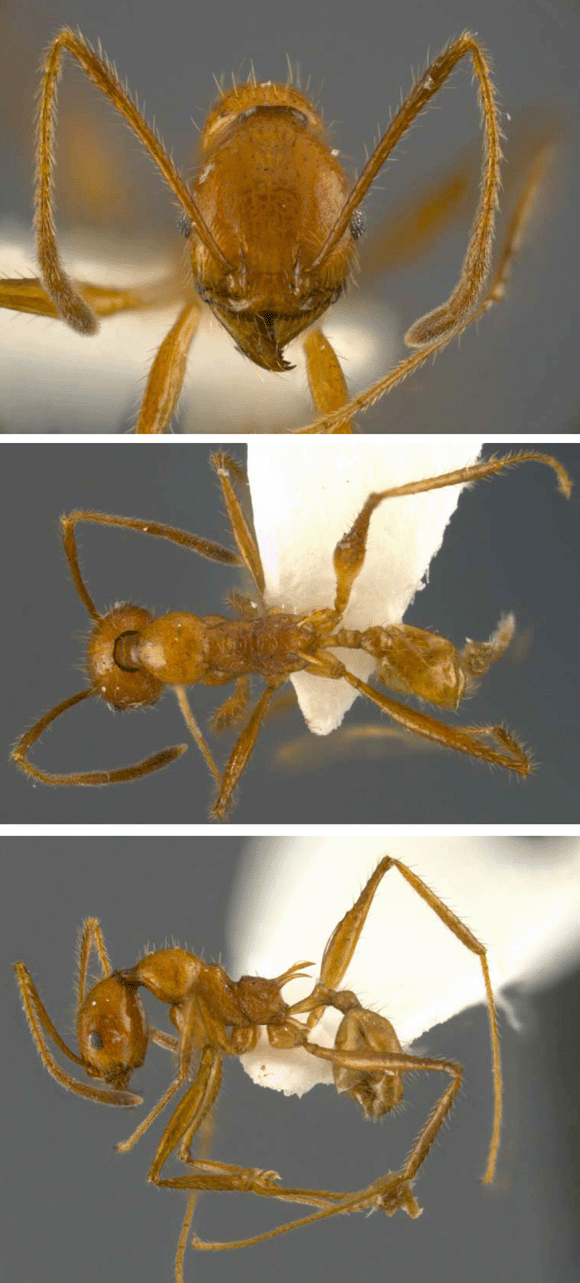
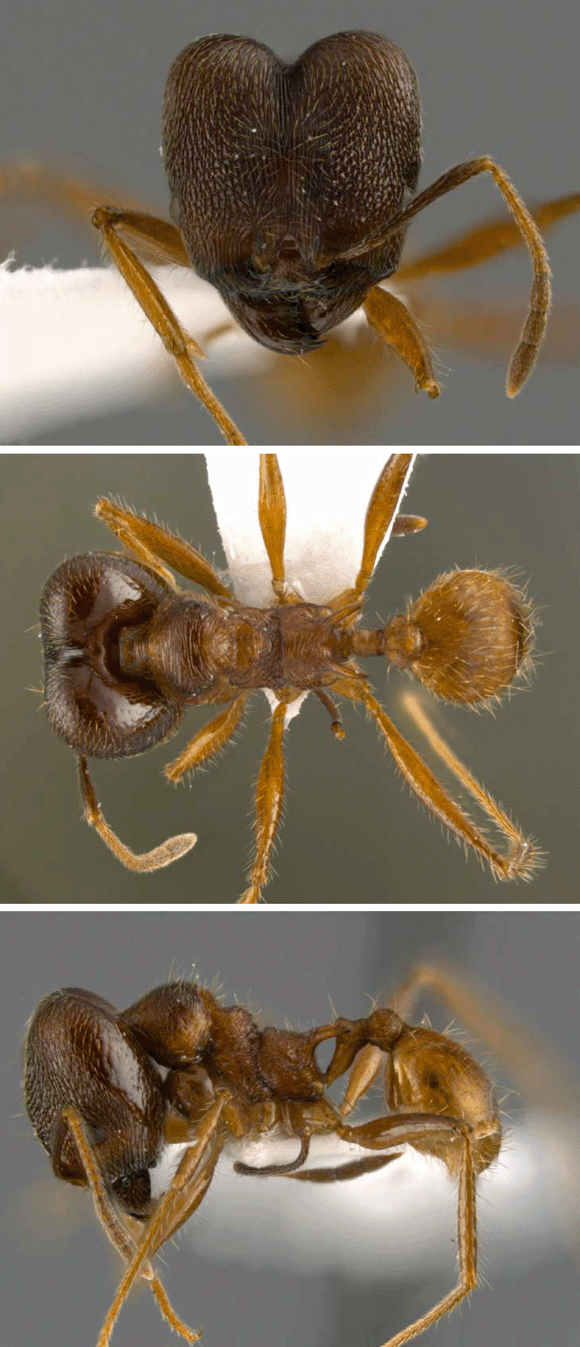
<body><![CDATA[<br>   OHT: distance between outer hypostomal teeth.    <br>   HTI: Hypostomal tooth index; 100*IHT/OHT.    <br>   When hypostomal teeth are curved laterally (either inward or outward), the approximate    midpoint of the base of the tooth is used, not the tip.</p>     <p><b>Repositories</b></p>     <p>ICN. Insect Collection, Instituto de Ciencias Naturales, Universidad Nacional    de Colombia, Bogot&aacute; D.C., Colombia.     <br>   MCZ. Museum of Comparative Zoology, Cambridge, MA, USA.    <br>   MZSP. Museum of Zoology, Universidade de S&atilde;o Paulo, SP, Brazil.</p>     <p><b>TAXONOMY</b></p>     <p><b><i>Pheidole iceni</i> new species</b>    <br>   <a href="#figura1">Figure 1</a>, <a href="#figura2">figure 2</a></p>     ]]></body>
<body><![CDATA[<p>    <center>     <img src="/img/revistas/cal/v33n2/v33n2a20fig1.gif"><a name="figura1"></a>   </center>     <center>       <p><b>Figure 1.</b> <i>Pheidole iceni</i> n. sp. Paratype, major worker. A. Head in      frontal view. B. Body in dorsal view. C. Body in lateral view.&nbsp; </p> </center>     <center>   <img src="/img/revistas/cal/v33n2/v33n2a20fig2.gif"><a name="figura2"></a>  </center>     <center>       <p><b>Figure 2.</b> <i>Pheidole iceni</i> n. sp. Paratype, minor worker. A. Head in      frontal view. B. Body in dorsal view. C. Body in lateral view.&nbsp; </p> </center>     <p><b>Holotype major worker.</b> Colombia, Choc&oacute;, La Balsa, Estaci&oacute;n    Silvicultural Bajo Atrato, 7&ordm;02'N 77&ordm;20'W, 1.ii.1994, F. Ferro leg.    (deposited in ICN).    <br>   <b>Paratypes:</b> Seven major workers, four minor workers, same data as holotype,    deposited in ICN, MCZ and MZSP.    <br>   <b>Geographic Range</b>    ]]></body>
<body><![CDATA[<br>   Colombia (Choc&oacute;).    <br>   <b> Diagnosis</b>    <br>   With the general habitus of <i>Pheidole fiorii</i> Emery in the <i>P. fallax</i>    group (Wilson 2003:291). Minor worker: head smooth and shining versus foveolated    and opaque / subopaque (fiorii); side of propodeum smooth and shining versus    with some foveolated (fiorii); metanotal groove deeply impressed versus shallowly    impressed (fiorii). Major worker: dorsal surface of mandible flat to weakly    convex versus with broad concavity covering basal half of dorsal surface (fossimandibula);    clypeus with large setal tufts in the form of pompons versus smooth and flat    (vestita) or with weak gibbosities (fossimandibula), setae sparse to abundant    but not in form of pompons (fossimandibula, vestita); face between frontal carinae    with large hemispherical concavity versus simple, typically convex (fossimandibula,    vestita).</p>     <p><b>Description of minor worker</b>    <br>   <i>Measurements</i> (paratype): HL 0.90, HW 0.65, HLA 0.33, SL 1.18, EL 0.14,    ML 1.24, PSL 0.36, PMG 0.05, SPL 0.037, PTW 0.13, PPW 0.21, CI 72, SI 182, PSLI    40, PMGI 5.5, SPLI 4.1, PPI 162.    <br>   Mandible and clypeus smooth and shining; three spaced concentric rugae around    antennal insertion, otherwise face smooth and shining; posterior margin of vertex    rounded; occipital carina well developed, visible in full face view; scape with    abundant erect setae as long as maximum width of scape and abundant reclined    setae; promesonotal groove present; metanotal groove deeply impressed; propodeal    spines long, thin, downturned; promesonotum smooth and shining; katepisternum    and lateral and dorsal faces of propodeum with irregular rugulae; abundant setae    (around 0.15 mm length or less) on all body; dorsal (outer) margin of hind tibia    with abundant suberect setae longer than maximum width of tibia; first gastral    tergum smooth and shining; color light brown.     <br>   <b>Description of major worker</b>    <br>   <i>Measurements</i> (holotype): HL 1.73, HW 1.36, HLA 0.41, SL 0.61, EL 0.22,    ML 1.41, PSL 0.05, PMG 0.00, SPL 0.07, PTW 0.29, PPW 0.49, IHT 0.25, OHT 0.54,    CI 79, SI 45, PSLI 3, PMGI 0, SPLI 4, PPI 168, HTI 45.    <br>   Mandible smooth and shining, somewhat flattened dorsally, with abundant piligerous    punctae and an even covering of long decumbent yellow setae; clypeus with two    large, horn-like gibbosities, but these covered from view by prominent tufts    of yellow setae that are erect at base, densely clustered on gibbosities like    sheaves of wheat, and then curve and become matted distally, forming globose    pompons; frontal carinae slanting obliquely outward posteriorly, forming dorsal    margins of prominent antennal scrobes, ventral margin of scrobe not sharply    defined; scrobe, side of head, and vertex lobes coarsely reticulate rugose;    area between frontal carinae and entire middle of face with a deep hemispherical    concavity; anterior portion of concavity with dense layer of minute piligerous    puncta from which arises a dense, short, yellow pubescence; posterior portion    of concavity grading into regular concentric rugae with somewhat longer pubescence;    rim of concavity with long, whisker-like setae laterally and posteriorly, basket-like;    rest of face and sides of head with abundant erect setae; scape microsculptured    and dull, not shining, terete at base, with abundant erect setae longer than    maximum width of scape; hypostomal margin straight; median tooth small; inner    hypostomal teeth pointed, stout, about one half distance from midline to outer    hypostomal teeth; promesonotal groove absent; propodeal spines present; pronotum    with reticulate rugae on humerus, sparse transverse carinulae anterolaterally,    otherwise generally smooth and shining; rest of mesosoma generally shining,    with some irregular rugulae and foveolae; dorsal (outer) margin of hind tibia    with abundant suberect setae longer than maximum width of tibia; pilosity abundant    on mesosomal dorsum; postpetiole in dorsal view strongly lenticular, much broader    than long; first gastral tergite with small patch of longitudinal etched microsculpture    near postpetiolar insertion, smooth and shining elsewhere, with abundant long    erect yellowish setae; color dark red brown.    <br>   <b>Biology</b>    ]]></body>
<body><![CDATA[<br>   Major and minor workers taken in low rainforest during the day.    <br>   <b>Comments</b>    <br>   The smooth and shining head, well developed occipital carinae, and long, downturned    propodeal spines differentiate the minor worker of this species of any other    in the genus and fallax group. <i>P. fiorii</i> Emery is near to this species,    but with clear differences (see diagnosis), including setae (shorter in iceni)    and color (light brown in iceni) and smooth and shining pronotum, sides of petiole    (variably foveolated in fiorii).     <br>   <b>Etymology</b>    <br>   The name is in reference to the 75th anniversary of the Instituto de Ciencias    Naturales of the Universidad Nacional de Colombia, Bogot&aacute;, D.C. Througout    its history the ICN has contributed greatly to the study and understanding of    the biological diversity of Colombia and the Neotropics as a whole. </p>     <p><b>ACKNOWLEDGEMENTS</b></p>     <p>Lauren Raz (ICN) for English improvement. To Claudia Ortiz (ICN) and Gary Alpert    (MCZ) for taking the pictures of the ants, and to the two evaluators for their    comments. </p>     <p><b>REFERENCES</b></p>     <!-- ref --><p> 1. LONGINO J.T. 2009. Additions to the taxonomy of New World Pheidole (Hymenoptera:    Formicidae). Zootaxa 2181:1-90.    &nbsp;&nbsp;&nbsp;&nbsp;&nbsp;&nbsp;&nbsp;&nbsp;[&#160;<a href="javascript:void(0);" onclick="javascript: window.open('/scielo.php?script=sci_nlinks&ref=000081&pid=S0366-5232201100020002000001&lng=','','width=640,height=500,resizable=yes,scrollbars=1,menubar=yes,');">Links</a>&#160;]<!-- end-ref --><!-- ref --><br>   2. WILSON, E.O. 2003. Pheidole in the New World: A Dominant, Hyperdiverse Ant    Genus. Harvard University Press, Cambridge, Mass., 794 pp.    &nbsp;&nbsp;&nbsp;&nbsp;&nbsp;&nbsp;&nbsp;&nbsp;[&#160;<a href="javascript:void(0);" onclick="javascript: window.open('/scielo.php?script=sci_nlinks&ref=000082&pid=S0366-5232201100020002000002&lng=','','width=640,height=500,resizable=yes,scrollbars=1,menubar=yes,');">Links</a>&#160;]<!-- end-ref --><br> </p> </font>       ]]></body><back>
<ref-list>
<ref id="B1">
<label>1.</label><nlm-citation citation-type="journal">
<person-group person-group-type="author">
<name>
<surname><![CDATA[LONGINO]]></surname>
<given-names><![CDATA[J.T.]]></given-names>
</name>
</person-group>
<article-title xml:lang="en"><![CDATA[Additions to the taxonomy of New World Pheidole (Hymenoptera: Formicidae)]]></article-title>
<source><![CDATA[Zootaxa]]></source>
<year>2009</year>
<volume>2181</volume>
<page-range>1-90</page-range></nlm-citation>
</ref>
<ref id="B2">
<label>2.</label><nlm-citation citation-type="book">
<person-group person-group-type="author">
<name>
<surname><![CDATA[WILSON]]></surname>
<given-names><![CDATA[E.O.]]></given-names>
</name>
</person-group>
<source><![CDATA[Pheidole in the New World: A Dominant, Hyperdiverse Ant Genus]]></source>
<year>2003</year>
<page-range>794</page-range><publisher-loc><![CDATA[Cambridge^eMass Mass]]></publisher-loc>
<publisher-name><![CDATA[Harvard University Press]]></publisher-name>
</nlm-citation>
</ref>
</ref-list>
</back>
</article>