<?xml version="1.0" encoding="ISO-8859-1"?><article xmlns:mml="http://www.w3.org/1998/Math/MathML" xmlns:xlink="http://www.w3.org/1999/xlink" xmlns:xsi="http://www.w3.org/2001/XMLSchema-instance">
<front>
<journal-meta>
<journal-id>0366-5232</journal-id>
<journal-title><![CDATA[Caldasia]]></journal-title>
<abbrev-journal-title><![CDATA[Caldasia]]></abbrev-journal-title>
<issn>0366-5232</issn>
<publisher>
<publisher-name><![CDATA[Instituto de Ciencias Naturales, Facultad de Ciencias-Universidad Nacional de Colombia]]></publisher-name>
</publisher>
</journal-meta>
<article-meta>
<article-id>S0366-52322012000100016</article-id>
<title-group>
<article-title xml:lang="en"><![CDATA[NEW SPECIES AND PREVIOUSLY UNKNOWN MALES OF NEOTROPICAL CLEPTOBIOTIC STINGLESS BEES (HYMENOPTERA, APIDAE, Lestrimelitta)]]></article-title>
<article-title xml:lang="es"><![CDATA[Especies nuevas y machos previamente desconocidos de abejas sin aguijón cleptobióticas neotropicales (Hymenoptera, Apidae, Lestrimelitta)]]></article-title>
</title-group>
<contrib-group>
<contrib contrib-type="author">
<name>
<surname><![CDATA[GONZALEZ]]></surname>
<given-names><![CDATA[VICTOR H]]></given-names>
</name>
<xref ref-type="aff" rid="A01"/>
</contrib>
<contrib contrib-type="author">
<name>
<surname><![CDATA[GRISWOLD]]></surname>
<given-names><![CDATA[TERRY L]]></given-names>
</name>
<xref ref-type="aff" rid="A02"/>
</contrib>
</contrib-group>
<aff id="A01">
<institution><![CDATA[,University of Kansas  ]]></institution>
<addr-line><![CDATA[ ]]></addr-line>
<country>USA</country>
</aff>
<aff id="A02">
<institution><![CDATA[,Utah State University  ]]></institution>
<addr-line><![CDATA[ ]]></addr-line>
<country>USA</country>
</aff>
<pub-date pub-type="pub">
<day>00</day>
<month>06</month>
<year>2012</year>
</pub-date>
<pub-date pub-type="epub">
<day>00</day>
<month>06</month>
<year>2012</year>
</pub-date>
<volume>34</volume>
<numero>1</numero>
<fpage>227</fpage>
<lpage>245</lpage>
<copyright-statement/>
<copyright-year/>
<self-uri xlink:href="http://www.scielo.org.co/scielo.php?script=sci_arttext&amp;pid=S0366-52322012000100016&amp;lng=en&amp;nrm=iso"></self-uri><self-uri xlink:href="http://www.scielo.org.co/scielo.php?script=sci_abstract&amp;pid=S0366-52322012000100016&amp;lng=en&amp;nrm=iso"></self-uri><self-uri xlink:href="http://www.scielo.org.co/scielo.php?script=sci_pdf&amp;pid=S0366-52322012000100016&amp;lng=en&amp;nrm=iso"></self-uri><abstract abstract-type="short" xml:lang="en"><p><![CDATA[Three new species of cleptobiotic stingless bees of the genus Lestrimelitta Friese, L. opita sp. n. and L. huilensis sp. n. from Colombia and L. catira sp. n. from Venezuela, are described and figured. The males of the Central American species L. chamelensis, L. danuncia, and L. mourei are also described and figured. New geographical records and an updated key to species from Central America and northern South America are provided.]]></p></abstract>
<abstract abstract-type="short" xml:lang="es"><p><![CDATA[Se describen e ilustran tres especies nuevas de abejas sin aguijón cleptobióticas del género Lestrimelitta Friese, L. opita sp. n. y L. huilensis sp. n. de Colombia y L. catira sp. n. de Venezuela. También se describen e ilustran los machos de las especies Centroamericanas L. chamelensis, L. danuncia y L. mourei. Se presentan registros geográficos nuevos y una clave actualizada para las especies de Centroamérica y norte de Suramérica.]]></p></abstract>
<kwd-group>
<kwd lng="en"><![CDATA[Anthophila]]></kwd>
<kwd lng="en"><![CDATA[Apoidea]]></kwd>
<kwd lng="en"><![CDATA[Meliponini]]></kwd>
<kwd lng="en"><![CDATA[Colombia]]></kwd>
<kwd lng="en"><![CDATA[Venezuela]]></kwd>
<kwd lng="en"><![CDATA[taxonomy]]></kwd>
<kwd lng="es"><![CDATA[Anthophila]]></kwd>
<kwd lng="es"><![CDATA[Apoidea]]></kwd>
<kwd lng="es"><![CDATA[Meliponini]]></kwd>
<kwd lng="es"><![CDATA[Colombia]]></kwd>
<kwd lng="es"><![CDATA[Venezuela]]></kwd>
<kwd lng="es"><![CDATA[taxonomía]]></kwd>
</kwd-group>
</article-meta>
</front><body><![CDATA[  <font size="2" face="verdana">      <p><font size="4">    <center><b>NEW SPECIES AND PREVIOUSLY UNKNOWN MALES OF NEOTROPICAL CLEPTOBIOTIC   STINGLESS BEES (HYMENOPTERA, APIDAE, <i>Lestrimelitta</i>)</b></center></font></p>     <p><font size="3">    <center><b>Especies nuevas y machos previamente desconocidos de abejas sin aguij&oacute;n   cleptobi&oacute;ticas neotropicales (Hymenoptera, Apidae, <i>Lestrimelitta</i>)</b></center></font></p>         <p><b>VICTOR H. GONZALEZ</b>    <br> <b>TERRY L. GRISWOLD</b></p>     <p><i>Division   of Entomology, Natural History Museum, 1501 Crestline Drive – Suite 140,   University of Kansas, Lawrence, Kansas 66045, USA. <a href="mailto:victorgonzab@gmail.com">victorgonzab@gmail.com</a></i></p>     <p><i>USDA-ARS, Bee Biology &amp; Systematics Laboratory, Utah State University, Logan, Utah 84322-5310, USA. <a href="mailto:terry.griswold@ars.usda.gov">terry.griswold@ars.usda.gov</a></i></p> <hr>      <p><b>ABSTRACT</b></p>     ]]></body>
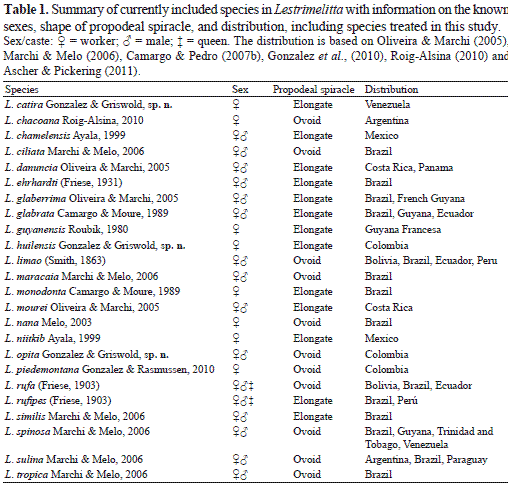
<body><![CDATA[<p>Three   new species of cleptobiotic stingless bees of the genus <i>Lestrimelitta</i> Friese, <i>L. opita</i> sp. n. and <i>L. huilensis</i> sp. n. from Colombia and <i>L. catira</i> sp. n. from Venezuela, are   described and figured. The males of the Central American species <i>L.   chamelensis</i>, <i>L. danuncia</i>, and <i>L. mourei</i> are also described   and figured. New geographical records and an updated key to species from   Central America and northern South America are   provided.</p>     <p><b>Key words.</b> Anthophila, Apoidea, Meliponini, Colombia, Venezuela,   taxonomy.</p> <hr>      <p><b>RESUMEN</b></p>     <p>Se   describen e ilustran tres especies nuevas de abejas sin aguij&oacute;n cleptobi&oacute;ticas   del g&eacute;nero <i>Lestrimelitta</i> Friese, <i>L. opita</i> sp. n. y <i>L.   huilensis</i> sp. n. de Colombia y <i>L. catira</i> sp. n. de Venezuela. Tambi&eacute;n se describen e ilustran los machos de las especies   Centroamericanas <i>L. chamelensis</i>, <i>L. danuncia</i> y <i>L. mourei</i>. Se presentan registros geogr&aacute;ficos nuevos y una clave   actualizada para las especies de Centroam&eacute;rica y norte de Suram&eacute;rica. </p>     <p><b>Palabras clave.</b> Anthophila, Apoidea, Meliponini, Colombia, Venezuela, taxonom&iacute;a.</p> <hr>      <p>Recibido: 18/11/2011    <br> Aceptado: 15/12/2011</p> <hr>      <p><b>INTRODUCTION</b></p>     <p>Unusual   and astonishing behaviors are often found in the commonly encountered stingless   bees, highly eusocial bees restricted to the tropical areas of the world but   more abundant and diverse in the Western Hemisphere   (<i>e.g</i>., Michener 2007). Examples of these are the defensive behavior of <i>Oxytrigona</i> Cockerell, whose workers repel intruders by biting and depositing into the skin   a mandibular secretion that contains formic acid and causes a long-lasting   blister (<i>e.g</i>., Michener 2007); the mutualistic relationship of <i>Plebeia   coccidophila</i> (Camargo &amp; Pedro) with a soft-scale insect (<i>Cryptostigma</i> sp.; Coccidae), which is housed inside the bee nest and provides sweet   secretions and additional wax to build the nest (Camargo &amp; Pedro 2002); the   obligate necrophagy of <i>Trigona hypogea </i>Silvestri, <i>T. crassipes </i>(Fabricius),   and <i>T. necrophaga </i>Camargo &amp; Roubik, the only known species to use   the flesh of dead animals as their only source of protein (Roubik 1982, Camargo   &amp; Roubik 1991); the lacrophilic behavior (tear drinking habits) of minute   Asian stingless bees of the genera <i>Lisotrigona</i> Moure and <i>Pariotrigona</i> Moure at mammalian eyes presumably to obtain proteins in addition to, or in   lieu of pollen (Bänziger <i>et al</i>. 2009); the pollen or propolis collecting   behavior exhibited by males of some Asian species which, while lacking a corbicula,   frequently carry these materials on a metatibia that resembles those of the   workers (Boongird &amp; Michener 2010); and the obligate robbing or   cleptobiotic behavior of the Neotropical <i>Lestrimelitta</i> Friese and the   African <i>Cleptotrigona</i> Moure, which despite having nests of their own,   steal food and nest materials from other stingless bees and even honey bees   (Portugal-Ara&uacute;jo 1958, Sakagami <i>et al</i>., 1993). <i>Trichotrigona</i> Camargo &amp; Moure, a monotypic genus from the Brazilian Amazon, is likely   another cleptobiotic bee or possibly the only known meliponine social parasite,   given the reduction of pollen-manipulating structures on the hind leg (Camargo   &amp; Pedro 2007a, Michener 2007).</p>      <p><i>Lestrimelitta</i> is   widely distributed in the Neotropical region, with apparent center of diversity   in Brazil;   14 of the 21 currently recognized species are from there (<a href="#tabla1">Table 1</a>). Such a high   diversity of <i>Lestrimelitta</i> in Brazil is likely due to the country's large expanse that covers a significant area of South America as well as the result of the effort of   numerous Brazilian researchers to document their bee fauna. Other South   American countries, such as Colombia, despite having preliminary checklists,   are still in early stages of exploration as indicated by the number of taxa   discovered in recent years (<i>e.g</i>., Engel 1997, 2009, 2010, Engel &amp;   Gonzalez 2009, Gonzalez 2004, 2006, Gonzalez &amp; Engel 2004, 2011, Gonzalez   &amp; Ruz 2007, Smith-Pardo &amp; Gonzalez 2007, 2009, Gonzalez <i>et al</i>.,   2010, Gonzalez &amp; Florez 2011, Gonzalez &amp; Griswold 2011, Gonzalez &amp;   Engel 2012). </p>     ]]></body>
<body><![CDATA[<p>    <center><img src="/img/revistas/cal/v34n1/v34n1a16tab1.gif"><a name="tabla1"></a></center></p>      <p><i>Lestrimelitta</i> is likely to be   related to <i>Plebeia</i> Schwarz, as suggested by both morphological and   molecular studies (Michener 2007, Rasmussen &amp; Cameron (2010). When compared   to other stingless bee genera, <i>Lestrimelitta</i> species seem to be   monotonously similar at first glance, but recent works (<i>e.g</i>., Ayala   1999, Oliveira 2002, Melo 2003, Oliveira &amp; Marchi 2005, Marchi &amp; Melo   2006, Gonzalez <i>et al</i>., 2010, Roig-Alsina 2010) have highlighted and   illustrated a suitable set of characters that are reliable in species   recognition. Those characters include the shape of the propodeal spiracle,   length of the mesotibial spur, presence or absence of hairs on the body, and   the length, density, and type of pubescence. Two large species groups can be   recognized within <i>Lestrimelitta</i> based on the shape of the propodeal   spiracle (<a href="#tabla1">Table 1</a>): the exclusively South American<i> limao</i> species group,   which consists of species with an ovoid propodeal spiracle, 2–3 times longer   than broad (c.f. Marchi &amp; Melo 2006; <a href="#figura1">fig. 1</a>, Gonzalez <i>et al</i>. 2010;   <a href="#figura1">fig. 2D</a>), and the <i>ehrhardti</i> species group found in both Central and   South America distinguished by an elongate propodeal spiracle, at least 4.6   times longer than broad (c.f. Marchi &amp; Melo 2006; <a href="#figura1">fig. 2</a>).</p>     <p>    <center><img src="/img/revistas/cal/v34n1/v34n1a16fig1.gif"><a name="figura1"></a></center></p>      <p>Herein   we describe three new species of <i>Lestrimelitta</i>: one of the <i>limao</i> species group from Colombia and two of the <i>ehrhardti</i> species group, one from Colombia and one from Venezuela. We also describe the   previously unknown males of three Central American species of the <i>ehrhardti</i> species group: <i>L. chamelensis</i>, <i>L. danuncia</i>, and <i>L. mourei</i>.   We also provide new geographical records and an updated key to species from   Central America and northern South America. </p>      <p><b>MATERIAL  AND METHODS</b></p>     <p>Morphological terminology and measurements (<i>e.g</i>., interalveolar,   alveolocular, ocellocular distances, etc.) follow that of Michener (2007).   Measurements were taken using an ocular micrometer on a Leica&reg; MZ12   stereomicroscope. Photomicrographs were taken using a Keyence&reg; VHX- 500F Digital Imaging System.   The abbreviations S and T are used for metasomal sterna and terga. The symbol   for female and the word itself are used below for worker, not queen.   Institutional acronyms used herein are: BBSL, U.S. National Pollinating Insects   Collection, Bee Biology and Systematics Laboratory, Utah State University, Logan, UT, USA; ICN, Instituto de Ciencias Naturales,   Universidad Nacional de Colombia, Bogot&aacute;, Colombia; and USNM, National Museum of Natural   History, Washington, DC, USA.   The novelty of the species described herein were confirmed by comparison with   specimens (including types) of other <i>Lestrimelitta</i> species deposited at   BBSL, ICN, and the Snow Entomological Collection, Division of Entomology,   Natural History Museum, University of Kansas, Lawrence, Kansas, USA.</p>      <p><b>SYSTEMATICS Tribe  Meliponini Lepeletier de Saint Fargeau, 1836 Genus <i>Lestrimelitta</i> Friese, 1903</b></p>     <p><b>Diagnosis. </b><i>Lestrimelitta</i> consists of small (4–7 mm long) species with shiny, sparsely haired bodies that   lack the metatibial corbiculae for carrying pollen found in other stingless   bees. The genus can also be recognized by the following combination characters:   metatibia without penicillum and with a rastellum consisting of tapering hairs;   first flagellomere shorter than combined lengths of second and third   flagellomeres in workers, shorter than second flagellomere in males; male sixth   and seventh sterna with long basolateral apodemes; male sixth sternum medially   emarginated on distal margin.</p>      ]]></body>
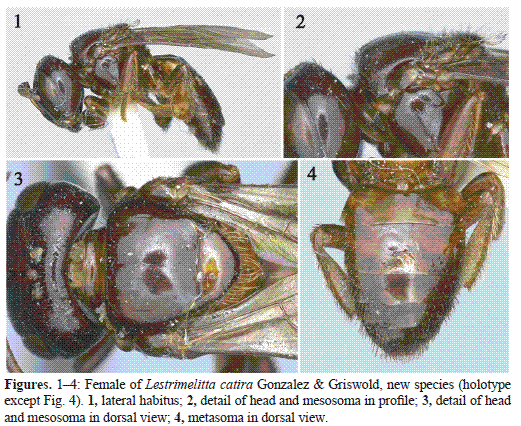
<body><![CDATA[<p><b><i>Lestrimelitta   catira</i></b>, new species</p>     <p>(<a href="#figura1">Figs.   1–4</a>)</p>        <p><b>Holotype.</b> Venezuela: &#9792;,   Caripito, Edo. Monagas – XII-14-43, R. Maduro   / Robbing honey from hive / C.H. Ballou, No BHT / LotNo 44-21773 (USNM). </p>        <p><b>Paratypes.</b> 2&#9792;, same data as   holotype (BBSL, USNM).</p>      <p><b>Diagnosis.</b> This species is most similar to <i>L.   rufipes</i> (Friese) and <i>L. huilensis</i>, which share the following   characters: propodeal spiracle elongate; vertex, preoccipital border and   anterior margin of mesoscutum with erect hairs; and pronotal lobe and tegula   without erect hairs. It can be easily distinguished by body color predominantly   reddish-brown, distinctly lighter than in those species, and body pubescence on   vertex, preoccipital border, and anterior margin of mesoscutum much shorter and   sparser, and on disc of mesoscutellum practically absent (<a href="#figura1">Figs. 1–3</a>). In <i>L.   rufipes,</i> the erect hairs of these areas are in general long and abundant;   on vertex and preoccipital border at least as long as median ocellar diameter;   on mesoscutum present along anterior margin as well as on anterior one-third of   disc medially; on disc of mesoscutellum abundant, about as long as (about twice   as long as median ocellar diameter) or slightly shorter than those on the   distal margin. Refer to diagnosis of <i>L. huilensis</i> for comparative   comments with that species. </p>      <p><b>Description.</b> &#9792;. Total body length 6.7 mm;   forewing length 4.4 mm;   head width 2.3 mm.   Head 1.3 times broader than long; inner orbits of compound eyes subparallel;   malar area 1.5 times median ocellar diameter; clypeus 3.5 times broader than   long; interalveolar distance shorter (0.8x) than alveolar diameter;   alveolocular distance about twice as long as alveolar diameter, 2.5 times   interalveolar distance; interocellar distance 2.8 times median ocellar   diameter, shorter (0.8x) than ocellocular distance; scape about 6.3 times   longer than wide; pedicel longer than broad; first flagellomere about as long   as broad, longer than second flagellomere, remaining flagellomeres broader than   long, except apical flagellomere much longer than broad; compound eye 2.5   longer than broad; gena broader than width of compound eye in profile.   Propodeal spiracle elongate, about 5.2 times longer than wide; metatibia about   three times longer than broad.</p>      <p>Integument smooth and shiny between minute, sparse punctures as in other   species of the genus; terga and sterna weakly lineolate-imbricate.</p>     <p>Color predominantly reddish-brown, except yellowish to light   reddish-brown on clypeus distally, labrum, outer surface of mandible, anterior   surface of scape, legs, propodeal triangle, and sterna. Wing   membrane yellowish; veins and pterostigma light brown.</p>      <p>Body   largely glabrous, sparsely covered with minute, appressed, simple yellowish to   whitish hairs except long, stout, erect hairs as follows: distal margin of   labrum and inferior margin of mandible (longest at least twice median ocellar   diameter); vertex and preoccipital border with few sparse hairs (at most width   of median ocellar diameter); anterior and lateral margins (next to axilla) of   mesoscutum, axilla, and mesoscutellum (1–2 times median ocellar diameter),   hairs longer on mesoscutellum; mesepisternum ventrally, meso- and, metacoxae,   mesotibia, and propodeum laterally (1–1.5 times median ocellar diameter);   posterior margin of metatibia, sides of T2–T4, entire T5 and T6 with dark brown   hairs (1.5–2 times median ocellar diameter) (<a href="#figura1">Fig. 4</a>).</p>      <p><b>Etymology.</b> The specific epithet is a word used by   Venezuelan people to describe a blonde or red-headed person; this word is used   herein in reference to the reddish coloration of this species.</p>     ]]></body>
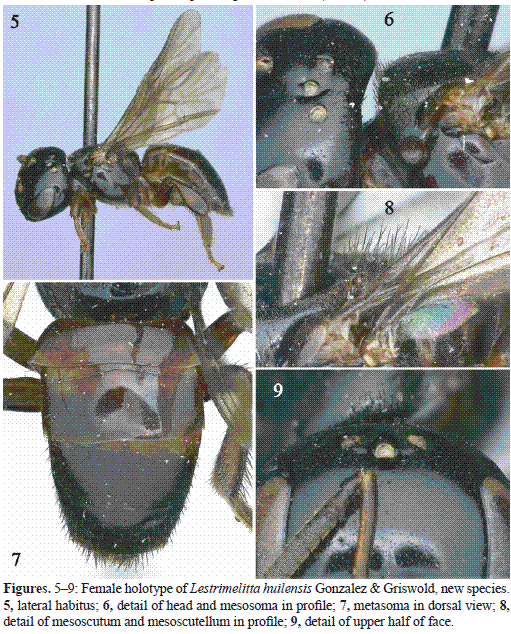
<body><![CDATA[<p><b>Comments.</b> The mesotibial spurs of the holotype and   one of the paratypes are presumably broken-off because in the remaining   paratype, which has the head glued to a point and missing left leg, the right   mesotibial spur is long, about 1.3 times longer than mesobasitarsal width. </p>      <p><b><i>Lestrimelitta   huilensis</i></b>, new species</p>     <p>(<a href="#figura5">Figs.   5–9</a>)</p>     <p>    <center><img src="/img/revistas/cal/v34n1/v34n1a16fig5.gif"><a name="figura5"></a></center></p>      <p><b>Holotype.</b> Colombia:   &#9792;, Huila, Rivera, Cementerio, 29.mar.1994, 745 m, G. Nates. Leg. / ICN   037926 (Barcode label) (ICN). </p>      <p><b>Diagnosis.</b> This species is most similar to <i>L.   rufipes</i> and <i>L. catira</i>, which share the following characters: propodeal   spiracle elongate; vertex, preoccipital border, and anterior margin of   mesoscutum with erect hairs; and sides of mesepisternum, pronotal lobe, and   tegula without erect hairs. It differs from <i>L. rufipes</i> in the vertex,   preoccipital border, and anterior margin of mesoscutum with shorter, sparser   erect hairs (<a href="#figura5">Fig. 6</a>); anterior one-third of disc of mesoscutum medially without   erect hairs; mesoscutellum with disc covered by short, sparse hairs contrasting   with long, abundant hairs on distal margin. It differs from <i>L. catira</i> in   the body color predominantly dark reddish-brown (<a href="#figura5">Figs. 5–9</a>), pubescence dense   on anterior margin of mesoscutum and mesoscutellum, on metasomal terga much   shorter, sparser. In <i>L. catira</i>, the body color is predominantly   reddish-brown, distinctly lighter than in <i>L. huilensis</i>; anterior margin   of mesoscutum with sparser erect hairs, especially medially; disc of   mesoscutellum largely glabrous; metasomal terga with longer, denser hairs   (compare <a href="#figura1">Figs. 4</a> and <a href="#figura5">7</a>), particularly on sides of T2 and discs of terminal   segments. </p>      <p><b>Description.</b> &#9792;. Total body length 6.1 mm; forewing length 4.9 mm; head width 2.1 mm. Head 1.3 times   broader than long; inner orbits of compound eyes subparallel; malar area 1.4   times median ocellar diameter; clypeus 3.1 times broader than long;   interalveolar distance shorter (0.9x) than alveolar diameter; alveolocular   distance 1.9 times alveolar diameter, 2.2 times interalveolar distance;   interocellar distance 2.3 times median ocellar diameter, shorter (0.8x) than   ocellocular distance; scape about 6.4 times longer than wide; pedicel longer   than broad; first flagellomere about as long as broad, longer than second   flagellomere, remaining flagellomeres broader than long, except apical   flagellomere much longer than broad; compound eye 2.5 longer than broad; gena   broader than width of compound eye in profile. Propodeal spiracle elongate,   about 4.6 times longer than wide; mesotibial spur long, about 1.3 times   mesobasitarsal width basally; metatibia about three times longer than broad.</p>      <p>Integument smooth and shiny between minute, sparse punctures as in other   species of the genus; terga and sterna weakly lineolate-imbricate.    <br> Color   predominantly dark reddish-brown, lighter on labrum, mandible (except basally),   clypeal margin, legs, T1 and T2, and sterna. Wing membrane yellowish; veins and   pterostigma light brown.</p>      ]]></body>
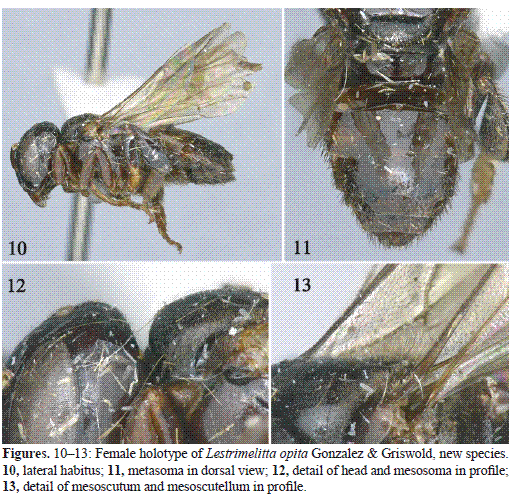
<body><![CDATA[<p>Body   largely glabrous, sparsely covered with minute, appressed, simple yellowish   hairs except long, stout, erect hairs as follows: distal margin of labrum and   inferior margin of mandible (longest at least twice median ocellar diameter);   vertex and preoccipital border with few sparse hairs (at most half width of   median ocellar diameter); anterior and lateral margins (next to axilla) of   mesoscutum (1–2 times median ocellar diameter) (<a href="#figura5">Figs. 6, 9</a>); axilla (about as   long as median ocellar diameter); mesoscutellum with sparse hairs on disc   (about as long as median ocellar diameter), much longer (2 times median ocellar   diameter) on distal margin (<a href="#figura5">Fig. 8</a>); mesepisternum ventrally, meso- and, metacoxae,   mesotibia, and propodeum laterally (1–1.5 times median ocellar diameter);   posterior margin of metatibia (1.3–2 times median ocellar diameter), sides of   T2–T4, entire T5 and T6 with dark brown hairs (0.5–2 times median ocellar   diameter) (<a href="#figura5">Fig. 7</a>).</p>      <p><b>Etymology.</b> The specific epithet refers to Huila, the   department in Colombia where the species is currently known to occur.</p>     <p><b>Comments.</b> Based on the limited material available   it appears that <i>L. huilensis </i>and <i>L. catira</i> are allopatric species   inhabiting different ecosystems: <i>L. catira</i> occupying deltaic savannas in   northeastern Venezuela, <i>L.   huilensis</i> inhabiting dry forests along the Magdalena Valley in Colombia. <i>Lestrimelitta   huilensis </i>is likely to be sympatric with <i>L. opita</i>, the only other <i>Lestrimelitta</i> species known to occur along the valley of the Magdalena River in Colombia. It can be easily   separated from that species by the shape of the propodeal spiracle (ovoid in <i>L.   opita</i>) and the presence of erect hairs on the vertex, preoccipital ridge,   and anterior margin of mesoscutum (hairs absent in <i>L. opita</i>). </p>      <p><b><i>Lestrimelitta   opita</i></b>, new species</p>     <p>(<a href="#figura10">Figs.   10</a>–<a href="#figura14">21</a>)</p>     <p>    <center><img src="/img/revistas/cal/v34n1/v34n1a16fig10.gif"><a name="figura10"></a></center></p>      <p><b>Holotype.</b> Colombia:   &#9792;, Tol. &#91;Tolima&#93;, Armero, malaise trap, 26–30-I-1977,   Peyton &amp; Suarez (USNM).</p>      <p><b>Paratypes.</b> 2&#9794;, same date as   holotype except I-5-II-197, E.L. Peyton (BBSL, USNM). </p>     <p><b>Diagnosis.</b> Both sexes of this species are most   similar to <i>L. limao</i> (Smith) and <i>L. ciliata</i> Marchi &amp; Melo,   which share the following characters: propodeal spiracle ovoid; sides of   mesepisternum and disc of mesoscutum practically glabrous, without erect hairs;   and mesotibial spur reduced. It can be easily distinguished from those species   by anterior margin of mesoscutum without erect hairs (<a href="#figura10">Figs. 12</a>, <a href="#figura14">14</a>).</p>     ]]></body>
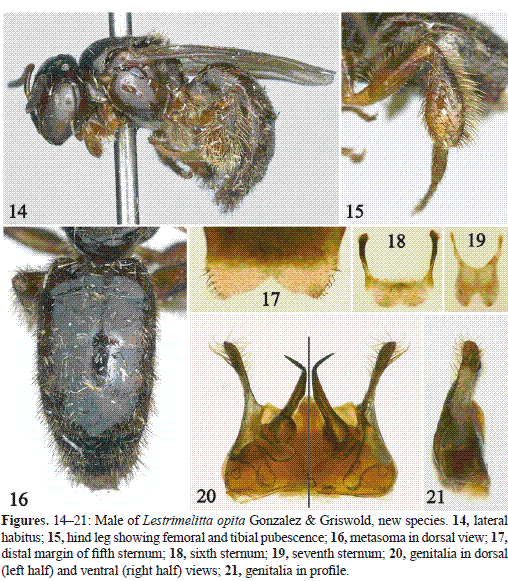
<body><![CDATA[<p>    <center><img src="/img/revistas/cal/v34n1/v34n1a16fig14.gif"><a name="figura14"></a></center></p>      <p><b>Description.</b> &#9792;. Total body length 5.3 mm;   forewing length 4.3 mm;   head width 2.1 mm. </p>     <p>Head   1.3 times broader than long; inner orbits of compound eyes subparallel; malar   area about as long as median ocellar diameter; clypeus about 3.3 times broader   than long; interalveolar distance shorter (0.8x) than alveolar diameter;   alveolocular distance 1.8 times alveolar diameter, 2.1 times interalveolar   distance; interocellar distance 2.4 times median ocellar diameter, shorter   (0.9x) than ocellocular distance; scape about six times longer than wide;   pedicel longer than broad; first flagellomere about as long as broad, longer   than second flagellomere, remaining flagellomeres broader than long, except   apical flagellomere much longer than broad; compound eye 2.4 longer than broad;   gena broader than width of compound eye in profile. Propodeal   spiracle ovoid, about three times longer than wide; metatibia about three times   longer than broad. </p>      <p>Integument smooth and shiny between minute, sparse punctures as in other   species of the genus; terga and sterna weakly lineolate-imbricate.    <br> Color   predominantly dark reddish-brown, lighter on labrum, mandible (except basally),   legs (except metafemur and metatibia), and basal terga and sterna. Wing   membrane yellowish; veins and pterostigma light brown.</p>     <p>Body   largely glabrous, sparsely covered with minute, appressed, simple yellowish   hairs except long, stout, erect hairs as follows: distal margin of labrum and   inferior margin of mandible (longest at least twice median ocellar diameter);   vertex with very few sparse hairs (at most half width of median ocellar   diameter); pronotal lobe inferiorly, anterolateral corner and lateral margin   (next to axilla) of mesoscutum, axilla, and disc of mesoscutellum with few dark   brown hairs (about as long as width of median ocellar diameter or less);   posterior margin of mesoscutellum with longer hairs (1.3–1.6 times median   ocellar diameter) (<a href="#figura10">Fig. 13</a>); mesepisternum ventrally, meso- and, metacoxae,   mesotibia, and propodeum laterally (1–1.5 times median ocellar diameter);   posterior margin of metatibia, sides of T1–T4, entire T5 and T6 with dark brown   hairs increasing in length towards apical terga (1.5–2 times median ocellar   diameter) (<a href="#figura10">Fig. 11</a>).</p>      <p>&#9794;. As in female except for yellowish   inferior paraocular area (next to inner orbit of compound eye), distal margin   of clypeus, labrum, mandible, and legs, and the following: Total body length   6.1–6.8 mm; forewing length 3.9–4.1 mm; head width 1.9–2.0 mm. Inner orbits of   compound eyes slightly converging below; malar area short, about one-third   width of median ocellar diameter; clypeus about 2.5 times broader than long;   alveolocular distance 1.3 times alveolar diameter, 1.5 times interalveolar   distance; interocellar distance about twice as long as median ocellar diameter,   1.2 times ocellocular distance; scape about 5.5 times longer than wide; pedicel   about as long as broad; first flagellomere slightly broader than long, about as   long as second flagellomere, remaining flagellomeres about as long as broad,   except apical flagellomere much longer than broad; compound eye 2.3 longer than   broad; gena narrower (~0.6x) than width of compound eye in profile. Metatibia 2.7 times longer than broad. T5 apical margin   invaginated medially. S5–S7 and genital capsule as in <a href="#figura14">figures   17–21</a>. Pubescence in general longer and denser than in   female, especially on mesofemur and mesotibia (0.5–1 times median ocellar   diameter), metafemur and metatibia (1–2 times median ocellar diameter), and   metasoma (Figs. <a href="#figura14">14–16</a>). </p>      <p><b>Etymology.</b> The specific epithet is a   self-referential nickname for inhabitants of the department of Tolima, the area   where this species is currently known. </p>     <p><b><i>Lestrimelitta   chamelensis</i></b> <b>Ayala</b></p>     ]]></body>
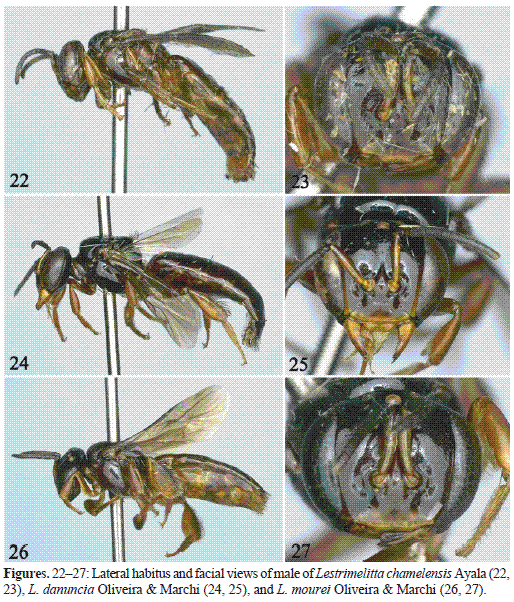
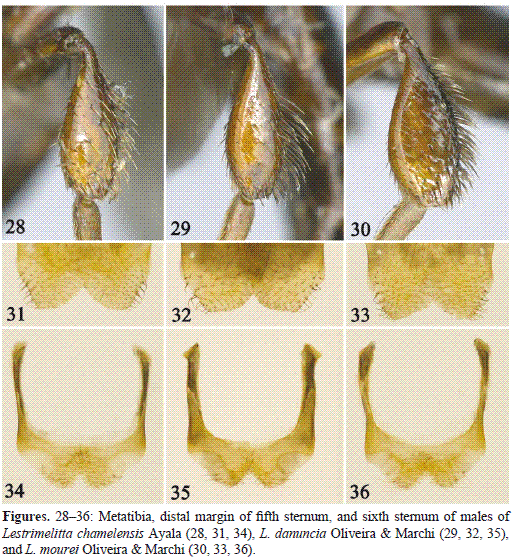
<body><![CDATA[<p><i>Lestrimelitta chamelensis</i> Ayala, 1999: 25 &#91;&#9792;&#93;.</p>      <p>(<a href="#figura22">Figs.   22, 23</a>, <a href="#figura28">28, 31, 34</a>)</p>     <p>    <center><img src="/img/revistas/cal/v34n1/v34n1a16fig22.gif"><a name="figura22"></a></center></p>     <p>    <center><img src="/img/revistas/cal/v34n1/v34n1a16fig28.gif"><a name="figura28"></a></center></p>      <p><b>Diagnosis.</b> The female of this species can be   separated from other Central American species of <i>Lestrimelitta</i> by the   following combination of characters: small body size (length about 5 mm); head and mesosoma   practically glabrous, except for scattered hairs on preoccipital border and   distal margin of mesoscutellum; mesotibia without erect hairs on outer surface;   and mesotibial spur very reduced. The male can be recognized by mesotibial spur   reduced, mesoscutellum with few short hairs on distal margin (at most as long as   median ocellar diameter), and metatibia with sparse, rather long hairs (about   as long as median ocellar diameter or longer) on outer surface (<a href="#figura28">Fig. 28</a>). </p>      <p><b>Description.</b> &#9794;. Total body length 7.1 mm;   forewing length 3.9 mm;   head width 1.9 mm.   Head 1.2 times broader than long; inner orbits of compound eyes slightly   converging below (<a href="#figura22">Fig. 23</a>); malar area short, about half width of median   ocellar diameter; clypeus about twice as broad as long; interalveolar distance   shorter (0.8x) than alveolar diameter; alveolocular distance 1.4 times alveolar   diameter, 1.8 times interalveolar distance; interocellar distance 2.1 times   median ocellar diameter, 1.2 times ocellocular distance; scape about five times   longer than wide; pedicel about as long as broad; first flagellomere slightly   broader than long, about as long as second flagellomere, remaining   flagellomeres about as long as broad, except apical flagellomere much longer   than broad; compound eye about twice as long as broad; gena about half width of   compound eye in profile. Propodeal spiracle elongate, 6.3 times longer than   wide; mesotibial spur reduced, about one-third of mesobasitarsus width basally;   metatibia 2.8 times longer than broad. T5 apical margin not invaginated medially; S5 and S6 as in <a href="#figura28">figures 31</a> and <a href="#figura28">34</a>, genital capsule and S7 as in <i>L.   opita</i>. </p>      <p>Integument smooth and shiny between minute, sparse punctures as in other   species of the genus; terga and sterna weakly lineolate-imbricate.    <br> Color predominantly dark reddish-brown, darker on face and mesoscutum,   yellowish to light reddish-brown on clypeus distally, labrum, anterior surface   of scape, mandible, legs, and sterna. Wing membrane brownish; veins and pterostigma dark brown.</p>      ]]></body>
<body><![CDATA[<p>Body largely glabrous, sparsely covered with minute,   appressed, simple yellowish to whitish hairs except as follows: mesoscutellum   distally, mesepisternum ventrally, and meso- and metacoxae with long (about as   long as median ocellar diameter), stout hairs; posterior margin of metatibia,   sides of T6, and distal margin of T7 with long (at least as twice as long as   median ocellar diameter), stout hairs. </p>      <p><b>Material  examined.</b> Mexico: 1&#9794;, Jalisco, Careyes, 12 Feb-19 Mar 1997, F.D. Parker (BBSL). </p>     <p><b><i>Lestrimelitta   danuncia</i></b> <b>Oliveira &amp; Marchi</b></p>     <p><i>Lestrimelitta danuncia</i> Oliveira &amp; Marchi, 2005: 1 &#91;&#9792;&#93;.</p>     <p>(<a href="#figura22">Figs.   24, 25</a>, <a href="#figura28">29, 32, 35</a>)</p>      <p><b>Diagnosis.</b><b> </b>Among Central   American <i>Lestrimelitta</i>, the female of this species can be easily   recognized by the combination of: vertex with erect hairs present on   preoccipital border and anterior margin of mesoscutum, disc of mesoscutum   practically glabrous, and mesotibial spur long. The male can be recognized by   the combination of: mesotibial spur long, and mesoscutellum with long (1.5–1.7 times median ocellar diameter), relatively dense, stout hairs   on distal margin. </p>      <p><b>Description.</b> &#9794;. As in <i>L. chamelensis</i> except as follows: Total body length 6.0 mm; forewing length 4.3 mm; head width 2.1 mm. Head 1.3 times   broader than long (<a href="#figura22">Fig. 25</a>); malar area about one-third width of median ocellar   diameter; interalveolar distance slightly shorter than alveolar diameter;   alveolocular distance 1.5 times interalveolar distance; interocellar distance   1.8 times median ocellar diameter; scape 5.2 times longer than wide; compound   eye 2.4 times longer than broad; gena about 0.6 times width of compound eye in   profile. Propodeal spiracle elongate, about six times longer than wide;   mesotibial spur long, about 1.5 times mesobasitarsal width basally. T5 apical   margin not invaginated medially; S5 and S6 as in   <a href="#figura22">figures 32</a> and <a href="#figura28">35</a>, genital capsule and S7 as in <i>L. opita</i>. </p>      <p>Color   predominantly dark reddish-brown to black, except yellowish on clypeus   distally, inferior paraocular area, labrum, anterior surface of scape, mandible, pronotum, legs, and sterna. </p>      <p>Body   largely glabrous, sparsely covered with minute, appressed, simple yellowish to   whitish hairs except as follows: inferior margin of mandible with long (at most   as long as median ocellar diameter), stout hairs; distal margin of clypeus with   longer hairs than on mandible (longest hairs about 1.4 times median ocellar   diameter); mesoscutellum distally with long (1.8 times median ocellar   diameter), stout, black hairs; mesepisternum ventrally and meso- and metacoxae   with long (slightly longer than median ocellar diameter), stout hairs;   posterior margin of metatibia, sides of T6, and distal margin of T7 with long   (two times or more median ocellar diameter), stout, dark brown to black hairs. </p>      <p><b>Material  examined.</b> Costa Rica:   3&#9794;4&#9792;, Guanacaste, Finca Montezuma, 3 km SE Rio Naranjo, March, Apr,   Jun, Jul, Oct 1992, Jul 1993,   F. Parker (BBSL); 5&#9792;, Guanacaste, Santa Rosa   National Park, Oct 1983, 300 m,   D.H. Janzen &amp; W. Hallwachs (USNM); 1&#9792;, Heredia, Chilamate, 75 m, Sep-Oct 1989, Hanson   &amp; Godoy (BBSL); 1&#9792;, Heredia, LaSelva Res. Sta., 11–17 Jun 1986, W.   Hanson, G. Bohart (BBSL); 1&#9794;, Limon, 4 km NE Bribri, 50 m, Sep-Nov 1989, P. Hanson   (BBSL); 1&#9792;, Puntarenas, Quepos, 13 Feb 1987, G. E. Bohart (BBSL).</p>        ]]></body>
<body><![CDATA[<p><b>Comments.</b> This species was previously known from   eastern Panama ( Panama Province)   and central Costa Rica (Turribalba). The specimens from the Costa Rican province of Guanacaste   represent the northwestern most distribution of this species. </p>     <p><b><i>Lestrimelitta   mourei</i></b> <b>Oliveira &amp; Marchi</b></p>      <p><i>Lestrimelitta mourei</i> Oliveira &amp; Marchi, 2005: 2 &#91;&#9792;&#93;.</p>     <p>(<a href="#figura22">Figs.   26, 27</a>, <a href="#figura28">30, 33, 36</a>)</p>     <p><b>Diagnosis.</b> The female of <i>L. mourei</i> is most   similar to that of <i>L. niitkib</i> from Mexico, which shares the following   characters: vertex, preoccipital border, and anterior margin of mesoscutum with   erect hairs; disc of mesoscutum densely covered by short, fine hairs giving a   tomentose appearance; and mesotibial spur reduced. It differs from that species   in anterior margin of mesoscutum with longer erect hairs, disc of mesoscutum   without erect hairs, disc of mesoscutellum with shorter, sparser erect hairs.   The male is distinctive for its metatibia, which is about 2.6 times longer than   broad, with outer surface distinctly flattened and the anterior margin strongly   convex (<a href="#figura28">Fig. 30</a>).</p>      <p><b>Description.</b> &#9794;. As in <i>L. chamelensis</i> except as follows: Total body length 7.2 mm; forewing length 4.4 mm; head width 2.2 mm. Clypeus 2.3 times   broader than long; interalveolar distance slightly shorter than alveolar   diameter; alveolocular distance about 1.6 times alveolar diameter and   interalveolar distance individually; interocellar distance about twice as long   as median ocellar diameter; compound eye 2.4 times longer than broad; gena   about 0.8 times width of compound eye in profile. Propodeal spiracle elongate,   4.6 times longer than wide; mesotibial spur very reduced, with apex barely   visible (c.f. Gonzalez <i>et al</i>. 2010; fig. 3E); metatibia 2.6 times longer   than broad, with outer surface distinctly flattened, anterior margin strongly   convex (<a href="#figura28">Fig. 30</a>). T5 apical margin not invaginated medially; S5 and S6 as in <a href="#figura28">figures 33</a> and <a href="#figura28">36</a>, genital capsule and S7 in general   as in <i>L. opita</i> but with longer hairs on gonostylus. </p>      <p>Body   with minute, appressed, simple yellowish to whitish hairs denser and longer   than in <i>L. chamelensis</i>; distal margin of mesoscutellum with darkened   hairs; posterior margin of metatibia, sides of T6, and distal margin of T7 with   stout, black hairs about 1.5 times median ocellar diameter. </p>      <p><b>Material  examined.</b> Costa Rica:   2&#9794;, 3&#9792;, Guanacaste, Finca Montezuma, 3 km SE Rio Naranjo, Apr, May   1992, Jun, Aug 1993, F.   Parker (BBSL); 4&#9792;, Guanacaste, 14 km S Ca&ntilde;as, Jan 1989, Mar, Apr 1990, F. D. Parker (BBSL); 1&#9792;,   Guanacaste, LaTaboga For.Res., 9   km SW Ca&ntilde;as, 23–30 Apr 1987, W. L Rubink (BBSL); 1&#9792;,   Limon, Guacimo, 4–7 Mar 1988,   F. D. Parker (BBSL); 1&#9792;, Puntarenas, Rincon de   Osa, 31 Jul 1966, D. Veirs (BBSL); 1&#9794;, San Jose, Escazu, 18 Jun–3 Jul 1988, F. D. Parker (BBSL);   1&#9792;, San Jose, Escazu, 8 Feb 1987, G. E. Bohart (BBSL). </p>      <p><b>Comments.</b> The material examined from northwestern Costa Rica ( Guanacaste Province) expands the distribution of   this species from its previously known range in central Costa Rica ( San Jose Province).</p>     <p><b><i>Lestrimelitta   glabatra</i></b> <b>Camargo &amp; Moure</b></p>     ]]></body>
<body><![CDATA[<p><i>Lestrimelitta glabatra</i> Camargo &amp; Moure, 1989: 199 &#91;&#9792;&#93;.</p>      <p><b>New Record.</b> Ecuador: 1&#9792;, Napo Province, Huahua Sumaco, km 45 on   Hollin-Loreto road, XII-20-1989, Malaise trap, M &amp; J. Wasbauer, collrs.   (BBSL); 1&#9792;, <i>idem</i>; Res. Ethnica Waorani, 1 km S. Onkone Gare Camp,   Trans. Ent. 6 Oct. 1995, 220m, 00&deg;38'S, 076&deg;36'W, T.   L. Erwin, et al / Insecticidal fogging of mostly bare green leaves, some with   covering of lichenous or brypothytic plants Project MAXUS At s-trans 6...5, Lot   1225 (USNM); 1&#9792;, <i>idem</i>; 2 July, 1995 / At s-trans 7...9, Lot 1069   (USNM).</p>      <p><b>Comments.</b> This new record expands the distribution   of this species from its previously known range: Brazil and Guyana. </p>     <p><b><i>Lestrimelitta   spinosa</i></b> <b>Marchi &amp; Melo</b></p>     <p><i>Lestrimelitta spinosa</i> Marchi &amp; Melo, 2006: 25 &#91;&#9792;&#93;.</p>      <p><b>New Record.</b> Venezuela:   1&#9792;, T.F. Amaz. &#91;Territorio Federal, Amazonas&#93; Cerro de la Neblina basecamp, 140 m, 0&deg;50'N, 66&deg;10'W1,   10-20 February 1985 / Malaise trap in rainforest; P.J. &amp; P.M. Spangler,   R.A. Faitoute &amp; W.E. Steiner colrs (USNM).</p>      <p><b>Comments.</b> This species was previously known from Trinidad and Tobago and the Brazilian Amazon; this new record is from a locality intermediate   between these two areas. </p>     <p><b>Keys to workers of <i>Lestrimelitta </i>from Central America and   Northern South America</b></p>     <p>Note:   Some characters used in the keys have been recently illustrated elsewhere and   are not duplicated here. When necessary, a reference to those works and their   corresponding figures are indicated in the couplets. </p>     <p>1.   Propodeal   spiracle ovoid, 2–3 times longer than broad (c.f. Marchi &amp; Melo 2006; <a href="#figura1">fig.   1</a>)............................................................ <b>2</b></p>      ]]></body>
<body><![CDATA[<p>-.   Propodeal spiracle elongate, at least 4.6 times longer than broad (c.f. Marchi   &amp; Melo 2006; <a href="#figura1">fig. 2</a>) ........................... <b>6</b></p>     <p>2(1). Lateral surface of mesepisternum practically   glabrous, without dense, stout, erect simple hairs ........................ <b>3</b> </p>     <p>-. Lateral surface of mesepisternum distinctly covered by stout,   erect, simple hairs (c.f. Marchi &amp; Melo 2006; <a href="#figura14">fig. 14</a>)............................................................. <b>4</b></p>      <p>3(2). Pronotal lobe and anterior margin of mesoscutum practically glabrous, without   dense, stout, erect simple hairs (<a href="#figura10">Fig. 12</a>) ............................... <b><i>L.   opita</i> sp. n.</b></p>      <p>-.   Pronotal lobe and anterior margin of mesoscutum distinctly covered by stout,   long (1–1.4 times median ocellar diameter), erect, simple hairs.......................................................<b><i>L. limao</i> (Smith)</b></p>      <p>4(3). Vertex   with few, sparse, short erect hairs restricted to interocellar area; disc of   mesoscutum practically glabrous, not densely covered by short, fine hairs,   without a tomentose appearance; Trinidad and Tobago, Venezuela, Brazil................................ <b><i>L. spinosa</i> Marchi &amp; Melo </b></p>      <p>-. Vertex and preoccipital   border with longer, denser hairs throughout; disc of mesoscutum densely covered   by short, fine hairs giving a tomentose appearance from which sparse, long,   stout hairs arise............................................................. <b>5</b> </p>      <p>5(4). Mesotibial spur very reduced, apex barely visible; Bolivia, Brazil, Ecuador......................................... <b><i>L. rufa </i>(Friese)</b></p>     <p>-.   Mesotibial spur normal, about as long as or slightly shorter than   mesobasitarsus width basally; Colombia........................ <b><i>L. piedemontana</i> Gonzalez   &amp; Rasmussen </b></p>      <p>6(1). Vertex, preoccipital border, and anterior margin of   mesoscutum practically glabrous, without erect hairs, at most with sparse,   short hairs restricted to interocellar area and anterolateral corner of   mesoscutum; disc of mesoscutum practically glabrous, with minute, appressed   hairs barely visible............. <b>7</b> </p>      ]]></body>
<body><![CDATA[<p>-.   Vertex, preoccipital border and anterior margin of mesoscutum with long, erect   hairs; disc of mesoscutum with variable pubescence, practically glabrous or   densely covered by short, fine hairs giving a tomentose appearance from which   sparse, long, stout hairs usually arise.... <b>10</b> </p>      <p>7(6). Small   bees (body length 5 mm;   head width 2.2 mm);   mesoscutellum distally with short (about twice as long as median ocellar   diameter), erect hairs; mesotibia with few long, stout, semierect or erect   hairs along anterior and posterior margins............................................................. <b>8</b></p>      <p>-.   Larger bees (body length 6–7.4 mm; head width at least 2.3 mm); mesoscutellum   distally with long (at least three times as long as median ocellar diameter),   erect hairs; mesotibia distinctly covered by long (about as long as median   ocellar diameter or longer), erect, stout hairs............... <b>9</b></p>      <p>8(7). Lateral surface of propodeum covered by relatively   long and dense pubescence, integument visible among hairs; mesotibial spur very reduced; Mexico............ <b><i>L. chamelensis</i> Ayala</b></p>     <p>-.   Lateral surface of propodeum sparsely covered by fine, short hairs (hairs   barely visible); mesotibial spur long, normal; Brazil, French Guyana..................................... <b><i>L. glaberrima</i> Oliveira   &amp; Marchi</b></p>      <p>9(7). Anterolateral corner of mesoscutum with abundant,   long, erect hairs; pronotal lobe with long, erect hairs inferiorly, with   branched hairs relatively long and dense on posterior margin; mesotibial spur   very reduced; T2–T5 laterally with long hairs (at least 1.3 times median   ocellar diameter); body length ~ 6   mm; head width 2.3 mm; French Guyana.......................................... <b><i>L. guyanensis</i> Roubik</b></p>      <p>-.   Anterolateral corner of mesoscutum and pronotal lobe distinctly glabrous, at   most with very short, sparse hairs; mesotibial spur normal; T2–T6 with shorter   hairs (about as long as median ocellar diameter), progressively increasing in   length towards apical terga; body length ~ 7.3 mm; head width 2.6 mm; Brazil, Guyana,   Ecuador............ <b><i>L. glabrata</i> Camargo &amp; Moure</b></p>      <p>10(6). Mandible with a single, small basal tooth;   mesepisternum laterally with erect hairs, hairs longer near omaulus, below   pronotal lobe; propodeum laterally with long, branched hairs; South America   ........ <b><i>L. monodonta</i> Camargo &amp; Moure</b></p>      <p>-.   Mandible with two small basal teeth; mesepisternum glabrous; propodeum   laterally with short, fine hairs............. <b>11</b></p>      <p>11(10). Metasoma with erect hairs on all terga,   at least laterally, except on T1; South America................................ <b>12</b> </p>     ]]></body>
<body><![CDATA[<p>-.   Metasoma with erect hairs on apical terga only; Central   America .................. <b>13</b></p>      <p>12(11). Head and mesosoma predominantly dark   ferruginous (<a href="#figura1">Figs. 1–3</a>); disc of mesoscutellum largely glabrous (<a href="#figura1">Fig. 3</a>); sides   of T2 with long hairs (about as long as median ocellar diameter) (<a href="#figura1">Fig. 4</a>); Venezuela ................ <b><i>L. catira</i> sp. n.</b></p>      <p>—. Head   and mesosoma much darker, predominantly dark brown to black (<a href="#figura5">Figs. 5, 6</a>); disc   of mesoscutellum sparsely covered with erect, short (about as long as median   ocellar diameter) hairs (<a href="#figura5">Fig. 8</a>); sides of T2 with minute erect hairs (at most   half width of median ocellar diameter) (<a href="#figura5">Fig. 7</a>); Colombia........................................ <b><i>L.   huilensis</i> sp. n.</b></p>      <p>13(11). Mesotibial spur normal, long; disc of   mesoscutum practically glabrous, with fine, minute hairs barely visible; erect   hairs on anterolateral corner of mesoscutum distinctly longer and denser than   those along anteromedial margin.......... <b><i>L.   danuncia</i> Oliveira &amp; Marchi</b></p>      <p>-.   Mesotibial spur reduced; disc of mesoscutum more densely covered by short, fine   hairs giving a tomentose appearance; erect hairs on anterolateral corner of   mesoscutum about as dense as and about as long as those along anteromedial margin......................... <b>14</b></p>      <p>14(13). Discs of mesoscutum and mesoscutellum   with erect hairs arising from short, fine pubescence, longer and denser on scutellum; Mexico................................................... <b><i>L. niitkib</i> Ayala</b></p>     <p>-.   Discs of mesoscutum and mesoscutellum practically without erect hairs arising   from short, fine pubescence, at most with few, short, erect hairs on scutellum;   Costa Rica................................................... <b><i>L. mourei</i> Oliveira &amp; Marchi</b></p>     <p><b>Key to males of <i>Lestrimelitta </i>from Central America and Northern   South America</b></p>     <p>Note:   Males of <i>L. catira</i>,<i> L. guyanensis</i>,<i> L. monodonta</i>, <i>L.   huilensis</i>, <i>L. niitkib</i>, and <i>L. piedemontana</i> are unknown. </p>      <p>1. Propodeal   spiracle ovoid, 2–3 times longer than broad (c.f. Marchi &amp; Melo 2006; <a href="#figura1">fig.   1</a>); T5 apical margin distinctly invaginated medially.......................... <b>2</b></p>     ]]></body>
<body><![CDATA[<p>-.   Propodeal spiracle elongate, at least 5 times longer than broad (c.f. Marchi   &amp; Melo 2006; <a href="#figura1">fig. 2</a>); T5 apical margin not invaginated medially.............................. <b>5</b></p>     <p>2(1). Vertex and preoccipital border with relatively dense   erect hairs; disc of mesoscutum densely covered by short, fine hairs giving a   tomentose appearance from which sparse, long, stout hairs arise; Bolivia,   Brazil, Ecuador............................................................ <b><i>L.   rufa </i>(Friese)</b></p>      <p>-.   Vertex practically glabrous, at most with few erect hairs restricted to   interocellar area; disc of mesoscutum practically glabrous, with minute,   appressed hairs barely visible...................................... <b>3</b></p>     <p>3(2). Lateral surface of mesepisternum distinctly covered   by stout, erect, simple hairs (c.f. Marchi &amp; Melo 2006; <a href="#figura14">fig. 14</a>); Trinidad and Tobago, Venezuela, Brazil................... <b><i>L. spinosa</i> Marchi &amp; Melo </b></p>      <p> -. Lateral surface of mesepisternum   practically glabrous, without dense, stout, erect simple hairs................................ <b>4</b> </p>     <p>4(3). Metafemur and metatibia covered by long (1–2 times   median ocellar diameter), dense, stout erect hairs (<a href="#figura14">Fig. 15</a>)................................................. <b><i>L.   opita</i> sp. n.</b></p>      <p>-.   Metafemur and metatibia covered by much shorter (at most as long as median   ocellar diameter) erect hairs............................................... <b><i>L. limao</i> (Smith)</b></p>     <p>5(1). Mesotibia with long and dense erect hairs; metasoma   with erect hairs on all terga, at least laterally, except on T1........................... <b><i>L. glabrata</i> Camargo &amp; Moure</b></p>     <p>-.   Mesotibia without long and dense erect hairs, practically glabrous or with   barely visible minute, fine appressed hairs; metasoma with erect hairs on   apical terga only..................................................... <b>6</b></p>      <p>6(5). Metatibia 2.6 times longer than broad, with outer   surface distinctly flattened and anterior margin strongly convex (<a href="#figura28">Fig. 30</a>).............. <b><i>L. mourei</i> Oliveira &amp; Marchi</b></p>     ]]></body>
<body><![CDATA[<p>-.   Metatibia 2.7–3.0 times longer than broad, with outer surface gently convex,   not distinctly flattened, its anterior margin gently convex (<a href="#figura28">Figs. 28, 29</a>)............... <b>7</b></p>      <p>7(6). Mesotibial spur long, normal; mesoscutellum with long   (1.5–1.7 times median ocellar diameter), relatively dense, stout hairs on   distal margin................... <b><i>L. danuncia</i> Oliveira &amp; Marchi</b></p>     <p>-.   Mesotibial spur reduced; mesoscutellum practically glabrous or with few,   relatively sparse, short hairs (at most as long as median ocellar diameter) on   distal margin........................................................... <b>8</b></p>      <p>8(7). Mesoscutellum with few, sparse, short hairs (at most   as long as median ocellar diameter) on distal margin; metatibia with sparse,   rather long hairs (about as long as median ocellar diameter or longer) on outer surface (<a href="#figura28">Fig. 28</a>); Mexico....................... <b><i>L. chamelensis</i> Ayala</b></p>     <p>-.   Mesoscutellum practically glabrous; metatibia with few, short hairs (at most   0.6 times median ocellar diameter) on outer surface, near apex; Brazil, French Guyana............................................. <b><i>L.   glaberrima</i> Oliveira &amp; Marchi</b></p>      <p><b>ACKNOWLEDGMENTS</b></p>     <p>We are   grateful to B. Harris and S. Brady (USNM) and C. Sarmiento (ICN) for bringing   this material to our attention and permitting its study; Orlando Rangel for the   invitation to contribute to this volume; Michael S. Engel, Amy Comfort de   Gonzalez, Molly Rightmyer, and anonymous reviewers for their comments and   suggestions that improved this manuscript. Support to V.H.G. was provided by US   National Science Foundation grant DBI-1057366 (to Michael S. Engel). This is a   contribution of the Division of Entomology, University of Kansas   Natural History Museum.</p> <hr>      <p><b>LITERATURE   CITED</b></p>     <!-- ref --><p>1. ASCHER, J. &amp; J. PICKERING. 2011. Bee Species   Guide (Hymenoptera: Apoidea: Anthophila).   <a href="http://www.discoverlife.org/mp/20q?guide=Apoidea_species. last accessed 11September 2011" target="_blank">http://www.discoverlife.org/mp/20q?guide=Apoidea_species. last accessed 11September 2011</a>.&nbsp;&nbsp;&nbsp;&nbsp;&nbsp;&nbsp;&nbsp;&nbsp;[&#160;<a href="javascript:void(0);" onclick="javascript: window.open('/scielo.php?script=sci_nlinks&ref=000161&pid=S0366-5232201200010001600001&lng=','','width=640,height=500,resizable=yes,scrollbars=1,menubar=yes,');">Links</a>&#160;]<!-- end-ref --><!-- ref --><p>2. AYALA, R. 1999. Revisi&oacute;n de las abejas sin   aguij&oacute;n de M&eacute;xico (Hymenoptera: Apidae: Meliponini). Folia Entomol&oacute;gica   Mexicana 106: 1–123.&nbsp;&nbsp;&nbsp;&nbsp;&nbsp;&nbsp;&nbsp;&nbsp;[&#160;<a href="javascript:void(0);" onclick="javascript: window.open('/scielo.php?script=sci_nlinks&ref=000162&pid=S0366-5232201200010001600002&lng=','','width=640,height=500,resizable=yes,scrollbars=1,menubar=yes,');">Links</a>&#160;]<!-- end-ref --><!-- ref --><p>3. B&Auml;NZIGER, H., BOONGIRD, S., SUKUMALANAND, P.   &amp; B&Auml;NZIGER, S. 2009. Bees (Hymenoptera: Apidae) that drink human tears.   Journal of the Kansas   Entomological Society 82(2): 135–150.&nbsp;&nbsp;&nbsp;&nbsp;&nbsp;&nbsp;&nbsp;&nbsp;[&#160;<a href="javascript:void(0);" onclick="javascript: window.open('/scielo.php?script=sci_nlinks&ref=000163&pid=S0366-5232201200010001600003&lng=','','width=640,height=500,resizable=yes,scrollbars=1,menubar=yes,');">Links</a>&#160;]<!-- end-ref --><!-- ref --><p>4. BOONGIRD, S. &amp; C. D. MICHENER. 2010. Pollen   and propolis collecting by male stingless bees (Hymenoptera: Apidae). Journal   of the Kansas   Entomological Society 83(1): 47–50. &nbsp;&nbsp;&nbsp;&nbsp;&nbsp;&nbsp;&nbsp;&nbsp;[&#160;<a href="javascript:void(0);" onclick="javascript: window.open('/scielo.php?script=sci_nlinks&ref=000164&pid=S0366-5232201200010001600004&lng=','','width=640,height=500,resizable=yes,scrollbars=1,menubar=yes,');">Links</a>&#160;]<!-- end-ref --><!-- ref --><p>5. CAMARGO, J. M. F. &amp; J. S. MOURE. 1989. Duas   esp&eacute;cies novas de Lestrimelitta Friese (Meliponinae, Apidae, Hymenoptera) da   Regi&atilde;o Amaz&ocirc;nica. Boletim do Museu Paraense Em&iacute;lio Goeldi, S&eacute;rie Zoologia 5(2):   185–212.&nbsp;&nbsp;&nbsp;&nbsp;&nbsp;&nbsp;&nbsp;&nbsp;[&#160;<a href="javascript:void(0);" onclick="javascript: window.open('/scielo.php?script=sci_nlinks&ref=000165&pid=S0366-5232201200010001600005&lng=','','width=640,height=500,resizable=yes,scrollbars=1,menubar=yes,');">Links</a>&#160;]<!-- end-ref --><!-- ref --><p>6. CAMARGO, J. M. F. &amp; D. W. ROUBIK. 1991.   Systematics and bionomics of the apoid obligate necrophages: the Trigona   hypogea group (Hymenoptera: Apidae; Meliponinae). Biological Journal of the   Linnean Society 44: 13–39.&nbsp;&nbsp;&nbsp;&nbsp;&nbsp;&nbsp;&nbsp;&nbsp;[&#160;<a href="javascript:void(0);" onclick="javascript: window.open('/scielo.php?script=sci_nlinks&ref=000166&pid=S0366-5232201200010001600006&lng=','','width=640,height=500,resizable=yes,scrollbars=1,menubar=yes,');">Links</a>&#160;]<!-- end-ref --><!-- ref --><p>7. CAMARGO, J. M. F. &amp; S. R. M. PEDRO. 2002.   Mutualistic association between a tiny Amazonian stingless bee and a   wax-producing scale insect. Biotropica 34(3): 446–451. &nbsp;&nbsp;&nbsp;&nbsp;&nbsp;&nbsp;&nbsp;&nbsp;[&#160;<a href="javascript:void(0);" onclick="javascript: window.open('/scielo.php?script=sci_nlinks&ref=000167&pid=S0366-5232201200010001600007&lng=','','width=640,height=500,resizable=yes,scrollbars=1,menubar=yes,');">Links</a>&#160;]<!-- end-ref --><!-- ref --><p>8. CAMARGO, J. M. F. &amp; S. R. M. PEDRO. 2007a. Notas sobre e bionom&iacute;a de Trichotrigona extranea Camargo   &amp; Moure (Hymenoptera, Apidae, Meliponini). Revista Brasileira de   Entomologia 51(1): 72-81.&nbsp;&nbsp;&nbsp;&nbsp;&nbsp;&nbsp;&nbsp;&nbsp;[&#160;<a href="javascript:void(0);" onclick="javascript: window.open('/scielo.php?script=sci_nlinks&ref=000168&pid=S0366-5232201200010001600008&lng=','','width=640,height=500,resizable=yes,scrollbars=1,menubar=yes,');">Links</a>&#160;]<!-- end-ref --><!-- ref --><p>9. CAMARGO, J. M. F. &amp; S. R. M. PEDRO. 2007b. Meliponini Lepeletier, 1836. In: Moure, J. S., D. Urban., &amp; G. A. R. Melo (Orgs). Catalogue   of Bees (Hymenoptera, Apoidea) in the Neotropical Region. Available at   <a href="http://www.moure.cria.org.br/catalogue [last accessed 11September 2011" target="_blank">http://www.moure.cria.org.br/catalogue &#91;last accessed 11September 2011</a>&nbsp;&nbsp;&nbsp;&nbsp;&nbsp;&nbsp;&nbsp;&nbsp;[&#160;<a href="javascript:void(0);" onclick="javascript: window.open('/scielo.php?script=sci_nlinks&ref=000169&pid=S0366-5232201200010001600009&lng=','','width=640,height=500,resizable=yes,scrollbars=1,menubar=yes,');">Links</a>&#160;]<!-- end-ref --><!-- ref --><p>10. ENGEL, M. S. &amp; V. H. GONZALEZ. 2009. A new species of   Chlerogas from the Andes of central Colombia (Hymenoptera: Halictidae).   Caldasia 31(2): 441–447.&nbsp;&nbsp;&nbsp;&nbsp;&nbsp;&nbsp;&nbsp;&nbsp;[&#160;<a href="javascript:void(0);" onclick="javascript: window.open('/scielo.php?script=sci_nlinks&ref=000170&pid=S0366-5232201200010001600010&lng=','','width=640,height=500,resizable=yes,scrollbars=1,menubar=yes,');">Links</a>&#160;]<!-- end-ref --><!-- ref --><p>11. ENGEL, M. S. 1997. Ischnomelissa,   a new augoclorine bee genus (Halictidae) from Colombia. Studies on   Neotropical Fauna and Environment 32(1): 41–46.&nbsp;&nbsp;&nbsp;&nbsp;&nbsp;&nbsp;&nbsp;&nbsp;[&#160;<a href="javascript:void(0);" onclick="javascript: window.open('/scielo.php?script=sci_nlinks&ref=000171&pid=S0366-5232201200010001600011&lng=','','width=640,height=500,resizable=yes,scrollbars=1,menubar=yes,');">Links</a>&#160;]<!-- end-ref --><!-- ref --><p>12. ENGEL, M. S. 2009. Notes on the augochlorine bee   genus Chlerogas (Hymenoptera: Halictidae). Caldasia 31(2): 449–457.&nbsp;&nbsp;&nbsp;&nbsp;&nbsp;&nbsp;&nbsp;&nbsp;[&#160;<a href="javascript:void(0);" onclick="javascript: window.open('/scielo.php?script=sci_nlinks&ref=000172&pid=S0366-5232201200010001600012&lng=','','width=640,height=500,resizable=yes,scrollbars=1,menubar=yes,');">Links</a>&#160;]<!-- end-ref --><!-- ref --><p>13. ENGEL, M. S. 2010. Revision of the bee genus   Chlerogella (Hymenoptera, Halictidae), part II: South American species and   generic diagnosis. ZooKeys 47: 1–100.&nbsp;&nbsp;&nbsp;&nbsp;&nbsp;&nbsp;&nbsp;&nbsp;[&#160;<a href="javascript:void(0);" onclick="javascript: window.open('/scielo.php?script=sci_nlinks&ref=000173&pid=S0366-5232201200010001600013&lng=','','width=640,height=500,resizable=yes,scrollbars=1,menubar=yes,');">Links</a>&#160;]<!-- end-ref --><!-- ref --><p>14. FRIESE, H. 1903. Neue Meliponiden II.   Zeitschrift f&uuml; r Systematische Hymenopterologie und Dipterologie 3: 359–361.&nbsp;&nbsp;&nbsp;&nbsp;&nbsp;&nbsp;&nbsp;&nbsp;[&#160;<a href="javascript:void(0);" onclick="javascript: window.open('/scielo.php?script=sci_nlinks&ref=000174&pid=S0366-5232201200010001600014&lng=','','width=640,height=500,resizable=yes,scrollbars=1,menubar=yes,');">Links</a>&#160;]<!-- end-ref --><!-- ref --><p>15. GONZALEZ, V. H. 2004. A new species of   Acamptopoeum from Colombia (Hymenoptera: Andrenidae: Panurginae). Caldasia 26(1): 239–243.&nbsp;&nbsp;&nbsp;&nbsp;&nbsp;&nbsp;&nbsp;&nbsp;[&#160;<a href="javascript:void(0);" onclick="javascript: window.open('/scielo.php?script=sci_nlinks&ref=000175&pid=S0366-5232201200010001600015&lng=','','width=640,height=500,resizable=yes,scrollbars=1,menubar=yes,');">Links</a>&#160;]<!-- end-ref --><!-- ref --><p>16. GONZALEZ, V. H. 2006. Dos   especies nuevas de abejas de la ciudad de Bogot&aacute; ( Colombia ). Revista   Colombiana de Entomolog&iacute;a 32(1): 93–96.&nbsp;&nbsp;&nbsp;&nbsp;&nbsp;&nbsp;&nbsp;&nbsp;[&#160;<a href="javascript:void(0);" onclick="javascript: window.open('/scielo.php?script=sci_nlinks&ref=000176&pid=S0366-5232201200010001600016&lng=','','width=640,height=500,resizable=yes,scrollbars=1,menubar=yes,');">Links</a>&#160;]<!-- end-ref --><!-- ref --><p>17. GONZALEZ, V. H. &amp; M. S. ENGEL. 2004. The   tropical Andean bee fauna (Insecta: Hymenoptera: Apoidea), with examples from Colombia.   Entomologische Abhandlungen 62(1): 65–75.&nbsp;&nbsp;&nbsp;&nbsp;&nbsp;&nbsp;&nbsp;&nbsp;[&#160;<a href="javascript:void(0);" onclick="javascript: window.open('/scielo.php?script=sci_nlinks&ref=000177&pid=S0366-5232201200010001600017&lng=','','width=640,height=500,resizable=yes,scrollbars=1,menubar=yes,');">Links</a>&#160;]<!-- end-ref --><!-- ref --><p>18. GONZALEZ, V. H. &amp; L. RUZ. 2007. New   enigmatic Andean bee species of Protandrena (Hymenoptera, Andrenidae,   Panurginae). Revista Brasileira de Entomologia 51(4): 397–403.&nbsp;&nbsp;&nbsp;&nbsp;&nbsp;&nbsp;&nbsp;&nbsp;[&#160;<a href="javascript:void(0);" onclick="javascript: window.open('/scielo.php?script=sci_nlinks&ref=000178&pid=S0366-5232201200010001600018&lng=','','width=640,height=500,resizable=yes,scrollbars=1,menubar=yes,');">Links</a>&#160;]<!-- end-ref --><!-- ref --><p>19. GONZALEZ, V. H. &amp; M. S. ENGEL. 2011.   Andinopanurgus, a new Andean subgenus of Protandrena (Hymenoptera, Andrenidae).   ZooKeys 126: 57–76.&nbsp;&nbsp;&nbsp;&nbsp;&nbsp;&nbsp;&nbsp;&nbsp;[&#160;<a href="javascript:void(0);" onclick="javascript: window.open('/scielo.php?script=sci_nlinks&ref=000179&pid=S0366-5232201200010001600019&lng=','','width=640,height=500,resizable=yes,scrollbars=1,menubar=yes,');">Links</a>&#160;]<!-- end-ref --><!-- ref --><p>20. GONZALEZ, V. H. &amp; M. S. ENGEL. 2012. A new species of   Geotrigona Moure from the Caribbean coast of Colombia (Hymenoptera, Apidae).   ZooKeys 172: 77–87.&nbsp;&nbsp;&nbsp;&nbsp;&nbsp;&nbsp;&nbsp;&nbsp;[&#160;<a href="javascript:void(0);" onclick="javascript: window.open('/scielo.php?script=sci_nlinks&ref=000180&pid=S0366-5232201200010001600020&lng=','','width=640,height=500,resizable=yes,scrollbars=1,menubar=yes,');">Links</a>&#160;]<!-- end-ref --><!-- ref --><p>21. GONZALEZ, V. H. &amp; J. FLOREZ. 2011.   Leioproctus rosellae sp. n., the first record of the genus from northern South America (Hymenoptera, Colletidae). ZooKeys 141:   71–77.&nbsp;&nbsp;&nbsp;&nbsp;&nbsp;&nbsp;&nbsp;&nbsp;[&#160;<a href="javascript:void(0);" onclick="javascript: window.open('/scielo.php?script=sci_nlinks&ref=000181&pid=S0366-5232201200010001600021&lng=','','width=640,height=500,resizable=yes,scrollbars=1,menubar=yes,');">Links</a>&#160;]<!-- end-ref --><!-- ref --><p>22. GONZALEZ, V. H. &amp; T. GRISWOLD. 2011.   Heriades tayrona n. sp., the first Osmiine bee from South   America (Hymenoptera: Megachilidae). Journal of the Kansas Entomological   Society 84(4): 255–259.&nbsp;&nbsp;&nbsp;&nbsp;&nbsp;&nbsp;&nbsp;&nbsp;[&#160;<a href="javascript:void(0);" onclick="javascript: window.open('/scielo.php?script=sci_nlinks&ref=000182&pid=S0366-5232201200010001600022&lng=','','width=640,height=500,resizable=yes,scrollbars=1,menubar=yes,');">Links</a>&#160;]<!-- end-ref --><!-- ref --><p>23. GONZALEZ, V.H., C. RASMUSSEN &amp; A. VEL&Aacute;ZQUEZ.   2010. Una especie nueva de Lestrimelitta y un cambio   de nombre en Lasioglossum (Hymenoptera: Apidae, Halictidae). Revista Colombiana   de Entomolog&iacute;a 36(2): 319–324. &nbsp;&nbsp;&nbsp;&nbsp;&nbsp;&nbsp;&nbsp;&nbsp;[&#160;<a href="javascript:void(0);" onclick="javascript: window.open('/scielo.php?script=sci_nlinks&ref=000183&pid=S0366-5232201200010001600023&lng=','','width=640,height=500,resizable=yes,scrollbars=1,menubar=yes,');">Links</a>&#160;]<!-- end-ref --><!-- ref --><p>24. LEPELETIER DE SAINT FARGEAU, A. L. M. 1836. Histoire Naturelle des Insectes—Hym&eacute;noptères {vol. 1}. Librairie Encyclop&eacute;dique de Roret, Paris, 547 pp.&nbsp;&nbsp;&nbsp;&nbsp;&nbsp;&nbsp;&nbsp;&nbsp;[&#160;<a href="javascript:void(0);" onclick="javascript: window.open('/scielo.php?script=sci_nlinks&ref=000184&pid=S0366-5232201200010001600024&lng=','','width=640,height=500,resizable=yes,scrollbars=1,menubar=yes,');">Links</a>&#160;]<!-- end-ref --><!-- ref --><p>25. MARCHI, P. &amp; G. A. R. MELO. 2006. Revis&atilde;o   taxon&ocirc;mica das esp&eacute;cies Brazileiras de abelhas do g&ecirc;nero Lestrimelitta Friese   (Hymenoptera, Apidae, Meliponina). Revista Brasileira de Entomologia 50(1):   6–30.&nbsp;&nbsp;&nbsp;&nbsp;&nbsp;&nbsp;&nbsp;&nbsp;[&#160;<a href="javascript:void(0);" onclick="javascript: window.open('/scielo.php?script=sci_nlinks&ref=000185&pid=S0366-5232201200010001600025&lng=','','width=640,height=500,resizable=yes,scrollbars=1,menubar=yes,');">Links</a>&#160;]<!-- end-ref --><!-- ref --><p>26. MELO, GAR. 2003. Notas sobre melipon&iacute;neos   neotropicais, com a descri&ccedil;&atilde;o de tr&ecirc;s novas esp&eacute;cies (Hymenoptera, Apidae). In:   Melo, G.A.R. &amp; I. Alves-dos-Santos (eds.). Apoidea Neotropica: Homenagem aos 90 Anos de Jesus Santiago Moure. Crici&uacute;ma,   Editora UNESC; pp. 84–91.&nbsp;&nbsp;&nbsp;&nbsp;&nbsp;&nbsp;&nbsp;&nbsp;[&#160;<a href="javascript:void(0);" onclick="javascript: window.open('/scielo.php?script=sci_nlinks&ref=000186&pid=S0366-5232201200010001600026&lng=','','width=640,height=500,resizable=yes,scrollbars=1,menubar=yes,');">Links</a>&#160;]<!-- end-ref --><!-- ref --><p>27. MICHENER, C.D. 2007. The Bees   of the World &#91;2nd Edition&#93;. Johns Hopkins University   Press, Baltimore.&nbsp;&nbsp;&nbsp;&nbsp;&nbsp;&nbsp;&nbsp;&nbsp;[&#160;<a href="javascript:void(0);" onclick="javascript: window.open('/scielo.php?script=sci_nlinks&ref=000187&pid=S0366-5232201200010001600027&lng=','','width=640,height=500,resizable=yes,scrollbars=1,menubar=yes,');">Links</a>&#160;]<!-- end-ref --><!-- ref --><p>28. OLIVEIRA, F.F. 2002. The mesotibial spur in   stingless bees: a new character for the systematics of Meliponini (Hymenoptera:   Apidae). Journal of the Kansas   Entomological Society 75: 194–202.&nbsp;&nbsp;&nbsp;&nbsp;&nbsp;&nbsp;&nbsp;&nbsp;[&#160;<a href="javascript:void(0);" onclick="javascript: window.open('/scielo.php?script=sci_nlinks&ref=000188&pid=S0366-5232201200010001600028&lng=','','width=640,height=500,resizable=yes,scrollbars=1,menubar=yes,');">Links</a>&#160;]<!-- end-ref --><!-- ref --><p>29. OLIVEIRA, F. F. &amp; MARCHI, P. 2005. Tr&ecirc;s esp&eacute;cies novas de Lestrimelitta Friese (Hymenoptera, Apidae)   da Costa Rica,   Panam&aacute; e Guiana Francesa. Revista Brasileira de Entomologia 49(1): 1–6.&nbsp;&nbsp;&nbsp;&nbsp;&nbsp;&nbsp;&nbsp;&nbsp;[&#160;<a href="javascript:void(0);" onclick="javascript: window.open('/scielo.php?script=sci_nlinks&ref=000189&pid=S0366-5232201200010001600029&lng=','','width=640,height=500,resizable=yes,scrollbars=1,menubar=yes,');">Links</a>&#160;]<!-- end-ref --><!-- ref --><p>30. PORTUGAL-ARA&Uacute;JO, V. 1958. A contribution to the bionomics of Lestrimelitta cubiceps. Journal of the Kansas   Entomological Society 31(3): 203–211.&nbsp;&nbsp;&nbsp;&nbsp;&nbsp;&nbsp;&nbsp;&nbsp;[&#160;<a href="javascript:void(0);" onclick="javascript: window.open('/scielo.php?script=sci_nlinks&ref=000190&pid=S0366-5232201200010001600030&lng=','','width=640,height=500,resizable=yes,scrollbars=1,menubar=yes,');">Links</a>&#160;]<!-- end-ref --><!-- ref --><p>31. RASMUSSEN, C. &amp; S.A. CAMERON. 2010. Global   stingless bee phylogeny supports ancient divergence, vicariance, and long   distance dispersal. Biological Journal of the Linnean Society 99: 206–232.&nbsp;&nbsp;&nbsp;&nbsp;&nbsp;&nbsp;&nbsp;&nbsp;[&#160;<a href="javascript:void(0);" onclick="javascript: window.open('/scielo.php?script=sci_nlinks&ref=000191&pid=S0366-5232201200010001600031&lng=','','width=640,height=500,resizable=yes,scrollbars=1,menubar=yes,');">Links</a>&#160;]<!-- end-ref --><!-- ref --><p>32. ROIG-ALSINA, A. 2010. Notas sistem&aacute;ticas sobre   abejas Meliponini del Chaco (Hymenoptera, Apidae).   Revista del Museo Argentino de Ciencias Naturales 12(1): 99–106.&nbsp;&nbsp;&nbsp;&nbsp;&nbsp;&nbsp;&nbsp;&nbsp;[&#160;<a href="javascript:void(0);" onclick="javascript: window.open('/scielo.php?script=sci_nlinks&ref=000192&pid=S0366-5232201200010001600032&lng=','','width=640,height=500,resizable=yes,scrollbars=1,menubar=yes,');">Links</a>&#160;]<!-- end-ref --><!-- ref --><p>33. ROUBIK, D. W. 1982. Obligate necrophagy in a   social bee. Science 217: 1059–1060.&nbsp;&nbsp;&nbsp;&nbsp;&nbsp;&nbsp;&nbsp;&nbsp;[&#160;<a href="javascript:void(0);" onclick="javascript: window.open('/scielo.php?script=sci_nlinks&ref=000193&pid=S0366-5232201200010001600033&lng=','','width=640,height=500,resizable=yes,scrollbars=1,menubar=yes,');">Links</a>&#160;]<!-- end-ref --><!-- ref --><p>34. SAKAGAMI, S. F., ROUBIK, D. W., &amp; R. ZUCCHI.   1993. Ethology of the robber stingless bee, Lestrimelitta limao. Sociobiology   21(2): 237–277.&nbsp;&nbsp;&nbsp;&nbsp;&nbsp;&nbsp;&nbsp;&nbsp;[&#160;<a href="javascript:void(0);" onclick="javascript: window.open('/scielo.php?script=sci_nlinks&ref=000194&pid=S0366-5232201200010001600034&lng=','','width=640,height=500,resizable=yes,scrollbars=1,menubar=yes,');">Links</a>&#160;]<!-- end-ref --><!-- ref --><p>35. SMITH-PARDO, A. &amp; V. H. GONZALEZ. 2007.   Abejas Chilicola (Hymenoptera, Colletidae, Xeromelissinae) del grupo megalostigma: una nueva especie de Colombia y   clave para las especies. Neotropical Entomology 36(6): 910–913.&nbsp;&nbsp;&nbsp;&nbsp;&nbsp;&nbsp;&nbsp;&nbsp;[&#160;<a href="javascript:void(0);" onclick="javascript: window.open('/scielo.php?script=sci_nlinks&ref=000195&pid=S0366-5232201200010001600035&lng=','','width=640,height=500,resizable=yes,scrollbars=1,menubar=yes,');">Links</a>&#160;]<!-- end-ref --><!-- ref --><p>36. SMITH-PARDO, A. H. &amp; V. H. GONZALEZ. 2009. A revision of   Neocorynura bees of the joannisi group, with new geographical records for other   rare Andean species (Hymenoptera: Halictidae, Augochlorini). Studies on Neotropical Fauna and Environment 44(2): 115–129.&nbsp;&nbsp;&nbsp;&nbsp;&nbsp;&nbsp;&nbsp;&nbsp;[&#160;<a href="javascript:void(0);" onclick="javascript: window.open('/scielo.php?script=sci_nlinks&ref=000196&pid=S0366-5232201200010001600036&lng=','','width=640,height=500,resizable=yes,scrollbars=1,menubar=yes,');">Links</a>&#160;]<!-- end-ref --> ]]></body><back>
<ref-list>
<ref id="B1">
<label>1</label><nlm-citation citation-type="">
<person-group person-group-type="author">
<name>
<surname><![CDATA[ASCHER]]></surname>
<given-names><![CDATA[J]]></given-names>
</name>
<name>
<surname><![CDATA[PICKERING]]></surname>
<given-names><![CDATA[J]]></given-names>
</name>
</person-group>
<source><![CDATA[Bee Species Guide (Hymenoptera: Apoidea: Anthophila)]]></source>
<year>2011</year>
</nlm-citation>
</ref>
<ref id="B2">
<label>2</label><nlm-citation citation-type="book">
<person-group person-group-type="author">
<name>
<surname><![CDATA[AYALA]]></surname>
<given-names><![CDATA[R]]></given-names>
</name>
</person-group>
<source><![CDATA[Revisión de las abejas sin aguijón de México (Hymenoptera: Apidae: Meliponini)]]></source>
<year>1999</year>
<volume>106</volume>
<page-range>1-123</page-range><publisher-name><![CDATA[Folia Entomológica Mexicana]]></publisher-name>
</nlm-citation>
</ref>
<ref id="B3">
<label>3</label><nlm-citation citation-type="journal">
<person-group person-group-type="author">
<name>
<surname><![CDATA[BÄNZIGER]]></surname>
<given-names><![CDATA[H]]></given-names>
</name>
<name>
<surname><![CDATA[BOONGIRD]]></surname>
<given-names><![CDATA[S]]></given-names>
</name>
<name>
<surname><![CDATA[SUKUMALANAND]]></surname>
<given-names><![CDATA[P]]></given-names>
</name>
<name>
<surname><![CDATA[BÄNZIGER]]></surname>
<given-names><![CDATA[S]]></given-names>
</name>
</person-group>
<source><![CDATA[Journal of the Kansas Entomological SocietyBees (Hymenoptera: Apidae) that drink human tears]]></source>
<year>2009</year>
<volume>82</volume>
<numero>2</numero>
<issue>2</issue>
<page-range>135-150</page-range></nlm-citation>
</ref>
<ref id="B4">
<label>4</label><nlm-citation citation-type="journal">
<person-group person-group-type="author">
<name>
<surname><![CDATA[BOONGIRD]]></surname>
<given-names><![CDATA[S]]></given-names>
</name>
<name>
<surname><![CDATA[MICHENER]]></surname>
<given-names><![CDATA[C. D]]></given-names>
</name>
</person-group>
<article-title xml:lang="en"><![CDATA[Pollen and propolis collecting by male stingless bees (Hymenoptera: Apidae)]]></article-title>
<source><![CDATA[Journal of the Kansas Entomological Society]]></source>
<year>2010</year>
<volume>83</volume>
<numero>1</numero>
<issue>1</issue>
<page-range>47-50</page-range></nlm-citation>
</ref>
<ref id="B5">
<label>5</label><nlm-citation citation-type="journal">
<person-group person-group-type="author">
<name>
<surname><![CDATA[CAMARGO]]></surname>
<given-names><![CDATA[J]]></given-names>
</name>
<name>
<surname><![CDATA[MOURE]]></surname>
<given-names><![CDATA[J. S]]></given-names>
</name>
</person-group>
<article-title xml:lang="fr"><![CDATA[Duas espécies novas de Lestrimelitta Friese (Meliponinae, Apidae, Hymenoptera) da Regiâo Amazônica]]></article-title>
<source><![CDATA[Boletim do Museu Paraense Emílio Goeldi, Série Zoologia]]></source>
<year>1989</year>
<volume>5</volume>
<numero>2</numero>
<issue>2</issue>
<page-range>185-212</page-range></nlm-citation>
</ref>
<ref id="B6">
<label>6</label><nlm-citation citation-type="journal">
<person-group person-group-type="author">
<name>
<surname><![CDATA[CAMARGO]]></surname>
<given-names><![CDATA[J. M. F]]></given-names>
</name>
<name>
<surname><![CDATA[ROUBIK]]></surname>
<given-names><![CDATA[D. W]]></given-names>
</name>
</person-group>
<article-title xml:lang="en"><![CDATA[Systematics and bionomics of the apoid obligate necrophages: the Trigona hypogea group (Hymenoptera: Apidae; Meliponinae)]]></article-title>
<source><![CDATA[Biological Journal of the Linnean Society]]></source>
<year>1991</year>
<volume>44</volume>
<page-range>13-39</page-range></nlm-citation>
</ref>
<ref id="B7">
<label>7</label><nlm-citation citation-type="journal">
<person-group person-group-type="author">
<name>
<surname><![CDATA[CAMARGO]]></surname>
<given-names><![CDATA[J. M. F]]></given-names>
</name>
<name>
<surname><![CDATA[PEDRO]]></surname>
<given-names><![CDATA[S. R. M]]></given-names>
</name>
</person-group>
<article-title xml:lang="en"><![CDATA[Mutualistic association between a tiny Amazonian stingless bee and a wax-producing scale insect]]></article-title>
<source><![CDATA[Biotropica]]></source>
<year>2002</year>
<volume>34</volume>
<numero>3</numero>
<issue>3</issue>
<page-range>446-451</page-range></nlm-citation>
</ref>
<ref id="B8">
<label>8</label><nlm-citation citation-type="journal">
<person-group person-group-type="author">
<name>
<surname><![CDATA[CAMARGO]]></surname>
<given-names><![CDATA[J. M. F]]></given-names>
</name>
<name>
<surname><![CDATA[PEDRO]]></surname>
<given-names><![CDATA[S. R. M]]></given-names>
</name>
</person-group>
<article-title xml:lang="es"><![CDATA[Notas sobre e bionomía de Trichotrigona extranea Camargo & Moure (Hymenoptera, Apidae, Meliponini)]]></article-title>
<source><![CDATA[Revista Brasileira de Entomologia]]></source>
<year>2007</year>
<volume>51</volume>
<numero>1</numero>
<issue>1</issue>
<page-range>72-81</page-range></nlm-citation>
</ref>
<ref id="B9">
<label>9</label><nlm-citation citation-type="">
<person-group person-group-type="author">
<name>
<surname><![CDATA[CAMARGO]]></surname>
<given-names><![CDATA[J. M. F]]></given-names>
</name>
<name>
<surname><![CDATA[PEDRO]]></surname>
<given-names><![CDATA[S. R. M]]></given-names>
</name>
</person-group>
<article-title xml:lang="en"><![CDATA[Meliponini Lepeletier, 1836]]></article-title>
<person-group person-group-type="editor">
<name>
<surname><![CDATA[Moure]]></surname>
<given-names><![CDATA[J. S]]></given-names>
</name>
<name>
<surname><![CDATA[Urban]]></surname>
<given-names><![CDATA[D]]></given-names>
</name>
<name>
<surname><![CDATA[Melo]]></surname>
<given-names><![CDATA[G. A. R]]></given-names>
</name>
</person-group>
<source><![CDATA[Catalogue of Bees (Hymenoptera, Apoidea) in the Neotropical Region]]></source>
<year>2007</year>
</nlm-citation>
</ref>
<ref id="B10">
<label>10</label><nlm-citation citation-type="journal">
<person-group person-group-type="author">
<name>
<surname><![CDATA[ENGEL]]></surname>
<given-names><![CDATA[M. S]]></given-names>
</name>
<name>
<surname><![CDATA[GONZALEZ]]></surname>
<given-names><![CDATA[V. H]]></given-names>
</name>
</person-group>
<article-title xml:lang="en"><![CDATA[A new species of Chlerogas from the Andes of central Colombia (Hymenoptera: Halictidae)]]></article-title>
<source><![CDATA[Caldasia]]></source>
<year>2009</year>
<volume>31</volume>
<numero>2</numero>
<issue>2</issue>
<page-range>441-447</page-range></nlm-citation>
</ref>
<ref id="B11">
<label>11</label><nlm-citation citation-type="journal">
<person-group person-group-type="author">
<name>
<surname><![CDATA[ENGEL]]></surname>
<given-names><![CDATA[M. S]]></given-names>
</name>
</person-group>
<article-title xml:lang="en"><![CDATA[Ischnomelissa, a new augoclorine bee genus (Halictidae) from Colombia]]></article-title>
<source><![CDATA[Studies on Neotropical Fauna and Environment]]></source>
<year>1997</year>
<volume>32</volume>
<numero>1</numero>
<issue>1</issue>
<page-range>41-46</page-range></nlm-citation>
</ref>
<ref id="B12">
<label>12</label><nlm-citation citation-type="journal">
<person-group person-group-type="author">
<name>
<surname><![CDATA[ENGEL]]></surname>
<given-names><![CDATA[M. S]]></given-names>
</name>
</person-group>
<article-title xml:lang="en"><![CDATA[Notes on the augochlorine bee genus Chlerogas (Hymenoptera: Halictidae)]]></article-title>
<source><![CDATA[Caldasia]]></source>
<year>2009</year>
<volume>31</volume>
<numero>2</numero>
<issue>2</issue>
<page-range>449-457</page-range></nlm-citation>
</ref>
<ref id="B13">
<label>13</label><nlm-citation citation-type="book">
<person-group person-group-type="author">
<name>
<surname><![CDATA[ENGEL]]></surname>
<given-names><![CDATA[M. S]]></given-names>
</name>
</person-group>
<source><![CDATA[Revision of the bee genus Chlerogella (Hymenoptera, Halictidae), part II: South American species and generic diagnosis]]></source>
<year>2010</year>
<volume>47</volume>
<page-range>1-100</page-range><publisher-name><![CDATA[ZooKeys]]></publisher-name>
</nlm-citation>
</ref>
<ref id="B14">
<label>14</label><nlm-citation citation-type="">
<person-group person-group-type="author">
<name>
<surname><![CDATA[FRIESE]]></surname>
<given-names><![CDATA[H]]></given-names>
</name>
</person-group>
<source><![CDATA[Neue Meliponiden II. Zeitschrift fü r Systematische Hymenopterologie und Dipterologie]]></source>
<year>1903</year>
<volume>3</volume>
<page-range>359-361</page-range></nlm-citation>
</ref>
<ref id="B15">
<label>15</label><nlm-citation citation-type="journal">
<person-group person-group-type="author">
<name>
<surname><![CDATA[GONZALEZ]]></surname>
<given-names><![CDATA[V. H]]></given-names>
</name>
</person-group>
<article-title xml:lang="en"><![CDATA[A new species of Acamptopoeum from Colombia (Hymenoptera: Andrenidae: Panurginae)]]></article-title>
<source><![CDATA[Caldasia]]></source>
<year>2004</year>
<volume>26</volume>
<numero>1</numero>
<issue>1</issue>
<page-range>239-243</page-range></nlm-citation>
</ref>
<ref id="B16">
<label>16</label><nlm-citation citation-type="journal">
<person-group person-group-type="author">
<name>
<surname><![CDATA[GONZALEZ]]></surname>
<given-names><![CDATA[V. H]]></given-names>
</name>
</person-group>
<article-title xml:lang="es"><![CDATA[Dos especies nuevas de abejas de la ciudad de Bogotá ( Colombia )]]></article-title>
<source><![CDATA[Revista Colombiana de Entomología]]></source>
<year>2006</year>
<volume>32</volume>
<numero>1</numero>
<issue>1</issue>
<page-range>93-96</page-range></nlm-citation>
</ref>
<ref id="B17">
<label>17</label><nlm-citation citation-type="journal">
<person-group person-group-type="author">
<name>
<surname><![CDATA[GONZALEZ]]></surname>
<given-names><![CDATA[V. H]]></given-names>
</name>
<name>
<surname><![CDATA[ENGEL]]></surname>
<given-names><![CDATA[M. S]]></given-names>
</name>
</person-group>
<article-title xml:lang="en"><![CDATA[The tropical Andean bee fauna (Insecta: Hymenoptera: Apoidea), with examples from Colombia]]></article-title>
<source><![CDATA[Entomologische Abhandlungen]]></source>
<year>2004</year>
<volume>62</volume>
<numero>1</numero>
<issue>1</issue>
<page-range>65-75</page-range></nlm-citation>
</ref>
<ref id="B18">
<label>18</label><nlm-citation citation-type="journal">
<person-group person-group-type="author">
<name>
<surname><![CDATA[GONZALEZ]]></surname>
<given-names><![CDATA[V. H]]></given-names>
</name>
<name>
<surname><![CDATA[RUZ]]></surname>
<given-names><![CDATA[L]]></given-names>
</name>
</person-group>
<article-title xml:lang="en"><![CDATA[New enigmatic Andean bee species of Protandrena (Hymenoptera, Andrenidae, Panurginae)]]></article-title>
<source><![CDATA[Revista Brasileira de Entomologia]]></source>
<year>2007</year>
<volume>51</volume>
<numero>4</numero>
<issue>4</issue>
<page-range>397-403</page-range></nlm-citation>
</ref>
<ref id="B19">
<label>19</label><nlm-citation citation-type="journal">
<person-group person-group-type="author">
<name>
<surname><![CDATA[GONZALEZ]]></surname>
<given-names><![CDATA[V. H]]></given-names>
</name>
<name>
<surname><![CDATA[ENGEL]]></surname>
<given-names><![CDATA[M. S]]></given-names>
</name>
</person-group>
<article-title xml:lang="en"><![CDATA[Andinopanurgus, a new Andean subgenus of Protandrena (Hymenoptera, Andrenidae)]]></article-title>
<source><![CDATA[ZooKeys]]></source>
<year>2011</year>
<volume>126</volume>
<page-range>57-76</page-range></nlm-citation>
</ref>
<ref id="B20">
<label>20</label><nlm-citation citation-type="journal">
<person-group person-group-type="author">
<name>
<surname><![CDATA[GONZALEZ]]></surname>
<given-names><![CDATA[V. H]]></given-names>
</name>
<name>
<surname><![CDATA[ENGEL]]></surname>
<given-names><![CDATA[M. S]]></given-names>
</name>
</person-group>
<article-title xml:lang="en"><![CDATA[A new species of Geotrigona Moure from the Caribbean coast of Colombia (Hymenoptera, Apidae)]]></article-title>
<source><![CDATA[ZooKeys]]></source>
<year>2012</year>
<volume>172</volume>
<page-range>77-87</page-range></nlm-citation>
</ref>
<ref id="B21">
<label>21</label><nlm-citation citation-type="journal">
<person-group person-group-type="author">
<name>
<surname><![CDATA[GONZALEZ]]></surname>
<given-names><![CDATA[V. H]]></given-names>
</name>
</person-group>
<source><![CDATA[ZooKeys]]></source>
<year></year>
<volume>141</volume>
<page-range>71-77</page-range></nlm-citation>
</ref>
<ref id="B22">
<label>22</label><nlm-citation citation-type="journal">
<person-group person-group-type="author">
<name>
<surname><![CDATA[GONZALEZ]]></surname>
<given-names><![CDATA[V. H]]></given-names>
</name>
</person-group>
<source><![CDATA[Journal of the Kansas Entomological Society]]></source>
<year></year>
<volume>84</volume>
<numero>4</numero>
<issue>4</issue>
<page-range>255-259</page-range></nlm-citation>
</ref>
<ref id="B23">
<label>23</label><nlm-citation citation-type="journal">
<person-group person-group-type="author">
<name>
<surname><![CDATA[GONZALEZ]]></surname>
<given-names><![CDATA[V. H]]></given-names>
</name>
</person-group>
<source><![CDATA[Revista Colombiana de Entomología]]></source>
<year></year>
<volume>36</volume>
<numero>2</numero>
<issue>2</issue>
<page-range>319-324</page-range></nlm-citation>
</ref>
<ref id="B24">
<label>24</label><nlm-citation citation-type="">
<person-group person-group-type="author">
<name>
<surname><![CDATA[LEPELETIER DE SAINT FARGEAU]]></surname>
<given-names><![CDATA[A. L. M]]></given-names>
</name>
</person-group>
<source><![CDATA[Histoire Naturelle des Insectes-Hyménoptères {vol. 1}. Librairie Encyclopédique de Roret]]></source>
<year>1836</year>
<page-range>547</page-range><publisher-loc><![CDATA[Paris ]]></publisher-loc>
</nlm-citation>
</ref>
<ref id="B25">
<label>25</label><nlm-citation citation-type="journal">
<person-group person-group-type="author">
<name>
<surname><![CDATA[MARCHI]]></surname>
<given-names><![CDATA[P]]></given-names>
</name>
<name>
<surname><![CDATA[MELO]]></surname>
<given-names><![CDATA[G. A. R]]></given-names>
</name>
</person-group>
<article-title xml:lang="fr"><![CDATA[Revisâo taxonômica das espécies Brazileiras de abelhas do gênero Lestrimelitta Friese (Hymenoptera, Apidae, Meliponina)]]></article-title>
<source><![CDATA[Revista Brasileira de Entomologia]]></source>
<year>2006</year>
<volume>50</volume>
<numero>1</numero>
<issue>1</issue>
<page-range>6-30</page-range></nlm-citation>
</ref>
<ref id="B26">
<label>26</label><nlm-citation citation-type="book">
<person-group person-group-type="author">
<name>
<surname><![CDATA[MELO]]></surname>
<given-names><![CDATA[GAR]]></given-names>
</name>
</person-group>
<article-title xml:lang="fr"><![CDATA[Notas sobre meliponíneos neotropicais, com a descriçâo de três novas espécies (Hymenoptera, Apidae)]]></article-title>
<person-group person-group-type="editor">
<name>
<surname><![CDATA[Melo]]></surname>
<given-names><![CDATA[G.A.R]]></given-names>
</name>
<name>
<surname><![CDATA[I]]></surname>
<given-names><![CDATA[Alves-dos-Santos]]></given-names>
</name>
</person-group>
<source><![CDATA[Apoidea Neotropica: Homenagem aos 90 Anos de Jesus Santiago Moure. Criciúma]]></source>
<year>2003</year>
<page-range>84-91</page-range><publisher-name><![CDATA[Editora UNESC]]></publisher-name>
</nlm-citation>
</ref>
<ref id="B27">
<label>27</label><nlm-citation citation-type="book">
<person-group person-group-type="author">
<name>
<surname><![CDATA[MICHENER]]></surname>
<given-names><![CDATA[C.D]]></given-names>
</name>
</person-group>
<source><![CDATA[The Bees of the World]]></source>
<year>2007</year>
<edition>2</edition>
<publisher-loc><![CDATA[Baltimore ]]></publisher-loc>
<publisher-name><![CDATA[Johns Hopkins University Press]]></publisher-name>
</nlm-citation>
</ref>
<ref id="B28">
<label>28</label><nlm-citation citation-type="journal">
<person-group person-group-type="author">
<name>
<surname><![CDATA[OLIVEIRA]]></surname>
<given-names><![CDATA[F.F]]></given-names>
</name>
</person-group>
<article-title xml:lang="en"><![CDATA[The mesotibial spur in stingless bees: a new character for the systematics of Meliponini (Hymenoptera: Apidae)]]></article-title>
<source><![CDATA[Journal of the Kansas Entomological Society]]></source>
<year>2002</year>
<volume>75</volume>
<page-range>194-202</page-range></nlm-citation>
</ref>
<ref id="B29">
<label>29</label><nlm-citation citation-type="journal">
<person-group person-group-type="author">
<name>
<surname><![CDATA[OLIVEIRA]]></surname>
<given-names><![CDATA[F. F]]></given-names>
</name>
<name>
<surname><![CDATA[MARCHI]]></surname>
<given-names><![CDATA[P]]></given-names>
</name>
</person-group>
<article-title xml:lang="fr"><![CDATA[Três espécies novas de Lestrimelitta Friese (Hymenoptera, Apidae) da Costa Rica, Panamá e Guiana Francesa]]></article-title>
<source><![CDATA[Revista Brasileira de Entomologia]]></source>
<year>2005</year>
<volume>49</volume>
<numero>1</numero>
<issue>1</issue>
<page-range>1-6</page-range></nlm-citation>
</ref>
<ref id="B30">
<label>30</label><nlm-citation citation-type="journal">
<person-group person-group-type="author">
<name>
<surname><![CDATA[PORTUGAL-ARAÚJO]]></surname>
<given-names><![CDATA[V]]></given-names>
</name>
</person-group>
<article-title xml:lang="en"><![CDATA[A contribution to the bionomics of Lestrimelitta cubiceps]]></article-title>
<source><![CDATA[Journal of the Kansas Entomological Society]]></source>
<year>1958</year>
<volume>31</volume>
<numero>3</numero>
<issue>3</issue>
<page-range>203-211</page-range></nlm-citation>
</ref>
<ref id="B31">
<label>31</label><nlm-citation citation-type="journal">
<person-group person-group-type="author">
<name>
<surname><![CDATA[RASMUSSEN]]></surname>
<given-names><![CDATA[C]]></given-names>
</name>
<name>
<surname><![CDATA[CAMERON]]></surname>
<given-names><![CDATA[S.A]]></given-names>
</name>
</person-group>
<article-title xml:lang="en"><![CDATA[Global stingless bee phylogeny supports ancient divergence, vicariance, and long distance dispersal]]></article-title>
<source><![CDATA[Biological Journal of the Linnean Society]]></source>
<year>2010</year>
<volume>99</volume>
<page-range>206-232</page-range></nlm-citation>
</ref>
<ref id="B32">
<label>32</label><nlm-citation citation-type="journal">
<person-group person-group-type="author">
<name>
<surname><![CDATA[ROIG-ALSINA]]></surname>
<given-names><![CDATA[A]]></given-names>
</name>
</person-group>
<article-title xml:lang="es"><![CDATA[Notas sistemáticas sobre abejas Meliponini del Chaco (Hymenoptera, Apidae)]]></article-title>
<source><![CDATA[Revista del Museo Argentino de Ciencias Naturales]]></source>
<year>2010</year>
<volume>12</volume>
<numero>1</numero>
<issue>1</issue>
<page-range>99-106</page-range></nlm-citation>
</ref>
<ref id="B33">
<label>33</label><nlm-citation citation-type="journal">
<person-group person-group-type="author">
<name>
<surname><![CDATA[ROUBIK]]></surname>
<given-names><![CDATA[D. W]]></given-names>
</name>
</person-group>
<article-title xml:lang="en"><![CDATA[Obligate necrophagy in a social bee]]></article-title>
<source><![CDATA[Science]]></source>
<year>1982</year>
<volume>217</volume>
<page-range>1059-1060</page-range></nlm-citation>
</ref>
<ref id="B34">
<label>34</label><nlm-citation citation-type="journal">
<person-group person-group-type="author">
<name>
<surname><![CDATA[SAKAGAMI]]></surname>
<given-names><![CDATA[S. F]]></given-names>
</name>
<name>
<surname><![CDATA[ROUBIK]]></surname>
<given-names><![CDATA[D. W]]></given-names>
</name>
<name>
<surname><![CDATA[ZUCCHI]]></surname>
<given-names><![CDATA[R]]></given-names>
</name>
</person-group>
<source><![CDATA[Ethology of the robber stingless bee, Lestrimelitta limao. Sociobiology]]></source>
<year>1993</year>
<volume>21</volume>
<numero>2</numero>
<issue>2</issue>
<page-range>237-277</page-range></nlm-citation>
</ref>
<ref id="B35">
<label>35</label><nlm-citation citation-type="journal">
<person-group person-group-type="author">
<name>
<surname><![CDATA[SMITH-PARDO]]></surname>
<given-names><![CDATA[A]]></given-names>
</name>
<name>
<surname><![CDATA[GONZALEZ]]></surname>
<given-names><![CDATA[V. H]]></given-names>
</name>
</person-group>
<source><![CDATA[Neotropical Entomology]]></source>
<year>2007</year>
<volume>36</volume>
<numero>6</numero>
<issue>6</issue>
<page-range>910-913</page-range></nlm-citation>
</ref>
<ref id="B36">
<label>36</label><nlm-citation citation-type="journal">
<person-group person-group-type="author">
<name>
<surname><![CDATA[SMITH-PARDO]]></surname>
<given-names><![CDATA[A. H]]></given-names>
</name>
<name>
<surname><![CDATA[GONZALEZ]]></surname>
<given-names><![CDATA[V. H]]></given-names>
</name>
</person-group>
<article-title xml:lang="en"><![CDATA[A revision of Neocorynura bees of the joannisi group, with new geographical records for other rare Andean species (Hymenoptera: Halictidae, Augochlorini)]]></article-title>
<source><![CDATA[Studies on Neotropical Fauna and Environment]]></source>
<year>2009</year>
<volume>44</volume>
<numero>2</numero>
<issue>2</issue>
<page-range>115-129</page-range></nlm-citation>
</ref>
</ref-list>
</back>
</article>