<?xml version="1.0" encoding="ISO-8859-1"?><article xmlns:mml="http://www.w3.org/1998/Math/MathML" xmlns:xlink="http://www.w3.org/1999/xlink" xmlns:xsi="http://www.w3.org/2001/XMLSchema-instance">
<front>
<journal-meta>
<journal-id>0366-5232</journal-id>
<journal-title><![CDATA[Caldasia]]></journal-title>
<abbrev-journal-title><![CDATA[Caldasia]]></abbrev-journal-title>
<issn>0366-5232</issn>
<publisher>
<publisher-name><![CDATA[Instituto de Ciencias Naturales, Facultad de Ciencias-Universidad Nacional de Colombia]]></publisher-name>
</publisher>
</journal-meta>
<article-meta>
<article-id>S0366-52322013000100001</article-id>
<title-group>
<article-title xml:lang="en"><![CDATA[LEAFLET ANATOMY OF ZAMIA DISODON D.W. STEV. & SABATO AND Z. RESTREPOI (D.W. STEV.) A. LINDSTR.]]></article-title>
<article-title xml:lang="es"><![CDATA[Anatomía de los folíolos de Zamia disodon D.W. Stev. & Sabato y Z. restrepoi]]></article-title>
</title-group>
<contrib-group>
<contrib contrib-type="author">
<name>
<surname><![CDATA[ACUÑA CASTILLO]]></surname>
<given-names><![CDATA[RAFAEL]]></given-names>
</name>
<xref ref-type="aff" rid="A01"/>
</contrib>
<contrib contrib-type="author">
<name>
<surname><![CDATA[MARÍN MENDEZ]]></surname>
<given-names><![CDATA[WALTER]]></given-names>
</name>
<xref ref-type="aff" rid="A01"/>
</contrib>
</contrib-group>
<aff id="A01">
<institution><![CDATA[,Universidad de Costa Rica Escuela de Biología Centro de investigaciones en estructuras microscópicas (CIEMic)]]></institution>
<addr-line><![CDATA[San Pedro San Jose]]></addr-line>
<country>Costa Rica</country>
</aff>
<pub-date pub-type="pub">
<day>30</day>
<month>06</month>
<year>2013</year>
</pub-date>
<pub-date pub-type="epub">
<day>30</day>
<month>06</month>
<year>2013</year>
</pub-date>
<volume>35</volume>
<numero>1</numero>
<fpage>1</fpage>
<lpage>9</lpage>
<copyright-statement/>
<copyright-year/>
<self-uri xlink:href="http://www.scielo.org.co/scielo.php?script=sci_arttext&amp;pid=S0366-52322013000100001&amp;lng=en&amp;nrm=iso"></self-uri><self-uri xlink:href="http://www.scielo.org.co/scielo.php?script=sci_abstract&amp;pid=S0366-52322013000100001&amp;lng=en&amp;nrm=iso"></self-uri><self-uri xlink:href="http://www.scielo.org.co/scielo.php?script=sci_pdf&amp;pid=S0366-52322013000100001&amp;lng=en&amp;nrm=iso"></self-uri><abstract abstract-type="short" xml:lang="en"><p><![CDATA[The genus Zamia is morphologically and ecologically the most diverse of the Cycadales. Colombia is the country where most living species of Zamia have been recorded. Even though in the past this genus extended beyond the Neotropical region, nowadays it is almost entirely restricted to that biogeographical realm. As with the remaining Cycadales, this genus shows several unusual anatomical traits in the leaflets. The objective of this research was to study and compare the leaflet anatomy of Zamia disodon and Z. restrepoi and establish possible relationships between the anatomical traits and the habitats of these species. We found that both species share several unusual traits with each other and with other species of the genus, such as the parenchyma morphology, the distribution of tissues between the veins and the stomata morphology. The main differences between these species were seen in their fiber clusters and in the distribution and abundance of the photosynthetic tissue near the vein areas. The presence of stomata both adaxially and abaxially could be the result of the very wet habitats where both species are native, while the presence of fiber clusters just at the vein areas could account for the longevity of the leaves of Zamia. On the other hand the unique traits of Zamia restrepoi are related to the presence of a midvein, a trait not found in any other species of Zamia.]]></p></abstract>
<abstract abstract-type="short" xml:lang="es"><p><![CDATA[Zamia es morfológica y ecológicamente el género más diverso de Cycadales. Colombia es el país con más especies vivientes, descritas de Zamia. Aunque en el pasado este género tuvo una distribución más amplia, en la actualidad está básicamente restringido a la región neotropical. Como con otras Cycadales, Zamiapresenta varias características anatómicas inusuales en sus foliolos. El objetivo de este trabajo consiste en comparar la anatomía de los foliolos de Zamia disodon y Z. restrepoi y establecer posibles relaciones entre sus características anatómicas y los ambientes que estas especies habitan. Encontramos que ambas especies comparten varias características en común, como la morfología del parénquima, la distribución de los tejidos en las áreas entre venas y la morfología de los estomas. Las diferencias más notables entre especies se vieron a nivel de sus paquetes de fibras y en la distribución y abundancia de los tejidos en las regiones cerca de las venas. La presencia de estomas en las superficies adaxial y abaxial puede deberse a la elevada humedad de los hábitats en los que ambas especies son nativas, mientras que la distribución de los paquetes de fibras puede permitir la longevidad de las hojas de Zamia. Por otra parte muchas de las características únicas de Zamia restrepoi son resultado de la presencia de una vena media muy conspicua, que es única de esta especie dentro del género.]]></p></abstract>
<kwd-group>
<kwd lng="en"><![CDATA[Colombia]]></kwd>
<kwd lng="en"><![CDATA[Leaflet anatomy]]></kwd>
<kwd lng="en"><![CDATA[Scanning electron microscopy]]></kwd>
<kwd lng="en"><![CDATA[Zamia disodon]]></kwd>
<kwd lng="en"><![CDATA[Zamiarestrepoi]]></kwd>
<kwd lng="es"><![CDATA[Colombia]]></kwd>
<kwd lng="es"><![CDATA[Anatomía de los folíolos]]></kwd>
<kwd lng="es"><![CDATA[Zamia disodon]]></kwd>
<kwd lng="es"><![CDATA[Zamia restrepoi]]></kwd>
</kwd-group>
</article-meta>
</front><body><![CDATA[  <font size="2" face="verdana">      <p><font size="4">        <center>     <b>LEAFLET ANATOMY OF <i>ZAMIA DISODON</i> D.W. STEV. &amp; SABATO AND <i>Z. RESTREPOI</i>      (D.W. STEV.) A. LINDSTR.</b>    </center>   </font></p> <font size="3">      <center>       <p><b>Anatom&iacute;a de los fol&iacute;olos de <i>Zamia disodon</i> D.W. Stev. &amp;      Sabato y <i>Z. restrepoi</i></b></p> </center> </font>      <p><b>RAFAEL ACU&Ntilde;A CASTILLO</b>    <br>   <b>WALTER MAR&Iacute;N MENDEZ</b>       <p><i>Centro de investigaciones en estructuras microsc&oacute;picas (CIEMic),    Escuela de Biolog&iacute;a, Universidad de Costa Rica, San Pedro, San Jose,    Costa Rica. P.O. Box 11501-2060.</i><a href="mailto:rafael.asurbanipal@gmail.com">rafael.asurbanipal@gmail.com</a></p>     <p><b>ABSTRACT</b>      <p>The genus <i>Zamia </i>is morphologically and ecologically the most diverse    of the Cycadales. Colombia is the country where most living species of <i>Zamia</i>    have been recorded. Even though in the past this genus extended beyond the Neotropical    region, nowadays it is almost entirely restricted to that biogeographical realm.    As with the remaining Cycadales, this genus shows several unusual anatomical    traits in the leaflets. The objective of this research was to study and compare    the leaflet anatomy of <i>Zamia disodon</i> and <i>Z. restrepoi</i> and    establish possible relationships between the anatomical traits and the habitats    of these species. We found that both species share several unusual traits with    each other and with other species of the genus, such as the parenchyma morphology,    the distribution of tissues between the veins and the stomata morphology.  The    main differences between these species were seen in their fiber clusters and    in the distribution and abundance of the photosynthetic tissue near the vein    areas. The presence of stomata both adaxially and abaxially could be the result    of the very wet habitats where both species are native, while the presence of    fiber clusters just at the vein areas could account for the longevity of the    leaves of <i>Zamia</i>. On the other hand the unique traits of <i>Zamia restrepoi</i>    are related to the presence of a midvein, a trait not found in any other species    of <i>Zamia.</i></p>     ]]></body>
<body><![CDATA[<p><b>Key words:</b> Colombia, Leaflet anatomy, Scanning    electron microscopy, <i>Zamia disodon</i>, <i>Zamiarestrepoi</i>.</p>     <p><b>RESUMEN</b></p>     <p><i>Zamia</i> es morfol&oacute;gica y ecol&oacute;gicamente el g&eacute;nero m&aacute;s diverso de    Cycadales. Colombia es el pa&iacute;s con m&aacute;s especies vivientes, descritas de <i>Zamia</i>.    Aunque en el pasado este g&eacute;nero tuvo una distribuci&oacute;n m&aacute;s amplia, en la actualidad    est&aacute; b&aacute;sicamente restringido a la regi&oacute;n neotropical. Como con otras Cycadales,    <i>Zamia</i>presenta varias caracter&iacute;sticas anat&oacute;micas inusuales en sus foliolos.    El objetivo de este trabajo consiste en comparar la anatom&iacute;a de los foliolos    de <i>Zamia disodon </i>y <i>Z. restrepoi</i> y establecer posibles relaciones    entre sus caracter&iacute;sticas anat&oacute;micas y los ambientes que estas especies habitan.    Encontramos que ambas especies comparten varias caracter&iacute;sticas en com&uacuten, como    la morfolog&iacute;a del par&eacute;nquima, la distribuci&oacute;n de los tejidos en las &aacute;reas entre    venas y la morfolog&iacute;a de los estomas. Las diferencias m&aacute;s notables entre especies    se vieron a nivel de sus paquetes de fibras y en la distribuci&oacute;n y abundancia    de los tejidos en las regiones cerca de las venas. La presencia de estomas en    las superficies adaxial y abaxial puede deberse a la elevada humedad de los    h&aacute;bitats en los que ambas especies son nativas, mientras que la distribuci&oacute;n    de los paquetes de fibras puede permitir la longevidad de las hojas de <i>Zamia</i>.    Por otra parte muchas de las caracter&iacute;sticas &uacutenicas de <i>Zamia restrepoi</i>    son resultado de la presencia de una vena media muy conspicua, que es &uacutenica    de esta especie dentro del g&eacute;nero. </p>     <p><b>Palabras Clave:</b> Colombia, Anatom&iacute;a de los fol&iacute;olos,    <i>Zamia disodon</i>, <i>Zamia restrepoi</i></p>     <p>Recibido: 15/12/2011    <br>   Aceptado: 28/01/2013</p>     <p><b>INTRODUCTION</b></p>     <p><i>Zamia </i>L.is the second largest genus of the order Cycadales (ca.    70 described species) and the most speciose of its family (Osborne <i>et al.</i>    2012). It can be distinguished from other genera of Zamiaceae by the combination    of the following characters: articulated leaflets, absence of terminal leaflets    both in seedlings and adults, leaflets with no prominent mid-vein (except in    <i>Z. restrepoi </i>(D.W. Stev.) A. Lindstr.), regularly branched trichomes,    leaves and cataphylls with vestigial stipules (at least as seedlings), peltate    megasporophylls without spine- or horn-like projections and foveolate pollen    (Stevenson 1992, Jones 2002). Nowadays this genus is restricted to the Neotropical    region (except <i>Z. integrifolia</i> L.f. which extends into southeastern USA)    from northwestern Mexico, to Bolivia, the Guianas and Amazonian Brazil (Stevenson    2001, Jones 2002). The genus has two geographical diversity centers: One in    Southeastern Mexico into Northern Central America (Nicolade-Morej&oacute;n et al. 2009)    and the other in Panama and Colombia. In fact, Colombia is the country with    most species of <i>Zamia</i>, with 18 described species, while Panama is the    most diverse country of Cycadales per unit area (Taylor <i>et al. </i>2008).</p>     <p>Fossil evidence indicates that in the past the distribution of this taxon was    even more extensive, as there are fossils as far north as the central USA and    to the south as far as Argentinean Patagonia (Artabe &amp; Stevenson 2002).    However there's no evidence that this genus ever extended outside the Americas    since the Paleocene (Jones 2002). This surprisingly broad distribution, for    an almost exclusively tropical genus, was probably a consequence of the warmer    world climate during most of the Tertiary (Taylor <i>et al. </i>2008, Graham    2010). The oldest fossils are from North America, pointing to a Laurasian center    of origin, along with <i>Ceratozamia</i> Brongn. and <i>Microcycas</i> Miq.    (Norstog &amp; Nicholls 1998). </p>     <p>As a genus, <i>Zamia</i>, exhibits the<i> </i>widest spectra of morphological,    ecological and karyological diversities of the order (Norstog 1981, Vovides    1983, Caputo <i>et al.</i> 1996, Stevenson 2001, Jones 2002). Within this taxon    there are species which show adaptations that are unique among gymnosperms like    the Panamanian <i>Zamia pseudoparasitica</i> which is epiphytic (Jones 2002)<i>.    </i>A few species tolerate saline water such as <i>Z. roezlii</i> Linden in    the Colombian Pacific mangroves (Stevenson 2001), and <i>Z. nesophila</i> A.S.    Taylor, J.L. Haynes &amp; Holzman in western Panama beaches (Taylor <i>et al.    </i>2008). Also, <i>Zamia </i>is the only cycadalean genus in which there    is karyotypic variation, both within and between the species (Norstog 1981,    Vovides 1983, Caputo <i>et al.</i> 1996).</p>     ]]></body>
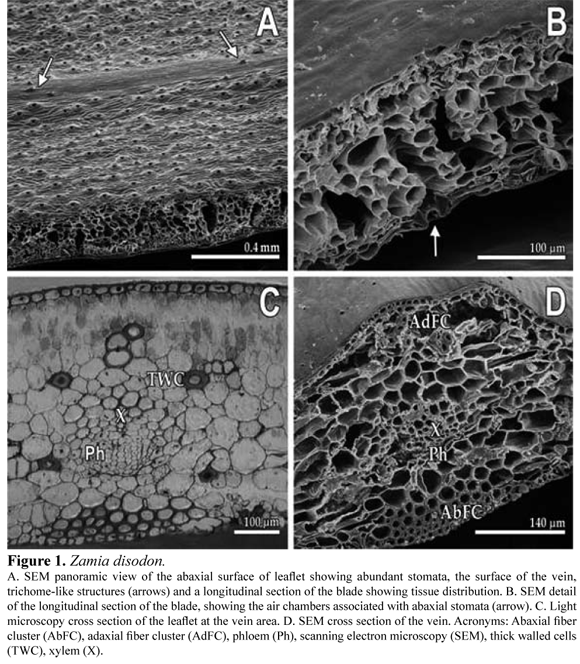
<body><![CDATA[<p>Cycadalean leaves show clear adaptations for a xerophytic    environment, although these could be inherited from an ancestor from a dry and    strongly irradiated environment, back in the Mesozoic (Norstog &amp; Nicholls    1998): a thick cuticle, a strongly developed hypodermis with thick walls and    sunken stomata usually present only on the abaxial surface of the leaflets.    All species of <i>Zamia</i> have pinnate leaves (Jones 2002) but the number    of leaflets per leaf varies considerably between species. The main axis of the    leaf consists of the petiole, which can be prickly or smooth, and the rachis    which supports the leaflets. The young leaves show erect vernation in aerial    stemmed species, and inflexed vernation in those with subterranean stems (Stevenson    1981), probably to protect the fragile new leaves as they emerge from the soil.    The internal anatomy of the petiole-rachis axis is characterized by an abundance    of parenchyma along with mucilage channels and relatively few and small discrete    vascular strands, which show an omega (&#937;) shape, if seen in cross section    (Norstog &amp; Nicholls 1998). The leaflets are variable between species in    regards to shape, length, width, margin and texture, and do not show a distinct    main midvein (except in one species, <i>Z. restrepoi</i>). Internally, in some    species at least, such as <i>Zamia integrifolia</i>, the palisade parenchyma    is indistinct, unlike in <i>Cycas</i> (Norstog &amp; Nicholls 1998). However,    there is a subepidermal compact parenchyma under the adaxial surface in some    tropical species. Also, idioblasts (Norstog &amp; Nicholls 1998, Jones 2002)    and occasionally isolated cells (Acu&ntilde;a-Castillo &amp; Mar&iacute;n-M&eacute;ndez 2012) with    thickened secondary walls can be found in the mesophyll. </p>     <p><i>Zamia</i> foliar anatomy, both internal and external,    has been studied in previous works. Probably the most relevant one is that by    Greguss (1968), which considered most cycad species known at the time, and was    centered mostly on characters useful in paleobotany, such as epidermal anatomy.    More recent research includes the works by Newell (1985, 1989) which emphasized    inter- and intra-population variation of external leaflet morphology of several    West Indian species. Stevenson (1981, 1990), Stevenson <i>et al. </i>(1996)    and Norstog &amp; Nicholls (1998) provided detailed descriptions about the general    foliar anatomy and the differences between the genera of the order. Zuo <i>et    al. </i>(2004) have even analyzed how the ultrastructure and function of the    chloroplasts change relative to carbon dioxide concentrations. The scarcity    of recent literature on cycadalean anatomy shows the need for more research,    especially in species that are virtually unstudied, as is the case for most    Central and South American species of <i>Zamia</i>. Anatomical traits can be    helpful in trying to establish the relationships of the species within the genus,    as has happened with <i>Cycas</i>, a genus in which the series and species    groups have similar foliar anatomy (Hill 1996). Previous studies of <i>Zamia    fairchildiana</i> L.D. G&oacute;mez and<i> Z. neurophyllidia </i>D.W. Stev. from Costa    Rica confirmed that even though the general anatomical features within the genus    follow a common general pattern, there are many details which have potential    taxonomic applications, and also demonstrated many interesting features that    could allow these species to survive in their natural wet forest undergrowth    environments (Acu&ntilde;a-Castillo y Mar&iacute;n-M&eacute;ndez 2012).</p>     <p>The objective of this research was to study and compare    the leaflet anatomy of <i>Zamia disodon</i> D.W. Stev. &amp; Sabato and<i>Z.    restrepoi</i>, both native to Colombia, and establish possible relationships    between the anatomical traits and the habitats of these species.</p>     <p><b>MATERIALS AND METHODS</b></p>     <p>We worked with <i>Zamia disodon</i> and <i>Z.    restrepoi</i>. Both species inhabit wet forests to rain forests in the lowlands    and mid elevations of northwestern Colombia. <i>Zamia disodon</i> is known only    from Antioquia (and apparently Hu&aacute;nuco in Per&uacute, but whether this population    is indeed <i>Z. disodon</i> is not yet clear), at  elevations between 400 and    800 m, while <i>Z. restrepoi </i>is endemic to southern Cordoba, at elevations    around 500 m. Both have very restricted natural ranges, and their natural populations    are critically endangered, and so even slight habitat alterations could result    in their disappearance. </p>     <p>Leaflet material was collected from fully developed,    mature leaves from plants cultivated in the Nong Nooch Tropical Botanical Garden,    Thailand.  All samples for microscopic observation were about about 0.5 cm<sup>2</sup>,    mostly from the center of the leaflet. The samples were first fixed in Karnowsky    solution (glutaraldehyde 2.5% / paraformaldehyde 2%&nbsp;/ sodium phosphate    buffer 0.1M, pH. 7.4), for 24 hours at 4 ºC. The material was then washed in    sodium phosphate buffer, and postfixed using 1% Osmium tetroxide (OsO<sub>4</sub>).    The samples were further washed in distilled water and were then processed for    scanning electron microscopy or light microscopy. </p>     <p>For scanning electron microscopy, the samples were    dehydrated through an ascending series of ethanol solutions and then the material    was left in tert-buthanol for 24 hours at 4ºC, to be sublimed thereafter in    a vacuum sublimizer Eiko ID-2. Then the material was mounted on aluminum bases    and covered with a 30 nm thick gold-palladium layer. Samples were observed using    a Hitachi S-570 scanning electron microscope, with an acceleration voltage of    15 KV.  For light microscopy, the  material was dehydrated through an ascending    series of propanone (acetone) solutions, then embeded in Spurr's epoxy resin.    The embedded samples were sectioned at 500 nm thick with a Power Tome PC (RMC    Products) Ultramicrotome, dyed with Touluidin Blue and observed with an Olympus    IX-51 inverted light microscope. </p>     <p><b>RESULTS</b></p>     <p><i>Zamia disodon </i>has membranaceous, sometimes    even translucent, leaflets. These are elliptical with a doubly serrate margin    towards the tip. The venation is more evident on the adaxial side of the leaflet    as opposed to many plicate leaved Zamias, which have venation most evident on    the abaxial side. The leaves have divergent veins that branch dichotomously.    In contrast, <i>Z. restrepoi </i>has symmetric, lanceolate to rarely linear    lanceolate leaflets (the latter were formerly considered a different species:    <i>Chigua bernalii </i>D.W. Stev.) with conspicuously dentate margins.    They show an obvious venation in which the midrib can be clearly distinguished    and from which secondary veins branch at oblique angles. This species is the    only <i>Zamia</i> known to have a conspicuous midrib.</p>     <p>The leaflets in both species are amphistomatic, although the stomata on the    abaxial surface of the leaflet are more abundant (<a href="#figura1">Fig. 1a</a>,    <a href="#figura2">Fig. 2a</a>).</p>       ]]></body>
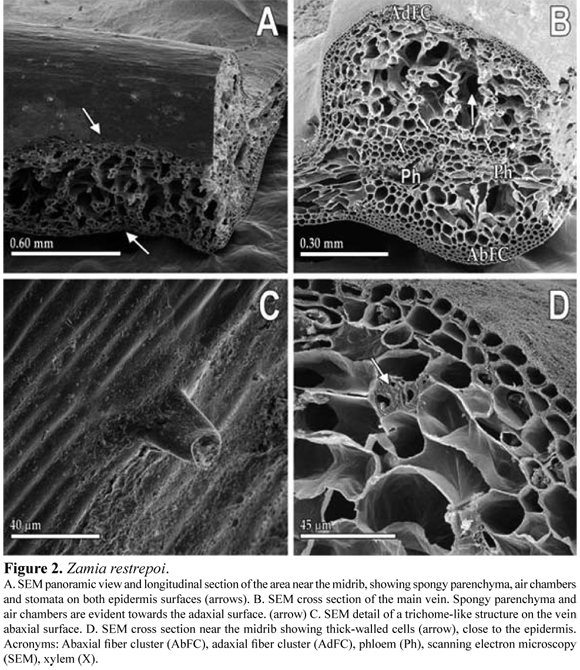
<body><![CDATA[<center>   <img src="/img/revistas/cal/v35n1/v35n1a1fig1.gif"><a name="figura1"></a>  </center>    <br>      <center>   <img src="/img/revistas/cal/v35n1/v35n1a1fig2.gif"><a name="figura2"></a>  </center>     <p> The stomata are sunken and syndetocheilic, in which the subsidiary cells surround    guard cells and are above them.  The main axis of the epidermal cells is parallel    to the leaflet's main axis and the cells over the veins are narrower and more    elongated than those between the veins. The latter tend to be more sinuous,    especially those abaxially located, possibly because of the abundance of stomata. The    structure of the mesophyll in the area between veins is similar for both species,    as they have a relatively compact, adaxially located parenchyma composed of    small cells. Below this tissue there is an extensive spongy parenchyma with    large air chambers (<a href="#figura1">Fig. 1b</a>). Even though the size of    the chambers differs between the species, the main axis of such chambers is    always perpendicular to the main axis of the leaflet, while the chamber's walls    are one cell thick and these cells are tubular, curved and branched (<a href="#figura1">Fig.    1b</a>, <a href="#figura2">Fig. 2a</a>). </p>     <p>The veins of <i>Zamia disodon </i>are raised adaxially. On the abaxial surface,    the flat veins are clearly distinguished from the area between the veins due    to differences in cell shape (<a href="#figura1">Fig. 1c</a>). Also on the abaxial    side of the vein, some conic or truncated structures with a trichome-like appearance    can be seen. These structures are almost entirely restricted to the epidermis    over the veins, although a few of them can be observed in areas between the    veins (<a href="#figura1">Fig. 1a</a>).</p>     <p>In the vein area and under the epidermal cells there are clusters of fibers,    both abaxially and adaxially (<a href="#figura1">Fig. 1d</a>, <a href="#figura1">Fig.    1c</a>). These fiber clusters are restricted to the veins, vertically aligned    with the vascular tissues, and no similar structures were seen between the veins.    The abaxial fiber cluster is trapezoid shaped and is notoriously more conspicuous    than the adaxial cluster, which is composed of rather few cells. Between the    fiber cluster and the vascular tissue there is parenchyma with cells of variable    diameter and relatively small intercellular spaces. Occasionally, scarce thick    walled cells can be seen. In the area between veins it is possible to distinguish    air chambers (<a href="#figura1">Fig. 1b</a>).  </p>     <p>The midrib of <i>Zamia restrepoi </i>is raised both adaxially and abaxially,    although it is more prominent on the adaxial surface (<a href="#figura2">Fig.    2b</a>). Even though the stomata are more frequent in the areas between the    veins, some can be found on the midrib edges. On the midrib it is possible to    see trichome-like projections over the surface. These structures are conical,    truncated or cylindrical (<a href="#figura2">Fig. 2c</a>). As in <i>Z. disodon</i>,    there are also similar structures in the areas between veins, but in such areas    they are very rare.</p>     <p>Under the adaxial epidermis of the midrib there are 2-4 layers of fibers. Under    these fibers there is spongy parenchyma, similar to that observed in the area    between the veins (<a href="#figura2">Fig. 2b</a>), formed by tubular cells,    with rather large air chambers that are connected to the spongy areas between    the veins (<a href="#figura2">Fig. 2a</a>). Under the spongy parenchyma there    is a relatively compact parenchyma surrounding the vascular tissue. There are    2-5 collateral vascular strands within the midrib and they are relatively small,    with little xylem and crushed protophloem. The parenchyma towards the abaxial    side, next to the vascular tissue, is more compact than that under the adaxial    surface, and with cells of larger diameters. Under it there are 3-5 layers of    abaxial, subepidermic fibers, even more developed than those located adaxially.    The fiber clusters are entirely restricted to the veins, as in <i>Zamia disodon.</i>    Rarely, there are thick-walled cells dispersed in the parenchyma (<a href="#figura2">Fig.    2d</a>).</p>     <p><b>DISCUSSION</b></p>     <p>Most cycad species are hypostomatic (Greguss 1968),    but in a few species, and occasionally in some individuals of some species,    it is possible to find amphistomatic leaflets; however, the stomatal density    on the adaxial surface of the leaflet is usually much lower than that of the    abaxial surface. This was noticed in the samples of <i>Zamia disodon</i>, in    which the abaxial density of stomata seemed higher compared to the upper surface.    It is likely that the density of the stomata and their presence on just the    abaxial surface of the leaflet, or on both surfaces, could be related to the    atmospheric humidity and the climate, especially because amphistomatic species    are chiefly from very humid environments such as the undergrowth of tropical    wet forests (Greguss 1968). The structure of the stomata and their subsidiary    cells in the studied species is the same as that described by Greguss (1968)    and Acu&ntilde;a-Catillo &amp; Mar&iacute;n-M&eacute;ndez (2012) for other species of the genus:    sunken guard cells and raised subsidiary cells that form the walls of the epistomatic    chamber. As pointed out by Norstog &amp; Nicholls (1998), this is an adaptation    for xeric environments, and in mesic habitat species, this could be an evolutionary    remnant that was present in the ancestors of the living species. As was reported    for <i>Zamia fairchildiana </i>and <i>Z. neurophyllidia</i> by Acu&ntilde;a-Castillo    &amp; Mar&iacute;n-M&eacute;ndez (2012), <i>Z. disodon </i>and <i>Z. restrepoi</i> have trichome-like    structures on their leaflets, especially on the veins. These seem to be the    basal cells of the branched trichomes, which are very common in young leaves    of <i>Zamia </i>(Stevenson 1981), although these are no longer present on mature    leaves. It appears that all that remains of the trichome is the basal cell,    after the branched apical cell has been shed. This suggests that these trichomes    are very fragile.</p>     ]]></body>
<body><![CDATA[<p>In <i>Zamia disodon</i>, a very uncommon leaf feature    was observed: the leaflet veins are raised on the adaxial surface, but flat    at the abaxial side of the leaflet. This is in contrast to the general pattern,    in which the leaflets are either flat or the veins are raised abaxially (Jones    2002). However, the general structure of the leaflet is very similar to that    of other species of <i>Zamia</i>, the main differences being the texture of    the leaflet and the size of the fiber clusters above and below the vascular    strands. These fiber clusters could indeed have taxonomic importance. However,    we are not aware of their use in this way, even though in <i>Cycas</i> the location    and abundance of foliar tissues have been applied in taxonomic studies (Hill    1993).</p>     <p>The conspicuous midrib seen in all leaflets of <i>Zamia    restrepoi </i>was the main trait used to separate this species in the genus    <i>Chigua</i> D.W. Stev. (Stevenson 1990), although the most recent genetic    evidence suggests that what was considered <i>Chigua </i>is nested within    a clade of mostly South American <i>Zamia</i>. Nonetheless, the foliar anatomy    of <i>Zamia restrepoi</i> shows several unusual traits, mostly related to the    midrib. As was pointed out by Stevenson <i>et al.</i> (1996), the midrib in    this species is very similar to that seen in the South African endemic, <i>Stangeria</i><i>    eriopus </i>(Kunze) Baill., as it is composed mostly of parenchyma and has several    discrete vascular strands. However, in the samples analyzed we found air chambers    in the adaxial side of the midrib. This is a rare feature in leaf anatomy and    to our knowledge this is the first report of this characteristic in Cycadales.    We think that either the presence or size of such air chambers is variable,    and probably related to relatively higher transpiration rates. This hypothesis    remains to be tested. The spongy parenchyma of the vein is connected to the    spongy parenchyma of the blade. Besides the particularities associated with    such a midvein, <i>Z. restrepoi </i>has several traits in common with other    species of <i>Zamia</i>. The main cluster of fibers is located on the abaxial    side of the leaflet, and even though those on the adaxial surface are abundant,    they have thinner walls than the abaxial fibers. We suspect that fiber location    and development could be related to structural factors adding resistance and    longevity to the leaflets, because even though there is no data on the longevity    of leaves in either of the studied species, some other species of the genus,    such as <i>Zamia 'skinneri' </i>Warsz. (<i>Z. neurophyllidia </i>in the most    current listings) in Costa Rica, have leaves that can stay attached to the plant    for periods of five years or even more (Clark &amp; Clark 1986, Clark <i>et    al.</i> 1992)</p>     <p>The abundance and size of the air chambers in both    species could be related to the very humid environment of the wet forest undergrowth,    where these species are native (Stevenson 2001, Jones 2002), similar characteristics    were noticed in <i>Zamia</i> <i>fairchildiana</i> and <i>Z</i>. <i>neurophyllidia</i>    (Acu&ntilde;a-Castillo &amp; Mar&iacute;n-M&eacute;ndez 2012). These chambers perhaps allow the leaflets    to increase gas exchange in order to eliminate excess water and fix carbon.     In contrast to <i>Cycas </i>there is no evident transfusion tissue in    <i>Zamia</i> (Norstog &amp; Nicholls 1998), although in this genus the elongated    tubular spongy parenchyma cells could be involved in horizontal transfer of    substances and are therefore probably fulfilling the role of a transfusion tissue.</p>     <p><b>ACKNOWLEDGEMENTS</b></p>     <p>We are indebted to Anders Lindström, from the Nong    Nooch Tropical Botanical Garden, Thailand, for providing the material for this    study. To the staff of Centro de investigacion en Estructuras Microsc&oacute;picas    at the University of Costa Rica for their valuable help during this research,    especially to Ethel S&aacute;nchez-Chac&oacute;n and Alexander Rodr&iacute;guez for their help with    the electron microscopy study and the image processing. We are also thankful    to Paul Hanson for reviewing the manuscript. Financial support for this research    was provided by Vicerrector&iacute;a de Investigaci&oacute;n, Universidad de Costa Rica through    grant No 810-B0-042.</p>     <p><b>LITERATURE CITED</b></p>     <!-- ref --><p>1. Acu&ntilde;a-Castillo, R. &amp; W. Mar&iacute;n-M&eacute;ndez. 2012. Some aspects of the foliar    anatomy of two <i>Zamia</i> species from Costa Rica: <i>Z. fairchildiana </i>L.D.    G&oacute;mez and <i>Z. neurophyllidia </i>D.W. Stev. Memoirs of the New York Botanical    Garden 106: 192-306.    &nbsp;&nbsp;&nbsp;&nbsp;&nbsp;&nbsp;&nbsp;&nbsp;[&#160;<a href="javascript:void(0);" onclick="javascript: window.open('/scielo.php?script=sci_nlinks&ref=000049&pid=S0366-5232201300010000100001&lng=','','width=640,height=500,resizable=yes,scrollbars=1,menubar=yes,');">Links</a>&#160;]<!-- end-ref --> </p>     <!-- ref --><p>2. Artabe, A &amp; D.W. Stevenson. 2004. Fossil Cycadales of Argentina. Botanical    Review.70: 219-238.    &nbsp;&nbsp;&nbsp;&nbsp;&nbsp;&nbsp;&nbsp;&nbsp;[&#160;<a href="javascript:void(0);" onclick="javascript: window.open('/scielo.php?script=sci_nlinks&ref=000051&pid=S0366-5232201300010000100002&lng=','','width=640,height=500,resizable=yes,scrollbars=1,menubar=yes,');">Links</a>&#160;]<!-- end-ref --> </p>     ]]></body>
<body><![CDATA[<!-- ref --><p>3. Caputo, P., S. Cozzolino, L. Gaudio, A. Moretti &amp; D.W. Stevenson. 1996.    Karyology and    phylogeny of some Mesoamerican species of <i>Zamia </i>(Zamiaceae).    American Journal of Botany 83: 1513-1520.    &nbsp;&nbsp;&nbsp;&nbsp;&nbsp;&nbsp;&nbsp;&nbsp;[&#160;<a href="javascript:void(0);" onclick="javascript: window.open('/scielo.php?script=sci_nlinks&ref=000053&pid=S0366-5232201300010000100003&lng=','','width=640,height=500,resizable=yes,scrollbars=1,menubar=yes,');">Links</a>&#160;]<!-- end-ref --></p>     <!-- ref --><p>4. Caputo, P., S. Cozzolino, P. De Luca, A. Moretti &amp; D.W. Stevenson. 2004.    Molecular phylogeny of Zamia. Pp. 149-158. In: T. Walters &amp; R. Osborne (eds),    <i>Cycad Classification: Concepts and Recommendations</i>. CABI Publishing,    Oxford.    &nbsp;&nbsp;&nbsp;&nbsp;&nbsp;&nbsp;&nbsp;&nbsp;[&#160;<a href="javascript:void(0);" onclick="javascript: window.open('/scielo.php?script=sci_nlinks&ref=000055&pid=S0366-5232201300010000100004&lng=','','width=640,height=500,resizable=yes,scrollbars=1,menubar=yes,');">Links</a>&#160;]<!-- end-ref --></p>     <!-- ref --><p>5. Clark, D.B. &amp; D.A. Clark. 1988. Leaf production and the cost of reproduction    in   the neotropical rain forest cycad, <i>Zamia skinneri</i>. Journal of Ecology    76: 1153-1163.    &nbsp;&nbsp;&nbsp;&nbsp;&nbsp;&nbsp;&nbsp;&nbsp;[&#160;<a href="javascript:void(0);" onclick="javascript: window.open('/scielo.php?script=sci_nlinks&ref=000057&pid=S0366-5232201300010000100005&lng=','','width=640,height=500,resizable=yes,scrollbars=1,menubar=yes,');">Links</a>&#160;]<!-- end-ref --></p>     <!-- ref --><p>6. Clark, D.B., D.A. Clark &amp; M. Grayum. 1992. Leaf demography of a neotropical    rain forest cycad, <i>Zamia skinneri </i>(Zamiaceae). American Journal of       Ecology. 79: 28-33.    &nbsp;&nbsp;&nbsp;&nbsp;&nbsp;&nbsp;&nbsp;&nbsp;[&#160;<a href="javascript:void(0);" onclick="javascript: window.open('/scielo.php?script=sci_nlinks&ref=000059&pid=S0366-5232201300010000100006&lng=','','width=640,height=500,resizable=yes,scrollbars=1,menubar=yes,');">Links</a>&#160;]<!-- end-ref --></p>     <!-- ref --><p>7. Graham, A. 2010. <i>Late Cretaceous and Cenozoic history of Latin American vegetation    and terrestrial environments</i>.<i> </i>Monographs in Systematic Botany from    the Missouri Botanical Garden 113. 617p.    &nbsp;&nbsp;&nbsp;&nbsp;&nbsp;&nbsp;&nbsp;&nbsp;[&#160;<a href="javascript:void(0);" onclick="javascript: window.open('/scielo.php?script=sci_nlinks&ref=000061&pid=S0366-5232201300010000100007&lng=','','width=640,height=500,resizable=yes,scrollbars=1,menubar=yes,');">Links</a>&#160;]<!-- end-ref --></p>     ]]></body>
<body><![CDATA[<!-- ref --><p>8. Greguss, P. 1968. <i>Xylotomy of the living cycads, with a description of    their leaves and epidermis</i>. Akad&eacute;miai Kiad&oacute;. Budapest. 440 p.    &nbsp;&nbsp;&nbsp;&nbsp;&nbsp;&nbsp;&nbsp;&nbsp;[&#160;<a href="javascript:void(0);" onclick="javascript: window.open('/scielo.php?script=sci_nlinks&ref=000063&pid=S0366-5232201300010000100008&lng=','','width=640,height=500,resizable=yes,scrollbars=1,menubar=yes,');">Links</a>&#160;]<!-- end-ref --></p>     <!-- ref --><p>9. Hill, K. D. 1996. A taxonomic revision of the genus <i>Cycas</i><i> </i>(Cycadaceae)    in Australia. Telopea 7: 1-64.    &nbsp;&nbsp;&nbsp;&nbsp;&nbsp;&nbsp;&nbsp;&nbsp;[&#160;<a href="javascript:void(0);" onclick="javascript: window.open('/scielo.php?script=sci_nlinks&ref=000065&pid=S0366-5232201300010000100009&lng=','','width=640,height=500,resizable=yes,scrollbars=1,menubar=yes,');">Links</a>&#160;]<!-- end-ref --></p>     <!-- ref --><p>10. Jones, D.L. 2002. <i>Cycads of the World</i>. Smithsonian Institution Press.    Washington D.C. 456 p.    &nbsp;&nbsp;&nbsp;&nbsp;&nbsp;&nbsp;&nbsp;&nbsp;[&#160;<a href="javascript:void(0);" onclick="javascript: window.open('/scielo.php?script=sci_nlinks&ref=000067&pid=S0366-5232201300010000100010&lng=','','width=640,height=500,resizable=yes,scrollbars=1,menubar=yes,');">Links</a>&#160;]<!-- end-ref --></p>     <!-- ref --><p>11. Newell, S. J. 1985. Intrapopulational variation in leaflet morphology of    <i>Zamia pumila </i>L. in relation to microenviroment and sex. American Journal    of Botany 72: 217-221.    &nbsp;&nbsp;&nbsp;&nbsp;&nbsp;&nbsp;&nbsp;&nbsp;[&#160;<a href="javascript:void(0);" onclick="javascript: window.open('/scielo.php?script=sci_nlinks&ref=000069&pid=S0366-5232201300010000100011&lng=','','width=640,height=500,resizable=yes,scrollbars=1,menubar=yes,');">Links</a>&#160;]<!-- end-ref --> </p>     <!-- ref --><p>12. Newell, S. J. 1989. Variation in leaflet morphology among populations of    Caribbean cycads (<i>Zamia</i>). American Journal of Botany 76: 1518-1523.    &nbsp;&nbsp;&nbsp;&nbsp;&nbsp;&nbsp;&nbsp;&nbsp;[&#160;<a href="javascript:void(0);" onclick="javascript: window.open('/scielo.php?script=sci_nlinks&ref=000071&pid=S0366-5232201300010000100012&lng=','','width=640,height=500,resizable=yes,scrollbars=1,menubar=yes,');">Links</a>&#160;]<!-- end-ref --></p>     ]]></body>
<body><![CDATA[<!-- ref --><p>13. Nicolade-Morej&oacute;n, F., A. P. Vovides,<sup> </sup>&amp; D. W. Stevenson.    2009. Taxonomic revision of <i>Zamia</i> in Mega-Mexico. Brittonia 61: 1-38.    &nbsp;&nbsp;&nbsp;&nbsp;&nbsp;&nbsp;&nbsp;&nbsp;[&#160;<a href="javascript:void(0);" onclick="javascript: window.open('/scielo.php?script=sci_nlinks&ref=000073&pid=S0366-5232201300010000100013&lng=','','width=640,height=500,resizable=yes,scrollbars=1,menubar=yes,');">Links</a>&#160;]<!-- end-ref --></p>     <!-- ref --><p>14. Norstog, K. 1981. Karyotypes of <i>Zamia </i>(Cycadales). Caryologia 34(3):    255-260.    &nbsp;&nbsp;&nbsp;&nbsp;&nbsp;&nbsp;&nbsp;&nbsp;[&#160;<a href="javascript:void(0);" onclick="javascript: window.open('/scielo.php?script=sci_nlinks&ref=000075&pid=S0366-5232201300010000100014&lng=','','width=640,height=500,resizable=yes,scrollbars=1,menubar=yes,');">Links</a>&#160;]<!-- end-ref --></p>     <!-- ref --><p>15. Norstog, K &amp; J. T. Nicholls. 1998. <i>The Biology of the Cycads</i>.    Comstock publishing associates. Ithaca, New York. 363 p.    &nbsp;&nbsp;&nbsp;&nbsp;&nbsp;&nbsp;&nbsp;&nbsp;[&#160;<a href="javascript:void(0);" onclick="javascript: window.open('/scielo.php?script=sci_nlinks&ref=000077&pid=S0366-5232201300010000100015&lng=','','width=640,height=500,resizable=yes,scrollbars=1,menubar=yes,');">Links</a>&#160;]<!-- end-ref --> </p>     <!-- ref --><p>16. Osborne, R., M. A. Calonje, K. D. Hill, L. Stanberg, &amp; D. W. Stevenson.    2012. The World List of Cycads. Memoirs of the New York Botanical Garden 106:    480-508.    &nbsp;&nbsp;&nbsp;&nbsp;&nbsp;&nbsp;&nbsp;&nbsp;[&#160;<a href="javascript:void(0);" onclick="javascript: window.open('/scielo.php?script=sci_nlinks&ref=000079&pid=S0366-5232201300010000100016&lng=','','width=640,height=500,resizable=yes,scrollbars=1,menubar=yes,');">Links</a>&#160;]<!-- end-ref --></p>     <!-- ref --><p>17. Stevenson, D. W. 1981. Observations on ptyxis, phenology, and trichomes    in the Cycadales and their systematic implications. American Journal of Botany    68: 1104-1114.    &nbsp;&nbsp;&nbsp;&nbsp;&nbsp;&nbsp;&nbsp;&nbsp;[&#160;<a href="javascript:void(0);" onclick="javascript: window.open('/scielo.php?script=sci_nlinks&ref=000081&pid=S0366-5232201300010000100017&lng=','','width=640,height=500,resizable=yes,scrollbars=1,menubar=yes,');">Links</a>&#160;]<!-- end-ref --></p>     ]]></body>
<body><![CDATA[<!-- ref --><p>18. Stevenson, D. W. 1990. Morphology and systematics of the Cycadales. Memoirs    of the New York Botanical Garden 57: 8-55.    &nbsp;&nbsp;&nbsp;&nbsp;&nbsp;&nbsp;&nbsp;&nbsp;[&#160;<a href="javascript:void(0);" onclick="javascript: window.open('/scielo.php?script=sci_nlinks&ref=000083&pid=S0366-5232201300010000100018&lng=','','width=640,height=500,resizable=yes,scrollbars=1,menubar=yes,');">Links</a>&#160;]<!-- end-ref --></p>     <!-- ref --><p>19. Stevenson, D.W. 1992. A formal classification of the extant cycads. Brittonia    44: 220-223.    &nbsp;&nbsp;&nbsp;&nbsp;&nbsp;&nbsp;&nbsp;&nbsp;[&#160;<a href="javascript:void(0);" onclick="javascript: window.open('/scielo.php?script=sci_nlinks&ref=000085&pid=S0366-5232201300010000100019&lng=','','width=640,height=500,resizable=yes,scrollbars=1,menubar=yes,');">Links</a>&#160;]<!-- end-ref --></p>     <!-- ref --><p>20. Stevenson, D.W. 2001. <i>Orden Cycadales</i>. En:<i> </i>Bernal, R. &amp;    E. Forero (eds). Flora de Colombia 21: 1-92.    &nbsp;&nbsp;&nbsp;&nbsp;&nbsp;&nbsp;&nbsp;&nbsp;[&#160;<a href="javascript:void(0);" onclick="javascript: window.open('/scielo.php?script=sci_nlinks&ref=000087&pid=S0366-5232201300010000100020&lng=','','width=640,height=500,resizable=yes,scrollbars=1,menubar=yes,');">Links</a>&#160;]<!-- end-ref --> </p>     <!-- ref --><p>21. Stevenson, D. W., K. Norstog, &amp; D. Molsen. 1996. Midribs of cycad pinnae.     Brittonia 48: 67-74.    &nbsp;&nbsp;&nbsp;&nbsp;&nbsp;&nbsp;&nbsp;&nbsp;[&#160;<a href="javascript:void(0);" onclick="javascript: window.open('/scielo.php?script=sci_nlinks&ref=000089&pid=S0366-5232201300010000100021&lng=','','width=640,height=500,resizable=yes,scrollbars=1,menubar=yes,');">Links</a>&#160;]<!-- end-ref --></p>     <!-- ref --><p>22. Taylor, A., J. Haynes &amp; G. Holzman. 2008. Taxonomical, nomenclatural    and    biogeographical revelations in the <i>Zamia skinneri </i>complex of Central    America (Cycadales: Zamiaceae). Botanical Journal of the Linnean Society158:    399-429.    &nbsp;&nbsp;&nbsp;&nbsp;&nbsp;&nbsp;&nbsp;&nbsp;[&#160;<a href="javascript:void(0);" onclick="javascript: window.open('/scielo.php?script=sci_nlinks&ref=000091&pid=S0366-5232201300010000100022&lng=','','width=640,height=500,resizable=yes,scrollbars=1,menubar=yes,');">Links</a>&#160;]<!-- end-ref --> </p>     ]]></body>
<body><![CDATA[<!-- ref --><p>23. Vovides, A.P. 1983. Systematic studies on the Mexican Zamiaceae. I. Chromosome    numbers and karyotypes. American Journal of Botany 70: 1002-1006.    &nbsp;&nbsp;&nbsp;&nbsp;&nbsp;&nbsp;&nbsp;&nbsp;[&#160;<a href="javascript:void(0);" onclick="javascript: window.open('/scielo.php?script=sci_nlinks&ref=000093&pid=S0366-5232201300010000100023&lng=','','width=640,height=500,resizable=yes,scrollbars=1,menubar=yes,');">Links</a>&#160;]<!-- end-ref --> </p>     <!-- ref --><p>24. Zuo, B., Q. Zhang, G. Jiang &amp; C. Chen. 2004. The response of ultrastructure    and function of chloroplasts from cycads to doubled CO<sub>2 </sub>concentration.    Botanical Review 70: 72-78.    &nbsp;&nbsp;&nbsp;&nbsp;&nbsp;&nbsp;&nbsp;&nbsp;[&#160;<a href="javascript:void(0);" onclick="javascript: window.open('/scielo.php?script=sci_nlinks&ref=000095&pid=S0366-5232201300010000100024&lng=','','width=640,height=500,resizable=yes,scrollbars=1,menubar=yes,');">Links</a>&#160;]<!-- end-ref --></p> </font>       ]]></body><back>
<ref-list>
<ref id="B1">
<label>1</label><nlm-citation citation-type="journal">
<person-group person-group-type="author">
<name>
<surname><![CDATA[Acuña-Castillo]]></surname>
<given-names><![CDATA[R.]]></given-names>
</name>
<name>
<surname><![CDATA[Marín-Méndez]]></surname>
<given-names><![CDATA[W.]]></given-names>
</name>
</person-group>
<article-title xml:lang="en"><![CDATA[Some aspects of the foliar anatomy of two Zamia species from Costa Rica: Z. fairchildiana L.D. Gómez and Z. neurophyllidia D.W. Stev.]]></article-title>
<source><![CDATA[Memoirs of the New York Botanical Garden]]></source>
<year>2012</year>
<volume>106</volume>
<page-range>192-306</page-range></nlm-citation>
</ref>
<ref id="B2">
<label>2</label><nlm-citation citation-type="journal">
<person-group person-group-type="author">
<name>
<surname><![CDATA[Artabe]]></surname>
<given-names><![CDATA[A]]></given-names>
</name>
<name>
<surname><![CDATA[Stevenson]]></surname>
<given-names><![CDATA[D.W.]]></given-names>
</name>
</person-group>
<article-title xml:lang="en"><![CDATA[Fossil Cycadales of Argentina]]></article-title>
<source><![CDATA[Botanical Review]]></source>
<year>2004</year>
<volume>70</volume>
<page-range>219-238</page-range></nlm-citation>
</ref>
<ref id="B3">
<label>3</label><nlm-citation citation-type="journal">
<person-group person-group-type="author">
<name>
<surname><![CDATA[Caputo]]></surname>
<given-names><![CDATA[P.]]></given-names>
</name>
<name>
<surname><![CDATA[Cozzolino]]></surname>
<given-names><![CDATA[S.]]></given-names>
</name>
<name>
<surname><![CDATA[Gaudio]]></surname>
<given-names><![CDATA[L.]]></given-names>
</name>
<name>
<surname><![CDATA[Moretti]]></surname>
<given-names><![CDATA[A.]]></given-names>
</name>
<name>
<surname><![CDATA[Stevenson]]></surname>
<given-names><![CDATA[D.W.]]></given-names>
</name>
</person-group>
<article-title xml:lang="en"><![CDATA[Karyology and phylogeny of some Mesoamerican species of Zamia (Zamiaceae)]]></article-title>
<source><![CDATA[American Journal of Botany]]></source>
<year>1996</year>
<volume>83</volume>
<page-range>1513-1520</page-range></nlm-citation>
</ref>
<ref id="B4">
<label>4</label><nlm-citation citation-type="book">
<person-group person-group-type="author">
<name>
<surname><![CDATA[Caputo]]></surname>
<given-names><![CDATA[P.]]></given-names>
</name>
<name>
<surname><![CDATA[Cozzolino]]></surname>
<given-names><![CDATA[S.]]></given-names>
</name>
<name>
<surname><![CDATA[De Luca]]></surname>
<given-names><![CDATA[P.]]></given-names>
</name>
<name>
<surname><![CDATA[Moretti]]></surname>
<given-names><![CDATA[A.]]></given-names>
</name>
<name>
<surname><![CDATA[Stevenson]]></surname>
<given-names><![CDATA[D.W.]]></given-names>
</name>
</person-group>
<article-title xml:lang="en"><![CDATA[Molecular phylogeny of Zamia]]></article-title>
<person-group person-group-type="editor">
<name>
<surname><![CDATA[Walters]]></surname>
<given-names><![CDATA[T.]]></given-names>
</name>
<name>
<surname><![CDATA[Osborne]]></surname>
<given-names><![CDATA[R.]]></given-names>
</name>
</person-group>
<source><![CDATA[Cycad Classification: Concepts and Recommendations]]></source>
<year>2004</year>
<page-range>149-158</page-range><publisher-loc><![CDATA[Oxford ]]></publisher-loc>
<publisher-name><![CDATA[CABI Publishing]]></publisher-name>
</nlm-citation>
</ref>
<ref id="B5">
<label>5</label><nlm-citation citation-type="journal">
<person-group person-group-type="author">
<name>
<surname><![CDATA[Clark]]></surname>
<given-names><![CDATA[D.B.]]></given-names>
</name>
<name>
<surname><![CDATA[Clark]]></surname>
<given-names><![CDATA[D.A.]]></given-names>
</name>
</person-group>
<article-title xml:lang="en"><![CDATA[Leaf production and the cost of reproduction in the neotropical rain forest cycad, Zamia skinneri]]></article-title>
<source><![CDATA[Journal of Ecology]]></source>
<year>1988</year>
<volume>76</volume>
<page-range>1153-1163</page-range></nlm-citation>
</ref>
<ref id="B6">
<label>6</label><nlm-citation citation-type="journal">
<person-group person-group-type="author">
<name>
<surname><![CDATA[Clark]]></surname>
<given-names><![CDATA[D.B.]]></given-names>
</name>
<name>
<surname><![CDATA[Clark]]></surname>
<given-names><![CDATA[D.A.]]></given-names>
</name>
<name>
<surname><![CDATA[Grayum]]></surname>
<given-names><![CDATA[M.]]></given-names>
</name>
</person-group>
<article-title xml:lang="en"><![CDATA[Leaf demography of a neotropical rain forest cycad, Zamia skinneri (Zamiaceae)]]></article-title>
<source><![CDATA[American Journal of Ecology]]></source>
<year>1992</year>
<volume>79</volume>
<page-range>28-33</page-range></nlm-citation>
</ref>
<ref id="B7">
<label>7</label><nlm-citation citation-type="journal">
<person-group person-group-type="author">
<name>
<surname><![CDATA[Graham]]></surname>
<given-names><![CDATA[A.]]></given-names>
</name>
</person-group>
<article-title xml:lang="en"><![CDATA[Late Cretaceous and Cenozoic history of Latin American vegetation and terrestrial environments]]></article-title>
<source><![CDATA[Monographs in Systematic Botany from the Missouri Botanical Garden]]></source>
<year>2010</year>
<volume>113</volume>
<page-range>617</page-range></nlm-citation>
</ref>
<ref id="B8">
<label>8</label><nlm-citation citation-type="book">
<person-group person-group-type="author">
<name>
<surname><![CDATA[Greguss]]></surname>
<given-names><![CDATA[P.]]></given-names>
</name>
</person-group>
<article-title xml:lang="en"><![CDATA[Xylotomy of the living cycads, with a description of their leaves and epidermis]]></article-title>
<source><![CDATA[]]></source>
<year>1968</year>
<page-range>440</page-range><publisher-loc><![CDATA[Budapest ]]></publisher-loc>
<publisher-name><![CDATA[Akadémiai Kiadó]]></publisher-name>
</nlm-citation>
</ref>
<ref id="B9">
<label>9</label><nlm-citation citation-type="journal">
<person-group person-group-type="author">
<name>
<surname><![CDATA[Hill]]></surname>
<given-names><![CDATA[K. D.]]></given-names>
</name>
</person-group>
<article-title xml:lang="en"><![CDATA[A taxonomic revision of the genus Cycas (Cycadaceae) in Australia]]></article-title>
<source><![CDATA[Telopea]]></source>
<year>1996</year>
<volume>7</volume>
<page-range>1-64</page-range></nlm-citation>
</ref>
<ref id="B10">
<label>10</label><nlm-citation citation-type="book">
<person-group person-group-type="author">
<name>
<surname><![CDATA[Jones]]></surname>
<given-names><![CDATA[D.L.]]></given-names>
</name>
</person-group>
<source><![CDATA[Cycads of the World]]></source>
<year>2002</year>
<page-range>456</page-range><publisher-loc><![CDATA[Washington^eD.C. D.C.]]></publisher-loc>
<publisher-name><![CDATA[Smithsonian Institution Press]]></publisher-name>
</nlm-citation>
</ref>
<ref id="B11">
<label>11</label><nlm-citation citation-type="journal">
<person-group person-group-type="author">
<name>
<surname><![CDATA[Newell]]></surname>
<given-names><![CDATA[S. J.]]></given-names>
</name>
</person-group>
<article-title xml:lang="en"><![CDATA[Intrapopulational variation in leaflet morphology of Zamia pumila L. in relation to microenviroment and sex]]></article-title>
<source><![CDATA[American Journal of Botany]]></source>
<year>1985</year>
<volume>72</volume>
<page-range>217-221</page-range></nlm-citation>
</ref>
<ref id="B12">
<label>12</label><nlm-citation citation-type="journal">
<person-group person-group-type="author">
<name>
<surname><![CDATA[Newell]]></surname>
<given-names><![CDATA[S. J.]]></given-names>
</name>
</person-group>
<article-title xml:lang="en"><![CDATA[Variation in leaflet morphology among populations of Caribbean cycads (Zamia)]]></article-title>
<source><![CDATA[American Journal of Botany]]></source>
<year>1989</year>
<volume>76</volume>
<page-range>1518-1523</page-range></nlm-citation>
</ref>
<ref id="B13">
<label>13</label><nlm-citation citation-type="journal">
<person-group person-group-type="author">
<name>
<surname><![CDATA[Nicolade-Morejón]]></surname>
<given-names><![CDATA[F.]]></given-names>
</name>
<name>
<surname><![CDATA[Vovides]]></surname>
<given-names><![CDATA[A. P.]]></given-names>
</name>
<name>
<surname><![CDATA[Stevenson]]></surname>
<given-names><![CDATA[D. W.]]></given-names>
</name>
</person-group>
<article-title xml:lang="en"><![CDATA[Taxonomic revision of Zamia in Mega-Mexico]]></article-title>
<source><![CDATA[Brittonia]]></source>
<year>2009</year>
<volume>61</volume>
<page-range>1-38</page-range></nlm-citation>
</ref>
<ref id="B14">
<label>14</label><nlm-citation citation-type="journal">
<person-group person-group-type="author">
<name>
<surname><![CDATA[Norstog]]></surname>
<given-names><![CDATA[K.]]></given-names>
</name>
</person-group>
<article-title xml:lang="en"><![CDATA[Karyotypes of Zamia (Cycadales)]]></article-title>
<source><![CDATA[Caryologia]]></source>
<year>1981</year>
<volume>34</volume>
<numero>3</numero>
<issue>3</issue>
<page-range>255-260</page-range></nlm-citation>
</ref>
<ref id="B15">
<label>15</label><nlm-citation citation-type="book">
<person-group person-group-type="author">
<name>
<surname><![CDATA[Norstog]]></surname>
<given-names><![CDATA[K]]></given-names>
</name>
<name>
<surname><![CDATA[Nicholls]]></surname>
<given-names><![CDATA[J. T.]]></given-names>
</name>
</person-group>
<source><![CDATA[The Biology of the Cycads]]></source>
<year>1998</year>
<page-range>363</page-range><publisher-loc><![CDATA[Ithaca, New York ]]></publisher-loc>
<publisher-name><![CDATA[Comstock publishing associates]]></publisher-name>
</nlm-citation>
</ref>
<ref id="B16">
<label>16</label><nlm-citation citation-type="journal">
<person-group person-group-type="author">
<name>
<surname><![CDATA[Osborne]]></surname>
<given-names><![CDATA[R.]]></given-names>
</name>
<name>
<surname><![CDATA[Calonje]]></surname>
<given-names><![CDATA[M. A.]]></given-names>
</name>
<name>
<surname><![CDATA[Hill]]></surname>
<given-names><![CDATA[K. D.]]></given-names>
</name>
<name>
<surname><![CDATA[Stanberg]]></surname>
<given-names><![CDATA[L.]]></given-names>
</name>
<name>
<surname><![CDATA[Stevenson]]></surname>
<given-names><![CDATA[D. W.]]></given-names>
</name>
</person-group>
<article-title xml:lang="en"><![CDATA[The World List of Cycads]]></article-title>
<source><![CDATA[Memoirs of the New York Botanical Garden]]></source>
<year>2012</year>
<volume>106</volume>
<page-range>480-508</page-range></nlm-citation>
</ref>
<ref id="B17">
<label>17</label><nlm-citation citation-type="journal">
<person-group person-group-type="author">
<name>
<surname><![CDATA[Stevenson]]></surname>
<given-names><![CDATA[D. W.]]></given-names>
</name>
</person-group>
<article-title xml:lang="en"><![CDATA[Observations on ptyxis, phenology, and trichomes in the Cycadales and their systematic implications]]></article-title>
<source><![CDATA[American Journal of Botany]]></source>
<year>1981</year>
<volume>68</volume>
<page-range>1104-1114</page-range></nlm-citation>
</ref>
<ref id="B18">
<label>18</label><nlm-citation citation-type="journal">
<person-group person-group-type="author">
<name>
<surname><![CDATA[Stevenson]]></surname>
<given-names><![CDATA[D. W.]]></given-names>
</name>
</person-group>
<article-title xml:lang="en"><![CDATA[Morphology and systematics of the Cycadales]]></article-title>
<source><![CDATA[Memoirs of the New York Botanical Garden]]></source>
<year>1990</year>
<volume>57</volume>
<page-range>8-55</page-range></nlm-citation>
</ref>
<ref id="B19">
<label>19</label><nlm-citation citation-type="journal">
<person-group person-group-type="author">
<name>
<surname><![CDATA[Stevenson]]></surname>
<given-names><![CDATA[D.W.]]></given-names>
</name>
</person-group>
<article-title xml:lang="en"><![CDATA[A formal classification of the extant cycads]]></article-title>
<source><![CDATA[Brittonia]]></source>
<year>1992</year>
<volume>44</volume>
<page-range>220-223</page-range></nlm-citation>
</ref>
<ref id="B20">
<label>20</label><nlm-citation citation-type="">
<person-group person-group-type="author">
<name>
<surname><![CDATA[Stevenson]]></surname>
<given-names><![CDATA[D.W.]]></given-names>
</name>
</person-group>
<article-title xml:lang="es"><![CDATA[Orden Cycadales]]></article-title>
<person-group person-group-type="editor">
<name>
<surname><![CDATA[Bernal]]></surname>
<given-names><![CDATA[R.]]></given-names>
</name>
<name>
<surname><![CDATA[Forero]]></surname>
<given-names><![CDATA[E.]]></given-names>
</name>
</person-group>
<source><![CDATA[Flora de Colombia]]></source>
<year>2001</year>
<volume>21</volume>
<page-range>1-92</page-range></nlm-citation>
</ref>
<ref id="B21">
<label>21</label><nlm-citation citation-type="journal">
<person-group person-group-type="author">
<name>
<surname><![CDATA[Stevenson]]></surname>
<given-names><![CDATA[D. W.]]></given-names>
</name>
<name>
<surname><![CDATA[Norstog]]></surname>
<given-names><![CDATA[K.]]></given-names>
</name>
<name>
<surname><![CDATA[Molsen]]></surname>
<given-names><![CDATA[D.]]></given-names>
</name>
</person-group>
<article-title xml:lang="en"><![CDATA[Midribs of cycad pinnae]]></article-title>
<source><![CDATA[Brittonia]]></source>
<year>1996</year>
<volume>48</volume>
<page-range>67-74</page-range></nlm-citation>
</ref>
<ref id="B22">
<label>22</label><nlm-citation citation-type="journal">
<person-group person-group-type="author">
<name>
<surname><![CDATA[Taylor]]></surname>
<given-names><![CDATA[A.]]></given-names>
</name>
<name>
<surname><![CDATA[Haynes]]></surname>
<given-names><![CDATA[J.]]></given-names>
</name>
<name>
<surname><![CDATA[Holzman]]></surname>
<given-names><![CDATA[G.]]></given-names>
</name>
</person-group>
<article-title xml:lang="en"><![CDATA[Taxonomical, nomenclatural and biogeographical revelations in the Zamia skinneri complex of Central America (Cycadales: Zamiaceae)]]></article-title>
<source><![CDATA[Botanical Journal of the Linnean Society]]></source>
<year>2008</year>
<volume>158</volume>
<page-range>399-429</page-range></nlm-citation>
</ref>
<ref id="B23">
<label>23</label><nlm-citation citation-type="journal">
<person-group person-group-type="author">
<name>
<surname><![CDATA[Vovides]]></surname>
<given-names><![CDATA[A.P.]]></given-names>
</name>
</person-group>
<article-title xml:lang="en"><![CDATA[Systematic studies on the Mexican Zamiaceae: I. Chromosome numbers and karyotypes]]></article-title>
<source><![CDATA[American Journal of Botany]]></source>
<year>1983</year>
<volume>70</volume>
<page-range>1002-1006</page-range></nlm-citation>
</ref>
<ref id="B24">
<label>24</label><nlm-citation citation-type="journal">
<person-group person-group-type="author">
<name>
<surname><![CDATA[Zuo]]></surname>
<given-names><![CDATA[B.]]></given-names>
</name>
<name>
<surname><![CDATA[Zhang]]></surname>
<given-names><![CDATA[Q.]]></given-names>
</name>
<name>
<surname><![CDATA[Jiang]]></surname>
<given-names><![CDATA[G.]]></given-names>
</name>
<name>
<surname><![CDATA[Chen]]></surname>
<given-names><![CDATA[C.]]></given-names>
</name>
</person-group>
<article-title xml:lang="en"><![CDATA[The response of ultrastructure and function of chloroplasts from cycads to doubled CO2 concentration]]></article-title>
<source><![CDATA[Botanical Review]]></source>
<year>2004</year>
<volume>70</volume>
<page-range>72-78</page-range></nlm-citation>
</ref>
</ref-list>
</back>
</article>