<?xml version="1.0" encoding="ISO-8859-1"?><article xmlns:mml="http://www.w3.org/1998/Math/MathML" xmlns:xlink="http://www.w3.org/1999/xlink" xmlns:xsi="http://www.w3.org/2001/XMLSchema-instance">
<front>
<journal-meta>
<journal-id>0366-5232</journal-id>
<journal-title><![CDATA[Caldasia]]></journal-title>
<abbrev-journal-title><![CDATA[Caldasia]]></abbrev-journal-title>
<issn>0366-5232</issn>
<publisher>
<publisher-name><![CDATA[Instituto de Ciencias Naturales, Facultad de Ciencias-Universidad Nacional de Colombia]]></publisher-name>
</publisher>
</journal-meta>
<article-meta>
<article-id>S0366-52322013000100012</article-id>
<title-group>
<article-title xml:lang="en"><![CDATA[UREDINALES (RUST FUNGI) BIOTA OF THE PARQUE NACIONAL DO ITATIAIA, BRAZIL: AN ANALYSIS OF COMPOSITION, SPECIES DIVERSITY AND ALTITUDINAL DISTRIBUTION]]></article-title>
<article-title xml:lang="es"><![CDATA[Biota de Uredinales (royas) del Parque Nacional do Itatiaia, Brasil: un análisis de la composición, diversidad de especies y distribución altitudinal]]></article-title>
</title-group>
<contrib-group>
<contrib contrib-type="author">
<name>
<surname><![CDATA[SALAZAR YEPES]]></surname>
<given-names><![CDATA[MAURICIO]]></given-names>
</name>
<xref ref-type="aff" rid="A01"/>
</contrib>
<contrib contrib-type="author">
<name>
<surname><![CDATA[ALVES DE CARVALHO JÚNIOR]]></surname>
<given-names><![CDATA[ANÍBAL]]></given-names>
</name>
<xref ref-type="aff" rid="A02"/>
</contrib>
</contrib-group>
<aff id="A01">
<institution><![CDATA[,Universidad Nacional de Colombia  ]]></institution>
<addr-line><![CDATA[Medellín ]]></addr-line>
<country>Colombia</country>
</aff>
<aff id="A02">
<institution><![CDATA[,Instituto de Pesquisas do Jardim Botânico do Rio de Janeiro  ]]></institution>
<addr-line><![CDATA[Rio de Janeiro RJ]]></addr-line>
<country>Brazil</country>
</aff>
<pub-date pub-type="pub">
<day>30</day>
<month>06</month>
<year>2013</year>
</pub-date>
<pub-date pub-type="epub">
<day>30</day>
<month>06</month>
<year>2013</year>
</pub-date>
<volume>35</volume>
<numero>1</numero>
<fpage>165</fpage>
<lpage>176</lpage>
<copyright-statement/>
<copyright-year/>
<self-uri xlink:href="http://www.scielo.org.co/scielo.php?script=sci_arttext&amp;pid=S0366-52322013000100012&amp;lng=en&amp;nrm=iso"></self-uri><self-uri xlink:href="http://www.scielo.org.co/scielo.php?script=sci_abstract&amp;pid=S0366-52322013000100012&amp;lng=en&amp;nrm=iso"></self-uri><self-uri xlink:href="http://www.scielo.org.co/scielo.php?script=sci_pdf&amp;pid=S0366-52322013000100012&amp;lng=en&amp;nrm=iso"></self-uri><abstract abstract-type="short" xml:lang="en"><p><![CDATA[The present study analyzed the composition, species diversity and altitudinal distribution based on species of rust fungi (Uredinales) collected in the Parque Nacional do Itatiaia, Brazil. Results were compared with other Atlantic Forest locations, the São Paulo Cerrado and some other tropical regions. The Uredinales collections were made over the course of two years, covering the states of Rio de Janeiro and Minas Gerais, from 500 to 2600m above sea level. Results showed the Uredinales Biota to be composed of 38 genera (32 teleomorphs and 6 anamorphs) and 207 species, out of which 178 were teleomorphic and 29 anamorphic. The genera Puccinia, Uromyces and Phakopsora comprised the largest number of species (58% in all). A hundred and ninety-two hosts belonging to 63 botanical families were registered. The rust/host ratio for ten of the richest families in number of species was 1:8. A high similarity (50%) was found between two altitudinal ranges. The results provide a strong additional argument for the urgency of preservation and continuous study for such areas.]]></p></abstract>
<abstract abstract-type="short" xml:lang="es"><p><![CDATA[Se analiza la composición, la diversidad de especies y la distribución altitudinal de las especies de hongos roya (Uredinales) recolectados en el Parque Nacional do Itatiaia, Brasil. Los resultados encontrados han sido comparados con otras localidades de la Floresta Atlántica y el Cerrado del estado de São Paulo, además de otras regiones tropicales. La colección de Uredinales se realizó durante dos años, cubriendo los estados de Rio de Janeiro y Minas Gerais, desde los 500 hasta 2600 metros sobre el nivel del mar. Los resultados muestran que la Biota de Uredinales del Parque está compuesta por 38 géneros (32 teliomorficos y 6 anamorfos) y 207 especies de las cuales 178 son teliomorficas y 29 anamorficas. Los géneros Puccinia, Uromyces y Phakopsora son los de mayor número de especies (58% en total). Se registraron 192 hospedantes con presencia de roya ubicados en 63 familias botánicas. La relación roya/hospedante para las diez familias botánicas más ricas en especies fue de 1:8. Se encontró una alta similitud (50%) entre los dos rangos altitudinales usados en el estudio. Estos resultados proveen un argumento adicional sobre la urgente necesidad de preservación y estudio de estas áreas.]]></p></abstract>
<kwd-group>
<kwd lng="en"><![CDATA[Brazil]]></kwd>
<kwd lng="en"><![CDATA[Diversity]]></kwd>
<kwd lng="en"><![CDATA[Rust fungi]]></kwd>
<kwd lng="en"><![CDATA[Parque Nacional do Itatiaia]]></kwd>
<kwd lng="en"><![CDATA[Uredinales]]></kwd>
<kwd lng="es"><![CDATA[Brasil]]></kwd>
<kwd lng="es"><![CDATA[Diversidad]]></kwd>
<kwd lng="es"><![CDATA[Royas]]></kwd>
<kwd lng="es"><![CDATA[Parque Nacional do Itatiaia]]></kwd>
<kwd lng="es"><![CDATA[Uredinales]]></kwd>
</kwd-group>
</article-meta>
</front><body><![CDATA[  <font size="2" face="verdana">      <p><font size="4">        <center>     <b>UREDINALES (RUST FUNGI) BIOTA OF THE PARQUE NACIONAL DO ITATIAIA, BRAZIL:      AN ANALYSIS OF COMPOSITION, SPECIES DIVERSITY AND ALTITUDINAL DISTRIBUTION</b>    </center>   </font></p> <font size="3">      <center>       <p><b>Biota de Uredinales (royas) del Parque Nacional do Itatiaia, Brasil: un      an&aacute;lisis de la composici&oacute;n, diversidad de especies y distribuci&oacute;n      altitudinal</b></p> </center> </font>      <p><b>MAURICIO SALAZAR YEPES</b>    <br>   <b>AN&Iacute;BAL ALVES DE CARVALHO J&Uacute;NIOR</b>      <p><i>Universidad Nacional de Colombia, sede Medell&iacute;n, Calle 59A No. 63-20,    Medell&iacute;n, Colombia.</i><a href="mailto:masalazay@unal.edu.co">masalazay@unal.edu.co</a></p>     <p><i>Instituto de Pesquisas do Jardim Bot&acirc;nico do Rio de Janeiro, Pacheco    Le&atilde;o 915, CEP 22460-030, Rio de Janeiro, RJ, Brazil.</i><a href="mailto:anibal@jbrj.gov.br">anibal@jbrj.gov.br</a></p>     <p><b>ABSTRACT</b>      ]]></body>
<body><![CDATA[<p>The present study analyzed the composition, species diversity and altitudinal    distribution based on species of rust fungi (Uredinales) collected in the Parque    Nacional do Itatiaia, Brazil. Results were compared with other Atlantic Forest    locations, the S&atilde;o Paulo Cerrado and some other tropical regions. The Uredinales    collections were made over the course of two years, covering the states of Rio    de Janeiro and Minas Gerais, from 500 to 2600m above sea level. Results showed    the Uredinales Biota to be composed of 38 genera (32 teleomorphs and 6 anamorphs)    and 207 species, out of which 178 were teleomorphic and 29 anamorphic. The genera    <i>Puccinia</i>, <i>Uromyces</i> and <i>Phakopsora</i> comprised the largest    number of species (58% in all). A hundred and ninety-two hosts belonging to    63 botanical families were registered. The rust/host ratio for ten of the richest    families in number of species was 1:8. A high similarity (50%) was found between    two altitudinal ranges. The results provide a strong additional argument for    the urgency of preservation and continuous study for such areas.</p>     <p><b>Key words:</b> Brazil, Diversity, Rust fungi, Parque Nacional do Itatiaia,    Uredinales.</p>     <p><b>RESUMEN</b></p>     <p>Se analiza la composici&oacute;n, la diversidad de especies y la distribuci&oacute;n    altitudinal de las especies de hongos roya (Uredinales) recolectados en el Parque    Nacional do Itatiaia, Brasil. Los resultados encontrados han sido comparados    con otras localidades de la Floresta Atl&aacute;ntica y el Cerrado del estado    de S&atilde;o Paulo, adem&aacute;s de otras regiones tropicales. La colecci&oacute;n    de Uredinales se realiz&oacute; durante dos a&ntilde;os, cubriendo los estados    de Rio de Janeiro y Minas Gerais, desde los 500 hasta 2600 metros sobre el nivel    del mar. Los resultados muestran que la Biota de Uredinales del Parque est&aacute;    compuesta por 38 g&eacute;neros (32 teliomorficos y 6 anamorfos) y 207 especies    de las cuales 178 son teliomorficas y 29 anamorficas. Los g&eacute;neros <i>Puccinia</i>,    <i>Uromyces</i> y <i>Phakopsora</i> son los de mayor n&uacute;mero de especies    (58% en total). Se registraron 192 hospedantes con presencia de roya ubicados    en 63 familias bot&aacute;nicas. La relaci&oacute;n roya/hospedante para las    diez familias bot&aacute;nicas m&aacute;s ricas en especies fue de 1:8. Se encontr&oacute;    una alta similitud (50%) entre los dos rangos altitudinales usados en el estudio.    Estos resultados proveen un argumento adicional sobre la urgente necesidad de    preservaci&oacute;n y estudio de estas &aacute;reas.</p>     <p><b>Palabras clave:</b> Brasil, Diversidad, Royas, Parque Nacional do Itatiaia,    Uredinales.</p>     <p>Recibido: 10/08/2012    <br>   Aceptado: 04/04/2013</p>     <p><b>INTRODUCTION</b></p>     <p>The Parque Nacional do Itatiaia (PARNA Itatiaia) is situated within the Atlantic    Forest and the Mantiqueira mountain range and bounded by the States of Rio de    Janeiro and Minas Gerais, Brazil. The park covers the municipalities of Alagoas,    Bocaina de Minas and Itamonte, between parallels 22º19' and 22º45' South and    meridians 44º15' and 44º50' West. When it was created in 1937, the park had    an approximate area of 12,000 ha. Later, its area was expanded to about 30,000    ha (<a href="http://www.ibama.gov.br/parna_itatiaia" target="_blank">http://www.ibama.gov.br/parna_itatiaia</a>).    The regime of rainfall, temperature and historic colonization by plants promoted    the emergence of an altitudinal and microclimatic profile that has decisively    influenced its biodiversity. Thus, the unique features of PARNA Itatiaia stand    out relative to its plant diversity and high degree of endemism (Safford 1999).    According to the classification system of Veloso <i>et al</i>. (1991), the PARNA    Itatiaia is composed of two forest formations: <i>Floresta</i><i> Ombrofila    Densa Montana</i>, (500-1500 MSL) and <i>Floresta</i><i> Ombrofila Densa Alto    Montana</i> (above 1500 MSL). The area of study also includes the vegetation    refuges.</p>     <p>The Order Uredinales, commonly known as rust fungi, is one of the most numerous    and important groups of phytopathogenic fungi. It is exclusively composed of    obligate parasites with a broad spectrum of hosts, such as Pteridophyta, Pinophyta    and Magnoliophyta (Pardo-Cardona 2000). This Order has an extensive worldwide    distribution and is adapted to extreme climatic conditions. The life cycle of    rust fungi is characterized by its diverse structures (spermogonia, two anamorphs,    teleomorphs and basidiospores) and its plasticity (Hennen &amp; Buritic&aacute;    1980). As a consequence of coevolution and the high specificity of certain species    of pathogens to their hosts, any area having a high diversity of hosts often    correlates with a high diversity of pathogens. It follows that the great diversity    of plants and the high endemism of PARNA Itatiaia suggest a large diversity    of highly specialized Uredinales species.</p>     ]]></body>
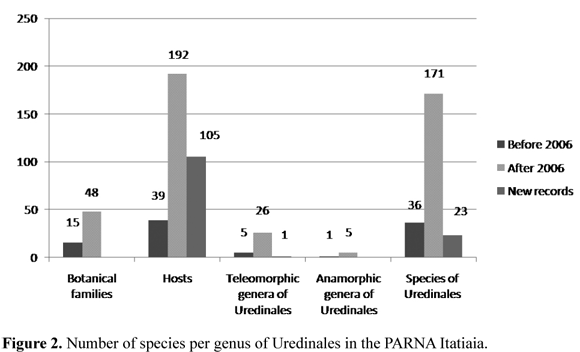
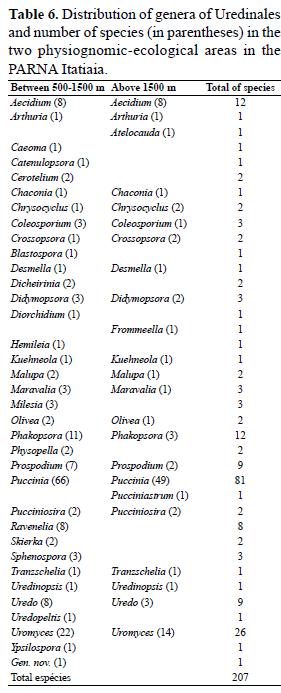
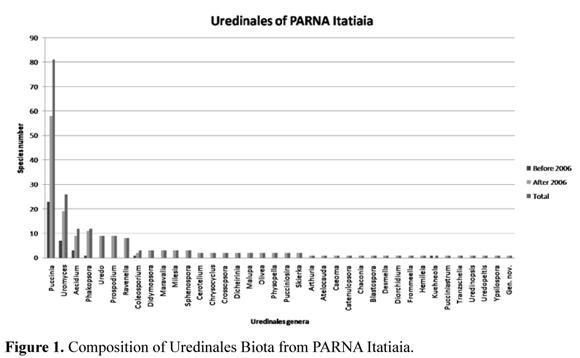
<body><![CDATA[<p>The oldest Uredinales collections from PARNA Itatiaia were made by Ernst Heinrish    Georg Ule between 1883 and 1903. Materials collected by Ule were mainly studied    by Paul Hennings (Hennings 1899), Paul Dietel (Dietel 1899) and Franz Otto Pazschke    (Pazschke 1896) in Germany. These collections are currently deposited at the    University of Hamburg Herbarium (HBG) (Friederichsen 1973). Between 1921 and    1922, Edward Willet Dorland Holway made the largest collection of rusts from    Brazil, including materials from PARNA Itatiaia which were studied in the United    States by H. S. Jackson (Jackson 1926-1932). These collections are deposited    in the Arthur Herbarium (PUR) at Purdue University. However, these samples were    collected sporadically and in a non-intensive way. Moreover, data, such as composition,    species diversity, and altitudinal ranges in comparison with other areas, were    absent. Therefore, this study aimed to update and increase the knowledge of    Uredinales species found at the Parque Nacional do Itatiaia, Brazil. To accomplish    this, data on the composition, species diversity and altitudinal ranges of Uredinales    were collected, analyzed and compared with other areas of the Atlantic Forest    (Brazil) and with Cerrado areas of S&atilde;o Paulo State (Brazil), Colombia, Costa    Rica and Southern Africa.</p>     <p><b>MATERIAL AND METHODS </b></p>     <p>First, an extensive review of the literature was conducted to become familiar    with species of Uredinales previously reported for the Parque Nacional do Itatiaia    (PARNA Itatiaia). Collections were then made over a two-year period, from July    2006 to June 2008, with a total of 13 expeditions, each lasting 5 days. Samples    were collected from wild and exotic plants infected by fungi of the Order Uredinales.    Sampling was carried out on several roads and trails of the park and from environmentally    protected areas around it at altidudes between 500 and 2600 MSL. Collected material    was herborized and taken to the Mycology Laboratory of the Instituto de Pesquisas    Jardim Botânico do Rio de Janeiro for definitive identification of both host    and rust. </p>     <p>To prepare samples for observation under a Leica S6E stereomicroscope, free-hand    sections and scrapings were placed into lactophenol and chloral hydrate. Rust    structure was observed using a Zeiss Axioskop 40 microscope connected to a Zeiss    Axiocam MRC digital camera. Images and spore measurements were performed using    the Axiovision Rel 4.6 program. Rusts were identified through morphology, spectrum    of hosts and comparisons with specialized Uredinales literature.</p>     <p>The database of the Instituto de Pesquisas Jardim Botânico do Rio de Janeiro    Herbarium (JABOT) was consulted to determine some host/rust relationships. This    database is the most reliable and complete bank of information concerning plants    from PARNA Itatiaia. Ten botanical families with the greatest number of vascular    species in the park were chosen and their rust/host relationship calculated.  </p>     <p>For the analysis of altitudinal distribution of Uredinales, the system of physiognomic-ecological    classification, as described by Veloso <i>et al</i>. (1991), was adopted. Based    on this system, park vegetation was divided into two distinct altitudinal areas:    one between 500-1500 MSL and other above 1500 MSL. The similarity between these    two areas was determined by means of the presence/absence of species using the    S&oslash;rensen coefficient (Allegrucci <i>et al</i>. 2007, Marques <i>et al</i>. 2008),    as follows: S&oslash;=2a/b+c, where &quot;b&quot; and &quot;c&quot; are the number    of species in each area and &quot;a&quot; is the number of species common to    both areas. This index ranges from 0 (no similarity-Absence) to 1 (complete    similarity-Presence). The same coefficient was applied to the comparative study    between the PARNA Uredinales Biota and the Colombian Coffee Region located in    the Colombian Andes at an altitude of 1000-2000 MSL (Salazar 2002).</p>     <p><b>RESULTS AND DISCUSSION</b></p>     <p><i>Composition</i></p>     <p><b>Uredinales</b>. The Biota of Uredinales (rust fungi) in the Parque Nacional    do Itatiaia is composed of 38 genera (32 teleomorphs and 6 anamorphs), representing    28% of the genera recognized worldwide (Cummins &amp; Hiratsuka; 2003). Two    hundred and seven species of Uredinales were found in the park, out of which    178 were teleomorphs and 29 anamorphs, representing almost 28% of all known    species of Brazil. Nine are new records for Brazil, and 171 species are new    records for the park. Moreover, one genus, 12 teleomorphic species and 11 anamorphic    species are new to science (<a href="#figura1">Figura 1</a>).</p>     <center>   <img src="/img/revistas/cal/v35n1/v35n1a12fig1.gif"><a name="figura1"></a>  </center>     ]]></body>
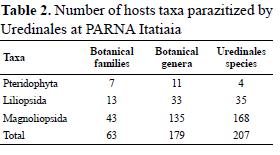
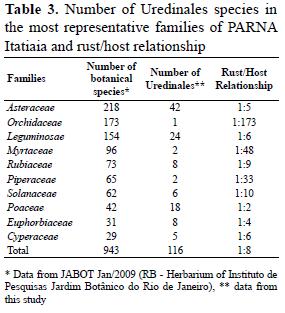
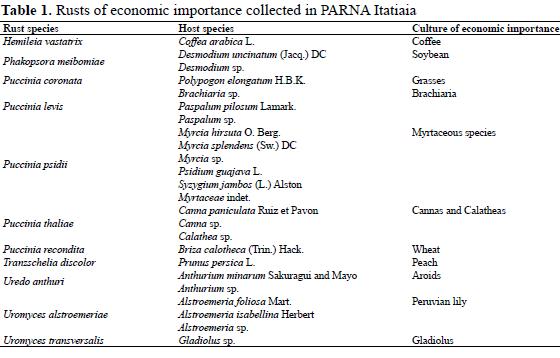
<body><![CDATA[<p>Sixty-one percent of the species at PARNA Itatiaia were found in Minas Gerais;    19% (39 species) were unique to this State. Of these species, 12 were found    in the environmentally protected area around the park. Thirty-one new records    were registered for the Uredinales Biota of Minas Gerais. Rio de Janeiro comprises    81% species of the rust fungi at PARNA Itatiaia. Thirty-nine percent (81 species)    are exclusive to this State. Of 168 species collected in Rio de Janeiro State,    34 correspond to new records for PARNA Itatiaia. Eighty-one species (42%) are    common to both Minas Gerais and Rio de Janeiro States. </p>     <p>Several rusts of economic importance were found at PARNA Itatiaia (<a href="#tab1">Table    1</a>). These fungi were collected from native and exotic plants that have been    commercialized. Some of these plants and their parasitic diseases are already    widespread, suggesting that the park could be a source of inocula for cultures    of significant economic importance that will eventually be established around    it. </p>       <center>   <img src="/img/revistas/cal/v35n1/v35n1a12tab1.jpg"><a name="tab1"></a>      </center>     <p>Seven species previously reported were not collected again: <i>Aecidium eupatorii</i>,    <i>Puccinia</i><i> improvisa</i>, <i>Puccinia</i><i> itatiayensis</i>, <i>Puccinia</i><i>    lorentzii</i>, <i>Puccinia</i><i> millegranae</i>, <i>Uromyces</i><i> cisneroanus</i>    and <i>Uromyces</i><i> dolichosporus</i>.</p>     <p><b>Hosts</b>. The coevolutionary relationship between Uredinales and their    hosts has been discussed in some studies of neotropical rusts (Buritic&aacute;    2000, Cummins &amp; Hiratsuka 2003, Pardo-Cardona 2000, Salazar <i>et al</i>.    2002, Smith &amp; Coil 2007). Thus, both knowledge and correct identification    of the hosts are essential to studies of Uredinales. At PARNA Itatiaia, 192    hosts belonging to 63 families were recorded. Considering the limitation of    previous identifications, 105 species are new records of hosts from the Brazilian    Uredinales Biota. This fact shows the importance of collaboration between mycologists,    botanists and plant pathologists in contributing to our overall understanding    of biodiversity. </p>     <p>Eleven genera belonging to four families of Pteridophyta were identified as    parasitized by 4 (2%) species of rusts. In Liliopsida, 13 families and 33 genera    were identified as parasitized by 35 (17%) species of Uredinales. Magnoliopsida    presented 43 families and 135 genera parasitized by 168 (81%) rust species (<a href="#tab2">Table    2</a>). At the park, 67% of host families recorded by Hennen <i>et al</i>. (2005)    for Brazil were found, indicating the importance of this rust biota.</p>     <center>   <img src="/img/revistas/cal/v35n1/v35n1a12tab2.jpg"><a name="tab2"></a>  </center>     <p>The host families with the greatest number of rust species were <i>Asteraceae</i>    with 42 species (20%), <i>Leguminosae</i> with 24 species (11%) and <i>Poaceae</i>    with 18 species (9%), representing 40% of all species present in the park (<a href="#tab3">Table    3</a>). These results corroborate the pattern suggested by Hennen <i>et al</i>.    (2005) in Brazil. In Colombia Pardo-Cardona (2000), the same three families    with 33% of species were indicated, with <i>Asteraceae</i> the most numerous    in species, followed by <i>Poaceae</i> and <i>Leguminosae</i>.</p>     <center>   <img src="/img/revistas/cal/v35n1/v35n1a12tab3.jpg"><a name="tab3"></a>  </center>     <p>Using JABOT data to establish rust:host relationships, the family <i>Orchidaceae</i>    appeared to be the second greatest family (9%) in number of species in the park.    However, out of 173 species of <i>Orchidaceae</i> already registered in the    park, only one rust was identified, thus presenting a very low rust:host relationship    (1:173). A similar result was found by Berndt (2008) in South Africa. Out of    the 10 most numerous families, 4 had no records at all for rusts, and the family    with the greatest number of species, <i>Aizoaceae</i> (2592 species), had only    9 species of Uredinales and a correspondingly low rust:host ratio (1:288). Even    the rust:host ratio for the 10 richest families in species from South Africa    was 1:47 (Berndt 2008), which is low, when compared to 1:8 of PARNA Itatiaia    (<a href="#tab3">Table 3</a>).</p>     ]]></body>
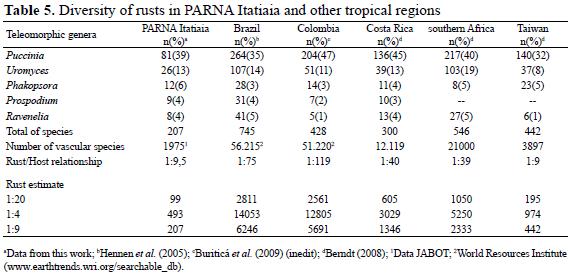
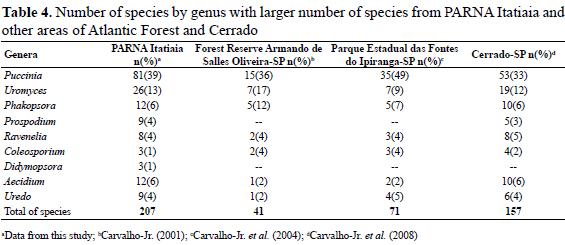
<body><![CDATA[<p>The Biota of the Uredinales from PARNA Itatiaia represents almost 28% of species    recorded from Brazil, confirming again its great biological diversity. The importance    of preserving both hosts and parasites is well established, as, theoretically,    these organisms exert a mutually inclusive pressure to maintain the dynamic    balance so necessary in natural areas. Additionally, the rust:host relationship    contributes to the speciation of both. The knowledge of the biota of rusts is,    therefore, very useful in policy design for biodiversity management and conservation.</p>     <p><i>Diversity of species</i></p>     <p>The genera <i>Puccinia</i> (with 81 species), <i>Uromyces</i> (with 26), <i>Aecidium</i>    (12) and <i>Phakopsora</i> (12) had the highest number of species (<a href="#figura2">Figura    2</a>). The first had 39% of species, followed by <i>Uromyces</i> with 13% and    <i>Aecidium</i> and <i>Phakopsora</i> with 6% each. As such, 64% of park species    belong to 3 teleomorphic genera and one anamorphic genus. The number of <i>Puccinia</i>    species previously recorded in the park was 23. After our new collections, the    number rose to 81, an increment of 352%. The genus <i>Uromyces</i><i> </i>increased    from 7 to 26 species (371%), <i>Aecidium</i> from 3 to 12 species (400%) and    <i>Phakopsora</i> from 1 to 12 (1200%).</p>     <center>   <img src="/img/revistas/cal/v35n1/v35n1a12fig2.gif"><a name="figura2"></a>  </center>     <p>Until 2006, the Biota of Uredinales from Brazil was composed of 56 teleomorphs,    9 anamorphs and about 745 species (Hennen <i>et al</i>. 2005). In the same catalogue,    the species of the teleomorphic genera <i>Puccinia</i>, <i>Uromyces</i><i> </i>and    <i>Phakopsora</i> represented 54% of occurrences, while the anamorphs <i>Aecidium    </i>and <i>Uredo</i> accounted for 19%. <a href="#tab4">Table    4</a> shows a comparison between the Uredinales Biota from PARNA Itatiaia and    three locations in the Atlantic Forest and Cerrado from S&atilde;o Paulo State (Carvalho-Jr.    2001, Carvalho-Jr. <i>et al</i>. 2004, 2008). These studies show almost the    same pattern when compared to Hennen <i>et al</i>. (2005). At PARNA Itatiaia,    species of<i> Puccinia</i>, <i>Uromyces</i><i> </i>and <i>Phakopsora</i> represented    58% of occurrences. Thus, for the Atlantic Forest region, the species percentages    of these three genera vary from 58 to 65% (<a href="#tab4">Table    4</a>), depending on the studied locality. On the other hand, in S&atilde;o Paulo State    Cerrado areas, these three genera account for 51% of occurrences. </p>         <center>   <img src="/img/revistas/cal/v35n1/v35n1a12tab4.jpg"><a name="tab4"></a>      </center>     <p>The anamorphic genera<i> Aecidium</i> and <i>Uredo </i>from the park correspond    to 10% of species, a number slightly below the data reported by Hennen <i>et    al. </i>(2005) (all data from Brazil). In the present study, the anamorphic    genera <i>Caeoma</i>, <i>Milesia</i>, <i>Malupa</i> and <i>Physopella</i> are    reported for the first time at PARNA Itatiaia and comprise15% of the total species.    This value would be even greater if we were to consider the teleomorphic species    with unknown life cycle. Therefore, further studies aimed at the characterization    of the life cycles of rust fungi in the park are suggested.</p>     <p>The five teleomorphic genera with the largest number of species at PARNA Itatiaia    and other tropical regions, such as Brazil, Colombia, Costa Rica, southern Africa    (Botswana, Namibia and South Africa) and Taiwan, are shown in <a href="#tab5">Table    5</a>. The genera <i>Puccinia</i>, <i>Uromyces</i> and <i>Phakopsora</i> comprise    between 45% and 64% of the 5000 to 7000 species reported by Cummins &amp; Hiratsuka    (2003). In southern Africa, Berndt (2008) reports <i>Uromyces</i> and <i>Puccinia    </i>with<i> </i>59% of occurrences and considers <i>Phakopsora</i> well represented    with 1% of occurrences. In the present study, <i>Phakopsora</i> represented    6% of species. This value reflects experience gained in recent years on species    of this genus based on various studies developed in the Neotropics, including    the work of Buritic&aacute; (1994, 1999), Buritic&aacute; &amp; Pardo-Cardona    (1996), Dianese <i>et al</i>. (1993), Ono <i>et al</i>. (1992), Ono (2000) and    Salazar &amp; Carvalho-Jr. (2009). According to Cummins &amp; Hiratsuka (2003),    <i>Phakopsora</i> is one of the largest genera in the humid regions of the tropics.    The study of this teleomorph requires some experience because the telial sori    are subepidermal or subcuticular, and symptoms are difficult to find. Consequently,    <i>Phakopsora</i><i> </i>species are often identified only as <i>Uredo.</i></p>         <center>   <img src="/img/revistas/cal/v35n1/v35n1a12tab5.jpg"><a name="tab5"></a>      </center>     <p>Hennen &amp; McCain (1993) proposed that the rate of rust fungi to host plants    in a given area generally ranges between 5%, or 1:20 and 25%, or 1:4. Their    results were based on estimates of the number of rust species in some Central    American countries and data from Mogi Mirim (Brazil) and Indiana (USA). Based    on this standard and using a rust:host estimate of 1:20 (5%), we would calculate    99 species of rust fungi in the park (<a href="#tab5">Table    5</a>). However, this number represents 48% fewer species than were actually    found in the present study. On the other hand, applying a 1:4 (25%) ratio, the    estimated number of rusts would be 493 species, out of which only 42% would    be known. Brazil would then have 5% of known species, Colombia 3%, Costa Rica    9%, South Africa 10% and Taiwan 45%. Based on our study, the rust:host relationship    found in the park is actually 1:9 (<a href="#tab5">Table    5</a>), meaning that 11% of vascular species of the park are infected by rusts.    The collections made for this study were comprehensive, and the sampling represents    almost all species of rusts known in that biota. Therefore, when our 1:9 ratio,    which is intermediate, is compared with the estimates of Hennen &amp; McCain    (1993), we believe that this estimate is closer to reality and can be applied    to other tropical regions. Thus, if we then go one step further and apply the    rust:host relationship of 1:9, as calculated for PARNA Itatiaia, to Brazil,    as a whole, the number of rusts would be 6246 (<a href="#tab5">Table    5</a>), out of which only 12% of rust species would be known in the country.    Using the same method, we would find Colombia to have 5691 species, with only    7% having been collected, and Costa Rica would have 1346 species, but only 22%    would be currently recorded. Finally, in the whole of southern Africa, including    Namibia, Botswana and South Africa, the estimate would be 2333 species, from    which only 23% would be known. By these estimates, countries like Brazil and    Colombia, as depositories of a great diversity of plants (<a href="http://www.earthtrends.wri.org/searchable_db" target="_blank">www.earthtrends.wri.org/searchable_db</a>),    also apparently have a great diversity of unknown rust fungi. </p>     ]]></body>
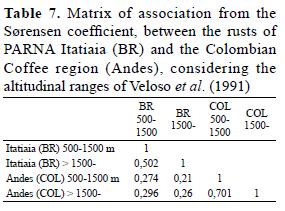
<body><![CDATA[<p><i>Altitudinal distribution</i></p>     <p>The altitudinal distribution of Uredinales species at PARNA Itatiaia (<a href="#tab6">Table    6</a>) showed some variation between <i>Floresta Ombr&oacute;fila Densa Montana</i>,    (500-1500 MSL) and <i>Floresta Ombr&oacute;fila Densa Alto-Montana</i> (above    1500 MSL). However, the teleomorphs <i>Uromyces</i> and <i>Puccinia </i>and    the anamorphs <i>Aecidium</i> and <i>Uredo</i> were widely distributed over    the entire altitudinal profile of the park and, in general, include species    with the highest number of occurrence (<a href="#figura2">Figura 2</a>). These    results are similar to those found in the Colombian Andean mountains with altitudes    varying from 0 m to &gt;3000 m (Pardo-Cardona 2000).</p>     <center>   <img src="/img/revistas/cal/v35n1/v35n1a12tab6.jpg"><a name="tab6"></a>  </center>     <p>Furthermore, among the physiognomic-ecological profiles of PARNA Itatiaia,    several altitude specializations were found (<a href="#tabla6">Table 6</a>).    Species of several genera, including <i>Caeoma</i>, <i>Catenulopsora</i>, <i>Cerotelium,    Blastospora</i>, <i>Dicheirinia</i>, <i>Diorchidium</i>, <i>Hemileia</i>, <i>Milesina</i>,    <i>Physopella</i>, <i>Ravenelia</i>, <i>Skierka</i>, <i>Sphenospora</i>, <i>Uredopeltis</i>,    <i>Ypsilospora</i>, and one new genus, were only found in the <i>Floresta Ombr&oacute;fila    Densa Montana</i> (500-1500 MSL). At this altitude, 175 Uredinales species were    found, representing 84% of the Uredinales Biota in the park.</p>     <p><i>Ravenelia</i> species, which have <i>Leguminosae</i> as host specificity,    represented one of the highest numbers of occurrences; however, they were only    found in the areas of <i>Floresta Ombr&oacute;fila Densa Montana</i> (500-1500    MSL). This fact probably results from the presence of both shrub and tree legumes,    predominantly at an altitude ranging from 700 to about 1200 MSL (Morim &amp;    Barroso 2007); consequently, species of <i>Ravenelia</i> are also predominantly    in this region. </p>     <p>The genera <i>Atelocauda</i>, <i>Frommeella</i><i> </i>and <i>Pucciniastrum</i>,    which are represented by one species each (<a href="#tab6">Table 6</a>), were    only found in the <i>Floresta Ombr&oacute;fila Densa Alto-Montana</i> (&gt;    1500 MSL). <i>Frommeella</i><i> </i>and <i>Pucciniastrum</i><i> </i>were only    found above 1950 MSL, the natural habitat of their hosts. In <i>Floresta Ombr&oacute;fila    Densa Alto-Montana</i>, 101 Uredinales species were collected, representing    49% of species in the PARNA Itatiaia.</p>     <p>Similarity between PARNA Itatiaia and the Colombian Coffee Region at equivalent    altitudinal ranges was only 26% (<a href="#tab7">Table 7</a>). Most species    were exclusive to each region, and those in common were species of wide geographical    distribution, such as <i>Hemileia vastatrix</i>, <i>Puccinia cnici-oleracei</i>,    <i>Puccinia hydrocotyles</i>, <i>Puccinia oxalidis</i>, <i>Uromyces setariae-italicae</i>    and <i>Uromyces tenuicutis</i>, among others.</p>     <center>   <img src="/img/revistas/cal/v35n1/v35n1a12tab7.jpg"><a name="tab7"></a>  </center>     <p>At genus level, Safford (1999) found evidence of biogeographical relationships    among plants, birds, frogs, butterflies, beetles and hymenoptera in fields of    the same altitude in southeastern Brazil and similar habitats of the Andes.    In spite such biogeographical relationships in these regions (Safford 1999,    2007), the distribution of species is highly endemic (Safford 1999, Fern&aacute;ndez-Alonso    2003). With 26% similarity of Uredinales between these two regions, this value    probably reflects differences in climatic factors, topography, latitude and    plant species, as well as the restricted distribution of their hosts.</p>     <p>The S&oslash;rensen coefficient was small when diversity at Itatiaia was compared    to similar regions in the Colombian Andes (<a href="#tab7">Table 7</a>). Similarity    between different altitudinal ranges at Itatiaia (500-1500 MSL and &gt; 1500    MSL) was high at 0.502. This value can be explained by the presence of cosmopolitan    species in both forest formations and the broad area of transition between the    two forest formations suggested by Veloso <i>et al</i>. (1991). By way of comparison,    similarity between the same altitudinal ranges in the Colombian Andes gave a    higher value of 0.701, as a likely consequence of differences in latitude, topography    and the greater extension of the Colombian forest formation. </p>     ]]></body>
<body><![CDATA[<p><b>CONCLUSIONS</b></p>     <p>PARNA Itatiaia has approximately 28% of the currently known Uredinales species    of Brazil. This diversity is represented by 38 genera and 207 species of Uredinales    parasitizing hosts of 63 botanical families and 179 genera. Thirty-one new occurrences    of Uredinales Biota were registered for Minas Gerais and 34 for Rio de Janeiro.    A total of 201 novel species, genera, hosts and records for Brazil in the States    of Minas Gerais and Rio de Janeiro were reported. Thus, for every 6 samples    collected, labeled and incorporated into the Herbarium (1157/201), one brings    new information. </p>     <p>With respect to the geographical distribution of species found at the park,    37% of species (77) are restricted to Brazil, and 54% of species (111) can be    found in at least two countries on the American continent. The remaining 9%    (19) are distributed worldwide. In PARNA Itatiaia, several altitude specializations    were found. Some species were only found between 500-1500 MSL, while others    were only present at altitudes higher than 1500 MSL, according to the natural    habitat of their hosts.</p>     <p>The similarity of Uredinales species between the two altitudinal extracts in    the same region may be considered high: 50% (PARNA Itatiaia) and 70% (Colombian    Coffee Region). However, the similarity between these two regions is low (26%),    probably as a result of marked differences in climate, topography, latitude    and plant species.</p>     <p>Several native and exotic plants of economic importance are parasitized with    Uredinales in the park and could act as a permanent source of inocula for crops    cultivated nearby, such as coffee, soybeans, brachiaria, cannas and calatheas    and Peruvian Lily, among others.</p>     <p>Overall, considering the uncontrolled deforestation of the Atlantic Forest    and other hotspot regions and also the sparse research and the scarce resources    available for research, many new species of rust will never be known. </p>     <p><b>ACKNOWLEDGMENTS</b></p>     <p>This paper is part of the PhD project conducted by the first author and required    by the Postgraduate Program in Botany, School of Tropical Botany, Instituto    de Pesquisas Jardim Botânico do Rio de Janeiro. The authors acknowledge the    staff of the PARNA Itatiaia (IBAMA) for their support during the fieldwork and    the Instituto de Pesquisas Jardim Botânico do Rio de Janeiro for the infrastructure,    logistical support and much of the taxonomic work for the identification of    botanical specimens. We thank Cassia Monica Sakuragui and Pablo Gutierrez for    suggestions on the manuscript, Jeronimo Boelsuns Barreto Sansevero for statistical    suggestions, and FAPERJ and CNPq for financial support.</p>     <p><b>LITERATURE CITED</b></p>     <!-- ref --><p>1. Allegrucci, N., L. Eliades, A. Bucsinszky, M. Cabello, &amp; A. Arambarri.    2007. Diversidad de Anamorfos de Ascomycota en bosques nativos de <i>Celtis    tala</i> (Ulmaceae) en la Provincia de Buenos Aires, Argentina. Bol Soc Argent    Bot 42(1-2): 79-86.    &nbsp;&nbsp;&nbsp;&nbsp;&nbsp;&nbsp;&nbsp;&nbsp;[&#160;<a href="javascript:void(0);" onclick="javascript: window.open('/scielo.php?script=sci_nlinks&ref=000072&pid=S0366-5232201300010001200001&lng=','','width=640,height=500,resizable=yes,scrollbars=1,menubar=yes,');">Links</a>&#160;]<!-- end-ref --></p>     <!-- ref --><p>2. Berndt, R. 2008. The rust mycobiota of southern Africa: Species richness,    composition, and affinities. Mycological Research 112: 463-471.    &nbsp;&nbsp;&nbsp;&nbsp;&nbsp;&nbsp;&nbsp;&nbsp;[&#160;<a href="javascript:void(0);" onclick="javascript: window.open('/scielo.php?script=sci_nlinks&ref=000074&pid=S0366-5232201300010001200002&lng=','','width=640,height=500,resizable=yes,scrollbars=1,menubar=yes,');">Links</a>&#160;]<!-- end-ref --></p>     <!-- ref --><p>3. Buritic&aacute;, P. 1994. Cambios taxonomicos y nuevos registros de Uredinales    de la flora Andina. Revista del Instituto de Ciencias Naturales y Ecolog&iacute;a    (Medell&iacute;n) 5(2): 173-190.    &nbsp;&nbsp;&nbsp;&nbsp;&nbsp;&nbsp;&nbsp;&nbsp;[&#160;<a href="javascript:void(0);" onclick="javascript: window.open('/scielo.php?script=sci_nlinks&ref=000076&pid=S0366-5232201300010001200003&lng=','','width=640,height=500,resizable=yes,scrollbars=1,menubar=yes,');">Links</a>&#160;]<!-- end-ref --></p>     <!-- ref --><p>4. Buritic&aacute;, P. 1999. La familia Phakopsoraceae en el Neotr&oacute;pico    III, generos: <i>Batistopsora</i> y <i>Phakopsora</i>. Rev. Acad. Colomb. Cienc.    23: 271-305.    &nbsp;&nbsp;&nbsp;&nbsp;&nbsp;&nbsp;&nbsp;&nbsp;[&#160;<a href="javascript:void(0);" onclick="javascript: window.open('/scielo.php?script=sci_nlinks&ref=000078&pid=S0366-5232201300010001200004&lng=','','width=640,height=500,resizable=yes,scrollbars=1,menubar=yes,');">Links</a>&#160;]<!-- end-ref --></p>     <!-- ref --><p>5. Buritic&aacute;, P. 2000. Adaptaci&oacute;n al ambiente de Uredinales Netropicales.    Biol&oacute;gico 62(1): 127-141.    &nbsp;&nbsp;&nbsp;&nbsp;&nbsp;&nbsp;&nbsp;&nbsp;[&#160;<a href="javascript:void(0);" onclick="javascript: window.open('/scielo.php?script=sci_nlinks&ref=000080&pid=S0366-5232201300010001200005&lng=','','width=640,height=500,resizable=yes,scrollbars=1,menubar=yes,');">Links</a>&#160;]<!-- end-ref --></p>     <!-- ref --><p>6. Buritic&aacute;, P. &amp; V.M. Pardo-Cardona. 1996. Flora Uredineana Colombiana.    Rev. Acad. Colomb. Cienc. 20(77): 183-236.    &nbsp;&nbsp;&nbsp;&nbsp;&nbsp;&nbsp;&nbsp;&nbsp;[&#160;<a href="javascript:void(0);" onclick="javascript: window.open('/scielo.php?script=sci_nlinks&ref=000082&pid=S0366-5232201300010001200006&lng=','','width=640,height=500,resizable=yes,scrollbars=1,menubar=yes,');">Links</a>&#160;]<!-- end-ref --></p>     <!-- ref --><p>7. Carvalho-JR., A.A. 2001. Micota uredinol&oacute;gica da reserva florestal    &quot;Armando de Salles Oliveira&quot; (S&atilde;o Paulo, Brasil). Dissertation, UNESP,    Botucatu.    &nbsp;&nbsp;&nbsp;&nbsp;&nbsp;&nbsp;&nbsp;&nbsp;[&#160;<a href="javascript:void(0);" onclick="javascript: window.open('/scielo.php?script=sci_nlinks&ref=000084&pid=S0366-5232201300010001200007&lng=','','width=640,height=500,resizable=yes,scrollbars=1,menubar=yes,');">Links</a>&#160;]<!-- end-ref --></p>     <!-- ref --><p>8. Carvalho-JR., A.A., J.F. Hennen &amp; M.B. Figueiredo. 2004. Cat&aacute;logo    de fungos causadores de ferrugens (Uredinales) do parque estadual das Fontes    do Ipiranga, S&atilde;o Paulo, SP. Hoehnea 31: 51-60.    &nbsp;&nbsp;&nbsp;&nbsp;&nbsp;&nbsp;&nbsp;&nbsp;[&#160;<a href="javascript:void(0);" onclick="javascript: window.open('/scielo.php?script=sci_nlinks&ref=000086&pid=S0366-5232201300010001200008&lng=','','width=640,height=500,resizable=yes,scrollbars=1,menubar=yes,');">Links</a>&#160;]<!-- end-ref --></p>     <!-- ref --><p>9. Carvalho-JR., A.A., J.F. Hennen, M.M.W. Hennen &amp; M.B. Figueiredo. 2008.    Fungos causadores de ferrugens (Uredinales) em &aacute;reas de cerrado no estado    de S&atilde;o Paulo, Brasil. Rodrigu&eacute;sia 59(1): 1-55.    &nbsp;&nbsp;&nbsp;&nbsp;&nbsp;&nbsp;&nbsp;&nbsp;[&#160;<a href="javascript:void(0);" onclick="javascript: window.open('/scielo.php?script=sci_nlinks&ref=000088&pid=S0366-5232201300010001200009&lng=','','width=640,height=500,resizable=yes,scrollbars=1,menubar=yes,');">Links</a>&#160;]<!-- end-ref --></p>     <!-- ref --><p>10. Cummins, G.B. &amp; Y. Hiratusuka. 2003. Illustrated genera of rust fungi.    Third Edition. American Phytophatological Society. St Paul.    &nbsp;&nbsp;&nbsp;&nbsp;&nbsp;&nbsp;&nbsp;&nbsp;[&#160;<a href="javascript:void(0);" onclick="javascript: window.open('/scielo.php?script=sci_nlinks&ref=000090&pid=S0366-5232201300010001200010&lng=','','width=640,height=500,resizable=yes,scrollbars=1,menubar=yes,');">Links</a>&#160;]<!-- end-ref --></p>     <!-- ref --><p>11. Dianese, J.C., R.B. Medeiros, L.T.P. Santos, C. Furlamento, M. Sanchez    &amp; A.C. Dianese. 1993. <i>Batistopsora</i> Gen. nov. and new <i>Phakopsora</i>,    <i>Ravenelia</i>, <i>Cerotelium</i>, and <i>Skierka</i> species from the Brazilian    Cerrado. Fitopatol. Bras. 18(3): 436-450.    &nbsp;&nbsp;&nbsp;&nbsp;&nbsp;&nbsp;&nbsp;&nbsp;[&#160;<a href="javascript:void(0);" onclick="javascript: window.open('/scielo.php?script=sci_nlinks&ref=000092&pid=S0366-5232201300010001200011&lng=','','width=640,height=500,resizable=yes,scrollbars=1,menubar=yes,');">Links</a>&#160;]<!-- end-ref --></p>     <!-- ref --><p>12. Dietel, P. 1899. Uredineae brasilienses, a cl. E. Ule lectae. II. Hedwigia    38: 248-259.    &nbsp;&nbsp;&nbsp;&nbsp;&nbsp;&nbsp;&nbsp;&nbsp;[&#160;<a href="javascript:void(0);" onclick="javascript: window.open('/scielo.php?script=sci_nlinks&ref=000094&pid=S0366-5232201300010001200012&lng=','','width=640,height=500,resizable=yes,scrollbars=1,menubar=yes,');">Links</a>&#160;]<!-- end-ref --></p>     <!-- ref --><p>13. Fern&aacute;ndez-Alonso, J.L. 2003. Algunos patrones de distribuci&oacute;n    y endemismo en plantas vasculares de los p&aacute;ramos de Colombia. In: <i>Memorias    del Congreso Mundial de P&aacute;ramos</i>, (Part I). Ministerio de Medio Ambiente.    Bogot&aacute;, pp 213-240.    &nbsp;&nbsp;&nbsp;&nbsp;&nbsp;&nbsp;&nbsp;&nbsp;[&#160;<a href="javascript:void(0);" onclick="javascript: window.open('/scielo.php?script=sci_nlinks&ref=000096&pid=S0366-5232201300010001200013&lng=','','width=640,height=500,resizable=yes,scrollbars=1,menubar=yes,');">Links</a>&#160;]<!-- end-ref --></p>     <!-- ref --><p>14. Friederichesen, I. 1973. Liste der Pilse der kollektion E. Ule aus Brasilien    (1883-1903) im Herbarium Hamburgense. Mitt. Staatsinst: Allg. Bot. Hamburg,    pp 95-134.    &nbsp;&nbsp;&nbsp;&nbsp;&nbsp;&nbsp;&nbsp;&nbsp;[&#160;<a href="javascript:void(0);" onclick="javascript: window.open('/scielo.php?script=sci_nlinks&ref=000098&pid=S0366-5232201300010001200014&lng=','','width=640,height=500,resizable=yes,scrollbars=1,menubar=yes,');">Links</a>&#160;]<!-- end-ref --></p>     <!-- ref --><p>15. Hennen, J.F. &amp; P. Buritic&aacute;. 1980. A brief summary of modern    rust taxonomic and evolutionary theory. Reports Tottori Mycological Institute    18: 243-256.    &nbsp;&nbsp;&nbsp;&nbsp;&nbsp;&nbsp;&nbsp;&nbsp;[&#160;<a href="javascript:void(0);" onclick="javascript: window.open('/scielo.php?script=sci_nlinks&ref=000100&pid=S0366-5232201300010001200015&lng=','','width=640,height=500,resizable=yes,scrollbars=1,menubar=yes,');">Links</a>&#160;]<!-- end-ref --></p>     <!-- ref --><p>16. Hennen, J.F., M.B. Figueiredo, A.A. Carvalho-JR. &amp; P.G. Hennen. 2005.    Catalogue of the species of plant rust fungi (Uredinales) of Brazil. <a href="http://www.jbrj.gov.br/" target="_blank">http://www.jbrj.gov.br</a>. (Last    accessed 03 March 2012).    &nbsp;&nbsp;&nbsp;&nbsp;&nbsp;&nbsp;&nbsp;&nbsp;[&#160;<a href="javascript:void(0);" onclick="javascript: window.open('/scielo.php?script=sci_nlinks&ref=000102&pid=S0366-5232201300010001200016&lng=','','width=640,height=500,resizable=yes,scrollbars=1,menubar=yes,');">Links</a>&#160;]<!-- end-ref --></p>     <!-- ref --><p>17. Hennen, J.F. &amp; J.W. Mccain. 1993. New species and records of Uredinales    from the Neotropics. Mycologia 85: 970–986.    &nbsp;&nbsp;&nbsp;&nbsp;&nbsp;&nbsp;&nbsp;&nbsp;[&#160;<a href="javascript:void(0);" onclick="javascript: window.open('/scielo.php?script=sci_nlinks&ref=000104&pid=S0366-5232201300010001200017&lng=','','width=640,height=500,resizable=yes,scrollbars=1,menubar=yes,');">Links</a>&#160;]<!-- end-ref --></p>     <!-- ref --><p>18. Hennings, P. 1899. Neue von E. Ule in Brasilien gesammelte Ustilagineen    und Uredineen. Hedwigia Beiblatt 38: 65-71.    &nbsp;&nbsp;&nbsp;&nbsp;&nbsp;&nbsp;&nbsp;&nbsp;[&#160;<a href="javascript:void(0);" onclick="javascript: window.open('/scielo.php?script=sci_nlinks&ref=000106&pid=S0366-5232201300010001200018&lng=','','width=640,height=500,resizable=yes,scrollbars=1,menubar=yes,');">Links</a>&#160;]<!-- end-ref --></p>     <!-- ref --><p>19. Jackson, H.S. 1926. The rusts of South America based on Holway collections-I.    Mycologia 18: 139-162.    &nbsp;&nbsp;&nbsp;&nbsp;&nbsp;&nbsp;&nbsp;&nbsp;[&#160;<a href="javascript:void(0);" onclick="javascript: window.open('/scielo.php?script=sci_nlinks&ref=000108&pid=S0366-5232201300010001200019&lng=','','width=640,height=500,resizable=yes,scrollbars=1,menubar=yes,');">Links</a>&#160;]<!-- end-ref --></p>     <!-- ref --><p>20. Jackson, H.S. 1927. The rusts of South America based on Holway collections-II.    Mycologia 19: 51-65.    &nbsp;&nbsp;&nbsp;&nbsp;&nbsp;&nbsp;&nbsp;&nbsp;[&#160;<a href="javascript:void(0);" onclick="javascript: window.open('/scielo.php?script=sci_nlinks&ref=000110&pid=S0366-5232201300010001200020&lng=','','width=640,height=500,resizable=yes,scrollbars=1,menubar=yes,');">Links</a>&#160;]<!-- end-ref --></p>     <!-- ref --><p>21. Jackson, H.S. 1931. The rusts of South America based on Holway collections-III.    Mycologia 23:96-116.    &nbsp;&nbsp;&nbsp;&nbsp;&nbsp;&nbsp;&nbsp;&nbsp;[&#160;<a href="javascript:void(0);" onclick="javascript: window.open('/scielo.php?script=sci_nlinks&ref=000112&pid=S0366-5232201300010001200021&lng=','','width=640,height=500,resizable=yes,scrollbars=1,menubar=yes,');">Links</a>&#160;]<!-- end-ref --></p>     <!-- ref --><p>22. Jackson, H.S. 1931. The rusts of South America based on Holway collections-IV.    Mycologia 23: 332-364.    &nbsp;&nbsp;&nbsp;&nbsp;&nbsp;&nbsp;&nbsp;&nbsp;[&#160;<a href="javascript:void(0);" onclick="javascript: window.open('/scielo.php?script=sci_nlinks&ref=000114&pid=S0366-5232201300010001200022&lng=','','width=640,height=500,resizable=yes,scrollbars=1,menubar=yes,');">Links</a>&#160;]<!-- end-ref --></p>     <!-- ref --><p>23. Jackson, H.S. 1931. The rusts of South America based on Holway collections-V.    Mycologia 23: 463-503.    &nbsp;&nbsp;&nbsp;&nbsp;&nbsp;&nbsp;&nbsp;&nbsp;[&#160;<a href="javascript:void(0);" onclick="javascript: window.open('/scielo.php?script=sci_nlinks&ref=000116&pid=S0366-5232201300010001200023&lng=','','width=640,height=500,resizable=yes,scrollbars=1,menubar=yes,');">Links</a>&#160;]<!-- end-ref --></p>     <!-- ref --><p>24. Jackson, H.S. 1932. The rusts of South America based on Holway collections-VI.    Mycologia 24: 62-186.    &nbsp;&nbsp;&nbsp;&nbsp;&nbsp;&nbsp;&nbsp;&nbsp;[&#160;<a href="javascript:void(0);" onclick="javascript: window.open('/scielo.php?script=sci_nlinks&ref=000118&pid=S0366-5232201300010001200024&lng=','','width=640,height=500,resizable=yes,scrollbars=1,menubar=yes,');">Links</a>&#160;]<!-- end-ref --></p>     <!-- ref --><p>25. Marques, M.F.O., L.F.P. Gusm&atilde;o &amp; L.C. Maia. 2008. Riqueza de esp&eacute;cies    de fungos conidiais em duas &aacute;reas de Mata Atlântica no Morro da Pioneira,    Serra da Jib&oacute;ia, BA, Brasil. Acta Bot. Bras. 22(4): 954-961.    &nbsp;&nbsp;&nbsp;&nbsp;&nbsp;&nbsp;&nbsp;&nbsp;[&#160;<a href="javascript:void(0);" onclick="javascript: window.open('/scielo.php?script=sci_nlinks&ref=000120&pid=S0366-5232201300010001200025&lng=','','width=640,height=500,resizable=yes,scrollbars=1,menubar=yes,');">Links</a>&#160;]<!-- end-ref --></p>     <!-- ref --><p>26. Morim, M.P. &amp; G.M. Barroso. 2007. Leguminosae arbustivas e arb&oacute;reas    da floresta atlântica do Parque Nacional do Itatiaia, sudeste do Brasil: subfam&iacute;lias    Caesalpinioideae e Mimosoideae. Rodrigu&eacute;sia 58(2): 423-468.    &nbsp;&nbsp;&nbsp;&nbsp;&nbsp;&nbsp;&nbsp;&nbsp;[&#160;<a href="javascript:void(0);" onclick="javascript: window.open('/scielo.php?script=sci_nlinks&ref=000122&pid=S0366-5232201300010001200026&lng=','','width=640,height=500,resizable=yes,scrollbars=1,menubar=yes,');">Links</a>&#160;]<!-- end-ref --></p>     <!-- ref --><p>27. Ono, Y. 2000. Taxonomy of the <i>Phakopsora ampelopsidis</i> species complex    on vitaceous hosts in Asia including a new species, <i>P. euvitis</i>. Mycologia    92: 154-173.    &nbsp;&nbsp;&nbsp;&nbsp;&nbsp;&nbsp;&nbsp;&nbsp;[&#160;<a href="javascript:void(0);" onclick="javascript: window.open('/scielo.php?script=sci_nlinks&ref=000124&pid=S0366-5232201300010001200027&lng=','','width=640,height=500,resizable=yes,scrollbars=1,menubar=yes,');">Links</a>&#160;]<!-- end-ref --></p>     <!-- ref --><p>28. Ono, Y., P. Buritic&aacute; &amp; J.F. Hennen. 1992. Delimitation of <i>Phakopsora,    Physopella, </i>and <i>Cerotelium </i>and their species on Leguminosae. Mycological    Research 96: 825-850.    &nbsp;&nbsp;&nbsp;&nbsp;&nbsp;&nbsp;&nbsp;&nbsp;[&#160;<a href="javascript:void(0);" onclick="javascript: window.open('/scielo.php?script=sci_nlinks&ref=000126&pid=S0366-5232201300010001200028&lng=','','width=640,height=500,resizable=yes,scrollbars=1,menubar=yes,');">Links</a>&#160;]<!-- end-ref --></p>     <!-- ref --><p>29. Pardo-Cardona, V.M. 2000. Relaciones flor&iacute;sticas y altitudinales    de los Uredinales colombianos. Biol&oacute;gico 62(1): 89-105.    &nbsp;&nbsp;&nbsp;&nbsp;&nbsp;&nbsp;&nbsp;&nbsp;[&#160;<a href="javascript:void(0);" onclick="javascript: window.open('/scielo.php?script=sci_nlinks&ref=000128&pid=S0366-5232201300010001200029&lng=','','width=640,height=500,resizable=yes,scrollbars=1,menubar=yes,');">Links</a>&#160;]<!-- end-ref --></p>     <!-- ref --><p>30. Parque Nacional Do Itatiaia. 2006. <a href="http://www.ibama.gov.br/parna_itatiaia" target="_blank">http://www.ibama.gov.br/parna_itatiaia</a>.    (Last accessed 08 September 2011).    &nbsp;&nbsp;&nbsp;&nbsp;&nbsp;&nbsp;&nbsp;&nbsp;[&#160;<a href="javascript:void(0);" onclick="javascript: window.open('/scielo.php?script=sci_nlinks&ref=000130&pid=S0366-5232201300010001200030&lng=','','width=640,height=500,resizable=yes,scrollbars=1,menubar=yes,');">Links</a>&#160;]<!-- end-ref --></p>     <!-- ref --><p>31. Pazschke, O. 1896. II. Verzeichniss brasilianischer von E. Ule gesammelter    Pilze. Hedwigia 35: 50-55.    &nbsp;&nbsp;&nbsp;&nbsp;&nbsp;&nbsp;&nbsp;&nbsp;[&#160;<a href="javascript:void(0);" onclick="javascript: window.open('/scielo.php?script=sci_nlinks&ref=000132&pid=S0366-5232201300010001200031&lng=','','width=640,height=500,resizable=yes,scrollbars=1,menubar=yes,');">Links</a>&#160;]<!-- end-ref --></p>     <!-- ref --><p>32. Safford, H.D. 1999. Brazilian p&aacute;ramos I. An introduction to the    physical environment and vegetation of the campos de altitude. J. Biogeogr.    26: 693–712.    &nbsp;&nbsp;&nbsp;&nbsp;&nbsp;&nbsp;&nbsp;&nbsp;[&#160;<a href="javascript:void(0);" onclick="javascript: window.open('/scielo.php?script=sci_nlinks&ref=000134&pid=S0366-5232201300010001200032&lng=','','width=640,height=500,resizable=yes,scrollbars=1,menubar=yes,');">Links</a>&#160;]<!-- end-ref --></p>     <!-- ref --><p>33. Safford, H.D. 2007. Brazilian p&aacute;ramos IV. Phytogeography of the    campos de altitude. J. Biogeogr. 34: 1701–1722.    &nbsp;&nbsp;&nbsp;&nbsp;&nbsp;&nbsp;&nbsp;&nbsp;[&#160;<a href="javascript:void(0);" onclick="javascript: window.open('/scielo.php?script=sci_nlinks&ref=000136&pid=S0366-5232201300010001200033&lng=','','width=640,height=500,resizable=yes,scrollbars=1,menubar=yes,');">Links</a>&#160;]<!-- end-ref --></p>     <!-- ref --><p>34. Salazar, Y.M. 2002. <i>Uredinales (Royas) en la zona cafetera colombiana</i>.    Thesis, Universidad de Caldas, Manizales.    &nbsp;&nbsp;&nbsp;&nbsp;&nbsp;&nbsp;&nbsp;&nbsp;[&#160;<a href="javascript:void(0);" onclick="javascript: window.open('/scielo.php?script=sci_nlinks&ref=000138&pid=S0366-5232201300010001200034&lng=','','width=640,height=500,resizable=yes,scrollbars=1,menubar=yes,');">Links</a>&#160;]<!-- end-ref --></p>     <!-- ref --><p>35. Salazar, Y.M., P. Buritic&aacute; &amp; G. Cadena-G&oacute;mez. 2002. Implicaciones    de los estudios sobre biodiversidad de los Uredinales (royas) en la regi&oacute;n    cafetera colombiana. Cenicaf&eacute; 53(3): 219-238.    &nbsp;&nbsp;&nbsp;&nbsp;&nbsp;&nbsp;&nbsp;&nbsp;[&#160;<a href="javascript:void(0);" onclick="javascript: window.open('/scielo.php?script=sci_nlinks&ref=000140&pid=S0366-5232201300010001200035&lng=','','width=640,height=500,resizable=yes,scrollbars=1,menubar=yes,');">Links</a>&#160;]<!-- end-ref --></p>     <!-- ref --><p>36. Salazar, Y.M. &amp; A.A. Carvalho-Jr. 2009. Two new Uredinales in the Phakopsoraceae    on Fabaceae from Brazil. Mycologia 101(2): 196-199.    &nbsp;&nbsp;&nbsp;&nbsp;&nbsp;&nbsp;&nbsp;&nbsp;[&#160;<a href="javascript:void(0);" onclick="javascript: window.open('/scielo.php?script=sci_nlinks&ref=000142&pid=S0366-5232201300010001200036&lng=','','width=640,height=500,resizable=yes,scrollbars=1,menubar=yes,');">Links</a>&#160;]<!-- end-ref --></p>     <!-- ref --><p>37. Smith, G.L. &amp; N.C. Coile. 2007. <i>Piptocarpha</i> (Compositae: Vernonieae).    Flora Neotropica Monograph 99: 1-94.    &nbsp;&nbsp;&nbsp;&nbsp;&nbsp;&nbsp;&nbsp;&nbsp;[&#160;<a href="javascript:void(0);" onclick="javascript: window.open('/scielo.php?script=sci_nlinks&ref=000144&pid=S0366-5232201300010001200037&lng=','','width=640,height=500,resizable=yes,scrollbars=1,menubar=yes,');">Links</a>&#160;]<!-- end-ref --></p>     <!-- ref --><p>38. Veloso, H.P., A.L.R. Rangel-Filho &amp; J.C.A. Lima. 1991. <i>Classificaç&atilde;o    da vegetaç&atilde;o brasileira adaptada a um sistema universal. Instituto Brasileiro    de Geografia e Estat&iacute;stica</i>, Rio de Janeiro. 124 p.    &nbsp;&nbsp;&nbsp;&nbsp;&nbsp;&nbsp;&nbsp;&nbsp;[&#160;<a href="javascript:void(0);" onclick="javascript: window.open('/scielo.php?script=sci_nlinks&ref=000146&pid=S0366-5232201300010001200038&lng=','','width=640,height=500,resizable=yes,scrollbars=1,menubar=yes,');">Links</a>&#160;]<!-- end-ref --></p>     <!-- ref --><p>39. World Resources Institute: Earthtrends Database. 2005. <a href="http://www.earthtrends.wri.org/searchable_db" target="_blank">www.earthtrends.wri.org/searchable_db</a>.    (Last accessed 03 March 2011).    &nbsp;&nbsp;&nbsp;&nbsp;&nbsp;&nbsp;&nbsp;&nbsp;[&#160;<a href="javascript:void(0);" onclick="javascript: window.open('/scielo.php?script=sci_nlinks&ref=000148&pid=S0366-5232201300010001200039&lng=','','width=640,height=500,resizable=yes,scrollbars=1,menubar=yes,');">Links</a>&#160;]<!-- end-ref --></p> </font>       ]]></body><back>
<ref-list>
<ref id="B1">
<label>1</label><nlm-citation citation-type="journal">
<person-group person-group-type="author">
<name>
<surname><![CDATA[Allegrucci]]></surname>
<given-names><![CDATA[N.]]></given-names>
</name>
<name>
<surname><![CDATA[Eliades]]></surname>
<given-names><![CDATA[L.]]></given-names>
</name>
<name>
<surname><![CDATA[Bucsinszky]]></surname>
<given-names><![CDATA[A.]]></given-names>
</name>
<name>
<surname><![CDATA[Cabello]]></surname>
<given-names><![CDATA[M.]]></given-names>
</name>
<name>
<surname><![CDATA[Arambarri]]></surname>
<given-names><![CDATA[A.]]></given-names>
</name>
</person-group>
<article-title xml:lang="es"><![CDATA[Diversidad de Anamorfos de Ascomycota en bosques nativos de Celtis tala (Ulmaceae) en la Provincia de Buenos Aires, Argentina]]></article-title>
<source><![CDATA[Bol Soc Argent Bot]]></source>
<year>2007</year>
<volume>42</volume>
<numero>1-2</numero>
<issue>1-2</issue>
<page-range>79-86</page-range></nlm-citation>
</ref>
<ref id="B2">
<label>2</label><nlm-citation citation-type="journal">
<person-group person-group-type="author">
<name>
<surname><![CDATA[Berndt]]></surname>
<given-names><![CDATA[R.]]></given-names>
</name>
</person-group>
<article-title xml:lang="en"><![CDATA[The rust mycobiota of southern Africa: Species richness, composition, and affinities]]></article-title>
<source><![CDATA[Mycological Research]]></source>
<year>2008</year>
<volume>112</volume>
<page-range>463-471</page-range></nlm-citation>
</ref>
<ref id="B3">
<label>3</label><nlm-citation citation-type="journal">
<person-group person-group-type="author">
<name>
<surname><![CDATA[Buriticá]]></surname>
<given-names><![CDATA[P.]]></given-names>
</name>
</person-group>
<article-title xml:lang="es"><![CDATA[Cambios taxonomicos y nuevos registros de Uredinales de la flora Andina]]></article-title>
<source><![CDATA[Revista del Instituto de Ciencias Naturales y Ecología (Medellín)]]></source>
<year>1994</year>
<volume>5</volume>
<numero>2</numero>
<issue>2</issue>
<page-range>173-190</page-range></nlm-citation>
</ref>
<ref id="B4">
<label>4</label><nlm-citation citation-type="journal">
<person-group person-group-type="author">
<name>
<surname><![CDATA[Buriticá]]></surname>
<given-names><![CDATA[P.]]></given-names>
</name>
</person-group>
<article-title xml:lang="es"><![CDATA[La familia Phakopsoraceae en el Neotrópico III, generos: Batistopsora y Phakopsora]]></article-title>
<source><![CDATA[Rev. Acad. Colomb. Cienc.]]></source>
<year>1999</year>
<volume>23</volume>
<page-range>271-305</page-range></nlm-citation>
</ref>
<ref id="B5">
<label>5</label><nlm-citation citation-type="journal">
<person-group person-group-type="author">
<name>
<surname><![CDATA[Buriticá]]></surname>
<given-names><![CDATA[P.]]></given-names>
</name>
</person-group>
<article-title xml:lang="es"><![CDATA[Adaptación al ambiente de Uredinales Netropicales]]></article-title>
<source><![CDATA[Biológico]]></source>
<year>2000</year>
<volume>62</volume>
<numero>1</numero>
<issue>1</issue>
<page-range>127-141</page-range></nlm-citation>
</ref>
<ref id="B6">
<label>6</label><nlm-citation citation-type="journal">
<person-group person-group-type="author">
<name>
<surname><![CDATA[Buriticá]]></surname>
<given-names><![CDATA[P.]]></given-names>
</name>
<name>
<surname><![CDATA[Pardo-Cardona]]></surname>
<given-names><![CDATA[V.M.]]></given-names>
</name>
</person-group>
<article-title xml:lang="es"><![CDATA[Flora Uredineana Colombiana]]></article-title>
<source><![CDATA[Rev. Acad. Colomb. Cienc.]]></source>
<year>1996</year>
<volume>20</volume>
<numero>77</numero>
<issue>77</issue>
<page-range>183-236</page-range></nlm-citation>
</ref>
<ref id="B7">
<label>7</label><nlm-citation citation-type="">
<person-group person-group-type="author">
<name>
<surname><![CDATA[Carvalho-JR.]]></surname>
<given-names><![CDATA[A.A.]]></given-names>
</name>
</person-group>
<source><![CDATA[Micota uredinológica da reserva florestal "Armando de Salles Oliveira" (São Paulo, Brasil)]]></source>
<year>2001</year>
</nlm-citation>
</ref>
<ref id="B8">
<label>8</label><nlm-citation citation-type="journal">
<person-group person-group-type="author">
<name>
<surname><![CDATA[Carvalho-JR.]]></surname>
<given-names><![CDATA[A.A.]]></given-names>
</name>
<name>
<surname><![CDATA[Hennen]]></surname>
<given-names><![CDATA[J.F.]]></given-names>
</name>
<name>
<surname><![CDATA[Figueiredo]]></surname>
<given-names><![CDATA[M.B.]]></given-names>
</name>
</person-group>
<article-title xml:lang="pt"><![CDATA[Catálogo de fungos causadores de ferrugens (Uredinales) do parque estadual das Fontes do Ipiranga, São Paulo, SP]]></article-title>
<source><![CDATA[Hoehnea]]></source>
<year>2004</year>
<volume>31</volume>
<page-range>51-60</page-range></nlm-citation>
</ref>
<ref id="B9">
<label>9</label><nlm-citation citation-type="journal">
<person-group person-group-type="author">
<name>
<surname><![CDATA[Carvalho-JR.]]></surname>
<given-names><![CDATA[A.A.]]></given-names>
</name>
<name>
<surname><![CDATA[Hennen]]></surname>
<given-names><![CDATA[J.F.]]></given-names>
</name>
<name>
<surname><![CDATA[Hennen]]></surname>
<given-names><![CDATA[M.M.W.]]></given-names>
</name>
<name>
<surname><![CDATA[Figueiredo]]></surname>
<given-names><![CDATA[M.B.]]></given-names>
</name>
</person-group>
<article-title xml:lang="pt"><![CDATA[Fungos causadores de ferrugens (Uredinales) em áreas de cerrado no estado de São Paulo, Brasil]]></article-title>
<source><![CDATA[Rodriguésia]]></source>
<year>2008</year>
<volume>59</volume>
<numero>1</numero>
<issue>1</issue>
<page-range>1-55</page-range></nlm-citation>
</ref>
<ref id="B10">
<label>10</label><nlm-citation citation-type="book">
<person-group person-group-type="author">
<name>
<surname><![CDATA[Cummins]]></surname>
<given-names><![CDATA[G.B.]]></given-names>
</name>
<name>
<surname><![CDATA[Hiratusuka]]></surname>
<given-names><![CDATA[Y.]]></given-names>
</name>
</person-group>
<source><![CDATA[Illustrated genera of rust fungi]]></source>
<year>2003</year>
<edition>Third Edition</edition>
<publisher-loc><![CDATA[St Paul ]]></publisher-loc>
<publisher-name><![CDATA[American Phytophatological Society]]></publisher-name>
</nlm-citation>
</ref>
<ref id="B11">
<label>11</label><nlm-citation citation-type="journal">
<person-group person-group-type="author">
<name>
<surname><![CDATA[Dianese]]></surname>
<given-names><![CDATA[J.C.]]></given-names>
</name>
<name>
<surname><![CDATA[Medeiros]]></surname>
<given-names><![CDATA[R.B.]]></given-names>
</name>
<name>
<surname><![CDATA[Santos]]></surname>
<given-names><![CDATA[L.T.P.]]></given-names>
</name>
<name>
<surname><![CDATA[Furlamento]]></surname>
<given-names><![CDATA[C.]]></given-names>
</name>
<name>
<surname><![CDATA[Sanchez]]></surname>
<given-names><![CDATA[M.]]></given-names>
</name>
<name>
<surname><![CDATA[Dianese]]></surname>
<given-names><![CDATA[A.C.]]></given-names>
</name>
</person-group>
<article-title xml:lang="en"><![CDATA[Batistopsora Gen. nov. and new Phakopsora, Ravenelia, Cerotelium, and Skierka species from the Brazilian Cerrado]]></article-title>
<source><![CDATA[Fitopatol. Bras.]]></source>
<year>1993</year>
<volume>18</volume>
<numero>3</numero>
<issue>3</issue>
<page-range>436-450</page-range></nlm-citation>
</ref>
<ref id="B12">
<label>12</label><nlm-citation citation-type="journal">
<person-group person-group-type="author">
<name>
<surname><![CDATA[Dietel]]></surname>
<given-names><![CDATA[P.]]></given-names>
</name>
</person-group>
<article-title xml:lang="pt"><![CDATA[Uredineae brasilienses, a cl. E. Ule lectae: II]]></article-title>
<source><![CDATA[Hedwigia]]></source>
<year>1899</year>
<volume>38</volume>
<page-range>248-259</page-range></nlm-citation>
</ref>
<ref id="B13">
<label>13</label><nlm-citation citation-type="book">
<person-group person-group-type="author">
<name>
<surname><![CDATA[Fernández-Alonso]]></surname>
<given-names><![CDATA[J.L.]]></given-names>
</name>
</person-group>
<article-title xml:lang="es"><![CDATA[Algunos patrones de distribución y endemismo en plantas vasculares de los páramos de Colombia]]></article-title>
<source><![CDATA[Memorias del Congreso Mundial de Páramos]]></source>
<year>2003</year>
<page-range>213-240</page-range><publisher-loc><![CDATA[Bogotá ]]></publisher-loc>
<publisher-name><![CDATA[Ministerio de Medio Ambiente]]></publisher-name>
</nlm-citation>
</ref>
<ref id="B14">
<label>14</label><nlm-citation citation-type="journal">
<person-group person-group-type="author">
<name>
<surname><![CDATA[Friederichesen]]></surname>
<given-names><![CDATA[I.]]></given-names>
</name>
</person-group>
<article-title xml:lang="de"><![CDATA[Liste der Pilse der kollektion E. Ule aus Brasilien (1883-1903) im Herbarium Hamburgense]]></article-title>
<source><![CDATA[Mitt. Staatsinst: Allg. Bot. Hamburg]]></source>
<year>1973</year>
<page-range>95-134</page-range></nlm-citation>
</ref>
<ref id="B15">
<label>15</label><nlm-citation citation-type="journal">
<person-group person-group-type="author">
<name>
<surname><![CDATA[Hennen]]></surname>
<given-names><![CDATA[J.F.]]></given-names>
</name>
<name>
<surname><![CDATA[Buriticá]]></surname>
<given-names><![CDATA[P.]]></given-names>
</name>
</person-group>
<article-title xml:lang="en"><![CDATA[A brief summary of modern rust taxonomic and evolutionary theory]]></article-title>
<source><![CDATA[Reports Tottori Mycological Institute]]></source>
<year>1980</year>
<volume>18</volume>
<page-range>243-256</page-range></nlm-citation>
</ref>
<ref id="B16">
<label>16</label><nlm-citation citation-type="">
<person-group person-group-type="author">
<name>
<surname><![CDATA[Hennen]]></surname>
<given-names><![CDATA[J.F.]]></given-names>
</name>
<name>
<surname><![CDATA[Figueiredo]]></surname>
<given-names><![CDATA[M.B.]]></given-names>
</name>
<name>
<surname><![CDATA[Carvalho-JR.]]></surname>
<given-names><![CDATA[A.A.]]></given-names>
</name>
<name>
<surname><![CDATA[Hennen]]></surname>
<given-names><![CDATA[P.G.]]></given-names>
</name>
</person-group>
<source><![CDATA[Catalogue of the species of plant rust fungi (Uredinales) of Brazil]]></source>
<year>2005</year>
</nlm-citation>
</ref>
<ref id="B17">
<label>17</label><nlm-citation citation-type="journal">
<person-group person-group-type="author">
<name>
<surname><![CDATA[Hennen]]></surname>
<given-names><![CDATA[J.F.]]></given-names>
</name>
<name>
<surname><![CDATA[Mccain]]></surname>
<given-names><![CDATA[J.W.]]></given-names>
</name>
</person-group>
<article-title xml:lang="en"><![CDATA[New species and records of Uredinales from the Neotropics]]></article-title>
<source><![CDATA[Mycologia]]></source>
<year>1993</year>
<volume>85</volume>
<page-range>970-986</page-range></nlm-citation>
</ref>
<ref id="B18">
<label>18</label><nlm-citation citation-type="journal">
<person-group person-group-type="author">
<name>
<surname><![CDATA[Hennings]]></surname>
<given-names><![CDATA[P.]]></given-names>
</name>
</person-group>
<article-title xml:lang="de"><![CDATA[Neue von E. Ule in Brasilien gesammelte Ustilagineen und Uredineen]]></article-title>
<source><![CDATA[Hedwigia Beiblatt]]></source>
<year>1899</year>
<volume>38</volume>
<page-range>65-71</page-range></nlm-citation>
</ref>
<ref id="B19">
<label>19</label><nlm-citation citation-type="journal">
<person-group person-group-type="author">
<name>
<surname><![CDATA[Jackson]]></surname>
<given-names><![CDATA[H.S.]]></given-names>
</name>
</person-group>
<article-title xml:lang="en"><![CDATA[The rusts of South America based on Holway collections-I]]></article-title>
<source><![CDATA[Mycologia]]></source>
<year>1926</year>
<volume>18</volume>
<page-range>139-162</page-range></nlm-citation>
</ref>
<ref id="B20">
<label>20</label><nlm-citation citation-type="journal">
<person-group person-group-type="author">
<name>
<surname><![CDATA[Jackson]]></surname>
<given-names><![CDATA[H.S.]]></given-names>
</name>
</person-group>
<article-title xml:lang="en"><![CDATA[The rusts of South America based on Holway collections-II]]></article-title>
<source><![CDATA[Mycologia]]></source>
<year>1927</year>
<volume>19</volume>
<page-range>51-65</page-range></nlm-citation>
</ref>
<ref id="B21">
<label>21</label><nlm-citation citation-type="journal">
<person-group person-group-type="author">
<name>
<surname><![CDATA[Jackson]]></surname>
<given-names><![CDATA[H.S.]]></given-names>
</name>
</person-group>
<article-title xml:lang="en"><![CDATA[The rusts of South America based on Holway collections-III]]></article-title>
<source><![CDATA[Mycologia]]></source>
<year>1931</year>
<volume>23</volume>
<page-range>96-116</page-range></nlm-citation>
</ref>
<ref id="B22">
<label>22</label><nlm-citation citation-type="journal">
<person-group person-group-type="author">
<name>
<surname><![CDATA[Jackson]]></surname>
<given-names><![CDATA[H.S.]]></given-names>
</name>
</person-group>
<article-title xml:lang="en"><![CDATA[The rusts of South America based on Holway collections-IV]]></article-title>
<source><![CDATA[Mycologia]]></source>
<year>1931</year>
<volume>23</volume>
<page-range>332-364</page-range></nlm-citation>
</ref>
<ref id="B23">
<label>23</label><nlm-citation citation-type="journal">
<person-group person-group-type="author">
<name>
<surname><![CDATA[Jackson]]></surname>
<given-names><![CDATA[H.S.]]></given-names>
</name>
</person-group>
<article-title xml:lang="en"><![CDATA[The rusts of South America based on Holway collections-V]]></article-title>
<source><![CDATA[Mycologia]]></source>
<year>1931</year>
<volume>23</volume>
<page-range>463-503</page-range></nlm-citation>
</ref>
<ref id="B24">
<label>24</label><nlm-citation citation-type="journal">
<person-group person-group-type="author">
<name>
<surname><![CDATA[Jackson]]></surname>
<given-names><![CDATA[H.S.]]></given-names>
</name>
</person-group>
<article-title xml:lang="en"><![CDATA[The rusts of South America based on Holway collections-VI]]></article-title>
<source><![CDATA[Mycologia]]></source>
<year>1932</year>
<volume>24</volume>
<page-range>62-186</page-range></nlm-citation>
</ref>
<ref id="B25">
<label>25</label><nlm-citation citation-type="journal">
<person-group person-group-type="author">
<name>
<surname><![CDATA[Marques]]></surname>
<given-names><![CDATA[M.F.O.]]></given-names>
</name>
<name>
<surname><![CDATA[Gusmão]]></surname>
<given-names><![CDATA[L.F.P.]]></given-names>
</name>
<name>
<surname><![CDATA[Maia]]></surname>
<given-names><![CDATA[L.C.]]></given-names>
</name>
</person-group>
<article-title xml:lang="pt"><![CDATA[Riqueza de espécies de fungos conidiais em duas áreas de Mata Atlântica no Morro da Pioneira, Serra da Jibóia, BA, Brasil]]></article-title>
<source><![CDATA[Acta Bot. Bras.]]></source>
<year>2008</year>
<volume>22</volume>
<numero>4</numero>
<issue>4</issue>
<page-range>954-961</page-range></nlm-citation>
</ref>
<ref id="B26">
<label>26</label><nlm-citation citation-type="journal">
<person-group person-group-type="author">
<name>
<surname><![CDATA[Morim]]></surname>
<given-names><![CDATA[M.P.]]></given-names>
</name>
<name>
<surname><![CDATA[Barroso]]></surname>
<given-names><![CDATA[G.M.]]></given-names>
</name>
</person-group>
<article-title xml:lang="pt"><![CDATA[Leguminosae arbustivas e arbóreas da floresta atlântica do Parque Nacional do Itatiaia, sudeste do Brasil: subfamílias Caesalpinioideae e Mimosoideae]]></article-title>
<source><![CDATA[Rodriguésia]]></source>
<year>2007</year>
<volume>58</volume>
<numero>2</numero>
<issue>2</issue>
<page-range>423-468</page-range></nlm-citation>
</ref>
<ref id="B27">
<label>27</label><nlm-citation citation-type="journal">
<person-group person-group-type="author">
<name>
<surname><![CDATA[Ono]]></surname>
<given-names><![CDATA[Y.]]></given-names>
</name>
</person-group>
<article-title xml:lang="en"><![CDATA[Taxonomy of the Phakopsora ampelopsidis species complex on vitaceous hosts in Asia including a new species, P. euvitis]]></article-title>
<source><![CDATA[Mycologia]]></source>
<year>2000</year>
<volume>92</volume>
<page-range>154-173</page-range></nlm-citation>
</ref>
<ref id="B28">
<label>28</label><nlm-citation citation-type="journal">
<person-group person-group-type="author">
<name>
<surname><![CDATA[Ono]]></surname>
<given-names><![CDATA[Y.]]></given-names>
</name>
<name>
<surname><![CDATA[Buriticá]]></surname>
<given-names><![CDATA[P.]]></given-names>
</name>
<name>
<surname><![CDATA[Hennen]]></surname>
<given-names><![CDATA[J.F.]]></given-names>
</name>
</person-group>
<article-title xml:lang="en"><![CDATA[Delimitation of Phakopsora, Physopella, and Cerotelium and their species on Leguminosae]]></article-title>
<source><![CDATA[Mycological Research]]></source>
<year>1992</year>
<volume>96</volume>
<page-range>825-850</page-range></nlm-citation>
</ref>
<ref id="B29">
<label>29</label><nlm-citation citation-type="journal">
<person-group person-group-type="author">
<name>
<surname><![CDATA[Pardo-Cardona]]></surname>
<given-names><![CDATA[V.M.]]></given-names>
</name>
</person-group>
<article-title xml:lang="es"><![CDATA[Relaciones florísticas y altitudinales de los Uredinales colombianos]]></article-title>
<source><![CDATA[Biológico]]></source>
<year>2000</year>
<volume>62</volume>
<numero>1</numero>
<issue>1</issue>
<page-range>89-105</page-range></nlm-citation>
</ref>
<ref id="B30">
<label>30</label><nlm-citation citation-type="">
<collab>Parque Nacional Do Itatiaia</collab>
<source><![CDATA[]]></source>
<year>2006</year>
</nlm-citation>
</ref>
<ref id="B31">
<label>31</label><nlm-citation citation-type="journal">
<person-group person-group-type="author">
<name>
<surname><![CDATA[Pazschke]]></surname>
<given-names><![CDATA[O.]]></given-names>
</name>
</person-group>
<article-title xml:lang="de"><![CDATA[II. Verzeichniss brasilianischer von E. Ule gesammelter Pilze]]></article-title>
<source><![CDATA[Hedwigia]]></source>
<year>1896</year>
<volume>35</volume>
<page-range>50-55</page-range></nlm-citation>
</ref>
<ref id="B32">
<label>32</label><nlm-citation citation-type="journal">
<person-group person-group-type="author">
<name>
<surname><![CDATA[Safford]]></surname>
<given-names><![CDATA[H.D.]]></given-names>
</name>
</person-group>
<article-title xml:lang="en"><![CDATA[Brazilian páramos I. An introduction to the physical environment and vegetation of the campos de altitude]]></article-title>
<source><![CDATA[J. Biogeogr.]]></source>
<year>1999</year>
<volume>26</volume>
<page-range>693-712</page-range></nlm-citation>
</ref>
<ref id="B33">
<label>33</label><nlm-citation citation-type="journal">
<person-group person-group-type="author">
<name>
<surname><![CDATA[Safford]]></surname>
<given-names><![CDATA[H.D.]]></given-names>
</name>
</person-group>
<article-title xml:lang="en"><![CDATA[Brazilian páramos IV: Phytogeography of the campos de altitude]]></article-title>
<source><![CDATA[J. Biogeogr.]]></source>
<year>2007</year>
<volume>34</volume>
<page-range>1701-1722</page-range></nlm-citation>
</ref>
<ref id="B34">
<label>34</label><nlm-citation citation-type="">
<person-group person-group-type="author">
<name>
<surname><![CDATA[Salazar]]></surname>
<given-names><![CDATA[Y.M.]]></given-names>
</name>
</person-group>
<source><![CDATA[Uredinales (Royas) en la zona cafetera colombiana]]></source>
<year>2002</year>
</nlm-citation>
</ref>
<ref id="B35">
<label>35</label><nlm-citation citation-type="journal">
<person-group person-group-type="author">
<name>
<surname><![CDATA[Salazar]]></surname>
<given-names><![CDATA[Y.M.]]></given-names>
</name>
<name>
<surname><![CDATA[Buriticá]]></surname>
<given-names><![CDATA[P.]]></given-names>
</name>
<name>
<surname><![CDATA[Cadena-Gómez]]></surname>
<given-names><![CDATA[G.]]></given-names>
</name>
</person-group>
<article-title xml:lang="es"><![CDATA[Implicaciones de los estudios sobre biodiversidad de los Uredinales (royas) en la región cafetera colombiana]]></article-title>
<source><![CDATA[Cenicafé]]></source>
<year>2002</year>
<volume>53</volume>
<numero>3</numero>
<issue>3</issue>
<page-range>219-238</page-range></nlm-citation>
</ref>
<ref id="B36">
<label>36</label><nlm-citation citation-type="journal">
<person-group person-group-type="author">
<name>
<surname><![CDATA[Salazar]]></surname>
<given-names><![CDATA[Y.M.]]></given-names>
</name>
<name>
<surname><![CDATA[Carvalho-Jr.]]></surname>
<given-names><![CDATA[A.A.]]></given-names>
</name>
</person-group>
<article-title xml:lang="en"><![CDATA[Two new Uredinales in the Phakopsoraceae on Fabaceae from Brazil]]></article-title>
<source><![CDATA[Mycologia]]></source>
<year>2009</year>
<volume>101</volume>
<numero>2</numero>
<issue>2</issue>
<page-range>196-199</page-range></nlm-citation>
</ref>
<ref id="B37">
<label>37</label><nlm-citation citation-type="journal">
<person-group person-group-type="author">
<name>
<surname><![CDATA[Smith]]></surname>
<given-names><![CDATA[G.L.]]></given-names>
</name>
<name>
<surname><![CDATA[Coile]]></surname>
<given-names><![CDATA[N.C.]]></given-names>
</name>
</person-group>
<article-title xml:lang="en"><![CDATA[Piptocarpha (Compositae: Vernonieae)]]></article-title>
<source><![CDATA[Flora Neotropica Monograph]]></source>
<year>2007</year>
<volume>99</volume>
<page-range>1-94</page-range></nlm-citation>
</ref>
<ref id="B38">
<label>38</label><nlm-citation citation-type="book">
<person-group person-group-type="author">
<name>
<surname><![CDATA[Veloso]]></surname>
<given-names><![CDATA[H.P.]]></given-names>
</name>
<name>
<surname><![CDATA[Rangel-Filho]]></surname>
<given-names><![CDATA[A.L.R.]]></given-names>
</name>
<name>
<surname><![CDATA[Lima]]></surname>
<given-names><![CDATA[J.C.A.]]></given-names>
</name>
</person-group>
<source><![CDATA[Classificação da vegetação brasileira adaptada a um sistema universal]]></source>
<year>1991</year>
<page-range>124</page-range><publisher-loc><![CDATA[Rio de Janeiro ]]></publisher-loc>
<publisher-name><![CDATA[Instituto Brasileiro de Geografia e Estatística]]></publisher-name>
</nlm-citation>
</ref>
<ref id="B39">
<label>39</label><nlm-citation citation-type="">
<collab>World Resources Institute: Earthtrends Database</collab>
<source><![CDATA[]]></source>
<year>2005</year>
</nlm-citation>
</ref>
</ref-list>
</back>
</article>