<?xml version="1.0" encoding="ISO-8859-1"?><article xmlns:mml="http://www.w3.org/1998/Math/MathML" xmlns:xlink="http://www.w3.org/1999/xlink" xmlns:xsi="http://www.w3.org/2001/XMLSchema-instance">
<front>
<journal-meta>
<journal-id>0366-5232</journal-id>
<journal-title><![CDATA[Caldasia]]></journal-title>
<abbrev-journal-title><![CDATA[Caldasia]]></abbrev-journal-title>
<issn>0366-5232</issn>
<publisher>
<publisher-name><![CDATA[Instituto de Ciencias Naturales, Facultad de Ciencias-Universidad Nacional de Colombia]]></publisher-name>
</publisher>
</journal-meta>
<article-meta>
<article-id>S0366-52322013000200003</article-id>
<title-group>
<article-title xml:lang="en"><![CDATA[A NEW SPECIES OF CASTILLEJA (OROBANCHACEAE) FROM THE PÁRAMOS OF THE COLOMBIAN EASTERN CORDILLERA, WITH COMMENTS ON ITS ASSOCIATION WITH PLANTAGO RIGIDA (PLANTAGINACEAE)]]></article-title>
<article-title xml:lang="es"><![CDATA[Una especie nueva de Castilleja (Orobanchaceae) de los páramos de la cordillera Oriental de Colombia, con comentarios acerca de su asociación con Plantago rigida (Plantaginaceae)]]></article-title>
</title-group>
<contrib-group>
<contrib contrib-type="author">
<name>
<surname><![CDATA[GONZÁLEZ]]></surname>
<given-names><![CDATA[FAVIO]]></given-names>
</name>
<xref ref-type="aff" rid="A01"/>
</contrib>
<contrib contrib-type="author">
<name>
<surname><![CDATA[PABÓN-MORA]]></surname>
<given-names><![CDATA[NATALIA]]></given-names>
</name>
<xref ref-type="aff" rid="A02"/>
</contrib>
</contrib-group>
<aff id="A01">
<institution><![CDATA[,Universidad Nacional de Colombia Instituto de Ciencias Naturales ]]></institution>
<addr-line><![CDATA[Bogotá D.C.]]></addr-line>
<country>Colombia</country>
</aff>
<aff id="A02">
<institution><![CDATA[,Universidad de Antioquia Instituto de Biología ]]></institution>
<addr-line><![CDATA[Medellín ]]></addr-line>
<country>Colombia</country>
</aff>
<pub-date pub-type="pub">
<day>00</day>
<month>12</month>
<year>2013</year>
</pub-date>
<pub-date pub-type="epub">
<day>00</day>
<month>12</month>
<year>2013</year>
</pub-date>
<volume>35</volume>
<numero>2</numero>
<fpage>261</fpage>
<lpage>272</lpage>
<copyright-statement/>
<copyright-year/>
<self-uri xlink:href="http://www.scielo.org.co/scielo.php?script=sci_arttext&amp;pid=S0366-52322013000200003&amp;lng=en&amp;nrm=iso"></self-uri><self-uri xlink:href="http://www.scielo.org.co/scielo.php?script=sci_abstract&amp;pid=S0366-52322013000200003&amp;lng=en&amp;nrm=iso"></self-uri><self-uri xlink:href="http://www.scielo.org.co/scielo.php?script=sci_pdf&amp;pid=S0366-52322013000200003&amp;lng=en&amp;nrm=iso"></self-uri><abstract abstract-type="short" xml:lang="en"><p><![CDATA[Castilleja paramensis F. González & Pabón-Mora, a perennial species of small herbs from páramos of Santander, Boyacá and Cundinamarca, in the Colombian Eastern Cordillera, is described and fully illustrated by photographs of the type collection. The new species is morphologically and ecologically similar to C. nubigena, C. pumila, and C. virgata, three perennial high Andean species from Ecuador, Peru and northern Chile and Argentina. C. paramensis is clearly distinguished from its relatives by the small size of the individuals, the broadly elliptic leaves and bracts (which are entire to slightly trilobed), the short (< 1 mm ) pedicel, the small size (0.8- 1.15 cm long) of the flowers, the not inflated calyx with the distal half bright yellow, the corolla often included to slightly exserted from the calyx, and the included style and stigma. The included corolla, stamens, styles and stigmas in C. paramensis strongly suggest the occurrence of cleistogamy. The new species often grows as a root hemiparasite of Plantago rigida.]]></p></abstract>
<abstract abstract-type="short" xml:lang="es"><p><![CDATA[Castilleja paramensis F. González & Pabón-Mora, una especie de hierbas perennes pequeñas propias de páramos de Santander, Boyacá y Cundinamarca, en la Cordillera Oriental Colombiana, es descrita y detalladamente ilustrada con fotografías de la colección tipo. La especie nueva es morfológica- y ecológicamente similar a C. nubigena, C. pumila y C. virgata, tres especies perennes de zonas altoandinas de Ecuador, Perú y norte de Chile y Argentina. Castilleja paramensis se distingue claramente de sus especies afines por el tamaño pequeño de los individuos, las hojas y las brácteas ancho-elípticas (las cuales son enteras a levemente 3-lobadas), el pedicelo extremadamente corto (< 1 mm ), el tamaño reducido de las flores (0.8- 1.15 cm largo), el cáliz no inflado, con la mitad distal de color amarillo brillante, la corola generalmente inserta o muy poco exerta del cáliz, y el estilo y estigma insertos. La corola, los estambres y los estigmas insertos en C. paramensis sugieren la ocurrencia de cleistogamia. La nueva especie se encuentra frecuentemente como hemiparásita de raíces de Plantago rigida.]]></p></abstract>
<kwd-group>
<kwd lng="en"><![CDATA[High Andean flora]]></kwd>
<kwd lng="en"><![CDATA[flora of Colombia]]></kwd>
<kwd lng="en"><![CDATA[hemiparasitic plants]]></kwd>
<kwd lng="en"><![CDATA[horizontal gene transfer]]></kwd>
<kwd lng="en"><![CDATA[páramo endemics]]></kwd>
<kwd lng="en"><![CDATA[root hemiparasites]]></kwd>
<kwd lng="es"><![CDATA[Endemismos de páramo]]></kwd>
<kwd lng="es"><![CDATA[flora altoandina]]></kwd>
<kwd lng="es"><![CDATA[flora de Colombia]]></kwd>
<kwd lng="es"><![CDATA[hemiparásitos de raíces]]></kwd>
<kwd lng="es"><![CDATA[plantas hemiparasíticas]]></kwd>
<kwd lng="es"><![CDATA[transferencia horizontal de genes]]></kwd>
</kwd-group>
</article-meta>
</front><body><![CDATA[  <font size="2" face="verdana">      <p><font size="4">       <center>     <b>A NEW SPECIES OF <i>CASTILLEJA</i> (OROBANCHACEAE) FROM THE P&Aacute;RAMOS OF THE COLOMBIAN EASTERN CORDILLERA, WITH COMMENTS ON ITS ASSOCIATION WITH PLANTAGO RIGIDA (PLANTAGINACEAE)</b>   </center>  </font></p> <font size="3">      <center>   <b>Una especie nueva de <i>Castilleja</i> (Orobanchaceae) de los p&aacute;ramos de la cordillera Oriental de Colombia, con comentarios acerca de su asociaci&oacute;n con Plantago rigida (Plantaginaceae)</b>    <br> </center> </font>     <p><b>FAVIO GONZ&Aacute;LEZ</b></br>     <br><b>NATALIA PAB&Oacute;N-MORA</b>     <p><i>Instituto de Ciencias Naturales,  Universidad Nacional de Colombia, Apartado 7495, Bogot&aacute;, D.C., Colombia.  <a href="mailto:fagonzalezg@unal.edu.co">fagonzalezg@unal.edu.co</a></i></p>     <p><i>Instituto de  Biolog&iacute;a, Universidad de Antioquia, Apartado 1226, Medell&iacute;n, Colombia.</i>     <p><b>ABSTRACT</b>      ]]></body>
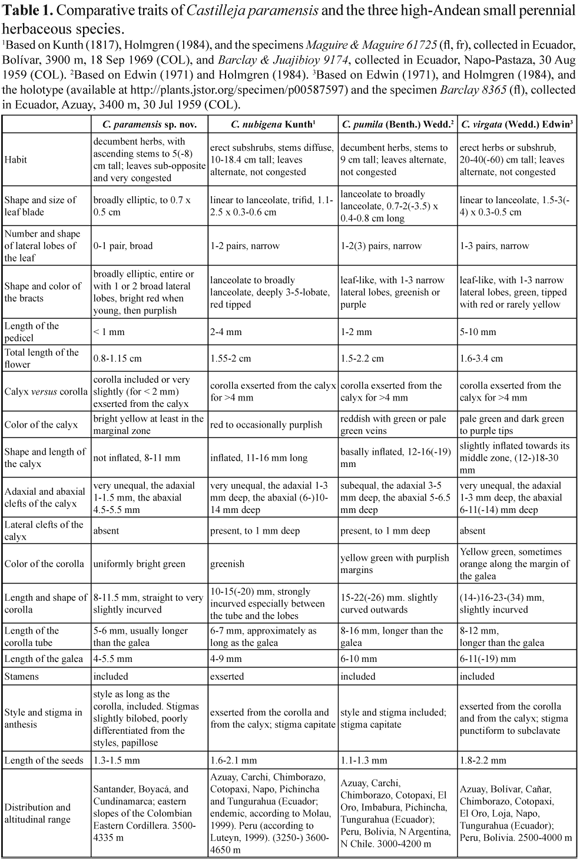
<body><![CDATA[<p><i>Castilleja</i><i> paramensis</i> F. Gonz&aacute;lez &amp; Pab&oacute;n-Mora,   a perennial species of small herbs from p&aacute;ramos of   Santander, Boyac&aacute; and Cundinamarca, in the Colombian Eastern Cordillera, is   described and fully illustrated by photographs of the type collection. The new   species is morphologically and ecologically similar to <i>C. nubigena, C. pumila</i>, and <i>C.   virgata</i>, three perennial high Andean species from   Ecuador,   Peru  and northern   Chile  and   Argentina. <i>C. paramensis</i> is clearly distinguished from   its relatives by the small size of the individuals, the broadly elliptic leaves   and bracts (which are entire to slightly trilobed),   the short (&lt; 1 mm)   pedicel, the small size (0.8- 1.15   cm long) of the flowers, the not inflated calyx with the   distal half bright yellow, the corolla often included to slightly exserted from the calyx, and the included style and stigma.   The included corolla, stamens, styles and stigmas in <i>C. paramensis </i>strongly suggest the occurrence of cleistogamy. The new species often grows as a root hemiparasite of <i>Plantago</i><i> rigida</i>. </p>     <p><b>Key words.</b><b> </b>High   Andean flora, flora of   Colombia, hemiparasitic plants, horizontal gene transfer, p&aacute;ramo endemics, root hemiparasites. </p>     <p><b>RESUMEN </b></p>     <p><i>Castilleja   paramensis</i> F. Gonz&aacute;lez   &amp; Pab&oacute;n-Mora, una especie de hierbas perennes   peque&ntilde;as propias de p&aacute;ramos de Santander, Boyac&aacute; y Cundinamarca, en  la Cordillera Oriental   Colombiana, es descrita y detalladamente ilustrada con fotograf&iacute;as de la   colecci&oacute;n tipo. La especie nueva es morfol&oacute;gica- y ecol&oacute;gicamente similar a <i>C.   nubigena, C. pumila</i> y <i>C.   virgata</i>, tres especies perennes de zonas altoandinas de Ecuador, Per&uacute; y norte de Chile y Argentina. <i>Castilleja   paramensis</i> se distingue claramente de sus   especies afines por el tama&ntilde;o peque&ntilde;o de los individuos, las hojas y las   br&aacute;cteas ancho-el&iacute;pticas (las cuales son enteras a levemente 3-lobadas), el pedicelo   extremadamente corto (&lt; 1 mm), el tama&ntilde;o reducido de las   flores (0.8- 1.15 cm largo), el c&aacute;liz no inflado, con la mitad distal de color amarillo brillante,   la corola generalmente inserta o muy poco exerta del   c&aacute;liz, y el estilo y estigma insertos. La corola, los estambres y los estigmas   insertos en <i>C. paramensis</i> sugieren la   ocurrencia de cleistogamia. La nueva especie se   encuentra frecuentemente como hemipar&aacute;sita de ra&iacute;ces de <i>Plantago rigida</i>. </p>     <p><b>Palabras clave.</b> Endemismos de   p&aacute;ramo, flora altoandina, flora de Colombia, hemipar&aacute;sitos de ra&iacute;ces, plantas hemiparas&iacute;ticas,   transferencia horizontal de genes. </p>     <p>Recibido:   19/02/2013 </br>     <br>Aceptado:  05/09/2013</p>     <p><b>INTRODUCTION </b></p>     <p><i>Castilleja</i> Mutis ex L. f. comprises approximately 200 species   (Holmgren 1978, Chuang &amp; Heckard 1991, Heide-Jørgensen 2008) most of which are native to western North America. The South American species (estimated   between 15 and 20; Egger, pers. comm.) are concentrated in the Andes. During the ongoing study of parasitic and hemiparasitic plants in   Colombia  by the authors, a number   of specimens of <i>Castilleja</i> collected in the p&aacute;ramos of the Eastern Cordillera drew our attention because of the small size of the individuals and the frequent association with <i>Plantago</i><i> rigida </i>Kunth. A specimen recently collected by FG in the p&aacute;ramo of Siscuns&iacute; (Sogamoso, Boyac&aacute;) matches all the morphological and   ecological traits of the small-sized individuals previously collected in   similar p&aacute;ramos of Santander, northern Boyac&aacute;, and   Cundinamarca, in the Colombian Eastern Cordillera. Until now, these specimens   have remained either undeterminated or were   tentatively identified as infraspecific taxa of <i>C. fissifolia</i> L.   f. or assigned to <i>C. nubigena </i>Kunth, a species known from the high Andes of Ecuador and   Peru (cf. Holmgren 1984, Luteyn 1999, Molau, 1999). A detailed examination of these collections   reveals, however, that they do not match any of the previously described   species of <i>Castilleja</i> from Costa Rica/Panama   (cf. Holmgren 1978) Venezuela (cf. Pennell 1953, Egger 2009), Colombia (cf. Fern&aacute;ndez-Alonso 1987), Ecuador (cf. Holmgren 1984) or Peru   (cf. Weddell 1857, Herrera 1926, Edwin, 1971). Thus, here we describe the new   species and compare it with other high Andean species of <i>Castilleja</i> characterized by the small size of the individuals. Besides   the disjunct distribution between the new species and   the other morphologically similar high Andean species (<i>C. nubigena, C. pumila </i>(Benth.) Wedd. ex Herrera,<i> and C. virgata </i>(Wedd.) Edwin), the   newly described species possesses clear-cut differences in the size and overall morphology of leaves, bracts, and flowers (<a href="#tabla1">Table 1</a>). </p>     <p>Additionally,   we include preliminary observations on the association of the species with <i>Plantago</i><i> rigida</i>, as   root hemiparasitism and hence physical plant   interactions may also have genetic implications, for instance the occurrence of   Horizontal Gene Transfer (HGT). </p>     ]]></body>
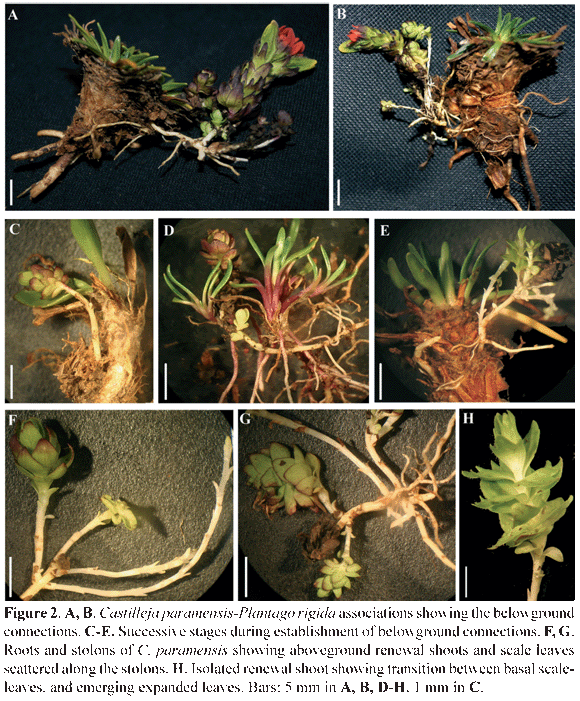
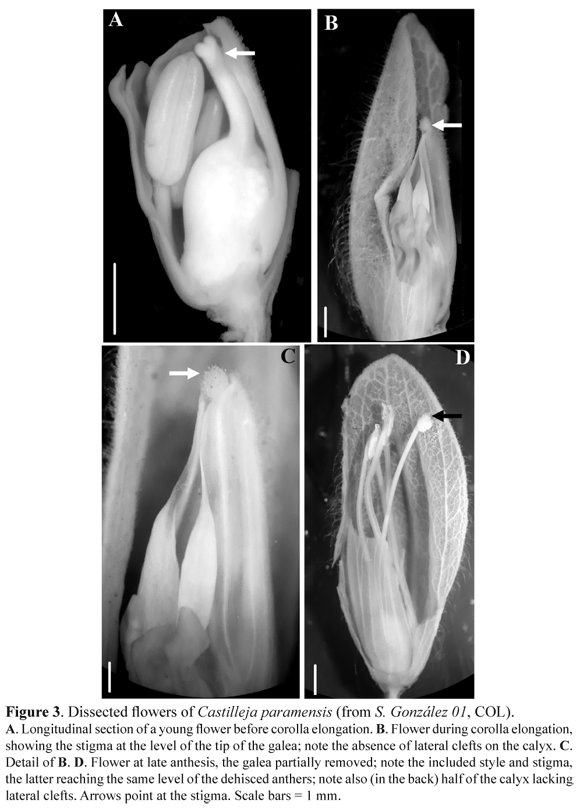
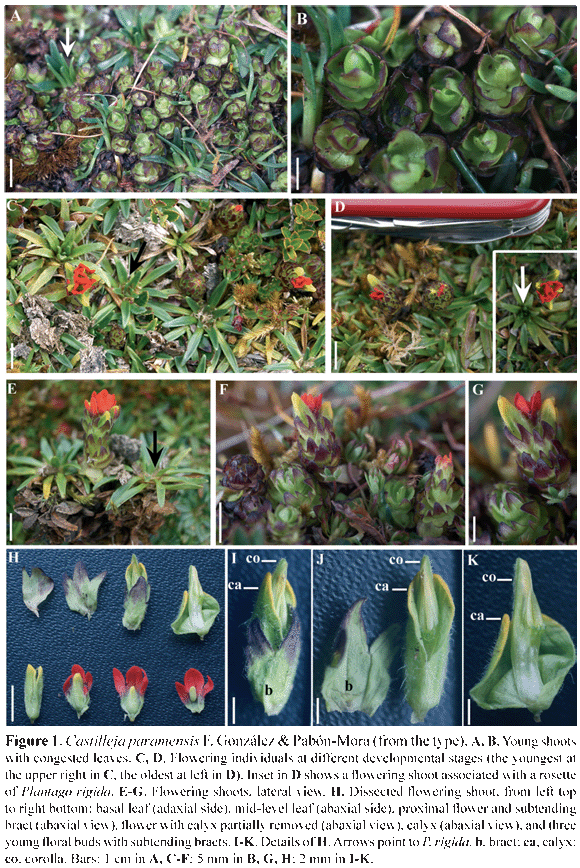
<body><![CDATA[<p>HGT has   been reported between members of the Orobanchaceae   and Plantaginaceae, preferentially involving   mitochondrial and ribosomal over plastid genes (Mower <i>et al.</i> 2004, Davis   &amp; Wurdack 2004). For instance, the mitochondrial <i>atp1</i> has been transferred from <i>Bartsia</i> (Orobanchaceae) to <i>Plantago</i><i> </i>(Mower <i>et al.</i> 2004). Plastid HGT seemed to have occurred less   frequently, like between the parasitic <i>Orobanche</i> and <i>Pelipanche</i><i> </i>(Park <i>et al.</i> 2007). These are both non-photosynthetic parasites with a shared plastid region   including <i>rps2</i>, <i>trnL</i>-<i>F</i>, and <i>rbcL</i><i> </i>that has probably been transferred <i>via</i> their common host (Park <i>et al.</i> 2007). At this point the genetic   consequences of the <i>Castilleja</i><i> paramensis-Plantago rigida</i> association are still unknown; however, their   tight physical link and their exclusive distributions in high altitudes in the Andes,   make them an excellent candidate to undertake studies testing explicitly for   the occurrence of HGT. </p>     <p><b><i>Castilleja   paramensis</i></b> <b>F.   Gonz&aacute;lez &amp; Pab&oacute;n-Mora, sp.   nov. </b>TYPE: COLOMBIA. <b>Boyac&aacute;</b>: Sogamoso, P&aacute;ramo de Siscuns&iacute;, alrededores de  la Laguna   de Siscuns&iacute;, 3875   m, 5º22'N, 72º50'W, 04 Feb   2013 (fl), <i>F. Gonz&aacute;lez, G. Plunkett,   A. Nicolas, J. Aguirre &amp; A. Herrera 4478</i> (Holotype: COL; isotypes: HUA, NY, UPTC, to be distributed). <a href="#figura1">Fig. 1</a>, <a href="#figura2">Fig. 2</a>, <a href="#figura3">Fig. 3</a> </p>     <center>   <img src="/img/revistas/cal/v35n2/v35n2a3fig1.gif"><a name="figura1"></a>  </center>    <br>      <center>   <img src="/img/revistas/cal/v35n2/v35n2a3fig2.gif"><a name="figura2"></a>  </center>    <br>      <center>   <img src="/img/revistas/cal/v35n2/v35n2a3fig3.gif"><a name="figura3"></a>  </center>    <br>      <p>Small,   rhizomatous, decumbent, perennial herbs; ascending stems to 5(-8) cm tall,   branching from the base. Rhizomes very thin, whitish, with a   few scattered achlorophyllous triangular scale-leaves   to 2 mm long and 1 mm wide. Internodes of the aerial shoots very short, to 3 mm long. Leaves   congested, sub-opposite, cucullate, sessile, broadly   elliptic, to 7 mm long and 5 mm wide, entire to slightly bi- or trilobate, light   green when young, later with the distal half purplish, lateral lobe(s)   triangular, ascending, glabrous above, scarcely villous below, margins villous,   especially along the distal half. Bracts broadly elliptic,   bi- or trilobate and bright red in their distal half,   glabrous above, villous below, with those subtending the mature flowers   becoming purplish. Flowers subsessile,   pedicel &lt; 1 mm long, axillary to the 3-4 most distal bracts. Calices   8- 11 mm long, green when immature, with bright yellow distal half at maturity, not   inflated, villous, tube to 6 mm long, median clefts strongly unequal, the adaxial 1- 1.5 mm deep, the abaxial 4.5- 5.5   mm deep, lateral clefts absent. Corollas 8- 11.5 mm long, completely   included or very slightly exserted from the calices,   hyaline, straight to very slightly incurved, tubes 5- 6 mm long, the galeas 4- 5.5   mm long, villous along the adaxial   mid-line, the lower three lips consisting of bright green, extremely reduced,   triangular, to 0.5 mm long and 0.2 mm wide, ascending, glabrous. Stamens included, slightly didynamous;   filaments 8.5- 10.5 mm long, adnate to the corolla tube for its proximal   1/3, anthers lanceolate, ca. 0.5- 0.8 mm long, thecae slightly   asymmetric. Styles as long as the corollas and included   during anthesis. Stigmas slightly bilobed,   poorly differentiated from the styles, papillose. Capsules oblong, to 10 x 5 mm, villous. Seeds obconical,   1.3-1.5 x 0.8- 1 mm,   seed coat papery, translucent, unruptured,   with deep and narrowly hexagonal reticulation cells. </p>     <p><b>Etymology: </b>The specific name refers to the ecosystem where the species has been   found. </p>     ]]></body>
<body><![CDATA[<p><b>Distribution   and phenology: </b><i>Castilleja</i><i> paramensis</i> has so far been collected in p&aacute;ramos of the departments of Santander, Boyac&aacute; and   Cundinamarca (   Colombia ).   It sets flowers in September, November to March and in May, and fruits in February, June and September. </p>     <p><b>Vernacular   name: </b>" Flores de lagarto" (Güic&aacute;n, Boyac&aacute;; <i>FG   1391</i>). </p>     <p><b>Additional   specimens examined </b>(when available, we have included the   field notes referring to the association of the new species with <i>Plantago</i><i> rigida</i>). <b>COLOMBIA.   Boyac&aacute;: </b>Morrena seca 200 m NW de  la Laguna Pintada, con <i>Espeletia</i><i> colombiana</i> predominante,   asociada con <i>Aciachne</i><i> pulvinata</i>, <i>Agrostis</i><i> breviculmis,   Agrostis trichoides</i> y <i>Acaena</i><i> cylindrostachya</i>, 3995 m,   25 Sep 1972 (fl, fr), <i>A.   M. Cleef &amp; P. A. Florschütz   5508</i> (COL); P&aacute;ramo de  La   Rusia, NW-N de Duitama, Pe&ntilde;a Blanca, 2 km al NE de Buenos Aires, pantanos con almohadas de <i>Plantago rigida</i> predominantes, 3720 m, 16 Dic 1972 (fl), <i>A. M. Cleef 7317</i> (COL); Sierra Nevada del Cocuy, p&aacute;ramo   C&oacute;ncavo, superp&aacute;ramo en el l&iacute;mite con el p&aacute;ramo p.d., 3.5   km al NNW del morro P&uacute;lpito   del Diablo, cabeceras de vallecitos entre morrenas, protegidas a viento con un frailejonal denso y h&uacute;medo de <i>Espeletia</i><i> lopezii</i>, 4335 m, 26 Feb 1973 (fl, fr), <i>A. M. Cleef 8530</i> (COL); Socot&aacute;,   p&aacute;ramo de Pisba, sitio  La Playita, entre colchones   de <i>Plantago rigida</i> (<i>FG 824</i>), c 3600 m, 15 Nov 1986 (fl), <i>F. Gonz&aacute;lez et   al. 823</i> (UPTC); Socha, sitio Los Pinos, 3600 m, asociada a <i>Plantago   rigida (FG 1118A</i>), 25 Jun   1987 (fl), <i>F. Gonz&aacute;lez et al. 1118</i> (UPTC); Güic&aacute;n, ascenso al Ritacuba   Blanco, por las caba&ntilde;as del Himat, 3800- 4800 m, 1 Mar 1988 (fl), <i>F. Gonz&aacute;lez et al. 1391</i> (UPTC); Güic&aacute;n, Sierra Nevada del Cocuy, carreteable   entre la caba&ntilde;a del Inderena y las Lagunillas, frente   a  la Laguna La   Atravesada, 4000 m,   entremezclada con <i>Plantago rigida</i> (<i>FG 1417</i>),   2 Mar 1988 (fl), <i>F. Gonz&aacute;lez et al. 1416</i> (UPTC); Bel&eacute;n, p&aacute;ramo del Güina, 3500 m, 22 May 1993 (fl), <i>F. Gonz&aacute;lez &amp; R. Small   2720</i> (COL, UPTC); Sierra Nevada del Cocuy, sector SE, valle del r&iacute;o   Lagunillas, entre 3650 y 4000   m, 24 May 1993 (fl), <i>F.   Gonz&aacute;lez &amp; R. Small 2734</i> (COL, UPTC); Güican, ascenso hacia el Boquer&oacute;n de Cardenillo, 6&ordm;18'50.6''N, 72&ordm;12'15.6''W, ca. 4300 m, 17 Ago 2013 (fl), <i>S. Gonz&aacute;lez et al. 01</i> (COL); Güic&aacute;n, Sierra Nevada del Cocuy, Laguna Grande de los   Verdes, en colchones de <i>Distichia</i> sp., 3900- 4100   m, 20 Sep 1978 (fl, fr), <i>O. Rangel &amp; H. Sturm 1534A</i> (COL); below the Playas of Ritacuba in the Cocuy mountains above Güic&aacute;n, locally   frequent in poorly drained damp paramo   3700- 4500 m,   particularly in damp flushes and poorly   drained grassy hollows, 4200   m, 24 Jun 1984 (fl, fr), <i>J. R. I. Wood 4458</i> (COL). <b>Cundinamarca</b>: P&aacute;ramo de Sumapaz,   Chisac&aacute;, pantano con cojines de <i>Plantago rigida</i>, 3680 m,   11 Dic 1971 (fl), <i>A. M. Cleef 143</i> (COL); Macizo de Bogot&aacute;, p&aacute;ramo de Chisac&aacute;, around the lakes   at about 3620 m, 16 Sep 1961 (fl), <i>J. Cuatrecasas &amp; R. Jaramillo M. 25972</i> (COL). <b>Santander</b>: Cordillera Oriental, p&aacute;ramo del Almorzadero,   above 3600   m, slope above   ci&eacute;naga, very wet, with hummocks of   mosses, <i>Plantago rigida</i>,   etc., 31 Dec 1959-1 Jan 1960 (fl), <i>H. G. Barclay &amp; P. Juajibioy 10369</i> (COL). </p>     <p><i>Castilleja</i><i> paramensis </i>is   morphologically similar to <i>C. pumila</i>, <i>C. virgata </i>and especially to <i>C. nubigena</i> (<a href="#tabla1">Table 1</a>).</p>      <center>   <img src="/img/revistas/cal/v35n2/v35n2a3tab1.gif"><a name="tabla1"></a>  </center>    <br>        <p>It clearly differs by its smaller size (up to 8 cm), broadly elliptic and   entire to slighly trilobed   leaves and bracts, reduced pedicel (&lt;1mm) and flower (0.8- 1.15 cm) lenght, bright yellow and not inflated calyx, and corolla   included or very slightly (for &lt; 2 mm) exserted from   the calyx (<a href="#figura1">Fig. 1</a>). Additional differences between <i>C. paramensis</i> and <i>C. nubigena </i>include the absence of lateral   clefts of the calyx (<a href="#figura3">Fig. 3B, D</a>), the straight to very slightly incurved   corolla, the included stamens and the bilobed, poorly   differentiated stigma in the former, <i>versus </i>the presence of lateral   clefts of the calyx, the strongly incurved corolla, the exserted   stamens and the capitate stigma in the latter. Finally,   the presence of included corolla, stamens, styles and stigmas (<a href="#figura1">Fig. 1</a>, <a href="#figura4">Fig. 3</a>) in <i>C.   paramensis </i>strongly suggests the ocurrence of cleistogamy in this   species. </p>     <p><b>On the systematics and life history of <i>Castilleja</i>:</b> The systematics of <i>Castilleja</i> has been considered difficult, mainly due to polyploidy, lack of crossing   barriers among species, and effective natural hybridization, all of which can   drastically change the morphological traits used to distinguish species (Heckard 1964, Heckard &amp;   Chuang 1977, Chuang &amp; Heckard 1991, Mathews &amp;   Lavin 1998, Hersch-Green &amp; Cronn   2009, Clay <i>et al.</i> 2012, Hersch-Green 2012). At   a suprageneric level, polyploidy has also led to   differential sampling of paralogs (e.g. <i>PHYA</i>)   in phylogenetic analyses, resulting in a polyphyletic <i>Castilleja</i> (Bennett &amp; Mathews 2006). </p>     <p>The   South American species of <i>Castilleja</i> fall into   two different subgenera, <i>Castilleja</i> and <i>Colacus</i>. All the Colombian species belong to the   subgenus <i>Castilleja</i> (<i>sensu</i> Chuang &amp; Heckard 1991), as the flowers are narrow   and tubular, the associated bracts, the calices and/or corollas are red, and   the galea is at least three times longer than the   lower three lips. All these traits have been associated with hummingbird,   pollination in the genus (Pennell 1948, Chuang &amp; Heckard   1991, Heide-Jørgensen 2008). Hummingbird pollination,   in turn, appears to be correlated with the evolution of perenniality   in the genus (Tank &amp; Olmstead 2008, 2009). This perennial habit has evolved   once from an annual condition in <i>Castilleja</i>,   and it seems to be tightly associated with polyploidy at least in the North   American species (Tank &amp; Olmstead 2008). The new species can be assigned   unequivocally to subgenus <i>Castilleja</i>, and it   is morphologically and ecologically similar to the high-Andean species <i>C. nubigena, C. pumila</i> and <i>C.   virgata</i> (<a href="#tabla1">Table 1</a>). The latter three species form   a clade of perennial but primarily diploid species   (Tank &amp; Olmstead 2009). We anticipate that the perennial <i>C. paramensis</i> belongs to this clade;   however, chromosome counts and molecular data are needed to confirm this   placement. In addition, studies on pollination biology of <i>C. paramensis </i>are critical, as its colorful flowers are   near the ground and appear to be too small and too low for hummingbird   pollination. The included style and stigma of <i>C. paramensis</i> (<a href="#figura3">Fig. 3</a>) strongly suggest that the species might be cleistogamous,   despite the fact that it can co-occur with <i>C. integrifolia</i>,   a species pollinated by the hummingbird <i>Oxypogon</i><i> guerinii</i> (Salamanca-Reyes 2011). </p>     <p><b><i>Castilleja</i></b><b> species as facultative root hemiparasites.</b><b> </b>Species   of <i>Castilleja</i> are facultative root hemiparasites,   which means they can complete their life cycle either as parasites or   singly without a host (Heckard 1962, 1964, Matthies 1997, Heide-Jørgensen   2008, Fay <i>et al.</i> 2010). <i>Castilleja</i> host   association is broad and can infect species across a diverse range of flowering   plant families <b>(</b>Heckard 1962, Musselman &amp; Press 1995), though some species might have   more exclusive associations. This is the case for <i>C. paramensis</i>,   frequently found associated belowground with <i>Plantago rigida</i> (<a href="#figura2">Fig. 2</a>). In fact, Cleef   (1981:127) included <i>C. paramensis</i> (referred   there as "<i>C. fissifolia</i> ssp. <i>pygmaea</i><i>, </i>ssp. nom. herb.;   in ed.?") and <i>P. rigida</i> as two primary   components of the <i>Wernerietea</i> syntaxonomy that conforms the "flush vegetation and cushion   bogs". </p>     ]]></body>
<body><![CDATA[<p>Seed   germination in <i>Castilleja</i> can occur in the   absence of a host (Heckard 1962); however, species   from high elevations may require moist and cold conditions that can slow down   germination rates (Kuijt 1969). Heckard   (1962) examined hemiparasitic <i>Castilleja</i> species growing with and without hosts and noticed that generally plants   growing as parasites are more vigorous, branch more profusely, and exhibit   early flowering. Haustoria in <i>Castilleja</i> are small (less than 1 mm in diameter) and are not as invasive or penetrating as haustoria   of other parasitic flowering plants. They initiate as elongated epidermal cells   similar to root hairs (Kuijt 1969). The first   responses during haustorial initiation are cortical   enlargement and increasing cell division, resulting in lateral or apical   protuberances in the parasite root similar to other Orobanchaceae,   such as <i>Bartsia</i><i>, Lathraea,   Melampyrum, Pedicularis </i>and <i>Rhinanthus</i><i> </i>(Heckard   1962, Dobbins &amp; Kuijt 1973a, Weber &amp; Weberling 1975, Riopel &amp; Timko 1995). A mature haustorium   of <i>Castilleja</i> is composed of a plate xylem   zone surrounded by parenchyma, a centrally located core of collenchyma   (with vessel members scattered), and the haustorial   surface (Dobbins &amp; Kuijt 1973a). Penetration is   likely due to cell dissolution in the host, accompanied by crushing of cells   (Dobbins &amp; Kuijt 1973b). The haustoria   of <i>C. paramensis</i> are spherical to cup-shaped   and usually terminal in secondary roots. </p>     <p><b>ACKNOWLEDGEMENTS </b></p>     <p>Thanks   to J. Aguirre, A. Nicolas, and G. Plunkett (The New York Botanical Garden), and   A. Herrera and S. Gonz&aacute;lez (National University of   Colombia), for accurate observations and valuable help during fieldwork while   collecting the type specimen and some of the paratypes.   Thanks also to J. M. Egger (Herbarium, Burke Museum of Natural   History and Culture,  University   of  Washington, Seattle), O. Rangel (  Institute   of  Natural   Sciences, National University of Colombia), and three anonymous reviewers, for valuable comments on the manuscript. </p>     <p><b>LITERATURE   CITED </b></p>     <!-- ref --><p>1. Bennett,   J.R. &amp; S. Mathews. 2006. Phylogeny of the parasitic plant family Orobanchaceae inferred from Phytochrome   A. American Journal of Botany 93: 1039-1051.    &nbsp;&nbsp;&nbsp;&nbsp;&nbsp;&nbsp;&nbsp;&nbsp;[&#160;<a href="javascript:void(0);" onclick="javascript: window.open('/scielo.php?script=sci_nlinks&ref=000047&pid=S0366-5232201300020000300001&lng=','','width=640,height=500,resizable=yes,scrollbars=1,menubar=yes,');">Links</a>&#160;]<!-- end-ref --> </p>     <!-- ref --><p>2. Chuang,   T.I. &amp; L.R. Heckard. 1991. Generic   realignment and synopsis of subtribe Castillejinae (Scrophulariaceae–tribe   Pediculareae). Systematic Botany 16: 644-666.    &nbsp;&nbsp;&nbsp;&nbsp;&nbsp;&nbsp;&nbsp;&nbsp;[&#160;<a href="javascript:void(0);" onclick="javascript: window.open('/scielo.php?script=sci_nlinks&ref=000049&pid=S0366-5232201300020000300002&lng=','','width=640,height=500,resizable=yes,scrollbars=1,menubar=yes,');">Links</a>&#160;]<!-- end-ref --> </p>     <!-- ref --><p>3. Clay,   D.L., S.J. Novak, M.D. Serpe, D.C. Tank &amp; J.F. Smith. 2012. Homoploid hybrid   speciation in a rare endemic&nbsp;<i>Castilleja</i>&nbsp;from Idaho (<i>Castilleja</i><i> christii</i>, Orobanchaceae). American Journal of Botany 99: 1976-1990.    &nbsp;&nbsp;&nbsp;&nbsp;&nbsp;&nbsp;&nbsp;&nbsp;[&#160;<a href="javascript:void(0);" onclick="javascript: window.open('/scielo.php?script=sci_nlinks&ref=000051&pid=S0366-5232201300020000300003&lng=','','width=640,height=500,resizable=yes,scrollbars=1,menubar=yes,');">Links</a>&#160;]<!-- end-ref --> </p>     ]]></body>
<body><![CDATA[<!-- ref --><p>4. Cleef, A. M. 1981. The   vegetation of the p&aacute;ramos of the Colombian Cordillera   Oriental. Dissertationes Botanicæ 61. J. Cramer, Vaduz.    &nbsp;&nbsp;&nbsp;&nbsp;&nbsp;&nbsp;&nbsp;&nbsp;[&#160;<a href="javascript:void(0);" onclick="javascript: window.open('/scielo.php?script=sci_nlinks&ref=000053&pid=S0366-5232201300020000300004&lng=','','width=640,height=500,resizable=yes,scrollbars=1,menubar=yes,');">Links</a>&#160;]<!-- end-ref --> </p>     <!-- ref --><p>5. Davis, C.C. &amp; K. Wurdack. 2004. Host-to-parasite gene transfer in   flowering plants: phylogenetic evidence from Malpighiales. Science 305: 676-678.    &nbsp;&nbsp;&nbsp;&nbsp;&nbsp;&nbsp;&nbsp;&nbsp;[&#160;<a href="javascript:void(0);" onclick="javascript: window.open('/scielo.php?script=sci_nlinks&ref=000055&pid=S0366-5232201300020000300005&lng=','','width=640,height=500,resizable=yes,scrollbars=1,menubar=yes,');">Links</a>&#160;]<!-- end-ref --> </p>     <!-- ref --><p>6. Dobbins,   D. &amp; J. Kuijt. 1973a. Studies on   the haustorium of <i>Castilleja</i> (Scrophulariaceae). I. The upper haustorium. Canadian Journal of Botany 51: 917-922.    &nbsp;&nbsp;&nbsp;&nbsp;&nbsp;&nbsp;&nbsp;&nbsp;[&#160;<a href="javascript:void(0);" onclick="javascript: window.open('/scielo.php?script=sci_nlinks&ref=000057&pid=S0366-5232201300020000300006&lng=','','width=640,height=500,resizable=yes,scrollbars=1,menubar=yes,');">Links</a>&#160;]<!-- end-ref --> </p>     <!-- ref --><p>7. Dobbins,   D. &amp; J. Kuijt. 1973b. Studies on   the haustorium of <i>Castilleja</i> (Scrophulariaceae). II. The endophyte.   Canadian Journal of Botany 51: 923-931.    &nbsp;&nbsp;&nbsp;&nbsp;&nbsp;&nbsp;&nbsp;&nbsp;[&#160;<a href="javascript:void(0);" onclick="javascript: window.open('/scielo.php?script=sci_nlinks&ref=000059&pid=S0366-5232201300020000300007&lng=','','width=640,height=500,resizable=yes,scrollbars=1,menubar=yes,');">Links</a>&#160;]<!-- end-ref --> </p>     <!-- ref --><p>8. Edwin,   G. 1971. Scrophulariaceae. Flora of   Peru. Field Museum of   Natural History, Bot. Ser. 13, part 5B (3): 461-717.    &nbsp;&nbsp;&nbsp;&nbsp;&nbsp;&nbsp;&nbsp;&nbsp;[&#160;<a href="javascript:void(0);" onclick="javascript: window.open('/scielo.php?script=sci_nlinks&ref=000061&pid=S0366-5232201300020000300008&lng=','','width=640,height=500,resizable=yes,scrollbars=1,menubar=yes,');">Links</a>&#160;]<!-- end-ref --> </p>     ]]></body>
<body><![CDATA[<!-- ref --><p>9. Egger,   J.M. 2009. A new species of <i>Castilleja</i> (Orobanchaceae)   from Trujillo.   Venezuela. Brittonia 61:41-45.    &nbsp;&nbsp;&nbsp;&nbsp;&nbsp;&nbsp;&nbsp;&nbsp;[&#160;<a href="javascript:void(0);" onclick="javascript: window.open('/scielo.php?script=sci_nlinks&ref=000063&pid=S0366-5232201300020000300009&lng=','','width=640,height=500,resizable=yes,scrollbars=1,menubar=yes,');">Links</a>&#160;]<!-- end-ref --> </p>     <!-- ref --><p>10. Fay,   M.F., J.R. Bennett, K.W. Dixon &amp; M.J.M. Christenhusz. 2010.   Parasites, their relationships and the disintegration of Scrophulariaceae <i>sensu</i><i> lato. </i>Curtis's Botanical   Magazine 26: 286–313.    &nbsp;&nbsp;&nbsp;&nbsp;&nbsp;&nbsp;&nbsp;&nbsp;[&#160;<a href="javascript:void(0);" onclick="javascript: window.open('/scielo.php?script=sci_nlinks&ref=000065&pid=S0366-5232201300020000300010&lng=','','width=640,height=500,resizable=yes,scrollbars=1,menubar=yes,');">Links</a>&#160;]<!-- end-ref --> </p>     <!-- ref --><p>11. Fern&aacute;ndez-Alonso,   J.L. 1987. <i>Castilleja</i>. Flora de  la Real Expedici&oacute;n   Bot&aacute;nica del Nuevo Reyno de Granada, Vol. 39: 77-82, T. LVIII-LXIV. Ediciones Cultura Hisp&aacute;nica, Madrid.    &nbsp;&nbsp;&nbsp;&nbsp;&nbsp;&nbsp;&nbsp;&nbsp;[&#160;<a href="javascript:void(0);" onclick="javascript: window.open('/scielo.php?script=sci_nlinks&ref=000067&pid=S0366-5232201300020000300011&lng=','','width=640,height=500,resizable=yes,scrollbars=1,menubar=yes,');">Links</a>&#160;]<!-- end-ref --> </p>     <!-- ref --><p>12. Fern&aacute;ndez-Alonso, J.L. 2000.<i> </i>Scrophulariaceae.<i> </i>Pp. 349- 359 in O. Rangel-Ch. (ed.) Colombia Diversidad Bi&oacute;tica III. La regi&oacute;n de vida paramuna. Universidad Nacional de Colombia, Bogot&aacute;    &nbsp;&nbsp;&nbsp;&nbsp;&nbsp;&nbsp;&nbsp;&nbsp;[&#160;<a href="javascript:void(0);" onclick="javascript: window.open('/scielo.php?script=sci_nlinks&ref=000069&pid=S0366-5232201300020000300012&lng=','','width=640,height=500,resizable=yes,scrollbars=1,menubar=yes,');">Links</a>&#160;]<!-- end-ref -->. </p>     <!-- ref --><p>13. Heckard, L.R. 1962. Root parasitism in <i>Castilleja</i>. Botanical Gazette 124: 21-29.    &nbsp;&nbsp;&nbsp;&nbsp;&nbsp;&nbsp;&nbsp;&nbsp;[&#160;<a href="javascript:void(0);" onclick="javascript: window.open('/scielo.php?script=sci_nlinks&ref=000071&pid=S0366-5232201300020000300013&lng=','','width=640,height=500,resizable=yes,scrollbars=1,menubar=yes,');">Links</a>&#160;]<!-- end-ref --> </p>     ]]></body>
<body><![CDATA[<!-- ref --><p>14. Heckard, L.R. 1964. Causes of   taxonomic complexity in <i>Castilleja</i>. American Journal of Botany 51: 686 (abstract).    &nbsp;&nbsp;&nbsp;&nbsp;&nbsp;&nbsp;&nbsp;&nbsp;[&#160;<a href="javascript:void(0);" onclick="javascript: window.open('/scielo.php?script=sci_nlinks&ref=000073&pid=S0366-5232201300020000300014&lng=','','width=640,height=500,resizable=yes,scrollbars=1,menubar=yes,');">Links</a>&#160;]<!-- end-ref --> </p>     <!-- ref --><p>15. Heckard, L.R.   &amp; T.-I. Chuang. 1977. Chromosome numbers, polyploidy, and   hybridization in <i>Castilleja</i> (Scrophulariaceae) of the Great Basin and Rocky   Mountains. Brittonia 29: 159-172.    &nbsp;&nbsp;&nbsp;&nbsp;&nbsp;&nbsp;&nbsp;&nbsp;[&#160;<a href="javascript:void(0);" onclick="javascript: window.open('/scielo.php?script=sci_nlinks&ref=000075&pid=S0366-5232201300020000300015&lng=','','width=640,height=500,resizable=yes,scrollbars=1,menubar=yes,');">Links</a>&#160;]<!-- end-ref --> </p>     <!-- ref --><p>16. Heide-Jørgensen, H. 2008. Parasitic   Flowering Plants. Brill, Leiden,   438 pp.    &nbsp;&nbsp;&nbsp;&nbsp;&nbsp;&nbsp;&nbsp;&nbsp;[&#160;<a href="javascript:void(0);" onclick="javascript: window.open('/scielo.php?script=sci_nlinks&ref=000077&pid=S0366-5232201300020000300016&lng=','','width=640,height=500,resizable=yes,scrollbars=1,menubar=yes,');">Links</a>&#160;]<!-- end-ref --> </p>     <!-- ref --><p>17. Herrera,   F.L. 1926. Chloris   Cuzcoensis.    Cuzco, Per&uacute;,   222 pp.    &nbsp;&nbsp;&nbsp;&nbsp;&nbsp;&nbsp;&nbsp;&nbsp;[&#160;<a href="javascript:void(0);" onclick="javascript: window.open('/scielo.php?script=sci_nlinks&ref=000079&pid=S0366-5232201300020000300017&lng=','','width=640,height=500,resizable=yes,scrollbars=1,menubar=yes,');">Links</a>&#160;]<!-- end-ref --> </p>     <!-- ref --><p>18. Hersch-Green, E.I. 2012. Polyploidy   in Indian paintbrush (<i>Castilleja</i>; Orobanchaceae) species shapes but does not prevent gene   flow across species boundaries. American Journal of Botany 99: 1680-1690.    &nbsp;&nbsp;&nbsp;&nbsp;&nbsp;&nbsp;&nbsp;&nbsp;[&#160;<a href="javascript:void(0);" onclick="javascript: window.open('/scielo.php?script=sci_nlinks&ref=000081&pid=S0366-5232201300020000300018&lng=','','width=640,height=500,resizable=yes,scrollbars=1,menubar=yes,');">Links</a>&#160;]<!-- end-ref --> </p>     ]]></body>
<body><![CDATA[<!-- ref --><p>19. Hersch-Green, E.I. &amp; R. Cronn. 2009.   Tangled trios?: characterizing a hybrid zone in <i>Castilleja</i><i> </i>(Orobanchaceae).<b> </b>American Journal of Botany 96: 1519–1531.    &nbsp;&nbsp;&nbsp;&nbsp;&nbsp;&nbsp;&nbsp;&nbsp;[&#160;<a href="javascript:void(0);" onclick="javascript: window.open('/scielo.php?script=sci_nlinks&ref=000083&pid=S0366-5232201300020000300019&lng=','','width=640,height=500,resizable=yes,scrollbars=1,menubar=yes,');">Links</a>&#160;]<!-- end-ref --> </p>     <!-- ref --><p>20. Holmgren, N.H. 1978. <i>Castilleja</i> (Scrophulariaceae)   of   Costa Rica  and Panama. Brittonia 30: 182–194.    &nbsp;&nbsp;&nbsp;&nbsp;&nbsp;&nbsp;&nbsp;&nbsp;[&#160;<a href="javascript:void(0);" onclick="javascript: window.open('/scielo.php?script=sci_nlinks&ref=000085&pid=S0366-5232201300020000300020&lng=','','width=640,height=500,resizable=yes,scrollbars=1,menubar=yes,');">Links</a>&#160;]<!-- end-ref --> </p>     <!-- ref --><p>21. Holmgren, N.H. 1984. <i>Castilleja</i>. Pp. 174–184. In: G. Harling   &amp; B. Sparre (eds.), Flora of   Ecuador, Vol.   21. Swedish Research Councils, Stockholm, Sweden.    &nbsp;&nbsp;&nbsp;&nbsp;&nbsp;&nbsp;&nbsp;&nbsp;[&#160;<a href="javascript:void(0);" onclick="javascript: window.open('/scielo.php?script=sci_nlinks&ref=000087&pid=S0366-5232201300020000300021&lng=','','width=640,height=500,resizable=yes,scrollbars=1,menubar=yes,');">Links</a>&#160;]<!-- end-ref --> </p>     <!-- ref --><p>22. Kuijt, J. 1969. The biology of   parasitic flowering plants.  University   of  California Press, Berkeley, 246 pp.    &nbsp;&nbsp;&nbsp;&nbsp;&nbsp;&nbsp;&nbsp;&nbsp;[&#160;<a href="javascript:void(0);" onclick="javascript: window.open('/scielo.php?script=sci_nlinks&ref=000089&pid=S0366-5232201300020000300022&lng=','','width=640,height=500,resizable=yes,scrollbars=1,menubar=yes,');">Links</a>&#160;]<!-- end-ref --> </p>     <!-- ref --><p>23. Kunth, K. S. 1817. <i>Castilleja</i>. Pp.   329-332. S. In F.H. Humboldt (eds.), Nova Genera et Species Plantarum Vol. 2. Paris.    &nbsp;&nbsp;&nbsp;&nbsp;&nbsp;&nbsp;&nbsp;&nbsp;[&#160;<a href="javascript:void(0);" onclick="javascript: window.open('/scielo.php?script=sci_nlinks&ref=000091&pid=S0366-5232201300020000300023&lng=','','width=640,height=500,resizable=yes,scrollbars=1,menubar=yes,');">Links</a>&#160;]<!-- end-ref --> </p>     ]]></body>
<body><![CDATA[<!-- ref --><p>24. Luteyn, J.L. 1999. P&aacute;ramos. A   checklist of plant diversity, geographic distribution and botanical literature.   Memoirs of The  New York  Botanical Garden 84: 1- 278.    &nbsp;&nbsp;&nbsp;&nbsp;&nbsp;&nbsp;&nbsp;&nbsp;[&#160;<a href="javascript:void(0);" onclick="javascript: window.open('/scielo.php?script=sci_nlinks&ref=000093&pid=S0366-5232201300020000300024&lng=','','width=640,height=500,resizable=yes,scrollbars=1,menubar=yes,');">Links</a>&#160;]<!-- end-ref --> </p>     <!-- ref --><p>25. Mathews, S. &amp; M.   Lavin. 1998. A biosystematic study of <i>Castilleja</i><i> crista-galli</i> (Scrophulariaceae): An allopolyploid origin   reexamined. Systematic Botany 23: 213-230.    &nbsp;&nbsp;&nbsp;&nbsp;&nbsp;&nbsp;&nbsp;&nbsp;[&#160;<a href="javascript:void(0);" onclick="javascript: window.open('/scielo.php?script=sci_nlinks&ref=000095&pid=S0366-5232201300020000300025&lng=','','width=640,height=500,resizable=yes,scrollbars=1,menubar=yes,');">Links</a>&#160;]<!-- end-ref --> </p>     <!-- ref --><p>26. Matthies, D. 1997. Parasite-host   interactions in <i>Castilleja</i> and <i>Orthocarpus</i>. Canadian Journal of Botany   75:1252-1260.    &nbsp;&nbsp;&nbsp;&nbsp;&nbsp;&nbsp;&nbsp;&nbsp;[&#160;<a href="javascript:void(0);" onclick="javascript: window.open('/scielo.php?script=sci_nlinks&ref=000097&pid=S0366-5232201300020000300026&lng=','','width=640,height=500,resizable=yes,scrollbars=1,menubar=yes,');">Links</a>&#160;]<!-- end-ref --> </p>     <!-- ref --><p>27. Molau, U. 1999. Scrophulariaceae. Pp. 891-899 in: P.M. jørgensen &amp; s. le&oacute;n-yanez (eds.), Catalogue of the   Vascular Plants of   Ecuador.   Monographs in Systematic Botany from the  Missouri  Botanical Garden   Press, Vol. 75, St. Louis, Missouri.    &nbsp;&nbsp;&nbsp;&nbsp;&nbsp;&nbsp;&nbsp;&nbsp;[&#160;<a href="javascript:void(0);" onclick="javascript: window.open('/scielo.php?script=sci_nlinks&ref=000099&pid=S0366-5232201300020000300027&lng=','','width=640,height=500,resizable=yes,scrollbars=1,menubar=yes,');">Links</a>&#160;]<!-- end-ref --> </p>     <!-- ref --><p>28. Mower,   J.P., S. Stefanovic,   G.J. Young &amp; J.D. Palmer. 2004. Gene transfer from parasitic to   host plants. Nature 432 (11 Nov): 165-166.    &nbsp;&nbsp;&nbsp;&nbsp;&nbsp;&nbsp;&nbsp;&nbsp;[&#160;<a href="javascript:void(0);" onclick="javascript: window.open('/scielo.php?script=sci_nlinks&ref=000101&pid=S0366-5232201300020000300028&lng=','','width=640,height=500,resizable=yes,scrollbars=1,menubar=yes,');">Links</a>&#160;]<!-- end-ref --> </p>     ]]></body>
<body><![CDATA[<!-- ref --><p>29. Musselman, L.J. &amp; M.C. Press. 1995. Introduction   to parasitic plants. Pp. 1- 13   in M.C. Press &amp; J. D. Graves (eds.), Parasitic plants. Chapman &amp; Hall, London.    &nbsp;&nbsp;&nbsp;&nbsp;&nbsp;&nbsp;&nbsp;&nbsp;[&#160;<a href="javascript:void(0);" onclick="javascript: window.open('/scielo.php?script=sci_nlinks&ref=000103&pid=S0366-5232201300020000300029&lng=','','width=640,height=500,resizable=yes,scrollbars=1,menubar=yes,');">Links</a>&#160;]<!-- end-ref --> </p>     <!-- ref --><p>  30.  Park, J.-M., J.-F. Manen &amp; G.M. Schneeweiss. 2007. Horizontal   gene transfer of a plastid gene in the non-photosynthetic flowering plants <i>Orobanche</i><i> </i>and <i>Phelipanche</i><i> </i>(Orobanchaceae). Molecular Phylogenetics and Evolution 43: 974-985.    &nbsp;&nbsp;&nbsp;&nbsp;&nbsp;&nbsp;&nbsp;&nbsp;[&#160;<a href="javascript:void(0);" onclick="javascript: window.open('/scielo.php?script=sci_nlinks&ref=000105&pid=S0366-5232201300020000300030&lng=','','width=640,height=500,resizable=yes,scrollbars=1,menubar=yes,');">Links</a>&#160;]<!-- end-ref --> </p>     <!-- ref --><p>31. Pennell,   F.W. 1948. The taxonomic significance of an understanding   of floral evolution. Brittonia 6:301-308.    &nbsp;&nbsp;&nbsp;&nbsp;&nbsp;&nbsp;&nbsp;&nbsp;[&#160;<a href="javascript:void(0);" onclick="javascript: window.open('/scielo.php?script=sci_nlinks&ref=000107&pid=S0366-5232201300020000300031&lng=','','width=640,height=500,resizable=yes,scrollbars=1,menubar=yes,');">Links</a>&#160;]<!-- end-ref --> </p>     <!-- ref --><p>32. Pennell, F.W. 1953. <i>Castilleja</i>.   In: J. A. Steyermark <i>et al.</i> (eds.), Botanical   explorations in   Venezuela,   III. Fieldiana: Botany 28: 516–519.    &nbsp;&nbsp;&nbsp;&nbsp;&nbsp;&nbsp;&nbsp;&nbsp;[&#160;<a href="javascript:void(0);" onclick="javascript: window.open('/scielo.php?script=sci_nlinks&ref=000109&pid=S0366-5232201300020000300032&lng=','','width=640,height=500,resizable=yes,scrollbars=1,menubar=yes,');">Links</a>&#160;]<!-- end-ref --> </p>     <!-- ref --><p>33. Riopel, J.L. &amp; M.P. Timko. 1995. Haustorial initiation and   differentiation. Pp. 39- 79 in M.C. Press &amp; J.D. Graves (eds.), Parasitic plants. Chapman &amp; Hall, London  .    &nbsp;&nbsp;&nbsp;&nbsp;&nbsp;&nbsp;&nbsp;&nbsp;[&#160;<a href="javascript:void(0);" onclick="javascript: window.open('/scielo.php?script=sci_nlinks&ref=000111&pid=S0366-5232201300020000300033&lng=','','width=640,height=500,resizable=yes,scrollbars=1,menubar=yes,');">Links</a>&#160;]<!-- end-ref --> </p>     ]]></body>
<body><![CDATA[<!-- ref --><p>34. Salamanca-Reyes,   J.R. 2011. Ecolog&iacute;a del   barbudito de p&aacute;ramo (<i>Oxypogon</i><i> guerinii</i>, Trochilidae) en el   p&aacute;ramo de Siscuns&iacute;, Boyac&aacute;, Colombia. Ornitolog&iacute;a Colombiana 11: 58-75.    &nbsp;&nbsp;&nbsp;&nbsp;&nbsp;&nbsp;&nbsp;&nbsp;[&#160;<a href="javascript:void(0);" onclick="javascript: window.open('/scielo.php?script=sci_nlinks&ref=000113&pid=S0366-5232201300020000300034&lng=','','width=640,height=500,resizable=yes,scrollbars=1,menubar=yes,');">Links</a>&#160;]<!-- end-ref --> </p>     <!-- ref --><p>35. Tank, D.C. &amp; R.G. Olmstead. 2008. From annuals to   perennials: phylogeny of subtribe Castillejinae   (Orobanchaceae). American Journal of Botany 95:   608–625.    &nbsp;&nbsp;&nbsp;&nbsp;&nbsp;&nbsp;&nbsp;&nbsp;[&#160;<a href="javascript:void(0);" onclick="javascript: window.open('/scielo.php?script=sci_nlinks&ref=000115&pid=S0366-5232201300020000300035&lng=','','width=640,height=500,resizable=yes,scrollbars=1,menubar=yes,');">Links</a>&#160;]<!-- end-ref --> </p>     <!-- ref --><p>36. Tank, D.C. &amp; R.G. Olmstead. 2009. The evolutionary origin of a second radiation   of annual <i>Castilleja</i><i> </i>(Orobanchaceae) species in south   America: the role of long distance dispersal and allopolyploidy.   American Journal of Botany 96: 1907–1921.    &nbsp;&nbsp;&nbsp;&nbsp;&nbsp;&nbsp;&nbsp;&nbsp;[&#160;<a href="javascript:void(0);" onclick="javascript: window.open('/scielo.php?script=sci_nlinks&ref=000117&pid=S0366-5232201300020000300036&lng=','','width=640,height=500,resizable=yes,scrollbars=1,menubar=yes,');">Links</a>&#160;]<!-- end-ref --> </p>     <!-- ref --><p>37. Webber,   H.C. &amp; F. Weberling. 1975. Zur Morphologie   der Haustorien von Rhinanthoideen (Scroph.). Berichte der Deutschen   Botanischen Gesellschaft   88: 329-345.    &nbsp;&nbsp;&nbsp;&nbsp;&nbsp;&nbsp;&nbsp;&nbsp;[&#160;<a href="javascript:void(0);" onclick="javascript: window.open('/scielo.php?script=sci_nlinks&ref=000119&pid=S0366-5232201300020000300037&lng=','','width=640,height=500,resizable=yes,scrollbars=1,menubar=yes,');">Links</a>&#160;]<!-- end-ref --> </p>     <!-- ref --><p>38. Weddell,   H.A. 1857. Chloris Andina,   Vol. 2. P. Bertrand, Paris, 364 pp.    &nbsp;&nbsp;&nbsp;&nbsp;&nbsp;&nbsp;&nbsp;&nbsp;[&#160;<a href="javascript:void(0);" onclick="javascript: window.open('/scielo.php?script=sci_nlinks&ref=000121&pid=S0366-5232201300020000300038&lng=','','width=640,height=500,resizable=yes,scrollbars=1,menubar=yes,');">Links</a>&#160;]<!-- end-ref --> </p> </font>     ]]></body>
<body><![CDATA[ ]]></body><back>
<ref-list>
<ref id="B1">
<label>1</label><nlm-citation citation-type="journal">
<person-group person-group-type="author">
<name>
<surname><![CDATA[Bennett]]></surname>
<given-names><![CDATA[J.R.]]></given-names>
</name>
<name>
<surname><![CDATA[Mathews]]></surname>
<given-names><![CDATA[S.]]></given-names>
</name>
</person-group>
<article-title xml:lang="en"><![CDATA[Phylogeny of the parasitic plant family Orobanchaceae inferred from Phytochrome A]]></article-title>
<source><![CDATA[American Journal of Botany]]></source>
<year>2006</year>
<volume>93</volume>
<page-range>1039-1051</page-range></nlm-citation>
</ref>
<ref id="B2">
<label>2</label><nlm-citation citation-type="journal">
<person-group person-group-type="author">
<name>
<surname><![CDATA[Chuang]]></surname>
<given-names><![CDATA[T.I.]]></given-names>
</name>
<name>
<surname><![CDATA[Heckard]]></surname>
<given-names><![CDATA[L.R.]]></given-names>
</name>
</person-group>
<article-title xml:lang="en"><![CDATA[Generic realignment and synopsis of subtribe Castillejinae (Scrophulariaceae-tribe Pediculareae)]]></article-title>
<source><![CDATA[Systematic Botany]]></source>
<year>1991</year>
<volume>16</volume>
<page-range>644-666</page-range></nlm-citation>
</ref>
<ref id="B3">
<label>3</label><nlm-citation citation-type="journal">
<person-group person-group-type="author">
<name>
<surname><![CDATA[Clay]]></surname>
<given-names><![CDATA[D.L.]]></given-names>
</name>
<name>
<surname><![CDATA[Novak]]></surname>
<given-names><![CDATA[S.J.]]></given-names>
</name>
<name>
<surname><![CDATA[Serpe]]></surname>
<given-names><![CDATA[M.D.]]></given-names>
</name>
<name>
<surname><![CDATA[Tank]]></surname>
<given-names><![CDATA[D.C.]]></given-names>
</name>
<name>
<surname><![CDATA[Smith]]></surname>
<given-names><![CDATA[J.F.]]></given-names>
</name>
</person-group>
<article-title xml:lang="en"><![CDATA[Homoploid hybrid speciation in a rare endemic Castilleja from Idaho (Castilleja christii, Orobanchaceae)]]></article-title>
<source><![CDATA[American Journal of Botany]]></source>
<year>2012</year>
<volume>99</volume>
<page-range>1976-1990</page-range></nlm-citation>
</ref>
<ref id="B4">
<label>4</label><nlm-citation citation-type="book">
<person-group person-group-type="author">
<name>
<surname><![CDATA[Cleef]]></surname>
<given-names><![CDATA[A. M.]]></given-names>
</name>
</person-group>
<source><![CDATA[The vegetation of the páramos of the Colombian Cordillera Oriental]]></source>
<year>1981</year>
<volume>61</volume>
<publisher-loc><![CDATA[Vaduz ]]></publisher-loc>
<publisher-name><![CDATA[J. Cramer]]></publisher-name>
</nlm-citation>
</ref>
<ref id="B5">
<label>5</label><nlm-citation citation-type="journal">
<person-group person-group-type="author">
<name>
<surname><![CDATA[C.C.]]></surname>
<given-names><![CDATA[Davis]]></given-names>
</name>
<name>
<surname><![CDATA[Wurdack]]></surname>
<given-names><![CDATA[K.]]></given-names>
</name>
</person-group>
<article-title xml:lang="en"><![CDATA[Host-to-parasite gene transfer in flowering plants: phylogenetic evidence from Malpighiales]]></article-title>
<source><![CDATA[Science]]></source>
<year>2004</year>
<volume>305</volume>
<page-range>676-678</page-range></nlm-citation>
</ref>
<ref id="B6">
<label>6</label><nlm-citation citation-type="journal">
<person-group person-group-type="author">
<name>
<surname><![CDATA[Dobbins]]></surname>
<given-names><![CDATA[D.]]></given-names>
</name>
<name>
<surname><![CDATA[Kuijt]]></surname>
<given-names><![CDATA[J.]]></given-names>
</name>
</person-group>
<article-title xml:lang="en"><![CDATA[Studies on the haustorium of Castilleja (Scrophulariaceae): I. The upper haustorium]]></article-title>
<source><![CDATA[Canadian Journal of Botany]]></source>
<year>1973</year>
<volume>51</volume>
<page-range>917-922</page-range></nlm-citation>
</ref>
<ref id="B7">
<label>7</label><nlm-citation citation-type="journal">
<person-group person-group-type="author">
<name>
<surname><![CDATA[Dobbins]]></surname>
<given-names><![CDATA[D.]]></given-names>
</name>
<name>
<surname><![CDATA[Kuijt]]></surname>
<given-names><![CDATA[J.]]></given-names>
</name>
</person-group>
<article-title xml:lang="en"><![CDATA[Studies on the haustorium of Castilleja (Scrophulariaceae): II. The endophyte]]></article-title>
<source><![CDATA[Canadian Journal of Botany]]></source>
<year>1973</year>
<volume>51</volume>
<page-range>923-931</page-range></nlm-citation>
</ref>
<ref id="B8">
<label>8</label><nlm-citation citation-type="journal">
<person-group person-group-type="author">
<name>
<surname><![CDATA[Edwin]]></surname>
<given-names><![CDATA[G.]]></given-names>
</name>
</person-group>
<article-title xml:lang="en"><![CDATA[Scrophulariaceae: Flora of Peru]]></article-title>
<source><![CDATA[Field Museum of Natural History, Bot. Ser.]]></source>
<year>1971</year>
<volume>13</volume>
<numero>3</numero>
<issue>3</issue>
<page-range>461-717</page-range></nlm-citation>
</ref>
<ref id="B9">
<label>9</label><nlm-citation citation-type="journal">
<person-group person-group-type="author">
<name>
<surname><![CDATA[Egger]]></surname>
<given-names><![CDATA[J.M.]]></given-names>
</name>
</person-group>
<article-title xml:lang="es"><![CDATA[A new species of Castilleja (Orobanchaceae) from Trujillo: Venezuela]]></article-title>
<source><![CDATA[Brittonia]]></source>
<year>2009</year>
<volume>61</volume>
<page-range>41-45</page-range></nlm-citation>
</ref>
<ref id="B10">
<label>10</label><nlm-citation citation-type="journal">
<person-group person-group-type="author">
<name>
<surname><![CDATA[Fay]]></surname>
<given-names><![CDATA[M.F.]]></given-names>
</name>
<name>
<surname><![CDATA[Bennett]]></surname>
<given-names><![CDATA[J.R.]]></given-names>
</name>
<name>
<surname><![CDATA[Dixon]]></surname>
<given-names><![CDATA[K.W.]]></given-names>
</name>
<name>
<surname><![CDATA[Christenhusz]]></surname>
<given-names><![CDATA[M.J.M.]]></given-names>
</name>
</person-group>
<article-title xml:lang="en"><![CDATA[Parasites, their relationships and the disintegration of Scrophulariaceae sensu lato]]></article-title>
<source><![CDATA[Curtis's Botanical Magazine]]></source>
<year>2010</year>
<volume>26</volume>
<page-range>286-313</page-range></nlm-citation>
</ref>
<ref id="B11">
<label>11</label><nlm-citation citation-type="book">
<person-group person-group-type="author">
<name>
<surname><![CDATA[Fernández-Alonso]]></surname>
<given-names><![CDATA[J.L.]]></given-names>
</name>
</person-group>
<source><![CDATA[Castilleja: Flora de la Real Expedición Botánica del Nuevo Reyno de Granada]]></source>
<year>1987</year>
<volume>39</volume>
<page-range>77-82</page-range><publisher-loc><![CDATA[Madrid ]]></publisher-loc>
<publisher-name><![CDATA[Ediciones Cultura Hispánica]]></publisher-name>
</nlm-citation>
</ref>
<ref id="B12">
<label>12</label><nlm-citation citation-type="book">
<person-group person-group-type="author">
<name>
<surname><![CDATA[Fernández-Alonso]]></surname>
<given-names><![CDATA[J.L.]]></given-names>
</name>
</person-group>
<article-title xml:lang="es"><![CDATA[Scrophulariaceae]]></article-title>
<person-group person-group-type="editor">
<name>
<surname><![CDATA[Rangel-Ch.]]></surname>
<given-names><![CDATA[O.]]></given-names>
</name>
</person-group>
<source><![CDATA[Colombia Diversidad Biótica III: La región de vida paramuna]]></source>
<year>2000</year>
<page-range>349- 359</page-range><publisher-loc><![CDATA[Bogotá ]]></publisher-loc>
<publisher-name><![CDATA[Universidad Nacional de Colombia]]></publisher-name>
</nlm-citation>
</ref>
<ref id="B13">
<label>13</label><nlm-citation citation-type="journal">
<person-group person-group-type="author">
<name>
<surname><![CDATA[Heckard]]></surname>
<given-names><![CDATA[L.R.]]></given-names>
</name>
</person-group>
<article-title xml:lang="en"><![CDATA[Root parasitism in Castilleja]]></article-title>
<source><![CDATA[Botanical Gazette]]></source>
<year>1962</year>
<volume>124</volume>
<page-range>21-29</page-range></nlm-citation>
</ref>
<ref id="B14">
<label>14</label><nlm-citation citation-type="journal">
<person-group person-group-type="author">
<name>
<surname><![CDATA[Heckard]]></surname>
<given-names><![CDATA[L.R.]]></given-names>
</name>
</person-group>
<article-title xml:lang="en"><![CDATA[Causes of taxonomic complexity in Castilleja]]></article-title>
<source><![CDATA[American Journal of Botany]]></source>
<year>1964</year>
<volume>51</volume>
<page-range>686</page-range></nlm-citation>
</ref>
<ref id="B15">
<label>15</label><nlm-citation citation-type="journal">
<person-group person-group-type="author">
<name>
<surname><![CDATA[Heckard]]></surname>
<given-names><![CDATA[L.R.]]></given-names>
</name>
<name>
<surname><![CDATA[Chuang]]></surname>
<given-names><![CDATA[T.-I.]]></given-names>
</name>
</person-group>
<article-title xml:lang="en"><![CDATA[Chromosome numbers, polyploidy, and hybridization in Castilleja (Scrophulariaceae) of the Great Basin and Rocky Mountains]]></article-title>
<source><![CDATA[Brittonia]]></source>
<year>1977</year>
<volume>29</volume>
<page-range>159-172</page-range></nlm-citation>
</ref>
<ref id="B16">
<label>16</label><nlm-citation citation-type="book">
<person-group person-group-type="author">
<name>
<surname><![CDATA[Heide-Jørgensen]]></surname>
<given-names><![CDATA[H.]]></given-names>
</name>
</person-group>
<source><![CDATA[Parasitic Flowering Plants]]></source>
<year>2008</year>
<page-range>438</page-range><publisher-loc><![CDATA[Leiden ]]></publisher-loc>
<publisher-name><![CDATA[Brill]]></publisher-name>
</nlm-citation>
</ref>
<ref id="B17">
<label>17</label><nlm-citation citation-type="">
<person-group person-group-type="author">
<name>
<surname><![CDATA[Herrera]]></surname>
<given-names><![CDATA[F.L.]]></given-names>
</name>
</person-group>
<source><![CDATA[Chloris Cuzcoensis]]></source>
<year>1926</year>
<page-range>222</page-range><publisher-loc><![CDATA[Cuzco ]]></publisher-loc>
</nlm-citation>
</ref>
<ref id="B18">
<label>18</label><nlm-citation citation-type="journal">
<person-group person-group-type="author">
<name>
<surname><![CDATA[Hersch-Green]]></surname>
<given-names><![CDATA[E.I.]]></given-names>
</name>
</person-group>
<article-title xml:lang="en"><![CDATA[Polyploidy in Indian paintbrush (Castilleja; Orobanchaceae) species shapes but does not prevent gene flow across species boundaries]]></article-title>
<source><![CDATA[American Journal of Botany]]></source>
<year>2012</year>
<volume>99</volume>
<page-range>1680-1690</page-range></nlm-citation>
</ref>
<ref id="B19">
<label>19</label><nlm-citation citation-type="journal">
<person-group person-group-type="author">
<name>
<surname><![CDATA[Hersch-Green]]></surname>
<given-names><![CDATA[E.I.]]></given-names>
</name>
<name>
<surname><![CDATA[Cronn]]></surname>
<given-names><![CDATA[R.]]></given-names>
</name>
</person-group>
<article-title xml:lang="en"><![CDATA[Tangled trios?: characterizing a hybrid zone in Castilleja (Orobanchaceae)]]></article-title>
<source><![CDATA[American Journal of Botany]]></source>
<year>2009</year>
<volume>96</volume>
<page-range>1519-1531</page-range></nlm-citation>
</ref>
<ref id="B20">
<label>20</label><nlm-citation citation-type="journal">
<person-group person-group-type="author">
<name>
<surname><![CDATA[Holmgren]]></surname>
<given-names><![CDATA[N.H.]]></given-names>
</name>
</person-group>
<article-title xml:lang="en"><![CDATA[Castilleja (Scrophulariaceae) of Costa Rica and Panama]]></article-title>
<source><![CDATA[Brittonia]]></source>
<year>1978</year>
<volume>30</volume>
<page-range>182-194</page-range></nlm-citation>
</ref>
<ref id="B21">
<label>21</label><nlm-citation citation-type="book">
<person-group person-group-type="author">
<name>
<surname><![CDATA[Holmgren]]></surname>
<given-names><![CDATA[N.H.]]></given-names>
</name>
</person-group>
<article-title xml:lang="en"><![CDATA[Castilleja]]></article-title>
<person-group person-group-type="editor">
<name>
<surname><![CDATA[Harling]]></surname>
<given-names><![CDATA[G.]]></given-names>
</name>
<name>
<surname><![CDATA[Sparre]]></surname>
<given-names><![CDATA[B.]]></given-names>
</name>
</person-group>
<source><![CDATA[Flora of Ecuador]]></source>
<year>1984</year>
<volume>21</volume>
<page-range>174-184</page-range><publisher-loc><![CDATA[Stockholm ]]></publisher-loc>
<publisher-name><![CDATA[Swedish Research Councils]]></publisher-name>
</nlm-citation>
</ref>
<ref id="B22">
<label>22</label><nlm-citation citation-type="book">
<person-group person-group-type="author">
<name>
<surname><![CDATA[Kuijt]]></surname>
<given-names><![CDATA[J.]]></given-names>
</name>
</person-group>
<source><![CDATA[The biology of parasitic flowering plants]]></source>
<year>1969</year>
<page-range>246</page-range><publisher-loc><![CDATA[Berkeley ]]></publisher-loc>
<publisher-name><![CDATA[University of California Press]]></publisher-name>
</nlm-citation>
</ref>
<ref id="B23">
<label>23</label><nlm-citation citation-type="">
<person-group person-group-type="author">
<name>
<surname><![CDATA[Kunth]]></surname>
<given-names><![CDATA[K. S.]]></given-names>
</name>
</person-group>
<article-title xml:lang="en"><![CDATA[Castilleja]]></article-title>
<person-group person-group-type="editor">
<name>
<surname><![CDATA[Humboldt]]></surname>
<given-names><![CDATA[F.H.]]></given-names>
</name>
</person-group>
<source><![CDATA[Nova Genera et Species Plantarum]]></source>
<year>1817</year>
<volume>2</volume>
<page-range>329-332</page-range><publisher-loc><![CDATA[Paris ]]></publisher-loc>
</nlm-citation>
</ref>
<ref id="B24">
<label>24</label><nlm-citation citation-type="journal">
<person-group person-group-type="author">
<name>
<surname><![CDATA[Luteyn]]></surname>
<given-names><![CDATA[J.L.]]></given-names>
</name>
</person-group>
<article-title xml:lang="en"><![CDATA[Páramos: A checklist of plant diversity, geographic distribution and botanical literature]]></article-title>
<source><![CDATA[Memoirs of The New York Botanical Garden]]></source>
<year>1999</year>
<volume>84</volume>
<page-range>1- 278</page-range></nlm-citation>
</ref>
<ref id="B25">
<label>25</label><nlm-citation citation-type="journal">
<person-group person-group-type="author">
<name>
<surname><![CDATA[Mathews]]></surname>
<given-names><![CDATA[S.]]></given-names>
</name>
<name>
<surname><![CDATA[Lavin]]></surname>
<given-names><![CDATA[M.]]></given-names>
</name>
</person-group>
<article-title xml:lang="en"><![CDATA[A biosystematic study of Castilleja crista-galli (Scrophulariaceae): An allopolyploid origin reexamined]]></article-title>
<source><![CDATA[Systematic Botany]]></source>
<year>1998</year>
<volume>23</volume>
<page-range>213-230</page-range></nlm-citation>
</ref>
<ref id="B26">
<label>26</label><nlm-citation citation-type="journal">
<person-group person-group-type="author">
<name>
<surname><![CDATA[Matthies]]></surname>
<given-names><![CDATA[D.]]></given-names>
</name>
</person-group>
<article-title xml:lang="en"><![CDATA[Parasite-host interactions in Castilleja and Orthocarpus]]></article-title>
<source><![CDATA[Canadian Journal of Botany]]></source>
<year>1997</year>
<volume>75</volume>
<page-range>1252-1260</page-range></nlm-citation>
</ref>
<ref id="B27">
<label>27</label><nlm-citation citation-type="book">
<person-group person-group-type="author">
<name>
<surname><![CDATA[Molau]]></surname>
<given-names><![CDATA[U.]]></given-names>
</name>
</person-group>
<article-title xml:lang="en"><![CDATA[Scrophulariaceae]]></article-title>
<person-group person-group-type="editor">
<name>
<surname><![CDATA[jørgensen]]></surname>
<given-names><![CDATA[P.M.]]></given-names>
</name>
<name>
<surname><![CDATA[león-yanez]]></surname>
<given-names><![CDATA[s.]]></given-names>
</name>
</person-group>
<source><![CDATA[Catalogue of the Vascular Plants of Ecuador]]></source>
<year>1999</year>
<volume>75</volume>
<page-range>891-899</page-range><publisher-loc><![CDATA[St. Louis^eMissouri Missouri]]></publisher-loc>
<publisher-name><![CDATA[Monographs in Systematic Botany from the Missouri Botanical Garden Press]]></publisher-name>
</nlm-citation>
</ref>
<ref id="B28">
<label>28</label><nlm-citation citation-type="journal">
<person-group person-group-type="author">
<name>
<surname><![CDATA[Mower]]></surname>
<given-names><![CDATA[J.P.]]></given-names>
</name>
<name>
<surname><![CDATA[Stefanovic]]></surname>
<given-names><![CDATA[S.]]></given-names>
</name>
<name>
<surname><![CDATA[Young]]></surname>
<given-names><![CDATA[G.J.]]></given-names>
</name>
<name>
<surname><![CDATA[Palmer]]></surname>
<given-names><![CDATA[J.D.]]></given-names>
</name>
</person-group>
<article-title xml:lang="en"><![CDATA[Gene transfer from parasitic to host plants]]></article-title>
<source><![CDATA[Nature]]></source>
<year>2004</year>
<volume>432</volume>
<page-range>165-166</page-range></nlm-citation>
</ref>
<ref id="B29">
<label>29</label><nlm-citation citation-type="book">
<person-group person-group-type="author">
<name>
<surname><![CDATA[Musselman]]></surname>
<given-names><![CDATA[L.J.]]></given-names>
</name>
<name>
<surname><![CDATA[Press]]></surname>
<given-names><![CDATA[M.C.]]></given-names>
</name>
</person-group>
<article-title xml:lang="en"><![CDATA[Introduction to parasitic plants]]></article-title>
<person-group person-group-type="editor">
<name>
<surname><![CDATA[Press]]></surname>
<given-names><![CDATA[M.C.]]></given-names>
</name>
<name>
<surname><![CDATA[Graves]]></surname>
<given-names><![CDATA[J. D.]]></given-names>
</name>
</person-group>
<source><![CDATA[Parasitic plants]]></source>
<year>1995</year>
<page-range>1- 13</page-range><publisher-loc><![CDATA[London ]]></publisher-loc>
<publisher-name><![CDATA[Chapman & Hall]]></publisher-name>
</nlm-citation>
</ref>
<ref id="B30">
<label>30</label><nlm-citation citation-type="journal">
<person-group person-group-type="author">
<name>
<surname><![CDATA[Park]]></surname>
<given-names><![CDATA[J.-M.]]></given-names>
</name>
<name>
<surname><![CDATA[Manen]]></surname>
<given-names><![CDATA[J.-F.]]></given-names>
</name>
<name>
<surname><![CDATA[Schneeweiss]]></surname>
<given-names><![CDATA[G.M.]]></given-names>
</name>
</person-group>
<article-title xml:lang="en"><![CDATA[Horizontal gene transfer of a plastid gene in the non-photosynthetic flowering plants Orobanche and Phelipanche (Orobanchaceae)]]></article-title>
<source><![CDATA[Molecular Phylogenetics and Evolution]]></source>
<year>2007</year>
<volume>43</volume>
<page-range>974-985</page-range></nlm-citation>
</ref>
<ref id="B31">
<label>31</label><nlm-citation citation-type="journal">
<person-group person-group-type="author">
<name>
<surname><![CDATA[Pennell]]></surname>
<given-names><![CDATA[F.W.]]></given-names>
</name>
</person-group>
<article-title xml:lang="en"><![CDATA[The taxonomic significance of an understanding of floral evolution]]></article-title>
<source><![CDATA[Brittonia]]></source>
<year>1948</year>
<volume>6</volume>
<page-range>301-308</page-range></nlm-citation>
</ref>
<ref id="B32">
<label>32</label><nlm-citation citation-type="">
<person-group person-group-type="author">
<name>
<surname><![CDATA[Pennell]]></surname>
<given-names><![CDATA[F.W.]]></given-names>
</name>
</person-group>
<article-title xml:lang="en"><![CDATA[Castilleja]]></article-title>
<person-group person-group-type="editor">
<name>
<surname><![CDATA[Steyermark]]></surname>
<given-names><![CDATA[J. A.]]></given-names>
</name>
</person-group>
<source><![CDATA[Botanical explorations in Venezuela, III]]></source>
<year>1953</year>
<volume>28</volume>
<page-range>516-519</page-range></nlm-citation>
</ref>
<ref id="B33">
<label>33</label><nlm-citation citation-type="book">
<person-group person-group-type="author">
<name>
<surname><![CDATA[Riopel]]></surname>
<given-names><![CDATA[J.L.]]></given-names>
</name>
<name>
<surname><![CDATA[Timko]]></surname>
<given-names><![CDATA[M.P.]]></given-names>
</name>
</person-group>
<article-title xml:lang="en"><![CDATA[Haustorial initiation and differentiation]]></article-title>
<person-group person-group-type="editor">
<name>
<surname><![CDATA[Press]]></surname>
<given-names><![CDATA[M.C.]]></given-names>
</name>
<name>
<surname><![CDATA[Graves]]></surname>
<given-names><![CDATA[J.D.]]></given-names>
</name>
</person-group>
<source><![CDATA[Parasitic plants]]></source>
<year>1995</year>
<page-range>39- 79</page-range><publisher-loc><![CDATA[London ]]></publisher-loc>
<publisher-name><![CDATA[Chapman & Hall]]></publisher-name>
</nlm-citation>
</ref>
<ref id="B34">
<label>34</label><nlm-citation citation-type="journal">
<person-group person-group-type="author">
<name>
<surname><![CDATA[Salamanca-Reyes]]></surname>
<given-names><![CDATA[J.R.]]></given-names>
</name>
</person-group>
<article-title xml:lang="es"><![CDATA[Ecología del barbudito de páramo (Oxypogon guerinii, Trochilidae) en el páramo de Siscunsí, Boyacá, Colombia]]></article-title>
<source><![CDATA[Ornitología Colombiana]]></source>
<year>2011</year>
<volume>11</volume>
<page-range>58-75</page-range></nlm-citation>
</ref>
<ref id="B35">
<label>35</label><nlm-citation citation-type="journal">
<person-group person-group-type="author">
<name>
<surname><![CDATA[Tank]]></surname>
<given-names><![CDATA[D.C.]]></given-names>
</name>
<name>
<surname><![CDATA[Olmstead]]></surname>
<given-names><![CDATA[R.G.]]></given-names>
</name>
</person-group>
<article-title xml:lang="en"><![CDATA[From annuals to perennials: phylogeny of subtribe Castillejinae (Orobanchaceae)]]></article-title>
<source><![CDATA[American Journal of Botany]]></source>
<year>2008</year>
<volume>95</volume>
<page-range>608-625</page-range></nlm-citation>
</ref>
<ref id="B36">
<label>36</label><nlm-citation citation-type="journal">
<person-group person-group-type="author">
<name>
<surname><![CDATA[Tank]]></surname>
<given-names><![CDATA[D.C.]]></given-names>
</name>
<name>
<surname><![CDATA[Olmstead]]></surname>
<given-names><![CDATA[R.G.]]></given-names>
</name>
</person-group>
<article-title xml:lang="en"><![CDATA[The evolutionary origin of a second radiation of annual Castilleja (Orobanchaceae) species in south America: the role of long distance dispersal and allopolyploidy]]></article-title>
<source><![CDATA[American Journal of Botany]]></source>
<year>2009</year>
<volume>96</volume>
<page-range>1907-1921</page-range></nlm-citation>
</ref>
<ref id="B37">
<label>37</label><nlm-citation citation-type="journal">
<person-group person-group-type="author">
<name>
<surname><![CDATA[Webber]]></surname>
<given-names><![CDATA[H.C.]]></given-names>
</name>
<name>
<surname><![CDATA[Weberling]]></surname>
<given-names><![CDATA[F.]]></given-names>
</name>
</person-group>
<article-title xml:lang="nl"><![CDATA[Zur Morphologie der Haustorien von Rhinanthoideen (Scroph.)]]></article-title>
<source><![CDATA[Berichte der Deutschen Botanischen Gesellschaft]]></source>
<year>1975</year>
<volume>88</volume>
<page-range>329-345</page-range></nlm-citation>
</ref>
<ref id="B38">
<label>38</label><nlm-citation citation-type="book">
<person-group person-group-type="author">
<name>
<surname><![CDATA[Weddell]]></surname>
<given-names><![CDATA[H.A.]]></given-names>
</name>
</person-group>
<source><![CDATA[Chloris Andina]]></source>
<year>1857</year>
<volume>2</volume>
<page-range>364</page-range><publisher-loc><![CDATA[Paris ]]></publisher-loc>
<publisher-name><![CDATA[P. Bertrand]]></publisher-name>
</nlm-citation>
</ref>
</ref-list>
</back>
</article>