<?xml version="1.0" encoding="ISO-8859-1"?><article xmlns:mml="http://www.w3.org/1998/Math/MathML" xmlns:xlink="http://www.w3.org/1999/xlink" xmlns:xsi="http://www.w3.org/2001/XMLSchema-instance">
<front>
<journal-meta>
<journal-id>0366-5232</journal-id>
<journal-title><![CDATA[Caldasia]]></journal-title>
<abbrev-journal-title><![CDATA[Caldasia]]></abbrev-journal-title>
<issn>0366-5232</issn>
<publisher>
<publisher-name><![CDATA[Instituto de Ciencias Naturales, Facultad de Ciencias-Universidad Nacional de Colombia]]></publisher-name>
</publisher>
</journal-meta>
<article-meta>
<article-id>S0366-52322013000200004</article-id>
<title-group>
<article-title xml:lang="en"><![CDATA[COLUMNEA CAUDATA AND COLUMNEA MEGAFOLIA, TWO NEW SPECIES OF GESNERIACEAE]]></article-title>
<article-title xml:lang="es"><![CDATA[Columnea caudata y Columnea megafolia, dos especies nuevas de Gesneriaceae]]></article-title>
</title-group>
<contrib-group>
<contrib contrib-type="author">
<name>
<surname><![CDATA[AMAYA MÁRQUEZ]]></surname>
<given-names><![CDATA[MARISOL]]></given-names>
</name>
<xref ref-type="aff" rid="A01"/>
</contrib>
<contrib contrib-type="author">
<name>
<surname><![CDATA[E. SKOG]]></surname>
<given-names><![CDATA[LAURENCE]]></given-names>
</name>
<xref ref-type="aff" rid="A02"/>
</contrib>
<contrib contrib-type="author">
<name>
<surname><![CDATA[PETER KVIST]]></surname>
<given-names><![CDATA[LARS]]></given-names>
</name>
<xref ref-type="aff" rid="A03"/>
</contrib>
</contrib-group>
<aff id="A01">
<institution><![CDATA[,Universidad Nacional de Colombia Instituto de Ciencias Naturales ]]></institution>
<addr-line><![CDATA[Bogotá D.C.]]></addr-line>
<country>Colombia</country>
</aff>
<aff id="A02">
<institution><![CDATA[,Smithsonian Institution Department of Botany ]]></institution>
<addr-line><![CDATA[Washington DC]]></addr-line>
<country>U.S.A.</country>
</aff>
<aff id="A03">
<institution><![CDATA[,University of Aarhus Institute of Biological Sciences ]]></institution>
<addr-line><![CDATA[Aarhus C. ]]></addr-line>
<country>Denmark</country>
</aff>
<pub-date pub-type="pub">
<day>00</day>
<month>12</month>
<year>2013</year>
</pub-date>
<pub-date pub-type="epub">
<day>00</day>
<month>12</month>
<year>2013</year>
</pub-date>
<volume>35</volume>
<numero>2</numero>
<fpage>273</fpage>
<lpage>280</lpage>
<copyright-statement/>
<copyright-year/>
<self-uri xlink:href="http://www.scielo.org.co/scielo.php?script=sci_arttext&amp;pid=S0366-52322013000200004&amp;lng=en&amp;nrm=iso"></self-uri><self-uri xlink:href="http://www.scielo.org.co/scielo.php?script=sci_abstract&amp;pid=S0366-52322013000200004&amp;lng=en&amp;nrm=iso"></self-uri><self-uri xlink:href="http://www.scielo.org.co/scielo.php?script=sci_pdf&amp;pid=S0366-52322013000200004&amp;lng=en&amp;nrm=iso"></self-uri><abstract abstract-type="short" xml:lang="en"><p><![CDATA[Two new species of Columnea belonging to section Collandra (Gesneriaceae) from the "cordillera Occidental" in the Colombian Andes are described and illustrated. Columnea caudata is distributed along the Biogeographical Chocó in the Departments of Antioquia, Chocó, Risaralda, and Valle del Cauca, whereas Columnea megafolia is restricted to Antioquia, and probably is an endemic species of the National Natural Park Las Orquídeas.]]></p></abstract>
<abstract abstract-type="short" xml:lang="es"><p><![CDATA[Se describen e ilustran dos nuevas especies de Columnea pertenecientes a la sección Collandra (Gesneriaceae) en la Cordillera Occidental en Colombia. Columnea caudata se distribuye en el Chocó Biogeográfico Colombiano, en los departamentos de Antioquia, Chocó, Risaralda, y Valle del Cauca, mientras que Columnea megafolia tiene una distribución restringida a los bosques montanos en Antioquia, siendo probablemente endémica del Parque Nacional Natural Las Orquídeas.]]></p></abstract>
<kwd-group>
<kwd lng="en"><![CDATA[Collandra]]></kwd>
<kwd lng="en"><![CDATA[Columnea]]></kwd>
<kwd lng="en"><![CDATA[Colombia]]></kwd>
<kwd lng="en"><![CDATA[Flora of Colombia]]></kwd>
<kwd lng="en"><![CDATA[Gesneriaceae]]></kwd>
<kwd lng="en"><![CDATA[Biogeographical Chocó]]></kwd>
<kwd lng="en"><![CDATA[Plant Taxonomy]]></kwd>
<kwd lng="es"><![CDATA[Collandra]]></kwd>
<kwd lng="es"><![CDATA[Columnea]]></kwd>
<kwd lng="es"><![CDATA[Colombia]]></kwd>
<kwd lng="es"><![CDATA[Flora de Colombia]]></kwd>
<kwd lng="es"><![CDATA[Gesneriaceae]]></kwd>
<kwd lng="es"><![CDATA[Chocó biogeográfico]]></kwd>
<kwd lng="es"><![CDATA[Taxonomía Vegetal]]></kwd>
</kwd-group>
</article-meta>
</front><body><![CDATA[  <font size="2" face="verdana">      <p><font size="4">       <center>     <b><i>COLUMNEA CAUDATA</i> AND <i>COLUMNEA MEGAFOLIA</i>, TWO NEW SPECIES OF GESNERIACEAE</b>   </center>  </font></p> <font size="3">      <center>   <b><i>Columnea caudata</i> y <i>Columnea megafolia</i>, dos especies nuevas de Gesneriaceae</b>    <br>       <br> </center> </font>      <p><b>MARISOL AMAYA M&Aacute;RQUEZ</b>     <br><b>LAURENCE E. SKOG</b></br>     <br><b>LARS PETER KVIST</b></p>        <p><i>Instituto de Ciencias Naturales, Universidad Nacional de Colombia, Apartado 7495, Bogot&aacute; D.C., Colombia. <a href="mailto:mamayam@unal.edu.co">mamayam@unal.edu.co</a></i></p>      ]]></body>
<body><![CDATA[<p><i>Department of Botany MRC-166, PO Box 37012, Smithsonian Institution, Washington, DC 20013-7012 U.S.A. <a href="mailto:SKOGL@si.edu">SKOGL@si.edu</a></i></p>      <p><i>Institute of Biological Sciences, University of Aarhus, Building 540, Ny Munkegade, DK-8000, Aarhus C., Denmark. <a href="mailto:larskvist@biology.au.dk">larskvist@biology.au.dk</a></i></p>     <p><b>ABSTRACT</b> </p>     <p>Two new   species of <i>Columnea</i><i> </i>belonging to   section <i>Collandra</i><i> </i>(Gesneriaceae)   from the "cordillera Occidental" in the Colombian Andes are described and   illustrated. <i>Columnea</i><i> caudata</i> is distributed along the Biogeographical Choc&oacute; in the   Departments of Antioquia, Choc&oacute;, Risaralda, and Valle del Cauca, whereas <i>Columnea</i><i> megafolia</i> is restricted to Antioquia, and probably is an endemic   species of the National Natural Park Las Orqu&iacute;deas. </p>     <p><b>Key words.</b> <i>Collandra</i><i>,  Columnea </i>,   Colombia, Flora of   Colombia, Gesneriaceae, Biogeographical   Choc&oacute;, Plant Taxonomy. </p>     <p><b>RESUMEN</b> </p>     <p>Se describen e ilustran dos nuevas   especies de <i>Columnea</i><i> </i>pertenecientes a   la secci&oacute;n <i>Collandra</i> (Gesneriaceae)   en  la Cordillera   Occidental   en Colombia. <i>Columnea</i><i> caudata</i> se distribuye en el Choc&oacute; Biogeogr&aacute;fico Colombiano, en los   departamentos de Antioquia, Choc&oacute;, Risaralda, y Valle del Cauca, mientras que <i>Columnea</i><i> megafolia </i>tiene   una distribuci&oacute;n restringida a los bosques montanos en Antioquia, siendo   probablemente end&eacute;mica del Parque Nacional Natural Las Orqu&iacute;deas. </p>     <p><b>Palabras   clave.</b> <i>Collandra</i><i>, Columnea</i>,   Colombia, Flora de Colombia, Gesneriaceae, Choc&oacute;   biogeogr&aacute;fico, Taxonom&iacute;a Vegetal. </p>     <p>Recibido:   16/05/2013 </br>     <br>Aceptado:  06/08/2013</br>     ]]></body>
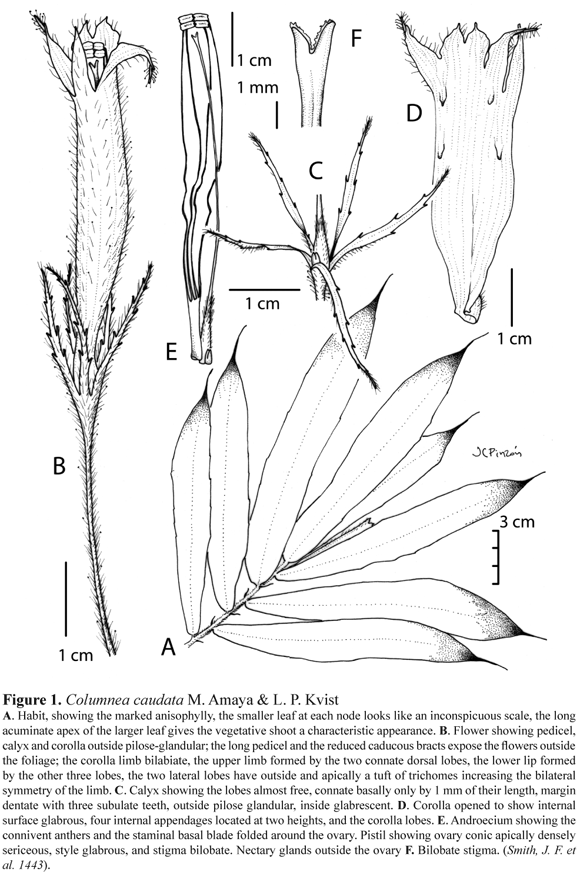
<body><![CDATA[<p><b>INTRODUCTION </b></p>     <p>The taxonomic revision of section <i>Collandra</i> (Lem.) Benth. &amp; Hook.f.   (<i>Columnea</i><i> </i>L., Gesneriaceae)   has revealed that our knowledge about this lineage of plants is far from   complete. Several new species of <i>Columnea</i>,   most of them from Colombia, have been published in the last ten years (<i>e.g.</i>,   Amaya-M&aacute;rquez <i>et al.</i> 2004; Kriebel   2005; Amaya-M&aacute;rquez 2010a, b; Amaya-M&aacute;rquez   &amp; Clark 2011; Amaya-M&aacute;rquez &amp; Mar&iacute;n-G&oacute;mez 2012; Amaya-M&aacute;rquez   &amp; Smith 2012; Clark &amp; Clavijo 2012). The   species of the genus <i>Columnea</i><i> </i>play an   important role in maintaining biodiversity due to the specialized system of   pollination by hummingbirds (Morley 1971; Jones &amp; Rich 1972; Stiles &amp;   Freeman 1993; Amaya-M&aacute;rquez 1996; Kastinger   &amp; Weber 2000). Biotic specialization, (<i>e.g</i>., the Neotropical   interaction hummingbird-<i>Columnea</i>) is known to   promote coexistence and speciation (Thompson 1994; Dyer <i>et al.</i> 2007; Schemske 2009) and therefore these ecological interactions   may determine local and global biodiversity patterns (Schemske   2002, Schemske <i>et al</i>. 2009).   Colombia  is the   country with the highest number of species of <i>Columnea</i><i> </i>(Kvist &amp; Skog 1993; Skog &amp; Boggan 2007) as well as of hummingbird species (Schuchman 1999), which may be the result of selection   driven by interactions between these two groups. These facts call for a great   responsibility to preserve the biodiversity and the ecological interactions   among species (Schemske 2002) and a precondition for   this, is to document the species that exist and investigate the ecology   including their coevolution with pollinators,   dispersers, and other organisms; one limitation to go farther in building this   type of knowledge is the lack of taxonomic tools available to identify species.   As part of the effort to overcome taxonomic limitations in the knowledge of the   genus <i>Columnea</i>, we report in this paper two   new species of <i>Columnea</i> from the Biogeographical Choc&oacute;, one of the most biodiverse   regions in   Colombia  and in the world (Myers <i>et al.</i> 2000; Rangel-Ch. &amp; Rivera-Diaz 2004). </p>     <p><i>Columnea</i><i> caudata </i>and <i>C. megafolia</i> are assigned to   section <i>Collandra</i> on the basis of having dorsiventral shoots typical for the species of the section,   and by having a solitary bilobate or tridentate   nectar gland. Additionally, these species have a great similarity to <i>C. ericae</i> Mansf. and <i>C. purpurata</i> Hanst. respectively, two   well-known species belonging to section <i>Collandra</i><i>.   Columnea caudata</i> is   unique among the species of section <i>Collandra</i> by having a long tubular corolla with a bilateral limb, with two lateral lobes   and four appendages inside the corolla, as well as having the larger leaf at   each node on the stem present a long caudate apex. <i>C. megafolia has</i> large membranous leaves lacking red spots, but   having conspicuous inflorescences crowded with several flowers and bracts. The   corolla tube is sigmoid and the limb has a marked bilateral symmetry. </p>     <p><b>Columnea</b><b> caudata </b>M.   Amaya &amp; L. P. Kvist sp.   nov. <a href="#figura1">Figure 1</a> </p>       <center>   <img src="/img/revistas/cal/v35n2/v35n2a4fig1.gif"><a name="figura1"></a>  </center>    <br>      <p>TYPE: COLOMBIA: Valle del Cauca, trail uphill from R&iacute;o Calima immediately across river from encampment Cuzumbu, 400-  1000   m, 21 Feb. 1989, <i>Smith, J. F. et al. 1443</i> (Holotype: COL, Isotypes: MO, WIS,   US). </p>     <p><i>Columnea</i><i> caudata </i>differs from <i>C. ericae </i>by the larger leaf of a pair having a long caudate apex and long narrow   corollas with a constricted zygomorphic limb. </p>     <p><b>Suffrutescent</b> woody climber. Stem subterete, 0.5-  0.7 cm   in diam., sericeous; internodes 1-  2 cm   long. <b>Leaves</b> opposite, strongly anisophyllous in a pair, papyraceous; larger leaf sessile; blade asymmetric, narrow oblanceolate to falcate, 8.5-23.5 x 1.3-  3.5 cm, base truncate and   slightly oblique, apex long caudate, margin serrate; adaxially   green and densely sericeous, veins obscure, abaxially green and red-purple apically (ca. 1/5th of the   leaf length), sometimes the margins are red-colored, densely sericeous (10- to 14-celled trichomes)   and with setulose unicellular trichomes   sparsely distributed, 13-17 veins on the larger side of the midrib, veining   mixed craspedodromous; smaller leaf sessile, linear,   5-7 x  0.5 mm . <b>Inflorescence</b> fasciculate of 1-2 flowers in the larger leaf axil; 1-2 bracts, lanceolate 2.3   x  0.3 cm   or reduced linear 4.0 x  0.5   mm, caduceus. <b>Flowers</b> pedicellate, pedicel 2.5-  3.5 cm, pilose   glandular (uniseriate 6- to 10-celled trichomes ending in a glandular head). <b>Calyx</b> green or pale yellow, lobes almost free, connate basally for about  1 mm, subequal,   very narrowly elliptic, 2-2.8 x 0.1-  0.3 cm, abaxially   glandular (uniseriate 6- to 10-celled trichomes with a glandular head), adaxially   glabrescent; margin dentate with 3 subulate teeth per   side. <b>Corolla</b> bright orange or yellow, tube cylindrical, dorsally   slightly recurved, 4.3-  5.5 cm   long, 0.6-  0.8 cm   wide along the tube,   2.7-  3.0 cm   wide at the limb, slightly constricted basally 0.5-  0.6 cm   wide; base dorsally   gibbous 0.3 x  0.4 cm   ;   limb bilabiate, upper lip formed by the two dorsal   lobes, lower lip formed by the other three; lobes unequal, two dorsal connate,   erect, acuminate, 0.5 x  0.3   cm   ; two lateral spreading, acute, 1.2 x  0.3 cm   ; the ventral lobe   slightly reflexed, acute, 1.0 x  0.3 cm   ; corolla outside pilose glandular (uniseriate 6-   to 10-celled trichomes ending in a glandular head),   with a tuft of hairs outside apically crowded in the lateral lobes, inside   glabrous and with 4 appendages. <b>Androecium</b> of   4 stamens, filament 4.0-  4.8   cm   long, with short trichomes   at the base of the filaments, basally connate for 1.0-  1.2 cm   of their length   forming a staminal blade folded and open dorsally,   anther rectangular 2.5 x  1.5   mm . <b>Gynoecium</b><b> </b>with   ovary conical, 0.5 x  0.3 cm,   setulose, apically densely sericeous   (uniseriate 3-to 6-celled trichomes);   style 4.4-  5.0 cm   long, glabrous; stigma bilobate. <b>Nectary</b> of one bilobulate dorsal gland, 3 x  3 mm . <b>Fruit</b> a green,   ovoid berry, 1.2-1.5 x 0.7-  1 cm . <b>Seeds</b> brown, elliptic, obliquely striated, 1.5 x  0.5 mm. </p>     <p><b>Etymology</b>. The species name makes reference to the   long caudate apex of the larger leaf at each stem node. </p>     ]]></body>
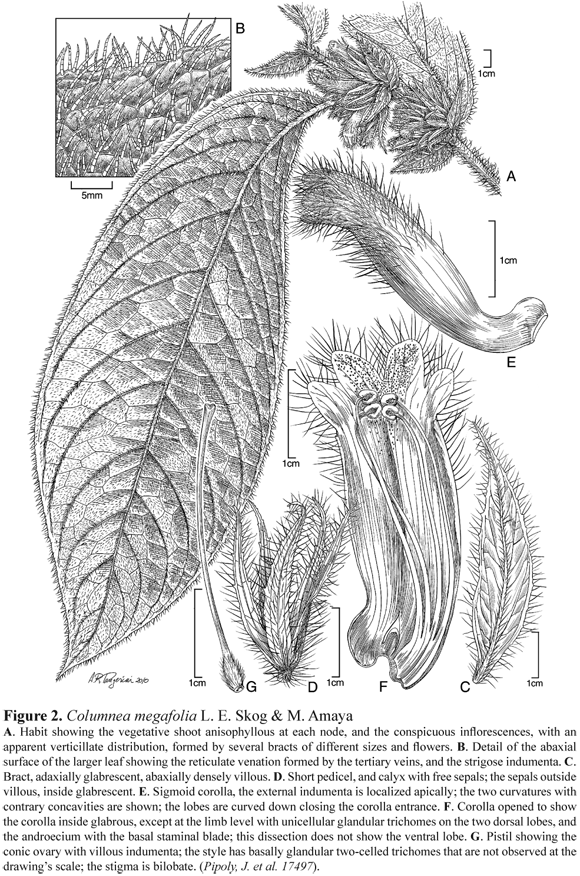
<body><![CDATA[<p><b>Phenology</b>: Flowers have   been recorded on the specimens collected in February, March and November. Fruits   were recorded from two specimens collected in February and March. </p>     <p><b>Distribution: </b>Colombia<b> </b>(Antioquia, Choc&oacute;, Risaralda, Valle del Cauca), 400-  1900 m   alt. This   species is distributed along a large part of the Colombian Biogeographical   Choc&oacute; region. The species seems to be distributed through a corridor of wet and   cloud forest on the mountains in the "Cordillera Occidental" of   Colombia  in the   Departments of Antioquia, Choc&oacute;, Risaralda, and Valle del Cauca. </p>     <p><b>Representative specimens</b>:   COLOMBIA. <b>Antioquia</b>:   Parque Nacional Natural Las   Orqu&iacute;deas, trail from Venados   to Carauta on the margin of the R&iacute;o Venados, 1300-  1350 m, Feb. 15, 1989, <i>Cogollo</i><i>,   A. et al. 4031 </i>(JAUM). Area around community called  La Madrona,   6-8 hrs walk from  La Clara   which is 3 hrs From El Sireno, which is 2 hrs on bus   north of Urrao, 1050-  1200 m, Nov. 10, 1982, <i>Folsom,   J. P. 10582</i> (US).<b> Choc&oacute;</b>: Municipio San   Jos&eacute; del Palmar, river basin of river Torito, tributary of the river H&aacute;bita,   850-  950 m,   Mar. 16, 1980, <i>Forero</i><i>, E. et al. 7398</i> (COL). Municipio of N&oacute;vita,   north slope of Cerro Torr&aacute;, western edge of the river   Surama, trail to the Alto del Oso,   600-  900 m,   Feb. 22, 1977, <i>Forero</i><i>, E. et al. 3128 </i>(COL). <b>Risaralda</b>: Municipio of Mistrat&oacute;,  12 Km   NE   from the municipality headwaters, 1800-1900m, Mar. 7, 1991, <i>Galeano</i><i>,   G. et al. 2575</i> (COL). On the road San Antonio de Chami   and Mistrat&oacute;, Quebrada   Sutu,  1750 m,   Apr. 27, 1992, <i>Fern&aacute;ndez</i><i>, A. et al. 10214</i> (COL). </p>     <p><b>Distinctive features: </b><i>Columnea</i><i> caudata</i> is easily recognized by having a dorsiventral vegetative shoot, the pair of leaves at each   node are strongly anisophyllous,   the smaller leaf being an inconspicuous linear scale leaf of 0.5-0.7 x  0.1 cm   is the smallest leaf   known in any species of <i>Columnea</i> section <i>Collandra</i>. The apex of the larger leaf is long   acuminate and 1.4-  2.8 cm   long giving to the plant a characteristic appearance making it easy to   recognize the species. The bracts are reduced, lanceolate   to linear, most of the time absent, suggesting that they are caducous. Unlike other species in section <i>Collandra</i><i> </i>in which the flowers are covered   and protected by the bracts and are kept very close to the vegetative shoot, in   this species the reduced bracts and long pedicels allow the flowers to be exserted from the vegetative shoot. The corolla limb is bilabiate but narrow, which points out a specialization to   restrict the nectar only to hummingbirds with long bills. It is interesting   that a narrow bilabiate limb neither allows   hummingbirds with short bills (<i>e.g</i>. <i>C. ericae</i>)   nor bees to access the nectar. Besides, the flowers of <i>C. caudata</i> present trichomes at   the edges of the lateral limbs, adding to the zygomorphic   symmetry of the limb; the long and narrow corolla suggests pollination   exclusively by a long-billed hummingbird, and the limb design might indicate a   visual signal directed to a specific species of hummingbird. This conjecture   might be found to be true if the species is a plentiful nectar producer and has   other ornithophilous plants competing for the same   bird pollinator in the same area. A reliable nectar producing plant might   increase its fitness (in, for example, pollinator visits, temporal flower   fidelity, fertilization, and outcrossing) by being distinctive   from other congenerics which may be less competitive.   Another morphological novelty reported in <i>C. caudata</i> is the four internal appendages, of unknown function, located inside the   corolla at two heights (<a href="#figura1">Fig. 1</a>). All of these floral traits broaden the   diversity of floral architectures known for the genus <i>Columnea</i> and pose the question about their functional value. </p>     <p><b>Columnea</b><b> megafolia </b>L.   E. Skog &amp; M. Amaya, sp. nov. <a href="#figura2">Figure 2</a> </p>       <center>   <img src="/img/revistas/cal/v35n2/v35n2a4fig2.gif"><a name="figura2"></a>  </center>    <br>      <p>TYPE: COLOMBIA: Antioquia, municipio Urrao: Vereda Calles, Alto de Palmitas  1   km   from the Inderena`s cabin   at Calles, 76º19' W, 6º32' N, 1300-  1400 m, <i>Pipoly</i><i>,   J. et al. 17497 </i>(Holotype: US, Isotype: MO). </p>     <p><i>Columnea</i><i> megafolia differs</i> from <i>C. purpurata</i> by having larger leaves and flowers, corolla   red or apically red and yellow, with a marked zygomorphic   limb. </p>     <p><b>Suffrutescent</b> terrestrial,  1 m   tall or woody climber&#8805;  1.5   m . Stem subterete,  1 cm   diam., indument lanate (trichomes 10-celled), internodes 1-  7 cm   long. <b>Leaves</b> opposite, strongly anisophyllous in a pair,   membranous, large leaf petiolate, petioles 0.2-  1.8 cm, villous (9- to   11-celled trichomes); blade asymmetrical, oblanceolate to narrowly oblong, 31-51 x 10-  16 cm, base oblique, shorter   side cuneate, longer side rounded, apex acuminate,   margin serrate; adaxially green, sparsely strigose (trichomes 5- to   12-celled trichomes); abaxially   pale green, sparsely strigose (5- to 12-celled trichomes), 13-16 secondary veins, the tertiary veins   forming a reticulate pattern; smaller leaf in a pair sessile, blade notably   asymmetric, lanceolate, 2-3 x 0.4-  1.2 cm, base oblique,   shorter side obtuse, longer side auriculate, apex   acuminate, margin dentate, adaxially green, sparsely strigose (9- to 12-celled trichomes),   abaxially pale green, sparsely strigose   (10- to 12-celled trichomes). <b>Inflorescence</b> fasciculate, of 4-5 flowers in the axil of larger   leaf; bracts 8-12, lanceolate, 1.8-5 x 0.3-  1.1 cm, abaxially   red, villous (8- to 12-celled trichomes), adaxially glabrous, margin dentate. <b>Flower </b>shortly   pedicellate, pedicels 0.1-  0.8 cm   long, villous,   glandular near the calyx. <b>Calyx</b> red, sepals free, subequal, lanceolate, 1.5-2 x   0.1-  0.4 cm,   abaxially villous (8- to 12-celled trichomes), adaxially glabrous,   margin dentate (sometimes with three subulate teeth   per side). <b>Corolla</b> red, or red and apically yellow, corolla tube   sigmoid, 3.5-  3.8 cm   long, 0.7-  0.8 cm   wide at the middle, constricted at base 0.4-  0.5 cm, base dorsally   gibbous, gibbosity 0.3-0.5 x 0.5-  0.7 cm   ; zygomorphic,   curved downward, lobes subequal, the two dorsal   obtuse, slightly hooded, imbricate and curved down, 3 x  2 mm   ; the two lateral obtuse,   3 x  2 mm   ;   and the ventral rounded 2 x  2   mm   ; corolla outside villous more dense apically (trichomes 10- to 12-celled), inside glabrous, except on the   two dorsal lobes that are densely glandular (with unicellular trichomes). <b>Androecium</b> of 4 stamens, filament 3-  3.4 cm   long, glabrous basally connate by 0.5-  0.7 cm   of their length and   forming a staminal blade; anther rectangular 2.5 x  1.5 mm, connective   rectangular. <b>Gynoecium</b><b> </b>with ovary conical, 0.4-0.5 x 0.1-  0.2 cm, villous (trichomes 10-celled) and basally setulose   (unicellular trichomes); style  3.3 cm   long, basally   glandular (2-celled trichomes); stigma bilobate. <b>Nectary</b> of one tridentate dorsal gland, 1.5 x  3 mm . <b>Fruit</b> and <b>Seeds </b>not seen. </p>     ]]></body>
<body><![CDATA[<p><b>Etymology</b>: The   species name refers to the large size of the larger leaf at each node. </p>     <p><b>Phenology</b>: Flowers have   been recorded from specimens collected in February, March, May, June, July and   December. </p>     <p><b>Distribution: </b> Colombia  (Antioquia)   at 1240-  1460 m   alt. in  Andean  Premontane  Wet  Forest   on the western slopes of the"  Cordillera Occidental   ". This species seems to be endemic   to the National Natural Park Las Orqu&iacute;deas. </p>     <p><b>Representative specimens</b>:   COLOMBIA. <b>Antioquia</b>:   Municipio de Urrao Parque Nacional Natural Las Orqu&iacute;deas, sector Calles,  1240 m,<i> </i>29 May 1988, <i>Cogollo</i><i>, A. &amp; J. G. Ram&iacute;rez   3037</i> (COL, JAUM); margin of river Calles,  1 km   ahead from the confluence   of the rivers Polo and Calles, 76º19` W, 6º32' N:  1460 m, Feb. 11 1989, <i>Cogollo</i><i>, A. et al. 3896</i> (JAUM);  1380 m, Mar. 26 1988, <i>Cogollo</i><i>, A. et al. 2622 </i>(COL, JAUM); 1350-  1450 m, Jul. 6 1991, <i>Cogollo</i><i>, A. et al. 5009</i> (MO); 76º19` W, 6º31'   N: 1300-  1320 m,   Mar. 27 1991, <i>Ram&iacute;rez</i><i>, J. &amp; E. Mu&ntilde;oz 4045 </i>(MO); river Calles, 77º4'51'' W, 4º35'56''   N, 1400-  1500 m,   May 3 1995, <i>Fonnegra</i><i>, R. et al. 5536</i> (HUA);  1400 m,   Jun. 15 1981, <i>Albert de Escobar, L. 1714</i> (HUA). </p>     <p><b>Distinctive features: </b><i>Columnea</i><i> megafolia</i> is close to <i>C. purpurata</i>, and both   species have conspicuous orange bracts that usually dry purplish, both species   do not have red spots on the larger leaves, which is unusual for species of   section <i>Collandra</i>. Also both species have a tridentate dorsal nectary gland.   However <i>C. megafolia</i> can be recognized by   having robust shoots and villous indumenta on the surface of almost all organs.   The larger leaf at each node is very large, 31-51 x 10-  16 cm   (vs. 11-30 x 3-  12 cm   in <i>C. purpurata</i>), usually with 15 veins on the larger side of   the blade (vs. 9-  12 in <i>C. purpurata</i>); short petioles give the   appearance of the leaves being sessile; the margin is serrate with glandular   teeth, whose function might be to release excess water. The inflorescences are   very conspicuous both in color which is red, and size; although the   inflorescence buds are located in the axils of the larger leaf of each node,   their size makes their distribution around the node appear verticillate;   the bracts are numerous and of different sizes, having the same red color of   the calyx and corolla, increasing the visual signal for pollinators. The   corolla tube is sigmoid presenting two marked curvatures along the tube, <i>i.e</i>.,   one concave up, basally just before the gibbous, the other concave down,   apically before the corolla limb; the corolla limb is curved downward closing   the corolla entrance (vs. an open corolla in <i>C. purpurata</i>).   This trait might be a trait to deter the entrance of certain floriverous insect - larvae of an unknown insect were found   inside the corolla of several dissected flowers. The corolla limb is clearly zygomorphic (vs. an actinomorphic   limb in <i>C. purpurata</i>), however the limb is not   bilabiate as all the lobes are recurved   down to close the corolla entrance, instead of forming upper and lower lips   (<a href="#figura2">Fig. 2</a>). As mentioned before, <i>C. megafolia</i> has been found only in Colombia (Antioquia) at 1200-  1460 m, while <i>C. purpurata</i> has a Neotropical   distribution and has been collected in Mexico, Nicaragua, Costa Rica, Panama,   Venezuela, and Colombia at 80-  1750   m .</p>     <p><b>ACKNOWLEDGMENTS </b></p>     <p>The authors thank National University of Colombia,  University   of  Aarhus, and Smithsonian Institution   for the opportunity to do research, Juan Carlos Pinz&oacute;n   and Alice Tangerini for the elaboration of the   drawings, and to the directors of the herbaria of  COL,   HUA,   JAUM,  MO, and US for their support and   collaboration to consult the collections deposited in those herbaria. To Jim   Smith and another anonymous reviewer whose valuable comments helped to improve   the manuscript. </p>     <p><b>LITERATURE CITED </b></p>     <!-- ref --><p>1. Amaya-M&aacute;rquez, M. 1996. Sistem&aacute;tica   y polinizaci&oacute;n del g&eacute;nero <i>Columnea</i> (Gesneriaceae) en  la Reserva Natural  la Planada   (Nari&ntilde;o). Tesis de   maestr&iacute;a, Universidad Nacional de Colombia, Bogot&aacute;, Colombia.    &nbsp;&nbsp;&nbsp;&nbsp;&nbsp;&nbsp;&nbsp;&nbsp;[&#160;<a href="javascript:void(0);" onclick="javascript: window.open('/scielo.php?script=sci_nlinks&ref=000051&pid=S0366-5232201300020000400001&lng=','','width=640,height=500,resizable=yes,scrollbars=1,menubar=yes,');">Links</a>&#160;]<!-- end-ref --> </p>     ]]></body>
<body><![CDATA[<!-- ref --><p>2. Amaya-M&aacute;rquez, M.   2010a. Una nueva especie de <i>Columnea</i> (Gesneriaceae) de la cordillera Oriental en los Andes   Colombianos. Caldasia 32 (1): 113-116.    &nbsp;&nbsp;&nbsp;&nbsp;&nbsp;&nbsp;&nbsp;&nbsp;[&#160;<a href="javascript:void(0);" onclick="javascript: window.open('/scielo.php?script=sci_nlinks&ref=000053&pid=S0366-5232201300020000400002&lng=','','width=640,height=500,resizable=yes,scrollbars=1,menubar=yes,');">Links</a>&#160;]<!-- end-ref --> </p>     <!-- ref --><p>3. Amaya-M&aacute;rquez, M.   2010b. Novedades Taxon&oacute;micas en el g&eacute;nero <i>Columnea</i><i> </i>(Gesneriaceae). Rev. Acad. Colomb.   Ci. Ex. Fis. Nat. 34 (132): 301-307.    &nbsp;&nbsp;&nbsp;&nbsp;&nbsp;&nbsp;&nbsp;&nbsp;[&#160;<a href="javascript:void(0);" onclick="javascript: window.open('/scielo.php?script=sci_nlinks&ref=000055&pid=S0366-5232201300020000400003&lng=','','width=640,height=500,resizable=yes,scrollbars=1,menubar=yes,');">Links</a>&#160;]<!-- end-ref --> </p>     <!-- ref --><p>4. Amaya-M&aacute;rquez, M. &amp; J. L. Clark. 2011. <i>Columnea</i><i> bivalvis </i>(Gesneriaceae),   a new species from the eastern slopes of the Ecuadorian Andes. J. Bot. Res.   Inst.  Texas      5   (1):75-79.    &nbsp;&nbsp;&nbsp;&nbsp;&nbsp;&nbsp;&nbsp;&nbsp;[&#160;<a href="javascript:void(0);" onclick="javascript: window.open('/scielo.php?script=sci_nlinks&ref=000057&pid=S0366-5232201300020000400004&lng=','','width=640,height=500,resizable=yes,scrollbars=1,menubar=yes,');">Links</a>&#160;]<!-- end-ref --> </p>     <!-- ref --><p>5. Amaya-M&aacute;rquez, M.   &amp; O.H. Mar&iacute;n-G&oacute;mez. 2012. <i>Columnea</i><i> rangelii </i>(Gesneriaceae), a new species from the Serran&iacute;a   de los Paraguas in the Colombian Andes. Caldasia 34 (1): 69-74.    &nbsp;&nbsp;&nbsp;&nbsp;&nbsp;&nbsp;&nbsp;&nbsp;[&#160;<a href="javascript:void(0);" onclick="javascript: window.open('/scielo.php?script=sci_nlinks&ref=000059&pid=S0366-5232201300020000400005&lng=','','width=640,height=500,resizable=yes,scrollbars=1,menubar=yes,');">Links</a>&#160;]<!-- end-ref --> </p>     <!-- ref --><p>6. Amaya-M&aacute;rquez, M. &amp; J.F. Smith.  2012. A   rare   new species of <i>Columnea</i> (Gesneriaceae)   from"  Cordillera Occidental   " in the Colombian   Andes. Rev. Acad. Colomb. Ci.   Ex. Fis. Nat. 23 (139): 13-16.    &nbsp;&nbsp;&nbsp;&nbsp;&nbsp;&nbsp;&nbsp;&nbsp;[&#160;<a href="javascript:void(0);" onclick="javascript: window.open('/scielo.php?script=sci_nlinks&ref=000061&pid=S0366-5232201300020000400006&lng=','','width=640,height=500,resizable=yes,scrollbars=1,menubar=yes,');">Links</a>&#160;]<!-- end-ref --> </p>     ]]></body>
<body><![CDATA[<!-- ref --><p>7. Amaya-M, M, L.E. Skog &amp; L.P. Kvist. 2004.   Novae Gesneriaceae Neotropicarium   XIII: Four New Species of <i>Columnea</i> (Gesneriaceae) Section <i>Collandra</i> from   Colombia.  Edinburgh      J.   Bot<i>.</i> 60: 415-424.    &nbsp;&nbsp;&nbsp;&nbsp;&nbsp;&nbsp;&nbsp;&nbsp;[&#160;<a href="javascript:void(0);" onclick="javascript: window.open('/scielo.php?script=sci_nlinks&ref=000063&pid=S0366-5232201300020000400007&lng=','','width=640,height=500,resizable=yes,scrollbars=1,menubar=yes,');">Links</a>&#160;]<!-- end-ref --> </p>     <!-- ref --><p>8. Clark,   J.L. &amp; L. Clavijo. 2012. <i>Columnea</i> <i>antennifera</i><i>, </i>a new species of Gesneriaceae from the  Cordillera   Central   of the Colombian Andes. J. Bot. Res. Inst.  Texas      6(2):385-389.    &nbsp;&nbsp;&nbsp;&nbsp;&nbsp;&nbsp;&nbsp;&nbsp;[&#160;<a href="javascript:void(0);" onclick="javascript: window.open('/scielo.php?script=sci_nlinks&ref=000065&pid=S0366-5232201300020000400008&lng=','','width=640,height=500,resizable=yes,scrollbars=1,menubar=yes,');">Links</a>&#160;]<!-- end-ref --> </p>     <!-- ref --><p>9. Dyer, L.A., M.S. Singer, J.T. Lill, J.O. Stireman, G.L. Gentry,   R.J. Marquis, R.E. Ricklefs, H.F. Greeney,   D.L. Wagner, H.C. Morais, I.R. Diniz,   T.A. Kursar &amp; P.D. Coley. 2007. Host specificity of Lepidoptera in tropical and temperate forest. Nature 448: 696-699.    &nbsp;&nbsp;&nbsp;&nbsp;&nbsp;&nbsp;&nbsp;&nbsp;[&#160;<a href="javascript:void(0);" onclick="javascript: window.open('/scielo.php?script=sci_nlinks&ref=000067&pid=S0366-5232201300020000400009&lng=','','width=640,height=500,resizable=yes,scrollbars=1,menubar=yes,');">Links</a>&#160;]<!-- end-ref --> </p>     <!-- ref --><p>10. Jones,   C.E. &amp; P.V. Rich 1972. Ornithophily and extrafloral color patterns in <i>Columnea</i>  florida      (Morton) Morton (Gesneriaceae). Bull.  S. Calif.   Acad. Sci. 7: 220-243.    &nbsp;&nbsp;&nbsp;&nbsp;&nbsp;&nbsp;&nbsp;&nbsp;[&#160;<a href="javascript:void(0);" onclick="javascript: window.open('/scielo.php?script=sci_nlinks&ref=000069&pid=S0366-5232201300020000400010&lng=','','width=640,height=500,resizable=yes,scrollbars=1,menubar=yes,');">Links</a>&#160;]<!-- end-ref --> </p>     <!-- ref --><p>11. Kastinger, C. &amp; A. Weber. 2000. Attraction   of hummingbirds by extrafloral cues in some Costa   Rican Species of <i>Columnea</i> (Gesneriaceae)   Linzer Biol. Beitr. 32(2): 652-653.    &nbsp;&nbsp;&nbsp;&nbsp;&nbsp;&nbsp;&nbsp;&nbsp;[&#160;<a href="javascript:void(0);" onclick="javascript: window.open('/scielo.php?script=sci_nlinks&ref=000071&pid=S0366-5232201300020000400011&lng=','','width=640,height=500,resizable=yes,scrollbars=1,menubar=yes,');">Links</a>&#160;]<!-- end-ref --> </p>     ]]></body>
<body><![CDATA[<!-- ref --><p>12. Kriebel, R.  2005. A   new species of <i>Columnea</i> and range   extension in the Gesneriaceae from   Costa Rica.   Brittonia 57(1): 39-42.    &nbsp;&nbsp;&nbsp;&nbsp;&nbsp;&nbsp;&nbsp;&nbsp;[&#160;<a href="javascript:void(0);" onclick="javascript: window.open('/scielo.php?script=sci_nlinks&ref=000073&pid=S0366-5232201300020000400012&lng=','','width=640,height=500,resizable=yes,scrollbars=1,menubar=yes,');">Links</a>&#160;]<!-- end-ref --> </p>     <!-- ref --><p>13. Kvist, L.P. &amp; L.E. Skog. 1993. The genus <i>Columnea</i> (Gesneriaceae) in   Ecuador.   Allertonia 6: 327-400.    &nbsp;&nbsp;&nbsp;&nbsp;&nbsp;&nbsp;&nbsp;&nbsp;[&#160;<a href="javascript:void(0);" onclick="javascript: window.open('/scielo.php?script=sci_nlinks&ref=000075&pid=S0366-5232201300020000400013&lng=','','width=640,height=500,resizable=yes,scrollbars=1,menubar=yes,');">Links</a>&#160;]<!-- end-ref --> </p>     <!-- ref --><p>14. Myers,   N., R.A. Mittermeier, C.G. Mittermeier,   G.A.B. de Fonseca &amp; J. Kent. 2000. Biodiversity hotspots for   conservation priorities. Nature 403: 853-858.    &nbsp;&nbsp;&nbsp;&nbsp;&nbsp;&nbsp;&nbsp;&nbsp;[&#160;<a href="javascript:void(0);" onclick="javascript: window.open('/scielo.php?script=sci_nlinks&ref=000077&pid=S0366-5232201300020000400014&lng=','','width=640,height=500,resizable=yes,scrollbars=1,menubar=yes,');">Links</a>&#160;]<!-- end-ref --> </p>     <!-- ref --><p>15. Morley, B.D.  1971. A   hybrid swarm between two hummingbird-pollinated species of <i>Columnea</i> (Gesneriaceae) in   Jamaica. J. Linn. Soc. Bot.   64: 81-96.    &nbsp;&nbsp;&nbsp;&nbsp;&nbsp;&nbsp;&nbsp;&nbsp;[&#160;<a href="javascript:void(0);" onclick="javascript: window.open('/scielo.php?script=sci_nlinks&ref=000079&pid=S0366-5232201300020000400015&lng=','','width=640,height=500,resizable=yes,scrollbars=1,menubar=yes,');">Links</a>&#160;]<!-- end-ref --> </p>     <!-- ref --><p>16. Rangel-Ch., J.O &amp; O. Rivera-D&iacute;az. 2004. Diversidad y riqueza de espermat&oacute;fitos   en el Choc&oacute; Biogeogr&aacute;fico: 83-99. In: Rangel-Ch.,J.O.   (ed.). Colombia Diversidad Bi&oacute;tica IV. El Choc&oacute; Biogeogr&aacute;fico/Costa Pac&iacute;fica.  Universidad Nacional de Colombia. Bogot&aacute;    &nbsp;&nbsp;&nbsp;&nbsp;&nbsp;&nbsp;&nbsp;&nbsp;[&#160;<a href="javascript:void(0);" onclick="javascript: window.open('/scielo.php?script=sci_nlinks&ref=000081&pid=S0366-5232201300020000400016&lng=','','width=640,height=500,resizable=yes,scrollbars=1,menubar=yes,');">Links</a>&#160;]<!-- end-ref -->. </p>     ]]></body>
<body><![CDATA[<!-- ref --><p>17. Schemske, D.W. 2002. Ecological and evolutionary perspectives   on the origins of tropical diversity. pp. 163-173. In:   Chazdon, R.I.      &amp; T.C. Whitmore (eds.). Foundations   of  Tropical  Forest      Biology. Univ.  Chicago      Press.   Chicago,  Illinois,   USA.    &nbsp;&nbsp;&nbsp;&nbsp;&nbsp;&nbsp;&nbsp;&nbsp;[&#160;<a href="javascript:void(0);" onclick="javascript: window.open('/scielo.php?script=sci_nlinks&ref=000083&pid=S0366-5232201300020000400017&lng=','','width=640,height=500,resizable=yes,scrollbars=1,menubar=yes,');">Links</a>&#160;]<!-- end-ref --> </p>     <!-- ref --><p>18. Schemske, D.W. 2009. Biotic interactions and speciation in the tropics: 219-239. In: Butlin, R.K., J.R. Bridle &amp; D. Schluter   (eds.). Speciation and patterns of   diversity.  Cambridge  University   Press,  Cambridge.    &nbsp;&nbsp;&nbsp;&nbsp;&nbsp;&nbsp;&nbsp;&nbsp;[&#160;<a href="javascript:void(0);" onclick="javascript: window.open('/scielo.php?script=sci_nlinks&ref=000085&pid=S0366-5232201300020000400018&lng=','','width=640,height=500,resizable=yes,scrollbars=1,menubar=yes,');">Links</a>&#160;]<!-- end-ref --> </p>     <!-- ref --><p>19. Schemske, D.W., G.G. Mittelbach,   H.V. Cornell, J.M. Sobel &amp; J.M.  Roy. 2009. Is there a latitudinal   gradient in the importance of biotic interactions? Ann. Rev. Ecol. Evol. Syst. 40: 245-269.    &nbsp;&nbsp;&nbsp;&nbsp;&nbsp;&nbsp;&nbsp;&nbsp;[&#160;<a href="javascript:void(0);" onclick="javascript: window.open('/scielo.php?script=sci_nlinks&ref=000087&pid=S0366-5232201300020000400019&lng=','','width=640,height=500,resizable=yes,scrollbars=1,menubar=yes,');">Links</a>&#160;]<!-- end-ref --> </p>     <!-- ref --><p>20. Schuchman, K.L. 1999. Trochilidae. Handbook of the Birds of the World. Volume   5. Lynx Editions.    &nbsp;&nbsp;&nbsp;&nbsp;&nbsp;&nbsp;&nbsp;&nbsp;[&#160;<a href="javascript:void(0);" onclick="javascript: window.open('/scielo.php?script=sci_nlinks&ref=000089&pid=S0366-5232201300020000400020&lng=','','width=640,height=500,resizable=yes,scrollbars=1,menubar=yes,');">Links</a>&#160;]<!-- end-ref --> </p>     <!-- ref --><p>21. Skog,   L.E. &amp; J.K. Boggan. 2007. World   Checklist of Gesneriaceae.   Washington,  DC : Dept. of Botany, Smithsonian Institution   Washington,  DC.   http://botany.si.edu/Gesneriaceae/Checklist &nbsp;&nbsp;&nbsp;&nbsp;&nbsp;&nbsp;&nbsp;&nbsp;[&#160;<a href="javascript:void(0);" onclick="javascript: window.open('/scielo.php?script=sci_nlinks&ref=000091&pid=S0366-5232201300020000400021&lng=','','width=640,height=500,resizable=yes,scrollbars=1,menubar=yes,');">Links</a>&#160;]<!-- end-ref --><!-- ref --><p>22. Stiles,   F.G. &amp; C.E. Freeman. 1993. Patterns in floral nectar   characteristics of some bird-visited plant species from Costa Rica. Biotropica 25:191-205 &nbsp;&nbsp;&nbsp;&nbsp;&nbsp;&nbsp;&nbsp;&nbsp;[&#160;<a href="javascript:void(0);" onclick="javascript: window.open('/scielo.php?script=sci_nlinks&ref=000092&pid=S0366-5232201300020000400022&lng=','','width=640,height=500,resizable=yes,scrollbars=1,menubar=yes,');">Links</a>&#160;]<!-- end-ref --><!-- ref --><p>23. Thompson, J.N.   1994. The Coevolutionary Process.   Univ.   Chicago   Press,   Chicago,  Illinois, USA.    &nbsp;&nbsp;&nbsp;&nbsp;&nbsp;&nbsp;&nbsp;&nbsp;[&#160;<a href="javascript:void(0);" onclick="javascript: window.open('/scielo.php?script=sci_nlinks&ref=000093&pid=S0366-5232201300020000400023&lng=','','width=640,height=500,resizable=yes,scrollbars=1,menubar=yes,');">Links</a>&#160;]<!-- end-ref --> </p> </font>      ]]></body><back>
<ref-list>
<ref id="B1">
<label>1</label><nlm-citation citation-type="">
<person-group person-group-type="author">
<name>
<surname><![CDATA[Amaya-Márquez]]></surname>
<given-names><![CDATA[M.]]></given-names>
</name>
</person-group>
<source><![CDATA[Sistemática y polinización del género Columnea (Gesneriaceae) en la Reserva Natural la Planada (Nariño)]]></source>
<year>1996</year>
</nlm-citation>
</ref>
<ref id="B2">
<label>2</label><nlm-citation citation-type="journal">
<person-group person-group-type="author">
<name>
<surname><![CDATA[Amaya-Márquez]]></surname>
<given-names><![CDATA[M.]]></given-names>
</name>
</person-group>
<article-title xml:lang="es"><![CDATA[Una nueva especie de Columnea (Gesneriaceae) de la cordillera Oriental en los Andes Colombianos]]></article-title>
<source><![CDATA[Caldasia]]></source>
<year>2010</year>
<volume>32</volume>
<numero>1</numero>
<issue>1</issue>
<page-range>113-116</page-range></nlm-citation>
</ref>
<ref id="B3">
<label>3</label><nlm-citation citation-type="journal">
<person-group person-group-type="author">
<name>
<surname><![CDATA[Amaya-Márquez]]></surname>
<given-names><![CDATA[M.]]></given-names>
</name>
</person-group>
<article-title xml:lang="es"><![CDATA[Novedades Taxonómicas en el género Columnea (Gesneriaceae)]]></article-title>
<source><![CDATA[Rev. Acad. Colomb. Ci. Ex. Fis. Nat.]]></source>
<year>2010</year>
<volume>34</volume>
<numero>132</numero>
<issue>132</issue>
<page-range>301-307</page-range></nlm-citation>
</ref>
<ref id="B4">
<label>4</label><nlm-citation citation-type="journal">
<person-group person-group-type="author">
<name>
<surname><![CDATA[Amaya-Márquez]]></surname>
<given-names><![CDATA[M.]]></given-names>
</name>
<name>
<surname><![CDATA[Clark]]></surname>
<given-names><![CDATA[J. L.]]></given-names>
</name>
</person-group>
<article-title xml:lang="en"><![CDATA[Columnea bivalvis (Gesneriaceae), a new species from the eastern slopes of the Ecuadorian Andes]]></article-title>
<source><![CDATA[J. Bot. Res. Inst. Texas]]></source>
<year>2011</year>
<volume>5</volume>
<numero>1</numero>
<issue>1</issue>
<page-range>75-79</page-range></nlm-citation>
</ref>
<ref id="B5">
<label>5</label><nlm-citation citation-type="journal">
<person-group person-group-type="author">
<name>
<surname><![CDATA[Amaya-Márquez]]></surname>
<given-names><![CDATA[M.]]></given-names>
</name>
<name>
<surname><![CDATA[Marín-Gómez]]></surname>
<given-names><![CDATA[O.H.]]></given-names>
</name>
</person-group>
<article-title xml:lang="en"><![CDATA[Columnea rangelii (Gesneriaceae), a new species from the Serranía de los Paraguas in the Colombian Andes]]></article-title>
<source><![CDATA[Caldasia]]></source>
<year>2012</year>
<volume>34</volume>
<numero>1</numero>
<issue>1</issue>
<page-range>69-74</page-range></nlm-citation>
</ref>
<ref id="B6">
<label>6</label><nlm-citation citation-type="journal">
<person-group person-group-type="author">
<name>
<surname><![CDATA[Amaya-Márquez]]></surname>
<given-names><![CDATA[M.]]></given-names>
</name>
<name>
<surname><![CDATA[Smith]]></surname>
<given-names><![CDATA[J.F.]]></given-names>
</name>
</person-group>
<article-title xml:lang="en"><![CDATA[A rare new species of Columnea (Gesneriaceae) from" Cordillera Occidental " in the Colombian Andes]]></article-title>
<source><![CDATA[Rev. Acad. Colomb. Ci. Ex. Fis. Nat.]]></source>
<year>2012</year>
<volume>23</volume>
<numero>139</numero>
<issue>139</issue>
<page-range>13-16</page-range></nlm-citation>
</ref>
<ref id="B7">
<label>7</label><nlm-citation citation-type="journal">
<person-group person-group-type="author">
<name>
<surname><![CDATA[Amaya-M]]></surname>
<given-names><![CDATA[M]]></given-names>
</name>
<name>
<surname><![CDATA[Skog]]></surname>
<given-names><![CDATA[L.E.]]></given-names>
</name>
<name>
<surname><![CDATA[Kvist]]></surname>
<given-names><![CDATA[L.P.]]></given-names>
</name>
</person-group>
<article-title xml:lang="en"><![CDATA[Novae Gesneriaceae Neotropicarium XIII: Four New Species of Columnea (Gesneriaceae) Section Collandra from Colombia]]></article-title>
<source><![CDATA[Edinburgh J. Bot.]]></source>
<year>2004</year>
<volume>60</volume>
<page-range>415-424</page-range></nlm-citation>
</ref>
<ref id="B8">
<label>8</label><nlm-citation citation-type="journal">
<person-group person-group-type="author">
<name>
<surname><![CDATA[Clark]]></surname>
<given-names><![CDATA[J.L.]]></given-names>
</name>
<name>
<surname><![CDATA[Clavijo]]></surname>
<given-names><![CDATA[L.]]></given-names>
</name>
</person-group>
<article-title xml:lang="en"><![CDATA[Columnea antennifera, a new species of Gesneriaceae from the Cordillera Central of the Colombian Andes]]></article-title>
<source><![CDATA[J. Bot. Res. Inst. Texas]]></source>
<year>2012</year>
<volume>6</volume>
<numero>2</numero>
<issue>2</issue>
<page-range>385-389</page-range></nlm-citation>
</ref>
<ref id="B9">
<label>9</label><nlm-citation citation-type="journal">
<person-group person-group-type="author">
<name>
<surname><![CDATA[Dyer]]></surname>
<given-names><![CDATA[L.A.]]></given-names>
</name>
<name>
<surname><![CDATA[Singer]]></surname>
<given-names><![CDATA[M.S.]]></given-names>
</name>
<name>
<surname><![CDATA[Lill]]></surname>
<given-names><![CDATA[J.T.]]></given-names>
</name>
<name>
<surname><![CDATA[Stireman]]></surname>
<given-names><![CDATA[J.O.]]></given-names>
</name>
<name>
<surname><![CDATA[Gentry]]></surname>
<given-names><![CDATA[G.L.]]></given-names>
</name>
<name>
<surname><![CDATA[Marquis]]></surname>
<given-names><![CDATA[R.J.]]></given-names>
</name>
<name>
<surname><![CDATA[Ricklefs]]></surname>
<given-names><![CDATA[R.E.]]></given-names>
</name>
<name>
<surname><![CDATA[Greeney]]></surname>
<given-names><![CDATA[H.F.]]></given-names>
</name>
<name>
<surname><![CDATA[Wagner]]></surname>
<given-names><![CDATA[D.L.]]></given-names>
</name>
<name>
<surname><![CDATA[Morais]]></surname>
<given-names><![CDATA[H.C.]]></given-names>
</name>
<name>
<surname><![CDATA[Diniz]]></surname>
<given-names><![CDATA[I.R.]]></given-names>
</name>
<name>
<surname><![CDATA[Kursar]]></surname>
<given-names><![CDATA[T.A.]]></given-names>
</name>
<name>
<surname><![CDATA[Coley]]></surname>
<given-names><![CDATA[P.D.]]></given-names>
</name>
</person-group>
<article-title xml:lang="en"><![CDATA[Host specificity of Lepidoptera in tropical and temperate forest]]></article-title>
<source><![CDATA[Nature]]></source>
<year>2007</year>
<volume>448</volume>
<page-range>696-699</page-range></nlm-citation>
</ref>
<ref id="B10">
<label>10</label><nlm-citation citation-type="journal">
<person-group person-group-type="author">
<name>
<surname><![CDATA[Jones]]></surname>
<given-names><![CDATA[C.E.]]></given-names>
</name>
<name>
<surname><![CDATA[Rich]]></surname>
<given-names><![CDATA[P.V.]]></given-names>
</name>
</person-group>
<article-title xml:lang="en"><![CDATA[Ornithophily and extrafloral color patterns in Columnea florida (Morton) Morton (Gesneriaceae)]]></article-title>
<source><![CDATA[Bull. S. Calif. Acad. Sci.]]></source>
<year>1972</year>
<volume>7</volume>
<page-range>220-243</page-range></nlm-citation>
</ref>
<ref id="B11">
<label>11</label><nlm-citation citation-type="journal">
<person-group person-group-type="author">
<name>
<surname><![CDATA[Kastinger]]></surname>
<given-names><![CDATA[C.]]></given-names>
</name>
<name>
<surname><![CDATA[Weber]]></surname>
<given-names><![CDATA[A.]]></given-names>
</name>
</person-group>
<article-title xml:lang="en"><![CDATA[Attraction of hummingbirds by extrafloral cues in some Costa Rican Species of Columnea (Gesneriaceae) Linzer]]></article-title>
<source><![CDATA[Biol. Beitr.]]></source>
<year>2000</year>
<volume>32</volume>
<numero>2</numero>
<issue>2</issue>
<page-range>652-653</page-range></nlm-citation>
</ref>
<ref id="B12">
<label>12</label><nlm-citation citation-type="journal">
<person-group person-group-type="author">
<name>
<surname><![CDATA[Kriebel]]></surname>
<given-names><![CDATA[R.]]></given-names>
</name>
</person-group>
<article-title xml:lang="en"><![CDATA[A new species of Columnea and range extension in the Gesneriaceae from Costa Rica]]></article-title>
<source><![CDATA[Brittonia]]></source>
<year>2005</year>
<volume>57</volume>
<numero>1</numero>
<issue>1</issue>
<page-range>39-42</page-range></nlm-citation>
</ref>
<ref id="B13">
<label>13</label><nlm-citation citation-type="journal">
<person-group person-group-type="author">
<name>
<surname><![CDATA[Kvist]]></surname>
<given-names><![CDATA[L.P.]]></given-names>
</name>
<name>
<surname><![CDATA[Skog]]></surname>
<given-names><![CDATA[L.E.]]></given-names>
</name>
</person-group>
<article-title xml:lang="en"><![CDATA[The genus Columnea (Gesneriaceae) in Ecuador]]></article-title>
<source><![CDATA[Allertonia]]></source>
<year>1993</year>
<volume>6</volume>
<page-range>327-400</page-range></nlm-citation>
</ref>
<ref id="B14">
<label>14</label><nlm-citation citation-type="journal">
<person-group person-group-type="author">
<name>
<surname><![CDATA[Myers]]></surname>
<given-names><![CDATA[N.]]></given-names>
</name>
<name>
<surname><![CDATA[Mittermeier]]></surname>
<given-names><![CDATA[R.A.]]></given-names>
</name>
<name>
<surname><![CDATA[Mittermeier]]></surname>
<given-names><![CDATA[C.G.]]></given-names>
</name>
<name>
<surname><![CDATA[de Fonseca]]></surname>
<given-names><![CDATA[G.A.B.]]></given-names>
</name>
<name>
<surname><![CDATA[Kent]]></surname>
<given-names><![CDATA[J.]]></given-names>
</name>
</person-group>
<article-title xml:lang="en"><![CDATA[Biodiversity hotspots for conservation priorities]]></article-title>
<source><![CDATA[Nature]]></source>
<year>2000</year>
<volume>403</volume>
<page-range>853-858</page-range></nlm-citation>
</ref>
<ref id="B15">
<label>15</label><nlm-citation citation-type="journal">
<person-group person-group-type="author">
<name>
<surname><![CDATA[Morley]]></surname>
<given-names><![CDATA[B.D.]]></given-names>
</name>
</person-group>
<article-title xml:lang="en"><![CDATA[A hybrid swarm between two hummingbird-pollinated species of Columnea (Gesneriaceae) in Jamaica]]></article-title>
<source><![CDATA[J. Linn. Soc. Bot.]]></source>
<year>1971</year>
<volume>64</volume>
<page-range>81-96</page-range></nlm-citation>
</ref>
<ref id="B16">
<label>16</label><nlm-citation citation-type="book">
<person-group person-group-type="author">
<name>
<surname><![CDATA[Rangel-Ch.]]></surname>
<given-names><![CDATA[J.O]]></given-names>
</name>
<name>
<surname><![CDATA[Rivera-Díaz]]></surname>
<given-names><![CDATA[O.]]></given-names>
</name>
</person-group>
<article-title xml:lang="es"><![CDATA[Diversidad y riqueza de espermatófitos en el Chocó Biogeográfico]]></article-title>
<person-group person-group-type="editor">
<name>
<surname><![CDATA[Rangel-Ch.]]></surname>
<given-names><![CDATA[J.O.]]></given-names>
</name>
</person-group>
<source><![CDATA[Colombia Diversidad Biótica IV: El Chocó Biogeográfico/Costa Pacífica]]></source>
<year>2004</year>
<page-range>83-99</page-range><publisher-loc><![CDATA[Bogotá ]]></publisher-loc>
<publisher-name><![CDATA[Universidad Nacional de Colombia]]></publisher-name>
</nlm-citation>
</ref>
<ref id="B17">
<label>17</label><nlm-citation citation-type="book">
<person-group person-group-type="author">
<name>
<surname><![CDATA[Schemske]]></surname>
<given-names><![CDATA[D.W.]]></given-names>
</name>
</person-group>
<article-title xml:lang="en"><![CDATA[Ecological and evolutionary perspectives on the origins of tropical diversity]]></article-title>
<person-group person-group-type="editor">
<name>
<surname><![CDATA[Chazdon]]></surname>
<given-names><![CDATA[R.I.]]></given-names>
</name>
<name>
<surname><![CDATA[Whitmore]]></surname>
<given-names><![CDATA[T.C.]]></given-names>
</name>
</person-group>
<source><![CDATA[Foundations of Tropical Forest Biology]]></source>
<year>2002</year>
<page-range>163-173</page-range><publisher-loc><![CDATA[Chicago^eIllinois Illinois]]></publisher-loc>
<publisher-name><![CDATA[Univ. Chicago Press]]></publisher-name>
</nlm-citation>
</ref>
<ref id="B18">
<label>18</label><nlm-citation citation-type="book">
<person-group person-group-type="author">
<name>
<surname><![CDATA[Schemske]]></surname>
<given-names><![CDATA[D.W.]]></given-names>
</name>
</person-group>
<article-title xml:lang="en"><![CDATA[Biotic interactions and speciation in the tropics]]></article-title>
<person-group person-group-type="editor">
<name>
<surname><![CDATA[Butlin]]></surname>
<given-names><![CDATA[R.K.]]></given-names>
</name>
<name>
<surname><![CDATA[Bridle]]></surname>
<given-names><![CDATA[J.R.]]></given-names>
</name>
<name>
<surname><![CDATA[Schluter]]></surname>
<given-names><![CDATA[D.]]></given-names>
</name>
</person-group>
<source><![CDATA[Speciation and patterns of diversity]]></source>
<year>2009</year>
<page-range>219-239</page-range><publisher-loc><![CDATA[Cambridge ]]></publisher-loc>
<publisher-name><![CDATA[Cambridge University Press]]></publisher-name>
</nlm-citation>
</ref>
<ref id="B19">
<label>19</label><nlm-citation citation-type="journal">
<person-group person-group-type="author">
<name>
<surname><![CDATA[Schemske]]></surname>
<given-names><![CDATA[D.W.]]></given-names>
</name>
<name>
<surname><![CDATA[Mittelbach]]></surname>
<given-names><![CDATA[G.G.]]></given-names>
</name>
<name>
<surname><![CDATA[Cornell]]></surname>
<given-names><![CDATA[H.V.]]></given-names>
</name>
<name>
<surname><![CDATA[Sobel]]></surname>
<given-names><![CDATA[J.M.]]></given-names>
</name>
<name>
<surname><![CDATA[Roy]]></surname>
<given-names><![CDATA[J.M.]]></given-names>
</name>
</person-group>
<article-title xml:lang="en"><![CDATA[Is there a latitudinal gradient in the importance of biotic interactions?]]></article-title>
<source><![CDATA[Ann. Rev. Ecol. Evol. Syst.]]></source>
<year>2009</year>
<volume>40</volume>
<page-range>245-269</page-range></nlm-citation>
</ref>
<ref id="B20">
<label>20</label><nlm-citation citation-type="book">
<person-group person-group-type="author">
<name>
<surname><![CDATA[Schuchman]]></surname>
<given-names><![CDATA[K.L.]]></given-names>
</name>
</person-group>
<source><![CDATA[Trochilidae: Handbook of the Birds of the World]]></source>
<year>1999</year>
<volume>5</volume>
<publisher-name><![CDATA[Lynx Editions]]></publisher-name>
</nlm-citation>
</ref>
<ref id="B21">
<label>21</label><nlm-citation citation-type="book">
<person-group person-group-type="author">
<name>
<surname><![CDATA[Skog]]></surname>
<given-names><![CDATA[L.E.]]></given-names>
</name>
<name>
<surname><![CDATA[Boggan]]></surname>
<given-names><![CDATA[J.K.]]></given-names>
</name>
</person-group>
<source><![CDATA[World Checklist of Gesneriaceae]]></source>
<year>2007</year>
<publisher-loc><![CDATA[Washington^eDC DC]]></publisher-loc>
<publisher-name><![CDATA[Dept. of Botany, Smithsonian Institution Washington, DC]]></publisher-name>
</nlm-citation>
</ref>
<ref id="B22">
<label>22</label><nlm-citation citation-type="journal">
<person-group person-group-type="author">
<name>
<surname><![CDATA[Stiles]]></surname>
<given-names><![CDATA[F.G.]]></given-names>
</name>
<name>
<surname><![CDATA[Freeman]]></surname>
<given-names><![CDATA[C.E.]]></given-names>
</name>
</person-group>
<article-title xml:lang="en"><![CDATA[Patterns in floral nectar characteristics of some bird-visited plant species from Costa Rica]]></article-title>
<source><![CDATA[Biotropica]]></source>
<year>1993</year>
<volume>25</volume>
<page-range>191-205</page-range></nlm-citation>
</ref>
<ref id="B23">
<label>23</label><nlm-citation citation-type="book">
<person-group person-group-type="author">
<name>
<surname><![CDATA[Thompson]]></surname>
<given-names><![CDATA[J.N.]]></given-names>
</name>
</person-group>
<source><![CDATA[The Coevolutionary Process]]></source>
<year>1994</year>
<publisher-loc><![CDATA[Chicago^eIllinois Illinois]]></publisher-loc>
<publisher-name><![CDATA[Univ. Chicago Press]]></publisher-name>
</nlm-citation>
</ref>
</ref-list>
</back>
</article>