<?xml version="1.0" encoding="ISO-8859-1"?><article xmlns:mml="http://www.w3.org/1998/Math/MathML" xmlns:xlink="http://www.w3.org/1999/xlink" xmlns:xsi="http://www.w3.org/2001/XMLSchema-instance">
<front>
<journal-meta>
<journal-id>0366-5232</journal-id>
<journal-title><![CDATA[Caldasia]]></journal-title>
<abbrev-journal-title><![CDATA[Caldasia]]></abbrev-journal-title>
<issn>0366-5232</issn>
<publisher>
<publisher-name><![CDATA[Instituto de Ciencias Naturales, Facultad de Ciencias-Universidad Nacional de Colombia]]></publisher-name>
</publisher>
</journal-meta>
<article-meta>
<article-id>S0366-52322014000100005</article-id>
<article-id pub-id-type="doi">10.15446/caldasia.v36n1.43891</article-id>
<title-group>
<article-title xml:lang="en"><![CDATA[PUYA HAMATA DEMOGRAPHY AS AN INDICATOR OF RECENT FIRE HISTORY IN THE PÁRAMO OF EL ÁNGEL AND VOLCÁN CHILES, ECUADOR-COLOMBIA]]></article-title>
<article-title xml:lang="es"><![CDATA[La demografía de Puya hamata como indicador de la historia de fuegos recientes en el páramo de El Ángel y Volcán Chiles, Ecuador-Colombia]]></article-title>
</title-group>
<contrib-group>
<contrib contrib-type="author">
<name>
<surname><![CDATA[GARCÍA-MENESES]]></surname>
<given-names><![CDATA[PAOLA M.]]></given-names>
</name>
<xref ref-type="aff" rid="A01"/>
</contrib>
<contrib contrib-type="author">
<name>
<surname><![CDATA[RAMSAY]]></surname>
<given-names><![CDATA[PAUL M.]]></given-names>
</name>
<xref ref-type="aff" rid="A02"/>
</contrib>
</contrib-group>
<aff id="A01">
<institution><![CDATA[,Plymouth University Earth and Environmental Sciences School of Geography]]></institution>
<addr-line><![CDATA[Plymouth ]]></addr-line>
<country>United Kingdom</country>
</aff>
<aff id="A02">
<institution><![CDATA[,Plymouth University Marine Biology and Ecology Research Centre ]]></institution>
<addr-line><![CDATA[Plymouth ]]></addr-line>
<country>United Kingdom</country>
</aff>
<pub-date pub-type="pub">
<day>30</day>
<month>06</month>
<year>2014</year>
</pub-date>
<pub-date pub-type="epub">
<day>30</day>
<month>06</month>
<year>2014</year>
</pub-date>
<volume>36</volume>
<numero>1</numero>
<fpage>53</fpage>
<lpage>69</lpage>
<copyright-statement/>
<copyright-year/>
<self-uri xlink:href="http://www.scielo.org.co/scielo.php?script=sci_arttext&amp;pid=S0366-52322014000100005&amp;lng=en&amp;nrm=iso"></self-uri><self-uri xlink:href="http://www.scielo.org.co/scielo.php?script=sci_abstract&amp;pid=S0366-52322014000100005&amp;lng=en&amp;nrm=iso"></self-uri><self-uri xlink:href="http://www.scielo.org.co/scielo.php?script=sci_pdf&amp;pid=S0366-52322014000100005&amp;lng=en&amp;nrm=iso"></self-uri><abstract abstract-type="short" xml:lang="en"><p><![CDATA[High-altitude páramo grasslands are important for their biodiversity and the ecosystem services that they provide to Andean people, but they are sensitive to disturbances, such as fire. Understanding the ecological impacts of disturbance is critical for the effective management of páramos. Indicator species studies can provide a relatively efficient way to gain such understanding. Puya hamata is a flagship giant rosette plant and has potential as an indicator of recent páramo fire history. To determine population size structure, mortality, recruitment and growth rates of Puya hamata rosettes, all Puya plants in 400 m² plots were surveyed in 2008 and again one year later. Sixteen plots were recorded in both years, containing exactly 1000 plants. Mortality was very low during this period (0.6%). Only 27 new plants were recruited. Three different size distribution patterns were observed in the plots: (1) low plant numbers across all size ranges; (2) a single dominant peak in numbers at a particular size; (3) two dominant peaks in numbers at distinct sizes. Estimated life span of Puya hamata was 28 years based on growth rates, and growth rate declined beyond the size at which most rosettes reproduce. To investigate the impact of different fire intensities on Puya hamata mortality, 400 m² plots within a mosaic of unburned and burned patches of different fire intensities were surveyed one month after the fire. Fire mortality was low in the medium and high intensity plots, and fires selectively killed smaller plants rather than larger ones. No mortality was observed in the unburned and low intensity fire plots. It is proposed that Puya responds to burning with pulses of seedling recruitment during periods of open vegetation after fires and very little recruitment at other times. Therefore, surveys of Puya plants can reveal past fire events in their population size structure. The combination of sensitivity to fire at recruitment, low fire mortality rates afterwards, and a 28-year lifespan makes Puya hamata an ideal indicator species of recent fire history in páramos.]]></p></abstract>
<abstract abstract-type="short" xml:lang="es"><p><![CDATA[Los páramos son importantes por su biodiversidad y los servicios ecosistémicos que proporcionan a los pueblos andinos, pero son sensibles a los disturbios como las quemas. El entendimiento de los impactos ecológicos de los disturbios es crucial pare al manejo efectivo de los páramos. El estudio de especies indicadoras puede contribuir de manera eficiente a este entendimiento. Puya hamata es una roseta gigante, considerada como especie bandera que tiene el potencial de actuar como indicador de la historia reciente de quema dentro de los páramos. Para determinar la estructura de tamaño de la población, la mortalidad, reclutamiento y tasa de crecimiento de Puya hamata, se midieron todas las plantas de Puya dentro de cuadros de 400 m² en 2008 y un año más tarde. Se registraron 16 parcelas en ambos años donde se encontraron exactamente 1000 plantas. La mortalidad fue bastante baja durante este periodo (0.6%). Se reclutaron solamente 27 plántulas. Se encontraron tres diferentes patrones de distribución en las parcelas monitoreadas: 1) bajo número de plantas de todos tamaños; 2) un solo pico dominante de un tamaño en particular; 3) dos picos dominantes de dos distintas categorías de tamaño. La duración estimada de vida de Puya hamata basada en la tasa de crecimiento, fue de 28 años la cual disminuyó al sobrepasar el tamaño en que la mayoría de las rosetas se reproducen. Para investigar el impacto de las quemas sobre la mortalidad de Puya hamata, se registraron, un mes después de la quema, parcelas de 400 m² dentro de un mosaico de parches no quemados y quemados a diferentes intensidades. En los cuadros de baja y media intensidad de fuego, la mortalidad fue baja y los fuegos mataron selectivamente plantas pequeñas más que grandes. No se observó mortalidad en las parcelas sin quema y de baja intensidad. Se propone que Puya responde a las quemas con pulsos de reclutamiento de plantas durante periodos cuando la vegetación está abierta después de las quemas y muy bajo reclutamiento en otras ocasiones. Por lo tanto, el seguimiento de Puya puede revelar eventos de quemas pasadas dentro de su estructura poblacional. La combinación de la sensibilidad a las quemas al momento del reclutamiento, la baja tasa de mortalidad después de las quemas y su duración de vida hace a Puya hamata una especie ideal que funciona como indicador de la historia de fuegos recientes en los páramos.]]></p></abstract>
<kwd-group>
<kwd lng="en"><![CDATA[Bromeliaceae]]></kwd>
<kwd lng="en"><![CDATA[burning]]></kwd>
<kwd lng="en"><![CDATA[Ecuador]]></kwd>
<kwd lng="en"><![CDATA[giant puya]]></kwd>
<kwd lng="en"><![CDATA[mortality]]></kwd>
<kwd lng="en"><![CDATA[páramo]]></kwd>
<kwd lng="en"><![CDATA[population dynamics]]></kwd>
<kwd lng="en"><![CDATA[seedling recruitment]]></kwd>
<kwd lng="en"><![CDATA[semelparity]]></kwd>
<kwd lng="es"><![CDATA[Bromeliaceae]]></kwd>
<kwd lng="es"><![CDATA[dinámica poblacional]]></kwd>
<kwd lng="es"><![CDATA[Ecuador]]></kwd>
<kwd lng="es"><![CDATA[mortalidad]]></kwd>
<kwd lng="es"><![CDATA[páramo]]></kwd>
<kwd lng="es"><![CDATA[puya gigante]]></kwd>
<kwd lng="es"><![CDATA[quemas]]></kwd>
<kwd lng="es"><![CDATA[reclutamiento de plántulas]]></kwd>
<kwd lng="es"><![CDATA[semelparidad]]></kwd>
</kwd-group>
</article-meta>
</front><body><![CDATA[  <font size="2" face="verdana">      <p><a href="http://dx.doi.org/10.15446/caldasia.v36n1.43891" target="_blank">http://dx.doi.org/10.15446/caldasia.v36n1.43891</a></p>     <p><font size="4">       <center>     <b><i>PUYA HAMATA</i> DEMOGRAPHY AS AN INDICATOR OF RECENT FIRE HISTORY IN THE P&Aacute;RAMO OF EL &Aacute;NGEL AND VOLC&Aacute;N CHILES, ECUADOR-COLOMBIA</b>   </center>  </font></p> <font size="3">      <center>   <b>La demograf&iacute;a de <i>Puya hamata</i> como indicador de la historia de fuegos recientes en el p&aacute;ramo de El &Aacute;ngel y Volc&aacute;n Chiles, Ecuador-Colombia</b>    <br> </center> </font>       <p><b>PAOLA M. GARC&Iacute;A-MENESES </b>    <br>    <b>PAUL M. RAMSAY</b>      <p><i>School of Geography,  Earth and Environmental Sciences, Plymouth  University, Plymouth, PL4 8AA,   United Kingdom.</i>       <p><i>Marine Biology and Ecology Research Centre, Plymouth University,  Plymouth, PL4 8AA, United    Kingdom. <a href="mailto:pramsay@plymouth.ac.uk">pramsay@plymouth.ac.uk</a></i></p>      ]]></body>
<body><![CDATA[<p><b>ABSTRACT</b></p>     <p>High-altitude p&aacute;ramo grasslands are important for their   biodiversity and the ecosystem services that they provide to Andean people, but   they are sensitive to disturbances, such as fire. Understanding the ecological   impacts of disturbance is critical for the effective management of p&aacute;ramos. Indicator species studies can provide a relatively   efficient way to gain such understanding. <i>Puya hamata </i>is a flagship giant rosette plant and has   potential as an indicator of recent p&aacute;ramo fire   history. To determine population size structure, mortality, recruitment and   growth rates of <i>Puya hamata</i> rosettes, all <i>Puya</i> plants in  400 m<sup>2</sup> plots were   surveyed in 2008 and again one year later. Sixteen plots were recorded in both   years, containing exactly 1000 plants. Mortality was very low during this   period (0.6%). Only 27 new plants were recruited. Three different size   distribution patterns were observed in the plots: (1) low plant numbers across   all size ranges; (2) a single dominant peak in numbers at a particular size;   (3) two dominant peaks in numbers at distinct sizes. Estimated life span of <i>Puya hamata</i> was 28   years based on growth rates, and growth rate declined beyond the size at which   most rosettes reproduce. To investigate the impact of different fire   intensities on <i>Puya hamata</i> mortality,  400 m<sup>2</sup> plots within a mosaic of unburned and burned patches of different fire   intensities were surveyed one month after the fire. Fire mortality was low in   the medium and high intensity plots, and fires selectively killed smaller   plants rather than larger ones. No mortality was observed in the unburned and   low intensity fire plots. It is proposed that <i>Puya</i> responds to burning with pulses of seedling recruitment during periods of open   vegetation after fires and very little recruitment at other times. Therefore,   surveys of <i>Puya</i> plants can reveal past fire   events in their population size structure. The combination of sensitivity to   fire at recruitment, low fire mortality rates afterwards, and a 28-year lifespan makes <i>Puya hamata</i> an ideal indicator species of recent fire history in p&aacute;ramos. </p>     <p><b>Key words.</b> Bromeliaceae, burning, Ecuador , giant puya, mortality, p&aacute;ramo,   population dynamics, seedling recruitment, semelparity. </p>     <p><b>RESUMEN</b></p>     <p>Los p&aacute;ramos son importantes por su   biodiversidad y los servicios ecosist&eacute;micos que proporcionan a los pueblos   andinos, pero son sensibles a los disturbios como las quemas. El entendimiento   de los impactos ecol&oacute;gicos de los disturbios es crucial pare al manejo efectivo   de los p&aacute;ramos. El estudio de especies indicadoras puede contribuir de manera   eficiente a este entendimiento. <i>Puya hamata</i> es   una roseta gigante, considerada como especie bandera que tiene el potencial de   actuar como indicador de la historia reciente de quema dentro de los p&aacute;ramos. Para   determinar la estructura de tama&ntilde;o de la poblaci&oacute;n, la mortalidad,   reclutamiento y tasa de crecimiento de <i>Puya hamata</i>,   se midieron todas las plantas de <i>Puya</i> dentro de cuadros de 400 m<sup>2</sup> en 2008 y   un a&ntilde;o m&aacute;s tarde. Se registraron 16 parcelas en ambos a&ntilde;os donde se encontraron   exactamente 1000 plantas. La mortalidad fue bastante baja durante este periodo   (0.6%). Se reclutaron solamente 27 pl&aacute;ntulas. Se encontraron tres diferentes   patrones de distribuci&oacute;n en las parcelas monitoreadas: 1) bajo n&uacute;mero de   plantas de todos tama&ntilde;os; 2) un solo pico dominante de un tama&ntilde;o en particular;   3) dos picos dominantes de dos distintas categor&iacute;as de tama&ntilde;o. La duraci&oacute;n   estimada de vida de <i>Puya hamata</i> basada en la   tasa de crecimiento, fue de 28 a&ntilde;os la cual disminuy&oacute; al sobrepasar el tama&ntilde;o   en que la mayor&iacute;a de las rosetas se reproducen. Para investigar el impacto de   las quemas sobre la mortalidad de <i>Puya hamata, </i>se   registraron, un mes despu&eacute;s de la quema, parcelas de 400 m<sup>2</sup> dentro de   un mosaico de parches no quemados y quemados a diferentes intensidades. En los   cuadros de baja y media intensidad de fuego, la mortalidad fue baja y los   fuegos mataron selectivamente plantas peque&ntilde;as m&aacute;s que grandes. No se observ&oacute;   mortalidad en las parcelas sin quema y de baja intensidad. Se propone que <i>Puya</i> responde a las quemas con pulsos de reclutamiento de plantas durante periodos   cuando la vegetaci&oacute;n est&aacute; abierta despu&eacute;s de las quemas y muy bajo   reclutamiento en otras ocasiones. Por lo tanto, el seguimiento de <i>Puya</i> puede revelar eventos de quemas pasadas dentro de su estructura poblacional. La   combinaci&oacute;n de la sensibilidad a las quemas al momento del reclutamiento, la   baja tasa de mortalidad despu&eacute;s de las quemas y su duraci&oacute;n de vida hace a <i>Puya hamata</i> una especie ideal que funciona como   indicador de la historia de fuegos recientes en los p&aacute;ramos. </p>     <p><b>Palabras   clave.</b> Bromeliaceae, din&aacute;mica poblacional, Ecuador, mortalidad,   p&aacute;ramo, puya gigante, quemas, reclutamiento de pl&aacute;ntulas, semelparidad.</p>     <p>Recibido:   26/02/2013</br>     <br>Aceptado:  03/04/2014</p>     <p><b>INTRODUCTION</b></p>     <p>High-altitude p&aacute;ramo grasslands are found at 3000–4800 m, above the   limits of continuous forest in the Andes from   Colombia and Venezuela  to northern Per&uacute; (Hofstede<i> </i>et al<i>.</i> 2003) and most probably a narrow strip above the subalpine or high Andean rain   forest to   Bolivia  (Garc&iacute;a &amp; Beck 2006). An outlier of p&aacute;ramo is also present in Panam&aacute; and   Costa Rica  (Kapelle &amp; Horn 2005). This ecosystem is sensitive to   land-use changes, but is under significant pressure from local human   populations for direct benefits, like agriculture, and indirect ecosystem   services, such as water supply (V&aacute;sconez &amp; Hofstede 2006). P&aacute;ramo ecosystems   are important for several reasons (Hofstede et al<i>.</i> 2003): a) their relatively high biological diversity and endemicity results in high conservation interest; b) they provide various ecosystem   services to many Andean people, mostly in ecological zones at lower altitudes;   c) ecotourism provides significant additional income to some rural communities;   and d) as fragile ecosystems, they are particularly threatened by poor management and climate change.</p>     ]]></body>
<body><![CDATA[<p>One of   the most common disturbances in the p&aacute;ramos is fire   (Horn &amp; Kappelle 2009). Several authors have   considered that p&aacute;ramo below 4100–4300 m.a.s.l represents secondary vegetation in previously   forested areas that has been shaped and maintained by anthropogenic fire (Ellenberg 1979, Lægaard 1992). However, Moscol &amp; Cleef (2009a,   b) were able to determine the upper forest line at about  3650 m in P&aacute;ramo de El Angel and Guandera in northern   Ecuador  .   Indeed there is a lot of "paramizaci&oacute;n" in   Ecuador , especially in Central   Ecuador, where the upper forest line is close to the  4000 m.a.s.l. The strongest argument against p&aacute;ramo as a man-made landscape is the numerous endemic plant species in it, which need natural open vegetation a habitat. Cochrane (2009) recognised that human activity seems to be responsible for the majority of current p&aacute;ramo fires. </p>     <p>Managing fire regimes is, therefore, a vital part of   managing p&aacute;ramo grasslands for biodiversity   conservation and sustainable use (Cochrane 2009). The fire regime often affects   the recruitment, growth and mortality of plants (Keeley 2009). In part, the different responses of plants to fire depend on the   location of critical tissues within the vegetation structure: fire temperatures   vary considerably from ground to canopy within a tussock grass community   (Ramsay &amp; Oxley 1996). Some common p&aacute;ramo species   like <i>Hypericum </i>or<i> Vaccinium</i> (Horn &amp; Kappelle 2009) benefit from some degree of disturbance (especially for germination and   establishment in otherwise dense vegetation; Grubb 1977) but too frequent or   intense fires can result in significant ecological damage (Horn &amp; Kappelle 2009). Grau et al<i>.,</i> (2010) recognized the beneficial effects that fires can have when they clear   areas for seedling recruitment and bad impacts when the frequency of fires is   high that can kill whole populations. In many p&aacute;ramos,   continued human visitor pressure and agricultural use suggests that preventing   fires completely is unlikely, and a more pragmatic approach is to accept fire   as inevitable, but attempt to manage the fire regime to minimise ecological damage. In order to determine appropriate fire regimes, landscape   scale studies over long periods of time are needed. Unfortunately, it is   practically impossible to conduct such studies at an ecosystem level across the   whole range of biodiversity and ecosystem services. On the other hand,   indicator species studies can provide an acceptable alternative to larger, more   expensive approaches (Caro &amp; Girling 2010, Ramsay   2014).</p>     <p><i>Puya</i> is an indicator   organism for the ecological effects of burning because it thrives in   fire-dominated p&aacute;ramos and also with seldom burning (Lægaard 1992). It is also a flagship plant, often   recognized by the public, and in some ways represents the p&aacute;ramo ecosystem in a wider sense (Vargas-Sierra 2013). By protecting flagship   species, other species are also afforded protection via the "umbrella effect"   (Heywood<i> </i>et al<i>.</i> 1995, Meffe &amp;   Carroll 1997, Simberloff 1998, Favreau<i> </i>et al<i>.</i> 2006, Caro &amp; Girling 2010). <i>Puya</i> is a keystone species, too, because of its   interactions with invertebrates like frogs (Miller 1988), hummingbirds (Woods   &amp; Ramsay 2001) and bears (Kattan<i> </i>et al<i>.</i> 2004). Such keystone species are important because they help to maintain the   integrity of the overall structure and functioning of an ecosystem (Garibaldi   &amp; Turner 2004). For these reasons, <i>Puya </i>is a good study group to choose to analyze the fire regime and sustainable   management of p&aacute;ramo grasslands. Other potential study giant <i>Puya</i> species concern <i>e.g.P. weberbaueri</i> from the Peruvian and Bolivian puna, <i>P. goudotiana</i> from Colombia and <i>P. aristiguietae</i> from Venezuela and adjacent Colombia . <i>Puya hamata</i> also extends in Colombian p&aacute;ramos.</p>     <p>Very   little information has been published about population dynamics in <i>Puya</i> species. Augspurger (1985) investigated the demography of <i>Puya dasylirioides </i>in bogs of   Costa Rica  , and Miller &amp; Silander (1991) studied the distribution of several <i>Puya</i> species in the Ecuadorian p&aacute;ramos.   Other studies have been carried out with similar growth form plants in African mountains (<i>e.g.</i>, <i>Lobelia</i>; Young 1984) and the Mexican highlands (<i>e.g.</i>, <i>Agave;</i> Eguiarte<i> </i>et al<i>.</i> 1999). </p>     <p>Although   much has been written about the effects of fire regime on the population   structures of grassland plants in general (Dyer 2003, Gibson 2009), there is   little published about their effects on giant ground rosette plants in mountain   grasslands. The response of <i>Puya</i> to fires has   been discussed by Lægaard (1992) and Miller &amp; Silander (1991) but very little quantitative evidence was   available to support their conclusions. Even in recent work on <i>Puya, </i>this issue has not been explained in detail (Grau<i> </i>et al<i>.</i> 2010).</p>     <p>It is   important to acknowledge that p&aacute;ramo fires are   variable in intensity and effects (Ramsay 2001). The intensity of vegetation   fires, in general, relates to the amount of fuel and fire spread: lower   intensity fires happen when fires move rapidly through drier fuels, up slopes,   and with the wind (Bond &amp; Van Wilgen 1996). Higher   intensity fires are produced when the fuel is slower to burn, and the fire   moves down slope and/or against the wind. Such factors vary in combination   across the landscape, changing the physical combustion process (Keeley 2009) and resulting in quite different outcomes from   place to place and time to time. Therefore, it is unwise to assume that burning   represents one single, consistent form of disturbance—it can have very   different impacts, according to local circumstances at the time of the fire (Ramsay 2001). </p>     <p>This   study aims to describe recruitment, growth, mortality rates and rosette size   structure of <i>Puya hamata</i> L.B. Smith populations within a burned p&aacute;ramo landscape mosaic. In addition, the impact of a fire and different burning intensities within the burned area, on <i>Puya hamata</i> mortality is reported.</p>     <p><b>Materials and   Methods</b></p>     <p><b>Study   species</b></p>     <p><i>Puya hamata</i> has been recognized as a plant which   generally benefits from p&aacute;ramo burning (Lægaard 1992). It<i> </i>is a common species of the   high-altitude p&aacute;ramo grasslands in parts of Ecuador and Colombia . It forms large rosettes,   which can reach more than 2 m   in diameter. At the end of its life, the plant produces a single, 4 m-tall   inflorescence containing a succession of hummingbird-pollinated flowers (Garc&iacute;a-Meneses &amp; Ramsay 2012). Flowering lasts over 100   days, the ripening of fruits takes a further two months, seed capsules open only   when all fruits have matured, and the dispersal of the seeds inside occurs over   six months or longer (Garc&iacute;a-Meneses 2012).</p>     ]]></body>
<body><![CDATA[<p>The   study was carried out in the p&aacute;ramo grasslands of El &Aacute;ngel and Volc&aacute;n Chiles, in   northern   Ecuador near the   border with Colombia  .   Part of the area belongs to the Reserva Ecol&oacute;gica El &Aacute;ngel, and the rest   forms land managed by the community of  La Esperanza for agriculture, conservation and   ecotourism. This p&aacute;ramo area has been promoted by its   inclusion as one of 14 intervention sites for Proyecto P&aacute;ramo Andino in Venezuela,   Colombia, Ecuador and Per&uacute; (Proyecto P&aacute;ramo Andino 2012),   selected to conserve ecosystems and ecosystem services, with a variety of land   use and human cultural diversity. Fires are common throughout these p&aacute;ramos, despite policies to prevent them, and the   landscape consists of a mosaic of patches in different stages of recovery after burning (Moscol Olivera &amp; Cleef 2009b).</p>     <p>The   vegetation was dominated by tussock grasses (<i>e.g., Calamagrostis, Festuca</i>), giant rosette plants (<i>Espeletia, Puya</i>),   small shrubs (<i>e.g., Hypericum, Loricaria, Brachyotum</i>) and herbs (<i>e.g.,   Geranium, Castilleja</i>); a comprehensive species list for this area is provided by Balslev (2001). </p>     <p><b>Population   size structure, mortality, recruitment and growth rates</b></p>     <p>To determine the population size structure, mortality, recruitment and   growth rates of <i>Puya hamata</i> rosettes, 20 permanent plots, 20 × 20   m in area, were established in randomly chosen locations   at an altitudinal range of approximately 3400–3700 m (<a href="/img/revistas/cal/v36n1/v36n1a5anex1.gif" target="blank">Appendix 1</a>). In   July–August 2008, the coordinates (to the nearest 10 cm) and diameter of all <i>Puya hamata</i> plants   in these 20 plots were recorded. The same plots were recorded again in   July–August 2009. Unfortunately, four plots could not be re-surveyed because   their marker posts were stolen. </p>     <p><b>Fire   impact on <i>Puya hamata</i> mortality</b></p>     <p>On 3   August  2009, a   fire burned the p&aacute;ramo in the south-west part of the P&aacute;ramo de El &Aacute;ngel and, owing to   the topography and wind conditions on the day; a mosaic of unburned and burned   patches of different fire intensities was created in one area. Normally, a fire   burns until it meets barriers that prevent further spread (streams, cliffs, <i>etc.</i>)   or if rains. In this case, the local fire brigade, reserve rangers, and   ecologists attempted to control the spread of the fire, and this resulted in   fire boundaries that were not associated with the usual barriers. Fire was prevented from spreading to some areas that would otherwise have burned. </p>     <p>This known fire provided an opportunity to investigate <i>Puya hamata</i> mortality rates according to fire intensity. Within an altitudinal range of   3600–3700 m, four fire intensity "treatments" were determined by observing the   fire during its course and preventing its spread in some places (based on form   of combustion and time spread) (<a href="/img/revistas/cal/v36n1/v36n1a5fig1.gif" target="blank">Fig. 1</a>). One month after the fire, these areas   were revisited and a single plot of 20 m x 20 m was established randomly in each. </p>     <p>In the case of the control plot, or plants that   escaped the fire in the burned plots, the diameters of all <i>Puya</i> plants was measured. However, most of the plants in the high intensity burned   plots were badly damaged by the fire (and the diameters of the plants were not   measured before burning). To estimate the original sizes of damaged <i>Puya</i> plants at the time of the fire, leaf width and   spine length were measured for 50 <i>Puya hamata</i> rosettes across a wide range of diameters. For   each plant, two horizontally-orientated leaves were sampled at random. For each   leaf, leaf width near the base was recorded, and the lengths of two leaf spines   were measured, from the point where the spines change direction from backward-   to forward-pointing. Leaf width and spine length was calibrated against rosette   diameter. Based on the calibrations, the original diameters of fire-damaged <i>Puya</i> rosettes were estimated from leaf width   measurements on the burned plants. </p>     <p><b>Statistical   analysis</b></p>     <p>A manual <i>G</i>-test was calculated to compare mortality rates between   the different plots. As well as correlations to determine the relationship   between rosette diameters, leaf width and spine length.</p>     ]]></body>
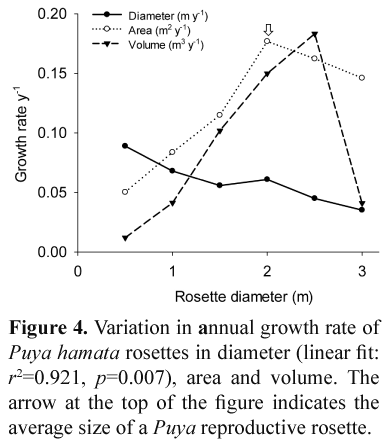
<body><![CDATA[<p><b>RESULTS</b></p>     <p><b>Population size structure, mortality, recruitment and growth rates of <i>Puya hamata</i></b></p>     <p>In total, 1310 <i>Puya</i> rosettes, from 20   plots, were measured in 2008—representing a density of 0.14 m<sup>-2</sup>.   Only 16 plots were recorded in both years, and they contained exactly 1000   plants in 2008. Of these 1000 plants, 0.6% had died by the following year.   Bears usually consume large sized plants with high concentration of sugar in   their rosettes. One large rosette ( 1.6 m diameter) had been eaten, most likely by   a spectacled bear (<i>Tremarctos ornatus</i>). The remaining five mortalities were for   rosettes 0.1–0.5 m diameter. In these same 16 plots, only 27 new plants were   recruited over the year. Mean rosette diameter of reproducing <i>Puya hamata</i> plants   was 2.01 m   (min=1.3 m,<i> s</i>=0.33 m, <i>n</i>=63). </p>     <p>The   size distribution of <i>Puya hamata</i> rosettes varied from plot to plot (<a href="/img/revistas/cal/v36n1/v36n1a5fig2.gif" target="blank">Fig. 2</a>). Broadly, three different size distribution patterns were observed: </p>     <p>•  a single dominant   peak in numbers at a particular size</p>     <p>•  two dominant peaks in   numbers at distinct sizes</p>     <p>•  low plant numbers   across all size ranges</p>     <p>After   one year, the size distributions had shifted a little for each plot, reflecting   the growth of <i>Puya</i> rosettes and their movement into larger categories (<a href="/img/revistas/cal/v36n1/v36n1a5fig3.gif" target="blank">Fig. 3</a>).</p>     <p>The mean annual diameter growth rate of <i>Puya hamata</i> rosettes was 0.081 m y<sup>-1</sup> (<i>s</i>=0.032, <i>n</i>=1000). Life span of <i>Puya hamata</i> was 28 years based on growth rates. Clonal growth or vegetative propagation was not recorded in <i>Puya hamata</i> plants. Annual growth rate declined as rosette diameter increased (<a href=#figura4>Fig. 4</a>), but   this does not mean larger plants grew more slowly. The increase in overall   plant biomass associated with a change in diameter of 1 cm is much greater for large   plants than for small ones. If annual growth rate in rosette area (in plan   view: view of an object as projected on a horizontal plane) or volume (assuming   the rosette is a perfect hemisphere) is plotted, the true pattern of biomass   accumulation becomes clearer. However, the growth rate declines significantly   close to the average size of a reproductive <i>Puya hamata</i> rosette (approximately 2 m). </p>         <center>   <img src="/img/revistas/cal/v36n1/v36n1a5fig4.gif"><a name="figura4"></a>  </center>    ]]></body>
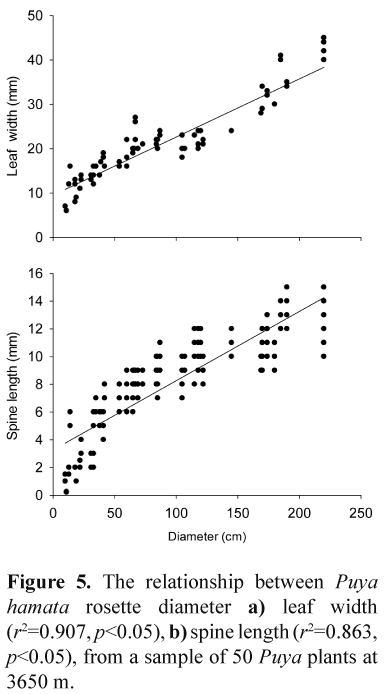
<body><![CDATA[<br>      <p>Both <i>Puya hamata</i> leaf   width and spine length were closely related to rosette diameter, with the best   predictor being leaf width (<a href="#figura5">Fig. 5</a>). The original rosette diameters of <i>Puya</i> plants damaged by fire were estimated using   measurements of leaf width, which was also the easier of the two estimates to measure in the field.</p>       <center>   <img src="/img/revistas/cal/v36n1/v36n1a5fig5.gif"><a name="figura5"></a>  </center>    <br>      <p>The   total number and size distributions of <i>Puya</i> plants differed between the control and burned plots before the observed fire   (<a href="/img/revistas/cal/v36n1/v36n1a5fig6.gif" target="blank">Fig. 6</a>). The fire killed plants only in the high and medium fire intensity   fire plots, but mortality rates were not significantly different between any of   the plots (<i>G<sub>adj</sub></i>= 9.893, <i>df</i>= 3, <i>p</i>=0.019). Medium   and high intensity fires selectively killed smaller plants rather than larger   ones (<i>G<sub>adj</sub></i>= 93.44, <i>df</i>=3, <i>p</i>&lt;0.0001 and<i> G<sub>adj</sub></i>= 7.63, <i>df</i>=3, <i>p</i>=0.054 respectively). Low intensity   fire and control plots did not experience any mortality within one month of the date of burning (<a href="/img/revistas/cal/v36n1/v36n1a5tab1.gif" target="blank">Table 1</a>). </p>     <p><b>DISCUSSION</b></p>     <p>Even   though the growth rate of <i>Puya hamata</i> varied according to rosette size, there was   little variation in the size of reproductive rosettes (mean diameter of  2.01 m). A few studies have   suggested more variation in growth rate and reproductive rosette size in other <i>Puya</i> species. Miller (1988) found that <i>Puya clava-herculis</i> showed considerable variation in growth rates between size categories, and   reported that rosettes in well drained, low elevation sites grew faster and   flowered at larger sizes than rosettes from a higher elevation site. Augspurger's (1985) study of <i>Puya dasylirioides</i> found to a minimum critical size (  40 cm diameter) before   flowering in a Costa Rican p&aacute;ramo. From the current study, <i>Puya hamata</i> appears to be more consistent in flowering rosette size in the P&aacute;ramo of El Angel. </p>     <p>Based   on growth rates calculated in this study, the mean time that <i>Puya hamata </i>took to   reach the mean size of a reproductive plant (approximately  2 m diameter) was 28 years. This   matched to the 27­–28 year time proposed for this species by Miller (1988). The   much larger <i>Puya raimondii </i>is estimated to grow for at least  100 in the field (Benzing 2000) to 120 (Ruiz 1978) years before reproduction, but few other estimates for <i>Puya</i> reproductive maturity have been published   (Hornung-Leoni &amp; Sosa 2006). It is worth pointing   out that <i>Puya hamata</i> growth rates and life span at other altitudes are likely to be different to the   results provided here for plants at approximately 3400–3700 m as it has been shown in other species like <i>Puya clava-herculis </i>(Miller 1988).</p>     <p>Very little recruitment of <i>Puya hamata </i>seedlings was observed in our study. It was only   observed in five plots (P1, P7, P8, P9 and P13). These plots had already seen   some recruitment before the investigation began, and additional seedlings   appeared during the study. All five plots with recruitment of seedlings were characterised by short, sparse, tussock grass vegetation   where light and warmth reached the ground more readily during the day. <i>Puya hamata</i> needs   temperatures over 14 °C   to germinate and prefers full light to shaded conditions (Garc&iacute;a-Meneses 2012). Open areas—most common after fires—provide conditions for germination   and promote recruitment. By contrast, Miller and Silander (1991) suggested that <i>Puya clava-herculis</i> seedlings are associated with tussock   edges and survive poorly in open areas and in vegetation dominated by cushion   and mat plants. There is no evidence that this is the case for <i>Puya hamata</i>, where   recruitment seems to be associated with more open areas, including cushion and   mat vegetation (Garc&iacute;a-Meneses 2012). Moscol Olivera &amp; Cleef (2009b) found some p&aacute;ramo bogs in the same region to be almost completely dominated by <i>Puya hamata</i> as a   result of abundant seedling recruitment. </p>     <p>The   size structure of <i>Puya hamata</i> populations varied from place to place and these differences might be related   to fire history. Three size structure patterns were found, 1) Plots with low   plant number across all size ranges (with some stochasticity):   this pattern results from the absence of fires during life time of the <i>Puya</i> plants, and resulting low but constant   recruitment rates (illustrated in <a href="/img/revistas/cal/v36n1/v36n1a5fig7.gif" target="blank">Fig. 7</a>, <i>t</i><sub>0</sub>); 2)<i> </i>Plots   with a single dominant peak at a particular size: this pattern results from a   single fire within the last 30 years that opened up the vegetation. Recruitment   was low before the fire, but then, for several years after the fire, there was   higher recruitment, before it returned to low levels again (<a href="/img/revistas/cal/v36n1/v36n1a5fig7.gif" target="blank">Fig. 7</a> <i>t</i>5<i>,   t</i>15);<i> </i>3) Plots with two dominant peaks at distinct sizes: the   pattern is caused by two fires during 30 years. There are two periods of higher recruitment but otherwise low recruitment levels are present (<a href="/img/revistas/cal/v36n1/v36n1a5fig7.gif" target="blank">Fig. 7</a>, t28).</p>     ]]></body>
<body><![CDATA[<p>In   grassy ecosystems, fires frequently provide safe sites for seedlings, and   fire-stimulated seedling recruitment is common (Enright &amp; Lamont 1989, Bond &amp; Keeley 2005). Perturbations   at large scales can lead to a population structure with distinct cohorts and   also to very uneven size and age distributions (Smith &amp; Young 1982, Smith   &amp; Young 1987, Ramsay 1998). <i>Puya</i> genus has   shown a high adaptation of new environments during its evolutionary processes   on the  Andes (Jabaily &amp; Sytsma 2010). Disturbances is another factor   that it is been used for colonization by Puyas (Grau<i> </i>et al<i>.</i> 2010). It seems that <i>Puya hamata</i> population size structure reflects fire regimes in more than just the density   of individuals. The number of recruitment pulses indicates the number of fire events during the last 30 years or so, and the sizes of the <i>Puya</i> rosettes can indicates when these fires happened (if the growth rate of <i>Puya</i> is known for the species in that place).</p>     <p>Mortality   of <i>Puya hamata</i> plants was low at all sizes in the revisited plots from 2008 to 2009. However,   the smallest plants were the most vulnerable. It is well known that small   plants have higher probabilities of death (Gatsuk<i> </i>et   al<i>.</i> 1980, Rogers 1985, Fenner &amp; Thompson   2005, Doak &amp; Morris 2010). Only one large plant   died in this period of time, mostly likely due to damage by a spectacled bear (<i>Tremarctos ornatus</i>)   which inhabit the p&aacute;ramos and are probably are the   only predators of <i>Puya</i> capable of dealing with the spiny leaves to reach sugar rich tissues in the centre of the plant (Kattan<i> </i>et al<i>.</i> 2004).</p>     <p>The low   mortality at all life stages of <i>Puya hamata</i> is typical of semelparous plants in general (Young &amp; Augspurger 1991). For semelparity to be a viable strategy, the risks of mortality   before reproduction must be low or iteroparity is   more successful (Stearns 1977, Young 1984, Young 1990). Nevertheless, our understanding of mortality rates in different <i>Puya</i> species is poor and more research is needed. </p>     <p>Interestingly,   the growth rate of <i>Puya hamata</i> declines significantly once rosettes reach about 2­–2.5 m in diameter. This   corresponds very closely to the average size at which rosettes produce an   inflorescence. In semelparity, there is a trade-off   between growth rate and the risk of mortality before reproduction has taken   place. At some point, the risks of mortality outweigh the benefits of   additional time for growth, and reproduction should take place. It appears that   this tipping threshold is reached at 2–2.5 m for <i>Puya hamata</i> at the altitudinal range of our study. Comparisons   of growth rates, mortality rates and size at reproduction would make   interesting studies for different <i>Puya</i> species across a range of lifespans and altitudes. </p>     <p>With   respect to p&aacute;ramo burning,<i> </i>one month after the   fire, <i>Puya</i> mortality was only observed in   plots which burned at medium and high fire intensities; all plants survived in   the control plot and in the plot subjected to low fire intensity. It is   possible that more plants died later, but additional monitoring would be needed   to determine this. Such work on mortality rates in burned and unburned areas is   essential to understand the impact of different intensities of fire in plant   populations. Too often, burning is assumed to be homogeneous and the results of   a single study can be extrapolated, perhaps incorrectly, to a much wider range of fire scenarios. </p>     <p>Clearly, <i>Puya hamata</i> is able to survive burning. In tropical alpine habitats, the "basal rosette"   growth form (Ramsay &amp; Oxley 1997) is common, including <i>Lobelia, Agave,   Aloe, Draba, Senecio </i>and<i> Puya</i>. Like other basal rosette species, <i>Puya hamata</i> plants   insulate the meristem from cold temperatures at night   (Smith &amp; Young 1987) and hot temperatures during fires (Ramsay &amp; Oxley   1996, Simon<i> </i>et al<i>.</i> 2009). Other Andean <i>Puya</i> species are also able to survive fire with mantles of persistent insulating   basal leaves (Benzing 2000). Even if a fire burns   away almost all leaves from a <i>Puya</i> plant,   recovery is relatively rapid from the protected meristem.   Such resistance to fire disturbance is a characteristic of many rosette plants   (McIntyre<i> </i>et al<i>.</i> 1995), including a wide range of species in the   family Bromeliaceae (Benzing 2000), such as <i>Cryptanthus, Dyckia</i> and <i>Encholirium</i> (native of   Brazil  ), <i>Ayensua</i> and <i>Brocchinia </i>(from highland habitats in   Guyana  ), and <i>Hechtia</i> (M&eacute;xico). </p>     <p>The   combination of sensitivity to fire at recruitment, low fire mortality rates   afterwards, and a 28-year lifespan makes <i>Puya hamata</i> an ideal indicator species of recent fire   history in p&aacute;ramo grasslands where it lives. <i>Puya hamata</i> population density and size structure in a particular place shows recruitment   pulses related to past fires during the plants' lifespan. Potentially, other   species of the widely distributed <i>Puya</i> genus   could be used in a similar way, if their fire responses are similar, but this   would require further investigation. Since <i>Puya</i> is a well-known p&aacute;ramo plant, easily recognized by   the public, it could also act as a flagship plant, linking the plant itself   with broader aspects of p&aacute;ramo ecology and management. </p>     <p><b>ACKNOWLEDGEMENTS</b></p>     <p>CONACYT,   M&eacute;xico, provided the financial support for this study. The work was carried out   with permission from the Ecuadorian Ministry of Environment (001-IC-FLO-DPAC). We   are grateful to Felipe Campos and Miguel Montenegro ( Ministerio del Ambiente, Ecuador  ) for   their help with the permits. Susana Le&oacute;n, Hugo Navarrete and Carmen Torres Tapia (all at the Pontificia Universidad Cat&oacute;lica del Ecuador, Quito)   and David Suarez (Corporaci&oacute;n Randi-Randi) provided   institutional support for the work. Carlos Molina and Wilson Enr&iacute;quez (Reserva Ecol&oacute;gica El &Aacute;ngel) arranged   accommodation at the reserve guardpost at El Voladero and Antonio Martinez, provided help with transport   and logistics. Marta Montalvo and Mar&iacute;a Eugenia Ramos Montalvo assisted with arrangements in   the town of El &Aacute;ngel.   Field assistance was given by Andrea Bustos, Nelly Mu&ntilde;oz, Carlos A. Rodr&iacute;guez,   Santiago E. Yerovi Echeverr&iacute;a,   Jorge A. Castillo Castro, Isabel Jones, and Erik Valent&iacute;n Silva Rodr&iacute;guez. Special thanks to Salom&oacute;n Ram&iacute;rez Contla, Alejandra Moscoso Estrella, Mayra Ninazunta Anaguano, Margarita Mi&ntilde;o Ron,   Alejandra Dom&iacute;nguez &Aacute;lvarez,   Saul R. Casta&ntilde;eda Contreras, provided with help and   support in the field. </p>     <p><b>LITERATURE   CITED</b></p>     ]]></body>
<body><![CDATA[<!-- ref --><p>1. Augspurger, C.K. 1985. Demography and life history variation of <i>Puya dasylirioides</i>, a long-lived rosette in tropical   subalpine bogs. Oikos 45<b>:</b> 341-352.    &nbsp;&nbsp;&nbsp;&nbsp;&nbsp;&nbsp;&nbsp;&nbsp;[&#160;<a href="javascript:void(0);" onclick="javascript: window.open('/scielo.php?script=sci_nlinks&ref=000073&pid=S0366-5232201400010000500001&lng=','','width=640,height=500,resizable=yes,scrollbars=1,menubar=yes,');">Links</a>&#160;]<!-- end-ref --></p>     <!-- ref --><p>2. Balslev, H. 2001.   Vascular plants on Volc&aacute;n Chiles and P&aacute;ramo del &Aacute;ngel, Ecuador -a   preliminary list. In: P. M. Ramsay (ed.), <i>The Ecology of Volc&aacute;n Chiles : high-altitude ecosystems on the Ecuador-Colombia border</i>: 1-26. Pebble and Shell Publications, Plymouth.    &nbsp;&nbsp;&nbsp;&nbsp;&nbsp;&nbsp;&nbsp;&nbsp;[&#160;<a href="javascript:void(0);" onclick="javascript: window.open('/scielo.php?script=sci_nlinks&ref=000075&pid=S0366-5232201400010000500002&lng=','','width=640,height=500,resizable=yes,scrollbars=1,menubar=yes,');">Links</a>&#160;]<!-- end-ref --></p>     <!-- ref --><p>3. Benzing, D.H. 2000. <i>Bromeliaceae: profile of an adaptive   radiation. </i> Cambridge University Press, Cambridge. 690 pp.    &nbsp;&nbsp;&nbsp;&nbsp;&nbsp;&nbsp;&nbsp;&nbsp;[&#160;<a href="javascript:void(0);" onclick="javascript: window.open('/scielo.php?script=sci_nlinks&ref=000077&pid=S0366-5232201400010000500003&lng=','','width=640,height=500,resizable=yes,scrollbars=1,menubar=yes,');">Links</a>&#160;]<!-- end-ref --></p>     <!-- ref --><p>4. Bond, W.J. &amp; J.E. Keeley 2005. Fire as a global ‘herbivore': the ecology and evolution of   flammable ecosystems. Trends in Ecology &amp; Evolution 20<b>:</b> 387-394.    &nbsp;&nbsp;&nbsp;&nbsp;&nbsp;&nbsp;&nbsp;&nbsp;[&#160;<a href="javascript:void(0);" onclick="javascript: window.open('/scielo.php?script=sci_nlinks&ref=000079&pid=S0366-5232201400010000500004&lng=','','width=640,height=500,resizable=yes,scrollbars=1,menubar=yes,');">Links</a>&#160;]<!-- end-ref --></p>     <!-- ref --><p>5. Bond, W.J. &amp; B.W. Van Wilgen 1996. <i>Fire and Plants (population and community biology series 14). </i>Chapman &amp; Hall, London. 264 pp.    &nbsp;&nbsp;&nbsp;&nbsp;&nbsp;&nbsp;&nbsp;&nbsp;[&#160;<a href="javascript:void(0);" onclick="javascript: window.open('/scielo.php?script=sci_nlinks&ref=000081&pid=S0366-5232201400010000500005&lng=','','width=640,height=500,resizable=yes,scrollbars=1,menubar=yes,');">Links</a>&#160;]<!-- end-ref --></p>     ]]></body>
<body><![CDATA[<!-- ref --><p>6. Caro, T.M. &amp; S. Girling 2010. <i>Conservation by Proxy: indicator, umbrella, keystone, flagship, and other surrogate species. </i>Island Press, Washington, DC. 374 pp.    &nbsp;&nbsp;&nbsp;&nbsp;&nbsp;&nbsp;&nbsp;&nbsp;[&#160;<a href="javascript:void(0);" onclick="javascript: window.open('/scielo.php?script=sci_nlinks&ref=000083&pid=S0366-5232201400010000500006&lng=','','width=640,height=500,resizable=yes,scrollbars=1,menubar=yes,');">Links</a>&#160;]<!-- end-ref --></p>     <!-- ref --><p>7. Cochrane, M.A. 2009. <i>Tropical Fire   Ecology: climate change, land use, and ecosystem dynamics. </i> Springer-Praxis, United Kingdom . 645   pp.    &nbsp;&nbsp;&nbsp;&nbsp;&nbsp;&nbsp;&nbsp;&nbsp;[&#160;<a href="javascript:void(0);" onclick="javascript: window.open('/scielo.php?script=sci_nlinks&ref=000085&pid=S0366-5232201400010000500007&lng=','','width=640,height=500,resizable=yes,scrollbars=1,menubar=yes,');">Links</a>&#160;]<!-- end-ref --></p>     <!-- ref --><p>8. Doak, D.F. &amp; W.F. Morris 2010. Demographic compensation and tipping points in   climate-induced range shifts. Nature 467<b>:</b> 959-962.    &nbsp;&nbsp;&nbsp;&nbsp;&nbsp;&nbsp;&nbsp;&nbsp;[&#160;<a href="javascript:void(0);" onclick="javascript: window.open('/scielo.php?script=sci_nlinks&ref=000087&pid=S0366-5232201400010000500008&lng=','','width=640,height=500,resizable=yes,scrollbars=1,menubar=yes,');">Links</a>&#160;]<!-- end-ref --></p>     <!-- ref --><p>9. Dyer, A.R. 2003. Burning and grazing   management in a  California   grassland: growth, mortality, and recruitment of <i>Nassella pulchra</i>. Restoration Ecology 11<b>:</b> 291-296.    &nbsp;&nbsp;&nbsp;&nbsp;&nbsp;&nbsp;&nbsp;&nbsp;[&#160;<a href="javascript:void(0);" onclick="javascript: window.open('/scielo.php?script=sci_nlinks&ref=000089&pid=S0366-5232201400010000500009&lng=','','width=640,height=500,resizable=yes,scrollbars=1,menubar=yes,');">Links</a>&#160;]<!-- end-ref --></p>     <!-- ref --><p>10. Eguiarte, L.E., J. Larson-Guerra, J. Nunez-Farfan, A. Martinez-Palacios, K.S. Del Prado   &amp; H.T. Arita 1999. Phylogenetic diversity and conservation: examples at different scales and a   population level proposal for <i>Agave victoriae-reginae</i> in the Mexican Chihuahuan desert. Revista Chilena de Historia Natural   72<b>:</b> 475-492.    &nbsp;&nbsp;&nbsp;&nbsp;&nbsp;&nbsp;&nbsp;&nbsp;[&#160;<a href="javascript:void(0);" onclick="javascript: window.open('/scielo.php?script=sci_nlinks&ref=000091&pid=S0366-5232201400010000500010&lng=','','width=640,height=500,resizable=yes,scrollbars=1,menubar=yes,');">Links</a>&#160;]<!-- end-ref --></p>     ]]></body>
<body><![CDATA[<!-- ref --><p>11. Ellenberg, H. 1979.   Man's influence on tropical mountain ecosystems in South   America: the second Tansley lecture. Journal   of Ecology 67<b>:</b> 401-416.    &nbsp;&nbsp;&nbsp;&nbsp;&nbsp;&nbsp;&nbsp;&nbsp;[&#160;<a href="javascript:void(0);" onclick="javascript: window.open('/scielo.php?script=sci_nlinks&ref=000093&pid=S0366-5232201400010000500011&lng=','','width=640,height=500,resizable=yes,scrollbars=1,menubar=yes,');">Links</a>&#160;]<!-- end-ref --></p>     <!-- ref --><p>12. Enright, N.J.   &amp; B.B. Lamont 1989. Seed banks, fire season, safe sites and seedling recruitment in   five co-occurring <i>Banksia</i> species. Journal   of Ecology 77<b>:</b> 1111-1122.    &nbsp;&nbsp;&nbsp;&nbsp;&nbsp;&nbsp;&nbsp;&nbsp;[&#160;<a href="javascript:void(0);" onclick="javascript: window.open('/scielo.php?script=sci_nlinks&ref=000095&pid=S0366-5232201400010000500012&lng=','','width=640,height=500,resizable=yes,scrollbars=1,menubar=yes,');">Links</a>&#160;]<!-- end-ref --></p>     <!-- ref --><p>13. Favreau, J.M., C.A. Drew, G.R. Hess, M.J. Rubino, F.H. Koch &amp; K.A. Eschelbach 2006. Recommendations for assessing the effectiveness   of surrogate species approaches. Biodiversity and Conservation 15<b>:</b> 3949-3969.    &nbsp;&nbsp;&nbsp;&nbsp;&nbsp;&nbsp;&nbsp;&nbsp;[&#160;<a href="javascript:void(0);" onclick="javascript: window.open('/scielo.php?script=sci_nlinks&ref=000097&pid=S0366-5232201400010000500013&lng=','','width=640,height=500,resizable=yes,scrollbars=1,menubar=yes,');">Links</a>&#160;]<!-- end-ref --></p>     <!-- ref --><p>14. Fenner, M. &amp; K. Thompson 2005. <i>The Ecology of Seeds.</i> Cambridge University   Press, Cambridge. 250 pp.    &nbsp;&nbsp;&nbsp;&nbsp;&nbsp;&nbsp;&nbsp;&nbsp;[&#160;<a href="javascript:void(0);" onclick="javascript: window.open('/scielo.php?script=sci_nlinks&ref=000099&pid=S0366-5232201400010000500014&lng=','','width=640,height=500,resizable=yes,scrollbars=1,menubar=yes,');">Links</a>&#160;]<!-- end-ref --></p>     <!-- ref --><p>15. Garc&iacute;a-Meneses, P.M. 2012. <i>Lanscape-scale Population   Dynamics: field observations and modelling of Puya hamata, a flagship plant   from the Andes.</i> PhD, Plymouth University. Plymouth.    &nbsp;&nbsp;&nbsp;&nbsp;&nbsp;&nbsp;&nbsp;&nbsp;[&#160;<a href="javascript:void(0);" onclick="javascript: window.open('/scielo.php?script=sci_nlinks&ref=000101&pid=S0366-5232201400010000500015&lng=','','width=640,height=500,resizable=yes,scrollbars=1,menubar=yes,');">Links</a>&#160;]<!-- end-ref --></p>     ]]></body>
<body><![CDATA[<!-- ref --><p>16. Garc&iacute;a-Meneses, P.M. &amp; P.M. Ramsay 2012. Pollinator response to within-patch spatial context determines   reproductive output of a giant rosette plant. Basic and Applied Ecology 13<b>:</b> 516-523.    &nbsp;&nbsp;&nbsp;&nbsp;&nbsp;&nbsp;&nbsp;&nbsp;[&#160;<a href="javascript:void(0);" onclick="javascript: window.open('/scielo.php?script=sci_nlinks&ref=000103&pid=S0366-5232201400010000500016&lng=','','width=640,height=500,resizable=yes,scrollbars=1,menubar=yes,');">Links</a>&#160;]<!-- end-ref --></p>     <!-- ref --><p>17. Garc&iacute;a, E.E. &amp; S.G. Beck 2006. Puna. In: M. Moraes, B. Ollgaard, L. P. Kvist, F. Borchsenius &amp; H. Balslev (eds), <i>Bot&aacute;nica Econ&oacute;mica de los Andes Centrales</i>:   51–76. Universidad Mayor de San Andr&eacute;s, La Paz.    &nbsp;&nbsp;&nbsp;&nbsp;&nbsp;&nbsp;&nbsp;&nbsp;[&#160;<a href="javascript:void(0);" onclick="javascript: window.open('/scielo.php?script=sci_nlinks&ref=000105&pid=S0366-5232201400010000500017&lng=','','width=640,height=500,resizable=yes,scrollbars=1,menubar=yes,');">Links</a>&#160;]<!-- end-ref --></p>     <!-- ref --><p>18. Garibaldi, A. &amp; N. Turner 2004. Cultural keystone species: implications for ecological   conservation and restoration. Ecology and Society 9(3)<b>:</b> 1-20.    &nbsp;&nbsp;&nbsp;&nbsp;&nbsp;&nbsp;&nbsp;&nbsp;[&#160;<a href="javascript:void(0);" onclick="javascript: window.open('/scielo.php?script=sci_nlinks&ref=000107&pid=S0366-5232201400010000500018&lng=','','width=640,height=500,resizable=yes,scrollbars=1,menubar=yes,');">Links</a>&#160;]<!-- end-ref --></p>     <!-- ref --><p>19. Gatsuk, L.E., O.V. Smirnova,   L.I. Vorontzova, L.B. Zaugolnova &amp;  L.A. Zhukova 1980. Age states of   plants of various growth forms: a review. Journal of Ecology 68<b>:</b> 675-696.    &nbsp;&nbsp;&nbsp;&nbsp;&nbsp;&nbsp;&nbsp;&nbsp;[&#160;<a href="javascript:void(0);" onclick="javascript: window.open('/scielo.php?script=sci_nlinks&ref=000109&pid=S0366-5232201400010000500019&lng=','','width=640,height=500,resizable=yes,scrollbars=1,menubar=yes,');">Links</a>&#160;]<!-- end-ref --></p>     <!-- ref --><p>20. Gibson, D.J. 2009. <i>Grasses   and Grassland Ecology.</i> Oxford University Press, Oxford. 305 pp.    &nbsp;&nbsp;&nbsp;&nbsp;&nbsp;&nbsp;&nbsp;&nbsp;[&#160;<a href="javascript:void(0);" onclick="javascript: window.open('/scielo.php?script=sci_nlinks&ref=000111&pid=S0366-5232201400010000500020&lng=','','width=640,height=500,resizable=yes,scrollbars=1,menubar=yes,');">Links</a>&#160;]<!-- end-ref --></p>     ]]></body>
<body><![CDATA[<!-- ref --><p>21. Grau, A., S.E.G. Romero &amp; E. Ardoz 2010. Puyas andinas. Ciencia Hoy 20<b>:</b> 8-15.    &nbsp;&nbsp;&nbsp;&nbsp;&nbsp;&nbsp;&nbsp;&nbsp;[&#160;<a href="javascript:void(0);" onclick="javascript: window.open('/scielo.php?script=sci_nlinks&ref=000113&pid=S0366-5232201400010000500021&lng=','','width=640,height=500,resizable=yes,scrollbars=1,menubar=yes,');">Links</a>&#160;]<!-- end-ref --></p>     <!-- ref --><p>22. Grubb, P.J. 1977. The maintenance of species-richness in plant   communities: the importance of the regeneration niche. Biological Reviews 52<b>:</b> 107-145.    &nbsp;&nbsp;&nbsp;&nbsp;&nbsp;&nbsp;&nbsp;&nbsp;[&#160;<a href="javascript:void(0);" onclick="javascript: window.open('/scielo.php?script=sci_nlinks&ref=000115&pid=S0366-5232201400010000500022&lng=','','width=640,height=500,resizable=yes,scrollbars=1,menubar=yes,');">Links</a>&#160;]<!-- end-ref --></p>     <!-- ref --><p>23. Heywood, V.H., R.T. Watson &amp; United Nations Environment Programme 1995. <i>Global   biodiversity assessment.</i> Cambridge University Press, Cambridge. 1140 pp.    &nbsp;&nbsp;&nbsp;&nbsp;&nbsp;&nbsp;&nbsp;&nbsp;[&#160;<a href="javascript:void(0);" onclick="javascript: window.open('/scielo.php?script=sci_nlinks&ref=000117&pid=S0366-5232201400010000500023&lng=','','width=640,height=500,resizable=yes,scrollbars=1,menubar=yes,');">Links</a>&#160;]<!-- end-ref --></p>     <!-- ref --><p>24. Hofstede, R., P. Segarra &amp; P. Mena-V&aacute;sconez 2003. <i>Los P&aacute;ramos del Mundo. </i>Proyecto Atlas Mundial de los P&aacute;ramos. Global Peatland Initiative/NC-IUCN/Ecociencia,  Quito. 299 pp.    &nbsp;&nbsp;&nbsp;&nbsp;&nbsp;&nbsp;&nbsp;&nbsp;[&#160;<a href="javascript:void(0);" onclick="javascript: window.open('/scielo.php?script=sci_nlinks&ref=000119&pid=S0366-5232201400010000500024&lng=','','width=640,height=500,resizable=yes,scrollbars=1,menubar=yes,');">Links</a>&#160;]<!-- end-ref --></p>     <!-- ref --><p>25. Horn, S.P. &amp; M. Kappelle 2009. Fire in the p&aacute;ramo ecosystems of Central and South America. In: M. A. Cochrane (ed.), <i>Tropical Fire Ecology</i>: 505-539. Springer-Praxis, Reino Unido.    &nbsp;&nbsp;&nbsp;&nbsp;&nbsp;&nbsp;&nbsp;&nbsp;[&#160;<a href="javascript:void(0);" onclick="javascript: window.open('/scielo.php?script=sci_nlinks&ref=000121&pid=S0366-5232201400010000500025&lng=','','width=640,height=500,resizable=yes,scrollbars=1,menubar=yes,');">Links</a>&#160;]<!-- end-ref --></p>     ]]></body>
<body><![CDATA[<!-- ref --><p>26.   Hornung-Leoni, C. &amp; V. Sosa 2006. Morphological variation in Puya (Bromeliaceae): an allometric study. Plant Systematics and Evolution 256<b>:</b> 35-53.    &nbsp;&nbsp;&nbsp;&nbsp;&nbsp;&nbsp;&nbsp;&nbsp;[&#160;<a href="javascript:void(0);" onclick="javascript: window.open('/scielo.php?script=sci_nlinks&ref=000123&pid=S0366-5232201400010000500026&lng=','','width=640,height=500,resizable=yes,scrollbars=1,menubar=yes,');">Links</a>&#160;]<!-- end-ref --></p>     <!-- ref --><p>27. Jabaily, R.S. &amp; K.J. Sytsma 2010. Phylogenetics of Puya (Bromeliaceae):   Placement, major lineages, and evolution of Chilean species. American Journal of Botany 97<b>:</b> 337-356.    &nbsp;&nbsp;&nbsp;&nbsp;&nbsp;&nbsp;&nbsp;&nbsp;[&#160;<a href="javascript:void(0);" onclick="javascript: window.open('/scielo.php?script=sci_nlinks&ref=000125&pid=S0366-5232201400010000500027&lng=','','width=640,height=500,resizable=yes,scrollbars=1,menubar=yes,');">Links</a>&#160;]<!-- end-ref --></p>     <!-- ref --><p>28. Kapelle,   M. &amp; S.P. Horn 2005. Hacia una breve descripci&oacute;n del concepto P&aacute;ramo. In: I. N. D. B. -Inbio (ed.), <i>P&aacute;ramos de Costa Rica</i>: 29-36. Inbio, San Jos&eacute;    &nbsp;&nbsp;&nbsp;&nbsp;&nbsp;&nbsp;&nbsp;&nbsp;[&#160;<a href="javascript:void(0);" onclick="javascript: window.open('/scielo.php?script=sci_nlinks&ref=000127&pid=S0366-5232201400010000500028&lng=','','width=640,height=500,resizable=yes,scrollbars=1,menubar=yes,');">Links</a>&#160;]<!-- end-ref -->.</p>     <!-- ref --><p>29. Kattan, G., O.L.   Hern&aacute;ndez, I. Goldstein, V. Rojas, O. Murillo, C.   G&oacute;mez, H. Restrepo &amp; F. Cuesta 2004. Range fragmentation in the spectacled bear<i> Tremarctos ornatus</i> in the northern Andes.   Oryx 38<b>:</b> 155-163.    &nbsp;&nbsp;&nbsp;&nbsp;&nbsp;&nbsp;&nbsp;&nbsp;[&#160;<a href="javascript:void(0);" onclick="javascript: window.open('/scielo.php?script=sci_nlinks&ref=000129&pid=S0366-5232201400010000500029&lng=','','width=640,height=500,resizable=yes,scrollbars=1,menubar=yes,');">Links</a>&#160;]<!-- end-ref --></p>     <!-- ref --><p>30. Keeley, J. 2009.   Fire intensity, fire severity and burn severity: a brief review and suggested   usage. International Journal of Wildland Fire 18<b>:</b> 116-126.    &nbsp;&nbsp;&nbsp;&nbsp;&nbsp;&nbsp;&nbsp;&nbsp;[&#160;<a href="javascript:void(0);" onclick="javascript: window.open('/scielo.php?script=sci_nlinks&ref=000131&pid=S0366-5232201400010000500030&lng=','','width=640,height=500,resizable=yes,scrollbars=1,menubar=yes,');">Links</a>&#160;]<!-- end-ref --></p>     ]]></body>
<body><![CDATA[<!-- ref --><p>31. Laegaard, S. 1992.   Influence of fire in the grass p&aacute;ramo vegetation of Ecuador . In: H. Balslev &amp; J. L. Luteyn (eds), <i>P&aacute;ramo:   an Andean ecosystem under human influence</i>. Academic Press, London.    &nbsp;&nbsp;&nbsp;&nbsp;&nbsp;&nbsp;&nbsp;&nbsp;[&#160;<a href="javascript:void(0);" onclick="javascript: window.open('/scielo.php?script=sci_nlinks&ref=000133&pid=S0366-5232201400010000500031&lng=','','width=640,height=500,resizable=yes,scrollbars=1,menubar=yes,');">Links</a>&#160;]<!-- end-ref --></p>     <!-- ref --><p>32.   McIntyre, S., S. Lavorel &amp; R.M. Tremont 1995. Plant life-history attributes: their relationship to   disturbance response in herbaceous vegetation. Journal of Ecology 83<b>:</b> 31-44.    &nbsp;&nbsp;&nbsp;&nbsp;&nbsp;&nbsp;&nbsp;&nbsp;[&#160;<a href="javascript:void(0);" onclick="javascript: window.open('/scielo.php?script=sci_nlinks&ref=000135&pid=S0366-5232201400010000500032&lng=','','width=640,height=500,resizable=yes,scrollbars=1,menubar=yes,');">Links</a>&#160;]<!-- end-ref --></p>     <!-- ref --><p>33. Meffe, G.K. &amp; C.R. Carroll 1997. <i>Principles of Conservation Biology. </i>Sinauer, Sunderland. 729 p.    &nbsp;&nbsp;&nbsp;&nbsp;&nbsp;&nbsp;&nbsp;&nbsp;[&#160;<a href="javascript:void(0);" onclick="javascript: window.open('/scielo.php?script=sci_nlinks&ref=000137&pid=S0366-5232201400010000500033&lng=','','width=640,height=500,resizable=yes,scrollbars=1,menubar=yes,');">Links</a>&#160;]<!-- end-ref --></p>     <!-- ref --><p>34. Miller, G.A. 1988. <i>The   Population Biology and Physical Ecology of Species of Puya (Bromeliaceae) in the Ecuadorian Andes.</i> PhD, University of Conneticut. Conneticut.    &nbsp;&nbsp;&nbsp;&nbsp;&nbsp;&nbsp;&nbsp;&nbsp;[&#160;<a href="javascript:void(0);" onclick="javascript: window.open('/scielo.php?script=sci_nlinks&ref=000139&pid=S0366-5232201400010000500034&lng=','','width=640,height=500,resizable=yes,scrollbars=1,menubar=yes,');">Links</a>&#160;]<!-- end-ref --></p>     <!-- ref --><p>35. Miller, G.A. &amp; J.A. Silander 1991. Control of the distribution of giant rosette   species of<i> Puya</i> (Bromeliaceae)   in the Ecuadorian p&aacute;ramos. Biotropica 23<b>:</b> 124-133.    &nbsp;&nbsp;&nbsp;&nbsp;&nbsp;&nbsp;&nbsp;&nbsp;[&#160;<a href="javascript:void(0);" onclick="javascript: window.open('/scielo.php?script=sci_nlinks&ref=000141&pid=S0366-5232201400010000500035&lng=','','width=640,height=500,resizable=yes,scrollbars=1,menubar=yes,');">Links</a>&#160;]<!-- end-ref --></p>     ]]></body>
<body><![CDATA[<!-- ref --><p>36. Moscol Olivera,   M.C. &amp; A.M. Cleef 2009a.   Vegetation composition and altitudinal distribution of Andean rain forests in   El Angel and Guandera reserves, northern Ecuador . Phytocoenologia 39(2)<b>:</b> 175 – 204.    &nbsp;&nbsp;&nbsp;&nbsp;&nbsp;&nbsp;&nbsp;&nbsp;[&#160;<a href="javascript:void(0);" onclick="javascript: window.open('/scielo.php?script=sci_nlinks&ref=000143&pid=S0366-5232201400010000500036&lng=','','width=640,height=500,resizable=yes,scrollbars=1,menubar=yes,');">Links</a>&#160;]<!-- end-ref --></p>     <!-- ref --><p>37. Moscol Olivera,   M.C. &amp; A.M. Cleef 2009b. A phytosociological study of the paramo along two altitudinal transects in El Carchi province, northern Ecuador . Phytocoenologia 39<b>:</b> 79-107.    &nbsp;&nbsp;&nbsp;&nbsp;&nbsp;&nbsp;&nbsp;&nbsp;[&#160;<a href="javascript:void(0);" onclick="javascript: window.open('/scielo.php?script=sci_nlinks&ref=000145&pid=S0366-5232201400010000500037&lng=','','width=640,height=500,resizable=yes,scrollbars=1,menubar=yes,');">Links</a>&#160;]<!-- end-ref --></p>     <!-- ref --><p>38. Proyecto P&aacute;ramo Andino.   2012. <i>Proyecto P&aacute;ramo Andino: trabajando por la vida en las alturas </i>(Online).   <a href="http://www.condesan.org/ppa/node/1022">http://www.condesan.org/ppa/node/1022</a>. (Accessed 13<sup>th </sup>June   2012).    &nbsp;&nbsp;&nbsp;&nbsp;&nbsp;&nbsp;&nbsp;&nbsp;[&#160;<a href="javascript:void(0);" onclick="javascript: window.open('/scielo.php?script=sci_nlinks&ref=000147&pid=S0366-5232201400010000500038&lng=','','width=640,height=500,resizable=yes,scrollbars=1,menubar=yes,');">Links</a>&#160;]<!-- end-ref --></p>     <!-- ref --><p>39. Ramsay, P.M. 1998. Landscape mosaic in High Andes: the   role of fire in p&aacute;ramo communities. In: P. Kovar (ed.), <i>Nature and Culture in Landscape Ecology   (Experiences for the 3<sup>rd</sup> Millenium)</i>: 192-200. Charles University, Prague.    &nbsp;&nbsp;&nbsp;&nbsp;&nbsp;&nbsp;&nbsp;&nbsp;[&#160;<a href="javascript:void(0);" onclick="javascript: window.open('/scielo.php?script=sci_nlinks&ref=000149&pid=S0366-5232201400010000500039&lng=','','width=640,height=500,resizable=yes,scrollbars=1,menubar=yes,');">Links</a>&#160;]<!-- end-ref --></p>     <!-- ref --><p>40. Ramsay, P.M. 2001. P&aacute;ramo vegetation recovery in the   first two years after the fire on Volcan Chiles, Ecuador . In: P. M. Ramsay (ed.), <i>The Ecology of Volc&aacute;n Chiles : high-altitude ecosystems on the   Ecuador-Colombia border</i>: 65-73 pp. Pebble and Shell, Plymouth. Reino Unido.    &nbsp;&nbsp;&nbsp;&nbsp;&nbsp;&nbsp;&nbsp;&nbsp;[&#160;<a href="javascript:void(0);" onclick="javascript: window.open('/scielo.php?script=sci_nlinks&ref=000151&pid=S0366-5232201400010000500040&lng=','','width=640,height=500,resizable=yes,scrollbars=1,menubar=yes,');">Links</a>&#160;]<!-- end-ref --></p>     ]]></body>
<body><![CDATA[<!-- ref --><p>41. Ramsay, P.M. 2014. Giant   rosette plant morphology as an indicator of recent fire history in Andean p&aacute;ramo grasslands. Ecological Indicators. In   press.    &nbsp;&nbsp;&nbsp;&nbsp;&nbsp;&nbsp;&nbsp;&nbsp;[&#160;<a href="javascript:void(0);" onclick="javascript: window.open('/scielo.php?script=sci_nlinks&ref=000153&pid=S0366-5232201400010000500041&lng=','','width=640,height=500,resizable=yes,scrollbars=1,menubar=yes,');">Links</a>&#160;]<!-- end-ref --></p>     <!-- ref --><p>42. Ramsay, P.M. &amp; E.R.B. Oxley 1996.   Fire temperatures and postfire plant community   dynamics in Ecuadorian grass paramo. Vegetatio 124<b>:</b> 129-144.    &nbsp;&nbsp;&nbsp;&nbsp;&nbsp;&nbsp;&nbsp;&nbsp;[&#160;<a href="javascript:void(0);" onclick="javascript: window.open('/scielo.php?script=sci_nlinks&ref=000155&pid=S0366-5232201400010000500042&lng=','','width=640,height=500,resizable=yes,scrollbars=1,menubar=yes,');">Links</a>&#160;]<!-- end-ref --></p>     <!-- ref --><p>43. Ramsay, P.M. &amp; E.R.B. Oxley 1997.   The growth form composition of plant communities in the Ecuadorian paramos. Plant Ecology 131<b>:</b> 173-192.    &nbsp;&nbsp;&nbsp;&nbsp;&nbsp;&nbsp;&nbsp;&nbsp;[&#160;<a href="javascript:void(0);" onclick="javascript: window.open('/scielo.php?script=sci_nlinks&ref=000157&pid=S0366-5232201400010000500043&lng=','','width=640,height=500,resizable=yes,scrollbars=1,menubar=yes,');">Links</a>&#160;]<!-- end-ref --></p>     <!-- ref --><p>44.  Rogers,   G.F. 1985. Mortality of   burned <i>Cereus giganteus</i>. Ecology 66<b>:</b> 630-632.    &nbsp;&nbsp;&nbsp;&nbsp;&nbsp;&nbsp;&nbsp;&nbsp;[&#160;<a href="javascript:void(0);" onclick="javascript: window.open('/scielo.php?script=sci_nlinks&ref=000159&pid=S0366-5232201400010000500044&lng=','','width=640,height=500,resizable=yes,scrollbars=1,menubar=yes,');">Links</a>&#160;]<!-- end-ref --></p>     <!-- ref --><p>45. Ruiz, H.M.    1978. A prop&oacute;sito de la mayor de las bromeliaceas.   Bolet&iacute;n de la   Sociedad Geogr&aacute;fica de Lima 97<b>:</b> 35-41.    &nbsp;&nbsp;&nbsp;&nbsp;&nbsp;&nbsp;&nbsp;&nbsp;[&#160;<a href="javascript:void(0);" onclick="javascript: window.open('/scielo.php?script=sci_nlinks&ref=000161&pid=S0366-5232201400010000500045&lng=','','width=640,height=500,resizable=yes,scrollbars=1,menubar=yes,');">Links</a>&#160;]<!-- end-ref --></p>     ]]></body>
<body><![CDATA[<!-- ref --><p>46. Simberloff,   D. 1998. Flagships, umbrellas and   keystones: is single-species management pass&eacute; in the landscape era? Biological Conservation 83<b>:</b> 247-257.    &nbsp;&nbsp;&nbsp;&nbsp;&nbsp;&nbsp;&nbsp;&nbsp;[&#160;<a href="javascript:void(0);" onclick="javascript: window.open('/scielo.php?script=sci_nlinks&ref=000163&pid=S0366-5232201400010000500046&lng=','','width=640,height=500,resizable=yes,scrollbars=1,menubar=yes,');">Links</a>&#160;]<!-- end-ref --></p>     <!-- ref --><p>47. Simon, M.F., R. Grether, L.P. de Queiroz, C. Skema, R.T.   Pennington &amp; C.E. Hughes 2009. Recent assembly of   the Cerrado, a neotropical plant diversity hotspot, by<i> in situ</i> evolution of adaptations to fire. Proceedings   of the National Academy of Sciences 106<b>:</b> 20359-20364.    &nbsp;&nbsp;&nbsp;&nbsp;&nbsp;&nbsp;&nbsp;&nbsp;[&#160;<a href="javascript:void(0);" onclick="javascript: window.open('/scielo.php?script=sci_nlinks&ref=000165&pid=S0366-5232201400010000500047&lng=','','width=640,height=500,resizable=yes,scrollbars=1,menubar=yes,');">Links</a>&#160;]<!-- end-ref --></p>     <!-- ref --><p>48. Smith, A.P. &amp; T.P. Young 1982. The cost of reproduction in <i>Senecio keniodendron</i>, a giant rosette species of Mt Kenya . Oecologia 55<b>:</b> 243-247.    &nbsp;&nbsp;&nbsp;&nbsp;&nbsp;&nbsp;&nbsp;&nbsp;[&#160;<a href="javascript:void(0);" onclick="javascript: window.open('/scielo.php?script=sci_nlinks&ref=000167&pid=S0366-5232201400010000500048&lng=','','width=640,height=500,resizable=yes,scrollbars=1,menubar=yes,');">Links</a>&#160;]<!-- end-ref --></p>     <!-- ref --><p>49. Smith, A.P. &amp; T.P. Young 1987. Tropical alpine plant ecology. Annual Review of   Ecology and Systematics 18<b>:</b> 137-158.    &nbsp;&nbsp;&nbsp;&nbsp;&nbsp;&nbsp;&nbsp;&nbsp;[&#160;<a href="javascript:void(0);" onclick="javascript: window.open('/scielo.php?script=sci_nlinks&ref=000169&pid=S0366-5232201400010000500049&lng=','','width=640,height=500,resizable=yes,scrollbars=1,menubar=yes,');">Links</a>&#160;]<!-- end-ref --></p>     <!-- ref --><p>50. Stearns, S.C. 1977.   The evolution of life history traits: a critique of the theory and a review of   the data. Annual Review of Ecology and Systematics 8<b>:</b> 145-171.    &nbsp;&nbsp;&nbsp;&nbsp;&nbsp;&nbsp;&nbsp;&nbsp;[&#160;<a href="javascript:void(0);" onclick="javascript: window.open('/scielo.php?script=sci_nlinks&ref=000171&pid=S0366-5232201400010000500050&lng=','','width=640,height=500,resizable=yes,scrollbars=1,menubar=yes,');">Links</a>&#160;]<!-- end-ref --></p>     ]]></body>
<body><![CDATA[<!-- ref --><p>51. Vargas-Sierra, N. 2013. <i>Evaluaci&oacute;n   del estado actual de la poblaci&oacute;n de Puya raimondii harms en la comunidad de p'isqu mayu-municipio vacas, cochabamba.</i> Maestria, Universidad Mayor de San Simon. Cochabamba.    &nbsp;&nbsp;&nbsp;&nbsp;&nbsp;&nbsp;&nbsp;&nbsp;[&#160;<a href="javascript:void(0);" onclick="javascript: window.open('/scielo.php?script=sci_nlinks&ref=000173&pid=S0366-5232201400010000500051&lng=','','width=640,height=500,resizable=yes,scrollbars=1,menubar=yes,');">Links</a>&#160;]<!-- end-ref --></p>     <!-- ref --><p>52. V&aacute;sconez &amp; R. Hofstede 2006. Los p&aacute;ramos ecuatorianos. In: R. M. Moraes, B. Øllgaard, L. P. Kvist, B. F.   &amp; H. Balslev (eds), <i>Bot&aacute;nica   Econ&oacute;mica de los Andes Centrales</i>: 91-109. Universidad Mayor de San Andr&eacute;s, La Paz.    &nbsp;&nbsp;&nbsp;&nbsp;&nbsp;&nbsp;&nbsp;&nbsp;[&#160;<a href="javascript:void(0);" onclick="javascript: window.open('/scielo.php?script=sci_nlinks&ref=000175&pid=S0366-5232201400010000500052&lng=','','width=640,height=500,resizable=yes,scrollbars=1,menubar=yes,');">Links</a>&#160;]<!-- end-ref --></p>     <!-- ref --><p>53. Woods, S. &amp; P.M. Ramsay 2001.   Variability in nectar supply: implications for high-altitude hummingbirds. In:   P. M. Ramsay (ed.), <i>The Ecology of Volc&aacute;n Chiles : high-altitude ecosystems on the Ecuador-Colombia border</i>: 209-217. Pebble and Shell, Plymouth. Reino Unido.    &nbsp;&nbsp;&nbsp;&nbsp;&nbsp;&nbsp;&nbsp;&nbsp;[&#160;<a href="javascript:void(0);" onclick="javascript: window.open('/scielo.php?script=sci_nlinks&ref=000177&pid=S0366-5232201400010000500053&lng=','','width=640,height=500,resizable=yes,scrollbars=1,menubar=yes,');">Links</a>&#160;]<!-- end-ref --></p>     <!-- ref --><p>54. Young, T. 1990. Evolution   of semelparity in Mount Kenya   lobelias. Evolutionary Ecology 4<b>:</b> 157-171.    &nbsp;&nbsp;&nbsp;&nbsp;&nbsp;&nbsp;&nbsp;&nbsp;[&#160;<a href="javascript:void(0);" onclick="javascript: window.open('/scielo.php?script=sci_nlinks&ref=000179&pid=S0366-5232201400010000500054&lng=','','width=640,height=500,resizable=yes,scrollbars=1,menubar=yes,');">Links</a>&#160;]<!-- end-ref --></p>     <!-- ref --><p>55. Young, T.P. 1984. The comparative demography of semelparous <i>Lobelia telekii </i>and iteroparous <i>Lobelia keniensis</i> on Mount Kenya. Journal of Ecology 72<b>:</b> 637-650.    &nbsp;&nbsp;&nbsp;&nbsp;&nbsp;&nbsp;&nbsp;&nbsp;[&#160;<a href="javascript:void(0);" onclick="javascript: window.open('/scielo.php?script=sci_nlinks&ref=000181&pid=S0366-5232201400010000500055&lng=','','width=640,height=500,resizable=yes,scrollbars=1,menubar=yes,');">Links</a>&#160;]<!-- end-ref --></p>     ]]></body>
<body><![CDATA[<!-- ref --><p>56. Young, T.P. &amp; C.K. Augspurger 1991. Ecology and evolution of long-lived semelparous plants. Trends in Ecology &amp; Evolution 6<b>:</b> 285-289.    &nbsp;&nbsp;&nbsp;&nbsp;&nbsp;&nbsp;&nbsp;&nbsp;[&#160;<a href="javascript:void(0);" onclick="javascript: window.open('/scielo.php?script=sci_nlinks&ref=000183&pid=S0366-5232201400010000500056&lng=','','width=640,height=500,resizable=yes,scrollbars=1,menubar=yes,');">Links</a>&#160;]<!-- end-ref --></p> </font>      ]]></body><back>
<ref-list>
<ref id="B1">
<label>1</label><nlm-citation citation-type="journal">
<person-group person-group-type="author">
<name>
<surname><![CDATA[Augspurger]]></surname>
<given-names><![CDATA[C.K.]]></given-names>
</name>
</person-group>
<article-title xml:lang="en"><![CDATA[Demography and life history variation of Puya dasylirioides, a long-lived rosette in tropical subalpine bogs]]></article-title>
<source><![CDATA[Oikos]]></source>
<year>1985</year>
<volume>45</volume>
<page-range>341-352</page-range></nlm-citation>
</ref>
<ref id="B2">
<label>2</label><nlm-citation citation-type="book">
<person-group person-group-type="author">
<name>
<surname><![CDATA[Balslev]]></surname>
<given-names><![CDATA[H.]]></given-names>
</name>
</person-group>
<article-title xml:lang="en"><![CDATA[Vascular plants on Volcán Chiles and Páramo del Ángel, Ecuador -a preliminary list]]></article-title>
<person-group person-group-type="editor">
<name>
<surname><![CDATA[Ramsay]]></surname>
<given-names><![CDATA[P. M.]]></given-names>
</name>
</person-group>
<source><![CDATA[The Ecology of Volcán Chiles: high-altitude ecosystems on the Ecuador-Colombia border]]></source>
<year>2001</year>
<page-range>1-26</page-range><publisher-loc><![CDATA[Plymouth ]]></publisher-loc>
<publisher-name><![CDATA[Pebble and Shell Publications]]></publisher-name>
</nlm-citation>
</ref>
<ref id="B3">
<label>3</label><nlm-citation citation-type="book">
<person-group person-group-type="author">
<name>
<surname><![CDATA[Benzing]]></surname>
<given-names><![CDATA[D.H.]]></given-names>
</name>
</person-group>
<source><![CDATA[Bromeliaceae: profile of an adaptive radiation]]></source>
<year>2000</year>
<page-range>690</page-range><publisher-loc><![CDATA[Cambridge ]]></publisher-loc>
<publisher-name><![CDATA[Cambridge University Press]]></publisher-name>
</nlm-citation>
</ref>
<ref id="B4">
<label>4</label><nlm-citation citation-type="journal">
<person-group person-group-type="author">
<name>
<surname><![CDATA[Bond]]></surname>
<given-names><![CDATA[W.J.]]></given-names>
</name>
<name>
<surname><![CDATA[Keeley]]></surname>
<given-names><![CDATA[J.E.]]></given-names>
</name>
</person-group>
<article-title xml:lang="en"><![CDATA[Fire as a global ‘herbivore’: the ecology and evolution of flammable ecosystems]]></article-title>
<source><![CDATA[Trends in Ecology & Evolution]]></source>
<year>2005</year>
<volume>20</volume>
<page-range>387-394</page-range></nlm-citation>
</ref>
<ref id="B5">
<label>5</label><nlm-citation citation-type="book">
<person-group person-group-type="author">
<name>
<surname><![CDATA[Bond]]></surname>
<given-names><![CDATA[W.J.]]></given-names>
</name>
<name>
<surname><![CDATA[Van Wilgen]]></surname>
<given-names><![CDATA[B.W.]]></given-names>
</name>
</person-group>
<source><![CDATA[Fire and Plants (population and community biology series 14)]]></source>
<year>1996</year>
<page-range>264</page-range><publisher-loc><![CDATA[London ]]></publisher-loc>
<publisher-name><![CDATA[Chapman & Hall]]></publisher-name>
</nlm-citation>
</ref>
<ref id="B6">
<label>6</label><nlm-citation citation-type="book">
<person-group person-group-type="author">
<name>
<surname><![CDATA[Caro]]></surname>
<given-names><![CDATA[T.M.]]></given-names>
</name>
<name>
<surname><![CDATA[Girling]]></surname>
<given-names><![CDATA[S.]]></given-names>
</name>
</person-group>
<source><![CDATA[Conservation by Proxy: indicator, umbrella, keystone, flagship, and other surrogate specie]]></source>
<year>2010</year>
<page-range>374</page-range><publisher-loc><![CDATA[Washington^eDC. DC.]]></publisher-loc>
<publisher-name><![CDATA[Island Press]]></publisher-name>
</nlm-citation>
</ref>
<ref id="B7">
<label>7</label><nlm-citation citation-type="book">
<person-group person-group-type="author">
<name>
<surname><![CDATA[Cochrane]]></surname>
<given-names><![CDATA[M.A.]]></given-names>
</name>
</person-group>
<source><![CDATA[Tropical Fire Ecology: climate change, land use, and ecosystem dynamics]]></source>
<year>2009</year>
<page-range>645</page-range><publisher-name><![CDATA[Springer-Praxis]]></publisher-name>
</nlm-citation>
</ref>
<ref id="B8">
<label>8</label><nlm-citation citation-type="journal">
<person-group person-group-type="author">
<name>
<surname><![CDATA[Doak]]></surname>
<given-names><![CDATA[D.F.]]></given-names>
</name>
<name>
<surname><![CDATA[Morris]]></surname>
<given-names><![CDATA[W.F.]]></given-names>
</name>
</person-group>
<article-title xml:lang="en"><![CDATA[Demographic compensation and tipping points in climate-induced range shifts]]></article-title>
<source><![CDATA[Nature]]></source>
<year>2010</year>
<volume>467</volume>
<page-range>959-962</page-range></nlm-citation>
</ref>
<ref id="B9">
<label>9</label><nlm-citation citation-type="journal">
<person-group person-group-type="author">
<name>
<surname><![CDATA[Dyer]]></surname>
<given-names><![CDATA[A.R.]]></given-names>
</name>
</person-group>
<article-title xml:lang="en"><![CDATA[Burning and grazing management in a California grassland: growth, mortality, and recruitment of Nassella pulchra]]></article-title>
<source><![CDATA[Restoration Ecology]]></source>
<year>2003</year>
<volume>11</volume>
<page-range>291-296</page-range></nlm-citation>
</ref>
<ref id="B10">
<label>10</label><nlm-citation citation-type="journal">
<person-group person-group-type="author">
<name>
<surname><![CDATA[Eguiarte]]></surname>
<given-names><![CDATA[L.E.]]></given-names>
</name>
<name>
<surname><![CDATA[Larson-Guerra]]></surname>
<given-names><![CDATA[J.]]></given-names>
</name>
<name>
<surname><![CDATA[Nunez-Farfan]]></surname>
<given-names><![CDATA[J.]]></given-names>
</name>
<name>
<surname><![CDATA[Martinez-Palacios]]></surname>
<given-names><![CDATA[A.]]></given-names>
</name>
<name>
<surname><![CDATA[Del Prado]]></surname>
<given-names><![CDATA[K.S.]]></given-names>
</name>
<name>
<surname><![CDATA[Arita]]></surname>
<given-names><![CDATA[H.T.]]></given-names>
</name>
</person-group>
<article-title xml:lang="en"><![CDATA[Phylogenetic diversity and conservation: examples at different scales and a population level proposal for Agave victoriae-reginae in the Mexican Chihuahuan desert]]></article-title>
<source><![CDATA[Revista Chilena de Historia Natural]]></source>
<year>1999</year>
<volume>72</volume>
<page-range>475-492</page-range></nlm-citation>
</ref>
<ref id="B11">
<label>11</label><nlm-citation citation-type="journal">
<person-group person-group-type="author">
<name>
<surname><![CDATA[Ellenberg]]></surname>
<given-names><![CDATA[H.]]></given-names>
</name>
</person-group>
<article-title xml:lang="en"><![CDATA[Man’s influence on tropical mountain ecosystems in South America: the second Tansley lecture]]></article-title>
<source><![CDATA[Journal of Ecology]]></source>
<year>1979</year>
<volume>67</volume>
<page-range>401-416</page-range></nlm-citation>
</ref>
<ref id="B12">
<label>12</label><nlm-citation citation-type="journal">
<person-group person-group-type="author">
<name>
<surname><![CDATA[Enright]]></surname>
<given-names><![CDATA[N.J.]]></given-names>
</name>
<name>
<surname><![CDATA[Lamont]]></surname>
<given-names><![CDATA[B.B.]]></given-names>
</name>
</person-group>
<article-title xml:lang="en"><![CDATA[Seed banks, fire season, safe sites and seedling recruitment in five co-occurring Banksia species]]></article-title>
<source><![CDATA[Journal of Ecology]]></source>
<year>1989</year>
<volume>77</volume>
<page-range>1111-1122</page-range></nlm-citation>
</ref>
<ref id="B13">
<label>13</label><nlm-citation citation-type="journal">
<person-group person-group-type="author">
<name>
<surname><![CDATA[Favreau]]></surname>
<given-names><![CDATA[J.M.]]></given-names>
</name>
<name>
<surname><![CDATA[Drew]]></surname>
<given-names><![CDATA[C.A.]]></given-names>
</name>
<name>
<surname><![CDATA[Hess]]></surname>
<given-names><![CDATA[G.R.]]></given-names>
</name>
<name>
<surname><![CDATA[Rubino]]></surname>
<given-names><![CDATA[M.J.]]></given-names>
</name>
<name>
<surname><![CDATA[Koch]]></surname>
<given-names><![CDATA[F.H.]]></given-names>
</name>
<name>
<surname><![CDATA[Eschelbach]]></surname>
<given-names><![CDATA[K.A.]]></given-names>
</name>
</person-group>
<article-title xml:lang="en"><![CDATA[Recommendations for assessing the effectiveness of surrogate species approaches]]></article-title>
<source><![CDATA[Biodiversity and Conservation]]></source>
<year>2006</year>
<volume>15</volume>
<page-range>3949-3969</page-range></nlm-citation>
</ref>
<ref id="B14">
<label>14</label><nlm-citation citation-type="book">
<person-group person-group-type="author">
<name>
<surname><![CDATA[Fenner]]></surname>
<given-names><![CDATA[M.]]></given-names>
</name>
<name>
<surname><![CDATA[Thompson]]></surname>
<given-names><![CDATA[K.]]></given-names>
</name>
</person-group>
<source><![CDATA[The Ecology of Seeds]]></source>
<year>2005</year>
<page-range>250</page-range><publisher-loc><![CDATA[Cambridge ]]></publisher-loc>
<publisher-name><![CDATA[Cambridge University Press]]></publisher-name>
</nlm-citation>
</ref>
<ref id="B15">
<label>15</label><nlm-citation citation-type="">
<person-group person-group-type="author">
<name>
<surname><![CDATA[García-Meneses]]></surname>
<given-names><![CDATA[P.M.]]></given-names>
</name>
</person-group>
<source><![CDATA[Lanscape-scale Population Dynamics: field observations and modelling of Puya hamata, a flagship plant from the Andes]]></source>
<year>2012</year>
</nlm-citation>
</ref>
<ref id="B16">
<label>16</label><nlm-citation citation-type="journal">
<person-group person-group-type="author">
<name>
<surname><![CDATA[García-Meneses]]></surname>
<given-names><![CDATA[P.M.]]></given-names>
</name>
<name>
<surname><![CDATA[Ramsay]]></surname>
<given-names><![CDATA[P.M.]]></given-names>
</name>
</person-group>
<article-title xml:lang="en"><![CDATA[Pollinator response to within-patch spatial context determines reproductive output of a giant rosette plant]]></article-title>
<source><![CDATA[Basic and Applied Ecology]]></source>
<year>2012</year>
<volume>13</volume>
<page-range>516-523</page-range></nlm-citation>
</ref>
<ref id="B17">
<label>17</label><nlm-citation citation-type="book">
<person-group person-group-type="author">
<name>
<surname><![CDATA[García]]></surname>
<given-names><![CDATA[E.E.]]></given-names>
</name>
<name>
<surname><![CDATA[Beck]]></surname>
<given-names><![CDATA[S.G.]]></given-names>
</name>
</person-group>
<article-title xml:lang="es"><![CDATA[Puna]]></article-title>
<person-group person-group-type="editor">
<name>
<surname><![CDATA[Moraes]]></surname>
<given-names><![CDATA[M.]]></given-names>
</name>
<name>
<surname><![CDATA[Ollgaard]]></surname>
<given-names><![CDATA[B.]]></given-names>
</name>
<name>
<surname><![CDATA[Kvist]]></surname>
<given-names><![CDATA[L. P.]]></given-names>
</name>
<name>
<surname><![CDATA[Borchsenius]]></surname>
<given-names><![CDATA[F.]]></given-names>
</name>
<name>
<surname><![CDATA[Balslev]]></surname>
<given-names><![CDATA[H.]]></given-names>
</name>
</person-group>
<source><![CDATA[Botánica Económica de los Andes Centrales]]></source>
<year>2006</year>
<page-range>51-76</page-range><publisher-loc><![CDATA[La Paz ]]></publisher-loc>
<publisher-name><![CDATA[Universidad Mayor de San Andrés]]></publisher-name>
</nlm-citation>
</ref>
<ref id="B18">
<label>18</label><nlm-citation citation-type="journal">
<person-group person-group-type="author">
<name>
<surname><![CDATA[Garibaldi]]></surname>
<given-names><![CDATA[A.]]></given-names>
</name>
<name>
<surname><![CDATA[Turner]]></surname>
<given-names><![CDATA[N.]]></given-names>
</name>
</person-group>
<article-title xml:lang="en"><![CDATA[Cultural keystone species: implications for ecological conservation and restoration]]></article-title>
<source><![CDATA[Ecology and Society]]></source>
<year>2004</year>
<volume>9</volume>
<numero>3</numero>
<issue>3</issue>
<page-range>1-20</page-range></nlm-citation>
</ref>
<ref id="B19">
<label>19</label><nlm-citation citation-type="journal">
<person-group person-group-type="author">
<name>
<surname><![CDATA[Gatsuk]]></surname>
<given-names><![CDATA[L.E.]]></given-names>
</name>
<name>
<surname><![CDATA[Smirnova]]></surname>
<given-names><![CDATA[O.V.]]></given-names>
</name>
<name>
<surname><![CDATA[Vorontzova]]></surname>
<given-names><![CDATA[L.I.]]></given-names>
</name>
<name>
<surname><![CDATA[Zaugolnova]]></surname>
<given-names><![CDATA[L.B.]]></given-names>
</name>
<name>
<surname><![CDATA[Zhukova]]></surname>
<given-names><![CDATA[L.A.]]></given-names>
</name>
</person-group>
<article-title xml:lang="en"><![CDATA[Age states of plants of various growth forms: a review]]></article-title>
<source><![CDATA[Journal of Ecology]]></source>
<year>1980</year>
<volume>68</volume>
<page-range>675-696</page-range></nlm-citation>
</ref>
<ref id="B20">
<label>20</label><nlm-citation citation-type="book">
<person-group person-group-type="author">
<name>
<surname><![CDATA[Gibson]]></surname>
<given-names><![CDATA[D.J.]]></given-names>
</name>
</person-group>
<source><![CDATA[Grasses and Grassland Ecology]]></source>
<year>2009</year>
<page-range>305</page-range><publisher-loc><![CDATA[Oxford ]]></publisher-loc>
<publisher-name><![CDATA[Oxford University Press]]></publisher-name>
</nlm-citation>
</ref>
<ref id="B21">
<label>21</label><nlm-citation citation-type="journal">
<person-group person-group-type="author">
<name>
<surname><![CDATA[Grau]]></surname>
<given-names><![CDATA[A.]]></given-names>
</name>
<name>
<surname><![CDATA[Romero]]></surname>
<given-names><![CDATA[S.E.G.]]></given-names>
</name>
<name>
<surname><![CDATA[Ardoz]]></surname>
<given-names><![CDATA[E.]]></given-names>
</name>
</person-group>
<article-title xml:lang="es"><![CDATA[Puyas andinas]]></article-title>
<source><![CDATA[Ciencia Hoy]]></source>
<year>2010</year>
<volume>20</volume>
<page-range>8-15</page-range></nlm-citation>
</ref>
<ref id="B22">
<label>22</label><nlm-citation citation-type="journal">
<person-group person-group-type="author">
<name>
<surname><![CDATA[Grubb]]></surname>
<given-names><![CDATA[P.J.]]></given-names>
</name>
</person-group>
<article-title xml:lang="en"><![CDATA[The maintenance of species-richness in plant communities: the importance of the regeneration niche]]></article-title>
<source><![CDATA[Biological Reviews]]></source>
<year>1977</year>
<volume>52</volume>
<page-range>107-145</page-range></nlm-citation>
</ref>
<ref id="B23">
<label>23</label><nlm-citation citation-type="book">
<person-group person-group-type="author">
<name>
<surname><![CDATA[Heywood]]></surname>
<given-names><![CDATA[V.H.]]></given-names>
</name>
<name>
<surname><![CDATA[Watson]]></surname>
<given-names><![CDATA[R.T.]]></given-names>
</name>
</person-group>
<collab>United Nations Environment Programme</collab>
<source><![CDATA[Global biodiversity assessment]]></source>
<year>1995</year>
<page-range>1140</page-range><publisher-loc><![CDATA[Cambridge ]]></publisher-loc>
<publisher-name><![CDATA[Cambridge University Press]]></publisher-name>
</nlm-citation>
</ref>
<ref id="B24">
<label>24</label><nlm-citation citation-type="book">
<person-group person-group-type="author">
<name>
<surname><![CDATA[Hofstede]]></surname>
<given-names><![CDATA[R.]]></given-names>
</name>
<name>
<surname><![CDATA[Segarra]]></surname>
<given-names><![CDATA[P.]]></given-names>
</name>
<name>
<surname><![CDATA[Mena-Vásconez]]></surname>
<given-names><![CDATA[P.]]></given-names>
</name>
</person-group>
<source><![CDATA[Los Páramos del Mundo]]></source>
<year>2003</year>
<page-range>299</page-range><publisher-loc><![CDATA[Quito ]]></publisher-loc>
<publisher-name><![CDATA[Global Peatland Initiative/NC-IUCN/Ecociencia]]></publisher-name>
</nlm-citation>
</ref>
<ref id="B25">
<label>25</label><nlm-citation citation-type="book">
<person-group person-group-type="author">
<name>
<surname><![CDATA[Horn]]></surname>
<given-names><![CDATA[S.P.]]></given-names>
</name>
<name>
<surname><![CDATA[Kappelle]]></surname>
<given-names><![CDATA[M.]]></given-names>
</name>
</person-group>
<article-title xml:lang="en"><![CDATA[Fire in the páramo ecosystems of Central and South America]]></article-title>
<person-group person-group-type="editor">
<name>
<surname><![CDATA[Cochrane]]></surname>
<given-names><![CDATA[M. A.]]></given-names>
</name>
</person-group>
<source><![CDATA[Tropical Fire Ecology]]></source>
<year>2009</year>
<page-range>505-539</page-range><publisher-name><![CDATA[Springer-Praxis]]></publisher-name>
</nlm-citation>
</ref>
<ref id="B26">
<label>26</label><nlm-citation citation-type="journal">
<person-group person-group-type="author">
<name>
<surname><![CDATA[Hornung-Leoni]]></surname>
<given-names><![CDATA[C.]]></given-names>
</name>
<name>
<surname><![CDATA[Sosa]]></surname>
<given-names><![CDATA[V.]]></given-names>
</name>
</person-group>
<article-title xml:lang="en"><![CDATA[Morphological variation in Puya (Bromeliaceae): an allometric study]]></article-title>
<source><![CDATA[Plant Systematics and Evolution]]></source>
<year>2006</year>
<volume>256</volume>
<page-range>35-53</page-range></nlm-citation>
</ref>
<ref id="B27">
<label>27</label><nlm-citation citation-type="journal">
<person-group person-group-type="author">
<name>
<surname><![CDATA[Jabaily]]></surname>
<given-names><![CDATA[R.S.]]></given-names>
</name>
<name>
<surname><![CDATA[Sytsma]]></surname>
<given-names><![CDATA[K.J.]]></given-names>
</name>
</person-group>
<article-title xml:lang="en"><![CDATA[Phylogenetics of Puya (Bromeliaceae): Placement, major lineages, and evolution of Chilean species]]></article-title>
<source><![CDATA[American Journal of Botany]]></source>
<year>2010</year>
<volume>97</volume>
<page-range>337-356</page-range></nlm-citation>
</ref>
<ref id="B28">
<label>28</label><nlm-citation citation-type="book">
<person-group person-group-type="author">
<name>
<surname><![CDATA[Kapelle]]></surname>
<given-names><![CDATA[M.]]></given-names>
</name>
<name>
<surname><![CDATA[Horn]]></surname>
<given-names><![CDATA[S.P.]]></given-names>
</name>
</person-group>
<article-title xml:lang="es"><![CDATA[Hacia una breve descripción del concepto Páramo]]></article-title>
<collab>I. N. D. B. -Inbio</collab>
<source><![CDATA[Páramos de Costa Rica]]></source>
<year>2005</year>
<page-range>29-36</page-range><publisher-loc><![CDATA[San José ]]></publisher-loc>
<publisher-name><![CDATA[Inbio]]></publisher-name>
</nlm-citation>
</ref>
<ref id="B29">
<label>29</label><nlm-citation citation-type="journal">
<person-group person-group-type="author">
<name>
<surname><![CDATA[Kattan]]></surname>
<given-names><![CDATA[G.]]></given-names>
</name>
<name>
<surname><![CDATA[Hernández]]></surname>
<given-names><![CDATA[O.L.]]></given-names>
</name>
<name>
<surname><![CDATA[Goldstein]]></surname>
<given-names><![CDATA[I.]]></given-names>
</name>
<name>
<surname><![CDATA[Rojas]]></surname>
<given-names><![CDATA[V.]]></given-names>
</name>
<name>
<surname><![CDATA[Murillo]]></surname>
<given-names><![CDATA[O.]]></given-names>
</name>
<name>
<surname><![CDATA[Gómez]]></surname>
<given-names><![CDATA[C.]]></given-names>
</name>
<name>
<surname><![CDATA[Restrepo]]></surname>
<given-names><![CDATA[H.]]></given-names>
</name>
<name>
<surname><![CDATA[Cuesta]]></surname>
<given-names><![CDATA[F.]]></given-names>
</name>
</person-group>
<article-title xml:lang="en"><![CDATA[Range fragmentation in the spectacled bear Tremarctos ornatus in the northern Andes]]></article-title>
<source><![CDATA[Oryx]]></source>
<year>2004</year>
<volume>38</volume>
<page-range>155-163</page-range></nlm-citation>
</ref>
<ref id="B30">
<label>30</label><nlm-citation citation-type="journal">
<person-group person-group-type="author">
<name>
<surname><![CDATA[Keeley]]></surname>
<given-names><![CDATA[J.]]></given-names>
</name>
</person-group>
<article-title xml:lang="en"><![CDATA[Fire intensity, fire severity and burn severity: a brief review and suggested usage]]></article-title>
<source><![CDATA[International Journal of Wildland Fire]]></source>
<year>2009</year>
<volume>18</volume>
<page-range>116-126</page-range></nlm-citation>
</ref>
<ref id="B31">
<label>31</label><nlm-citation citation-type="book">
<person-group person-group-type="author">
<name>
<surname><![CDATA[Laegaard]]></surname>
<given-names><![CDATA[S.]]></given-names>
</name>
</person-group>
<article-title xml:lang="en"><![CDATA[Influence of fire in the grass páramo vegetation of Ecuador]]></article-title>
<person-group person-group-type="editor">
<name>
<surname><![CDATA[Balslev]]></surname>
<given-names><![CDATA[H.]]></given-names>
</name>
<name>
<surname><![CDATA[Luteyn]]></surname>
<given-names><![CDATA[J. L.]]></given-names>
</name>
</person-group>
<source><![CDATA[Páramo: an Andean ecosystem under human influence]]></source>
<year>1992</year>
<publisher-name><![CDATA[Academic Press]]></publisher-name>
</nlm-citation>
</ref>
<ref id="B32">
<label>32</label><nlm-citation citation-type="journal">
<person-group person-group-type="author">
<name>
<surname><![CDATA[McIntyre]]></surname>
<given-names><![CDATA[S.]]></given-names>
</name>
<name>
<surname><![CDATA[Lavorel]]></surname>
<given-names><![CDATA[S.]]></given-names>
</name>
<name>
<surname><![CDATA[Tremont]]></surname>
<given-names><![CDATA[R.M.]]></given-names>
</name>
</person-group>
<article-title xml:lang="en"><![CDATA[Plant life-history attributes: their relationship to disturbance response in herbaceous vegetation]]></article-title>
<source><![CDATA[Journal of Ecology]]></source>
<year>1995</year>
<volume>83</volume>
<page-range>31-44</page-range></nlm-citation>
</ref>
<ref id="B33">
<label>33</label><nlm-citation citation-type="">
<person-group person-group-type="author">
<name>
<surname><![CDATA[Meffe]]></surname>
<given-names><![CDATA[G.K.]]></given-names>
</name>
<name>
<surname><![CDATA[Carroll]]></surname>
<given-names><![CDATA[C.R.]]></given-names>
</name>
</person-group>
<source><![CDATA[Principles of Conservation Biology]]></source>
<year>1997</year>
<page-range>729</page-range><publisher-loc><![CDATA[Sinauer ]]></publisher-loc>
</nlm-citation>
</ref>
<ref id="B34">
<label>34</label><nlm-citation citation-type="">
<person-group person-group-type="author">
<name>
<surname><![CDATA[Miller]]></surname>
<given-names><![CDATA[G.A.]]></given-names>
</name>
</person-group>
<source><![CDATA[The Population Biology and Physical Ecology of Species of Puya (Bromeliaceae) in the Ecuadorian Andes]]></source>
<year>1988</year>
</nlm-citation>
</ref>
<ref id="B35">
<label>35</label><nlm-citation citation-type="journal">
<person-group person-group-type="author">
<name>
<surname><![CDATA[Miller]]></surname>
<given-names><![CDATA[G.A.]]></given-names>
</name>
<name>
<surname><![CDATA[Silander]]></surname>
<given-names><![CDATA[J.A.]]></given-names>
</name>
</person-group>
<article-title xml:lang="en"><![CDATA[Control of the distribution of giant rosette species of Puya (Bromeliaceae) in the Ecuadorian páramos]]></article-title>
<source><![CDATA[Biotropica]]></source>
<year>1991</year>
<volume>23</volume>
<page-range>124-133</page-range></nlm-citation>
</ref>
<ref id="B36">
<label>36</label><nlm-citation citation-type="journal">
<person-group person-group-type="author">
<name>
<surname><![CDATA[Moscol Olivera]]></surname>
<given-names><![CDATA[M.C.]]></given-names>
</name>
<name>
<surname><![CDATA[Cleef]]></surname>
<given-names><![CDATA[A.M.]]></given-names>
</name>
</person-group>
<article-title xml:lang="en"><![CDATA[Vegetation composition and altitudinal distribution of Andean rain forests in El Angel and Guandera reserves, northern Ecuador]]></article-title>
<source><![CDATA[Phytocoenologia]]></source>
<year>2009</year>
<volume>39</volume>
<numero>2</numero>
<issue>2</issue>
<page-range>175 - 204</page-range></nlm-citation>
</ref>
<ref id="B37">
<label>37</label><nlm-citation citation-type="journal">
<person-group person-group-type="author">
<name>
<surname><![CDATA[Moscol Olivera]]></surname>
<given-names><![CDATA[M.C.]]></given-names>
</name>
<name>
<surname><![CDATA[Cleef]]></surname>
<given-names><![CDATA[A.M.]]></given-names>
</name>
</person-group>
<article-title xml:lang="en"><![CDATA[A phytosociological study of the paramo along two altitudinal transects in El Carchi province, northern Ecuador]]></article-title>
<source><![CDATA[Phytocoenologia]]></source>
<year>2009</year>
<volume>39</volume>
<page-range>79-107</page-range></nlm-citation>
</ref>
<ref id="B38">
<label>38</label><nlm-citation citation-type="">
<collab>Proyecto Páramo Andino</collab>
<source><![CDATA[Proyecto Páramo Andino: trabajando por la vida en las alturas]]></source>
<year>2012</year>
</nlm-citation>
</ref>
<ref id="B39">
<label>39</label><nlm-citation citation-type="book">
<person-group person-group-type="author">
<name>
<surname><![CDATA[Ramsay]]></surname>
<given-names><![CDATA[P.M.]]></given-names>
</name>
</person-group>
<article-title xml:lang="en"><![CDATA[Landscape mosaic in High Andes: the role of fire in páramo communities]]></article-title>
<person-group person-group-type="editor">
<name>
<surname><![CDATA[Kovar]]></surname>
<given-names><![CDATA[P.]]></given-names>
</name>
</person-group>
<source><![CDATA[Nature and Culture in Landscape Ecology (Experiences for the 3rd Millenium)]]></source>
<year>1998</year>
<page-range>192-200</page-range><publisher-loc><![CDATA[Prague ]]></publisher-loc>
<publisher-name><![CDATA[Charles University]]></publisher-name>
</nlm-citation>
</ref>
<ref id="B40">
<label>40</label><nlm-citation citation-type="book">
<person-group person-group-type="author">
<name>
<surname><![CDATA[Ramsay]]></surname>
<given-names><![CDATA[P.M.]]></given-names>
</name>
</person-group>
<article-title xml:lang="en"><![CDATA[Páramo vegetation recovery in the first two years after the fire on Volcan Chiles, Ecuador]]></article-title>
<person-group person-group-type="editor">
<name>
<surname><![CDATA[Ramsay]]></surname>
<given-names><![CDATA[P. M.]]></given-names>
</name>
</person-group>
<source><![CDATA[The Ecology of Volcán Chiles: high-altitude ecosystems on the Ecuador-Colombia border]]></source>
<year>2001</year>
<page-range>65-73</page-range><publisher-loc><![CDATA[Plymouth ]]></publisher-loc>
<publisher-name><![CDATA[Pebble and Shell]]></publisher-name>
</nlm-citation>
</ref>
<ref id="B41">
<label>41</label><nlm-citation citation-type="">
<person-group person-group-type="author">
<name>
<surname><![CDATA[Ramsay]]></surname>
<given-names><![CDATA[P.M.]]></given-names>
</name>
</person-group>
<source><![CDATA[Giant rosette plant morphology as an indicator of recent fire history in Andean páramo grasslands: Ecological Indicators]]></source>
<year>2014</year>
</nlm-citation>
</ref>
<ref id="B42">
<label>42</label><nlm-citation citation-type="journal">
<person-group person-group-type="author">
<name>
<surname><![CDATA[Ramsay]]></surname>
<given-names><![CDATA[P.M.]]></given-names>
</name>
<name>
<surname><![CDATA[Oxley]]></surname>
<given-names><![CDATA[E.R.B.]]></given-names>
</name>
</person-group>
<article-title xml:lang="en"><![CDATA[Fire temperatures and postfire plant community dynamics in Ecuadorian grass paramo]]></article-title>
<source><![CDATA[Vegetatio]]></source>
<year>1996</year>
<volume>124</volume>
<page-range>129-144</page-range></nlm-citation>
</ref>
<ref id="B43">
<label>43</label><nlm-citation citation-type="journal">
<person-group person-group-type="author">
<name>
<surname><![CDATA[Ramsay]]></surname>
<given-names><![CDATA[P.M.]]></given-names>
</name>
<name>
<surname><![CDATA[Oxley]]></surname>
<given-names><![CDATA[E.R.B.]]></given-names>
</name>
</person-group>
<article-title xml:lang="en"><![CDATA[The growth form composition of plant communities in the Ecuadorian paramos]]></article-title>
<source><![CDATA[Plant Ecology]]></source>
<year>1997</year>
<volume>131</volume>
<page-range>173-192</page-range></nlm-citation>
</ref>
<ref id="B44">
<label>44</label><nlm-citation citation-type="journal">
<person-group person-group-type="author">
<name>
<surname><![CDATA[Rogers]]></surname>
<given-names><![CDATA[G.F.]]></given-names>
</name>
</person-group>
<article-title xml:lang="en"><![CDATA[Mortality of burned Cereus giganteus]]></article-title>
<source><![CDATA[Ecology]]></source>
<year>1985</year>
<volume>66</volume>
<page-range>630-632</page-range></nlm-citation>
</ref>
<ref id="B45">
<label>45</label><nlm-citation citation-type="journal">
<person-group person-group-type="author">
<name>
<surname><![CDATA[Ruiz]]></surname>
<given-names><![CDATA[H.M.]]></given-names>
</name>
</person-group>
<article-title xml:lang="es"><![CDATA[A propósito de la mayor de las bromeliaceas]]></article-title>
<source><![CDATA[Boletín de la Sociedad Geográfica de Lima]]></source>
<year>1978</year>
<volume>97</volume>
<page-range>35-41</page-range></nlm-citation>
</ref>
<ref id="B46">
<label>46</label><nlm-citation citation-type="journal">
<person-group person-group-type="author">
<name>
<surname><![CDATA[Simberloff]]></surname>
<given-names><![CDATA[D.]]></given-names>
</name>
</person-group>
<article-title xml:lang="en"><![CDATA[Flagships, umbrellas and keystones: is single-species management passé in the landscape era?]]></article-title>
<source><![CDATA[Biological Conservation]]></source>
<year>1998</year>
<volume>83</volume>
<page-range>247-257</page-range></nlm-citation>
</ref>
<ref id="B47">
<label>47</label><nlm-citation citation-type="journal">
<person-group person-group-type="author">
<name>
<surname><![CDATA[Simon]]></surname>
<given-names><![CDATA[M.F.]]></given-names>
</name>
<name>
<surname><![CDATA[Grether]]></surname>
<given-names><![CDATA[R.]]></given-names>
</name>
<name>
<surname><![CDATA[de Queiroz]]></surname>
<given-names><![CDATA[L.P.]]></given-names>
</name>
<name>
<surname><![CDATA[Skema]]></surname>
<given-names><![CDATA[C.]]></given-names>
</name>
<name>
<surname><![CDATA[Pennington]]></surname>
<given-names><![CDATA[R.T.]]></given-names>
</name>
<name>
<surname><![CDATA[Hughes]]></surname>
<given-names><![CDATA[C.E.]]></given-names>
</name>
</person-group>
<article-title xml:lang="en"><![CDATA[Recent assembly of the Cerrado, a neotropical plant diversity hotspot, by in situ evolution of adaptations to fire]]></article-title>
<source><![CDATA[Proceedings of the National Academy of Sciences]]></source>
<year>2009</year>
<volume>106</volume>
<page-range>20359-20364</page-range></nlm-citation>
</ref>
<ref id="B48">
<label>48</label><nlm-citation citation-type="journal">
<person-group person-group-type="author">
<name>
<surname><![CDATA[Smith]]></surname>
<given-names><![CDATA[A.P.]]></given-names>
</name>
<name>
<surname><![CDATA[Young]]></surname>
<given-names><![CDATA[T.P.]]></given-names>
</name>
</person-group>
<article-title xml:lang="en"><![CDATA[The cost of reproduction in Senecio keniodendron, a giant rosette species of Mt Kenya]]></article-title>
<source><![CDATA[Oecologia]]></source>
<year>1982</year>
<volume>55</volume>
<page-range>243-247</page-range></nlm-citation>
</ref>
<ref id="B49">
<label>49</label><nlm-citation citation-type="journal">
<person-group person-group-type="author">
<name>
<surname><![CDATA[Smith]]></surname>
<given-names><![CDATA[A.P.]]></given-names>
</name>
<name>
<surname><![CDATA[Young]]></surname>
<given-names><![CDATA[T.P.]]></given-names>
</name>
</person-group>
<article-title xml:lang="en"><![CDATA[Tropical alpine plant ecology]]></article-title>
<source><![CDATA[Annual Review of Ecology and Systematics]]></source>
<year>1987</year>
<volume>18</volume>
<page-range>137-158</page-range></nlm-citation>
</ref>
<ref id="B50">
<label>50</label><nlm-citation citation-type="journal">
<person-group person-group-type="author">
<name>
<surname><![CDATA[Stearns]]></surname>
<given-names><![CDATA[S.C.]]></given-names>
</name>
</person-group>
<article-title xml:lang="en"><![CDATA[The evolution of life history traits: a critique of the theory and a review of the data]]></article-title>
<source><![CDATA[Annual Review of Ecology and Systematics]]></source>
<year>1977</year>
<volume>8</volume>
<page-range>145-171</page-range></nlm-citation>
</ref>
<ref id="B51">
<label>51</label><nlm-citation citation-type="">
<person-group person-group-type="author">
<name>
<surname><![CDATA[Vargas-Sierra]]></surname>
<given-names><![CDATA[N.]]></given-names>
</name>
</person-group>
<source><![CDATA[Evaluación del estado actual de la población de Puya raimondii harms en la comunidad de p’isqu mayu-municipio vacas, cochabamba]]></source>
<year>2013</year>
</nlm-citation>
</ref>
<ref id="B52">
<label>52</label><nlm-citation citation-type="book">
<person-group person-group-type="author">
<name>
<surname><![CDATA[Vásconez]]></surname>
</name>
<name>
<surname><![CDATA[Hofstede]]></surname>
<given-names><![CDATA[R.]]></given-names>
</name>
</person-group>
<article-title xml:lang="es"><![CDATA[Los páramos ecuatorianos]]></article-title>
<person-group person-group-type="editor">
<name>
<surname><![CDATA[Moraes]]></surname>
<given-names><![CDATA[R. M.]]></given-names>
</name>
<name>
<surname><![CDATA[Øllgaard]]></surname>
<given-names><![CDATA[B.]]></given-names>
</name>
<name>
<surname><![CDATA[Kvist]]></surname>
<given-names><![CDATA[L. P.]]></given-names>
</name>
<name>
<surname><![CDATA[Balslev]]></surname>
<given-names><![CDATA[H.]]></given-names>
</name>
</person-group>
<source><![CDATA[Botánica Económica de los Andes Centrales]]></source>
<year>2006</year>
<page-range>91-109</page-range><publisher-loc><![CDATA[La Paz ]]></publisher-loc>
<publisher-name><![CDATA[Universidad Mayor de San Andrés]]></publisher-name>
</nlm-citation>
</ref>
<ref id="B53">
<label>53</label><nlm-citation citation-type="book">
<person-group person-group-type="author">
<name>
<surname><![CDATA[Woods]]></surname>
<given-names><![CDATA[S.]]></given-names>
</name>
<name>
<surname><![CDATA[Ramsay]]></surname>
<given-names><![CDATA[P.M.]]></given-names>
</name>
</person-group>
<article-title xml:lang="en"><![CDATA[Variability in nectar supply: implications for high-altitude hummingbirds]]></article-title>
<person-group person-group-type="editor">
<name>
<surname><![CDATA[Ramsay]]></surname>
<given-names><![CDATA[P. M.]]></given-names>
</name>
</person-group>
<source><![CDATA[The Ecology of Volcán Chiles: high-altitude ecosystems on the Ecuador-Colombia border]]></source>
<year>2001</year>
<page-range>209-217</page-range><publisher-loc><![CDATA[Plymouth ]]></publisher-loc>
<publisher-name><![CDATA[Pebble and Shell]]></publisher-name>
</nlm-citation>
</ref>
<ref id="B54">
<label>54</label><nlm-citation citation-type="journal">
<person-group person-group-type="author">
<name>
<surname><![CDATA[Young]]></surname>
<given-names><![CDATA[T.]]></given-names>
</name>
</person-group>
<article-title xml:lang="en"><![CDATA[Evolution of semelparity in Mount Kenya lobelias]]></article-title>
<source><![CDATA[Evolutionary Ecology]]></source>
<year>1990</year>
<volume>4</volume>
<page-range>157-171</page-range></nlm-citation>
</ref>
<ref id="B55">
<label>55</label><nlm-citation citation-type="journal">
<person-group person-group-type="author">
<name>
<surname><![CDATA[Young]]></surname>
<given-names><![CDATA[T.P.]]></given-names>
</name>
</person-group>
<article-title xml:lang="en"><![CDATA[The comparative demography of semelparous Lobelia telekii and iteroparous Lobelia keniensis on Mount Kenya]]></article-title>
<source><![CDATA[Journal of Ecology]]></source>
<year>1984</year>
<volume>72</volume>
<page-range>637-650</page-range></nlm-citation>
</ref>
<ref id="B56">
<label>56</label><nlm-citation citation-type="journal">
<person-group person-group-type="author">
<name>
<surname><![CDATA[Young]]></surname>
<given-names><![CDATA[T.P.]]></given-names>
</name>
<name>
<surname><![CDATA[Augspurger]]></surname>
<given-names><![CDATA[C.K.]]></given-names>
</name>
</person-group>
<article-title xml:lang="en"><![CDATA[Ecology and evolution of long-lived semelparous plants]]></article-title>
<source><![CDATA[Trends in Ecology & Evolution]]></source>
<year>1991</year>
<volume>6</volume>
<page-range>285-289</page-range></nlm-citation>
</ref>
</ref-list>
</back>
</article>