<?xml version="1.0" encoding="ISO-8859-1"?><article xmlns:mml="http://www.w3.org/1998/Math/MathML" xmlns:xlink="http://www.w3.org/1999/xlink" xmlns:xsi="http://www.w3.org/2001/XMLSchema-instance">
<front>
<journal-meta>
<journal-id>0366-5232</journal-id>
<journal-title><![CDATA[Caldasia]]></journal-title>
<abbrev-journal-title><![CDATA[Caldasia]]></abbrev-journal-title>
<issn>0366-5232</issn>
<publisher>
<publisher-name><![CDATA[Instituto de Ciencias Naturales, Facultad de Ciencias-Universidad Nacional de Colombia]]></publisher-name>
</publisher>
</journal-meta>
<article-meta>
<article-id>S0366-52322014000100007</article-id>
<article-id pub-id-type="doi">10.15446/caldasia.v36n1.43893</article-id>
<title-group>
<article-title xml:lang="en"><![CDATA[PHYLOGENETIC SIGNAL OF SUBSETS OF MORPHOLOGICAL CHARACTERS: A CASE STUDY IN THE GENUS ERYTHEMIS (ANISOPTERA: LIBELLULIDAE)]]></article-title>
<article-title xml:lang="es"><![CDATA[Señal filogenética de subgrupos de caracteres morfológicos: un estudio de caso en el género Ertyhemis (Anisoptera: Libellulidae)]]></article-title>
</title-group>
<contrib-group>
<contrib contrib-type="author">
<name>
<surname><![CDATA[PALACINO-RODRÍGUEZ]]></surname>
<given-names><![CDATA[FREDY]]></given-names>
</name>
<xref ref-type="aff" rid="A01"/>
</contrib>
<contrib contrib-type="author">
<name>
<surname><![CDATA[GONZÁLEZ-SORIANO]]></surname>
<given-names><![CDATA[ENRIQUE]]></given-names>
</name>
<xref ref-type="aff" rid="A02"/>
</contrib>
<contrib contrib-type="author">
<name>
<surname><![CDATA[SARMIENTO]]></surname>
<given-names><![CDATA[CARLOS EDUARDO]]></given-names>
</name>
<xref ref-type="aff" rid="A03"/>
</contrib>
</contrib-group>
<aff id="A01">
<institution><![CDATA[,Universidad Nacional de Colombia Departamento de Biología Laboratorio de Artrópodos del Centro Internacional de Física]]></institution>
<addr-line><![CDATA[Bogotá D.C.]]></addr-line>
<country>Colombia</country>
</aff>
<aff id="A02">
<institution><![CDATA[,Universidad Nacional Autónoma de México Instituto de Biología Departamento de Zoología]]></institution>
<addr-line><![CDATA[México D.F.]]></addr-line>
<country>México</country>
</aff>
<aff id="A03">
<institution><![CDATA[,Universidad Nacional de Colombia Instituto de Ciencias Naturales Laboratorio de Sistemática y Biología Comparada de Insectos]]></institution>
<addr-line><![CDATA[Bogotá ]]></addr-line>
<country>Colombia</country>
</aff>
<pub-date pub-type="pub">
<day>30</day>
<month>06</month>
<year>2014</year>
</pub-date>
<pub-date pub-type="epub">
<day>30</day>
<month>06</month>
<year>2014</year>
</pub-date>
<volume>36</volume>
<numero>1</numero>
<fpage>85</fpage>
<lpage>106</lpage>
<copyright-statement/>
<copyright-year/>
<self-uri xlink:href="http://www.scielo.org.co/scielo.php?script=sci_arttext&amp;pid=S0366-52322014000100007&amp;lng=en&amp;nrm=iso"></self-uri><self-uri xlink:href="http://www.scielo.org.co/scielo.php?script=sci_abstract&amp;pid=S0366-52322014000100007&amp;lng=en&amp;nrm=iso"></self-uri><self-uri xlink:href="http://www.scielo.org.co/scielo.php?script=sci_pdf&amp;pid=S0366-52322014000100007&amp;lng=en&amp;nrm=iso"></self-uri><abstract abstract-type="short" xml:lang="en"><p><![CDATA[Erythemis Hagen, 1861 shows a considerable variation in genitalic characters, body coloration and wing venation. Since it is known that these traits are affected by different kinds of selection that probably blur their phylogenetic signal, we chose the genus Erythemis as a model taxon to analyze and compare the phylogenetic signal of these and other morphologic characters. A cladistic analysis was performed using ten species of the genus plus another seventeen species of Libellulidae as outgroup. Characters were defined following standard criteria and were managed using the software DELTA. Tree search was performed with the software NONA. Partitioned and combined analyses were conducted. Character tracking of characters with ri=100 was used to identify synapomorphies. In agreement with the literature, color characters provided strong phylogenetic signal, meanwhile, genitalia characters offered no synapomorphies. We did not find any character that could support the monophyly of Erythemis. The only clade that has strong support from the morphologic set of characters is (E. vesiculosa, (E. simplicicollis, E. collocata)). Contrary to the results found in other Odonata, wing characters offered synapomorphies for some Erythemis clades.]]></p></abstract>
<abstract abstract-type="short" xml:lang="es"><p><![CDATA[Erythemis muestra una considerable variación en caracteres de genitalia, coloración del cuerpo y venación alar. Estos caracteres están afectados por diferentes tipos de selección, lo que puede desdibujar su señal filogenética, por lo que nosotros elegimos el género Erythemis como taxón modelo para analizar y comparar la señal filogenética de éstos y otros caracteres morfológicos. Un análisis cladístico se realizó con las diez especies del género más otras 17 especies de Libellulidae como grupo ajeno. Los caracteres se definieron siguiendo criterios de estandarización y fueron manejados con el software DELTA. La búsqueda de árboles fue ejecutada con el software NONA. Se adelantaron análisis particionados y análisis combinados. El rastreo de caracteres con ri=100 se usó para identificar las sinapomorfías. En coincidencia con la literatura, los caracteres de color proveen fuerte señal filogenética mientras que los caracteres de genitales no ofrecieron sinapomorfías. No se encontró ningún caracter que soporte la monofilia del género. El único clado con fuerte soporte es (E. vesiculosa, (E. simplicicollis, E. collocata)). Contrario a lo reportado para otros Odonata, la venación alar arrojó sinapomorfías para algunos clados de Erythemis.]]></p></abstract>
<kwd-group>
<kwd lng="en"><![CDATA[Odonata]]></kwd>
<kwd lng="en"><![CDATA[dragonfly]]></kwd>
<kwd lng="en"><![CDATA[phylogenetic signal]]></kwd>
<kwd lng="en"><![CDATA[male genitalia]]></kwd>
<kwd lng="en"><![CDATA[body coloration]]></kwd>
<kwd lng="es"><![CDATA[Odonata]]></kwd>
<kwd lng="es"><![CDATA[libélula]]></kwd>
<kwd lng="es"><![CDATA[señal filogenética]]></kwd>
<kwd lng="es"><![CDATA[genitales del macho]]></kwd>
<kwd lng="es"><![CDATA[coloración corporal]]></kwd>
</kwd-group>
</article-meta>
</front><body><![CDATA[  <font size="2" face="verdana">      <p><a href="http://dx.doi.org/10.15446/caldasia.v36n1.43893" target="_blank">http://dx.doi.org/10.15446/caldasia.v36n1.43893</a></p>     <p><font size="4">       <center>     <b>PHYLOGENETIC SIGNAL OF SUBSETS OF MORPHOLOGICAL CHARACTERS: A CASE STUDY IN THE GENUS <i>ERYTHEMIS</i> (ANISOPTERA: LIBELLULIDAE)</b>   </center>  </font></p> <font size="3">      <center>   <b>Se&ntilde;al filogen&eacute;tica de subgrupos de caracteres morfol&oacute;gicos: un estudio de caso en el g&eacute;nero <i>Ertyhemis</i> (Anisoptera: Libellulidae)</b> </center> </font>       <p><b>FREDY  PALACINO-RODR&Iacute;GUEZ</b>    <br>    <b>ENRIQUE  GONZ&Aacute;LEZ-SORIANO </b>    <br>    <b>CARLOS EDUARDO SARMIENTO</b>      <p><i>Laboratorio de Artr&oacute;podos  del Centro Internacional de F&iacute;sica, Universidad Nacional de Colombia.  Departamento de Biolog&iacute;a / Universidad El Bosque, Bogot&aacute; D.C., Colombia.  <a href="mailto:odonata17@hotmail.com">odonata17@hotmail.com</a></i></p>     <p><i>Departamento de Zoolog&iacute;a, Instituto de  Biolog&iacute;a, Universidad Nacional Aut&oacute;noma de M&eacute;xico, M&eacute;xico D.F., M&eacute;xico.  <a href="mailto:esoriano@ibunam2.ibiologia.unam.mx">esoriano@ibunam2.ibiologia.unam.mx</a></i></p>     ]]></body>
<body><![CDATA[<p><i>Laboratorio de  Sistem&aacute;tica y Biolog&iacute;a Comparada de Insectos, Instituto de Ciencias Naturales,  Universidad Nacional de Colombia, Bogot&aacute;, Colombia. <a href="mailto:cesarmientom@unal.edu.co">cesarmientom@unal.edu.co</a></i></p>      <p><b>ABSTRACT</b></p>     <p><i>Erythemis</i> Hagen, 1861 shows a considerable variation in genitalic characters, body coloration and wing venation. Since   it is known that these traits are affected by different kinds of selection that   probably blur their phylogenetic signal, we chose the   genus <i>Erythemis</i> as a model taxon   to analyze and compare the phylogenetic signal of   these and other morphologic characters. A cladistic   analysis was performed using ten species of the genus plus another seventeen   species of Libellulidae as outgroup.   Characters were defined following standard criteria and were managed using the   software DELTA. Tree search was performed with the software NONA. Partitioned   and combined analyses were conducted. Character tracking of characters with ri=100   was used to identify synapomorphies. In agreement   with the literature, color characters provided strong phylogenetic   signal, meanwhile, genitalia characters offered no synapomorphies.   We did not find any character that could support the monophyly   of <i>Erythemis</i>. The only clade   that has strong support from the morphologic set of characters is (<i>E. vesiculosa</i>, (<i>E. simplicicollis,   E. collocata</i>)). Contrary   to the results found in other Odonata, wing characters   offered synapomorphies for some <i>Erythemis</i> clades. </p>     <p><b>Key words.</b><b> </b>Odonata,   dragonfly, phylogenetic signal, male genitalia, body   coloration. </p>     <p><b>RESUMEN </b></p>     <p><i>Erythemis</i> muestra una considerable variaci&oacute;n en caracteres de genitalia, coloraci&oacute;n del cuerpo y venaci&oacute;n   alar. Estos caracteres est&aacute;n afectados por diferentes tipos de selecci&oacute;n, lo   que puede desdibujar su se&ntilde;al filogen&eacute;tica, por lo que nosotros elegimos el   g&eacute;nero <i>Erythemis</i> como tax&oacute;n modelo para   analizar y comparar la se&ntilde;al filogen&eacute;tica de &eacute;stos y otros caracteres   morfol&oacute;gicos. Un an&aacute;lisis clad&iacute;stico se realiz&oacute; con   las diez especies del g&eacute;nero m&aacute;s otras 17 especies de Libellulidae   como grupo ajeno. Los caracteres se definieron siguiendo criterios de   estandarizaci&oacute;n y fueron manejados con el software DELTA. La b&uacute;squeda de   &aacute;rboles fue ejecutada con el software NONA. Se adelantaron an&aacute;lisis particionados y an&aacute;lisis combinados. El rastreo de   caracteres con ri=100 se us&oacute; para identificar las sinapomorf&iacute;as. En coincidencia con la literatura, los   caracteres de color proveen fuerte se&ntilde;al filogen&eacute;tica mientras que los   caracteres de genitales no ofrecieron sinapomorf&iacute;as.   No se encontr&oacute; ning&uacute;n caracter que soporte la monofilia del g&eacute;nero. El &uacute;nico clado   con fuerte soporte es (<i>E. vesiculosa</i>, (<i>E. simplicicollis,   E. collocata</i>)). Contrario a lo reportado para   otros Odonata, la venaci&oacute;n   alar arroj&oacute; sinapomorf&iacute;as para algunos clados de <i>Erythemis</i>. </p>     <p><b>Palabras clave. </b>Odonata, lib&eacute;lula, se&ntilde;al filogen&eacute;tica, genitales   del macho, coloraci&oacute;n corporal. </p>     <p>Recibido:   25/06/2013 </br>     <br>Aceptado:  30/04/2014</p>     <p><b>INTRODUCTION </b></p>     ]]></body>
<body><![CDATA[<p>The   genus <i>Erythemis</i> Hagen, 1861, is composed by   ten species distributed in the Neotropical and Neartic regions, which are found from sea level to 2300 masl. Some species within the genus show territorial   behavior and tolerate high temperatures (McVey, 1981),   males exhibit continuous signals of interspecific   aggression during mating and hunting (Baird &amp; May, 2003). Several authors   have studied the phylogenetic relationships in Odonata using different data sets; of these, only a few   have included <i>Erythemis</i> in their analysis, but   no more than one species of the genus has been included (e.g. Ware <i>et al</i>.,   2007; Pilgrim &amp; Von Dohlen, 2008). Specific   studies on phylogenetic relationships among <i>Erythemis </i>species,<i> </i>were conducted by Kennedy (1923) and Pinto (2008). Kennedy (1923)   established a relationship among <i>E. vesiculosa, E.   collocata </i>and <i>E. simplicicollis </i>based on the absence of the posterior lobe of the vesica   espermalis. Likewise, this author proposed the   grouping of <i>E. peruviana</i>, <i>E. mithroides</i>, and <i>E. attala</i>,   separating them from the group <i>E. plebeja</i>, <i>E.   carmelita</i> and <i>E. haematogastra</i> considering the narrower abdomen of this   last group.<i> </i>Unfortunately, the data of Pinto (2008) have not been   published and the characters worked by him are not known. </p>     <p>The phylogenetic signal of a   character has been an important topic in systematics,   which began for the interest on the evolutionary phenomena that may affect it (  Wilson      , 1975). Currently,   the phylogenetic signal is a topic used to describe the tendency of   related organisms to resemble each other without implications about the   mechanisms that might cause it (Blomberg, <i>et al</i>.,   2003), and it can be described as the number of   homologies that may be found in a particular character set. The   amount of phylogenetic signal that provides different   systems of characters may depend on the selection pressures and evolutionary   rates that the character experiences. For example, some studies on genital characters, across several groups of insects, suggests   that their evolution could have been faster due to sexual selection (C&oacute;rdoba-Aguilar,   2005), and this phenomenon may blur the phylogenetic signal of these characters in comparison with other characters that are not under those selective pressures. </p>     <p>The phylogenetic signal of a   character set (a group that includes all the characters of a particular   corporal region, i.e. wings or thorax) can be analyzed in two ways:  1. A   separate analysis of each   character set can be conducted and the consensus analysis between the trees   obtained may indicate the level of congruency between each proposal; it has   been argued that in this way the properties and the selective pressures of each   character set are included in every analysis and are shown by the tree that better   reflects the information in each analysis (Kluge, 1989). For instance, odonate   wings are under natural selection, related to the aerodynamics of the flight (Kesel, 2000) while odonate   genitalia and coloration may be under the selective pressures of species   recognition processes and sexual selection (C&oacute;rdoba-Aguilar &amp; Cordero,   2008), thus, the phylogenetic behavior of those   character sets may be different.  2. A   combined analysis can be performed and the behavior   of each character set is compared; it is believed that this approach maximizes   the explanatory power of the characters and may conduct a more rigorous test of   homology for the characters (Nixon &amp; Carpenter, 1996). In addition, given the phylogenetic   signal of different character sets may add to the solution of conflicts in these analyses, polytomies may become less frequent (Kluge, 1989; Kluge &amp; Wolf, 1993). </p>     <p>A   priori down weighting or character removal is frequently used (Wiens, 1995). However, it has been proven that supposedly   unreliable characters (i.e. genitalia   or coloration) may provide phylogenetic   signal, meanwhile character sets traditionally considered reliable, may provide   lower phylogenetic signal (Areekul   &amp; Quicke, 2006, Song &amp; Bucheli,   2010). In the present study a phylogenetic analysis   of the genus <i>Erythemis</i> was conducted to: 1)   compare the phylogenetic signal of genitalia and   color characters with those of other groups of characters, 2) test whether <i>Erythemis</i> is a monophyletic taxon,   and 3) propose a phylogenetic hypothesis of relationships   among <i>Erythemis</i> species. </p>     <p><b>MATERIALS   AND METHODS </b></p>     <p><b>Taxa</b><b> </b></p>     <p>The   analysis included 27 species, the ten currently recognized species of <i>Erythemis </i>as ingroup,   and 17 species as outgroup, those   species were selected according to previous phylogenetic   hypotheses (e.g. Pilgrim &amp; Von Dohlen, 2008)<b> </b>and to include   representatives of other Libellulidae subfamilies. The   species included in this study were: Subfamily Sympetrinae<i> Erythemis attala </i>(Selys <i>in </i>Sagra), <i>E. carmelita </i>Williamson,<i> E. collocata </i>(Hagen), <i>E. credula</i> (Hagen), <i>E. haematogastra </i>(Burmeister), <i>E. mithroides </i>(Brauer), <i>E. peruviana </i>(Rambur), <i>E. plebeja </i>(Burmeister), <i>E. simplicicollis</i> (Say), <i>E. vesiculosa </i>(Fabricius), <i>Rhodopygiacardinalis </i>(Erichson)<i>, R. geijskesi </i>Belle<i>, R. hinei </i>Calvert<i>, R. hollandi </i>Calvert<i>, R. pruinosa </i>Buchholz; Subfamily Leucorrhininae<i> Brachymesia herbida</i> (Gundlach);<i> </i>Subfamily Libellulinae<i> Garrisonia aurindae</i> Penalva &amp; Costa, 2007,<i> Libellula   herculea </i>Karsch;<i> </i>Subfamily Palpopleurinae<i> Perithemislais </i>(Perty),<i> Perithemis mooma </i>Kirby, <i>Perithemis thais </i>Kirby, <i>Perithemis tenera </i>(Say);<i> </i>Subfamily Trameinae<i> Miathyria marcella</i> (Selys), <i>Pantala flavescens</i> (Fabricius),<i> Tramea calverti </i>Muttkowski<i>, </i>and<i> T. rustica </i>De Marmels and Racenis.   Considering the work of Pilgrim &amp;   Von Dohlen (2008)<b> </b><i>Rhodothemis rufa </i>Rambur was   used for rooting purposes.<i> </i></p>     <p>In   order to record character variation a total of 3,000 specimens from the   following entomological collections were studied. Their acronyms follow Evenhuis   &amp; Samuelson (2004) and   are provided within brackets: Colecci&oacute;n de Entomolog&iacute;a, Universidad de   los Andes, Bogot&aacute;, Colombia (ANDES), Laboratorio de Colecciones Entomol&oacute;gicas   de  la Universidad   de Antioquia (CEUA), Colecci&oacute;n Nacional de Insectos, Universidad Nacional   Aut&oacute;noma de M&eacute;xico, M&eacute;xico D. F., M&eacute;xico (CNIN), Florida State Collection of Arthropods, Gainesville,   Florida, USA (FSCA), Instituto de Ciencias Naturales, Universidad Nacional de   Colombia, Bogot&aacute; D.C. (ICN), Museum   of Comparative Zoology, Harvard University,   Cambridge, Massachusetts, USA (MCZ), Museo de Entomolog&iacute;a Francisco Luis   Gallego, Universidad Nacional de Colombia, Medell&iacute;n, Colombia (MEFLG), Museu Nacional, Universidade do Rio Janeiro, Rio de Janeiro, Brazil (MNRJ), Museo de Entomolog&iacute;a de  la Universidad   del Valle,   Cali, Colombia (MUSENUV), Rosser W. Garrison personal collection,   Sacramento, California, USA (RWG), Museo de Colecciones Biol&oacute;gicas-Universidad   del Atl&aacute;ntico Regi&oacute;n Caribe (UARC), and Museum of Zoology,   University of Michigan, Ann Arbor, Michigan, USA (UMMZ). </p>     <p><b>Character   coding and cladistic analyses </b></p>     <p>The   definition of the characters follows the parameters proposed by previous   authors (Vogt <i>et al</i>., 2010); in most cases, the functional components of   the character follows Sereno (2007) considering   characters as properties of the species observed in the organisms expressed as   independent variables with exclusive states. The "absent" state was only   considered for neomorphic characters in the sense of   a "substance" which is either present or absent in any structure (Sereno, 2007). Morphological terminology follows Borror (1942), Riek &amp; Kukalov&aacute;-Peck (1984), and Garrison <i>et al</i>. (2006).   The characters were recorded in a matrix (<a href="/img/revistas/cal/v36n1/v36n1a7anex1.gif" target="blank">Supplementary Material</a>) using the   DELTA package (Descriptive Language for Taxonomy) (Dallwitz,   2000). Specimens were examined using stereomicroscope and Scanning Electron   Microscopy at low voltage (25-30kV). Gold-coated structures were observed using   a Scanning Electron FEI Quanta200 microscope. </p>     ]]></body>
<body><![CDATA[<p>Diagnostic   characters should be synapomorphies as they should be   restricted to the species belonging to a specific taxon   (i.e. genus); once a diagnostic character is present in other taxa, its value is questionable. The diagnosis of the genus <i>Erythemis </i>(Garrison <i>et al</i>.,   2010) was based on a combination of characters and none of them are unique to <i>Erythemis</i> species. Three of these characters were   coded with minor adjustments, to fulfill with character definition criteria   described above, these were: origin of CuP in HW attached to posterior angle of triangle   (character 93), posterior border of vulvar lamina   rounded or acute or truncated (119), and posterior hamule   bifid (122). Body color was alternatively coded as presence/absence of pigments   (coding 1, <a href="/img/revistas/cal/v36n1/v36n1a7tab1.gif" target="blank">Table 1</a>), or as presence/absence of color patterns such as spots or   stripes on the skeleton (coding 2, <a href="/img/revistas/cal/v36n1/v36n1a7tab1.gif" target="blank">Table 1</a>). Partitioned analyses were   conducted to test the effect of these coding schemes. The character posterior   femur widened and with 3-4 robust spines located at the external angle of the   distal region, as described by Garrison <i>et al</i>. (2010), generates several   non-exclusive character states violating the exclusivity principle defined by Sereno (2007). Thus, we proposed seven characters   considering separate qualities in each such as femur width, spines thickness,   number, size, distribution pattern, and location of spines (characters 69-71,   73, 74, 76, 77). </p>     <p>A total   of 131 characters were coded (<a href="/img/revistas/cal/v36n1/v36n1a7tab1.gif" target="blank">Table 1</a>): 15 characters belong to the abdomen,   thorax, and legs, 34 to the wing venation, 15 to the genitalia (vesica spermalis; vulvar lamina, and cerci), and 67 were color characters. Due   to high intraspecific variation, the following five   characters were not included in the phylogenetic   analyses: Number of postnodal veins between costa and radio veins, previous to first postnodal vein between radio and M1 veins in FW (100),   Number of postnodal veins between costa   and radio veins previous to first postnodal vein   between radio and M1 veins in HW (101), Number of cells between A<sub>1</sub> and anal angle in HW (102), Number of rows of cells between MA and Mspl in FW (103), and Number of cells in the anal keel   bifurcation in HW (107). Williamson (1923) proposed the character widening of   the abdominal basal region with different states to separate some species in   his key, however, such definition of the character did show high overlapping   between states and no species separation, for this reason this character was   recoded (character 80). Some characters correspond to alternative coding   strategies to test their effect on the phylogenetic   analysis (see <a href="/img/revistas/cal/v36n1/v36n1a7tab1.gif" target="blank">table 1</a>). </p>     <p>All the   characters were coded as non-additive. Missing data were indicated by a   question mark ("?") and inapplicable data were indicated by a hyphen mark   ("-"). Phylogenetic analyses were done using the   parsimony software NONA under the WinClada   package10.00.08 (<a href="http://www.cladistics.com/">http://www.cladistics.com/</a>). Given the number of taxa (27), heuristic   search based on the Ratchet algorithm (Nixon, 1999) with 10% of characters resampled   was applied. Ten trees were retained per replicate and   tree-bisection-reconnection (TBR) and branch swapping with the default options   of the software were used. </p>     <p>For an assessment of tree search thoroughness, we   repeated tree search increasing repetitions up to 100,000. Once every search   was completed the number of fundamental trees, their length, Ci and Ri   were recorded. If the number of fundamental trees did not increase with   replications, this was considered as an indication of exhaustively sampled   space tree. However, since the number of fundamental trees may increase as   replication increases, due to some clades where no   further resolution can be reached with the current data set, we identified   these cases by comparing the strict consensus trees of every replicate (<a href="/img/revistas/cal/v36n1/v36n1a7tab2.gif" target="blank">Table 2</a>). Strict consensus trees were used in every analysis as a summary of the   congruent information obtained from the fundamental trees (Nixon   &amp; Carpenter, 1996). We only used characters with retention index of 100 as   support for specific clades. This value appears if no   trace of homoplasic interpretations can be observed   in a character (Patterson, 1982; Farris, 1989a). A flowchart of the procedure   described here is presented in <a href="/img/revistas/cal/v36n1/v36n1a7fig1.gif" target="blank">figure 1</a>. </p>     <p><b>Comparison of the phylogenetic signal of   different character sets </b></p>     <p>Characters were grouped into the following sets: wing venation,   thorax-legs-abdomen, genitalia, and body coloration. These character sets may   be susceptible to different selection pressures. For example, the wing venation   is exposed to aerodynamic conditions and thus to natural selection pressures (Kesel, 2000), while genitalia and coloration may be subject   of sexual selection (C&oacute;rdoba-Aguilar &amp; Cordero, 2008). Separate and   combined or simultaneous phylogenetic analyses were   conducted. The strict consensus tree from the combined analysis using the   pigment coding strategy (coding 1) was used as reference, given that a higher   number of characters provided a more severe test of homology (Kluge, 1989; Kitching <i>et al</i>., 1998) and in some cases these   allowed the recovery of hidden homologies within a character subset (Nixon   &amp; Carpenter, 1996). In addition, as it is shown in the results section below, this tree   presented higher resolution and retention index </p>     <p>The phylogenetic   signal of a character set was analyzed by looking at the retention index of   each tree. This index has been traditionally used as a general descriptor of   the phylogenetic signal in a tree as this is not affected by matrix size (Farris, 1989a; Farris, 1989b; Kitching <i>et al</i>., 1998; Klingenberg   &amp; Gidaszewski, 2010). In this study the character   sets ranged in size from 15 characters in the genitalia set up to 112   characters in the combined evidence analysis using the color pigment coding   strategy. We also traced   each character with retention index of 100 on both, its own subset tree, and   on the combined analysis tree. In the latter, their   assignation of a character subset was recorded; this strategy identifies the phylogenetic signal of that subset in the context of a more   stringent dataset (Farris, 1989a; Song &amp; Bucheli,   2010). A third approach to quantify the informativeness   of each character set was recording the percentage of homologies with retention 100, respect to the total   number of characters in both partitioned and combined analyses. </p>     <p><b>RESULTS   AND DISCUSSION </b></p>     <p><b>Tree   search </b></p>     <p>The   analyses with the abdomen-legs-thorax character subset and the combined data   set reached a maximum of trees that did not changed after 10,000 and 5,000   replications respectively (<a href="/img/revistas/cal/v36n1/v36n1a7tab2.gif" target="blank">Table 2</a>). In the analyses with the character subsets   genitalia, wings, and color, the number of trees always increased with the   number of replications (<a href="/img/revistas/cal/v36n1/v36n1a7tab2.gif" target="blank">Table 2</a>); however, the topology of the strict consensus   trees of each replication were identical within these character subsets,   indicating that the changes in the number of fundamental trees of each   replication were the result of polytomies, where no   characters allow subtree resolution. These results   lead us to conclude that tree search was thorough in all the character subsets   and in the total evidence analyses. </p>     ]]></body>
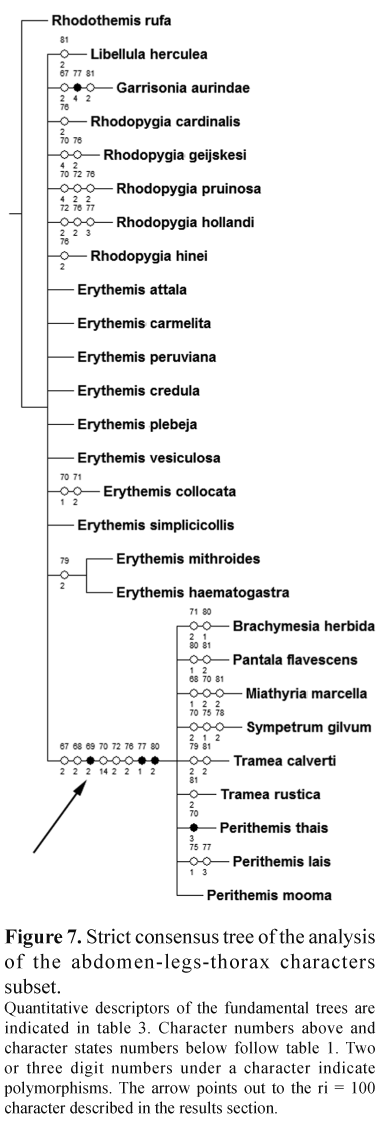
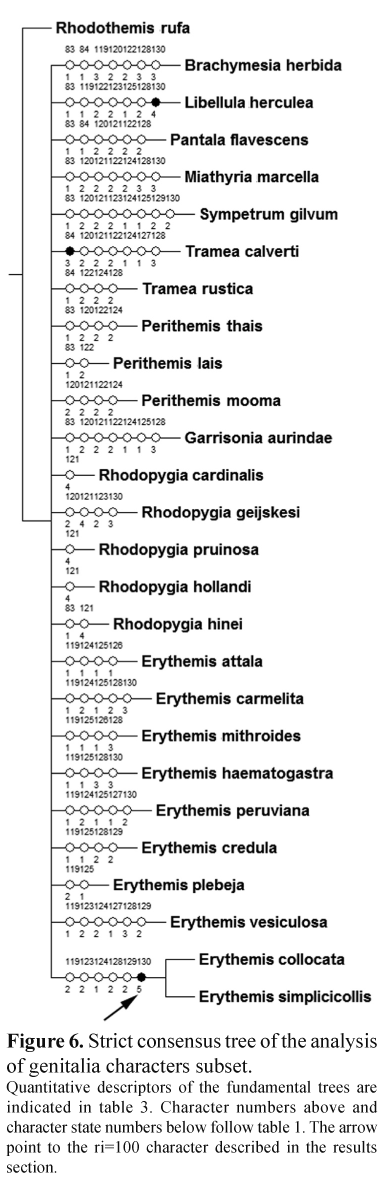
<body><![CDATA[<p><b>Character coding </b></p>     <p>The consensus tree from the combined pattern presence/absence coding   strategy (coding 2, <a href="/img/revistas/cal/v36n1/v36n1a7fig2.gif" target="blank">Fig. 2</a>) presented lower resolution than that of the tree   from the combined pigment presence/absence coding strategy (coding 1, <a href="/img/revistas/cal/v36n1/v36n1a7fig3.gif" target="blank">Fig. 3</a>). In   the latter, several species of <i>Erythemis</i> appear in a single clade, the genus <i>Rhodopygia</i> appeared as monophyletic, and it is the   sister group of a large clade that includes species   of several genera. Nine characters with retention of 100 appeared on this tree.   Similarly, when comparing both color dataset codifications, there was a large   difference between the two strategies; the tree from the pattern coding was   highly unresolved, and with a single clade (<i>E. vesiculosa</i>, (<i>E. simplicicollis</i>, <i>E. collocata</i>)) (<a href="/img/revistas/cal/v36n1/v36n1a7fig4.gif" target="blank">Fig. 4</a>) that is also present   in the tree from the pigment coding (<a href="/img/revistas/cal/v36n1/v36n1a7fig5.gif" target="blank">Fig. 5</a>). The latter was a more resolved   tree. The retention index of both coding strategies was very similar (<a href="/img/revistas/cal/v36n1/v36n1a7tab3.gif" target="blank">Table 3</a>). </p>     <p>It has   been proposed that proper coding of characters is a crucial step in phylogenetic research especially when using morphologic   data, and the compliance with basic requirements of character definition, such   as independence, exclusivity, and logical standardization, must be addressed (Sereno, 2007; Vogt <i>et al</i>., 2010). In this study we   found a good example of the importance of these requirements; when coding color   characters as pattern, or strategy coding 1,  these show lower resolution than the   pigment coding, or strategy coding 2, analyzed as separate datasets or in the   combined analyses. </p>     <p><b>Partitioned analyses, combined analyses, and phylogenetic   signal </b></p>     <p>The abdomen-legs-thorax and the genitalia subsets offered higher   retention indexes (82 and 64 respectively) while the wing venation subset   offered lower retention index (<a href="/img/revistas/cal/v36n1/v36n1a7tab3.gif" target="blank">Table 3</a>). The retention index values of the two   coding strategies for the color subset were a bit higher than those of the   total evidence analyses using the two coding strategies (<a href="/img/revistas/cal/v36n1/v36n1a7tab3.gif" target="blank">Table 3</a>). The   genitalia subset provided a highly unresolved tree with the single clade (<i>Erythemiscollocata,E. simplicicollis</i>)   (<a href="#figura6">Fig. 6</a>) supported by the character of suboval shape   of the vesica spermalis   hook (130, ri=100).</p>        <center>   <img src="/img/revistas/cal/v36n1/v36n1a7fig6.gif"><a name="figura6"></a>  </center>    <br>        <p> The extensive analysis of the genitalia of several   species through Scanning Electron Microscopy revealed a large complexity of   structures not observed before but unfortunately their coding was difficult due   to variation. A similar situation occurred with the abdomen-legs-thorax subset,   where only a clade (<i>Erythemis mithroides,E. haematogastra</i>)   was found (<a href="#figura7">Fig. 7</a>).</p>        <center>   <img src="/img/revistas/cal/v36n1/v36n1a7fig7.gif"><a name="figura7"></a>  </center>    <br>        ]]></body>
<body><![CDATA[<p> The wing veins subset offered a tree where most of the <i>Erythemis</i> species are located in a large basal polytomy and others are in other sections of the tree (<a href="/img/revistas/cal/v36n1/v36n1a7fig8.gif" target="blank">Fig. 8</a>). The presence/absence color pigment subset offered a mostly resolved tree   with five polytomies, four of these are composed by   three branches while one includes seven branches (<a href="/img/revistas/cal/v36n1/v36n1a7fig5.gif" target="blank">Fig. 5</a>); the clades are a mixture of species from different genera. Two   characters had a 100 ri   value and support the clade (<i>E. vesiculosa</i>, (<i>E. collocata,   E. simplicicollis</i>)), these characters refer to   the presence of green and red pigment on the epiproct   (47 and 49 respectively). </p>     <p>The strict consensus of the 12 fundamental trees found from the combined   analysis using the presence/absence of pigment coding strategy presented a   basal polytomy composed by <i>Libelulla herculea</i>, four species of <i>Erythemis</i> and two large clades, one which included the other   six species of <i>Erythemis</i>, and a large clade with species of several genera (<a href="/img/revistas/cal/v36n1/v36n1a7fig3.gif" target="blank">Fig. 3</a>), no   characters with 100 ri could be traced at the node of   the <i>Erythemis</i> species (<a href="/img/revistas/cal/v36n1/v36n1a7fig3.gif" target="blank">Fig. 3</a>). A total of   nine characters were found with ri = 100, One belong   to the color pattern subset (15), four belong to color pigments character   subset (41, 45, 48, 50), two to the wing veins subset (86, 109), one to the   thorax-legs-abdomen subset (68), and one to the genitalia subset (122). None of   these characters were recovered as synapomorphies   with ri =  100, in   the analyses using   the separate subsets of characters. Only three of the six clades   observed in the analysis of the color pigment coding subset were present in the combined analysis. </p>     <p>The   thickened long spines in the hind femur present in <i>Erythemis</i>, are also   present in the genus <i>Rhodopygia, </i>in the   species<i> Libelulla herculea,   Rhodothemis rufa</i> and in <i>Garrisonia aurindae.</i> The disposition of the long spines in the external angle of the posterior femur   exhibits a large array of variation in the species studied and even variation   within species was recorded. The number of long spines in the external angle of   the posterior femur also shows large variability and species such as <i>E. haematogastra</i> and <i>E. credula</i> had specimens with a lower or higher number of long spines to those proposed as   diagnostic of the genus. In addition, species of other genera such as <i>Perithemis</i>, <i>Rhodopygia,</i> and <i>Libellula</i> exhibit between 3 and 4 long   spines in the hind femur. The widened hind femur is also present in <i>Libellula herculea </i>Karsch, 1889 and <i>Garrisonia aurindae </i>Penalva &amp;   Costa, 2007 (Penalva &amp; Costa, 2007). </p>     <p>Despite   the debate about the use of either combined or partitioned analyses in phylogenetic studies (Lecointre   &amp; Deleporte, 2004; Nixon &amp; Carpenter, 1996),   our analysis is in agreement with the first as the trees of the combined   analyses are more informative than these of the partitioned analyses and also   present a larger number of synapomorphies. Moreover,   the combined analyses uncover nine homologies that were not observed in the   partitioned analyses. Another result that agrees with the literature (Wenzel   &amp; Siddall, 1999) points out to the lack of additivity of characters in phylogenetic   studies; despite that the color characters were the more abundant of the entire   data set (58%), that the color characters were five of the nine synapomorphies found in the combined analysis, and that the   phylogenetic analysis of the color pigment subset   provided the more resolved tree, this tree agreed only in six out of the 19   nodes observed in the combined analysis. In addition, none of the four   characters with ri=100 in the subset analyses was observed as such in the   combined analysis. Thus, the role of a character subset and that of a character   can only be understood once the analysis is conducted to detect hidden synapomorphies (Nixon &amp; Carpenter, 1996). A single   character from the genitalia subset (122) was recovered as synapomorphy   in the combined analysis; this result differs from these found by other authors   (e.g., Song &amp; Bucheli, 2010) who surveyed a large   number of studies and concluded that genitalia characters can be as useful to phylogenetic analysis as any other character set, but they   suggest a careful examination in every study. In the present case, the observed   variation is expressed as homoplasy in different   lineages, agreeing with the low informativeness of   the genitalic region, as a consequence of accelerated   and divergent sexual selection pressures (M&eacute;ndez   &amp; C&oacute;rdoba-Aguilar, 2004; Song &amp; Wenzel, 2008; Song &amp; Bucheli, 2010). </p>     <p>The characters from the abdomen-legs-thorax subset offered a highly   unresolved tree; however, one of these characters appeared as a homology   supporting a clade in the combined analysis (<a href="/img/revistas/cal/v36n1/v36n1a7fig3.gif" target="blank">Fig. 3</a>).   Because odonate wing venation is complex and full of autopomorphies (Rehn, 2003), the   set of wing characters of <i>Erythemis</i> provided a   mostly unresolved tree (<a href="/img/revistas/cal/v36n1/v36n1a7fig8.gif" target="blank">Fig. 8</a>); however, two characters of this set appeared   as homologies in the combined analysis (<a href="/img/revistas/cal/v36n1/v36n1a7fig3.gif" target="blank">Fig. 3</a>). Our results do not entirely   comply with other authors (e.g., Rehn, 2003; Pilgrim   &amp; Von Dohlen, 2008), who proposed that wing   venation is a highly variable region and provides very poor phylogenetic   information. Despite the strong selection pressures that flight performance   exerted over these structures (Kesel, 2000),   homologies were recovered from these structures. </p>     <p>Even though Kennedy (1923) proposed the widening of basal region of the   abdomen to establish species groups for the genus <i>Erythemis</i>,   an analysis of body proportions of this region performed by the authors   (unpublished data), showed that its high variation do not allow to recognize   the discontinuity and therefore the character states can not be acknowledged. The   relation between <i>E. simplicollis </i>and <i>E. collocata</i> proposed by Kennedy (1923) based on the   absence of posterior lobe in the vesica spermalis, was corroborated by this study, but using the   shape of the hook of the vesica spermalis.</p>     <p>Despite   that color varies intraspecifically due to environment,   ontogeny, and diet (Winston, 1999), and that museum specimens are often   discolored, our results agreed with others who provided evidence that color   characters may be useful for phylogenetic analysis in   several insect groups (Areekul &amp; Quicke, 2006). These results supports that color characters   are involved in strongly conserved patterns (Song &amp; Bucheli,   2010), perhaps as a consequence of their role on sexual recognition in <i>Erythemis</i>, doing that color characters may show a   strongly structured evolution as a whole, that may lead to a strong phylogenetic signal (Song &amp; Bucheli,   2010). As it was demonstrated above, coding is important when including traits,   to avoid violations to logic precepts in the characters such as character   interdependence, conjunction of character states, or character correlation (Sereno, 2007). The results on wing and color character   subsets also points at the importance of looking at the data before proceeding   with preventive subtraction (Wenzel &amp; Siddall,   1999). </p>     <p>As it has happened in other odonate taxa (e.g. Dijkstra &amp; Vick,   2006; Ware et al<i>.</i>, 2007; Pilgrim &amp; von Dohlen,   2008; Blanke et al<i>.</i>, 2013), <i>Erythemis </i>was not found as a monophyletic   group due to the extensive homoplasy and structural   variability observed in its diagnostic characters (Dijkstra   et al., 2014). In <i>Ertythemis </i>case,   aside from the high intra and interspecific variation   that most of the characters showed, a large number of the character states are   shared with other genera. </p>     <p>Some   authors have approached to the high variation and complexity of Odonate morphology (e.g. Pilgrim &amp; Von Dohlen, 2008) and they have studied wing venation along   with many autopomorphies (Rehn,   2003), showing that the developmental process as larvae may influence this   variation (Martinov, 1930). In addition it has been   proposed that this variation, might respond for the strong differences in the   capability of wing flexion among some odonates such   as <i>Aeshna </i>Fabricius,   1775 and <i>Pachydiplax </i>Brauer, 1868 (Combes &amp; Daniel, 2003). </p>     <p>The <i>Erythemis</i> morphology may be an   example of the interaction between stochastic evolutionary processes altering   the genetic homogeneity of the species (Clegg <i>et al.</i>,<i> </i>2002) and   the adaptation to habitat heterogeneity inhabited by their species. Studies in   other odonates have suggested that selective   pressures such as landscape structure (Taylor &amp; Merriam, 1995), food and   predation stress (Svensson &amp; Friberg,   2007), wind and high acidification of the larvae biotopes (Marinov   &amp; McHugh, 2010), and sexual selection (Outomuro   &amp; Johansson, 2011), can affect the evolution of wing and abdomen   characters. For example, Johansson &amp; Samuelson (1994) found that the action   of predators might influence the length of dorsal and lateral thorns in <i>Leucorrhinia dubia </i>(Vander   Linden, 1825)<i> </i>larvae. Giacomini &amp; De Marco   Jr. (2008) found a relationship among the variation of body length in larvae of   several Anisoptera species and the habitat portion   used by these. The authors stated that species like <i>E. peruviana</i> shows a narrower abdomen associated to the possibility of easy camouflage in macrophytes as a defense against predators. According to Giacomini &amp; De Marco Jr. (2008) the presence and   reproduction of the organisms, is related to the variation of their morphology   with the environment and its usage that they might do of their habitat. </p>     ]]></body>
<body><![CDATA[<p><b>ACKNOWLEDGEMENTS </b></p>     <p>We are grateful to the following   people for access to different   entomological collections: Rosser W. Garrison (RWG), Emilio Realpe and Melissa   S&aacute;nchez (ANDES-E), Martha Wolff and   Cornelio Bota (CEUA); Rafael Borja and Le&oacute;n A. P&eacute;rez   (UARC), Sergio Orduz and   John Jairo Quiroz (MEFLG), Nancy Carrejo, Carmen E. Posso   and Christian Berm&uacute;dez (MUSENUV), Bill Mauffray (FSCA), Janira M. Costa   (MNRJ), Philip D. Perkins (MCZ), and Mark F. O'Brien (UMMZ). We thank Natalia von Ellenrieder for her corrections and suggestions on this   manuscript. Two referees are thanked for useful advice.   We thank the Laboratorio de Sistem&aacute;tica y Biolog&iacute;a Comparada de   Insectos, and Laboratorio de Artr&oacute;podos del Centro   Internacional de F&iacute;sica, Universidad Nacional de Colombia, Departamento de   Biolog&iacute;a, Universidad El Bosque. This research was supported   by a fellowship from   Departamento Administrativo de Ciencia, Tecnolog&iacute;a e Innovaci&oacute;n COLCIENCIAS, and by the Direcci&oacute;n de   Investigaci&oacute;n-Facultad de Ciencias, Universidad Nacional de Colombia (Bogot&aacute; Branch). We thank the electronic microscopy   laboratory at the Universidad Nacional de Colombia   for support with the SEM images. </p>     <p><b>LITERATURE   CITED </b></p>     <!-- ref --><p>1. Areekul, B. &amp; D.L.J. Quicke. 2006.   The use of colour characters in phylogenetic   reconstruction. Biological Journal of the Linnean   Society 88: 193-202.    &nbsp;&nbsp;&nbsp;&nbsp;&nbsp;&nbsp;&nbsp;&nbsp;[&#160;<a href="javascript:void(0);" onclick="javascript: window.open('/scielo.php?script=sci_nlinks&ref=000066&pid=S0366-5232201400010000700001&lng=','','width=640,height=500,resizable=yes,scrollbars=1,menubar=yes,');">Links</a>&#160;]<!-- end-ref --> </p>     <!-- ref --><p>2. Baird,   J.M. &amp; M.L. May. 2003. Fights at the dinner table: agonistic behavior   in <i>Pachydiplax longipennis </i>(Odonata: Libellulidae)   at feeding sites. Journal of Insect Behavior<i> </i>16: 189-216.    &nbsp;&nbsp;&nbsp;&nbsp;&nbsp;&nbsp;&nbsp;&nbsp;[&#160;<a href="javascript:void(0);" onclick="javascript: window.open('/scielo.php?script=sci_nlinks&ref=000068&pid=S0366-5232201400010000700002&lng=','','width=640,height=500,resizable=yes,scrollbars=1,menubar=yes,');">Links</a>&#160;]<!-- end-ref --> </p>     <!-- ref --><p>3. Blanke, A., C. Greve, R. Mokso, F. Beckman &amp; B. Misof. 2013. An updated phylogeny of Anisoptera   including formal convergence analysis of morphological characters. Systematic   Entomology 38: 474-490.    &nbsp;&nbsp;&nbsp;&nbsp;&nbsp;&nbsp;&nbsp;&nbsp;[&#160;<a href="javascript:void(0);" onclick="javascript: window.open('/scielo.php?script=sci_nlinks&ref=000070&pid=S0366-5232201400010000700003&lng=','','width=640,height=500,resizable=yes,scrollbars=1,menubar=yes,');">Links</a>&#160;]<!-- end-ref --> </p>     <!-- ref --><p>4. Blomberg, S. P., T.JR. Garland &amp; A.R.   Ives. 2003. Testing for phylogenetic   signal in comparative data: behavioral traits are more labile. Evolution 57(4):   717-745.    &nbsp;&nbsp;&nbsp;&nbsp;&nbsp;&nbsp;&nbsp;&nbsp;[&#160;<a href="javascript:void(0);" onclick="javascript: window.open('/scielo.php?script=sci_nlinks&ref=000072&pid=S0366-5232201400010000700004&lng=','','width=640,height=500,resizable=yes,scrollbars=1,menubar=yes,');">Links</a>&#160;]<!-- end-ref --> </p>     <!-- ref --><p>5. Borror, D.  1942. <i>A revision of the Libellulinae genus Erythrodiplax Odonata. Contributions in Zoology and Entomology, No. 4.</i> Biological Series. The  Ohio  State  University   , USA  .    &nbsp;&nbsp;&nbsp;&nbsp;&nbsp;&nbsp;&nbsp;&nbsp;[&#160;<a href="javascript:void(0);" onclick="javascript: window.open('/scielo.php?script=sci_nlinks&ref=000074&pid=S0366-5232201400010000700005&lng=','','width=640,height=500,resizable=yes,scrollbars=1,menubar=yes,');">Links</a>&#160;]<!-- end-ref --> </p>     <!-- ref --><p>6. Clegg,   S.M., S.M. Degnan, C. Moritz, A. Estoup,   J. Kikkawa &amp; I.P.F. Owens. 2002.   Microevolution in island forms: the roles of drift and directional selection in   morphological divergence of a passerine bird. Evolution<i> </i>56: 2090-2099.    &nbsp;&nbsp;&nbsp;&nbsp;&nbsp;&nbsp;&nbsp;&nbsp;[&#160;<a href="javascript:void(0);" onclick="javascript: window.open('/scielo.php?script=sci_nlinks&ref=000076&pid=S0366-5232201400010000700006&lng=','','width=640,height=500,resizable=yes,scrollbars=1,menubar=yes,');">Links</a>&#160;]<!-- end-ref --> </p>     <!-- ref --><p>7. Combes, S.A.   &amp; T.L. Daniel. 2003. Flexural stiffness in insect wings. I. Scaling   and the in&#64258;uence of   wing venation. The Journal of Experimental Biology 206: 2979-2987.    &nbsp;&nbsp;&nbsp;&nbsp;&nbsp;&nbsp;&nbsp;&nbsp;[&#160;<a href="javascript:void(0);" onclick="javascript: window.open('/scielo.php?script=sci_nlinks&ref=000078&pid=S0366-5232201400010000700007&lng=','','width=640,height=500,resizable=yes,scrollbars=1,menubar=yes,');">Links</a>&#160;]<!-- end-ref --> </p>     <!-- ref --><p>8. C&oacute;rdoba-Aguilar,   A. 2005. Possible coevolution   of male and female genital form and function in a calopterygid   damselfly. Journal of Evolutionary Biology 18: 132-137.    &nbsp;&nbsp;&nbsp;&nbsp;&nbsp;&nbsp;&nbsp;&nbsp;[&#160;<a href="javascript:void(0);" onclick="javascript: window.open('/scielo.php?script=sci_nlinks&ref=000080&pid=S0366-5232201400010000700008&lng=','','width=640,height=500,resizable=yes,scrollbars=1,menubar=yes,');">Links</a>&#160;]<!-- end-ref --> </p>     <!-- ref --><p>9. C&oacute;rdoba-Aguilar,   A. &amp; A. Cordero. 2008. Cryptic female choice and sexual conflict.   pp. 189-202. In: A. C&oacute;rdoba Aguilar. (ed.). 2008. <i>Dragonflies   and Damselflies: Model organisms for ecological and evolutionary research</i>.  Oxford  University   Press,  Oxford    .    &nbsp;&nbsp;&nbsp;&nbsp;&nbsp;&nbsp;&nbsp;&nbsp;[&#160;<a href="javascript:void(0);" onclick="javascript: window.open('/scielo.php?script=sci_nlinks&ref=000082&pid=S0366-5232201400010000700009&lng=','','width=640,height=500,resizable=yes,scrollbars=1,menubar=yes,');">Links</a>&#160;]<!-- end-ref -->&nbsp; </p>     <!-- ref --><p>10. Dallwitz, M.L. 2000. Onwards. Data requirements for naturallanguaje descriptions    and identification. <a href="http://deltaintkey.com">http://deltaintkey.com</a>    (Consulted: September 12 2010).    &nbsp;&nbsp;&nbsp;&nbsp;&nbsp;&nbsp;&nbsp;&nbsp;[&#160;<a href="javascript:void(0);" onclick="javascript: window.open('/scielo.php?script=sci_nlinks&ref=000084&pid=S0366-5232201400010000700010&lng=','','width=640,height=500,resizable=yes,scrollbars=1,menubar=yes,');">Links</a>&#160;]<!-- end-ref --> </p>     <!-- ref --><p>11. Dijkstra, K.D.B. &amp; G.S. Vick. 2006. Inflation by   venation and the bankruptcy of traditional genera: the case of <i>Neodythemis </i>and <i>Micromacromia</i>,   with keys to the continental African species and the description of two new <i>Neodythemis </i>species from the Albertine Rift (Odonata: Libellulidae). International Journal of Odonatology   9, 51-70.    &nbsp;&nbsp;&nbsp;&nbsp;&nbsp;&nbsp;&nbsp;&nbsp;[&#160;<a href="javascript:void(0);" onclick="javascript: window.open('/scielo.php?script=sci_nlinks&ref=000086&pid=S0366-5232201400010000700011&lng=','','width=640,height=500,resizable=yes,scrollbars=1,menubar=yes,');">Links</a>&#160;]<!-- end-ref --> </p>     <!-- ref --><p>12. Dijkstra, K.D.B., V.J. Kalkman,   R.A. Dow, F.R. Stokvis &amp; J. Van Tol. 2014. Redefining the damselfly families:   a comprehensive molecular phylogeny of Zygoptera (Odonata). Systematic Entomology 39: 68-96.    &nbsp;&nbsp;&nbsp;&nbsp;&nbsp;&nbsp;&nbsp;&nbsp;[&#160;<a href="javascript:void(0);" onclick="javascript: window.open('/scielo.php?script=sci_nlinks&ref=000088&pid=S0366-5232201400010000700012&lng=','','width=640,height=500,resizable=yes,scrollbars=1,menubar=yes,');">Links</a>&#160;]<!-- end-ref --></p>     <!-- ref --><p>13. Evenhuis, N.L. &amp; G.A. Samuelson. 2004. Abbreviations for Insect and    Spider Collections of the World. <a href="http://hbs.bishopmuseum.org/codens/codens-inst.html">http://hbs.bishopmuseum.org/codens/codens-inst.html</a>    (accessed 17 September 2011).    &nbsp;&nbsp;&nbsp;&nbsp;&nbsp;&nbsp;&nbsp;&nbsp;[&#160;<a href="javascript:void(0);" onclick="javascript: window.open('/scielo.php?script=sci_nlinks&ref=000090&pid=S0366-5232201400010000700013&lng=','','width=640,height=500,resizable=yes,scrollbars=1,menubar=yes,');">Links</a>&#160;]<!-- end-ref --> </p>     <!-- ref --><p>14. Farris, J. S.   1989a. The retention index and homoplasy   excess. Systematic Zoology 38: 406- 407.    &nbsp;&nbsp;&nbsp;&nbsp;&nbsp;&nbsp;&nbsp;&nbsp;[&#160;<a href="javascript:void(0);" onclick="javascript: window.open('/scielo.php?script=sci_nlinks&ref=000092&pid=S0366-5232201400010000700014&lng=','','width=640,height=500,resizable=yes,scrollbars=1,menubar=yes,');">Links</a>&#160;]<!-- end-ref --> </p>     <!-- ref --><p>15. Farris, J.S.   1989b. The retention index and rescaled consistency index. Cladistics 5:   417-419.    &nbsp;&nbsp;&nbsp;&nbsp;&nbsp;&nbsp;&nbsp;&nbsp;[&#160;<a href="javascript:void(0);" onclick="javascript: window.open('/scielo.php?script=sci_nlinks&ref=000094&pid=S0366-5232201400010000700015&lng=','','width=640,height=500,resizable=yes,scrollbars=1,menubar=yes,');">Links</a>&#160;]<!-- end-ref --> </p>     <!-- ref --><p>16. Garrison, R.W.,   N. Von Ellenrieder &amp; J.A. Louton. 2006. <i>Dragonfly   genera of the  New World   , an illustrated and   annotated key to the Anisoptera</i>. The  Johns  Hopkins  University      Press.   USA  . 384 pp.    &nbsp;&nbsp;&nbsp;&nbsp;&nbsp;&nbsp;&nbsp;&nbsp;[&#160;<a href="javascript:void(0);" onclick="javascript: window.open('/scielo.php?script=sci_nlinks&ref=000096&pid=S0366-5232201400010000700016&lng=','','width=640,height=500,resizable=yes,scrollbars=1,menubar=yes,');">Links</a>&#160;]<!-- end-ref --> </p>     <!-- ref --><p>17. Garrison R.W.,   N. Von Ellenrieder &amp; J.A. Louton. 2010. <i>Damselfly   genera of the  New World   . An   Illustrated and Annotated Key to the Zygoptera.</i> The Johns Hopkins University   Press,  Baltimore      , xiv + 490 pp, + 24 color plates.    &nbsp;&nbsp;&nbsp;&nbsp;&nbsp;&nbsp;&nbsp;&nbsp;[&#160;<a href="javascript:void(0);" onclick="javascript: window.open('/scielo.php?script=sci_nlinks&ref=000098&pid=S0366-5232201400010000700017&lng=','','width=640,height=500,resizable=yes,scrollbars=1,menubar=yes,');">Links</a>&#160;]<!-- end-ref --> </p>     <!-- ref --><p>18. Giacomini, H.C. &amp; P. De Marco   Jr. 2008. Larval ecomorphology of 13 Libellulidae (Anisoptera, Odonata) of the Middle   Rio Doce Valley, Minas   Gerais, Brazil. Brazilian Journal   of Biology 68(1): 211-219.    &nbsp;&nbsp;&nbsp;&nbsp;&nbsp;&nbsp;&nbsp;&nbsp;[&#160;<a href="javascript:void(0);" onclick="javascript: window.open('/scielo.php?script=sci_nlinks&ref=000100&pid=S0366-5232201400010000700018&lng=','','width=640,height=500,resizable=yes,scrollbars=1,menubar=yes,');">Links</a>&#160;]<!-- end-ref --> </p>     <!-- ref --><p>19. Johansson,   F. &amp; L. Samuelson. 1994. Fish-induced variation in abdominal   spine length of <i>Leucorrhinia dubia </i>(Odonata) larvae? Oecologia 100: 74-79.    &nbsp;&nbsp;&nbsp;&nbsp;&nbsp;&nbsp;&nbsp;&nbsp;[&#160;<a href="javascript:void(0);" onclick="javascript: window.open('/scielo.php?script=sci_nlinks&ref=000102&pid=S0366-5232201400010000700019&lng=','','width=640,height=500,resizable=yes,scrollbars=1,menubar=yes,');">Links</a>&#160;]<!-- end-ref --> </p>     <!-- ref --><p>20. Kennedy,   C.H. 1923. The phylogeny and the distribution of the genus <i>Erythemis</i> (Odonata).   Miscellaneous Publications of the  Museum   of  Zoology  University   of  Michigan 11: 19-21.    &nbsp;&nbsp;&nbsp;&nbsp;&nbsp;&nbsp;&nbsp;&nbsp;[&#160;<a href="javascript:void(0);" onclick="javascript: window.open('/scielo.php?script=sci_nlinks&ref=000104&pid=S0366-5232201400010000700020&lng=','','width=640,height=500,resizable=yes,scrollbars=1,menubar=yes,');">Links</a>&#160;]<!-- end-ref --> </p>     <!-- ref --><p>21. Kesel, A. B. 2000. Aerodynamic characteristics of   dragonfly wing sections compared with technical aerofoils.   The Journal of Experimental Biology 203: 3125-3135.    &nbsp;&nbsp;&nbsp;&nbsp;&nbsp;&nbsp;&nbsp;&nbsp;[&#160;<a href="javascript:void(0);" onclick="javascript: window.open('/scielo.php?script=sci_nlinks&ref=000106&pid=S0366-5232201400010000700021&lng=','','width=640,height=500,resizable=yes,scrollbars=1,menubar=yes,');">Links</a>&#160;]<!-- end-ref --> </p>     <!-- ref --><p>22. Kitching,  I.   , P. Forey, C. Humphries &amp; D. Williams. 1998. <i>Cladistics, the theory and practice of parsimony   analysis</i>. The systematics   association publication No. 11.  Oxford  University    Press. 226pp.    &nbsp;&nbsp;&nbsp;&nbsp;&nbsp;&nbsp;&nbsp;&nbsp;[&#160;<a href="javascript:void(0);" onclick="javascript: window.open('/scielo.php?script=sci_nlinks&ref=000108&pid=S0366-5232201400010000700022&lng=','','width=640,height=500,resizable=yes,scrollbars=1,menubar=yes,');">Links</a>&#160;]<!-- end-ref --> </p>     <!-- ref --><p>23. Klingenberg, C. &amp; N. Gidaszewski. 2010.   Testing and Quantifying Phylogenetic Signals and Homoplasy in Morphometric Data. Systematic   Biology 59(3): 245-261.    &nbsp;&nbsp;&nbsp;&nbsp;&nbsp;&nbsp;&nbsp;&nbsp;[&#160;<a href="javascript:void(0);" onclick="javascript: window.open('/scielo.php?script=sci_nlinks&ref=000110&pid=S0366-5232201400010000700023&lng=','','width=640,height=500,resizable=yes,scrollbars=1,menubar=yes,');">Links</a>&#160;]<!-- end-ref --> </p>     <!-- ref --><p>24. Kluge, A. G.  1989. A   concern for evidence and a phylogenetic   hypothesis of relationships among <i>Epicrates </i>(Boidae, Serpentes). Systematic Zoology 38: 7-25.    &nbsp;&nbsp;&nbsp;&nbsp;&nbsp;&nbsp;&nbsp;&nbsp;[&#160;<a href="javascript:void(0);" onclick="javascript: window.open('/scielo.php?script=sci_nlinks&ref=000112&pid=S0366-5232201400010000700024&lng=','','width=640,height=500,resizable=yes,scrollbars=1,menubar=yes,');">Links</a>&#160;]<!-- end-ref --> </p>     <!-- ref --><p>25. Kluge,   A. G., &amp; A.J. Wolf. 1993. Cladistics:   What's in a word? Cladistics<i> </i>9: 183-199.    &nbsp;&nbsp;&nbsp;&nbsp;&nbsp;&nbsp;&nbsp;&nbsp;[&#160;<a href="javascript:void(0);" onclick="javascript: window.open('/scielo.php?script=sci_nlinks&ref=000114&pid=S0366-5232201400010000700025&lng=','','width=640,height=500,resizable=yes,scrollbars=1,menubar=yes,');">Links</a>&#160;]<!-- end-ref --> </p>     <!-- ref --><p>26. Lecointre G. &amp; P. Deleporte. 2004.   Total evidence requires exclusion of phylogenetically   misleading data. Zoologica Scripta   34: 101-117.    &nbsp;&nbsp;&nbsp;&nbsp;&nbsp;&nbsp;&nbsp;&nbsp;[&#160;<a href="javascript:void(0);" onclick="javascript: window.open('/scielo.php?script=sci_nlinks&ref=000116&pid=S0366-5232201400010000700026&lng=','','width=640,height=500,resizable=yes,scrollbars=1,menubar=yes,');">Links</a>&#160;]<!-- end-ref --> </p>     <!-- ref --><p>27. Marinov, M. &amp; P. Mchugh. 2010.   Comparative study of the Chatham Islands Odonata:   Morphological variability, behaviour and demography   of the endemic <i>Xanthocnemis tuanuii</i> Rowe, 1987. International Dragonfly Fund-Report   30: 1-44.    &nbsp;&nbsp;&nbsp;&nbsp;&nbsp;&nbsp;&nbsp;&nbsp;[&#160;<a href="javascript:void(0);" onclick="javascript: window.open('/scielo.php?script=sci_nlinks&ref=000118&pid=S0366-5232201400010000700027&lng=','','width=640,height=500,resizable=yes,scrollbars=1,menubar=yes,');">Links</a>&#160;]<!-- end-ref --> </p>     <!-- ref --><p>28. Martynov, A.V. 1930. Wing   venation of the Odonata and Agnatha.   The interpretation of the wing venation&nbsp;and tracheation   of the Odonata&nbsp;and   Agnatha. Psyche<i>&nbsp;</i>37: 245-280.    &nbsp;&nbsp;&nbsp;&nbsp;&nbsp;&nbsp;&nbsp;&nbsp;[&#160;<a href="javascript:void(0);" onclick="javascript: window.open('/scielo.php?script=sci_nlinks&ref=000120&pid=S0366-5232201400010000700028&lng=','','width=640,height=500,resizable=yes,scrollbars=1,menubar=yes,');">Links</a>&#160;]<!-- end-ref --> </p>     <!-- ref --><p>29.  Mcvey   ,  M.E.      1981. Lifetime reproductive   tactics in a territorial dragonfly, <i>Erythemis simplicicollis</i> (Odonata,   Libellulidae). Anonymous.   Anonymous.  Rockefeller  University      . 1147, OA 6068. Ph. D. Thesis.    &nbsp;&nbsp;&nbsp;&nbsp;&nbsp;&nbsp;&nbsp;&nbsp;[&#160;<a href="javascript:void(0);" onclick="javascript: window.open('/scielo.php?script=sci_nlinks&ref=000122&pid=S0366-5232201400010000700029&lng=','','width=640,height=500,resizable=yes,scrollbars=1,menubar=yes,');">Links</a>&#160;]<!-- end-ref --> </p>     <!-- ref --><p>30. M&eacute;ndez, V. &amp; A. C&oacute;rdoba-Aguilar. 2004.   Sexual selection and animal genitalia. Trends in Ecology and Evolution 19:   224-225.    &nbsp;&nbsp;&nbsp;&nbsp;&nbsp;&nbsp;&nbsp;&nbsp;[&#160;<a href="javascript:void(0);" onclick="javascript: window.open('/scielo.php?script=sci_nlinks&ref=000124&pid=S0366-5232201400010000700030&lng=','','width=640,height=500,resizable=yes,scrollbars=1,menubar=yes,');">Links</a>&#160;]<!-- end-ref --> </p>     <!-- ref --><p>31. Nixon, K.C.   1999. The Parsimony Ratchet, a New Method for Rapid Parsimony Analysis. Cladistics 15: 407-414.    &nbsp;&nbsp;&nbsp;&nbsp;&nbsp;&nbsp;&nbsp;&nbsp;[&#160;<a href="javascript:void(0);" onclick="javascript: window.open('/scielo.php?script=sci_nlinks&ref=000126&pid=S0366-5232201400010000700031&lng=','','width=640,height=500,resizable=yes,scrollbars=1,menubar=yes,');">Links</a>&#160;]<!-- end-ref --> </p>     <!-- ref --><p>32. Nixon,   K.C. &amp; J.M. Carpenter. 1996. On   consensus, collapsibility and clade concordance. Cladistics 12: 305-321.    &nbsp;&nbsp;&nbsp;&nbsp;&nbsp;&nbsp;&nbsp;&nbsp;[&#160;<a href="javascript:void(0);" onclick="javascript: window.open('/scielo.php?script=sci_nlinks&ref=000128&pid=S0366-5232201400010000700032&lng=','','width=640,height=500,resizable=yes,scrollbars=1,menubar=yes,');">Links</a>&#160;]<!-- end-ref --> </p>     <!-- ref --><p>33. Outomuro, D. &amp; F. Johansson. 2011. The effects   of latitude, body size, and sexual selection on wing shape in a damselfly. Biological   Journal of the Linnean Society 102: 263-274.    &nbsp;&nbsp;&nbsp;&nbsp;&nbsp;&nbsp;&nbsp;&nbsp;[&#160;<a href="javascript:void(0);" onclick="javascript: window.open('/scielo.php?script=sci_nlinks&ref=000130&pid=S0366-5232201400010000700033&lng=','','width=640,height=500,resizable=yes,scrollbars=1,menubar=yes,');">Links</a>&#160;]<!-- end-ref --> </p>     <!-- ref --><p>34. Patterson, C.   1982. Morphological characters and homology. pp.   21-74. In: K. A. Joysey &amp; A.E. Friday. (eds). <i>Problems   of Phylogenetic Reconstruction</i>. Academic Press,  London   and  New York    .    &nbsp;&nbsp;&nbsp;&nbsp;&nbsp;&nbsp;&nbsp;&nbsp;[&#160;<a href="javascript:void(0);" onclick="javascript: window.open('/scielo.php?script=sci_nlinks&ref=000132&pid=S0366-5232201400010000700034&lng=','','width=640,height=500,resizable=yes,scrollbars=1,menubar=yes,');">Links</a>&#160;]<!-- end-ref --> </p>     <!-- ref --><p>35. Penalva, R. &amp; J. M. Costa. 2007. <i>Garrisonia aurindae </i>gen.   and spec. nov. from the State of  Bahia   , Brazil  (Anisoptera: Libellulidae). Zootaxa 1453: 33-40.    &nbsp;&nbsp;&nbsp;&nbsp;&nbsp;&nbsp;&nbsp;&nbsp;[&#160;<a href="javascript:void(0);" onclick="javascript: window.open('/scielo.php?script=sci_nlinks&ref=000134&pid=S0366-5232201400010000700035&lng=','','width=640,height=500,resizable=yes,scrollbars=1,menubar=yes,');">Links</a>&#160;]<!-- end-ref --> </p>     <!-- ref --><p>36. Pilgrim,   E.M. &amp; C.D. Von Dohlen. 2008. Phylogeny   of the Sympetrinae (Odonata:   Libellulidae): further evidence of the homoplasious nature of wing venation. Systematic Entomology 33:   159-174.    &nbsp;&nbsp;&nbsp;&nbsp;&nbsp;&nbsp;&nbsp;&nbsp;[&#160;<a href="javascript:void(0);" onclick="javascript: window.open('/scielo.php?script=sci_nlinks&ref=000136&pid=S0366-5232201400010000700036&lng=','','width=640,height=500,resizable=yes,scrollbars=1,menubar=yes,');">Links</a>&#160;]<!-- end-ref --> </p>     <!-- ref --><p>37. Pinto, A.   2008. An&aacute;lise clad&iacute;stica de <i>Erythemis</i> Hagen, 1861 com avaliação de seu posicionamento   filogen&eacute;tico em Sympetrinae (Insecta,   Odonata, Libellulidae). Dissertação   apresentada ao Programa de P&oacute;sGraduação  em Ciências   Biol&oacute;gicas   (Zoologia), Museu Nacional, da Universidade Federal do Rio de Janeiro/UFRJ, Brasil.    &nbsp;&nbsp;&nbsp;&nbsp;&nbsp;&nbsp;&nbsp;&nbsp;[&#160;<a href="javascript:void(0);" onclick="javascript: window.open('/scielo.php?script=sci_nlinks&ref=000138&pid=S0366-5232201400010000700037&lng=','','width=640,height=500,resizable=yes,scrollbars=1,menubar=yes,');">Links</a>&#160;]<!-- end-ref --> </p>     <!-- ref --><p>38. Rehn, A.C. 2003. Phylogenetic analysis of higher   level relationships of Odonata. Systematic   Entomology 28: 181-239.    &nbsp;&nbsp;&nbsp;&nbsp;&nbsp;&nbsp;&nbsp;&nbsp;[&#160;<a href="javascript:void(0);" onclick="javascript: window.open('/scielo.php?script=sci_nlinks&ref=000140&pid=S0366-5232201400010000700038&lng=','','width=640,height=500,resizable=yes,scrollbars=1,menubar=yes,');">Links</a>&#160;]<!-- end-ref --> </p>     <!-- ref --><p>39. Riek, E.F. &amp; J. Kukalov&aacute;-Peck.  1984. A   new   interpretation of dragonfly wing venation based upon Early Upper Carboniferous   fossils from   Argentina  (Insecta: Odonatoidea) and   basic character states in pterygote wings. Canadian Journal of Zoology<i> </i>62(6): 1150-1166.    &nbsp;&nbsp;&nbsp;&nbsp;&nbsp;&nbsp;&nbsp;&nbsp;[&#160;<a href="javascript:void(0);" onclick="javascript: window.open('/scielo.php?script=sci_nlinks&ref=000142&pid=S0366-5232201400010000700039&lng=','','width=640,height=500,resizable=yes,scrollbars=1,menubar=yes,');">Links</a>&#160;]<!-- end-ref --> </p>     <!-- ref --><p>40. Sereno, P.C. 2007. Logical basis for   morphological characters in phylogenetics. Cladistics<i> </i>23: 565-587.    &nbsp;&nbsp;&nbsp;&nbsp;&nbsp;&nbsp;&nbsp;&nbsp;[&#160;<a href="javascript:void(0);" onclick="javascript: window.open('/scielo.php?script=sci_nlinks&ref=000144&pid=S0366-5232201400010000700040&lng=','','width=640,height=500,resizable=yes,scrollbars=1,menubar=yes,');">Links</a>&#160;]<!-- end-ref --> </p>     <!-- ref --><p>41. Song,   H. &amp; J.W. Wenzel. 2008. Mosaic pattern of genital   divergence in three populations of <i>Schistocerca lineata</i> Scudder (Orthoptera:   Acrididae: Cyrtacanthacridinae).   Biological Journal of the Linnean Society 94:   289–301.    &nbsp;&nbsp;&nbsp;&nbsp;&nbsp;&nbsp;&nbsp;&nbsp;[&#160;<a href="javascript:void(0);" onclick="javascript: window.open('/scielo.php?script=sci_nlinks&ref=000146&pid=S0366-5232201400010000700041&lng=','','width=640,height=500,resizable=yes,scrollbars=1,menubar=yes,');">Links</a>&#160;]<!-- end-ref --> </p>     <!-- ref --><p>42. Song,   H. &amp; S.R. Bucheli. 2010. Comparison   of phylogenetic signal between male genitalia and nongenital characters in insect systematics.   Cladistics 26: 23-35.    &nbsp;&nbsp;&nbsp;&nbsp;&nbsp;&nbsp;&nbsp;&nbsp;[&#160;<a href="javascript:void(0);" onclick="javascript: window.open('/scielo.php?script=sci_nlinks&ref=000148&pid=S0366-5232201400010000700042&lng=','','width=640,height=500,resizable=yes,scrollbars=1,menubar=yes,');">Links</a>&#160;]<!-- end-ref --> </p>     <!-- ref --><p>43. Svensson, E.I.   &amp; M. Friberg. 2007. Selective predation on wing   morphology in sympatric damselflies. The American Naturalist 170, 101-112.    &nbsp;&nbsp;&nbsp;&nbsp;&nbsp;&nbsp;&nbsp;&nbsp;[&#160;<a href="javascript:void(0);" onclick="javascript: window.open('/scielo.php?script=sci_nlinks&ref=000150&pid=S0366-5232201400010000700043&lng=','','width=640,height=500,resizable=yes,scrollbars=1,menubar=yes,');">Links</a>&#160;]<!-- end-ref --> </p>     <!-- ref --><p>44. Taylor,   P.D. &amp; G. Merriam. 1995. Wing morphology of a forest   damselfly is related to landscape structure. Oikos<i> </i>73: 43-48.    &nbsp;&nbsp;&nbsp;&nbsp;&nbsp;&nbsp;&nbsp;&nbsp;[&#160;<a href="javascript:void(0);" onclick="javascript: window.open('/scielo.php?script=sci_nlinks&ref=000152&pid=S0366-5232201400010000700044&lng=','','width=640,height=500,resizable=yes,scrollbars=1,menubar=yes,');">Links</a>&#160;]<!-- end-ref --> </p>     <!-- ref --><p>45. Vogt,   L., T. Bartolomaeus &amp; G. Giribet. 2010.   The linguistic problem of morphology: structure versus homology and the   standardization of morphological data. Cladistics 26:   301-325.    &nbsp;&nbsp;&nbsp;&nbsp;&nbsp;&nbsp;&nbsp;&nbsp;[&#160;<a href="javascript:void(0);" onclick="javascript: window.open('/scielo.php?script=sci_nlinks&ref=000154&pid=S0366-5232201400010000700045&lng=','','width=640,height=500,resizable=yes,scrollbars=1,menubar=yes,');">Links</a>&#160;]<!-- end-ref --> </p>     <!-- ref --><p>46. Ware,   J., M. May &amp; K. Kjer. 2007. Phylogeny   of the higher Libelluloidea (Anisoptera:   Odonata): An exploration of the most speciose superfamily of   dragonflies. Molecular Phylogenetics and Evolution   45: 289-310.    &nbsp;&nbsp;&nbsp;&nbsp;&nbsp;&nbsp;&nbsp;&nbsp;[&#160;<a href="javascript:void(0);" onclick="javascript: window.open('/scielo.php?script=sci_nlinks&ref=000156&pid=S0366-5232201400010000700046&lng=','','width=640,height=500,resizable=yes,scrollbars=1,menubar=yes,');">Links</a>&#160;]<!-- end-ref --> </p>     <!-- ref --><p>47. Wenzel,   J.W. &amp; M.E. Siddall. 1999. Noise.   Cladistics 15: 51-64.    &nbsp;&nbsp;&nbsp;&nbsp;&nbsp;&nbsp;&nbsp;&nbsp;[&#160;<a href="javascript:void(0);" onclick="javascript: window.open('/scielo.php?script=sci_nlinks&ref=000158&pid=S0366-5232201400010000700047&lng=','','width=640,height=500,resizable=yes,scrollbars=1,menubar=yes,');">Links</a>&#160;]<!-- end-ref --> </p>     <!-- ref --><p>48. Wiens, J.J. 1995. Polymorphic characters in phylogenetic systematics. Systematic   Biology 44: 482-500.    &nbsp;&nbsp;&nbsp;&nbsp;&nbsp;&nbsp;&nbsp;&nbsp;[&#160;<a href="javascript:void(0);" onclick="javascript: window.open('/scielo.php?script=sci_nlinks&ref=000160&pid=S0366-5232201400010000700048&lng=','','width=640,height=500,resizable=yes,scrollbars=1,menubar=yes,');">Links</a>&#160;]<!-- end-ref --> </p>     <!-- ref --><p>49.  Wilson      , E.O.   1975. <i>Sociobiology</i>. The New   Synthesis.  Harvard  University   Press,  Cambridge    . 720pp.    &nbsp;&nbsp;&nbsp;&nbsp;&nbsp;&nbsp;&nbsp;&nbsp;[&#160;<a href="javascript:void(0);" onclick="javascript: window.open('/scielo.php?script=sci_nlinks&ref=000162&pid=S0366-5232201400010000700049&lng=','','width=640,height=500,resizable=yes,scrollbars=1,menubar=yes,');">Links</a>&#160;]<!-- end-ref --> </p>     <!-- ref --><p>50. Winston, J.E.   1999. <i>Describing species. Practical   taxonomic procedure for biologists.</i> New York, NY.   Columbia University Press.   518pp.    &nbsp;&nbsp;&nbsp;&nbsp;&nbsp;&nbsp;&nbsp;&nbsp;[&#160;<a href="javascript:void(0);" onclick="javascript: window.open('/scielo.php?script=sci_nlinks&ref=000164&pid=S0366-5232201400010000700050&lng=','','width=640,height=500,resizable=yes,scrollbars=1,menubar=yes,');">Links</a>&#160;]<!-- end-ref --> </p> </font>      ]]></body><back>
<ref-list>
<ref id="B1">
<label>1</label><nlm-citation citation-type="journal">
<person-group person-group-type="author">
<name>
<surname><![CDATA[Areekul]]></surname>
<given-names><![CDATA[B.]]></given-names>
</name>
<name>
<surname><![CDATA[Quicke]]></surname>
<given-names><![CDATA[D.L.J.]]></given-names>
</name>
</person-group>
<article-title xml:lang="en"><![CDATA[The use of colour characters in phylogenetic reconstruction]]></article-title>
<source><![CDATA[Biological Journal of the Linnean Society]]></source>
<year>2006</year>
<volume>88</volume>
<page-range>193-202</page-range></nlm-citation>
</ref>
<ref id="B2">
<label>2</label><nlm-citation citation-type="journal">
<person-group person-group-type="author">
<name>
<surname><![CDATA[Baird]]></surname>
<given-names><![CDATA[J.M.]]></given-names>
</name>
<name>
<surname><![CDATA[May]]></surname>
<given-names><![CDATA[M.L.]]></given-names>
</name>
</person-group>
<article-title xml:lang="en"><![CDATA[Fights at the dinner table: agonistic behavior in Pachydiplax longipennis (Odonata: Libellulidae) at feeding sites]]></article-title>
<source><![CDATA[Journal of Insect Behavior]]></source>
<year>2003</year>
<volume>16</volume>
<page-range>189-216</page-range></nlm-citation>
</ref>
<ref id="B3">
<label>3</label><nlm-citation citation-type="journal">
<person-group person-group-type="author">
<name>
<surname><![CDATA[Blanke]]></surname>
<given-names><![CDATA[A.]]></given-names>
</name>
<name>
<surname><![CDATA[Greve]]></surname>
<given-names><![CDATA[C.]]></given-names>
</name>
<name>
<surname><![CDATA[Mokso]]></surname>
<given-names><![CDATA[R.]]></given-names>
</name>
<name>
<surname><![CDATA[Beckman]]></surname>
<given-names><![CDATA[F.]]></given-names>
</name>
<name>
<surname><![CDATA[Misof]]></surname>
<given-names><![CDATA[B.]]></given-names>
</name>
</person-group>
<article-title xml:lang="en"><![CDATA[An updated phylogeny of Anisoptera including formal convergence analysis of morphological characters]]></article-title>
<source><![CDATA[Systematic Entomology]]></source>
<year>2013</year>
<volume>38</volume>
<page-range>474-490</page-range></nlm-citation>
</ref>
<ref id="B4">
<label>4</label><nlm-citation citation-type="journal">
<person-group person-group-type="author">
<name>
<surname><![CDATA[Blomberg]]></surname>
<given-names><![CDATA[S. P.]]></given-names>
</name>
<name>
<surname><![CDATA[Garland]]></surname>
<given-names><![CDATA[T.JR.]]></given-names>
</name>
<name>
<surname><![CDATA[Ives]]></surname>
<given-names><![CDATA[A.R.]]></given-names>
</name>
</person-group>
<article-title xml:lang="en"><![CDATA[Testing for phylogenetic signal in comparative data: behavioral traits are more labile]]></article-title>
<source><![CDATA[Evolution]]></source>
<year>2003</year>
<volume>57</volume>
<numero>4</numero>
<issue>4</issue>
<page-range>717-745</page-range></nlm-citation>
</ref>
<ref id="B5">
<label>5</label><nlm-citation citation-type="book">
<person-group person-group-type="author">
<name>
<surname><![CDATA[Borror]]></surname>
<given-names><![CDATA[D.]]></given-names>
</name>
</person-group>
<source><![CDATA[A revision of the Libellulinae genus Erythrodiplax Odonata: Contributions in Zoology and Entomology]]></source>
<year>1942</year>
<volume>4</volume>
<publisher-name><![CDATA[The Ohio State University]]></publisher-name>
</nlm-citation>
</ref>
<ref id="B6">
<label>6</label><nlm-citation citation-type="journal">
<person-group person-group-type="author">
<name>
<surname><![CDATA[Clegg]]></surname>
<given-names><![CDATA[S.M.]]></given-names>
</name>
<name>
<surname><![CDATA[Degnan]]></surname>
<given-names><![CDATA[S.M.]]></given-names>
</name>
<name>
<surname><![CDATA[Moritz]]></surname>
<given-names><![CDATA[C.]]></given-names>
</name>
<name>
<surname><![CDATA[Estoup]]></surname>
<given-names><![CDATA[A.]]></given-names>
</name>
<name>
<surname><![CDATA[Kikkawa]]></surname>
<given-names><![CDATA[J.]]></given-names>
</name>
<name>
<surname><![CDATA[Owens]]></surname>
<given-names><![CDATA[I.P.F.]]></given-names>
</name>
</person-group>
<article-title xml:lang="en"><![CDATA[Microevolution in island forms: the roles of drift and directional selection in morphological divergence of a passerine bird]]></article-title>
<source><![CDATA[Evolution]]></source>
<year>2002</year>
<volume>56</volume>
<page-range>2090-2099</page-range></nlm-citation>
</ref>
<ref id="B7">
<label>7</label><nlm-citation citation-type="journal">
<person-group person-group-type="author">
<name>
<surname><![CDATA[Combes]]></surname>
<given-names><![CDATA[S.A.]]></given-names>
</name>
<name>
<surname><![CDATA[Daniel]]></surname>
<given-names><![CDATA[T.L.]]></given-names>
</name>
</person-group>
<article-title xml:lang="en"><![CDATA[Flexural stiffness in insect wings. I: Scaling and the in&#64258;uence of wing venation]]></article-title>
<source><![CDATA[The Journal of Experimental Biology]]></source>
<year>2003</year>
<volume>206</volume>
<page-range>2979-2987</page-range></nlm-citation>
</ref>
<ref id="B8">
<label>8</label><nlm-citation citation-type="journal">
<person-group person-group-type="author">
<name>
<surname><![CDATA[Córdoba-Aguilar]]></surname>
<given-names><![CDATA[A.]]></given-names>
</name>
</person-group>
<article-title xml:lang="en"><![CDATA[Possible coevolution of male and female genital form and function in a calopterygid damselfly]]></article-title>
<source><![CDATA[Journal of Evolutionary Biology]]></source>
<year>2005</year>
<volume>18</volume>
<page-range>132-137</page-range></nlm-citation>
</ref>
<ref id="B9">
<label>9</label><nlm-citation citation-type="book">
<person-group person-group-type="author">
<name>
<surname><![CDATA[Córdoba-Aguilar]]></surname>
<given-names><![CDATA[A.]]></given-names>
</name>
<name>
<surname><![CDATA[Cordero]]></surname>
<given-names><![CDATA[A.]]></given-names>
</name>
</person-group>
<article-title xml:lang="en"><![CDATA[Cryptic female choice and sexual conflict]]></article-title>
<person-group person-group-type="editor">
<name>
<surname><![CDATA[Córdoba Aguilar]]></surname>
<given-names><![CDATA[A.]]></given-names>
</name>
</person-group>
<source><![CDATA[Dragonflies and Damselflies: Model organisms for ecological and evolutionary research]]></source>
<year>2008</year>
<month>20</month>
<day>08</day>
<page-range>189-202</page-range><publisher-loc><![CDATA[Oxford ]]></publisher-loc>
<publisher-name><![CDATA[Oxford University Press]]></publisher-name>
</nlm-citation>
</ref>
<ref id="B10">
<label>10</label><nlm-citation citation-type="">
<person-group person-group-type="author">
<name>
<surname><![CDATA[Dallwitz]]></surname>
<given-names><![CDATA[M.L.]]></given-names>
</name>
</person-group>
<source><![CDATA[Onwards: Data requirements for naturallanguaje descriptions and identification]]></source>
<year>2000</year>
</nlm-citation>
</ref>
<ref id="B11">
<label>11</label><nlm-citation citation-type="journal">
<person-group person-group-type="author">
<name>
<surname><![CDATA[Dijkstra]]></surname>
<given-names><![CDATA[K.D.B.]]></given-names>
</name>
<name>
<surname><![CDATA[Vick]]></surname>
<given-names><![CDATA[G.S.]]></given-names>
</name>
</person-group>
<article-title xml:lang="en"><![CDATA[Inflation by venation and the bankruptcy of traditional genera: the case of Neodythemis and Micromacromia, with keys to the continental African species and the description of two new Neodythemis species from the Albertine Rift (Odonata: Libellulidae)]]></article-title>
<source><![CDATA[International Journal of Odonatology]]></source>
<year>2006</year>
<volume>9</volume>
<page-range>51-70</page-range></nlm-citation>
</ref>
<ref id="B12">
<label>12</label><nlm-citation citation-type="journal">
<person-group person-group-type="author">
<name>
<surname><![CDATA[Dijkstra]]></surname>
<given-names><![CDATA[K.D.B.]]></given-names>
</name>
<name>
<surname><![CDATA[Kalkman]]></surname>
<given-names><![CDATA[V.J.]]></given-names>
</name>
<name>
<surname><![CDATA[Dow]]></surname>
<given-names><![CDATA[R.A.]]></given-names>
</name>
<name>
<surname><![CDATA[Stokvis]]></surname>
<given-names><![CDATA[F.R.]]></given-names>
</name>
<name>
<surname><![CDATA[Van Tol]]></surname>
<given-names><![CDATA[J.]]></given-names>
</name>
</person-group>
<article-title xml:lang="en"><![CDATA[Redefining the damselfly families: a comprehensive molecular phylogeny of Zygoptera (Odonata)]]></article-title>
<source><![CDATA[Systematic Entomology]]></source>
<year>2014</year>
<volume>39</volume>
<page-range>68-96</page-range></nlm-citation>
</ref>
<ref id="B13">
<label>13</label><nlm-citation citation-type="">
<person-group person-group-type="author">
<name>
<surname><![CDATA[Evenhuis]]></surname>
<given-names><![CDATA[N.L.]]></given-names>
</name>
<name>
<surname><![CDATA[Samuelson]]></surname>
<given-names><![CDATA[G.A.]]></given-names>
</name>
</person-group>
<source><![CDATA[Abbreviations for Insect and Spider Collections of the World]]></source>
<year>2004</year>
</nlm-citation>
</ref>
<ref id="B14">
<label>14</label><nlm-citation citation-type="journal">
<person-group person-group-type="author">
<name>
<surname><![CDATA[Farris]]></surname>
<given-names><![CDATA[J. S.]]></given-names>
</name>
</person-group>
<article-title xml:lang="en"><![CDATA[The retention index and homoplasy excess]]></article-title>
<source><![CDATA[Systematic Zoology]]></source>
<year>1989</year>
<volume>38</volume>
<page-range>406- 407</page-range></nlm-citation>
</ref>
<ref id="B15">
<label>15</label><nlm-citation citation-type="journal">
<person-group person-group-type="author">
<name>
<surname><![CDATA[Farris]]></surname>
<given-names><![CDATA[J.S.]]></given-names>
</name>
</person-group>
<article-title xml:lang="en"><![CDATA[The retention index and rescaled consistency index]]></article-title>
<source><![CDATA[Cladistics]]></source>
<year>1989</year>
<volume>5</volume>
<page-range>417-419</page-range></nlm-citation>
</ref>
<ref id="B16">
<label>16</label><nlm-citation citation-type="book">
<person-group person-group-type="author">
<name>
<surname><![CDATA[Garrison]]></surname>
<given-names><![CDATA[R.W.]]></given-names>
</name>
<name>
<surname><![CDATA[Von Ellenrieder]]></surname>
<given-names><![CDATA[N.]]></given-names>
</name>
<name>
<surname><![CDATA[Louton]]></surname>
<given-names><![CDATA[J.A.]]></given-names>
</name>
</person-group>
<source><![CDATA[Dragonfly genera of the New World , an illustrated and annotated key to the Anisoptera]]></source>
<year>2006</year>
<page-range>384</page-range><publisher-name><![CDATA[The Johns Hopkins University Press]]></publisher-name>
</nlm-citation>
</ref>
<ref id="B17">
<label>17</label><nlm-citation citation-type="book">
<person-group person-group-type="author">
<name>
<surname><![CDATA[Garrison]]></surname>
<given-names><![CDATA[R.W.]]></given-names>
</name>
<name>
<surname><![CDATA[Von Ellenrieder]]></surname>
<given-names><![CDATA[N.]]></given-names>
</name>
<name>
<surname><![CDATA[Louton]]></surname>
<given-names><![CDATA[J.A.]]></given-names>
</name>
</person-group>
<source><![CDATA[Damselfly genera of the New World: An Illustrated and Annotated Key to the Zygoptera]]></source>
<year>2010</year>
<page-range>490</page-range><publisher-loc><![CDATA[Baltimore ]]></publisher-loc>
<publisher-name><![CDATA[The Johns Hopkins University Press]]></publisher-name>
</nlm-citation>
</ref>
<ref id="B18">
<label>18</label><nlm-citation citation-type="journal">
<person-group person-group-type="author">
<name>
<surname><![CDATA[Giacomini]]></surname>
<given-names><![CDATA[H.C.]]></given-names>
</name>
<name>
<surname><![CDATA[De Marco Jr.]]></surname>
<given-names><![CDATA[P.]]></given-names>
</name>
</person-group>
<article-title xml:lang="en"><![CDATA[Larval ecomorphology of 13 Libellulidae (Anisoptera, Odonata) of the Middle Rio Doce Valley, Minas Gerais, Brazil]]></article-title>
<source><![CDATA[Brazilian Journal of Biology]]></source>
<year>2008</year>
<volume>68</volume>
<numero>1</numero>
<issue>1</issue>
<page-range>211-219</page-range></nlm-citation>
</ref>
<ref id="B19">
<label>19</label><nlm-citation citation-type="journal">
<person-group person-group-type="author">
<name>
<surname><![CDATA[Johansson]]></surname>
<given-names><![CDATA[F.]]></given-names>
</name>
<name>
<surname><![CDATA[Samuelson]]></surname>
<given-names><![CDATA[L.]]></given-names>
</name>
</person-group>
<article-title xml:lang="en"><![CDATA[Fish-induced variation in abdominal spine length of Leucorrhinia dubia (Odonata) larvae?]]></article-title>
<source><![CDATA[Oecologia]]></source>
<year>1994</year>
<volume>100</volume>
<page-range>74-79</page-range></nlm-citation>
</ref>
<ref id="B20">
<label>20</label><nlm-citation citation-type="journal">
<person-group person-group-type="author">
<name>
<surname><![CDATA[Kennedy]]></surname>
<given-names><![CDATA[C.H.]]></given-names>
</name>
</person-group>
<article-title xml:lang="en"><![CDATA[The phylogeny and the distribution of the genus Erythemis (Odonata)]]></article-title>
<source><![CDATA[Miscellaneous Publications of the Museum of Zoology University of Michigan]]></source>
<year>1923</year>
<volume>11</volume>
<page-range>19-21</page-range></nlm-citation>
</ref>
<ref id="B21">
<label>21</label><nlm-citation citation-type="journal">
<person-group person-group-type="author">
<name>
<surname><![CDATA[Kesel]]></surname>
<given-names><![CDATA[A. B.]]></given-names>
</name>
</person-group>
<article-title xml:lang="en"><![CDATA[Aerodynamic characteristics of dragonfly wing sections compared with technical aerofoils]]></article-title>
<source><![CDATA[The Journal of Experimental Biology]]></source>
<year>2000</year>
<volume>203</volume>
<page-range>3125-3135</page-range></nlm-citation>
</ref>
<ref id="B22">
<label>22</label><nlm-citation citation-type="book">
<person-group person-group-type="author">
<name>
<surname><![CDATA[Kitching]]></surname>
<given-names><![CDATA[I.]]></given-names>
</name>
<name>
<surname><![CDATA[Forey]]></surname>
<given-names><![CDATA[P.]]></given-names>
</name>
<name>
<surname><![CDATA[Humphries]]></surname>
<given-names><![CDATA[C.]]></given-names>
</name>
<name>
<surname><![CDATA[Williams]]></surname>
<given-names><![CDATA[D.]]></given-names>
</name>
</person-group>
<source><![CDATA[Cladistics, the theory and practice of parsimony analysis]]></source>
<year>1998</year>
<page-range>226</page-range><publisher-name><![CDATA[Oxford University Press]]></publisher-name>
</nlm-citation>
</ref>
<ref id="B23">
<label>23</label><nlm-citation citation-type="journal">
<person-group person-group-type="author">
<name>
<surname><![CDATA[Klingenberg]]></surname>
<given-names><![CDATA[C.]]></given-names>
</name>
<name>
<surname><![CDATA[Gidaszewski]]></surname>
<given-names><![CDATA[N.]]></given-names>
</name>
</person-group>
<article-title xml:lang="en"><![CDATA[Testing and Quantifying Phylogenetic Signals and Homoplasy in Morphometric Data]]></article-title>
<source><![CDATA[Systematic Biology]]></source>
<year>2010</year>
<volume>59</volume>
<numero>3</numero>
<issue>3</issue>
<page-range>245-261</page-range></nlm-citation>
</ref>
<ref id="B24">
<label>24</label><nlm-citation citation-type="journal">
<person-group person-group-type="author">
<name>
<surname><![CDATA[Kluge]]></surname>
<given-names><![CDATA[A. G.]]></given-names>
</name>
</person-group>
<article-title xml:lang="en"><![CDATA[A concern for evidence and a phylogenetic hypothesis of relationships among Epicrates (Boidae, Serpentes)]]></article-title>
<source><![CDATA[Systematic Zoology]]></source>
<year>1989</year>
<volume>38</volume>
<page-range>7-25</page-range></nlm-citation>
</ref>
<ref id="B25">
<label>25</label><nlm-citation citation-type="journal">
<person-group person-group-type="author">
<name>
<surname><![CDATA[Kluge]]></surname>
<given-names><![CDATA[A. G.]]></given-names>
</name>
<name>
<surname><![CDATA[Wolf]]></surname>
<given-names><![CDATA[A.J.]]></given-names>
</name>
</person-group>
<article-title xml:lang="en"><![CDATA[Cladistics: What’s in a word?]]></article-title>
<source><![CDATA[Cladistics]]></source>
<year>1993</year>
<volume>9</volume>
<page-range>183-199</page-range></nlm-citation>
</ref>
<ref id="B26">
<label>26</label><nlm-citation citation-type="journal">
<person-group person-group-type="author">
<name>
<surname><![CDATA[Lecointre]]></surname>
<given-names><![CDATA[G.]]></given-names>
</name>
<name>
<surname><![CDATA[Deleporte]]></surname>
<given-names><![CDATA[P.]]></given-names>
</name>
</person-group>
<article-title xml:lang="en"><![CDATA[Total evidence requires exclusion of phylogenetically misleading data]]></article-title>
<source><![CDATA[Zoologica Scripta]]></source>
<year>2004</year>
<volume>34</volume>
<page-range>101-117</page-range></nlm-citation>
</ref>
<ref id="B27">
<label>27</label><nlm-citation citation-type="journal">
<person-group person-group-type="author">
<name>
<surname><![CDATA[Marinov]]></surname>
<given-names><![CDATA[M.]]></given-names>
</name>
<name>
<surname><![CDATA[Mchugh]]></surname>
<given-names><![CDATA[P.]]></given-names>
</name>
</person-group>
<article-title xml:lang="en"><![CDATA[Comparative study of the Chatham Islands Odonata: Morphological variability, behaviour and demography of the endemic Xanthocnemis tuanuii Rowe, 1987]]></article-title>
<source><![CDATA[International Dragonfly Fund-Report]]></source>
<year>2010</year>
<volume>30</volume>
<page-range>1-44</page-range></nlm-citation>
</ref>
<ref id="B28">
<label>28</label><nlm-citation citation-type="journal">
<person-group person-group-type="author">
<name>
<surname><![CDATA[Martynov]]></surname>
<given-names><![CDATA[A.V.]]></given-names>
</name>
</person-group>
<article-title xml:lang="en"><![CDATA[Wing venation of the Odonata and Agnatha: The interpretation of the wing venation and tracheation of the Odonata and Agnatha]]></article-title>
<source><![CDATA[Psyche]]></source>
<year>1930</year>
<volume>37</volume>
<page-range>245-280</page-range></nlm-citation>
</ref>
<ref id="B29">
<label>29</label><nlm-citation citation-type="">
<person-group person-group-type="author">
<name>
<surname><![CDATA[Mcvey]]></surname>
<given-names><![CDATA[M.E.]]></given-names>
</name>
</person-group>
<source><![CDATA[Lifetime reproductive tactics in a territorial dragonfly, Erythemis simplicicollis (Odonata, Libellulidae)]]></source>
<year>1981</year>
</nlm-citation>
</ref>
<ref id="B30">
<label>30</label><nlm-citation citation-type="journal">
<person-group person-group-type="author">
<name>
<surname><![CDATA[Méndez]]></surname>
<given-names><![CDATA[V.]]></given-names>
</name>
<name>
<surname><![CDATA[Córdoba-Aguilar]]></surname>
<given-names><![CDATA[A.]]></given-names>
</name>
</person-group>
<article-title xml:lang="en"><![CDATA[Sexual selection and animal genitalia]]></article-title>
<source><![CDATA[Trends in Ecology and Evolution]]></source>
<year>2004</year>
<volume>19</volume>
<page-range>224-225</page-range></nlm-citation>
</ref>
<ref id="B31">
<label>31</label><nlm-citation citation-type="journal">
<person-group person-group-type="author">
<name>
<surname><![CDATA[Nixon]]></surname>
<given-names><![CDATA[K.C.]]></given-names>
</name>
</person-group>
<article-title xml:lang="en"><![CDATA[The Parsimony Ratchet, a New Method for Rapid Parsimony Analysis]]></article-title>
<source><![CDATA[Cladistics]]></source>
<year>1999</year>
<volume>15</volume>
<page-range>407-414</page-range></nlm-citation>
</ref>
<ref id="B32">
<label>32</label><nlm-citation citation-type="journal">
<person-group person-group-type="author">
<name>
<surname><![CDATA[Nixon]]></surname>
<given-names><![CDATA[K.C.]]></given-names>
</name>
<name>
<surname><![CDATA[Carpenter]]></surname>
<given-names><![CDATA[J.M.]]></given-names>
</name>
</person-group>
<article-title xml:lang="en"><![CDATA[On consensus, collapsibility and clade concordance]]></article-title>
<source><![CDATA[Cladistics]]></source>
<year>1996</year>
<volume>12</volume>
<page-range>305-321</page-range></nlm-citation>
</ref>
<ref id="B33">
<label>33</label><nlm-citation citation-type="journal">
<person-group person-group-type="author">
<name>
<surname><![CDATA[Outomuro]]></surname>
<given-names><![CDATA[D.]]></given-names>
</name>
<name>
<surname><![CDATA[Johansson]]></surname>
<given-names><![CDATA[F.]]></given-names>
</name>
</person-group>
<article-title xml:lang="en"><![CDATA[The effects of latitude, body size, and sexual selection on wing shape in a damselfly]]></article-title>
<source><![CDATA[Biological Journal of the Linnean Society]]></source>
<year>2011</year>
<volume>102</volume>
<page-range>263-274</page-range></nlm-citation>
</ref>
<ref id="B34">
<label>34</label><nlm-citation citation-type="book">
<person-group person-group-type="author">
<name>
<surname><![CDATA[Patterson]]></surname>
<given-names><![CDATA[C.]]></given-names>
</name>
</person-group>
<article-title xml:lang="en"><![CDATA[Morphological characters and homology]]></article-title>
<person-group person-group-type="editor">
<name>
<surname><![CDATA[Joysey]]></surname>
<given-names><![CDATA[K. A.]]></given-names>
</name>
<name>
<surname><![CDATA[Friday]]></surname>
<given-names><![CDATA[A.E.]]></given-names>
</name>
</person-group>
<source><![CDATA[Problems of Phylogenetic Reconstruction]]></source>
<year>1982</year>
<page-range>21-74</page-range><publisher-loc><![CDATA[London and New York ]]></publisher-loc>
<publisher-name><![CDATA[Academic Press]]></publisher-name>
</nlm-citation>
</ref>
<ref id="B35">
<label>35</label><nlm-citation citation-type="journal">
<person-group person-group-type="author">
<name>
<surname><![CDATA[Penalva]]></surname>
<given-names><![CDATA[R.]]></given-names>
</name>
<name>
<surname><![CDATA[Costa]]></surname>
<given-names><![CDATA[J. M.]]></given-names>
</name>
</person-group>
<article-title xml:lang="en"><![CDATA[Garrisonia aurindae gen. and spec. nov. from the State of Bahia , Brazil (Anisoptera: Libellulidae)]]></article-title>
<source><![CDATA[Zootaxa]]></source>
<year>2007</year>
<volume>1453</volume>
<page-range>33-40</page-range></nlm-citation>
</ref>
<ref id="B36">
<label>36</label><nlm-citation citation-type="journal">
<person-group person-group-type="author">
<name>
<surname><![CDATA[Pilgrim]]></surname>
<given-names><![CDATA[E.M.]]></given-names>
</name>
<name>
<surname><![CDATA[Dohlen]]></surname>
<given-names><![CDATA[C.D.]]></given-names>
</name>
</person-group>
<article-title xml:lang="en"><![CDATA[Phylogeny of the Sympetrinae (Odonata: Libellulidae): further evidence of the homoplasious nature of wing venation]]></article-title>
<source><![CDATA[Systematic Entomology]]></source>
<year>2008</year>
<volume>33</volume>
<page-range>159-174</page-range></nlm-citation>
</ref>
<ref id="B37">
<label>37</label><nlm-citation citation-type="">
<person-group person-group-type="author">
<name>
<surname><![CDATA[Pinto]]></surname>
<given-names><![CDATA[A.]]></given-names>
</name>
</person-group>
<source><![CDATA[Análise cladística de Erythemis Hagen, 1861 com avaliação de seu posicionamento filogenético em Sympetrinae (Insecta, Odonata, Libellulidae)]]></source>
<year>2008</year>
</nlm-citation>
</ref>
<ref id="B38">
<label>38</label><nlm-citation citation-type="journal">
<person-group person-group-type="author">
<name>
<surname><![CDATA[Rehn]]></surname>
<given-names><![CDATA[A.C.]]></given-names>
</name>
</person-group>
<article-title xml:lang="en"><![CDATA[Phylogenetic analysis of higher level relationships of Odonata]]></article-title>
<source><![CDATA[Systematic Entomology]]></source>
<year>2003</year>
<volume>28</volume>
<page-range>181-239</page-range></nlm-citation>
</ref>
<ref id="B39">
<label>39</label><nlm-citation citation-type="journal">
<person-group person-group-type="author">
<name>
<surname><![CDATA[Riek]]></surname>
<given-names><![CDATA[E.F.]]></given-names>
</name>
<name>
<surname><![CDATA[Kukalová-Peck]]></surname>
<given-names><![CDATA[J.]]></given-names>
</name>
</person-group>
<article-title xml:lang="en"><![CDATA[A new interpretation of dragonfly wing venation based upon Early Upper Carboniferous fossils from Argentina (Insecta: Odonatoidea) and basic character states in pterygote wings]]></article-title>
<source><![CDATA[Canadian Journal of Zoology]]></source>
<year>1984</year>
<volume>62</volume>
<numero>6</numero>
<issue>6</issue>
<page-range>1150-1166</page-range></nlm-citation>
</ref>
<ref id="B40">
<label>40</label><nlm-citation citation-type="journal">
<person-group person-group-type="author">
<name>
<surname><![CDATA[Sereno]]></surname>
<given-names><![CDATA[P.C.]]></given-names>
</name>
</person-group>
<article-title xml:lang="en"><![CDATA[Logical basis for morphological characters in phylogenetics]]></article-title>
<source><![CDATA[Cladistics]]></source>
<year>2007</year>
<volume>23</volume>
<page-range>565-587</page-range></nlm-citation>
</ref>
<ref id="B41">
<label>41</label><nlm-citation citation-type="journal">
<person-group person-group-type="author">
<name>
<surname><![CDATA[Song]]></surname>
<given-names><![CDATA[H.]]></given-names>
</name>
<name>
<surname><![CDATA[Wenzel]]></surname>
<given-names><![CDATA[J.W.]]></given-names>
</name>
</person-group>
<article-title xml:lang="en"><![CDATA[Mosaic pattern of genital divergence in three populations of Schistocerca lineata Scudder (Orthoptera: Acrididae: Cyrtacanthacridinae)]]></article-title>
<source><![CDATA[Biological Journal of the Linnean Society]]></source>
<year>2008</year>
<volume>94</volume>
<page-range>289-301</page-range></nlm-citation>
</ref>
<ref id="B42">
<label>42</label><nlm-citation citation-type="journal">
<person-group person-group-type="author">
<name>
<surname><![CDATA[Song]]></surname>
<given-names><![CDATA[H.]]></given-names>
</name>
<name>
<surname><![CDATA[Bucheli]]></surname>
<given-names><![CDATA[S.R.]]></given-names>
</name>
</person-group>
<article-title xml:lang="en"><![CDATA[Comparison of phylogenetic signal between male genitalia and nongenital characters in insect systematics]]></article-title>
<source><![CDATA[Cladistics]]></source>
<year>2010</year>
<volume>26</volume>
<page-range>23-35</page-range></nlm-citation>
</ref>
<ref id="B43">
<label>43</label><nlm-citation citation-type="journal">
<person-group person-group-type="author">
<name>
<surname><![CDATA[Svensson]]></surname>
<given-names><![CDATA[E.I.]]></given-names>
</name>
<name>
<surname><![CDATA[Friberg]]></surname>
<given-names><![CDATA[M.]]></given-names>
</name>
</person-group>
<article-title xml:lang="en"><![CDATA[Selective predation on wing morphology in sympatric damselflies]]></article-title>
<source><![CDATA[The American Naturalist]]></source>
<year>2007</year>
<volume>170</volume>
<page-range>101-112</page-range></nlm-citation>
</ref>
<ref id="B44">
<label>44</label><nlm-citation citation-type="journal">
<person-group person-group-type="author">
<name>
<surname><![CDATA[Taylor]]></surname>
<given-names><![CDATA[P.D.]]></given-names>
</name>
<name>
<surname><![CDATA[Merriam]]></surname>
<given-names><![CDATA[G.]]></given-names>
</name>
</person-group>
<article-title xml:lang="en"><![CDATA[Wing morphology of a forest damselfly is related to landscape structure]]></article-title>
<source><![CDATA[Oikos]]></source>
<year>1995</year>
<volume>73</volume>
<page-range>43-48</page-range></nlm-citation>
</ref>
<ref id="B45">
<label>45</label><nlm-citation citation-type="journal">
<person-group person-group-type="author">
<name>
<surname><![CDATA[Vogt]]></surname>
<given-names><![CDATA[L.]]></given-names>
</name>
<name>
<surname><![CDATA[Bartolomaeus]]></surname>
<given-names><![CDATA[T.]]></given-names>
</name>
<name>
<surname><![CDATA[Giribet]]></surname>
<given-names><![CDATA[G.]]></given-names>
</name>
</person-group>
<article-title xml:lang="en"><![CDATA[The linguistic problem of morphology: structure versus homology and the standardization of morphological data]]></article-title>
<source><![CDATA[Cladistics]]></source>
<year>2010</year>
<volume>26</volume>
<page-range>301-325</page-range></nlm-citation>
</ref>
<ref id="B46">
<label>46</label><nlm-citation citation-type="journal">
<person-group person-group-type="author">
<name>
<surname><![CDATA[Ware]]></surname>
<given-names><![CDATA[J.]]></given-names>
</name>
<name>
<surname><![CDATA[May]]></surname>
<given-names><![CDATA[M.]]></given-names>
</name>
<name>
<surname><![CDATA[Kjer]]></surname>
<given-names><![CDATA[K.]]></given-names>
</name>
</person-group>
<article-title xml:lang="en"><![CDATA[Phylogeny of the higher Libelluloidea (Anisoptera: Odonata): An exploration of the most speciose superfamily of dragonflies]]></article-title>
<source><![CDATA[Molecular Phylogenetics and Evolution]]></source>
<year>2007</year>
<volume>45</volume>
<page-range>289-310</page-range></nlm-citation>
</ref>
<ref id="B47">
<label>47</label><nlm-citation citation-type="journal">
<person-group person-group-type="author">
<name>
<surname><![CDATA[Wenzel]]></surname>
<given-names><![CDATA[J.W.]]></given-names>
</name>
<name>
<surname><![CDATA[Siddall]]></surname>
<given-names><![CDATA[M.E.]]></given-names>
</name>
</person-group>
<article-title xml:lang="en"><![CDATA[Noise]]></article-title>
<source><![CDATA[Cladistics]]></source>
<year>1999</year>
<volume>15</volume>
<page-range>51-64</page-range></nlm-citation>
</ref>
<ref id="B48">
<label>48</label><nlm-citation citation-type="journal">
<person-group person-group-type="author">
<name>
<surname><![CDATA[Wiens]]></surname>
<given-names><![CDATA[J.J.]]></given-names>
</name>
</person-group>
<article-title xml:lang="en"><![CDATA[Polymorphic characters in phylogenetic systematics]]></article-title>
<source><![CDATA[Systematic Biology]]></source>
<year>1995</year>
<volume>44</volume>
<page-range>482-500</page-range></nlm-citation>
</ref>
<ref id="B49">
<label>49</label><nlm-citation citation-type="book">
<person-group person-group-type="author">
<name>
<surname><![CDATA[Wilson]]></surname>
<given-names><![CDATA[E.O.]]></given-names>
</name>
</person-group>
<source><![CDATA[Sociobiology: The New Synthesis]]></source>
<year>1975</year>
<page-range>720</page-range><publisher-loc><![CDATA[Cambridge ]]></publisher-loc>
<publisher-name><![CDATA[Harvard University Press]]></publisher-name>
</nlm-citation>
</ref>
<ref id="B50">
<label>50.</label><nlm-citation citation-type="book">
<person-group person-group-type="author">
<name>
<surname><![CDATA[Winston]]></surname>
<given-names><![CDATA[J.E.]]></given-names>
</name>
</person-group>
<source><![CDATA[Describing species: Practical taxonomic procedure for biologists]]></source>
<year>1999</year>
<page-range>518</page-range><publisher-loc><![CDATA[New York ]]></publisher-loc>
<publisher-name><![CDATA[Columbia University Press]]></publisher-name>
</nlm-citation>
</ref>
</ref-list>
</back>
</article>