<?xml version="1.0" encoding="ISO-8859-1"?><article xmlns:mml="http://www.w3.org/1998/Math/MathML" xmlns:xlink="http://www.w3.org/1999/xlink" xmlns:xsi="http://www.w3.org/2001/XMLSchema-instance">
<front>
<journal-meta>
<journal-id>0366-5232</journal-id>
<journal-title><![CDATA[Caldasia]]></journal-title>
<abbrev-journal-title><![CDATA[Caldasia]]></abbrev-journal-title>
<issn>0366-5232</issn>
<publisher>
<publisher-name><![CDATA[Instituto de Ciencias Naturales, Facultad de Ciencias-Universidad Nacional de Colombia]]></publisher-name>
</publisher>
</journal-meta>
<article-meta>
<article-id>S0366-52322014000100008</article-id>
<article-id pub-id-type="doi">10.15446/caldasia.v36n1.43894</article-id>
<title-group>
<article-title xml:lang="en"><![CDATA[PHYLOGENETIC ANALYSIS WHITHIN THE PRISTIMANTIS UNISTRIGATUS (ANURA, CRAUGASTORIDAE) GROUP BASED ON MORPHOLOGICAL CHARACTERS]]></article-title>
<article-title xml:lang="es"><![CDATA[Análisis filogenético en el grupo Pristimantis unistrigatus (Anura, Craugastoridae) basado en caracteres morfológicos]]></article-title>
</title-group>
<contrib-group>
<contrib contrib-type="author">
<name>
<surname><![CDATA[HOYOS]]></surname>
<given-names><![CDATA[JULIO MARIO]]></given-names>
</name>
<xref ref-type="aff" rid="A01"/>
</contrib>
<contrib contrib-type="author">
<name>
<surname><![CDATA[MANTILLA]]></surname>
<given-names><![CDATA[CATALINA]]></given-names>
</name>
<xref ref-type="aff" rid="A01"/>
</contrib>
<contrib contrib-type="author">
<name>
<surname><![CDATA[GALINDO]]></surname>
<given-names><![CDATA[DIANA]]></given-names>
</name>
<xref ref-type="aff" rid="A02"/>
</contrib>
<contrib contrib-type="author">
<name>
<surname><![CDATA[SALGAR]]></surname>
<given-names><![CDATA[LINA]]></given-names>
</name>
<xref ref-type="aff" rid="A01"/>
</contrib>
</contrib-group>
<aff id="A01">
<institution><![CDATA[,Pontificia Universidad Javeriana Departamento de Biología Unidad de Ecología y Sistemática (UNESIS)]]></institution>
<addr-line><![CDATA[Bogotá ]]></addr-line>
<country>Colombia</country>
</aff>
<aff id="A02">
<institution><![CDATA[,Universidad de los Andes Departamento de Biología ]]></institution>
<addr-line><![CDATA[Bogotá ]]></addr-line>
<country>Colombia</country>
</aff>
<pub-date pub-type="pub">
<day>30</day>
<month>06</month>
<year>2014</year>
</pub-date>
<pub-date pub-type="epub">
<day>30</day>
<month>06</month>
<year>2014</year>
</pub-date>
<volume>36</volume>
<numero>1</numero>
<fpage>107</fpage>
<lpage>124</lpage>
<copyright-statement/>
<copyright-year/>
<self-uri xlink:href="http://www.scielo.org.co/scielo.php?script=sci_arttext&amp;pid=S0366-52322014000100008&amp;lng=en&amp;nrm=iso"></self-uri><self-uri xlink:href="http://www.scielo.org.co/scielo.php?script=sci_abstract&amp;pid=S0366-52322014000100008&amp;lng=en&amp;nrm=iso"></self-uri><self-uri xlink:href="http://www.scielo.org.co/scielo.php?script=sci_pdf&amp;pid=S0366-52322014000100008&amp;lng=en&amp;nrm=iso"></self-uri><abstract abstract-type="short" xml:lang="en"><p><![CDATA[We present a phylogenetic analysis within the Pristimantis unistrigatus group (Anura, Craugastoridae) of Colombia . Characters from the superficial muscles of the hands and feet as well as external characters were taken for analysis. Most of the muscle characters were observed directly, and some were taken from the literature. Similarly, the external ones were taken mostly from the original descriptions and others from the literature as well. Two matrices were constructed, as the species belonging to this group have changed in recent years with respect to the initially proposed when the group was defined. The results lead us to conclude that the group is not monophyletic, although there are some relationships that are worth to survey because they are kept in the very last cladograms obtained for both proposals. It is suggested that these last relationships should be explored in particular, and the overall group in general, increasing the number of characters and taxa that belong to P. unistrigatus. An open question we left is whether actually is worth to keep these informal taxonomic hierarchy called group within the genera of anurans.]]></p></abstract>
<abstract abstract-type="short" xml:lang="es"><p><![CDATA[Se presenta un análisis filogenético del grupo Prsitimantis unistrigatus (Anura, Craugastoridae) de Colombia. Para esto se tomaron caracteres de la musculatura superficial de manos y pies y caracteres externos. La mayoría de los caracteres musculares fueron observados directamente, y algunos fueron tomados de la literatura. Igualmente, los externos fueron tomados en su mayoría de las descripciones originales, y otros tomados de la literatura también. Se construyeron dos matrices, pues las especies que pertenecen al grupo han cambiado en los últimos años con respecto a lo propuesto inicialmente cuando el grupo fue definido. Los resultados nos llevan a concluir que el grupo no es monofilético, aunque existen algunas relaciones que vale la pena explorar, pues se mantienen en los cladogramas definitivos obtenidos para ambas propuestas. Se sugiere que deben explorarse más estas relaciones en particular, y la del grupo en general, aumentando los caracteres y el número de taxones que pertenecen a P. unirtsigatus. Igualmente se deja como interrogante si en realidad vale la pena mantener estos grupos informales dentro de los géneros de anuros.]]></p></abstract>
<kwd-group>
<kwd lng="en"><![CDATA[Neotropical frogs]]></kwd>
<kwd lng="en"><![CDATA[Cordillera Oriental]]></kwd>
<kwd lng="en"><![CDATA[superficial muscles]]></kwd>
<kwd lng="en"><![CDATA[Pristimantis]]></kwd>
<kwd lng="es"><![CDATA[Ranas neotropicales]]></kwd>
<kwd lng="es"><![CDATA[Cordillera Oriental]]></kwd>
<kwd lng="es"><![CDATA[músculos superficiales]]></kwd>
<kwd lng="es"><![CDATA[Pristimantis]]></kwd>
</kwd-group>
</article-meta>
</front><body><![CDATA[  <font size="2" face="verdana">      <p><a href="http://dx.doi.org/10.15446/caldasia.v36n1.43894" target="_blank">http://dx.doi.org/10.15446/caldasia.v36n1.43894</a></p>     <p><font size="4">       <center>     <b>PHYLOGENETIC ANALYSIS WHITHIN THE PRISTIMANTIS UNISTRIGATUS (ANURA, CRAUGASTORIDAE) GROUP BASED ON MORPHOLOGICAL CHARACTERS</b>   </center>  </font></p> <font size="3">      <center>   <b>An&aacute;lisis filogen&eacute;tico en el grupo Pristimantis unistrigatus (Anura, Craugastoridae) basado en caracteres morfol&oacute;gicos</b>    <br> </center> </font>       <p><b>JULIO MARIO HOYOS</b>    <br>    <b>CATALINA MANTILLA</b>    <br>    <b>DIANA GALINDO</b>    <br>    <b>LINA SALGAR</b>      ]]></body>
<body><![CDATA[<p><i>Pontificia Universidad  Javeriana, Departamento de Biolog&iacute;a, Unidad de Ecolog&iacute;a y Sistem&aacute;tica (UNESIS),  Apartado 56710, Bogot&aacute; Colombia. <a href="mailto:jmhoyos@javeriana.edu.co">jmhoyos@javeriana.edu.co</a>, <a href="mailto:dmant010@fiu.edu">dmant010@fiu.edu</a>, <a href="mailto:linasalgar@hotmail.com">linasalgar@hotmail.com</a></i></p>     <p><i>Universidad de los Andes, Departamento de  Biolog&iacute;a, Bogot&aacute;, Colombia. <a href="mailto:dmgalindo48@uniandes.edu.co">dmgalindo48@uniandes.edu.co</a></i></p>     <p><b>ABSTRACT</b></p>     <p>We     present a phylogenetic analysis within the <i>Pristimantis unistrigatus </i>group (Anura, Craugastoridae)     of Colombia .     Characters from the superficial muscles of the hands and feet as well as     external characters were taken for analysis. Most of the muscle characters were     observed directly, and some were taken from the literature. Similarly, the     external ones were taken mostly from the original descriptions and others from     the literature as well. Two matrices were constructed, as the species belonging     to this group have changed in recent years with respect to the initially     proposed when the group was defined. The results lead us to conclude that the     group is not monophyletic, although there are some relationships that are worth     to survey because they are kept in the very last cladograms obtained for both proposals. It is suggested that these last relationships     should be explored in particular, and the overall group in general, increasing     the number of characters and taxa that belong to <i>P. unistrigatus</i>. An open question we left is whether     actually is worth to keep these informal taxonomic hierarchy called group within the genera of anurans.</span></p>       <p><b>Key</b><b> words. </b>Neotropical frogs, Cordillera Oriental, superficial muscles,&nbsp;<i>Pristimantis.</i></p>       <p><b>RESUMEN</b></p>       <p>Se presenta un     an&aacute;lisis filogen&eacute;tico del grupo <i>Prsitimantisunistrigatus</i> (Anura, Craugastoridae)     de Colombia. Para esto se tomaron caracteres de la musculatura superficial de     manos y pies y caracteres externos. La mayor&iacute;a de los caracteres musculares     fueron observados directamente, y algunos fueron tomados de la literatura. Igualmente,     los externos fueron tomados en su mayor&iacute;a de las descripciones originales, y     otros tomados de la literatura tambi&eacute;n. Se construyeron dos matrices, pues las     especies que pertenecen al grupo han cambiado en los &uacute;ltimos a&ntilde;os con respecto     a lo propuesto inicialmente cuando el grupo fue definido. Los resultados nos     llevan a concluir que el grupo no es monofil&eacute;tico,     aunque existen algunas relaciones que vale la pena explorar, pues se mantienen     en los cladogramas definitivos obtenidos para ambas     propuestas. Se sugiere que deben explorarse m&aacute;s estas relaciones en particular,     y la del grupo en general, aumentando los caracteres y el n&uacute;mero de taxones que     pertenecen a <i>P. unirtsigatus</i>. Igualmente se     deja como interrogante si en realidad vale la pena mantener estos grupos     informales dentro de los g&eacute;neros de anuros. </p>       <p><b>Palabras clave.</b> Ranas neotropicales, Cordillera Oriental, m&uacute;sculos superficiales, <i>Pristimantis.</i></p>       <p>Recibido:   12/12/2011</br>       <br>Aceptado:  25/02/2014</p>       ]]></body>
<body><![CDATA[<p><b>INTRODUCTION</b></p>       <p>Frost <i>et al.</i> (2006)     doubted the existence of the genus <i>Eleutherodactylus</i> Dum&eacute;ril and Bibron, 1841 as     monophyletic, and suggested that it should be divided into many monophyletic     genera. Heinicke <i>et al</i>. (2008) divided the     former genus <i>Eleutherodactylus</i> plus the genus <i>Brachycephalus</i> Fitzinger, 1826 in three Clades: the South American Clade,     the Caribbean Clade and the Middle American Clade. The <i>Eleutherodactylus unistrigatus </i>group was included in the South     American Clade using the available name <i>Pristimantis</i> Jim&eacute;nez de la Espada,     1870.<i> </i>This group is one of the richest <i>Pristimantis</i> groups, with members occurring in the Andes and the Amazonian basin, ranging     from Bolivia to Colombia (Hedges <i>et al</i>. 2008, Padial <i>et al.</i> 2009). </p>       <p>In the literature related to the diagnosis of the <i>unistrigatus </i>group species of the Cordillera     Oriental of Colombia, potential kinship and characteristics in common are     referred (Duellman &amp; Simmons 1977, Lynch1973, 1978, 1981, 1983, 1984, 1994a, 1994b, 1998, 2003, Lynch &amp; Duellman1980, Lynch &amp; Duellman 1997, Lynch &amp; Suarez 2002, Pyburn &amp;     Lynch1981). However, there have been no formal relationship hypotheses     supported by cladograms.</p>       <p>It is     perhaps for this <i>Pristimantis </i>group that were proposed the highest number of hypotheses of     relationships in     Colombia    ,     because it is the richest in species number in this country. From the     perspective of phylogenetic systematics of the genus <i>Pristimantis</i>, the work that has a     growing number of Colombian species for the <i>unistrigatus </i>group (<i>sensu</i> Lynch &amp; Duellman 1997) of the Cordillera Oriental of Colombia has     been that of Galindo (2004), based on external characters. However, the papers     of Duellman &amp; Simmons (1977), Lynch (1973, 1975a,     1975b, 1978, 1981, 1983, 1984, 1994a, 1994b, 1998, 2003), Lynch &amp; Duellman (1980), Lynch &amp; Su&aacute;rez (2002 ) and Pyburn &amp; Lynch (1981) have revealed potential     relationships for species of the <i>unistrigatus</i> group, some with formal cladograms, but the majority     without them. </span>Lynch (1984) proposed a     hypothesis of relationship for the <i>unsitrigatus</i> group without including any of the species used here, but some belonging to the "assemblages" <i>pyrrhomerus</i> and <i>myersi, </i>suggesting these should be combined by a series of synapomorphies found in external characters. Finally,     recently Padial <i>et al</i>. (2009) considered     that the <i>Pristimantis unistrigatus</i> group is not monophyletic.</p>       <p>Other groups, which have launched hypotheses of relationship, either with or without     explicit cladograms are: <i>discoidalis </i>(Lynch 1989) (with explicit cladogram), using external and cranial characters, and <i>sulcatus </i>(Lynch 1997) (with explicit cladogram), finding for these     relationships nine characters from     the skull. As this paper aims to use morphology as a fundamental element to establish kinship hypothesis, the     discussion will not be based on specific     morphological differences between what we found and what other authors have     found, but between the relationships proposed here based on potential synapomorphies, and other hypotheses and characters used to construct them.</p>       <p>From morphology's point of view, the     contributions are all innovative in the sense     that no previous research has been dedicated solely to the study of muscles of hands and feet for the phylogenetic analysis of the <i>Pristimantis </i>genus. Similarly,     although there are some previous     descriptions about hand muscles of some species of the genus (e.g.Burton 1998a, Dunlap 1960), these were mainly for comparative purposes (Dunlap 1960, Salgar <i>et     al</i>. 2009), or with the aim to find characters     to establish hypotheses of relationships (Burton 1998a) but there was not a genus-specific analysis     performed.</p>       <p>Previous studies in the literature, using both muscles     of hands and forearms and feet to propose phylogenetic relationships in frogs are very rare; in fact, there is only one (Faivovich 2002), but in the genus <i>Scinax </i>(Hylidae). The most comprehensive descriptive work in this     regard have been those of Gaup (1886),     Dunlap (1960), Andersen (1978) and, more     recently, Burton (1996,1998a,b, 2001,     2004). Most of them propose (tacitly     or explicitly) some assumptions about the     potential systematic value of characters taken from hands and feet in anuran     amphibians, without reaching cladistic analysis themselves. Only in one of his most recent work,  Burton (2004)     developed a cladistic analysis using only the muscles of the feet in the family Hylidae. The only existing descriptions of     this musculature in Colombian species of frogs has been conducted by Salgar (2003) and Salgar <i>et al.</i> (2009). Although these last two     analyses are brief, for the first     time, possible synapomorphies for the genus <i>Pristimantis </i>(intrageneric relationships) based on the muscles of hands and feet were revealed. Lynch (1984) proposed     some characteres but for relationships between     species groups, based on osteological characters and some of the muscles (but not     hands and feet).</p>       <p>Hedges <i>et al.</i> (2008) redefined the <i>Pristimantis unistrigatus</i> group changing the species included to it, assigning 193 species to this group,     changing some of the species previously identified into the group by Lynch     (1976a, Lynch &amp; Duellman 1997, Duellman &amp; Pramuk 1999), and     by Lynch &amp; Duellman (1997) and Acosta (2000) for     Colombia.</p>       <p>Taking into account that there are two different     classifications for the <i>Pristimantis unistrigatus</i> group, our aim is to compare our results     in using morphological characters from hand and foot muscles in both proposals,     because there are not enough consensus about which is the best classification. It     is for this reason that both the number of species and characters in both     analyses differs (see results). The only classification that     include all species of our study is that by Lynch &amp; Duellman (1997). The number of species in classification by     Hedges et al. (2008) is lower, because they do not consider some of the species     by Lynch &amp; Duellman (1997) as belonging to the <i>P. unistrigatus </i>group. Owing to this account, the     number of characters also changed. In comparing our results with those by Heinicke <i>et al.</i> (2008), and Hedges <i>et al</i>.     (2008), we can conclude that they agree that <i>P</i>. <i>unistrigatus</i> group is not monophyletic.</p>       <p><b>MATERIALS     AND METHODS</b></p>       ]]></body>
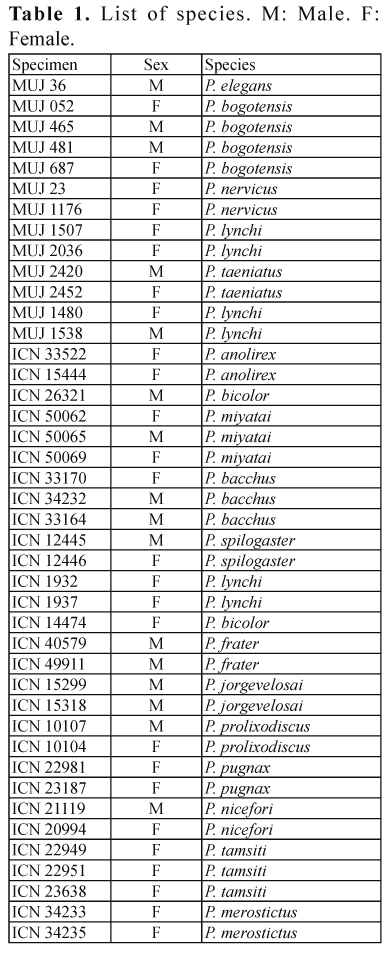
<body><![CDATA[<p>A total of 42 adult specimens (<a href="#tabla1">Table 1</a>)     representing 17 species of <i>Pristimantis</i> of     the Cordillera Oriental of Colombia and one of <i>Craugastor</i> were dissected. Specimens belong to the Museo de Historia Natural (MUJ) of the Pontificia Universidad Javeriana in Bogot&aacute;, Colombia ,     and to the Instituto de Ciencias Naturales (ICN) of the Universidad Nacional de Colombia in Bogot&aacute;.</p>  	       <center>   <img src="/img/revistas/cal/v36n1/v36n1a8tab1.gif"><a name="tabla1"></a>  </center>    <br>  	    <p>Taking into account the     species belonging to the <i>unistrigatus</i> group <i>sensu </i>Hedges <i>et al.</i> (2008), we decided     to compare results considering the former classification made by Lynch &amp; Duellman (1997).We chose the     following two ingroups: <i>sensu </i>Lynch &amp; Duellman (1997) (LD): <i>Pristimantis anolirex</i> (Lynch, 1983): ICN 33522, 15444; <i>P. bacchus</i> (Lynch, 1984): ICN 33164, 33170, 34232; <i>P.     bicolor</i> ( Rueda-Almonacid and Lynch, 1983): ICN     14474, 26321; <i>P. bogotensis</i> (Peters, 1863):     MUJ 052, 465, 481, 687; <i>P. elegans</i> (Peters,     1863): MUJ 036; <i>P. frater</i> (Werner, 1899): ICN     40579, 49911; <i>P</i>. <i>jorgevelosai</i> (Lynch,     1994): ICN 15299, 15318; <i>P. lynchi</i> (Duellman and Simmons, 1977): MUJ 1480, 1538, 1507, 2036;     ICN 01932, 01937; <i>P. merostictus</i> (Lynch,     1984): ICN 34233, 34235; <i>P. miyatai</i> (Lynch,     1984): ICN 50062, 50065, 50069; <i>P. nervicus</i> (Lynch, 1994): MUJ 023<i>,</i>1176;<i> P. nicefori</i> (Cochran and Goin, 1970): ICN 20994, 21119; <i>P. prolixodiscus</i> (Lynch, 1978): ICN 10104, 10107; <i>P. pugnax</i> (Lynch, 1973): ICN 22981, 23187; <i>P. spilogaster</i> (Lynch, 1984): ICN 12445, 12446; <i>P. taeniatus</i> (Boulenger, 1912):     MUJ 2452, 2420; <i>P. tamsitti</i> (Cochran and Goin, 1970): ICN 22949, 22951, 23638; <i>Sensu</i> Hedges <i>et al.</i> (2008) (HEA): <i>P. anolirex</i> (Lynch, 1983),<i> P. bacchus</i> (Lynch, 1984),<i> P. bogotensis</i> (Peters, 1863) ,<i> P. elegans</i> (Peters, 1863),<i> P. lynchi</i> (Duellman and Simmons, 1977),<i> P. merostictus</i> (Lynch, 1984), <i>P. nervicus</i> (Lynch, 1994),<i> P. nicefori</i> (Cochran and Goin, 1970), <i>P. pugnax</i> (Lynch, 1973),<i> P. spilogaster</i> (Lynch, 1984), <i>P. taeniatus</i> (Boulenger,     1912),<i> P. tamsitti</i> (Cochran and Goin, 1970) <i>.</i></p>       <p>Outgroups: <i>Craugastor raniformis</i>:     MUJ 2871, 2689 for the LD matrix, and <i>P. frater</i> for the HEA matrix (<a href="/img/revistas/cal/v36n1/v36n1a8tab2.gif" target="blank">Table 2</a> and <a href="/img/revistas/cal/v36n1/v36n1a8tab3.gif" target="blank">Table 3</a>).</p>       <p>The new classification proposed by Hedges <i>et al.</i> (2008) for some     of the species formerly assigned to <i>unistigatus</i> group is as follows: <i>P. frater</i>: <i>frater</i> group; <i>P. bicolor</i>: species series <i>P</i>.     (<i>Hypodiction</i>) <i>ridens</i>; <i>P</i>.<i>miyatai</i>: <i>P</i>. <i>frater</i> group; <i>P</i>. <i>jorgevelosai</i>:     species series <i>P</i>. (<i>Hypodiction</i>) <i>ridens</i>; and <i>P</i>. <i>prolixodiscus</i>: <i>lacrimosus</i> group.</p>       <p><b>Muscles</b></p>       <p>We observed about 90     small hand and feet muscles,     both superficial and deep, of     which about     50 superficial were chosen. For choosing the characters and states, we did comparisons between muscles from ten     species of <i>Pristimantis </i>used for the     study with respect to different aspects that are related below. Dissections     were done in hands, feet, and legs and forearms in order to examine those     muscles associated morphologically with the hands and feet. We used a     dissecting microscope and a reversible Weigert's iodine solution that stains muscles (Bock &amp; Shear1972) to see the direction     of the fibers, obtaining a clear differentiation of muscles and tendons,     including the origins and insertions.     For all specimens both right and left hands and feet superficial muscles were     dissected and examined, following the protocols proposed by Raikow <i>et al.</i> (1990). For each muscle we identified: a. origin; b. insertion; c. spatial arrangement with     respect to the hand and foot, and d. spatial relationship with adjacent muscles. Although we explored mainly superficial     musculature, we also dissected some deep muscles considering that we took into     account characters proposed by  Burton     (1998a, 2004). The     nomenclature was taken from that proposed by Dunlap (1960), Andersen (1978),  Burton (1998a, 2004), and Salgar <i>et     al. </i>(2009). We     used for most cases, at least one male and one female of each species to the     extent that the number of specimens of the collection allowed it, to determine     the existence of sexual dimorphism. Finally, we drew pictures of characters     considered as potential synapomorphies using photographs and the Adobe Illustrator software.    <br>     For     the accuracy of the origin and insertion of muscles, we made use of clearing     and staining skeletons of <i>P. bogotensis</i>.</p>       <p><b>External characters</b></p>       ]]></body>
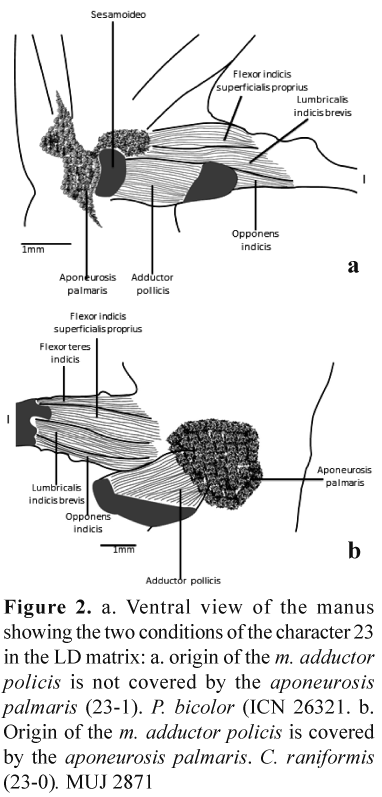
<body><![CDATA[<p>These were taken from taxonomic descriptions after Cochran &amp; Goin (1970), Lynch (1983), Lynch (1984), Rueda &amp; Lynch (1983), Dunn (1944), Hoyos (1991), Pyburn &amp; Lynch (1991), Lynch (1994), Duellman &amp; Simmons (1997), Lynch (1998), Lynch (1978),     and Lynch &amp; Duellman (1980), and after our own     observations. </p>       <p><b>Phylogenetic</b><b> analysis</b></p>       <p>For the phylogenetic analysis, we compared each result taking     into account two matrices (see below). We did heuristic searches in TNT,     performing TBR branch swapping on 100 addition replicates. Matrices were     running considering characters with the same weight. We did not find many intraspecific (polymorphic) variations or many multistate characters, however we use all of those we found for the phylogenetic analyses. Polymorphic characters were coded     according to Faivovich (2002) as follows: A=0/1; B=0/2, and C=1/2, and multistate characters were all     considered nonadditive and unordered. We did not get whether retention (RI)     or consistency indices (CI), given that we are comparing groups of different     sizes (e.g. Conrad 2008), so the value for the CI will be greater in the     HEA ( <i>Sensu</i> Hedges <i>et     al.</i>, 2008) group than in the LD (<i>sensu </i>Lynch &amp; Duellman,     1997) group because we     considered less species in the first group than in the second one, and the RI     will be less in the HEA for the same reason. </p>       <p>We choose one outgroup species for each     analysis, following recommendation by Nixon &amp; Carpenter&nbsp; (1993: 419) about the fact that "…a third pervasive     myth, the notion that more than one outgroup is     somehow required for correct polarity determination", and taking into account     that "Outgroups and polarity are the same problem"     (Nixon Nixon &amp; Carpenter&nbsp;1993: 420). We only show the unambiguous synapomorphies. </p>       <p><b>Results</b></p>       <p>We     scored 81 characters, from which 64 are muscle characters (44 from the manus and 20 from the pes), and     17 external characters. Four manus characters were     taken from    Burton (1998a), and five pes characters from    Burton     (2004). </span>Based on this matrix, we eliminated     those characters according to changes in the taxa for     each matrix as we describe below.</p>       <p><b>Phylogenetic</b><b> analysis</b></p>       <p>LD <i>P. unistrigatus</i> group </p>       <p>By eliminating those characters with only one     character state present in the outgroup and ingroup, we took 70 from the 81 characters     (<a href="/img/revistas/cal/v36n1/v36n1a8anex1.gif" target="blank">Appendix 1</a>). The cladistic analysis resulted in one     fully resolved most-parismonious tree (<a href="/img/revistas/cal/v36n1/v36n1a8fig1.gif" target="blank">Fig. 1</a>) with a     length of 202. We found character states 62(0) (First finger     shorter than second) and 23(1) (The     origin of the <i>m. adductor policis </i>is not     covered by the <i>aponeurosis palmaris</i>) (<a href="#figura2">Fig. 2</a>) as     the only two unambiguous putative synapomorphies. The     first one included almost all species leaving away <i>P. nicefori</i>,     and the second one is a character shared by <i>P. prolixodiscus</i> and <i>P. bicolor</i>.</p> 	       <center>   <img src="/img/revistas/cal/v36n1/v36n1a8fig2.gif"><a name="figura2"></a>  </center>    ]]></body>
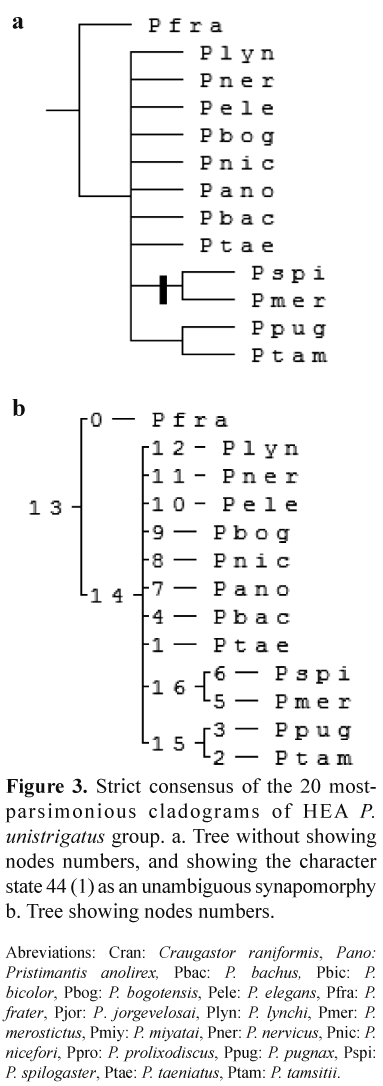
<body><![CDATA[<br>        <p>HEA <i>P. unistrigatus</i> group (<a href="/img/revistas/cal/v36n1/v36n1a8anex2.gif" target="blank">Appendix 2</a>)</p>       <p>We took 60 characters for the analysis (Appendix 2). The cladistic analysis resulted in 20 most-parismonious trees of 139 steps. The strict consensus tree     (<a href="#figura3">Fig. 3</a>) shows a node 14 not resolved, consisting of taxa <i>P. lynchi</i>, <i>P. nervicus</i>, <i>P. elegans</i>, <i>P. bogotensis</i>, <i>P. nicefori</i>, <i>P. anolirex</i>, <i>P. bacchus</i>, and <i>P. taeniatus</i>.</p>  		       <center>   <img src="/img/revistas/cal/v36n1/v36n1a8fig3.gif"><a name="figura3"></a>  </center>    <br>  	    <p>The only unambiguous putative synapomorphy (found in all trees) is the character state     44(1) (Origin of the <i>tendo superficialis hallucis</i> from     the <i>aponeurosis plantaris</i> including some fibers of the <i>m. lumbricalis brevis hallucis</i>) (<a href="#figura4">Fig. 4</a>) relating <i>P. spilogaster </i>and <i>P. merostictus</i>.</p> 		       <center>   <img src="/img/revistas/cal/v36n1/v36n1a8fig4.gif"><a name="figura4"></a>  </center>    <br>        <p><b>DISCUSSION</b></p>       <p>As shown in the cladograms obtained for both <i>unistrigatus</i> groups, the LD     (<a href="/img/revistas/cal/v36n1/v36n1a8fig1.gif" target="blank">Fig. 1</a>) group is more resolved than the strict consensus of the HEA (<a href="#figura3">Fig. 3</a>), but there are no synapomorphies that support it, except partially for nodes 21 and 32 in     LD, and exclusively for node16 in HEA, this means that all topologies are     weakly supported by synapomorphies. In node 22 of DL no synapomorphies were found, whereas for the other nodes, potential synapomorphies are actually reversals or convergences.</p>       ]]></body>
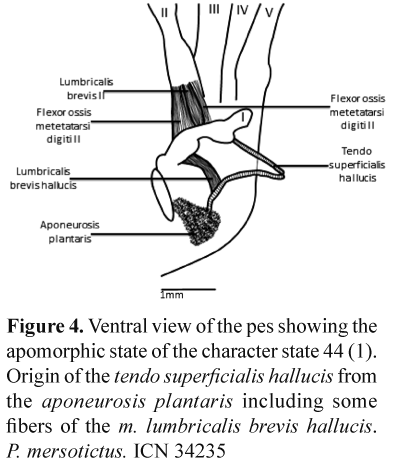
<body><![CDATA[<p>Taking     into account the results and species considered by HEA and LD, we could say     that the assigned HEA <i>unistrigatus</i> group is     weaker because the relationships are less resolved, even if the number of steps     is smaller (it has a smaller number of taxa). On the     other hand, even with a larger number of species involved, the proposed LD <i>unistrigatus</i> group can be considered stronger if we     take the fact that we have got a single tree completely resolved; this does not     mean that we are clear about the putative synapomorphies involved, as we saw above. It is remarkable that the relationships between <i>P. pugnax</i> and <i>P. tamsitti</i>, and between <i>P. spilogaster</i> and <i>P. merostictus </i>are retained in both cladograms, </span>meaning that these species maybe considered sisters,     but without finding putative synapomorphies to     support the relationship between <i>P. pugnax </i>and <i>P. tamsitti.</i></p>       <p><b>Limb     muscles and phylogeny</b></p>       <p>All     characters and character states obtained were chosen bearing in mind character     distribution and conditions deemed to be </span>worth for the analysis. Burton's (1998a, 2004) characters and     character states were used just as he defined them, but in some cases we     believed that some had to be redefined due to the fact that they were not     clearly named. Then, we think that most of these characters are new and very     useful for future analyses in frog morphology and phylogeny studies. It is fascinating how many characters have found on     the hands and feet, although only the superficial muscles have been observed. More     characters were found in the hands (44, including four of Burton)     than in the feet (21, including six of  Burton).     Similarly, after making a clearance based on external descriptions and original observations, we     obtained 26 characters. Faivovich (2002) used 14 characters from the manus and seven from the pes,     from which he found two synapomorphies for <i>Scinax </i>Wagler, 1830 , both from the manus. However,     although we did not find any useful characters taken from hand and foot     musculature, this does not mean that these characters should be dismissed from phylogenetic studies in frogs. Burton (1998a) found some hand muscle     character conditions useful to support intrafamiliar relationships in Leptodactylids. Likewise, Burton     (1998b) found a hand muscle character condition within Ranidae Rafinesque, 1814, stressing that superficial muscles can vary more than deep     ones, but that these muscle can contribute to get frog relationships. It is     apparently historically clear that superficial hand muscles may play a role     more important to resolve frog relationships than superficial feet muscles,     although we found muscles of both that could be putative synapomorphies.</p>       <p><b>External     characters</b></p>       <p>Phylogenetic analysis including external characters is rare in     frogs, although identification of most of the species groups and all species have been based on     these characters. The results show that characteristics of the fingers are     still important, and can be used     in establishing kinship, but were obviously not essential to support the monophyly of the <i>unistrigatus </i>group. Apparently,     the other external characters are     not useful because, in any case, it was     established that they could participate     as potential synapomorphies. Maybe we should pay     attention to the condition of tympanic annulus and to the dorsal view of the     snout because for the two analyses that show that these characters appear as     potential synapomorphies (nodes 21 and 23 respectively     in LD group, and node 15 in     HEA group) , although actually they are homoplasies. </p>       <p>To compare our results with those     by Heinicke <i>et al</i>. (2008) and Hedges <i>et al</i>.     (2008) is difficult, because most of the species included in our work were not     used by these authors. However, our results agree in identifying the <i>unistrigatus</i> group as non monophyletic. Heinicke <i>et al. </i>(2008) only included six spececies belonging to the former <i>P. unistrigatus</i> group (Lynch, 1976; Lynch <i>et al</i>., 1997). Taking into account this     classification, their results showed that this group is monophyletic. However,     based on Hedges <i>et al.</i> (2008) classification <i>P. ockendeni</i>,     in the <i>P. unistrigatus</i> group by Heinicke et al. (2008), belongs to the <i>P. frater</i> group; in this sense,     the group would become not monophyletic. </p>       <p><b>CONCLUSIONS</b></p>       <p>Although the muscles of hands and feet and external     characters useful in taxonomy failed to identify the <i>Pristimantis unistrigatus </i>as monophyletic, this     does not mean they are not useful for     establishing relationships within the genus. It is possible that including more <i>unistrigatus</i> group species in the study, the     situation changes, however, it seems also essential to     include the deep muscles of the hands and feet and external characters as well.     It is possible that other characters facilitate to define relationships among species within the genus. However,     it is necessary to explore deeper the relationship <i>P. spilogaster</i>-<i>P. merostictus</i>, and <i>P. pugnax</i>-<i>P. tamsitti</i>,     because we need whether to confirm or     falsify if these clades actually are     monophyletic. By detecting the difficulties that several researchers (e,g,     Hedges <i>et al</i>. 2008; Padial <i>et al</i>. 2009)     and our own study have found to     discover the monophyly of the <i>P. unistrigatus</i> group and other ones in frogs, the     question we pose is: Is it worthwhile to keep this informal taxonomic hierarchy called group in systematics of frogs?</p>       <p><b>LITERATURE     CITED</b></p>       <!-- ref --><p>1. Acosta, A. R.     2000. Ranas, Salamandras y Caecilias (Tetrapoda: Amphibia) de Colombia. Biota Colombiana 1 (3): 289-319.    &nbsp;&nbsp;&nbsp;&nbsp;&nbsp;&nbsp;&nbsp;&nbsp;[&#160;<a href="javascript:void(0);" onclick="javascript: window.open('/scielo.php?script=sci_nlinks&ref=000072&pid=S0366-5232201400010000800001&lng=','','width=640,height=500,resizable=yes,scrollbars=1,menubar=yes,');">Links</a>&#160;]<!-- end-ref --></p>       <!-- ref --><p>2. Andersen, M.     1978. The comparative myology and osteology of the carpus and     tarsus of selected anurans. Volumes I and II. Ph.D. Dissertation.University of Kansas, Department of Systematics and Ecology. Kansas, USA .     310pp.    &nbsp;&nbsp;&nbsp;&nbsp;&nbsp;&nbsp;&nbsp;&nbsp;[&#160;<a href="javascript:void(0);" onclick="javascript: window.open('/scielo.php?script=sci_nlinks&ref=000074&pid=S0366-5232201400010000800002&lng=','','width=640,height=500,resizable=yes,scrollbars=1,menubar=yes,');">Links</a>&#160;]<!-- end-ref --></p>       <!-- ref --><p>3. Bernal,     X. &amp; F. Guzm&aacute;n. 1999. The     advertisement calls of three <i>Eleutherodactylus</i> species (Anura: Leptodactylidae)     in Colombian highland community. Revista Academia Colombiana de Ciencias     Exactas F&iacute;sicas y Naturales 23(suplemento especial): 261-264.    &nbsp;&nbsp;&nbsp;&nbsp;&nbsp;&nbsp;&nbsp;&nbsp;[&#160;<a href="javascript:void(0);" onclick="javascript: window.open('/scielo.php?script=sci_nlinks&ref=000076&pid=S0366-5232201400010000800003&lng=','','width=640,height=500,resizable=yes,scrollbars=1,menubar=yes,');">Links</a>&#160;]<!-- end-ref --></p>       <!-- ref --><p>4. Bock,     W. &amp; O.R. Shear. 1972.     A staining method for gross dissection of vertebrate     muscles. Anatomischer Anzeiger 130: 222-227.    &nbsp;&nbsp;&nbsp;&nbsp;&nbsp;&nbsp;&nbsp;&nbsp;[&#160;<a href="javascript:void(0);" onclick="javascript: window.open('/scielo.php?script=sci_nlinks&ref=000078&pid=S0366-5232201400010000800004&lng=','','width=640,height=500,resizable=yes,scrollbars=1,menubar=yes,');">Links</a>&#160;]<!-- end-ref --></p>       <!-- ref --><p>5.  Burton, T.C.     1996. Adaptation and evolution in the hand muscles of Australo-Papuan Hylid Frogs (Anura: Hylidae: Pelodryadinae). Australian     Journal of Zoology 44: 611-623.    &nbsp;&nbsp;&nbsp;&nbsp;&nbsp;&nbsp;&nbsp;&nbsp;[&#160;<a href="javascript:void(0);" onclick="javascript: window.open('/scielo.php?script=sci_nlinks&ref=000080&pid=S0366-5232201400010000800005&lng=','','width=640,height=500,resizable=yes,scrollbars=1,menubar=yes,');">Links</a>&#160;]<!-- end-ref --></p>       <!-- ref --><p>6.  Burton, T.C.     1998a. Variation in the hand and superficial throat musculature of neotropical Leptodactylidae frogs. Herpetologica 54: 53-72.    &nbsp;&nbsp;&nbsp;&nbsp;&nbsp;&nbsp;&nbsp;&nbsp;[&#160;<a href="javascript:void(0);" onclick="javascript: window.open('/scielo.php?script=sci_nlinks&ref=000082&pid=S0366-5232201400010000800006&lng=','','width=640,height=500,resizable=yes,scrollbars=1,menubar=yes,');">Links</a>&#160;]<!-- end-ref --></p>       <!-- ref --><p>7.  Burton, T.C.     1998b. Pointing the way: the distribution and evolution of     some characters of the finger muscles of frogs. American Museum Novitates 3229: 1-13.    &nbsp;&nbsp;&nbsp;&nbsp;&nbsp;&nbsp;&nbsp;&nbsp;[&#160;<a href="javascript:void(0);" onclick="javascript: window.open('/scielo.php?script=sci_nlinks&ref=000084&pid=S0366-5232201400010000800007&lng=','','width=640,height=500,resizable=yes,scrollbars=1,menubar=yes,');">Links</a>&#160;]<!-- end-ref --> </p>       <!-- ref --><p>8.  Burton, T.C.     2001. Variation in the foot muscles of frogs of the family Myobatrachidae.     Australian Journal of Zoology 49: 539-559.    &nbsp;&nbsp;&nbsp;&nbsp;&nbsp;&nbsp;&nbsp;&nbsp;[&#160;<a href="javascript:void(0);" onclick="javascript: window.open('/scielo.php?script=sci_nlinks&ref=000086&pid=S0366-5232201400010000800008&lng=','','width=640,height=500,resizable=yes,scrollbars=1,menubar=yes,');">Links</a>&#160;]<!-- end-ref --></p>       <!-- ref --><p>9.  Burton, T.C.     2004. Muscles of the pes of Hylid frogs. Journal of Morphology 260: 209-233.    &nbsp;&nbsp;&nbsp;&nbsp;&nbsp;&nbsp;&nbsp;&nbsp;[&#160;<a href="javascript:void(0);" onclick="javascript: window.open('/scielo.php?script=sci_nlinks&ref=000088&pid=S0366-5232201400010000800009&lng=','','width=640,height=500,resizable=yes,scrollbars=1,menubar=yes,');">Links</a>&#160;]<!-- end-ref --></p>       <!-- ref --><p>10. Cochran     D.M. &amp; C.J. Goin 1970. <i>Frogs of Colombia </i>. United States National Museum Bulletin 288, Smithsonian     Institution Press, Washington D.C. 655 pp.    &nbsp;&nbsp;&nbsp;&nbsp;&nbsp;&nbsp;&nbsp;&nbsp;[&#160;<a href="javascript:void(0);" onclick="javascript: window.open('/scielo.php?script=sci_nlinks&ref=000090&pid=S0366-5232201400010000800010&lng=','','width=640,height=500,resizable=yes,scrollbars=1,menubar=yes,');">Links</a>&#160;]<!-- end-ref --></p>       <!-- ref --><p>11. Conrad, J.L.     2008. Phylogeny and systematics of Squamata (Reptilia) based on     morphology. Bulletin of the American Museum of Natural History     310: 1-182.    &nbsp;&nbsp;&nbsp;&nbsp;&nbsp;&nbsp;&nbsp;&nbsp;[&#160;<a href="javascript:void(0);" onclick="javascript: window.open('/scielo.php?script=sci_nlinks&ref=000092&pid=S0366-5232201400010000800011&lng=','','width=640,height=500,resizable=yes,scrollbars=1,menubar=yes,');">Links</a>&#160;]<!-- end-ref --></p>       <!-- ref --><p>12. Duellman, W.D. &amp; J.B. Pramuk. 1999. Frogs of the Genus <i>Eleutherodactylus: </i>Anura: Leptodactylidae)     in the Andes of Northern Peru. Scientific     Papers, Natural History Museum, The University of Kansas (13):1-78.    &nbsp;&nbsp;&nbsp;&nbsp;&nbsp;&nbsp;&nbsp;&nbsp;[&#160;<a href="javascript:void(0);" onclick="javascript: window.open('/scielo.php?script=sci_nlinks&ref=000094&pid=S0366-5232201400010000800012&lng=','','width=640,height=500,resizable=yes,scrollbars=1,menubar=yes,');">Links</a>&#160;]<!-- end-ref --></p>       <!-- ref --><p>13. Duellman, W.D. &amp; J.E. Simmons. 1977.     A new species of <i>Eleutherodactylus</i>: Anura: Leptodactylidae) from the Cordillera Oriental of Colombia. Proceedings of the Biological Society of Washington     90: 60-65.    &nbsp;&nbsp;&nbsp;&nbsp;&nbsp;&nbsp;&nbsp;&nbsp;[&#160;<a href="javascript:void(0);" onclick="javascript: window.open('/scielo.php?script=sci_nlinks&ref=000096&pid=S0366-5232201400010000800013&lng=','','width=640,height=500,resizable=yes,scrollbars=1,menubar=yes,');">Links</a>&#160;]<!-- end-ref --></p>       <!-- ref --><p>14. Dunlap, D.     1960. The comparative miology of     the pelvic appendage in Salientia. Journal of     Morphology 160: 1-76.    &nbsp;&nbsp;&nbsp;&nbsp;&nbsp;&nbsp;&nbsp;&nbsp;[&#160;<a href="javascript:void(0);" onclick="javascript: window.open('/scielo.php?script=sci_nlinks&ref=000098&pid=S0366-5232201400010000800014&lng=','','width=640,height=500,resizable=yes,scrollbars=1,menubar=yes,');">Links</a>&#160;]<!-- end-ref --></p>       <!-- ref --><p>15. Dunn, E. R.     1944. Herpetology of Bogot&aacute; Area. Revista     de la Academia     Colombiana de Ciencias Exactas, F&iacute;sicas y Naturales 6: 68-81.    &nbsp;&nbsp;&nbsp;&nbsp;&nbsp;&nbsp;&nbsp;&nbsp;[&#160;<a href="javascript:void(0);" onclick="javascript: window.open('/scielo.php?script=sci_nlinks&ref=000100&pid=S0366-5232201400010000800015&lng=','','width=640,height=500,resizable=yes,scrollbars=1,menubar=yes,');">Links</a>&#160;]<!-- end-ref --></p>       <!-- ref --><p>16. Egan, D.     1995. The comparative osteology and miology of the carpus of     the Australian Leptodactylidae. Honors     Dissertation. University of Adelaide. Adelaide, Australia .     58pp.    &nbsp;&nbsp;&nbsp;&nbsp;&nbsp;&nbsp;&nbsp;&nbsp;[&#160;<a href="javascript:void(0);" onclick="javascript: window.open('/scielo.php?script=sci_nlinks&ref=000102&pid=S0366-5232201400010000800016&lng=','','width=640,height=500,resizable=yes,scrollbars=1,menubar=yes,');">Links</a>&#160;]<!-- end-ref --></p>       <!-- ref --><p>17. Faivovich,     J. 2002. A cladistic analysis of <i>Scinax</i> (Hylidae). Cladistics 18: 367-393.    &nbsp;&nbsp;&nbsp;&nbsp;&nbsp;&nbsp;&nbsp;&nbsp;[&#160;<a href="javascript:void(0);" onclick="javascript: window.open('/scielo.php?script=sci_nlinks&ref=000104&pid=S0366-5232201400010000800017&lng=','','width=640,height=500,resizable=yes,scrollbars=1,menubar=yes,');">Links</a>&#160;]<!-- end-ref --> </p>       <!-- ref --><p>18. Frost,     D., T. Grant, J. Faivovich, R. Bai,     A. Haas, C. Haddad, R. De S&aacute;, A. Channing, M.     Wilkinson, S. Donnellan, C. Raxworthy,     J. Campbell, B. Blotto, P. Moler, R. Drewes, R. Nussbaum, J. Lynch, D. Green &amp; W. Wheeler 2006. Tree of life<i>. </i>The amphibian     tree of life. Bulletin of the American Museum of Natural History     297: 1–370.    &nbsp;&nbsp;&nbsp;&nbsp;&nbsp;&nbsp;&nbsp;&nbsp;[&#160;<a href="javascript:void(0);" onclick="javascript: window.open('/scielo.php?script=sci_nlinks&ref=000106&pid=S0366-5232201400010000800018&lng=','','width=640,height=500,resizable=yes,scrollbars=1,menubar=yes,');">Links</a>&#160;]<!-- end-ref --></p>       <!-- ref --><p>19. Galindo,     D. 2004. Filogenia de especies del grupo <i>unistrigatus </i>(<i>sensu </i>Lynch), del g&eacute;nero <i>Eleutherodactylus </i>(Amphibia:     Anura: Leptodactylidae) de la cordillera Oriental de     Colombia. Trabajo de Grado de Pregrado. Pontificia Universidad Javeriana,     Bogot&aacute;, Colombia. 190 pp.    &nbsp;&nbsp;&nbsp;&nbsp;&nbsp;&nbsp;&nbsp;&nbsp;[&#160;<a href="javascript:void(0);" onclick="javascript: window.open('/scielo.php?script=sci_nlinks&ref=000108&pid=S0366-5232201400010000800019&lng=','','width=640,height=500,resizable=yes,scrollbars=1,menubar=yes,');">Links</a>&#160;]<!-- end-ref --></p>       <!-- ref --><p>20. Gaupp, E.1896. A. <i>Ecker's und R. Wiedersheim's Anatomie des Frosches</i>. Friedrich View und Sohn, Braunschweig.    &nbsp;&nbsp;&nbsp;&nbsp;&nbsp;&nbsp;&nbsp;&nbsp;[&#160;<a href="javascript:void(0);" onclick="javascript: window.open('/scielo.php?script=sci_nlinks&ref=000110&pid=S0366-5232201400010000800020&lng=','','width=640,height=500,resizable=yes,scrollbars=1,menubar=yes,');">Links</a>&#160;]<!-- end-ref --> </p>       <!-- ref --><p>21. Glaw, F.M., M. Vences, F. Andreone &amp; D. Vallan. 2001.     Revision of the <i>Boophis majori</i> group (Amphibia&nbsp;: Mantellidae) from Madagascar ,     with the description of five new species. Zoological Journal of the Linnean Society133: 495-529.    &nbsp;&nbsp;&nbsp;&nbsp;&nbsp;&nbsp;&nbsp;&nbsp;[&#160;<a href="javascript:void(0);" onclick="javascript: window.open('/scielo.php?script=sci_nlinks&ref=000112&pid=S0366-5232201400010000800021&lng=','','width=640,height=500,resizable=yes,scrollbars=1,menubar=yes,');">Links</a>&#160;]<!-- end-ref --></p>       <!-- ref --><p>22. Hedges,     S.B., W.E. Duellman &amp; M.P. Heinicke. 2008. New World direct-developing frogs (Anura: Terrarana): Molecular phylogeny, classification,     biogeography, and conservation. <i>Zootaxa </i>1737:     1-182 pp&nbsp;&nbsp;&nbsp;&nbsp;&nbsp;&nbsp;&nbsp;&nbsp;[&#160;<a href="javascript:void(0);" onclick="javascript: window.open('/scielo.php?script=sci_nlinks&ref=000114&pid=S0366-5232201400010000800022&lng=','','width=640,height=500,resizable=yes,scrollbars=1,menubar=yes,');">Links</a>&#160;]<!-- end-ref --><!-- ref --><p>23. Heinicke, M.P., W.E. Duellman &amp; S. B. Hedges. 2007. Major Caribbean and Central American frog     faunas originated by ancient oceanic dispersal. Proceedings of the National Academy     of Sciences of United States   of America 104 (24): 1092-1097.    &nbsp;&nbsp;&nbsp;&nbsp;&nbsp;&nbsp;&nbsp;&nbsp;[&#160;<a href="javascript:void(0);" onclick="javascript: window.open('/scielo.php?script=sci_nlinks&ref=000115&pid=S0366-5232201400010000800023&lng=','','width=640,height=500,resizable=yes,scrollbars=1,menubar=yes,');">Links</a>&#160;]<!-- end-ref --></p>       <!-- ref --><p>24. Hoyos,     J.M. 1991. Aspectos taxon&oacute;micos y patrones de dise&ntilde;o de <i>Eleutherodactylus bogotensis </i>del Parque Nacional Natural Chingaza. Cuadernos Divulgativos 18: 1-12&nbsp;&nbsp;&nbsp;&nbsp;&nbsp;&nbsp;&nbsp;&nbsp;[&#160;<a href="javascript:void(0);" onclick="javascript: window.open('/scielo.php?script=sci_nlinks&ref=000117&pid=S0366-5232201400010000800024&lng=','','width=640,height=500,resizable=yes,scrollbars=1,menubar=yes,');">Links</a>&#160;]<!-- end-ref --><!-- ref --><p>25. Kwet, A. &amp; J. FAIVOVICH. 2001. <i>Protoceratophrys bigibbosa</i> species group (Anura: Leptodactylidae), with description of new species. Copeia 2001: 203-215.    &nbsp;&nbsp;&nbsp;&nbsp;&nbsp;&nbsp;&nbsp;&nbsp;[&#160;<a href="javascript:void(0);" onclick="javascript: window.open('/scielo.php?script=sci_nlinks&ref=000118&pid=S0366-5232201400010000800025&lng=','','width=640,height=500,resizable=yes,scrollbars=1,menubar=yes,');">Links</a>&#160;]<!-- end-ref --></p>       <!-- ref --><p>26. Lynch,     J.D. 1973. A new species of <i>Eleutherodactylus</i> (Amphibia, Leptodactylidae) from Andean Ecuador. Bulletin     of the Southern California Academy of Sciences 72:     107-109.    &nbsp;&nbsp;&nbsp;&nbsp;&nbsp;&nbsp;&nbsp;&nbsp;[&#160;<a href="javascript:void(0);" onclick="javascript: window.open('/scielo.php?script=sci_nlinks&ref=000120&pid=S0366-5232201400010000800026&lng=','','width=640,height=500,resizable=yes,scrollbars=1,menubar=yes,');">Links</a>&#160;]<!-- end-ref --> </p>       <!-- ref --><p>27. Lynch, J.D.     1975a. A review of the broad-headed eleutherodactyline frogs of South America (Leptodactylidae). Occasional Papers of the Museum of Natural History University of Kansas     38: 1-46.    &nbsp;&nbsp;&nbsp;&nbsp;&nbsp;&nbsp;&nbsp;&nbsp;[&#160;<a href="javascript:void(0);" onclick="javascript: window.open('/scielo.php?script=sci_nlinks&ref=000122&pid=S0366-5232201400010000800027&lng=','','width=640,height=500,resizable=yes,scrollbars=1,menubar=yes,');">Links</a>&#160;]<!-- end-ref --></p>       <!-- ref --><p>28. Lynch, J.D.     1975b. The identity of the frog <i>Eleutherodactylus conspicillatus</i> (Günther)     with description of two related species from Northwestern Soth America (Amphibia, Leptodactylidae). Natural History Museum of Los Angeles Contributions in Science 272:     1-19.    &nbsp;&nbsp;&nbsp;&nbsp;&nbsp;&nbsp;&nbsp;&nbsp;[&#160;<a href="javascript:void(0);" onclick="javascript: window.open('/scielo.php?script=sci_nlinks&ref=000124&pid=S0366-5232201400010000800028&lng=','','width=640,height=500,resizable=yes,scrollbars=1,menubar=yes,');">Links</a>&#160;]<!-- end-ref --> </p>       <!-- ref --><p>29. Lynch, J.D.     1976.The species groups of the South American frogs of the genus <i>Eleutherodactylus </i>(Leptodactylidae).     Occasional papers of the Museum of Natural History 61: 1-24.    &nbsp;&nbsp;&nbsp;&nbsp;&nbsp;&nbsp;&nbsp;&nbsp;[&#160;<a href="javascript:void(0);" onclick="javascript: window.open('/scielo.php?script=sci_nlinks&ref=000126&pid=S0366-5232201400010000800029&lng=','','width=640,height=500,resizable=yes,scrollbars=1,menubar=yes,');">Links</a>&#160;]<!-- end-ref --></p>       <!-- ref --><p>30. Lynch, J.D. 1978. A new Eleutherodactyline frog from the     Andes of Northern Colombia (Leptodactylidae). Copeia 1978: 17-21.    &nbsp;&nbsp;&nbsp;&nbsp;&nbsp;&nbsp;&nbsp;&nbsp;[&#160;<a href="javascript:void(0);" onclick="javascript: window.open('/scielo.php?script=sci_nlinks&ref=000128&pid=S0366-5232201400010000800030&lng=','','width=640,height=500,resizable=yes,scrollbars=1,menubar=yes,');">Links</a>&#160;]<!-- end-ref --></p>       <!-- ref --><p>31. Lynch, J.D. 1981. Two     new species of <i>Eleutherodactylus</i> from Western Colombia (Amphibia, Anura, Leptodactylidae). Occasional     Papers of the Museum of Zoology, University     of Michigan 697: 1-12.    &nbsp;&nbsp;&nbsp;&nbsp;&nbsp;&nbsp;&nbsp;&nbsp;[&#160;<a href="javascript:void(0);" onclick="javascript: window.open('/scielo.php?script=sci_nlinks&ref=000130&pid=S0366-5232201400010000800031&lng=','','width=640,height=500,resizable=yes,scrollbars=1,menubar=yes,');">Links</a>&#160;]<!-- end-ref --></p>       <!-- ref --><p>32. Lynch, J.D. 1983. A new Leptodactylid frog from the     Cordillera Oriental of Colombia. <u>In</u>: Rhodin, A. G. J. &amp; Williams, E. E. <i>Advances in     Herpetology and evolutionary biology</i>: 52-57. Museum of   Comparative Zoology, Cambridge, Massachussetts.    &nbsp;&nbsp;&nbsp;&nbsp;&nbsp;&nbsp;&nbsp;&nbsp;[&#160;<a href="javascript:void(0);" onclick="javascript: window.open('/scielo.php?script=sci_nlinks&ref=000132&pid=S0366-5232201400010000800032&lng=','','width=640,height=500,resizable=yes,scrollbars=1,menubar=yes,');">Links</a>&#160;]<!-- end-ref --></p>       <!-- ref --><p>33. Lynch, J.D. 1984. A new species of <i>Eleutherodactylus</i> (Amphibia, Anura: Leptodactylidae)     from Southern Andean Colombia. Herpetologica 40:     234-237.    &nbsp;&nbsp;&nbsp;&nbsp;&nbsp;&nbsp;&nbsp;&nbsp;[&#160;<a href="javascript:void(0);" onclick="javascript: window.open('/scielo.php?script=sci_nlinks&ref=000134&pid=S0366-5232201400010000800033&lng=','','width=640,height=500,resizable=yes,scrollbars=1,menubar=yes,');">Links</a>&#160;]<!-- end-ref --></p>       <!-- ref --><p>34. Lynch, J.D.     1989. Intrageneric Relationships of Mainland <i>Eleutherodactylus </i>(Leptodactylidae) I. A Review of the Frogs     Assigned to the <i>Eleutherodactylus discoidalis </i>species group.Contributions in Biology and Geology, Milwaukee Public Museum 79: 1-25.    &nbsp;&nbsp;&nbsp;&nbsp;&nbsp;&nbsp;&nbsp;&nbsp;[&#160;<a href="javascript:void(0);" onclick="javascript: window.open('/scielo.php?script=sci_nlinks&ref=000136&pid=S0366-5232201400010000800034&lng=','','width=640,height=500,resizable=yes,scrollbars=1,menubar=yes,');">Links</a>&#160;]<!-- end-ref --></p>       <!-- ref --><p>35. Lynch, J.D.     1994a. A new species of High-altitude frog (<i>Eleutherodactylus</i> Leptodactylidae)     from the Cordillera Oriental of Colombia. Revista de la Academia Colombiana     de Ciencias Exactas, F&iacute;sicas y Naturales 19: 195-203.    &nbsp;&nbsp;&nbsp;&nbsp;&nbsp;&nbsp;&nbsp;&nbsp;[&#160;<a href="javascript:void(0);" onclick="javascript: window.open('/scielo.php?script=sci_nlinks&ref=000138&pid=S0366-5232201400010000800035&lng=','','width=640,height=500,resizable=yes,scrollbars=1,menubar=yes,');">Links</a>&#160;]<!-- end-ref --></p>       <!-- ref --><p>36. Lynch, J.D.     1994b. A new species of frog (Genus <i>Eleutherodactylus</i>: Leptodactylidae) from the cloud forest in Departamento de     Santander, Colombia . Revista de la     Academia Colombiana de Ciencias Exactas, F&iacute;sicas y Naturales     19: 205-20.    &nbsp;&nbsp;&nbsp;&nbsp;&nbsp;&nbsp;&nbsp;&nbsp;[&#160;<a href="javascript:void(0);" onclick="javascript: window.open('/scielo.php?script=sci_nlinks&ref=000140&pid=S0366-5232201400010000800036&lng=','','width=640,height=500,resizable=yes,scrollbars=1,menubar=yes,');">Links</a>&#160;]<!-- end-ref --></p>       <!-- ref --><p>37. Lynch, J.D.     1997. Intrageneric relationships of mainland <i>Eleutherodactylus</i> II. A review of the <i>Eleutherodactylus sulcatus</i> group. Revista     de la Academia     Colombiana de Ciencias Exactas, F&iacute;sicas y Naturales 21:     353-372.    &nbsp;&nbsp;&nbsp;&nbsp;&nbsp;&nbsp;&nbsp;&nbsp;[&#160;<a href="javascript:void(0);" onclick="javascript: window.open('/scielo.php?script=sci_nlinks&ref=000142&pid=S0366-5232201400010000800037&lng=','','width=640,height=500,resizable=yes,scrollbars=1,menubar=yes,');">Links</a>&#160;]<!-- end-ref --> </p>       <!-- ref --><p>38. Lynch, J.D. 1998. A new frog (Genus <i>Eleutherodactylus</i>)     from cloud forests of southern Boyac&aacute;. Revista de la Academia Colombiana     de Ciencias Exactas, F&iacute;sicas y Naturales 22: 429-432.    &nbsp;&nbsp;&nbsp;&nbsp;&nbsp;&nbsp;&nbsp;&nbsp;[&#160;<a href="javascript:void(0);" onclick="javascript: window.open('/scielo.php?script=sci_nlinks&ref=000144&pid=S0366-5232201400010000800038&lng=','','width=640,height=500,resizable=yes,scrollbars=1,menubar=yes,');">Links</a>&#160;]<!-- end-ref --></p>       <!-- ref --><p>39. Lynch, J.D.     2001. Four osteological synapomorphies within <i>Eleutherodactylus</i> (Amphibia: Leptodactylidae) and their bearing on subgeneric classifications. Revista de la Academia Colombiana     de Ciencias Exactas, F&iacute;sicas y Naturales 25: 127-136.    &nbsp;&nbsp;&nbsp;&nbsp;&nbsp;&nbsp;&nbsp;&nbsp;[&#160;<a href="javascript:void(0);" onclick="javascript: window.open('/scielo.php?script=sci_nlinks&ref=000146&pid=S0366-5232201400010000800039&lng=','','width=640,height=500,resizable=yes,scrollbars=1,menubar=yes,');">Links</a>&#160;]<!-- end-ref --></p>       <!-- ref --><p>40. Lynch, J.D.     2003. New species of frogs (<i>Eleutherodactylus</i>: Leptodactylidae) from the Cordillera Oriental of     Norte de Santander and Santander, Colombia . Revista     de la Academia     Colombiana de Ciencias Exactas, F&iacute;sicas y Naturales 27:     449-460.    &nbsp;&nbsp;&nbsp;&nbsp;&nbsp;&nbsp;&nbsp;&nbsp;[&#160;<a href="javascript:void(0);" onclick="javascript: window.open('/scielo.php?script=sci_nlinks&ref=000148&pid=S0366-5232201400010000800040&lng=','','width=640,height=500,resizable=yes,scrollbars=1,menubar=yes,');">Links</a>&#160;]<!-- end-ref --></p>       <!-- ref --><p>41. Lynch,     J.D. &amp; M.C. Ardila-Robayo. 1999.     The <i>Eleutherodactylus </i>of the <i>taeniatus</i> complex in Western     Colombia: taxonomy and distribution. Revista de la Academia Colombiana     de Ciencias Exactas, F&iacute;sicas y Naturales 23(89): 615-624.    &nbsp;&nbsp;&nbsp;&nbsp;&nbsp;&nbsp;&nbsp;&nbsp;[&#160;<a href="javascript:void(0);" onclick="javascript: window.open('/scielo.php?script=sci_nlinks&ref=000150&pid=S0366-5232201400010000800041&lng=','','width=640,height=500,resizable=yes,scrollbars=1,menubar=yes,');">Links</a>&#160;]<!-- end-ref --></p>       <!-- ref --><p>42. Lynch,     J.D. &amp; W. Duellman. 1980. The <i>Eleutherodactylus</i> of the Amazonian slopes of the     Ecuadorian Andes (Anura, Leptodactylidae).     The University of Kansas, Lawrence, Kansas     69: 1-86.    &nbsp;&nbsp;&nbsp;&nbsp;&nbsp;&nbsp;&nbsp;&nbsp;[&#160;<a href="javascript:void(0);" onclick="javascript: window.open('/scielo.php?script=sci_nlinks&ref=000152&pid=S0366-5232201400010000800042&lng=','','width=640,height=500,resizable=yes,scrollbars=1,menubar=yes,');">Links</a>&#160;]<!-- end-ref --></p>       <!-- ref --><p>43. Lynch,     J.D. &amp; W. Duellman. 1997. Frogs of     the genus <i>Eleutherodactylus </i>in Western Ecuador. Special publication, No. 23, Natural History     Museum, The University of Kansas, Lawrence, Kansas.    &nbsp;&nbsp;&nbsp;&nbsp;&nbsp;&nbsp;&nbsp;&nbsp;[&#160;<a href="javascript:void(0);" onclick="javascript: window.open('/scielo.php?script=sci_nlinks&ref=000154&pid=S0366-5232201400010000800043&lng=','','width=640,height=500,resizable=yes,scrollbars=1,menubar=yes,');">Links</a>&#160;]<!-- end-ref --></p>       <!-- ref --><p>44. Lynch, J.D. &amp; B. Myers. 1983.     Frogs of the <i>fitzingeri</i> group of <i>Eleutherodactylus</i> in Eastern     Panama and Chocoan South America (Leptodactylidae). Bulletin of the American Museum     of Natural History 175: 484-568.    &nbsp;&nbsp;&nbsp;&nbsp;&nbsp;&nbsp;&nbsp;&nbsp;[&#160;<a href="javascript:void(0);" onclick="javascript: window.open('/scielo.php?script=sci_nlinks&ref=000156&pid=S0366-5232201400010000800044&lng=','','width=640,height=500,resizable=yes,scrollbars=1,menubar=yes,');">Links</a>&#160;]<!-- end-ref --></p>       <!-- ref --><p>45. Lynch,     J.D. &amp; A.M. Su&aacute;rez. 2002. A new frog (<i>Eleutherodactylus</i>: Leptodactylidae)     from the Southern part of the Cordillera Oriental de Colombia. Revista     de la Academia     Colombiana de Ciencias Exactas, F&iacute;sicas y Naturales 24:     289-293.    &nbsp;&nbsp;&nbsp;&nbsp;&nbsp;&nbsp;&nbsp;&nbsp;[&#160;<a href="javascript:void(0);" onclick="javascript: window.open('/scielo.php?script=sci_nlinks&ref=000158&pid=S0366-5232201400010000800045&lng=','','width=640,height=500,resizable=yes,scrollbars=1,menubar=yes,');">Links</a>&#160;]<!-- end-ref --></p>       <!-- ref --><p>46. Nixon,     K. &amp; J.M. Carpenter. 1993. On outgroups. Cladistics 9: 413-426.    &nbsp;&nbsp;&nbsp;&nbsp;&nbsp;&nbsp;&nbsp;&nbsp;[&#160;<a href="javascript:void(0);" onclick="javascript: window.open('/scielo.php?script=sci_nlinks&ref=000160&pid=S0366-5232201400010000800046&lng=','','width=640,height=500,resizable=yes,scrollbars=1,menubar=yes,');">Links</a>&#160;]<!-- end-ref --></p>       <!-- ref --><p>47. Padial, J. M., S. Castroviejo-Fisher, J. Köhler, C. Vil&aacute;, J. C. Chaparro &amp; I. de la Riva. 2009. Deciphering the products of evolution at the     species level: the need for an integrative taxonomy. Zoologica Scripta 38: 431-447.    &nbsp;&nbsp;&nbsp;&nbsp;&nbsp;&nbsp;&nbsp;&nbsp;[&#160;<a href="javascript:void(0);" onclick="javascript: window.open('/scielo.php?script=sci_nlinks&ref=000162&pid=S0366-5232201400010000800047&lng=','','width=640,height=500,resizable=yes,scrollbars=1,menubar=yes,');">Links</a>&#160;]<!-- end-ref --></p>       <!-- ref --><p>48. Pyburn, W.F. &amp; J.D. Lynch. 1981. Two     little-known species of <i>Eleutherodactylus</i> (Amphibia, Leptodactylidae) from     the Sierra de la Macarena, Colombia . Proceedings of the     Biological Society of Washington     94: 404-412.    &nbsp;&nbsp;&nbsp;&nbsp;&nbsp;&nbsp;&nbsp;&nbsp;[&#160;<a href="javascript:void(0);" onclick="javascript: window.open('/scielo.php?script=sci_nlinks&ref=000164&pid=S0366-5232201400010000800048&lng=','','width=640,height=500,resizable=yes,scrollbars=1,menubar=yes,');">Links</a>&#160;]<!-- end-ref --></p>       <!-- ref --><p>49. Raikow, R., A. Bledsoe, B. Myers &amp; C. Welsh. 1990.     Individual variation in avian muscles and its significance for the     reconstruction of phylogeny. Systematic Zoology 39: 362-370.    &nbsp;&nbsp;&nbsp;&nbsp;&nbsp;&nbsp;&nbsp;&nbsp;[&#160;<a href="javascript:void(0);" onclick="javascript: window.open('/scielo.php?script=sci_nlinks&ref=000166&pid=S0366-5232201400010000800049&lng=','','width=640,height=500,resizable=yes,scrollbars=1,menubar=yes,');">Links</a>&#160;]<!-- end-ref --></p>       <!-- ref --><p>50. Reichle, S., S.     Lötters &amp; I. de la Riva. 2001. A new species of the <i>discoidalis</i> group of <i>Eleutherodactylus</i> (Anura, Leptodactylidae) fron Inner-Andean Dry Valley of Bolivia. Journal of     Herpetology 35: 21-26.    &nbsp;&nbsp;&nbsp;&nbsp;&nbsp;&nbsp;&nbsp;&nbsp;[&#160;<a href="javascript:void(0);" onclick="javascript: window.open('/scielo.php?script=sci_nlinks&ref=000168&pid=S0366-5232201400010000800050&lng=','','width=640,height=500,resizable=yes,scrollbars=1,menubar=yes,');">Links</a>&#160;]<!-- end-ref --></p>       <!-- ref --><p>51. Rueda, J.V. &amp; J.D. Lynch. 1983. Una nueva especie de <i>Eleutherodactylus </i>(Amphibia: Leptodactylidae) para la Cordillera Oriental de Colombia. Lozania 42: 1-6.    &nbsp;&nbsp;&nbsp;&nbsp;&nbsp;&nbsp;&nbsp;&nbsp;[&#160;<a href="javascript:void(0);" onclick="javascript: window.open('/scielo.php?script=sci_nlinks&ref=000170&pid=S0366-5232201400010000800051&lng=','','width=640,height=500,resizable=yes,scrollbars=1,menubar=yes,');">Links</a>&#160;]<!-- end-ref --></p>       <!-- ref --><p>52. Salgar,     L. 2003. Miolog&iacute;a de manos y pies de <i>Hyla labialis</i> (Peters, 1883) y de <i>Eleutherodactylus bogotensis</i> (Peters, 1883). Trabajo de Grado, Departamento de     Biolog&iacute;a, Pontificia Universidad Javeriana Bogot&aacute; D.C.     258 pp.    &nbsp;&nbsp;&nbsp;&nbsp;&nbsp;&nbsp;&nbsp;&nbsp;[&#160;<a href="javascript:void(0);" onclick="javascript: window.open('/scielo.php?script=sci_nlinks&ref=000172&pid=S0366-5232201400010000800052&lng=','','width=640,height=500,resizable=yes,scrollbars=1,menubar=yes,');">Links</a>&#160;]<!-- end-ref --></p>       <!-- ref --><p>53. Salgar, L., J.M. Hoyos &amp; A.     Acosta. 2009. New conditions and intraspecific variations in hand and foot muscles in <i>Pristimantis bogotensis</i> (Peters, 1863) (Amphibia:Anura: Strabomantidae). Zootaxa 2025: 56-68.    &nbsp;&nbsp;&nbsp;&nbsp;&nbsp;&nbsp;&nbsp;&nbsp;[&#160;<a href="javascript:void(0);" onclick="javascript: window.open('/scielo.php?script=sci_nlinks&ref=000174&pid=S0366-5232201400010000800053&lng=','','width=640,height=500,resizable=yes,scrollbars=1,menubar=yes,');">Links</a>&#160;]<!-- end-ref --></p> </font>      ]]></body><back>
<ref-list>
<ref id="B1">
<label>1</label><nlm-citation citation-type="journal">
<person-group person-group-type="author">
<name>
<surname><![CDATA[Acosta]]></surname>
<given-names><![CDATA[A. R.]]></given-names>
</name>
</person-group>
<article-title xml:lang="es"><![CDATA[Ranas, Salamandras y Caecilias (Tetrapoda: Amphibia) de Colombia]]></article-title>
<source><![CDATA[Biota Colombiana]]></source>
<year>2000</year>
<volume>1</volume>
<numero>3</numero>
<issue>3</issue>
<page-range>289-319</page-range></nlm-citation>
</ref>
<ref id="B2">
<label>2</label><nlm-citation citation-type="">
<person-group person-group-type="author">
<name>
<surname><![CDATA[Andersen]]></surname>
<given-names><![CDATA[M.]]></given-names>
</name>
</person-group>
<source><![CDATA[The comparative myology and osteology of the carpus and tarsus of selected anurans]]></source>
<year>1978</year>
<volume>I and II</volume>
</nlm-citation>
</ref>
<ref id="B3">
<label>3</label><nlm-citation citation-type="journal">
<person-group person-group-type="author">
<name>
<surname><![CDATA[Bernal]]></surname>
<given-names><![CDATA[X.]]></given-names>
</name>
<name>
<surname><![CDATA[Guzmán]]></surname>
<given-names><![CDATA[F.]]></given-names>
</name>
</person-group>
<article-title xml:lang="en"><![CDATA[The advertisement calls of three Eleutherodactylus species (Anura: Leptodactylidae) in Colombian highland community]]></article-title>
<source><![CDATA[Revista Academia Colombiana de Ciencias Exactas Físicas y Naturales]]></source>
<year>1999</year>
<volume>23</volume>
<page-range>261-264</page-range></nlm-citation>
</ref>
<ref id="B4">
<label>4</label><nlm-citation citation-type="journal">
<person-group person-group-type="author">
<name>
<surname><![CDATA[Bock]]></surname>
<given-names><![CDATA[W.]]></given-names>
</name>
<name>
<surname><![CDATA[Shear]]></surname>
<given-names><![CDATA[O.R.]]></given-names>
</name>
</person-group>
<article-title xml:lang="en"><![CDATA[A staining method for gross dissection of vertebrate muscles]]></article-title>
<source><![CDATA[Anatomischer Anzeiger]]></source>
<year>1972</year>
<volume>130</volume>
<page-range>222-227</page-range></nlm-citation>
</ref>
<ref id="B5">
<label>5</label><nlm-citation citation-type="journal">
<person-group person-group-type="author">
<name>
<surname><![CDATA[Burton]]></surname>
<given-names><![CDATA[T.C.]]></given-names>
</name>
</person-group>
<article-title xml:lang="en"><![CDATA[Adaptation and evolution in the hand muscles of Australo-Papuan Hylid Frogs (Anura: Hylidae: Pelodryadinae)]]></article-title>
<source><![CDATA[Australian Journal of Zoology]]></source>
<year>1996</year>
<volume>44</volume>
<page-range>611-623</page-range></nlm-citation>
</ref>
<ref id="B6">
<label>6</label><nlm-citation citation-type="journal">
<person-group person-group-type="author">
<name>
<surname><![CDATA[Burton]]></surname>
<given-names><![CDATA[T.C.]]></given-names>
</name>
</person-group>
<article-title xml:lang="en"><![CDATA[Variation in the hand and superficial throat musculature of neotropical Leptodactylidae frogs]]></article-title>
<source><![CDATA[Herpetologica]]></source>
<year>1998</year>
<volume>54</volume>
<page-range>53-72</page-range></nlm-citation>
</ref>
<ref id="B7">
<label>7</label><nlm-citation citation-type="journal">
<person-group person-group-type="author">
<name>
<surname><![CDATA[Burton]]></surname>
<given-names><![CDATA[T.C.]]></given-names>
</name>
</person-group>
<article-title xml:lang="en"><![CDATA[Pointing the way: the distribution and evolution of some characters of the finger muscles of frogs]]></article-title>
<source><![CDATA[American Museum Novitates]]></source>
<year>1998</year>
<volume>3229</volume>
<page-range>1-13</page-range></nlm-citation>
</ref>
<ref id="B8">
<label>8</label><nlm-citation citation-type="journal">
<person-group person-group-type="author">
<name>
<surname><![CDATA[Burton]]></surname>
<given-names><![CDATA[T.C.]]></given-names>
</name>
</person-group>
<article-title xml:lang="en"><![CDATA[Variation in the foot muscles of frogs of the family Myobatrachidae]]></article-title>
<source><![CDATA[Australian Journal of Zoology]]></source>
<year>2001</year>
<volume>49</volume>
<page-range>539-559</page-range></nlm-citation>
</ref>
<ref id="B9">
<label>9</label><nlm-citation citation-type="journal">
<person-group person-group-type="author">
<name>
<surname><![CDATA[Burton]]></surname>
<given-names><![CDATA[T.C.]]></given-names>
</name>
</person-group>
<article-title xml:lang="en"><![CDATA[Muscles of the pes of Hylid frogs]]></article-title>
<source><![CDATA[Journal of Morphology]]></source>
<year>2004</year>
<volume>260</volume>
<page-range>209-233</page-range></nlm-citation>
</ref>
<ref id="B10">
<label>10</label><nlm-citation citation-type="book">
<person-group person-group-type="author">
<name>
<surname><![CDATA[Cochran]]></surname>
<given-names><![CDATA[D.M.]]></given-names>
</name>
<name>
<surname><![CDATA[Goin]]></surname>
<given-names><![CDATA[C.J.]]></given-names>
</name>
</person-group>
<source><![CDATA[Frogs of Colombia]]></source>
<year>1970</year>
<volume>288</volume>
<page-range>655</page-range><publisher-loc><![CDATA[Washington^eD.C. D.C.]]></publisher-loc>
<publisher-name><![CDATA[Smithsonian Institution Press]]></publisher-name>
</nlm-citation>
</ref>
<ref id="B11">
<label>11</label><nlm-citation citation-type="journal">
<person-group person-group-type="author">
<name>
<surname><![CDATA[Conrad]]></surname>
<given-names><![CDATA[J.L.]]></given-names>
</name>
</person-group>
<article-title xml:lang="en"><![CDATA[Phylogeny and systematics of Squamata (Reptilia) based on morphology]]></article-title>
<source><![CDATA[Bulletin of the American Museum of Natural History]]></source>
<year>2008</year>
<volume>310</volume>
<page-range>1-182</page-range></nlm-citation>
</ref>
<ref id="B12">
<label>12</label><nlm-citation citation-type="journal">
<person-group person-group-type="author">
<name>
<surname><![CDATA[Duellman]]></surname>
<given-names><![CDATA[W.D.]]></given-names>
</name>
<name>
<surname><![CDATA[Pramuk]]></surname>
<given-names><![CDATA[J.B.]]></given-names>
</name>
</person-group>
<article-title xml:lang="en"><![CDATA[Frogs of the Genus Eleutherodactylus: Anura: Leptodactylidae) in the Andes of Northern Peru]]></article-title>
<source><![CDATA[Scientific Papers, Natural History Museum, The University of Kansas]]></source>
<year>1999</year>
<volume>13</volume>
<page-range>1-78</page-range></nlm-citation>
</ref>
<ref id="B13">
<label>13</label><nlm-citation citation-type="journal">
<person-group person-group-type="author">
<name>
<surname><![CDATA[Duellman]]></surname>
<given-names><![CDATA[W.D.]]></given-names>
</name>
<name>
<surname><![CDATA[Simmons]]></surname>
<given-names><![CDATA[J.E.]]></given-names>
</name>
</person-group>
<article-title xml:lang="en"><![CDATA[A new species of Eleutherodactylus: Anura: Leptodactylidae) from the Cordillera Oriental of Colombia]]></article-title>
<source><![CDATA[Proceedings of the Biological Society of Washington]]></source>
<year>1977</year>
<volume>90</volume>
<page-range>60-65</page-range></nlm-citation>
</ref>
<ref id="B14">
<label>14</label><nlm-citation citation-type="journal">
<person-group person-group-type="author">
<name>
<surname><![CDATA[Dunlap]]></surname>
<given-names><![CDATA[D.]]></given-names>
</name>
</person-group>
<article-title xml:lang="en"><![CDATA[The comparative miology of the pelvic appendage in Salientia]]></article-title>
<source><![CDATA[Journal of Morphology]]></source>
<year>1960</year>
<volume>160</volume>
<page-range>1-76</page-range></nlm-citation>
</ref>
<ref id="B15">
<label>15</label><nlm-citation citation-type="journal">
<person-group person-group-type="author">
<name>
<surname><![CDATA[Dunn]]></surname>
<given-names><![CDATA[E. R.]]></given-names>
</name>
</person-group>
<article-title xml:lang="en"><![CDATA[Herpetology of Bogotá Area]]></article-title>
<source><![CDATA[Revista de la Academia Colombiana de Ciencias Exactas, Físicas y Naturales]]></source>
<year>1944</year>
<volume>6</volume>
<page-range>68-81</page-range></nlm-citation>
</ref>
<ref id="B16">
<label>16</label><nlm-citation citation-type="">
<person-group person-group-type="author">
<name>
<surname><![CDATA[Egan]]></surname>
<given-names><![CDATA[D.]]></given-names>
</name>
</person-group>
<source><![CDATA[The comparative osteology and miology of the carpus of the Australian Leptodactylidae.]]></source>
<year>1995</year>
</nlm-citation>
</ref>
<ref id="B17">
<label>17</label><nlm-citation citation-type="journal">
<person-group person-group-type="author">
<name>
<surname><![CDATA[Faivovich]]></surname>
<given-names><![CDATA[J.]]></given-names>
</name>
</person-group>
<article-title xml:lang="en"><![CDATA[A cladistic analysis of Scinax (Hylidae)]]></article-title>
<source><![CDATA[Cladistics]]></source>
<year>2002</year>
<volume>18</volume>
<page-range>367-393</page-range></nlm-citation>
</ref>
<ref id="B18">
<label>18</label><nlm-citation citation-type="journal">
<person-group person-group-type="author">
<name>
<surname><![CDATA[Frost]]></surname>
<given-names><![CDATA[D.]]></given-names>
</name>
<name>
<surname><![CDATA[Grant]]></surname>
<given-names><![CDATA[T.]]></given-names>
</name>
<name>
<surname><![CDATA[Faivovich]]></surname>
<given-names><![CDATA[J.]]></given-names>
</name>
<name>
<surname><![CDATA[Bai]]></surname>
<given-names><![CDATA[R.]]></given-names>
</name>
<name>
<surname><![CDATA[Haas]]></surname>
<given-names><![CDATA[A.]]></given-names>
</name>
<name>
<surname><![CDATA[Haddad]]></surname>
<given-names><![CDATA[C.]]></given-names>
</name>
<name>
<surname><![CDATA[De Sá]]></surname>
<given-names><![CDATA[R.]]></given-names>
</name>
<name>
<surname><![CDATA[Channing]]></surname>
<given-names><![CDATA[A.]]></given-names>
</name>
<name>
<surname><![CDATA[Wilkinson]]></surname>
<given-names><![CDATA[M.]]></given-names>
</name>
<name>
<surname><![CDATA[Donnellan]]></surname>
<given-names><![CDATA[S.]]></given-names>
</name>
<name>
<surname><![CDATA[Raxworthy]]></surname>
<given-names><![CDATA[C.]]></given-names>
</name>
<name>
<surname><![CDATA[Campbell]]></surname>
<given-names><![CDATA[J.]]></given-names>
</name>
<name>
<surname><![CDATA[Blotto]]></surname>
<given-names><![CDATA[B.]]></given-names>
</name>
<name>
<surname><![CDATA[Moler]]></surname>
<given-names><![CDATA[P.]]></given-names>
</name>
<name>
<surname><![CDATA[Drewes]]></surname>
<given-names><![CDATA[R.]]></given-names>
</name>
<name>
<surname><![CDATA[Nussbaum]]></surname>
<given-names><![CDATA[R.]]></given-names>
</name>
<name>
<surname><![CDATA[Lynch]]></surname>
<given-names><![CDATA[J.]]></given-names>
</name>
<name>
<surname><![CDATA[Green]]></surname>
<given-names><![CDATA[D.]]></given-names>
</name>
<name>
<surname><![CDATA[Wheeler]]></surname>
<given-names><![CDATA[W.]]></given-names>
</name>
</person-group>
<article-title xml:lang="en"><![CDATA[Tree of life: The amphibian tree of life]]></article-title>
<source><![CDATA[Bulletin of the American Museum of Natural History]]></source>
<year>2006</year>
<volume>297</volume>
<page-range>1-370</page-range></nlm-citation>
</ref>
<ref id="B19">
<label>19</label><nlm-citation citation-type="">
<person-group person-group-type="author">
<name>
<surname><![CDATA[Galindo]]></surname>
<given-names><![CDATA[D.]]></given-names>
</name>
</person-group>
<source><![CDATA[Filogenia de especies del grupo unistrigatus (sensu Lynch), del género Eleutherodactylus (Amphibia: Anura: Leptodactylidae) de la cordillera Oriental de Colombia]]></source>
<year>2004</year>
</nlm-citation>
</ref>
<ref id="B20">
<label>20</label><nlm-citation citation-type="book">
<person-group person-group-type="author">
<name>
<surname><![CDATA[Gaupp]]></surname>
<given-names><![CDATA[E.]]></given-names>
</name>
</person-group>
<source><![CDATA[A. Ecker’s und R. Wiedersheim’s Anatomie des Frosches]]></source>
<year>1896</year>
<publisher-loc><![CDATA[Braunschweig ]]></publisher-loc>
<publisher-name><![CDATA[Friedrich View und Sohn]]></publisher-name>
</nlm-citation>
</ref>
<ref id="B21">
<label>21</label><nlm-citation citation-type="journal">
<person-group person-group-type="author">
<name>
<surname><![CDATA[Glaw]]></surname>
<given-names><![CDATA[F.M.]]></given-names>
</name>
<name>
<surname><![CDATA[Vences]]></surname>
<given-names><![CDATA[M.]]></given-names>
</name>
<name>
<surname><![CDATA[Andreone]]></surname>
<given-names><![CDATA[F.]]></given-names>
</name>
<name>
<surname><![CDATA[Vallan]]></surname>
<given-names><![CDATA[D.]]></given-names>
</name>
</person-group>
<article-title xml:lang="en"><![CDATA[Revision of the Boophis majori group (Amphibia : Mantellidae) from Madagascar , with the description of five new species]]></article-title>
<source><![CDATA[Zoological Journal of the Linnean Society]]></source>
<year>2001</year>
<volume>133</volume>
<page-range>495-529</page-range></nlm-citation>
</ref>
<ref id="B22">
<label>22</label><nlm-citation citation-type="journal">
<person-group person-group-type="author">
<name>
<surname><![CDATA[Hedges]]></surname>
<given-names><![CDATA[S.B.]]></given-names>
</name>
<name>
<surname><![CDATA[Duellman]]></surname>
<given-names><![CDATA[W.E.]]></given-names>
</name>
<name>
<surname><![CDATA[Heinicke]]></surname>
<given-names><![CDATA[M.P.]]></given-names>
</name>
</person-group>
<article-title xml:lang="en"><![CDATA[New World direct-developing frogs (Anura: Terrarana): Molecular phylogeny, classification, biogeography, and conservation]]></article-title>
<source><![CDATA[Zootaxa]]></source>
<year>2008</year>
<volume>1737</volume>
<page-range>1-182</page-range></nlm-citation>
</ref>
<ref id="B23">
<label>23</label><nlm-citation citation-type="journal">
<person-group person-group-type="author">
<name>
<surname><![CDATA[Heinicke]]></surname>
<given-names><![CDATA[M.P.]]></given-names>
</name>
<name>
<surname><![CDATA[Duellman]]></surname>
<given-names><![CDATA[W.E.]]></given-names>
</name>
<name>
<surname><![CDATA[Hedges]]></surname>
<given-names><![CDATA[S. B.]]></given-names>
</name>
</person-group>
<article-title xml:lang="en"><![CDATA[Major Caribbean and Central American frog faunas originated by ancient oceanic dispersal]]></article-title>
<source><![CDATA[Proceedings of the National Academy of Sciences of United States of America]]></source>
<year>2007</year>
<volume>104</volume>
<numero>24</numero>
<issue>24</issue>
<page-range>1092-1097</page-range></nlm-citation>
</ref>
<ref id="B24">
<label>24</label><nlm-citation citation-type="journal">
<person-group person-group-type="author">
<name>
<surname><![CDATA[Hoyos]]></surname>
<given-names><![CDATA[J.M.]]></given-names>
</name>
</person-group>
<article-title xml:lang="es"><![CDATA[Aspectos taxonómicos y patrones de diseño de Eleutherodactylus bogotensis del Parque Nacional Natural Chingaza]]></article-title>
<source><![CDATA[Cuadernos Divulgativos]]></source>
<year>1991</year>
<volume>18</volume>
<page-range>1-12</page-range></nlm-citation>
</ref>
<ref id="B25">
<label>25</label><nlm-citation citation-type="journal">
<person-group person-group-type="author">
<name>
<surname><![CDATA[Kwet]]></surname>
<given-names><![CDATA[A.]]></given-names>
</name>
<name>
<surname><![CDATA[FAIVOVICH]]></surname>
<given-names><![CDATA[J.]]></given-names>
</name>
</person-group>
<article-title xml:lang="en"><![CDATA[Protoceratophrys bigibbosa species group (Anura: Leptodactylidae), with description of new species]]></article-title>
<source><![CDATA[Copeia]]></source>
<year>2001</year>
<volume>2001</volume>
<page-range>203-215</page-range></nlm-citation>
</ref>
<ref id="B26">
<label>26</label><nlm-citation citation-type="journal">
<person-group person-group-type="author">
<name>
<surname><![CDATA[Lynch]]></surname>
<given-names><![CDATA[J.D.]]></given-names>
</name>
</person-group>
<article-title xml:lang="en"><![CDATA[A new species of Eleutherodactylus (Amphibia, Leptodactylidae) from Andean Ecuador]]></article-title>
<source><![CDATA[Bulletin of the Southern California Academy of Sciences]]></source>
<year>1973</year>
<volume>72</volume>
<page-range>107-109</page-range></nlm-citation>
</ref>
<ref id="B27">
<label>27</label><nlm-citation citation-type="journal">
<person-group person-group-type="author">
<name>
<surname><![CDATA[Lynch]]></surname>
<given-names><![CDATA[J.D.]]></given-names>
</name>
</person-group>
<article-title xml:lang="en"><![CDATA[A review of the broad-headed eleutherodactyline frogs of South America (Leptodactylidae)]]></article-title>
<source><![CDATA[Occasional Papers of the Museum of Natural History University of Kansas]]></source>
<year>1975</year>
<volume>38</volume>
<page-range>1-46</page-range></nlm-citation>
</ref>
<ref id="B28">
<label>28</label><nlm-citation citation-type="journal">
<person-group person-group-type="author">
<name>
<surname><![CDATA[Lynch]]></surname>
<given-names><![CDATA[J.D.]]></given-names>
</name>
</person-group>
<article-title xml:lang="en"><![CDATA[The identity of the frog Eleutherodactylus conspicillatus (Günther) with description of two related species from Northwestern Soth America (Amphibia, Leptodactylidae)]]></article-title>
<source><![CDATA[Natural History Museum of Los Angeles Contributions in Science]]></source>
<year>1975</year>
<volume>272</volume>
<page-range>1-19</page-range></nlm-citation>
</ref>
<ref id="B29">
<label>29</label><nlm-citation citation-type="journal">
<person-group person-group-type="author">
<name>
<surname><![CDATA[Lynch]]></surname>
<given-names><![CDATA[J.D.]]></given-names>
</name>
</person-group>
<article-title xml:lang="en"><![CDATA[The species groups of the South American frogs of the genus Eleutherodactylus (Leptodactylidae)]]></article-title>
<source><![CDATA[Occasional papers of the Museum of Natural History]]></source>
<year>1976</year>
<volume>61</volume>
<page-range>1-24</page-range></nlm-citation>
</ref>
<ref id="B30">
<label>30</label><nlm-citation citation-type="journal">
<person-group person-group-type="author">
<name>
<surname><![CDATA[Lynch]]></surname>
<given-names><![CDATA[J.D.]]></given-names>
</name>
</person-group>
<article-title xml:lang="en"><![CDATA[A new Eleutherodactyline frog from the Andes of Northern Colombia (Leptodactylidae)]]></article-title>
<source><![CDATA[Copeia]]></source>
<year>1978</year>
<volume>1978</volume>
<page-range>17-21</page-range></nlm-citation>
</ref>
<ref id="B31">
<label>31</label><nlm-citation citation-type="journal">
<person-group person-group-type="author">
<name>
<surname><![CDATA[Lynch]]></surname>
<given-names><![CDATA[J.D.]]></given-names>
</name>
</person-group>
<article-title xml:lang="en"><![CDATA[Two new species of Eleutherodactylus from Western Colombia (Amphibia, Anura, Leptodactylidae)]]></article-title>
<source><![CDATA[Occasional Papers of the Museum of Zoology, University of Michigan]]></source>
<year>1981</year>
<volume>697</volume>
<page-range>1-12</page-range></nlm-citation>
</ref>
<ref id="B32">
<label>32</label><nlm-citation citation-type="book">
<person-group person-group-type="author">
<name>
<surname><![CDATA[Lynch]]></surname>
<given-names><![CDATA[J.D.]]></given-names>
</name>
</person-group>
<article-title xml:lang="en"><![CDATA[A new Leptodactylid frog from the Cordillera Oriental of Colombia]]></article-title>
<person-group person-group-type="editor">
<name>
<surname><![CDATA[Rhodin]]></surname>
<given-names><![CDATA[A. G. J.]]></given-names>
</name>
<name>
<surname><![CDATA[Williams]]></surname>
<given-names><![CDATA[E. E.]]></given-names>
</name>
</person-group>
<source><![CDATA[Advances in Herpetology and evolutionary biology]]></source>
<year>1983</year>
<page-range>52-57</page-range><publisher-loc><![CDATA[Cambridge^eMassachussetts Massachussetts]]></publisher-loc>
<publisher-name><![CDATA[Museum of Comparative Zoology]]></publisher-name>
</nlm-citation>
</ref>
<ref id="B33">
<label>33</label><nlm-citation citation-type="journal">
<person-group person-group-type="author">
<name>
<surname><![CDATA[Lynch]]></surname>
<given-names><![CDATA[J.D.]]></given-names>
</name>
</person-group>
<article-title xml:lang="en"><![CDATA[A new species of Eleutherodactylus (Amphibia, Anura: Leptodactylidae) from Southern Andean Colombia]]></article-title>
<source><![CDATA[Herpetologica]]></source>
<year>1984</year>
<volume>40</volume>
<page-range>234-237</page-range></nlm-citation>
</ref>
<ref id="B34">
<label>34</label><nlm-citation citation-type="journal">
<person-group person-group-type="author">
<name>
<surname><![CDATA[Lynch]]></surname>
<given-names><![CDATA[J.D.]]></given-names>
</name>
</person-group>
<article-title xml:lang="en"><![CDATA[Intrageneric Relationships of Mainland Eleutherodactylus (Leptodactylidae) I: A Review of the Frogs Assigned to the Eleutherodactylus discoidalis species group]]></article-title>
<source><![CDATA[Contributions in Biology and Geology, Milwaukee Public Museum]]></source>
<year>1989</year>
<volume>79</volume>
<page-range>1-25</page-range></nlm-citation>
</ref>
<ref id="B35">
<label>35</label><nlm-citation citation-type="journal">
<person-group person-group-type="author">
<name>
<surname><![CDATA[Lynch]]></surname>
<given-names><![CDATA[J.D.]]></given-names>
</name>
</person-group>
<article-title xml:lang="en"><![CDATA[A new species of High-altitude frog (Eleutherodactylus Leptodactylidae) from the Cordillera Oriental of Colombia]]></article-title>
<source><![CDATA[Revista de la Academia Colombiana de Ciencias Exactas, Físicas y Naturales]]></source>
<year>1994</year>
<volume>19</volume>
<page-range>195-203</page-range></nlm-citation>
</ref>
<ref id="B36">
<label>36</label><nlm-citation citation-type="journal">
<person-group person-group-type="author">
<name>
<surname><![CDATA[Lynch]]></surname>
<given-names><![CDATA[J.D.]]></given-names>
</name>
</person-group>
<article-title xml:lang="en"><![CDATA[A new species of frog (Genus Eleutherodactylus: Leptodactylidae) from the cloud forest in Departamento de Santander, Colombia]]></article-title>
<source><![CDATA[Revista de la Academia Colombiana de Ciencias Exactas, Físicas y Naturales]]></source>
<year>1994</year>
<volume>19</volume>
<page-range>205-20</page-range></nlm-citation>
</ref>
<ref id="B37">
<label>37</label><nlm-citation citation-type="journal">
<person-group person-group-type="author">
<name>
<surname><![CDATA[Lynch]]></surname>
<given-names><![CDATA[J.D.]]></given-names>
</name>
</person-group>
<article-title xml:lang="en"><![CDATA[Intrageneric relationships of mainland Eleutherodactylus II: A review of the Eleutherodactylus sulcatus group]]></article-title>
<source><![CDATA[Revista de la Academia Colombiana de Ciencias Exactas, Físicas y Naturales]]></source>
<year>1997</year>
<volume>21</volume>
<page-range>353-372</page-range></nlm-citation>
</ref>
<ref id="B38">
<label>38</label><nlm-citation citation-type="journal">
<person-group person-group-type="author">
<name>
<surname><![CDATA[Lynch]]></surname>
<given-names><![CDATA[J.D.]]></given-names>
</name>
</person-group>
<article-title xml:lang="en"><![CDATA[A new frog (Genus Eleutherodactylus) from cloud forests of southern Boyacá]]></article-title>
<source><![CDATA[Revista de la Academia Colombiana de Ciencias Exactas, Físicas y Naturales]]></source>
<year>1998</year>
<volume>22</volume>
<page-range>429-432</page-range></nlm-citation>
</ref>
<ref id="B39">
<label>39</label><nlm-citation citation-type="journal">
<person-group person-group-type="author">
<name>
<surname><![CDATA[Lynch]]></surname>
<given-names><![CDATA[J.D.]]></given-names>
</name>
</person-group>
<article-title xml:lang="en"><![CDATA[Four osteological synapomorphies within Eleutherodactylus (Amphibia: Leptodactylidae) and their bearing on subgeneric classifications]]></article-title>
<source><![CDATA[Revista de la Academia Colombiana de Ciencias Exactas, Físicas y Naturales]]></source>
<year>2001</year>
<volume>25</volume>
<page-range>127-136</page-range></nlm-citation>
</ref>
<ref id="B40">
<label>40</label><nlm-citation citation-type="journal">
<person-group person-group-type="author">
<name>
<surname><![CDATA[Lynch]]></surname>
<given-names><![CDATA[J.D.]]></given-names>
</name>
</person-group>
<article-title xml:lang="en"><![CDATA[New species of frogs (Eleutherodactylus: Leptodactylidae) from the Cordillera Oriental of Norte de Santander and Santander, Colombia]]></article-title>
<source><![CDATA[Revista de la Academia Colombiana de Ciencias Exactas, Físicas y Naturales]]></source>
<year>2003</year>
<volume>27</volume>
<page-range>449-460</page-range></nlm-citation>
</ref>
<ref id="B41">
<label>41</label><nlm-citation citation-type="journal">
<person-group person-group-type="author">
<name>
<surname><![CDATA[Lynch]]></surname>
<given-names><![CDATA[J.D.]]></given-names>
</name>
<name>
<surname><![CDATA[Ardila-Robayo]]></surname>
<given-names><![CDATA[M.C.]]></given-names>
</name>
</person-group>
<article-title xml:lang="en"><![CDATA[The Eleutherodactylus of the taeniatus complex in Western Colombia: taxonomy and distribution]]></article-title>
<source><![CDATA[Revista de la Academia Colombiana de Ciencias Exactas, Físicas y Naturales]]></source>
<year>1999</year>
<volume>23</volume>
<numero>89</numero>
<issue>89</issue>
<page-range>615-624</page-range></nlm-citation>
</ref>
<ref id="B42">
<label>42</label><nlm-citation citation-type="journal">
<person-group person-group-type="author">
<name>
<surname><![CDATA[Lynch]]></surname>
<given-names><![CDATA[J.D.]]></given-names>
</name>
<name>
<surname><![CDATA[Duellman]]></surname>
<given-names><![CDATA[W.]]></given-names>
</name>
</person-group>
<article-title xml:lang="en"><![CDATA[The Eleutherodactylus of the Amazonian slopes of the Ecuadorian Andes (Anura, Leptodactylidae)]]></article-title>
<source><![CDATA[The University of Kansas, Lawrence, Kansas]]></source>
<year>1980</year>
<volume>69</volume>
<page-range>1-86</page-range></nlm-citation>
</ref>
<ref id="B43">
<label>43</label><nlm-citation citation-type="book">
<person-group person-group-type="author">
<name>
<surname><![CDATA[Lynch]]></surname>
<given-names><![CDATA[J.D.]]></given-names>
</name>
<name>
<surname><![CDATA[Duellman]]></surname>
<given-names><![CDATA[W.]]></given-names>
</name>
</person-group>
<source><![CDATA[Frogs of the genus Eleutherodactylus in Western Ecuador]]></source>
<year>1997</year>
<volume>23</volume>
<publisher-loc><![CDATA[Lawrence^eKansas Kansas]]></publisher-loc>
<publisher-name><![CDATA[Natural History Museum, The University of Kansas]]></publisher-name>
</nlm-citation>
</ref>
<ref id="B44">
<label>44</label><nlm-citation citation-type="journal">
<person-group person-group-type="author">
<name>
<surname><![CDATA[Lynch]]></surname>
<given-names><![CDATA[J.D.]]></given-names>
</name>
<name>
<surname><![CDATA[Myers]]></surname>
<given-names><![CDATA[B.]]></given-names>
</name>
</person-group>
<article-title xml:lang="en"><![CDATA[Frogs of the fitzingeri group of Eleutherodactylus in Eastern Panama and Chocoan South America (Leptodactylidae)]]></article-title>
<source><![CDATA[Bulletin of the American Museum of Natural History]]></source>
<year>1983</year>
<volume>175</volume>
<page-range>484-568</page-range></nlm-citation>
</ref>
<ref id="B45">
<label>45</label><nlm-citation citation-type="journal">
<person-group person-group-type="author">
<name>
<surname><![CDATA[Lynch]]></surname>
<given-names><![CDATA[J.D.]]></given-names>
</name>
<name>
<surname><![CDATA[Suárez]]></surname>
<given-names><![CDATA[A.M.]]></given-names>
</name>
</person-group>
<article-title xml:lang="en"><![CDATA[A new frog (Eleutherodactylus: Leptodactylidae) from the Southern part of the Cordillera Oriental de Colombia]]></article-title>
<source><![CDATA[Revista de la Academia Colombiana de Ciencias Exactas, Físicas y Naturales]]></source>
<year>2002</year>
<volume>24</volume>
<page-range>289-293</page-range></nlm-citation>
</ref>
<ref id="B46">
<label>46</label><nlm-citation citation-type="journal">
<person-group person-group-type="author">
<name>
<surname><![CDATA[Nixon]]></surname>
<given-names><![CDATA[K.]]></given-names>
</name>
<name>
<surname><![CDATA[Carpenter]]></surname>
<given-names><![CDATA[J.M.]]></given-names>
</name>
</person-group>
<article-title xml:lang="en"><![CDATA[On outgroups]]></article-title>
<source><![CDATA[Cladistics]]></source>
<year>1993</year>
<volume>9</volume>
<page-range>413-426</page-range></nlm-citation>
</ref>
<ref id="B47">
<label>47</label><nlm-citation citation-type="journal">
<person-group person-group-type="author">
<name>
<surname><![CDATA[Padial]]></surname>
<given-names><![CDATA[J. M.]]></given-names>
</name>
<name>
<surname><![CDATA[Castroviejo-Fisher]]></surname>
<given-names><![CDATA[S.]]></given-names>
</name>
<name>
<surname><![CDATA[Köhler]]></surname>
<given-names><![CDATA[J.]]></given-names>
</name>
<name>
<surname><![CDATA[Vilá]]></surname>
<given-names><![CDATA[C.]]></given-names>
</name>
<name>
<surname><![CDATA[Chaparro]]></surname>
<given-names><![CDATA[J. C.]]></given-names>
</name>
<name>
<surname><![CDATA[de la Riva]]></surname>
<given-names><![CDATA[I.]]></given-names>
</name>
</person-group>
<article-title xml:lang="en"><![CDATA[Deciphering the products of evolution at the species level: the need for an integrative taxonomy]]></article-title>
<source><![CDATA[Zoologica Scripta]]></source>
<year>2009</year>
<volume>38</volume>
<page-range>431-447</page-range></nlm-citation>
</ref>
<ref id="B48">
<label>48</label><nlm-citation citation-type="journal">
<person-group person-group-type="author">
<name>
<surname><![CDATA[Pyburn]]></surname>
<given-names><![CDATA[W.F.]]></given-names>
</name>
<name>
<surname><![CDATA[Lynch]]></surname>
<given-names><![CDATA[J.D.]]></given-names>
</name>
</person-group>
<article-title xml:lang="en"><![CDATA[Two little-known species of Eleutherodactylus (Amphibia, Leptodactylidae) from the Sierra de la Macarena, Colombia]]></article-title>
<source><![CDATA[Proceedings of the Biological Society of Washington]]></source>
<year>1981</year>
<volume>94</volume>
<page-range>404-412</page-range></nlm-citation>
</ref>
<ref id="B49">
<label>49</label><nlm-citation citation-type="journal">
<person-group person-group-type="author">
<name>
<surname><![CDATA[Raikow]]></surname>
<given-names><![CDATA[R.]]></given-names>
</name>
<name>
<surname><![CDATA[Bledsoe]]></surname>
<given-names><![CDATA[A.]]></given-names>
</name>
<name>
<surname><![CDATA[Myers]]></surname>
<given-names><![CDATA[B.]]></given-names>
</name>
<name>
<surname><![CDATA[Welsh]]></surname>
<given-names><![CDATA[C.]]></given-names>
</name>
</person-group>
<article-title xml:lang="en"><![CDATA[Individual variation in avian muscles and its significance for the reconstruction of phylogeny]]></article-title>
<source><![CDATA[Systematic Zoology]]></source>
<year>1990</year>
<volume>39</volume>
<page-range>362-370</page-range></nlm-citation>
</ref>
<ref id="B50">
<label>50</label><nlm-citation citation-type="journal">
<person-group person-group-type="author">
<name>
<surname><![CDATA[Reichle]]></surname>
<given-names><![CDATA[S.]]></given-names>
</name>
<name>
<surname><![CDATA[Lötters]]></surname>
<given-names><![CDATA[S.]]></given-names>
</name>
<name>
<surname><![CDATA[de la Riva]]></surname>
<given-names><![CDATA[I.]]></given-names>
</name>
</person-group>
<article-title xml:lang="en"><![CDATA[A new species of the discoidalis group of Eleutherodactylus (Anura, Leptodactylidae) fron Inner-Andean Dry Valley of Bolivia]]></article-title>
<source><![CDATA[Journal of Herpetology]]></source>
<year>2001</year>
<volume>35</volume>
<page-range>21-26</page-range></nlm-citation>
</ref>
<ref id="B51">
<label>51</label><nlm-citation citation-type="journal">
<person-group person-group-type="author">
<name>
<surname><![CDATA[Rueda]]></surname>
<given-names><![CDATA[J.V.]]></given-names>
</name>
<name>
<surname><![CDATA[Lynch]]></surname>
<given-names><![CDATA[J.D.]]></given-names>
</name>
</person-group>
<article-title xml:lang="es"><![CDATA[Una nueva especie de Eleutherodactylus (Amphibia: Leptodactylidae) para la Cordillera Oriental de Colombia]]></article-title>
<source><![CDATA[Lozania]]></source>
<year>1983</year>
<volume>42</volume>
<page-range>1-6</page-range></nlm-citation>
</ref>
<ref id="B52">
<label>52</label><nlm-citation citation-type="">
<person-group person-group-type="author">
<name>
<surname><![CDATA[Salgar]]></surname>
<given-names><![CDATA[L.]]></given-names>
</name>
</person-group>
<source><![CDATA[Miología de manos y pies de Hyla labialis (Peters, 1883) y de Eleutherodactylus bogotensis (Peters, 1883)]]></source>
<year>2003</year>
</nlm-citation>
</ref>
<ref id="B53">
<label>53</label><nlm-citation citation-type="journal">
<person-group person-group-type="author">
<name>
<surname><![CDATA[Salgar]]></surname>
<given-names><![CDATA[L.]]></given-names>
</name>
<name>
<surname><![CDATA[Hoyos]]></surname>
<given-names><![CDATA[J.M.]]></given-names>
</name>
<name>
<surname><![CDATA[Acosta]]></surname>
<given-names><![CDATA[A.]]></given-names>
</name>
</person-group>
<article-title xml:lang="en"><![CDATA[New conditions and intraspecific variations in hand and foot muscles in Pristimantis bogotensis (Peters, 1863) (Amphibia:Anura: Strabomantidae)]]></article-title>
<source><![CDATA[Zootaxa]]></source>
<year>2009</year>
<volume>2025</volume>
<page-range>56-68</page-range></nlm-citation>
</ref>
</ref-list>
</back>
</article>