MARISOL AMAYA-MÁRQUEZ
LAURENCE E. SKOG
LARS PETER KVIST
Instituto de Ciencias Naturales, Universidad Nacional de Colombia, Apartado 7495, Bogotá D.C., Colombia. mamayam@unal.edu.co
Department of Botany, MRC-166, PO Box 37012, Smithsonian Institution, Washington, DC 20013-7012 U.S.A. skogl@si.edu
Institute of Biological Sciences, University of Aarhus, Building 540, Ny Munkegade, DK-8000, Aarhus C., Denmark. lp@hels-gym.dk ]]> ABSTRACTIn this paper two new species of Gesneriaceae (genus Columnea) are described and illustrated. Columnea chocoensis is distributed in the Colombian departments of Chocó and Valle del Cauca, while its variety, C. chocoensis var. altaquerensis is restricted to the Department of Nariño, Colombia. Columnea stilesiana was found in La Serranía de Los Paraguas located in the Cordillera Occidental between the Chocó and Valle del Cauca Departments in Colombia. Further, Columnea archidonae is here considered a variety of C. ericae; Columnea ericae var. archidonae is distributed in Colombia and Ecuador, in forests at elevations higher than those in which the typical variety is found.
Key words. Columnea chocoensis, Columnea stilesiana, Columnea ericae, Gesneriaceae, Chocó Biogeographical Region.
RESUMEN
En este artículo describimos dos nuevas especies de Gesneriaceae (género Columnea). Columnea chocoensis se encuentra distribuida en los departamentos de Chocó y Valle del Cauca en Colombia, y C. chocoensis var. altaquerensis se distribuye en el departamento de Nariño, Colombia. Columnea stilesiana fue hallada en La Serranía de Los Paraguas localizada en la Cordillera Occidental entre los departamentos de Chocó y Valle del Cauca en Colombia. Adicionalmente, aquí se considera a Columnea archidonae como variedad de C. ericae. Columnea ericae var. archidonae se distribuye en Colombia y Ecuador, en bosques de mayor altura que aquellos en los cuales se encuentra la variedad típica.
Palabras clave. Columnea chocoensis, Columnea stilesiana, Columnea ericae, Gesneriaceae, Chocó Biogeográfico.
Recibido: 07/11/2014
Aceptado: 01/10/2015
INTRODUCTION
Taxonomic novelties and nomenclatural changes have arisen during the process of studying material for the taxonomic revision of Columnea L. section Collandra Lem. (Benth.) (Gesneriaceae). Columnea is the most diverse genus of the neotropical Gesneriaceae with more than 205 species (Möller& Clark 2013), and more than 80 species in Colombia, with the Chocó biogeographical region contributing ca. 44% of that diversity (Rangel-Churrio & Rivera-Díaz 2004); recent reports of new species for this region (see Amaya-Márquezet al. 2015) as well as the new species that we report here, support this geographic patterns of diversity. Recent molecular studies have shown that Columnea is a monophyletic group, while the subgeneric classification is not fully supported (Smith et al. 2013). In this paper two species of Columnea, C. stilesiana and C. chocoensis, as well as the variety C. chocoensis var. altaquerensis are reported new for science; the taxonomical placement of these species in section Collandra is discussed. An examination of Columnea ericae Mansf.indicates a wider intraspecific morphological variation, as well as a wider range of geographical distribution for this species. Therefore, a new variety of C. ericae Mansf.is recognized.
]]> MATERIALS AND METHODSHerbarium specimens (101) were examined under a binocular microscope (Nikon SMZ-1) using lens 33×/6, Columnea chocoensis var. chocoensis (4), C. chocoensis var. altaquerensis (11), C. ericae var. ericae (46), C. ericae var. archidonae (28), and C. stilesiana (12). The full descriptions of the species follow the traditional taxonomic procedure (i.e., Winston 1999) which comprises: protologue including synonymy when necessary, etymology, phenology, geographical distribution, representative specimens, and distinctive characters.
RESULTS AND DISCUSSION
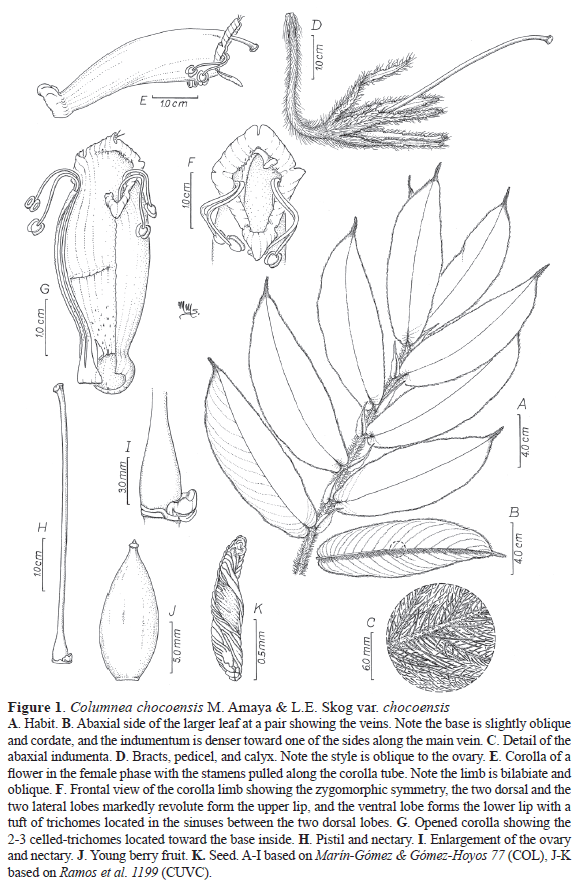
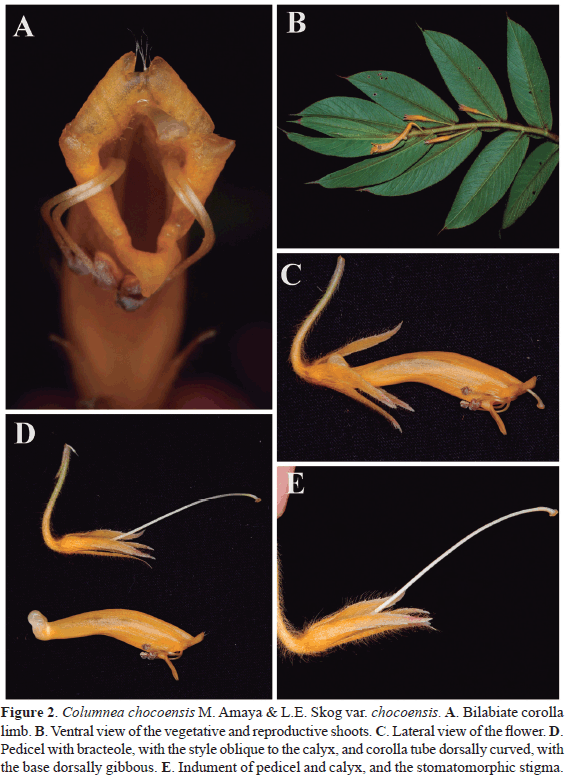
Columnea chocoensis M. Amaya & L.E. Skog, sp. nov. (Figure 1 and Figure 2).
TYPE: COLOMBIA: Chocó: Municipio de San José del Palmar, vereda San Antonio, Escuela San Antonio, 4°52'N, 76°13'W, 1650 m, 13 May 2011, Marín-Gómez, O. H. & D. A. Gómez-Hoyos 77 (Holotype: COL; isotype: US).
Columnea chocoensis differs from any other known Columnea by having a long, dorsally recurved tubular corolla with a narrow bilabiate limb, and exserted stamens and style.
]]> Terrestrial suffrutescent, 0.2-1 m tall. Stem green, terete, densely golden pilose; internodes 1.8-3.5 cm. Leaves opposite, strongly anisophyllous in a pair, papyraceous to chartaceous. Larger leaf sessile; blade asymmetric, narrowly oblong to lanceolate, 11.5-16 × 3.2-4.5 cm, base slightly oblique, cordate, apex acuminate, margin serrate, irregularly spaced, adaxially dark green, glabrous, except on the margin where it is pilose (5-10-celled trichomes), abaxially pale green, red at the apex, or at the apex and at the apical margin above the middle, pilose, more dense on the veins (10-celled trichomes), 15-16 veins on the larger side of the blade. Smaller leaf sessile; blade asymmetric, lanceolate, 2.0-3.2 × 0.4-0.6 cm, base oblique, apex long attenuate, margin serrate, adaxially glabrous, except on the margin, abaxially densely pilose (5-10-celled trichomes). Inflorescence reduced to one flower in the axil of the larger leaf in each pair; two bracteoles 0.4-0.6 × 0.1-0.2 cm, pale yellow, lanceolate, totally covered on both sides with trichomes 0.7-0.8 cm long. Flowers pedicellate, pedicels apically swollen, 3-3.2 cm long, densely pilose and with sparsely glandular trichomes.Calyx yellow, sepals free, subequal, lanceolate, 2.3-2.5 × 0.3-0.4 cm, adaxially glabrous, abaxially pilose (7-10-celled trichomes) and with sparsely glandular trichomes, margin dentate, 6 teeth per side.Corolla yellow, slightly oblique in the calyx, tube dorsally recurved, 4.7 cm long on the larger side (dorsal) and 3.7 cm long on the shorter side (ventral), 1.3 cm wide at the wider part before the limb, 1.7 cm at the limb, basally constricted to 0.4 cm wide, base dorsally gibbous, gibbosity 0.4 × 0.8 cm; limb oblique, bilabiate, upper lip formed by the two dorsal and two lateral rounded and revolute lobes, 0.7 × 0.4 cm, ventral lobe very wide, oblong, 0.7 × 0.4 cm; corolla outside glabrous, except for a few long trichomes on the sinuses between the two dorsal lobes, inside sparsely pilose (2-3-celled trichomes), apically densely glandular between the two dorsal lobes, and more sparse on the other lobes. Androecium of 4 exserted stamens, filaments 5-5.5 cm long, apically glabrous, basally pilose, connate at base for 0.4 cm forming a staminal blade; anthers dorsally subquadrate, 2 × 2.5 mm. Gynoecium with ovary conic, 5-6 × 2.5-3 mm, glabrous; style 4.5 cm long, glabrous, stigma stomatomorphic. Nectary of two dorsal connate glands, 4.0 × 1.5 mm. Fruit a pale yellow, pointed berry, 1.2 × 0.6 cm. Seeds brown, 1.2 × 0.2 mm, obliquely striate.Etymology: The species epithet refers to the Chocó Biogeographical Region, where the species is distributed in Colombia.
Phenology: Flowers have been recorded from a specimen collected in May, and fruits from another specimen collected in August.
Distribution: Colombia (Valle del Cauca, Chocó) at 1650-1800 m alt.
Paratype: COLOMBIA. Chocó: Municipio San José del Palmar, vereda Río Negro, Cerro Torrá, near the heliport, 12 Aug.1988, 1800 m, Ramos, J. E. et al. 1199 (CUVC, US).
Distinctive features: Columnea chocoensis is easily recognized by presenting the following characteristics: the plant is terrestrial of 0.2-1 m height, its shoots extended horizontally in a similar way to the climber conspecifics. The plant has long trichomes, especially on the stems and on the abaxial surfaces of the leaves (Figures 1A, 1C), however, the trichomes are absent on the adaxial face, except for a ca. 2 mm wide border along the margin where the trichomes are abundant and homogenously distributed. The inflorescences are reduced to solitary flowers located in the axil of the larger leaf, the bracteoles may not be seen by the casual observer, due to their reduced size (0.4 × 0.2 cm), and because they are totally covered on both sides by trichomes 0.7-0.8 cm long (Figure 1D). The corolla is yellow, slightly oblique in the calyx, long, narrow and bilabiate (Figures 2C); the four lobes of the upper lip are revolute, and the ventral lobe is very broadly oblong, with anthers and stigma exserted from the corolla (Figures 2A). Usually the bilabiate corollas in Columnea are wide at the limb and the upper lip is formed by two lobes, while in C. chocoensis the limb is almost as narrow as the rest of the corolla tube, and the upper lip is formed by four lobes, giving to the corolla a distinctive aspect that helps to distinguish this species from other species within the genus.
We recognized two varieties of Columnea chocoensis. The typical variety is restricted to the Chocó and Valle del Cauca Departments in Colombia, while the second variety (below) is distributed southern, in the Nariño Department. The three departments make up part of the Chocó Biogeographical region.
Columnea chocoensis M. Amaya & L.E. Skog var. altaquerensis L.E. Skog var. nov. (Figure 3).
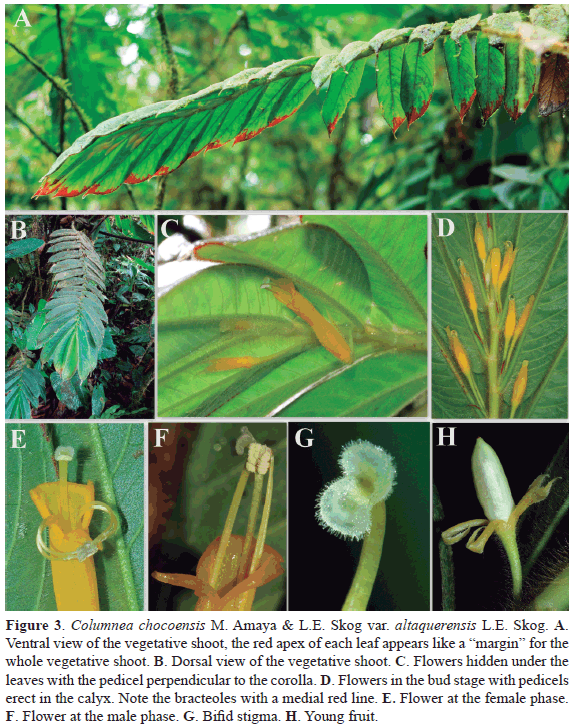
Differs from the typical variety by having: (1) the adaxial face of leaves hispid (vs. glabrous); (2) a larger and asymmetric red spot on the lower side of the larger leaf, which as a whole forms a red "margin" of the shoot (Figure 3A); (3) a shorter pedicel 2.0-2.2 cm (vs. 3.0-3.2 cm); (4) bracteoles with a medial red line on the abaxial side (Fig. 3D); (5) sepals 1.9-2.1 × 0.2-0.3 cm (vs. 2.3-2.5 × 0.3-04 cm), (6) corolla 4.1 cm long (vs. 4.7 cm in the typical variety); (7) smaller nectary 1.5 × 1.5 mm (vs. 4.0 × 1.5 mm); and (8) a bifid stigma (vs. stomatomorphic) (Fig. 3G).
Etymology: The name refers to Altaquer where the Natural Reserve of the Ñambí River is located (Department of Nariño, Colombia), and acknowledges the efforts made by local people to preserve the natural patrimony and the high biological diversity harbored in the area.
Phenology: Flowers have been recorded on the specimens collected in March, July, and August.
Distribution: Colombia (Nariño) at 1100-1500 m, in premontane pluvial forests.
Representative specimens: COLOMBIA. Nariño: Municipio Barbacoas, Corregimiento Altaquer, vereda El Barro. Natural Reserve Río Ñambí, 1°18'N, 78°8'W, 1325 m, Franco, P. et al. 4942 (COL); 1100-1400 m, Salinas, N. R. et al. 317 (COL); 1350-1400 m, Pipoly, J. et al. 21325 (PSO, CUVC); 1250-1350 m, Pipoly, J. et al. 21586 (PSO), 1325 m, Betancur, J. et al. 4384 (COL); 1°19'N, 78°05'W, 1300 m, Arias, J. C. 107 (PSO); 1°17'37.5''N, 78°5'44.7''W, 1350 m, Marín-Gómez, O. H. 265 (MO), 298 (COL).
Columnea chocoensis var. chocoensis and var. altaquerensis both exhibit the floral mechanism of dynamic herkogamy associated with protandry, which is known to occur in other species of Columnea (Morley 1974; Amaya-Márquezined.). At the end of the male phase, the filaments usually coil and pull the anthers inside at the base of the corolla, creating an efficient physical separation between the female and male parts. After anthesis in both varieties of C. chocoensis the stamens are no longer functional and they bend down remaining outside the corolla (Figure 3E). Columnea chocoensis var. altaquerensis has been more widely collected than the typical variety, however all the collections come from the Natural Reserve Río Ñambi, suggesting that this variety might be endemic to the region, or that more botanical exploration is required in the Nariño and Cauca departments.
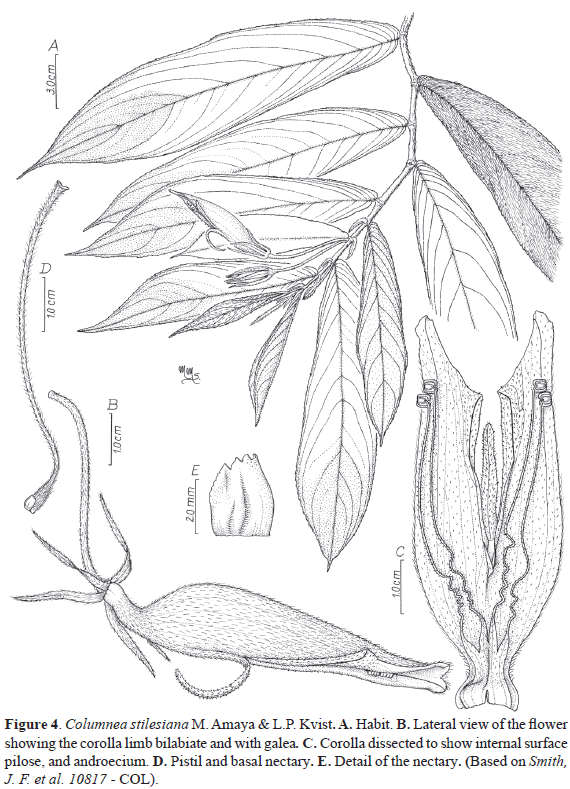
Columnea stilesiana M. Amaya & L.P. Kvist sp. nov. (Figure 4 and Figure 5)
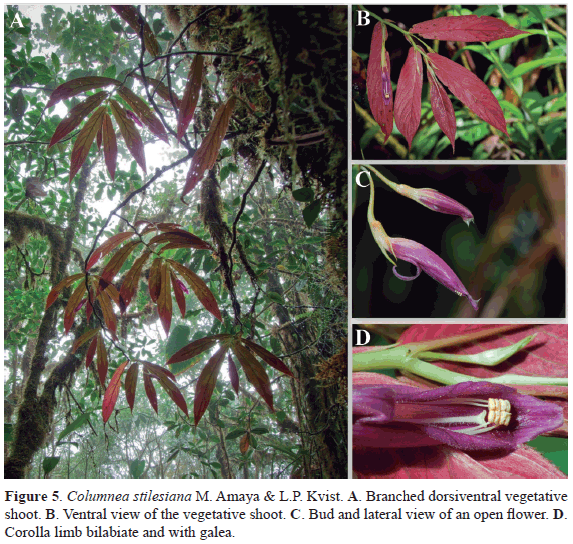
TYPE: COLOMBIA. Valle del Cauca: Limit between the municipalities of El Cairo and San José del Palmar; sector La Florida, trail Los Santicos-La Florida, Natural Reserve Cerro del Inglés. 4.74°N, 76.29°W, 2177 m, 20 May 2013, Smith, J. F. et al. 10817 (Holotype: COL; isotypes: US, SRP).
Columnea stilesiana differs from C. ericae Mansf. by the absence of bracts (having only a pair of tiny, caduceus bracteoles), larger pedicels, and larger, violet-magenta corollas.
Suffrutescent climber. Stem sub-terete, apically canaliculate, 0.3-0.8 cm diam., indument sericeous with sparsely setulose, white unicellular trichomes; internodes 1.4-5 cm long. Leaves opposite, strongly anisophyllous in a pair, membranous, less often papyraceous. Larger leaf sessile; blade asymmetric, oblanceolate to narrow oblong, 13.5-25 × 2.9-5 cm, base oblique, apex long acuminate, margin dentate, adaxially green, sericeous, sometimes with sparsely white setulose (1-2-celled trichomes); abaxially totally reddish with deep purple on almost 1/2 of the apical foliar area, sericeous, trichomes more dense on the veins; 10-11 veins on the larger side of the blade. Smaller leaf sessile; blade asymmetric, lanceolate, 1.4-2.2 × 0.2-0.3 cm, base oblique, apex long acuminate, margin serrate, adaxially green, sericeous, abaxially reddish, sericeous. Inflorescence reduced to 1, rarely 2 flowers in the axil of the larger leaf; bracteoles 2, unequal, 3.5-8 × 1 mm, densely sericeous on both faces, caducous. Flowers pedicellate, pedicel 3.8-4.7 cm long, sericeous. Calyx pale green, sepals nearly free, the lobes connate basally for 1-2 mm of their length, subequal, lanceolate, 1.9-3 × 0.2 cm, adaxially sericeous, abaxially densely sericeous, margin dentate, 6 teeth per side. Corolla purple-magenta, basally white; tube sigmoid and dorsally curved, 6-7.6 cm long, 1.4-1.6 cm wide at the widest part (which coincides with the corolla apex where the ventral lobe originates); basally gibbous, gibbosity 0.6-1 × 0.2-0.4 cm; limb bilabiate, oblique, upper limb formed by the two dorsal lobes (which form an ample galea) and the two lateral triangular lobes, the ventral lobe 1.8-3 × 0.1-0.3 cm; corolla outside translucent sericeous, inside sparsely pilose (4 celled-trichomes), the limb densely glandular (2-4-celled trichomes plus the glandular head). Androecium of 4 stamens, filaments 5.2-6.1 cm long, hairy along their length and basally connate for 1 cm forming a staminal blade folded and open dorsally; anther 2 × 1.9 mm, connective subquadrate, basally sagittate, thecae elliptic with longitudinal dehiscence. Gynoecium with ovary conic, 0.8 × 0.2 cm, densely sericeous; style laminar, 5.4-6.2 cm long, densely pilose, with uniseriate and glandular trichomes (2-6-celled plus glandular head), more dense apically; stigma bilobulate and recurved, papillate. Nectary of one dorsal tridentate or tetradentate gland, 3 × 2.5 mm, less often two dorsal bidentate glands, 2 × 1 mm each. Fruit a white, ovoid berry, 2.2 × 0.9 cm. Seeds light brown, darker at the ends, elliptic, obliquely striated, 1.3 × 0.8 mm.
Etymology: The species epithet honors Frank Garfield Stiles, an eminent scientist who has contributed enormously to the understanding of the ecology of tropical birds, particularly to the study of neotropical hummingbird, which are pollinators of the species of Columnea. Dr. Stiles is an excellent professor who has contributed to the education of several generations of biologists at the Universidad Nacional de Colombia. In the past the senior author was one of those fortunate students.
Phenology: Columnea stilesiana has been recorded with flowers in January, February, March, May, and August.
Distribution: This species is distributed in the Colombian Biogeographical Chocó Region (Departments of Chocó and Valle del Cauca) in forest located between 1600-2300 m alt.
Representative specimens: COLOMBIA. Chocó: San José del Palmar, Carretera Ansermanuevo-San José del Palmar. Alto de Galápagos, 2000 m, Forero, E. et al. 2846 (COL, MO, US); Vereda el Corcovado, finca Ayaconas, 2140 m, Franco, P. et al. 1591 (COL); Cerro del Torrá, eastern slopes of Río Negro, vereda del río negro, near heliport, 1630 m, Ramos, J. E. et al. 1056 (CUVC, US); Valle del Cauca: El Cairo, vereda El Brillante, Reserva comunitaria Cerro El Inglés, 4°44'N, 76°18'W, 2200-2300 m, Marín-Gómez, O. H. et al. 7 (COL); 4°45'N, 76°17'W, Marín-Gómez, O. H. et al. 181 (COL); vereda El Brillante, Cordillera Occidental, Serranía de Los Paraguas, Natural Reserve La Fontana, Montoya-Dossman, D. 102 (CUVC); Corregimiento El Boquerón, vereda El Brillante. Natural Reserve Cerro El Inglés, trail to the place La Florida by the Alto Los Santicos, 4°45'28.1''- 4°46'37'' N, 76°18'3.4''-76°18'26.1''W, 1710-2210 m, Clavijo, L. et al. 1706 (COL, US, CUVC).
Columnea ericae Mansf., Repert. Spec. Nov. Regni Veg. 36: 123. 1934, var. ericae. Dalbergaria ericae Wiehler, Phytologia 27: 317. 1973.
]]> TYPE: ECUADOR: Napo: Tena, Hacienda Dos Ríos, 700 m, 8 Apr. 1933, Heinrichs, E. 323 (Holotype: B, no longer extant); ECUADOR: Napo: Río Wai Si Ayá, a northern tributary to Río Aguarico, 1.5 km up the river on a small path going in direction SE, 0°15'S, 76°21'W, 300 m, Brandbyge et al. 32643 (Neotype: AAU; isoneotype: US designated by Kvist & Skog, Allertonia 6: 355, 1993). (Figure 6 and Figure 7).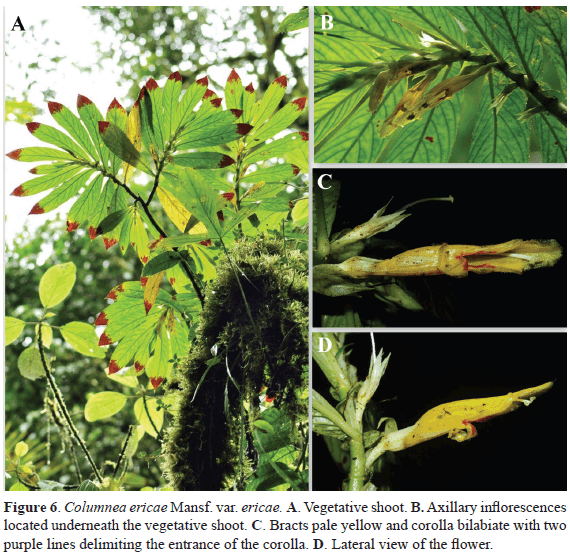
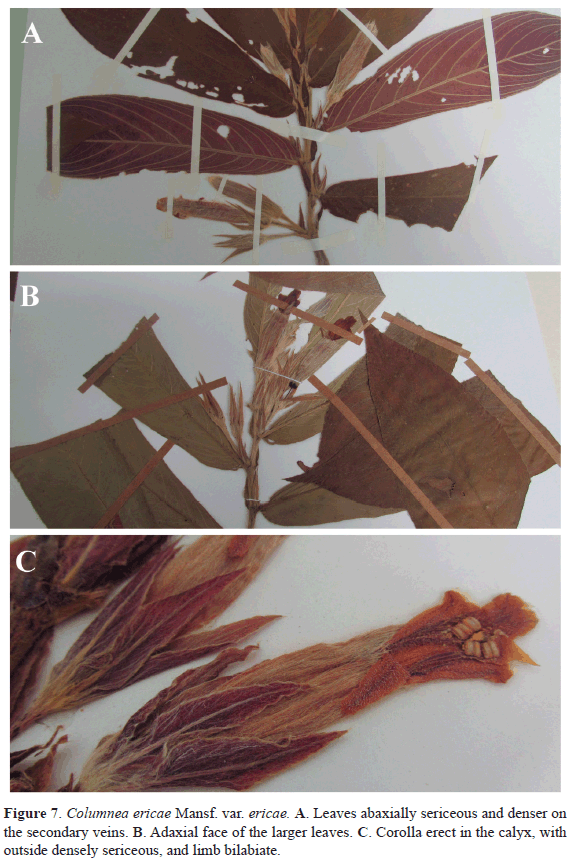
Suffrutescent vine. Stem green, subterete, 0.6-1.3 cm in diam., canaliculate, sericeous (5-12- celled trichomes), glandular on the nodes; internodes 0.7-3.0 cm long. Leaves opposite, strongly anisophyllous in a pair, papyraceous. Larger leaf sessile or shortly petiolate, petioles 0.1-0.3 cm long, sericeous; blade asymmetric, oblanceolate to narrow oblong, 8.5-27.0 × 2.8-7.6 cm, base oblique, apex acuminate, margin serrate, adaxially green, sericeous (5-10-celled trichomes) with sparse setulose, white unicellular trichomes, abaxially green or reddish, red or deep purple in the apical 1/3 or 1/5 of the foliar area, sparsely sericeous and more dense on the main veins, 11 (rarely 7-14) veins on the larger side of the blade. Smaller leaf sessile; blade asymmetric, lanceolate, 1.0-3.5 × 0.2-0.8 cm, base oblique, apex acuminate, margin serrate, adaxially green, sericeous (5-10-celled trichomes) with sparse white, setulose trichomes, abaxially green, sparsely sericeous (5-7-celled trichomes) with sparse white setulose trichomes. Inflorescence fasciculate (cymose), with 1-3 flowers in the axil of the larger leaf; bracts 2-5, yellow, lanceolate, 0.8-2.3 × 0.1-0.6 cm, sericeous on both faces.Flowers pedicellate, pedicels 0.6-3.8 cm long, densely golden-sericeous (10-14-celled trichomes).Calyx pale green, yellow, or yellow with a red midline on each sepal; sepals free, unequal, lanceolate, 1.7-3 × 0.3-0.4 cm, adaxially and abaxially sericeous, margin dentate with 3-4 tiny teeth per side. Corolla yellow with two deep purple vertical stripes along both sides of the ventral lobe, tube sigmoid, 5-7 cm long, constricted at base to 0.5 cm, base dorsally gibbous, gibbosity 0.4 × 0.3 cm; 1.0-1.1 cm wide at middle and throat, 1.3 cm wide at limb, the limb bilabiate and oblique, the upper lip formed by the two dorsal and the two lateral lobes, 1.5-1.8 × 1.5-1.8 cm, the lower lip formed by the ventral lobe, 1.0-2.8 × 0.2-0.4 cm, corolla outside densely sericeous (5-10-celled trichomes), inside pilose, glandular on the limb on all five lobes (2-3-celled uniseriate trichomes with a glandular apical head). Androecium of 4 stamens, filaments laminar, 4-4.5 cm long, pilose along their length, basally connate for 0.5 cm forming a staminal blade; anthers quadrate, 0.2 × 0.2 cm. Gynoecium with ovary oblique to the style, conic, 0.5 × 0.2 cm, densely sericeous; style laminar, pilose with simple and glandular trichomes, 4.2- 4.5 cm long; stigma bilobate. Nectary of one dorsal bidentate- or tridentate-gland, 0.2 × 0.3 cm. Fruit a berry, 1.3 × 1.2 cm. Seeds amber-colored, 0.2 × 0.1 cm, obliquely striated.
Etymology: The species name 'ericae' honors the collector of the holotype, Miss Erica Heinrichs, who collected plants in Ecuador during the 1930s.
Phenology: The examined specimens show that this species produces flowers all year round; fruits were recorded on a specimen collected in June.
Distribution: Columnea ericae has been collected mainly in the lowland rain forest in the plains of the Amazon Basin, and also in the Andean piedmont in southeastern Colombia (Amazonas, Caquetá, Putumayo, Vaupés) at 90-1000 m alt., eastern Ecuador (Morona-Santiago, Napo, Pastaza, Tungurahua, Zamora) at 270-2200 m alt., and eastern Peru (Amazonas, Cajamarca, Huanuco, Loreto, Pasco, San Martín) at 100-1650 m.
Representative specimens: COLOMBIA. Amazonas: Between rivers Putumayo and Purité, 3°32'9.8''S, 69°53'27.26''W, Guataquira S. et al. 13 (COL); P.N.N. Amacayacu, Río Amacayacu, trail San Martín-Cotué before CañoAguapudre, 90 m, Pinilla, N. et al. 323 (COL); Río Amacayacu 20 km de son embouchure sur l'Amazone, maloca Impata, Sastre, L. G. & R. Echeverry 565 (COL, P). Caquetá: 21 km from Florencia towards Altamira, 915 m, Luteyn, J. et al. 4949 (COL, NY, SEL); 28 km E of Morelia toward Río Pescado, 260 m, Gentry, A. et al. 9084 (COL, MO); Cordillera Oriental, eastern slope, bank of Río Hacha, 1000 m, Cuatrecasas, J. 9004-A (COL); Florencia-Guadalupe road, km 21, 670 m, Londoño, X. & L. P. Kvist 129 (COL, US); Florencia-Guadalupe road, km 26, 750 m, Londoño, X. & L. P. Kvist 150 (COL, US); Solano, bank of Río Mesay. Estación Puerto Abeja, sector sur-oriental P.N.N. Chiribiquete, 0°4'27"N, 72°27'5"W, Rosero, L. 143 (COL). Putumayo: Orito, Vereda San Andrés, forest on the right side of the road from Orito to inspección Tesalia, 0°40'30''N, 76°45'30''W, 410 m, Rodríguez, N. et al. 793 (COL); vereda El Libano, predio Umiyac, 00°40'53.8''N, 77°2'7.2''W, 775-850 m, Giraldo, I. et al. 165A (COL); Puerto Porvenir, arriba de Puerto Ospina, hacia la Loma, 230-250 m, Cuatrecasas, J. 10628 (COL, F, US); Slopes and road sides along road from Mocoa to Pto. Asís at km 27, 670 m, Luteyn, J. et al. 5061 (COL, NY). Vaupés: Forest between Apaporis and Vaupés rivers, path from Puerto Naré to Victoria, 300 m, Schultes, R. E. 5361 (COL, F, GH, US). ECUADOR. Pichincha: Mission Shandia, Jatun Yaku river, Barclay, H. G. 4986 (COL); Reserva Florística-Ecológica Río Guajalito, km 59 on the old road Quito-Sto. Domingo de los Colorados, 3.5 km NE of the road. Eastern slopes of Volcán Pichincha, 0°13›53»S, 78°48›10»W, 2200 m, Grijalva, E. 304 (MO); Morona-Santiago: Tiwintza, region of the Cordillera del Condór. Center Shuar Kaputna, S. of Río Santiago, 3°1'10"S, 77°55'31"W, 270 m, Kajekai, C. 1080 (MO); from Macas across Río Upano for about 15 km and then a 5 km hike by foot into the Cordillera de Cutucú, after 2.5 km across a river via steel basket on a cable, then another 2.5 km upward, Wiehler, H. et al. 8817 (US); Gualaquiza-Indaza, km. 20 between Túmbez and Tucumbatza, 1600 m, Harling, G. & L. Andersson 24388 (GB, SEL, US); San Juan Bosco road between San Juan Bosco and El Pangui, 2-3 km S of San Juan Bosco, 3°8''36''S, 78°32'13''W, 1291, Clark, J. L. et al. 9872 (AAU, COL, MO, NY, QCNE, SEL, UNA, US). Napo: Archidona, Ribera del Río Alpayacu, Bloque 19, líneasísmica 22, Helipuerto 6 Compañía Triton, 0°52'S, 77°24'W, 480 m, Vargas, H. & P. Grefa 857 (US); Loreto, National Park Sumaco, matorral de bambú, bloque 19, líneasismica 22, compañía Triton, 0°47'S, 77°28'W, 500 m, Freire, E. & J. Cerda 229 (US); Río Wai Si Ayá, 5 km upstream from the outlet in Río Aguarico, 0°15'S, 76°21'W, 300 m, Brandbyge, J. et al. 33370 (AAU, US); Río Cosanga, 1920 m, Boeke, J. D. & J. B. McElroy 410 (NY, SEL, US). Pastaza: Motolo, in the vicinity of Shell-Mera (Pastaza), Lugo, H. 690 (SEL, US); Vicinity of Puyo, eastern foot-hills of the Andes, 750-1000 m, Skutch, F. 4418 (A, F, GH, MO, NY, US); Vicinity of Shell, ca. 1 km, 0°29'39"S, 78°3'52"W, 1085 m, Croat, T. B. & L. Hannon 87061 (MO); Pozo Villano, 2 km from Arco 2 km from town Villano, 1°25'S, 77°20'W, 400 m, Tipaz, G. et al. 576 (US). Tungurahua: CantónBaños, Parroquia Río Negro, locality near Río Topo, 1°23'8.7''S, 78°10'1.2''W, 1400 m, Clark, J. L. & V. Duran 6006 (AAU, COL, QCA, QCNE, US); Baños, Parroquia Río Verde, sector Machay, along forested trail (from Baños-Puyo road) toward Cascada de San Miguel via San Agustin, 1°23›5››S, 78°16›50››W, 1800-2200 m, Clark, J. L. et al. 5697 (AAU, COL, K, NY MO, QCA, QCNE, US). Zamora-Chinchipe: Jamboe Bajo, Eastern border of Podocarpus National Park, 4°5›S, 78ª55›W, 1100 m, Clark, J. L. et al. 3292 (AAU, COL, E, GB, LOJA, MO, NY, QCNE, SRP, US); Vicinity of Tandaime, above the junction to Condor Mirador, sandstone plateau of Cordillera del Condor, 3°35'54"S, 78°29'14"W, 1420 m, Croat, T. M. & G. Ferry 98854 (MO). PERU. Amazonas: Bagua, Aramango, trail Nueva Esperanza-Catarata, 5°29'54"S, 78°20'00"W, 1650 m, Vásquez, R. et al. 27349 (MO). Cajamarca: San Ignacio, Huarango, poblado Selva Andina, road leading to the "captación de agua", 5°3'50"S, 78°43'19"W, 2378 m, Perea, J. et al. 3818 (MO). Huanuco: Pachitea, Codo de Pozuzo, alluvial fan floodplain of Río Pozuzo after it emerges from mountains, 9°40'S, 75°25'W, 450 m, Foster, R. 9184A (MO, USM). Loreto: Maynas, Explornapo Camp, Inventario McArthur, near Sucusari, along river Napo, 3°20´S, 72°55´W, 100-140 m, Pipoly, J. et al. 13048 (COL, MEXU), 14009 (COL); Ravine Paparo, tributary of Río Manatí, 3°45'S, 72°55'W, 110 m, Vásquez, R. & N. Jaramillo 11670 (MO). Pasco: Oxapampa, Distrito Iscozacín, Pariona, W. & J. Ruiz 1042 (MO); 2-3 km E of Iscosacin, 10°11'S, 75°13'W, 400 m, Smith, D. 2866 (MO); Palcazu valley, Izcozacin, trail to Villa America, 4 km from airstrip, 10°12'S, 75°15'W, 400 m, Foster, R. et al. 7893 (MEXU, MO, US, USM). San Martín: Lamas, Distrito Alonso de Alvarado, San Juan de Pacaizapa, km 72 highway Tarapoto-Moyobamba, 1000-1050 m, Schunke, J. 9629 (GH, MEXU, MO, U, US).
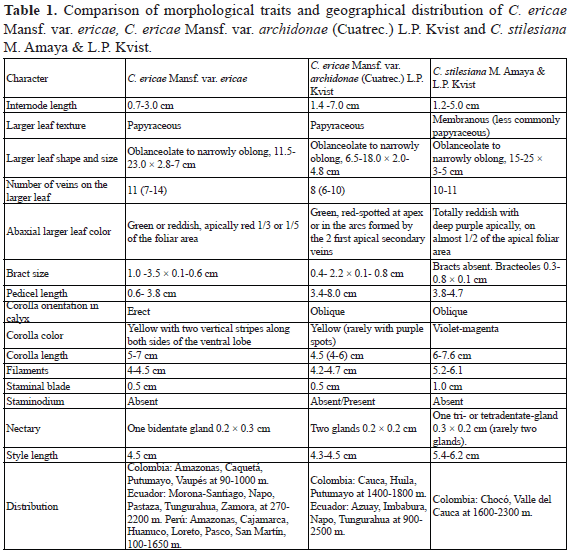
]]> Distinctive charactersColumnea ericae var. ericae can be recognized by having the following traits: (1) a sericeous dorsiventral vegetative shoot, with short internodes; (2) the larger leaf in a pair oblanceolate, adaxially green, abaxially green less often reddish with contrasting red or deep purple in the apical 1/3 or 1/5 of the foliar area, 11 veins (rarely 7-14); (3) inflorescences with two to three pedicellate flowers usually adpressed to the ventral side of the vegetative shoot, bracts lanceolate, 1-3.5 × 0.2-0.8 cm; and (4) pedicels densely sericeous, 0.6-3.8 cm long, corolla erect in the calyx, limb bilabiate, yellow with two deep purple vertical stripes along both sides of the ventral lobe, and a nectary of one dorsal gland (Figure 6 and Figure 7). This variety is similar to C. ericae var. archidonae, and to C. stilesiana, although it can be differentiated from them by the shorter pedicel, the corolla color, and additional differences presented in Table 1.
Columnea ericae Mansf.var. archidonae (Cuatrec.) L.P. Kvist comb. et stat. nov.
Columnea archidonae Cuatrec., Anales Ci. Univ. Madrid 4: 245 (reprint p. 42). 1935. Dalbergaria archidonae (Cuatrec.) Wiehler, Phytologia 27: 316. 1973.
TYPE: ECUADOR: Napo: Between Baeza and Archidona, Mar.-Apr., 1865, Isern, J. 497 (Lectotype: MA - designated by Kvist & Skog Allertonia 6: 355, 1993) (Figure 8).
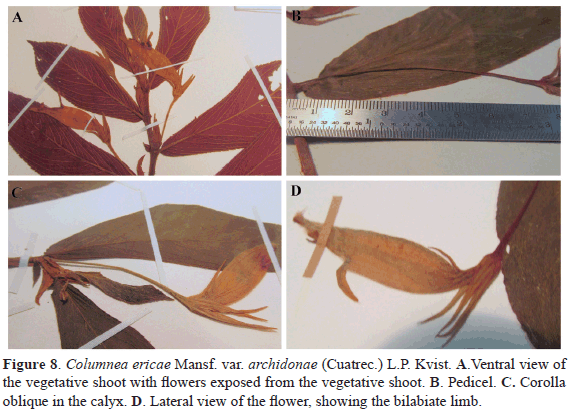
Columnea ericae var. archidonae differs from the typical variety by having smaller leaves, bracts, and corollas, while the internodes and the pedicels are longer. The corolla is oblique in the calyx, homogenously yellow (rarely with purple spots), remarkably curved dorsally, the red marks below the larger leaf do not extend to the apex, the spots do not have a defined shape, and are distributed along the arcs subtended by the two apical secondary veins; the flowers often present a staminode; the nectary consists of 2 (rarely 4 glands). In general, the flowers of this variety are more exposed, i.e., they are not adpressed to the vegetative shoot (Figure 8).
]]> Etymology: The epithet used by José Cuatrecasas to name Columnea archidonae refers to Archidona, a colonial town north of Tena (Napo Province, Ecuador) from where the species was originally collected.Phenology: Specimens with flowers have been recorded in almost all months of the year, except February, August, and October.
Distribution: Columnea ericae var. archidonae has been collected in the Andean foothill forest in southern Colombia (Cauca, Huila, Putumayo) at 1400-1800 m alt., and central Ecuador (Azuay, Imbabura, Napo, Tungurahua) at 900-2500 m.
Representative specimens: COLOMBIA. Cauca: Municipio de Santa Rosa, Vereda La Petrolera, Bota Caucana, NE slope of the Serranía de Los Churumbelos, Road between Pitalito and Mocoa, Antena Inravisión, 1800 m, González, C. E. 1958 (CAUP, COL); Bota caucana, Corregimiento San Juan de Villalobos, vereda La Esmeralda, 1°33'18.7"N, 76°18'18.6"W, 1686 m, Munar, D. M. 613 (CAUP); Huila: Municipio Acevedo, National Natural Park Cueva de los Guacharos, between cabin Andaqui and El Pesebre, 1°36'N, 76° 6'W, 1900-2001 m, Ramírez, B. et al. 14934 (CAUP); Río Villalobos, vicinity of Río Suazita, 1400 m, Schultes, R. E. & M. Villareal 5196 (COL, US); Putumayo: Mocoa: road between Mocoa and Pitalito, Fernández, J. L. 11474 (COL|). ECUADOR. Azuay: Near Cola de San Pablo entrance, Wiehler, H. et al. 8641 (US); Imbabura: Cantón, Ibarra Parroquia: Lita. Comunidad de San Francisco next to Río Verde, 0°45'21"N, 78°27'09"W, 900-1100 m, Clark, J. L. et al. 7519 (QCA, QCNE, SEL, US); Morona-Santiago: Cantón, Limón Indasa main road between Gualaceo and Plan de Milagro, "Tinajillas," 3°0'19"S, 78°36'36"W, 2800 m, Clark, J. L. et al. 5906 (COL, HA, MO, QCNE, US); Napo: Cantón El Chaco, Río Granadillo, campamento de Inecel "Codo Alto", 0°8'S, 77°28'W, 1300 m, Palacios, W. 5599 (US); Cantón Quijos, ParroquíaCosanga, Yanayacu, Biological Station and Center for Creative Studies, 5 km W of Cosanga (vía de Las Caucheras road), 0°35'93"S, 77°53'37"W, 2200 m, Clark, J. L. & H. F. Greeny 5770 (K, QCA, QCNE, SRP, US); Quijos, Sierra Azul (agricola Industrial Río Aragón), campamento Estero Chico, 00°41'S, 77°56'W, 2500 m, Alvarez, A. et al. 554 (US); Sierra Azul (agricola Industrial Río Aragón), Cedroyacu, 0°41'S, 77°57'W, 2100 m, Alvarez, A. et al. 231 (US); Quijos Cantón, Reserva Ecológica Antisana, Río Aliso 8 km SW of Cosanga, 00°36'S, 77°57'W, 2390 m, Vargas, H. et al. 2925 (US); Tena cantón, Parque Nacional Llanganates, via Salcedo-Tena, km 74-75, margen del Río Mulatos, 1°0'S, 78°11'W, 1950 m, Vargas, H. et al. 2383 (US); Pastaza: Road Puyo-Macas, ca. 15 km SW of Puyo, Lugo, H. 4702 (GB, SEL, US); Tungurahua: Baños, National Park Llanganates, Cordillera Sacha Llanganates, trial along Río Zuñac, 1°22'50''S, 78°9'44''W, 1500 m, Neill, D. et al. 13541 (US); Cantón Baños, 7 km SW of Baños, 10-11 road-km SW of main highway, Comunidad Viscaya. 1°20'35"S, 78°23'44"W, 2500 m, Clark, J. L. et al. 7752 (AAU, MO, QCA, QCNE, SEL, UNA, US); Parroquia Rio Negro, near Río Topo. Locality near Río Topo, 1°23›8.7»S, 78°10›0.12»W, 1400 m, Clark, J. L. & V. Duran 6013 (AAU, COL, NY, QCA, QCNE).
Columnea ericae var. archidonae was initially described as Columnea archidonae (Cuatrecasas 1935), later it was reduced to the synonymy of C. ericae Mansf. (Kvist & Skog 1993) because the similarity of these two species. However, detailed morphological analysis carried out in the present study, evidence two distinctive taxonomic entities, with consistent morphological patterns and geographical distributions (Table 1). We decided to give a new status to C. archidonae Cuatrec. as a variety of C. ericae. Future ecological and molecular studies will determine if these two entities correspond to two different species. The Colombian specimens coming from the Departments of Cauca and Huila vary from the rest of the studied specimens in that they have a larger and narrower oblong leaf which is membranous rather than papyraceous. It might correspond to a local phenotype of the populations from which the specimens were collected.
C. chocoensis and C. stilesiana are assigned here to section Collandra based on the following characteristics: dorsiventral shoots with anisophyllous sessil leaves, red/purple color patterns in the abaxial face. However, both species present unusual flower characteristics in Collandra; C. chocoensis has a bilabiate narrow limb with the upper limb formed by four lobes, instead of two, and C. stilesiana has corolla violet-magent, and it has a galea. Therefore, the taxonomic placement of the species described here might be temporal, waiting for molecular phylogenies that include these or similar species in their analysis.
ACKNOWLEDGMENTS
The authors thank the following: The National University of Colombia, Smithsonian Institution, and Aarhus University for the opportunity to do research on Gesneriaceae; Oscar Humberto Marín Gómez for discussion, for permission to use his photographs in this publication, and for his help with the figures; Marcela Morales for the preparation of the drawings; Diego Giraldo Cañas for providing helpful comments on the early version of the manuscript; Carlos Parra for discussion; Laura Clavijo for her collaboration with the collections; Ayda Patiño for her support to MAM during her visit to the PSO; the following herbaria for allowing to study the collections A, AAU, COL, CUVC, E, F, MEXU, MO, MG, NY, PSO, QCA, QCNE, SEL, SRP, U and US. Three anonymous reviewers who helped to increase the quality of this paper with their valuable observations. The FundaciónEcológica los Colibríes de Altaquer (FELCA): Mauricio Florez Pai, OrganizaciónAmbiental Comunitaria (SERRANIAGUA): Johnier Arango Bermudez and Diego Gómez Hoyos (WCS Colombia) for their interest and support to the studies on the plant-hummingbird interaction.
LITERATURE CITED
1. Amaya-Márquez, M., L. Clavijo & O. H. Marín-Gómez. 2015. Columnea longipedicellata a new species of Gesneriaceae from Colombia. Phytotaxa 217 (3): 273-278. [ Links ]
2. Cuatrecasas, J. 1935. Gesneriaceae, pp.42-57. I: Plantae Isernianae, I. p.42 (reprint of Anales Univ. Madrid, Ciencias 4(2): 206-265, p.245). [ Links ]
3. Kvist, L.P. & L.E. Skog. 1993. The genus Columnea (Gesneriaceae) in Ecuador. Allertonia 6 (5): 327-400. [ Links ]
4. Möller, M. & Clark, J.L. 2013. The state of molecular studies in the family Gesneriaceae: review. Selbyana 31: 95–125. [ Links ]
5. Morley, B.D. 1974. Notes on some critical characters in Columnea classification.Ann. Missouri Bot. Gard. 61: 514-525. [ Links ]
6. Rangel-C., J.O. & O. Rivera-Díaz. 2004 Diversidad y riqueza de espermatófitos en el Chocó Biogeográfico. In: Rangel-Ch., J.O. (ed.) Colombia Diversidad Biótica IV Universidad Nacional de Colombia, Bogotá D.C., pp. 83–104. [ Links ]
7. Smith, J.F., Ooi, M.T., Schulte, L., Amaya-Márquez, M., Pritchard, R. & Clark, J.L. 2013. Searching for monophyly in the subgeneric classification systems of Columnea (Gesneriaceae). Selbyana 31: 126–142. [ Links ]
8. Winston, J. E. 1999. Describing Species Practical Taxonomic Procedure for Biologists. Columbia University Press. New York. [ Links ]
]]>