<?xml version="1.0" encoding="ISO-8859-1"?><article xmlns:mml="http://www.w3.org/1998/Math/MathML" xmlns:xlink="http://www.w3.org/1999/xlink" xmlns:xsi="http://www.w3.org/2001/XMLSchema-instance">
<front>
<journal-meta>
<journal-id>0366-5232</journal-id>
<journal-title><![CDATA[Caldasia]]></journal-title>
<abbrev-journal-title><![CDATA[Caldasia]]></abbrev-journal-title>
<issn>0366-5232</issn>
<publisher>
<publisher-name><![CDATA[Instituto de Ciencias Naturales, Facultad de Ciencias-Universidad Nacional de Colombia]]></publisher-name>
</publisher>
</journal-meta>
<article-meta>
<article-id>S0366-52322015000200004</article-id>
<article-id pub-id-type="doi">10.15446/caldasia.v37n2.54374</article-id>
<title-group>
<article-title xml:lang="en"><![CDATA[DRYMONIA SQUAMOSA (GESNERIACEAE), A NEW SPECIES FROM LAS ORQUÍDEAS NATIONAL NATURAL PARK (ANTIOQUIA, COLOMBIA)]]></article-title>
<article-title xml:lang="es"><![CDATA[Drymonia squamosa (Gesneriaceae), una especie nueva del Parque Nacional Natural Las Orquídeas (Antioquia, Colombia)]]></article-title>
</title-group>
<contrib-group>
<contrib contrib-type="author">
<name>
<surname><![CDATA[CLAVIJO]]></surname>
<given-names><![CDATA[LAURA]]></given-names>
</name>
<xref ref-type="aff" rid="A01"/>
</contrib>
<contrib contrib-type="author">
<name>
<surname><![CDATA[CLARK]]></surname>
<given-names><![CDATA[JOHN L.]]></given-names>
</name>
<xref ref-type="aff" rid="A02"/>
</contrib>
</contrib-group>
<aff id="A01">
<institution><![CDATA[,The University of Alabama Department of Biological Sciences ]]></institution>
<addr-line><![CDATA[Tuscaloosa Alabama]]></addr-line>
<country>USA</country>
</aff>
<aff id="A02">
<institution><![CDATA[,The Lawrenceville School Science Department ]]></institution>
<addr-line><![CDATA[Lawrenceville New Jersey]]></addr-line>
<country>USA</country>
</aff>
<pub-date pub-type="pub">
<day>12</day>
<month>30</month>
<year>2015</year>
</pub-date>
<pub-date pub-type="epub">
<day>12</day>
<month>30</month>
<year>2015</year>
</pub-date>
<volume>37</volume>
<numero>2</numero>
<fpage>271</fpage>
<lpage>277</lpage>
<copyright-statement/>
<copyright-year/>
<self-uri xlink:href="http://www.scielo.org.co/scielo.php?script=sci_arttext&amp;pid=S0366-52322015000200004&amp;lng=en&amp;nrm=iso"></self-uri><self-uri xlink:href="http://www.scielo.org.co/scielo.php?script=sci_abstract&amp;pid=S0366-52322015000200004&amp;lng=en&amp;nrm=iso"></self-uri><self-uri xlink:href="http://www.scielo.org.co/scielo.php?script=sci_pdf&amp;pid=S0366-52322015000200004&amp;lng=en&amp;nrm=iso"></self-uri><abstract abstract-type="short" xml:lang="en"><p><![CDATA[A new species of Drymonia (Gesneriaceae) from the Cordillera Occidental of the Colombian Andes in the department of Antioquia is described and illustrated. The new species, Drymonia squamosa, is distinguished by dense clusters of scales on the petioles, glabrate leaf blades with minute punctations on the lower surface, calyx appearing swollen at base with lanceolate lobes, corolla villous to lanate, and style with glandular trichomes. Additionally, D. squamosa is categorized as vulnerable (VU) based on the IUCN criteria.]]></p></abstract>
<abstract abstract-type="short" xml:lang="es"><p><![CDATA[Se describe e ilustra una especie nueva de Drymonia (Gesneriaceae) de la Cordillera Occidental de los Andes colombianos, departamento de Antioquia. La nueva especie, Drymonia squamosa, se distingue por tener los pecíolos cubiertos con escamas, el envés de la lámina foliar glabrescente y punteado, el cáliz con la base engrosada y los lóbulos lanceolados, la corola vilosa a lanosa, y el estilo con tricomas glandulares. Adicionalmente, D. squamosa es categorizada como vulnerable (VU) siguiendo los criterios de la IUCN.]]></p></abstract>
<kwd-group>
<kwd lng="en"><![CDATA[Andes]]></kwd>
<kwd lng="en"><![CDATA[Drymonia]]></kwd>
<kwd lng="en"><![CDATA[Flora of Colombia]]></kwd>
<kwd lng="en"><![CDATA[Neotropics]]></kwd>
<kwd lng="en"><![CDATA[protected areas]]></kwd>
<kwd lng="es"><![CDATA[Andes]]></kwd>
<kwd lng="es"><![CDATA[Drymonia]]></kwd>
<kwd lng="es"><![CDATA[Flora de Colombia]]></kwd>
<kwd lng="es"><![CDATA[Neotrópico]]></kwd>
<kwd lng="es"><![CDATA[áreas protegidas]]></kwd>
</kwd-group>
</article-meta>
</front><body><![CDATA[  <font size="2" face="verdana">  doi: <a href="http://dx.doi.org/10.15446/caldasia.v37n2.54374">http://dx.doi.org/10.15446/caldasia.v37n2.54374</a>     <p><font size="4">       <center>     <b><i>DRYMONIA SQUAMOSA</i> (GESNERIACEAE), A NEW SPECIES FROM LAS ORQU&Iacute;DEAS NATIONAL NATURAL PARK (ANTIOQUIA, COLOMBIA) </b>   </center>  </font></p> <font size="3">      <center>   <b><i>Drymonia squamosa</i> (Gesneriaceae), una especie nueva del Parque Nacional Natural Las Orqu&iacute;deas (Antioquia, Colombia)</b>       <br> </center> </font>     <p><b>LAURA CLAVIJO</b>    <br>   <b>JOHN L. CLARK</b></p>     <p><i>Department of Biological Sciences, The University of  Alabama, Box 870345, Tuscaloosa, Alabama 35487 USA. <a href="mailto:lauriclav@gmail.com">lauriclav@gmail.com</a></i></p>     <p><i>Science  Department, The Lawrenceville School, 2500 Main Street, Lawrenceville, New  Jersey, 08648 USA. <a href="mailto:jlc@lawrenceville.org">jlc@lawrenceville.org</a></i></p>      <p><b>ABSTRACT</b></p>     ]]></body>
<body><![CDATA[<p>A new species of <i>Drymonia</i> (Gesneriaceae) from the Cordillera Occidental of the   Colombian Andes in the department of Antioquia is described and illustrated<i>. </i>The new species, <i>Drymonia</i> <i>squamosa</i>, is distinguished by dense clusters of   scales on the petioles, glabrate leaf blades with   minute punctations on the lower surface, calyx   appearing swollen at base with lanceolate lobes, corolla   villous to lanate, and style with glandular trichomes. Additionally, <i>D. squamosa </i>is categorized as vulnerable (VU) based on the IUCN criteria. </p>     <p><b>Key words.</b><b> </b>Andes, <i>Drymonia</i>,   Flora of Colombia, Neotropics, protected areas.</p>     <p><b>RESUMEN</b></p>     <p>Se describe e ilustra una especie nueva de <i>Drymonia</i> (Gesneriaceae) de la Cordillera Occidental de los   Andes colombianos, departamento de Antioquia. La nueva especie, <i>Drymonia</i> <i>squamosa</i><i>,</i> se distingue por tener los pec&iacute;olos cubiertos con escamas, el env&eacute;s de la   l&aacute;mina foliar glabrescente y punteado, el c&aacute;liz con la base engrosada y los   l&oacute;bulos lanceolados, la corola vilosa a lanosa, y el   estilo con tricomas glandulares. Adicionalmente, <i>D. squamosa</i> es categorizada como vulnerable (VU)   siguiendo los criterios de la IUCN. </p>     <p><b>Palabras   clave. </b>Andes, <i>Drymonia</i>, Flora de Colombia, Neotr&oacute;pico, &aacute;reas protegidas.</p>     <p>Recibido:  13/07/2015</br>     <br>Aceptado: 22/11/2015</br>     <p><b>INTRODUCTION</b></p>     <p>The northern Andes is one of the most diverse regions on Earth (Mittermeier <i>et al.</i> 2005), and harbors the highest   species richness of Gesneriaceae in the world.   Colombia has the largest number of species of Gesneriaceae in the Neotropics (Kvist <i>et   al.</i> 1998, Clavijo <i>et al.</i> 2015), and the   largest number of species of <i>Drymonia</i>, which   are especially diverse in the Andes with 28 of the 37 species found<i> </i>in   the country (Clavijo <i>et al.</i> 2015). However,   the Andes have suffered some of the highest deforestation rates because of   anthropogenic pressures such as the conversion of forest to farmland (Mittermeier <i>et al.</i> 2005, Su&aacute;rez<i>et al.</i> 2011). In Colombia, the deforestation rate in the Andes is high,   with 0.67% of the native forest disappearing every year as a result, primarily,   of the expansion of agriculture and pasture frontiers (Armenteras <i>et al.</i> 2011, Rodr&iacute;guez <i>et al.</i> 2013). The declaration of protected   areas in regions suffering rapid deforestation is important for the   conservation of native flora, and has been successful in preserving natural   ecosystems in the northern Andes where biological diversity is greatest (Joppa <i>et   al.</i> 2008, Armenteras <i>et al.</i> 2009,   Rodr&iacute;guez <i>et al.</i> 2013). Additionally, research intended to document the   diversity in these protected areas is urgently needed and fundamental for   ongoing conservation efforts. Las Orqu&iacute;deas National   Natural Park, located in the northwestern department of Antioquia, was created   in 1974 with an area of 29.784 ha to preserve the Andean Pacific slopes forest   in the Choc&oacute; Biogeographic region, which are two of the most diverse regions in   the world. The inventory of the flora in Las Orqu&iacute;deas (Pedraza-Pe&ntilde;alosa&amp; Betancur 2014) has resulted in the discovery of several new species, some of them   already published (Garz&oacute;n&amp; Gonz&aacute;lez 2012, Garz&oacute;n<i>et al.</i> 2012, Giraldo &amp; Dalstr&ouml;m, 2012, Szlachetko &amp; Klonowska 2013, Smith <i>et al.</i> 2013,   Amaya-M&aacute;rquez 2014, Clavijo &amp; Clark 2015, Croat <i>et al.</i> 2015, Pedraza- Pe&ntilde;alosa 2015), and many others still in preparation (Pedraza-Pe&ntilde;alosa pers. comm.).</p>     <p><i>Drymonia</i><i>, </i>with 74 species, is   the third largest genus in the Neotropics, and one of   the most morphologically diverse among the neotropical genera of the family Gesneriaceae (Weber 2004, Clark <i>et al.</i> 2006, 2015, Clavijo &amp; Clark 2009). Extensive fieldwork, revision of herbarium   collections, and molecular phylogenetic analyses have contributed to our   current knowledge of the diversity and morphological variation of the genus.   However, documenting the diversity of <i>Drymonia</i> is a task that is far from complete. There are numerous species that are new to   science and many others that are only known from limited (i.e., one to few) localities that need to be studied and included in   ongoing phylogenetic studies. Here, we describe a new species of <i>Drymonia</i> from Las Orqu&iacute;deas National Natural Park, increasing the number of species found in Colombia to 39   and the total number to 75. The description of <i>D. squamosa</i> is based on the study of herbarium specimens, and the terminology used in the   description follows Harris &amp; Harris (2001). </p>     ]]></body>
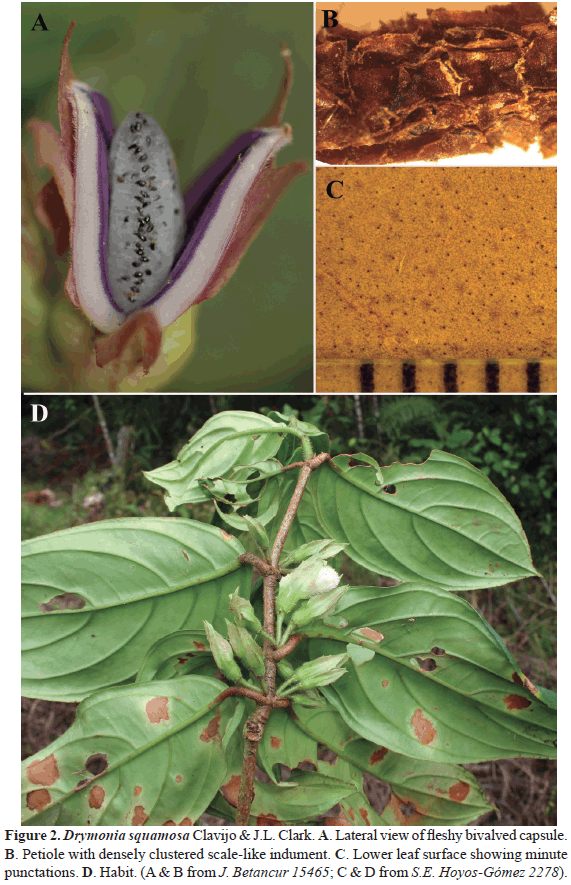
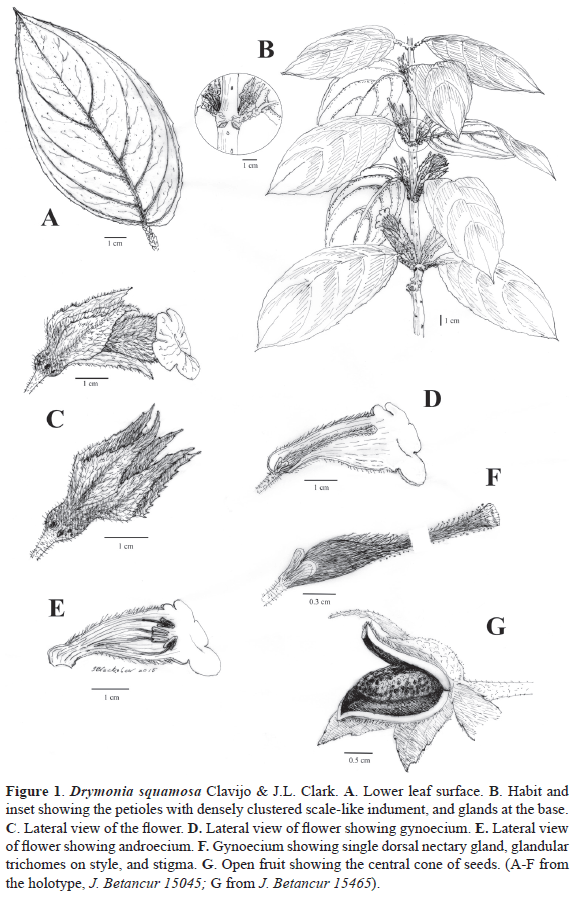
<body><![CDATA[<p><b><i>Drymonia</i></b><b><i> squamosa </i></b>Clavijo &amp; J.L. Clark, <i>sp</i><i>. nov.</i>  (<a href="#figura1">Fig. 1</a> &amp; <a href="#figura1">Fig. 2</a>)</p>       <center>   <img src="/img/revistas/cal/v37n2/v37n2a4fig1.gif"><a name="figura1"></a>  </center>    <br>        <center>   <img src="/img/revistas/cal/v37n2/v37n2a4fig2.gif"><a name="figura2"></a>  </center>    <br>      <p>Type: COLOMBIA. Antioquia: Urrao,   Parque Nacional Natural Las Orqu&iacute;deas, sector Calles, cerca de la Caba&ntilde;a de   Parques, margen izquierdo del rio Calles, 6&deg; 31' 7.5" N, 76&deg; 15' 58.5" W, 1340   m, 7 Apr 2011 (fl, fr), <i>J. Betancur et al. 15045</i> (holotype COL!, isotype NY!). </p>     <p><i>Drymonia</i><i> squamosa</i> differs from other species of <i>Drymonia</i> by dense clusters of scales on the   petioles, glabrate leaf blades with minute punctations on the lower surface, calyx appearing swollen   at base with lanceolate lobes, corolla villous to lanate, and style with glandular trichomes.</p>     <p>Hemiepiphytic, scandent or terrestrial shrub, 2.5-4.5 m tall. <b>Stem </b>erect   to decumbent, branched, adventitious roots absent, subquadrangular in cross-section, 3.7-7.4 mm in diameter, surface papyraceous,   glabrous, lenticels present, internodes 4.4-6.8 cm long. <b>Leaves </b>opposite,   decussate, equal in a pair, evenly spaced; petiole 0.6-2.2 cm long, terete in cross-section, with a pair of glands at base of   petiole, glabrous, covered with a dense clusters of scales (more evident when dry);   blade ovate to elliptic, 9-27 x 5-12 cm, coriaceous, green adaxially,   light green abaxially, apex acuminate, base cuneate to rounded, sometimes oblique, margin with   scattered small teeth, glabrous adaxially, glabrate and with minute punctations abaxially, 4-5 pairs of main lateral veins, higher   order of venation only evident abaxially. <b>Inflorescence</b> a reduced pair-flowered axillary cyme with 1-4 flowers; peduncle absent; bracts   3.5-6.5 x 0.5-1 mm, green to maroon, linear, apex acute, base truncate, margin   entire, glabrate to strigillose. <b>Pedicel</b> erect or oblique relative to the stem, 10-23 mm long, green, rugose, scarcely pilose to pilose, with glands toward the apex. <b>Calyx</b><i> </i>green   during anthesis, then becoming green with pink   margins and apex in fruit, swollen basally, membranous apically, only mid-vein   conspicuous, with a pair of conspicuous glands at base, lobes fused at base for   3-14.5 mm; calyx lobes 5, 4 nearly equal and dorsal lobe slightly reduced,   26-40 x 8.4-16 mm, lanceolate, apex acuminate, margin   serrate and recurved, abaxial surface punctate, strigose basally, strigillose apically, adaxial surface pubescent basally. <b>Corolla</b><i> </i>zygomorphic, 4.5-5 cm long,   oblique relative to calyx, protandrous, infundibuliform; base gibbous, 6-7 mm in diameter, gibbosity 4-5.5 mm long; tube 3.5-4 cm long, 0.8-1.6 cm   wide, outer surface white, sometimes pink ventrally, villous to lanate, inner surface white to yellow, glabrate;   throat 9.5-16 mm in diameter, inner surface with dark red or purple spots,   glandular trichomes dorsally; corolla lobes 5, subequal, spreading, white, apex rounded, ventral lobe   16-17 x 12-14 mm, oblong, margin slightly erose,   glabrous, lateral lobes 8-13 x 9-10 mm, ovate to oblong, margin slightly erose, lanate abaxially,   glabrous adaxially, dorsal lobes 8-10 x 8-11 mm,   ovate, margin entire. <b>Androecium</b> of 4 stamens, didynamous,   filaments 30-32 mm long, adnate to the corolla tube   for 15-17 mm, white, glabrous, coiling after anthesis; staminode absent; anthers sagittate,   5-6 x 2-3 mm, coherent by the lateral walls, dehiscence by basal pores that   develop into longitudinal slits. <b>Gynoecium</b> with a single bilobed dorsal nectary gland, oblong, apex emarginate, 3-4 mm long, whitish, glabrous; ovary superior,   5-7 x 3-4 mm, ovate, strigillose; style 20-22 mm   long, pilose, with regular and glandular trichomes, stigma stomatomorphic. <b>Fruit</b> a bivalved fleshy capsule, ovate, valves   reflexed up to 90&deg;, 19-25 x 10-15 mm, strigose and   light green to yellow with pink margins abaxially,   glabrous and purple adaxially; seeds numerous,   immersed in a mass of fleshy funicular tissue forming a central cone, 1.2-1.7   mm long, 0.5-0.8 mm wide, black, elliptic, surface smooth.</p>     <p>Etymology:</span></b> The species epithet refers to the squamate or densely clustered scale-like indument present in   the petioles that is especially conspicuous when dry.</p>     <p><b>Distribution and habitat</b>:<i> Drymonia squamosa </i>is endemic   to Colombia and only known from Las Orqu&iacute;deas National Natural Park along the Pacific slopes of the Cordillera Occidental in   the department of Antioquia, between 980 and 1340 m of elevation. <i>D. squamosa </i>has been collected only in well-preserved   cloud forests. </p>     ]]></body>
<body><![CDATA[<p><b>Phenology</b>: Flowers recorded from April to July, and fruit recorded in July. </p>     <p><b>Taxonomic affinities</b>: <i>Drymonia</i><i> squamosa </i>can   be distinguished from the other species in the genus by the densely clustered   scale-like indument on the petiole that is especially   conspicuous when dry, the glabrate leaf blades with   minute punctuations on the lower surface, the villous to lanate corolla, and the style with glandular trichomes. <i>Drymonia</i><i> squamosa</i> and <i>D. glandulosa</i> Kriebel are similar in their habit, foliage, scale-like indument on the petiole, and the style with glandular trichomes.   However, these two species can be differentiated by the following characters in <i>Drymonia</i><i> squamosa</i>:   petiole 0.6-2.2 cm long (<i>vs. </i>3.5-6 cm long); blade with 4-5 pairs of   main lateral veins (<i>vs.</i> 7-9), with minute punctuations abaxially (<i>vs.</i> absence of punctuations); calyx lobes lanceolate, 2.6-4 cm long (<i>vs. </i>oblong to   ovate, 1.5-2.5 cm long); corolla villous to lanate,   4.5-5 cm long (<i>vs. </i>glabrate, 5.5-7 cm long),   and throat white to yellow, suffused with dark red or purple spots (<i>vs.</i> purple). <i>Drymonia</i><i> glandulosa </i>is endemic to northern Costa Rica and <i>D. squamosa </i>is endemic to the Pacific slopes of the Colombian Andes in the department   of Antioquia. </p>     <p><i>Drymonia</i><i> squamosa </i>and <i>D. alloplectoides</i> Hanst. have similar flowers.   However, <i>D. squamosa </i>is differentiated by the   following characters: petiole with clustered scale-like indumentum (<i>vs.</i> smooth); blades 9-27 x 5-12 cm (<i>vs.</i> 3.8-11.3 x 1.8-5.4 cm); blade glabrate and with minute punctuations abaxially (<i>vs.</i> villous); stigma stomatomorphic (<i>vs.</i> bifid); fruit with valves reflexed up to 90&deg; (<i>vs. </i>180&deg;), and seed   surface smooth (<i>vs.</i> striated).</p>     <p>Conservation status:</span></b> The only known populations of <i>Drymonia</i><i> squamosa</i> are located in the protected area of Las Orqu&iacute;deas National Natural Park. The species has a restricted geographic distribution, small area of occupancy, and has only been   collected from the type locality. Therefore, according to the IUCN Red List   criteria (IUCN 2012) for restricted area of occupancy and number of locations   (D2, area of occupancy less than 20 km<sup>2</sup>, and known to exist at only   a single location), <i>D. squamosa </i>should be   listed in the category VU (Vulnerable).</p>     <p><b>Additional</b><b> specimens examined:</b> COLOMBIA. <b>Antioquia</b>: Frontino,   Parque Nacional Natural Las Orqu&iacute;deas, sector Venados, vereda Venados Abajo,   sitio La Miquera, 6&deg; 32' 23''- 6&deg; 32' 28'' N, 76&deg; 17' 59''- 76&deg; 18' 5'' W,   1000-1030 m, 27 Jul 2011 (fl, fr), <i>J. Betancur et al. 15465 </i>(COL!, NY!); Urrao,   Parque Nacional Natural Las Orqu&iacute;deas, vereda Cruces, sitio Pi&ntilde;ares,   camino a Perdidas, poco despu&eacute;s de la escuela La Esperanza, orilla izquierda   del r&iacute;o Calles, 6&deg; 28' 35.5'' N, 76&deg; 19' 39.5'' W, 980 m, 3 May 2013 (fl), <i>S.E. Hoyos-G&oacute;mez et al. 2278 </i>(COL!, NY!, UNA!).</p>     <p><b>ACKNOWLEDGMENTS</b></p>     <p>We thank Paola Pedraza-Pe&ntilde;alosa (NY), Julio Betancur (COL) and Mateo Jaimes (COL) for providing access to the collections, Sue Blackshear for the   illustration, and Julio Betancur for suggesting the   specific epithet. Images were provided by Julio Betancur (<a href="#figura2">Fig. 2A</a>) and Sa&uacute;lHoyos-G&oacute;mez   (<a href="#figura2">Fig. 2D</a>). We are grateful to four anonymous reviewers for their useful   comments that improved the manuscript. <i>Drymonia</i><i> squamosa </i>was collected as part of the project   "Flora of Las Orqu&iacute;deas National Park" funded by the   National Science Foundation (DEB 1020623) to Paola Pedraza-Pe&ntilde;alosa. </p>     <p><b>LITERATURE CITED</b></p>     <!-- ref --><p>1. Amaya-M&aacute;rquez, M. 2014. <i>Columnea</i><i> figueroae</i>, a new species of Gesneriaceae from las Orqu&iacute;deas National   Natural Park (Antioquia, Colombia).Caldasia 36: 261-268.    &nbsp;&nbsp;&nbsp;&nbsp;&nbsp;&nbsp;&nbsp;&nbsp;[&#160;<a href="javascript:void(0);" onclick="javascript: window.open('/scielo.php?script=sci_nlinks&ref=000041&pid=S0366-5232201500020000400001&lng=','','width=640,height=500,resizable=yes,scrollbars=1,menubar=yes,');">Links</a>&#160;]<!-- end-ref --></p>     ]]></body>
<body><![CDATA[<!-- ref --><p>2. Armenteras,   D., N. Rodr&iacute;guez &amp; J. Retana. 2009. Are   conservation strategies effective in avoiding the deforestation of the   Colombian Guyana Shield? Biological Conservation 142:   1411-1419.    &nbsp;&nbsp;&nbsp;&nbsp;&nbsp;&nbsp;&nbsp;&nbsp;[&#160;<a href="javascript:void(0);" onclick="javascript: window.open('/scielo.php?script=sci_nlinks&ref=000043&pid=S0366-5232201500020000400002&lng=','','width=640,height=500,resizable=yes,scrollbars=1,menubar=yes,');">Links</a>&#160;]<!-- end-ref --></p>     <!-- ref --><p>3. Armenteras, D., N.   Rodr&iacute;guez, J. Retana &amp; M. Morales. 2011. Understanding deforestation in upper montane and lower montane areas   of the Colombian Andes. Regional Environmental Change 1: 693-705.    &nbsp;&nbsp;&nbsp;&nbsp;&nbsp;&nbsp;&nbsp;&nbsp;[&#160;<a href="javascript:void(0);" onclick="javascript: window.open('/scielo.php?script=sci_nlinks&ref=000045&pid=S0366-5232201500020000400003&lng=','','width=640,height=500,resizable=yes,scrollbars=1,menubar=yes,');">Links</a>&#160;]<!-- end-ref --></p>     <!-- ref --><p>4. Clark, J.L., L. Clavijo &amp; N. Muchhala. 2009.   Convergence of anti-bee pollination mechanisms in the Neotropical plant genus <i>Drymonia</i> (Gesneriaceae).   Evolutionary Ecology 29: 355-377.    &nbsp;&nbsp;&nbsp;&nbsp;&nbsp;&nbsp;&nbsp;&nbsp;[&#160;<a href="javascript:void(0);" onclick="javascript: window.open('/scielo.php?script=sci_nlinks&ref=000047&pid=S0366-5232201500020000400004&lng=','','width=640,height=500,resizable=yes,scrollbars=1,menubar=yes,');">Links</a>&#160;]<!-- end-ref --></p>     <!-- ref --><p>5. Clark, J.L., P.S. Herendeen,   L.E. Skog &amp; E.A. Zimmer. 2006.   Phylogenetic relationships and generic boundaries in the Episcieae (Gesneriaceae) inferred from nuclear, chloroplast,   and morphological data. Taxon 55: 313-336.    &nbsp;&nbsp;&nbsp;&nbsp;&nbsp;&nbsp;&nbsp;&nbsp;[&#160;<a href="javascript:void(0);" onclick="javascript: window.open('/scielo.php?script=sci_nlinks&ref=000049&pid=S0366-5232201500020000400005&lng=','','width=640,height=500,resizable=yes,scrollbars=1,menubar=yes,');">Links</a>&#160;]<!-- end-ref --> </p>     <!-- ref --><p>6. Clavijo, L. &amp; J.L. Clark. 2009. El g&eacute;nero <i>Drymonia</i> (Gesneriaceae). Guide # 244. Rapid Color Guides, Environmental and Conservation   Programs, The Field Museum, Chicago, IL. <u><a href="http://fm2.fieldmuseum.org/plantguides/guideimages.asp?ID=371" target="_blank">http://fm2.fieldmuseum.org/plantguides/guideimages.asp?ID=371</a>.    &nbsp;&nbsp;&nbsp;&nbsp;&nbsp;&nbsp;&nbsp;&nbsp;[&#160;<a href="javascript:void(0);" onclick="javascript: window.open('/scielo.php?script=sci_nlinks&ref=000051&pid=S0366-5232201500020000400006&lng=','','width=640,height=500,resizable=yes,scrollbars=1,menubar=yes,');">Links</a>&#160;]<!-- end-ref --></u></p>     ]]></body>
<body><![CDATA[<!-- ref --><p>7. Clavijo, L. &amp; J.L. Clark. 2015. <i>Drymonia</i><i> betancurii</i> (Gesneriaceae),   a new species from northwestern Colombia. Phytotaxa 221(1): 077-082.    &nbsp;&nbsp;&nbsp;&nbsp;&nbsp;&nbsp;&nbsp;&nbsp;[&#160;<a href="javascript:void(0);" onclick="javascript: window.open('/scielo.php?script=sci_nlinks&ref=000053&pid=S0366-5232201500020000400007&lng=','','width=640,height=500,resizable=yes,scrollbars=1,menubar=yes,');">Links</a>&#160;]<!-- end-ref --></p>     <!-- ref --><p>8. Clavijo, L., L.E. Skog   &amp; J.L. Clark. 2015. Gesneriaceae. In: R. Bernal, S.R. Gradstein &amp; M. Celis (eds.). <i>Cat&aacute;logo de plantas y l&iacute;quenes de   Colombia</i>. Instituto de Ciencias Naturales,   Universidad Nacional de Colombia, Bogot&aacute;. <u><a href="http://catalogoplantascolombia.unal.edu.co" target="_blank">http://catalogoplantascolombia.unal.edu.co</a>.</u> Accessed May 15 of 2015.    &nbsp;&nbsp;&nbsp;&nbsp;&nbsp;&nbsp;&nbsp;&nbsp;[&#160;<a href="javascript:void(0);" onclick="javascript: window.open('/scielo.php?script=sci_nlinks&ref=000055&pid=S0366-5232201500020000400008&lng=','','width=640,height=500,resizable=yes,scrollbars=1,menubar=yes,');">Links</a>&#160;]<!-- end-ref --></p>     <!-- ref --><p>9. Croat, T., M. Hempe &amp;   C.V. Kostelac. 2015. Araceae of Parque Nacional Natural de Las Orqu&iacute;deas,   Colombia. Aroideana 38E(2): 67-122.    &nbsp;&nbsp;&nbsp;&nbsp;&nbsp;&nbsp;&nbsp;&nbsp;[&#160;<a href="javascript:void(0);" onclick="javascript: window.open('/scielo.php?script=sci_nlinks&ref=000057&pid=S0366-5232201500020000400009&lng=','','width=640,height=500,resizable=yes,scrollbars=1,menubar=yes,');">Links</a>&#160;]<!-- end-ref --></p>     <!-- ref --><p>10. Garz&oacute;n-V., J. &amp; F. G&oacute;nzalez. 2012.   Five new species and three new records of <i>Burmeistera</i> (Campanulaceae-Lobelioideae) from Colombia. Caldasia 34: 309-324.    &nbsp;&nbsp;&nbsp;&nbsp;&nbsp;&nbsp;&nbsp;&nbsp;[&#160;<a href="javascript:void(0);" onclick="javascript: window.open('/scielo.php?script=sci_nlinks&ref=000059&pid=S0366-5232201500020000400010&lng=','','width=640,height=500,resizable=yes,scrollbars=1,menubar=yes,');">Links</a>&#160;]<!-- end-ref --></p>     <!-- ref --><p>11. Garz&oacute;n-V., J., F. G&oacute;nzalez&amp; J.M. V&eacute;lez P. 2012. <i>Burmeistera</i><i> minutiflora</i> (Campanulaceae-Lobelioideae),   a new species from the high Andes of Antioquia (Colombia) with the smallest   flowers in the genus. Anales del Jard&iacute;n Bot&aacute;nico de Madrid 69:   243-246.    &nbsp;&nbsp;&nbsp;&nbsp;&nbsp;&nbsp;&nbsp;&nbsp;[&#160;<a href="javascript:void(0);" onclick="javascript: window.open('/scielo.php?script=sci_nlinks&ref=000061&pid=S0366-5232201500020000400011&lng=','','width=640,height=500,resizable=yes,scrollbars=1,menubar=yes,');">Links</a>&#160;]<!-- end-ref --></p>     ]]></body>
<body><![CDATA[<!-- ref --><p>12. Giraldo, G. &amp; S. Dalstr&ouml;m. 2012. A new and extraordinary <i>Cyrtochilum</i> (Orchidaceae: Oncidiinae) from Colombia. Lankesteriana 12: 137-142.    &nbsp;&nbsp;&nbsp;&nbsp;&nbsp;&nbsp;&nbsp;&nbsp;[&#160;<a href="javascript:void(0);" onclick="javascript: window.open('/scielo.php?script=sci_nlinks&ref=000063&pid=S0366-5232201500020000400012&lng=','','width=640,height=500,resizable=yes,scrollbars=1,menubar=yes,');">Links</a>&#160;]<!-- end-ref --> </p>     <!-- ref --><p>13. Harris, J.G. &amp; M.W. Harris. 2001. <i>Plant Identification Terminology:   An Illustrated Glossary</i>. 2<sup>nd</sup> Edition, Spring   Lake, Spring Lake, Utah.    &nbsp;&nbsp;&nbsp;&nbsp;&nbsp;&nbsp;&nbsp;&nbsp;[&#160;<a href="javascript:void(0);" onclick="javascript: window.open('/scielo.php?script=sci_nlinks&ref=000065&pid=S0366-5232201500020000400013&lng=','','width=640,height=500,resizable=yes,scrollbars=1,menubar=yes,');">Links</a>&#160;]<!-- end-ref --></p>     <!-- ref --><p>14. IUCN.   2012. <i>IUCN Red List Categories and Criteria</i>: Version 3.1. Second edition. Gland, Switzerland and   Cambridge, UK.    &nbsp;&nbsp;&nbsp;&nbsp;&nbsp;&nbsp;&nbsp;&nbsp;[&#160;<a href="javascript:void(0);" onclick="javascript: window.open('/scielo.php?script=sci_nlinks&ref=000067&pid=S0366-5232201500020000400014&lng=','','width=640,height=500,resizable=yes,scrollbars=1,menubar=yes,');">Links</a>&#160;]<!-- end-ref --></p>     <!-- ref --><p>15. Joppa, L.N., S.R. Loarie &amp; S.L. Pimm. 2008. On the protection of ''protected areas''.   Proceedings of the National Academy of Sciences USA 105: 6673-6678.    &nbsp;&nbsp;&nbsp;&nbsp;&nbsp;&nbsp;&nbsp;&nbsp;[&#160;<a href="javascript:void(0);" onclick="javascript: window.open('/scielo.php?script=sci_nlinks&ref=000069&pid=S0366-5232201500020000400015&lng=','','width=640,height=500,resizable=yes,scrollbars=1,menubar=yes,');">Links</a>&#160;]<!-- end-ref --></p>     <!-- ref --><p>16. Kvist, L.P., L.E. Skog   &amp; M. Amaya-M&aacute;rquez. 1998. Los g&eacute;neros de Gesneri&aacute;ceas de Colombia. Caldasia 20: 12-28.    &nbsp;&nbsp;&nbsp;&nbsp;&nbsp;&nbsp;&nbsp;&nbsp;[&#160;<a href="javascript:void(0);" onclick="javascript: window.open('/scielo.php?script=sci_nlinks&ref=000071&pid=S0366-5232201500020000400016&lng=','','width=640,height=500,resizable=yes,scrollbars=1,menubar=yes,');">Links</a>&#160;]<!-- end-ref --></p>     ]]></body>
<body><![CDATA[<!-- ref --><p>17. Mittermeier, R.A., P.   Robles-Gil, M. Hoffman, J. Pilgrim, T. Brooks, C.G. Mittermeier, J. Lamoreux &amp;   G.A.B. Da Fonsenca. 2005. <i>Hotspots Revisited</i>. CEMEX,   S.A., Mexico.    &nbsp;&nbsp;&nbsp;&nbsp;&nbsp;&nbsp;&nbsp;&nbsp;[&#160;<a href="javascript:void(0);" onclick="javascript: window.open('/scielo.php?script=sci_nlinks&ref=000073&pid=S0366-5232201500020000400017&lng=','','width=640,height=500,resizable=yes,scrollbars=1,menubar=yes,');">Links</a>&#160;]<!-- end-ref --></p>     <!-- ref --><p>18. Pedraza-Pa&ntilde;alosa, P. 2015. New blueberry   and morti&ntilde;o relatives (Ericaceae)   from northwestern Colombia.PhytoKeys 49:   33-58.    &nbsp;&nbsp;&nbsp;&nbsp;&nbsp;&nbsp;&nbsp;&nbsp;[&#160;<a href="javascript:void(0);" onclick="javascript: window.open('/scielo.php?script=sci_nlinks&ref=000075&pid=S0366-5232201500020000400018&lng=','','width=640,height=500,resizable=yes,scrollbars=1,menubar=yes,');">Links</a>&#160;]<!-- end-ref --></p>     <!-- ref --><p>19. Pedraza-Pe&ntilde;alosa, P. &amp; J.   Betancur. 2014 On ward.   Flora of Las Orqu&iacute;deas National Park: vascular plants   of the Colombian Andes and Choc&oacute;. En: <a href="http://sweetgum.nybg.org/orqu&iacute;deas" target="_blank">http://sweetgum.nybg.org/orqu&iacute;deas</a>. The New York Botanicla Garden, New York.    &nbsp;&nbsp;&nbsp;&nbsp;&nbsp;&nbsp;&nbsp;&nbsp;[&#160;<a href="javascript:void(0);" onclick="javascript: window.open('/scielo.php?script=sci_nlinks&ref=000077&pid=S0366-5232201500020000400019&lng=','','width=640,height=500,resizable=yes,scrollbars=1,menubar=yes,');">Links</a>&#160;]<!-- end-ref --></p>     <!-- ref --><p>20. Rodr&iacute;guez, N., D. Armenteras &amp; J. Retana. 2013. Effectiveness   of protected areas in the Colombian Andes: deforestation, fire and land-use   changes. Regional Environmental Change 13: 423-435.    &nbsp;&nbsp;&nbsp;&nbsp;&nbsp;&nbsp;&nbsp;&nbsp;[&#160;<a href="javascript:void(0);" onclick="javascript: window.open('/scielo.php?script=sci_nlinks&ref=000079&pid=S0366-5232201500020000400020&lng=','','width=640,height=500,resizable=yes,scrollbars=1,menubar=yes,');">Links</a>&#160;]<!-- end-ref --></p>     <!-- ref --><p>21. Smith, J.F., M. Amaya-M&aacute;rquez, O.H. Mar&iacute;n-G&oacute;mez   &amp; J.L. Clark. 2013. Four new   species of <i>Columnea</i> (Gesneriaceae)   with primary distributions in Colombia. Journal of the Botanical Research   Institute of Texas 7: 667-679.    &nbsp;&nbsp;&nbsp;&nbsp;&nbsp;&nbsp;&nbsp;&nbsp;[&#160;<a href="javascript:void(0);" onclick="javascript: window.open('/scielo.php?script=sci_nlinks&ref=000081&pid=S0366-5232201500020000400021&lng=','','width=640,height=500,resizable=yes,scrollbars=1,menubar=yes,');">Links</a>&#160;]<!-- end-ref --></p>     ]]></body>
<body><![CDATA[<!-- ref --><p>22. Szlachetko, D.L. &amp;   M. Klonowska. 2013 A new species of <i>Rhetinantha</i> (Orchidaceae, Maxillarieae)   from Antioquia, Colombia. Plant Systematics and Evolution 299: 1873-1877.   <a href="http://dx.doi.org/10.1007/s00606-013-0843-5" target="_blank">http://dx.doi.org/10.1007/s00606-013-0843-5</a>.    &nbsp;&nbsp;&nbsp;&nbsp;&nbsp;&nbsp;&nbsp;&nbsp;[&#160;<a href="javascript:void(0);" onclick="javascript: window.open('/scielo.php?script=sci_nlinks&ref=000083&pid=S0366-5232201500020000400022&lng=','','width=640,height=500,resizable=yes,scrollbars=1,menubar=yes,');">Links</a>&#160;]<!-- end-ref --></p>     <!-- ref --><p>23. Su&aacute;rez, C.F., L.G. Naranjo, J.C.   Espinosa &amp; J. Sabogal. 2011.   Land use changes and their synergies with climate change. <i>Climate   change and biodiversity in the Tropical Andes,</i> Inter-American Institute for   Global Change Research (IAI) and Scientific Committee on Problems of the   Environment (SCOPE), 141-151.    &nbsp;&nbsp;&nbsp;&nbsp;&nbsp;&nbsp;&nbsp;&nbsp;[&#160;<a href="javascript:void(0);" onclick="javascript: window.open('/scielo.php?script=sci_nlinks&ref=000085&pid=S0366-5232201500020000400023&lng=','','width=640,height=500,resizable=yes,scrollbars=1,menubar=yes,');">Links</a>&#160;]<!-- end-ref --></p>     <!-- ref --><p>24. Weber, A. 2004. Gesneriaceae. In: L. Kubitzki &amp; J.W. Kadereit (eds.). <i>The families   and genera of vascular plants,</i> vol. 7: 3-158<i>.</i> Springer,   Berlin, Germany.    &nbsp;&nbsp;&nbsp;&nbsp;&nbsp;&nbsp;&nbsp;&nbsp;[&#160;<a href="javascript:void(0);" onclick="javascript: window.open('/scielo.php?script=sci_nlinks&ref=000087&pid=S0366-5232201500020000400024&lng=','','width=640,height=500,resizable=yes,scrollbars=1,menubar=yes,');">Links</a>&#160;]<!-- end-ref --></p> </font>      ]]></body><back>
<ref-list>
<ref id="B1">
<label>1</label><nlm-citation citation-type="journal">
<person-group person-group-type="author">
<name>
<surname><![CDATA[Amaya-Márquez]]></surname>
<given-names><![CDATA[M.]]></given-names>
</name>
</person-group>
<article-title xml:lang="en"><![CDATA[Columnea figueroae, a new species of Gesneriaceae from las Orquídeas National Natural Park (Antioquia, Colombia)]]></article-title>
<source><![CDATA[Caldasia]]></source>
<year>2014</year>
<volume>36</volume>
<page-range>261-268</page-range></nlm-citation>
</ref>
<ref id="B2">
<label>2</label><nlm-citation citation-type="journal">
<person-group person-group-type="author">
<name>
<surname><![CDATA[Armenteras]]></surname>
<given-names><![CDATA[D.]]></given-names>
</name>
<name>
<surname><![CDATA[Rodríguez]]></surname>
<given-names><![CDATA[N.]]></given-names>
</name>
<name>
<surname><![CDATA[Retana]]></surname>
<given-names><![CDATA[J.]]></given-names>
</name>
</person-group>
<article-title xml:lang="en"><![CDATA[Are conservation strategies effective in avoiding the deforestation of the Colombian Guyana Shield?]]></article-title>
<source><![CDATA[Biological Conservation]]></source>
<year>2009</year>
<volume>142</volume>
<page-range>1411-1419</page-range></nlm-citation>
</ref>
<ref id="B3">
<label>3</label><nlm-citation citation-type="journal">
<person-group person-group-type="author">
<name>
<surname><![CDATA[Armenteras]]></surname>
<given-names><![CDATA[D.]]></given-names>
</name>
<name>
<surname><![CDATA[Rodríguez]]></surname>
<given-names><![CDATA[N.]]></given-names>
</name>
<name>
<surname><![CDATA[Retana]]></surname>
<given-names><![CDATA[J.]]></given-names>
</name>
<name>
<surname><![CDATA[Morales]]></surname>
<given-names><![CDATA[M.]]></given-names>
</name>
</person-group>
<article-title xml:lang="en"><![CDATA[Understanding deforestation in upper montane and lower montane areas of the Colombian Andes]]></article-title>
<source><![CDATA[Regional Environmental Change]]></source>
<year>2011</year>
<volume>1</volume>
<page-range>693-705</page-range></nlm-citation>
</ref>
<ref id="B4">
<label>4</label><nlm-citation citation-type="journal">
<person-group person-group-type="author">
<name>
<surname><![CDATA[Clark]]></surname>
<given-names><![CDATA[J.L.]]></given-names>
</name>
<name>
<surname><![CDATA[Clavijo]]></surname>
<given-names><![CDATA[L.]]></given-names>
</name>
<name>
<surname><![CDATA[Muchhala]]></surname>
<given-names><![CDATA[N.]]></given-names>
</name>
</person-group>
<article-title xml:lang="en"><![CDATA[Convergence of anti-bee pollination mechanisms in the Neotropical plant genus Drymonia (Gesneriaceae)]]></article-title>
<source><![CDATA[Evolutionary Ecology]]></source>
<year>2009</year>
<volume>29</volume>
<page-range>355-377</page-range></nlm-citation>
</ref>
<ref id="B5">
<label>5</label><nlm-citation citation-type="journal">
<person-group person-group-type="author">
<name>
<surname><![CDATA[Clark]]></surname>
<given-names><![CDATA[J.L.]]></given-names>
</name>
<name>
<surname><![CDATA[Herendeen]]></surname>
<given-names><![CDATA[P.S.]]></given-names>
</name>
<name>
<surname><![CDATA[Skog]]></surname>
<given-names><![CDATA[L.E.]]></given-names>
</name>
<name>
<surname><![CDATA[Zimmer]]></surname>
<given-names><![CDATA[E.A.]]></given-names>
</name>
</person-group>
<article-title xml:lang="en"><![CDATA[Phylogenetic relationships and generic boundaries in the Episcieae (Gesneriaceae) inferred from nuclear, chloroplast, and morphological data]]></article-title>
<source><![CDATA[Taxon]]></source>
<year>2006</year>
<volume>55</volume>
<page-range>313-336</page-range></nlm-citation>
</ref>
<ref id="B6">
<label>6</label><nlm-citation citation-type="book">
<person-group person-group-type="author">
<name>
<surname><![CDATA[Clavijo]]></surname>
<given-names><![CDATA[L.]]></given-names>
</name>
<name>
<surname><![CDATA[Clark]]></surname>
<given-names><![CDATA[J.L.]]></given-names>
</name>
</person-group>
<source><![CDATA[El género Drymonia (Gesneriaceae): Guide # 244]]></source>
<year>2009</year>
<publisher-loc><![CDATA[Chicago^eIL IL]]></publisher-loc>
<publisher-name><![CDATA[The Field Museum]]></publisher-name>
</nlm-citation>
</ref>
<ref id="B7">
<label>7</label><nlm-citation citation-type="journal">
<person-group person-group-type="author">
<name>
<surname><![CDATA[Clavijo]]></surname>
<given-names><![CDATA[L.]]></given-names>
</name>
<name>
<surname><![CDATA[Clark]]></surname>
<given-names><![CDATA[J.L.]]></given-names>
</name>
</person-group>
<article-title xml:lang="en"><![CDATA[Drymonia betancurii (Gesneriaceae), a new species from northwestern Colombia]]></article-title>
<source><![CDATA[Phytotaxa]]></source>
<year>2015</year>
<volume>221</volume>
<numero>1</numero>
<issue>1</issue>
<page-range>077-082</page-range></nlm-citation>
</ref>
<ref id="B8">
<label>8</label><nlm-citation citation-type="book">
<person-group person-group-type="author">
<name>
<surname><![CDATA[Clavijo]]></surname>
<given-names><![CDATA[L.]]></given-names>
</name>
<name>
<surname><![CDATA[Skog]]></surname>
<given-names><![CDATA[L.E.]]></given-names>
</name>
<name>
<surname><![CDATA[Clark]]></surname>
<given-names><![CDATA[J.L.]]></given-names>
</name>
</person-group>
<article-title xml:lang="es"><![CDATA[Gesneriaceae]]></article-title>
<person-group person-group-type="editor">
<name>
<surname><![CDATA[Bernal]]></surname>
<given-names><![CDATA[R.]]></given-names>
</name>
<name>
<surname><![CDATA[Gradstein]]></surname>
<given-names><![CDATA[S.R.]]></given-names>
</name>
<name>
<surname><![CDATA[Celis]]></surname>
<given-names><![CDATA[M.]]></given-names>
</name>
</person-group>
<source><![CDATA[Catálogo de plantas y líquenes de Colombia]]></source>
<year>2015</year>
<publisher-loc><![CDATA[Bogotá ]]></publisher-loc>
<publisher-name><![CDATA[Instituto de Ciencias Naturales, Universidad Nacional de Colombia]]></publisher-name>
</nlm-citation>
</ref>
<ref id="B9">
<label>9</label><nlm-citation citation-type="journal">
<person-group person-group-type="author">
<name>
<surname><![CDATA[Croat]]></surname>
<given-names><![CDATA[T.]]></given-names>
</name>
<name>
<surname><![CDATA[Hempe]]></surname>
<given-names><![CDATA[M.]]></given-names>
</name>
<name>
<surname><![CDATA[Kostelac]]></surname>
<given-names><![CDATA[C.V.]]></given-names>
</name>
</person-group>
<article-title xml:lang="en"><![CDATA[Araceae of Parque Nacional Natural de Las Orquídeas, Colombia]]></article-title>
<source><![CDATA[Aroideana]]></source>
<year>2015</year>
<volume>38E</volume>
<numero>2</numero>
<issue>2</issue>
<page-range>67-122</page-range></nlm-citation>
</ref>
<ref id="B10">
<label>10</label><nlm-citation citation-type="journal">
<person-group person-group-type="author">
<name>
<surname><![CDATA[Garzón-V.]]></surname>
<given-names><![CDATA[J.]]></given-names>
</name>
<name>
<surname><![CDATA[Gónzalez]]></surname>
<given-names><![CDATA[F.]]></given-names>
</name>
</person-group>
<article-title xml:lang="en"><![CDATA[Five new species and three new records of Burmeistera (Campanulaceae-Lobelioideae) from Colombia]]></article-title>
<source><![CDATA[Caldasia]]></source>
<year>2012</year>
<volume>34</volume>
<page-range>309-324</page-range></nlm-citation>
</ref>
<ref id="B11">
<label>11</label><nlm-citation citation-type="journal">
<person-group person-group-type="author">
<name>
<surname><![CDATA[Garzón-V.]]></surname>
<given-names><![CDATA[J.]]></given-names>
</name>
<name>
<surname><![CDATA[Gónzalez]]></surname>
<given-names><![CDATA[F.]]></given-names>
</name>
<name>
<surname><![CDATA[Vélez P.]]></surname>
<given-names><![CDATA[J.M.]]></given-names>
</name>
</person-group>
<article-title xml:lang="en"><![CDATA[Burmeistera minutiflora (Campanulaceae-Lobelioideae), a new species from the high Andes of Antioquia (Colombia) with the smallest flowers in the genus]]></article-title>
<source><![CDATA[Anales del Jardín Botánico de Madrid]]></source>
<year>2012</year>
<volume>69</volume>
<page-range>243-246</page-range></nlm-citation>
</ref>
<ref id="B12">
<label>12</label><nlm-citation citation-type="journal">
<person-group person-group-type="author">
<name>
<surname><![CDATA[Giraldo]]></surname>
<given-names><![CDATA[G.]]></given-names>
</name>
<name>
<surname><![CDATA[Dalström]]></surname>
<given-names><![CDATA[S.]]></given-names>
</name>
</person-group>
<article-title xml:lang="en"><![CDATA[A new and extraordinary Cyrtochilum (Orchidaceae: Oncidiinae) from Colombia]]></article-title>
<source><![CDATA[Lankesteriana]]></source>
<year>2012</year>
<volume>12</volume>
<page-range>137-142</page-range></nlm-citation>
</ref>
<ref id="B13">
<label>13</label><nlm-citation citation-type="book">
<person-group person-group-type="author">
<name>
<surname><![CDATA[Harris]]></surname>
<given-names><![CDATA[J.G.]]></given-names>
</name>
<name>
<surname><![CDATA[Harris]]></surname>
<given-names><![CDATA[M.W.]]></given-names>
</name>
</person-group>
<source><![CDATA[Plant Identification Terminology: An Illustrated Glossary]]></source>
<year>2001</year>
<edition>2nd</edition>
<publisher-loc><![CDATA[Spring Lake^eUtah Utah]]></publisher-loc>
<publisher-name><![CDATA[Spring Lake]]></publisher-name>
</nlm-citation>
</ref>
<ref id="B14">
<label>14</label><nlm-citation citation-type="book">
<collab>IUCN</collab>
<source><![CDATA[IUCN Red List Categories and Criteria: Version 3.1]]></source>
<year>2012</year>
<edition>Second</edition>
<publisher-loc><![CDATA[Gland ]]></publisher-loc>
<publisher-name><![CDATA[Switzerland and Cambridge]]></publisher-name>
</nlm-citation>
</ref>
<ref id="B15">
<label>15</label><nlm-citation citation-type="journal">
<person-group person-group-type="author">
<name>
<surname><![CDATA[Joppa]]></surname>
<given-names><![CDATA[L.N.]]></given-names>
</name>
<name>
<surname><![CDATA[Loarie]]></surname>
<given-names><![CDATA[S.R.]]></given-names>
</name>
<name>
<surname><![CDATA[Pimm]]></surname>
<given-names><![CDATA[S.L.]]></given-names>
</name>
</person-group>
<article-title xml:lang="en"><![CDATA[On the protection of ''protected areas'']]></article-title>
<source><![CDATA[Proceedings of the National Academy of Sciences USA]]></source>
<year>2008</year>
<volume>105</volume>
<page-range>6673-6678</page-range></nlm-citation>
</ref>
<ref id="B16">
<label>16</label><nlm-citation citation-type="journal">
<person-group person-group-type="author">
<name>
<surname><![CDATA[Kvist]]></surname>
<given-names><![CDATA[L.P.]]></given-names>
</name>
<name>
<surname><![CDATA[Skog]]></surname>
<given-names><![CDATA[L.E.]]></given-names>
</name>
<name>
<surname><![CDATA[Amaya-Márquez]]></surname>
<given-names><![CDATA[M.]]></given-names>
</name>
</person-group>
<article-title xml:lang="es"><![CDATA[Los géneros de Gesneriáceas de Colombia]]></article-title>
<source><![CDATA[Caldasia]]></source>
<year>1998</year>
<volume>20</volume>
<page-range>12-28</page-range></nlm-citation>
</ref>
<ref id="B17">
<label>17</label><nlm-citation citation-type="book">
<person-group person-group-type="author">
<name>
<surname><![CDATA[Mittermeier]]></surname>
<given-names><![CDATA[R.A.]]></given-names>
</name>
<name>
<surname><![CDATA[Robles-Gil]]></surname>
<given-names><![CDATA[P.]]></given-names>
</name>
<name>
<surname><![CDATA[Hoffman]]></surname>
<given-names><![CDATA[M.]]></given-names>
</name>
<name>
<surname><![CDATA[Pilgrim]]></surname>
<given-names><![CDATA[J.]]></given-names>
</name>
<name>
<surname><![CDATA[Brooks]]></surname>
<given-names><![CDATA[T.]]></given-names>
</name>
<name>
<surname><![CDATA[Mittermeier]]></surname>
<given-names><![CDATA[C.G.]]></given-names>
</name>
<name>
<surname><![CDATA[Lamoreux]]></surname>
<given-names><![CDATA[J.]]></given-names>
</name>
<name>
<surname><![CDATA[Da Fonsenca]]></surname>
<given-names><![CDATA[G.A.B.]]></given-names>
</name>
</person-group>
<source><![CDATA[Hotspots Revisited]]></source>
<year>2005</year>
<publisher-loc><![CDATA[Mexico ]]></publisher-loc>
<publisher-name><![CDATA[CEMEX, S.A.]]></publisher-name>
</nlm-citation>
</ref>
<ref id="B18">
<label>18</label><nlm-citation citation-type="journal">
<person-group person-group-type="author">
<name>
<surname><![CDATA[Pedraza-Pañalosa]]></surname>
<given-names><![CDATA[P.]]></given-names>
</name>
</person-group>
<article-title xml:lang="en"><![CDATA[New blueberry and mortiño relatives (Ericaceae) from northwestern Colombia]]></article-title>
<source><![CDATA[PhytoKeys]]></source>
<year>2015</year>
<volume>49</volume>
<page-range>33-58</page-range></nlm-citation>
</ref>
<ref id="B19">
<label>19</label><nlm-citation citation-type="book">
<person-group person-group-type="author">
<name>
<surname><![CDATA[Pedraza-Peñalosa]]></surname>
<given-names><![CDATA[P.]]></given-names>
</name>
<name>
<surname><![CDATA[Betancur]]></surname>
<given-names><![CDATA[J.]]></given-names>
</name>
</person-group>
<article-title xml:lang="en"><![CDATA[Flora of Las Orquídeas National Park: vascular plants of the Colombian Andes and Chocó]]></article-title>
<source><![CDATA[]]></source>
<year>2014</year>
<publisher-loc><![CDATA[New York ]]></publisher-loc>
<publisher-name><![CDATA[The New York Botanicla Garden]]></publisher-name>
</nlm-citation>
</ref>
<ref id="B20">
<label>20</label><nlm-citation citation-type="journal">
<person-group person-group-type="author">
<name>
<surname><![CDATA[Rodríguez]]></surname>
<given-names><![CDATA[N.]]></given-names>
</name>
<name>
<surname><![CDATA[Armenteras]]></surname>
<given-names><![CDATA[D.]]></given-names>
</name>
<name>
<surname><![CDATA[Retana]]></surname>
<given-names><![CDATA[J.]]></given-names>
</name>
</person-group>
<article-title xml:lang="en"><![CDATA[Effectiveness of protected areas in the Colombian Andes: deforestation, fire and land-use changes]]></article-title>
<source><![CDATA[Regional Environmental Change]]></source>
<year>2013</year>
<volume>13</volume>
<page-range>423-435</page-range></nlm-citation>
</ref>
<ref id="B21">
<label>21</label><nlm-citation citation-type="journal">
<person-group person-group-type="author">
<name>
<surname><![CDATA[Smith]]></surname>
<given-names><![CDATA[J.F.]]></given-names>
</name>
<name>
<surname><![CDATA[Amaya-Márquez]]></surname>
<given-names><![CDATA[M.]]></given-names>
</name>
<name>
<surname><![CDATA[Marín-Gómez]]></surname>
<given-names><![CDATA[O.H.]]></given-names>
</name>
<name>
<surname><![CDATA[Clark]]></surname>
<given-names><![CDATA[J.L.]]></given-names>
</name>
</person-group>
<article-title xml:lang="en"><![CDATA[Four new species of Columnea (Gesneriaceae) with primary distributions in Colombia]]></article-title>
<source><![CDATA[Journal of the Botanical Research Institute of Texas]]></source>
<year>2013</year>
<volume>7</volume>
<page-range>667-679</page-range></nlm-citation>
</ref>
<ref id="B22">
<label>22</label><nlm-citation citation-type="journal">
<person-group person-group-type="author">
<name>
<surname><![CDATA[Szlachetko]]></surname>
<given-names><![CDATA[D.L.]]></given-names>
</name>
<name>
<surname><![CDATA[Klonowska]]></surname>
<given-names><![CDATA[M.]]></given-names>
</name>
</person-group>
<article-title xml:lang="en"><![CDATA[A new species of Rhetinantha (Orchidaceae, Maxillarieae) from Antioquia, Colombia]]></article-title>
<source><![CDATA[Plant Systematics and Evolution]]></source>
<year>2013</year>
<volume>299</volume>
<page-range>1873-1877</page-range></nlm-citation>
</ref>
<ref id="B23">
<label>23</label><nlm-citation citation-type="journal">
<person-group person-group-type="author">
<name>
<surname><![CDATA[Suárez]]></surname>
<given-names><![CDATA[C.F.]]></given-names>
</name>
<name>
<surname><![CDATA[Naranjo]]></surname>
<given-names><![CDATA[L.G.]]></given-names>
</name>
<name>
<surname><![CDATA[Espinosa]]></surname>
<given-names><![CDATA[J.C.]]></given-names>
</name>
<name>
<surname><![CDATA[Sabogal]]></surname>
<given-names><![CDATA[J.]]></given-names>
</name>
</person-group>
<article-title xml:lang="en"><![CDATA[Land use changes and their synergies with climate change: Climate change and biodiversity in the Tropical Andes]]></article-title>
<source><![CDATA[Inter-American Institute for Global Change Research (IAI) and Scientific Committee on Problems of the Environment (SCOPE)]]></source>
<year>2011</year>
<page-range>141-151</page-range></nlm-citation>
</ref>
<ref id="B24">
<label>24</label><nlm-citation citation-type="book">
<person-group person-group-type="author">
<name>
<surname><![CDATA[Weber]]></surname>
<given-names><![CDATA[A.]]></given-names>
</name>
</person-group>
<article-title xml:lang="en"><![CDATA[Gesneriaceae]]></article-title>
<person-group person-group-type="editor">
<name>
<surname><![CDATA[Kubitzki]]></surname>
<given-names><![CDATA[L.]]></given-names>
</name>
<name>
<surname><![CDATA[Kadereit]]></surname>
<given-names><![CDATA[J.W.]]></given-names>
</name>
</person-group>
<source><![CDATA[The families and genera of vascular plants]]></source>
<year>2004</year>
<volume>7</volume>
<page-range>3-158</page-range><publisher-loc><![CDATA[Berlin ]]></publisher-loc>
<publisher-name><![CDATA[Springer]]></publisher-name>
</nlm-citation>
</ref>
</ref-list>
</back>
</article>