<?xml version="1.0" encoding="ISO-8859-1"?><article xmlns:mml="http://www.w3.org/1998/Math/MathML" xmlns:xlink="http://www.w3.org/1999/xlink" xmlns:xsi="http://www.w3.org/2001/XMLSchema-instance">
<front>
<journal-meta>
<journal-id>0366-5232</journal-id>
<journal-title><![CDATA[Caldasia]]></journal-title>
<abbrev-journal-title><![CDATA[Caldasia]]></abbrev-journal-title>
<issn>0366-5232</issn>
<publisher>
<publisher-name><![CDATA[Instituto de Ciencias Naturales, Facultad de Ciencias-Universidad Nacional de Colombia]]></publisher-name>
</publisher>
</journal-meta>
<article-meta>
<article-id>S0366-52322015000200012</article-id>
<article-id pub-id-type="doi">10.15446/caldasia.v37n2.53583</article-id>
<title-group>
<article-title xml:lang="en"><![CDATA[THE TADPOLE OF THE MEXICAN TREE FROG CHARADRAHYLA TAENIOPUS (ANURA: HYLIDAE)]]></article-title>
<article-title xml:lang="es"><![CDATA[El renacuajo de la rana arborνcola Mexicana Charadrahyla taeniopus (Anura: Hylidae)]]></article-title>
</title-group>
<contrib-group>
<contrib contrib-type="author">
<name>
<surname><![CDATA[KAPLAN]]></surname>
<given-names><![CDATA[MOISES]]></given-names>
</name>
<xref ref-type="aff" rid="A01"/>
</contrib>
<contrib contrib-type="author">
<name>
<surname><![CDATA[HEIMES]]></surname>
<given-names><![CDATA[PETER]]></given-names>
</name>
<xref ref-type="aff" rid="A02"/>
</contrib>
</contrib-group>
<aff id="A01">
<institution><![CDATA[,Ann Arbor  ]]></institution>
<addr-line><![CDATA[Michigan ]]></addr-line>
<country>USA</country>
</aff>
<aff id="A02">
<institution><![CDATA[,Zalai ut 11B  ]]></institution>
<addr-line><![CDATA[Budapest ]]></addr-line>
<country>Hungary</country>
</aff>
<pub-date pub-type="pub">
<day>12</day>
<month>30</month>
<year>2015</year>
</pub-date>
<pub-date pub-type="epub">
<day>12</day>
<month>30</month>
<year>2015</year>
</pub-date>
<volume>37</volume>
<numero>2</numero>
<fpage>393</fpage>
<lpage>396</lpage>
<copyright-statement/>
<copyright-year/>
<self-uri xlink:href="http://www.scielo.org.co/scielo.php?script=sci_arttext&amp;pid=S0366-52322015000200012&amp;lng=en&amp;nrm=iso"></self-uri><self-uri xlink:href="http://www.scielo.org.co/scielo.php?script=sci_abstract&amp;pid=S0366-52322015000200012&amp;lng=en&amp;nrm=iso"></self-uri><self-uri xlink:href="http://www.scielo.org.co/scielo.php?script=sci_pdf&amp;pid=S0366-52322015000200012&amp;lng=en&amp;nrm=iso"></self-uri><abstract abstract-type="short" xml:lang="en"><p><![CDATA[The tadpole of Charadrahyla taeniopus is described. This tadpole is a typical stream-dweller with a long depressed body, oral disc completely surrounded by marginal papillae with numerous small submarginal papillae lateral to the mouth, and several rows of teeth on the posterior labium (6-7).]]></p></abstract>
<abstract abstract-type="short" xml:lang="es"><p><![CDATA[El renacuajo de Charadrahyla taeniopus es descrito. Este renacuajo es tνpico habitante de corrientes de agua, el cual posee un cuerpo largo y aplanado, disco oral rodeado completamente de papilas marginales y con numerosas papilas submarginales pequeρas a los lados de la boca, y varias hileras de dientes en el labio posterior (6-7).]]></p></abstract>
<kwd-group>
<kwd lng="en"><![CDATA[Larvae]]></kwd>
<kwd lng="en"><![CDATA[streams]]></kwd>
<kwd lng="en"><![CDATA[Sierra Madre Oriental]]></kwd>
<kwd lng="es"><![CDATA[Larva]]></kwd>
<kwd lng="es"><![CDATA[riachuelos]]></kwd>
<kwd lng="es"><![CDATA[Sierra Madre Oriental]]></kwd>
</kwd-group>
</article-meta>
</front><body><![CDATA[  <font size="2" face="verdana">  doi: <a href="http://dx.doi.org/10.15446/caldasia.v37n2.53583">http://dx.doi.org/10.15446/caldasia.v37n2.53583</a>     <p><font size="4">       <center>     <b>THE TADPOLE OF THE MEXICAN TREE FROG <i>CHARADRAHYLA TAENIOPUS</i> (ANURA: HYLIDAE)</b>   </center>  </font></p> <font size="3">      <center>   <b>El renacuajo de la rana arbor&iacute;cola Mexicana <i>Charadrahyla taeniopus</i> (Anura: Hylidae)</b>    <br> </center> </font>     <p><b>MOISES KAPLAN</b>    <br> <b>PETER HEIMES</b></p>     <p><i>1508 Brooklyn Avenue, Ann Arbor, Michigan 48104, USA.  <a href="mailto:moises.kaplan@gmail.com">moises.kaplan@gmail.com</a></i></p> <i>Zalai  ut 11B, 1125 Budapest, Hungary</i>      <p><b>ABSTRACT</b></p>     <p>The tadpole of <i>Charadrahyla</i><i> taeniopus</i> is described. This tadpole is a typical   stream-dweller with a long depressed body, oral disc completely surrounded by   marginal papillae with numerous small submarginal papillae lateral to the mouth, and several rows of teeth on the posterior   labium (67).</p>     ]]></body>
<body><![CDATA[<p><b>Key words.</b><b> </b>Larvae, streams, Sierra Madre Oriental.</p>     <p><b>RESUMEN</b></p>     <p>El renacuajo de <i>Charadrahyla</i><i> taeniopus</i> es descrito. Este renacuajo es t&iacute;pico habitante de corrientes de agua, el cual   posee un cuerpo largo y aplanado, disco oral rodeado completamente de papilas   marginales y con numerosas papilas submarginales peque&ntilde;as a los lados de la boca, y varias hileras de dientes en el labio   posterior (67).</p>     <p><b>Palabras clave. </b>Larva, riachuelos, Sierra Madre Oriental.</p>     <p>Recibido:  28/09/2013</br>     <br>Aceptado: 10/09/2015</p>     <p><b>INTRODUCTION</b></p>     <p>The Mexican genus <i>Charadrahyla</i> comprises six species of large, stream-dwelling frogs that inhabit the   highlands of the Sierra Madre Oriental, Sierra Madre Occidental, and the   sierras of Oaxaca and Chiapas (Duellman, 2001;   Campbell <i>et al</i>. 2009). One of these species, <i>Charadrahyla</i> <i>taeniopus</i> Gunther 1901 inhabits cloud forest   between 1200 and 2100 m along the Sierra Madre Oriental in the Mexican states   of Hidalgo, Puebla, and Veracruz (Duellman, 1965,   2001).         </p>     <p>The identity of the tadpole of <i>Charadrahyla</i><i> taeniopus</i> is still uncertain. Duellman (1965) assigned a tadpole from Puebla (KU 68498) with labial tooth row formula   (hereafter LTRF) 2(2)/3 and one row of large submarginal papillae to <i>C. taeniopus</i>,<i> </i>but no   conclusive evidence (i.e., molecular or developmental) supports this hypothesis. </p>     <p>We collected tadpoles from various locations along the Sierra Madre   Oriental in Mexico and determined they are <i>Charadrahyla</i><i> taeniopus</i>. Herein, we describe the tadpole of <i>C. taeniopus</i>.</p>     ]]></body>
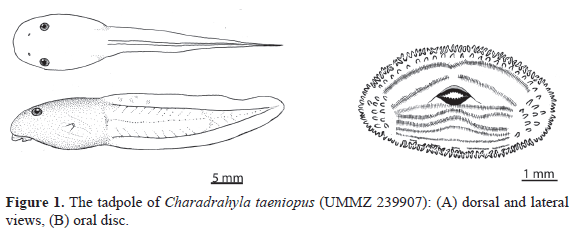
<body><![CDATA[<p><b>MATERIALS AND METHODS</b></p>     <p>We obtained previously undescribed tadpoles   from various locations in the Mexican states of Hidalgo, Puebla, and Veracruz   between March and June 2004 (see Comparative Materials). Most tadpoles were   reared through metamorphosis to either juvenile and adult stages, except for   few that were preserved in formalin (10%) at various developmental stages. All   the transformed individuals were unambiguously identified as <i>Charadrahyla</i><i> taeniopus</i> using the diagnoses of this species provided by Duellman (1965, 2001: 445).<i> </i></p>     <p>Tadpoles were staged following Gosner (1960).   Terminology of tadpole morphology and measurements follow that of Altig &amp; McDiarmid (1999).   Museum acronyms: UMMZ = University of Michigan Museum of Zoology.</p>     <p><b>RESULTS</b></p>     <p>A tadpole in Stage 31 (UMMZ 239907) (<a href="#figura1">Fig. 1</a>) (measurement in mm): body   length 16.2; maximum body width 8.9; tail length 27.3; total length 43.5; oral   disc diameter (transverse) 5.4; eye diameter 1.9; interorbital distance 5.2; internostril distance 4.8; width of   caudal musculature 4.9; maximum tail height 9.5; body slightly depressed; snout   rounded in dorsal view and profile; eyes small (diameter of eye 11.7 % of body   length), dorsal, not protuberant; nostril opening ovoid, not prominent, anterolaterally directed, located slightly closer to eye   than to tip of snout; spiracle sinistral, angled 45   degrees with respect to horizontal plane of body; opening of spiracle located   at midline of body, slightly closer to end of body than to tip of snout; inner   wall of spiracle free from body (Altig and McDiarmid, 1999; Fig. 3.5 C); vent tube dextral with right   wall displaced anteriorly (Altig and McDiarmid, 1999; Fig 3.5 F); tail highest at anterior third   of tail, gradually tapering posteriorly, ending in a narrow round tip; dorsal   fin not extending onto body; dorsal fin slightly higher than ventral fin;   posterior tip of tail musculature curved dorsally. </p>             <center>   <img src="/img/revistas/cal/v37n2/v37n2a12fig1.gif"><a name="figura1"></a>  </center>    <br>      <p>Oral disc ventral (<a href="#figura1">Fig. 1</a>), small (diameter of oral disc 60% of body   width), elliptical, not emarginate, completely surrounded   by marginal papillae; marginal papillae biserial anteriorly, uniserial laterally, biserial to triserial posteriorly; one nearly complete row of   medium submarginal papillae anterior to A-1; clumps   of 9-12 small submarginal papillae lateral to   posterior rows of teeth; LTRF 2(2)/6; gap in A-2 narrow; relative lengths of   tooth rows A-1&gt;A-2&gt;P-1-P-5&gt;P-6; P-6 intermittent; relative length of   labial teeth rows A-1, A-2, P-1, P-2, P-3&gt;P-4&gt;P-5&gt;P-6; spaces between   teeth rows of posterior labium gradually diminishes from anterior to posterior;   oral surface of upper jaw sheath long, wide, flat to slightly convex with wide,   long, well-pigmented, lateral projections; upper and lower jaw sheaths   well-keratinized, gradually more pigmented toward their serrated edges; two   darkly-pigmented narrow processes extend posterodorsally from the lateral edges of the upper jaw sheath; serrated edges of upper and   lower jaw sheaths slightly convex and U-shaped, respectively; upper and lower   jaw sheaths bearing small, round-tipped, well-defined, discrete serrations. </p>     <p>In preservative, body light brown, tail musculature cream; small, poorly   defined spots on anterior part of dorsal fin. In life, a tadpole (UMMZ   2399713) has body reddish brown with golden flecks, tail musculature reddish   cream, and fins grayish.</p>     <p>Tadpoles in developmental stages later than 31 can have large blotches   on tail musculature and a pigmented vent. Tadpoles in various developmental   stages can have the musculature of the posterior part of the tail straight, body   gray in preservative, upper jaw sheath poorly or not pigmented (UMMZ 2399068,   239966, 2399689, 2399715) and poorly keratinized (i.e., with the medial part   of the serrated edge slightly to sharply concave) (UMMZ 2399068, 239972),   upper jaw sheath short, serrations of upper and/or lower jaw sheaths barely   distinct to absent (UMMZ 239908), P-6 continuous, row of submarginal papillae between A-1 and marginal papillae absent (UMMZ 239907), and P-1 split   in two short segments and positioned on both sides of lower jaw sheath (UMMZ   239974). Tadpoles in developmental stages 26-41 can have LTRF 2(2)/5   (UMMZ 2399078) or 2(1)(2)/6 (UMMZ 239973). Tadpoles   in stage 25 can have LTRF 2(2)/46. Some tadpoles (UMMZ 239968, 2399745) have   LTRF 2(2)/7. One tadpole has two rows of submarginal papillae anterior to A-1 (UMMZ 239979).</p>     ]]></body>
<body><![CDATA[<p><b>DISCUSSION</b>      </p>     <p>Duellman (1965) assigned the tadpole KU 68498 with LTRF 2(2)/3   and one row of submarginal papillae to <i>Charadrahyla</i><i> taeniopus</i>.   This is incorrect. This study shows that the tadpole of <i>C. taeniopus</i> has LTRF 2(2)/6-7 and it is a typical   stream-dweller with body depressed, eyes dorsal, oral disc completely   surrounded by marginal papillae, large number of teeth rows on posterior   labium, and short teeth (Altig &amp; McDiarmid, 1999). We think that the tadpole KU 68498 is <i>Plectrohyla</i><i> arborescandens</i>,   a species also found in Tezuitlan Puebla, because it   has LTRF 2(2)/3, complete marginal papillae, uniserial marginal papillae surrounding the oral disc, submarginal papillae forming one row around the mouth, and P3 shorter that P1 and P2,   and lacks clumps of papillae laterally to the mouth (Kaplan &amp; Heimes, 2011).</p>     <p>Duellman (2001:921) assigned a tadpole with LTRF 2(2)/6 to <i>Plectrohyla</i><i> arborescandens</i> Taylor 1939 but Kaplan &amp; Heimes (2011) identified   the correct tadpole of this species as one having LTRF 2(2)/3. We think that Duellman's tadpole is <i>Charadrahyla</i><i> taeniopus</i> because it has the same labial tooth   row formulae and clumps of lateral submarginal papillae as the tadpoles described in this study and also because it was   collected near Tezuitlan Puebla, a locality where <i>C. taeniopus</i> is abundant. </p>     <p>Altig (1987) assigned a tadpole from Hidalgo (no museum number provided) with   LTRF 2(2)/7 to <i>Plectrohyla</i><i> charadricola</i> Duellman. We   think this tadpole is <i>Charadrahyla</i><i> taeniopus</i> because it has the same labial tooth row   formula as the tadpoles from Hidalgo described in this study and because <i>C. taeniopus</i> is very common in Hidalgo.</p>     <p>The tadpole of <i>Charadrahyla</i><i> taeniopus</i> resembles those of <i>C. altipotens</i> Duellman 1968 and <i>C. nephila</i> Mendelson &amp; Campbell 1999 by having clumps of   many small submarginal papillae lateral to the rows   of teeth and by lacking rows of large, discrete submarginal papillae between teeth rows and marginal papillae (Duellman,   2001); <i>C. taeniopus</i> differs from these species   by having 6-7 posterior teeth rows. The tadpole of <i>C. taeniopus</i> differs from that of <i>C. trux</i> Adler &amp; Dennis 1972 by having two rows of   teeth on the anterior labium (Duellman, 2001). The   tadpoles of <i>C. chaneque</i> Duellman 1961 and <i>C. tecuani</i> Campbell <i>et al</i>.   2009 are still unknown. </p>     <p>We found geographic variation in the maximum number of teeth rows on the   posterior labium of the tadpoles of <i>Charadrahyla</i><i> taeniopus</i>. In particular, the tadpoles from   Puebla and Veracruz have a maximum of 6 rows of teeth while those from Hidalgo   have a maximum of 7 rows. This observation is consistent, although not   conclusive, with Taylor's (1939) hypothesis that the populations of <i>C. taeniopus</i> from Hidalgo constitute a species (i.e., <i>C. bromeliana</i> Taylor 1939) different from the   populations of <i>C. taeniopus</i> from Puebla and   Veracruz (i.e., <i>C. taeniopus</i>).</p>     <p><b>Comparative materials: </b>MEXICO: <i>Hidalgo</i>: between HWY 105 and Carpinteros UMMZ 23997177, 23983941; 15 kms from Zacualtipan on Zacualtipan-Molango rd. UMMZ 23996670, 23983538. <i>Puebla</i>:   14 kms. W. Huauchinango UMMZ 23970810, 23985455, 239906; campamento La Trucha Rio Totolapa, W. Huauchinango UMMZ 239906, 239907, 239856.<i>Veracruz</i>:   near the town of Las Minas (19&deg; 40.5' N; 97&deg; 10.3' W) UMMZ 23997982,   23984752, 23998384; reserva "Las Ca&ntilde;adas", near Huatusco UMMZ   23971114, 23871416. </p>     <p><b>ACKNOWLEDGEMENTS</b></p>     <p>We thank Oscar Flores Villela for collecting   permits, Ron Nussbaum for loan of specimens, John Megahan for help with the illustrations, and John McCormack for comment on the   manuscript.</p>     <p><b>LITERATURE CITED</b></p>     ]]></body>
<body><![CDATA[<!-- ref --><p>1. Altig, R. 1987. Key to the   anuran tadpoles of Mexico. The Southwestern Naturalist 32: 7584.    &nbsp;&nbsp;&nbsp;&nbsp;&nbsp;&nbsp;&nbsp;&nbsp;[&#160;<a href="javascript:void(0);" onclick="javascript: window.open('/scielo.php?script=sci_nlinks&ref=000043&pid=S0366-5232201500020001200001&lng=','','width=640,height=500,resizable=yes,scrollbars=1,menubar=yes,');">Links</a>&#160;]<!-- end-ref --></p>     <!-- ref --><p>2. Altig, R. &amp; R.W. Mcdiarmid. 1999. Body plan: development and morphology. In: R. W. McDiarmid &amp; R. Altig. (eds). <i>Tadpoles: the biology of anuran larvae</i>:   2551, University of Chicago Press, Chicago.    &nbsp;&nbsp;&nbsp;&nbsp;&nbsp;&nbsp;&nbsp;&nbsp;[&#160;<a href="javascript:void(0);" onclick="javascript: window.open('/scielo.php?script=sci_nlinks&ref=000045&pid=S0366-5232201500020001200002&lng=','','width=640,height=500,resizable=yes,scrollbars=1,menubar=yes,');">Links</a>&#160;]<!-- end-ref --></p>     <!-- ref --><p>3. Campbell, J. A., J.C. Blancas-Hernandez, &amp; E. N. Smith. 2009. A new species of stream-breeding treefrog of the genus <i>Charadrahyla</i> (Hylidae) from the Sierra Madre del Sur of Guerrero,   Mexico. Copeia 2009: 287295.    &nbsp;&nbsp;&nbsp;&nbsp;&nbsp;&nbsp;&nbsp;&nbsp;[&#160;<a href="javascript:void(0);" onclick="javascript: window.open('/scielo.php?script=sci_nlinks&ref=000047&pid=S0366-5232201500020001200003&lng=','','width=640,height=500,resizable=yes,scrollbars=1,menubar=yes,');">Links</a>&#160;]<!-- end-ref --></p>     <!-- ref --><p>4. Duellman, W. E. 1965. Frogs of   the <i>Hyla</i><i> taeniopus</i> group.Copeia<i>,</i> 1965: 159-168.    &nbsp;&nbsp;&nbsp;&nbsp;&nbsp;&nbsp;&nbsp;&nbsp;[&#160;<a href="javascript:void(0);" onclick="javascript: window.open('/scielo.php?script=sci_nlinks&ref=000049&pid=S0366-5232201500020001200004&lng=','','width=640,height=500,resizable=yes,scrollbars=1,menubar=yes,');">Links</a>&#160;]<!-- end-ref --></p>     <!-- ref --><p>5. Duellman, W. E. 2001. <i>Hylid</i><i> frogs of Middle   America</i>.Society for the Study of Amphibians and   Reptiles, Ithaca, NY. 1170 pp.    &nbsp;&nbsp;&nbsp;&nbsp;&nbsp;&nbsp;&nbsp;&nbsp;[&#160;<a href="javascript:void(0);" onclick="javascript: window.open('/scielo.php?script=sci_nlinks&ref=000051&pid=S0366-5232201500020001200005&lng=','','width=640,height=500,resizable=yes,scrollbars=1,menubar=yes,');">Links</a>&#160;]<!-- end-ref --></p>     ]]></body>
<body><![CDATA[<!-- ref --><p>6. Duellman, W. E. &amp; L. Trueb. 1986. <i>Biology of Amphibians</i>. MacGraw-Hill, New   York, 670 pp.    &nbsp;&nbsp;&nbsp;&nbsp;&nbsp;&nbsp;&nbsp;&nbsp;[&#160;<a href="javascript:void(0);" onclick="javascript: window.open('/scielo.php?script=sci_nlinks&ref=000053&pid=S0366-5232201500020001200006&lng=','','width=640,height=500,resizable=yes,scrollbars=1,menubar=yes,');">Links</a>&#160;]<!-- end-ref --></p>     <!-- ref --><p>7. Gosner, K.L. 1960. A simplified table for   staging anuran embryos and larvae with notes on identification, Herpetologica 16: 183-190.    &nbsp;&nbsp;&nbsp;&nbsp;&nbsp;&nbsp;&nbsp;&nbsp;[&#160;<a href="javascript:void(0);" onclick="javascript: window.open('/scielo.php?script=sci_nlinks&ref=000055&pid=S0366-5232201500020001200007&lng=','','width=640,height=500,resizable=yes,scrollbars=1,menubar=yes,');">Links</a>&#160;]<!-- end-ref --></p>     <!-- ref --><p>8. Kaplan, M. &amp; P. Heimes. 2011. The tadpole of <i>Plectrohyla</i><i> arborescandens</i>, with comments on the identity of   the tadpole of <i>Plectrohyla</i><i> cyclada</i>. Journal of Herpetology 45: 463464.    &nbsp;&nbsp;&nbsp;&nbsp;&nbsp;&nbsp;&nbsp;&nbsp;[&#160;<a href="javascript:void(0);" onclick="javascript: window.open('/scielo.php?script=sci_nlinks&ref=000057&pid=S0366-5232201500020001200008&lng=','','width=640,height=500,resizable=yes,scrollbars=1,menubar=yes,');">Links</a>&#160;]<!-- end-ref --></p>     <!-- ref --><p>9. Taylor, E.H. 1939. A new bromeliad frog. Copeia<i> </i>1939: 97-100.    &nbsp;&nbsp;&nbsp;&nbsp;&nbsp;&nbsp;&nbsp;&nbsp;[&#160;<a href="javascript:void(0);" onclick="javascript: window.open('/scielo.php?script=sci_nlinks&ref=000059&pid=S0366-5232201500020001200009&lng=','','width=640,height=500,resizable=yes,scrollbars=1,menubar=yes,');">Links</a>&#160;]<!-- end-ref --></p> </font>      ]]></body><back>
<ref-list>
<ref id="B1">
<label>1</label><nlm-citation citation-type="journal">
<person-group person-group-type="author">
<name>
<surname><![CDATA[Altig]]></surname>
<given-names><![CDATA[R.]]></given-names>
</name>
</person-group>
<article-title xml:lang="en"><![CDATA[Key to the anuran tadpoles of Mexico]]></article-title>
<source><![CDATA[The Southwestern Naturalist]]></source>
<year>1987</year>
<volume>32</volume>
<page-range>75-84</page-range></nlm-citation>
</ref>
<ref id="B2">
<label>2</label><nlm-citation citation-type="book">
<person-group person-group-type="author">
<name>
<surname><![CDATA[Altig]]></surname>
<given-names><![CDATA[R.]]></given-names>
</name>
<name>
<surname><![CDATA[Mcdiarmid]]></surname>
<given-names><![CDATA[R.W.]]></given-names>
</name>
</person-group>
<article-title xml:lang="en"><![CDATA[Body plan: development and morphology]]></article-title>
<person-group person-group-type="editor">
<name>
<surname><![CDATA[McDiarmid]]></surname>
<given-names><![CDATA[R. W.]]></given-names>
</name>
<name>
<surname><![CDATA[Altig]]></surname>
<given-names><![CDATA[R.]]></given-names>
</name>
</person-group>
<source><![CDATA[Tadpoles: the biology of anuran larvae]]></source>
<year>1999</year>
<page-range>25-51</page-range><publisher-loc><![CDATA[Chicago ]]></publisher-loc>
<publisher-name><![CDATA[University of Chicago Press]]></publisher-name>
</nlm-citation>
</ref>
<ref id="B3">
<label>3</label><nlm-citation citation-type="journal">
<person-group person-group-type="author">
<name>
<surname><![CDATA[Campbell]]></surname>
<given-names><![CDATA[J. A.]]></given-names>
</name>
<name>
<surname><![CDATA[Blancas-Hernandez]]></surname>
<given-names><![CDATA[J.C.]]></given-names>
</name>
<name>
<surname><![CDATA[Smith]]></surname>
<given-names><![CDATA[E. N.]]></given-names>
</name>
</person-group>
<article-title xml:lang="en"><![CDATA[A new species of stream-breeding treefrog of the genus Charadrahyla (Hylidae) from the Sierra Madre del Sur of Guerrero, Mexico]]></article-title>
<source><![CDATA[Copeia]]></source>
<year>2009</year>
<volume>2009</volume>
<page-range>287-295</page-range></nlm-citation>
</ref>
<ref id="B4">
<label>4</label><nlm-citation citation-type="journal">
<person-group person-group-type="author">
<name>
<surname><![CDATA[Duellman]]></surname>
<given-names><![CDATA[W. E.]]></given-names>
</name>
</person-group>
<article-title xml:lang="en"><![CDATA[Frogs of the Hyla taeniopus group]]></article-title>
<source><![CDATA[Copeia]]></source>
<year>1965</year>
<volume>1965</volume>
<page-range>159-168</page-range></nlm-citation>
</ref>
<ref id="B5">
<label>5</label><nlm-citation citation-type="book">
<person-group person-group-type="author">
<name>
<surname><![CDATA[Duellman]]></surname>
<given-names><![CDATA[W. E.]]></given-names>
</name>
</person-group>
<source><![CDATA[Hylid frogs of Middle America]]></source>
<year>2001</year>
<page-range>1170</page-range><publisher-loc><![CDATA[Ithaca^eNY NY]]></publisher-loc>
<publisher-name><![CDATA[Society for the Study of Amphibians and Reptiles]]></publisher-name>
</nlm-citation>
</ref>
<ref id="B6">
<label>6</label><nlm-citation citation-type="book">
<person-group person-group-type="author">
<name>
<surname><![CDATA[Duellman]]></surname>
<given-names><![CDATA[W. E.]]></given-names>
</name>
<name>
<surname><![CDATA[Trueb]]></surname>
<given-names><![CDATA[L.]]></given-names>
</name>
</person-group>
<source><![CDATA[Biology of Amphibians]]></source>
<year>1986</year>
<page-range>670</page-range><publisher-loc><![CDATA[New York ]]></publisher-loc>
<publisher-name><![CDATA[MacGraw-Hill]]></publisher-name>
</nlm-citation>
</ref>
<ref id="B7">
<label>7</label><nlm-citation citation-type="journal">
<person-group person-group-type="author">
<name>
<surname><![CDATA[Gosner]]></surname>
<given-names><![CDATA[K.L.]]></given-names>
</name>
</person-group>
<article-title xml:lang="en"><![CDATA[A simplified table for staging anuran embryos and larvae with notes on identification]]></article-title>
<source><![CDATA[Herpetologica]]></source>
<year>1960</year>
<volume>16</volume>
<page-range>183-190</page-range></nlm-citation>
</ref>
<ref id="B8">
<label>8</label><nlm-citation citation-type="journal">
<person-group person-group-type="author">
<name>
<surname><![CDATA[Kaplan]]></surname>
<given-names><![CDATA[M.]]></given-names>
</name>
<name>
<surname><![CDATA[Heimes]]></surname>
<given-names><![CDATA[P.]]></given-names>
</name>
</person-group>
<article-title xml:lang="en"><![CDATA[The tadpole of Plectrohyla arborescandens, with comments on the identity of the tadpole of Plectrohyla cyclada]]></article-title>
<source><![CDATA[Journal of Herpetology]]></source>
<year>2011</year>
<volume>45</volume>
<page-range>463-464</page-range></nlm-citation>
</ref>
<ref id="B9">
<label>9</label><nlm-citation citation-type="journal">
<person-group person-group-type="author">
<name>
<surname><![CDATA[Taylor]]></surname>
<given-names><![CDATA[E.H.]]></given-names>
</name>
</person-group>
<article-title xml:lang="en"><![CDATA[A new bromeliad frog]]></article-title>
<source><![CDATA[Copeia]]></source>
<year>1939</year>
<volume>1939</volume>
<page-range>97-100</page-range></nlm-citation>
</ref>
</ref-list>
</back>
</article>
