<?xml version="1.0" encoding="ISO-8859-1"?><article xmlns:mml="http://www.w3.org/1998/Math/MathML" xmlns:xlink="http://www.w3.org/1999/xlink" xmlns:xsi="http://www.w3.org/2001/XMLSchema-instance">
<front>
<journal-meta>
<journal-id>0366-5232</journal-id>
<journal-title><![CDATA[Caldasia]]></journal-title>
<abbrev-journal-title><![CDATA[Caldasia]]></abbrev-journal-title>
<issn>0366-5232</issn>
<publisher>
<publisher-name><![CDATA[Instituto de Ciencias Naturales, Facultad de Ciencias-Universidad Nacional de Colombia]]></publisher-name>
</publisher>
</journal-meta>
<article-meta>
<article-id>S0366-52322015000200013</article-id>
<article-id pub-id-type="doi">10.15446/caldasia.v37n2.54392</article-id>
<title-group>
<article-title xml:lang="en"><![CDATA[THE DISTRIBUTION OF BATS OF GENUS LASIURUS (VESPERTILIONIDAE) IN COLOMBIA, WITH NOTES ON TAXONOMY, MORPHOLOGY AND ECOLOGY]]></article-title>
<article-title xml:lang="es"><![CDATA[Distribución de murciélagos del género Lasiurus (Vespertilionidae) en Colombia, con notas sobre taxonomía, morfología y ecología]]></article-title>
</title-group>
<contrib-group>
<contrib contrib-type="author">
<name>
<surname><![CDATA[MORALES-MARTÍNEZ]]></surname>
<given-names><![CDATA[DARWIN M.]]></given-names>
</name>
<xref ref-type="aff" rid="A01"/>
</contrib>
<contrib contrib-type="author">
<name>
<surname><![CDATA[RAMÍREZ-CHAVES]]></surname>
<given-names><![CDATA[HÉCTOR E.]]></given-names>
</name>
<xref ref-type="aff" rid="A02"/>
</contrib>
</contrib-group>
<aff id="A01">
<institution><![CDATA[,Universidad Nacional de Colombia Instituto de Ciencias Naturales Grupo de Conservación y Manejo de Vida Silvestre]]></institution>
<addr-line><![CDATA[Bogotá ]]></addr-line>
<country>Colombia</country>
</aff>
<aff id="A02">
<institution><![CDATA[,University of Queensland School of Biological Sciences ]]></institution>
<addr-line><![CDATA[Brisbane ]]></addr-line>
<country>Australia</country>
</aff>
<pub-date pub-type="pub">
<day>12</day>
<month>30</month>
<year>2015</year>
</pub-date>
<pub-date pub-type="epub">
<day>12</day>
<month>30</month>
<year>2015</year>
</pub-date>
<volume>37</volume>
<numero>2</numero>
<fpage>397</fpage>
<lpage>408</lpage>
<copyright-statement/>
<copyright-year/>
<self-uri xlink:href="http://www.scielo.org.co/scielo.php?script=sci_arttext&amp;pid=S0366-52322015000200013&amp;lng=en&amp;nrm=iso"></self-uri><self-uri xlink:href="http://www.scielo.org.co/scielo.php?script=sci_abstract&amp;pid=S0366-52322015000200013&amp;lng=en&amp;nrm=iso"></self-uri><self-uri xlink:href="http://www.scielo.org.co/scielo.php?script=sci_pdf&amp;pid=S0366-52322015000200013&amp;lng=en&amp;nrm=iso"></self-uri><abstract abstract-type="short" xml:lang="en"><p><![CDATA[In order to clarify the distribution of bats of the genus Lasiurus in Colombia, we performed a morphological study of 49 specimens from four Colombian collections. Our review confirms the presence of three species in Colombia (L. blossevillii, L. cinereus, and L. ega) with distribution in all natural regions that include six of the nine biogeographic provinces. These species can be easily differentiated based on external and cranial characters. Lasiurus cinereus is the largest species (forearm length &gt; 52 mm) and L. blossevillii is the smallest (forearm < 42 mm); L. ega has a distinctive skull shape with a developed sagittal crest. While previous literature make claims that L. egregius and L. castaneus occur in Colombia, our analysis found no support for this and even contradicts the evidence cited for their presence in the country. We demonstrate that one specimen attributed to L. egregius in literature corresponds to a misidentified L. blossevillii. Furthermore, we found that there are not any specimens of L. castaneus from the Department of Cundinamarca despite several reports in the literature. The status of subspecies in Colombia remains controversial and more specimens are needed to determine whether there are clear distinctions between forms in any geographical region. Most of the specimens examined were males and in some cases, were collected opportunistically from dead individuals found in cities in the Andean region.]]></p></abstract>
<abstract abstract-type="short" xml:lang="es"><p><![CDATA[Con el objetivo de clarificar la distribución de murciélagos del género Lasiurus en Colombia, se efectuó una revisión morfológica de 49 ejemplares de cuatro colecciones colombianas. Esta revisión confirma la presencia de tres especies en Colombia (L. blossevillii, L. cinereus, and L. ega), distribuidas en todas las regiones naturales que incluyen seis de las nueve provincias biogeográficas. Estas especies pueden diferenciarse fácilmente a partir de caracteres externos y craneales. Lasiurus cinereus es la especie de mayor talla (longitud del antebrazo &gt; 52 mm), mientras que L. blossevillii es la más pequeña (antebrazo < 42 mm). Lasiurus ega presenta una forma distintiva de cráneo con una cresta sagital desarrollada. Aunque menciones previas en literatura sugieren la presencia de L. egregius y L. castaneus en Colombia, estos análisis no apoyan dichas inclusiones y contradicen la evidencia citada de la presencia de estas especies en el país. Se demostró que un ejemplar atribuido a L. egregius en literatura es una identificación errónea de L. blossevillii. Además, se encontró que no existen ejemplares de L. castaneus para el departamento de Cundinamarca, a pesar de varias menciones en literatura. El estatus subespecífico de estas especies en Colombia sigue siendo controversial y se requiere de ejemplares adicionales para determinar si existen distinciones claras entre diferentes formas asociadas a alguna región geográfica. La mayoría de los ejemplares revisados fueron machos y en algunos casos fueron encontrados casualmente muertos en ciudades grandes localizadas en la región Andina.]]></p></abstract>
<kwd-group>
<kwd lng="en"><![CDATA[Andes]]></kwd>
<kwd lng="en"><![CDATA[Amazonas]]></kwd>
<kwd lng="en"><![CDATA[Chiroptera]]></kwd>
<kwd lng="en"><![CDATA[misidentifications]]></kwd>
<kwd lng="en"><![CDATA[Pacific Region]]></kwd>
<kwd lng="es"><![CDATA[Andes]]></kwd>
<kwd lng="es"><![CDATA[Amazonas]]></kwd>
<kwd lng="es"><![CDATA[Chiroptera]]></kwd>
<kwd lng="es"><![CDATA[identificaciones erróneas]]></kwd>
<kwd lng="es"><![CDATA[región Pacífica]]></kwd>
</kwd-group>
</article-meta>
</front><body><![CDATA[  <font size="2" face="verdana">  doi: <a href="http://dx.doi.org/10.15446/caldasia.v37n2.54392">http://dx.doi.org/10.15446/caldasia.v37n2.54392</a>     <p><font size="4">       <center>     <b>THE DISTRIBUTION OF BATS OF GENUS <i>LASIURUS</i> (VESPERTILIONIDAE) IN COLOMBIA, WITH NOTES ON TAXONOMY, MORPHOLOGY AND ECOLOGY</b>   </center>  </font></p> <font size="3">      <center>   <b>Distribuci&oacute;n de murci&eacute;lagos del g&eacute;nero <i>Lasiurus</i> (Vespertilionidae) en Colombia, con notas sobre taxonom&iacute;a, morfolog&iacute;a y ecolog&iacute;a</b>    <br> </center> </font>     <p><b>DARWIN M. MORALES-MART&Iacute;NEZ</b>    <br> <b>H&Eacute;CTOR E. RAM&Iacute;REZ-CHAVES</b></p>      <p><i>Grupo de Mastozoolog&iacute;a, Grupo de Conservaci&oacute;n y  Manejo de Vida Silvestre, and Instituto de Ciencias Naturales, Universidad  Nacional de Colombia, Carrera 45 No 26-85, Bogot&aacute;, Colombia.</i></p> <i>School  of Biological Sciences, University of Queensland, Goddard Building 8, St. Lucia  4072, Brisbane, Australia. <a href="mailto:hera.chaves@gmail.com">hera.chaves@gmail.com</a></i>      <p><b>ABSTRACT</b></p>     <p>In order to clarify the distribution of bats of the genus <i>Lasiurus</i> in Colombia, we performed a morphological   study of 49 specimens from four Colombian collections. Our review confirms the   presence of three species in Colombia (<i>L. blossevillii,   L. cinereus</i>, and <i>L. ega</i>)   with distribution in all natural regions that include six of the nine   biogeographic provinces. These species can be easily differentiated based on   external and cranial characters. <i>Lasiurus</i><i> cinereus</i> is the largest species (forearm length &gt; 52   mm) and <i>L. blossevillii</i> is the smallest   (forearm &lt; 42 mm); <i>L. ega</i> has a distinctive   skull shape with a developed sagittal crest. While previous literature make   claims that <i>L. egregius</i> and <i>L. castaneus</i> occur in Colombia, our analysis found no   support for this and even contradicts the evidence cited for their presence in   the country. We demonstrate that one specimen attributed to <i>L. egregius </i>in literature corresponds to a misidentified <i>L. blossevillii</i>. Furthermore, we found that there   are not any specimens of <i>L. castaneus</i> from the   Department of Cundinamarca despite several reports in the literature. The   status of subspecies in Colombia remains controversial and more specimens are   needed to determine whether there are clear distinctions between forms in any   geographical region. Most of the specimens examined were males and in some   cases, were collected opportunistically from dead individuals found in cities   in the Andean region.</p>     ]]></body>
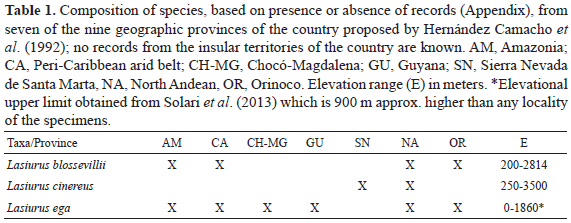
<body><![CDATA[<p><b>Key words.</b> Andes, Amazonas, Chiroptera,   misidentifications, Pacific Region.</p>     <p><b>RESUMEN</b></p>     <p>Con el objetivo de clarificar la distribuci&oacute;n de   murci&eacute;lagos del g&eacute;nero <i>Lasiurus</i> en Colombia,   se efectu&oacute; una revisi&oacute;n morfol&oacute;gica de 49 ejemplares de cuatro colecciones   colombianas. Esta revisi&oacute;n confirma la presencia de tres especies en Colombia (<i>L. blossevillii, L. cinereus</i>,   and <i>L. ega</i>), distribuidas en todas las   regiones naturales que incluyen seis de las nueve provincias biogeogr&aacute;ficas.   Estas especies pueden diferenciarse f&aacute;cilmente a partir de caracteres externos   y craneales. <i>Lasiurus</i><i> cinereus</i> es la especie de mayor talla (longitud del antebrazo &gt; 52 mm), mientras que <i>L. blossevillii</i> es la m&aacute;s peque&ntilde;a (antebrazo &lt; 42   mm). <i>Lasiurus</i><i> ega</i> presenta una forma distintiva de cr&aacute;neo con una cresta sagital desarrollada.   Aunque menciones previas en literatura sugieren la presencia de <i>L. egregius</i> y <i>L. castaneus</i> en Colombia, estos an&aacute;lisis no apoyan dichas inclusiones y contradicen la   evidencia citada de la presencia de estas especies en el pa&iacute;s. Se demostr&oacute; que   un ejemplar atribuido a <i>L. egregius </i>en   literatura es una identificaci&oacute;n err&oacute;nea de <i>L. blossevillii</i>.   Adem&aacute;s, se encontr&oacute; que no existen ejemplares de <i>L. castaneus</i> para el departamento de Cundinamarca, a pesar de varias menciones en   literatura. El estatus subespec&iacute;fico de estas   especies en Colombia sigue siendo controversial y se requiere de ejemplares   adicionales para determinar si existen distinciones claras entre diferentes   formas asociadas a alguna regi&oacute;n geogr&aacute;fica. La mayor&iacute;a de los ejemplares   revisados fueron machos y en algunos casos fueron encontrados casualmente   muertos en ciudades grandes localizadas en la regi&oacute;n Andina.</p>     <p><b>Palabras   clave.</b> Andes, Amazonas, Chiroptera, identificaciones   err&oacute;neas, regi&oacute;n Pac&iacute;fica.</p>     <p>Recibido:  03/07/2015</br>     <br>Aceptado: 22/10/2015</p>     <p><b>INTRODUCTION</b></p>     <p>The genus <i>Lasiurus</i><i> </i>comprises   between 15-17 species of aerial insectivores distributed along North and South   America (Simmons 2005, Gardner &amp; Handley 2008). In Colombia, the number of   species present is controversial. Historically, between three (Aellen 1970, Solari <i>et al.</i> 2013) and five species (Cuervo D&iacute;az<i>et al</i>. 1986, Alberico <i>et al</i>. 2000) have   been reported. The first account of <i>Lasiurus</i><i> </i>in Colombia provided by Aellen (1970) included   the species <i>L. borealis</i> (M&uuml;ller, 1766), <i>L. cinereus</i> (Palisot de Beavois, 1796),   and <i>L. ega</i> (Gervais,   1856). Two additional taxa have historically been included in the Colombian   fauna: <i>L. castaneus </i>and <i>L. egregius.</i> Cuervo-D&iacute;az<i>et   al</i>. (1986) introduced records of<i> L. casteneus </i>(sic.)   (= <i>L. castaneus</i> Handley 1960) in the warm   mountain areas of the Department of Cundinamarca, and Rodr&iacute;guez-Mahecha <i>et al</i>. (1995) included <i>L. castaneus</i> in Colombia as a whole. Neither publication,   however, provided voucher specimens or specific localities.</p>     <p>Cuervo-D&iacute;az <i>et al</i>. (1986) also listed <i>L. egregius</i> (Peters, 1870) as potentially present in   Colombia based on records from adjacent countries. Alberico <i>et al</i>.<i> </i>(2000) followed the suggestions of Cuervo-D&iacute;az<i>et al</i>. (1986) and claimed that specimens of <i>L. castaneus</i> are housed in the collections of Instituto de Ciencias Naturales (ICN) in   Bogot&aacute;. Later, Mu&ntilde;oz (2001) indicated that the presence of <i>L. castaneus</i> and <i>L. egregius</i> is only probable in Colombia. Bejarano-Bonilla <i>et   al</i>. (2007) listed <i>L. egregius</i> for the   Andean region (Department of Tolima) based on the capture of one individual   housed in the Zoological collections of Universidad de Tolima (CZUT). This   individual is the first reported specimen of <i>L. egregius</i> in Colombia. The records of Cuervo-D&iacute;az<i>et al</i>.   (1986) and Bejarano-Bonilla <i>et al</i>. (2007), were not properly discussed in recent accounts of the   genus (Gardner &amp; Handley 2008, Solari <i>et al</i>.   2013). However, the distribution of <i>L</i>. <i>egregius</i> has been recently updated (L&oacute;pez-Baucells<i>et al</i>.   2014) and two literature records from Colombia (Alberico <i>et al</i>. 2000 and Bejarano-Bonilla <i>et al</i>.   2007) were included in that update.</p>     <p>As Aellen (1970), Gardner &amp; Handley   (2008), and Solari <i>et al</i>. (2013) list only   three species for Colombia: <i>L. cinereus</i>, <i>L. ega</i>, and <i>L. blossevillii</i> (Lesson, 1826). The latter is a replacement of <i>L. borealis</i>, which is now   known to be restricted to North America (Morales &amp; Bickham 1995). The number of subspecies registered in Colombia varies for each species   and authors. <i>Lasiurus</i><i> blossevillii</i> presents two subspecies:<i> L. b. blossevillii</i> (Lesson, 1826), from the Amazon basin drainage, and <i>L. b. frantzii</i> (W. Peters, 1870), from northern and western   Colombia (Gardner &amp; Handley 2008). <i>Lasiurus</i><i> cinereus </i>is represented by only one subspecies   along the national territory: <i>L. c. pallescens </i>(W.   Peters, 1870). Although the subspecies <i>L. c. villosissimus </i>(&Eacute;. Geoffroy St.-Hilaire,   1806) has been historically reported for the country, Gardner &amp; Handley   (2008) mentioned that the subspecies found in Colombia is <i>L. c. pallescens</i>, while <i>L. c. villosissimus </i>is found from central Peru south to Argentina. Between two (Gardner &amp;   Handley 2008) or three (Kurta &amp; Lehr 1995)   subspecies of <i>L. ega </i>have been mentioned for   the country: <i>L. e. ega </i>(Gervais,   1856) for eastern Colombia (Kurta &amp; Lehr 1995), <i>L.   e. panamensis</i> (Thomas, 1901) for northern part of   the country, and <i>L. e. fuscatus</i> (Thomas, 1901)   for western Colombia (Kurta &amp; Lehr 1995, Gardner   &amp; Handley 2008).</p>     ]]></body>
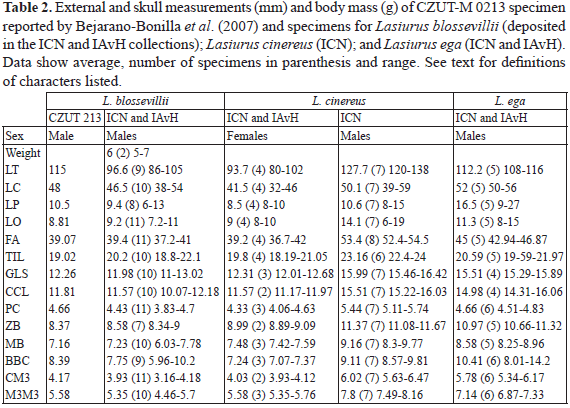
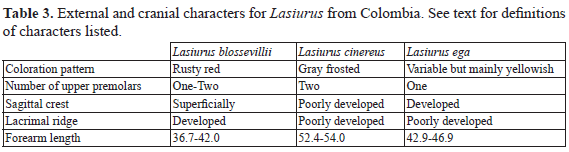
<body><![CDATA[<p>In order to clarify the distribution of genus <i>Lasiurus</i> and to address the debate on the presence of <i>L. castaneus</i> and <i>L. egregius</i> in Colombia, we reviewed   specimens from 4 natural history collections. We provide an updated   distribution of the species within the genus, a comparison of their morphological   and morphometric traits, and some ecological notes based on vouchered   literature records and specimens reviewed.</p>     <p><b>MATERIAL AND METHODS</b></p>     <p>We reviewed 49 specimens of genus <i>Lasiurus</i> from the collections of the Instituto de Ciencias Naturales (ICN), Bogot&aacute;;   the Instituto Alexander von Humboldt, (IAvH), Villa de Leyva; the Colecci&oacute;nZool&oacute;gica, Universidad   de Tolima (CZUT), Ibagu&eacute;; and the Museo de Historia Natural de la Universidad del Cauca (MHNUC), Popay&aacute;n. For   each specimen, 10 cranial and external measurements were taken using digital   calipers to the nearest 0.1 mm: hind foot length (HF) forearm length (FA),   greatest length of the cranium excluding incisors (GLS), condyle-basal length   (CBL), zygomatic breadth (ZB), mastoid breadth (BM),   braincase breadth (BBC), breadth across postorbital constriction (POC), length   of maxillary toothrow (CM3), and breadth across   molars (M3M3). In addition, total body length (TL), tail length (TV), ear   length (EAR), and weight (W) were taken from the specimen's labels.</p>     <p>We reviewed all available specimens housed at the ICN, searching for   vouchers of <i>L. castaneus</i> as well as the   specimen CZUT-M 0213 identified as <i>L. egregius</i> by Bejarano-Bonilla <i>et al</i>. (2007) to assess   the accuracy of their identifications. We compared each specimen with the   characters provided by Handley (1960), Shump &amp; Shump (1982) and Gardner &amp; Handley (2008).   Additionally, we describe the morphological characters and their degree of   variation in each of the species distributed in Colombia to facilitate future   identification under field and laboratory conditions.</p>     <p>We created distribution maps for each species using specimen localities   in addition to those available in the literature (Handley 1960, Gardner &amp;   Handley 2008), and housed in the collections of the American Museum of Natural   History (AMNH), New York; Field Museum of Natural History (FMNH), Chicago; Mus&eacute;umd'histoirenaturelle de la Ville de Genève (MHNG), Geneve;   and Royal Ontario Museum (ROM), Ontario. Furthermore, we analyzed the presence   or absence of each species among the different geographic regions and provinces   of Colombia (<a href="#tabla1">Table 1</a>) proposed by Hern&aacute;ndez Camacho <i>et al</i>. (1992).   Finally, ecological observations were obtained from information associated with   reviewed specimens.</p>             <center>   <img src="/img/revistas/cal/v37n2/v37n2a13tab1.gif"><a name="tabla1"></a>  </center>    <br>      <p><b>RESULTS</b></p>     <p>Based on the reviewed specimens, we identified three distinct species   distributed in Colombia: <i>L. blossevillii</i>, <i>L. cinereus</i>, and <i>L. ega </i>(<a href="#tabla1">Table 1</a>). These species are easily differentiated by external measurements   and cranial characters (<a href="#tabla2">Table 2</a>, <a href="#tabla3">Table 3</a>, <a href="#figura1">Fig. 1</a>). We   found no evidence for the presence of <i>L. castaneus </i>and<i> L</i>.<i> egregius</i> in Colombia. No   specimens matched the diagnostic characters of <i>L. castaneus </i>in the collections reviewed. Furthermore, our review of the only reported <i>L. egregius</i> specimen from Colombia (CZUT-M 0213;   <a href="#figura2">Fig. 2</a>) reveals that it belongs to <i>L. blossevillii</i>,   based on the following cranial, external, and morphometric characters: a   developed lacrimal ridge, rusty red pelage coloration, and small size (FA 39   mm). In contrast,<i> L. egregius </i>lacks a lacrimal   ridge, has a bright red pelage, and a larger size (FA &gt; 46 mm) (Shump &amp; Shump 1982, Bianconi &amp; Pedro 2007; <a href="#tabla2">Table 2</a>, <a href="#figura1">Fig. 1</a>)<i>.</i> The   probable cause for CZUT-M 0213 misidentification is the presence of only one   upper premolar in the specimen, a condition generally seen in <i>L. egregius</i> versus the two upper premolars found in <i>L. blossevillii. </i>We consider this condition a dental   abnormality of the individual since all other measurements of CZUT-M 0213 most   resemble those of other <i>L. blossevillii</i> specimens from Colombia (<a href="#tabla2">Table 2</a>).</p>             <center>   <img src="/img/revistas/cal/v37n2/v37n2a13tab2.gif"><a name="tabla2"></a>  </center>    ]]></body>
<body><![CDATA[<br>            <center>   <img src="/img/revistas/cal/v37n2/v37n2a13tab3.gif"><a name="tabla3"></a>  </center>    <br>            <center>   <img src="/img/revistas/cal/v37n2/v37n2a12fig1.gif"><a name="figura1"></a>  </center>    <br>            <center>   <img src="/img/revistas/cal/v37n2/v37n2a12fig2.gif"><a name="figura2"></a>  </center>    <br>      <p><i>Lasiurus</i><i> blossevillii</i> was the most abundant in number of   specimens in the visited collections with a total of 28 from the Amazonia, Peri-Caribbean arid belt, Guyana and North Andean provinces   (<a href="#tabla3">Table 1</a>; <a href="#figura3">Fig. 3a</a>). It can be identified based on the following characters:   medium size (FA &lt; 42 mm), with red-colored pelage varying from rusty red to   brownish red, and dorsal pelage extending to the knees over the uropatagium. It has a small and short skull (GLS &lt; 13.1   mm), with a developed lacrimal ridge (<a href="#figura1">Fig. 1</a>). The dental formula can be   variable (I1/3 C1/1 P1-2/2 M3/3) and generally presents two upper premolars. No   morphological differences associated to any geographical distribution were   observed, and all specimens reviewed (n = 28) belong to the same subspecies,   that we attributed to <i>L. b. frantzii </i>following   Handley (1960) and Gardner &amp; Handley (2008)<i>.</i></p>             <center>   <img src="/img/revistas/cal/v37n2/v37n2a12fig3.gif"><a name="figura3"></a>  </center>    <br>      ]]></body>
<body><![CDATA[<p><i>Lasiurus</i><i> cinereus</i> is known only from nine records in Colombian   collections, all of these limited to Sierra Nevada de Santa Marta Province, the   eastern slopes of Western Cordillera and western slopes of Eastern Cordillera   of the North Andean Province (<a href="#tabla1">Table 1</a>, <a href="#figura3">Fig. 3b</a>). It is the largest species of   the genus in the country (FA 52.4-54.0 mm; <a href="#tabla2">Table 2</a>) with frosty pelage mixed   with dark brown, grey and white tips. The skull is comparatively large for the   genus with a relatively short rostrum (<a href="#figura1">Fig. 1</a>), a poorly developed lacrimal   ridge, and the dental formula I1/3 C1/1 P2/2 M3/3. All the specimens reviewed   are similar in size and external morphology and belong to a single subspecies   that we attributed to <i>L. c. pallescens </i>following   Gardner &amp; Handley (2008) suggestions<i>.</i></p>     <p><i>Lasiurus</i><i> ega</i> is a medium sized bat (FA ~ 45 mm) with   records in Colombian collections from the Amazon, Caribbean and Pacific   regions, and six geographical provinces (<a href="#tabla1">Table 1</a>, <a href="#tabla3">Fig. 3b</a>, <a href="#anexo1">Appendix</a>). It   exhibits a high variation in pelage color, from gold to dusk white coloration,   even within the same biogeographic region of Colombia. Therefore, they could   not be clearly assigned to any of the three subspecies with suggested presence   in Colombia neither with morphological characters nor in distribution. This   species has the most distinctive cranial morphology of the three species in   Colombia. It has a small but elongated and flattened skull with a pronounced   sagittal crest and a poorly developed lacrimal ridge (<a href="#figura1">Fig. 1</a>). The dental   formula is I1/3 C1/1 P1/2 M3/3.</p>             <center>   <img src="/img/revistas/cal/v37n2/v37n2a12anex1.gif"><a name="anexo1"></a>  </center>    <br>      <p>Most of the <i>Lasiurus</i> specimens from   Colombian collections were males (100% of <i>L. cinereus</i>,   75% of <i>L. ega</i>, and 75% of <i>L</i>. <i>blossevillii</i>; <a href="#tabla2">Table 2</a>). For <i>L. cinereus, </i>the<i> </i>available reproductive information   of six specimens show that males with inguinal testes   were found from October to February. For <i>L. ega</i> five male specimens with reproductive activity are found from February to July.   For <i>L</i>. <i>blossevillii</i> three male   specimens were reproductively active from November to May. Furthermore, six   female <i>L. blossevillii </i>nursing specimens were   found from June to March. Finally, several records of <i>L. blossevillii</i> and <i>L. cinereus</i> are based on dead individuals   found in large cities such as Bogot&aacute;, Villavicencio, and Cali.</p>     <p><b>DISCUSSION</b></p>     <p>Our review allows us to update and clarify some issues regarding the   distribution of genus <i>Lasiurus</i> in Colombia.   The distribution of <i>L. cinereus </i>(Gardner &amp;   Handley 2008) has been defined based on two marginal specimen localities in   northern Colombia (Magdalena, Bonda; Allen 1900), one   in Eastern Cordillera (Cundinamarca, Bogot&aacute;, Santa Isabel; Sanborn &amp; Crespo 1957), and one in Central Cordillera, in an elevational range between 1700 and 3500 m (Solari <i>et al</i>. 2013), with no records for southern   Colombia (Gardner &amp; Handley 2008). We found two records from the eastern   slopes of Western Cordillera in the departments of Cauca (Ram&iacute;rez Chaves &amp; P&eacute;rez 2011) and Valle del Cauca (<a href="#anexo1">Appendix</a>), which extend the   distribution of <i>L. cinereus</i> to the Eastern   Andes of south-western Colombia (<a href="#figura3">Fig. 3b</a>). Although Solari <i>et al</i>. (2013) listed both departments in the distribution of the   species, Western Cordillera was not included. These records also close the   distance between mainland Colombian populations (<i>L. cinereus pallescens</i>) and the closest Peruvian populations   (<i>L. c. villosissimus</i>) in more than 350 km,   reducing the distance between both subspecies to 1250 km approximately. This   increases the possibility that both populations belong to one single   subspecies. Furthermore, the current restriction of the subspecies <i>L. c. villosissimus </i>to central Peru south through Bolivia,   Paraguay, Uruguay, Brazil, and central Argentina (Gardner &amp; Handley 2008)   supports the inclusion of the records from Colombia (e.g. Tamsitt <i>et al</i>. 1964) into <i>L. cinereus pallescens,</i> as we found no reason to list more than one   subspecies of <i>L. cinereus</i> for the country.</p>     <p>We found a similar result for <i>L. blossevillii</i> in Colombia, for which the distribution was based on two marginal localities:   one in the western slopes of the Eastern Cordillera (Cundinamarca, Sasaima), and a second in the upper Cauca River basin in   the eastern slopes of the Western Cordillera (Cauca, Mazamorrero).   We found additional records from the inter-Andean valleys of upper Cauca river   basin in the departments of Cauca apart of the record from Mazamorrero (Gardner &amp; Handley 2008), the Valle del Cauca (Rojas-D&iacute;az<i>et al</i>. 2012; not included in Solari <i>et al</i>.   2013), and also from the Pat&iacute;a river basin (Ram&iacute;rez-Chaves <i>et al</i>. 2010) that fill gaps in the   recorded distribution of the species, and increase the elevational range to 300 to 2814 m (from 500-2600 m; Solari <i>et   al</i>. 2013). Despite reports of two subspecies of <i>L. blossevillii</i> in Colombia by Gardner &amp; Handley (2008), we found that all the reviewed   specimens in Colombian collections can be attributed to only one subspecies: <i>L.   b. frantzii. </i>Although the subspecies <i>L. b. blossevillii</i> has been suggested as present in the   Amazon basin drainage of Colombia (Gardner &amp; Handley 2008), the only   specimen from the upper Amazon basin (ICN 16914) is indistinguishable from the <i>L.   b. frantzii </i>specimens found in other regions of   Colombia. However, to date there are not available specimens from lower part of   the Amazonia Province of Colombia to raise further conclusions.</p>     <p>For <i>L. ega</i>, the distribution includes   the lowlands of Colombia as reported by Gardner &amp; Handley (2008) and   Gonzalez <i>et al</i>. (2008). Although only four localities from Colombia have   been listed in the most recent update of the distribution of <i>L. ega</i> in America (Leal &amp; Gomes-Silva 2015), we found   12 confirmed localities from six of the nine geographic provinces or the   country (<a href="#tabla1">Table 1</a>; <a href="#anexo1">Appendix</a>). Subspecies identification, however, is   controversial. The external characters provided by Thomas (1901) to   differentiate among subspecies reportedly distributed in Colombia (Thomas 1901,   Gardner &amp; Handley 2008) are ambiguous, especially considering the high   variation of coloration observed in Colombian specimens. Thus, we assigned all <i>L. ega</i> specimens in Colombian collections to the   nominal subspecies, pending additional comparisons using genetic information of   specimens from the eastern and western part of Colombia. The elevational upper limit (1860 m; <a href="#tabla1">Table 1</a>) for <i>L. ega</i> in Solari <i>et al</i>.   (2013) is 900 m approx. higher than any locality of the specimens reviewed   (<a href="#anexo1">Appendix</a>), and we considered this elevational record   as dubious until more evidence supporting Solari <i>et   al</i>.´s (2013) range is provided.</p>     <p>Besides repeated mentions on the presence of <i>L. castaneus</i> and <i>L. egregius</i> in Colombia (Cuervo-D&iacute;az<i>et al. </i>1986,   Rodr&iacute;guez-Mahecha <i>et al</i>. 1995, Bejarano-Bonilla <i>et al</i>. 2007, L&oacute;pez-Baucells<i>et al</i>. 2014), we concur with Gardner &amp; Handley (2008), and Solari <i>et al</i>. (2013) in excluding these   taxa for the country. None of the records included in literature for these   species is supported with voucher specimens, considering that "<i>L</i>. <i>egregius</i>" with specimen CZUT-M 0213 by Bejarano-Bonilla <i>et al</i>. (2007) here is re-identified   as <i>L. blossevillii.</i> This misidentification was   probably caused by the presence of only one upper premolar in CZUT-M 0213.   However, presence/absence of a second premolar is not rare in some <i>Lasiurus</i><i> </i>species, as<i> </i>shown<i> </i>by<i> </i>Handley (1960) with approximately 10% of individuals of each species showing   variation. External characters also support the misidentification of CZUT-M   0213 which are not consistent with <i>L. egregius</i>:   large body size (FA 48-50 mm), the reddish coloration pattern of the pelage   with dorsal hairs with a dark base, a yellowish medium band, and reddish tips (Bianconi &amp; Pedro 2007). Although <i>L. egregius</i> is potentially present in Colombia based on   records from Panama and Brazil (Gardner &amp; Handley 2008), to date there is   no evidence of its presence in the country.</p>     ]]></body>
<body><![CDATA[<p>Confusion in the identification of <i>Lasiurus</i> in Colombia might be caused by inconsistencies in the characters used by   different researchers. In reference to dental characters, Shump &amp; Shump (1982) mentioned that <i>L. egregius </i>has two upper premolars, but the species   generally has only one (Bianconi &amp; Pedro 2007,   Gardner &amp; Handley 2008). Furthermore, wing characters are also   controversial. Handley (1996), and Gardner &amp; Handley (2008) mentioned that <i>L. egregius</i> has black wing membranes, with no   conspicuously reddish coloration along the metacarpals and phalanges (paler   than adjacent wing membranes in dried specimens). In contrast, Bianconi &amp; Pedro (2007), and L&oacute;pez-Baucells<i>et al</i>. (2014) reported that <i>L. egregius</i> has wings with a paler region along metacarpals and phalanges than the adjacent   wing membranes. We are not able to say which combination of characters is the   correct, considering that the species is not being registered to date in   Colombia</p>     <p><b>Ecological notes</b></p>     <p>The species of the <i>Lasiurus</i> genus are   not commonly caught in mist nests (Bianconi &amp;   Pedro 2007), and most records of <i>L. blossevillii</i> and <i>L. cinereus</i> are occasional and generally   come from cities in which they are found dead. Although museum data are always   biased due variable collection techniques (Cryan 2003), the remarkably uneven ratio of male vs. female specimens found in   Colombian collections, might be caused by sex differences in migratory patterns   and/or physiological constraints. For <i>L. cinereus</i>,   the absence of female specimens from mountainous regions during summer has been   suggested as possibly associated to physiological inability to raise young in   these areas due to the climatic conditions and low density of resources (Cryan 2003). Alternatively, altitudinal sexual segregation   likely represents partial altitudinal migrants because sexes must occur sympatrically to mate (McGuire &amp; Boyle 2013). Both, the   physiological inability and the migration events could also being affecting the   populations in Colombia and might explain the absence of females from high   Andean ecosystems of the country.</p>     <p>Using alternate methods is recommended for capturing information on   these bat species (such as recording echolocation calls) and the collection of   additional specimens to increase the number of the samples in the country for   future comparisons. Genetic analysis would be useful to determine the validity   of the subspecies classifications currently in use and some ecological aspects,   such as migratory movements, and reproductive periods of the species found in   Colombia.</p>     <p><b>ACKNOWLEDGEMENTS</b></p>     <p>We thank Hugo L&oacute;pez (ICN), Claudia Medina (IAvH), Pilar Rivas (MHNUC), Derly Constanza Yar&aacute; (CZ-UT), for allowing us the review of specimens under   their care. Manuel Ruedi provided information of the   specimens from Colombia deposited at the Mus&eacute;umd'histoirenaturelle de la Ville   de Genève (MHNG) and used in <a href="#anexo1">Appendix</a>. Felipe Su&aacute;rez-Castro   and two anonymous reviewers provided useful comments that improved this work.   HERC thanks Ariel Marcy and Viviana Gonz&aacute;lez Astudillo for comments on an early version, Bernardo Ram&iacute;rez Padilla, Maatiaak Ram&iacute;rez, and the University of Queensland (UQCent and UQI scholarships) for support.</p>     <p><b>LITERATURE CITED</b></p>     <!-- ref --><p>1. Aellen, V. 1970. Catalogue raisonn&eacute; des chiropterès de la Colombie. Revue Suisse de Zoologie 77: 1-37.    &nbsp;&nbsp;&nbsp;&nbsp;&nbsp;&nbsp;&nbsp;&nbsp;[&#160;<a href="javascript:void(0);" onclick="javascript: window.open('/scielo.php?script=sci_nlinks&ref=000060&pid=S0366-5232201500020001300001&lng=','','width=640,height=500,resizable=yes,scrollbars=1,menubar=yes,');">Links</a>&#160;]<!-- end-ref --></p>     <!-- ref --><p>2. Alberico, M., A.   Cadena, J.I. Hern&aacute;ndez-Camacho &amp; Y. Mu&ntilde;oz-Saba. 2000. Mam&iacute;feros (Synapsida: Theria) de Colombia. Biota Colombiana 1: 43-75.    &nbsp;&nbsp;&nbsp;&nbsp;&nbsp;&nbsp;&nbsp;&nbsp;[&#160;<a href="javascript:void(0);" onclick="javascript: window.open('/scielo.php?script=sci_nlinks&ref=000062&pid=S0366-5232201500020001300002&lng=','','width=640,height=500,resizable=yes,scrollbars=1,menubar=yes,');">Links</a>&#160;]<!-- end-ref --></p>     <!-- ref --><p>3. Allen, J.A. 1900. List of bats collected by Mr. H. H. Smith in the Santa Marta region of   Colombia, with descriptions of new species. Bulletin of the American Museum of   Natural History 13: 87-94&nbsp;&nbsp;&nbsp;&nbsp;&nbsp;&nbsp;&nbsp;&nbsp;[&#160;<a href="javascript:void(0);" onclick="javascript: window.open('/scielo.php?script=sci_nlinks&ref=000064&pid=S0366-5232201500020001300003&lng=','','width=640,height=500,resizable=yes,scrollbars=1,menubar=yes,');">Links</a>&#160;]<!-- end-ref --><!-- ref --><p>4. Bejarano-Bonilla, D.A., A. Yate-Rivas &amp; M.H. Bernal-Bautista. 2007. Diversidad y distribuci&oacute;n de la   fauna quir&oacute;ptera en un transecto altitudinal en el   departamento del Tolima, Colombia. Caldasia 29:   297-308.    &nbsp;&nbsp;&nbsp;&nbsp;&nbsp;&nbsp;&nbsp;&nbsp;[&#160;<a href="javascript:void(0);" onclick="javascript: window.open('/scielo.php?script=sci_nlinks&ref=000065&pid=S0366-5232201500020001300004&lng=','','width=640,height=500,resizable=yes,scrollbars=1,menubar=yes,');">Links</a>&#160;]<!-- end-ref --></p>     <!-- ref --><p>5. Cuervo-D&iacute;az, A., J.I. Hern&aacute;ndez-Camacho, and A.   Cadena. 1986. Lista actualizada de los   mam&iacute;feros de Colombia anotaciones sobre su distribuci&oacute;n. Caldasia 15: 71-75.    &nbsp;&nbsp;&nbsp;&nbsp;&nbsp;&nbsp;&nbsp;&nbsp;[&#160;<a href="javascript:void(0);" onclick="javascript: window.open('/scielo.php?script=sci_nlinks&ref=000067&pid=S0366-5232201500020001300005&lng=','','width=640,height=500,resizable=yes,scrollbars=1,menubar=yes,');">Links</a>&#160;]<!-- end-ref --></p>     <!-- ref --><p>6. Cryan, P.M. 2003. Seasonal distribution of migratory tree   bats (<i>Lasiurus</i> and <i>Lasionycteris</i>)   in North America. Journal of Mammalogy 84: 579-593.    &nbsp;&nbsp;&nbsp;&nbsp;&nbsp;&nbsp;&nbsp;&nbsp;[&#160;<a href="javascript:void(0);" onclick="javascript: window.open('/scielo.php?script=sci_nlinks&ref=000069&pid=S0366-5232201500020001300006&lng=','','width=640,height=500,resizable=yes,scrollbars=1,menubar=yes,');">Links</a>&#160;]<!-- end-ref --></p>     <!-- ref --><p>7. Bianconi, G.V.B. &amp; W.A. Pedro. 2007. Familia Vespertilionidae.   In N.R. dos Reis, A.L. Peracchi, W.A. Pedro &amp; I.P. Lima (eds.). Morcegos do Brasil: 167-195,<b> </b>Universidade Estadual de Londrina, Paran&aacute;    &nbsp;&nbsp;&nbsp;&nbsp;&nbsp;&nbsp;&nbsp;&nbsp;[&#160;<a href="javascript:void(0);" onclick="javascript: window.open('/scielo.php?script=sci_nlinks&ref=000071&pid=S0366-5232201500020001300007&lng=','','width=640,height=500,resizable=yes,scrollbars=1,menubar=yes,');">Links</a>&#160;]<!-- end-ref -->.</p>     ]]></body>
<body><![CDATA[<!-- ref --><p>8. Gonzalez, E., R. Barquez &amp; J. Arroyo-Cabrales. 2008. <i>Lasiurus</i><i> cinereus</i>. In<i> </i>The IUCN Red List of Threatened Species.Version 2014.3. &lt;www.iucnredlist.org&gt;. Downloaded on 17 February 2015.    &nbsp;&nbsp;&nbsp;&nbsp;&nbsp;&nbsp;&nbsp;&nbsp;[&#160;<a href="javascript:void(0);" onclick="javascript: window.open('/scielo.php?script=sci_nlinks&ref=000073&pid=S0366-5232201500020001300008&lng=','','width=640,height=500,resizable=yes,scrollbars=1,menubar=yes,');">Links</a>&#160;]<!-- end-ref --></p>     <!-- ref --><p>9. Handley, C.O., Jr. 1960. Descriptions   of new bats from Panama. Proceedings of the United States National   Museum 112: 459-79.    &nbsp;&nbsp;&nbsp;&nbsp;&nbsp;&nbsp;&nbsp;&nbsp;[&#160;<a href="javascript:void(0);" onclick="javascript: window.open('/scielo.php?script=sci_nlinks&ref=000075&pid=S0366-5232201500020001300009&lng=','','width=640,height=500,resizable=yes,scrollbars=1,menubar=yes,');">Links</a>&#160;]<!-- end-ref --></p>     <!-- ref --><p>10. Handley, C.O., Jr.   1996. New species of mammals from northern South America: Bats of the genera <i>Histiotus</i><i> </i>Gervais and <i>Lasiurus</i><i> </i>Gray (Mammalia: Chiroptera: Vespertilionidae).   Proceedings of the Biological Society of Washington 109: 1-9.    &nbsp;&nbsp;&nbsp;&nbsp;&nbsp;&nbsp;&nbsp;&nbsp;[&#160;<a href="javascript:void(0);" onclick="javascript: window.open('/scielo.php?script=sci_nlinks&ref=000077&pid=S0366-5232201500020001300010&lng=','','width=640,height=500,resizable=yes,scrollbars=1,menubar=yes,');">Links</a>&#160;]<!-- end-ref --></p>     <!-- ref --><p>11. Handley, C.O., Jr. &amp; A.L. Gardner. 2008. Genus <i>Lasiurus</i>. In A.L.   Gardner (ed.). Mammals of   South America. Volume 1. Marsupials, xenarthrans, shrews, and bats: 188-189, The University of   Chicago Press, Chicago.    &nbsp;&nbsp;&nbsp;&nbsp;&nbsp;&nbsp;&nbsp;&nbsp;[&#160;<a href="javascript:void(0);" onclick="javascript: window.open('/scielo.php?script=sci_nlinks&ref=000079&pid=S0366-5232201500020001300011&lng=','','width=640,height=500,resizable=yes,scrollbars=1,menubar=yes,');">Links</a>&#160;]<!-- end-ref --></p>     <!-- ref --><p>12. Hern&aacute;ndez Camacho, J.I., A.H. Guerra, R.O.   Quijano &amp; T. Walschburger. 1992. Unidades biogeogr&aacute;ficas de   Colombia. In G. Halffter, (ed.).   La Diversidad Biol&oacute;gica de Iberoam&eacute;rica: 105-151, Acta Zool&oacute;gica Mexicana (n.s.), M&eacute;xico.    &nbsp;&nbsp;&nbsp;&nbsp;&nbsp;&nbsp;&nbsp;&nbsp;[&#160;<a href="javascript:void(0);" onclick="javascript: window.open('/scielo.php?script=sci_nlinks&ref=000081&pid=S0366-5232201500020001300012&lng=','','width=640,height=500,resizable=yes,scrollbars=1,menubar=yes,');">Links</a>&#160;]<!-- end-ref --></p>     ]]></body>
<body><![CDATA[<!-- ref --><p>13. Kurta, A. &amp; G.C. Lehr.   1995. <i>Lasiurus</i><i> ega.</i> Mammalian Species 515: 1-7.    &nbsp;&nbsp;&nbsp;&nbsp;&nbsp;&nbsp;&nbsp;&nbsp;[&#160;<a href="javascript:void(0);" onclick="javascript: window.open('/scielo.php?script=sci_nlinks&ref=000083&pid=S0366-5232201500020001300013&lng=','','width=640,height=500,resizable=yes,scrollbars=1,menubar=yes,');">Links</a>&#160;]<!-- end-ref --></p>     <!-- ref --><p>14. Leal, E.S.B. &amp; F.F. Gomes-Silva. 2015. Update compilation on the   geographic distribution of <i>Lasiurus</i><i> ega</i> (Gervais, 1856)   (Mammalia, Chiroptera, Vespertilionidae),   including the first record for the Caatinga in the   state of Para&iacute;ba, northeastern Brazil. Chiroptera Neotropical 21: 1320-1331.    &nbsp;&nbsp;&nbsp;&nbsp;&nbsp;&nbsp;&nbsp;&nbsp;[&#160;<a href="javascript:void(0);" onclick="javascript: window.open('/scielo.php?script=sci_nlinks&ref=000085&pid=S0366-5232201500020001300014&lng=','','width=640,height=500,resizable=yes,scrollbars=1,menubar=yes,');">Links</a>&#160;]<!-- end-ref --></p>     <!-- ref --><p>15. L&oacute;pez-Baucells, A., R.   Rocha, G. Fern&aacute;ndez-Arellano &amp; P. Estefano. 2014. Echolocation of the big red bat <i>Lasiurus</i><i> egregius</i> (Chiroptera: Vespertilionidae)   and &#64257;rst record from the Central Brazilian Amazon. Studies on Neotropical Fauna and Environment 49: 18-25.    &nbsp;&nbsp;&nbsp;&nbsp;&nbsp;&nbsp;&nbsp;&nbsp;[&#160;<a href="javascript:void(0);" onclick="javascript: window.open('/scielo.php?script=sci_nlinks&ref=000087&pid=S0366-5232201500020001300015&lng=','','width=640,height=500,resizable=yes,scrollbars=1,menubar=yes,');">Links</a>&#160;]<!-- end-ref --></p>     <!-- ref --><p>16. McGuire, L.P. &amp; W.A. Boyle. 2013. Altitudinal migration in bats:   evidence, patterns, and processes. Biological Reviews 88: 767-786.    &nbsp;&nbsp;&nbsp;&nbsp;&nbsp;&nbsp;&nbsp;&nbsp;[&#160;<a href="javascript:void(0);" onclick="javascript: window.open('/scielo.php?script=sci_nlinks&ref=000089&pid=S0366-5232201500020001300016&lng=','','width=640,height=500,resizable=yes,scrollbars=1,menubar=yes,');">Links</a>&#160;]<!-- end-ref --></p>     <!-- ref --><p>17. Morales, J. C.   &amp; J. Bickham. 1995. Molecular   systematics of the genus <i>Lasiurus</i> (Chiroptera: Vespertilionidae)   based on restriction-site maps of the mitochondrial ribosomal genes. Journal of Mammalogy 76: 30-749.    &nbsp;&nbsp;&nbsp;&nbsp;&nbsp;&nbsp;&nbsp;&nbsp;[&#160;<a href="javascript:void(0);" onclick="javascript: window.open('/scielo.php?script=sci_nlinks&ref=000091&pid=S0366-5232201500020001300017&lng=','','width=640,height=500,resizable=yes,scrollbars=1,menubar=yes,');">Links</a>&#160;]<!-- end-ref --></p>     ]]></body>
<body><![CDATA[<!-- ref --><p>18. Ram&iacute;rez-Chaves, H.E. &amp; W. P&eacute;rez. 2011. Mam&iacute;feros (Mammalia: Theria) del departamento del Cauca, Colombia. Biota   Colombiana 11: 139-169. (Dated 2010, printed 2011).    &nbsp;&nbsp;&nbsp;&nbsp;&nbsp;&nbsp;&nbsp;&nbsp;[&#160;<a href="javascript:void(0);" onclick="javascript: window.open('/scielo.php?script=sci_nlinks&ref=000093&pid=S0366-5232201500020001300018&lng=','','width=640,height=500,resizable=yes,scrollbars=1,menubar=yes,');">Links</a>&#160;]<!-- end-ref --></p>     <!-- ref --><p>19. Ram&iacute;rez-Chaves, H.E., F. Ayerbe-Qui&ntilde;ones,   and O. Mej&iacute;a-Egas. 2010. Mam&iacute;feros de la cuenca Alta del r&iacute;o Pat&iacute;a en   el departamento del Cauca, Colombia. Bolet&iacute;n Cient&iacute;fico, Centro de Museos,   Universidad de Caldas 14: 92-113.    &nbsp;&nbsp;&nbsp;&nbsp;&nbsp;&nbsp;&nbsp;&nbsp;[&#160;<a href="javascript:void(0);" onclick="javascript: window.open('/scielo.php?script=sci_nlinks&ref=000095&pid=S0366-5232201500020001300019&lng=','','width=640,height=500,resizable=yes,scrollbars=1,menubar=yes,');">Links</a>&#160;]<!-- end-ref --></p>     <!-- ref --><p>20. Rodr&iacute;guez-Mahecha, J. V., J.I.   Hern&aacute;ndez-Camacho, T.R. Defler, M. Alberico, R.B. Mast, R.A. Mittermeier &amp; A. Cadena. 1995. Mam&iacute;feros colombianos: sus nombres comunes e   ind&iacute;genas. Occasional Papers in Conservation Biology, Conservation International 3: 1-56.    &nbsp;&nbsp;&nbsp;&nbsp;&nbsp;&nbsp;&nbsp;&nbsp;[&#160;<a href="javascript:void(0);" onclick="javascript: window.open('/scielo.php?script=sci_nlinks&ref=000097&pid=S0366-5232201500020001300020&lng=','','width=640,height=500,resizable=yes,scrollbars=1,menubar=yes,');">Links</a>&#160;]<!-- end-ref --></p>     <!-- ref --><p>21. Rojas-D&iacute;az, V., M. Reyes-G. &amp; M. Alberico. 2012. Mam&iacute;feros (Synapsida, Theria)   del Valle del Cauca, Colombia. Biota Colombiana 13: 99-116.    &nbsp;&nbsp;&nbsp;&nbsp;&nbsp;&nbsp;&nbsp;&nbsp;[&#160;<a href="javascript:void(0);" onclick="javascript: window.open('/scielo.php?script=sci_nlinks&ref=000099&pid=S0366-5232201500020001300021&lng=','','width=640,height=500,resizable=yes,scrollbars=1,menubar=yes,');">Links</a>&#160;]<!-- end-ref --></p>     <!-- ref --><p>22. Sanborn, C.C. &amp;   J.A. Crespo. 1957. El murci&eacute;lago blanquizco (<i>Lasiurus</i><i> cinereus</i>)   y sus subespecies. Bolet&iacute;n del Museo Argentino de Ciencias Naturales   "Bernardino Rivadavia" e Instituto Nacional de Investigaciones de las Ciencias   Naturales, Buenos Aires 4: 1-13.    &nbsp;&nbsp;&nbsp;&nbsp;&nbsp;&nbsp;&nbsp;&nbsp;[&#160;<a href="javascript:void(0);" onclick="javascript: window.open('/scielo.php?script=sci_nlinks&ref=000101&pid=S0366-5232201500020001300022&lng=','','width=640,height=500,resizable=yes,scrollbars=1,menubar=yes,');">Links</a>&#160;]<!-- end-ref --></p>     ]]></body>
<body><![CDATA[<!-- ref --><p>23. Simmons, N.B. 2005. Order Chiroptera. In D.E. Wilson and D.M. Reeder (eds.). Mammals Species of the World: a taxonomic and   geographic reference 3a ed., Vol. 1, 2: 312-529,<i> </i>The Johns Hopkins   University Press, Baltimore, USA.    &nbsp;&nbsp;&nbsp;&nbsp;&nbsp;&nbsp;&nbsp;&nbsp;[&#160;<a href="javascript:void(0);" onclick="javascript: window.open('/scielo.php?script=sci_nlinks&ref=000103&pid=S0366-5232201500020001300023&lng=','','width=640,height=500,resizable=yes,scrollbars=1,menubar=yes,');">Links</a>&#160;]<!-- end-ref --></p>     <!-- ref --><p>24. Shump, K.A. &amp; A.U. Shump. 1982. <i>Lasiurus</i><i> borealis</i>. Mammalian Species 183: 1-6.    &nbsp;&nbsp;&nbsp;&nbsp;&nbsp;&nbsp;&nbsp;&nbsp;[&#160;<a href="javascript:void(0);" onclick="javascript: window.open('/scielo.php?script=sci_nlinks&ref=000105&pid=S0366-5232201500020001300024&lng=','','width=640,height=500,resizable=yes,scrollbars=1,menubar=yes,');">Links</a>&#160;]<!-- end-ref --></p>     <!-- ref --><p>25. Solari, S., Y. Mu&ntilde;oz-Saba,   J.V. Rodr&iacute;guez-Mahecha, T.R. Defler, H.E.   Ram&iacute;rez-Chaves &amp; F. Trujillo. 2013. Riqueza, endemismo y conservaci&oacute;n de los mam&iacute;feros de   Colombia. Mastozoolog&iacute;a Neotropical 20: 301-365.    &nbsp;&nbsp;&nbsp;&nbsp;&nbsp;&nbsp;&nbsp;&nbsp;[&#160;<a href="javascript:void(0);" onclick="javascript: window.open('/scielo.php?script=sci_nlinks&ref=000107&pid=S0366-5232201500020001300025&lng=','','width=640,height=500,resizable=yes,scrollbars=1,menubar=yes,');">Links</a>&#160;]<!-- end-ref --></p>     <!-- ref --><p>26. Tamsitt, J.R., D.   Valdivieso &amp; J. Hern&aacute;ndez Camacho. 1964.   Bats of the Bogota savanna, Colombia, with notes on altitudinal distribution of Neotropical bats. Revista de Biolog&iacute;a Tropical 12: 107-15.    &nbsp;&nbsp;&nbsp;&nbsp;&nbsp;&nbsp;&nbsp;&nbsp;[&#160;<a href="javascript:void(0);" onclick="javascript: window.open('/scielo.php?script=sci_nlinks&ref=000109&pid=S0366-5232201500020001300026&lng=','','width=640,height=500,resizable=yes,scrollbars=1,menubar=yes,');">Links</a>&#160;]<!-- end-ref --></p>     <!-- ref --><p>27. Thomas, O. 1901. New Neotropical Mammals, with a Note on the Species of <i>Reithrodon</i>. Annals and Magazine of Natural History 8: 246-255.    &nbsp;&nbsp;&nbsp;&nbsp;&nbsp;&nbsp;&nbsp;&nbsp;[&#160;<a href="javascript:void(0);" onclick="javascript: window.open('/scielo.php?script=sci_nlinks&ref=000111&pid=S0366-5232201500020001300027&lng=','','width=640,height=500,resizable=yes,scrollbars=1,menubar=yes,');">Links</a>&#160;]<!-- end-ref --></p> </font>     ]]></body>
<body><![CDATA[ ]]></body><back>
<ref-list>
<ref id="B1">
<label>1</label><nlm-citation citation-type="journal">
<person-group person-group-type="author">
<name>
<surname><![CDATA[Aellen]]></surname>
<given-names><![CDATA[V.]]></given-names>
</name>
</person-group>
<article-title xml:lang="sv"><![CDATA[Catalogue raisonné des chiropterès de la Colombie]]></article-title>
<source><![CDATA[Revue Suisse de Zoologie]]></source>
<year>1970</year>
<volume>77</volume>
<page-range>1-37</page-range></nlm-citation>
</ref>
<ref id="B2">
<label>2</label><nlm-citation citation-type="journal">
<person-group person-group-type="author">
<name>
<surname><![CDATA[Alberico]]></surname>
<given-names><![CDATA[M.]]></given-names>
</name>
<name>
<surname><![CDATA[Cadena]]></surname>
<given-names><![CDATA[A.]]></given-names>
</name>
<name>
<surname><![CDATA[Hernández-Camacho]]></surname>
<given-names><![CDATA[J.I.]]></given-names>
</name>
<name>
<surname><![CDATA[Muñoz-Saba]]></surname>
<given-names><![CDATA[Y.]]></given-names>
</name>
</person-group>
<article-title xml:lang="es"><![CDATA[Mamíferos (Synapsida: Theria) de Colombia]]></article-title>
<source><![CDATA[Biota Colombiana]]></source>
<year>2000</year>
<volume>1</volume>
<page-range>43-75</page-range></nlm-citation>
</ref>
<ref id="B3">
<label>3</label><nlm-citation citation-type="journal">
<person-group person-group-type="author">
<name>
<surname><![CDATA[Allen]]></surname>
<given-names><![CDATA[J.A.]]></given-names>
</name>
</person-group>
<article-title xml:lang="en"><![CDATA[List of bats collected by Mr. H. H. Smith in the Santa Marta region of Colombia, with descriptions of new species]]></article-title>
<source><![CDATA[Bulletin of the American Museum of Natural History]]></source>
<year>1900</year>
<volume>13</volume>
<page-range>87-94</page-range></nlm-citation>
</ref>
<ref id="B4">
<label>4</label><nlm-citation citation-type="journal">
<person-group person-group-type="author">
<name>
<surname><![CDATA[Bejarano-Bonilla]]></surname>
<given-names><![CDATA[D.A.]]></given-names>
</name>
<name>
<surname><![CDATA[Yate-Rivas]]></surname>
<given-names><![CDATA[A.]]></given-names>
</name>
<name>
<surname><![CDATA[Bernal-Bautista]]></surname>
<given-names><![CDATA[M.H.]]></given-names>
</name>
</person-group>
<article-title xml:lang="es"><![CDATA[Diversidad y distribución de la fauna quiróptera en un transecto altitudinal en el departamento del Tolima, Colombia]]></article-title>
<source><![CDATA[Caldasia]]></source>
<year>2007</year>
<volume>29</volume>
<page-range>297-308</page-range></nlm-citation>
</ref>
<ref id="B5">
<label>5</label><nlm-citation citation-type="journal">
<person-group person-group-type="author">
<name>
<surname><![CDATA[Cuervo-Díaz]]></surname>
<given-names><![CDATA[A.]]></given-names>
</name>
<name>
<surname><![CDATA[Hernández-Camacho]]></surname>
<given-names><![CDATA[J.I.]]></given-names>
</name>
<name>
<surname><![CDATA[Cadena]]></surname>
<given-names><![CDATA[A.]]></given-names>
</name>
</person-group>
<article-title xml:lang="es"><![CDATA[Lista actualizada de los mamíferos de Colombia anotaciones sobre su distribución]]></article-title>
<source><![CDATA[Caldasia]]></source>
<year>1986</year>
<volume>15</volume>
<page-range>71-75</page-range></nlm-citation>
</ref>
<ref id="B6">
<label>6</label><nlm-citation citation-type="journal">
<person-group person-group-type="author">
<name>
<surname><![CDATA[Cryan]]></surname>
<given-names><![CDATA[P.M.]]></given-names>
</name>
</person-group>
<article-title xml:lang="en"><![CDATA[Seasonal distribution of migratory tree bats (Lasiurus and Lasionycteris) in North America]]></article-title>
<source><![CDATA[Journal of Mammalogy]]></source>
<year>2003</year>
<volume>84</volume>
<page-range>579-593</page-range></nlm-citation>
</ref>
<ref id="B7">
<label>7</label><nlm-citation citation-type="book">
<person-group person-group-type="author">
<name>
<surname><![CDATA[Bianconi]]></surname>
<given-names><![CDATA[G.V.B.]]></given-names>
</name>
<name>
<surname><![CDATA[Pedro]]></surname>
<given-names><![CDATA[W.A.]]></given-names>
</name>
</person-group>
<article-title xml:lang="es"><![CDATA[Familia Vespertilionidae]]></article-title>
<person-group person-group-type="editor">
<name>
<surname><![CDATA[dos Reis]]></surname>
<given-names><![CDATA[N.R.]]></given-names>
</name>
<name>
<surname><![CDATA[Peracchi]]></surname>
<given-names><![CDATA[A.L.]]></given-names>
</name>
<name>
<surname><![CDATA[Pedro]]></surname>
<given-names><![CDATA[W.A.]]></given-names>
</name>
<name>
<surname><![CDATA[Lima]]></surname>
<given-names><![CDATA[I.P.]]></given-names>
</name>
</person-group>
<source><![CDATA[Morcegos do Brasil]]></source>
<year>2007</year>
<page-range>167-195</page-range><publisher-loc><![CDATA[^eParaná Paraná]]></publisher-loc>
<publisher-name><![CDATA[Universidade Estadual de Londrina]]></publisher-name>
</nlm-citation>
</ref>
<ref id="B8">
<label>8</label><nlm-citation citation-type="">
<person-group person-group-type="author">
<name>
<surname><![CDATA[Gonzalez]]></surname>
<given-names><![CDATA[E.]]></given-names>
</name>
<name>
<surname><![CDATA[Barquez]]></surname>
<given-names><![CDATA[R.]]></given-names>
</name>
<name>
<surname><![CDATA[Arroyo-Cabrales]]></surname>
<given-names><![CDATA[J.]]></given-names>
</name>
</person-group>
<source><![CDATA[Lasiurus cinereus]]></source>
<year>2008</year>
</nlm-citation>
</ref>
<ref id="B9">
<label>9</label><nlm-citation citation-type="journal">
<person-group person-group-type="author">
<name>
<surname><![CDATA[Handley]]></surname>
<given-names><![CDATA[C.O., Jr.]]></given-names>
</name>
</person-group>
<article-title xml:lang="en"><![CDATA[Descriptions of new bats from Panama]]></article-title>
<source><![CDATA[Proceedings of the United States National Museum]]></source>
<year>1960</year>
<volume>112</volume>
<page-range>459-79</page-range></nlm-citation>
</ref>
<ref id="B10">
<label>10</label><nlm-citation citation-type="journal">
<person-group person-group-type="author">
<name>
<surname><![CDATA[Handley]]></surname>
<given-names><![CDATA[C.O., Jr.]]></given-names>
</name>
</person-group>
<article-title xml:lang="en"><![CDATA[New species of mammals from northern South America: Bats of the genera Histiotus Gervais and Lasiurus Gray (Mammalia: Chiroptera: Vespertilionidae)]]></article-title>
<source><![CDATA[Proceedings of the Biological Society of Washington]]></source>
<year>1996</year>
<volume>109</volume>
<page-range>1-9</page-range></nlm-citation>
</ref>
<ref id="B11">
<label>11</label><nlm-citation citation-type="book">
<person-group person-group-type="author">
<name>
<surname><![CDATA[Handley]]></surname>
<given-names><![CDATA[C.O., Jr.]]></given-names>
</name>
<name>
<surname><![CDATA[Gardner]]></surname>
<given-names><![CDATA[A.L.]]></given-names>
</name>
</person-group>
<article-title xml:lang="en"><![CDATA[Genus Lasiurus]]></article-title>
<person-group person-group-type="editor">
<name>
<surname><![CDATA[Gardner]]></surname>
<given-names><![CDATA[A.L.]]></given-names>
</name>
</person-group>
<source><![CDATA[Mammals of South America]]></source>
<year>2008</year>
<volume>1</volume>
<page-range>188-189</page-range><publisher-loc><![CDATA[Chicago ]]></publisher-loc>
<publisher-name><![CDATA[The University of Chicago Press]]></publisher-name>
</nlm-citation>
</ref>
<ref id="B12">
<label>12</label><nlm-citation citation-type="">
<person-group person-group-type="author">
<name>
<surname><![CDATA[Hernández Camacho]]></surname>
<given-names><![CDATA[J.I.]]></given-names>
</name>
<name>
<surname><![CDATA[Guerra]]></surname>
<given-names><![CDATA[A.H.]]></given-names>
</name>
<name>
<surname><![CDATA[Quijano]]></surname>
<given-names><![CDATA[R.O.]]></given-names>
</name>
<name>
<surname><![CDATA[Walschburger]]></surname>
<given-names><![CDATA[T.]]></given-names>
</name>
</person-group>
<article-title xml:lang="es"><![CDATA[Unidades biogeográficas de Colombia]]></article-title>
<person-group person-group-type="editor">
<name>
<surname><![CDATA[Halffter]]></surname>
<given-names><![CDATA[G.]]></given-names>
</name>
</person-group>
<source><![CDATA[La Diversidad Biológica de Iberoamérica]]></source>
<year>1992</year>
<page-range>105-151</page-range></nlm-citation>
</ref>
<ref id="B13">
<label>13</label><nlm-citation citation-type="journal">
<person-group person-group-type="author">
<name>
<surname><![CDATA[Kurta]]></surname>
<given-names><![CDATA[A.]]></given-names>
</name>
<name>
<surname><![CDATA[Lehr]]></surname>
<given-names><![CDATA[G.C.]]></given-names>
</name>
</person-group>
<article-title xml:lang="en"><![CDATA[Lasiurus ega]]></article-title>
<source><![CDATA[Mammalian Species]]></source>
<year>1995</year>
<volume>515</volume>
<page-range>1-7</page-range></nlm-citation>
</ref>
<ref id="B14">
<label>14</label><nlm-citation citation-type="journal">
<person-group person-group-type="author">
<name>
<surname><![CDATA[Leal]]></surname>
<given-names><![CDATA[E.S.B.]]></given-names>
</name>
<name>
<surname><![CDATA[Gomes-Silva]]></surname>
<given-names><![CDATA[F.F.]]></given-names>
</name>
</person-group>
<article-title xml:lang="en"><![CDATA[Update compilation on the geographic distribution of Lasiurus ega (Gervais, 1856) (Mammalia, Chiroptera, Vespertilionidae), including the first record for the Caatinga in the state of Paraíba, northeastern Brazil]]></article-title>
<source><![CDATA[Chiroptera Neotropical]]></source>
<year>2015</year>
<volume>21</volume>
<page-range>1320-1331</page-range></nlm-citation>
</ref>
<ref id="B15">
<label>15</label><nlm-citation citation-type="journal">
<person-group person-group-type="author">
<name>
<surname><![CDATA[López-Baucells]]></surname>
<given-names><![CDATA[A.]]></given-names>
</name>
<name>
<surname><![CDATA[Rocha]]></surname>
<given-names><![CDATA[R.]]></given-names>
</name>
<name>
<surname><![CDATA[Fernández-Arellano]]></surname>
<given-names><![CDATA[G.]]></given-names>
</name>
<name>
<surname><![CDATA[Estefano]]></surname>
<given-names><![CDATA[P.]]></given-names>
</name>
</person-group>
<article-title xml:lang="en"><![CDATA[Echolocation of the big red bat Lasiurus egregius (Chiroptera: Vespertilionidae) and &#64257;rst record from the Central Brazilian Amazon]]></article-title>
<source><![CDATA[Studies on Neotropical Fauna and Environment]]></source>
<year>2014</year>
<volume>49</volume>
<page-range>18-25</page-range></nlm-citation>
</ref>
<ref id="B16">
<label>16</label><nlm-citation citation-type="journal">
<person-group person-group-type="author">
<name>
<surname><![CDATA[McGuire]]></surname>
<given-names><![CDATA[L.P.]]></given-names>
</name>
<name>
<surname><![CDATA[Boyle]]></surname>
<given-names><![CDATA[W.A.]]></given-names>
</name>
</person-group>
<article-title xml:lang="en"><![CDATA[Altitudinal migration in bats: evidence, patterns, and processes]]></article-title>
<source><![CDATA[Biological Reviews]]></source>
<year>2013</year>
<volume>88</volume>
<page-range>767-786</page-range></nlm-citation>
</ref>
<ref id="B17">
<label>17</label><nlm-citation citation-type="journal">
<person-group person-group-type="author">
<name>
<surname><![CDATA[Morales]]></surname>
<given-names><![CDATA[J. C.]]></given-names>
</name>
<name>
<surname><![CDATA[Bickham]]></surname>
<given-names><![CDATA[J.]]></given-names>
</name>
</person-group>
<article-title xml:lang="en"><![CDATA[Molecular systematics of the genus Lasiurus (Chiroptera: Vespertilionidae) based on restriction-site maps of the mitochondrial ribosomal genes]]></article-title>
<source><![CDATA[Journal of Mammalogy]]></source>
<year>1995</year>
<volume>76</volume>
<page-range>30-749</page-range></nlm-citation>
</ref>
<ref id="B18">
<label>18</label><nlm-citation citation-type="journal">
<person-group person-group-type="author">
<name>
<surname><![CDATA[Ramírez-Chaves]]></surname>
<given-names><![CDATA[H.E.]]></given-names>
</name>
<name>
<surname><![CDATA[Pérez]]></surname>
<given-names><![CDATA[W.]]></given-names>
</name>
</person-group>
<article-title xml:lang="es"><![CDATA[Mamíferos (Mammalia: Theria) del departamento del Cauca, Colombia]]></article-title>
<source><![CDATA[Biota Colombiana]]></source>
<year>2011</year>
<volume>11</volume>
<page-range>139-169</page-range></nlm-citation>
</ref>
<ref id="B19">
<label>19</label><nlm-citation citation-type="journal">
<person-group person-group-type="author">
<name>
<surname><![CDATA[Ramírez-Chaves]]></surname>
<given-names><![CDATA[H.E.]]></given-names>
</name>
<name>
<surname><![CDATA[Ayerbe-Quiñones]]></surname>
<given-names><![CDATA[F.]]></given-names>
</name>
<name>
<surname><![CDATA[Mejía-Egas]]></surname>
<given-names><![CDATA[O.]]></given-names>
</name>
</person-group>
<article-title xml:lang="es"><![CDATA[Mamíferos de la cuenca Alta del río Patía en el departamento del Cauca, Colombia]]></article-title>
<source><![CDATA[Boletín Científico, Centro de Museos, Universidad de Caldas]]></source>
<year>2010</year>
<volume>14</volume>
<page-range>92-113</page-range></nlm-citation>
</ref>
<ref id="B20">
<label>20</label><nlm-citation citation-type="journal">
<person-group person-group-type="author">
<name>
<surname><![CDATA[Rodríguez-Mahecha]]></surname>
<given-names><![CDATA[J. V.]]></given-names>
</name>
<name>
<surname><![CDATA[Hernández-Camacho]]></surname>
<given-names><![CDATA[J.I.]]></given-names>
</name>
<name>
<surname><![CDATA[Defler]]></surname>
<given-names><![CDATA[T.R.]]></given-names>
</name>
<name>
<surname><![CDATA[Alberico]]></surname>
<given-names><![CDATA[M.]]></given-names>
</name>
<name>
<surname><![CDATA[Mast]]></surname>
<given-names><![CDATA[R.B.]]></given-names>
</name>
<name>
<surname><![CDATA[Mittermeier]]></surname>
<given-names><![CDATA[R.A.]]></given-names>
</name>
<name>
<surname><![CDATA[Cadena]]></surname>
<given-names><![CDATA[A.]]></given-names>
</name>
</person-group>
<article-title xml:lang="es"><![CDATA[Mamíferos colombianos: sus nombres comunes e indígenas]]></article-title>
<source><![CDATA[Occasional Papers in Conservation Biology, Conservation International]]></source>
<year>1995</year>
<volume>3</volume>
<page-range>1-56</page-range></nlm-citation>
</ref>
<ref id="B21">
<label>21</label><nlm-citation citation-type="journal">
<person-group person-group-type="author">
<name>
<surname><![CDATA[Rojas-Díaz]]></surname>
<given-names><![CDATA[V.]]></given-names>
</name>
<name>
<surname><![CDATA[Reyes-G.]]></surname>
<given-names><![CDATA[M.]]></given-names>
</name>
<name>
<surname><![CDATA[Alberico]]></surname>
<given-names><![CDATA[M.]]></given-names>
</name>
</person-group>
<article-title xml:lang="es"><![CDATA[Mamíferos (Synapsida, Theria) del Valle del Cauca, Colombia]]></article-title>
<source><![CDATA[Biota Colombiana]]></source>
<year>2012</year>
<volume>13</volume>
<page-range>99-116</page-range></nlm-citation>
</ref>
<ref id="B22">
<label>22</label><nlm-citation citation-type="journal">
<person-group person-group-type="author">
<name>
<surname><![CDATA[Sanborn]]></surname>
<given-names><![CDATA[C.C.]]></given-names>
</name>
<name>
<surname><![CDATA[Crespo]]></surname>
<given-names><![CDATA[J.A.]]></given-names>
</name>
</person-group>
<article-title xml:lang="es"><![CDATA[El murciélago blanquizco (Lasiurus cinereus) y sus subespecies]]></article-title>
<source><![CDATA[Boletín del Museo Argentino de Ciencias Naturales "Bernardino Rivadavia" e Instituto Nacional de Investigaciones de las Ciencias Naturales, Buenos Aires]]></source>
<year>1957</year>
<volume>4</volume>
<page-range>1-13</page-range></nlm-citation>
</ref>
<ref id="B23">
<label>23</label><nlm-citation citation-type="book">
<person-group person-group-type="author">
<name>
<surname><![CDATA[Simmons]]></surname>
<given-names><![CDATA[N.B.]]></given-names>
</name>
</person-group>
<article-title xml:lang="en"><![CDATA[Order Chiroptera]]></article-title>
<person-group person-group-type="editor">
<name>
<surname><![CDATA[Wilson]]></surname>
<given-names><![CDATA[D.E.]]></given-names>
</name>
<name>
<surname><![CDATA[Reeder]]></surname>
<given-names><![CDATA[D.M.]]></given-names>
</name>
</person-group>
<source><![CDATA[Mammals Species of the World: a taxonomic and geographic reference]]></source>
<year>2005</year>
<volume>1, 2</volume>
<edition>3</edition>
<page-range>312-529</page-range><publisher-loc><![CDATA[Baltimore ]]></publisher-loc>
<publisher-name><![CDATA[The Johns Hopkins University Press]]></publisher-name>
</nlm-citation>
</ref>
<ref id="B24">
<label>24</label><nlm-citation citation-type="journal">
<person-group person-group-type="author">
<name>
<surname><![CDATA[Shump]]></surname>
<given-names><![CDATA[K.A.]]></given-names>
</name>
<name>
<surname><![CDATA[Shump]]></surname>
<given-names><![CDATA[A.U.]]></given-names>
</name>
</person-group>
<article-title xml:lang="en"><![CDATA[Lasiurus borealis]]></article-title>
<source><![CDATA[Mammalian Species]]></source>
<year>1982</year>
<volume>183</volume>
<page-range>1-6</page-range></nlm-citation>
</ref>
<ref id="B25">
<label>25</label><nlm-citation citation-type="journal">
<person-group person-group-type="author">
<name>
<surname><![CDATA[Solari]]></surname>
<given-names><![CDATA[S.]]></given-names>
</name>
<name>
<surname><![CDATA[Muñoz-Saba]]></surname>
<given-names><![CDATA[Y.]]></given-names>
</name>
<name>
<surname><![CDATA[Rodríguez-Mahecha]]></surname>
<given-names><![CDATA[J.V.]]></given-names>
</name>
<name>
<surname><![CDATA[Defler]]></surname>
<given-names><![CDATA[T.R.]]></given-names>
</name>
<name>
<surname><![CDATA[Ramírez-Chaves]]></surname>
<given-names><![CDATA[H.E.]]></given-names>
</name>
<name>
<surname><![CDATA[Trujillo]]></surname>
<given-names><![CDATA[F.]]></given-names>
</name>
</person-group>
<article-title xml:lang="es"><![CDATA[Riqueza, endemismo y conservación de los mamíferos de Colombia]]></article-title>
<source><![CDATA[Mastozoología Neotropical]]></source>
<year>2013</year>
<volume>20</volume>
<page-range>301-365</page-range></nlm-citation>
</ref>
<ref id="B26">
<label>26</label><nlm-citation citation-type="journal">
<person-group person-group-type="author">
<name>
<surname><![CDATA[Tamsitt]]></surname>
<given-names><![CDATA[J.R.]]></given-names>
</name>
<name>
<surname><![CDATA[Valdivieso]]></surname>
<given-names><![CDATA[D.]]></given-names>
</name>
<name>
<surname><![CDATA[Hernández Camacho]]></surname>
<given-names><![CDATA[J.]]></given-names>
</name>
</person-group>
<article-title xml:lang="en"><![CDATA[Bats of the Bogota savanna, Colombia, with notes on altitudinal distribution of Neotropical bats]]></article-title>
<source><![CDATA[Revista de Biología Tropical]]></source>
<year>1964</year>
<volume>12</volume>
<page-range>107-15</page-range></nlm-citation>
</ref>
<ref id="B27">
<label>27</label><nlm-citation citation-type="journal">
<person-group person-group-type="author">
<name>
<surname><![CDATA[Thomas]]></surname>
<given-names><![CDATA[O.]]></given-names>
</name>
</person-group>
<article-title xml:lang="en"><![CDATA[New Neotropical Mammals, with a Note on the Species of Reithrodon]]></article-title>
<source><![CDATA[Annals and Magazine of Natural History]]></source>
<year>1901</year>
<volume>8</volume>
<page-range>246-255</page-range></nlm-citation>
</ref>
</ref-list>
</back>
</article>