<?xml version="1.0" encoding="ISO-8859-1"?><article xmlns:mml="http://www.w3.org/1998/Math/MathML" xmlns:xlink="http://www.w3.org/1999/xlink" xmlns:xsi="http://www.w3.org/2001/XMLSchema-instance">
<front>
<journal-meta>
<journal-id>0366-5232</journal-id>
<journal-title><![CDATA[Caldasia]]></journal-title>
<abbrev-journal-title><![CDATA[Caldasia]]></abbrev-journal-title>
<issn>0366-5232</issn>
<publisher>
<publisher-name><![CDATA[Instituto de Ciencias Naturales, Facultad de Ciencias-Universidad Nacional de Colombia]]></publisher-name>
</publisher>
</journal-meta>
<article-meta>
<article-id>S0366-52322016000100011</article-id>
<article-id pub-id-type="doi">10.15446/caldasia.v38n1.57837</article-id>
<title-group>
<article-title xml:lang="en"><![CDATA[DIVERSITY OF NECROPHAGOUS BLOWFLY (DIPTERA: CALLIPHORIDAE) OF MEDICAL AND VETERINARY IMPORTANCE IN URBAN ENVIRONMENTS IN CÓRDOBA (ARGENTINA)]]></article-title>
<article-title xml:lang="es"><![CDATA[Diversidad de moscas necrófagas (Diptera: Calliphoridae) de importancia médica y veterinaria en ambientes urbanos en Córdoba (Argentina)]]></article-title>
</title-group>
<contrib-group>
<contrib contrib-type="author">
<name>
<surname><![CDATA[BATTÁN-HORENSTEIN]]></surname>
<given-names><![CDATA[MOIRA]]></given-names>
</name>
<xref ref-type="aff" rid="A01"/>
</contrib>
<contrib contrib-type="author">
<name>
<surname><![CDATA[BELLIS]]></surname>
<given-names><![CDATA[LAURA M.]]></given-names>
</name>
<xref ref-type="aff" rid="A01"/>
</contrib>
<contrib contrib-type="author">
<name>
<surname><![CDATA[GLEISER]]></surname>
<given-names><![CDATA[RAQUEL M.]]></given-names>
</name>
<xref ref-type="aff" rid="A02"/>
</contrib>
</contrib-group>
<aff id="A01">
<institution><![CDATA[,Universidad Nacional de Córdoba Facultad de Ciencias Exactas, Físicas y Naturales IDEA-CONICET]]></institution>
<addr-line><![CDATA[Córdoba ]]></addr-line>
<country>Argentina</country>
</aff>
<aff id="A02">
<institution><![CDATA[,Universidad Nacional de Córdoba Facultad de Ciencias Agropecuarias Instituto Multidisciplinario de Biología Vegetal (IMBIV, CONICET-UNC)]]></institution>
<addr-line><![CDATA[Córdoba ]]></addr-line>
<country>Argentina</country>
</aff>
<pub-date pub-type="pub">
<day>30</day>
<month>06</month>
<year>2016</year>
</pub-date>
<pub-date pub-type="epub">
<day>30</day>
<month>06</month>
<year>2016</year>
</pub-date>
<volume>38</volume>
<numero>1</numero>
<fpage>183</fpage>
<lpage>195</lpage>
<copyright-statement/>
<copyright-year/>
<self-uri xlink:href="http://www.scielo.org.co/scielo.php?script=sci_arttext&amp;pid=S0366-52322016000100011&amp;lng=en&amp;nrm=iso"></self-uri><self-uri xlink:href="http://www.scielo.org.co/scielo.php?script=sci_abstract&amp;pid=S0366-52322016000100011&amp;lng=en&amp;nrm=iso"></self-uri><self-uri xlink:href="http://www.scielo.org.co/scielo.php?script=sci_pdf&amp;pid=S0366-52322016000100011&amp;lng=en&amp;nrm=iso"></self-uri><abstract abstract-type="short" xml:lang="en"><p><![CDATA[The complex nature of urban environments can have different effects on species diversity and composition. The aim of this work was to characterize the assemblage of Calliphoridae regarding its richness, abundance, and synanthropy in Córdoba City, Argentina. Three sampling sites differing in their distance to the border of the city and degree of urbanization were selected. In each site, collections were carried out with 12 traps baited with cow liver (200 g per trap) that were operated for five consecutive days during three different times of the year, in April, June and August 2013. A total of 341 adult calliphorids from nine species, Lucilia sericata (Meigen), L. eximia (Wiedemann), L. cuprina (Wiedemann), L. cluvia (Walker), Calliphora vicina Robineau-Desvoidy, Sarconesia chlorogaster (Wiedemann), Chrysomya albiceps (Wiedemann), C. megacephala (Fabricius) and C. chloropyga (Wiedemann) were collected. Lucilia sericata was the most abundant species followed by C. vicina. Species diversity, composition and abundance changed between sites, richness being lowest at the most urbanized site. All species are cosmopolitan except Sarconesia chlorogaster, whose distribution is restricted to South America. These results are consistent with a homogenization of the fauna in urban environments.]]></p></abstract>
<abstract abstract-type="short" xml:lang="es"><p><![CDATA[La complejidad de los entornos urbanos puede tener diferentes efectos en la diversidad y la composición de especies. El objetivo de este trabajo fue caracterizar el conjunto de Calliphoridae en cuanto a su riqueza, abundancia y sinantropía en la ciudad de Córdoba, Argentina. Se seleccionaron tres sitios de muestreo que difieren tanto en la distancia al borde o límite de la ciudad como en la intensidad de la urbanización. En cada sitio se colocaron 12 trampas cebadas con hígado de vaca (200 g por trampa) que permanecieron durante cinco días consecutivos durante tres momentos diferentes del año, en abril, junio y agosto de 2013. Se recolectó un total de 341 califóridas adultos pertenecientes a nueve especies, Lucilia sericata (Meigen), L. eximia (Wiedemann), L. cuprina (Wiedemann), L. cluvia (Walker), Calliphora vicina Robineau-Desvoidy, Sarconesia chlorogaster (Wiedemann), Chrysomya albiceps (Wiedemann), C. megacephala (Fabricius) y C. chloropyga (Wiedemann). Lucilia sericata fue la especie más abundante, seguida de C. vicina. La diversidad, la composición y la abundancia de especies cambiaron entre los sitios, observándose una disminución en la riqueza del sitio más urbanizado. Todas las especies son cosmopolitas, excepto Sarconesia chlorogaster, cuya distribución está restringida a Sudamérica. Estos resultados son consistentes con una homogeneización de la fauna en entornos urbanos.]]></p></abstract>
<kwd-group>
<kwd lng="en"><![CDATA[Diptera]]></kwd>
<kwd lng="en"><![CDATA[Calliphoridae]]></kwd>
<kwd lng="en"><![CDATA[urban landscape]]></kwd>
<kwd lng="en"><![CDATA[diversity]]></kwd>
<kwd lng="es"><![CDATA[Diptera]]></kwd>
<kwd lng="es"><![CDATA[Calliphoridae]]></kwd>
<kwd lng="es"><![CDATA[paisaje urbano]]></kwd>
<kwd lng="es"><![CDATA[diversidad]]></kwd>
</kwd-group>
</article-meta>
</front><body><![CDATA[  <font size="2" face="verdana">  doi: <a href="http://dx.doi.org/10.15446/caldasia.v38n1.57837" target="_blank">10.15446/caldasia.v38n1.57837</a>     <p><font size="4">       <center>     <b>DIVERSITY OF NECROPHAGOUS BLOWFLY (DIPTERA: CALLIPHORIDAE) OF MEDICAL AND VETERINARY IMPORTANCE IN URBAN ENVIRONMENTS IN C&Oacute;RDOBA (ARGENTINA)</b>   </center>  </font></p> <font size="3">      <center>    <b>Diversidad de moscas necr&oacute;fagas (Diptera: Calliphoridae) de importancia m&eacute;dica y veterinaria en ambientes urbanos en C&oacute;rdoba (Argentina)</b>    <br> </center></font></p>      <p><b>MOIRA BATT&Aacute;N-HORENSTEIN</b>    <br> <b>LAURA M. BELLIS</b>    <br> <b>RAQUEL M. GLEISER</b>     <p><i>IDEA-CONICET, Facultad de Ciencias Exactas, F&iacute;sicas y Naturales, Universidad Nacional de C&oacute;rdoba, C&oacute;rdoba, Argentina. <a href="mailto:moira_battan@yahoo.com.ar">moira_battan@yahoo.com.ar</a> </i></br>       <p><i>Centro de Relevamiento y Evaluaci&oacute;n de Recursos Agr&iacute;colas y Naturales, Instituto Multidisciplinario de Biolog&iacute;a Vegetal (IMBIV, CONICET-UNC), Facultad de Ciencias Agropecuarias, Universidad Nacional de C&oacute;rdoba, C&oacute;rdoba, Argentina</i></br>      ]]></body>
<body><![CDATA[<p><b>ABSTRACT</b></p>     <p>The complex nature of urban environments can have different effects on   species diversity and composition. The aim of this work was to characterize the   assemblage of Calliphoridae regarding its richness,   abundance, and synanthropy in C&oacute;rdoba City,   Argentina. Three sampling sites differing in their distance to the border of the   city and degree of urbanization were selected. In each site, collections were   carried out with 12 traps baited with cow liver (200 g per trap) that were   operated for five consecutive days during three different times of the year, in   April, June and August 2013. A total of 341 adult calliphorids from nine species, <i>Lucilia sericata </i>(Meigen), <i>L</i>. <i>eximia</i> (Wiedemann), <i>L</i>. <i>cuprina</i> (Wiedemann), <i>L</i>. <i>cluvia</i> (Walker), <i>Calliphora vicina </i>Robineau-Desvoidy, <i>Sarconesia</i> <i>chlorogaster</i> (Wiedemann), <i>Chrysomya</i> <i>albiceps</i> (Wiedemann), <i>C</i>. <i>megacephala</i> (Fabricius) and <i>C</i>. <i>chloropyga</i> (Wiedemann) were collected.<i> Lucilia sericata</i> was the most abundant species followed   by <i>C</i>. <i>vicina</i>. Species diversity,   composition and abundance changed between sites, richness being lowest at the   most urbanized site. All species are cosmopolitan except <i>Sarconesia chlorogaster</i>, whose distribution is restricted to   South America. These results are consistent with a homogenization of the fauna   in urban environments. </p>     <p><b>Key words.</b> Diptera, Calliphoridae, urban landscape, diversity.</p>     <p><b>RESUMEN</b></p>     <p>La complejidad de los entornos urbanos puede tener diferentes efectos   en la diversidad y la composici&oacute;n de especies. El objetivo de este trabajo fue   caracterizar el conjunto de Calliphoridae en cuanto a   su riqueza, abundancia y sinantrop&iacute;a en la ciudad de   C&oacute;rdoba, Argentina. Se seleccionaron tres sitios de muestreo que difieren tanto   en la distancia al borde o l&iacute;mite de la ciudad como en la intensidad de la   urbanizaci&oacute;n. En cada sitio se colocaron 12 trampas cebadas con h&iacute;gado de vaca   (200 g por trampa) que permanecieron durante cinco d&iacute;as consecutivos durante   tres momentos diferentes del a&ntilde;o, en abril, junio y agosto de 2013. Se   recolect&oacute; un total de 341 calif&oacute;ridas adultos   pertenecientes a nueve especies, <i>Lucilia sericata </i>(Meigen), <i>L</i>. <i>eximia</i> (Wiedemann), <i>L</i>. <i>cuprina</i> (Wiedemann), <i>L</i>. <i>cluvia</i> (Walker), <i>Calliphora vicina </i>Robineau-Desvoidy, <i>Sarconesia chlorogaster </i>(Wiedemann), <i>Chrysomya albiceps </i>(Wiedemann), <i>C</i>. <i>megacephala</i> (Fabricius) y <i>C</i>. <i>chloropyga</i> (Wiedemann). <i>Lucilia sericata</i> fue la especie m&aacute;s abundante, seguida de <i>C</i>. <i>vicina</i>. La diversidad, la   composici&oacute;n y la abundancia de especies cambiaron entre los sitios,   observ&aacute;ndose una disminuci&oacute;n en la riqueza del sitio m&aacute;s urbanizado. Todas las   especies son cosmopolitas, excepto <i>Sarconesia chlorogaster</i>, cuya distribuci&oacute;n est&aacute; restringida   a Sudam&eacute;rica. Estos resultados son consistentes con una homogeneizaci&oacute;n de la   fauna en entornos urbanos.</p>     <p><b>Palabras   clave.</b> Diptera, Calliphoridae, paisaje   urbano, diversidad.</p>     <p>Recibido:  26/08/2015    <br> Aceptado: 15/04/2016</p>     <p><b>INTRODUCTION</b></p>     <p>The process of urbanization affects the structure of   the insect communities. Urban environments can have different effects on local   species diversity, leading to a marked dominance of those more adapted to human   environments and their activities (McKinney 2002, 2006, Mulieri <i>et al</i>. 2011). Alternatively, urbanization can promote an increase in   biodiversity, usually by the incorporation of exotic species that may even   replace native species or because urban environments offer a high diversity of   resources which can be used by a larger variety of species (McKinney 2002,   2006). Researches on biotic responses to urbanization have shown widely varying   results. For example, a meta-analysis of results from carabid studies showed a clear reduction in species richness in urban green areas   compared with equivalent rural sites (Martinson &amp; Raupp 2013). In Buenos Aires, Argentina, Sarcophagidae species that were able to exploit dead or moribund invertebrates were collected   almost exclusively in rural and not in urban environments, suggesting that the urban landscape could reduce the abundance and richness of potential   prey or dead insects (Mulieri <i>et al</i>. 2011). On   the other hand, both the urban and suburban samples were dominated by native   coprophilous species; this success is due to exploiting the feces of domestic   animals, a larval substrate commonly available in cities (Mulieri <i>et al</i>. 2011).</p>     ]]></body>
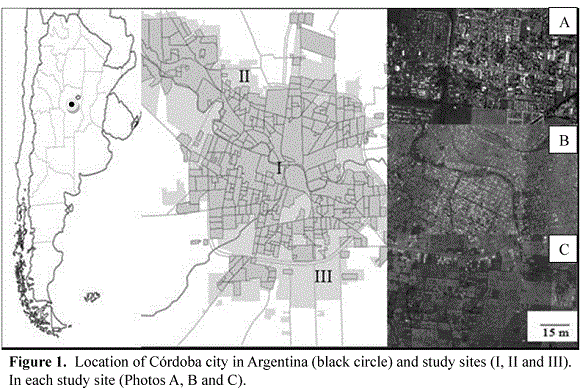
<body><![CDATA[<p>Several studies have described the detrimental impact of urbanization on   abundance, species richness, and community composition in different groups of   insects (for example, Gibb &amp; Hochuli 2002, Mulieri <i>et al</i>. 2011, Martinson &amp; Raupp 2013, Greco <i>et al</i>. 2014). Some of these works   have particularly focused on necrophagous Diptera, especially on species of the family Calliphoridae, which are important in the degradation of   organic matter (for example, Figueroa-Roa &amp; Linhares 2002, Patitucci <i>et al</i>.   2011, De Souza &amp; Zuben 2012, Pinilla Beltran <i>et al</i>. 2012). These flies have medical and veterinary relevance   as they can be mechanical vectors of biological pathogens (Cadavid-Sanchez <i>et al</i>. 2015), and some species cause myiasis to humans and other vertebrates (Greenberg 1973, Guimar&atilde;es&amp; Papavero 1999). Blowflies are common   inhabitants of the urban ecosystem and require a temporally and spatially   random ephemeral resource (e.g., carrion, dung, animal decaying organic matter)   to complete development. Therefore, these dipterous may display a different   response to urbanization compared with insects that feed and/or reproduce on   more constant and uniformly distributed food sources. Recent studies indicate   that species composition and relative abundance of Calliphoridae may be strongly influenced by human intervention on natural environments,   especially when urbanization processes are involved (Patitucci <i>et al</i>. 2011).</p>     <p>The association of calliphorid species with human settlements has been studied for some regions of South America,   in Brazil (Linhares 1981a, Carvalho <i>et al</i>. 1984, Viana <i>et al</i>. 1998), Chile   (Figueroa &amp; Linhares 2002) and Colombia (Pinilla Beltran <i>et al</i>. 2012). Comparative studies on   the diversity of blowflies in relation to gradients of urbanization have been   conducted in some geographic locations in Argentina. In the southeast of   Patagonia, Mariluis <i>et al</i>. (2008) reported a   higher prevalence in urban areas of the exotic species <i>Calliphora vicina</i> and <i>Lucilia sericata</i> over the natives <i>Compsomyops fulvicrura</i> (Robineau-Desvoidy)   and <i>Sarconesia chlorogaster</i>,   which showed a strong preference for either uninhabited or less influenced   area. This region of Patagonia has cold semidesertic climate and is mainly represented by a shrubby steppe of xeric shrubs   accompanied by coarse grasses. Centeno <i>et al</i>.   (2004), in the "Pampa" biome near Buenos Aires characterized by predominantly   grassland vegetation and a temperate-humid to subhumid climate, observed the highest levels of diversity in natural and rural areas   compared to urban sites. In a rural area of C&oacute;rdoba, a temperate-semidry area, Batt&aacute;nHorenstein <i>et al</i>.   (2007, 2010) carried out a study on pig carcasses detecting seasonal and   insolation condition (shade or sunlight) differences in species composition of   the Calliphoridae family. In that study, seven calliphorid species were collected, and <i>Chrysomya</i> <i>albiceps</i> was the dominant species in   summer, autumn and spring, being replaced in winter by <i>C. vicina</i>, <i>S</i>. <i>chlorogaster</i> and <i>L</i>. <i>sericata</i>. <i>Calliphora vicina</i> showed a strong preference for carcasses in the shade.</p>     <p>As far as we know, the effect of urbanization on blowfly communities in   the central region of Argentina, an eco-climatically different region from   Buenos Aires and Patagonia, has not yet been explored. The aim of this work was   to characterize the assemblage of calliphorid regarding its richness, abundance, and synanthropy (urbanization intensity) in C&oacute;rdoba City, Argentina. Our final goal is to   contribute to the knowledge of how human modification of the natural   environment affects the diversity of ecological communities and may have health   implications through facilitating the proliferation of species of medical and   veterinary importance.</p>     <p><b>MATERIALS AND METHODS</b></p>     <p><b>Field sites and blowfly collections</b></p>     <p>The study was carried out in the city of C&oacute;rdoba, which is situated in   the center of Argentina (31&deg; 200´ S, 64&deg; 100´ W, elevation 440 m a s l). The climate is temperate, mesothermal,   with average temperatures ranging from 11&deg; C in the winter to 24&deg; C in the   summer. Average annual rainfall is 800 mm, and rainfalls prevail during October   to December and in March (Jarsun <i>et al</i>. 2003).   The city is located within the Espinal phytogeographic province, a thorny deciduous shrubland forest (Fund 2014), but has been historically   subjected to intense modifications, including deforestation, urbanization and   agriculture. These anthropogenic influences have resulted in a landscape   characterized by a highly developed urban core and a trend toward diminishing   impervious surfaces at the periphery. Three sampling sites differing in their   distance to the border of the city and degree of urbanization were selected   (<a href="#figura1">Fig. 1</a>).</p>                      <center>   <img src="/img/revistas/cal/v38n1/v38n1a11fig1.gif"><a name="figura1"></a>  </center>    <br>          <p>Site I (in the center of the city) is densely built (22 houses per   hectare; 85% impervious surfaces), with a predominance of backyards and small   or no front yards; it includes park areas (approximately 1 ha) and commercial   buildings. Site II (closer to the hilly range) has a lower (8 houses per   hectare, 45% impervious surfaces) construction density with bigger gardens,   more trees but fewer recreational areas. Large areas are used for agriculture,   plant nurseries, and industrial activities, and other commercial activities are   limited. Site III (near to the crops area), although still suburban, has more   isolated housing (4 houses per hectare, 15% impervious surfaces) in close   proximity to agriculture and pig and poultry farms. Since the rainy season is   concentrated during October to March (Jarsun <i>et al</i>.   2003), the collections of flies were carried out during the drier months of   April, June and August of 2013. In each site and month 12 traps baited with cow   liver (200 g per trap) were installed for 5 consecutive days. Traps adapted   from Hwang and Turner (2005) consisted of two plastic bottles (500 ml and 1000   ml), one pushed inside the other forming two parts, the upper collection   chamber and the lower bait chamber. The collection chamber was made from the   top parts of two bottles. The bait chamber was the bottom part of a bottle.   Entry holes were made by cutting the plastic with an X shape and folding back   the triangular portions to form a square hole with four inner vanes restricting   escape of flies. Within each site, traps were separated by a minimum of 150 m   and a maximum of 500 m. Adult flies were collected and stored in 80% ethanol   for taxonomic identification to species level based on morphological characters   (Mariluis &amp; Schnack 2002). The specimens are deposited at the entomological collection of Instituto de Diversidad y Ecolog&iacute;a Animal (CONICET-UNC; Moira Batt&aacute;nHorenstein).</p>     <p><b>Data analysis</b></p>     ]]></body>
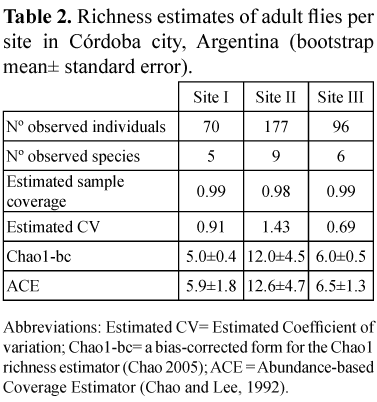
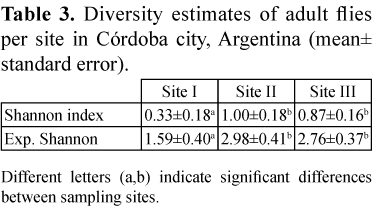
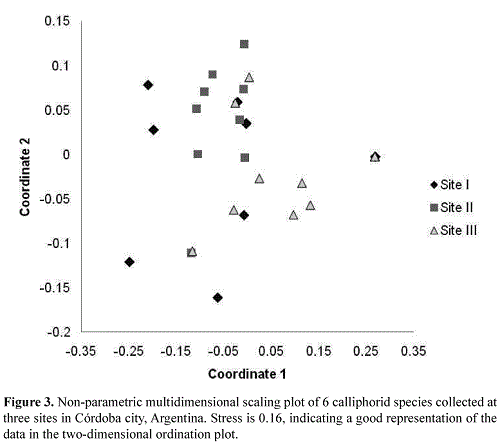
<body><![CDATA[<p>To estimate overall species richness and verify the completeness of the calliphorid blowfly inventory, first, species data   collected from all traps from a site along the sampling period were pooled.   Then, a species accumulation curve was generated for each site, using   sample-based interpolation (rarefaction) from the reference samples using the   multinomial model (S(est))   (Colwell <i>et al</i>. 2012) in EstimateS software   (Colwell 2013) (i.e., the expected number of species represented among m   samples, given the reference sample). Three traps from sites I and II that   collected no flies were excluded from the analysis. Richness estimates,   standard errors, and 95% confidence intervals were calculated. </p>     <p>Two estimators of total species richness were calculated: The non-parametric   estimator ACE (Abundance-based Coverage Estimator) of Chao &amp; Lee (1992)   that separates the observed species as rare and abundant groups, and only uses   the rare group to estimate the number of missing species, and Chao1-bc, a   bias-corrected form for Chao1 (Chao 2005). This approach uses the numbers of   singletons and doubletons to estimate the number of missing species because   missing species information is mostly concentrated on those low frequency   counts. The estimated CV is used to characterize the degree of heterogeneity   among species discovery probabilities. A CV = 0 would mean that all species   have equal detection probabilities in the community.</p>     <p>Shannon index and its effective number of species (diversity of order 1,   or Shannon diversity), were calculated based on Horvitz-Thompson estimator and   sample coverage method (Chao &amp; Shen 2003), and   its estimated standard error was based on a bootstrap method in SPADE software   (Chao &amp; Shen 2010). </p>     <p>The effects of site on fly abundance (data transformed to ln (n+1)) and diversity were evaluated using one way   analysis of variance (ANOVA) (Infostat, Di Rienzo <i>et al</i>. 2014). For all tests, a <i>p</i> value   &lt;0.05 was considered to represent significant differences. Least significant   difference (LSD) Fisher test was used for post hoc analyses. Throughout the   text, the results are presented as the adjusted mean plus/minus the standard   error.</p>     <p>To assess the similarity in species composition between areas or dates,   Sorensen qualitative index was estimated (Magurran 2004): </p>     <p>Sørensen = 2C / (S<sub>A</sub> + S<sub>B</sub>).</p>     <p>Where C = number of species common to areas A and B; S<sub>A</sub> or S<sub>B</sub> = total number of species of area A or B, respectively.</p>     <p>To test for differences in species composition between sampling sites   considering relative abundance, a non-parametric multivariate analysis of   variance (PERMANOVA) based on Bray-Curtis distances was used, with 10,000   permutations. To visualize differences in multivariate patterns among   observations, non-metric multidimensional scaling (nMDS)   was performed on the Bray-Curtis distances (Past software, Hammer <i>et al</i>.   2001). Where these groups differed, similarity percentages (SIMPER) were   calculated using ln (n+1) transformed data to   determine which species made the largest contribution to the dissimilarities   (Clarke &amp; Warwick 2001). Also, a principal components analysis (PCA) was   used to explore the relationships between assemblages of species abundance and   site. </p>     <p>We also calculated the indicator value (IndVal)   index (Dufrene &amp; Legendre 1997) to find species   significantly associated with a particular urbanization level (or site   typology) following the equation: IndVal<sub>ij</sub>=A<sub>ij</sub> x B<sub>ij</sub> x 100. Where IndVal<sub>ij</sub> is the indicator   value for species <i>i</i> in site <i>j</i>; A<sub>ij</sub>,   is the mean abundance of species i in site j compared to the species abundance   in all sites in the study. B<sub>ij</sub> is   the proportion of traps within site j where the species i is present. Final   multiplication by 100 produces percentages. An IndVal = 100 % shows that a species is a perfect indicator for a given site typology   (for details, see Dufrene &amp; Legendre 1997).   Indicator values were tested for significance with a Monte Carlo randomization   procedure (Quinn &amp; Keough 2002).</p>     <p><b>RESULTS</b></p>     ]]></body>
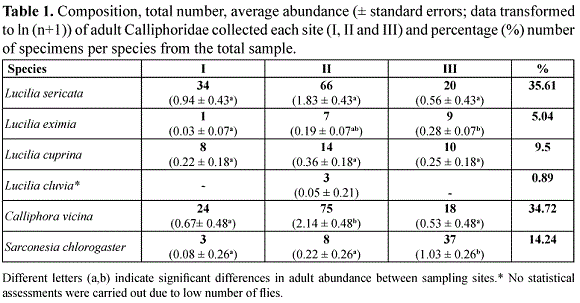
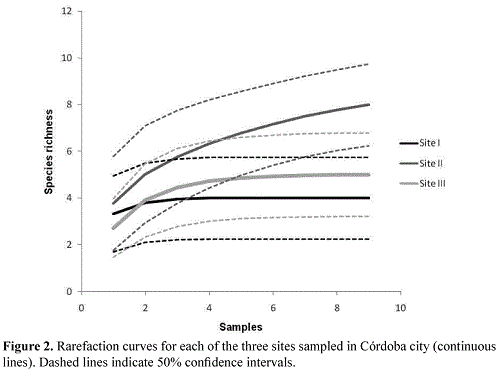
<body><![CDATA[<p>A total of 341 adult calliphorids from nine species, <i>Lucilia sericata</i>, <i>L</i>. <i>eximia</i>, <i>L</i>. <i>cuprina</i>, <i>L</i>. <i>cluvia</i>, <i>C. vicina</i>, <i>S.</i> <i>chlorogaster</i> <i>C.</i> <i>albiceps</i>, <i>C</i>. <i>megacephala</i> and <i>C</i>. <i>chloropyga</i> were collected.<i> Lucilia sericata</i> was the most frequent species followed   by <i>C. vicina</i>. Species and abundances of flies   observed in each site are shown in <a href="#tabla1">Table 1</a>.</p>                          <center>   <img src="/img/revistas/cal/v38n1/v38n1a11tab1.gif"><a name="tabla1"></a>  </center>    <br>        <p><i>Chrysomya</i> <i>albiceps</i>, <i>C. megacephala</i> and <i>C. chloropyga </i>were collected in fewer than   three specimens each and were not included in the tables or abundance analysis.   Rarefaction curves indicated that total richness was overall well estimated,   because they reached a sill for sites I and III (<a href="#figura2">Fig.   2</a>).</p>                          <center>   <img src="/img/revistas/cal/v38n1/v38n1a11fig2.gif"><a name="figura2"></a>  </center>    <br>        <p>Also, for sites I and III the number of species observed matched expected   species richness based on Chao1-bc and ACE estimates, and sample coverage was 1   (or close to 1), meaning that the probability of finding additional species   with further sampling was less than 1%, while for site II 70% of expected   species richness was detected (<a href="#tabla2">Table 2</a>). CV values close to one indicate that   discovery probabilities are not homogeneous among species.</p>                       <center>   <img src="/img/revistas/cal/v38n1/v38n1a11tab2.gif"><a name="tabla2"></a>  </center>    <br>      <p>Rarefaction curves were compared between pairs of sites at 9 samples   (the total number of positive traps per site). Following the conservative no   overlap criterion proposed by Colwell <i>et al</i>. (2012) it was inferred that   species richness of site II was significantly higher than species richness of   site I. Sites II and III overlapped 8.26% (<a href="#figura2">Fig. 2</a>). Both Shannon diversity   index (F<sub>2,26</sub>= 3.84, p = 0.03) and its   effective number of species (F<sub>2,26</sub>= 3.36, p = 0.05) were higher for   sites II and III compared to site I (<a href="#tabla3">Table 3</a>).</p>                       ]]></body>
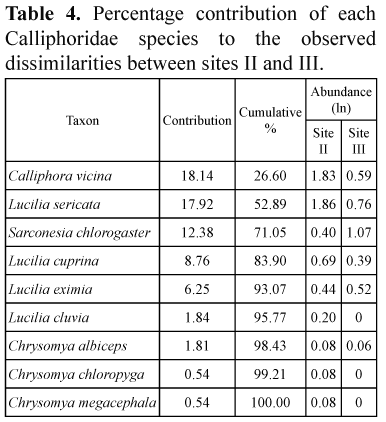
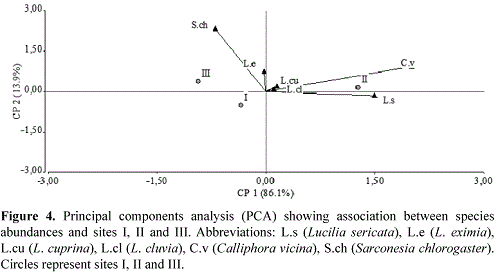
<body><![CDATA[<center>   <img src="/img/revistas/cal/v38n1/v38n1a11tab3.gif"><a name="tabla3"></a>  </center>    <br>         <p>Total fly abundance tended to differ between sites (F<sub>2,26</sub>= 2.95, p = 0.07), flies being more abundant in   site II. For individual species (<a href="#tabla2">Table 2</a>), <i>C. vicina</i> was mainly collected at site II (F<sub>2,26</sub>=   4.39, p = 0.02), while <i>S</i>. <i>chlorogaster</i> was the dominant species at site III (F<sub>2,26</sub>= 4.36, p = 0.02), where <i>L. sericata </i>collections were lowest (F<sub>2,26</sub>=   3.66, p = 0.04). </p>     <p>Species composition changed between sites. Sites I and II, I and III   shared 88% and 83% of species, respectively. Areas II and III that are farthest   spatially from each other were 64% similar in species composition. Considering   relative abundance, species composition also significantly differed between   sites (F = 2.69; p = 0.01) using PERMANOVA. Site II significantly differed from   site III (P = 0.002), while differences between sites I and III were close to   significant (P = 0.08). Collections from traps on site II separated from site   III traps in two dimensional ordination space when species abundances from   different sites were analyzed using NMDS; traps from site II grouped mostly to   the top left side of the graph while site III were more widely spread towards   the right side of the graph (<a href="#figura3">Fig. 3</a>).</p>                        <center>   <img src="/img/revistas/cal/v38n1/v38n1a11fig3.gif"><a name="figura3"></a>  </center>    <br>        <p>SIMPER between Site II and site III traps   consistently showed <i>Ch. vicinia,</i> <i>L. sericata</i> and <i>S. chlorogaster</i> as the species making the largest contribution to the dissimilarities (each   contributing &gt;10%) (<a href="#tabla4">Table 4</a>).</p>                        <center>   <img src="/img/revistas/cal/v38n1/v38n1a11tab4.gif"><a name="tabla4"></a>  </center>    <br>        <p>The first two species   were more abundant in site II while <i>S. chlorogaster</i> was more frequent on site III. A similar pattern was also observed with a PCA,   where <i>C. vicina</i> and <i>L. sericata</i> cluster with site II while <i>S. chlorogaster</i> with site III (<a href="#figura4">Fig. 4</a>).</p>                       ]]></body>
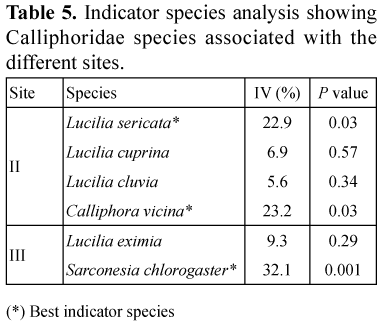
<body><![CDATA[<center>   <img src="/img/revistas/cal/v38n1/v38n1a11fig4.gif"><a name="figura4"></a>  </center>    <br>      <p>In the indicator species analysis three calliphorid species were selected as significant indicators of a particular site type. <i>Sarconesia chlorogaster</i> was closely associated with site III, <i>L. sericata</i> and <i>C. vicina</i> with site II, and no species   were significantly associated with site I (<a href="#tabla5">Table 5</a>).</p>                       <center>   <img src="/img/revistas/cal/v38n1/v38n1a11tab5.gif"><a name="tabla5"></a>  </center>    <br>      <p><b>DISCUSSION</b></p>     <p>It has been observed that responses to urbanization differ depending on   the insect species. In this study the assemblage of blowfly species showed some   variations between the three sampling sites. Species richness was highest at   the intermediate urbanized site (site II), being twice as diverse as site I   (based on effective numbers) but only 10% more diverse than the more rural site   III, as would be expected from intermediate disturbance hypothesis (Connell   1978). In contrast, Mulieri <i>et al</i>. (2012)   found a negative relation between urbanization level and richness of Sarcophagidae species, more in tune with the increasing   disturbance hypothesis proposed by Gray (1989). </p>     <p>At the species level, the two most abundant were <i>Lucilia sericata</i> and <i>Calliphora vicina.</i> Both species are originally from the   Holarctic region but are now widely spread throughout the world (Greenberg   1973). Patitucci <i>et al</i>. (2011) defined them as   urban exploiters, consistent with the observations of other authors (Hwang   &amp; Turner 2005 in England, Kavazos 2012 in   Australia).</p>     <p><i>Lucilia sericata</i> is considered a thermophilic and heliophilic species, while <i>C. vicina</i> is typical of cold and shaded environments.   Studies in C&oacute;rdoba (Battan-Horenstein <i>et al</i>.   2007) and Buenos Aires (Mariluis &amp; Schnack 1989) indicate that these species are temporally   segregated, <i>L. sericata</i> peaking in the summer   and <i>C. vicina</i> in the winter. The fact that   both species were very abundant in the present study may be explained by the   sampling period, which was mostly in the fall, a transitional period in terms   of temperature conditions.</p>     <p>In this study <i>L. sericata</i> and <i>C. vicina</i> species were dominant in the site II which has   an intermediate density of houses, and showed lower abundances in the most   urbanized site (I). Both species were the indicators of site II as shown by the IndVal index. Still, due to their high abundance they   can be characterized as urban, as proposed by Patitucci <i>et al</i>. (2011). <i>Sarconesia chlorogaster</i> has an exclusively South American   distribution, with records for Brazil, Argentina, Uruguay, Peru and Chile (Bonatto &amp; Carvalho 1996).   This species was collected in the three sites but was mainly abundant in the   rural environment, where it had been previously recorded by Batt&aacute;n-Horenstein<i>et al</i>. (2007, 2010) on pig carcasses. Other authors have observed <i>S</i>. <i>chlorogaster</i> associated with rural or more   natural environments; for example, in southeast Patagonia it showed a strong   preference for sites with little or no influence from human activities (Mariluis <i>et al</i>. 2008).</p>     ]]></body>
<body><![CDATA[<p>In most cities, there is usually no simple linear decrease in the level   of urbanization from the city center to rural sites (McIntyre 2000). The high   flying ability of the blowflies could contribute to the homogenization of the   environment in terms of species composition. Species turnover was similar for   the different sites. The increasing distance between sites (II and III were the   furthest apart) contributes most clearly to changes in beta diversity.   Considering species composition, sites that are closer were more similar. When   species relative abundances were included in the analysis, sites II and III   were the least similar. These results may indicate that, although the sites   share a high number of same species, the proportion of the species varies. This   may be related to a combination of different degrees of urbanization and   probably habitat heterogeneity. Site II showed an intermediate level of   urbanization with moderately to highly built patches alternating with open   green spaces, while agricultural landscape was more prevalent on site III. </p>     <p>Biotic homogenization is a process by which species similarity across   space increases over time as a combined result of species invasions and   extinctions (Olden 2006). The establishment of cosmopolitan species, together   with reductions of endemic species, increases the phylogenetic similarity, a   process referred to as taxonomic homogenization. Most species detected in the   present study were exotic and considered either eusynanthropic or hemisynanthropic (Labud <i>et   al</i>. 2003), supporting the homogenization of the blowfly fauna in urban   environments, as has been observed in other bioclimatic regions (Mariluis <i>et al</i>. 2008, Patitucci <i>et al</i>. 2011, Labud <i>et al</i>. 2003). <i>Lucilia eximia</i> and <i>L</i>. <i>cluvia</i> are a Nearctic and a Neotropical species, respectively, frequently found in   rural and urban sites and that breed primarily in carcasses but also in rotten   fruit and urban garbage (Madeira <i>et al</i>. 1989). The three species   of <i>Chrysomya</i> were introduced to Brazil from   Africa about four decades ago, quickly spreading through Peru, Bolivia,   Paraguay and Argentina (Mariluis 1983, Peris 1986). Several authors (Linhares,   1981, Ferreira &amp; Barbola, 1998) determined the synanthropic indexes for <i>C. albiceps</i> and classified it as hemisynantropic and with   positive heliophily. It is important to note that Battan-Horenstein <i>et al. </i>(2007), working in the same   region using a pig carcass as bait during the Autumn of 2004, collected this species in high abundance. The low percentage of <i>C</i>. <i>albiceps</i> in the present work can be attributed   to the size of the bait used. Apparently, <i>C</i>. <i>albiceps</i> is attracted to larger animals, such as pig carcasses, to oviposit. Similar   results were obtained by Souza and Linhares (1997).<i> Lucilia</i> <i>cuprina</i> is a species originally from Afrotropical and   Oriental regions, but that now is widely distributed throughout the world   (Greenberg 1973).</p>     <p>Several of the species detected in this study are considered relevant   from a medical and/or veterinary perspective for their role as mechanical   vectors of pathogens. For example, <i>Lucilia sericata </i>and other species of the genus have been shown   to transmit <i>Salmonella enteritidis </i>and <i>Klepsiella oxytoca</i> (Mian <i>et al</i>. 2002, Cadavid-Sanchez <i>et al</i>. 2015). Other species such as <i>C. vicina,   L. sericata, L. cluvia</i> and <i>S. chlorogaster</i> can cause myasis due their larvae feeding on dead tissue or decaying   organic matter (Mariluis &amp; Schnack,   1996). Most of the species were collected at the three sites, except <i>L. cluvia</i> which was restricted to site II, but was   actually a rare species, represented by only three specimens. The widespread   occurrence of these species in anthropic environments implies potential health   risk and thus their populations should be monitored. </p>     <p>In conclusion, we contributed to the characterization of the assemblage   of Calliphoride in a temperate city of South America,   detecting mostly cosmopolitan species, a clear indication of biotic homogeneization. Urbanization intensity affected calliphorid assemblages because species richness, diversity   and abundance were higher at intermediate compared to high or low urbanization   levels. Although we had good estimates of species richness, the sampling method   implied that mostly species attracted to small decaying animal bait were   collected. Further surveys with other attractants are underway for a more   complete assessment of Calliphoridae fauna.</p>     <p><b>ACKNOWLEDGEMENTS</b></p>     <p>The present study was partially supported by grants from SeCyT – UNC and PICT 2012, Argentina. M. Batt&aacute;nHorenstein, L.M. Bellis and R.M. Gleiser are   Career Researchers of CONICET. We acknowledge four anonymous reviewers for   their constructive feedback on this manuscript.</p>     <p><b>REFERENCES</b></p>     <!-- ref --><p>1. Batt&aacute;nHorenstein, M., A.X. Linhares,   B. Rosso &amp; M.D. Garc&iacute;a. 2007. Species composition and seasonal   succession of saprophagous calliforids in a rural area of Cordoba (Argentina). Biological Research 40: 163-171.    &nbsp;&nbsp;&nbsp;&nbsp;&nbsp;&nbsp;&nbsp;&nbsp;[&#160;<a href="javascript:void(0);" onclick="javascript: window.open('/scielo.php?script=sci_nlinks&ref=787262&pid=S0366-5232201600010001100001&lng=','','width=640,height=500,resizable=yes,scrollbars=1,menubar=yes,');">Links</a>&#160;]<!-- end-ref --></p>     <!-- ref --><p>2. Batt&aacute;nHorenstein, M., A.X. Linhares,   B. Rosso &amp; M.D. Garc&iacute;a. 2010. Decomposition and dipteran   succession on pig carrion in central Argentina: ecological aspects and their   importance to forensic science. Medical and Veterinary   Entomology 24: 16-25.    &nbsp;&nbsp;&nbsp;&nbsp;&nbsp;&nbsp;&nbsp;&nbsp;[&#160;<a href="javascript:void(0);" onclick="javascript: window.open('/scielo.php?script=sci_nlinks&ref=787264&pid=S0366-5232201600010001100002&lng=','','width=640,height=500,resizable=yes,scrollbars=1,menubar=yes,');">Links</a>&#160;]<!-- end-ref --></p>     <!-- ref --><p>3. Bonatto S.R. &amp; C.J. Carvalho. 1996. An&aacute;lise morfol&oacute;gica das formas imaturas de <i>Sarconesia chlorogaster</i> (Wiedemann) (Diptera, Calliphoridae, Toxotarsinae).   Revista Brasileira do Zoologia 13: 707-726.    &nbsp;&nbsp;&nbsp;&nbsp;&nbsp;&nbsp;&nbsp;&nbsp;[&#160;<a href="javascript:void(0);" onclick="javascript: window.open('/scielo.php?script=sci_nlinks&ref=787266&pid=S0366-5232201600010001100003&lng=','','width=640,height=500,resizable=yes,scrollbars=1,menubar=yes,');">Links</a>&#160;]<!-- end-ref --></p>     <!-- ref --><p>4. Cadavid-Sanchez., I.C.,   E. Amat &amp; L.M. Gomez-Pi&ntilde;erez. 2015. Enterobacteria isolated from synanthropic flies (Diptera, Calyptratae) in   Medell&iacute;n, Colombia. Caldasia 37(2): 319-332.    &nbsp;&nbsp;&nbsp;&nbsp;&nbsp;&nbsp;&nbsp;&nbsp;[&#160;<a href="javascript:void(0);" onclick="javascript: window.open('/scielo.php?script=sci_nlinks&ref=787268&pid=S0366-5232201600010001100004&lng=','','width=640,height=500,resizable=yes,scrollbars=1,menubar=yes,');">Links</a>&#160;]<!-- end-ref --> </p>     <!-- ref --><p>5. Carvalho, C.J.B., J.R. Almeida &amp; C.B. Jesus. 1984.   D&iacute;pteros sinantr&oacute;picos de Curitiba e arredores (Paran&aacute;, Brasil). I. Muscidae.   Revista Brasileira do Entomologia 28: 551-560.    &nbsp;&nbsp;&nbsp;&nbsp;&nbsp;&nbsp;&nbsp;&nbsp;[&#160;<a href="javascript:void(0);" onclick="javascript: window.open('/scielo.php?script=sci_nlinks&ref=787270&pid=S0366-5232201600010001100005&lng=','','width=640,height=500,resizable=yes,scrollbars=1,menubar=yes,');">Links</a>&#160;]<!-- end-ref --></p>     <!-- ref --><p>6. Centeno, N., D. Almorza &amp; C. Arnillas. 2004. Diversity of Calliphoridae (Insecta: Diptera) in   Hudson, Argentina. Neotropical Entomology 33:   387-390.    &nbsp;&nbsp;&nbsp;&nbsp;&nbsp;&nbsp;&nbsp;&nbsp;[&#160;<a href="javascript:void(0);" onclick="javascript: window.open('/scielo.php?script=sci_nlinks&ref=787272&pid=S0366-5232201600010001100006&lng=','','width=640,height=500,resizable=yes,scrollbars=1,menubar=yes,');">Links</a>&#160;]<!-- end-ref --></p>     <!-- ref --><p>7. Chao, A. &amp; S.H. Lee. 1992. Estimating the number of classes via sample   coverage. Journal of American Statistical Association 87: 210-217.    &nbsp;&nbsp;&nbsp;&nbsp;&nbsp;&nbsp;&nbsp;&nbsp;[&#160;<a href="javascript:void(0);" onclick="javascript: window.open('/scielo.php?script=sci_nlinks&ref=787274&pid=S0366-5232201600010001100007&lng=','','width=640,height=500,resizable=yes,scrollbars=1,menubar=yes,');">Links</a>&#160;]<!-- end-ref --> </p>     <!-- ref --><p>8. Chao, A. &amp; T.J. Shen. 2003. Nonparametric estimation of   Shannon´s index of diversity when there are unseen species in sample.   Environmental Ecological Statistics 10: 429-443.    &nbsp;&nbsp;&nbsp;&nbsp;&nbsp;&nbsp;&nbsp;&nbsp;[&#160;<a href="javascript:void(0);" onclick="javascript: window.open('/scielo.php?script=sci_nlinks&ref=787276&pid=S0366-5232201600010001100008&lng=','','width=640,height=500,resizable=yes,scrollbars=1,menubar=yes,');">Links</a>&#160;]<!-- end-ref --></p>     <!-- ref --><p>9. Chao, A. 2005. Species estimation and applications. p&aacute;gs. 7907-7916 en: N. Balakrishnan, C.B. Read &amp; B. Vidakovic (eds), <i>Encyclopedia of   statistic sciences</i>. 2nd ed., Vol 12. Wiley, ew York.    &nbsp;&nbsp;&nbsp;&nbsp;&nbsp;&nbsp;&nbsp;&nbsp;[&#160;<a href="javascript:void(0);" onclick="javascript: window.open('/scielo.php?script=sci_nlinks&ref=787278&pid=S0366-5232201600010001100009&lng=','','width=640,height=500,resizable=yes,scrollbars=1,menubar=yes,');">Links</a>&#160;]<!-- end-ref --></p>     <!-- ref --><p>10. Chao, A. &amp; T.J. Shen. 2010. Program SPADE (Species Prediction   and Diversity Estimation). Program and User's Guide available   at http://chao.stat.nthu.edu.tw.Accessed 5 Nov 2014.    &nbsp;&nbsp;&nbsp;&nbsp;&nbsp;&nbsp;&nbsp;&nbsp;[&#160;<a href="javascript:void(0);" onclick="javascript: window.open('/scielo.php?script=sci_nlinks&ref=787280&pid=S0366-5232201600010001100010&lng=','','width=640,height=500,resizable=yes,scrollbars=1,menubar=yes,');">Links</a>&#160;]<!-- end-ref --></p>     <!-- ref --><p>11. Clarke, K.R. &amp; R.M. Warwick. 2001. <i>Change in marine communities: an   approach to statistical analysis and interpretation</i>, Primer-E. Plymouth:   Plymouth Marine Laboratory.    &nbsp;&nbsp;&nbsp;&nbsp;&nbsp;&nbsp;&nbsp;&nbsp;[&#160;<a href="javascript:void(0);" onclick="javascript: window.open('/scielo.php?script=sci_nlinks&ref=787282&pid=S0366-5232201600010001100011&lng=','','width=640,height=500,resizable=yes,scrollbars=1,menubar=yes,');">Links</a>&#160;]<!-- end-ref --></p>     <!-- ref --><p>12. Colwell, R.K, A. Chao, N.J. Gotelli, S.Y. Lin, C.X. Mao, R.L. Chazdon &amp; J.T. Longino. 2012. Models and estimators   linking individual-based and sample-based rarefaction, extrapolation, and   comparison of assemblages. Journal of Plant Ecology 5: 3-21.    &nbsp;&nbsp;&nbsp;&nbsp;&nbsp;&nbsp;&nbsp;&nbsp;[&#160;<a href="javascript:void(0);" onclick="javascript: window.open('/scielo.php?script=sci_nlinks&ref=787284&pid=S0366-5232201600010001100012&lng=','','width=640,height=500,resizable=yes,scrollbars=1,menubar=yes,');">Links</a>&#160;]<!-- end-ref --></p>     <!-- ref --><p>13. Colwell, R.K. 2013. <i>EstimateS: Statistical   estimation of species richness and shared species from samples</i>. Version 9. User's Guide and application published at:   http://purl.oclc.org/estimates.    &nbsp;&nbsp;&nbsp;&nbsp;&nbsp;&nbsp;&nbsp;&nbsp;[&#160;<a href="javascript:void(0);" onclick="javascript: window.open('/scielo.php?script=sci_nlinks&ref=787286&pid=S0366-5232201600010001100013&lng=','','width=640,height=500,resizable=yes,scrollbars=1,menubar=yes,');">Links</a>&#160;]<!-- end-ref --></p>     <!-- ref --><p>14. Connell, J.H. 1978. Diversity in tropical rain forest and   coral reefs. Science 199: 1302-1310.    &nbsp;&nbsp;&nbsp;&nbsp;&nbsp;&nbsp;&nbsp;&nbsp;[&#160;<a href="javascript:void(0);" onclick="javascript: window.open('/scielo.php?script=sci_nlinks&ref=787288&pid=S0366-5232201600010001100014&lng=','','width=640,height=500,resizable=yes,scrollbars=1,menubar=yes,');">Links</a>&#160;]<!-- end-ref --></p>     <!-- ref --><p>15. Di Rienzo, J.A., F. Casanoves, M.G. Balzarini, L. Gonzalez, M. Tablada &amp; C.W. Robledo <i>InfoStat versi&oacute;n 2014</i>. Grupo InfoStat,   FCA, Universidad Nacional de C&oacute;rdoba, Argentina. URL <a href="http://www.infostat.com.ar">http://www.infostat.com.ar</a>&nbsp;&nbsp;&nbsp;&nbsp;&nbsp;&nbsp;&nbsp;&nbsp;[&#160;<a href="javascript:void(0);" onclick="javascript: window.open('/scielo.php?script=sci_nlinks&ref=787290&pid=S0366-5232201600010001100015&lng=','','width=640,height=500,resizable=yes,scrollbars=1,menubar=yes,');">Links</a>&#160;]<!-- end-ref --><!-- ref --><p>16. Dufrene, M. &amp; P.   Legendre. 1997. Species assemblage and indicator   species: the need for a flexible asymmetrical approach. Ecological Monograph 67:   345–366.    &nbsp;&nbsp;&nbsp;&nbsp;&nbsp;&nbsp;&nbsp;&nbsp;[&#160;<a href="javascript:void(0);" onclick="javascript: window.open('/scielo.php?script=sci_nlinks&ref=787291&pid=S0366-5232201600010001100016&lng=','','width=640,height=500,resizable=yes,scrollbars=1,menubar=yes,');">Links</a>&#160;]<!-- end-ref --></p>     <!-- ref --><p>17. Ferreira, M.J.M. &amp; I.F. Barbola. 1998. Sinantropia de Califorideos (Insecta: Diptera) de Curitiba, Parana,   Brasil. Revista Brasileira Biologia 58: 203-209.    &nbsp;&nbsp;&nbsp;&nbsp;&nbsp;&nbsp;&nbsp;&nbsp;[&#160;<a href="javascript:void(0);" onclick="javascript: window.open('/scielo.php?script=sci_nlinks&ref=787293&pid=S0366-5232201600010001100017&lng=','','width=640,height=500,resizable=yes,scrollbars=1,menubar=yes,');">Links</a>&#160;]<!-- end-ref --></p>     ]]></body>
<body><![CDATA[<!-- ref --><p>18. Figueroa, L. &amp; A. Linhares. 2002. Sinantropia de los Calliphoridae (Diptera)   de Valdivia, Chile. Neotropical Entomology 31: 233-239.    &nbsp;&nbsp;&nbsp;&nbsp;&nbsp;&nbsp;&nbsp;&nbsp;[&#160;<a href="javascript:void(0);" onclick="javascript: window.open('/scielo.php?script=sci_nlinks&ref=787295&pid=S0366-5232201600010001100018&lng=','','width=640,height=500,resizable=yes,scrollbars=1,menubar=yes,');">Links</a>&#160;]<!-- end-ref --></p>     <!-- ref --><p>19. Fund, W.   2014. <i>Argentine Espinal</i>. Retrieved from <a href="http://www.eoearth.org/view/article/150226">http://www.eoearth.org/view/article/150226</a>&nbsp;&nbsp;&nbsp;&nbsp;&nbsp;&nbsp;&nbsp;&nbsp;[&#160;<a href="javascript:void(0);" onclick="javascript: window.open('/scielo.php?script=sci_nlinks&ref=787297&pid=S0366-5232201600010001100019&lng=','','width=640,height=500,resizable=yes,scrollbars=1,menubar=yes,');">Links</a>&#160;]<!-- end-ref --><!-- ref --><p>20. Gibb, H. &amp; D.F. Hochuli. 2002. Habitat fragmentation in an urban   environment: large and small fragments support different arthropod assemblages.   Biological Conservation 106: 91-100.    &nbsp;&nbsp;&nbsp;&nbsp;&nbsp;&nbsp;&nbsp;&nbsp;[&#160;<a href="javascript:void(0);" onclick="javascript: window.open('/scielo.php?script=sci_nlinks&ref=787298&pid=S0366-5232201600010001100020&lng=','','width=640,height=500,resizable=yes,scrollbars=1,menubar=yes,');">Links</a>&#160;]<!-- end-ref --></p>     <!-- ref --><p>21. Gray,   J.S. 1989. Effects of environmental stress on species rich   assemblages. Biological Journal of the Linnean Society 37: 19-32.    &nbsp;&nbsp;&nbsp;&nbsp;&nbsp;&nbsp;&nbsp;&nbsp;[&#160;<a href="javascript:void(0);" onclick="javascript: window.open('/scielo.php?script=sci_nlinks&ref=787300&pid=S0366-5232201600010001100021&lng=','','width=640,height=500,resizable=yes,scrollbars=1,menubar=yes,');">Links</a>&#160;]<!-- end-ref --> </p>     <!-- ref --><p>22. Greco, S., P. Brandmayr &amp; T. Bonacci. 2014. Synanthropy and temporal variability of Calliphoridae living in Cosenza (Calabria, southern Italy). Journal of Insect Science: doi: 10.1093/jisesa/ieu078.    &nbsp;&nbsp;&nbsp;&nbsp;&nbsp;&nbsp;&nbsp;&nbsp;[&#160;<a href="javascript:void(0);" onclick="javascript: window.open('/scielo.php?script=sci_nlinks&ref=787302&pid=S0366-5232201600010001100022&lng=','','width=640,height=500,resizable=yes,scrollbars=1,menubar=yes,');">Links</a>&#160;]<!-- end-ref --></p>     <!-- ref --><p>23. Greenberg, B. 1973. <i>Flies and Disease.</i> Vol. 2. Princeton University Press, Princeton.    &nbsp;&nbsp;&nbsp;&nbsp;&nbsp;&nbsp;&nbsp;&nbsp;[&#160;<a href="javascript:void(0);" onclick="javascript: window.open('/scielo.php?script=sci_nlinks&ref=787304&pid=S0366-5232201600010001100023&lng=','','width=640,height=500,resizable=yes,scrollbars=1,menubar=yes,');">Links</a>&#160;]<!-- end-ref --></p>     <!-- ref --><p>24. Guimar&atilde;es, J.H. &amp; N. Papavero. 1999. <i>Myiasis in man and animals in   the Neotropical region</i>. FAPESP: Publisher   Pleiades, S&atilde;o Paulo.    &nbsp;&nbsp;&nbsp;&nbsp;&nbsp;&nbsp;&nbsp;&nbsp;[&#160;<a href="javascript:void(0);" onclick="javascript: window.open('/scielo.php?script=sci_nlinks&ref=787306&pid=S0366-5232201600010001100024&lng=','','width=640,height=500,resizable=yes,scrollbars=1,menubar=yes,');">Links</a>&#160;]<!-- end-ref --></p>     <!-- ref --><p>25. Hammer, Ø., D.A.T. Harper   &amp; P.D. Ryan. 2001 <i>PAST:   Paleontological statistics software package for education and data analysis.</i> Palaeontologia Electronica (Internet) <a href="http://palaeo-electronica.org/ 2001_1/past/issue1_01.htm">http://palaeo-electronica.org/   2001_1/past/issue1_01.htm</a>.    &nbsp;&nbsp;&nbsp;&nbsp;&nbsp;&nbsp;&nbsp;&nbsp;[&#160;<a href="javascript:void(0);" onclick="javascript: window.open('/scielo.php?script=sci_nlinks&ref=787308&pid=S0366-5232201600010001100025&lng=','','width=640,height=500,resizable=yes,scrollbars=1,menubar=yes,');">Links</a>&#160;]<!-- end-ref --></p>     <!-- ref --><p>26. Hwang, C. &amp; B.D. Turner. 2005. Spatial and temporal variability of necrophagous Diptera from urban   to rural areas. Medical and Veterinary Entomology 19:   379–391.    &nbsp;&nbsp;&nbsp;&nbsp;&nbsp;&nbsp;&nbsp;&nbsp;[&#160;<a href="javascript:void(0);" onclick="javascript: window.open('/scielo.php?script=sci_nlinks&ref=787310&pid=S0366-5232201600010001100026&lng=','','width=640,height=500,resizable=yes,scrollbars=1,menubar=yes,');">Links</a>&#160;]<!-- end-ref --></p>     <!-- ref --><p>27. Jars&uacute;n,   B., J.A. Gorgas, E. Zamora, E. Bosnero, E. Lovera, A. Ravelo &amp; J.L. Tassile. 2003. <i>Recursos Naturales De La Provincia De   C&oacute;rdoba: Los Suelos</i>. C&oacute;rdoba: Agencia C&oacute;rdoba, D.A.C.y T.S.E.M Direcci&oacute;n de Ambiente, INTA, Manfredi.    &nbsp;&nbsp;&nbsp;&nbsp;&nbsp;&nbsp;&nbsp;&nbsp;[&#160;<a href="javascript:void(0);" onclick="javascript: window.open('/scielo.php?script=sci_nlinks&ref=787312&pid=S0366-5232201600010001100027&lng=','','width=640,height=500,resizable=yes,scrollbars=1,menubar=yes,');">Links</a>&#160;]<!-- end-ref --></p>     <!-- ref --><p>28. Kavazos, C. &amp; J.F. Wallman. 2012 Community composition of carrion-breeding blowflies (Diptera: Calliphoridae) along an urban gradient in   south-eastern Australia. Landscape Urban Plan 106: 183–190.    &nbsp;&nbsp;&nbsp;&nbsp;&nbsp;&nbsp;&nbsp;&nbsp;[&#160;<a href="javascript:void(0);" onclick="javascript: window.open('/scielo.php?script=sci_nlinks&ref=787314&pid=S0366-5232201600010001100028&lng=','','width=640,height=500,resizable=yes,scrollbars=1,menubar=yes,');">Links</a>&#160;]<!-- end-ref --></p>     <!-- ref --><p>29. Labud, V.A., L.G. Semenas &amp; F. Laos. 2003 Diptera of sanitary importance associated with composting of biosolids in Argentina. Revista do Sa&uacute;de P&uacute;blica   37: 722-8.    &nbsp;&nbsp;&nbsp;&nbsp;&nbsp;&nbsp;&nbsp;&nbsp;[&#160;<a href="javascript:void(0);" onclick="javascript: window.open('/scielo.php?script=sci_nlinks&ref=787316&pid=S0366-5232201600010001100029&lng=','','width=640,height=500,resizable=yes,scrollbars=1,menubar=yes,');">Links</a>&#160;]<!-- end-ref --></p>     <!-- ref --><p>30. Lal, S.M., H. Maag &amp; J.V. Tacal. 2002. Isolation of <i>Salmonella </i>from muscoid flies at commercial animal establishments in San   Bernardino County, California. Journal of Vector Ecology 27: 82-85.    &nbsp;&nbsp;&nbsp;&nbsp;&nbsp;&nbsp;&nbsp;&nbsp;[&#160;<a href="javascript:void(0);" onclick="javascript: window.open('/scielo.php?script=sci_nlinks&ref=787318&pid=S0366-5232201600010001100030&lng=','','width=640,height=500,resizable=yes,scrollbars=1,menubar=yes,');">Links</a>&#160;]<!-- end-ref --></p>     <!-- ref --><p>31. Linhares, A.X. 1981. Synanthropy of Calliphoridae and Sarcophagidae (Diptera)   in the city of Campinas, Sao Paulo, Brazil. Revista Brasileira Entomologia 25: 189-215.    &nbsp;&nbsp;&nbsp;&nbsp;&nbsp;&nbsp;&nbsp;&nbsp;[&#160;<a href="javascript:void(0);" onclick="javascript: window.open('/scielo.php?script=sci_nlinks&ref=787320&pid=S0366-5232201600010001100031&lng=','','width=640,height=500,resizable=yes,scrollbars=1,menubar=yes,');">Links</a>&#160;]<!-- end-ref --></p>     <!-- ref --><p>32. Madeira, N.G., G.A.R. Silveira &amp; C. Pavan. 1989.   The occurrence of primary myiasis in cats caused by <i>Phaenicia eximia </i>(Diptera: Calliphoridae). Memorias do Instituto Oswaldo Cruz 84: 41.    &nbsp;&nbsp;&nbsp;&nbsp;&nbsp;&nbsp;&nbsp;&nbsp;[&#160;<a href="javascript:void(0);" onclick="javascript: window.open('/scielo.php?script=sci_nlinks&ref=787322&pid=S0366-5232201600010001100032&lng=','','width=640,height=500,resizable=yes,scrollbars=1,menubar=yes,');">Links</a>&#160;]<!-- end-ref --></p>     <!-- ref --><p>33. Magurran, A. 2004. <i>Measuring   biological diversity</i>. Blackwell Publishing, Malden.    &nbsp;&nbsp;&nbsp;&nbsp;&nbsp;&nbsp;&nbsp;&nbsp;[&#160;<a href="javascript:void(0);" onclick="javascript: window.open('/scielo.php?script=sci_nlinks&ref=787324&pid=S0366-5232201600010001100033&lng=','','width=640,height=500,resizable=yes,scrollbars=1,menubar=yes,');">Links</a>&#160;]<!-- end-ref --></p>     <!-- ref --><p>34. Mariluis, J.C. &amp;   J.A. Schnack. 1986. Ecolog&iacute;a de una taxocenosis de Calliphoridae del &aacute;rea platense (Prov. de Buenos   Aires) (Insecta, Diptera). Ecosur 12–13: 81–91.    &nbsp;&nbsp;&nbsp;&nbsp;&nbsp;&nbsp;&nbsp;&nbsp;[&#160;<a href="javascript:void(0);" onclick="javascript: window.open('/scielo.php?script=sci_nlinks&ref=787326&pid=S0366-5232201600010001100034&lng=','','width=640,height=500,resizable=yes,scrollbars=1,menubar=yes,');">Links</a>&#160;]<!-- end-ref --></p>     <!-- ref --><p>35. Mariluis, J.C. &amp; J.A. Schnack. 1996. Elenco espec&iacute;fico y aspectos   ecol&oacute;gicos de Calliphoridae (Insecta, Diptera) de San Carlos de Bariloche, Argentina. Boletin de la Revista de la Sociedad Espa&ntilde;ola de Historia   Natural (Sec. Biol.) 92: 1-4.    &nbsp;&nbsp;&nbsp;&nbsp;&nbsp;&nbsp;&nbsp;&nbsp;[&#160;<a href="javascript:void(0);" onclick="javascript: window.open('/scielo.php?script=sci_nlinks&ref=787328&pid=S0366-5232201600010001100035&lng=','','width=640,height=500,resizable=yes,scrollbars=1,menubar=yes,');">Links</a>&#160;]<!-- end-ref --></p>     <!-- ref --><p>36. Mariluis, J.C. &amp;   J.A. Schnack. 2002. Calliphoridae de la Argentina. Sistem&aacute;tica, ecolog&iacute;a   e importancia sanitaria (Insecta, Diptera).   p&aacute;gs. 23-37 en: O.S. Salom&oacute;n (ed.) <i>Actualizaciones en Artropodolog&iacute;a Sanitaria Argentina. </i>Fundaci&oacute;n Mundo Sano, Buenos Aires.    &nbsp;&nbsp;&nbsp;&nbsp;&nbsp;&nbsp;&nbsp;&nbsp;[&#160;<a href="javascript:void(0);" onclick="javascript: window.open('/scielo.php?script=sci_nlinks&ref=787330&pid=S0366-5232201600010001100036&lng=','','width=640,height=500,resizable=yes,scrollbars=1,menubar=yes,');">Links</a>&#160;]<!-- end-ref --> </p>     <!-- ref --><p>37. Mariluis, J.C., J.A. Schnack, P.R. Mulieri &amp; L.D. Patitucci. 2008. Calliphoridae (Diptera) de ambientes no habitados, suburbanos y   urbanos en tres localidades del sudeste patag&oacute;nico. Revista de la Sociedad   Entomol&oacute;gica Argentina 67: 107-114.    &nbsp;&nbsp;&nbsp;&nbsp;&nbsp;&nbsp;&nbsp;&nbsp;[&#160;<a href="javascript:void(0);" onclick="javascript: window.open('/scielo.php?script=sci_nlinks&ref=787332&pid=S0366-5232201600010001100037&lng=','','width=640,height=500,resizable=yes,scrollbars=1,menubar=yes,');">Links</a>&#160;]<!-- end-ref --></p>     <!-- ref --><p>38. Martinson, H.M. &amp; M.J. Raupp.   2013. A meta-analysis of the effects of   urbanization on ground beetle communities. Ecosphere 4: 60.    &nbsp;&nbsp;&nbsp;&nbsp;&nbsp;&nbsp;&nbsp;&nbsp;[&#160;<a href="javascript:void(0);" onclick="javascript: window.open('/scielo.php?script=sci_nlinks&ref=787334&pid=S0366-5232201600010001100038&lng=','','width=640,height=500,resizable=yes,scrollbars=1,menubar=yes,');">Links</a>&#160;]<!-- end-ref --></p>     <!-- ref --><p>39. McIntyre, N.E. 2000. Ecology of urban arthropods: a review and a call to action.   Annals of Entomological Society of America 93: 825-835.    &nbsp;&nbsp;&nbsp;&nbsp;&nbsp;&nbsp;&nbsp;&nbsp;[&#160;<a href="javascript:void(0);" onclick="javascript: window.open('/scielo.php?script=sci_nlinks&ref=787336&pid=S0366-5232201600010001100039&lng=','','width=640,height=500,resizable=yes,scrollbars=1,menubar=yes,');">Links</a>&#160;]<!-- end-ref --></p>     <!-- ref --><p>40. McKinney, M.L. 2002. <i>Urbanization, biodiversity, and   conservation</i>.BioScience, 52:883–890.    &nbsp;&nbsp;&nbsp;&nbsp;&nbsp;&nbsp;&nbsp;&nbsp;[&#160;<a href="javascript:void(0);" onclick="javascript: window.open('/scielo.php?script=sci_nlinks&ref=787338&pid=S0366-5232201600010001100040&lng=','','width=640,height=500,resizable=yes,scrollbars=1,menubar=yes,');">Links</a>&#160;]<!-- end-ref --></p>     <!-- ref --><p>41. McKinney, M.L. 2006. Urbanization as a major cause of biotic   homogenization. Biological Conservation 127: 356–361.    &nbsp;&nbsp;&nbsp;&nbsp;&nbsp;&nbsp;&nbsp;&nbsp;[&#160;<a href="javascript:void(0);" onclick="javascript: window.open('/scielo.php?script=sci_nlinks&ref=787340&pid=S0366-5232201600010001100041&lng=','','width=640,height=500,resizable=yes,scrollbars=1,menubar=yes,');">Links</a>&#160;]<!-- end-ref --></p>     <!-- ref --><p>42. Mulieri, P.R., L.D. Patitucci, J.A. Schnack &amp;   J.C. Mariluis. 2011. Diversity and seasonal dynamics of an   assemblage of sarcophagid Diptera in a gradient of urbanization<i>. </i>Journal of Insect Science 11: 91,   available online: insectscience.org/11.91&nbsp;&nbsp;&nbsp;&nbsp;&nbsp;&nbsp;&nbsp;&nbsp;[&#160;<a href="javascript:void(0);" onclick="javascript: window.open('/scielo.php?script=sci_nlinks&ref=787342&pid=S0366-5232201600010001100042&lng=','','width=640,height=500,resizable=yes,scrollbars=1,menubar=yes,');">Links</a>&#160;]<!-- end-ref --><!-- ref --><p>43. Olden, J.D. 2006. Biotic homogenization: a new research agenda for   conservation biogeography. Journal of Biogeography 33: 2027–2039.    &nbsp;&nbsp;&nbsp;&nbsp;&nbsp;&nbsp;&nbsp;&nbsp;[&#160;<a href="javascript:void(0);" onclick="javascript: window.open('/scielo.php?script=sci_nlinks&ref=787343&pid=S0366-5232201600010001100043&lng=','','width=640,height=500,resizable=yes,scrollbars=1,menubar=yes,');">Links</a>&#160;]<!-- end-ref --></p>     ]]></body>
<body><![CDATA[<!-- ref --><p>44. Patitucci, L.D., P.R. Mulieri, J.A. Schnack &amp; J.C. Mariluis. 2011.   Species composition and heterogeneity of blowflies assemblages (Diptera: Calliphoridae) in   urban-rural gradients at regional scale in Argentinean Patagonia. Study of Neotropical Fauna 46: 49-58&nbsp;&nbsp;&nbsp;&nbsp;&nbsp;&nbsp;&nbsp;&nbsp;[&#160;<a href="javascript:void(0);" onclick="javascript: window.open('/scielo.php?script=sci_nlinks&ref=787345&pid=S0366-5232201600010001100044&lng=','','width=640,height=500,resizable=yes,scrollbars=1,menubar=yes,');">Links</a>&#160;]<!-- end-ref --><!-- ref --><p>45. Peris, S.V. 1986. Some   additional data on the distribution of <i>Chrysomya</i> species in South America (Diptera).Ecos 61: 239-240.    &nbsp;&nbsp;&nbsp;&nbsp;&nbsp;&nbsp;&nbsp;&nbsp;[&#160;<a href="javascript:void(0);" onclick="javascript: window.open('/scielo.php?script=sci_nlinks&ref=787346&pid=S0366-5232201600010001100045&lng=','','width=640,height=500,resizable=yes,scrollbars=1,menubar=yes,');">Links</a>&#160;]<!-- end-ref --></p>     <!-- ref --><p>46. Pinilla Beltr&aacute;n, Y.T., N.A. Segura &amp; F.J.   Bello. 2012. Synanthropy of Calliphoridae and Sarcophagidae (Diptera) in Bogot&aacute;, Colombia. Neotropical Entomology 41: 237-242.    &nbsp;&nbsp;&nbsp;&nbsp;&nbsp;&nbsp;&nbsp;&nbsp;[&#160;<a href="javascript:void(0);" onclick="javascript: window.open('/scielo.php?script=sci_nlinks&ref=787348&pid=S0366-5232201600010001100046&lng=','','width=640,height=500,resizable=yes,scrollbars=1,menubar=yes,');">Links</a>&#160;]<!-- end-ref --></p>     <!-- ref --><p>47. Quinn, G.P. &amp; M.J. Keough.   2002. <i>Experimental design and data analysis for   biologists</i>. Cambridge University Press, London.    &nbsp;&nbsp;&nbsp;&nbsp;&nbsp;&nbsp;&nbsp;&nbsp;[&#160;<a href="javascript:void(0);" onclick="javascript: window.open('/scielo.php?script=sci_nlinks&ref=787350&pid=S0366-5232201600010001100047&lng=','','width=640,height=500,resizable=yes,scrollbars=1,menubar=yes,');">Links</a>&#160;]<!-- end-ref --></p>     <!-- ref --><p>48. Souza, A.M &amp; A.X. Linhares. 1997. Diptera and Coleoptera of potential forensic importance in   southeastern Brazil: relative abundance and seasonality. Medical   and Veternary Entomology 11: 8-12.    &nbsp;&nbsp;&nbsp;&nbsp;&nbsp;&nbsp;&nbsp;&nbsp;[&#160;<a href="javascript:void(0);" onclick="javascript: window.open('/scielo.php?script=sci_nlinks&ref=787352&pid=S0366-5232201600010001100048&lng=','','width=640,height=500,resizable=yes,scrollbars=1,menubar=yes,');">Links</a>&#160;]<!-- end-ref --></p>     <!-- ref --><p>49. Viana, E.S., J.G. Brum &amp; P.B. Ribeiro. 1998. Synanthropy of Calliphoridae (Diptera) in Pelotas, Rio Grande do Sul State, Brazil. Brazilian Journal of Veterinary Parasitology 7:   141-147.    &nbsp;&nbsp;&nbsp;&nbsp;&nbsp;&nbsp;&nbsp;&nbsp;[&#160;<a href="javascript:void(0);" onclick="javascript: window.open('/scielo.php?script=sci_nlinks&ref=787354&pid=S0366-5232201600010001100049&lng=','','width=640,height=500,resizable=yes,scrollbars=1,menubar=yes,');">Links</a>&#160;]<!-- end-ref --></p></font>      ]]></body><back>
<ref-list>
<ref id="B1">
<label>1</label><nlm-citation citation-type="journal">
<person-group person-group-type="author">
<name>
<surname><![CDATA[BattánHorenstein]]></surname>
<given-names><![CDATA[M.]]></given-names>
</name>
<name>
<surname><![CDATA[Linhares]]></surname>
<given-names><![CDATA[A.X.]]></given-names>
</name>
<name>
<surname><![CDATA[Rosso]]></surname>
<given-names><![CDATA[B.]]></given-names>
</name>
<name>
<surname><![CDATA[García]]></surname>
<given-names><![CDATA[M.D.]]></given-names>
</name>
</person-group>
<article-title xml:lang="en"><![CDATA[Species composition and seasonal succession of saprophagous calliforids in a rural area of Cordoba (Argentina)]]></article-title>
<source><![CDATA[Biological Research]]></source>
<year>2007</year>
<volume>40</volume>
<page-range>163-171</page-range></nlm-citation>
</ref>
<ref id="B2">
<label>2</label><nlm-citation citation-type="journal">
<person-group person-group-type="author">
<name>
<surname><![CDATA[BattánHorenstein]]></surname>
<given-names><![CDATA[M.]]></given-names>
</name>
<name>
<surname><![CDATA[Linhares]]></surname>
<given-names><![CDATA[A.X.]]></given-names>
</name>
<name>
<surname><![CDATA[Rosso]]></surname>
<given-names><![CDATA[B.]]></given-names>
</name>
<name>
<surname><![CDATA[García]]></surname>
<given-names><![CDATA[M.D.]]></given-names>
</name>
</person-group>
<article-title xml:lang="en"><![CDATA[Decomposition and dipteran succession on pig carrion in central Argentina: ecological aspects and their importance to forensic science]]></article-title>
<source><![CDATA[Medical and Veterinary Entomology]]></source>
<year>2010</year>
<volume>24</volume>
<page-range>16-25</page-range></nlm-citation>
</ref>
<ref id="B3">
<label>3</label><nlm-citation citation-type="journal">
<person-group person-group-type="author">
<name>
<surname><![CDATA[Bonatto]]></surname>
<given-names><![CDATA[S.R.]]></given-names>
</name>
<name>
<surname><![CDATA[Carvalho]]></surname>
<given-names><![CDATA[C.J.]]></given-names>
</name>
</person-group>
<article-title xml:lang="pt"><![CDATA[Análise morfológica das formas imaturas de Sarconesia chlorogaster (Wiedemann) (Diptera, Calliphoridae, Toxotarsinae)]]></article-title>
<source><![CDATA[Revista Brasileira do Zoologia]]></source>
<year>1996</year>
<volume>13</volume>
<page-range>707-726</page-range></nlm-citation>
</ref>
<ref id="B4">
<label>4</label><nlm-citation citation-type="journal">
<person-group person-group-type="author">
<name>
<surname><![CDATA[Cadavid-Sanchez]]></surname>
<given-names><![CDATA[I.C.]]></given-names>
</name>
<name>
<surname><![CDATA[Amat]]></surname>
<given-names><![CDATA[E.]]></given-names>
</name>
<name>
<surname><![CDATA[Gomez-Piñerez]]></surname>
<given-names><![CDATA[L.M.]]></given-names>
</name>
</person-group>
<article-title xml:lang="en"><![CDATA[Enterobacteria isolated from synanthropic flies (Diptera, Calyptratae) in Medellín, Colombia]]></article-title>
<source><![CDATA[Caldasia]]></source>
<year>2015</year>
<volume>37</volume>
<numero>2</numero>
<issue>2</issue>
<page-range>319-332</page-range></nlm-citation>
</ref>
<ref id="B5">
<label>5</label><nlm-citation citation-type="journal">
<person-group person-group-type="author">
<name>
<surname><![CDATA[Carvalho]]></surname>
<given-names><![CDATA[C.J.B.]]></given-names>
</name>
<name>
<surname><![CDATA[Almeida]]></surname>
<given-names><![CDATA[J.R.]]></given-names>
</name>
<name>
<surname><![CDATA[Jesus]]></surname>
<given-names><![CDATA[C.B.]]></given-names>
</name>
</person-group>
<article-title xml:lang="pt"><![CDATA[Dípteros sinantrópicos de Curitiba e arredores (Paraná, Brasil): I. Muscidae]]></article-title>
<source><![CDATA[Revista Brasileira do Entomologia]]></source>
<year>1984</year>
<volume>28</volume>
<page-range>551-560</page-range></nlm-citation>
</ref>
<ref id="B6">
<label>6</label><nlm-citation citation-type="journal">
<person-group person-group-type="author">
<name>
<surname><![CDATA[Centeno]]></surname>
<given-names><![CDATA[N.]]></given-names>
</name>
<name>
<surname><![CDATA[Almorza]]></surname>
<given-names><![CDATA[D.]]></given-names>
</name>
<name>
<surname><![CDATA[Arnillas]]></surname>
<given-names><![CDATA[C.]]></given-names>
</name>
</person-group>
<article-title xml:lang="en"><![CDATA[Diversity of Calliphoridae (Insecta: Diptera) in Hudson, Argentina]]></article-title>
<source><![CDATA[Neotropical Entomology]]></source>
<year>2004</year>
<volume>33</volume>
<page-range>387-390</page-range></nlm-citation>
</ref>
<ref id="B7">
<label>7</label><nlm-citation citation-type="journal">
<person-group person-group-type="author">
<name>
<surname><![CDATA[Chao]]></surname>
<given-names><![CDATA[A.]]></given-names>
</name>
<name>
<surname><![CDATA[Lee]]></surname>
<given-names><![CDATA[S.H.]]></given-names>
</name>
</person-group>
<article-title xml:lang="en"><![CDATA[Estimating the number of classes via sample coverage]]></article-title>
<source><![CDATA[Journal of American Statistical Association]]></source>
<year>1992</year>
<volume>87</volume>
<page-range>210-217</page-range></nlm-citation>
</ref>
<ref id="B8">
<label>8</label><nlm-citation citation-type="journal">
<person-group person-group-type="author">
<name>
<surname><![CDATA[Chao]]></surname>
<given-names><![CDATA[A.]]></given-names>
</name>
<name>
<surname><![CDATA[Shen]]></surname>
<given-names><![CDATA[T.J.]]></given-names>
</name>
</person-group>
<article-title xml:lang="en"><![CDATA[Nonparametric estimation of Shannon´s index of diversity when there are unseen species in sample]]></article-title>
<source><![CDATA[Environmental Ecological Statistics]]></source>
<year>2003</year>
<volume>10</volume>
<page-range>429-443</page-range></nlm-citation>
</ref>
<ref id="B9">
<label>9</label><nlm-citation citation-type="book">
<person-group person-group-type="author">
<name>
<surname><![CDATA[Chao]]></surname>
<given-names><![CDATA[A.]]></given-names>
</name>
</person-group>
<article-title xml:lang="en"><![CDATA[Species estimation and applications]]></article-title>
<person-group person-group-type="editor">
<name>
<surname><![CDATA[Balakrishnan]]></surname>
<given-names><![CDATA[N.]]></given-names>
</name>
<name>
<surname><![CDATA[Read]]></surname>
<given-names><![CDATA[C.B.]]></given-names>
</name>
<name>
<surname><![CDATA[Vidakovic]]></surname>
<given-names><![CDATA[B.]]></given-names>
</name>
</person-group>
<source><![CDATA[Encyclopedia of statistic sciences]]></source>
<year>2005</year>
<volume>12</volume>
<edition>2nd ed.</edition>
<page-range>7907-7916</page-range><publisher-loc><![CDATA[ew York ]]></publisher-loc>
<publisher-name><![CDATA[Wiley]]></publisher-name>
</nlm-citation>
</ref>
<ref id="B10">
<label>10</label><nlm-citation citation-type="">
<person-group person-group-type="author">
<name>
<surname><![CDATA[Chao]]></surname>
<given-names><![CDATA[A.]]></given-names>
</name>
<name>
<surname><![CDATA[Shen]]></surname>
<given-names><![CDATA[T.J.]]></given-names>
</name>
</person-group>
<source><![CDATA[Program SPADE (Species Prediction and Diversity Estimation)]]></source>
<year>2010</year>
</nlm-citation>
</ref>
<ref id="B11">
<label>11</label><nlm-citation citation-type="book">
<person-group person-group-type="author">
<name>
<surname><![CDATA[Clarke]]></surname>
<given-names><![CDATA[K.R.]]></given-names>
</name>
<name>
<surname><![CDATA[Warwick]]></surname>
<given-names><![CDATA[R.M.]]></given-names>
</name>
</person-group>
<source><![CDATA[Change in marine communities: an approach to statistical analysis and interpretation, Primer-E]]></source>
<year>2001</year>
<publisher-name><![CDATA[Plymouth: Plymouth Marine Laboratory]]></publisher-name>
</nlm-citation>
</ref>
<ref id="B12">
<label>12</label><nlm-citation citation-type="journal">
<person-group person-group-type="author">
<name>
<surname><![CDATA[Colwell]]></surname>
<given-names><![CDATA[R.K]]></given-names>
</name>
<name>
<surname><![CDATA[Chao]]></surname>
<given-names><![CDATA[A.]]></given-names>
</name>
<name>
<surname><![CDATA[Gotelli]]></surname>
<given-names><![CDATA[N.J.]]></given-names>
</name>
<name>
<surname><![CDATA[Lin]]></surname>
<given-names><![CDATA[S.Y.]]></given-names>
</name>
<name>
<surname><![CDATA[Mao]]></surname>
<given-names><![CDATA[C.X.]]></given-names>
</name>
<name>
<surname><![CDATA[Chazdon]]></surname>
<given-names><![CDATA[R.L.]]></given-names>
</name>
<name>
<surname><![CDATA[Longino]]></surname>
<given-names><![CDATA[J.T.]]></given-names>
</name>
</person-group>
<article-title xml:lang="en"><![CDATA[Models and estimators linking individual-based and sample-based rarefaction, extrapolation, and comparison of assemblages]]></article-title>
<source><![CDATA[Journal of Plant Ecology]]></source>
<year>2012</year>
<volume>5</volume>
<page-range>3-21</page-range></nlm-citation>
</ref>
<ref id="B13">
<label>13</label><nlm-citation citation-type="">
<person-group person-group-type="author">
<name>
<surname><![CDATA[Colwell]]></surname>
<given-names><![CDATA[R.K.]]></given-names>
</name>
</person-group>
<source><![CDATA[EstimateS: Statistical estimation of species richness and shared species from samples]]></source>
<year>2013</year>
</nlm-citation>
</ref>
<ref id="B14">
<label>14</label><nlm-citation citation-type="journal">
<person-group person-group-type="author">
<name>
<surname><![CDATA[Connell]]></surname>
<given-names><![CDATA[J.H.]]></given-names>
</name>
</person-group>
<article-title xml:lang="en"><![CDATA[Diversity in tropical rain forest and coral reefs]]></article-title>
<source><![CDATA[Science]]></source>
<year>1978</year>
<volume>199</volume>
<page-range>1302-1310</page-range></nlm-citation>
</ref>
<ref id="B15">
<label>15</label><nlm-citation citation-type="book">
<person-group person-group-type="author">
<name>
<surname><![CDATA[Di Rienzo]]></surname>
<given-names><![CDATA[J.A.]]></given-names>
</name>
<name>
<surname><![CDATA[Casanoves]]></surname>
<given-names><![CDATA[F.]]></given-names>
</name>
<name>
<surname><![CDATA[Balzarini]]></surname>
<given-names><![CDATA[M.G.]]></given-names>
</name>
<name>
<surname><![CDATA[Gonzalez]]></surname>
<given-names><![CDATA[L.]]></given-names>
</name>
<name>
<surname><![CDATA[Tablada]]></surname>
<given-names><![CDATA[M.]]></given-names>
</name>
<name>
<surname><![CDATA[Robledo]]></surname>
<given-names><![CDATA[C.W.]]></given-names>
</name>
</person-group>
<source><![CDATA[InfoStat versión]]></source>
<year>2014</year>
<publisher-name><![CDATA[Grupo InfoStat, FCA, Universidad Nacional de Córdoba]]></publisher-name>
</nlm-citation>
</ref>
<ref id="B16">
<label>16</label><nlm-citation citation-type="journal">
<person-group person-group-type="author">
<name>
<surname><![CDATA[Dufrene]]></surname>
<given-names><![CDATA[M.]]></given-names>
</name>
<name>
<surname><![CDATA[Legendre]]></surname>
<given-names><![CDATA[P.]]></given-names>
</name>
</person-group>
<article-title xml:lang="en"><![CDATA[Species assemblage and indicator species: the need for a flexible asymmetrical approach]]></article-title>
<source><![CDATA[Ecological Monograph]]></source>
<year>1997</year>
<volume>67</volume>
<page-range>345-366</page-range></nlm-citation>
</ref>
<ref id="B17">
<label>17</label><nlm-citation citation-type="journal">
<person-group person-group-type="author">
<name>
<surname><![CDATA[Ferreira]]></surname>
<given-names><![CDATA[M.J.M.]]></given-names>
</name>
<name>
<surname><![CDATA[Barbola]]></surname>
<given-names><![CDATA[I.F.]]></given-names>
</name>
</person-group>
<article-title xml:lang="es"><![CDATA[Sinantropia de Califorideos (Insecta: Diptera) de Curitiba, Parana, Brasil]]></article-title>
<source><![CDATA[Revista Brasileira Biologia]]></source>
<year>1998</year>
<volume>58</volume>
<page-range>203-209</page-range></nlm-citation>
</ref>
<ref id="B18">
<label>18</label><nlm-citation citation-type="journal">
<person-group person-group-type="author">
<name>
<surname><![CDATA[Figueroa]]></surname>
<given-names><![CDATA[L.]]></given-names>
</name>
<name>
<surname><![CDATA[Linhares]]></surname>
<given-names><![CDATA[A.]]></given-names>
</name>
</person-group>
<article-title xml:lang="es"><![CDATA[Sinantropia de los Calliphoridae (Diptera) de Valdivia, Chile]]></article-title>
<source><![CDATA[Neotropical Entomology]]></source>
<year>2002</year>
<volume>31</volume>
<page-range>233-239</page-range></nlm-citation>
</ref>
<ref id="B19">
<label>19</label><nlm-citation citation-type="">
<person-group person-group-type="author">
<name>
<surname><![CDATA[Fund]]></surname>
<given-names><![CDATA[W.]]></given-names>
</name>
</person-group>
<source><![CDATA[Argentine Espinal]]></source>
<year>2014</year>
</nlm-citation>
</ref>
<ref id="B20">
<label>20</label><nlm-citation citation-type="journal">
<person-group person-group-type="author">
<name>
<surname><![CDATA[Gibb]]></surname>
<given-names><![CDATA[H.]]></given-names>
</name>
<name>
<surname><![CDATA[Hochuli]]></surname>
<given-names><![CDATA[D.F.]]></given-names>
</name>
</person-group>
<article-title xml:lang="en"><![CDATA[Habitat fragmentation in an urban environment: large and small fragments support different arthropod assemblages]]></article-title>
<source><![CDATA[Biological Conservation]]></source>
<year>2002</year>
<volume>106</volume>
<page-range>91-100</page-range></nlm-citation>
</ref>
<ref id="B21">
<label>21</label><nlm-citation citation-type="journal">
<person-group person-group-type="author">
<name>
<surname><![CDATA[Gray]]></surname>
<given-names><![CDATA[J.S.]]></given-names>
</name>
</person-group>
<article-title xml:lang="en"><![CDATA[Effects of environmental stress on species rich assemblages]]></article-title>
<source><![CDATA[Biological Journal of the Linnean Society]]></source>
<year>1989</year>
<volume>37</volume>
<page-range>19-32</page-range></nlm-citation>
</ref>
<ref id="B22">
<label>22</label><nlm-citation citation-type="journal">
<person-group person-group-type="author">
<name>
<surname><![CDATA[Greco]]></surname>
<given-names><![CDATA[S.]]></given-names>
</name>
<name>
<surname><![CDATA[Brandmayr]]></surname>
<given-names><![CDATA[P.]]></given-names>
</name>
<name>
<surname><![CDATA[Bonacci]]></surname>
<given-names><![CDATA[T.]]></given-names>
</name>
</person-group>
<article-title xml:lang="en"><![CDATA[Synanthropy and temporal variability of Calliphoridae living in Cosenza (Calabria, southern Italy)]]></article-title>
<source><![CDATA[Journal of Insect Science]]></source>
<year>2014</year>
</nlm-citation>
</ref>
<ref id="B23">
<label>23</label><nlm-citation citation-type="book">
<person-group person-group-type="author">
<name>
<surname><![CDATA[Greenberg]]></surname>
<given-names><![CDATA[B.]]></given-names>
</name>
</person-group>
<source><![CDATA[Flies and Disease]]></source>
<year>1973</year>
<volume>2</volume>
<publisher-loc><![CDATA[Princeton ]]></publisher-loc>
<publisher-name><![CDATA[Princeton University Press]]></publisher-name>
</nlm-citation>
</ref>
<ref id="B24">
<label>24</label><nlm-citation citation-type="book">
<person-group person-group-type="author">
<name>
<surname><![CDATA[Guimarães]]></surname>
<given-names><![CDATA[J.H.]]></given-names>
</name>
<name>
<surname><![CDATA[Papavero]]></surname>
<given-names><![CDATA[N.]]></given-names>
</name>
</person-group>
<source><![CDATA[Myiasis in man and animals in the Neotropical region]]></source>
<year>1999</year>
<publisher-loc><![CDATA[São Paulo ]]></publisher-loc>
<publisher-name><![CDATA[FAPESP: Publisher Pleiades]]></publisher-name>
</nlm-citation>
</ref>
<ref id="B25">
<label>25</label><nlm-citation citation-type="journal">
<person-group person-group-type="author">
<name>
<surname><![CDATA[Hammer]]></surname>
<given-names><![CDATA[Ø.]]></given-names>
</name>
<name>
<surname><![CDATA[Harper]]></surname>
<given-names><![CDATA[D.A.T.]]></given-names>
</name>
<name>
<surname><![CDATA[Ryan]]></surname>
<given-names><![CDATA[P.D.]]></given-names>
</name>
</person-group>
<article-title xml:lang="en"><![CDATA[PAST: Paleontological statistics software package for education and data analysis]]></article-title>
<source><![CDATA[Palaeontologia Electronica]]></source>
<year>2001</year>
</nlm-citation>
</ref>
<ref id="B26">
<label>26</label><nlm-citation citation-type="journal">
<person-group person-group-type="author">
<name>
<surname><![CDATA[Hwang]]></surname>
<given-names><![CDATA[C.]]></given-names>
</name>
<name>
<surname><![CDATA[Turner]]></surname>
<given-names><![CDATA[B.D.]]></given-names>
</name>
</person-group>
<article-title xml:lang="en"><![CDATA[Spatial and temporal variability of necrophagous Diptera from urban to rural areas]]></article-title>
<source><![CDATA[Medical and Veterinary Entomology]]></source>
<year>2005</year>
<volume>19</volume>
<page-range>379-391</page-range></nlm-citation>
</ref>
<ref id="B27">
<label>27</label><nlm-citation citation-type="book">
<person-group person-group-type="author">
<name>
<surname><![CDATA[Jarsún]]></surname>
<given-names><![CDATA[B.]]></given-names>
</name>
<name>
<surname><![CDATA[Gorgas]]></surname>
<given-names><![CDATA[J.A.]]></given-names>
</name>
<name>
<surname><![CDATA[Zamora]]></surname>
<given-names><![CDATA[E.]]></given-names>
</name>
<name>
<surname><![CDATA[Bosnero]]></surname>
<given-names><![CDATA[E.]]></given-names>
</name>
<name>
<surname><![CDATA[Lovera]]></surname>
<given-names><![CDATA[E.]]></given-names>
</name>
<name>
<surname><![CDATA[Ravelo]]></surname>
<given-names><![CDATA[A.]]></given-names>
</name>
<name>
<surname><![CDATA[Tassile]]></surname>
<given-names><![CDATA[J.L.]]></given-names>
</name>
</person-group>
<source><![CDATA[Recursos Naturales De La Provincia De Córdoba: Los Suelos]]></source>
<year>2003</year>
<publisher-loc><![CDATA[Córdoba ]]></publisher-loc>
<publisher-name><![CDATA[Agencia Córdoba, D.A.C.y T.S.E.M Dirección de Ambiente, INTA, Manfredi]]></publisher-name>
</nlm-citation>
</ref>
<ref id="B28">
<label>28</label><nlm-citation citation-type="journal">
<person-group person-group-type="author">
<name>
<surname><![CDATA[Kavazos]]></surname>
<given-names><![CDATA[C.]]></given-names>
</name>
<name>
<surname><![CDATA[Wallman]]></surname>
<given-names><![CDATA[J.F.]]></given-names>
</name>
</person-group>
<article-title xml:lang="en"><![CDATA[Community composition of carrion-breeding blowflies (Diptera: Calliphoridae) along an urban gradient in south-eastern Australia]]></article-title>
<source><![CDATA[Landscape Urban Plan]]></source>
<year>2012</year>
<volume>106</volume>
<page-range>183-190</page-range></nlm-citation>
</ref>
<ref id="B29">
<label>29</label><nlm-citation citation-type="journal">
<person-group person-group-type="author">
<name>
<surname><![CDATA[Labud]]></surname>
<given-names><![CDATA[V.A.]]></given-names>
</name>
<name>
<surname><![CDATA[Semenas]]></surname>
<given-names><![CDATA[L.G.]]></given-names>
</name>
<name>
<surname><![CDATA[Laos]]></surname>
<given-names><![CDATA[F.]]></given-names>
</name>
</person-group>
<article-title xml:lang="en"><![CDATA[Diptera of sanitary importance associated with composting of biosolids in Argentina]]></article-title>
<source><![CDATA[Revista do Saúde Pública]]></source>
<year>2003</year>
<volume>37</volume>
<page-range>722-8</page-range></nlm-citation>
</ref>
<ref id="B30">
<label>30</label><nlm-citation citation-type="journal">
<person-group person-group-type="author">
<name>
<surname><![CDATA[Lal]]></surname>
<given-names><![CDATA[S.M.]]></given-names>
</name>
<name>
<surname><![CDATA[Maag]]></surname>
<given-names><![CDATA[H.]]></given-names>
</name>
<name>
<surname><![CDATA[Tacal]]></surname>
<given-names><![CDATA[J.V.]]></given-names>
</name>
</person-group>
<article-title xml:lang="en"><![CDATA[Isolation of Salmonella from muscoid flies at commercial animal establishments in San Bernardino County, California]]></article-title>
<source><![CDATA[Journal of Vector Ecology]]></source>
<year>2002</year>
<volume>27</volume>
<page-range>82-85</page-range></nlm-citation>
</ref>
<ref id="B31">
<label>31</label><nlm-citation citation-type="journal">
<person-group person-group-type="author">
<name>
<surname><![CDATA[Linhares]]></surname>
<given-names><![CDATA[A.X.]]></given-names>
</name>
</person-group>
<article-title xml:lang="en"><![CDATA[Synanthropy of Calliphoridae and Sarcophagidae (Diptera) in the city of Campinas, Sao Paulo, Brazil]]></article-title>
<source><![CDATA[Revista Brasileira Entomologia]]></source>
<year>1981</year>
<volume>25</volume>
<page-range>189-215</page-range></nlm-citation>
</ref>
<ref id="B32">
<label>32</label><nlm-citation citation-type="journal">
<person-group person-group-type="author">
<name>
<surname><![CDATA[Madeira]]></surname>
<given-names><![CDATA[N.G.]]></given-names>
</name>
<name>
<surname><![CDATA[Silveira]]></surname>
<given-names><![CDATA[G.A.R.]]></given-names>
</name>
<name>
<surname><![CDATA[Pavan]]></surname>
<given-names><![CDATA[C.]]></given-names>
</name>
</person-group>
<article-title xml:lang="en"><![CDATA[The occurrence of primary myiasis in cats caused by Phaenicia eximia (Diptera: Calliphoridae)]]></article-title>
<source><![CDATA[Memorias do Instituto Oswaldo Cruz]]></source>
<year>1989</year>
<volume>84</volume>
<page-range>41</page-range></nlm-citation>
</ref>
<ref id="B33">
<label>33</label><nlm-citation citation-type="book">
<person-group person-group-type="author">
<name>
<surname><![CDATA[Magurran]]></surname>
<given-names><![CDATA[A.]]></given-names>
</name>
</person-group>
<source><![CDATA[Measuring biological diversity]]></source>
<year>2004</year>
<publisher-loc><![CDATA[Malden ]]></publisher-loc>
<publisher-name><![CDATA[Blackwell Publishing]]></publisher-name>
</nlm-citation>
</ref>
<ref id="B34">
<label>34</label><nlm-citation citation-type="journal">
<person-group person-group-type="author">
<name>
<surname><![CDATA[Mariluis]]></surname>
<given-names><![CDATA[J.C.]]></given-names>
</name>
<name>
<surname><![CDATA[Schnack]]></surname>
<given-names><![CDATA[J.A.]]></given-names>
</name>
</person-group>
<article-title xml:lang="es"><![CDATA[Ecología de una taxocenosis de Calliphoridae del área platense (Prov. de Buenos Aires) (Insecta, Diptera)]]></article-title>
<source><![CDATA[Ecosur]]></source>
<year>1986</year>
<volume>12-13</volume>
<page-range>81-91</page-range></nlm-citation>
</ref>
<ref id="B35">
<label>35</label><nlm-citation citation-type="journal">
<person-group person-group-type="author">
<name>
<surname><![CDATA[Mariluis]]></surname>
<given-names><![CDATA[J.C.]]></given-names>
</name>
<name>
<surname><![CDATA[Schnack]]></surname>
<given-names><![CDATA[J.A.]]></given-names>
</name>
</person-group>
<article-title xml:lang="es"><![CDATA[Elenco específico y aspectos ecológicos de Calliphoridae (Insecta, Diptera) de San Carlos de Bariloche, Argentina]]></article-title>
<source><![CDATA[Boletin de la Revista de la Sociedad Española de Historia Natural (Sec. Biol.)]]></source>
<year>1996</year>
<volume>92</volume>
<page-range>1-4</page-range></nlm-citation>
</ref>
<ref id="B36">
<label>36</label><nlm-citation citation-type="book">
<person-group person-group-type="author">
<name>
<surname><![CDATA[Mariluis]]></surname>
<given-names><![CDATA[J.C.]]></given-names>
</name>
<name>
<surname><![CDATA[Schnack]]></surname>
<given-names><![CDATA[J.A.]]></given-names>
</name>
</person-group>
<article-title xml:lang="es"><![CDATA[Calliphoridae de la Argentina: Sistemática, ecología e importancia sanitaria (Insecta, Diptera)]]></article-title>
<person-group person-group-type="editor">
<name>
<surname><![CDATA[Salomón]]></surname>
<given-names><![CDATA[O.S.]]></given-names>
</name>
</person-group>
<source><![CDATA[Actualizaciones en Artropodología Sanitaria Argentina]]></source>
<year>2002</year>
<page-range>23-37</page-range><publisher-loc><![CDATA[Buenos Aires ]]></publisher-loc>
<publisher-name><![CDATA[Fundación Mundo Sano]]></publisher-name>
</nlm-citation>
</ref>
<ref id="B37">
<label>37</label><nlm-citation citation-type="journal">
<person-group person-group-type="author">
<name>
<surname><![CDATA[Mariluis]]></surname>
<given-names><![CDATA[J.C.]]></given-names>
</name>
<name>
<surname><![CDATA[Schnack]]></surname>
<given-names><![CDATA[J.A.]]></given-names>
</name>
<name>
<surname><![CDATA[Mulieri]]></surname>
<given-names><![CDATA[P.R.]]></given-names>
</name>
<name>
<surname><![CDATA[Patitucci]]></surname>
<given-names><![CDATA[L.D.]]></given-names>
</name>
</person-group>
<article-title xml:lang="es"><![CDATA[Calliphoridae (Diptera) de ambientes no habitados, suburbanos y urbanos en tres localidades del sudeste patagónico]]></article-title>
<source><![CDATA[Revista de la Sociedad Entomológica Argentina]]></source>
<year>2008</year>
<volume>67</volume>
<page-range>107-114</page-range></nlm-citation>
</ref>
<ref id="B38">
<label>38</label><nlm-citation citation-type="journal">
<person-group person-group-type="author">
<name>
<surname><![CDATA[Martinson]]></surname>
<given-names><![CDATA[H.M.]]></given-names>
</name>
<name>
<surname><![CDATA[Raupp]]></surname>
<given-names><![CDATA[M.J.]]></given-names>
</name>
</person-group>
<article-title xml:lang="en"><![CDATA[A meta-analysis of the effects of urbanization on ground beetle communities]]></article-title>
<source><![CDATA[Ecosphere]]></source>
<year>2013</year>
<volume>4</volume>
<page-range>60</page-range></nlm-citation>
</ref>
<ref id="B39">
<label>39</label><nlm-citation citation-type="journal">
<person-group person-group-type="author">
<name>
<surname><![CDATA[McIntyre]]></surname>
<given-names><![CDATA[N.E.]]></given-names>
</name>
</person-group>
<article-title xml:lang="en"><![CDATA[Ecology of urban arthropods: a review and a call to action]]></article-title>
<source><![CDATA[Annals of Entomological Society of America]]></source>
<year>2000</year>
<volume>93</volume>
<page-range>825-835</page-range></nlm-citation>
</ref>
<ref id="B40">
<label>40</label><nlm-citation citation-type="journal">
<person-group person-group-type="author">
<name>
<surname><![CDATA[McKinney]]></surname>
<given-names><![CDATA[M.L.]]></given-names>
</name>
</person-group>
<article-title xml:lang="en"><![CDATA[Urbanization, biodiversity, and conservation]]></article-title>
<source><![CDATA[BioScience]]></source>
<year>2002</year>
<volume>52</volume>
<page-range>883-890</page-range></nlm-citation>
</ref>
<ref id="B41">
<label>41</label><nlm-citation citation-type="journal">
<person-group person-group-type="author">
<name>
<surname><![CDATA[McKinney]]></surname>
<given-names><![CDATA[M.L.]]></given-names>
</name>
</person-group>
<article-title xml:lang="en"><![CDATA[Urbanization as a major cause of biotic homogenization]]></article-title>
<source><![CDATA[Biological Conservation]]></source>
<year>2006</year>
<volume>127</volume>
<page-range>356-361</page-range></nlm-citation>
</ref>
<ref id="B42">
<label>42</label><nlm-citation citation-type="journal">
<person-group person-group-type="author">
<name>
<surname><![CDATA[Mulieri]]></surname>
<given-names><![CDATA[P.R.]]></given-names>
</name>
<name>
<surname><![CDATA[Patitucci]]></surname>
<given-names><![CDATA[L.D.]]></given-names>
</name>
<name>
<surname><![CDATA[Schnack]]></surname>
<given-names><![CDATA[J.A.]]></given-names>
</name>
<name>
<surname><![CDATA[Mariluis]]></surname>
<given-names><![CDATA[J.C.]]></given-names>
</name>
</person-group>
<article-title xml:lang="en"><![CDATA[Diversity and seasonal dynamics of an assemblage of sarcophagid Diptera in a gradient of urbanization]]></article-title>
<source><![CDATA[Journal of Insect Science]]></source>
<year>2011</year>
<volume>11</volume>
<numero>insectscience.org/11.91</numero>
<issue>insectscience.org/11.91</issue>
<page-range>91</page-range></nlm-citation>
</ref>
<ref id="B43">
<label>43</label><nlm-citation citation-type="journal">
<person-group person-group-type="author">
<name>
<surname><![CDATA[Olden]]></surname>
<given-names><![CDATA[J.D.]]></given-names>
</name>
</person-group>
<article-title xml:lang="en"><![CDATA[Biotic homogenization: a new research agenda for conservation biogeography]]></article-title>
<source><![CDATA[Journal of Biogeography]]></source>
<year>2006</year>
<volume>33</volume>
<page-range>2027-2039</page-range></nlm-citation>
</ref>
<ref id="B44">
<label>44</label><nlm-citation citation-type="journal">
<person-group person-group-type="author">
<name>
<surname><![CDATA[Patitucci]]></surname>
<given-names><![CDATA[L.D.]]></given-names>
</name>
<name>
<surname><![CDATA[Mulieri]]></surname>
<given-names><![CDATA[P.R.]]></given-names>
</name>
<name>
<surname><![CDATA[Schnack]]></surname>
<given-names><![CDATA[J.A.]]></given-names>
</name>
<name>
<surname><![CDATA[Mariluis]]></surname>
<given-names><![CDATA[J.C.]]></given-names>
</name>
</person-group>
<article-title xml:lang="en"><![CDATA[Species composition and heterogeneity of blowflies assemblages (Diptera: Calliphoridae) in urban-rural gradients at regional scale in Argentinean Patagonia]]></article-title>
<source><![CDATA[Study of Neotropical Fauna]]></source>
<year>2011</year>
<volume>46</volume>
<page-range>49-58</page-range></nlm-citation>
</ref>
<ref id="B45">
<label>45</label><nlm-citation citation-type="journal">
<person-group person-group-type="author">
<name>
<surname><![CDATA[Peris]]></surname>
<given-names><![CDATA[S.V.]]></given-names>
</name>
</person-group>
<article-title xml:lang="en"><![CDATA[Some additional data on the distribution of Chrysomya species in South America (Diptera)]]></article-title>
<source><![CDATA[Ecos]]></source>
<year>1986</year>
<volume>61</volume>
<page-range>239-240</page-range></nlm-citation>
</ref>
<ref id="B46">
<label>46</label><nlm-citation citation-type="journal">
<person-group person-group-type="author">
<name>
<surname><![CDATA[Pinilla Beltrán]]></surname>
<given-names><![CDATA[Y.T.]]></given-names>
</name>
<name>
<surname><![CDATA[Segura]]></surname>
<given-names><![CDATA[N.A.]]></given-names>
</name>
<name>
<surname><![CDATA[Bello]]></surname>
<given-names><![CDATA[F.J.]]></given-names>
</name>
</person-group>
<article-title xml:lang="en"><![CDATA[Synanthropy of Calliphoridae and Sarcophagidae (Diptera) in Bogotá, Colombia]]></article-title>
<source><![CDATA[Neotropical Entomology]]></source>
<year>2012</year>
<volume>41</volume>
<page-range>237-242</page-range></nlm-citation>
</ref>
<ref id="B47">
<label>47</label><nlm-citation citation-type="book">
<person-group person-group-type="author">
<name>
<surname><![CDATA[Quinn]]></surname>
<given-names><![CDATA[G.P.]]></given-names>
</name>
<name>
<surname><![CDATA[Keough]]></surname>
<given-names><![CDATA[M.J.]]></given-names>
</name>
</person-group>
<source><![CDATA[Experimental design and data analysis for biologists]]></source>
<year>2002</year>
<publisher-name><![CDATA[Cambridge University Press]]></publisher-name>
</nlm-citation>
</ref>
<ref id="B48">
<label>48</label><nlm-citation citation-type="journal">
<person-group person-group-type="author">
<name>
<surname><![CDATA[Souza]]></surname>
<given-names><![CDATA[A.M]]></given-names>
</name>
<name>
<surname><![CDATA[Linhares]]></surname>
<given-names><![CDATA[A.X.]]></given-names>
</name>
</person-group>
<article-title xml:lang="en"><![CDATA[Diptera and Coleoptera of potential forensic importance in southeastern Brazil: relative abundance and seasonality]]></article-title>
<source><![CDATA[Medical and Veternary Entomology]]></source>
<year>1997</year>
<volume>11</volume>
<page-range>8-12</page-range></nlm-citation>
</ref>
<ref id="B49">
<label>49</label><nlm-citation citation-type="journal">
<person-group person-group-type="author">
<name>
<surname><![CDATA[Viana]]></surname>
<given-names><![CDATA[E.S.]]></given-names>
</name>
<name>
<surname><![CDATA[Brum]]></surname>
<given-names><![CDATA[J.G.]]></given-names>
</name>
<name>
<surname><![CDATA[Ribeiro]]></surname>
<given-names><![CDATA[P.B.]]></given-names>
</name>
</person-group>
<article-title xml:lang="pt"><![CDATA[Synanthropy of Calliphoridae (Diptera) in Pelotas, Rio Grande do Sul State, Brazil]]></article-title>
<source><![CDATA[Brazilian Journal of Veterinary Parasitology]]></source>
<year>1998</year>
<volume>7</volume>
<page-range>141-147</page-range></nlm-citation>
</ref>
</ref-list>
</back>
</article>