<?xml version="1.0" encoding="ISO-8859-1"?><article xmlns:mml="http://www.w3.org/1998/Math/MathML" xmlns:xlink="http://www.w3.org/1999/xlink" xmlns:xsi="http://www.w3.org/2001/XMLSchema-instance">
<front>
<journal-meta>
<journal-id>1657-4206</journal-id>
<journal-title><![CDATA[Ecos de Economía]]></journal-title>
<abbrev-journal-title><![CDATA[ecos.econ.]]></abbrev-journal-title>
<issn>1657-4206</issn>
<publisher>
<publisher-name><![CDATA[Universidad EAFIT]]></publisher-name>
</publisher>
</journal-meta>
<article-meta>
<article-id>S1657-42062015000200003</article-id>
<article-id pub-id-type="doi">10.17230/ecos.2015.41.3</article-id>
<title-group>
<article-title xml:lang="en"><![CDATA[Evidence that Risk Adjustment is Unnecessary in Estimates of the User Cost of Money]]></article-title>
<article-title xml:lang="es"><![CDATA[Evidencia de que no es necesario ajustar por riesgo al estimar el costo de uso del dinero]]></article-title>
</title-group>
<contrib-group>
<contrib contrib-type="author">
<name>
<surname><![CDATA[Restrepo-Tobón]]></surname>
<given-names><![CDATA[Diego A]]></given-names>
</name>
</contrib>
</contrib-group>
<aff id="A01">
<institution><![CDATA[,Universidad EAFIT  ]]></institution>
<addr-line><![CDATA[ ]]></addr-line>
<country>Colombia</country>
</aff>
<pub-date pub-type="pub">
<day>00</day>
<month>12</month>
<year>2015</year>
</pub-date>
<pub-date pub-type="epub">
<day>00</day>
<month>12</month>
<year>2015</year>
</pub-date>
<volume>19</volume>
<numero>41</numero>
<fpage>49</fpage>
<lpage>70</lpage>
<copyright-statement/>
<copyright-year/>
<self-uri xlink:href="http://www.scielo.org.co/scielo.php?script=sci_arttext&amp;pid=S1657-42062015000200003&amp;lng=en&amp;nrm=iso"></self-uri><self-uri xlink:href="http://www.scielo.org.co/scielo.php?script=sci_abstract&amp;pid=S1657-42062015000200003&amp;lng=en&amp;nrm=iso"></self-uri><self-uri xlink:href="http://www.scielo.org.co/scielo.php?script=sci_pdf&amp;pid=S1657-42062015000200003&amp;lng=en&amp;nrm=iso"></self-uri><abstract abstract-type="short" xml:lang="en"><p><![CDATA[Investors value the special attributes of monetary assets (e.g., exchangeability, liquidity, and safety) and pay a premium for holding them in the form of a lower return rate. The user cost of holding monetary assets can be measured approximately by the difference between the returns on illiquid risky assets and those of safer liquid assets. A more appropriate measure should adjust this difference by the differential risk of the assets in question. We investigate the impact that time non-separable preferences has on the estimation of the risk-adjusted user cost of money. Using U.K. data from 1965Q1 to 2011Q1, we estimate a habit-based asset pricing model with money in the utility function and find that the risk adjustment for risky monetary assets is negligible. Thus, researchers can dispense with risk adjusting the user cost of money in constructing monetary aggregate indexes.]]></p></abstract>
<abstract abstract-type="short" xml:lang="es"><p><![CDATA[Los inversionistas valoran los atributos especiales de los activos monetarios (e.g., intercambiabilidad, liquidez y bajo riesgo) y pagan una prima de riesgo al invertir en ellos al aceptar una rentabilidad menor. El costo de uso de activos monetarios puede ser medido de forma aproximada por la diferencia entre el rendimiento de activos ilíquidos riesgosos y activos líquidos de bajos riesgo. Una mejor medida debería ajustar dicha diferencia por el riesgo relativo entre estas dos clases de activos. En este artículo, nosotros investigamos el impacto que dicho ajuste por riesgo tiene en los valores estimados del costo de uso de activos monetarios. Usando datos para el Reino Unido entre 1965Q1 y 2011Q1,nosotros estimamos un modelo de valoración de activos de capital con formación de hábitos y dinero en la función de utilidad. Nuestros resultados empíricos indican que el ajuste por riesgo de activos monetarios es económicamente insignificante. De esta manera, realizar ajustes por riesgo a dichas estimaciones es innecesario.]]></p></abstract>
<kwd-group>
<kwd lng="en"><![CDATA[Dinero]]></kwd>
<kwd lng="en"><![CDATA[costo de uso]]></kwd>
<kwd lng="en"><![CDATA[formación de hábitos]]></kwd>
<kwd lng="en"><![CDATA[valoración de activos]]></kwd>
<kwd lng="es"><![CDATA[Money]]></kwd>
<kwd lng="es"><![CDATA[User cost]]></kwd>
<kwd lng="es"><![CDATA[Habit formation]]></kwd>
<kwd lng="es"><![CDATA[Asset pricing]]></kwd>
</kwd-group>
</article-meta>
</front><body><![CDATA[  <font size="2" face="Verdana, Arial, Helvetica, sans-serif">     <p align="right"><b>RESEARCH ARTICLE</b></p>     <p align="right">&nbsp;</p>     <p align="right">DOI:<A href="http://dx.doi.org/10.17230/ecos.2015.41.3" target="_blank">10.17230/ecos.2015.41.3</a></p>     <p align="center">&nbsp;</p>     <p align="center"><b><font size="4">Evidence that Risk Adjustment is Unnecessary   in Estimates of the User Cost of Money<a name="b0"></a><a href="#0">*</a></font></b></p>     <p align="center">&nbsp;</p>     <p align="center"><b><font size="3">   Evidencia de que no es necesario ajustar por   riesgo al estimar el costo de uso del dinero</font></b></p>     <p>&nbsp;  </p>     <p>&nbsp;</p>     ]]></body>
<body><![CDATA[<p><b>Diego A. Restrepo-Tob&oacute;n**</b> </p>     <p>** Universidad EAFIT, Colombia. Email address: <a href="mailto:drestr16@eafit.edu.co">drestr16@eafit.edu.co</a></p>     <p>&nbsp;</p>     <p>JEL CODE: E41, E51, G12.</p>     <p>Received: 28/06/2015   Accepted: 20/10/2015   Published: 01/12/2015</p>     <p>&nbsp;</p> <hr size="1" />     <p><b>Abstract</b></p>     <p>   Investors value the special attributes of monetary assets (e.g., exchangeability,   liquidity, and safety) and pay a premium for holding them in the form of a   lower return rate. The user cost of holding monetary assets can be measured   approximately by the difference between the returns on illiquid risky assets   and those of safer liquid assets. A more appropriate measure should adjust   this difference by the differential risk of the assets in question. We investigate   the impact that time non-separable preferences has on the estimation of the   risk-adjusted user cost of money. Using U.K. data from 1965Q1 to 2011Q1, we   estimate a habit-based asset pricing model with money in the utility function   and find that the risk adjustment for risky monetary assets is negligible. Thus,   researchers can dispense with risk adjusting the user cost of money in constructing   monetary aggregate indexes.</p>     <p><b>Palabras clave:</b> Dinero, costo   de uso, formaci&oacute;n de h&aacute;bitos, valoraci&oacute;n de activos.</p> <hr size="1" />     <p><b>Resumen:</b></p>     ]]></body>
<body><![CDATA[<p>   Los inversionistas valoran los atributos especiales de los activos monetarios   (e.g., intercambiabilidad, liquidez y bajo riesgo) y pagan una prima de riesgo al   invertir en ellos al aceptar una rentabilidad menor. El costo de uso de activos   monetarios puede ser medido de forma aproximada por la diferencia entre el   rendimiento de activos il&iacute;quidos riesgosos y activos l&iacute;quidos de bajos riesgo.   Una mejor medida deber&iacute;a ajustar dicha diferencia por el riesgo relativo entre   estas dos clases de activos. En este art&iacute;culo, nosotros investigamos el impacto   que dicho ajuste por riesgo tiene en los valores estimados del costo de uso de   activos monetarios. Usando datos para el Reino Unido entre 1965Q1 y 2011Q1,nosotros estimamos un modelo de valoraci&oacute;n de activos de capital con formaci&oacute;n de h&aacute;bitos y   dinero en la funci&oacute;n de utilidad. Nuestros resultados emp&iacute;ricos indican que el ajuste por riesgo de   activos monetarios es econ&oacute;micamente insignificante. De esta manera, realizar ajustes por riesgo   a dichas estimaciones es innecesario.</p>     <p><b>Key words:</b> Money, User cost, Habit formation, Asset pricing.</p> <hr size="1" />     <p>&nbsp;</p>     <p><b><font size="3">1. Introduction</font></b></p>     <p>   Monetary assets, like cash, are accepted in exchange, are liquid, and safer than most assets in the   economy. Investors value the special attributes of monetary assets (e.g., exchangeability, liquidity,   and safety) and pay a premium for holding them in the form of a lower return rate. The implicit premium   for holding monetary assets&#8212;called the user cost of money&#8212;equals the difference between   the return rates of monetary assets and the unobserved return rates of such assets if they lacked   monetary attributes.</p>     <p>The user cost of money is a necessary input to estimate theoretically correct models of the demand   for money. Barnett (1978) pioneered the formula to quantifying the user cost of money under certainty   and Barnett, Liu, and Jensen (1997) extended it to the uncertainty case. Under certainty, the   user cost of monetary assets is given by the discounted difference between a benchmark rate and the   rate of return of the monetary asset. Under uncertainty, the user cost equals the certainty-equivalent   user cost plus a risk-adjustment that depends on investors' risk aversion and the correlation between   the monetary asset return rate and consumption growth. The benchmark rates is the return rate on an asset with highly valued monetary attributes (e.g., short-term risk-free assets).</p>     <p>When monetary assets' return rates correlate positively (negatively) with consumption growth,   the user cost is higher (lower) that what it would be under certainty. Using models capturing   time separable preferences and simulated data, Barnett et al. (1997) show that the gain from risk   adjusting Divisia monetary aggregates is small. The main reason is that under time separable preferences,   monetary assets returns correlate poorly with consumption. In a recent work, however,   Barnett and Wu (2005) conjecture that under time non-separable preferences the risk-adjustment   to the certainty-equivalent user cost will be bigger and of empirical relevance for the construction of Divisia monetary aggregates.</p>     <p>Barnett and Wu (2005) derive expressions for estimating the user cost of risky monetary assets   assuming time non-separable preferences and show that under uncertainty any asset can be used as   the benchmark asset in the estimation of the user cost of money. However, the extent to which time   non-separable preferences yield higher risk adjustment estimates and the robustness of the results to the choice of arbitrary benchmark rates remain empirical questions.</p>     <p>In this paper, we contribute to the literature on the user cost of money by testing the hypotheses   in Barnett and Wu (2005). We use U.K. data from 1965Q1 to 2011Q1 to estimate a habit-based asset   pricing model using the market portfolio (proxied by the FTSE 100) and six industrial sectors portfolios.   We also test the model using six Fama-French portfolios sorted by size and book-to-market values from   1980Q4 to 2010Q4. For both samples, we find that the model is not rejected by the data in the sense that pricing errors are small. The estimated parameters are reasonable and in line with the literature.</p>     <p>Consistent with Barnett et al. (1997), we find that the risk-adjustment is negligible. The reason is   that the risk-adjustment depends on the covariance between monetary assets returns and the SDF; which is almost zero across the monetary assets we consider. Thus, time non-separable preferences are unlikely to yield risk-adjustment estimates sufficiently high to affect the construction of Divisia monetary aggregates. In addition, we find the choice of the benchmark asset to estimate the risk adjustment to the user costs does matter in empirical applications.</p>     ]]></body>
<body><![CDATA[<p>Our results have two important implications for the construction of monetary indexes. First, researchers   may dispense with risk-adjusting the user cost of money to construct such indexes. Despite   their theoretical appeal, our empirical results show that the risk adjustment for risky monetary assets   is negligible. Second, choosing a benchmark risky asset does matter for adjusting the user cost in   empirical applications. Thus, the theoretical appeal of risk adjusting the user cost of risky monetary   assets is lost since there are numerous benchmark assets to choose from. Any choice would be arbitrary and will likely lead to different results.</p>     <p>We organize the paper as follows. In Section 2 we explain the methodology and in Section 3 we set   up the model. Section 4 presents our strategy to estimating the model parameters and the user cost   of monetary assets. We describe our data in Section 5 and present the empirical results in Section 6. We conclude in Section 7.</p>     <p>&nbsp;</p>     <p><b><font size="3">2. Methodology</font></b></p>     <p>To account for time non-separable preferences, we use a habit-based asset pricing model to estimate   the risk-adjustment component of the user cost of risky monetary assets. In particular, we use   Campbell and Cochrane (1999) model (CC hereafter). Unlike Barnett et al. (1997) who use simulated   data, we estimate the structural parameters of the CC model based on consumption, interest rates,   and equity data, and then estimate the user cost of monetary assets for the U.K.</p>     <p>We use the estimated parameters of the CC model to compute the risk-adjustment to the certainty   equivalent user cost of money. Unlike Barnett et al. (1997), we estimate a dynamic conditional correlation (DCC) model which allows us to get time and asset specific risk-adjustment estimates.</p>     <p>We choose a habit-based model given that the empirical evidence shows that many asset pricing   puzzles can be explained when habit formation is added to standard preferences (e.g., Abel, 1990;   Constantinides, 1990; Epstein and Zin, 1991; Campbell and Cochrane, 1999; Yogo, 2006; Chen and   Ludvigson, 2009 and Verdelhan, 2010). These models are the most successful in explaining both   the cross sectional variation in expected stock returns and the time variation in the equity premium   (Yogo, 2006). In macroeconomics, habit models are used to capture the joint dynamics of consumption   and asset returns over the business cycle (Boldrin, Christiano and Fisher, 2001) and the relation between consumption and monetary policy (Fuhrer, 2000).</p>     <p>The CC model is able to explain the most salient stylized facts of asset returns, their relation with   consumption growth, and the link between interest rates and consumption. Wachter (2006) incorporate   inflation dynamics into the CC model and show that the model accounts for several features   of the nominal term structure of interest rates and that the model reproduces realistic means and   volatilities of bond yields, the high equity premium, and excess stock market volatility. Likewise,   Buraschi and Jiltsov (2007) show that a model with external habits, as in the CC model, captures   the nonlinearity of the short-term interest rate, deviations from the expectations hypothesis, the   persistence of the conditional volatility of interest rates, and the relationship between interest rates and monetary aggregates.</p>     <p>Evidence from the U.K. indicates that the CC model outperforms other consumption- based   models to explain the relation between asset returns and consumption growth. In particular, Hyde   and Sherif (2005a,b) find that the Campbell and Cochrane's model performs better than both the   Abel's (1990) and Epstein and Zin's (1991) models in explaining the cross section of U.K. asset returns.   Unfortunately, Hyde and Sherif only estimate two out of six structural parameters for the Campbell and Cochrane's model. Thus, we cannot use their results as a starting point for our paper.</p>     <p>In the CC model, the representative household's utility function depends on both current and past   aggregate consumption. Negative endowment shocks push current consumption toward the habit   level, making investors more risk averse. Thus, risk premia are countercyclical. In bad times&#8212;when   consumption is low and risk aversion is high&#8212; the conditional variance of the inter-temporal rate of   marginal substitution (stochastic discount factor, SDF) is large; creating a higher conditional covariance   between asset returns and consumption growth. If this covariance is also high with respect to   returns of monetary assets, the risk adjustment to the certainty-equivalent user cost of risky assets   will be also higher than that documented in Barnett et al. (1997) and may affect the construction of Divisia monetary aggregates.</p>     ]]></body>
<body><![CDATA[<p>After estimating the structural parameters of the model, we estimate the user cost of monetary   assets components included in the U.K. Divisia monetary index. To capture households' demand for   monetary assets, we include money in the utility function within the CC specification. Based on empirical   evidence, we assume that money and consumption are additively separable (e.g., Jones and   Stracca, 2008). Additive separability greatly simplifies the estimation of the model. First, it implies   that the stochastic discount factor does not depend on monetary holdings; which avoids making   stringent assumptions on the functional form of the monetary aggregation function. And second,   given than monetary assets time series data have shorter spans, it allows us to use longer time series data to estimate the model.</p>     <p>&nbsp;</p>     <p><b><font size="3">3. Consumption and Portfolio Choice with Monetary Assets</font></b></p>     <p>We consider an economy as in Campbell and Cochrane (1999), with time-varying risk free rates,   and monetary asset holdings entering the utility function. In this respect, our approach follows the   recent literature on liquidity and money-like attributes of financial assets (see Krishnamurthy and Vissing-Jorgensen, 2012; Lagos, 2011; Lagos, 2010; and the references therein).</p>     <p><b>3.1. Consumption Growth and Habit</b></p>     <p>Let lowercase letters denote logarithms of uppercase letters, ct = lnCt , and so forth. Consumption growth is an i.d.d. lognormal endowment process,</p>     <p align="right"><img src="/img/revistas/ecos/v19n41/v19n41a3g1.jpg"></p>     <p>We incorporate habit in consumption to capture intertemporal nonseparability. We assume that   habit is external as in Campbell and Cochrane (1999). The habit process is conveniently expressed in terms of the consumption surplus ratio</p>     <p align="right"><img src="/img/revistas/ecos/v19n41/v19n41a3g2.jpg"></p>     <p>The log consumption surplus ratio evolves as</p>     ]]></body>
<body><![CDATA[<p align="right"><img src="/img/revistas/ecos/v19n41/v19n41a3g3.jpg"></p>     <p>where &phi; , g, and s&macr; are parameters; and &lambda; (<i>st</i>) is a sensitivity function given by</p>     <p align="right"><img src="/img/revistas/ecos/v19n41/v19n41a3g4.jpg"></p>     <p>which controls how <i>S t</i> <sub>+ 1</sub> and thus <i>Xt</i><sub>+1</sub> responds to contemporaneous consumption Ct +1.</p>     <p>In (4),</p>     <p align="right"><img src="/img/revistas/ecos/v19n41/v19n41a3g5.jpg"></p>     <p>and Smax is the value of <i>St</i> at which the square root in (5) runs into zero,</p>     <p align="right"><img src="/img/revistas/ecos/v19n41/v19n41a3g6.jpg"></p>     <p>S&macr; and smax are the steady state and upper bound of the surplus consumption ratio, respectively. <i>B</i> =   &gamma; (1 &#8211; &phi;) &#8211; &gamma;<sub>2</sub> &sigma;<sub>2</sub> / <i>S</i><sup>&macr; 2</sup> is the elasticity of the interest rate to deviations of the surplus consumption ratio from the steady state.</p>     <p>The specifications of the dynamic of consumption and the surplus consumption ratio imply that   the habit process moves more slowly than consumption: consumption falls (increases) faster than the   habit level, resulting in an instantaneous increase (decrease) in risk aversion. Therefore, risk aversion   is countercyclical, which leads to countercyclical risk premia and expected returns. Countercyclical risk aversion means that risk aversion increases during recessions, when wealth is likely to be low.</p>     ]]></body>
<body><![CDATA[<p><b>3.2. The Household's Optimization Problem</b></p>     <p>The consumption and portfolio choice problem of a household is as follows. At the beginning of   each period <i>t</i> , the household purchases Ct units of a consumption good at price <i>Pt</i>. There are J tradeable   assets in the economy, indexed by <i>j</i>; and M monetary assets, indexed by <i>m</i>. In period <i>t</i>, the household   invests <i>K<sub>jt</sub></i> units of wealth <i>W<sub>t</sub></i> in asset <i>j</i> and K<sub>mt</sub> units in monetary asset <i>m</i>. The gross rates of return   on asset <i>j</i> and monetary asset m in period <i>t</i> + 1 are <i>R <sub>j,t</sub></i> <sub>+1</sub> and <i>R<sub>m,t</sub></i> <sub>+1</sub>, respectively. The household's total saving in assets satisfies the intraperiod budget constraint:</p>     <p align="right"><img src="/img/revistas/ecos/v19n41/v19n41a3g7.jpg"></p>     <p>The household's wealth in the following period satisfies the intertemporal budgetconstraint:</p>     <p align="right"><img src="/img/revistas/ecos/v19n41/v19n41a3g8.jpg"></p>     <p align="right"><img src="/img/revistas/ecos/v19n41/v19n41a3g9.jpg" /></p>     <p>From (7), (8) can be expressed as:</p>     <p align="right"><img src="/img/revistas/ecos/v19n41/v19n41a3g10.jpg"></p>     <p>To capture the demand for monetary services, we incorporate money in the house- hold's utility   function. The household's intraperiod utility function is given by <i>U</i> (<i>C<sub>t</sub></i> &#8211; <i>X<sub>t</sub></i> , <i>M<sub>t</sub></i> / <i>P<sub>t</sub></i> ); where <i>X<sub>t</sub></i> is the   level of habit, <i>M<sub>t</sub></i> = <i>M</i> (<i>m<sub>t</sub></i>) is the nominal amount of monetary holdings <i>m<sub>t</sub></i> = &#91;<i>K</i><sub>1,t</sub>, <i>K</i><sub>2,t</sub> , ..., <i>K<sub>M,t</sub></i> &#93;<sup>0</sup>, and Pt   is the general price level. Thus, household's utility is function of current private consumption, <i>C<sub>t</sub></i>, as   well as current and past aggregate consumption, <i>X<sub>t</sub></i>. Since the habit is external, individual agents do not consider the effects of current consumption on future utility.</p>     <p>We further assume that the utility function is separable between consumption and real monetary holdings. Thus, the household intertemporal utility function is given by:</p>     ]]></body>
<body><![CDATA[<p align="right"><img src="/img/revistas/ecos/v19n41/v19n41a3g11.jpg"></p>     <p>Given the household's current level of wealth Wt , the household chooses consumption and saving {<i>C<sub>t</sub></i>, <i>M<sub>t</sub></i> , <i>K</i><sub>1,t</sub> , <i>K</i><sub>2,t</sub> , ..., <i>K</i><sub>J,t</sub>} to maximize its utility (10) subject to the constraint (9).</p>     <p><b>3.3. Marginal Utility and Asset Prices</b></p>     <p>   Intratemporal marginal utility with respect to consumption <i>C<sub>t</sub></i> is given by</p>     <p align="right"><img src="/img/revistas/ecos/v19n41/v19n41a3g12.jpg"></p>     <p>Thus, the itertemporal marginal utility, or stochastic discount factor, is:</p>     <p align="right"><img src="/img/revistas/ecos/v19n41/v19n41a3g13.jpg"></p>     <p>Maximizing (10) subject to (9) yields:</p>     <p align="right"><img src="/img/revistas/ecos/v19n41/v19n41a3g24.jpg" /></p>     <p>where &pi;<i><sub>mt</sub></i> = <i>U<sub>c</sub></i> (<i>C<sub>t</sub>, X<sub>t</sub></i>)/<i>U<sub>m</sub></i> (<i>K<sub>m,t</sub></i> ) &ge; 0 is the intratemporal marginal rate of substitution between   consumption and the monetary asset <i>K<sub>mt</sub></i>; and captures the user cost of money of the monetary   asset <i>K<sub>mt</sub></i>, see Barnett and Wu (2005). Equations (13) and (14) are the pricing equations for tradable   and monetary assets, respectively. Equation (13) is the fundamental equation of any dynamic asset   pricing model. Equation (14) applies to any monetary asset providing liquidity services. Combining (13) and (14) we get:</p>     ]]></body>
<body><![CDATA[<p align="right"><img src="/img/revistas/ecos/v19n41/v19n41a3g14.jpg"></p>     <p>Equation (15) shows that the user cost of any monetary asset m is given by the discounted difference   between the return on a tradeable asset and the monetary asset m. The discount factor is   stochastic and corresponds to the intertemporal marginal rate of substitution of consumption&#8212;which   is the appropriate measure of risk for an individual who cares about consumption. During bad times,   consumption is low and thus marginal utility is high. Assets that yield low returns in bad times are   risky since they fail to deliver when investors need them the most. Thus, risky assets offer high expected   returns to compensate investors for bearing risk. In contrast, assets that dowell in bad times hedge investors and thus offer low expected returns<sup><a href="#1">1</a><a name="b1"></a></sup>.</p>     <p>If there exists a risk free asset providing monetary services, its risk free rate obeys:</p>     <p align="right"><img src="/img/revistas/ecos/v19n41/v19n41a3g15.jpg"></p>      <p>where &pi;<sub><i>r f, t</i></sub> &ge; 0 is the user cost of the risk free asset and <i>r</i>&macr; = &minus; <i>ln</i>&beta; + &gamma; <i>g</i> &#8211; &gamma; &sigma;<sup>22</sup> 2<i>S</i><sup>2</sup> is the steady   state (log)interest rate. If &pi;<i><sub>r f, t</sub></i> = 0, the risk free asset provides no monetary services. The risk free   interest rate is constant when B = 0 &#8212;the baseline case in Campbell and Cochrane (1999). If B 0,   interest rates are low (high) in bad times and high (low) in good times (Verdelhan, 2010). It can be   shown that B 0 implies a procyclical (countercyclical) real risk free interest rate and a downward (upward) sloping yield curve (M&oslash;ller, 2009).</p>     <p>&nbsp;</p>     <p><b><font size="3">4. Estimation</font></b></p>     <p>   Under the maintained assumption of separability between money and consumption, we can estimate   the user cost of monetary assets in two steps. First, we estimate the model parameters using (13).   Second, we compute the user cost of monetary assets, &pi;mt , using (14) or (15). A one-step estimation   is hampered by the unequal and sometimes shorter length of time series data on monetary assets   compared with equity and interest rate data.</p>     <p><b>4.1. Model Parameters</b></p>     <p>We estimate the model parameters q= {&lambda;, g, &sigma;, S, &beta;, &phi;} using the generalized method of moment   (GMM) approach of Hansen and Singleton (1982). Unlike Campbell and Cochrane (1999), we allow   for a time-varying risk free rate. Equations (1), (13), and (20) yield the following population moment conditions:</p>      ]]></body>
<body><![CDATA[<p>Moment conditions (17)-(20) lead to q orthogonality conditions of the form <i>E</i> &#91;<i>g</i> (<i>X<sub>t</sub></i>, &theta;)|<i>Z<sub>t</sub></i>&#93; =0,   where <i>X</i> represent data and Z<sub>t</sub> the conditioning information set at time t . Using a vector of instrumental variables Zt observed at t , these orthogonality conditions become E &#91;g (Xt , &theta;)|Zt &#93; =0. GMM estimates the sample counterpart of these orthogonality conditions, gt  <img src="/img/revistas/ecos/v19n41/v19n41a3g17.jpg"> by choosing q such that gT (&theta;) is a close as possible to zero. The GMM estimator is defined as follows:</p>     <p align="right"><img src="/img/revistas/ecos/v19n41/v19n41a3g18.jpg"></p>     <p>where <i>W</i><sub>T</sub> is a <i>q</i> x <i>q</i> positive semi-definite weighting matrix. The optimal choice of Wt is given by   the inverse of the covariance matrix of the sample orthogonality conditions. The GMM estimator is   consistent under relatively weak conditions&#8212;in large samples, the minimum of J<sub>T</sub> approximate the minimum of the population objective function.</p>     <p>We estimate &theta; using 2-step, <i>k</i>-step, and the continuously updating GMM estimators, Hansen,   Heaton, and Yaron (1996). Compared to 2- and <i>k</i>-step optimal GMM estimators, the continuously   updating estimator&#8212;when it converges&#8212; is more efficient, less biased, and has better small-sample   properties, see Hansen et al. (1996), Donald and Newey (2000), and Antoine, Bonnal, and Renault (2007).</p>     <p>The estimation of the model parameters is numerically demanding since the surplus consumption   ratio process in (3) is unobserved. To overcome this difficulty, we initialized the surplus consumption   ratio at its steady state value, s&macr;, and estimate all the parameters jointly. For each iteration of the GMM   estimation, the parameters affecting the surplus consumption ratio change and a new consumption   ratio process is generated. The process continuous until (21) convergences. The estimation procedure   needs to keep the parameters within their joint feasible space. Thus, we impose box and inequality constraints in our estimation &#8212;&gamma; &gt; 0, &sigma; &gt; 0, S&macr; &gt; 0, &beta; &gt; 0, &phi; &gt; 0, and 1 &#8211; &phi; &#8211; B / &#8211; &gamma; &gt; 0<sup><a href="#2">2</a><a name="b2"></a></sup>.</p>     <p align="center"><img src="/img/revistas/ecos/v19n41/v19n41a3g23.jpg" /></p>     <p>To compute WT , we use Newey and West's (1987) heteroscedasticity and autocorrelation consistent   (HAC) covariance matrix estimate with Andrews's (1991) automatic bandwidth selection using   quadratic spectral and Tukey-Hanning kernels. We obtain an initial consistent estimator of WT in a one step GMM estimation using the identity matrix as the weighting matrix.</p>     <p><b>4.2. User Cost of Monetary Assets</b></p>     <p>   After estimating the model parameters, we compute &pi;mt using three alternative methods. First,   using (13), <i>Et</i> &#91;<i>Q<sub>t</sub></i> <sub>+1</sub>&#93; = <img src="/img/revistas/ecos/v19n41/v19n41a3g19.jpg" />, where <i>r f</i>, <i>t</i> is the real risk-free rate. Then, denoting real returns by <i>r<sub>m</sub></i> and <i>r   j</i> , (14) can be written as:</p>     <p align="right"><img src="/img/revistas/ecos/v19n41/v19n41a3g20.jpg"></p>      ]]></body>
<body><![CDATA[<p>Second, we can write (14) as:</p>     <p align="right"><img src="/img/revistas/ecos/v19n41/v19n41a3g21.jpg"></p>     <p>The first method implies that the benchmark asset is the risk-free interest rate i the economy   and the second implies that any risky asset can be used as the benchmark asset (Barnett and Wu,   2005). In theory, (22) and (23) should give identical results. Our empirical application shows that they differ but show a similar pattern over time.</p>     <p>In practice, (22) and (23) may yield &pi;mt &lt; 0. To avoid excessive negative user cost estimates, we   consider a third method. We use the envelop approach of Barnett, Offenbacher and Spindt (1981)   and Hancock (2005a,b) under which the benchmark rate equals the highest expected return among   all monetary assets, rB,t = max {<i>E<sub>t</sub></i> &#91;<i>r</i> <sub>1, t +1</sub>&#93;, ... <i>E<sub>t</sub></i> &#91;<i>r</i><sub><i>M t</i> +1</sub>&#93;} for each <i>t</i>. Then, we compute &pi;<i>mt</i> using <i>r<sub>B,t</sub></i> instead of <i>r f ,t</i> in (22).</p>     <p>To operationalize (22) and (23), we need to estimate the expected values of <i>Q<sub>t</sub></i> <sub>+1</sub>, r <i><sub>j,t</sub></i> <sub>+1</sub>, and <i>r<sub>m,t</sub></i><sub> +1</sub> at   time <i>t</i>. Following the literature, we use time series models to compute the one step-ahead forecast for   these variables (see Elger and Binner, 2004). In addition, we use Engle (2002)'s dynamic conditional   correlation model (DCC) to estimate the covariance terms in (22) and (23). The DCC model gives   estimates of time-varying correlations, &rho; <sup><i>t</i></sup><i>x, y</i>, between any two variables <i>x</i> and y and estimates of   their time-varying conditional variances &sigma;2<i><sub>t,x</sub></i> and &sigma;<sup>2</sup><i><sub>t,y</sub></i> in a multi-GARCH (generalized autoregressive   conditional heteroscedasticity) framework. Then, time-varying conditional covariances between any x and y can be computed as &sigma;<i><sup>t</sup></i><i>x,y</i> = p<i><sup>t</sup>x,y</i> &sigma;<i>t</i>, x &sigma;<i>t, y</i>.</p>     <p>&nbsp;</p>     <p><b><font size="3">5. Data</font></b></p>     <p>   To estimate the model we need consumption, population, equity returns, and interest rate data.   We use quarterly U.K. data for the period between 1965Q1 to 2011Q1. Thus, we have 185 observations   for each time series. Consumption data comes from the Office for National Statistics (ONS).   We measure consumption as seasonally adjusted households' expenditures on non-durables (UTIJ)   and services (UTIN). We deflate consumption, interest rates, and asset returns data using the implicit   price deflator for expenditures on non-durables and services. To compute per capita consumption,   we use mid-1965 to mid-1974 U.K. resident population estimates from the CIA's World Fact Book   and mid-1975 to mid-2010 from the ONS<sup><a href="#3">3</a><a name="b3"></a></sup>.</p>     <p>We obtain equity returns from Datastream&reg;. We use the total return index of the FTSE (All   shares) and six economic sectors (industrial, oil and gas, materials, consumption goods, health care,   and non-financial) to compute quarterly returns. As a proxy for the general level of interest rates,   we use the interest rate on 3-months government bonds from the FRED&reg; Economic Data published by the Federal Reserve Banks of St. Louis, U.S.A.</p>     <p>In addition, to test the robustness of our results, we compute the model parameters using value-   weighted six Fama-French portfolios sorted by size and book-to-market value from 1980Q4 to   2010Q4<sup><a href="#4">4</a><a name="b4"></a></sup>. Since the Fama-French portfolio data are at a monthly frequency but consumption data are at a quarterly frequency, we aggregate monthly data to a quarterly frequency before estimation.</p>     ]]></body>
<body><![CDATA[<p>To compute the user cost of monetary assets, we need data on monetary aggregate components   for the U.K. We consider the following components used in the computation of the Monetary Services   Divisia Index: Interest-bearing banks sight deposits (1977Q1-2011Q1), interest-bearing bank time deposits   (1977Q1-2011Q1), interest-bearing sight deposits at mutuals (1998Q4-2011Q1), interest-bearing sight   deposits at mutuals (1998Q4-2011Q1), and cash individual saving accounts (ISA). (1999Q2-2011Q1). Definitions and data for each component are available at the Bank of England<sup><a href="#5">5</a><a name="b5"></a></sup>.</p>     <p align="center"><a name="t1"></a><img src="/img/revistas/ecos/v19n41/v19n41a3t1.jpg"></p>      <p>We also consider monetary holdings at U.K. unit trusts. Unit trusts are openended investment   funds offering some features akin to other monetary assets like bank deposits. For instance, unit   trusts usually allow withdrawals within a period comparable to those of bank time deposits. Compared   to bank deposits and most monetary assets, unit trusts carry higher risks. We use Datastream&reg;to   obtain datafor all U.K. unit trust funds from 1983Q1 to 2011Q1. We compute average returns including   dead, delisted, and merged funds for all unit trust. Our dataset is limited since we cannot identify all   funds by their objective strategy. Thus, we build a quarterly total return index giving equal weight to each fund.</p>     <p><a href="#t1">Table 1</a> presents summary statistics for the variables we use in the estimation (e.g., obs:number   of observations, mean: sample average, std.dev: standard deviation, coef.var: coefficient of variation,   min: minimum, median: the median, max: maximum). All values are in real terms and are computed   from quarterly observations. The first panel shows summary statistics for the sample from 1965Q2   to 2011Q1. In this sample, we include per capita consumption growth (consumption growth), the gross   rate of return of the FTSE all share index (Market return), the gross free interest rate (Risk free rate),   and the gross rate of return of the six sector portfolios. The second panel shows summary statistics   for the sample from 1980Q4 to 2010Q4. The sample size is limited by data availability on the six   Fama-French portfolios sorted by size and book-to-market values. The first letter in any portfolio   descriptor denotes size, and the second the book-to-market category. For instance, SL denotes small minus low book-to-market while BH denotes big and high book-to-market.</p>     <p>&nbsp;</p>     <p><b><font size="3">6. Empirical Results</font></b></p>     <p>   <b>6.1. Model Parameter Estimates</b></p>     <p>In this subsection, we estimate the Campbell and Cochrane's model parameters &theta; = {&gamma;, <i>g</i>, &sigma;, <i>S</i>,      &beta;, &phi;} and the implied elasticity of the interest rate with respect to deviations from the steady state   of the surplus consumption ratio, B. The estimates represent the set of parameters that minimize the pricing errors of the Euler equations (17)-(20).</p>     <p>We consider two sets of test assets. First, we use as test assets the FTSE all share returns, the   risk free interest rate, and six sectors returns (industrial, oil and gas, materials, consumption goods,   health care, and non-financial sectors). Second, we use the six Fama-French portfolios sorted by   size and book-to-market value, the risk free interest rate, and a weighted-value market return as   described in Gregory et al. (2009). We include in the conditional information set the lag of the risk   free interest rate, the market return, and consumption growth for a total of forty-moment conditions.   The sample period for the six sector portfolios extends from March 1965 to March 2011 and for the six Fama-Frech portfolios from December 1980 to December 2010.</p>     <p><a href="#t2">Table 2</a> reports the estimated values for the structural parameters and the implied B parameter.   We present results using three alternative methods: two-steps GMM (2-steps), continuously updating   estimator GMM (CUE), and iterative GMM (ITER). In general, the results across the three methods are   comparable. We emphasize the results from the continuously updating GMM method since it has better   small sample statistical properties. Following Campbell and Cochrane's, we use &gamma; = &phi; = 0.965, b = 0.971 and S&macr; = 0.057 as starting values. For <i>g</i>&macr; and s, we use their sample estimates presented in <a href="#t1">Table 1</a>.</p>     ]]></body>
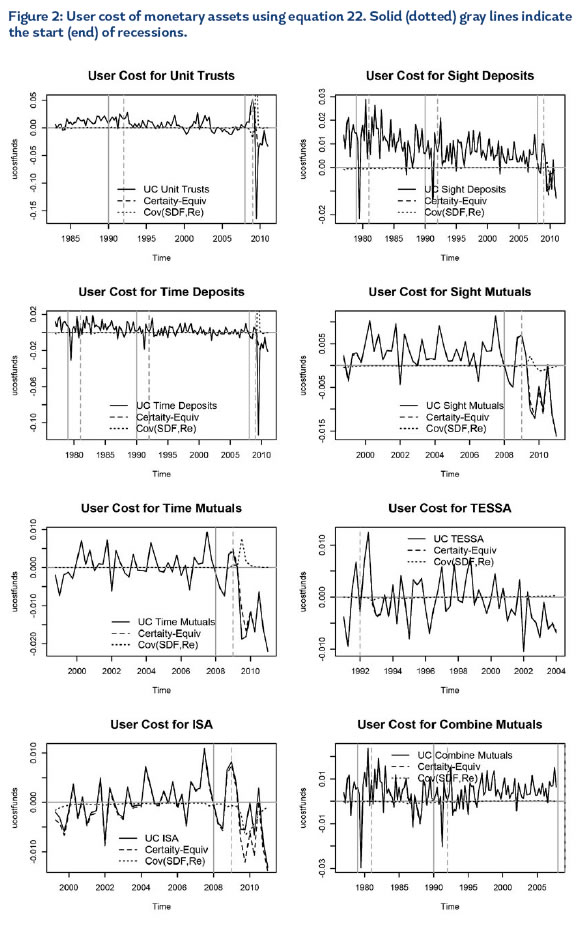
<body><![CDATA[<p align="center"><a name="t2"></a><img src="/img/revistas/ecos/v19n41/v19n41a3t2.jpg"></p>     <p>To compute the optimal weighting matrix, we estimate the HAC covariance matrix using the   quadratic spectral kernel for the 2-steps-GMM and ITER-GMM methods since it has better statistical   properties, Andrews (1991). We use the Tukey-Hanning kernel for the CU-GMM method since it is   numerically more stable and has statistical properties comparable to those of the quadratic spectral   kernel. We compute standard errors using the estimated HAC covariance matrix. For the implied parameter B, we use the delta method to compute its standard errors.</p>     <p>The estimated structural parameters seem reasonable and in line with the literature. The parameter   estimates for g vary from 1.58 to 2.32 with relatively high standard errors. Campbell and Cochrane use g = 2 for their post-war period U.S. application.</p>     <p>The persistence parameter estimates, &Phi;, vary from 0.966 to 0.986. For the six sector portfolios   case, the estimates of the mean consumption growth, <i>g</i>&macr; &gamma;, range from 0.22% to 0.37%. In the data,   <i>g</i>&macr; = 0.39%. This indicates a highly persistent surplus consumption process in line with the findings   in Tallarini and Zhang (2005) and Verdelhan (2010). The estimates of the volatility of consumption   growth, s, range from 0.61% to 0.67%. In the data, &sigma; = 0.86%. Their standard errors are very small.   For the six Fama-French portfolio case, mean consumption growth estimates are below their sample estimate of 0.48% while its volatility estimates are close to its sample estimate of 1.05%.</p>     <p>Average surplus consumption ratio estimates, <i>S</i>&macr;, are between 3.71% and 5.23%, which indicates   that the habit level of consumption is between 94.77% and 96.29%. The estimations for <i>B</i>, the elasticity   of interest rates with respect to deviations from the steady state consumption ratio, are negative   but their standard errors indicate that they are statistically insignificant, which suggest a constant   interest rate. This result is consistent with Campbell and Cochrane who show that adding interest   rate variation through <i>B</i> has very little effect in their results. The estimates of the subjective discount factor are around 0.97 which implies a subjective discount rate of around 3% per quarter.</p>     <p>The <i>J</i>-<i>Test</i> values and their associated p-values in <a href="#t2">Table 2</a> indicate that the CC model is not rejected   in our two samples. The differing results between the 2-steps and iterative GMM estimators suggest   that weak identification of the model parameters maybe a concern (Stock, Wright and Yogo, 2002).   Stock and Wright (2000) show that the continuously updating GMM estimator seems to be partially   robust to weak identification. They propose to use a robust overidentiying test in the presence of weak   identification, the S-Test. In our case the J-Test presented in <a href="#t2">Table 2</a> for the CUE estimator coincides   with the <i>S-Test</i>. Thus, even though we cannot rule out weak identification of the model parameters,   the CUE GMM results seems to be robust to such a problem. In the following subsection, we use the CUE GMM results to estimate the user cost of monetary assets.</p>     <p><b>6.2. Risk-adjusted User Cost of Monetary Assets</b></p>     <p>   After estimating the structural parameters of the CC model, we are in a position to estimate the   the risk adjustment and the user cost of monetary assets. Equation (22) is a risk-adjusted user cost   formula derived under the assumption that there exists a risk free benchmark rate, in this case the   risk-free interest rate. This formula depends on the expected return of each monetary asset as well   as on an estimate of the covariance between each monetary asset return and the stochastic discount   factor (SDF).</p>     <p>The first term in (22), (<i>r <sub>f ,t</sub></i> &minus; <i>E<sub>t</sub></i> &#91;<i>r<sub>m,t</sub></i> <sub>+1</sub>&#93;)/<i>r <sub>f ,t</sub></i> , corresponds to the certainty-equivalent user cost   of each monetary asset m. The second term, &#8211; <i>Covt</i> (<i>Q<sub>t</sub></i> <sub>+1</sub>, <i>r<sub>m,t</sub></i> <sub>+1</sub>), is the risk- adjustment to the certainty-   equivalent user cost. When the risk-adjustment is large, Divisia Monetary Indexes using the   certainty-equivalent user cost will be biased. <a href="#t3">Table 3</a> presents summary statistics of the risk-adjustment   estimates for each monetary asset over their respective sample period and <a href="#f1">Figure 1</a> depicts their behavior over time.</p>     <p align="center"><a name="t3"></a><img src="/img/revistas/ecos/v19n41/v19n41a3t3.jpg"></p>     ]]></body>
<body><![CDATA[<p align="center"><a name="f1"></a><img src="/img/revistas/ecos/v19n41/v19n41a3f1.jpg"></p>     <p>The mean and the median of the risk-adjustment estimates for each monetary assets are positive   but close to zero, indicating that the risk-adjustment can be neglected in the construction of Divisia   monetary aggregates. Even for the riskiest monetary asset, unit trust funds, the risk adjustment is negligible. Our results are consistent with Barnett et al. (1997) who consider time separable preferences.</p>     <p>The mean and the median of the risk-adjustment estimates for each monetary assets are positive   but close to zero, indicating that the risk-adjustment can be neglected in the construction of Divisia   monetary aggregates. Even for the riskiest monetary asset, unit trust funds, the risk adjustment is negligible. Our results are consistent with Barnett et al. (1997) who consider time separable preferences.</p>     <p>Barnett and Wu (2005) show that under uncertainty, (14) implies that any non monetary asset   could be used as the benchmark asset in the estimation the user cost of monetary assets. In <a href="#t4">Table 4</a>,   we report the user cost estimates taking the risk-free rate (first panel) and the market return (second   panel) as the benchmark rates. Figures <a href="#f2">2</a> and <a href="#f3">3</a> depict their behavior over time. The results indicate   that for all monetary asset there are negative user costs. This is not a theoretical problem of the CC   model, but a feature of the data at hand. For instance, if the yield curve is inverted such that the return   on short-term monetary assets is greater than the return on a long-term non-monetary asset,   the user cost may be negative. This is a violation of the assumption that monetary assets offering higher levels of monetary services should yield lower return rates.</p>     <p align="center"><a name="t4"></a><img src="/img/revistas/ecos/v19n41/v19n41a3t4.jpg"></p>     <p align="center"><a name="f2"></a><img src="/img/revistas/ecos/v19n41/v19n41a3f2.jpg" /></p>     <p align="center"><a name="f3"></a><img src="/img/revistas/ecos/v19n41/v19n41a3f3.jpg"></p>     <p align="center"><a name="f4"></a><img src="/img/revistas/ecos/v19n41/v19n41a3f4.jpg"></p>     <p>Negative user costs are a common problem in the construction of Divisia aggregates. To solve   the problem, researchers have to make further assumptions or arbitrary adjustments to make them   conform with theory. For instance, researchers at the Bank of England and the U.S. Federal Reserve   resolve this problem by defining the benchmark asset to be the asset with the highest return, regardless   of market liquidity or time to maturity, see Hancock (2005a,b) , Anderson and Buol (2005),   Anderson and Jones (2011). This is known as the envelope approach. According with this method the benchmark rate corresponds to the highest expected return among all monetary assets, <i>r<sub>B, t</sub></i> = <i>max</i> {<i>E<sub>t</sub></i> &#91;<i>r</i><sub>1</sub>,<sub>t +1</sub>&#93;, ... <i>E<sub>t</sub></i> &#91;<i>r<sub>M,t</sub></i> <sub>+1</sub>&#93;} for each <i>t</i>.</p>     <p>We implement the envelope approach by computing &pi;mt using rB,t instead of <i>r <sub>f ,t</sub></i> in (22). Following   the literature, we add a liquidity premium of 144 basis points to the benchmark rate to avoid negative   user costs, see Anderson and Jones (2011). The third panel of <a href="#t4">Table 4</a> present the results and <a href="#f4">Figure   4</a> depict them over time. We exclude data from 2008 onward, since due to the collapse of interest   rates after the recent U.S. financial crisis, most user cost become negative. As expected, the mean   user cost estimates for each monetary assets are positive. However, note that for unit trusts, there are some negative values, reflecting the very negative results for this funds during those periods.</p>     ]]></body>
<body><![CDATA[<p>&nbsp;</p>     <p><b><font size="3">7. Conclusions</font></b></p>     <p>Barnett et al. (1997) show that the risk-adjustment to the certainty-equivalent user cost of money   is negligible. Barnett and Wu (2005) hypothesize, however, that Barnett et al. (1997) approach   may underestimate the magnitude of the risk-adjustment since they do not consider time non-separable   preferences. Using the habit-based asset pricing model of Campbell and Cochrane (1999)   (CC model), we find that under time non-separable preferences the risk adjustment user cost is also   negligible. Therefore, the construction of Divisia monetary aggregates without accounting for risk are unlikely to be affected.</p>     <p>We use U.K. data from 1965Q1 to 2011Q1 to estimate the CC model using to sets of test assets.   First, we use a market portfolio and six industrial sectors portfolios. Second, we test the model using   six Fama-French portfolios sorted by size and book- to-market values from 1980Q4 to 2010Q4. Our   results indicate that the CC model is not rejected by the data in the sense that pricing errors are small. The estimated parameters are reasonable and in line with the literature.</p>     <p>Using the parameter estimates from the CC model, we estimate estimate time and asset specific   risk-adjustment to the certainty equivalent user cost of monetary assets included in the U.K. Divisia   index. We also include unit trusts as a potential risky monetary asset. Using the dynamic conditional   correlation (DCC) model of Engle (2002), we find that the average risk-adjustments for most   monetary assets is positive but their magnitudes are too low to affect the construction of Divisia monetary aggregates.</p>     <p>Our results have two important implications for the construction of monetary indexes. First,   researchers may dispense from risk-adjusting the user cost of money to construct such indexes.   Despite their theoretical appeal, our empirical results show that the risk adjustment for risky monetary   assets is negligible. Second, choosing a benchmark risky asset does matter for adjusting the   user cost in empirical applications. Thus, the theoretical appeal of risk adjusting the user cost of risky   monetary assets is lost since there are numerous benchmark assets to choose from. Any choice would be arbitrary and will likely lead to different results.</p>     <p>&nbsp;</p> <hr size="1" />     <p><a name="0"></a><a href="#b0">*</a> Acknowledge financial support from the   Colombian Fulbright Commission, the   Colombian Administrative Department   of Science, Technology and Innovation (Colciencias), and EAFIT University.</p>     <p><a name="1"></a><a href="#b1">1</a> Our modeling strategy takes as given that monetary assets offer monetary services&#8212;households value monetary assets for their   liquidity and for been claims to streams of consumption goods. However, equation (15) can also be derived from micro-founded models in which monetary assets are useful in facilitating exchange as in Lagos (2010) and Lagos (2011).</p>     <p><a name="2"></a><a h><a href="#b2">2</a></a> We use the constraint nonlinear optimization algorithm of Powell (1994) and available from the NLopt free-open-source library developed by Steven G. Johnson (<a href="http://ab-initio.mit.edu/ nlopt" target="_blank">http://ab-initio.mit.edu/ nlopt</a>).</p>     ]]></body>
<body><![CDATA[<p><a name="3"></a><a href="#b3">3</a> We interpolate annual population data to a quarterly frequency using a seasonal Kalman filter.</p>     <p><a name="4"></a><a href="#b4">4</a> Available at <a href="http://xfi.exeter.ac.uk/researchandpublications/portfoliosandfactors/index.php" target="_blank">http://xfi.exeter.ac.uk/researchandpublications/portfoliosandfactors/index.php</a>. See Gregory, Tharyan and Huang (2009)   for details.</p>     <p><a name="5"></a><a href="#b5">5</a> See <a href="http://www.bankofengland.co.uk/statistics/pages/iadb/notesiadb/Divisia.aspx" target="_blank">http://www.bankofengland.co.uk/statistics/pages/iadb/notesiadb/Divisia.aspx</a></p> <hr size="1" />     <p>&nbsp;</p>     <p><b><font size="3">References</font></b></p>     <!-- ref --><p>Abel, A. B., May 1990. Asset Pricing under Habit Formation and Catching Up with the Joneses. American Economic   Review (Papers and Proceedings) 80 (2), 38&#8211;42.    &nbsp;&nbsp;&nbsp;&nbsp;&nbsp;&nbsp;&nbsp;&nbsp;[&#160;<a href="javascript:void(0);" onclick="javascript: window.open('/scielo.php?script=sci_nlinks&ref=5185675&pid=S1657-4206201500020000300001&lng=','','width=640,height=500,resizable=yes,scrollbars=1,menubar=yes,');">Links</a>&#160;]<!-- end-ref --></p>     <!-- ref --><p>   Anderson, R., Buol, J., 2005. Revisions to user costs for the Federal Reserve Bank of St. Louis monetary services   indices. Review Federal Reserve Bank of Saint Louis 87 (6), 735.    &nbsp;&nbsp;&nbsp;&nbsp;&nbsp;&nbsp;&nbsp;&nbsp;[&#160;<a href="javascript:void(0);" onclick="javascript: window.open('/scielo.php?script=sci_nlinks&ref=5185677&pid=S1657-4206201500020000300002&lng=','','width=640,height=500,resizable=yes,scrollbars=1,menubar=yes,');">Links</a>&#160;]<!-- end-ref --></p>     <!-- ref --><p>   Anderson, R., Jones, B., 2011. A comprehensive revision of the US monetary services (Divisia) indexes. Federal   Reserve Bank of St. Louis Review 93 (5), 235&#8211;59.    &nbsp;&nbsp;&nbsp;&nbsp;&nbsp;&nbsp;&nbsp;&nbsp;[&#160;<a href="javascript:void(0);" onclick="javascript: window.open('/scielo.php?script=sci_nlinks&ref=5185679&pid=S1657-4206201500020000300003&lng=','','width=640,height=500,resizable=yes,scrollbars=1,menubar=yes,');">Links</a>&#160;]<!-- end-ref --></p>     <!-- ref --><p>Andrews, D., 1991. Heteroskedasticity and autocorrelation consistent covariance matrix estimation. Econometrica: Journal of the Econometric Society, 817&#8211;858.    &nbsp;&nbsp;&nbsp;&nbsp;&nbsp;&nbsp;&nbsp;&nbsp;[&#160;<a href="javascript:void(0);" onclick="javascript: window.open('/scielo.php?script=sci_nlinks&ref=5185681&pid=S1657-4206201500020000300004&lng=','','width=640,height=500,resizable=yes,scrollbars=1,menubar=yes,');">Links</a>&#160;]<!-- end-ref --></p>     <!-- ref --><p>   Antoine, B., Bonnal, H., Renault, E., 2007. On the efficient use of the informational content of estimating   equations: Implied probabilities and Euclidean empirical likelihood. Journal of Econometrics 138 (2),   461 &#8211; 487.    &nbsp;&nbsp;&nbsp;&nbsp;&nbsp;&nbsp;&nbsp;&nbsp;[&#160;<a href="javascript:void(0);" onclick="javascript: window.open('/scielo.php?script=sci_nlinks&ref=5185683&pid=S1657-4206201500020000300005&lng=','','width=640,height=500,resizable=yes,scrollbars=1,menubar=yes,');">Links</a>&#160;]<!-- end-ref --></p>     <!-- ref --><p>   Barnett, W., 1978. The user cost of money. Economics Letters 1 (2), 145&#8211;149.    &nbsp;&nbsp;&nbsp;&nbsp;&nbsp;&nbsp;&nbsp;&nbsp;[&#160;<a href="javascript:void(0);" onclick="javascript: window.open('/scielo.php?script=sci_nlinks&ref=5185685&pid=S1657-4206201500020000300006&lng=','','width=640,height=500,resizable=yes,scrollbars=1,menubar=yes,');">Links</a>&#160;]<!-- end-ref --></p>     <!-- ref --><p>   Barnett, W., Offenbacher, E., Spindt, P., 1981. New Concepts of Aggregated Money. The Journal of Finance 36   (2), 497&#8211;505.    &nbsp;&nbsp;&nbsp;&nbsp;&nbsp;&nbsp;&nbsp;&nbsp;[&#160;<a href="javascript:void(0);" onclick="javascript: window.open('/scielo.php?script=sci_nlinks&ref=5185687&pid=S1657-4206201500020000300007&lng=','','width=640,height=500,resizable=yes,scrollbars=1,menubar=yes,');">Links</a>&#160;]<!-- end-ref --></p>     <!-- ref --><p>   Barnett, W. A., Liu, Y., Jensen, M., June 1997. Capm Risk Adjustment For Exact Aggregation Over Financial Assets.   Macroeconomic Dynamics 1 (02), 485&#8211;512.    &nbsp;&nbsp;&nbsp;&nbsp;&nbsp;&nbsp;&nbsp;&nbsp;[&#160;<a href="javascript:void(0);" onclick="javascript: window.open('/scielo.php?script=sci_nlinks&ref=5185689&pid=S1657-4206201500020000300008&lng=','','width=640,height=500,resizable=yes,scrollbars=1,menubar=yes,');">Links</a>&#160;]<!-- end-ref --></p>     <!-- ref --><p>   Barnett, W. A., Wu, S., 2005. On user costs of risky monetary assets. Annals of Finance 1 (1), 35&#8211;50.    &nbsp;&nbsp;&nbsp;&nbsp;&nbsp;&nbsp;&nbsp;&nbsp;[&#160;<a href="javascript:void(0);" onclick="javascript: window.open('/scielo.php?script=sci_nlinks&ref=5185691&pid=S1657-4206201500020000300009&lng=','','width=640,height=500,resizable=yes,scrollbars=1,menubar=yes,');">Links</a>&#160;]<!-- end-ref --><!-- ref --> Boldrin,   M., Christiano, L. J., Fisher, J. D. M., 2001. Habit Persistence, Asset Returns, and the Business Cycle. The   American Economic Review 91 (1), 149&#8211;166.    &nbsp;&nbsp;&nbsp;&nbsp;&nbsp;&nbsp;&nbsp;&nbsp;[&#160;<a href="javascript:void(0);" onclick="javascript: window.open('/scielo.php?script=sci_nlinks&ref=5185692&pid=S1657-4206201500020000300010&lng=','','width=640,height=500,resizable=yes,scrollbars=1,menubar=yes,');">Links</a>&#160;]<!-- end-ref --></p>     <!-- ref --><p>   Buraschi, A., Jiltsov, A., 2007. Habit Formation and Macroeconomic Models of the Term Structure of Interest   Rates. Journal of Finance 62 (6), 3009 &#8211; 3063.    &nbsp;&nbsp;&nbsp;&nbsp;&nbsp;&nbsp;&nbsp;&nbsp;[&#160;<a href="javascript:void(0);" onclick="javascript: window.open('/scielo.php?script=sci_nlinks&ref=5185694&pid=S1657-4206201500020000300011&lng=','','width=640,height=500,resizable=yes,scrollbars=1,menubar=yes,');">Links</a>&#160;]<!-- end-ref --></p>     <!-- ref --><p>   Campbell, J. Y., Cochrane, J. H., Apr. 1999. By Force of Habit: A Consumption-Based Explanation of Aggregate   Stock Market Behavior. Journal of Political Economy 107 (2), 205&#8211;251.    &nbsp;&nbsp;&nbsp;&nbsp;&nbsp;&nbsp;&nbsp;&nbsp;[&#160;<a href="javascript:void(0);" onclick="javascript: window.open('/scielo.php?script=sci_nlinks&ref=5185696&pid=S1657-4206201500020000300012&lng=','','width=640,height=500,resizable=yes,scrollbars=1,menubar=yes,');">Links</a>&#160;]<!-- end-ref --></p>     <!-- ref --><p>   Chen, X., Ludvigson, S. C., 2009. Land of addicts? an empirical investigation of habit-based asset pricing models.   Journal of Applied Econometrics 24 (7), 1057&#8211;1093.    &nbsp;&nbsp;&nbsp;&nbsp;&nbsp;&nbsp;&nbsp;&nbsp;[&#160;<a href="javascript:void(0);" onclick="javascript: window.open('/scielo.php?script=sci_nlinks&ref=5185698&pid=S1657-4206201500020000300013&lng=','','width=640,height=500,resizable=yes,scrollbars=1,menubar=yes,');">Links</a>&#160;]<!-- end-ref --></p>     ]]></body>
<body><![CDATA[<!-- ref --><p>   Constantinides, G. M., Jun. 1990. Habit Formation: A Resolution of the Equity Premium Puzzle. Journal of Political   Economy 98 (3), 519&#8211;543.    &nbsp;&nbsp;&nbsp;&nbsp;&nbsp;&nbsp;&nbsp;&nbsp;[&#160;<a href="javascript:void(0);" onclick="javascript: window.open('/scielo.php?script=sci_nlinks&ref=5185700&pid=S1657-4206201500020000300014&lng=','','width=640,height=500,resizable=yes,scrollbars=1,menubar=yes,');">Links</a>&#160;]<!-- end-ref --></p>     <!-- ref --><p>   Donald, S. G., Newey, W. K., 2000. A jackknife interpretation of the continuous updating estimator. Economics   Letters 67 (3), 239&#8211;243.    &nbsp;&nbsp;&nbsp;&nbsp;&nbsp;&nbsp;&nbsp;&nbsp;[&#160;<a href="javascript:void(0);" onclick="javascript: window.open('/scielo.php?script=sci_nlinks&ref=5185702&pid=S1657-4206201500020000300015&lng=','','width=640,height=500,resizable=yes,scrollbars=1,menubar=yes,');">Links</a>&#160;]<!-- end-ref --></p>     <!-- ref --><p>   Elger, T., Binner, J., 2004. The UK Household Sector Demand for Risky Money. The B.E. Journal of Macroeconomics   4 (1), 1&#8211;22.    &nbsp;&nbsp;&nbsp;&nbsp;&nbsp;&nbsp;&nbsp;&nbsp;[&#160;<a href="javascript:void(0);" onclick="javascript: window.open('/scielo.php?script=sci_nlinks&ref=5185704&pid=S1657-4206201500020000300016&lng=','','width=640,height=500,resizable=yes,scrollbars=1,menubar=yes,');">Links</a>&#160;]<!-- end-ref --></p>     <!-- ref --><p>   Engle, R., 2002. Dynamic conditional correlation. Journal of Business &amp; Economic Statistics 20 (3), 339&#8211;350.    &nbsp;&nbsp;&nbsp;&nbsp;&nbsp;&nbsp;&nbsp;&nbsp;[&#160;<a href="javascript:void(0);" onclick="javascript: window.open('/scielo.php?script=sci_nlinks&ref=5185706&pid=S1657-4206201500020000300017&lng=','','width=640,height=500,resizable=yes,scrollbars=1,menubar=yes,');">Links</a>&#160;]<!-- end-ref --></p>     <!-- ref --><p>   Epstein, L. G., Zin, S. E., Apr. 1991. Substitution, Risk Aversion, and the Temporal Behavior of Consumption   Growth and Asset Returns II: An Empirical Analysis. Journal of Political Economy 9 (2), 263&#8211;286.    &nbsp;&nbsp;&nbsp;&nbsp;&nbsp;&nbsp;&nbsp;&nbsp;[&#160;<a href="javascript:void(0);" onclick="javascript: window.open('/scielo.php?script=sci_nlinks&ref=5185708&pid=S1657-4206201500020000300018&lng=','','width=640,height=500,resizable=yes,scrollbars=1,menubar=yes,');">Links</a>&#160;]<!-- end-ref --></p>     ]]></body>
<body><![CDATA[<!-- ref --><p>   Fuhrer, J., 2000. Habit formation in consumption and its implications for monetary-policy models. American   Economic Review, 367&#8211;390.    &nbsp;&nbsp;&nbsp;&nbsp;&nbsp;&nbsp;&nbsp;&nbsp;[&#160;<a href="javascript:void(0);" onclick="javascript: window.open('/scielo.php?script=sci_nlinks&ref=5185710&pid=S1657-4206201500020000300019&lng=','','width=640,height=500,resizable=yes,scrollbars=1,menubar=yes,');">Links</a>&#160;]<!-- end-ref --></p>     <!-- ref --><p>   Gregory, A., Tharyan, R., Huang, A., 2009. The Fama-French and momentum portfolios and factors in the UK.   University of Exeter Business School, Xfi Centre for Finance and Investment Paper (09/05).    &nbsp;&nbsp;&nbsp;&nbsp;&nbsp;&nbsp;&nbsp;&nbsp;[&#160;<a href="javascript:void(0);" onclick="javascript: window.open('/scielo.php?script=sci_nlinks&ref=5185712&pid=S1657-4206201500020000300020&lng=','','width=640,height=500,resizable=yes,scrollbars=1,menubar=yes,');">Links</a>&#160;]<!-- end-ref --><!-- ref --> Hancock,   M., 2005a. A new measure of Divisia money. Bank of England Monetary &amp; Financial Statistics, 13&#8211;14.    &nbsp;&nbsp;&nbsp;&nbsp;&nbsp;&nbsp;&nbsp;&nbsp;[&#160;<a href="javascript:void(0);" onclick="javascript: window.open('/scielo.php?script=sci_nlinks&ref=5185713&pid=S1657-4206201500020000300021&lng=','','width=640,height=500,resizable=yes,scrollbars=1,menubar=yes,');">Links</a>&#160;]<!-- end-ref --></p>     <!-- ref --><p>   Hancock, M., 2005b. Divisia money. Bank of England Quarterly Bulletin, Spring.    &nbsp;&nbsp;&nbsp;&nbsp;&nbsp;&nbsp;&nbsp;&nbsp;[&#160;<a href="javascript:void(0);" onclick="javascript: window.open('/scielo.php?script=sci_nlinks&ref=5185715&pid=S1657-4206201500020000300022&lng=','','width=640,height=500,resizable=yes,scrollbars=1,menubar=yes,');">Links</a>&#160;]<!-- end-ref --></p>     <!-- ref --><p>   Hansen, L. P., Heaton, J., Yaron, A., 1996. Finite-Sample Properties of Some Alternative GMM Estimators.   Journal of Business &amp; Economic Statistics 14 (3), 262&#8211;280.    &nbsp;&nbsp;&nbsp;&nbsp;&nbsp;&nbsp;&nbsp;&nbsp;[&#160;<a href="javascript:void(0);" onclick="javascript: window.open('/scielo.php?script=sci_nlinks&ref=5185717&pid=S1657-4206201500020000300023&lng=','','width=640,height=500,resizable=yes,scrollbars=1,menubar=yes,');">Links</a>&#160;]<!-- end-ref --></p>     <!-- ref --><p>   Hansen, L. P., Singleton, K. J., September 1982. Generalized Instrumental Variables Estimation of Nonlinear   Rational Expectations Models. Econometrica 50 (5), 1269&#8211;86.    &nbsp;&nbsp;&nbsp;&nbsp;&nbsp;&nbsp;&nbsp;&nbsp;[&#160;<a href="javascript:void(0);" onclick="javascript: window.open('/scielo.php?script=sci_nlinks&ref=5185719&pid=S1657-4206201500020000300024&lng=','','width=640,height=500,resizable=yes,scrollbars=1,menubar=yes,');">Links</a>&#160;]<!-- end-ref --></p>     <!-- ref --><p>   Hyde, S., Sherif, M., 2005a. Consumption Asset Pricing Models: Evidence from the UK. The Manchester School   73 (3), 343&#8211;363.    &nbsp;&nbsp;&nbsp;&nbsp;&nbsp;&nbsp;&nbsp;&nbsp;[&#160;<a href="javascript:void(0);" onclick="javascript: window.open('/scielo.php?script=sci_nlinks&ref=5185721&pid=S1657-4206201500020000300025&lng=','','width=640,height=500,resizable=yes,scrollbars=1,menubar=yes,');">Links</a>&#160;]<!-- end-ref --></p> </font>     <!-- ref --><p><font size="2" face="Verdana, Arial, Helvetica, sans-serif">Hyde, S., Sherif, M., 2005b. DonSt break the habit: structural stability tests of consumption asset pricing models in the UK. Applied Economics Letters 12 (5), 289&#8211;296.    &nbsp;&nbsp;&nbsp;&nbsp;&nbsp;&nbsp;&nbsp;&nbsp;[&#160;<a href="javascript:void(0);" onclick="javascript: window.open('/scielo.php?script=sci_nlinks&ref=5185723&pid=S1657-4206201500020000300026&lng=','','width=640,height=500,resizable=yes,scrollbars=1,menubar=yes,');">Links</a>&#160;]<!-- end-ref --></font></p> <font size="2" face="Verdana, Arial, Helvetica, sans-serif">    <!-- ref --><p>   Jones, B. E., Stracca, L., 2008. Does money matter in the IS curve? The case of the U.K. The Manchester   School 76, 58&#8211;84.    &nbsp;&nbsp;&nbsp;&nbsp;&nbsp;&nbsp;&nbsp;&nbsp;[&#160;<a href="javascript:void(0);" onclick="javascript: window.open('/scielo.php?script=sci_nlinks&ref=5185725&pid=S1657-4206201500020000300027&lng=','','width=640,height=500,resizable=yes,scrollbars=1,menubar=yes,');">Links</a>&#160;]<!-- end-ref --></p>     <!-- ref --><p>   Krishnamurthy, A., Vissing-Jorgensen, A., 2012. The aggregate demand for treasury debt. Journal of Political   Economy 120 (2), 233&#8211;267.    &nbsp;&nbsp;&nbsp;&nbsp;&nbsp;&nbsp;&nbsp;&nbsp;[&#160;<a href="javascript:void(0);" onclick="javascript: window.open('/scielo.php?script=sci_nlinks&ref=5185727&pid=S1657-4206201500020000300028&lng=','','width=640,height=500,resizable=yes,scrollbars=1,menubar=yes,');">Links</a>&#160;]<!-- end-ref --></p>     <!-- ref --><p>   Lagos, R., 2010. Asset prices and liquidity in an exchange economy. Journal of Monetary Economics 57 (8),   913&#8211;930.    &nbsp;&nbsp;&nbsp;&nbsp;&nbsp;&nbsp;&nbsp;&nbsp;[&#160;<a href="javascript:void(0);" onclick="javascript: window.open('/scielo.php?script=sci_nlinks&ref=5185729&pid=S1657-4206201500020000300029&lng=','','width=640,height=500,resizable=yes,scrollbars=1,menubar=yes,');">Links</a>&#160;]<!-- end-ref --></p>     <!-- ref --><p>   Lagos, R., 2011. Asset prices, liquidity, and monetary policy in an exchange economy. Journal of Money, Credit   and Banking 43 (s2), 521&#8211;552.    &nbsp;&nbsp;&nbsp;&nbsp;&nbsp;&nbsp;&nbsp;&nbsp;[&#160;<a href="javascript:void(0);" onclick="javascript: window.open('/scielo.php?script=sci_nlinks&ref=5185731&pid=S1657-4206201500020000300030&lng=','','width=640,height=500,resizable=yes,scrollbars=1,menubar=yes,');">Links</a>&#160;]<!-- end-ref --></p>     <!-- ref --><p>   M&oslash;ller, S., 2009. Habit persistence: explaining cross-sectional variation in returns and time-varying expected   returns. Journal of Empirical Finance 16 (4), 525&#8211;536.    &nbsp;&nbsp;&nbsp;&nbsp;&nbsp;&nbsp;&nbsp;&nbsp;[&#160;<a href="javascript:void(0);" onclick="javascript: window.open('/scielo.php?script=sci_nlinks&ref=5185733&pid=S1657-4206201500020000300031&lng=','','width=640,height=500,resizable=yes,scrollbars=1,menubar=yes,');">Links</a>&#160;]<!-- end-ref --></p>     <!-- ref --><p>   Newey, W., West, K., 1987. A simple, positive semi-definite, heteroskedasticity and autocorrelation consistent   covariance matrix. Econometrica: Journal of the Econometric Society, 703&#8211;708.    &nbsp;&nbsp;&nbsp;&nbsp;&nbsp;&nbsp;&nbsp;&nbsp;[&#160;<a href="javascript:void(0);" onclick="javascript: window.open('/scielo.php?script=sci_nlinks&ref=5185735&pid=S1657-4206201500020000300032&lng=','','width=640,height=500,resizable=yes,scrollbars=1,menubar=yes,');">Links</a>&#160;]<!-- end-ref --></p>     <!-- ref --><p>   Powell, M., 1994. A direct search optimization method that models the objective and constraint functions by   linear interpolation. Advances in optimization and numerical analysis 7, 51&#8211;67.    &nbsp;&nbsp;&nbsp;&nbsp;&nbsp;&nbsp;&nbsp;&nbsp;[&#160;<a href="javascript:void(0);" onclick="javascript: window.open('/scielo.php?script=sci_nlinks&ref=5185737&pid=S1657-4206201500020000300033&lng=','','width=640,height=500,resizable=yes,scrollbars=1,menubar=yes,');">Links</a>&#160;]<!-- end-ref --></p>     <!-- ref --><p>   Stock, J., Wright, J., Yogo, M., 2002. A survey of weak instruments and weak identification in generalized   method   of moments. Journal of Business &amp; Economic Statistics 20 (4), 518&#8211;529.    &nbsp;&nbsp;&nbsp;&nbsp;&nbsp;&nbsp;&nbsp;&nbsp;[&#160;<a href="javascript:void(0);" onclick="javascript: window.open('/scielo.php?script=sci_nlinks&ref=5185739&pid=S1657-4206201500020000300034&lng=','','width=640,height=500,resizable=yes,scrollbars=1,menubar=yes,');">Links</a>&#160;]<!-- end-ref --></p>     <!-- ref --><p>   Stock, J. H., Wright, J. H., 2000. GMM with Weak Identification. Econometrica 68 (5), 1055&#8211;1096.    &nbsp;&nbsp;&nbsp;&nbsp;&nbsp;&nbsp;&nbsp;&nbsp;[&#160;<a href="javascript:void(0);" onclick="javascript: window.open('/scielo.php?script=sci_nlinks&ref=5185741&pid=S1657-4206201500020000300035&lng=','','width=640,height=500,resizable=yes,scrollbars=1,menubar=yes,');">Links</a>&#160;]<!-- end-ref --> </p>     <!-- ref --><p>Tallarini, T.   D., Zhang, H. H., 2005. External Habit and the Cyclicality of Expected Stock Returns. The Journal of   Business 78 (3), 1023&#8211;1048.    &nbsp;&nbsp;&nbsp;&nbsp;&nbsp;&nbsp;&nbsp;&nbsp;[&#160;<a href="javascript:void(0);" onclick="javascript: window.open('/scielo.php?script=sci_nlinks&ref=5185743&pid=S1657-4206201500020000300036&lng=','','width=640,height=500,resizable=yes,scrollbars=1,menubar=yes,');">Links</a>&#160;]<!-- end-ref --></p>     <!-- ref --><p>   Verdelhan, A., 2010. A Habit-Based Explanation of the Exchange Rate Risk Premium. The Journal of Finance   65 (1), 123&#8211;146.    &nbsp;&nbsp;&nbsp;&nbsp;&nbsp;&nbsp;&nbsp;&nbsp;[&#160;<a href="javascript:void(0);" onclick="javascript: window.open('/scielo.php?script=sci_nlinks&ref=5185745&pid=S1657-4206201500020000300037&lng=','','width=640,height=500,resizable=yes,scrollbars=1,menubar=yes,');">Links</a>&#160;]<!-- end-ref --></p>     <!-- ref --><p>   Wachter, J. A., 2006. A consumption-based model of the term structure of interest rates. Journal of Financial   Economics 79 (2), 365&#8211;399.    &nbsp;&nbsp;&nbsp;&nbsp;&nbsp;&nbsp;&nbsp;&nbsp;[&#160;<a href="javascript:void(0);" onclick="javascript: window.open('/scielo.php?script=sci_nlinks&ref=5185747&pid=S1657-4206201500020000300038&lng=','','width=640,height=500,resizable=yes,scrollbars=1,menubar=yes,');">Links</a>&#160;]<!-- end-ref --></p>     <!-- ref --><p>   Yogo, M., 2006. A Consumption-Based Explanation of Expected St0ock Returns. The Journal of Finance 61   (2), 539&#8211;580.    &nbsp;&nbsp;&nbsp;&nbsp;&nbsp;&nbsp;&nbsp;&nbsp;[&#160;<a href="javascript:void(0);" onclick="javascript: window.open('/scielo.php?script=sci_nlinks&ref=5185749&pid=S1657-4206201500020000300039&lng=','','width=640,height=500,resizable=yes,scrollbars=1,menubar=yes,');">Links</a>&#160;]<!-- end-ref --></p>     <p>&nbsp;</p>     <p>&nbsp;</p>     <p>&nbsp;</p>     <p>&nbsp;</p> </font>     ]]></body><back>
<ref-list>
<ref id="B1">
<nlm-citation citation-type="journal">
<person-group person-group-type="author">
<name>
<surname><![CDATA[Abel]]></surname>
<given-names><![CDATA[A. B]]></given-names>
</name>
</person-group>
<article-title xml:lang="en"><![CDATA[Asset Pricing under Habit Formation and Catching Up with the Joneses]]></article-title>
<source><![CDATA[American Economic Review]]></source>
<year>May </year>
<month>19</month>
<day>90</day>
<volume>80</volume>
<numero>2</numero>
<issue>2</issue>
<page-range>38-42</page-range></nlm-citation>
</ref>
<ref id="B2">
<nlm-citation citation-type="journal">
<person-group person-group-type="author">
<name>
<surname><![CDATA[Anderson]]></surname>
<given-names><![CDATA[R]]></given-names>
</name>
<name>
<surname><![CDATA[Buol]]></surname>
<given-names><![CDATA[J]]></given-names>
</name>
</person-group>
<article-title xml:lang="en"><![CDATA[Revisions to user costs for the Federal Reserve Bank of St. Louis monetary services indices]]></article-title>
<source><![CDATA[Review Federal Reserve Bank of Saint Louis]]></source>
<year>2005</year>
<volume>87</volume>
<numero>6</numero>
<issue>6</issue>
<page-range>735</page-range></nlm-citation>
</ref>
<ref id="B3">
<nlm-citation citation-type="journal">
<person-group person-group-type="author">
<name>
<surname><![CDATA[Anderson]]></surname>
<given-names><![CDATA[R]]></given-names>
</name>
<name>
<surname><![CDATA[Jones]]></surname>
<given-names><![CDATA[B]]></given-names>
</name>
</person-group>
<article-title xml:lang="en"><![CDATA[A comprehensive revision of the US monetary services (Divisia) indexes]]></article-title>
<source><![CDATA[Federal Reserve Bank of St. Louis Review]]></source>
<year>2011</year>
<volume>93</volume>
<numero>5</numero>
<issue>5</issue>
<page-range>235-59</page-range></nlm-citation>
</ref>
<ref id="B4">
<nlm-citation citation-type="journal">
<person-group person-group-type="author">
<name>
<surname><![CDATA[Andrews]]></surname>
<given-names><![CDATA[D]]></given-names>
</name>
</person-group>
<article-title xml:lang="en"><![CDATA[Heteroskedasticity and autocorrelation consistent covariance matrix estimation]]></article-title>
<source><![CDATA[Econometrica: Journal of the Econometric Society]]></source>
<year>1991</year>
<page-range>817-858</page-range></nlm-citation>
</ref>
<ref id="B5">
<nlm-citation citation-type="journal">
<person-group person-group-type="author">
<name>
<surname><![CDATA[Antoine]]></surname>
<given-names><![CDATA[B]]></given-names>
</name>
<name>
<surname><![CDATA[Bonnal]]></surname>
<given-names><![CDATA[H]]></given-names>
</name>
<name>
<surname><![CDATA[Renault]]></surname>
<given-names><![CDATA[E]]></given-names>
</name>
</person-group>
<article-title xml:lang="en"><![CDATA[On the efficient use of the informational content of estimating equations: Implied probabilities and Euclidean empirical likelihood]]></article-title>
<source><![CDATA[Journal of Econometrics]]></source>
<year>2007</year>
<volume>138</volume>
<numero>2</numero>
<issue>2</issue>
<page-range>461 - 487</page-range></nlm-citation>
</ref>
<ref id="B6">
<nlm-citation citation-type="journal">
<person-group person-group-type="author">
<name>
<surname><![CDATA[Barnett]]></surname>
<given-names><![CDATA[W]]></given-names>
</name>
</person-group>
<article-title xml:lang="en"><![CDATA[The user cost of money]]></article-title>
<source><![CDATA[Economics Letters]]></source>
<year>1978</year>
<volume>1</volume>
<numero>2</numero>
<issue>2</issue>
<page-range>145-149</page-range></nlm-citation>
</ref>
<ref id="B7">
<nlm-citation citation-type="journal">
<person-group person-group-type="author">
<name>
<surname><![CDATA[Barnett]]></surname>
<given-names><![CDATA[W]]></given-names>
</name>
<name>
<surname><![CDATA[Offenbacher]]></surname>
<given-names><![CDATA[E]]></given-names>
</name>
<name>
<surname><![CDATA[Spindt]]></surname>
<given-names><![CDATA[P]]></given-names>
</name>
</person-group>
<article-title xml:lang="en"><![CDATA[New Concepts of Aggregated Money]]></article-title>
<source><![CDATA[The Journal of Finance]]></source>
<year>1981</year>
<volume>36</volume>
<numero>2</numero>
<issue>2</issue>
<page-range>497-505</page-range></nlm-citation>
</ref>
<ref id="B8">
<nlm-citation citation-type="journal">
<person-group person-group-type="author">
<name>
<surname><![CDATA[Barnett]]></surname>
<given-names><![CDATA[W. A]]></given-names>
</name>
<name>
<surname><![CDATA[Liu]]></surname>
<given-names><![CDATA[Y]]></given-names>
</name>
<name>
<surname><![CDATA[Jensen]]></surname>
<given-names><![CDATA[M]]></given-names>
</name>
</person-group>
<article-title xml:lang="en"><![CDATA[Capm Risk Adjustment For Exact Aggregation Over Financial Assets]]></article-title>
<source><![CDATA[Macroeconomic Dynamics]]></source>
<year>June</year>
<month> 1</month>
<day>99</day>
<volume>1</volume>
<numero>02</numero>
<issue>02</issue>
<page-range>485-512</page-range></nlm-citation>
</ref>
<ref id="B9">
<nlm-citation citation-type="journal">
<person-group person-group-type="author">
<name>
<surname><![CDATA[Barnett]]></surname>
<given-names><![CDATA[W. A]]></given-names>
</name>
<name>
<surname><![CDATA[Wu]]></surname>
<given-names><![CDATA[S]]></given-names>
</name>
</person-group>
<article-title xml:lang="en"><![CDATA[On user costs of risky monetary assets]]></article-title>
<source><![CDATA[Annals of Finance]]></source>
<year>2005</year>
<volume>1</volume>
<numero>1</numero>
<issue>1</issue>
<page-range>35-50</page-range></nlm-citation>
</ref>
<ref id="B10">
<nlm-citation citation-type="journal">
<person-group person-group-type="author">
<name>
<surname><![CDATA[Boldrin]]></surname>
<given-names><![CDATA[M]]></given-names>
</name>
<name>
<surname><![CDATA[Christiano]]></surname>
<given-names><![CDATA[L. J]]></given-names>
</name>
<name>
<surname><![CDATA[Fisher]]></surname>
<given-names><![CDATA[J. D. M]]></given-names>
</name>
</person-group>
<article-title xml:lang="en"><![CDATA[Habit Persistence, Asset Returns, and the Business Cycle]]></article-title>
<source><![CDATA[The American Economic Review]]></source>
<year>2001</year>
<volume>91</volume>
<numero>1</numero>
<issue>1</issue>
<page-range>149-166</page-range></nlm-citation>
</ref>
<ref id="B11">
<nlm-citation citation-type="journal">
<person-group person-group-type="author">
<name>
<surname><![CDATA[Buraschi]]></surname>
<given-names><![CDATA[A]]></given-names>
</name>
<name>
<surname><![CDATA[Jiltsov]]></surname>
<given-names><![CDATA[A]]></given-names>
</name>
</person-group>
<article-title xml:lang="en"><![CDATA[Habit Formation and Macroeconomic Models of the Term Structure of Interest Rates]]></article-title>
<source><![CDATA[Journal of Finance]]></source>
<year>2007</year>
<volume>62</volume>
<numero>6</numero>
<issue>6</issue>
<page-range>3009 - 3063</page-range></nlm-citation>
</ref>
<ref id="B12">
<nlm-citation citation-type="journal">
<person-group person-group-type="author">
<name>
<surname><![CDATA[Campbell]]></surname>
<given-names><![CDATA[J. Y]]></given-names>
</name>
<name>
<surname><![CDATA[Cochrane]]></surname>
<given-names><![CDATA[J. H]]></given-names>
</name>
</person-group>
<article-title xml:lang="en"><![CDATA[By Force of Habit: A Consumption-Based Explanation of Aggregate Stock Market Behavior]]></article-title>
<source><![CDATA[Journal of Political Economy]]></source>
<year>Apr.</year>
<month> 1</month>
<day>99</day>
<volume>107</volume>
<numero>2</numero>
<issue>2</issue>
<page-range>205-251</page-range></nlm-citation>
</ref>
<ref id="B13">
<nlm-citation citation-type="journal">
<person-group person-group-type="author">
<name>
<surname><![CDATA[Chen]]></surname>
<given-names><![CDATA[X]]></given-names>
</name>
<name>
<surname><![CDATA[Ludvigson]]></surname>
<given-names><![CDATA[S. C]]></given-names>
</name>
</person-group>
<article-title xml:lang="en"><![CDATA[Land of addicts? an empirical investigation of habit-based asset pricing models]]></article-title>
<source><![CDATA[Journal of Applied Econometrics]]></source>
<year>2009</year>
<volume>24</volume>
<numero>7</numero>
<issue>7</issue>
<page-range>1057-1093</page-range></nlm-citation>
</ref>
<ref id="B14">
<nlm-citation citation-type="journal">
<person-group person-group-type="author">
<name>
<surname><![CDATA[Constantinides]]></surname>
<given-names><![CDATA[G. M]]></given-names>
</name>
</person-group>
<article-title xml:lang="en"><![CDATA[Habit Formation: A Resolution of the Equity Premium Puzzle]]></article-title>
<source><![CDATA[Journal of Political Economy]]></source>
<year>Jun.</year>
<month> 1</month>
<day>99</day>
<volume>98</volume>
<numero>3</numero>
<issue>3</issue>
<page-range>519-543</page-range></nlm-citation>
</ref>
<ref id="B15">
<nlm-citation citation-type="journal">
<person-group person-group-type="author">
<name>
<surname><![CDATA[Donald]]></surname>
<given-names><![CDATA[S. G]]></given-names>
</name>
<name>
<surname><![CDATA[Newey]]></surname>
<given-names><![CDATA[W. K]]></given-names>
</name>
</person-group>
<article-title xml:lang="en"><![CDATA[A jackknife interpretation of the continuous updating estimator]]></article-title>
<source><![CDATA[Economics Letters]]></source>
<year>2000</year>
<volume>67</volume>
<numero>3</numero>
<issue>3</issue>
<page-range>239-243</page-range></nlm-citation>
</ref>
<ref id="B16">
<nlm-citation citation-type="journal">
<person-group person-group-type="author">
<name>
<surname><![CDATA[Elger]]></surname>
<given-names><![CDATA[T]]></given-names>
</name>
<name>
<surname><![CDATA[Binner]]></surname>
<given-names><![CDATA[J]]></given-names>
</name>
</person-group>
<article-title xml:lang="en"><![CDATA[The UK Household Sector Demand for Risky Money. The B.E]]></article-title>
<source><![CDATA[Journal of Macroeconomics]]></source>
<year>2004</year>
<volume>4</volume>
<numero>1</numero>
<issue>1</issue>
<page-range>1-22</page-range></nlm-citation>
</ref>
<ref id="B17">
<nlm-citation citation-type="journal">
<person-group person-group-type="author">
<name>
<surname><![CDATA[Engle]]></surname>
<given-names><![CDATA[R]]></given-names>
</name>
</person-group>
<article-title xml:lang="en"><![CDATA[Dynamic conditional correlation]]></article-title>
<source><![CDATA[Journal of Business & Economic Statistics]]></source>
<year>2002</year>
<volume>20</volume>
<numero>3</numero>
<issue>3</issue>
<page-range>339-350</page-range></nlm-citation>
</ref>
<ref id="B18">
<nlm-citation citation-type="journal">
<person-group person-group-type="author">
<name>
<surname><![CDATA[Epstein]]></surname>
<given-names><![CDATA[L. G]]></given-names>
</name>
<name>
<surname><![CDATA[Zin]]></surname>
<given-names><![CDATA[S. E]]></given-names>
</name>
</person-group>
<article-title xml:lang="en"><![CDATA[Substitution, Risk Aversion, and the Temporal Behavior of Consumption Growth and Asset Returns II: An Empirical Analysis]]></article-title>
<source><![CDATA[Journal of Political Economy]]></source>
<year>Apr.</year>
<month> 1</month>
<day>99</day>
<volume>9</volume>
<numero>2</numero>
<issue>2</issue>
<page-range>263-286</page-range></nlm-citation>
</ref>
<ref id="B19">
<nlm-citation citation-type="journal">
<person-group person-group-type="author">
<name>
<surname><![CDATA[Fuhrer]]></surname>
<given-names><![CDATA[J]]></given-names>
</name>
</person-group>
<article-title xml:lang="en"><![CDATA[Habit formation in consumption and its implications for monetary-policy models]]></article-title>
<source><![CDATA[American Economic Review]]></source>
<year>2000</year>
<page-range>367-390</page-range></nlm-citation>
</ref>
<ref id="B20">
<nlm-citation citation-type="book">
<person-group person-group-type="author">
<name>
<surname><![CDATA[Gregory]]></surname>
<given-names><![CDATA[A]]></given-names>
</name>
<name>
<surname><![CDATA[Tharyan]]></surname>
<given-names><![CDATA[R]]></given-names>
</name>
<name>
<surname><![CDATA[Huang]]></surname>
<given-names><![CDATA[A]]></given-names>
</name>
</person-group>
<source><![CDATA[The Fama-French and momentum portfolios and factors in the UK]]></source>
<year>2009</year>
<publisher-name><![CDATA[University of Exeter Business School, Xfi Centre for Finance and Investment Paper (09/05)]]></publisher-name>
</nlm-citation>
</ref>
<ref id="B21">
<nlm-citation citation-type="journal">
<person-group person-group-type="author">
<name>
<surname><![CDATA[Hancock]]></surname>
<given-names><![CDATA[M]]></given-names>
</name>
</person-group>
<article-title xml:lang="en"><![CDATA[A new measure of Divisia money]]></article-title>
<source><![CDATA[Bank of England Monetary & Financial Statistics]]></source>
<year>2005</year>
<month>a</month>
<page-range>13-14</page-range></nlm-citation>
</ref>
<ref id="B22">
<nlm-citation citation-type="book">
<person-group person-group-type="author">
<name>
<surname><![CDATA[Hancock]]></surname>
<given-names><![CDATA[M]]></given-names>
</name>
</person-group>
<source><![CDATA[Divisia money]]></source>
<year>2005</year>
<month>b</month>
<publisher-name><![CDATA[Bank of England Quarterly Bulletin, Spring]]></publisher-name>
</nlm-citation>
</ref>
<ref id="B23">
<nlm-citation citation-type="journal">
<person-group person-group-type="author">
<name>
<surname><![CDATA[Hansen]]></surname>
<given-names><![CDATA[L. P]]></given-names>
</name>
<name>
<surname><![CDATA[Heaton]]></surname>
<given-names><![CDATA[J]]></given-names>
</name>
<name>
<surname><![CDATA[Yaron]]></surname>
<given-names><![CDATA[A]]></given-names>
</name>
</person-group>
<article-title xml:lang="en"><![CDATA[-Sample Properties of Some Alternative GMM Estimators]]></article-title>
<source><![CDATA[Journal of Business & Economic Statistics]]></source>
<year>1996</year>
<volume>14</volume>
<numero>3</numero>
<issue>3</issue>
<page-range>262-280</page-range></nlm-citation>
</ref>
<ref id="B24">
<nlm-citation citation-type="journal">
<person-group person-group-type="author">
<name>
<surname><![CDATA[Hansen]]></surname>
<given-names><![CDATA[L. P]]></given-names>
</name>
<name>
<surname><![CDATA[Singleton]]></surname>
<given-names><![CDATA[K. J]]></given-names>
</name>
</person-group>
<article-title xml:lang="en"><![CDATA[Generalized Instrumental Variables Estimation of Nonlinear Rational Expectations Models]]></article-title>
<source><![CDATA[Econometrica]]></source>
<year>Sept</year>
<month>em</month>
<day>be</day>
<volume>50</volume>
<numero>5</numero>
<issue>5</issue>
<page-range>1269-86</page-range></nlm-citation>
</ref>
<ref id="B25">
<nlm-citation citation-type="journal">
<person-group person-group-type="author">
<name>
<surname><![CDATA[Hyde]]></surname>
<given-names><![CDATA[S]]></given-names>
</name>
<name>
<surname><![CDATA[Sherif]]></surname>
<given-names><![CDATA[M]]></given-names>
</name>
</person-group>
<article-title xml:lang="en"><![CDATA[Consumption Asset Pricing Models: Evidence from the UK]]></article-title>
<source><![CDATA[The Manchester School]]></source>
<year>2005</year>
<month>a</month>
<volume>73</volume>
<numero>3</numero>
<issue>3</issue>
<page-range>343-363</page-range></nlm-citation>
</ref>
<ref id="B26">
<nlm-citation citation-type="journal">
<person-group person-group-type="author">
<name>
<surname><![CDATA[Hyde]]></surname>
<given-names><![CDATA[S]]></given-names>
</name>
<name>
<surname><![CDATA[Sherif]]></surname>
<given-names><![CDATA[M]]></given-names>
</name>
</person-group>
<article-title xml:lang="en"><![CDATA[DonSt break the habit: structural stability tests of consumption asset pricing models in the UK]]></article-title>
<source><![CDATA[Applied Economics Letters]]></source>
<year>2005</year>
<month>b</month>
<volume>12</volume>
<numero>5</numero>
<issue>5</issue>
<page-range>289-296</page-range></nlm-citation>
</ref>
<ref id="B27">
<nlm-citation citation-type="journal">
<person-group person-group-type="author">
<name>
<surname><![CDATA[Jones]]></surname>
<given-names><![CDATA[B. E]]></given-names>
</name>
<name>
<surname><![CDATA[Stracca]]></surname>
<given-names><![CDATA[L]]></given-names>
</name>
</person-group>
<article-title xml:lang="en"><![CDATA[Does money matter in the IS curve?]]></article-title>
<source><![CDATA[The case of the U.K. The Manchester School]]></source>
<year>2008</year>
<volume>76</volume>
<page-range>58-84</page-range></nlm-citation>
</ref>
<ref id="B28">
<nlm-citation citation-type="journal">
<person-group person-group-type="author">
<name>
<surname><![CDATA[Krishnamurthy]]></surname>
<given-names><![CDATA[A]]></given-names>
</name>
<name>
<surname><![CDATA[Vissing-Jorgensen]]></surname>
<given-names><![CDATA[A]]></given-names>
</name>
</person-group>
<article-title xml:lang="en"><![CDATA[The aggregate demand for treasury debt]]></article-title>
<source><![CDATA[Journal of Political Economy]]></source>
<year>2012</year>
<volume>120</volume>
<numero>2</numero>
<issue>2</issue>
<page-range>233-267</page-range></nlm-citation>
</ref>
<ref id="B29">
<nlm-citation citation-type="journal">
<person-group person-group-type="author">
<name>
<surname><![CDATA[Lagos]]></surname>
<given-names><![CDATA[R]]></given-names>
</name>
</person-group>
<article-title xml:lang="en"><![CDATA[Asset prices and liquidity in an exchange economy]]></article-title>
<source><![CDATA[Journal of Monetary Economics]]></source>
<year>2010</year>
<volume>57</volume>
<numero>8</numero>
<issue>8</issue>
<page-range>913-930</page-range></nlm-citation>
</ref>
<ref id="B30">
<nlm-citation citation-type="journal">
<person-group person-group-type="author">
<name>
<surname><![CDATA[Lagos]]></surname>
<given-names><![CDATA[R]]></given-names>
</name>
</person-group>
<article-title xml:lang="en"><![CDATA[Asset prices, liquidity, and monetary policy in an exchange economy]]></article-title>
<source><![CDATA[Journal of Money, Credit and Banking]]></source>
<year>2011</year>
<volume>43</volume>
<numero>s2</numero>
<issue>s2</issue>
<page-range>521-552</page-range></nlm-citation>
</ref>
<ref id="B31">
<nlm-citation citation-type="journal">
<person-group person-group-type="author">
<name>
<surname><![CDATA[Møller]]></surname>
<given-names><![CDATA[S]]></given-names>
</name>
</person-group>
<article-title xml:lang="en"><![CDATA[Habit persistence: explaining cross-sectional variation in returns and time-varying expected returns]]></article-title>
<source><![CDATA[Journal of Empirical Finance]]></source>
<year>2009</year>
<volume>16</volume>
<numero>4</numero>
<issue>4</issue>
<page-range>525-536</page-range></nlm-citation>
</ref>
<ref id="B32">
<nlm-citation citation-type="journal">
<person-group person-group-type="author">
<name>
<surname><![CDATA[Newey]]></surname>
<given-names><![CDATA[W]]></given-names>
</name>
<name>
<surname><![CDATA[West]]></surname>
<given-names><![CDATA[K]]></given-names>
</name>
</person-group>
<article-title xml:lang="en"><![CDATA[A simple, positive semi-definite, heteroskedasticity and autocorrelation consistent covariance matrix]]></article-title>
<source><![CDATA[Econometrica: Journal of the Econometric Society]]></source>
<year>1987</year>
<page-range>703-708</page-range></nlm-citation>
</ref>
<ref id="B33">
<nlm-citation citation-type="journal">
<person-group person-group-type="author">
<name>
<surname><![CDATA[Powell]]></surname>
<given-names><![CDATA[M]]></given-names>
</name>
</person-group>
<article-title xml:lang="en"><![CDATA[A direct search optimization method that models the objective and constraint functions by linear interpolation]]></article-title>
<source><![CDATA[Advances in optimization and numerical analysis]]></source>
<year>1994</year>
<volume>7</volume>
<page-range>51-67</page-range></nlm-citation>
</ref>
<ref id="B34">
<nlm-citation citation-type="journal">
<person-group person-group-type="author">
<name>
<surname><![CDATA[Stock]]></surname>
<given-names><![CDATA[J]]></given-names>
</name>
<name>
<surname><![CDATA[Wright]]></surname>
<given-names><![CDATA[J]]></given-names>
</name>
<name>
<surname><![CDATA[Yogo]]></surname>
<given-names><![CDATA[M]]></given-names>
</name>
</person-group>
<article-title xml:lang="en"><![CDATA[A survey of weak instruments and weak identification in generalized method of moments]]></article-title>
<source><![CDATA[Journal of Business & Economic Statistics]]></source>
<year>2002</year>
<volume>20</volume>
<numero>4</numero>
<issue>4</issue>
<page-range>518-529</page-range></nlm-citation>
</ref>
<ref id="B35">
<nlm-citation citation-type="journal">
<person-group person-group-type="author">
<name>
<surname><![CDATA[Stock]]></surname>
<given-names><![CDATA[J. H]]></given-names>
</name>
<name>
<surname><![CDATA[Wright]]></surname>
<given-names><![CDATA[J. H]]></given-names>
</name>
</person-group>
<article-title xml:lang="en"><![CDATA[GMM with Weak Identification]]></article-title>
<source><![CDATA[Econometrica]]></source>
<year>2000</year>
<volume>68</volume>
<numero>5</numero>
<issue>5</issue>
<page-range>1055-1096</page-range></nlm-citation>
</ref>
<ref id="B36">
<nlm-citation citation-type="journal">
<person-group person-group-type="author">
<name>
<surname><![CDATA[Tallarini]]></surname>
<given-names><![CDATA[T. D]]></given-names>
</name>
<name>
<surname><![CDATA[Zhang]]></surname>
<given-names><![CDATA[H. H]]></given-names>
</name>
</person-group>
<article-title xml:lang="en"><![CDATA[External Habit and the Cyclicality of Expected Stock Returns]]></article-title>
<source><![CDATA[The Journal of Business]]></source>
<year>2005</year>
<volume>78</volume>
<numero>3</numero>
<issue>3</issue>
<page-range>1023-1048</page-range></nlm-citation>
</ref>
<ref id="B37">
<nlm-citation citation-type="journal">
<person-group person-group-type="author">
<name>
<surname><![CDATA[Verdelhan]]></surname>
<given-names><![CDATA[A]]></given-names>
</name>
</person-group>
<article-title xml:lang="en"><![CDATA[A Habit-Based Explanation of the Exchange Rate Risk Premium]]></article-title>
<source><![CDATA[The Journal of Finance]]></source>
<year>2010</year>
<volume>65</volume>
<numero>1</numero>
<issue>1</issue>
<page-range>123-146</page-range></nlm-citation>
</ref>
<ref id="B38">
<nlm-citation citation-type="journal">
<person-group person-group-type="author">
<name>
<surname><![CDATA[Wachter]]></surname>
<given-names><![CDATA[J. A]]></given-names>
</name>
</person-group>
<article-title xml:lang="en"><![CDATA[A consumption-based model of the term structure of interest rates]]></article-title>
<source><![CDATA[Journal of Financial Economics]]></source>
<year>2006</year>
<volume>79</volume>
<numero>2</numero>
<issue>2</issue>
<page-range>365-399</page-range></nlm-citation>
</ref>
<ref id="B39">
<nlm-citation citation-type="journal">
<person-group person-group-type="author">
<name>
<surname><![CDATA[Yogo]]></surname>
<given-names><![CDATA[M]]></given-names>
</name>
</person-group>
<article-title xml:lang="en"><![CDATA[A Consumption-Based Explanation of Expected St0ock Returns]]></article-title>
<source><![CDATA[The Journal of Finance]]></source>
<year>2006</year>
<volume>61</volume>
<numero>2</numero>
<issue>2</issue>
<page-range>539-580</page-range></nlm-citation>
</ref>
</ref-list>
</back>
</article>