<?xml version="1.0" encoding="ISO-8859-1"?><article xmlns:mml="http://www.w3.org/1998/Math/MathML" xmlns:xlink="http://www.w3.org/1999/xlink" xmlns:xsi="http://www.w3.org/2001/XMLSchema-instance">
<front>
<journal-meta>
<journal-id>1657-4206</journal-id>
<journal-title><![CDATA[Ecos de Economía]]></journal-title>
<abbrev-journal-title><![CDATA[ecos.econ.]]></abbrev-journal-title>
<issn>1657-4206</issn>
<publisher>
<publisher-name><![CDATA[Universidad EAFIT]]></publisher-name>
</publisher>
</journal-meta>
<article-meta>
<article-id>S1657-42062016000100003</article-id>
<article-id pub-id-type="doi">10.17230/ecos.2015.42.3</article-id>
<title-group>
<article-title xml:lang="en"><![CDATA[Global trends in relative and absolute income inequality]]></article-title>
<article-title xml:lang="es"><![CDATA[Tendencias mundiales de desigualdad de ingreso en términos absolutos y relativos]]></article-title>
</title-group>
<contrib-group>
<contrib contrib-type="author">
<name>
<surname><![CDATA[Goda]]></surname>
<given-names><![CDATA[Thomas]]></given-names>
</name>
<xref ref-type="aff" rid="A01"/>
</contrib>
</contrib-group>
<aff id="A01">
<institution><![CDATA[,Universidad EAFIT  ]]></institution>
<addr-line><![CDATA[ ]]></addr-line>
</aff>
<pub-date pub-type="pub">
<day>00</day>
<month>06</month>
<year>2016</year>
</pub-date>
<pub-date pub-type="epub">
<day>00</day>
<month>06</month>
<year>2016</year>
</pub-date>
<volume>20</volume>
<numero>42</numero>
<fpage>46</fpage>
<lpage>69</lpage>
<copyright-statement/>
<copyright-year/>
<self-uri xlink:href="http://www.scielo.org.co/scielo.php?script=sci_arttext&amp;pid=S1657-42062016000100003&amp;lng=en&amp;nrm=iso"></self-uri><self-uri xlink:href="http://www.scielo.org.co/scielo.php?script=sci_abstract&amp;pid=S1657-42062016000100003&amp;lng=en&amp;nrm=iso"></self-uri><self-uri xlink:href="http://www.scielo.org.co/scielo.php?script=sci_pdf&amp;pid=S1657-42062016000100003&amp;lng=en&amp;nrm=iso"></self-uri><abstract abstract-type="short" xml:lang="en"><p><![CDATA[This paper provides an overview of historic worldwide trends in relative and absolute income inequality. Depending on the concept used, inequality trends differ considerably. Inequality between countries increased strongly during 1820-2000 and started decreasing at the beginning of the twenty-first century, whether measured in relative or absolute terms. Within-country inequality, on the contrary, grew especially strongly during the last decades: Its growth rate accelerated after 1950 in absolute terms and after 1975 in relative terms. Absolute global inequality also increased substantially in the post-1950 period, whereas relative global inequality decreased slightly during this period.]]></p></abstract>
<abstract abstract-type="short" xml:lang="es"><p><![CDATA[Este documento muestra una visión general de las tendencias históricas de la desigualdad mundial de ingreso en términos absolutos y relativos. Dependiendo del concepto usado, las tendencias de desigualdad difieren considerablemente. La desigualdad entre países aumentó fuertemente durante el periodo 1820-2000 y ha comenzado a disminuir a principios del siglo veintiuno, independiente si es medido en términos relativos o absolutos. La desigualdad dentro de los países, por el contrario, ha crecido especialmente fuerte en las últimas décadas: su tasa de crecimiento aceleró a partir de 1950 en términos absolutos y a partir de 1975 en términos relativos. En términos absolutos la desigualdad global también se incrementó sustancialmente en el periodo post-1950, mientras en términos relativos la desigualdad global ha disminuido ligeramente en el mismo periodo.]]></p></abstract>
<kwd-group>
<kwd lng="en"><![CDATA[Global income inequality]]></kwd>
<kwd lng="en"><![CDATA[relative inequality]]></kwd>
<kwd lng="en"><![CDATA[absolute inequality]]></kwd>
<kwd lng="en"><![CDATA[personal income distribution]]></kwd>
<kwd lng="es"><![CDATA[Desigualdad de ingreso global]]></kwd>
<kwd lng="es"><![CDATA[Desigualdad relativa]]></kwd>
<kwd lng="es"><![CDATA[Desigualdad absoluta]]></kwd>
<kwd lng="es"><![CDATA[Distribución personal del ingreso]]></kwd>
</kwd-group>
</article-meta>
</front><body><![CDATA[  <font size="2" face="Verdana, Arial, Helvetica, sans-serif">    <p>&nbsp;</p>     <p align="right"><b>&nbsp;RESEARCH ARTICLES</b></p>     <p align="right">&nbsp;</p>     <p align="right">DOI: <a href="http://dx.doi.org/10.17230/ecos.2015.42.3" target="_blank">10.17230/ecos.2015.42.3</a></p>     <p align="right">&nbsp;</p>     <p align="center"><b><font size="4">Global trends in relative and absolute income inequality </font></b></p>     <p align="center">&nbsp;</p>     <p align="center"><b><font size="3">Tendencias mundiales de desigualdad de ingreso en t&eacute;rminos absolutos y relativos </font></b></p>     <p>&nbsp;  </p>     ]]></body>
<body><![CDATA[<p><b>Thomas Goda* </b></p>     <p>Universidad  EAFIT, Colombia. Email&nbsp; address: <a href="mailto:tgoda@eafit.edu.co">tgoda@eafit.edu.co</a></p>     <p>&nbsp; </p>     <p><b>Received: </b>19/04/2016 <b>Accepted: </b>13/05/2016 <b>Published: </b>17/06/2016</p>     <p>&nbsp;</p> <hr size="1" />     <p><b>Abstract</b></p>     <p>This paper provides an overview of historic worldwide trends in relative  and absolute income  inequality. Depending on the concept  used, inequality trends differ  considerably. Inequality between countries increased strongly during  1820-2000 and started  decreasing at the  beginning of the  twenty-first century,  whether measured in relative or absolute terms. Within-country inequality, on the contrary, grew especially strongly  during the last decades: Its growth  rate accelerated after  1950 in absolute  terms and after  1975 in relative  terms. Absolute global inequality also increased substantially in the post-1950 period, whereas relative global  inequality decreased slightly during this period.</p>     <p><b>Keywords: </b>Global income  inequality; relative inequality; absolute inequality; personal income  distribution </p> <hr size="1" />     <p><b>Resumen</b></p>     <p>Este documento muestra una  visi&oacute;n general de las  tendencias hist&oacute;ricas de la desigualdad mundial de ingreso  en t&eacute;rminos absolutos y relativos. Dependiendo del concepto usado, las  tendencias de desigualdad difieren  considerablemente. La desigualdad entre pa&iacute;ses  aument&oacute; fuertemente durante el periodo 1820-2000 y ha comenzado a disminuir a principios del siglo veintiuno, independiente si es medido en t&eacute;rminos relativos o absolutos. La desigualdad dentro de los  pa&iacute;ses, por el contrario, ha crecido especialmente fuerte en las &uacute;ltimas d&eacute;cadas:  su tasa de crecimiento aceler&oacute;  a partir de 1950 en t&eacute;rminos  absolutos y a partir de 1975 en t&eacute;rminos  relativos. En t&eacute;rminos absolutos la desigualdad global tambi&eacute;n se increment&oacute; sustancialmente en el periodo  post-1950, mientras en t&eacute;rminos  relativos la desigualdad global ha disminuido ligeramente en el mismo  periodo.</p>     ]]></body>
<body><![CDATA[<p><b>Palabras clave:</b>Desigualdad de  ingreso global; Desigualdad relativa; Desigualdad absoluta; Distribuci&oacute;n personal del ingreso.</p>     <p><b>JEL  classifications: </b>D31, N3</p> <hr size="1" />     <p>&nbsp;</p>     <p>   <b><font size="3">1 Introduction</font></b></p>     <p>Research on inequality and  on the impact  of changes in income distribution on economic processes and social conditions has a long history in economics and was prominent in the works  of Smith, Ricardo, Mill and Marx.  While the topic  fell somewhat out  of fashion in the last  quarter of the  twentieth century (Atkinson, 1997), it has again  moved into the centre  of political and economic debates.  One important reason for the recent revival  in interest is new empirical evidence that suggests  that high and growing  inequality can have  adverse effects on macroeconomic stability and can hurt  economic growth (Herzer  and Vollmer, 2012; 2013; Stiglitz, 2012; Goda and Lysandrou, 2014; Halter <i>et al.</i>, 2014;       Onaran and Galanis, 2014; Ostry <i>et al.</i>, 2014; Stockhammer, 2015; Kumhof <i>et al.</i>, 2015; OECD, 2015).</p>       <p>Separate from any concerns  about its economic  impacts, social scientists have long been con cerned about whether income inequality beyond certain levels  may be fundamentally unfair, either  within or across countries (Seers, 1972; Sen, 2000). Historically, the idea of class struggle  arose from a perception that individuals in the upper portion of the income distribution had too large a share of  national income. This same concern  has reappeared in the arguments of the anti-globalization movements (Ravallion, 2004) and  in the discourse of the Occupy  movement (''We are  the 99%'') that started shortly after the  financial crisis of 2008 (Keister, 2014).</p>       <p>Most of the recent  evidence about rising  income inequality within  countries and its  adverse consequences is based on data from developed countries (especially the USA);  yet, if rising  inequality is perceived as causing unfairness and is hampering growth in developed economies, the magnitude of these  problems could be even greater  in the context of the global changes  underway. As a consequence, it is critical to also  examine the trends  in income inequality between countries, within developing countries, and between  global citizens.</p>       <p>Lately there  has emerged a substantial empirical literature about global  inequality (e.g., Milano- vic, 2005; 2012,  2013; Sala-i-Martin, 2006; Piketty, 2014; van Zanden <i>et al.</i>, 2014), but this literature has a limitation in that it is focused  on the Gini and Theil  Indices, which both measure relative  differences between  incomes (i.e. ratios  of incomes to the mean). Inequality also can be measured in absolute monetary terms, and absolute and relative inequality trends can be quite different. If, for example, the income of the whole  population increases by the same percentage, the Gini and Theil  coefficients remain constant, even though the  absolute income gap  increases. The most  appropriate measures to estimate the  absolute degree of inequality are  the Absolute Gini  Index and the  variance (see Chakravarty, 2001).<sup><a href="#1">1</a><a name="b1"></a></sup> </p>       <p>Various surveys  show that people refer to both absolute and relative income differences when they  talk about inequality (Ballano  and Ruiz-Castillo, 1993; Harrison  and Seidel, 1994; Amiel and Cowell, 1999), which  might explain the  conflicting assessments about  the distributional outcomes of globalization. Depending on whether people have a ''relative'' or ''absolute'' inequality view, they claim that globalization leads to rising or declining income inequality around the globe (Ravallion, 2004; Atkinson and  Brandolini, 2010).</p>       <p> Moreover, for certain types  of problems, changes  in absolute inequality may be more important than changes in relative inequality (and vice versa).  Standard economic theory  argues, for example, that rising absolute income differences increase the  expected utility of illegal activities and thus generate incentives to engage in property  crimes (Fleisher, 1966; Ehrlich, 1973). Relative income inequality, on the other  hand, is often  seen to foster violent  crimes because it is associated with social strains and  the feeling of relative deprivation (Agnew, 1985,  1992; Hagan and  Peterson, 1995). With regard to economic stability, it has  been shown that  absolute inequality can  affect the demand for assets and thus lead to unsustainable asset  price booms (Froud <i>et al.</i>, 2001; Goda and Lysandrou, 2014), while relative inequality partly explains why poor and  middle-income US households became over indebted in the run-up  to the subprime crisis  of 2007 (Rajan, 2010; Hein, 2012; van Treeck, 2014).</p>       ]]></body>
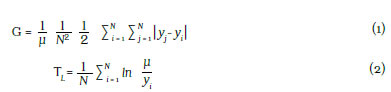
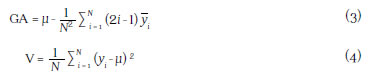
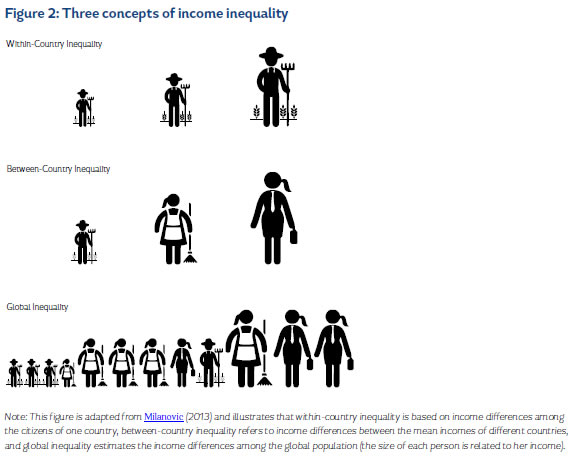
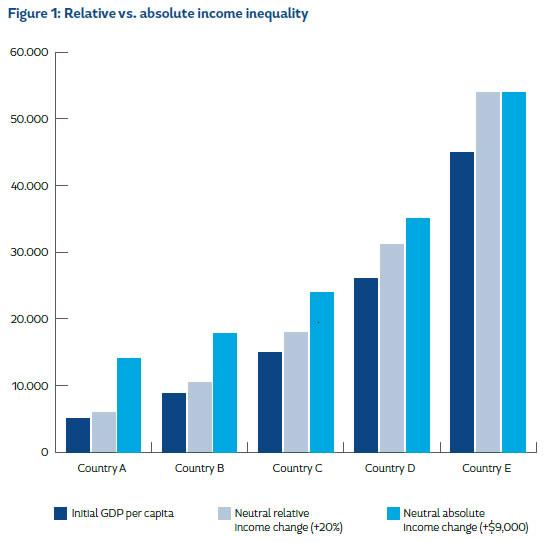
<body><![CDATA[<p>The aim of this paper  is to provide an overall picture  of the historic trends in relative and absolute between-country,  within-country, and global  income inequality. Existing  studies that present  longrun income inequality trends on a global scale  either present relative (Bourguignon and Morrisson, 2002; Milanovic, 2005; van Zanden <i>et al.</i>, 2014) or absolute estimates (Goda and Torres  Garc&iacute;a, 2016). As such, this is the first study that contrasts changes  in relative and absolute inequality between 1820 and 2010 to establish if these two measures have moved in the same or in opposing directions.<sup><a href="#2">2</a><a name="b2"></a></sup> </p>       <p>The main conclusions from this examination are that: (i) income inequality between countries  increased strongly during  1820-2000 and started  decreasing at the beginning of the twentieth-first century, irrespective of whether measured in relative  or absolute terms;  (ii) within-country inequality grew especially strongly after  1950 in absolute  terms and after  1975 in relative  terms; (iii) absolute global inequality also increased very substantially in the post-1950 period, whereas relative  global inequality decreased during the last three decades;  and (iv) today's  global relative and absolute inequality levels are much  higher than they  were in 1820.</p>     <p>The structure of the paper  is as follows: Section  two briefly outlines the existing concepts and alternative measures  of income inequality. Section  three presents the findings regarding the level and  trend of between-country inequality. Section  four provides an overview of the observed  changes in global within-country inequality. Section five  discusses the historical trend changes in global income inequality. Section six concludes.</p>     <p>&nbsp;</p>         <b><font size="3">2. Three concepts  of inequality and their relative  and absolute measurement</font></b>     <p>Relative income  inequality refers  to the average disproportionality of income, whereas  absolute inequality conceptualises income differences in money terms.  To make the difference between these two inequality measures more palpable, <a href="#f1">Figure  1</a> demonstrates an income  neutral change in relative  and in absolute terms. Initially, Country A has an income  of $5,000 while  the income of Country E is $45,000 (light grey bars). If the income of all countries  increases by 20% (black bars), Country  E still has 9 times the income of Country A but the absolute income  difference between  the two countries increases to $48,000. If the income  of all countries increases by $9,000 (dark  grey bars), the absolute income difference between  these two countries remains $40,000, but  now Country E 'only' has approximately four times  Country A's income.<sup><a href="#3">3</a><a name="b3"></a></sup> This simple comparison shows that absolute  and relative inequality trends  can differ significantly.</p>     <p align="center"><a name="f1"></a><img src="/img/revistas/ecos/v20n42/v20n42a3f1.jpg"></p>     <p>The most  widely used indicator to measure  relative inequalities is the Gini  Index. The lower  bound (0 = total  equality) and the  upper bound (1 = total  inequality) of this  indicator can easily  be understood by the broader  public, and it can also be nicely  presented graphically (via the Lorenz  curve). A second commonly used relative inequality indicator is the  Theil Index, the  lower bound of this indicator is also zero but its  upper bound is the logarithm of the sample  size. Both indices  are highly correlated, yet an advantage of the Theil  Index over the Gini Index  is that it can establish precisely to what degree  global inequality changes are due to changes  in withinand between-country inequality (see Cowell (2000) for an in-depth discussion). The Gini Index  (G) and the Theil Index  (T<i><sub>L</sub></i>) can be expressed as follows:</p>     <p align="right"><img src="/img/revistas/ecos/v20n42/v20n42a3e1.jpg"></p>     <p>where <i>N </i>is the population size, <i>&mu; </i>is the mean income, <i>y</i><i><sub>i </sub></i>is the income  of the <i>i-th </i>individual, and <i>y</i><i><sub>j</sub></i> is the income of the <i>j-th </i>individual.</p>     <p>The respective absolute counterparts of the Gini  Index and the  Theil Index are  the absolute Gini Index and the variance, the main difference being  that they are  not normalized by the  mean income of the  country (within-country inequality) or the world  (between-country inequality). In line with their  relative counterparts, only  the variance allows  the precise decomposition of global inequality into its withinand between-country components (Chakravarty, 2001; Chakravarty and Tyagarupananda, 2009). The  absolute Gini Index  (GA)4&nbsp;and the variance (V) can  be written as follows:</p>     ]]></body>
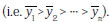
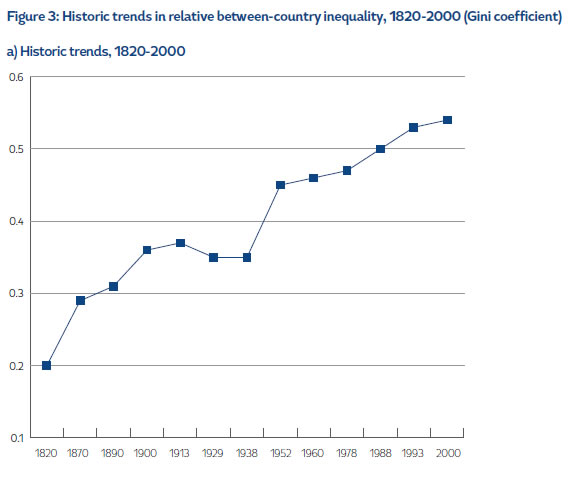
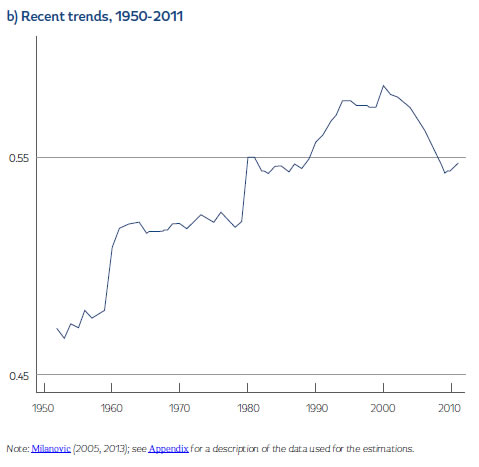
<body><![CDATA[<p align="right"><img src="/img/revistas/ecos/v20n42/v20n42a3e2.jpg" /></p>     <p><br clear="all" /> where is the welfare  ranked permutation of <i>y </i><img src="/img/revistas/ecos/v20n42/v20n42a3e3.jpg" />.</p>     <p>Relative and absolute inequality measures can  be applied in a wide  array of circumstances. For the purposes  of this paper,  we apply both in three  circumstances: within-country, between-country and global  inequality. Within-country inequality refers to income  differences between individuals in a specific country  (individual income data are typically retrieved from household surveys). These income differences can  be measured either  without accounting for direct  tax payments and  transfer receipts  (market inequality) or by taking these  income reducing/increasing changes  into account (net inequality). Typically, within-country market inequality estimates  are higher than within-countrynet inequality estimates, given that direct  tax payments and transfer receipts  tend to be progressive. </p>     <p>Between-country inequality, on the other  hand, concerns differences in the average  income of countries (typically measured by GDP per capita data adjusted for purchasing power parity (PPP)). Finally, population size-adjusted inequalities between and within  countries are used  to estimate the degree  of inequality between  global citizens.<sup><a href="#5">5</a><a name="b5"></a></sup> To be more precise, the concept of global inequality compares the incomes  of poor people  in rich countries with that of rich people  in poor countries, the incomes of rich people  in poor countries with that of poor people  in rich countries, etc. (See <a href="#f2">Figure 2</a> for an illustration of these three  concepts).</p>     <p align="center"><a name="f2"></a><img src="/img/revistas/ecos/v20n42/v20n42a3f2.jpg"></p>     <p>Before presenting the respective inequality trends, a cautionary note is required. As things stand, there exist  important shortcomings in the availability and  quality of inequality data (despite important advances during  recent years). These  shortcomings are especially notable with respect  to household surveys, which differ in their inequality concepts  (consumption, expenditure, net-income, or gross-income), in their  reference units (family, household, individual), and  in their sources  (Francois and Rojas-Romagosa, 2007). Moreover, household surveys often under-represent both  very poor and very rich households, and they suffer from non-responses and misreporting &#8212; deliberately or due to missing information (Atkinson and Brandolini, 2001; Gu&eacute;nard  and Mespl&eacute;-Somps, 2010).  The latter point applies  especially for the upper  tail of the distribution, so many household surveys oversample  high-income households. However,  existing oversampling strategies are not one-hundred percent successful.<sup><a href="#6">6</a><a name="b6"></a></sup> Consequently, tax data are often  used to measure the highest incomes  (Atkinson <i>et al.</i>, 2011) and to adjust  the overall income  distribution data accordingly (Lakner  and Milanovic, 2013; Solt, 2014). However, recent evidence shows that the  very rich often  successfully evade taxes  (Palan <i>et al.</i>, 2010; Henry, 2012; Zucman, 2015)<sup><a href="#7">7</a><a name="b7"></a></sup>, which casts  doubt on the reliability of these tax-adjusted data. In sum, the inequality estimates presented below are not very precise and most likely  underestimate the true extent  of inequality.<br clear="all" /> </p>     <p><b><font size="3">3. Historic trends in between-country income inequality</font></b></p>             <p>The existing data show that in relative terms a Great Divergence in income between  countries took place during  the 19th and 20th century.  In 1820, the GDP per capita of most countries was relatively equal but during the following  180 years, today's  developed countries had significantly higher average growth rates  than the rest  of the world.  As a result, the between-country Gini coefficient nearly  tripled during this  period, from 0.20  in 1820 to 0.54  in 2000 (<a href="#f3">Figure 3a</a>). Accordingly, the  gap between the richest  and the poorest  country in 2000  was much higher  than in 1820:  the mean GDP per  capita of the  richest country was  six times that  of the poorest  country in 1820,  whereas in 2000 this multiple increased to 134.<sup><a href="#8">8</a><a name="b8"></a></sup> </p>     <p>Recent estimates from Milanovic (2012; 2013) suggest that the current level of relative  between-country inequality is even higher than  previously thought (<a href="#f3">Figure  3b</a>). The reason for the  higher inequality levels being  that the PPP estimates from the 2005 survey of the International Comparison Program  (ICP) led to a downward revision  of PPP-adjusted GDP estimates in many developing countries (e.g. by 40% in China and  India).<sup><a href="#9">9</a><a name="b9"></a></sup> <a href="#f3">Figure 3b</a> also shows that,  after a relatively steep inequality increase in the 1990s, the 'Great Divergence' between countries not only stopped  but that it was replaced  by a convergence process from 2000 onwards.</p>     <p>&nbsp;</p>     ]]></body>
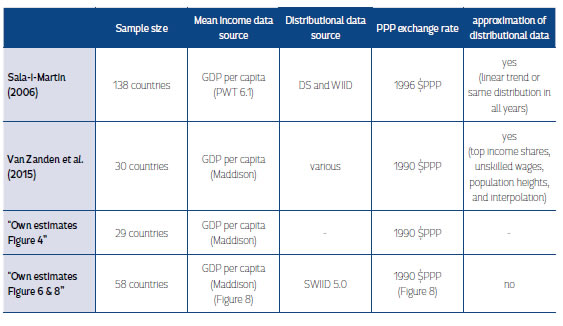
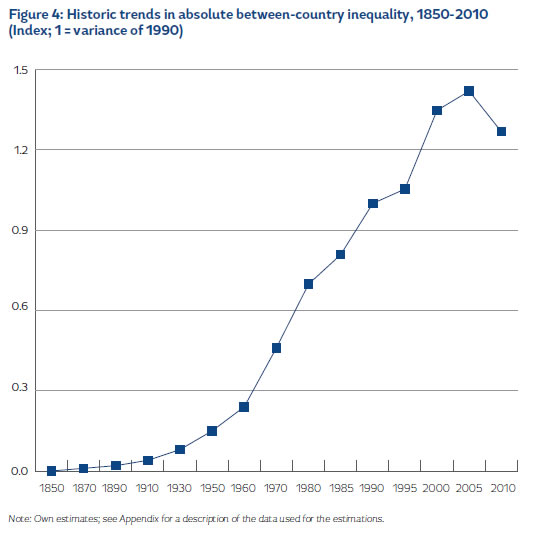
<body><![CDATA[<p align="center"><a name="f3"></a><img src="/img/revistas/ecos/v20n42/v20n42a3f3.jpg"></p>     <p align="center"><img src="/img/revistas/ecos/v20n42/v20n42a3f3a.jpg"></p>        <p>The inequality increase in the  1990s took place  due to the sluggish growth performance in Latin  America, the decline in Eastern European/former Soviet Union incomes,  and the disastrous economic developments within many African  economies (Milanovic, 2005). In the 2000s,  on the contrary, a commodity price  boom led to favourable economic conditions in commodity-producing developing countries, with the result that average  annual GDP per capita growth rate in these countries  was relatively high<sup><a href="#10">10</a><a name="b10"></a></sup> while at the same time developed countries experienced relatively slow growth.       <p><a href="#f4">Figure  4</a> shows that inequality between countries has increased much more in absolute than in  relative terms.<sup><a href="#11">11</a><a name="b11"></a></sup>  This is especially true  for the second half  of the 20th  century: between 1950  and 2000 the annual growth  rate of absolute  between-country inequality was 3.6%, while  it was 2.7% during 1850-1910 and 1.8% during  1910-1950. Having said that, after  2005 for the first  time since the beginning of the industrial revolution, absolute  income convergence took place between  developing and developed countries  (for the same reasons that are mentioned  above). Accordingly, especially after 1980, relative and absolute between-country inequality have exhibited similar trends.</p>     <p align="center"><a name="f4"></a><img src="/img/revistas/ecos/v20n42/v20n42a3f4.jpg"></p>       <p>&nbsp;</p>       <p>         <p><b><font size="3">4 Historic trends in within-country income inequality      </font></b>       <p>Given the discussed data shortcomings (see Section 2), and considering that existing studies  and inequality databases use different  methodologies (see Anand and Segal (2008)) and source  data (see <a href="#a1">Table A1</a> in the Appendix), it is not  possible to state the  exact degree of within-country inequality. Having said that,  there is a broad consensus on its overall  trends. When measured at a global  level, relative within-country inequality shows no clear trend  between 1820 and  1929 (i.e. the  level of inequality was the same in 1929 as it was in 1820)  but, following a decrease during  1929-1960, it demonstrates a sharp upward  trend after 1975 (<a href="#f5">Figure 5</a>). The main driver for the recent rise of global within-country inequality is the increasing inequality levels in populous countries (including China, India, and the USA), which  led to the situation that today ''seven  out of 10 people live in countries in which the gap between rich and poor is greater  than it was 30 years  ago'' (Oxfam, 2014, pg.8).</p>       <p align="center"><a name="f5"></a><img src="/img/revistas/ecos/v20n42/v20n42a3f5.jpg"></p>       ]]></body>
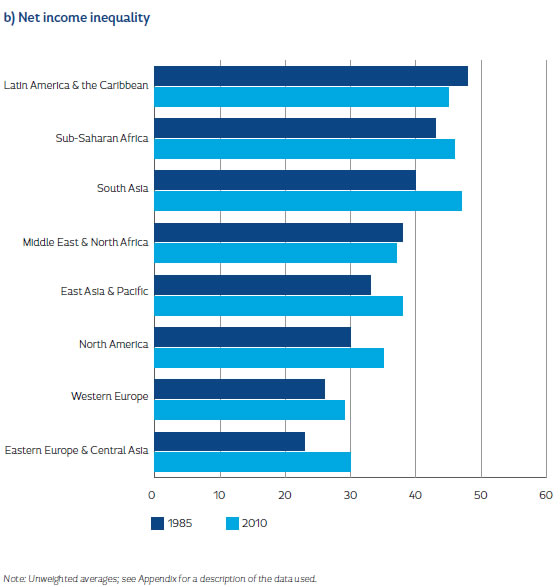
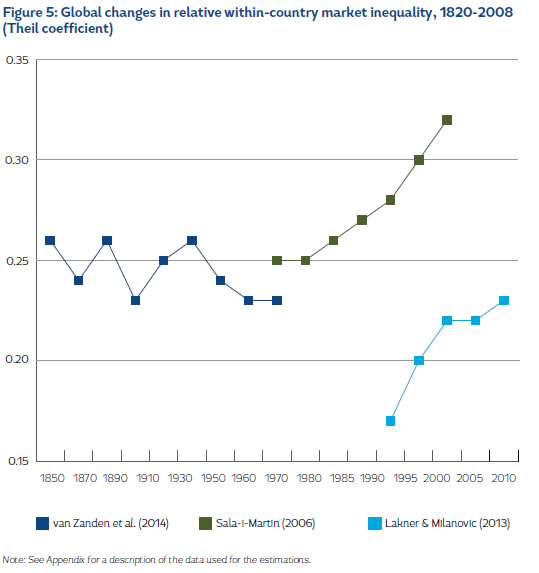
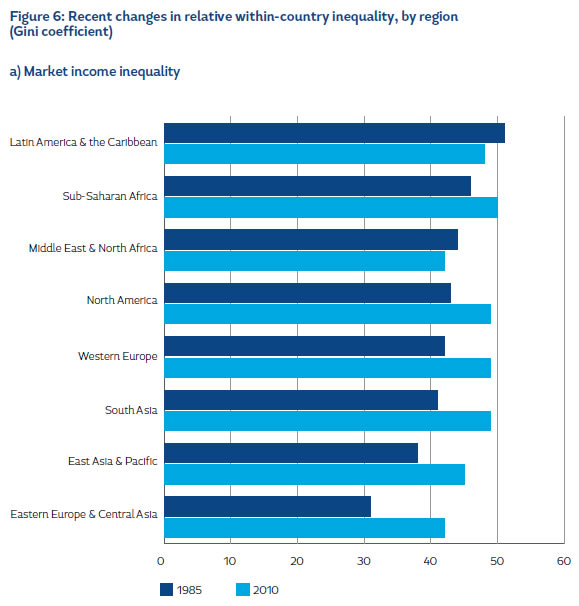
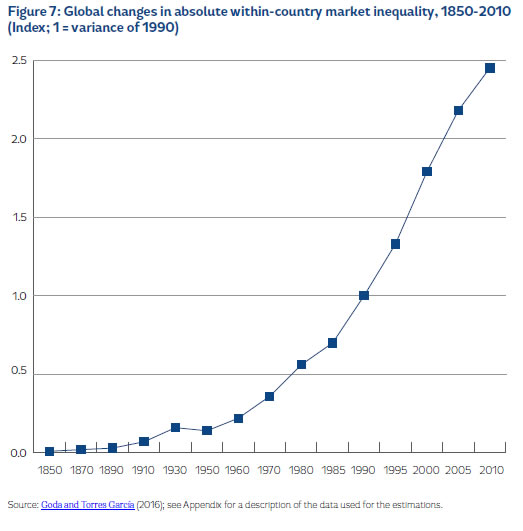
<body><![CDATA[<p>If one compares regional inequality averages for the  year 2010 with  that of the  year 1985, it be comes apparent that both relative market  and net income  inequality increased significantly within Northern American, European, Asian and Sub-Saharan African countries, whereas  it declined moderately within Latin American  and Caribbean (LAC) and Middle Eastern  and North African  countries (<a href="#f6">Figure 6</a>).<sup><a href="#12">12</a><a name="b12"></a></sup> The outcome of these diverging trends is that  today the market  income Gini averages of all regions  are relatively similar, with values between  42 and 50.  This finding challenges Kuznets' (1955, 1965) inverted-U hypothesis of income  inequality that states  that economic development first leads to a rise and later  to a decline of income inequality within countries.<sup><a href="#13">13</a><a name="b13"></a></sup> </p>       <p>The net  income inequality averages, on the other  hand, reveal  important regional differences (<a href="#f6">Figure 6b</a>). While the net Gini averages of European countries are below 30, the net Gini values  of LAC, Sub-Saharan Africa  and South Asia are nearly  the same as their market  Gini values. In other words, these data  reveal that some regions  have relatively strong redistributive policies while others  have not.</p>       <p>The most important reason  for the recent  rise of relative inequality in North America  and Western Europe is an over-proportional increase in top incomes (OECD, 2011). The  increase in the  top income share is primarily due to (i) the failure of real wages  to increase as much as productivity, which means that between 1980 and 2010 the profit  share rose by approximately 12 percentage points  in Japan, 10 percentage points in continental European countries, and 5 percentage points in the UK  and US (Stockhammer, 2015);  (ii) the over-proportional increase of top management and superstar  wages (see e.g. ILO, 2008; Ellis  and Smith, 2010; Atkinson <i>et al.</i>, 2011); and (iii) the rising concentration of capital-related income (see e.g. OECD, 2011).</p>      <p align="center"><a name="f6"></a><img src="/img/revistas/ecos/v20n42/v20n42a3f6.jpg"></p>       <p align="center"><img src="/img/revistas/ecos/v20n42/v20n42a3f6a.jpg"></p>       <p>The resulting increase in market  income inequality was not offset  by redistribution because this inequality was growing twice  as fast as redistributive transfers, partly because redistributive policies in rich countries became weaker (Immervoll and Richardson, 2011). This meant that inequality ''first began to rise in the late 1970s  and early 1980s  in some Anglophone countries, notably in the United Kingdom and the  United States, followed by a more widespread increase from the  late 1980s on'' (OECD 2011, p.6). Accordingly, total income shares  of the top 1% income earners  were increasing in nearly all developed countries for which  data is available after 1985 (Atkinson <i>et al.</i>'s, 2011).</p>     <p>It is more difficult to generalize about  the causes of the changes  in income inequality in developing countries, and it is beyond the scope of this paper  to undertake an in-depth  discussion of this par ticular subject. One  of the possible explanations as to why  within-country inequality also  increased in many developing countries is that the profit  share also increased in most of these countries (ILO, 2008). In the case of Asian and Eastern European  countries, this increase  went hand in hand with profound market reforms that also led to an increase  in the top income  share (this was especially true in  the case of China and  Russia, see Atkinson <i>et al.</i>, 2011).</p>     <p>By contrast, Middle Eastern, North  African, and LAC countries experienced only minor  changes in their inequality levels (<a href="#f6">Figure 6</a>). It is important to note that in the LAC region  the inequality trend was u-shaped: inequality levels  first increased due  to the debt crisis  in the 1980s  and in the  decade following the 'lost  decade', reaching their  peak in the late 1990s,  and then decreased again. The post2000 development was  mainly related to the  commodity price boom,  to more employment in the formal  sector, to higher incomes  in rural areas,  to the decline in the skill  premium, and to an increase in social  government spending (Cornia, 2010; Gasparini <i>et al.</i>, 2011; Lustig and Gasparini, 2011).</p>     <p><a href="#f7">Figure 7</a> shows that the increase  of absolute within-country inequality was  much more pronounced  than that of relative within-country inequality. This figure also shows that the increase was espe cially large after 1950: the post-1950 average  annual growth rate of absolute  global within-country  inequality was 4.8%,  while it was  3.2% during 1850-1910 and 1.8% during  1910-1950. In line  with the absolute between-country inequality, absolute within-country inequality only declined  in one period. Important reasons for the  decline during 1929-1950 were the bankruptcies and destruction caused by the Great  Depression and WW II and  the increase in government involvement in the economy, resulting in increasing taxation of top incomes,  financial sector regulation, the nationalisation of major  industries, the strengthening of trade unions  and labour rights,  and the creation  of social welfare  states (Goda and  Torres Garc&iacute;a, 2016).</p>      <p align="center"><a name="f7"></a><img src="/img/revistas/ecos/v20n42/v20n42a3f7.jpg"></p>     ]]></body>
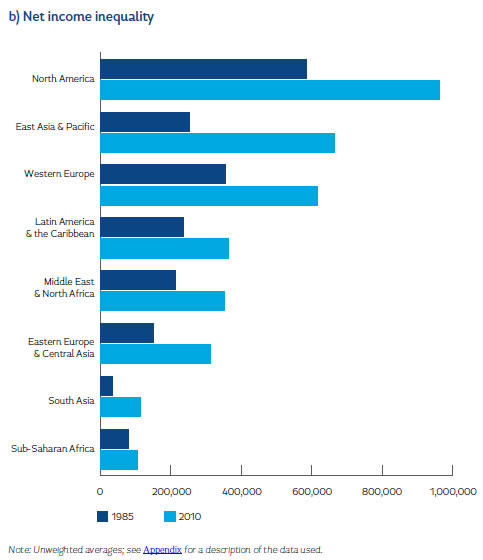
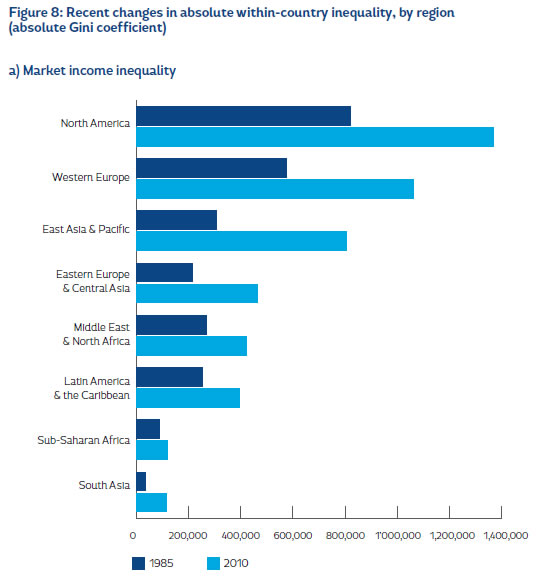
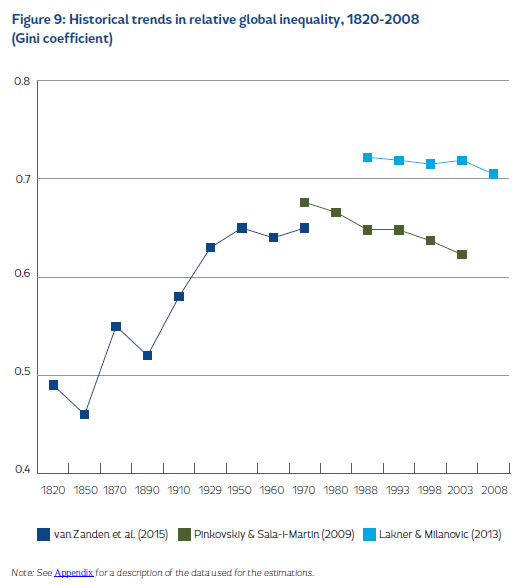
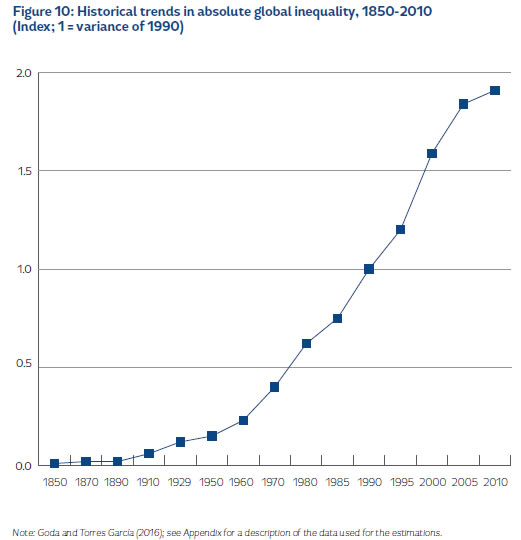
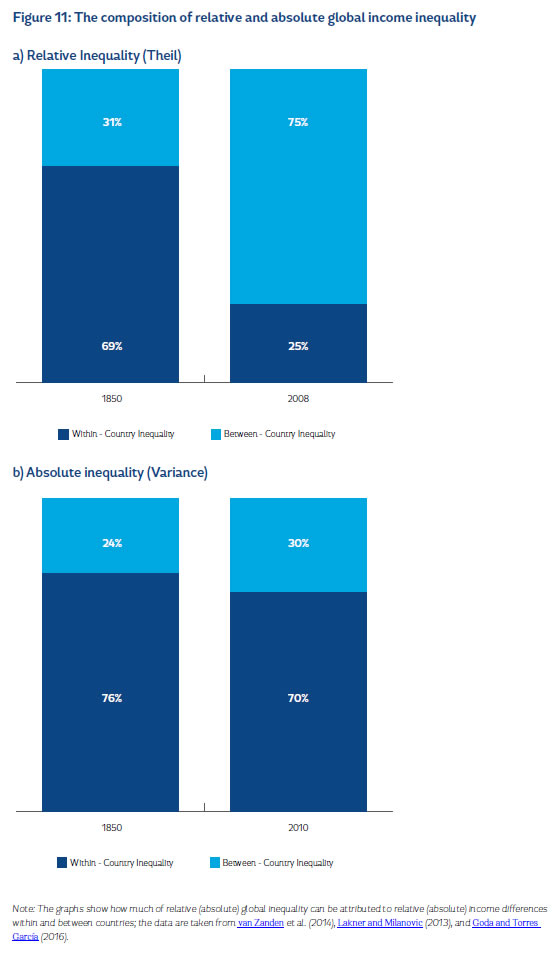
<body><![CDATA[<p>In contrast  to relative within-country inequality, the level of absolute market  and net income  inequality increased in all regions  between 1985 and  2010 (<a href="#f8">Figure 8</a>).<sup><a href="#14">14</a><a name="b14"></a></sup> The relatively modest  increase in Sub-Saharan Africa was mainly  due to the low real absolute  income growth within  this region (on average, +341/capita in 1990 $PPP); whereas the relatively strong mean income growth of LAC (+3,180/capita) and the Middle  East and North  Africa (+3,440/capita) more than offset  the relative inequality decrease  within these regions  (see <a href="#f6">Figure 6</a>). The stark increase of absolute inequality in the other regions  was due to the  strong increase in real mean  incomes and a large increase in relative inequality levels.</p>     <p>Unsurprisingly, this  comparison also shows  that those regions  that include the  most developed countries (North  America, Europe, and East Asia and Pacific)  are much more unequal in absolute  terms than regions that primarily include developing countries. Finally, it is important to note that  the differences between  the regions are lower in net terms  than in market  income terms, suggesting that in absolute terms the developed  countries in general,  and the Western European countries  in particular, are more  redistributive than developing countries.</p>      <p align="center"><a name="f8"></a><img src="/img/revistas/ecos/v20n42/v20n42a3f8.jpg"></p>       <p align="center"><img src="/img/revistas/ecos/v20n42/v20n42a3f8a.jpg"></p>     <p>     <p><b><font size="3">5 Historical trends in global income  inequality </font></b>      <p>''It is not possible  to reach a definite  conclusion regarding the direction of the change  in [relative] global  inequality over the last three  decades of the twentieth century''  (Anand and Segal, 2008, pg. 90), given the wide array of data sources and methodologies used to estimate the measures.<sup><a href="#15">15</a><a name="b15"></a></sup> And although recent estimates from two distinguished inequality researchers, Sala-i-Martin and Milanovic, suggest that it is likely  that relative global  inequality declined during  the last two decades (<a href="#f9">Figure 9</a>), ''these changes  are probably not robust to plausible  standard errors (if one could formulate and calculate them)'' (Lakner and  Milanovic, 2013,  pg.48). Having said  that, there  exists a broad  consensus that relative global  income inequality increased sharply between 1820 and 1950 (Bourguignon and Morrisson, 2002; van Zanden <i>et al</i>., 2014), and  that today's relative global inequality levels  are much higher  than they were in 1820.  Moreover, they are also much higher than  today's inequality levels within  countries (with the notable exception of Angola, Namibia,  and South Africa)  and between countries.</p>      <p align="center"><a name="f9"></a><img src="/img/revistas/ecos/v20n42/v20n42a3f9.jpg"></p>     <p>With regard to absolute global inequality, the three papers  with these estimates unanimously report a sharp increase in inequality. Atkinson and Brandolini (2010) find that the absolute  Gini coefficient increased strongly  throughout the period  1820-1992 (with an especially sharp  increase after 1950), while Anand and Segal (2015) report  that this strong  growth continued between  1992 and 2005.  The most recent  data presented by Goda  and Torres Garc&iacute;a (2016) confirm these  findings (<a href="#f10">Figure 10</a>). More precisely, their estimates show a continuous increase in absolute global inequality during  1850-2010 that accelerated after  1950: ''in the  first one hundred  years of our  sample, the average  annual growth rate of absolute global  inequality was 3.0%,  whereas it was  4.3% between 1950  and 2010'' (pg.  8).</p>      <p align="center"><a name="f10"></a><img src="/img/revistas/ecos/v20n42/v20n42a3f10.jpg"></p>     ]]></body>
<body><![CDATA[<p>Finally, it is important  to note that not only the trend changes  of relative and global inequality differ considerably but also their  composition. As explained in Section 2, global inequality can be decomposed into a within-country inequality component and a between-country inequality component (adjusted by the population size of the countries). Depending  on which of these two components is more  important, global inequality can be driven  either by growing income  differences within countries or by growing mean income differences between these countries. <a href="#f11">Figure  11</a> shows that in 1850  both relative and  absolute global inequality were mainly explained by income  inequality within countries (i.e. 69% and 76% of global inequality were due to differences between income groups within  countries). In 2000,  on the contrary, relative global inequality was mainly due  to income differences  between countries, whereas  within-country inequality was still the main driver behind the growth  in absolute global inequality.</p>     <p>&nbsp;</p>      <p align="center"><a name="f11"></a><img src="/img/revistas/ecos/v20n42/v20n42a3f11.jpg"></p>     <p>&nbsp;</p>     <p><b><font size="3">6 Conclusions</font></b></p>     <p>The estimates presented in this paper  demonstrate that today's  global income inequality levels are much higher  than they were  in 1820, irrespective if measured in absolute or in relative terms. However, the historical trends  of within-country and global inequality differ considerably, depending on the preferred measure. Absolute within-country inequality increased continuously on a global  scale (with the exception of the period  1929-1950), with an especially large increase  after 1950. The relative  measures, on the contrary, report  no clear trend  prior to 1950, a strong decrease  between 1950 and 1970, and a sharp  increase from 1975 onwards.  With regard to global inequality, the main discrepancy  between the measures can be found  after 1970. While  relative inequality most  probably decreased, absolute inequality grew much faster  than in the pre-1970 period.  Finally, it is important to note that  regional differences are  much more pronounced in absolute than  in relative terms.</p>     <p>These findings  show that one should abstain  from general statements about inequality trends without clarifying whether the trends refer  to relative or absolute  inequality, and they also explain why there are conflicting assessments about the  distributional outcomes of globalization. Moreover, these findings indicate that it is essential to choose  the right inequality measure for a specific  question at hand.  For example, the usage  of relative inequality data might lead to misleading results  when investigating the potential effects of inequality on property crime,  given that the expected utility  of this illegal activity  depends on the degree of absolute inequality.</p>     <p>Finally, it is important to note  that the results  of our study  also suggest that  different policies would be appropriate to reduce  either absolute or relative global  inequality. Given that today three-fourths of relative global inequality is explained by income  differences between countries, migration would  likely be the best option  to reduce relative global  inequality. On the contrary, redistributional policies within countries (instead  of migration) would be the most efficient  policy option to reduce absolute  inequality levels, since  currently within-country inequality explains more than  two-thirds of absolute global inequality.</p>     <p>&nbsp;</p> <hr size="1" />     <p><a name="1"></a><a href="#b1">1</a> All of the four mentioned relative and absolute measures fulfil the property of normalization and symmetry and the transfer and population principle. To be more precise all of these measures are non-negative and have a value of zero if all incomes are equal, they are sensitive to the reordering of all incomes, a transfer from a poor to a rich increases inequality, and the level of inequality does not depend on population size (Chakravarty, 2001). Therefore, from a technical point of view, there is no reason to favour the Gini and Theil Index over the Absolute Gini Index and the variance.</p>     ]]></body>
<body><![CDATA[<p><a name="2"></a><a href="#b2">2</a> The period 1820-2010 is dictated by data availability: (i) Maddison's database, which is typically used to calculate historical changes   in between-country and global inequality, only provides GDP data up to 2010 at the time of writing; and (ii) within-country inequality   estimates for a representative group of countries are only available from 1820 onwards.</p>     <p><a name="3"></a><a href="#b3">3</a> The initial Gini coefficient between the countries in Figure 1 is 0.39 (light grey bars). After the income neutral change in relative terms (black bars) it is still 0.39, whereas it decreases to 0.27 after the income neutral change in absolute terms (dark grey bars).</p>     <p><a name="4"></a><a href="#b4">4</a> The absolute Gini coefficient can also be calculated by multiplying the (relative) Gini coefficient by the mean income (Chakravarty, 2001).</p>     <p>   <a name="5"></a><a href="#b5">5</a> As mentioned above, the Gini Index does not allow a precise decomposition of the global inequality into its withinand betweencountry   component; notwithstanding, it allows the inclusion of population weights and the estimation of total global inequality: Global   Gini coefficient = <img src="/img/revistas/ecos/v20n42/v20n42a3e4.jpg" width="183" height="23" />, where Gi is the Gini coefficient of the i-th country, pi is the population share of the   i-th country, &pi;i is the i-th country's share in world income, &mu; is the mean income of the world, yi is the mean income of the i-th country,   yj is the mean income of the j-th country, pj is the population share of the j-th country, and L is a residual.</p>     <p><a name="6"></a><a href="#b6">6</a> ''In  the US in 2006, for instance, tax data excluding capital gains imply a top  percentile share of 18.0% while survey data imply a&nbsp;&nbsp;&nbsp;&nbsp;&nbsp; share of 13.7%. Using data for 2006, the  US Gini based on household survey data (the Current Population Survey) is 0.470,  while correcting the top percentile's income using the tax data raises it by  nearly 0.05 to 0.519. Moreover, the increase in the U.S. Gini from 1976 to 2006 using survey data alone (corrected  for a change in definition) was 0.053, which more than doubles to an increase  of 0.108 using  the top income data (including capital gains)'' (Anand and Segal,  2015, pg. 948).</p>     <p><a name="7"></a><a href="#b7">7</a> Estimates for  hidden offshore wealth range from US$ 7.6 trillion  (Zucman, 2015) to US$ 21 trillion (Henry, 2012).</p>     <p><a name="8"></a><a href="#b8">8</a> In 1820 Korea had a GDP per capita of $335, whereas England had a GDP per capita of $2,074 (in 1990 $PPP). In 2000, the respective figures were $214 for Congo and $28,702 for the USA (Maddison Project, 2016).</p>     <p>   <a name="9"></a><a href="#b9">9</a> Please note that the 2005 PPP estimates have been heavily criticized (e.g., Deaton, 2010; Breton and Garc&iacute;a, 2015) and that it seems   that the newest PPP estimates (from the 2011 round) are similar to the pre-2005 estimates (Deaton and Aten, 2015). However, 2011   PPP data are only available from 1990 onwards. In any case, PPP revisions have little effect on the overall trend of between-country   inequality on the grounds that national inflation and GDP growth rates are used to obtain the GDP per capita of previous years   (Milanovic, 2012).</p>     <p><a name="10"></a><a href="#b10">10</a> Between 2000 and 2011, the average annual growth rate of developing countries was 3.3% in Latin America and the Caribbean, 4.7% in Sub-Saharan Africa, and 4.1% in the Middle East and North Africa (WDI, 2016).</p>     <p>   <a name="11"></a><a href="#b11">11</a> The variance has been calculated as shown in (4), where &gamma;i is the GDP per capita of the i-th country and &mu; is the average GDP per   capita of all sample countries.</p>     ]]></body>

<body><![CDATA[<p><a name="12"></a><a href="#b12">12</a> Please note that this regional comparison is hampered by the underrepresentation of Middle Eastern and African countries.   Moreover, it is important to note that the SWIID data we use have been heavily criticised recently (Jenkins, 2015). However, most of the   critique points that have been brought forward do not apply to the latest version of the dataset used in this paper (SWIID V5.0), and   currently there is no better dataset available that provides a homogenized dataset including developed and developing countries net and market income Gini coefficients (Solt, 2015).</p>     <p>   <a name="13"></a><a href="#b13">13</a> Kuznets argues that the increase happens due to the movement of labour from rural agricultural to urban industrial areas, whereas   the decline starts when the majority of people work in modern sectors.</p>     <p><a name="14"></a><a href="#b14">14</a> Absolute inequality was calculated by multiplying each countries Gini coefficient with its GDP per capita.</p>     <p><a name="15"></a><a href="#b15">15</a> Studies have to choose between (different) PPP exchange rates and market exchange rates, household or national account   means, expenditure or (gross or net) income, and grouped or individual-level data. Moreover, many studies estimate within-country   distributions and and extrapolate some data &#8212; see Anand and Segal (2008), Goda (2013), and Lakner and Milanovic (2013) for an in-depth discussion.</p>     <p>&nbsp;</p> <hr size="1" />     <p>&nbsp;</p>     <p><b><font size="3">References</font></b></p>     <!-- ref --><p>Amiel, Y.&nbsp; and Cowell,&nbsp;  F.A.&nbsp; (1999).&nbsp; <i>Thinking&nbsp; about inequality:&nbsp; Personal judgment and income&nbsp;&nbsp; distributions.</i>   Cambridge: Cambridge University  Press.    &nbsp;&nbsp;&nbsp;&nbsp;&nbsp;&nbsp;&nbsp;&nbsp;[&#160;<a href="javascript:void(0);" onclick="javascript: window.open('/scielo.php?script=sci_nlinks&ref=5110639&pid=S1657-4206201600010000300001&lng=','','width=640,height=500,resizable=yes,scrollbars=1,menubar=yes,');">Links</a>&#160;]<!-- end-ref --></p>     <!-- ref --><p>Anand,  S. and Segal, P. (2008). What Do We Know about Global Income Inequality?. <i>Journal of Economic Literature, 46</i>(1):  57-94.    &nbsp;&nbsp;&nbsp;&nbsp;&nbsp;&nbsp;&nbsp;&nbsp;[&#160;<a href="javascript:void(0);" onclick="javascript: window.open('/scielo.php?script=sci_nlinks&ref=5110641&pid=S1657-4206201600010000300002&lng=','','width=640,height=500,resizable=yes,scrollbars=1,menubar=yes,');">Links</a>&#160;]<!-- end-ref --></p>     <!-- ref --><p>Anand, S. and Segal, P. (2015). The  Global Distribution of Income. In Atkinson, A.B. and Bourguignon, F. (eds.):   <i>Handbook  of Income Distribution. </i>Oxford: North-Holland, Ch.11.    &nbsp;&nbsp;&nbsp;&nbsp;&nbsp;&nbsp;&nbsp;&nbsp;[&#160;<a href="javascript:void(0);" onclick="javascript: window.open('/scielo.php?script=sci_nlinks&ref=5110643&pid=S1657-4206201600010000300003&lng=','','width=640,height=500,resizable=yes,scrollbars=1,menubar=yes,');">Links</a>&#160;]<!-- end-ref --></p>     <!-- ref --><p>Agnew, R. (1985). A revised strain  theory of delinquency. <i>Social Forces, 64</i>(1):  151-167.    &nbsp;&nbsp;&nbsp;&nbsp;&nbsp;&nbsp;&nbsp;&nbsp;[&#160;<a href="javascript:void(0);" onclick="javascript: window.open('/scielo.php?script=sci_nlinks&ref=5110645&pid=S1657-4206201600010000300004&lng=','','width=640,height=500,resizable=yes,scrollbars=1,menubar=yes,');">Links</a>&#160;]<!-- end-ref --></p>     <!-- ref --><p>Agnew, R. (1992). Foundation for a generalism strain  theory of crime and delinquency. <i>Criminology, </i>30(1): 47-87.    &nbsp;&nbsp;&nbsp;&nbsp;&nbsp;&nbsp;&nbsp;&nbsp;[&#160;<a href="javascript:void(0);" onclick="javascript: window.open('/scielo.php?script=sci_nlinks&ref=5110647&pid=S1657-4206201600010000300005&lng=','','width=640,height=500,resizable=yes,scrollbars=1,menubar=yes,');">Links</a>&#160;]<!-- end-ref --></p>     <!-- ref --><p>Atkinson, A.B. (1997).  Bringing income distribution in from the cold. <i>The Economic  Journal, 107</i>(441): 297-321.    &nbsp;&nbsp;&nbsp;&nbsp;&nbsp;&nbsp;&nbsp;&nbsp;[&#160;<a href="javascript:void(0);" onclick="javascript: window.open('/scielo.php?script=sci_nlinks&ref=5110649&pid=S1657-4206201600010000300006&lng=','','width=640,height=500,resizable=yes,scrollbars=1,menubar=yes,');">Links</a>&#160;]<!-- end-ref --></p>     <!-- ref --><p>Atkinson, A.B.&nbsp; and Brandolini, A.&nbsp; (2001).&nbsp;  Promise&nbsp; and Pitfalls&nbsp; in the&nbsp;  Use&nbsp; of 'Secondary' Data-Sets: Income   Inequality in OECD Countries. <i>Journal of Economic Literature, 39</i>(3):  771-799.    &nbsp;&nbsp;&nbsp;&nbsp;&nbsp;&nbsp;&nbsp;&nbsp;[&#160;<a href="javascript:void(0);" onclick="javascript: window.open('/scielo.php?script=sci_nlinks&ref=5110651&pid=S1657-4206201600010000300007&lng=','','width=640,height=500,resizable=yes,scrollbars=1,menubar=yes,');">Links</a>&#160;]<!-- end-ref --></p>     <!-- ref --><p>Atkinson, A.B. and Brandolini, A. (2010). On Analyzing the World Distribution of Income. <i>World Bank Economic  Review, 24</i>(1): 1-37.    &nbsp;&nbsp;&nbsp;&nbsp;&nbsp;&nbsp;&nbsp;&nbsp;[&#160;<a href="javascript:void(0);" onclick="javascript: window.open('/scielo.php?script=sci_nlinks&ref=5110653&pid=S1657-4206201600010000300008&lng=','','width=640,height=500,resizable=yes,scrollbars=1,menubar=yes,');">Links</a>&#160;]<!-- end-ref --></p>     <!-- ref --><p>Atkinson, A.B., Piketty,  T. and Saez, E. (2011). Top Incomes in the Long Run of History. <i>Journal of Economic Literature, 49</i>(1): 3&#8211;71.    &nbsp;&nbsp;&nbsp;&nbsp;&nbsp;&nbsp;&nbsp;&nbsp;[&#160;<a href="javascript:void(0);" onclick="javascript: window.open('/scielo.php?script=sci_nlinks&ref=5110655&pid=S1657-4206201600010000300009&lng=','','width=640,height=500,resizable=yes,scrollbars=1,menubar=yes,');">Links</a>&#160;]<!-- end-ref --></p>     <!-- ref --><p>Ballano, C. and Ruiz-Castillo, J. (1993). Searching  by questionnaire for the meaning  of income inequality. <i>Revista Espa&ntilde;ol de  Econom&iacute;a, 10</i>(2): 233-259.    &nbsp;&nbsp;&nbsp;&nbsp;&nbsp;&nbsp;&nbsp;&nbsp;[&#160;<a href="javascript:void(0);" onclick="javascript: window.open('/scielo.php?script=sci_nlinks&ref=5110657&pid=S1657-4206201600010000300010&lng=','','width=640,height=500,resizable=yes,scrollbars=1,menubar=yes,');">Links</a>&#160;]<!-- end-ref --></p>     <!-- ref --><p>Bourguignon,  F. and Morrisson, C. (2002). Inequality among World Citizens: 1820-1992. <i>American Economic Review, </i>92(4): 727-744.    &nbsp;&nbsp;&nbsp;&nbsp;&nbsp;&nbsp;&nbsp;&nbsp;[&#160;<a href="javascript:void(0);" onclick="javascript: window.open('/scielo.php?script=sci_nlinks&ref=5110659&pid=S1657-4206201600010000300011&lng=','','width=640,height=500,resizable=yes,scrollbars=1,menubar=yes,');">Links</a>&#160;]<!-- end-ref --></p>     <!-- ref --><p>Breton, T. and Garc&iacute;a,  J.J. (2015). ICP 2005 Construction Prices: Are They Underestimated in  Developing Countries?. <i>Review of Income  and Wealth, </i>DOI: 10.1111/roiw.12170.    &nbsp;&nbsp;&nbsp;&nbsp;&nbsp;&nbsp;&nbsp;&nbsp;[&#160;<a href="javascript:void(0);" onclick="javascript: window.open('/scielo.php?script=sci_nlinks&ref=5110661&pid=S1657-4206201600010000300012&lng=','','width=640,height=500,resizable=yes,scrollbars=1,menubar=yes,');">Links</a>&#160;]<!-- end-ref --></p>     <!-- ref --><p>Chakravarty,  S.R. (2001). The variance as a subgroup decomposable measure of inequality. <i>Social Indicators Research, </i>53(1):  79-95.    &nbsp;&nbsp;&nbsp;&nbsp;&nbsp;&nbsp;&nbsp;&nbsp;[&#160;<a href="javascript:void(0);" onclick="javascript: window.open('/scielo.php?script=sci_nlinks&ref=5110663&pid=S1657-4206201600010000300013&lng=','','width=640,height=500,resizable=yes,scrollbars=1,menubar=yes,');">Links</a>&#160;]<!-- end-ref --></p>     <!-- ref --><p>Chakravarty,  S.R. and Tyagarupananda, S. (2009). The subgroup decomposable intermediate  indices of inequality. <i>Spanish Economic  Review, </i>11(2): 83-97.    &nbsp;&nbsp;&nbsp;&nbsp;&nbsp;&nbsp;&nbsp;&nbsp;[&#160;<a href="javascript:void(0);" onclick="javascript: window.open('/scielo.php?script=sci_nlinks&ref=5110665&pid=S1657-4206201600010000300014&lng=','','width=640,height=500,resizable=yes,scrollbars=1,menubar=yes,');">Links</a>&#160;]<!-- end-ref --></p>     <!-- ref --><p>Cornia, G.A. (2010).  Income Distribution under Latin America's New Left Regimes. <i>Journal of Human Development and Capabilities, </i>11(1): 85-114.    &nbsp;&nbsp;&nbsp;&nbsp;&nbsp;&nbsp;&nbsp;&nbsp;[&#160;<a href="javascript:void(0);" onclick="javascript: window.open('/scielo.php?script=sci_nlinks&ref=5110667&pid=S1657-4206201600010000300015&lng=','','width=640,height=500,resizable=yes,scrollbars=1,menubar=yes,');">Links</a>&#160;]<!-- end-ref --></p>     <!-- ref --><p>Cowell, F.A. (2000). <i>Measuring Income Inequality. </i>London:  Harvester Wheatsheaf.    &nbsp;&nbsp;&nbsp;&nbsp;&nbsp;&nbsp;&nbsp;&nbsp;[&#160;<a href="javascript:void(0);" onclick="javascript: window.open('/scielo.php?script=sci_nlinks&ref=5110669&pid=S1657-4206201600010000300016&lng=','','width=640,height=500,resizable=yes,scrollbars=1,menubar=yes,');">Links</a>&#160;]<!-- end-ref --></p>     <!-- ref --><p>Deaton,  A. (2010). Price indexes, inequality, and the measurement of world poverty. <i>American Economic Review, </i>100(1):  5-34.    &nbsp;&nbsp;&nbsp;&nbsp;&nbsp;&nbsp;&nbsp;&nbsp;[&#160;<a href="javascript:void(0);" onclick="javascript: window.open('/scielo.php?script=sci_nlinks&ref=5110671&pid=S1657-4206201600010000300017&lng=','','width=640,height=500,resizable=yes,scrollbars=1,menubar=yes,');">Links</a>&#160;]<!-- end-ref --></p>     <!-- ref --><p>Deaton, A. and Aten, B. (2015).  ''Trying to Understand the PPPs in ICP2011: Why are the Results so Different?'', NBER Working Paper, No. 20244 (update  March 2015).    &nbsp;&nbsp;&nbsp;&nbsp;&nbsp;&nbsp;&nbsp;&nbsp;[&#160;<a href="javascript:void(0);" onclick="javascript: window.open('/scielo.php?script=sci_nlinks&ref=5110673&pid=S1657-4206201600010000300018&lng=','','width=640,height=500,resizable=yes,scrollbars=1,menubar=yes,');">Links</a>&#160;]<!-- end-ref --></p>     <!-- ref --><p>Ehrlich, I. (1973). Participation in illegitimate activities: a theoretical and empirical investigation. <i>Journal of Po litical Economy, </i>81(3): 521-65.    &nbsp;&nbsp;&nbsp;&nbsp;&nbsp;&nbsp;&nbsp;&nbsp;[&#160;<a href="javascript:void(0);" onclick="javascript: window.open('/scielo.php?script=sci_nlinks&ref=5110675&pid=S1657-4206201600010000300019&lng=','','width=640,height=500,resizable=yes,scrollbars=1,menubar=yes,');">Links</a>&#160;]<!-- end-ref --></p>     <!-- ref --><p>Ellis, L. and Kathryn  S. (2010). The global upward trend in the profit  share. <i>Applied Economics Quarterly, </i>56(3): 231-255.    &nbsp;&nbsp;&nbsp;&nbsp;&nbsp;&nbsp;&nbsp;&nbsp;[&#160;<a href="javascript:void(0);" onclick="javascript: window.open('/scielo.php?script=sci_nlinks&ref=5110677&pid=S1657-4206201600010000300020&lng=','','width=640,height=500,resizable=yes,scrollbars=1,menubar=yes,');">Links</a>&#160;]<!-- end-ref --></p>     <!-- ref --><p>Fleisher, B.M. (1966). The effect of  income on delinquency. <i>American Economic  Review, </i>56(1/2): 118-37.    &nbsp;&nbsp;&nbsp;&nbsp;&nbsp;&nbsp;&nbsp;&nbsp;[&#160;<a href="javascript:void(0);" onclick="javascript: window.open('/scielo.php?script=sci_nlinks&ref=5110679&pid=S1657-4206201600010000300021&lng=','','width=640,height=500,resizable=yes,scrollbars=1,menubar=yes,');">Links</a>&#160;]<!-- end-ref --></p>     <!-- ref --><p>Francois, J.F. and Rojas-Romagosa, H. (2007). 'The Construction and Interpretation of Combined Cross-Section and Time-Series Inequality Datasets'. IIDE Discussion Paper  No. 200708-05.    &nbsp;&nbsp;&nbsp;&nbsp;&nbsp;&nbsp;&nbsp;&nbsp;[&#160;<a href="javascript:void(0);" onclick="javascript: window.open('/scielo.php?script=sci_nlinks&ref=5110681&pid=S1657-4206201600010000300022&lng=','','width=640,height=500,resizable=yes,scrollbars=1,menubar=yes,');">Links</a>&#160;]<!-- end-ref --> </p>     <!-- ref --><p>Froud,  J., Johal, S., Haslam, C. and Williams, K. (2001). Accumulation under  conditions of inequality. <i>Review of  International Political Economy, </i>8(1):66-95.    &nbsp;&nbsp;&nbsp;&nbsp;&nbsp;&nbsp;&nbsp;&nbsp;[&#160;<a href="javascript:void(0);" onclick="javascript: window.open('/scielo.php?script=sci_nlinks&ref=5110683&pid=S1657-4206201600010000300023&lng=','','width=640,height=500,resizable=yes,scrollbars=1,menubar=yes,');">Links</a>&#160;]<!-- end-ref --></p>     <!-- ref --><p>Gasparini,&nbsp; L.,&nbsp;  Cruces,&nbsp; G.&nbsp; and&nbsp;  Tornarolli,&nbsp; L.&nbsp; (2011).&nbsp;  Recent&nbsp; Trends&nbsp; in&nbsp;  Income&nbsp; Inequality&nbsp; in&nbsp;  Latin America.   <i>Econom&iacute;a, </i>11(2):147-190.    &nbsp;&nbsp;&nbsp;&nbsp;&nbsp;&nbsp;&nbsp;&nbsp;[&#160;<a href="javascript:void(0);" onclick="javascript: window.open('/scielo.php?script=sci_nlinks&ref=5110685&pid=S1657-4206201600010000300024&lng=','','width=640,height=500,resizable=yes,scrollbars=1,menubar=yes,');">Links</a>&#160;]<!-- end-ref --> </p>     <!-- ref --><p>Goda, T. (2013). 'Changes in income  inequality from a global perspective: an overview'. PKSG Working Paper, No.  1303.    &nbsp;&nbsp;&nbsp;&nbsp;&nbsp;&nbsp;&nbsp;&nbsp;[&#160;<a href="javascript:void(0);" onclick="javascript: window.open('/scielo.php?script=sci_nlinks&ref=5110687&pid=S1657-4206201600010000300025&lng=','','width=640,height=500,resizable=yes,scrollbars=1,menubar=yes,');">Links</a>&#160;]<!-- end-ref --></p>     <!-- ref --><p>Goda, T. and Lysandrou, P. (2014). The contribution of wealth concentration to the subprime  crisis: a quantitative estimation. <i>Cambridge Journal of Economics, </i>38(2): 301-27.    &nbsp;&nbsp;&nbsp;&nbsp;&nbsp;&nbsp;&nbsp;&nbsp;[&#160;<a href="javascript:void(0);" onclick="javascript: window.open('/scielo.php?script=sci_nlinks&ref=5110689&pid=S1657-4206201600010000300026&lng=','','width=640,height=500,resizable=yes,scrollbars=1,menubar=yes,');">Links</a>&#160;]<!-- end-ref --></p>     <!-- ref --><p>Goda, T. and Torres  Garc&iacute;a, A. (2016).  The Rising Tide of Absolute  Global Income Inequality During 1850&#8211;2010: Is  It Driven by Inequality Within or Between Countries?. <i>Social Indicators Research, </i>first online, doi:  <a href="http://dx.doi.org/10.1007/s11205-015-1222-0" target="_blank">10.1007/s11205-015-1222-0</a>.    &nbsp;&nbsp;&nbsp;&nbsp;&nbsp;&nbsp;&nbsp;&nbsp;[&#160;<a href="javascript:void(0);" onclick="javascript: window.open('/scielo.php?script=sci_nlinks&ref=5110691&pid=S1657-4206201600010000300027&lng=','','width=640,height=500,resizable=yes,scrollbars=1,menubar=yes,');">Links</a>&#160;]<!-- end-ref --></p>     <!-- ref --><p>Hagan, J., &amp; Peterson, R.D. (1995). Criminal  inequality in America:  Patterns and consequences. In Hagan, J. and  Peterson, R.D. (eds.): <i>Crime and inequality. </i>Stanford: Stanford University Press, pp. 14-36.    &nbsp;&nbsp;&nbsp;&nbsp;&nbsp;&nbsp;&nbsp;&nbsp;[&#160;<a href="javascript:void(0);" onclick="javascript: window.open('/scielo.php?script=sci_nlinks&ref=5110693&pid=S1657-4206201600010000300028&lng=','','width=640,height=500,resizable=yes,scrollbars=1,menubar=yes,');">Links</a>&#160;]<!-- end-ref --></p>     <!-- ref --><p>Halter, D., Oechslin, M. and Zweim&uuml;ller, J. (2014). Inequality and growth: the neglected time dimension. <i>Journal  of Economic Growth, </i>19(1): 81-104.    &nbsp;&nbsp;&nbsp;&nbsp;&nbsp;&nbsp;&nbsp;&nbsp;[&#160;<a href="javascript:void(0);" onclick="javascript: window.open('/scielo.php?script=sci_nlinks&ref=5110695&pid=S1657-4206201600010000300029&lng=','','width=640,height=500,resizable=yes,scrollbars=1,menubar=yes,');">Links</a>&#160;]<!-- end-ref --></p>     <!-- ref --><p>Harrison, E. and Seidl,  C. (1994). Perceptional inequality and preferential judgments: An empirical examination of distributional axioms. <i>Public Choice, </i>79(1-2): 61-81.    &nbsp;&nbsp;&nbsp;&nbsp;&nbsp;&nbsp;&nbsp;&nbsp;[&#160;<a href="javascript:void(0);" onclick="javascript: window.open('/scielo.php?script=sci_nlinks&ref=5110697&pid=S1657-4206201600010000300030&lng=','','width=640,height=500,resizable=yes,scrollbars=1,menubar=yes,');">Links</a>&#160;]<!-- end-ref --></p>     <!-- ref --><p>Hein, E. (2012). <i>The macroeconomics of finance-dominated  capitalism and its crisis. </i>Cheltenham:Edward Elgar.    &nbsp;&nbsp;&nbsp;&nbsp;&nbsp;&nbsp;&nbsp;&nbsp;[&#160;<a href="javascript:void(0);" onclick="javascript: window.open('/scielo.php?script=sci_nlinks&ref=5110699&pid=S1657-4206201600010000300031&lng=','','width=640,height=500,resizable=yes,scrollbars=1,menubar=yes,');">Links</a>&#160;]<!-- end-ref --> </p>     <!-- ref --><p>Henry, J.S. (2012). 'The price of offshore  revisited: New estimates for 'missing' global private wealth, income,  inequality, and lost taxes'. Tax Justice Network Research Paper, 22nd July.    &nbsp;&nbsp;&nbsp;&nbsp;&nbsp;&nbsp;&nbsp;&nbsp;[&#160;<a href="javascript:void(0);" onclick="javascript: window.open('/scielo.php?script=sci_nlinks&ref=5110701&pid=S1657-4206201600010000300032&lng=','','width=640,height=500,resizable=yes,scrollbars=1,menubar=yes,');">Links</a>&#160;]<!-- end-ref --></p>     <!-- ref --><p>Herzer, D. and Vollmer, S. (2012). Inequality and growth: evidence  from panel cointegration. <i>Journal of Economic Inequality, </i>10(4): 489-503.    &nbsp;&nbsp;&nbsp;&nbsp;&nbsp;&nbsp;&nbsp;&nbsp;[&#160;<a href="javascript:void(0);" onclick="javascript: window.open('/scielo.php?script=sci_nlinks&ref=5110703&pid=S1657-4206201600010000300033&lng=','','width=640,height=500,resizable=yes,scrollbars=1,menubar=yes,');">Links</a>&#160;]<!-- end-ref --></p>     <!-- ref --><p>Herzer,  D. and Vollmer, S. (2013). Rising top incomes do not raise the tide. <i>Journal of Policy Modeling, </i>35(4):  504-19   ILO  (2008).    &nbsp;&nbsp;&nbsp;&nbsp;&nbsp;&nbsp;&nbsp;&nbsp;[&#160;<a href="javascript:void(0);" onclick="javascript: window.open('/scielo.php?script=sci_nlinks&ref=5110705&pid=S1657-4206201600010000300034&lng=','','width=640,height=500,resizable=yes,scrollbars=1,menubar=yes,');">Links</a>&#160;]<!-- end-ref --><!-- ref --> <i>World of work report 2008: income  inequalities in the age of financial globalization. </i>Geneva: International  Labour Organization.    &nbsp;&nbsp;&nbsp;&nbsp;&nbsp;&nbsp;&nbsp;&nbsp;[&#160;<a href="javascript:void(0);" onclick="javascript: window.open('/scielo.php?script=sci_nlinks&ref=5110706&pid=S1657-4206201600010000300035&lng=','','width=640,height=500,resizable=yes,scrollbars=1,menubar=yes,');">Links</a>&#160;]<!-- end-ref --></p>     <!-- ref --><p>Immervoll, H. and Richardson, L. (2011). Redistribution  Policy and Inequality Reduction in OECD Countries: What Has Changed in Two  Decades? OECD Social, Employment and Migration Working Paper No.&nbsp; 122.    &nbsp;&nbsp;&nbsp;&nbsp;&nbsp;&nbsp;&nbsp;&nbsp;[&#160;<a href="javascript:void(0);" onclick="javascript: window.open('/scielo.php?script=sci_nlinks&ref=5110708&pid=S1657-4206201600010000300036&lng=','','width=640,height=500,resizable=yes,scrollbars=1,menubar=yes,');">Links</a>&#160;]<!-- end-ref --> </p>     <!-- ref --><p>Keister, L.A. (2014). The One  Percent. <i>Annual Review of Sociology, </i>40:  347-367.    &nbsp;&nbsp;&nbsp;&nbsp;&nbsp;&nbsp;&nbsp;&nbsp;[&#160;<a href="javascript:void(0);" onclick="javascript: window.open('/scielo.php?script=sci_nlinks&ref=5110710&pid=S1657-4206201600010000300037&lng=','','width=640,height=500,resizable=yes,scrollbars=1,menubar=yes,');">Links</a>&#160;]<!-- end-ref --></p>     ]]></body>
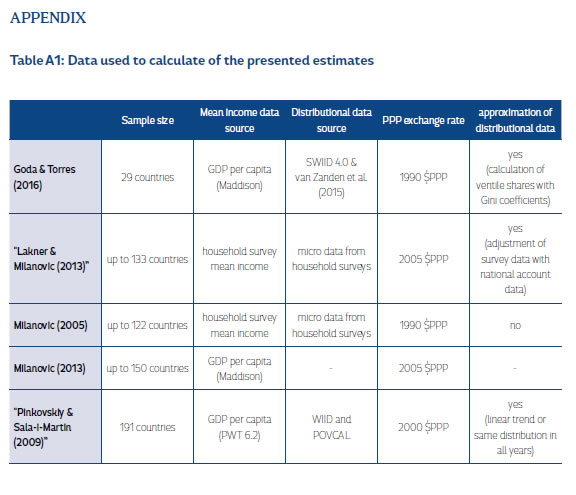
<body><![CDATA[<!-- ref --><p>Kumhof, M.,  Ranci&eacute;re, R. and Winant, P. (2015). Inequality, Leverage, and Crises. <i>American Economic Review,</i>     105(3):1217-1245.    &nbsp;&nbsp;&nbsp;&nbsp;&nbsp;&nbsp;&nbsp;&nbsp;[&#160;<a href="javascript:void(0);" onclick="javascript: window.open('/scielo.php?script=sci_nlinks&ref=5110712&pid=S1657-4206201600010000300038&lng=','','width=640,height=500,resizable=yes,scrollbars=1,menubar=yes,');">Links</a>&#160;]<!-- end-ref --></p>       <!-- ref --><p>Kuznets, S. (1955). <i>Economic  growth and income inequality. </i>American Economic Review, 45(1): 1-28.    &nbsp;&nbsp;&nbsp;&nbsp;&nbsp;&nbsp;&nbsp;&nbsp;[&#160;<a href="javascript:void(0);" onclick="javascript: window.open('/scielo.php?script=sci_nlinks&ref=5110714&pid=S1657-4206201600010000300039&lng=','','width=640,height=500,resizable=yes,scrollbars=1,menubar=yes,');">Links</a>&#160;]<!-- end-ref --></p>       <!-- ref --><p>Kuznets, S. (1965). <i>Economic Growth and Structure: selected  essays. </i>London: Heinemann Educational Books.    &nbsp;&nbsp;&nbsp;&nbsp;&nbsp;&nbsp;&nbsp;&nbsp;[&#160;<a href="javascript:void(0);" onclick="javascript: window.open('/scielo.php?script=sci_nlinks&ref=5110716&pid=S1657-4206201600010000300040&lng=','','width=640,height=500,resizable=yes,scrollbars=1,menubar=yes,');">Links</a>&#160;]<!-- end-ref --></p>       <!-- ref --><p>Lakner, C. and Milanovic, B.  (2013). Global Income Distribution: From the Fall of the Berlin Wall to  the&nbsp; Great     Recession. World Bank Policy  Research Working Paper, No. 6719.    &nbsp;&nbsp;&nbsp;&nbsp;&nbsp;&nbsp;&nbsp;&nbsp;[&#160;<a href="javascript:void(0);" onclick="javascript: window.open('/scielo.php?script=sci_nlinks&ref=5110718&pid=S1657-4206201600010000300041&lng=','','width=640,height=500,resizable=yes,scrollbars=1,menubar=yes,');">Links</a>&#160;]<!-- end-ref --></p>       <!-- ref --><p>Lustig, N. and Gasparini, L. (2011). The Rise and Fall of Income  Inequality in Latin  America. In Ocampo,  J.A. and Ros, J. (eds.): <i>The Oxford  Handbook of Latin American Economics. </i>New York: Oxford  University Press, pp. 691-714.    &nbsp;&nbsp;&nbsp;&nbsp;&nbsp;&nbsp;&nbsp;&nbsp;[&#160;<a href="javascript:void(0);" onclick="javascript: window.open('/scielo.php?script=sci_nlinks&ref=5110720&pid=S1657-4206201600010000300042&lng=','','width=640,height=500,resizable=yes,scrollbars=1,menubar=yes,');">Links</a>&#160;]<!-- end-ref --><!-- ref -->     Milanovic (2013). Global Income  Inequality in Numbers: in History and Now. <i>Global  Policy, </i>4(2): 198-208.    &nbsp;&nbsp;&nbsp;&nbsp;&nbsp;&nbsp;&nbsp;&nbsp;[&#160;<a href="javascript:void(0);" onclick="javascript: window.open('/scielo.php?script=sci_nlinks&ref=5110721&pid=S1657-4206201600010000300043&lng=','','width=640,height=500,resizable=yes,scrollbars=1,menubar=yes,');">Links</a>&#160;]<!-- end-ref --></p>       <!-- ref --><p>Milanovic, B. (2005). <i>Worlds Apart: Measuring International and Global  Inequality. </i>Princeton: Princeton Univer sity Press.    &nbsp;&nbsp;&nbsp;&nbsp;&nbsp;&nbsp;&nbsp;&nbsp;[&#160;<a href="javascript:void(0);" onclick="javascript: window.open('/scielo.php?script=sci_nlinks&ref=5110723&pid=S1657-4206201600010000300044&lng=','','width=640,height=500,resizable=yes,scrollbars=1,menubar=yes,');">Links</a>&#160;]<!-- end-ref --></p>       <!-- ref --><p>Milanovic,  B. (2012). Global inequality recalculated and updated: the effect of new PPP  estimates on global inequality and 2005 estimates. <i>Journal of Economic Inequality, </i>10(1): 1-18.    &nbsp;&nbsp;&nbsp;&nbsp;&nbsp;&nbsp;&nbsp;&nbsp;[&#160;<a href="javascript:void(0);" onclick="javascript: window.open('/scielo.php?script=sci_nlinks&ref=5110725&pid=S1657-4206201600010000300045&lng=','','width=640,height=500,resizable=yes,scrollbars=1,menubar=yes,');">Links</a>&#160;]<!-- end-ref --></p> </font>    <!-- ref --><p><font size="2" face="Verdana, Arial, Helvetica, sans-serif">OECD  (2011). 'Growing Income Inequality in OECD Countries: What Drives it and How  Can Policy Tackle it?'. OECD Forum on tackling inequality,  Paris, 2 May.    &nbsp;&nbsp;&nbsp;&nbsp;&nbsp;&nbsp;&nbsp;&nbsp;[&#160;<a href="javascript:void(0);" onclick="javascript: window.open('/scielo.php?script=sci_nlinks&ref=5110727&pid=S1657-4206201600010000300046&lng=','','width=640,height=500,resizable=yes,scrollbars=1,menubar=yes,');">Links</a>&#160;]<!-- end-ref --></font></p>   <font size="2" face="Verdana, Arial, Helvetica, sans-serif">    <!-- ref --><p>Onaran, O. and Galanis, G. (2014).  Income distribution and growth: a global model. <i>Environment and Planning</i>     A, 46(10): 2489-2513.    &nbsp;&nbsp;&nbsp;&nbsp;&nbsp;&nbsp;&nbsp;&nbsp;[&#160;<a href="javascript:void(0);" onclick="javascript: window.open('/scielo.php?script=sci_nlinks&ref=5110729&pid=S1657-4206201600010000300047&lng=','','width=640,height=500,resizable=yes,scrollbars=1,menubar=yes,');">Links</a>&#160;]<!-- end-ref --></p>       <!-- ref --><p>Ostry, J.D.,  Berg, A., Tsangarides, C.G. (2014). Redistribution, Inequality, and Growth.  IMF Staff Discussion Note, No. SDN/14/02.    &nbsp;&nbsp;&nbsp;&nbsp;&nbsp;&nbsp;&nbsp;&nbsp;[&#160;<a href="javascript:void(0);" onclick="javascript: window.open('/scielo.php?script=sci_nlinks&ref=5110731&pid=S1657-4206201600010000300048&lng=','','width=640,height=500,resizable=yes,scrollbars=1,menubar=yes,');">Links</a>&#160;]<!-- end-ref --></p>       <!-- ref --><p>Oxfam (2014). <i>Even it Up. Time to end extreme inequality. </i>Oxford: Oxfam.    &nbsp;&nbsp;&nbsp;&nbsp;&nbsp;&nbsp;&nbsp;&nbsp;[&#160;<a href="javascript:void(0);" onclick="javascript: window.open('/scielo.php?script=sci_nlinks&ref=5110733&pid=S1657-4206201600010000300049&lng=','','width=640,height=500,resizable=yes,scrollbars=1,menubar=yes,');">Links</a>&#160;]<!-- end-ref --></p>       <!-- ref --><p>Palan,  R., Murphy, R. and Chavagneux, C. (2010). <i>Tax Havens:  How globalization really works. </i>New York: Cornell University Press.    &nbsp;&nbsp;&nbsp;&nbsp;&nbsp;&nbsp;&nbsp;&nbsp;[&#160;<a href="javascript:void(0);" onclick="javascript: window.open('/scielo.php?script=sci_nlinks&ref=5110735&pid=S1657-4206201600010000300050&lng=','','width=640,height=500,resizable=yes,scrollbars=1,menubar=yes,');">Links</a>&#160;]<!-- end-ref --></p>       <!-- ref --><p>Piketty, T. (2014). <i>Capital </i><i>in  the Twenty-First Century. </i>Cambridge Mass:  Belknap Press of Harvard University&nbsp; Press.    &nbsp;&nbsp;&nbsp;&nbsp;&nbsp;&nbsp;&nbsp;&nbsp;[&#160;<a href="javascript:void(0);" onclick="javascript: window.open('/scielo.php?script=sci_nlinks&ref=5110737&pid=S1657-4206201600010000300051&lng=','','width=640,height=500,resizable=yes,scrollbars=1,menubar=yes,');">Links</a>&#160;]<!-- end-ref --> </p>       <!-- ref --><p>Pinkovskiy,&nbsp; M.&nbsp; and  Sala-i-Martin,&nbsp; X.&nbsp; (2009).&nbsp;  'Parametric&nbsp; Estimations&nbsp; of the World Distribution of Income'.     NBER Working Paper No. 15433.    &nbsp;&nbsp;&nbsp;&nbsp;&nbsp;&nbsp;&nbsp;&nbsp;[&#160;<a href="javascript:void(0);" onclick="javascript: window.open('/scielo.php?script=sci_nlinks&ref=5110739&pid=S1657-4206201600010000300052&lng=','','width=640,height=500,resizable=yes,scrollbars=1,menubar=yes,');">Links</a>&#160;]<!-- end-ref --></p>       <!-- ref --><p>Rajan, R.G. (2010). <i>Fault Lines. How Hidden Fractures Still  Threaten the World Economy. </i>Princeton:Princeton University Press.    &nbsp;&nbsp;&nbsp;&nbsp;&nbsp;&nbsp;&nbsp;&nbsp;[&#160;<a href="javascript:void(0);" onclick="javascript: window.open('/scielo.php?script=sci_nlinks&ref=5110741&pid=S1657-4206201600010000300053&lng=','','width=640,height=500,resizable=yes,scrollbars=1,menubar=yes,');">Links</a>&#160;]<!-- end-ref --></p>      <!-- ref --><p>Ravallion, M. (2004). Competing Concepts of Inequality in  the Globalization Debate. In Collins, S.M. and Graham, C. (eds.): <i>Brookings  Trade Forum 2004.  Globalization, Poverty,  and Inequality. </i>Washington: Brookings Institution Press, pp. 1-38.    &nbsp;&nbsp;&nbsp;&nbsp;&nbsp;&nbsp;&nbsp;&nbsp;[&#160;<a href="javascript:void(0);" onclick="javascript: window.open('/scielo.php?script=sci_nlinks&ref=5110743&pid=S1657-4206201600010000300054&lng=','','width=640,height=500,resizable=yes,scrollbars=1,menubar=yes,');">Links</a>&#160;]<!-- end-ref --></p>      <!-- ref --><p>Sala-i-Martin, X. (2006). The world distribution of income: falling  poverty and ... convergence, period. <i>Quaterly  Journal of Economics, </i>71(2): 351-397.    &nbsp;&nbsp;&nbsp;&nbsp;&nbsp;&nbsp;&nbsp;&nbsp;[&#160;<a href="javascript:void(0);" onclick="javascript: window.open('/scielo.php?script=sci_nlinks&ref=5110745&pid=S1657-4206201600010000300055&lng=','','width=640,height=500,resizable=yes,scrollbars=1,menubar=yes,');">Links</a>&#160;]<!-- end-ref --></p>      <!-- ref --><p>Seers, D. (1972). What are we trying  to measure?. <i>Journal of Development  Studies, </i>8(3): 21-36.    &nbsp;&nbsp;&nbsp;&nbsp;&nbsp;&nbsp;&nbsp;&nbsp;[&#160;<a href="javascript:void(0);" onclick="javascript: window.open('/scielo.php?script=sci_nlinks&ref=5110747&pid=S1657-4206201600010000300056&lng=','','width=640,height=500,resizable=yes,scrollbars=1,menubar=yes,');">Links</a>&#160;]<!-- end-ref --> </p>      <!-- ref --><p>Solt, F. (2014).  The standardized world income inequality database. Retrieved at 19 January  2016 from <a href="https://dataverse.harvard.edu/dataset.xhtml?persistentId=hdl:1902.1/11992" target="_blank">https://dataverse.harvard.edu/dataset.xhtml?persistentId=hdl:1902.1/11992</a>.    &nbsp;&nbsp;&nbsp;&nbsp;&nbsp;&nbsp;&nbsp;&nbsp;[&#160;<a href="javascript:void(0);" onclick="javascript: window.open('/scielo.php?script=sci_nlinks&ref=5110749&pid=S1657-4206201600010000300057&lng=','','width=640,height=500,resizable=yes,scrollbars=1,menubar=yes,');">Links</a>&#160;]<!-- end-ref --></p>      <!-- ref --><p>Stiglitz, J.E. (2012). <i>The Price of Inequality. </i>London: Penguin  Books&nbsp;&nbsp;&nbsp;&nbsp;&nbsp;&nbsp;&nbsp;&nbsp;[&#160;<a href="javascript:void(0);" onclick="javascript: window.open('/scielo.php?script=sci_nlinks&ref=5110751&pid=S1657-4206201600010000300058&lng=','','width=640,height=500,resizable=yes,scrollbars=1,menubar=yes,');">Links</a>&#160;]<!-- end-ref --><!-- ref --><p>Stockhammer, E. (2015). Rising Inequality as a cause of  the present crisis. <i>Cambridge Journal of  Economics,</i>   39(3): 935-958.    &nbsp;&nbsp;&nbsp;&nbsp;&nbsp;&nbsp;&nbsp;&nbsp;[&#160;<a href="javascript:void(0);" onclick="javascript: window.open('/scielo.php?script=sci_nlinks&ref=5110752&pid=S1657-4206201600010000300059&lng=','','width=640,height=500,resizable=yes,scrollbars=1,menubar=yes,');">Links</a>&#160;]<!-- end-ref --> </p>      <!-- ref --><p>van Treeck, T. (2014). Did  inequality cause the U.S. financial crisis?. <i>Journal of Economic Surveys, </i>28(3):421-48.  van&nbsp;&nbsp;&nbsp;&nbsp;&nbsp;&nbsp;&nbsp;&nbsp;[&#160;<a href="javascript:void(0);" onclick="javascript: window.open('/scielo.php?script=sci_nlinks&ref=5110754&pid=S1657-4206201600010000300060&lng=','','width=640,height=500,resizable=yes,scrollbars=1,menubar=yes,');">Links</a>&#160;]<!-- end-ref --><!-- ref --><p>Zanden, J.L., Baten, J., Foldvari, P. and  van Leeuwen, B. (2014). The Changing Shape of Global&nbsp;&nbsp; Inequality    1820-2000: Exploring a new dataset. <i>Review of Income and Wealth, </i>60(2):&nbsp; 279-297.    &nbsp;&nbsp;&nbsp;&nbsp;&nbsp;&nbsp;&nbsp;&nbsp;[&#160;<a href="javascript:void(0);" onclick="javascript: window.open('/scielo.php?script=sci_nlinks&ref=5110755&pid=S1657-4206201600010000300061&lng=','','width=640,height=500,resizable=yes,scrollbars=1,menubar=yes,');">Links</a>&#160;]<!-- end-ref --></p>      <!-- ref --><p>Zucman, G. (2015). <i>The  hidden wealth of nations:  The scourge of tax havens. </i>Chicago: University of Chicago Press.    &nbsp;&nbsp;&nbsp;&nbsp;&nbsp;&nbsp;&nbsp;&nbsp;[&#160;<a href="javascript:void(0);" onclick="javascript: window.open('/scielo.php?script=sci_nlinks&ref=5110757&pid=S1657-4206201600010000300062&lng=','','width=640,height=500,resizable=yes,scrollbars=1,menubar=yes,');">Links</a>&#160;]<!-- end-ref --></p>      <p align="center"><a name="a1"></a><img src="/img/revistas/ecos/v20n42/v20n42a3a1.jpg"></p>      <p align="center"><img src="/img/revistas/ecos/v20n42/v20n42a3a2.jpg"></p>     <p>&nbsp;</p>     ]]></body>
<body><![CDATA[<p>&nbsp;</p>     <p>&nbsp;</p>     <p>&nbsp;</p> </font>     ]]></body><back>
<ref-list>
<ref id="B1">
<nlm-citation citation-type="book">
<person-group person-group-type="author">
<name>
<surname><![CDATA[Amiel]]></surname>
<given-names><![CDATA[Y]]></given-names>
</name>
<name>
<surname><![CDATA[Cowell]]></surname>
<given-names><![CDATA[F.A]]></given-names>
</name>
</person-group>
<source><![CDATA[Thinking about inequality: Personal judgment and income distributions]]></source>
<year>1999</year>
<publisher-loc><![CDATA[Cambridge ]]></publisher-loc>
<publisher-name><![CDATA[Cambridge University Press]]></publisher-name>
</nlm-citation>
</ref>
<ref id="B2">
<nlm-citation citation-type="journal">
<person-group person-group-type="author">
<name>
<surname><![CDATA[Anand]]></surname>
<given-names><![CDATA[S]]></given-names>
</name>
<name>
<surname><![CDATA[Segal]]></surname>
<given-names><![CDATA[P]]></given-names>
</name>
</person-group>
<article-title xml:lang="en"><![CDATA[What Do We Know about Global Income Inequality?]]></article-title>
<source><![CDATA[Journal of Economic Literature]]></source>
<year>2008</year>
<volume>46</volume>
<numero>1</numero>
<issue>1</issue>
<page-range>57-94</page-range></nlm-citation>
</ref>
<ref id="B3">
<nlm-citation citation-type="book">
<person-group person-group-type="author">
<name>
<surname><![CDATA[Anand]]></surname>
<given-names><![CDATA[S]]></given-names>
</name>
<name>
<surname><![CDATA[Segal]]></surname>
<given-names><![CDATA[P]]></given-names>
</name>
</person-group>
<article-title xml:lang="en"><![CDATA[The Global Distribution of Income]]></article-title>
<person-group person-group-type="editor">
<name>
<surname><![CDATA[Atkinson]]></surname>
<given-names><![CDATA[A.B]]></given-names>
</name>
<name>
<surname><![CDATA[Bourguignon]]></surname>
<given-names><![CDATA[F]]></given-names>
</name>
</person-group>
<source><![CDATA[Handbook of Income Distribution]]></source>
<year>2015</year>
<volume>11</volume>
<publisher-loc><![CDATA[Oxford ]]></publisher-loc>
<publisher-name><![CDATA[North-Holland]]></publisher-name>
</nlm-citation>
</ref>
<ref id="B4">
<nlm-citation citation-type="journal">
<person-group person-group-type="author">
<name>
<surname><![CDATA[Agnew]]></surname>
<given-names><![CDATA[R]]></given-names>
</name>
</person-group>
<article-title xml:lang="en"><![CDATA[A revised strain theory of delinquency]]></article-title>
<source><![CDATA[Social Forces]]></source>
<year>1985</year>
<volume>64</volume>
<numero>1</numero>
<issue>1</issue>
<page-range>151-167</page-range></nlm-citation>
</ref>
<ref id="B5">
<nlm-citation citation-type="journal">
<person-group person-group-type="author">
<name>
<surname><![CDATA[Agnew]]></surname>
<given-names><![CDATA[R]]></given-names>
</name>
</person-group>
<article-title xml:lang="en"><![CDATA[Foundation for a generalism strain theory of crime and delinquency]]></article-title>
<source><![CDATA[Criminology]]></source>
<year>1992</year>
<volume>30</volume>
<numero>1</numero>
<issue>1</issue>
<page-range>47-87</page-range></nlm-citation>
</ref>
<ref id="B6">
<nlm-citation citation-type="journal">
<person-group person-group-type="author">
<name>
<surname><![CDATA[Atkinson]]></surname>
<given-names><![CDATA[A.B]]></given-names>
</name>
</person-group>
<source><![CDATA[The Economic Journal]]></source>
<year>1997</year>
<volume>107</volume>
<numero>441</numero>
<issue>441</issue>
<page-range>297-321</page-range></nlm-citation>
</ref>
<ref id="B7">
<nlm-citation citation-type="journal">
<person-group person-group-type="author">
<name>
<surname><![CDATA[Atkinson]]></surname>
<given-names><![CDATA[A.B]]></given-names>
</name>
<name>
<surname><![CDATA[Brandolini]]></surname>
<given-names><![CDATA[A]]></given-names>
</name>
</person-group>
<article-title xml:lang="en"><![CDATA[Promise and Pitfalls in the Use of 'Secondary' Data-Sets: Income Inequality in OECD Countries]]></article-title>
<source><![CDATA[Journal of Economic Literature]]></source>
<year>2001</year>
<volume>39</volume>
<numero>3</numero>
<issue>3</issue>
<page-range>771-799</page-range></nlm-citation>
</ref>
<ref id="B8">
<nlm-citation citation-type="journal">
<person-group person-group-type="author">
<name>
<surname><![CDATA[Atkinson]]></surname>
<given-names><![CDATA[A.B]]></given-names>
</name>
<name>
<surname><![CDATA[Brandolini]]></surname>
<given-names><![CDATA[A]]></given-names>
</name>
</person-group>
<article-title xml:lang="en"><![CDATA[On Analyzing the World Distribution of Income]]></article-title>
<source><![CDATA[World Bank Economic Review]]></source>
<year>2010</year>
<volume>24</volume>
<numero>1</numero>
<issue>1</issue>
<page-range>1-37</page-range></nlm-citation>
</ref>
<ref id="B9">
<nlm-citation citation-type="journal">
<person-group person-group-type="author">
<name>
<surname><![CDATA[Atkinson]]></surname>
<given-names><![CDATA[A.B]]></given-names>
</name>
<name>
<surname><![CDATA[Piketty]]></surname>
<given-names><![CDATA[T]]></given-names>
</name>
<name>
<surname><![CDATA[Saez]]></surname>
<given-names><![CDATA[E]]></given-names>
</name>
</person-group>
<article-title xml:lang="en"><![CDATA[Top Incomes in the Long Run of History]]></article-title>
<source><![CDATA[Journal of Economic Literature]]></source>
<year>2011</year>
<volume>49</volume>
<numero>1</numero>
<issue>1</issue>
<page-range>3&ndash;71</page-range></nlm-citation>
</ref>
<ref id="B10">
<nlm-citation citation-type="journal">
<person-group person-group-type="author">
<name>
<surname><![CDATA[Ballano]]></surname>
<given-names><![CDATA[C]]></given-names>
</name>
<name>
<surname><![CDATA[Ruiz-Castillo]]></surname>
<given-names><![CDATA[J]]></given-names>
</name>
</person-group>
<article-title xml:lang="en"><![CDATA[Searching by questionnaire for the meaning of income inequality]]></article-title>
<source><![CDATA[Revista Español de Economía]]></source>
<year>1993</year>
<volume>10</volume>
<numero>2</numero>
<issue>2</issue>
<page-range>233-259</page-range></nlm-citation>
</ref>
<ref id="B11">
<nlm-citation citation-type="journal">
<person-group person-group-type="author">
<name>
<surname><![CDATA[Bourguignon]]></surname>
<given-names><![CDATA[F]]></given-names>
</name>
<name>
<surname><![CDATA[Morrisson]]></surname>
<given-names><![CDATA[C]]></given-names>
</name>
</person-group>
<article-title xml:lang="en"><![CDATA[Inequality among World Citizens: 1820-1992]]></article-title>
<source><![CDATA[American Economic Review]]></source>
<year>2002</year>
<volume>92</volume>
<numero>4</numero>
<issue>4</issue>
<page-range>727-744</page-range></nlm-citation>
</ref>
<ref id="B12">
<nlm-citation citation-type="journal">
<person-group person-group-type="author">
<name>
<surname><![CDATA[Breton]]></surname>
<given-names><![CDATA[T]]></given-names>
</name>
<name>
<surname><![CDATA[García]]></surname>
<given-names><![CDATA[J.J]]></given-names>
</name>
</person-group>
<article-title xml:lang="en"><![CDATA[ICP 2005 Construction Prices: Are They Underestimated in Developing Countries?]]></article-title>
<source><![CDATA[Review of Income and Wealth]]></source>
<year>2015</year>
</nlm-citation>
</ref>
<ref id="B13">
<nlm-citation citation-type="journal">
<person-group person-group-type="author">
<name>
<surname><![CDATA[Chakravarty]]></surname>
<given-names><![CDATA[S.R]]></given-names>
</name>
</person-group>
<source><![CDATA[Social Indicators Research]]></source>
<year>2001</year>
<volume>53</volume>
<numero>1</numero>
<issue>1</issue>
<page-range>79-95</page-range></nlm-citation>
</ref>
<ref id="B14">
<nlm-citation citation-type="journal">
<person-group person-group-type="author">
<name>
<surname><![CDATA[Chakravarty]]></surname>
<given-names><![CDATA[S.R]]></given-names>
</name>
<name>
<surname><![CDATA[Tyagarupananda]]></surname>
<given-names><![CDATA[S]]></given-names>
</name>
</person-group>
<article-title xml:lang="en"><![CDATA[The subgroup decomposable intermediate indices of inequality]]></article-title>
<source><![CDATA[Spanish Economic Review]]></source>
<year>2009</year>
<volume>11</volume>
<numero>2</numero>
<issue>2</issue>
<page-range>83-97</page-range></nlm-citation>
</ref>
<ref id="B15">
<nlm-citation citation-type="journal">
<person-group person-group-type="author">
<name>
<surname><![CDATA[Cornia]]></surname>
<given-names><![CDATA[G.A]]></given-names>
</name>
</person-group>
<source><![CDATA[Journal of Human Development and Capabilities]]></source>
<year>2010</year>
<volume>11</volume>
<numero>1</numero>
<issue>1</issue>
<page-range>85-114</page-range></nlm-citation>
</ref>
<ref id="B16">
<nlm-citation citation-type="book">
<person-group person-group-type="author">
<name>
<surname><![CDATA[Cowell]]></surname>
<given-names><![CDATA[F.A]]></given-names>
</name>
</person-group>
<source><![CDATA[Measuring Income Inequality]]></source>
<year>2000</year>
<publisher-loc><![CDATA[London ]]></publisher-loc>
<publisher-name><![CDATA[Harvester Wheatsheaf]]></publisher-name>
</nlm-citation>
</ref>
<ref id="B17">
<nlm-citation citation-type="journal">
<person-group person-group-type="author">
<name>
<surname><![CDATA[Deaton]]></surname>
<given-names><![CDATA[A]]></given-names>
</name>
</person-group>
<article-title xml:lang="en"><![CDATA[Price indexes, inequality, and the measurement of world poverty]]></article-title>
<source><![CDATA[American Economic Review]]></source>
<year>2010</year>
<volume>100</volume>
<numero>1</numero>
<issue>1</issue>
<page-range>5-34</page-range></nlm-citation>
</ref>
<ref id="B18">
<nlm-citation citation-type="book">
<person-group person-group-type="author">
<name>
<surname><![CDATA[Deaton]]></surname>
<given-names><![CDATA[A]]></given-names>
</name>
<name>
<surname><![CDATA[Aten]]></surname>
<given-names><![CDATA[B]]></given-names>
</name>
</person-group>
<article-title xml:lang="en"><![CDATA[&ldquo;Trying to Understand the PPPs]]></article-title>
<source><![CDATA[ICP2011: Why are the Results so Different?&rdquo;]]></source>
<year>2015</year>
<volume>20244</volume>
<publisher-name><![CDATA[NBER]]></publisher-name>
</nlm-citation>
</ref>
<ref id="B19">
<nlm-citation citation-type="journal">
<person-group person-group-type="author">
<name>
<surname><![CDATA[Ehrlich]]></surname>
<given-names><![CDATA[I]]></given-names>
</name>
</person-group>
<article-title xml:lang="en"><![CDATA[Participation in illegitimate activities: a theoretical and empirical investigation]]></article-title>
<source><![CDATA[Journal of Political Economy]]></source>
<year>1973</year>
<volume>81</volume>
<numero>3</numero>
<issue>3</issue>
<page-range>521-65</page-range></nlm-citation>
</ref>
<ref id="B20">
<nlm-citation citation-type="journal">
<person-group person-group-type="author">
<name>
<surname><![CDATA[Ellis]]></surname>
<given-names><![CDATA[L]]></given-names>
</name>
<name>
<surname><![CDATA[Kathryn]]></surname>
<given-names><![CDATA[S]]></given-names>
</name>
</person-group>
<article-title xml:lang="en"><![CDATA[The global upward trend in the profit share]]></article-title>
<source><![CDATA[Applied Economics Quarterly]]></source>
<year>2010</year>
<volume>56</volume>
<numero>3</numero>
<issue>3</issue>
<page-range>231-255</page-range></nlm-citation>
</ref>
<ref id="B21">
<nlm-citation citation-type="journal">
<person-group person-group-type="author">
<name>
<surname><![CDATA[Fleisher]]></surname>
<given-names><![CDATA[B.M]]></given-names>
</name>
</person-group>
<article-title xml:lang="en"><![CDATA[The effect of income on delinquency]]></article-title>
<source><![CDATA[American Economic Review]]></source>
<year>1966</year>
<volume>56</volume>
<numero>1</numero><numero>2</numero>
<issue>1</issue><issue>2</issue>
<page-range>118-37</page-range></nlm-citation>
</ref>
<ref id="B22">
<nlm-citation citation-type="book">
<person-group person-group-type="author">
<name>
<surname><![CDATA[Francois]]></surname>
<given-names><![CDATA[J.F]]></given-names>
</name>
<name>
<surname><![CDATA[Rojas-Romagosa]]></surname>
<given-names><![CDATA[H]]></given-names>
</name>
</person-group>
<source><![CDATA['The Construction and Interpretation of Combined Cross-Section and Time-Series Inequality Datasets']]></source>
<year>2007</year>
<volume>200708-05</volume>
<publisher-name><![CDATA[IIDE]]></publisher-name>
</nlm-citation>
</ref>
<ref id="B23">
<nlm-citation citation-type="journal">
<person-group person-group-type="author">
<name>
<surname><![CDATA[Froud]]></surname>
<given-names><![CDATA[J]]></given-names>
</name>
<name>
<surname><![CDATA[Johal]]></surname>
<given-names><![CDATA[S]]></given-names>
</name>
</person-group>
<source><![CDATA[Review of International Political Economy]]></source>
<year></year>
<volume>8</volume>
<numero>1</numero>
<issue>1</issue>
<page-range>66-95</page-range></nlm-citation>
</ref>
<ref id="B24">
<nlm-citation citation-type="journal">
<person-group person-group-type="author">
<name>
<surname><![CDATA[Gasparini]]></surname>
<given-names><![CDATA[L]]></given-names>
</name>
<name>
<surname><![CDATA[Cruces]]></surname>
<given-names><![CDATA[G]]></given-names>
</name>
<name>
<surname><![CDATA[Tornarolli]]></surname>
<given-names><![CDATA[L]]></given-names>
</name>
</person-group>
<article-title xml:lang="en"><![CDATA[Recent Trends in Income Inequality in Latin America]]></article-title>
<source><![CDATA[Economía]]></source>
<year>2011</year>
<volume>11</volume>
<numero>2</numero>
<issue>2</issue>
<page-range>147-190</page-range></nlm-citation>
</ref>
<ref id="B25">
<nlm-citation citation-type="book">
<person-group person-group-type="author">
<name>
<surname><![CDATA[Goda]]></surname>
<given-names><![CDATA[T]]></given-names>
</name>
</person-group>
<source><![CDATA['Changes in income inequality from a global perspective: an overview']]></source>
<year>2013</year>
<volume>1303</volume>
<publisher-name><![CDATA[PKSG]]></publisher-name>
</nlm-citation>
</ref>
<ref id="B26">
<nlm-citation citation-type="journal">
<person-group person-group-type="author">
<name>
<surname><![CDATA[Goda]]></surname>
<given-names><![CDATA[T]]></given-names>
</name>
<name>
<surname><![CDATA[Lysandrou]]></surname>
<given-names><![CDATA[P]]></given-names>
</name>
</person-group>
<article-title xml:lang="en"><![CDATA[The contribution of wealth concentration to the subprime crisis: a quantitative estimation]]></article-title>
<source><![CDATA[Cambridge Journal of Economics]]></source>
<year>2014</year>
<volume>38</volume>
<numero>2</numero>
<issue>2</issue>
<page-range>301-27</page-range></nlm-citation>
</ref>
<ref id="B27">
<nlm-citation citation-type="journal">
<person-group person-group-type="author">
<name>
<surname><![CDATA[Goda]]></surname>
<given-names><![CDATA[T]]></given-names>
</name>
<name>
<surname><![CDATA[Torres García]]></surname>
<given-names><![CDATA[A]]></given-names>
</name>
</person-group>
<article-title xml:lang="en"><![CDATA[The Rising Tide of Absolute Global Income Inequality During 1850&ndash;2010: Is It Driven by Inequality Within or Between Countries?]]></article-title>
<source><![CDATA[Social Indicators Research]]></source>
<year>2016</year>
</nlm-citation>
</ref>
<ref id="B28">
<nlm-citation citation-type="book">
<person-group person-group-type="author">
<name>
<surname><![CDATA[Hagan,]]></surname>
<given-names><![CDATA[J]]></given-names>
</name>
<name>
<surname><![CDATA[Peterson]]></surname>
<given-names><![CDATA[R.D.]]></given-names>
</name>
</person-group>
<article-title xml:lang="en"><![CDATA[Criminal inequality in America: Patterns and consequences]]></article-title>
<person-group person-group-type="editor">
<name>
<surname><![CDATA[Hagan]]></surname>
<given-names><![CDATA[J]]></given-names>
</name>
<name>
<surname><![CDATA[Peterson]]></surname>
<given-names><![CDATA[R.D]]></given-names>
</name>
</person-group>
<source><![CDATA[Crime and inequality]]></source>
<year>1995</year>
<page-range>14-36</page-range><publisher-loc><![CDATA[Stanford ]]></publisher-loc>
<publisher-name><![CDATA[Stanford University Press]]></publisher-name>
</nlm-citation>
</ref>
<ref id="B29">
<nlm-citation citation-type="journal">
<person-group person-group-type="author">
<name>
<surname><![CDATA[Halter]]></surname>
<given-names><![CDATA[D]]></given-names>
</name>
<name>
<surname><![CDATA[Oechslin]]></surname>
<given-names><![CDATA[M]]></given-names>
</name>
<name>
<surname><![CDATA[Zweimüller]]></surname>
<given-names><![CDATA[J]]></given-names>
</name>
</person-group>
<article-title xml:lang="en"><![CDATA[Inequality and growth: the neglected time dimension]]></article-title>
<source><![CDATA[Journal of Economic Growth]]></source>
<year>2014</year>
<volume>19</volume>
<numero>1</numero>
<issue>1</issue>
<page-range>81-104</page-range></nlm-citation>
</ref>
<ref id="B30">
<nlm-citation citation-type="journal">
<person-group person-group-type="author">
<name>
<surname><![CDATA[Harrison]]></surname>
<given-names><![CDATA[E]]></given-names>
</name>
<name>
<surname><![CDATA[Seidl]]></surname>
<given-names><![CDATA[C]]></given-names>
</name>
</person-group>
<article-title xml:lang="en"><![CDATA[Perceptional inequality and preferential judgments: An empirical examination of distributional axioms]]></article-title>
<source><![CDATA[Public Choice]]></source>
<year>1994</year>
<volume>79</volume>
<numero>1</numero><numero>2</numero>
<issue>1</issue><issue>2</issue>
<page-range>61-81</page-range></nlm-citation>
</ref>
<ref id="B31">
<nlm-citation citation-type="book">
<person-group person-group-type="author">
<name>
<surname><![CDATA[Hein]]></surname>
<given-names><![CDATA[E]]></given-names>
</name>
</person-group>
<source><![CDATA[The macroeconomics of finance-dominated capitalism and its crisis]]></source>
<year>2012</year>
<publisher-loc><![CDATA[Cheltenham ]]></publisher-loc>
<publisher-name><![CDATA[Edward Elgar]]></publisher-name>
</nlm-citation>
</ref>
<ref id="B32">
<nlm-citation citation-type="journal">
<person-group person-group-type="author">
<name>
<surname><![CDATA[Henry]]></surname>
<given-names><![CDATA[J.S]]></given-names>
</name>
</person-group>
<article-title xml:lang="en"><![CDATA['The price of offshore revisited: New estimates for 'missing' global private wealth, income, inequality, and lost taxes']]></article-title>
<source><![CDATA[Tax Justice Network]]></source>
<year>2012</year>
</nlm-citation>
</ref>
<ref id="B33">
<nlm-citation citation-type="journal">
<person-group person-group-type="author">
<name>
<surname><![CDATA[Herzer]]></surname>
<given-names><![CDATA[D]]></given-names>
</name>
<name>
<surname><![CDATA[Vollmer]]></surname>
<given-names><![CDATA[S]]></given-names>
</name>
</person-group>
<article-title xml:lang="en"><![CDATA[Inequality and growth: evidence from panel cointegration]]></article-title>
<source><![CDATA[Journal of Economic Inequality]]></source>
<year>2012</year>
<volume>10</volume>
<numero>4</numero>
<issue>4</issue>
<page-range>489-503</page-range></nlm-citation>
</ref>
<ref id="B34">
<nlm-citation citation-type="journal">
<person-group person-group-type="author">
<name>
<surname><![CDATA[Herzer]]></surname>
<given-names><![CDATA[D]]></given-names>
</name>
<name>
<surname><![CDATA[Vollmer]]></surname>
<given-names><![CDATA[S]]></given-names>
</name>
</person-group>
<article-title xml:lang="en"><![CDATA[Rising top incomes do not raise the tide]]></article-title>
<source><![CDATA[Journal of Policy Modeling]]></source>
<year>2013</year>
<volume>35</volume>
<numero>4</numero>
<issue>4</issue>
<page-range>504-19</page-range></nlm-citation>
</ref>
<ref id="B35">
<nlm-citation citation-type="book">
<collab>ILO</collab>
<source><![CDATA[World of work report 2008: income inequalities in the age of financial globalization]]></source>
<year>2008</year>
<publisher-loc><![CDATA[Geneva ]]></publisher-loc>
<publisher-name><![CDATA[International Labour Organization]]></publisher-name>
</nlm-citation>
</ref>
<ref id="B36">
<nlm-citation citation-type="book">
<person-group person-group-type="author">
<name>
<surname><![CDATA[Immervoll]]></surname>
<given-names><![CDATA[H]]></given-names>
</name>
<name>
<surname><![CDATA[Richardson]]></surname>
<given-names><![CDATA[L]]></given-names>
</name>
</person-group>
<article-title xml:lang="en"><![CDATA[Redistribution Policy and Inequality Reduction]]></article-title>
<source><![CDATA[OECD Countries: What Has Changed in Two Decades?]]></source>
<year>2011</year>
<volume>122</volume>
<publisher-name><![CDATA[OECD Social, Employment and Migration]]></publisher-name>
</nlm-citation>
</ref>
<ref id="B37">
<nlm-citation citation-type="journal">
<person-group person-group-type="author">
<name>
<surname><![CDATA[Keister]]></surname>
<given-names><![CDATA[L.A]]></given-names>
</name>
</person-group>
<article-title xml:lang="en"><![CDATA[The One Percent]]></article-title>
<source><![CDATA[Annual Review of Sociology]]></source>
<year>2014</year>
<volume>40</volume>
<page-range>347-367</page-range></nlm-citation>
</ref>
<ref id="B38">
<nlm-citation citation-type="journal">
<person-group person-group-type="author">
<name>
<surname><![CDATA[Kumhof]]></surname>
<given-names><![CDATA[M]]></given-names>
</name>
<name>
<surname><![CDATA[Ranciére]]></surname>
<given-names><![CDATA[R]]></given-names>
</name>
<name>
<surname><![CDATA[Winant]]></surname>
<given-names><![CDATA[P]]></given-names>
</name>
</person-group>
<article-title xml:lang="en"><![CDATA[Inequality, Leverage, and Crises]]></article-title>
<source><![CDATA[American Economic Review]]></source>
<year>2015</year>
<volume>105</volume>
<numero>3</numero>
<issue>3</issue>
<page-range>1217-1245</page-range></nlm-citation>
</ref>
<ref id="B39">
<nlm-citation citation-type="journal">
<person-group person-group-type="author">
<name>
<surname><![CDATA[Kuznets]]></surname>
<given-names><![CDATA[S]]></given-names>
</name>
</person-group>
<article-title xml:lang="en"><![CDATA[Economic growth and income inequality]]></article-title>
<source><![CDATA[American Economic Review]]></source>
<year>1955</year>
<volume>45</volume>
<numero>1</numero>
<issue>1</issue>
<page-range>1-28</page-range></nlm-citation>
</ref>
<ref id="B40">
<nlm-citation citation-type="book">
<person-group person-group-type="author">
<name>
<surname><![CDATA[Kuznets]]></surname>
<given-names><![CDATA[S]]></given-names>
</name>
</person-group>
<source><![CDATA[Economic Growth and Structure: selected essays]]></source>
<year>1965</year>
<publisher-loc><![CDATA[London ]]></publisher-loc>
<publisher-name><![CDATA[Heinemann Educational Books]]></publisher-name>
</nlm-citation>
</ref>
<ref id="B41">
<nlm-citation citation-type="book">
<person-group person-group-type="author">
<name>
<surname><![CDATA[Lakner]]></surname>
<given-names><![CDATA[C]]></given-names>
</name>
<name>
<surname><![CDATA[Milanovic]]></surname>
<given-names><![CDATA[B]]></given-names>
</name>
</person-group>
<source><![CDATA[Global Income Distribution: From the Fall of the Berlin Wall to the Great Recession]]></source>
<year>2013</year>
<volume>6719</volume>
<publisher-name><![CDATA[World Bank Policy Research]]></publisher-name>
</nlm-citation>
</ref>
<ref id="B42">
<nlm-citation citation-type="book">
<person-group person-group-type="author">
<name>
<surname><![CDATA[Lustig]]></surname>
<given-names><![CDATA[N]]></given-names>
</name>
<name>
<surname><![CDATA[Gasparini]]></surname>
<given-names><![CDATA[L]]></given-names>
</name>
</person-group>
<article-title xml:lang="en"><![CDATA[The Rise and Fall of Income Inequality in Latin America]]></article-title>
<person-group person-group-type="editor">
<name>
<surname><![CDATA[Ocampo]]></surname>
<given-names><![CDATA[J.A]]></given-names>
</name>
<name>
<surname><![CDATA[Ros]]></surname>
<given-names><![CDATA[J]]></given-names>
</name>
</person-group>
<source><![CDATA[The Oxford Handbook of Latin American Economics]]></source>
<year>2011</year>
<page-range>691-714</page-range><publisher-loc><![CDATA[New York ]]></publisher-loc>
<publisher-name><![CDATA[Oxford University Press]]></publisher-name>
</nlm-citation>
</ref>
<ref id="B43">
<nlm-citation citation-type="journal">
<collab>Milanovic</collab>
<article-title xml:lang="en"><![CDATA[Global Income Inequality in Numbers: in History and Now]]></article-title>
<source><![CDATA[Global Policy]]></source>
<year>2013</year>
<volume>4</volume>
<numero>2</numero>
<issue>2</issue>
<page-range>198-208</page-range></nlm-citation>
</ref>
<ref id="B44">
<nlm-citation citation-type="book">
<person-group person-group-type="author">
<name>
<surname><![CDATA[Milanovic]]></surname>
<given-names><![CDATA[B]]></given-names>
</name>
</person-group>
<source><![CDATA[Worlds Apart: Measuring International and Global Inequality]]></source>
<year>2005</year>
<publisher-loc><![CDATA[Princeton ]]></publisher-loc>
<publisher-name><![CDATA[Princeton University Press]]></publisher-name>
</nlm-citation>
</ref>
<ref id="B45">
<nlm-citation citation-type="journal">
<person-group person-group-type="author">
<name>
<surname><![CDATA[Milanovic]]></surname>
<given-names><![CDATA[B]]></given-names>
</name>
</person-group>
<article-title xml:lang="en"><![CDATA[Global inequality recalculated and updated: the effect of new PPP estimates on global inequality and 2005 estimates]]></article-title>
<source><![CDATA[Journal of Economic Inequality]]></source>
<year>2012</year>
<volume>10</volume>
<numero>1</numero>
<issue>1</issue>
<page-range>1-18</page-range></nlm-citation>
</ref>
<ref id="B46">
<nlm-citation citation-type="book">
<collab>OECD</collab>
<source><![CDATA['Growing Income Inequality in OECD Countries: What Drives it and How Can Policy Tackle it?']]></source>
<year>2011</year>
<publisher-loc><![CDATA[Paris ]]></publisher-loc>
<publisher-name><![CDATA[OECD]]></publisher-name>
</nlm-citation>
</ref>
<ref id="B47">
<nlm-citation citation-type="journal">
<person-group person-group-type="author">
<name>
<surname><![CDATA[Onaran]]></surname>
<given-names><![CDATA[O]]></given-names>
</name>
<name>
<surname><![CDATA[Galanis]]></surname>
<given-names><![CDATA[G]]></given-names>
</name>
</person-group>
<article-title xml:lang="en"><![CDATA[Income distribution and growth: a global model]]></article-title>
<source><![CDATA[Environment and Planning A]]></source>
<year>2014</year>
<volume>46</volume>
<numero>10</numero>
<issue>10</issue>
<page-range>2489-2513</page-range></nlm-citation>
</ref>
<ref id="B48">
<nlm-citation citation-type="book">
<person-group person-group-type="author">
<name>
<surname><![CDATA[Ostry]]></surname>
<given-names><![CDATA[J.D]]></given-names>
</name>
<name>
<surname><![CDATA[Berg]]></surname>
<given-names><![CDATA[A]]></given-names>
</name>
<name>
<surname><![CDATA[Tsangarides]]></surname>
<given-names><![CDATA[C.G]]></given-names>
</name>
</person-group>
<source><![CDATA[Redistribution, Inequality, and Growth]]></source>
<year>2014</year>
<volume>SDN/14/02</volume>
<publisher-name><![CDATA[IMF]]></publisher-name>
</nlm-citation>
</ref>
<ref id="B49">
<nlm-citation citation-type="book">
<collab>Oxfam</collab>
<source><![CDATA[Even it Up. Time to end extreme inequality]]></source>
<year>2014</year>
<publisher-loc><![CDATA[Oxford ]]></publisher-loc>
<publisher-name><![CDATA[Oxfam]]></publisher-name>
</nlm-citation>
</ref>
<ref id="B50">
<nlm-citation citation-type="book">
<person-group person-group-type="author">
<name>
<surname><![CDATA[Palan]]></surname>
<given-names><![CDATA[R]]></given-names>
</name>
<name>
<surname><![CDATA[Murphy]]></surname>
<given-names><![CDATA[R]]></given-names>
</name>
<name>
<surname><![CDATA[Chavagneux]]></surname>
<given-names><![CDATA[C]]></given-names>
</name>
</person-group>
<source><![CDATA[Tax Havens: How globalization really works]]></source>
<year>2010</year>
<publisher-loc><![CDATA[New York ]]></publisher-loc>
<publisher-name><![CDATA[Cornell University Press]]></publisher-name>
</nlm-citation>
</ref>
<ref id="B51">
<nlm-citation citation-type="book">
<person-group person-group-type="author">
<name>
<surname><![CDATA[Piketty]]></surname>
<given-names><![CDATA[T]]></given-names>
</name>
</person-group>
<source><![CDATA[Capital in the Twenty-First Century]]></source>
<year>2014</year>
<publisher-loc><![CDATA[Cambridge ]]></publisher-loc>
<publisher-name><![CDATA[Belknap Press of Harvard University Press]]></publisher-name>
</nlm-citation>
</ref>
<ref id="B52">
<nlm-citation citation-type="book">
<person-group person-group-type="author">
<name>
<surname><![CDATA[Pinkovskiy]]></surname>
<given-names><![CDATA[M]]></given-names>
</name>
<name>
<surname><![CDATA[Sala-i-Martin]]></surname>
<given-names><![CDATA[X]]></given-names>
</name>
</person-group>
<article-title xml:lang="en"><![CDATA['Parametric Estimations of the World Distribution of Income']]></article-title>
<source><![CDATA[]]></source>
<year>2009</year>
<volume>15433</volume>
<publisher-name><![CDATA[NBER]]></publisher-name>
</nlm-citation>
</ref>
<ref id="B53">
<nlm-citation citation-type="book">
<person-group person-group-type="author">
<name>
<surname><![CDATA[Rajan]]></surname>
<given-names><![CDATA[R.G]]></given-names>
</name>
</person-group>
<source><![CDATA[Fault Lines. How Hidden Fractures Still Threaten the World Economy]]></source>
<year>2010</year>
<publisher-loc><![CDATA[Princeton ]]></publisher-loc>
<publisher-name><![CDATA[Princeton University Press]]></publisher-name>
</nlm-citation>
</ref>
<ref id="B54">
<nlm-citation citation-type="book">
<person-group person-group-type="author">
<name>
<surname><![CDATA[Ravallion]]></surname>
<given-names><![CDATA[M]]></given-names>
</name>
</person-group>
<article-title xml:lang="en"><![CDATA[Competing Concepts of Inequality in the Globalization Debate]]></article-title>
<person-group person-group-type="editor">
<name>
<surname><![CDATA[Collins]]></surname>
<given-names><![CDATA[S.M]]></given-names>
</name>
<name>
<surname><![CDATA[Graham]]></surname>
<given-names><![CDATA[C]]></given-names>
</name>
</person-group>
<source><![CDATA[Brookings Trade Forum 2004. Globalization, Poverty, and Inequality]]></source>
<year>2004</year>
<page-range>1-38</page-range><publisher-loc><![CDATA[Washington ]]></publisher-loc>
<publisher-name><![CDATA[Brookings Institution Press]]></publisher-name>
</nlm-citation>
</ref>
<ref id="B55">
<nlm-citation citation-type="journal">
<person-group person-group-type="author">
<name>
<surname><![CDATA[Sala-i-Martin]]></surname>
<given-names><![CDATA[X]]></given-names>
</name>
</person-group>
<article-title xml:lang="en"><![CDATA[The world distribution of income: falling poverty and ... convergence, period]]></article-title>
<source><![CDATA[Quaterly Journal of Economics]]></source>
<year>2006</year>
<volume>71</volume>
<numero>2</numero>
<issue>2</issue>
<page-range>351-397</page-range></nlm-citation>
</ref>
<ref id="B56">
<nlm-citation citation-type="journal">
<person-group person-group-type="author">
<name>
<surname><![CDATA[Seers]]></surname>
<given-names><![CDATA[D]]></given-names>
</name>
</person-group>
<article-title xml:lang="en"><![CDATA[What are we trying to measure?]]></article-title>
<source><![CDATA[Journal of Development Studies]]></source>
<year>1972</year>
<volume>8</volume>
<numero>3</numero>
<issue>3</issue>
<page-range>21-36</page-range></nlm-citation>
</ref>
<ref id="B57">
<nlm-citation citation-type="">
<person-group person-group-type="author">
<name>
<surname><![CDATA[Solt]]></surname>
<given-names><![CDATA[F]]></given-names>
</name>
</person-group>
<source><![CDATA[The standardized world income inequality database]]></source>
<year>2014</year>
</nlm-citation>
</ref>
<ref id="B58">
<nlm-citation citation-type="book">
<person-group person-group-type="author">
<name>
<surname><![CDATA[Stiglitz]]></surname>
<given-names><![CDATA[J.E]]></given-names>
</name>
</person-group>
<source><![CDATA[The Price of Inequality]]></source>
<year>2012</year>
<publisher-loc><![CDATA[London ]]></publisher-loc>
<publisher-name><![CDATA[Penguin Books]]></publisher-name>
</nlm-citation>
</ref>
<ref id="B59">
<nlm-citation citation-type="journal">
<person-group person-group-type="author">
<name>
<surname><![CDATA[Stockhammer]]></surname>
<given-names><![CDATA[E]]></given-names>
</name>
</person-group>
<source><![CDATA[Cambridge Journal of Economics]]></source>
<year>2015</year>
<month>93</month>
<day>5-</day>
<volume>39</volume>
<numero>3</numero>
<issue>3</issue>
</nlm-citation>
</ref>
<ref id="B60">
<nlm-citation citation-type="journal">
<person-group person-group-type="author">
<name>
<surname><![CDATA[van Treeck]]></surname>
<given-names><![CDATA[T]]></given-names>
</name>
</person-group>
<article-title xml:lang="en"><![CDATA[Did inequality cause the U.S. financial crisis?]]></article-title>
<source><![CDATA[Journal of Economic Surveys]]></source>
<year>2014</year>
<volume>28</volume>
<numero>3</numero>
<issue>3</issue>
<page-range>421-48</page-range></nlm-citation>
</ref>
<ref id="B61">
<nlm-citation citation-type="journal">
<person-group person-group-type="author">
<name>
<surname><![CDATA[Zanden]]></surname>
<given-names><![CDATA[J.L]]></given-names>
</name>
<name>
<surname><![CDATA[Baten]]></surname>
<given-names><![CDATA[J]]></given-names>
</name>
<name>
<surname><![CDATA[Foldvari]]></surname>
<given-names><![CDATA[P]]></given-names>
</name>
<name>
<surname><![CDATA[van Leeuwen]]></surname>
<given-names><![CDATA[B]]></given-names>
</name>
</person-group>
<article-title xml:lang="en"><![CDATA[The Changing Shape of Global Inequality 1820-2000: Exploring a new dataset]]></article-title>
<source><![CDATA[Review of Income and Wealth]]></source>
<year>2014</year>
<volume>60</volume>
<numero>2</numero>
<issue>2</issue>
<page-range>279-297</page-range></nlm-citation>
</ref>
<ref id="B62">
<nlm-citation citation-type="book">
<person-group person-group-type="author">
<name>
<surname><![CDATA[Zucman]]></surname>
<given-names><![CDATA[G]]></given-names>
</name>
</person-group>
<source><![CDATA[The hidden wealth of nations: The scourge of tax havens]]></source>
<year>2015</year>
<publisher-loc><![CDATA[Chicago ]]></publisher-loc>
<publisher-name><![CDATA[University of Chicago Press]]></publisher-name>
</nlm-citation>
</ref>
</ref-list>
</back>
</article>