<?xml version="1.0" encoding="ISO-8859-1"?><article xmlns:mml="http://www.w3.org/1998/Math/MathML" xmlns:xlink="http://www.w3.org/1999/xlink" xmlns:xsi="http://www.w3.org/2001/XMLSchema-instance">
<front>
<journal-meta>
<journal-id>1657-4214</journal-id>
<journal-title><![CDATA[Perfil de Coyuntura Económica]]></journal-title>
<abbrev-journal-title><![CDATA[Perf. de Coyunt. Econ.]]></abbrev-journal-title>
<issn>1657-4214</issn>
<publisher>
<publisher-name><![CDATA[Universidad de Antioquia]]></publisher-name>
</publisher>
</journal-meta>
<article-meta>
<article-id>S1657-42142012000100007</article-id>
<title-group>
<article-title xml:lang="es"><![CDATA[''Internet Móvil: Aceptación tecnológica para el cierre de la brecha digital en Colombia'']]></article-title>
<article-title xml:lang="en"><![CDATA[Mobile internet: Technologic acceptation for the digital gap closing in Colombia]]></article-title>
</title-group>
<contrib-group>
<contrib contrib-type="author">
<name>
<surname><![CDATA[Tavera M.]]></surname>
<given-names><![CDATA[Juan Fernando]]></given-names>
</name>
<xref ref-type="aff" rid="A01"/>
</contrib>
<contrib contrib-type="author">
<name>
<surname><![CDATA[Arias P.]]></surname>
<given-names><![CDATA[Jose Enrique]]></given-names>
</name>
<xref ref-type="aff" rid="A02"/>
</contrib>
</contrib-group>
<aff id="A01">
<institution><![CDATA[,Universidad de Antioquia Facultad de Ciencias Económicas Departamento de Ciencias Administrativas]]></institution>
<addr-line><![CDATA[ ]]></addr-line>
</aff>
<aff id="A02">
<institution><![CDATA[,Universidad de Antioquia Facultad de Ciencias Económicas Departamento de Ciencias Administrativas]]></institution>
<addr-line><![CDATA[ ]]></addr-line>
</aff>
<pub-date pub-type="pub">
<day>00</day>
<month>06</month>
<year>2012</year>
</pub-date>
<pub-date pub-type="epub">
<day>00</day>
<month>06</month>
<year>2012</year>
</pub-date>
<numero>19</numero>
<fpage>139</fpage>
<lpage>155</lpage>
<copyright-statement/>
<copyright-year/>
<self-uri xlink:href="http://www.scielo.org.co/scielo.php?script=sci_arttext&amp;pid=S1657-42142012000100007&amp;lng=en&amp;nrm=iso"></self-uri><self-uri xlink:href="http://www.scielo.org.co/scielo.php?script=sci_abstract&amp;pid=S1657-42142012000100007&amp;lng=en&amp;nrm=iso"></self-uri><self-uri xlink:href="http://www.scielo.org.co/scielo.php?script=sci_pdf&amp;pid=S1657-42142012000100007&amp;lng=en&amp;nrm=iso"></self-uri><abstract abstract-type="short" xml:lang="es"><p><![CDATA[El acceso a las Tecnologías de Información y Comunicación es uno de los pilares de la competitividad y un determinante del desarrollo de los negocios. El Internet es una de las tecnologías de mayor relevancia y su acceso presenta diferencias contrastadas entre países y personas con mayores niveles de ingreso, frente a aquellos que poseen menores ingresos. El cierre de dicha brecha digital es relevante para el desarrollo de los países y las regiones, y los medios móviles representan una solución viable dada su superior penetración frente al acceso a Internet tradicional de línea fija, implicando una posibilidad de mayor rapidez y menores costos de penetración. El estudio de la aceptación del Internet Móvil posibilita identificar los determinantes del comportamiento de adopción de los consumidores, permitiendo proponer estrategias empresariales y gubernamentales para incrementar la penetración y acelerar el cierre de la brecha digital existente. El presente artículo explora la utilización del Modelo de Aceptación Tecnológica (TAM) como herramienta para describir el comportamiento de aceptación del Internet Móvil por parte de los consumidores colombianos, propone un modelo de hipotético de ecuaciones estructurales, ratifica la fiabilidad y validez del modelo de medida mediante un Análisis Factorial Confirmatorio (AFC) y contrasta empíricamente las hipótesis propuestas con una muestra de 130 individuos de la ciudad de Medellín. El TAM aplicado obtuvo excelentes indicadores de bondad de ajuste y el no rechazo de la totalidad de hipótesis planteadas, permitiendo identificar la facilidad de uso, la utilidad percibida y la actitud hacia el uso de Internet Móvil como antecedentes significativos de la intención de uso.]]></p></abstract>
<abstract abstract-type="short" xml:lang="en"><p><![CDATA[Access to Information and Communication Technologies is one pillar of competitiveness and a determinant of business development. Internet is one of the most important technologies and its access presents contrasted differences between countries and people with higher income levels compared to those with lower incomes. Closing the digital gap is relevant for the development of countries and regions, and mobile media represent a viable solution because of its superior penetration compared to traditional Internet access by fixed lines, implying a possibility of faster and lower penetration costs. The study of acceptance of Mobile Internet allows to identify the determinants of consumers' adoption behavior, enabling businesses and government to propose strategies for increasing market penetration and accelerating the closure of the digital gap. This article explores the use of the Technology Acceptance Model (TAM) as a tool for describing the behavior of Mobile Internet acceptance by Colombian consumers. Proposes a hypothetical model of structural equations, confirms the reliability and validity of the measurement model by Confirmatory Factor Analysis (CFA) and empirically contrasts proposed hypotheses with a sample of 130 individuals from the Medellin city. The TAM obtained excellent goodness of fit indicators and non-rejection of all hypotheses, permiting to identify the ease of use, perceived usefulness and attitude toward using mobile internet as a significant antecedents of Intention of Use.]]></p></abstract>
<kwd-group>
<kwd lng="es"><![CDATA[Internet móvil]]></kwd>
<kwd lng="es"><![CDATA[TAM]]></kwd>
<kwd lng="es"><![CDATA[aceptación tecnológica]]></kwd>
<kwd lng="es"><![CDATA[competitividad]]></kwd>
<kwd lng="es"><![CDATA[brecha digital]]></kwd>
<kwd lng="en"><![CDATA[Mobile internet]]></kwd>
<kwd lng="en"><![CDATA[TAM]]></kwd>
<kwd lng="en"><![CDATA[technology acceptance]]></kwd>
<kwd lng="en"><![CDATA[competitivity]]></kwd>
<kwd lng="en"><![CDATA[digital divide]]></kwd>
</kwd-group>
</article-meta>
</front><body><![CDATA[  <font face="Verdana, Arial, Helvetica, sans-serif" size="2">     <p align="right"> <b>ART&Iacute;CULOS</b></p>     <p>&nbsp;</p>     <p>&nbsp;</p>     <p align="center"><b><font size="4">''Internet M&oacute;vil: Aceptaci&oacute;n tecnol&oacute;gica para el  cierre de la brecha digital en Colombia''<a href="#_ftn0" name="_ftnref0" >*</a></font></b></p>     <p>&nbsp;</p>     <p align="center"><b><font size="3"> Mobile internet: Technologic acceptation for the digital gap closing in Colombia</font></b></p>     <p>&nbsp;</p>     <p>&nbsp;</p>     <p><b> Juan Fernando Tavera M.**; Jose Enrique Arias P.***</b></p>     ]]></body>
<body><![CDATA[<p>** Director del Grupo de Investigaci&oacute;n en Marketing (iMARK). Docente e Investigador del Departamento de Ciencias Administrativas de la Facultad de Ciencias Econ&oacute;micas, Universidad de Antioquia. Correo electr&oacute;nico: <a href="mailto:jftavera@economicas.udea.edu.co">jftavera@economicas.udea.edu.co</a>.</p>     <p> *** Docente e Investigador del Departamento de Ciencias Administrativas de la Facultad de Ciencias Econ&oacute;micas, Universidad de Antioquia. Correo electr&oacute;nico: <a href="mailto:jearias@economicas.udea.edu.co">jearias@economicas.udea.edu.co</a>.</p>     <p>&nbsp;</p>      <p align="center"><i>&#8211;Introducci&oacute;n.  &#8211;I. Marco te&oacute;rico. &#8211;II. Modelo de aceptaci&oacute;n de tecnolog&iacute;as -Technology  Acceptance Model-(TAM). &#8211;III. Modelo de hip&oacute;tesis establecidas. &#8211;</i>    <br>     <i>IV.  Metodolog&iacute;a y an&aacute;lisis de datos. &#8211; Conclusiones. &#8211;Referencias bibliogr&aacute;ficas.</i></p>     <p align="center">&nbsp;</p>     <p>Primera versi&oacute;n recibida: Abril 27 de  2012; versi&oacute;n final aceptada: Junio <a name="_GoBack"></a>8 de 2012</p>      <p>&nbsp;</p> <hr noshade size="1">     <p><b> RESUMEN</b></p>     <p>El acceso a las Tecnolog&iacute;as de Informaci&oacute;n y Comunicaci&oacute;n es uno de los  pilares de la competitividad y un determinante del desarrollo de los negocios.  El Internet es una de las tecnolog&iacute;as de mayor relevancia y su acceso presenta  diferencias contrastadas entre pa&iacute;ses y personas con mayores niveles de  ingreso, frente a aquellos que poseen menores ingresos. El cierre de dicha  brecha digital es relevante para el desarrollo de los pa&iacute;ses y las regiones, y  los medios m&oacute;viles representan una soluci&oacute;n viable dada su superior penetraci&oacute;n  frente al acceso a Internet tradicional de l&iacute;nea fija, implicando una  posibilidad de mayor rapidez y menores costos de penetraci&oacute;n.</p>     ]]></body>
<body><![CDATA[<p> El estudio de la aceptaci&oacute;n del Internet M&oacute;vil posibilita identificar los  determinantes del comportamiento de adopci&oacute;n de los consumidores, permitiendo  proponer estrategias empresariales y gubernamentales para incrementar la  penetraci&oacute;n y acelerar el cierre de la brecha digital existente. </p>     <p> El presente art&iacute;culo explora la utilizaci&oacute;n del Modelo de Aceptaci&oacute;n  Tecnol&oacute;gica (TAM) como herramienta para describir el comportamiento de  aceptaci&oacute;n del Internet M&oacute;vil por parte de los consumidores colombianos,  propone un modelo de hipot&eacute;tico de ecuaciones estructurales, ratifica la  fiabilidad y validez del modelo de medida mediante un An&aacute;lisis Factorial  Confirmatorio (AFC) y contrasta emp&iacute;ricamente las hip&oacute;tesis propuestas con una  muestra de 130 individuos de la ciudad de Medell&iacute;n. </p>     <p> El TAM aplicado obtuvo excelentes indicadores de bondad de ajuste y el no  rechazo de la totalidad de hip&oacute;tesis planteadas, permitiendo identificar la  facilidad de uso, la utilidad percibida y la actitud hacia el uso de Internet  M&oacute;vil como antecedentes significativos de la intenci&oacute;n de uso.</p>     <p><b>Palabras claves:</b> Internet m&oacute;vil, TAM, aceptaci&oacute;n tecnol&oacute;gica,  competitividad, brecha digital.</p> <hr noshade size="1">     <p> <b>ABSTRACT</b></p>     <p>Access to Information and Communication  Technologies is one pillar of competitiveness and a determinant of business  development. Internet is one of the most important technologies and its access  presents contrasted differences between countries and people with higher income  levels compared to those with lower incomes. Closing the digital gap is relevant  for the development of countries and regions, and mobile media represent a  viable solution because of its superior penetration compared to traditional  Internet access by fixed lines, implying a possibility of faster and lower  penetration costs.</p>     <p> The study of acceptance of Mobile Internet  allows to identify the determinants of consumers' adoption behavior, enabling  businesses and government to propose strategies for increasing market  penetration and accelerating the closure of the digital gap.</p>     <p> This article explores the use of the Technology  Acceptance Model (TAM) as a tool for describing the behavior of Mobile Internet  acceptance by Colombian consumers. Proposes a hypothetical model of structural  equations, confirms the reliability and validity of the measurement model by  Confirmatory Factor Analysis (CFA) and empirically contrasts proposed  hypotheses with a sample of 130 individuals from the Medellin city. </p>     <p> The TAM obtained excellent goodness of fit  indicators and non-rejection of all hypotheses, permiting to identify the ease  of use, perceived usefulness and attitude toward using mobile internet as a  significant antecedents of Intention of Use.</p>     <p><b>Key words: </b>Mobile internet, TAM, technology  acceptance, competitivity, digital divide.</p>     ]]></body>
<body><![CDATA[<p>    <b>Clasificaci&oacute;n JEL: </b>L86, O14.</p> <hr noshade size="1">     <p>&nbsp;</p>     <p>&nbsp;</p>     <p><font size="3"><b>Introducci&oacute;n</b></font></p>     <p>El n&uacute;mero de suscriptores de Internet M&oacute;vil (IM) en Colombia, ha tenido un  crecimiento exponencial en los &uacute;ltimos a&ntilde;os, presentando un incremento del  34.9% al comparar los resultados del primer semestre de 2011 con los del 2012  (Mintic, 2012), de tal suerte que en la actualidad los abonados ascienden a  2.964.612, es decir, aproximadamente 6.3 habitantes de cada cien, han adoptado  esta tecnolog&iacute;a; sin embargo, el pa&iacute;s se encuentra un tanto rezagado, dado que  el promedio en el mundo es de 15.68 (ITU, 2012), por ello, en esta materia  ocupa el puesto 70 entre los 142 incluidos en el Reporte de Tecnolog&iacute;a de la  Informaci&oacute;n Global (WEF, 2012).</p>     <p> La importancia del IM radica en que su grado de penetraci&oacute;n, se ha  convertido en un importante indicador de la competitividad de los pa&iacute;ses (WEF,  2011; IMD, 2012), que supone una mayor favorabilidad para hacer negocios (WEF,  2012); asimismo, se considera una estrategia clave para reducir la brecha  digital, asociada a las dificultades de acceso a internet de determinados  grupos poblacionales, en raz&oacute;n a que el IM tiende a tener un menor costo y una  mayor cobertura frente al Internet Fijo (Srinuan et al, 2011; ITU, 2012;  Mbarika, 2002).</p>     <p> En cuanto al estudio del IM, se identifican dos grandes perspectivas (Donner,  2008), una relacionada con su adopci&oacute;n y la otra con sus impactos, si bien es  preciso se&ntilde;alar que est&aacute; surgiendo un tercer enfoque, asociado a la  interrelaci&oacute;n entre personas y tecnolog&iacute;as. Particularmente la adopci&oacute;n ha sido  abordada fundamentalmente desde dos enfoques, a saber, el Modelo de Aceptaci&oacute;n  Tecnol&oacute;gica (Cheong &amp; Park, 2005; Hong et al, 2006; Shin, 2007; Vatanparast  &amp; Qadim, 2009; Shin et al, 2010; Wang &amp; Wang, 2010) y la econometr&iacute;a  (Rice &amp; Katz, 2003; Rouvinen, 2006; James &amp; Versteeg, 2007; Srinuan et  al, 2011; Gerpott et al, 2012).</p>     <p> En relaci&oacute;n con los impactos del IM, diversos estudios destacan los de  car&aacute;cter econ&oacute;mico, especialmente el efecto positivo de la penetraci&oacute;n sobre el  crecimiento econ&oacute;mico (Thompson &amp; Garbacz, 2007; Sridhar &amp; Sridhar,  2006) y la innovaci&oacute;n (Stewart &amp; Pavlou, 2002); sumado a ello, propicia las  condiciones para el surgimiento de una nueva industria intensiva en  conocimiento, asociada al hardware, software y servicios conexos (Funk, 2011).</p>     <p> En cuanto a los impactos sociales, la difusi&oacute;n del IM ha facilitado su  inserci&oacute;n en las aulas de clase como una estrategia para fomentar el  aprendizaje (Whattananarong 2005), tambi&eacute;n ha dinamizado la relaci&oacute;n del estado  con los ciudadanos, y en general la participaci&oacute;n ciudadana (WEF, 2012);  igualmente, son notorios sus beneficios en el campo de la atenci&oacute;n de desastres  (Agar, 2003) y urgencias m&eacute;dicas (Idowu, et al, 2003); sumado a su moderado  impacto sobre la exclusi&oacute;n social (Chigona, 2009)</p>     <p> En el contexto colombiano, dada la incipiente penetraci&oacute;n del IM, ha  prevalecido el estudio de la adopci&oacute;n sobre los impactos, fundamentalmente  desde la Econometr&iacute;a (Gamboa &amp; Otero, 2009), aunque en funci&oacute;n de un  constructo m&aacute;s amplio como lo es la telefon&iacute;a m&oacute;vil (Faride, 2012). En consecuencia,  en el pa&iacute;s, el IM y su adopci&oacute;n es un fen&oacute;meno pr&aacute;cticamente inexplorado desde  la perspectiva acad&eacute;mica.</p>     ]]></body>
<body><![CDATA[<p>    De ah&iacute; la importancia del presente art&iacute;culo, el cual explora, por primera  vez en el pa&iacute;s, la adopci&oacute;n del IM a partir del Modelo de Aceptaci&oacute;n  Tecnol&oacute;gica (TAM, por sus siglas en ingl&eacute;s), quiz&aacute;s el m&aacute;s utilizado en la  literatura, dado que permite identificar claramente las variables y el conjunto  de relaciones entre las mismas, que condicionan el uso de esta tecnolog&iacute;a por  parte de los individuos.</p>     <p> Sumado a ello, el art&iacute;culo busca determinar la validez del TAM como  estrategia para modelar la aceptaci&oacute;n del IM en Colombia, lo cual servir&iacute;a de  base para estudios posteriores que ahonden en el an&aacute;lisis de este fen&oacute;meno;  igualmente, identificar las variables que est&aacute;n determinando el uso de esta  tecnolog&iacute;a, en aras de proveer informaci&oacute;n para que el Estado y las empresas  prestadoras de este servicio, puedan afinar sus estrategias y profundizar su  penetraci&oacute;n, buscando generar los impactos sociales y econ&oacute;micos mencionados  anteriormente.</p>     <p> La estructura general del art&iacute;culo es el siguiente: en la primera parte, se  aborda el TAM y se formulan las hip&oacute;tesis en funci&oacute;n de la aceptaci&oacute;n del IM,  posteriormente, se presentan los aspectos metodol&oacute;gicos y los resultados, por  &uacute;ltimo se presentan las conclusiones.     </p>     <p>&nbsp;</p> <font size="3">    <p><b>I. Marco Te&oacute;rico</b></p></font>        <p> <b>&bull; Modelo de Aceptaci&oacute;n de  Tecnolog&iacute;as &#8211; Technology Acceptance Model (TAM)</b></p>     <p>  El TAM es uno de los modelos m&aacute;s utilizados para dar explicaci&oacute;n al  comportamiento de adopci&oacute;n de las tecnolog&iacute;as por parte de los usuarios de las  mismas (Kim &amp; Forsythe, 2008; Ruiz, Sanz,  &amp; Tavera, 2010; Zhang &amp; Mao, 2008). Planteado inicialmente por  Davis (1989), consiste en una evoluci&oacute;n  de la Teor&iacute;a de Acci&oacute;n Razonada (TRA) de Fishbein y Ajzen (1975), la cual explica e identifica la  intenci&oacute;n de comportarse como el principal determinante del comportamiento. </p>     <p> El TAM aborda la actitud hacia el uso de la tecnolog&iacute;a como antecedente  directo de la intenci&oacute;n de usarla, adicionando al modelo los constructos de Facilidad  Percibida de Uso y Utilidad Percibida como factores antecedentes (Davis, Bagozzi, &amp; Warshaw, 1989; King &amp; He,  2006).</p>     <p> Los conceptos de ''Intenci&oacute;n de Uso'' se entiende como la intenci&oacute;n de tener  dicho comportamiento, mientras que la ''Actitud hacia el Uso'' se refiere a la  ''predisposici&oacute;n aprendida para responder consistentemente de una manera  favorable o desfavorable a un objeto dado'' (Ajzen,  1991; Ajzen &amp; Fishbein, 1977; Fishbein &amp; Ajzen, 1975).</p>     <p> A su vez, la ''Utilidad Percibida'' corresponde a la percepci&oacute;n del usuario  de que el uso de la tecnolog&iacute;a mejorar&aacute; su desempe&ntilde;o frente a tecnolog&iacute;as  anteriores y la ''Facilidad de Uso Percibida'' como el grado en el que el usuario  considera que el uso de dicha tecnolog&iacute;a no implicar&aacute; desarrollar mayor  esfuerzo (Davis, 1989; Davis et al., 1989).  </p>     ]]></body>
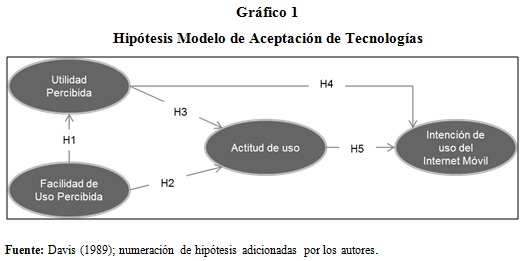
<body><![CDATA[<p> El modelo TAM comprende la ''Utilidad Percibida'' como un antecedente de la  ''Actitud'' y de la ''Intenci&oacute;n de Uso'', mientras que la ''Facilidad de Uso  Percibida'' es antecedente de la ''Actitud'' y de la ''Utilidad Percibida''.  </p>     <p> El modelo TAM ha sido utilizado para explicar el comportamiento de adopci&oacute;n  de m&uacute;ltiples tecnolog&iacute;as en diversos mercados (Davis,  1989; Davis, Bagozzi, &amp; Warshaw, 1985; Ji-Won &amp; Young-Gul, 2001; J. Kim  &amp; Forsythe, 2008; Lee, 2006; Liao, Tsou, &amp; Huang, 2007; Ruiz, Sanz,  &amp; Tavera-Mes&iacute;as, 2010; Ruiz et al., 2010; Venkatesh &amp; Davis, 2000)  y ha sido utilizado expl&iacute;citamente para modelar el comportamiento de adopci&oacute;n  de internet m&oacute;vil en diversos estudios (Cheong  &amp; Park, 2005; Hsu, Lu, &amp; Hsu, 2007; Park, 2006; Pedersen, 2005; Teo  &amp; Pok, 2003), pero la literatura abordada no permiti&oacute; identificar  ninguno que hubiera utilizado el modelo para el caso de la aceptaci&oacute;n del  internet m&oacute;vil en Colombia. </p>     <p><b>&bull; Modelo de  hip&oacute;tesis establecidas</b></p>     <p>La literatura abordada permite suponer que el TAM es un modelo v&aacute;lido para  explicar el comportamiento de aceptaci&oacute;n del IM en Colombia. La Teor&iacute;a de  Aceptaci&oacute;n de Tecnolog&iacute;as permite establecer las siguientes hip&oacute;tesis (ver  <a href="#g1">Gr&aacute;fico 1</a>):</p>     <p>    <b>H1:</b> La Facilidad Percibida de uso influye sobre la  Actitud hacia el Uso del Internet m&oacute;vil.     <br>     <b>H2:</b> La Facilidad Percibida de Uso influye sobre la  Utilidad Percibida del Internet m&oacute;vil.    <br>     <b>H3:</b> La Utilidad Percibida de Uso influye sobre la  Actitud hacia el uso del Internet m&oacute;vil.    <br>     <b>H4:</b> La Utilidad Percibida de Uso influye sobre la  Intenci&oacute;n de adoptar el Internet m&oacute;vil.    <br>     <b>H5:</b> La Actitud hacia el Uso influye sobre la  Intenci&oacute;n de Usar el Internet m&oacute;vil. </p>         <p align="center"><a name="g1"></a><img src="/img/revistas/pece/n19/n19a7g1.jpg"></p>     ]]></body>
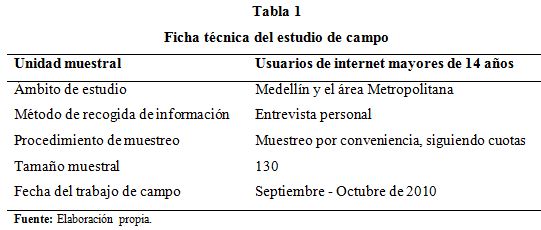
<body><![CDATA[<p align="center">&nbsp;</p>     <p>La contrastaci&oacute;n emp&iacute;rica de este modelo permitir&aacute;  validar el TAM como herramienta de modelaci&oacute;n de la aceptaci&oacute;n del Internet  m&oacute;vil en Colombia, lo que facilitar&aacute; hacia el futuro la proposici&oacute;n de modelos  m&aacute;s extensos basados en el TAM que permitan explicar el creciente fen&oacute;meno de  adopci&oacute;n en nuestro pa&iacute;s y proponer estrategias gerenciales y/o gubernamentales  para incrementar las tasas de penetraci&oacute;n.</p>     <p>&nbsp;</p>     <p><font size="3"><b>II. Metodolog&iacute;a y an&aacute;lisis de datos</b></font></p>     <p>Se elabor&oacute; un estudio (ver <a href="#t1">Tabla 1</a>) con una muestra  de 130 individuos seleccionados por conveniencia y siguiendo cuotas  demogr&aacute;ficas para asegurar una proporci&oacute;n similar en edades y g&eacute;nero a la  existente en el pa&iacute;s (M.-J. Kim, Chung, &amp; Lee, 2011).  El uso de muestras por conveniencia se ha  utilizado en otras ocasiones en el estudio de aceptaci&oacute;n de tecnolog&iacute;as  similares en otros mercados (p. ej. Gefen, Karahanna, &amp; Straub, 2003; Gefen  &amp; Straub, 2004; Jones &amp; Leonard, 2007; Kim, Ferrin, &amp; Rao, 2008;  Liu, Marchewka, Lu, &amp; Yu, 2005; Palvia, 2009).</p>      <p align="center"><a name="t1"></a><img src="/img/revistas/pece/n19/n19a7t1.jpg"></p>     <p align="center">&nbsp;</p>     <p>La <a href="/img/revistas/pece/n19/n19a7t2.jpg" target="_blank">Tabla 2</a> recoge los &iacute;tems que fueron utilizados  en cada escala as&iacute; como la procedencia de los mismos. La selecci&oacute;n de dichos  &iacute;tems fue revisada previamente con expertos, garantizando la validez de  contenido.</p>     <p>Se verific&oacute; la fiabilidad y validez mediante un  An&aacute;lisis Factorial Confirmatorio utilizando el m&eacute;todo de m&aacute;xima verosimilitud  robusto, ideal para muestras con cierta anormalidad en los datos (Joreskog  &amp; Sorbom, 1990).</p>     <p> En el estudio de la validez convergente se verific&oacute;  que todas las cargas factoriales estandarizadas de los indicadores fueran  superiores a 0,6 (Bagozzi &amp; Yi, 1988), que el promedio de cargas  factoriales estandarizadas fuera superior a 0,7, que el test de multiplicadores  de Lagrange no propusiera relaciones adicionales a las planteadas (Hatcher,  1994) y que hubiera un buen ajuste del modelo. El proceso exigi&oacute; la depuraci&oacute;n  de los &iacute;tems A3 y A4, tras lo que fue posible garantizar las condiciones  anteriores con un buen ajuste del modelo, tal como lo evidencia la <a href="/img/revistas/pece/n19/n19a7t3.jpg" target="_blank">Tabla 3</a>.    ]]></body>
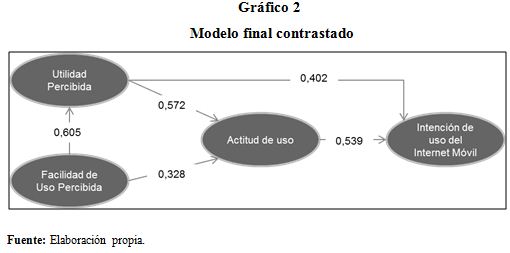
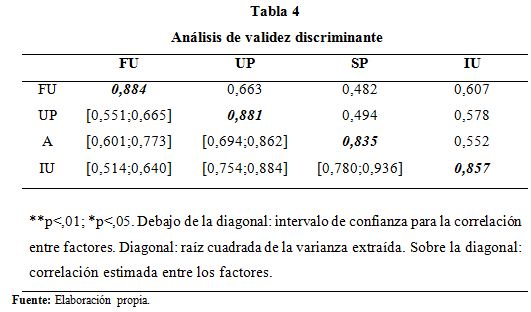
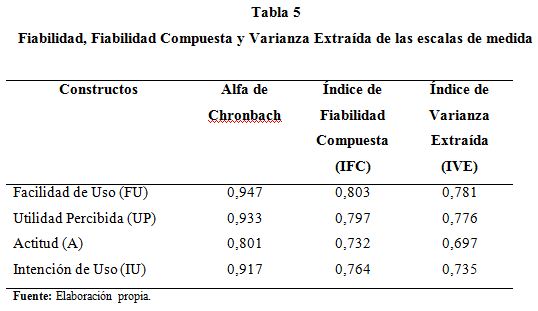
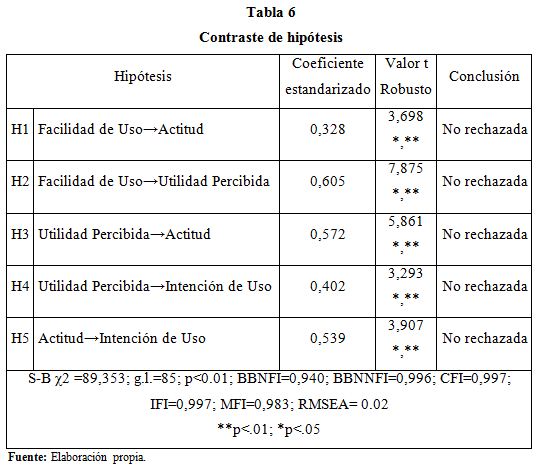
<body><![CDATA[<br> </p>     <p>Se procedi&oacute; a verificar la validez discriminante (ver <a href="#t4">tabla 4</a>) evidenciando  que el valor 1 no estuviera contenido en el intervalo de confianza de las  correlaciones entre las diferentes escalas (Anderson  &amp; Gerbing, 1988), y que el &Iacute;ndice de Varianza Extra&iacute;da &#8211; IVE de cada  constructo sobrepasara el cuadrado de las covarianzas entre cada par de  factores (Fornell &amp; Larcker, 1981). </p>     <p align="center"><a name="t4"></a><img src="/img/revistas/pece/n19/n19a7t4.jpg"></p>     <p align="center">&nbsp;</p>     <p>Tambi&eacute;n se evidenci&oacute; la fiabilidad del instrumento mediante el c&aacute;lculo del  Alfa de Cronbach para cada escala de cada constructo (<a href="#t5">Tabla 5</a>), evidenciando que fuera  superior a 0,7 (Churchill Jr, 1979; Nunnally  &amp; Bernstein, 1994). A su vez, se procedi&oacute; al c&aacute;lculo del &Iacute;ndice de  Fiabilidad Compuesta (IFC) y el &Iacute;ndice de Varianza Extra&iacute;da (IVE), logr&aacute;ndose  superar los l&iacute;mites de sugeridos de 0,7 y 0,5 respectivamente, para todos los  casos (Fornell &amp; Larcker, 1981).</p>     <p align="center"><a name="t5"></a><img src="/img/revistas/pece/n19/n19a7t5.jpg"></p>     <p align="center">&nbsp;</p>     <p>Una vez garantizadas la fiabilidad y la validez del  instrumento de medida, se procedi&oacute; a contrastar las hip&oacute;tesis mediante  ecuaciones estructurales. La utilizaci&oacute;n del m&eacute;todo de m&aacute;xima verosimilitud  robusto condujo a buenos indicadores de ajuste y al no rechazo de todas las  hip&oacute;tesis planteadas, tal como lo evidencia la <a href="#t6">tabla 6</a> y lo ilustra el <a href="#g2">gr&aacute;fico  2</a>.</p>     <p align="center"><a name="t6"></a><img src="/img/revistas/pece/n19/n19a7t6.jpg"></p>     <p align="center">&nbsp;</p>     ]]></body>
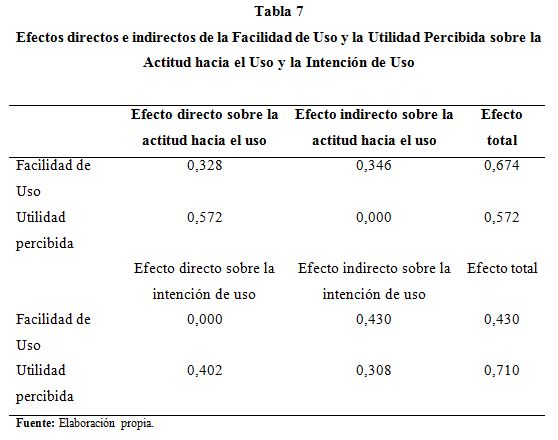
<body><![CDATA[<p align="center"><a name="g2"></a><img src="/img/revistas/pece/n19/n19a7g2.jpg"></p>     <p align="center">&nbsp;</p>     <p>Los resultados obtenidos validan la utilizaci&oacute;n del  TAM para la modelaci&oacute;n del fen&oacute;meno de aceptaci&oacute;n del Internet m&oacute;vil en  Colombia, lo que permite que el mismo se pueda constituir en un punto de  partida para el estudio de las razones que anteceden la intenci&oacute;n de uso del  Internet m&oacute;vil en nuestro pa&iacute;s.</p>     <p> El <a href="#g2">gr&aacute;fico 2</a> permite visualizar los resultados del  contraste emp&iacute;rico del modelo, evidenciando de forma exploratoria, que en el  caso colombiano, la actitud se constituye en el antecedente directo de mayor  relevancia para la intenci&oacute;n de uso del internet m&oacute;vil. A su vez, al sumar los  efectos directos e indirectos, es la Facilidad de Uso el constructo con mayor  influencia sobre la Actitud hacia el Uso, y la utilidad percibida quien posee  un mayor efecto total sobre la Intenci&oacute;n de Uso el Internet m&oacute;vil en Colombia,  tal como lo evidencia la <a href="#t7">tabla 7</a>.</p>     <p align="center"><a name="t7"></a><img src="/img/revistas/pece/n19/n19a7t7.jpg"></p>     <p>&nbsp;</p>     <p><font size="3"><b>Conclusiones</b></font></p>     <p> Tras realizar el estudio descriptivo de alcance  exploratorio, se puede concluir que el modelo TAM es una opci&oacute;n adecuada para  estudios de tipo conclusivo que pretendan dar explicaci&oacute;n a la adopci&oacute;n de los  consumidores del Internet m&oacute;vil en Colombia. Todas las hip&oacute;tesis planteadas en  el modelo fueron soportadas emp&iacute;ricamente para la muestra con buenos  indicadores de bondad de ajuste  y cargas  factoriales significativas, tal como en los estudios originales de Davis (Davis, 1989; Davis et al., 1989).</p>     <p> Al analizar el modelo en el caso colombiano, se  evidencia que la Facilidad de Uso se constituye como el principal antecedente  de la Actitud hacia el Uso del Internet m&oacute;vil en Colombia, lo que llama a la  necesidad de que las empresas de telecomunicaciones utilicen campa&ntilde;as de  comunicaci&oacute;n que refuercen dicho concepto y evidencien el poco esfuerzo  necesario para la utilizaci&oacute;n de dicha tecnolog&iacute;a.</p>     <p> Por su parte, la utilidad percibida fue  identificada como el mayor antecedente de la Intenci&oacute;n de Usar Internet m&oacute;vil,  lo que implica que en miras al comportamiento de adopci&oacute;n, la percepci&oacute;n de un  mejor desempe&ntilde;o del Internet m&oacute;vil sobre el internet tradicional debe  reforzarse en la b&uacute;squeda de mayores tasas de penetraci&oacute;n que ayuden al cierre  de la brecha digital. </p>     ]]></body>
<body><![CDATA[<p> Hoy, las plataformas tecnol&oacute;gicas del Internet  m&oacute;vil no poseen en la actualidad la capacidad de igualar la velocidad y  capacidad de subida y descarga de datos de las redes fijas de banda ancha. Sin  embargo, el Internet m&oacute;vil favorece el desempe&ntilde;o dadas las caracter&iacute;sticas de  los dispositivos m&oacute;viles tales como la ubicuidad, la interactividad, la  socializaci&oacute;n y el acceso a contenidos especializados para dispositivos m&oacute;viles  (Bauer, Reichardt, Barnes, &amp; Neumann, 2005;  Bruner II &amp; Kumar, 2007; Okazaki, 2007; Okazaki, Katsukura, &amp;  Nishiyama, 2007; Tsang, Ho, &amp; Liang, 2004). El favorecer la utilidad  percibida implica que la comunicaci&oacute;n de marketing empresarial debe hacer  hincapi&eacute; en dichas caracter&iacute;sticas que pueden acrecentar la percepci&oacute;n de un  mejor rendimiento frente al Internet tradicional.</p>     <p> El papel del gobierno es vital para la difusi&oacute;n de  la tecnolog&iacute;a y sus pol&iacute;ticas deber&iacute;an favorecer la competencia entre  operadores del servicio con miras a reducir los costos de acceso y utilizaci&oacute;n  del IM para los consumidores. Lo anterior conllevar&aacute; a que el acceso a Internet  mediante los dispositivos m&oacute;viles tenga ventaja significativa para los  usuarios. </p>     <p> Las consecuencias de pol&iacute;ticas que favorezcan la  competencia, conllevar&aacute; a que la utilidad de usar IM sea percibida como superior  frente a la alternativa de l&iacute;nea fija, favoreciendo la aceptaci&oacute;n de la  tecnolog&iacute;a por parte de los consumidores. Lo anterior, acelerar&aacute; el cierre de  la brecha digital, dado que a diferencia de las l&iacute;neas fijas, la tasa de  penetraci&oacute;n para los tel&eacute;fonos celulares en Colombia alcanza en la actualidad  el 100% (Sandoval, 2012), lo que implica  que el canal de acceso universal a Internet ya est&aacute; desarrollado y s&oacute;lo resta  acrecentar los proceso de difusi&oacute;n y aceptaci&oacute;n de la tecnolog&iacute;a.</p>     <p>&nbsp;</p> <hr noshade size="1">     <p><font size="3"> <b>NOTAS</b></font></p>     <p>       <a href="#_ftnref0" name="_ftn0" title="">*</a> El  presente art&iacute;culo constituye un resultado parcial de la investigaci&oacute;n  ''Aceptaci&oacute;n Tecnol&oacute;gica del Internet M&oacute;vil'' desarrollado por iMARK-Grupo de  Investigaci&oacute;n en Marketing de la Facultad de Ciencias Econ&oacute;micas de la  Universidad de Antioquia. </p> <hr noshade size="1">     <p>&nbsp;</p>     <p><font size="3"> <b>Referencias Bibliogr&aacute;ficas</b></font></p>     <!-- ref --><p> Agar, J. (2003). ''<i>Constant touch: A global  history of the mobile phone''.</i> Cambridge, UK: Icon Books.    &nbsp;&nbsp;&nbsp;&nbsp;&nbsp;&nbsp;&nbsp;&nbsp;[&#160;<a href="javascript:void(0);" onclick="javascript: window.open('/scielo.php?script=sci_nlinks&ref=000101&pid=S1657-4214201200010000700001&lng=','','width=640,height=500,resizable=yes,scrollbars=1,menubar=yes,');">Links</a>&#160;]<!-- end-ref --></p>      ]]></body>
<body><![CDATA[<!-- ref --><p>Ajzen, I. (1991). ''The Theory of Planned Behavior<i>''</i>. <i>Organizational Behavior  and Human Decision Processes, </i>Vol. 50<i>, </i>No. 2, pp. 179-211.    &nbsp;&nbsp;&nbsp;&nbsp;&nbsp;&nbsp;&nbsp;&nbsp;[&#160;<a href="javascript:void(0);" onclick="javascript: window.open('/scielo.php?script=sci_nlinks&ref=000103&pid=S1657-4214201200010000700002&lng=','','width=640,height=500,resizable=yes,scrollbars=1,menubar=yes,');">Links</a>&#160;]<!-- end-ref --> </p>     <!-- ref --><p>Ajzen, I. Y Fishbein, M. (1977). ''Attitude-Behaviour relations: A  theoretical analysis and review of empirical research''. <i>Psychological Bulletin, </i>Vol. 84, No. 5, pp. 888-918.    &nbsp;&nbsp;&nbsp;&nbsp;&nbsp;&nbsp;&nbsp;&nbsp;[&#160;<a href="javascript:void(0);" onclick="javascript: window.open('/scielo.php?script=sci_nlinks&ref=000105&pid=S1657-4214201200010000700003&lng=','','width=640,height=500,resizable=yes,scrollbars=1,menubar=yes,');">Links</a>&#160;]<!-- end-ref --> </p>     <!-- ref --><p>Anderson, J. Y Gerbing, D. (1988). ''Structural equation modeling in practice: A review  and recommended two-step approach''. <i>Psychological  Bulletin, </i>Vol. 103, No. 3, pp. 411-423.    &nbsp;&nbsp;&nbsp;&nbsp;&nbsp;&nbsp;&nbsp;&nbsp;[&#160;<a href="javascript:void(0);" onclick="javascript: window.open('/scielo.php?script=sci_nlinks&ref=000107&pid=S1657-4214201200010000700004&lng=','','width=640,height=500,resizable=yes,scrollbars=1,menubar=yes,');">Links</a>&#160;]<!-- end-ref --> </p>     <!-- ref --><p>Bagozzi, R. Y Yi, Y. (1988). ''On the evaluation of structural equation models''. <i>Journal of Academy of Marketing Science, </i>Vol.  16, No. 1, pp. 74-94.    &nbsp;&nbsp;&nbsp;&nbsp;&nbsp;&nbsp;&nbsp;&nbsp;[&#160;<a href="javascript:void(0);" onclick="javascript: window.open('/scielo.php?script=sci_nlinks&ref=000109&pid=S1657-4214201200010000700005&lng=','','width=640,height=500,resizable=yes,scrollbars=1,menubar=yes,');">Links</a>&#160;]<!-- end-ref --> </p>     <!-- ref --><p>Bauer, H., Reichardt, T., Barnes, S. Y Neumann, M. (2005). ''Driving consumer acceptance of mobile marketing: a  theoretical framework and empirical study''. <i>Journal  of Electronic Commerce Research, </i>Vol. 6, No. 3, pp 181.    &nbsp;&nbsp;&nbsp;&nbsp;&nbsp;&nbsp;&nbsp;&nbsp;[&#160;<a href="javascript:void(0);" onclick="javascript: window.open('/scielo.php?script=sci_nlinks&ref=000111&pid=S1657-4214201200010000700006&lng=','','width=640,height=500,resizable=yes,scrollbars=1,menubar=yes,');">Links</a>&#160;]<!-- end-ref --> </p>     ]]></body>
<body><![CDATA[<!-- ref --><p>Bhattacherjee, A. (2001). ''An  empirical analysis of the antecedents of electronic commerce service  continuance''.  <i>Decision support systems, </i>Vol. 32, No. 2, pp.  201-214.    &nbsp;&nbsp;&nbsp;&nbsp;&nbsp;&nbsp;&nbsp;&nbsp;[&#160;<a href="javascript:void(0);" onclick="javascript: window.open('/scielo.php?script=sci_nlinks&ref=000113&pid=S1657-4214201200010000700007&lng=','','width=640,height=500,resizable=yes,scrollbars=1,menubar=yes,');">Links</a>&#160;]<!-- end-ref --> </p>     <!-- ref --><p>Bruner II, G. Y Kumar, A. (2007). ''Attitude toward Location-Based Advertising''. <i>Journal of Interactive Advertising, </i>Vol  7, No. 2, pp. 1-15.    &nbsp;&nbsp;&nbsp;&nbsp;&nbsp;&nbsp;&nbsp;&nbsp;[&#160;<a href="javascript:void(0);" onclick="javascript: window.open('/scielo.php?script=sci_nlinks&ref=000115&pid=S1657-4214201200010000700008&lng=','','width=640,height=500,resizable=yes,scrollbars=1,menubar=yes,');">Links</a>&#160;]<!-- end-ref --> </p>     <!-- ref --><p>Cheong, J. Y Park, M. (2005). ''Mobile internet acceptance in Korea''. <i>Internet Research,</i>Vol.15, No. 2, pp. 125.    &nbsp;&nbsp;&nbsp;&nbsp;&nbsp;&nbsp;&nbsp;&nbsp;[&#160;<a href="javascript:void(0);" onclick="javascript: window.open('/scielo.php?script=sci_nlinks&ref=000117&pid=S1657-4214201200010000700009&lng=','','width=640,height=500,resizable=yes,scrollbars=1,menubar=yes,');">Links</a>&#160;]<!-- end-ref --> </p>     <!-- ref --><p>Chigona, W., Vally, J., Beukes, D., Y Tanner, M. (2009). ''Can mobile internet help alleviate social  exclusion in developing countries''. <i>EJISDC</i> <i>, </i>Vol. 36, No. 7, pp.1-16.    &nbsp;&nbsp;&nbsp;&nbsp;&nbsp;&nbsp;&nbsp;&nbsp;[&#160;<a href="javascript:void(0);" onclick="javascript: window.open('/scielo.php?script=sci_nlinks&ref=000119&pid=S1657-4214201200010000700010&lng=','','width=640,height=500,resizable=yes,scrollbars=1,menubar=yes,');">Links</a>&#160;]<!-- end-ref --></p>     <!-- ref --><p> Churchill, G. (1979). ''A paradigm for developing  better measures of marketing constructs''. <i>Journal  of Marketing Research</i>, pp. 64-73.    &nbsp;&nbsp;&nbsp;&nbsp;&nbsp;&nbsp;&nbsp;&nbsp;[&#160;<a href="javascript:void(0);" onclick="javascript: window.open('/scielo.php?script=sci_nlinks&ref=000121&pid=S1657-4214201200010000700011&lng=','','width=640,height=500,resizable=yes,scrollbars=1,menubar=yes,');">Links</a>&#160;]<!-- end-ref --> </p>     ]]></body>
<body><![CDATA[<!-- ref --><p>Davis, F. (1989). ''Perceived usefulness, perceived ease of use, and  user acceptance of information technologies''. <i>MIS Quarterly, </i>Vol. 13, No. 3, pp. 21.    &nbsp;&nbsp;&nbsp;&nbsp;&nbsp;&nbsp;&nbsp;&nbsp;[&#160;<a href="javascript:void(0);" onclick="javascript: window.open('/scielo.php?script=sci_nlinks&ref=000123&pid=S1657-4214201200010000700012&lng=','','width=640,height=500,resizable=yes,scrollbars=1,menubar=yes,');">Links</a>&#160;]<!-- end-ref --> </p>     <!-- ref --><p>Davis, F., Bagozzi, R., Y Warshaw, P. (1985). ''Intrinsec and extrinsec motivation to use computers  in the workplace''. <i>Journal of Applied  Social Psychology, </i>Vol. 22, pp. 1111-1132.    &nbsp;&nbsp;&nbsp;&nbsp;&nbsp;&nbsp;&nbsp;&nbsp;[&#160;<a href="javascript:void(0);" onclick="javascript: window.open('/scielo.php?script=sci_nlinks&ref=000125&pid=S1657-4214201200010000700013&lng=','','width=640,height=500,resizable=yes,scrollbars=1,menubar=yes,');">Links</a>&#160;]<!-- end-ref --> </p>     <!-- ref --><p>Davis, F., Bagozzi, R., Y Warshaw, P. (1989). ''User Acceptance of Computer Technology: A  comparisson of two theoretical models''. <i>Management  Science, </i>Vol. 35, No. 8, pp. 982.    &nbsp;&nbsp;&nbsp;&nbsp;&nbsp;&nbsp;&nbsp;&nbsp;[&#160;<a href="javascript:void(0);" onclick="javascript: window.open('/scielo.php?script=sci_nlinks&ref=000127&pid=S1657-4214201200010000700014&lng=','','width=640,height=500,resizable=yes,scrollbars=1,menubar=yes,');">Links</a>&#160;]<!-- end-ref --> </p>     <!-- ref --><p>Donner, J. (2008). ''Research Approaches to Mobile Use in the Developing  World: A Review of the Literature''. <i>The Information Society</i> <i>, </i>Vol. 24, No. 3, pp. 140-159.    &nbsp;&nbsp;&nbsp;&nbsp;&nbsp;&nbsp;&nbsp;&nbsp;[&#160;<a href="javascript:void(0);" onclick="javascript: window.open('/scielo.php?script=sci_nlinks&ref=000129&pid=S1657-4214201200010000700015&lng=','','width=640,height=500,resizable=yes,scrollbars=1,menubar=yes,');">Links</a>&#160;]<!-- end-ref --></p>     <!-- ref --><p>Fishbein, M. Y Ajzen, I. (1975). <i>Belief,  attitude, intention, and behavior: An introduction to theory and research</i>:  Addison-Wesley.    &nbsp;&nbsp;&nbsp;&nbsp;&nbsp;&nbsp;&nbsp;&nbsp;[&#160;<a href="javascript:void(0);" onclick="javascript: window.open('/scielo.php?script=sci_nlinks&ref=000131&pid=S1657-4214201200010000700016&lng=','','width=640,height=500,resizable=yes,scrollbars=1,menubar=yes,');">Links</a>&#160;]<!-- end-ref --> </p>     ]]></body>
<body><![CDATA[<!-- ref --><p>Fornell, C. Y Larcker, D. (1981). ''Evaluating structural equation models with  unobservable variables and measurement error''. <i>Journal of Marketing Research, </i>Vol. 18, No. 1, pp. 39-50.    &nbsp;&nbsp;&nbsp;&nbsp;&nbsp;&nbsp;&nbsp;&nbsp;[&#160;<a href="javascript:void(0);" onclick="javascript: window.open('/scielo.php?script=sci_nlinks&ref=000133&pid=S1657-4214201200010000700017&lng=','','width=640,height=500,resizable=yes,scrollbars=1,menubar=yes,');">Links</a>&#160;]<!-- end-ref --> </p>     <!-- ref --><p>Funk, J. (2011). ''Standards, critical mass, and the formation of  complex industries: A case study of the mobile Internet''. <i>Journal of  Engineering and Technology Management</i> <i>, </i>Vol. 28, No. 1, pp. 232-248.    &nbsp;&nbsp;&nbsp;&nbsp;&nbsp;&nbsp;&nbsp;&nbsp;[&#160;<a href="javascript:void(0);" onclick="javascript: window.open('/scielo.php?script=sci_nlinks&ref=000135&pid=S1657-4214201200010000700018&lng=','','width=640,height=500,resizable=yes,scrollbars=1,menubar=yes,');">Links</a>&#160;]<!-- end-ref --></p>     <!-- ref --><p>Gamboa, L. Y Otero, J. (2009). ''An estimation of the pattern of diffusion of mobile  phones: The case of Colombia''. <i>Telecommunications Policy</i> <i>, </i>Vol. 33, No. 11, pp. 611-620.    &nbsp;&nbsp;&nbsp;&nbsp;&nbsp;&nbsp;&nbsp;&nbsp;[&#160;<a href="javascript:void(0);" onclick="javascript: window.open('/scielo.php?script=sci_nlinks&ref=000137&pid=S1657-4214201200010000700019&lng=','','width=640,height=500,resizable=yes,scrollbars=1,menubar=yes,');">Links</a>&#160;]<!-- end-ref --></p>     <!-- ref --><p> Gefen, D., Karahanna, E. Y Straub, D. (2003). ''Inexperience and experience with online stores: The  importance of TAM and trust''. <i>IEEE  Transactions on Engineering Management, </i>Vol. 50, No. 3, pp. 307-322.    &nbsp;&nbsp;&nbsp;&nbsp;&nbsp;&nbsp;&nbsp;&nbsp;[&#160;<a href="javascript:void(0);" onclick="javascript: window.open('/scielo.php?script=sci_nlinks&ref=000139&pid=S1657-4214201200010000700020&lng=','','width=640,height=500,resizable=yes,scrollbars=1,menubar=yes,');">Links</a>&#160;]<!-- end-ref --> </p>     <!-- ref --><p>Gefen, D. Y Straub, D. (2004). ''Consumer trust in B2C e-Commerce and the importance  of social presence: experiments in e-Products and e-Services''. <i>Omega, </i>Vol. 32, No. 3, pp. 407-424.    &nbsp;&nbsp;&nbsp;&nbsp;&nbsp;&nbsp;&nbsp;&nbsp;[&#160;<a href="javascript:void(0);" onclick="javascript: window.open('/scielo.php?script=sci_nlinks&ref=000141&pid=S1657-4214201200010000700021&lng=','','width=640,height=500,resizable=yes,scrollbars=1,menubar=yes,');">Links</a>&#160;]<!-- end-ref --> </p>     ]]></body>
<body><![CDATA[<!-- ref --><p>George, J. (2004). ''The theory of planned  behavior and Internet purchasing''. <i>Internet  research, </i>Vol. 14, No. 3, pp. 198-212.    &nbsp;&nbsp;&nbsp;&nbsp;&nbsp;&nbsp;&nbsp;&nbsp;[&#160;<a href="javascript:void(0);" onclick="javascript: window.open('/scielo.php?script=sci_nlinks&ref=000143&pid=S1657-4214201200010000700022&lng=','','width=640,height=500,resizable=yes,scrollbars=1,menubar=yes,');">Links</a>&#160;]<!-- end-ref --> </p>     <!-- ref --><p>Gerpott, T., Thomas, S. Y Weichert, M. (2012). ''Characteristics and mobile Internet use  intensity of consumers with different types of advanced handsets: An  exploratory empirical study of iPhone, Android and other web-enabled mobile  users in Germany''. <i>Telecommunications Policy</i> .    &nbsp;&nbsp;&nbsp;&nbsp;&nbsp;&nbsp;&nbsp;&nbsp;[&#160;<a href="javascript:void(0);" onclick="javascript: window.open('/scielo.php?script=sci_nlinks&ref=000145&pid=S1657-4214201200010000700023&lng=','','width=640,height=500,resizable=yes,scrollbars=1,menubar=yes,');">Links</a>&#160;]<!-- end-ref --></p>     <!-- ref --><p>Hatcher, L. (1994). <i>A step-by-step approach to using the SAS system for factor analysis and  structural equation modeling</i>: SAS Publishing.    &nbsp;&nbsp;&nbsp;&nbsp;&nbsp;&nbsp;&nbsp;&nbsp;[&#160;<a href="javascript:void(0);" onclick="javascript: window.open('/scielo.php?script=sci_nlinks&ref=000147&pid=S1657-4214201200010000700024&lng=','','width=640,height=500,resizable=yes,scrollbars=1,menubar=yes,');">Links</a>&#160;]<!-- end-ref --> </p>     <!-- ref --><p>Herrera, M. (2012). <i>Difusi&oacute;n de la Telefon&iacute;a M&oacute;vil en Colombia, Tesis  de Maestr&iacute;a.</i> Recuperado el 12 de agosto de 2012, de <a href="http://repository.urosario.edu.co/bitstream/10336/2896/1/1014185313-2012.pdf">http://repository.urosario.edu.co/bitstream/10336/2896/1/1014185313-2012.pdf</a> &nbsp;&nbsp;&nbsp;&nbsp;&nbsp;&nbsp;&nbsp;&nbsp;[&#160;<a href="javascript:void(0);" onclick="javascript: window.open('/scielo.php?script=sci_nlinks&ref=000149&pid=S1657-4214201200010000700025&lng=','','width=640,height=500,resizable=yes,scrollbars=1,menubar=yes,');">Links</a>&#160;]<!-- end-ref --><!-- ref --><p>Hong, S., Thong, J. Y Tam, K. (2006). ''Understanding continued  information technology usage behavior: A comparison of three models in the  context of mobile internet''. <i>Decision Support Systems</i> <i>, </i>Vol. 42, No. 3, pp. 1819-1834.    &nbsp;&nbsp;&nbsp;&nbsp;&nbsp;&nbsp;&nbsp;&nbsp;[&#160;<a href="javascript:void(0);" onclick="javascript: window.open('/scielo.php?script=sci_nlinks&ref=000150&pid=S1657-4214201200010000700026&lng=','','width=640,height=500,resizable=yes,scrollbars=1,menubar=yes,');">Links</a>&#160;]<!-- end-ref --></p>     <!-- ref --><p>Hsu, C., Lu, H., Y Hsu, H. (2007). ''Adoption of the mobile Internet: An empirical study  of multimedia message service (MMS)''. <i>Omega, </i>Vol. 35, No. 6, pp. 715.    &nbsp;&nbsp;&nbsp;&nbsp;&nbsp;&nbsp;&nbsp;&nbsp;[&#160;<a href="javascript:void(0);" onclick="javascript: window.open('/scielo.php?script=sci_nlinks&ref=000152&pid=S1657-4214201200010000700027&lng=','','width=640,height=500,resizable=yes,scrollbars=1,menubar=yes,');">Links</a>&#160;]<!-- end-ref --> </p>     <!-- ref --><p>Idowu, B., Ogunbodede, E. Y Idowu, B. (2003). ''Information and communication technology in Nigeria: The  health sector experience''. <i>Journal of Information Technology Impact</i> <i>, </i>Vol. 3, No. 2, pp. 69-76.    &nbsp;&nbsp;&nbsp;&nbsp;&nbsp;&nbsp;&nbsp;&nbsp;[&#160;<a href="javascript:void(0);" onclick="javascript: window.open('/scielo.php?script=sci_nlinks&ref=000154&pid=S1657-4214201200010000700028&lng=','','width=640,height=500,resizable=yes,scrollbars=1,menubar=yes,');">Links</a>&#160;]<!-- end-ref --></p>     <!-- ref --><p>IMD. (junio  de 2012). <i>World Competitiveness Yearbook 2012.</i> Recuperado el 12 de agosto de 2012,  de <a href="http://www.imd.org/research/publications/wcy/World-Competitiveness-Yearbook-Results/#/" target="_blank">http://www.imd.org/research/publications/wcy/World-Competitiveness-Yearbook-Results/#/</a>&nbsp;&nbsp;&nbsp;&nbsp;&nbsp;&nbsp;&nbsp;&nbsp;[&#160;<a href="javascript:void(0);" onclick="javascript: window.open('/scielo.php?script=sci_nlinks&ref=000156&pid=S1657-4214201200010000700029&lng=','','width=640,height=500,resizable=yes,scrollbars=1,menubar=yes,');">Links</a>&#160;]<!-- end-ref --><!-- ref --><p>ITU. (junio de 2012). <i>World  Telecommunication/ICT Indicators Database Online 2012, 16th Edition.</i> Recuperado el 12 de agosto de 2012, de <a href="http://www.itu.int/ITU-D/ict/publications/world/world.html" target="_blank">http://www.itu.int/ITU-D/ict/publications/world/world.html </a> &nbsp;&nbsp;&nbsp;&nbsp;&nbsp;&nbsp;&nbsp;&nbsp;[&#160;<a href="javascript:void(0);" onclick="javascript: window.open('/scielo.php?script=sci_nlinks&ref=000157&pid=S1657-4214201200010000700030&lng=','','width=640,height=500,resizable=yes,scrollbars=1,menubar=yes,');">Links</a>&#160;]<!-- end-ref --><!-- ref --><p>Jeffrey, J. Y Versteeg, M. (2007). ''Mobile phones in Africa: How much do  we really know?'' . <i>Social Indicators Research</i> <i>, </i>Vol 84, No. 1, pp. 117-126.    &nbsp;&nbsp;&nbsp;&nbsp;&nbsp;&nbsp;&nbsp;&nbsp;[&#160;<a href="javascript:void(0);" onclick="javascript: window.open('/scielo.php?script=sci_nlinks&ref=000158&pid=S1657-4214201200010000700031&lng=','','width=640,height=500,resizable=yes,scrollbars=1,menubar=yes,');">Links</a>&#160;]<!-- end-ref --></p>     <!-- ref --><p>Ji-Won, M. Y Young-Gul, K. (2001). ''Extending the TAM for a World-Wide-Web context''. <i>Information &amp; Management, </i>Vol. 38,  No 4, pp. 217.    &nbsp;&nbsp;&nbsp;&nbsp;&nbsp;&nbsp;&nbsp;&nbsp;[&#160;<a href="javascript:void(0);" onclick="javascript: window.open('/scielo.php?script=sci_nlinks&ref=000160&pid=S1657-4214201200010000700032&lng=','','width=640,height=500,resizable=yes,scrollbars=1,menubar=yes,');">Links</a>&#160;]<!-- end-ref --> </p>     <!-- ref --><p>Jones, K. YLeonard, L. (2007). ''Consumer-to-Consumer Electronic Commerce: A  Distinct Research Stream''. <i>Journal of  Electronic Commerce in Organizations, </i>Vol. 5, No. 4, pp. 39.    &nbsp;&nbsp;&nbsp;&nbsp;&nbsp;&nbsp;&nbsp;&nbsp;[&#160;<a href="javascript:void(0);" onclick="javascript: window.open('/scielo.php?script=sci_nlinks&ref=000162&pid=S1657-4214201200010000700033&lng=','','width=640,height=500,resizable=yes,scrollbars=1,menubar=yes,');">Links</a>&#160;]<!-- end-ref --> </p>     <!-- ref --><p>Joreskog, K. Y Sorbom, D. (1990). <i>LISREL 7. A  guide to program and application</i>. Michigan: SPSS.    &nbsp;&nbsp;&nbsp;&nbsp;&nbsp;&nbsp;&nbsp;&nbsp;[&#160;<a href="javascript:void(0);" onclick="javascript: window.open('/scielo.php?script=sci_nlinks&ref=000164&pid=S1657-4214201200010000700034&lng=','','width=640,height=500,resizable=yes,scrollbars=1,menubar=yes,');">Links</a>&#160;]<!-- end-ref --> </p>     <!-- ref --><p> Kim, D., Ferrin, D. y Rao, H. (2008). ''A trust-based consumer decision-making model in  electronic commerce: The role of trust, perceived risk, and their antecedents''. <i>Decision Support Systems, </i>Vol. 44,  No. 2, pp, 544-564. doi: 10.1016/j.dss.2007.07.001 &nbsp;&nbsp;&nbsp;&nbsp;&nbsp;&nbsp;&nbsp;&nbsp;[&#160;<a href="javascript:void(0);" onclick="javascript: window.open('/scielo.php?script=sci_nlinks&ref=000166&pid=S1657-4214201200010000700035&lng=','','width=640,height=500,resizable=yes,scrollbars=1,menubar=yes,');">Links</a>&#160;]<!-- end-ref --><!-- ref --><p>Kim, J. Y Forsythe, S. (2008). ''Sensory enabling technology acceptance model  (SE-TAM): A multiple-group structural model comparison''. <i>Psychology &amp; Marketing, </i>Vol. 25, No. 9, pp. 901.    &nbsp;&nbsp;&nbsp;&nbsp;&nbsp;&nbsp;&nbsp;&nbsp;[&#160;<a href="javascript:void(0);" onclick="javascript: window.open('/scielo.php?script=sci_nlinks&ref=000167&pid=S1657-4214201200010000700036&lng=','','width=640,height=500,resizable=yes,scrollbars=1,menubar=yes,');">Links</a>&#160;]<!-- end-ref --> </p>     <!-- ref --><p>Kim, M., Chung, N. Y Lee, C. (2011). ''The effect of perceived trust on electronic  commerce: Shopping online for tourism products and services in South Korea''. <i>Tourism Management, </i>Vol.32, No. 2, pp, 256-265.  doi: 10.1016/j.tourman.2010.01.011 &nbsp;&nbsp;&nbsp;&nbsp;&nbsp;&nbsp;&nbsp;&nbsp;[&#160;<a href="javascript:void(0);" onclick="javascript: window.open('/scielo.php?script=sci_nlinks&ref=000169&pid=S1657-4214201200010000700037&lng=','','width=640,height=500,resizable=yes,scrollbars=1,menubar=yes,');">Links</a>&#160;]<!-- end-ref --><!-- ref --><p>King, W. Y He, J. (2006). ''A meta-analysis of the technology acceptance model''. <i>Information &amp; Management, </i>Vol.  43, pp. 16.    &nbsp;&nbsp;&nbsp;&nbsp;&nbsp;&nbsp;&nbsp;&nbsp;[&#160;<a href="javascript:void(0);" onclick="javascript: window.open('/scielo.php?script=sci_nlinks&ref=000170&pid=S1657-4214201200010000700038&lng=','','width=640,height=500,resizable=yes,scrollbars=1,menubar=yes,');">Links</a>&#160;]<!-- end-ref --> </p>     <!-- ref --><p>Lee, Y. (2006). ''An empirical investigation into factors influencing  the adoption of an e-learning system''. <i>Online  Information Review, </i>Vol. 30, No. 5, pp. 517.    &nbsp;&nbsp;&nbsp;&nbsp;&nbsp;&nbsp;&nbsp;&nbsp;[&#160;<a href="javascript:void(0);" onclick="javascript: window.open('/scielo.php?script=sci_nlinks&ref=000172&pid=S1657-4214201200010000700039&lng=','','width=640,height=500,resizable=yes,scrollbars=1,menubar=yes,');">Links</a>&#160;]<!-- end-ref --> </p>     <!-- ref --><p>Liao, C., Tsou, C Y Huang, M. (2007). ''Factors influencing the usage of 3G mobile  services in Taiwan''. <i>Online Information  Review, </i>Vol. 31, No. 6, pp. 759.    &nbsp;&nbsp;&nbsp;&nbsp;&nbsp;&nbsp;&nbsp;&nbsp;[&#160;<a href="javascript:void(0);" onclick="javascript: window.open('/scielo.php?script=sci_nlinks&ref=000174&pid=S1657-4214201200010000700040&lng=','','width=640,height=500,resizable=yes,scrollbars=1,menubar=yes,');">Links</a>&#160;]<!-- end-ref --> </p>     <!-- ref --><p>Liu, C., Marchewka, J., Lu, J. Y Yu, C. (2005). ''Beyond concern - a privacy-trust-behavioral intention  model of electronic commerce''. <i>Information  &amp; Management, </i>Vol. 42, No. 2, pp. 289-304.    &nbsp;&nbsp;&nbsp;&nbsp;&nbsp;&nbsp;&nbsp;&nbsp;[&#160;<a href="javascript:void(0);" onclick="javascript: window.open('/scielo.php?script=sci_nlinks&ref=000176&pid=S1657-4214201200010000700041&lng=','','width=640,height=500,resizable=yes,scrollbars=1,menubar=yes,');">Links</a>&#160;]<!-- end-ref --> </p>     <!-- ref --><p>Mbarika, V. (2002). ''Re-thinking information and communications  technology policy focus on internet versus teledensity diffusion for africa's  least developed countries''. <i>Electronic Journal on Information Systems in  Developing Countries</i> <i>, </i>Vol.  9, No. 1, pp. 1-13.    &nbsp;&nbsp;&nbsp;&nbsp;&nbsp;&nbsp;&nbsp;&nbsp;[&#160;<a href="javascript:void(0);" onclick="javascript: window.open('/scielo.php?script=sci_nlinks&ref=000178&pid=S1657-4214201200010000700042&lng=','','width=640,height=500,resizable=yes,scrollbars=1,menubar=yes,');">Links</a>&#160;]<!-- end-ref --></p>     <!-- ref --><p>MINTIC.  (mayo de 2012). <i>Bolet&iacute;n Trimestral de las TIC, Banda Ancha Vive Digital,  Cifras Primer Semestre de 2012.</i> Recuperado el  12 de agosto de 2012, de <a href="http://www.mintic.gov.co/images/documentos/cifras_del_sector/informe_2012_1t_vive_digital.v1.rar" target="_blank">http://www.mintic.gov.co/images/documentos/cifras_del_sector/informe_2012_1t_vive_digital.v1.rar</a>&nbsp;&nbsp;&nbsp;&nbsp;&nbsp;&nbsp;&nbsp;&nbsp;[&#160;<a href="javascript:void(0);" onclick="javascript: window.open('/scielo.php?script=sci_nlinks&ref=000180&pid=S1657-4214201200010000700043&lng=','','width=640,height=500,resizable=yes,scrollbars=1,menubar=yes,');">Links</a>&#160;]<!-- end-ref --><!-- ref --><p>Nunnally, J. Y Bernstein, I. (1994). <i>Psychometric  Theory</i> (3a ed.). New York: McGraw-Hill.    &nbsp;&nbsp;&nbsp;&nbsp;&nbsp;&nbsp;&nbsp;&nbsp;[&#160;<a href="javascript:void(0);" onclick="javascript: window.open('/scielo.php?script=sci_nlinks&ref=000181&pid=S1657-4214201200010000700044&lng=','','width=640,height=500,resizable=yes,scrollbars=1,menubar=yes,');">Links</a>&#160;]<!-- end-ref --> </p>     ]]></body>
<body><![CDATA[<!-- ref --><p>Nysveen, H., Pedersen, P. Y Thorbj&oslash;rnsen, H. (2005). ''Intentions to Use Mobile Services: Antecedents and  Cross-Service Comparisons''. <i>Academy of  Marketing Science. Journal, </i>Vol. 33, No. 3, pp. 330.    &nbsp;&nbsp;&nbsp;&nbsp;&nbsp;&nbsp;&nbsp;&nbsp;[&#160;<a href="javascript:void(0);" onclick="javascript: window.open('/scielo.php?script=sci_nlinks&ref=000183&pid=S1657-4214201200010000700045&lng=','','width=640,height=500,resizable=yes,scrollbars=1,menubar=yes,');">Links</a>&#160;]<!-- end-ref --> </p>     <!-- ref --><p>Okazaki, S. (2007). ''Lessons learned from i-mode: What makes consumers  click wireless banner ads?''. <i>Computers in  Human Behavior, </i>Vol. 23, No. 3, pp. 1692-1719.    &nbsp;&nbsp;&nbsp;&nbsp;&nbsp;&nbsp;&nbsp;&nbsp;[&#160;<a href="javascript:void(0);" onclick="javascript: window.open('/scielo.php?script=sci_nlinks&ref=000185&pid=S1657-4214201200010000700046&lng=','','width=640,height=500,resizable=yes,scrollbars=1,menubar=yes,');">Links</a>&#160;]<!-- end-ref --> </p>     <!-- ref --><p>Okazaki, S., Katsukura, A. Y Nishiyama, M. (2007). ''How Mobile Advertising Works: The Role of Trust in  Improving Attitudes and Recall''. <i>Journal  of Advertising Research, </i>Vol. 47, No. 2, pp. 165.    &nbsp;&nbsp;&nbsp;&nbsp;&nbsp;&nbsp;&nbsp;&nbsp;[&#160;<a href="javascript:void(0);" onclick="javascript: window.open('/scielo.php?script=sci_nlinks&ref=000187&pid=S1657-4214201200010000700047&lng=','','width=640,height=500,resizable=yes,scrollbars=1,menubar=yes,');">Links</a>&#160;]<!-- end-ref --> </p>     <!-- ref --><p>Palvia, P. (2009). ''The role of trust in e-commerce relational  exchange: A unified model''. <i>Information  &amp; Management, </i>Vol. 46, No. 4, pp. 213-220.    &nbsp;&nbsp;&nbsp;&nbsp;&nbsp;&nbsp;&nbsp;&nbsp;[&#160;<a href="javascript:void(0);" onclick="javascript: window.open('/scielo.php?script=sci_nlinks&ref=000189&pid=S1657-4214201200010000700048&lng=','','width=640,height=500,resizable=yes,scrollbars=1,menubar=yes,');">Links</a>&#160;]<!-- end-ref --> </p>     <!-- ref --><p>Park, C. (2006). ''Hedonic and utilitarian values of mobile internet  in Korea''. <i>International Journal of  Mobile Communications, </i>Vol. 4, No. 5, pp. 497-508.    &nbsp;&nbsp;&nbsp;&nbsp;&nbsp;&nbsp;&nbsp;&nbsp;[&#160;<a href="javascript:void(0);" onclick="javascript: window.open('/scielo.php?script=sci_nlinks&ref=000191&pid=S1657-4214201200010000700049&lng=','','width=640,height=500,resizable=yes,scrollbars=1,menubar=yes,');">Links</a>&#160;]<!-- end-ref --> </p>     ]]></body>
<body><![CDATA[<!-- ref --><p>Pedersen, P. (2005). ''Adoption of mobile Internet services: An  exploratory study of mobile commerce early adopters''. <i>Journal of organizational computing and electronic commerce, </i>Vol.  15, No. 3, pp. 203-222.    &nbsp;&nbsp;&nbsp;&nbsp;&nbsp;&nbsp;&nbsp;&nbsp;[&#160;<a href="javascript:void(0);" onclick="javascript: window.open('/scielo.php?script=sci_nlinks&ref=000193&pid=S1657-4214201200010000700050&lng=','','width=640,height=500,resizable=yes,scrollbars=1,menubar=yes,');">Links</a>&#160;]<!-- end-ref --> </p>     <!-- ref --><p>Rice, R. Y Katz, J. (2003). ''Comparing internet and mobile phone usage:digital  divides of usage, adoption, and dropouts''. <i>Telecommunications Policy</i> <i>, </i>Vol. 27, No. 1, pp.  597-623.    &nbsp;&nbsp;&nbsp;&nbsp;&nbsp;&nbsp;&nbsp;&nbsp;[&#160;<a href="javascript:void(0);" onclick="javascript: window.open('/scielo.php?script=sci_nlinks&ref=000195&pid=S1657-4214201200010000700051&lng=','','width=640,height=500,resizable=yes,scrollbars=1,menubar=yes,');">Links</a>&#160;]<!-- end-ref --></p>     <!-- ref --><p>Rouvinen, P. (2006). ''Diffusion of digital mobile telephony: Are  developing countries different?''. <i>Telecommunications Policy</i> <i>, </i>Vol. 30, No. 1, pp. 46-63.    &nbsp;&nbsp;&nbsp;&nbsp;&nbsp;&nbsp;&nbsp;&nbsp;[&#160;<a href="javascript:void(0);" onclick="javascript: window.open('/scielo.php?script=sci_nlinks&ref=000197&pid=S1657-4214201200010000700052&lng=','','width=640,height=500,resizable=yes,scrollbars=1,menubar=yes,');">Links</a>&#160;]<!-- end-ref --> </p>     <!-- ref --><p>Ruiz, C., Sanz, S. Y Tavera-Mes&iacute;as, J. (2010). ''A comparative study of mobile messaging services  acceptance to participate in television programmes''. <i>Journal of Service Management, </i>Vol. 21, No. 1, pp. 69-102.    &nbsp;&nbsp;&nbsp;&nbsp;&nbsp;&nbsp;&nbsp;&nbsp;[&#160;<a href="javascript:void(0);" onclick="javascript: window.open('/scielo.php?script=sci_nlinks&ref=000199&pid=S1657-4214201200010000700053&lng=','','width=640,height=500,resizable=yes,scrollbars=1,menubar=yes,');">Links</a>&#160;]<!-- end-ref --> </p>     <!-- ref --><p>Ruiz, C., Sanz, S. Y Tavera, J. (2010). ''A comparative study of mobile messaging services  acceptance to participate in television programmes''. <i>Journal of Service Management, </i>Vol. 21, No. 1, pp. 69.    &nbsp;&nbsp;&nbsp;&nbsp;&nbsp;&nbsp;&nbsp;&nbsp;[&#160;<a href="javascript:void(0);" onclick="javascript: window.open('/scielo.php?script=sci_nlinks&ref=000201&pid=S1657-4214201200010000700054&lng=','','width=640,height=500,resizable=yes,scrollbars=1,menubar=yes,');">Links</a>&#160;]<!-- end-ref --> </p>     ]]></body>
<body><![CDATA[<!-- ref --><p>Sandoval, A. (2012). Este mes habr&aacute; tantos celulares como habitantes en  Am&eacute;rica Latina. Recuperado 18 de marzo, 2012, de  <a href="http://www.eltiempo.com/tecnologia/telecomunicaciones/ARTICULO-WEB-NEW_NOTA_INTERIOR-9032680.html" target="_blank">http://www.eltiempo.com/tecnologia/telecomunicaciones/ARTICULO-WEB-NEW_NOTA_INTERIOR-9032680.html</a> &nbsp;&nbsp;&nbsp;&nbsp;&nbsp;&nbsp;&nbsp;&nbsp;[&#160;<a href="javascript:void(0);" onclick="javascript: window.open('/scielo.php?script=sci_nlinks&ref=000203&pid=S1657-4214201200010000700055&lng=','','width=640,height=500,resizable=yes,scrollbars=1,menubar=yes,');">Links</a>&#160;]<!-- end-ref --><!-- ref --><p>Shin, D. (2007). ''User acceptance of mobile Internet: Implication for  convergence technologies''. <i>Interacting with Computers</i> <i>, </i>Vol. 19, No. 1, pp. 472-483.    &nbsp;&nbsp;&nbsp;&nbsp;&nbsp;&nbsp;&nbsp;&nbsp;[&#160;<a href="javascript:void(0);" onclick="javascript: window.open('/scielo.php?script=sci_nlinks&ref=000204&pid=S1657-4214201200010000700056&lng=','','width=640,height=500,resizable=yes,scrollbars=1,menubar=yes,');">Links</a>&#160;]<!-- end-ref --></p>     <!-- ref --><p>Shin, Y., Lee, S., Shin, B. Y Lee, H. (2010). ''Examining influencing factors of post-adoption  usage of mobile internet: Focus on the user perception of supplier-side  attributes''. <i>Inf Syst Front</i> <i>, </i>Vol. 12, No. 1, pp. 595&#8211;606.    &nbsp;&nbsp;&nbsp;&nbsp;&nbsp;&nbsp;&nbsp;&nbsp;[&#160;<a href="javascript:void(0);" onclick="javascript: window.open('/scielo.php?script=sci_nlinks&ref=000206&pid=S1657-4214201200010000700057&lng=','','width=640,height=500,resizable=yes,scrollbars=1,menubar=yes,');">Links</a>&#160;]<!-- end-ref --></p>     <!-- ref --><p> Sridhar, K. Y Sridhar, V. (2006). ''Telecommunications and growth: Causal model,  quantitative and qualitative evidence''. <i>Economic and political weekly</i> <i>, </i>Vol. 41, No. 25, pp.  2611-2619.    &nbsp;&nbsp;&nbsp;&nbsp;&nbsp;&nbsp;&nbsp;&nbsp;[&#160;<a href="javascript:void(0);" onclick="javascript: window.open('/scielo.php?script=sci_nlinks&ref=000208&pid=S1657-4214201200010000700058&lng=','','width=640,height=500,resizable=yes,scrollbars=1,menubar=yes,');">Links</a>&#160;]<!-- end-ref --></p>     <!-- ref --><p>Srinuan, C.,  Srinuan, P. Y Bohlin, E. (2011). ''An analysis of mobile Internet access in Thailand:  Implications for bridging the digital divide''. <i>Telematics and Informatics</i> <i>, </i>Vol. 29, No. 1, pp.  254-262.    &nbsp;&nbsp;&nbsp;&nbsp;&nbsp;&nbsp;&nbsp;&nbsp;[&#160;<a href="javascript:void(0);" onclick="javascript: window.open('/scielo.php?script=sci_nlinks&ref=000210&pid=S1657-4214201200010000700059&lng=','','width=640,height=500,resizable=yes,scrollbars=1,menubar=yes,');">Links</a>&#160;]<!-- end-ref --></p>     <!-- ref --><p>Stewart, D. Y Pavlou, P. (2002). ''From Consumer Response to Active Consumer:  Measuring the Effectiveness of Interactive Media''. <i>Journal of the Academy of  Marketing Science, </i>Vol. 30, No. 4,  pp. 376-396.    &nbsp;&nbsp;&nbsp;&nbsp;&nbsp;&nbsp;&nbsp;&nbsp;[&#160;<a href="javascript:void(0);" onclick="javascript: window.open('/scielo.php?script=sci_nlinks&ref=000212&pid=S1657-4214201200010000700060&lng=','','width=640,height=500,resizable=yes,scrollbars=1,menubar=yes,');">Links</a>&#160;]<!-- end-ref --> </p>     <!-- ref --><p>Taylor, S. Y Todd, P. (1995). ''Understanding information technology  usage: A test of competing models''. <i>Information  Systems Research, </i>Vol. 6, No. 2, pp. 144.    &nbsp;&nbsp;&nbsp;&nbsp;&nbsp;&nbsp;&nbsp;&nbsp;[&#160;<a href="javascript:void(0);" onclick="javascript: window.open('/scielo.php?script=sci_nlinks&ref=000214&pid=S1657-4214201200010000700061&lng=','','width=640,height=500,resizable=yes,scrollbars=1,menubar=yes,');">Links</a>&#160;]<!-- end-ref --> </p>     <!-- ref --><p>Teo, T. Y Pok, S. (2003). ''Adoption of WAP-enabled mobile phones among Internet  users''. <i>Omega, </i>Vol. 31, No. 6, pp. 483-498.    &nbsp;&nbsp;&nbsp;&nbsp;&nbsp;&nbsp;&nbsp;&nbsp;[&#160;<a href="javascript:void(0);" onclick="javascript: window.open('/scielo.php?script=sci_nlinks&ref=000216&pid=S1657-4214201200010000700062&lng=','','width=640,height=500,resizable=yes,scrollbars=1,menubar=yes,');">Links</a>&#160;]<!-- end-ref --> </p>     <!-- ref --><p>Tsang, M., Ho, S. Y Liang, T. (2004). ''Consumer Attitudes Toward Mobile  Advertising: An Empirical Study''. <i>International  Journal of Electronic Commerce, </i>Vol. 8, No. 3, pp. 65.    &nbsp;&nbsp;&nbsp;&nbsp;&nbsp;&nbsp;&nbsp;&nbsp;[&#160;<a href="javascript:void(0);" onclick="javascript: window.open('/scielo.php?script=sci_nlinks&ref=000218&pid=S1657-4214201200010000700063&lng=','','width=640,height=500,resizable=yes,scrollbars=1,menubar=yes,');">Links</a>&#160;]<!-- end-ref --> </p>     <!-- ref --><p>Thompson, H. Y Garbacz, C. (2007). ''Mobile, fixed line and  internet service effects on global productive efficiency''. <i>Information  Economics and Policy</i> <i>, </i>Vol.  19, No. 2, pp. 189-214.    &nbsp;&nbsp;&nbsp;&nbsp;&nbsp;&nbsp;&nbsp;&nbsp;[&#160;<a href="javascript:void(0);" onclick="javascript: window.open('/scielo.php?script=sci_nlinks&ref=000220&pid=S1657-4214201200010000700064&lng=','','width=640,height=500,resizable=yes,scrollbars=1,menubar=yes,');">Links</a>&#160;]<!-- end-ref --></p>     <!-- ref --><p>Vatanparast,  R. Y Qadim, H. (2009). ''A cross-cultural study on mobile internet usage''. <i>International  Journal of Mobile Marketing</i><i>,</i> Vol.  4, No. 2, pp. 14-27.    &nbsp;&nbsp;&nbsp;&nbsp;&nbsp;&nbsp;&nbsp;&nbsp;[&#160;<a href="javascript:void(0);" onclick="javascript: window.open('/scielo.php?script=sci_nlinks&ref=000222&pid=S1657-4214201200010000700065&lng=','','width=640,height=500,resizable=yes,scrollbars=1,menubar=yes,');">Links</a>&#160;]<!-- end-ref --></p>     <!-- ref --><p>Venkatesh, V. Y Davis, F. (2000). ''A theoretical extension of the technology  acceptance model: Four longitudinal field studies''. <i>Management Science, </i>Vol. 46, No. 2, pp. 186.    &nbsp;&nbsp;&nbsp;&nbsp;&nbsp;&nbsp;&nbsp;&nbsp;[&#160;<a href="javascript:void(0);" onclick="javascript: window.open('/scielo.php?script=sci_nlinks&ref=000224&pid=S1657-4214201200010000700066&lng=','','width=640,height=500,resizable=yes,scrollbars=1,menubar=yes,');">Links</a>&#160;]<!-- end-ref --> </p>     <!-- ref --><p>Wang, H. Y Wang, S. (2010). ''User acceptance of mobile internet based on the   unified theory of acceptance and use of technology: Investigating the   determinants and gender differences''. <i>Social behavior and personality</i> <i>, </i>Vol. 38, No. 3, pp.   415-426.    &nbsp;&nbsp;&nbsp;&nbsp;&nbsp;&nbsp;&nbsp;&nbsp;[&#160;<a href="javascript:void(0);" onclick="javascript: window.open('/scielo.php?script=sci_nlinks&ref=000226&pid=S1657-4214201200010000700067&lng=','','width=640,height=500,resizable=yes,scrollbars=1,menubar=yes,');">Links</a>&#160;]<!-- end-ref --></p>     <!-- ref --><p>WEF. (junio de 2011). <i>The Global Competitiveness Report 2011&#8211;2012.</i> Recuperado el 12 de agosto de 2012, de   <a href="www3.weforum.org/docs/WEF_GCR_Report_2011-12.pdf" target="_blank">www3.weforum.org/docs/WEF_GCR_Report_2011-12.pdf</a>&nbsp;&nbsp;&nbsp;&nbsp;&nbsp;&nbsp;&nbsp;&nbsp;[&#160;<a href="javascript:void(0);" onclick="javascript: window.open('/scielo.php?script=sci_nlinks&ref=000228&pid=S1657-4214201200010000700068&lng=','','width=640,height=500,resizable=yes,scrollbars=1,menubar=yes,');">Links</a>&#160;]<!-- end-ref --><!-- ref --><p>WEF. (junio de 2012). <i>The Global   Information Technology Report 2012.</i> Recuperado el 12 de agosto de 2012, de   <a href="http://www3.weforum.org/docs/Global_IT_Report_2012.pdf" target="_blank">http://www3.weforum.org/docs/Global_IT_Report_2012.pdf</a>&nbsp;&nbsp;&nbsp;&nbsp;&nbsp;&nbsp;&nbsp;&nbsp;[&#160;<a href="javascript:void(0);" onclick="javascript: window.open('/scielo.php?script=sci_nlinks&ref=000229&pid=S1657-4214201200010000700069&lng=','','width=640,height=500,resizable=yes,scrollbars=1,menubar=yes,');">Links</a>&#160;]<!-- end-ref --><!-- ref --><p>Whattananarong,   K. (2005). ''An experiment in the use   of mobile phones for testing at King mongkut's Institute of technology North   Bangkok, Thailand''. <i>Journal of King Mongkut's Institute of Technology North   Bangkok</i> <i>, </i>Vol. 15, No. 1,   pp. 45-50.    &nbsp;&nbsp;&nbsp;&nbsp;&nbsp;&nbsp;&nbsp;&nbsp;[&#160;<a href="javascript:void(0);" onclick="javascript: window.open('/scielo.php?script=sci_nlinks&ref=000230&pid=S1657-4214201200010000700070&lng=','','width=640,height=500,resizable=yes,scrollbars=1,menubar=yes,');">Links</a>&#160;]<!-- end-ref --> </p>     <!-- ref --><p>Wu, J. Y Wang, S. (2005). ''What drives mobile commerce? An empirical  evaluation of the revised technology acceptance model''. <i>Information &amp; Management, </i>Vol. 42, No. 5, pp. 719.    &nbsp;&nbsp;&nbsp;&nbsp;&nbsp;&nbsp;&nbsp;&nbsp;[&#160;<a href="javascript:void(0);" onclick="javascript: window.open('/scielo.php?script=sci_nlinks&ref=000232&pid=S1657-4214201200010000700071&lng=','','width=640,height=500,resizable=yes,scrollbars=1,menubar=yes,');">Links</a>&#160;]<!-- end-ref --> </p>     <!-- ref --><p>Zhang, J. Y Mao, E. (2008). ''Understanding the acceptance of mobile SMS  advertising among young Chinese consumers''. <i>Psychology  &amp; Marketing, </i>Vol. 25, No. 8, pp. 787-805.    &nbsp;&nbsp;&nbsp;&nbsp;&nbsp;&nbsp;&nbsp;&nbsp;[&#160;<a href="javascript:void(0);" onclick="javascript: window.open('/scielo.php?script=sci_nlinks&ref=000234&pid=S1657-4214201200010000700072&lng=','','width=640,height=500,resizable=yes,scrollbars=1,menubar=yes,');">Links</a>&#160;]<!-- end-ref --> </p>     <p>&nbsp;</p> </font>      ]]></body><back>
<ref-list>
<ref id="B1">
<nlm-citation citation-type="book">
<person-group person-group-type="author">
<name>
<surname><![CDATA[Agar]]></surname>
<given-names><![CDATA[J.]]></given-names>
</name>
</person-group>
<source><![CDATA[Constant touch: A global history of the mobile phone]]></source>
<year>2003</year>
<publisher-loc><![CDATA[Cambridge^eUK UK]]></publisher-loc>
<publisher-name><![CDATA[Icon Books]]></publisher-name>
</nlm-citation>
</ref>
<ref id="B2">
<nlm-citation citation-type="journal">
<person-group person-group-type="author">
<name>
<surname><![CDATA[Ajzen]]></surname>
<given-names><![CDATA[I]]></given-names>
</name>
</person-group>
<article-title xml:lang="en"><![CDATA[''The Theory of Planned Behavior]]></article-title>
<source><![CDATA[Organizational Behavior and Human Decision Processes]]></source>
<year>1991</year>
<volume>50</volume>
<numero>2</numero>
<issue>2</issue>
<page-range>179-211</page-range></nlm-citation>
</ref>
<ref id="B3">
<nlm-citation citation-type="journal">
<person-group person-group-type="author">
<name>
<surname><![CDATA[Ajzen]]></surname>
<given-names><![CDATA[I]]></given-names>
</name>
<name>
<surname><![CDATA[Fishbein]]></surname>
<given-names><![CDATA[M]]></given-names>
</name>
</person-group>
<article-title xml:lang="en"><![CDATA[Attitude-Behaviour relations: A theoretical analysis and review of empirical research]]></article-title>
<source><![CDATA[Psychological Bulletin]]></source>
<year>1977</year>
<volume>84</volume>
<numero>5</numero>
<issue>5</issue>
<page-range>888-918</page-range></nlm-citation>
</ref>
<ref id="B4">
<nlm-citation citation-type="journal">
<person-group person-group-type="author">
<name>
<surname><![CDATA[Anderson]]></surname>
<given-names><![CDATA[J]]></given-names>
</name>
<name>
<surname><![CDATA[Gerbing]]></surname>
<given-names><![CDATA[D]]></given-names>
</name>
</person-group>
<article-title xml:lang="en"><![CDATA[Structural equation modeling in practice: A review and recommended two-step approach]]></article-title>
<source><![CDATA[Psychological Bulletin]]></source>
<year>1988</year>
<volume>103</volume>
<numero>3</numero>
<issue>3</issue>
<page-range>411-423</page-range></nlm-citation>
</ref>
<ref id="B5">
<nlm-citation citation-type="journal">
<person-group person-group-type="author">
<name>
<surname><![CDATA[Bagozzi]]></surname>
<given-names><![CDATA[R]]></given-names>
</name>
<name>
<surname><![CDATA[Yi]]></surname>
<given-names><![CDATA[Y]]></given-names>
</name>
</person-group>
<article-title xml:lang="en"><![CDATA[On the evaluation of structural equation models]]></article-title>
<source><![CDATA[Journal of Academy of Marketing Science]]></source>
<year>1988</year>
<volume>16</volume>
<numero>1</numero>
<issue>1</issue>
<page-range>74-94</page-range></nlm-citation>
</ref>
<ref id="B6">
<nlm-citation citation-type="journal">
<person-group person-group-type="author">
<name>
<surname><![CDATA[Bauer]]></surname>
<given-names><![CDATA[H]]></given-names>
</name>
<name>
<surname><![CDATA[Reichardt]]></surname>
<given-names><![CDATA[T]]></given-names>
</name>
<name>
<surname><![CDATA[Barnes]]></surname>
<given-names><![CDATA[S]]></given-names>
</name>
<name>
<surname><![CDATA[Neumann]]></surname>
<given-names><![CDATA[M]]></given-names>
</name>
</person-group>
<article-title xml:lang="en"><![CDATA[Driving consumer acceptance of mobile marketing: a theoretical framework and empirical study]]></article-title>
<source><![CDATA[Journal of Electronic Commerce Research]]></source>
<year>2005</year>
<volume>6</volume>
<numero>3</numero>
<issue>3</issue>
<page-range>181</page-range></nlm-citation>
</ref>
<ref id="B7">
<nlm-citation citation-type="journal">
<person-group person-group-type="author">
<name>
<surname><![CDATA[Bhattacherjee]]></surname>
<given-names><![CDATA[A]]></given-names>
</name>
</person-group>
<article-title xml:lang="en"><![CDATA[An empirical analysis of the antecedents of electronic commerce service continuance]]></article-title>
<source><![CDATA[Decision support systems]]></source>
<year>2001</year>
<volume>32</volume>
<numero>2</numero>
<issue>2</issue>
<page-range>201-214</page-range></nlm-citation>
</ref>
<ref id="B8">
<nlm-citation citation-type="journal">
<person-group person-group-type="author">
<name>
<surname><![CDATA[Bruner II]]></surname>
<given-names><![CDATA[G]]></given-names>
</name>
<name>
<surname><![CDATA[Kumar]]></surname>
<given-names><![CDATA[A]]></given-names>
</name>
</person-group>
<article-title xml:lang="en"><![CDATA[Attitude toward Location-Based Advertising]]></article-title>
<source><![CDATA[Journal of Interactive Advertising]]></source>
<year>2007</year>
<volume>7</volume>
<numero>2</numero>
<issue>2</issue>
<page-range>1-15</page-range></nlm-citation>
</ref>
<ref id="B9">
<nlm-citation citation-type="journal">
<person-group person-group-type="author">
<name>
<surname><![CDATA[Cheong]]></surname>
<given-names><![CDATA[J]]></given-names>
</name>
<name>
<surname><![CDATA[Park]]></surname>
<given-names><![CDATA[M]]></given-names>
</name>
</person-group>
<article-title xml:lang="en"><![CDATA[Mobile internet acceptance in Korea]]></article-title>
<source><![CDATA[Internet Research]]></source>
<year>2005</year>
<volume>15</volume>
<numero>2</numero>
<issue>2</issue>
<page-range>125</page-range></nlm-citation>
</ref>
<ref id="B10">
<nlm-citation citation-type="journal">
<person-group person-group-type="author">
<name>
<surname><![CDATA[Chigona]]></surname>
<given-names><![CDATA[W]]></given-names>
</name>
<name>
<surname><![CDATA[Vally]]></surname>
<given-names><![CDATA[J]]></given-names>
</name>
<name>
<surname><![CDATA[Beukes]]></surname>
<given-names><![CDATA[D]]></given-names>
</name>
<name>
<surname><![CDATA[Tanner]]></surname>
<given-names><![CDATA[M]]></given-names>
</name>
</person-group>
<article-title xml:lang="en"><![CDATA[Can mobile internet help alleviate social exclusion in developing countries]]></article-title>
<source><![CDATA[EJISDC]]></source>
<year>2009</year>
<volume>36</volume>
<numero>7</numero>
<issue>7</issue>
<page-range>1-16</page-range></nlm-citation>
</ref>
<ref id="B11">
<nlm-citation citation-type="journal">
<person-group person-group-type="author">
<name>
<surname><![CDATA[Churchill]]></surname>
<given-names><![CDATA[G.]]></given-names>
</name>
</person-group>
<article-title xml:lang="en"><![CDATA[''A paradigm for developing better measures of marketing constructs'']]></article-title>
<source><![CDATA[Journal of Marketing Research]]></source>
<year>1979</year>
<page-range>64-73</page-range></nlm-citation>
</ref>
<ref id="B12">
<nlm-citation citation-type="journal">
<person-group person-group-type="author">
<name>
<surname><![CDATA[Davis]]></surname>
<given-names><![CDATA[F]]></given-names>
</name>
</person-group>
<article-title xml:lang="en"><![CDATA[Perceived usefulness, perceived ease of use, and user acceptance of information technologies]]></article-title>
<source><![CDATA[MIS Quarterly]]></source>
<year>1989</year>
<volume>13</volume>
<numero>3</numero>
<issue>3</issue>
<page-range>21</page-range></nlm-citation>
</ref>
<ref id="B13">
<nlm-citation citation-type="journal">
<person-group person-group-type="author">
<name>
<surname><![CDATA[Davis]]></surname>
<given-names><![CDATA[F]]></given-names>
</name>
<name>
<surname><![CDATA[Bagozzi]]></surname>
<given-names><![CDATA[R]]></given-names>
</name>
<name>
<surname><![CDATA[Warshaw]]></surname>
<given-names><![CDATA[P]]></given-names>
</name>
</person-group>
<article-title xml:lang="en"><![CDATA[Intrinsec and extrinsec motivation to use computers in the workplace]]></article-title>
<source><![CDATA[Journal of Applied Social Psychology]]></source>
<year>1985</year>
<volume>22</volume>
<page-range>1111-1132</page-range></nlm-citation>
</ref>
<ref id="B14">
<nlm-citation citation-type="journal">
<person-group person-group-type="author">
<name>
<surname><![CDATA[Davis]]></surname>
<given-names><![CDATA[F]]></given-names>
</name>
<name>
<surname><![CDATA[Bagozzi]]></surname>
<given-names><![CDATA[R]]></given-names>
</name>
<name>
<surname><![CDATA[Warshaw]]></surname>
<given-names><![CDATA[P]]></given-names>
</name>
</person-group>
<article-title xml:lang="en"><![CDATA[User Acceptance of Computer Technology: A comparisson of two theoretical models]]></article-title>
<source><![CDATA[Management Science]]></source>
<year>1989</year>
<volume>35</volume>
<numero>8</numero>
<issue>8</issue>
<page-range>982</page-range></nlm-citation>
</ref>
<ref id="B15">
<nlm-citation citation-type="journal">
<person-group person-group-type="author">
<name>
<surname><![CDATA[Donner]]></surname>
<given-names><![CDATA[J]]></given-names>
</name>
</person-group>
<article-title xml:lang="en"><![CDATA[Research Approaches to Mobile Use in the Developing World: A Review of the Literature]]></article-title>
<source><![CDATA[The Information Society]]></source>
<year>2008</year>
<volume>24</volume>
<numero>3</numero>
<issue>3</issue>
<page-range>140-159</page-range></nlm-citation>
</ref>
<ref id="B16">
<nlm-citation citation-type="book">
<person-group person-group-type="author">
<name>
<surname><![CDATA[Fishbein]]></surname>
<given-names><![CDATA[M.]]></given-names>
</name>
<name>
<surname><![CDATA[Ajzen]]></surname>
<given-names><![CDATA[I.]]></given-names>
</name>
</person-group>
<source><![CDATA[Belief, attitude, intention, and behavior: An introduction to theory and research]]></source>
<year>1975</year>
<publisher-name><![CDATA[Addison-Wesley]]></publisher-name>
</nlm-citation>
</ref>
<ref id="B17">
<nlm-citation citation-type="journal">
<person-group person-group-type="author">
<name>
<surname><![CDATA[Fornell]]></surname>
<given-names><![CDATA[C]]></given-names>
</name>
<name>
<surname><![CDATA[Larcker]]></surname>
<given-names><![CDATA[D]]></given-names>
</name>
</person-group>
<article-title xml:lang="en"><![CDATA[Evaluating structural equation models with unobservable variables and measurement error]]></article-title>
<source><![CDATA[Journal of Marketing Research]]></source>
<year>1981</year>
<volume>18</volume>
<numero>1</numero>
<issue>1</issue>
<page-range>39-50</page-range></nlm-citation>
</ref>
<ref id="B18">
<nlm-citation citation-type="journal">
<person-group person-group-type="author">
<name>
<surname><![CDATA[Funk]]></surname>
<given-names><![CDATA[J]]></given-names>
</name>
</person-group>
<article-title xml:lang="en"><![CDATA[Standards, critical mass, and the formation of complex industries: A case study of the mobile Internet]]></article-title>
<source><![CDATA[Journal of Engineering and Technology Management]]></source>
<year>2011</year>
<volume>28</volume>
<numero>1</numero>
<issue>1</issue>
<page-range>232-248</page-range></nlm-citation>
</ref>
<ref id="B19">
<nlm-citation citation-type="journal">
<person-group person-group-type="author">
<name>
<surname><![CDATA[Gamboa]]></surname>
<given-names><![CDATA[L]]></given-names>
</name>
<name>
<surname><![CDATA[Otero]]></surname>
<given-names><![CDATA[J]]></given-names>
</name>
</person-group>
<article-title xml:lang="en"><![CDATA[An estimation of the pattern of diffusion of mobile phones: The case of Colombia]]></article-title>
<source><![CDATA[Telecommunications Policy]]></source>
<year>2009</year>
<volume>33</volume>
<numero>11</numero>
<issue>11</issue>
<page-range>611-620</page-range></nlm-citation>
</ref>
<ref id="B20">
<nlm-citation citation-type="journal">
<person-group person-group-type="author">
<name>
<surname><![CDATA[Gefen]]></surname>
<given-names><![CDATA[D]]></given-names>
</name>
<name>
<surname><![CDATA[Karahanna]]></surname>
<given-names><![CDATA[E]]></given-names>
</name>
<name>
<surname><![CDATA[Straub]]></surname>
<given-names><![CDATA[D]]></given-names>
</name>
</person-group>
<article-title xml:lang="en"><![CDATA[Inexperience and experience with online stores: The importance of TAM and trust]]></article-title>
<source><![CDATA[IEEE Transactions on Engineering Management]]></source>
<year>2003</year>
<volume>50</volume>
<numero>3</numero>
<issue>3</issue>
<page-range>307-322</page-range></nlm-citation>
</ref>
<ref id="B21">
<nlm-citation citation-type="journal">
<person-group person-group-type="author">
<name>
<surname><![CDATA[Gefen]]></surname>
<given-names><![CDATA[D]]></given-names>
</name>
<name>
<surname><![CDATA[Straub]]></surname>
<given-names><![CDATA[D]]></given-names>
</name>
</person-group>
<article-title xml:lang="en"><![CDATA[Consumer trust in B2C e-Commerce and the importance of social presence: experiments in e-Products and e-Services]]></article-title>
<source><![CDATA[Omega]]></source>
<year>2004</year>
<volume>32</volume>
<numero>3</numero>
<issue>3</issue>
<page-range>407-424</page-range></nlm-citation>
</ref>
<ref id="B22">
<nlm-citation citation-type="journal">
<person-group person-group-type="author">
<name>
<surname><![CDATA[George]]></surname>
<given-names><![CDATA[J]]></given-names>
</name>
</person-group>
<article-title xml:lang="en"><![CDATA[The theory of planned behavior and Internet purchasing]]></article-title>
<source><![CDATA[Internet research]]></source>
<year>2004</year>
<volume>14</volume>
<numero>3</numero>
<issue>3</issue>
<page-range>198-212</page-range></nlm-citation>
</ref>
<ref id="B23">
<nlm-citation citation-type="">
<person-group person-group-type="author">
<name>
<surname><![CDATA[Gerpott]]></surname>
<given-names><![CDATA[T.]]></given-names>
</name>
<name>
<surname><![CDATA[Thomas]]></surname>
<given-names><![CDATA[S.]]></given-names>
</name>
<name>
<surname><![CDATA[Weichert]]></surname>
<given-names><![CDATA[M.]]></given-names>
</name>
</person-group>
<source><![CDATA[Characteristics and mobile Internet use intensity of consumers with different types of advanced handsets: An exploratory empirical study of iPhone, Android and other web-enabled mobile users in Germany]]></source>
<year>2012</year>
</nlm-citation>
</ref>
<ref id="B24">
<nlm-citation citation-type="book">
<person-group person-group-type="author">
<name>
<surname><![CDATA[Hatcher]]></surname>
<given-names><![CDATA[L.]]></given-names>
</name>
</person-group>
<source><![CDATA[A step-by-step approach to using the SAS system for factor analysis and structural equation modeling]]></source>
<year>1994</year>
<publisher-name><![CDATA[SAS Publishing]]></publisher-name>
</nlm-citation>
</ref>
<ref id="B25">
<nlm-citation citation-type="">
<person-group person-group-type="author">
<name>
<surname><![CDATA[Herrera]]></surname>
<given-names><![CDATA[M.]]></given-names>
</name>
</person-group>
<source><![CDATA[Difusión de la Telefonía Móvil en Colombia, Tesis de Maestría]]></source>
<year>2012</year>
</nlm-citation>
</ref>
<ref id="B26">
<nlm-citation citation-type="journal">
<person-group person-group-type="author">
<name>
<surname><![CDATA[Hong]]></surname>
<given-names><![CDATA[S]]></given-names>
</name>
<name>
<surname><![CDATA[Thong]]></surname>
<given-names><![CDATA[J]]></given-names>
</name>
<name>
<surname><![CDATA[Tam]]></surname>
<given-names><![CDATA[K]]></given-names>
</name>
</person-group>
<article-title xml:lang="en"><![CDATA[Understanding continued information technology usage behavior: A comparison of three models in the context of mobile internet]]></article-title>
<source><![CDATA[Decision Support Systems]]></source>
<year>2006</year>
<volume>42</volume>
<numero>3</numero>
<issue>3</issue>
<page-range>1819-1834</page-range></nlm-citation>
</ref>
<ref id="B27">
<nlm-citation citation-type="journal">
<person-group person-group-type="author">
<name>
<surname><![CDATA[Hsu]]></surname>
<given-names><![CDATA[C]]></given-names>
</name>
<name>
<surname><![CDATA[Lu]]></surname>
<given-names><![CDATA[H]]></given-names>
</name>
<name>
<surname><![CDATA[Y Hsu]]></surname>
<given-names><![CDATA[H]]></given-names>
</name>
</person-group>
<article-title xml:lang="en"><![CDATA[Adoption of the mobile Internet: An empirical study of multimedia message service (MMS)]]></article-title>
<source><![CDATA[Omega]]></source>
<year>2007</year>
<volume>35</volume>
<numero>6</numero>
<issue>6</issue>
<page-range>715</page-range></nlm-citation>
</ref>
<ref id="B28">
<nlm-citation citation-type="journal">
<person-group person-group-type="author">
<name>
<surname><![CDATA[Idowu]]></surname>
<given-names><![CDATA[B]]></given-names>
</name>
<name>
<surname><![CDATA[Ogunbodede]]></surname>
<given-names><![CDATA[E]]></given-names>
</name>
<name>
<surname><![CDATA[Idowu]]></surname>
<given-names><![CDATA[B]]></given-names>
</name>
</person-group>
<article-title xml:lang="en"><![CDATA[Information and communication technology in Nigeria: The health sector experience]]></article-title>
<source><![CDATA[Journal of Information Technology Impact]]></source>
<year>2003</year>
<volume>3</volume>
<numero>2</numero>
<issue>2</issue>
<page-range>69-76</page-range></nlm-citation>
</ref>
<ref id="B29">
<nlm-citation citation-type="">
<collab>IMD</collab>
<source><![CDATA[World Competitiveness Yearbook 2012]]></source>
<year>juni</year>
<month>o </month>
<day>de</day>
</nlm-citation>
</ref>
<ref id="B30">
<nlm-citation citation-type="">
<collab>ITU</collab>
<source><![CDATA[World Telecommunication/ICT Indicators Database Online 2012]]></source>
<year>juni</year>
<month>o </month>
<day>de</day>
<edition>16</edition>
</nlm-citation>
</ref>
<ref id="B31">
<nlm-citation citation-type="journal">
<person-group person-group-type="author">
<name>
<surname><![CDATA[Jeffrey]]></surname>
<given-names><![CDATA[J]]></given-names>
</name>
<name>
<surname><![CDATA[Versteeg]]></surname>
<given-names><![CDATA[M]]></given-names>
</name>
</person-group>
<article-title xml:lang="en"><![CDATA[Mobile phones in Africa: How much do we really know?]]></article-title>
<source><![CDATA[Social Indicators Research]]></source>
<year>2007</year>
<volume>84</volume>
<numero>1</numero>
<issue>1</issue>
<page-range>117-126</page-range></nlm-citation>
</ref>
<ref id="B32">
<nlm-citation citation-type="journal">
<person-group person-group-type="author">
<name>
<surname><![CDATA[Ji-Won]]></surname>
<given-names><![CDATA[M]]></given-names>
</name>
<name>
<surname><![CDATA[Young-Gul]]></surname>
<given-names><![CDATA[K]]></given-names>
</name>
</person-group>
<article-title xml:lang="en"><![CDATA[Extending the TAM for a World-Wide-Web context]]></article-title>
<source><![CDATA[Information & Management]]></source>
<year>2001</year>
<volume>38, No 4</volume>
<page-range>217</page-range></nlm-citation>
</ref>
<ref id="B33">
<nlm-citation citation-type="journal">
<person-group person-group-type="author">
<name>
<surname><![CDATA[Jones]]></surname>
<given-names><![CDATA[K]]></given-names>
</name>
<name>
<surname><![CDATA[Leonard]]></surname>
<given-names><![CDATA[L]]></given-names>
</name>
</person-group>
<article-title xml:lang="en"><![CDATA[Consumer-to-Consumer Electronic Commerce: A Distinct Research Stream]]></article-title>
<source><![CDATA[Journal of Electronic Commerce in Organizations]]></source>
<year>2007</year>
<volume>5</volume>
<numero>4</numero>
<issue>4</issue>
<page-range>39</page-range></nlm-citation>
</ref>
<ref id="B34">
<nlm-citation citation-type="book">
<person-group person-group-type="author">
<name>
<surname><![CDATA[Joreskog]]></surname>
<given-names><![CDATA[K.]]></given-names>
</name>
<name>
<surname><![CDATA[Sorbom]]></surname>
<given-names><![CDATA[D.]]></given-names>
</name>
</person-group>
<source><![CDATA[LISREL 7. A guide to program and application]]></source>
<year>1990</year>
<publisher-loc><![CDATA[Michigan ]]></publisher-loc>
<publisher-name><![CDATA[SPSS]]></publisher-name>
</nlm-citation>
</ref>
<ref id="B35">
<nlm-citation citation-type="journal">
<person-group person-group-type="author">
<name>
<surname><![CDATA[Kim]]></surname>
<given-names><![CDATA[D]]></given-names>
</name>
<name>
<surname><![CDATA[Ferrin]]></surname>
<given-names><![CDATA[D]]></given-names>
</name>
<name>
<surname><![CDATA[Rao]]></surname>
<given-names><![CDATA[H]]></given-names>
</name>
</person-group>
<article-title xml:lang="en"><![CDATA[A trust-based consumer decision-making model in electronic commerce: The role of trust, perceived risk, and their antecedents]]></article-title>
<source><![CDATA[Decision Support Systems]]></source>
<year>2008</year>
<volume>44</volume>
<numero>2</numero>
<issue>2</issue>
<page-range>544-564</page-range></nlm-citation>
</ref>
<ref id="B36">
<nlm-citation citation-type="journal">
<person-group person-group-type="author">
<name>
<surname><![CDATA[Kim]]></surname>
<given-names><![CDATA[J]]></given-names>
</name>
<name>
<surname><![CDATA[Forsythe]]></surname>
<given-names><![CDATA[S]]></given-names>
</name>
</person-group>
<article-title xml:lang="en"><![CDATA[Sensory enabling technology acceptance model (SE-TAM): A multiple-group structural model comparison]]></article-title>
<source><![CDATA[Psychology & Marketing]]></source>
<year>2008</year>
<volume>25</volume>
<numero>9</numero>
<issue>9</issue>
<page-range>901</page-range></nlm-citation>
</ref>
<ref id="B37">
<nlm-citation citation-type="journal">
<person-group person-group-type="author">
<name>
<surname><![CDATA[Kim]]></surname>
<given-names><![CDATA[M]]></given-names>
</name>
<name>
<surname><![CDATA[Chung]]></surname>
<given-names><![CDATA[N]]></given-names>
</name>
<name>
<surname><![CDATA[Lee]]></surname>
<given-names><![CDATA[C]]></given-names>
</name>
</person-group>
<article-title xml:lang="en"><![CDATA[The effect of perceived trust on electronic commerce: Shopping online for tourism products and services in South Korea]]></article-title>
<source><![CDATA[Tourism Management]]></source>
<year>2011</year>
<volume>32</volume>
<numero>2</numero>
<issue>2</issue>
<page-range>256-265</page-range></nlm-citation>
</ref>
<ref id="B38">
<nlm-citation citation-type="journal">
<person-group person-group-type="author">
<name>
<surname><![CDATA[King]]></surname>
<given-names><![CDATA[W]]></given-names>
</name>
<name>
<surname><![CDATA[He]]></surname>
<given-names><![CDATA[J]]></given-names>
</name>
</person-group>
<article-title xml:lang="en"><![CDATA[A meta-analysis of the technology acceptance model]]></article-title>
<source><![CDATA[Information & Management]]></source>
<year>2006</year>
<volume>43</volume>
<page-range>16</page-range></nlm-citation>
</ref>
<ref id="B39">
<nlm-citation citation-type="journal">
<person-group person-group-type="author">
<name>
<surname><![CDATA[Lee]]></surname>
<given-names><![CDATA[Y]]></given-names>
</name>
</person-group>
<article-title xml:lang="en"><![CDATA[An empirical investigation into factors influencing the adoption of an e-learning system]]></article-title>
<source><![CDATA[Online Information Review]]></source>
<year>2006</year>
<volume>30</volume>
<numero>5</numero>
<issue>5</issue>
<page-range>517</page-range></nlm-citation>
</ref>
<ref id="B40">
<nlm-citation citation-type="journal">
<person-group person-group-type="author">
<name>
<surname><![CDATA[Liao]]></surname>
<given-names><![CDATA[C]]></given-names>
</name>
<name>
<surname><![CDATA[Tsou]]></surname>
<given-names><![CDATA[C]]></given-names>
</name>
<name>
<surname><![CDATA[Huang]]></surname>
<given-names><![CDATA[M]]></given-names>
</name>
</person-group>
<article-title xml:lang="en"><![CDATA[Factors influencing the usage of 3G mobile services in Taiwan]]></article-title>
<source><![CDATA[Online Information Review]]></source>
<year>2007</year>
<volume>31</volume>
<numero>6</numero>
<issue>6</issue>
<page-range>759</page-range></nlm-citation>
</ref>
<ref id="B41">
<nlm-citation citation-type="journal">
<person-group person-group-type="author">
<name>
<surname><![CDATA[Liu]]></surname>
<given-names><![CDATA[C]]></given-names>
</name>
<name>
<surname><![CDATA[Marchewka]]></surname>
<given-names><![CDATA[J]]></given-names>
</name>
<name>
<surname><![CDATA[Lu]]></surname>
<given-names><![CDATA[J]]></given-names>
</name>
<name>
<surname><![CDATA[Yu]]></surname>
<given-names><![CDATA[C]]></given-names>
</name>
</person-group>
<article-title xml:lang="en"><![CDATA[Beyond concern - a privacy-trust-behavioral intention model of electronic commerce]]></article-title>
<source><![CDATA[Information & Management]]></source>
<year>2005</year>
<volume>42</volume>
<numero>2</numero>
<issue>2</issue>
<page-range>289-304</page-range></nlm-citation>
</ref>
<ref id="B42">
<nlm-citation citation-type="journal">
<person-group person-group-type="author">
<name>
<surname><![CDATA[Mbarika]]></surname>
<given-names><![CDATA[V]]></given-names>
</name>
</person-group>
<article-title xml:lang="en"><![CDATA[Re-thinking information and communications technology policy focus on internet versus teledensity diffusion for africa's least developed countries]]></article-title>
<source><![CDATA[Electronic Journal on Information Systems in Developing Countries]]></source>
<year>2002</year>
<volume>9</volume>
<numero>1</numero>
<issue>1</issue>
<page-range>1-13</page-range></nlm-citation>
</ref>
<ref id="B43">
<nlm-citation citation-type="">
<collab>MINTIC</collab>
<source><![CDATA[Boletín Trimestral de las TIC, Banda Ancha Vive Digital, Cifras Primer Semestre de 2012]]></source>
<year>mayo</year>
<month> d</month>
<day>e </day>
</nlm-citation>
</ref>
<ref id="B44">
<nlm-citation citation-type="book">
<person-group person-group-type="author">
<name>
<surname><![CDATA[Nunnally]]></surname>
<given-names><![CDATA[J.]]></given-names>
</name>
<name>
<surname><![CDATA[Bernstein]]></surname>
<given-names><![CDATA[I.]]></given-names>
</name>
</person-group>
<source><![CDATA[Psychometric Theory]]></source>
<year>1994</year>
<edition>3</edition>
<publisher-loc><![CDATA[New York ]]></publisher-loc>
<publisher-name><![CDATA[McGraw-Hill]]></publisher-name>
</nlm-citation>
</ref>
<ref id="B45">
<nlm-citation citation-type="journal">
<person-group person-group-type="author">
<name>
<surname><![CDATA[Nysveen]]></surname>
<given-names><![CDATA[H]]></given-names>
</name>
<name>
<surname><![CDATA[Pedersen]]></surname>
<given-names><![CDATA[P]]></given-names>
</name>
<name>
<surname><![CDATA[Thorbjørnsen]]></surname>
<given-names><![CDATA[H]]></given-names>
</name>
</person-group>
<article-title xml:lang="en"><![CDATA[Intentions to Use Mobile Services: Antecedents and Cross-Service Comparisons]]></article-title>
<source><![CDATA[Academy of Marketing Science. Journal]]></source>
<year>2005</year>
<volume>33</volume>
<numero>3</numero>
<issue>3</issue>
<page-range>330</page-range></nlm-citation>
</ref>
<ref id="B46">
<nlm-citation citation-type="journal">
<person-group person-group-type="author">
<name>
<surname><![CDATA[Okazaki]]></surname>
<given-names><![CDATA[S]]></given-names>
</name>
</person-group>
<article-title xml:lang="en"><![CDATA[Lessons learned from i-mode: What makes consumers click wireless banner ads?]]></article-title>
<source><![CDATA[Computers in Human Behavior]]></source>
<year>2007</year>
<volume>23</volume>
<numero>3</numero>
<issue>3</issue>
<page-range>1692-1719</page-range></nlm-citation>
</ref>
<ref id="B47">
<nlm-citation citation-type="journal">
<person-group person-group-type="author">
<name>
<surname><![CDATA[Okazaki]]></surname>
<given-names><![CDATA[S]]></given-names>
</name>
<name>
<surname><![CDATA[Katsukura]]></surname>
<given-names><![CDATA[A]]></given-names>
</name>
<name>
<surname><![CDATA[Nishiyama]]></surname>
<given-names><![CDATA[M]]></given-names>
</name>
</person-group>
<article-title xml:lang="en"><![CDATA[How Mobile Advertising Works: The Role of Trust in Improving Attitudes and Recall]]></article-title>
<source><![CDATA[Journal of Advertising Research]]></source>
<year>2007</year>
<volume>47</volume>
<numero>2</numero>
<issue>2</issue>
<page-range>165</page-range></nlm-citation>
</ref>
<ref id="B48">
<nlm-citation citation-type="journal">
<person-group person-group-type="author">
<name>
<surname><![CDATA[Palvia]]></surname>
<given-names><![CDATA[P]]></given-names>
</name>
</person-group>
<article-title xml:lang="en"><![CDATA[The role of trust in e-commerce relational exchange: A unified model]]></article-title>
<source><![CDATA[Information & Management]]></source>
<year>2009</year>
<volume>46</volume>
<numero>4</numero>
<issue>4</issue>
<page-range>213-220</page-range></nlm-citation>
</ref>
<ref id="B49">
<nlm-citation citation-type="journal">
<person-group person-group-type="author">
<name>
<surname><![CDATA[Park]]></surname>
<given-names><![CDATA[C]]></given-names>
</name>
</person-group>
<article-title xml:lang="en"><![CDATA[Hedonic and utilitarian values of mobile internet in Korea]]></article-title>
<source><![CDATA[International Journal of Mobile Communications]]></source>
<year>2006</year>
<volume>4</volume>
<numero>5</numero>
<issue>5</issue>
<page-range>497-508</page-range></nlm-citation>
</ref>
<ref id="B50">
<nlm-citation citation-type="journal">
<person-group person-group-type="author">
<name>
<surname><![CDATA[Pedersen]]></surname>
<given-names><![CDATA[P]]></given-names>
</name>
</person-group>
<article-title xml:lang="en"><![CDATA[Adoption of mobile Internet services: An exploratory study of mobile commerce early adopters]]></article-title>
<source><![CDATA[Journal of organizational computing and electronic commerce]]></source>
<year>2005</year>
<volume>15</volume>
<numero>3</numero>
<issue>3</issue>
<page-range>203-222</page-range></nlm-citation>
</ref>
<ref id="B51">
<nlm-citation citation-type="journal">
<person-group person-group-type="author">
<name>
<surname><![CDATA[Rice]]></surname>
<given-names><![CDATA[R]]></given-names>
</name>
<name>
<surname><![CDATA[Katz]]></surname>
<given-names><![CDATA[J]]></given-names>
</name>
</person-group>
<article-title xml:lang="en"><![CDATA[Comparing internet and mobile phone usage:digital divides of usage, adoption, and dropouts]]></article-title>
<source><![CDATA[Telecommunications Policy]]></source>
<year>2003</year>
<volume>27</volume>
<numero>1</numero>
<issue>1</issue>
<page-range>597-623</page-range></nlm-citation>
</ref>
<ref id="B52">
<nlm-citation citation-type="journal">
<person-group person-group-type="author">
<name>
<surname><![CDATA[Rouvinen]]></surname>
<given-names><![CDATA[P]]></given-names>
</name>
</person-group>
<article-title xml:lang="en"><![CDATA[Diffusion of digital mobile telephony: Are developing countries different?]]></article-title>
<source><![CDATA[Telecommunications Policy]]></source>
<year>2006</year>
<volume>30</volume>
<numero>1</numero>
<issue>1</issue>
<page-range>46-63</page-range></nlm-citation>
</ref>
<ref id="B53">
<nlm-citation citation-type="journal">
<person-group person-group-type="author">
<name>
<surname><![CDATA[Ruiz]]></surname>
<given-names><![CDATA[C]]></given-names>
</name>
<name>
<surname><![CDATA[Sanz]]></surname>
<given-names><![CDATA[S]]></given-names>
</name>
<name>
<surname><![CDATA[Tavera-Mesías]]></surname>
<given-names><![CDATA[J]]></given-names>
</name>
</person-group>
<article-title xml:lang="en"><![CDATA[A comparative study of mobile messaging services acceptance to participate in television programmes]]></article-title>
<source><![CDATA[Journal of Service Management]]></source>
<year>2010</year>
<volume>21</volume>
<numero>1</numero>
<issue>1</issue>
<page-range>69-102</page-range></nlm-citation>
</ref>
<ref id="B54">
<nlm-citation citation-type="journal">
<person-group person-group-type="author">
<name>
<surname><![CDATA[Ruiz]]></surname>
<given-names><![CDATA[C]]></given-names>
</name>
<name>
<surname><![CDATA[Sanz]]></surname>
<given-names><![CDATA[S]]></given-names>
</name>
<name>
<surname><![CDATA[Tavera]]></surname>
<given-names><![CDATA[J]]></given-names>
</name>
</person-group>
<article-title xml:lang="en"><![CDATA[A comparative study of mobile messaging services acceptance to participate in television programmes]]></article-title>
<source><![CDATA[Journal of Service Management]]></source>
<year>2010</year>
<volume>21</volume>
<numero>1</numero>
<issue>1</issue>
<page-range>69</page-range></nlm-citation>
</ref>
<ref id="B55">
<nlm-citation citation-type="">
<person-group person-group-type="author">
<name>
<surname><![CDATA[Sandoval]]></surname>
<given-names><![CDATA[A.]]></given-names>
</name>
</person-group>
<source><![CDATA[Este mes habrá tantos celulares como habitantes en América Latina]]></source>
<year>2012</year>
</nlm-citation>
</ref>
<ref id="B56">
<nlm-citation citation-type="journal">
<person-group person-group-type="author">
<name>
<surname><![CDATA[Shin]]></surname>
<given-names><![CDATA[D]]></given-names>
</name>
</person-group>
<article-title xml:lang="en"><![CDATA[User acceptance of mobile Internet: Implication for convergence technologies]]></article-title>
<source><![CDATA[Interacting with Computers]]></source>
<year>2007</year>
<volume>19</volume>
<numero>1</numero>
<issue>1</issue>
<page-range>472-483</page-range></nlm-citation>
</ref>
<ref id="B57">
<nlm-citation citation-type="journal">
<person-group person-group-type="author">
<name>
<surname><![CDATA[Shin]]></surname>
<given-names><![CDATA[Y]]></given-names>
</name>
<name>
<surname><![CDATA[Lee]]></surname>
<given-names><![CDATA[S]]></given-names>
</name>
<name>
<surname><![CDATA[Shin]]></surname>
<given-names><![CDATA[B]]></given-names>
</name>
<name>
<surname><![CDATA[Lee]]></surname>
<given-names><![CDATA[H]]></given-names>
</name>
</person-group>
<article-title xml:lang="en"><![CDATA[Examining influencing factors of post-adoption usage of mobile internet: Focus on the user perception of supplier-side attributes]]></article-title>
<source><![CDATA[Inf Syst Front]]></source>
<year>2010</year>
<volume>12</volume>
<numero>1</numero>
<issue>1</issue>
<page-range>595-606</page-range></nlm-citation>
</ref>
<ref id="B58">
<nlm-citation citation-type="journal">
<person-group person-group-type="author">
<name>
<surname><![CDATA[Sridhar]]></surname>
<given-names><![CDATA[K]]></given-names>
</name>
<name>
<surname><![CDATA[Sridhar]]></surname>
<given-names><![CDATA[V]]></given-names>
</name>
</person-group>
<article-title xml:lang="en"><![CDATA[Telecommunications and growth: Causal model, quantitative and qualitative evidence]]></article-title>
<source><![CDATA[Economic and political weekly]]></source>
<year>2006</year>
<volume>41</volume>
<numero>25</numero>
<issue>25</issue>
<page-range>2611-2619</page-range></nlm-citation>
</ref>
<ref id="B59">
<nlm-citation citation-type="journal">
<person-group person-group-type="author">
<name>
<surname><![CDATA[Srinuan]]></surname>
<given-names><![CDATA[C]]></given-names>
</name>
<name>
<surname><![CDATA[Srinuan]]></surname>
<given-names><![CDATA[P]]></given-names>
</name>
<name>
<surname><![CDATA[Bohlin]]></surname>
<given-names><![CDATA[E]]></given-names>
</name>
</person-group>
<article-title xml:lang="en"><![CDATA[An analysis of mobile Internet access in Thailand: Implications for bridging the digital divide]]></article-title>
<source><![CDATA[Telematics and Informatics]]></source>
<year>2011</year>
<volume>29</volume>
<numero>1</numero>
<issue>1</issue>
<page-range>254-262</page-range></nlm-citation>
</ref>
<ref id="B60">
<nlm-citation citation-type="journal">
<person-group person-group-type="author">
<name>
<surname><![CDATA[Stewart]]></surname>
<given-names><![CDATA[D]]></given-names>
</name>
<name>
<surname><![CDATA[Pavlou]]></surname>
<given-names><![CDATA[P]]></given-names>
</name>
</person-group>
<article-title xml:lang="en"><![CDATA[From Consumer Response to Active Consumer: Measuring the Effectiveness of Interactive Media]]></article-title>
<source><![CDATA[Journal of the Academy of Marketing Science]]></source>
<year>2002</year>
<volume>30</volume>
<numero>4</numero>
<issue>4</issue>
<page-range>376-396</page-range></nlm-citation>
</ref>
<ref id="B61">
<nlm-citation citation-type="journal">
<person-group person-group-type="author">
<name>
<surname><![CDATA[Taylor]]></surname>
<given-names><![CDATA[S]]></given-names>
</name>
<name>
<surname><![CDATA[Todd]]></surname>
<given-names><![CDATA[P]]></given-names>
</name>
</person-group>
<article-title xml:lang="en"><![CDATA[Understanding information technology usage: A test of competing models]]></article-title>
<source><![CDATA[Information Systems Research]]></source>
<year>1995</year>
<volume>6</volume>
<numero>2</numero>
<issue>2</issue>
<page-range>144</page-range></nlm-citation>
</ref>
<ref id="B62">
<nlm-citation citation-type="journal">
<person-group person-group-type="author">
<name>
<surname><![CDATA[Teo]]></surname>
<given-names><![CDATA[T]]></given-names>
</name>
<name>
<surname><![CDATA[Pok]]></surname>
<given-names><![CDATA[S]]></given-names>
</name>
</person-group>
<article-title xml:lang="en"><![CDATA[Adoption of WAP-enabled mobile phones among Internet users]]></article-title>
<source><![CDATA[Omega]]></source>
<year>2003</year>
<volume>31</volume>
<numero>6</numero>
<issue>6</issue>
<page-range>483-498</page-range></nlm-citation>
</ref>
<ref id="B63">
<nlm-citation citation-type="journal">
<person-group person-group-type="author">
<name>
<surname><![CDATA[Tsang]]></surname>
<given-names><![CDATA[M]]></given-names>
</name>
<name>
<surname><![CDATA[Ho]]></surname>
<given-names><![CDATA[S]]></given-names>
</name>
<name>
<surname><![CDATA[Liang]]></surname>
<given-names><![CDATA[T]]></given-names>
</name>
</person-group>
<article-title xml:lang="en"><![CDATA[Consumer Attitudes Toward Mobile Advertising: An Empirical Study]]></article-title>
<source><![CDATA[International Journal of Electronic Commerce]]></source>
<year>2004</year>
<volume>8</volume>
<numero>3</numero>
<issue>3</issue>
<page-range>65</page-range></nlm-citation>
</ref>
<ref id="B64">
<nlm-citation citation-type="journal">
<person-group person-group-type="author">
<name>
<surname><![CDATA[Thompson]]></surname>
<given-names><![CDATA[H]]></given-names>
</name>
<name>
<surname><![CDATA[Garbacz]]></surname>
<given-names><![CDATA[C]]></given-names>
</name>
</person-group>
<article-title xml:lang="en"><![CDATA[Mobile, fixed line and internet service effects on global productive efficiency]]></article-title>
<source><![CDATA[Information Economics and Policy]]></source>
<year>2007</year>
<volume>19</volume>
<numero>2</numero>
<issue>2</issue>
<page-range>189-214</page-range></nlm-citation>
</ref>
<ref id="B65">
<nlm-citation citation-type="journal">
<person-group person-group-type="author">
<name>
<surname><![CDATA[Vatanparast]]></surname>
<given-names><![CDATA[R]]></given-names>
</name>
<name>
<surname><![CDATA[Qadim]]></surname>
<given-names><![CDATA[H]]></given-names>
</name>
</person-group>
<article-title xml:lang="en"><![CDATA[A cross-cultural study on mobile internet usage]]></article-title>
<source><![CDATA[International Journal of Mobile Marketing]]></source>
<year>2009</year>
<volume>4</volume>
<numero>2</numero>
<issue>2</issue>
<page-range>14-27</page-range></nlm-citation>
</ref>
<ref id="B66">
<nlm-citation citation-type="journal">
<person-group person-group-type="author">
<name>
<surname><![CDATA[Venkatesh]]></surname>
<given-names><![CDATA[V]]></given-names>
</name>
<name>
<surname><![CDATA[Davis]]></surname>
<given-names><![CDATA[F]]></given-names>
</name>
</person-group>
<article-title xml:lang="en"><![CDATA[A theoretical extension of the technology acceptance model: Four longitudinal field studies]]></article-title>
<source><![CDATA[Management Science]]></source>
<year>2000</year>
<volume>46</volume>
<numero>2</numero>
<issue>2</issue>
<page-range>186</page-range></nlm-citation>
</ref>
<ref id="B67">
<nlm-citation citation-type="journal">
<person-group person-group-type="author">
<name>
<surname><![CDATA[Wang]]></surname>
<given-names><![CDATA[H]]></given-names>
</name>
<name>
<surname><![CDATA[Wang]]></surname>
<given-names><![CDATA[S]]></given-names>
</name>
</person-group>
<article-title xml:lang="en"><![CDATA[User acceptance of mobile internet based on the unified theory of acceptance and use of technology: Investigating the determinants and gender differences]]></article-title>
<source><![CDATA[Social behavior and personality]]></source>
<year>2010</year>
<volume>38</volume>
<numero>3</numero>
<issue>3</issue>
<page-range>415-426</page-range></nlm-citation>
</ref>
<ref id="B68">
<nlm-citation citation-type="">
<collab>WEF</collab>
<source><![CDATA[The Global Competitiveness Report 2011-2012]]></source>
<year>juni</year>
<month>o </month>
<day>de</day>
</nlm-citation>
</ref>
<ref id="B69">
<nlm-citation citation-type="">
<collab>WEF</collab>
<source><![CDATA[The Global Information Technology Report 2012]]></source>
<year>juni</year>
<month>o </month>
<day>de</day>
</nlm-citation>
</ref>
<ref id="B70">
<nlm-citation citation-type="journal">
<person-group person-group-type="author">
<name>
<surname><![CDATA[Whattananarong]]></surname>
<given-names><![CDATA[K]]></given-names>
</name>
</person-group>
<article-title xml:lang="en"><![CDATA[An experiment in the use of mobile phones for testing at King mongkut's Institute of technology North Bangkok, Thailand]]></article-title>
<source><![CDATA[Journal of King Mongkut's Institute of Technology North Bangkok]]></source>
<year>2005</year>
<volume>15</volume>
<numero>1</numero>
<issue>1</issue>
<page-range>45-50</page-range></nlm-citation>
</ref>
<ref id="B71">
<nlm-citation citation-type="journal">
<person-group person-group-type="author">
<name>
<surname><![CDATA[Wu]]></surname>
<given-names><![CDATA[J]]></given-names>
</name>
<name>
<surname><![CDATA[Wang]]></surname>
<given-names><![CDATA[S]]></given-names>
</name>
</person-group>
<article-title xml:lang="en"><![CDATA[What drives mobile commerce? An empirical evaluation of the revised technology acceptance model]]></article-title>
<source><![CDATA[Information & Management]]></source>
<year>2005</year>
<volume>42</volume>
<numero>5</numero>
<issue>5</issue>
<page-range>719</page-range></nlm-citation>
</ref>
<ref id="B72">
<nlm-citation citation-type="journal">
<person-group person-group-type="author">
<name>
<surname><![CDATA[Zhang]]></surname>
<given-names><![CDATA[J]]></given-names>
</name>
<name>
<surname><![CDATA[Mao]]></surname>
<given-names><![CDATA[E]]></given-names>
</name>
</person-group>
<article-title xml:lang="en"><![CDATA[Understanding the acceptance of mobile SMS advertising among young Chinese consumers]]></article-title>
<source><![CDATA[Psychology & Marketing]]></source>
<year>2008</year>
<volume>25</volume>
<numero>8</numero>
<issue>8</issue>
<page-range>787-805</page-range></nlm-citation>
</ref>
</ref-list>
</back>
</article>