ARTÍCULO
Foreign Direct Investment in Chile: Historical Process, changing political ideologies and the responses of MNEs
Inversión Extranjera Directa en Chile: Proceso Histórico, Cambios en Ideologías Políticas y Respuestas de Empresas Multinacionales
Carolina Salcedo1
Michèle E. M. Akoorie2
]]> 1 PhD. University of Waikato, Postgraduate Diploma in International Management, Licentiate in Economics and Business Administration, Pontificia Universidad Católica de Chile, Santiago de Chile. Director Centro I+DEA, Facultad de Emprendimiento y Negocios, Universidad Mayor, Santiago, Chile. E-mail: carolina.salcedo@umayor.cl
2 PhD. University of Waikato, MBA in Export Management and International Business, Cass Business School, London, BA, University of Auckland, New Zealand. Professor of International Management, Waikato Management School, University of Waikato, Hamilton, New Zealand. Email: mema@waikato.ac.nz
Received: 20/09/2012 Acepted: 06/05/2013
Abstract:
The objective of this paper is to identify how historical process and changing political ideologies have affected the responses of MNEs to investment in Chile. Using the historical dimension we provide a trajectory of development along which the Chilean economic system influenced by shifts in political ideologies has evolved. For each section we categorized the responses of MNEs during these periods of investment. We then offer some contributions to theory and implications for managers by suggesting that understanding the functioning of a political system assists firm to develop and execute appropriate risk management strategies.
Key Words: MNEs; foreign direct investment; Chile; political risk; corporate social responsibility; transition economies.
JEL Classification: F23, P3.
Resumen:
El objetivo de este artículo es identificar como el proceso histórico y los cambios en ideologías políticas han influenciado en la respuesta de inversión en Chile por parte de las empresas multinacionales. Con base en una dimensión histórica, se presenta una trayectoria de desarrollo a través de la cual el sistema económico chileno, influenciado por cambios en las ideologías políticas, ha evolucionado. En cada sección se categorizan las respuestas de las empresas multinacionales durante los distintos periodos de inversión. A continuación se proponen contribuciones a la teoría e implicancias para los administradores, sugiriendo que el entendimiento del funcionamiento del sistema político de un país asiste a la empresa para desarrollar y ejecutar estrategias de manejo de riesgo apropiadas.
Palabras clave: multinacionales; inversión extranjera directa; Chile; riesgo político; responsabilidad social empresarial; economías en transición.
]]> Clasificación JEL: F23, P3.
Introduction
Chile, along with a number of emerging (developing) countries in Latin America has only relatively recently begun to acknowledge the potentially positive impacts of FDI. This has not always been the case. During the immediate post war period multinational enterprises (MNEs), principally from the United States investing in Latin America, displayed a voracious appetite for raw materials including copper, aluminum and oil to fuel the insatiable demand for US made goods. This rapid expansion created tension between multinationals who were bent on maximizing the well-being of their stakeholders, without accepting direct responsibility for the consequences of its actions in individual national jurisdictions and the regimes of nation states which were built on the principle that people within national jurisdictions had to the right to maximize their well- being (Hymer, 1972; Vernon, 1998).
From 1960-1985 there was an unprecedented number of expropriations and nationalizations of MNE investment in developing countries (Kennedy, 1992). However during the 1980s the pendulum against FDI in developing economies swung in the opposite direction. Vernon (1998) ascribes this shift to the pressures from non-government agencies and the role of the UN agencies in demystifying the activities of MNEs as well as the increasing number of bilateral, regional and global negotiations to smooth the path for multinational investment. Since the 1980s MNEs have become acknowledged as the principal bearers of technology, capital resources and management skills with countries offering 'carrots' to MNEs in the form of financial concessions such as preferential income tax, tax holidays, import exemptions and import duty refunds set against exports.
The objective of this paper is to examine the impact of foreign direct investment in the context of Chile. Chile, of all countries in Latin America has experienced violent altercations in terms of policy shifts in relation to foreign direct investment - from colonial exploitation of resources in the 19th Century to the nationalization of its key resource (the copper industry which was dominated by US firms) in the 20th Century. This led to political intervention by the United States to support the establishment of a military-led coup and a shift towards a so-called neo-liberal approach to foreign investment (Richards, 1997). The modern perspective of foreign direct investment in Chile is that it is a benign force and investment in key utility industries and encouraging the establishment of indirect linkages with NGOs the MNCs is enabling Chile to upgrade its economic infrastructure. The notion of corporate social responsibility (CSR) is embedded in this activity (Oetzel & Doh, 2009).
Following Redding's (2005) approach we have based this research on English and Spanish commentaries of the period with original statistical data from the Central Bank of Chile and the United Nations Commission on Latin America and the Caribbean (CEPAL) the Chilean Economic Development Agency (CORFO). The remainder of the paper is organized in the following way. In the next section we examine how political risk is grounded in the understanding of how a political system works. We then discuss how events in the functioning political system may constitute managerial risk to foreign direct investors. The next section examines historical evidence from Chile to show how shifts in the political landscape resulted in attitudinal shifts towards foreign direct investment by MNEs. We traverse through three distinct periods of FDI in Chile, which has experienced violent policy shifts affecting its relationships with MNEs. In each of these phases we discuss the responses of MNEs during these periods of investment which we characterize as ranging from enclave responses (aligning with dominant political groupings) political risk insurance (responding to threats of expropriation) and finally an emerging trend of developing corporate social responsibility linkages with local entities to overcome the liabilities of foreignness. In the concluding section, we offer some contributions to theory and discuss the managerial implications of the findings.
Literature review
International Business, although purportedly interdisciplinary by nature, in reality exhibits a distinct tendency for scholars to take their primary disciplinary focus as a basis for analysis. International Business draws on a variety of disciplines such as economics, finance, management, strategy and other social sciences (Buckley & Lessard, 2005). As Van Wyk (2010) points out the study of risk, especially political risk, suffers from a deficit in interdisciplinary analysis since the political context and the forces that shape changes in the political context are often poorly understood by business managers.
]]> Earlier studies of political risk, especially in response to the wave of nationalizations experienced in the post dependency era of the 1960 - 1970s focused on the sources of risk which originated in the institutions of host countries, home countries and the international environment. Robock and Simmond's (1989) outlined the potential sources of risk and suggested how managers could assign risk ratings to their calculation of cost benefit analyses for the host country and the MNE. Scholars were still following this approach in the 1980s (Sethi & Luther, 1986) and the 1990s (Howell & Chaddick, 1994). An alternative approach is to use risk rating agencies such as the Business Risk Intelligence SA which attempts to quantify political risk (Van Wyk, 2010). Nevertheless advances in the understanding of trigger points in political risk have been made with Bremmer and Keat (2009) suggesting that the "Fat Tail" effect may be useful in explaining political events that deviate from the norm. (Fat tails graphs are seen whenever there are a lot of events or values that stray widely from the average giving more frequent high and low values).Clearly, the understanding of political risk should be grounded in the understanding of how a political system works, which is the provenance of political science. Added to that is a need for the understanding of the sequential flow of risk; that is how events in the functioning political system are expressed and developed through informal and formal agendas which is the legitimate authority of a government.
Almond and Powell (1966) distinguish three levels on which the political system functions. For the first level Easton (1965) classified two classes of inputs into the political system; demands and supports. Demands may be for goods and services such as health care; product regulation (safety standards); participation (changes in government policy such as in the field of discrimination policy) and commitments to values (such as recognition of indigenous peoples' rights). Each of these inputs may come from different sources such as elites inside the political system, boundary-crossing activities of societal organizations such as non-government organizations (NGOs) and international non-government organizations (IGOs) such as climate change advocacy groups. To convert each of these inputs into outputs requires the allocation of public funds and participation. In meeting different input requirements governments may have to undertake a balancing act to meet demands of different constituent groups and at the same time fulfill economic and social agendas. To convert policy proposals into binding rules is the function of government rule makers such as elected representatives or ministerial agencies. The adjudication of rules is carried out by the judicial system.
The second level of functioning is how the political system interacts with its environment. This environment is flexible and may expand or contract as levels of political participation shift (Van Wyk, 2010). Almond and Powell (1966) identify four categories of system capabilities. Extractive capabilities refer to the system's ability to draw in material and human resources (such as taxes and via immigration policies) into its environment. The regulative capability refers to control over individual or organizational activities. The distributive capability refers to how goods and services, opportunities and recognition are offered to individuals and organization. The fourth system capability is symbolic - where a political system affirms the values of society through ceremonial occasions. The success of a legitimate political system is measured by the extent of its ability to respond to constituents by converting demands into appropriate policies. A coalition of minority parties may lead to considerable compromise in meeting competing by legitimate demands.
Of all aspects of a political system, environmental adaption represents a latent form of political risk. In a democracy, elections fulfill the primary function of recruiting individuals to perform the roles of maintenance of the status quo or adapting (and being socialized) into an incoming regime. Non democratic systems may employ less transparent forms of appointment such as cooptation, or cronyism. Where there is a political shift taking place in a society there may be fragmentation and conflict, especially where there is a political group which may be small in numeric terms but is more vocal in influencing policy. Identifications of ethnicity and religious grouping may supersede national activity. Where the political system is dysfunctional rule-makers may respond in different ways; either adapting their behavior to accommodate demands; suppress demands; deny or display indifference to demands. Grindle and Thomas (1991) and Jones (2001) suggest that a distinction may be made between public and formal agendas. Where there is a public agenda issues have been given a high level of public interest and visibility. As the Chilean example in this paper shows, during the 1960's Salvador Allende was able to engage the public in the intellectual dependencia debate which claimed that developing country resources were exploited by foreign investors. However this move to a public agenda can be preceded by a formal agenda in which decision makers consider agendas which have not yet been made public. To mobilize these agendas initiatives by outside interest groups (or expert decision makers) gives credence to decision makers to move their demands from the formal to the public agenda. If demands are initiated by political elites then the expansion to the public agenda is not required since these elites take their own responsibility for decision making and can empower resources such as the military or para-military forces.
While the dissection of a country's political system may offer potential investors some indicators about how shifts in the landscape could impact on their business activities it does not provide a guide to how managers might develop a framework for assessing risk. Business continuity planning focuses on multiple drivers of threats and vulnerabilities; the impact of such threats in the form of risk exposure of the firm and managerial policies to mitigate risk such as awareness, creation, prevention, remediation and knowledge management.
Van Wyk (2010) offers a sequential flow of risk model which is linked to the various processes and functions of the political system. Over time the model shows how political risk moves from conditions to politicized events, then to threats, risks and the management of these risks. Simon (1984) suggests that risks typically emerge from conditions inside the political system or its embedded context. It can also emanate from external environments or systems such as the transnational activities of organizations such as firms, NGOs, IGOs and governments. Conditions are transformed into events where demands originate within the political system; for example a change of government (political authority) committed to nationalization of foreign owned assets, as was the case in Chile in the Allende regime in the 1960s, increased the risk perception of current foreign investors.
Simons (2000) distinguishes between four types of risk: operations risk and distributive capability, asset impairment risk, competitive risk, and franchise and reputational risk. Of all the risks the most high profile risk is related to a firm's distributive capability. A firm's distributive capability can be threatened by nationalization (with compensation) or confiscation or expropriation of assets (without compensation). This is often driven by interest groups who shape the formal agenda on business, trade and competition. Firms are limited in their powers of redress in this situation since the interests of foreign firms would not be supported by politicized local courts.
Risk management policy options that are available to firms can be categorized into three main approaches (Burmester & Tayeb, 2000; Hilber & Jones, 2004; Lhabitant & Tinguela, 2001). The first policy approach is market avoidance (or postponement of market entry) until industry or market uncertainties improve. However this approach presupposes that the firm's information system and decision making regarding international operations (understanding of politics, knowledge management and strategy) is adequate to perform such a task.
The second policy approach is an exit strategy. This may be the only way in which a firm can recover from catastrophic and reputation damaging events. Such was the strategy adopted by Nestle in the Infant Food formula debacle in Africa in the 1970s (Sethi, 1994).
]]> A third policy option is risk sharing through long term agreements with buyers and suppliers, alliances and international joint ventures (Allaire & Firsirotu, 1989; Shapiro, 1986). Such risk sharing activities may be mandated by governments, as is the case with the Chinese automobile industry where, as a pillar industry, foreign investment is limited to 50 per cent of the investment to encourage the transfer of technological, management and organizational skills. The advantage to the international joint venture partner is to have partners who can navigate their way through the complex web of the local official approvals and industry regulations. However although these arrangements of uncertainty trade-offs may mitigate risk through sharing interests divergent interests may be created through change in political authorities or regimes (Miller, 1992).In conclusion then, the concept of political risk needs to be grounded in an understanding of how a political system in a given country works and how the political system as a whole interacts with its environment and how that environment is maintained and adapted. Adaptation refers to political shifts which might be taking place in an environment. These political shifts may be fragmented and conflictual, if there is one group which is attempting to assert influence over formal agendas and this influence is being resisted by the incumbent elite. For a foreign investor the shifts in political agenda setting lead to politicized events, then potentially threats to investment and then risks. How a firm identifies these risks (whether it is operations risk, asset impairment risk, competitive risk or franchise and reputational risk) will determine an appropriate policy response.
As the next section of this paper shows historical evidence of foreign direct investment in Chile has had to contend with shifting ideologies, expressed as politicized events which have threatened the distributive capability of investors. The history of foreign direct investment (FDI) in Chile also shows how two companies, both in the same industry, responded to these events and their assessment of managerial risk was exceptionally polarized.
Historical Importance Of FDI in Chile
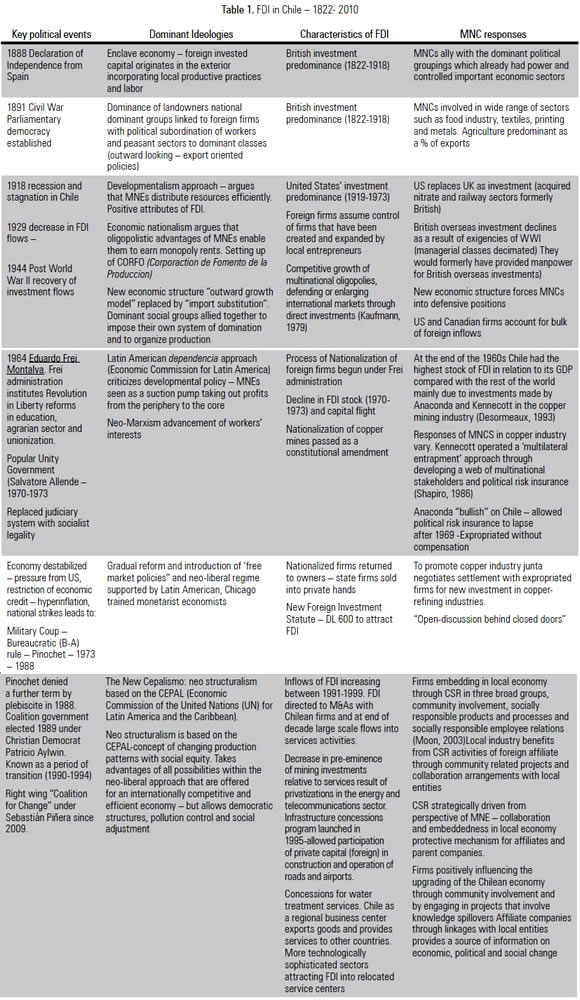
The figure below (Table 1) offers an historical explanation of FDI in Chile highlighting the dominant ideologies, the characteristics of FDI and the responses of MNC to key political events.
The earliest foreign investment in Chile was in 1822, four years after the declaration of its independence from Spain. Since then, three main periods can be distinguished (Behrens, 1992): These periods are shown in Table 1. The prevailing political ideology in each period is shown in the middle column which helps explain the radical shifts in policy towards FDI in each period identified.
]]> Working from Table 1 we now examine in more detail the historical process of FDI in Chile. Each section is presented in four parts. First, we briefly discuss the key political events of each period, followed by a discussion of the dominant political ideologies of the time; the characteristics of FDI in each period and the responses of MNCs to shifts in the political landscape.British Investment Predominance (1822-1918)
In the first half of the nineteenth century, the Chilean situation seemed exceptional among the Spanish colonies (Cardoso & Faletto, 1979). Chile already had reasonably stable institutions, and the Chilean port of Valparaiso was well situated, considering the reorganization of Latin American relations with metropolitan markets. Chile's numerous exports included copper, agricultural products and livestock, for which there were favorable prospects on the world market.
Most foreign investment, mainly British, entered the marketing and inter-oceanic transport sector (Behrens, 1992) Local investment continued to be limited to the primary activities, which meant that production was controlled nationally while marketing and transportation were controlled from abroad. This pattern changed with the flow of foreign investment into the extractive industries.
Dominant Political Characteristics of the nclave Economy 3
Cardoso and Faletto (1979) noted that the reason for a division of functions between locals and foreigners was that foreign investment in these sectors increased the income of the local landowners by expanding production. They argue that local capital was available for the investments made by foreigners, but owners of this capital were not interested in investing in such activities. However, the expansion of the economy created demand for large capital investments, especially in mining and the railway business, as well as increasingly complex transportation and marketing services. This expansion required a volume of investment beyond the possibilities of local private capital (Cardoso & Faletto, 1979). As a result, Chile could not keep foreign interests from gaining control of national production sectors. Indeed, between 1822 and 1830, British investors started to enter the railway business and the mining sector. For instance, three British mining firms were established in the 1820s.
In the years following 1850, Chile entered a period of greater prosperity. The economic order was better integrated with the metropolitan powers. The new market stimulated Chile to develop an industrial economy; Chilean copper was an excellent example (Behrens, 1992). Within this context, enclave investments were embedded in the Chilean economy (between the end of the nineteenth century and the beginning of the twentieth century), when national political groups already had power and controlled important economic sectors.
The Structure of Domination
The structure of domination was a direct manifestation of the political subordination of the workers and peasant sectors to the dominant classes. The national dominant groups were linked to foreign firms more as a politically dominant class than as an "entrepreneurial sector" (Cardoso & Faletto, 1979). During this period (the nineteenth century) British investment continued to dominate investment in the Chilean economy, as demonstrated by its involvement in a range of sectors, specially the food industry, textiles, printing, and metals (Muñoz, 1977), and by the development of the exports sector.
After the "Guerra del Pacifico" 4, the Chilean economy changed dramatically since the country gained land rich in nitrate (Chilean nitrate). The importance of nitrate for the Chilean economy vastly exceeded the importance of copper. Consequently, in 1890, the value of Chilean exports was 17 per cent higher than in 1879. In the same year the involvement of British investors in export activities was a considerable 56 per cent, which finally reached 74 per cent in 1895 (Behrens, 1992). This boom was mainly the result of British investors becoming the owners of the major part of the nitrate industry.
]]> In the following years, until World War I (WWI), British investment continued to increase. However, FDI coming from the United States and Germany started to grow as well. As a result, by 1919 its relative importance for the Chilean economy relative to other investors started to decline. Towards the end of the nineteenth century German investors controlled 18 per cent of the nitrate sector and trade activities between Chile and the United States showed a rapid increase - mainly directed to the mining sector especially copper (Behrens, 1992). Thus, until 1915 the main foreign investors in Chile came from England, the United States and Germany, representing 52 per cent, 34 per cent, and 13 per cent of total investment respectively (Behrens, 1992).United States' Investment Predominance (1919-1973)
Despite "enclave" features, during the first quarter of the twentieth century the Chilean economy was characterized by a relatively successful and commercialized nineteenth century agricultural base, coupled with a locally-controlled "small-mining" sector, which supported quite high levels of pre-industrial modernization (Kaufman, 1979). Most of the mining and agricultural products were exported to Europe. As a result, the external market played a crucial role in the economic development of Chile (Behrens, 1992).
After 1884, the nitrate economy, in the hands of British capital, continued to be the major source of revenue, and exports increased notably during World War I. United States capital began to displace British capital at this time. One technological reason was that the Guggenheim system of nitrate exploitation made possible the use of lower-grade limestone than did the British Shank system. United States banks supplanted the British Rothschild's bank as creditors of the State (Cardoso & Faletto, 1979).
However, although conditions for the change in foreign trade were favorable, the post-war years were a period of bond issues, inflation, and unconvertible paper currency. Speculation and negotiations with the State were everyday events. With the end of WWI the situation became worse since Chilean nitrate was less in demand and was also being replaced by synthetic nitrate. Nitrate revenues fell 36 per cent from 1918 to 1922 (Cardoso and Faletto, 1979). In this period of recession and stagnation of FDI in Chile, the United States maintained its position as the main source of capital. As a result, after World War I, the United States positioned itself as Chile's main source of FDI. The importance of FDI inflows coming from the United States showed a rapid increase. In 1926 it represented 50 per cent of total FDI and in 1930 it rose to 70 cent (Ramírez, 1970).
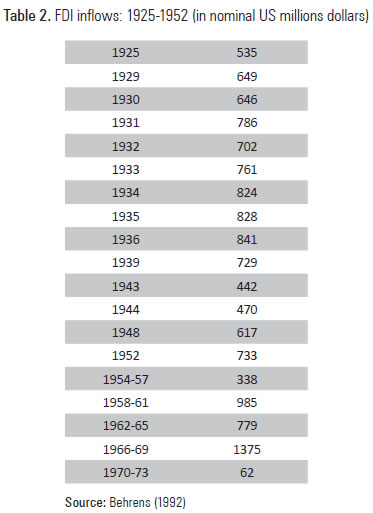
The world crisis of 1929-1930 affected the enclave economy and the economy as a whole. In 1930, exports decreased 42 per cent from 1929, and until 1955 (in nominal value) were still less than in 1929 (Cardoso & Faletto, 1979). In terms of inflows of foreign investment, the crisis represented a considerable breakdown for the Chilean economy. Table 2 shows that FDI reached its highest point in 1936, thereafter decreasing until 1943. The decrease in FDI inflows was a result of the worldwide recession which slowed down overseas investment from OECD countries. Decreasing FDI inflows in certain periods were a result of remittances of capital and the acquisition of foreign-owned firms, mainly British, by local investors (Behrens, 1992). The inflows of FDI started to rise again only in the mid-1940s. Their recovery, in 1944, could be attributed to the worldwide resurgence of FDI in the mid-1940s.
After the 1929 crisis, employment could be maintained only by State subsidies. With Chilean nitrate being replaced by synthetic nitrate on the world market, foreign firms began to dismantle their plants. If balance were to be restored, a new economic structure had to be created to sustain it. During this period, the government took measures to expand, or in some cases to create an industrial sector. In addition to the repercussions of the "Great Depression" in the economy, the limited availability of finished products during the period of World War II (WWII) also played an important role in the shift from an "outward-growth model" to an "import substitution" type of development, which was characterized by industrialization and the formation of a local market. The import-substitution strategy was supposed to assist Chile to abandon its economic reliance on the production of primary products and become an economy "on its way to industrialization" ("en vias de industrializacion"), in terms of economic growth and industry structure (Behrens, 1992; Cardoso & Faletto, 1979). The dominant social groups allied themselves and worked together after the Great Depression to impose their own system of domination and to organize production (Cardoso & Faletto, 1979; Quijano, 1974).
The Rise ff Nationalist Sentiment
]]> Economic factors, political ideologies and the importance given to the development of local industry resulted in the emergence of a nationalist sentiment in Chile, which resulted in the adoption of policies that encouraged State intervention (Cardoso & Faletto, 1979). Within this process, in 1939, the Corporacion de Fomento de la Produccion (CORFO) 5 was created. Its main role was to establish and maintain an economic policy in which the State would also play an entrepreneurial role.Between 1940 and 1970, CORFO invested in a range of activities. Two periods of development can be distinguished (Behrens, 1992). The first, from 1940 until the mid-1950s, was characterized by the focus on the substitution of imports. During this period important State firms were created: ENDESA (Empresa Nacional de Electricidad S.A.), in the energy industry; CAP (Compañia de Aceros del Pacifico) in the steel industry; ENAP (Empresa Nacional del Petroleo) in the exploitation and refining of oil; and IANSA (Industria Azucarera Nacional S.A.), in the sugar beet industry. The second period, from the end of the 1950s until 1970, focused on exports diversification, by developing the forestry, fishing, and fruit sectors. In this structure of national production the importance of the State grew, both as a supplier and as a consumer of products.
Changes in FDI regulations during the administration of President Carlos Ibáñez del Campo (1954-1958) resulted in a significant increase in manufacturing investments, although mining continued to be the main attraction for foreign firms. Specifically, in 1954, the first Foreign Investment Statute, which promulgated a positive attitude towards FDI, was established. Until 1969 this positive attitude increasingly attracted inflows of FDI.
Between 1959 and 1970, capital inflows were concentrated in the mining sector, manufacturing 6, and to a much smaller extent, in services. During this period, United States and Canadian firms accounted for the bulk of foreign inflows (ECLAC, 2000). At the end of the 1960s Chile had one of the biggest stocks of foreign investment in relation to its GDP in comparison with the rest of the world, mainly because of the huge investments made by Anaconda and Kennecott in the copper mining industry (Desormeaux, 1993).
Dependencia critique of developmentalism
In Latin America, during the late 1960s, the question of FDI in manufacturing was one of the major issues which led to the dependency critique of Economic Commission for Latin America (ECLA) developmentalism in Latin America (Jenkins, 1984). It saw MNEs as a major mechanism blocking development in developing countries and as an important obstacle to socialist transformation.
The dependency approach criticized the developmentalist assumptions about FDI's contributions in terms of additional foreign exchange, additional savings, and better technology, and management techniques. FDI was linked to underdevelopment (Jenkins, 1987).
Dependency writers also noticed other consequences of FDI. They argued that FDI concentrates on the production of luxury products for small elites instead of supplying basic goods for the mass of the population. Also, MNEs are not integrated in the local industry since they tend to generate links primarily with the parent firm or other affiliates and only to a very limited extent with local suppliers. Moreover, MNEs tend to use their political influence in order that public expenditure is allocated to support their investment through the provision of infrastructure (Cardoso & Faletto, 1979; Jenkins, 1987).
In the late 1960s Chile's economic scenery was substantially altered by a series of reforms, particularly the nationalization of large-scale copper mining 7 and agrarian reform (Cardoso & Faletto, 1979; Behrens, 1992; ECLAC, 2000). Some economists and reformist politicians argued that redistributive policies which enlarged the local market would provide a new impetus to manufacturing growth, primarily in non-durable consumer goods and in some low-price consumer durables sectors. This strategy was one component of the general policies of the Frei and Allende's administrations. It implied, for one thing, tax and land reforms which antagonized not only traditional elites, but much of the urban middle class (Kaufman, 1979). Of these, only Frei's comparatively moderate version was able to manage conflicting pressures for a short period of time. Between 1965 and 1967, income and land redistribution, rising copper revenues, massive Alliance for Progress aid, and some direct foreign investment, all combined to stimulate a three-year period of industrial expansion. By 1968, however, prices started to rise and the economy slowed again. Moreover, foreign manufacturing investment also dropped off sharply after 1968, apparently in response to the growing local conflict and the forthcoming 1970 presidential elections (Kaufman, 1979).
The late 1960s and early 1970s were marked by a growth of the left in Latin America and a number of popular victories. As an ideology, developmentalism was discredited for large sectors of the population by the late 1960s. In Chile, the regime of president Salvador Allende instituted policies to control MNEs very strictly, a strategy which also appealed strongly to nationalism for legitimacy (Jenkins, 1984). Indeed, in 1970, Chile signed the Andean pact, which established a range of measures and policies that considerably restricted foreign activity, in this way stopping the flow of FDI to Chile.
Consequently, with the advent of the socialist government of President Salvador Allende, the State became more deeply involved in the economy, and the scope of action for private agents narrowed. In addition to carrying out land reform and initiating a new policy of income redistribution, the Allende government nationalized foreign firms, from the mines to the banks (Ianni, 1975).
Under the Popular Unity 8 government, Chile's foreign policy was that of a socialist State. Chilean foreign policy attempted to discard assumptions or practices that contradicted the interests of the wage-earning classes. Foreign policy adopted the viewpoint of these classes, not that of the bourgeoisie 9 (Ianni, 1975; Quijano, 1974). It has been argued that in Chile a national bourgeoisie was able to develop industry in the period before WWII because, among other factors, foreign capital was mainly interested in the primary sector. On the other hand, extensive sectors of industry were controlled by foreign capital even in the inter-war period and that there was no justification for the view that local industrialists constituted a class opposed to foreign capital and imperialism 10 (Kaufman, 1979).
Shifts in the Political Landscape
Allende's hostile position towards MNEs prompted extreme reactions from local sectors 11 and international economic powers, particularly from the United States. In February 1972 President Nixon made official the governmental policy proposed by ITT in October 1970 following Allende's victory in the Chilean elections. One of the conglomerate's proposals was for systemization of United States pressures against Chile. Subsequently, without informing President Allende, all United States aid funds already committed to Chile were given the "under review" status so that entry of money into Chile was temporarily stopped with a view to a permanent cut-off if necessary (Ianni, 1975) 12.
Consequently, within a relatively short period of time the country suffered from a severe political and economic crisis and, as conditions for foreign capital were found to be discouraging, a sharp fall in FDI inflows resulted. The stock of FDI decreased towards the end of 1973 to US$500 million, one of the lowest in Latin America (Desormeaux, 1993).
Responses of Multinationals to crisis - political risk
Shapiro's (1986) classic case study of two U.S copper MNEs involvement in Chile illustrates how political risk can be managed ex ante through a policy of multilateral entrapment. As Table 1 shows Kennecott and Anaconda had radically different outlooks on Chile's future. Kennecott was concerned to minimize its exposure in Chile through developing a multinational web of stakeholders while Anaconda remained bullish on Chile all along. Kennecott was under pressure to expand and modernize its mining operation at El Tienente but the expansion plan was financed by the sale of a 51 per cent interest in the mine for US$80 million to the Chilean government in exchange for a 10 year management contract.
Kennecott also insured its equity sale to the Chilean government with US-AID and ensured that further financing (obtained from the U.S. Export-Import Bank - Eximbank) loan was unconditionally guaranteed by the Chilean state. Kennecott also ensured that the doctrine of sovereign immunity was voided by insisting that any disputes between Kennecott and Chile would be submitted to the law of the State of New York. The web of entrapment was further spun by mortgaging copper still in the ground by writing long term contracts to European and Asian customers and selling the collection rights for these contracts to a consortium of European banks and Mitsui and Co., the Japanese trading company (Shapiro, 1986, p.490).
By contrast Anaconda, which had invested heavily in its own name in new mines and the modernization of existing ones throughout 1945-1965, refused voluntary divestiture and was forced to sell its Chilean holdings to the state in 1969. Anaconda had partial cover for its holdings with AID prior to its forced divesture but had allowed the policy to lapse. Anaconda was expropriated without compensation because it had no leverage (being the sole investor) against the Chilean government and it had no coverage from OPIC since it had failed to insure against political risk. Kennecott raised the cost of nationalization to the host government while Anaconda ignored it.
The 1973 coup coalition
The crisis was so intense, the economic disturbance so severe, that on September 11 1973, a coup coalition - formed by civilian and military technocrats with the support of international agents (Ianni, 1975) - put an end to Salvador Allende's government through the institution of a Bureaucratic Authoritarian (B-A) 13 rule (Jenkins, 1984) headed by Augusto Pinochet.
]]> The change of regime brought about different policies in the economic arena, which resulted in a change of the extent and pattern of FDI for the following years. The politico-economic crisis during the Popular Unity, the nationalization (without compensation) of the copper industry, and the post-coup repression were so violent that for a substantial period the government had difficulty in attracting foreign investment in spite of extreme economic orthodoxy (Collier, 1979).Extreme Economic Orthodoxy
The military government, which took power in 1973, called upon several internationally respected technocrats to frame policies that made radical changes in economic policy with the introduction of a neo-liberal model (ECLAC, 2000). Cardoso and Faletto (1979) refer to this approach as a "peculiar kind of liberal economy", in the sense that the State redistributed wealth to those groups of private interests that economically controlled the regime. Kaufman (1979) described this approach as unusual, in terms of the extent to which the military government embraced the tenets of conservative economic orthodoxy. The ideological influence to which policy makers were primarily responding was anti-planning, anti-import substitution industrialization (ISI) and anti-ECLA reaction (Hirschman, 1979). The most absolutist component of this movement was a group of Latin American economists, who had received graduate training at the University of Chicago, in whose Department of Economics strict neo-laissez-faire views had long been dominant (Desormeaux, 1993).
Policy makers imported virtually without reservation strict monetarist and laissez-faire doctrines, apparently convinced that exceptional measures were essential to control the desperate inflationary and balance of payments crises and to restore the confidence of international lenders and investors. Import, price and distribution controls, installed under previous administrations, were removed; wages were frozen; and credit was severely restricted. Also, much of the "State enterprise" sector was dismantled (Cardoso & Faletto, 1979; ECLAC, 2000; Kaufman, 1979).
The B-A regime implemented a range of measures to attract FDI. It was committed to provide information to foreign investors through an "open-discussion behind closed doors" policy, in which it would openly discuss the Chilean reality with foreign investors (Bitar, Espinosa, Maulian, Vergara, & Vignolo, 1980). Furthermore, those in power 14 simply accepted local and eventually international private interests as if they corresponded to the needs of the nation and of the people. Between 1973 and 1977, over three hundred firms nationalized by Allende were returned to their former owners; another two hundred State firms, many of which had originated in the public sector, were sold into private hands (ECLAC, 2000). In addition, in order to reinstate MNEs' confidence, the military government refused to adhere to Andean Pact restrictions on MNEs and, in 1976, Chile withdrew from the Andean Pact itself (Kaufman, 1979). To promote copper sales, the junta negotiated a settlement with the expropriated American mining firms, in exchange for promises of marketing assistance for new investment in copper-refining industries (ECLAC, 2000; Kaufman, 1979).
In 1974, the government enacted a new Foreign Investment Statute, the Decree Law 600 (DL 600), regulating the conditions of market entry, capitalization and remittances of foreign capital. This legal instrument was used to raise the profile of foreign investment, and it soon became one of the main sources of financing for a renewed development strategy based on an extensive opening of the economy (ECLAC, 2000; Bitar et al., 1980). From 1974, the vast majority of foreign investors have chosen to use this mechanism (DL 600). Between 1974 and 2003, investments representing 83 per cent of total FDI inflows used this mechanism (Foreign Investment Committee, 2004). The popularity of the DL 600 with investors stems not only from the fiscal advantages it offers but also from the long-term security, which it provides (Ffrench-Davis, 2003). However, the DL 600 was not always the preferred investment mechanism.
Responses of MNEs
With these measures, the new government sought to turn the market into the main agent of resource allocation, private enterprise into the driving force of the economy, and comparative advantage-based exports into the foundation for the country's economic development (Behrens, 1992; ECLAC, 2000). The main focus of the government's long-term strategy of recovery was the expansion and diversification of exports. Export diversification was portrayed as a fundamental departure from Chile's long-standing dependence on industrial protectionism and mineral exports. Commitment to the promotion of non-traditional exports was reflected by, among other things, the formation of a new agency, ProChile, charged with developing foreign markets for Chilean wines, fruits, shoes, textiles, leather products, and paper (Kaufman, 1979).
For the first three or four years of military rule, the impact of these policies seemed at best ineffective and at worst counterproductive (Cardoso & Faletto, 1979; ECLAC, 2000; Kaufman, 1979). It was expected that FDI would help to strengthen and broaden the Chilean export sector. Indeed, FDI inflows for the period 1974-1977 were not significant (Behrens, 1992; Desormeaux, 1993; ECLAC, 2000). However, although European creditors refused in 1975 to refinance Chile's large external debt, private American banks and the World Bank began in the mid-1970s to provide a substantial inflow of financial aid and credit. As a result, in 1976 the economy started to show scattered signs of recovery, and by 1977 these began to provide some basis for official optimism. For the period 1977-1979, Chile had a balance of payments surplus; its inflation rate had come down to about 60 per cent and its economy continued the modest recovery begun in 1976 (Kaufman, 1979).
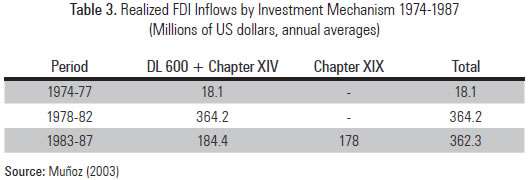
FDI inflows increased considerably in the late 1970s (see Table 3). However, this trend slowed at the beginning of the 1980s due to an economic recession in Chile. A strong external shock, generated by a sudden break in foreign financing, rising international interest rates and deterioration in the terms of trade intensified by heavy local borrowing and an inflexible economic policy, caused GDP to decrease by 14 per cent in 1982. In response, the government adopted a more realistic economic policy, particularly regarding foreign exchange rate policies (Behrens, 1992; ECLAC, 2000; Kaufman, 1979).
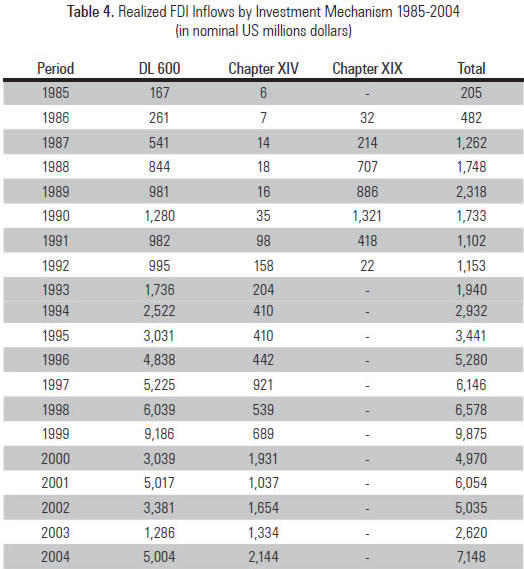
]]> As one of the solutions to the 1980s debt crisis, and as a way to increase inflows of FDI, Chapter XIX, a mechanism for converting debt into equity was created (See Table 4). This mechanism consisted of foreign investors buying debt documents - their market value was significantly lower than their nominal value - and using them as capital for investing in Chile.The debt-conversion program was promoted widely abroad, which helped to create a favorable climate for foreign investors and encouraged them to consider Chile as an investment prospect (ECLAC, 2000). Indeed, a number of non-traditional investors were attracted by this mechanism, for example, investors from Holland and New Zealand (Behrens, 1992).Chapter XIX was discriminatory in terms of access to productive activities. For instance, only 10 per cent of investments in the mining sector were allowed to use this mechanism (Riveros & Vatter, 1994). However, Chapter XIX made it possible to finance major projects in the promising resource-based manufacturing industry, particularly the forestry sector. These investments - like those made in agricultural activities, mainly fresh fruit, and fisheries - boosted Chilean exports (ECLAC, 2000). Services activities also received a large share of the resources that flowed into the country under Chapter XIX, particularly telecommunications, electrical energy, banking, pension fund administrators, and tourism.
During the second half of the 1980s FDI inflows increased as a result of inflows of FDI coming through Chapter XIX coupled with a positive investment environment (Desormeaux, 1993). At the same time, FDI inflows channeled through the traditional mechanism of DL 600 also increased, with most of these going to new mining projects (ECLAC, 2000). However, in 1990 this figure decreased again as a result of a considerable drop in FDI coming through Chapter XIX. When the market value of the debt documents started to match their nominal value, which occurred in 1991, Chapter XIX lost its importance since it was more expensive to use this mechanism than the DL 600 in terms of capital repatriation and profits remittance. For instance, Chapter XIX established that investors could repatriate capital only 10 years after their entry and remit profits only 5 years after their entry (Wilska, 2002). As a result, total FDI inflows decreased between 1990 and 1992.
Resurgence of a Democratic Regime
The beginning of the 1990s was a key period for the Chilean society. First, the resurgence of a democratic regime took place through a peaceful and organized process, which brought about the reintegration of Chile into the international arena. Second, it represented the beginning of the most productive period of the Chilean economy, which continued until the consequences of the Asian crisis reached Latin America. In the 1990s the effects of the debt crisis disappeared and the new government was successful in reconciling macroeconomic and social objectives by promulgating appropriate policies (Ffrench-Davis & Tapia, 2001).
The Chilean environment of the 1990s attracted considerable amounts of FDI. Between 1991 and 1999 inflows of FDI increased steadily reaching their highest point in 1999, despite the disappearance of the Chapter XIX mechanism. This phenomenon was due not only to the positive economic environment of Chile, but was also part of a global trend. However, in Latin America, Chile has been one of the most preferred locations for FDI. Chile has offered a dynamic and strong economy relative to other Latin American countries, something which constituted a crucial factor for attracting FDI in the 1990s, despite its small local market. Most FDI entering the Chilean economy during this decade was directed to mergers and acquisitions (M&A) of successful Chilean firms (Muñoz, 2003). Towards the end of the decade, large-scale flows of FDI into services activities began to shape a new pattern in the involvement of MNEs in the Chilean economy (ECLAC, 2000).
]]> Since the 1990s - the rise of neo-structuralism (CEPAL)The triumph of neo-liberalism began during at the beginning of the 1980s. The programs for adjustment and the financial support of the World Bank and IMF were bound up with the adoption of neo-liberal policies in the countries which requested financial assistance. The classical structuralist theorists were forced to rethink and to modify their defensive position. Since the middle of the 1980s a concept for development has emerged that builds on classical structuralist assumptions and sees itself as an antithesis to neo-liberalism: neo-structuralism. The variety of political and economic positions within Latin America explains the fact that the CEPAL was not able to present its new concept earlier during the times of the obvious failure of Cepalismo and the debt crisis. A consensus could not be found. Only when neo-liberalism was generally accepted as the predominant economic practice the CEPAL could set up a new system based on neo-liberal fundamentals (CEPAL, 2001).
The new Cepalismo: Neo-structuralism or simply a repetition of neo-liberalism?
The new CEPAL-strategy for development in the 1990s suggests that neither the industrialization in the framework of the local market of the post-war period nor the neo-liberal opening towards world market in the 1980s has provided a long-term productive model for development. Neo-structuralism is based on the CEPAL-concept of ''Transformación productiva con equidad" (changing production patterns with social equity). It is a reorientation in development theory, as for the first time it to forge a better union between economic growth, equity and democracy (Riveros & Vatter, 1994). The CEPAL, traditionally antagonistic to neo-liberalism has now had to reformulate its ideas in a way that was compatible with the neo-liberal approach, so that these ideas could be accepted in the new age of neo-liberal paradigm. Thus, there remains a question of interpretation. Can neo-structuralism be seen as the opposite of neo-liberalism or is it only a further development of neo-liberalism? The new program ''changing production patterns with social equity'' tries to take advantage of all possibilities within the neo-liberal approach that are offered for an international competitive and efficient economy but, at the same time, allows for the existence of democratic structures and promotes pollution control and social adjustment.
Responses of MNEs - new landscapes to explore
In the first half of the 1990s, a considerable amount of FDI inflows was directed to sectors associated with the exploitation of natural resources, especially in the mining sector, which absorbed 57 per cent of FDI inflows via DL 600 in 1990-95 (Foreign Investment Committee, 2004, 2005). Since 1990, however, other sectors have gained in importance. Consequently, the mining sector represented 22 cent of GDP for the period 1996-2001. The service sector became the most attractive sector, representing 26 per cent of GDP in 1996-2001 without including the electricity, gas, and water industries. A considerable amount of the inflows was directed to the banking industry; in fact, foreign banks increased their participation in the local financial system from 14 per cent in 1995 to 45 per cent in 2000 (CEPAL, 2001). The public services sector (electricity, gas, and water) became the second most attractive sector for foreign investors, representing 24 per cent of GDP in 1996-2001 (Ffrench-Davis, 2003). The service sector represented 50 per cent of the GDP for the period 1996-2001 when the electricity, gas and water industries are included.
Reactions of MNEs -the CSR approach
The responses of MNEs to the policy shifts taking place in the Chilean environment and the opportunities created by the potential to invest in the services sector through the infrastructure concessions program show that MNEs are developing links with local communities (Richards, 1997). This reflects a more apolitical stance taken by MNEs. Whereas in earlier eras MNEs had aligned with dominant hierarchies, their concerns now are to align their investments with the neo-structuralist agenda; forging a better union between economic growth, equity and democracy. At the same time this approach is consistent with the strategic approach of MNEs, anxious to prove their worth as good corporate citizens (Vernon, 1998).
Conclusions
]]> Chile has experienced violent policy shifts during its relations with MNEs. In this paper we discussed two periods of investment domination by Britain (1822-1918) and then the United States (1919-1973). The development of political ideologies as a response to this foreign dominance is a defining moment in the emergence of nationalist sentiment in Chile which led to the emergence of dependency/socialist movements where the State became more deeply involved in the economy, initiating land reforms, nationalization of foreign enterprises and income redistribution. In the third section we discussed the period 1974 to the present dating from the military coup headed by Augustus Pinochet. During this period extreme economic orthodoxy in an attempt to attract foreign investment back to Chile after the post-coup repression. We then categorized the responses of MNEs during these periods of investment. These responses varied; from enclave responses during the investment domination period by British and US investors; to the political risk insurance responses as the threat of expropriation became real during the dependency socialist period. Finally, we noted an emerging trend in MNE investment in Chile, drawing on previous research. In an apparently benign climate of investment, MNEs in the service sector are developing corporate social responsibility linkages with local entities to engender loyalty from the local community.It behooves managers to maintain cognizance about the shifts in the political and economic landscape in which they operate. While political risk analysis (metrics) may seem to be a useful tool in which to assess the riskiness of an investment prospect it is only a blunt tool (Bremmer & Keat, 2009). Political risk analysts may overlook key sources of changes (if they are not factored into the variables selected for inclusion). Political risk analysts failed to see the direction of change in the Iranian revolution in 1979 (Kennedy, 1984) and the deposition of the Shah, because the political aspirations of a dominant religious grouping were not included in the risk analysis. As the Kennecott and Anaconda cases showed, firms apparently choose either to interpret the same information differently, or they are inclined, whatever the evidence, to take an optimistic or pessimistic view. As it turned out the pessimistic view of having the life rafts ready was an appropriate perspective in the circumstances. Although the threat of large scale expropriations seems unlikely in the present benign climate towards FDI it would be indeed be foolish not to continue to be vigilant.
In this paper, we offered some contributions to theory suggesting that past actions of a host country government cannot be considered as a useful predictor of future actions. We also suggest that in order to understand political systems managers need to understand how a political system works in a given country which is based on a well-developed information system and sound decision making regarding the international operations of the firm. They also need to understand the sequential process of risk formation which will assist firms to develop and execute appropriate risk management policies.
Acknowledgements
The authors gratefully acknowledge financial support from the Department of Strategy and Human Resource Management, Waikato Management School, University of Waikato, for providing assistance to undertake the field work for this project in Chile.
Notes
3 In enclave economies, foreign invested capital originates in the exterior, is incorporated into local productive processes and transforms parts of itself into wages and taxes. Its value is increased by the exploitation of local labor forces, which transform nature and produce goods that realize the life of this capital when staples are sold in the external market, In the case of copper mining in Chile, foreign firms assumed control of firms that have been created and expanded by local entrepreneurs (Cardoso and Faletto, 1979, p.19)
]]> 4 This war (1879-1883) was between Peru, Bolivia and Chile. Chile won the war.5 Corporation for the promotion of production.
6 Mainly the manufacture of paper and petroleum-based chemicals.
7 For an illustration of the effects of the "nationalization" of the mining sector in Chile see the cases of Kennecott and Anaconda in Shapiro, 1986.
8 The Popular Unity is a coalition of predominantly leftist parties that form the political base of the government.
9 Indeed, it has been argued that the local industrial bourgeoisie in the region was not opposed to foreign capital. Surveys of industrialists in Chile confirmed this, finding that far from being opposed to foreign capital, they were generally in favor of foreign investment (Kaufman, 1979).
10 Writings on "dependent development" have emphasized the interdependent relationship between the local bourgeoisie and international capital. While local capital may depend on foreign capital for technology, trademarks, access to export markets, and so on, MNEs may depend on the local bourgeoisie to play an integrative role because of their greater involvement in local networks through personal and family ties (Jenkins, 1984).
11 For the local bourgeoisie and military officers and technocrats, who were not tied directly to contending class interests, political-economic patterns seemed to support the view that the costs of tolerating populist pressures had increased - a perspective which undoubtedly grew and hardened among MNEs in the course of the 1950s and 1960s (Kaufman, 1979).
12 Documentos Secretos de la ITT, quotation p. 81 in Ianni (1974).
13 This system is "excluding" and nondemocratic. Central actors in the dominant coalition include high-level technocrats - military and civilian, within and outside the State- working in close association with foreign capital. This new elite eliminates electoral competition and severely controls the political participation of the popular sector. Public policy is centrally concerned with promoting advanced industrialization (Collier, 1979).
]]> 14 Technocrats, both military and civilians, and the bourgeoisie (economic elite).
References
Almond, G.A. and Powell, G. B. (1966). Comparative politics: a developmental approach. Boston, MA: Little, Brown and Company. [ Links ]
Allaire, Y. & M. E. Firsirotu (1989). Coping with strategic uncertainty. Sloan Management Review, 30(3), 7-16. [ Links ]
Behrens, R. (1992). Inversión extranjera y empresas transnacionales en la economía de Chile: 1974-1989; el papel del capital extranjero y la estrategia nacional de desarrollo.Estudios e Informes de la CEPAL numero 86, Santiago, Chile: CEPAL. [ Links ]
Buckley, P.J. & Lessard, D. R. (November 2005). Regaining the edge for international national business research. Journal of International Business Studies, 36(6), 595-599. DOI 10.1057/palgrave.jibs.8400170 [ Links ]
Burmester, B. & Tayeb, M. H. 2000. International business theories: policies and practices. London: Pearson. [ Links ]
Bitar, S., Espinosa, J.G., Maulian, T., Vergara, P., & Vignolo, C. 1980. Chile, liberalismo económico y dictadura política. America Problema Series, Numero 11. Lima, Perú: Instituto de Estudios Peruanos. [ Links ]
Bremmer, I. & Keat, P. (2009). The Fat Tail: The power of political knowledge for strategic investing. Oxford University Press: Oxford. [ Links ]
Cardoso, F. & Faletto, E. (1979). Dependency and development. (M. Urquidi, Trans.). Berkeley, California: University of California Press. [ Links ]
CEPAL (Comisión Económica para America Latina y el Caribe) 1954. Antecedentes sobre el desarrollo de la economía chilena 1925-1952. Santiago, Chile: Editorial del Pacifico. [ Links ]
]]>CEPAL (2001). La inversión extranjera en America Latina y el Caribe, 2000. Santiago, Chile: Naciones Unidas. [ Links ]
Collier, D. (1979). The new authoritarianism in Latin America. Princeton, NJ: Princeton University Press. [ Links ]
CORFO (2005). Chile: Global services platform. Chilean Economic Development Agency, CORFO. http://www.todochile.cl/corfo_det_20080910160133.aspx. Accessed 25 May 2005. [ Links ]
CORFO (2009). Guia para empresas y emprendedores. (Edición Marzo 2008). Santiago, Chile: CORFO. [ Links ]
Desormeaux, J. (1993). La inversión extranjera y su rol en el desarrollo de Chile. In D. Wisecarver (Ed.), El modelo económico chileno. Santiago, Chile: CINDE. [ Links ]
]]>Easton, D. (1965). A systems analysis of political life. New York, New York: John Wiley & Sons. [ Links ]
ELAC (Economic Commission for Latin America and the Caribbean) (2000). Foreign investment in Latin America and the Caribbean, 1999.(LC/G/2061-P. Santiago, Chile: United Nations Publication. [ Links ]
Foreign Investment Committee, Chile (CINVER) (2004, 2005). http://www.cinver.cl Accessed 20 July 2009. [ Links ]
Ffrench-Davis, R. (2003). La inversión extranjera directa en Chile. In O. Muñoz Gomá (Ed.), Hacia un Chile competitivo: instituciones y políticas. Santiago, Chile: Editorial Universitaria-FLACSO. [ Links ]
Ffrench-Davis, R., & Tapia, H. (2001). Three varieties of capital surge management in Chile. In R. Ffrench-Davis (Ed.), Financial crises in successful emerging economies. Washington, D.C.: ECLAC and Brookings Institution Press. [ Links ]
]]>Grindle, M.S. & Thomas J. W. (1991). Public choices and policy: The political economy of reform in developing countries. Baltimore, MD: Johns Hopkins University Press. [ Links ]
Hilbert, P. & Jones M. T. (December 2004). What if -- ? Finance & Development, 40(4), 24-27. Available at: http://www.imf.org/external/pubs/ft/fandd/2004/12/pdf/hilbers.pdf [ Links ]
Hirschman, A. 1979. The turn to authoritarianism in Latin America and the search for its economic determinants. In D. Collier (Ed.), The new authoritarianism in Latin America: (pp.61-98). Princeton, NJ: Princeton University Press. [ Links ]
Howell, L.D. & Chaddick, B. (1994). Models of political risk for foreign investment and trade: an assessment of three approaches. Columbia Journal of World Business, 29(3), 70-91. DOI 10.1016/0022-5428(94)90048-5 [ Links ]
Hymer, S. (1972). The multinational corporation and the law of uneven development. In J. Bhagwati (Ed.), Economics and the World Order, New York: Macmillan. [ Links ]
Ianni, O. (1975). La formación del estado populista en América Latina Ciudad de Mexico, Mexico: Ediciones Era. [ Links ]
]]>Jenkins, R. (1984). Transnational Corporations and industrial transformation in Latin America.London: Macmillan. [ Links ]
Jenkins, R. (1987). Transnational corporations and uneven development. London: Methuen. [ Links ]
Jones, B.D. (2001). Politics and the architecture of choice. Chicago: University of Chicago Press. [ Links ]
Kaufman, R. (1979). Industrial change and authoritarian rule in Latin America: A concrete review of the Bureaucratic-Authoritarian model, In D. Collier (Ed.), The New Authoritarianism in Latin America (pp.165-253). Princeton, NJ: Princeton University Press. [ Links ]
Kennedy, C. Jr. (August 1984). Multinational corporations and political risk in the Persian Gulf. International Journal of Middle East Studies, 16(3), 391-403. DOI 10.1017/S0020743800028233 [ Links ]
Kennedy, C. Jr. (1992). Relations between transnational corporations and governments of host countries: a look to the future. Transnational Corporations, 1(1), 67-91. [ Links ]
Lhabitant, F-S. & Tinguela, O. (May 2001). Financial risk management: an introduction. Thunderbird International Business Review, 43(3), 343-363. DOI 10.1002/tie.1001 [ Links ]
Miller, K.D. (1992). A framework for integrated risk management in international business. Journal of International Business Studies, 23(2), 311-332. Available at: http://www.jstor.org/stable/154903 [ Links ]
Muñoz, O. (1977). Estado e Industrialización en el ciclo de expansión del salitre', Estudios CIEPLAN, Nº 6, Santiago de Chile, Corporación de Investigaciones Económicas para Latinoamérica (CIEPLAN), Enero. [ Links ]
Muñoz, O. (2003). Hacia un Chile competitivo: Instituciones y políticas. Santiago, Chile: Editorial Universitaria y FLACSO-Chile. [ Links ]
Oetzel, J. & Doh, J. (April 2009). MNEs and development: a review and reconceptualization. Journal of World Business, 44(2), 108-120. DOI 10.1016/j.jwb.2008.05.001 [ Links ] A. (1974). Crisis imperialista y clase obrera en America Latina. Lima, Perú: Quijano. [ Links ]
Ramírez, H. (1970). Historia del Imperialismo en Chile. Santiago, Chile: Editorial Austral. [ Links ]
Redding, G. (2005). The thick description and comparison of societal systems of capitalism. Journal International Business Studies, 36, 123-155. DOI 10.1057/palgrave.jibs.8400129 [ Links ]
Richards, D. G. (1997). The political economy of the Chilean miracle. Latin American Research Review, 32(1), 139-159. [ Links ]
Riveros, L., & Vatter, J. (1994). La inversión extranjera directa en Chile, su contribución al desarrollo: 1987-93, Serie de Documentos de Trabajo - BID, numero 181. Washington, DC: BID. [ Links ]
Robock, S.H. & Simmonds, K. (1989). International business and multinational enterprises. Homewood, IL: Irwin. [ Links ]
Sethi, S.P. & Luther K. A. N. (1986). Political risk analysis and direct foreign investment: some problems of definition and measurement. California Management Review, 28(2), 57-68. DOI 10.1002/tie.5060280206 [ Links ]
Sethi, S.P. (1994). Multinational corporations and the impact of public advocacy on corporate strategy: Nestlé and infant food formula controversy. Boston: Kluwer Academic Press. [ Links ]
Shapiro, A. (1986). Multinational financial management. Allyn and Bacon: Boston, Mass. [ Links ]
Simon, J.D. (1984). A theoretical perspective on political risk. Journal of International Business Studies, 15(1), 123-143. DOI 10.1057/palgrave.jibs.8490499 [ Links ]
Simons, R. (2000). Performance measurement and control systems for implementing strategy. Upper Saddle River, New Jersey: Prentice Hall. [ Links ]
Van Wyk, J. (2010). Political sources of international business risk: An interdisciplinary framework. Journal of International Business Research, 9(1), 103-119. [ Links ]
Vernon, R. (1998). In the hurricane's eye: The troubled prospects of multinational enterprises. Cambridge, MA: Harvard University Press. [ Links ]
]]>Wilska, K. (2002). Host country determinants of foreign direct investment in Latin America: Finnish company cases in Brazil, Chile and Mexico. Turku, Finland: Turku School of Economics and Business Administration. [ Links ]
]]>