ARTÍCULO
Organic Agriculture: Giving Low–Tech a Chance? An overview of the patent landscape
Argricultura orgánica: ¿Tecnología artesanal? Revisión del panorama de patentamiento.
Luis Gil Abinader1
1 Abogado, investigador júnior del Programa de Derecho y Bienes Públicos y asistente de la Cátedra OMC en la FLACSO/Argentina. Correo electrónico: lgil@flacso.org.ar
]]>Received: 27/09/2013 Modificado: 21/04/2014 Acepted: 28/04/2014
Abstract
This research overview the patent landscape of the inputs approved for certified organic agriculture. For this, it explains the tensions in regards to private voluntary standards addressed in certain trade–related forums. A succinct characterization of the economic impact of plant diseases outbreaks in the Dominican Republic –an organic produce exporting countries– follows. It then briefly compares the ''public'' norms controlling the production and labeling of organic agriculture, with their ''private'' counterparts. Subsequently, the result of the patent searchers, which were performed taking into account the private voluntary certifiers' list of validated inputs, is reported. When the data is analyzed quantitatively, the finding suggests that there is no high intellectual property costs required to comply with the examined private voluntary standards. However, a small number of validated fungicides -which are also widely used by organic farmers in the Dominican Republic– may have significant intellectual property access barriers.
Key words: Private standards; patent landscape; fungicides; organic agriculture; certifications; WTO.
JEL Classification: F13, O34.
Resumen
Esta investigación explora el panorama de patentamiento de los insumos aprobados para la agricultura orgánica certificada. Para esto, explica las tensiones en relación con los estándares privados dilucidadas en ciertos foros comerciales. Le sigue una sucinta caracterización del impacto económico de los brotes de plagas en la República Dominicana -un exportador de productos orgánicos–. Luego, se comparan brevemente las normas ''públicas'' que controlan la producción y el etiquetado de la agricultura orgánica, con sus contrapartes ''privadas''. Subsecuentemente, se reporta el resultado de las búsquedas de patentes, que fueron realizadas con base en la lista de insumos validados por las certificadoras privadas. Analizando los datos cuantitativamente, la evidencia arroja que no hay altos costos de propiedad intelectual para cumplir con estos estándares. No obstante, un reducido número de fungicidas validados ampliamente usados por los agricultores orgánicos en República Dominicana– pueden tener importantes barreras de acceso de propiedad intelectual.
Palabras clave: Estándares privados; panorama de patentamiento; fungicidas; agricultura orgánica; certificaciones; OMC.
]]> Clasificación JEL: F13, O34
Introduction
private voluntary standards Private voluntary standards are a controversial issue in the World Trade Organization (WTO). After being raised by Saint Vincent and the Grenadines during a meeting held in June 2005, they have been periodically addressed at the Committee on Sanitary and Phytosanitary Measures. The concern shared by several developing countries, including Argentina, Belize, Ecuador, Egypt, and Peru, is that requirements such as the ''Good Agricultural Practices'' certified by GlobalGAP are a de facto entry condition in certain markets. And, to obtain these certifications, exporters must comply with the requirements set by private certifiers. These are, for instance, the use of certain storage facilities or off–farm inputs. Some WTO Members believe that those requirements are unnecessarily restrictive and scientifically unjustified. Therefore, those Members consider these standards incompatible with the WTO Agreement on Sanitary and Phytosanitary Measures (SPSM).
Other Members, however, have argued that they have limited power to address these standards. Particularly the European Union (EU), where private standards are widely required by importers and retailers. These Members claim that private standards are not mandatory. In theory, indeed, exporters can chose whether they will comply or not with a specific standard. Where private standards have become the industry norm, however, this choice is limited. In those cases, suppliers not participating in private sector standards, and particularly small farmers in developing countries, could be excluded from export markets (United Nations Conference on Trade and Development [UNCTAD], 2007).
Thus, the border between ''private'' and ''public'' standards is, in practice, blurred. However, it is unclear whether this issue can be resolved under current WTO law. So far it has led to a lengthy legal debate regarding article 13 of the SPSM Agreement. That article provides that WTO Members shall take the ''reasonable measures'' available to ensure that ''non–governmental entities'' within their territories comply with the Agreement. However, Members are still debating on the meaning of ''reasonable measures'', which types of entities are bound with this commitment, and how governments should comply with it. In addition to the legal discussion, some countries have also promoted a discussion about the policy measures that are immediately available. This policy debate has been supported in forums such as the United Nations Conference on Trade and Development, the Food and Agriculture Organization, and the World Organization for Animal Health. As such, lack of physical and human capital, lack of reliable energy supplies, low quality transport and telecommunications systems, lack of laboratories, and lack of cold storage facilities have been pointed out, generally, as the main constrains that farmers in developing countries face in order to comply with private standards (Organisation for Economic Co–operation and Development [OECD], 2007). And any policy aimed at improving market access would likely consider those factors. At the same time, these are also long–term structural challenges that integrate the development–oriented public policies in these countries.
In order to design more specific, short and medium–term policies and cooperation agendas between developed and developing countries it is necessary to better understand the cost of complying with private standards. Several efforts are assessing the socioeconomic and environmental impact of agriculture standards (International Trade Centre [ITC], 2011b). Others are focusing on understanding the value chain of relevant products, such as fresh fruits and vegetables, and strengthening the farmers' side of the chain (ITC, 2011a). In these debates, however, the role of technology and the policy options to promote its transfer has not been exhaustively addressed.
A parallel but related discussion, focused on information technologies, has extensively addressed the links between intellectual property, antitrust law and interoperability Standard Setting Organizations (SSOs). That debate has been centered in the United States of America (U.S.), where technological interoperability standards have been under the scrutiny of the courts (Rambus v. Infineon Technologies, 2003). Induced collusions, which could occur if participants agree to standards that compel each to pay intellectual property royalties to the other, is one of the antitrust concerns that has been raised (Shapiro, 2001). Similarly, a patent hold–up could also be created by the owner of a proprietary technology considered essential to comply with certain standard. And the majority of SSOs surveyed by Lemley (2002) indeed required their members to disclose the intellectual property rights of which they are aware, in order to deal with the hold–up problem. Similarly, as specialists noted (Lemley, 2002), SSOs commonly impose a condition to license standard–relevant intellectual property rights on ''reasonable and nondiscriminatory terms''.
Observers have also drawn their attention towards SSOs and WTO law. The promotion of a proprietary encryption standard for wireless communications in China, a counterpart of the U.S.–based Wireless Local Area Network (WLAN), triggered this debate. Some commentators characterized the move as the start of a transpacific ''standards war'' (Kennedy, 2006) for technological superiority. Avoiding intellectual property royalties payments to the right holders of the technologies used in U.S. interoperability standards has also been pointed out as one of the reasons for the Chinese measure (Gibson, 2007).
The latter claim is consistent with the Chinese position at the Committee on Technical Barriers to Trade of the WTO. In a communication dated May 23, 2005, China considered that intellectual property rights have become an obstacle for Members to adopt international standards and facilitate international trade. This claim was based on the uncertainty and transaction costs of intellectual property rights, the risk of hold–up, and the costs of licensing relevant technologies. For this reason, some scholars foresee the incorporation of intellectual property disclosure and reasonable licensing provisions into WTO's Technical Barriers to Trade (TBT) Agreement as a solution to ease these tensions (Gibson, 2007).
]]> However, none of these debates have covered ''good practices'' or quality standards in agriculture. Furthermore, many of the controversies in the technological compatibility standards debate are not present in agricultural standards. SSOs–led interoperability standards, for instance, are generally adopted through cooperative processes. The innovators are usually participants influencing the standards setting processes. Whenever proprietary technology is involved, the participants tend to be holders of at least some of the rights. Agricultural standards are rather vertical. The targets of these standards are farmers, and they adhere to requirements previously set in a non–participatory process. They are not holders of intellectual property, but rather buyers of the commercial products.Therefore, this paper will provide a first overview of the links between the technology required by agriculture voluntary standards and intellectual property. It will explore to what extent the inputs used by certified farmers involve proprietary technology. In particular, a patent landscape2 analysis of the fungicides approved for certified organic bananas –for which a list–based scheme is often used– is performed. The case of the Dominican Republic, a net importer of technology and net exporter of organic produce, will be emphasized.
It must be noted, however, that patents are only one type of intellectual property. Additional forms of protection include, for instance, trade secrets and trial data exclusivity. This study will not survey these additional modes of protections. Other factors such as the technology licensing trends, strength of domestic agrochemical industries, or the abuses of the intellectual property system, would not be examined in the present analysis.
Plant diseases
''Organic'' agriculture is often portrayed –for instance, in newspapers– as a synonym of low–tech3 farming. That is, agriculture without technology such as genetically modified organisms or pesticides. While the former is true in virtually all certification programs, and synthetic pesticides are generally banned, there are several (usually naturally–occurring) compounds authorized and used as pesticides in organic agriculture. The use of these substances, nevertheless, is typically not encouraged by organic certifiers.
In countries were the impetus to apply chemical controls –either because of environmental or economic factors– has historically been weak, these restrictions had a minor impact. The pressure of plant diseases, however, has increased in some of those countries in recent decades. This has happened, for instance, in the Dominican Republic, where outbreaks of a disease caused by a wind–borne fungus, called Mycosphaerella fijiensis, have been constant. This leaf spot disease, also known as the black Sigatoka, in fact is the most dramatic set–back affecting plantain and banana production. In plantations where disease management techniques are not appropriately implemented an estimate of 30 to 80% of production could be loss (Polanco, 2008). Particularly the produce destined to international markets, which, once affected with the leaf spot disease, are no longer suitable for export.
The black Sigatoka was first reported in the Dominican Republic in 1996. By early 2004, according to newspapers accounts, it was already diminishing between 40 and 50% of organic production in certain banana producing provinces (Rubens, 2004). The Ministerio de Agricultura (2011) has reported similar losses of organic production at the national level. This translates into a USD$10 million dollars loss, according to the main banana producers' organization (Nivar, 2011). In an economically constrained country, these are important figures. And ''perhaps the biggest challenge'' for agricultural policy in the Dominican Republic is the black Sigatoka disease, said a top government official (Adames, 2005).
There are various methods to manage and reduce the environmental and socioeconomic impact of the black Sigatoka disease. These include enhancing the soil fertility, manually removing affected leafs, and introducing disease–resistant plant varieties. But generally, and particularly in the Dominican Republic, applying fungicides is the most important measure taken by farmers (Polanco, 2008). Conventional banana producers usually use synthetic pesticidal compounds. Certified organic banana growers are allowed to use a number of products listed by their certifiers.
The list–based scheme
]]> To control the off–farm inputs used by growers, organic certification programs primarily use a list–based system. Government norms, such as the National Organic Program (NOP) of the United States Department of Agriculture (USDA) and EU Commission Regulation No. 889/2008, lists a number of generic compounds allowed as pesticides in organic agriculture. In some sections, they designate specific compounds, such as lecithin and rotenone. In others, the indication is broader: ''micro–organisms (bacteria, viruses and fungi)'' and ''plant oils (e.g. mint oil, pine oil, caraway oil)'', for instance, are also accepted.In addition to its positive list, the USDA's NOP also states the non–synthetic substances prohibited in organic agriculture. These are, for example, arsenic and tobacco dust.
Private standards go beyond. Instead of generic compounds, they accept specific brand name products. In order to enter their lists of accepted inputs, a commercial manufacturer must proof that they comply with the national norms' requirements and are compatible with the general principles of organic agriculture. Upon receiving an application, the certifiers evaluate a sample of the brand name product. Some certifiers also offer an on–site inspection of the processing, storage and labelling facilities of the manufacturer. If successful, a ''compatibility confirmation'' or ''off–farm input verification'' validates that they are equivalent to the generic compounds listed by government norms.
Certifiers do not necessarily identify this process as a certification. Some consider that it only validates whether the products are compliant with the binding national regulations. However, certified growers are ''rarely'' allowed to use an input other than the brand names products integrating the lists, according to one expert ([name omitted; in author's archives], personal communication, May 20, 2013). In practice, then, using a listed brand becomes a certification requirement. This appears to be the case even for generic compounds allowed by government norms, but not registered as a brand name in the certifiers' inputs lists.
Patent landscape
Based on the above, the inputs accepted by certifiers have been deemed as an organic certification requirement. They will therefore be analyzed in this landscaping exercise.
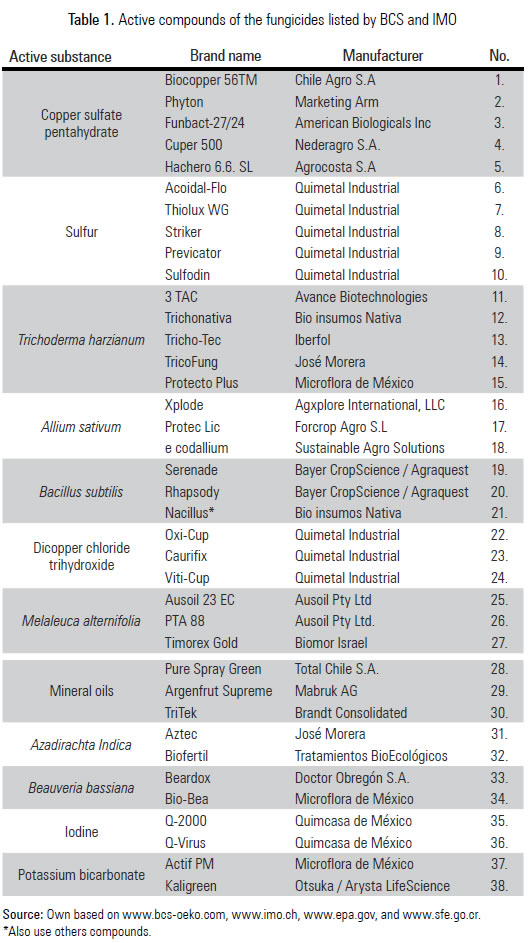
BCS Öko–Garantie GMBH, a Germany–based certifier that controls an estimate of 80% of all certification in the Dominican Republic (Rib–Bejarán, 2007), lists more than 500 products compatible with certified organic agriculture. This includes inputs such as fertilizers, insecticides, and fungicides. Similarly, the Swiss certifier IMO Control, who also participates in the Dominican market, names nearly 400 products cleared for organic agriculture. However, because banana producers primarily use fungicides to manage the black Sigatoka disease, only fungicidal compounds were considered for the patent search.
More than 100 different brand names fungicides have been validated, many of them by both certifiers. Their generic compounds, however, are not shown in the lists. For most of the products, the official labels or the technical specifications is readily available in the manufacturer's official websites. The active compound described there was deemed accurate. Scientific literature was also reviewed to retrieve the active substances. In some cases, the databases of the Pesticide Product Label System hosted by the U.S. Environmental Protection Agency and the Costa Rican Servicio Fitosanitario del Estado were used to cross–check the manufacturers' information. However, this was only possible with fungicides commercially authorized in the U.S and Costa Rica. In a minority of the cases, an official label or other trustworthy source of the active substance was not found.
Table 1 is a list of the brand name products for which the active substances were identified. Because it excludes the brand name products for which an active substance was not found, Table 1 is non–exhaustive. Patent documents were searched for all the identified compounds. Patentscope –the database of the World Intellectual Property Organization– and Espacenet -ran by the European Patent Office– were primarily used for this purpose. In the initial step, no time limits were explicitly set in the search, or any geographical restriction. The International Patent Classifications used were A01N, A61K, C01G, C07C, C07D and C08F. The applicant name was another criteria used to filter the search.
]]> This search criteria returned several relevant documents. Many of these patents are in the public domain –either because they lapsed, expired or were never filed in certain countries–. Therefore, the freedom to operate in regards to those technologies is particularly wide.Copper sulfate
This is the case of fungicides and bactericides based on copper sulfate. The pesticidal features of this compound are well known in the art, and have been disclosed in several patent documents. U.S. patent 4673687, describing a ''new chemotherapeutic agents for the control of plant and animal diseases'', is an illustrative example. It was filed by Source Technology Biologicals, Inc.,–now known as the Phyton Corporation–, in 1985. The underlying technology, licensed to Marketing Arm, is sold under the brand Phyton. Both, the product and manufacturer, are in the lists of inputs approved for organic agriculture.
The Phyton patent application was only filed in the U.S. Due to the territoriality principle of patent protection –which requires applicants to file for a patent in every country where protection is sough–, the content disclosed in that document has already entered the public domain. And, indeed, generic versions of fungicides based on copper sulfate pentahydrate are being produced in countries such as Chile and Ecuador. Some of these manufacturers have also obtained a compatibility validation from organic inputs certifiers.
Potassium bicarbonate
Similarly, U.S. patent 1560558 –issued on November 10, 1925– disclosed the use of salts such as potassium bicarbonate as fungicide ingredients. This art has been enhanced by several applications. A couple of examples includes U.S. patent document 5389386 –filed on June 30, 1994– which described a formulation based on potassium bicarbonate that could be easily removed from the plant surface by water–washing. Another relevant document, U.S. patent 5123950 –filed in April 4, 1990–, disclosed a formulation with ''high efficiency even at a concentration lower than that conventionally''. The more efficient formulation described can be comprised of several common agricultural chemicals, potassium bicarbonate being one of them. This application has been quoted by at least 15 subsequent patent documents. And, according to its official label, it was licensed to Otsuka Chemicals to manufacture the BSC approved input commercially known as Kaligreen.
However, the freedom to operate in regards to this technology is also considerably wide. Many of the improvements around pesticides based on potassium bicarbonate either have reached the end of their 20 years patent term in the U.S., or will expire soon. Moreover, most of the applications over this compound were not filed and, therefore, have no legal effects in many countries growing certified organic produce. In fact, generic versions of fungicides based on potassium bicarbonate are currently available, for instance, in Mexico.
Bacillus subtilis
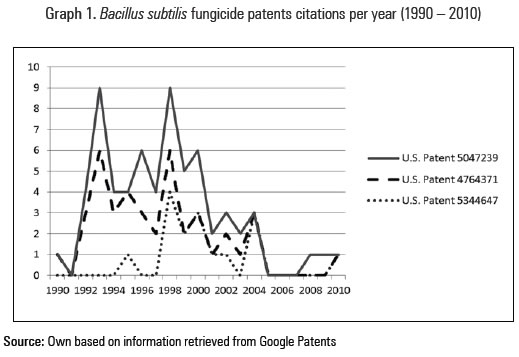
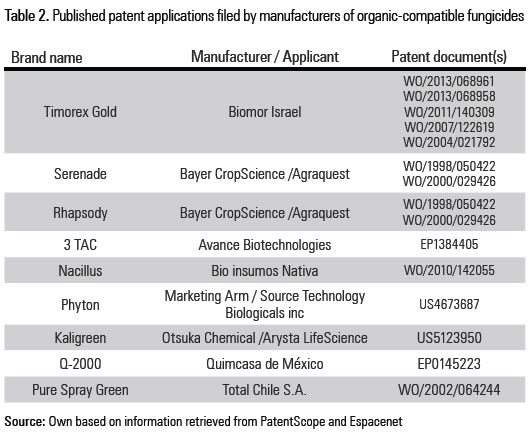
]]> The patent landscape, however, varies across the different active substances. Bacillus subtilis is a well–known bacterium commonly found in soil. The U.S. patent 5344647 -filed on December 29, 1992 and also as EU patent 0276132– disclosed an isolated strain of the Bacillus subtilis with broad antifungal activity. A method for controlling brown rot on postharvest stone fruit using an amount of Bacillus subtilis was described in U.S. patent 4764371-filed on November 13, 1985–. Likewise, the U.S. patent 5047239 -filed on August 11, 1989– claimed a method of inhibiting growth of brown rot, gray mold rot and bitter rot applying Bacillus subtili. These documents have been quoted in at least 16, 29 and 20 subsequent patents applications, respectively. And several of those quotations have appeared in documents filed by Bayer CropScience's subsidiary AgraQuest, Inc. (Graph 1)AgraQuest, Inc. has filed at least two Patent Cooperation Treaty (PCT) applications over fungicidal compounds based on the Bacillus subtili, as shown in Table 2. PCT document WO1998050422 characterizes a strain known as AQ713. The document WO2000029426 claimed a method for protecting plants and fruit from insect infestations, applying the same strain. These applications entered the national phase in Australia, Czech Republic, New Zealand, and the European Patent Office, where at least one was granted. They were published and granted in the U.S. as patents 606005, 6291426, 6103228, and 6417163.
According to their labels, at least two of the products validated as inputs compatible with organic agriculture use that specific patented strain of Bacillus subtili. However, that strain is in the public domain in most countries, particularly where the PCT national phase was not initiated in due time. And in fact, BSC and IMO have validated other inputs that also use the antifungal activity of the Bacillus subtili, although is unclear which specific strain.
Melaleuca alternifolia
Another compound which may have several policy implications is Melaleuca alternifolia. The leaves of tea tree, as it is also known, has been crushed and used as an antiseptic for thousands of years by the Bundjalung people in the coast of New South Wales, Australia (Shemes & Mayo, 1991). Its antifungal activity has also been widely reported in scientific literature (Shemes & Mayo, 1991). Several patents documents are relevant to that substance too, including PCT application WO2002021926. This application disclosed an antimicrobial composition that can be used ''as an inhibitor of microbial growth on crops, plants or foodstuffs''. The composition described comprised ''an antimicrobially effective amount of clove bud oil, eucalyptus oil, lavender oil, tea tree and orange oil but may be diluted with water prior to application''.
A similarly relevant document is PCT application WO2004021792, filed on September 1, 2003, by Biomor Israel. This application claimed a fungicide composition ''comprising tea tree oil and a water emulsion''. It entered the national phase in Australia, India, New Zealand, and the European Patent Office, where it was granted. It was also filed directly in several national offices based on the priority established in the Paris Convention for the Protection of Industrial Property. This includes Argentina, Brazil, Costa Rica, Dominican Republic, and Honduras. As shown in Table 2, Biomor has filed additional PCT applications for a ''non–toxic environmental friendly [tea tree oil]–based therapeutic and disinfective agents for treating aquaculture'', and methods for treating a plant infection caused by different classes of fungus ''applying to the plant a combination of tea tree oil and a synthetic fungicidal compound''.
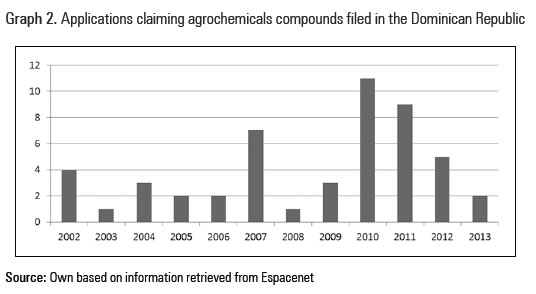
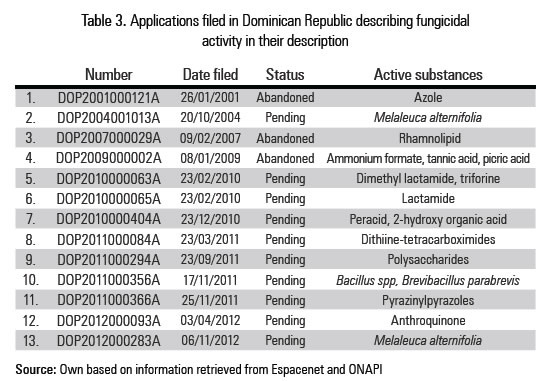
The number of patents filed for agrochemicals in the Dominican Republic is relatively small (see Graph 2), and only a handful of them specifically describe compounds with antifungal activity (see Table 3). Nevertheless, two Biomor tea tree fungicide applications, still pending for examination at the national patent office, are within that list.
]]>
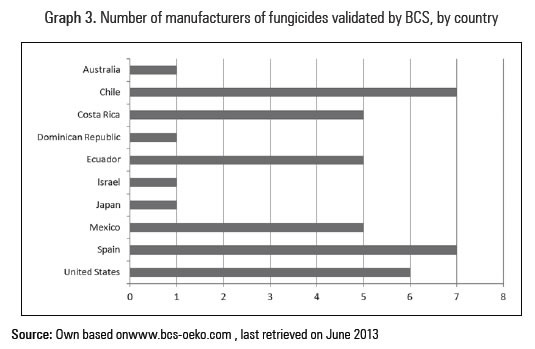
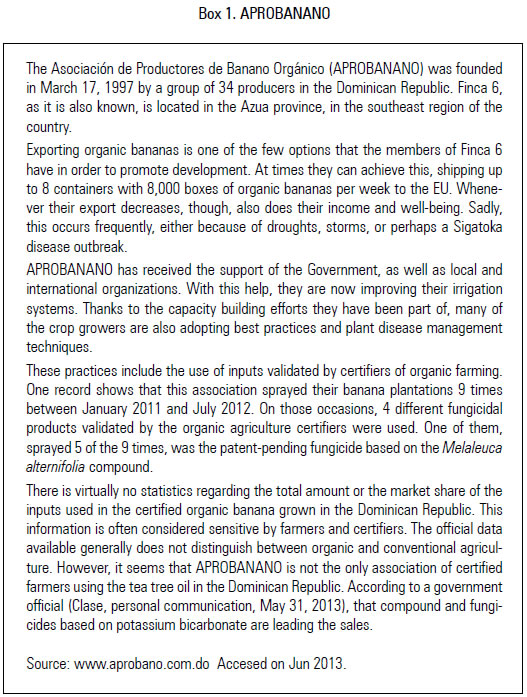
The Biomor fungicide based on the Melaleuca alternifolia has been validated by BSC and IMO, and is commercially available in several countries growing certified organic agriculture, such as Argentina, Chile, Costa Rica, Dominican Republic, Ecuador, and Peru (see Graph 3 and Box 1).
Analysis and discussion
From a quantitative perspective, the patent landscape suggests that there are no significant intellectual property barriers to access to the fungicidal technology validated by certifiers of organic agriculture. Fungicidal compounds such as copper sulfate or potassium bicarbonate are generally off–patent, which seemingly allows the competition between generic manufactures. These findings are particularly manifest in developing countries, where only a handful of patent applications have been filed for the relevant agrochemicals substances.
Nevertheless, some specific patent families or applications may be an issue. They could impose significant intellectual property costs in developing countries engaged in certified organic agriculture. This conclusion particularly applies to pending and granted patents over the Melaleuca alternifolia, an antifungal substance widely used by banana growers.
While a patent grants a monopoly over the specific claimed technology, it does not necessarily give market power to its holder. This also depends on factors such as the structure of the market and the elasticity of the demand. Because this data is not available in the Dominican Republic, no conclusive evidence in regards to the actual costs or the full impact of the patent–induced monopoly on the price of fungicides has been observed. Similarly, none of the patents identified in this research seems to cover a fungicidal technology deemed essential to comply with private voluntary standards.
Therefore, more research should be done in regards to the role of intellectual property in this industry. In particular, further research is needed to understand the market share of the few patented inputs. These further studies should bear in mind factors like market concentration as well as agricultural practices. For instance, a practice often advised is to rotate the off–farm inputs to avoid the development of pest resistance. Thus, even with multiple inputs available, a farmer implementing pesticides rotation techniques might have few alternatives. Then, the market power should be estimated base on these limited options.
]]> It is also worthwhile to consider the nature of the Melaleuca alternifolia patent application. The language of its first claim, which formally defines the scope of patent protection, reads: ''A fungicidal emulsion comprising tea tree oil and a water emulsion [...]''. The following claims describe the different concentrations of the indicated emulsion. The tea tree oil is a naturally–occurring substance that has been known and used for hundreds of years (for instance, as an antiseptic). Therefore, this application essentially claims protection for an allegedly new use of a known substance, and its emulsifiers.Any application for a patent must satisfy the basic criteria of novelty, inventive step and industrial applicability. And the Members of the WTO and its Agreement on Trade–Related Aspects of Intellectual Property Rights (TRIPS) have ''considerable freedom to determine what should be deemed an invention and, if they so desire, to exclude from patentability any substance which exists in nature as being a mere discovery'' (United Nation Conference on Trade and Development & International Centre for Trade and Sustainable Development [UNCTAD–ICTSD], 2005). Several countries apply this TRIPS flexibility by excluding new uses or discoveries from patent protection. The authorities examining the tea tree oil fungicide patent, therefore, should consider these flexibilities.
This argument might be extended to other naturally–occurring substances used as a pesticide, such as isolated strains of bacteria, particularly common in organic agriculture. Moreover, the Ministry of Agriculture of the Dominican Republic is reportedly promoting the use of handmade inputs –primarily fertilizer, but also fungicides– permitted by government norms (Gómez, personal communication, February 18, 2013). In part, this seeks to compensate for the lack of locally–produced inputs compatible with organic agriculture. There are no significant intellectual property barriers in order to promote this type of policies, for instance, in regards to off–patent substances such as garlic (allium sativum). Garlic has antifungal activity, is approved by organic norms, and is readily available in most countries. However, because these fungicides are handmade, and not a registered product that is commercially available, the certifiers rarely allow their use.
An additional tension could derive from trial data exclusivity. The Dominican Republic is one of several countries currently implementing TRIPS–plus provisions. Hence, despite the flexibilities conferred by article 39.3 of the TRIPS agreement, which covers undisclosed information, Dominican laws provides 10 years of exclusive protection over the data submitted to government authorities in order to obtain a market approval for agrochemical products. Because private certifiers only approve registered products, governments interested in promoting the use of alternative substances might be inclined to initiate the regulatory procedure with the corresponding authorities. But whenever the market approval for that compound requires data that is under exclusive protection, royalties could be owed.
Another observation is that many of the manufacturers noted (in the products' labels, websites, etc.) that they sell ''patented products''. This type of claims was often inaccurate, either because a patent application was only filed in specific markets, the patent examination was still pending, or the granted patent already lapsed or expired. This misinformation, however, increases the transactions costs in regards to intellectual property and technology transfer. Transaction costs could also be inefficiently high for imitators that might know the trademark of a validated input, but face several difficulties in order to identify their active compounds. Governments should, therefore, consider adopting policies aimed at reducing these asymmetries of information, either through the already far–reaching regulations over agrochemicals products labels, or with instruments such as antitrust laws.
Similarly, organic certification bodies should consider encouraging a voluntary disclosure of intellectual property rights belonging to the manufacturers of validated inputs. Indeed this is a practice commonly implemented by SSOs in regards to interoperability standards.
Except for isolated cases, science, technology and innovation policies in regards to organic agriculture are generally absent in the Dominican Republic. An indicator of this is the small number of fungicides manufactures in comparison to others Latin American countries, and the lack of firms innovating in this field. This suggests that public policies and incentives should be revised, designed or implemented. Along with the recognition of intellectual property rights, policies instruments such as subsidies and grants should be considered.
Finally, it is unclear to what extent these findings can relate to other standards. Organic standards use an objective list of approved inputs. But most agricultural standards use subjective criteria, and are concerned with the outcome. Therefore, which exact offfarm products are best suited to achieve the outcome and comply with those standards is unclear.
At the same time, standards such as GlobalG.A.P adopt the concept of Integrated Pest Management techniques. As such, GlobalG.A.P. encourages the ''[u]se of natural enemies and other commercially–available biological methods of controls'', including the use of ''appropriate commercially–available selective microbial control agents (e.g., Bacillus thuringiensis, insect–parasitic nematodes, insect–specific fungal and viral products)''. Some of the patented or patent–pending fungicides fall within this characterization. But GlobalG.A.P also considers that this non–mandatory requirement is only a ''minor must''.
]]> Conclusion and policy implications
Multiple conclusions with policy implications derive from these findings, as shown above.
For the international debate:
• There are strong links between intellectual property and the private voluntary standards used in agriculture. However, more research and policy discussions addressing these links are warranted to inform the policy–making. Those subsequent efforts could build upon the ongoing discussions in regards to interoperability Standard–Setting Organizations, intellectual property and antitrust law.
• A quantitatively significant amount of technologies approved for organic agriculture are in the public domain of exporters countries. Hence, engaging in technological cooperation activities without high intellectual property costs seems feasible.
• Those efforts can be oriented at outstanding issues, such as exchanging information in regards to trial data and commercialization approval of new compounds. That type of cooperation could help alleviate the tensions in regards to the cost of compliance of private standards, which are often considered a regressive instrument.
For countries themselves:
• Policy–makers should consider the patent landscape of certifiers–validated substances, and the possibility to promote technology transfer to strengthen the capacity to comply with private standards without high intellectual property costs.
• In addition to compliance with private standards, several public goods can derive from the diffusion of environmentally preferable fungicides. Therefore, the authorities of countries where these technologies are off–patent but not locally produced should consider adopting general policies to support this industry.
• Promoting locally–based science, technology, and innovation in organic agriculture should be part of those efforts. Therefore, intellectual property incentives should be recognized, and instruments such as grants and subsidies should also be considered.
]]> • Producing off–patent, handmade inputs do not present significant intellectual property cots. Governments should continue engaging certifiers to allow their use.• Some certifiers–validated fungicides use naturally–occurring substances, such as bacteria. National patent authorities should carefully consider the patentability were the claims consist of new uses of a known compound or the isolation of a naturally–occurring substance. These are likely closer to discoveries than actual inventions.
Acknowledgments
I am solely responsible for all the views expressed here. However, I am deeply in debt with all those who helped me through the course of this research. They are: Valentina Delich, Vanesa Lowenstein, Luisa Astacio, Milagros Mejía, Gianna Franjul, Amb. Mario Arvelo Caamaño, Bernarda Castillo, Juan Clase, José Zapata Gómez, Máximo Jerez, Yaris López, Chantal Ordehi González, Joaquín Díaz, Luisa Ozuna, and many others.
Notes
2 A patent landscape describes the patent situation for a specific technology in a given country or region.
4 As opposed to high–tech farming.
]]> References
Adames, F. (January 14, 2005). Los Plátanos se Caen de la Mata. Periódico Hoy. Retrieve from http://hoy.com.do/los–platanos–se–caen–de–la–mata/ [ Links ]
EU Commission Regulation 889/2008 of September 5, 2008 for organic production and labelling of organic products with regard to organic production, labelling and control [2008] OJ L 250/1 http://faolex.fao.org/cgi–bin/faolex.exe?rec_id=066120&database=faolex&search_type=link&table=result&lang=eng&format_name=@ERALL [ Links ]
Gibson, C. S. (2007). Globalization and the Technology Standards Game: Balancing Concerns of Protectionism and Intellectual Property in International Standards. Berkeley Technology Law Journal, 22, 825–853. [ Links ]
ITC. (2011a). The Impacts of Private Standards on Global Value Chains. Literature Review Series on the Impacts of Private Standards - Part I. (Publication No. MAR–11–198.E). Geneva, Switzerland. [ Links ]
ITC. (2011b) The Impacts of Private Standards on Producers in Developing Countries. Literature Review Series on the Impacts of Private Standards - Part II. (Publication No. MAR–11– 198.E). Geneva, Switzerland. [ Links ]
Kennedy, S. (2006). The Political Economy of Standards Coalitions: Explaining China's Involvement in High–Tech Standards Wars. Asia Policy, 2, 41–62. [ Links ]
Lemley, M. (2002). Intellectual Property Rights and Standard–Setting Organizations. California Law Review, 90(6), 1889–1979 [ Links ]
Ministerio de Agricultura. (2011). Breve Reseña del Estado Actual de la Agricultura Orgánica en la República Dominicana (Oficina de Control Orgánico publication). Santo Domingo, Dominican Republic. Retrieved from http://www.agricultura.gob.do/media/SyncCMSMedia/6606/Breve–Rese%C3%B1a–del–Estado–Actual–de–la–Agr––Organica–en–RD–2012.pdf [ Links ]
Nivar, A. (December 22, 2011,). El 2011, año de Muy Baja Rentabilidad. Listín Diario. Retrieved from http://www.listin.com.do/economia–y–negocios/2011/12/21/215544/El–2011–fueun–ano–de–muy–baja–rentabilidad [ Links ]
OECD. (2007). Private Voluntary Standards and Developing Country Market Access: Preliminary Results, Communication from OECD (WTO Document G/SPS/GEN/763). Geneva, Switzerland. [ Links ]
Polanco, T. (2008). Patógenos Asociados a las Musáceas en la República Dominicana, Instituto Dominicano de Investigaciones Forestales (IDIAF document), Santo Domingo, Dominican Republic. [ Links ]
Rambus Inc. v. Infineon Technologies, U.S. Federal Circuit (January 29, 2003). Available at: http://www.consortiuminfo.org/essentialguide/images/rambus2.pdf [ Links ]
Rib–Bejarán, S. (2007). La Agricultura Orgánica en la República Dominicana: Algunos Alcances. In UNCTAD (Ed.), Requisitos Ambientales, Competitividad Internacional y Acceso a Mercados en América Central, Cuba, y la República Dominicana (pp. 119–126). Geneve and New York: United Nations. [ Links ]
Rubens, E. (February 21, 2004) Sigatoka Negra Daña Banano, Periódico Hoy, Retrieved from http://hoy.com.do/sigatoka–negra–dana–banano/ [ Links ]
Shapiro, C. (2001). Setting Compatibility Standards: Cooperation or Collusion? In R. Cooper Dreyfuss, D. L. Zimmerman, & H. First (Eds.), Expanding the Boundaries of Intellectual Property. Innovation Policy for the Knowledge Society (pp. 81–101). United States: Oxford University Press. [ Links ]
Shemes, A. & Mayo, W. (1991). Australian Tea Tree Oil: a Natural Antiseptic and Fungicidal Agent. Australian Journal of Pharmacy, 72, 802–803. [ Links ]
OECD. (2007). Private Voluntary Standards and Developing Country Market Access: Preliminary Results, Communication from OECD (WTO Document G/SPS/GEN/763). Geneva, Switzerland. [ Links ]
UNCTAD. (2007) Typology of Global Standards. Note by the Secretariat, Communication from the United Nations Conference on Trade and Development (UNCTAD) (WTO Document G/ SPS/GEN/760). Geneva, Switzerland. [ Links ]
]]>UNCTAD–ICTSD. (2005). Resource Book on TRIPS and Development. New York: Cambridge University [ Links ] ]]>