<?xml version="1.0" encoding="ISO-8859-1"?><article xmlns:mml="http://www.w3.org/1998/Math/MathML" xmlns:xlink="http://www.w3.org/1999/xlink" xmlns:xsi="http://www.w3.org/2001/XMLSchema-instance">
<front>
<journal-meta>
<journal-id>1692-0279</journal-id>
<journal-title><![CDATA[AD-minister]]></journal-title>
<abbrev-journal-title><![CDATA[AD-minister]]></abbrev-journal-title>
<issn>1692-0279</issn>
<publisher>
<publisher-name><![CDATA[Escuela de Administración  de la Universidad EAFIT]]></publisher-name>
</publisher>
</journal-meta>
<article-meta>
<article-id>S1692-02792014000200003</article-id>
<title-group>
<article-title xml:lang="en"><![CDATA[The new international financial architecture: Lessons and experiences from Africa]]></article-title>
<article-title xml:lang="es"><![CDATA[La nueva arquitectura financiera internacional: lecciones y experiencias de África]]></article-title>
</title-group>
<contrib-group>
<contrib contrib-type="author">
<name>
<surname><![CDATA[Outa]]></surname>
<given-names><![CDATA[Erick R]]></given-names>
</name>
<xref ref-type="aff" rid="A01"/>
</contrib>
</contrib-group>
<aff id="A01">
<institution><![CDATA[,Faculty Strathmore Business School and Researcher  ]]></institution>
<addr-line><![CDATA[Nairobi ]]></addr-line>
<country>Kenya</country>
</aff>
<pub-date pub-type="pub">
<day>00</day>
<month>12</month>
<year>2014</year>
</pub-date>
<pub-date pub-type="epub">
<day>00</day>
<month>12</month>
<year>2014</year>
</pub-date>
<numero>25</numero>
<fpage>49</fpage>
<lpage>78</lpage>
<copyright-statement/>
<copyright-year/>
<self-uri xlink:href="http://www.scielo.org.co/scielo.php?script=sci_arttext&amp;pid=S1692-02792014000200003&amp;lng=en&amp;nrm=iso"></self-uri><self-uri xlink:href="http://www.scielo.org.co/scielo.php?script=sci_abstract&amp;pid=S1692-02792014000200003&amp;lng=en&amp;nrm=iso"></self-uri><self-uri xlink:href="http://www.scielo.org.co/scielo.php?script=sci_pdf&amp;pid=S1692-02792014000200003&amp;lng=en&amp;nrm=iso"></self-uri><abstract abstract-type="short" xml:lang="en"><p><![CDATA[The purpose of this paper is to examine the requirements and successes of the New International Financial Architecture (NIFA) on transparency and corporate governance from a global perspective with a special focus on Africa. In recent years, transparency, accountability and governance have become key topics with many countries around the world having adopted International Financial Reporting Standards (IFRS) and corporate governance codes. The outcomes of these initiatives have been unconvincing. Desktop research was used to gather literature and data on compliance with corporate governance codes and International Financial Reporting Standards (IFRS) and other NIFA requirements. This study established that in spite of many regional and global initiatives by the World Bank and relevant regulators, compliance with IFRS and governance in parts of Africa has yet to reach its best level and guidelines are not fully followed leading to opportunities for improvement and policy adjustments. This research has implications and uses for both global and local institutions and regulators concerned with economic stability and growth including the World Bank, central banks, capital markets and boards of companies and the government in general. The findings contribute to governance debates by providing additional perspectives from Africa on compliance with accounting standards and codes in a region where research and corporate governance and reporting issues are still confusing.]]></p></abstract>
<abstract abstract-type="short" xml:lang="es"><p><![CDATA[El propósito de este artículo es examinar los requisitos y los éxitos de la Nueva Arquitectura Financiera Internacional (NAFI) sobre transparencia y gobierno corporativo desde una perspectiva global, con enfoque especial en África. En los últimos años, la transparencia, la rendición de cuentas y el buen gobierno se han convertido en temas clave con muchos países de todo el mundo después de haber adoptado las Normas Internacionales de Información Financiera (NIIF) y los códigos de gobierno corporativo. Los resultados de estas iniciativas han sido poco convincentes. La investigación de escritorio se utiliza para recopilar literatura y los datos sobre el cumplimiento de los códigos de gobierno corporativo y las Normas Internacionales de Información Financiera (NIIF) y otros requisitos NAFI. En este estudio se estableció que, a pesar de las muchas iniciativas regionales y globales por parte del Banco Mundial y los organismos reguladores pertinentes, el cumplimiento con las NIIF y la gobernabilidad en algunas partes de África es todavía para llegar a su mejor momento y directrices no se siguen completamente dando lugar a oportunidades de mejora y ajustes de políticas. Esta investigación tiene implicaciones y usos tanto para instituciones como reguladores globales y locales que se ocupan de la estabilidad económica y el crecimiento como el Banco Mundial, los bancos centrales, los mercados de capital y los consejos de administración de las empresas y el gobierno en general. Los hallazgos contribuyen a los debates de gobierno al proporcionar perspectivas adicionales desde África sobre el cumplimiento de las normas de contabilidad y códigos en una región donde la investigación y la gestión empresarial y las cuestiones de presentación de informes son todavía factores de confusión.]]></p></abstract>
<kwd-group>
<kwd lng="en"><![CDATA[Corporate governance]]></kwd>
<kwd lng="en"><![CDATA[International Financial Reporting Standards (IFRS)]]></kwd>
<kwd lng="en"><![CDATA[International Financial Architecture (NIFA)]]></kwd>
<kwd lng="en"><![CDATA[transparency]]></kwd>
<kwd lng="es"><![CDATA[Gobierno corporativo]]></kwd>
<kwd lng="es"><![CDATA[Normas Internacionales de Información Financiera (NIIF)]]></kwd>
<kwd lng="es"><![CDATA[Nueva Arquitectura Financiera Internacional (NAFI)]]></kwd>
<kwd lng="es"><![CDATA[transparencia]]></kwd>
</kwd-group>
</article-meta>
</front><body><![CDATA[  <font face="Verdana, Arial, Helvetica, sans-serif" size="2">    <p align="right"><b>ART&Iacute;CULO</b></p>     <p align="center"><font size="4"><b>The  new international financial architecture: Lessons and experiences from Africa</b></font>    <p align="center">     <font size="3"><b>La nueva arquitectura financiera internacional:  lecciones y experiencias de &Aacute;frica</b></font>    <p> </p> Erick R. Outa     <p align="left">&nbsp;</p>     <p align="left">Adjunct Faculty Strathmore Business School and  Researcher\Consultant. Nairobi, Kenya. E-mail: <a href="mailto:ericouta2002@yahoo.co.uk">ericouta2002@yahoo.co.uk</a></p> </font>    <p>&nbsp;</p>     <p><font size="2" face="Verdana, Arial, Helvetica, sans-serif"><b>Received:  31/07/2014&nbsp; Modified: 24/10/2014  Accepted: 02/11/2014</b></font></p> <font face="Verdana, Arial, Helvetica, sans-serif" size="2">    <p>&nbsp;</p> <hr />     ]]></body>
<body><![CDATA[<p><b>Abstract</b></p>     <p>The purpose of this paper is  to examine the requirements and successes of the New International Financial  Architecture (NIFA) on transparency and corporate governance from a global  perspective with a special focus on Africa. In recent years, transparency, accountability  and governance have become key topics with many countries around the world  having adopted International Financial Reporting Standards (IFRS) and corporate  governance codes.</p>     <p>The outcomes of these initiatives have been unconvincing. Desktop  research was used to gather literature and data on compliance with corporate  governance codes and International Financial Reporting Standards (IFRS) and  other NIFA requirements. This study established that in spite of many regional  and global initiatives by the World Bank and relevant regulators, compliance  with IFRS and governance in parts of Africa has yet to reach its best level and  guidelines are not fully followed leading to opportunities for improvement and  policy adjustments. This research has  implications and uses for both global and local institutions and regulators  concerned with economic stability and growth including the World Bank, central  banks, capital markets and boards of companies and the government in general. The  findings contribute to governance debates by providing additional perspectives  from Africa on compliance with accounting standards and codes in a region where  research and corporate governance and reporting issues are still confusing.</p>     <p><b>Keywords:</b> Corporate governance; International Financial  Reporting Standards (IFRS); New International Financial Architecture (NIFA);  transparency. </p>     <p><b>JEL Classification:</b> G3, M1, M2.</p> <hr /> <b>Resumen</b>       <p>  El prop&oacute;sito de este art&iacute;culo es examinar los  requisitos y los &eacute;xitos de la Nueva Arquitectura Financiera Internacional  (NAFI) sobre transparencia y gobierno corporativo desde una perspectiva global,  con enfoque especial en &Aacute;frica. En los &uacute;ltimos a&ntilde;os, la transparencia, la  rendici&oacute;n de cuentas y el buen gobierno se han convertido en temas clave con  muchos pa&iacute;ses de todo el mundo despu&eacute;s de haber adoptado las Normas&nbsp; Internacionales de Informaci&oacute;n Financiera  (NIIF) y los c&oacute;digos de gobierno corporativo. Los resultados de estas  iniciativas han sido poco convincentes. La investigaci&oacute;n de escritorio se  utiliza para recopilar literatura y los datos sobre el cumplimiento de los  c&oacute;digos de gobierno corporativo y las Normas Internacionales de Informaci&oacute;n  Financiera (NIIF) y otros requisitos NAFI. En este estudio se estableci&oacute; que, a  pesar de las muchas iniciativas regionales y globales por parte del Banco  Mundial y los organismos reguladores pertinentes, el cumplimiento con las NIIF  y la gobernabilidad en algunas partes de &Aacute;frica es todav&iacute;a para llegar a su  mejor momento y directrices no se siguen completamente dando lugar a oportunidades  de mejora y ajustes de pol&iacute;ticas. Esta investigaci&oacute;n tiene implicaciones y usos  tanto para instituciones como reguladores globales y locales que se ocupan de  la estabilidad econ&oacute;mica y el crecimiento como el Banco Mundial, los bancos  centrales, los mercados de capital y los consejos de administraci&oacute;n de las  empresas y el gobierno en general. Los hallazgos contribuyen a los debates de  gobierno al proporcionar perspectivas adicionales desde &Aacute;frica sobre el  cumplimiento de las normas de contabilidad y c&oacute;digos en una regi&oacute;n donde la  investigaci&oacute;n y la gesti&oacute;n empresarial y las cuestiones de presentaci&oacute;n de  informes son todav&iacute;a factores de confusi&oacute;n. </p>     <p><b>Palabras clave:</b> Gobierno corporativo; Normas  Internacionales de Informaci&oacute;n Financiera (NIIF); Nueva Arquitectura Financiera  Internacional (NAFI), transparencia.</p>     <p><b>Clasificaci&oacute;n  JEL:</b> G3,  M1, M2.</p> <hr />     <p>&nbsp;</p>     <p><b><font size="3">Introduction</font></b></p>     ]]></body>
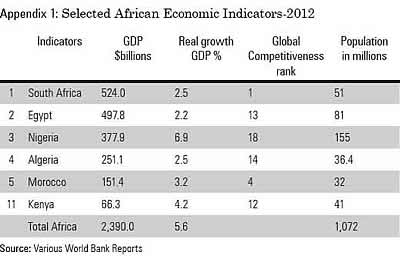
<body><![CDATA[<p>The question of Corporate Governance has  been at the forefront around the world after the Asian Financial crisis of 1998  when intensified efforts to strengthen the international financial system resulted  in the creation of a New International Financial Architecture (NIFA). According  to Singh and Newberry (2008, p. 1) NIFA requirements include corporate  governance and compliance with International Financial Reporting Standards  (IFRS).&nbsp; NIFA was conceptualized in April  1998, when finance ministers and Central Bank Governors from a number of  significant economies met in Washington DC to examine issues related to the  stability of the international financial system and the effective functioning  of the global capital markets. They identified three action areas that would  stabilize the international financial system: 1) enhancing transparency and  accountability 2) strengthening domestic financial systems and 3) managing  international financial crises. Under enhancing transparency, it was  recommended that priority be given to compliance with and enforcement of high  quality accounting standards to enhance the relevance, reliability,  comparability and understandability of financial reports. The IMF was mandated  to prepare a report summarizing the extent to which an economy meets  internationally recognized disclosure standards. In this study, the International  Financial Reporting Standards (IFRS) have been applied as a proxy for high  quality accounting standards. Under strengthening domestic financial systems, the  focus is on principles and policies that foster the development of a stable and  efficient financial system including corporate governance and risk management.</p>     <p>According to Soederburg (2002), the International  Monetary Fund &nbsp;(IMF) and the World Bank  (WB) have used their considerable international surveillance powers to ensure that  countries comply with NIFA, through the use of international standards such as  IFRS, in accordance with what is known as the Report on Observance of Standards  and Codes (ROSC). According to the Bank for International Settlements (BIS)  (1998), members recognized that cooperation and coordination among national  supervisors, regulators and international groups are crucial to the  strengthening of domestic and financial systems. Bank for International  Settlements is an intergovernmental organization of central banks that foster  monetary and financial cooperation and serve as a bank for Central Banks. Its  main objectives are monetary and financial stability.</p>     <p>Since NIFA came into being, IFRS have  been rapidly spreading around the world. To date, over 100 countries have  adopted the standards and the world's biggest economy, the US, has endorsed the  use of IFRS by issuing a road map for its adoption in the country even though  there is a belief US GAAP is as good as or even better than IFRS. According to  IAS plus (2010), IFRS refers to the entire body of the International Accounting  Standards Board (IASB) pronouncements including standards and interpretations  approved by the IASB and the International Accounting Standards Committee  (IASC). To date, there are 28 IAS and 15 IFRS. Other authors have also  explained that accounting standards state how particular types of transactions  should be reflected on the financial statements. Each accounting standard is  structured with an objective, scope, definition of applicable terms, accounting  treatment, presentation, and disclosure. The arrangements ensure that the  objectives of financial reporting, including disclosures, are met.</p>     <p>The African case is  important. Questions have been raised as to whether Africa is still a dark  continent given the continuing increases in foreign direct investment (the  highest in any developing region), the recent hosting of the World Cup in South  Africa and the discovery of oil and gas in Uganda, Kenya and Tanzania. It is  estimated that Africa's GDP in 2008 stood at $1.6 trillion, equivalent to that  of Brazil and Russia. The McKinsey quarterly report (2010) indicated that about  half of Africa's 1 billion populations will live in cities in 2030. 18 top  cities in Africa will have a combined purchasing power equal to 8% of the total  Africa GDP. Since 2005 GDP growth on the continent has averaged 5.1% and the World  Bank and many other development institutions have recognized Africa as the area  for growth given Europe and the US are not registering major growth  projections. Moreover, oil, gas and other minerals continue to be discovered in  the continent while service industries are now major part of the GDP. The five  top economies include South Africa, Nigeria, Egypt, Algeria and Morocco while  the fastest growing ones include Ethiopia (7.5%), Mozambique (7.2%), Tanzania (6.8%),  Congo (6.5%), Ghana (9%) and Zambia (7.6%) in 2013 see appendix 1 and 2. Even  though growth rates in Africa have been criticized as excluding equity and  wealth distribution, this unequal distribution mars progress and has been a  source of many upheavals. Some corporate leaders have suggested that African  economic growth will not be sustainable if the continent does not improve its  reputation for corporate governance (Ramalho, 2013) and that Africa's growth  will be real only if it develops strong companies able to compete successfully  in their home and overseas markets and that is best achieved through good corporate  governance. Keeping Africa on governance trajectory is therefore timely as the  anticipated and currently dismal wealth situation needs to be managed well and in  the best interest of society so as to reach the predicted middle-income status  by 2050.</p>     <p>In light of these debates, this study  seeks to establish the extent to which corporate governance and financial  reporting practices in Africa are in line with global best practices, and has  applied desktop research to gather literature and data. The findings are that  compliance with NIFA is still low though improving, and guidelines are not  fully followed and this is manifested by the recurrence of financial crises,  suspension of companies from securities exchanges, bailouts of companies, and bankrupt  or collapsed companies. &nbsp;The study will  be useful for both global and local institutions and regulators concerned with  economic stability and growth. The World Bank, central banks, capital markets  and boards of companies and organizations, investors and academics will find it  useful.</p>     <p>The paper is organized as follows.  Section 2 reviews literature on corporate governance and codes, theories, global  corporate lapses, IFRS and African overview of NIFA. Section 3 reviews the  situation on the ground regarding transparency and accountability by evaluating  ROSC reports from selected countries in Africa. Section 4 covers strengthening  of the domestic financial system and details general shortcomings in current  corporate governance practices. Section 5 discusses findings and  recommendations and section 6 concludes the paper by drawing on the lessons  found in the study and then makes suggestions for future research. </p>     <p>&nbsp;</p>     <p><b><font size="3">Literature Review</font></b></p>     <p>&nbsp;</p>     <p><b>Corporate  Governance</b></p>     ]]></body>
<body><![CDATA[<p>The principal agent paradigm enunciated  by Fama (1980) raises the question on how to ensure that managers follow the  interests of shareholders. Modern corporations are characterized by a separation  of ownership and control as they are run by professional managers (agents) who  are not accountable to dispersed shareholders (principals). The principals must  then solve two problems 1) how to select the most capable managers and 2)  address the moral hazard of giving the managers the right incentives to put  forth efforts aligned with shareholder interests. Shleifer and Vishny (1997, p.  737) define corporate governance as a set of mechanisms through which outside  investors protect themselves against expropriation by the insiders, a  definition criticized for focusing too much on profit. There are many other  definitions that try to put into perspective the motions of governance. These  definitions state that corporate governance deals with the ways in which  suppliers of finance to corporations assure themselves of getting a return on  their investments. The Economic Commission for Africa (ECA) (2002) defined  corporate governance as the system by which companies are governed and  controlled. In view of these definitions, it's widely accepted that bad  governance leads to economic collapse. Indeed, many corporate scandals and the stock  price collapses of companies such as Adelphia, Tyco and World com, Enron, (US) and  Parmalat (Europe) are believed to be the result of poor governance (Brown &amp;  Caylor 2004). </p>     <p>It has also been argued that good corporate  governance structures encourage firms to create value and provide  accountability and control systems commensurate with the risks involved. According  to the Australian Stock Exchange (2003) good corporate governance is a necessary  prerequisite that will attract investors, create competitive and efficient  companies and business enterprises, enhance accountability and promote  efficient use of limited resources. Similarly, the Organization for Economic Cooperation  and Development (OECD) (2009) has defined corporate governance as the internal  means by which corporations are operated and controlled. Tan and Tan  (2004) state that best run corporations recognize that business ethics and sensitivity  to the interests of the environment and the society in which they operate can  have an impact on the reputation and long-term performance of the organization.  Furthermore, Ashbaugh-Skaife, Collins and LaFond (2006) argue that applying the  framework developed by Standards and Poor for evaluating governance provides  compelling evidence that a variety of governance mechanisms explain credit  ratings after controlling for other factors. In particular, the framework  identifies four indicators that are associated with credit ratings. These are a  negative association of block holders, positive relation to weaker shareholder  rights and positive relationship to the degree of financial transparency and  other board CEO relationships. </p>     <p>The damage caused by corporate scandals  has encouraged many governments, regulators and international organizations to  initiate measures aimed at restoring investor confidence (Corporate Centre for  Governance, 2006). There are many issues that draw attention to corporate  governance and Montgomery (2007) cites the global recognition of corporate  social responsibility, the Asian Financial Crisis of 1998, and the economic  scandals in the US and Europe. These scandals have been manifested through a decline  in the value of stock prices, marketplace panics and a run on banks.&nbsp; The negative impact that such scandals have  had on people are enormous leading to an urgent need for policy guidelines to  prevent scandals in the future. </p>     <p>In the case of emerging economies, Montgomery  (2007) takes the argument a notch higher by arguing that in developing countries,  there are lost opportunities to mobilize financial resources on domestic and  international markets as poor governance is associated with low returns. This  view is also associated with the McKinseys &amp; Company report (2002) where an  investor opinion survey showed that companies with good corporate governance  have a 12% increase in their market valuation. The findings also reported that  over 73% of the investors in the world are willing to pay a premium for well-governed  companies<b>.</b><br />   Corporate governance, it can be argued,  is crucial because the impact occasioned by its absence or presence can be  devastating or profitable. Commonwealth Association for Corporate Governance (CACG)  (2006) rates the UK and Netherlands as front-runners in corporate governance  compliance followed by Belgium, France and Germany while Norway, Portugal and  Switzerland lag behind. </p>     <p>&nbsp;</p>     <p><b>Corporate Governance Codes</b></p>     <p>According  to the World Bank (2005), corporate governance codes are sets of nonbinding  recommendations aimed at improving and guiding the governance practices of  corporations within a country's specific legal environment and business  context. They provide clear guidance for financial and non-financial  disclosure, foster better engagement with minority shareholders and clarify the  respective roles of managers and directors. Good  corporate governance is supported by appropriate codes that are benchmarked to  world standards. Most codes are voluntary and require firms to either comply or  explain why they have not complied. A few others are regulatory and require  mandatory compliance such as the Sarbanes Oxley Act commonly known as SOX 2002.  Such codes include the Capital Market Authority (CMA) Kenya guidelines, SOX  2002 (USA), King II 2002 (SA) and the Higgs and Smith Report 2003 (UK), the  European Commission's Action Plan (EU) and the Organization for Economic  Cooperation's (OECD) Corporate Governance Framework. Other global bodies  engaged in corporate governance include the IFC, World Bank and regional development  banks such as the African Development Bank.</p>     <p>Iliev (2010) has raised some  very critical questions on the role of regulation as far as corporate  governance is concerned. What is the optimal level of regulation for public  firms? &nbsp;Are the costs of new regulations  excessive? Can regulation improve the quality of financial reporting? And, ultimately,  how does regulation affect the market valuation of firms? There are no clear  answers to these questions but it is possible the poor implementation and outcomes  of corporate governance reflects the inability to adequately respond to these questions.</p>     <p><b><i>Capital  Market Authority (CMA) Kenya Guidelines 2002 no 3362</i></b></p>     <p>This was issued by the CMA  and referred to as guidelines on  corporate governance practices by publicly listed companies in Kenya<b> </b>gazette  notice no 3362 to be applied as of the year ending 2002. It encouraged  companies to comply and like all other voluntary codes, it is expected  companies to identify reasons why they are not able to comply. Other private  sector non-listed companies were encouraged to comply too as a best  practice.&nbsp; Section 1.3 of the guidelines  indicate that they have been developed taking into account the work that has  been undertaken extensively by several jurisdictions through many task forces  and committees including but not limited to the United Kingdom, Malaysia, South  Africa<b>, </b>Organization for Economic Cooperation and Development (OECD<b>) </b>and  the Commonwealth Association for Corporate Governance. Although a new one has  been issued in 2011, companies in Kenya between 2007 and 2011 were expected to  apply the 2002 act. The guidelines cover board structure, board committees,  AGMs, shareholders, accountability and information audit and disclosure. </p>     ]]></body>
<body><![CDATA[<p>In Kenya, the broad  Corporate Governance structure is made up of the CAP 486 Companies Act and  other acts of parliament that include the state corporations act, the  cooperatives act and the regulators that include the Insurance Regulatory  Authority Act, Capital Markets Authority Act, the Central Bank Act, labor laws  and many others. The existence of an independent judiciary and an independent  press are considered crucial components of corporate governance and their  impact is just beginning following the promulgamation of the new constitution  in 2010. In 2014, these guidelines were reissued together with a blueprint for  action in light of the problems experienced in several listed companies.</p>     <p><b><i>The Sarbanes Oxley Act 2002</i></b></p>     <p>Enacted in the USA in  2002 as a government response to the numerous corporate scandals that befell  the country, the code focuses on the independent auditing of oversight boards,  higher penalties for corporate wrongdoers (up to 20 years in prison for  destroying or falsifying financial or audit information), extensive financial disclosures  and avenues of recourse for aggrieved shareholders. SOX also provides for CEOs  and CFOs to forfeit any financial gain received from bonuses and profits based  on inaccurate financial results. While it was initially opposed by many  corporations in 2002 as another endless list of regulations adding costs to  businesses, subsequent surveys indicated that 60% of those surveyed thought  that SOX had positive effects on firms while 70% of the directors thought that  SOX had positive effects on the activities of the board of directors according  to Stanwick (2008). The impact of SOX according to Reilly (2006) was the  reduction and an expected further reduction in earnings restatements, which  were 250 in 2000 and rose to 1,200 in 2005. Another worry with SOX was the cost  of implementation and which, according to Reilly (2006), was decreasing  ($463,000 in 2004 to $223,000 in 2005) implying there are beneficial effects to  complying with Sox. For African countries looking forward to sharing experiences  from the west, it must be noted that cost, benefits and valuations are critical  and recent scientific research is very skeptical about the benefits of mandatory  regulation as opposed to voluntary codes. </p>     <p><b><i>European Commission Action  Plan </i></b></p>     <p>According to Stanwick  (2008), the framework falls into short, medium and long term with the short  term requiring EU firms to explain their Corporate Governance structure in  their annual reports, including items such as shareholder rights, board of  directors composition and operation, and this framework is commonly applied in  Kenya. In the medium term, the European Action Plan recommends that firms be  required to submit to shareholders their investment and voting policies as well  as the kind of board structure they want to implement, and it is believed that  the evaluation of the short and medium term will possibly lead to a long term  horizon.</p>     <p><b><i>The organization for Economic Cooperation and Development  (OECD)</i></b></p>     <p>OECD revised the 1999  Corporate Governance framework in 2004, which included requirements for transparency  and efficient market development. The significant elements of this framework  include fair treatment of individual shareholders to same information,  disclosure of conflict of interest, performance enhancement systems and the  freedom of shareholders to raise concerns regarding illegal and unethical  activities. </p>     <p><b><i>King II and III report 2009</i></b></p>     <p> King II report in South Africa advocates for  an integrated approach to good governance and incorporates emerging themes such  as risk management, rights of the minority, and the reporting of non financial  issues and has been supported by the revised Company's Act of 2008. King III  applies to all entities even though it has not received Company's Act backing  yet.</p>     <p><b><i>The Higgs and Smith Report</i></b><br />     <b></b><br />   Targets audit  committee composition and duties to monitor the integrity of financial controls  and risk management.</p>     ]]></body>
<body><![CDATA[<p>Other Corporate Governance  codes include the Combined Code prepared by the Institute of Chartered  Accountants in England and Wales (ICAEW) following the Turnbull Report and the  Commonwealth Association for Corporate Governance. One of the criticisms of local  corporate governance codes is contained in the CACG Guiding Principles for  Corporate Governance in the Commonwealth (2006) that states that the  globalization of the market place has ushered in an era where the traditional  dimensions of corporate governance defined within local laws, regulations and  national priorities are becoming increasingly challenged by circumstances and  events with an international impact. The other side of this argument has been proposed  by Accountants when promoting globing accounting standards (IFRS), where it has  been argued that the adoption of one common global framework may not be practical.  From an analysis of the codes, it can be argued that the diversity and  similarities in both global and local codes are quite obvious but Stanwick  (2008, p. 2) concludes that certain core standards are universal and can be  applied anywhere by combining the good qualities of each frameworks while  avoiding global standards that result in conflicts when applied locally as  noted in law and accounting.</p>     <p>&nbsp;</p>     <p><b>Corporate  Governance Theories</b></p>     <p>The theories that underpin these frameworks  have been discussed in prior literature by Bruner (2011), Coffee (2005) and  Leblac and Lilies (2003) and many others.</p>     <p>Bruner (2011, p. 309) argues that both sides of  the Atlantic are engaged in proposals to empower shareholders in both financial  and public companies with the belief that this would constrain reckless  managers and curb risk taking that results in financial crises. This is based  on the theory that corporate governance issues oscillate between the  shareholders and board of directors. It is widely believed, according to Bruner  (2011), that the current face of corporate governance proposals reflect a  response to the last economic crisis of 2007 that wrought havoc on banking  systems in the US and the UK and which, many studies believe, was related to  executive compensation.&nbsp; He argues that  the case for corporate governance in non-financial sectors is weak since risk  incentives and associated regulatory problems differ between the two domains.  This partly explains why the banking sector in Kenya, has to comply with  Central Bank regulations based on the Basle conventions, in addition to Capital  Market Authority (CMA) rules that are applicable to all listed companies but  are not a sufficient deterrent to bad governance. Bruner's (2011, p. 321)  argument is that corporate governance revolves around two power constituencies  - the board and the shareholders - and that the 2007 crisis was occasioned by  board oversight failures, meaning that the shareholders did not monitor the  boards adequately. The reason for shareholder failures arises from the fact that  shareholder ownership is either concentrated or dispersed. In concentrated  ownership, corporate governance aims to constrain the block holder's (the  majority shareholder) power by strongly emphasizing the interest of other  stakeholders such as employees and creditors. The other ownership structure  referred to as dispersed ownership is fragmented. In this case, corporate  governance seeks to protect minorityshareholders who lack  voting power. It can therefore be inferred that Kenyan shareholders are  dispersed in theory and that the Capital Markets Authority's objective in their  corporate governance framework is to protect the minority.</p>     <p>Coffee (2005) applied the same theory in  explaining why there are more corporate scandals in the US than in the UK. He  theorizes that the corporate governance of majority-owned corporations  (predominant in Europe) should be fundamentally different than corporate  governance of corporations that lack a controlling shareholder group  (predominant in the U.S.). It is not necessarily because there are fewer  incentives to rip off other shareholders, but the feasible means to do so will  differ, thus explaining why there are fewer scandals in Europe. In his theory  of corporate scandals, he argues that fraud is more easily accomplished by the misappropriation  of the private benefits of control: authorization of related-party transactions  at advantageous prices and below-market tender offers. This theory can be used  to understand the 2011 Cooper Motor's Cooperation (CMC - Kenya). In this  scenario, a shareholder with a 24.8% interest who was a Director and Chair of  the Board had his company conduct business with CMC Kenya. The net effect was  that this sister company over billed CMC based on non-arms length transaction  ranging in millions of shillings. Transactions arising out of relationship led  to a dysfunctional board, suspension by the securities exchange and lose of  confidence from partners including banks, auditors and franchise holders.</p>     <p>Leblanc and Gillies  (2003, p. 3) in their paper on the coming revolution argue that regulations  that were developed in the 1990's to govern corporations were based on very  limited knowledge about the factors influencing corporate decisions. While they  state that relatively little is known about why or how corporate scandals or  failure occur or how and why key decisions were made or not made and why boards  acted in a certain way, the reasons for these failures, broadly, irrationality  of the markets, maximization of short term returns and personal greed, are  still dominant. This reasoning has led to the theory that if that the task of  the independent board is oversight responsibility of management, then these  lapses must have been caused by the inability of the boards to operate  effectively, which is in line with Brunner's argument above of oversight  failure by the board. Leblanc and Gillies continue to reason that many  commentators see Board effectiveness in terms of the separation of chair and  CEO, composition (independent and non independent directors) and board size and  this has led to the proposed model below: </p>     <p>BE  = BS + BM + BP<br />   DE  = DI + DC + DB<br />   Board  effectiveness (BE) depends upon Board Structure (BS) +<br />   Board  Membership (BM) + Board Process (BP).<br />   Director  effectiveness (DE) depends upon Director<br />   Independence  (DI) + Director Competence (DC) + Director Behavior (DB)<br />   <b>Source:</b> Leblanc and Gillies (2003, p. 9)</p>     <p>These models are  based on arguments made by many commissions and think tanks that state it is  board effectiveness that matters because there is no evidence linking board  structure and corporate financial success. In many ways this model attempts to  explain the real issues behind successful corporate governance i.e. Director  Effectiveness. In Kenya and many emerging markets, the application of such  models to explain corporate governance is uncommon yet most of the line items  in the corporate governance models depict these variables.</p>     <p><br />   <b>Scope, Interest, and forces behind Corporate Governance</b></p>     ]]></body>
<body><![CDATA[<p>The scope of  corporate governance is wide and CACG (2006) extends this to its impact on  society in terms of corporate social responsibility (CSR) as well as its  effects on shareholders, directors, employees and other stakeholders. In many  countries, annual reports and audited accounts are now regarded as key sources  of information on corporate governance and financial disclosures, with reports  covering wide areas such the Board of Directors, Board Corporate Governance  Committees (advice on governance standards), Board Audit and Risk Management  Committees, Board Compensation Committees, Board Nomination Committees and  Board Business Ethics Committees. Other important disclosures include  shareholding structures, the number of meetings attended by each Director,  conflict of interest statements, related party transactions and other disclosures.</p>     <p>Since the Asian  financial crisis in 1998, vigorous activities have been intensified to improve  corporate governance. Consequently, society needs to reassure itself that  corporate business enterprises are viable, sustainable and competitive and that  corporations are held accountable and are competitive investments. The policies  that have been put in place are designed to make sure that corporations comply  with the legal framework, remain relevant and legitimate in society and that  the rights of all shareholders are respected. Apart from financial crises and  corporate failures and scandals, other factors that drive corporate governance  at the international and local level include the fight against money  laundering, corruption, bribery, and abuses of corporate power, shareholder  activism, global governance revolution and the environment. On a local level,  in Kenya, additional forces pushing for good corporate governance include the farmers'  dissatisfaction with the agricultural sector (coffee, sugar, tea, and cotton),  corruption, nepotism, Savings Credit and Cooperative Societies (S ACCO's), and economic  growth and development. </p>     <p><br />   <b>IFRS and the Accounting Framework</b></p>     <p>On the other hand,  International Financial Reporting Standards (IFRS) have been noted as the other  side of governance that focuses on disclosures that can help assess the  financial performance and viability of an enterprise. IFRS are built from the  standard conceptual framework known as the IASB.&nbsp; The structure of this conceptual framework specifies  the following five concepts for the preparation and presentation of financial  statements: 1) objectives of financial  statements, 2) qualitative characteristics of financial statements, 3)  Reporting Entity&nbsp; 4) Definition,  recognition and measurement of the <b>&nbsp;</b>elements  from which financial statements are constructed and 5) the concept of capital  and capital maintenance. The IFRS are standards that explain how  transactions should be accounted for and reported in the financial statements  including minimum disclosures. The IFRS also provide guidelines that indicate  the threshold at which reporting quality meets governance standards.</p>     <p>Robinson  and Munter (2004) also state that high quality financial reporting is any overall  financial reporting, including disclosures, which results in a fair  presentation of a company's operations (both earnings and cash flow) and  financial position. According to the two, low quality financial reporting results from:</p> <ol start="1" type="1">       <li>Applying standards       but selecting alternatives that bias or distort reported results.</li>       <li>Using loopholes or       bright-lines in accounting principles (e.g., the lessee has a capital       lease if the present value of the lease payments is 90 percent or more of       the property's fair value)</li>       <li>Using unrealistic or       inappropriate estimates and assumptions (e.g., using extraordinarily long       depreciable lives for assets or unrealistically optimistic assumptions       about the collectability of receivables and loans). </li>       <li>Stretching accounting principles (e.g.,       using a narrowly defined rule on consolidation of special-purpose entities       (SPEs) for a lease transaction to justify no consolidation of SPEs in       other types of transactions). </li>       <li>Engaging in fraudulent financial       reporting. Rather than low quality financial reporting, this category       actually has no financial reporting quality at all. </li>     ]]></body>
<body><![CDATA[</ol>     <p>These five items explain that in many cases, financial  statements certified as IFRS turn out not to be so, because in most corporate  collapses unqualified financial statements have been signed. The  same arguments are repeated by Saudagaran (2004) who states that high quality accounting systems produce comparable,  reliable and relevant information to decision makers. Agrawal (2008)  argues that IFRS will impact corporate governance as it (IFRS) involves an extensive  use of judgment in the selection of appropriate accounting policies and  alternative treatments at the time of adoption. Also, IFRS requires valuations  and future forecasts, which will involve the use of estimates, assumptions and  management judgment. It has been observed that the combination of all these  factors can have a significant impact on an enterprise's reported earnings and  financial position. In this way, boards and audit committee must be prepared to  understand and play this role effectively. According to Agrawal (2008),  investors, analysts and stakeholders may view earnings restatements negatively if  the five items above are not taken into consideration.<br />   There are numerous IFRS  proponents who support the view that global financial reporting has positive  effects on the functioning of global markets since standard and quality  information will be available to users - including investors. In addition to  this, it has been noted that global firms incur huge costs when preparing,  auditing and interpreting information prepared using different accounting  standards in different countries. Consequently, IFRS proponents such as the  IASB (previously IASC), the International Organization for Securities  commission organization (I) and Barth et al. (2008) among others argue that the  adoption of IFRS will contribute towards a reduction in the cost of capital. </p>     <p>Although, there are  calls for the universal adoption of IFRS including IASB, there is still  considerable debate as to whether the adoption of IFRS is beneficial (Barth,  Landsman &amp; Lang, 2008, p. 1161 and Christensen, Lee &amp; Walker 2008, p. 8).&nbsp;&nbsp; In this regard, consensus is yet to be  reached on issues relating to improved accounting quality, reduced cost of  capital, transparency and capital market effects.</p>     <p>&nbsp;</p>     <p><b>Governance  and IFRS Challenges in Africa and positive actions</b></p>     <p>Okeahalam and Akinboade (2003, p. 11) mention six items that constitute problems  in Africa: Transition economies, a large number of state owned enterprises, a culture  of corruption, a weak business environment and low financial intermediation all  of which create extreme challenges. Many African economies started as socialist  economies and over time have transitioned or are in the process of transitioning  to capitalist economies involving privatization of enterprise and a reduction of  government control. Some of these processes have involved massive corruption  threatening many lives in their economies. Zambia is a leading example of this where  privatization of the mines has created more problems that it has solved.&nbsp; </p>     <p>In light of the growing  recognition of the importance of Corporate Governance and Financial Reporting  Standards, African states have embarked on initiatives to facilitate IFRS  adoption such as the newly launched Pan African Federation of Accountants  (PAFA) in 2011 and the Francophone Chartered Accountants int'l Federation  (FIDEF). In this regard, positive country level steps have been seen in Lesotho,  Mauritius, Zambia, Kenya, Tanzania, Uganda, Ghana and the West African Monetary  Economic Monetary Union (WAEMU) (8 countries). In spite of these efforts,  challenges such as adherence issues (Uganda), conflicts with national law (South  Africa), enforcement mechanisms (Kenya and Mauritius), implementation  guidelines (Tanzania), non-compliant accounting systems and software (WAEMU, CEMAC,  OHADA/SYCOA) &nbsp;need to be addressed. CEMAC  is the French acronym for the Economic Community for Central African States  comprising Cameroon, Central African Republic, Chad, Equatorial Guinea,  Republic of the Congo and Gabon. OHADA is a system of <a href="http://en.wikipedia.org/wiki/Business" title="Business">business</a> laws and institutional implementations adopted by sixteen <a href="http://en.wikipedia.org/wiki/West_Africa" title="West Africa">West</a> and <a href="http://en.wikipedia.org/wiki/Central_Africa" title="Central Africa">Central  African</a> nations. It is the French acronym for &quot;Organization  pour l'Harmonisation en Afrique du Droit des Affaires&quot;, which translates  into English as &quot;Organization for the Harmonization of Business Law in  Africa&rdquo;.<br /> </p>     <p>It can therefore be  said that IFRS acceptances has gained momentum and has had an impact on Africa,  although a lot still needs to be done on the observance of standards and codes according  to various World Bank reports.</p>     <p>Other initiatives in  Africa towards the adoption and implementation of good corporate governance  include the Africa Peer Review mechanism (APRM), an initiative under which 26  African leaders agreed to submit their countries and themselves to a peer  review on selected areas of governance under the New Economic Partnership for  African Development (NEPAD). NEPAD is a programme of the African Union (AU)  adopted in Lusaka, Zambia in 2001. NEPAD is a radically new intervention,  spearheaded by African leaders to pursue new priorities and approaches to the  political and socio-economic transformation of Africa. NEPAD's objective is to  enhance Africa's growth, development and participation in the global economy.</p>     <p>This  initiative is similar to those promoted by regional bodies in other parts of  the world. Montgomery (2007) cites results from 25 meetings of roundtables  sponsored by the OECD in which 6 factors emerged as challenges. These included  enforcement, ownership and control, shareholder rights and equitable treatment,  responsibilities of the board, transparency and disclosure as well as the role  of stakeholders. This list is very similar to the contents of many corporate governance  codes. CACG (2006, pp.76-79) concurs with Montgomery but expands the list to  include concentrated ownership structures, ineffective regulatory and judiciary  systems, underdeveloped institutional capacities, limited underutilized human  capital skills and capabilities, preponderance of small/fragmented economies,  corrupt complex bureaucracies, expensive financing, heavy foreign debt and  insignificant capital market. CACG's list is significant for emerging economies  in Africa because 25 out of 40 highly indebted countries are in Africa, and 22  out of the 30 least literate countries are in Africa. The continent is also  bedeviled by limited access to the Internet, phone, electricity and safe water.  The CACG report makes an interesting observation that Africa constitutes only  1.8% of international trade and all these factors continue to complicate the  governance situation in Africa. </p>     ]]></body>
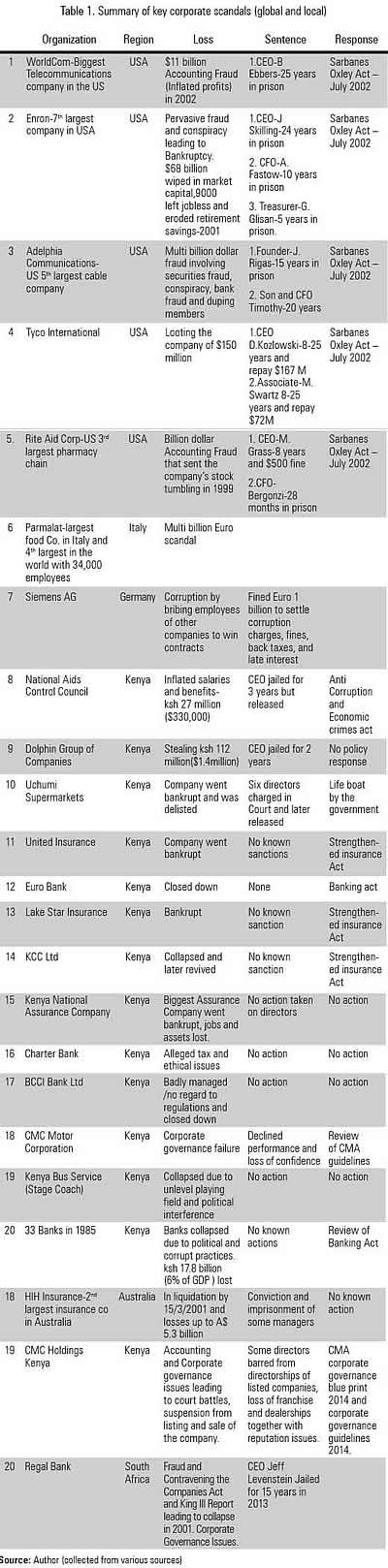
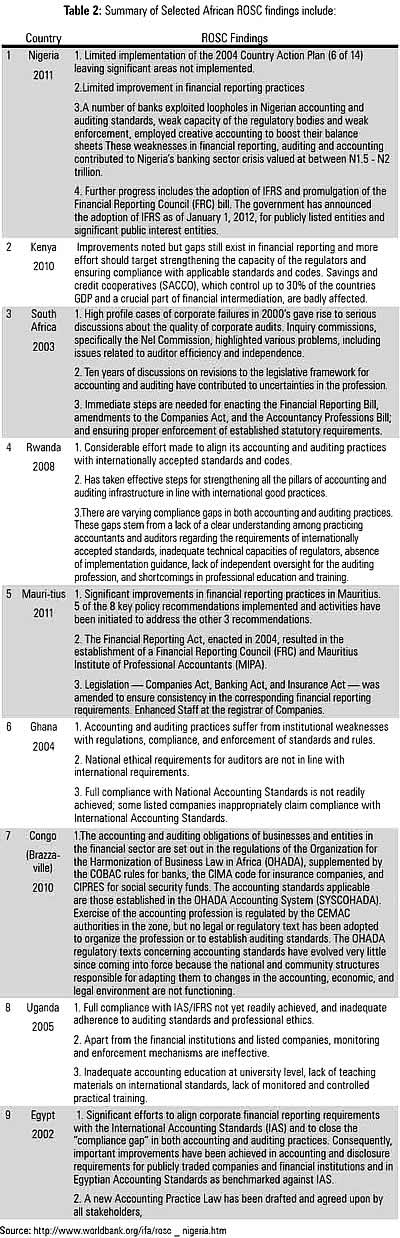
<body><![CDATA[<p>&nbsp;</p>     <p><b>Governance  and IFRS Lessons: Global comparative analysis</b></p>     <p>Lessons from around  the world on the magnitude of losses and their impact on society do prove the  need to ensure no more governance lapses. While the list depicts direct losses,  others including the reputation of the firms involved shouldn't be overlooked.  Some of the reasons cited for these failures include lapses in auditing, hiding  loans or losses, insider trading and inflated revenue. The New York Times on 16/6/2002  listed top institutions including Arthur Andersen, Delloite &amp; Touch&eacute;, Ernst  and Young, KPMG and PWC alongside other corporations. This section summarizes  some of the consequences of corporate failures and scandals both in and outside  Africa (See Table 1).</p>     <p align="center"><img src="/img/revistas/adter/n25/n25a3t1.jpg" /></p>     <p align="center">&nbsp;</p>     <p align="left"><b>Enhancing Transparency and  Accountability (ROSC reports)</b></p>     <p align="left">According to NIFA, enhancing transparency and  accountability is critical to achieving World Economic stability and minimizing  the impact of global economic crisis. Countries can achieve this through  compliance with the International Accounting Standards (IFRS) issued by the International  Accounting Standards Board (IASB) and the International Standards on Auditing  (ISA) issued by the International Federation of Accountants (IFAC). Findings on  country code compliance with standards are reported by World Bank observer  teams known as Report on Standards and Observation of Codes (ROSC) and the  Financial Standards Compliance Index.</p>     <p>&nbsp;</p>     <p><b>ROSC Compliance</b></p>     <p>The  World Bank's Reports on the Observance of Standards and Codes (ROSC) targeting its  member countries on the implementation of international accounting and auditing standards for  strengthening the financial reporting regime (World Bank, 2010) has been an  indicator of compliance. The general findings of this program over the past  decade continuously show that gaps still exist between domestic and  international standards and that these gaps need to be closed so the financial  reports generated are of high quality (Transparent, relevant, reliable and  comparable) (See Table 2).</p>     ]]></body>
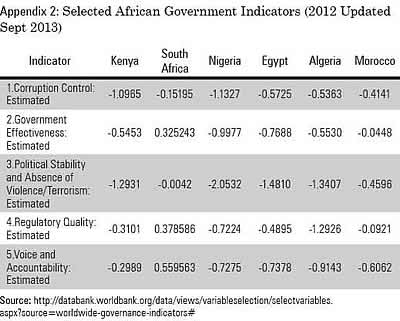
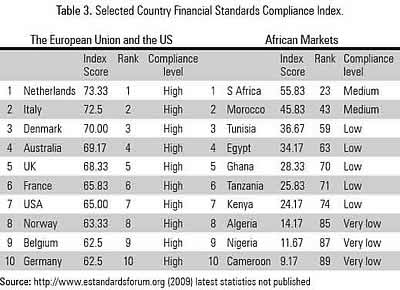
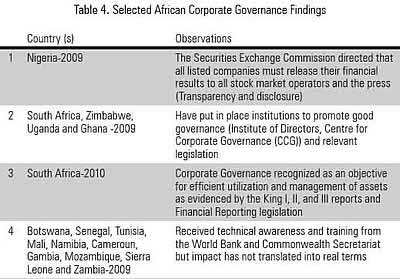
<body><![CDATA[<p align="center"><img src="/img/revistas/adter/n25/n25a3t2.jpg" /></p>     <p align="left">It can be seen that throughout Africa, weak capacity of regulatory bodies,  weak monitoring and enforcement, lack of independent oversight of the auditing profession  and general institutional weaknesses cut across the continent weakening  financial reporting and attendant investor confidence. </p>     <p align="left">&nbsp;</p>     <p><b>Financial Standards Compliance Index</b></p>     <p>It is widely  recognized that global financial stability rests on robust national systems, and  therefore requires enhanced measures at the country level. (ROSC Uganda 2008,  p.1). In a world of integrated capital markets, financial crises in individual  countries can imperil international financial stability. This provides a basic  &ldquo;public goods&rdquo; rationale for minimum standards, which benefit international and  individual national systems. In this context, the World Bank and the  International Monetary Fund (IMF) initiated the Reports on the Observance of  Standards and Codes (ROSC), which cover twelve internationally recognized core  standards and codes relevant to economic stability and private and financial  sector development. The Financial Standards Compliance Index is made up of 12  key standards covering macroeconomic policy and data transparency,  institutional market infrastructure and financial regulation and supervision. Africa has not fared well on these standards as  can be seen in the table below. It can be seen that only two countries in  Africa achieved a medium score while the other eight score 'low' and 'very low'.  Since this data relates to some of the top economies in Africa, it can be  argued that the financial standards compliance index is quite low meaning the  12 indicators above have not been sufficiently complied with. This is in total  contrast to the EU and the US where the compliance index is considered high (See  Table 3). </p>     <p align="center"><img src="/img/revistas/adter/n25/n25a3t3.jpg" /></p>     <p align="center">&nbsp;</p>     <p align="left"><b>Strengthening Domestic  Financial Systems (corporate governance)</b></p>     <p>Under NIFA, the principles  and policies that foster the development of stable, efficient financial systems  include corporate governance. The findings of this study are based on the implementation  status of corporate governance codes that indicate material items to be  reported upon. Most codes expect that a report on good corporate governance should ensure timely and  accurate disclosures of all material information regarding the corporation to  stakeholders. &nbsp;Generally and around the  world, the key contents of corporate governance codes include compliance with  guidelines on corporate governance codes and reasons for non compliance,  establishment of board and board committees, supply and disclosure of  information, election of directors, resignation of directors, AGM's, a balanced  board, best practices relating to the rights of shareholders and an effective  audit committee. It is however noted that good corporate governance may not  survive in a place where country governance is still questionable. Governance  in African countries has in many instances not measured up to many global standards  and this has contributed to poor corporate governance. Some African countries  have been under military rule or non-democratic civilian governments (Zimbabwe)  and this has not helped corporate governance either (See Table 4). </p>     <p align="center"><img src="/img/revistas/adter/n25/n25a3t4.jpg" /></p>     ]]></body>
<body><![CDATA[<p>Most  Corporate Governance information is availed through the annual reports and  audited financial statements of organizations. Annual reports and audited  financial statements in Kenya like many other countries contain information on  company objectives, management structures, shareholders and voting rights, board  compensation, key executives, board charter/conduct, board responsibilities,  meetings, accountability, enterprise risk, succession planning, shareholding  structures.</p>     <p>This  study has analyzed two cases in Africa's two largest economies shown in  appendixes 3 and 4. Ned Bank South Africa is a strong Africa focused bank whose  strategy is currently under threat following an alliance with Eco bank that  trades on three West Africa exchanges. The study depicts possible loss and harm  to the relationship where the reputation of one partner is questionable and disclosure  is being avoided. The Cadbury Nigeria Case is a near Enron style case where  compliance with regulation and falsifying financial statements characterized a  scandal in a multinational listed on the Lagos Securities Exchange. Penalties  and damages were incurred directly and indirectly.</p>     <p>&nbsp;</p>     <p><b><font size="3">Discussion of Findings and Recommendations</font></b></p>     <p>From ROSC  reports on financial standards compliance and corporate governance, it appears  that there is still more to be done. While it has been seen that a foundation  has been laid, the impact of governance measured in wealth creation has not been  felt in many parts of Africa. The Nigeria ROSC report for 2011 paints a grim  picture showing that most recommendations have not been adopted and this has  led to a financial crisis in that country. While the annual reports of many  companies in Africa have indicated increased attention to governance reporting  it is many people's opinion that the reports are not sufficient evidence of  governance compliance. Many reports show board responsibilities and don't  indicate any separation between the roles of the Chair, the CEO and management.  Many conflicts of interest exist and no mechanisms for dealing with them.  Directors resign often but no reasons are given and where professional advice  is necessary, there is no evidence on how it is obtained. The development of ethical  behavior in most institutions isn't clear as code of conduct executions lack  clarity. Many companies in Africa do not indicate the corporate governance  codes they have applied and many countries have not clearly spelt out how this  should be done and the consequences.</p>     <p>Some suggestions border on  the fact that some regulators and governments think that codes and standards  may not be suitable for Africa. Singh and Newberry (2008, p. 484) suggest that  those seeking IFRS for developing countries may need to devise an acceptable  solution and obtain inside access to the standard-setting process to achieve  this aim. However, this is unlikely to happen in emerging economies because  they seem to be consumers of IFRS and are not part of the creation process. </p>     <p>Other  recommendations on good corporate governance challenge the effectiveness of the  audit committees responsible for overseeing the work of the auditors and  independently review the workings of the organization. According to The Accountant  (2006), the Enron audit committee carried out its duty in a cursory manner with  some members missing meetings up to 75% of the time. In the case of HIH (Lipton,  2003) insurance in Australia, their terms of reference and minutes indicated  they were only concerned with the accounts and the figures and never focused on  risk management or internal controls with the meetings attended by everyone  including the executive directors thus leading to a failure to attend to the  risks faced by the company and a serious conflict of interest. Coffee (2005)  suggests that any difficulty in achieving  auditor independence in a corporation with a controlling shareholder may also  imply that minority shareholders in concentrated ownership economies should  directly select their own gatekeepers - a suggestion that can be complex to  implement. </p>     <p>The Accountant (2006) argues that failure to grasp the concept of  conflict of interest can also lead to serious flaws. In the case of CMC Motors Group  in Kenya, the annual governance report clearly indicated there was no conflict  of interest, but events within the company did show that the directors and the  chairman had been doing business with the company leading to serious conflicts  of interest among many other issues. </p>     <p>In line with the above, Bruner (2011, p. 319) argues that governance  codes such as the new code proposed by the Financial Reporting Council (FRC) in  the UK, will enhance the quality of engagement between institutional investors  and companies and accommodate the seven principles included in the code. Unsurprisingly,  the principles are not new; they simply reflect what appears in several  suggestions. These principles include (1) disclosure of investor  stewardship policies; (2) adoption of a robust policy for managing conflicts of  interest; (3) active monitoring of all related companies; (4) adoption of clear  guidelines on when and how to escalate activities as a method of protecting and  enhancing shareholder value; (5) willingness to act collectively with other  investors where appropriate; (6) adoption of voting policies; and (7) periodic  reporting on stewardship and voting activities.</p>     <p>&nbsp;</p>     ]]></body>
<body><![CDATA[<p><b><font size="3">Conclusions</font></b></p>     <p>This study has applied a literature  review to assess the continent's response to NIFA suggestions regarding economic  stability. The review looked at transparency and accountability as well as the strengthening  of domestic markets. The findings include weak regulatory bodies, weak monitoring and  enforcement, lack of independent oversight of the auditing profession and  general institutional weaknesses with improvements over the years. World Bank  ROSC reports also indicated lapses in IFRS implementation.  Compliance with NIFA is therefore still low and guidelines are not fully  followed. This is made manifested by recurrent financial crises, courtroom  battles, suspensions and stock market delisting as well as challenges to  reputations, some of which have trickledown effects for the economic  development of the countries, with Nigeria being a case in point. It is  therefore concluded that NIFA compliance is still low and ongoing efforts are  still necessary for improving Africa's corporate governance and IFRS mechanisms  so that wealth creation and resource management can trickle down to the wider  population and reduce discontent among the population. </p>     <p>Future research could dwell  on corporate governance and IFRS and state owned enterprises, corporate  governance mechanisms, corporate governance and impact on poverty alleviation, enforcement  of appropriate codes and relationship between corporate governance and country  governance indicators.</p>     <p>&nbsp;</p>     <p><b><font size="3">Acknowledgements</font></b></p>     <p>Thanks to very insightful  comments at Catholic University of Eastern Africa-Nairobi where this paper was  first presented.</p> <hr />     <p>&nbsp;</p>       <!-- ref --><p><b><font size="3">References</font></b> <br /> Agrawal, N. (2008). The  Impact of IFRS on corporate governance. <i>Live  Mint</i>. Retrieved from  <a href="http://www.livemint.com/Politics/jQgcH4GFaiM3aNzAGERIkL/The-impact-of-IFRS-on-corporate-governance.html" target="_blank">http://www.livemint.com/Politics/jQgcH4GFaiM3aNzAGERIkL/The-impact-of-IFRS-on-corporate-governance.html</a>&nbsp;&nbsp;&nbsp;&nbsp;&nbsp;&nbsp;&nbsp;&nbsp;[&#160;<a href="javascript:void(0);" onclick="javascript: window.open('/scielo.php?script=sci_nlinks&ref=000120&pid=S1692-0279201400020000300001&lng=','','width=640,height=500,resizable=yes,scrollbars=1,menubar=yes,');">Links</a>&#160;]<!-- end-ref --><!-- ref --><p>Ashbaugh-Skaife, H., Collins, D. W.  &amp; LaFond, R. (2006). The effects of corporate governance on firms' credit  ratings. <i>Journal of Accounting and  Economics</i>, 42(1-2), 203-243. doi: <a href="http://dx.doi.org/10.1016/j.jacceco.2006.02.003" target="_blank">http://dx.doi.org/10.1016/j.jacceco.2006.02.003</a>&nbsp;&nbsp;&nbsp;&nbsp;&nbsp;&nbsp;&nbsp;&nbsp;[&#160;<a href="javascript:void(0);" onclick="javascript: window.open('/scielo.php?script=sci_nlinks&ref=000121&pid=S1692-0279201400020000300002&lng=','','width=640,height=500,resizable=yes,scrollbars=1,menubar=yes,');">Links</a>&#160;]<!-- end-ref --><!-- ref --><p>ASX  Corporate Governance Council., &amp; Australian Stock Exchange. (2003).  Principles of good corporate governance and best practice recommendations.  Sydney: Australian Stock Exchange Ltd.    &nbsp;&nbsp;&nbsp;&nbsp;&nbsp;&nbsp;&nbsp;&nbsp;[&#160;<a href="javascript:void(0);" onclick="javascript: window.open('/scielo.php?script=sci_nlinks&ref=000122&pid=S1692-0279201400020000300003&lng=','','width=640,height=500,resizable=yes,scrollbars=1,menubar=yes,');">Links</a>&#160;]<!-- end-ref --></p>     <!-- ref --><p>Bank  for International Settlements. (1998). Report on the international Financial  Architecture on work groups. <i>Bank for  International Settlements</i>. Retrieved from: <a href="http://www.bis.org/publ/othp01.htm" target="_blank">http://www.bis.org/publ/othp01.htm</a>&nbsp;&nbsp;&nbsp;&nbsp;&nbsp;&nbsp;&nbsp;&nbsp;[&#160;<a href="javascript:void(0);" onclick="javascript: window.open('/scielo.php?script=sci_nlinks&ref=000124&pid=S1692-0279201400020000300004&lng=','','width=640,height=500,resizable=yes,scrollbars=1,menubar=yes,');">Links</a>&#160;]<!-- end-ref --><!-- ref --><p>Barth, M. E., Landsman, W.  R., &amp; Lang, M. H. (2008). International Accounting Standards and Accounting  Quality. <i>Journal of Accounting Research</i>, <i>46</i>(3), 467-498.  doi:10.1111/j.1475-679X.2008.00287.x&nbsp;&nbsp;&nbsp;&nbsp;&nbsp;&nbsp;&nbsp;&nbsp;[&#160;<a href="javascript:void(0);" onclick="javascript: window.open('/scielo.php?script=sci_nlinks&ref=000125&pid=S1692-0279201400020000300005&lng=','','width=640,height=500,resizable=yes,scrollbars=1,menubar=yes,');">Links</a>&#160;]<!-- end-ref --><!-- ref --><p>Brown,  L. &amp; Caylor, M. (2004). <i>Corporate Governance and Firm Performance. &nbsp;</i>Georgia: Available at SSRN. doi:  <a href="http://dx.doi.org/10.2139/ssrn.586423" target="_blank">http://dx.doi.org/10.2139/ssrn.586423</a>&nbsp;&nbsp;&nbsp;&nbsp;&nbsp;&nbsp;&nbsp;&nbsp;[&#160;<a href="javascript:void(0);" onclick="javascript: window.open('/scielo.php?script=sci_nlinks&ref=000126&pid=S1692-0279201400020000300006&lng=','','width=640,height=500,resizable=yes,scrollbars=1,menubar=yes,');">Links</a>&#160;]<!-- end-ref --><!-- ref --><p>Bruner,  C. (2011). Corporate Governance Reform in a Time of Crisis. <i>Journal of Corporation  Law</i>, <i>36</i>(2), 309-341.    &nbsp;&nbsp;&nbsp;&nbsp;&nbsp;&nbsp;&nbsp;&nbsp;[&#160;<a href="javascript:void(0);" onclick="javascript: window.open('/scielo.php?script=sci_nlinks&ref=000127&pid=S1692-0279201400020000300007&lng=','','width=640,height=500,resizable=yes,scrollbars=1,menubar=yes,');">Links</a>&#160;]<!-- end-ref --></p>     <!-- ref --><p>Centre for Corporate Governance (CCG). (2006). <i>Training Course for Directors.</i> Handbook. Nairobi, Kenya.    &nbsp;&nbsp;&nbsp;&nbsp;&nbsp;&nbsp;&nbsp;&nbsp;[&#160;<a href="javascript:void(0);" onclick="javascript: window.open('/scielo.php?script=sci_nlinks&ref=000129&pid=S1692-0279201400020000300008&lng=','','width=640,height=500,resizable=yes,scrollbars=1,menubar=yes,');">Links</a>&#160;]<!-- end-ref --></p>     <!-- ref --><p>Christensen,  H, Lee, E. &amp; Walker, M. (2008). Incentives or Standards: What Determines  Accounting Quality Changes Around IFRS Adoption? In <i>AAA 2008 Financial  Accounting and Reporting Section (FARS) Paper.</i>Minneapolis: SSNR.  doi: <a href="http://dx.doi.org/10.2139/ssrn.586423" target="_blank">http://dx.doi.org/10.2139/ssrn.1013054</a>&nbsp;&nbsp;&nbsp;&nbsp;&nbsp;&nbsp;&nbsp;&nbsp;[&#160;<a href="javascript:void(0);" onclick="javascript: window.open('/scielo.php?script=sci_nlinks&ref=000131&pid=S1692-0279201400020000300009&lng=','','width=640,height=500,resizable=yes,scrollbars=1,menubar=yes,');">Links</a>&#160;]<!-- end-ref --><!-- ref --><p>Coffee,  J. (2005). <i>A Theory of Corporate Scandals: Why the U.S. and Europe Differ'<i>.</i></i> Columbia Law and Economics Working  Paper No. 274 Available at SSRN. doi: <a href="http://dx.doi.org/10.2139/ssrn.694581" target="_blank">http://dx.doi.org/10.2139/ssrn.694581</a>&nbsp;&nbsp;&nbsp;&nbsp;&nbsp;&nbsp;&nbsp;&nbsp;[&#160;<a href="javascript:void(0);" onclick="javascript: window.open('/scielo.php?script=sci_nlinks&ref=000132&pid=S1692-0279201400020000300010&lng=','','width=640,height=500,resizable=yes,scrollbars=1,menubar=yes,');">Links</a>&#160;]<!-- end-ref --><!-- ref --><p>Economic Commission for Africa. (2002).<i>Guidelines  for Enhancing Good Economic and </i><i>Corporate Governance in  Africa. </i>New  York: Economic Commission for Africa. <a href="http://repository.uneca.org/bitstream/handle/10855/5544/Bib-39457.pdf?sequence=1" target="_blank">http://repository.uneca.org/bitstream/handle/10855/5544/Bib-39457.pdf?sequence=1</a>&nbsp;&nbsp;&nbsp;&nbsp;&nbsp;&nbsp;&nbsp;&nbsp;[&#160;<a href="javascript:void(0);" onclick="javascript: window.open('/scielo.php?script=sci_nlinks&ref=000133&pid=S1692-0279201400020000300011&lng=','','width=640,height=500,resizable=yes,scrollbars=1,menubar=yes,');">Links</a>&#160;]<!-- end-ref --><!-- ref --><p>Fama,  E. F. (1980). Agency Problems and the Theory of the Firm. <i>Journal of  Political Economy</i>, <i>88</i>(2), 288-307. Retrieved from:  <a href="http://www.jstor.org/stable/1837292" target="_blank">http://www.jstor.org/stable/1837292</a>&nbsp;&nbsp;&nbsp;&nbsp;&nbsp;&nbsp;&nbsp;&nbsp;[&#160;<a href="javascript:void(0);" onclick="javascript: window.open('/scielo.php?script=sci_nlinks&ref=000134&pid=S1692-0279201400020000300012&lng=','','width=640,height=500,resizable=yes,scrollbars=1,menubar=yes,');">Links</a>&#160;]<!-- end-ref --><!-- ref --><p>IAS Plus. (2010). Background  to International Financial Reporting Standards. Retrieved from:&nbsp; <u><a href="http://www.iasplus.com/en/resources/ifrsf/due-process/background-to-ifrs" target="_blank">http://www.iasplus.com/en/resources/ifrsf/due-process/background-to-ifrs</a></u>&nbsp;    &nbsp;&nbsp;&nbsp;&nbsp;&nbsp;&nbsp;&nbsp;&nbsp;[&#160;<a href="javascript:void(0);" onclick="javascript: window.open('/scielo.php?script=sci_nlinks&ref=000135&pid=S1692-0279201400020000300013&lng=','','width=640,height=500,resizable=yes,scrollbars=1,menubar=yes,');">Links</a>&#160;]<!-- end-ref -->&nbsp;&nbsp;&nbsp; </p>     <!-- ref --><p>Iliev,  P. (2010). The Effect of SOX Section 404: Costs, Earnings Quality, and Stock  Prices. <i>The Journal of Finance</i>, <i>65</i>(3), 1163-1196.  doi:10.1111/j.1540-6261.2010.01564.x&nbsp;&nbsp;&nbsp;&nbsp;&nbsp;&nbsp;&nbsp;&nbsp;[&#160;<a href="javascript:void(0);" onclick="javascript: window.open('/scielo.php?script=sci_nlinks&ref=000137&pid=S1692-0279201400020000300014&lng=','','width=640,height=500,resizable=yes,scrollbars=1,menubar=yes,');">Links</a>&#160;]<!-- end-ref --><!-- ref --><p>Leblanc, R. &amp; Gillies, J. (2003). The Coming Revolution  in Corporate Governance. <i>Ivey  Business Journal 68</i>, 1-11. Retrieved from: &nbsp;<a href="http://www.iasplus.com/en/resources/ifrsf/due-process/background-to-ifrs" target="_blank">http://iveybusinessjournal.com/topics/governance/the-coming-revolution-in-corporate-governance#.VGOLFjSG9qk</a> &nbsp;&nbsp;&nbsp;&nbsp;&nbsp;&nbsp;&nbsp;&nbsp;[&#160;<a href="javascript:void(0);" onclick="javascript: window.open('/scielo.php?script=sci_nlinks&ref=000138&pid=S1692-0279201400020000300015&lng=','','width=640,height=500,resizable=yes,scrollbars=1,menubar=yes,');">Links</a>&#160;]<!-- end-ref --><!-- ref --><p>Leke, A, Lund, S, Roxburgh, Ch., &amp;  van Wamelen, A. (2010).What's  driving Africa's growth?<i> Insights &amp;  Publications </i>(McKinsey &amp; Company). Retrieved from:<a href="http://www.mckinsey.com/insights/economic_studies/whats_driving_africas_growth" target="_blank">http://www.mckinsey.com/insights/economic_studies/whats_driving_africas_growth</a>&nbsp;&nbsp;&nbsp;&nbsp;&nbsp;&nbsp;&nbsp;&nbsp;[&#160;<a href="javascript:void(0);" onclick="javascript: window.open('/scielo.php?script=sci_nlinks&ref=000139&pid=S1692-0279201400020000300016&lng=','','width=640,height=500,resizable=yes,scrollbars=1,menubar=yes,');">Links</a>&#160;]<!-- end-ref --><!-- ref --><p>Lipton, P. (2003). 'The Demise of HIH: Corporate Governance  lessons'. <i>Keeping Good </i><i>Companies,  55</i>(5), 273-277.    &nbsp;&nbsp;&nbsp;&nbsp;&nbsp;&nbsp;&nbsp;&nbsp;[&#160;<a href="javascript:void(0);" onclick="javascript: window.open('/scielo.php?script=sci_nlinks&ref=000140&pid=S1692-0279201400020000300017&lng=','','width=640,height=500,resizable=yes,scrollbars=1,menubar=yes,');">Links</a>&#160;]<!-- end-ref --></p>     <!-- ref --><p>Mckinseys  &amp; Company (2002).Global investor  Opinion Survey: Key findings. Retrieved from: <a href="http://www.eiod.org/uploads/Publications/Pdf/II-Rp-4-1.pdf" target="_blank">http://www.eiod.org/uploads/Publications/Pdf/II-Rp-4-1.pdf</a>&nbsp;    &nbsp;&nbsp;&nbsp;&nbsp;&nbsp;&nbsp;&nbsp;&nbsp;[&#160;<a href="javascript:void(0);" onclick="javascript: window.open('/scielo.php?script=sci_nlinks&ref=000142&pid=S1692-0279201400020000300018&lng=','','width=640,height=500,resizable=yes,scrollbars=1,menubar=yes,');">Links</a>&#160;]<!-- end-ref -->&nbsp;&nbsp;&nbsp;</p>     <!-- ref --><p>Montgomery, S. (2007). 'Corporate  Governance in Developing Countries: Shortcomings, Challenges  &amp; Impact on Credit'. <i>Congress to  celebrate the fortieth annual session of UNCITRAL</i>, Vienna 9-12 July 2007. Retrieved  from:&nbsp; <u><a href="http://www.iasplus.com/en/resources/ifrsf/due-process/background-to-ifrs" target="_blank">http://www.uncitral.org/pdf/english/congress/Cooper_S_rev.pdf</a></u>&nbsp;&nbsp;&nbsp;&nbsp;&nbsp;&nbsp;&nbsp;&nbsp;[&#160;<a href="javascript:void(0);" onclick="javascript: window.open('/scielo.php?script=sci_nlinks&ref=000144&pid=S1692-0279201400020000300019&lng=','','width=640,height=500,resizable=yes,scrollbars=1,menubar=yes,');">Links</a>&#160;]<!-- end-ref --><!-- ref --><p>OECD.  (2009). <i>Principles of Corporate Governance. </i>Paris: OECD. Retrieved from: &nbsp;<u><a href="http://www.oecd.org/corporate/ca/corporategovernanceprinciples/31557724.pdf" target="_blank">http://www.oecd.org/corporate/ca/corporategovernanceprinciples/31557724.pdf</a></u>&nbsp;&nbsp;&nbsp;&nbsp;&nbsp;&nbsp;&nbsp;&nbsp;[&#160;<a href="javascript:void(0);" onclick="javascript: window.open('/scielo.php?script=sci_nlinks&ref=000145&pid=S1692-0279201400020000300020&lng=','','width=640,height=500,resizable=yes,scrollbars=1,menubar=yes,');">Links</a>&#160;]<!-- end-ref --><!-- ref --><p>Okeahalam, C. &amp; Akinboade, O. (2003).A Review of  Corporate Governance in Africa: Literature, Issues and Challenges Paper. <i>Global </i>&nbsp;&nbsp;&nbsp;&nbsp;&nbsp;&nbsp;&nbsp;&nbsp;[&#160;<a href="javascript:void(0);" onclick="javascript: window.open('/scielo.php?script=sci_nlinks&ref=000146&pid=S1692-0279201400020000300021&lng=','','width=640,height=500,resizable=yes,scrollbars=1,menubar=yes,');">Links</a>&#160;]<!-- end-ref --><!-- ref --><p><i>Corporate Governance Forum</i>, 15 June 2003. Retrieved from: <a href="http://www.researchgate.net/publication/237256378" target="_blank"><u>http://www.researchgate.net/publication/237256378</u></a><u>_A_Review_of_Corporate_Governance_in_Africa_Literature_Issues_and_Challenges</u>&nbsp;&nbsp;&nbsp;&nbsp;&nbsp;&nbsp;&nbsp;&nbsp;[&#160;<a href="javascript:void(0);" onclick="javascript: window.open('/scielo.php?script=sci_nlinks&ref=000147&pid=S1692-0279201400020000300022&lng=','','width=640,height=500,resizable=yes,scrollbars=1,menubar=yes,');">Links</a>&#160;]<!-- end-ref --><!-- ref --><p>Ramalho,&nbsp; A. &nbsp;(2013).<i> African  Corporate Growth Depends on Corporate </i><i>Governance. </i>Institute of Directors in  Southern Africa (IoDSA). <i>Retrieved from:</i> &nbsp;<i><a href="http://www.iodsa.co.za/news/129222/African-Corporate-Growth-Depends-on-Corporate-Governance.htm" target="_blank">http://www.iodsa.co.za/news/129222/African-Corporate-Growth-Depends-on-Corporate-Governance.htm</a> &nbsp;    &nbsp;&nbsp;&nbsp;&nbsp;&nbsp;&nbsp;&nbsp;&nbsp;[&#160;<a href="javascript:void(0);" onclick="javascript: window.open('/scielo.php?script=sci_nlinks&ref=000148&pid=S1692-0279201400020000300023&lng=','','width=640,height=500,resizable=yes,scrollbars=1,menubar=yes,');">Links</a>&#160;]<!-- end-ref --></i></p>     <!-- ref --><p>Reilly, D. (2006). 'Sarbanes-Oxley  Changes Take Root'. <i>The wall street  Journal</i>, March 3. Retrieved from: &nbsp;&nbsp;<a href="http://online.wsj.com/articles/SB114135577334088374" target="_blank">http://online.wsj.com/articles/SB114135577334088374</a>&nbsp;&nbsp;&nbsp;&nbsp;&nbsp;&nbsp;&nbsp;&nbsp;[&#160;<a href="javascript:void(0);" onclick="javascript: window.open('/scielo.php?script=sci_nlinks&ref=000150&pid=S1692-0279201400020000300024&lng=','','width=640,height=500,resizable=yes,scrollbars=1,menubar=yes,');">Links</a>&#160;]<!-- end-ref --><!-- ref --><p>Robinson, T. &amp; Munter, P. (2004).&nbsp; Financial Reporting Quality: Red Flags and Accounting  Warning Signs. <i>Commercial Lending Review</i>.  , 1-15Retrieved from:  <a href="http://www.tsi-thailand.org/images/stories/TSI2012_Professional/Download/CISA2_FinancialReportingQuality.pdf" target="_blank">http://www.tsi-thailand.org/images/stories/TSI2012_Professional/Download/CISA2_FinancialReportingQuality.pdf</a>&nbsp;    &nbsp;&nbsp;&nbsp;&nbsp;&nbsp;&nbsp;&nbsp;&nbsp;[&#160;<a href="javascript:void(0);" onclick="javascript: window.open('/scielo.php?script=sci_nlinks&ref=000151&pid=S1692-0279201400020000300025&lng=','','width=640,height=500,resizable=yes,scrollbars=1,menubar=yes,');">Links</a>&#160;]<!-- end-ref -->&nbsp;&nbsp;&nbsp;&nbsp;&nbsp;&nbsp;&nbsp; </p>     ]]></body>
<body><![CDATA[<!-- ref --><p>ROSC  Uganda (2008). Report on the observance  of Standards and Codes (ROSC) on Uganda Accounting and Auditing Standards. Retrieved  from: &nbsp;<u><a href="http://www.worldbank.org/ifa/rosc_aa_uga.pdf" target="_blank">http://www.worldbank.org/ifa/rosc_aa_uga.pdf</a></u> &nbsp;&nbsp;&nbsp;&nbsp;&nbsp;&nbsp;&nbsp;&nbsp;[&#160;<a href="javascript:void(0);" onclick="javascript: window.open('/scielo.php?script=sci_nlinks&ref=000153&pid=S1692-0279201400020000300026&lng=','','width=640,height=500,resizable=yes,scrollbars=1,menubar=yes,');">Links</a>&#160;]<!-- end-ref --><!-- ref --><p>Shleifer,  A., &amp; Vishny, R. W. (1997). A Survey of Corporate Governance. <i>The  Journal of Finance</i>, <i>52</i>(2), 737-783.  doi:10.1111/j.1540-6261.1997.tb04820.x&nbsp;&nbsp;&nbsp;&nbsp;&nbsp;&nbsp;&nbsp;&nbsp;[&#160;<a href="javascript:void(0);" onclick="javascript: window.open('/scielo.php?script=sci_nlinks&ref=000154&pid=S1692-0279201400020000300027&lng=','','width=640,height=500,resizable=yes,scrollbars=1,menubar=yes,');">Links</a>&#160;]<!-- end-ref --><!-- ref --><p>Singh,  R. &amp; Newberry, S. (2008). Corporate Governance and International Financial Reporting standard (IFRS):  The Case of Developing Countries. <i>Research  in </i><i>Accounting  in Emerging Economies, </i>8, 483-518.    &nbsp;&nbsp;&nbsp;&nbsp;&nbsp;&nbsp;&nbsp;&nbsp;[&#160;<a href="javascript:void(0);" onclick="javascript: window.open('/scielo.php?script=sci_nlinks&ref=000155&pid=S1692-0279201400020000300028&lng=','','width=640,height=500,resizable=yes,scrollbars=1,menubar=yes,');">Links</a>&#160;]<!-- end-ref --></p>     <!-- ref --><p>Soederberg,  S. (2002). The contradictions of the New International Financial Architecture:  another procrustean bed for emerging markets? <i>Third World Quarterly</i>, 23(4), 607-620. Retrieved from:  <a href="http://www.jstor.org/stable/3993478" target="_blank">http://www.jstor.org/stable/3993478</a>&nbsp;&nbsp;&nbsp;&nbsp;&nbsp;&nbsp;&nbsp;&nbsp;[&#160;<a href="javascript:void(0);" onclick="javascript: window.open('/scielo.php?script=sci_nlinks&ref=000157&pid=S1692-0279201400020000300029&lng=','','width=640,height=500,resizable=yes,scrollbars=1,menubar=yes,');">Links</a>&#160;]<!-- end-ref --><!-- ref --><p>Stanwick,  P. (2008). Corporate Governance in the 21st Century: Do We Need  Global Standards? <i>Queens University Belfast conference</i> 7-9 September 2008. Retrieved from: &nbsp;<a href="http://wwwcrrconference.org" target="_blank">http://wwwcrrconference.org</a>&nbsp;&nbsp;&nbsp;&nbsp;&nbsp;&nbsp;&nbsp;&nbsp;[&#160;<a href="javascript:void(0);" onclick="javascript: window.open('/scielo.php?script=sci_nlinks&ref=000158&pid=S1692-0279201400020000300030&lng=','','width=640,height=500,resizable=yes,scrollbars=1,menubar=yes,');">Links</a>&#160;]<!-- end-ref --><!-- ref --><p>Tan, W. &amp; Tan, M. (2004). <i>The  Impact of Corporate Governance on Value Creation in </i><i>Entrepreneurial Firms. </i>Singapore: Singapore  Management University Library. <i>Rencontres  de St-gall 2004</i> (2004).Available at: <a href="http://www.jstor.org/stable/3993478" target="_blank">http://works.bepress.com/weeliang_tan/7</a> &nbsp;&nbsp;&nbsp;&nbsp;&nbsp;&nbsp;&nbsp;&nbsp;[&#160;<a href="javascript:void(0);" onclick="javascript: window.open('/scielo.php?script=sci_nlinks&ref=000159&pid=S1692-0279201400020000300031&lng=','','width=640,height=500,resizable=yes,scrollbars=1,menubar=yes,');">Links</a>&#160;]<!-- end-ref --><!-- ref --><p>The Accountant (2006).  Applied Corporate Governance: Lessons from Corporate Failures<i>.  </i>Nairobi: <i>Journal  of the institute of Certified Public Accountants of Kenya, </i>13-14.    &nbsp;&nbsp;&nbsp;&nbsp;&nbsp;&nbsp;&nbsp;&nbsp;[&#160;<a href="javascript:void(0);" onclick="javascript: window.open('/scielo.php?script=sci_nlinks&ref=000160&pid=S1692-0279201400020000300032&lng=','','width=640,height=500,resizable=yes,scrollbars=1,menubar=yes,');">Links</a>&#160;]<!-- end-ref --></p>     <!-- ref --><p>World Bank (2005). 'T O O L K I T 2 Developing  Corporate Governance Codes of Best Practice users guide'<i>.</i> Washington, USA: The World Bank and IFC. Retrieved from: <a href="http://www.gcgf.org/wps/wcm/connect%20accessed%2014%20January%202013" target="_blank">http://www.gcgf.org/wps/wcm/connect </a>&nbsp;&nbsp;&nbsp;&nbsp;&nbsp;&nbsp;&nbsp;&nbsp;[&#160;<a href="javascript:void(0);" onclick="javascript: window.open('/scielo.php?script=sci_nlinks&ref=000162&pid=S1692-0279201400020000300033&lng=','','width=640,height=500,resizable=yes,scrollbars=1,menubar=yes,');">Links</a>&#160;]<!-- end-ref --><!-- ref --><p>World Bank (2010). Report on the observance of  Standards and Codes (ROSC) on Kenya Accounting and Auditing Standards.<i> World Bank Group.</i> Retrieved from:  <a href="http://www.jstor.org/stable/3993478" target="_blank"><u>http://www.worldbank.org/ifa/rosc_aa.html</u></a>&nbsp;&nbsp;&nbsp;&nbsp;&nbsp;&nbsp;&nbsp;&nbsp;[&#160;<a href="javascript:void(0);" onclick="javascript: window.open('/scielo.php?script=sci_nlinks&ref=000163&pid=S1692-0279201400020000300034&lng=','','width=640,height=500,resizable=yes,scrollbars=1,menubar=yes,');">Links</a>&#160;]<!-- end-ref --><p>&nbsp;</p>     <p><b>Appendixes</b></p>     <p align="center"><img src="/img/revistas/adter/n25/n25a3t5.jpg" /><br /> </p>     <p align="center"><img src="/img/revistas/adter/n25/n25a3t6.jpg" /></p>     <p><b>&nbsp;</b><br />   -2.5 Weakest and 2.5  Strongest<br /> The Worldwide Governance  Indicators (WGI) are a research dataset summarizing the views on the quality of  governance provided by a large number of enterprise, citizen and expert survey  respondents in industrial and developing countries. This data is gathered from  a number of survey institutes, think tanks, non-governmental organizations,  international organizations, and private sector firms. </p> <ol start="1" type="1">       <li>Reflects perceptions of       the extent to which public power is exercised for private gain, including       both petty and grand forms of corruption, as well as &quot;capture&quot;       of the state by elites and private interests.</li>       <li>Reflects perceptions of       the quality of public services, the quality of the civil service and its degree       of independence from political pressures, the policy formulation and       implementation quality, and the credibility of the government's commitment       to such policies.</li>       <li>Reflects perceptions of       the likelihood that the government will be destabilized or overthrown by       unconstitutional or violent means, including politically motivated       violence and terrorism.</li>       <li>Reflects perceptions of       the ability of the government to formulate and implement sound policies       and regulations that permit and promote private sector development.</li>       ]]></body>
<body><![CDATA[<li>Reflects perceptions of       the extent to which a country's citizens are able to participate in       selecting their government, as well as freedom of expression, freedom of       association, and a free media.</li>     </ol>     <p>&nbsp;</p>     <p><b>Appendix 3: NED Bank  South Africa and Eco Bank Nigeria 2013</b></p>     <p>Ned bank South Africa traces  its roots back to 1831 in Amsterdam but is now a South African bank with an  African focus and at the end of 2012 it had a market capitalization of US $9  billion. Its asset base then was US $80.5 billion with 28,000 employees and it was  listed on the Johannesburg Security Exchange (JSE). It resisted an HSBC buyout  in 2010 but deepened its strategic alliance with Eco Bank, which operates in 36  African states and is traded on the Ghana, Nigeria and Ivory Coast Security Exchanges.  The alliance was to provide facilities to support Eco Bank's corporate  development programs including its transformational banking acquisition in Nigeria  and in so doing secured the right to acquire up to 20% of Eco Bank Transnational  Inc. It loaned Eco Bank $285m to help it acquire Nigeria Oceanic Bank and in  the West African press, Eco Bank claimed it had a similar right to subscribe to  20% of Ned Bank under an unclear arrangement. &nbsp;The Ned Bank press statement did not mention  these reciprocal arrangements which were in perpetuity.</p>     <p>These arrangements required  shareholder approval from both sides given the significant dilution it would  have for Ned Bank and neither bank included this in their annual report in  spite of their significance.</p>     <p>While no court cases have  been filed nor has impropriety been found, an analyst's presentation indicated that  the 2.478 million new shares to be acquired with the $285 million loan would  convert to 11.5 us cents per share whereas the shares were trading at 9c in  Lagos and would only represent a 12.6% share of the company. To acquire the  full 20%, Ned Bank would have to buy the additional shares at market rates  resulting in an additional $164 million on top of the loan.</p>     <p>In  the course of the year allegations of fraud by the chairman and CEO of Eco Bank  of &nbsp;writing off debts to a company owned  by the chairman and selling assets on the cheap to related parties appeared and  these investigations are ongoing by Nigerian regulators. It also surfaced that Oceanic  Bank, the purchase which was financed by Ned Bank collapsed in 2008 under  Nigeria Central Bank management under claims of fraud. Two South African  Companies, Ethos Private Equity and Old Mutual Private Equity lost fortunes in  the bank. The matters got even more clouded as the Public Investment  Corporation of South Africa, which holds 6.5% of Ned bank and whose operations  include acquiring African assets, is also a major shareholder of Eco Bank.</p>     <p>The  issue that is a concern in South Africa is lack of progress in the regulator's  investigation of the alleged Eco Bank transactions with its related parties  which are thought to be lacking in corporate governance and a possible early  warning sign. The outcome of these investigations will shed light on the  options available to Ned Bank as it is believed it could suffer potential losses  but, worse still, the question of why such a transaction exists if there are questions  regarding the leadership reputation of the entities involved. Even though both banks are giants and their  stocks are trading, these disclosure failures are worrying, may have serious implications  and have obviously put a check on Ned Bank's Pan African strategy.</p> <ol start="1" type="1">       <li>Corporate Governance scandal threatens Ned bank's Africa       Strategy.</li>     ]]></body>
<body><![CDATA[</ol>     <p><a href="http://www.bdlive.co.za/opinion/columnists/2013/10/21/corporate-governance-scandal-threatens-nedbanks-africa-strategy" target="_blank">http://www.bdlive.co.za/opinion/columnists/2013/10/21/corporate-governance-scandal-threatens-nedbanks-africa-strategy</a> .&nbsp;&nbsp; <a href="http://www.bdlive.co.za/opinion/staffprofiles/2012/08/06/stuart-theobald-profile" target="_blank">Stuart  Theobald</a>, 21 October 2013, 07:37 </p>     <p>&nbsp;</p>     <p><b>Appendix  4: Cadbury Nigeria PLC 2006 - Overstatement in Financial Statements</b></p>     <p>Cadbury Nigeria was founded in 1965 as a  subsidiary of Cadbury Schweppes, a major global player in confectionery and  beverages markets with operations in 200 countries and 40,000 employees.  Cadbury Nigeria engages in the manufacture and sale of sugar confectionery, gum  and food beverages in two segments. It owns the Stanmark Cocoa Processing  Company. </p>     <p>In October 2006, the board of Cadbury Nigeria  PLC notified the world, including its stockholders and regulatory bodies, that  it had discovered &quot;Overstatements&quot; in its accounts, which, in its  words, had spanned many years. It quickly appointed Price WaterHouseCoopers, an  independent auditing firm to investigate these &quot;Overstatements,&quot; and  they submitted a report that the overstatement could be around 13-15 billion  naira ($90 million) leading to a provision for a 15 million pounds goodwill impairment  from the transaction. The overstatement was first detected after due diligence performed  by Cadbury UK when increasing its acquisition from 46 to 50%. Analysts and  reports from Nigeria indicated several lapses.</p>     <p>Sales and stock buybacks were reported including false  stock certifications. Overstatement of profits,  misrepresentation of sales and false supplier certificates characterized the  financial statements. In 2006, the year  of the scandal, the company recorded a loss of $15 million with more expected,  and share prices dropped 5-26%. Offshore compensation of certain senior  employees was detected and this had not been authorized by the compensation committee  as required by policy.</p>     <p>Other analysts and members of the Nigerian institute  of Directors pointed at serious governance issues including a failure of board  oversight functions. The CFO and CEO exercised delegated powers and after the  US Enron debacle, directors learned and were expected to pay close attention to  the affairs of the company. Even more interestingly, the audit committee was  made up of 3 executive directors, contrary to the code of practice. Internal  control and organization, integrity, audit committee, external auditors and the  entire management were cited as having been problematic because of their  failure to comply and detect the irregularities that led to this overstatement.  Questions were raised regarding whistle blowing and why it didn't work. Why  didn't the banks scrutinize the financial statements before lending any money? </p>     <p>Lastly,  the Union Registrars, the filing company for Cadbury Nigeria with the duty to  report to the SEC any actual or suspected breach, infringement or  non-compliance with any SEC rules and regulations in the Nigerian code of corporate  governance failed. However, the Union Registrars did not pay dividends and  failed to notify SEC in writing as required when Cadbury Nigeria failed to  transfer dividend payments to shareholders within 7 business days.</p>     <p>What  was the damage? A scandal of this magnitude is always very expensive. The CFO, CEO  and all the officials that presided over this company were disqualified from  operating in the Nigerian Capital Market thus denting many people's careers.  The Company suffered heavy penalties and their shares listing was suspended while  the registrar and the auditors received penalties for their roles. The loss of  share value from a loss of public confidence, the damage to the Cadbury brand,  the reputation of the external auditor associated with the big 4 and the 300  shareholders suing the company for breach of duty all complicated the matter. </p>     ]]></body>
<body><![CDATA[<p>1. Corporate Governance Issues in Financial  Reporting-The Cadbury Challenge <u><a href="http://www.nigeriavillagesquare.com/articles/oladele-o-solanke/corporate-governance-issues-in-financial-reporting-the-cadbury-challenge.html" target="_blank">http://www.nigeriavillagesquare.com/articles/oladele-o-solanke/corporate-governance-issues-in-financial-reporting-the-cadbury-challenge.html</a></u><br />   2. An evaluation of the limitations  of the corporate governance&nbsp; codes in  preventing corporate collapses in Nigeria. <u><a href="http://www.jstor.org/stable/3993478" target="_blank">http://iosrjournals.org/iosr-jbm/papers/Vol7-issue2/P072110118.pdf</a></u></p>     <p>&nbsp;</p>     <p>&nbsp;</p>     <p>&nbsp;</p>     <p>&nbsp;</p>     <p>&nbsp;</p> </font>      ]]></body><back>
<ref-list>
<ref id="B1">
<nlm-citation citation-type="">
<person-group person-group-type="author">
<name>
<surname><![CDATA[Agrawal]]></surname>
<given-names><![CDATA[N]]></given-names>
</name>
</person-group>
<source><![CDATA[The Impact of IFRS on corporate governance. Live Mint]]></source>
<year>2008</year>
</nlm-citation>
</ref>
<ref id="B2">
<nlm-citation citation-type="journal">
<person-group person-group-type="author">
<name>
<surname><![CDATA[Ashbaugh-Skaife]]></surname>
<given-names><![CDATA[H]]></given-names>
</name>
<name>
<surname><![CDATA[Collins]]></surname>
<given-names><![CDATA[D. W.]]></given-names>
</name>
<name>
<surname><![CDATA[LaFond]]></surname>
<given-names><![CDATA[R]]></given-names>
</name>
</person-group>
<article-title xml:lang="en"><![CDATA[The effects of corporate governance on firms' credit ratings.]]></article-title>
<source><![CDATA[Journal of Accounting and Economics]]></source>
<year>2006</year>
<volume>42</volume>
<numero>1-2</numero>
<issue>1-2</issue>
<page-range>203-243</page-range></nlm-citation>
</ref>
<ref id="B3">
<nlm-citation citation-type="book">
<collab>ASX Corporate Governance Council., & Australian Stock Exchange</collab>
<source><![CDATA[Principles of good corporate governance and best practice recommendations.]]></source>
<year>2003</year>
<publisher-loc><![CDATA[Sydney ]]></publisher-loc>
<publisher-name><![CDATA[Australian Stock Exchange Ltd]]></publisher-name>
</nlm-citation>
</ref>
<ref id="B4">
<nlm-citation citation-type="">
<collab>Bank for International Settlements</collab>
<source><![CDATA[Report on the international Financial Architecture on work groups. Bank for International Settlements.]]></source>
<year>1998</year>
</nlm-citation>
</ref>
<ref id="B5">
<nlm-citation citation-type="journal">
<person-group person-group-type="author">
<name>
<surname><![CDATA[Barth]]></surname>
<given-names><![CDATA[M. E]]></given-names>
</name>
<name>
<surname><![CDATA[Landsman]]></surname>
<given-names><![CDATA[W. R]]></given-names>
</name>
<name>
<surname><![CDATA[Lang]]></surname>
<given-names><![CDATA[M. H]]></given-names>
</name>
</person-group>
<article-title xml:lang="en"><![CDATA[International Accounting Standards and Accounting Quality]]></article-title>
<source><![CDATA[Journal of Accounting Research]]></source>
<year>2008</year>
<volume>46</volume>
<numero>3</numero>
<issue>3</issue>
<page-range>467-498</page-range></nlm-citation>
</ref>
<ref id="B6">
<nlm-citation citation-type="book">
<person-group person-group-type="author">
<name>
<surname><![CDATA[Brown]]></surname>
<given-names><![CDATA[L]]></given-names>
</name>
<name>
<surname><![CDATA[Caylor]]></surname>
<given-names><![CDATA[M]]></given-names>
</name>
</person-group>
<source><![CDATA[Corporate Governance and Firm Performance]]></source>
<year>2004</year>
<publisher-loc><![CDATA[Georgia ]]></publisher-loc>
<publisher-name><![CDATA[SSRN]]></publisher-name>
</nlm-citation>
</ref>
<ref id="B7">
<nlm-citation citation-type="journal">
<person-group person-group-type="author">
<name>
<surname><![CDATA[Bruner]]></surname>
<given-names><![CDATA[C]]></given-names>
</name>
</person-group>
<article-title xml:lang="en"><![CDATA[Corporate Governance Reform in a Time of Crisis]]></article-title>
<source><![CDATA[Journal of Corporation Law]]></source>
<year>2011</year>
<volume>36</volume>
<numero>2</numero>
<issue>2</issue>
<page-range>309-341</page-range></nlm-citation>
</ref>
<ref id="B8">
<nlm-citation citation-type="book">
<collab>Centre for Corporate Governance (CCG).</collab>
<source><![CDATA[Training Course for Directors]]></source>
<year>2006</year>
<publisher-name><![CDATA[Nairobi]]></publisher-name>
</nlm-citation>
</ref>
<ref id="B9">
<nlm-citation citation-type="confpro">
<person-group person-group-type="author">
<name>
<surname><![CDATA[Christensen]]></surname>
<given-names><![CDATA[H,]]></given-names>
</name>
<name>
<surname><![CDATA[Lee]]></surname>
<given-names><![CDATA[E]]></given-names>
</name>
<name>
<surname><![CDATA[Walker]]></surname>
<given-names><![CDATA[M]]></given-names>
</name>
</person-group>
<source><![CDATA[Incentives or Standards: What Determines Accounting Quality Changes Around IFRS Adoption?]]></source>
<year>2008</year>
<conf-name><![CDATA[ AAA 2008 Financial Accounting and Reporting Section (FARS)]]></conf-name>
<conf-loc>Minneapolis </conf-loc>
</nlm-citation>
</ref>
<ref id="B10">
<nlm-citation citation-type="journal">
<person-group person-group-type="author">
<name>
<surname><![CDATA[Coffee]]></surname>
<given-names><![CDATA[J]]></given-names>
</name>
</person-group>
<article-title xml:lang="en"><![CDATA[A Theory of Corporate Scandals: Why the U.S. and Europe Differ']]></article-title>
<source><![CDATA[Columbia Law and Economics Working]]></source>
<year>2005</year>
<volume>274</volume>
</nlm-citation>
</ref>
<ref id="B11">
<nlm-citation citation-type="">
<collab>Economic Commission for Africa</collab>
<source><![CDATA[Guidelines for Enhancing Good Economic and Corporate Governance in Africa. New York: Economic Commission for Africa]]></source>
<year>2002</year>
</nlm-citation>
</ref>
<ref id="B12">
<nlm-citation citation-type="journal">
<person-group person-group-type="author">
<name>
<surname><![CDATA[Fama]]></surname>
<given-names><![CDATA[E. F]]></given-names>
</name>
</person-group>
<article-title xml:lang="en"><![CDATA[Agency Problems and the Theory of the Firm]]></article-title>
<source><![CDATA[Journal of Political Economy]]></source>
<year>1980</year>
<volume>88</volume>
<numero>2</numero>
<issue>2</issue>
<page-range>288-307</page-range></nlm-citation>
</ref>
<ref id="B13">
<nlm-citation citation-type="">
<collab>IAS Plus</collab>
<source><![CDATA[Background to International Financial Reporting Standards]]></source>
<year>2010</year>
</nlm-citation>
</ref>
<ref id="B14">
<nlm-citation citation-type="journal">
<person-group person-group-type="author">
<name>
<surname><![CDATA[Iliev]]></surname>
<given-names><![CDATA[P]]></given-names>
</name>
</person-group>
<article-title xml:lang="en"><![CDATA[The Effect of SOX Section 404: Costs, Earnings Quality, and Stock Prices]]></article-title>
<source><![CDATA[The Journal of Finance]]></source>
<year>2010</year>
<volume>65</volume>
<numero>3</numero>
<issue>3</issue>
<page-range>1163-1196</page-range></nlm-citation>
</ref>
<ref id="B15">
<nlm-citation citation-type="journal">
<person-group person-group-type="author">
<name>
<surname><![CDATA[Leblanc]]></surname>
<given-names><![CDATA[R]]></given-names>
</name>
<name>
<surname><![CDATA[Gillies]]></surname>
<given-names><![CDATA[J]]></given-names>
</name>
</person-group>
<article-title xml:lang="en"><![CDATA[The Coming Revolution in Corporate Governance]]></article-title>
<source><![CDATA[Ivey Business Journal]]></source>
<year>2003</year>
<volume>68</volume>
<page-range>1-11</page-range></nlm-citation>
</ref>
<ref id="B16">
<nlm-citation citation-type="book">
<person-group person-group-type="author">
<name>
<surname><![CDATA[Leke]]></surname>
<given-names><![CDATA[A]]></given-names>
</name>
<name>
<surname><![CDATA[Lund]]></surname>
<given-names><![CDATA[S]]></given-names>
</name>
<name>
<surname><![CDATA[Roxburgh]]></surname>
<given-names><![CDATA[Ch]]></given-names>
</name>
<name>
<surname><![CDATA[van Wamelen]]></surname>
<given-names><![CDATA[A]]></given-names>
</name>
</person-group>
<source><![CDATA[What's driving Africa's growth?]]></source>
<year>2010</year>
<publisher-name><![CDATA[McKinsey & Company]]></publisher-name>
</nlm-citation>
</ref>
<ref id="B17">
<nlm-citation citation-type="journal">
<person-group person-group-type="author">
<name>
<surname><![CDATA[Lipton]]></surname>
<given-names><![CDATA[P]]></given-names>
</name>
</person-group>
<article-title xml:lang="en"><![CDATA['The Demise of HIH: Corporate Governance lessons']]></article-title>
<source><![CDATA[Keeping Good Companies]]></source>
<year>2003</year>
<volume>55</volume>
<numero>5</numero>
<issue>5</issue>
<page-range>273-277</page-range></nlm-citation>
</ref>
<ref id="B18">
<nlm-citation citation-type="">
<collab>Mckinseys & Company</collab>
<source><![CDATA[Global investor Opinion Survey: Key findings]]></source>
<year>2002</year>
</nlm-citation>
</ref>
<ref id="B19">
<nlm-citation citation-type="">
<person-group person-group-type="author">
<name>
<surname><![CDATA[Montgomery]]></surname>
<given-names><![CDATA[S]]></given-names>
</name>
</person-group>
<source><![CDATA['Corporate Governance in Developing Countries: Shortcomings, Challenges & Impact on Credit'. Congress to celebrate the fortieth annual session of UNCITRAL, Vienna 9-12 July 2007.]]></source>
<year>2007</year>
</nlm-citation>
</ref>
<ref id="B20">
<nlm-citation citation-type="">
<collab>OECD</collab>
<source><![CDATA[Principles of Corporate Governance]]></source>
<year>2009</year>
<publisher-loc><![CDATA[Paris ]]></publisher-loc>
</nlm-citation>
</ref>
<ref id="B21">
<nlm-citation citation-type="book">
<person-group person-group-type="author">
<name>
<surname><![CDATA[Okeahalam]]></surname>
<given-names><![CDATA[C]]></given-names>
</name>
<name>
<surname><![CDATA[Akinboade]]></surname>
<given-names><![CDATA[O]]></given-names>
</name>
</person-group>
<source><![CDATA[A Review of Corporate Governance in Africa: Literature, Issues and Challenges Paper]]></source>
<year>2003</year>
<publisher-name><![CDATA[Global]]></publisher-name>
</nlm-citation>
</ref>
<ref id="B22">
<nlm-citation citation-type="">
<collab>Corporate Governance Forum</collab>
<source><![CDATA[]]></source>
<year>15 J</year>
<month>un</month>
<day>e </day>
</nlm-citation>
</ref>
<ref id="B23">
<nlm-citation citation-type="">
<person-group person-group-type="author">
<name>
<surname><![CDATA[Ramalho]]></surname>
<given-names><![CDATA[A]]></given-names>
</name>
</person-group>
<source><![CDATA[African Corporate Growth Depends on Corporate Governance. Institute of Directors in Southern Africa (IoDSA)]]></source>
<year>2013</year>
</nlm-citation>
</ref>
<ref id="B24">
<nlm-citation citation-type="">
<person-group person-group-type="author">
<name>
<surname><![CDATA[Reilly]]></surname>
<given-names><![CDATA[D]]></given-names>
</name>
</person-group>
<source><![CDATA['Sarbanes-Oxley Changes Take Root'. The wall street Journal, March 3.]]></source>
<year>2006</year>
</nlm-citation>
</ref>
<ref id="B25">
<nlm-citation citation-type="">
<person-group person-group-type="author">
<name>
<surname><![CDATA[Robinson]]></surname>
<given-names><![CDATA[T]]></given-names>
</name>
<name>
<surname><![CDATA[Munter]]></surname>
<given-names><![CDATA[P]]></given-names>
</name>
</person-group>
<source><![CDATA[Financial Reporting Quality: Red Flags and Accounting Warning Signs. Commercial Lending Review. , 1-15]]></source>
<year>2004</year>
</nlm-citation>
</ref>
<ref id="B26">
<nlm-citation citation-type="">
<collab>ROSC Uganda</collab>
<source><![CDATA[Report on the observance of Standards and Codes (ROSC) on Uganda Accounting and Auditing Standards.]]></source>
<year>2008</year>
</nlm-citation>
</ref>
<ref id="B27">
<nlm-citation citation-type="journal">
<person-group person-group-type="author">
<name>
<surname><![CDATA[Shleifer]]></surname>
<given-names><![CDATA[A]]></given-names>
</name>
<name>
<surname><![CDATA[Vishny]]></surname>
<given-names><![CDATA[R. W]]></given-names>
</name>
</person-group>
<article-title xml:lang="en"><![CDATA[A Survey of Corporate Governance]]></article-title>
<source><![CDATA[The Journal of Finance]]></source>
<year>1997</year>
<volume>52</volume>
<numero>2</numero>
<issue>2</issue>
<page-range>737-783</page-range></nlm-citation>
</ref>
<ref id="B28">
<nlm-citation citation-type="journal">
<person-group person-group-type="author">
<name>
<surname><![CDATA[Singh]]></surname>
<given-names><![CDATA[R]]></given-names>
</name>
<name>
<surname><![CDATA[Newberry]]></surname>
<given-names><![CDATA[S]]></given-names>
</name>
</person-group>
<article-title xml:lang="en"><![CDATA[Corporate Governance and International Financial Reporting standard (IFRS): The Case of Developing Countries]]></article-title>
<source><![CDATA[Research in Accounting in Emerging Economies]]></source>
<year>2008</year>
<volume>8</volume>
<page-range>483-518</page-range></nlm-citation>
</ref>
<ref id="B29">
<nlm-citation citation-type="journal">
<person-group person-group-type="author">
<name>
<surname><![CDATA[Soederberg]]></surname>
<given-names><![CDATA[S]]></given-names>
</name>
</person-group>
<article-title xml:lang="en"><![CDATA[The contradictions of the New International Financial Architecture: another procrustean bed for emerging markets?]]></article-title>
<source><![CDATA[Third World Quarterly]]></source>
<year>2002</year>
<volume>23</volume>
<numero>4</numero>
<issue>4</issue>
<page-range>607-620</page-range></nlm-citation>
</ref>
<ref id="B30">
<nlm-citation citation-type="confpro">
<person-group person-group-type="author">
<name>
<surname><![CDATA[Stanwick]]></surname>
<given-names><![CDATA[P]]></given-names>
</name>
</person-group>
<article-title xml:lang="en"><![CDATA[Corporate Governance in the 21st Century: Do We Need Global Standards?]]></article-title>
<source><![CDATA[]]></source>
<year>2008</year>
<conf-name><![CDATA[ Queens University Belfast conference]]></conf-name>
<conf-date>7-9 September 2008</conf-date>
<conf-loc> </conf-loc>
</nlm-citation>
</ref>
<ref id="B31">
<nlm-citation citation-type="">
<person-group person-group-type="author">
<name>
<surname><![CDATA[Tan]]></surname>
<given-names><![CDATA[W]]></given-names>
</name>
<name>
<surname><![CDATA[Tan]]></surname>
<given-names><![CDATA[M]]></given-names>
</name>
</person-group>
<source><![CDATA[The Impact of Corporate Governance on Value Creation in Entrepreneurial Firms. Singapore: Singapore Management University Library. Rencontres de St-gall 2004 (2004).]]></source>
<year>2004</year>
</nlm-citation>
</ref>
<ref id="B32">
<nlm-citation citation-type="journal">
<collab>The Accountant</collab>
<article-title xml:lang="en"><![CDATA[Applied Corporate Governance: Lessons from Corporate Failures]]></article-title>
<source><![CDATA[Nairobi: Journal of the institute of Certified Public Accountants of Kenya]]></source>
<year>2006</year>
<page-range>13-14</page-range></nlm-citation>
</ref>
<ref id="B33">
<nlm-citation citation-type="">
<collab>World Bank</collab>
<source><![CDATA['T O O L K I T 2 Developing Corporate Governance Codes of Best Practice users guide'. Washington, USA: The World Bank and IFC.]]></source>
<year>2005</year>
</nlm-citation>
</ref>
<ref id="B34">
<nlm-citation citation-type="">
<collab>World Bank</collab>
<source><![CDATA[Report on the observance of Standards and Codes (ROSC) on Kenya Accounting and Auditing Standards. World Bank Group]]></source>
<year>2010</year>
</nlm-citation>
</ref>
</ref-list>
</back>
</article>