ARTÍCULOS ORIGINALES
DOI: 10.17230/ad-minister.28.3
Business Continuity and Disaster Risk Management in Business Education: Case of York University
Continuidad de negocio y gestión del riesgo de desastres en la educación de negocios: el caso York University
ALI ASGARY1
1 Associate Professor, Disaster & Emergency Management, School of Administrative Studies, Faculty of Liberal Arts and Professional Studies, York University, Toronto, Ontario, Canada. Email. asgary@yorku.ca
Received: 18/03/2016 Modified: 2/06/2016 Accepted: 10/06/2016
]]> JEL: H12, M14, Q54Increasing levels of business disruptions and disaster events on one hand while local, national and international campaigns on the other have increased businesses' awareness, attention and demand for the need for business continuity management. As more and more businesses are looking to integrate disaster risk and business continuity management into their business operations and decision making processes, the need for such expertise has also increased. Despite these needs, many business schools around the world have not fully identified, realized or addressed them. While there are several models for integrating disaster risk and business continuity management in business education, York University has established undergraduate and graduate level disaster and emergency management programs in a business school setting to address these growing needs. Through this integration, considerable numbers of business students enroll in disaster risk management, and business continuity courses. Knowledge and skills that students acquire through these courses make them informed and knowledgeable players in business continuity management teams in their varied work places.
KEYWORDS Business continuity management; York University; business education; disaster risk management.
RESUMEN:
Mientras que por un lado los niveles de disrupciones en los negocios y los eventos desastrosos son crecientes, por el otro, las campañas locales, nacionales e internacionales han incrementado la consciencia, atención y demanda de las empresas con respecto a la necesidad de la gestión de la continuidad de negocio. En la medida en que más empresas buscan integrar la gestión del riesgo de desastres y de la continuidad de negocio en sus operaciones y procesos de toma de decisiones, la necesidad de dicho conocimiento también ha aumentado. Sin embargo, a pesar de estas necesidades, muchas escuelas de negocios alrededor del mundo no las han identificado, no se han dado cuenta de ellas, ni las han abordado. Si bien hay diferentes modelos para integrar la gestión del riesgo de desastres y de la continuidad de negocio en la educación de negocios, York University ha establecido programas de pregrado y posgrado sobre la gestión de desastres y emergencias en una escuela de negocios para hacer frente a estas crecientes necesidades. A través de esta integración, un número considerable de estudiantes de negocios se matriculan en cursos de gestión del riesgo de desastres y de continuidad de negocio. El conocimiento y las capacidades que los estudiantes adquieren a través de estos cursos, los convierten en actores informados y conocedores para los equipos de gestión de la continuidad de negocio de sus diferentes lugares de trabajo.
PALABRAS CLAVE Gestión de la continuidad de negocio; York University; educación de negocios; gestión del riesgo de desastres.
INTRODUCTION
Businesses like other facets of the society are at risk for a large number of dynamic, natural, technological, and human made hazards. Increasing business complexity, government and industry-specific regulations, corporate governance requirements, stakeholders push, media and public scrutiny, demand an integrated approach to business risk and continuity management (Shaw & Harald, 2004). Moreover, as the number of large disruptive disasters is increasing businesses are becoming more and more concerned with disaster-induced direct and indirect losses in their supply chains, along with the fall in output, revenue, and profitability (Desai & Sarmiento, 2015) and therefore seek to prepare business continuity plans (Sarmiento et al., 2015). Considering that significant amount of critical infrastructure, wealth, investment, employment, and income sources rest with private sector companies, it is important to make sure that the educational support for disaster risk management and business continuity is available to businesses for risk reduction and business continuity. The Global Assessment Report (UNISDR, 2013) highlighted some of the key issues in this area with particular emphasis on disaster risk considerations in private sector's investment decisions. In order to address these issues, national and international agencies have embarked on a number of initiatives to shift the focus from the government and public sectors to the private sector. New standards in business continuity and risk management have been released by national and international standard agencies, new educational programs and academic journals have been created, global campaigns such as the United Nations Global Compact have been initiated and the UNISDR Sendai Framework for Action (SFA) has paid significant attention to the role of private sector in disaster risk reduction and business continuity.
This paper examines the development of business continuity in business education using York University's disaster and emergency management program as a case study. It is argued that disaster risk reduction and business continuity management should be an integral part of business education if the objectives of the Sendai Framework for Disaster Risk Reduction in private sector's role in disaster risk reduction at both corporate and wider levels are going to be achieved by the year 2030. The rest of this paper is organized as follows: Section two reviews the need for business continuity and disaster risk management education in general and in business education in particular. Section three presents four contemporary approaches and models for dealing with business continuity and disaster risk management in business education. Methodology of the paper is explained in section four. Section five describes York University's approach to integrating business continuity and disaster risk management in business education in detail. Finally, section six concludes with some recommendations.
]]> DISASTER RISK AND BUSINESS CONTINUITY MANAGEMENT IN BUSINESSES EDUCATIONDisaster risk and business continuity management aim to integrate risk and business continuity management into corporate, strategic, tactical and operational management systems. Several standards of risk and business continuity management provide guidance on implementation of risk reduction and business continuity. To incorporate disaster risk reduction and business continuity management in all businesses and industries, business administration program professionals should develop the knowledge and skills needed to effectively apply risk and business continuity management. This requires careful design and implementation of certain courses in the existing business curriculum. While disaster risk and business continuity management experts are needed to lead these activities in businesses and organizations, especially large ones, it is important that all key decision makers and key business personnel have a good understanding of disaster risks and business continuity management concepts and methods. The Hyogo Framework for Action (2005 to 2015) formed the needed awareness about the risk and the need for its management in both public and private sectors. Sendai Framework for Disaster Risk Reduction (2015-2030) calls for integrating disaster risk and business continuity into business models and practices at all businesses, particularly small businesses. This can be achieved more successfully by making sure that business schools equip graduates with the needed knowledge and skills.
''Substantial reduction of disaster risk and losses in lives, livelihoods and health and in the economic, physical, social, cultural and environmental assets of persons, businesses, communities and countries'' has been mentioned as one of the key outcomes of the Sendai Framework. To achieve this, the Framework states that:
While there is no direct mention of disaster risk and business continuity management education in the above statements, one can conclude that these goals and objectives cannot be attained without integrating disaster risk and business continuity management into business education. Evidently, significant progress has been made in disaster and emergency management education during the past 15 years in most countries (McCreight, 2014) and disaster risk and business continuity domains have hindered their recognitions as a legitimate field of scholarship (Holloway, 2014). Despite this, its penetration and presence in business has been relatively slow and marginal. Although some business schools have courses in crisis management, many business schools have not integrated disaster risk and business continuity management in their curriculum (McCreight, 2009).
As businesses become more aware of their risks and vulnerabilities, their demands for disaster risk and business continuity plans, planning experts, tools and methods increases. As mentioned earlier this increasing attention and demand are the outcome of several internal and external factors. Internally, companies are facing a dynamic and complex risk landscape as well as employees' safety, well being, and job security. Externally, businesses are faced with increasing supply chain disruptions, new and mega risks, rising competition, and inability of governments to protect them during major disaster events. Moreover, companies are now being rated and ranked for disaster risk and business continuity management, organizational resilience, and enterprise risk management (Gatzert & Martin, 2005).
Lack of attention to disaster risk and business continuity management in business schools is evident from the lack of theories, academic textbooks, and relatively low threshold of research (Shaw & Harrald, 2004). While the demand for disaster risk and business continuity management expertise has increased, universities have not been able to adequately respond. Instead these rising needs have been partially met by practitioners and consultants through short training courses, handbooks, industry seminars, etc. As highlighted in the 2013 Global Assessment Report (UNISDR, 2013), if disaster risk reduction and business continuity are to be integrated into business operations and investment decisions, one key means to achieve this is to embed the relevant knowledge and skills into business education.
If we look at the proposed competencies for business continuity professionals proposed by Shaw and Harrald (2004) (such as: expert knowledge of business continuity planning; detailed knowledge of business recovery planning; working knowledge of the organization's critical business processes, policies, risk appetite, etc.; working knowledge of critical point and IT disaster recovery; working knowledge of the organization's investment/financial management practices, ability to communicate calmly, effectively and authoritatively), we can see that most of these competencies are covered in the existing business curriculums. Therefore, adding business continuity planning and disaster risk management knowledge and skills to the existing business curriculum will meet the basic requirements.
]]> Studies conducted in both developed and developing countries show that existing technical knowledge and expertise in disaster risk and business continuity management play a key role in businesses' disaster risk and business continuity management (Teikoku Databank Ltd, 2011; UNISDR, 2013). Moreover, maintaining business continuity for many organizations is no longer an option, nor is it appropriate to address it with traditional crisis management approaches such as an ad hoc reactions to events. As argued by Herbane (2010) we are moving from a self-regulation and voluntary base business continuity period to a period in which businesses are increasingly required to have business continuity plans. ''This transition has been driven by the introduction of legislation, along with regulation, and national and international business standards that have in turn arisen in response to, and in the aftermath of, important historical events'' (Herbane, 2010: p 979; Waugh, 2005 ).INTEGRATING BUSINESS CONTINUITY MANAGEMENT INTO BUSINESS EDUCATION
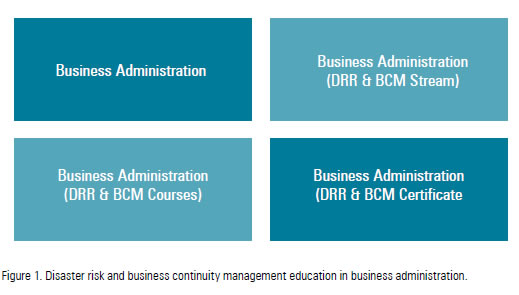
An examination of the existing programs in disaster risk and business continuity management around the world (Building Research Institute, 2007), reveals at least four models for integrating disaster risk and business continuity management in business education (Figure 1). This section briefly describes these models.
Business Administration (Status Quo)
This is the conventional model in which disaster risk and business continuity management are not on the business schools' radar and mainstream business discipline (Orlando, 2008; Acharyya, 2010) and therefor are not considered in the business education curriculum. Disaster risk and business continuity management are primarily viewed as separate disciplines. This view is consistent with the traditional perspectives in which disaster risk management is considered as being part of the natural sciences, engineering, and social sciences area (Shaw et al., 2011a) and business continuity management is considered as an information technology field (Herbane, 2010). In other words, business continuity and disaster risk reduction are not considered as true business functions, such as marketing, accounting, finance, etc. Because business continuity also known as disaster recovery was initially emerged as a response to information technology failures and business continuity experts often come from support areas of business, many business schools consider continuity management more as a technical skill than business function (Orlando, 2008). As a result there are many business schools that do not have disaster risk and business continuity management education as part of their curricula. These topics are either covered by other disciplines (such as Information Technology) or emerging degree programs in disaster studies/management and business continuity. During the 1990s and especially in the 2000s a significant number of degree programs in these areas emerged. Hyogo Frameworks for Action (HFA) (2005-2015) emphasized on knowledge and education and highlighted education as important component for disaster risk reduction (Shaw et al., 2011b). Although there are many disaster and emergency management degree programs (often with a business continuity element), degree programs in business continuity are relatively rare. Example of such programs is the Master of Science in Business Continuity Management at Norwich University (Vermont, USA).
Business Administration with Disaster Risk and Business Continuity Management Courses
This is a model in which disaster risk and business continuity management contents and courses are added to the business education curriculum. This approach is based on the view that disaster management and business continuity education need to be included in every relevant discipline to increase awareness and capacities of graduates to reduce the risks in their decisions and enhance their abilities to reduce social and economic disruptions caused by a variety of disaster events. This view has been implemented in two ways: 1) adding more disaster risk reduction and modern business continuity contents to the existing relevant courses; and 2) creating new disaster risk and business continuity management courses. In the first case, disaster risk and business continuity management materials are integrated into the existing business courses such as ''strategic management'', ''crisis management'', ''risk management'', ''supply chain management'', ''occupational health and safety'', ''corporate social responsibility'', ''project management'', ''audit'', ''information security management for business'', ''information assurance, and ''management information systems''. In the second case, disaster risk and business continuity management courses are added to the curriculum.
Business Administration with Disaster Risk and Business Continuity Management Streams
The third option is a model in which disaster risk and business continuity management become streams in business programs. Depending on the degree level and type of the stream, a certain number of specialized or stream related courses are created. For example, Walden University (Maryland, USA) has created a Homeland Security Specialization in its Doctor of Business Administration (DBA) program. This program includes a number of foundation and core business courses (i.e. Contemporary Challenges in Business, Organizational Leadership; Information Systems; Marketing; Finance; Business Operations). Specialized courses include: impact of homeland security policies on business continuity, homeland security, business planning, business infrastructure vulnerability analysis2.
]]> Business Administration with Disaster Risk and Business ContinuityManagement Certificates/Diploma
The fourth option or model is a combination of the business administration degree with a certificate/diploma in risk management or business continuity management. Certificates/diplomas are offered by business schools (i.e. business continuity certificate in Coventry School of Business in the UK), disaster and emergency management schools, or professional associations such as Disaster Recovery Institute (DRI), Business Continuity Institute (BCI), etc. This option leaves it to the business students to decide whether or not they want to enter into the disaster risk and business continuity profession and seek certification if needed. While there is a tendency in businesses to hire individuals with a business continuity degree, having a degree in business administration and a certificate in business continuity is acceptable. Having a certificate in business continuity management is viewed as an important credential and more and more companies require certifications when hiring such professionals.
While comparing these options with today's business and risk environment, it is diftcult to accept that the status quo is a viable option. First, business continuity is no longer restricted to information technology and it encompasses many aspects of business functions. Second, businesses are more frequently disrupted by internal and external hazards and the consequences of disruptions have become significant and sometimes deadly. Third, emergence of national and international standards in risk management and business continuity management provide further evidence of the importance and maturity of this field, and business students' knowledge of these standards are vital. The fourth option may work during a period when the need for disaster risk and business continuity experts has increased but universities and business schools are not prepared to address these needs. While having professional certificates is necessary in these fields, it is not suftcient. Certificates may be more useful when combined with university degrees with suftcient coverage of the field. In other words having a certificate in BCM with a business degree that has no business continuity component may not be ideal. This leaves us with the other two models. Both models have their own advantages and disadvantages. Depending on the availability of faculty resources and demands, business schools can choose among these two options.
METHODOLOGY
This paper uses primarily a case study method in which York University's programs and courses in disaster and emergency management are the focus of the study. Survey results conducted by the university and the course instructor are used to provide insights into students' experiences in these programs. University surveys have been conducted as part of cyclical program reviews in 2015 in which past and present students are asked some key questions about various aspects of the programs. The author who teaches some of the case study courses (ADMS 2700 and ADMS 3703) has also conducted various surveys during the past few years in order to better understand why students take such courses and what kind of impacts these courses have on their individual, social, and professional lives. Secondary data regarding the student enrollments in specific courses are also used to understand students' enrollments in different courses.
DISASTER RISK AND BUSINESS CONTINUITY MANAGEMENT IN BUSINESS EDUCATION AT YORK UNIVERSITY
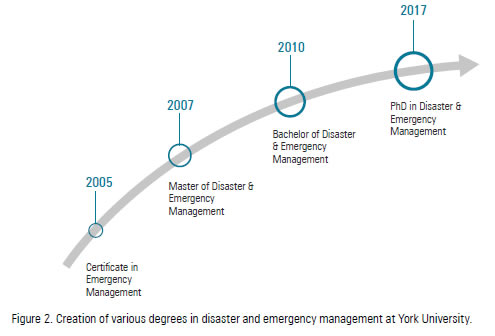
Recognizing the societal needs and building on its key institutional values and missions, York University embarked on creating a disaster and emergency management program in 2005 that is now one of the flagship programs of the University. Housed in the School of Administrative Studies of the Faculty of Liberal Arts and Professional Studies, York University's Disaster & Emergency Management (DEM) Programs have been offering disaster and emergency management degrees, certificates, courses, and professional trainings to a large number of students and practitioners over the past ten years. Starting with a certificate in emergency management in 2005, the department developed a masters degree in 2007, a bachelors degree in 2010 and a PhD program is currently in the approval process and is scheduled to start in 2017 (Figure 2).
DEM is an example of York's leadership in developing programs to address new needs and interests, locally, nationally, and internationally. York is a large and comprehensive university with a strong commitment to accessibility and social responsibility. The disaster and emergency management program is fulfilling the University's strategic plans and contributes to Canada's disaster risk reduction goals and objectives. Given that more than 10 years have passed since the establishment of these programs at York University, there are a number of lessons that can be learned from this experience.
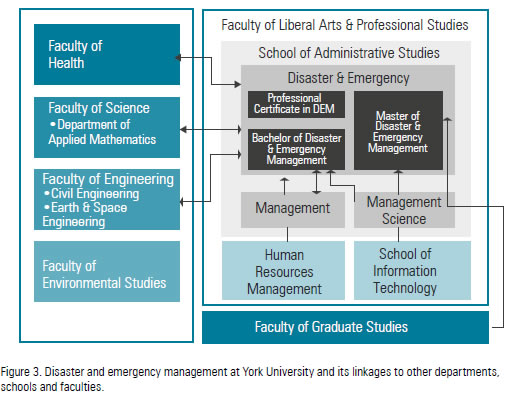
]]> Developing a world class research and training capacity in disaster and emergency management has been a priority for York University. Therefore, York is the only university in Canada that offers both undergraduate and graduate degrees in this field. York Universities' disaster and emergency management programs are housed in the School of Administrative Studies (SAS) that is part of the Faculty of Liberal Arts and Professional Studies (Figure 3). In addition to the disaster and emergency management unit, the School has nine other units (Management, Management Science, Finance, Accounting, Marketing, Audit, Financial Accounting, and Financial Accountability). The Disaster and emergency management unit has a close collaboration (teaching and research) with a number of units in the School of Administrative Studies, Faculty of Liberal Arts and Professional Studies, and other Faculties at York University. Students from most Faculties take disaster and emergency management courses at both undergraduate and graduate programs. Disaster and emergency management students also take some of their elective courses from other schools. Disaster and emergency management faculty members are involved in collaborative research with professors from other departments and Faculties. For example, a number of disaster and emergency management faculty and faculty members from the Faculty of Science, School of Information Technology, Faculty of Engineering, and Faculty of Environmental Studies are involved in a Natural Sciences, Engineering Research Council (NSERC) CREATE funded program ($1.65 million) on Advanced Disaster, Emergency, and Rapid Response Simulation. The aim of this program is to train the next generation of highly qualified personnel in disaster risk, response, continuity, and recovery simulations for both public and private organizations. Disaster and emergency management has close ties with governmental, non-governmental, and private sector organizations in Canada.Undergraduate Program
York University offers bachelor degrees in disaster and emergency management (BDEM) in various formats (ordinary 90 credits, 120 credits honors and specialized honors) and a professional certificate (24 credits, can be completed in campus or online). Students from other disciplines can do a double major or minor in disaster and emergency management. BDEM curriculum consists of 15 disaster and emergency management specific courses, management courses (offered by SAS management and management science such as organizational behavior, project management, and quantitative methods), and courses from other schools and departments in the Faculty of Liberal Arts and Professional Studies including human resources management, political science, public policy, geography, and faculty of environmental studies, faculty of science and faculty of health.
BDEM is designed to provide students with the core competencies needed by emergency and business continuity managers as well as a critical understanding of the theoretical approaches and assumptions underlying these competencies. The program is broadly conceptualized into four areas of study. In addition, it contains a substantial emphasis on experiential education.
Disaster and Emergency Management
Through a series of foundational courses, students develop a working knowledge of the assessment procedures, measures for preparedness, service delivery systems, impact on communities and hazards associated with disaster and emergency management. The core course ''Fundamentals of Emergency Management'' introduces students to the theories and principles of disaster management. Subsequent courses focus on the disaster risk management process and specific methods/tools used to address risks faced by communities and businesses; business continuity planning; theories of effective communication particularly in a crisis context; and theoretical understanding and practical analysis of the four pillars of comprehensive emergency management mitigation, preparedness, response and recovery.
Management
The multi-dimensional complexities of disaster and emergency management require that students develop competencies in project management, leadership, administration, communication and public policy. The program includes a substantive complement of administrative studies content designed to give students the knowledge and competencies needed to perform these management functions.
Interdisciplinary Studies
]]> Interdisciplinary is inherent to this field. Emergency and business continuity managers must be able to communicate effectively with professionals from a variety of disciplines and know when to draw on their expertise. They also must approach emergency and business continuity management from a range of perspectives. In planning and responding to disasters and emergencies, they need to consider the critical interrelationships of a variety of disciplines on outcomes. By including courses from a number of key disciplines, the program enables students to develop a basic understanding of their theoretical underpinnings and how these fields intersect in relationship to disaster and emergency management.Practical Experience
There is general agreement among emergency and business continuity management professionals that there needs to be a strong relationship between the theory and practice. The BDEM program provides opportunities for students to integrate academic concepts into operational settings. Third year students in the program have the option of completing a three credit field placement course (equivalent of 140 hours) in emergency or business continuity management. This field experience fosters a greater understanding of the complexities and challenges of the application of theories of emergency management to real-life situations. Using a formal agreement, students are placed in local, provincial, federal and international agencies at governmental, non-governmental, and private sector organizations carefully selected by the program under the supervision of faculty and professionals hosting the students. Participating students report their experiences in the placement early in the course, at middle of the term, and at the end of term. Student assessment is carried out jointly by the field and faculty supervisors. York University provides insurance for students.
BDEM Program courses are offered by faculty members from the disaster and emergency management area, other units in the School of Administrative Studies such as management and management science, Faculty of Environmental Studies, and a number of practitioners as part time instructors. Part time instructors are professionals in the field (i.e. Emergency ManagerCity of Brampton; Emergency Manager-City of Toronto; Business Continuity Manager Sunlife Assurance; Coordinator, Emergency Planning at City of Toronto, Business Continuity ConsultantHydro One, etc.). Disaster and emergency management unit is a corporate member of a number of professional associations and networks including Ontario Association of Emergency Managers, Disaster Recovery Information Exchange (DRIE) and the Canadian Risk and Hazards Network.
A recent survey of students in the BDEM program conducted as part of the cyclical program review in 2015 found that: close to 70% of students rated the overall program quality good, very good or excellent, while 21% rated the program fair and 8.6% rated the overall program either poor or very poor. A significant number of students (69%) believe that ''Course instructors provide high quality teaching'' in all, most, or half of the courses. Close to 78% believe that ''Instructors are enthusiastic about their teaching'' and that ''Instructors encourage students to become independent learners''. Close to 69% of students believe that the program does very well or fairly well in ''Covering a variety of disciplinary or multi-disciplinary perspectives''. About 88% mentioned that the program does very well or fairly well in ''Addressing equity, diversity and/or inclusivity''. In response to the open ended question of ''In your opinion, what is the ONE BEST thing about your program?'' students have listed the followings: Interesting field and compelling program, interesting courses and assignments, experienced, knowledgeable and caring instructors, small class size, application of theory in real world, evening courses, and field placement. A majority of the students (65%) believe that the program does not do well in ''Avoiding unnecessary repetition of the same material in different courses'' (Institute for Social Research, York University, 2015).
Graduate Program
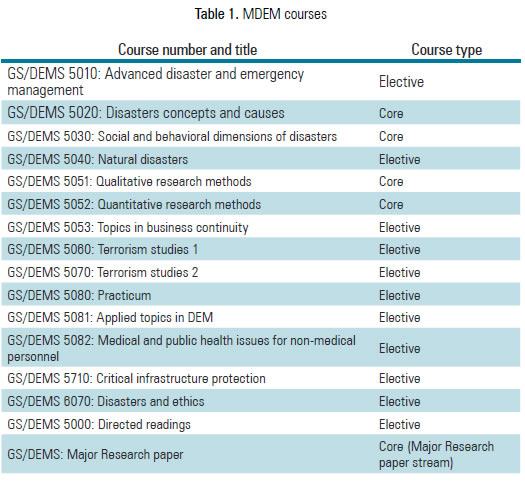
Master of Disaster and Emergency Management (MDEM) is a 30 credits degree offered as a course base (10 courses) and as Major Research Paper options (8 courses plus a 6 credits major research paper). York University's graduate programs are administered by the Faculty of Graduate Studies and resourced by the home Faculty (Faculty of Liberal Arts and Professional Studies in case of MDEM). A PhD proposal in under review and will be initiated by September 2017 upon approval. Although MDEM is considered a general master degree in disaster and emergency management, the program has certain focusing areas such as: business continuity, disaster risk management, health emergencies, public safety, and public policy (Table 1).
Like the BDEM program, some of the MDEM courses are also taken by students from other master programs. For example, students from Master of Information Technology regularly take Topics in Business Continuity and Advanced Disaster & Emergency Management courses from MDEM. Also, some MDEM students take courses from Refugee Studies, Environmental Studies, Health Management, Public Policy, etc. MADEM graduates are now employed in key emergency management and business continuity positions at both public and private sector organizations across Canada. Students can do MDEM in full time (four semesters) or part time basis.
In a recent survey of MDEM past and current students also conducted as part of cyclical program review in 2015, it was found that majority of students (53%) enter the MADEM program based on personal interest and 32.4 % choose MDEM for career opportunities. Close to 82% of students rated the overall program quality good, very good or excellent, while 14.7% rated the program fair and 2.9% rated the overall program either poor or very poor.
]]> York University received a major grant through Ontario Research Fund (ORF), York University and Industry Partners to create an Advanced Disaster, Emergency and Rapid Response Simulation (ADERSIM) facility (Budgeted for $ 4.3Million) to be launched by March 2017. ADERSIM's 12-room, multi-function infrastructure will mimic an advanced Emergency Operations Centre, with the capability to develop large scale computer based disaster simulations.DEM Courses for Business Students
In this section three key undergraduate courses that are taken by business students will be discussed and some insights into their enrolments and students' experiences with these courses will be provided. These three courses are: ADMS 2700 Fundamental of Emergency Management, ADMS 3701 Disaster Risk Management, and ADMS 3703 Business Continuity Management (Figure 4).
Both ADMS 2700 and ADMS 3701 are three credit courses that are available to all students at York University. ADMS 2700 is organized around the four pillars of mitigation, preparedness, response and recovery. This course provides students with the key concepts and basic knowledge required to operate effectively in an emergency management context including the legislative context, risk identification, assessment and communications. ADMS 3701 covers practical analysis of the risk management process and the specific tools and methods used to address the risks facing organizations, institutions, and communities. Both courses are offered in the fall, winter, and summer (fully online) semesters. Each section accepts up to 100 students and in most semesters the enrollment reaches the full capacity. Students of all levels and various degrees enroll in these courses. In particular one can find students from the disaster and emergency management, administrative studies (accounting, finance, management, and marketing), business economics, business and society, public policy, political science, nursing, geography, health information technology, international development, social works, sociology, environmental studies, biology, history, language and journalism in this course.
Our investigation reveals that as expected these courses are taken by a diverse and large number of students. Between 45 to 48% of the students enrolled in these courses are enrolled in the bachelor degree programs other than the BDEM and BAS. They include students from other social sciences disciplines (sociology, psychology, political science, communication studies, and public policy), health, and science, and environmental studies. About 40 percent of the students that are taking the Disaster Risk Management and 31 % that are taking the Fundamentals of Emergency Management are from the Bachelor of Administrative Studies (Figure 5).
In another study of students taking the ADMS 2700 Asgary (2008) found that while disaster and emergency management students take the course as a required course, close to 60 percent of the students take the course as an elective course. More than 70 percent of the students would recommend the course to other students. Students believed that this course has increased their knowledge of disaster risk and emergency management and their interests in the field and that they intend to take more courses in this area. Students support the idea that as a result of taking this course, they would be willing to participate in emergency and business continuity teams in their workplace and that taking this course is benefiting their families as well through awareness and knowledge transfer. Appendix 1 contains some quotes from students in response to the survey asking their overall impression about this course.
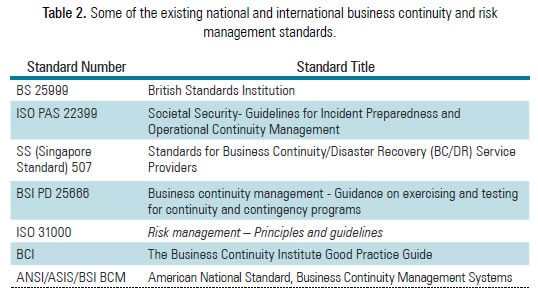
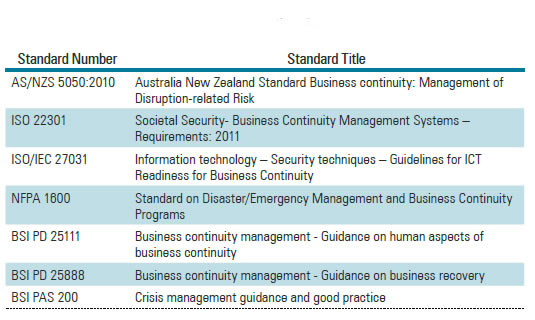
ADMS 3703 is a three credit course. This course provides an introduction to the field of business continuity. Continuity management is a holistic management process that identifies potential impacts threatening an organization and provides a framework for building resilience with the capability for an effective response. The course is based on the ISO 31000 Standards in Risk Management and four major business continuity standards:
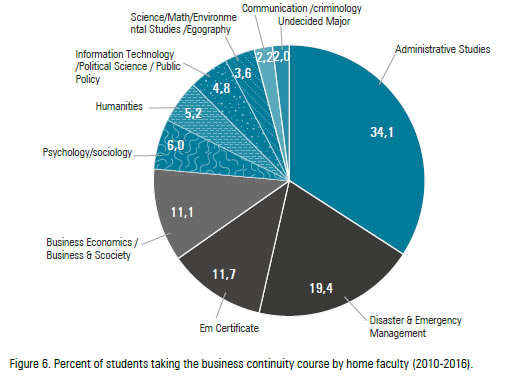
This Business Continuity Planning course is offered in both fall (face to face) and winter (online) semesters. As expected, this course is taken mainly by the BAS and BDEM students (Figure. 6). Considering that Business Economics and Business and Society are part of the broader business discipline, it can be argued that at least 50 percent of the students taking the business continuity course are business students.
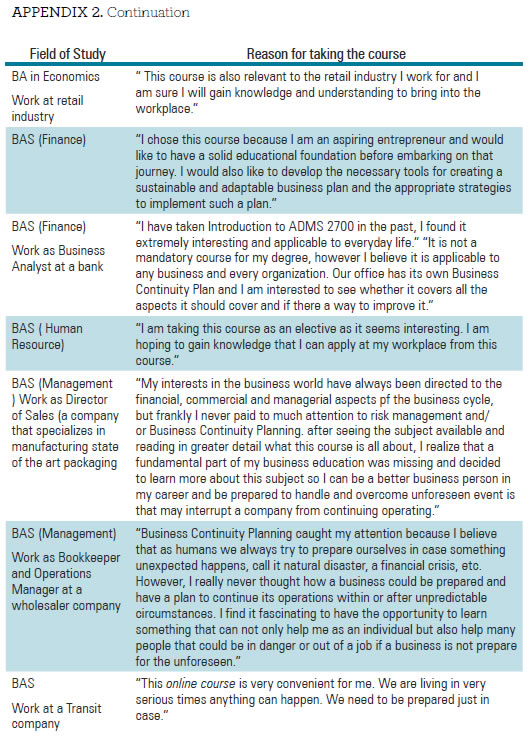
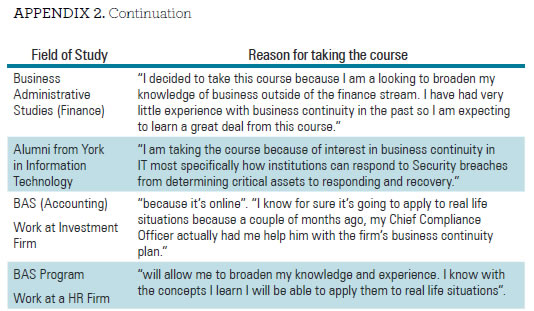
When a sample of students who took the Business Continuity Planning course in January 2016 was asked about why they have chosen the course, various reasons were provided (Appendix 2). Students are interested in taking the course as they see it very relevant in today's business world and they can apply the learning in their work place, especially when they run their own business. Some of them have been already involved in business continuity in their work place but had no knowledge of the process.
CONCLUSIONS
]]> The need for disaster risk reduction and business continuity education in business schools is evident. Businesses should proactively reduce the risks and enhance their continuity planning and resilience in order to meet the regulatory requirements, stakeholders' expectations, and long term sustainability. Unlike creating new programs, adding a couple or more courses to the existing business programs is not a diftcult task administratively. Business programs normally encompass the necessary foundations and much of the required competencies and experts needed by disaster risk and business continuity programs. By adding some disaster risk and business continuity courses, graduates would be able to become active members and advocates of disaster risk and business continuity management in their workplaces. While hiring a full time business continuity or disaster risk manager is not feasi ble for many small and even medium size companies, having business staff with academic and professional skills in these areas can help them to better manage disaster risks and prepare them for potential disruptions.Since most universities in both developed and developing countries have undergraduate business programs, York's approach may be a practical and feasible solution to expand disaster risk and business continuity management education in business programs.
Emergency management education in universities should be looked upon as a discipline and as a general education subject. The more students learn about disaster risks and disaster management the better prepared a society will be. A general education course that can be taken by all students would be timely and needed. Experience shows that students who have taken disaster and emergency management courses believe that such a course is beneficial to themselves, their families, place of work and the society at large. Therefore, it is ideal if universities offer at least one emergency management course to their students. The content of such course should be well designed and appropriate to students coming from every discipline.
If disaster risk and business continuity management are going to be integrated into the business education, all key stakeholders (i.e. practitioners, professional associations, academics, business associations, and private sector executives) ought to participate in curriculum development. This engagement is very important for creating experiential education opportunities for students as well. Close collaborations between the stakeholders will make sure that the provided education meets their needs.
It is believed that students graduating from the business programs by taking disaster risk and business continuity courses will be able to actively take part in such activities and decisions in the workforce. Providing some courses as part of the existing business programs may be the starting point towards integrating disaster risk and business continuity in business education. Creating streams would be the next important step. Finally, integrating disaster risk and business continuity management into business curriculums is not an easy task and should go beyond just adding a couple or more courses into the existing business curricula.
Finding instructors who have the required background knowledge, skills and qualifications has been relatively diftcult. As this integration is taking place, attention should also be paid to the training of highly qualified personnel who can teach the proposed courses.
This paper provides for insights into York University's current approach to integrating disaster risk and business continuity education into the higher education level with particular emphasis in business education. Further studies are needed to examine similar programs in other universities around the world to better understand the pros and cons of different models.
2 For more info, see: https://www.waldenu.edu/doctoral/doctor-of-business-administration/curriculum/homeland-security.
REFERENCES
Acharyya, M. (2010, April). An Enterprise Risk Management Curriculum for Business Studies: A Practical Understanding. In 2010 Enterprise Risk Management Symposium. Retrieved from: https://www.soa.org/library/monographs/other-monographs/2010/april/mono-2010-m-as10-1-acharyya.pdf [ Links ]
Asgary, A. (2008). Expanding Emergency Management Education to non-Emergency Management Disciplines: Emergency Management as an Elective Course, Homeland Security Education Summit, Washington D.C., March 2008. [ Links ]
Building Research Institute (2007). Disaster Education, National Graduate Institute for Policy Studies, Tokyo, Japan. Retrieved from: http://www.preventionweb.net/files/3442_DisasterEducation.pdf [ Links ]
Desai, B., & Sarmiento, J.P. (2015). Special issue: Risking disaster – The role of private investment and public regulation in disaster risk management. International Journal of Disaster Risk Reduction, 14(3), 203-204. DOI:10.1016/j.ijdrr.2014.09.010 [ Links ]
Gatzert, N, & Martin, M. (2005). Determinants and Value of Enterprise Risk Management: Imperial Evidence from the Literature. Risk Management and Insurance Review, 18(1), 29-53. DOI: 10.1111/rmir.12028 [ Links ]
Herbane, B. (2010). The evolution of business continuity management: A historical review of practices and drivers. Business History, 52(6) 978–1002. DOI:10.1080/00076791.2010.511185 [ Links ]
Holloway, A. (2015). Strategic mobilisation of higher education institutions in disaster risk reduction capacity building: Experience of Periperi U. Global Assessment Report on Disaster Risk Reduction. Retrieved from: http://www.preventionweb.net/english/hyogo/gar/2015/en/bgdocs/Holloway,%202014.pdf [ Links ]
Institute for Social Research, York University (2015). York University Cyclical Program Review 2015, Undergraduate Program in Disaster & Emergency Management, Student Questionnaire Results, York University. [ Links ]
McCreight, R. (2009). Educational Challenges in Homeland Security and Emergency Management Education. Journal of Homeland Security and Emergency Management, 6(1). 1547–7355. DOI: 10.2202/1547-7355.1576. [ Links ]
McCreight, R. (2014). A Pathway Forward in Homeland Security Education: An Option Worth Considering and the Challenge Ahead. Homeland Security & Emergency Management, 11(1), 25–38. DOI: 10.1515/ jhsem-2013-0099 [ Links ]
Orlando, J. (2008). Higher Education and the Growth of Business Continuity, Continuity Insights, Retrived from: http://www.continuityinsights.com/article/2008/11/higher-education-and-growth-business-continuity [ Links ]
Pelfrey, W., & Kelley, W. (2013). Homeland Security Education: A Way Forward, Homeland Security Affairs, 9(February 2013), 1-12. Retrieved from: http://www.hsaj.org/?article=9.1.3 [ Links ]
Sarmiento, J. P., Hoberman, G., Ilcheva, M., Asgary, A., Majano, A. M., Poggione, S., & Duran, L. R. (2015). Private sector and disaster risk reduction: The cases of Bogota, Miami, Kingston, San Jose, Santiago, and Vancouver. International Journal of Disaster Risk Reduction, 14(3), 225-237. DOI: 10.1016/j.ijdrr.2014.09.008 [ Links ]
Shaw, G.L. & Harrald J.R. (2004). Identification of the Core Competencies Required of Executive Level Business Crisis and Continuity Manager, Journal of Homeland Security and Emergency, 1(1). 1547-7355. DOI: 10.2202/1547-7355.1003 [ Links ]
Shaw, R., Mallick, F., & Takeuchi, Y. (2011a). Chapter 5 Essentials of Higher Education in Disaster Risk Reduction: Prospects and Challenges. In Rajib Shaw, Koichi Shiwaku, Yukiko Takeuchi (ed.) Disaster Education (Community, Environment and Disaster Risk Management, Volume 7) (pp. 95-113) Emerald Group Publishing Limited. [ Links ]
Shaw, R., Takeuchi, Y., Gwee, Q.R., & Shiwaku, K., (2011b). Chapter 1 Disaster Education: An Introduction. In Rajib Shaw, Koichi Shiwaku, Yukiko Takeuchi (ed.) Disaster Education (Community, Environment and Disaster Risk Management, Volume 7) (pp. 1-22). Emerald Group Publishing Limited. [ Links ]
]]>UNISDR (2013). The Global Assessment Report on Disaster Risk Reduction. Geneva: UN Office for Disaster Risk Reduction (UNISDR). Retrieved from: http://www.preventionweb.net/english/hyogo/gar/2013/en/home/index.html. [ Links ]
UNISDR, (2015). Sendai Framework for Disaster Reduction, 2015, Retrieved from: http://www.unisdr.org/we/coordinate/sendai-framework. [ Links ]
Waugh, W. L. Jr., (2005). Public Administration, Emergency Management, and Disaster Policy, Georgia State University, FEMA Higher Education Conference. [ Links ]
 ]]>
]]>
]]>