ARTÍCULOS ORIGINALES
DOI: 10.17230/ad-minister.28.13
Sustainability Education in Indian Business Schools: A Status Review
Educación para la sostenibilidad en las escuelas de negocios indias: informe de la situación
PD JOSE1
]]> 1 Professor, Corporate Strategy and Policy Area, Indian Institute of Management Bangalore, India. Email: jose@iimb.ernet.inJEL: I2, M1
Received: 20/06/2016Modified: 22/06/2016Accepted: 25/06/2016
ABSTRACT
Sustainability issues, given their potential scale of impact and urgency, have captured the imagination of both corporations and academic institutions everywhere. This paper examines how such problems and their potential solutions have been incorporated into higher education, particularly business school education in India. With over 3,600 business schools in the public and private sector, business education in India has proliferated. However, students by and large still remain unexposed to sustainability and disaster management concepts in their curriculum. The underlying factors for this include, lack of institutional capacity, issues related to faculty motivation and incentives, lack of recruiter interest and limited availability to high quality resource material. Further, while several schools in India focus on sectors relevant to sustainability, inter-organizational linkages have not developed and business school generally operate independently. This paper examines the way forward to deeply integrate sustainability principles into the core curriculum of business schools. Measures suggested include creating communities of practice among academia and industry, building a resource base of teaching materials for easy access by faculty, and several measures to strengthen institutional capacity.
KEYWORDS Sustainability; disaster management; environmental management; education; sustainability curriculum; India
RESUMEN
Debido a su alto potencial de impacto y urgencia, los asuntos relacionados con la sostenibilidad han capturado la imaginación tanto de las empresas privadas, como de las instituciones académicas en todas partes. Este artículo examina cómo dichos problemas y sus soluciones potenciales han sido incorporados en la educación superior, particularmente en la educación de negocios de India. Con unas 3,600 escuelas de negocios en los sectores público y privado, la educación de negocios en India ha proliferado. Sin embargo, los estudiantes, en general, siguen sin tener contacto con conceptos de sostenibilidad y gestión de desastres en sus currículos. Los factores subyacentes a esta situación incluyen la falta de capacidad institucional, los problemas relacionados con la motivación e incentivos de los profesores universitarios, la falta de interés de los reclutadores y la limitada disponibilidad de material de consulta de alta calidad. Además, mientras que varias escuelas de negocios de India se enfocan en sectores relevantes para la sostenibilidad, los vínculos interorganizacionales no han sido desarrollados y las escuelas de negocios operan en general independientemente. Este artículo examina el camino a seguir para integrar principios de sostenibilidad de manera profunda a los currículos básicos de las escuelas de negocios. Las medidas que se sugieren incluyen la creación de comunidades de prácticas entre la academia y la industria, la construcción de materiales pedagógicos de fácil acceso para profesores universitarios y diferentes medidas para fortalecer la capacidad institucional.
PALABRAS CLAVE Sostenibilidad; gestión de desastres; gestión ambiental; educación; currículo de sostenibilidad; India.
]]> INTRODUCTION
Sustainability issues, especially with respect to environmental management, and especially disaster management, are increasingly influencing both boardroom strategies and corporate profits. While corporations have responded to broad sustainability concerns even earlier, the last two decades have seen a significant increase in the level as well as the scope of businesses' engagement with sustainability matters. This can be attributed to: an improved understanding of the mutually-reinforcing nature of business and ecosystem cycles; the growing power of civil societies; a proliferation of local/national regulatory policies; and multilateral agreements. Consequently, there is greater appreciation of the positive and transformational role that corporations need to play in a resource-constrained, sustainablychallenged world. This is even more critical given our experience that left unattended, sustainability issues may eventually morph into industrial or humanitarian disasters in the long run.
As a result of the above, global environmental concerns, such as climate change, biodiversity loss, natural resource depletion, atmospheric pollution, industrial pollution, global poverty etc., have become important inputs for decision making at the firm level. While industrial sustainability has been intensively discussed in the developed country contexts, in the context of the developing countries these may differ in terms of methods as well as outcomes. Further issue of environment and industry competitiveness is particularly important in the case of developing countries such as India as several studies have pointed out that improvements in environmental performance can actually improve the overall performance of the industry.
Apart from an increase in general levels of awareness amongst industry and citizens, three other developments in the Indian economy have made it impossible for Indian firms to ignore the environmental impacts of their operations. First, the quantum of losses associated with poor environmental performance is staggering. Second, the current government's focus on manufacturing is likely to exacerbate the environmental pollution in the country. Third, the legislative framework in India has changed in recent years. The 1994 amendments to the Companies Act make it mandatory for firms to spend, in every financial year, at least two per cent of the average net profits, subject to certain qualifying conditions towards corporate social responsibility activities, defined to include environmental and disaster mitigation initiatives. Growing pressures from civil society, and adoption of best practices in reporting have also meant that there is more intensive scrutiny of the sustainability impacts of business` operations in India.
Given the strategic importance of environmental management from a national perspective, it is necessary for the business schools in India to take a more proactive role in creating managers and business leaders who have a good understanding of how to incorporate environmental issues into corporate decision making.
METHODOLOGY
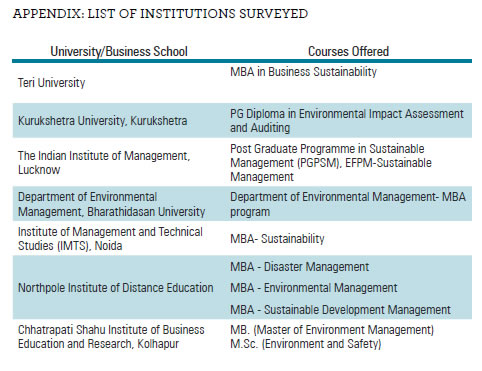
This study was carried out in two phases. The first was to do a survey of existing literature and analyze the curriculum of schools teaching sustainability using secondary sources, primarily the websites of the concerned institutes. This was supplemented by conversations with faculty teaching sustainability or allied courses across the identified schools. Given the limitations of time it was not possible to independently verify all the information available on the web by directly contacting the schools in all the cases.
BUSINESS EDUCATION IN INDIA: AN OVERVIEW
Business education in India is of relatively recent vintage with the first fully independent business school being set up in the sixties. Interestingly though the premier business schools of India were set up as Institutes of Management rather than business schools recognizing the fact that management went beyond just running a business. However, since then, the growth of business schools has mirrored the economic growth of India. In 2015, India had over 3,600 business schools compared to less than 1,000 business schools in 1988. The numbers in themselves do not fully reflect the quality of management education in India as these institutions vary greatly in terms of both academic infrastructure as well as faculty resources.
Business education in India is organized at three levels; the first, namely premier schools such as the Indian Institutes of Management, are set up through a special act of the Indian parliament offering both two-year and one-year Post Graduate Diplomas in Management. The second category comprises schools aftliated to the state, central or independent universities. The third category includes schools set up by private foundations and societies. Most such institutions function under the regulatory control of the All India Council for Technical Education. While programmes offered by these schools are generally referred to as Post Graduate Diplomas in Management, the two year programmes in business management offered under the university system are called Master of Business Administration.
]]> SUSTAINABILITY EDUCATION IN BUSINESS SCHOOLS: A STATUS REVIEWTraditionally, the key narrative in management education in India, as elsewhere in the world, has been one of maximizing shareholder value. However, in the last two decades an alternative perspective built around sustainability, corporate governance, and corporate social responsibility has been emerging. And that has been reflected in the curriculum redesign of a number of institutions across India.
Sustainability education initiatives in the in India's business schools can be traced back to the early 90's when the premier business school in India such as the Indian Institute of Management at Ahmedabad and Calcutta decided to offer environmental management courses as electives in their post graduate courses. Since then many more schools have incorporated environmental management courses into their curriculum. Such initiatives have also been strongly influenced by the directives from the higher education regulatory agencies and the judiciary. For instance, the University Grants Commission, the controlling authority for Universities in India, mandated that an environmental management course must be taught in the MBA programmes offered by universities.
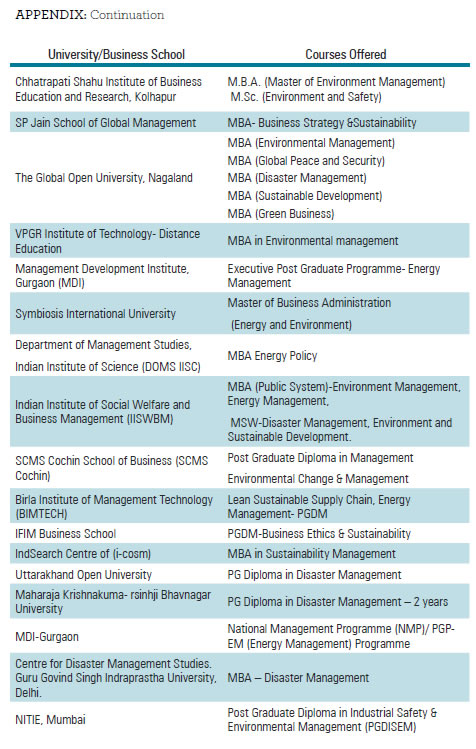
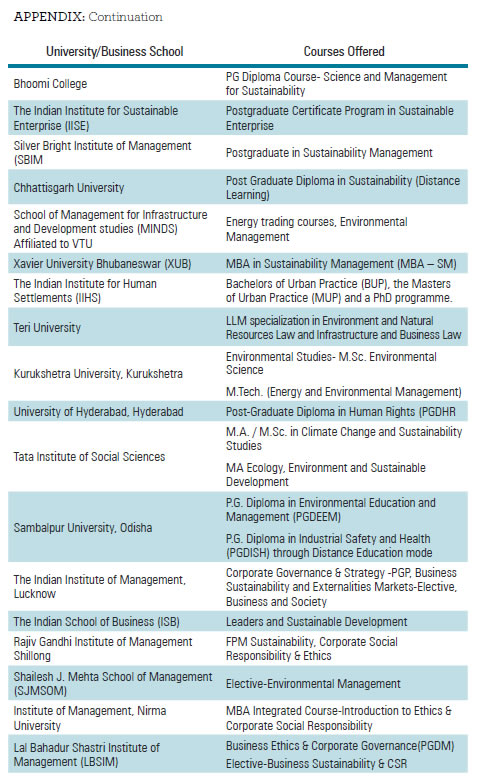
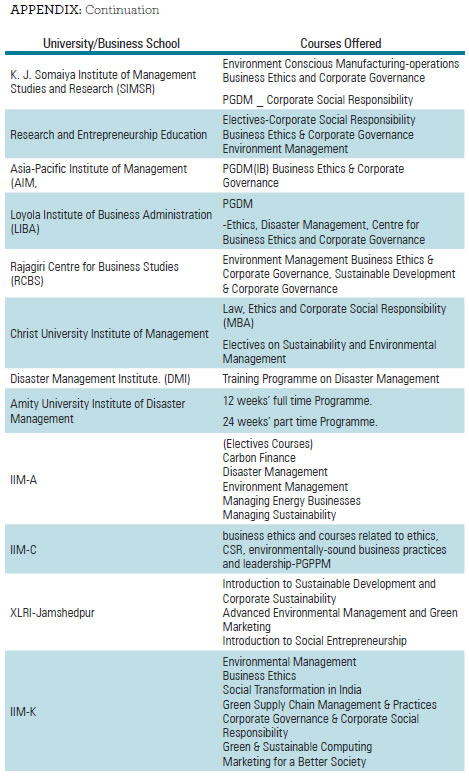
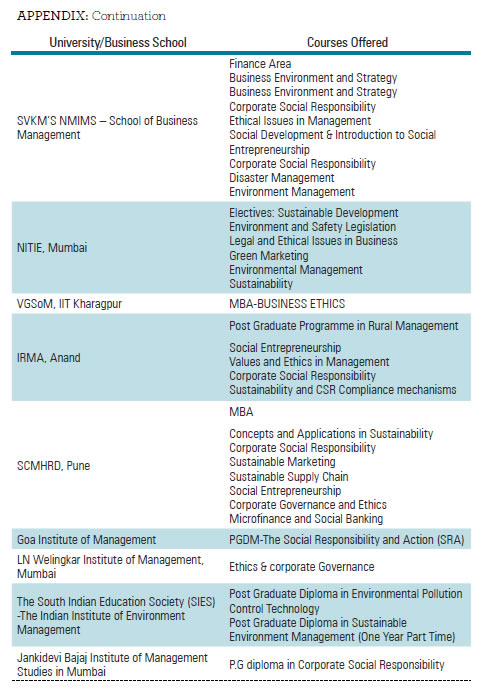
A survey on Corporate Responsibility education in India among top ranked 104 schools by Partners in Change concluded that while corporate responsibility education had made some progress, significant steps were further needed (Partners in Change, 2007). A second study on the status of ethics, corporate governance and environment education concluded that of the 107 schools surveyed ''ethics was offered by 64.49%, corporate governance by 31.78%, CSR by 10.28% and environment and sustainability by 14.02% of the business schools surveyed (Srinivasan, Srinivasan & Anand, 2012).
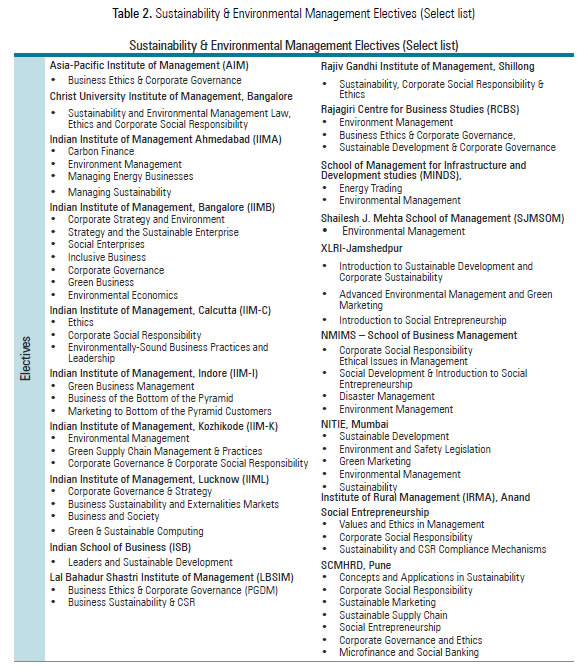
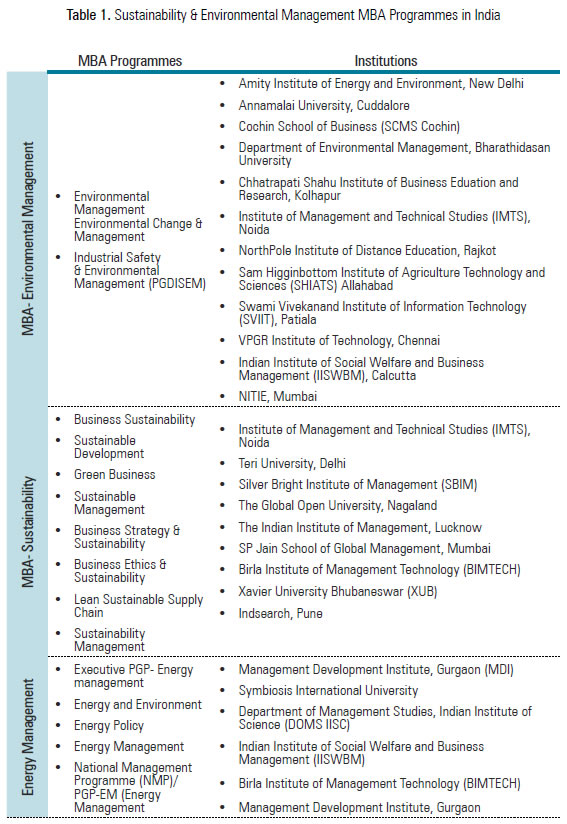
The content and pedagogy of sustainability courses also vary greatly between business schools. The most common approach has been to introduce standalone courses in sustainability or allied areas such as corporate governance, ethics, corporate social responsibility, green operations etc., Much of these initiatives have been individual faculty driven. A second approach now being adopted by a few schools is to introduce compulsory core courses as a part of the first year core curriculum as in the case of schools like IIM Ahmedabad, Xavier School of Management Jamshedpur, Xavier Institute of Management Bhubaneshwar, IIM Lucknow and others. In many of these instances multiple courses on environment are offered. However, in most instances the courses are strongly driven by faculty interests and their future depends on continued faculty interest, something that is diftcult to sustain, given the wide variations in student interest and institutional support. Even where environmental courses are offered, these are currently done in a very disjointed manner and not integrated with the functional areas. Also in the absence of a concerted effort and lack of adequate focus by the business schools themselves the impact of these pioneering efforts is limited. A third approach has been to introduce masters level programmes in sustainable business management as given in Table 1. An early attempt at starting a sustainability programme was from Symbiosis University in 2008 by way of an integrated Energy and Environment program. The most recent have been the launch of Post Graduate Programmes in sustainability by two premier institutions: Xavier University and the Indian Institute of Management Lucknow (IIML). However most of these programmes have remained small and have not been scaled up.
Three alternate programmes that focus almost exclusively on business and sustainability are given in the following section. Such programmes indicate a growing demand for sustainability-oriented business education.
Case Study 1: Xavier University's School of Sustainability (XSOS):
XSOS launched the MBA in Sustainability Management in June 2015. Traditionally, the idea of building sustainability into a business school curriculum has been to add electives onto a core curriculum. XSOS has integrated sustainability as the core and added the functional areas as (add-ons). This is somewhat of a paradigmatic shift from the way MBA programmes in sustainability are generally conceived elsewhere. This programme focuses on five key areas namely (1) Human Development; (2) Sustainability, Leadership and Entrepreneurship; (3) Climate Change and Natural Resource Management; (4) Sustainable Energy; (5) Policies, Laws and Governance. In the second year students specialize in any of the four functional areas including Accounting and Finance, Marketing, Human Resource Management, Operations Management and Information Systems. This is complemented by capstone projects and a six-week program on Sustainability Discovery, where students are encouraged to explore sustainability issues in the community.
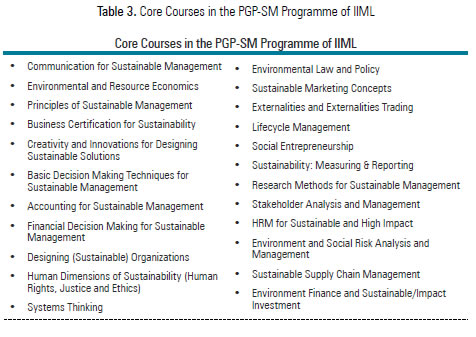
]]> Case Study 2: IIML's Post Graduate Programme in Sustainable Management (PGP-SM): Launched in 2015, the PGP-SM covers the subject areas of environmental, social, and economic sustainability of businesses, change-management, Policy and institutional analysis, and cross-sector collaboration. Core sustainability courses taught in this are given in Table 3:Case Study 3: MBA in Business Sustainability (TERI University):
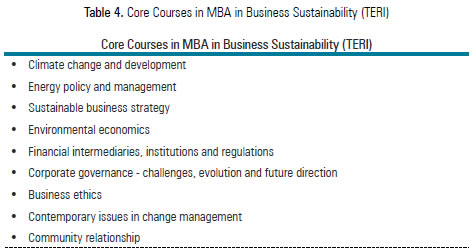
The MBA in Business Sustainability at the TERI University covers a variety of courses, including Principles and Concepts of Sustainability, Climate Change and Development, Sustainability Reporting and CSR, Sustainable Business Strategy, Business and Society and Environmental Economics. Core sustainability courses taught in this are given in Table 4:
While all the three institutions have an enviable track record in designing and delivering high quality post graduate programmes it is too early to predict the success of these new initiatives.
SECTORAL SCHOOLS
India also has several schools with a specific sectoral focus such as Rural Development, Forest Management or allied areas. While such programmes are not conventional MBAs, they offer significant coverage of sustainability areas. Examples of such institutes are the Indian Institute of Forest Management (IIFM), Institute of Rural Management (IRMA), and the Disaster Management Institute (DMI) offer courses with significant coverage over sustainability and disaster management topics. A good case in point is the Indian Institute of Forest Management, established 1982 by the Indian Government (under the Ministry of Environment, Forests and Climate Change). IIFM offers a PG diploma in Forestry Management, with a primary focus on sustainable management of natural resources.
COURSES IN DISASTER MANAGEMENT
Disaster management in India received significant attention from the government as well as stakeholder groups in the wake of the Bhopal gas tragedy in 1984, considered the world's worst manmade industrial disaster. The following period saw the introduction of new legislation for environmental protection. Simultaneously there has also been greater appreciation of the need to better manage natural disasters of varying magnitude that impact the Indian subcontinent on a regular basis.
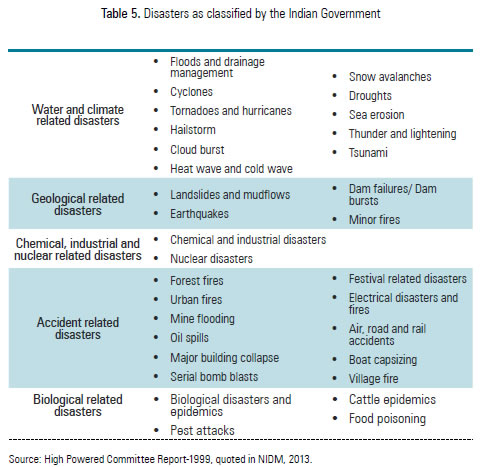
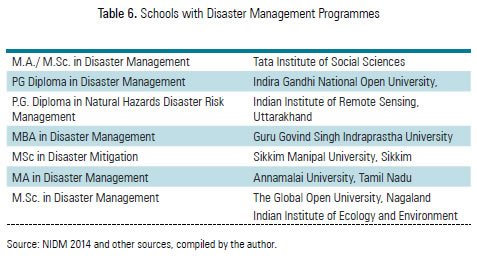
]]> While courses on crisis and disaster management have been taught as part of other programmes, the exclusive focus on Disaster Management as a business school course is a recent development. India is particularly vulnerable to disasters because of its geo-climatic and socio-economic conditions. With the enactment of the Disaster Management Act in 2005 by the Indian Government, events emanating from both natural and manmade causes as well as those due to accidents and negligence are now categorized as disasters. A high powered committee by the government has classified disasters as related to (a) water and climate; (b) geology; (c) chemical, industrial and nuclear; (d) accidents; and (e) biological. For a comprehensive list of these please see Table 5.As in the case of sustainability, several institutions also offer courses on Disaster management. A select list such institutes is given below in Table 6:
CHALLENGES IN INCORPORATING SUSTAINABILITY INTO BUSINESS SCHOOL CURRICULUM
While the efforts detailed in the previous sections are laudable, it is fair to say that there have not been enough efforts by business schools to mainstream sustainability or disaster management concepts into the curriculum by integrating them with core functional area courses. By and large it appears that, business schools have introduced sustainability themes into MBA curriculum more out of political concerns and correctness, rather than conviction. Even as this trend is slowly changing, it is interesting to note that while being sustainable is often profitable to business, whether it is worthwhile for business schools to engage in sustainability initiatives is still a moot question. The overall progress has been stymied due to a variety of reasons:
RECOMMENDATIONS
To summarize, sustainability education suffers from what could be characterized as an unhealthy amount of skepticism all around. Both faculty and students are circumspect about pursuing opportunities in the sustainability and disaster management spaces because career options are not easily visible or well defined. Faculty are cynical, partly because career growth is not so very well defined. This is exacerbated by the fact hardly any journals publishing interdisciplinary research would find themselves among the top rated journal lists of business schools. There is also a great deal of institutional level skepticism because such courses have limited student appeal and hence are not easily scalable, adding to the institutions' costs.
Our analysis of the current status indicates that a three-pronged approach is necessary to strengthen sustainability education in Indian business schools, namely:
STRENGTHENING INSTITUTIONAL CAPACITY
As noted before, the lack of institutional capacity is a strong barrier to the introduction of sustainability and disaster management courses into business school curricula. Institutional capacity here refers to resource constraints in the areas of finance, materials and faculty. This is felt most acutely in the case of teaching faculty. The average business school operates with limited faculty and no possibility of establishing dedicated faculty for environmental courses. It is therefore necessary to upgrade the skills/knowledge levels of the existing faculty so that environmental issues can be covered in an adequate manner by faculty from other functional areas. Institutional capacity may also be strengthened by providing some amount of budgetary support for procuring appropriate material, and for developing teaching material by the concerned faculty.
BUILDING A RESOURCE BASE OF TEACHING MATERIALS
There is an urgent need to develop adequate teaching material in the form of case studies, articles, simulations and multi-media resources on topics related to disaster management. An indicative list of possible topics is given below.
CREATING COMMUNITIES OF PRACTICE
A third approach to promote sustainability related education in business schools is to network all faculty involved in teaching environmental courses in business schools with others interested in introducing similar courses. This networking can be achieved by facilitating collaborative research on curriculum development between different participating institutions, in particular between premier institutions such as IIMs and other second level institutions.
In the final analysis the key question is can business schools help innovate and incubate solutions to some of the biggest sustainability challenges that we face? Our experience so far indicates that we can. For example, several innovative ideas as well as best practices in sustainability have emerged in the business school context, such as base of the pyramid approaches. Further, the most challenging sustainability problems that humanity faces are located in the developing and emerging economy contexts, and there is a need to involve local institutions in helping co-create appropriate and effective solutions to meet these challenges.
ACKNOWLEDGEMENTS
The author gratefully acknowledges the research support provided by Probeeta Bolar and Menaka Rao, Research Associates at IIM Bangalore.
]]> REFERENCESGovernment of India Ministry of Home Affairs. (2011). Disaster Management in India. New Delhi. Retrieved from: http://www.unisdr.org/2005/mdgs-drr/national-reports/India-report.pdf [ Links ]
Institute of Disaster Management (2013). Indian Disaster Report. NIDM, Ministry of Home Affairs. New Delhi: GoI. [ Links ]
National Institute of Disaster Management. (2014). Directory of Institutions and Resource Persons in Disaster Management, NIDM, Ministry of Home Affairs. New Delhi: GoI. Retrieved from: http://nidm.gov.in/PDF/Pubs/DM_Dir_2014.pdf [ Links ]
Partners in Change. (2007). 'National Survey of Corporate Responsibility: Teaching and Research in Management Education. New Delhi: Partners in Change. [ Links ]
Srinivasan, P., Srinivasan V., & Anand, R.V. (2012). Status of ethics, corporate governance, CSR and environment education in b-schools in India: An exploratory study, IIMB working Paper No 362, Bangalore. Retrieved from: http://www.iimb.ernet.in/research/sites/default/files/WP%20No.%20362.pdf [ Links ]