<?xml version="1.0" encoding="ISO-8859-1"?><article xmlns:mml="http://www.w3.org/1998/Math/MathML" xmlns:xlink="http://www.w3.org/1999/xlink" xmlns:xsi="http://www.w3.org/2001/XMLSchema-instance">
<front>
<journal-meta>
<journal-id>1692-0279</journal-id>
<journal-title><![CDATA[AD-minister]]></journal-title>
<abbrev-journal-title><![CDATA[AD-minister]]></abbrev-journal-title>
<issn>1692-0279</issn>
<publisher>
<publisher-name><![CDATA[Escuela de Administración  de la Universidad EAFIT]]></publisher-name>
</publisher>
</journal-meta>
<article-meta>
<article-id>S1692-02792016000200003</article-id>
<article-id pub-id-type="doi">10.17230/ad-minister.29.3</article-id>
<title-group>
<article-title xml:lang="en"><![CDATA[Technological Unemployment: an approximation to the Latin American Case]]></article-title>
<article-title xml:lang="es"><![CDATA[Desempleo Tecnológico: una aproximación al caso latinoamericano]]></article-title>
</title-group>
<contrib-group>
<contrib contrib-type="author">
<name>
<surname><![CDATA[AGUILERA]]></surname>
<given-names><![CDATA[ANDRÉS]]></given-names>
</name>
<xref ref-type="aff" rid="A01"/>
</contrib>
<contrib contrib-type="author">
<name>
<surname><![CDATA[RAMOS BARRERA]]></surname>
<given-names><![CDATA[MARÍA GABRIELA]]></given-names>
</name>
<xref ref-type="aff" rid="A02"/>
</contrib>
</contrib-group>
<aff id="A01">
<institution><![CDATA[,Universidad EAN Facultad de Administración, Finanzas y Ciencias Económicas ]]></institution>
<addr-line><![CDATA[Bogotá, D. C ]]></addr-line>
<country>Colombia</country>
</aff>
<aff id="A02">
<institution><![CDATA[,Universidad de La Salle Facultad de Ciencias Económicas y Sociales ]]></institution>
<addr-line><![CDATA[Bogotá, D. C ]]></addr-line>
<country>Colombia</country>
</aff>
<pub-date pub-type="pub">
<day>00</day>
<month>12</month>
<year>2016</year>
</pub-date>
<pub-date pub-type="epub">
<day>00</day>
<month>12</month>
<year>2016</year>
</pub-date>
<numero>29</numero>
<fpage>58</fpage>
<lpage>78</lpage>
<copyright-statement/>
<copyright-year/>
<self-uri xlink:href="http://www.scielo.org.co/scielo.php?script=sci_arttext&amp;pid=S1692-02792016000200003&amp;lng=en&amp;nrm=iso"></self-uri><self-uri xlink:href="http://www.scielo.org.co/scielo.php?script=sci_abstract&amp;pid=S1692-02792016000200003&amp;lng=en&amp;nrm=iso"></self-uri><self-uri xlink:href="http://www.scielo.org.co/scielo.php?script=sci_pdf&amp;pid=S1692-02792016000200003&amp;lng=en&amp;nrm=iso"></self-uri><abstract abstract-type="short" xml:lang="en"><p><![CDATA[Recent advancements in Artificial Intelligence (AI), robotics, control systems, software and related technologies have revived the debate on the influence that technology has on labor markets. So far, the focus of the literature has been on advanced economies. This document aims to analyze the following variables: domestic spending in science and technology, GDP per capita, nominal minimum wage, domestic spending in education and their impact on unemployment rate in seven Latin American countries from 1996 to 2011. Panel data was used to measure the relation of these variables with unemployment rates in the region. The results allowed us to conclude that investment in Science and Technology in the region has not reached levels that potentially reduce employment; on the contrary, innovation is regarded as a source of labor productivity gains. The broader implications of technology and automation are yet to be seen, however, both firms and the public sector in the region must prepare for massive technological unemployement, as predicted by recent models.]]></p></abstract>
<abstract abstract-type="short" xml:lang="es"><p><![CDATA[Avances recientes en Inteligencia Artificial (IA), robótica, sistemas de control, software y tecnologías relacionadas han revivido el debate sobre la influencia que la tecnología ejerce en el mercado laboral. Hasta el momento, el enfoque de la literatura se ha dado en economías avanzadas. Este documento busca describir y comparar las siguientes variables: gasto doméstico en ciencia y tecnología, PIB per cápita, salario mínimo nominal, gasto doméstico en educación en siete economías latinoamericanas y su impacto en la tasa de desempleo durante el periodo 1996 a 2011. Se usaron datos panel para medir la relación de las variables con las tasas de desempleo en la región. Los resultados nos permitieron concluir que la inversión en ciencia y tecnología en la región no ha alcanzado niveles que reduzcan potencialmente el empleo; por el contrario, la innovación es vista como una fuente de ganancias en productividad en la mano de obra. Las implicaciones más amplias de la tecnología y la automatización todavía no son evidentes, sin embargo, tanto las firmas como el sector público en la región deben prepararse para el desempleo tecnológico masivo que se ha estimado en modelos recientes.]]></p></abstract>
<kwd-group>
<kwd lng="en"><![CDATA[Technological innovation]]></kwd>
<kwd lng="en"><![CDATA[unemployment]]></kwd>
<kwd lng="en"><![CDATA[science and technology investments]]></kwd>
<kwd lng="en"><![CDATA[gross domestic product]]></kwd>
<kwd lng="es"><![CDATA[Innovación tecnológica]]></kwd>
<kwd lng="es"><![CDATA[desempleo]]></kwd>
<kwd lng="es"><![CDATA[inversión en ciencia y tecnología, producto interno bruto]]></kwd>
</kwd-group>
</article-meta>
</front><body><![CDATA[  <font size="2" face="Verdana, Arial, Helvetica, sans-serif">     <p align="right"><strong>ART&Iacute;CULOS ORIGINALES</strong></p>     <p align="right">DOI: <a href="http://dx.doi.org/10.17230/ad-minister.29.3" target="_blank">10.17230/ad-minister.29.3</a></p>     <p align="center"><b><font size="4">Technological Unemployment: an approximation to   the Latin American Case</font></b></p>     <p align="center">&nbsp;</p>     <p align="center"><b><font size="3"> Desempleo Tecnol&oacute;gico: una aproximaci&oacute;n al caso latinoamericano</font></b></p>     <p align="center">&nbsp;</p>     <p align="center">&nbsp;</p>     <p><b>ANDR&Eacute;S   AGUILERA<sup>1</sup>, MAR&Iacute;A GABRIELA   RAMOS BARRERA<sup>2</sup></b></p>     <p>1 Facultad de Administraci&oacute;n, Finanzas y Ciencias Econ&oacute;micas, Universidad EAN, Bogot&aacute;, D. C, Colombia. Email: <a href="mailto:aaguilerac@universidadean.edu.co">aaguilerac@universidadean.edu.co</a> ORCID: <a href="http://orcid.org/0000-0002-9484-7047" target="_blank">http://orcid.org/0000-0002-9484-7047</a></p>     ]]></body>
<body><![CDATA[<p>2 Facultad de Ciencias Econ&oacute;micas y Sociales, Universidad de La Salle, Bogot	&aacute;, D. C, Colombia. Email: <a href="mailto:mgramos@unisalle.edu.co">mgramos@unisalle.edu.co</a> ORCID: <a href="http://orcid.org/0000-0002-0887-5608" target="_blank">http://orcid.org/0000-0002-0887-5608</a></p>     <p>&nbsp;  </p>     <p>JEL: E24, J24, O3</p>     <p>   Received :09/11/2015 Modified: 05/05/2016 Accepted: 16/06/2016</p>     <p>&nbsp;</p> <hr size="1" />     <p><b>ABSTRACT</b></p>     <p>   Recent advancements in Artificial Intelligence (AI), robotics, control systems, software and related   technologies have revived the debate on the influence that technology has on labor markets. So far,   the focus of the literature has been on advanced economies. This document aims to analyze the   following variables: domestic spending in science and technology, GDP per capita, nominal minimum   wage, domestic spending in education and their impact on unemployment rate in seven Latin American   countries from 1996 to 2011. Panel data was used to measure the relation of these variables with   unemployment rates in the region. The results allowed us to conclude that investment in Science and   Technology in the region has not reached levels that potentially reduce employment; on the contrary,   innovation is regarded as a source of labor productivity gains. The broader implications of technology and   automation are yet to be seen, however, both firms and the public sector in the region must prepare for massive technological unemployement, as predicted by recent models.</p>     <p>   <b>KEY WORDS </b>Technological innovation; unemployment; science and technology investments, gross domestic product.</p> <hr size="1" />     <p>   <b>RESUMEN</b></p>     <p>   Avances recientes en Inteligencia Artificial (IA), rob&oacute;tica, sistemas de control, software y tecnolog&iacute;as   relacionadas han revivido el debate sobre la influencia que la tecnolog&iacute;a ejerce en el mercado laboral.   Hasta el momento, el enfoque de la literatura se ha dado en econom&iacute;as avanzadas. Este documento   busca describir y comparar las siguientes variables: gasto dom&eacute;stico en ciencia y tecnolog&iacute;a, PIB per   c&aacute;pita, salario m&iacute;nimo nominal, gasto dom&eacute;stico en educaci&oacute;n en siete econom&iacute;as latinoamericanas y su   impacto en la tasa de desempleo durante el periodo 1996 a 2011. Se usaron datos panel para medir la   relaci&oacute;n de las variables con las tasas de desempleo en la regi&oacute;n. Los resultados nos permitieron concluir   que la inversi&oacute;n en ciencia y tecnolog&iacute;a en la regi&oacute;n no ha alcanzado niveles que reduzcan potencialmente   el empleo; por el contrario, la innovaci&oacute;n es vista como una fuente de ganancias en productividad   en la mano de obra. Las implicaciones m&aacute;s amplias de la tecnolog&iacute;a y la automatizaci&oacute;n todav&iacute;a no son   evidentes, sin embargo, tanto las firmas como el sector p&uacute;blico en la regi&oacute;n deben prepararse para el desempleo tecnol&oacute;gico masivo que se ha estimado en modelos recientes.</p>     ]]></body>
<body><![CDATA[<p>   <b>PALABRAS CLAVE </b>Innovaci&oacute;n tecnol&oacute;gica; desempleo; inversi&oacute;n en ciencia y tecnolog&iacute;a, producto interno bruto.</p> <hr size="1" />     <p>&nbsp;</p>     <p>&nbsp;</p>     <p><b><font size="3">INTRODUCTION</font></b></p>     <p>   The influence of technology and innovation on labor markets has been a recurring   theme of study for economists and social scientists since the Luddite movement   in England that opposed the integration of the spinning jenny in yarn production   in the 19th century. (Autor, 2015) However, most of the specialized literature has   focused its attention on advanced economies, leaving emerging markets out of   their scope of analysis.</p>    <p>   In this paper, we address the following question: what could be the relationship   between domestic expenditure in Science and Technology (S&amp;T) and education   and the unemployment rate in seven Latin American economies? To shed light   on this issue, we analyzed panel data from Argentina, Brazil, Colombia, Costa   Rica, Mexico, Panama and Uruguay for the period 1996-2011. More specifically, the   document aims to review the most recent and relevant research on the topic of   technological unemployment, reviewing it in a Latin American context. Finally,   it will briefly describe the public policy options encountered in the literature and   their implications for the private sector.</p>    <p>   Keynes (1930) in the short essay <i>Economic Possibilities for our Grandchildren</i>,   mentioned how the increases in efficiency in the different production processes   would result in the replacement of labor by capital, thus creating technological   unemployment. Handel (2003) who based his conclusions primarily on the works   by (Woirol, 1996; Bix, 2000) provided a glance of the literature on the subject matter   during the 20<sup>th</sup> century, focusing on the public policy response from different U.S.   administrations.</p>       <p>   Autor (2015) described the associated forces that have shaped labor markets   throughout most of the 20<sup>th</sup> and beginning of the 21<sup>st</sup> century in developed   countries. Those forces include changes in the relative supply of college and noncollege   labor, rising trade penetration, offshoring, globalization of production   chains, declines in labor union penetration, and the changing (declining) share of   labor in GDP. However, the one force that was singled out in the literature is the   impact of information technology (IT).</p>       <p>   This focus on information technology has supported the hypothesis of Skill   Biased Technological Change (SBTC) discussed by (Bell, 1996; Autor, Katz&amp;  Kruger, 1998; Bresnahan, Brynjolfsson &amp; Hitt, 2002; Autor, Levy &amp; Murnane, 2001).   The SBTC hypothesis argues that the introduction of computers and information   technologies reduced the demand for less-skilled workers hence reducing the   employment options for this population but increasing the demand for medium   and high skilled workers.</p>    <p>   Goos and Manning (2003) contributed to the discussion showing evidence of a   market polarization in the United Kingdom where middle-skilled jobs are being lost   due to the implementation of technologies. Additional studies (Beaudry, Green&amp;  Sand, 2016; Jaimovich &amp; Siu, 2014) pointed out that technology not only affects those with lower skills but also those occupations with higher cognitive tasks.</p>    ]]></body>
<body><![CDATA[<p> In a seminal work by Frey &amp; Osborne (2013), the authors introduced a novel approach by quantifying the probability of job categories prone to automation in the United States. The result showed 47% of the jobs in the United States are in the highrisk category for computerization/automation in the coming 10-20 years. In the case of Germany, Bonin, Gregory &amp; Zierahn, (2015) replicated the method suggested by Frey &amp; Osborne and found comparable results with 42% of jobs with a probability over 0.7 for automation in coming years. Monroy, Moreno &amp; Santos (2015), suggested the lack of reliable and comparable data in emerging countries to classify occupations as seen in the United States and Germany.</p>    <p> Due to data availability limitations, the lack of a uniform and comparable job classification code among sample countries (e.g. the International Standard Classification of Occupations (ISCO) ISCO-88, ISCO-08) makes it impossible to replicate the methodology proposed by Frey and Osborne at this stage.</p>     <p>&nbsp;</p>     <p><b><font size="3">   TECHNOLOGY, INNOVATION AND UNEMPLOYMENT</font></b></p>     <p>   Contemporary society is currently reaping the benefits of decades of investment   and cumulative innovation in information technology and telecommunications.   The exponential growth of computing power (Moore's Law), artificial intelligence,   cloud computing, machine learning, robotics, 3D printing, big data and the Internet   of things (IoT) are transforming most of human experience. These technologies are   creating and making accessible new products and services for massive consumption   in an unprecedented pace, but also threatening jobs in occupations of all skill categories. (Manyika et al., 2013; Ford, 2015; Pratt, 2015; Rifkin, 2015; Sachs, 2015)</p>     <p>   Handel's (2003) characterization of information technology provided a quick   glimpse of the scope and reach of IT. ''IT systems are frequently fast, precise, high   storage, high capacity, highly flexible, reprogrammable, and automatic or self-acting.   They may be able to record, process, communicate, and react to information from   users and feedback from the environment in more or less sophisticated ways.'' (p. 12)</p>    <p>   Brynjolfsson and McAfee (2014) argued that modern society has reached a   second machine age. The first age automated muscular work freeing labor from the   agricultural sector, leading to the manufacturing and service sectors that employ the   bulk of the population. The second machine age would automate complex work and   tasks, which until recently, was the exclusive domain of humans.</p>    <p>   Vivarelli (2012) presented the six compensation mechanisms found in   the literature regarding the labor savings that lead to the implementation of   technological innovations:</p>       <blockquote>         <p>       &bull; Job creation in the capital goods sector: innovations that displace workers       from a certain sector would create new jobs associated with these innovations.</p>         ]]></body>
<body><![CDATA[<p>&bull; Reduced prices: given the increased productivity resulting from the implementation       of innovations, it is estimated that the unit production costs decreases.</p>         <p>&bull; New investments: the gap between falling production costs and falling prices       would generate surpluses that can be invested in new production and new jobs.</p>         <p>&bull; Salary adjustments: the implementation of technologies and innovations that       reduce labor would reassess the price of labor, thus, it could enable firms to       absorb more labor at a lower price.</p>         <p>&bull; Income: savings achieved due lower production costs could be translated into       higher income pushing up demand.</p>         <p>&bull; Creation and commercialization of new products: the creation of new sectors       and industries would employ available labor freed due to technological change.</p>   </blockquote>       <p>   In this regard, the effects of technological change on the labor market are both   quantitative (unemployment) and qualitative (demand for more skilled labor to   operate optimally implemented technologies); hence the hypothesis of Skill Biased   Technological Change (SBTC), according to which the limitation of technology   implementation is due to the shortage of skilled labor to operate innovations.</p>    <p>   Autor, Levy and Murnane (2001) studied the effects the use of computers   introduced in the labor market had in the United States between 1970 and 1998,   particularly highlighting an increase in the demand for labor with a tertiary   education starting in the 1980s. They emphasized the difference between certain   easy to automate tasks (routine and programmable) versus tasks considered difficult   to automate like driving an automobile or a truck. However, recent innovations have   demonstrated that the world is on the verge of autonomous vehicles with minimal or   no human intervention to operate. (Bertoncello &amp; Wee, 2015)</p>    <p>   Autor (2014) highlights the polarization of the labor market, as evidenced by the   simultaneous growth of highly skilled, well-paid jobs with the growth of low-skilled   and low-paid ones. Considering the SBTC hypothesis and some data collected by   Manpower (2013), there are labor shortages in highly skilled jobs associated with   the lack of training in these specific skills. Ironically, the report identified both   unemployment and labor shortages. Formal education and training programs   are particularly slow to adapt to the rapid technological changes; young people   are graduating from universities with degrees in danger of obsolescence and the   opportunity cost is losing a new generation of workers with the necessary skills to   cope with a highly automated future. A profound discussion on the subject matter   is found in Tether et al. (2005).</p>    <p>   The academic study of the effects of technology on labor markets in Latin   America is incipient. Crespi and Tacsir (2012) approached the issue by comparing   data from innovation surveys and its impact on employment: their observations   found no ''displacement effect'' due to the introduction of product innovations. On   a further note, they described the relationship between innovation and employment   in the region as ''idiosyncratic,'' not to mention differences in economic and societal   structure, thus, making it difficult to infer similar insights from developed countries.</p>     <p>&nbsp;</p>     ]]></body>
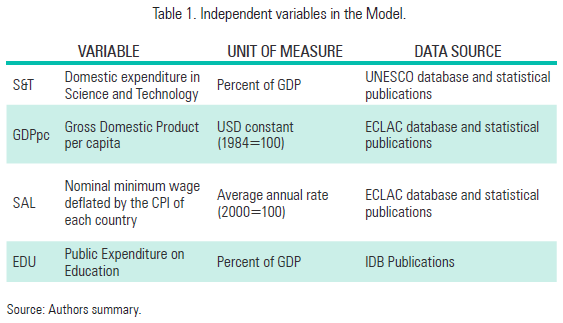
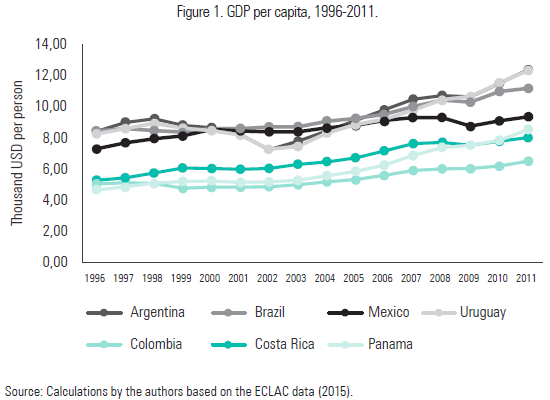
<body><![CDATA[<p><b><font size="3">METHODOLOGY DESCRIPTION</font></b></p>     <p>   <u><b>Data Set</b></u></p>     <p>   An empirical analysis of the variables was performed using panel data from   Argentina, Brazil, Colombia, Costa Rica, Mexico, Panama and Uruguay for the period   1996-2011. . These countries were selected based on the criteria of highest investment   in science and technology (S&amp;T) as share of their GDP.</p>    <p>   In addition, two sets of countries were created using GDP per capita as a   measure for differentiation in order to separate the effect their particular national   economic structure may have within the model. <a href="#f1">Figure 1</a> shows Argentina, Brazil,   Mexico and Uruguay maintaining an average GDP per capita of $9,000 (in constant   USD), evidencing higher growth rates than the cases of Colombia, Costa Rica and   Panama where GDP per capita averaged approximately $6,000 USD (in constant   USD) during the observed period. Given the difference between the two groups, the analysis was done separately.</p>     <p align="center"><a name="f1"></a><img src="/img/revistas/adter/n29/n29a03f1.fw.jpg" alt="Figure 1. GDP per capita, 1996-2011." align="absmiddle" /></p>     <p><u><b>Explanatory variables for Unemployment</b></u></p>     <p>   Due to data availability as Monroy et al (2015) mentioned in their publication,   the approach conducted here aimed to analyze if there was a relationship between   innovation (measured by spending on science and technology) and unemployment; in   other words, if national investments in S&amp;T could create technological unemployment   in the selected countries. Furthermore, in order to give greater significance to the model, other economic and social variables were included as shown in <a href="#t1">Table 1</a><sup><a href="#3">3</a></sup><a name="b3"></a></p>     <p align="center"><a name="t1"></a><img src="/img/revistas/adter/n29/n29a03t1.fw.jpg" alt="Table 1. Independent variables in the Model." /></p>     <p>As previously stated, the relationship between innovation (measured as spending   on science and technology) could have two effects on the unemployment rate: either   it increases it due to the automation of tasks previously performed by humans, or   it decreases it because of growth in production levels that may require additional   skilled labor and non-automated processes.</p>    <p>   With regard to the GDP per capita (GDPpc), it is believed that an increase in   production would foster business activity and industrial growth, thus stimulating job   creation, hence the inverse relationship between GDPpc and unemployment. Wage   levels were also considered as inversely related to unemployment assuming that   higher salaries would attract more talent to the work force. As for the last variable,   the effects of educational attainment on labor markets and productivity have been   widely researched, this is why education is considered to be inversely related to unemployment (Becker, 1962; Mincer, 1991; Autor &amp; Handel, 2009).</p>     ]]></body>
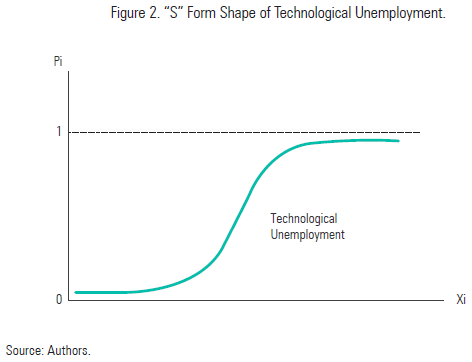
<body><![CDATA[<p><u><b>The dependent variable</b></u></p>     <p>   The regression analysis proposed is set based on the characteristics of the dependent   variable. The unemployment rate is restricted between values of 0 and 1, so that its   growth will be mitigated when reaching its maximum value, as will its decline when   reaching its minimum value.</p>    <p>   Thus, unemployment by means of automation - Technological Unemployment   (TU) - is represented by a sigmoidal growth (''S'' Form - See <a href="#f1">Figure 1</a>) which is curbed   as it reaches its peak, given it is calculated within a finite limit (0 &le; TU &le; 1).</p>       <p>   Even though it may have an exponential growth at one stage of its evolution, it does   not reach infinite rates but it is stabilized in the long term, either by implementing public policies that control it or by the natural limit of the population.</p>     <p align="center"><a name="f2"></a><img src="/img/revistas/adter/n29/n29a03f2.fw.jpg" alt="Figure 2. â€œSâ€ Form Shape of Technological Unemployment." /></p>     <p>Given this specification, consistent estimations of &beta; can be obtained by maximizing the logarithm of the likelihood function</p>     <p align="right"><img src="/img/revistas/adter/n29/n29a03i1.fw.jpg" alt="Given this specification, consistent estimations of &beta; can be obtained by" /></p>     <p>The distribution of probability will come given by a probit model, which function of distribution originates by the integral:</p>     <p align="right"><img src="/img/revistas/adter/n29/n29a03i2.fw.jpg" alt="The distribution of probability will come given by a probit model, which function" /></p>     <p>Where the probability of success, Pit, were defined by the area under the X<sub>it</sub>&beta; curve. In addition, random effects were assumed:</p>     ]]></body>
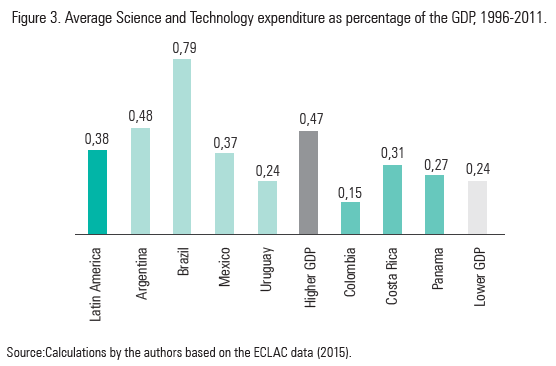
<body><![CDATA[<p align="right"><img src="/img/revistas/adter/n29/n29a03i3.fw.jpg" alt="Where the probability of success, Pit, were defined by the area under the X<sub>it</sub>Î² curve." /></p>     <p>Since there is assumed that it exists strict exogenous influence from X<sub>it</sub> subject to   &mu;i, and that the Y<sub>it</sub> are independent in time given X<sub>it</sub> and &mu;<sub>i</sub> (Gujarati, 2004).<sup><a href="#4">4</a><a name="b4"></a></sup></p>     <p>   Considering this, in order to have a statistically significant model, Y turns into a   binary variable where: Y = 1 if the event is successful or Y = 0 for the opposite case.   In this sense, the unemployment variable was transformed to ''1'' in those values in   which the unemployment rate increased above the country average and ''0'' when the unemployment rate was below the country average for the years studied.</p>     <p>&nbsp;</p>     <p><b><font size="3">TECHNOLOGICAL UNEMPLOYMENT IN LATIN AMERICA</font></b></p>     <p>   -<b>Unemployment and Innovation in Latin America</b>- </p>     <p>According to Inter-American Development Bank, IDB, (2010), the countries   of Latin America must maintain policies that improve the quality of life   of their populations, attending to priorities such as education, health,   poverty, among others; nevertheless, it also affirms that the challenges of   modern society force the countries to face the technological changes that   affect their economies. On a separate note, Crespi and Tacsir (2012) argued   that the productive structure of the region, dominated by commodity   production, preponderance of Small and Medium Enterprises (SMEs)   and low technological intensity of manufactured goods could generate   different results in the mix of innovation and employment.</p>     <p>   Rodrik (2015) singled out Latin America as one of the regions most   vulnerable to ''premature deindustrialization'' suggesting that globalization,   trade and labor-saving technologies have hindered the development of a   strong manufacturing base (and jobs) in the area. Additionally, the author   commented on the political and economic backlash of this phenomenon,   including political instability and democratic failure.</p>     <p>   In the literature, it was found that the region had made changes regarding the   levels of expenditure dedicated to Science and Technology. According to the IDB   (2010), Latin America showed substantial advances in some indicators of recorded   patents and increased output of scientific publications. However, the progress was   focused in only a few countries, therefore, the region continued to lag behind in   regard to science and the technology investment and achievements compared to the   rest of the world. <a href="#f3">Figure 3</a> shows some of the gaps in the levels of expenditure in S&amp;T between different countries of the region.</p>       <p>   Brazil stands out as the country that invested the most in S&amp;T as a share of GDP   compared to its neighbors: it even doubles the regional average. On the other hand, countries like Colombia were behind regional peers and below average.</p>     ]]></body>
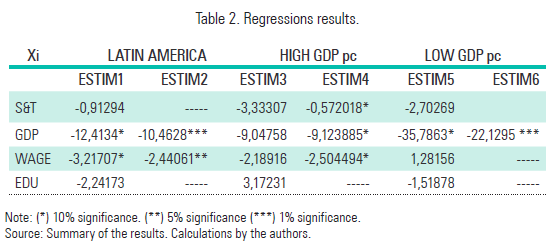
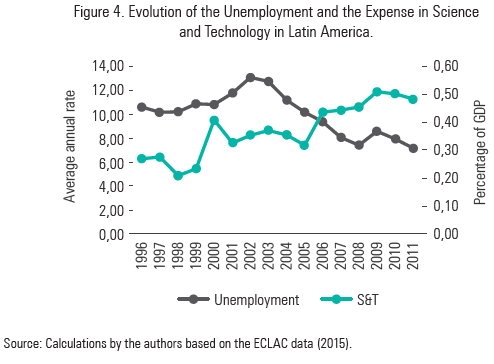
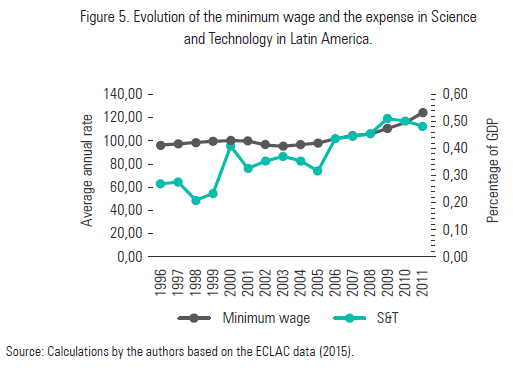
<body><![CDATA[<p align="center"><a name="f3"></a><img src="/img/revistas/adter/n29/n29a03f3.fw.jpg" alt="Figure 3. Average Science and Technology expenditure as percentage of the GDP, 1996-2011." /></p>     <p>In <a href="#f4">Figure 4</a>, we can see the increasing trend of the expense in S&amp;T by the countries   of the sample. The investment in this segment rose (on average) from 0.26% of the   GDP in 1996 to 0.51 % in 2011; in the year 2009 it reached a peak at 0.53%, being   the countries with high GDPpc those that invested the most in this category. The   principal characteristic of the indicator is its volatility during the period of study, which demonstrates high rates of growth particularly in the year 2000 and 2006.</p>     <p align="center"><a name="f4"></a><img src="/img/revistas/adter/n29/n29a03f4.fw.jpg" alt="Figure 4. Evolution of the Unemployment and the Expense in Science" /></p>     <p>Regarding the unemployment rate, the regional trend was downwards from 2002   and the volatility of this indicator was minimal. Between 1996 and 2000 the data   showed an increase in the unemployment levels, due to real exchange rate appreciation   as argued by Ros (2005); after 2002 the fall in unemployment is supported by some   hypotheses associated with the commodities boom experienced by some regional   countries during most of the first decade of the 21<sup>st</sup> century (World Bank, 2015).</p>     <p>   Vivarelli (2012) suggested that one of the compensation mechanisms of automation   is the readjustment in wages, taking into account the implementation of innovations   that reduce the need to use workforce - an adjustment was assumed in the price of work.   When comparing the behavior of wages and the level of expenditure in S&amp;T, see <a href="#f5">Figure   5</a>, a relative stagnation was observed in the wages of the region in spite of the increase   in the S&amp;T investment. This stagnation trend in wages was documented in advanced   economies, as the average productivity increased the return of the workforce, (labor share) has declined (Karabarbounis &amp; Neiman, 2013; Autor, 2014).</p>     <p align="center"><a name="f5"></a><img src="/img/revistas/adter/n29/n29a03f5.fw.jpg" alt="Figure 5. Evolution of the minimum wage and the expense in Science" /></p>     <p>The IDB (2010) argued the existence of a synergy in which investments in   innovation, productivity and per capita income were mutually reinforced and allowed   the countries to achieve growth rates sustained over time. Therefore, the stagnation   of wages experienced in regional economies was perceived as a barrier to promote growth and technological development.</p>     <p><u><b>Relation between Unemployment and Science and Technology Expenditure</b></u></p>     <p>   The econometric estimations were calculated to assess the correlation between   Science and Technology expenditure as share of GDP, GDPpc, median wages and   the expenditure in education on the unemployment rate.</p>    <p>   <a href="#t2">Table 2</a> summarizes the results: the estimations (1), (3) and (5), include the regression   with four independent variables proposed in this research, whereas the estimations (2), (4) and (6) showed only the statistically significant regressions of the models.</p>     ]]></body>
<body><![CDATA[<p align="center"><a name="t2"></a><img src="/img/revistas/adter/n29/n29a03t2.fw.jpg" alt="Table 2. Regressions results." /></p>     <p>The first regressions of every group proved not to be significant to explain   the unemployment rate during the period 1996-2011. Nevertheless, after some   transformations in the line of regression it was found that results provided some explanation hypotheses about the variations of the unemployment in the region.</p>     <p>   <u><b>The Latin American case</b></u></p>     <p>   According to the statistical results, there was no evidence that expenditures in Science   and Technology were related to the unemployment rate in the region; contrasting   what was found in specialized literature on advanced economies, technological   innovation in the observed period did not generate unemployment in Latin America.</p>    <p>   The model showed that unemployment rates were only explained by the GDP   and the wages, a 1% increase in the GDPpc increased the probability of reducing   the unemployment by 10%, whereas a 1% increase in the salary raised the probability   of reducing the unemployment by 2.4%. A higher GDPpc suggested an increase in   production, assuming that this increase involved a higher employment of workforce,   thus a decrease of the unemployment rate. Regarding salaries, it was inferred that an   increase in wages motivated the non-employed to enter the formal labor market, thus influencing the unemployment rate.</p>     <p><u><b>High GDPpc group</b></u></p>     <p>   For countries with higher levels of income measured in GDPpc, it was found that only   the expenditure in education was not adequate for explaining the unemployment. As   in the case above, both GDP and salaries had a negative relation with unemployment,   in agreement with the results of the model, a 1% increase of the GDPpc increased the   probability of reducing the unemployment by 9%, whereas a 1% increase in the salary   raised the probability of reducing the unemployment by 2.5%.</p>    <p>   The resemblance of the results between the Latin America sample and the high   GDPpc sample helped to infer that the particular economic structure of the countries   could lead to bias in the results. It was important to understand the limitation of the   model in this regard, and for the analysis to separate the countries depending on   their income measured as GDPpc.</p>    <p>   In the model, S&amp;T expenditure turned out to be statistically significant to   estimate the unemployment levels, however the relation was inverse: a 1% increase   of the expense in S&amp;T increased the probability of reducing the unemployment rate   by 0.57%. In those countries with higher income, where the investment in investment   in S&amp;T was higher, it was observed that increased productivity did not necessarily   cause unemployment; on the contrary, productivity gains from innovation could probably turn into higher labor intake.</p>     <p>   <u><b>Lower GDPpc group</b></u></p>     ]]></body>
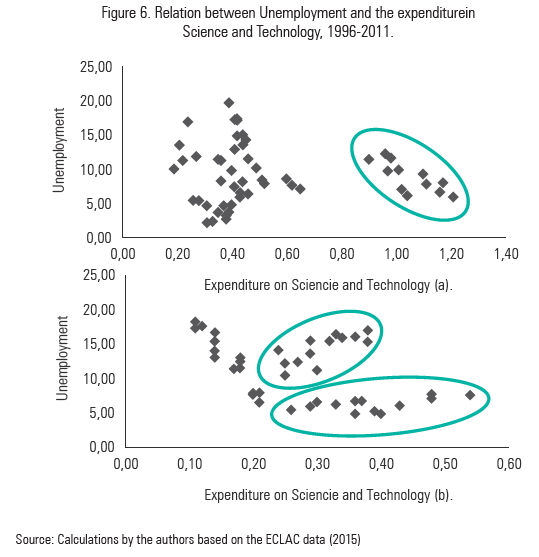
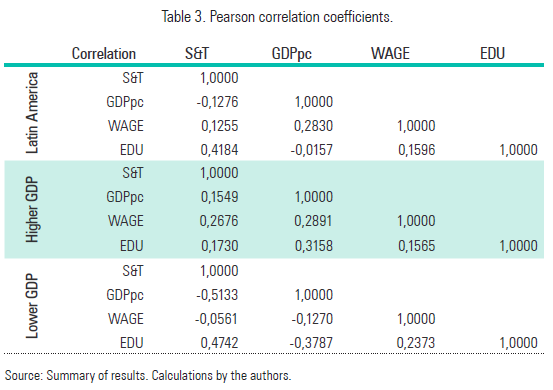
<body><![CDATA[<p>   As for the countries in the sample with lower income, the findings of the model were   that only GDPpc explained the unemployment rate, thus supporting the negative   relation of these two variables, based on the estimation: a 1% increase of the GDPpc   raised the probability of reducing the unemployment in 22%.</p>    <p>   As expected, in countries whose investment in S&amp;T was high, no significant   impacts were seen on the unemployment rate. The probability was even less in   countries with lower GDPpc. Based on these results it was deducted that public   policies directed to promote investment in education or increasing wages would not have a significant impact on the levels of unemployment.</p>     <p>   <u><b>Additional analysis</b></u></p>     <p>   The results were further analyzed by exploring the individual relation between   unemployment and the expense in Science and Technology shown in <a href="#f6">Figure 6</a>. The   scatter plot 5a shows the correlation that exists in the countries with higher GDPpc,   highlighting two trends. First, a high concentration of values was observed towards   the left side of the graph, and secondly, a minor concentration of values to the right.</p>     <p>   In the majority of the observations, no direct relation was perceived between S&amp;T   and unemployment. As for the second phenomenon, it seemed to validate that if the   levels of investment in S&amp;T increase, there is a minor decrease in the unemployment rate, as suggested by the model.</p>    <p> This behavior particularly matched the case of Brazil where there was a higher investment in S&amp;T, high levels of production as seen in the GDPpc indicator, higher median wages and larger amounts invested in education that other countries in the sample. In sum, the application of these diverse public policy instruments might reduce unemployment.</p>    <p> On the other hand, <a href="#f6">Figure 6b</a> shows the relation of both variables for the lower GDPpc group, minor increases in S&amp;T expenditure did not seem to affect the level of unemployment of the sample. In this case, it is worth emphasizing that the lowest levels of unemployment related to the highest levels of expense in S&amp;T were in Costa Rica, where the average percentage amount invested was larger than the average of the region. But this situation was not reflected in changes on the unemployment rate.</p>     <p align="center"><a name="f6"></a><img src="/img/revistas/adter/n29/n29a03f6.fw.jpg" alt="Figure 6. Relation between Unemployment and the expenditurein" /></p>     <p>In order to explain why some variables had to be excluded from the model, we   estimated the Pearson correlation coefficients of independent variables in every   group, to verify if the presence of linear correlation might explain these behaviors. In   reality, as the <a href="#t3">Table 3</a> demonstrates, a high correlation exists between the expenditure   in S&amp;T and the expenditure in Education, mainly for the case of Latin America and the group of countries with lower GDPpc.</p>     <p align="center"><a name="t3"></a><img src="/img/revistas/adter/n29/n29a03t3.fw.jpg" alt="Table 3. Pearson correlation coefficients." /></p>     ]]></body>
<body><![CDATA[<p>The interdependence seen in the expenditures in education and S&amp;T demonstrated   that the allocation of these expenditures seemed to be restrictive between these two   activities (opportunity cost): in other words, if it was assigned to one, it would not   be assigned to other. Therefore, public policies should be devised to promote the   interrelation and synergy of funds allocation in these categories.</p>    <p>   Accordingly, it is advisable for Latin American decision makers to formulate   public policies and private sector initiatives to tackle the negative effects, minimize   the risk and mitigate the political and economic consequences of potential massive   unemployment (Marchant et al., 2014; Rodrik, 2015).</p>    <p>   So far, three major ideas have been found in the literature. First, the creation of a   system for Universal Basic Income in which eligible citizens are granted an amount   of money unconditionally. Even though the policy idea was proposed some time ago,   it is not until recently (after the 2008-2009 financial crisis) that it gained traction in   public policy circles. Experiments on this matter are currently under evaluation in Canada and Finland (De Wispelaere and Stirton, 2004; Van Parijs, 2004).</p>    <p> Secondly, some suggest solutions based on the human capital theory, life-longlearning, retraining, upskilling and reskilling. These ideas are not particularly new but are definitely relevant in a contemporary debate about automation replacing jobs (Becker, 1962; Davis &amp; Reeve, 2000; Cairo &amp; Cajner, 2014).</p>    <p> Finally, the third option involves reducing the weekly working time: some European countries have taken the lead by reducing the weekly working hours and sharing work seems to be a fresh strategy to mitigate the unemployment wave predicted by the probabilistic models (Bosch &amp; Lehndorff, 2001; Ohanian, Raffo&amp; Rogerson, 2006; Askenazy, 2013).</p>     <p> Even though the model showed that investments in S&amp;T did not affect the unemployment rate in the sample but contributed to labor productivity, it is important to devise, test and implement public policies and private sector plans that may contribute to mitigate the effects of innovation such as technological unemployment.</p>     <p>&nbsp;  </p>     <p><b><font size="3">CONCLUSIONS</font></b></p>     <p>   In recent years, countries in Latin America have increased their levels of investment   in innovation, primarily through spendings on science and technology; however,   the average investment levels remain low compared to the average level of S&amp;T   expenditure observed in developed countries. Worth noting cases such as Brazil and   Costa Rica show that growth in S&amp;T investment rates have followed the patterns of   more advanced countries.</p>    <p>   As noted in the data, countries with high levels of GDPpc in the region are still   in the development stage in which S&amp;T investments positively affect employment,   attaining productivity gains. According to the model, it can be stated that promoting   the development of innovations, alongside growth in salaries and increases in GDPpc   could generate significant impacts on job creation, thus, reducing the unemployment   rate. However, given the rapid evolution of technology observed in recent years,   broad technological diffusion and the effects of globalization, it is crucial to question   and forecast when the Latin American region will enter a productive stage in which   there is a noticeable substitution of labor by capital.</p>    ]]></body>
<body><![CDATA[<p>   The results of the model showed that the relation between the investments in   S&amp;T (in conjunction with the other variables) did not have a significant impact on   the unemployment rate in the seven countries studied. Nevertheless, given the   newest models proposed based on Frey &amp; Osborne and the exponential growth of   current innovations, further research is required on the subject of technological   unemployment in the region.</p>    <p>   Companies that have made significant investments in creating outsourcing   services (Business Process Outsourcing, BPO) such as call centers would compete   against technological innovations in speech recognition and real-time translation.   The pervasive use of the Internet as a growing marketplace and a tool for trade could displace large number of people currently working in the retail sector, downplaying   the role of the physical store and moving the workload to the development of digital   content to become more attractive to consumers and increase satisfaction of delivery,   that is, the logistics chain.</p>    <p>   The projected effects that innovation and automation could generate in the labor   markets of developed countries (unemployment) are a cautionary tale of what could   tentatively and with a time lag occur in the region. The initial assumption is that   tasks that require less formal education are the most automatable. However, recent   reports showed that high-skill sectors such as finance have automated some of their   operations (i.e. dark pools &amp; high frequency trading) in which complex algorithms   are involved in decision making for purchasing or selling securities at high speed.</p>    <p>   The education variable did not prove significant in any of the models and its   incidence on innovation is evidence that the substitution of labor by capital in   our region was not present in the timeframe observed. Nonetheless, the literature   offered tentative solutions through the human capital theory, upskilling and reskilling   of the workforce.</p>    <p>   The initial considerations presented here about the relationship between   technological innovation and unemployment seek to promote fresh research on   this issue in the region, not only for academic purposes but also for the impact and   implications for businesses and policy makers.</p>    <p>   Employment is one of the most important subjects in business economics and if   automation becomes the dominant form of production and value creation, this topic   should lead to the formulation of tentative scenarios, the identification of unintended   consequences (unemployment, crime, greater inequality) and the preparation of   schemes to mitigate the adverse effects that can bring this transition to our society.</p>       <p>&nbsp;</p>   <hr size="1" />       <p><a name="3"></a><a href="#b3">3</a> The data include 112 observations from the study of 16 periods for 7 groups, which complete panel data     of 448 observations. In order to work with stationary variables, logarithms are applied to the independent     variables to reduce the tendency of the data towards dispersion. Thus, allowing to estimate a reliable and     effective model (Gujarati, 2004). Additionally, a subsequent differentiation is made: each of real variables in   the model underwent the augmented Dickey-Fuller test (ADF).</p>       <p><a name="4"></a><a href="#b4">4</a> In the regressions, Hausman tests are realized to confirm the presence of random effects, reason by which the estimations are elaborated under the assumptions of a Probit model of binary regression.</p>       <p><a name="5"></a><a href="#b5">5</a> In the countries that are not included, the average of the expense in Science and Technology is below 0.1 as percentage of the GDP.</p>   <hr size="1" />       ]]></body>
<body><![CDATA[<p>&nbsp;</p>       <p>&nbsp;</p>       <p><b><font size="3">   ACKNOWLEDGEMENTS</font></b></p>     <p>   We would like to thank Luis Castillo for reading the different versions of the   manuscript and providing valuable insights and timely feedback.   And, we would like to thank Pilar Sanchez for her contributions and novel   perspectives on research.</p>     <p>&nbsp;</p>     <p><b><font size="3">   REFERENCES</font></b></p>     <!-- ref --><p>   Askenazy, P. (2013). Working time regulation in France from 1996 to 2012. <i>Cambridge Journal of Economics</i>,   37(2), 323-347. DOI: <a href="http://dx.doi.org/10.1093/cje/bes084" target="_blank">10.1093/cje/bes084</a>.    &nbsp;&nbsp;&nbsp;&nbsp;&nbsp;&nbsp;&nbsp;&nbsp;[&#160;<a href="javascript:void(0);" onclick="javascript: window.open('/scielo.php?script=sci_nlinks&ref=5350258&pid=S1692-0279201600020000300001&lng=','','width=640,height=500,resizable=yes,scrollbars=1,menubar=yes,');">Links</a>&#160;]<!-- end-ref --></p>     <!-- ref --><p>   Autor, D., Katz, L. &amp; Krueger, A. (1998). Computing Inequality: Have Computers Changed the Labor Market?   <i>Quarterly Journal of Economics</i>, 113(4): 1169-213. DOI: <a href="http://dx.doi.org/10.1162/003355398555874" target="_blank">10.1162/003355398555874</a>&nbsp;&nbsp;&nbsp;&nbsp;&nbsp;&nbsp;&nbsp;&nbsp;[&#160;<a href="javascript:void(0);" onclick="javascript: window.open('/scielo.php?script=sci_nlinks&ref=5350260&pid=S1692-0279201600020000300002&lng=','','width=640,height=500,resizable=yes,scrollbars=1,menubar=yes,');">Links</a>&#160;]<!-- end-ref --><!-- ref --><p>   Autor, D., Levy, F., &amp; Murnane, R. (2003). The Skill Content of Recent Technological Change: An Empirical   Exploration. <i>Quarterly Journal of Economic</i>, 118(4): 1279-1333. DOI: <a href="http://dx.doi.org/10.3386/w8337" target="_blank">10.3386/w8337</a>&nbsp;&nbsp;&nbsp;&nbsp;&nbsp;&nbsp;&nbsp;&nbsp;[&#160;<a href="javascript:void(0);" onclick="javascript: window.open('/scielo.php?script=sci_nlinks&ref=5350261&pid=S1692-0279201600020000300003&lng=','','width=640,height=500,resizable=yes,scrollbars=1,menubar=yes,');">Links</a>&#160;]<!-- end-ref --><!-- ref --><p>Autor, D., &amp; Handel, M. (2009). Putting tasks to the test: Human capital, job tasks and wages. National Bureau   of Economic Research. <i>Working Paper</i> 15116. DOI: <a href="http://dx.doi.org/10.3386/w8337" target="_blank">10.3386/w15116</a>&nbsp;&nbsp;&nbsp;&nbsp;&nbsp;&nbsp;&nbsp;&nbsp;[&#160;<a href="javascript:void(0);" onclick="javascript: window.open('/scielo.php?script=sci_nlinks&ref=5350262&pid=S1692-0279201600020000300004&lng=','','width=640,height=500,resizable=yes,scrollbars=1,menubar=yes,');">Links</a>&#160;]<!-- end-ref --><!-- ref --><p>Autor, D. (2014). Polanyi's paradox and the shape of employment growth. Federal Reserve Bank of Kansas   City Symposium ''Re-evaluating labor market dynamics''. <i>NBER Working Paper</i> No. 20485. DOI: <a href="http://dx.doi.org/10.3386/w20485" target="_blank">10.3386/w20485</a>&nbsp;&nbsp;&nbsp;&nbsp;&nbsp;&nbsp;&nbsp;&nbsp;[&#160;<a href="javascript:void(0);" onclick="javascript: window.open('/scielo.php?script=sci_nlinks&ref=5350263&pid=S1692-0279201600020000300005&lng=','','width=640,height=500,resizable=yes,scrollbars=1,menubar=yes,');">Links</a>&#160;]<!-- end-ref --><!-- ref --><p>Autor, D. (2015). Why Are There Still So Many Jobs? The History and Future of Workplace Automation. <i>Journal   of Economic Perspectives</i>, 29(3): 3-30. DOI: <a href="http://dx.doi.org/10.1257/jep.29.3.3" target="_blank">10.1257/jep.29.3.3</a>&nbsp;&nbsp;&nbsp;&nbsp;&nbsp;&nbsp;&nbsp;&nbsp;[&#160;<a href="javascript:void(0);" onclick="javascript: window.open('/scielo.php?script=sci_nlinks&ref=5350264&pid=S1692-0279201600020000300006&lng=','','width=640,height=500,resizable=yes,scrollbars=1,menubar=yes,');">Links</a>&#160;]<!-- end-ref --><!-- ref --><p>Baltagi, B. (2005). Econometric Analysis of Panel Data (Third edition ed.). John Wiley &amp; Sons Ltd.Paul Beaudry  &amp; David A. Green &amp; Benjamin M. Sand, (2016). The Great Reversal in the Demand for Skill and Cognitive Tasks, <i>Journal of Labor Economics</i>, 34(1): 199-S247. DOI: <a href="http://dx.doi.org/10.3386/w18901" target="_blank">10.3386/w18901</a>&nbsp;&nbsp;&nbsp;&nbsp;&nbsp;&nbsp;&nbsp;&nbsp;[&#160;<a href="javascript:void(0);" onclick="javascript: window.open('/scielo.php?script=sci_nlinks&ref=5350265&pid=S1692-0279201600020000300007&lng=','','width=640,height=500,resizable=yes,scrollbars=1,menubar=yes,');">Links</a>&#160;]<!-- end-ref --><!-- ref --><p>Becker, G. (1962). Investment in Human Capital: A Theoretical Analysis. <i>The Journal of Political Economy</i>. 70(5),    Part 2: 13-44. DOI: <a href="http://dx.doi.org/10.1086/258724" target="_blank">10.1086/258724</a>&nbsp;&nbsp;&nbsp;&nbsp;&nbsp;&nbsp;&nbsp;&nbsp;[&#160;<a href="javascript:void(0);" onclick="javascript: window.open('/scielo.php?script=sci_nlinks&ref=5350266&pid=S1692-0279201600020000300008&lng=','','width=640,height=500,resizable=yes,scrollbars=1,menubar=yes,');">Links</a>&#160;]<!-- end-ref --><!-- ref --><p>Bell, B. (1996). <i>Skill-Biased Technological Change and Wages: Evidence from a Longitudinal Data Set.    Manuscript</i>. Nuffield College, Oxford. Retrieved from <a href="http://www.nuff.ox.ac.uk/Economics/papers/1996/ W25/computer.pdf" target="_blank">http://www.nuff.ox.ac.uk/Economics/papers/1996/    W25/computer.pdf</a>&nbsp;&nbsp;&nbsp;&nbsp;&nbsp;&nbsp;&nbsp;&nbsp;[&#160;<a href="javascript:void(0);" onclick="javascript: window.open('/scielo.php?script=sci_nlinks&ref=5350267&pid=S1692-0279201600020000300009&lng=','','width=640,height=500,resizable=yes,scrollbars=1,menubar=yes,');">Links</a>&#160;]<!-- end-ref --><!-- ref --><p>Bertoncello, M., &amp; Wee, D. (2015) <i>Ten ways autonomous driving could redefine the automotive world</i>. McKinsey&amp;Co. Retrieved from <a href="http://www.mckinsey.com/industries/automotive-and-assembly/ourinsights/ten-ways-autonomous-driving-could-redefine-the-automotive-world" target="_blank">http://www.mckinsey.com/industries/automotive-and-assembly/ourinsights/ten-ways-autonomous-driving-could-redefine-the-automotive-world</a>&nbsp;&nbsp;&nbsp;&nbsp;&nbsp;&nbsp;&nbsp;&nbsp;[&#160;<a href="javascript:void(0);" onclick="javascript: window.open('/scielo.php?script=sci_nlinks&ref=5350268&pid=S1692-0279201600020000300010&lng=','','width=640,height=500,resizable=yes,scrollbars=1,menubar=yes,');">Links</a>&#160;]<!-- end-ref --><!-- ref --><p>Bix, A. S. (2000). <i>Inventing Ourselves Out of a Job? America's Debate over Technological Unemployment, 1929-    1981</i>. Johns Hopkins University Press. DOI: <a href="http://dx.doi.org/10.1353/tech.2001.0107" target="_blank">10.1353/tech.2001.0107</a>&nbsp;&nbsp;&nbsp;&nbsp;&nbsp;&nbsp;&nbsp;&nbsp;[&#160;<a href="javascript:void(0);" onclick="javascript: window.open('/scielo.php?script=sci_nlinks&ref=5350269&pid=S1692-0279201600020000300011&lng=','','width=640,height=500,resizable=yes,scrollbars=1,menubar=yes,');">Links</a>&#160;]<!-- end-ref --><!-- ref --><p>Bonin, H., Gregory, T., &amp; Zierahn, U. (2015). Ãœbertragung der Studie von Frey/Osborne (2013) auf Deutschland. <i>ZEW   Kurzexpertise</i>, No. 57. Retrieved from <a href="https://www.econstor.eu/bitstream/10419/123310/1/82873271X.pdf" target="_blank">https://www.econstor.eu/bitstream/10419/123310/1/82873271X.   pdf</a>&nbsp;&nbsp;&nbsp;&nbsp;&nbsp;&nbsp;&nbsp;&nbsp;[&#160;<a href="javascript:void(0);" onclick="javascript: window.open('/scielo.php?script=sci_nlinks&ref=5350270&pid=S1692-0279201600020000300012&lng=','','width=640,height=500,resizable=yes,scrollbars=1,menubar=yes,');">Links</a>&#160;]<!-- end-ref --><!-- ref --><p>Bosch, G., &amp; Lehndorff, S. (2001). Working-Time Reduction and Employment: Experiences in Europe and Economic   Policy Recomendations. <i>Cambridge Journal of Economics</i>, 25(2): 209-243. DOI: <a href="http://dx.doi.org/10.1093/cje/25.2.209" target="_blank">10.1093/cje/25.2.209</a>&nbsp;&nbsp;&nbsp;&nbsp;&nbsp;&nbsp;&nbsp;&nbsp;[&#160;<a href="javascript:void(0);" onclick="javascript: window.open('/scielo.php?script=sci_nlinks&ref=5350271&pid=S1692-0279201600020000300013&lng=','','width=640,height=500,resizable=yes,scrollbars=1,menubar=yes,');">Links</a>&#160;]<!-- end-ref --><!-- ref --><p>Bresnahan, T., Brynjolfsson, E., &amp; Hitt, L. (1999). Information Technology, Workplace Organization, and the   Demand for Skilled Labor: Firm-Level Evidence. <i>The Quarterly Journal of Economics</i>, MIT Press, 117(1):   339-376. DOI: <a href="http://dx.doi.org/10.3386/w7136" target="_blank">10.3386/w7136</a>&nbsp;&nbsp;&nbsp;&nbsp;&nbsp;&nbsp;&nbsp;&nbsp;[&#160;<a href="javascript:void(0);" onclick="javascript: window.open('/scielo.php?script=sci_nlinks&ref=5350272&pid=S1692-0279201600020000300014&lng=','','width=640,height=500,resizable=yes,scrollbars=1,menubar=yes,');">Links</a>&#160;]<!-- end-ref --><!-- ref --><p>Brynjolfsson, E., &amp; McAfee, A. (2014). <i>The second machine age. Work, progress, and prosperity in a time of   brilliant technologies</i>. New York: W.W. Norton &amp; Company.    &nbsp;&nbsp;&nbsp;&nbsp;&nbsp;&nbsp;&nbsp;&nbsp;[&#160;<a href="javascript:void(0);" onclick="javascript: window.open('/scielo.php?script=sci_nlinks&ref=5350273&pid=S1692-0279201600020000300015&lng=','','width=640,height=500,resizable=yes,scrollbars=1,menubar=yes,');">Links</a>&#160;]<!-- end-ref --></p>     <!-- ref --><p>Cair&oacute;, I., &amp; Cajner, T. (2014). Human Capital and Unemployment Dynamics: Why More Educated Workers Enjoy Greater Employment Stability. <i>FEDS Working Paper</i> No. 2014-09. DOI: <a href="http://dx.doi.org/10.2139/ssrn.2390830" target="_blank">10.2139/ssrn.2390830</a>&nbsp;&nbsp;&nbsp;&nbsp;&nbsp;&nbsp;&nbsp;&nbsp;[&#160;<a href="javascript:void(0);" onclick="javascript: window.open('/scielo.php?script=sci_nlinks&ref=5350275&pid=S1692-0279201600020000300016&lng=','','width=640,height=500,resizable=yes,scrollbars=1,menubar=yes,');">Links</a>&#160;]<!-- end-ref --><!-- ref --><p>   Comisi&oacute;n Econ&oacute;mica para Am&eacute;rica Latina y el Caribe. (2010). <i>Base de Datos y Publicaciones Estad&iacute;sticas</i>. Retrieved from <a href="http://websie.eclac.cl/infest/ajax/cepalstat.asp?carpeta=estadisticas" target="_blank">http://websie.eclac.cl/infest/ajax/cepalstat.asp?carpeta=estadisticas</a>&nbsp;&nbsp;&nbsp;&nbsp;&nbsp;&nbsp;&nbsp;&nbsp;[&#160;<a href="javascript:void(0);" onclick="javascript: window.open('/scielo.php?script=sci_nlinks&ref=5350276&pid=S1692-0279201600020000300017&lng=','','width=640,height=500,resizable=yes,scrollbars=1,menubar=yes,');">Links</a>&#160;]<!-- end-ref --><!-- ref --><p>   Crespi, G., &amp; Tacsir, E. (2011). Effects of Innovation on Employment in Latin America. <i>Inter-American   Development Bank Technical Note</i> No. IDB-TN-496. Retrieved from <a href="https://publications.iadb.org/handle/11319/5066?locale-attribute=es" target="_blank">https://publications.iadb.org/handle/11319/5066?locale-attribute=es</a>&nbsp;&nbsp;&nbsp;&nbsp;&nbsp;&nbsp;&nbsp;&nbsp;[&#160;<a href="javascript:void(0);" onclick="javascript: window.open('/scielo.php?script=sci_nlinks&ref=5350277&pid=S1692-0279201600020000300018&lng=','','width=640,height=500,resizable=yes,scrollbars=1,menubar=yes,');">Links</a>&#160;]<!-- end-ref --><!-- ref --><p>   Davis, D., &amp; Reeve, T. (2000). Human capital, unemployment and relative wages in a global economy. Board of   Governors of the Federal Reserve System International Finance. <i>Discussion Papers</i> Number 659. Retrieved from <a href="http://www.federalreserve.gov/pubs/ifdp/2000/659/ifdp659.pdf" target="_blank">http://www.federalreserve.gov/pubs/ifdp/2000/659/ifdp659.pdf</a>&nbsp;&nbsp;&nbsp;&nbsp;&nbsp;&nbsp;&nbsp;&nbsp;[&#160;<a href="javascript:void(0);" onclick="javascript: window.open('/scielo.php?script=sci_nlinks&ref=5350278&pid=S1692-0279201600020000300019&lng=','','width=640,height=500,resizable=yes,scrollbars=1,menubar=yes,');">Links</a>&#160;]<!-- end-ref --><!-- ref --><p>   De Wispelaere, J., &amp; Stirton, L. (2004). The Many Faces of Universal Basic Income. <i>The Political Quarterly</i>, 75 (3):266-274. DOI: <a href="http://dx.doi.org/10.1111/j.1467-923X.2004.00611.x" target="_blank">10.1111/j.1467-923X.2004.00611.x</a>&nbsp;&nbsp;&nbsp;&nbsp;&nbsp;&nbsp;&nbsp;&nbsp;[&#160;<a href="javascript:void(0);" onclick="javascript: window.open('/scielo.php?script=sci_nlinks&ref=5350279&pid=S1692-0279201600020000300020&lng=','','width=640,height=500,resizable=yes,scrollbars=1,menubar=yes,');">Links</a>&#160;]<!-- end-ref --><!-- ref --><p> Ford, M. (2015). <i>Rise of the Robots: Technology and the Threat of a Jobless Future</i>. Kindle Edition&nbsp;&nbsp;&nbsp;&nbsp;&nbsp;&nbsp;&nbsp;&nbsp;[&#160;<a href="javascript:void(0);" onclick="javascript: window.open('/scielo.php?script=sci_nlinks&ref=5350280&pid=S1692-0279201600020000300021&lng=','','width=640,height=500,resizable=yes,scrollbars=1,menubar=yes,');">Links</a>&#160;]<!-- end-ref --><!-- ref --><p>   Frey, C. B., &amp; Osborne, M. (2013). <i>The Future of Employment: How Susceptible are jobs to Computerisation?</i>  Oxford. Retrieved from <a href="http://www.oxfordmartin.ox.ac.uk/downloads/academic/The_Future_of_Employment.pdf" target="_blank">http://www.oxfordmartin.ox.ac.uk/downloads/academic/The_Future_of_Employment.pdf</a>&nbsp;&nbsp;&nbsp;&nbsp;&nbsp;&nbsp;&nbsp;&nbsp;[&#160;<a href="javascript:void(0);" onclick="javascript: window.open('/scielo.php?script=sci_nlinks&ref=5350281&pid=S1692-0279201600020000300022&lng=','','width=640,height=500,resizable=yes,scrollbars=1,menubar=yes,');">Links</a>&#160;]<!-- end-ref --><!-- ref --><p> Goos, M., Manning, A. (2003). <i>Lousy and Lovely Jobs: the Rising Polarization of Work in Britain</i>. Centre for   Economic Performance. Retrieved from <a href="http://eprints.lse.ac.uk/20002/1/Lousy_and_Lovely_Jobs_the_Rising_Polarization_of_Work_in_Britain.pdf" target="_blank">http://eprints.lse.ac.uk/20002/1/Lousy_and_Lovely_Jobs_the_Rising_Polarization_of_Work_in_Britain.pdf</a>&nbsp;&nbsp;&nbsp;&nbsp;&nbsp;&nbsp;&nbsp;&nbsp;[&#160;<a href="javascript:void(0);" onclick="javascript: window.open('/scielo.php?script=sci_nlinks&ref=5350282&pid=S1692-0279201600020000300023&lng=','','width=640,height=500,resizable=yes,scrollbars=1,menubar=yes,');">Links</a>&#160;]<!-- end-ref --><!-- ref --><p> Gujarati, D., Porter, D. (2004). <i>Basic Econometrics</i> (Fouth Edition ed.). Mexico: McGrawâˆ’Hill Companies.    &nbsp;&nbsp;&nbsp;&nbsp;&nbsp;&nbsp;&nbsp;&nbsp;[&#160;<a href="javascript:void(0);" onclick="javascript: window.open('/scielo.php?script=sci_nlinks&ref=5350283&pid=S1692-0279201600020000300024&lng=','','width=640,height=500,resizable=yes,scrollbars=1,menubar=yes,');">Links</a>&#160;]<!-- end-ref --></p>     <!-- ref --><p>   Handel, M. J. (2003). Implications of Information Technology for Employment, Skills, and Wages: A Review   of Recent Research. <i>SRI International: Anual Review of Sociology</i>. 29. 135-165. DOI: <a href="http://dx.doi.org/10.1146/annurev. soc.29.010202.100030" target="_blank">10.1146/annurev. soc.29.010202.100030</a>&nbsp;&nbsp;&nbsp;&nbsp;&nbsp;&nbsp;&nbsp;&nbsp;[&#160;<a href="javascript:void(0);" onclick="javascript: window.open('/scielo.php?script=sci_nlinks&ref=5350285&pid=S1692-0279201600020000300025&lng=','','width=640,height=500,resizable=yes,scrollbars=1,menubar=yes,');">Links</a>&#160;]<!-- end-ref --><!-- ref --><p>   Inter-American Development Bank (2010). <i>Ciencia, Tecnolog&iacute;a e Innovaci&oacute;n en Am&eacute;rica Latina y el Caribe:   un compendio estad&iacute;stico de indicadores. Vicepresidencia de Sectores y Conocimiento</i>. BID, Divisi&oacute;n de Ciencia y Tecnolog&iacute;a.    &nbsp;&nbsp;&nbsp;&nbsp;&nbsp;&nbsp;&nbsp;&nbsp;[&#160;<a href="javascript:void(0);" onclick="javascript: window.open('/scielo.php?script=sci_nlinks&ref=5350286&pid=S1692-0279201600020000300026&lng=','','width=640,height=500,resizable=yes,scrollbars=1,menubar=yes,');">Links</a>&#160;]<!-- end-ref --></p>     <!-- ref --><p>   Jaimovich, N., Siu, H. (2014). The Trend is the Cycle: Job Polarization and Jobless Recoveries. <i>NBER Working Paper</i> No. 18334. DOI: <a href="http://dx.doi.org/10.3386/w18334" target="_blank">10.3386/w18334</a>&nbsp;&nbsp;&nbsp;&nbsp;&nbsp;&nbsp;&nbsp;&nbsp;[&#160;<a href="javascript:void(0);" onclick="javascript: window.open('/scielo.php?script=sci_nlinks&ref=5350288&pid=S1692-0279201600020000300027&lng=','','width=640,height=500,resizable=yes,scrollbars=1,menubar=yes,');">Links</a>&#160;]<!-- end-ref --><!-- ref --><p>Karabarbounis, L., Neiman, B. (2013). The Global Decline of the Labor Share. <i>NBER Working Paper</i> No. 19136. DOI: <a href="http://dx.doi.org/10.3386/w19136" target="_blank">10.3386/w19136</a>&nbsp;&nbsp;&nbsp;&nbsp;&nbsp;&nbsp;&nbsp;&nbsp;[&#160;<a href="javascript:void(0);" onclick="javascript: window.open('/scielo.php?script=sci_nlinks&ref=5350289&pid=S1692-0279201600020000300028&lng=','','width=640,height=500,resizable=yes,scrollbars=1,menubar=yes,');">Links</a>&#160;]<!-- end-ref --><!-- ref --><p>   Keynes, J. M. (1963). Essays in Persuasion. New York: W.W. Norton &amp; Co.   Manpower Group (2013) <i>Talent Shortage Survey Research Results</i>. Retrieved from <a href="http://www.manpowergroup.com/wps/wcm/connect/587d2b45-c47a-4647-a7c1-e7a74f68fb85/2013_Talent_Shortage_Survey_Results_US_high+res.pdf?MOD=AJPERES" target="_blank">http://www.manpowergroup.com/wps/wcm/connect/587d2b45-c47a-4647-a7c1-e7a74f68fb85/2013_Talent_Shortage_Survey_Results_US_high+res.pdf?MOD=AJPERES</a>&nbsp;&nbsp;&nbsp;&nbsp;&nbsp;&nbsp;&nbsp;&nbsp;[&#160;<a href="javascript:void(0);" onclick="javascript: window.open('/scielo.php?script=sci_nlinks&ref=5350290&pid=S1692-0279201600020000300029&lng=','','width=640,height=500,resizable=yes,scrollbars=1,menubar=yes,');">Links</a>&#160;]<!-- end-ref --><!-- ref --><p>   Manyika, J., Chui, M., et. al. (2013). <i>Disruptive technologies: Advances that will transform life, business and the   global economy</i>. McKinsey Global Institute. Retrieved from <a href="http://www.mckinsey.com/business-functions/business-technology/our-insights/disruptive-technologies" target="_blank">http://www.mckinsey.com/business-functions/business-technology/our-insights/disruptive-technologies</a>&nbsp;&nbsp;&nbsp;&nbsp;&nbsp;&nbsp;&nbsp;&nbsp;[&#160;<a href="javascript:void(0);" onclick="javascript: window.open('/scielo.php?script=sci_nlinks&ref=5350291&pid=S1692-0279201600020000300030&lng=','','width=640,height=500,resizable=yes,scrollbars=1,menubar=yes,');">Links</a>&#160;]<!-- end-ref --><!-- ref --><p>   Marchant, G., Stevens, Y., et. al. (2014). Technology, Unemployment &amp; Policy Options: Navigating the Transition   to a Better World. <i>Journal of Evolution and Technology</i>. 24 (1): 26-44. Retrieved from <a href="http://jetpress.org/v24/marchant.htm" target="_blank">http://jetpress.org/v24/marchant.htm</a>&nbsp;&nbsp;&nbsp;&nbsp;&nbsp;&nbsp;&nbsp;&nbsp;[&#160;<a href="javascript:void(0);" onclick="javascript: window.open('/scielo.php?script=sci_nlinks&ref=5350292&pid=S1692-0279201600020000300031&lng=','','width=640,height=500,resizable=yes,scrollbars=1,menubar=yes,');">Links</a>&#160;]<!-- end-ref --><!-- ref --><p>   Mincer, J. (1991). Human Capital, Technology and the Wage Structure: What the times series show? National   Bureau of Economic Research. <i>Working Paper</i> 3581. DOI: <a href="http://dx.doi.org/10.3386/w3581" target="_blank">10.3386/w3581</a>&nbsp;&nbsp;&nbsp;&nbsp;&nbsp;&nbsp;&nbsp;&nbsp;[&#160;<a href="javascript:void(0);" onclick="javascript: window.open('/scielo.php?script=sci_nlinks&ref=5350293&pid=S1692-0279201600020000300032&lng=','','width=640,height=500,resizable=yes,scrollbars=1,menubar=yes,');">Links</a>&#160;]<!-- end-ref --><!-- ref --><p>Monroy, S., Moreno, M., &amp; Santos, I. (2015). <i>Technological Change and Labor Market Disruptions: evidence from   the developing world</i>. 10th IZA/World Bank Conference on Employment and Development: Technological   Change and Jobs. Retrieved from <a href="http://www.iza.org/conference_files/worldb2015/monroy-taborda_s22138.pdf" target="_blank">http://www.iza.org/conference_files/worldb2015/monroy-taborda_s22138.pdf</a>&nbsp;&nbsp;&nbsp;&nbsp;&nbsp;&nbsp;&nbsp;&nbsp;[&#160;<a href="javascript:void(0);" onclick="javascript: window.open('/scielo.php?script=sci_nlinks&ref=5350294&pid=S1692-0279201600020000300033&lng=','','width=640,height=500,resizable=yes,scrollbars=1,menubar=yes,');">Links</a>&#160;]<!-- end-ref --><!-- ref --><p>   Ohanian, L., Raffo, A., &amp; Rogerson, R. (2006). Long-term changes in labor supply and taxes: Evidence from   OECD countries, 1956-2005. National Bureau of Economic Research. <i>Working Paper</i> 12786. DOI: <a href="http://dx.doi.org/10.3386/ w12786" target="_blank">10.3386/ w12786</a>&nbsp;&nbsp;&nbsp;&nbsp;&nbsp;&nbsp;&nbsp;&nbsp;[&#160;<a href="javascript:void(0);" onclick="javascript: window.open('/scielo.php?script=sci_nlinks&ref=5350295&pid=S1692-0279201600020000300034&lng=','','width=640,height=500,resizable=yes,scrollbars=1,menubar=yes,');">Links</a>&#160;]<!-- end-ref --><!-- ref --><p>   Pratt, G. A. (2015). Is a Cambrian Explosion Coming for Robotics? <i>Journal of Economic Perspectives</i>. 29 (3). 51-60. DOI: <a href="http://dx.doi.org/10.1257/jep.29.3.51" target="_blank">10.1257/jep.29.3.51</a>&nbsp;&nbsp;&nbsp;&nbsp;&nbsp;&nbsp;&nbsp;&nbsp;[&#160;<a href="javascript:void(0);" onclick="javascript: window.open('/scielo.php?script=sci_nlinks&ref=5350296&pid=S1692-0279201600020000300035&lng=','','width=640,height=500,resizable=yes,scrollbars=1,menubar=yes,');">Links</a>&#160;]<!-- end-ref --><!-- ref --><p>   Rifkin, J. (2015). <i>The Zero Marginal Cost Society: The Internet of Things, the Collaborative Commons, and the Eclipse of Capitalism</i>. St. Martin's Griffin.    &nbsp;&nbsp;&nbsp;&nbsp;&nbsp;&nbsp;&nbsp;&nbsp;[&#160;<a href="javascript:void(0);" onclick="javascript: window.open('/scielo.php?script=sci_nlinks&ref=5350297&pid=S1692-0279201600020000300036&lng=','','width=640,height=500,resizable=yes,scrollbars=1,menubar=yes,');">Links</a>&#160;]<!-- end-ref --></p>     <!-- ref --><p> Rodrik, D. (2015). Premature Deindustrialization. <i>NBER Working Paper</i> 20935. DOI: <a href="http://dx.doi.org/10.3386/w20935" target="_blank">10.3386/w20935</a>.    &nbsp;&nbsp;&nbsp;&nbsp;&nbsp;&nbsp;&nbsp;&nbsp;[&#160;<a href="javascript:void(0);" onclick="javascript: window.open('/scielo.php?script=sci_nlinks&ref=5350299&pid=S1692-0279201600020000300037&lng=','','width=640,height=500,resizable=yes,scrollbars=1,menubar=yes,');">Links</a>&#160;]<!-- end-ref --></p>     <!-- ref --><p>   Ros, J. (2005). El desempleo en Am&eacute;rica Latina desde 1990. <i>CEPAL Serie Estudios y Perspectivas</i> No. 29. Retrieved from htt<a href="p://repositorio.cepal.org/bitstream/handle/11362/4949/1/S0502113_es.pdf" target="_blank">p://repositorio.cepal.org/bitstream/handle/11362/4949/1/S0502113_es.pdf</a>&nbsp;&nbsp;&nbsp;&nbsp;&nbsp;&nbsp;&nbsp;&nbsp;[&#160;<a href="javascript:void(0);" onclick="javascript: window.open('/scielo.php?script=sci_nlinks&ref=5350301&pid=S1692-0279201600020000300038&lng=','','width=640,height=500,resizable=yes,scrollbars=1,menubar=yes,');">Links</a>&#160;]<!-- end-ref --><!-- ref --><p>Sachs, J. D., Benzell, S. G., &amp; LaGarda, G. (2015). Robots: Curse of blessing? A basic framework. <i>NBER Working Paper</i> 21091. DOI: <a href="http://dx.doi.org/10.3386/w21091" target="_blank">10.3386/w21091</a>&nbsp;&nbsp;&nbsp;&nbsp;&nbsp;&nbsp;&nbsp;&nbsp;[&#160;<a href="javascript:void(0);" onclick="javascript: window.open('/scielo.php?script=sci_nlinks&ref=5350302&pid=S1692-0279201600020000300039&lng=','','width=640,height=500,resizable=yes,scrollbars=1,menubar=yes,');">Links</a>&#160;]<!-- end-ref --><!-- ref --><p>   Tether, B., Mina, A., Consoli, D., &amp; Gagliardi, D. (2005). <i>A Literature Review on Skills and Innovation</i>. CRIC,   University of Manchester. Retrieved from <a href="http://webarchive.nationalarchives.gov.uk/+/http:/www.berr.gov.uk/files/file11008.pdf" target="_blank">http://webarchive.nationalarchives.gov.uk/+/http:/www.berr.gov.uk/files/file11008.pdf</a>&nbsp;&nbsp;&nbsp;&nbsp;&nbsp;&nbsp;&nbsp;&nbsp;[&#160;<a href="javascript:void(0);" onclick="javascript: window.open('/scielo.php?script=sci_nlinks&ref=5350303&pid=S1692-0279201600020000300040&lng=','','width=640,height=500,resizable=yes,scrollbars=1,menubar=yes,');">Links</a>&#160;]<!-- end-ref --><!-- ref --><p>   Van Parijs, P. (2004). Basic Income: A Simple and Powerful Idea for the Twenty-First Century. <i>Politics &amp; Society</i>, 32: 7-38. DOI: <a href="http://dx.doi.org/10.1177/0032329203261095" target="_blank">10.1177/0032329203261095</a>&nbsp;&nbsp;&nbsp;&nbsp;&nbsp;&nbsp;&nbsp;&nbsp;[&#160;<a href="javascript:void(0);" onclick="javascript: window.open('/scielo.php?script=sci_nlinks&ref=5350304&pid=S1692-0279201600020000300041&lng=','','width=640,height=500,resizable=yes,scrollbars=1,menubar=yes,');">Links</a>&#160;]<!-- end-ref --><!-- ref --><p>   Vivarelli, M. (2012). Innovation, employment and skills in advanced and developing countries: A survey of the   literature. <i>Discussion Paper series, Forschungsinstitut zur Zukunft der Arbeit</i>, No. 6291. Retrieved from <a href="http://ftp.iza.org/dp6291.pdf" target="_blank">http://ftp.iza.org/dp6291.pdf</a>&nbsp;&nbsp;&nbsp;&nbsp;&nbsp;&nbsp;&nbsp;&nbsp;[&#160;<a href="javascript:void(0);" onclick="javascript: window.open('/scielo.php?script=sci_nlinks&ref=5350305&pid=S1692-0279201600020000300042&lng=','','width=640,height=500,resizable=yes,scrollbars=1,menubar=yes,');">Links</a>&#160;]<!-- end-ref --><!-- ref --><p> Woirol, G. R. (1996). <i>The Technological Unemployment and Structural Unemployment Debates</i>. Kindle Edition.    &nbsp;&nbsp;&nbsp;&nbsp;&nbsp;&nbsp;&nbsp;&nbsp;[&#160;<a href="javascript:void(0);" onclick="javascript: window.open('/scielo.php?script=sci_nlinks&ref=5350306&pid=S1692-0279201600020000300043&lng=','','width=640,height=500,resizable=yes,scrollbars=1,menubar=yes,');">Links</a>&#160;]<!-- end-ref --></p>     <!-- ref --><p>   World Bank. (2015). <i>Working to End Poverty in Latin America and the Caribbean: Workers, Jobs and Wages</i>. World   Bank Group. Retrieved from <a href="http://www-wds.worldbank.org/external/default/WDSContentServer/WDSP/IB/2015/12/04/090224b083ad2048/3_0/Rendered/PDF/Working0to0end0ers00jobs00and0wages.pdf" target="_blank">http://www-wds.worldbank.org/external/default/WDSContentServer/WDSP/IB/2015/12/04/090224b083ad2048/3_0/Rendered/PDF/Working0to0end0ers00jobs00and0wages.pdf</a>&nbsp;&nbsp;&nbsp;&nbsp;&nbsp;&nbsp;&nbsp;&nbsp;[&#160;<a href="javascript:void(0);" onclick="javascript: window.open('/scielo.php?script=sci_nlinks&ref=5350308&pid=S1692-0279201600020000300044&lng=','','width=640,height=500,resizable=yes,scrollbars=1,menubar=yes,');">Links</a>&#160;]<!-- end-ref --> ]]></body><back>
<ref-list>
<ref id="B1">
<nlm-citation citation-type="journal">
<person-group person-group-type="author">
<name>
<surname><![CDATA[Askenazy]]></surname>
<given-names><![CDATA[P]]></given-names>
</name>
</person-group>
<article-title xml:lang="en"><![CDATA[Working time regulation in France from 1996 to 2012]]></article-title>
<source><![CDATA[Cambridge Journal of Economics]]></source>
<year>2013</year>
<volume>37</volume>
<numero>2</numero>
<issue>2</issue>
<page-range>323-347</page-range></nlm-citation>
</ref>
<ref id="B2">
<nlm-citation citation-type="journal">
<person-group person-group-type="author">
<name>
<surname><![CDATA[Autor]]></surname>
<given-names><![CDATA[D]]></given-names>
</name>
<name>
<surname><![CDATA[Katz]]></surname>
<given-names><![CDATA[L]]></given-names>
</name>
<name>
<surname><![CDATA[Krueger]]></surname>
<given-names><![CDATA[A]]></given-names>
</name>
</person-group>
<article-title xml:lang="en"><![CDATA[Computing Inequality: Have Computers Changed the Labor Market?]]></article-title>
<source><![CDATA[Quarterly Journal of Economics]]></source>
<year>1998</year>
<volume>113</volume>
<numero>4</numero>
<issue>4</issue>
<page-range>1169-213</page-range></nlm-citation>
</ref>
<ref id="B3">
<nlm-citation citation-type="journal">
<person-group person-group-type="author">
<name>
<surname><![CDATA[Autor]]></surname>
<given-names><![CDATA[D]]></given-names>
</name>
<name>
<surname><![CDATA[Levy]]></surname>
<given-names><![CDATA[F]]></given-names>
</name>
<name>
<surname><![CDATA[Murnane]]></surname>
<given-names><![CDATA[R]]></given-names>
</name>
</person-group>
<article-title xml:lang="en"><![CDATA[The Skill Content of Recent Technological Change: An Empirical Exploration]]></article-title>
<source><![CDATA[Quarterly Journal of Economic]]></source>
<year>2003</year>
<volume>118</volume>
<numero>4</numero>
<issue>4</issue>
<page-range>1279-1333</page-range></nlm-citation>
</ref>
<ref id="B4">
<nlm-citation citation-type="journal">
<person-group person-group-type="author">
<name>
<surname><![CDATA[Autor]]></surname>
<given-names><![CDATA[D]]></given-names>
</name>
<name>
<surname><![CDATA[Handel]]></surname>
<given-names><![CDATA[M]]></given-names>
</name>
</person-group>
<article-title xml:lang="en"><![CDATA[Putting tasks to the test: Human capital, job tasks and wages]]></article-title>
<source><![CDATA[National Bureau of Economic Research]]></source>
<year>2009</year>
</nlm-citation>
</ref>
<ref id="B5">
<nlm-citation citation-type="journal">
<person-group person-group-type="author">
<name>
<surname><![CDATA[Autor]]></surname>
<given-names><![CDATA[D]]></given-names>
</name>
</person-group>
<article-title xml:lang="en"><![CDATA[Polanyi's paradox and the shape of employment growth. Federal Reserve Bank of Kansas City Symposium "Re-evaluating labor market dynamics"]]></article-title>
<source><![CDATA[NBER]]></source>
<year>2014</year>
<volume>20485</volume>
</nlm-citation>
</ref>
<ref id="B6">
<nlm-citation citation-type="journal">
<person-group person-group-type="author">
<name>
<surname><![CDATA[Autor]]></surname>
<given-names><![CDATA[D]]></given-names>
</name>
</person-group>
<article-title xml:lang="en"><![CDATA[Why Are There Still So Many Jobs? The History and Future of Workplace Automation]]></article-title>
<source><![CDATA[Journal of Economic Perspectives]]></source>
<year>2015</year>
<volume>29</volume>
<numero>3</numero>
<issue>3</issue>
<page-range>3-30</page-range></nlm-citation>
</ref>
<ref id="B7">
<nlm-citation citation-type="journal">
<person-group person-group-type="author">
<name>
<surname><![CDATA[Baltagi]]></surname>
<given-names><![CDATA[B]]></given-names>
</name>
</person-group>
<article-title xml:lang="en"><![CDATA[Econometric Analysis of Panel Data (Third edition ed.)]]></article-title>
<source><![CDATA[John Wiley & Sons Ltd.Paul Beaudry & David A. Green & Benjamin M. Sand]]></source>
<year>2005</year>
<volume>(2016). The Great Reversal in the Demand for Skill and Cognitive Tasks</volume>
<page-range>Journal of Labor Economics, 34(1): 199-S247</page-range></nlm-citation>
</ref>
<ref id="B8">
<nlm-citation citation-type="journal">
<person-group person-group-type="author">
<name>
<surname><![CDATA[Becker]]></surname>
<given-names><![CDATA[G]]></given-names>
</name>
</person-group>
<article-title xml:lang="en"><![CDATA[Investment in Human Capital: A Theoretical Analysis]]></article-title>
<source><![CDATA[The Journal of Political Economy]]></source>
<year>1962</year>
<volume>70</volume><volume>2</volume>
<numero>5</numero>
<issue>5</issue>
<page-range>13-44</page-range></nlm-citation>
</ref>
<ref id="B9">
<nlm-citation citation-type="book">
<person-group person-group-type="author">
<name>
<surname><![CDATA[Bell]]></surname>
<given-names><![CDATA[B]]></given-names>
</name>
</person-group>
<source><![CDATA[Skill-Biased Technological Change and Wages: Evidence from a Longitudinal Data Set]]></source>
<year>1996</year>
<publisher-loc><![CDATA[Oxford ]]></publisher-loc>
<publisher-name><![CDATA[Nuffield College]]></publisher-name>
</nlm-citation>
</ref>
<ref id="B10">
<nlm-citation citation-type="book">
<person-group person-group-type="author">
<name>
<surname><![CDATA[Bertoncello]]></surname>
<given-names><![CDATA[M]]></given-names>
</name>
<name>
<surname><![CDATA[Wee]]></surname>
<given-names><![CDATA[D]]></given-names>
</name>
</person-group>
<source><![CDATA[Ten ways autonomous driving could redefine the automotive world]]></source>
<year>2015</year>
<publisher-name><![CDATA[McKinsey & Co]]></publisher-name>
</nlm-citation>
</ref>
<ref id="B11">
<nlm-citation citation-type="book">
<person-group person-group-type="author">
<name>
<surname><![CDATA[Bix]]></surname>
<given-names><![CDATA[A. S]]></given-names>
</name>
</person-group>
<source><![CDATA[Inventing Ourselves Out of a Job? America's Debate over Technological Unemployment, 1929- 1981]]></source>
<year>2000</year>
<publisher-name><![CDATA[Johns Hopkins University Press]]></publisher-name>
</nlm-citation>
</ref>
<ref id="B12">
<nlm-citation citation-type="journal">
<person-group person-group-type="author">
<name>
<surname><![CDATA[Bonin]]></surname>
<given-names><![CDATA[H]]></given-names>
</name>
<name>
<surname><![CDATA[Gregory]]></surname>
<given-names><![CDATA[T]]></given-names>
</name>
<name>
<surname><![CDATA[Zierahn]]></surname>
<given-names><![CDATA[U]]></given-names>
</name>
</person-group>
<article-title xml:lang="de"><![CDATA[Übertragung der Studie von Frey/Osborne (2013) auf Deutschland]]></article-title>
<source><![CDATA[ZEW Kurzexpertise]]></source>
<year>2015</year>
<volume>57</volume>
</nlm-citation>
</ref>
<ref id="B13">
<nlm-citation citation-type="journal">
<person-group person-group-type="author">
<name>
<surname><![CDATA[Bosch]]></surname>
<given-names><![CDATA[G]]></given-names>
</name>
<name>
<surname><![CDATA[Lehndorff]]></surname>
<given-names><![CDATA[S]]></given-names>
</name>
</person-group>
<article-title xml:lang="en"><![CDATA[Working-Time Reduction and Employment: Experiences in Europe and Economic Policy Recomendations]]></article-title>
<source><![CDATA[Cambridge Journal of Economics]]></source>
<year>2001</year>
<volume>25</volume>
<numero>2</numero>
<issue>2</issue>
<page-range>209-243</page-range></nlm-citation>
</ref>
<ref id="B14">
<nlm-citation citation-type="journal">
<person-group person-group-type="author">
<name>
<surname><![CDATA[Bresnahan]]></surname>
<given-names><![CDATA[T]]></given-names>
</name>
<name>
<surname><![CDATA[Brynjolfsson]]></surname>
<given-names><![CDATA[E]]></given-names>
</name>
<name>
<surname><![CDATA[Hitt]]></surname>
<given-names><![CDATA[L]]></given-names>
</name>
</person-group>
<article-title xml:lang="en"><![CDATA[Information Technology, Workplace Organization, and the Demand for Skilled Labor: Firm-Level Evidence]]></article-title>
<source><![CDATA[The Quarterly Journal of Economics]]></source>
<year>1999</year>
<volume>MIT Press</volume>
<page-range>117(1): 339-376</page-range></nlm-citation>
</ref>
<ref id="B15">
<nlm-citation citation-type="book">
<person-group person-group-type="author">
<name>
<surname><![CDATA[Brynjolfsson]]></surname>
<given-names><![CDATA[E]]></given-names>
</name>
<name>
<surname><![CDATA[McAfee]]></surname>
<given-names><![CDATA[A]]></given-names>
</name>
</person-group>
<source><![CDATA[The second machine age. Work, progress, and prosperity in a time of brilliant technologies]]></source>
<year>2014</year>
<publisher-loc><![CDATA[New York ]]></publisher-loc>
<publisher-name><![CDATA[W.W. Norton & Company]]></publisher-name>
</nlm-citation>
</ref>
<ref id="B16">
<nlm-citation citation-type="journal">
<person-group person-group-type="author">
<name>
<surname><![CDATA[Cairó]]></surname>
<given-names><![CDATA[I]]></given-names>
</name>
<name>
<surname><![CDATA[Cajner]]></surname>
<given-names><![CDATA[T]]></given-names>
</name>
</person-group>
<article-title xml:lang="en"><![CDATA[Human Capital and Unemployment Dynamics: Why More Educated Workers Enjoy Greater Employment Stability]]></article-title>
<source><![CDATA[FEDS]]></source>
<year>2014</year>
<volume>2014-09</volume>
</nlm-citation>
</ref>
<ref id="B17">
<nlm-citation citation-type="">
<collab>Comisión Económica para América Latina y el Caribe</collab>
<source><![CDATA[Base de Datos y Publicaciones Estadísticas]]></source>
<year>2010</year>
</nlm-citation>
</ref>
<ref id="B18">
<nlm-citation citation-type="book">
<person-group person-group-type="author">
<name>
<surname><![CDATA[Crespi]]></surname>
<given-names><![CDATA[G]]></given-names>
</name>
<name>
<surname><![CDATA[Tacsir]]></surname>
<given-names><![CDATA[E]]></given-names>
</name>
</person-group>
<source><![CDATA[Effects of Innovation on Employment in Latin America]]></source>
<year>2011</year>
<volume>IDB-TN-496</volume>
<publisher-name><![CDATA[Inter-American Development Bank Technical]]></publisher-name>
</nlm-citation>
</ref>
<ref id="B19">
<nlm-citation citation-type="journal">
<person-group person-group-type="author">
<name>
<surname><![CDATA[Davis]]></surname>
<given-names><![CDATA[D]]></given-names>
</name>
<name>
<surname><![CDATA[Reeve]]></surname>
<given-names><![CDATA[T]]></given-names>
</name>
</person-group>
<article-title xml:lang="en"><![CDATA[Human capital, unemployment and relative wages in a global economy]]></article-title>
<source><![CDATA[Board of Governors of the Federal Reserve System International Finance]]></source>
<year>2000</year>
<volume>659</volume>
</nlm-citation>
</ref>
<ref id="B20">
<nlm-citation citation-type="journal">
<person-group person-group-type="author">
<name>
<surname><![CDATA[De Wispelaere]]></surname>
<given-names><![CDATA[J]]></given-names>
</name>
<name>
<surname><![CDATA[Stirton]]></surname>
<given-names><![CDATA[L]]></given-names>
</name>
</person-group>
<article-title xml:lang="en"><![CDATA[The Many Faces of Universal Basic Income]]></article-title>
<source><![CDATA[The Political Quarterly]]></source>
<year>2004</year>
<volume>75</volume>
<numero>3</numero>
<issue>3</issue>
<page-range>266-274</page-range></nlm-citation>
</ref>
<ref id="B21">
<nlm-citation citation-type="book">
<person-group person-group-type="author">
<name>
<surname><![CDATA[Ford]]></surname>
<given-names><![CDATA[M]]></given-names>
</name>
</person-group>
<source><![CDATA[Rise of the Robots: Technology and the Threat of a Jobless Future]]></source>
<year>2015</year>
<publisher-name><![CDATA[Kindle Edition]]></publisher-name>
</nlm-citation>
</ref>
<ref id="B22">
<nlm-citation citation-type="">
<person-group person-group-type="author">
<name>
<surname><![CDATA[Frey]]></surname>
<given-names><![CDATA[C. B]]></given-names>
</name>
<name>
<surname><![CDATA[Osborne]]></surname>
<given-names><![CDATA[M]]></given-names>
</name>
</person-group>
<source><![CDATA[The Future of Employment: How Susceptible are jobs to Computerisation?]]></source>
<year>2013</year>
<publisher-loc><![CDATA[Oxford ]]></publisher-loc>
</nlm-citation>
</ref>
<ref id="B23">
<nlm-citation citation-type="">
<person-group person-group-type="author">
<name>
<surname><![CDATA[Goos]]></surname>
<given-names><![CDATA[M]]></given-names>
</name>
<name>
<surname><![CDATA[Manning]]></surname>
<given-names><![CDATA[A]]></given-names>
</name>
</person-group>
<source><![CDATA[Lousy and Lovely Jobs: the Rising Polarization of Work in Britain. Centre for Economic Performance]]></source>
<year>2003</year>
</nlm-citation>
</ref>
<ref id="B24">
<nlm-citation citation-type="book">
<person-group person-group-type="author">
<name>
<surname><![CDATA[Gujarati]]></surname>
<given-names><![CDATA[D]]></given-names>
</name>
<name>
<surname><![CDATA[Porter]]></surname>
<given-names><![CDATA[D]]></given-names>
</name>
</person-group>
<source><![CDATA[Basic Econometrics (Fouth Edition ed.)]]></source>
<year>2004</year>
<publisher-loc><![CDATA[Mexico ]]></publisher-loc>
<publisher-name><![CDATA[McGrawâˆ’Hill Companies]]></publisher-name>
</nlm-citation>
</ref>
<ref id="B25">
<nlm-citation citation-type="journal">
<person-group person-group-type="author">
<name>
<surname><![CDATA[Handel]]></surname>
<given-names><![CDATA[M. J]]></given-names>
</name>
</person-group>
<article-title xml:lang="en"><![CDATA[Implications of Information Technology for Employment, Skills, and Wages: A Review of Recent Research]]></article-title>
<source><![CDATA[SRI International: Anual Review of Sociology]]></source>
<year>2003</year>
<volume>29</volume>
<page-range>135-165</page-range></nlm-citation>
</ref>
<ref id="B26">
<nlm-citation citation-type="book">
<collab>Inter-American Development Bank</collab>
<source><![CDATA[Ciencia, Tecnología e Innovación en América Latina y el Caribe: un compendio estadístico de indicadores]]></source>
<year>2010</year>
<publisher-name><![CDATA[Vicepresidencia de Sectores y Conocimiento. BID, División de Ciencia y Tecnología]]></publisher-name>
</nlm-citation>
</ref>
<ref id="B27">
<nlm-citation citation-type="journal">
<person-group person-group-type="author">
<name>
<surname><![CDATA[Jaimovich]]></surname>
<given-names><![CDATA[N]]></given-names>
</name>
<name>
<surname><![CDATA[Siu]]></surname>
<given-names><![CDATA[H]]></given-names>
</name>
</person-group>
<article-title xml:lang="en"><![CDATA[The Trend is the Cycle: Job Polarization and Jobless Recoveries]]></article-title>
<source><![CDATA[NBER]]></source>
<year>2014</year>
<volume>18334</volume>
</nlm-citation>
</ref>
<ref id="B28">
<nlm-citation citation-type="journal">
<person-group person-group-type="author">
<name>
<surname><![CDATA[Karabarbounis]]></surname>
<given-names><![CDATA[L]]></given-names>
</name>
<name>
<surname><![CDATA[Neiman]]></surname>
<given-names><![CDATA[B]]></given-names>
</name>
</person-group>
<article-title xml:lang="en"><![CDATA[The Global Decline of the Labor Share]]></article-title>
<source><![CDATA[NBER]]></source>
<year>2013</year>
<volume>19136</volume>
</nlm-citation>
</ref>
<ref id="B29">
<nlm-citation citation-type="book">
<person-group person-group-type="author">
<name>
<surname><![CDATA[Keynes]]></surname>
<given-names><![CDATA[J. M]]></given-names>
</name>
</person-group>
<source><![CDATA[Essays in Persuasion]]></source>
<year>1963</year>
<publisher-loc><![CDATA[New York ]]></publisher-loc>
<publisher-name><![CDATA[W.W. Norton & Co. Manpower Group]]></publisher-name>
</nlm-citation>
</ref>
<ref id="B30">
<nlm-citation citation-type="book">
<person-group person-group-type="author">
<name>
<surname><![CDATA[Manyika]]></surname>
<given-names><![CDATA[J]]></given-names>
</name>
<name>
<surname><![CDATA[Chui]]></surname>
<given-names><![CDATA[M]]></given-names>
</name>
</person-group>
<source><![CDATA[Disruptive technologies: Advances that will transform life, business and the global economy]]></source>
<year>2013</year>
<publisher-name><![CDATA[McKinsey Global Institute]]></publisher-name>
</nlm-citation>
</ref>
<ref id="B31">
<nlm-citation citation-type="journal">
<person-group person-group-type="author">
<name>
<surname><![CDATA[Marchant]]></surname>
<given-names><![CDATA[G]]></given-names>
</name>
<name>
<surname><![CDATA[Stevens]]></surname>
<given-names><![CDATA[Y]]></given-names>
</name>
</person-group>
<article-title xml:lang="en"><![CDATA[Technology, Unemployment & Policy Options: Navigating the Transition to a Better World]]></article-title>
<source><![CDATA[Journal of Evolution and Technology]]></source>
<year>2014</year>
<volume>24</volume>
<numero>1</numero>
<issue>1</issue>
<page-range>26-44</page-range></nlm-citation>
</ref>
<ref id="B32">
<nlm-citation citation-type="journal">
<person-group person-group-type="author">
<name>
<surname><![CDATA[Mincer]]></surname>
<given-names><![CDATA[J]]></given-names>
</name>
</person-group>
<article-title xml:lang="en"><![CDATA[Human Capital, Technology and the Wage Structure: What the times series show?]]></article-title>
<source><![CDATA[National Bureau of Economic Research]]></source>
<year>1991</year>
<volume>3581</volume>
</nlm-citation>
</ref>
<ref id="B33">
<nlm-citation citation-type="">
<person-group person-group-type="author">
<name>
<surname><![CDATA[Monroy]]></surname>
<given-names><![CDATA[S]]></given-names>
</name>
<name>
<surname><![CDATA[Moreno]]></surname>
<given-names><![CDATA[M]]></given-names>
</name>
<name>
<surname><![CDATA[Santos]]></surname>
<given-names><![CDATA[I]]></given-names>
</name>
</person-group>
<article-title xml:lang="en"><![CDATA[Technological Change and Labor Market Disruptions: evidence from the developing world]]></article-title>
<source><![CDATA[10th IZA/World Bank Conference on Employment and Development: Technological Change and Jobs]]></source>
<year>2015</year>
</nlm-citation>
</ref>
<ref id="B34">
<nlm-citation citation-type="journal">
<person-group person-group-type="author">
<name>
<surname><![CDATA[nian]]></surname>
<given-names><![CDATA[L]]></given-names>
</name>
<name>
<surname><![CDATA[Raffo]]></surname>
<given-names><![CDATA[A]]></given-names>
</name>
<name>
<surname><![CDATA[Rogerson]]></surname>
<given-names><![CDATA[R]]></given-names>
</name>
</person-group>
<article-title xml:lang="en"><![CDATA[Long-term changes in labor supply and taxes: Evidence from OECD countries, 1956-2005]]></article-title>
<source><![CDATA[National Bureau of Economic]]></source>
<year>2006</year>
<volume>12786</volume>
</nlm-citation>
</ref>
<ref id="B35">
<nlm-citation citation-type="journal">
<person-group person-group-type="author">
<name>
<surname><![CDATA[Pratt]]></surname>
<given-names><![CDATA[G. A]]></given-names>
</name>
</person-group>
<article-title xml:lang="en"><![CDATA[Is a Cambrian Explosion Coming for Robotics?]]></article-title>
<source><![CDATA[Journal of Economic Perspectives]]></source>
<year>2015</year>
<volume>29</volume>
<numero>3</numero>
<issue>3</issue>
<page-range>51-60</page-range></nlm-citation>
</ref>
<ref id="B36">
<nlm-citation citation-type="book">
<person-group person-group-type="author">
<name>
<surname><![CDATA[Rifkin]]></surname>
<given-names><![CDATA[J]]></given-names>
</name>
</person-group>
<source><![CDATA[The Zero Marginal Cost Society: The Internet of Things, the Collaborative Commons, and the Eclipse of Capitalism]]></source>
<year>2015</year>
<publisher-name><![CDATA[St. Martin's Griffin]]></publisher-name>
</nlm-citation>
</ref>
<ref id="B37">
<nlm-citation citation-type="journal">
<person-group person-group-type="author">
<name>
<surname><![CDATA[Rodrik]]></surname>
<given-names><![CDATA[D]]></given-names>
</name>
</person-group>
<article-title xml:lang="en"><![CDATA[Premature Deindustrialization]]></article-title>
<source><![CDATA[NBER]]></source>
<year>2015</year>
<volume>20935</volume>
</nlm-citation>
</ref>
<ref id="B38">
<nlm-citation citation-type="journal">
<person-group person-group-type="author">
<name>
<surname><![CDATA[Ros]]></surname>
<given-names><![CDATA[J]]></given-names>
</name>
</person-group>
<article-title xml:lang="es"><![CDATA[El desempleo en América Latina desde 1990]]></article-title>
<source><![CDATA[CEPAL Serie Estudios y Perspectivas]]></source>
<year>2005</year>
<volume>29</volume>
</nlm-citation>
</ref>
<ref id="B39">
<nlm-citation citation-type="journal">
<person-group person-group-type="author">
<name>
<surname><![CDATA[Sachs]]></surname>
<given-names><![CDATA[J. D]]></given-names>
</name>
<name>
<surname><![CDATA[Benzell]]></surname>
<given-names><![CDATA[S. G]]></given-names>
</name>
<name>
<surname><![CDATA[LaGarda]]></surname>
<given-names><![CDATA[G]]></given-names>
</name>
</person-group>
<article-title xml:lang="en"><![CDATA[Robots: Curse of blessing? A basic framework]]></article-title>
<source><![CDATA[NBER]]></source>
<year>2015</year>
<volume>21091</volume>
</nlm-citation>
</ref>
<ref id="B40">
<nlm-citation citation-type="book">
<person-group person-group-type="author">
<name>
<surname><![CDATA[Tether]]></surname>
<given-names><![CDATA[B]]></given-names>
</name>
<name>
<surname><![CDATA[Mina]]></surname>
<given-names><![CDATA[A]]></given-names>
</name>
<name>
<surname><![CDATA[Consoli]]></surname>
<given-names><![CDATA[D]]></given-names>
</name>
<name>
<surname><![CDATA[Gagliardi]]></surname>
<given-names><![CDATA[D]]></given-names>
</name>
</person-group>
<source><![CDATA[A Literature Review on Skills and Innovation]]></source>
<year>2005</year>
<publisher-name><![CDATA[CRIC, University of Manchester]]></publisher-name>
</nlm-citation>
</ref>
<ref id="B41">
<nlm-citation citation-type="journal">
<person-group person-group-type="author">
<name>
<surname><![CDATA[Van Parijs]]></surname>
<given-names><![CDATA[P]]></given-names>
</name>
</person-group>
<article-title xml:lang="en"><![CDATA[Basic Income: A Simple and Powerful Idea for the Twenty-First Century]]></article-title>
<source><![CDATA[Politics & Society]]></source>
<year>2004</year>
<volume>32</volume>
<page-range>7-38</page-range></nlm-citation>
</ref>
<ref id="B42">
<nlm-citation citation-type="journal">
<person-group person-group-type="author">
<name>
<surname><![CDATA[Vivarelli]]></surname>
<given-names><![CDATA[M]]></given-names>
</name>
</person-group>
<article-title xml:lang="en"><![CDATA[Innovation, employment and skills in advanced and developing countries: A survey of the literature]]></article-title>
<source><![CDATA[Forschungsinstitut zur Zukunft der Arbeit]]></source>
<year>2012</year>
<volume>6291</volume>
</nlm-citation>
</ref>
<ref id="B43">
<nlm-citation citation-type="book">
<person-group person-group-type="author">
<name>
<surname><![CDATA[Woirol]]></surname>
<given-names><![CDATA[G. R]]></given-names>
</name>
</person-group>
<source><![CDATA[The Technological Unemployment and Structural Unemployment Debates]]></source>
<year>1996</year>
<publisher-name><![CDATA[Kindle Edition]]></publisher-name>
</nlm-citation>
</ref>
<ref id="B44">
<nlm-citation citation-type="book">
<collab>World Bank</collab>
<source><![CDATA[Working to End Poverty in Latin America and the Caribbean: Workers, Jobs and Wages]]></source>
<year>2015</year>
<publisher-name><![CDATA[World Bank Group]]></publisher-name>
</nlm-citation>
</ref>
</ref-list>
</back>
</article>