<?xml version="1.0" encoding="ISO-8859-1"?><article xmlns:mml="http://www.w3.org/1998/Math/MathML" xmlns:xlink="http://www.w3.org/1999/xlink" xmlns:xsi="http://www.w3.org/2001/XMLSchema-instance">
<front>
<journal-meta>
<journal-id>1692-3324</journal-id>
<journal-title><![CDATA[Revista Ingenierías Universidad de Medellín]]></journal-title>
<abbrev-journal-title><![CDATA[Rev. ing. univ. Medellín]]></abbrev-journal-title>
<issn>1692-3324</issn>
<publisher>
<publisher-name><![CDATA[Universidad de Medellín]]></publisher-name>
</publisher>
</journal-meta>
<article-meta>
<article-id>S1692-33242010000200015</article-id>
<title-group>
<article-title xml:lang="en"><![CDATA[A conceptual spatio-temporal multidimensional model]]></article-title>
<article-title xml:lang="es"><![CDATA[Un modelo multidimensional conceptual espacio-temporal]]></article-title>
</title-group>
<contrib-group>
<contrib contrib-type="author">
<name>
<surname><![CDATA[Moreno]]></surname>
<given-names><![CDATA[Francisco]]></given-names>
</name>
<xref ref-type="aff" rid="A01"/>
</contrib>
<contrib contrib-type="author">
<name>
<surname><![CDATA[Echeverri Arias]]></surname>
<given-names><![CDATA[Jaime Alberto]]></given-names>
</name>
<xref ref-type="aff" rid="A02"/>
</contrib>
<contrib contrib-type="author">
<name>
<surname><![CDATA[Manrique Losada]]></surname>
<given-names><![CDATA[Bell]]></given-names>
</name>
<xref ref-type="aff" rid="A03"/>
</contrib>
</contrib-group>
<aff id="A01">
<institution><![CDATA[,Universidad Nacional de Colombia  ]]></institution>
<addr-line><![CDATA[ ]]></addr-line>
</aff>
<aff id="A02">
<institution><![CDATA[,Universidad de Medellín  ]]></institution>
<addr-line><![CDATA[Medellín ]]></addr-line>
<country>Colombia</country>
</aff>
<aff id="A03">
<institution><![CDATA[,Universidad de Medellín  ]]></institution>
<addr-line><![CDATA[Medellín ]]></addr-line>
<country>Colombia</country>
</aff>
<pub-date pub-type="pub">
<day>00</day>
<month>07</month>
<year>2010</year>
</pub-date>
<pub-date pub-type="epub">
<day>00</day>
<month>07</month>
<year>2010</year>
</pub-date>
<volume>9</volume>
<numero>17</numero>
<fpage>175</fpage>
<lpage>183</lpage>
<copyright-statement/>
<copyright-year/>
<self-uri xlink:href="http://www.scielo.org.co/scielo.php?script=sci_arttext&amp;pid=S1692-33242010000200015&amp;lng=en&amp;nrm=iso"></self-uri><self-uri xlink:href="http://www.scielo.org.co/scielo.php?script=sci_abstract&amp;pid=S1692-33242010000200015&amp;lng=en&amp;nrm=iso"></self-uri><self-uri xlink:href="http://www.scielo.org.co/scielo.php?script=sci_pdf&amp;pid=S1692-33242010000200015&amp;lng=en&amp;nrm=iso"></self-uri><abstract abstract-type="short" xml:lang="en"><p><![CDATA[Today, thanks to global positioning systems technologies and mobile devices equipped with tracking sensors, and a lot of data about moving objects can be collected, e.g., spatio-temporal data related to the movement followed by objects. On the other hand, data warehouses, usually modeled using a multidimensional view of data, are specialized databases to support the decision-making process. Unfortunately, conventional data warehouses are mainly oriented to manage alphanumeric data. In this article, we incorporate temporal elements to a conceptual spatial multidimensional model resulting in a spatio-temporal multidimensional model. We illustrate our proposal with a case study related to animal migration.]]></p></abstract>
<abstract abstract-type="short" xml:lang="es"><p><![CDATA[Hoy, gracias a los sistemas de posicionamiento global y dispositivos móviles equipados con sensores de rastreo, se puede recopilar una gran cantidad de datos sobre objetos móviles, es decir, datos espacio-temporales relacionados con el movimiento seguido por esos objetos. Por otro lado, las bodegas de datos, usualmente modeladas mediante una vista multidimensional de los datos, son bases de datos especializadas para soportar la toma de decisiones. Desafortunadamente, las bodegas de datos convencionales están principalmente orientadas al manejo de datos alfanuméricos. En este artículo, se incorporan elementos temporales a un modelo multidimensional conceptual espacial dando origen a un modelo multidimensional conceptual espacio-temporal. La propuesta se ilustra con un caso de estudio relacionado con la migración de animales]]></p></abstract>
<kwd-group>
<kwd lng="en"><![CDATA[data warehouses]]></kwd>
<kwd lng="en"><![CDATA[multidimensional models]]></kwd>
<kwd lng="en"><![CDATA[conceptual modeling]]></kwd>
<kwd lng="en"><![CDATA[moving objects]]></kwd>
<kwd lng="es"><![CDATA[bodegas de datos]]></kwd>
<kwd lng="es"><![CDATA[modelos multidimensionales]]></kwd>
<kwd lng="es"><![CDATA[modelado conceptual]]></kwd>
<kwd lng="es"><![CDATA[objetos móviles]]></kwd>
</kwd-group>
</article-meta>
</front><body><![CDATA[  	    <p ALIGN="CENTER"><FONT SIZE="4" FACE="Verdana"><B>A conceptual spatio-temporal multidimensional model  </B></FONT></p> 	    <p ALIGN="CENTER">&nbsp;</p> 	    <p ALIGN="CENTER"><B><FONT SIZE="3" FACE="Verdana">Un modelo multidimensional conceptual espacio-temporal  </FONT></B></p>     <p>&nbsp;</p>     <p>&nbsp;</p>     <p>       <CENTER>     <FONT SIZE="2" FACE="Verdana">    </FONT>   </CENTER> </p>        <p ALIGN="LEFT"><FONT SIZE="2" FACE="Verdana">Francisco Moreno<SUP>*</SUP>; Jaime Alberto Echeverri Arias<SUP>**</SUP>; Bell Manrique Losada<SUP>***</SUP>   </FONT></p>     <p><FONT SIZE="2" FACE="Verdana">* Ingeniero de Sistemas, Ph. D(c). Profesor asistente Universidad Nacional Colombia. Correo electr&oacute;nico: <a href="mailto:fjmoreno@unalmed.edu.co.">fjmoreno@unalmed.edu.co.    ]]></body>
<body><![CDATA[<BR> </a></FONT><FONT SIZE="2" FACE="Verdana">**     M. Sc. Ing. de Sistemas, profesor Universidad de Medell&iacute;n. Medell&iacute;n, Colombia. Correo electr&oacute;nico: <a href="mailto:jaecheverri@udem.edu.co">jaecheverri@udem.edu.co</a> .    <BR> </FONT><FONT SIZE="2" FACE="Verdana">***     M. Sc. Ing. de Sistemas, profesora Universidad de Medell&iacute;n. Medell&iacute;n, Colombia. Correo electr&oacute;nico: <a href="mailto:bmanrique@udem.edu.co.">bmanrique@udem.edu.co.</a>  </FONT></p>        <p>&nbsp;</p>     <p>&nbsp;</p> <hr size="1" noshade> <font size="2" face="Verdana"><B>Abstract</B></font>       <p><FONT SIZE="2" FACE="Verdana">Today, thanks to global positioning systems technologies and mobile devices equipped with tracking sensors, and a lot of data about moving objects can be collected, e.g., spatio-temporal data related to the movement followed by objects. On the other hand, data warehouses, usually modeled using a multidimensional view of data, are specialized databases to support the decision-making process. Unfortunately, conventional data warehouses are mainly oriented to manage alphanumeric data. In this article, we incorporate temporal elements to a conceptual spatial multidimensional model resulting in a spatio-temporal multidimensional model. We illustrate our proposal with a case study related to animal migration. </FONT></p>  <FONT SIZE="2" FACE="Verdana">  <B>Palabras clave:</B> data warehouses, multidimensional models, conceptual   modeling, moving objects. </FONT>  <hr size="1" noshade><font size="2" face="Verdana"><B>Resumen</B></font>       <p><FONT SIZE="2" FACE="Verdana">Hoy, gracias a los sistemas de posicionamiento global y dispositivos m&oacute;viles equipados con sensores de rastreo, se puede recopilar una gran cantidad de datos sobre objetos m&oacute;viles, es decir, datos espacio-temporales relacionados con el movimiento seguido por esos objetos. Por otro lado, las bodegas de datos, usualmente modeladas mediante una vista multidimensional de los datos, son bases de datos especializadas para soportar la toma de decisiones. Desafortunadamente, las bodegas de datos convencionales est&aacute;n principalmente orientadas al manejo de datos alfanum&eacute;ricos. En este art&iacute;culo, se incorporan elementos temporales a un modelo multidimensional conceptual espacial dando origen a un modelo multidimensional conceptual espacio-temporal. La propuesta se ilustra con un caso de estudio relacionado con la migraci&oacute;n de animales </FONT></p> <FONT SIZE="2" FACE="Verdana">  <B>Key words:</B> bodegas de datos, modelos multidimensionales, modelado conceptual,   objetos m&oacute;viles    </FONT>   <hr size="1" noshade>      <p>&nbsp;</p>     <p>&nbsp;</p>      <p><FONT SIZE="3" FACE="Verdana"><B>INTRODUCTION </B></FONT></p>     <p><FONT SIZE="2" FACE ="Verdana">In the last decade Data Warehouses (DWs) &#91;1, 2&#93; have proved their usefulness as systems for integrating information and supporting the decision-making process. DWs are usually modeled using a multidimensional view of data &#91;3&#93;. A multidimensional model is a model of business activities in terms of dimensions and facts. A dimension is a categorizing structure by which factual data can be classified for analysis purposes. For example, in an animal resource consumption scenario, dimensions such as Time and Group of Animals can be used to analyze facts about animal consumption habits.</FONT></p>     ]]></body>
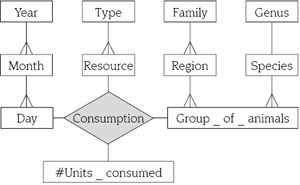
<body><![CDATA[<p><FONT SIZE="2" FACE ="Verdana">A dimension is organized in a hierarchy of levels &#91;4&#93; to     enable the data analysis at various levels of detail, e.g., in the Time dimension,     there exists a hierarchical relationship among days, months, and years, see     <A HREF="#f1">figure 1</A>. This hierarchical relationship captures the full containment between dimension     values, e.g., a day is fully contained in a month, a month is fully contained in a year.</FONT></p>     <p ALIGN="CENTER"><FONT SIZE="2" FACE ="Verdana"><img src="/img/revistas/rium/v9n17/v9n17a15f01.jpg"><A NAME="f1"></A>    <BR>   <STRONG>Figure 1.</STRONG> A conventional multidimensional model for analyzing   animal consumption.<BR /> Source: authors</FONT></p>     <p><FONT SIZE="2" FACE ="Verdana">Conventional DWs are mainly oriented to manage alphanumeric data; however, in recent years DWs have been enriched with spatial data &#91;5-10&#93;. In particular, the work by Jensen &#91;7&#93; introduces the partial containment relationship between dimension values, a relationship prevalent in spatial data. For example, the location of a group of animals can be partially contained in a geographical region; some weeks are partially contained in a month. There are also proposals that provide support for managing temporal data in a DW, for a recent survey see &#91;11&#93;. Note that although DWs include a Time dimension, this dimension is not oriented to keep track of changes in other dimensions &#91;10&#93;, e.g., when a group of animals changes its geographical region; therefore, additional temporal support is required for managing this sort of changes.</FONT></p>     <p><FONT SIZE="2" FACE ="Verdana">On the other hand, with the advance of technologies such as sensors and Global Positioning Systems (GPS), other types of data are becoming available in huge quantities, e.g., spatio-temporal data about migration of animals, movements of trucks, ships, airplanes, people, among others. We believe that the incorporation of this type of data into a DW can enable the discovery of spatio-temporal behaviors that otherwise would be very difficult to recognize.</FONT></p>     <p><FONT SIZE="2" FACE ="Verdana">There are a few works devoted to conceptual spatio-temporal multidimensional models. Savary &#91;12&#93; presents a UML class diagram for a spatio-temporal DW oriented to human motion in urban locations. What the authors call spatio-temporal is the combination of time intervals and locations, which are represented in an alphanumeric format. In Pestana &#91;13&#93; a conceptual spatio-temporal multidimensional model is proposed. Perceptory model &#91;14&#93; that provides a graphic notation for representing non-multidimensional spatio-temporal systems is used. The authors adopt spatial dimensions and spatial measures from the work by Han &#91;5&#93; and consider that their associated geometries can evolve over time. Ahmed &#91;15, 16&#93; proposes a conceptual multidimensional model for continuous spatial data, which deals with natural phenomena that exist continuously in time and space, i.e., that have unclear boundaries. However, none of these works consider partial containment or temporal relationships between dimension values.</FONT></p>     <p><FONT SIZE="2" FACE ="Verdana">In this paper, we gradually extend a conceptual spatial multidimensional model with temporal elements giving rise to a spatio-temporal multidimensional model where partial containment is supported and temporal relationships between dimension values are tracked.</FONT></p>     <p><FONT SIZE="2" FACE ="Verdana">The rest of the paper is organized as follows. In section 2 we develop our proposal and in section 3 we end the paper and present some remarks for future research.</FONT></p>      <p>&nbsp;</p>     <p><FONT SIZE="3" FACE="Verdana"><B>1.  FROM A CONVENTIONAL TO A SPATIO-TEMPORAL MULTIDIMENSIONAL MODEL</B></FONT></p>      ]]></body>
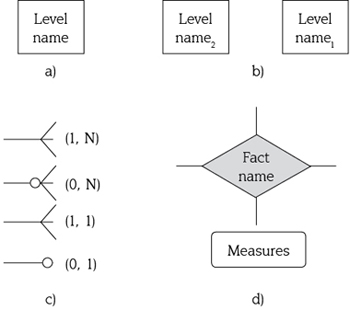
<body><![CDATA[<p><FONT SIZE="2" FACE="Verdana"><B>1.1 A conventional multidimensional model </B></FONT></p>     <p><FONT SIZE="2" FACE ="Verdana">Suppose we are interested in analyzing the     resource consumption of groups of animals. The location of a group of animals     is in a geographical region and we assume that all the animals in a group     belong to the same species. Species are classified into genera and genera     into families. Animals consume resources, e.g., grass, fruits, fish, insects,     salt, water, which are categorized in types, e.g., vegetal, animal, mineral.     Data about resource units (kg) consumed by each group of animals are recorded     daily. A multidimensional model to represent this scenario is shown in <A HREF="#f1">figure     1</A>. To represent our multidimensional models, we use basic notations from Malinowski &#91;10&#93;, see <A HREF="#f2">figure 2</A>, Note that, since the cardinality of every level (rectangles) participating in a fact relationship (grey diamond) is zero-to-many (crowfoot connector), such cardinalities are not showed in order to simplify the model.</FONT></p>     <p ALIGN="CENTER"><FONT SIZE="2" FACE ="Verdana"><img src="/img/revistas/rium/v9n17/v9n17a15f02.jpg"><A NAME="f2"></A>    <BR>   <STRONG>Figure 2.</STRONG> Basic notations for a conceptual multidimensional   model: a) level,     <BR>   b) hierarchy,  c) cardinalities, and d) fact relationship. <BR /> Source: Malinowski [10].</FONT></p>     <p><FONT SIZE="2" FACE ="Verdana">Consumption fact relationship facilitates data analysis. For example, analysts can formulate queries such as what is the total number of units of water consumed in each geographical region&#63; Which are the months when the water consumption increase (decrease)&#63;</FONT></p>     <p><FONT SIZE="2" FACE ="Verdana">Note that if a visual representation of spatial data (for the regions and the locations of groups of animals) is added to our model, this would enable the discovery of patterns that otherwise would be difficult to recognize, as we show in the next section.</FONT></p>      <p><FONT SIZE="2" FACE="Verdana"><B>1.2 Incorporating Spatiality </B></FONT></p>     <p><FONT SIZE="2" FACE ="Verdana">In a multidimensional model, spatiality can be incorporated as an analysis axis, i.e., as a dimension, and/or as an analysis subject, i.e., as a fact &#91;8&#93;. We define a spatial dimension as a dimension that includes at least one spatial level. A spatial level is a level that the application needs to keep its spatial characteristics &#91;10&#93; represented by geometries. Spatial dimensions allow that facts be analyzed according to predefined spatial levels, as usual in a multidimensional model. On the other hand, facts can include spatial measures, i.e., measures represented by a geometry.</FONT></p>     <p><FONT SIZE="2" FACE ="Verdana">Geometries of spatial levels can be topologically related. Topological relationships for geometries have been identified &#91;17-19&#93;, e.g., eight topological relation ships have been identified for regions: disjoint, meet, equal, inside, contains, coveredBy, covers, and overlap. Some of these relationships apply to other types of geometries, details are given in &#91;18&#93;.</FONT></p>     ]]></body>
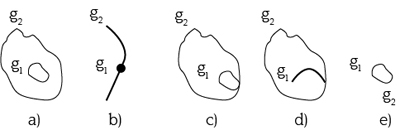
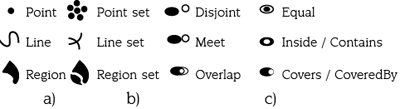
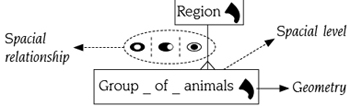
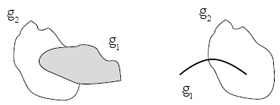
<body><![CDATA[<p><FONT SIZE="2" FACE ="Verdana">On the other hand, in conventional multidimensional models, the hierarchical relationship between levels captures their full containment &#91;20&#93;, e.g., the location of a group of animals is fully contained in a geographical region. Full containment helps to ensure correct aggregation of measures in higher levels, e.g., the number of units consumed in a specific consumption fact is (indirectly) associated with a single geographical region. However, in practice full containment can be violated. We deal with this situation in subsection 2.3.</FONT></p>     <p><FONT SIZE="2" FACE ="Verdana">When spatial data come into play, the full     containment relationship corresponds to the topological relationship inside/contains, coveredBy/covers, or equal, see <A HREF="#f3">figure 3</A>.</FONT></p>     <p ALIGN="CENTER"><FONT SIZE="2" FACE ="Verdana"><img src="/img/revistas/rium/v9n17/v9n17a15f03.jpg"><A NAME="f3"></A>    <BR>   <STRONG>Figure 3.</STRONG> Examples of some topological relationships between   geometries g1 and g2: <BR /> a) and b) inside/contains, c) and d) coveredBy/covers, and e) equal.<BR /> Source: authors</FONT></p>     <p><FONT SIZE="2" FACE ="Verdana">For representing the geometry of spatial levels     and topological relationships, we use icons from Malinowski &#91;10&#93;, see <A HREF="#f4">figure 4</A>, that in turn, were based on the work by Parent &#91;18&#93;. We extend the multidimensional model of <A HREF="#f1">figure 1</A> in order to support topological relationships between levels, see <A HREF="#f5">figure 5</A>.</FONT></p>     <p ALIGN="CENTER"><FONT SIZE="2" FACE ="Verdana"><img src="/img/revistas/rium/v9n17/v9n17a15f04.jpg"><A NAME="f4"></A>    <BR>   <STRONG>Figure 4. </STRONG>Notations for: a) simple geometries, b) complex   geometries, and     <BR>   c) topological relationships. <BR /> Source: Malinowski [10].</FONT></p>     <p ALIGN="CENTER">&nbsp;</p>     <p ALIGN="CENTER"><FONT SIZE="2" FACE ="Verdana"><img src="/img/revistas/rium/v9n17/v9n17a15f05.jpg"><A NAME="f5"></A>    ]]></body>
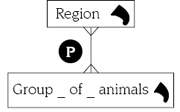
<body><![CDATA[<BR>   <STRONG>Figure 5. </STRONG>Spatial level, spatial relationship,  and geometry of a spatial level.<BR /> Source: authors</FONT></p>     <p><FONT SIZE="2" FACE ="Verdana">Consider the topological relationship between Group_of_animals and Region levels. The location of a group of animals can be inside, covered by, or equal to a geographical region. We enrich Malinowski's conceptual model with the symbol &#166; (exclusive or) to express this topological constraint, see <A HREF="#f5">figure 5</A>.</FONT></p>     <p><FONT SIZE="2" FACE ="Verdana">The addition of visual representation of spatial data enables spatial data analysis. For example, analysts can now formulate queries such as what is the total number of units of water consumed by all the groups of animals located within a given zone (a zone that can cover several geographical regions)&#63; Is the resources' consumption higher in the east or in the west regions during the winter months&#63;</FONT></p>      <p><FONT SIZE="2" FACE="Verdana"><B>1.3 Incorporating Partial Containment </B></FONT></p>     <p><FONT SIZE="2" FACE ="Verdana">In a multidimensional model summarizability is a property needed to ensure correct aggregation of measures. In order to guarantee summarizability, dimension hierarchies must meet disjointness and completeness conditions &#91;21&#93;. There is a third necessary condition for summarizability, but this depends on the correct use of measures with the aggregation functions applied &#91;21&#93;; therefore, it will not be discussed here. Informally, disjointness states that a member level can only be associated with a member level in each higher level, and completeness states that each member level must be associated with a member level in an immediate parent level, i.e., there do not exist &#8220;orphans&#8221; members.</FONT></p>     <p><FONT SIZE="2" FACE ="Verdana">In the model of <A HREF="#f5">figure 5</A>,     the location of a group of animals cannot be associated with more than one     geographical region, otherwise     disjointness condition would be violated. However, in real life the location     of a group of animals could overlap several geographical regions. To represent     this situation, we extend our model allowing the topological relationship     overlap, see <A HREF="#f6">figure 6</A>, between levels, i.e., the hierarchical relationship between levels captures their partial containment &#91;7&#93;, see <A HREF="#f7">figure 7</A>. In <A HREF="#f8">figure 8</A> we propose symbols in order to simplify our graphical notation to represent spatial full containment and spatial partial containment.</FONT></p>     <p ALIGN="CENTER"><FONT SIZE="2" FACE ="Verdana"><img src="/img/revistas/rium/v9n17/v9n17a15f06.jpg"><A NAME="f6"></A>    <BR>   <STRONG>Figure 6.</STRONG> Examples of overlap relationship between geometries   g1 and g2.<BR /> Source: authors</FONT></p>     <p ALIGN="CENTER">&nbsp;</p>     <p ALIGN="CENTER"><FONT SIZE="2" FACE ="Verdana"><img src="/img/revistas/rium/v9n17/v9n17a15f07.jpg"><A NAME="f7"></A>    ]]></body>
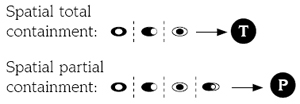
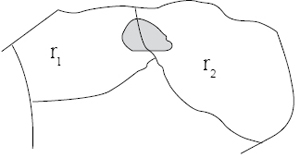
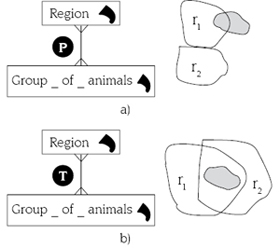
<body><![CDATA[<BR>   <STRONG>Figure 7. </STRONG>Allowing spatial partial containment <BR /> in our multidimensional model.<BR /> Source: authors</FONT></p>     <p ALIGN="CENTER">&nbsp;</p>     <p ALIGN="CENTER"><FONT SIZE="2" FACE ="Verdana"><img src="/img/revistas/rium/v9n17/v9n17a15f08.jpg"><A NAME="f8"></A>    <BR>   <STRONG>Figure 8. </STRONG>Symbols to represent spatial full <BR /> and partial containment.<BR /> Source: authors</FONT></p>     <p ALIGN="LEFT"><FONT SIZE="2" FACE ="Verdana">Partial containment requires a special handling     to ensure correct aggregation of measures because disjointness condition     can be violated. For instance, suppose a group of animals overlaps regions     r1 and r2, see <A HREF="#f9">figure 9</A>, How should the number of units     consumed by this group be aggregated with regard to regions r1 and r2&#63;</FONT></p>     <p ALIGN="CENTER"><FONT SIZE="2" FACE ="Verdana"><img src="/img/revistas/rium/v9n17/v9n17a15f09.jpg"><A NAME="f9"></A>    <BR>   <STRONG>Figure 9.</STRONG> A group of animals located between two regions.<BR /> Source: authors</FONT></p>     <p><FONT SIZE="2" FACE ="Verdana">Note that, partial containment is a generalization     of full containment and usually violates disjointness; however, it is possible,     although hard, to think of an example where partial containment and disjointness     must be met. For example, suppose that the location of a group of animals     can be partially contained in just one region and regions are disjoint, see     <A HREF="#f10">figure 10</A>(a). Analogously, full containment usually meets     disjointness; however, if regions are not disjoint, it is possible that full     containment violates disjointness, see <A HREF="#f10">figure 10</A>(b).</FONT></p>     <p ALIGN="CENTER"><FONT SIZE="2" FACE ="Verdana"><img src="/img/revistas/rium/v9n17/v9n17a15f10.jpg"><A NAME="f10"></A>    <BR>   <STRONG>Figure 10.</STRONG> Containment and disjointness examples:     ]]></body>
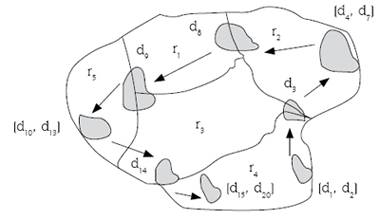
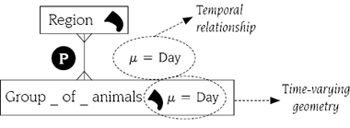
<body><![CDATA[<BR>   a) partial   containment and disjointness and     <BR>   b) full containment and non-disjointness.    <BR> Source: authors</FONT></p>     <p><FONT SIZE="2" FACE ="Verdana">So far, we have assumed that the location of a group of animals does not change during its lifespan. However, this assumption does not hold in scenarios such as animal migration, see subsection 2.4. Note that in our current model if the location of a group of animals changes, only the last location where the group is (or was) saved.</FONT></p>      <p><FONT SIZE="2" FACE="Verdana"><B>1.4 Incorporating Temporality </B></FONT></p>     <p><FONT SIZE="2" FACE ="Verdana">Consider a scenario of periodic animal migration &#91;22&#93;,     i.e., the movements of a group of animals among geographical regions, see     <A HREF="#f11">figure 11</A>. To represent this situation, we extend themodel of <A HREF="#f7">figure     7</A> with temporal     elements. We consider time as discrete, i.e., a point in the time line that corresponds to a positive integer &#91;23&#93;. A positive integer represents an instance of a temporal unit, e.g., an hour, a day. Let i, j be positive integers, &#91;i, j&#93; represents an interval, i.e., a set of contiguous integers. For clarity, we will use d1 (or an equivalent value such as 2008-Jan-01) instead 1 to represent, e.g., day 1.</FONT></p>     <p ALIGN="CENTER"><FONT SIZE="2" FACE ="Verdana"><img src="/img/revistas/rium/v9n17/v9n17a15f11.jpg"><A NAME="f11"></A>    <BR>   <STRONG>Figure 11.</STRONG> Migration among regions (ri) of a group of animals.<BR /> Source: authors</FONT></p>     <p><FONT SIZE="2" FACE ="Verdana">We add temporality to our model in two ways: i) we support temporal relationships, e.g., we keep track of the assignments between Group_of_animals and Region levels, and ii) we track the evolution of the geometry of a spatial level, i.e., a time-varying geometry.</FONT></p>     <p><FONT SIZE="2" FACE ="Verdana">In <A HREF="#f12">figure 12</A>, the location of a group of animals can     be associated with more than one geographical region at any time instant     (day) and the corresponding partial containment relationship between these levels must also hold at any time instant.</FONT></p>     ]]></body>
<body><![CDATA[<p ALIGN="CENTER"><FONT SIZE="2" FACE ="Verdana"><img src="/img/revistas/rium/v9n17/v9n17a15f12.jpg"><A NAME="f12"></A>    <BR>   <STRONG>Figure 12.</STRONG> Temporal relationship  and time-varying geometry.<BR /> Source: authors</FONT></p>     <p><FONT SIZE="2" FACE ="Verdana">With regard to the evolution of the geometry of a spatial level, the geometry can change of position, extent, or both at any time instant as long as the partial containment relationship between Group_of_animals and Region levels holds.</FONT></p>     <p><FONT SIZE="2" FACE ="Verdana">The addition of temporality to our model enables the analysts to formulate queries such as what is the total number of units of water consumed by a group of animals in its last two visits to a particular geographical region&#63; What is the total number of units of water consumed by a group of animals in all its visits to a given zone&#63;</FONT></p>      <p>&nbsp;</p>     <p><FONT SIZE="3" FACE="Verdana"><B>2. CONCLUSIONS AND FUTURE WORK </B></FONT></p>     <p><FONT SIZE="2" FACE ="Verdana">We enriched a conceptual spatial multidimensional model with temporal elements giving rise to a spatio-temporal multidimensional model. We incorporated elements to represent spatio-temporal relationships between levels and to manage time-varying geometries of spatial levels. In addition, we proposed symbols to represent spatial full/partial containment between spatial levels.</FONT></p>     <p><FONT SIZE="2" FACE ="Verdana">As future work, we plan to transform our conceptual model into a logical one to facilitate their implementation in a particular paradigm. We also plan to develop a query language in order to express spatio-temporal multidimensional queries, such as the ones described through section 2. From a physical point of view, a related issue is how to store and retrieve efficiently these data. Data structures and indexing schemes must be designed for this purpose.</FONT></p>     <p><FONT SIZE="2" FACE ="Verdana">Analysis of summarizability when spatial partial containment arises is another promising direction for research, although there are some proposals &#91;17, 24&#93;; a definitive handling of this subject has not been achieved.</FONT></p>     <p><FONT SIZE="2" FACE ="Verdana">Finally, note that from <A HREF="#f11">figure       11</A>, we can infer a trajectory     from the evolving location of the group of animals. It could be interesting     to model a trajectory explicitly, i.e., as a first class concept, in a multidimensional     model. This could enable trajectory analysis, e.g., we could formulate queries such as how many trajectories cross a given region.</FONT></p>      ]]></body>
<body><![CDATA[<p>&nbsp;</p>     <p><FONT SIZE="3" FACE="Verdana"><B>REFERENCES</B></FONT></p>      <!-- ref --><p><FONT SIZE="2" FACE ="Verdana">&#91;1&#93; W. H. Inmon, <I>Building the Data       Warehouse</I>, 4 </I 4 ed., Hoboken: John Wiley & Sons, Incorporated, 1993.>ed.,       Hoboken: John Willey &amp; Sons, Incorporated, 1993.</FONT>&nbsp;&nbsp;&nbsp;&nbsp;&nbsp;&nbsp;&nbsp;&nbsp;[&#160;<a href="javascript:void(0);" onclick="javascript: window.open('/scielo.php?script=sci_nlinks&ref=000095&pid=S1692-3324201000020001500001&lng=','','width=640,height=500,resizable=yes,scrollbars=1,menubar=yes,');">Links</a>&#160;]<!-- end-ref --><!-- ref --><p><FONT SIZE="2" FACE ="Verdana">&#91;2&#93; R. Kimball <I>et al., The Data Warehouse Lifecycle Toolkit</I>, New York: Wiley Computer Publishing, 2008, p. 800.</FONT>&nbsp;&nbsp;&nbsp;&nbsp;&nbsp;&nbsp;&nbsp;&nbsp;[&#160;<a href="javascript:void(0);" onclick="javascript: window.open('/scielo.php?script=sci_nlinks&ref=000096&pid=S1692-3324201000020001500002&lng=','','width=640,height=500,resizable=yes,scrollbars=1,menubar=yes,');">Links</a>&#160;]<!-- end-ref --><!-- ref --><p><FONT SIZE="2" FACE ="Verdana">&#91;3&#93; R. Agrawal <i>et al</i>., &#8220;Modeling Multidimensional Databases&#8221; presentado a 13th International Conference on Data Engineering (ICDE), 1995, pp. 10.</FONT>&nbsp;&nbsp;&nbsp;&nbsp;&nbsp;&nbsp;&nbsp;&nbsp;[&#160;<a href="javascript:void(0);" onclick="javascript: window.open('/scielo.php?script=sci_nlinks&ref=000097&pid=S1692-3324201000020001500003&lng=','','width=640,height=500,resizable=yes,scrollbars=1,menubar=yes,');">Links</a>&#160;]<!-- end-ref --><!-- ref --><p><FONT SIZE="2" FACE ="Verdana">&#91;4&#93; R. Torlone, &#8220;Conceptual multidimensional models&#8221;, en <I>Multidimensional databases,</I> pp. 69-90: IGI Publishing, 2003.</FONT>&nbsp;&nbsp;&nbsp;&nbsp;&nbsp;&nbsp;&nbsp;&nbsp;[&#160;<a href="javascript:void(0);" onclick="javascript: window.open('/scielo.php?script=sci_nlinks&ref=000098&pid=S1692-3324201000020001500004&lng=','','width=640,height=500,resizable=yes,scrollbars=1,menubar=yes,');">Links</a>&#160;]<!-- end-ref --><!-- ref --><p><FONT SIZE="2" FACE ="Verdana">&#91;5&#93; J. Han <i>et al</i>., &#8220;Selective materialization: An efficient method for spatial data cube construction&#8221;, en <I>Research and Development in Knowledge Discovery and Data Mining,</I> X. Wu, R. Kotagiri y K. Korb, eds., pp. 144-158, New York: Springer Berlin / Heidelberg, 1998.</FONT>&nbsp;&nbsp;&nbsp;&nbsp;&nbsp;&nbsp;&nbsp;&nbsp;[&#160;<a href="javascript:void(0);" onclick="javascript: window.open('/scielo.php?script=sci_nlinks&ref=000099&pid=S1692-3324201000020001500005&lng=','','width=640,height=500,resizable=yes,scrollbars=1,menubar=yes,');">Links</a>&#160;]<!-- end-ref --><!-- ref --><p><FONT SIZE="2" FACE ="Verdana">&#91;6&#93; Y. B&eacute;dard <i>et al</i>., &#8220;Fundamentals of spatial data warehousing for geographic knowledge discovery&#8221;, en <I>Geographic Data Mining and Knowledge Discovery,</I> H. J. Miller y J. Han, eds., pp. 53-73: CRC Press, 2001.</FONT>&nbsp;&nbsp;&nbsp;&nbsp;&nbsp;&nbsp;&nbsp;&nbsp;[&#160;<a href="javascript:void(0);" onclick="javascript: window.open('/scielo.php?script=sci_nlinks&ref=000100&pid=S1692-3324201000020001500006&lng=','','width=640,height=500,resizable=yes,scrollbars=1,menubar=yes,');">Links</a>&#160;]<!-- end-ref --><!-- ref --><p><FONT SIZE="2" FACE ="Verdana">&#91;7&#93; C. S. Jensen <i>et al</i>., &#8220;Multidimensional data modeling for location-based services&#8221;, <I>The VLDB Journal,</I> vol. 13, no. 1, pp. 1-21, 2004.</FONT>&nbsp;&nbsp;&nbsp;&nbsp;&nbsp;&nbsp;&nbsp;&nbsp;[&#160;<a href="javascript:void(0);" onclick="javascript: window.open('/scielo.php?script=sci_nlinks&ref=000101&pid=S1692-3324201000020001500007&lng=','','width=640,height=500,resizable=yes,scrollbars=1,menubar=yes,');">Links</a>&#160;]<!-- end-ref --><!-- ref --><p><FONT SIZE="2" FACE ="Verdana">&#91;8&#93; S. Bimonte <i>et al</i>., &#8220;Towards a spatial multidimensional model&#8221;, presentado a Proceedings of the 8th ACM international workshop on Data warehousing and OLAP, Bremen, Germany, 2005, pp. 39-46.</FONT>&nbsp;&nbsp;&nbsp;&nbsp;&nbsp;&nbsp;&nbsp;&nbsp;[&#160;<a href="javascript:void(0);" onclick="javascript: window.open('/scielo.php?script=sci_nlinks&ref=000102&pid=S1692-3324201000020001500008&lng=','','width=640,height=500,resizable=yes,scrollbars=1,menubar=yes,');">Links</a>&#160;]<!-- end-ref --><!-- ref --><p><FONT SIZE="2" FACE ="Verdana">&#91;9&#93; M. L. Damiani, y S. Spaccapietra, &#8220;Spatial Data Warehouse Modelling&#8221;, en <I>Processing and Managing Complex Data for Decision Support,</I> J. Darmont y O. Boussa&iuml;d, eds., p. 27, Lyon: Universidad de Lyon, 2006.</FONT>&nbsp;&nbsp;&nbsp;&nbsp;&nbsp;&nbsp;&nbsp;&nbsp;[&#160;<a href="javascript:void(0);" onclick="javascript: window.open('/scielo.php?script=sci_nlinks&ref=000103&pid=S1692-3324201000020001500009&lng=','','width=640,height=500,resizable=yes,scrollbars=1,menubar=yes,');">Links</a>&#160;]<!-- end-ref --><!-- ref --><p><FONT SIZE="2" FACE ="Verdana">&#91;10&#93; E. Malinowski, y E. Zimnyi, <I>Advanced Data Warehouse Design: From Conventional to Spatial and Temporal Applications</I> New York: Springer Publishing Company, 2008.</FONT>&nbsp;&nbsp;&nbsp;&nbsp;&nbsp;&nbsp;&nbsp;&nbsp;[&#160;<a href="javascript:void(0);" onclick="javascript: window.open('/scielo.php?script=sci_nlinks&ref=000104&pid=S1692-3324201000020001500010&lng=','','width=640,height=500,resizable=yes,scrollbars=1,menubar=yes,');">Links</a>&#160;]<!-- end-ref --><!-- ref --><p><FONT SIZE="2" FACE ="Verdana">&#91;11&#93; M. Golfarelli, y S. Rizzi, &#8220;A Survey on Temporal Data Warehousing&#8221;, <I>International Journal of Data Warehousing and Mining,</I> vol. 5, no. 1, pp. 17, 2009.</FONT>&nbsp;&nbsp;&nbsp;&nbsp;&nbsp;&nbsp;&nbsp;&nbsp;[&#160;<a href="javascript:void(0);" onclick="javascript: window.open('/scielo.php?script=sci_nlinks&ref=000105&pid=S1692-3324201000020001500011&lng=','','width=640,height=500,resizable=yes,scrollbars=1,menubar=yes,');">Links</a>&#160;]<!-- end-ref --><!-- ref --><p><FONT SIZE="2" FACE ="Verdana">&#91;12&#93; L. Savary <i>et al</i>., &#8220;Spatio-Temporal Data Warehouse Design for Human Activity Pattern Analysis&#8221;, presentado a Proceedings of the Database and Expert Systems Applications, 15th International Workshop, 2004, pp. 814-818.</FONT>&nbsp;&nbsp;&nbsp;&nbsp;&nbsp;&nbsp;&nbsp;&nbsp;[&#160;<a href="javascript:void(0);" onclick="javascript: window.open('/scielo.php?script=sci_nlinks&ref=000106&pid=S1692-3324201000020001500012&lng=','','width=640,height=500,resizable=yes,scrollbars=1,menubar=yes,');">Links</a>&#160;]<!-- end-ref --><!-- ref --><p><FONT SIZE="2" FACE ="Verdana">&#91;13&#93; G. Pestana, y M. Mira da Silva, &#8220;Multidimensional Modeling based on Spatial, Temporal and Spatio-Temporal Stereotypes&#8221;, presentado a ESRI International User Conference, 2005, p. 5.</FONT>&nbsp;&nbsp;&nbsp;&nbsp;&nbsp;&nbsp;&nbsp;&nbsp;[&#160;<a href="javascript:void(0);" onclick="javascript: window.open('/scielo.php?script=sci_nlinks&ref=000107&pid=S1692-3324201000020001500013&lng=','','width=640,height=500,resizable=yes,scrollbars=1,menubar=yes,');">Links</a>&#160;]<!-- end-ref --><!-- ref --><p><FONT SIZE="2" FACE ="Verdana">&#91;14&#93; Y. B&eacute;dard <i>et al</i>., &#8220;Modeling Geospatial Databases with Plug-Ins for Visual Languages: A Pragmatic Approach and the Impacts of 16 Years of Research and Experimentations on Perceptory&#8221;, <I>CoMoGIS 2004,</I> vol. 3289, pp. 13-17, 2004.</FONT>&nbsp;&nbsp;&nbsp;&nbsp;&nbsp;&nbsp;&nbsp;&nbsp;[&#160;<a href="javascript:void(0);" onclick="javascript: window.open('/scielo.php?script=sci_nlinks&ref=000108&pid=S1692-3324201000020001500014&lng=','','width=640,height=500,resizable=yes,scrollbars=1,menubar=yes,');">Links</a>&#160;]<!-- end-ref --><!-- ref --><p><FONT SIZE="2" FACE ="Verdana">&#91;15&#93; T. O. Ahmed, &#8220;Continuous Spatial DataWarehousing&#8221;, presentado a 19th International Arab Conference on Information Technology ACIT, 2008, p. 6.</FONT>&nbsp;&nbsp;&nbsp;&nbsp;&nbsp;&nbsp;&nbsp;&nbsp;[&#160;<a href="javascript:void(0);" onclick="javascript: window.open('/scielo.php?script=sci_nlinks&ref=000109&pid=S1692-3324201000020001500015&lng=','','width=640,height=500,resizable=yes,scrollbars=1,menubar=yes,');">Links</a>&#160;]<!-- end-ref --><!-- ref --><p><FONT SIZE="2" FACE ="Verdana">&#91;16&#93; T. O. Ahmed, y M. Maryvonne, &#8220;Multidimensional Structures Dedicated to Continuous Spatiotemporal Phenomena&#8221;, presentado a 22nd British National Conference on Databases (BNCOD), 2005, p. 11.</FONT>&nbsp;&nbsp;&nbsp;&nbsp;&nbsp;&nbsp;&nbsp;&nbsp;[&#160;<a href="javascript:void(0);" onclick="javascript: window.open('/scielo.php?script=sci_nlinks&ref=000110&pid=S1692-3324201000020001500016&lng=','','width=640,height=500,resizable=yes,scrollbars=1,menubar=yes,');">Links</a>&#160;]<!-- end-ref --><!-- ref --><p><FONT SIZE="2" FACE ="Verdana">&#91;17&#93; M. Egenhofer <i>et al</i>., &#8220;A Topological Data Model for Spatial Databases&#8221;, presentado a 1st Symposium of Design and Implementation of Large Spatial Databases, 1989, p. 15.</FONT>&nbsp;&nbsp;&nbsp;&nbsp;&nbsp;&nbsp;&nbsp;&nbsp;[&#160;<a href="javascript:void(0);" onclick="javascript: window.open('/scielo.php?script=sci_nlinks&ref=000111&pid=S1692-3324201000020001500017&lng=','','width=640,height=500,resizable=yes,scrollbars=1,menubar=yes,');">Links</a>&#160;]<!-- end-ref --><!-- ref --><p><FONT SIZE="2" FACE ="Verdana">&#91;18&#93; C. Parent <i>et al</i>., &#8220;Spatio-temporal conceptual models: data structures + space + time&#8221;, presentado a Proceedings of the 7th ACM international symposium on Advances in geographic information systems, Kansas City, Missouri, United States, 1999, pp. 26-33.</FONT>&nbsp;&nbsp;&nbsp;&nbsp;&nbsp;&nbsp;&nbsp;&nbsp;[&#160;<a href="javascript:void(0);" onclick="javascript: window.open('/scielo.php?script=sci_nlinks&ref=000112&pid=S1692-3324201000020001500018&lng=','','width=640,height=500,resizable=yes,scrollbars=1,menubar=yes,');">Links</a>&#160;]<!-- end-ref --><!-- ref --><p><FONT SIZE="2" FACE ="Verdana">&#91;19&#93; M. Schneider, &#8220;Computing the Topological Relationship of Complex Regions&#8221;, presentado a 15th Int. Conf. on Database and Expert Systems Applications, 2004, p. 9.</FONT>&nbsp;&nbsp;&nbsp;&nbsp;&nbsp;&nbsp;&nbsp;&nbsp;[&#160;<a href="javascript:void(0);" onclick="javascript: window.open('/scielo.php?script=sci_nlinks&ref=000113&pid=S1692-3324201000020001500019&lng=','','width=640,height=500,resizable=yes,scrollbars=1,menubar=yes,');">Links</a>&#160;]<!-- end-ref --><!-- ref --><p><FONT SIZE="2" FACE ="Verdana">&#91;20&#93; T. B. Pedersen <i>et al</i>., &#8220;A foundation for capturing and querying complex multidimensional data&#8221;, <I>Information Systems,</I> vol. 26, no. 5, pp. 383-423, 2001.</FONT>&nbsp;&nbsp;&nbsp;&nbsp;&nbsp;&nbsp;&nbsp;&nbsp;[&#160;<a href="javascript:void(0);" onclick="javascript: window.open('/scielo.php?script=sci_nlinks&ref=000114&pid=S1692-3324201000020001500020&lng=','','width=640,height=500,resizable=yes,scrollbars=1,menubar=yes,');">Links</a>&#160;]<!-- end-ref --><!-- ref --><p><FONT SIZE="2" FACE ="Verdana">&#91;21&#93; H.-J. Lenz, y A. Shoshani, &#8220;Summarizability in OLAP and Statistical Data Bases&#8221;, presentado a Proceedings of the Ninth International Conference on Scientific and Statistical Database Management, 1997, pp. 132-143.</FONT>&nbsp;&nbsp;&nbsp;&nbsp;&nbsp;&nbsp;&nbsp;&nbsp;[&#160;<a href="javascript:void(0);" onclick="javascript: window.open('/scielo.php?script=sci_nlinks&ref=000115&pid=S1692-3324201000020001500021&lng=','','width=640,height=500,resizable=yes,scrollbars=1,menubar=yes,');">Links</a>&#160;]<!-- end-ref --><!-- ref --><p><FONT SIZE="2" FACE ="Verdana">&#91;22&#93; H. Dingle, y V. A. Drake, &#8220;What is Migration&#63;&#8221;, <I>BioScience,</I> vol. 57, p. 8, 2007.</FONT>&nbsp;&nbsp;&nbsp;&nbsp;&nbsp;&nbsp;&nbsp;&nbsp;[&#160;<a href="javascript:void(0);" onclick="javascript: window.open('/scielo.php?script=sci_nlinks&ref=000116&pid=S1692-3324201000020001500022&lng=','','width=640,height=500,resizable=yes,scrollbars=1,menubar=yes,');">Links</a>&#160;]<!-- end-ref --><!-- ref --><p><FONT SIZE="2" FACE ="Verdana">&#91;23&#93; A. O. Mendelzon, y A. A. Vaisman, &#8220;Temporal Queries in OLAP&#8221;, presentado a Proceedings of the 26th International Conference on Very Large Data Bases, 2000, pp. 242-253.</FONT>&nbsp;&nbsp;&nbsp;&nbsp;&nbsp;&nbsp;&nbsp;&nbsp;[&#160;<a href="javascript:void(0);" onclick="javascript: window.open('/scielo.php?script=sci_nlinks&ref=000117&pid=S1692-3324201000020001500023&lng=','','width=640,height=500,resizable=yes,scrollbars=1,menubar=yes,');">Links</a>&#160;]<!-- end-ref --><!-- ref --><p><FONT SIZE="2" FACE ="Verdana">&#91;24&#93; I. Timko <i>et al</i>., &#8220;Probabilistic data modeling and querying for location-based data warehouses&#8221;, presentado a Proceedings of the 17th international conference on Scientific and statistical database management, Santa Barbara, CA, 2005, pp. 273-282.</FONT>&nbsp;&nbsp;&nbsp;&nbsp;&nbsp;&nbsp;&nbsp;&nbsp;[&#160;<a href="javascript:void(0);" onclick="javascript: window.open('/scielo.php?script=sci_nlinks&ref=000118&pid=S1692-3324201000020001500024&lng=','','width=640,height=500,resizable=yes,scrollbars=1,menubar=yes,');">Links</a>&#160;]<!-- end-ref --><p>&nbsp;</p>     <p><FONT SIZE="2" FACE ="Verdana"> <B>Recibido:</B> 23/08/2010.    <BR> <B> Aceptado:</B> 08/10/2010. </FONT></p>      ]]></body><back>
<ref-list>
<ref id="B1">
<label>1</label><nlm-citation citation-type="book">
<person-group person-group-type="author">
<name>
<surname><![CDATA[Inmon]]></surname>
<given-names><![CDATA[W. H.]]></given-names>
</name>
</person-group>
<source><![CDATA[Building the Data Warehouse]]></source>
<year>1993</year>
<edition>4</edition>
<publisher-loc><![CDATA[Hoboken ]]></publisher-loc>
<publisher-name><![CDATA[John Willey & Sons]]></publisher-name>
</nlm-citation>
</ref>
<ref id="B2">
<label>2</label><nlm-citation citation-type="book">
<person-group person-group-type="author">
<name>
<surname><![CDATA[Kimball]]></surname>
<given-names><![CDATA[R.]]></given-names>
</name>
</person-group>
<source><![CDATA[The Data Warehouse Lifecycle Toolkit]]></source>
<year>2008</year>
<publisher-loc><![CDATA[New York ]]></publisher-loc>
<publisher-name><![CDATA[Wiley Computer Publishing]]></publisher-name>
</nlm-citation>
</ref>
<ref id="B3">
<label>3</label><nlm-citation citation-type="confpro">
<person-group person-group-type="author">
<name>
<surname><![CDATA[Agrawal]]></surname>
<given-names><![CDATA[R.]]></given-names>
</name>
</person-group>
<source><![CDATA[Modeling Multidimensional Databases]]></source>
<year></year>
<conf-name><![CDATA[13 International Conference on Data Engineering (ICDE)]]></conf-name>
<conf-date>1995</conf-date>
<conf-loc> </conf-loc>
</nlm-citation>
</ref>
<ref id="B4">
<label>4</label><nlm-citation citation-type="book">
<person-group person-group-type="author">
<name>
<surname><![CDATA[Torlone]]></surname>
<given-names><![CDATA[R.]]></given-names>
</name>
</person-group>
<article-title xml:lang="en"><![CDATA[Conceptual multidimensional models]]></article-title>
<source><![CDATA[Multidimensional databases]]></source>
<year>2003</year>
<page-range>69-90</page-range><publisher-name><![CDATA[IGI Publishing]]></publisher-name>
</nlm-citation>
</ref>
<ref id="B5">
<label>5</label><nlm-citation citation-type="book">
<person-group person-group-type="author">
<name>
<surname><![CDATA[Han]]></surname>
<given-names><![CDATA[J.]]></given-names>
</name>
</person-group>
<article-title xml:lang="en"><![CDATA[Selective materialization: An efficient method for spatial data cube construction]]></article-title>
<person-group person-group-type="editor">
<name>
<surname><![CDATA[Wu]]></surname>
<given-names><![CDATA[X.]]></given-names>
</name>
<name>
<surname><![CDATA[Kotagiri]]></surname>
<given-names><![CDATA[R.]]></given-names>
</name>
<name>
<surname><![CDATA[Korb]]></surname>
<given-names><![CDATA[K.]]></given-names>
</name>
</person-group>
<source><![CDATA[Research and Development in Knowledge Discovery and Data Mining]]></source>
<year>1998</year>
<page-range>144-158</page-range><publisher-loc><![CDATA[New York ]]></publisher-loc>
<publisher-name><![CDATA[Springer Berlin / Heidelberg]]></publisher-name>
</nlm-citation>
</ref>
<ref id="B6">
<label>6</label><nlm-citation citation-type="book">
<person-group person-group-type="author">
<name>
<surname><![CDATA[Bédard]]></surname>
<given-names><![CDATA[Y.]]></given-names>
</name>
</person-group>
<article-title xml:lang="en"><![CDATA[Fundamentals of spatial data warehousing for geographic knowledge discovery]]></article-title>
<person-group person-group-type="editor">
<name>
<surname><![CDATA[Miller]]></surname>
<given-names><![CDATA[H. J.]]></given-names>
</name>
<name>
<surname><![CDATA[Han]]></surname>
<given-names><![CDATA[J.]]></given-names>
</name>
</person-group>
<source><![CDATA[Geographic Data Mining and Knowledge Discovery]]></source>
<year>2001</year>
<page-range>53-73</page-range><publisher-name><![CDATA[CRC Press]]></publisher-name>
</nlm-citation>
</ref>
<ref id="B7">
<label>7</label><nlm-citation citation-type="journal">
<person-group person-group-type="author">
<name>
<surname><![CDATA[Jensen]]></surname>
<given-names><![CDATA[C. S.]]></given-names>
</name>
</person-group>
<article-title xml:lang="en"><![CDATA[Multidimensional data modeling for location-based services]]></article-title>
<source><![CDATA[The VLDB Journal]]></source>
<year>2004</year>
<volume>13</volume>
<numero>1</numero>
<issue>1</issue>
<page-range>1-21</page-range></nlm-citation>
</ref>
<ref id="B8">
<label>8</label><nlm-citation citation-type="confpro">
<person-group person-group-type="author">
<name>
<surname><![CDATA[Bimonte]]></surname>
<given-names><![CDATA[S.]]></given-names>
</name>
</person-group>
<article-title xml:lang="en"><![CDATA[Towards a spatial multidimensional model]]></article-title>
<source><![CDATA[Proceedings]]></source>
<year></year>
<conf-name><![CDATA[8 international workshop on Data warehousing and OLAP]]></conf-name>
<conf-date>2005</conf-date>
<conf-loc>Bremen </conf-loc>
<page-range>39-46</page-range></nlm-citation>
</ref>
<ref id="B9">
<label>9</label><nlm-citation citation-type="book">
<person-group person-group-type="author">
<name>
<surname><![CDATA[Damiani]]></surname>
<given-names><![CDATA[M. L.]]></given-names>
</name>
<name>
<surname><![CDATA[Spaccapietra]]></surname>
<given-names><![CDATA[S.]]></given-names>
</name>
</person-group>
<article-title xml:lang="en"><![CDATA[Spatial Data Warehouse Modelling]]></article-title>
<person-group person-group-type="editor">
<name>
<surname><![CDATA[Darmont]]></surname>
<given-names><![CDATA[J.]]></given-names>
</name>
<name>
<surname><![CDATA[Boussaďd]]></surname>
<given-names><![CDATA[O.]]></given-names>
</name>
</person-group>
<source><![CDATA[Processing and Managing Complex Data for Decision Support]]></source>
<year>2006</year>
<publisher-loc><![CDATA[Lyon ]]></publisher-loc>
<publisher-name><![CDATA[Universidad de Lyon]]></publisher-name>
</nlm-citation>
</ref>
<ref id="B10">
<label>10</label><nlm-citation citation-type="book">
<person-group person-group-type="author">
<name>
<surname><![CDATA[Malinowski]]></surname>
<given-names><![CDATA[E.]]></given-names>
</name>
<name>
<surname><![CDATA[Zimnyi]]></surname>
<given-names><![CDATA[E.]]></given-names>
</name>
</person-group>
<source><![CDATA[Advanced Data Warehouse Design: From Conventional to Spatial and Temporal Applications]]></source>
<year>2008</year>
<publisher-loc><![CDATA[New York ]]></publisher-loc>
<publisher-name><![CDATA[Springer Publishing Company]]></publisher-name>
</nlm-citation>
</ref>
<ref id="B11">
<label>11</label><nlm-citation citation-type="journal">
<person-group person-group-type="author">
<name>
<surname><![CDATA[Golfarelli]]></surname>
<given-names><![CDATA[M.]]></given-names>
</name>
<name>
<surname><![CDATA[Rizzi]]></surname>
<given-names><![CDATA[S.]]></given-names>
</name>
</person-group>
<article-title xml:lang="en"><![CDATA[A Survey on Temporal Data Warehousing]]></article-title>
<source><![CDATA[International Journal of Data Warehousing and Mining]]></source>
<year>2009</year>
<volume>5</volume>
<numero>1</numero>
<issue>1</issue>
<page-range>17</page-range></nlm-citation>
</ref>
<ref id="B12">
<label>12</label><nlm-citation citation-type="confpro">
<person-group person-group-type="author">
<name>
<surname><![CDATA[Savary]]></surname>
<given-names><![CDATA[L.]]></given-names>
</name>
</person-group>
<article-title xml:lang="en"><![CDATA[Spatio-Temporal Data Warehouse Design for Human Activity Pattern Analysis]]></article-title>
<source><![CDATA[Proceedings]]></source>
<year></year>
<conf-name><![CDATA[15 the Database and Expert Systems Applications]]></conf-name>
<conf-date>2004</conf-date>
<conf-loc> </conf-loc>
<page-range>814-818</page-range></nlm-citation>
</ref>
<ref id="B13">
<label>13</label><nlm-citation citation-type="confpro">
<person-group person-group-type="author">
<name>
<surname><![CDATA[Pestana]]></surname>
<given-names><![CDATA[G.]]></given-names>
</name>
<name>
<surname><![CDATA[Mira da Silva]]></surname>
<given-names><![CDATA[M.]]></given-names>
</name>
</person-group>
<source><![CDATA[Multidimensional Modeling based on Spatial, Temporal and Spatio-Temporal Stereotypes]]></source>
<year></year>
<conf-name><![CDATA[ ESRI International User Conference]]></conf-name>
<conf-date>2005</conf-date>
<conf-loc> </conf-loc>
<page-range>5</page-range></nlm-citation>
</ref>
<ref id="B14">
<label>14</label><nlm-citation citation-type="">
<person-group person-group-type="author">
<name>
<surname><![CDATA[Bédard]]></surname>
<given-names><![CDATA[Y.]]></given-names>
</name>
</person-group>
<article-title xml:lang="en"><![CDATA[Modeling Geospatial Databases with Plug-Ins for Visual Languages: A Pragmatic Approach and the Impacts of 16 Years of Research and Experimentations on Perceptory]]></article-title>
<source><![CDATA[CoMoGIS 2004]]></source>
<year>2004</year>
<volume>3289</volume>
<page-range>13-17</page-range></nlm-citation>
</ref>
<ref id="B15">
<label>15</label><nlm-citation citation-type="confpro">
<person-group person-group-type="author">
<name>
<surname><![CDATA[Ahmed]]></surname>
<given-names><![CDATA[T. O.]]></given-names>
</name>
</person-group>
<article-title xml:lang="en"><![CDATA[Continuous Spatial DataWarehousing]]></article-title>
<source><![CDATA[]]></source>
<year></year>
<conf-name><![CDATA[19 International Arab Conference on Information Technology ACIT]]></conf-name>
<conf-date>2008</conf-date>
<conf-loc> </conf-loc>
<page-range>6</page-range></nlm-citation>
</ref>
<ref id="B16">
<label>16</label><nlm-citation citation-type="confpro">
<person-group person-group-type="author">
<name>
<surname><![CDATA[Ahmed]]></surname>
<given-names><![CDATA[T. O.]]></given-names>
</name>
<name>
<surname><![CDATA[Maryvonne]]></surname>
<given-names><![CDATA[M.]]></given-names>
</name>
</person-group>
<article-title xml:lang="en"><![CDATA[Multidimensional Structures Dedicated to Continuous Spatiotemporal Phenomena]]></article-title>
<source><![CDATA[]]></source>
<year></year>
<conf-name><![CDATA[22 British National Conference on Databases (BNCOD)]]></conf-name>
<conf-date>2005</conf-date>
<conf-loc> </conf-loc>
<page-range>11</page-range></nlm-citation>
</ref>
<ref id="B17">
<label>17</label><nlm-citation citation-type="confpro">
<person-group person-group-type="author">
<name>
<surname><![CDATA[Egenhofer]]></surname>
<given-names><![CDATA[M.]]></given-names>
</name>
</person-group>
<article-title xml:lang="en"><![CDATA[A Topological Data Model for Spatial Databases]]></article-title>
<source><![CDATA[]]></source>
<year></year>
<conf-name><![CDATA[1 Symposium of Design and Implementation of Large Spatial Databases]]></conf-name>
<conf-date>1989</conf-date>
<conf-loc> </conf-loc>
<page-range>15</page-range></nlm-citation>
</ref>
<ref id="B18">
<label>18</label><nlm-citation citation-type="confpro">
<person-group person-group-type="author">
<name>
<surname><![CDATA[Parent]]></surname>
<given-names><![CDATA[C.]]></given-names>
</name>
</person-group>
<article-title xml:lang="en"><![CDATA[Spatio-temporal conceptual models: data structures + space + time]]></article-title>
<source><![CDATA[Proceedings of the]]></source>
<year></year>
<conf-name><![CDATA[7 international symposium on Advances in geographic information systems]]></conf-name>
<conf-date>1999</conf-date>
<conf-loc>Kansas Missouri</conf-loc>
<page-range>26-33</page-range></nlm-citation>
</ref>
<ref id="B19">
<label>19</label><nlm-citation citation-type="confpro">
<person-group person-group-type="author">
<name>
<surname><![CDATA[Schneider]]></surname>
<given-names><![CDATA[M.]]></given-names>
</name>
</person-group>
<article-title xml:lang="en"><![CDATA[Computing the Topological Relationship of Complex Regions]]></article-title>
<source><![CDATA[]]></source>
<year></year>
<conf-name><![CDATA[15 Conf. on Database and Expert Systems Applications]]></conf-name>
<conf-date>2004</conf-date>
<conf-loc> </conf-loc>
<page-range>9</page-range></nlm-citation>
</ref>
<ref id="B20">
<label>20</label><nlm-citation citation-type="journal">
<person-group person-group-type="author">
<name>
<surname><![CDATA[Pedersen]]></surname>
<given-names><![CDATA[T. B.]]></given-names>
</name>
</person-group>
<article-title xml:lang="en"><![CDATA[A foundation for capturing and querying complex multidimensional data]]></article-title>
<source><![CDATA[Information Systems]]></source>
<year>2001</year>
<volume>26</volume>
<numero>5</numero>
<issue>5</issue>
<page-range>383-423</page-range></nlm-citation>
</ref>
<ref id="B21">
<label>21</label><nlm-citation citation-type="confpro">
<person-group person-group-type="author">
<name>
<surname><![CDATA[Lenz]]></surname>
<given-names><![CDATA[H.-J.]]></given-names>
</name>
<name>
<surname><![CDATA[Shoshani]]></surname>
<given-names><![CDATA[A.]]></given-names>
</name>
</person-group>
<article-title xml:lang="en"><![CDATA[Summarizability in OLAP and Statistical Data Bases]]></article-title>
<source><![CDATA[Proceedings of the]]></source>
<year></year>
<conf-name><![CDATA[Ninth International Conference on Scientific and Statistical Database Management]]></conf-name>
<conf-date>1997</conf-date>
<conf-loc> </conf-loc>
<page-range>132-143</page-range></nlm-citation>
</ref>
<ref id="B22">
<label>22</label><nlm-citation citation-type="journal">
<person-group person-group-type="author">
<name>
<surname><![CDATA[Dingle]]></surname>
<given-names><![CDATA[H.]]></given-names>
</name>
<name>
<surname><![CDATA[Drake]]></surname>
<given-names><![CDATA[V. A.]]></given-names>
</name>
</person-group>
<article-title xml:lang="en"><![CDATA[What is Migration?]]></article-title>
<source><![CDATA[BioScience]]></source>
<year>2007</year>
<volume>57</volume>
<page-range>8</page-range></nlm-citation>
</ref>
<ref id="B23">
<label>23</label><nlm-citation citation-type="confpro">
<person-group person-group-type="author">
<name>
<surname><![CDATA[Mendelzon]]></surname>
<given-names><![CDATA[A. O.]]></given-names>
</name>
<name>
<surname><![CDATA[Vaisman]]></surname>
<given-names><![CDATA[A. A.]]></given-names>
</name>
</person-group>
<article-title xml:lang="en"><![CDATA[Temporal Queries in OLAP]]></article-title>
<source><![CDATA[Proceedings of]]></source>
<year></year>
<conf-name><![CDATA[26 International Conference on Very Large Data Bases]]></conf-name>
<conf-date>2000</conf-date>
<conf-loc> </conf-loc>
<page-range>242-253</page-range></nlm-citation>
</ref>
<ref id="B24">
<label>24</label><nlm-citation citation-type="confpro">
<person-group person-group-type="author">
<name>
<surname><![CDATA[Timko]]></surname>
<given-names><![CDATA[I.]]></given-names>
</name>
</person-group>
<article-title xml:lang="en"><![CDATA[Probabilistic data modeling and querying for location-based data warehouses]]></article-title>
<source><![CDATA[Proceedings]]></source>
<year></year>
<conf-name><![CDATA[17 international conference on Scientific and statistical database management]]></conf-name>
<conf-date>2005</conf-date>
<conf-loc>Santa Barbara CA</conf-loc>
<page-range>273-282</page-range></nlm-citation>
</ref>
</ref-list>
</back>
</article>