<?xml version="1.0" encoding="ISO-8859-1"?><article xmlns:mml="http://www.w3.org/1998/Math/MathML" xmlns:xlink="http://www.w3.org/1999/xlink" xmlns:xsi="http://www.w3.org/2001/XMLSchema-instance">
<front>
<journal-meta>
<journal-id>1692-3324</journal-id>
<journal-title><![CDATA[Revista Ingenierías Universidad de Medellín]]></journal-title>
<abbrev-journal-title><![CDATA[Rev. ing. univ. Medellín]]></abbrev-journal-title>
<issn>1692-3324</issn>
<publisher>
<publisher-name><![CDATA[Universidad de Medellín]]></publisher-name>
</publisher>
</journal-meta>
<article-meta>
<article-id>S1692-33242011000200017</article-id>
<title-group>
<article-title xml:lang="en"><![CDATA[NUMERICAL SOLUTION OF AN EIGENVALUE PROBLEM FOR BOUNDED PLASMA]]></article-title>
<article-title xml:lang="es"><![CDATA[SOLUCIÓN NUMÉRICA DE UN PROBLEMA DE VALORES PROPIOS PARA UN PLASMA ACOTADO]]></article-title>
</title-group>
<contrib-group>
<contrib contrib-type="author">
<name>
<surname><![CDATA[H. Hoyos]]></surname>
<given-names><![CDATA[Jaime]]></given-names>
</name>
<xref ref-type="aff" rid="A01"/>
</contrib>
<contrib contrib-type="author">
<name>
<surname><![CDATA[A. Rodríguez]]></surname>
<given-names><![CDATA[Carlos]]></given-names>
</name>
<xref ref-type="aff" rid="A02"/>
</contrib>
</contrib-group>
<aff id="A01">
<institution><![CDATA[,Universidad de Medellín Departamento de Ciencias Básicas Grupo de investigación SUMMA]]></institution>
<addr-line><![CDATA[Medellín ]]></addr-line>
<country>Colombia</country>
</aff>
<aff id="A02">
<institution><![CDATA[,Universidad de Medellín Departamento de Ciencias Básicas Grupo de investigación SUMMA]]></institution>
<addr-line><![CDATA[Medellín ]]></addr-line>
<country>Colombia</country>
</aff>
<pub-date pub-type="pub">
<day>00</day>
<month>12</month>
<year>2011</year>
</pub-date>
<pub-date pub-type="epub">
<day>00</day>
<month>12</month>
<year>2011</year>
</pub-date>
<volume>10</volume>
<numero>19</numero>
<fpage>179</fpage>
<lpage>188</lpage>
<copyright-statement/>
<copyright-year/>
<self-uri xlink:href="http://www.scielo.org.co/scielo.php?script=sci_arttext&amp;pid=S1692-33242011000200017&amp;lng=en&amp;nrm=iso"></self-uri><self-uri xlink:href="http://www.scielo.org.co/scielo.php?script=sci_abstract&amp;pid=S1692-33242011000200017&amp;lng=en&amp;nrm=iso"></self-uri><self-uri xlink:href="http://www.scielo.org.co/scielo.php?script=sci_pdf&amp;pid=S1692-33242011000200017&amp;lng=en&amp;nrm=iso"></self-uri><abstract abstract-type="short" xml:lang="en"><p><![CDATA[This article is the result of a research on the propagation of electromagnetic waves in a plasma found confined in a cylindrical metal structure through an intense axial magnetic field. The eigenvalue problem resulting from this study is numerically solved and frequencies of the first electromagnetic modes are obtained. Results of this work could be applied to characterize plasmas at the laboratory.]]></p></abstract>
<abstract abstract-type="short" xml:lang="es"><p><![CDATA[En este artículo investigamos la propagación de ondas electromagnéticas en un plasma que se encuentra confinado en una estructura metálica cilíndrica a través de un intenso campo magnético axial. Resolvemos numéricamente el problema de valores propios que proviene de este estudio y obtenemos las frecuencias de los primeros modos electromagnéticos. Los resultados de este trabajo podrían tener aplicaciones en caracterización de plasmas a nivel de laboratorio.]]></p></abstract>
<kwd-group>
<kwd lng="en"><![CDATA[Plasma Physics]]></kwd>
<kwd lng="en"><![CDATA[electromagnetic waves]]></kwd>
<kwd lng="en"><![CDATA[eigenvalue problems]]></kwd>
<kwd lng="es"><![CDATA[física del plasma -ondas electromagnéticas-]]></kwd>
<kwd lng="es"><![CDATA[problemas de valores propios]]></kwd>
</kwd-group>
</article-meta>
</front><body><![CDATA[  	    <p align="right"><FONT SIZE="2" FACE="Verdana"><B> ART&Iacute;CULOS</B></FONT></p> 	    <p align="right">&nbsp;</p>     <p ALIGN="CENTER"><FONT SIZE="4" FACE="Verdana"><B> NUMERICAL SOLUTION OF AN EIGENVALUE PROBLEM FOR BOUNDED PLASMA	</B></FONT></p>     <p ALIGN="CENTER">&nbsp;</p>     <P align="center"><font size="3" face="Verdana"><B>SOLUCI&Oacute;N NUM&Eacute;RICA DE UN PROBLEMA DE VALORES PROPIOS PARA UN PLASMA ACOTADO </B></font></P>     <P align="center">&nbsp;</P>     <p align="center"><FONT SIZE="2" FACE="Verdana"> <b>Jaime H. Hoyos<SUP>*</SUP>; Carlos A. Rodr&iacute;guez<SUP>**</SUP></b><SUP></SUP> </FONT></p>     <p align="center">&nbsp;</p>     <p><FONT SIZE="2" FACE="Verdana"> <SUP>* </SUP>Ph. D. in Physics, Universidad de Chile, Full time professor, Departamento de Ciencias B&aacute;sicas, Grupo de investigaci&oacute;n SUMMA, Universidad de Medell&iacute;n, Medell&iacute;n, Colombia. Telefax: (094)3405442. Email: <a href="mailto:jhhoyos@udem.edu.co">jhhoyos@udem.edu.co</a></FONT></p>     ]]></body>
<body><![CDATA[<p><FONT SIZE="2" FACE="Verdana"> <SUP>** </SUP>Physicist, Universidad de Antioquia, Full time professor, Departamento de Ciencias B&aacute;sicas, Grupo de investigaci&oacute;n SUMMA, Universidad de Medell&iacute;n, Medell&iacute;n, Colombia. Telefax: (094)3405442. Email: <a href="mailto:carodriguez@udem.edu.co">carodriguez@udem.edu.co</a></FONT></p>     <p>&nbsp;</p>     <p><FONT SIZE="2" FACE="Verdana"><B>Recibido:</B> 10/02/2010     <br><B>Aceptado: </B>26/08/2011 </FONT></p>     <p>&nbsp;</p> <hr size="1" noshade>     <P><font size="2" face="Verdana"><B>ABSTRACT  </B></font></P>     <p><FONT SIZE="2" FACE="Verdana"> This article is the result of a research on the propagation of electromagnetic waves in a plasma found confined in a cylindrical metal structure through an intense axial magnetic field. The eigenvalue problem resulting from this study is numerically solved and frequencies of the first electromagnetic modes are obtained. Results of this work could be applied to characterize plasmas at the laboratory.</FONT></p>     <p><FONT SIZE="2" FACE="Verdana"><B>Key words: </B>Plasma Physics, electromagnetic waves, eigenvalue problems. </FONT></p> <hr size="1" noshade>     <P><font size="2" face="Verdana"><B>RESUMEN	 </B></font></P>     <p><FONT SIZE="2" FACE="Verdana"> En este art&iacute;culo investigamos la propagaci&oacute;n de ondas electromagn&eacute;ticas en un plasma que se encuentra confinado en una estructura met&aacute;lica cil&iacute;ndrica a trav&eacute;s de un intenso campo magn&eacute;tico axial. Resolvemos num&eacute;ricamente el problema de valores propios que proviene de este estudio y obtenemos las frecuencias de los primeros modos electromagn&eacute;ticos. Los resultados de este trabajo podr&iacute;an tener aplicaciones en caracterizaci&oacute;n de plasmas a nivel de laboratorio.</FONT></p>     ]]></body>
<body><![CDATA[<p><FONT SIZE="2" FACE="Verdana"><B>Palabras clave:</B> f&iacute;sica del plasma &#8211;ondas electromagn&eacute;ticas&#8211; problemas de valores propios </FONT></p> <hr size="1" noshade>     <p>&nbsp;</p>     <p>&nbsp;</p>     <p><FONT SIZE="3" FACE="Verdana"><B>INTRODUCTION  </B></FONT></p>     <p><FONT SIZE="2" FACE="Verdana">The theoretical study of the propagation of electromagnetic waves in a Plasma system is one of the most fundamental problems in Plasma Physics &#91;1&#93;. This study requires the knowledge of the macroscopic response of the plasma to the presence of electromagnetic fields &#91;2&#93;. This information is contained in the structure of physical quantities such as the dielectric function, the electrical conductivity and the current density. The theoretical derivation of these macroscopic quantities is based in kinetic microscopic models of the plasma matter which provide this information through statistical averages of the corresponding microscopic quantities. </FONT></p>     <p><FONT SIZE="2" FACE="Verdana"> With the knowledge of the macroscopic response, the electromagnetic boundary conditions and under an assumption of the electromagnetic fields structure is possible obtain an eigenvalue problem for the system. The solution of this problem gives the natural frequencies (eigenvalues) with the corresponding wavenumbers of the electromagnetic waves (eigenvectors or eigenmodes) propagating in the system. From the behavior of the eigenfrequencies as a function of the wavenumber (dispersion relation) is possible to calculate important quantities such as the phase and group electromagnetic wave velocities. These quantities allow to calculate the speed of the electromagnetic energy propagation through the system &#91;3&#93;. In addition from the dispersion relation is possible obtain relevant information of the plasma such as the temperature and the density. </FONT></p>     <p><FONT SIZE="2" FACE="Verdana"> The laboratory plasmas are generally confined by strong magnetic fields inside metallic structures &#91;4&#93;. Therefore, the solution of the eigenvalue problem in this case involves the solution of partial differential equations for the electromagnetic fields which must satisfy the boundary conditions. In this paper we concentrate in the study of the propagation of electromagnetic waves in a fully ionized plasma, which is confined inside a metallic cylindrical structure through a strong axial magnetic field?&#91;5-9&#93;. This kind of studies can be useful as a plasmas characterization tool. The reason for the latter is that the dispersion relation depends on relevant macroscopic quantities such as the plasma temperature and the plasma density profile &#91;4&#93;. Several works have studied the dispersion relation of bounded plasmas for different conditions. In Ref. &#91;5&#93; the authors calculate the dispersion relation of a toroidal waveguide in the presence of a plasma column. In this case, the solution of the equations uses an analytical approximation method where the curvature of the axis of the waveguide is considered as a disturbance parameter to the straight circular cylinder approximation. Thus, the perturbed equations lead to the dispersion relation. On the other hand in Ref &#91;6&#93; the dispersion characteristics of electrostatic modes in a longitudinally magnetized parallel plate waveguide completely filled with a transversely inhomogeneous cold collisionless electron plasma are examined. In Ref. &#91;7&#93; the electrostatic hybrid resonance oscillation modes are investigated in semi-bounded magnetized dusty plasmas. There, it is found that the frequencies for the electrostatic upper- and lower-hybrid resonance oscillations are independent of the orientation of the applied magnetic field. In addition, the hybrid resonance frequencies are found to decrease as we increase the ratio of the electron plasma frequency to the electron cyclotron frequency. In Ref. &#91;8&#93; the dispersion relation for helicon waves in a uniform bounded plasma is derived by including the finite electron mass. The eigenmodes are identified and the study is related with the application of helicon waves for the generation and heating of plasmas. In Ref. &#91;9&#93; by using a quantum hydrodynamic model for bounded three-component quantum plasmas the dispersion relation for the bounded wave in quantum electron-ion-dust plasmas is obtained by carrying out a normal mode analysis. In Ref. &#91;10&#93; the effects of electromagnetic plane waves obliquely incident on a warm bounded plasma slab of finite length are studied by solving the coupled Vlasov-Maxwell set of equations. In Ref. &#91;11&#93; dust ion-acoustic surface waves propagating on the interface between a vacuum and a semi-bounded Lorentzian (kappa) plasma are kinetically investigated. In Ref. &#91;12&#93; the propagation of the TE-surface waves on a semibounded quantum plasma is investigated by using the system of generalized quantum hydrodynamic (QHD) model and Maxwell's equations. </FONT></p>     <p><FONT SIZE="2" FACE="Verdana"> Taking into account this context, the main body of the paper is organized as follows. In Sec. 2 we explain the basis of the physical model and establish the corresponding eigenvalue problem to study the propagation of the electromagnetic waves. In Sec. 3 we show and discuss the numerical results of this work. Finally, we give the main conclusions of our research. </FONT></p>     <p>&nbsp;</p>     <p><FONT SIZE="3" FACE="Verdana"><B>1.  PHYSICAL DESCRIPTION, BASIC EQUATIONS AND EIGENVALUE PROBLEM  </B></FONT></p>     ]]></body>
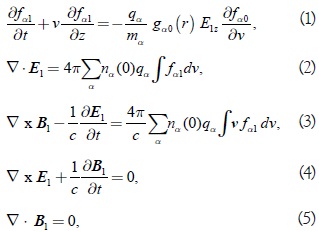
<body><![CDATA[<p><FONT SIZE="2" FACE="Verdana">In this section we describe the physical system and the main assumptions of our model and show the basic equations which leads to the eigenvalue problem which will be solved in the next section. The physical system is a fully ionized plasma composed by electrons and ions inside of an axially infinite metallic cylinder. This plasma is confined in a cylinder of radius <I>a</I> through a strong axial magnetic field. We consider the plasma to be radially inhomogeneous but axially symmetric &#91;7&#93;&#91;13-17&#93;. We consider that the magnitude of the field is such that the cyclotron radius of the particles is much less than the cylinder radius. Therefore, we neglect the transverse motion and restrict the particles motion to the axial direction <I>z</I>. In this case the dynamics of particles of specie &#945; can be described by a distribution function which is one-dimensional in the velocity space of the form: </FONT></p>     <p align="center"><a name="e1"></a><img src="/img/revistas/rium/v10n19/v10n19a17e1.jpg"></p>     <p><FONT SIZE="2" FACE="Verdana"> where <I>v</I> = <I>v<SUB>parall</SUB>&#234;<SUB>z</SUB></I> + <I>v<SUB>perp</SUB></I> is the tridimensional particle velocity with <I>v<SUB>parall</SUB></I> the parallel speed to the magnetic field direction<I> z </I>and <I>v<SUB>perp </SUB></I>the perpendicular velocity to this direction.., In order to simplify our notation in what follows we set <I>v<SUB>parall</SUB></I>&#926; <I>v.</I> </FONT></p>     <p><FONT SIZE="2" FACE="Verdana"> Due to the mass differences between the electrons and ions we consider a range of frequencies that allows neglect the response of the ions and consider only the dielectric response of the electrons. Thus, the role of the ions is neutralizing the total charge of the system. Taking into account all the previous considerations we obtain the linearized Vlasov-Maxwell system of equations which describe the dynamics of this system &#91;18&#93;: </FONT></p>     <p align="center"><a name="e2"></a><img src="/img/revistas/rium/v10n19/v10n19a17e2.jpg"></p>     <p><FONT SIZE="2" FACE="Verdana"> where <I>q<SUB>a</SUB></I> is the electric charge of particles of specie &#945; = <I>electrons, ions,</I> <I>f</I><SUB>&#945;</SUB> = <I>f</I><SUB>&#945; 0</SUB> + <I>f</I><SUB>&#945;1</SUB> is the corresponding distribution function<I> </I>with <I>f</I><SUB>&#945;1 </SUB>&#60;&#60; <I>f</I><SUB>&#945;0</SUB> a small perturbation around the equilibrium distribution function </FONT></p>     <p align="center"><a name="e6"></a><img src="/img/revistas/rium/v10n19/v10n19a17e6.jpg"></p>     <p><FONT SIZE="2" FACE="Verdana"> with <img src="/img/revistas/rium/v10n19/v10n19a17e6a.jpg"> giving the equilibrium radial plasma number density profile <I>n<SUB>&#945</SUB></I>(<I>r</I>) for particles of specie &#945; relative to the number density evaluated at the center of the cylinder <I>n<SUB>&#945;</SUB></I>(0). If the plasma is distributed homogeneously in the cylinder <I>g<SUB>&#945;0</SUB></I>(<I>r</I>) = 1. otherwise <I>g<SUB>&#945;0</SUB></I>(<I>r</I>) is an arbitrary function of the radius <I>r</I>. On the other hand <I>F<SUB>&#945;0</SUB></I>(<I>v</I>) is the Maxwell-Boltzman distribution function for the axial particle velocities. </FONT></p>     <p><FONT SIZE="2" FACE="Verdana"> In Eqs. (1-5) the electromagnetic fields have been linearized as <img src="/img/revistas/rium/v10n19/v10n19a17e7.jpg"> with <I>B</I><SUB>0</SUB> a strong axial equilibrium magnetic field and the electric field as <img src="/img/revistas/rium/v10n19/v10n19a17e8.jpg"> where <I>B</I><SUB>1</SUB> &#60;&#60;, and <I>E</I><SUB>1</SUB> are small perturbations. The strong axial magnetic field promotes that the electrons to move preferentially along the cylinder axis, thus, the Transverse electric modes (TE) which have the electric field confined to the transversal plane are not modified by the plasma presence respect to that structure in a vacuum cylinder. Thus, we restrict our study only to the Transverse Magnetic modes (TM) which are modified by the plasma presence. From the structure of the Eqs. (1-5) is possible to show that all the components of the electromagnetic field in a TM mode can be obtained from the knowledge of only the axial electric field component &#91;19&#93;. Thus, and according to the cylindrical geometry of the system we expand the axial electric field as </FONT></p>     <p align="center"><a name="e9"></a><img src="/img/revistas/rium/v10n19/v10n19a17e9.jpg"></p>     ]]></body>
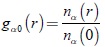
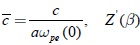
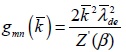
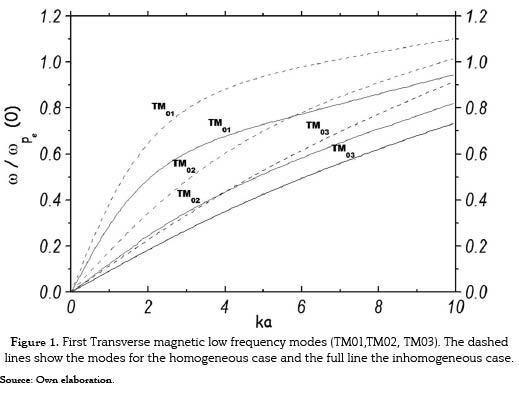
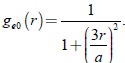
<body><![CDATA[<p><FONT SIZE="2" FACE="Verdana"> where A<SUB>m</SUB><SUP>l(n)</SUP>(k) are the expansion coefficients which define the electric field structure for the transverse magnetic mode TM<I>mn</I> with the indices <I>m,n</I> being the azimutal and radial number respectively. J<SUB>m</SUB>(X) are the Bessel functions of first specie and order <I>m</I>, and <I>P<SUB>ml</SUB></I> is the radial wavenumber which is obtained from the boundary condition J<SUB>m</SUB>(<I>P<SUB>ml</SUB>a</I>) = 0 (perfect conductor at the cylinder walls &#91;19&#93;), thus <I>P<SUB>ml</SUB>a</I> = <I>X<SUB>ml</SUB></I> and <I>X<SUB>ml</SUB></I> are the zeros of the equation J<SUB>m</SUB>(X) = 0. Introducing the above expansion in the Eqs. (1-5) and considering harmonic propagating fields with angular frequency &#969; and axial wavenumber <img src="/img/revistas/rium/v10n19/v10n19a17e10.jpg"> with &#955; the wavelength, we obtain the eigenvalue problem for this system: </FONT></p>     <p align="center"><a name="e6"></a><img src="/img/revistas/rium/v10n19/v10n19a17e11.jpg"></p>     <p><FONT SIZE="2" FACE="Verdana"> where <I>g<SUB>mn</SUB></I>(<I>k</I>) are the eigenvalues, <I>A<SUB>m</SUB><SUP>n</SUP></I>(<I>k</I>) the corresponding eigenvectors and the matrix <I>G<SUB>m</SUB></I>(<I>k,&#969;</I>) is defined in terms of the auxiliar matrix <I>Q<SUB>m</SUB></I>(<I>k,&#969;</I>)&#8211;<I>g<SUB>mn</SUB></I>(<I>k</I>)1. Thus, for each <I>k</I> it is neccessary to find the eigenfrequencies <I>&#969;<SUB>mn</SUB></I>(<I>k</I>) that satisfy the Eq. (8). The elements of the matrix <I>Q<SUB>m</SUB></I>(<I>k,&#969;</I>) are given by </FONT></p>     <p align="center"><a name="e6"></a><img src="/img/revistas/rium/v10n19/v10n19a17e12.jpg"></p>     <p><FONT SIZE="2" FACE="Verdana"> where we have introduced the dimensionless variables <img src="/img/revistas/rium/v10n19/v10n19a17e13.jpg"> the angular frequency normalized by the electrons plasma frequency evaluated at the center of the cylinder, <img src="/img/revistas/rium/v10n19/v10n19a17e14.jpg"> the wavenumber normalized by the cylinder radius, <img src="/img/revistas/rium/v10n19/v10n19a17e15.jpg"> the Debye length for the electrons which depends on the plasma temperture &#91;1&#93;, <img src="/img/revistas/rium/v10n19/v10n19a17e16.jpg"> is the first derivative of the Plasma dispersion function &#91;20&#93;, <img src="/img/revistas/rium/v10n19/v10n19a17e17.jpg"> and the eigenvalues which contain the eigenfrequencies <img src="/img/revistas/rium/v10n19/v10n19a17e18.jpg"> are given by <img src="/img/revistas/rium/v10n19/v10n19a17e19.jpg">. </FONT></p>     <p>&nbsp;</p>     <p><FONT SIZE="3" FACE="Verdana"><B>2. NUMERICAL RESULTS  </B></FONT></p>     <p><FONT SIZE="2" FACE="Verdana">In this section we calculate numerically the eigenfrequencies of the first three modes given by Eq.(8). To achieve this goal we use the numerical method developed by Serizawa &#91;21&#93;. The basis of this method are explained in Appendix. We focus our numerical analysis in the symmetrical modes, i.e, TM<SUB>01</SUB>, TM<SUB>02</SUB>, TM<SUB>03</SUB>.<SUB> </SUB>We use the inhomogeneuous radial density profile for the electrons as <img src="/img/revistas/rium/v10n19/v10n19a17e20.jpg">. This inhomogeneous density profile adjusts well the profile measured in the classic experiment of Malmberg and Wharton &#91;4&#93; in which they studied experimentally the propagation of waves in a long cylinder with a confined plasma on it. The numerical calculations were done with the parameters of the Malmberg and Wharton experiment <img src="/img/revistas/rium/v10n19/v10n19a17e21.jpg">  and we used for the solution of Eq. (9) the numerical methods developed in Refs. &#91;21-22&#93;. For our calculations we selected the size of the matrix Eq.(9) as 15x15. We found numerical differences with the eigenfrequencies obtained with the matrix 14x14 of order 10<SUP>&#8211;5</SUP>. </FONT></p>     <p><FONT SIZE="2" FACE="Verdana"> For each <img src="/img/revistas/rium/v10n19/v10n19a17e23.jpg"> we found the presence of two modal branches <img src="/img/revistas/rium/v10n19/v10n19a17e24.jpg">. One of them is a low frequency mode (<img src="/img/revistas/rium/v10n19/v10n19a17e25.jpg">) while the other one is a high frequency mode <img src="/img/revistas/rium/v10n19/v10n19a17e26.jpg"> In <a href="#f1">Fig. 1</a> we show the numerical results for the first three low and high frequency modes (full line) and we compare the results with those modes arising from a homogeneous plasma, i.e. <I>g<SUB>e0</SUB></I>(<I>r</I>) = 1 (dashed line). We observe from this figure that the low-frequency modes for the inhomogeneous case (full line) are lower than the corresponding ones for the homogeneous case (dashed line). This can be explained taking account that in the inhomogeneous case the effective density across the cylinder decreases respect to the homogeneous case which completely fills the entire cylinder. In addition for small wave-lengths compared with the cylinder radius (<I>ka </I>&#62;&#62; 1) the plasma ignores the boundaries, thus, the behavior must correspond to a not bounded plasma. It is well known that for not bounded plasma case the frequencies of the low frequency waves (electrostatic waves) are proportional to the plasma density &#91;1, 5&#93;. </FONT></p>     <p>&nbsp;</p>     ]]></body>

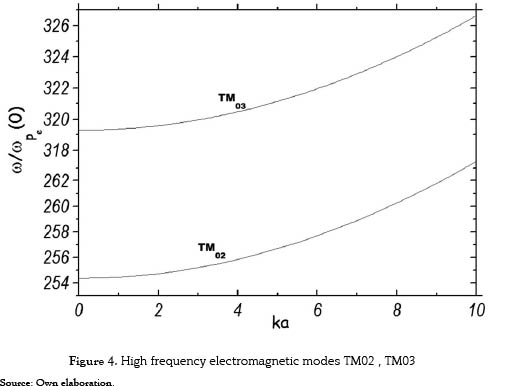
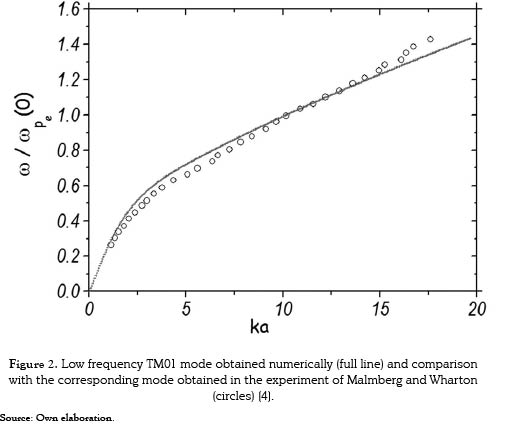
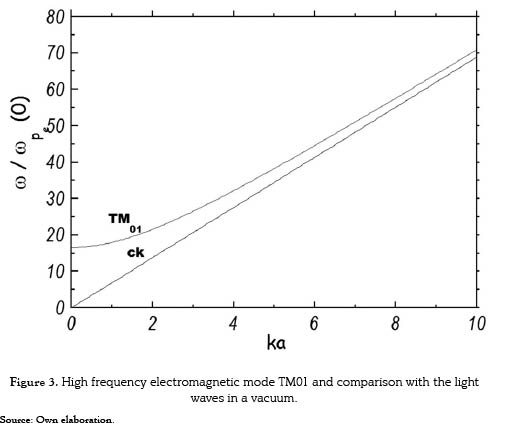
<body><![CDATA[<p align="center"><a name="f1"></a><img src="/img/revistas/rium/v10n19/v10n19a17f1.jpg"></p>     <p>&nbsp;</p>     <p><FONT SIZE="2" FACE="Verdana"> On the other hand, in <a href="#f2">Fig. 2</a> we compare the TM<SUB>01</SUB> low-frequency mode for the inhomogeneous case (full line) with the corresponding results obtained in the Malmberg and Wharton experiment (circles) and we observe a good agreement between the two curves. This is a strong verification of our numerical method and in general of our physical model. </FONT></p>     <p>&nbsp;</p>     <p align="center"><a name="f2"></a><img src="/img/revistas/rium/v10n19/v10n19a17f2.jpg"></p>     <p>&nbsp;</p>     <p><FONT SIZE="2" FACE="Verdana"> In <a href="#f3">Figs 3</a>-<a href="#f4">4</a> we show the same modes than before but now for the high frequency electromagnetic waves. We observe that in all the cases the presence of a cutoff frequency in the limit <I>ka </I>&#8594; 0. For these modes, the waves with frequencies lower than this cutoff are forbidden. In addition in <a href="#f3">Fig. 3</a> we observe that for high frequencies the phase velocity (<img src="/img/revistas/rium/v10n19/v10n19a17e23.jpg">) of the waves tends to the light speed at vacuum. This fact is expected since in this regime of frequencies the waves ignores the plasma presence. </FONT></p>     <p>&nbsp;</p>     <p align="center"><a name="f3"></a><img src="/img/revistas/rium/v10n19/v10n19a17f3.jpg"></p>     <p>&nbsp;</p>     ]]></body>
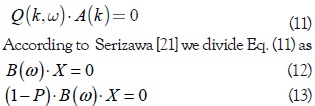
<body><![CDATA[<p align="center"><a name="f4"></a><img src="/img/revistas/rium/v10n19/v10n19a17f4.jpg"></p>     <p>&nbsp;</p>     <p><FONT SIZE="3" FACE="Verdana"><B>3 SUMMARY AND CONCLUSIONS  </B></FONT></p>     <p><FONT SIZE="2" FACE="Verdana">We found numerically the eigenfrequencies of the first symmetrical transverse magnetic modes TM<SUB>0n</SUB> modes in a radially inhomogeneous plasma confined in a cylinder through a strong magnetic field. To describe the dynamics of the system we used the Vlasov-Maxwell system of equations. We expanded the electromagnetic fields in an orthonormal basis which lead to find the eigenvalues of a matrix whose elements depend on the radial density profile, the plasma temperature and the cylinder radius. We solved numerically this eigenvalue problem and we found the presence of two main modal branches. One of these branches is a low-frequency mode with frequencies much lower than the natural plasma frequency <img src="/img/revistas/rium/v10n19/v10n19a17e27.jpg"> and the high frequency mode corresponds to the opposite regime <img src="/img/revistas/rium/v10n19/v10n19a17e28.jpg"> We found that for the high frequency mode the phase speed of the waves tends to the light speed velocity at vacuum. This is reasonable since for this high frequency range the waves ignores the presence of the plasma. We found that for the low frequency mode the plasma inhomogeneity produces a decrease of the frequencies respect to the homogeneous case. This can be explained taking account that for small wavelengths compared with the cylinder radius (<I>ka </I>&#62;&#62; 1) the plasma ignores the boundaries, thus, the behavior must correspond to an infinite plasma medium on which the frequencies of the low frequency waves (electrostatic waves) are proportional to the plasma density. In addition, we compared the numerical results of the first electrostatic mode with experimental measurements and we found a good agreement. This comparison gives validity to our numerical methods and also to the physical model and assumptions. The elements of the matrix Eq. (9) depend on the density an plasma temperature through the electron Debye length. Thus, an experimental measurement of the frequencies of the propagating waves as was done by Malmberg and Wharton can be used as a characterization tool &#91;16&#93;. A precise information of parameters as the temperature and density can be crucial to improve the efficiency of plasma assisted processes which are used in materials technology, for instance, in material hard coating processes. </FONT></p>     <p>&nbsp;</p>     <p><FONT SIZE="3" FACE="Verdana"><B>ACKNOWLEDGMENTS	 </B></FONT></p>     <p><FONT SIZE="2" FACE="Verdana">JH thanks Alfonso Devia and Carlos Diaz for useful physical discussions around this research. JH thanks the hospitality of Laboratorio de F&iacute;sica del Plasma at Universidad Nacional de Colombia, Sede Manizales. This manuscript was elaborated as part of the research shock plan of the University of Medell&iacute;n 2009-2010 and the research project ''Campos Magn&eacute;ticos'' (University of Medellin project Identification Number: 530). </FONT></p>     <p>&nbsp;</p>     <p><FONT SIZE="3" FACE="Verdana"><B>REFERENCES	</B></FONT></p>     <!-- ref --><p><FONT SIZE="2" FACE="Verdana">&#91;1&#93; N. A. Krall, y A. W. Trivelpiece, Principles of Plasma Physics, New York: McGraw-Hill, Inc, 1973, 674 p. </FONT>&nbsp;&nbsp;&nbsp;&nbsp;&nbsp;&nbsp;&nbsp;&nbsp;[&#160;<a href="javascript:void(0);" onclick="javascript: window.open('/scielo.php?script=sci_nlinks&ref=000072&pid=S1692-3324201100020001700001&lng=','','width=640,height=500,resizable=yes,scrollbars=1,menubar=yes,');">Links</a>&#160;]<!-- end-ref --><!-- ref --><p><FONT SIZE="2" FACE="Verdana">&#91;2&#93; S. Ichimaru, Basic Principles of Plasma Physics: A Statistical Approach, Massachusetts: Bejamin Reading, Inc, 1973, 324 p. </FONT>&nbsp;&nbsp;&nbsp;&nbsp;&nbsp;&nbsp;&nbsp;&nbsp;[&#160;<a href="javascript:void(0);" onclick="javascript: window.open('/scielo.php?script=sci_nlinks&ref=000073&pid=S1692-3324201100020001700002&lng=','','width=640,height=500,resizable=yes,scrollbars=1,menubar=yes,');">Links</a>&#160;]<!-- end-ref --><!-- ref --><p><FONT SIZE="2" FACE="Verdana">&#91;3&#93; V. L. Ginzburg, The propagation of Electromagnetic Waves in Plasmas, 2 ed., Oxford, New York: Pergamon Press, 1970, 615 p. </FONT>&nbsp;&nbsp;&nbsp;&nbsp;&nbsp;&nbsp;&nbsp;&nbsp;[&#160;<a href="javascript:void(0);" onclick="javascript: window.open('/scielo.php?script=sci_nlinks&ref=000074&pid=S1692-3324201100020001700003&lng=','','width=640,height=500,resizable=yes,scrollbars=1,menubar=yes,');">Links</a>&#160;]<!-- end-ref --><!-- ref --><p><FONT SIZE="2" FACE="Verdana"> &#91;4&#93; J. H. Malmberg, y C. B. Wharton, ''Dispersion of Electron Plasma Waves,'' Phys.Rev.Letts, vol. 17, no. 4, pp. 175-178, 1966.	</FONT>&nbsp;&nbsp;&nbsp;&nbsp;&nbsp;&nbsp;&nbsp;&nbsp;[&#160;<a href="javascript:void(0);" onclick="javascript: window.open('/scielo.php?script=sci_nlinks&ref=000075&pid=S1692-3324201100020001700004&lng=','','width=640,height=500,resizable=yes,scrollbars=1,menubar=yes,');">Links</a>&#160;]<!-- end-ref --><!-- ref --><p><FONT SIZE="2" FACE="Verdana"> &#91;5&#93; F. M. Aghamir  <I>et al</I>., ''Dispersion Characteristics of a Plasma Column in a Toroidal Waveguide,'' IEEE Transactions on Plasma Science, vol. 39, no. 5, pp. 1204 - 1212, 2010. </FONT>&nbsp;&nbsp;&nbsp;&nbsp;&nbsp;&nbsp;&nbsp;&nbsp;[&#160;<a href="javascript:void(0);" onclick="javascript: window.open('/scielo.php?script=sci_nlinks&ref=000076&pid=S1692-3324201100020001700005&lng=','','width=640,height=500,resizable=yes,scrollbars=1,menubar=yes,');">Links</a>&#160;]<!-- end-ref --><!-- ref --><p><FONT SIZE="2" FACE="Verdana"> &#91;6&#93; P. d. Santis, y G. Franceschetti, ''Dynamic Modes in Open Gyromagnetic Waveguides,'' Journal of Applied Physics, vol. 43, no. 4, pp. 513-515, 1973. </FONT>&nbsp;&nbsp;&nbsp;&nbsp;&nbsp;&nbsp;&nbsp;&nbsp;[&#160;<a href="javascript:void(0);" onclick="javascript: window.open('/scielo.php?script=sci_nlinks&ref=000077&pid=S1692-3324201100020001700006&lng=','','width=640,height=500,resizable=yes,scrollbars=1,menubar=yes,');">Links</a>&#160;]<!-- end-ref --><!-- ref --><p><FONT SIZE="2" FACE="Verdana"> &#91;7&#93; C.-G. Kim, y Y.-D. Jung, ''Electrostatic hybrid resonance modes in semi-bounded magnetized dusty plasmas '' Journal of Physics D: Applied Physics, vol. 39, no. 1, pp. 119, 2006. </FONT>&nbsp;&nbsp;&nbsp;&nbsp;&nbsp;&nbsp;&nbsp;&nbsp;[&#160;<a href="javascript:void(0);" onclick="javascript: window.open('/scielo.php?script=sci_nlinks&ref=000078&pid=S1692-3324201100020001700007&lng=','','width=640,height=500,resizable=yes,scrollbars=1,menubar=yes,');">Links</a>&#160;]<!-- end-ref --><!-- ref --><p><FONT SIZE="2" FACE="Verdana"> &#91;8&#93; M. Shoucri, ''Helicon waves in a cylindrical plasma,'' Canadian Journal of Physics, vol. 77, no. 5, pp. 385-391, 1999. </FONT>&nbsp;&nbsp;&nbsp;&nbsp;&nbsp;&nbsp;&nbsp;&nbsp;[&#160;<a href="javascript:void(0);" onclick="javascript: window.open('/scielo.php?script=sci_nlinks&ref=000079&pid=S1692-3324201100020001700008&lng=','','width=640,height=500,resizable=yes,scrollbars=1,menubar=yes,');">Links</a>&#160;]<!-- end-ref --><!-- ref --><p><FONT SIZE="2" FACE="Verdana"> &#91;9&#93; K.-Z. Zhang, y J.-K. Xue, ''Streaming instability in bounded three-component quantum plasmas,'' Phys. Plasmas, vol. 17, no. 3, 2010. </FONT>&nbsp;&nbsp;&nbsp;&nbsp;&nbsp;&nbsp;&nbsp;&nbsp;[&#160;<a href="javascript:void(0);" onclick="javascript: window.open('/scielo.php?script=sci_nlinks&ref=000080&pid=S1692-3324201100020001700009&lng=','','width=640,height=500,resizable=yes,scrollbars=1,menubar=yes,');">Links</a>&#160;]<!-- end-ref --><!-- ref --><p><FONT SIZE="2" FACE="Verdana"> &#91;10&#93; J. R. Angus  <I>et al</I>., ''Kinetic theory of electromagnetic plane wave obliquely incident on bounded plasma slab,'' Phys. Plasmas, vol. 17, no. 10, 2010. </FONT>&nbsp;&nbsp;&nbsp;&nbsp;&nbsp;&nbsp;&nbsp;&nbsp;[&#160;<a href="javascript:void(0);" onclick="javascript: window.open('/scielo.php?script=sci_nlinks&ref=000081&pid=S1692-3324201100020001700010&lng=','','width=640,height=500,resizable=yes,scrollbars=1,menubar=yes,');">Links</a>&#160;]<!-- end-ref --><!-- ref --><p><FONT SIZE="2" FACE="Verdana"> &#91;11&#93; T-Kim, y M.-J. Lee, ''Dust ion-acoustic surface waves and Landau damping in a semi-bounded Lorentzian plasma,'' Phys. Plasmas, vol. 15, no. 12, 2008. </FONT>&nbsp;&nbsp;&nbsp;&nbsp;&nbsp;&nbsp;&nbsp;&nbsp;[&#160;<a href="javascript:void(0);" onclick="javascript: window.open('/scielo.php?script=sci_nlinks&ref=000082&pid=S1692-3324201100020001700011&lng=','','width=640,height=500,resizable=yes,scrollbars=1,menubar=yes,');">Links</a>&#160;]<!-- end-ref --><!-- ref --><p><FONT SIZE="2" FACE="Verdana"> &#91;12&#93; B. F. Mohamed, y M. A. Aziz, ''Propagation of TE-Surface Waves on Semi-Bounded Quantum Plasma,'' International Journal of Plasma Science and Engineering, &#91;En l&iacute;nea&#93;, vol. 2010, no., Disponible: <a href="http://www.hindawi.com/archive/2010/693049/cta/" target="_blank">http://www.hindawi.com/archive/2010/693049/cta/</a>, 2010. </FONT>&nbsp;&nbsp;&nbsp;&nbsp;&nbsp;&nbsp;&nbsp;&nbsp;[&#160;<a href="javascript:void(0);" onclick="javascript: window.open('/scielo.php?script=sci_nlinks&ref=000083&pid=S1692-3324201100020001700012&lng=','','width=640,height=500,resizable=yes,scrollbars=1,menubar=yes,');">Links</a>&#160;]<!-- end-ref --><!-- ref --><p><FONT SIZE="2" FACE="Verdana"> &#91;13&#93; C. J. Diaz, ''On the Vlasov-Poisson system of equations for an inhomogeneous cylindrical plasma '' Plasma Phys., vol. 23, no. 5, pp. 455-472, 1981. </FONT>&nbsp;&nbsp;&nbsp;&nbsp;&nbsp;&nbsp;&nbsp;&nbsp;[&#160;<a href="javascript:void(0);" onclick="javascript: window.open('/scielo.php?script=sci_nlinks&ref=000084&pid=S1692-3324201100020001700013&lng=','','width=640,height=500,resizable=yes,scrollbars=1,menubar=yes,');">Links</a>&#160;]<!-- end-ref --><!-- ref --><p><FONT SIZE="2" FACE="Verdana"> &#91;14&#93; A. Devia, ''Ondas Electromagn&eacute;ticas en Plasmas cil&iacute;ndricos e Inhomog&eacute;neos,'' tesis de Tesis de maestr&iacute;a, Universidad del Valle, 1983.  </FONT>&nbsp;&nbsp;&nbsp;&nbsp;&nbsp;&nbsp;&nbsp;&nbsp;[&#160;<a href="javascript:void(0);" onclick="javascript: window.open('/scielo.php?script=sci_nlinks&ref=000085&pid=S1692-3324201100020001700014&lng=','','width=640,height=500,resizable=yes,scrollbars=1,menubar=yes,');">Links</a>&#160;]<!-- end-ref --><!-- ref --><p><FONT SIZE="2" FACE="Verdana"> &#91;15&#93; A. Devia  <I>et al</I>., ''Electromagnetic oscilations in cylindrical plasmas with electron beams interactions,'' Astrophysics and Space Science, vol. 256, pp. 321-326, 1997. </FONT>&nbsp;&nbsp;&nbsp;&nbsp;&nbsp;&nbsp;&nbsp;&nbsp;[&#160;<a href="javascript:void(0);" onclick="javascript: window.open('/scielo.php?script=sci_nlinks&ref=000086&pid=S1692-3324201100020001700015&lng=','','width=640,height=500,resizable=yes,scrollbars=1,menubar=yes,');">Links</a>&#160;]<!-- end-ref --><!-- ref --><p><FONT SIZE="2" FACE="Verdana"> &#91;16&#93; J. Hoyos, ''Relaci&oacute;n de dispersi&oacute;n para ondas electromagn&eacute;ticas en un plasma cil&iacute;ndricos,'' tesis de pregrado en F&iacute;sica, Universidad Nacional de Colombia, 2001. </FONT>&nbsp;&nbsp;&nbsp;&nbsp;&nbsp;&nbsp;&nbsp;&nbsp;[&#160;<a href="javascript:void(0);" onclick="javascript: window.open('/scielo.php?script=sci_nlinks&ref=000087&pid=S1692-3324201100020001700016&lng=','','width=640,height=500,resizable=yes,scrollbars=1,menubar=yes,');">Links</a>&#160;]<!-- end-ref --><!-- ref --><p><FONT SIZE="2" FACE="Verdana"> &#91;17&#93; J. Hoyos  <I>et al</I>., ''Transverse Magnetic Modes in a strongly magnetized bounded inhomogeneous plasma,'' presentado en Simposio Chileno de F&iacute;sica, Concepci&oacute;n, 2002. </FONT>&nbsp;&nbsp;&nbsp;&nbsp;&nbsp;&nbsp;&nbsp;&nbsp;[&#160;<a href="javascript:void(0);" onclick="javascript: window.open('/scielo.php?script=sci_nlinks&ref=000088&pid=S1692-3324201100020001700017&lng=','','width=640,height=500,resizable=yes,scrollbars=1,menubar=yes,');">Links</a>&#160;]<!-- end-ref --><!-- ref --><p><FONT SIZE="2" FACE="Verdana"> &#91;18&#93; A. Vlasov, ''On the Kinetic Theory of an Assembly of Particles with Collective Interaction,'' Journal of Physics USSR, vol. 9, no. 1, pp. 25-40, 1945. </FONT>&nbsp;&nbsp;&nbsp;&nbsp;&nbsp;&nbsp;&nbsp;&nbsp;[&#160;<a href="javascript:void(0);" onclick="javascript: window.open('/scielo.php?script=sci_nlinks&ref=000089&pid=S1692-3324201100020001700018&lng=','','width=640,height=500,resizable=yes,scrollbars=1,menubar=yes,');">Links</a>&#160;]<!-- end-ref --><!-- ref --><p><FONT SIZE="2" FACE="Verdana"> &#91;19&#93; J. D. Jackson, Electrodin&aacute;mica Cl&aacute;sica, 2 ed., Madrid: Editorial Alhambra, 1980, 861 p. </FONT>&nbsp;&nbsp;&nbsp;&nbsp;&nbsp;&nbsp;&nbsp;&nbsp;[&#160;<a href="javascript:void(0);" onclick="javascript: window.open('/scielo.php?script=sci_nlinks&ref=000090&pid=S1692-3324201100020001700019&lng=','','width=640,height=500,resizable=yes,scrollbars=1,menubar=yes,');">Links</a>&#160;]<!-- end-ref --><!-- ref --><p><FONT SIZE="2" FACE="Verdana"> &#91;20&#93; B. D. Fried, y S. D. Conte, The Plasma Dispersion Function, New York: Academic Press, 1961, 419 p. </FONT>&nbsp;&nbsp;&nbsp;&nbsp;&nbsp;&nbsp;&nbsp;&nbsp;[&#160;<a href="javascript:void(0);" onclick="javascript: window.open('/scielo.php?script=sci_nlinks&ref=000091&pid=S1692-3324201100020001700020&lng=','','width=640,height=500,resizable=yes,scrollbars=1,menubar=yes,');">Links</a>&#160;]<!-- end-ref --><!-- ref --><p><FONT SIZE="2" FACE="Verdana"> &#91;21&#93; T.Watanabe, y H. Daigaku, Efficient computation of the plasma dispersion function Z, Hiroshima: Institute for Fusion Theory, Hiroshima University, 1979, 14 p. </FONT>&nbsp;&nbsp;&nbsp;&nbsp;&nbsp;&nbsp;&nbsp;&nbsp;[&#160;<a href="javascript:void(0);" onclick="javascript: window.open('/scielo.php?script=sci_nlinks&ref=000092&pid=S1692-3324201100020001700021&lng=','','width=640,height=500,resizable=yes,scrollbars=1,menubar=yes,');">Links</a>&#160;]<!-- end-ref --><!-- ref --><p><FONT SIZE="2" FACE="Verdana"> &#91;22&#93; Y. Serizawa  <I>et al</I>., ''A Numerical Method for Eigenvalue Problems of Integral Equations,'' J. Phys. Soc. Jpn, vol. 52, pp. 28-35, 1983. </FONT>&nbsp;&nbsp;&nbsp;&nbsp;&nbsp;&nbsp;&nbsp;&nbsp;[&#160;<a href="javascript:void(0);" onclick="javascript: window.open('/scielo.php?script=sci_nlinks&ref=000093&pid=S1692-3324201100020001700022&lng=','','width=640,height=500,resizable=yes,scrollbars=1,menubar=yes,');">Links</a>&#160;]<!-- end-ref --><!-- ref --><p><FONT SIZE="2" FACE="Verdana"> &#91;23&#93; G. Tribulato, ''Characterization of a magnetized plasma in cylindrical geometry,'' tesis de maestr&iacute;a en F&iacute;sica, Universidad de Tromso, Noruega, 2007. </FONT>&nbsp;&nbsp;&nbsp;&nbsp;&nbsp;&nbsp;&nbsp;&nbsp;[&#160;<a href="javascript:void(0);" onclick="javascript: window.open('/scielo.php?script=sci_nlinks&ref=000094&pid=S1692-3324201100020001700023&lng=','','width=640,height=500,resizable=yes,scrollbars=1,menubar=yes,');">Links</a>&#160;]<!-- end-ref --><p align="center">&nbsp;</p>     <p align="center">&nbsp;</p>     <p><FONT SIZE="3" FACE="Verdana"><B>APPENDIX. NUMERICAL METHOD </B></FONT></p>     <p><FONT SIZE="2" FACE="Verdana">In this work we solve the eigenvalue problem given by Eq. (9) which can be written as </FONT></p>     <p align="center"><a name="e6"></a><img src="/img/revistas/rium/v10n19/v10n19a17e29.jpg"></p>     <p><FONT SIZE="2" FACE="Verdana"> For each <I>k </I>we need to find the corresponding <I>&#969;</I> <I>(k), </I>these values must satisfy the above equation. Thus, we solve the generic martricial system: </FONT></p>     <p align="center"><a name="e6"></a><img src="/img/revistas/rium/v10n19/v10n19a17e30.jpg"></p>     <p><FONT SIZE="2" FACE="Verdana">where<I> P </I>is a proyection operator of <I>N</I> grade </FONT></p>     ]]></body>
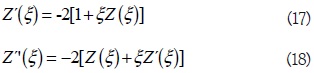
<body><![CDATA[<p><FONT SIZE="2" FACE="Verdana"> To obtain &#969;<I> </I>and <I>X</I> we make a Taylor expansion around given values &#969;<SUB>0 </SUB>and <I>X</I><SUB>0</SUB> as follows </FONT></p>     <p align="center"><FONT SIZE="2" FACE="Verdana"> &#969; = &#969;<SUB>0</SUB> + &#969;<SUB>1</SUB> (14) </FONT></p>     <p align="center"><FONT SIZE="2" FACE="Verdana"> <I>X</I> = <I>X</I><SUB>0</SUB> + <I>X</I><SUB>1</SUB> (15) </FONT></p>     <p><FONT SIZE="2" FACE="Verdana"> The above procedure leads to a matrix system of equations that we solve for &#969; and <I>X.</I> </FONT></p>     <p><FONT SIZE="2" FACE="Verdana"> On the other hand, the eigenvalue problem of Eq. (9) requires the knowledge of the Plasma dispersion Function &#91;20&#93;. This function is defined by </FONT></p>     <p align="center"><a name="e6"></a><img src="/img/revistas/rium/v10n19/v10n19a17e32.jpg"></p>     <p><FONT SIZE="2" FACE="Verdana"> for <I>Im</I>(&#958;) &gt; 0 and can be defined for <I>Im</I>(&#958;) &lt; 0 by analytic continuation. Some useful relations are: </FONT></p>     <p align="center"><a name="e6"></a><img src="/img/revistas/rium/v10n19/v10n19a17e33.jpg"></p>     <p><FONT SIZE="2" FACE="Verdana"> The numerical calculation of Z(&#958;) is based on Ref.(21) where the residue theorem of the complex variable theory is used. </FONT></p>     <p align="center">&nbsp;</p>     ]]></body>
<body><![CDATA[<p align="center">&nbsp;</p>      ]]></body><back>
<ref-list>
<ref id="B1">
<label>[1]</label><nlm-citation citation-type="book">
<person-group person-group-type="author">
<name>
<surname><![CDATA[Krall]]></surname>
<given-names><![CDATA[N. A.]]></given-names>
</name>
<name>
<surname><![CDATA[Trivelpiece]]></surname>
<given-names><![CDATA[A. W.]]></given-names>
</name>
</person-group>
<source><![CDATA[Principles of Plasma Physics]]></source>
<year>1973</year>
<page-range>674</page-range><publisher-loc><![CDATA[New York ]]></publisher-loc>
<publisher-name><![CDATA[McGraw-Hill]]></publisher-name>
</nlm-citation>
</ref>
<ref id="B2">
<label>[2]</label><nlm-citation citation-type="book">
<person-group person-group-type="author">
<name>
<surname><![CDATA[Ichimaru]]></surname>
<given-names><![CDATA[S.]]></given-names>
</name>
</person-group>
<source><![CDATA[Basic Principles of Plasma Physics: A Statistical Approach]]></source>
<year>1973</year>
<page-range>324</page-range><publisher-loc><![CDATA[Massachusetts ]]></publisher-loc>
<publisher-name><![CDATA[Bejamin Reading, Inc]]></publisher-name>
</nlm-citation>
</ref>
<ref id="B3">
<label>[3]</label><nlm-citation citation-type="book">
<person-group person-group-type="author">
<name>
<surname><![CDATA[Ginzburg]]></surname>
<given-names><![CDATA[V. L.]]></given-names>
</name>
</person-group>
<source><![CDATA[The propagation of Electromagnetic Waves in Plasmas]]></source>
<year>1970</year>
<edition>2</edition>
<page-range>615</page-range><publisher-loc><![CDATA[Oxford^eNew York New York]]></publisher-loc>
<publisher-name><![CDATA[Pergamon Press]]></publisher-name>
</nlm-citation>
</ref>
<ref id="B4">
<label>[4]</label><nlm-citation citation-type="journal">
<person-group person-group-type="author">
<name>
<surname><![CDATA[Malmberg]]></surname>
<given-names><![CDATA[J. H.]]></given-names>
</name>
<name>
<surname><![CDATA[Wharton]]></surname>
<given-names><![CDATA[C. B.]]></given-names>
</name>
</person-group>
<article-title xml:lang="en"><![CDATA[Dispersion of Electron Plasma Waves]]></article-title>
<source><![CDATA[Phys.Rev.Letts]]></source>
<year>1966</year>
<volume>17</volume>
<numero>4</numero>
<issue>4</issue>
<page-range>175-178</page-range></nlm-citation>
</ref>
<ref id="B5">
<label>[5]</label><nlm-citation citation-type="journal">
<person-group person-group-type="author">
<name>
<surname><![CDATA[Aghamir]]></surname>
<given-names><![CDATA[F. M.]]></given-names>
</name>
</person-group>
<article-title xml:lang="en"><![CDATA[Dispersion Characteristics of a Plasma Column in a Toroidal Waveguide]]></article-title>
<source><![CDATA[IEEE Transactions on Plasma Science]]></source>
<year>2010</year>
<volume>39</volume>
<numero>5</numero>
<issue>5</issue>
<page-range>1204 - 1212</page-range></nlm-citation>
</ref>
<ref id="B6">
<label>[6]</label><nlm-citation citation-type="journal">
<person-group person-group-type="author">
<name>
<surname><![CDATA[Santis]]></surname>
<given-names><![CDATA[P. d.]]></given-names>
</name>
<name>
<surname><![CDATA[Franceschetti]]></surname>
<given-names><![CDATA[G.]]></given-names>
</name>
</person-group>
<article-title xml:lang="en"><![CDATA[Dynamic Modes in Open Gyromagnetic Waveguides]]></article-title>
<source><![CDATA[Journal of Applied Physics]]></source>
<year>1973</year>
<volume>43</volume>
<numero>4</numero>
<issue>4</issue>
<page-range>513-515</page-range></nlm-citation>
</ref>
<ref id="B7">
<label>[7]</label><nlm-citation citation-type="journal">
<person-group person-group-type="author">
<name>
<surname><![CDATA[Kim]]></surname>
<given-names><![CDATA[C.-G.]]></given-names>
</name>
<name>
<surname><![CDATA[Jung]]></surname>
<given-names><![CDATA[Y.-D.]]></given-names>
</name>
</person-group>
<article-title xml:lang="en"><![CDATA[Electrostatic hybrid resonance modes in semi-bounded magnetized dusty plasmas]]></article-title>
<source><![CDATA[Journal of Physics D: Applied Physics]]></source>
<year>2006</year>
<volume>39</volume>
<numero>1</numero>
<issue>1</issue>
<page-range>119</page-range></nlm-citation>
</ref>
<ref id="B8">
<label>[8]</label><nlm-citation citation-type="journal">
<person-group person-group-type="author">
<name>
<surname><![CDATA[Shoucri]]></surname>
<given-names><![CDATA[M.]]></given-names>
</name>
</person-group>
<article-title xml:lang="en"><![CDATA[Helicon waves in a cylindrical plasma]]></article-title>
<source><![CDATA[Canadian Journal of Physics]]></source>
<year>1999</year>
<volume>77</volume>
<numero>5</numero>
<issue>5</issue>
<page-range>385-391</page-range></nlm-citation>
</ref>
<ref id="B9">
<label>[9]</label><nlm-citation citation-type="journal">
<person-group person-group-type="author">
<name>
<surname><![CDATA[Zhang]]></surname>
<given-names><![CDATA[K.-Z.]]></given-names>
</name>
<name>
<surname><![CDATA[Xue]]></surname>
<given-names><![CDATA[J.-K.]]></given-names>
</name>
</person-group>
<article-title xml:lang="en"><![CDATA[''Streaming instability in bounded three-component quantum plasmas,'']]></article-title>
<source><![CDATA[Phys. Plasmas]]></source>
<year>2010</year>
<volume>17</volume>
<numero>3</numero>
<issue>3</issue>
</nlm-citation>
</ref>
<ref id="B10">
<label>[10]</label><nlm-citation citation-type="journal">
<person-group person-group-type="author">
<name>
<surname><![CDATA[Angus]]></surname>
<given-names><![CDATA[J. R.]]></given-names>
</name>
</person-group>
<article-title xml:lang="en"><![CDATA[''Kinetic theory of electromagnetic plane wave obliquely incident on bounded plasma slab,'']]></article-title>
<source><![CDATA[Phys. Plasmas]]></source>
<year>2010</year>
<volume>17</volume>
<numero>10</numero>
<issue>10</issue>
</nlm-citation>
</ref>
<ref id="B11">
<label>[11]</label><nlm-citation citation-type="journal">
<person-group person-group-type="author">
<name>
<surname><![CDATA[Kim]]></surname>
<given-names><![CDATA[T]]></given-names>
</name>
<name>
<surname><![CDATA[Lee]]></surname>
<given-names><![CDATA[M.-J.]]></given-names>
</name>
</person-group>
<article-title xml:lang="en"><![CDATA[''Dust ion-acoustic surface waves and Landau damping in a semi-bounded Lorentzian plasma,'']]></article-title>
<source><![CDATA[Phys. Plasmas]]></source>
<year>2008</year>
<volume>15</volume>
<numero>12</numero>
<issue>12</issue>
</nlm-citation>
</ref>
<ref id="B12">
<label>[12]</label><nlm-citation citation-type="">
<person-group person-group-type="author">
<name>
<surname><![CDATA[Mohamed]]></surname>
<given-names><![CDATA[B. F.]]></given-names>
</name>
<name>
<surname><![CDATA[Aziz]]></surname>
<given-names><![CDATA[M. A.]]></given-names>
</name>
</person-group>
<source><![CDATA[''Propagation of TE-Surface Waves on Semi-Bounded Quantum Plasma,'']]></source>
<year>2010</year>
<volume>2010</volume>
</nlm-citation>
</ref>
<ref id="B13">
<label>[13]</label><nlm-citation citation-type="journal">
<person-group person-group-type="author">
<name>
<surname><![CDATA[Diaz]]></surname>
<given-names><![CDATA[C. J.]]></given-names>
</name>
</person-group>
<article-title xml:lang="en"><![CDATA[On the Vlasov-Poisson system of equations for an inhomogeneous cylindrical plasma]]></article-title>
<source><![CDATA[Plasma Phys.]]></source>
<year>1981</year>
<volume>23</volume>
<numero>5</numero>
<issue>5</issue>
<page-range>455-472</page-range></nlm-citation>
</ref>
<ref id="B14">
<label>[14]</label><nlm-citation citation-type="">
<person-group person-group-type="author">
<name>
<surname><![CDATA[Devia]]></surname>
<given-names><![CDATA[A.]]></given-names>
</name>
</person-group>
<source><![CDATA[''Ondas Electromagnéticas en Plasmas cilíndricos e Inhomogéneos,'']]></source>
<year></year>
</nlm-citation>
</ref>
<ref id="B15">
<label>[15]</label><nlm-citation citation-type="journal">
<person-group person-group-type="author">
<name>
<surname><![CDATA[Devia]]></surname>
<given-names><![CDATA[A.]]></given-names>
</name>
</person-group>
<article-title xml:lang="en"><![CDATA[''Electromagnetic oscilations in cylindrical plasmas with electron beams interactions,'']]></article-title>
<source><![CDATA[Astrophysics and Space Science]]></source>
<year>1997</year>
<volume>256</volume>
<page-range>321-326</page-range></nlm-citation>
</ref>
<ref id="B16">
<label>[16]</label><nlm-citation citation-type="">
<person-group person-group-type="author">
<name>
<surname><![CDATA[Hoyos]]></surname>
<given-names><![CDATA[J.]]></given-names>
</name>
</person-group>
<source><![CDATA[''Relación de dispersión para ondas electromagnéticas en un plasma cilíndricos,'']]></source>
<year></year>
</nlm-citation>
</ref>
<ref id="B17">
<label>[17]</label><nlm-citation citation-type="">
<person-group person-group-type="author">
<name>
<surname><![CDATA[Hoyos]]></surname>
<given-names><![CDATA[J.]]></given-names>
</name>
</person-group>
<source><![CDATA[''Transverse Magnetic Modes in a strongly magnetized bounded inhomogeneous plasma,'']]></source>
<year>2002</year>
</nlm-citation>
</ref>
<ref id="B18">
<label>[18]</label><nlm-citation citation-type="journal">
<person-group person-group-type="author">
<name>
<surname><![CDATA[Vlasov]]></surname>
<given-names><![CDATA[A.]]></given-names>
</name>
</person-group>
<article-title xml:lang="en"><![CDATA[On the Kinetic Theory of an Assembly of Particles with Collective Interaction]]></article-title>
<source><![CDATA[Journal of Physics USSR]]></source>
<year>1945</year>
<volume>9</volume>
<numero>1</numero>
<issue>1</issue>
<page-range>25-40</page-range></nlm-citation>
</ref>
<ref id="B19">
<label>[19]</label><nlm-citation citation-type="book">
<person-group person-group-type="author">
<name>
<surname><![CDATA[Jackson]]></surname>
<given-names><![CDATA[J. D.]]></given-names>
</name>
</person-group>
<source><![CDATA[Electrodinámica Clásica]]></source>
<year>1980</year>
<edition>2</edition>
<page-range>861</page-range><publisher-loc><![CDATA[Madrid ]]></publisher-loc>
<publisher-name><![CDATA[Editorial Alhambra]]></publisher-name>
</nlm-citation>
</ref>
<ref id="B20">
<label>[20]</label><nlm-citation citation-type="book">
<person-group person-group-type="author">
<name>
<surname><![CDATA[Fried]]></surname>
<given-names><![CDATA[B. D.]]></given-names>
</name>
<name>
<surname><![CDATA[Conte]]></surname>
<given-names><![CDATA[S. D.]]></given-names>
</name>
</person-group>
<source><![CDATA[The Plasma Dispersion Function]]></source>
<year>1961</year>
<page-range>419</page-range><publisher-loc><![CDATA[New York ]]></publisher-loc>
<publisher-name><![CDATA[Academic Press]]></publisher-name>
</nlm-citation>
</ref>
<ref id="B21">
<label>[21]</label><nlm-citation citation-type="book">
<person-group person-group-type="author">
<name>
<surname><![CDATA[Watanabe]]></surname>
<given-names><![CDATA[T.]]></given-names>
</name>
<name>
<surname><![CDATA[Daigaku]]></surname>
<given-names><![CDATA[H.]]></given-names>
</name>
</person-group>
<source><![CDATA[Efficient computation of the plasma dispersion function Z]]></source>
<year>1979</year>
<page-range>14</page-range><publisher-loc><![CDATA[Hiroshima ]]></publisher-loc>
<publisher-name><![CDATA[Institute for Fusion Theory, Hiroshima University]]></publisher-name>
</nlm-citation>
</ref>
<ref id="B22">
<label>[22]</label><nlm-citation citation-type="journal">
<person-group person-group-type="author">
<name>
<surname><![CDATA[Serizawa]]></surname>
<given-names><![CDATA[Y.]]></given-names>
</name>
</person-group>
<article-title xml:lang="en"><![CDATA[''A Numerical Method for Eigenvalue Problems of Integral Equations,'']]></article-title>
<source><![CDATA[J. Phys. Soc. Jpn]]></source>
<year>1983</year>
<volume>52</volume>
<page-range>28-35</page-range></nlm-citation>
</ref>
<ref id="B23">
<label>[23]</label><nlm-citation citation-type="">
<person-group person-group-type="author">
<name>
<surname><![CDATA[Tribulato]]></surname>
<given-names><![CDATA[G.]]></given-names>
</name>
</person-group>
<source><![CDATA[''Characterization of a magnetized plasma in cylindrical geometry,'']]></source>
<year></year>
</nlm-citation>
</ref>
</ref-list>
</back>
</article>