<?xml version="1.0" encoding="ISO-8859-1"?><article xmlns:mml="http://www.w3.org/1998/Math/MathML" xmlns:xlink="http://www.w3.org/1999/xlink" xmlns:xsi="http://www.w3.org/2001/XMLSchema-instance">
<front>
<journal-meta>
<journal-id>1794-9165</journal-id>
<journal-title><![CDATA[Ingeniería y Ciencia]]></journal-title>
<abbrev-journal-title><![CDATA[ing.cienc.]]></abbrev-journal-title>
<issn>1794-9165</issn>
<publisher>
<publisher-name><![CDATA[Escuela de Ciencias y Humanidades y Escuela de Ingeniería de la Universidad EAFIT]]></publisher-name>
</publisher>
</journal-meta>
<article-meta>
<article-id>S1794-91652010000200002</article-id>
<title-group>
<article-title xml:lang="en"><![CDATA[A simple proof of Abel's theorem on the lemniscate]]></article-title>
<article-title xml:lang="pt"><![CDATA[Uma prova simples do teorema de Abel sobre a lemniscata]]></article-title>
<article-title xml:lang="es"><![CDATA[Demostración simple del teorema de Abel sobre la lemniscata]]></article-title>
</title-group>
<contrib-group>
<contrib contrib-type="author">
<name>
<surname><![CDATA[Solanilla]]></surname>
<given-names><![CDATA[Leonardo]]></given-names>
</name>
<xref ref-type="aff" rid="A01"/>
</contrib>
<contrib contrib-type="author">
<name>
<surname><![CDATA[Palacio]]></surname>
<given-names><![CDATA[Óscar]]></given-names>
</name>
<xref ref-type="aff" rid="A02"/>
</contrib>
<contrib contrib-type="author">
<name>
<surname><![CDATA[Hernández]]></surname>
<given-names><![CDATA[Uriel]]></given-names>
</name>
<xref ref-type="aff" rid="A03"/>
</contrib>
</contrib-group>
<aff id="A01">
<institution><![CDATA[,Universidad del Tolima  ]]></institution>
<addr-line><![CDATA[Ibagué ]]></addr-line>
<country>Colombia</country>
</aff>
<aff id="A02">
<institution><![CDATA[,Universidad del Tolima  ]]></institution>
<addr-line><![CDATA[Ibagué ]]></addr-line>
<country>Colombia</country>
</aff>
<aff id="A03">
<institution><![CDATA[,Universidad del Tolima  ]]></institution>
<addr-line><![CDATA[Ibagué ]]></addr-line>
<country>Colombia</country>
</aff>
<pub-date pub-type="pub">
<day>00</day>
<month>06</month>
<year>2010</year>
</pub-date>
<pub-date pub-type="epub">
<day>00</day>
<month>06</month>
<year>2010</year>
</pub-date>
<volume>6</volume>
<numero>12</numero>
<fpage>43</fpage>
<lpage>49</lpage>
<copyright-statement/>
<copyright-year/>
<self-uri xlink:href="http://www.scielo.org.co/scielo.php?script=sci_arttext&amp;pid=S1794-91652010000200002&amp;lng=en&amp;nrm=iso"></self-uri><self-uri xlink:href="http://www.scielo.org.co/scielo.php?script=sci_abstract&amp;pid=S1794-91652010000200002&amp;lng=en&amp;nrm=iso"></self-uri><self-uri xlink:href="http://www.scielo.org.co/scielo.php?script=sci_pdf&amp;pid=S1794-91652010000200002&amp;lng=en&amp;nrm=iso"></self-uri><abstract abstract-type="short" xml:lang="en"><p><![CDATA[Since Abel's original paper of 1827, his remarkable theorem on the constructibility of the lemniscate splitting has been proven with the aid of Elliptic Functions. Nowadays, Rosen's proof of 1981 is considered definitive. He also makes use of (modern and more elaborate) Class Field Theory.Here we present a novel, short and simple proof of Abel's Theorem on the lemniscate and its converse. Our only ingredients are the addition formulas of Gauss lemniscatic functions and some basic facts of Galois Theory.]]></p></abstract>
<abstract abstract-type="short" xml:lang="pt"><p><![CDATA[Desde o artigo original de Abel em 1827, seu notável teorema sobre a construtibilidade da divisão da lemniscata tem sido provado com ajuda das funções elípticas. Hoje, a prova de Rosen (1981) é considerada definitiva. Ele também faz uso da moderna e mais elaborada teoría dos corpos de classes. Neste trabalho, nós apresentamos uma prova nova, curta e simples do Teorema de Abel sobre a lemniscata e seu recíproco. Nossos ingredientes são apenas as fórmulas de adição das funções lemniscáticas de Gauss e alguns fatos básicos da teoría de Galois.]]></p></abstract>
<abstract abstract-type="short" xml:lang="es"><p><![CDATA[Desde la publicación original de Abel en 1827, su notable teorema sobre la constructibilidad de la división de la lemniscata se ha demostrado con ayuda de la teoría de las funciones elípticas. La prueba dada por Rosen en 1981 se considera, hoy por hoy, como definitiva. En ella se utiliza, además, la moderna e intrincada Class Field Theory. Aquí se presenta una demostración nueva, corta y simple del teorema de Abel para la lemniscata junto con su recíproco. Las únicas herramientas son las propiedades aditivas de las funciones lemniscáticas de Gauss y algunos elementos de teoría de Galois.]]></p></abstract>
<kwd-group>
<kwd lng="en"><![CDATA[Abel's theorem on the lemniscate]]></kwd>
<kwd lng="en"><![CDATA[Gauss lemniscatic functions]]></kwd>
<kwd lng="en"><![CDATA[geometric constructions]]></kwd>
<kwd lng="pt"><![CDATA[teorema de Abel sobre a lemniscata]]></kwd>
<kwd lng="pt"><![CDATA[funções lemniscáticas de Gauss]]></kwd>
<kwd lng="pt"><![CDATA[construções geométricas]]></kwd>
<kwd lng="es"><![CDATA[teorema de Abel sobre la lemniscata]]></kwd>
<kwd lng="es"><![CDATA[funciones lemniscáticas de Gauss]]></kwd>
<kwd lng="es"><![CDATA[construcciones geométricas]]></kwd>
</kwd-group>
</article-meta>
</front><body><![CDATA[ <p align="center"><font face="Verdana, Arial, Helvetica, sans-serif" size="4"><b>A simple proof  of  Abel's theorem on  the  lemniscate </b></font></p>     <p align="center"><font face="Verdana, Arial, Helvetica, sans-serif" size="3"><b>Uma prova simples do  teorema de  Abel sobre a lemniscata</b></font></p>    <p align="center"><font face="Verdana, Arial, Helvetica, sans-serif" size="3"><b>Demostraci&oacute;n simple del teorema de  Abel sobre la lemniscata</b></font></p>     <p align="center"> </p>     <p><font face="Verdana, Arial, Helvetica, sans-serif" size="2">Leonardo Solanilla<sup>1</sup>, &Oacute;scar Palacio<sup>2</sup>y  UrielHern&aacute;ndez<sup>3</sup> </font></p>     <p><font face="Verdana, Arial, Helvetica, sans-serif" size="2">1 Doctor en Matem&aacute;ticas, <a href="mailto:leonsolc@ut.edu.co">leonsolc@ut.edu.co</a>, profesor, Universidad del Tolima, Ibagu&eacute;- Colombia. </font></p>     <p><font face="Verdana, Arial, Helvetica, sans-serif" size="2"> 2 Profesional  en Matem&aacute;ticas con &eacute;nfasis en Estad&iacute;stica, <a href="mailto:tikomania86@hotmail.com">tikomania86@hotmail.com</a>, estudiantede Especializaci&oacute;nen Matem&aacute;ticas, Universidad del Tolima, Ibagu&eacute;-Colombia. </font></p>     <p><font face="Verdana, Arial, Helvetica, sans-serif" size="2">3 Profesional en Matem&aacute;ticas con &eacute;nfasis en Estad&iacute;stica, <a href="mailto:uriel501@hotmail.com">uriel501@hotmail.com</a>, estudian   te de pregrado, Universidad del Tolima, Ibagu&eacute;-Colombia.</font></p>     <p><font face="Verdana, Arial, Helvetica, sans-serif" size="2">(Recepci&oacute;n: 27-feb-2010. Modificaci&oacute;n: 19-oct-2010. Aceptaci&oacute;n: 06-dic-2010) </font></p> <hr size="1" />     <p> </p>     ]]></body>
<body><![CDATA[<p><font face="Verdana, Arial, Helvetica, sans-serif" size="2"><b>Abstract  </b></font></p>       <p><font face="Verdana, Arial, Helvetica, sans-serif" size="2">Since Abel's original  paper of 1827, his remarkable theorem on the constructibility of the lemniscate splitting has been proven with the aid of Elliptic Functions. Nowadays, Rosen's proof of 1981 is considered definitive. He also makes use of (modern and more elaborate) Class Field Theory.Here we present a novel, short and simple proof of Abel's Theorem on the lemniscate and its converse. Our only ingredients are the addition formulas of Gauss lemniscatic functions and some basic facts of Galois Theory.</font></p>       <p><font face="Verdana, Arial, Helvetica, sans-serif" size="2"><b>Key words</b>:Abel's theorem on the lemniscate, Gauss lemniscatic functions, geometric constructions</font></p>   <hr size="1" />       <p>&nbsp;</p>       <p><font face="Verdana, Arial, Helvetica, sans-serif" size="2"><b>Resumo  </b></font></p>       <p><font face="Verdana, Arial, Helvetica, sans-serif" size="2">Desde o artigo original de Abel em 1827, seu not&aacute;vel teorema sobre a construtibilidade da divis&atilde;o da lemniscata tem sido provado com  ajuda das fun&ccedil;&otilde;es el&iacute;pticas. Hoje, a prova de Rosen (1981) &eacute; considerada definitiva. Ele tamb&eacute;m faz uso da moderna e mais elaborada teor&iacute;a dos corpos de classes. Neste trabalho, n&oacute;s apresentamos uma prova nova, curta e simples do Teorema de Abel sobre a lemniscata e seu rec&iacute;proco.  Nossos ingredientes s&atilde;o apenas as f&oacute;rmulas de adi&ccedil;&atilde;o das fun&ccedil;&otilde;es lemnisc&aacute;ticas de Gauss e alguns fatos b&aacute;sicos da teor&iacute;a de Galois.     </font></p>       <p><font face="Verdana, Arial, Helvetica, sans-serif" size="2"><b>Palavras chaves</b>:  teorema de Abel sobre a lemniscata, fun&ccedil;&otilde;es lemnisc&aacute;ticas de Gauss, constru&ccedil;&otilde;es geom&eacute;tricas.</font></p>   <hr size="1" />       <p> </p>       <p><font face="Verdana, Arial, Helvetica, sans-serif" size="2"><b>Resumen  </b></font></p>       <p><font face="Verdana, Arial, Helvetica, sans-serif" size="2">Desde  la publicaci&oacute;n original de Abel en 1827, su notable teorema sobre la constructibilidad de la divisi&oacute;n de la lemniscata se ha demostrado con ayuda de la teor&iacute;a de las funciones el&iacute;pticas. La prueba dada por Rosen en 1981 se considera, hoy por hoy, como definitiva. En ella se utiliza, adem&aacute;s, la moderna e intrincada Class Field Theory. Aqu&iacute; se presenta una demostraci&oacute;n nueva, corta     y simple del teorema de Abel para la lemniscata junto con  su rec&iacute;proco.  Las &uacute;nicas herramientas son las propiedades aditivas de las funciones lemnisc&aacute;ticas de Gauss y algunos elementos de teor&iacute;a de Galois.   </font></p>       ]]></body>
<body><![CDATA[<p><font face="Verdana, Arial, Helvetica, sans-serif" size="2"><b>Palabras  claves</b>: teorema de Abel sobre la lemniscata, funciones lemnisc&aacute;ticas de Gauss, construcciones geom&eacute;tricas.</font></p>       <p>&nbsp;</p>   <hr size="1" />     <p> </p>     <p> </p>     <p><font face="Verdana, Arial, Helvetica, sans-serif" size="3"><b>1 Introduction</b></font></p>     <p><font face="Verdana, Arial, Helvetica, sans-serif" size="2">In 1801, Gauss &#91;1, section 7&#93; proved his celebrated theorem on the construction    of the regular polygons by using the trigonometric  or circular functions.  He also announced  that the theory applies  to a wider  class of transcendental functions including the lemniscatic arc length. Some years later, Abel &#91;2, pp.    361-362&#93; showed indeed clearly his famous theorem.  More recently, Rosen &#91;3,    p. 388&#93; has claimed  to be the first of having the converse of Abel's theorem appeared in print. In what follows,  we prove comprenhensively the theorem and its converse from very elementary facts. Our proof improves substantially the technique employed by Hern&aacute;ndez and Palacio &#91;4, chapter 4&#93;. </font></p>     <p><font face="Verdana, Arial, Helvetica, sans-serif" size="2"><b>Theorem 1.1.</b>  <em>The lemniscate can be divided into </em>n <em>e</em><em>q</em><em>u</em><em>a</em><em>l</em><em> a</em><em>r</em><em>c</em><em>s </em><em>b</em><em>y </em><em>m</em><em>e</em><em>a</em><em>n</em><em>s </em><em>o</em><em>f</em><em> a </em><em>c</em><em>o</em><em>m</em><em>p</em><em>a</em><em>ss</em><em> and an unmarked straightedge if and only if </em>n = 2<sup>k</sup>p<sub>1</sub>p<sub>2</sub>&middot; &middot; &middot; p<sub>t</sub><em>,where the <img src="/img/revistas/ince/v6n12/a02g1.jpg" /> are distinct Fermat primes.</em></font></p>     <p><font face="Verdana, Arial, Helvetica, sans-serif" size="2">In section 2 we define the lemniscate, discuss its arc length and recast the lemniscatic functions to fit the later work.  In section 3 we give our proof of the  "if " part of theorem 1.1 by examining the Galois group of a suitable extension  of Q(i).Section  4 is devoted  to the  "only  if " part of the theorem.At the end  we draw  some  conclusions  regarding the  possibility of generalizing the procedure to a whole class of curves comprising the circle and the lemniscate. </font></p>     <p> </p>     <p><font face="Verdana, Arial, Helvetica, sans-serif" size="3"><b>2 Gauss lemniscatic functions</b></font></p>     ]]></body>
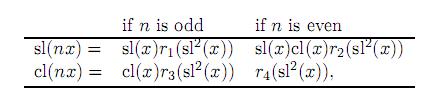
<body><![CDATA[<p><font face="Verdana, Arial, Helvetica, sans-serif" size="2">Here, the  lemniscate is the  locus  L of points  (<i>x, y</i>)  in the  plane  satisfying the  equation (x<sup>2</sup> + y<sup>2</sup>)<sup>2</sup>= x<sup>2</sup>&minus; y<sup>2</sup>.  In polar coordinates (<i>r</i>, &theta;),  the  equation becomes <i>r</i><sup>2</sup>= cos 2&theta; and its arc length is given by the function </font></p>     <p align="center"><img src="/img/revistas/ince/v6n12/a02g2.jpg" /></p>     <p><font face="Verdana, Arial, Helvetica, sans-serif" size="2">The lemniscatic sine sl(<i>x</i>) is the odd function resulting from extending arcsl<sup>-1 </sup>to the real line in such a way it is periodic with period <img src="/img/revistas/ince/v6n12/a02g3.jpg" />     The lemniscatic cosine is cl(x) = sl </font>   <img src="/img/revistas/ince/v6n12/a02g4.jpg" />.</p>     <p><font face="Verdana, Arial, Helvetica, sans-serif" size="2">The most important properties of the lemniscatic functions are their addition formulas </font></p>     <p align="center"><img src="/img/revistas/ince/v6n12/a02g5.jpg" /></p>     <p><font face="Verdana, Arial, Helvetica, sans-serif" size="2">By induction on n &isin; Z<sup>+</sup>, </font></p>     <p align="center"><img src="/img/revistas/ince/v6n12/a02g6.jpg" /></p>     <p><font face="Verdana, Arial, Helvetica, sans-serif" size="2">where <i>r</i><sub>1</sub>, <i>r</i><sub>2</sub>,<i> r</i><sub>3</sub>, <i>r</i><sub>4</sub> stand for rational functions in one in determinate with integer coefficients. </font></p>     <p><font face="Verdana, Arial, Helvetica, sans-serif" size="2">The Pythagorean-like identity </font></p>    <p align="center"><img src="/img/revistas/ince/v6n12/a02g7.jpg" /></p>     ]]></body>



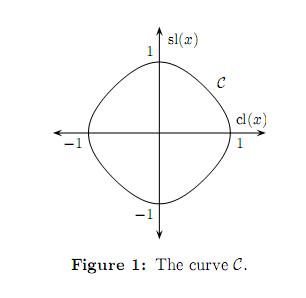
<body><![CDATA[<p><font face="Verdana, Arial, Helvetica, sans-serif" size="2">can be visualized as the image C of the map <i>x</i> 7&rarr; cl(<i>x</i>), sl(<i>x</i>)  . <a href="#f1">Figure 1</a> shows a sketch of this curve. C possesses a canonical group structure isomorphic to </font></p>     <p align="center"><img src="/img/revistas/ince/v6n12/a02f1.jpg" /></p>     <p><font face="Verdana, Arial, Helvetica, sans-serif" size="2">the quotient <img src="/img/revistas/ince/v6n12/a02g8.jpg" /> of the additive group R into the subgroup generated by <img src="/img/revistas/ince/v6n12/a02g9.jpg" />. </font></p>     <p><font face="Verdana, Arial, Helvetica, sans-serif" size="2">Since every point (sl(<i>x</i>), cl(<i>x</i>)) &isin; <i>C</i> determines clearly a (<i>x, y</i>) &isin; L and the </font><font face="Verdana, Arial, Helvetica, sans-serif" size="2">critical point of the lemniscate introduces no confusion,we may use C to split</font><font face="Verdana, Arial, Helvetica, sans-serif" size="2"><img src="file:///E|/Documents and Settings/And/Datos de programa/Macromedia/Dreamweaver 8/OfficeImageTemp/clip_image002_0008.gif" />  the lemniscate L.  For a fixed positive integer n, our problem is then equivalent </font>   <font face="Verdana, Arial, Helvetica, sans-serif" size="2">to the constructibility of the division points &gamma;<sub>k</sub> =cl <img src="/img/revistas/ince/v6n12/a02g10.jpg" /> &isin; <i>C</i>, <i>k</i> = 0, 1,...,n &minus;1.The addition formulas (1) provide &Gamma;<sub>n</sub>= <img src="/img/revistas/ince/v6n12/a02g11.jpg" s} /> with a natural   </div>  <i>k</i> = 0 group structure isomorphicto Z<sub>n</sub>. Writing shortly cl(<i>x</i>) + <i>i</i>sl(<i>x</i>) = <i>z</i>(<i>x</i>),the  elements of &Gamma;<sub>n</sub> are just the solutions to the equation <i>r</i>(<i>z</i>(<i>x</i>)) = <i>z</i>(<i>nx)</i> = 1. </font></p>     <p> </p>     <p><font face="Verdana, Arial, Helvetica, sans-serif" size="3"><b>3 Extending Q(<i>i</i>) </b></font></p>       <p><font face="Verdana, Arial, Helvetica, sans-serif" size="2">The extension field L<sub>n</sub>= Q(<i>i</i>)(&Gamma;<sub>n</sub>) is Galois over Q(i). Certainly, &Gamma;<sub>n</sub> is finite and so, L<sub>n</sub> is algebraic and finite dimensional.  As Q(i) has characteristic 0, <i>L<sub>n</sub></i>        is separable. Also, if &sigma; is a Q(i)-automorphism of C and &gamma;<sub>k</sub>= &alpha;<sub>k</sub>+ <i>i</i>&beta;<sub>k</sub> &isin; &Gamma;<sub>n</sub>, then <i>r</i>(&sigma;(&alpha;<sub><i>k</i></sub>) + <i>i</i>&sigma;(&beta;<i><sub>k</sub></i>)) =  &sigma;(<i>r</i>(&alpha;<i><sub>k</sub></i> + <i>i</i>&beta;<i><sub>k</sub></i>)) =  1.Therefore,  the  equivalence relation </font></p>       <p align="center"><img src="/img/revistas/ince/v6n12/a02g12.jpg" /></p>       <p><font face="Verdana, Arial, Helvetica, sans-serif" size="2">partitions &Gamma;<i><sub>n</sub></i> into classes of elements sharing the same irreducible polynomial over Q(<i>i</i>). Since <i>L<sub>n</sub></i> is the splitting field of the product of these polynomials,  it is normal. </font></p>       <p><font face="Verdana, Arial, Helvetica, sans-serif" size="2">Furthermore, the  Galois  group Gal<sub><i>Q</i>(<i>i</i>)</sub><i>L<sub>n</sub></i>= <i>G<sub>n</sub></i> is isomorphic to a subgroup of the  multiplicative group <i>U<sub>n</sub></i> of units  of <i>Z<sub>n</sub></i>.Actually,  the  action  of <i>G<sub>n</sub></i> on &Gamma;<sub><i>n</i></sub> defined  by &sigma;(&gamma;<i><sub>k</sub></i>)  is a bijection for  each  fixed  &sigma;, which  preserves  the  group structure  on &Gamma;<sub>n</sub>.  That is,  there is a group homomorphism  Gn &rarr;Aut(&Gamma;<sub>n</sub>)  &cong;   Aut(Zn) &cong; Un. Since <i>L<sub>n</sub></i> isalgebraic, this homomorphism  is onto. </font></p>       ]]></body>

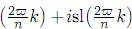
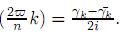
<body><![CDATA[<p><font face="Verdana, Arial, Helvetica, sans-serif" size="2">Now, the order of Un equals the value of Euler's &phi;-function at <i>n</i>. Thus, if        <i>n</i>=2<i><sup>k</sup></i><i>p</i><sub>1</sub><i>p</i><sub>2</sub>&middot;&middot;&middot; <i>p<sub>t</sub></i> with different Fermat primes <i>p<sub>i</sub></i>, 1 &#8806; <i>i</i> &#8806; <i>t</i>, a simple number-theory calculation  shows  the  order of <i>U<sub>n</sub></i> is a power of two. As  a result  of Lagrange's  theorem  and  basic  Galois  theory,  &#91;<i>L<sub>n</sub></i>:  Q(i)&#93; is also a power of two.  Hence, the elements of &Gamma;<sub>n </sub>are constructible. A convenient reference for this  material  is the  fifteenth  chapter  of Hungerford's book &#91;5&#93;. So,  we have proved  Abel's theorem: if <i>n</i> has the given  form, then  the lemniscate  can  be split into <i>n</i> equal parts with ruler and compass. </font></p>       <p> </p>       <p><font face="Verdana, Arial, Helvetica, sans-serif" size="3"><b>4 Converse</b></font></p>       <p><font face="Verdana, Arial, Helvetica, sans-serif" size="2">We must elucidate the field structure of <i>L<sub>n</sub></i>.  To begin, let us consider the orbits        &#91;<i>k</i>&#93; of the action <i>U<sub>n</sub></i> &times; <i>Z<sub>n</sub></i> &rarr; <i>Z<sub>n</sub></i>, (<i>u, k</i>) 7 &rarr; <i>uk</i>. We claim that <i>&gamma;<sub>k</sub></i> &sim; <i>&gamma;<sub>l</sub></i> &hArr; &#91;<i>k</i>&#93; = &#91;<i>l</i>&#93;. The implication  "&rArr;" has been already proved: if <i>&gamma;<sub>k</sub> </i>&sim; <i>&gamma;<sub>l</sub></i>, there is a <i>u</i> &isin; <i>U<sub>n</sub></i> such  that <i>l</i>  = <i>uk</i>,  i.e., &#91;<i>k</i>&#93; = &#91;<i>l</i>&#93;.  The  "&lArr;"  part is  more  elaborate  and  relies </font><font face="Verdana, Arial, Helvetica, sans-serif" size="2">on a careful  scrutiny of the  general addition formulas for sl(<i>nx</i>), cl(<i>nx</i>). We notice that, when  n is odd  (respectively, even), the  factors  cl(<i>x</i>), sl(<i>x</i>)  yield the  solution  <i>&gamma;<sub>0</sub></i> =  1 (respectively, solutions &gamma;<sub>0</sub>=  1, &gamma;<sub>n</sub>/<sub>2</sub>=  &minus;1)  of equation <i>r</i>(<i>z</i>(<i>x</i>)) = cl(<i>nx</i>)  + <i>i</i>sl(<i>nx</i>) = 1 + 0<i>i</i>.  Since  the  remaining factors  depend on  sl<sup>2</sup>(<i>x</i>), the elements of &Gamma;<sub>n</sub>occur in conjugate pairs within the same equivalence class. </font></p>       <p><font face="Verdana, Arial, Helvetica, sans-serif" size="2">Let us resume  the  proof where we left  off.  If &#91;<i>k</i>&#93; = &#91;<i>l</i>&#93;, then  there is a        <i>u</i> &isin; <i>U<i><sub>n</sub></i></i> such that <i>l</i> = <i>uk</i>.  The case <i>u</i> = 1 is evident.  If <i>u</i> = <i>n</i> &minus; 1, <i>&gamma;<sub>l</sub></i> is the complex conjugate <img src="/img/revistas/ince/v6n12/a02g14.jpg" /> of <i>&gamma;<sub>k</sub></i>.  The remaining case is when <i>u</i> &isin; <i>U<sub>n</sub></i> \ {1, <i>n</i> &minus; 1}.  In this case, the real and imaginary parts of </font></p>       <p align="center"><img src="/img/revistas/ince/v6n12/a02g15.jpg" /></p>       <p><font face="Verdana, Arial, Helvetica, sans-serif" size="2"> </font>   </p>         <p><font face="Verdana, Arial, Helvetica, sans-serif" size="2">are, via the addition formulas, rational expressions of cl<img src="/img/revistas/ince/v6n12/a02g16.jpg" /> and  sl<img src="/img/revistas/ince/v6n12/a02g17.jpg" />. In this way, given <i>u</i> &isin; <i>U<sub>n</sub></i>, there is a permutation <i>&gamma;<sub>j</sub></i> &rarr; <i>&gamma;<sub>uj</sub></i> </font>       </font> <font face="Verdana, Arial, Helvetica, sans-serif" size="2">of  the  equivalence class &#91;<i>&gamma;<sub>k</sub></i>&#93;  of <i>&gamma;<sub>k</sub></i>. For, <i>&gamma;<sub>uj</sub></i> is  obtained  from  &#91;<i>&gamma;<sub>k</sub></i>&#93;  and  Q(<i>i</i>) by a finite  sequence  of field  operations.In  other words, it belongs to the splitting field  Q(<i>i</i>) (&#91;<i>&gamma;<sub>k</sub></i>&#93;)  of the  irreducible polynomial associated with &#91;<i>&gamma;<sub>k</sub></i>&#93;. Then,  the  permutation induces  a linear automorphism of Q(<i>i</i>)(&#91;<i>&gamma;<sub>k</sub></i>&#93;)  which leaves each element of Q(<i>i</i>) unchanged.  By performing the process in the other equivalence classes in &Gamma;<sub>n</sub>,  this automorphism extends in  turn to a  &sigma;<i><sub>u</sub></i> &isin; <i>G<sub>n</sub></i>.        As &sigma;<i><sub>u</sub></i> (<i>&gamma;<sub>k</sub></i>) = <i>&gamma;<sub>l</sub></i>, we get <i>&gamma;<sub>k</sub></i>  &sim; <i>&gamma;<sub>l</sub></i>. </font></p>           <p><font face="Verdana, Arial, Helvetica, sans-serif" size="2">Consequently, <i>G<sub>n</sub></i> is  isomorphic to  <i>U<sub>n</sub></i>.  Then, &#91;<i>L<sub>n</sub></i>: Q(<i>i</i>)&#93; = &phi;(<i>n</i>).  If the division  of the  lemniscate into  <i>n</i> equal  arcs  can  be constructed, &phi;(<i>n</i>) is a power of two.  By elementary arguments in number theory we conclude that </font><font face="Verdana, Arial, Helvetica, sans-serif" size="2"><i>n</i> = <i>2<sup>k</sup>p<sub>1</sub>p<sub>2</sub></i>&middot;&middot;&middot;<i>p<sub>t</sub></i>, where the <img src="/img/revistas/ince/v6n12/a02g1.jpg" /> are distinct Fermat primes. Theorem1.1          follows. </font></font> </p> </p>           <p> </p>           ]]></body>

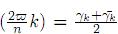
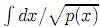
<body><![CDATA[<p><font face="Verdana, Arial, Helvetica, sans-serif" size="3"><b>5 Conclusions</b></font></p>           <p><font face="Verdana, Arial, Helvetica, sans-serif" size="2">The  plainness  of the  procedure  reveals what might be needed  for  a closed curve to split like the  circle  or the  lemniscate. First, its arc  length should be given by an elliptic  integral,  say <img src="/img/revistas/ince/v6n12/a02g18.jpg" />  for  a certain polynomial <i>p</i>.          Second, the locus of the solution to Euler's pproblem         </font></p>       </font></p>    <p align="center"><img src="/img/revistas/ince/v6n12/a02g19.jpg" /></p>           <p><font face="Verdana, Arial, Helvetica, sans-serif" size="2">should conveniently match the  curve. Third, there should  be a periodic  parametrization x(t), y(t) of the solution locus such that x(nt), y(nt), n &isin; Z+, are rational  functions  of <i>x</i>(<i>t</i>), <i>y</i>(<i>t</i>) with  rational  coefficients. Fourth, the problem should reduce to the constructibility of <i>x</i>((2&piv; /<i>n</i>)<i>k</i>) + <i>iy</i>((2&piv;/<i>n</i>)<i>k</i>),  <i>k</i> = 0, 1, . . . , <i>n</i> &minus; 1, where 2&piv; denotes the parametrization period. Fifth, these numbers should be the  zeros of equation <i>x</i>(<i>nt</i>)  + <i>iy</i>(<i>nt</i>) = 1, etc.  For  background material on elliptic integrals the reader can consult McKean and Moll  &#91;6, chapter 2&#93;. See also &#91;7&#93;. </font></p>           <p> </p>           <p><font face="Verdana, Arial, Helvetica, sans-serif" size="3"><b>Acknowledgements</b></font></p>           <p><font face="Verdana, Arial, Helvetica, sans-serif" size="2">This paper has  been  partially supported  by the  Vicerrector&iacute;a de Investigaciones of Universidad de Medell&iacute;n and the Facultad de Ciencias of Universidad del Tolima.  The authors also wish to thank the referees for their valuable suggestions and improvements in the paper. </font></p>    <p> </p>           <p><font face="Verdana, Arial, Helvetica, sans-serif" size="3"><b>References </b></font></p>           <!-- ref --><p><font face="Verdana, Arial, Helvetica, sans-serif" size="2">1. CF. Gauss. <em>Disquisitiones Arithmetic&aelig;</em>, ISBN 958-92-05-15-1. Spanish translation by H. Barrantes, M. Josephy and  A.  Ruiz, Academia Colombiana de Ciencias Exactas, F&iacute;sicas y Naturales, Bogot&aacute;, 1995. Originally published by Gerh. Fleischer, Leipzig, 1801. Referenciado en 44 </font>&nbsp;&nbsp;&nbsp;&nbsp;&nbsp;&nbsp;&nbsp;&nbsp;[&#160;<a href="javascript:void(0);" onclick="javascript: window.open('/scielo.php?script=sci_nlinks&ref=000072&pid=S1794-9165201000020000200001&lng=','','width=640,height=500,resizable=yes,scrollbars=1,menubar=yes,');">Links</a>&#160;]<!-- end-ref --><!-- ref --><p><font face="Verdana, Arial, Helvetica, sans-serif" size="2">2. NH. Abel. <em>Recherches sur les fonctions elliptiques,&#338;uvresCompl&egrave;tes,Christiania (Oslo)</em>,  1881. Originally published in  Journal fu&uml;r  die  reine und  angewandte Mathematik, herausgegeben von Crelle,  Bd. 2, 3; Berlin, 1827, 1828. Referenciado en 44 </font>&nbsp;&nbsp;&nbsp;&nbsp;&nbsp;&nbsp;&nbsp;&nbsp;[&#160;<a href="javascript:void(0);" onclick="javascript: window.open('/scielo.php?script=sci_nlinks&ref=000073&pid=S1794-9165201000020000200002&lng=','','width=640,height=500,resizable=yes,scrollbars=1,menubar=yes,');">Links</a>&#160;]<!-- end-ref --><!-- ref --><p><font face="Verdana, Arial, Helvetica, sans-serif" size="2">3. Michael Rosen. <em>Abel'sTheoremon the Lemniscate</em>. The American Mathematical          Monthly, ISSN 0002-9890, 88(6), 387-395 (1981). Referenciado en  44 </font>&nbsp;&nbsp;&nbsp;&nbsp;&nbsp;&nbsp;&nbsp;&nbsp;[&#160;<a href="javascript:void(0);" onclick="javascript: window.open('/scielo.php?script=sci_nlinks&ref=000074&pid=S1794-9165201000020000200003&lng=','','width=640,height=500,resizable=yes,scrollbars=1,menubar=yes,');">Links</a>&#160;]<!-- end-ref --><!-- ref --><p><font face="Verdana, Arial, Helvetica, sans-serif" size="2">4. U.  Hern&aacute;ndez, OJ. Palacio. Divisi&oacute;n de la  lemniscata: geometr&iacute;a, an&aacute;lisis,    &aacute;lgebra. Facultad de Ciencias, Universidad del Tolima, traba jo de grado del Programa de Matem&aacute;ticas con &eacute;nfasis en Estad&iacute;stica, Ibagu&eacute;-Colombia, 2009. Referenciado en  44 </font>&nbsp;&nbsp;&nbsp;&nbsp;&nbsp;&nbsp;&nbsp;&nbsp;[&#160;<a href="javascript:void(0);" onclick="javascript: window.open('/scielo.php?script=sci_nlinks&ref=000075&pid=S1794-9165201000020000200004&lng=','','width=640,height=500,resizable=yes,scrollbars=1,menubar=yes,');">Links</a>&#160;]<!-- end-ref --><!-- ref --><p><font face="Verdana, Arial, Helvetica, sans-serif" size="2">5. Thomas W. Hungerford. <em>Abstract Algebra, an Introduction</em>, ISBN 0-03-010559-          5. Brooks/Cole, New York, 1996. Referenciado en  47 </font>&nbsp;&nbsp;&nbsp;&nbsp;&nbsp;&nbsp;&nbsp;&nbsp;[&#160;<a href="javascript:void(0);" onclick="javascript: window.open('/scielo.php?script=sci_nlinks&ref=000076&pid=S1794-9165201000020000200005&lng=','','width=640,height=500,resizable=yes,scrollbars=1,menubar=yes,');">Links</a>&#160;]<!-- end-ref --><!-- ref --><p><font face="Verdana, Arial, Helvetica, sans-serif" size="2">6. Henry McKean and  Victor  Moll. <em>Elliptic Curves: Function Theory, Geometry, Arithmetic</em>, ISBN  978-0521658171.  Cambridge  University  Press,  Cambridge,          1999. Referenciado en  48 </font>&nbsp;&nbsp;&nbsp;&nbsp;&nbsp;&nbsp;&nbsp;&nbsp;[&#160;<a href="javascript:void(0);" onclick="javascript: window.open('/scielo.php?script=sci_nlinks&ref=000077&pid=S1794-9165201000020000200006&lng=','','width=640,height=500,resizable=yes,scrollbars=1,menubar=yes,');">Links</a>&#160;]<!-- end-ref --><!-- ref --><p><font face="Verdana, Arial, Helvetica, sans-serif" size="2">7. R. Sridharan. <em>From Lintearia to Lemniscate II: Gauss and Landen's Work </em>. Resonance, ISSN 0971-8044, 9(6), 11-20 (June 2004). Referenciado en  48 </font>&nbsp;&nbsp;&nbsp;&nbsp;&nbsp;&nbsp;&nbsp;&nbsp;[&#160;<a href="javascript:void(0);" onclick="javascript: window.open('/scielo.php?script=sci_nlinks&ref=000078&pid=S1794-9165201000020000200007&lng=','','width=640,height=500,resizable=yes,scrollbars=1,menubar=yes,');">Links</a>&#160;]<!-- end-ref --> ]]></body><back>

<ref-list>
<ref id="B1">
<label>1</label><nlm-citation citation-type="book">
<person-group person-group-type="author">
<name>
<surname><![CDATA[Gauss]]></surname>
<given-names><![CDATA[CF]]></given-names>
</name>
</person-group>
<source><![CDATA[Disquisitiones Arithmeticæ]]></source>
<year>1995</year>
<publisher-loc><![CDATA[Bogotá ]]></publisher-loc>
<publisher-name><![CDATA[Academia Colombiana de Ciencias Exactas, Físicas y Naturales]]></publisher-name>
</nlm-citation>
</ref>
<ref id="B2">
<label>2</label><nlm-citation citation-type="">
<person-group person-group-type="author">
<name>
<surname><![CDATA[Abel]]></surname>
<given-names><![CDATA[NH]]></given-names>
</name>
</person-group>
<source><![CDATA[Recherches sur les fonctions elliptiques,ŒuvresComplètes,Christiania (Oslo)]]></source>
<year></year>
</nlm-citation>
</ref>
<ref id="B3">
<label>3</label><nlm-citation citation-type="journal">
<person-group person-group-type="author">
<name>
<surname><![CDATA[Rosen]]></surname>
<given-names><![CDATA[Michael]]></given-names>
</name>
</person-group>
<article-title xml:lang="en"><![CDATA[Abel'sTheoremon the Lemniscate]]></article-title>
<source><![CDATA[The American Mathematical Monthly]]></source>
<year>(198</year>
<month>1)</month>
<volume>88</volume>
<numero>6</numero>
<issue>6</issue>
<page-range>387-395</page-range></nlm-citation>
</ref>
<ref id="B4">
<label>4</label><nlm-citation citation-type="">
<person-group person-group-type="author">
<name>
<surname><![CDATA[Hernández]]></surname>
<given-names><![CDATA[U]]></given-names>
</name>
<name>
<surname><![CDATA[Palacio]]></surname>
<given-names><![CDATA[OJ]]></given-names>
</name>
</person-group>
<source><![CDATA[División de la lemniscata: geometría, análisis, álgebra]]></source>
<year></year>
</nlm-citation>
</ref>
<ref id="B5">
<label>5</label><nlm-citation citation-type="book">
<person-group person-group-type="author">
<name>
<surname><![CDATA[Hungerford]]></surname>
<given-names><![CDATA[Thomas W]]></given-names>
</name>
</person-group>
<source><![CDATA[Abstract Algebra, an Introduction]]></source>
<year>1996</year>
<publisher-loc><![CDATA[New York ]]></publisher-loc>
<publisher-name><![CDATA[Brooks/Cole]]></publisher-name>
</nlm-citation>
</ref>
<ref id="B6">
<label>6</label><nlm-citation citation-type="book">
<person-group person-group-type="author">
<name>
<surname><![CDATA[McKean]]></surname>
<given-names><![CDATA[Henry]]></given-names>
</name>
<name>
<surname><![CDATA[Moll]]></surname>
<given-names><![CDATA[Victor]]></given-names>
</name>
</person-group>
<source><![CDATA[Elliptic Curves: Function Theory, Geometry, Arithmetic]]></source>
<year>1999</year>
<publisher-loc><![CDATA[Cambridge ]]></publisher-loc>
<publisher-name><![CDATA[Cambridge University Press]]></publisher-name>
</nlm-citation>
</ref>
<ref id="B7">
<label>7</label><nlm-citation citation-type="journal">
<person-group person-group-type="author">
<name>
<surname><![CDATA[Sridharan]]></surname>
<given-names><![CDATA[R]]></given-names>
</name>
</person-group>
<article-title xml:lang="en"><![CDATA[From Lintearia to Lemniscate II: Gauss and Landen's Work]]></article-title>
<source><![CDATA[Resonance]]></source>
<year>(Jun</year>
<month>e </month>
<day>20</day>
<volume>9</volume>
<numero>6</numero>
<issue>6</issue>
<page-range>11-20</page-range></nlm-citation>
</ref>
</ref-list>
</back>
</article>