<?xml version="1.0" encoding="ISO-8859-1"?><article xmlns:mml="http://www.w3.org/1998/Math/MathML" xmlns:xlink="http://www.w3.org/1999/xlink" xmlns:xsi="http://www.w3.org/2001/XMLSchema-instance">
<front>
<journal-meta>
<journal-id>1794-9165</journal-id>
<journal-title><![CDATA[Ingeniería y Ciencia]]></journal-title>
<abbrev-journal-title><![CDATA[ing.cienc.]]></abbrev-journal-title>
<issn>1794-9165</issn>
<publisher>
<publisher-name><![CDATA[Escuela de Ciencias y Humanidades y Escuela de Ingeniería de la Universidad EAFIT]]></publisher-name>
</publisher>
</journal-meta>
<article-meta>
<article-id>S1794-91652012000200001</article-id>
<title-group>
<article-title xml:lang="en"><![CDATA[Inverse-FEM Characterization of a Brain Tissue Phantom to Simulate Compression and Indentation]]></article-title>
<article-title xml:lang="es"><![CDATA[Caracterización de tejido cerebral artificial utilizando Inverse-FEM para simular indentación y comprensión]]></article-title>
</title-group>
<contrib-group>
<contrib contrib-type="author">
<name>
<surname><![CDATA[Mesa-Múnera]]></surname>
<given-names><![CDATA[Elizabeth]]></given-names>
</name>
<xref ref-type="aff" rid="A01"/>
</contrib>
<contrib contrib-type="author">
<name>
<surname><![CDATA[Ramírez-Salazar]]></surname>
<given-names><![CDATA[Juan F]]></given-names>
</name>
<xref ref-type="aff" rid="A02"/>
</contrib>
<contrib contrib-type="author">
<name>
<surname><![CDATA[Boulanger]]></surname>
<given-names><![CDATA[Pierre]]></given-names>
</name>
<xref ref-type="aff" rid="A03"/>
</contrib>
<contrib contrib-type="author">
<name>
<surname><![CDATA[Branch]]></surname>
<given-names><![CDATA[John W]]></given-names>
</name>
<xref ref-type="aff" rid="A04"/>
</contrib>
</contrib-group>
<aff id="A01">
<institution><![CDATA[,Universidad Nacional de Colombia  ]]></institution>
<addr-line><![CDATA[Medellin ]]></addr-line>
<country>Colombia</country>
</aff>
<aff id="A02">
<institution><![CDATA[,Universidad Nacional de Colombia  ]]></institution>
<addr-line><![CDATA[Medellin ]]></addr-line>
<country>Colombia</country>
</aff>
<aff id="A03">
<institution><![CDATA[,University of Alberta  ]]></institution>
<addr-line><![CDATA[Edmonton ]]></addr-line>
<country>Canada</country>
</aff>
<aff id="A04">
<institution><![CDATA[,Universidad Nacional de Colombia  ]]></institution>
<addr-line><![CDATA[Medellín ]]></addr-line>
<country>Colombia</country>
</aff>
<pub-date pub-type="pub">
<day>00</day>
<month>07</month>
<year>2012</year>
</pub-date>
<pub-date pub-type="epub">
<day>00</day>
<month>07</month>
<year>2012</year>
</pub-date>
<volume>8</volume>
<numero>16</numero>
<fpage>11</fpage>
<lpage>36</lpage>
<copyright-statement/>
<copyright-year/>
<self-uri xlink:href="http://www.scielo.org.co/scielo.php?script=sci_arttext&amp;pid=S1794-91652012000200001&amp;lng=en&amp;nrm=iso"></self-uri><self-uri xlink:href="http://www.scielo.org.co/scielo.php?script=sci_abstract&amp;pid=S1794-91652012000200001&amp;lng=en&amp;nrm=iso"></self-uri><self-uri xlink:href="http://www.scielo.org.co/scielo.php?script=sci_pdf&amp;pid=S1794-91652012000200001&amp;lng=en&amp;nrm=iso"></self-uri><abstract abstract-type="short" xml:lang="en"><p><![CDATA[The realistic simulation of tool-tissue interactions is necessary for the development of surgical simulators and one of the key element for it realism is accurate bio-mechanical tissue models. In this paper, we determined the mechanical properties of soft tissue by minimizing the difference between experimental measurements and the analytical or simulated solution of the deformation. Then, we selected the best model parameters that fit the experimental data to simulate a bonded compression and a needle indentation with a flat-tip. We show that the inverse FEM allows accurate material property estimation. We also validated our results using multiple tool-tissue interactions over the same specimen.]]></p></abstract>
<abstract abstract-type="short" xml:lang="es"><p><![CDATA[Una simulación realista de la interacción tejido-herramienta es necesaria para desarrollar simuldores quirúrgicos, y la presición en modelos biomecánicos de tejidos es determinante para cumplir tal fin. Los trabajos previos han caracterizado las propiedades de tejidos blandos; sin embargo, ha faltado una validación apropiada de los resultados. En este trabajo se determinaron las propiedades mecánicas de un tejido blando minimizando la diferencia entre las mediciones experimentales y la solución analítica o simulada del problema. Luego, fueron seleccionados los parámetros que mejor se ajustaron a los datos experimentales para simular una compresión con fricción y la indentación de una aguja con punta plana. Se concluye que el inverse-FEM permite la precisa estimación de las propiedades del material. Además, estos resultados fueron validados con varias interacciones tejido-herramienta sobre el mismo espécimen.]]></p></abstract>
<kwd-group>
<kwd lng="en"><![CDATA[Inverse FEM]]></kwd>
<kwd lng="en"><![CDATA[Compression Test]]></kwd>
<kwd lng="en"><![CDATA[Indentation]]></kwd>
<kwd lng="en"><![CDATA[Tissue Calibration]]></kwd>
<kwd lng="en"><![CDATA[Surgical Simulators]]></kwd>
<kwd lng="es"><![CDATA[inverse-FEM]]></kwd>
<kwd lng="es"><![CDATA[Ensayo a Compresión]]></kwd>
<kwd lng="es"><![CDATA[Indentación]]></kwd>
<kwd lng="es"><![CDATA[Calibración de tejidos]]></kwd>
<kwd lng="es"><![CDATA[Simuladores Quirúrgicos]]></kwd>
</kwd-group>
</article-meta>
</front><body><![CDATA[  <font face="Verdana, Arial, Helvetica, sans-serif" size="2"> </font>    <p align="right"><font size="2" face="Verdana, Arial, Helvetica, sans-serif">ART&Iacute;CULO ORIGINAL</font> <font face="Verdana, Arial, Helvetica, sans-serif" size="2">    <P>     <p align="center">&nbsp;</p>     <p align="center"><b><font size="4">Inverse-FEM Characterization of a Brain   Tissue Phantom to Simulate Compression   and Indentation</font></b></p>     <p>&nbsp;</p>     <p align="center"><b><font size="3">Caracterizaci&oacute;n de tejido cerebral artificial utilizando   <i>Inverse-FEM</i> para simular indentaci&oacute;n y comprensi&oacute;n</font></b></p>     <p>&nbsp;</p>     <p>&nbsp;</p>     <p><b>Elizabeth Mesa&#8211;M&uacute;nera<sup>1</sup>, Juan F. Ram&iacute;rez&#8211;Salazar<sup>2</sup>, Pierre Boulanger<sup>3</sup> and John W. Branch<sup>4</sup></b></p>     ]]></body>
<body><![CDATA[<p>&nbsp;</p>     <p><font size="2" face="Verdana, Arial, Helvetica, sans-serif"><sup>1</sup> Mechanical Engineer, M.Sc in Systems Engineering, <a href="mailto:emesamun@unal.edu.co">emesamun@unal.edu.co</a>, researcher National University of Colombia, Medellin&#8211;Colombia.</font></p>     <p><font size="2" face="Verdana, Arial, Helvetica, sans-serif"><sup>2</sup> Mechanical Engineer, M.Sc in Systems Engineering, <a href="mailto:jframiresa@unal.edu.co">jframiresa@unal.edu.co</a>, researcher,   National University of Colombia, Medellin&#8211;Colombia.</font></p>     <p><font size="2" face="Verdana, Arial, Helvetica, sans-serif"><sup>3</sup> Ph.D in Electrical Engineering, <a href="mailto:pierreb@ualberta.ca">pierreb@ualberta.ca</a>, professor, University of Alberta,   Edmonton&#8211;Canada.</font></p> </font>     <p><font size="2" face="Verdana, Arial, Helvetica, sans-serif"> <sup>4</sup> Ph.D in Systems Engineering, <a href="mailto:jwbranch@unal.edu.co">jwbranch@unal.edu.co</a>, professor, National University of   Colombia, Medell&iacute;n&#8211;Colombia.</font></p> <font face="Verdana, Arial, Helvetica, sans-serif" size="2">     <p>&nbsp;</p>     <p>Received: 18-abr-2012, Acepted: 17-oct-2012   Available online: 30-nov-2012</p>     <p>MSC: 74S05 </p> </font> <hr size="1" /> <font face="Verdana, Arial, Helvetica, sans-serif" size="2">     <p><b>Abstract</b></p>     <p>The realistic simulation of tool-tissue interactions is necessary for the development   of surgical simulators and one of the key element for it realism is accurate   bio-mechanical tissue models. In this paper, we determined the mechanical   properties of soft tissue by minimizing the difference between experimental   measurements and the analytical or simulated solution of the deformation.   Then, we selected the best model parameters that fit the experimental data to   simulate a bonded compression and a needle indentation with a flat-tip. We   show that the inverse FEM allows accurate material property estimation. We   also validated our results using multiple tool-tissue interactions over the same specimen. </p>     ]]></body>
<body><![CDATA[<p><b>Key words:</b> Inverse FEM, Compression Test, Indentation, Tissue Calibration, Surgical Simulators.</p> </font> <hr size="1" /> <font face="Verdana, Arial, Helvetica, sans-serif" size="2">     <p><b>Resumen</b></p>     <p>   Una simulaci&oacute;n realista de la interacci&oacute;n tejido-herramienta es necesaria para   desarrollar simuldores quir&uacute;rgicos, y la presici&oacute;n en modelos biomec&aacute;nicos   de tejidos es determinante para cumplir tal fin. Los trabajos previos han caracterizado   las propiedades de tejidos blandos; sin embargo, ha faltado una   validaci&oacute;n apropiada de los resultados. En este trabajo se determinaron las   propiedades mec&aacute;nicas de un tejido blando minimizando la diferencia entre   las mediciones experimentales y la soluci&oacute;n anal&iacute;tica o simulada del problema.   Luego, fueron seleccionados los par&aacute;metros que mejor se ajustaron a los datos   experimentales para simular una compresi&oacute;n con fricci&oacute;n y la indentaci&oacute;n   de una aguja con punta plana. Se concluye que el <i>inverse-FEM</i> permite la   precisa estimaci&oacute;n de las propiedades del material. Adem&aacute;s, estos resultados   fueron validados con varias interacciones tejido-herramienta sobre el mismo   esp&eacute;cimen</p>     <p><b>Palabras claves:</b> <i>inverse-FEM</i>, Ensayo a Compresi&oacute;n, Indentaci&oacute;n, Calibraci&oacute;n de tejidos, Simuladores Quir&uacute;rgicos.</p> </font> <hr size="1" /> <font face="Verdana, Arial, Helvetica, sans-serif" size="2">     <p>&nbsp;</p>     <p>&nbsp;</p>     <p><b><font size="3">1 Introduction</font></b></p>     <p>The realistic simulation of surgical procedures has been considered to be an effective   and safe method for the development of surgical training and planning   by emphasizing on real-time interaction with medical instruments and realistic   virtual models of patients. Surgical simulators have been developed for a   wide range of procedures and they can be classified into three main categories:   needle-based, open, and minimally invasive surgery (MIS). Neurosurgical needle   insertion (NI) is a type of MIS that is performed with a restricted field   of view, displaced 2D visual feedback, and distorted haptic feedback. To simulate   realistic surgical interventions for NI into the brain, it is necessary to   implement algorithms that are accurate and computationally efficient &#91;1&#93;. Furthermore, the accuracy of planning in medical interventions and the credibility of surgical simulation depend on soft-tissue constitutive laws, representations of the surgical tools, organ geometry, and boundary conditions imposed by the connective tissues surrounding the organ &#91;2&#93;. Much research and development have been devoted to training surgeons in MIS using visual and haptic feedback, but the accurate characterization of soft tissue models is critical for haptic simulation and remains an open research area &#91;3&#93;.</p>     <p>Techniques to acquire soft tissue properties are difficult. Some researchers   have evaluated soft tissue properties <i>in-vivo</i>, <i>ex-vivo</i>, or in phantom tissues, using   stretch tests &#91;4&#93;, aspiration experiments &#91;5&#93;, compression tests, and needle   insertion, for linear &#91;6&#93; and non-linear bio-mechanical models &#91;7&#93;. In all these   cases, researchers showed that their material models fit correctly with the experimental   data acquired during a material calibration procedure. However,   they did not evaluate the estimated material properties in different experimental   setups that resemble real-world procedures. In this paper, a material   model of a silicone rubber with properties close to brain tissues was estimated   using different experimental setups (standard compression, bonded compression,   and flat-tip needle indentation). Initially, the material parameters are   estimated by performing a standard compression test and by comparing an   analytical deformation solution to the experimental data. Following this initial   estimation, the simulated deformations are compared and validated with   the ones resulting from bounded compression and needle indentation using   inverse Finite Element Methods (FEM). This paper is organized as following.   We first, review the related work on tissue characterization in Section 2.   We also review the theoretical foundations of hyperelastic models in Section   3. Sections 4, 5, and 6 describe the methods, experiments, and results to   calibrate a material model using a standard compression test, bonded compression   test, and an indentation experiment, respectively. We then conclude and discuss future work.</p>     <p>&nbsp;</p>     ]]></body>
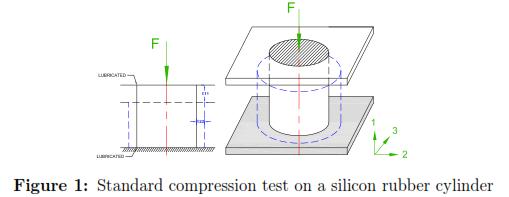
<body><![CDATA[<p><b><font size="3">2 Related Work</font></b></p>     <p>To produce a realistic approximation of soft tissue in surgical virtual environments,   it is necessary to develop accurate mathematical models that predict   its behavior. Tissue characterization consists of estimating material properties   using measurements of tool-tissue interaction forces and deformations. Some researchers use indentation &#91;6&#93;,&#91;7&#93;, others consider stretching &#91;4&#93;, aspiration &#91;5&#93;, compression &#91;8&#93;, and vibration &#91;9&#93;. Results have been reported for different organs of animals and humans, such as the liver &#91;10&#93;, the brain &#91;11&#93;,&#91;12&#93;, and the kidney &#91;7&#93;. Some researchers have used <i>ex-vivo</i> experiments and phantom tissues, as they allow precise control of the sample and experimental conditions for modeling &#91;6&#93;,&#91;13&#93;.</p>     <p>Some materials can be successfully defined by very simple approximations   based on Hooke's Law, as shown by DiMaio and Salcudean in &#91;6&#93;. However,   more complex materials, such as liver, kidney, and brain, require the use of   viscoelastic and hyperelastic models. Kim et al. &#91;7&#93; determined the hyperviscoelastic   properties of intra-abdominal organs <i>in-vivo</i> using an indentation   device. As mentioned earlier, previous work on tissue calibration did not   evaluate and validate model performance in different conditions. For instance,   Miller et al. &#91;11&#93; demonstrated that swine brain tissue is considerably softer in extension than in compression.</p>     <p>&nbsp;</p>     <p><b><font size="3">3 Theoretical Foundations</font></b></p>     <p>Biomechanics seeks to understand the mechanics of living systems. We focused   our study on the deformation and displacement of a continuous material when   subjected to the action of different stresses and forces. The definitions in this   section come from the continuum mechanics theory presented by Fung in his   books &#91;15&#93;,&#91;14&#93; and the notation is according to the book by Bower &#91;16&#93;. This   section presents the hyperelastic constitutive laws to approximate brain tissue   behavior. An extensive overview of continuum mechanics is beyond the scope   of this section, but &#91;16&#93;,&#91;15&#93; and &#91;14&#93; provide a good introduction to this subject and its applications to living tissues.</p>      <p><b>3.1 Hyperelasticity</b></p> </font>     <p><font size="2" face="Verdana, Arial, Helvetica, sans-serif">Different constitutive laws are used to model the mechanical response of a   material according to its behavior &#91;16&#93;. These models are obtained by fitting   experimental measurements to a set of equations that relate stresses and   strains. Hyperelastic models are required when the material is subjected to   finite displacements, whereas elastic theory is restricted to infinitesimal displacements. Hyperelasticity constitutes the basis for more complex material models such as viscoelasticity and tissue damage &#91;17&#93;. The constitutive equation for a hyperelastic material is derived from an analytic function of the strain energy density (<i>W</i>) with respect to the deformation gradient tensor (F<i><sub>ij</sub></i>). The strain energy can be defined in terms of the invariants (<i>I</i><sub>1</sub>,<i>I</i><sub>2</sub>,<i>I</i><sub>3</sub>) of the left Cauchy Green deformation tensor (<i>B<sub>ij</sub></i>), the alternative invariants (<img src="/img/revistas/ince/v8n16/v8n16a01g1.jpg" /><sub>1</sub>,<img src="/img/revistas/ince/v8n16/v8n16a01g1.jpg" /><sub>2</sub>,<i>J</i>) of <i>B<sub>ij</sub></i>, or in terms of the principal stretches (&lambda;<sub>1</sub>, &lambda;<sub>2</sub>,&lambda;<sub>3</sub>), as shown   by: <i>W</i>(<i><b>F</b></i>) = <i>U</i>(<i>I</i><sub>1</sub>,<i>I</i><sub>2</sub>,<i>I</i><sub>3</sub>) = <img src="/img/revistas/ince/v8n16/v8n16a01g2.jpg" /> (<img src="/img/revistas/ince/v8n16/v8n16a01g1.jpg" /><sub>1</sub>,<img src="/img/revistas/ince/v8n16/v8n16a01g1.jpg" /><sub>2</sub>,<i>J</i>) = <img src="/img/revistas/ince/v8n16/v8n16a01g3.jpg" /> (&lambda;<sub>1</sub>, &lambda;<sub>2</sub>, &lambda;<sub>3</sub>). Later, <i>W</i> is related   with the Cauchy Stress Tensor (&sigma;<sub><i>ij</i></sub>) to model the behavior of a hyperelastic material and is defined by: </font></p> <font face="Verdana, Arial, Helvetica, sans-serif" size="2">    <p align="right"><img src="/img/revistas/ince/v8n16/v8n16a01g4.jpg" /></p>     <p>where <i>F</i> and <i>J</i> denote the deformation gradient tensor and its Jacobian, respectively.   Depending on the complexity of the function <i>W</i>, different features   such as nonlinearity and anisotropy can be added into the model &#91;17&#93;. Some of   the most representative forms of the strain energy density, which are usually   included in commercial FEM software and are: <i>Polynomial Strain Energy</i>, <i>Reduced Polynomial Strain Energy Potential</i>, <i>Ogden Form</i>, <i>Neo-Hookean Solid</i> and <i>Mooney-Rivlin Solid</i>.</p>     ]]></body>

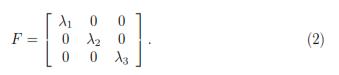
<body><![CDATA[<p>Soft biological tissues can be approximated as nearly incompressible materials   because of their high water content. To model fully incompressible materials using any of the previous models, one simply needs to set the <i>Jacobian</i> equal to 1.</p>     <p>&nbsp;</p>     <p><b><font size="3">4 Material calibration using the analytical solution of a simple compression test</font></b></p>     <p>Tissue characterization consists of the determination of material properties by   minimizing the differences between experimental measurements and the solution   of the constitutive equation. This equation can be solved analytically or   numerically. The first step consist of solving an analytical solution of a simple   uniaxial compression test of multiple hyperelastic materials to determine directly the model parameters based on a least-squares fit.</p>      <p><b>4.1 Analytical Solution of an Uniaxial Compression Test</b></p>     <p>In a simple uniaxial compression test, the material is submitted to a stresses   created by holding the material between two lubricated plates to avoid lateral   stresses (see <a href="#f1">Fig. 1</a>). Let's assume that the material is incompressible, homogeneous,   and isotropic material. Therefore the transverse strains &epsilon;<sub>22</sub> and &epsilon;<sub>33</sub><sup><a href="#1">&Dagger;</a><a name="b1"></a></sup> are considered to be the same.</p>     <p align="center"><a name="f1"></a><img src="/img/revistas/ince/v8n16/v8n16a01f1.jpg" /></p> </font>     <p><font size="2" face="Verdana, Arial, Helvetica, sans-serif">Using the Poisson's ratio (&nu;), one can relate the transverse strains with   the axial strain &epsilon;<sub>11</sub> as following: (1 +  &epsilon;<sub>22</sub>) = (1 + &epsilon;<sub>33</sub>) = (1 + &epsilon;<sub>11</sub>)<sup>&#8211;<i>&nu;</i></sup>, where   the principal stretches are defined in terms of the principal nominal strains   by: &lambda;<i><sub>i</sub></i> = 1 + &epsilon;<sub><i>ii</i></sub>. Additionally, the deformation gradient tensor (<i>F</i>) can be   also expressed in terms of &lambda;<i><sub>i</sub></i> as shown by Eq. 2. To satisfy the assumption of   an incompressible material, the Jacobian (<i>J</i>) should be equal to 1. Therefore, <i>J</i> = det(<i>F</i>) = &lambda;<sub>1</sub>&lambda;<sub>2</sub>&lambda;<sub>3</sub> = 1, where</font></p> <font face="Verdana, Arial, Helvetica, sans-serif" size="2">     <p align="right"><img src="/img/revistas/ince/v8n16/v8n16a01g12.jpg" /></p>     <p>Considering that this procedure will be the same for the rest of the material   models, an analytical solution for a Neo-Hookean material can be easily determined.   From Eq.1 the stress-strain relationship from the strain energy density can be deduced &#91;16&#93;:</p>     ]]></body>
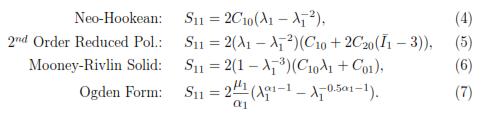
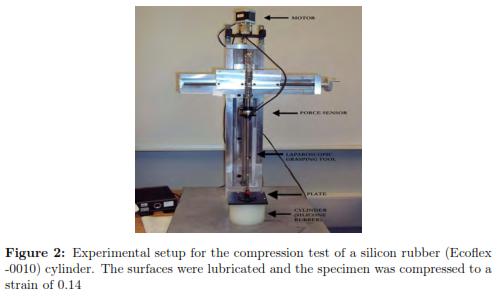
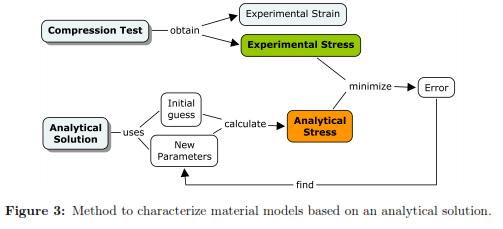
<body><![CDATA[<p align="right"><img src="/img/revistas/ince/v8n16/v8n16a01g5.jpg" /></p>     <p>Now, defining the left Cauchy-Green deformation tensor as <i>B<sub>ij</sub></i> = <i>F<sub>ik</sub>F<sub>jk</sub></i> and   using Eq. 2, the normal stress for an incompressible Neo-Hookean material is given by <i>&sigma;</i><sub>11</sub> = 2<i>C</i><sub>10</sub><img src="/img/revistas/ince/v8n16/v8n16a01g6.jpg" />), where &lambda;<sub>2</sub> = &lambda;<sub>3</sub>= <img src="/img/revistas/ince/v8n16/v8n16a01g7.jpg" />.</p>     <p>  Using the relationship between strains and stresses during a uniaxial compression   test, the normal components of the Cauchy Stress can be defined in terms   of the principal stretch in direction of the load application: <i>&sigma;</i><sub>11</sub> = <img src="/img/revistas/ince/v8n16/v8n16a01g8.jpg" />.</p>     <p>Knowing that the relationship of the Cauchy stress with the nominal stress   is given by <i>S<sub>ij</sub></i> = <img src="/img/revistas/ince/v8n16/v8n16a01g9.jpg" />, we can define the following nominal stresses (<i>S<sub>ij</sub></i>): <i>S</i><sub>11</sub> = <img src="/img/revistas/ince/v8n16/v8n16a01g10.jpg" />.</p>     <p>We rather use nominal stress instead of the Cauchy stress, because Sij   corresponds to the internal force per unit of <i>undeformed</i> area acting within   a solid, which is easier to determine during an experimental procedure. The   constitutive equations for the Neo-Hookean, Reduced Polynomial, Mooney Rivlin, and Ogden models are respectively:</p>     <p align="right"><img src="/img/revistas/ince/v8n16/v8n16a01g11.jpg" /></p>      <p><b>4.2 Experimental Setup: Uniaxial Compression Test</b></p>     <p>As shown by Francheschini et al. &#91;18&#93;, human brain tissue is similar to filled   elastomers, and can be modeled by a nonlinear solid with small volumetric   compressibility. Girnary &#91;19&#93; also highlights that silicone brain phantoms are   a good approximation to simulate brain behavior. Other additional studies   use silicone rubber phantoms (such as <i>Ecoflex</i>) to successfully simulate the behavior of human tissue &#91;20&#93;,&#91;21&#93;,&#91;22&#93;,&#91;23&#93;.</p>     <p>The parameters for four different hyperelastic models were estimated to   simulate the mechanical behavior of a platinum-cure silicone rubber submitted to a compression test.</p>     <p>The silicone rubber is called <i>Ecoflex 00-10</i> (from Smooth-On, Inc.) where a   proportion (20%) of a softener called &quot;Slacker&quot; (also from Smooth-On, Inc.) was used to simulate brain tissue. Each component of the rubber solution was   evenly mixed according to the recommendations of the manufacturer and then formed into a cylindrical mold of 80 <i>mm</i> diameter and 70 <i>mm</i> height.</p> </font>     ]]></body>
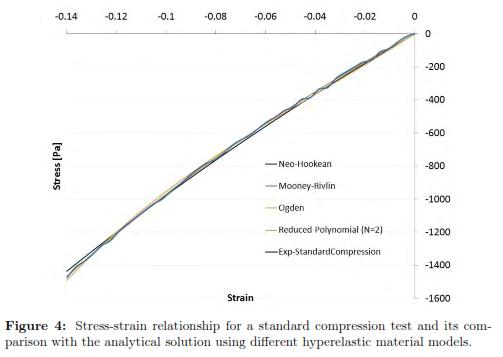
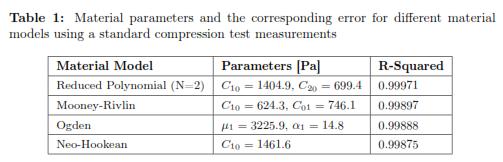
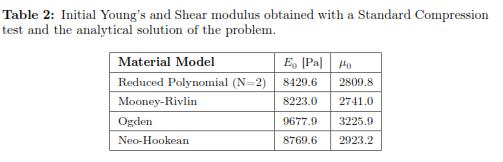
<body><![CDATA[<p><font size="2" face="Verdana, Arial, Helvetica, sans-serif">A force/torque sensing sensor was installed on a laparoscopic grasping tool   and was calibrated by the manufacturer (ATI, Industrial Automation). The   maximum error in the Z axis (the needle axis) is 0.75% of its full-scale load.   This calibration was done at a constant 22&#9702;C. The force/torque sensor (ATI   Mini40 SI-40-2) had a resolution of 0.02 N and was attached to a laparoscopic   grasping tool, which was fixed to a rigid plate (see <a href="#f2">Fig. 2</a>). The contact areas   were lubricated with talcum powder in order to minimize lateral friction. The   plate was displaced using a Phidget bipolar stepper motor to compress the   tissue at a constant velocity of 0.248 <i>mm</i>/<i>s</i> (based on &#91;24&#93;,&#91;25&#93;,&#91;26&#93;,&#91;18&#93;,&#91;12&#93;), until the plate was displaced by 10 <i>mm</i>.</font></p>     <p align="center"><font face="Verdana, Arial, Helvetica, sans-serif" size="2"><a name="f2" id="f2"></a><img src="/img/revistas/ince/v8n16/v8n16a01f2.jpg" /></p>     <p>&nbsp;</p>     <p><b>4.3 Methodology</b></p>     <p>A C++ program was developed to integrate the measurements of forces (given   by the f/t sensor) with displacements (given by the motor) using the time (in milliseconds) as a reference. We assumed that the experiment occured under   symmetric conditions, with a homogeneous, isotropic and incompressible material,   and that imposed deformations were small compared with the original   size of the cylinder. Hyperelastic models defined by the equations (4), (5), (6) and (7) were selected to estimate the mechanical response of the specimen.</p>     <p>To calibrate the material parameters, we minimized the square of the absolute   error between the stress-strain curve obtained with the analytical solution   with the experimental measurements (see <a href="#f3">Fig. 3</a>). The use of absolute errors   instead of relative errors is justified as it provides a better fit for large strains   (deformations bigger than 0.05<i>mm</i>). The experimental nominal stress (<i>S</i><sub>11</sub>)   was found by dividing the reaction force at every sample point by the undeformed   contact area. The nominal strain corresponded to the displacement   of the plate divided by the un-deformed height of the cylinder. Once the   material parameters were obtained, their reliability was evaluated using the   Drucker stability test &#91;16&#93;. This stability criterion for an incompressible material   establishes that the work done by the traction through the displacements   must be positive or zero. This condition is satisfied when the stress-strain   relation is bigger or equal to zero (<b>&Delta;</b><i>&tau;<sub>ij</sub></i><b>&Delta;</b><i>&epsilon;</i><sub><i>ij</i></sub> &ge; 0), where <b>&Delta;</b><i>&tau;<sub>ij</sub></i> is the change   in Kirchhoff stress, and <b>&Delta;</b><i>&epsilon;<sub>ij</sub></i> is an infinitesimal change in displacement. The   stability criterion is violated wherever the stress decreases with strain in tension,   or increases with strain in compression &#91;16&#93;,&#91;27&#93;. For the Neo-Hookean material model, the Drucker stability is satisfied when the coefficient <i>C</i><sub>10</sub> is positive.</p>     <p align="center"><a name="f3" id="f3"></a><img src="/img/revistas/ince/v8n16/v8n16a01f3.jpg" /></p>      <p><b>4.4 Results</b></p>     <p>The stress-strain experimental curve for the uniaxial compression test and   the four predicted curves using the different hyperelastic models are shown   in <a href="#f4">Fig. 4</a>. To calculate the error, we picked data points at evenly spaced   strain intervals over the range of strains that we will require later to do needle   indentations. To facilitate the interpretation of the results, it is also reported   in <a href="#t1">Table 1</a> where the R-squared values for each fitting result is shown. The   Drucker stability test showed that the four models were stable for all strains.   <a href="#t2">Table 2</a> shows the corresponding initial Young's Modulus (<i>E</i><sub>0</sub>) and initial shear modulus (<i>&mu;</i><sub>0</sub>) obtained with each of the fitting parameters.</p>     <p align="center"><a name="f4"></a><img src="/img/revistas/ince/v8n16/v8n16a01f4.jpg" /></p>     ]]></body>
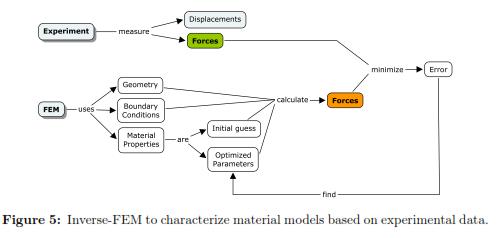
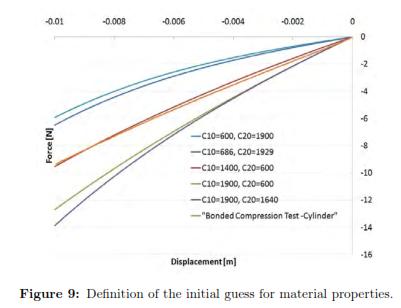
<body><![CDATA[<p align="center"><a name="t1"></a><img src="/img/revistas/ince/v8n16/v8n16a01t1.jpg" /></p>     <p align="center"><a name="t2"></a><img src="/img/revistas/ince/v8n16/v8n16a01t2.jpg" /></p>     <p><font size="2" face="Verdana, Arial, Helvetica, sans-serif">Four material models were used, Neo-Hookean, second order Reduced   Polynomial, Mooney Rivlin, and Ogden Form were tested. The reduced polynomial   gave the best fit (R &#8212; <i>squared</i> = 0.99971) at the same time of being   the most stable based according to the Drucker criterium. The parameters for   this model are: <i>C</i><sub>10</sub> = 1404.9 and <i>C</i><sub>20</sub> = 699.4 which correspond to an initial Young's Modulus of 8.4 <i>kPa</i>.</font></p>     <p>&nbsp;</p> <font face="Verdana, Arial, Helvetica, sans-serif" size="2">    <p><b><font size="3">5 Characterization of Soft Tissue Using Inverse FEM and a Bonded Compression Test</font></b></p>     <p>In more complex scenarios, the use of an analytical solution in the calibration   of a material is not really feasible. Therefore, solving the stress-strain   differential equation by using a numerical approximation emerges is a good alternative.</p>      <p><b>5.1 Inverse Finite Element Method</b></p>     <p>FEM gives a numerical approximation to the solution of a partial differential   equation. Usually to solve this type of problems, one have to know the boundary   conditions, material properties, and the geometry in order to determine the   stress-strain (or force-displacement) relationship at any node in the domain.   If one assumes that the material properties are unknown and that the forcedisplacement   relationship, the geometry, and boundary conditions are known   then an inverse-FEM can be used to determine the material properties by running   multiple FEM simulations with different parameter values. The optimal   parameter estimate correspond to the force-displacement relationship that is   the closest to the experimental measurements. This procedure is showed in <a href="#f5">Fig. 5</a>.</p>     <p align="center"><a name="f5"></a><img src="/img/revistas/ince/v8n16/v8n16a01f5.jpg" /></p>      <p><b>5.2 Bonded Compression Test</b></p>     ]]></body>
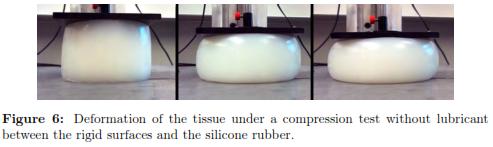
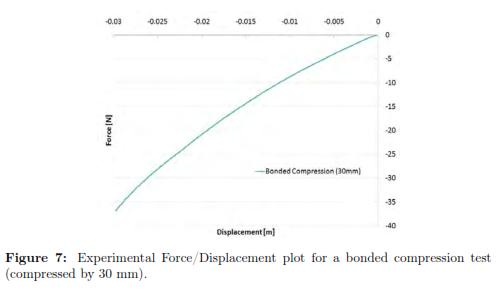
<body><![CDATA[<p>The use of compression testing to determine the mechanical behavior of a   material is widely known and used. Contrary to this simple compression test,   the bonded compression test does not include the use of lubricant between the   rigid plates and the phantom tissue. As a result the rubber is compressed and   it expands laterally; this is called the ''barrelling effect''. Previous works have determined the analytical solution of this deformation for an elastic material &#91;8&#93;,&#91;28&#93;,&#91;29&#93;. However, the solution for more complicated material models (such as viscoelastic and hyperelastic) is not trivial.</p>     <p><b>5.2.1 Experimental Setup</b> Using the same material specimen as before,   we applied compressive forces without the use of lubricant and executed the   experiment three times in order to validate the measurements. The force   sensor, motor, temperature, displacement of the plate, and the velocity of movement, were the same.</p>      <p><b>5.3 Methodology</b></p>     <p>Based on the experimental measurements, the material properties were determined   using the method described in <a href="#f5">Fig. 5</a>. Multiple FEM simulations were   computed keeping the same geometries and boundary conditions except for   the friction between the plates and the tissue. Additionally, we optimized the   material properties to minimize the error between experimental measurements and the FEM results.</p> </font>    <p><font size="2" face="Verdana, Arial, Helvetica, sans-serif">Because a cylindrical sample was used, one could also analyze this 3&#8211;D problem as an axis-symmetric formulation reducing the problem to a 2D   scheme. Based on &#91;31&#93;,&#91;30&#93;,&#91;32&#93; the friction coefficient between silicone rubber   and steel ranges between 0.6 to 0.9. We ran multiple simulations using these   various friction coefficients and did not find any significant differences either   in the prediction of the reaction forces nor in the geometrical changes. In   consequence, we used a friction coefficient of 0.7 in all our simulations. We   simulated bounded compression in ABAQUS 6.10 EF2 as the contact between   a rigid plate and silicone rubber specimen. The discrete rigid bodies were   two lines composed by 10 linear line elements of type RAX2 and 11 nodes.   Each rigid body had a reference point where we applied boundary conditions.   The axis-symmetric deformable model corresponded to a square of 40 mm by   70 mm, with 500 linear quadrilateral hybrid elements of type C4X4RH and 546   nodes. The mesh size was graded to be more refined close to the areas where   we expected higher deformations and coarse near to the axis of revolution.   In all simulations, we allowed nonlinearities, for the material model and for   large geometric deformation. We delimited position constraints for the three parts that were provided for our simulation. The edges of the rigid parts were coincident with the upper and lower surface of the deformable body. At the contact, we defined a penalty method, where the tangential behavior had the friction coefficient equal to 0.7. This boundary condition completely restricted the displacement and rotation of the RP-B. The RP-A was displaced 10 mm in y-direction during 40.32 s (which ensured a compression velocity of 0.248 mm/s), its displacement in X and rotation around Z was fixed to be zero. Finally, we also applied a symmetric boundary condition in the X direction.</font></p>      <p><font size="2" face="Verdana, Arial, Helvetica, sans-serif">Because this study required a nonlinear optimization, the solution was   found by specifying the loading as a function of time, which allowed us to   obtain the nonlinear response. Therefore, for each time increment ABAQUS   solved the system of equations using the Newton optimization method. The   integration time steps was defined between 1.25 x 10<sup>&minus;5</sup> and 0.25. Once the   solution for a specific set of material properties was found, an optimization algorithm   determined a new set of parameters to redo the FEM simulation (this   steps were done in PYTHON). With the initial guess we used a Levenberg-   Marquardt optimization algorithm to find the material coefficients that fits   better the experimental measurements. We used a Python program to manage   the inputs and outputs directly from ABAQUS, to estimate the error,   process the output, modify the material properties, and re-submit a new simulation   until the convergence is achieved. Finally, we validated the stability of the material using the Drucker stability test.</font></p> <font face="Verdana, Arial, Helvetica, sans-serif" size="2">     <p><b>5.4 Results</b></p>     <p>The <a href="#f6">figure 6</a> shows the geometrical changes of a Silicon Rubber cylinder submitted under compressive forces without lubricant.</p>     <p align="center"><a name="f6"></a><img src="/img/revistas/ince/v8n16/v8n16a01f6.jpg" /></p> </font>    <p><font size="2" face="Verdana, Arial, Helvetica, sans-serif">To visualize the behavior of the force/displacement (<i>f</i>/<i>d</i>) curve for the   material at higher deformations, we also submitted the tissue to a bonded   compression test that displaced the plate up to 30 <i>mm</i> (see <a href="#f7">Fig. 7</a>). In that   case, it was obvious the curvature of the f/d relationship. But, because we are   interested in brain needle insertion applications, we do not require indentations   that produce strains bigger than 0.14 (bigger than 10 <i>mm</i> using this specimen).   Therefore, we will focus in the definition of a material model that accurately fit the region of strains lower than 0.14.</font></p> <font face="Verdana, Arial, Helvetica, sans-serif" size="2">     ]]></body>
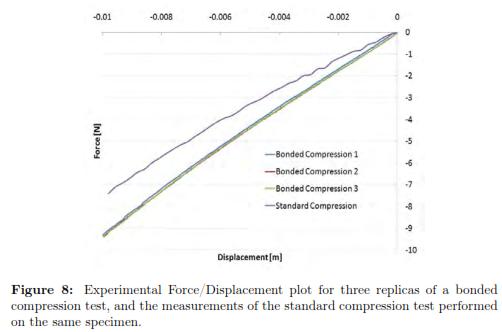
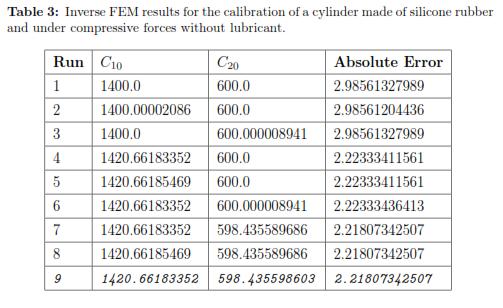
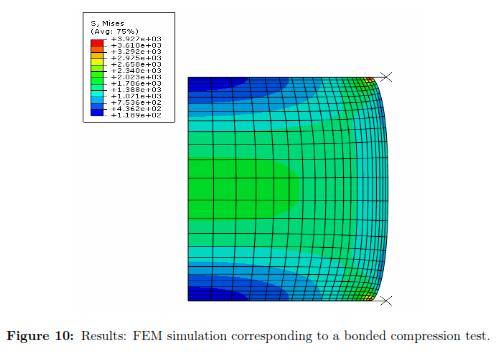
<body><![CDATA[<p align="center"><a name="f7"></a><img src="/img/revistas/ince/v8n16/v8n16a01f7.jpg" /></p>     <p>For 10 <i>mm</i> displacement, the f/d measurements are reported in <a href="#f8">Fig. 8</a>. We   also include the previous f/d data for a standard compression test, in order to   facilitate the comparison with the three replicas of bonded compression test.   As one can see, the three curves for bonded compression test are very closed   to each other. As expected, the reaction forces in the plate were higher during a bonded compression test compared to a standard compression test.</p>     <p align="center"><a name="f8"></a><img src="/img/revistas/ince/v8n16/v8n16a01f8.jpg" /></p>     <p>To ensure an efficient simulation, before we ran the experiments, we refined   the mesh until the error of the simulation with respect to the experimental   data did not change significantly. For the following experimental runs, we kept the same mesh parameters.</p> </font>     <p><font size="2" face="Verdana, Arial, Helvetica, sans-serif">To define the initial guesses for the material parameters (<i>C</i><sub>10</sub> and <i>C</i><sub>20</sub> in   the Second order Reduced Polynomial model) we used different values until we   determined a set of parameters that give a behavior closed to the experimental   measurements. We called this process ''Manual Optimization'' and <a href="#f9">Fig. 9</a> shows   the results that provided an initial set of material properties. This reaction   force was calculated in ABAQUS at the reference point of the rigid body   (the plate). As one can see the closest group of parameters corresponded   to <i>C</i><sub>10</sub> = 1400 and <i>C</i><sub>20</sub> = 600, which is already closed to the coefficients determined by the analytical solution (<i>C</i><sub>10</sub> = 1404.9 and <i>C</i><sub>20</sub> = 699.4).</font></p> <a name="f9"></a>    <p align="center"><img src="/img/revistas/ince/v8n16/v8n16a01f9.jpg"></p> <font face="Verdana, Arial, Helvetica, sans-serif" size="2"> </font>     <p><font size="2" face="Verdana, Arial, Helvetica, sans-serif">Using a Levenberg-Marquardt Optimization algorithm and the initial set   of material properties, we ran multiple FEM simulations to determine the   optimal material coefficients. <a href="#t3">Table 3</a> shows the square of the absolute error   obtained for each run of the FEM simulation. The optimal set of parameters   calibrated under a bonded compression test for the second order Reduced Polynomial   model are: <i>C</i><sub>10</sub> = 1420.662 and <i>C</i><sub>20</sub> = 598.436. Additionally, <a href="#f10">Fig. 10</a>  plots the stress distribution over the cylinder the maximum deformation is achieved.</font></p> <font face="Verdana, Arial, Helvetica, sans-serif" size="2">    <p align="center"><a name="t3"></a><img src="/img/revistas/ince/v8n16/v8n16a01t3.jpg" /></p>     <p align="center"><a name="f10"></a><img src="/img/revistas/ince/v8n16/v8n16a01f10.jpg" /></p>     <p>Finally we validated the stability of the material using the Drucker stability test.</p>     ]]></body>
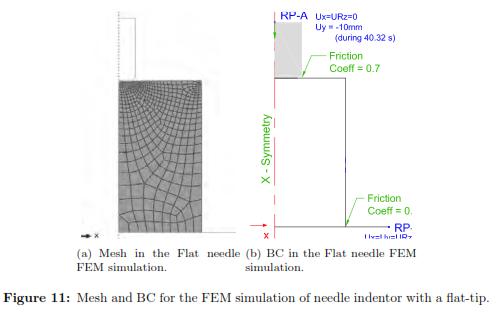
<body><![CDATA[<p>&nbsp;</p>     <p><b><font size="3">6 Tissue Characterization Using Needle Indentation</font></b></p>     <p>As mentioned previously, the characterization of soft tissue is required in the   development of accurate surgical simulators. In order to do so, one needs new   devices, methods, and techniques that allow the characterization of soft tissue   <i>in-vivo</i>. To obtain material properties during a compression test is simple,   fast, and accurate, using an analytical solution. However, this experimental   setup cannot deal with <i>in-vivo</i> measurements. In this paper, we propose a new   needle indentation test which could be an excellent alternative to characterize   in-vivo tissues properties without creating damages. Different studies &#91;3&#93;,&#91;10&#93;   have been done in the simulation of ''needle insertion'' but very little on needle   indentation. To simulate needle indentation there is no simple analytical solution to the problem. This is because there are many factors that vary at every step right after a needle touches the soft tissue. Depending on the shape of the needle, the reaction force direction will be different. Additionally, the contact area changes depending on the needle shape and the distance of penetration. To solve the problem, we use an inverse FEM method which assumes that the needles are rigid and that the problem can be reduced to an axis-symmetric condition.</p>      <p><b>6.1 Methodology</b></p>     <p>We assumed the needle had a flat tip of 16 <i>mm</i> diameter and was indented by 10 <i>mm</i>. We used a friction coefficient of 0.7 in our simulation.</p> </font>     <p><font size="2" face="Verdana, Arial, Helvetica, sans-serif">We simulated the flat needle indentation on the hyperelastic cylinder. Both   rigid bodies had reference points where we imposed the boundary conditions.   The axis-symmetric object was modeled as a rectangle of size 40 mm by 70 mm,   with 500 quadratic quadrilateral hybrid elements of type C4X8RH and 1601   nodes. The mesh size was graded to be more refined close to the indenter and coarse near the model boundaries. <a href="#f11">Fig. 11</a> shows the boundary conditions that were to the rigid bodies and to the soft tissue. As for the time integration it is defined 1.209 x 10<sup>&minus;4</sup> was the minimum increment size and 2 was the maximum increment. Because this simulation is more computationally expensive, the program ran in parallel on 4 processors. As the initial guess we used the results of the previous characterization (<i>C</i><sub>10</sub> = 1420.0 and <i>C</i><sub>20</sub> = 598.0). Again, we implemented a Levenberg-Marquardt Optimization algorithm to obtain the optimal material properties. Finally, and once we obtained the optimal set of parameters, we validated their stability using the Drucker test.</font></p>     <p align="center"><a name="f11"></a><img src="/img/revistas/ince/v8n16/v8n16a01f11.jpg" /></p> <font face="Verdana, Arial, Helvetica, sans-serif" size="2">     <p><b>6.2 Experimental Setup</b></p>     <p>We used the same specimen of the previous experiments and without adding   any type of lubricant, we indented a steel flat punch of 16 <i>mm</i> diameter   until the tissue was deformed by 10 <i>mm</i>. We repeated the experiment three   times to ensure the validity of the measurements. The force sensor, motor,   temperature, and velocity of the movement were the same as in the previous experiments.</p>     <p><b>6.3 Results</b></p>     ]]></body>
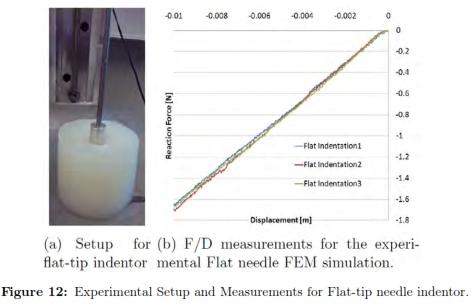
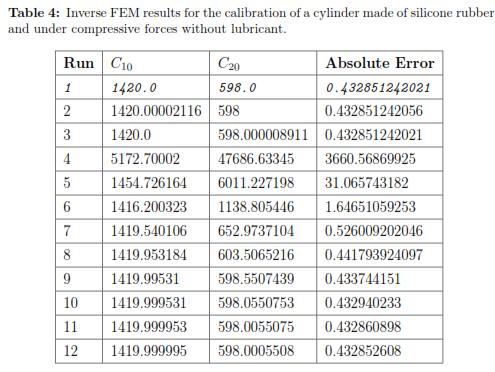
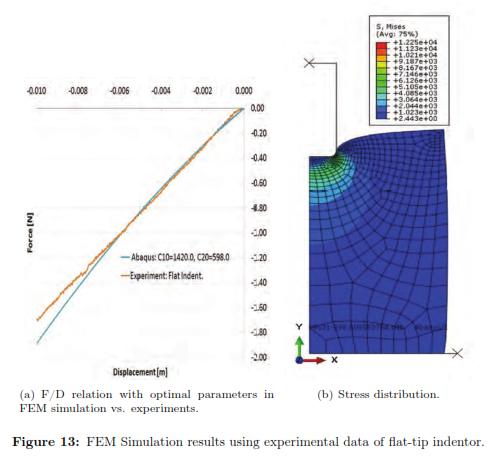
<body><![CDATA[<p>The deformation in the specimen under a flat indentor can be seen in <a href="#f12">Fig. 12</a>,   shows the force/displacement curves for each repetition of the same experiment.   The results for every iteration can be found in <a href="#t4">Table 4</a>, where the best   fit is highlighted in grey. We also plot the f/d relationship where we compared   the experimental measurements with the FEM prediction using the optimal set of material properties with ABAQUS (see <a href="#f13">Fig. 13</a>(a))</p>     <p align="center"><a name="f12"></a><img src="/img/revistas/ince/v8n16/v8n16a01f12.jpg" /></p>     <p align="center"><a name="t4"></a> <img src="/img/revistas/ince/v8n16/v8n16a01t4.jpg" /></p>     <p align="center"><a name="f13"></a><img src="/img/revistas/ince/v8n16/v8n16a01f13.jpg" /></p>     <p>&nbsp;</p>     <p><b><font size="3">7 Conclusion and Future Work</font></b></p>     <p>We developed a comprehensive study for the characterization of soft tissue   using the inverse finite element method. The validations of the material properties   could be done in multiple ways, like using different tool-tissue interactions,   comparing the simulated results with experimental measurements of   force/displacement plots, and evaluating the geometrical changes with the   simulated and real specimen. In this study, we started with simpler simulations,   i.e. compression test in a cylinder, until we reached our final destination: needle indentation into a brain phantom tissue.</p>     <p>In our study, we submitted the cylinder to compressive forces with lubricant,   and we calibrated the material using an analytical solution. We obtained   the parameters for the Neo-Hookean, Reduced Polynomial, Mooney-   Rivlin, and Ogden material models, and we determined if they were stable   for all strains using the Drucker stability criterium. We concluded that the   second order reduced polynomial model is the best approximation to the experimental   data. To validate the results, we re-calibrated the same cylinder   using a bounded compression test using an axis-symmetric FEM simulation   in ABAQUS, and a second order reduced polynomial model. We observed the estimated material properties were very close to the standard method.</p>     <p>The final step was to study indentations of a flat-tip indenter with softtissues.   As mentioned earlier, the final aim of this study was to contribute in   the development of surgical simulators, which requires fast and accurate models.   Therefore, it was important to analyze how much the simulation could be   simplified. Therefore we probed that using an axis-symmetric FEM simulation   with hyperelastic materials, we successfully at calibrating the sample. Again, the parameters were very similar to the ones obtained with compression tests.</p>     <p>Future work will explore FEM simulations with higher complexity, i.e. for   a conical-shaped needle, using an viscoelastic material models, 3D simulations, different geometries and in-vivo measurements.</p>     ]]></body>
<body><![CDATA[<p>&nbsp;</p>     <p><b><font size="3">References</font></b></p>     <!-- ref --><p>1. A. Maciel, T. Halic, Z. Lu, L. P. Nedel,  S. De, ''Using the PhysX engine for   physics-based virtual surgery with force feedback'', <i>The International Journal   of Medical Robotics and Computer Assisted Surgery</i>, vol. 5, n.o 3, pp. 341-353,   2009.    &nbsp;&nbsp;&nbsp;&nbsp;&nbsp;&nbsp;&nbsp;&nbsp;[&#160;<a href="javascript:void(0);" onclick="javascript: window.open('/scielo.php?script=sci_nlinks&ref=000125&pid=S1794-9165201200020000100001&lng=','','width=640,height=500,resizable=yes,scrollbars=1,menubar=yes,');">Links</a>&#160;]<!-- end-ref --> Referenced in 12</p>     <!-- ref --><p>2. S. Misra, K. J. Macura, K. T. Ramesh, A. M. Okamura, ''The Importance of   Organ Geometry and Boundary Constraints for Planning of Medical Interventions'',   <i>Med Eng Phys</i>, vol. 31, n.o 2, pp. 195-206, mar. 2009.    &nbsp;&nbsp;&nbsp;&nbsp;&nbsp;&nbsp;&nbsp;&nbsp;[&#160;<a href="javascript:void(0);" onclick="javascript: window.open('/scielo.php?script=sci_nlinks&ref=000127&pid=S1794-9165201200020000100002&lng=','','width=640,height=500,resizable=yes,scrollbars=1,menubar=yes,');">Links</a>&#160;]<!-- end-ref -->   Referenced in 13</p>     <!-- ref --><p>3. N. Abolhassani, R. Patel, M. Moallem, ''Needle insertion into soft tissue: A   survey'', <i>Medical Engineering &amp; Physics</i>, vol. 29, n.o 4, pp. 413-431, may 2007.    &nbsp;&nbsp;&nbsp;&nbsp;&nbsp;&nbsp;&nbsp;&nbsp;[&#160;<a href="javascript:void(0);" onclick="javascript: window.open('/scielo.php?script=sci_nlinks&ref=000129&pid=S1794-9165201200020000100003&lng=','','width=640,height=500,resizable=yes,scrollbars=1,menubar=yes,');">Links</a>&#160;]<!-- end-ref -->   Referenced in 13, 28</p>     <!-- ref --><p>4. I. Brouwer, J. Ustin, L. Bentley, A. Sherman, N. Dhruv, F. Tendick, ''Measuring   In Vivo Animal Soft Tissue Properties for Haptic Modeling in Surgical Simulaing tion'', <i>in Stud Health Technol Inform</i>, 2001, pp. 69-74.    &nbsp;&nbsp;&nbsp;&nbsp;&nbsp;&nbsp;&nbsp;&nbsp;[&#160;<a href="javascript:void(0);" onclick="javascript: window.open('/scielo.php?script=sci_nlinks&ref=000131&pid=S1794-9165201200020000100004&lng=','','width=640,height=500,resizable=yes,scrollbars=1,menubar=yes,');">Links</a>&#160;]<!-- end-ref --> Referenced in 13</p>     ]]></body>
<body><![CDATA[<!-- ref --><p>5. M. Kauer, V. Vuskovic, J. Dual, G. Szekely,  M. Bajka, ''Inverse finite element   characterization of soft tissues'', <i>Medical Image Analysis</i>, vol. 6, n.o 3, pp. 275- 287, sep. 2002.    &nbsp;&nbsp;&nbsp;&nbsp;&nbsp;&nbsp;&nbsp;&nbsp;[&#160;<a href="javascript:void(0);" onclick="javascript: window.open('/scielo.php?script=sci_nlinks&ref=000133&pid=S1794-9165201200020000100005&lng=','','width=640,height=500,resizable=yes,scrollbars=1,menubar=yes,');">Links</a>&#160;]<!-- end-ref --> Referenced in 13</p>     <!-- ref --><p>6. S. P. DiMaio y S. E. Salcudean, ''Needle insertion modelling and simulation'',   <i>in Robotics and Automation</i>, 2002. Proceedings. ICRA '02. IEEE International Conference on, 2002, vol. 2, pp. 2098 - 2105 vol.2.    &nbsp;&nbsp;&nbsp;&nbsp;&nbsp;&nbsp;&nbsp;&nbsp;[&#160;<a href="javascript:void(0);" onclick="javascript: window.open('/scielo.php?script=sci_nlinks&ref=000135&pid=S1794-9165201200020000100006&lng=','','width=640,height=500,resizable=yes,scrollbars=1,menubar=yes,');">Links</a>&#160;]<!-- end-ref --> Referenced in 13, 14</p>     <!-- ref --><p>7. J. Kim y M. Srinivasan, ''Characterization of Viscoelastic Soft Tissue Properties   from In Vivo Animal Experiments and Inverse FE Parameter Estimation'', <i>in Medical Image Computing and Computer-Assisted Intervention - MICCAI 2005</i>, vol. 3750, J. Duncan y G. Gerig, Eds. Springer Berlin / Heidelberg, 2005, pp. 599-606.    &nbsp;&nbsp;&nbsp;&nbsp;&nbsp;&nbsp;&nbsp;&nbsp;[&#160;<a href="javascript:void(0);" onclick="javascript: window.open('/scielo.php?script=sci_nlinks&ref=000137&pid=S1794-9165201200020000100007&lng=','','width=640,height=500,resizable=yes,scrollbars=1,menubar=yes,');">Links</a>&#160;]<!-- end-ref --> Referenced in 13, 14</p>     <!-- ref --><p>8. C. Dechwayukul y W. Thongruang, ''Compressive modulus of adhesive bonded   rubber block'', Songklanakarin <i>Journal of Science and Technology</i>, vol. 30, n.o 2, pp. 221-225, 2008.    &nbsp;&nbsp;&nbsp;&nbsp;&nbsp;&nbsp;&nbsp;&nbsp;[&#160;<a href="javascript:void(0);" onclick="javascript: window.open('/scielo.php?script=sci_nlinks&ref=000139&pid=S1794-9165201200020000100008&lng=','','width=640,height=500,resizable=yes,scrollbars=1,menubar=yes,');">Links</a>&#160;]<!-- end-ref --> Referenced in 14, 23</p>     <!-- ref --><p>9. M. Kaneko, C. Toya,  M. Okajima, ''Active Strobe Imager for Visualizing Dynamic   Behavior of Tumors'', <i>in Robotics and Automation</i>, 2007 IEEE International Conference on, 2007, pp. 3009 -3014.    &nbsp;&nbsp;&nbsp;&nbsp;&nbsp;&nbsp;&nbsp;&nbsp;[&#160;<a href="javascript:void(0);" onclick="javascript: window.open('/scielo.php?script=sci_nlinks&ref=000141&pid=S1794-9165201200020000100009&lng=','','width=640,height=500,resizable=yes,scrollbars=1,menubar=yes,');">Links</a>&#160;]<!-- end-ref --> Referenced in 14</p>     ]]></body>
<body><![CDATA[<!-- ref --><p>10. A. M. Okamura, C. Simone,  M. D. O'Leary, ''Force modeling for needle insertion   into soft tissue'', <i>Biomedical Engineering</i>, IEEE Transactions on, vol. 51, n.o 10, pp. 1707 -1716, oct. 2004.    &nbsp;&nbsp;&nbsp;&nbsp;&nbsp;&nbsp;&nbsp;&nbsp;[&#160;<a href="javascript:void(0);" onclick="javascript: window.open('/scielo.php?script=sci_nlinks&ref=000143&pid=S1794-9165201200020000100010&lng=','','width=640,height=500,resizable=yes,scrollbars=1,menubar=yes,');">Links</a>&#160;]<!-- end-ref --> Referenced in 14, 28</p>     <!-- ref --><p>11. K. Miller, A. youWittek, G. Joldes, A. Horton, T. Dutta-Roy, J. Berger, y L.   Morriss, ''Modelling brain deformations for computer-integrated neurosurgery'',   <i>International Journal for Numerical Methods in Biomedical Engineering</i>, vol. 26, n.o 1, pp. 117-138, 2010.    &nbsp;&nbsp;&nbsp;&nbsp;&nbsp;&nbsp;&nbsp;&nbsp;[&#160;<a href="javascript:void(0);" onclick="javascript: window.open('/scielo.php?script=sci_nlinks&ref=000145&pid=S1794-9165201200020000100011&lng=','','width=640,height=500,resizable=yes,scrollbars=1,menubar=yes,');">Links</a>&#160;]<!-- end-ref --> Referenced in 14</p>     <!-- ref --><p>12. M. Kohandel, S. Sivaloganathan, G. Tenti,  J. M. Drake, ''The constitutive   properties of the brain parenchyma: Part 1. Strain energy approach'', <i>Medical   Engineering &amp; Physics</i>, vol. 28, n.o 5, pp. 449-454, jun. 2006.    &nbsp;&nbsp;&nbsp;&nbsp;&nbsp;&nbsp;&nbsp;&nbsp;[&#160;<a href="javascript:void(0);" onclick="javascript: window.open('/scielo.php?script=sci_nlinks&ref=000147&pid=S1794-9165201200020000100012&lng=','','width=640,height=500,resizable=yes,scrollbars=1,menubar=yes,');">Links</a>&#160;]<!-- end-ref --> Referenced in 14, 18</p>     <!-- ref --><p>13. K. Sangpradit, H. Liu, L. D. Seneviratne,  K. Althoefer, ''Tissue identification   using inverse Finite Element analysis of rolling indentation'', <i>in Robotics and   Automation</i>, 2009. ICRA '09. IEEE International Conference on, 2009, pp. 1250 -1255.    &nbsp;&nbsp;&nbsp;&nbsp;&nbsp;&nbsp;&nbsp;&nbsp;[&#160;<a href="javascript:void(0);" onclick="javascript: window.open('/scielo.php?script=sci_nlinks&ref=000149&pid=S1794-9165201200020000100013&lng=','','width=640,height=500,resizable=yes,scrollbars=1,menubar=yes,');">Links</a>&#160;]<!-- end-ref --> Referenced in 14</p>     <!-- ref --><p>14. Y. C. Fung, <i>Biomechanics: Mechanical Properties of Living Tissues</i>, Second   Edition, 2nd ed. Springer, 1993.    &nbsp;&nbsp;&nbsp;&nbsp;&nbsp;&nbsp;&nbsp;&nbsp;[&#160;<a href="javascript:void(0);" onclick="javascript: window.open('/scielo.php?script=sci_nlinks&ref=000151&pid=S1794-9165201200020000100014&lng=','','width=640,height=500,resizable=yes,scrollbars=1,menubar=yes,');">Links</a>&#160;]<!-- end-ref --> Referenced in 14</p>     ]]></body>
<body><![CDATA[<!-- ref --><p>15. Y. C. Fung, <i>Foundations of Solid Mechanics</i>, 2nd Printing. Prentice Hall, 1965.    &nbsp;&nbsp;&nbsp;&nbsp;&nbsp;&nbsp;&nbsp;&nbsp;[&#160;<a href="javascript:void(0);" onclick="javascript: window.open('/scielo.php?script=sci_nlinks&ref=000153&pid=S1794-9165201200020000100015&lng=','','width=640,height=500,resizable=yes,scrollbars=1,menubar=yes,');">Links</a>&#160;]<!-- end-ref -->   Referenced in 14</p>     <!-- ref --><p>16. A. F. Bower, <i>Applied Mechanics of Solids</i>, 1.a ed. CRC Press, 2009.    &nbsp;&nbsp;&nbsp;&nbsp;&nbsp;&nbsp;&nbsp;&nbsp;[&#160;<a href="javascript:void(0);" onclick="javascript: window.open('/scielo.php?script=sci_nlinks&ref=000155&pid=S1794-9165201200020000100016&lng=','','width=640,height=500,resizable=yes,scrollbars=1,menubar=yes,');">Links</a>&#160;]<!-- end-ref -->   Referenced in 14, 16, 19</p> </font>    <!-- ref --><p><font size="2" face="Verdana, Arial, Helvetica, sans-serif">17. N. Famaey, J. V. Sloten, ''Soft tissue modelling for applications in virtual   surgery and surgical robotics'', <i>Computer Methods in Biomechanics and Biomedical   Engineering</i>, vol. 11, n.o 4, pp. 351-366, 2008.    &nbsp;&nbsp;&nbsp;&nbsp;&nbsp;&nbsp;&nbsp;&nbsp;[&#160;<a href="javascript:void(0);" onclick="javascript: window.open('/scielo.php?script=sci_nlinks&ref=000157&pid=S1794-9165201200020000100017&lng=','','width=640,height=500,resizable=yes,scrollbars=1,menubar=yes,');">Links</a>&#160;]<!-- end-ref --> Referenced in 15</font></p> <font face="Verdana, Arial, Helvetica, sans-serif" size="2">    <!-- ref --><p>18. G. Franceschini, D. Bigoni, P. Regitnig,  G. A. Holzapfel, ''Brain tissue deforms   similarly to filled elastomers and follows consolidation theory'', <i>Journal of   the Mechanics and Physics of Solids</i>, vol. 54, n.o 12, pp. 2592-2620, dic. 2006.    &nbsp;&nbsp;&nbsp;&nbsp;&nbsp;&nbsp;&nbsp;&nbsp;[&#160;<a href="javascript:void(0);" onclick="javascript: window.open('/scielo.php?script=sci_nlinks&ref=000159&pid=S1794-9165201200020000100018&lng=','','width=640,height=500,resizable=yes,scrollbars=1,menubar=yes,');">Links</a>&#160;]<!-- end-ref -->   Referenced in 17, 18</p>     <!-- ref --><p>19. H. Girnary, ''BRAIN PHANTOM PROJECT'', dic. 2007. Referenced in 17&nbsp;&nbsp;&nbsp;&nbsp;&nbsp;&nbsp;&nbsp;&nbsp;[&#160;<a href="javascript:void(0);" onclick="javascript: window.open('/scielo.php?script=sci_nlinks&ref=000161&pid=S1794-9165201200020000100019&lng=','','width=640,height=500,resizable=yes,scrollbars=1,menubar=yes,');">Links</a>&#160;]<!-- end-ref --><!-- ref --><p>20. H. O. Altamar, R. E. Ong, C. L. Glisson, D. P. Viprakasit, M. I. Miga, S.   D. Herrell, y R. L. Galloway, ''Kidney Deformation and Intraprocedural Registration:   A Study of Elements of Image-Guided Kidney Surgery'', <i>Journal of   Endourology</i>, vol. 25, n.o 3, pp. 511-517, mar. 2011.    &nbsp;&nbsp;&nbsp;&nbsp;&nbsp;&nbsp;&nbsp;&nbsp;[&#160;<a href="javascript:void(0);" onclick="javascript: window.open('/scielo.php?script=sci_nlinks&ref=000162&pid=S1794-9165201200020000100020&lng=','','width=640,height=500,resizable=yes,scrollbars=1,menubar=yes,');">Links</a>&#160;]<!-- end-ref --> Referenced in 17</p>     <!-- ref --><p>21. A. Deram, V. Luboz, E. Promayon, y Y. Payan, ''Using a 3D biomechanical   model to improve a light aspiration device for in vivo soft tissue characterisation'',   <i>Computer Methods in Biomechanics and Biomedical Engineering</i>, vol. 15, n.o   sup1, pp. 41-43, 2012.    &nbsp;&nbsp;&nbsp;&nbsp;&nbsp;&nbsp;&nbsp;&nbsp;[&#160;<a href="javascript:void(0);" onclick="javascript: window.open('/scielo.php?script=sci_nlinks&ref=000164&pid=S1794-9165201200020000100021&lng=','','width=640,height=500,resizable=yes,scrollbars=1,menubar=yes,');">Links</a>&#160;]<!-- end-ref --> Referenced in 17</p>     <!-- ref --><p>22. E. Promayon, V. Luboz, G. Chagnon, T. Alonso, D. Favier, C. Barthod, y   Y. Payan, ''Comparison of LASTIC (Light Aspiration device for in vivo Soft   TIssue Characterization) with classic Tensile Tests.'', <i>in Proceedings of the EUROMECH534   Colloquium</i>., France, 2012, pp. 75-76.    &nbsp;&nbsp;&nbsp;&nbsp;&nbsp;&nbsp;&nbsp;&nbsp;[&#160;<a href="javascript:void(0);" onclick="javascript: window.open('/scielo.php?script=sci_nlinks&ref=000166&pid=S1794-9165201200020000100022&lng=','','width=640,height=500,resizable=yes,scrollbars=1,menubar=yes,');">Links</a>&#160;]<!-- end-ref --> Referenced in 17</p>     <!-- ref --><p>23. D. Hendrickson y F. Bellezo, ''Surgical Simulator, Simulated Organs and Method   of Making Same'',    &nbsp;&nbsp;&nbsp;&nbsp;&nbsp;&nbsp;&nbsp;&nbsp;[&#160;<a href="javascript:void(0);" onclick="javascript: window.open('/scielo.php?script=sci_nlinks&ref=000168&pid=S1794-9165201200020000100023&lng=','','width=640,height=500,resizable=yes,scrollbars=1,menubar=yes,');">Links</a>&#160;]<!-- end-ref --> . Referenced in 17</p>     <!-- ref --><p>   24. K. Miller y K. Chinzei, ''Constitutive modelling of brain tissue: Experiment and   theory'', <i>Journal of Biomechanics</i>, vol. 30, n.o 11-12, pp. 1115-1121, nov. 1997.    &nbsp;&nbsp;&nbsp;&nbsp;&nbsp;&nbsp;&nbsp;&nbsp;[&#160;<a href="javascript:void(0);" onclick="javascript: window.open('/scielo.php?script=sci_nlinks&ref=000170&pid=S1794-9165201200020000100024&lng=','','width=640,height=500,resizable=yes,scrollbars=1,menubar=yes,');">Links</a>&#160;]<!-- end-ref -->   Referenced in 18</p>     <!-- ref --><p>   25. K. Miller, ''Constitutive model of brain tissue suitable for finite element analysis   of surgical procedures'', <i>Journal of Biomechanics</i>, vol. 32, n.o 5, pp. 531-537,   may 1999.    &nbsp;&nbsp;&nbsp;&nbsp;&nbsp;&nbsp;&nbsp;&nbsp;[&#160;<a href="javascript:void(0);" onclick="javascript: window.open('/scielo.php?script=sci_nlinks&ref=000172&pid=S1794-9165201200020000100025&lng=','','width=640,height=500,resizable=yes,scrollbars=1,menubar=yes,');">Links</a>&#160;]<!-- end-ref --> Referenced in 18</p>     <!-- ref --><p>   26. K. Miller, K. Chinzei, G. Orssengo, y P. Bednarz, ''Mechanical properties of brain   tissue in-vivo: experiment and computer simulation'', <i>Journal of Biomechanics</i>,   vol. 33, n.o 11, pp. 1369-1376, nov. 2000.    &nbsp;&nbsp;&nbsp;&nbsp;&nbsp;&nbsp;&nbsp;&nbsp;[&#160;<a href="javascript:void(0);" onclick="javascript: window.open('/scielo.php?script=sci_nlinks&ref=000174&pid=S1794-9165201200020000100026&lng=','','width=640,height=500,resizable=yes,scrollbars=1,menubar=yes,');">Links</a>&#160;]<!-- end-ref --> Referenced in 18</p>     <!-- ref --><p>27. K. I. Romanov, ''The drucker stability of a material'', <i>Journal of Applied Mathematics   and Mechanics</i>, vol. 65, n.o 1, pp. 155-162, feb. 2001.    &nbsp;&nbsp;&nbsp;&nbsp;&nbsp;&nbsp;&nbsp;&nbsp;[&#160;<a href="javascript:void(0);" onclick="javascript: window.open('/scielo.php?script=sci_nlinks&ref=000176&pid=S1794-9165201200020000100027&lng=','','width=640,height=500,resizable=yes,scrollbars=1,menubar=yes,');">Links</a>&#160;]<!-- end-ref --> Referenced in 19</p>     <!-- ref --><p>   28. A. N. Gent y E. A. Meinecke, ''Compression, bending, and shear of bonded   rubber blocks'', <i>Polymer Engineering &amp; Science</i>, vol. 10, n.o 1, pp. 48-53, 1970.    &nbsp;&nbsp;&nbsp;&nbsp;&nbsp;&nbsp;&nbsp;&nbsp;[&#160;<a href="javascript:void(0);" onclick="javascript: window.open('/scielo.php?script=sci_nlinks&ref=000178&pid=S1794-9165201200020000100028&lng=','','width=640,height=500,resizable=yes,scrollbars=1,menubar=yes,');">Links</a>&#160;]<!-- end-ref -->   Referenced in 23</p>     <!-- ref --><p>   29. J. G. Williams y C. Gamonpilas, ''Using the simple compression test to determine   Young's modulus, Poisson's ratio and the Coulomb friction coefficient'',   <i>International Journal of Solids and Structures</i>, vol. 45, n.o 16, pp. 4448-4459,   ago. 2008.    &nbsp;&nbsp;&nbsp;&nbsp;&nbsp;&nbsp;&nbsp;&nbsp;[&#160;<a href="javascript:void(0);" onclick="javascript: window.open('/scielo.php?script=sci_nlinks&ref=000180&pid=S1794-9165201200020000100029&lng=','','width=640,height=500,resizable=yes,scrollbars=1,menubar=yes,');">Links</a>&#160;]<!-- end-ref --> Referenced in 23</p> </font>     <!-- ref --><p><font size="2" face="Verdana, Arial, Helvetica, sans-serif">   30. ''Friction - DiracDelta Science &amp; Engineering Encyclopedia''. &#91;Online&#93;. Available:   <a href="http://www.diracdelta.co.uk/science/source/f/r/friction/source.html#.USuMSyBT2uJ" target="_blank">www.diracdelta.co.uk/science/source/f/r/</a> . &#91;Accessed: 06-nov-2012&#93;    &nbsp;&nbsp;&nbsp;&nbsp;&nbsp;&nbsp;&nbsp;&nbsp;[&#160;<a href="javascript:void(0);" onclick="javascript: window.open('/scielo.php?script=sci_nlinks&ref=000182&pid=S1794-9165201200020000100030&lng=','','width=640,height=500,resizable=yes,scrollbars=1,menubar=yes,');">Links</a>&#160;]<!-- end-ref -->.   Referenced in 23</font></p> <font face="Verdana, Arial, Helvetica, sans-serif" size="2"> </font>     <!-- ref --><p><font size="2" face="Verdana, Arial, Helvetica, sans-serif">   31. ''Coefficients of Friction for Steel''. &#91;Online&#93;. Available:   <a href="http://hypertextbook.com/facts/2005/steel.shtml" target="_blank">hypertextbook.com/facts/2005/steel.shtml</a> &#91;Accessed: mar-2011&#93;    &nbsp;&nbsp;&nbsp;&nbsp;&nbsp;&nbsp;&nbsp;&nbsp;[&#160;<a href="javascript:void(0);" onclick="javascript: window.open('/scielo.php?script=sci_nlinks&ref=000184&pid=S1794-9165201200020000100031&lng=','','width=640,height=500,resizable=yes,scrollbars=1,menubar=yes,');">Links</a>&#160;]<!-- end-ref -->.   Referenced in 23</font></p>      <!-- ref --><p><font size="2" face="Verdana, Arial, Helvetica, sans-serif">   32. ''Coefficient of Friction''. &#91;Online&#93;. Available:   <a href="http://buildingcriteria2.tpub.com/ufc_4_152_01/ufc_4_152_010141.htm" target="_blank">http://buildingcriteria2.tpub.com/ufc_4_152_01/ufc_4_152_010141.htm</a>  &#91;Accessed: mar-2011&#93;    &nbsp;&nbsp;&nbsp;&nbsp;&nbsp;&nbsp;&nbsp;&nbsp;[&#160;<a href="javascript:void(0);" onclick="javascript: window.open('/scielo.php?script=sci_nlinks&ref=000186&pid=S1794-9165201200020000100032&lng=','','width=640,height=500,resizable=yes,scrollbars=1,menubar=yes,');">Links</a>&#160;]<!-- end-ref -->. Referenced in 23</font></p> <font face="Verdana, Arial, Helvetica, sans-serif" size="2">    <p>&nbsp;</p> </font>     <p><font size="2" face="Verdana, Arial, Helvetica, sans-serif"><b><font size="3">Notas al pie </font></b></font></p> <font face="Verdana, Arial, Helvetica, sans-serif" size="2">    <p><sup><a href="#b1">&Dagger;</a><a name="1"></a></sup> &epsilon;<sub>33</sub> is perpendicular to the applied load and &epsilon;<sub>11</sub> is in the same direction of the load.</p>     <p>&nbsp;</p> </font>      ]]></body><back>
<ref-list>
<ref id="B1">
<label>1</label><nlm-citation citation-type="journal">
<person-group person-group-type="author">
<name>
<surname><![CDATA[Maciel]]></surname>
<given-names><![CDATA[A]]></given-names>
</name>
<name>
<surname><![CDATA[Halic]]></surname>
<given-names><![CDATA[T]]></given-names>
</name>
<name>
<surname><![CDATA[Lu]]></surname>
<given-names><![CDATA[Z]]></given-names>
</name>
<name>
<surname><![CDATA[P. Nedel]]></surname>
<given-names><![CDATA[L]]></given-names>
</name>
<name>
<surname><![CDATA[De]]></surname>
<given-names><![CDATA[S]]></given-names>
</name>
</person-group>
<article-title xml:lang="en"><![CDATA[Using the PhysX engine for physics-based virtual surgery with force feedback]]></article-title>
<source><![CDATA[The International Journal of Medical Robotics and Computer Assisted Surgery]]></source>
<year>2009</year>
<volume>5</volume>
<numero>3</numero>
<issue>3</issue>
<page-range>341-353</page-range></nlm-citation>
</ref>
<ref id="B2">
<label>2</label><nlm-citation citation-type="journal">
<person-group person-group-type="author">
<name>
<surname><![CDATA[Misra]]></surname>
<given-names><![CDATA[S]]></given-names>
</name>
<name>
<surname><![CDATA[Macura]]></surname>
<given-names><![CDATA[K J]]></given-names>
</name>
<name>
<surname><![CDATA[Ramesh]]></surname>
<given-names><![CDATA[K T]]></given-names>
</name>
<name>
<surname><![CDATA[Okamura]]></surname>
<given-names><![CDATA[A M]]></given-names>
</name>
</person-group>
<article-title xml:lang="en"><![CDATA[The Importance of Organ Geometry and Boundary Constraints for Planning of Medical Interventions]]></article-title>
<source><![CDATA[Med Eng Phys]]></source>
<year>mar </year>
<month>20</month>
<day>09</day>
<volume>31</volume>
<numero>2</numero>
<issue>2</issue>
<page-range>195-206</page-range></nlm-citation>
</ref>
<ref id="B3">
<label>3</label><nlm-citation citation-type="journal">
<person-group person-group-type="author">
<name>
<surname><![CDATA[Abolhassani]]></surname>
<given-names><![CDATA[N]]></given-names>
</name>
<name>
<surname><![CDATA[Patel]]></surname>
<given-names><![CDATA[R]]></given-names>
</name>
<name>
<surname><![CDATA[Moallem]]></surname>
<given-names><![CDATA[M]]></given-names>
</name>
</person-group>
<article-title xml:lang="en"><![CDATA[Needle insertion into soft tissue: A survey]]></article-title>
<source><![CDATA[Medical Engineering & Physics]]></source>
<year>may </year>
<month>20</month>
<day>07</day>
<volume>29</volume>
<numero>4</numero>
<issue>4</issue>
<page-range>413-431</page-range></nlm-citation>
</ref>
<ref id="B4">
<label>4</label><nlm-citation citation-type="journal">
<person-group person-group-type="author">
<name>
<surname><![CDATA[Brouwer]]></surname>
<given-names><![CDATA[I]]></given-names>
</name>
<name>
<surname><![CDATA[Ustin]]></surname>
<given-names><![CDATA[J]]></given-names>
</name>
<name>
<surname><![CDATA[Bentley]]></surname>
<given-names><![CDATA[L]]></given-names>
</name>
<name>
<surname><![CDATA[Sherman]]></surname>
<given-names><![CDATA[A]]></given-names>
</name>
<name>
<surname><![CDATA[Dhruv]]></surname>
<given-names><![CDATA[N]]></given-names>
</name>
<name>
<surname><![CDATA[Tendick]]></surname>
<given-names><![CDATA[F]]></given-names>
</name>
</person-group>
<article-title xml:lang="en"><![CDATA[Measuring In Vivo Animal Soft Tissue Properties for Haptic Modeling in Surgical Simulaing tion]]></article-title>
<source><![CDATA[Stud Health Technol Inform]]></source>
<year>2001</year>
<page-range>69-74</page-range></nlm-citation>
</ref>
<ref id="B5">
<label>5</label><nlm-citation citation-type="journal">
<person-group person-group-type="author">
<name>
<surname><![CDATA[Kauer]]></surname>
<given-names><![CDATA[M]]></given-names>
</name>
<name>
<surname><![CDATA[Vuskovic]]></surname>
<given-names><![CDATA[V]]></given-names>
</name>
<name>
<surname><![CDATA[Dual]]></surname>
<given-names><![CDATA[J]]></given-names>
</name>
<name>
<surname><![CDATA[Szekely]]></surname>
<given-names><![CDATA[G]]></given-names>
</name>
<name>
<surname><![CDATA[Bajka]]></surname>
<given-names><![CDATA[M]]></given-names>
</name>
</person-group>
<article-title xml:lang="en"><![CDATA[Inverse finite element characterization of soft tissues]]></article-title>
<source><![CDATA[Medical Image Analysis]]></source>
<year>sep </year>
<month>20</month>
<day>02</day>
<volume>6</volume>
<numero>3</numero>
<issue>3</issue>
<page-range>275- 287</page-range></nlm-citation>
</ref>
<ref id="B6">
<label>6</label><nlm-citation citation-type="confpro">
<person-group person-group-type="author">
<name>
<surname><![CDATA[DiMaio]]></surname>
<given-names><![CDATA[S. P]]></given-names>
</name>
<name>
<surname><![CDATA[Salcudean]]></surname>
<given-names><![CDATA[S. E]]></given-names>
</name>
</person-group>
<source><![CDATA[Needle insertion modelling and simulation]]></source>
<year></year>
<volume>2</volume>
<conf-name><![CDATA[ Robotics and Automation, 2002. Proceedings. ICRA '02. IEEE International Conference]]></conf-name>
<conf-date>2002</conf-date>
<conf-loc> </conf-loc>
<page-range>2098 - 2105</page-range></nlm-citation>
</ref>
<ref id="B7">
<label>7</label><nlm-citation citation-type="book">
<person-group person-group-type="author">
<name>
<surname><![CDATA[Kim]]></surname>
<given-names><![CDATA[J]]></given-names>
</name>
<name>
<surname><![CDATA[Srinivasan]]></surname>
<given-names><![CDATA[M]]></given-names>
</name>
</person-group>
<article-title xml:lang="en"><![CDATA[Characterization of Viscoelastic Soft Tissue Properties from In Vivo Animal Experiments and Inverse FE Parameter Estimation]]></article-title>
<source><![CDATA[Medical Image Computing and Computer-Assisted Intervention - MICCAI 2005]]></source>
<year>2005</year>
<volume>3750</volume>
<page-range>599-606</page-range><publisher-name><![CDATA[Springer]]></publisher-name>
</nlm-citation>
</ref>
<ref id="B8">
<label>8</label><nlm-citation citation-type="journal">
<person-group person-group-type="author">
<name>
<surname><![CDATA[Dechwayukul]]></surname>
<given-names><![CDATA[C]]></given-names>
</name>
<name>
<surname><![CDATA[Thongruang]]></surname>
<given-names><![CDATA[W]]></given-names>
</name>
</person-group>
<article-title xml:lang="en"><![CDATA[Compressive modulus of adhesive bonded rubber block]]></article-title>
<source><![CDATA[Songklanakarin Journal of Science and Technology]]></source>
<year>2008</year>
<volume>30</volume>
<numero>2</numero>
<issue>2</issue>
<page-range>221-225</page-range></nlm-citation>
</ref>
<ref id="B9">
<label>9</label><nlm-citation citation-type="confpro">
<person-group person-group-type="author">
<name>
<surname><![CDATA[Kaneko]]></surname>
<given-names><![CDATA[M]]></given-names>
</name>
<name>
<surname><![CDATA[Toya]]></surname>
<given-names><![CDATA[C]]></given-names>
</name>
<name>
<surname><![CDATA[Okajima]]></surname>
<given-names><![CDATA[M]]></given-names>
</name>
</person-group>
<source><![CDATA[Active Strobe Imager for Visualizing Dynamic Behavior of Tumors]]></source>
<year></year>
<conf-name><![CDATA[ Robotics and Automation, 2007 IEEE International Conference]]></conf-name>
<conf-date>2007</conf-date>
<conf-loc> </conf-loc>
<page-range>3009 -3014</page-range></nlm-citation>
</ref>
<ref id="B10">
<label>10</label><nlm-citation citation-type="journal">
<person-group person-group-type="author">
<name>
<surname><![CDATA[Okamura]]></surname>
<given-names><![CDATA[A M]]></given-names>
</name>
<name>
<surname><![CDATA[Simone]]></surname>
<given-names><![CDATA[C]]></given-names>
</name>
<name>
<surname><![CDATA[O'Leary]]></surname>
<given-names><![CDATA[M D]]></given-names>
</name>
</person-group>
<article-title xml:lang="en"><![CDATA[Force modeling for needle insertion into soft tissue]]></article-title>
<source><![CDATA[Biomedical Engineering, IEEE Transactions on]]></source>
<year>oct </year>
<month>20</month>
<day>04</day>
<volume>51</volume>
<numero>10</numero>
<issue>10</issue>
<page-range>1707 -1716</page-range></nlm-citation>
</ref>
<ref id="B11">
<label>11</label><nlm-citation citation-type="journal">
<person-group person-group-type="author">
<name>
<surname><![CDATA[Miller]]></surname>
<given-names><![CDATA[K]]></given-names>
</name>
<name>
<surname><![CDATA[youWittek]]></surname>
<given-names><![CDATA[A]]></given-names>
</name>
<name>
<surname><![CDATA[Joldes]]></surname>
<given-names><![CDATA[G]]></given-names>
</name>
<name>
<surname><![CDATA[Horton]]></surname>
<given-names><![CDATA[A]]></given-names>
</name>
<name>
<surname><![CDATA[Dutta-Roy]]></surname>
<given-names><![CDATA[T]]></given-names>
</name>
<name>
<surname><![CDATA[Berger]]></surname>
<given-names><![CDATA[J]]></given-names>
</name>
<name>
<surname><![CDATA[Morriss]]></surname>
<given-names><![CDATA[L]]></given-names>
</name>
</person-group>
<article-title xml:lang="en"><![CDATA[Modelling brain deformations for computer-integrated neurosurgery]]></article-title>
<source><![CDATA[International Journal for Numerical Methods in Biomedical Engineering]]></source>
<year>2010</year>
<volume>26</volume>
<numero>1</numero>
<issue>1</issue>
<page-range>117-138</page-range></nlm-citation>
</ref>
<ref id="B12">
<label>12</label><nlm-citation citation-type="journal">
<person-group person-group-type="author">
<name>
<surname><![CDATA[Kohandel]]></surname>
<given-names><![CDATA[M]]></given-names>
</name>
<name>
<surname><![CDATA[Sivaloganathan]]></surname>
<given-names><![CDATA[S]]></given-names>
</name>
<name>
<surname><![CDATA[Tenti]]></surname>
<given-names><![CDATA[G]]></given-names>
</name>
<name>
<surname><![CDATA[Drake]]></surname>
<given-names><![CDATA[J M]]></given-names>
</name>
</person-group>
<article-title xml:lang="en"><![CDATA[The constitutive properties of the brain parenchyma: Part 1 Strain energy approach]]></article-title>
<source><![CDATA[Medical Engineering & Physics]]></source>
<year>jun </year>
<month>20</month>
<day>06</day>
<volume>28</volume>
<numero>5</numero>
<issue>5</issue>
<page-range>449-454</page-range></nlm-citation>
</ref>
<ref id="B13">
<label>13</label><nlm-citation citation-type="confpro">
<person-group person-group-type="author">
<name>
<surname><![CDATA[Sangpradit]]></surname>
<given-names><![CDATA[K]]></given-names>
</name>
<name>
<surname><![CDATA[Liu]]></surname>
<given-names><![CDATA[H]]></given-names>
</name>
<name>
<surname><![CDATA[Seneviratne]]></surname>
<given-names><![CDATA[L. D]]></given-names>
</name>
<name>
<surname><![CDATA[Althoefer]]></surname>
<given-names><![CDATA[K]]></given-names>
</name>
</person-group>
<source><![CDATA[Tissue identification using inverse Finite Element analysis of rolling indentation]]></source>
<year></year>
<conf-name><![CDATA[ Robotics and Automation, 2009. ICRA '09. IEEE International Conference]]></conf-name>
<conf-date>2009</conf-date>
<conf-loc> </conf-loc>
<page-range>1250 -1255</page-range></nlm-citation>
</ref>
<ref id="B14">
<label>14</label><nlm-citation citation-type="book">
<person-group person-group-type="author">
<name>
<surname><![CDATA[Fung]]></surname>
<given-names><![CDATA[Y. C]]></given-names>
</name>
</person-group>
<source><![CDATA[Biomechanics: Mechanical Properties of Living Tissues]]></source>
<year>1993</year>
<edition>2</edition>
<publisher-name><![CDATA[Springer]]></publisher-name>
</nlm-citation>
</ref>
<ref id="B15">
<label>15</label><nlm-citation citation-type="book">
<person-group person-group-type="author">
<name>
<surname><![CDATA[Fung]]></surname>
<given-names><![CDATA[Y. C]]></given-names>
</name>
</person-group>
<source><![CDATA[Foundations of Solid Mechanics]]></source>
<year>1965</year>
<edition>2</edition>
<publisher-name><![CDATA[Prentice Hall]]></publisher-name>
</nlm-citation>
</ref>
<ref id="B16">
<label>16</label><nlm-citation citation-type="book">
<person-group person-group-type="author">
<name>
<surname><![CDATA[Bower]]></surname>
<given-names><![CDATA[A. F]]></given-names>
</name>
</person-group>
<source><![CDATA[Applied Mechanics of Solids]]></source>
<year>2009</year>
<edition>1</edition>
<publisher-name><![CDATA[CRC Press]]></publisher-name>
</nlm-citation>
</ref>
<ref id="B17">
<label>17</label><nlm-citation citation-type="journal">
<person-group person-group-type="author">
<name>
<surname><![CDATA[Famaey]]></surname>
<given-names><![CDATA[N]]></given-names>
</name>
<name>
<surname><![CDATA[Sloten]]></surname>
<given-names><![CDATA[J V]]></given-names>
</name>
</person-group>
<article-title xml:lang="en"><![CDATA[Soft tissue modelling for applications in virtual surgery and surgical robotics]]></article-title>
<source><![CDATA[Computer Methods in Biomechanics and Biomedical Engineering]]></source>
<year>2008</year>
<volume>11</volume>
<numero>4</numero>
<issue>4</issue>
<page-range>351-366</page-range></nlm-citation>
</ref>
<ref id="B18">
<label>18</label><nlm-citation citation-type="journal">
<person-group person-group-type="author">
<name>
<surname><![CDATA[Franceschini]]></surname>
<given-names><![CDATA[G]]></given-names>
</name>
<name>
<surname><![CDATA[Bigoni]]></surname>
<given-names><![CDATA[D]]></given-names>
</name>
<name>
<surname><![CDATA[Regitnig]]></surname>
<given-names><![CDATA[P]]></given-names>
</name>
<name>
<surname><![CDATA[Holzapfel]]></surname>
<given-names><![CDATA[G A]]></given-names>
</name>
</person-group>
<article-title xml:lang="en"><![CDATA[Brain tissue deforms similarly to filled elastomers and follows consolidation theory]]></article-title>
<source><![CDATA[Journal of the Mechanics and Physics of Solids]]></source>
<year>dic </year>
<month>20</month>
<day>06</day>
<volume>54</volume>
<numero>12</numero>
<issue>12</issue>
<page-range>2592-2620</page-range></nlm-citation>
</ref>
<ref id="B19">
<label>19</label><nlm-citation citation-type="">
<person-group person-group-type="author">
<name>
<surname><![CDATA[Girnary]]></surname>
<given-names><![CDATA[H]]></given-names>
</name>
</person-group>
<source><![CDATA[BRAIN PHANTOM PROJECT]]></source>
<year>2007</year>
</nlm-citation>
</ref>
<ref id="B20">
<label>20</label><nlm-citation citation-type="journal">
<person-group person-group-type="author">
<name>
<surname><![CDATA[Altamar]]></surname>
<given-names><![CDATA[H O]]></given-names>
</name>
<name>
<surname><![CDATA[Ong]]></surname>
<given-names><![CDATA[R E]]></given-names>
</name>
<name>
<surname><![CDATA[Glisson]]></surname>
<given-names><![CDATA[C L]]></given-names>
</name>
<name>
<surname><![CDATA[Viprakasit]]></surname>
<given-names><![CDATA[D P]]></given-names>
</name>
<name>
<surname><![CDATA[Miga]]></surname>
<given-names><![CDATA[M I]]></given-names>
</name>
<name>
<surname><![CDATA[Herrell]]></surname>
<given-names><![CDATA[S D]]></given-names>
</name>
<name>
<surname><![CDATA[Galloway]]></surname>
<given-names><![CDATA[y R L]]></given-names>
</name>
</person-group>
<article-title xml:lang="en"><![CDATA[Kidney Deformation and Intraprocedural Registration: A Study of Elements of Image-Guided Kidney Surgery]]></article-title>
<source><![CDATA[Journal of Endourology]]></source>
<year>mar </year>
<month>20</month>
<day>11</day>
<volume>25</volume>
<numero>3</numero>
<issue>3</issue>
<page-range>511-517</page-range></nlm-citation>
</ref>
<ref id="B21">
<label>21</label><nlm-citation citation-type="journal">
<person-group person-group-type="author">
<name>
<surname><![CDATA[Deram]]></surname>
<given-names><![CDATA[A]]></given-names>
</name>
<name>
<surname><![CDATA[Luboz]]></surname>
<given-names><![CDATA[V]]></given-names>
</name>
<name>
<surname><![CDATA[Promayon]]></surname>
<given-names><![CDATA[E]]></given-names>
</name>
<name>
<surname><![CDATA[Payan]]></surname>
<given-names><![CDATA[y Y]]></given-names>
</name>
</person-group>
<article-title xml:lang="en"><![CDATA[Using a 3D biomechanical model to improve a light aspiration device for in vivo soft tissue characterisation]]></article-title>
<source><![CDATA[Computer Methods in Biomechanics and Biomedical Engineering]]></source>
<year>2012</year>
<volume>15</volume>
<numero>sup1</numero>
<issue>sup1</issue>
<page-range>41-43</page-range></nlm-citation>
</ref>
<ref id="B22">
<label>22</label><nlm-citation citation-type="confpro">
<person-group person-group-type="author">
<name>
<surname><![CDATA[Promayon]]></surname>
<given-names><![CDATA[E]]></given-names>
</name>
<name>
<surname><![CDATA[Luboz]]></surname>
<given-names><![CDATA[V]]></given-names>
</name>
<name>
<surname><![CDATA[Chagnon]]></surname>
<given-names><![CDATA[G]]></given-names>
</name>
<name>
<surname><![CDATA[Alonso]]></surname>
<given-names><![CDATA[T]]></given-names>
</name>
<name>
<surname><![CDATA[Favier]]></surname>
<given-names><![CDATA[D]]></given-names>
</name>
<name>
<surname><![CDATA[Barthod]]></surname>
<given-names><![CDATA[C]]></given-names>
</name>
<name>
<surname><![CDATA[Payan]]></surname>
<given-names><![CDATA[Y]]></given-names>
</name>
</person-group>
<source><![CDATA[Comparison of LASTIC (Light Aspiration device for in vivo Soft TIssue Characterization) with classic Tensile Tests]]></source>
<year></year>
<conf-name><![CDATA[ EUROMECH534 Colloquium]]></conf-name>
<conf-date>2012</conf-date>
<conf-loc> </conf-loc>
<page-range>75-76</page-range></nlm-citation>
</ref>
<ref id="B23">
<label>23</label><nlm-citation citation-type="">
<source><![CDATA[]]></source>
<year></year>
</nlm-citation>
</ref>
<ref id="B24">
<label>24</label><nlm-citation citation-type="journal">
<person-group person-group-type="author">
<name>
<surname><![CDATA[Miller]]></surname>
<given-names><![CDATA[K]]></given-names>
</name>
<name>
<surname><![CDATA[Chinzei]]></surname>
<given-names><![CDATA[K]]></given-names>
</name>
</person-group>
<article-title xml:lang="en"><![CDATA[Constitutive modelling of brain tissue: Experiment and theory]]></article-title>
<source><![CDATA[Journal of Biomechanics]]></source>
<year>nov </year>
<month>19</month>
<day>97</day>
<volume>30</volume>
<numero>11-12</numero>
<issue>11-12</issue>
<page-range>1115-1121</page-range></nlm-citation>
</ref>
<ref id="B25">
<label>25</label><nlm-citation citation-type="journal">
<person-group person-group-type="author">
<name>
<surname><![CDATA[Miller]]></surname>
<given-names><![CDATA[K]]></given-names>
</name>
</person-group>
<article-title xml:lang="en"><![CDATA[Constitutive model of brain tissue suitable for finite element analysis of surgical procedures]]></article-title>
<source><![CDATA[Journal of Biomechanics]]></source>
<year>may </year>
<month>19</month>
<day>99</day>
<volume>32</volume>
<numero>5</numero>
<issue>5</issue>
<page-range>531-537</page-range></nlm-citation>
</ref>
<ref id="B26">
<label>26</label><nlm-citation citation-type="journal">
<person-group person-group-type="author">
<name>
<surname><![CDATA[Miller]]></surname>
<given-names><![CDATA[K]]></given-names>
</name>
<name>
<surname><![CDATA[Chinzei]]></surname>
<given-names><![CDATA[K]]></given-names>
</name>
<name>
<surname><![CDATA[Orssengo]]></surname>
<given-names><![CDATA[G]]></given-names>
</name>
<name>
<surname><![CDATA[Bednarz]]></surname>
<given-names><![CDATA[P]]></given-names>
</name>
</person-group>
<article-title xml:lang="en"><![CDATA[Mechanical properties of brain tissue in-vivo: experiment and computer simulation]]></article-title>
<source><![CDATA[Journal of Biomechanics]]></source>
<year>nov </year>
<month>20</month>
<day>00</day>
<volume>33</volume>
<numero>11</numero>
<issue>11</issue>
<page-range>1369-1376</page-range></nlm-citation>
</ref>
<ref id="B27">
<label>27</label><nlm-citation citation-type="journal">
<person-group person-group-type="author">
<name>
<surname><![CDATA[I. Romanov]]></surname>
<given-names><![CDATA[K]]></given-names>
</name>
</person-group>
<article-title xml:lang="en"><![CDATA[The drucker stability of a material]]></article-title>
<source><![CDATA[Journal of Applied Mathematics and Mechanics]]></source>
<year>feb </year>
<month>20</month>
<day>01</day>
<volume>65</volume>
<numero>1</numero>
<issue>1</issue>
<page-range>155-162</page-range></nlm-citation>
</ref>
<ref id="B28">
<label>28</label><nlm-citation citation-type="journal">
<person-group person-group-type="author">
<name>
<surname><![CDATA[Gent y E A. Meinecke]]></surname>
<given-names><![CDATA[A N]]></given-names>
</name>
</person-group>
<article-title xml:lang="en"><![CDATA[Compression, bending, and shear of bonded rubber blocks]]></article-title>
<source><![CDATA[Polymer Engineering & Science]]></source>
<year>1970</year>
<volume>10</volume>
<numero>1</numero>
<issue>1</issue>
<page-range>48-53</page-range></nlm-citation>
</ref>
<ref id="B29">
<label>29</label><nlm-citation citation-type="journal">
<person-group person-group-type="author">
<name>
<surname><![CDATA[Williams]]></surname>
<given-names><![CDATA[J G]]></given-names>
</name>
<name>
<surname><![CDATA[Gamonpilas]]></surname>
<given-names><![CDATA[C]]></given-names>
</name>
</person-group>
<article-title xml:lang="en"><![CDATA[Using the simple compression test to determine Young's modulus, Poisson's ratio and the Coulomb friction coefficient]]></article-title>
<source><![CDATA[International Journal of Solids and Structures]]></source>
<year>ago </year>
<month>20</month>
<day>08</day>
<volume>45</volume>
<numero>16</numero>
<issue>16</issue>
<page-range>4448-4459</page-range></nlm-citation>
</ref>
<ref id="B30">
<label>30</label><nlm-citation citation-type="">
<source><![CDATA[Friction - DiracDelta Science & Engineering Encyclopedia]]></source>
<year></year>
</nlm-citation>
</ref>
<ref id="B31">
<label>31</label><nlm-citation citation-type="">
<source><![CDATA[Coefficients of Friction for Steel]]></source>
<year></year>
</nlm-citation>
</ref>
<ref id="B32">
<label>32</label><nlm-citation citation-type="">
<source><![CDATA[Coefficient of Friction]]></source>
<year></year>
</nlm-citation>
</ref>
</ref-list>
</back>
</article>