<?xml version="1.0" encoding="ISO-8859-1"?><article xmlns:mml="http://www.w3.org/1998/Math/MathML" xmlns:xlink="http://www.w3.org/1999/xlink" xmlns:xsi="http://www.w3.org/2001/XMLSchema-instance">
<front>
<journal-meta>
<journal-id>1794-9165</journal-id>
<journal-title><![CDATA[Ingeniería y Ciencia]]></journal-title>
<abbrev-journal-title><![CDATA[ing.cienc.]]></abbrev-journal-title>
<issn>1794-9165</issn>
<publisher>
<publisher-name><![CDATA[Escuela de Ciencias y Humanidades y Escuela de Ingeniería de la Universidad EAFIT]]></publisher-name>
</publisher>
</journal-meta>
<article-meta>
<article-id>S1794-91652013000200004</article-id>
<title-group>
<article-title xml:lang="en"><![CDATA[Physicochemical and Microbiological Characterization of Apis mellifera sp. Honey from Southwest of Antioquia in Colombia]]></article-title>
<article-title xml:lang="es"><![CDATA[Caracterización físico-química y microbiológica de la miel de Apis mellifera sp. del Suroeste de Antioquia, Colombia]]></article-title>
</title-group>
<contrib-group>
<contrib contrib-type="author">
<name>
<surname><![CDATA[Velásquez Giraldo]]></surname>
<given-names><![CDATA[A. M]]></given-names>
</name>
<xref ref-type="aff" rid="A01"/>
</contrib>
<contrib contrib-type="author">
<name>
<surname><![CDATA[Vélez Acosta]]></surname>
<given-names><![CDATA[L. M]]></given-names>
</name>
<xref ref-type="aff" rid="A02"/>
</contrib>
<contrib contrib-type="author">
<name>
<surname><![CDATA[Zuluaga Gallego]]></surname>
<given-names><![CDATA[R]]></given-names>
</name>
<xref ref-type="aff" rid="A03"/>
</contrib>
</contrib-group>
<aff id="A01">
<institution><![CDATA[,University of Massachusetts  ]]></institution>
<addr-line><![CDATA[Amherst ]]></addr-line>
<country>Estados Unidos</country>
</aff>
<aff id="A02">
<institution><![CDATA[,Universidad Pontificia Bolivariana  ]]></institution>
<addr-line><![CDATA[Medellín ]]></addr-line>
<country>Colombia</country>
</aff>
<aff id="A03">
<institution><![CDATA[,Universidad Pontificia Bolivariana  ]]></institution>
<addr-line><![CDATA[Medellín ]]></addr-line>
<country>Colombia</country>
</aff>
<pub-date pub-type="pub">
<day>00</day>
<month>12</month>
<year>2013</year>
</pub-date>
<pub-date pub-type="epub">
<day>00</day>
<month>12</month>
<year>2013</year>
</pub-date>
<volume>9</volume>
<numero>18</numero>
<fpage>61</fpage>
<lpage>74</lpage>
<copyright-statement/>
<copyright-year/>
<self-uri xlink:href="http://www.scielo.org.co/scielo.php?script=sci_arttext&amp;pid=S1794-91652013000200004&amp;lng=en&amp;nrm=iso"></self-uri><self-uri xlink:href="http://www.scielo.org.co/scielo.php?script=sci_abstract&amp;pid=S1794-91652013000200004&amp;lng=en&amp;nrm=iso"></self-uri><self-uri xlink:href="http://www.scielo.org.co/scielo.php?script=sci_pdf&amp;pid=S1794-91652013000200004&amp;lng=en&amp;nrm=iso"></self-uri><abstract abstract-type="short" xml:lang="en"><p><![CDATA[Characterizations of Apis mellifera honey produced in Southwest of Antioquia, an important coffee region of Colombia, have not been published in recent years. In the present work, seven samples of honey collected in the mentioned region, were physically (refractive index, specific rotation, density), chemically (moisture content, water activity, pH, free acidity, carbohydrates) and microbiologically (Clostridium, fungi and yeast) analyzed. The results show that the analyzed honeys meet both national (Resolución 1057 of 2010) and International (Codex-Stan 12 of 1981) standards for moisture content, free acidity, sucrose content and microbiological parameters, indicating their good quality. Fructose/glucose ratio, pH and specific rotation values indicate that the samples are blossom honeys.]]></p></abstract>
<abstract abstract-type="short" xml:lang="es"><p><![CDATA[Caracterizaciones de miel de Apis mellifera producida en el Suroeste de Antioquia, una región cafetera de Colombia, no se han publicado recientemente. En el presente trabajo, siete muestras de miel recolectadas en la región mencionada, fueron físicamente (índice de refracción, rotación específica, densidad), químicamente (contenido de humedad, actividad acuosa, pH, acidez libre, carbohidratos), y microbiológicamente (Clostridium, hongos y levaduras) analizadas. Los resultados muestran que las mieles analizadas cumplen tanto los estándares nacionales (Resolución 1057 de 2010) como internacionales (Codex-Stan 12 de 1981) para contenido de humedad, acidez libre, contenido de sacarosa y los parámetros microbiológicos, indicando su buena calidad. Los valores de relación fructosa/glucosa, pH y rotación específica indican que las muestras son mieles florales.]]></p></abstract>
<kwd-group>
<kwd lng="en"><![CDATA[honey]]></kwd>
<kwd lng="en"><![CDATA[honey bee]]></kwd>
<kwd lng="en"><![CDATA[apis mellifera]]></kwd>
<kwd lng="en"><![CDATA[physicochemical parameters]]></kwd>
<kwd lng="en"><![CDATA[microbiology analysis]]></kwd>
<kwd lng="en"><![CDATA[quality standards]]></kwd>
<kwd lng="es"><![CDATA[miel de abejas]]></kwd>
<kwd lng="es"><![CDATA[abeja melífera]]></kwd>
<kwd lng="es"><![CDATA[apis mellifera]]></kwd>
<kwd lng="es"><![CDATA[parámetros físico-químicos]]></kwd>
<kwd lng="es"><![CDATA[análisis microbiológico]]></kwd>
<kwd lng="es"><![CDATA[estándares de calidad]]></kwd>
</kwd-group>
</article-meta>
</front><body><![CDATA[ <FONT size="2" face="Verdana, Arial, Helvetica, sans-serif">    <p align="right"><b>ART&Iacute;CULO ORIGINAL</b></p>     <p align="center">&nbsp;</p>     <p align="center"><b><font size="4">Physicochemical and Microbiological   Characterization of <i>Apis mellifera</i> sp.   Honey from Southwest of Antioquia in Colombia</font></b></p>     <p>&nbsp;</p>     <p align="center"><b><font size="3">Caracterizaci&oacute;n f&iacute;sico-qu&iacute;mica y microbiol&oacute;gica de   la miel de <i>Apis mellifera</i> sp. del Suroeste de Antioquia, Colombia</font></b></p>     <p>&nbsp;</p>     <p>&nbsp;</p>     <p><b>A. M. Vel&aacute;squez Giraldo<sup>1</sup>, L. M. V&eacute;lez Acosta<sup>2</sup> and R. Zuluaga Gallego<sup>3</sup></b></p>     <p>1 Ing. Agroindustrial,<a href="mailto:avelasquez@pubpol.umass.edu"> avelasquez@pubpol.umass.edu</a>, Estudiante University of Massachusetts, Amherst, Estados Unidos</p>     ]]></body>
<body><![CDATA[<p>   2 Mg. en Desarrollo, <a href="mailto:lina.velez@upb.edu.co">lina.velez@upb.edu.co</a>, Universidad Pontificia Bolivariana,   Medell&iacute;n, Colombia.</p>     <p>   3 PhD. en Ingenier&iacute;a, <a href="mailto:robin.zuluaga@upb.edu.co">robin.zuluaga@upb.edu.co</a>, Universidad Pontificia Bolivariana,   Medell&iacute;n, Colombia. </p>     <p>&nbsp;</p>     <p>Received: 23-03-2013, Acepted: 17-06-2013 Available online: 05-11-2013</p>     <p>&nbsp;</p> <hr size="1" />     <p><b>Abstract</b></p>     <p>   Characterizations of Apis <i>mellifera</i> honey produced in Southwest of Antioquia,   an important coffee region of Colombia, have not been published in   recent years. In the present work, seven samples of honey collected in the   mentioned region, were physically (refractive index, specific rotation, density),   chemically (moisture content, water activity, <i>pH</i>, free acidity, carbohydrates)   and microbiologically (Clostridium, fungi and yeast) analyzed.   The results show that the analyzed honeys meet both national (Resoluci&oacute;n   1057 of 2010) and International (Codex-Stan 12 of 1981) standards   for moisture content, free acidity, sucrose content and microbiological parameters,   indicating their good quality. Fructose/glucose ratio, <i>pH</i> and   specific rotation values indicate that the samples are blossom honeys.</p>     <p>   <b>Key words:</b> honey; honey bee; <i>apis mellifera</i>; physicochemical   parameters; microbiology analysis; quality standards.</p>     <p><b>Highlights</b></p>     <p>&bull; Southwest of Antioquia honeys have different water activity behavior   than honeys from other Colombian regions. &bull; Absence of microorganisms   reveals the application of good manufacturing practices.  Fructose/   glucose ratio, pH and specific rotation values indicate that the samples   are blossom honeys. &bull; Southwest of Antioquia honeys meet current Colombian and International regulation.</p> <hr size="1" />     ]]></body>
<body><![CDATA[<p><b>Resumen</b></p>     <p>   Caracterizaciones de miel de <i>Apis mellifera</i> producida en el Suroeste de   Antioquia, una regi&oacute;n cafetera de Colombia, no se han publicado recientemente.   En el presente trabajo, siete muestras de miel recolectadas en la   regi&oacute;n mencionada, fueron f&iacute;sicamente (&iacute;ndice de refracci&oacute;n, rotaci&oacute;n espec&iacute;fica,   densidad), qu&iacute;micamente (contenido de humedad, actividad acuosa,   <i>pH</i>, acidez libre, carbohidratos), y microbiol&oacute;gicamente (Clostridium, hongos   y levaduras) analizadas. Los resultados muestran que las mieles analizadas   cumplen tanto los est&aacute;ndares nacionales (Resoluci&oacute;n 1057 de 2010)   como internacionales (Codex-Stan 12 de 1981) para contenido de humedad,   acidez libre, contenido de sacarosa y los par&aacute;metros microbiol&oacute;gicos,   indicando su buena calidad. Los valores de relaci&oacute;n fructosa/glucosa, <i>pH</i>  y rotaci&oacute;n espec&iacute;fica indican que las muestras son mieles florales.</p>     <p>   <b>Palabras clave:</b> miel de abejas; abeja mel&iacute;fera; <i>apis mellifera</i>;   par&aacute;metros f&iacute;sico-qu&iacute;micos; an&aacute;lisis microbiol&oacute;gico; est&aacute;ndares de calidad.</p> <hr size="1" />     <p>&nbsp;</p>     <p>&nbsp;</p>     <p><b><font size="3">1 Introduction</font></b></p>     <p>   The Codex Alimentarius regulation for honey, Codex-Stan 12 of 1981 &#91;2&#93;,   defines it as the natural sweet substance produced by <i>Apis mellifera</i> bees   from the nectar of plants or extrafloral secretions that bees transform and   store. Due to this nectar origin, honey is composed mainly of sugars,   specially fructose and glucose, followed by sucrose and other saccharides.   Honey also contains water, traces of organic acids, enzymes, amino acids,   pigment, traces of pollen and wax &#91;3&#93;, and volatile substances &#91;4&#93;. Depending   on the origin of these components, honey exhibits specific properties that can be analyzed in order to determine its botanical origin, geographical   origin or quality. Honeys of all over the world have been chemical,   physical and microbiologically characterized in order to found differential   aspects among them.</p>     <p>Besides the intrinsic characteristics, honey usually contains microorganisms   like yeasts and spore-forming bacteria from the environment. Contamination   with microbial organisms may come from primary sources (pollen,   the digestive tracts of honey bees, dust, air, dirt and nectar), or from   secondary sources (contamination due to human manipulation and transformation   processes). Primary sources are very difficult to control but   secondary sources of contamination can be controlled applying good manufacturing practices &#91;5&#93;.</p>     <p>Until mid-2010, the only local existing regulation for honey was NTC1273   Colombian technical standard, issued in 1997 by the Instituto Colombiano   de Normas T&eacute;cnicas y Certificaci&oacute;n(Icontec) (private entity). Since March   2010 came into effect Resoluci&oacute;n 1057 by which the Ministry of Social Protection   of the national government establishes the technical regulations on   the health requirements to be met by honey for human consumption. Unlike   the NTC 1273, Resoluci&oacute;n 1057 is more lax in some parameters such as   moisture content and hydroxymethylfurfural (HMF), perhaps in response   to new proposals of the scientific community (e.g.the increase in the accepted   HMF limit, suggested by &#91;6&#93;). Although some parameters are more   flexible, the community of beekeepers should be prepared to meet these   requirements, because the governmental character of the norm strengthens its application.</p>     <p>In Colombia, honey is mainly produced through the utilization of Africanized   bees, <i>Apis mellifera</i> sp. By 2008, the Southwestern sub-region held   the 65% of the beekeeping activity of Antioquia &#91;7&#93;, making it necessary   to concentrate efforts on the study of bee products from this specific area.   Southwest of Antioquia is a mountainous, coffee production zone with a   great potential for beekeeping due its geographic, climatic and botanic resources.   Furthermore, since 2000 it has appeared some rural associations   dedicated to this activity in the area, and they need support in the technical area to access to new markets, taking into account their product quality.</p>     ]]></body>
<body><![CDATA[<p>Preliminary efforts to characterize honey from the coffee zone of Southwestern Antioquia were reported by &#91;8&#93;, who found reducing sugars content,   moisture content, free acidity, diastase activity, HMF content and ashes for   18 samples from the coffee zone of Southwest of Antioquia. Even though   this represents a first approach, these results must be updated in order   to know the current honey conditions and the actual compliance to the regulations.</p>     <p>For all the reasons previously exposed, in this paper we analyze physical   (refractive index, specific rotation, density), chemical (moisture content,   water activity, pH, free acidity, carbohydrates) and microbiological   (<i>Clostridium</i>, fungi and yeast) properties of Sothwest Antioquia honey,   intending to provide the academic and industrial community with input   information for their research projects and processes, respectively. These   aspects are fundamental to understand the composition of local honey in   order to exploit its potential in the subsequent transformation processes.   The characterization also aims to determine the compliance to the existing parameters of Colombian &#91;1&#93; and International &#91;2&#93; regulations.</p>     <p>&nbsp;</p>     <p><b><font size="3">2 Materials and methods</font></b></p>     <p>   <b>2.1 Honey Samples</b>  </p>     <p>Analyses were carried out for seven samples of honey (<i>n</i> = 7) collected   during the first semester of 2011, in Southwest of Antioquia. Samples were   provided by local producers. They indicated that the samples had not been   heated or pasteurized, and were less than 6 months old. At the laboratory,   samples were stored at room temperature.</p>     <p><b>2.2 Physicochemical characteristics</b></p>     <p>   All physicochemical analyses were carried out in triplicate to comply with   standards suggested by &#91;6&#93; and the typical honey analysis found in the   literature. The decision of the kind of analysis to conduct was based in   the parameters requested by the existent regulations and the equipment   available to the researchers.</p>     <p><b>2.2.1 Specific rotation (Polarimetry)</b> The specific rotation analysis   was applied to measure the chirality of the honey samples. It was conducted in a Jina Polarimeter, under the code 781 USP 33 of USP methods.</p>     <p><b>2.2.2 Density</b> Honey samples were loaded into a Blaubrand Pycnometer   (Reference 43420), with a 24:7023 <i>cm</i><sup>3</sup> volume. The weight of the sample   was found by the difference between the weight before and after loading   the pycnometer. Temperature of analysis was 23:4 &deg;C &plusmn; 1:4. We report   the temperature because in general, at a constant pressure, the density of   a solution decreases as the temperature rises. Literature did not provide a   mathematical correction for density in relation with temperature, and this   concern should be address to those interested in using honey density data for further analysis.</p>     ]]></body>
<body><![CDATA[<p><b>2.2.3 Moisture content</b> Water or moisture content was indirectly measured   by refractometry using a B&amp;C 32400 digital Abbe Refractometer, and   correlating according to Chataway Charts &#91;9&#93;. All measurements were performed   at 21:5 &deg;<i>C</i> &plusmn; 2:3 and data was corrected to 25 &deg;<i>C</i> as indicated by &#91;10&#93;.</p>     <p><b>2.2.4 Water activity</b> Water activity data was measured with a Rotronic   Higropalm device, using the Awquick mode and a stabilization time of 15 min per sample. The temperature of analysis was 24 &deg;C &plusmn; 1:2.</p>     <p><b>2.2.5 pH and free acidity</b> A solution of 10 <i>g</i> of honey in 75 <i>ml</i> of   distilled water was prepared. Initial <i>pH</i> value was measured, and then the   solution was titrated with 0:1 <i>M</i> NaOH until the pH reached 8:5. The <i>pH</i>  was measured with a Schott Instruments <i>pH</i> Meter (Lab 850 series) with a <i>pH</i> 14 BlueLine electrode.</p>     <p><b>2.2.6 Carbohydrate analysis</b> High Resolution Liquid Chromatography   (HPLC) analysis was conducted using a Prominence series Shimadzu   device, equipped with an autoinjector (SIL 20A) and a refractive index detector (RID 10A).</p>     <p>The resolution of the sucrose, glucose and fructose was achieved using a Waters IC-Pack column Ion Exclusion of 150 <i>mm</i> x 7:8 <i>mm</i>, with 0:01 N sulfuric acid as mobile phase at a temperature of 30 &deg;C and a flow of 0:6 <i>ml=min</i>. Fructose + glucose values are reported as % of total solids (dry weight).</p>     <p><b>2.3 Microbiological parameters</b></p>     <p><b>2.3.1 Sulfite-reducing Clostridia</b> This analysis was carried out according   to the methodology proposed by &#91;4&#93; for the isolation of vegetative cells   of sulfite-reducing Clostridia. Anaerobic bacteria were isolated on Sulfite   Polymyxin Sulfadiazine (SPS) agar which contains per liter: peptone 15 <i>g</i>;   yeast extract, 10 <i>g</i>; sodium sulfite, 0:5 <i>g</i>; ferric citrate, 0:5 <i>g</i>; Polymyxin   B sulfate, 0:01 <i>g</i>; sulfadiazine sodium salt, 0:12 <i>g</i>, and agar, 13:5 <i>g</i>. First,   20 <i>g</i> of honey was suspended in 150 <i>ml</i> of peptone water, homogenized,   and centrifuged at 8500 g and 4 &deg;<i>C</i> during 60 <i>min</i>. The sediment was   re-suspended in 7 <i>ml</i> of peptone water. Then, a series of dilutions (1 : 10)   were cultured in Miller?Pricket tubes containing SPS medium. The tubes were sealed with Vas-Par and incubated at 37 &deg;<i>C</i> for 48 <i>h</i>.</p>     <p>The above-mentioned dilutions were heated to 80 &deg;<i>C</i> for 20 <i>min</i> and   quickly cooled in water to obtain the spores of sulfite-reducing Clostridia,   and cultured in Miller?Pricket tubes containing SPS medium. The tubes were sealed with Vas-Par and incubated at 45 &deg;C during 48 <i>h</i>.</p>     <p>Black colonies indicated the presence of Sulfite-reducing Clostridia, and   the count was only made on the tubes that showed 5 to 50 black colored   colonies. The average number of colonies, multiplied by the dilution factor,   was considered for the counting of vegetative forms and spores. Results   were expressed as colony forming units (CFU) of sulfite-reducing Clostridia   per gramme of honey. As suggested by peers, analyses were carried out in duplicate.</p>     <p><b>2.3.2 Yeast and fungi</b> This analysis was carried out according to the   methodology proposed by &#91;4&#93; for yeast and fungi counting: 10 <i>g</i> of honey   taken from the surface of the container were diluted in 90 <i>ml</i> of phosphate   buffer, <i>pH</i> 5:3, containing 0:1 <i>g</i> of agar (10 - 1 dilution). The same procedure   was performed with honey from the bulk of the container. A series of dilutions (10 - 2 and 10 - 3) were then obtained from these solutions. </p>     ]]></body>
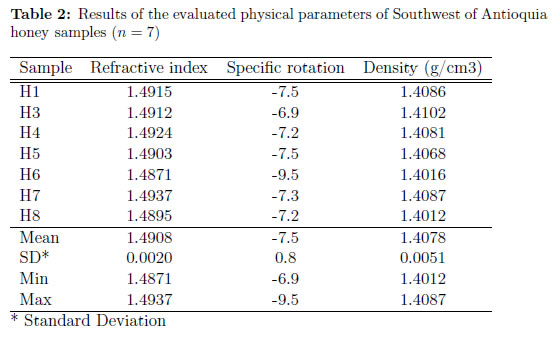
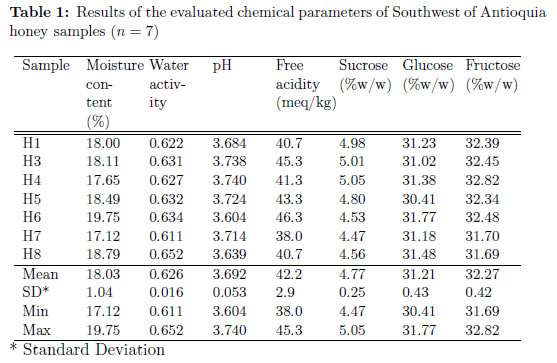
<body><![CDATA[<p>Then, 1 <i>ml</i> of each mentioned dilutions was then mixed in Petri dishes   with 12 <i>ml</i> of culture medium (<i>pH</i> 3:5) containing yeast extracts, glucose,   minerals and chloramphenicol (10 <i>mg=ml</i>). Finally, they were incubated at 25 &deg;C for 5 days.</p>     <p>Average number of colonies, multiplied by the dilution factor, was considered   for the counting of yeast and fungi colonies. Results were expressed   as colony forming units (CFU) of yeast or fungi per gram of honey. Analyses were carried out in duplicate after consulting with peers.</p>     <p>&nbsp;</p>     <p><b><font size="3">3 Results and discussion</font></b></p>     <p>   <b>3.1 Physicochemical parameters</b></p>     <p>   <a href="#t1">Table 1</a> shows the results of honey chemical analysis, with minimum, maximum,   mean and standard deviation. The mean moisture content is 18:03%     <i>w=w</i> &plusmn; 1:04. This result meets the requirement of Resoluci&oacute;n 1057 of the   Colombian government and international Codex-Stan 12, which accepts up   to 20% humidity. Compliance with this parameter ensures that the extraction   was carried out in a proper state of maturity and the fact that honey   was kept under appropriate storage conditions &#91;4&#93;. This level of moisture   prevents contamination with microorganisms &#91;11&#93;. However, sample H6 had   a moisture percentage of 19:75% <i>w=w</i>, which indicates that this particular   sample has a greater probability of fermentation, spoilage and flavor loss,   leading to a decrease in quality &#91;12&#93;. Although, the legislation is not being   violated, it is important to improve the manufacturing practices in order   to prevent deficiencies that may affect the final product quality.</p>     <p align="center"><a name="t1"></a><img src="/img/revistas/ince/v9n18/v9n18a04t1.jpg"></p>     <p>The mean water activity for samples was 0:626 &plusmn; 0:016. Although the   water activity is not regulated by any law, it is useful to analyze it as an   indicator of the risk of contamination with microorganisms. Water activity   consists in the real amount of water that is available for yeast to grow   and develop &#91;13&#93;. The water activity of honey is within a range of 0:5 to   0:65. This prevents the appearance of mold, yeast and bacteria, but is not   low enough to avoid the contamination with osmophilic yeasts, those who   can grow at a 0:6 water activity &#91;14&#93;. Sample H8 reaches a 0:652 water   activity, which is outside the range previously mentioned. Overall, samples   are close to the upper range previously mentioned, therefore water activity   of Southwest of Antioquia honeys make them susceptible to microorganism spoilage.</p>     <p>According to &#91;15&#93;, honeys from Boyac&aacute; and Tolima (other Colombian   Departments) have a mean water activity of 0:574 - 0:590. They say that   these values can be even low for honeys of coffee zones associated with   montane wet forest bio-geographic zone (bmh-MB). The opposite occurred   with tested honeys, because coming from this type of region, values were higher. It could be an indicator of Southwest of Antioquia honeys having different water activity characteristics than honeys from other Colombian regions, but further studies are needed to support this idea.</p>     <p>The <i>pH</i> values of the honeys analyzed ranged from 3:604 to 3:740. No   national or international regulation exists for <i>pH</i>. As most honeys, the   analyzed samples are acidic. The samples appear to be blossom honeys,   because <i>pH</i> value for this type of honey is between 3:300 to 4:600 &#91;16&#93;. This   fact is also supported by the argument of &#91;17&#93; and &#91;11&#93;, which states that   honeydew honeys generally have less active acidity and therefore a higher <i>pH</i>.</p>     ]]></body>
<body><![CDATA[<p>Free acidity in honey is due to the presence of organic acids, particularly   gluconic acid, which are in equilibrium with the corresponding lactones   and some inorganic ions &#91;11&#93;. Values recorded for free acidity in   the current study ranged from 38:0 to 45:3 <i>meq=kg</i>. The mean value was   42:2 <i>meq=kg</i> &plusmn; 2:9. This value represent a more active acidity than those   reported by &#91;11&#93; for Ireland honeys; &#91;18&#93; for central Spain honeys; &#91;4&#93; for   central Argentina honeys; and &#91;19&#93; for Venezuela honeys. Further analysis   should be conducted to ensure that Colombian honeys are more acid than   honeys from other countries. Although free acidity is high compared to   other honeys, the values are still in the range of the Colombian and International   regulation, being under 50:0 <i>meq=kg</i>. The compliance of this   parameter may be taken as an indicative of honey freshness and absence of unwanted fermentations &#91;4&#93;.</p>     <p>Mean fructose content was greater than glucose content, 32:72% <i>w=w</i>  and 31:12% <i>w=w</i>, respectively. This goes in agreement with the fact that   in almost all honey types fructose predominates and glucose is the second   main sugar &#91;20&#93;. Fructose/glucose ratio is an indicator of nectar source &#91;3&#93;,   because blossom honeys show a fructose/glucose ratio of about 1:0, while   honeydew honeys ratio is about 1:50 to 2:00 &#91;14&#93;. Mean fructose/glucose   ratio for the analyzed honey samples was 1:05, which suggest that samples   are blossom honeys. For honeys from more than 6 countries around the   world, &#91;13&#93; reported values between 78:50 and 92:70 for fructose + glucose   as % of total solids. In our study honeys have a fructose + glucose mean   value of 77:44% of total solids (dry weight). Colombian legislation does   not regulate this parameter, but results meet the Codex-Stand 12 (60 <i>g</i>  fructose + glucose/100 <i>g</i> honey). The glucose/water ratio is an indicator for predicting honey crystallization, because below 1:7 are indicative of slowly crystallizing honeys &#91;21&#93;. In our case, glucose/water ratio is 1:73; which is a result not conclusive about the speed rate of crystallization of the samples.</p>     <p>The results show a mean sucrose content of 4:77% <i>w=w</i> &plusmn; 0:25. The   Codex-Stan 12 and Colombian standard for honey accepts up to 5% <i>w=w</i>  sucrose content. This proves that no adulteration with sucrose was present   in tested samples, and that bees were not over-fed with sugar prior to harvest season &#91;3&#93;.</p>     <p><a href="#t2">Table 2</a> lists each sample result, mean, minimum and maximum values,   and standard deviation obtained for each physical variable measured.   Honey from all sources show the property of rotating the polarization plane   of polarized light &#91;16&#93;. Blossom honey is levorotatory in contrast to honeydew   and some adulterated honey, which are normally dextrorotatory. This   is a consequence of normal preponderance of fructose in the floral honey,   which shows a negative specific rotation over glucose &#91;22&#93;. In this study all   samples turned out to be levorotatory, with a mean value of &#8212;7:5 &plusmn;0:8, indicating   the floral origin of honeys and validating the higher fructose than glucose content found in the carbohydrate and <i>pH</i> analysis.</p>     <p align="center"><a name="t2"></a><img src="/img/revistas/ince/v9n18/v9n18a04t2.jpg"></p>     <p>Density is a property that changes according to water content: the less   water contents the less density. Density mean value was 1:4078 <i>g</i>=<i>cm</i><sup>3</sup> &plusmn;   0:0051. &#91;16&#93; explained that honey density is greater than water density by about 50% as we observed for all analyzed samples.</p>     <p><b>3.2 Microbiological analysis</b></p>     <p>   Honey normally contains fewer microorganisms than other natural food due   to its high concentration of sugars. But reports have showed that spores of     <i>Clostridium botulinum</i> can be present in honey &#91;5&#93;. Honey does not contain   the Botulinus toxin, but the spores can theoretically build the toxin after   human digestion. <i>C. botulinum</i> toxin is very harmful, especially for kids   under a year, and it can cause even death &#91;16&#93;. Therefore <i>C. botulinum</i>  needs to be monitored in order to avoid the risk of consumers&acute; food intoxication.   The count of sulfite reducing spores of Clostridia resulted in less   than 10 <i>CFU=g</i> for all the analyzed honeys. This meets the Resoluci&oacute;n   1057, which accepts a count of sulfite reducing spores of <i>Clostridium</i> between   10 and 100 <i>CFU=g</i> as a figure that prevents risks of infection for   humans.</p>     <p>Osmotolerant yeasts, which can cause undesirable fermentation, are   naturally contained in honey. This type of yeasts can particularly develop   in honeys with high moisture content and water activity, as mentioned   previously. &#91;16&#93; presented the relationship of moisture content of honey   and fermentation risk, and stated that honeys with a moisture content   of 17:1% to 18% are safe from fermentation if the yeast count is below   1000 CFU=g. Honeys with 18:1 to 19% moisture content are safe from   fermentation if the yeast count is below 10 <i>CFU=g</i>. The count of yeast and   fungi showed that all the analyzed honeys had less than 10 <i>CFU=g</i>. This   value is considerably below the maximum limit value allowed by Resoluci&oacute;n   1057 (10 - 100 <i>CFU=g</i>). Therefore, the analyzed honeys are safe for the   consumer and will not present fermentation spoilage. The absence of fungi   and yeast is consistent with moisture content and free acidity values. From   this perspective we determined the samples have good quality and reveal   the application of good manufacturing practices by beekeepers and the transformation industry.</p>     <p>&nbsp;</p>     ]]></body>
<body><![CDATA[<p><b><font size="3">4 Conclusions</font></b></p>     <p>   The results of moisture content, free acidity, percentage of sucrose, glucose   and fructose of the analyzed honeys from Southwest of Antioquia   meets current Colombian and International regulation, indicating that the   tested product is suitable for internal and external marketing. Proper moisture   levels and the absence of sulfite reducing Clostridium and fungi and   yeasts, reveal the application of good manufacturing practices by beekeepers.   Southwest of Antioquia honeys have different water activity behavior   than honeys from other Colombian regions, like Boyac&aacute; and Tolima. Analyzed   samples present a higher free acidity than the usual ranges reported   by literature, and further analysis should be conducted in order to determine   if Colombian honeys are more acidic than honeys from other countries.   Fructose/glucose ratio, <i>pH</i> and specific rotation values indicate that   the samples are blossom honeys.</p>     <p>&nbsp;</p>     <p><b><font size="3">Acknowledgments</font></b></p>     <p>   This work was developed under the project 721A-12/10-49 of Universidad   Pontificia Bolivariana (Medell&iacute;n campus). Authors wish to thank   the community of Betania Beekeepers Association (ASOAPIBE) who provided   the honey samples, as well as the Departamento Administrativo de   Ciencia, Tecnolog&iacute;a e Innovaci&oacute;n Colciencias who partially funded this   project through the program J&oacute;venes Investigadores e Innovadores ''Virginia   Guti&eacute;rrez de Pineda'' 2010. Our special gratitude goes to the student   Andr&eacute;s Felipe Ospina, who kindly conducted some of the experiments included   in this paper.</p>     <p>&nbsp;</p>     <p><b><font size="3">References</font></b></p>     <!-- ref --><p>   &#91;1&#93; Ministerio de Protecci&oacute;n Social de Colombia, ''Resoluci&oacute;n 1057/2010 Requisitos   sanitarios que debe cumplir la miel de abejas para consumo humano,''   pp. 1&#8211;9, 2010.    &nbsp;&nbsp;&nbsp;&nbsp;&nbsp;&nbsp;&nbsp;&nbsp;[&#160;<a href="javascript:void(0);" onclick="javascript: window.open('/scielo.php?script=sci_nlinks&ref=000080&pid=S1794-9165201300020000400001&lng=','','width=640,height=500,resizable=yes,scrollbars=1,menubar=yes,');">Links</a>&#160;]<!-- end-ref --> 64</p>     <!-- ref --><p>   &#91;2&#93; Codex Alimentarius Commission, ''Revised Codex Standard for Honey Codex   Stan 12-1981, Rev. 1 (1987), Rev. 2 (2001),'' <i>Codex Standard</i>, pp. 1&#8211;7, 1981.    &nbsp;&nbsp;&nbsp;&nbsp;&nbsp;&nbsp;&nbsp;&nbsp;[&#160;<a href="javascript:void(0);" onclick="javascript: window.open('/scielo.php?script=sci_nlinks&ref=000082&pid=S1794-9165201300020000400002&lng=','','width=640,height=500,resizable=yes,scrollbars=1,menubar=yes,');">Links</a>&#160;]<!-- end-ref -->   62, 64</p>     <!-- ref --><p>&#91;3&#93; E. Anklam, ''A review of the analytical methods to determine the geographical   and botanical origin of honey,'' <i>Food Chemistry</i>, vol. 63, no. 4, pp. 549&#8211; 562, 1998.    &nbsp;&nbsp;&nbsp;&nbsp;&nbsp;&nbsp;&nbsp;&nbsp;[&#160;<a href="javascript:void(0);" onclick="javascript: window.open('/scielo.php?script=sci_nlinks&ref=000084&pid=S1794-9165201300020000400003&lng=','','width=640,height=500,resizable=yes,scrollbars=1,menubar=yes,');">Links</a>&#160;]<!-- end-ref --> 62, 69, 70</p>     <!-- ref --><p>   &#91;4&#93; M. S. Finola, M. C. Lasagno, and J. M. Marioli, ''Microbiological and chemical   characterization of honeys from central Argentina,'' <i>Food Chemistry</i>, vol.   100, no. 4, pp. 1649&#8211;1653, 2007.    &nbsp;&nbsp;&nbsp;&nbsp;&nbsp;&nbsp;&nbsp;&nbsp;[&#160;<a href="javascript:void(0);" onclick="javascript: window.open('/scielo.php?script=sci_nlinks&ref=000086&pid=S1794-9165201300020000400004&lng=','','width=640,height=500,resizable=yes,scrollbars=1,menubar=yes,');">Links</a>&#160;]<!-- end-ref --> 62, 66, 67, 69</p>     <!-- ref --><p>   &#91;5&#93; J. A. Snowdon and D. O. Cliver, ''Microorganisms in honey,'' <i>International   Journal of Food Microbiology</i>, vol. 31, no. 31, pp. 1&#8211;26, 1996.    &nbsp;&nbsp;&nbsp;&nbsp;&nbsp;&nbsp;&nbsp;&nbsp;[&#160;<a href="javascript:void(0);" onclick="javascript: window.open('/scielo.php?script=sci_nlinks&ref=000088&pid=S1794-9165201300020000400005&lng=','','width=640,height=500,resizable=yes,scrollbars=1,menubar=yes,');">Links</a>&#160;]<!-- end-ref --> 63, 71</p>     <!-- ref --><p>   &#91;6&#93; S. Bogdanov, E. Forschungsanstalt fur Milchwirtschaft, and I. H. Commission.,     <i>Honey quality : methods of analysis and international regulatory standards   : review of the work of the International Honey Commission</i>. Bern:   Federal Dairy Research Institute Liebefeld, 1999.    &nbsp;&nbsp;&nbsp;&nbsp;&nbsp;&nbsp;&nbsp;&nbsp;[&#160;<a href="javascript:void(0);" onclick="javascript: window.open('/scielo.php?script=sci_nlinks&ref=000090&pid=S1794-9165201300020000400006&lng=','','width=640,height=500,resizable=yes,scrollbars=1,menubar=yes,');">Links</a>&#160;]<!-- end-ref --> 63, 64</p>     <!-- ref --><p>   &#91;7&#93; L. D. Rodr&iacute;guez, ''Informe de la actividad ap&iacute;cola en Antioquia,'' Centro de   Desarrollo Rural Cr&eacute;ame, Medell&iacute;n, Antioquia, Tech. Rep., 2009.    &nbsp;&nbsp;&nbsp;&nbsp;&nbsp;&nbsp;&nbsp;&nbsp;[&#160;<a href="javascript:void(0);" onclick="javascript: window.open('/scielo.php?script=sci_nlinks&ref=000092&pid=S1794-9165201300020000400007&lng=','','width=640,height=500,resizable=yes,scrollbars=1,menubar=yes,');">Links</a>&#160;]<!-- end-ref --> 63</p>     <!-- ref --><p>   &#91;8&#93; A. M. Cifuentes and G. L. Garc&iacute;a, ''Evaluaci&oacute;n de la calidad de miel de abejas   procedente de la zona cafetera del Suroeste antioque&ntilde;o,'' Ph.D. dissertation,   Universidad Nacional de Colombia Sede Medell&iacute;n, 1987.    &nbsp;&nbsp;&nbsp;&nbsp;&nbsp;&nbsp;&nbsp;&nbsp;[&#160;<a href="javascript:void(0);" onclick="javascript: window.open('/scielo.php?script=sci_nlinks&ref=000094&pid=S1794-9165201300020000400008&lng=','','width=640,height=500,resizable=yes,scrollbars=1,menubar=yes,');">Links</a>&#160;]<!-- end-ref --> 64</p>     <!-- ref --><p>   &#91;9&#93; H. D. Chataway, ''The determination of moisture in honey,'' <i>Can. J. Res.   Canadian Journal of Research</i>, vol. 6, no. 5, pp. 532&#8211;547, 1932.    &nbsp;&nbsp;&nbsp;&nbsp;&nbsp;&nbsp;&nbsp;&nbsp;[&#160;<a href="javascript:void(0);" onclick="javascript: window.open('/scielo.php?script=sci_nlinks&ref=000096&pid=S1794-9165201300020000400009&lng=','','width=640,height=500,resizable=yes,scrollbars=1,menubar=yes,');">Links</a>&#160;]<!-- end-ref --> 65</p>     <!-- ref --><p>   &#91;10&#93; S. Bogdanov, P. Martin, and C. Luellmann, ''Harmonised methods of the   European Honey Commission,'' <i>APIDOLOGIE</i>, vol. 28 SUPP/1, p. ALL,   1997.    &nbsp;&nbsp;&nbsp;&nbsp;&nbsp;&nbsp;&nbsp;&nbsp;[&#160;<a href="javascript:void(0);" onclick="javascript: window.open('/scielo.php?script=sci_nlinks&ref=000098&pid=S1794-9165201300020000400010&lng=','','width=640,height=500,resizable=yes,scrollbars=1,menubar=yes,');">Links</a>&#160;]<!-- end-ref --> 65</p>     <!-- ref --><p>   &#91;11&#93; G. Downey, K. Hussey, J. D. Kelly, T. F. Walshe, and P. G. Martin, ''Preliminary   contribution to the characterisation of artisanal honey produced   on the island of Ireland by palynological and physico-chemical data,'' <i>Food   Chemistry</i>, vol. 91, no. 2, pp. 347&#8211;354, 2005.    &nbsp;&nbsp;&nbsp;&nbsp;&nbsp;&nbsp;&nbsp;&nbsp;[&#160;<a href="javascript:void(0);" onclick="javascript: window.open('/scielo.php?script=sci_nlinks&ref=000100&pid=S1794-9165201300020000400011&lng=','','width=640,height=500,resizable=yes,scrollbars=1,menubar=yes,');">Links</a>&#160;]<!-- end-ref --> 67, 69</p>     <!-- ref --><p>   &#91;12&#93; L. S. M. Costa, M. L. S. Albuquerque, L. C. Trugo, L. M. C. Quinteiro, O. M.   Barth, M. Ribeiro, and C. A. B. D. Maria, ''Determination of non-volatile   compounds of different botanical origin Brazilian honeys,'' <i>Food Chemistry</i>,   vol. 65, no. 3, pp. 347&#8211;352, 1999.    &nbsp;&nbsp;&nbsp;&nbsp;&nbsp;&nbsp;&nbsp;&nbsp;[&#160;<a href="javascript:void(0);" onclick="javascript: window.open('/scielo.php?script=sci_nlinks&ref=000102&pid=S1794-9165201300020000400012&lng=','','width=640,height=500,resizable=yes,scrollbars=1,menubar=yes,');">Links</a>&#160;]<!-- end-ref --> 67</p>     <!-- ref --><p>   &#91;13&#93; M. C. Zamora, J. Chirife, and D. Rold&aacute;n, ''On the nature of the relationship   between water activity and % moisture in honey,'' Food Control, vol. 17,   no. 8, pp. 642&#8211;647, 2006.    &nbsp;&nbsp;&nbsp;&nbsp;&nbsp;&nbsp;&nbsp;&nbsp;[&#160;<a href="javascript:void(0);" onclick="javascript: window.open('/scielo.php?script=sci_nlinks&ref=000104&pid=S1794-9165201300020000400013&lng=','','width=640,height=500,resizable=yes,scrollbars=1,menubar=yes,');">Links</a>&#160;]<!-- end-ref --> 68, 69</p>     <!-- ref --><p>   &#91;14&#93; R. A. Gleiter, H. Horn, and H.-D. Isengard, ''Influence of type and state of   crystallisation on the water activity of honey,'' <i>Food Chemistry</i>, vol. 96, no. 3,   pp. 441&#8211;445, 2006.    &nbsp;&nbsp;&nbsp;&nbsp;&nbsp;&nbsp;&nbsp;&nbsp;[&#160;<a href="javascript:void(0);" onclick="javascript: window.open('/scielo.php?script=sci_nlinks&ref=000106&pid=S1794-9165201300020000400014&lng=','','width=640,height=500,resizable=yes,scrollbars=1,menubar=yes,');">Links</a>&#160;]<!-- end-ref --> 68, 69</p>     <!-- ref --><p>&#91;15&#93; Salamanca G. G., F. C. P&eacute;rez, and B. J. A. Serra, ''Determinaci&oacute;n de la   actividad de agua en mieles colombianos de las zonas de Boyac&aacute; y Tolima,''   <i>Apicervices - Galer&iacute;a Ap&iacute;cola Virtual</i>., 2001.    &nbsp;&nbsp;&nbsp;&nbsp;&nbsp;&nbsp;&nbsp;&nbsp;[&#160;<a href="javascript:void(0);" onclick="javascript: window.open('/scielo.php?script=sci_nlinks&ref=000108&pid=S1794-9165201300020000400015&lng=','','width=640,height=500,resizable=yes,scrollbars=1,menubar=yes,');">Links</a>&#160;]<!-- end-ref --> &#91;Online&#93;. Available: http:// <a href="http://www.apiservices.com/articulos/salamanca/actividad_agua.htm" target="_blank">www.apiservices.com/articulos/salamanca/actividad_agua.htm</a> 68</p>     <!-- ref --><p>   &#91;16&#93; S. Bogdanov, <i>Book of Honey (Online version)</i>, 1st ed. Switzerland: Bee   Research Center, 2009.    &nbsp;&nbsp;&nbsp;&nbsp;&nbsp;&nbsp;&nbsp;&nbsp;[&#160;<a href="javascript:void(0);" onclick="javascript: window.open('/scielo.php?script=sci_nlinks&ref=000110&pid=S1794-9165201300020000400016&lng=','','width=640,height=500,resizable=yes,scrollbars=1,menubar=yes,');">Links</a>&#160;]<!-- end-ref --> &#91;Online&#93;. Available: <a href="http://www.bee-hexagon.net/en/protected-sid-NFBoeXNpY2FsUHJvcGVydGllc0hvbmV5LnBkZg%3D%3D.htm" target="_blank">http://www.bee-hexagon.net/en/protected-sid-NFBoeXNpY2FsUHJvcGVydGllc0hvbmV5LnBkZg%3D%3D.htm</a> 69, 70, 71</p>     <!-- ref --><p>   &#91;17&#93; J. W. W. Jr., ''Honey,'' in <i>Food Research</i>, ser. Advances in Food Research,   C. O. Chichester, Ed. Academic Press, 1978, vol. 24, pp. 287&#8211;374.    &nbsp;&nbsp;&nbsp;&nbsp;&nbsp;&nbsp;&nbsp;&nbsp;[&#160;<a href="javascript:void(0);" onclick="javascript: window.open('/scielo.php?script=sci_nlinks&ref=000112&pid=S1794-9165201300020000400017&lng=','','width=640,height=500,resizable=yes,scrollbars=1,menubar=yes,');">Links</a>&#160;]<!-- end-ref --> 69</p>     <!-- ref --><p>   &#91;18&#93; A. C. Soria, M. Gonz&aacute;lez, C. de Lorenzo, I. Mart&iacute;nez-Castro, and J. Sanz, ''Characterization of artisanal honeys from Madrid (Central Spain) on the basis of their melissopalynological, physicochemical and volatile composition data,'' <i>Food Chemistry</i>, vol. 85, no. 1, pp. 121&#8211;130, 2004.    &nbsp;&nbsp;&nbsp;&nbsp;&nbsp;&nbsp;&nbsp;&nbsp;[&#160;<a href="javascript:void(0);" onclick="javascript: window.open('/scielo.php?script=sci_nlinks&ref=000114&pid=S1794-9165201300020000400018&lng=','','width=640,height=500,resizable=yes,scrollbars=1,menubar=yes,');">Links</a>&#160;]<!-- end-ref --> 69</p>     <!-- ref --><p>   &#91;19&#93; P. Vit, S. Bogdanov, and V. Kilchenmann, ''Composition of Venezuelan honeys   from stingless bees (Apidae: Meliponinae) and Apis mellifera L,'' <i>Apidologie   Apidologie</i>, vol. 25, no. 3, pp. 278&#8211;288, 1994.    &nbsp;&nbsp;&nbsp;&nbsp;&nbsp;&nbsp;&nbsp;&nbsp;[&#160;<a href="javascript:void(0);" onclick="javascript: window.open('/scielo.php?script=sci_nlinks&ref=000116&pid=S1794-9165201300020000400019&lng=','','width=640,height=500,resizable=yes,scrollbars=1,menubar=yes,');">Links</a>&#160;]<!-- end-ref --> 69</p>     <!-- ref --><p>   &#91;20&#93; M. M. Cavia, M. A. Fern&aacute;ndez-Mui&ntilde;o, E. G&oacute;mez-Alonso, M. J. Montes-   P&eacute;rez, J. F. Huidobro, and M. T. Sancho, ''Evolution of fructose and glucose   in honey over one year: influence of induced granulation,'' <i>Food Chemistry</i>,   vol. 78, no. 2, pp. 157&#8211;161, 2002.    &nbsp;&nbsp;&nbsp;&nbsp;&nbsp;&nbsp;&nbsp;&nbsp;[&#160;<a href="javascript:void(0);" onclick="javascript: window.open('/scielo.php?script=sci_nlinks&ref=000118&pid=S1794-9165201300020000400020&lng=','','width=640,height=500,resizable=yes,scrollbars=1,menubar=yes,');">Links</a>&#160;]<!-- end-ref --> 69</p>     <!-- ref --><p>   &#91;21&#93; I. Manikis and A. Thrasivoulou, ''La relaci&oacute;n entra las caracter&iacute;sticas f&iacute;sicoqu&iacute;micas   de la miel y los par&aacute;metros de sensibilidad a la cristalizaci&oacute;n,''   <i>Apiacta</i>, pp. 106&#8211;112, 2001.    &nbsp;&nbsp;&nbsp;&nbsp;&nbsp;&nbsp;&nbsp;&nbsp;[&#160;<a href="javascript:void(0);" onclick="javascript: window.open('/scielo.php?script=sci_nlinks&ref=000120&pid=S1794-9165201300020000400021&lng=','','width=640,height=500,resizable=yes,scrollbars=1,menubar=yes,');">Links</a>&#160;]<!-- end-ref --> 70</p>     <!-- ref --><p>   &#91;22&#93; V. Nanda, B. C. Sarkar, H. K. Sharma, and A. S. Bawa, ''Physico-chemical   properties and estimation of mineral content in honey produced from different   plants in Northern India,'' <i>Journal of Food Composition and Analysis</i>, vol. 16,   no. 5, pp. 613&#8211;619, 2003.    &nbsp;&nbsp;&nbsp;&nbsp;&nbsp;&nbsp;&nbsp;&nbsp;[&#160;<a href="javascript:void(0);" onclick="javascript: window.open('/scielo.php?script=sci_nlinks&ref=000122&pid=S1794-9165201300020000400022&lng=','','width=640,height=500,resizable=yes,scrollbars=1,menubar=yes,');">Links</a>&#160;]<!-- end-ref --> 70</p>     <p>&nbsp;</p>     <p>&nbsp;</p> </font>     ]]></body><back>
<ref-list>
<ref id="B1">
<label>1</label><nlm-citation citation-type="">
<collab>Ministerio de Protección Social de Colombia</collab>
<source><![CDATA[Resolución 1057/2010 Requisitos sanitarios que debe cumplir la miel de abejas para consumo humano]]></source>
<year>2010</year>
<page-range>1-9</page-range></nlm-citation>
</ref>
<ref id="B2">
<label>2</label><nlm-citation citation-type="book">
<collab>Codex Alimentarius Commission</collab>
<source><![CDATA[Revised Codex Standard for Honey Codex Stan 12-1981]]></source>
<year>1981</year>
<page-range>1-7</page-range><publisher-name><![CDATA[Codex Standard]]></publisher-name>
</nlm-citation>
</ref>
<ref id="B3">
<label>[3</label><nlm-citation citation-type="journal">
<person-group person-group-type="author">
<name>
<surname><![CDATA[Anklam]]></surname>
<given-names><![CDATA[E]]></given-names>
</name>
</person-group>
<article-title xml:lang="en"><![CDATA[A review of the analytical methods to determine the geographical and botanical origin of honey]]></article-title>
<source><![CDATA[Food Chemistry]]></source>
<year>1998</year>
<volume>63</volume>
<numero>4</numero>
<issue>4</issue>
<page-range>549- 562</page-range></nlm-citation>
</ref>
<ref id="B4">
<label>[4</label><nlm-citation citation-type="journal">
<person-group person-group-type="author">
<name>
<surname><![CDATA[Finola]]></surname>
<given-names><![CDATA[M S]]></given-names>
</name>
<name>
<surname><![CDATA[Lasagno]]></surname>
<given-names><![CDATA[M C]]></given-names>
</name>
<name>
<surname><![CDATA[Marioli]]></surname>
<given-names><![CDATA[J M]]></given-names>
</name>
</person-group>
<article-title xml:lang="en"><![CDATA[Microbiological and chemical characterization of honeys from central Argentina]]></article-title>
<source><![CDATA[Food Chemistry]]></source>
<year>2007</year>
<volume>100</volume>
<numero>4</numero>
<issue>4</issue>
<page-range>1649-1653</page-range></nlm-citation>
</ref>
<ref id="B5">
<label>5</label><nlm-citation citation-type="journal">
<person-group person-group-type="author">
<name>
<surname><![CDATA[Snowdon]]></surname>
<given-names><![CDATA[J A]]></given-names>
</name>
<name>
<surname><![CDATA[Cliver]]></surname>
<given-names><![CDATA[D O]]></given-names>
</name>
</person-group>
<article-title xml:lang="en"><![CDATA[Microorganisms in honey]]></article-title>
<source><![CDATA[International Journal of Food Microbiology]]></source>
<year>1996</year>
<volume>31</volume>
<numero>31</numero>
<issue>31</issue>
<page-range>1-26</page-range></nlm-citation>
</ref>
<ref id="B6">
<label>6</label><nlm-citation citation-type="book">
<person-group person-group-type="author">
<name>
<surname><![CDATA[Bogdanov]]></surname>
<given-names><![CDATA[S]]></given-names>
</name>
</person-group>
<source><![CDATA[E. Forschungsanstalt fur Milchwirtschaft, and I. H. Commission., Honey quality : methods of analysis and international regulatory standards : review of the work of the International Honey Commission]]></source>
<year>1999</year>
<publisher-loc><![CDATA[Bern ]]></publisher-loc>
<publisher-name><![CDATA[Federal Dairy Research Institute Liebefeld]]></publisher-name>
</nlm-citation>
</ref>
<ref id="B7">
<label>7</label><nlm-citation citation-type="book">
<person-group person-group-type="author">
<name>
<surname><![CDATA[Rodríguez]]></surname>
<given-names><![CDATA[L. D]]></given-names>
</name>
</person-group>
<source><![CDATA[Informe de la actividad apícola en Antioquia]]></source>
<year>2009</year>
<publisher-loc><![CDATA[Medellín ]]></publisher-loc>
<publisher-name><![CDATA[Centro de Desarrollo Rural Créame]]></publisher-name>
</nlm-citation>
</ref>
<ref id="B8">
<label>8</label><nlm-citation citation-type="">
<person-group person-group-type="author">
<name>
<surname><![CDATA[Cifuentes]]></surname>
<given-names><![CDATA[A. M]]></given-names>
</name>
<name>
<surname><![CDATA[García]]></surname>
<given-names><![CDATA[G. L]]></given-names>
</name>
</person-group>
<source><![CDATA[Evaluación de la calidad de miel de abejas procedente de la zona cafetera del Suroeste antioqueño]]></source>
<year></year>
</nlm-citation>
</ref>
<ref id="B9">
<label>9</label><nlm-citation citation-type="journal">
<person-group person-group-type="author">
<name>
<surname><![CDATA[Chataway]]></surname>
<given-names><![CDATA[H D]]></given-names>
</name>
</person-group>
<article-title xml:lang="en"><![CDATA[The determination of moisture in honey]]></article-title>
<source><![CDATA[Can. J. Res. Canadian Journal of Research]]></source>
<year>1932</year>
<volume>6</volume>
<numero>5</numero>
<issue>5</issue>
<page-range>532-547</page-range></nlm-citation>
</ref>
<ref id="B10">
<label>10</label><nlm-citation citation-type="journal">
<person-group person-group-type="author">
<name>
<surname><![CDATA[Bogdanov]]></surname>
<given-names><![CDATA[S]]></given-names>
</name>
<name>
<surname><![CDATA[Martin]]></surname>
<given-names><![CDATA[P]]></given-names>
</name>
<name>
<surname><![CDATA[Luellmann]]></surname>
<given-names><![CDATA[C]]></given-names>
</name>
</person-group>
<article-title xml:lang="en"><![CDATA[Harmonised methods of the European Honey Commission]]></article-title>
<source><![CDATA[APIDOLOGIE]]></source>
<year>1997</year>
<volume>28</volume>
<numero>^s1</numero>
<issue>^s1</issue>
<supplement>1</supplement>
</nlm-citation>
</ref>
<ref id="B11">
<label>[11</label><nlm-citation citation-type="journal">
<person-group person-group-type="author">
<name>
<surname><![CDATA[Downey]]></surname>
<given-names><![CDATA[G]]></given-names>
</name>
<name>
<surname><![CDATA[Hussey]]></surname>
<given-names><![CDATA[K]]></given-names>
</name>
<name>
<surname><![CDATA[Kelly]]></surname>
<given-names><![CDATA[J D]]></given-names>
</name>
<name>
<surname><![CDATA[Walshe]]></surname>
<given-names><![CDATA[T F]]></given-names>
</name>
<name>
<surname><![CDATA[Martin]]></surname>
<given-names><![CDATA[P G]]></given-names>
</name>
</person-group>
<article-title xml:lang="en"><![CDATA[Preliminary contribution to the characterisation of artisanal honey produced on the island of Ireland by palynological and physico-chemical data]]></article-title>
<source><![CDATA[Food Chemistry]]></source>
<year>2005</year>
<volume>91</volume>
<numero>2</numero>
<issue>2</issue>
<page-range>347-354</page-range></nlm-citation>
</ref>
<ref id="B12">
<label>[12</label><nlm-citation citation-type="journal">
<person-group person-group-type="author">
<name>
<surname><![CDATA[Costa]]></surname>
<given-names><![CDATA[L S M]]></given-names>
</name>
<name>
<surname><![CDATA[Albuquerque]]></surname>
<given-names><![CDATA[M L S]]></given-names>
</name>
<name>
<surname><![CDATA[Trugo]]></surname>
<given-names><![CDATA[L C]]></given-names>
</name>
<name>
<surname><![CDATA[Quinteiro]]></surname>
<given-names><![CDATA[L M C]]></given-names>
</name>
<name>
<surname><![CDATA[Barth]]></surname>
<given-names><![CDATA[O M]]></given-names>
</name>
<name>
<surname><![CDATA[Ribeiro]]></surname>
<given-names><![CDATA[M]]></given-names>
</name>
<name>
<surname><![CDATA[Maria]]></surname>
<given-names><![CDATA[C A B D]]></given-names>
</name>
</person-group>
<article-title xml:lang="en"><![CDATA[Determination of non-volatile compounds of different botanical origin Brazilian honeys]]></article-title>
<source><![CDATA[Food Chemistry]]></source>
<year>1999</year>
<volume>65</volume>
<numero>3</numero>
<issue>3</issue>
<page-range>347-352</page-range></nlm-citation>
</ref>
<ref id="B13">
<label>[13</label><nlm-citation citation-type="journal">
<person-group person-group-type="author">
<name>
<surname><![CDATA[Zamora]]></surname>
<given-names><![CDATA[M C]]></given-names>
</name>
<name>
<surname><![CDATA[Chirife]]></surname>
<given-names><![CDATA[J]]></given-names>
</name>
<name>
<surname><![CDATA[Roldán]]></surname>
<given-names><![CDATA[D]]></given-names>
</name>
</person-group>
<article-title xml:lang="en"><![CDATA[On the nature of the relationship between water activity and % moisture in honey]]></article-title>
<source><![CDATA[Food Control]]></source>
<year>2006</year>
<volume>17</volume>
<numero>8</numero>
<issue>8</issue>
<page-range>642-647</page-range></nlm-citation>
</ref>
<ref id="B14">
<label>[14</label><nlm-citation citation-type="journal">
<person-group person-group-type="author">
<name>
<surname><![CDATA[Gleiter]]></surname>
<given-names><![CDATA[R A]]></given-names>
</name>
<name>
<surname><![CDATA[Horn]]></surname>
<given-names><![CDATA[H]]></given-names>
</name>
<name>
<surname><![CDATA[Isengard]]></surname>
<given-names><![CDATA[H-D]]></given-names>
</name>
</person-group>
<article-title xml:lang="en"><![CDATA[Influence of type and state of crystallisation on the water activity of honey]]></article-title>
<source><![CDATA[Food Chemistry]]></source>
<year>2006</year>
<volume>96</volume>
<numero>3</numero>
<issue>3</issue>
<page-range>441-445</page-range></nlm-citation>
</ref>
<ref id="B15">
<label>15</label><nlm-citation citation-type="book">
<person-group person-group-type="author">
<name>
<surname><![CDATA[Salamanca]]></surname>
<given-names><![CDATA[G. G]]></given-names>
</name>
<name>
<surname><![CDATA[Pérez]]></surname>
<given-names><![CDATA[F. C]]></given-names>
</name>
<name>
<surname><![CDATA[Serra]]></surname>
<given-names><![CDATA[B. J. A]]></given-names>
</name>
</person-group>
<source><![CDATA[Determinación de la actividad de agua en mieles colombianos de las zonas de Boyacá y Tolima]]></source>
<year>2001</year>
<publisher-name><![CDATA[Apicervices - Galería Apícola Virtual]]></publisher-name>
</nlm-citation>
</ref>
<ref id="B16">
<label>16</label><nlm-citation citation-type="book">
<person-group person-group-type="author">
<name>
<surname><![CDATA[Bogdanov]]></surname>
<given-names><![CDATA[S]]></given-names>
</name>
</person-group>
<source><![CDATA[Book of Honey]]></source>
<year>2009</year>
<edition>1</edition>
<publisher-loc><![CDATA[Switzerland ]]></publisher-loc>
<publisher-name><![CDATA[Bee Research Center]]></publisher-name>
</nlm-citation>
</ref>
<ref id="B17">
<label>17</label><nlm-citation citation-type="book">
<person-group person-group-type="author">
<name>
<surname><![CDATA[Jr]]></surname>
<given-names><![CDATA[J. W. W]]></given-names>
</name>
</person-group>
<article-title xml:lang="en"><![CDATA[Honey]]></article-title>
<source><![CDATA[Food Research]]></source>
<year>1978</year>
<volume>24</volume>
<page-range>287-374</page-range><publisher-name><![CDATA[Academic Press]]></publisher-name>
</nlm-citation>
</ref>
<ref id="B18">
<label>[18</label><nlm-citation citation-type="journal">
<person-group person-group-type="author">
<name>
<surname><![CDATA[Soria]]></surname>
<given-names><![CDATA[A C]]></given-names>
</name>
<name>
<surname><![CDATA[González]]></surname>
<given-names><![CDATA[M]]></given-names>
</name>
<name>
<surname><![CDATA[de Lorenzo]]></surname>
<given-names><![CDATA[C]]></given-names>
</name>
<name>
<surname><![CDATA[Martínez-Castro]]></surname>
<given-names><![CDATA[I]]></given-names>
</name>
<name>
<surname><![CDATA[Sanz]]></surname>
<given-names><![CDATA[J]]></given-names>
</name>
</person-group>
<article-title xml:lang="en"><![CDATA[Characterization of artisanal honeys from Madrid (Central Spain) on the basis of their melissopalynological, physicochemical and volatile composition data]]></article-title>
<source><![CDATA[Food Chemistry]]></source>
<year>2004</year>
<volume>85</volume>
<numero>1</numero>
<issue>1</issue>
<page-range>121-130</page-range></nlm-citation>
</ref>
<ref id="B19">
<label>[19</label><nlm-citation citation-type="journal">
<person-group person-group-type="author">
<name>
<surname><![CDATA[Vit]]></surname>
<given-names><![CDATA[P]]></given-names>
</name>
<name>
<surname><![CDATA[Bogdanov]]></surname>
<given-names><![CDATA[S]]></given-names>
</name>
<name>
<surname><![CDATA[Kilchenmann]]></surname>
<given-names><![CDATA[V]]></given-names>
</name>
</person-group>
<article-title xml:lang="en"><![CDATA[Composition of Venezuelan honeys from stingless bees (Apidae: Meliponinae) and Apis mellifera L]]></article-title>
<source><![CDATA[Apidologie Apidologie]]></source>
<year>1994</year>
<volume>25</volume>
<numero>3</numero>
<issue>3</issue>
<page-range>278-288</page-range></nlm-citation>
</ref>
<ref id="B20">
<label>[20</label><nlm-citation citation-type="journal">
<person-group person-group-type="author">
<name>
<surname><![CDATA[Cavia]]></surname>
<given-names><![CDATA[M M]]></given-names>
</name>
<name>
<surname><![CDATA[Fernández-Muiño]]></surname>
<given-names><![CDATA[M A]]></given-names>
</name>
<name>
<surname><![CDATA[Gómez-Alonso]]></surname>
<given-names><![CDATA[E]]></given-names>
</name>
<name>
<surname><![CDATA[Montes- Pérez]]></surname>
<given-names><![CDATA[M J]]></given-names>
</name>
<name>
<surname><![CDATA[Huidobro]]></surname>
<given-names><![CDATA[J F]]></given-names>
</name>
<name>
<surname><![CDATA[Sancho]]></surname>
<given-names><![CDATA[M T]]></given-names>
</name>
</person-group>
<article-title xml:lang="en"><![CDATA[Evolution of fructose and glucose in honey over one year: influence of induced granulation]]></article-title>
<source><![CDATA[Food Chemistry]]></source>
<year>2002</year>
<volume>78</volume>
<numero>2</numero>
<issue>2</issue>
<page-range>157-161</page-range></nlm-citation>
</ref>
<ref id="B21">
<label>21</label><nlm-citation citation-type="journal">
<person-group person-group-type="author">
<name>
<surname><![CDATA[Manikis]]></surname>
<given-names><![CDATA[I]]></given-names>
</name>
<name>
<surname><![CDATA[Thrasivoulou]]></surname>
<given-names><![CDATA[A]]></given-names>
</name>
</person-group>
<article-title xml:lang="es"><![CDATA[La relación entra las características físicoquímicas de la miel y los parámetros de sensibilidad a la cristalización]]></article-title>
<source><![CDATA[Apiacta]]></source>
<year>2001</year>
<page-range>106-112</page-range></nlm-citation>
</ref>
<ref id="B22">
<label>[22</label><nlm-citation citation-type="journal">
<person-group person-group-type="author">
<name>
<surname><![CDATA[Nanda]]></surname>
<given-names><![CDATA[V]]></given-names>
</name>
<name>
<surname><![CDATA[Sarkar]]></surname>
<given-names><![CDATA[B C]]></given-names>
</name>
<name>
<surname><![CDATA[Sharma]]></surname>
<given-names><![CDATA[H K]]></given-names>
</name>
<name>
<surname><![CDATA[Bawa]]></surname>
<given-names><![CDATA[A S]]></given-names>
</name>
</person-group>
<article-title xml:lang="en"><![CDATA[Physico-chemical properties and estimation of mineral content in honey produced from different plants in Northern India]]></article-title>
<source><![CDATA[Journal of Food Composition and Analysis]]></source>
<year>2003</year>
<volume>16</volume>
<numero>5</numero>
<issue>5</issue>
<page-range>613-619</page-range></nlm-citation>
</ref>
</ref-list>
</back>
</article>