<?xml version="1.0" encoding="ISO-8859-1"?><article xmlns:mml="http://www.w3.org/1998/Math/MathML" xmlns:xlink="http://www.w3.org/1999/xlink" xmlns:xsi="http://www.w3.org/2001/XMLSchema-instance">
<front>
<journal-meta>
<journal-id>1794-9165</journal-id>
<journal-title><![CDATA[Ingeniería y Ciencia]]></journal-title>
<abbrev-journal-title><![CDATA[ing.cienc.]]></abbrev-journal-title>
<issn>1794-9165</issn>
<publisher>
<publisher-name><![CDATA[Escuela de Ciencias y Humanidades y Escuela de Ingeniería de la Universidad EAFIT]]></publisher-name>
</publisher>
</journal-meta>
<article-meta>
<article-id>S1794-91652014000100003</article-id>
<title-group>
<article-title xml:lang="en"><![CDATA[A Mathematical Model for Social Security Systems with Dynamical Systems]]></article-title>
<article-title xml:lang="es"><![CDATA[Un modelo matemático para sistemas de jubilación del seguro social con sistemas dinámicos]]></article-title>
</title-group>
<contrib-group>
<contrib contrib-type="author">
<name>
<surname><![CDATA[Gonzalez-Parra]]></surname>
<given-names><![CDATA[Gilberto]]></given-names>
</name>
<xref ref-type="aff" rid="A01"/>
</contrib>
<contrib contrib-type="author">
<name>
<surname><![CDATA[Arenas]]></surname>
<given-names><![CDATA[Abraham J]]></given-names>
</name>
<xref ref-type="aff" rid="A02"/>
</contrib>
</contrib-group>
<aff id="A01">
<institution><![CDATA[,Universidad Los Andes  ]]></institution>
<addr-line><![CDATA[Mérida ]]></addr-line>
<country>Venezuela</country>
</aff>
<aff id="A02">
<institution><![CDATA[,Universidad de Córdoba  ]]></institution>
<addr-line><![CDATA[Montería ]]></addr-line>
<country>Colombia</country>
</aff>
<pub-date pub-type="pub">
<day>30</day>
<month>01</month>
<year>2014</year>
</pub-date>
<pub-date pub-type="epub">
<day>30</day>
<month>01</month>
<year>2014</year>
</pub-date>
<volume>10</volume>
<numero>19</numero>
<fpage>33</fpage>
<lpage>53</lpage>
<copyright-statement/>
<copyright-year/>
<self-uri xlink:href="http://www.scielo.org.co/scielo.php?script=sci_arttext&amp;pid=S1794-91652014000100003&amp;lng=en&amp;nrm=iso"></self-uri><self-uri xlink:href="http://www.scielo.org.co/scielo.php?script=sci_abstract&amp;pid=S1794-91652014000100003&amp;lng=en&amp;nrm=iso"></self-uri><self-uri xlink:href="http://www.scielo.org.co/scielo.php?script=sci_pdf&amp;pid=S1794-91652014000100003&amp;lng=en&amp;nrm=iso"></self-uri><abstract abstract-type="short" xml:lang="en"><p><![CDATA[In this paper it is proposed a mathematical approach based on dynamic systems to study the effect of the increase in the Social Security normal retirement age on the worker and on the dynamics of retiree populations. In order to simplify this initial effort, the proposed model does not include some economic variables, such as wage growth, earnings or productivity. Here, we employ numerical simulations of the model to investigate the dynamics of the labor force under different demographic scenarios. Analysis of this type of model with numerical simulations can help government economic planners make optimal strategies to sustain pension systems and forecast future trends of pensioner and worker populations.]]></p></abstract>
<abstract abstract-type="short" xml:lang="es"><p><![CDATA[Este artículo propone una primera aproximación matemática basada en los sistemas dinámicos para estudiar el efecto del aumento de la edad de jubilación de la Seguridad Social de los trabajadores y la dinámica de las poblaciones de jubilados. El modelo propuesto no incluye diversas variables económicas como el crecimiento salarial, los ingresos y la productividad con el fin de obtener un primer enfoque poco complejo. Las simulaciones numéricas del modelo se utilizan para investigar la dinámica de la fuerza de trabajo utilizando diferentes escenarios demográficos. El análisis de este tipo de modelos con simulaciones numéricas puede ayudar a los planificadores económicos de los gobiernos a generar las estrategias óptimas para mantener el sistema de pensiones y obtener pronósticos sobre las poblaciones de pensionistas y trabajadores.]]></p></abstract>
<kwd-group>
<kwd lng="en"><![CDATA[retirement model]]></kwd>
<kwd lng="en"><![CDATA[mathematical modeling]]></kwd>
<kwd lng="en"><![CDATA[social security]]></kwd>
<kwd lng="en"><![CDATA[dynamical system]]></kwd>
<kwd lng="en"><![CDATA[applications of mathematics]]></kwd>
<kwd lng="es"><![CDATA[modelo de jubilación]]></kwd>
<kwd lng="es"><![CDATA[modelización matemática]]></kwd>
<kwd lng="es"><![CDATA[seguridad social]]></kwd>
<kwd lng="es"><![CDATA[Sistema dinámico]]></kwd>
<kwd lng="es"><![CDATA[matemáticas aplicadas]]></kwd>
</kwd-group>
</article-meta>
</front><body><![CDATA[  <font size="2" face="Verdana, Arial, Helvetica, sans-serif">     <p align="right"><B>ART&Iacute;CULO ORIGINAL</B></p>     <p align="center">&nbsp;</p>    <p align="center"><font size="4"><b>A Mathematical Model for Social Security Systems with Dynamical Systems</b></font></p>      <p align="center"><font size="3"><b>Un modelo matem&aacute;tico para sistemas de jubilaci&oacute;n   del seguro social con sistemas din&aacute;micos</b></font></p>       <p><b>Gilberto Gonzalez-Parra<sup>1</sup> and Abraham J. Arenas<sup>2</sup></b>  </p>     <p><sup>1</sup> Ph. D. in Applied Math, <a href="mailto:gcarlos@ula.ve">gcarlos@ula.ve</a>, Universidad Los Andes, M&eacute;rida, Venezuela.</p>     <p><sup>2</sup> Ph. D. in Applied Math, <a href="mailto:aarenas@correo.unicordoba.edu.co">aarenas@correo.unicordoba.edu.co</a>, Universidad de C&oacute;rdoba, Monter&iacute;a, Colombia.</p>      <p>Received: 24-05-2013, Acepted: 09-09-2013</p>     <p>   Available online: 30-01-2014</p>     ]]></body>
<body><![CDATA[<p>   MSC: 97M10, 97M40</p>  <hr size="1" />     <p><b>Abstract</b></p>     <p>In this paper it is proposed a mathematical approach based on dynamic   systems to study the effect of the increase in the Social Security normal   retirement age on the worker and on the dynamics of retiree populations.   In order to simplify this initial effort, the proposed model does not include   some economic variables, such as wage growth, earnings or productivity.   Here, we employ numerical simulations of the model to investigate the dynamics   of the labor force under different demographic scenarios. Analysis   of this type of model with numerical simulations can help government economic   planners make optimal strategies to sustain pension systems and forecast future trends of pensioner and worker populations.</p>     <p><b>Key words:</b> retirement model; mathematical modeling; social security; dynamical system; applications of mathematics.</p> <hr size="1" />     <p><b>Resumen</b></p>     <p>   Este art&iacute;culo propone una primera aproximaci&oacute;n matem&aacute;tica basada en   los sistemas din&aacute;micos para estudiar el efecto del aumento de la edad de   jubilaci&oacute;n de la Seguridad Social de los trabajadores y la din&aacute;mica de las   poblaciones de jubilados. El modelo propuesto no incluye diversas variables   econ&oacute;micas como el crecimiento salarial, los ingresos y la productividad con   el fin de obtener un primer enfoque poco complejo. Las simulaciones num&eacute;ricas   del modelo se utilizan para investigar la din&aacute;mica de la fuerza de   trabajo utilizando diferentes escenarios demogr&aacute;ficos. El an&aacute;lisis de este   tipo de modelos con simulaciones num&eacute;ricas puede ayudar a los planificadores   econ&oacute;micos de los gobiernos a generar las estrategias &oacute;ptimas para   mantener el sistema de pensiones y obtener pron&oacute;sticos sobre las poblaciones   de pensionistas y trabajadores.</p>     <p>   <b>Palabras clave:</b> modelo de jubilaci&oacute;n; modelizaci&oacute;n matem&aacute;tica; seguridad   social; Sistema din&aacute;mico; matem&aacute;ticas aplicadas.</p> <hr size="1" />       <p><b><font size="3">1 Introduction</font></b></p>     <p>   During the last decades in many European countries the demographic   scenario has changed steadily. The fall in fertility and the rise in   longevity have lead to a significant increase in the proportion of the   older population. Therefore, Social Security systems, whose expenditures   are very much determined by the size of the older population,   have been facing an increasingly financial stress &#91;1&#93;. Germany, in   particular faces one of the most extreme population aging processes.   The proportion of persons aged 60 and older will increase from 21%   in 1995 to 36% in the year 2035, when the aging process will peak   in Germany. Along with Switzerland and Austria, this will be the   highest proportion in the world in the year 2035 &#91;2&#93;.</p>     <p>European old age labor force participation rates are relatively low   compared to the United States and Japan. The decline in old age   labor force participation amplifies the problems of financing social   security in times of population aging because it implies more recipients and fewer contributors &#91;2&#93;,&#91;3&#93;. Workers who approach retirement age evaluate their prospective wage and pension streams, and choose the retirement age that maximizes their expected lifetime earnings or utility. In most cases workers choose the minimum retirement age fixed by the system.</p>     ]]></body>
<body><![CDATA[<p>Social security systems of several countries are having problems   sustaining the economic system of pension benefits, since retirees receive   pensions for a longer time while there are fewer employers per   pensioner to contribute to the financial burden of the pension systems   &#91;2&#93;,&#91;3&#93;. Several options have been proposed to solve this economic   problem and some are starting to be implemented. One solution   that has been proposed in several scholarly publications includes   the increase of the retirement age as well as pension benefits for late   retirement. However, early retirement has an advantage over lately   retirement in the long term for the optimization of some institutions, since can be a ''soft'' way to reduce or to renew the workforce &#91;4&#93;.</p>     <p>Many studies have been presented which quantitatively model the   rise in Social Security expenditures as a function of population aging   (see, for instance, &#91;5&#93;,&#91;6&#93;,&#91;7&#93;,&#91;8&#93;). Nowadays, the task continues,   as many political institutions are concerned by the budgetary implications   of demographic changes. Over the years, the methodologies   used to yield some quantitative forecasts of the likely evolution of Social   Security expenditures have been improved and, nowadays there is a menu of alternative approaches to perform this task &#91;7&#93;.</p>     <p>A survey &#91;7&#93; of the different approaches available to study the effects   of the aging of the population on the sustainability of the social   security system has been presented. The approaches are grouped into   three categories that we in turn label as: i) aggregate accounting,   ii) individual life-cycle profiles, and iii) general equilibrium models.   Our approach may be considered as belonging to the last group. In   &#91;7&#93;, different predictions for the evolution of Social Security expenditures   for the Spanish case are compared. In &#91;9&#93; authors develop a   continuous-time overlapping generations model in which population   is divided into young, working age, and old classes in order to study consumption in regard to the fertility.</p>     <p>Ordinary differential initial value problems appear in several real   world applications. One aim of this paper is to present a preliminary   mathematical model to study the dynamics of worker population under   different retirement plans depending on the age of retirement. The   mathematical model is based on a dynamic system that considers that   populations can be divided into three classes: children, workers, and   pensioners; where the condition for pension benefits is only eligibility   by age. The proposed model does not include several economic   variables, such as wage growth, earnings, or productivity, in order to   obtain an initial, simplified approach. Moreover, immigration is one   source of population growth, but is very volatile, and thus hard to   project. Immigration can be affected either positively or negatively   by changes in immigration policies or by events that happen in other   parts of the world &#91;10&#93;. Therefore, in this initial model, immigration is not considered.</p>     <p>Numerical simulations are performed here with two main aims: (i)   the use of the simplified model based on ordinary differential equations   systems to model the dynamics of the population and (ii) investigate   the effects of Social Security normal retirement age, longevity and   starting work mean age on the population dynamics. The well known   economic old dependency ratio (ODR) is used as one indicator of the evolution of the worker and retiree population.</p>     <p>One of our goals is to model the future behavior of the worker and   pensioner populations when different Social Security normal retirement   ages and lifetime expectancies are simulated. Thus, the model   also helps us to understand the consequences of different retirement   plans with regard to age. These dynamics are important since the   decline in old age labor force participation amplifies the problems of   financing social security in times of population aging because it implies   more recipients and fewer contributors. A mathematical model   allows us to understand the global dynamic behavior of the working   population and to establish sustainable public retirement programs.</p>     <p>The organization of this paper is as follows. In Section 2 the mathematical   model is introduced to study the effect of the increase of the Social Security normal retirement age in the worker and retiree population dynamics. A linear stability analysis of the ordinary differential equation system underlying the mathematical model is performed in Section 3. In Section 4, numerical simulations for different Social Security normal retirement ages are reported. Discussion and conclusions are presented in Section 5.</p>      <p><b><font size="3">2 Mathematical model</font></b></p>     <p>   The proposed model is based on a linear ordinary differential equation   system. A dynamic mathematical model capable of estimating   qualitatively the future dynamics of worker and pensioner populations   when Social Security normal retirement age is modified and life   expectancy varies is useful for planning. Additionally, several countries   can be studied by only modifying a few parameter values of the   model to adjust for the particular characteristics of each country.</p>     <p>Following the basic ideas and structure of mathematical modeling,   the retirement model is developed under the following basic hypotheses &#91;11&#93;,&#91;12&#93;,&#91;13&#93;.</p>     ]]></body>
<body><![CDATA[<p>1. The total population <i>P</i>(<i>t</i>) is divided in three classes:</p>     <p>   &bull; Children <i>C</i>(<i>t</i>): members of the population under the starting   work age mean.</p>     <p>   &bull; Workers <i>W </i>(<i>t</i>): members of the population over the starting   work age and under Social Security normal retirement age.</p>     <p>   &bull; Retirees <i>R</i> (<i>t</i>): members of the population over the Social   Security normal retirement age.</p>      <p>2. Unemployment is assumed null in the worker class population <i>W</i> (<i>t</i>).</p>     <p>   3. A child transit at a <i>&beta;</i> rate from the children <i>C </i>(<i>t</i>) class to the   workers class <i>W</i> (<i>t</i>).</p>     <p>   4. A worker individual transit rate  (<i>&gamma;</i>) by which the worker leaves   the worker class population <i>W</i> (<i>t</i>) to the retired population <i>R</i> (<i>t</i>).</p>     <p>5. A retired individual death rate (<i>&mu;</i>), by which the retirees leaves the retired population <i>R</i> (<i>t</i>).</p>     <p>   6. For both Children and Workers class individuals, it is assumed   that the the natural death rate <i>&mu;</i> is zero.</p>     <p>   7. Homogeneous individuals with no gender distinction.</p>     ]]></body>
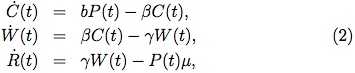
<body><![CDATA[<p>   8. An individual in the retired class <i>R </i>(<i>t</i>) can not return to the   worker class <i>W </i>(<i>t</i>); even if there is a change in the Social Security   normal retirement age.</p>     <p>   9. Each of the parameters <i>&mu;</i>, <i>&gamma;</i>    and <i>&beta;</i> can be interpreted as a mean   of the length of the transit period between classes. Therefore,   the numerical values estimated for each parameter should be   considered as average and does not be regarded as fixed values   for all individuals. </p>     <p>10. Overlapping generations are assumed, i.e., births are continuous.</p>     <p>The total population is denoted by</p>     <p><a name="e1"></a><img src="/img/revistas/ince/v10n19/v10n19a03e1.jpg"></p>     <p>Constant or variable population size can be implemented in the   model in many ways. For instance, it is possible to take different   recruitment and death rates in order to have a variable population   size. Although modeling changes in population size and age structure   distribution is an interesting topic in this work, we focus on a basic   variable population size underlying the demographic model in order to   identify more easily the effects of Social Security normal retirement   age and increase in lifetime expectancy. Notice that in our model   we ignore childhood and early adult mortality, assuming that death   only occurs among the retired. The model could easily be adapted   to incorporate these other forms of mortality by changing the basic equations &#91;9&#93;.</p>     <p align="center"><a name="f1"></a><img src="/img/revistas/ince/v10n19/v10n19a03f1.jpg"></p>     <p>Under the above assumptions, the dynamic retirement model for   children, workers and retirees is depicted graphically in <a href="#f1">Figure 1</a> and is   given by the following first order linear system of ordinary differential equation,</p>     <p><a name="e2"></a><img src="/img/revistas/ince/v10n19/v10n19a03e2.jpg"></p>     <p>where <i>P</i> (<i>t</i>) is the total population.</p>     ]]></body>
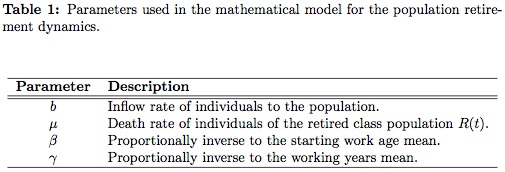
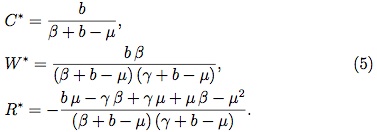
<body><![CDATA[<p>In order to study the population dynamics in a simpler form the   system (2) is scaled. Hence, following ideas developed in &#91;14&#93; about   how to scale models where the total population size is varying one obtains:</p>     <p><a name="e3"></a><img src="/img/revistas/ince/v10n19/v10n19a03e3.jpg"></p>     <p>where</p>     <p><a name="e4"></a><img src="/img/revistas/ince/v10n19/v10n19a03e4.jpg"></p>     <p>The parameters used in the proposed mathematical model (2) for the population retirement dynamics are presented in <a href="#t1">Table 1</a>.</p>     <p align="center"><a name="t1"></a><img src="/img/revistas/ince/v10n19/v10n19a03t1.jpg"></p>      <p><font size="3"><b>3 Mathematical model analysis</b></font></p>     <p> The properties of the mathematical model (3) are studied in this   section in order to know the steady state of the model. Thus, we   can anticipate some qualitative behavior of the numerical solutions   coming out from the model. The equilibrium points of system (3) are   obtained by setting zero the left-hand sides of system (2). Without   loss of generality, and for sake of clarity, from now on, capital letters   are used to denote the population proportions <i>c</i>(<i>t</i>), <i>w</i>(<i>t</i>) and <i>r</i> (<i>t</i>). The   scaled model (3) has only one equilibrium point (<i>C</i>*,<i> W*</i>, <i>R*</i>), where,</p>     <p><a name="e5"></a><img src="/img/revistas/ince/v10n19/v10n19a03e5.jpg"></p>     <p>This equilibrium point depends on the birth, <i>b</i>; and the death, <i>&mu;</i>;   rates, the starting work age parameter, <i>&beta;</i>, and the Social Security   normal retirement age, <i>&gamma;</i>. All these parameters can be set to adjust   the model to numerical values corresponding to different countries.   Therefore, the effects of the increase of the Social Security normal retirement   age in the structure of the population can be studied for different ages of retirement. Additionally, changes in the life expectancy can also be analyzed and the dynamics of the population classes can be obtained.</p>     ]]></body>
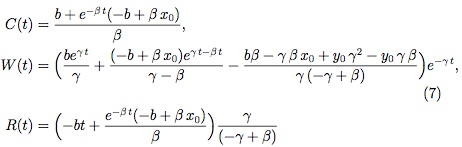
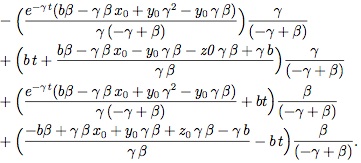
<body><![CDATA[<p>Initially, we would like to introduce a classical measure used in   labor economics to study retirement dynamics. Several options are   available, but here we use the old dependency ratio (ODR) defined as the ratio of the number of retirees to the number of workers &#91;7&#93;,&#91;8&#93;.</p>     <p><a name="e6"></a><img src="/img/revistas/ince/v10n19/v10n19a03e6.jpg"></p>     <p>As it can be seen, the dependency ratio varies with time and is   based on the proportional sizes of the classes or subpopulations <i>W</i> (<i>t</i>)   and <i>R</i> (<i>t</i>). In the context of the mathematical model, a high dependency   ratio implies that there are fewer workers per pensioner to   contribute to the financial burden of the pension systems. Conversely,   a low dependency ratio indicates that there are a more workers per pensioner to contribute to the social security system.</p>     <p>The linear system (2) can be solved analytically without using any   transformation or special class function and closed analytical expressions   are obtained which allows a more convenient analysis. Although   there are few parameters in the model, the closed form solution is   very long and not particularly illuminating so instead of writing it   here we can just said that the main feature is as <i>t</i> <img src="../img/revistas/ince/v10n19/v10n19a02fle.jpg"> <i>&infin;</i> the solution   approaches the equilibrium point (<i>C</i>*, <i>W</i>*, <i>R</i>*). However, for the particular   case when the population is constant (<i>b</i> = <i>&mu;</i>), the closed form solution of the system (3) is the following,</p>     <p><a name="e7"></a><img src="/img/revistas/ince/v10n19/v10n19a03e7.jpg"></p>     <p><a name="e7.1"></a><img src="/img/revistas/ince/v10n19/v10n19a03e7.1.jpg"></p>     <p>Note that the population dynamics can be studied using the closed   form solution (7) and that the different results for each country are obtained using different parameter values.</p>      <p><font size="3"><b>4 Numerical simulations</b></font></p>     <p> In this section some numerical simulations of the mathematical model   (3) to study the transient dynamics of children, worker and retiree   populations (classes) are presented. Several scenarios are simulated   in order to understand better the effect of the retirement age parameter <i>&gamma;</i> on population dynamics. In addition, numerical simulations   with different life expectancy and different values of the starting work   age are performed in order to study the effect of longevity and time   of education (university, high school) on the Social Security system.   The study of Social Security normal retirement age and longevity is   important since an increase of one year in both life expectancy and   working life raises considerably the old dependency ratio, because   such an increase represents, proportionally, a larger rise of average   years.</p>     <p>In order to compare the numerical results, baseline scenarios are   used as in &#91;5&#93;. Some of the parameters values for these scenarios are   taken from previous social security retirement studies as well as using   approximate values from Spain, USA and Venezuela &#91;2&#93;,&#91;3&#93;,&#91;15&#93;,&#91;16&#93;,&#91;17&#93;,   &#91;18&#93;,&#91;19&#93;,&#91;20&#93;,&#91;21&#93;. The simulations of the models were run until a steady state was reached and, using the model (3) in order to analyze the results using the population proportions.</p>      ]]></body>
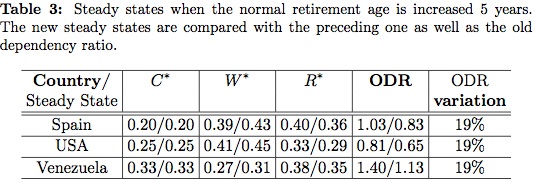
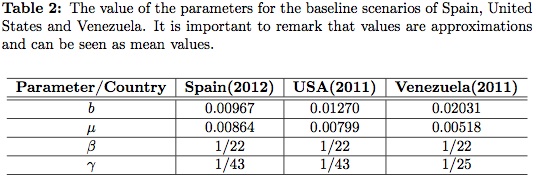
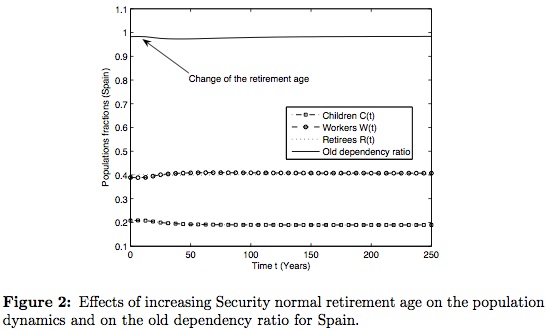
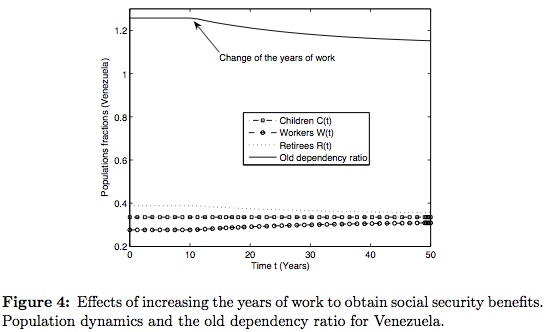
<body><![CDATA[<p><font size="3"><b>4.1 Social Security baseline cases</b></font></p>     <p>   Different countries have different life expectancies, Social Security retirement   ages, and starting work ages. Here we select values for these   parameters based on previous studies, most of which focused on the   OECD countries and international labor economic data &#91;1&#93;,&#91;7&#93;,&#91;15&#93;,&#91;16&#93;,   &#91;22&#93;,&#91;23&#93;,&#91;24&#93;. The parameter values for the baseline scenarios of Spain,   United States and Venezuela are shown in <a href="#t2">Table 2</a>. We should note   that these values are approximations and can be considered mean values.   For Venezuela, we observe that the difference between the birth   and death rates is large as is found in many Latin American countries.   Thus, the total population size is growing quickly. On the other   hand, the difference between the birth and death rates for Spain is   small and a constant population may be assumed, as in many other   European countries.</p>     <p align="center"><a name="t2"></a><img src="/img/revistas/ince/v10n19/v10n19a03t2.jpg"></p>      <p><b><font size="3">4.2 Effects of Social Security normal retirement age</font></b></p>     <p>   Social Security systems, whose expenditures are very much determined   by the size of the older population, have been facing a increasingly   financial stress &#91;1&#93;. One solution that has been proposed (and   has been already applied) is an increase in retirement age as well as   in pensions benefits for late retirement &#91;23&#93;. First, we simulate the Spain baseline scenario, which is the country with the highest life expectancy   (80.9 years) of the countries under consideration. The first   10 years is simulated using the baseline scenario and after that the   retirement age is increased 5 years. In order to observe quantitatively   the changes on population dynamics, the old dependency ratio is calculated   using the proportions of the different classes instead of the   population size of each class. Thus, here we use the old dependency   ratio (ODR), defined as the ratio of the proportion of retirees to the   proportion of workers in regard to the total population &#91;7&#93;,&#91;8&#93;.</p>     <p>In <a href="#f2">Figure 2</a>, it can be seen that the worker population, <i>W </i>(<i>t</i>);   increases and the old dependency ratio decreases, showing the effectiveness   of the social security decision regarding the old dependency   ratio. <a href="#f3">Figures 3</a> and <a href="#f4">4</a> show the numerical simulations for USA and   Venezuela. As in the Spanish case, worker population, <i>W</i> (<i>t</i>); increases   and old dependency ratio decreases. Notice in Figures 2, 3 and 4,   that steady states are obtained after approximately 150 years, since the Social Security system has a long time scale.</p>     <p align="center"><a name="f2"></a><img src="/img/revistas/ince/v10n19/v10n19a03f2.jpg"></p>     <p align="center"><a name="f3"></a><img src="/img/revistas/ince/v10n19/v10n19a03f3.jpg"></p>     <p align="center"><a name="f4"></a><img src="/img/revistas/ince/v10n19/v10n19a03f4.jpg"></p>     <p>The numerical results regarding the old and new steady states are   presented in <a href="#t3">Table 3</a> for each country . In addition, the variations in   the old dependency ratio are presented. As can be observed in <A href="#t3">Table   3</a> the best results correspond to USA, since the old dependency ratio   decreases to a very low value of 0.65. However, Venezuela achieves   the maximum absolute variation with 0.27. Since USA population has   younger population than Spain, an increase in age of retirement produces   a low retiree population. In contrast, in Venezuela the retiree population decreases, but still high in relation to working population.</p>     ]]></body>
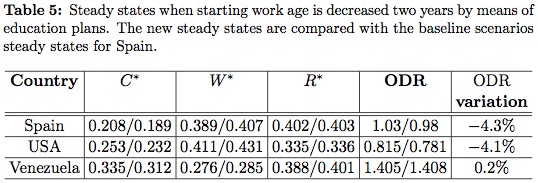
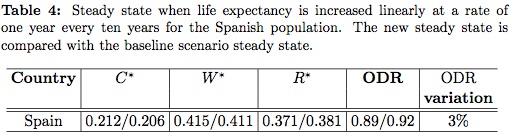
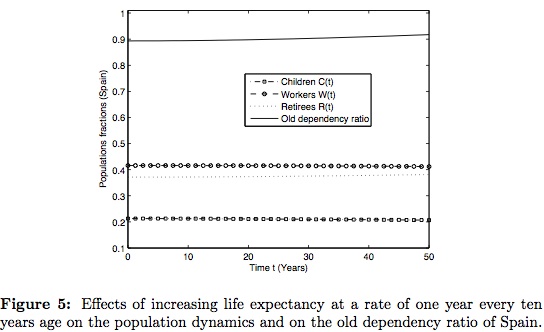
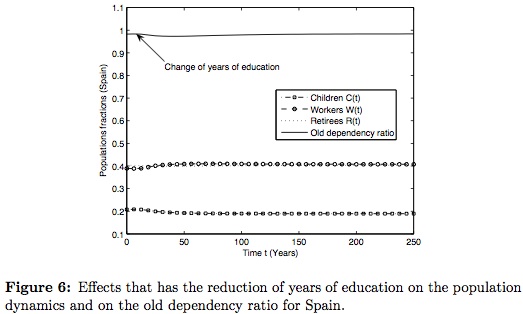
<body><![CDATA[<p align="center"><a name="t3"></a><img src="/img/revistas/ince/v10n19/v10n19a03t3.jpg"></p>      <p><b><font size="3">4.3 Effects of the life expectancy</font></b></p>     <p>   In the second half of the twentieth century it has been observed a rise   in the maximum and modal age and the median and life expectancy   has been increased at a slower pace &#91;25&#93;. Thus, the increase of life   expectancy is an important issue of public policy that influence agebased   entitlement programs such as Social Security. Most forecasts   estimate an increase in life expectancy despite current trends in obesity   around the world. Some authors states that the steady rise in life   expectancy during the past two centuries may soon come to an end   &#91;26&#93;.</p>     <p>Here we study the effect that increasing life expectancy has on   the Social Security system using linear extrapolation. The numerical   simulation is only performed for Spain since in the underlying demographic model (3) the increasing of life expectancy can be only achieved in a simple way only for a constant population, which is a valid assumption for Spain. In order to consider a change of life expectancy in a variable population size model it is necessary to consider a more complex demographic model, for instance as in &#91;27&#93;,&#91;28&#93;.</p>     <p>The increase of life expectancy is such that for every ten years the   life expectancy increases by one year. In order to observe the population   dynamics and the old dependency ratio, we simulate the model   (3) over a time horizon of 50 years. As before, in <a href="#t4">Table 4</a> we present a   comparison of steady states when life expectancy is increased linearly at a rate of one year every ten years.</p>     <p align="center"><a name="t4"></a><img src="/img/revistas/ince/v10n19/v10n19a03t4.jpg"></p>     <p align="center"><a name="f5"></a><img src="/img/revistas/ince/v10n19/v10n19a03f5.jpg"></p>     <p>In <a href="#f5">Figure 5</a>, it can be observed that the retired population, <i>R </i>(<i>t</i>);   and old dependency ratio increase in Spain, showing the effect of a   higher life expectancy. Note that in this case the life expectancy   parameter (1 &frasl; <i>&mu;</i>) varies with time. As can be observed in <a href="#t4">Table 4</a> the   old dependency ratio increases with a variation of 3% due to the aging of the Spanish population as was expected.</p>      <p><font size="3"><b>4.4 Effect of starting work age</b></font></p>     <p>   Here we study the effect of reduction of years of education. It is   important to remark that some European countries are reducing education   years according to the guidelines of Bologna plan &#91;29&#93;. In order   to observe the population dynamics and the old dependency ratio we   simulate the model (3) over a time horizon of 250 years. As before,   in <a href="#t5">Table 5</a> we present a comparison of the steady states when the   education is reduced by two years. Notice that for Spain and USA   the retirement age is fixed in this study at 65 years old. Then, the   parameter value of <i>&gamma;</i>   is also increased by two years in order to reach to   the retirement age. On the other hand, for Venezuela the retirement   is not by age and it is obtained when the worker reach 25 years of   work.</p>     ]]></body>
<body><![CDATA[<p align="center"><a name="t5"></a><img src="/img/revistas/ince/v10n19/v10n19a03t5.jpg"></p>     <p>As expected in <a href="#f6">Figure 6</a>, it can be observed that the young or   children population proportion <i>C</i> (<i>t</i>) from Spain decreases and the old   dependency ratio also decreases. As it can be observed in Table 5 the old dependency ratio variation for Venezuela is low and high for Spain and USA. However, it is important to point out that a Social Security system with fixed time to obtain retirement (Venezuela) does not get a relatively important benefit (regarding ODR) of shorting education years. On the other hand, a Social Security system with retirement by age (Spain and USA) lowers its old dependency ratio.</p>     <p align="center"><a name="f6"></a><img src="/img/revistas/ince/v10n19/v10n19a03f6.jpg"></p>      <p><b><font size="3">5 Discussion and conclusions</font></b></p>     <p>   In this paper, we propose a mathematical approach based on dynamical   systems to study the effect of the increase in the Social Security   normal retirement age on worker and retiree population dynamics. In   addition, the model allows the study of the effect of life longevity on   the Social Security system dynamics. Furthermore, the model can be   used to investigate in a simple way the effect of years of education   of different systems (university, high school) on the Social Security   system. That this mathematical model is simpler than reality makes   it useful in understanding qualitatively some basic facts of the global   dynamic behavior of Social Security systems and thus helps in the establishment of sustainable public retirement programs.</p>     <p>By comparing the estimates and simulations of different effects on   the retirement models, the dynamics of each population class can be   assessed. Thus, we obtain three principal results that are particularly   important in considering the effects of pensions and Social Security   on retirement. First, the normal retirement age is a public policy that   can easily modify the old dependency ratio. Second, longevity affects   clearly the Social Security system but is not easy to change because   of the socio-cultural issues involved. The last result is that a Social   Security system with fixed time to obtain retirement (Venezuela) does   not lower the old dependency ratio when education years are reduced,   but the old dependency ratio of Europeans countries decreases, since   labor force population increases. It is worth mentioning that other   issues such as wages or Social Security incentives to keep working were not studied in this paper.</p>     <p>From a practical point of view the model allows the prediction   of trends in worker and pensioner populations when different Social   Security normal retirement ages are simulated. This implies that the   model helps to understand the consequences of different retirements   plans with regard to age. These dynamics are important since the   decline in old age labor force participation amplifies the problems of   financing social security in times of population aging because it implies   more recipients and fewer contributors. Numerical simulations   of the model can help government economic planners optimize strategies   to sustain the pension system and to forecast trends in the Social   Security system. Furthermore, these models allow to analyze possible   future scenarios as well as to understand better the population dynamics   in order to design the optimal features to sustain the Social Security system.</p>      <p><b><font size="3">Acknowledgements</font></b></p>     <p>   The authors are grateful to the anonymous reviewers of this journal   for providing us with very helpful comments that helped us improve   the clarity and the quality of the paper.</p> <hr size="1" />       <p><b><font size="3">References</font></b></p>     ]]></body>
<body><![CDATA[<!-- ref --><p>   &#91;1&#93; A. Okamoto, ''Simulating progressive expenditure taxation in an aging   Japan,'' <i>J. Policy Model</i>., vol. 27, no. 3, pp. 309&#8211;325, 2005.    &nbsp;&nbsp;&nbsp;&nbsp;&nbsp;&nbsp;&nbsp;&nbsp;[&#160;<a href="javascript:void(0);" onclick="javascript: window.open('/scielo.php?script=sci_nlinks&ref=000103&pid=S1794-9165201400010000300001&lng=','','width=640,height=500,resizable=yes,scrollbars=1,menubar=yes,');">Links</a>&#160;]<!-- end-ref --> 34, 43</p>     <!-- ref --><p>   &#91;2&#93; A. Borsch-Supan, ''A model under siege: A case study of the German retirement   insurance system,'' <i>Econ. J</i>., vol. 110, no. 461, pp. 24&#8211;45, 2000.    &nbsp;&nbsp;&nbsp;&nbsp;&nbsp;&nbsp;&nbsp;&nbsp;[&#160;<a href="javascript:void(0);" onclick="javascript: window.open('/scielo.php?script=sci_nlinks&ref=000105&pid=S1794-9165201400010000300002&lng=','','width=640,height=500,resizable=yes,scrollbars=1,menubar=yes,');">Links</a>&#160;]<!-- end-ref --> 34, 35,   42</p>     <!-- ref --><p>   &#91;3&#93; &#8212;''Incentive effects of social security on labor force participation: evidence   in Germany and across Europe,'' <i>J. Public Econ</i>., vol. 78, no. 1-2, pp.   25&#8211;49, 2000.    &nbsp;&nbsp;&nbsp;&nbsp;&nbsp;&nbsp;&nbsp;&nbsp;[&#160;<a href="javascript:void(0);" onclick="javascript: window.open('/scielo.php?script=sci_nlinks&ref=000107&pid=S1794-9165201400010000300003&lng=','','width=640,height=500,resizable=yes,scrollbars=1,menubar=yes,');">Links</a>&#160;]<!-- end-ref --> 34, 35, 42</p>     <!-- ref --><p>   &#91;4&#93; F. El-Hamidi, ''Early retirement in the government sector in Egypt: Preferences,   determinants, and policy implications,'' <i>J. Dev. Areas</i>, vol. <b>43</b>, no. 2,   pp. 79&#8211;110, 2010.    &nbsp;&nbsp;&nbsp;&nbsp;&nbsp;&nbsp;&nbsp;&nbsp;[&#160;<a href="javascript:void(0);" onclick="javascript: window.open('/scielo.php?script=sci_nlinks&ref=000109&pid=S1794-9165201400010000300004&lng=','','width=640,height=500,resizable=yes,scrollbars=1,menubar=yes,');">Links</a>&#160;]<!-- end-ref --> 35</p>     <!-- ref --><p>   &#91;5&#93; M. M. Hamid Faruqee, ''Population aging in Japan: demographic shock and   fiscal sustainability,'' <i>JPN. World Econ</i>., vol. 15, no. 2, pp. 185&#8211;210, 2003.    &nbsp;&nbsp;&nbsp;&nbsp;&nbsp;&nbsp;&nbsp;&nbsp;[&#160;<a href="javascript:void(0);" onclick="javascript: window.open('/scielo.php?script=sci_nlinks&ref=000111&pid=S1794-9165201400010000300005&lng=','','width=640,height=500,resizable=yes,scrollbars=1,menubar=yes,');">Links</a>&#160;]<!-- end-ref -->   35, 42</p>     ]]></body>
<body><![CDATA[<!-- ref --><p>   &#91;6&#93; D. Roseveare, W. Leibfritz, D. Fore, and E. Wurzel, ''Ageing populations,   pensions systems and government budgets: simulations for 20 <i>OECD countries,''   OECD Economics Department, Working Paper</i>, vol. 168, 1996.    &nbsp;&nbsp;&nbsp;&nbsp;&nbsp;&nbsp;&nbsp;&nbsp;[&#160;<a href="javascript:void(0);" onclick="javascript: window.open('/scielo.php?script=sci_nlinks&ref=000113&pid=S1794-9165201400010000300006&lng=','','width=640,height=500,resizable=yes,scrollbars=1,menubar=yes,');">Links</a>&#160;]<!-- end-ref --> 35</p>     <!-- ref --><p>   &#91;7&#93; J. F. Jimeno, J. A. Rojas, and S. Puente, ''Modelling the impact of aging   on social security expenditures,'' <i>Econ. Model</i>., vol. 25, no. 2, pp. 201&#8211;224,   2008.    &nbsp;&nbsp;&nbsp;&nbsp;&nbsp;&nbsp;&nbsp;&nbsp;[&#160;<a href="javascript:void(0);" onclick="javascript: window.open('/scielo.php?script=sci_nlinks&ref=000115&pid=S1794-9165201400010000300007&lng=','','width=640,height=500,resizable=yes,scrollbars=1,menubar=yes,');">Links</a>&#160;]<!-- end-ref --> 35, 41, 43, 44</p>     <!-- ref --><p>   &#91;8&#93; A. Borsch-Supan, A. Heiss, F. Ludwig, and A. Winter, ''Pension reform,   capital, markets and rate of return,'' <i>University of Mannheim</i>, manuscript.    &nbsp;&nbsp;&nbsp;&nbsp;&nbsp;&nbsp;&nbsp;&nbsp;[&#160;<a href="javascript:void(0);" onclick="javascript: window.open('/scielo.php?script=sci_nlinks&ref=000117&pid=S1794-9165201400010000300008&lng=','','width=640,height=500,resizable=yes,scrollbars=1,menubar=yes,');">Links</a>&#160;]<!-- end-ref -->   35, 41, 44</p>     <!-- ref --><p>   &#91;9&#93; H. Hock and D. N. Weil, ''On the dynamics of the age structure, dependency,   and consumption,'' <i>J. Popul. Econ</i>., vol. 25, no. 3, pp. 1019&#8211;1043, 2012.    &nbsp;&nbsp;&nbsp;&nbsp;&nbsp;&nbsp;&nbsp;&nbsp;[&#160;<a href="javascript:void(0);" onclick="javascript: window.open('/scielo.php?script=sci_nlinks&ref=000119&pid=S1794-9165201400010000300009&lng=','','width=640,height=500,resizable=yes,scrollbars=1,menubar=yes,');">Links</a>&#160;]<!-- end-ref --> 35,   38</p>     <!-- ref --><p>   &#91;10&#93; M. Toossi, ''Labor force projections to 2020: a more slowly growing workforce,''   <i>Monthly Lab. Rev</i>., vol. 135, pp. 43&#8211;64, 2012.    &nbsp;&nbsp;&nbsp;&nbsp;&nbsp;&nbsp;&nbsp;&nbsp;[&#160;<a href="javascript:void(0);" onclick="javascript: window.open('/scielo.php?script=sci_nlinks&ref=000121&pid=S1794-9165201400010000300010&lng=','','width=640,height=500,resizable=yes,scrollbars=1,menubar=yes,');">Links</a>&#160;]<!-- end-ref --> 36</p>     ]]></body>
<body><![CDATA[<!-- ref --><p>   &#91;11&#93; J. D. Murray, <i>Mathematical Biology I. An Introduction</i>. Springer, Berlin,   2002.    &nbsp;&nbsp;&nbsp;&nbsp;&nbsp;&nbsp;&nbsp;&nbsp;[&#160;<a href="javascript:void(0);" onclick="javascript: window.open('/scielo.php?script=sci_nlinks&ref=000123&pid=S1794-9165201400010000300011&lng=','','width=640,height=500,resizable=yes,scrollbars=1,menubar=yes,');">Links</a>&#160;]<!-- end-ref --> 37</p>     <!-- ref --><p>   &#91;12&#93; P. Manfredi and L. Fanti, ''Demography in macroeconomic models: when   labour supply matters for economic cycles,'' <i>Metroeconomica</i>, vol. 57, no. 4,   pp. 536&#8211;563, 2006.    &nbsp;&nbsp;&nbsp;&nbsp;&nbsp;&nbsp;&nbsp;&nbsp;[&#160;<a href="javascript:void(0);" onclick="javascript: window.open('/scielo.php?script=sci_nlinks&ref=000125&pid=S1794-9165201400010000300012&lng=','','width=640,height=500,resizable=yes,scrollbars=1,menubar=yes,');">Links</a>&#160;]<!-- end-ref --> 37</p>     <!-- ref --><p>&#91;13&#93; G. Feichtinger and G. Sorger, ''Self-generated fertility waves in a non-linear   continuous overlapping generations model,'' <i>J. Popul. Econ</i>., vol. 2, no. 4, pp. 267&#8211;280, 1989.    &nbsp;&nbsp;&nbsp;&nbsp;&nbsp;&nbsp;&nbsp;&nbsp;[&#160;<a href="javascript:void(0);" onclick="javascript: window.open('/scielo.php?script=sci_nlinks&ref=000127&pid=S1794-9165201400010000300013&lng=','','width=640,height=500,resizable=yes,scrollbars=1,menubar=yes,');">Links</a>&#160;]<!-- end-ref --> 37</p>     <!-- ref --><p>   &#91;14&#93; D. F. Aranda, R. J. Villanueva, A. J. Arenas, and G. C. G. Parra, ''Mathematical   modeling of toxoplasmosis disease in varying size populations,'' <i>Comput.   Math. Appl</i>., vol. 56, no. 3, pp. 690&#8211;696, 2008.    &nbsp;&nbsp;&nbsp;&nbsp;&nbsp;&nbsp;&nbsp;&nbsp;[&#160;<a href="javascript:void(0);" onclick="javascript: window.open('/scielo.php?script=sci_nlinks&ref=000129&pid=S1794-9165201400010000300014&lng=','','width=640,height=500,resizable=yes,scrollbars=1,menubar=yes,');">Links</a>&#160;]<!-- end-ref --> 39</p>     <!-- ref --><p>   &#91;15&#93; SSA, ''Social Security. The Official Website of the U.S. Social Security Administration,''   Available from: <a href="http://www.ssa.gov"target="_blank">http://www.ssa.gov</a>.    &nbsp;&nbsp;&nbsp;&nbsp;&nbsp;&nbsp;&nbsp;&nbsp;[&#160;<a href="javascript:void(0);" onclick="javascript: window.open('/scielo.php?script=sci_nlinks&ref=000131&pid=S1794-9165201400010000300015&lng=','','width=640,height=500,resizable=yes,scrollbars=1,menubar=yes,');">Links</a>&#160;]<!-- end-ref --> 42, 43</p>     ]]></body>
<body><![CDATA[<!-- ref --><p>   &#91;16&#93; OECD, ''Ageing and employment policies, Synthesis Report, OECD, Paris   (2005),'' Available from:<a href="http://www.oecdbookshop.org"target="_blank">http://www.oecdbookshop.org</a>, 2005.    &nbsp;&nbsp;&nbsp;&nbsp;&nbsp;&nbsp;&nbsp;&nbsp;[&#160;<a href="javascript:void(0);" onclick="javascript: window.open('/scielo.php?script=sci_nlinks&ref=000133&pid=S1794-9165201400010000300016&lng=','','width=640,height=500,resizable=yes,scrollbars=1,menubar=yes,');">Links</a>&#160;]<!-- end-ref --> 42, 43</p>     <!-- ref --><p>   &#91;17&#93; INE, ''Instituto Nacional de Estad&iacute;stica,'' Available from:   <a href="http://www.ocei.gov.ve/"target="_blank">http://www.ocei.gov.ve/</a>, 2010.    &nbsp;&nbsp;&nbsp;&nbsp;&nbsp;&nbsp;&nbsp;&nbsp;[&#160;<a href="javascript:void(0);" onclick="javascript: window.open('/scielo.php?script=sci_nlinks&ref=000135&pid=S1794-9165201400010000300017&lng=','','width=640,height=500,resizable=yes,scrollbars=1,menubar=yes,');">Links</a>&#160;]<!-- end-ref --> 42</p>     <!-- ref --><p>   &#91;18&#93; D. E. Bloom, D. Canning, R. K. Mansfield, and M. Moore, ''Demographic   change, social security systems, and savings,'' <i>J. Monetary. Econ</i>., vol. 54,   no. 1, pp. 92&#8211;114, 2007.    &nbsp;&nbsp;&nbsp;&nbsp;&nbsp;&nbsp;&nbsp;&nbsp;[&#160;<a href="javascript:void(0);" onclick="javascript: window.open('/scielo.php?script=sci_nlinks&ref=000137&pid=S1794-9165201400010000300018&lng=','','width=640,height=500,resizable=yes,scrollbars=1,menubar=yes,');">Links</a>&#160;]<!-- end-ref --> 42</p>     <!-- ref --><p>   &#91;19&#93; A. Ang and A. Maddaloni, <i>Do Demographic changes Affect Risk Premiums?   Evidence From International Data</i>. Cambridge,MA: National Bureau of   Economic Research Working Paper, 2003, vol. 9677. 42&nbsp;&nbsp;&nbsp;&nbsp;&nbsp;&nbsp;&nbsp;&nbsp;[&#160;<a href="javascript:void(0);" onclick="javascript: window.open('/scielo.php?script=sci_nlinks&ref=000139&pid=S1794-9165201400010000300019&lng=','','width=640,height=500,resizable=yes,scrollbars=1,menubar=yes,');">Links</a>&#160;]<!-- end-ref --><!-- ref --><p>   &#91;20&#93; D. E. Bloom, D. Canning, R. K. Mansfield, and M. Moore, ''Demographic   change, social security systems, and savings,'' <i>J. Monetary. Econ</i>., vol. 54,   no. 1, pp. 92&#8211;114, 2007.    &nbsp;&nbsp;&nbsp;&nbsp;&nbsp;&nbsp;&nbsp;&nbsp;[&#160;<a href="javascript:void(0);" onclick="javascript: window.open('/scielo.php?script=sci_nlinks&ref=000140&pid=S1794-9165201400010000300020&lng=','','width=640,height=500,resizable=yes,scrollbars=1,menubar=yes,');">Links</a>&#160;]<!-- end-ref --> 42</p>     <!-- ref --><p>   &#91;21&#93; M. Bouzahzah, D. D. la Croix, and F. Docquier, ''Policy reforms and growth   in computable OLG economies,'' <i>J. Econ. Dyn</i>. <i>Control</i>, vol. 26, no. 12, pp.   2093&#8211;2113, 2002.    &nbsp;&nbsp;&nbsp;&nbsp;&nbsp;&nbsp;&nbsp;&nbsp;[&#160;<a href="javascript:void(0);" onclick="javascript: window.open('/scielo.php?script=sci_nlinks&ref=000142&pid=S1794-9165201400010000300021&lng=','','width=640,height=500,resizable=yes,scrollbars=1,menubar=yes,');">Links</a>&#160;]<!-- end-ref --> 42</p>     <!-- ref --><p>   &#91;22&#93; H. S. Buscher, H. Buslei, K. Goggelmann, H. Koschel, T. F. N. Schmidt,   V. Steiner, and P. Winker, ''Empirical macro models under test. A comparative   simulation study of the employment effects of a revenue neutral cut   in social security contributions,'' <i>Econ. Model</i>., vol. 18, no. 3, pp. 455&#8211;474,   2001.    &nbsp;&nbsp;&nbsp;&nbsp;&nbsp;&nbsp;&nbsp;&nbsp;[&#160;<a href="javascript:void(0);" onclick="javascript: window.open('/scielo.php?script=sci_nlinks&ref=000144&pid=S1794-9165201400010000300022&lng=','','width=640,height=500,resizable=yes,scrollbars=1,menubar=yes,');">Links</a>&#160;]<!-- end-ref --> 43</p>     <!-- ref --><p>   &#91;23&#93; R. Beetsma, L. Bettendorf, and P. Broer, ''The budgeting and economic   consequences of ageing in the Netherlands,'' <i>Econ. Model</i>., vol. 20, no. 5, pp.   987&#8211;1013, 2003.    &nbsp;&nbsp;&nbsp;&nbsp;&nbsp;&nbsp;&nbsp;&nbsp;[&#160;<a href="javascript:void(0);" onclick="javascript: window.open('/scielo.php?script=sci_nlinks&ref=000146&pid=S1794-9165201400010000300023&lng=','','width=640,height=500,resizable=yes,scrollbars=1,menubar=yes,');">Links</a>&#160;]<!-- end-ref --> 43</p>     <!-- ref --><p>   &#91;24&#93; L. J. Bettendorf and B. J. Heijdra, ''Population ageing and pension reform   in a small open economy with non-traded goods,''<i> J. Econ. Dyn. Control</i>,   vol. 30, no. 12, pp. 2389&#8211;2424, 2006.    &nbsp;&nbsp;&nbsp;&nbsp;&nbsp;&nbsp;&nbsp;&nbsp;[&#160;<a href="javascript:void(0);" onclick="javascript: window.open('/scielo.php?script=sci_nlinks&ref=000148&pid=S1794-9165201400010000300024&lng=','','width=640,height=500,resizable=yes,scrollbars=1,menubar=yes,');">Links</a>&#160;]<!-- end-ref --> 43</p>     <!-- ref --><p>&#91;25&#93; V. Canudas-Romo, ''Three measures of longevity: Time trends and record values,'' <i>Demography</i>, vol. <b>47</b>, pp. 299&#8211;312, 2010,    &nbsp;&nbsp;&nbsp;&nbsp;&nbsp;&nbsp;&nbsp;&nbsp;[&#160;<a href="javascript:void(0);" onclick="javascript: window.open('/scielo.php?script=sci_nlinks&ref=000150&pid=S1794-9165201400010000300025&lng=','','width=640,height=500,resizable=yes,scrollbars=1,menubar=yes,');">Links</a>&#160;]<!-- end-ref --> referenced in. 46</p>     <!-- ref --><p>   &#91;26&#93; S. J. Olshansky, D. J. Passaro, R. C. Hershow, J. Layden, B. A. Carnes,   J. Brody, L. Hayflick, R. N. Butler, D. B. Allison, and D. S. Ludwig, ''A   potential decline in life expectancy in the United States in the 21st century,''   <i>N. Engl. J. Med</i>., vol. 352, no. 11, pp. 1138&#8211;1145, 2005.    &nbsp;&nbsp;&nbsp;&nbsp;&nbsp;&nbsp;&nbsp;&nbsp;[&#160;<a href="javascript:void(0);" onclick="javascript: window.open('/scielo.php?script=sci_nlinks&ref=000152&pid=S1794-9165201400010000300026&lng=','','width=640,height=500,resizable=yes,scrollbars=1,menubar=yes,');">Links</a>&#160;]<!-- end-ref --> 46</p>     <!-- ref --><p>   &#91;27&#93; J. C. Mico, D. Soler, , and A. Caselles, ''Age-structured human population   dynamics,'' <i>J. Math. Sociol</i>., vol. 30, no. 1, pp. 1&#8211;31, 2006.    &nbsp;&nbsp;&nbsp;&nbsp;&nbsp;&nbsp;&nbsp;&nbsp;[&#160;<a href="javascript:void(0);" onclick="javascript: window.open('/scielo.php?script=sci_nlinks&ref=000154&pid=S1794-9165201400010000300027&lng=','','width=640,height=500,resizable=yes,scrollbars=1,menubar=yes,');">Links</a>&#160;]<!-- end-ref --> 47</p>     <!-- ref --><p>   &#91;28&#93; N. Keyfitz, <i>Applied Mathematical Demography</i>. Springer, 2005.    &nbsp;&nbsp;&nbsp;&nbsp;&nbsp;&nbsp;&nbsp;&nbsp;[&#160;<a href="javascript:void(0);" onclick="javascript: window.open('/scielo.php?script=sci_nlinks&ref=000156&pid=S1794-9165201400010000300028&lng=','','width=640,height=500,resizable=yes,scrollbars=1,menubar=yes,');">Links</a>&#160;]<!-- end-ref --> 47</p>     <!-- ref --><p>   &#91;29&#93; P. Hensen, ''The ''Bologna process'' in European higher education: Impact of   bachelor's and master's degrees on german medical education,'' <i>Teach. Learn.   Med</i>., vol. <b>22</b>, no. 2, pp. 142&#8211;147, 2010.    &nbsp;&nbsp;&nbsp;&nbsp;&nbsp;&nbsp;&nbsp;&nbsp;[&#160;<a href="javascript:void(0);" onclick="javascript: window.open('/scielo.php?script=sci_nlinks&ref=000158&pid=S1794-9165201400010000300029&lng=','','width=640,height=500,resizable=yes,scrollbars=1,menubar=yes,');">Links</a>&#160;]<!-- end-ref --> 48</p>  </font>     ]]></body><back>
<ref-list>
<ref id="B1">
<label>1</label><nlm-citation citation-type="journal">
<person-group person-group-type="author">
<name>
<surname><![CDATA[Okamoto]]></surname>
<given-names><![CDATA[A]]></given-names>
</name>
</person-group>
<article-title xml:lang="en"><![CDATA[Simulating progressive expenditure taxation in an aging Japan]]></article-title>
<source><![CDATA[J. Policy Model.]]></source>
<year>2005</year>
<volume>27</volume>
<numero>3</numero>
<issue>3</issue>
<page-range>309-325</page-range></nlm-citation>
</ref>
<ref id="B2">
<label>2</label><nlm-citation citation-type="journal">
<person-group person-group-type="author">
<name>
<surname><![CDATA[Borsch-Supan]]></surname>
<given-names><![CDATA[A]]></given-names>
</name>
</person-group>
<article-title xml:lang="en"><![CDATA[A model under siege: A case study of the German retirement insurance system]]></article-title>
<source><![CDATA[Econ. J]]></source>
<year>2000</year>
<volume>110</volume>
<numero>461</numero>
<issue>461</issue>
<page-range>24-45</page-range></nlm-citation>
</ref>
<ref id="B3">
<label>3</label><nlm-citation citation-type="journal">
<article-title xml:lang="en"><![CDATA[Incentive effects of social security on labor force participation: evidence in Germany and across Europe]]></article-title>
<source><![CDATA[J. Public Econ]]></source>
<year>2000</year>
<volume>78</volume>
<numero>1-2</numero>
<issue>1-2</issue>
<page-range>25-49</page-range></nlm-citation>
</ref>
<ref id="B4">
<label>4</label><nlm-citation citation-type="journal">
<person-group person-group-type="author">
<name>
<surname><![CDATA[El-Hamidi]]></surname>
<given-names><![CDATA[F]]></given-names>
</name>
</person-group>
<article-title xml:lang="en"><![CDATA[Early retirement in the government sector in Egypt: Preferences, determinants, and policy implications]]></article-title>
<source><![CDATA[J. Dev. Areas]]></source>
<year>2010</year>
<volume>43</volume>
<numero>2</numero>
<issue>2</issue>
<page-range>79-110</page-range></nlm-citation>
</ref>
<ref id="B5">
<label>&#091;5</label><nlm-citation citation-type="journal">
<person-group person-group-type="author">
<name>
<surname><![CDATA[Hamid Faruqee]]></surname>
<given-names><![CDATA[M M]]></given-names>
</name>
</person-group>
<article-title xml:lang="en"><![CDATA[Population aging in Japan: demographic shock and fiscal sustainability]]></article-title>
<source><![CDATA[JPN. World Econ.]]></source>
<year>2003</year>
<volume>15</volume>
<numero>2</numero>
<issue>2</issue>
<page-range>185-210</page-range></nlm-citation>
</ref>
<ref id="B6">
<label>6</label><nlm-citation citation-type="journal">
<person-group person-group-type="author">
<name>
<surname><![CDATA[Roseveare]]></surname>
<given-names><![CDATA[D]]></given-names>
</name>
<name>
<surname><![CDATA[Leibfritz]]></surname>
<given-names><![CDATA[W]]></given-names>
</name>
<name>
<surname><![CDATA[Fore]]></surname>
<given-names><![CDATA[D]]></given-names>
</name>
<name>
<surname><![CDATA[Wurzel]]></surname>
<given-names><![CDATA[E]]></given-names>
</name>
</person-group>
<article-title xml:lang="en"><![CDATA[Ageing populations, pensions systems and government budgets: simulations for 20 OECD countries]]></article-title>
<source><![CDATA[OECD Economics Department, Working Paper]]></source>
<year>1996</year>
<volume>168</volume>
</nlm-citation>
</ref>
<ref id="B7">
<label>&#091;7</label><nlm-citation citation-type="journal">
<person-group person-group-type="author">
<name>
<surname><![CDATA[Jimeno]]></surname>
<given-names><![CDATA[J F]]></given-names>
</name>
<name>
<surname><![CDATA[Rojas]]></surname>
<given-names><![CDATA[J A]]></given-names>
</name>
<name>
<surname><![CDATA[Puente]]></surname>
<given-names><![CDATA[S]]></given-names>
</name>
</person-group>
<article-title xml:lang="en"><![CDATA[Modelling the impact of aging on social security expenditures]]></article-title>
<source><![CDATA[Econ. Model.]]></source>
<year>2008</year>
<volume>25</volume>
<numero>2</numero>
<issue>2</issue>
<page-range>201-224</page-range></nlm-citation>
</ref>
<ref id="B8">
<label>8</label><nlm-citation citation-type="book">
<person-group person-group-type="author">
<name>
<surname><![CDATA[Borsch-Supan]]></surname>
<given-names><![CDATA[A]]></given-names>
</name>
<name>
<surname><![CDATA[Heiss]]></surname>
<given-names><![CDATA[A]]></given-names>
</name>
<name>
<surname><![CDATA[Ludwig]]></surname>
<given-names><![CDATA[F]]></given-names>
</name>
<name>
<surname><![CDATA[Winter]]></surname>
<given-names><![CDATA[A]]></given-names>
</name>
</person-group>
<source><![CDATA[Pension reform, capital, markets and rate of return]]></source>
<year></year>
<publisher-name><![CDATA[University of Mannheim]]></publisher-name>
</nlm-citation>
</ref>
<ref id="B9">
<label>&#091;9</label><nlm-citation citation-type="journal">
<person-group person-group-type="author">
<name>
<surname><![CDATA[Hock]]></surname>
<given-names><![CDATA[H]]></given-names>
</name>
<name>
<surname><![CDATA[Weil]]></surname>
<given-names><![CDATA[D N]]></given-names>
</name>
</person-group>
<article-title xml:lang="en"><![CDATA[On the dynamics of the age structure, dependency, and consumption]]></article-title>
<source><![CDATA[J. Popul. Econ.]]></source>
<year>2012</year>
<volume>25</volume>
<numero>3</numero>
<issue>3</issue>
<page-range>1019-1043</page-range></nlm-citation>
</ref>
<ref id="B10">
<label>&#091;10</label><nlm-citation citation-type="journal">
<person-group person-group-type="author">
<name>
<surname><![CDATA[Toossi]]></surname>
<given-names><![CDATA[M]]></given-names>
</name>
</person-group>
<article-title xml:lang="en"><![CDATA[Labor force projections to 2020: a more slowly growing workforce]]></article-title>
<source><![CDATA[Monthly Lab. Rev.]]></source>
<year>2012</year>
<volume>135</volume>
<page-range>43-64</page-range></nlm-citation>
</ref>
<ref id="B11">
<label>11</label><nlm-citation citation-type="">
<person-group person-group-type="author">
<name>
<surname><![CDATA[Murray]]></surname>
<given-names><![CDATA[J. D]]></given-names>
</name>
</person-group>
<source><![CDATA[Mathematical Biology I. An Introduction]]></source>
<year>2002</year>
<publisher-loc><![CDATA[Springer ]]></publisher-loc>
</nlm-citation>
</ref>
<ref id="B12">
<label>&#091;12</label><nlm-citation citation-type="journal">
<person-group person-group-type="author">
<name>
<surname><![CDATA[Manfredi]]></surname>
<given-names><![CDATA[P]]></given-names>
</name>
<name>
<surname><![CDATA[Fanti]]></surname>
<given-names><![CDATA[L]]></given-names>
</name>
</person-group>
<article-title xml:lang="en"><![CDATA[Demography in macroeconomic models: when labour supply matters for economic cycles]]></article-title>
<source><![CDATA[Metroeconomica]]></source>
<year>2006</year>
<volume>57</volume>
<numero>4</numero>
<issue>4</issue>
<page-range>536-563</page-range></nlm-citation>
</ref>
<ref id="B13">
<label>&#091;13</label><nlm-citation citation-type="journal">
<person-group person-group-type="author">
<name>
<surname><![CDATA[Feichtinger]]></surname>
<given-names><![CDATA[G]]></given-names>
</name>
<name>
<surname><![CDATA[Sorger]]></surname>
<given-names><![CDATA[G]]></given-names>
</name>
</person-group>
<article-title xml:lang="en"><![CDATA[Self-generated fertility waves in a non-linear continuous overlapping generations model]]></article-title>
<source><![CDATA[J. Popul. Econ.]]></source>
<year>1989</year>
<volume>2</volume>
<numero>4</numero>
<issue>4</issue>
<page-range>267-280</page-range></nlm-citation>
</ref>
<ref id="B14">
<label>&#091;14</label><nlm-citation citation-type="journal">
<person-group person-group-type="author">
<name>
<surname><![CDATA[Aranda]]></surname>
<given-names><![CDATA[D F]]></given-names>
</name>
<name>
<surname><![CDATA[Villanueva]]></surname>
<given-names><![CDATA[R J]]></given-names>
</name>
<name>
<surname><![CDATA[Arenas]]></surname>
<given-names><![CDATA[A J]]></given-names>
</name>
<name>
<surname><![CDATA[Parra]]></surname>
<given-names><![CDATA[G C G]]></given-names>
</name>
</person-group>
<article-title xml:lang="en"><![CDATA[Mathematical modeling of toxoplasmosis disease in varying size populations]]></article-title>
<source><![CDATA[Comput. Math. Appl.]]></source>
<year>2008</year>
<volume>56</volume>
<numero>3</numero>
<issue>3</issue>
<page-range>690-696</page-range></nlm-citation>
</ref>
<ref id="B15">
<label>15</label><nlm-citation citation-type="">
<collab>SSA</collab>
<source><![CDATA[Social Security. The Official Website of the U.S. Social Security Administration]]></source>
<year></year>
</nlm-citation>
</ref>
<ref id="B16">
<label>16</label><nlm-citation citation-type="">
<collab>OECD</collab>
<source><![CDATA[Ageing and employment policies, Synthesis Report, OECD, Paris (2005)]]></source>
<year>2005</year>
</nlm-citation>
</ref>
<ref id="B17">
<label>17</label><nlm-citation citation-type="">
<collab>INE</collab>
<source><![CDATA[Instituto Nacional de Estadística]]></source>
<year>2010</year>
</nlm-citation>
</ref>
<ref id="B18">
<label>&#091;18</label><nlm-citation citation-type="journal">
<person-group person-group-type="author">
<name>
<surname><![CDATA[Bloom]]></surname>
<given-names><![CDATA[D E]]></given-names>
</name>
<name>
<surname><![CDATA[Canning]]></surname>
<given-names><![CDATA[D]]></given-names>
</name>
<name>
<surname><![CDATA[Mansfield]]></surname>
<given-names><![CDATA[R K]]></given-names>
</name>
<name>
<surname><![CDATA[Moore]]></surname>
<given-names><![CDATA[M]]></given-names>
</name>
</person-group>
<article-title xml:lang="en"><![CDATA[Demographic change, social security systems, and savings]]></article-title>
<source><![CDATA[J. Monetary. Econ.]]></source>
<year>2007</year>
<volume>54</volume>
<numero>1</numero>
<issue>1</issue>
<page-range>92-114</page-range></nlm-citation>
</ref>
<ref id="B19">
<label>19</label><nlm-citation citation-type="book">
<person-group person-group-type="author">
<name>
<surname><![CDATA[Ang]]></surname>
<given-names><![CDATA[A]]></given-names>
</name>
<name>
<surname><![CDATA[Maddaloni]]></surname>
<given-names><![CDATA[A]]></given-names>
</name>
</person-group>
<source><![CDATA[Do Demographic changes Affect Risk Premiums? Evidence From International Data]]></source>
<year>2003</year>
<volume>9677</volume>
<publisher-loc><![CDATA[Cambridge,MA ]]></publisher-loc>
<publisher-name><![CDATA[National Bureau of Economic Research Working Paper]]></publisher-name>
</nlm-citation>
</ref>
<ref id="B20">
<label>&#091;20</label><nlm-citation citation-type="journal">
<person-group person-group-type="author">
<name>
<surname><![CDATA[Bloom]]></surname>
<given-names><![CDATA[D E]]></given-names>
</name>
<name>
<surname><![CDATA[Canning]]></surname>
<given-names><![CDATA[D]]></given-names>
</name>
<name>
<surname><![CDATA[Mansfield]]></surname>
<given-names><![CDATA[R K]]></given-names>
</name>
<name>
<surname><![CDATA[Moore]]></surname>
<given-names><![CDATA[M]]></given-names>
</name>
</person-group>
<article-title xml:lang="en"><![CDATA[Demographic change, social security systems, and savings]]></article-title>
<source><![CDATA[J. Monetary. Econ.]]></source>
<year>2007</year>
<volume>54</volume>
<numero>1</numero>
<issue>1</issue>
<page-range>92-114</page-range></nlm-citation>
</ref>
<ref id="B21">
<label>&#091;21</label><nlm-citation citation-type="journal">
<person-group person-group-type="author">
<name>
<surname><![CDATA[Bouzahzah]]></surname>
<given-names><![CDATA[M]]></given-names>
</name>
<name>
<surname><![CDATA[la Croix]]></surname>
<given-names><![CDATA[D D]]></given-names>
</name>
<name>
<surname><![CDATA[Docquier]]></surname>
<given-names><![CDATA[F]]></given-names>
</name>
</person-group>
<article-title xml:lang="en"><![CDATA[Policy reforms and growth in computable OLG economies]]></article-title>
<source><![CDATA[J. Econ. Dyn. Control]]></source>
<year>2002</year>
<volume>26</volume>
<numero>12</numero>
<issue>12</issue>
<page-range>2093-2113</page-range></nlm-citation>
</ref>
<ref id="B22">
<label>&#091;22</label><nlm-citation citation-type="journal">
<person-group person-group-type="author">
<name>
<surname><![CDATA[Buscher]]></surname>
<given-names><![CDATA[H S]]></given-names>
</name>
<name>
<surname><![CDATA[Buslei]]></surname>
<given-names><![CDATA[H]]></given-names>
</name>
<name>
<surname><![CDATA[Goggelmann]]></surname>
<given-names><![CDATA[K]]></given-names>
</name>
<name>
<surname><![CDATA[Koschel]]></surname>
<given-names><![CDATA[H]]></given-names>
</name>
<name>
<surname><![CDATA[Schmidt]]></surname>
<given-names><![CDATA[T F N]]></given-names>
</name>
<name>
<surname><![CDATA[Steiner]]></surname>
<given-names><![CDATA[V]]></given-names>
</name>
<name>
<surname><![CDATA[Winker]]></surname>
<given-names><![CDATA[P]]></given-names>
</name>
</person-group>
<article-title xml:lang="en"><![CDATA[Empirical macro models under test. A comparative simulation study of the employment effects of a revenue neutral cut in social security contributions]]></article-title>
<source><![CDATA[Econ. Model.]]></source>
<year>2001</year>
<volume>18</volume>
<numero>3</numero>
<issue>3</issue>
<page-range>455-474</page-range></nlm-citation>
</ref>
<ref id="B23">
<label>&#091;23</label><nlm-citation citation-type="journal">
<person-group person-group-type="author">
<name>
<surname><![CDATA[Beetsma]]></surname>
<given-names><![CDATA[R]]></given-names>
</name>
<name>
<surname><![CDATA[Bettendorf]]></surname>
<given-names><![CDATA[L]]></given-names>
</name>
<name>
<surname><![CDATA[Broer]]></surname>
<given-names><![CDATA[P]]></given-names>
</name>
</person-group>
<article-title xml:lang="en"><![CDATA[The budgeting and economic consequences of ageing in the Netherlands]]></article-title>
<source><![CDATA[Econ. Model.]]></source>
<year>2003</year>
<volume>20</volume>
<numero>5</numero>
<issue>5</issue>
<page-range>987-1013</page-range></nlm-citation>
</ref>
<ref id="B24">
<label>&#091;24</label><nlm-citation citation-type="journal">
<person-group person-group-type="author">
<name>
<surname><![CDATA[Bettendorf]]></surname>
<given-names><![CDATA[L J]]></given-names>
</name>
<name>
<surname><![CDATA[Heijdra]]></surname>
<given-names><![CDATA[B J]]></given-names>
</name>
</person-group>
<article-title xml:lang="en"><![CDATA[Population ageing and pension reform in a small open economy with non-traded goods]]></article-title>
<source><![CDATA[J. Econ. Dyn. Control]]></source>
<year>2006</year>
<volume>30</volume>
<numero>12</numero>
<issue>12</issue>
<page-range>2389-2424</page-range></nlm-citation>
</ref>
<ref id="B25">
<label>25</label><nlm-citation citation-type="journal">
<person-group person-group-type="author">
<name>
<surname><![CDATA[Canudas-Romo]]></surname>
<given-names><![CDATA[V]]></given-names>
</name>
</person-group>
<article-title xml:lang="en"><![CDATA[Three measures of longevity: Time trends and record values]]></article-title>
<source><![CDATA[Demography]]></source>
<year>2010</year>
<volume>47</volume>
<page-range>299-312</page-range></nlm-citation>
</ref>
<ref id="B26">
<label>&#091;26</label><nlm-citation citation-type="journal">
<person-group person-group-type="author">
<name>
<surname><![CDATA[Olshansky]]></surname>
<given-names><![CDATA[S J]]></given-names>
</name>
<name>
<surname><![CDATA[Passaro]]></surname>
<given-names><![CDATA[D J]]></given-names>
</name>
<name>
<surname><![CDATA[Hershow]]></surname>
<given-names><![CDATA[R C]]></given-names>
</name>
<name>
<surname><![CDATA[Layden]]></surname>
<given-names><![CDATA[J]]></given-names>
</name>
<name>
<surname><![CDATA[Carnes]]></surname>
<given-names><![CDATA[B A]]></given-names>
</name>
<name>
<surname><![CDATA[Brody]]></surname>
<given-names><![CDATA[J]]></given-names>
</name>
<name>
<surname><![CDATA[Hayflick]]></surname>
<given-names><![CDATA[L]]></given-names>
</name>
<name>
<surname><![CDATA[Butler]]></surname>
<given-names><![CDATA[R N]]></given-names>
</name>
<name>
<surname><![CDATA[Allison]]></surname>
<given-names><![CDATA[D B]]></given-names>
</name>
<name>
<surname><![CDATA[Ludwig]]></surname>
<given-names><![CDATA[D S]]></given-names>
</name>
</person-group>
<article-title xml:lang="en"><![CDATA[A potential decline in life expectancy in the United States in the 21st century]]></article-title>
<source><![CDATA[N. Engl. J. Med.]]></source>
<year>2005</year>
<volume>352</volume>
<numero>11</numero>
<issue>11</issue>
<page-range>1138-1145</page-range></nlm-citation>
</ref>
<ref id="B27">
<label>&#091;27</label><nlm-citation citation-type="journal">
<person-group person-group-type="author">
<name>
<surname><![CDATA[Mico]]></surname>
<given-names><![CDATA[J C]]></given-names>
</name>
<name>
<surname><![CDATA[Soler,]]></surname>
<given-names><![CDATA[D]]></given-names>
</name>
<name>
<surname><![CDATA[Caselles]]></surname>
<given-names><![CDATA[A]]></given-names>
</name>
</person-group>
<article-title xml:lang="en"><![CDATA[Age-structured human population dynamics]]></article-title>
<source><![CDATA[J. Math. Sociol.]]></source>
<year>2006</year>
<volume>30</volume>
<numero>1</numero>
<issue>1</issue>
<page-range>1-31</page-range></nlm-citation>
</ref>
<ref id="B28">
<label>28</label><nlm-citation citation-type="book">
<person-group person-group-type="author">
<name>
<surname><![CDATA[Keyfitz]]></surname>
<given-names><![CDATA[N]]></given-names>
</name>
</person-group>
<source><![CDATA[Applied Mathematical Demography]]></source>
<year>2005</year>
<publisher-name><![CDATA[Springer]]></publisher-name>
</nlm-citation>
</ref>
<ref id="B29">
<label>&#091;29</label><nlm-citation citation-type="journal">
<person-group person-group-type="author">
<name>
<surname><![CDATA[Hensen]]></surname>
<given-names><![CDATA[P]]></given-names>
</name>
</person-group>
<article-title xml:lang="en"><![CDATA[The ''Bologna process'' in European higher education: Impact of bachelor's and master's degrees on german medical education]]></article-title>
<source><![CDATA[Teach. Learn. Med.]]></source>
<year>2010</year>
<volume>22</volume>
<numero>2</numero>
<issue>2</issue>
<page-range>142-147</page-range></nlm-citation>
</ref>
</ref-list>
</back>
</article>