<?xml version="1.0" encoding="ISO-8859-1"?><article xmlns:mml="http://www.w3.org/1998/Math/MathML" xmlns:xlink="http://www.w3.org/1999/xlink" xmlns:xsi="http://www.w3.org/2001/XMLSchema-instance">
<front>
<journal-meta>
<journal-id>1794-9165</journal-id>
<journal-title><![CDATA[Ingeniería y Ciencia]]></journal-title>
<abbrev-journal-title><![CDATA[ing.cienc.]]></abbrev-journal-title>
<issn>1794-9165</issn>
<publisher>
<publisher-name><![CDATA[Escuela de Ciencias y Humanidades y Escuela de Ingeniería de la Universidad EAFIT]]></publisher-name>
</publisher>
</journal-meta>
<article-meta>
<article-id>S1794-91652014000100006</article-id>
<title-group>
<article-title xml:lang="en"><![CDATA[Overall Description of Wind Power Systems]]></article-title>
<article-title xml:lang="es"><![CDATA[Descripción general de sistemas de potencia eólicos]]></article-title>
</title-group>
<contrib-group>
<contrib contrib-type="author">
<name>
<surname><![CDATA[Trejos-Grisales]]></surname>
<given-names><![CDATA[Luz]]></given-names>
</name>
<xref ref-type="aff" rid="A01"/>
</contrib>
<contrib contrib-type="author">
<name>
<surname><![CDATA[Guarnizo-Lemus]]></surname>
<given-names><![CDATA[Cristian]]></given-names>
</name>
<xref ref-type="aff" rid="A02"/>
</contrib>
<contrib contrib-type="author">
<name>
<surname><![CDATA[Serna]]></surname>
<given-names><![CDATA[Sergio]]></given-names>
</name>
<xref ref-type="aff" rid="A03"/>
</contrib>
</contrib-group>
<aff id="A01">
<institution><![CDATA[,Instituto Tecnológico Metropolitano  ]]></institution>
<addr-line><![CDATA[Medellín ]]></addr-line>
<country>Colombia</country>
</aff>
<aff id="A02">
<institution><![CDATA[,Instituto Tecnológico Metropolitano  ]]></institution>
<addr-line><![CDATA[Medellín ]]></addr-line>
<country>Colombia</country>
</aff>
<aff id="A03">
<institution><![CDATA[,Instituto Tecnológico Metropolitano  ]]></institution>
<addr-line><![CDATA[Medellín ]]></addr-line>
<country>Colombia</country>
</aff>
<pub-date pub-type="pub">
<day>30</day>
<month>01</month>
<year>2014</year>
</pub-date>
<pub-date pub-type="epub">
<day>30</day>
<month>01</month>
<year>2014</year>
</pub-date>
<volume>10</volume>
<numero>19</numero>
<fpage>99</fpage>
<lpage>126</lpage>
<copyright-statement/>
<copyright-year/>
<self-uri xlink:href="http://www.scielo.org.co/scielo.php?script=sci_arttext&amp;pid=S1794-91652014000100006&amp;lng=en&amp;nrm=iso"></self-uri><self-uri xlink:href="http://www.scielo.org.co/scielo.php?script=sci_abstract&amp;pid=S1794-91652014000100006&amp;lng=en&amp;nrm=iso"></self-uri><self-uri xlink:href="http://www.scielo.org.co/scielo.php?script=sci_pdf&amp;pid=S1794-91652014000100006&amp;lng=en&amp;nrm=iso"></self-uri><abstract abstract-type="short" xml:lang="en"><p><![CDATA[This paper presents a general overview of the main characteristics of the wind power systems, also considerations about the simulation models and the most used Maximum Power Point Tracker (MPPT) techniques are made. Some simulation results are shown and conclusions about the work are given.]]></p></abstract>
<abstract abstract-type="short" xml:lang="es"><p><![CDATA[Este artículo presenta una visión general de las principales características de los sistemas eólicos, también se hacen consideraciones acerca de modelos para simulación y sobre las técnicas Maximum Power Point Tracker (MPPT) más utilizadas. Algunos resultados de simulación se presentan y se dan conclusiones al respecto.]]></p></abstract>
<kwd-group>
<kwd lng="en"><![CDATA[wind energy]]></kwd>
<kwd lng="en"><![CDATA[wind turbines]]></kwd>
<kwd lng="en"><![CDATA[MPPT control]]></kwd>
<kwd lng="en"><![CDATA[DC-DC power converter]]></kwd>
<kwd lng="en"><![CDATA[simulation]]></kwd>
<kwd lng="es"><![CDATA[energía eólica]]></kwd>
<kwd lng="es"><![CDATA[turbina eólica]]></kwd>
<kwd lng="es"><![CDATA[control MPPT]]></kwd>
<kwd lng="es"><![CDATA[convertidor DC-DC]]></kwd>
<kwd lng="es"><![CDATA[simulación]]></kwd>
</kwd-group>
</article-meta>
</front><body><![CDATA[  <font size="2" face="Verdana, Arial, Helvetica, sans-serif">     <p align="right"><B>ART&Iacute;CULO ORIGINAL</B></p>     <p align="center">&nbsp;</p>     <p align="center"><b><font size="4">Overall Description of Wind Power Systems</font></b></p>      <p align="center"><b><font size="3">Descripci&oacute;n general de sistemas de potencia e&oacute;licos</font></b></p>       <p><b>Luz Trejos&#8211;Grisales<sup>1</sup>, Cristian Guarnizo&#8211;Lemus<sup>2</sup> and   Sergio Serna<sup>3</sup></b></p>     <p><sup>1</sup> Mag&iacute;ster en Ingenier&iacute;a el&eacute;ctrica,<a href="mailto:adri.trejos.09@gmail.com"> adri.trejos.09@gmail.com</a>, Instituto Tecnol&oacute;gico Metropolitano, Medell&iacute;n, Colombia.</p>     <p>   <sup>2</sup> Magister en Ingenier&iacute;a el&eacute;ctrica, <a href="mailto:cdguarnizo@gmail.com">cdguarnizo@gmail.com</a>, Instituto Tecnol&oacute;gico   Metropolitano, Medell&iacute;n, Colombia.</p>     <p>   <sup>3</sup> Mag&iacute;ster en Ingenier&iacute;a de Sistemas, <a href="mailto:sergioserna@itm.edu.co">sergioserna@itm.edu.co</a>, Instituto Tecnol&oacute;gico   Metropolitano, Medell&iacute;n, Colombia.</p>      <p>Recepci&oacute;n: 24-04-2013, Aceptaci&oacute;n: 04-08-2013 </p>     ]]></body>
<body><![CDATA[<p>Disponible en l&iacute;nea: 30-01-2014</p>     <p>   PACS:88.50.-k, 88.50.-G, 88.50.Xy </p>  <hr size="1" />     <p><b>Abstract</b></p>     <p>   This paper presents a general overview of the main characteristics of the   wind power systems, also considerations about the simulation models and   the most used <i>Maximum Power Point Tracker</i> (MPPT) techniques are   made. Some simulation results are shown and conclusions about the work   are given.</p>     <p>   <b>Key words:</b> wind energy; wind turbines; MPPT control; DC-DC power   converter; simulation.</p> <hr size="1" />     <p><b>Resumen</b></p>     <p>   Este art&iacute;culo presenta una visi&oacute;n general de las principales caracter&iacute;sticas   de los sistemas e&oacute;licos, tambi&eacute;n se hacen consideraciones acerca de modelos   para simulaci&oacute;n y sobre las t&eacute;cnicas <i>Maximum Power Point Tracker </i>(MPPT) m&aacute;s utilizadas. Algunos resultados de simulaci&oacute;n se presentan y   se dan conclusiones al respecto.</p>     <p>   <b>Palabras clave</b>: energ&iacute;a e&oacute;lica; turbina e&oacute;lica; control MPPT; convertidor   DC-DC; simulaci&oacute;n.</p> <hr size="1" />       <p><font size="3"><b>1 Introduction</b></font></p>     <p>   Generation systems based on alternative power sources have become   in a stronger option to the growing power demand and the purpose   of reducing the use of fossil fuels. The development of modern wind   power conversion technology has been going on since 1970s, and it   has been faster from 1990s &#91;1&#93;. Those contributions have been accompanied   with important breakthroughs in power electronics and   signal processors devices which encourages to continue with the development   of this kind of systems. Wind energy conversion systems   (WECS), have an average annual growth rate of 30% during the last   ten years, most of them are located in Germany, Spain, USA, Denmark   and India &#91;1&#93;, however countries like New Zeland and Ireland   have increased their wind system penetration &#91;2&#93;. One of the most innovative   researching areas, is modeling and control of wind systems.   The design of an interface between the energy source and the load,   capable of making the system work under suitable conditions, is one   of the main current challenges. Therefore, one of the first tasks is the   definition of the system characteristics: the wind turbine, the generator,   the power interface and the load. All those components have to   be involved in the modeling and implementation of control technique.</p>     ]]></body>
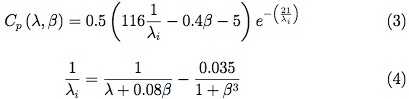
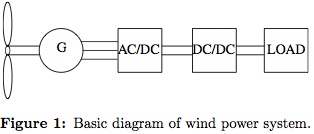
<body><![CDATA[<p>Wind turbines can operate in two different ways: with fixed speed   or with variable speed. Fixed-speed wind turbines are equipped with   an induction generator; they are designed to operate with the maximum efficiency at one particular wind speed &#91;3&#93;. This type of wind turbine has the advantage of being simple and cheap, but the disadvantage of being poor controllable and unstable &#91;4&#93;. On the other hand, variable-speed wind turbines are designed to work with maximum efficiency over a wide range of wind speed. They are typically equipped with an induction or synchronous generator &#91;3&#93;, and even when their electrical system is more complex than that of a fixed speed wind turbine, they have the advantage of increasing the captured energy and improving power quality through control actions implemented on the power interface &#91;5&#93;.</p>     <p>Wind energy can be easily found in nature, but the sudden changes   throughout the day can represent a drawback to the WECS &#91;6&#93;. That   drawback can be solved by the implementation of control actions like   Maximum Power Point Tracking or MPPT control. This control strategy   allows to achieve the maximum power at any wind speed &#91;7&#93; and   it is implemented commonly through a DC-DC converter. In <a href="#f1">Figure   1</a> a simple diagram of wind power system is shown, the load can be   modeled according to the final application of the system: DC loads, AC loads or both.</p>     <p align="center"><a name="f1"></a><img src="/img/revistas/ince/v10n19/v10n19a06f1.jpg"></p>     <p>MPPT algorithms have been widely studied, not only for wind   systems, photovoltaic systems are also a typical application area for   MPPT techniques &#91;5&#93;,&#91;8&#93;,&#91;7&#93;,&#91;6&#93;; it can be said that the implementation   of those techniques, for PV systems or WECS is the same, except for the variables involved in the algorithms.</p>     <p>A large number of MPPT techniques for WECS has been studied   and reported in literature, they can be grouped in three main methods:   hill-climb search (HSC) control, tip speed ratio (TSR) control and power signal feedback (PSF) control &#91;6&#93;. The application of one or another depends on the characteristics of the wind system and the requirements of techniques, this means, the amount and type on sensors and computational demand. Some techniques need an accurate knowledge of the turbine parameters and the measurement of the wind speed &#91;9&#93;; some of them do not require the measurement of the wind system, but do implement an estimator &#91;10&#93;; some recent techniques do not require to measure any parameter, normally they are based in conventional algorithms improved by intelligent techniques like fuzzy logic, neural networks or genetics algorithms &#91;11&#93;.</p>     <p>This paper provides an overview of the most significant characteristics   of wind systems, and considerations about models for simulation   are made, also some of the most used MPPT techniques are studied.   This paper makes emphasis on HCS control techniques and their application   in permanent magnet synchronous generator (PMSG) with a   variable-speed wind turbine. An application example is presented, its   implementation is made by simulation in Matlab/Simulink&reg;  . Finally some conclusion of the paper and simulation results are given.</p>      <p><b><font size="3">2 Wind Energy Conversion Systems Background</font></b></p>     <p>   In WECS the energy from wind is used to cause a rotation motion   in turbine. This motion will make the generator produces electrical   energy which can be regulated and controlled by the power interface.   The mechanical power produced by a wind turbine can be represented   by (1), where <i>&rho;</i> is the air density, <i>R</i> is the turbine radius, <i>V<sub>w</sub></i> is the   wind speed measured in meters per second (<i>m</i> &frasl;<i>s</i>) and <i>C<sub>p</sub></i> is the power   coefficient which depends on the tip speed ratio <i>&lambda;</i> and the pitch angle  <i>&beta;</i>  &#91;6&#93;, &#91;5&#93;, &#91;8&#93;.  </p>     <p><a name="e1"></a><img src="/img/revistas/ince/v10n19/v10n19a06e1.jpg"></p>     <p>The tip speed ratio is given by : </p>     ]]></body>
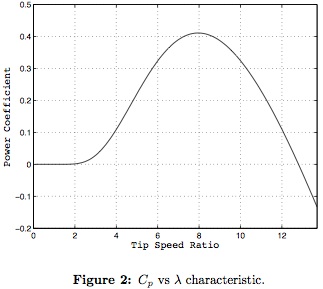
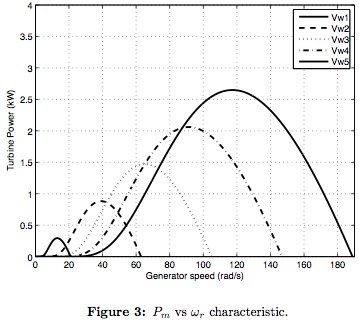
<body><![CDATA[<p><a name="e2"></a><img src="/img/revistas/ince/v10n19/v10n19a06e2.jpg"></p>     <p>Where <i>&omega;<sub>r</sub></i> is the turbine angular speed. The power coefficient <i>C<sub>p</sub></i> is normally defined by (3) and (4) &#91;12&#93;.</p>     <p><a name="e3"></a><img src="/img/revistas/ince/v10n19/v10n19a06e3.jpg"></p>     <p>However, the non-linear, dimensionless <i>C<sub>p</sub></i> characteristic can be represented   by (5). Constants <i>c<sub>1</sub></i> to<i> c<sub>6</sub></i> are obtained through experimental tests &#91;13&#93;.</p>     <p><a name="e4"></a><img src="/img/revistas/ince/v10n19/v10n19a06e4.jpg"></p>     <p>If a fixed pitch rotor is assumed, <i>&beta;</i> is equal to zero, which makes <i>C<sub>p</sub></i>   depends only on <i>&lambda;</i> and from (3) the graphical relationship between   them can be obtained as is shown in <a href="#f2">Figure 2</a>. This relationship gives the first key in the characterization of WECS &#91;12&#93;, &#91;5&#93;.</p>     <p align="center"><a name="f2"></a><img src="/img/revistas/ince/v10n19/v10n19a06f2.jpg"></p>     <p>In <a href="#f3">Figure 3</a>, the behavior of mechanical power for a turbine airbreeze   is shown. It can be seen how the curve has a maximum point   for each wind speed condition (from <i>V<sub>w</sub></i>1 to <i>V<sub>w</sub></i>5); this simple idea   leads to the question: how to get that point?, that is the work of MPPT algorithm.</p>     <p align="center"><a name="f3"></a><img src="/img/revistas/ince/v10n19/v10n19a06f3.jpg"></p>      <p><b><font size="3">3 Models for Simulation of Wind Systems</font></b></p>     ]]></body>
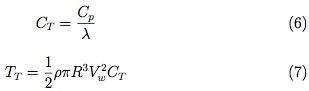
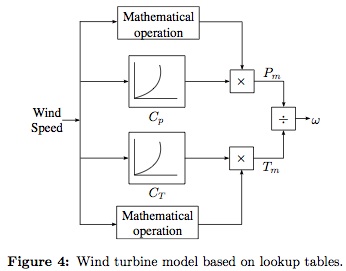
<body><![CDATA[<p>   In general, the simulation of any system is an important tool for   validating theoretical analysis and propose adjustments if they are   needed. Simulation of wind systems must begin with the model of   the different elements of it, and one of the most important elements is   obviously the wind turbine. Wind turbines convert the kinetic energy   present in the wind into mechanical energy by means of producing   torque which is injected to a generator. In the previous section, it was explained, that the power (1) depends on different parameters,   one of them is the power coefficient <i>C<sub>p</sub></i>, from where another important   parameter is defined, the torque coefficient <i>C<sub>T</sub></i> . The relationship   between power and torque coefficients is shown in (6). By combining   (1), (2), and (6), the torque of the turbine (7) can be obtained.   This expression can be very useful if the input for the generator is the   produced torque.</p>     <p><a name="e5"></a><img src="/img/revistas/ince/v10n19/v10n19a06e5.jpg"></p>     <p>In &#91;14&#93;, the curves for Cp and CT are obtained and used later as   lookup tables to model the wind turbine in PSIM&reg;  , as is shown in   <a href="#f4">Figure 4</a>. By using different forms of equations (1) and (2), Joshi   et al. &#91;15&#93;, present basic wind turbine models and simulate them on   Matlab&reg;  and PSIM&reg;  . The results allow to analyse the behavior of   the wind turbine to changes in different parameters, additionally the   models can be used as a base for other studies. In &#91;16&#93;, a model   in Matlab/Simulink&reg;  based on a lookup table for the power and a   second order system to model the wind turbine dynamics, is shown.   In that case a double-fed induction generator is used and modelled through vector approach.</p>     <p>As it was seen through the different aforementioned cases, the   choice of a suitable model for simulation is an important part of the   analysis process. The more information is taken from the real system,   the more accurate model will be simulated. One of the most   significant parameters of the wind turbine, is the power coefficient.   Its characteristic, which is a non-linear curve, represents the aerodynamic   behavior of the wind turbine. By means of different experimental   tests, it is possible to find the parameters of <i>C<sub>p</sub></i> function,   which can represent a powerful tool for implementing MPPT control   algorithm, as it is shown in &#91;13&#93;, where special attention is given   to inertia system analysis. Analogy between electrical and mechanical parameters is carefully studied with the aim of create a custom</p>     <p align="center"><a name="f4"></a><img src="/img/revistas/ince/v10n19/v10n19a06f4.jpg"></p>     <p> model using PSIM&reg;. Similar considerations are made in &#91;12&#93; by using   Matlab/Simulink&reg;  , a block with the <i>C<sub>p</sub></i> equation is used to calculate   the mechanical power and later the mechanical torque.</p>     <p>Simulation issues are commonly related with the approaches and   estimations made on the real model, despite the simulation software   chosen for the analysis. There are simulation packages, which in principle   can describe a complete wind turbine with all units, however   the turbine description used in those programs requires certain parameters   that are not easy to know by the user, at least in initial   condition which is critical since correct initialisation of a model in   a power system simulation tool, avoids fictitious electrical transients   and makes it possible to evaluate correctly the real dynamic performance   of the system &#91;17&#93;; another situation related with that turbine   description is that it can not be viable in grid simulations packages   because of high computational burden and can not be used to represent   wind farms containing hundred of wind turbines in grid simulations   without proper simplifications. Some problems that arises   in implementing the model of a wind power system into commercial   power system simulation tools, include the simulation time step having into account that a transient simulation requires very small time steps and consequently very long simulation time, compatibility constraints, inability of the tool to spot phenomena such as the presence of dc-offset and unbalanced events; moreover in grid-connected wind power systems, detailed validation of the model especially during grid fault conditions, is still hard to found in the literature &#91;18&#93;, &#91;19&#93;. It is not impossible to carry on good simulations, but one must be very responsibly interpreting and analysing the results in the right context, otherwise the results of the computer simulations can be insufficient and unreliable in the research work.</p>      <p><b><font size="3">3.1 Wind Speed Distribution Models</font></b></p>     <p>   The primary source of energy in wind systems is the wind, and it   is necessary have its behavior into account for simulation and implementation   of any wind system. Among the wind characteristics, its   speed is the most important parameter in the design and study of   wind energy conversion systems. In practice, it is very important to   describe the variation of wind speeds for optimizing the design of the   systems, which leads to actual values on wind energy potential. An   important tool from probability theory is used to analyze the wind   speed: probability density function (PDF), which is a function that   describes the relative likelihood of a random variable to take on a   given value &#91;20&#93;. The PDF of wind speed predominantly determines   the performance of a wind energy system in a given location for the   period involved &#91;21&#93;, that depends on several factors like weather and   topography of the place on. The following briefly describes the most   widely accepted PDF's.</p>     <p><i>Weibull</i> distribution is highly used and recommended in wind systems   analysis; it uses three parameters <i>&alpha;,  &beta;</i> and    <i>&gamma;</i>, which correspond   to the shape parameter, the scale parameter and the location parameter,   respectively. Weibull distribution has found diverse application   areas such as the survival and reliability analysis, and it is by far   the most popular statistical distribution for wind speed modeling.   Its capability to mimic exponential distribution and normal distribution through adjusting scale and shape parameters contributes to the scope of this distribution for various applications &#91;22&#93;, &#91;23&#93;. Along with the Weibull distribution the <i>Rayleigh</i> distribution is one of the most used statistical distributions in reliability theory; is a special case of Weibull distribution, where the shape parameter is equal to two, and the scale parameter is &radic;2 times of the scale parameter of the corresponding Weibull distribution &#91;21&#93;. Other distribution that have been reported in literature are <i>Lognormal</i> distribution, which is a special form of the normal distribution, <i>Gamma</i> and <i>Erlang</i> distributions which uses exponential approximations, <i>inverse Gaussian</i> distribution is also used and is popular in meteorology studies, additionally other alternatives for wind speed analysis include <i>Skewed generalized error</i> distribution, <i>Skewed t</i> distribution and Burr distribution &#91;24&#93;. In &#91;25&#93; and &#91;26&#93;, <i>Maximum Entropy Principle</i> (MEP) is proposed to overcome the inaccuracy of Weibull and other distributions in some cases. The maximum entropy principle is based on the premise that when estimating the probability distribution, one should select the distribution model which gives the largest remaining uncertainty, and is consistent with the existing constraints, then no additional assumptions or biases, such as a prior distribution and the range of parameters in the distribution model, are introduced into the model.</p>      ]]></body>
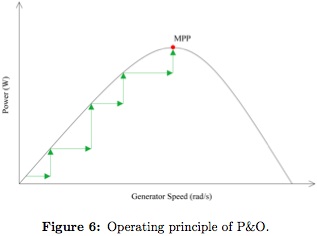
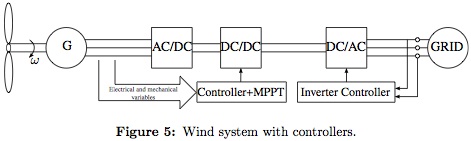
<body><![CDATA[<p><b><font size="3">3.2 Power Interface</font></b></p>     <p>   Figure 1 shows the basic form of a wind power system. The power   interface is placed between the generation section and the load, it is   mainly composed by an uncontrolled rectifier, a DC-DC converter and   a DC-AC inverter. The main purpose of the rectifier is to deliver a DC   voltage signal to the converter, so some control actions can be made.   The power extracted from the wind turbine could be maximized by   the addition of control algorithms known as maximum power point   tracking methods. They are mainly implemented through the DC-DC   converter. <a href="#f5">Figure 5</a> shows a typical scheme of a WECS with maximum   power point tracking controller.</p>     <p>The DC-AC inverter is the interface between the wind turbine system and the grid, by controlling this inverter it is possible to control the power factor which provides better performances &#91;12&#93;.</p>     <p align="center"><a name="f5"></a><img src="/img/revistas/ince/v10n19/v10n19a06f5.jpg"></p>     <p>Several topologies for the DC-DC converter and the DC-AC inverter   have been proposed. For the DC-DC converter is common to   use the boost, and buck-boost converter &#91;12&#93;, while for the DC-AC   inverter the options include typical full bridge converter, multilevel   inverters and matrix converters &#91;27&#93; &#91;28&#93;. An important aspect to consider   for choosing the topology of the DC-DC converter and DC-AC   inverter is the losses which implies the performance of the elements of   the circuitry: power switches, resistors, capacitors, inductors among others &#91;29&#93;.</p>      <p><b><font size="3">3.3 Maximum Power Point Tracking Control Methods</font></b></p>     <p>   Due to the sudden changes in wind, which cannot be predicted and   controlled, it is necessary to control the WECS through its power   interface, to achieve satisfactory results.</p>     <p>There are three main control methods to extract the maximum   power available: hill-climb search (HSC) control, tip speed ratio (TSR)   control and power signal feedback (PSF) control. Next, the most significant characteristics of these methods are described.</p>      <p><b><font size="3">3.4 Hill-climb Search (HCS) Control</font></b></p>     <p>   The curve of the power produced by the wind has one maximum power   point (MPP). HCS techniques track this point by searching in the   curve making variations of a determined variable and comparing the   previous and actual power. One of the most widely used techniques,   which is based in this principle, is perturbation and observation or   P&amp;O. In <a href="#f6">Figure 6</a>, the principle of P&amp;O is shown. It can be seen that   if the operating point is to the left of the MPP, the control must move   it to the right and vice versa if it is to the right.</p>     ]]></body>
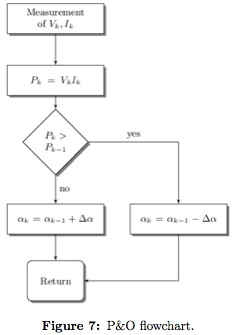
<body><![CDATA[<p align="center"><a name="f6"></a><img src="/img/revistas/ince/v10n19/v10n19a06f6.jpg"></p>     <p>This technique can be implemented perturbing the rotational speed   and observing the mechanical power, perturbing the inverter input   voltage and observing the output power or perturbing the DC-DC   converter duty cycle <i>D</i> and observing the output power &#91;5&#93;. <a href="#f7">Figure   7</a> shows the flow chart of the P&amp;O algorithm where the perturbed variable is <i>D</i> which is defined by (8) &#91;6&#93; &#91;7&#93;.</p>     <p><a name="e6"></a><img src="/img/revistas/ince/v10n19/v10n19a06e6.jpg"></p>     <p align="center"><a name="f7"></a><img src="/img/revistas/ince/v10n19/v10n19a06f7.jpg"></p>     <p>Choosing an appropriate step-size is the main task to implement   the algorithm and sometimes is not an easy task. Larger step-size   can generate faster responses and more oscillations around the MPP   which can represent low efficiency; on the other hand, smaller stepsize   improves efficiency but reduces the convergence speed &#91;5&#93;. The   initialization of parameters is also an important aspect of this technique,   some reported works suggest to run a related algorithm to find the suitable values and then run the P&amp;O algorithm &#91;10&#93;</p>     <p>One of the main advantages of this technique is that it does not   require knowledge of system characteristics, which makes it cheap and   easy to implement. But on the other hand, one significant drawback   is the possibility of failure to quick changes in wind speed &#91;8&#93; &#91;30&#93;. To   improve the conventional P&amp;O algorithm, several modifications have   been proposed, one of the most representative is the variable step-size &#91;30&#93; &#91;27&#93; &#91;31&#93;, where the step-size is automatically updated depending on the operating point, then if the system is working on a point far from the MPP, the step-size should be increased to accelerate the searching and if the system is working on a point near to the MPP the step-size must be reduced. With this principle the algorithm will be fast, little oscillating, therefore efficiency will be improved.</p>     <p><b>3.4.1 Hill-climb search for PMSG based WECS</b> As it was mentioned,   variable-speed wind turbines are designed to work with maximum   efficiency over a wide range of wind speed and they are normally   equipped with a PMSG. This kind of system have been widely studied   and reported in literature, and remains as a suitable option for WECS.</p>     <p>In &#91;32&#93;, a MPPT based on the optimum power versus speed characteristic   and a conventional P&amp;O, is presented while in &#91;33&#93; and &#91;34&#93;,   artificial neural networks are used to improve the performance of a   conventional P&amp;O algorithm; the controller is implemented through a DSP (Digital Signal Processor), which ensures fast responses.</p>     <p>Several novel HCS-based methods, include the principle of searchremember-   reuse. Those methods requires storing data of peak points   obtained and training stage. The maximum power error driven mechanism   (MPED) has been recently use &#91;35&#93;; it provides a preliminary   optimized operating point from which the memory begins storage process.   The direct current demand control (DCDC) makes use of optimized   functions to calculate the initial state of the variables of HCS   algorithm, normally MPED and DCDC are implemented together in a structure which is known as advanced hill-climb search &#91;6&#93;.</p>      <p><b><font size="3">3.5 Tip Speed ratio (TSR)</font></b></p>     ]]></body>
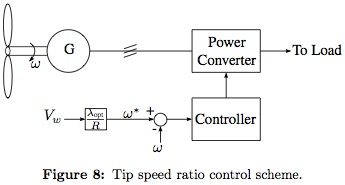
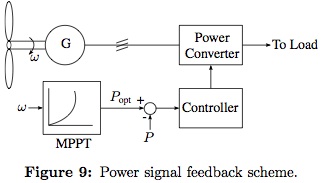
<body><![CDATA[<p>   <a href="#f8">Figure 8</a> illustrates the structure of this MPPT control method. The   tip speed ratio, as given in (2), is the relationship between the speed   at the tip of the turbine blade and the speed of the wind and as   is shown in (1), the power is a function of the wind speed and the   rotor speed. When the TSR is optimal, the extracted energy will be maximized besides, the optimal value of TSR is constant regardless   of wind speed. The principle of this method is to force the system to   remain at the optimal TSR by comparing with the actual operating   point and sending this information to the controller &#91;5&#93; &#91;7&#93;. This   method is mainly use in large systems due to the need of measuring   the wind. It is one of the major drawbacks of this method.</p>     <p align="center"><a name="f8"></a><img src="/img/revistas/ince/v10n19/v10n19a06f8.jpg"></p>     <p>Some reported works propose an estimation of wind to avoid the   installation of anemometers and related equipment. In &#91;36&#93; a TSR   observer based in adaptive perturbations is proposed which is implemented   in a DSP. In &#91;37&#93; a system with two series connected wind   turbines is presented; the dynamic performances of the wind turbines are analysed to design the controller.</p>     <p>Estimators are commonly implemented trough advanced control   techniques like neural networks, fuzzy logic, among others. In &#91;34&#93;,   &#91;38&#93; and &#91;39&#93; neural networks are used to assess the TSR, in &#91;40&#93; growing   neural gas learning method is used to improve MPPT controller, while in &#91;41&#93; and &#91;42&#93; TSR method based on fuzzy logic is presented.</p>      <p><b><font size="3">3.6 Power Signal Feedback (PSF)</font></b></p>     <p>   In this method, the reference obtained from simulations or experimental   tests, is the curve of rotational speed vs. optimal power &#91;5&#93;.   If the system is operating with wind speed <i>V</i><sub>1</sub>, shaft speed <i>&omega;<sub>T</sub></i><sub>1</sub>, and   maximum output power <i>P<sub>1</sub></i>, and the wind speed change to <i>V<sub>2</sub></i>, the new optimum output power should be <i>P</i><sub>2</sub>, but the real output power will   be P'<sub>2</sub>   due to the inertia of the shaft. Then the shaft will accelerate   under additional turbine torque and operations point will be moved   to <i>P</i><sub>2</sub> and <i>&omega;<sub>T</sub></i><sub>2</sub>. To implement PSF technique, the maximum power   is tracked by the shaft speed measurement and corresponding power   reference determination. No wind velocity measurement is required   in this method &#91;43&#93;. However, measuring the mechanical shaft speed   and wind turbine output power is a drawback of this method. <a href="#f9">Figure   9</a>, shows the classical structure for this control method.</p>     <p align="center"><a name="f9"></a><img src="/img/revistas/ince/v10n19/v10n19a06f9.jpg"></p>     <p>In &#91;44&#93; a mechanical speed-sensorless PSF method is implemented   for induction generator. The method provides the power reference   for the controller corresponding to maximum power point. A look-up   table containing generator synchronous speeds corresponding to the   optimal generator power and the wind turbine must keep adjusting its   speed to track the optimum speed shaft. The generator synchronous   speed can be increased or decreased by modifying the induction generator   terminal frequency. In &#91;7&#93; the rotor speed is sensed with an   encoder and then the optimal value of the electrical power is computed.   It requires a pre-recorder relation between the rotor speed   and the optimal power. In &#91;45&#93; a fuzzy logic based PSF controller is   designed for a doubly fed induction generator. The data driven design   methodology is capable of generate a Takagi-Sugeno-Kang fuzzy   model for maximum power extraction. The controller has two inputs   (the rotor speed and generator output power) and one output (the estimated maximum power). In similar way, a fuzzy controller is used to track the maximum power point in &#91;46&#93;, but in this case is for a squirrel cage induction generator. Maximum power output of the system at different wind velocity is computed using a polynomial curve fit of third order.</p>      <p><b><font size="3">3.7 Additional Control Considerations</font></b></p>     <p>   As it was said before, the implementation of a MPPT control technique   can be done through the power converter; by controlling the   duty cycle of the converter, the apparent load developed by the generator   can be adjusted, and thus its output voltage and shaft speed   can also be adjusted. However tracking the MPP is not the only objective   of the control structure. WECS are exposed to disturbances   that can affect its performance; those disturbances may include voltage   imbalances (flicker, dip), harmonics, reactive power imbalances,   etc specially when the system is connected to the grid &#91;3&#93;. To reject   perturbances and ensure a good performance of any wind system   additional control actions must be done, commonly they are made   through the power interface. Several studies have been made on the   configuration of the converter who is the central component of the   power interface; the main characteristics of the system as the type of   wind turbine and the type of the generator, may define the topology.   In &#91;47&#93; and &#91;48&#93;, different configurations are discussed for variablespeed   wind turbine systems; in &#91;49&#93; is it recommended using a boost   converter because its low cost and reliability for PMSG, while in &#91;5&#93;   it is considered that the power interface can be composed by a backto-   back converter or by a three-phase diode rectifier connected to a   boost converter; nevertheless equipment like STATCOM and matrix   converters are commonly used in WECS. Besides MPPT technique,   the control loop can be conformed by a voltage control, current control   or duty cycle control, which can be implemented using diverse   control techniques. Classical controllers like PI is widely used in industry   applications since it is simple to design and easy to implement.   Useful details about PI controlling of wind turbines are given in &#91;50&#93;   and &#91;51&#93;; three kinds of control loops for tracking the optimal rotor speed are used, in all of them the target rotor speed. In &#91;52&#93;, a   simple approximate model of a large wind farm is modeling, which   attempts to mimic the active and reactive power dynamics of two   generic wind turbine control systems based on PI controller. Adaptive   control schemes continuously measure the value of system parameters   and then change the control system dynamics in order to make   sure that the desired performance criteria are always met, in &#91;53&#93; a   model reference fuzzy adaptive controller was proposed for harvesting   the maximum power from wind, authors highlight that the proposed   controller has the advantages of shortening the time for system adjustment   and quickening the response speed over conventional PID   controllers. In &#91;54&#93;, a proportional-resonant controller is proposed,   which is adopted in a current loop, by giving a suitable current reference   value for the controller, the problem of ac-side line-current   asymmetry can be solved, and the effect of unbalanced grid voltages   on the system can be avoided as well. Fuzzy logic control and other   advanced control techniques are an effective approach to design wind   systems due to their high nonlinear characteristics; in &#91;55&#93; a robust   control algorithm for wind turbines subjected to a wide range of wind   variation is presented, the algorithm utilizes fuzzy systems based on   Takagi-Sugeno models and combines the merits of the capability for   dealing with non-linear uncertain systems and the powerful Linear   Matrix Equalities approach to obtain control gains while in &#91;56&#93; an   on-line training recurrent fuzzy neural network controller is proposed,   the control strategy is achieved without mechanical sensors such as   the wind speed or position sensor, instead the estimation of the rotor   speed is based on the model reference adaptive system, obtaining a   sensorless vector-control scheme.</p>      ]]></body>
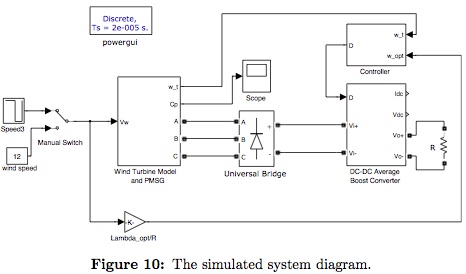
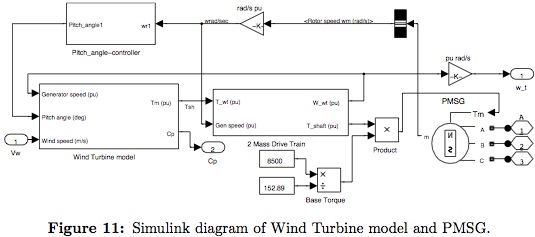
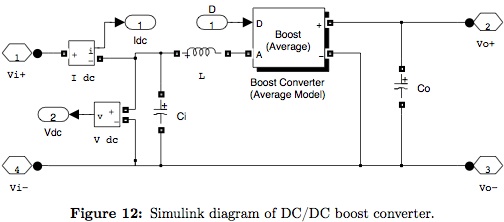
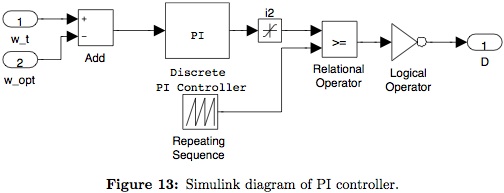
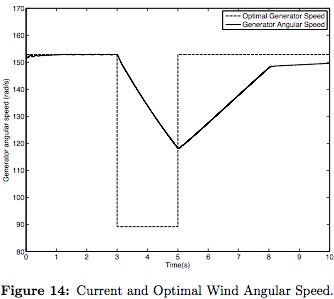
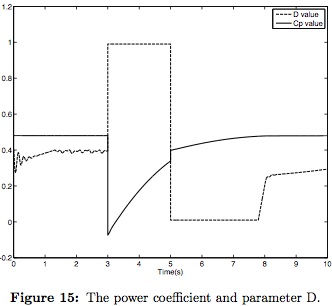
<body><![CDATA[<p><b><font size="3">4 Simulation Results and Discussion</font></b></p>     <p>   To keep an optimal <i>C<sub>p</sub></i> value, control techniques must adapt the generator   angular speed <i>&omega;<sub>r</sub></i> according to current wind speed value <i>V<sub>&omega;</sub></i>. In   this sense, there is a relation between the parameter D at the DCDC   converter side and the generator angular speed. Tip Speed Ratio based control is adopted to present the incidence of parameter D in   the generator angular speed. Simulations were carried out with Wind   Turbine and Permanent Magnet Synchronous Generator parameters   as in &#91;57&#93; and DC-DC Boost Converter parameters as in &#91;12&#93;. The   load resistance was set to 20 &Omega; for all simulations. The simulated system diagram is shown in <a href="#f10">Figure 10</a>.</p>     <p align="center"><a name="f10"></a><img src="/img/revistas/ince/v10n19/v10n19a06f10.jpg"></p>     <p>A detailed description of Wind Model, Converter and Controller blocks from Figure 10 are shown in <a href="#f11">Figures 11</a>,<a href="#f12">12</a> <a href="#f13">13</a>, respectively.</p>     <p align="center"><a name="f11"></a><img src="/img/revistas/ince/v10n19/v10n19a06f11.jpg"></p>     <p align="center"><a name="f12"></a><img src="/img/revistas/ince/v10n19/v10n19a06f12.jpg"></p>     <p align="center"><a name="f13"></a><img src="/img/revistas/ince/v10n19/v10n19a06f13.jpg"></p>     <p>For the first experiment a step-like wind speed signal was generated (similar to optimal generator speed signal shown in <a href="#f14">Figure 14</a>.   The performance of the adopted controller is shown in <a href="#f14">Figures 14</a> and   <a href="#f15">15</a>. <i>C<sub>p</sub></i> maximum value 0.48 is maintained for the first 3 seconds before   the negative step change in the wind speed occurred. To achieve   again the optimal <i>C<sub>p</sub></i> value, wind generator speed was decreased in   the controller by increasing D to its top value. At time 5 s a positive   step change in the wind speed occurred. Then, parameter D is decreased to increase wind generator speed and improve the <i>C<sub>p</sub></i> value.</p>     <p align="center"><a name="f14"></a><img src="/img/revistas/ince/v10n19/v10n19a06f14.jpg"></p>     <p align="center"><a name="f15"></a><img src="/img/revistas/ince/v10n19/v10n19a06f15.jpg"></p>      ]]></body>
<body><![CDATA[<p><b><font size="3">5 Conclusions</font></b></p>     <p>   An overview of the most important concepts related to wind power   systems have been shown in this paper. Aspects like the composition   of the system and their behavior due to different conditions have   been presented. It is important to highlight the role that the control   plays, in these systems. The MPPT algorithms represent an suitable   tool for improving the performance of the system. Besides, it helps   to encourage the wind power systems like a good choice to the current   challenges in energy matter. The models for simulations are the   first step in the way of the designing process. Several models and   related concepts have been studied, however there is no a established   metodology to develop a model for a particular type of analysis, but   the equations related with the power of the wind and the turbine are   the main fundamentals for modeling. In the simulation results, the   behavior of the power coefficient <i>C<sub>p</sub></i> is highlighted. The relationship   between <i>C<sub>p</sub></i> and the duty cycle D of the DC-DC converter is given,   and it lets show the importance of the power interface.</p>      <p><b><font size="3">Acknowledgments</font></b></p>     <p>   This work was supported by the AyE and MATyER research groups   of the Instituto Tecnologico Metropolitano under the project Maximizaci&oacute;n   de extracci&oacute;n de energ&iacute;a en aerogeneradores para cogeneraci&oacute;n   urbana en el Valle de Aburr&aacute;. The project was started in May   of 2010 and ended in November of 2012.</p> <hr size="1" />       <p><b><font size="3">References</font></b></p>     <!-- ref --><p>   &#91;1&#93; H. Li and Z. Chen, ''Overview of different wind generator systems and their   comparisons,'' <i>IET renewable Power Generation,</i> vol. 2, no. 2, pp. 123&#8211;138,   2008.    &nbsp;&nbsp;&nbsp;&nbsp;&nbsp;&nbsp;&nbsp;&nbsp;[&#160;<a href="javascript:void(0);" onclick="javascript: window.open('/scielo.php?script=sci_nlinks&ref=000098&pid=S1794-9165201400010000600001&lng=','','width=640,height=500,resizable=yes,scrollbars=1,menubar=yes,');">Links</a>&#160;]<!-- end-ref --> 100</p>     <!-- ref --><p>   &#91;2&#93; T. Ackermann, G. Ancell, L. D. Borup, P. B. Eriksen, B. Ernst, F. Groome,   M. Lange, C. Mohrlen, A. G. Orths, J. OSullivan, and M. de la Torre, ''Where   the wind blows,'' <i>IEEE Power and Energy Magazine</i>, vol. 7, no. 6, pp. 65&#8211;75,   2009.    &nbsp;&nbsp;&nbsp;&nbsp;&nbsp;&nbsp;&nbsp;&nbsp;[&#160;<a href="javascript:void(0);" onclick="javascript: window.open('/scielo.php?script=sci_nlinks&ref=000100&pid=S1794-9165201400010000600002&lng=','','width=640,height=500,resizable=yes,scrollbars=1,menubar=yes,');">Links</a>&#160;]<!-- end-ref --> 100</p>     <!-- ref --><p>&#91;3&#93; T. Ackermann, <i>Wind Power in Power Systems</i>. West Sussex PO19 8SQ, England: John Wiley and Sons, Ltd, 2005.    &nbsp;&nbsp;&nbsp;&nbsp;&nbsp;&nbsp;&nbsp;&nbsp;[&#160;<a href="javascript:void(0);" onclick="javascript: window.open('/scielo.php?script=sci_nlinks&ref=000102&pid=S1794-9165201400010000600003&lng=','','width=640,height=500,resizable=yes,scrollbars=1,menubar=yes,');">Links</a>&#160;]<!-- end-ref --> 100, 101, 115</p>     <!-- ref --><p>   &#91;4&#93; A. Sumper, O. Gomis-Bellmunt, A. Sudria-Andreu, R. Villafafila-Robles, and   J. Rull-Duran, ''Response of fixed speed wind turbines to system frequency   disturbances,''<i> IEEE Transactions on Power Systems</i>, vol. 24, no. 1, pp. 181&#8211;   192, 2009.    &nbsp;&nbsp;&nbsp;&nbsp;&nbsp;&nbsp;&nbsp;&nbsp;[&#160;<a href="javascript:void(0);" onclick="javascript: window.open('/scielo.php?script=sci_nlinks&ref=000104&pid=S1794-9165201400010000600004&lng=','','width=640,height=500,resizable=yes,scrollbars=1,menubar=yes,');">Links</a>&#160;]<!-- end-ref --> 101</p>     <!-- ref --><p>   &#91;5&#93; M. Abdullah, A. Yatim, C. Tan, and R. Saidur, ''A review of maximum   power point tracking algorithms for wind energy systems,'' <i>Renewable and   Sustainable Energy Reviews</i>, vol. 16, no. 5, pp. 3220&#8211;3227, 2012.    &nbsp;&nbsp;&nbsp;&nbsp;&nbsp;&nbsp;&nbsp;&nbsp;[&#160;<a href="javascript:void(0);" onclick="javascript: window.open('/scielo.php?script=sci_nlinks&ref=000106&pid=S1794-9165201400010000600005&lng=','','width=640,height=500,resizable=yes,scrollbars=1,menubar=yes,');">Links</a>&#160;]<!-- end-ref --> 101, 102,   103, 110, 111, 113, 115</p>     <!-- ref --><p>   &#91;6&#93; J. S. Thongam and M. Ouhrouche,<i> Fundamental and Advanced Topics in   Wind Power, Chapter 15</i>. Janeza Trdine 9, 51000 Rijeka, Croatia: Intech,   2011.    &nbsp;&nbsp;&nbsp;&nbsp;&nbsp;&nbsp;&nbsp;&nbsp;[&#160;<a href="javascript:void(0);" onclick="javascript: window.open('/scielo.php?script=sci_nlinks&ref=000108&pid=S1794-9165201400010000600006&lng=','','width=640,height=500,resizable=yes,scrollbars=1,menubar=yes,');">Links</a>&#160;]<!-- end-ref --> 101, 102, 110, 112</p>     <!-- ref --><p>   &#91;7&#93; J. C. U. Pena, M. A. G. de Brito, G. de A. e Melo, and C. A. Canesin, ''A comparative   study of mppt strategies and a novel single phase integrated buck   boost inverter for small wind energy conversion systems,'' in <i>2011 Brazilian   Power Electronics Conference COBEP</i>, 2011, pp. 458&#8211;465.    &nbsp;&nbsp;&nbsp;&nbsp;&nbsp;&nbsp;&nbsp;&nbsp;[&#160;<a href="javascript:void(0);" onclick="javascript: window.open('/scielo.php?script=sci_nlinks&ref=000110&pid=S1794-9165201400010000600007&lng=','','width=640,height=500,resizable=yes,scrollbars=1,menubar=yes,');">Links</a>&#160;]<!-- end-ref --> 101, 110, 113,   114</p>     <!-- ref --><p>   &#91;8&#93; L. Whei-Min and H. Chih-Ming, ''Intelligent approach to maximum power   point tracking control strategy for variable speed wind turbine generation   system,'' <i>Energy</i>, vol. 35, no. 6, pp. 2440&#8211;2447, 2010.    &nbsp;&nbsp;&nbsp;&nbsp;&nbsp;&nbsp;&nbsp;&nbsp;[&#160;<a href="javascript:void(0);" onclick="javascript: window.open('/scielo.php?script=sci_nlinks&ref=000112&pid=S1794-9165201400010000600008&lng=','','width=640,height=500,resizable=yes,scrollbars=1,menubar=yes,');">Links</a>&#160;]<!-- end-ref --> 101, 102, 111</p>     <!-- ref --><p>   &#91;9&#93; L. Gonzalez, E. Figueres, G. Garcera, and O. Carranza, ''Maximum-powerpoint   tracking with reduced mechanical stress applied to wind-energyconversion-   systems,'' <i>Applied Energy</i>, vol. 87, no. 7, pp. 2304&#8211;2312, 2010.    &nbsp;&nbsp;&nbsp;&nbsp;&nbsp;&nbsp;&nbsp;&nbsp;[&#160;<a href="javascript:void(0);" onclick="javascript: window.open('/scielo.php?script=sci_nlinks&ref=000114&pid=S1794-9165201400010000600009&lng=','','width=640,height=500,resizable=yes,scrollbars=1,menubar=yes,');">Links</a>&#160;]<!-- end-ref -->   102</p>     <!-- ref --><p>   &#91;10&#93; A. Soetedjo, A. Lomi, and W. P. Mulayanto, ''Modeling of wind energy system   with mppt control,'' in 2011 <i>International Conference on Electrical Engineering   and Informatics</i>, 2011, pp. 1&#8211;6.    &nbsp;&nbsp;&nbsp;&nbsp;&nbsp;&nbsp;&nbsp;&nbsp;[&#160;<a href="javascript:void(0);" onclick="javascript: window.open('/scielo.php?script=sci_nlinks&ref=000116&pid=S1794-9165201400010000600010&lng=','','width=640,height=500,resizable=yes,scrollbars=1,menubar=yes,');">Links</a>&#160;]<!-- end-ref --> 102, 111</p>     <!-- ref --><p>   &#91;11&#93; A. Meharrar, M. Tioursi, M. Hatti, and A. B. Stambouli, ''A variable speed   wind generator maximum power tracking based on adaptative neuro-fuzzy   inference system,'' <i>Expert Systems with Applications</i>, vol. 38, no. 6, pp. 7659&#8211;   7664, 2011.    &nbsp;&nbsp;&nbsp;&nbsp;&nbsp;&nbsp;&nbsp;&nbsp;[&#160;<a href="javascript:void(0);" onclick="javascript: window.open('/scielo.php?script=sci_nlinks&ref=000118&pid=S1794-9165201400010000600011&lng=','','width=640,height=500,resizable=yes,scrollbars=1,menubar=yes,');">Links</a>&#160;]<!-- end-ref --> 102</p>     <!-- ref --><p>   &#91;12&#93; H. E. Mena-Lopez, ''Maximum power tracking control scheme for wind generator   systems,'' Master's thesis, Texas A&amp;M University, USA, 2007.    &nbsp;&nbsp;&nbsp;&nbsp;&nbsp;&nbsp;&nbsp;&nbsp;[&#160;<a href="javascript:void(0);" onclick="javascript: window.open('/scielo.php?script=sci_nlinks&ref=000120&pid=S1794-9165201400010000600012&lng=','','width=640,height=500,resizable=yes,scrollbars=1,menubar=yes,');">Links</a>&#160;]<!-- end-ref --> 103,   106, 109, 117</p>     <!-- ref --><p>&#91;13&#93; J. Hui, ''An adaptive control algortihm for maximum power point tracking   for wind energy conversion systems,'' Master's thesis, Queen's University, Kingston, Ontario, Canada, 2008.    &nbsp;&nbsp;&nbsp;&nbsp;&nbsp;&nbsp;&nbsp;&nbsp;[&#160;<a href="javascript:void(0);" onclick="javascript: window.open('/scielo.php?script=sci_nlinks&ref=000122&pid=S1794-9165201400010000600013&lng=','','width=640,height=500,resizable=yes,scrollbars=1,menubar=yes,');">Links</a>&#160;]<!-- end-ref --> 103, 105</p>     <!-- ref --><p>   &#91;14&#93; M. Topal and L. T. Ergene, ''Designing a wind turbine with permanent magnet   synchronous machine,'' <i>Journal of Electrical and Electronics Engineering   Instanbul University</i>, vol. 11, no. 1, pp. 1311&#8211;1317, 2011.    &nbsp;&nbsp;&nbsp;&nbsp;&nbsp;&nbsp;&nbsp;&nbsp;[&#160;<a href="javascript:void(0);" onclick="javascript: window.open('/scielo.php?script=sci_nlinks&ref=000124&pid=S1794-9165201400010000600014&lng=','','width=640,height=500,resizable=yes,scrollbars=1,menubar=yes,');">Links</a>&#160;]<!-- end-ref --> 105</p>     <!-- ref --><p>   &#91;15&#93; S. Joshi, A. Patel, P. Patel, and V. Patel, ''Wind energy - a brief survey with   wind turbine simulations,'' <i>International Journal of Computer Communication   and Information System</i> ( IJCCIS), vol. 2, no. 1, pp. 228&#8211;232, 2010.    &nbsp;&nbsp;&nbsp;&nbsp;&nbsp;&nbsp;&nbsp;&nbsp;[&#160;<a href="javascript:void(0);" onclick="javascript: window.open('/scielo.php?script=sci_nlinks&ref=000126&pid=S1794-9165201400010000600015&lng=','','width=640,height=500,resizable=yes,scrollbars=1,menubar=yes,');">Links</a>&#160;]<!-- end-ref -->   105</p>     <!-- ref --><p>   &#91;16&#93; B. Babu and K.B.Mohanty, ''Doubly-fed induction generator for variable   speed wind energy conversion systems-modeling and simulation,'' <i>International   Journal of Computer and Electrical Engineering</i>, vol. 2, no. 1, pp.   141&#8211;147, 2010.    &nbsp;&nbsp;&nbsp;&nbsp;&nbsp;&nbsp;&nbsp;&nbsp;[&#160;<a href="javascript:void(0);" onclick="javascript: window.open('/scielo.php?script=sci_nlinks&ref=000128&pid=S1794-9165201400010000600016&lng=','','width=640,height=500,resizable=yes,scrollbars=1,menubar=yes,');">Links</a>&#160;]<!-- end-ref --> 105</p>     <!-- ref --><p>   &#91;17&#93; A. D. Hansen, C. Jauch, P. S&oslash;rensen, F. Iov, and F. Blaabjerg, <i>Dynamic   wind turbine models in power system simulation tool DIgSILENT</i>. Roskilde,   Denmark: Ris&oslash; National Laboratory, 2003.    &nbsp;&nbsp;&nbsp;&nbsp;&nbsp;&nbsp;&nbsp;&nbsp;[&#160;<a href="javascript:void(0);" onclick="javascript: window.open('/scielo.php?script=sci_nlinks&ref=000130&pid=S1794-9165201400010000600017&lng=','','width=640,height=500,resizable=yes,scrollbars=1,menubar=yes,');">Links</a>&#160;]<!-- end-ref --> 106</p>     <!-- ref --><p>   &#91;18&#93; O. S. Mutlu, ''Modeling wind farms in power system simulation studies: a   review,''<i> Journal of Naval Science and Engineering</i>, vol. 82, no. 1, pp. 47&#8211;67,   2012.    &nbsp;&nbsp;&nbsp;&nbsp;&nbsp;&nbsp;&nbsp;&nbsp;[&#160;<a href="javascript:void(0);" onclick="javascript: window.open('/scielo.php?script=sci_nlinks&ref=000132&pid=S1794-9165201400010000600018&lng=','','width=640,height=500,resizable=yes,scrollbars=1,menubar=yes,');">Links</a>&#160;]<!-- end-ref --> 107</p>     <!-- ref --><p>   &#91;19&#93; A. Perdana, ''Wind turbine models for power system stability studies,'' Master's   thesis, Chalmers University of Technology, Goteborg, Sweden, 2006.    &nbsp;&nbsp;&nbsp;&nbsp;&nbsp;&nbsp;&nbsp;&nbsp;[&#160;<a href="javascript:void(0);" onclick="javascript: window.open('/scielo.php?script=sci_nlinks&ref=000134&pid=S1794-9165201400010000600019&lng=','','width=640,height=500,resizable=yes,scrollbars=1,menubar=yes,');">Links</a>&#160;]<!-- end-ref -->   107</p>     <!-- ref --><p>   &#91;20&#93; W. MathWorld, ''Probability density function,'' April 2013. &#91;Online&#93;.   Available: <a href="http://mathworld.wolfram.com/ProbabilityDensityFunction.html"target="_blank">http://mathworld.wolfram.com/ProbabilityDensityFunction.html</a>  107&nbsp;&nbsp;&nbsp;&nbsp;&nbsp;&nbsp;&nbsp;&nbsp;[&#160;<a href="javascript:void(0);" onclick="javascript: window.open('/scielo.php?script=sci_nlinks&ref=000136&pid=S1794-9165201400010000600020&lng=','','width=640,height=500,resizable=yes,scrollbars=1,menubar=yes,');">Links</a>&#160;]<!-- end-ref --><!-- ref --><p>   &#91;21&#93; J. Zhou, E. Erdem, G. Li, and J. Shi, ''Comprehensive evaluation of wind   speed distribution models: A case study for north dakota sites,'' <i>Energy   Conversion and Management</i>, vol. 51, no. 7, pp. 1449&#8211;1458, 2010.    &nbsp;&nbsp;&nbsp;&nbsp;&nbsp;&nbsp;&nbsp;&nbsp;[&#160;<a href="javascript:void(0);" onclick="javascript: window.open('/scielo.php?script=sci_nlinks&ref=000137&pid=S1794-9165201400010000600021&lng=','','width=640,height=500,resizable=yes,scrollbars=1,menubar=yes,');">Links</a>&#160;]<!-- end-ref --> 107, 108</p>     <!-- ref --><p>   &#91;22&#93; Z. Qin, W. Li, and X. Xiong, ''Generation system reliability evaluation incorporating   correlations of wind speeds with different distributions,'' <i>IEEE   Transactions on Power Systems</i>, vol. 28, no. 1, pp. 551&#8211;558, 2013.    &nbsp;&nbsp;&nbsp;&nbsp;&nbsp;&nbsp;&nbsp;&nbsp;[&#160;<a href="javascript:void(0);" onclick="javascript: window.open('/scielo.php?script=sci_nlinks&ref=000139&pid=S1794-9165201400010000600022&lng=','','width=640,height=500,resizable=yes,scrollbars=1,menubar=yes,');">Links</a>&#160;]<!-- end-ref --> 108</p>     <!-- ref --><p>   &#91;23&#93; E. C. Morgan, M. Lackner, R. M. Vogel, and L. G. Baise, ''Probability distributions   for offshore wind speeds,'' <i>Energy Conversion and Management</i>,   vol. 52, no. 1, pp. 15&#8211;26, 2011.    &nbsp;&nbsp;&nbsp;&nbsp;&nbsp;&nbsp;&nbsp;&nbsp;[&#160;<a href="javascript:void(0);" onclick="javascript: window.open('/scielo.php?script=sci_nlinks&ref=000141&pid=S1794-9165201400010000600023&lng=','','width=640,height=500,resizable=yes,scrollbars=1,menubar=yes,');">Links</a>&#160;]<!-- end-ref --> 108</p>     ]]></body>
<body><![CDATA[<!-- ref --><p>&#91;24&#93; I. Usta and Y. M. Kantar, ''Analysis of some flexible families of distributions   for estimation of wind speed distributions,'' <i>Applied Energy</i>, vol. 89, no. 1, pp. 335&#8211;367, 2012.    &nbsp;&nbsp;&nbsp;&nbsp;&nbsp;&nbsp;&nbsp;&nbsp;[&#160;<a href="javascript:void(0);" onclick="javascript: window.open('/scielo.php?script=sci_nlinks&ref=000143&pid=S1794-9165201400010000600024&lng=','','width=640,height=500,resizable=yes,scrollbars=1,menubar=yes,');">Links</a>&#160;]<!-- end-ref --> 108</p>     <!-- ref --><p>   &#91;25&#93; F. Chellali, A. Khellaf, A. Belouchrani, B. Batoun, and S. Boualit, ''The   application of the maximum entropy function principle to fit the wind speed   distribution,'' <i>in Revue des Energies Renouvelables SMEE'10</i>, 2010, pp. 107 &#8211;    &nbsp;&nbsp;&nbsp;&nbsp;&nbsp;&nbsp;&nbsp;&nbsp;[&#160;<a href="javascript:void(0);" onclick="javascript: window.open('/scielo.php?script=sci_nlinks&ref=000145&pid=S1794-9165201400010000600025&lng=','','width=640,height=500,resizable=yes,scrollbars=1,menubar=yes,');">Links</a>&#160;]<!-- end-ref --> 114. 108</p>     <!-- ref --><p>   &#91;26&#93; F. B. Amar and M. Elamouri, ''A new theoretical model for modeling the wind   speed frequency distribution,'' <i>International Journal Of Renewable Energy   Research</i>, vol. 1, no. 4, pp. 306&#8211;313, 2011.    &nbsp;&nbsp;&nbsp;&nbsp;&nbsp;&nbsp;&nbsp;&nbsp;[&#160;<a href="javascript:void(0);" onclick="javascript: window.open('/scielo.php?script=sci_nlinks&ref=000147&pid=S1794-9165201400010000600026&lng=','','width=640,height=500,resizable=yes,scrollbars=1,menubar=yes,');">Links</a>&#160;]<!-- end-ref --> 108</p>     <!-- ref --><p>   &#91;27&#93; A. Hua and B. Cheng, ''Design and implementation of power converters for   wind energy conversion system,'' in <i>2010 International Power Electronics   Conference</i> (<i>IPEC</i>), 2010, pp. 323&#8211;328.    &nbsp;&nbsp;&nbsp;&nbsp;&nbsp;&nbsp;&nbsp;&nbsp;[&#160;<a href="javascript:void(0);" onclick="javascript: window.open('/scielo.php?script=sci_nlinks&ref=000149&pid=S1794-9165201400010000600027&lng=','','width=640,height=500,resizable=yes,scrollbars=1,menubar=yes,');">Links</a>&#160;]<!-- end-ref --> 109, 111</p>     <!-- ref --><p>   &#91;28&#93; S. M. Barakati, M. Kazerani, and J. D. Aplevich, ''Maximum power tracking   control for a wind turbine system including a matrix converter,'' <i>IEEE   Transactions on Energy Conversion</i>, vol. 24, no. 3, pp. 705&#8211;713, 2009.    &nbsp;&nbsp;&nbsp;&nbsp;&nbsp;&nbsp;&nbsp;&nbsp;[&#160;<a href="javascript:void(0);" onclick="javascript: window.open('/scielo.php?script=sci_nlinks&ref=000151&pid=S1794-9165201400010000600028&lng=','','width=640,height=500,resizable=yes,scrollbars=1,menubar=yes,');">Links</a>&#160;]<!-- end-ref --> 109</p>     ]]></body>
<body><![CDATA[<!-- ref --><p>   &#91;29&#93; L. Max, ''Energy evaluation for dc/dc converters in dc-based wind farms,''   Master's thesis, Chalmers University of technology, Goteborg, Sweden, 2007.    &nbsp;&nbsp;&nbsp;&nbsp;&nbsp;&nbsp;&nbsp;&nbsp;[&#160;<a href="javascript:void(0);" onclick="javascript: window.open('/scielo.php?script=sci_nlinks&ref=000153&pid=S1794-9165201400010000600029&lng=','','width=640,height=500,resizable=yes,scrollbars=1,menubar=yes,');">Links</a>&#160;]<!-- end-ref -->   109</p>     <!-- ref --><p>   &#91;30&#93; S. Kazmi, H. Goto, H.-J. Guo, and O. Ichinokura, ''A novel algorithm for fast   and efficient speed-sensorless maximum power point tracking in wind energy   conversion systems,''<i> IEEE Transactions on Industrial Electronics</i>, vol. 58,   no. 1, pp. 29&#8211;36, 2011.    &nbsp;&nbsp;&nbsp;&nbsp;&nbsp;&nbsp;&nbsp;&nbsp;[&#160;<a href="javascript:void(0);" onclick="javascript: window.open('/scielo.php?script=sci_nlinks&ref=000155&pid=S1794-9165201400010000600030&lng=','','width=640,height=500,resizable=yes,scrollbars=1,menubar=yes,');">Links</a>&#160;]<!-- end-ref --> 111</p>     <!-- ref --><p>   &#91;31&#93; E. Koutroulis and K. Kalaitzakis, ''Design of a maximum power tracking   system for wind-energy-conversion applications,'' <i>IEEE Transactions on Industrial   Electronics</i>, vol. 58, no. 1, pp. 486&#8211;494, 2006.    &nbsp;&nbsp;&nbsp;&nbsp;&nbsp;&nbsp;&nbsp;&nbsp;[&#160;<a href="javascript:void(0);" onclick="javascript: window.open('/scielo.php?script=sci_nlinks&ref=000157&pid=S1794-9165201400010000600031&lng=','','width=640,height=500,resizable=yes,scrollbars=1,menubar=yes,');">Links</a>&#160;]<!-- end-ref --> 111</p>     <!-- ref --><p>   &#91;32&#93; C. Patsios, Chaniotis, and A. A., Kladas, ''A hybrid maximum power point   tracking system for grid-connected variable speed wind-generators,'' in <i>Power   Electronics Specialists Conference, PESC, 2008</i>, 2008, pp. 1749 &#8211; 1754.    &nbsp;&nbsp;&nbsp;&nbsp;&nbsp;&nbsp;&nbsp;&nbsp;[&#160;<a href="javascript:void(0);" onclick="javascript: window.open('/scielo.php?script=sci_nlinks&ref=000159&pid=S1794-9165201400010000600032&lng=','','width=640,height=500,resizable=yes,scrollbars=1,menubar=yes,');">Links</a>&#160;]<!-- end-ref --> 112</p>     <!-- ref --><p>   &#91;33&#93; J. S. Thongam, P. Bouchard, H. Ezzaidi, and M. Ouhrouche, ''Artificial neural   network-based maximum power point tracking control for variable speed   wind energy conversion systems,'' in 1<i>8th IEEE International Conference on   Control Applications</i>, 2009, pp. 1667 &#8211; 1671.    &nbsp;&nbsp;&nbsp;&nbsp;&nbsp;&nbsp;&nbsp;&nbsp;[&#160;<a href="javascript:void(0);" onclick="javascript: window.open('/scielo.php?script=sci_nlinks&ref=000161&pid=S1794-9165201400010000600033&lng=','','width=640,height=500,resizable=yes,scrollbars=1,menubar=yes,');">Links</a>&#160;]<!-- end-ref --> 112</p>     ]]></body>
<body><![CDATA[<!-- ref --><p>   &#91;34&#93; H. Li, K.L.Shi, and P.G.McLaren, ''Neural-network-based sensorless maximum   wind energy capture with compensated power coefficient,'' <i>IEEE Transactions   on Industry Applications</i>, vol. 41, no. 6, pp. 1548&#8211;1556, 2005.    &nbsp;&nbsp;&nbsp;&nbsp;&nbsp;&nbsp;&nbsp;&nbsp;[&#160;<a href="javascript:void(0);" onclick="javascript: window.open('/scielo.php?script=sci_nlinks&ref=000163&pid=S1794-9165201400010000600034&lng=','','width=640,height=500,resizable=yes,scrollbars=1,menubar=yes,');">Links</a>&#160;]<!-- end-ref --> 112,   113</p>     <!-- ref --><p>&#91;35&#93; R. Wai, C. Lin, and Y. Chang, ''Novel maximum-power-extraction algorithm   for pmsg wind generation system,'' <i>IET Power Electronics Applications</i>, vol. 1, no. 2, pp. 275&#8211;283, 2007.    &nbsp;&nbsp;&nbsp;&nbsp;&nbsp;&nbsp;&nbsp;&nbsp;[&#160;<a href="javascript:void(0);" onclick="javascript: window.open('/scielo.php?script=sci_nlinks&ref=000165&pid=S1794-9165201400010000600035&lng=','','width=640,height=500,resizable=yes,scrollbars=1,menubar=yes,');">Links</a>&#160;]<!-- end-ref --> 112</p>     <!-- ref --><p>   &#91;36&#93; M. Matsui, D. Xu, L. Kang, and Z. Yang, ''Limit cycle based simple mppt   control scheme for a small sized wind turbine generator system-principle and   experimental verification,'' in <i>Power Electronics and Motion Control Conference,   IPEMC 2004</i>, 2004, pp. 1746 &#8211; 1750.    &nbsp;&nbsp;&nbsp;&nbsp;&nbsp;&nbsp;&nbsp;&nbsp;[&#160;<a href="javascript:void(0);" onclick="javascript: window.open('/scielo.php?script=sci_nlinks&ref=000167&pid=S1794-9165201400010000600036&lng=','','width=640,height=500,resizable=yes,scrollbars=1,menubar=yes,');">Links</a>&#160;]<!-- end-ref --> 113</p>     <!-- ref --><p>   &#91;37&#93; H. Yokoyama, F. Tatsuta, and S. Nishikata, ''Tip speed ratio control of wind   turbine generating system connected in series,'' in <i>2011 International Electrical   Machines and Systems</i> (ICEMS), 2011, pp. 1 &#8211; 4.    &nbsp;&nbsp;&nbsp;&nbsp;&nbsp;&nbsp;&nbsp;&nbsp;[&#160;<a href="javascript:void(0);" onclick="javascript: window.open('/scielo.php?script=sci_nlinks&ref=000169&pid=S1794-9165201400010000600037&lng=','','width=640,height=500,resizable=yes,scrollbars=1,menubar=yes,');">Links</a>&#160;]<!-- end-ref --> 113</p>     <!-- ref --><p>   &#91;38&#93; M. Pucci and M. Cirrincione, ''Neural mppt control of wind generators with,''   <i>IEEE Transactions on Industrial Electronics</i>, vol. 58, no. 1, pp. 37&#8211;47, 2011.    &nbsp;&nbsp;&nbsp;&nbsp;&nbsp;&nbsp;&nbsp;&nbsp;[&#160;<a href="javascript:void(0);" onclick="javascript: window.open('/scielo.php?script=sci_nlinks&ref=000171&pid=S1794-9165201400010000600038&lng=','','width=640,height=500,resizable=yes,scrollbars=1,menubar=yes,');">Links</a>&#160;]<!-- end-ref -->   113</p>     ]]></body>
<body><![CDATA[<!-- ref --><p>   &#91;39&#93; M. Yurdusev, R. Ata, and N. Cetin, ''Assesment of optimum tip speed ratio   in wind turbines using artificial neural networks,'' <i>Energy</i>, vol. 31, no. 12, pp.   2153&#8211;2161, 2006.    &nbsp;&nbsp;&nbsp;&nbsp;&nbsp;&nbsp;&nbsp;&nbsp;[&#160;<a href="javascript:void(0);" onclick="javascript: window.open('/scielo.php?script=sci_nlinks&ref=000173&pid=S1794-9165201400010000600039&lng=','','width=640,height=500,resizable=yes,scrollbars=1,menubar=yes,');">Links</a>&#160;]<!-- end-ref --> 113</p>     <!-- ref --><p>   &#91;40&#93; M. Cirrincione, M. Pucci, and G. Vitale, ''Growing neural gas-based mppt of   variable pitch wind generators with induction machines,'' <i>IEEE Transactions   on Industry Applications</i>, vol. 48, no. 3, pp. 1006&#8211;1016, 2012.    &nbsp;&nbsp;&nbsp;&nbsp;&nbsp;&nbsp;&nbsp;&nbsp;[&#160;<a href="javascript:void(0);" onclick="javascript: window.open('/scielo.php?script=sci_nlinks&ref=000175&pid=S1794-9165201400010000600040&lng=','','width=640,height=500,resizable=yes,scrollbars=1,menubar=yes,');">Links</a>&#160;]<!-- end-ref --> 113</p>     <!-- ref --><p>   &#91;41&#93; S. A. Khan, M. I. Hossain, and M. J. Hossain, ''Fuzzy logic based control   scheme for power optimization of a small wind turbine system with dc-dc   converter,'' <i>International Journal on Electronics &amp; Communication Technology   (IJECT)</i>, vol. 2, no. 2, pp. 18&#8211;21, 2011.    &nbsp;&nbsp;&nbsp;&nbsp;&nbsp;&nbsp;&nbsp;&nbsp;[&#160;<a href="javascript:void(0);" onclick="javascript: window.open('/scielo.php?script=sci_nlinks&ref=000177&pid=S1794-9165201400010000600041&lng=','','width=640,height=500,resizable=yes,scrollbars=1,menubar=yes,');">Links</a>&#160;]<!-- end-ref --> 113</p>     <!-- ref --><p>   &#91;42&#93; E. Adzic, Z. Ivanovic, M. Adzic, and V. Katic, ''Maximum power search in   wind turbine based on fuzzy logic control,'' <i>Acta Polytechnica Hungarica</i>,   vol. 6, no. 1, pp. 131&#8211;149, 2009.    &nbsp;&nbsp;&nbsp;&nbsp;&nbsp;&nbsp;&nbsp;&nbsp;[&#160;<a href="javascript:void(0);" onclick="javascript: window.open('/scielo.php?script=sci_nlinks&ref=000179&pid=S1794-9165201400010000600042&lng=','','width=640,height=500,resizable=yes,scrollbars=1,menubar=yes,');">Links</a>&#160;]<!-- end-ref --> 113</p>     <!-- ref --><p>   &#91;43&#93; Q.Wang and L. Chang, ''An intelligent maximum power extraction algorithm   for inverter-based variable speed wind turbine systems,'' <i>IEEE Transactions   on Power Electronics</i>, vol. 19, no. 5, pp. 1242&#8211;1249, 2004.    &nbsp;&nbsp;&nbsp;&nbsp;&nbsp;&nbsp;&nbsp;&nbsp;[&#160;<a href="javascript:void(0);" onclick="javascript: window.open('/scielo.php?script=sci_nlinks&ref=000181&pid=S1794-9165201400010000600043&lng=','','width=640,height=500,resizable=yes,scrollbars=1,menubar=yes,');">Links</a>&#160;]<!-- end-ref --> 114</p>     ]]></body>
<body><![CDATA[<!-- ref --><p>   &#91;44&#93; B. Masoud, ''Modeling and controller design of a wind energy conversion   system,'' Ph.D. dissertation, University of Waterloo, Ontario, Canada, 2008.    &nbsp;&nbsp;&nbsp;&nbsp;&nbsp;&nbsp;&nbsp;&nbsp;[&#160;<a href="javascript:void(0);" onclick="javascript: window.open('/scielo.php?script=sci_nlinks&ref=000183&pid=S1794-9165201400010000600044&lng=','','width=640,height=500,resizable=yes,scrollbars=1,menubar=yes,');">Links</a>&#160;]<!-- end-ref -->   114</p>     <!-- ref --><p>   &#91;45&#93; V. Galdi, A. Piccolo, and P. Siano, ''Designing an adaptive fuzzy controller   for maximum wind energy extraction,'' <i>IEEE Transactions on Energy Conversion</i>,   vol. 23, no. 2, pp. 559&#8211;569, 2008.    &nbsp;&nbsp;&nbsp;&nbsp;&nbsp;&nbsp;&nbsp;&nbsp;[&#160;<a href="javascript:void(0);" onclick="javascript: window.open('/scielo.php?script=sci_nlinks&ref=000185&pid=S1794-9165201400010000600045&lng=','','width=640,height=500,resizable=yes,scrollbars=1,menubar=yes,');">Links</a>&#160;]<!-- end-ref --> 114</p>     <!-- ref --><p>&#91;46&#93; R. Hilloowala and A. M. Sharaf, ''A rule-based fuzzy logic controller for a pwm   inverter in a stand alone wind energy conversion scheme,''<i> IEEE Transactions on Industry Applications,</i> vol. 32, no. 1, pp. 57&#8211;65, 1996.    &nbsp;&nbsp;&nbsp;&nbsp;&nbsp;&nbsp;&nbsp;&nbsp;[&#160;<a href="javascript:void(0);" onclick="javascript: window.open('/scielo.php?script=sci_nlinks&ref=000187&pid=S1794-9165201400010000600046&lng=','','width=640,height=500,resizable=yes,scrollbars=1,menubar=yes,');">Links</a>&#160;]<!-- end-ref --> 115</p>     <!-- ref --><p>   &#91;47&#93; R. Llorente, R. Lacal, and M. Aguado, ''Power electronics evolution in wind   turbines - a market-based analysis,'' <i>Renewable and Sustainable Energy Reviews</i>,   vol. 15, no. 9, pp. 4982&#8211;4993, 2011.    &nbsp;&nbsp;&nbsp;&nbsp;&nbsp;&nbsp;&nbsp;&nbsp;[&#160;<a href="javascript:void(0);" onclick="javascript: window.open('/scielo.php?script=sci_nlinks&ref=000189&pid=S1794-9165201400010000600047&lng=','','width=640,height=500,resizable=yes,scrollbars=1,menubar=yes,');">Links</a>&#160;]<!-- end-ref --> 115</p>     <!-- ref --><p>   &#91;48&#93; C. Zhe, J. Guerrero, and F. Blaabjerg, ''A review of the state of the art of   power electronics for wind turbines,'' <i>IEEE Transactions on Power Electronics</i>,   vol. 24, no. 8, pp. 1859&#8211;1875, 2009.    &nbsp;&nbsp;&nbsp;&nbsp;&nbsp;&nbsp;&nbsp;&nbsp;[&#160;<a href="javascript:void(0);" onclick="javascript: window.open('/scielo.php?script=sci_nlinks&ref=000191&pid=S1794-9165201400010000600048&lng=','','width=640,height=500,resizable=yes,scrollbars=1,menubar=yes,');">Links</a>&#160;]<!-- end-ref --> 115</p>     ]]></body>
<body><![CDATA[<!-- ref --><p>   &#91;49&#93; Q. Zhipeng, Z. Keliang, and L. Yingtao, ''Modeling and control of diode   rectifier fed pmsg based wind turbine,'' in <i>4th International conference on   electric utilityderegulation and restructuring and power technologies</i>, 2011,   pp. 1384&#8211;1388.    &nbsp;&nbsp;&nbsp;&nbsp;&nbsp;&nbsp;&nbsp;&nbsp;[&#160;<a href="javascript:void(0);" onclick="javascript: window.open('/scielo.php?script=sci_nlinks&ref=000193&pid=S1794-9165201400010000600049&lng=','','width=640,height=500,resizable=yes,scrollbars=1,menubar=yes,');">Links</a>&#160;]<!-- end-ref --> 115</p>     <!-- ref --><p>   &#91;50&#93; E. A. Bossanyi, ''The design of closed loop controllers for wind turbines,''   <i>Wind Energy</i>, vol. 3, no. 3, pp. 149&#8211;163, 2001.    &nbsp;&nbsp;&nbsp;&nbsp;&nbsp;&nbsp;&nbsp;&nbsp;[&#160;<a href="javascript:void(0);" onclick="javascript: window.open('/scielo.php?script=sci_nlinks&ref=000195&pid=S1794-9165201400010000600050&lng=','','width=640,height=500,resizable=yes,scrollbars=1,menubar=yes,');">Links</a>&#160;]<!-- end-ref --> 115</p>     <!-- ref --><p>   &#91;51&#93; T. Burton, D. Sharpe, N. Jenkins, and E. Bossanyi, <i>Wind Energy Handbook</i>.   Chichester, UK: Wiley and Sons, 2001.    &nbsp;&nbsp;&nbsp;&nbsp;&nbsp;&nbsp;&nbsp;&nbsp;[&#160;<a href="javascript:void(0);" onclick="javascript: window.open('/scielo.php?script=sci_nlinks&ref=000197&pid=S1794-9165201400010000600051&lng=','','width=640,height=500,resizable=yes,scrollbars=1,menubar=yes,');">Links</a>&#160;]<!-- end-ref --> 115</p>     <!-- ref --><p>   &#91;52&#93; Y. Guo, S. H. Hosseini, C. Y. Tang, J. N. Jiang, and R. G. Ramakumar, ''An approximate wind turbine control system model for wind farm power control,'' <i>IEEE Transactions on Sustainable Energy</i>, vol. 4, no. 1, pp. 262&#8211; 274, 2013.    &nbsp;&nbsp;&nbsp;&nbsp;&nbsp;&nbsp;&nbsp;&nbsp;[&#160;<a href="javascript:void(0);" onclick="javascript: window.open('/scielo.php?script=sci_nlinks&ref=000199&pid=S1794-9165201400010000600052&lng=','','width=640,height=500,resizable=yes,scrollbars=1,menubar=yes,');">Links</a>&#160;]<!-- end-ref --> 116</p>     <!-- ref --><p>   &#91;53&#93; W. Dinghui, X. Lili, and J. Zhicheng, ''Fuzzy adaptive control for wind energy   conversion system based on model reference,'' in <i>Control and Decision   Conference, 2009</i>. <i>CCDC '09</i>, 2009, pp. 1783&#8211;1787.    &nbsp;&nbsp;&nbsp;&nbsp;&nbsp;&nbsp;&nbsp;&nbsp;[&#160;<a href="javascript:void(0);" onclick="javascript: window.open('/scielo.php?script=sci_nlinks&ref=000201&pid=S1794-9165201400010000600053&lng=','','width=640,height=500,resizable=yes,scrollbars=1,menubar=yes,');">Links</a>&#160;]<!-- end-ref --> 116</p>     ]]></body>
<body><![CDATA[<!-- ref --><p>   &#91;54&#93; C. Xia, Z. Wang, T. Shi, and X. He, ''An improved control strategy of triple   line-voltage cascaded voltage source converter based on proportional resonant   controller,'' <i>IEEE Transactions on Industrial Electronics</i>, vol. 60, no. 7, pp.   2894&#8211;2908, 2013.    &nbsp;&nbsp;&nbsp;&nbsp;&nbsp;&nbsp;&nbsp;&nbsp;[&#160;<a href="javascript:void(0);" onclick="javascript: window.open('/scielo.php?script=sci_nlinks&ref=000203&pid=S1794-9165201400010000600054&lng=','','width=640,height=500,resizable=yes,scrollbars=1,menubar=yes,');">Links</a>&#160;]<!-- end-ref --> 116</p>     <!-- ref --><p>   &#91;55&#93; E. Kamal, M. Bayart, and A. Aitouche, ''Robust control of wind energy conversion   systems,'' in <i>Communications, Computing and Control Applications   (CCCA)</i>, 2011, pp. 1&#8211;6.    &nbsp;&nbsp;&nbsp;&nbsp;&nbsp;&nbsp;&nbsp;&nbsp;[&#160;<a href="javascript:void(0);" onclick="javascript: window.open('/scielo.php?script=sci_nlinks&ref=000205&pid=S1794-9165201400010000600055&lng=','','width=640,height=500,resizable=yes,scrollbars=1,menubar=yes,');">Links</a>&#160;]<!-- end-ref --> 116</p>     <!-- ref --><p>   &#91;56&#93; W.-M. Lin, C.-M. Hong, and F.-S. Cheng, ''Design of intelligent controllers   for wind generation system with sensorless maximum wind energy control,''   <i>Energy Conversion and Management</i>, vol. 52, no. 2, pp. 1086&#8211;1096, 2010.    &nbsp;&nbsp;&nbsp;&nbsp;&nbsp;&nbsp;&nbsp;&nbsp;[&#160;<a href="javascript:void(0);" onclick="javascript: window.open('/scielo.php?script=sci_nlinks&ref=000207&pid=S1794-9165201400010000600056&lng=','','width=640,height=500,resizable=yes,scrollbars=1,menubar=yes,');">Links</a>&#160;]<!-- end-ref -->   116</p>     <!-- ref --><p>&#91;57&#93; C. N. Bhende, S. Mishra, and S. G. Malla, ''Permanent magnet synchronous   generator-based standalone wind energy supply system,'' <i>IEEE TRANSACTIONS   ON SUSTAINABLE ENERGY</i>, vol. 2, no. 4, pp. 361&#8211;373, October 2011.    &nbsp;&nbsp;&nbsp;&nbsp;&nbsp;&nbsp;&nbsp;&nbsp;[&#160;<a href="javascript:void(0);" onclick="javascript: window.open('/scielo.php?script=sci_nlinks&ref=000209&pid=S1794-9165201400010000600057&lng=','','width=640,height=500,resizable=yes,scrollbars=1,menubar=yes,');">Links</a>&#160;]<!-- end-ref --> 117</p>  </font>     ]]></body><back>
<ref-list>
<ref id="B1">
<label>&#091;1</label><nlm-citation citation-type="journal">
<person-group person-group-type="author">
<name>
<surname><![CDATA[Li]]></surname>
<given-names><![CDATA[H]]></given-names>
</name>
<name>
<surname><![CDATA[Chen]]></surname>
<given-names><![CDATA[Z]]></given-names>
</name>
</person-group>
<article-title xml:lang="en"><![CDATA[Overview of different wind generator systems and their comparisons]]></article-title>
<source><![CDATA[IET renewable Power Generation]]></source>
<year>2008</year>
<volume>2</volume>
<numero>2</numero>
<issue>2</issue>
<page-range>123-138</page-range></nlm-citation>
</ref>
<ref id="B2">
<label>&#091;2</label><nlm-citation citation-type="journal">
<person-group person-group-type="author">
<name>
<surname><![CDATA[Ackermann]]></surname>
<given-names><![CDATA[T]]></given-names>
</name>
<name>
<surname><![CDATA[Ancell]]></surname>
<given-names><![CDATA[G]]></given-names>
</name>
<name>
<surname><![CDATA[Borup]]></surname>
<given-names><![CDATA[L D]]></given-names>
</name>
<name>
<surname><![CDATA[Eriksen]]></surname>
<given-names><![CDATA[P B]]></given-names>
</name>
<name>
<surname><![CDATA[Ernst]]></surname>
<given-names><![CDATA[B]]></given-names>
</name>
<name>
<surname><![CDATA[Groome]]></surname>
<given-names><![CDATA[F]]></given-names>
</name>
<name>
<surname><![CDATA[Lange]]></surname>
<given-names><![CDATA[M]]></given-names>
</name>
<name>
<surname><![CDATA[Mohrlen]]></surname>
<given-names><![CDATA[C]]></given-names>
</name>
<name>
<surname><![CDATA[Orths]]></surname>
<given-names><![CDATA[A G]]></given-names>
</name>
<name>
<surname><![CDATA[OSullivan]]></surname>
<given-names><![CDATA[J]]></given-names>
</name>
<name>
<surname><![CDATA[de la Torre]]></surname>
<given-names><![CDATA[M]]></given-names>
</name>
</person-group>
<article-title xml:lang="en"><![CDATA[Where the wind blows]]></article-title>
<source><![CDATA[IEEE Power and Energy Magazine]]></source>
<year>2009</year>
<volume>7</volume>
<numero>6</numero>
<issue>6</issue>
<page-range>65-75</page-range></nlm-citation>
</ref>
<ref id="B3">
<label>3</label><nlm-citation citation-type="book">
<person-group person-group-type="author">
<name>
<surname><![CDATA[Ackermann]]></surname>
<given-names><![CDATA[T]]></given-names>
</name>
</person-group>
<source><![CDATA[Wind Power in Power Systems]]></source>
<year>2005</year>
<publisher-name><![CDATA[John Wiley and Sons]]></publisher-name>
</nlm-citation>
</ref>
<ref id="B4">
<label>&#091;4</label><nlm-citation citation-type="journal">
<person-group person-group-type="author">
<name>
<surname><![CDATA[Sumper]]></surname>
<given-names><![CDATA[A]]></given-names>
</name>
<name>
<surname><![CDATA[Gomis-Bellmunt]]></surname>
<given-names><![CDATA[O]]></given-names>
</name>
<name>
<surname><![CDATA[Sudria-Andreu]]></surname>
<given-names><![CDATA[A]]></given-names>
</name>
<name>
<surname><![CDATA[Villafafila-Robles]]></surname>
<given-names><![CDATA[R]]></given-names>
</name>
<name>
<surname><![CDATA[Rull-Duran]]></surname>
<given-names><![CDATA[J]]></given-names>
</name>
</person-group>
<article-title xml:lang="en"><![CDATA[Response of fixed speed wind turbines to system frequency disturbances]]></article-title>
<source><![CDATA[IEEE Transactions on Power Systems]]></source>
<year>2009</year>
<volume>24</volume>
<numero>1</numero>
<issue>1</issue>
<page-range>181- 192</page-range></nlm-citation>
</ref>
<ref id="B5">
<label>&#091;5</label><nlm-citation citation-type="journal">
<person-group person-group-type="author">
<name>
<surname><![CDATA[Abdullah]]></surname>
<given-names><![CDATA[M]]></given-names>
</name>
<name>
<surname><![CDATA[Yatim]]></surname>
<given-names><![CDATA[A]]></given-names>
</name>
<name>
<surname><![CDATA[Tan]]></surname>
<given-names><![CDATA[C]]></given-names>
</name>
<name>
<surname><![CDATA[Saidur]]></surname>
<given-names><![CDATA[R]]></given-names>
</name>
</person-group>
<article-title xml:lang="en"><![CDATA[A review of maximum power point tracking algorithms for wind energy systems]]></article-title>
<source><![CDATA[Renewable and Sustainable Energy Reviews]]></source>
<year>2012</year>
<volume>16</volume>
<numero>5</numero>
<issue>5</issue>
<page-range>3220-3227</page-range></nlm-citation>
</ref>
<ref id="B6">
<label>6</label><nlm-citation citation-type="">
<person-group person-group-type="author">
<name>
<surname><![CDATA[Thongam]]></surname>
<given-names><![CDATA[J. S]]></given-names>
</name>
<name>
<surname><![CDATA[Ouhrouche]]></surname>
<given-names><![CDATA[M]]></given-names>
</name>
</person-group>
<source><![CDATA[Fundamental and Advanced Topics in Wind Power]]></source>
<year>2011</year>
</nlm-citation>
</ref>
<ref id="B7">
<label>7</label><nlm-citation citation-type="confpro">
<person-group person-group-type="author">
<name>
<surname><![CDATA[Pena]]></surname>
<given-names><![CDATA[J. C. U]]></given-names>
</name>
<name>
<surname><![CDATA[de Brito]]></surname>
<given-names><![CDATA[M. A. G]]></given-names>
</name>
<name>
<surname><![CDATA[Melo]]></surname>
<given-names><![CDATA[G. de A]]></given-names>
</name>
<name>
<surname><![CDATA[Canesin]]></surname>
<given-names><![CDATA[C. A]]></given-names>
</name>
</person-group>
<source><![CDATA[A comparative study of mppt strategies and a novel single phase integrated buck boost inverter for small wind energy conversion systems]]></source>
<year>2011</year>
<conf-name><![CDATA[ 2011 Brazilian Power Electronics Conference COBEP]]></conf-name>
<conf-loc> </conf-loc>
<page-range>458-465</page-range></nlm-citation>
</ref>
<ref id="B8">
<label>&#091;8</label><nlm-citation citation-type="journal">
<person-group person-group-type="author">
<name>
<surname><![CDATA[Whei-Min]]></surname>
<given-names><![CDATA[L]]></given-names>
</name>
<name>
<surname><![CDATA[Chih-Ming]]></surname>
<given-names><![CDATA[H]]></given-names>
</name>
</person-group>
<article-title xml:lang="en"><![CDATA[Intelligent approach to maximum power point tracking control strategy for variable speed wind turbine generation system]]></article-title>
<source><![CDATA[Energy]]></source>
<year>2010</year>
<volume>35</volume>
<numero>6</numero>
<issue>6</issue>
<page-range>2440-2447</page-range></nlm-citation>
</ref>
<ref id="B9">
<label>&#091;9</label><nlm-citation citation-type="journal">
<person-group person-group-type="author">
<name>
<surname><![CDATA[Gonzalez]]></surname>
<given-names><![CDATA[L]]></given-names>
</name>
<name>
<surname><![CDATA[Figueres]]></surname>
<given-names><![CDATA[E]]></given-names>
</name>
<name>
<surname><![CDATA[Garcera]]></surname>
<given-names><![CDATA[G]]></given-names>
</name>
<name>
<surname><![CDATA[Carranza]]></surname>
<given-names><![CDATA[O]]></given-names>
</name>
</person-group>
<article-title xml:lang="en"><![CDATA[Maximum-powerpoint tracking with reduced mechanical stress applied to wind-energyconversion- systems]]></article-title>
<source><![CDATA[Applied Energy]]></source>
<year>2010</year>
<volume>87</volume>
<numero>7</numero>
<issue>7</issue>
<page-range>2304-2312</page-range></nlm-citation>
</ref>
<ref id="B10">
<label>10</label><nlm-citation citation-type="confpro">
<person-group person-group-type="author">
<name>
<surname><![CDATA[Soetedjo]]></surname>
<given-names><![CDATA[A]]></given-names>
</name>
<name>
<surname><![CDATA[Lomi]]></surname>
<given-names><![CDATA[A]]></given-names>
</name>
<name>
<surname><![CDATA[Mulayanto]]></surname>
<given-names><![CDATA[W. P]]></given-names>
</name>
</person-group>
<source><![CDATA[Modeling of wind energy system with mppt control]]></source>
<year></year>
<conf-name><![CDATA[ in 2011 International Conference on Electrical Engineering and Informatics]]></conf-name>
<conf-date>2011</conf-date>
<conf-loc> </conf-loc>
<page-range>1-6</page-range></nlm-citation>
</ref>
<ref id="B11">
<label>&#091;11</label><nlm-citation citation-type="journal">
<person-group person-group-type="author">
<name>
<surname><![CDATA[Meharrar]]></surname>
<given-names><![CDATA[A]]></given-names>
</name>
<name>
<surname><![CDATA[Tioursi]]></surname>
<given-names><![CDATA[M]]></given-names>
</name>
<name>
<surname><![CDATA[Hatti]]></surname>
<given-names><![CDATA[M]]></given-names>
</name>
<name>
<surname><![CDATA[Stambouli]]></surname>
<given-names><![CDATA[A B]]></given-names>
</name>
</person-group>
<article-title xml:lang="en"><![CDATA[A variable speed wind generator maximum power tracking based on adaptative neuro-fuzzy inference system]]></article-title>
<source><![CDATA[Expert Systems with Applications]]></source>
<year>2011</year>
<volume>38</volume>
<numero>6</numero>
<issue>6</issue>
<page-range>7659- 7664</page-range></nlm-citation>
</ref>
<ref id="B12">
<label>12</label><nlm-citation citation-type="">
<person-group person-group-type="author">
<name>
<surname><![CDATA[Mena-Lopez]]></surname>
<given-names><![CDATA[H. E]]></given-names>
</name>
</person-group>
<source><![CDATA[Maximum power tracking control scheme for wind generator systems]]></source>
<year></year>
</nlm-citation>
</ref>
<ref id="B13">
<label>13</label><nlm-citation citation-type="">
<person-group person-group-type="author">
<name>
<surname><![CDATA[Hui]]></surname>
<given-names><![CDATA[J]]></given-names>
</name>
</person-group>
<source><![CDATA[An adaptive control algortihm for maximum power point tracking for wind energy conversion systems]]></source>
<year></year>
</nlm-citation>
</ref>
<ref id="B14">
<label>&#091;14</label><nlm-citation citation-type="journal">
<person-group person-group-type="author">
<name>
<surname><![CDATA[Topal]]></surname>
<given-names><![CDATA[M]]></given-names>
</name>
<name>
<surname><![CDATA[Ergene]]></surname>
<given-names><![CDATA[L T]]></given-names>
</name>
</person-group>
<article-title xml:lang="en"><![CDATA[Designing a wind turbine with permanent magnet synchronous machine]]></article-title>
<source><![CDATA[Journal of Electrical and Electronics Engineering Instanbul University]]></source>
<year>2011</year>
<volume>11</volume>
<numero>1</numero>
<issue>1</issue>
<page-range>1311-1317</page-range></nlm-citation>
</ref>
<ref id="B15">
<label>&#091;15</label><nlm-citation citation-type="journal">
<person-group person-group-type="author">
<name>
<surname><![CDATA[Joshi]]></surname>
<given-names><![CDATA[S]]></given-names>
</name>
<name>
<surname><![CDATA[Patel]]></surname>
<given-names><![CDATA[A]]></given-names>
</name>
<name>
<surname><![CDATA[Patel]]></surname>
<given-names><![CDATA[P]]></given-names>
</name>
<name>
<surname><![CDATA[Patel]]></surname>
<given-names><![CDATA[V]]></given-names>
</name>
</person-group>
<article-title xml:lang="en"><![CDATA[Wind energy - a brief survey with wind turbine simulations]]></article-title>
<source><![CDATA[International Journal of Computer Communication and Information System ( IJCCIS)]]></source>
<year>2010</year>
<volume>2</volume>
<numero>1</numero>
<issue>1</issue>
<page-range>228-232</page-range></nlm-citation>
</ref>
<ref id="B16">
<label>&#091;16</label><nlm-citation citation-type="journal">
<person-group person-group-type="author">
<name>
<surname><![CDATA[Babu]]></surname>
<given-names><![CDATA[B]]></given-names>
</name>
<name>
<surname><![CDATA[Mohanty]]></surname>
<given-names><![CDATA[KB]]></given-names>
</name>
</person-group>
<article-title xml:lang="en"><![CDATA[Doubly-fed induction generator for variable speed wind energy conversion systems-modeling and simulation]]></article-title>
<source><![CDATA[International Journal of Computer and Electrical Engineering]]></source>
<year>2010</year>
<volume>2</volume>
<numero>1</numero>
<issue>1</issue>
<page-range>141-147</page-range></nlm-citation>
</ref>
<ref id="B17">
<label>17</label><nlm-citation citation-type="book">
<person-group person-group-type="author">
<name>
<surname><![CDATA[Hansen]]></surname>
<given-names><![CDATA[A. D]]></given-names>
</name>
<name>
<surname><![CDATA[Jauch]]></surname>
<given-names><![CDATA[C]]></given-names>
</name>
<name>
<surname><![CDATA[Sørensen]]></surname>
<given-names><![CDATA[P]]></given-names>
</name>
<name>
<surname><![CDATA[Iov]]></surname>
<given-names><![CDATA[F]]></given-names>
</name>
<name>
<surname><![CDATA[Blaabjerg]]></surname>
<given-names><![CDATA[F]]></given-names>
</name>
</person-group>
<source><![CDATA[Dynamic wind turbine models in power system simulation tool DIgSILENT]]></source>
<year>2003</year>
<publisher-loc><![CDATA[Roskilde ]]></publisher-loc>
<publisher-name><![CDATA[Risø National Laboratory]]></publisher-name>
</nlm-citation>
</ref>
<ref id="B18">
<label>&#091;18</label><nlm-citation citation-type="journal">
<person-group person-group-type="author">
<name>
<surname><![CDATA[Mutlu]]></surname>
<given-names><![CDATA[O S]]></given-names>
</name>
</person-group>
<article-title xml:lang="en"><![CDATA[Modeling wind farms in power system simulation studies: a review]]></article-title>
<source><![CDATA[Journal of Naval Science and Engineering]]></source>
<year>2012</year>
<volume>82</volume>
<numero>1</numero>
<issue>1</issue>
<page-range>47-67</page-range></nlm-citation>
</ref>
<ref id="B19">
<label>19</label><nlm-citation citation-type="">
<person-group person-group-type="author">
<name>
<surname><![CDATA[Perdana]]></surname>
<given-names><![CDATA[A]]></given-names>
</name>
</person-group>
<source><![CDATA[Wind turbine models for power system stability studies]]></source>
<year></year>
</nlm-citation>
</ref>
<ref id="B20">
<label>20</label><nlm-citation citation-type="">
<person-group person-group-type="author">
<name>
<surname><![CDATA[MathWorld]]></surname>
<given-names><![CDATA[W]]></given-names>
</name>
</person-group>
<source><![CDATA[Probability density function]]></source>
<year></year>
</nlm-citation>
</ref>
<ref id="B21">
<label>&#091;21</label><nlm-citation citation-type="journal">
<person-group person-group-type="author">
<name>
<surname><![CDATA[Zhou]]></surname>
<given-names><![CDATA[J]]></given-names>
</name>
<name>
<surname><![CDATA[Erdem]]></surname>
<given-names><![CDATA[E]]></given-names>
</name>
<name>
<surname><![CDATA[Li]]></surname>
<given-names><![CDATA[G]]></given-names>
</name>
<name>
<surname><![CDATA[Shi]]></surname>
<given-names><![CDATA[J]]></given-names>
</name>
</person-group>
<article-title xml:lang="en"><![CDATA[Comprehensive evaluation of wind speed distribution models: A case study for north dakota sites]]></article-title>
<source><![CDATA[Energy Conversion and Management]]></source>
<year>2010</year>
<volume>51</volume>
<numero>7</numero>
<issue>7</issue>
<page-range>1449-1458</page-range></nlm-citation>
</ref>
<ref id="B22">
<label>&#091;22</label><nlm-citation citation-type="journal">
<person-group person-group-type="author">
<name>
<surname><![CDATA[Qin]]></surname>
<given-names><![CDATA[Z]]></given-names>
</name>
<name>
<surname><![CDATA[Li]]></surname>
<given-names><![CDATA[W]]></given-names>
</name>
<name>
<surname><![CDATA[Xiong]]></surname>
<given-names><![CDATA[X]]></given-names>
</name>
</person-group>
<article-title xml:lang="en"><![CDATA[Generation system reliability evaluation incorporating correlations of wind speeds with different distributions]]></article-title>
<source><![CDATA[IEEE Transactions on Power Systems]]></source>
<year>2013</year>
<volume>28</volume>
<numero>1</numero>
<issue>1</issue>
<page-range>551-558</page-range></nlm-citation>
</ref>
<ref id="B23">
<label>&#091;23</label><nlm-citation citation-type="journal">
<person-group person-group-type="author">
<name>
<surname><![CDATA[Morgan]]></surname>
<given-names><![CDATA[E C]]></given-names>
</name>
<name>
<surname><![CDATA[Lackner]]></surname>
<given-names><![CDATA[M]]></given-names>
</name>
<name>
<surname><![CDATA[Vogel]]></surname>
<given-names><![CDATA[R M]]></given-names>
</name>
<name>
<surname><![CDATA[Baise]]></surname>
<given-names><![CDATA[L G]]></given-names>
</name>
</person-group>
<article-title xml:lang="en"><![CDATA[Probability distributions for offshore wind speeds]]></article-title>
<source><![CDATA[Energy Conversion and Management]]></source>
<year>2011</year>
<volume>52</volume>
<numero>1</numero>
<issue>1</issue>
<page-range>15-26</page-range></nlm-citation>
</ref>
<ref id="B24">
<label>&#091;24</label><nlm-citation citation-type="journal">
<person-group person-group-type="author">
<name>
<surname><![CDATA[Usta]]></surname>
<given-names><![CDATA[I]]></given-names>
</name>
<name>
<surname><![CDATA[Kantar]]></surname>
<given-names><![CDATA[Y M]]></given-names>
</name>
</person-group>
<article-title xml:lang="en"><![CDATA[Analysis of some flexible families of distributions for estimation of wind speed distributions]]></article-title>
<source><![CDATA[Applied Energy]]></source>
<year>2012</year>
<volume>89</volume>
<numero>1</numero>
<issue>1</issue>
<page-range>335-367</page-range></nlm-citation>
</ref>
<ref id="B25">
<label>25</label><nlm-citation citation-type="journal">
<person-group person-group-type="author">
<name>
<surname><![CDATA[Chellali]]></surname>
<given-names><![CDATA[F]]></given-names>
</name>
<name>
<surname><![CDATA[Khellaf]]></surname>
<given-names><![CDATA[A]]></given-names>
</name>
<name>
<surname><![CDATA[Belouchrani]]></surname>
<given-names><![CDATA[A]]></given-names>
</name>
<name>
<surname><![CDATA[Batoun]]></surname>
<given-names><![CDATA[B]]></given-names>
</name>
<name>
<surname><![CDATA[Boualit]]></surname>
<given-names><![CDATA[S]]></given-names>
</name>
</person-group>
<article-title xml:lang="en"><![CDATA[The application of the maximum entropy function principle to fit the wind speed distribution]]></article-title>
<source><![CDATA[Revue des Energies Renouvelables SMEE'10]]></source>
<year>2010</year>
<page-range>107 - 114</page-range></nlm-citation>
</ref>
<ref id="B26">
<label>&#091;26</label><nlm-citation citation-type="journal">
<person-group person-group-type="author">
<name>
<surname><![CDATA[Amar]]></surname>
<given-names><![CDATA[F B]]></given-names>
</name>
<name>
<surname><![CDATA[Elamouri]]></surname>
<given-names><![CDATA[M]]></given-names>
</name>
</person-group>
<article-title xml:lang="en"><![CDATA[A new theoretical model for modeling the wind speed frequency distribution]]></article-title>
<source><![CDATA[International Journal Of Renewable Energy Research]]></source>
<year>2011</year>
<volume>1</volume>
<numero>4</numero>
<issue>4</issue>
<page-range>306-313</page-range></nlm-citation>
</ref>
<ref id="B27">
<label>27</label><nlm-citation citation-type="confpro">
<person-group person-group-type="author">
<name>
<surname><![CDATA[Hua]]></surname>
<given-names><![CDATA[A]]></given-names>
</name>
<name>
<surname><![CDATA[Cheng]]></surname>
<given-names><![CDATA[B]]></given-names>
</name>
</person-group>
<source><![CDATA[Design and implementation of power converters for wind energy conversion system]]></source>
<year></year>
<conf-name><![CDATA[ 2010 International Power Electronics Conference (IPEC)]]></conf-name>
<conf-date>2010</conf-date>
<conf-loc> </conf-loc>
<page-range>323-328</page-range></nlm-citation>
</ref>
<ref id="B28">
<label>&#091;28</label><nlm-citation citation-type="journal">
<person-group person-group-type="author">
<name>
<surname><![CDATA[Barakati]]></surname>
<given-names><![CDATA[S M]]></given-names>
</name>
<name>
<surname><![CDATA[Kazerani]]></surname>
<given-names><![CDATA[M]]></given-names>
</name>
<name>
<surname><![CDATA[Aplevich]]></surname>
<given-names><![CDATA[J D]]></given-names>
</name>
</person-group>
<article-title xml:lang="en"><![CDATA[Maximum power tracking control for a wind turbine system including a matrix converter]]></article-title>
<source><![CDATA[IEEE Transactions on Energy Conversion]]></source>
<year>2009</year>
<volume>24</volume>
<numero>3</numero>
<issue>3</issue>
<page-range>705-713</page-range></nlm-citation>
</ref>
<ref id="B29">
<label>29</label><nlm-citation citation-type="">
<person-group person-group-type="author">
<name>
<surname><![CDATA[Max]]></surname>
<given-names><![CDATA[L]]></given-names>
</name>
</person-group>
<source><![CDATA[Energy evaluation for dc/dc converters in dc-based wind farms]]></source>
<year></year>
</nlm-citation>
</ref>
<ref id="B30">
<label>&#091;30</label><nlm-citation citation-type="journal">
<person-group person-group-type="author">
<name>
<surname><![CDATA[Kazmi]]></surname>
<given-names><![CDATA[S]]></given-names>
</name>
<name>
<surname><![CDATA[Goto]]></surname>
<given-names><![CDATA[H]]></given-names>
</name>
<name>
<surname><![CDATA[Guo]]></surname>
<given-names><![CDATA[H-J]]></given-names>
</name>
<name>
<surname><![CDATA[Ichinokura]]></surname>
<given-names><![CDATA[O]]></given-names>
</name>
</person-group>
<article-title xml:lang="en"><![CDATA[A novel algorithm for fast and efficient speed-sensorless maximum power point tracking in wind energy conversion systems]]></article-title>
<source><![CDATA[IEEE Transactions on Industrial Electronics]]></source>
<year>2011</year>
<volume>58</volume>
<numero>1</numero>
<issue>1</issue>
<page-range>29-36</page-range></nlm-citation>
</ref>
<ref id="B31">
<label>&#091;31</label><nlm-citation citation-type="journal">
<person-group person-group-type="author">
<name>
<surname><![CDATA[Koutroulis]]></surname>
<given-names><![CDATA[E]]></given-names>
</name>
<name>
<surname><![CDATA[Kalaitzakis]]></surname>
<given-names><![CDATA[K]]></given-names>
</name>
</person-group>
<article-title xml:lang="en"><![CDATA[Design of a maximum power tracking system for wind-energy-conversion applications]]></article-title>
<source><![CDATA[IEEE Transactions on Industrial Electronics]]></source>
<year>2006</year>
<volume>58</volume>
<numero>1</numero>
<issue>1</issue>
<page-range>486-494</page-range></nlm-citation>
</ref>
<ref id="B32">
<label>32</label><nlm-citation citation-type="confpro">
<person-group person-group-type="author">
<name>
<surname><![CDATA[Patsios, Chaniotis]]></surname>
<given-names><![CDATA[C]]></given-names>
</name>
<name>
<surname><![CDATA[Kladas]]></surname>
<given-names><![CDATA[A. A]]></given-names>
</name>
</person-group>
<source><![CDATA[A hybrid maximum power point tracking system for grid-connected variable speed wind-generators]]></source>
<year></year>
<conf-name><![CDATA[ Power Electronics Specialists Conference, PESC]]></conf-name>
<conf-date>2008</conf-date>
<conf-loc> </conf-loc>
<page-range>1749 - 1754</page-range></nlm-citation>
</ref>
<ref id="B33">
<label>33</label><nlm-citation citation-type="confpro">
<person-group person-group-type="author">
<name>
<surname><![CDATA[Thongam]]></surname>
<given-names><![CDATA[J. S]]></given-names>
</name>
<name>
<surname><![CDATA[Bouchard]]></surname>
<given-names><![CDATA[P]]></given-names>
</name>
<name>
<surname><![CDATA[Ezzaidi]]></surname>
<given-names><![CDATA[H]]></given-names>
</name>
<name>
<surname><![CDATA[Ouhrouche]]></surname>
<given-names><![CDATA[M]]></given-names>
</name>
</person-group>
<source><![CDATA[Artificial neural network-based maximum power point tracking control for variable speed wind energy conversion systems]]></source>
<year></year>
<conf-name><![CDATA[18 IEEE International Conference on Control Applications]]></conf-name>
<conf-date>2009</conf-date>
<conf-loc> </conf-loc>
<page-range>1667 - 1671</page-range></nlm-citation>
</ref>
<ref id="B34">
<label>&#091;34</label><nlm-citation citation-type="journal">
<person-group person-group-type="author">
<name>
<surname><![CDATA[Li]]></surname>
<given-names><![CDATA[H]]></given-names>
</name>
<name>
<surname><![CDATA[Shi]]></surname>
<given-names><![CDATA[KL]]></given-names>
</name>
<name>
<surname><![CDATA[McLaren]]></surname>
<given-names><![CDATA[PG]]></given-names>
</name>
</person-group>
<article-title xml:lang="en"><![CDATA[Neural-network-based sensorless maximum wind energy capture with compensated power coefficient]]></article-title>
<source><![CDATA[IEEE Transactions on Industry Applications]]></source>
<year>2005</year>
<volume>41</volume>
<numero>6</numero>
<issue>6</issue>
<page-range>1548-1556</page-range></nlm-citation>
</ref>
<ref id="B35">
<label>&#091;35</label><nlm-citation citation-type="journal">
<person-group person-group-type="author">
<name>
<surname><![CDATA[Wai]]></surname>
<given-names><![CDATA[R]]></given-names>
</name>
<name>
<surname><![CDATA[Lin]]></surname>
<given-names><![CDATA[C]]></given-names>
</name>
<name>
<surname><![CDATA[Chang]]></surname>
<given-names><![CDATA[Y]]></given-names>
</name>
</person-group>
<article-title xml:lang="en"><![CDATA[Novel maximum-power-extraction algorithm for pmsg wind generation system]]></article-title>
<source><![CDATA[IET Power Electronics Applications]]></source>
<year>2007</year>
<volume>1</volume>
<numero>2</numero>
<issue>2</issue>
<page-range>275-283</page-range></nlm-citation>
</ref>
<ref id="B36">
<label>36</label><nlm-citation citation-type="confpro">
<person-group person-group-type="author">
<name>
<surname><![CDATA[Matsui]]></surname>
<given-names><![CDATA[M]]></given-names>
</name>
<name>
<surname><![CDATA[Xu]]></surname>
<given-names><![CDATA[D]]></given-names>
</name>
<name>
<surname><![CDATA[Kang]]></surname>
<given-names><![CDATA[L]]></given-names>
</name>
<name>
<surname><![CDATA[Yang]]></surname>
<given-names><![CDATA[Z]]></given-names>
</name>
</person-group>
<source><![CDATA[Limit cycle based simple mppt control scheme for a small sized wind turbine generator system-principle and experimental verification]]></source>
<year>2004</year>
<conf-name><![CDATA[ Power Electronics and Motion Control Conference, IPEMC 2004]]></conf-name>
<conf-loc> </conf-loc>
<page-range>1746 - 1750</page-range></nlm-citation>
</ref>
<ref id="B37">
<label>37</label><nlm-citation citation-type="confpro">
<person-group person-group-type="author">
<name>
<surname><![CDATA[Yokoyama]]></surname>
<given-names><![CDATA[H]]></given-names>
</name>
<name>
<surname><![CDATA[Tatsuta]]></surname>
<given-names><![CDATA[F]]></given-names>
</name>
<name>
<surname><![CDATA[Nishikata]]></surname>
<given-names><![CDATA[S]]></given-names>
</name>
</person-group>
<source><![CDATA[Tip speed ratio control of wind turbine generating system connected in series]]></source>
<year></year>
<conf-name><![CDATA[ 2011 International Electrical Machines and Systems (ICEMS)]]></conf-name>
<conf-date>2011</conf-date>
<conf-loc> </conf-loc>
<page-range>1 - 4</page-range></nlm-citation>
</ref>
<ref id="B38">
<label>&#091;38</label><nlm-citation citation-type="journal">
<person-group person-group-type="author">
<name>
<surname><![CDATA[Pucci]]></surname>
<given-names><![CDATA[M]]></given-names>
</name>
<name>
<surname><![CDATA[Cirrincione]]></surname>
<given-names><![CDATA[M]]></given-names>
</name>
</person-group>
<article-title xml:lang="en"><![CDATA[Neural mppt control of wind generators with]]></article-title>
<source><![CDATA[IEEE Transactions on Industrial Electronics]]></source>
<year>2011</year>
<volume>58</volume>
<numero>1</numero>
<issue>1</issue>
<page-range>37-47</page-range></nlm-citation>
</ref>
<ref id="B39">
<label>&#091;39</label><nlm-citation citation-type="journal">
<person-group person-group-type="author">
<name>
<surname><![CDATA[Yurdusev]]></surname>
<given-names><![CDATA[M]]></given-names>
</name>
<name>
<surname><![CDATA[Ata]]></surname>
<given-names><![CDATA[R]]></given-names>
</name>
<name>
<surname><![CDATA[Cetin]]></surname>
<given-names><![CDATA[N]]></given-names>
</name>
</person-group>
<article-title xml:lang="en"><![CDATA[Assesment of optimum tip speed ratio in wind turbines using artificial neural networks]]></article-title>
<source><![CDATA[Energy]]></source>
<year>2006</year>
<volume>31</volume>
<numero>12</numero>
<issue>12</issue>
<page-range>2153-2161</page-range></nlm-citation>
</ref>
<ref id="B40">
<label>&#091;40</label><nlm-citation citation-type="journal">
<person-group person-group-type="author">
<name>
<surname><![CDATA[Cirrincione]]></surname>
<given-names><![CDATA[M]]></given-names>
</name>
<name>
<surname><![CDATA[Pucci]]></surname>
<given-names><![CDATA[M]]></given-names>
</name>
<name>
<surname><![CDATA[Vitale]]></surname>
<given-names><![CDATA[G]]></given-names>
</name>
</person-group>
<article-title xml:lang="en"><![CDATA[Growing neural gas-based mppt of variable pitch wind generators with induction machines]]></article-title>
<source><![CDATA[IEEE Transactions on Industry Applications]]></source>
<year>2012</year>
<volume>48</volume>
<numero>3</numero>
<issue>3</issue>
<page-range>1006-1016</page-range></nlm-citation>
</ref>
<ref id="B41">
<label>&#091;41</label><nlm-citation citation-type="journal">
<person-group person-group-type="author">
<name>
<surname><![CDATA[Khan]]></surname>
<given-names><![CDATA[S A]]></given-names>
</name>
<name>
<surname><![CDATA[Hossain]]></surname>
<given-names><![CDATA[M I]]></given-names>
</name>
<name>
<surname><![CDATA[Hossain]]></surname>
<given-names><![CDATA[M J]]></given-names>
</name>
</person-group>
<article-title xml:lang="en"><![CDATA[Fuzzy logic based control scheme for power optimization of a small wind turbine system with dc-dc converter]]></article-title>
<source><![CDATA[International Journal on Electronics & Communication Technology (IJECT)]]></source>
<year>2011</year>
<volume>2</volume>
<numero>2</numero>
<issue>2</issue>
<page-range>18-21</page-range></nlm-citation>
</ref>
<ref id="B42">
<label>&#091;42</label><nlm-citation citation-type="journal">
<person-group person-group-type="author">
<name>
<surname><![CDATA[Adzic]]></surname>
<given-names><![CDATA[E]]></given-names>
</name>
<name>
<surname><![CDATA[Ivanovic]]></surname>
<given-names><![CDATA[Z]]></given-names>
</name>
<name>
<surname><![CDATA[Adzic]]></surname>
<given-names><![CDATA[M]]></given-names>
</name>
<name>
<surname><![CDATA[Katic]]></surname>
<given-names><![CDATA[V]]></given-names>
</name>
</person-group>
<article-title xml:lang="en"><![CDATA[Maximum power search in wind turbine based on fuzzy logic control]]></article-title>
<source><![CDATA[Acta Polytechnica Hungarica]]></source>
<year>2009</year>
<volume>6</volume>
<numero>1</numero>
<issue>1</issue>
<page-range>131-149</page-range></nlm-citation>
</ref>
<ref id="B43">
<label>&#091;43</label><nlm-citation citation-type="journal">
<person-group person-group-type="author">
<name>
<surname><![CDATA[Wang]]></surname>
<given-names><![CDATA[Q]]></given-names>
</name>
<name>
<surname><![CDATA[Chang]]></surname>
<given-names><![CDATA[L]]></given-names>
</name>
</person-group>
<article-title xml:lang="en"><![CDATA[An intelligent maximum power extraction algorithm for inverter-based variable speed wind turbine systems]]></article-title>
<source><![CDATA[IEEE Transactions on Power Electronics]]></source>
<year>2004</year>
<volume>19</volume>
<numero>5</numero>
<issue>5</issue>
<page-range>1242-1249</page-range></nlm-citation>
</ref>
<ref id="B44">
<label>44</label><nlm-citation citation-type="">
<person-group person-group-type="author">
<name>
<surname><![CDATA[Masoud]]></surname>
<given-names><![CDATA[B]]></given-names>
</name>
</person-group>
<source><![CDATA[Modeling and controller design of a wind energy conversion system]]></source>
<year></year>
</nlm-citation>
</ref>
<ref id="B45">
<label>&#091;45</label><nlm-citation citation-type="journal">
<person-group person-group-type="author">
<name>
<surname><![CDATA[Galdi]]></surname>
<given-names><![CDATA[V]]></given-names>
</name>
<name>
<surname><![CDATA[Piccolo]]></surname>
<given-names><![CDATA[A]]></given-names>
</name>
<name>
<surname><![CDATA[Siano]]></surname>
<given-names><![CDATA[P]]></given-names>
</name>
</person-group>
<article-title xml:lang="en"><![CDATA[Designing an adaptive fuzzy controller for maximum wind energy extraction]]></article-title>
<source><![CDATA[IEEE Transactions on Energy Conversion]]></source>
<year>2008</year>
<volume>23</volume>
<numero>2</numero>
<issue>2</issue>
<page-range>559-569</page-range></nlm-citation>
</ref>
<ref id="B46">
<label>&#091;46</label><nlm-citation citation-type="journal">
<person-group person-group-type="author">
<name>
<surname><![CDATA[Hilloowala]]></surname>
<given-names><![CDATA[R]]></given-names>
</name>
<name>
<surname><![CDATA[M. Sharaf]]></surname>
<given-names><![CDATA[A]]></given-names>
</name>
</person-group>
<article-title xml:lang="en"><![CDATA[A rule-based fuzzy logic controller for a pwm inverter in a stand alone wind energy conversion scheme]]></article-title>
<source><![CDATA[IEEE Transactions on Industry Applications]]></source>
<year>1996</year>
<volume>32</volume>
<numero>1</numero>
<issue>1</issue>
<page-range>57-65</page-range></nlm-citation>
</ref>
<ref id="B47">
<label>&#091;47</label><nlm-citation citation-type="journal">
<person-group person-group-type="author">
<name>
<surname><![CDATA[Llorente]]></surname>
<given-names><![CDATA[R]]></given-names>
</name>
<name>
<surname><![CDATA[Lacal]]></surname>
<given-names><![CDATA[R]]></given-names>
</name>
<name>
<surname><![CDATA[Aguado]]></surname>
<given-names><![CDATA[M]]></given-names>
</name>
</person-group>
<article-title xml:lang="en"><![CDATA[Power electronics evolution in wind turbines - a market-based analysis]]></article-title>
<source><![CDATA[Renewable and Sustainable Energy Reviews]]></source>
<year>2011</year>
<volume>15</volume>
<numero>9</numero>
<issue>9</issue>
<page-range>4982-4993</page-range></nlm-citation>
</ref>
<ref id="B48">
<label>&#091;48</label><nlm-citation citation-type="journal">
<person-group person-group-type="author">
<name>
<surname><![CDATA[Zhe]]></surname>
<given-names><![CDATA[C]]></given-names>
</name>
<name>
<surname><![CDATA[Guerrero]]></surname>
<given-names><![CDATA[J]]></given-names>
</name>
<name>
<surname><![CDATA[Blaabjerg]]></surname>
<given-names><![CDATA[F]]></given-names>
</name>
</person-group>
<article-title xml:lang="en"><![CDATA[A review of the state of the art of power electronics for wind turbines]]></article-title>
<source><![CDATA[IEEE Transactions on Power Electronics]]></source>
<year>2009</year>
<volume>24</volume>
<numero>8</numero>
<issue>8</issue>
<page-range>1859-1875</page-range></nlm-citation>
</ref>
<ref id="B49">
<label>49</label><nlm-citation citation-type="confpro">
<person-group person-group-type="author">
<name>
<surname><![CDATA[Zhipeng]]></surname>
<given-names><![CDATA[Q]]></given-names>
</name>
<name>
<surname><![CDATA[Keliang]]></surname>
<given-names><![CDATA[Z]]></given-names>
</name>
<name>
<surname><![CDATA[Yingtao]]></surname>
<given-names><![CDATA[L]]></given-names>
</name>
</person-group>
<source><![CDATA[Modeling and control of diode rectifier fed pmsg based wind turbine]]></source>
<year></year>
<conf-name><![CDATA[4 International conference on electric utilityderegulation and restructuring and power technologies]]></conf-name>
<conf-date>2011</conf-date>
<conf-loc> </conf-loc>
<page-range>1384-1388</page-range></nlm-citation>
</ref>
<ref id="B50">
<label>&#091;50</label><nlm-citation citation-type="journal">
<person-group person-group-type="author">
<name>
<surname><![CDATA[Bossanyi]]></surname>
<given-names><![CDATA[E A]]></given-names>
</name>
</person-group>
<article-title xml:lang="en"><![CDATA[The design of closed loop controllers for wind turbines]]></article-title>
<source><![CDATA[Wind Energy]]></source>
<year>2001</year>
<volume>3</volume>
<numero>3</numero>
<issue>3</issue>
<page-range>149-163</page-range></nlm-citation>
</ref>
<ref id="B51">
<label>51</label><nlm-citation citation-type="book">
<person-group person-group-type="author">
<name>
<surname><![CDATA[Burton]]></surname>
<given-names><![CDATA[T]]></given-names>
</name>
<name>
<surname><![CDATA[Sharpe]]></surname>
<given-names><![CDATA[D]]></given-names>
</name>
<name>
<surname><![CDATA[Jenkins]]></surname>
<given-names><![CDATA[N]]></given-names>
</name>
<name>
<surname><![CDATA[Bossanyi]]></surname>
<given-names><![CDATA[E]]></given-names>
</name>
</person-group>
<source><![CDATA[Wind Energy Handbook]]></source>
<year>2001</year>
<publisher-loc><![CDATA[Chichester ]]></publisher-loc>
<publisher-name><![CDATA[Wiley and Sons]]></publisher-name>
</nlm-citation>
</ref>
<ref id="B52">
<label>&#091;52</label><nlm-citation citation-type="journal">
<person-group person-group-type="author">
<name>
<surname><![CDATA[Guo]]></surname>
<given-names><![CDATA[Y]]></given-names>
</name>
<name>
<surname><![CDATA[Hosseini]]></surname>
<given-names><![CDATA[S H]]></given-names>
</name>
<name>
<surname><![CDATA[Tang]]></surname>
<given-names><![CDATA[C Y]]></given-names>
</name>
<name>
<surname><![CDATA[Jiang]]></surname>
<given-names><![CDATA[J N]]></given-names>
</name>
<name>
<surname><![CDATA[Ramakumar]]></surname>
<given-names><![CDATA[R G]]></given-names>
</name>
</person-group>
<article-title xml:lang="en"><![CDATA[An approximate wind turbine control system model for wind farm power control]]></article-title>
<source><![CDATA[IEEE Transactions on Sustainable Energy]]></source>
<year>2013</year>
<volume>4</volume>
<numero>1</numero>
<issue>1</issue>
<page-range>262- 274</page-range></nlm-citation>
</ref>
<ref id="B53">
<label>53</label><nlm-citation citation-type="confpro">
<person-group person-group-type="author">
<name>
<surname><![CDATA[Dinghui]]></surname>
<given-names><![CDATA[W]]></given-names>
</name>
<name>
<surname><![CDATA[Lili]]></surname>
<given-names><![CDATA[X]]></given-names>
</name>
<name>
<surname><![CDATA[Zhicheng]]></surname>
<given-names><![CDATA[J]]></given-names>
</name>
</person-group>
<source><![CDATA[Fuzzy adaptive control for wind energy conversion system based on model reference]]></source>
<year></year>
<conf-name><![CDATA[ Control and Decision Conference]]></conf-name>
<conf-date>2009</conf-date>
<conf-loc> </conf-loc>
<page-range>1783-1787</page-range></nlm-citation>
</ref>
<ref id="B54">
<label>&#091;54</label><nlm-citation citation-type="journal">
<person-group person-group-type="author">
<name>
<surname><![CDATA[Xia]]></surname>
<given-names><![CDATA[C]]></given-names>
</name>
<name>
<surname><![CDATA[Wang]]></surname>
<given-names><![CDATA[Z]]></given-names>
</name>
<name>
<surname><![CDATA[Shi]]></surname>
<given-names><![CDATA[T]]></given-names>
</name>
<name>
<surname><![CDATA[He]]></surname>
<given-names><![CDATA[X]]></given-names>
</name>
</person-group>
<article-title xml:lang="en"><![CDATA[An improved control strategy of triple line-voltage cascaded voltage source converter based on proportional resonant controller]]></article-title>
<source><![CDATA[IEEE Transactions on Industrial Electronics]]></source>
<year>2013</year>
<volume>60</volume>
<numero>7</numero>
<issue>7</issue>
<page-range>2894-2908</page-range></nlm-citation>
</ref>
<ref id="B55">
<label>55</label><nlm-citation citation-type="confpro">
<person-group person-group-type="author">
<name>
<surname><![CDATA[Kamal]]></surname>
<given-names><![CDATA[E]]></given-names>
</name>
<name>
<surname><![CDATA[Bayart]]></surname>
<given-names><![CDATA[M]]></given-names>
</name>
<name>
<surname><![CDATA[Aitouche]]></surname>
<given-names><![CDATA[A]]></given-names>
</name>
</person-group>
<source><![CDATA[Robust control of wind energy conversion systems]]></source>
<year>2011</year>
<conf-name><![CDATA[ Communications, Computing and Control Applications (CCCA)]]></conf-name>
<conf-loc> </conf-loc>
<page-range>1-6</page-range></nlm-citation>
</ref>
<ref id="B56">
<label>&#091;56</label><nlm-citation citation-type="journal">
<person-group person-group-type="author">
<name>
<surname><![CDATA[Lin]]></surname>
<given-names><![CDATA[W-M]]></given-names>
</name>
<name>
<surname><![CDATA[Hong]]></surname>
<given-names><![CDATA[C-M]]></given-names>
</name>
<name>
<surname><![CDATA[Cheng]]></surname>
<given-names><![CDATA[F-S]]></given-names>
</name>
</person-group>
<article-title xml:lang="en"><![CDATA[Design of intelligent controllers for wind generation system with sensorless maximum wind energy control]]></article-title>
<source><![CDATA[Energy Conversion and Management]]></source>
<year>2010</year>
<volume>52</volume>
<numero>2</numero>
<issue>2</issue>
<page-range>1086-1096</page-range></nlm-citation>
</ref>
<ref id="B57">
<label>&#091;57</label><nlm-citation citation-type="journal">
<person-group person-group-type="author">
<name>
<surname><![CDATA[Bhende]]></surname>
<given-names><![CDATA[C N]]></given-names>
</name>
<name>
<surname><![CDATA[Mishra]]></surname>
<given-names><![CDATA[S]]></given-names>
</name>
<name>
<surname><![CDATA[Malla]]></surname>
<given-names><![CDATA[S G]]></given-names>
</name>
</person-group>
<article-title xml:lang="en"><![CDATA[Permanent magnet synchronous generator-based standalone wind energy supply system]]></article-title>
<source><![CDATA[IEEE TRANSACTIONS ON SUSTAINABLE ENERGY]]></source>
<year>Octo</year>
<month>be</month>
<day>r </day>
<volume>2</volume>
<numero>4</numero>
<issue>4</issue>
<page-range>361-373</page-range></nlm-citation>
</ref>
</ref-list>
</back>
</article>