ARTÍCULO ORIGINAL
DOI: 10.17230/ingciencia.11.22.1
Diffraction Efficiency Adjustment to Record High Quality Color Holograms
Ajuste de la eficiencia de difracción para el registro de hologramas a color de alta calidad
]]> D. Velásquez1 and L.M Giraldo2
1 Universidad EAFIT, Medellín, Colombia, dvelas@eafit.edu.co
2 Karlsruhe Institute of Technology (KIT). 76131 Karlsruhe, Germany, leidy.giraldo@student.kit.edu.
Received: 19-11-2014 Accepted: 06-04-2015 Online: 31-07-2015
PACS: 42.40.-i, 42.30.-d
Abstract
In this article, we report the experimental values of required exposure to obtain the maximum diffraction efficiencies in PFG-03C Slavich film on independent recordings and RGB multiplexed recordings. Also, color adjustments by modifying wavelength channels contribution on reflection diffraction gratings, and color composition changes on Denisyuk holograms observed by using different spectral compositions light sources were studied and presented.
]]> Key words: color holography; RGB multiplexed recordings; PFG-03C Slavich; panchromatic silver halide materialsResumen
En este artículo se obtienen los valores experimentales de exposición requeridos para obtener las máximas eficiencias de difracción en película Slavich PFG-03C, sobre registros independientes y registros multiplexados RGB. También fueron ajustadas las contribuciones porcentuales de cada color sobre redes de difracción por reflexión para observar correspondencia en la composición del color con estas contribuciones RGB sobre hologramas tipo Denisyuk.
Palabras clave: holografía a color; registros multiplexados RGB; Emulsión Slavich PFG-03C; materiales de registro pancromáticos
1 Introduction
Given the emergence of holographic recording materials based on silver halides, with better properties such as higher resolution, wide spectral range, sensitivity and high diffraction efficiency. It has enabled a new development of holographic techniques looking for ultra-realistic three dimensional images. Given this possibility, reproducing the color properties of original pieces turns out to be a fundamental point in generation of these kind of 3D images. Currently, there are available panchromatic emulsions based on silver halides. These emulsions allow for recording, in a single exposure, color holograms, which turn out to be unique 3D pieces of art, or high-resolution records for numerous commercial and security applications. To obtain these high-quality images, the color reproduction depends on the wavelength of lasers used, the spectral sensibility of the film and the reconstruction light source spectrum.
Color holography allows for obtaining hyper realistic images by satisfying the correspondence condition between the original object and the reconstructed image [1]. Nevertheless, there are plenty of problems related with the achievement of good quality recordings. Along with the color transmission holograms development, the first color reflection hologram was obtained by Lin et al. using Lippman photographic color techniques [2],[3]. Currently, color reflection holography converged to Denisyuk single beam technique, which is not constrained by recording geometry. This property is not only related to the absence of distortions and chromatic aberrations when reconstructing using white light, but also to the high selectivity of the diffracted wavelength due to Bragg condition [4].
Properties of holographic recording materials and development conditions are critical to achieve realistic recordings. Among several recording media, the panchromatic silver halide materials with ultrafine grain have some advantages, such as high-diffraction efficiency, resolution (10000 lp/mm), high signal-to-noise ratio (SNR), high sensitivity in wide visible spectral range, low light scattering and a grain size with a normal distribution around 10nm. Currently, there exist commercial silver halide panchromatic emulsions with different characteristics offered by a number of manufacturers like the Russian: Slavich, British: Colour Holographic, and French: Ultimate Holography. In particular, we used Slavich PFG03C, ultra-fine grained panchromatic plates with an average grain size of 10 nm, and resolving power of aproximately 5000 lines/mm, the spectral sensitivity of this film range up to 700 nm.
]]> Moreover, to obtain high-quality results by using this film some processing considerations must be taken into account. From the physical process, two constraints should be addressed: The color reproduction is constrained by the film's spectral sensitivity and restricted by laser's wavelengths; depending on the holographic material and its dynamic range, the exposure values for each wavelength can be set to obtain proper color channels addition with the best diffraction efficiency. The loss of diffraction efficiency as a result of multiplexed recordings on the same plate should be taken into account. On the other hand, from the chemical process the grain size growing should be restricted in order to avoid excessive scattering in the blue region of the spectrum. Furthermore, without a proper developing process the emulsion may shrink, producing a shift in the diffracted light and therefore affecting the color appearance [5],[6],[7],[8].We determine the exposure values for each color channel given by laser wavelengths, obtaining the highest efficiencies in monocolor diffraction gratings. Loss of diffraction efficiency on RGB multiplexed recordings were also studied, in order to configure the percentage contributions of RGB channels. We present the experimental results evaluation to optimize diffraction efficiencies and visual correspondence of color in Denisyuk holograms, looking forward to obtain color holograms.
2 Experimental setup
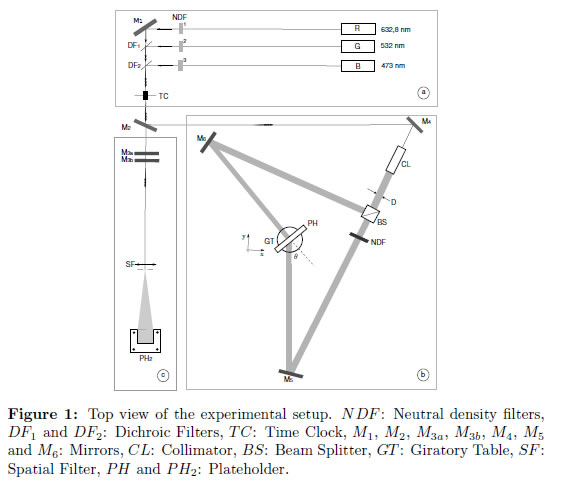
The experimental setup depicted in Figure 1 was used for recording reflection diffraction gratings and single beam reflection holograms.
A coherent RGB illumination source composed by three lasers: 632.8 nm (He-Ne), 532 nm (DPSS) and 473 nm (DPSS) were used. Their intensities were individually controlled by adding variable neutral density filters (NDF) in the output of each laser. The mixture of RGB channels was performed by using M1 mirror and two dichroic filters (DF1 and DF2); this provided a coherent "white" light beam to the output with R, G and B components.
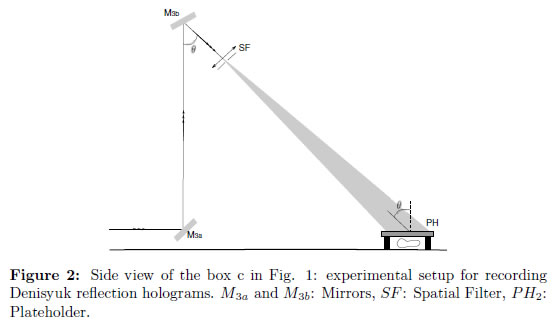
To record reflection diffraction gratings the setup in Figure 1b allows for obtaining the interference of two collimated wavefronts. Single beam configuration shown in the Figure 1c is enabled by removing M2 mirror, this mirror redirects the beam to the M3a mirror and then it is redirected again to the holographic plate across a spatial filter SF as shown in Figure 2.
]]>
3 Results and discussion
Independent and multiplexed recordings where obtained by using Slavich emulsions. These emulsions are softer compared with other silver halide materials. In these films, distortions caused by the action of the solutions used in the developing process are of concern, due to the latter property. Main distortions are related with emulsion shrinkage or tanning. In order to obtain clean holograms with high diffraction efficiency and without these effects, the CW-C2 based on ascorbic acid and catechol was used [9]. The presence of urea facilitates the infiltration of the developer, and even though this agent softens the emulsion, it is posible to compensate these distortions, by using a proper combination of hardening solution and rehalogenant bleach free of fixer. PFG-03C ultra-fine grain emulsions were used and developed by using the CW-C2 process proposed by Bjelkhagen [10].
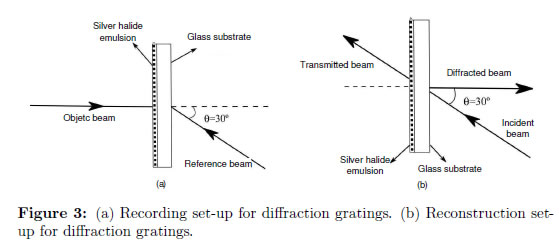
3.1 Independent recordings We recorded holographic volume gratings by using Figure 1b setup, three different wavelengths corresponding to the RGB channels with different exposures, and setting θ = 30°, to determine the emulsion performance under these conditions. Figure 3 shows a set-up with recording and reconstruction parameters for holographic reflection gratings recorded.
Spatial frecuencies for each wavelength were determined using Equation 1,

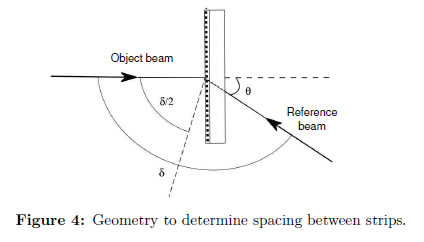
where ν, is the spatial frecuency, δ, is the direction of reference beam, λ, is the wavelength of incident beam and n, the refractive index of the emulsion. δ angle between object and reference beams is determined according to the Figure 4.
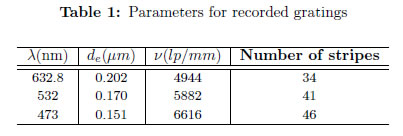
With θ = 30° is obtained  =75°. Table 1 shows spacing values between stripes de (inverse of spatial frecuencies), spatial frecuency ν in (lp/mm) and the possible number of stripes inside the emulsion for the holographic gratings recorded and assumming n=1.6, thickness 7μm, λR=632.8nm λG = 532 nm and λB = 473nm.
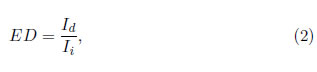
Diffraction efficiencies were calculated using Equation 2 by measuring the incident intensity Ii and diffracted intensity Id for each grating, they were illuminated with each unexpanded laser. For measuring, we used an optical power meter Newport 1830-C with an optical silicon detector with spectral range between 400nm and 1100nm and calibration module Newport 818-SL.
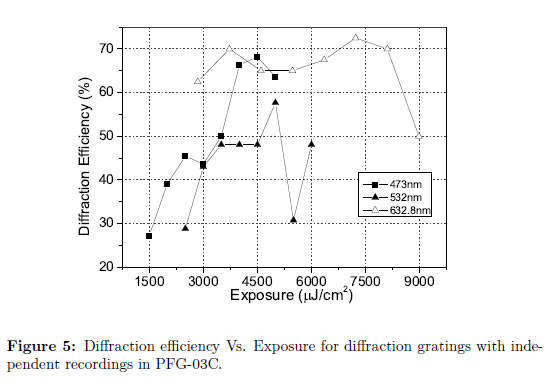
In Figure 5, diffraction efficiencies curves for different exposures are shown for each wavelength. The sampling was performed for different initial exposure values in each case, and considering the spectral sensitivity curve provided by manufacturer. These curves evidence decrements in the diffraction efficiency values as a result of the material overexposure.
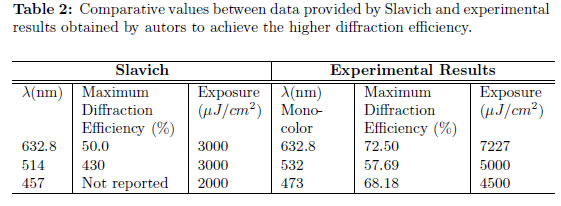
The maximum diffraction efficiency value of 72.5% was obtained for 632.8nm, and values close to 57.7% for 532nm were found. In both cases, those values are above the 50% and 45%, referenced by manufacturer respectively. The maximum diffraction efficiency obtained for 473nm reaches 68.2% compared with the 25% diffraction efficiency reported [9]. However, the manufacturer does not specify the experimental conditions different from the wavelengths used in multiplexed recordings; these wavelengths differ from those used in this work.
From the above results it is also found that higher diffraction efficiencies were achieved for exposure values larger than those suggested by manufacturer. Table 2 allows comparing the values provided by manufacturer's film specifications (columns 1 to 3) with values obtained experimentally (columns 4 to 6).
3.2 Multiplexed recordings
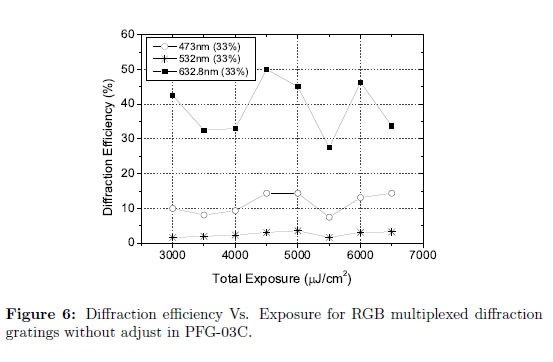
Diffraction gratings were recorded using multiplexed RGB channels with equal contribution for each wavelength. Exposures (Et) were made between 3000 μJ/cm2 and 6500 μJ/cm2 by considering the energy range to sensitize the emulsion.
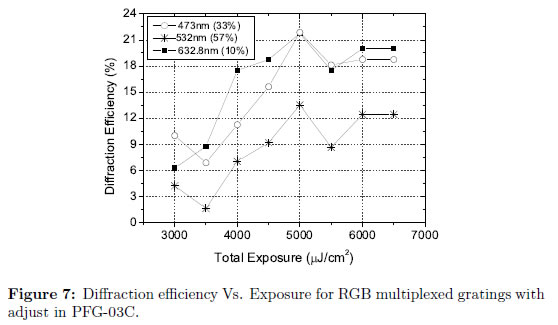
]]> Figure 6 depicts the measured diffraction efficiencies Vs. total exposure for each wavelength. As expected, a loss of diffraction efficiency at three wavelengths is observed in relation to the efficiencies reached for independent recordings due to multiplexing, this is especially noticeable for green contribution. This spectral composition was also used to record holograms of 3D objects, nevertheless, when the white objects are reconstructed, it is apparent that images exhibit different hues corresponding to red wavelengths, which is expected because of the RGB contributions were not adjusted in relation with the film sensitivity.In order to compensate the visual correspondence of color on the holographic images, an appropriate setting of exposure for each wavelength Eλ was made and diffraction gratings set with different total exposures Et were recorded. The closer percentage contributions experimentally found to the reproduction of white in recorded holograms of 3D objects correspond to: R: 10%, G: 57% and B: 33%. The diffraction efficiency was measured for each grating as described in Section. 3.1 and the distribution of measured data for each wavelength is shown in Figure 7.
When reducing the contribution of red, diffraction efficiencies increase for blue and green in relation to the results depicted in Figure 6, it means a higher balance in the spectral composition of the diffracted light. Total exposure which maximizes diffraction efficiency for the three wavelengths with this spectral composition is 5000 μJ/cm2, which corresponds to exposures for RGB of 500 μJ/cm2, 2850 μJ/cm2 and 1650 μJ/cm2, respectively.
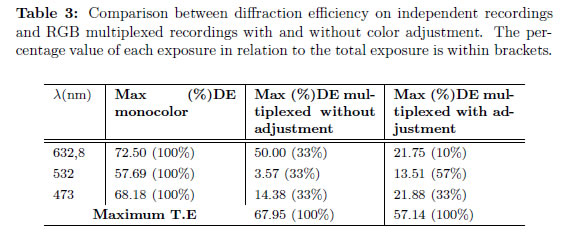
Table 3 shows the maximum diffraction efficiency achieved for each wavelength in RGB multiplexed gratings, with and without setting intensities during recording. Also included in Table 3 are the experimental values reported in Table 2 corresponding to independent recordings, in order to compare maximum efficiencies of monocolor with multiplexed gratings.
The sum of diffraction efficiencies for each channel in the same hologram is called total diffraction efficiency (T.E). Table 3 shows the diffraction efficiency per wavelength, and total diffraction efficiency for each recording type. It is observed that diffraction efficiencies for each wavelength on independent recordings are higher than the obtained on multiplexed recordings and these also significantly vary according to the RGB percentage contributions. It shows the committed relation between diffraction efficiency and color balance in recording of full color holograms, therefore, adjusting color in a hologram involves a cost in its total diffraction efficiency.
3.3 Hologram recording of 3D objects
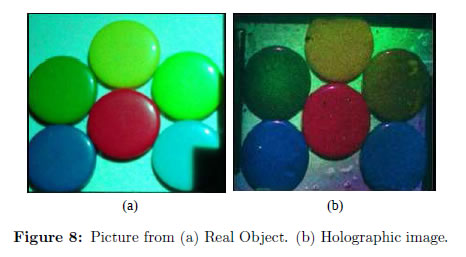
Holograms obtained by using the results for diffraction gratings, show a better color correspondence under direct observation by the eye. They were obtained with a total exposure proportion of: R: 10%, G: 57%, B: 33%, recorded on a glass plate of 2.5 in x 2.5 in and developed with CW-C2 process. Figure 8 compares a picture of a real object (Figure 8a) with a picture of the respective color holographic image (Figure 8b), both were simultaneously illuminated with RGB coherent light with the same spectral composition (R: 10%, G: 57% y B: 33%). It shows high diffraction efficiency and color correspondence on the holographic image in relation to the real object. These results validate the diffraction efficiency measurements and the adjustment of percentage contributions for each wavelength realized.
]]>
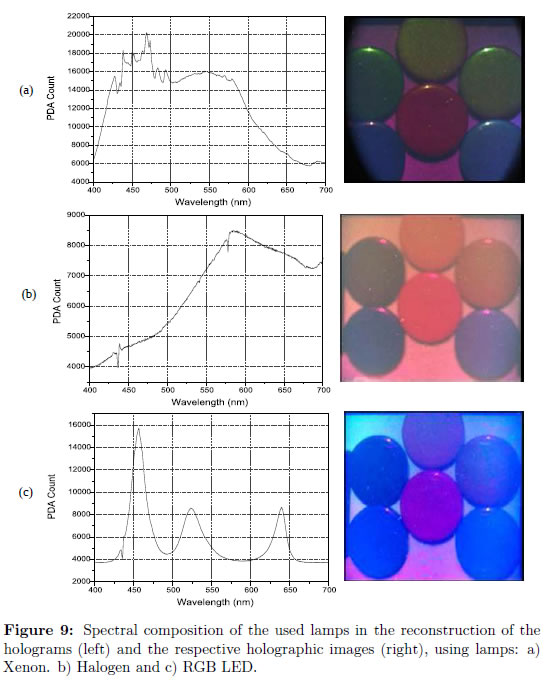
We used 3 sources of white light to reconstruct the holographic images, an Oriel Xenon lamp of 150 W, a halogen commercial lamp of 50 W with higher spectral component to red and a LED Universal lamp composed by 3 RGB leds. The corresponding spectrums for each lamp and a picture of the holographic image reconstructed with each source are depicted in Figure 9a, Figure 9b and Figure 9c, respectively. The spectrum presented for RGB LED lamp corresponds to the white light composition provided by manufacturer.
The predominant wavelengths in the reconstructed holographic images correspond to the predominant region of the spectrum in the spectrum of the illuminant. When the hologram is reconstructed employing a source with a relative uniform spectrum (Xenon lamp, Figure 9a), it is observed a color correspondence according to the real object under natural conditions.
Aside from the performed color setting for each channel in the recording process, the final composition of color in the holographic image is strongly determined by the light source used in the reconstruction.
4 Conclusions
Values of real exposures were determined to optimize the diffraction efficiency in Slavich PFG-03C film with CW-C2 development process. We experimentally determined for RGB multiplexed recording gratings, the exposure percentages to obtain higher diffraction efficiencies with color correspondence between real and holographic object, as a fundamental step to obtain color holographic recordings with high quality.
High-quality holographic images of 3D objects were obtained with color correspondence by setting contributions for each color channel according to the measurements on diffraction gratings. This method allows controlling the settings of color components in the recording process, aside from the color mixture observed on the object.
The high-resolution power of silver halide materials particulary PFG-03C allows to create unique 3D pieces with color characteristics in a single exposure. Nevertheless in full color holography a committed relation between total diffraction efficiency and color correspondence related to multiplexing is of concern. Also, the quality of color holograms are determined by the spectral composition of light sources used for reconstruction.
]]>Acknowledgements
We would like to acknowledge for economical support to the Research Direction from Universidad EAFIT (Colombia). Project Code 261-00004. Our gratitude and special thanks to PhD. Daniel Sierra, PhD. René Restrepo and PhD. Luciano A. Toro, for their kind and helpful suggestions.
Reference
[1] H. Bjelkhagen and D. Brotherton, Ultra-Realistic Imaging: Advanced Techniques in Analogue and Digital Colour Holography. CRC Press, 2013. [ Links ]
[2] L. H. Lin, K. S. Pennington, G. W. Stroke, and A. E. Labeyrie, "Multicolor holographic image reconstruction with white-light illumination," Bell System Technical Journal, vol. 45, no. 4, pp. 659-661, 1966. [Online]. Available: http://dx.doi.org/10.1002/j.1538-7305.1966.tb01050.x [ Links ]
[3] G. Lippmann, "La photographie des couleurs," Comptes Rendus Hebdomadaires des Séances de l'Académie des Sciences, vol. 112, pp. 274-275, 1891. [ Links ]
[4] G. K. Ackermann and J. Eichler, Holography: A practical Approach. Wiley-VCH Verlag GmbH & Co. KGaA.Germany, 2007. [ Links ]
[5] T. Kubota, "Recording of high quality color holograms," Appl. Opt., vol. 25, no. 22, pp. 4141-41 451, 1986. [ Links ]
[6] H. I. Bjelkhagen and E. Mirlis, "Color holography to produce highly realistic three-dimensional images," Applied optics, vol. 47, no. 4, pp. A123-A133, 2008. [Online]. Available: http://dx.doi.org/10.1364/AO.47.00A123 [ Links ]
[7] T. Petrova, B. Ivanov, K. Zdravkov, D. Nazarova, E. Estoykova, and G. Minchev, "Basic holographic characterisitics of a panchromatic light sensitive material for reflective autostereoscopic 3D display," EURASIP Journal on Advances in Signal Processing, vol. 2009, 2009. [ Links ]
[8] H. I. Bjelkhagen, "Color holography: its history, state-of-the-art, and future," vol. 6252, 2006, pp. 62 521U-62 521U-11. [Online]. Available: http://dx.doi.org/10.1117/12.677173 [ Links ]
[9] H. Bjelkhagen, Silver-Halide recording materials: For Holography and their processing. Springer, 1995. [ Links ]
[10] H. I. Bjelkhagen, Q. Huang, and T. H. Jeong, "Progress in color reflection holography," vol. 3358, 1998, pp. 104-113. [Online]. Available: http://dx.doi.org/10.1117/12.301459. [ Links ]
]]>