<?xml version="1.0" encoding="ISO-8859-1"?><article xmlns:mml="http://www.w3.org/1998/Math/MathML" xmlns:xlink="http://www.w3.org/1999/xlink" xmlns:xsi="http://www.w3.org/2001/XMLSchema-instance">
<front>
<journal-meta>
<journal-id>1794-9165</journal-id>
<journal-title><![CDATA[Ingeniería y Ciencia]]></journal-title>
<abbrev-journal-title><![CDATA[ing.cienc.]]></abbrev-journal-title>
<issn>1794-9165</issn>
<publisher>
<publisher-name><![CDATA[Escuela de Ciencias y Humanidades y Escuela de Ingeniería de la Universidad EAFIT]]></publisher-name>
</publisher>
</journal-meta>
<article-meta>
<article-id>S1794-91652015000200008</article-id>
<article-id pub-id-type="doi">10.17230/ingciencia.11.22.8</article-id>
<title-group>
<article-title xml:lang="en"><![CDATA[Effect of the Recycled Rubber on the Properties of Recycled Rubber/Recycled Polypropylene Blends]]></article-title>
<article-title xml:lang="es"><![CDATA[Efecto de caucho reciclado en las propiedades de mezclas de caucho reciclado y polipropileno reciclado]]></article-title>
</title-group>
<contrib-group>
<contrib contrib-type="author">
<name>
<surname><![CDATA[Ciro]]></surname>
<given-names><![CDATA[Erwin]]></given-names>
</name>
<xref ref-type="aff" rid="A01"/>
</contrib>
<contrib contrib-type="author">
<name>
<surname><![CDATA[Parra]]></surname>
<given-names><![CDATA[Jorge]]></given-names>
</name>
<xref ref-type="aff" rid="A02"/>
</contrib>
<contrib contrib-type="author">
<name>
<surname><![CDATA[Zapata]]></surname>
<given-names><![CDATA[Manuel]]></given-names>
</name>
<xref ref-type="aff" rid="A03"/>
</contrib>
<contrib contrib-type="author">
<name>
<surname><![CDATA[Murillo]]></surname>
<given-names><![CDATA[Edwin A]]></given-names>
</name>
<xref ref-type="aff" rid="A04"/>
</contrib>
</contrib-group>
<aff id="A01">
<institution><![CDATA[,Universidad de Antioquia  ]]></institution>
<addr-line><![CDATA[Medellín ]]></addr-line>
<country>Colombia</country>
</aff>
<aff id="A02">
<institution><![CDATA[,Universidad de Antioquia  ]]></institution>
<addr-line><![CDATA[Medellín ]]></addr-line>
<country>Colombia</country>
</aff>
<aff id="A03">
<institution><![CDATA[,Universidad de Antioquia  ]]></institution>
<addr-line><![CDATA[Medellín ]]></addr-line>
<country>Colombia</country>
</aff>
<aff id="A04">
<institution><![CDATA[,Universidad Francisco de Paula Santander  ]]></institution>
<addr-line><![CDATA[San José de Cúcuta ]]></addr-line>
<country>Colombia</country>
</aff>
<pub-date pub-type="pub">
<day>00</day>
<month>07</month>
<year>2015</year>
</pub-date>
<pub-date pub-type="epub">
<day>00</day>
<month>07</month>
<year>2015</year>
</pub-date>
<volume>11</volume>
<numero>22</numero>
<fpage>173</fpage>
<lpage>188</lpage>
<copyright-statement/>
<copyright-year/>
<self-uri xlink:href="http://www.scielo.org.co/scielo.php?script=sci_arttext&amp;pid=S1794-91652015000200008&amp;lng=en&amp;nrm=iso"></self-uri><self-uri xlink:href="http://www.scielo.org.co/scielo.php?script=sci_abstract&amp;pid=S1794-91652015000200008&amp;lng=en&amp;nrm=iso"></self-uri><self-uri xlink:href="http://www.scielo.org.co/scielo.php?script=sci_pdf&amp;pid=S1794-91652015000200008&amp;lng=en&amp;nrm=iso"></self-uri><abstract abstract-type="short" xml:lang="en"><p><![CDATA[This study evaluates the influence of recycled rubber (RR) with a specific particle size in the properties of blends, blended recycled polypropylene/polyethylene (RPP) and RR (RPP/RR). The proportions of RPP/RR employed to obtain the blends were as follows: 90/10 (PP90), 75/25 (PP75), 60/40 (PP60) and 45/55 (PP45). The particle size of the RR employed was 850 &#956;m . The properties of the blends were evaluated by rheometric, thermogravimetric (TGA), differential scanning calorimetric (DSC), scanning electronic microscopy (SEM), density, melt flow index and tensile analysis. The maximum torque increased with the RPP content. By DSC analysis, it was observed that the RPP exhibited two melting temperatures, the first corresponded to low density polyethylene (LDPE) and the second to polypropylene (PP). Furthermore, the RR affected the crystallinity of the RPP. By using SEM and TGA analyses, it was determined that the RPP as well as RR contained fillers. The blend densities were higher than those of RPP. The melt flow index exhibited a trend with the amount of RR]]></p></abstract>
<abstract abstract-type="short" xml:lang="es"><p><![CDATA[Este estudio evalúa la influencia de caucho reciclado (RR) con un tamaño de partícula específico en las propiedades de mezclas, mezclas de polipropileno reciclado/polietileno (RPP) y RR (RPP/RR). Las proporciones de RPP/RR para obtener los compósitos fueron como sigue: 90/10 (PP90), 75/25 (PP75), 60/40 (PP60) and 45/55 (PP45). El tamaño de partícula empleado del RR fue 850 &#956;m. Las propiedades de las mezclas, fueron evaluadas por análisis reométrico, termogravimétrico (TGA), calorimetría diferencial de barrido (DSC), microscopia de barrido electrónica (SEM), densidad, índice de fluidez y ténsil. El torque máximo incrementó con el contenido de RPP. Por análisis DSC se observó que el RPP exhibió dos temperaturas de fusión, la primera correspondió al polietileno de baja densidad (LDPE) y la segunda al polipropileno (PP). Además, el RR afectó la cristalinidad del RPP. Por análisis de SEM y TGA, se determinó que el RR y el RPP contenían rellenos. Las densidades de las mezclas fueron más altas que la del RPP. El índice de fluidez exhibió una tendencia con la cantidad de RR]]></p></abstract>
<kwd-group>
<kwd lng="en"><![CDATA[recycled polypropylene]]></kwd>
<kwd lng="en"><![CDATA[recycled rubber]]></kwd>
<kwd lng="en"><![CDATA[blends]]></kwd>
<kwd lng="en"><![CDATA[properties]]></kwd>
<kwd lng="es"><![CDATA[polipropileno reciclado]]></kwd>
<kwd lng="es"><![CDATA[caucho reciclado]]></kwd>
<kwd lng="es"><![CDATA[compósitos]]></kwd>
<kwd lng="es"><![CDATA[propiedades]]></kwd>
</kwd-group>
</article-meta>
</front><body><![CDATA[  <font size="2" face="Verdana, Arial, Helvetica, sans-serif">   </font>    <p align="right"><font size="2" face="Verdana, Arial, Helvetica, sans-serif"><b>ART&Iacute;CULO ORIGINAL</b></font></p>     <p align="right">&nbsp; </p> <font size="2" face="Verdana, Arial, Helvetica, sans-serif">    <p align="right">DOI: <a href="http://dx.doi.org/10.17230/ingciencia.11.22.8" target="_blank">10.17230/ingciencia.11.22.8</a> </p>     <p align="center">&nbsp;</p>     <p align="center"><b><font size="4">Effect of the Recycled Rubber on the Properties of Recycled Rubber/Recycled Polypropylene Blends </font></b></p>     <p align="center">&nbsp;</p>     <p align="center"><font size="3"><b>Efecto de caucho reciclado en las propiedades de mezclas de caucho reciclado y polipropileno reciclado</b></font></p>     <p align="center">&nbsp;</p>     <p align="left">&nbsp;</p>     ]]></body>
<body><![CDATA[<p align="left"><b>Erwin Ciro<sup>1</sup>,   Jorge   Parra<sup>2</sup>   , Manuel   Zapata<sup>3</sup>and   Edwin A.   Murillo<sup>4</sup></b></p>     <p align="left">1 Universidad de Antioquia, Medell&iacute;n, Colombia, <a href="mailto:erwinciro@gmail.com">erwinciro@gmail.com</a></p>     <p align="left">2 Universidad de Antioquia, Medell&iacute;n, Colombia, <a href="mailto:esneider.parra@udea.edu.co">esneider.parra@udea.edu.co</a></p>     <p align="left">3 Universidad de Antioquia, Medell&iacute;n, Colombia, <a href="mailto:ignacio.zapata@udea.edu.co">ignacio.zapata@udea.edu.co</a></p>     <p align="left">4 Universidad Francisco de Paula Santander, San Jos&eacute; de C&uacute;cuta, Colombia, <a href="mailto:edwinalbertomr@ufps.edu.co">edwinalbertomr@ufps.edu.co</a> </p>     <p>&nbsp;</p>     <p>Received: 14-12-2014  Accepted: 19-06-2015  Online: 31-07-2015</p>     <p>PACS: 61.25.hk, 83.80.Va, 81.05.Lg</p>     <p>&nbsp;</p> <hr size="1">     <p><b>Abstract</b></p>     ]]></body>
<body><![CDATA[<p>This study evaluates the influence of recycled rubber (RR) with a   specific particle size in the properties of blends, blended recycled   polypropylene/polyethylene (RPP) and RR (RPP/RR). The proportions of   RPP/RR employed to obtain the blends were as follows: 90/10   (PP90), 75/25 (PP75), 60/40 (PP60) and 45/55 (PP45).   The particle size of the RR employed was 850 &#956;m . The   properties of the blends were evaluated by rheometric,   thermogravimetric (TGA), differential scanning calorimetric (DSC),   scanning electronic microscopy (SEM), density, melt flow index and   tensile analysis. The maximum torque increased with the RPP content.   By DSC analysis, it was observed that the RPP exhibited two melting   temperatures, the first corresponded to low density polyethylene   (LDPE) and the second to polypropylene (PP). Furthermore, the RR   affected the crystallinity of the RPP. By using SEM and TGA   analyses, it was determined that the RPP as well as RR contained   fillers. The blend densities were higher than those of RPP. The melt   flow index exhibited a trend with the amount of RR.  </p>     <p><b>Key words: </b>recycled polypropylene; recycled rubber; blends; properties </p> <hr size="1">     <p><b>Resumen</b></p>     <p>Este estudio eval&uacute;a la influencia de caucho reciclado (RR) con un   tama&ntilde;o de part&iacute;cula espec&iacute;fico en las propiedades de mezclas,   mezclas de polipropileno reciclado/polietileno (RPP) y RR (RPP/RR).   Las proporciones de RPP/RR para obtener los comp&oacute;sitos fueron como   sigue: 90/10 (PP90), 75/25 (PP75), 60/40 (PP60) and   45/55 (PP45). El tama&ntilde;o de part&iacute;cula empleado del RR fue 850   &#956;m. Las propiedades de las mezclas, fueron evaluadas por   an&aacute;lisis reom&eacute;trico, termogravim&eacute;trico (TGA), calorimetr&iacute;a   diferencial de barrido (DSC), microscopia de barrido electr&oacute;nica   (SEM), densidad,  &iacute;ndice de fluidez y t&eacute;nsil. El torque m&aacute;ximo   increment&oacute; con el contenido de RPP. Por an&aacute;lisis DSC se observ&oacute; que   el RPP exhibi&oacute; dos temperaturas de fusi&oacute;n, la primera correspondi&oacute;   al polietileno de baja densidad (LDPE) y la segunda al polipropileno   (PP).  Adem&aacute;s, el RR afect&oacute; la cristalinidad del RPP. Por an&aacute;lisis   de SEM y TGA, se determin&oacute; que el RR y el RPP conten&iacute;an rellenos.   Las densidades de las mezclas fueron m&aacute;s altas que la del RPP. El   &iacute;ndice de fluidez exhibi&oacute; una tendencia con la cantidad de RR.</p>     <p><b>Palabras clave:</b>polipropileno reciclado; caucho reciclado; comp&oacute;sitos; propiedades </p> <hr size="1">     <p>&nbsp;</p>     <p>&nbsp;</p>     <p><b><font size="3">1&nbsp;&nbsp;Introduction</font></b></p>     <p>   Now-a-days, the application of polymers  increased so much. These   materials are used, for example, in automobile &#91;1&#93;, packaging   &#91;2&#93;, and resin &#91;3&#93; industries. These materials can be   easily accumulated and remained in the environment for a long time,   which is hazardous to the environment &#91;2&#93;. The recycling of   polymers is a good way to resolve these problems, because they can   be employed in the fabrication of some materials for automobiles,   toys, packaging etc. PP is a thermoplastic material, that present   good thermal and mechanical properties, excellent processability as   well as good chemical resistance. PP has a low impact resistance   &#91;4&#93;, but that of the rubber is high and the rubber has low   mechanical properties with respect to PP &#91;4&#93;,&#91;5&#93;.   Recycling of waste ground tire rubber requires the rubber to be   ground, this may be complicated, because the rubber is a thermoset   material. Grinding it will require special techniques &#91;6&#93;. More   attention has been focused on compounding finely ground tire rubber   with thermoplastics, which can be subsequently re-melted and formed   into a wide range of molded and extruded products &#91;6&#93;.   Thermoplastic elastomeric materials (TPE) can be obtained from a   mixture of PP and rubber. These materials have the physical   combinations of thermoplastic and elastomeric materials &#91;5&#93;.   Furthermore, they can be processed like thermoplastic materials,   since these materials exhibit elastomeric characteristic   &#91;7&#93;,&#91;8&#93;.  RPP/RR blends can yield very important results   for the polymer industry, since this contributes to resolving   the problem of accumulation of these polymers. The function of the   rubber in these blends is that it acts as a stress concentrator and   relieves the volume strain by cavitation &#91;4&#93;. Properties of   thermoplastic elastomers based on PP/natural rubber (NR) and PP/RR   blends were studied &#91;7&#93;,&#91;8&#93;. The torque stabilization and   elongation at break increased with content of rubber, but the   elastic modulus and tensile strength decreased &#91;7&#93;,&#91;8&#93;.   The effect of the ethylene-propylene-diene-monomer (EPDM) content on   the deformation and impact behavior of PP-EPDM blends were studied.   The rubber content employed was between 0 and 40 wt%. The Young's   modulus and the yield stress decreased linearly with the increasing   of the rubber content &#91;9&#93;. Every year, numerous papers are   published on the recycling of rubber, where the waste rubber is used   as a filler or it is blended with virgin rubber, but there are few   publications discussing the influence of RR with a specific particle   size in the properties of recycled blends. The particle size of the   rubber is a factor very important in the preparation blends of   rubber, because this affects the mechanical and viscoelastic   properties, and the crystallinity of the materials. The properties   of the materials obtained with different rubber particle size are   not the same. Therefore the main objective of this work is to   determine the influence of RR with a specific particle size on the   thermal, morphological and mechanical properties of the RPP/RR   blends. Furthermore to study possible synergisms between these two types of wastes (RR and RPP).</p>     <p>&nbsp;</p>     ]]></body>
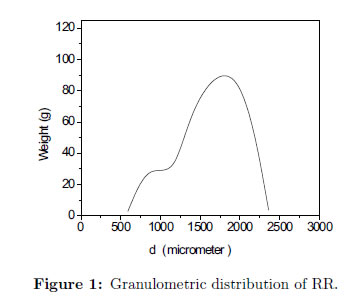
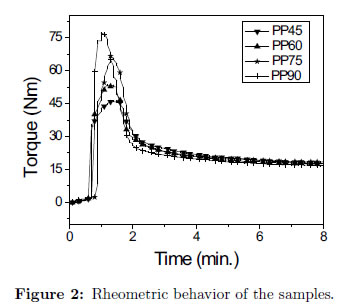
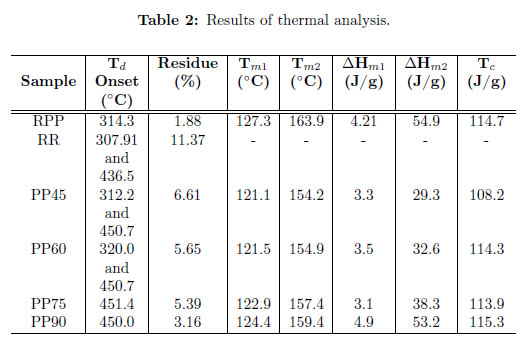
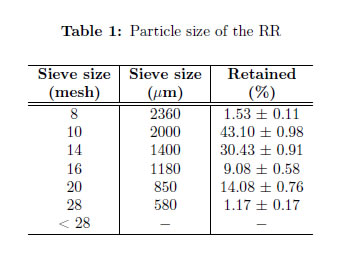
<body><![CDATA[<p><b><font size="3"> 2&nbsp;&nbsp;Experimental part</font></b></p>     <p>   The materials employed in this study were RPP and RR. The RPP whose   reference is policolor was collected from SCRecycling company, in   Medell&iacute;n, Colombia, this RPP contains small amount of LDPE (it   has not been quantified). The RR employed was obtained from tires;   this sample was provided in granules form by Resol company in   Medell&iacute;n, Colombia. This material is a mixture of natural rubber   (NR), styrene-butadiene rubber (SBR) and additives. In the   preparation of the blends previously the rubber was passed by   different sieves (600, 355, 300, 250, 180, 150, 106,   98, 75, 53 and 45 micrometers) and rubber with particle size   of 850 &#956;m was used for the preparation of the blends. All   RPP/RR blends were prepared in a torque rheometer Thermo Scientific.   From it the respective amount of RPP and RR were taken together to   the reactor, the system was kept at 200 &deg;C, mix during 8 minutes   using at rotation speed of 60 rpm. In all cases were prepared   200 g of the blends. The composition of the sample blends was the   following: PP45 (RPP 45 wt% and RR 55 wt%), PP60  (RPP   60 wt% and RR 40 wt%), PP75 (RPP 75 wt% and RR 25   wt%),  and PP90 (RPP 90 wt% and RR 10 wt%). To the   characterization of RPP, RR and RPP/RR blends, the study of the   thermal stability of the blends was done in an equipment of TA   Instruments model Q500. Approximately 22 mg of the sample was used   in all cases. This analysis was performed by using nitrogen   atmosphere at a heating rate of 10 &deg;C/min until 600 &deg;C. Then the   atmosphere was changed into air, but keeping the heating rate until   800 &deg;C.  Differential scanning calorimetric analysis was done in a   TA Instrument model Q100. 11 mg of sample and a heating and   cooling rate of 30 &deg;C/min, under nitrogen atmosphere, was used.   Scanning electron microscopy analysis was done in a Joel   JSM-6490LV employing between 10 and 20 kW. For it, the samples   were previously cryo-fractured. Density analysis was made under   standard ASTM D 792. Melt flow rate analysis was performed by   using a CEAST equipment according to ASTM D 1238 at 230 &deg;C and   using a charge of 2,16 Kg. Five repetitions were obtained for   every sample. Tensile tests were conducted under standard ASTM D   638 employing type IV specimen at a rate of 5 mm/min until the   specimens failed. For density, melt flow and tensile test, the analysis was done up to five repetitions.</p>     <p>&nbsp;</p>     <p><b><font size="3"> 3&nbsp;&nbsp;Results and discussion</font></b></p>     <p> The granulometric analysis is presented in <a href="#t1">Table 1</a>. The ground tire rubber has a particle size average between 8 and 28 mesh (2360 and 580 &#956;m). Despite that the RR exhibited particle size lower than 850 &#956;m (580 &#956;m), in this study the particle size (850 &#956;m) was chosen,  due to its  presence in the ground tire rubber in a higher amount than that whose particle size is 580 &#956;m. The granulometric analysis of the RR showed a bimodal distribution (<a href="#f1">Figure 1</a>), which is wide; it indicates that RR contains high heterogeneity on particle size.</p>     <p align="center"><a name="t1"></a><img src="/img/revistas/ince/v11n22/v11n22a8t1.jpg"></p>     <p align="center"><a name="f1"></a><img src="/img/revistas/ince/v11n22/v11n22a8f1.jpg"></p>     <p><a href="#f2">Figure 2</a>, presents the rheometric behavior of the   samples.The torque of the blends increased to  maximum value, and   then decreased, finally became stable for all samples at a time around 7 minutes.</p>     <p align="center"><a name="f2"></a><img src="/img/revistas/ince/v11n22/v11n22a8f2.jpg"></p>     <p>   The maximum torque value is increased with the RPP content. When the   amount of RPP is high, more time is required to melt all the RPP,   so, the viscosity of the system is elevated, but when this amount is   low, the melting time has also become low. The final torque   increased slightly with the RR amount, this behavior is attributed   to the augmented viscosity of the system, since this material is   elastomeric and therefore, it is not melted during the processing of   the blends.</p>     ]]></body>
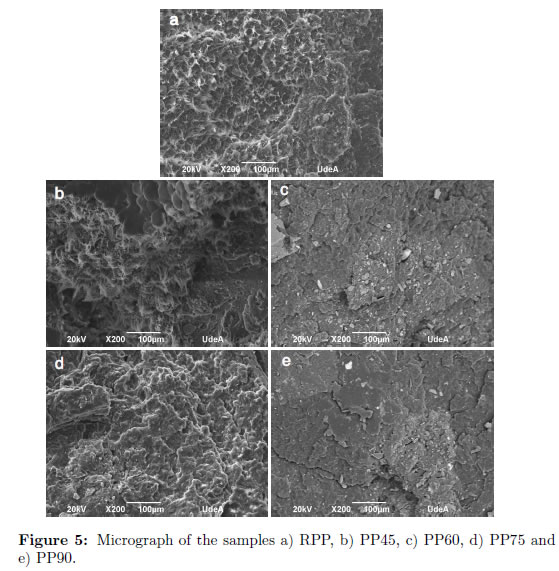
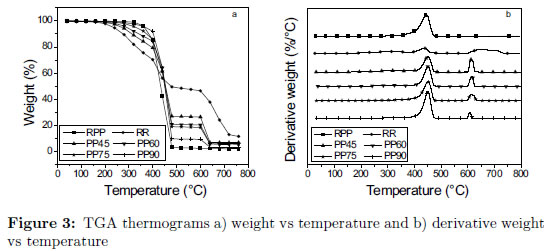
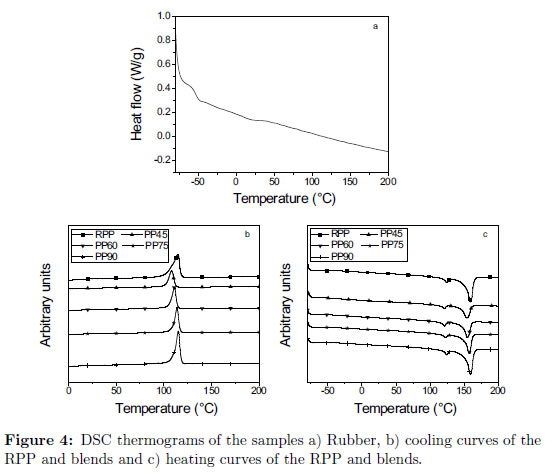
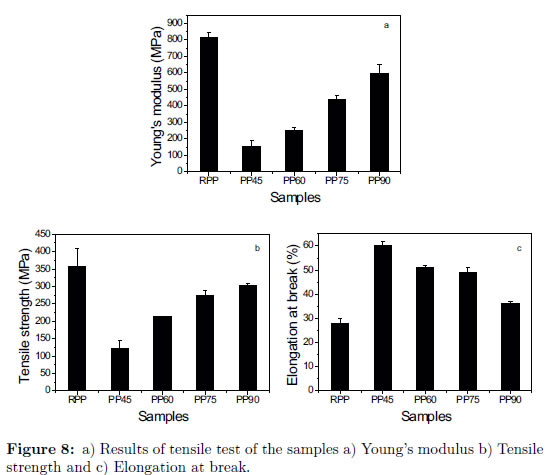
<body><![CDATA[<p>   <a href="#f3">Figure 3</a> shows the TGA thermograms of the samples. The   <a href="#f3">Figure 3a</a> presents the curve of weight vs temperature and   <a href="#f3">Figure 3b</a> shows the curve of derivate weight vs   temperature. The residue (<a href="#f3">Figure 3a</a>) of the RR was 11,37   wt%, in the case of the RPP this was 1,88 wt%. These residues   are due to the presence of inorganic additives in these materials.   All blends was presented a residue and this increased with the   rubber content. Only PP75 and PP90 exhibited a decomposition   temperature (T<sub>d</sub>), this temperature appears at a value   lower than 600 &deg;C (<a href="#t2">Table 2</a>). In the Figure 3b,   it can be observed that the samples PP45, PP60 and RR exhibited   a weight loss around 310 &deg;C, which was due to the possibility to   present a small amount of compounds with low molecular weight (some   additives). The reason for this weight loss in the samples PP90   and PP75 is possibly due to a low amount of this additive in these   blends.</p>     <p align="center"><a name="f3"></a><img src="/img/revistas/ince/v11n22/v11n22a8f3.jpg"></p>     <p align="center"><a name="t2"></a><img src="/img/revistas/ince/v11n22/v11n22a8t2.jpg"></p>     <p>   The thermal stability of the blends was higher than those of the RPP   and RR (<a href="#f3">Figure 3b</a>). The low thermal stability of RR,   possibly was due to the presence of additives, which activate the   degradation process &#91;10&#93;. The TGA curves showed that after   pyrolysis (around 600 &deg;C), the blends and RR formed a char residue   and this increased with the RR content. It was expected since RR contained a higher fillers amount than RPP.</p>     <p align="center"><a name="f4"></a><img src="/img/revistas/ince/v11n22/v11n22a8f4.jpg"></p>     <p>   <a href="#f4">Figure 4</a> presents DSC thermograms of the samples. The RR   presented a glass transition temperature (T<sub>g</sub>) at &#8722;53.3   &deg;C (Figure 4), this value is close to cured NR/SBR blends   whose values of Tg were around &#8722;59 &deg;C (214 K) &#91;11&#93;. <a href="#f4">Figure     4b</a> presents the cooling curves and <a href="#f4">figure  4c</a> shows heating   curves. The RPP exhibited two melting temperatures (T<sub>m</sub>),   the first (T<sub>m1</sub>) corresponds to LDPE (Table 2)   and the second (T<sub>m2</sub>) to PP (163,9 &deg;C). All  blends   presented a T<sub>m1</sub> lower than LDPE (present in RPP) (Table   2). The same behavior was observed in the case of the PP   present in the RPP. T<sub>m1</sub> and T<sub>m2</sub> values   decreased with the content of RR in the blend (Table 2).   The first melting enthalpy (&#8710;H<sub>m1</sub>) of the blends,   is due to LDPE present in RPP. Only  PP90 blend presented a   melting enthalpy (&#8710;H<sub>m</sub>) greater than that of LDPE   contained in the RPP (<a href="#t2">Table 2</a>). The heat of fusion values   depends on the crystallinity of the material. This is an indication   that this blend presents higher crystallinity. Therefore, only in   this blend, the rubber acted as nucleating agent to LDPE, which was   due to low amount of rubber in this sample. The results of   &#8710;H<sub>m1</sub> to the PP75, PP60 and PP45 blends are similar.</p>     <p>   The second melting enthalpy (&#8710;H<sub>m2</sub>) is related to   the PP crystallization process. &#8710;H<sub>m2</sub> exhibited   for the PP90 blend  (Table 2), is similar to the value   presented by RPP. This means that the PP has a similar crystalinity   than the PP90 blend. &#8710;H<sub>m2</sub> decreased with the   proportion of RR employed in the blend preparation, which mean that   in this same sense decreased the crystalinity of the PP present in   the blends. The difference in enthalpy behavior exhibited for these   blends is related to the proportions of the LDPE and PP, since the   proportion of PP is higher than that of LDPE. It can be seen that   &#8710;H<sub>m2</sub> is greater than &#8710;H<sub>m1</sub> to   the RPP (<A href="#t2">Table 2</a>), which is due to higher amount of PP in   the blends.  The results of  &#8710;H<sub>m2</sub> correlates with the results obtained for T<sub>m2</sub>.</p>     <p> The crystallization temperature (T<sub>c</sub>) of the RPP is presented in <a href="#t2">Table 2</a>. The samples  PP60, PP75, PP90 and RPP presented a similar T<sub>c</sub> (<a href="#f4">Figure 4b</a>). The PP45 blend exhibited the lowest T<sub>c</sub> value. This indicated that this blend presented more difficulty to crystallize. The crystallization process of this sample is slower than others blends. This behavior is due to the high rubber proportion restrains the crystalline arrangement. The absence of T<sub>c</sub> of LDPE is attributed to two reasons the first is the close crystallization temperatures of the individual polymers and the second is that the polymer blends were cooled at a relatively high cooling rate of 30 &deg;C/min. The same behavior has been observed to PP/LDPE blends employing cooling rate of 10 &deg;C/min &#91;12&#93;.</p>     <p>   The introduction of rubber affected the crystalline structure of the LDPE and PP present in the RPP, since all blends reduced its T<sub>m</sub>. The reduction of crystallinity of the PP has been observed in a PP/epoxidized NR blend, it is proposed that the presence of rubber particles in the blend interrupts the formation of crystals &#91;13&#93;.</p>     <p>   <a href="#f5">Figure 5</a> shows the micrograph of the samples (cryogenic fracture). The RPP, exhibited a ductile fracture. This fracture type has been observed for other authors &#91;14&#93;.  Furthermore this sample presented granules, which are due to fillers (usually calcium carbonate). This sample did not exhibit cavities.</p>     ]]></body>
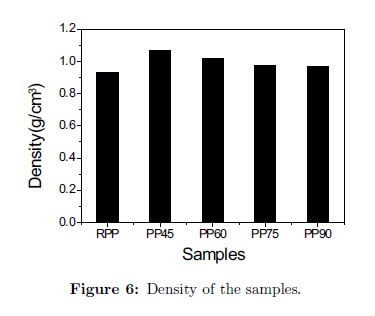
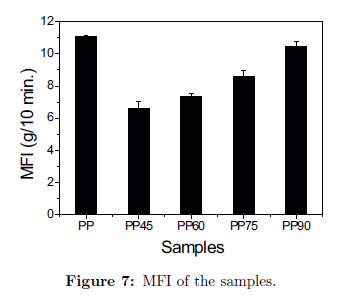
<body><![CDATA[<p align="center"><a name="f5"></a><img src="/img/revistas/ince/v11n22/v11n22a8f5.jpg"></p>     <p>   The blends did not show cavities due to the removal of rubber   particles and fillers during the tensile test, this mean that the   RPP and RR were dispersed as domains in a continuous PP phase. The   PP45 blend presented a surface that was less smooth with respect   to others blends, this is an indication that this sample require a   lower energy to cause catastrophic failure, which was due to high   amount of rubber employed in this sample. It can be corroborated   because this sample exhibited a phase separation, since regions with   RPP and others with RR appeared. The same results have been observed   for  waste tire rubber powder reinforced PP &#91;15&#93;.</p>     <p>   The density of the blends is greater than that of RPP (<a href="#f6">Figure     6</a>). This behavior is due to the RR particles has a density   higher than that of the RPP. Therefore a reduction in the RPP   content increases the density. This result correlates with the SEM   analysis, because presences of voids in these materials were not   observed and an increase in voids would cause a reduction in the   density &#91;14&#93;.</p>     <p align="center"><a name="f6"></a><img src="/img/revistas/ince/v11n22/v11n22a8f6.jpg"></p>     <p>   The melt flow index (MFI) of the blends was lower than that of RPP   (<a href="#f7">Figure 7</a>). This behavior was expected since RR is not   fluid. Therefore the MFI has to increase with the RPP amount. The   variation on MFI of the blends with respect to RPP was not greater   than 4 g/10 min. The MFI values obtained for RPP by some authors   &#91;16&#93; were higher (12.17 &#177; 0.08 and 14.07 &#177; 0.15   g/10 min.) than that obtained in this study. These mean that the   RPP employed in this study has suffered less degradation process that those employed by these authors &#91;16&#93;.</p>     <p align="center"><a name="f7"></a><img src="/img/revistas/ince/v11n22/v11n22a8f7.jpg"></p>     <p>   <a href="#f8">Figure 8</a>, presents the results of Young's modulus (<a href="#f8">Figure     8a</a>), tensile strength (<a href="#f8">Figure 8b</a>) and elongation   at break (figure 8c) of the samples. The Young's modulus   (<a href="#f8">Figure 8a</a>) and tensile strength (<a href="#f8">figure 8b</a>) of   the blends were lower than that of the RPP.  All  blends decreased   their Young's modulus and tensile strength values with the RR   content  (<a href="#f8">Figure 8</a>), this was expected since the amount of   RR confers more elastic and less rigidity to the blends, which allow   that these materials exhibit lower deformation resistance than RPP.   The properties obtained from these materials are comparable to the   results obtained by others authors to blends of NR and PP &#91;17&#93;.   The results of Young's modulus of the blends are comparable with the   obtained to PP-latex modified waste tyre dust blends, whose  Young's modulus values were between 160 and 700 MPa &#91;8&#93;.</p>     <p align="center"><a name="f8"></a><img src="/img/revistas/ince/v11n22/v11n22a8f8.jpg"></p>     <p>   The blends exhibited higher elongation at break values than RPP   (Figure 8c). These behaviors, were expected and they   are according with results obtained for Young's modulus, since with   the increasing of rubber in the blends, the elasticity also has to   increase. The elongation at break values obtained in this study are   higher than reported by other authors, who employed rubber with   particle size of 500 (17.9 %) and 1000 &#956;m (10 %) in   blends of rubber and PP &#91;14&#93;. The difference to the result   obtained in this study was due to the proportions of rubber and PP,   rubber particle size employed in this study and filler content   present in RPP and RR.</p>     <p align="center">&nbsp;</p>     ]]></body>
<body><![CDATA[<p><b><font size="3"> 4&nbsp;&nbsp;Conclusions</font></b></p>     <p>   In this study RPP/RR blends were obtained and the effect of RR with a specific particle size in the properties thermal, morphological and mechanical was evaluated. The results for the thermal properties, studied by TGA, indicated that the thermal stability of the blends decreased with the rubber content. DSC analysis showed evidence that the incorporation of rubber affects the crystalline structure of the LDPE and PP, since all blends reduced its melting temperature and enthalpy values with regards to individual components. SEM analysis indicated that employing a particle size of 850 &#956;m were not presented cavities due to the removal of rubber particles during the tensile test.</p>     <p>   HBP45 required a lower energy to cause catastrophic failure. All  blends decreased  their Young's modulus and tensile strength values with  the content of RR, but the elongation at break increased. The RPP and RR exhibited a synergy in the mechanical properties of the RPP/RR blends.</p>     <p>&nbsp;</p>     <p><b><font size="3">References</font></b></p>     <!-- ref --><p>&#91;1&#93;   E.&nbsp;A. Murillo and B.&nbsp;L. Lopez, "Study of the Impact Resistance of Physically   and Dynamically Vulcanized Mixtures of PP/EPDM," <i>Macromolecular     Symposia</i>, vol. 242, no.&nbsp;1, pp. 131-139, 2006.    &nbsp;&nbsp;&nbsp;&nbsp;&nbsp;&nbsp;&nbsp;&nbsp;[&#160;<a href="javascript:void(0);" onclick="javascript: window.open('/scielo.php?script=sci_nlinks&ref=000068&pid=S1794-9165201500020000800001&lng=','','width=640,height=500,resizable=yes,scrollbars=1,menubar=yes,');">Links</a>&#160;]<!-- end-ref --> &#91;Online&#93;. Available: <a href="http://dx.doi.org/10.1002/masy.200651020" target="_blank">http://dx.doi.org/10.1002/masy.200651020</a></p>     <!-- ref --><p>   &#91;2&#93;   M.&nbsp;Guzm&aacute;n and E.&nbsp;A. Murillo, "Funcionalizaci&oacute;n de polietileno de baja   densidad con anh&iacute;drido maleico en estado fundido,"   <i>Pol&iacute;meros</i>, vol.&nbsp;24, no.&nbsp;2, pp. 162-169, 2014.    &nbsp;&nbsp;&nbsp;&nbsp;&nbsp;&nbsp;&nbsp;&nbsp;[&#160;<a href="javascript:void(0);" onclick="javascript: window.open('/scielo.php?script=sci_nlinks&ref=000070&pid=S1794-9165201500020000800002&lng=','','width=640,height=500,resizable=yes,scrollbars=1,menubar=yes,');">Links</a>&#160;]<!-- end-ref --> &#91;Online&#93;. Available: <a href="http://dx.doi.org/10.4322/polimeros.2014.034" target="_blank">http://dx.doi.org/10.4322/polimeros.2014.034</a></p>     <!-- ref --><p>   &#91;3&#93;   E.&nbsp;A. Murillo, P.&nbsp;P. Vallejo, and B.&nbsp;L. L&oacute;pez, "Effect of tall oil fatty   acid content on the properties of novel hyperbranched alkyd resins,"   <i>Journal of Applied Polymer Science</i>, vol. 120, no.&nbsp;6, pp. 3151-3158, 2011.    &nbsp;&nbsp;&nbsp;&nbsp;&nbsp;&nbsp;&nbsp;&nbsp;[&#160;<a href="javascript:void(0);" onclick="javascript: window.open('/scielo.php?script=sci_nlinks&ref=000072&pid=S1794-9165201500020000800003&lng=','','width=640,height=500,resizable=yes,scrollbars=1,menubar=yes,');">Links</a>&#160;]<!-- end-ref --> &#91;Online&#93;. Available: <a href="http://dx.doi.org/10.1002/app.33502" target="_blank">http://dx.doi.org/10.1002/app.33502</a></p>     <!-- ref --><p>   &#91;4&#93;   A.&nbsp;der Waal, "Polypropylene-rubber blends: 1. The effect of the matrix   properties on the impact behavior," <i>Polymer</i>, vol.&nbsp;39, no.&nbsp;26, pp.   6781-6787, 1998.    &nbsp;&nbsp;&nbsp;&nbsp;&nbsp;&nbsp;&nbsp;&nbsp;[&#160;<a href="javascript:void(0);" onclick="javascript: window.open('/scielo.php?script=sci_nlinks&ref=000074&pid=S1794-9165201500020000800004&lng=','','width=640,height=500,resizable=yes,scrollbars=1,menubar=yes,');">Links</a>&#160;]<!-- end-ref --> &#91;Online&#93;. Available: <a href="http://dx.doi.org/10.1016/S0032-3861(98)00170-0" target="_blank">http://dx.doi.org/10.1016/S0032-3861(98)00170-0</a></p>     <!-- ref --><p>   &#91;5&#93;   S.&nbsp;Ling, "Prediction of mechanical properties of polypropylene/waste ground   rubber tire powder treated by bitumen blends via uniform design and   artificial neural networks," <i>Materials and Design</i>, vol.&nbsp;31, no.&nbsp;4,   pp. 1900-1905, 2010.    &nbsp;&nbsp;&nbsp;&nbsp;&nbsp;&nbsp;&nbsp;&nbsp;[&#160;<a href="javascript:void(0);" onclick="javascript: window.open('/scielo.php?script=sci_nlinks&ref=000076&pid=S1794-9165201500020000800005&lng=','','width=640,height=500,resizable=yes,scrollbars=1,menubar=yes,');">Links</a>&#160;]<!-- end-ref --> &#91;Online&#93;. Available: <a href="http://dx.doi.org/10.1016/j.matdes.2009.10.057" target="_blank">http://dx.doi.org/10.1016/j.matdes.2009.10.057</a></p>     <!-- ref --><p>   &#91;6&#93;   M.&nbsp;M. Hassan, N.&nbsp;A. Badway, A.&nbsp;M. Gamal, M.&nbsp;Y. Elnaggar, and E.&nbsp;A. Hegazy,   "Studies on mechanical, thermal and morphological properties of irradiated   recycled polyamide and waste rubber powder blends," <i>Nuclear     Instruments and Methods in Physics Research Section B: Beam Interactions with     Materials and Atoms</i>, vol. 268, no.&nbsp;9, pp. 1427-1434, 2010.    &nbsp;&nbsp;&nbsp;&nbsp;&nbsp;&nbsp;&nbsp;&nbsp;[&#160;<a href="javascript:void(0);" onclick="javascript: window.open('/scielo.php?script=sci_nlinks&ref=000078&pid=S1794-9165201500020000800006&lng=','','width=640,height=500,resizable=yes,scrollbars=1,menubar=yes,');">Links</a>&#160;]<!-- end-ref --> &#91;Online&#93;. Available: <a href="http://dx.doi.org/10.1016/j.nimb.2010.01.021" target="_blank">http://dx.doi.org/10.1016/j.nimb.2010.01.021</a></p>     <!-- ref --><p>   &#91;7&#93;   H.&nbsp;Ismail, D.&nbsp;Galpaya, and Z.&nbsp;Ahmad, "The compatibilizing effect of epoxy   resin (EP) on polypropylene (PP)/recycled acrylonitrile butadiene rubber   (NBRr) blends," <i>Polymer Testing</i>, vol.&nbsp;28, no.&nbsp;4, pp. 363-462, 2009.    &nbsp;&nbsp;&nbsp;&nbsp;&nbsp;&nbsp;&nbsp;&nbsp;[&#160;<a href="javascript:void(0);" onclick="javascript: window.open('/scielo.php?script=sci_nlinks&ref=000080&pid=S1794-9165201500020000800007&lng=','','width=640,height=500,resizable=yes,scrollbars=1,menubar=yes,');">Links</a>&#160;]<!-- end-ref -->   &#91;Online&#93;. Available: <a href="http://dx.doi.org/10.1016/j.polymertesting.2008.11.007" target="_blank">http://dx.doi.org/10.1016/j.polymertesting.2008.11.007</a></p>     <!-- ref --><p>   &#91;8&#93;   M.&nbsp;Awang, H.&nbsp;Ismail, and M.&nbsp;A. Hazizan, "Polypropylene-based blends   containing waste tire dust: Effects of trans-polyoctylene rubber (TOR) and   dynamic vulcanization," <i>Polymer Testing</i>, vol.&nbsp;26, no.&nbsp;6, pp.   779-787, 2007.    &nbsp;&nbsp;&nbsp;&nbsp;&nbsp;&nbsp;&nbsp;&nbsp;[&#160;<a href="javascript:void(0);" onclick="javascript: window.open('/scielo.php?script=sci_nlinks&ref=000082&pid=S1794-9165201500020000800008&lng=','','width=640,height=500,resizable=yes,scrollbars=1,menubar=yes,');">Links</a>&#160;]<!-- end-ref --> &#91;Online&#93;. Available: <a href="http://dx.doi.org/10.1016/j.polymertesting.2007.04.007" target="_blank">http://dx.doi.org/10.1016/j.polymertesting.2007.04.007</a></p>     <!-- ref --><p>   &#91;9&#93;   A.&nbsp;der Waal, R.&nbsp;Nijhof, and R.&nbsp;J. Gaymans, "Polypropylene-rubber blends: 2.   The effect of the rubber content on the deformation and impact behavior,"   <i>Polymer</i>, vol.&nbsp;40, no.&nbsp;22, pp. 6031-6044, 1999.    &nbsp;&nbsp;&nbsp;&nbsp;&nbsp;&nbsp;&nbsp;&nbsp;[&#160;<a href="javascript:void(0);" onclick="javascript: window.open('/scielo.php?script=sci_nlinks&ref=000084&pid=S1794-9165201500020000800009&lng=','','width=640,height=500,resizable=yes,scrollbars=1,menubar=yes,');">Links</a>&#160;]<!-- end-ref --> &#91;Online&#93;. Available: <a href="http://dx.doi.org/10.1016/S0032-3861(99)00213-X" target="_blank">http://dx.doi.org/10.1016/S0032-3861(99)00213-X</a></p>     <!-- ref --><p>   &#91;10&#93;   J.&nbsp;Jose, S.&nbsp;Satapathy, A.&nbsp;Nag, and G.&nbsp;B. Nando, "Modification of Waste   Polypropylene with Waste Rubber Dust from Textile Cot Industry and its   Characterization," <i>Process Safety and Environmental Protection</i>,   vol.&nbsp;85, no.&nbsp;4, pp. 318-326, 2007.    &nbsp;&nbsp;&nbsp;&nbsp;&nbsp;&nbsp;&nbsp;&nbsp;[&#160;<a href="javascript:void(0);" onclick="javascript: window.open('/scielo.php?script=sci_nlinks&ref=000086&pid=S1794-9165201500020000800010&lng=','','width=640,height=500,resizable=yes,scrollbars=1,menubar=yes,');">Links</a>&#160;]<!-- end-ref --> &#91;Online&#93;. Available: <a href="http://dx.doi.org/10.1205/psep06045" target="_blank">http://dx.doi.org/10.1205/psep06045</a></p>     <!-- ref --><p>   &#91;11&#93;   W.&nbsp;Salgueiro, A.&nbsp;Somozaa, A.&nbsp;J. Marzocca, G.&nbsp;Consolati, and F.&nbsp;Quasso,   "Evolution of the crosslink structure in the elastomers NR and SBR,"   <i>Radiation Physics and Chemistry</i>, vol.&nbsp;76, no.&nbsp;2, pp. 142-145, 2007.    &nbsp;&nbsp;&nbsp;&nbsp;&nbsp;&nbsp;&nbsp;&nbsp;[&#160;<a href="javascript:void(0);" onclick="javascript: window.open('/scielo.php?script=sci_nlinks&ref=000088&pid=S1794-9165201500020000800011&lng=','','width=640,height=500,resizable=yes,scrollbars=1,menubar=yes,');">Links</a>&#160;]<!-- end-ref -->   &#91;Online&#93;. Available: <a href="http://dx.doi.org/10.1016/j.radphyschem.2006.03.019" target="_blank">http://dx.doi.org/10.1016/j.radphyschem.2006.03.019</a></p>     <!-- ref --><p>   &#91;12&#93;   D.&nbsp;G. Dikobe and A.&nbsp;S. Luyt, "Comparative study of the morphology and   properties of PP/LLDPE/wood powder and MAPP/LLDPE/wood powder polymer blend   blends," <i>eXPRESS Polymer Letters</i>, vol.&nbsp;4, no.&nbsp;11, pp. 729-741,   2010.    &nbsp;&nbsp;&nbsp;&nbsp;&nbsp;&nbsp;&nbsp;&nbsp;[&#160;<a href="javascript:void(0);" onclick="javascript: window.open('/scielo.php?script=sci_nlinks&ref=000090&pid=S1794-9165201500020000800012&lng=','','width=640,height=500,resizable=yes,scrollbars=1,menubar=yes,');">Links</a>&#160;]<!-- end-ref --> &#91;Online&#93;. Available: <a href="http://dx.doi.org/10.3144/expresspolymlett.2010.88" target="_blank">http://dx.doi.org/10.3144/expresspolymlett.2010.88</a></p>     <!-- ref --><p>   &#91;13&#93;   N.&nbsp;Mohamad, N.&nbsp;S. Zainol, F.&nbsp;F. Rahim, H.&nbsp;E. Maulod, T.&nbsp;A. Rahim, S.&nbsp;R.   Shamsuri, M.&nbsp;A. Azam, M.&nbsp;Y. Yaakub, M.&nbsp;F. Abdollah, and M.&nbsp;E. Manaf,   "Mechanical and Morphological Properties of Polypropylene/Epoxidized   Natural Rubber Blends at Various Mixing Ratio," <i>Procedia     Engineering</i>, vol.&nbsp;68, pp. 439-445, 2013.    &nbsp;&nbsp;&nbsp;&nbsp;&nbsp;&nbsp;&nbsp;&nbsp;[&#160;<a href="javascript:void(0);" onclick="javascript: window.open('/scielo.php?script=sci_nlinks&ref=000092&pid=S1794-9165201500020000800013&lng=','','width=640,height=500,resizable=yes,scrollbars=1,menubar=yes,');">Links</a>&#160;]<!-- end-ref --> &#91;Online&#93;. Available: <a href="http://dx.doi.org/10.1016/j.proeng.2013.12.204" target="_blank">http://dx.doi.org/10.1016/j.proeng.2013.12.204</a></p>     <!-- ref --><p>   &#91;14&#93;   L.&nbsp;S. Montagna, L.&nbsp;S. Bento, M.&nbsp;R. da Silva Silveira, and R.&nbsp;M. Campomanes,   "Evaluation of the Effect of the Incorporation of Rubber Tire Waste   Particles on the Properties of PP, HIPS and PP/HIPS Matrices,"   <i>Pol&iacute;meros</i>, vol.&nbsp;23, no.&nbsp;2, pp. 169-174, 2013.    &nbsp;&nbsp;&nbsp;&nbsp;&nbsp;&nbsp;&nbsp;&nbsp;[&#160;<a href="javascript:void(0);" onclick="javascript: window.open('/scielo.php?script=sci_nlinks&ref=000094&pid=S1794-9165201500020000800014&lng=','','width=640,height=500,resizable=yes,scrollbars=1,menubar=yes,');">Links</a>&#160;]<!-- end-ref --> &#91;Online&#93;. Available: <a href="http://dx.doi.org/10.4322/polimeros.2013.077" target="_blank">http://dx.doi.org/10.4322/polimeros.2013.077</a></p>     <!-- ref --><p>   &#91;15&#93;   Sivaraos, T.&nbsp;C. Yap, Qumrul, M.&nbsp;A. Amran, T.&nbsp;J.&nbsp;S. Anand, R.&nbsp;Izamshah, and   A.&nbsp;A. Aziz, "Friction Performance Analysis of Waste Tire Rubber Powder   Reinforced Polypropylene Using Pin-On-Disk Tribometer," <i>Procedia     Engineering</i>, vol.&nbsp;68, pp. 743-749, 2013.    &nbsp;&nbsp;&nbsp;&nbsp;&nbsp;&nbsp;&nbsp;&nbsp;[&#160;<a href="javascript:void(0);" onclick="javascript: window.open('/scielo.php?script=sci_nlinks&ref=000096&pid=S1794-9165201500020000800015&lng=','','width=640,height=500,resizable=yes,scrollbars=1,menubar=yes,');">Links</a>&#160;]<!-- end-ref --> &#91;Online&#93;. Available: <a href="http://dx.doi.org/10.1016/j.proeng.2013.12.248" target="_blank">http://dx.doi.org/10.1016/j.proeng.2013.12.248</a></p>     <!-- ref --><p>   &#91;16&#93;   E.&nbsp;E. Ferg and L.&nbsp;L. Bolo, "A correlation between the variable melt flow   index and the molecular mass distribution of virgin and recycled   polypropylene used in the manufacturing of battery cases," <i>Polymer     Testing</i>, vol.&nbsp;32, no.&nbsp;8, pp. 1452-1459, 2013.    &nbsp;&nbsp;&nbsp;&nbsp;&nbsp;&nbsp;&nbsp;&nbsp;[&#160;<a href="javascript:void(0);" onclick="javascript: window.open('/scielo.php?script=sci_nlinks&ref=000098&pid=S1794-9165201500020000800016&lng=','','width=640,height=500,resizable=yes,scrollbars=1,menubar=yes,');">Links</a>&#160;]<!-- end-ref --> &#91;Online&#93;. Available: <a href="http://dx.doi.org/10.1016/j.polymertesting.2013.09.009" target="_blank">http://dx.doi.org/10.1016/j.polymertesting.2013.09.009</a></p>     <!-- ref --><p>   &#91;17&#93;   Y.&nbsp;Ruksakulpiwat, J.&nbsp;Sridee, N.&nbsp;Suppakarn, and W.&nbsp;Sutapun, "Improvement of   impact property of natural fiber-polypropylene blend by using natural rubber   and EPDM rubber," <i>Blends Part B: Engineering</i>, vol.&nbsp;40, pp. 619-622,   2009.    &nbsp;&nbsp;&nbsp;&nbsp;&nbsp;&nbsp;&nbsp;&nbsp;[&#160;<a href="javascript:void(0);" onclick="javascript: window.open('/scielo.php?script=sci_nlinks&ref=000100&pid=S1794-9165201500020000800017&lng=','','width=640,height=500,resizable=yes,scrollbars=1,menubar=yes,');">Links</a>&#160;]<!-- end-ref --> &#91;Online&#93;. Available: <a href="http://dx.doi.org/10.1016/j.compositesb.2009.04.006" target="_blank">http://dx.doi.org/10.1016/j.compositesb.2009.04.006</a></p>     <p></font>     ]]></body>
<body><![CDATA[ ]]></body><back>
<ref-list>
<ref id="B1">
<label>1</label><nlm-citation citation-type="journal">
<person-group person-group-type="author">
<name>
<surname><![CDATA[Murillo]]></surname>
<given-names><![CDATA[E. A.]]></given-names>
</name>
<name>
<surname><![CDATA[Lopez]]></surname>
<given-names><![CDATA[B. L.]]></given-names>
</name>
</person-group>
<article-title xml:lang="en"><![CDATA["Study of the Impact Resistance of Physically and Dynamically Vulcanized Mixtures of PP/EPDM,"]]></article-title>
<source><![CDATA[Macromolecular Symposia]]></source>
<year>2006</year>
<volume>242</volume>
<numero>1</numero>
<issue>1</issue>
<page-range>131-139</page-range></nlm-citation>
</ref>
<ref id="B2">
<label>2</label><nlm-citation citation-type="journal">
<person-group person-group-type="author">
<name>
<surname><![CDATA[Guzmán]]></surname>
<given-names><![CDATA[M.]]></given-names>
</name>
<name>
<surname><![CDATA[Murillo]]></surname>
<given-names><![CDATA[E. A.]]></given-names>
</name>
</person-group>
<article-title xml:lang="es"><![CDATA["Funcionalización de polietileno de baja densidad con anhídrido maleico en estado fundido,"]]></article-title>
<source><![CDATA[Polímeros]]></source>
<year>2014</year>
<volume>24</volume>
<numero>2</numero>
<issue>2</issue>
<page-range>162-169</page-range></nlm-citation>
</ref>
<ref id="B3">
<label>3</label><nlm-citation citation-type="journal">
<person-group person-group-type="author">
<name>
<surname><![CDATA[Murillo]]></surname>
<given-names><![CDATA[E. A.]]></given-names>
</name>
<name>
<surname><![CDATA[Vallejo]]></surname>
<given-names><![CDATA[P. P.]]></given-names>
</name>
<name>
<surname><![CDATA[López]]></surname>
<given-names><![CDATA[B. L.]]></given-names>
</name>
</person-group>
<article-title xml:lang="en"><![CDATA["Effect of tall oil fatty acid content on the properties of novel hyperbranched alkyd resins,"]]></article-title>
<source><![CDATA[Journal of Applied Polymer Science]]></source>
<year>2011</year>
<volume>120</volume>
<numero>6</numero>
<issue>6</issue>
<page-range>3151-3158</page-range></nlm-citation>
</ref>
<ref id="B4">
<label>4</label><nlm-citation citation-type="journal">
<person-group person-group-type="author">
<name>
<surname><![CDATA[der Waal]]></surname>
<given-names><![CDATA[A.]]></given-names>
</name>
</person-group>
<article-title xml:lang="en"><![CDATA["Polypropylene-rubber blends: 1. The effect of the matrix properties on the impact behavior,"]]></article-title>
<source><![CDATA[Polymer]]></source>
<year>1998</year>
<volume>39</volume>
<numero>26</numero>
<issue>26</issue>
<page-range>6781-6787</page-range></nlm-citation>
</ref>
<ref id="B5">
<label>5</label><nlm-citation citation-type="journal">
<person-group person-group-type="author">
<name>
<surname><![CDATA[Ling]]></surname>
<given-names><![CDATA[S.]]></given-names>
</name>
</person-group>
<article-title xml:lang="en"><![CDATA["Prediction of mechanical properties of polypropylene/waste ground rubber tire powder treated by bitumen blends via uniform design and artificial neural networks,"]]></article-title>
<source><![CDATA[Materials and Design]]></source>
<year>2010</year>
<volume>31</volume>
<numero>4</numero>
<issue>4</issue>
<page-range>1900-1905</page-range></nlm-citation>
</ref>
<ref id="B6">
<label>6</label><nlm-citation citation-type="journal">
<person-group person-group-type="author">
<name>
<surname><![CDATA[Hassan]]></surname>
<given-names><![CDATA[M. M.]]></given-names>
</name>
<name>
<surname><![CDATA[Badway]]></surname>
<given-names><![CDATA[N. A.]]></given-names>
</name>
<name>
<surname><![CDATA[Gamal]]></surname>
<given-names><![CDATA[A. M.]]></given-names>
</name>
<name>
<surname><![CDATA[Elnaggar]]></surname>
<given-names><![CDATA[M. Y.]]></given-names>
</name>
<name>
<surname><![CDATA[Hegazy]]></surname>
<given-names><![CDATA[E. A.]]></given-names>
</name>
</person-group>
<article-title xml:lang="en"><![CDATA["Studies on mechanical, thermal and morphological properties of irradiated recycled polyamide and waste rubber powder blends,"]]></article-title>
<source><![CDATA[Nuclear Instruments and Methods in Physics Research Section B: Beam Interactions with Materials and Atoms]]></source>
<year>2010</year>
<volume>268</volume>
<numero>9</numero>
<issue>9</issue>
<page-range>1427-1434</page-range></nlm-citation>
</ref>
<ref id="B7">
<label>7</label><nlm-citation citation-type="journal">
<person-group person-group-type="author">
<name>
<surname><![CDATA[Ismail]]></surname>
<given-names><![CDATA[H.]]></given-names>
</name>
<name>
<surname><![CDATA[Galpaya]]></surname>
<given-names><![CDATA[D.]]></given-names>
</name>
<name>
<surname><![CDATA[Ahmad]]></surname>
<given-names><![CDATA[Z.]]></given-names>
</name>
</person-group>
<article-title xml:lang="en"><![CDATA["The compatibilizing effect of epoxy resin (EP) on polypropylene (PP)/recycled acrylonitrile butadiene rubber (NBRr) blends,"]]></article-title>
<source><![CDATA[Polymer Testing]]></source>
<year>2009</year>
<volume>28</volume>
<numero>4</numero>
<issue>4</issue>
<page-range>363-462</page-range></nlm-citation>
</ref>
<ref id="B8">
<label>8</label><nlm-citation citation-type="journal">
<person-group person-group-type="author">
<name>
<surname><![CDATA[Awang]]></surname>
<given-names><![CDATA[M.]]></given-names>
</name>
<name>
<surname><![CDATA[Ismail]]></surname>
<given-names><![CDATA[H.]]></given-names>
</name>
<name>
<surname><![CDATA[Hazizan]]></surname>
<given-names><![CDATA[M. A.]]></given-names>
</name>
</person-group>
<article-title xml:lang="en"><![CDATA["Polypropylene-based blends containing waste tire dust: Effects of trans-polyoctylene rubber (TOR) and dynamic vulcanization,"]]></article-title>
<source><![CDATA[Polymer Testing]]></source>
<year>2007</year>
<volume>26</volume>
<numero>6</numero>
<issue>6</issue>
<page-range>779-787</page-range></nlm-citation>
</ref>
<ref id="B9">
<label>9</label><nlm-citation citation-type="journal">
<person-group person-group-type="author">
<name>
<surname><![CDATA[der Waal]]></surname>
<given-names><![CDATA[A.]]></given-names>
</name>
<name>
<surname><![CDATA[Nijhof]]></surname>
<given-names><![CDATA[R.]]></given-names>
</name>
<name>
<surname><![CDATA[Gaymans]]></surname>
<given-names><![CDATA[R. J.]]></given-names>
</name>
</person-group>
<article-title xml:lang="en"><![CDATA["Polypropylene-rubber blends: 2. The effect of the rubber content on the deformation and impact behavior,"]]></article-title>
<source><![CDATA[Polymer]]></source>
<year>1999</year>
<volume>40</volume>
<numero>22</numero>
<issue>22</issue>
<page-range>6031-6044</page-range></nlm-citation>
</ref>
<ref id="B10">
<label>10</label><nlm-citation citation-type="journal">
<person-group person-group-type="author">
<name>
<surname><![CDATA[Jose]]></surname>
<given-names><![CDATA[J.]]></given-names>
</name>
<name>
<surname><![CDATA[Satapathy]]></surname>
<given-names><![CDATA[S.]]></given-names>
</name>
<name>
<surname><![CDATA[Nag]]></surname>
<given-names><![CDATA[A.]]></given-names>
</name>
<name>
<surname><![CDATA[Nando]]></surname>
<given-names><![CDATA[G. B.]]></given-names>
</name>
</person-group>
<article-title xml:lang="en"><![CDATA["Modification of Waste Polypropylene with Waste Rubber Dust from Textile Cot Industry and its Characterization,"]]></article-title>
<source><![CDATA[Process Safety and Environmental Protection]]></source>
<year>2007</year>
<volume>85</volume>
<numero>4</numero>
<issue>4</issue>
<page-range>318-326</page-range></nlm-citation>
</ref>
<ref id="B11">
<label>11</label><nlm-citation citation-type="journal">
<person-group person-group-type="author">
<name>
<surname><![CDATA[Salgueiro]]></surname>
<given-names><![CDATA[W.]]></given-names>
</name>
<name>
<surname><![CDATA[Somozaa]]></surname>
<given-names><![CDATA[A.]]></given-names>
</name>
<name>
<surname><![CDATA[Marzocca]]></surname>
<given-names><![CDATA[A. J.]]></given-names>
</name>
<name>
<surname><![CDATA[Consolati]]></surname>
<given-names><![CDATA[G.]]></given-names>
</name>
<name>
<surname><![CDATA[Quasso]]></surname>
<given-names><![CDATA[F.]]></given-names>
</name>
</person-group>
<article-title xml:lang="en"><![CDATA["Evolution of the crosslink structure in the elastomers NR and SBR,"]]></article-title>
<source><![CDATA[Radiation Physics and Chemistry]]></source>
<year>2007</year>
<volume>76</volume>
<numero>2</numero>
<issue>2</issue>
<page-range>142-145</page-range></nlm-citation>
</ref>
<ref id="B12">
<label>12</label><nlm-citation citation-type="journal">
<person-group person-group-type="author">
<name>
<surname><![CDATA[Dikobe]]></surname>
<given-names><![CDATA[D. G.]]></given-names>
</name>
<name>
<surname><![CDATA[Luyt]]></surname>
<given-names><![CDATA[A. S.]]></given-names>
</name>
</person-group>
<article-title xml:lang="en"><![CDATA["Comparative study of the morphology and properties of PP/LLDPE/wood powder and MAPP/LLDPE/wood powder polymer blend blends,"]]></article-title>
<source><![CDATA[eXPRESS Polymer Letters]]></source>
<year>2010</year>
<volume>4</volume>
<numero>11</numero>
<issue>11</issue>
<page-range>729-741</page-range></nlm-citation>
</ref>
<ref id="B13">
<label>13</label><nlm-citation citation-type="journal">
<person-group person-group-type="author">
<name>
<surname><![CDATA[Mohamad]]></surname>
<given-names><![CDATA[N.]]></given-names>
</name>
<name>
<surname><![CDATA[Zainol]]></surname>
<given-names><![CDATA[N. S.]]></given-names>
</name>
<name>
<surname><![CDATA[Rahim]]></surname>
<given-names><![CDATA[F. F.]]></given-names>
</name>
<name>
<surname><![CDATA[Maulod]]></surname>
<given-names><![CDATA[H. E.]]></given-names>
</name>
<name>
<surname><![CDATA[Rahim]]></surname>
<given-names><![CDATA[T. A.]]></given-names>
</name>
<name>
<surname><![CDATA[Shamsuri]]></surname>
<given-names><![CDATA[S. R.]]></given-names>
</name>
<name>
<surname><![CDATA[Azam]]></surname>
<given-names><![CDATA[M. A.]]></given-names>
</name>
<name>
<surname><![CDATA[Yaakub]]></surname>
<given-names><![CDATA[M. Y.]]></given-names>
</name>
<name>
<surname><![CDATA[Abdollah]]></surname>
<given-names><![CDATA[M. F.]]></given-names>
</name>
<name>
<surname><![CDATA[Manaf]]></surname>
<given-names><![CDATA[M. E.]]></given-names>
</name>
</person-group>
<article-title xml:lang="en"><![CDATA["Mechanical and Morphological Properties of Polypropylene/Epoxidized Natural Rubber Blends at Various Mixing Ratio,"]]></article-title>
<source><![CDATA[Procedia Engineering]]></source>
<year>2013</year>
<volume>68</volume>
<page-range>439-445</page-range></nlm-citation>
</ref>
<ref id="B14">
<label>14</label><nlm-citation citation-type="journal">
<person-group person-group-type="author">
<name>
<surname><![CDATA[Montagna]]></surname>
<given-names><![CDATA[L. S.]]></given-names>
</name>
<name>
<surname><![CDATA[Bento]]></surname>
<given-names><![CDATA[L. S.]]></given-names>
</name>
<name>
<surname><![CDATA[da Silva Silveira]]></surname>
<given-names><![CDATA[M. R.]]></given-names>
</name>
<name>
<surname><![CDATA[Campomanes]]></surname>
<given-names><![CDATA[R. M.]]></given-names>
</name>
</person-group>
<article-title xml:lang="en"><![CDATA["Evaluation of the Effect of the Incorporation of Rubber Tire Waste Particles on the Properties of PP, HIPS and PP/HIPS Matrices,"]]></article-title>
<source><![CDATA[Polímeros]]></source>
<year>2013</year>
<volume>23</volume>
<numero>2</numero>
<issue>2</issue>
<page-range>169-174</page-range></nlm-citation>
</ref>
<ref id="B15">
<label>15</label><nlm-citation citation-type="journal">
<person-group person-group-type="author">
<name>
<surname><![CDATA[Sivaraos]]></surname>
<given-names><![CDATA[T. C.]]></given-names>
</name>
<name>
<surname><![CDATA[Amran]]></surname>
<given-names><![CDATA[M. A.]]></given-names>
</name>
<name>
<surname><![CDATA[Anand]]></surname>
<given-names><![CDATA[T. J. S.]]></given-names>
</name>
<name>
<surname><![CDATA[Izamshah]]></surname>
<given-names><![CDATA[R.]]></given-names>
</name>
<name>
<surname><![CDATA[Aziz]]></surname>
<given-names><![CDATA[A. A.]]></given-names>
</name>
</person-group>
<article-title xml:lang="en"><![CDATA["Friction Performance Analysis of Waste Tire Rubber Powder Reinforced Polypropylene Using Pin-On-Disk Tribometer,"]]></article-title>
<source><![CDATA[Procedia Engineering]]></source>
<year>2013</year>
<volume>68</volume>
<page-range>743-749</page-range></nlm-citation>
</ref>
<ref id="B16">
<label>16</label><nlm-citation citation-type="journal">
<person-group person-group-type="author">
<name>
<surname><![CDATA[Ferg]]></surname>
<given-names><![CDATA[E. E.]]></given-names>
</name>
<name>
<surname><![CDATA[Bolo]]></surname>
<given-names><![CDATA[L. L.]]></given-names>
</name>
</person-group>
<article-title xml:lang="en"><![CDATA["A correlation between the variable melt flow index and the molecular mass distribution of virgin and recycled polypropylene used in the manufacturing of battery cases,"]]></article-title>
<source><![CDATA[Polymer Testing]]></source>
<year>2013</year>
<volume>32</volume>
<numero>8</numero>
<issue>8</issue>
<page-range>1452-1459</page-range></nlm-citation>
</ref>
<ref id="B17">
<label>17</label><nlm-citation citation-type="journal">
<person-group person-group-type="author">
<name>
<surname><![CDATA[Ruksakulpiwat]]></surname>
<given-names><![CDATA[Y.]]></given-names>
</name>
<name>
<surname><![CDATA[Sridee]]></surname>
<given-names><![CDATA[J.]]></given-names>
</name>
<name>
<surname><![CDATA[Suppakarn]]></surname>
<given-names><![CDATA[N.]]></given-names>
</name>
<name>
<surname><![CDATA[Sutapun]]></surname>
<given-names><![CDATA[W.]]></given-names>
</name>
</person-group>
<article-title xml:lang="en"><![CDATA["Improvement of impact property of natural fiber-polypropylene blend by using natural rubber and EPDM rubber,"]]></article-title>
<source><![CDATA[Blends Part B: Engineering]]></source>
<year>2009</year>
<volume>40</volume>
<page-range>619-622</page-range></nlm-citation>
</ref>
</ref-list>
</back>
</article>