<?xml version="1.0" encoding="ISO-8859-1"?><article xmlns:mml="http://www.w3.org/1998/Math/MathML" xmlns:xlink="http://www.w3.org/1999/xlink" xmlns:xsi="http://www.w3.org/2001/XMLSchema-instance">
<front>
<journal-meta>
<journal-id>0012-7353</journal-id>
<journal-title><![CDATA[DYNA]]></journal-title>
<abbrev-journal-title><![CDATA[Dyna rev.fac.nac.minas]]></abbrev-journal-title>
<issn>0012-7353</issn>
<publisher>
<publisher-name><![CDATA[Universidad Nacional de Colombia]]></publisher-name>
</publisher>
</journal-meta>
<article-meta>
<article-id>S0012-73532008000100002</article-id>
<title-group>
<article-title xml:lang="en"><![CDATA[RATIONAL ENERGY USE AND WASTE MINIMIZATION GOALS BASED ON THE USE OF PRODUCTION DATA]]></article-title>
<article-title xml:lang="es"><![CDATA[ESTABLECIMIENTO DE METAS DE USO RACIONAL DE LA ENERGÍA Y DE MINIMIZACIÓN DE DESECHOS BASADAS EN LA UTILIZACIÓN DE DATOS DE PRODUCCIÓN]]></article-title>
</title-group>
<contrib-group>
<contrib contrib-type="author">
<name>
<surname><![CDATA[POSADA]]></surname>
<given-names><![CDATA[ENRIQUE]]></given-names>
</name>
<xref ref-type="aff" rid="A01"/>
</contrib>
</contrib-group>
<aff id="A01">
<institution><![CDATA[,INDISA S.A.  ]]></institution>
<addr-line><![CDATA[Medellín ]]></addr-line>
<country>Colombia</country>
</aff>
<pub-date pub-type="pub">
<day>00</day>
<month>03</month>
<year>2008</year>
</pub-date>
<pub-date pub-type="epub">
<day>00</day>
<month>03</month>
<year>2008</year>
</pub-date>
<volume>75</volume>
<numero>154</numero>
<fpage>19</fpage>
<lpage>27</lpage>
<copyright-statement/>
<copyright-year/>
<self-uri xlink:href="http://www.scielo.org.co/scielo.php?script=sci_arttext&amp;pid=S0012-73532008000100002&amp;lng=en&amp;nrm=iso"></self-uri><self-uri xlink:href="http://www.scielo.org.co/scielo.php?script=sci_abstract&amp;pid=S0012-73532008000100002&amp;lng=en&amp;nrm=iso"></self-uri><self-uri xlink:href="http://www.scielo.org.co/scielo.php?script=sci_pdf&amp;pid=S0012-73532008000100002&amp;lng=en&amp;nrm=iso"></self-uri><abstract abstract-type="short" xml:lang="es"><p><![CDATA[Las empresas productivas acostumbran a generar conjuntos muy amplios de datos, relacionados con la producción, con los desechos, con la energía y con aspectos ambientales. Estos números tienen un potencial grande de utilización como base racional para establecer metas de mejoramiento continuo, de minimización de desechos, de reducción en los consumos de energía y de control ambiental. Sin embargo, no ocurre esto generalmente, probablemente porque las personas responsables carecen de conocimientos específicos sobre cómo usar estos datos con estas finalidades. Lo más común es que se establezcan metas fijas sin base real, sin relación con los niveles de producción ni con los consumos de energía y de producción de desechos. Este artículo muestra cómo utilizar datos para procesos de seguimiento y establecimiento de metas aplicables a la reducción de desechos y de consumos de energía. Se basa en la experiencia del autor en más de 20 casos industriales.]]></p></abstract>
<abstract abstract-type="short" xml:lang="en"><p><![CDATA[Companies normally generate rich sets of data, related to production, waste, energy and environmental parameters. These numbers have a great potential to be used as rational means to establish goals for continuous improvement, waste minimization, energy use reduction and environmental pollution control. However, this is not the case, in general, because people in charge lack knowledge on how to use the data for this purpose. It is common that fixed goals are set without real bases, with no relationship to production levels or energy and waste real data. This paper shows how to use data for monitoring process and targeting goals for waste minimization and specific energy use reduction. It is based on the experience of the author on applying this practice to more than 20 industrial cases.]]></p></abstract>
<kwd-group>
<kwd lng="es"><![CDATA[URE]]></kwd>
<kwd lng="es"><![CDATA[energía]]></kwd>
<kwd lng="es"><![CDATA[ahorros]]></kwd>
<kwd lng="es"><![CDATA[metas]]></kwd>
<kwd lng="es"><![CDATA[minimización]]></kwd>
<kwd lng="es"><![CDATA[estadística]]></kwd>
<kwd lng="es"><![CDATA[datos]]></kwd>
<kwd lng="es"><![CDATA[seguimiento]]></kwd>
<kwd lng="en"><![CDATA[rational energy use]]></kwd>
<kwd lng="en"><![CDATA[energy]]></kwd>
<kwd lng="en"><![CDATA[savings]]></kwd>
<kwd lng="en"><![CDATA[minimization]]></kwd>
<kwd lng="en"><![CDATA[statistics]]></kwd>
<kwd lng="en"><![CDATA[monitoring]]></kwd>
</kwd-group>
</article-meta>
</front><body><![CDATA[ <p align="center"><font size="4" face="Verdana, Arial, Helvetica, sans-serif"><b>RATIONAL ENERGY USE AND WASTE MINIMIZATION  GOALS BASED ON THE USE OF PRODUCTION DATA</b></font></p>     <p align="center"><i><font size="3" face="Verdana, Arial, Helvetica, sans-serif"><b>ESTABLECIMIENTO       DE METAS DE USO RACIONAL DE LA ENERGÍA Y DE MINIMIZACIÓN DE DESECHOS BASADAS EN LA UTILIZACIÓN  DE DATOS DE PRODUCCIÓN</b></font></i></p>     <p align="center">&nbsp;</p>     <p align="center"><font size="2" face="Verdana, Arial, Helvetica, sans-serif"><b>ENRIQUE POSADA</b>    <br>   <i>Ingeniero Mecánico, MSc, INDISA S.A, Medellín, Colombia , <a href="mailto:eposadar@indisa.com.co">eposadar@indisa.com.co</a></i></font></p>     <p align="center">&nbsp;</p>     <p align="center"><font size="2" face="Verdana, Arial, Helvetica, sans-serif"><b>Recibido       para revisar Mayo 05 de 2007, aceptado Agosto 08 de 2007, versión final   Agosto 21 de 2007</b></font></p>     <p>&nbsp;</p> <hr>     <p><font size="2" face="Verdana, Arial, Helvetica, sans-serif"><b>RESUMEN:</b> Las     empresas productivas acostumbran a generar conjuntos muy amplios de datos,     relacionados con la producción, con   los desechos, con la energía y con aspectos ambientales. Estos números tienen   un potencial grande de utilización como base racional para establecer metas   de mejoramiento continuo, de minimización de desechos, de reducción en los   consumos de energía y de control ambiental. Sin embargo, no ocurre esto generalmente,   probablemente porque las personas responsables carecen de conocimientos específicos   sobre cómo usar estos datos con estas finalidades. Lo más común es que se establezcan   metas fijas sin base real, sin relación con los niveles de producción ni con   los consumos de energía y de producción de desechos. Este artículo muestra   cómo utilizar datos para procesos de seguimiento y establecimiento de metas   aplicables a la reducción de desechos y de consumos de energía. Se basa en la experiencia del autor en más de 20 casos industriales. </font></p>     <p><font size="2" face="Verdana, Arial, Helvetica, sans-serif"><b>PALABRAS CLAVE:</b> URE,     energía, ahorros, metas, minimización,  estadística, datos, seguimiento.</font></p>     ]]></body>
<body><![CDATA[<p><font size="2" face="Verdana, Arial, Helvetica, sans-serif"><b>ABSTRACT:</b> Companies normally generate rich sets  of data, related to production, waste, energy and environmental parameters.  These numbers have a great potential to be used as rational means to establish  goals for continuous improvement, waste minimization, energy use reduction  and environmental pollution control. However, this is not the case, in general,  because people in charge lack knowledge on how to use the data for this purpose.  It is common that fixed goals are set without real bases, with no relationship  to production levels or energy and waste real data. This paper shows how to  use data for monitoring process and targeting goals for waste minimization  and specific energy use reduction. It is based on the experience of the author  on applying this practice to more than 20 industrial cases. </font></p>     <p><font size="2" face="Verdana, Arial, Helvetica, sans-serif"><b>KEY WORDS</b>: rational energy use, energy, savings, minimization, statistics,  monitoring</font></p>   <hr>     <p>&nbsp;</p>     <p><font size="3" face="Verdana, Arial, Helvetica, sans-serif"><b>1. INTRODUCTION MANAGEMENT OF ENERGY RELATED INFORMATION  </b></font></p>     <p><font size="2" face="Verdana, Arial, Helvetica, sans-serif">Industrial companies  gather a lot of process information as part of their normal working procedures.  This information is gathered both by operators in written formats and by automatic  means based on the process instrumentation. The author had the opportunity  of visiting more than </font></p>     <p><font size="2" face="Verdana, Arial, Helvetica, sans-serif">30 companies in Colombia  in 2006, as part of an energy auditing effort made by its company, INDISA,  to several customers. In these visits the author found the following, in relationship  to the use of energy related data:</font></p> <ul>    <li><font size="2" face="Verdana, Arial, Helvetica, sans-serif">Most companies     gathered enough useful information as to be able to establish meaningful     energy use indicators. All of them used the data to calculate energy costs     for their general process.</font></li>       <li><font size="2" face="Verdana, Arial, Helvetica, sans-serif">Only a handful     was able to use them to calculate costs for specific operations or processes.     In general the energy data was general and only in a few cases was related     to specific operations.</font></li>       <li><font size="2" face="Verdana, Arial, Helvetica, sans-serif">About two     thirds of the companies had the data taken to Excel electronic sheet data     formats and calculated, with them, specific energy use indicators. The rest     of the companies did not show evidence of doing anything special with the     information </font></li>       <li><font size="2" face="Verdana, Arial, Helvetica, sans-serif">About 35     % of the companies made graphs of the behavior of the indicators against     time. This was the major use of the indicators. Usually these companies had     goals associated with the indicators. In all cases, the goals were based     on fixed numbers, without attempts to relate them to production levels or     to scientific or technological basis. </font></li>     ]]></body>
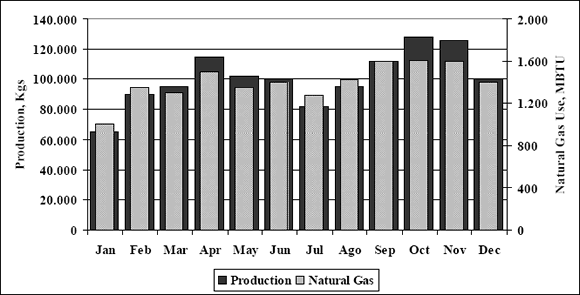
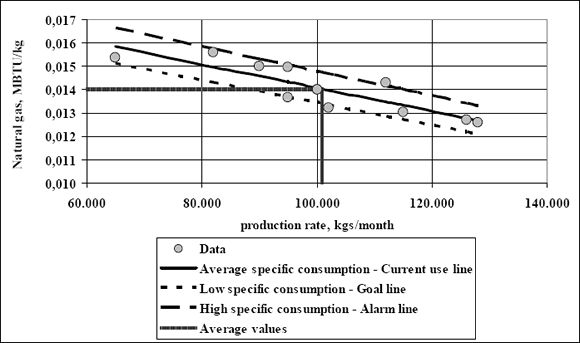
<body><![CDATA[</ul>     <p><font size="2" face="Verdana, Arial, Helvetica, sans-serif">The normal use the  companies did with the data was to prepare a table of consumptions and costs  of energy against production for periods of time. These tables are usually  presented in graph form, using bar graphs. In a few cases dispersion graphs  are used. <a href="#fig01">Figure 1</a> shows a typical graph. </font></p>     <p align="center"><font size="2" face="Verdana, Arial, Helvetica, sans-serif"><b><a name="fig01"></a><img src="/img/revistas/dyna/v75n154/a02fig01.gif">    <br>   Figura       1. </b>Gráfico típico de barras con datos de producción y consumo de energía    <br>  <b>Figure 1. </b>Typical bar graph presentation of production and energy data</font></p>     <p><font size="2" face="Verdana, Arial, Helvetica, sans-serif">Only a couple     of the visited companies used the energy data in correlation with the production.   In no case the specific energy consumption indicators were employed to establish   rational energy use or energy saving goals. This was always discussed with   the company personal in an attempt to establish a reference frame to give the   visited companies the best possible advice on establishing goals for rational   use of energy.</font></p>     <p>&nbsp;</p>     <p>&nbsp;</p>      <p><font size="3" face="Verdana, Arial, Helvetica, sans-serif"><b>2. RATIONAL USE OF APPROPRIATE SPECIFIC ENERGY CONSUMPTION INDICATORS    FOR TARGETING AND MONITORING  </b></font></p>      <p><font size="2" face="Verdana, Arial, Helvetica, sans-serif">Given the observed  facts, the author made a deliberate effort to discuss with the companies how  to use energy and production data to generate rational  and attainable goals. In the reports written as a result of the auditing program,   a procedure for this was explained and the data gathered was used as an example   of the procedure. This can be done by means of the calculation of specific   consumptions (electric energy kwh per ton of production and fuel consumption   per ton of production, for example). These are very appropriate indicators,   since they give comparable objective units which can be examined both in relationship  to time and to production rates. The use of specific consumptions allows the  company to draw very useful conclusions and enable it to establish goals for  savings and energy rational use. This is based on obtaining graphs with the  indicator as function of production rates. <a href="#fig02">Figure 2</a> shows a typical graph,  prepared with the data of <a href="#fig01">figure 1</a>.</font></p>     ]]></body>
<body><![CDATA[<p align="center"><font size="2" face="Verdana, Arial, Helvetica, sans-serif"><b><a name="fig02"></a><img src="/img/revistas/dyna/v75n154/a02fig02.gif">    <br>   Figura 2.</b> Datos     de consumos específicos presentados con metas de uso racional de la energía    <br>     <b>Figure 2. </b> Specific consumption  data for rational energy use goals</font></p>     <p><font size="2" face="Verdana, Arial, Helvetica, sans-serif">The normal thing     observed in this type of graphs, is a tendency for the specific consumption     to diminish when increasing the production rate. When observing the graph,     it is evident that at least three data regions can be located. One of them     includes the near average data. An average line data can be obtained, for     example, using linear correlations or similar averaging techniques. This     is shown as a black line which includes the average data and which represents     data close to it. Other set is conformed by the data with lower specific     consumptions. There is a line of representative minimum values shown as a     short slashed black line and called “Goal  line”. A third set corresponds to the larger specific consumptions and in the  graph a long black slashed line has been drawn to represent the maximum values  for this set, called the </font></p>     <p><font size="2" face="Verdana, Arial, Helvetica, sans-serif">“Alarm line”.     What these two lines indicate is that there is a relatively ample range of     specific consumptions, resulting from the normal operation for the process.     This fact gives rise to the opportunity of establishing realistic goals of     reductions of consumptions, based on real data and process parameters that  occur actually.</font></p>     <p><font size="2" face="Verdana, Arial, Helvetica, sans-serif">The high (alarm) and  low (goal) specific consumption lines were drawn in a conservative way, at  the criteria of the author, and do not include the entire range of high and  low consumption points.</font></p>     <p><font size="2" face="Verdana, Arial, Helvetica, sans-serif">The  “Alarm line”, gives indication of the extremes of inefficient operation that  are occurring at the current forms of work at the process. Paying attention  to these operating ways, will show the things that could cause excessive expenses  or inefficiencies. Even more useful, is the line of lower smaller consumptions,  the “goal line” which gives indication of the extremes of more efficient operation  that are currently occurring. These more efficient ways are real, attainable  and can be studied and determined. It is possible to use the line as a base  to established realistic specific consumptions goals, with the existing systems  and available knowledge and means</font></p>     <p><font size="2" face="Verdana, Arial, Helvetica, sans-serif">By using this technique,  realistic goals of reduction of consumptions with respect to the present average  situation were proposed for the majority of the companies that were visited.  Three major points were stressed:</font></p> <ul>    <li><font size="2" face="Verdana, Arial, Helvetica, sans-serif">It is important     to try to use the equipment at points in which they show higher operating     efficiencies. Usually they will occur at higher production rates. Attaining     this will be related to logistics, programming, sales and a good knowledge     of the best operating points for the process.</font></li>       <li><font size="2" face="Verdana, Arial, Helvetica, sans-serif">Its is possible     to attain the energy consumption reductions signaled by the goal line, simply     based on process internal auditing and close operation attention, usually     without the need of investing in additional equipment. However, the savings     will allow for some basic expenses and investments to facilitate the operation     and the monitoring of the processes with the goals in mind.</font></li>       ]]></body>
<body><![CDATA[<li><font size="2" face="Verdana, Arial, Helvetica, sans-serif">Specific     energy consumptions goals are related to production rates. A table of production     rate related goals should be prepared and used as a base for targeting and     monitoring. Fixed goals will not give a real sense of what is happening. </font></li>     </ul>     <p><font size="2" face="Verdana, Arial, Helvetica, sans-serif">In this perspective,  historical analysis of data does not lose importance. The historical monitoring  of production rates and costs is now complemented with the monitoring of the  historical behavior of the indicator. With the idea of targeting and monitoring,  it is important then to analyze the causes of the variations that occur and  to make decisions that will allow to lower the consumptions of energy and other  resources. The stated goals of specific consumption are to be reached based  on the monitoring of the indicator. A team of people focused in the energy  efficiency looks for the fulfillment of the goals, putting attention in the  operation and control of the systems and equipment that consume the greater  amounts of energy.</font></p>     <p><font size="2" face="Verdana, Arial, Helvetica, sans-serif">When good results  are obtained, attention should be paid, at once, to observe what might have  happened, in order to be able to replicate the results and the learning. Also,  when the indicators show abnormal rises of consumption, remedial actions are  to be proposed and taken at once, based on analysis of the possible causes.  In this form the energy working team will be detecting and taking actions that  will result in the continuous diminution of the consumptions. This will mean,  eventually, the establishment of new and more demanding goals. It is possible  to obtain the goals of reduction by this methodology in less of a year. The  basic steps are:</font></p> <ul>    <li><font size="2" face="Verdana, Arial, Helvetica, sans-serif">Establish     a responsible team, conformed by people from process, engineering, maintenance,     administration and operation.</font></li>       <li><font size="2" face="Verdana, Arial, Helvetica, sans-serif">The team     should be trained in techniques of continuous improvement, group work, analysis     of opportunities and strategies.</font></li>       <li><font size="2" face="Verdana, Arial, Helvetica, sans-serif">Establish     appropriate specific indicators for the plant in general and for specific     equipment and processes, supported by adequate monitoring of associated production     and energy variables.</font></li>       <li><font size="2" face="Verdana, Arial, Helvetica, sans-serif">At least     once weekly, the behavior of the indicators should be analyzed.</font></li>       <li><font size="2" face="Verdana, Arial, Helvetica, sans-serif">Propose actions     and take them to practice.</font></li>       <li><font size="2" face="Verdana, Arial, Helvetica, sans-serif">Gather and     stimulate ideas from the involved personnel.</font></li>       ]]></body>
<body><![CDATA[<li><font size="2" face="Verdana, Arial, Helvetica, sans-serif">Let the results,     targets and benefits be known by all parties.</font></li>     </ul>     <p>&nbsp;</p>     <p><font size="3" face="Verdana, Arial, Helvetica, sans-serif"><b>3. GENERALIZATION OF THIS TECHNOLOGY BASED IN RESULTS OBTAINED IN A STUDY OF   21 INDUSTRIES. </b></font></p>     <p><font size="2" face="Verdana, Arial, Helvetica, sans-serif">The author decided  to take a general view of the results obtained after getting energy consumption  information from 21 companies in Colombia , with the idea of proposing a simple  system to find targeting goals based on statistical information on production  rates and energy usage for a given process. In order to do this, the information  was converted to non dimensional numbers, so that very different ways of measuring  rates and specific consumptions could be compared. The non dimensional numbers  were:</font></p>     <p><font size="2" face="Verdana, Arial, Helvetica, sans-serif">Indicator of production  rate= Rate / Average rate</font></p>     <p><font size="2" face="Verdana, Arial, Helvetica, sans-serif">Indicator of specific  consumption = Specific consumption  / Average specific consumption. </font></p>     <p><font size="2" face="Verdana, Arial, Helvetica, sans-serif"><a href="#fig03">Figure       3</a> shows the  data for <a href="#fig01">figure 1</a> and <a href="#fig02">figure 2</a> presented in this non dimensional format. </font></p>     <p align="center"><font size="2" face="Verdana, Arial, Helvetica, sans-serif"><b><a name="fig03"></a><img src="/img/revistas/dyna/v75n154/a02fig03.gif">    <br>   Figura       3.</b> Datos de consumos específicos de las figuras 1 y 2 presentados en       forma no dimensional    ]]></body>
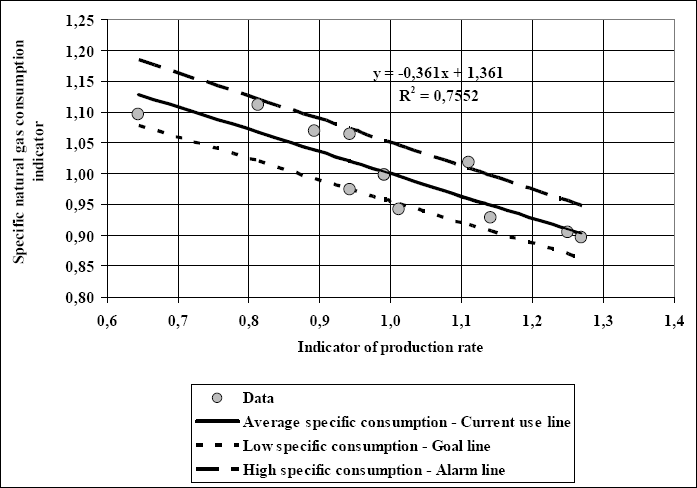
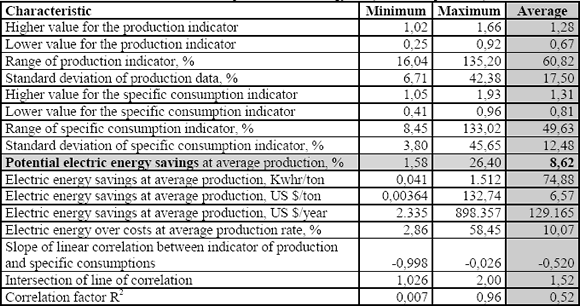
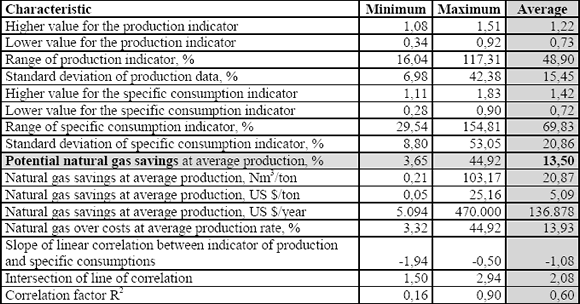
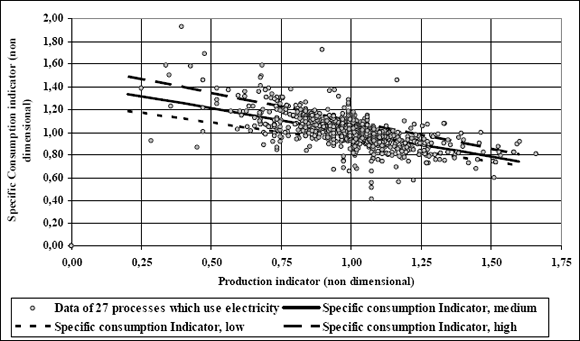
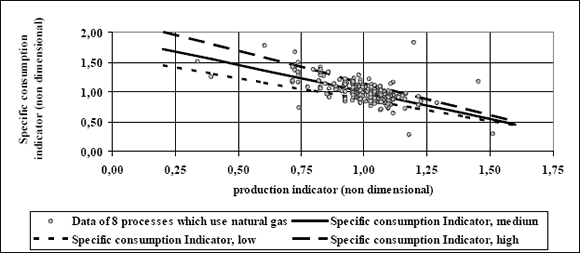
<body><![CDATA[<br>     <b>Figure 3. </b> Specific consumption data for figures 1 and 2 presented  in non dimensional format</font></p>     <p><font size="2" face="Verdana, Arial, Helvetica, sans-serif">The linear tendency   of the data shows a correlation factor R<sup>2</sup> of 0.755, with a slope   of -0,361 and an intersection of 1,361. The range of the production indicator   is from 0,65 to 1,28. The specific consumption indicator goes from 0,90 to   1,12 . The possible savings at average production are of 4.5 %, while the over   costs are of 5,0 %. The standard deviation for the production indicator is   17,7 % and standard deviation for the specific consumption indicator is 7,4   % compared each one to their respective average values. </font></p>     <p>&nbsp;</p>     <p><font size="2" face="Verdana, Arial, Helvetica, sans-serif">Twenty one different  companies with 27 processes were studied in the following fields: Cement production,  scrap steel works, sewing threads manufacturing, steel car rings manufacturing,  coffee roasting, rice milling, beer manufacturing, fiber cement roofing tile   manufacturing, aluminum can manufacturing, rubber tire manufacturing, brake   paste manufacturing, cocoa roasting, barley malt roasting. In most cases general   production indicators were considered, in some cases specific systems were   part of the study. In general, data corresponded to monthly averages, but in   some few cases daily data were studied. For this study two energy resources   were considered, electricity and natural gas. For each case non dimensional   graphs, similar to the ones shown in <a href="#fig03">figure 3</a>, were prepared, and the correlation   factors of the linear correlations were obtained, plus the other factor associated,   including possible savings and over costs. </font></p>     <p><font size="2" face="Verdana, Arial, Helvetica, sans-serif"><a href="#tab01">Tables       1</a> and <a href="#tab02">2</a>  show the general characteristics of the gathered data, using the non dimensional   indicators. In the table, the possible yearly savings at average production   were calculated based in the current electricity cost (0,088 US $ per Kwhr) and natural gas cost (0,244 US $ per standard cubic meter)</font></p>     <p align="center"><font size="2" face="Verdana, Arial, Helvetica, sans-serif"><b><a name="tab01"></a>Tabla 1. </b>Resultados     para los consumos específicos de electricidad (datos de 27 procesos)    <br>     <b>Table 1. </b>Results  for specific electric energy use (data for 27 processes)</font>    <br>  <img src="/img/revistas/dyna/v75n154/a02tab01.gif"></p>     <p align="center"><font size="2" face="Verdana, Arial, Helvetica, sans-serif"><b><a name="tab02"></a>Tabla 2. </b>Resultados     para los consumos específicos de gas natural (datos de 8 procesos)    <br>     <b>Table 2. </b>Results  for specific natural gas use (data for 8 processes)</font>    ]]></body>
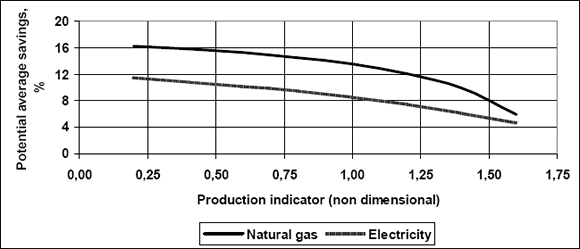
<body><![CDATA[<br>  <img src="/img/revistas/dyna/v75n154/a02tab02.gif"></p>     <p><font size="2" face="Verdana, Arial, Helvetica, sans-serif">The data is now shown  in general graphs (<a href="#fig04">fig 4</a> and <a href="#fig05">5</a>) for all the cases studied, correlating the  non dimensional indicators for production and specific consumptions. The high  and low specific consumption lines were drawn in a conservative way, at the  criteria of the author, and do not include the entire range of points. </font></p>       <p align="center"><font size="2" face="Verdana, Arial, Helvetica, sans-serif"><b><a name="fig04"></a><img src="/img/revistas/dyna/v75n154/a02fig04.gif">    <br>   Figura 4.</b> Análisis estadístico  de consumos específicos de electricidad en una muestra de procesos industriales  en   Colombia     <br>  <b>Figure 4.</b> Statistical analysis  of electricity specific consumption in a sample of industrial processes in  Colombia </font></p>     <p align="center"><font size="2" face="Verdana, Arial, Helvetica, sans-serif"><b><a name="fig05"></a><img src="/img/revistas/dyna/v75n154/a02fig05.gif">    <br>   Figura 5.</b> Análisis estadístico  de consumos específicos de gas natural en una muestra de procesos industriales  en Colombia    <br>  <b>Figure 5.</b> Statistical analysis  of natural gas specific consumption in a sample of industrial processes in  Colombia </font></p>     <p><font size="2" face="Verdana, Arial, Helvetica, sans-serif">It is very interesting  that such a diverse set of data can be arranged in a general graph. This was  possible with the use of the non dimensional indicators. </font></p>     <p><font size="2" face="Verdana, Arial, Helvetica, sans-serif"><a href="#fig06">Figure       6</a> shows the  potential savings deducted from <a href="#fig04">figures 4</a> and <a href="#fig05">5</a>, as a function of the production  indicator. It is clear that the savings tend to diminish with production. </font></p>       ]]></body>
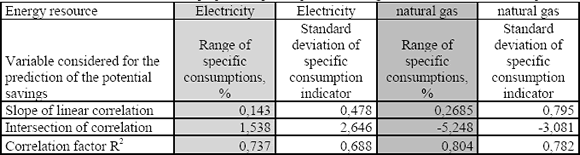
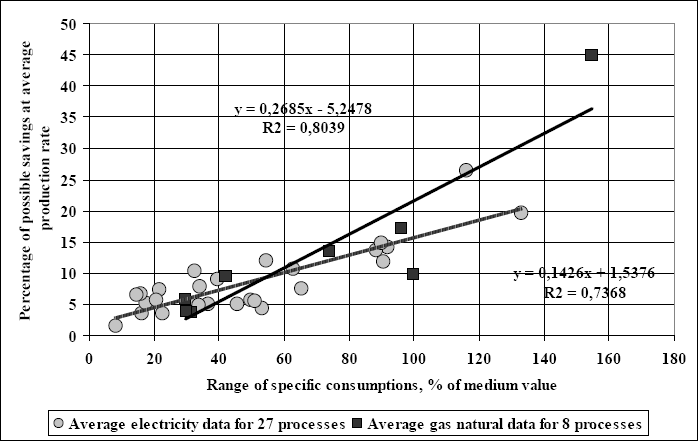
<body><![CDATA[<p align="center"><font size="2" face="Verdana, Arial, Helvetica, sans-serif"><b><a name="fig06"></a><img src="/img/revistas/dyna/v75n154/a02fig06.gif">    <br>   Figura 6.</b> Ahorros potenciales  para las muestras estudiadas mediante seguimientos operativos    <br>  <b>Figure 6.</b> Potential savings  for the studied sample as a result of operational monitoring </font></p>     <p><font size="2" face="Verdana, Arial, Helvetica, sans-serif">The average potential  savings were correlated with the different variables of which the average values  were presented in <a href="#tab01">tables 1</a> and <a href="#tab02">2</a>. The idea is to be able to predict the potential  savings as a function of statistical production and consumption data. It was  found that the savings could be correlated with standard deviation for non dimensional   specific consumption and with the range of values for this indicator, expressed   as percentage. <a href="#fig07">Figure 7</a>, for example, shows the correlation found with the   range of the specific consumption indicator). <a href="#tab03">Table 3</a> shows the  proposed correlations presented as a result of this study for the statistical  variables considered.</font></p>     <p align="center"><font size="2" face="Verdana, Arial, Helvetica, sans-serif"><b><a name="tab03"></a>Tabla 3. </b>Correlaciones lineales  propuestas para predecir los ahorros potenciales en los procesos estudiados    <br>  <b>Table 3. </b>Linear correlations  proposed to predict potential savings in the studied industrial samples</font>    <br>  <img src="/img/revistas/dyna/v75n154/a02tab03.gif"></p>     <p align="center"><font size="2" face="Verdana, Arial, Helvetica, sans-serif"><b><a name="fig07"></a><img src="/img/revistas/dyna/v75n154/a02fig07.gif">    <br>   Figura 7.</b> Correlación de los  datos de ahorros potenciales de electricidad y gas natural gas a producción  promedio contra el rango de variación del indicador de los consumos específicos    <br>  <b>Figure 7.</b> Correlation of data  of savings of electricity and natural gas at average production with the range  of the specific consumption indicator</font></p>     ]]></body>
<body><![CDATA[<p>&nbsp;</p>     <p><font size="3" face="Verdana, Arial, Helvetica, sans-serif"><b>4. CONCLUSIONS</b> </font></p>     <p><font size="2" face="Verdana, Arial, Helvetica, sans-serif">The proposed method  of data analysis permits a more rational approach to rational energy use, as  the goals can be declared in relationship to production goals. This demands  a more comprehensive and technical analysis, but will direct the companies  to greater savings and more knowledge of their process.</font></p>     <p><font size="2" face="Verdana, Arial, Helvetica, sans-serif">The proposed methodology  is based on the use of existing data plus a monitoring and goal setting program,  applied to normal production. In principle, no investments are considered. </font></p>     <p><font size="2" face="Verdana, Arial, Helvetica, sans-serif">The existing potential  for savings, based on normal operative practices and process monitoring is  large. This study, based in 21 well established companies in Colombia, found  electricity potential savings of 8,6 % and gas natural potential  savings of 13,5 % , in the average. This savings could be reached by </font></p>     <p><font size="2" face="Verdana, Arial, Helvetica, sans-serif">operative practices  and getting them will help greatly in the national programs related to global  warming and sustainable development. </font></p>     <p><font size="2" face="Verdana, Arial, Helvetica, sans-serif">It is possible to  predict potential savings in specific energy consumption by using statistical  data of production and specific energy consumption, based on a non dimensional  format for the data.</font></p>     <p>&nbsp;</p>     <p><font size="3" face="Verdana, Arial, Helvetica, sans-serif"><b>REFERENCES </b></font></p>     <!-- ref --><p><font size="2" face="Verdana, Arial, Helvetica, sans-serif"><b>[1]</b> POSADA,     ENRIQUE. Guía de buenas prácticas de manejo energético en las pequeñas y medianas empresas,  Medellín, Centro Nacional de Producción más Limpia, Medellín, 2002    &nbsp;&nbsp;&nbsp;&nbsp;&nbsp;&nbsp;&nbsp;&nbsp;[&#160;<a href="javascript:void(0);" onclick="javascript: window.open('/scielo.php?script=sci_nlinks&ref=000102&pid=S0012-7353200800010000200001&lng=','','width=640,height=500,resizable=yes,scrollbars=1,menubar=yes,');">Links</a>&#160;]<!-- end-ref --><!-- ref --><br>  <b>[2]</b> FIKSEL,  JOSEPH. Ingeniería de diseño medio ambiental. DFE, McGraw-Hill, Madrid, 1997 </font>&nbsp;&nbsp;&nbsp;&nbsp;&nbsp;&nbsp;&nbsp;&nbsp;[&#160;<a href="javascript:void(0);" onclick="javascript: window.open('/scielo.php?script=sci_nlinks&ref=000103&pid=S0012-7353200800010000200002&lng=','','width=640,height=500,resizable=yes,scrollbars=1,menubar=yes,');">Links</a>&#160;]<!-- end-ref --> ]]></body><back>
<ref-list>
<ref id="B1">
<label>1</label><nlm-citation citation-type="book">
<person-group person-group-type="author">
<name>
<surname><![CDATA[POSADA]]></surname>
<given-names><![CDATA[ENRIQUE]]></given-names>
</name>
</person-group>
<source><![CDATA[Guía de buenas prácticas de manejo energético en las pequeñas y medianas empresas]]></source>
<year>2002</year>
<publisher-loc><![CDATA[Medellín ]]></publisher-loc>
<publisher-name><![CDATA[Centro Nacional de Producción más Limpia]]></publisher-name>
</nlm-citation>
</ref>
<ref id="B2">
<label>2</label><nlm-citation citation-type="book">
<person-group person-group-type="author">
<name>
<surname><![CDATA[FIKSEL]]></surname>
<given-names><![CDATA[JOSEPH]]></given-names>
</name>
</person-group>
<source><![CDATA[Ingeniería de diseño medio ambiental]]></source>
<year>1997</year>
<publisher-loc><![CDATA[Madrid ]]></publisher-loc>
<publisher-name><![CDATA[McGraw-Hill]]></publisher-name>
</nlm-citation>
</ref>
</ref-list>
</back>
</article>