<?xml version="1.0" encoding="ISO-8859-1"?><article xmlns:mml="http://www.w3.org/1998/Math/MathML" xmlns:xlink="http://www.w3.org/1999/xlink" xmlns:xsi="http://www.w3.org/2001/XMLSchema-instance">
<front>
<journal-meta>
<journal-id>0012-7353</journal-id>
<journal-title><![CDATA[DYNA]]></journal-title>
<abbrev-journal-title><![CDATA[Dyna rev.fac.nac.minas]]></abbrev-journal-title>
<issn>0012-7353</issn>
<publisher>
<publisher-name><![CDATA[Universidad Nacional de Colombia]]></publisher-name>
</publisher>
</journal-meta>
<article-meta>
<article-id>S0012-73532009000400031</article-id>
<title-group>
<article-title xml:lang="en"><![CDATA[AUTOMATIC VISUAL MODEL FOR CLASSIFICATION AND MEASUREMENT OF QUALITY OF FRUIT: CASE Mangifera indica l]]></article-title>
<article-title xml:lang="es"><![CDATA[MODELO VISUAL AUTOMATICO PARA LA CLASIFICACION Y MEDIDA DE CALIDAD DE FRUTO: CASO Mangifera indica l]]></article-title>
</title-group>
<contrib-group>
<contrib contrib-type="author">
<name>
<surname><![CDATA[Atencio]]></surname>
<given-names><![CDATA[Pedro]]></given-names>
</name>
<xref ref-type="aff" rid="A01"/>
</contrib>
<contrib contrib-type="author">
<name>
<surname><![CDATA[Sánchez T]]></surname>
<given-names><![CDATA[Germán]]></given-names>
</name>
<xref ref-type="aff" rid="A01"/>
</contrib>
<contrib contrib-type="author">
<name>
<surname><![CDATA[Branch]]></surname>
<given-names><![CDATA[John William]]></given-names>
</name>
<xref ref-type="aff" rid="A03"/>
</contrib>
</contrib-group>
<aff id="A01">
<institution><![CDATA[,Universidad del Magdalena Grupo de Investigación y Desarrollo en Nuevas Tecnologías de la Información y la Comunicación ]]></institution>
<addr-line><![CDATA[ ]]></addr-line>
</aff>
<aff id="A02">
<institution><![CDATA[,Universidad del Magdalena Grupo de Investigación y Desarrollo en Nuevas Tecnologías de la Información y la Comunicación ]]></institution>
<addr-line><![CDATA[ ]]></addr-line>
</aff>
<aff id="A03">
<institution><![CDATA[,Universidad Nacional de Colombia - Sede Medellin Grupo de Investigación y Desarrollo en Inteligencia Artificial - GIDIA ]]></institution>
<addr-line><![CDATA[ ]]></addr-line>
</aff>
<pub-date pub-type="pub">
<day>00</day>
<month>12</month>
<year>2009</year>
</pub-date>
<pub-date pub-type="epub">
<day>00</day>
<month>12</month>
<year>2009</year>
</pub-date>
<volume>76</volume>
<numero>160</numero>
<fpage>317</fpage>
<lpage>326</lpage>
<copyright-statement/>
<copyright-year/>
<self-uri xlink:href="http://www.scielo.org.co/scielo.php?script=sci_arttext&amp;pid=S0012-73532009000400031&amp;lng=en&amp;nrm=iso"></self-uri><self-uri xlink:href="http://www.scielo.org.co/scielo.php?script=sci_abstract&amp;pid=S0012-73532009000400031&amp;lng=en&amp;nrm=iso"></self-uri><self-uri xlink:href="http://www.scielo.org.co/scielo.php?script=sci_pdf&amp;pid=S0012-73532009000400031&amp;lng=en&amp;nrm=iso"></self-uri><abstract abstract-type="short" xml:lang="en"><p><![CDATA[The physical properties of fruits in the agriculture industry constitute the main information in the quality determination for activities as exportation. This work presents a visual inspection based method for the classification of mango (Mangifera Indica L.). The classification process is made according to the Norma Técnica Colombiana (Colombian Technical Norm) NTC 5139 standard, by means of automatic estimation of physical properties of fruits, such as height, width, volume, weight, caliber, and maturity level using the Principal Component Analysis and a fruit’s ellipsoidal 3-D model. Finally, the level of maturity is inferred through a similarity measure of the color distribution between the fruit and experimentally fixed models in the HSL space. The results showed that the method is computationally efficient, non invasive, precise and of low cost.]]></p></abstract>
<abstract abstract-type="short" xml:lang="es"><p><![CDATA[Las propiedades físicas de las frutas en la industria agrícola constituyen la principal información en la determinación de calidad para las actividades como la exportación. Este trabajo presenta un método basado en la inspección visual para la clasificación de mango (Mangifera indica L.), acorde con la Norma Tecnica Colombiana NTC 5139, realizado mediante la estimación automática de las propiedades físicas de la fruta, como la altura, anchura, volumen, peso, calibre y nivel de madurez, por medio de la utilización del Análisis de Componentes Principales y un modelo elipsoidal tridimensional del mango. Por último, el nivel de madurez se infiere a través de una medida de similitud de la distribución de color en el espacio HSL, entre la fruta y un modelo experimental fijo. Los resultados mostraron que el método es computacionalmente eficiente, no invasivo, preciso y de bajo costo.]]></p></abstract>
<kwd-group>
<kwd lng="en"><![CDATA[Digital image processing]]></kwd>
<kwd lng="en"><![CDATA[volume and color estimation]]></kwd>
<kwd lng="en"><![CDATA[mango fruit]]></kwd>
<kwd lng="es"><![CDATA[Procesamiento digital de imágenes]]></kwd>
<kwd lng="es"><![CDATA[fruto mango]]></kwd>
<kwd lng="es"><![CDATA[estimación del color]]></kwd>
<kwd lng="es"><![CDATA[volumen en frutas]]></kwd>
</kwd-group>
</article-meta>
</front><body><![CDATA[ <p align="center"><font size="4" face="Verdana, Arial, Helvetica, sans-serif"><b>AUTOMATIC VISUAL MODEL  FOR CLASSIFICATION AND MEASUREMENT OF QUALITY OF FRUIT: CASE Mangifera indica l </b></font></p>     <p align="center"><i><font size="3" face="Verdana, Arial, Helvetica, sans-serif"><b>MODELO VISUAL AUTOMATICO PARA LA CLASIFICACION Y MEDIDA DE CALIDAD DE FRUTO: CASO Mangifera indica l </b></font></i></p>     <p align="center">&nbsp;</p>     <p align="center"><font size="2" face="Verdana, Arial, Helvetica, sans-serif"><b>Pedro Atencio</b>    <br>   <i>Grupo de Investigaci&oacute;n y Desarrollo en  Nuevas Tecnolog&iacute;as de  la  Informaci&oacute;n y la Comunicaci&oacute;n , Universidad  del Magdalena </i></font></p>     <p align="center"><font size="2" face="Verdana, Arial, Helvetica, sans-serif"><b>Germ&aacute;n S&aacute;nchez T</b>    <br>   <i>Grupo de Investigaci&oacute;n y Desarrollo en  Nuevas Tecnolog&iacute;as de  la  Informaci&oacute;n y la Comunicaci&oacute;n , Universidad del Magdalena </i></font></p>     <p align="center"><font size="2" face="Verdana, Arial, Helvetica, sans-serif"><b>John  William Branch</b>    <br>  <i>Grupo de Investigaci&oacute;n  y Desarrollo en Inteligencia Artificial – GIDIA, Universidad  Nacional de Colombia – Sede Medellin <a href="mailto:jwbranch@unal.edu.co">jwbranch@unal.edu.co</a> </i></font></p>     <p align="center">&nbsp;</p>     ]]></body>
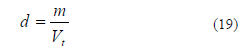
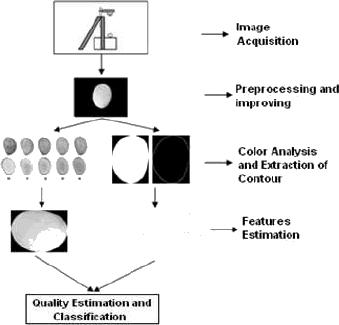
<body><![CDATA[<p align="center"><font size="2" face="Verdana, Arial, Helvetica, sans-serif"><b>Recibido para revisar septiembre  25 de 2009, aceptado octubre 28 de 2009, versi&oacute;n final octubre 31 de 2009 </b></font></p>     <p align="center">&nbsp;</p> <hr>     <p><font size="2" face="Verdana, Arial, Helvetica, sans-serif"><b>Abstract:</b> The physical properties of fruits  in the agriculture industry constitute the main information in the quality  determination for activities as exportation. This work presents a visual  inspection based method for the classification of mango (Mangifera Indica L.).  The classification process is made according to the Norma T&eacute;cnica Colombiana (Colombian  Technical Norm) NTC 5139 standard, by means of automatic estimation of physical  properties of fruits, such as height, width, volume, weight, caliber, and  maturity level using the Principal Component Analysis and a fruit’s ellipsoidal  3-D model. Finally, the level of maturity is inferred through a similarity  measure of the color distribution between the fruit and experimentally fixed  models in the HSL space. The results showed that the method is computationally  efficient, non invasive, precise and of low cost. </font></p>     <p><font size="2" face="Verdana, Arial, Helvetica, sans-serif"><b>KEYWORDS: </b>Digital image processing, volume and color  estimation, mango fruit. </font></p>     <p><font size="2" face="Verdana, Arial, Helvetica, sans-serif"><b>RESUMEN:</b> Las propiedades f&iacute;sicas de las frutas en la  industria agr&iacute;cola constituyen la principal informaci&oacute;n en la determinaci&oacute;n de  calidad para las actividades como la exportaci&oacute;n. Este trabajo presenta un  m&eacute;todo basado en la inspecci&oacute;n visual para la clasificaci&oacute;n de mango (Mangifera  indica L.), acorde con  la  Norma Tecnica Colombiana NTC 5139, realizado mediante la  estimaci&oacute;n autom&aacute;tica de las propiedades f&iacute;sicas de la fruta, como la altura,  anchura, volumen, peso, calibre y nivel de madurez, por medio de la utilizaci&oacute;n  del An&aacute;lisis de Componentes Principales y un modelo elipsoidal tridimensional  del mango. Por &uacute;ltimo, el nivel de madurez se infiere a trav&eacute;s de una medida de  similitud de la distribuci&oacute;n de color en el espacio HSL, entre la fruta y un  modelo experimental fijo. Los resultados mostraron que el m&eacute;todo es  computacionalmente eficiente, no invasivo, preciso y de bajo costo. </font></p>     <p><font size="2" face="Verdana, Arial, Helvetica, sans-serif"><b>PALABRAS  CLAVE:</b> Procesamiento digital de im&aacute;genes, fruto mango, estimaci&oacute;n del color y  volumen en frutas. </font></p> <hr>     <p>&nbsp;</p>     <p><font size="3" face="Verdana, Arial, Helvetica, sans-serif"><b>1. </b>  <b>INTRODUCTION </b> </font></p> <font size="2" face="Verdana, Arial, Helvetica, sans-serif">     <p>The   correct and agile evaluation of physical properties of products in food   industry has represented one of the most relevant issues in this industry,   because of the high value in costs and time required by this process. The   solution in many of the cases has been the augmentation of personnel, but the   general tendency is the implementation of automation technology. The high cost   of these technologies has represented an obstacle because this technology cannot   be used by small and medium sized companies devoted to this industry, which in Colombia represents a high percentage: therefore, computer vision is an efficient, quick   and cheap technique to support productive processes. Its speed and accurateness   in estimation and measurement of parameters are the main features which   complement the nonexistence of errors related to subjective interpretation. In   addition to this, it is a non invasive natural technique, which turns it into a      very suitable technique to be used in the food industry. In this field,   specifically in mango processing, the process of fruit selection, according to   national rules that determine the physical features that fruits must have to be   exported, use to be manual, performed by a group of people, not necessarily   supported by rigorous measurement steps by means of specialized instrumentation   due to the long time this implies. On the contrary, most measurement and   classification processes are performed by means of a process of subjective   interpretation, optimized through practice. From the determination phases of   maturity degrees, to the measurement of physical features and classification   for exportation, precise estimations are required, which make possible for an   adequate classification. This work presents a method based on visual inspection   for the classification of sugar mango fruit (Mangifera Indica L.), according to   standards described in Colombian Technical Norm NTC 5139 &#91;1&#93;, through automatic   measurement of fruit's physical properties such as height, width, volume,   weight, caliber, and maturity. The   method begins with image acquisition, which is later pre-processed and   segmented. The fruit caliber is estimated according to NTC-5139 which   co-relates mango caliber with its weight. Finally, the maturity degree is   inferred through estimation of a similarity measurement between color   distribution represented in a histogram of the mango segmented image and a set   of pattern histograms determined by experimentation (See <a href="#fig01">Figure 1</a>). This work   is organized as follows: Section 2 shows a set of works related to visual   inspection in the food industry. Section 3, describes the procedures of image   pre-processing. Section 4, presents the proposed method for the estimation of   fruit maturity level. Section 5, describes the proposed method for fruit caliber  estimation. The following sections describe experimental results and the conclusions. </p>     <p align="center"><b><a name="fig01"></a><img src="/img/revistas/dyna/v76n160/a31fig01.gif">    ]]></body>
<body><![CDATA[<br>   Figure 1. </b>Proposed method for the  classification process of Mangifera Indica L Fruit </p> </font>     <p>&nbsp;</p>     <p><font size="3" face="Verdana, Arial, Helvetica, sans-serif"><b>2. </b> <b> LITERATURE   REVIEW </b></font>  </p> <font face="Verdana, Arial, Helvetica, sans-serif">     <p><font size="2">Computer vision attempts to simulate the    performance of human vision as to the inspection of color, content, shape and    texture &#91;2&#93;. Supported by learning systems, computer vision provides a    mechanism in which human thought is artificially simulated and can help people    to make complicate decisions in an accurate, fast and very consistent way over    long periods of time &#91;3&#93;. Learning techniques can be used to automatically find    nontrivial or significant relationships over a set of training data and produce    a generalization of those relations that can be used to interpret new test data    &#91;4&#93;. Therefore, using sample data from a learning system can generate an    updated basis to improve the classification of subsequent data from the same    source, and express the new base in an intelligible symbolic form &#91;5&#93;. However,    there is a need for further research about the combination of computer vision  and learning techniques of food quality inspection&#91;6&#93;. </font></p>     <p><font size="2">An automatic classification    system of strawberries was developed by &#91;7&#93; with an effectiveness average in    the evaluation of the shape and size from 98% to 100%, respectively, and invariant    to the position and orientation of the fruit with a processing time of 1.18 s.    In &#91;8&#93; an image processing algorithm is developed, based on Fourier expansion    to objectively characterize the shape of the apple and thus identify different    phenotypes. This research showed that four images per apple were needed to quantify    the average shape of a randomly chosen apple. This analysis of profile can be    used to characterize the list of existing apple shape descriptors as defined by    the International Plant Genetic Resources. Therefore, this study shows a    relationship or link between subjective shape descriptors and objective  measures of shape recognition. </font></p>     <p><font size="2">Some other recent studies in    computer vision, associated with classification of vegetables, color inspection    and defects in the classification of peppers are presented in &#91;9&#93;. Morrow <i>et al</i>. &#91;10&#93; present techniques of Visual    inspection of mushrooms, apples and potatoes in terms of size, shape and color.    The use of computer vision for the location of the stem-root junction in    carrots has also been addressed in &#91;11&#93;. Feature extraction and pattern    recognition techniques were developed by &#91;12&#93; to characterize and classify    carrots by surface defects, curvature and fragility. The rate of    misclassification was below 15% in a total of 250 samples examined. More    recently, onions were scanned by X-rays to examine internal defects &#91;13&#93;. An    effectiveness average of 90% was achieved when spatial and transformation    characteristics were evaluated in the classification of products. A broader  review of work in the area can be found in &#91;14&#93; and its references. </font></p> </font>     <p>&nbsp;</p>     <p><font face="Verdana, Arial, Helvetica, sans-serif"><font size="3"><b>3. </b> <b>IMAGE ACQUISITION,   PRE-PROCESSING AND SEGMENTATION </b> </font></font></p> <font face="Verdana, Arial, Helvetica, sans-serif"><font size="2">     <p>Image acquisition,   pre-processing and segmentation represent important steps in computer vision   systems. These steps determine, largely, the behavior of the system in later   stages &#91;16&#93;. After we acquire the images, we pre-processed them, applying brightness and contrast adjustment, and Median and Gauss Filters &#91;15&#93;. </p> </font></font>     <p>&nbsp;</p>     ]]></body>
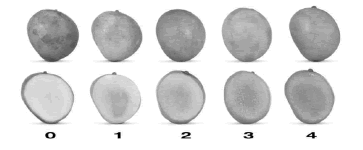
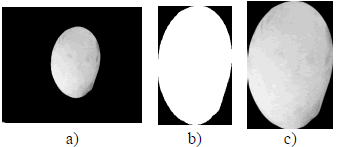
<body><![CDATA[<p><font size="2" face="Verdana, Arial, Helvetica, sans-serif"><b>3.1 Image segmentation </b>       <br> In image    segmentation, each pixel is classified according to the background or to the    fruit. Pixels that are in the range &#91;(0:r),(0:g),(0,b)&#93;, where r, g, b are    threshold values for the RGB color model in the image, are considered as    belonging to the background and their value is set to 0 for each channel. The other    pixels represent the fruit, and then their values are not modified. Hence, if C(x,    y) denotes the intensity value of a channel C for a pixel in the point (x, y)    of a RGB image, G(x, y) denotes the value obtained by filtering the color and µ denotes the filter threshold for the channel C, then we get: </font></p>     <p><img src="/img/revistas/dyna/v76n160/a31eq01.gif"></p>     <p><font size="2" face="Verdana, Arial, Helvetica, sans-serif">Once the color filter is applied, the image shown in     <a href="#fig02">Figure 2a</a>, is obtained. In this image, both the object and the background are  distinguishable without ambiguity. </font></p>     <p align="center"><font size="2" face="Verdana, Arial, Helvetica, sans-serif"><b><a name="fig02"></a><img src="/img/revistas/dyna/v76n160/a31fig02.gif">    <br>   Figure 2.</b> a ) Color-Filtered Image b) Fruit’s BLOB and c)  segment of Fruit Extracted </font></p>     <p><font size="2" face="Verdana, Arial, Helvetica, sans-serif">In a subsequent processing, the image is converted to  gray scale and binarized using a thresholding method for labeling objects that belong to the image &#91;17&#93; (<a href="#fig02">Figure 2b</a>). </font></p>     <p>&nbsp;</p>     <p><font size="3" face="Verdana, Arial, Helvetica, sans-serif"><b>4. FRUIT MATURITY ESTIMATION   METHOD </b></font></p>     <p><font size="2" face="Verdana, Arial, Helvetica, sans-serif">The technical standard NTC 5139 defines 5 based-graphics color models for  classification of fruits in their varying stages of maturation (see <a href="#fig03">Figure 3</a>).  For classification, the standard shows the distribution of internal color (related  to pulp color) and external color, (referring to the fruit skin). Due to the  invasive nature of the internal analysis of the fruit, in this work the  determination of the level of maturity is based on analyzing the color distribution  of the skin or peel of the fruit, similar to what an expert would do. </font></p>     ]]></body>
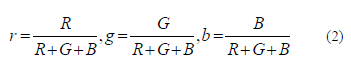
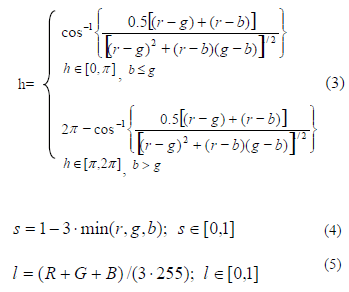
<body><![CDATA[<p align="center"><font size="2" face="Verdana, Arial, Helvetica, sans-serif"><b><a name="fig03"></a><img src="/img/revistas/dyna/v76n160/a31fig03.gif">    <br>   Figure   3.</b> Fruit maturation level&rsquo;s table color from NTC </font></p>     <p><font size="2" face="Verdana, Arial, Helvetica, sans-serif">While the manner in which a human expert makes the determination of the  level of maturity of a fruit is a complex process to be modeled automatically,  there are tools that allow to express the distribution of color through  mathematical models in a quantitative way. These tools constitute, among  others, the HSL ( Hue ,  Saturation, and Lightning) color system, which defines the possible range of  colors, by defining three axes that describe separate features to define a  color &#91;18&#93;. </font></p>     <p><font size="2" face="Verdana, Arial, Helvetica, sans-serif">The estimation of the level of maturity is a procedure by which the  acquired initial image, pre-processed and segmented, is compared with fixed  models that indicate each of the levels of maturity described in the norm. This  comparison is performed by estimating the difference in models of color in the  HSL space. The estimated HSL color model for each of the images requires  initially, the transformation of each color in the RGB space to HSL space. This  change of space is performed initially by normalizing the RGB colors as shown  in Equation 2. </font></p>     <p><img src="/img/revistas/dyna/v76n160/a31eq02.gif"></p>     <p><font size="2" face="Verdana, Arial, Helvetica, sans-serif">Where R, G, B are the values of three RGB color space layers of a pixel in  the image. </font></p>     <p><font size="2" face="Verdana, Arial, Helvetica, sans-serif">Then, each one of the values of the corresponding HSL components is  obtained through the equations 3, 4 and 5. </font></p>     <p><img src="/img/revistas/dyna/v76n160/a31eq030405.gif"></p>     <p><font size="2" face="Verdana, Arial, Helvetica, sans-serif">Because the method used in this work is based on the comparison of  histograms, it is necessary to transform the values of the components H, S and  L to the range &#91;0.255&#93; used for 8-bit images. The conversion of these values is  expressed by equations 6, 7 and 8. </font></p>     <p><img src="/img/revistas/dyna/v76n160/a31eq060708.gif"></p>     ]]></body>

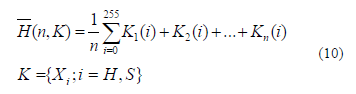
<body><![CDATA[<p><font size="2" face="Verdana, Arial, Helvetica, sans-serif">Finally, the estimated level of similarity of each particular fruit and  each of the models that represent different levels of maturity of mango are  calculated. The models for each level are fixed and they have been estimated as  average histograms of a sample of fruit from each of the selected levels of  maturity through the assistance of an expert. The similarity measure takes into  account the color distribution of each of the layers of color model used. That is,  the level of similarity is given by the average similarity in each of the  layers of color model of the acquired image and a model. </font></p>     <p><font size="2" face="Verdana, Arial, Helvetica, sans-serif">As mentioned earlier, H and S components of the HSL model are the ones that  really represent the color of the image, so the component L is not used in this  paper to determine the color of the fruit. Because of this, the determination  of the level of maturity is given by the minimization of the functional of  similarity with respect to a model histogram (see Equation 9). </font></p>     <p><img src="/img/revistas/dyna/v76n160/a31eq09.gif"></p>     <p><font size="2" face="Verdana, Arial, Helvetica, sans-serif">Where M is each of the reference models, J is the image of the fruit for  which you want to infer its level of maturity. <i>S(M, J)</i> is the similarity function and <img src="/img/revistas/dyna/v76n160/a31eq002.gif"> is the distance  measure between an image M and image J in a X layer. </font></p>     <p><font size="2" face="Verdana, Arial, Helvetica, sans-serif"><b>4.1 Model  histograms estimation    <br> </b></font><font size="2" face="Verdana, Arial, Helvetica, sans-serif">For the estimation of these histograms, sampling was conducted  independently, assisted by an expert of fruit in each classification in  accordance with the standard. Then, the histograms H and S layers of each image  were obtained, and finally each of the histograms of each layer was averaged.  The average histogram is expressed in Equation 10. </font></p>     <p><img src="/img/revistas/dyna/v76n160/a31eq10.gif"></p>     <p><font size="2" face="Verdana, Arial, Helvetica, sans-serif">Where <img src="/img/revistas/dyna/v76n160/a31eq004.gif"> is the average  histogram of the layer <i>k</i> of a set of  images <i>n</i>. </font></p>     <p><font size="2" face="Verdana, Arial, Helvetica, sans-serif"><b>4.2 Measure of similarity  between histograms    <br> </b></font><font size="2" face="Verdana, Arial, Helvetica, sans-serif">The distance between any two histograms can be expressed in terms of the  distances of the measures of the values of its elements. Given two data sets of n elements, A and B,  this problem is considered as finding the minimum difference between pairs of  the two sets. The problem is to  determine the best relationship between two data sets so that the sum of all  differences between a pair of individual elements is minimized. For these reasons, this method evaluates the  mean square error between the normalized histograms of each of the layers H and  S of an image with respect to two model histograms H and S, and calculates the  average, according to the following equations: </font></p>     ]]></body>

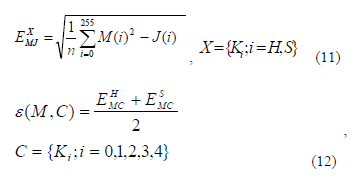
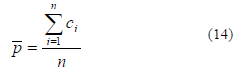
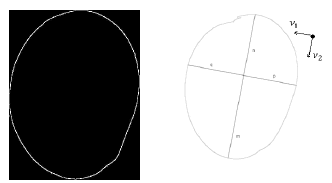
<body><![CDATA[<p><img src="/img/revistas/dyna/v76n160/a31eq1112.gif"></p>     <p><font size="2" face="Verdana, Arial, Helvetica, sans-serif">Where <img src="/img/revistas/dyna/v76n160/a31eq002.gif"> is the mean square  error of the histograms M and J of the layer <i>k</i>. </font></p>     <p> <font size="2" face="Verdana, Arial, Helvetica, sans-serif"><img src="/img/revistas/dyna/v76n160/a31eq006.gif"> is the average of the  errors between histograms H and S of an image M and the set of model histograms  C. A set of histograms model consists of  two histograms: H and S, which have been obtained through averaging the  histograms of H and S layers of two-dimensional images of a set of mangoes  belonging to the same level of maturity. Finally, error minimization allows to find  the greatest similarity of a two-dimensional image of a sugar mango with a set  of model histograms. This allows to estimate the level of maturity of a mango  that is described on an image. </font></p>     <p>&nbsp;</p>     <p><font size="3" face="Verdana, Arial, Helvetica, sans-serif"><b>5. FRUIT CALIBER ESTIMATION METHOD </b> </font></p>     <p><font size="2" face="Verdana, Arial, Helvetica, sans-serif"><b>5.1 Contour extraction and geometric dimensions   estimation </b>         <br> Different   approaches have been proposed for estimating geometric dimensions &#91;18-19&#93;.   However, the automatic application of these approaches is often difficult and   sometimes requires taking the image in a fruit’s particular position. This   paper proposes a robust mechanism to estimate geometrical-measuring,   independent of the fruit location inside the image, by the application of the Principal   Component Analysis (PCA) to the fruit contour. It is, the direction of the axis   that describes the mayor tendencies represent an estimation of the fruit’s length and width. </font></p> <font size="2" face="Verdana, Arial, Helvetica, sans-serif">     <p>For this, the pixels   group that forms the contour is initially obtained. Note that it is not   necessary to analyze the pixels complete group, that is to say, the pixels   inside the fruit’s image, because what is sought is to find the direction of   the axis on which to measure these lengths. To   determine the contour pixels’ group, a recursive search over the completed   image is applied, by extracting a group of the contiguous pixels that appear in   its neighborhood (determined by the surrounding Grid) black and white   neighbors. This group represents the fruit contour and is named <img src="/img/revistas/dyna/v76n160/a31eq008.gif"> <i>. </i>The  4 shows the graphical result of the extraction procedure. </p>     <p>When the C group is obtained,   the main fruit lengths are similar in direction in respect to the principal   component directions in <i>C</i> . To estimate the principal   directions in C, we use a Multivariate Statistical Model named PCA or   Karhunen-Loève transform &#91;20&#93;. It begins with covariance estimation of c<sub>i</sub> making a dimensional reduction to <img src="/img/revistas/dyna/v76n160/a31eq012.gif"> . The matrix of covariance is defined according the  Equation 13. </p>     <p><img src="/img/revistas/dyna/v76n160/a31eq13.gif"></p>     ]]></body>

<body><![CDATA[<p>Where, <img src="/img/revistas/dyna/v76n160/a31eq014.gif"> is the C size and <img src="/img/revistas/dyna/v76n160/a31eq016.gif"> is the center of mass point of <i>c</i> , and is defined by: </p>     <p><img src="/img/revistas/dyna/v76n160/a31eq14.gif"></p>     <p>The PCA method   returns as many vectors as spatial dimensions have the data; in this particular   case, we worked with Bi-dimensional images, hence two vectors were obtained.   Thus, the <img src="/img/revistas/dyna/v76n160/a31eq018.gif"> corresponds to the Eigenvalues and the <img src="/img/revistas/dyna/v76n160/a31eq020.gif"> are the Eigenvectors of <i>M</i><sub>c</sub>.   If <img src="/img/revistas/dyna/v76n160/a31eq022.gif"> , then v<sub>1</sub> represent   direction of the minor variability in the data and coincide with the direction   of the line that crosses through the width of the fruit. In a similar way, v<sub>2</sub> represents the direction of the principal variability in the data that is an  approximation of the fruit length. </p>     <p>If we consider the fruit   length as the longest line that cuts the fruit contour twice, then in order to   measure it, we start a path from the image’s center of mass <img src="/img/revistas/dyna/v76n160/a31eq026.gif"> in the v<sub>2</sub> direction to both sides. The amount of pixels through the line is calculated, as   it approximates to the real value of the fruit length. In this work, the width   of the mango was defined as the longest line that cuts the contour in two different   points and is perpendicular to the line of length. So, the second direction v<sub>1</sub>,   which is perpendicular to the length line, was used to find the longest line to  measure the width. The found length and width can be observed in <a href="#fig04">Figure 4</a>. </p>     <p align="center"><a name="fig04"></a><b><img src="/img/revistas/dyna/v76n160/a31fig04.gif">    <br> Figure 4.</b> Contours and its estimated Principal Components </p> <b>5.2 Ellipsoidal model of volume    <br> </b>In order to approximate the    fruit volume, we reconstruct a three-dimensional model that approximates the    volume by ellipses, as in &#91;21&#93;. The geometrical features of both the Manila and sugar mango    differ in its roundness, so we approximate the fruit volume by only four    sections formed by two lines intersection. This intersection defines 4 semi-axis; n, m, p and q, as shown in <a href="#fig05">Figure 5</a>. </font>     <p align="center"><font size="2" face="Verdana, Arial, Helvetica, sans-serif"><b><a name="fig05"></a><img src="/img/revistas/dyna/v76n160/a31fig05.gif">    <br>   Figure 5.</b> Manila   mango fruit&rsquo;s sections &#91;4&#93; </font></p>     <p><font size="2" face="Verdana, Arial, Helvetica, sans-serif">Let a, b, c, d be the endpoints of the principal   axis that belongs to the extracted contour and k the point of interception of   the principal axis <img src="/img/revistas/dyna/v76n160/a31eq028.gif"> and <img src="/img/revistas/dyna/v76n160/a31eq030.gif"> , the principal axis are   defined by: <img src="/img/revistas/dyna/v76n160/a31eq032.gif"> , <img src="/img/revistas/dyna/v76n160/a31eq036.gif"> . Finally <i>m</i> and <i>q</i> are the complementary axis. </font></p>     ]]></body>
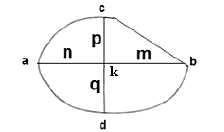
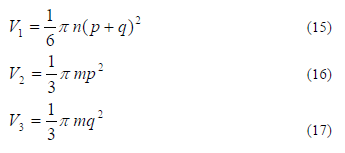
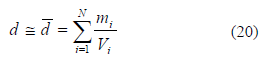
<body><![CDATA[<p><font size="2" face="Verdana, Arial, Helvetica, sans-serif">Once we defined the four   components <i>n, m, p and q</i>, the volumes of the four segments were   approximated by segment of ellipses, those volumes: V<sub>1</sub>, V<sub>2</sub> y V<sub>3</sub>, were defined by the equation 15-17. </font></p>     <p><font size="2" face="Verdana, Arial, Helvetica, sans-serif"><img src="/img/revistas/dyna/v76n160/a31eq151617.gif"></font></p>     <p><font size="2" face="Verdana, Arial, Helvetica, sans-serif">where      V<sub>1</sub> is half part of the volume of   the ellipse formed in the region 1, its ratio is n and <img src="/img/revistas/dyna/v76n160/a31eq048.gif"> ;      V<sub>2</sub> is a quarter part of the   volume of the ellipse formed in the region 2, with ratio p and m;      V<sub>3</sub> is a quarter of the ellipse’s   volume formed in the region 3 with ratio q and m. </font></p>     <p><font size="2" face="Verdana, Arial, Helvetica, sans-serif">The total volume of the mango      V<sub>t</sub> , is defined by the sum of   volumes in each of the regions (see Equation 18). </font></p>     <p><font face="Verdana, Arial, Helvetica, sans-serif"><img src="/img/revistas/dyna/v76n160/a31eq18.gif"></font></p> <font size="2" face="Verdana, Arial, Helvetica, sans-serif"><b>5.3 Average density and approximate weight calculation    <br>  </b>Once the volume of the mango   is obtained, the procedure to approximate the weight is carried out. We use the  relationship among the mass, volume and density (see the Equation 19): </font>     <p><font face="Verdana, Arial, Helvetica, sans-serif"><img src="/img/revistas/dyna/v76n160/a31eq19.gif"></font></p>     <p><font size="2" face="Verdana, Arial, Helvetica, sans-serif">Where, <i>d</i> represents the density of the   fruit, <i>V<sub>t</sub> </i>is the estimated   volume and <i>m</i> is an approximated measuring   of the mass. The density was experimentally defined by a measuring fruit set <i>M</i>. For each one, the mass and the volume   was measured with specialized instruments. Thus, <i>d</i> is defined as the average density estimated from the samples. </font></p>     <p><font size="2" face="Verdana, Arial, Helvetica, sans-serif"><img src="/img/revistas/dyna/v76n160/a31eq20.gif"></font></p>     <p><font size="2" face="Verdana, Arial, Helvetica, sans-serif">Where, <i>N</i> is the size of the   sample <i>M</i> and <i>V<sub>i</sub></i> and         m<sub>i</sub> correspond to the volume and   average weight of each mango respectively.   Because this quantity is an average, it will be most representative if the   sample <i>N</i> is larger. And the estimated   weight will be more accurate (see <a href="#fig06">Figure 6</a>). Finally, the weight is estimated   by the Equation 21. </font></p>     ]]></body>

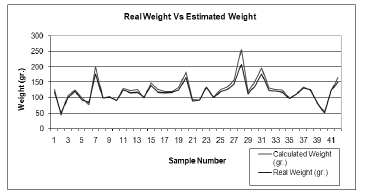
<body><![CDATA[<p><font size="2" face="Verdana, Arial, Helvetica, sans-serif"><img src="/img/revistas/dyna/v76n160/a31eq21.gif"></font></p>     <p align="center"><font size="2" face="Verdana, Arial, Helvetica, sans-serif"><b><a name="fig06"></a><img src="/img/revistas/dyna/v76n160/a31fig06.gif">    <br> Figure 6.</b> Real weight vs Estimated weight </font></p>     <p><font size="2" face="Verdana, Arial, Helvetica, sans-serif">The caliber estimation is made   by a direct comparison of the estimated weight and the <a href="#tab01">Table 1</a> ranges. </font></p>     <p align="center"><font size="2" face="Verdana, Arial, Helvetica, sans-serif"><a name="tab01"></a><b>Table 1.</b> NTC 5139   Technical standard Fruit’s Caliber    <br>   <b>Tabla </b> <b>1</b> <b>.</b> Calibres del mango de az&uacute;car de la norma t&eacute;cnica NTC 5139 </font>    <br>   <img src="/img/revistas/dyna/v76n160/a31tab01.gif"></p>     <p>&nbsp;</p>     <p><font size="3" face="Verdana, Arial, Helvetica, sans-serif"><b>6. EXPERIMENTS   AND RESULTS </b> </font> </p>     <p><font size="2" face="Verdana, Arial, Helvetica, sans-serif">The fixed images used in this study were obtained with   a KODAK digital camera, to control the lens height in relation to the fruit.   The resolution used to take the photos was 1280 x 960 pixels, in .jpg format,   to obtain the best relationship between computational expense and quality of   estimated measurements. A sampling was performed with 142 fruits. An image of   every fruit was taken, and its weight was measured by a scale with grams resolution.   The images where stored in RGB format, for the segmentation stage, in which a   technique of color filtering was used. The illumination factor was worked under   normal conditions with white light. To make the extraction of the mango easier in   relation to the background, a non-reflectant surface painted with black mate   was used. </font></p>     ]]></body>
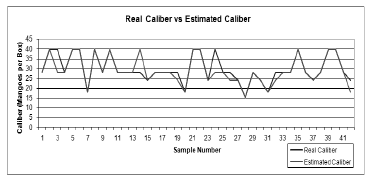
<body><![CDATA[<p><font size="2" face="Verdana, Arial, Helvetica, sans-serif">The algorithms and techniques previously   commented where developed with C++ using OpenCV library &#91;22&#93;, and C# using   Aforge library &#91;23&#93;, and they were executed in a desktop computer, with the   following features: Pentium IV @ 2.8 Ghz, 1GB RAM memory, and 7200 RPM SATA   Hard drive. </font></p> <font size="2" face="Verdana, Arial, Helvetica, sans-serif"><b>6.1 </b> <b>Experimental estimation of average density    <br> </b></font><font size="2" face="Verdana, Arial, Helvetica, sans-serif">To estimate the parameter related to the fruit’s   density, an independent additional sampling was performed in 100 fruits,   randomly selected from a farm. </font>     <p><font size="2" face="Verdana, Arial, Helvetica, sans-serif"><b>6.2 </b> <b>Estimation of weight    <br>   </b></font><font size="2" face="Verdana, Arial, Helvetica, sans-serif">For     the 142 mangoes, their weight was estimated by means of the proposed method,     using the average density which was found. <a href="#fig06">Figure 6</a> shows the behavior of real     weight and the estimated weight for 42 randomly selected fruits. The generated     error in the weight, using previously found density is 11.16g, which indicates that the estimated weight can be ±11.16g from the real weight. </font></p>     <p><font size="2" face="Verdana, Arial, Helvetica, sans-serif"><b>6.3 </b> <b>Estimation of mango caliber by means   of the proposed method    <br>   </b>Once that approximated weight for 142     mangoes was obtained by means of their image analysis, its caliber was     estimated by means of caliber table of NTC-5139. <a href="#fig07">Figure 7</a> shows the behavior of     estimated caliber in relation with real caliber for the first 42 mangoes of the     sampling of 142 mangoes. </font></p>     <p align="center"><font size="2" face="Verdana, Arial, Helvetica, sans-serif"><b><a name="fig07"></a><img src="/img/revistas/dyna/v76n160/a31fig07.gif">    <br> Figure 7</b>. Real caliber vs Estimated caliber </font></p>     <p><font size="2" face="Verdana, Arial, Helvetica, sans-serif">The effectiveness percentage in the   calculation of sugar mango caliber calculation by means of estimated weight was 83.3%. </font></p>     <p><font size="2" face="Verdana, Arial, Helvetica, sans-serif"><b>6.4 </b> <b> Experimental Estimation Of Model Histograms    ]]></body>
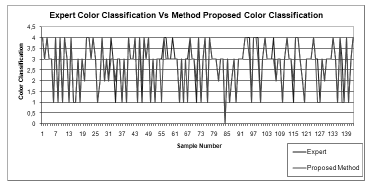
<body><![CDATA[<br>   </b></font><font size="2" face="Verdana, Arial, Helvetica, sans-serif">To     estimate model histograms required for automatic classification of mango's     color, a sampling was performed on 40 mangoes by an expert. Once those images     were obtained for every mango, H and S average histograms of every color classification were found.</font></p>     <p><font size="2" face="Verdana, Arial, Helvetica, sans-serif"><b>6.5 </b> <b>Color estimation of the mango by   means of the proposed method    <br>   </b>Once that model histograms were found for     the 5 classifications of the norm through the latter sampling of 40 mangoes,     the color was evaluated for the sampling of 142 mangoes by means of the mean     square error method in histograms. In <a href="#fig08">Figure 8</a>, the color classification     performed by the expert can be observed, and the color classification performed     by means of square error method in histograms. For the sampling of 142 mangoes,     the automatic classification method generated an accurateness percentage of 99.29%. </font></p>     <p align="center"><font size="2" face="Verdana, Arial, Helvetica, sans-serif"><b><a name="fig08"></a><img src="/img/revistas/dyna/v76n160/a31fig08.gif">    <br>   Figure 8.</b> Automatic  vs Manual Expert Color-Classification Method </font></p> <font size="2" face="Verdana, Arial, Helvetica, sans-serif"><b>6.6 </b> <b>Processing time of mango´s  classification method    <br> </b>The    estimation of process times was performed since the image entered at the    pre-processing stage, until the values of mango's caliber and color classification were estimated. </font><font face="Verdana, Arial, Helvetica, sans-serif">     <p><font size="2">The average time generated for the    developed algorithms was 2.1 seconds. This time varies notoriously according to    captured image resolution, which can be reduced according to the quality of the camera in use. </font></p>     <p>&nbsp;</p> </font>     <p><font size="3" face="Verdana, Arial, Helvetica, sans-serif"><b>7. CONCLUSIONS </b></font></p>  <font face="Verdana, Arial, Helvetica, sans-serif">     <p><font size="2">The method proposed in this work for weight    estimation of sugar mango (Mangifera Indica L.) using computer vision techniques    presents, according to the performed tests, a good approximation for    measurement of this property (weight), and therefore the volume. Its main    feature is that it is completely automatic and because of the higher    computational load associated to the equation system resolution which forms the co-variance matrix, this method results computationally efficient. </font></p>     ]]></body>
<body><![CDATA[<p><font size="2">The assembly required for implementing a    system based in the proposed method is simple and cheap, because a personal    computer and a standard color camera can be used for it. In addition to this, it    is possible to extend this study to other fruits with similar density as orange and watermelon is shown. </font></p>     <p><font size="2">The generated error is near to 11g average.    However it is possible to reduce this error, by increasing the size of    estimation samples. Equally, the roundness of the fruit improves the    ellipsoidal approximation, so, it would be convenient to study a penalty factor    on the weight according to the fruit roundness level. An additional aspect    which was not addressed in this work is the study of the effect of the maturity    level in relation to the density estimation. If it were possible to establish    this relationship, an extension based in the study of color which indicates the maturity level, would help to augment the precision of estimation. </font></p>     <p>&nbsp;</p>  </font>     <p><font size="3" face="Verdana, Arial, Helvetica, sans-serif"><b>REFERENCES </b></font></p>     <!-- ref --><p><font size="2" face="Verdana, Arial, Helvetica, sans-serif"><b>&#91;1&#93;</b> ICONTEC, Colombian technical Standard NTC 5139, Frutas frescas. Mangos criollos. Especificaciones, ICONTEC, Bogot&aacute; D.C, 2002.     &nbsp;&nbsp;&nbsp;&nbsp;&nbsp;&nbsp;&nbsp;&nbsp;[&#160;<a href="javascript:void(0);" onclick="javascript: window.open('/scielo.php?script=sci_nlinks&ref=000127&pid=S0012-7353200900040003100001&lng=','','width=640,height=500,resizable=yes,scrollbars=1,menubar=yes,');">Links</a>&#160;]<!-- end-ref --><!-- ref --><br>     <b>&#91;2&#93;</b> Domenico, S., AND Gary , W. Machine vision and neural nets in food processing and packaging—natural way combinations. In Food processing automation III—Proceedings of the FPAC conference (pp. 11). Orlando , Fl: ASAE., 1994.     &nbsp;&nbsp;&nbsp;&nbsp;&nbsp;&nbsp;&nbsp;&nbsp;[&#160;<a href="javascript:void(0);" onclick="javascript: window.open('/scielo.php?script=sci_nlinks&ref=000128&pid=S0012-7353200900040003100002&lng=','','width=640,height=500,resizable=yes,scrollbars=1,menubar=yes,');">Links</a>&#160;]<!-- end-ref --><!-- ref --><br>     <b>&#91;3&#93;</b> Abdullah, M. Z., Guan, L. C., Lim, K. C., AND Karim, A. A. The applications of computer vision system and tomographic radar imaging for assessing physical properties of food, Journal of Food Engineering, 125–135, 2004.     &nbsp;&nbsp;&nbsp;&nbsp;&nbsp;&nbsp;&nbsp;&nbsp;[&#160;<a href="javascript:void(0);" onclick="javascript: window.open('/scielo.php?script=sci_nlinks&ref=000129&pid=S0012-7353200900040003100003&lng=','','width=640,height=500,resizable=yes,scrollbars=1,menubar=yes,');">Links</a>&#160;]<!-- end-ref --><!-- ref --><br>     <b>&#91;4&#93;</b> Mitchell, R. S., Sherlock, R. A., and Smith, L. A. An Investigation Into The Use Of Machine Learning For Determining Oestrus In Cows, Computers and Electronics in Agriculture, 15, 95–213, 1996.     &nbsp;&nbsp;&nbsp;&nbsp;&nbsp;&nbsp;&nbsp;&nbsp;[&#160;<a href="javascript:void(0);" onclick="javascript: window.open('/scielo.php?script=sci_nlinks&ref=000130&pid=S0012-7353200900040003100004&lng=','','width=640,height=500,resizable=yes,scrollbars=1,menubar=yes,');">Links</a>&#160;]<!-- end-ref --><!-- ref --><br>     <b>&#91;5&#93;</b> Michie, D. Methodologies from machine learning in data analysis and software, The Computer Journal, 34, 559–565, 1991.     &nbsp;&nbsp;&nbsp;&nbsp;&nbsp;&nbsp;&nbsp;&nbsp;[&#160;<a href="javascript:void(0);" onclick="javascript: window.open('/scielo.php?script=sci_nlinks&ref=000131&pid=S0012-7353200900040003100005&lng=','','width=640,height=500,resizable=yes,scrollbars=1,menubar=yes,');">Links</a>&#160;]<!-- end-ref --><!-- ref --><br>     <b>&#91;6&#93;</b> Vizh&aacute;ny&aacute; , T., AND Felfoldi, J. Enhancing colour differences in images of diseased mushrooms, Computers and Electronics in Agriculture, 26, 187–198, 2000.     &nbsp;&nbsp;&nbsp;&nbsp;&nbsp;&nbsp;&nbsp;&nbsp;[&#160;<a href="javascript:void(0);" onclick="javascript: window.open('/scielo.php?script=sci_nlinks&ref=000132&pid=S0012-7353200900040003100006&lng=','','width=640,height=500,resizable=yes,scrollbars=1,menubar=yes,');">Links</a>&#160;]<!-- end-ref --><!-- ref --><br>     <b>&#91;7&#93;</b>  Bato, P.M., Nagata, M., Cao, Q.X., Hiyoshi, K., and Kitahara, T. Study on sorting system for strawberry using machine vision (part 2): development of sorting system with direction and judgement functions for trawberry (Akihime variety), Journal of the Japanese Society of Agricultural Machinery, 62, 101-110, 2000.        &nbsp;&nbsp;&nbsp;&nbsp;&nbsp;&nbsp;&nbsp;&nbsp;[&#160;<a href="javascript:void(0);" onclick="javascript: window.open('/scielo.php?script=sci_nlinks&ref=000133&pid=S0012-7353200900040003100007&lng=','','width=640,height=500,resizable=yes,scrollbars=1,menubar=yes,');">Links</a>&#160;]<!-- end-ref --><!-- ref --><br>     <b>&#91;8&#93;</b>  Paulus, I. and Schrevens, E. Shape characterisation of new apple cultivars by Fourier expansion of digital images, Journal of Agricultural Engineering Research, 72, 113-118, 1999.        &nbsp;&nbsp;&nbsp;&nbsp;&nbsp;&nbsp;&nbsp;&nbsp;[&#160;<a href="javascript:void(0);" onclick="javascript: window.open('/scielo.php?script=sci_nlinks&ref=000134&pid=S0012-7353200900040003100008&lng=','','width=640,height=500,resizable=yes,scrollbars=1,menubar=yes,');">Links</a>&#160;]<!-- end-ref --><!-- ref --><br>     <b>&#91;9&#93;</b> Shearer, S. A. and Payne, F. A. Color and defect sorting of bell peppers using machine vision, Transactions of the ASAE, 33, 2045–2050, 1990.     &nbsp;&nbsp;&nbsp;&nbsp;&nbsp;&nbsp;&nbsp;&nbsp;[&#160;<a href="javascript:void(0);" onclick="javascript: window.open('/scielo.php?script=sci_nlinks&ref=000135&pid=S0012-7353200900040003100009&lng=','','width=640,height=500,resizable=yes,scrollbars=1,menubar=yes,');">Links</a>&#160;]<!-- end-ref --><!-- ref --><br>     <b>&#91;10&#93;</b>  Morrow, C.T., Heinemann, P.H., Sommer, H.J., Tao, Y. and Varghese, Z. Automate inspection of potatoes, apples, and mushrooms, Proceedings of the International Advanced Robotics Programme, Avignon, 179-188,1990.        &nbsp;&nbsp;&nbsp;&nbsp;&nbsp;&nbsp;&nbsp;&nbsp;[&#160;<a href="javascript:void(0);" onclick="javascript: window.open('/scielo.php?script=sci_nlinks&ref=000136&pid=S0012-7353200900040003100010&lng=','','width=640,height=500,resizable=yes,scrollbars=1,menubar=yes,');">Links</a>&#160;]<!-- end-ref --><!-- ref --><br>     <b>&#91;11&#93;</b>  Batchelor, M.M. and Searcy, S.W. Computer vision determination of stem/root joint on processing carrots, Journal of Agricultural Engineering Research, 43, 259-269, 1989.        &nbsp;&nbsp;&nbsp;&nbsp;&nbsp;&nbsp;&nbsp;&nbsp;[&#160;<a href="javascript:void(0);" onclick="javascript: window.open('/scielo.php?script=sci_nlinks&ref=000137&pid=S0012-7353200900040003100011&lng=','','width=640,height=500,resizable=yes,scrollbars=1,menubar=yes,');">Links</a>&#160;]<!-- end-ref --><!-- ref --><br>     <b>&#91;12&#93;</b>  Howarth, M.S. and Searcy, S.W. Inspection of fresh carrots by machine vision, Food Processing Automation II, ASAE , USA , 1992.        &nbsp;&nbsp;&nbsp;&nbsp;&nbsp;&nbsp;&nbsp;&nbsp;[&#160;<a href="javascript:void(0);" onclick="javascript: window.open('/scielo.php?script=sci_nlinks&ref=000138&pid=S0012-7353200900040003100012&lng=','','width=640,height=500,resizable=yes,scrollbars=1,menubar=yes,');">Links</a>&#160;]<!-- end-ref --><!-- ref --><br>     <b>&#91;13&#93;</b>  Tollner, E.W., Shahin, M.A., Maw, B.W., Gilaitis, R.D. and Summer, D.R. Classification of onions based on internal defects using imaging processing and natural network techniques, ASAE International Meeting, Toronto, Onteroi, Paper no. 993165, ASAF, 2950 Niles Road, St. Joseph, MI 49085-9659, USA, 1999.        &nbsp;&nbsp;&nbsp;&nbsp;&nbsp;&nbsp;&nbsp;&nbsp;[&#160;<a href="javascript:void(0);" onclick="javascript: window.open('/scielo.php?script=sci_nlinks&ref=000139&pid=S0012-7353200900040003100013&lng=','','width=640,height=500,resizable=yes,scrollbars=1,menubar=yes,');">Links</a>&#160;]<!-- end-ref --><!-- ref --><br>     <b>&#91;14&#93;</b>  Tadhg B. and Da-Wen, S. Inspection and grading of agricultural and food products by computer vision systems--a review, Computers and Electronics in Agriculture, 36, 193-213, 2002.        &nbsp;&nbsp;&nbsp;&nbsp;&nbsp;&nbsp;&nbsp;&nbsp;[&#160;<a href="javascript:void(0);" onclick="javascript: window.open('/scielo.php?script=sci_nlinks&ref=000140&pid=S0012-7353200900040003100014&lng=','','width=640,height=500,resizable=yes,scrollbars=1,menubar=yes,');">Links</a>&#160;]<!-- end-ref --><!-- ref --><br>     <b>&#91;15&#93;</b> PAJARES G. Visi&oacute;n por computador: im&aacute;genes digitales y aplicaciones, ALFAOMEGA Grupo Editor, 2002.     &nbsp;&nbsp;&nbsp;&nbsp;&nbsp;&nbsp;&nbsp;&nbsp;[&#160;<a href="javascript:void(0);" onclick="javascript: window.open('/scielo.php?script=sci_nlinks&ref=000141&pid=S0012-7353200900040003100015&lng=','','width=640,height=500,resizable=yes,scrollbars=1,menubar=yes,');">Links</a>&#160;]<!-- end-ref --><!-- ref --><br>     <b>&#91;16&#93;</b> Sun, D.W. and Du, C. J. Segmentation of complex food images by stick growing and merging algorithm, Journal of Food Engineering, 61, 17–26, 2004.     &nbsp;&nbsp;&nbsp;&nbsp;&nbsp;&nbsp;&nbsp;&nbsp;[&#160;<a href="javascript:void(0);" onclick="javascript: window.open('/scielo.php?script=sci_nlinks&ref=000142&pid=S0012-7353200900040003100016&lng=','','width=640,height=500,resizable=yes,scrollbars=1,menubar=yes,');">Links</a>&#160;]<!-- end-ref --><!-- ref --><br>     <b>&#91;17&#93;</b>  DU, C. AND SUN, D. Learning techniques used in computer vision for food quality evaluation: a review, Journal of Food Engineering 72, 39-55, 2006.        &nbsp;&nbsp;&nbsp;&nbsp;&nbsp;&nbsp;&nbsp;&nbsp;[&#160;<a href="javascript:void(0);" onclick="javascript: window.open('/scielo.php?script=sci_nlinks&ref=000143&pid=S0012-7353200900040003100017&lng=','','width=640,height=500,resizable=yes,scrollbars=1,menubar=yes,');">Links</a>&#160;]<!-- end-ref --><!-- ref --><br>     <b>&#91;18&#93;</b>  Vasquez-Caicedo, A.L., Neidhart, S. and et al. Physical, Chemical, and Sensory Properties of Nine Thai Mango Cultivars and Evaluation of their Technological and Nutritional Potential, International Symposium: Sustaining Food Security and Managing Natural Resources in Southeast Asia Challenges for the 21st Century, 8-11, 2002.        &nbsp;&nbsp;&nbsp;&nbsp;&nbsp;&nbsp;&nbsp;&nbsp;[&#160;<a href="javascript:void(0);" onclick="javascript: window.open('/scielo.php?script=sci_nlinks&ref=000144&pid=S0012-7353200900040003100018&lng=','','width=640,height=500,resizable=yes,scrollbars=1,menubar=yes,');">Links</a>&#160;]<!-- end-ref --><!-- ref --><br>     <b>&#91;19&#93;</b>  Yimyam, P, Chalidabhongse, T, Sirisomboon, P. and Boonmung. S. Physical properties analysis of mango using computer vision, Proceeding of ICCAS, 2005.        &nbsp;&nbsp;&nbsp;&nbsp;&nbsp;&nbsp;&nbsp;&nbsp;[&#160;<a href="javascript:void(0);" onclick="javascript: window.open('/scielo.php?script=sci_nlinks&ref=000145&pid=S0012-7353200900040003100019&lng=','','width=640,height=500,resizable=yes,scrollbars=1,menubar=yes,');">Links</a>&#160;]<!-- end-ref --><!-- ref --><br>     <b>&#91;20&#93;</b>  DUDA, R. Pattern Classification Second Edition, Wiley-Interscience, 2000.        &nbsp;&nbsp;&nbsp;&nbsp;&nbsp;&nbsp;&nbsp;&nbsp;[&#160;<a href="javascript:void(0);" onclick="javascript: window.open('/scielo.php?script=sci_nlinks&ref=000146&pid=S0012-7353200900040003100020&lng=','','width=640,height=500,resizable=yes,scrollbars=1,menubar=yes,');">Links</a>&#160;]<!-- end-ref --><!-- ref --><br>     <b>&#91;21&#93;</b> GUZM&Aacute;N C., Alcalde, S., Mosqueda R. and Mart&iacute;nez, A. Ecuaci&oacute;n para estimar el volumen y din&aacute;mica de crecimiento del fruto de mango cv. Manila, Revista Agronom&iacute;a Tropical, 46, 395-412, 1996.     &nbsp;&nbsp;&nbsp;&nbsp;&nbsp;&nbsp;&nbsp;&nbsp;[&#160;<a href="javascript:void(0);" onclick="javascript: window.open('/scielo.php?script=sci_nlinks&ref=000147&pid=S0012-7353200900040003100021&lng=','','width=640,height=500,resizable=yes,scrollbars=1,menubar=yes,');">Links</a>&#160;]<!-- end-ref --><!-- ref --><br>     <b>&#91;22&#93;</b>  Source Forge, Open Computer Vision Library, Available: <a href="http://sourceforge.net/projects/opencvlibrary/">http://sourceforge.net/projects/opencvlibrary/</a>, 2009 &#91;cited October 2th of 2009&#93;</b> .        &nbsp;&nbsp;&nbsp;&nbsp;&nbsp;&nbsp;&nbsp;&nbsp;[&#160;<a href="javascript:void(0);" onclick="javascript: window.open('/scielo.php?script=sci_nlinks&ref=000148&pid=S0012-7353200900040003100022&lng=','','width=640,height=500,resizable=yes,scrollbars=1,menubar=yes,');">Links</a>&#160;]<!-- end-ref --><!-- ref --><br>    <b>&#91;23&#93;</b>  Aforge.Net, C# Computer Vision Framework, Available: <a href="http://www.aforgenet.com/framework/">http://www.aforgenet.com/framework/</a> , 2009 &#91;cited October 2th of 2009&#93;</b> .</font> &nbsp;&nbsp;&nbsp;&nbsp;&nbsp;&nbsp;&nbsp;&nbsp;[&#160;<a href="javascript:void(0);" onclick="javascript: window.open('/scielo.php?script=sci_nlinks&ref=000149&pid=S0012-7353200900040003100023&lng=','','width=640,height=500,resizable=yes,scrollbars=1,menubar=yes,');">Links</a>&#160;]<!-- end-ref --> ]]></body><back>
<ref-list>
<ref id="B1">
<label>1</label><nlm-citation citation-type="book">
<collab>ICONTEC</collab>
<source><![CDATA[Colombian technical Standard NTC 5139: Frutas frescas. Mangos criollos. Especificaciones]]></source>
<year>2002</year>
<publisher-loc><![CDATA[Bogotá D.C ]]></publisher-loc>
<publisher-name><![CDATA[ICONTEC]]></publisher-name>
</nlm-citation>
</ref>
<ref id="B2">
<label>2</label><nlm-citation citation-type="confpro">
<person-group person-group-type="author">
<name>
<surname><![CDATA[Domenico]]></surname>
<given-names><![CDATA[S.]]></given-names>
</name>
<name>
<surname><![CDATA[Gary]]></surname>
<given-names><![CDATA[W.]]></given-names>
</name>
</person-group>
<article-title xml:lang="en"><![CDATA[Machine vision and neural nets in food processing and packaging-natural way combinations]]></article-title>
<source><![CDATA[]]></source>
<year></year>
<conf-name><![CDATA[III Food processing automation]]></conf-name>
<conf-date>1994</conf-date>
<conf-loc>Orlando Fl</conf-loc>
</nlm-citation>
</ref>
<ref id="B3">
<label>3</label><nlm-citation citation-type="journal">
<person-group person-group-type="author">
<name>
<surname><![CDATA[Abdullah]]></surname>
<given-names><![CDATA[M. Z.]]></given-names>
</name>
<name>
<surname><![CDATA[Guan]]></surname>
<given-names><![CDATA[L. C.]]></given-names>
</name>
<name>
<surname><![CDATA[Lim]]></surname>
<given-names><![CDATA[K. C.]]></given-names>
</name>
<name>
<surname><![CDATA[Karim]]></surname>
<given-names><![CDATA[A. A.]]></given-names>
</name>
</person-group>
<article-title xml:lang="en"><![CDATA[The applications of computer vision system and tomographic radar imaging for assessing physical properties of food]]></article-title>
<source><![CDATA[Journal of Food Engineering]]></source>
<year>2004</year>
<page-range>125-135</page-range></nlm-citation>
</ref>
<ref id="B4">
<label>4</label><nlm-citation citation-type="journal">
<person-group person-group-type="author">
<name>
<surname><![CDATA[Mitchell]]></surname>
<given-names><![CDATA[R. S.]]></given-names>
</name>
<name>
<surname><![CDATA[Sherlock]]></surname>
<given-names><![CDATA[R. A.]]></given-names>
</name>
<name>
<surname><![CDATA[Smith]]></surname>
<given-names><![CDATA[L. A.]]></given-names>
</name>
</person-group>
<article-title xml:lang="en"><![CDATA[An Investigation Into The Use Of Machine Learning For Determining Oestrus In Cows]]></article-title>
<source><![CDATA[Computers and Electronics in Agriculture]]></source>
<year>1996</year>
<volume>15</volume>
<page-range>95-213</page-range></nlm-citation>
</ref>
<ref id="B5">
<label>5</label><nlm-citation citation-type="journal">
<person-group person-group-type="author">
<name>
<surname><![CDATA[Michie]]></surname>
<given-names><![CDATA[D.]]></given-names>
</name>
</person-group>
<article-title xml:lang="en"><![CDATA[Methodologies from machine learning in data analysis and software]]></article-title>
<source><![CDATA[The Computer Journal]]></source>
<year>1991</year>
<volume>34</volume>
<page-range>559-565</page-range></nlm-citation>
</ref>
<ref id="B6">
<label>6</label><nlm-citation citation-type="journal">
<person-group person-group-type="author">
<name>
<surname><![CDATA[Vizhányá]]></surname>
<given-names><![CDATA[T.]]></given-names>
</name>
<name>
<surname><![CDATA[Felfoldi]]></surname>
<given-names><![CDATA[J.]]></given-names>
</name>
</person-group>
<article-title xml:lang="en"><![CDATA[Enhancing colour differences in images of diseased mushrooms]]></article-title>
<source><![CDATA[Computers and Electronics in Agriculture]]></source>
<year>2000</year>
<volume>26</volume>
<page-range>187-198</page-range></nlm-citation>
</ref>
<ref id="B7">
<label>7</label><nlm-citation citation-type="journal">
<person-group person-group-type="author">
<name>
<surname><![CDATA[Bato]]></surname>
<given-names><![CDATA[P.M.]]></given-names>
</name>
<name>
<surname><![CDATA[Nagata]]></surname>
<given-names><![CDATA[M.]]></given-names>
</name>
<name>
<surname><![CDATA[Cao]]></surname>
<given-names><![CDATA[Q.X.]]></given-names>
</name>
<name>
<surname><![CDATA[Hiyoshi]]></surname>
<given-names><![CDATA[K.]]></given-names>
</name>
<name>
<surname><![CDATA[Kitahara]]></surname>
<given-names><![CDATA[T.]]></given-names>
</name>
</person-group>
<article-title xml:lang="en"><![CDATA[Study on sorting system for strawberry using machine vision: (part 2): development of sorting system with direction and judgement functions for trawberry (Akihime variety)]]></article-title>
<source><![CDATA[Journal of the Japanese Society of Agricultural Machinery]]></source>
<year>2000</year>
<page-range>101-110</page-range></nlm-citation>
</ref>
<ref id="B8">
<label>8</label><nlm-citation citation-type="journal">
<person-group person-group-type="author">
<name>
<surname><![CDATA[Paulus]]></surname>
<given-names><![CDATA[I.]]></given-names>
</name>
<name>
<surname><![CDATA[Schrevens]]></surname>
<given-names><![CDATA[E.]]></given-names>
</name>
</person-group>
<article-title xml:lang="en"><![CDATA[Shape characterisation of new apple cultivars by Fourier expansion of digital images]]></article-title>
<source><![CDATA[Journal of Agricultural Engineering Research]]></source>
<year>1999</year>
<volume>72</volume>
<page-range>113-118</page-range></nlm-citation>
</ref>
<ref id="B9">
<label>9</label><nlm-citation citation-type="journal">
<person-group person-group-type="author">
<name>
<surname><![CDATA[Shearer]]></surname>
<given-names><![CDATA[S. A.]]></given-names>
</name>
<name>
<surname><![CDATA[Payne]]></surname>
<given-names><![CDATA[F. A.]]></given-names>
</name>
</person-group>
<article-title xml:lang="en"><![CDATA[Color and defect sorting of bell peppers using machine vision]]></article-title>
<source><![CDATA[Transactions of the ASAE]]></source>
<year>1990</year>
<volume>33</volume>
<page-range>2045-2050</page-range></nlm-citation>
</ref>
<ref id="B10">
<label>10</label><nlm-citation citation-type="book">
<person-group person-group-type="author">
<name>
<surname><![CDATA[Morrow]]></surname>
<given-names><![CDATA[C.T.]]></given-names>
</name>
<name>
<surname><![CDATA[Heinemann]]></surname>
<given-names><![CDATA[P.H.]]></given-names>
</name>
<name>
<surname><![CDATA[Sommer]]></surname>
<given-names><![CDATA[H.J.]]></given-names>
</name>
<name>
<surname><![CDATA[Tao]]></surname>
<given-names><![CDATA[Y.]]></given-names>
</name>
<name>
<surname><![CDATA[Varghese]]></surname>
<given-names><![CDATA[Z.]]></given-names>
</name>
</person-group>
<article-title xml:lang="en"><![CDATA[Automate inspection of potatoes, apples, and mushrooms]]></article-title>
<source><![CDATA[Proceedings of the International Advanced Robotics Programme]]></source>
<year>1990</year>
<page-range>179-188</page-range><publisher-name><![CDATA[Avignon]]></publisher-name>
</nlm-citation>
</ref>
<ref id="B11">
<label>11</label><nlm-citation citation-type="journal">
<person-group person-group-type="author">
<name>
<surname><![CDATA[Batchelor]]></surname>
<given-names><![CDATA[M.M.]]></given-names>
</name>
<name>
<surname><![CDATA[Searcy]]></surname>
<given-names><![CDATA[S.W.]]></given-names>
</name>
</person-group>
<article-title xml:lang="en"><![CDATA[Computer vision determination of stem/root joint on processing carrots]]></article-title>
<source><![CDATA[Journal of Agricultural Engineering Research]]></source>
<year>1989</year>
<volume>43</volume>
<page-range>259-269</page-range></nlm-citation>
</ref>
<ref id="B12">
<label>12</label><nlm-citation citation-type="confpro">
<person-group person-group-type="author">
<name>
<surname><![CDATA[Howarth]]></surname>
<given-names><![CDATA[M.S.]]></given-names>
</name>
<name>
<surname><![CDATA[Searcy]]></surname>
<given-names><![CDATA[S.W.]]></given-names>
</name>
</person-group>
<article-title xml:lang="en"><![CDATA[Inspection of fresh carrots by machine vision]]></article-title>
<source><![CDATA[]]></source>
<year></year>
<conf-name><![CDATA[ Food Processing Automation II]]></conf-name>
<conf-date>1992</conf-date>
<conf-loc> </conf-loc>
</nlm-citation>
</ref>
<ref id="B13">
<label>13</label><nlm-citation citation-type="confpro">
<person-group person-group-type="author">
<name>
<surname><![CDATA[Tollner]]></surname>
<given-names><![CDATA[E.W.]]></given-names>
</name>
<name>
<surname><![CDATA[Shahin]]></surname>
<given-names><![CDATA[M.A.]]></given-names>
</name>
<name>
<surname><![CDATA[Maw]]></surname>
<given-names><![CDATA[B.W.]]></given-names>
</name>
<name>
<surname><![CDATA[Gilaitis]]></surname>
<given-names><![CDATA[R.D.]]></given-names>
</name>
<name>
<surname><![CDATA[Summer]]></surname>
<given-names><![CDATA[D.R.]]></given-names>
</name>
</person-group>
<article-title xml:lang="en"><![CDATA[Classification of onions based on internal defects using imaging processing and natural network techniques]]></article-title>
<source><![CDATA[Paper no. 993165]]></source>
<year>1999</year>
<conf-name><![CDATA[ ASAE International Meeting]]></conf-name>
<conf-loc>Toronto Onteroi</conf-loc>
</nlm-citation>
</ref>
<ref id="B14">
<label>14</label><nlm-citation citation-type="journal">
<person-group person-group-type="author">
<name>
<surname><![CDATA[Tadhg]]></surname>
<given-names><![CDATA[B.]]></given-names>
</name>
<name>
<surname><![CDATA[Da-Wen]]></surname>
<given-names><![CDATA[S.]]></given-names>
</name>
</person-group>
<article-title xml:lang="en"><![CDATA[Inspection and grading of agricultural and food products by computer vision systems: a review]]></article-title>
<source><![CDATA[Computers and Electronics in Agriculture]]></source>
<year>2002</year>
<volume>36</volume>
<page-range>193-213</page-range></nlm-citation>
</ref>
<ref id="B15">
<label>15</label><nlm-citation citation-type="book">
<person-group person-group-type="author">
<name>
<surname><![CDATA[PAJARES]]></surname>
<given-names><![CDATA[G.]]></given-names>
</name>
</person-group>
<source><![CDATA[Visión por computador: imágenes digitales y aplicaciones]]></source>
<year>2002</year>
<publisher-name><![CDATA[ALFAOMEGA Grupo Editor]]></publisher-name>
</nlm-citation>
</ref>
<ref id="B16">
<label>16</label><nlm-citation citation-type="journal">
<person-group person-group-type="author">
<name>
<surname><![CDATA[Sun]]></surname>
<given-names><![CDATA[D.W.]]></given-names>
</name>
<name>
<surname><![CDATA[Du]]></surname>
<given-names><![CDATA[C. J.]]></given-names>
</name>
</person-group>
<article-title xml:lang="en"><![CDATA[Segmentation of complex food images by stick growing and merging algorithm]]></article-title>
<source><![CDATA[Journal of Food Engineering]]></source>
<year>2004</year>
<volume>61</volume>
<page-range>17-26</page-range></nlm-citation>
</ref>
<ref id="B17">
<label>17</label><nlm-citation citation-type="journal">
<person-group person-group-type="author">
<name>
<surname><![CDATA[DU]]></surname>
<given-names><![CDATA[C.]]></given-names>
</name>
<name>
<surname><![CDATA[SUN]]></surname>
<given-names><![CDATA[D.]]></given-names>
</name>
</person-group>
<article-title xml:lang="en"><![CDATA[techniques used in computer vision for food quality evaluation: a review]]></article-title>
<source><![CDATA[Journal of Food Engineering]]></source>
<year>2006</year>
<volume>72</volume>
<page-range>39-55</page-range></nlm-citation>
</ref>
<ref id="B18">
<label>18</label><nlm-citation citation-type="confpro">
<person-group person-group-type="author">
<name>
<surname><![CDATA[Vasquez-Caicedo]]></surname>
<given-names><![CDATA[A.L.]]></given-names>
</name>
<name>
<surname><![CDATA[Neidhart]]></surname>
<given-names><![CDATA[S.]]></given-names>
</name>
</person-group>
<article-title xml:lang="en"><![CDATA[Physical, Chemical, and Sensory Properties of Nine Thai Mango Cultivars and Evaluation of their Technological and Nutritional Potential]]></article-title>
<source><![CDATA[]]></source>
<year>2002</year>
<conf-name><![CDATA[ International Symposium: Sustaining Food Security and Managing Natural Resources in Southeast Asia Challenges for the 21st Century]]></conf-name>
<conf-loc> </conf-loc>
<page-range>8-11</page-range></nlm-citation>
</ref>
<ref id="B19">
<label>19</label><nlm-citation citation-type="confpro">
<person-group person-group-type="author">
<name>
<surname><![CDATA[Yimyam]]></surname>
<given-names><![CDATA[P]]></given-names>
</name>
<name>
<surname><![CDATA[Chalidabhongse]]></surname>
<given-names><![CDATA[T]]></given-names>
</name>
<name>
<surname><![CDATA[Sirisomboon]]></surname>
<given-names><![CDATA[P.]]></given-names>
</name>
<name>
<surname><![CDATA[Boonmung]]></surname>
<given-names><![CDATA[S.]]></given-names>
</name>
</person-group>
<article-title xml:lang="en"><![CDATA[Physical properties analysis of mango using computer vision]]></article-title>
<source><![CDATA[]]></source>
<year></year>
<conf-name><![CDATA[ Proceeding of ICCAS]]></conf-name>
<conf-date>2005</conf-date>
<conf-loc> </conf-loc>
</nlm-citation>
</ref>
<ref id="B20">
<label>20</label><nlm-citation citation-type="book">
<person-group person-group-type="author">
<name>
<surname><![CDATA[DUDA]]></surname>
<given-names><![CDATA[R.]]></given-names>
</name>
</person-group>
<source><![CDATA[Pattern Classification]]></source>
<year>2000</year>
<edition>Second</edition>
<publisher-name><![CDATA[Wiley-Interscience]]></publisher-name>
</nlm-citation>
</ref>
<ref id="B21">
<label>21</label><nlm-citation citation-type="journal">
<person-group person-group-type="author">
<name>
<surname><![CDATA[GUZMÁN]]></surname>
<given-names><![CDATA[C.]]></given-names>
</name>
<name>
<surname><![CDATA[Alcalde]]></surname>
<given-names><![CDATA[S.]]></given-names>
</name>
<name>
<surname><![CDATA[Mosqueda]]></surname>
<given-names><![CDATA[R.]]></given-names>
</name>
<name>
<surname><![CDATA[Martínez]]></surname>
<given-names><![CDATA[A.]]></given-names>
</name>
</person-group>
<article-title xml:lang="es"><![CDATA[Ecuación para estimar el volumen y dinámica de crecimiento del fruto de mango cv. Manila]]></article-title>
<source><![CDATA[Revista Agronomía Tropical]]></source>
<year>1996</year>
<volume>46</volume>
<page-range>395-412</page-range></nlm-citation>
</ref>
<ref id="B22">
<label>22</label><nlm-citation citation-type="">
<collab>Source Forge</collab>
<source><![CDATA[Open Computer Vision Library]]></source>
<year></year>
</nlm-citation>
</ref>
<ref id="B23">
<label>23</label><nlm-citation citation-type="">
<collab>Aforge.Net</collab>
<source><![CDATA[C# Computer Vision Framework]]></source>
<year></year>
</nlm-citation>
</ref>
</ref-list>
</back>
</article>