<?xml version="1.0" encoding="ISO-8859-1"?><article xmlns:mml="http://www.w3.org/1998/Math/MathML" xmlns:xlink="http://www.w3.org/1999/xlink" xmlns:xsi="http://www.w3.org/2001/XMLSchema-instance">
<front>
<journal-meta>
<journal-id>0012-7353</journal-id>
<journal-title><![CDATA[DYNA]]></journal-title>
<abbrev-journal-title><![CDATA[Dyna rev.fac.nac.minas]]></abbrev-journal-title>
<issn>0012-7353</issn>
<publisher>
<publisher-name><![CDATA[Universidad Nacional de Colombia]]></publisher-name>
</publisher>
</journal-meta>
<article-meta>
<article-id>S0012-73532010000100006</article-id>
<title-group>
<article-title xml:lang="en"><![CDATA[STABILITY ANALYSES OF FOOTWALL SLOPES IN OPEN PIT MINING]]></article-title>
<article-title xml:lang="es"><![CDATA[ANÁLISIS DE ESTABILIDAD DE TALUDES DE MURO EN EXPLOTACIONES MINERAS A CIELO ABIERTO]]></article-title>
</title-group>
<contrib-group>
<contrib contrib-type="author">
<name>
<surname><![CDATA[ALEJANO]]></surname>
<given-names><![CDATA[LEANDRO R.]]></given-names>
</name>
<xref ref-type="aff" rid="A01"/>
</contrib>
<contrib contrib-type="author">
<name>
<surname><![CDATA[SÁNCHEZ JUNCAL]]></surname>
<given-names><![CDATA[ABEL]]></given-names>
</name>
<xref ref-type="aff" rid="A02"/>
</contrib>
</contrib-group>
<aff id="A01">
<institution><![CDATA[,Universidad de Vigo Departamento de Ingeniería de los Recursos Naturales y Medio Ambiente ]]></institution>
<addr-line><![CDATA[ ]]></addr-line>
<country>España</country>
</aff>
<aff id="A02">
<institution><![CDATA[,Universidad de Vigo Departamento de Ingeniería de los Recursos Naturales y Medio Ambiente ]]></institution>
<addr-line><![CDATA[ ]]></addr-line>
<country>España</country>
</aff>
<pub-date pub-type="pub">
<day>00</day>
<month>03</month>
<year>2010</year>
</pub-date>
<pub-date pub-type="epub">
<day>00</day>
<month>03</month>
<year>2010</year>
</pub-date>
<volume>77</volume>
<numero>161</numero>
<fpage>61</fpage>
<lpage>70</lpage>
<copyright-statement/>
<copyright-year/>
<self-uri xlink:href="http://www.scielo.org.co/scielo.php?script=sci_arttext&amp;pid=S0012-73532010000100006&amp;lng=en&amp;nrm=iso"></self-uri><self-uri xlink:href="http://www.scielo.org.co/scielo.php?script=sci_abstract&amp;pid=S0012-73532010000100006&amp;lng=en&amp;nrm=iso"></self-uri><self-uri xlink:href="http://www.scielo.org.co/scielo.php?script=sci_pdf&amp;pid=S0012-73532010000100006&amp;lng=en&amp;nrm=iso"></self-uri><abstract abstract-type="short" xml:lang="en"><p><![CDATA[In this paper we analyse different failure mechanisms typically associated to footwall slopes, in order to evaluate its stability using the numeric code UDEC. These results will then be analysed and contrasted against the “Limit Equilibrium Method” (LEM) to determine the use of UDEC as a valid tool in footwall slope analysis. Two real cases, where the footwall slope failure took place through complex mechanisms, are finally analysed using UDEC.]]></p></abstract>
<abstract abstract-type="short" xml:lang="es"><p><![CDATA[En éste artículo se analizan diferentes mecanismos de rotura típicamente asociados a taludes de muro, con el objetivo de poder evaluar su estabilidad, mediante el código numérico UDEC (Código de Elementos Distintos Universal). Se analizan, también, mediante métodos de equilibrio límite (MEL), comparándose los resultados obtenidos por ambos métodos, a fin de determinar la validez del código UDEC como herramienta de análisis de la estabilidad de taludes de muro. Se incluye además, el análisis de dos casos reales, en los que la rotura del talud se produjo por mecanismos complejos.]]></p></abstract>
<kwd-group>
<kwd lng="en"><![CDATA[Rock engineering]]></kwd>
<kwd lng="en"><![CDATA[Stability analyses]]></kwd>
<kwd lng="en"><![CDATA[Footwall slope]]></kwd>
<kwd lng="en"><![CDATA[UDEC]]></kwd>
<kwd lng="es"><![CDATA[Mecánica de rocas]]></kwd>
<kwd lng="es"><![CDATA[Análisis de estabilidad]]></kwd>
<kwd lng="es"><![CDATA[Taludes de muro]]></kwd>
<kwd lng="es"><![CDATA[UDEC]]></kwd>
</kwd-group>
</article-meta>
</front><body><![CDATA[ <p align="center"><font size="4" face="Verdana, Arial, Helvetica, sans-serif"><b>STABILITY ANALYSES OF FOOTWALL SLOPES IN OPEN PIT MINING </b></font></p>      <p align="center"><i><font size="3"><b><font face="Verdana, Arial, Helvetica, sans-serif">AN&Aacute;LISIS DE ESTABILIDAD DE TALUDES DE MURO EN EXPLOTACIONES MINERAS A CIELO ABIERTO</font></b></font></i></p>      <p align="center">&nbsp;</p>      <p align="center"><font size="2" face="Verdana, Arial, Helvetica, sans-serif"> <b>LEANDRO R. ALEJANO</b>    <br>   <i> Departamento de Ingenier&iacute;a de los  Recursos Naturales y Medio Ambiente, Universidad de Vigo, Espa&ntilde;a,  <a href="mailto:alejano@uvigo.es">alejano@uvigo.es</a> </i> </font></p>      <p align="center"><font size="2" face="Verdana, Arial, Helvetica, sans-serif"><b>ABEL S&Aacute;NCHEZ JUNCAL </b><i>     <br>  Departamento de Ingenier&iacute;a de los  Recursos Naturales y Medio Ambiente, Universidad de Vigo, Espa&ntilde;a </i> </font></p>     <p align="center">&nbsp;</p>     <p align="center"><font size="2" face="Verdana, Arial, Helvetica, sans-serif"><b>Received for review May 20<sup>th</sup>, 2009, accepted  December 6<sup>th, </sup>2009, final version December 17<sup>th</sup>, 2009</b></font></p>     <p>&nbsp;</p> <hr>     ]]></body>
<body><![CDATA[<p><font size="2" face="Verdana, Arial, Helvetica, sans-serif"><b>ABSTRACT</b>: In this paper we analyse  different failure mechanisms typically associated to footwall slopes, in order  to evaluate its stability using the numeric code UDEC. These results will then  be analysed and contrasted against the “Limit Equilibrium Method” (LEM) to  determine the use of UDEC as a valid tool in footwall slope analysis. Two real  cases, where the footwall slope failure took place through complex mechanisms,  are finally analysed using UDEC.</font></p>     <p><font size="2" face="Verdana, Arial, Helvetica, sans-serif"><b>KEYWORDS</b>: Rock engineering, Stability  analyses, Footwall slope, UDEC.</font></p>     <p><font size="2" face="Verdana, Arial, Helvetica, sans-serif"><b>RESUMEN: </b>En &eacute;ste art&iacute;culo se  analizan diferentes mecanismos de rotura t&iacute;picamente asociados a taludes de  muro, con el objetivo de poder evaluar su estabilidad, mediante el c&oacute;digo  num&eacute;rico UDEC (C&oacute;digo de Elementos Distintos Universal). Se analizan, tambi&eacute;n,  mediante m&eacute;todos de equilibrio l&iacute;mite (MEL), compar&aacute;ndose los resultados  obtenidos por ambos m&eacute;todos, a fin de determinar la validez del c&oacute;digo UDEC  como herramienta de an&aacute;lisis de la estabilidad de taludes de muro. Se incluye  adem&aacute;s, el an&aacute;lisis de dos casos reales, en los que la rotura del talud se  produjo por mecanismos complejos. </font></p>      <p><font size="2" face="Verdana, Arial, Helvetica, sans-serif"><b>PALABRAS CLAVE</b>: Mec&aacute;nica de  rocas, An&aacute;lisis de estabilidad, Taludes de muro, UDEC.</font></p>    <hr>      <p>&nbsp;</p>      <p><font face="Verdana, Arial, Helvetica, sans-serif"><b><font size="3">1. INTRODUCTION </font></b></font></p>      <p><font size="2" face="Verdana, Arial, Helvetica, sans-serif">In mineral  deposits associated with sedimentary rock, the economic limit is commonly  defined by the footwall of the deeper seam to be mined. Where open pit mines  are developed in dipping strata, a high footwall slope may result, which is  usually designed with an angle equal or less steep than that of the bedding  planes to avoid planar failure (see <a href="#fig01">Figure. 1</a>). </font></p>      <p align="center"><font size="2" face="Verdana, Arial, Helvetica, sans-serif"><b><a name="fig01"></a><img src="/img/revistas/dyna/v77n161/a06fig01.gif">    <br>   Figure    1.</b> Typical footwall slope where the instabilities analyzed in this study    may take place</font></p>      <p><font size="2" face="Verdana, Arial, Helvetica, sans-serif">This design  is sometimes appropriate, but some failure mechanisms -associated with bedding  planes or any other persistent discontinuity parallel to the slope- may occur  producing undesirable instability effects, whose study is the object of this  paper.</font></p>      ]]></body>
<body><![CDATA[<p><font size="2" face="Verdana, Arial, Helvetica, sans-serif">These types  of phenomena do not only take place in sedimentary rock –where they are more  common (see for instance Coulthard et al. &#91;1&#93; or Hawley et al. &#91;2&#93;) – but it  has also been observed in metamorphic rocks like slate –whenever a slope is  designed parallel to cleavage– and in any type of opencast seam mining in which  behind the footwall slope any persistent discontinuity or weak material is  encountered. </font></p>      <p><font size="2" face="Verdana, Arial, Helvetica, sans-serif">This last  case has been reported for instance, in the case study of a quartz mine &#91;3&#93; and  in the case study of the Brenda Mine, where clay gouge zones induced wall slope  instabilities in a quartz diorite host rock &#91;4&#93;.</font></p>      <p><font size="2" face="Verdana, Arial, Helvetica, sans-serif">These  instability mechanisms are not very often considered in classic civil or mining  rock slope design techniques. However, they have produced some important  accidents in mines. They are mainly linked to the sliding of a mass of rock through  one of these pre-existing discontinuities, but they also need either one or  more smaller discontinuities, or the yield of an area of intact rock due to  compressive, shear or tensile stress to allow toe breakout.</font></p>      <p><font size="2" face="Verdana, Arial, Helvetica, sans-serif">In classic  rock mechanics literature and in practice, these types of phenomena were  studied by means of standard Limit Equilibrium Methods (LEM). However,  presently and due to the advances in numerical modeling, distinct element  codes, such as UDEC &#91;5&#93;, have shown to be a useful tool to understand the  mechanism associated with these phenomena and to calculate the safety factor of  the designed footwall slope, based on the shear strength reduction technique  &#91;6&#93;. The numerical approach to study these problems was firstly introduced by  Stead and Eberhardt &#91;7&#93; </font></p>      <p>&nbsp;</p>     <p><font size="3" face="Verdana, Arial, Helvetica, sans-serif"><b>2. METHODOLOGY</b></font></p>      <p><font size="2" face="Verdana, Arial, Helvetica, sans-serif">We have  analysed different problems with different footwall slope failure mechanisms. A  factor of safety (FoS) can be estimated for these mechanisms according to limit  equilibrium methods (LEM) &#91;8&#93;. This FoS can also be calculated according to the  shear strength reduction technique (SSRT) and by means of numerical models. For  the failure modes where discontinuities play a significant role, it is very  appropriate to use distinct element codes such as UDEC &#91;5&#93;.</font></p>      <p><font size="2" face="Verdana, Arial, Helvetica, sans-serif">A numerical  model simulates reality as it is. In this way, if one models a slope, either it  is stable or it falls. Therefore, in order to obtain a FoS with numerical  models, we need to use special techniques, such as the SSRT. This technique  estimates the factors of safety (FoS) by performing a series of models with  different tentative values of the FoS. These tentative values are used to  reduce the actual values of the strength properties of the rock and joints  (cohesion, friction, tensile strength), until the instability of the slope is  observed. The final value of the FoS according to the SSRT is that  corresponding to a limiting state (equilibrium-instability).</font></p>      <p><font size="2" face="Verdana, Arial, Helvetica, sans-serif">In this  paper, we present a series of simple cases of possible footwall slope failures.  We will analyse them by means of LEM. Then they will be studied by means of the  UDEC-SSRT.</font></p>      <p>&nbsp;</p>     ]]></body>
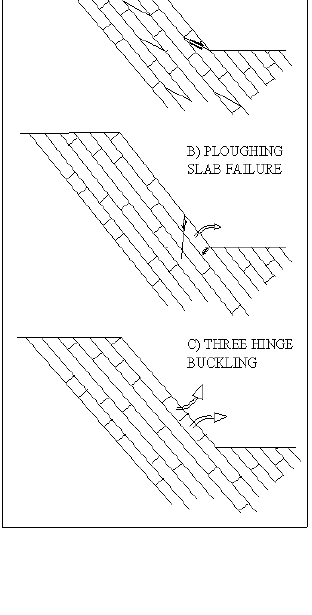
<body><![CDATA[<p><font face="Verdana, Arial, Helvetica, sans-serif"><b><font size="3">3. FAILURE MECHANISMS OBSERVED</font></b></font></p>      <p><font size="2" face="Verdana, Arial, Helvetica, sans-serif">High slopes  with persistent discontinuities parallel to the slope face are prone to fail  according to different mechanisms, reviewed by Hawley et al. &#91;2&#93; and can be  primarily divided according to the full or partial discontinuity control. If  the failure mechanism is totally controlled by pre-existing discontinuities,  the instability phenomena presented in the next section may take place. If no  secondary joints -enabling instability- exist, then, the discontinuity control  is only partial and the failure phenomena necessitating the crushing or  shearing of the rock mass. The instability mechanisms resulting in this case  are geometrically similar to the previously mentioned ones, but they are obviously less likely to occur.</font></p>      <p><font size="2" face="Verdana, Arial, Helvetica, sans-serif"><b>3.1&nbsp; Totally    joint controlled failure mechanisms    <br>   </b>The most    commonly encountered mechanisms, presented in <a href="#fig02">Figure 2</a> include: </font></p> <ol type="a">      <li><font size="2" face="Verdana, Arial, Helvetica, sans-serif">Bilinear  slab failure, which involves sliding along a basal plane in combination with  sliding along a secondary shallow dipping joint, which is undercut by the slope  face (Fig. 2.A). In reference &#91;2&#93; this type of failure is reported in a mine.</font></li>      <li><font size="2" face="Verdana, Arial, Helvetica, sans-serif">Ploughing slab failure, which takes place when slab sliding along a primary  discontinuity combines with sliding along a joint, which strikes sub-parallel  to the slope face, causing the toe block to be lifted by sliding and eventually  rotated out of the slope (Fig. 2.B). Although this mechanism is not very common  Ram&iacute;rez-Oyanguren &#91;9&#93; reported various cases, where this type of failure was  observed. </font></li>      <li><font size="2" face="Verdana, Arial, Helvetica, sans-serif">Three  hinge buckling, described by Cavers &#91;10&#93;, is the third known mechanism of this  type. It assumes the presence of at least three joints normal to bedding in the  slope’s lower part. Failure is initiated when enough water pressure exists in  the basal plane to induce rotation or shearing along cross-joints causing the  extrusion of blocks. (Fig. 2.C). </font></li>     </ol>       <p align="center"><font size="2" face="Verdana, Arial, Helvetica, sans-serif"><b><a name="fig02"></a><img src="/img/revistas/dyna/v77n161/a06fig02.gif">    <br>   Figure 2.</b> Totally  discontinuity controlled failure mechanisms observed on footwall slopes,  including A) Bilinear slab failure, B) Ploughing slab failure and C) Three  hinge buckling</font></p>     ]]></body>
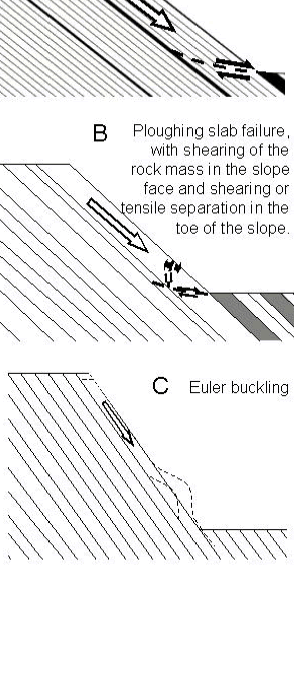
<body><![CDATA[<p><font size="2" face="Verdana, Arial, Helvetica, sans-serif">There are   other kinematically possible failure modes but they have not been reported or   observed as far as the authors are concerned.</font></p>     <p><font size="2" face="Verdana, Arial, Helvetica, sans-serif"><b>3.2 Partially joint controlled failure  mechanisms    <br>  </b>The three  basic mechanisms of this type analogous to those fully controlled by  discontinuities and presented in <a href="#fig03">Figure 3</a> are:</font></p> <ol type="a">      <li><font size="2" face="Verdana, Arial, Helvetica, sans-serif">Bilinear  slab failure with shearing and/or crushing in the toe of the slope, similar to  the one all along discontinuities, but with the failure of the rock mass  penetrating through the slope toe. Recently Fisher &#91;10&#93; has studied in detail  these mechanisms.</font></li>      <li><font size="2" face="Verdana, Arial, Helvetica, sans-serif">Ploughing slab failure, with shearing of the rock mass in the slope face and  shearing or tensile separation in the toe of the slope.</font></li>      <li><font size="2" face="Verdana, Arial, Helvetica, sans-serif">Euler  buckling of the first rock bed as presented by Cavers &#91;11&#93;.</font></li>     </ol>       <p align="center"><font size="2" face="Verdana, Arial, Helvetica, sans-serif"><b><a name="fig03"></a><img src="/img/revistas/dyna/v77n161/a06fig03.gif">    <br>   Figure 3. </b>Partially  discontinuity controlled failure mechanisms observed on footwall slopes,  including A) Bilinear slab failure with shearing, B) Ploughing slab failure  with shearing and tensile failure and C) Euler buckling</font></p>     <p><font size="2" face="Verdana, Arial, Helvetica, sans-serif">Due to the   higher strength of the rock mass versus the rock joints, these mechanisms are   much less common than the previously presented ones, but they should not be a   priori discarded in a design analysis.</font></p>     ]]></body>
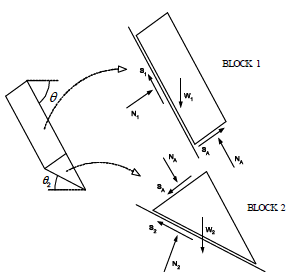
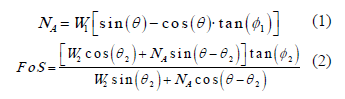
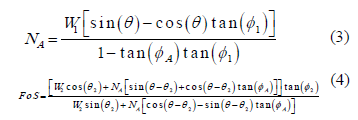
<body><![CDATA[<p>&nbsp;</p>     <p><font size="3" face="Verdana, Arial, Helvetica, sans-serif"><b>4. LIMIT EQUILIBRIUM METHODS</b></font></p>     <p><font size="2" face="Verdana, Arial, Helvetica, sans-serif">LEM’s are based on the force and moment  equilibrium in a rock mass or in different sliding or toppling blocks in a  mass. The method may require some more or less realistic assumptions be made.  The degree of realism of these hypotheses determines the reliability of the  results obtained. If, as in the case of fully discontinuity controlled cases,  failure is due to movements of blocks fully limited by geological discontinuities,  the geometry and joint shear strength are the key parameters in the analyses  and, when no untrue assumptions are taken, LEM are accurate enough to obtain  reliable results.</font></p>      <p> <font size="2" face="Verdana, Arial, Helvetica, sans-serif"><b>4.1 </b> <b>Discontinuity  controlled bilinear slab failure    <br>  </b>The stability analysis is done dividing the  sliding elements into an active block (1) or slab and a passive block (2) in  the toe (<a href="#fig04">Figure 4</a>). For the sake of simplicity, the calculations that follow  assume null cohesion joints and no underground water.</font></p>      <p align="center"><font size="2" face="Verdana, Arial, Helvetica, sans-serif"><b><a name="fig04"></a><img src="/img/revistas/dyna/v77n161/a06fig04.gif">    <br>   Figure 4.</b> Bilinear slab failure  analysis geometry</font></p>      <p><font size="2" face="Verdana, Arial, Helvetica, sans-serif">First, the normal external force needed by the  active block to be stable (N<sub>A</sub>) is calculated, and then, this force  is transferred to the resisting block to calculate the safety factor. The  analysis needs an assumption concerning the state of the interface between the  active and the resisting blocks. If we assume that this boundary is  frictionless, it can be found that:</font></p>      <p><img src="/img/revistas/dyna/v77n161/a06eq0102.gif"></p>      <p><font size="2" face="Verdana, Arial, Helvetica, sans-serif">If we assume that there is friction acting on  this interface, and that the upper block is in limit equilibrium, it can be  found that: </font></p>      ]]></body>
<body><![CDATA[<p><img src="/img/revistas/dyna/v77n161/a06eq0304.gif"></p>      <p><font size="2" face="Verdana, Arial, Helvetica, sans-serif">The realism of these assumptions varies  according to the case, so no one can be considered a priori better. However,  the actual value of the factor of safety has to be one in-between the values  obtained according to the presented hypothesis. According to our experience, we  suggest for practice the use of the average value safety factor (frictionless  and friction assumptions). </font></p>      <p><font size="2" face="Verdana, Arial, Helvetica, sans-serif"><b>4.2 Discontinuity controlled  ploughing slab failure    <br>  </b>The method of analysis is similar to the  bilinear slab failure (see <a href="#fig05">Figure 5</a>). But in this case two further topics  should be considered in greater detail. </font></p>      <p align="center"><font size="2" face="Verdana, Arial, Helvetica, sans-serif"><b><a name="fig05"></a><img src="/img/revistas/dyna/v77n161/a06fig05.gif">    <br>   Figure 5.</b> Ploughing slab  failure analysis geometry</font></p>      <p><font size="2" face="Verdana, Arial, Helvetica, sans-serif">First, the only kinematically available  possibility for the resisting block to move involves that the interface  in-between blocks should be in limit equilibrium, so the second assumption  proposed for the previous case should not only be used, but it is also a highly  realistic one. </font></p>       <p><font size="2" face="Verdana, Arial, Helvetica, sans-serif">Second, the passive block may move out of the  slope by either sliding through the upper and lower limiting discontinuities or  rotating freely out of the toe of the slope. It turns out then, that a  different factor of safety should be computed for both types of mechanisms,  finally selecting the smaller FoS, which will also mark the type of behaviour  to be expected. </font></p>      <p><font size="2" face="Verdana, Arial, Helvetica, sans-serif">Assuming friction acting on the interface, we  find: </font></p>      <p><img src="/img/revistas/dyna/v77n161/a06eq0506.gif"></p>      ]]></body>
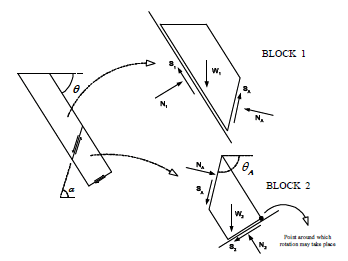
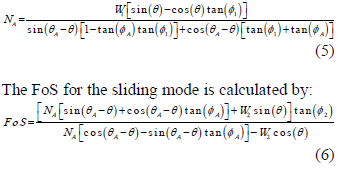
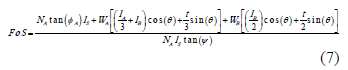
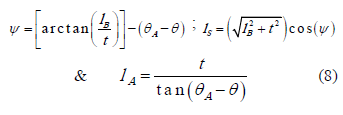
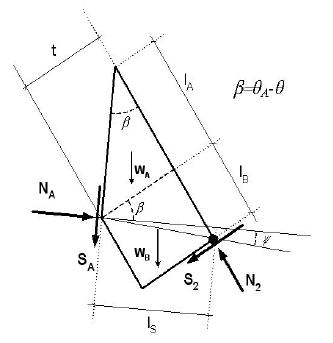
<body><![CDATA[<p><font size="2" face="Verdana, Arial, Helvetica, sans-serif">For the limit equilibrium of the toppling case,  some geometric values are needed, which are defined in <a href="#fig06">Figure 6</a>. Finally, the  FoS for the toppling mode is:</font></p>      <p><img src="/img/revistas/dyna/v77n161/a06eq07.gif"></p>      <p><font size="2" face="Verdana, Arial, Helvetica, sans-serif">Where:</font></p>      <p><img src="/img/revistas/dyna/v77n161/a06eq08.gif"></p>      <p align="center"><font size="2" face="Verdana, Arial, Helvetica, sans-serif"><b><a name="fig06"></a><img src="/img/revistas/dyna/v77n161/a06fig06.gif">    <br>  Figure 6. </b>Detail of block 2 for the toppling analysis</font></p>      <p>&nbsp;</p>      <p><font size="3" face="Verdana, Arial, Helvetica, sans-serif"><b>5. THEORETICAL EXAMPLES</b></font></p>      <p><font size="2" face="Verdana, Arial, Helvetica, sans-serif">To deepen the understanding on these mechanisms  some theoretical examples are analysed according to LEM and numerical model  (UDEC) and the SSRT. Another goal is to contrast these techniques and highlight  their advantages and draw-backs. The examples concern totally joint controlled  mechanisms –for which only rigid blocks are needed–. </font></p>      <p> <font size="2" face="Verdana, Arial, Helvetica, sans-serif"><b>5.1 </b> <b>Example 1.  Bilinear slab failure    ]]></body>
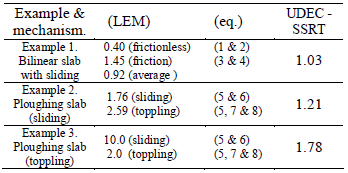
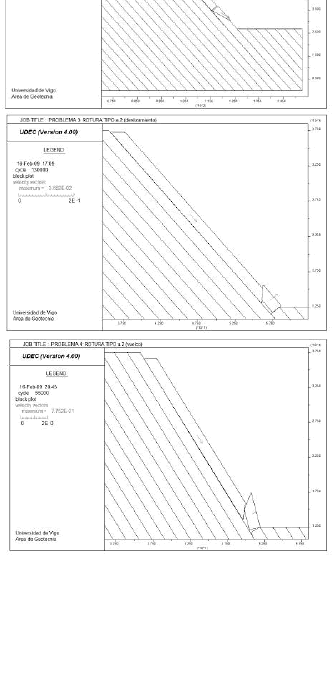
<body><![CDATA[<br>  </b></font><font size="2" face="Verdana, Arial, Helvetica, sans-serif">The analysis focuses on a 50 m slope, dipping  50º (<i>q </i>=50º), formed by 3 m strata (t=3 m), and with a  joint striking parallel to the slope in its toe and dipping <i>q </i><sub>2</sub>=30º. The example includes another joint normal to  bedding and located as shown in <a href="#fig04">Figure 4</a>. The friction angle of bedding is <i>f <sub>1</sub></i> = 30º and  that of the other joints is <i>f&#61472;<sub>A </sub></i>=&#61472; <i>f&#61472;<sub>2</sub></i> = 40º. The  specific weight for examples 1 to 5 is <i>g </i>= 25 kN/m<sup>3</sup>.  Under these circumstances and applying LEM and UDEC &amp; SSRT, the results are  shown in <a href="#tab01">Table 1</a>.</font></p>      <p align="center"><font size="2" face="Verdana, Arial, Helvetica, sans-serif"><b><a name="tab01"></a>Table 1</b>. Factors of safety for the proposed examples    1, 2 &amp; 3</font>    <br>    <img src="/img/revistas/dyna/v77n161/a06tab01.gif"></p>      <p><font size="2" face="Verdana, Arial, Helvetica, sans-serif">It can be checked that in the interface there  is not only normal force –frictionless model–, but also shear one which is  smaller than that needed to produce the movement of blocks along this interface  –friction LEM–. Then it seems, that even if a shear force appears, it is  smaller than that needed for limit equilibrium, so the FoS will be smaller than  that obtained for that case, but larger than the frictionless one. The factors  of safety obtained by means of UDEC-SRRT are usually not far from the average  (friction-frictionless) LEM value.</font></p>      <p><font size="2" face="Verdana, Arial, Helvetica, sans-serif"><b>5.2 Example 2. Ploughing slab failure (sliding)    <br>  </b></font><font size="2" face="Verdana, Arial, Helvetica, sans-serif">The analysis studies a 25 m slope, dipping 50º  (<i>q&#61472;</i>=50º),  formed by 1.5 m strata (t=1.5m), and with a joint striking parallel to the  slope in its toe and dipping towards the slope with <sub> <img src="/img/revistas/dyna/v77n161/a06eq002.gif"> </sub>=95º, according to <a href="#fig05">Figure 5</a>. There is also a joint  normal to bedding passing through the slope toe. For bedding planes <sub> <img src="/img/revistas/dyna/v77n161/a06eq004.gif"> </sub>=30º and for the rest of the joints <i>f <sub>A </sub></i>=&#61472; <i>f <sub>2</sub></i> =20º. The  distance so called <sub> <img src="/img/revistas/dyna/v77n161/a06eq006.gif"> </sub> in <a href="#fig06">Figure 6</a> is <sub> <img src="/img/revistas/dyna/v77n161/a06eq006.gif"> </sub> =2.293m. </font></p>      <p><font size="2" face="Verdana, Arial, Helvetica, sans-serif">The results are shown in <a href="#tab01">Table 1</a>. A lower  value of the FoS is obtained for the sliding case than for the toppling case.  This can be read in terms of the mechanism of instability, which should be  sliding. Also the in the analysis with UDEC and the SSRT a sliding mechanism is  observed. However the accurateness of the obtained figures is not very good.</font></p>      <p> <font size="2" face="Verdana, Arial, Helvetica, sans-serif"><b>5.3&nbsp; </b> <b>Example 3.  Ploughing slab failure (toppling)    <br>  </b></font><font size="2" face="Verdana, Arial, Helvetica, sans-serif">The study focuses a 25 m slope, dipping 60º (<sub> <img src="/img/revistas/dyna/v77n161/a06eq008.gif"> </sub>=60º), formed by 1.5 m beds (t=1.5 m), and with a  joint striking parallel to the slope in its toe and dipping towards it, with<sub> <img src="/img/revistas/dyna/v77n161/a06eq008.gif"> <i>A</i></sub>=95º.  There is also a joint normal to bedding in the slope toe and <sub> <img src="/img/revistas/dyna/v77n161/a06eq006.gif"> </sub>=3 m. The friction of bedding planes is <sub> <img src="/img/revistas/dyna/v77n161/a06eq004.gif"> </sub>= 30º and for the rest of the joints <sub> <img src="/img/revistas/dyna/v77n161/a06eq010.gif"> </sub>=<sub> <img src="/img/revistas/dyna/v77n161/a06eq012.gif"> </sub>= 40º. </font></p>      <p><font size="2" face="Verdana, Arial, Helvetica, sans-serif">The results are shown in <a href="#tab01">Table 1</a>. In this case LEM and  UDEC-SRRT compare well, for they both indicate toppling failure, and the FoS  values are similar in both cases. <a href="#fig07">Figure 7</a> shows the UDEC mechanisms of  examples 1 to 3.</font></p>      ]]></body>
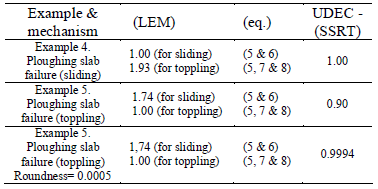
<body><![CDATA[<p align="center"><font size="2" face="Verdana, Arial, Helvetica, sans-serif"><b><a name="fig07"></a><img src="/img/revistas/dyna/v77n161/a06fig07.gif">    <br>   Figure 7.</b> UDEC response of  examples 1 to 3, where the different mechanisms can be observed</font></p>      <p><font size="2" face="Verdana, Arial, Helvetica, sans-serif">One can be surprised at the differences in FoS  obtained by both methods. In the case of example 1, this is due to the fact that  neither the frictionless nor the friction assumptions are strictly correct. In  examples 2 and 3, this can be due to the following: every factor of safety  compares two figures, one related to the forces or moments tending to stability  and the other related to those tending to instability. Since the approaches are  different, they must only coincide for the case of limit equilibrium (FoS  =1,00) and they can diverge as long as the FoS is far from 1. FoS is not an  actual variable, but it is an indicative value of the risk engineers are ready  to assume. This is studied in the next examples. </font></p>      <p><font size="2" face="Verdana, Arial, Helvetica, sans-serif"><b>5.4 Examples 4 and 5. Ploughing  slab failure    <br>  </b>We analyse two examples, 4 and 5,  representative of the failure mechanisms of ploughing slab failure, with  sliding and toppling of the resisting block respectively. In both of them, the  LEM FoS obtained is 1.00, -that is to say- they are in limit equilibrium. The  results of the analysis are shown in <a href="#tab02">Table 2</a>.</font></p>      <p align="center"><font size="2" face="Verdana, Arial, Helvetica, sans-serif"><b><a name="tab02"></a>Table 2</b>. Factors of safety for the proposed examples 4  &amp; 5</font>    <br>  <img src="/img/revistas/dyna/v77n161/a06tab02.gif"></p>      <p><font size="2" face="Verdana, Arial, Helvetica, sans-serif">For the case of sliding (example 4) the safety factor  obtained by UDEC and the SSRT is exactly 1.00, demonstrating the accurateness  of both methods to detect limit equilibrium. </font></p>      <p><font size="2" face="Verdana, Arial, Helvetica, sans-serif">However, for the case of toppling (example 5), even if  the FoS is close to one, it differs in 0.1 unities. This inaccurate result was  surprising, so we investigated the possible reasons. We finally found out that  this was due to the roundness of the corners of the UDEC blocks. The program  selects a small value of this roundness automatically. When changing this value  to a very small one (r= 0.0005 m), the FoS for toppling in example 5 became  0,9994, and then, practically 1.00. So it can now be stated that, when  performing very detailed geometrical models and close to limit equilibrium,  both techniques (LEM &amp; UDEC-SRRT), yield the same response. </font></p>      <p>&nbsp;</p>      ]]></body>
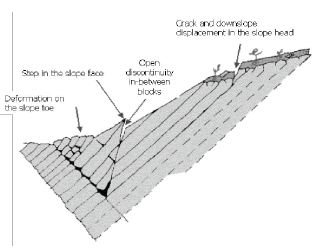
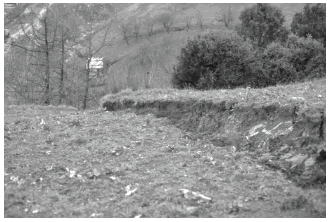
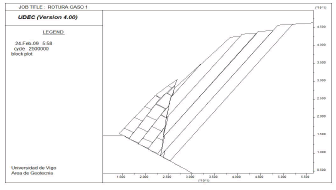
<body><![CDATA[<p><font size="3" face="Verdana, Arial, Helvetica, sans-serif"><b>6. PRACTICAL CASE STUDIES</b></font></p>      <p><font size="3" face="Verdana, Arial, Helvetica, sans-serif"></font><font size="2" face="Verdana, Arial, Helvetica, sans-serif">Two real cases studies are briefly presented. In both  cases the LEM approach is not easy, since not only one but various strata were  involved in the failure processes. Therefore, an approach based on numerical  models (UDEC) is preferred in order to understand the evolution of the instability  mechanisms, which took place.</font></p>      <p><font size="2" face="Verdana, Arial, Helvetica, sans-serif"><b>6.1 Case study 1    <br>  </b>We study the instability of slope occurred during the  excavation of a highway in northern  Spain . This case was presented in  detail by some authors &#91;12&#93;. The geometric description of the slope is shown in  <a href="#fig08">Figure 8</a>.</font></p>      <p align="center"><font size="2" face="Verdana, Arial, Helvetica, sans-serif"><b><a name="fig08"></a><img src="/img/revistas/dyna/v77n161/a06fig08.gif">    <br>   Figure 8. </b>Geometry and identified  features of a wall slope failure in road according to &#91;12&#93;</font></p>      <p><font size="2" face="Verdana, Arial, Helvetica, sans-serif">The instability was finally caused by the water  pressure after a very rainy period. A detail of the upper part of the slope is  illustrated in <a href="#fig09">Figure 9</a>.</font></p>      <p align="center"><font size="2" face="Verdana, Arial, Helvetica, sans-serif"><b><a name="fig09"></a><img src="/img/revistas/dyna/v77n161/a06fig09.gif">    <br>   Figure 9. </b>Picture of the tension crack  in the upper part of the slope</font></p>      <p><font size="2" face="Verdana, Arial, Helvetica, sans-serif">The UDEC analysis determined that the dry    slope was stable, whereas the inclusion of water induced the instability. The failure mechanisms as derived    from our UDEC approach is illustrated in <a href="#fig10">Figure 10</a>.</font></p>      ]]></body>
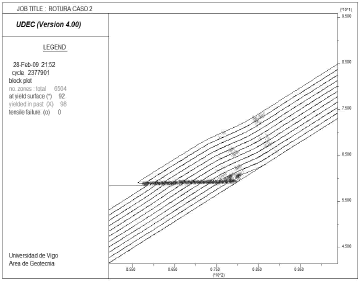
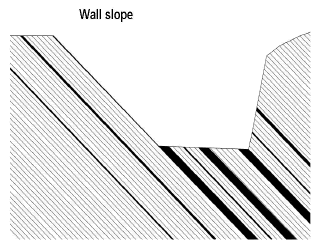
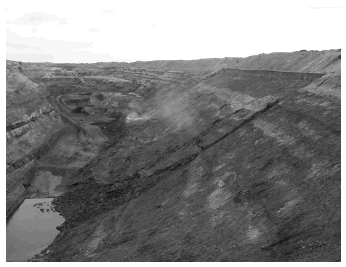
<body><![CDATA[<p align="center"><font size="2" face="Verdana, Arial, Helvetica, sans-serif"><b><a name="fig10"></a><img src="/img/revistas/dyna/v77n161/a06fig10.gif">    <br>   Figure 10. </b>UDEC mechanism of the  failure of a wall slope failure as developed by the authors</font></p>      <p align="left"><font size="2" face="Verdana, Arial, Helvetica, sans-serif"><b>6.2 Case study 2    <br>   </b>An outstanding footwall slope failure took place in    Leigh Creek    open pit coal mine in Australia .    The original study of the topic was developed by Coulthard et al. &#91;1&#93;, which    can be consulted for further details on the case study. </font></p>      <p><font size="2" face="Verdana, Arial, Helvetica, sans-serif">The LEM analyses determined that the slope was a  stable one. Nevertheless, when the slope attained a depth of 100 meters as  shown in <a href="#fig11">Figure 11</a> the slope failed. Ten very weak 1 m thick strata slided  through a very weak bedding plane located 10 m below the slope face. </font></p>      <p align="center"><font size="2" face="Verdana, Arial, Helvetica, sans-serif"><b><a name="fig11"></a><img src="/img/revistas/dyna/v77n161/a06fig11.gif">    <br>   Figure 11. </b>Picture    of the footwall slope failure in    Leigh Creek mine</font></p>      <p><font size="2" face="Verdana, Arial, Helvetica, sans-serif">The UDEC model is able to determine the instability of  this slope only partially controlled by discontinuities. The failure mechanism  is shown in <a href="#fig12">Figure 12</a>, where it is observed how the toe breakout needs shearing  of the rock mass. This topic of the analysis of biplanar dip slope failures to  limit model and parameter uncertainty in the determination of setback distances  has been addresses in detail by Fisher &#91;10&#93;.</font></p>      <p align="center"><font size="2" face="Verdana, Arial, Helvetica, sans-serif"><b><a name="fig12"></a><img src="/img/revistas/dyna/v77n161/a06fig12.gif">    <br>   Figure 12. </b>Detail of the UDEC model showing the shearing of the  rock in the base of the slope failure in  Leigh Creek  mine. Remark that shearing of the rock mass is required for toe breakout</font></p>      ]]></body>
<body><![CDATA[<p><font size="2" face="Verdana, Arial, Helvetica, sans-serif">According to this case it is clear that very complex  mechanisms are difficult to analyse by means of LEM, and a tool such as UDEC  can be very helpful for understanding and identifying wall slope failure  mechanisms in actual case studies, as well as to study its possible  evolution. </font></p>      <p>&nbsp;</p>     <p><font face="Verdana, Arial, Helvetica, sans-serif"><b><font size="3">7. CONCLUSIONS</font></b></font></p>      <p><font size="2" face="Verdana, Arial, Helvetica, sans-serif">Footwall slope failure mechanisms have been reviewed  and different techniques –LEM and the SSRT with code UDEC– to obtain factors of  safety in these cases have been presented and applied to various examples and  two case studies. As a consequence of all this, the following considerations  have been drawn.</font></p>      <p><font size="2" face="Verdana, Arial, Helvetica, sans-serif">LEM are a good choice to obtain FoS in those footwall  slopes where the failure mechanism grants limit equilibrium in all blocks  –ploughing slab failure with sliding or toppling of the resisting block–. For  the case of full discontinuity controlled bilinear slab failure results are not  sufficiently good and more realistic assumptions are needed. The role of  friction could be further investigated by analysing practical cases or by means  of physical modelling. This topic is a present research line of the authors. </font></p>      <p><font size="2" face="Verdana, Arial, Helvetica, sans-serif">The partially discontinuity controlled bilinear  failure mechanism requires shearing through the rock mass or along a  discontinuity above the toe. Therefore, the frictionless model proposed by  Hawley et al. &#91;2&#93; is really not appropriate for theses cases. This is  illustrated in <a href="#fig12">Figure 12</a>. These failure mechanisms are complex and needs shear  failure through the rock mass. Fischer &#91;10&#93; provides an interesting discussion  on the topic, which falls out of the scope of this study.</font></p>      <p><font size="2" face="Verdana, Arial, Helvetica, sans-serif">LEM, if results are reliable, are preferred than SSRT  in that it is easier to perform further –but commonly needed– analysis like  parametric studies, back-analysis, statistical analysis like Monte Carlo and so  on.</font></p>      <p><font size="2" face="Verdana, Arial, Helvetica, sans-serif">The combination of the SSRT with UDEC is a very strong  technique to estimate FoS for every mechanism of footwall slope instability,  having the advantages of finding automatic and naturally the failure mechanism  and the critical slip or separation surfaces. It should be used within the  frame of more wide design methodology as proposed by Starfield &amp; Cundall  &#91;13&#93;, that is to say as a tool for thinking and understanding mechanisms, more  than a calculating machine. </font></p>      <p><font size="2" face="Verdana, Arial, Helvetica, sans-serif">Nevertheless, this technique is more complex to use;  making more difficult the carrying out of further studies.</font></p>      <p>&nbsp;</p>      ]]></body>
<body><![CDATA[<p><font size="3" face="Verdana, Arial, Helvetica, sans-serif"><b>8. ACKNOWLEDGEMENTS</b></font></p>     <p><font size="2" face="Verdana, Arial, Helvetica, sans-serif">The authors acknowledge local Government of Galicia (Conseller&iacute;a de  Innovaci&oacute;n e Industria de  la  Xunta de Galicia )  the financing received to develop this research project under the title  “Stability analysis of wall slopes”, with reference number  (INCITE08PXIB304076PR).</font></p>      <p>&nbsp;</p>      <p><b><font size="3" face="Verdana, Arial, Helvetica, sans-serif">REFERENCES  </font></b></p>  <font size="2" face="Verdana, Arial, Helvetica, sans-serif">      <!-- ref --><p><b>&#91;1&#93;</b>  COULTHARD, M.A., LUCAS D.S. AND FULLER, P.G. Application of UDEC to a stress-related mine slope failure al Leigh Creek, South Australia. Proceedings of the Symposium on Numerical Modelling of Discrete Materials, Bochum ( Germany ). Ed. Konietzky. Balkema. Pp. 289-296. October 2004.     &nbsp;&nbsp;&nbsp;&nbsp;&nbsp;&nbsp;&nbsp;&nbsp;[&#160;<a href="javascript:void(0);" onclick="javascript: window.open('/scielo.php?script=sci_nlinks&ref=000137&pid=S0012-7353201000010000600001&lng=','','width=640,height=500,resizable=yes,scrollbars=1,menubar=yes,');">Links</a>&#160;]<!-- end-ref --><!-- ref --><br><b>&#91;2&#93;</b>  HAWLEY P.M, MARTIN, D.C. & ACOTT. C.P. Failure mechanics and design considerations for footwall slopes. 87th Ann. Gen. Meet. Can. Inst. of Min. & Metall. Vancouver. 29 pp. 1985.     &nbsp;&nbsp;&nbsp;&nbsp;&nbsp;&nbsp;&nbsp;&nbsp;[&#160;<a href="javascript:void(0);" onclick="javascript: window.open('/scielo.php?script=sci_nlinks&ref=000138&pid=S0012-7353201000010000600002&lng=','','width=640,height=500,resizable=yes,scrollbars=1,menubar=yes,');">Links</a>&#160;]<!-- end-ref --><!-- ref --><br><b>&#91;3&#93;</b>  ALEJANO, L.R.; GARC&Iacute;A BASTANTE, F., ALONSO, E. & G&Oacute;MEZ-M&Aacute;RQUEZ, I. Stability analysis and design of two quarry slopes with the help of numerical modeling. EUROCK 2001, ISRM Symposium, Rock Mechanics a challenge for society. Espoo, Finland . Ed. Balkema. June, 2001.     &nbsp;&nbsp;&nbsp;&nbsp;&nbsp;&nbsp;&nbsp;&nbsp;[&#160;<a href="javascript:void(0);" onclick="javascript: window.open('/scielo.php?script=sci_nlinks&ref=000139&pid=S0012-7353201000010000600003&lng=','','width=640,height=500,resizable=yes,scrollbars=1,menubar=yes,');">Links</a>&#160;]<!-- end-ref --><!-- ref --><br><b>&#91;4&#93;</b>  CALDER, P.N.. AND BLACKWEL, G.H.. Investigation of a complex rock displacement at Brenda Mines. The Canadian Mining and Metallurgy Bulletin. Pp. 1-10. August, 1980.      &nbsp;&nbsp;&nbsp;&nbsp;&nbsp;&nbsp;&nbsp;&nbsp;[&#160;<a href="javascript:void(0);" onclick="javascript: window.open('/scielo.php?script=sci_nlinks&ref=000140&pid=S0012-7353201000010000600004&lng=','','width=640,height=500,resizable=yes,scrollbars=1,menubar=yes,');">Links</a>&#160;]<!-- end-ref --><!-- ref --><br><b>&#91;5&#93;</b>  ITASCA. 2000. User manual for UDEC, Version 3.1. Itasca Consulting Group Inc., Minnesota, USA .      &nbsp;&nbsp;&nbsp;&nbsp;&nbsp;&nbsp;&nbsp;&nbsp;[&#160;<a href="javascript:void(0);" onclick="javascript: window.open('/scielo.php?script=sci_nlinks&ref=000141&pid=S0012-7353201000010000600005&lng=','','width=640,height=500,resizable=yes,scrollbars=1,menubar=yes,');">Links</a>&#160;]<!-- end-ref --><!-- ref --><br><b>&#91;6&#93;</b>  DAWSON, E.M., ROTH, W.H. & DRESCHER, A. Slope stability analysis by Strength reduction. Geotechnique. 49(6): 835-840, 1999.      &nbsp;&nbsp;&nbsp;&nbsp;&nbsp;&nbsp;&nbsp;&nbsp;[&#160;<a href="javascript:void(0);" onclick="javascript: window.open('/scielo.php?script=sci_nlinks&ref=000142&pid=S0012-7353201000010000600006&lng=','','width=640,height=500,resizable=yes,scrollbars=1,menubar=yes,');">Links</a>&#160;]<!-- end-ref --><!-- ref --><br><b>&#91;7&#93;</b>  STEAD, D., EBERHARDT, E. Developments in the analysis of footwall slopes in surface coal mining. Engineering Geology 46: 41-61. 1997.     &nbsp;&nbsp;&nbsp;&nbsp;&nbsp;&nbsp;&nbsp;&nbsp;[&#160;<a href="javascript:void(0);" onclick="javascript: window.open('/scielo.php?script=sci_nlinks&ref=000143&pid=S0012-7353201000010000600007&lng=','','width=640,height=500,resizable=yes,scrollbars=1,menubar=yes,');">Links</a>&#160;]<!-- end-ref --><!-- ref --><br><b>&#91;8&#93;</b>  RAM&Iacute;REZ OYANGUREN, P. & ALEJANO, L.R. Numerical and Analytical stability analysis of footwall slopes in opencast coalmines. Geotech. Meet. Santiago de Chile (Chile). September, 1992.     &nbsp;&nbsp;&nbsp;&nbsp;&nbsp;&nbsp;&nbsp;&nbsp;[&#160;<a href="javascript:void(0);" onclick="javascript: window.open('/scielo.php?script=sci_nlinks&ref=000144&pid=S0012-7353201000010000600008&lng=','','width=640,height=500,resizable=yes,scrollbars=1,menubar=yes,');">Links</a>&#160;]<!-- end-ref --><!-- ref --><br><b>&#91;9&#93;</b>  RAM&Iacute;REZ OYANGUREN, P. 2003. Personal communication.     &nbsp;&nbsp;&nbsp;&nbsp;&nbsp;&nbsp;&nbsp;&nbsp;[&#160;<a href="javascript:void(0);" onclick="javascript: window.open('/scielo.php?script=sci_nlinks&ref=000145&pid=S0012-7353201000010000600009&lng=','','width=640,height=500,resizable=yes,scrollbars=1,menubar=yes,');">Links</a>&#160;]<!-- end-ref --><!-- ref --><br><b>&#91;10&#93;</b>  FISHER, B.R. Improved characterization and analysis of biplanar dip slope failures to limit model and parameter uncertainty in the determination of setback distances. &#91;PhD Thesis&#93;</b> . Vancouver, British Columbia, Canada : University of British Columbia, 2009. Available: https://circle.ubc.ca/handle/2429/11559. &#91;Visited 15 December 2009&#93;</b> .     &nbsp;&nbsp;&nbsp;&nbsp;&nbsp;&nbsp;&nbsp;&nbsp;[&#160;<a href="javascript:void(0);" onclick="javascript: window.open('/scielo.php?script=sci_nlinks&ref=000146&pid=S0012-7353201000010000600010&lng=','','width=640,height=500,resizable=yes,scrollbars=1,menubar=yes,');">Links</a>&#160;]<!-- end-ref --><!-- ref --><br><b>&#91;11&#93;</b>  CAVERS, D.S. Simple methods to analyse buckling of rock slopes. Rock Mech. & Rock Eng. 14: 87-104, 1981.     &nbsp;&nbsp;&nbsp;&nbsp;&nbsp;&nbsp;&nbsp;&nbsp;[&#160;<a href="javascript:void(0);" onclick="javascript: window.open('/scielo.php?script=sci_nlinks&ref=000147&pid=S0012-7353201000010000600011&lng=','','width=640,height=500,resizable=yes,scrollbars=1,menubar=yes,');">Links</a>&#160;]<!-- end-ref --><!-- ref --><br><b>&#91;12&#93;</b>  MANERA BASSA, C.; RAM&Iacute;REZ OYANGUREN, P. Rotura en dos bloques de los taludes de muro de explotaciones de carb&oacute;n”. Bolet&iacute;n Geol&oacute;gico y Minero. Volumen 99. 261-266, 1986.     &nbsp;&nbsp;&nbsp;&nbsp;&nbsp;&nbsp;&nbsp;&nbsp;[&#160;<a href="javascript:void(0);" onclick="javascript: window.open('/scielo.php?script=sci_nlinks&ref=000148&pid=S0012-7353201000010000600012&lng=','','width=640,height=500,resizable=yes,scrollbars=1,menubar=yes,');">Links</a>&#160;]<!-- end-ref --><!-- ref --><br><b>&#91;13&#93;</b>  STARFIELD, A.M. & CUNDALL, P.A. Towards a methodology for rock mechanics modelling. Int. J. of Rock Mech. Min. Sci. & Geom. Abstr. 25(3): 99-106, 1988.  &nbsp;&nbsp;&nbsp;&nbsp;&nbsp;&nbsp;&nbsp;&nbsp;[&#160;<a href="javascript:void(0);" onclick="javascript: window.open('/scielo.php?script=sci_nlinks&ref=000149&pid=S0012-7353201000010000600013&lng=','','width=640,height=500,resizable=yes,scrollbars=1,menubar=yes,');">Links</a>&#160;]<!-- end-ref --> ]]></body><back>
<ref-list>
<ref id="B1">
<label>1</label><nlm-citation citation-type="confpro">
<person-group person-group-type="author">
<name>
<surname><![CDATA[COULTHARD]]></surname>
<given-names><![CDATA[M.A.]]></given-names>
</name>
<name>
<surname><![CDATA[LUCAS]]></surname>
<given-names><![CDATA[D.S.]]></given-names>
</name>
<name>
<surname><![CDATA[FULLER]]></surname>
<given-names><![CDATA[P.G.]]></given-names>
</name>
</person-group>
<article-title xml:lang="en"><![CDATA[Application of UDEC to a stress-related mine slope failure al Leigh Creek, South Australia]]></article-title>
<person-group person-group-type="editor">
<name>
<surname><![CDATA[Konietzky]]></surname>
</name>
<name>
<surname><![CDATA[Balkema]]></surname>
</name>
</person-group>
<source><![CDATA[Proceedings]]></source>
<year>Octo</year>
<month>be</month>
<day>r </day>
<conf-name><![CDATA[ Symposium on Numerical Modelling of Discrete Materials]]></conf-name>
<conf-loc>Bochum </conf-loc>
<page-range>289-296</page-range></nlm-citation>
</ref>
<ref id="B2">
<label>2</label><nlm-citation citation-type="confpro">
<person-group person-group-type="author">
<name>
<surname><![CDATA[HAWLEY]]></surname>
<given-names><![CDATA[P.M]]></given-names>
</name>
<name>
<surname><![CDATA[MARTIN]]></surname>
<given-names><![CDATA[D.C.]]></given-names>
</name>
<name>
<surname><![CDATA[ACOTT.]]></surname>
<given-names><![CDATA[C.P.]]></given-names>
</name>
</person-group>
<article-title xml:lang="en"><![CDATA[Failure mechanics and design considerations for footwall slopes]]></article-title>
<source><![CDATA[]]></source>
<year>1985</year>
<conf-name><![CDATA[87 Ann. Gen. Meet. Can. Inst. of Min. & Metall]]></conf-name>
<conf-loc>Vancouver </conf-loc>
<page-range>29</page-range></nlm-citation>
</ref>
<ref id="B3">
<label>3</label><nlm-citation citation-type="confpro">
<person-group person-group-type="author">
<name>
<surname><![CDATA[ALEJANO]]></surname>
<given-names><![CDATA[L.R.]]></given-names>
</name>
<name>
<surname><![CDATA[GARCÍA BASTANTE]]></surname>
<given-names><![CDATA[F.]]></given-names>
</name>
<name>
<surname><![CDATA[ALONSO]]></surname>
<given-names><![CDATA[E.]]></given-names>
</name>
<name>
<surname><![CDATA[GÓMEZ-MÁRQUEZ]]></surname>
<given-names><![CDATA[I.]]></given-names>
</name>
</person-group>
<article-title xml:lang="en"><![CDATA[analysis and design of two quarry slopes with the help of numerical modeling]]></article-title>
<person-group person-group-type="editor">
<name>
<surname><![CDATA[Balkema]]></surname>
</name>
</person-group>
<source><![CDATA[]]></source>
<year>June</year>
<month>, </month>
<day>20</day>
<conf-name><![CDATA[ EUROCK 2001, ISRM Symposium, Rock Mechanics a challenge for society]]></conf-name>
<conf-loc>Espoo </conf-loc>
</nlm-citation>
</ref>
<ref id="B4">
<label>4</label><nlm-citation citation-type="journal">
<person-group person-group-type="author">
<name>
<surname><![CDATA[CALDER]]></surname>
<given-names><![CDATA[P.N.]]></given-names>
</name>
<name>
<surname><![CDATA[BLACKWEL]]></surname>
<given-names><![CDATA[G.H.]]></given-names>
</name>
</person-group>
<article-title xml:lang="en"><![CDATA[Investigation of a complex rock displacement at Brenda Mines]]></article-title>
<source><![CDATA[The Canadian Mining and Metallurgy Bulletin]]></source>
<year>Augu</year>
<month>st</month>
<day>, </day>
<page-range>1-10</page-range></nlm-citation>
</ref>
<ref id="B5">
<label>5</label><nlm-citation citation-type="book">
<collab>ITASCA</collab>
<source><![CDATA[User manual for UDEC: Version 3.1]]></source>
<year>2000</year>
<publisher-loc><![CDATA[Minnesota ]]></publisher-loc>
<publisher-name><![CDATA[Itasca Consulting Group Inc.]]></publisher-name>
</nlm-citation>
</ref>
<ref id="B6">
<label>6</label><nlm-citation citation-type="journal">
<person-group person-group-type="author">
<name>
<surname><![CDATA[DAWSON]]></surname>
<given-names><![CDATA[E.M.]]></given-names>
</name>
<name>
<surname><![CDATA[ROTH]]></surname>
<given-names><![CDATA[W.H.]]></given-names>
</name>
<name>
<surname><![CDATA[DRESCHER]]></surname>
<given-names><![CDATA[A.]]></given-names>
</name>
</person-group>
<article-title xml:lang="en"><![CDATA[Slope stability analysis by Strength reduction]]></article-title>
<source><![CDATA[Geotechnique]]></source>
<year>1999</year>
<volume>49</volume>
<numero>6</numero>
<issue>6</issue>
<page-range>835-840</page-range></nlm-citation>
</ref>
<ref id="B7">
<label>7</label><nlm-citation citation-type="journal">
<person-group person-group-type="author">
<name>
<surname><![CDATA[STEAD]]></surname>
<given-names><![CDATA[D.]]></given-names>
</name>
<name>
<surname><![CDATA[EBERHARDT]]></surname>
<given-names><![CDATA[E.]]></given-names>
</name>
</person-group>
<article-title xml:lang="en"><![CDATA[Developments in the analysis of footwall slopes in surface coal mining]]></article-title>
<source><![CDATA[Engineering Geology]]></source>
<year>1997</year>
<volume>46</volume>
<page-range>41-61</page-range></nlm-citation>
</ref>
<ref id="B8">
<label>8</label><nlm-citation citation-type="confpro">
<person-group person-group-type="author">
<name>
<surname><![CDATA[RAMÍREZ OYANGUREN]]></surname>
<given-names><![CDATA[P.]]></given-names>
</name>
<name>
<surname><![CDATA[ALEJANO]]></surname>
<given-names><![CDATA[L.R.]]></given-names>
</name>
</person-group>
<article-title xml:lang="en"><![CDATA[Numerical and Analytical stability analysis of footwall slopes in opencast coalmines]]></article-title>
<source><![CDATA[]]></source>
<year></year>
<conf-name><![CDATA[ Geotech. Meet. Santiago de Chile]]></conf-name>
<conf-date>September, 1992</conf-date>
<conf-loc> </conf-loc>
</nlm-citation>
</ref>
<ref id="B9">
<label>9</label><nlm-citation citation-type="">
<person-group person-group-type="author">
<name>
<surname><![CDATA[RAMÍREZ OYANGUREN]]></surname>
<given-names><![CDATA[P.]]></given-names>
</name>
</person-group>
<source><![CDATA[Personal communication]]></source>
<year>2003</year>
</nlm-citation>
</ref>
<ref id="B10">
<label>10</label><nlm-citation citation-type="">
<person-group person-group-type="author">
<name>
<surname><![CDATA[FISHER]]></surname>
<given-names><![CDATA[B.R.]]></given-names>
</name>
</person-group>
<source><![CDATA[Improved characterization and analysis of biplanar dip slope failures to limit model and parameter uncertainty in the determination of setback distances]]></source>
<year></year>
</nlm-citation>
</ref>
<ref id="B11">
<label>11</label><nlm-citation citation-type="journal">
<person-group person-group-type="author">
<name>
<surname><![CDATA[CAVERS]]></surname>
<given-names><![CDATA[D.S.]]></given-names>
</name>
</person-group>
<article-title xml:lang="en"><![CDATA[Simple methods to analyse buckling of rock slopes]]></article-title>
<source><![CDATA[Rock Mech. & Rock Eng.]]></source>
<year>1981</year>
<volume>14</volume>
<page-range>87-104</page-range></nlm-citation>
</ref>
<ref id="B12">
<label>12</label><nlm-citation citation-type="journal">
<person-group person-group-type="author">
<name>
<surname><![CDATA[MANERA BASSA]]></surname>
<given-names><![CDATA[C.]]></given-names>
</name>
<name>
<surname><![CDATA[RAMÍREZ OYANGUREN]]></surname>
<given-names><![CDATA[P.]]></given-names>
</name>
</person-group>
<article-title xml:lang="es"><![CDATA[Rotura en dos bloques de los taludes de muro de explotaciones de carbón]]></article-title>
<source><![CDATA[Boletín Geológico y Minero]]></source>
<year>1986</year>
<volume>99</volume>
<page-range>261-266</page-range></nlm-citation>
</ref>
<ref id="B13">
<label>13</label><nlm-citation citation-type="journal">
<person-group person-group-type="author">
<name>
<surname><![CDATA[STARFIELD]]></surname>
<given-names><![CDATA[A.M.]]></given-names>
</name>
<name>
<surname><![CDATA[CUNDALL]]></surname>
<given-names><![CDATA[P.A.]]></given-names>
</name>
</person-group>
<article-title xml:lang="en"><![CDATA[Towards a methodology for rock mechanics modelling]]></article-title>
<source><![CDATA[Int. J. of Rock Mech. Min. Sci. & Geom. Abstr.]]></source>
<year>1988</year>
<volume>25</volume>
<numero>3</numero>
<issue>3</issue>
<page-range>99-106</page-range></nlm-citation>
</ref>
</ref-list>
</back>
</article>