<?xml version="1.0" encoding="ISO-8859-1"?><article xmlns:mml="http://www.w3.org/1998/Math/MathML" xmlns:xlink="http://www.w3.org/1999/xlink" xmlns:xsi="http://www.w3.org/2001/XMLSchema-instance">
<front>
<journal-meta>
<journal-id>0012-7353</journal-id>
<journal-title><![CDATA[DYNA]]></journal-title>
<abbrev-journal-title><![CDATA[Dyna rev.fac.nac.minas]]></abbrev-journal-title>
<issn>0012-7353</issn>
<publisher>
<publisher-name><![CDATA[Universidad Nacional de Colombia]]></publisher-name>
</publisher>
</journal-meta>
<article-meta>
<article-id>S0012-73532010000300028</article-id>
<title-group>
<article-title xml:lang="en"><![CDATA[NUMERICAL SIMULATION OF THIN LAYER COFFEE DRYING BY CONTROL VOLUMES]]></article-title>
<article-title xml:lang="es"><![CDATA[SIMULACIÓN NUMÉRICA DE SECADO DE CAFÉ EN CAPA DELGADA USANDO VOLÚMENES DE CONTROL]]></article-title>
</title-group>
<contrib-group>
<contrib contrib-type="author">
<name>
<surname><![CDATA[CIRO-VELÁSQUEZ]]></surname>
<given-names><![CDATA[HÉCTOR J.]]></given-names>
</name>
<xref ref-type="aff" rid="A01"/>
</contrib>
<contrib contrib-type="author">
<name>
<surname><![CDATA[ABUD-CANO]]></surname>
<given-names><![CDATA[LUIS C.]]></given-names>
</name>
<xref ref-type="aff" rid="A02"/>
</contrib>
<contrib contrib-type="author">
<name>
<surname><![CDATA[PÉREZ-ALEGRÍA]]></surname>
<given-names><![CDATA[LUIS. R.]]></given-names>
</name>
<xref ref-type="aff" rid="A03"/>
</contrib>
</contrib-group>
<aff id="A01">
<institution><![CDATA[,UNAL- Sede Medellín Department of Agricultural and Food Engineering ]]></institution>
<addr-line><![CDATA[ ]]></addr-line>
</aff>
<aff id="A02">
<institution><![CDATA[,Mechanical Engineer  ]]></institution>
<addr-line><![CDATA[ ]]></addr-line>
</aff>
<aff id="A03">
<institution><![CDATA[,University of Puerto Rico Mayagüez Campus Department of Agricultural and Biosystems Engineering]]></institution>
<addr-line><![CDATA[ ]]></addr-line>
</aff>
<pub-date pub-type="pub">
<day>00</day>
<month>09</month>
<year>2010</year>
</pub-date>
<pub-date pub-type="epub">
<day>00</day>
<month>09</month>
<year>2010</year>
</pub-date>
<volume>77</volume>
<numero>163</numero>
<fpage>270</fpage>
<lpage>278</lpage>
<copyright-statement/>
<copyright-year/>
<self-uri xlink:href="http://www.scielo.org.co/scielo.php?script=sci_arttext&amp;pid=S0012-73532010000300028&amp;lng=en&amp;nrm=iso"></self-uri><self-uri xlink:href="http://www.scielo.org.co/scielo.php?script=sci_abstract&amp;pid=S0012-73532010000300028&amp;lng=en&amp;nrm=iso"></self-uri><self-uri xlink:href="http://www.scielo.org.co/scielo.php?script=sci_pdf&amp;pid=S0012-73532010000300028&amp;lng=en&amp;nrm=iso"></self-uri><abstract abstract-type="short" xml:lang="en"><p><![CDATA[The thin layer drying model proposed by Sokhansanj and Bruce (1987) was implemented to model the drying process of parchment coffee beans. A computational model based on a control volume approach was developed to simulate the drying process of parchment coffee. A one dimensional transient analysis was implemented in the radial direction applied to a spherical coffee bean of equivalent radius. The results found that, even though the numerical value for the mass transfer coefficient is a small number (about of 10-7 m/sec), moisture content predictions were sensitive to this value. The predicted drying curve compared favorably with published results.]]></p></abstract>
<abstract abstract-type="short" xml:lang="es"><p><![CDATA[El modelo de secado en capa delgada desarrollado por Sokhansanj y Bruce (1987) fue implementado para simular el secado de un grano de café pergamino. El modelo computacional fue definido en estado transitorio y unidimensional para una esfera de radio equivalente utilizando la técnica del volumen de control. Los resultados indicaron que el valor numérico del coeficiente de transferencia de masa es muy pequeño (orden de magnitud alrededor de 10-7 m/s) haciendo que la predicción del contenido de humedad sea muy sensible a este valor. Además, los resultados de la simulación mostraron que la predicción del modelo numérico fue favorablemente similar a los datos experimentales dados en la literatura.]]></p></abstract>
<kwd-group>
<kwd lng="en"><![CDATA[Coffee]]></kwd>
<kwd lng="en"><![CDATA[drying]]></kwd>
<kwd lng="en"><![CDATA[numerical simulation]]></kwd>
<kwd lng="en"><![CDATA[thin layer]]></kwd>
<kwd lng="es"><![CDATA[Café]]></kwd>
<kwd lng="es"><![CDATA[secado]]></kwd>
<kwd lng="es"><![CDATA[simulación numérica]]></kwd>
<kwd lng="es"><![CDATA[capa delgada]]></kwd>
</kwd-group>
</article-meta>
</front><body><![CDATA[ <p align="center"><font size="4" face="Verdana, Arial, Helvetica, sans-serif"><b>NUMERICAL   SIMULATION OF THIN LAYER COFFEE DRYING   BY CONTROL VOLUMES</b></font></p>     <p align="center"><i><font size="3" face="Verdana, Arial, Helvetica, sans-serif"><b>SIMULACI&Oacute;N NUM&Eacute;RICA DE SECADO DE CAF&Eacute; EN CAPA DELGADA USANDO VOL&Uacute;MENES DE CONTROL </b></font></i></p>     <p align="center">&nbsp;</p>     <p align="center"><font size="2" face="Verdana, Arial, Helvetica, sans-serif"><b>H&Eacute;CTOR J.   CIRO-VEL&Aacute;SQUEZ</b>    <br>   </font><font size="2" face="Verdana, Arial, Helvetica, sans-serif"><i>Department of Agricultural and Food   Engineering, UNAL- Sede Medell&iacute;n, <a href="mailto:hjciro@unal.edu.co">hjciro@unal.edu.co</a></i></font></p>     <p align="center"><font size="2" face="Verdana, Arial, Helvetica, sans-serif"><b>LUIS C.   ABUD-CANO</b>    <br>   <i>Mechanical Engineer, M.Sc, <a href="mailto:labud68@hotmail.com">labud68@hotmail.com</a></i></font></p>     <p align="center"><font size="2" face="Verdana, Arial, Helvetica, sans-serif"><b>LUIS. R.   P&Eacute;REZ-ALEGR&Iacute;A</b>    <br>   </font><font size="2" face="Verdana, Arial, Helvetica, sans-serif"><i>Department of Agricultural and   Biosystems Engineering,   University   of Puerto Rico-Mayagüez Campus, <a href="mailto:luisr.perez1@upr.edu">luisr.perez1@upr.edu</a></i></font></p>     <p align="center">&nbsp;</p>     ]]></body>
<body><![CDATA[<p align="center"><font size="2" face="Verdana, Arial, Helvetica, sans-serif"><b>Received for review May 21<sup>th</sup>, 2009, accepted   September 8<sup>th</sup>, 2009,   final version September, 24<sup>th</sup>,   2009</b></font></p>     <p>&nbsp;</p> <hr>     <p><font size="2" face="Verdana, Arial, Helvetica, sans-serif"><b>ABSTRACT: </b>The   thin layer drying model proposed by Sokhansanj and Bruce (1987) was implemented   to model the drying process of parchment coffee beans. A computational model based on a control   volume approach was developed to simulate the drying process of parchment   coffee. A one dimensional transient analysis   was implemented in the radial direction applied to a spherical coffee bean of   equivalent radius. The results found   that, even though the numerical value for the mass transfer coefficient is a   small number (about of 10<sup>-7 </sup>m/sec), moisture content predictions   were sensitive to this value. The   predicted drying curve compared favorably with published results.</font></p>     <p><font size="2" face="Verdana, Arial, Helvetica, sans-serif"><b>KEY-WORDS:</b> Coffee, drying, numerical simulation, thin layer.</font></p>     <p><font size="2" face="Verdana, Arial, Helvetica, sans-serif"><b>RESUMEN: </b>El modelo   de secado en capa delgada desarrollado por Sokhansanj y Bruce (1987) fue   implementado para simular el secado de   un grano de caf&eacute; pergamino. El   modelo computacional fue definido en   estado transitorio y unidimensional para   una esfera de radio equivalente utilizando   la t&eacute;cnica del volumen de control. Los resultados indicaron que el valor   num&eacute;rico del coeficiente de transferencia de masa es muy pequeño (orden de   magnitud alrededor de 10<sup>-7</sup> m/s) haciendo que la predicci&oacute;n del   contenido de humedad sea muy sensible a este valor. Adem&aacute;s, los resultados de   la simulaci&oacute;n mostraron que la predicci&oacute;n del modelo num&eacute;rico fue favorablemente similar a los datos experimentales   dados en la literatura.</font></p>     <p><font size="2" face="Verdana, Arial, Helvetica, sans-serif"><b>PALABRAS CLAVES:</b> Caf&eacute;, secado,   simulaci&oacute;n num&eacute;rica, capa delgada.</font></p> <hr>     <p>&nbsp;</p>     <p><font size="3" face="Verdana, Arial, Helvetica, sans-serif"><b>1.   INTRODUCTION</b></font></p>     <p><font size="2" face="Verdana, Arial, Helvetica, sans-serif">Worldwide,   Colombia is the third coffee producing country and the first coffee producer of smooth   coffees. To reach and maintain the   status of the Colombian coffee, understanding of the impact of coffee drying   and other stages of postharvest management   has been fundamental. </font></p>     <p><font size="2" face="Verdana, Arial, Helvetica, sans-serif">Drying of grains has been a research-intensive area because of the   complexity of the drying phenomenon and, consequently, modeling and simulation   of the same needs the proper definition of the governing equations with   boundary conditions, use of appropriate material properties and consideration   of mechanical and chemical effects, when necessary &#91;1-3&#93;.</font></p>     ]]></body>
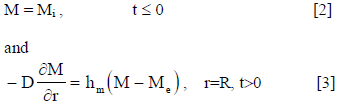
<body><![CDATA[<p><font size="2" face="Verdana, Arial, Helvetica, sans-serif">Drying   is the part of the postharvest process that is responsible for the removal of   excess moisture to a level that is safe for long time storage without any   impact to aroma or taste of the final beverage. Drying is a combination of heat and mass transfers that occurs   simultaneously where moisture is removed   by evaporation from the outer surface of the bean due to partial vapor pressure   differential between the bean's and the air mass that surrounds it &#91;4-6&#93;. Drying could affect the physical appearance,   the yield at hulling and the taste of the beverage &#91;7&#93;. Actually, dry parchment coffee is sold at   final moisture content between 10 and 12% wet basis. </font></p>     <p><font size="2" face="Verdana, Arial, Helvetica, sans-serif">Coffee   drying in deep beds is modeled using thin-layer models (thin-layer is the depth   of three layers of coffee beans), one in top of the next until the depth of the   bed is reached. Models build this way   are able to predict and simulate the temperature and moisture profile under   constant air flow &#91;8-10&#93;. Therefore, the   accuracy of this modeling approach directly depends on the accuracy of the   thin-layer drying model &#91;11-14&#93;. </font></p>     <p><font size="2" face="Verdana, Arial, Helvetica, sans-serif">This   paper describes a new implemented coffee drying simulation model based on heat   conduction equation &#91;15&#93;. Upon   validation the model can be used to design and optimization of deep bed dryers for parchment coffee beans. </font></p>     <p>&nbsp;</p>     <p><font size="3" face="Verdana, Arial, Helvetica, sans-serif"><b>2. THEORETICAL ANALYSIS</b></font></p>     <p><font size="2" face="Verdana, Arial, Helvetica, sans-serif">The   general diffusion equation that describes moisture mass transfer in the bean is   given by the equation: </font></p>     <p><img src="/img/revistas/dyna/v77n163/a28eq01.gif"></p>     <p><font size="2" face="Verdana, Arial, Helvetica, sans-serif">Initial   and boundary conditions for equation (1) are, respectively:</font></p>     <p><img src="/img/revistas/dyna/v77n163/a28eq0203.gif"></p>     <p><font size="2" face="Verdana, Arial, Helvetica, sans-serif">In   convective drying, the grain's surface exchange heat with the surroundings   as a result of convection, while the internal mass of the grain is heated by   heat conduction. The general form of   heat conduction equation that applies to grain drying can be written as:</font></p>     ]]></body>
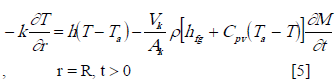
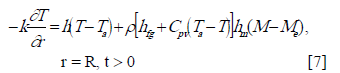
<body><![CDATA[<p><img src="/img/revistas/dyna/v77n163/a28eq04.gif"></p>     <p><font size="2" face="Verdana, Arial, Helvetica, sans-serif">Boundary   conditions for eq. (4) area based on 1) liquid moisture in the grain moves from   the interior layer to the outer surface by diffusion and 2) moisture evaporates   from the outer surface. The energy   balance at the bean's surface can be written as:</font></p>     <p><img src="/img/revistas/dyna/v77n163/a28eq05.gif"></p>     <p><font size="2" face="Verdana, Arial, Helvetica, sans-serif">Eq.   5 implies that the energy transported by the air is used to evaporate moisture   in the bean's surface and the rest to heat the internal layers of the   bean. The initial condition for this   process is:</font></p>     <p><img src="/img/revistas/dyna/v77n163/a28eq06.gif"></p>     <p><font size="2" face="Verdana, Arial, Helvetica, sans-serif">Using   the mass transfer condition in eq. (3), the boundary condition for the   bean's temperature (eq. 5) can be simplified &#91;16&#93; to:</font></p>     <p><img src="/img/revistas/dyna/v77n163/a28eq07.gif"></p>     <p><font size="2" face="Verdana, Arial, Helvetica, sans-serif">The   set of equations described above represent heat and mass transfer in a coffee   bean. These equations are tight together   by the use of the derivative of the bean's moisture content and time (eq. 5) are solved to describe temperature and moisture profiles in a   single coffee bean. </font></p>     <p><font size="2" face="Verdana, Arial, Helvetica, sans-serif">The   thin layer coffee drying model developed here use the following assumptions: 1)   the coffee bean is homogeneous and isotropic, 2) the bean is represented by an   equivalent sphere which is defined as the ratio between bean's volume and   surface area, 3) the bean is symmetrical with respect to its principal axis and   temperature and moisture depend on the radial distance, r and time, t, 4)   moisture evaporation takes place in the bean's surface, 5) initial   temperature and moisture content are uniform, 6) temperature and moisture   profiles are symmetrical during the drying process, 7) heat and mass transfer   are pure diffusion within the bean and outside the bean are pure convection. There is not heat radiation, 8) bean's   volume is assumed constant, there is no shrinkage or expansion of the bean   during drying and 9) specific heat and thermal conductivity depend on the   bean's moisture content. Diffusion coefficient and latent heat of   vaporization depend on the bean's temperature and moisture content.</font></p>     <p><font size="2" face="Verdana, Arial, Helvetica, sans-serif"><b>2.1 Numerical scheme    ]]></body>
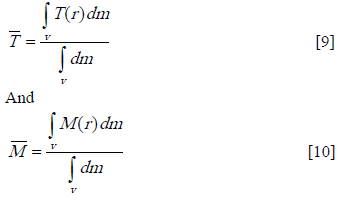
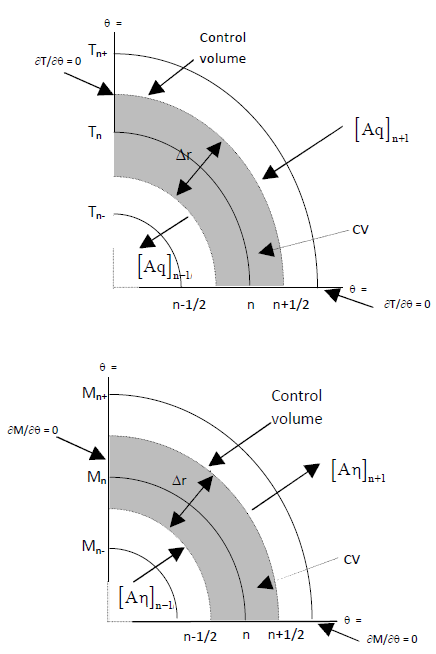
<body><![CDATA[<br>   </b></font><font size="2" face="Verdana, Arial, Helvetica, sans-serif">Under   transient regime, heat and moisture transfer equations are non-linear. These equations have physical variables that   depend on bean's moisture and temperature &#91;17&#93;. The set of equations were solved using the   control-volume scheme &#91;18&#93;. In this   scheme, each control-volume maintains mass conservation, energy and   momentum. To apply this technique, the   computational domain is divided in a known number of control-volumes that do   not overlap and that each node of the grid is associated with one control   volume. In each control volume, energy   or mass balances are performed. Moisture and temperature variations follow a   linear profile with respect to radial distance, r. The solution also uses an implicit scheme   that assumes that the new value of the dependent variable (temperature or   moisture) prevails constant during the time interval. As a result of this scheme, a set of   algebraic equations are generated. The   set of algebraic equations, one for each control volume, are solved using an   iterative procedure. The coffee bean is   represented by a sphere with an equivalent radius that is symmetrical with   respect to the azimuthal coordinate &#966;. The solution model uses only an eighth of sphere. The model also assumes symmetry with respect   to the zenith angle q. Therefore, the model offers solutions with   respect to the polar coordinates; radial, r and time, t. <a href="#fig01">Figure 1</a> shows the solution scheme for any   zenith angle of the sphere. The plain in   Fig. 1 is divided in N number of sub-regions with a node in the mid-radius of   each sub-region, except for nodes 0 and N that are located in the center and the   outer surface of the sphere, respectively. The energy and moisture mass balance for the central, intermediates and   surface nodes a set of N+1 simultaneous algebraic equations are generated for   N+1 X's unknowns. These set of   equations are expressed in matrix form as:</font></p>     <p><img src="/img/revistas/dyna/v77n163/a28eq08.gif"></p>     <p><font size="2" face="Verdana, Arial, Helvetica, sans-serif">Where,   X represents the bean's temperature or moisture, A and D are constants   that depend mainly on physical and thermal properties of coffee beans and its   geometry. </font></p>     <p align="center"><font size="2" face="Verdana, Arial, Helvetica, sans-serif"><b><a name="fig01"></a><img src="/img/revistas/dyna/v77n163/a28fig01.gif">    <br>   Figure 1.</b> Control   volume for heat and mass transfers within parchment coffee beans</font></p>     <p><font size="2" face="Verdana, Arial, Helvetica, sans-serif">The   solution of the system of non-linear equations (eq. 8) gives the node's   temperature and moisture content for each time interval during the drying   process. Non-linearity comes from the   fact that the thermal conductivity and the bean's specific heat depend on   the grain moisture content; while the diffusion coefficient and the latent heat   of vaporization depend on the bean's temperature and moisture content. </font></p>     <p><font size="2" face="Verdana, Arial, Helvetica, sans-serif">Assuming   that the bean's density remains constant, the mean temperature or mass   temperature and mean moisture content were determined using the following equations:</font></p>     <p><img src="/img/revistas/dyna/v77n163/a28eq0910.gif"></p>     <p><font size="2" face="Verdana, Arial, Helvetica, sans-serif">The solution of the matrix system of equation at each step was obtained   by successive iterations. The implicit method was chosen because it is unconditionally   stable. A banded matrix of unknowns was thus formed with the solution obtained   using a standard iterative solver for the matrix. The moisture matrix was   solved first and the change in the moisture from one iteration step to the next   was substituted into the temperature boundary condition. This information was   then transferred to the &#8216;D' matrix of the temperature equation and   the conduction equation was solved. The numerical solution was coded in Fortran.</font></p>     <p><font size="2" face="Verdana, Arial, Helvetica, sans-serif"><b>2.2 Thermo-physical   Properties of Coffee    ]]></body>
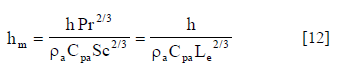
<body><![CDATA[<br>   </b></font><font size="2" face="Verdana, Arial, Helvetica, sans-serif">Thermal   and physical properties of the coffee bean were taken from the literature:   Diffusion coefficient &#91;19&#93;, equilibrium moisture content and latent heat of   vaporization &#91;20&#93;; equivalent radius, real density, thermal conductivity and   specific heat &#91;21&#93;. Heat and mass transfer coefficients were calculated in this study. </font></p>     <p><font size="2" face="Verdana, Arial, Helvetica, sans-serif">The   heat transfer coefficient was calculated using correlation for grains &#91;15&#93;:</font></p>     <p><img src="/img/revistas/dyna/v77n163/a28eq11.gif"></p>     <p><font size="2" face="Verdana, Arial, Helvetica, sans-serif">Initially,   the mass transfer coefficient was estimated using the Chilton-Colburn analogy:</font></p>     <p><img src="/img/revistas/dyna/v77n163/a28eq12.gif"></p>     <p>&nbsp;</p>     <p><font size="3" face="Verdana, Arial, Helvetica, sans-serif"><b>3. RESULTS AND DISCUSSION</b></font></p>     <p><font size="2" face="Verdana, Arial, Helvetica, sans-serif"><b>3.1 Computational model    <br>   </b></font><font size="2" face="Verdana, Arial, Helvetica, sans-serif">Convergence   and stability of the model's solution scheme was studied by discretizing   the domain (number of nodes) and the time-step and measuring its effect on estate   variables (temperature and moisture). A   robust model offers solutions that are independent of the discretization used   and the time interval selected. </font></p>     <p><font size="2" face="Verdana, Arial, Helvetica, sans-serif"><b>3.2 Effect of the nodal grid    ]]></body>
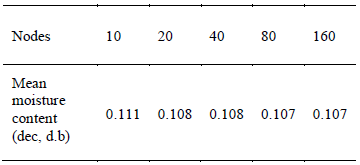
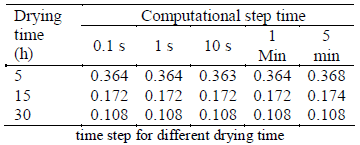
<body><![CDATA[<br>   </b></font><font size="2" face="Verdana, Arial, Helvetica, sans-serif">The   effect of the nodal grid in the solution was measured by calculating coffee   bean's moisture content for a 30-hr drying time with one second   time-step. Reference &#91;22&#93; gives the drying operational conditions used in this   study: Air drying temperature (T<sub>a</sub>=40°C), relative humidity (RH=29%)   and initial moisture content (M<sub>i</sub>=0.65 decimal, d.b). <a href="#tab01">Table 1</a> shows that   the obtained mean bean's moisture is less than 0.5% between a 40 and 80   node's grid. Therefore, a 40 node grid was used in this study. </font></p>     <p align="center"><font size="2" face="Verdana, Arial, Helvetica, sans-serif"><b><a name="tab01"></a>Table 1.</b> Influence of mesh size on model's stability</font>    <br>   <img src="/img/revistas/dyna/v77n163/a28tab01.gif"></p>     <p><font size="2" face="Verdana, Arial, Helvetica, sans-serif"><b>3.3 Effect of time-step    <br>   </b></font><font size="2" face="Verdana, Arial, Helvetica, sans-serif">The   solution model showed no sensitivity and no significant differences of the   bean's moisture when the integration time was varied from 0.1 to 60   seconds (<a href="#tab02">Table 2</a>). Therefore a 60-sec integration time was used for the solution. </font></p>     <p align="center"><font size="2" face="Verdana, Arial, Helvetica, sans-serif"><b><a name="tab02"></a>Table 2.</b> Model stability according to computational time step for different drying time</font>    <br>   <img src="/img/revistas/dyna/v77n163/a28tab02.gif"></p>     <p><font size="2" face="Verdana, Arial, Helvetica, sans-serif"><b>3.4 Model's   validation    <br>   </b></font><font size="2" face="Verdana, Arial, Helvetica, sans-serif">Reference   &#91;22&#93; presents the experimental data of coffee drying used to validate the model.   Bean's moisture results using the mass transfer coefficient generated by   the Chilton-Colburn analogy under predicts the bean's moisture during the   entire drying process (<a href="#fig02">Figure 2</a>). Thus, the drying process occurs at a faster   rate than observed; therefore, the mass transfer coefficient calculated using   Chilton-Colburn is not appropriate for coffee beans. </font></p>     <p align="center"><font size="2" face="Verdana, Arial, Helvetica, sans-serif"><b><a name="fig02"></a><img src="/img/revistas/dyna/v77n163/a28fig02.gif">    ]]></body>
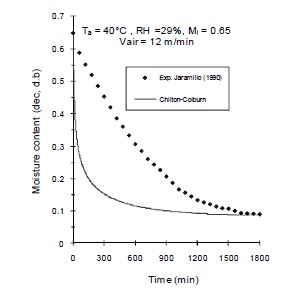
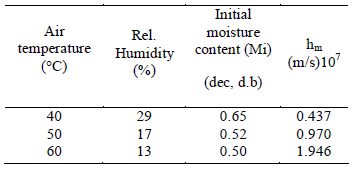
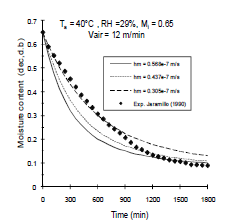
<body><![CDATA[<br>   Figure 2.</b> Simulated   mean moisture content of parchment coffee bean using the Chilton-Colburn   analogy (h<sub>m</sub> = 0.561x10<sup>-1 </sup>m/s)</font></p>     <p><font size="2" face="Verdana, Arial, Helvetica, sans-serif">The   mass transfer coefficient was then calculated with the experimental data. A constant moisture loss is assumed for all   phases of the drying process. During   drying, moisture is only loss at the bean's surface; therefore, moisture   migration within the bean is controlled by water loss at the bean's   surface. The   mathematical expression for moisture loss is:</font></p>     <p><img src="/img/revistas/dyna/v77n163/a28eq13.gif"></p>     <p><font size="2" face="Verdana, Arial, Helvetica, sans-serif">After   integration and assuming "<i>h<sub>m</sub>";</i> a time independent function, obtain:</font></p>     <p><img src="/img/revistas/dyna/v77n163/a28eq14.gif"></p>     <p><font size="2" face="Verdana, Arial, Helvetica, sans-serif">Thus,   the graph of bean's moisture versus time should produce a straight line   with slope <i>m</i> (Eq. 14). Hence, the mass transfer coefficient is given   by:</font></p>     <p><img src="/img/revistas/dyna/v77n163/a28eq15.gif"></p>     <p><font size="2" face="Verdana, Arial, Helvetica, sans-serif">In <a href="#fig03">Figure 3</a> the mass transfer coefficient was varied to simulate the drying   conditions. The prediction of the model   improves for the initial 600 min (10 hr) of drying when the coefficient was   reduced in 30% (<i>h<sub>m</sub></i>=0.305x10<sup>-7</sup> m/s) and worsen when the coefficient was increased in 30%. Regardless of the value of <i>h<sub>m</sub></i> the model over estimates   grain moisture at the final stages of drying. Although <i>h<sub>m</sub></i> is a   small number (<a href="#fig03">Table 3</a>), it controls the bean's moisture during   drying. </font></p>     <p align="center"><font size="2" face="Verdana, Arial, Helvetica, sans-serif"><b><a name="fig03"></a><img src="/img/revistas/dyna/v77n163/a28fig03.gif">    <br>   Figure 3.</b> Simulated mean moisture content of parchment coffee bean to different heat   mass transfer coefficients</font></p>     ]]></body>
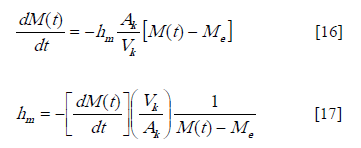
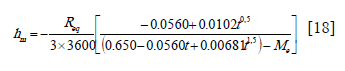
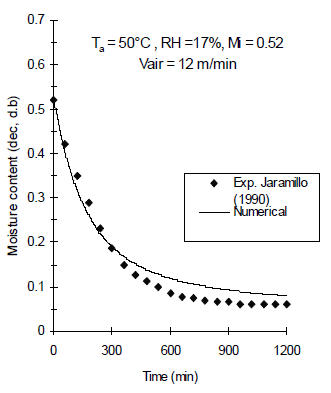
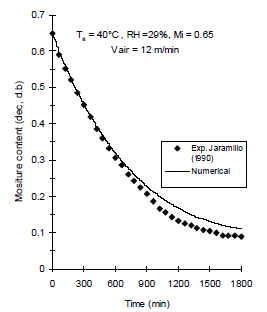
<body><![CDATA[<p><font size="2" face="Verdana, Arial, Helvetica, sans-serif">A better estimate of   the mass transfer coefficient was generated taking into account the time into   drying and therefore the bean's moisture content with the following eqs.:</font></p>     <p align="center"><font size="2" face="Verdana, Arial, Helvetica, sans-serif"><b><a name="tab03"></a>Table 3.</b> Mass   transfer coefficients calculated according to drying experimental conditions</font>    <br>   <img src="/img/revistas/dyna/v77n163/a28tab03.gif"></p>     <p><img src="/img/revistas/dyna/v77n163/a28eq1617.gif"></p>     <p><font size="2" face="Verdana, Arial, Helvetica, sans-serif">In   these eqs., <i>h<sub>m</sub></i> depend on the bean's moisture content, equilibrium moisture content and   moisture ratio for every stage of the drying process (temperature, relative   humidity and airflow velocity). Eq.(18) gives the final expression for <i>h<sub>m</sub> </i>according to drying conditions presented in <a href="#fig04">Figure 4</a>: </font></p>     <p><img src="/img/revistas/dyna/v77n163/a28eq18.gif"></p>     <p><font size="2" face="Verdana, Arial, Helvetica, sans-serif">Updating <i>h<sub>m</sub> </i>during the drying   process improved significantly model's predictions (<a href="#fig04">Figures 4</a>, <a href="#fig05">5</a> and <a href="#fig06">6</a>). Further analysis of the results indicate that   the bean's moisture equilibrium, M<sub>e</sub> developed in reference &#91;20&#93; and used in this study, is   responsible for predicting higher bean's moisture contents at the end of   the drying process &#91;22&#93;. </font></p>     <p align="center"><font size="2" face="Verdana, Arial, Helvetica, sans-serif"><b><a name="fig04"></a><img src="/img/revistas/dyna/v77n163/a28fig04.gif">    <br>   Figure 4.</b> Simulated mean moisture content of parchment coffee beans using an   experimental mass transfer coefficient changing with the drying time and drying   conditions: air temperature ( 40°C),   relative humidity (29%), initial moisture content (0.65) and air velocity (12   m/min)</font></p>     <p align="center"><font size="2" face="Verdana, Arial, Helvetica, sans-serif"><b><a name="fig05"></a><img src="/img/revistas/dyna/v77n163/a28fig05.gif">    ]]></body>
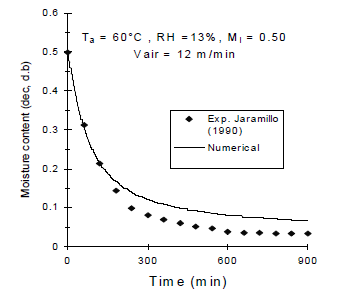
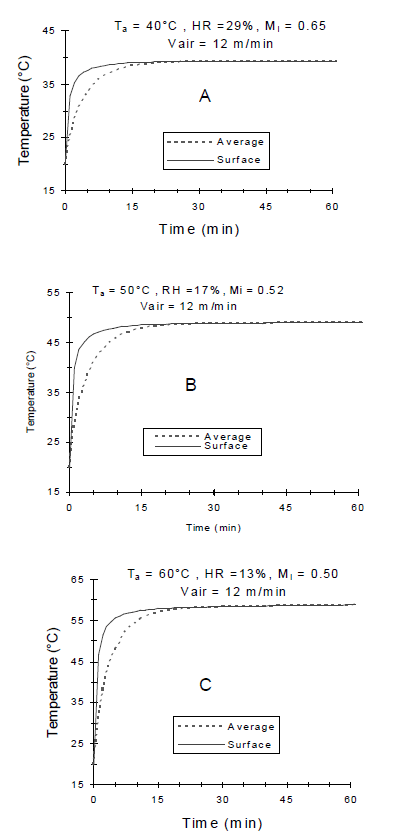
<body><![CDATA[<br>   Figure 5.</b> Simulated mean moisture content of parchment coffee   beans using an experimental mass transfer coefficient changing with the drying   time and drying conditions: air temperature ( 50°C),   relative humidity (17%), initial moisture content (0.52) and air velocity (12   m/min)</font></p>     <p align="center"><font size="2" face="Verdana, Arial, Helvetica, sans-serif"><b><a name="fig06"></a><img src="/img/revistas/dyna/v77n163/a28fig06.gif">    <br>   Figure 6.</b> Simulated mean moisture content of parchment coffee bean using an experimental mass transfer coefficient   changing with the drying time and drying conditions: air temperature ( 60°C),   relative humidity (13%), initial moisture content (0.50) and air velocity (12</font></p>     <p><font size="2" face="Verdana, Arial, Helvetica, sans-serif"><b>3.5 Bean's Temperature    <br>   </b></font><font size="2" face="Verdana, Arial, Helvetica, sans-serif">Bean's   interior and surface temperature increased during the first 15 min of   simulation time (<a href="#fig07">Figures 7A</a>, <a href="#fig07">B</a>, <a href="#fig07">C</a>). The bean's mean and surface   temperatures reached equilibrium temperature (air temperature) 20 min from   initiation of drying and then remained constant during the rest of the   process. </font></p>     <p align="center"><font size="2" face="Verdana, Arial, Helvetica, sans-serif"><b><a name="fig07"></a><img src="/img/revistas/dyna/v77n163/a28fig07.gif">    <br>   Figure 7.</b> Simulated temperature of parchment coffee beans for different experimental   drying conditions</font></p>     <p><font size="2" face="Verdana, Arial, Helvetica, sans-serif">A sharp increase in the mass average temperature prediction during the   first few minutes of drying indicates the presence of large temperature   gradients and therefore high levels of thermal stress during that period.   Hence, rapid stabilization of the mass average temperature could have an effect   on mass transfer &#91;1&#93;. The   short time required for equilibrium temperature is documented &#91;15, 23-24&#93; but   due to lack of temperature profile of coffee beans during drying this study   could not validate this claim for coffee beans. </font></p>     <p><font size="2" face="Verdana, Arial, Helvetica, sans-serif">Practical   application of thin-layer theory is limited because rarely coffee is dried in   thin layers now days. Its importance   lays in the fact that bean's temperature and moisture transfer is govern   by thin-layer theory, therefore any improvement to the modeling of thin layer   directly improves modeling of deep coffee drying. Thus, this paper provides a direct   contribution to real application of coffee drying. </font></p>     <p>&nbsp;</p>     ]]></body>
<body><![CDATA[<p><font size="3" face="Verdana, Arial, Helvetica, sans-serif"><b>4. CONCLUSIONS</b></font></p>     <p><font size="2" face="Verdana, Arial, Helvetica, sans-serif">Thin-layer   coffee drying was successfully modeled using the equation proposed by   Sokhansanj and Bruce (1987). A key   element that affected the accuracy of the model is the availability of relevant   experimental data to generate thermophysicals parameters of coffee beans or any   grain that are relevant to describe thermal and mass diffusion within the   drying process. It was also found that the mass transfer coefficient is a very   small number in the order of 10<sup>- 7 m s-1</sup> but highly significnt to   describe the process and very dependent on the time elapsed in drying process. </font></p>     <p>&nbsp;</p>     <p><font size="2" face="Verdana, Arial, Helvetica, sans-serif"><b>LIST OF SYMBOLS</b></font></p>     <p><font size="2" face="Verdana, Arial, Helvetica, sans-serif">A<sub>k</sub>= Kernel superficial   area, m<sup>2</sup>.    <br>   </font><font size="2" face="Verdana, Arial, Helvetica, sans-serif">A<sub>N</sub>=   Numerical matrix.    <br>   </font><font size="2" face="Verdana, Arial, Helvetica, sans-serif">C<sub>p</sub>=   Specific heat, kJ/kg K.    <br>   </font><font size="2" face="Verdana, Arial, Helvetica, sans-serif">C<sub>pa</sub>= Air specific heat,   kJ/kg K.    <br>   </font><font size="2" face="Verdana, Arial, Helvetica, sans-serif">C<sub>pv</sub>=   Vapor specific heat, kJ/kg K.    <br>   </font><font size="2" face="Verdana, Arial, Helvetica, sans-serif">D=   Kernel diffusivity, m<sup>2</sup>/s.    ]]></body>
<body><![CDATA[<br>   </font><font size="2" face="Verdana, Arial, Helvetica, sans-serif">D<sub>N</sub>=   Matrix    <br>   </font><font size="2" face="Verdana, Arial, Helvetica, sans-serif">h=   Air-grain convective heat transfer coefficient, W/m<sup>2</sup> K.    <br>   </font><font size="2" face="Verdana, Arial, Helvetica, sans-serif">h<sub>fg</sub>=Latent heat   vaporization of water, kJ/kg.    <br>   </font><font size="2" face="Verdana, Arial, Helvetica, sans-serif">h<sub>m</sub>=Convective mass   transfer coefficient, m/s.    <br>   </font><font size="2" face="Verdana, Arial, Helvetica, sans-serif">k=Kernel   thermal conductivity, W/m K.    <br>   </font><font size="2" face="Verdana, Arial, Helvetica, sans-serif">Le=   Lewis number    <br>   </font><font size="2" face="Verdana, Arial, Helvetica, sans-serif">M=   Kernel moisture content, decimal d.b.    <br>   </font><font size="2" face="Verdana, Arial, Helvetica, sans-serif">Me=   Equilibrium moisture content, decimal d.b.    <br>   </font><font size="2" face="Verdana, Arial, Helvetica, sans-serif">Mi=   Initial moisture content, decimal d.b.    <br>   </font><font size="2" face="Verdana, Arial, Helvetica, sans-serif">Pr=   Prandtl number.    ]]></body>
<body><![CDATA[<br>   </font><font size="2" face="Verdana, Arial, Helvetica, sans-serif">r= radial coordinates.    <br>   </font><font size="2" face="Verdana, Arial, Helvetica, sans-serif">R=   Radius of the grain, m.    <br>   </font><font size="2" face="Verdana, Arial, Helvetica, sans-serif">R<sub>e</sub>=   Reynolds number.    <br>   </font><font size="2" face="Verdana, Arial, Helvetica, sans-serif">R<sub>eq</sub>=   Equivalent radius, m.    <br>   </font><font size="2" face="Verdana, Arial, Helvetica, sans-serif">RH=   Relative humidity, %.    <br>   </font><font size="2" face="Verdana, Arial, Helvetica, sans-serif">Sc=   Schmidt number.    <br>   </font><font size="2" face="Verdana, Arial, Helvetica, sans-serif">t=   drying time, h.    <br>   </font><font size="2" face="Verdana, Arial, Helvetica, sans-serif">T=   Kernel temperature, ºC.    <br>   </font><font size="2" face="Verdana, Arial, Helvetica, sans-serif">T<sub>a</sub>=   Air drying temperature, ºC.    <br>   </font><font size="2" face="Verdana, Arial, Helvetica, sans-serif">T<sub>i</sub>= Initial temperature, ºC.    ]]></body>
<body><![CDATA[<br>   </font><font size="2" face="Verdana, Arial, Helvetica, sans-serif">V<sub>k</sub>= Kernel Volume, m<sup>3</sup>.    <br>   </font><font size="2" face="Verdana, Arial, Helvetica, sans-serif">V<sub>s</sub>=   Superficial air velocity, m/s.    <br>   </font><font size="2" face="Verdana, Arial, Helvetica, sans-serif">X= Variables vector. </font></p>     <p><font size="2" face="Verdana, Arial, Helvetica, sans-serif">Greek   Symbols    <br>   </font><font size="2" face="Symbol">r</font><font size="2" face="Verdana, Arial, Helvetica, sans-serif">= Kernel density, kg/m<sup>3</sup>.    <br>   </font><font size="2" face="Symbol">r</font><font size="2" face="Verdana, Arial, Helvetica, sans-serif">a= Air density, kg/m<sup>3.</sup></font></p>     <p>&nbsp;</p>     <p><font size="3" face="Verdana, Arial, Helvetica, sans-serif"><b>REFERENCES</b></font></p>     <!-- ref --><p><font size="2" face="Verdana, Arial, Helvetica, sans-serif"><b>&#91;1&#93;</b> IRUDAYARAJ, J., HAGHIGHI, K. AND STROSHINE, R. L. Finite element analysis of drying with application to cereal grains, J. Agric. Eng. Res., 53, 209-229, 1992.     &nbsp;&nbsp;&nbsp;&nbsp;&nbsp;&nbsp;&nbsp;&nbsp;[&#160;<a href="javascript:void(0);" onclick="javascript: window.open('/scielo.php?script=sci_nlinks&ref=000141&pid=S0012-7353201000030002800001&lng=','','width=640,height=500,resizable=yes,scrollbars=1,menubar=yes,');">Links</a>&#160;]<!-- end-ref --><!-- ref --><br>   <b>&#91;2&#93;</b> DUTTA, A. K. AND ZHANG. J. Porous media approach to heat and mass transfer in solid foods, ASAE Paper No. 99-3068. St. Joseph, Mich.: ASAE, 1999.     &nbsp;&nbsp;&nbsp;&nbsp;&nbsp;&nbsp;&nbsp;&nbsp;[&#160;<a href="javascript:void(0);" onclick="javascript: window.open('/scielo.php?script=sci_nlinks&ref=000142&pid=S0012-7353201000030002800002&lng=','','width=640,height=500,resizable=yes,scrollbars=1,menubar=yes,');">Links</a>&#160;]<!-- end-ref --><!-- ref --><br>   <b>&#91;3&#93;</b> RANJAN R., IRUDAYARAJ, J. AND JUN, S. A three-dimensional control volume approach to modeling heat and mass transfer in foods materials, Transactions of the ASAE 33, 209-229, 2001.     &nbsp;&nbsp;&nbsp;&nbsp;&nbsp;&nbsp;&nbsp;&nbsp;[&#160;<a href="javascript:void(0);" onclick="javascript: window.open('/scielo.php?script=sci_nlinks&ref=000143&pid=S0012-7353201000030002800003&lng=','','width=640,height=500,resizable=yes,scrollbars=1,menubar=yes,');">Links</a>&#160;]<!-- end-ref --><!-- ref --><br>   <b>&#91;4&#93;</b> SRIVASTAVA, V.K. AND JOHN, J. Deep bed grain drying modeling, Energy Conversion and Management 43, 1689-1708, 2002.     &nbsp;&nbsp;&nbsp;&nbsp;&nbsp;&nbsp;&nbsp;&nbsp;[&#160;<a href="javascript:void(0);" onclick="javascript: window.open('/scielo.php?script=sci_nlinks&ref=000144&pid=S0012-7353201000030002800004&lng=','','width=640,height=500,resizable=yes,scrollbars=1,menubar=yes,');">Links</a>&#160;]<!-- end-ref --><!-- ref --><br>   <b>&#91;5&#93;</b> ZIEGLER, TH. AND RICHTER, I.G. Analyzing deep-bed drying based on enthalpy-water content diagrams for air and grain, Computers and Electronics in Agriculture 26, 105-122, 2000.     &nbsp;&nbsp;&nbsp;&nbsp;&nbsp;&nbsp;&nbsp;&nbsp;[&#160;<a href="javascript:void(0);" onclick="javascript: window.open('/scielo.php?script=sci_nlinks&ref=000145&pid=S0012-7353201000030002800005&lng=','','width=640,height=500,resizable=yes,scrollbars=1,menubar=yes,');">Links</a>&#160;]<!-- end-ref --><!-- ref --><br>   <b>&#91;6&#93;</b> YADOLLAHINIA, A.R., OMID, M. AND RAFIEE, S. Design and fabrication of experimental dryer for studying agricultural products, International Journal of Agricultural & Biology 10, 61-65, 2008.     &nbsp;&nbsp;&nbsp;&nbsp;&nbsp;&nbsp;&nbsp;&nbsp;[&#160;<a href="javascript:void(0);" onclick="javascript: window.open('/scielo.php?script=sci_nlinks&ref=000146&pid=S0012-7353201000030002800006&lng=','','width=640,height=500,resizable=yes,scrollbars=1,menubar=yes,');">Links</a>&#160;]<!-- end-ref --><!-- ref --><br>   <b>&#91;7&#93;</b> AREGBA, A.W., SEBASTIAN, P. AND NADEAU, J.P. Stationary deep-bed drying: A comparative study between a logarithmic model and a non-equilibrium model, Journal of Food Engineering 77, 27-40, 2006.     &nbsp;&nbsp;&nbsp;&nbsp;&nbsp;&nbsp;&nbsp;&nbsp;[&#160;<a href="javascript:void(0);" onclick="javascript: window.open('/scielo.php?script=sci_nlinks&ref=000147&pid=S0012-7353201000030002800007&lng=','','width=640,height=500,resizable=yes,scrollbars=1,menubar=yes,');">Links</a>&#160;]<!-- end-ref --><!-- ref --><br>   <b>&#91;8&#93;</b> PABIS, S., JAYAS, D. S. AND CENKOWSKI, S. Grain drying: Theory and practice, John Wiley & Sons, 1998.     &nbsp;&nbsp;&nbsp;&nbsp;&nbsp;&nbsp;&nbsp;&nbsp;[&#160;<a href="javascript:void(0);" onclick="javascript: window.open('/scielo.php?script=sci_nlinks&ref=000148&pid=S0012-7353201000030002800008&lng=','','width=640,height=500,resizable=yes,scrollbars=1,menubar=yes,');">Links</a>&#160;]<!-- end-ref --><!-- ref --><br>   <b>&#91;9&#93;</b> FREIRE, F. B., BARROZO, M.A., SARTORI, D. AND FREIRE, J.T. Study of the drying kinetics in thin layer: fixed and moving bed, Drying Technology 23, 1451-1464, 2005.     &nbsp;&nbsp;&nbsp;&nbsp;&nbsp;&nbsp;&nbsp;&nbsp;[&#160;<a href="javascript:void(0);" onclick="javascript: window.open('/scielo.php?script=sci_nlinks&ref=000149&pid=S0012-7353201000030002800009&lng=','','width=640,height=500,resizable=yes,scrollbars=1,menubar=yes,');">Links</a>&#160;]<!-- end-ref --><!-- ref --><br>   <b>&#91;10&#93;</b> American Society of Agricultural and Biological Engineering (ASABE). Thin layer equation of agricultural crops: Standard S448.1, ASABE Standards, 2006.     &nbsp;&nbsp;&nbsp;&nbsp;&nbsp;&nbsp;&nbsp;&nbsp;[&#160;<a href="javascript:void(0);" onclick="javascript: window.open('/scielo.php?script=sci_nlinks&ref=000150&pid=S0012-7353201000030002800010&lng=','','width=640,height=500,resizable=yes,scrollbars=1,menubar=yes,');">Links</a>&#160;]<!-- end-ref --><!-- ref --><br>   <b>&#91;11&#93;</b> PARTI, M. Selection of mathematical models for drying grain in thin layer, J.Agric.Eng.Res. 54, 339-352,1993.     &nbsp;&nbsp;&nbsp;&nbsp;&nbsp;&nbsp;&nbsp;&nbsp;[&#160;<a href="javascript:void(0);" onclick="javascript: window.open('/scielo.php?script=sci_nlinks&ref=000151&pid=S0012-7353201000030002800011&lng=','','width=640,height=500,resizable=yes,scrollbars=1,menubar=yes,');">Links</a>&#160;]<!-- end-ref --><!-- ref --><br>   <b>&#91;12&#93;</b> BROOKER, D. B., BAKKER-ARKEMA, F.W. AND HALL, C.W. Drying and storage of grains and oilseeds, Springer, 1992.     &nbsp;&nbsp;&nbsp;&nbsp;&nbsp;&nbsp;&nbsp;&nbsp;[&#160;<a href="javascript:void(0);" onclick="javascript: window.open('/scielo.php?script=sci_nlinks&ref=000152&pid=S0012-7353201000030002800012&lng=','','width=640,height=500,resizable=yes,scrollbars=1,menubar=yes,');">Links</a>&#160;]<!-- end-ref --><!-- ref --><br>   <b>&#91;13&#93;</b> BALA, B.K. Drying and storage of cereal grains, Science Publishers, 1997.     &nbsp;&nbsp;&nbsp;&nbsp;&nbsp;&nbsp;&nbsp;&nbsp;[&#160;<a href="javascript:void(0);" onclick="javascript: window.open('/scielo.php?script=sci_nlinks&ref=000153&pid=S0012-7353201000030002800013&lng=','','width=640,height=500,resizable=yes,scrollbars=1,menubar=yes,');">Links</a>&#160;]<!-- end-ref --><!-- ref --><br>   <b>&#91;14&#93;</b> GARC&Iacute;A-P&Eacute;REZ, J.A., CARCEL, J.V., GARC&Iacute;A-ALVARADO, M.A. AND MULET, A. Simulation of grape stalk deep-bed drying, Journal of Food Engineering 90, 308-314, 2009.     &nbsp;&nbsp;&nbsp;&nbsp;&nbsp;&nbsp;&nbsp;&nbsp;[&#160;<a href="javascript:void(0);" onclick="javascript: window.open('/scielo.php?script=sci_nlinks&ref=000154&pid=S0012-7353201000030002800014&lng=','','width=640,height=500,resizable=yes,scrollbars=1,menubar=yes,');">Links</a>&#160;]<!-- end-ref --><!-- ref --><br>   <b>&#91;15&#93;</b> SOKHANSANJ, S. AND BRUCE, D. M. A conduction model to predict grain temperature in grain drying simulation, Transactions of the ASAE 30, 1181-1184, 1987.     &nbsp;&nbsp;&nbsp;&nbsp;&nbsp;&nbsp;&nbsp;&nbsp;[&#160;<a href="javascript:void(0);" onclick="javascript: window.open('/scielo.php?script=sci_nlinks&ref=000155&pid=S0012-7353201000030002800015&lng=','','width=640,height=500,resizable=yes,scrollbars=1,menubar=yes,');">Links</a>&#160;]<!-- end-ref --><!-- ref --><br>   <b>&#91;16&#93;</b> MIKETINAC, M. J., SOKHANSANJ, S. AND TUTEK, Z. Determination of heat and mass transfer coefficients in thin layer drying of grain, Transactions of the ASAE 35, 1853-1858, 1992.     &nbsp;&nbsp;&nbsp;&nbsp;&nbsp;&nbsp;&nbsp;&nbsp;[&#160;<a href="javascript:void(0);" onclick="javascript: window.open('/scielo.php?script=sci_nlinks&ref=000156&pid=S0012-7353201000030002800016&lng=','','width=640,height=500,resizable=yes,scrollbars=1,menubar=yes,');">Links</a>&#160;]<!-- end-ref --><!-- ref --><br>   <b>&#91;17&#93;</b> SANDER, A. Thin-layer drying of porous materials: Selection of the appropriate mathematical model and relationships between thin-layer models parameters, Chemical Engineering and Processing 46, 1324-1331, 2007.     &nbsp;&nbsp;&nbsp;&nbsp;&nbsp;&nbsp;&nbsp;&nbsp;[&#160;<a href="javascript:void(0);" onclick="javascript: window.open('/scielo.php?script=sci_nlinks&ref=000157&pid=S0012-7353201000030002800017&lng=','','width=640,height=500,resizable=yes,scrollbars=1,menubar=yes,');">Links</a>&#160;]<!-- end-ref --><!-- ref --><br>   <b>&#91;18&#93;</b> PATANKAR, S. V. Numerical Heat Transfer and Fluid Flow, Hemisphere Publishing Corp, 1980.     &nbsp;&nbsp;&nbsp;&nbsp;&nbsp;&nbsp;&nbsp;&nbsp;[&#160;<a href="javascript:void(0);" onclick="javascript: window.open('/scielo.php?script=sci_nlinks&ref=000158&pid=S0012-7353201000030002800018&lng=','','width=640,height=500,resizable=yes,scrollbars=1,menubar=yes,');">Links</a>&#160;]<!-- end-ref --><!-- ref --><br>   <b>&#91;19&#93;</b> MONTOYA E., OLIVEROS, C. AND ROA, G. 1990. Optimizaci&oacute;n operacional del secador intermitente de flujos concurrentes para caf&eacute; pergamino, Centro Nacional de investigaciones de Caf&eacute;, CENICAFE - Colombia 41, 19-33, 1990.     &nbsp;&nbsp;&nbsp;&nbsp;&nbsp;&nbsp;&nbsp;&nbsp;[&#160;<a href="javascript:void(0);" onclick="javascript: window.open('/scielo.php?script=sci_nlinks&ref=000159&pid=S0012-7353201000030002800019&lng=','','width=640,height=500,resizable=yes,scrollbars=1,menubar=yes,');">Links</a>&#160;]<!-- end-ref --><!-- ref --><br>   <b>&#91;20&#93;</b> TREJOS R., ROA, G. AND OLIVEROS, C. Humedad de equilibrio y calor latente de vaporizaci&oacute;n del caf&eacute; pergamino y del caf&eacute; verde, Centro Nacional de investigaciones de Caf&eacute;, CENICAFE- Colombia 40, 5-15, 1989.     &nbsp;&nbsp;&nbsp;&nbsp;&nbsp;&nbsp;&nbsp;&nbsp;[&#160;<a href="javascript:void(0);" onclick="javascript: window.open('/scielo.php?script=sci_nlinks&ref=000160&pid=S0012-7353201000030002800020&lng=','','width=640,height=500,resizable=yes,scrollbars=1,menubar=yes,');">Links</a>&#160;]<!-- end-ref --><!-- ref --><br>   <b>&#91;21&#93;</b> PEREZ-ALEGR&Iacute;A, L.R., CIRO-V., H.J. AND ABUD, L.C. Physical and thermal properties of parchment coffee bean, Transactions of the ASAE 44, 1721-1726, 2001.     &nbsp;&nbsp;&nbsp;&nbsp;&nbsp;&nbsp;&nbsp;&nbsp;[&#160;<a href="javascript:void(0);" onclick="javascript: window.open('/scielo.php?script=sci_nlinks&ref=000161&pid=S0012-7353201000030002800021&lng=','','width=640,height=500,resizable=yes,scrollbars=1,menubar=yes,');">Links</a>&#160;]<!-- end-ref --><!-- ref --><br>   <b>&#91;22&#93;</b> JARAMILLO B. G. Ecuaci&oacute;n de capa delgada para caf&eacute; pergamino, Centro Nacional de investigaciones de Caf&eacute;, CENICAFE - Colombia 41, 103-113, 1990.     &nbsp;&nbsp;&nbsp;&nbsp;&nbsp;&nbsp;&nbsp;&nbsp;[&#160;<a href="javascript:void(0);" onclick="javascript: window.open('/scielo.php?script=sci_nlinks&ref=000162&pid=S0012-7353201000030002800022&lng=','','width=640,height=500,resizable=yes,scrollbars=1,menubar=yes,');">Links</a>&#160;]<!-- end-ref --><!-- ref --><br>   <b>&#91;23&#93;</b> FORTES, M. AND OKOS, M. R. A non-equilibrium thermodynamics approach to transport phenomenon in capillary porous bodies, Transactions of the ASAE 24, 756-760, 1981.     &nbsp;&nbsp;&nbsp;&nbsp;&nbsp;&nbsp;&nbsp;&nbsp;[&#160;<a href="javascript:void(0);" onclick="javascript: window.open('/scielo.php?script=sci_nlinks&ref=000163&pid=S0012-7353201000030002800023&lng=','','width=640,height=500,resizable=yes,scrollbars=1,menubar=yes,');">Links</a>&#160;]<!-- end-ref --><!-- ref --><br>   <b>&#91;24&#93;</b> IRUDAYARAJ, J. AND WU, Y. Numerical modeling of heat and mass transfer in starch systems, Transactions of the ASAE 42, 449- 455, 1999. </font>&nbsp;&nbsp;&nbsp;&nbsp;&nbsp;&nbsp;&nbsp;&nbsp;[&#160;<a href="javascript:void(0);" onclick="javascript: window.open('/scielo.php?script=sci_nlinks&ref=000164&pid=S0012-7353201000030002800024&lng=','','width=640,height=500,resizable=yes,scrollbars=1,menubar=yes,');">Links</a>&#160;]<!-- end-ref --> ]]></body><back>
<ref-list>
<ref id="B1">
<label>1</label><nlm-citation citation-type="journal">
<person-group person-group-type="author">
<name>
<surname><![CDATA[IRUDAYARAJ]]></surname>
<given-names><![CDATA[J.]]></given-names>
</name>
<name>
<surname><![CDATA[HAGHIGHI]]></surname>
<given-names><![CDATA[K.]]></given-names>
</name>
<name>
<surname><![CDATA[STROSHINE]]></surname>
<given-names><![CDATA[R. L.]]></given-names>
</name>
</person-group>
<article-title xml:lang="en"><![CDATA[Finite element analysis of drying with application to cereal grains]]></article-title>
<source><![CDATA[J. Agric. Eng. Res.]]></source>
<year>1992</year>
<volume>53</volume>
<page-range>209-229</page-range></nlm-citation>
</ref>
<ref id="B2">
<label>2</label><nlm-citation citation-type="book">
<person-group person-group-type="author">
<name>
<surname><![CDATA[DUTTA]]></surname>
<given-names><![CDATA[A. K.]]></given-names>
</name>
<name>
<surname><![CDATA[ZHANG]]></surname>
<given-names><![CDATA[J.]]></given-names>
</name>
</person-group>
<source><![CDATA[Porous media approach to heat and mass transfer in solid foods: ASAE Paper No. 99-3068]]></source>
<year>1999</year>
<publisher-loc><![CDATA[St. Joseph^eMich Mich]]></publisher-loc>
<publisher-name><![CDATA[ASAE]]></publisher-name>
</nlm-citation>
</ref>
<ref id="B3">
<label>3</label><nlm-citation citation-type="journal">
<person-group person-group-type="author">
<name>
<surname><![CDATA[RANJAN]]></surname>
<given-names><![CDATA[R.]]></given-names>
</name>
</person-group>
<source><![CDATA[Transactions of the ASAE]]></source>
<year>2001</year>
<numero>33</numero>
<issue>33</issue>
<page-range>209-229</page-range></nlm-citation>
</ref>
<ref id="B4">
<label>4</label><nlm-citation citation-type="journal">
<person-group person-group-type="author">
<name>
<surname><![CDATA[SRIVASTAVA]]></surname>
<given-names><![CDATA[V.K.]]></given-names>
</name>
<name>
<surname><![CDATA[JOHN]]></surname>
<given-names><![CDATA[J.]]></given-names>
</name>
</person-group>
<article-title xml:lang="en"><![CDATA[Deep bed grain drying modeling]]></article-title>
<source><![CDATA[Energy Conversion and Management]]></source>
<year>2002</year>
<volume>43</volume>
<page-range>1689-1708</page-range></nlm-citation>
</ref>
<ref id="B5">
<label>5</label><nlm-citation citation-type="journal">
<person-group person-group-type="author">
<name>
<surname><![CDATA[ZIEGLER]]></surname>
<given-names><![CDATA[TH.]]></given-names>
</name>
<name>
<surname><![CDATA[RICHTER]]></surname>
<given-names><![CDATA[I.G.]]></given-names>
</name>
</person-group>
<article-title xml:lang="en"><![CDATA[Analyzing deep-bed drying based on enthalpy-water content diagrams for air and grain]]></article-title>
<source><![CDATA[Computers and Electronics in Agriculture]]></source>
<year>2000</year>
<volume>26</volume>
<page-range>105-122</page-range></nlm-citation>
</ref>
<ref id="B6">
<label>6</label><nlm-citation citation-type="journal">
<person-group person-group-type="author">
<name>
<surname><![CDATA[YADOLLAHINIA]]></surname>
<given-names><![CDATA[A.R.]]></given-names>
</name>
<name>
<surname><![CDATA[OMID]]></surname>
<given-names><![CDATA[M.]]></given-names>
</name>
<name>
<surname><![CDATA[RAFIEE]]></surname>
<given-names><![CDATA[S.]]></given-names>
</name>
</person-group>
<article-title xml:lang="en"><![CDATA[Design and fabrication of experimental dryer for studying agricultural products]]></article-title>
<source><![CDATA[International Journal of Agricultural & Biology]]></source>
<year>2008</year>
<volume>10</volume>
<page-range>61-65</page-range></nlm-citation>
</ref>
<ref id="B7">
<label>7</label><nlm-citation citation-type="journal">
<person-group person-group-type="author">
<name>
<surname><![CDATA[AREGBA]]></surname>
<given-names><![CDATA[A.W.]]></given-names>
</name>
<name>
<surname><![CDATA[SEBASTIAN]]></surname>
<given-names><![CDATA[P.]]></given-names>
</name>
<name>
<surname><![CDATA[NADEAU]]></surname>
<given-names><![CDATA[J.P.]]></given-names>
</name>
</person-group>
<article-title xml:lang="en"><![CDATA[Stationary deep-bed drying: A comparative study between a logarithmic model and a non-equilibrium model]]></article-title>
<source><![CDATA[Journal of Food Engineering]]></source>
<year>2006</year>
<volume>77</volume>
<page-range>27-40</page-range></nlm-citation>
</ref>
<ref id="B8">
<label>8</label><nlm-citation citation-type="book">
<person-group person-group-type="author">
<name>
<surname><![CDATA[PABIS]]></surname>
<given-names><![CDATA[S.]]></given-names>
</name>
<name>
<surname><![CDATA[JAYAS]]></surname>
<given-names><![CDATA[D. S.]]></given-names>
</name>
<name>
<surname><![CDATA[CENKOWSKI]]></surname>
<given-names><![CDATA[S.]]></given-names>
</name>
</person-group>
<source><![CDATA[Grain drying: Theory and practice]]></source>
<year>1998</year>
<publisher-name><![CDATA[John Wiley & Sons]]></publisher-name>
</nlm-citation>
</ref>
<ref id="B9">
<label>9</label><nlm-citation citation-type="journal">
<person-group person-group-type="author">
<name>
<surname><![CDATA[FREIRE]]></surname>
<given-names><![CDATA[F. B.]]></given-names>
</name>
<name>
<surname><![CDATA[BARROZO]]></surname>
<given-names><![CDATA[M.A.]]></given-names>
</name>
<name>
<surname><![CDATA[SARTORI]]></surname>
<given-names><![CDATA[D.]]></given-names>
</name>
<name>
<surname><![CDATA[FREIRE]]></surname>
<given-names><![CDATA[J.T.]]></given-names>
</name>
</person-group>
<article-title xml:lang="en"><![CDATA[Study of the drying kinetics in thin layer: fixed and moving bed]]></article-title>
<source><![CDATA[Drying Technology]]></source>
<year>2005</year>
<volume>23</volume>
<page-range>1451-1464</page-range></nlm-citation>
</ref>
<ref id="B10">
<label>10</label><nlm-citation citation-type="book">
<collab>American Society of Agricultural and Biological Engineering</collab>
<source><![CDATA[Thin layer equation of agricultural crops: Standard S448.1]]></source>
<year>2006</year>
<publisher-name><![CDATA[ASABE Standards]]></publisher-name>
</nlm-citation>
</ref>
<ref id="B11">
<label>11</label><nlm-citation citation-type="journal">
<person-group person-group-type="author">
<name>
<surname><![CDATA[PARTI]]></surname>
<given-names><![CDATA[M.]]></given-names>
</name>
</person-group>
<article-title xml:lang="en"><![CDATA[Selection of mathematical models for drying grain in thin layer]]></article-title>
<source><![CDATA[J.Agric.Eng.Res.]]></source>
<year>1993</year>
<numero>54</numero>
<issue>54</issue>
<page-range>339-352</page-range></nlm-citation>
</ref>
<ref id="B12">
<label>12</label><nlm-citation citation-type="book">
<person-group person-group-type="author">
<name>
<surname><![CDATA[BROOKER]]></surname>
<given-names><![CDATA[D. B.]]></given-names>
</name>
<name>
<surname><![CDATA[BAKKER-ARKEMA]]></surname>
<given-names><![CDATA[F.W.]]></given-names>
</name>
<name>
<surname><![CDATA[HALL]]></surname>
<given-names><![CDATA[C.W.]]></given-names>
</name>
</person-group>
<source><![CDATA[Drying and storage of grains and oilseeds]]></source>
<year>1992</year>
<publisher-name><![CDATA[Springer]]></publisher-name>
</nlm-citation>
</ref>
<ref id="B13">
<label>13</label><nlm-citation citation-type="book">
<person-group person-group-type="author">
<name>
<surname><![CDATA[BALA]]></surname>
<given-names><![CDATA[B.K.]]></given-names>
</name>
</person-group>
<source><![CDATA[Drying and storage of cereal grains]]></source>
<year>1997</year>
<publisher-name><![CDATA[Science Publishers]]></publisher-name>
</nlm-citation>
</ref>
<ref id="B14">
<label>14</label><nlm-citation citation-type="journal">
<person-group person-group-type="author">
<name>
<surname><![CDATA[GARCÍA-PÉREZ]]></surname>
<given-names><![CDATA[J.A.]]></given-names>
</name>
<name>
<surname><![CDATA[CARCEL]]></surname>
<given-names><![CDATA[J.V.]]></given-names>
</name>
<name>
<surname><![CDATA[GARCÍA-ALVARADO]]></surname>
<given-names><![CDATA[M.A.]]></given-names>
</name>
<name>
<surname><![CDATA[MULET]]></surname>
<given-names><![CDATA[A.]]></given-names>
</name>
</person-group>
<article-title xml:lang="en"><![CDATA[Simulation of grape stalk deep-bed drying]]></article-title>
<source><![CDATA[Journal of Food Engineering]]></source>
<year>2009</year>
<numero>90</numero>
<issue>90</issue>
<page-range>308-314</page-range></nlm-citation>
</ref>
<ref id="B15">
<label>15</label><nlm-citation citation-type="journal">
<person-group person-group-type="author">
<name>
<surname><![CDATA[SOKHANSANJ]]></surname>
<given-names><![CDATA[S.]]></given-names>
</name>
<name>
<surname><![CDATA[BRUCE]]></surname>
<given-names><![CDATA[D. M.]]></given-names>
</name>
</person-group>
<article-title xml:lang="en"><![CDATA[A conduction model to predict grain temperature in grain drying simulation]]></article-title>
<source><![CDATA[Transactions of the ASAE]]></source>
<year>1987</year>
<volume>30</volume>
<page-range>1181-1184</page-range></nlm-citation>
</ref>
<ref id="B16">
<label>16</label><nlm-citation citation-type="journal">
<person-group person-group-type="author">
<name>
<surname><![CDATA[MIKETINAC]]></surname>
<given-names><![CDATA[M. J.]]></given-names>
</name>
<name>
<surname><![CDATA[SOKHANSANJ]]></surname>
<given-names><![CDATA[S.]]></given-names>
</name>
<name>
<surname><![CDATA[TUTEK]]></surname>
<given-names><![CDATA[Z.]]></given-names>
</name>
</person-group>
<article-title xml:lang="en"><![CDATA[Determination of heat and mass transfer coefficients in thin layer drying of grain]]></article-title>
<source><![CDATA[Transactions of the ASAE]]></source>
<year>1992</year>
<volume>35</volume>
<page-range>1853-1858</page-range></nlm-citation>
</ref>
<ref id="B17">
<label>17</label><nlm-citation citation-type="journal">
<person-group person-group-type="author">
<name>
<surname><![CDATA[SANDER]]></surname>
<given-names><![CDATA[A.]]></given-names>
</name>
</person-group>
<article-title xml:lang="en"><![CDATA[Thin-layer drying of porous materials: Selection of the appropriate mathematical model and relationships between thin-layer models parameters]]></article-title>
<source><![CDATA[Chemical Engineering and Processing]]></source>
<year>2007</year>
<volume>46</volume>
<page-range>1324-1331</page-range></nlm-citation>
</ref>
<ref id="B18">
<label>18</label><nlm-citation citation-type="book">
<person-group person-group-type="author">
<name>
<surname><![CDATA[PATANKAR]]></surname>
<given-names><![CDATA[S. V.]]></given-names>
</name>
</person-group>
<source><![CDATA[Numerical Heat Transfer and Fluid Flow]]></source>
<year>1980</year>
<publisher-name><![CDATA[Hemisphere Publishing Corp]]></publisher-name>
</nlm-citation>
</ref>
<ref id="B19">
<label>19</label><nlm-citation citation-type="journal">
<person-group person-group-type="author">
<name>
<surname><![CDATA[MONTOYA]]></surname>
<given-names><![CDATA[E.]]></given-names>
</name>
<name>
<surname><![CDATA[OLIVEROS]]></surname>
<given-names><![CDATA[C.]]></given-names>
</name>
<name>
<surname><![CDATA[ROA]]></surname>
<given-names><![CDATA[G.]]></given-names>
</name>
</person-group>
<article-title xml:lang="es"><![CDATA[Optimización operacional del secador intermitente de flujos concurrentes para café pergamino]]></article-title>
<source><![CDATA[CENICAFE]]></source>
<year>1990</year>
<month>19</month>
<day>90</day>
<numero>41</numero>
<issue>41</issue>
<page-range>19-33</page-range></nlm-citation>
</ref>
<ref id="B20">
<label>20</label><nlm-citation citation-type="journal">
<person-group person-group-type="author">
<name>
<surname><![CDATA[TREJOS]]></surname>
<given-names><![CDATA[R.]]></given-names>
</name>
<name>
<surname><![CDATA[ROA]]></surname>
<given-names><![CDATA[G.]]></given-names>
</name>
<name>
<surname><![CDATA[OLIVEROS]]></surname>
<given-names><![CDATA[C.]]></given-names>
</name>
</person-group>
<article-title xml:lang="es"><![CDATA[Humedad de equilibrio y calor latente de vaporización del café pergamino y del café verde]]></article-title>
<source><![CDATA[CENICAFE]]></source>
<year>1989</year>
<numero>40</numero>
<issue>40</issue>
<page-range>5-15</page-range></nlm-citation>
</ref>
<ref id="B21">
<label>21</label><nlm-citation citation-type="journal">
<person-group person-group-type="author">
<name>
<surname><![CDATA[PEREZ-ALEGRÍA]]></surname>
<given-names><![CDATA[L.R.]]></given-names>
</name>
<name>
<surname><![CDATA[CIRO-V.]]></surname>
<given-names><![CDATA[H.J.]]></given-names>
</name>
<name>
<surname><![CDATA[ABUD]]></surname>
<given-names><![CDATA[L.C.]]></given-names>
</name>
</person-group>
<article-title xml:lang="en"><![CDATA[Physical and thermal properties of parchment coffee bean]]></article-title>
<source><![CDATA[Transactions of the ASAE]]></source>
<year>2001</year>
<volume>44</volume>
<page-range>1721-1726</page-range></nlm-citation>
</ref>
<ref id="B22">
<label>22</label><nlm-citation citation-type="journal">
<person-group person-group-type="author">
<name>
<surname><![CDATA[JARAMILLO]]></surname>
<given-names><![CDATA[B. G.]]></given-names>
</name>
</person-group>
<article-title xml:lang="es"><![CDATA[Ecuación de capa delgada para café pergamino]]></article-title>
<source><![CDATA[CENICAFE]]></source>
<year>1990</year>
<volume>41</volume>
<page-range>103-113</page-range></nlm-citation>
</ref>
<ref id="B23">
<label>23</label><nlm-citation citation-type="journal">
<person-group person-group-type="author">
<name>
<surname><![CDATA[FORTES]]></surname>
<given-names><![CDATA[M.]]></given-names>
</name>
<name>
<surname><![CDATA[OKOS]]></surname>
<given-names><![CDATA[M. R.]]></given-names>
</name>
</person-group>
<article-title xml:lang="en"><![CDATA[non-equilibrium thermodynamics approach to transport phenomenon in capillary porous bodies]]></article-title>
<source><![CDATA[Transactions of the ASAE]]></source>
<year>1981</year>
<volume>24</volume>
<page-range>756-760</page-range></nlm-citation>
</ref>
<ref id="B24">
<label>24</label><nlm-citation citation-type="journal">
<person-group person-group-type="author">
<name>
<surname><![CDATA[IRUDAYARAJ]]></surname>
<given-names><![CDATA[J.]]></given-names>
</name>
<name>
<surname><![CDATA[WU]]></surname>
<given-names><![CDATA[Y.]]></given-names>
</name>
</person-group>
<article-title xml:lang="en"><![CDATA[Numerical modeling of heat and mass transfer in starch systems]]></article-title>
<source><![CDATA[Transactions of the ASAE 42]]></source>
<year>1999</year>
<page-range>449- 455</page-range></nlm-citation>
</ref>
</ref-list>
</back>
</article>