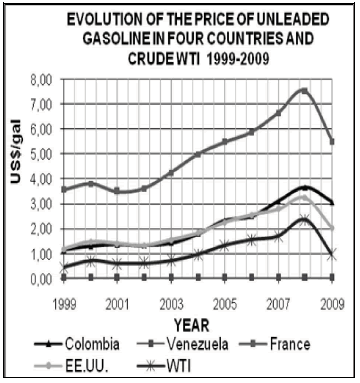
Figure 1: Evolution of the price of unleaded gasoline in four countries and crude WTI, 1999-2009. Source: [3, 4 y 6]
ANÁLISIS DEL PRECIO DE LA GASOLINA EN COLOMBIA: APROXIMACIÓN
MARYLONE MONTOYA-TORRES
Facultad de Minas, Universidad Nacional de Colombia, mmontoyt@unal.edu.co
ADRIANA MARTÍNEZ-CASTRO
Facultad de Minas, Universidad Nacional de Colombia, ammartin@unal.edu.co
GIOVANNI FRANCO-SEPÚLVEDA
Universidad Nacional de Colombia, gfranco@unal.edu.co
]]> Received for review December 12th, 2009, accepted August 3th, 2010, final version August, 10th, 2010
ABSTRACT: This paper presents an analysis of the price structure of gasoline in Colombia from 1999 to 2009, by doing a comparison of the resolution with which the Colombian government sets the actual price regarding the public sale price in general in the different service stations. The beginning shows how the WTI price influences the gasoline prices in countries such as United States, Venezuela, and France, but for Colombia the relation is not clear yet. Then the article exposes the factors used to set the price of gasoline in Colombia. Finally, it is concluded that the price of Colombian gasoline is very high and does not follow the equation proposed by the government and the factors that have the most influence on the final price are the producer income mainly affected by the WTI and the Market Representative Rate.
KEYWORDS: Price; Gasoline; Colombia
RESUMEN: El siguiente trabajo presenta un análisis de la estructura de precios de la gasolina en Colombia entre los años 1999-2009, haciendo una comparación de la resolución con la que el gobierno colombiano fija el precio actual con respecto al de venta al público en general en las diferentes estaciones de abastecimiento. Al inicio se muestra cómo influye el precio del WTI en el precio de la gasolina en países como Estados Unidos, Venezuela y Francia, en tanto que para Colombia la relación aún no es muy clara. Luego se exponen los factores usados para fijar el precio de la gasolina en Colombia. Finalmente, se concluye que el precio de la gasolina colombiana es muy alto y no sigue la ecuación propuesta por el gobierno y los factores que más influyen en el precio final son el ingreso al productor afectado principalmente por el WTI y la Tasa Representativa del Mercado.
PALABRAS CLAVE: Precio; Gasolina; Colombia
1. INTRODUCTION
The rise of the internal price of gasoline during the last months has not had a trustable justification on behalf of the government, since the price of oil WTI has suffered rises and falls, but the price of such fuel seems to be sensible only to the behavior that does not benefit the consumers.
Since the price of gasoline must be affected by factors such as the WTI, the Market Representative Rate and taxes, it seems that this is the last one where the government centers its highest interest, since it is where it receives the most profit.
]]> This work initially contains the comparison of the price of gasoline with other countries such as Venezuela, France, and the United States followed by the presentation of the factors that affect the price of gasoline in Colombia. Last, there is an analysis of the factors that affect the price of the producer income, component that affects the most, the final price of gasoline in Colombia.
2. PROBLEM DEFINITION
In Colombia the price of gasoline has been modified throughout years, for external factors and by internal agents, such as:
The price of gasoline in Colombia has also been affected by the international oil price, and it is the determinant factor for it, nevertheless, in Colombia, government intervention has significantly marked the evolution of the gasoline price throughout history, with the measures taken by the government, there have been several objectives such as facing inflation, improving the income of the producer to guarantee its development and duration in the market, stimulate competitiveness, among others. But these measures have brought some impacts, such as the rise of the prices of other goods and services as an effect of a logical association between the increase of the price of combustibles and the increase of prices at general levels.
Due to the importance of hydrocarbons at a worldwide level, it is necessary; to analyze the situation regarding oil and fuel of other countries, especially the case of unleaded gasoline, to then define the situation in Colombia.
Colombia is a country that even though it is not considered as an oil producing country, does depend of hydrocarbons in its industries; such as the case of gasoline whose main use is in auto-motors. For 2007, the country exceeded the gasoline demand in almost 9 KBPD produced [1]. However, could mean a relief in the pockets of the consumer by eliminating a series of taxes and additional costs due to the importation of products from abroad.
Venezuela for example is a country that sells gasoline to vehicle proprietors at the lowest price in the world, this is because the State and the State oil company PDVSA grant a subsidy to benefit the internal consumption of gasoline, since the country is one of the largest oil producers in the world, even though this measure does not favor environmental policies in a great measure, it enables Venezuelans to purchase more gasoline than water, since this second natural resource costs 25 times more than the aforementioned fuel [2].
Now, taking France as a second case for analysis, we can see that the gallon of gasoline has a higher price in comparison to Venezuela, United States and Colombia, since for being a developed country and one of the highest importers or crude oil at a world level, the price of gasoline must include additional costs for the fuel to be available for end users.
The last case of analysis is the United States, whose gasoline demand represents 24.3% of the world consumption of this product and it is one of the potencies of the world, but on the contrary, as it appears later in this article, presents in the last months a gasoline price lower than in Colombia.
]]> Now, Colombia against other countries is self-sufficient regarding fuels, which means production and consumption in one same place, which is a benefit for consumers since they should pay for their products a lower price compared to those who have to import it. If it see Figure 1, it can be noted that the price with the lowest price of gasoline is Venezuela, even lower than the WTI price, which represents an advantage for its consumers, since they not only obtain a gasoline at a lower cost, but also of higher quality. In the higher side of the prices appears France, who has sold in average at 5.5 US$/gallon during 2009. Colombian unleaded gasoline followed a behavior similar to the one in the United States and the WTI until 2006, where the increase of the price has generated a large impact in the pockets of Colombians.
Figure 1: Evolution of the price of unleaded gasoline in four countries and crude WTI, 1999-2009. Source: [3, 4 y 6]
Compared with another Latin-American country, such as Venezuela, Colombia sells its gasoline at a higher price; this is why in the border of both countries the illegal sale of gasoline is a business that supports many families.
Even though the citizens of these four countries have a different life quality, of the four cases analyzed, what percentage of their salary has to be spent daily to obtain a gallon of gasoline? To answer this question, the base is the minimum wage of the citizens of these countries, which divides the average price of gasoline in each year for each country. The result is Figure 2, that compared to Figure 1, enables to infer that the price paid by a consumer in any of the countries for one gallon of gasoline, is not necessarily the fair or proportional price to what the citizen earns, such as the case of Colombia, where a citizen earns 232 US$/month which is equal to 6.8 times less than what a French citizen earns or even 2.5 times less than a Venezuelan citizen.
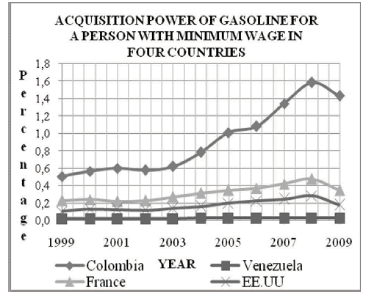
Figure 2: Acquisition power of gasoline for a person with minimum wage in four countries. Source: [3, 4 y 6], Own calculations. 2009
Another characteristic of the aforementioned situation, is that the proportion gasoline gallon/salary, tends to be stable within a same range for France and U.S.A., in Venezuela it remains unaltered, but in the Colombian case it seems that as of 2003 the increase of the price of gasoline does not try to maintain a balance with the income of consumers.
Due to the last considerations for the Colombian case, an analysis of the possible factors or motives that explain the rising behavior suffered by the price of gasoline and that does not favor the pocket of Colombians, is relevant since it enables to do the necessary explanations or to pose questions towards the measures taken by the government to set the price of gasoline.
]]> 3. ECONOMIC MODELS
In Colombia, the government resolves for the setting of the price of unleaded gasoline the use of an equation that involves different factors, some of them are expected to have a greater influence than others according to the importance assigned by the government.
The following is a general presentation of the elements of the structure of the price of gasoline, besides doing an analysis of which are and have been the factors that have influenced the behavior of the price of gasoline, such as taxes, elimination of the consumer subsidy, producer income, among others. To determine if the price paid by Colombians for each gallon of gasoline calculated through the resolution and the one stated by the government are the same.
3.1. General elements of the price structure of gasoline in Colombia
The Ministry of Mines and Energy through resolutions 82438 and 82439 of 1998, adopted a new structure for the setting of prices of unleaded gasoline and Diesel, and in such sense since January 1st, 1999 in Colombia the prices of such fuels are set monthly, having as a reference the opportunity costs and for this the exportation price parity is currently used.
The price structure for unleaded gasoline and Diesel, is made up by:
This cost will be calculated,
It has been established that crude oil under 14 API degrees, crude oil over 14 API degrees, fuel oil, IFO´s, exploitation residual crude and leaded gasoline, may freely establish their sale price, considering the internal production costs, and the prices that rule the international market.
Regarding the first item, Producer income, the equation used for the calculation is the following:

Where: IP(t): Is the producer income in effect for period t.
PrFOB: Is the arithmetic average of the quotations of Index UNL 87 U.S. Gulf Coast Waterborne of the publication by PLATT´s about Standard & Poor´s, published during the last thirty (30) calendar days immediately before the Calculation Date, expressed in dollars per gallon (US$/Gal).
FL: Is the maritime or land transportation fees and other expenses incurred to transport a gallon of gasoline from the Coast of the Gulf of the U.S.A. to the port of local importation, expressed in dollars per gallon (US$/Gallon). Such value will be the result of the following equation:
]]>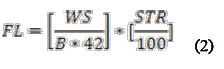
Where:
Ws: Is the value of the reference fee of the route Houston-Pozos Colorados published yearly by the Worldwide Tanker Nominal Freight Scale "World scale" in effect for the month immediately before period t, expressed in dollars per metric ton.
STR: Arithmetic average of the quotations published during the last thirty (30) calendar days immediately before the Date of Calculation, of the market correction factor for the fee of empty tankers of 30.000 Metric Tons for the route CARIB/USG, of the publication PLATT´s of Standard & Poor´s, expressed in World scale assess (WS Assess).
b: Conversion factor of metric tons into barrels. For the case of Colombian unleaded gasoline this conversion factor is 8.535 at 60° API.
42: Conversion factor of barrels to gallons.
SE: Is the cost of maritime or land insurances and other costs incurred to transport a gallon of gasoline from the coast of the Gulf of the U.S.A. to the local importation port, expressed in dollars per gallon (US$/Gallon), which will be calculated according to following equation:
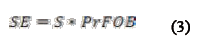
Where:
S: Is the multiplying factor used for the calculation of the insurances (SE). The factor in effect as of the coverage of the resolution will be 0.000387. This multiplied factor will be revised yearly, as of January 1, 2000. For each year the Ministry of Mines and Energy will set the S value, based on the quotation average of at least three (3) international insurance companies, whose long term debt qualification in dollars is equal or higher than BBB- of Standard & Poor´s, or has a qualification degree granted by another international agency with risk qualification.
]]> IM: Is the value of the quality inspection at the loading and unloading dock, expressed in dollars per gallon (US$/gallon). This cost will be US$0.000286 per gallon as of the date of effect of the aforementioned resolution. This value will be adjusted yearly, as of January 1, 2000, based on the quality inspection and in port handling costs that are in effect for each adjustment date.RMR : Is the "Market Representative Rate" as it is defined in article 96 of the Organic Statute of the Financial System, in effect on the day immediately before the "Calculation Date", as it may be certified by the Banking Superintendence.
A: Is the value corresponding to the payment of the ancillary fee for gasoline importations expressed in pesos per gallon, calculated according to the general fee established by article 1st of Decree-Law 2317 of 1995 or in those norms that modify, add, or complement it, applied on the taxable base established by the disposition that rule the customs appraisal according to Decree 1909 of 1992 and other norms that may complement or modify it.
TPC: Is the value corresponding to the payment of the fee for the Pozos Colorados Barranca Poliduct that connects the port of Pozos Colorados and Galán, expressed in pesos per gallon. The TPC value will be thirty-one pesos and forty cents per gallon ($31.4/gallon). Such value will be adjusted yearly by the Ministry of Mines and Energy according to the Petroleum Code and other applicable norms.
TI: Is the value corresponding to the payment of the applicable ring tax, expressed in pesos per gallon and calculated according to the general fee established in the corresponding norms, or in those norms that may modify it, add to it or complement it, applied on the taxable base established in the corresponding dispositions.
t: is the period between the first calendar day of each calendar month and the last calendar day of the same calendar month.
3.2. Factors that influence the price of gasoline
There are different factors that have a direct and indirect effect on the price of gasoline, but for the following analysis only the following will be considered: the WTI price, Representative Market Rate (RMR), and the measures taken by the government to decrease the impact generated on the Colombian economy by the variations of crude and its derivates in the international market.
A. WTI price Besides reflecting the conditions of the international market, the WTI, determines the price of its derivates, enabling the refineries to work without loss. This is, it has a direct effect on the price of its derivates as the main source it is. As it is observed in the Figure 1, it was in 2008 when the price of this commodity reached its maximum price in the last decade and the same way it started to slow down reaching values lower than 40 US$/barrel and increasing again during 2009 until achieving an average for this year not higher than US$ 60/barrel.
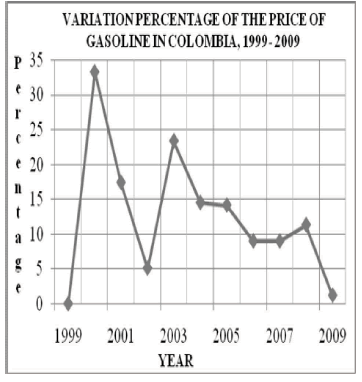
It seems as the price of unleaded gasoline has not followed the expected behavior, assisted by the government who has fixed the price of gasoline in a base price of crude of US$ 79/barrell, price that has only been reached twice: in October of 2008 when it experimented its notorious decrease and the second occasion is currently, a year later, when the price of crude does not reach the US$ 80/barrel. This measure has been one of the causes for the variations in the price of gasoline and it is not just to benefit the pocket of Colombians, as it appears in Figure 3.
]]>
B. Market Representative Rate The government, within the structure of the price of gasoline, supposes that it is being brought from abroad; therefore the RMR becomes a fundamental factor for the purchase in Colombian port. Figure 4 shows the behavior of the RMR and the price of gasoline in Colombia.
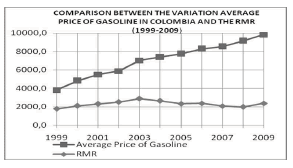
Figure 4: Comparison between the variation of the average price of gasoline in Colombia and the RMR (1999-2009). Source: [4y 6]
Figure 4 shows that both elements do not have a similar behavior pattern, this is, you could expect the RMR to influence the price of gasoline in some measure, but the RMR has had an average behavior during the last decade of $2300, and whose variation has stayed between $1756 and $2877, which have been the minimum and maximum values reached in such period, and even this way, the price of the fuel studied during the same decade has had an increase of 255.7%, which can be justified through devaluation be it of the dollar or Colombian currency.
C. Government Measures The measures adopted by the Colombian government towards the subject of the price of fuels, has pursued several objectives, such as facing inflation, keeping the interest of foreign investor by stimulating competition and improving the producer income. But such measures have also generated unexpected consequences such as the increase of the general level of the prices of other products and services. The following is a presentation about the impact generated by taxes and the elimination of the subsidy for the price of gasoline.
a. Taxes
Taxes are one of the factors that generate the most increase in the payment of the price of gasoline. Of the structure of the price of gasoline, the average prices of 1999 - 2009 have been taken and Figure 5 was obtained, in which it is shown that explicitly the user assumes the taxes such as Sales, the global tax, and fee, the total 37.5% of the price of gasoline.
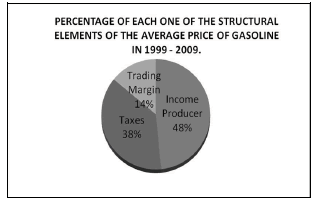 ]]>
Figure 5: Percentage of each one of the structural elements of the average price of gasoline in 1999 - 2009.Source: [4, 6 y 7]
]]>
Figure 5: Percentage of each one of the structural elements of the average price of gasoline in 1999 - 2009.Source: [4, 6 y 7]
b. Subsidies
Some of the measures taken by the current government as of 1999, was to generate a subsidy by the company ECOPETROL for the internal price of fuels, that consisted in preventing the increase of WTI and the variations of the RMR to generate increases on the price of fuels, in such case the state company assumed the difference between the international and national price, action that was supposed to benefit the pocket of the consumers.
But as of 2006 the government includes in the NDP, the cancellation of the subsidies to encourage competition and investment in the refinery of liquid fuels. Besides, with the fall of the WTI price during 2008, the government obtained the confidence to continue selling gasoline like when crude was at 120 US$/barrel, reason why currently in Colombia the prices of fuels are equal to between 105 and 115% of the international prices [5], these rises have been justified by the creation of a Price Stabilization Fund, that enables to mitigate the volatility of prices.
Another impact generated by the increase of the price of gasoline, is the stimulation to the consumption of substitute products such as Diesel, which has suffered the same measures as gasoline and that to date, has been sold at a lower price. And the consumption of gasoline has decreased 35%, Diesel has generated demand in the market with an increase of 79% between 1999 and 2007 [6]
3.3. Analysis of the Producer Income in the structure of the price of gasoline in Colombia
Analyzing the structure of prices of gasoline in Colombia and according to the data in Figure 5, it can be noted that the most influential factor on the price of gasoline in Colombia is the Producer Income, therefore there will be and emphasis on such concept.
Producer income intends to measure the opportunity cost incurred by Ecopetrol by selling gasoline in the internal market, instead of exporting it to other countries, the equation (1) states how to calculate this factor. This way, it is intended that the internal prices reflect in higher or lower extend the variations of external prices, with the purpose of sending appropriate signals to consumers about the real cost (and opportunity cost) that implies the production and commercialization of fuels in Colombia. In order to get that price, there is a calculation of the monetary value of all the costs incurred if the gasoline is commercialized between Colombia and the U.S.A.
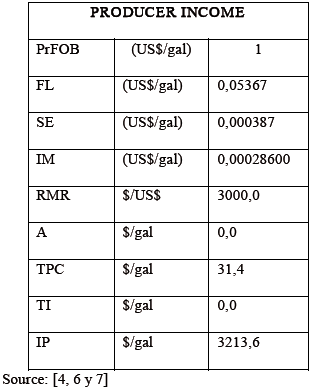
To find the factors that have the most influence on the producer income it replaced in equation (1) the values of each one of the constants, in chart 1 there are the values used and it is concluded that the PrFOB and the RMR are the factors that generate the highest variations on the Producer Income.
Table 1: Example of values used to calculate the Producer Income ]]>
The following are some calculations of the producer income, maintaining the other constant parameters, using equation (1), which tries to identify between the PrFOB and the RMR, which one affects the producer income the most:
Table 2: Econometric model between IP and PrFOB having a fixed RMR
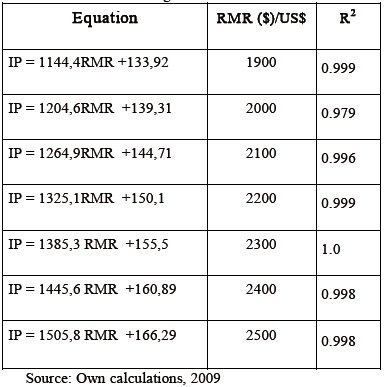
Table 3: Econometric model between the IP and RMR with a fixed PrFOB
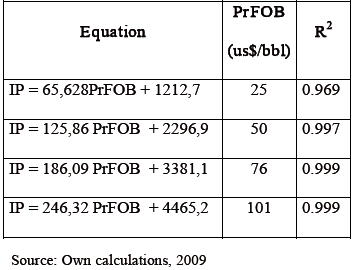
Both Figures 6 and 7 and Charts 2 and 3, show the influence of each factor on the price of the producer income, maintaining the other non-studied factor, constant in each case. Given that the slopes of the lines that relate PrFOB with the producer income are higher, it may be understood, that even though the RMR represents a factor of great incidence on the Producer Income, PrFOB is even more.
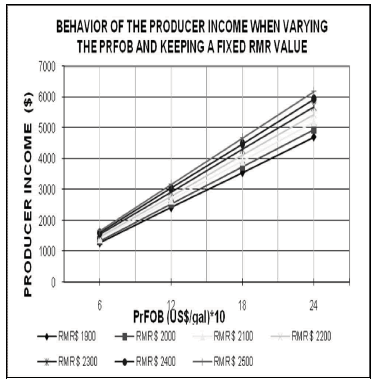
Figure 6: Behavior of the producer income when varying the PrFOB and keeping a fixed RMR value. Source: Own calculations, 2009
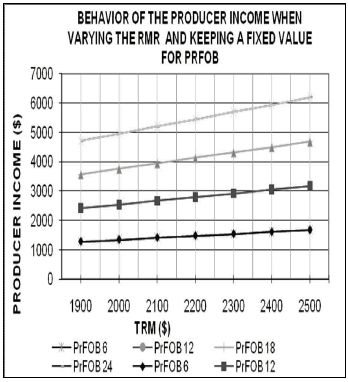
Doing a linear regression between the PrFOB and the RMR, Figure 8 shows that both factors are related inversely, this is, that for a high PrFOB price, the RMR has a lower value compared to those where the PrFOB is of lower magnitude. Therefore, if both factors are the ones with more incidence on the producer income, and both are inversely related, why is the value of the Producer Income unbalanced, since with rises in one variable, the other decreases, having effect on the final prices of gasoline which vary in an known range. Or given that there is record of long periods where the inverse behavior between both factors has been present in the market, but both the price of the producer income and the average price of gasoline in Colombia have continued increasing without showing a logical or predictable behavior.
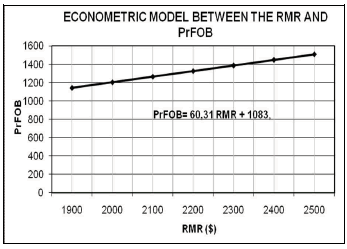
Figure 8: Econometric Model between the RMR and PrFOB. Source: Own calculations. 2009
3.4. Analysis of the producer income of resolution vs. the real one
In the practice, the national government has not done a strict application of the equation, as it appears in Figure 9, since the producer income, until the end of 2008 was higher than the authorized market price, reason why there was a subsidy for such agent. Such subsidy has been extremely volatile. For example, in October of 2008 it represented more than half the final price of a gallon of gasoline. But with the fall of the international oil quotation, in December of 2008, for the first time the value of gasoline calculated based on the external price found itself under the price set by the Ministry of Mines and Energy, reason why the subsidy became an overprice charged to the consumers.
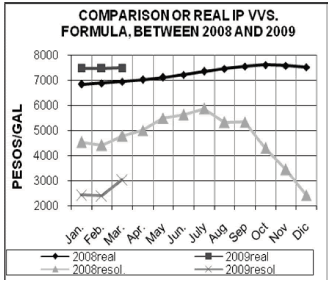
Figure 9: Comparison of real IP vs. Formula, between 2008 and 2009. Source: [4 y 6], Own calculations. 2009
Observing Figure 9 it can see that effectively the National Government has been "subsidizing"; the high producer income until mid October of 2008, and as of this time the price that Colombians pay is higher than the one calculated with the resolution issued monthly by the National Government. But the question is, did this subsidy really exist?, in the calculations of the price of the producer income, the National Government poses a fee that implies the transportation of the crude oil from the Gulf of Mexico, when the reality is that we are supplied with crude oil produced in Colombia, considering this situation instead of saying that it was receiving "subsidy";, the National Government should pose a price structure in Colombia according to the current situation of the country that even though it is not an oil producing country, at least it produces oil to be self sufficient.
]]> Besides, with the current structure of prices of gasoline it is hard to understand the concern of the government for running out of oil in Colombia, since regarding the price they are charging it seems as if Colombia did not produce oil. With this scenario we will calculate the fair price that Colombians should be paying for gasoline by calculating the price with the rate for transportation from the extraction well here in Colombia to the refineries and service stations.
4. CONCLUSIONS
According to the analysis and the information gathered in this article, it may be concluded that:
Even with self-supplying advantages the price of gasoline in Colombia is very high compared to countries such as U.S.A. and Venezuela.
Colombians have to spend a higher percentage of their income for the purchase of gasoline than the French who pay US$ 2.20 more per gallon than a Colombian.
The price of gasoline in Colombia is affected by factors such as: RMR , WTI, and the measures adopted by the government.
Taxes represent a high percentage in the structure of the prices of gasoline.
The impact generated on the internal market on the consumption of gasoline is the increase of the demand for substitute products when there arebb new increases on the sale price of gasoline.
The factor that affects the price of gasoline in Colombia the most is the producer income, which is proven that is mainly influenced by the PrFOB and the RMR.
]]> The government does not comply with the Resolution that poses the price of gasoline in Colombia, since in general, the price established by the Ministry of Mines and Energy has been lower than the price that would be the result of the strict application of the equation (resolution).
5. RECOMMENDATIONS
It is necessary on behalf of the Government to carry out a readjustment to the structure of prices of gasoline, because with the oil resource existing in the country, both the subsidies and overprices are unjustified. Some elements, such as transportation from the Gulf of Mexico to Colombian port which constitutes a freight, the maritime insurance, the importation fee, the ring tax, the quality inspection abroad, do not only generate over costs to the producer income finally affecting the price of gasoline, but values the gasoline used in Colombia as an imported product, which is totally incorrect and unfair since even if Colombia is not an oil country the internal offer of gasoline is enough to cover the internal demand.
6. REFFERENCES
[1] RINCON, H. ¿Do Colombian fuel consumers receive subsidy or, as a whole, pay taxes? Borradores de Economía, 540, 2008. [ Links ]
[2] MARQUEZ, H, Venezuela: the lowest price of gasoline in the world, Inter Press Service. Available at: http://www.ipsnoticias.net/ [November 9, 2009]. [ Links ]
[3] EIA: Energy Information Administration. Petroleum Data, 2009. [ Links ]
[4] UPME. Mining and Energy Planning Unit. Monthly price bulletin, 2009. [ Links ]
[5] SALAZAR, H. If the international prices of oil have substantially decreased in the last months, why doesn't the same happen in the service stations of a large part of the Latin American countries? BBC Mundo. Available at: http://www.bbc.co.uk/mundo/index.shtml [quoted: November 13, 2009]. [ Links ]
[6] ECOPETROL. Statistics of the oil industry, Economic Indicators. 2009. [ Links ]
[8] MINISTRY OF MINES AND ENERGY. Communications, 2009. [ Links ] ]]>