<?xml version="1.0" encoding="ISO-8859-1"?><article xmlns:mml="http://www.w3.org/1998/Math/MathML" xmlns:xlink="http://www.w3.org/1999/xlink" xmlns:xsi="http://www.w3.org/2001/XMLSchema-instance">
<front>
<journal-meta>
<journal-id>0012-7353</journal-id>
<journal-title><![CDATA[DYNA]]></journal-title>
<abbrev-journal-title><![CDATA[Dyna rev.fac.nac.minas]]></abbrev-journal-title>
<issn>0012-7353</issn>
<publisher>
<publisher-name><![CDATA[Universidad Nacional de Colombia]]></publisher-name>
</publisher>
</journal-meta>
<article-meta>
<article-id>S0012-73532014000500030</article-id>
<article-id pub-id-type="doi">10.15446/dyna.v81n186.46105</article-id>
<title-group>
<article-title xml:lang="en"><![CDATA[Reliability in urban freight distribution: A Markovian approach]]></article-title>
<article-title xml:lang="es"><![CDATA[Confiabilidad en distribución urbana de mercancías: Un enfoque Markoviano]]></article-title>
</title-group>
<contrib-group>
<contrib contrib-type="author">
<name>
<surname><![CDATA[Cedillo-Campos]]></surname>
<given-names><![CDATA[Miguel Gastón]]></given-names>
</name>
<xref ref-type="aff" rid="A01"/>
</contrib>
<contrib contrib-type="author">
<name>
<surname><![CDATA[Riva-Canizales]]></surname>
<given-names><![CDATA[José Luis de la]]></given-names>
</name>
<xref ref-type="aff" rid="A02"/>
</contrib>
<contrib contrib-type="author">
<name>
<surname><![CDATA[Bueno-Solano]]></surname>
<given-names><![CDATA[Alfredo]]></given-names>
</name>
<xref ref-type="aff" rid="A01"/>
</contrib>
<contrib contrib-type="author">
<name>
<surname><![CDATA[Gonzalez-Feliu]]></surname>
<given-names><![CDATA[Jesús]]></given-names>
</name>
<xref ref-type="aff" rid="A03"/>
</contrib>
<contrib contrib-type="author">
<name>
<surname><![CDATA[García-Alcaraz]]></surname>
<given-names><![CDATA[Jorge Luis]]></given-names>
</name>
<xref ref-type="aff" rid="A04"/>
</contrib>
</contrib-group>
<aff id="A01">
<institution><![CDATA[,Mexican Institute of Transportation  ]]></institution>
<addr-line><![CDATA[Querétaro ]]></addr-line>
<country>México</country>
</aff>
<aff id="A02">
<institution><![CDATA[,National Council of Science and Technology  ]]></institution>
<addr-line><![CDATA[Saltillo Coahuila]]></addr-line>
<country>México</country>
</aff>
<aff id="A03">
<institution><![CDATA[,Centre National de la Recherche Scientifique  ]]></institution>
<addr-line><![CDATA[Lyon ]]></addr-line>
<country>France</country>
</aff>
<aff id="A04">
<institution><![CDATA[,Autonomous University of Ciudad Juarez Institute of Engineering and Technology ]]></institution>
<addr-line><![CDATA[Ciudad Juarez ]]></addr-line>
<country>México</country>
</aff>
<pub-date pub-type="pub">
<day>00</day>
<month>10</month>
<year>2014</year>
</pub-date>
<pub-date pub-type="epub">
<day>00</day>
<month>10</month>
<year>2014</year>
</pub-date>
<volume>81</volume>
<numero>187</numero>
<fpage>232</fpage>
<lpage>239</lpage>
<copyright-statement/>
<copyright-year/>
<self-uri xlink:href="http://www.scielo.org.co/scielo.php?script=sci_arttext&amp;pid=S0012-73532014000500030&amp;lng=en&amp;nrm=iso"></self-uri><self-uri xlink:href="http://www.scielo.org.co/scielo.php?script=sci_abstract&amp;pid=S0012-73532014000500030&amp;lng=en&amp;nrm=iso"></self-uri><self-uri xlink:href="http://www.scielo.org.co/scielo.php?script=sci_pdf&amp;pid=S0012-73532014000500030&amp;lng=en&amp;nrm=iso"></self-uri><abstract abstract-type="short" xml:lang="en"><p><![CDATA[A key element in assessing reliability in urban freight distribution (UFD) is the probability density function (PDF) of the variables that characterize the performance of the distribution routes. This article presents a method for modeling the PDF with an approach based on the Markov models, under the assumption that the present status of reliability of a route depends only on its immediate previous state. Currently, the PDF is obtained directly from the field, therefore an analytical model that provides certainty to the analysis is essential. The results are applicable both to the design of routes and operation of the same process. The originality of this work is based on the development of a methodological procedure to assess the reliability of the components of a path, complementary to current methodologies to calculate network reliability.]]></p></abstract>
<abstract abstract-type="short" xml:lang="es"><p><![CDATA[Un elemento importante en la evaluación de la confiabilidad de la distribución urbana de mercancías (DUM) es la función de densidad de probabilidad (FDP) de las variables que caracterizan el desempeño de las rutas de distribución. En este artículo se presenta un método para modelar la FDP con un enfoque basado en los modelos de Markov, bajo el supuesto de que la situación actual de la confiabilidad de una ruta sólo depende de su estado inmediato anterior. Actualmente, la FDP se obtiene de forma empírica, por lo tanto, un modelo analítico que proporcione seguridad en el análisis es esencial. Los resultados son aplicables en el diseño de rutas y el funcionamiento del mismo proceso. La originalidad de este trabajo se basa en el desarrollo de un procedimiento metodológico para evaluar la confiabilidad de los componentes de una ruta, la cual es complementaria a las metodologías actuales para calcular confiabilidad en redes.]]></p></abstract>
<kwd-group>
<kwd lng="en"><![CDATA[Reliability]]></kwd>
<kwd lng="en"><![CDATA[Markov models]]></kwd>
<kwd lng="en"><![CDATA[urban freight distribution]]></kwd>
<kwd lng="en"><![CDATA[logistics]]></kwd>
<kwd lng="en"><![CDATA[supply chain]]></kwd>
<kwd lng="es"><![CDATA[Confiabilidad]]></kwd>
<kwd lng="es"><![CDATA[modelo de Markov]]></kwd>
<kwd lng="es"><![CDATA[distribución urbana de mercancías]]></kwd>
<kwd lng="es"><![CDATA[logística]]></kwd>
<kwd lng="es"><![CDATA[cadena de suministro]]></kwd>
</kwd-group>
</article-meta>
</front><body><![CDATA[ <p><font size="2" face="Verdana, Arial, Helvetica, sans-serif"><a href="http://dx.doi.org/10.15446/dyna.v81n187.46105" target="_blank">http://dx.doi.org/10.15446/dyna.v81n187.46105</a></font></p>     <p align="center"><font size="4" face="Verdana, Arial, Helvetica, sans-serif"><b>Reliability in urban freight distribution: A  Markovian approach</b></font></p>     <p align="center"><i><b><font size="3" face="Verdana, Arial, Helvetica, sans-serif">Confiabilidad en distribuci&oacute;n urbana de mercanc&iacute;as: Un enfoque  Markoviano</font></b></i></p>     <p align="center">&nbsp;</p>     <p align="center"><b><font size="2" face="Verdana, Arial, Helvetica, sans-serif">Miguel Gast&oacute;n Cedillo-Campos <i><sup>a</sup></i>, Jos&eacute; Luis de la   Riva-Canizales <i><sup>b</sup></i>, Alfredo   Bueno-Solano <i><sup>c</sup></i>,  Jes&uacute;s Gonzalez-Feliu <i><sup>d</sup></i> &amp; Jorge Luis Garc&iacute;a-Alcaraz <i><sup>e</sup></i></font></b></p>     <p align="center">&nbsp;</p>     <p align="center"><font size="2" face="Verdana, Arial, Helvetica, sans-serif"><sup><i>a,   c </i></sup><i>Mexican   Institute of Transportation, Quer&eacute;taro, M&eacute;xico. <a href="mailto:gaston.cedillo@mexico-logistico.org">gaston.cedillo@mexico-logistico.org</a>, <a href="mailto:abueno@imt.mx">abueno@imt.mx</a>    <br>   <sup>b</sup> COMIMSA - CONACYT (National Council of Science     and Technology), Saltillo, Coahuila, M&eacute;xico.    <br>     <sup>d </sup>Centre National de la Recherche       Scientifique, Lyon,       France. <a href="mailto:jesus.gonzalez-feliu@cnrs.fr">jesus.gonzalez-feliu@cnrs.fr</a>    <br>       <sup>e</sup> Institute of Engineering and Technology -         Autonomous University of Ciudad Juarez, Ciudad Juarez, M&eacute;xico. <a href="mailto:jorge.garcia@4uacj.mx">jorge.garcia@4uacj.mx</a> </i></font></p>     ]]></body>
<body><![CDATA[<p align="center">&nbsp;</p>     <p align="center"><font size="2" face="Verdana, Arial, Helvetica, sans-serif"><b>Received:  May 28<sup>th</sup>, 2014.Received in revised form: August 25<sup>th</sup>, 2014.Accepted: September  10<sup>th</sup>, 2014 </b></font></p>     <p align="center">&nbsp;</p> <hr>     <p><font size="2" face="Verdana, Arial, Helvetica, sans-serif"><b>Abstract    <br> </b></font><font size="2" face="Verdana, Arial, Helvetica, sans-serif">A key element in  assessing reliability in urban freight distribution (UFD) is the probability  density function (PDF) of the variables that characterize the performance of  the distribution routes. This article presents a method for modeling the PDF  with an approach based on the Markov models, under the assumption that the  present status of reliability of a route depends only on its immediate previous  state. Currently, the PDF is obtained directly from the field, therefore an  analytical model that provides certainty to the analysis is essential. The  results are applicable both to the design of routes and operation of the same  process. The originality of this work is based on the development of a  methodological procedure to assess the reliability of the components of a path, complementary to current methodologies to calculate network reliability.</font></p>     <p><font size="2" face="Verdana, Arial, Helvetica, sans-serif"><i>Keywords</i>:  Reliability; Markov models; urban freight distribution; logistics; supply  chain. </font></p>     <p><font size="2" face="Verdana, Arial, Helvetica, sans-serif"><b>Resumen    <br> </b></font><font size="2" face="Verdana, Arial, Helvetica, sans-serif">Un elemento  importante en la evaluaci&oacute;n de la confiabilidad de la distribuci&oacute;n urbana de  mercanc&iacute;as (DUM) es la funci&oacute;n de densidad de probabilidad (FDP) de las  variables que caracterizan el desempe&ntilde;o de las rutas de distribuci&oacute;n. En este  art&iacute;culo se presenta un m&eacute;todo para modelar la FDP con un enfoque basado en los  modelos de Markov, bajo el supuesto de que la situaci&oacute;n actual de la  confiabilidad de una ruta s&oacute;lo depende de su estado inmediato anterior.  Actualmente, la FDP se obtiene de forma emp&iacute;rica, por lo tanto, un modelo  anal&iacute;tico que proporcione seguridad en el an&aacute;lisis es esencial. Los resultados  son aplicables en el dise&ntilde;o de rutas y el funcionamiento del mismo proceso. La  originalidad de este trabajo se basa en el desarrollo de un procedimiento  metodol&oacute;gico para evaluar la confiabilidad de los componentes de una ruta, la  cual es complementaria a las metodolog&iacute;as actuales para calcular confiabilidad en redes.</font></p>     <p><font size="2" face="Verdana, Arial, Helvetica, sans-serif"><i>Palabras clave:</i> Confiabilidad; modelo de Markov; distribuci&oacute;n  urbana de mercanc&iacute;as; log&iacute;stica; cadena de suministro.</font></p> <hr>     <p>&nbsp;</p>     ]]></body>
<body><![CDATA[<p><font size="3" face="Verdana, Arial, Helvetica, sans-serif"><b>1.  Introduction</b></font></p>     <p><font size="2" face="Verdana, Arial, Helvetica, sans-serif">An urban freight  distribution system with an incorrect design can sometimes cause an increase of  up to 5% on the invoiced value of the goods, and also degrades the quality of  service expected by the client &#91;1,2&#93;. Companies benefit from the important  advantages of high agglomeration of production and consumption activities  located within cities, (considered as entities with a greater influence in the  dynamism of transport and its development). But at the same time, this means  important challenges imposed by extern factors such as congestion of traffic  and other barriers for the effective distribution of its products &#91;3-6&#93;. In  this sense, the urban freight distribution (UFD) must at the same time adapt to  new forms of consumption, and also adjust to the urban territory's  transformations that put new barriers to logistics operations &#91;7-9&#93;.</font></p>     <p><font size="2" face="Verdana, Arial, Helvetica, sans-serif">Requirements of an  agile coordination of human, material and financial resources at the UFD  require establishing a well-structured plan of logistics operations. Otherwise,  there is a risk of unexpected costs that would not only be reflected in the  final price of a product, but also in a poor exposure and lost sales. Wishing  to guarantee an effective logistics performance, a key factor is to know the  level of operation of the system both in stable and uncertain states &#91;10&#93;. In  fact, according to &#91;11&#93;: &quot;<i>in addition   to factors such as time and cost, logistics performance increasingly depends on   the reliability and predictability of the supply chain.</i>&quot; So &quot;<i>the reliability of the supply chain is one    of the most important aspects in logistics performance</i>&quot;.</font></p>     <p><font size="2" face="Verdana, Arial, Helvetica, sans-serif">Reliability in UFD is considered as: &quot;<i>the level of stability in the quality of the  service offered by a system of routes</i>&quot; &#91;12&#93;. It is also known as  distribution system robustness &#91;13&#93;. In this regard, a key element in assessing  network reliability is the probability density function (PDF) of the variables  that characterize the performance of the distribution routes, which is  currently calculated empirically. This is why an analytical model is necessary.</font></p>     <p><font size="2" face="Verdana, Arial, Helvetica, sans-serif">This research  contributes to the body of knowledge in the area, by offering a methodology for  evaluating the reliability of the components of a distribution route, modeling  the PDF on the basis of the Markov models. Accordingly, this contribution  assumes that the current state of reliability of a route depends only on its  immediate previous state. In this context, two main problems were identified to  be solved for the analysis of reliability of a UFD network: 1) to determine its  reliability and vulnerability to ensure an operational level of service; and 2)  dynamically re-design the system of distribution routes considering  predetermined restrictions regarding its set of nodes and edges. Given the  scope of the topic, this article focuses on the resolution of the first issue.  That is, with the objective of evaluating the reliability of the components of  a UFD route, a modeling method of the PDF based on the theory of Markov models  is exposed.</font></p>     <p><font size="2" face="Verdana, Arial, Helvetica, sans-serif">This document is structured as follows. In the following  section 2, a critical analysis of previous approaches, and evaluation techniques  reported in the literature is presented. Section 3 outlines the methodology  used, emphasizing the phase of application of the Markov models. Section 4  presents the application of this methodology to a case study. Finally, section  5 presents relevant conclusions, as well as future research work.</font></p>     <p>&nbsp;</p>     <p><font size="3" face="Verdana, Arial, Helvetica, sans-serif"><b>2.  Background</b></font></p>     <p><font size="2" face="Verdana, Arial, Helvetica, sans-serif">In the context of  commercial distribution, the UFD activity is considered as the set of processes  performed through the distribution chain, from the origin until the reception  by the customer within an urban area &#91;14&#93;. In this sense, looking for improved  distribution systems, decision makers are not only facing the definition of the  location of warehouses and sale points, transportation, inventory level, but  also the selection of distribution routes, all under a set of given  restrictions &#91;7&#93;.</font></p>     <p><font size="2" face="Verdana, Arial, Helvetica, sans-serif">In this regard,  different strategies to improve the urban freight distribution have been  implemented in recent years, among them: i) improvements in the processing of  orders and customer service; ii) processes and operations of reverse logistics;  iii) implementation of logistics operators with dedicated fleets; iv) location  of logistics support in logistics centers, many-to-many delivery, multiple  shipments, among others &#91;11,15&#93;. All these have been originated and modified  routing design methods. The literature reports three classes of methods: 1)  exact; 2) heuristics; and; 3) meta-heuristics methods &#91;16&#93;.</font></p>     ]]></body>
<body><![CDATA[<p><font size="2" face="Verdana, Arial, Helvetica, sans-serif"><b><i>2.1.  Networks  reliability</i></b></font></p>     <p><font size="2" face="Verdana, Arial, Helvetica, sans-serif">The analysis of network  reliability has commonly focused on different aspects of the distribution and  transport, such as: i) the reliability of connectivity (or terminal  reliability, which means that distribution can be successfully completed  between each pair of nodes); ii) reliability of the travel time (including the  transportation of goods with success at a given time); and iii) the reliability  of capacity (which considers the distribution adapted to a demand of traffic or  load). All of them are associated with probabilities of occurrence of each  event &#91;17-18&#93;.</font></p>     <p><font size="2" face="Verdana, Arial, Helvetica, sans-serif">Another important aspect is also the vulnerability of  networks. This latest is related to observable consequences in the distribution  due to any failure or disruption on routes regardless of its probability of  occurrence. These two concepts (reliability and vulnerability) are  differentiated when considering the reliability as the operability level of the  system, and vulnerability as the consequences of the non-operability &#91;19&#93;. </font></p>     <p><font size="2" face="Verdana, Arial, Helvetica, sans-serif">Among the consequences of a distribution system with a low  reliability, it is possible to observe: i) increase in the transit time of the  goods; ii) loss of opportunity value; iii) total or partial default order; and  iv) need to implement crisis plans. All these generate socioeconomic costs that  were not previously considered.</font></p>     <p><font size="2" face="Verdana, Arial, Helvetica, sans-serif"><b><i>2.2.  Reliability  evaluation methods</i></b></font></p>     <p><font size="2" face="Verdana, Arial, Helvetica, sans-serif">This paper defines a measure of reliability of a  distribution system based on its topology and on the reliability of its  components. One of the important elements to assess network reliability is the  stage of defining the parameters or reliability indicators. The main common  indicators are: 1) frequency of interruption, which indicates how many times a  route has been disrupted over a period of time; 2) unavailability of the  network, which measures the total time of disruption for a route over a period  of time; 3) duration of disruption; &#91;20&#93;.</font></p>     <p><font size="2" face="Verdana, Arial, Helvetica, sans-serif">However, another important indicator is the probability of  failure, for which there are analytical methodologies and simulations. Among  those with a focus on simulation, Monte Carlo technique is used. It should be  noted that, meta-heuristics and genetic algorithms techniques are also used. On  the other hand, the focus of analytical methods, include: i) techniques of  frequency and duration; ii) minimum-cut method; iii) fault tree analysis; iv)  Markov models; v) Boolean models; vi) the generating function &#91;21&#93;. </font></p>     <p><font size="2" face="Verdana, Arial, Helvetica, sans-serif">However, these methodologies require the reliability value  of each component of the route to determine the reliability of the whole route.  All of them lack a procedure for evaluation; however, the Markov models were  identified as an important base to measure the reliability of the every  component through its PDF. Markov models are characterized by a logical  approach to model complex systems and sequential events &#91;22&#93;.</font></p>     <p><font size="2" face="Verdana, Arial, Helvetica, sans-serif">Since  our research assumed that the current state of reliability of a route only  depends on its immediate previous state, an approach based on the Markov models  was appropriate. At the same time, we considered that taking samples of the  reliability state of a route, at different moments, and if these samples are  related to some indicators, it is then possible to make a dynamic analysis  (feature which is lacking in other methods). A Markov model applied to the subject  of distribution is defined as a stochastic model of evaluation of reliability,  associated with one of the default states of operation or not &#91;22,23&#93;. However,  it is important to note that Markov models allow obtaining the probability that  the route resides in any of its possible states, but not the probability of  failure or disruption at some certain time of operation.</font></p>     <p>&nbsp;</p>     ]]></body>
<body><![CDATA[<p><font size="3" face="Verdana, Arial, Helvetica, sans-serif"><b>3.  Methodology</b></font></p>     <p><font size="2" face="Verdana, Arial, Helvetica, sans-serif">The methodology  oriented to reliability assessment here exposed is composed by 3 stages: i)  Evaluation of reliability factors; ii) Markov models; and iii) Evaluation of  the path reliability.</font></p>     <p><font size="2" face="Verdana, Arial, Helvetica, sans-serif"><b><i>3.1.  Evaluation of  reliability factors</i></b></font></p>     <p><font size="2" face="Verdana, Arial, Helvetica, sans-serif">The first phase determines the variables to consider as  factors of reliability of a route. Based on the approach of reliability  analysis (connectivity, travel time or capacity), these factors are specified  by considering as <i>route failure</i> any  incident or disruption that affects the optimal or expected operation of the  route. Among some of the variables observed are: i) time; ii) reaction capacity;  iii) cost of operation by unit transported; iv) effective deliveries; v) load  capacity, etc.</font></p>     <p><font size="2" face="Verdana, Arial, Helvetica, sans-serif">For each unit of time during which the measurements of the  reliability factors are carried out, an indicator, called reliability  indicator, must represent them. To integrate this indicator, we must linearly  combine all the study factors that consider as coefficients the importance  weightings of each variable. Furthermore, to determine the reliability of the  elements or nodes that make up the distribution route, it was due to obtain an  indicator of reliability for each of them. </font></p>     <p><font size="2" face="Verdana, Arial, Helvetica, sans-serif"><b><i>3.2.  Markov models</i></b></font></p>     <p><font size="2" face="Verdana, Arial, Helvetica, sans-serif">In a second phase, Markov models were applied to estimate  the reliability of each item (node) of the route. This was based on the  measurements of the reliability factors, as well as on the reliability  indicator &#91;24&#93;. This approach was organized around four parts:</font></p>     <p><font size="2" face="Verdana, Arial, Helvetica, sans-serif"><i>a)    Definition of the states of the process and  mechanisms of transition between them</i></font></p>     <p><font size="2" face="Verdana, Arial, Helvetica, sans-serif">The performance states of the route can be defined a  priori or a posteriori of the measurements of the reliability indicator.  Consequently, based on &#91;23,25&#93; the characteristics of the process were  identified to define the mechanisms of transition between states. Therefore, if  the probability that the process currently in a certain state changes to  another state, we then say that the process is:</font></p> <ul>       <li><font size="2" face="Verdana, Arial, Helvetica, sans-serif"><b><i>Recurrent: </i></b>If the probability is the     same for two or more units of time;</font></li>       ]]></body>
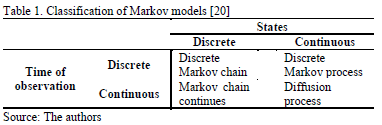
<body><![CDATA[<li><font size="2" face="Verdana, Arial, Helvetica, sans-serif"><b><i>Transitional: </i></b>If the probability is     different for any two units of time; </font></li>       <li><font size="2" face="Verdana, Arial, Helvetica, sans-serif"><b><i>Periodical: </i></b>If the probability is     the same for any period of unit of time;</font></li>       <li><font size="2" face="Verdana, Arial, Helvetica, sans-serif"><b><i>Absorbent: </i></b>If the probability is     zero in any unit of time;</font></li>       <li><font size="2" face="Verdana, Arial, Helvetica, sans-serif"><b><i>Complex: </i></b>If the probability is     different to zero in any unit of time.</font></li>     </ul>     <p><font size="2" face="Verdana, Arial, Helvetica, sans-serif"><i>b)  Selecting  the Markov model</i></font></p>     <p><font size="2" face="Verdana, Arial, Helvetica, sans-serif">There  are other attributes of the process to determine the type of model to be used  when modelling a phenomenon. </font></p>     <p align="center"><font size="2" face="Verdana, Arial, Helvetica, sans-serif"><a name="tab01"></a></font><img src="/img/revistas/dyna/v81n187/v81n187a30tab01.gif"></p>     <p><font size="2" face="Verdana, Arial, Helvetica, sans-serif">First,  it is important to confirm that the phenomenon is consistent with a behavior of  Markov chains. This way, based on the frequency of measurements of the variables  of the process and the classification of the possible states of the process,  the type of Markov model is stated &#91;20,22&#93;. </font></p>     <p><font size="2" face="Verdana, Arial, Helvetica, sans-serif">Another important feature of the model is its homogeneity,  i.e., the probability that the process currently in one of the states changes  to another particular state is the same, regardless of the time in which the  variables of the phenomenon are evaluated &#91;19,22&#93;. </font></p>     ]]></body>
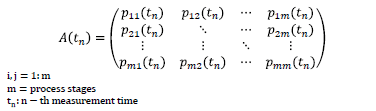
<body><![CDATA[<p><font size="2" face="Verdana, Arial, Helvetica, sans-serif"><i>c)    Determining the probabilities of transition </i></font></p>     <p><font size="2" face="Verdana, Arial, Helvetica, sans-serif">The  probabilities of transition between states indicate the </font><font size="2" face="Verdana, Arial, Helvetica, sans-serif">probability of the process <i>X</i> to go from a state <i>i</i> to state <i>j</i> for each unit of time <i>n</i> &#91;23&#93;, which are expressed as follows:</font></p>     <p><img src="/img/revistas/dyna/v81n187/v81n187a30eq01.gif"></p>     <p><font size="2" face="Verdana, Arial, Helvetica, sans-serif">Then, for the case in which the probability of the process  of going from state <i>i</i> to state <i>j</i> for <i>k</i> units of time is needed, the expression to compute it is &#91;24&#93;:</font></p>     <p><img src="/img/revistas/dyna/v81n187/v81n187a30eq02.gif"></p>     <p><font size="2" face="Verdana, Arial, Helvetica, sans-serif">Based on the characteristics and type of Markov model, as  well as on the reliability of the process indicator measurements, transition  probabilities were obtained &#91;20&#93;, which in turn formed the transition matrix:</font></p>     <p><img src="/img/revistas/dyna/v81n187/v81n187a30eq021.gif"></p>     <p><font size="2" face="Verdana, Arial, Helvetica, sans-serif"><i>d) Analysis of the temporal evolution of the  phenomenon</i></font></p>     <p><font size="2" face="Verdana, Arial, Helvetica, sans-serif">This process is understood as predicting the state of a  process at a certain time through transition matrices &#91;22&#93;. However, the  analysis depends on the type of model:</font></p> <ul>       <li><font size="2" face="Verdana, Arial, Helvetica, sans-serif">In the case of a discrete Markov chain, the transition     matrix of <i>k</i> units of time is as     follows: </font></li>     ]]></body>
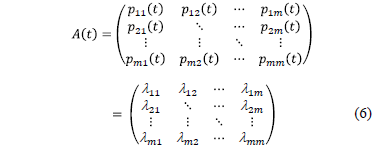
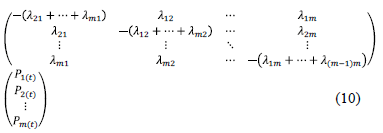
<body><![CDATA[</ul>     <blockquote>       <p><font size="2" face="Verdana, Arial, Helvetica, sans-serif"> </font><img src="/img/revistas/dyna/v81n187/v81n187a30eq03.gif"></p>       <p><font size="2" face="Verdana, Arial, Helvetica, sans-serif">Where each component of the matrix is the probability of     transition from one state to another in <i>k</i> units of time. If the discrete Markov chain is homogeneous, it is because:</font></p>       <p><img src="/img/revistas/dyna/v81n187/v81n187a30eq04.gif"></p> </blockquote> <ul>       <li><font size="2" face="Verdana, Arial, Helvetica, sans-serif">In the case of a     continuous Markov chain, one of the techniques to analyze this type of     stochastic processes is to solve differential equations &#91;24,25&#93;. Since the     process is represented by a succession of values X (t) representing the value     of the process X at any moment of time t, then the probability of transition     from one state <i>i </i>to state <i>j</i>, was defined as:</font></li>     </ul>     <p><img src="/img/revistas/dyna/v81n187/v81n187a30eq05.gif"></p>     <blockquote>       <p><font size="2" face="Verdana, Arial, Helvetica, sans-serif">Where, the matrix of transition was established as:</font></p> </blockquote>     ]]></body>
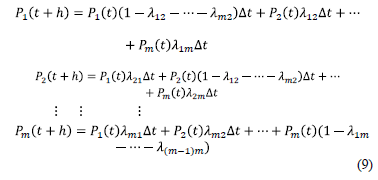
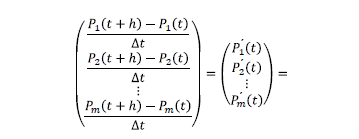
<body><![CDATA[<p><img src="/img/revistas/dyna/v81n187/v81n187a30eq06.gif"></p>     <p><font size="2" face="Verdana, Arial, Helvetica, sans-serif">Therefore, considering a homogeneous Markov chain, we  obtained that the probability of each state at time <i>t</i> + <i>h</i> was the linear  combination of the probabilities of all states at time <i>t</i> and the transition probabilities in infinitesimal time interval (<i><font face="Symbol">D</font>t</i>) defined as <i><font face="Symbol">l</font><sub>ij</sub><font face="Symbol">D</font>t</i>: </font></p>     <p><img src="/img/revistas/dyna/v81n187/v81n187a30eq07.gif"></p>     <p><font size="2" face="Verdana, Arial, Helvetica, sans-serif">Based on the property that the sum of the probabilities of  transition from one state to the other, the process is:</font></p>     <p><img src="/img/revistas/dyna/v81n187/v81n187a30eq08.gif"></p>     <p><font size="2" face="Verdana, Arial, Helvetica, sans-serif">The result was that by replacing (7) in each equation (8)  for each state, the equations system is:</font></p>     <p><img src="/img/revistas/dyna/v81n187/v81n187a30eq09.gif"></p>     <p><font size="2" face="Verdana, Arial, Helvetica, sans-serif">From which, applying algebra we obtained the following  matrix system:</font></p>     <p><img src="/img/revistas/dyna/v81n187/v81n187a30eq091.gif"></p>     <p><font size="2" face="Verdana, Arial, Helvetica, sans-serif">By solving this differential equations system, and  considering the initial conditions of the process, the result is a system  solution vector in which its components are the PDF of reliability states.</font></p>     ]]></body>
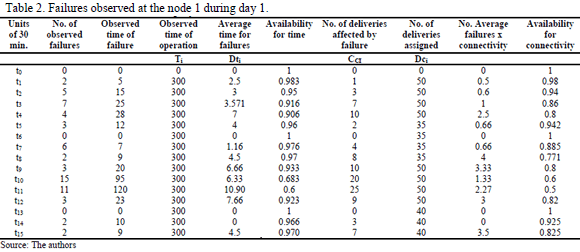
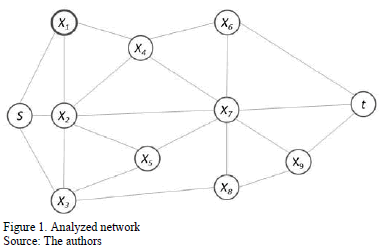
<body><![CDATA[<p><img src="/img/revistas/dyna/v81n187/v81n187a30eq10.gif"></p>     <p><font size="2" face="Verdana, Arial, Helvetica, sans-serif"><b><i>3.3.  Evaluation of  the path reliability</i></b></font></p>     <p><font size="2" face="Verdana, Arial, Helvetica, sans-serif">In a third phase, once obtained the calculation of  reliability of each node that is part of the distribution path, the reliability  of the distribution network is computed. To do so, algorithms to assess the  network reliability were used. An option was implementing the hybrid algorithm  proposed by Jane Chin-Chia &#91;26&#93;. It not only calculates the reliability of a  route, but also of all feasible routes based on nodes, edges, demand and  distribution costs. It also displays a direct and practical reliability assessment.</font></p>     <p><font size="2" face="Verdana, Arial, Helvetica, sans-serif">The purpose of this algorithm is to compute the  reliability of the route by organizing its components as reliable, not  reliable, or stochastic, through the analysis of the characteristics of the  route, stored in a <i>S-item</i>. The  algorithm starts by considering as stochastic all possible routes formed by  feasible nodes and edges for the distribution. Through iteration the  classification of each route is determined. Finally, the algorithm ends when  the <i>S-item</i> is absent from any  stochastic route.</font></p>     <p><font size="2" face="Verdana, Arial, Helvetica, sans-serif">In the process of determining if a route is reliable or  not, the reliability portion issued by this route is added to the network  reliability on the previous iteration. If it is considered as stochastic, then  each component of this route is analyzed to determine what parts are reliable  or not, ending with the calculation of reliability of the route.</font></p>     <p>&nbsp;</p>     <p><font size="3" face="Verdana, Arial, Helvetica, sans-serif"><b>4.  Application and  analysis</b></font></p>     <p><font size="2" face="Verdana, Arial, Helvetica, sans-serif">To  show the importance of the exposed work, a case study was used. The ABC Company  is dedicated to the delivery and collection of mail and parcel service. It  wishes to fulfill in time and form the service expectations offered to the</font> <font size="2" face="Verdana, Arial, Helvetica, sans-serif">customer. The approach used was  mainly based on the assessment of reliability in the sense of connectivity and  delivery time. Due to the variability of the demand, the company required  assessing the reliability for each day in order to design an optimal route.  Accordingly, the company looked for designing a route from <i>s</i> to <i>t</i> (see <a href="#fig01">Fig. 1</a>).</font></p>     <p align="center"><font size="2" face="Verdana, Arial, Helvetica, sans-serif"><a name="fig01"></a></font><img src="/img/revistas/dyna/v81n187/v81n187a30fig01.gif"></p>     <p><font size="2" face="Verdana, Arial, Helvetica, sans-serif">After a sampling of failures at each node in the route  during 12 days (two weeks of six working days each), with ten delivery  vehicles, the following items were observed: i) average failure time; ii)  deliveries affected by failures; and iii) availability of the route due to  failure (see <a href="#tab02">Table 2</a>).</font></p>     ]]></body>
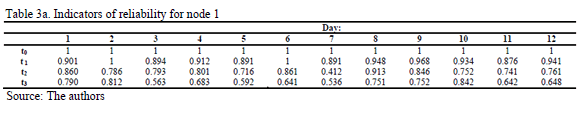
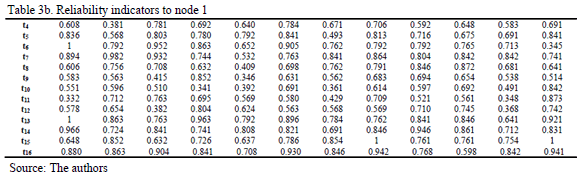
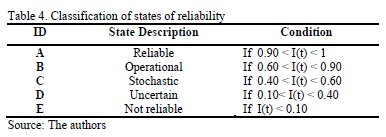
<body><![CDATA[<p align="center"><font size="2" face="Verdana, Arial, Helvetica, sans-serif"><a name="tab02"></a></font><img src="/img/revistas/dyna/v81n187/v81n187a30tab02.gif"></p>     <p><font size="2" face="Verdana, Arial, Helvetica, sans-serif">Although the type of failure or disruption was considered  independent in this analysis of reliability, it is relevant to mention what  events were counted as failures: i) mechanical failures; ii) traffic  congestion; iii) road accidents; iv) loss of time due to ignorance of the  route.</font></p>     <p><font size="2" face="Verdana, Arial, Helvetica, sans-serif">From the information  collected, there were reliability indicators for each time period and each day.  This information is presented in <a href="#tab03a">Table 3</a>, by means of the following equation  (based on the classification of States):</font></p>     <p><img src="/img/revistas/dyna/v81n187/v81n187a30eq11.gif"></p>     <p><font size="2" face="Verdana, Arial, Helvetica, sans-serif">Where <i>VC (X)</i> is  the critical value of the variable <i>X</i>,  which indicates the tolerance limit of <i>X</i> because of shortcomings in each period of time. For the case study, these are: </font></p>     <p><img src="/img/revistas/dyna/v81n187/v81n187a30eq12.gif"></p>     <p align="center"><font size="2" face="Verdana, Arial, Helvetica, sans-serif"><a name="tab03a"></a></font><img src="/img/revistas/dyna/v81n187/v81n187a30tab03a.gif"></p>     <p align="center"><font size="2" face="Verdana, Arial, Helvetica, sans-serif"><a name="tab03b"></a></font><img src="/img/revistas/dyna/v81n187/v81n187a30tab03b.gif"></p>     <p><font size="2" face="Verdana, Arial, Helvetica, sans-serif">Once evaluated the reliability indicators, the PDF were  determine for each state of the process; that is to say initiating the phase of  Markov models to define the states of reliability (see <a href="#tab04">Table 4</a>).</font></p>     <p align="center"><font size="2" face="Verdana, Arial, Helvetica, sans-serif"><a name="tab04"></a></font><img src="/img/revistas/dyna/v81n187/v81n187a30tab04.gif"></p>     ]]></body>

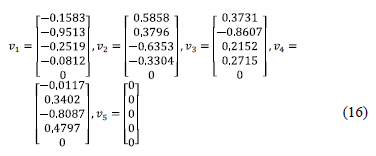
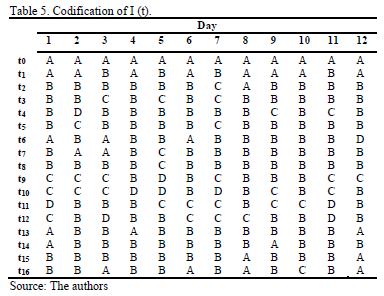
<body><![CDATA[<p><font size="2" face="Verdana, Arial, Helvetica, sans-serif">The characteristics of the phenomenon related to the  properties of Markov models were also took into account. Considering that the  process is transitory, absorbed in state E and reducible due to state E, <a href="#tab05">Table  5</a> is obtained, showing the encoding of the I(t).</font></p>     <p align="center"><font size="2" face="Verdana, Arial, Helvetica, sans-serif"><a name="tab05"></a></font><img src="/img/revistas/dyna/v81n187/v81n187a30tab05.gif"></p>     <p><font size="2" face="Verdana, Arial, Helvetica, sans-serif">Since the experiment was conducted during continued  business days with consecutive units of time (with a discrete classification of  states; and in compliance with the property of Markov, where the current state  of the process depends only on the state during the previous time unit), to  work with a continuous Markov chain was chosen.</font></p>     <p><font size="2" face="Verdana, Arial, Helvetica, sans-serif">Taken into account  the ratios of change from one state to another, the transition matrix A was  defined based on the coding of <a href="#tab04">Table 4</a>, which is represented as:</font></p>     <p><img src="/img/revistas/dyna/v81n187/v81n187a30eq13.gif"></p>     <p><font size="2" face="Verdana, Arial, Helvetica, sans-serif">For example, the process appears 33 times in state A  (excluding states from final time t<sub>16</sub>), but once in it, the process  only remains in state A 13 times. So the transition probability is 0.393.</font></p>     <p><font size="2" face="Verdana, Arial, Helvetica, sans-serif">For the last part of the Markov modeling, the differential  equation system was solved (DES). This system is representative of the  reliability behavior of node 1. So the DES is represented as:</font></p>     <p><img src="/img/revistas/dyna/v81n187/v81n187a30eq14.gif"></p>     <p><font size="2" face="Verdana, Arial, Helvetica, sans-serif">Since the DES is linear and homogeneous with constant  coefficients, to solve the eigenvalues and eigenvectors of the matrix  associated with the DES, the eigenvalues were obtained by using the MATLAB®  language:</font></p>     <p><img src="/img/revistas/dyna/v81n187/v81n187a30eq15.gif"></p>     ]]></body>
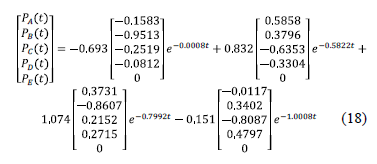
<body><![CDATA[<p><font size="2" face="Verdana, Arial, Helvetica, sans-serif">While the eigenvectors were:</font></p>     <p><img src="/img/revistas/dyna/v81n187/v81n187a30eq16.gif"></p>     <p><font size="2" face="Verdana, Arial, Helvetica, sans-serif">And considering as initial conditions of the process:</font></p>     <p><img src="/img/revistas/dyna/v81n187/v81n187a30eq17.gif"></p>     <p><font size="2" face="Verdana, Arial, Helvetica, sans-serif">Then from (15), (16) and (17), the solution of the DES was  defined by the vector in (18). </font></p>     <p><font size="2" face="Verdana, Arial, Helvetica, sans-serif">As a result, the reliability state of each node in the  route for each time of unit of the same operation was obtained. By applying  this phase of the methodology to each node in the route, a map of the  reliability states of all nodes was obtained during all the time of operation</font></p>     <p><img src="/img/revistas/dyna/v81n187/v81n187a30eq18.gif"></p>     <p>&nbsp;</p>     <p><font size="3" face="Verdana, Arial, Helvetica, sans-serif"><b>5.  Conclusions</b></font></p>     <p><font size="2" face="Verdana, Arial, Helvetica, sans-serif">The reliability evaluation of routes is a relevant issue  in the design of urban freight distribution routes, but some current algorithms  and techniques do not consider stages prior to the calculation of reliability.  Therefore, combining in one methodology steps of analysis, such as: i) sampling  of data; ii) classification of reliability levels; and iii) reliability of each  node, enables the input and output information at every stage to being highly  correlated with the final result of the methodology. i.e. that the reliability  calculation of the route is completely related to the information obtained on  the field and its analysis through each phase.</font></p>     ]]></body>
<body><![CDATA[<p><font size="2" face="Verdana, Arial, Helvetica, sans-serif">With the methodology here presented, the reliability  evaluation of a route of urban freight distribution is simplified, from  gathering information of the reliability factors to the evaluation of the route  through the application of some algorithm. The methodology also offers the  decision maker a useful tool to design and operate complex distribution routes.</font></p>     <p><font size="2" face="Verdana, Arial, Helvetica, sans-serif">Applying the technique of Markov models provides a dynamic  analysis, i.e., it enables knowing the behavior of the elements that make up  the distribution route at any time unit of operation. And, along with the  quantitative measurement of reliability of each node involved in the route, it  covers the opportunity area that was observed in different algorithms to  evaluate the networks reliability.</font></p>     <p><font size="2" face="Verdana, Arial, Helvetica, sans-serif">Regarding the application, the probability density  function (PDF), indicators was defined based on performance goals established  for the case here analyzed. Likewise, a reliability approach was considered,  based on two variables, which were connectivity and delivery time. The  theoretical support for the analysis of reliability through Markov models is  also explained, considering it as one of the contributions of this work. While  the most important innovation is the use of Markov models, the balanced  integration of all phases is important for the effectiveness of the  methodology.</font></p>     <p><font size="2" face="Verdana, Arial, Helvetica, sans-serif">However, a key element is to note that the complexity of  the methodology lies in the execution of the last phase, where the choice of  the algorithm to assess the reliability of the route is at the discretion of  the analyst. Consequently, three future works were identified. First, to  compare the results of this application with other existing algorithms looking  for an exact selection of the algorithm used during the last phase of the  method. Second, strengthening the contribution of the first phase with the  improvement in the evaluation of probability of transition between states. One  option is through bayesian theory, due to the stochastic behavior of the  distribution process. And third, standardizing the proposed methodology through  the creation of a computer application, which would evaluate the reliability of  the route, and design the optimal route based on costs, demands, and  reliability.</font></p>     <p>&nbsp;</p>     <p><font size="3" face="Verdana, Arial, Helvetica, sans-serif"><b>Acknowledgment</b></font></p>     <p><font size="2" face="Verdana, Arial, Helvetica, sans-serif">The authors thank Flora Hammer for several useful comments  that improved this paper as well as anonymous reviewers for their constructive  comments and suggestions.</font></p>     <p>&nbsp;</p>     <p><b><font size="3" face="Verdana, Arial, Helvetica, sans-serif">References</font></b></p>     <!-- ref --><p><font size="2" face="Verdana, Arial, Helvetica, sans-serif"><b>&#91;1&#93;</b> Calder&oacute;n,  K., Se encarece costo de productos por fallas en distribuci&oacute;n urbana &#91;En  linea&#93;. Noticiero T21 &#91;Consulta: 18 de jun 2012&#93;. Dsiponioble en : <a href="http://www.t21.com.mx/news/news_display.php?story_id=14164" target="_blank">http://www.t21.com.mx/news/news_display.php?story_id=14164</a>.    &nbsp;&nbsp;&nbsp;&nbsp;&nbsp;&nbsp;&nbsp;&nbsp;[&#160;<a href="javascript:void(0);" onclick="javascript: window.open('/scielo.php?script=sci_nlinks&ref=000142&pid=S0012-7353201400050003000001&lng=','','width=640,height=500,resizable=yes,scrollbars=1,menubar=yes,');">Links</a>&#160;]<!-- end-ref --> </font></p>     <!-- ref --><p><font size="2" face="Verdana, Arial, Helvetica, sans-serif"><b>&#91;2&#93;</b>    Boudouin,  D., Morel, C., and Gardrat, M., Suppy chains and urban logistics plataforms. In  Gonzalez-Feliu, J., Semet, F., Routhier, J.L., (eds.), Sustainable urban  logistics: Concepts, methods and information systems. Springer, Heideberg, 2014, pp. 01-20.    &nbsp;&nbsp;&nbsp;&nbsp;&nbsp;&nbsp;&nbsp;&nbsp;[&#160;<a href="javascript:void(0);" onclick="javascript: window.open('/scielo.php?script=sci_nlinks&ref=000144&pid=S0012-7353201400050003000002&lng=','','width=640,height=500,resizable=yes,scrollbars=1,menubar=yes,');">Links</a>&#160;]<!-- end-ref --></font></p>     <!-- ref --><p><font size="2" face="Verdana, Arial, Helvetica, sans-serif"><b>&#91;3&#93;</b>    Crainic,  T.G., City logistics. In Chen, Z.L. and Raghavan, S. (eds.), Tutorials in  operations research 2008. State-of-the-art decision making Tools in the information-intensive age, INFORMS, 2008, pp. 181-212,    &nbsp;&nbsp;&nbsp;&nbsp;&nbsp;&nbsp;&nbsp;&nbsp;[&#160;<a href="javascript:void(0);" onclick="javascript: window.open('/scielo.php?script=sci_nlinks&ref=000146&pid=S0012-7353201400050003000003&lng=','','width=640,height=500,resizable=yes,scrollbars=1,menubar=yes,');">Links</a>&#160;]<!-- end-ref -->.</font></p>     <!-- ref --><p><font size="2" face="Verdana, Arial, Helvetica, sans-serif"><b>&#91;4&#93;</b> Sanz, G., Pastor, R. and Benedito,  E.,  Distribuci&oacute;n urbana de mercanc&iacute;as:  Descripci&oacute;n y clasificaci&oacute;n de soluciones existentes e implementaci&oacute;n de dos soluciones novedosas. DYNA, 80 (179), pp. 6-13, 2013.    &nbsp;&nbsp;&nbsp;&nbsp;&nbsp;&nbsp;&nbsp;&nbsp;[&#160;<a href="javascript:void(0);" onclick="javascript: window.open('/scielo.php?script=sci_nlinks&ref=000148&pid=S0012-7353201400050003000004&lng=','','width=640,height=500,resizable=yes,scrollbars=1,menubar=yes,');">Links</a>&#160;]<!-- end-ref --></font></p>     <!-- ref --><p><font size="2" face="Verdana, Arial, Helvetica, sans-serif"><b>&#91;5&#93;</b>    Arango-Serna,  M.D., Serna-Uran, C.A. and Alvarez-Uribe, K.C., Collaborative autonomous systems in models of urban logistics. DYNA, 79 (172), pp. 171-179, 2012.    &nbsp;&nbsp;&nbsp;&nbsp;&nbsp;&nbsp;&nbsp;&nbsp;[&#160;<a href="javascript:void(0);" onclick="javascript: window.open('/scielo.php?script=sci_nlinks&ref=000150&pid=S0012-7353201400050003000005&lng=','','width=640,height=500,resizable=yes,scrollbars=1,menubar=yes,');">Links</a>&#160;]<!-- end-ref --></font></p>     <!-- ref --><p><font size="2" face="Verdana, Arial, Helvetica, sans-serif"><b>&#91;6&#93;</b> Soto-de la Vega, D., Vidal-Vieira, J.G.  and Vitor-Toso, E.A., Metodolog&iacute;a para la localizaci&oacute;n de centros de  distribuci&oacute;n a trav&eacute;s de an&aacute;lisis multicriterio y optimizaci&oacute;n. DYNA, 81 (184), pp. 28-35, 2014.    &nbsp;&nbsp;&nbsp;&nbsp;&nbsp;&nbsp;&nbsp;&nbsp;[&#160;<a href="javascript:void(0);" onclick="javascript: window.open('/scielo.php?script=sci_nlinks&ref=000152&pid=S0012-7353201400050003000006&lng=','','width=640,height=500,resizable=yes,scrollbars=1,menubar=yes,');">Links</a>&#160;]<!-- end-ref --></font></p>     <!-- ref --><p><font size="2" face="Verdana, Arial, Helvetica, sans-serif"><b>&#91;7&#93;</b>    Arango-Serna,  M.D., Adarme-Jaimes, W. and Zapata-Cortes, J.A., Commodities distribution using  alternative types of transport. A study in the Colombian Bread SMEs. DYNA ,79 (172), pp. 171-179, 2010.    &nbsp;&nbsp;&nbsp;&nbsp;&nbsp;&nbsp;&nbsp;&nbsp;[&#160;<a href="javascript:void(0);" onclick="javascript: window.open('/scielo.php?script=sci_nlinks&ref=000154&pid=S0012-7353201400050003000007&lng=','','width=640,height=500,resizable=yes,scrollbars=1,menubar=yes,');">Links</a>&#160;]<!-- end-ref --></font></p>     <!-- ref --><p><font size="2" face="Verdana, Arial, Helvetica, sans-serif"><b>&#91;8&#93;</b> Galv&aacute;n,  D.C., Mart&iacute;nez, L. y Ant&uacute;n, J.P., Pr&aacute;cticas en distribuci&oacute;n y su efecto sobre  la optimizaci&oacute;n de la log&iacute;stica urbana. XVI Congreso Panamericano de Transporte, Tr&aacute;fico y Log&iacute;stica, Lisboa, Portugal, 2010.    &nbsp;&nbsp;&nbsp;&nbsp;&nbsp;&nbsp;&nbsp;&nbsp;[&#160;<a href="javascript:void(0);" onclick="javascript: window.open('/scielo.php?script=sci_nlinks&ref=000156&pid=S0012-7353201400050003000008&lng=','','width=640,height=500,resizable=yes,scrollbars=1,menubar=yes,');">Links</a>&#160;]<!-- end-ref --></font></p>     <!-- ref --><p><font size="2" face="Verdana, Arial, Helvetica, sans-serif"><b>&#91;9&#93;</b> Betanzo-Quezada, E., Romero-Navarrete, J.  y Obreg&oacute;n-Biosca, S. Un referencial para evaluar la gesti&oacute;n p&uacute;blica en  transporte urbano de carga. Gesti&oacute;n y Pol&iacute;tica P&uacute;blica, XXII (2), pp. 313-354, 2013.    &nbsp;&nbsp;&nbsp;&nbsp;&nbsp;&nbsp;&nbsp;&nbsp;[&#160;<a href="javascript:void(0);" onclick="javascript: window.open('/scielo.php?script=sci_nlinks&ref=000158&pid=S0012-7353201400050003000009&lng=','','width=640,height=500,resizable=yes,scrollbars=1,menubar=yes,');">Links</a>&#160;]<!-- end-ref --></font></p>     <!-- ref --><p><font size="2" face="Verdana, Arial, Helvetica, sans-serif"><b>&#91;10&#93;</b>   Morana,  J., Sustainable supply chain management in urban logistics. In Gonzalez-Feliu,  J., Semet, F., Routhier, J.L. (eds.), Sustainable urban logistics: Concepts, Methods and information systems. Springer, Heideberg, 2014, pp. 21-34.    &nbsp;&nbsp;&nbsp;&nbsp;&nbsp;&nbsp;&nbsp;&nbsp;[&#160;<a href="javascript:void(0);" onclick="javascript: window.open('/scielo.php?script=sci_nlinks&ref=000160&pid=S0012-7353201400050003000010&lng=','','width=640,height=500,resizable=yes,scrollbars=1,menubar=yes,');">Links</a>&#160;]<!-- end-ref --></font></p>     <!-- ref --><p><font size="2" face="Verdana, Arial, Helvetica, sans-serif"><b>&#91;11&#93;</b> Arvis,  J.F., Alina, M., Ojala, L., Shepherd, B. and Saslavsky, D., The logistics  performance index and its indicators. &#91;En l&iacute;nea&#93;. By: World Bank's  International Trade Department, 2010, &#91;date of reference December 8 of 2013&#93;.  Avaiable at: &lt;<a href="http://siteresources.worldbank.org/INTTLF/Resources/LPI2010_for_web.pdf" target="_blank">http://siteresources.worldbank.org/INTTLF/Resources/LPI2010_for_web.    &nbsp;&nbsp;&nbsp;&nbsp;&nbsp;&nbsp;&nbsp;&nbsp;[&#160;<a href="javascript:void(0);" onclick="javascript: window.open('/scielo.php?script=sci_nlinks&ref=000162&pid=S0012-7353201400050003000011&lng=','','width=640,height=500,resizable=yes,scrollbars=1,menubar=yes,');">Links</a>&#160;]<!-- end-ref -->pdf</a>&gt;</font></p>     <!-- ref --><p><font size="2" face="Verdana, Arial, Helvetica, sans-serif"><b>&#91;12&#93;</b>   Tadashi,  Y., Yohe, Y. and Kazuhiro, M., Road network reliability analysis using vehicle  routing and scheduling procedures. III International Conference on City Logistics: Logistics Systems for Sustainable Cities, pp. 111-122, 2013.    &nbsp;&nbsp;&nbsp;&nbsp;&nbsp;&nbsp;&nbsp;&nbsp;[&#160;<a href="javascript:void(0);" onclick="javascript: window.open('/scielo.php?script=sci_nlinks&ref=000164&pid=S0012-7353201400050003000012&lng=','','width=640,height=500,resizable=yes,scrollbars=1,menubar=yes,');">Links</a>&#160;]<!-- end-ref --> </font></p>     <!-- ref --><p><font size="2" face="Verdana, Arial, Helvetica, sans-serif"><b>&#91;13&#93;</b>   Robledo,  F., Modelos combinatorios de confiabilidad en redes. Apuntes del curso de  postgrado Modelos Combinatorios de Confiabilidad en Redes, IMERL/INCO - UdelaR Montevideo, Uruguay, 2009.    &nbsp;&nbsp;&nbsp;&nbsp;&nbsp;&nbsp;&nbsp;&nbsp;[&#160;<a href="javascript:void(0);" onclick="javascript: window.open('/scielo.php?script=sci_nlinks&ref=000166&pid=S0012-7353201400050003000013&lng=','','width=640,height=500,resizable=yes,scrollbars=1,menubar=yes,');">Links</a>&#160;]<!-- end-ref --> </font></p>     <!-- ref --><p><font size="2" face="Verdana, Arial, Helvetica, sans-serif"><b>&#91;14&#93;</b> Ros, Ll. and Hayes, S., La distribuci&oacute;n  urbana de mercanc&iacute;as. economistas, vol. 2. Consultores ALTRAN Technologies, pp. 2-4, 2009.    &nbsp;&nbsp;&nbsp;&nbsp;&nbsp;&nbsp;&nbsp;&nbsp;[&#160;<a href="javascript:void(0);" onclick="javascript: window.open('/scielo.php?script=sci_nlinks&ref=000168&pid=S0012-7353201400050003000014&lng=','','width=640,height=500,resizable=yes,scrollbars=1,menubar=yes,');">Links</a>&#160;]<!-- end-ref --></font></p>     <!-- ref --><p><font size="2" face="Verdana, Arial, Helvetica, sans-serif"><b>&#91;15&#93;</b> Estrada, R., An&aacute;lisis de estrategias  eficientes en la log&iacute;stica de distribuci&oacute;n de paqueter&iacute;a. PhD. Thesis. Universitat Politècnica de Catalunya, Barcelona, Spain, 2007.    &nbsp;&nbsp;&nbsp;&nbsp;&nbsp;&nbsp;&nbsp;&nbsp;[&#160;<a href="javascript:void(0);" onclick="javascript: window.open('/scielo.php?script=sci_nlinks&ref=000170&pid=S0012-7353201400050003000015&lng=','','width=640,height=500,resizable=yes,scrollbars=1,menubar=yes,');">Links</a>&#160;]<!-- end-ref --> </font></p>     <!-- ref --><p><font size="2" face="Verdana, Arial, Helvetica, sans-serif"><b>&#91;16&#93;</b> Garc&iacute;a,  I.C., Un enfoque metaheur&iacute;stico para un problema de ruteo con flexibilidad en  las fechas de entrega. Ph.D. Thesis, Facultad de Ingenier&iacute;a Mec&aacute;nica y El&eacute;ctrica, Universidad Aut&oacute;noma de Nuevo Le&oacute;n, M&eacute;xico, 2010.    &nbsp;&nbsp;&nbsp;&nbsp;&nbsp;&nbsp;&nbsp;&nbsp;[&#160;<a href="javascript:void(0);" onclick="javascript: window.open('/scielo.php?script=sci_nlinks&ref=000172&pid=S0012-7353201400050003000016&lng=','','width=640,height=500,resizable=yes,scrollbars=1,menubar=yes,');">Links</a>&#160;]<!-- end-ref --></font></p>     <!-- ref --><p><font size="2" face="Verdana, Arial, Helvetica, sans-serif"><b>&#91;17&#93;</b>   Jenelius,  E., Peterson, T. and Mattsson, L.G., Importance and exposure in road network  vulnerability analysis. Transportation Research Part A: Policy and Practice, 40 (7), pp. 537-560, 2006.    &nbsp;&nbsp;&nbsp;&nbsp;&nbsp;&nbsp;&nbsp;&nbsp;[&#160;<a href="javascript:void(0);" onclick="javascript: window.open('/scielo.php?script=sci_nlinks&ref=000174&pid=S0012-7353201400050003000017&lng=','','width=640,height=500,resizable=yes,scrollbars=1,menubar=yes,');">Links</a>&#160;]<!-- end-ref --> </font></p>     <!-- ref --><p><font size="2" face="Verdana, Arial, Helvetica, sans-serif"><b>&#91;18&#93;</b>   Susilawai,  S., Taylor, M.A.P. and Somenahalli, S.V.C., Travel time reliability measurement  for selected corridors in the Adelaide Metropolitan area. Journal of the Eastern Asia Society for Transportation Studies,8, pp. 86-102, 2010.    &nbsp;&nbsp;&nbsp;&nbsp;&nbsp;&nbsp;&nbsp;&nbsp;[&#160;<a href="javascript:void(0);" onclick="javascript: window.open('/scielo.php?script=sci_nlinks&ref=000176&pid=S0012-7353201400050003000018&lng=','','width=640,height=500,resizable=yes,scrollbars=1,menubar=yes,');">Links</a>&#160;]<!-- end-ref --></font></p>     <!-- ref --><p><font size="2" face="Verdana, Arial, Helvetica, sans-serif"><b>&#91;19&#93;</b>   Husdal,  J., Reliability and vulnerability versus cost and benefits. Proceedings of the  Second International Symposium on Transportation Network Reliability (INSTR 2004). Christchurch, New Zealand, pp. 182-189, 2004.    &nbsp;&nbsp;&nbsp;&nbsp;&nbsp;&nbsp;&nbsp;&nbsp;[&#160;<a href="javascript:void(0);" onclick="javascript: window.open('/scielo.php?script=sci_nlinks&ref=000178&pid=S0012-7353201400050003000019&lng=','','width=640,height=500,resizable=yes,scrollbars=1,menubar=yes,');">Links</a>&#160;]<!-- end-ref --></font></p>     <!-- ref --><p><font size="2" face="Verdana, Arial, Helvetica, sans-serif"><b>&#91;20&#93;</b> Sumper, A., Sudrià, A., Ram&iacute;rez, R.,  Villaf&aacute;fila, R. y Chindris, M., &Iacute;ndices de continuidad en redes de distribuci&oacute;n  y su mejora. 9&deg; Congreso HISPANO LUSO Ingenier&iacute;a El&eacute;ctrica, pp. 20-24, 2004.    &nbsp;&nbsp;&nbsp;&nbsp;&nbsp;&nbsp;&nbsp;&nbsp;[&#160;<a href="javascript:void(0);" onclick="javascript: window.open('/scielo.php?script=sci_nlinks&ref=000180&pid=S0012-7353201400050003000020&lng=','','width=640,height=500,resizable=yes,scrollbars=1,menubar=yes,');">Links</a>&#160;]<!-- end-ref --></font></p>     <!-- ref --><p><font size="2" face="Verdana, Arial, Helvetica, sans-serif"><b>&#91;21&#93;</b> Mu&ntilde;oz, A.Z., Multi-State system reliability  design via particle evolutionary swarm optimization. MSc. Thesis, Centro de Investigaci&oacute;n en Matem&aacute;ticas A.C., Guanajuato, M&eacute;xico, 2004.    &nbsp;&nbsp;&nbsp;&nbsp;&nbsp;&nbsp;&nbsp;&nbsp;[&#160;<a href="javascript:void(0);" onclick="javascript: window.open('/scielo.php?script=sci_nlinks&ref=000182&pid=S0012-7353201400050003000021&lng=','','width=640,height=500,resizable=yes,scrollbars=1,menubar=yes,');">Links</a>&#160;]<!-- end-ref --></font></p>     <!-- ref --><p><font size="2" face="Verdana, Arial, Helvetica, sans-serif"><b>&#91;22&#93;</b>   Fuqua,  N.B., The applicability of Marvok analysis methods to reliability,  maintainability and safety. Selected Topic in Assurance Related Technologies (START), 2 (10), pp. 1-8, 2003.    &nbsp;&nbsp;&nbsp;&nbsp;&nbsp;&nbsp;&nbsp;&nbsp;[&#160;<a href="javascript:void(0);" onclick="javascript: window.open('/scielo.php?script=sci_nlinks&ref=000184&pid=S0012-7353201400050003000022&lng=','','width=640,height=500,resizable=yes,scrollbars=1,menubar=yes,');">Links</a>&#160;]<!-- end-ref --></font></p>     <!-- ref --><p><font size="2" face="Verdana, Arial, Helvetica, sans-serif"><b>&#91;23&#93;</b> Rubio, C.T. y Echeverr&iacute;a, A., Modelos de  Markov: Una herramienta &uacute;til para el an&aacute;lisis f&aacute;rmaco-econ&oacute;mico. Pharmacoeconomics -Spanish Research, 3 (2), pp. 71-78, 2006.    &nbsp;&nbsp;&nbsp;&nbsp;&nbsp;&nbsp;&nbsp;&nbsp;[&#160;<a href="javascript:void(0);" onclick="javascript: window.open('/scielo.php?script=sci_nlinks&ref=000186&pid=S0012-7353201400050003000023&lng=','','width=640,height=500,resizable=yes,scrollbars=1,menubar=yes,');">Links</a>&#160;]<!-- end-ref --></font></p>     <!-- ref --><p><font size="2" face="Verdana, Arial, Helvetica, sans-serif"><b>&#91;24&#93;</b> Oca&ntilde;a, R.A., Modelos de Markov aplicados a  la investigaci&oacute;n en Ciencias de la Salud. Interciencia, 34 (3), pp. 157-162, 2009.    &nbsp;&nbsp;&nbsp;&nbsp;&nbsp;&nbsp;&nbsp;&nbsp;[&#160;<a href="javascript:void(0);" onclick="javascript: window.open('/scielo.php?script=sci_nlinks&ref=000188&pid=S0012-7353201400050003000024&lng=','','width=640,height=500,resizable=yes,scrollbars=1,menubar=yes,');">Links</a>&#160;]<!-- end-ref --></font></p>     <!-- ref --><p><font size="2" face="Verdana, Arial, Helvetica, sans-serif"><b>&#91;25&#93;</b> Mar&iacute;n, J.M.D. ,Cadenas de Markov. Apuntes  de estad&iacute;stica actuarial II &#91;en linea&#93;. Depto. de Estad&iacute;stica, Univ. Carlos III  de Madrid. &#91;date of referenca June 15th of 2013&#93;. Avaiable at: &lt;<a href="http://halweb.uc3m.es/esp/Personal/personas/jmmarin/esp/PEst/tema4pe.pdf" target="_blank">http://halweb.uc3m.es/esp/Personal/personas/jmmarin/esp/PEst/tema4pe.    &nbsp;&nbsp;&nbsp;&nbsp;&nbsp;&nbsp;&nbsp;&nbsp;[&#160;<a href="javascript:void(0);" onclick="javascript: window.open('/scielo.php?script=sci_nlinks&ref=000190&pid=S0012-7353201400050003000025&lng=','','width=640,height=500,resizable=yes,scrollbars=1,menubar=yes,');">Links</a>&#160;]<!-- end-ref -->pdf</a>&gt;</font></p>     <!-- ref --><p><font size="2" face="Verdana, Arial, Helvetica, sans-serif"><b>&#91;26&#93;</b>   Chin-Chia,  J., Performance evaluation of logistics systems under cost and reliability  considerations. Transport. Res. Part E, 47 82), pp. 130-137, 2010, doi:10.1016/j.tre.2010.09.012.    &nbsp;&nbsp;&nbsp;&nbsp;&nbsp;&nbsp;&nbsp;&nbsp;[&#160;<a href="javascript:void(0);" onclick="javascript: window.open('/scielo.php?script=sci_nlinks&ref=000192&pid=S0012-7353201400050003000026&lng=','','width=640,height=500,resizable=yes,scrollbars=1,menubar=yes,');">Links</a>&#160;]<!-- end-ref --></font></p>     <p>&nbsp;</p>     <p><font size="2" face="Verdana, Arial, Helvetica, sans-serif"><b>M.G. Cedillo-Campos,</b> is a Professor-Researcher in Logistics Systems Dynamics at the Mexican   Institute of Transportation (IMT). He is the Founder and President of the   Mexican Logistics and Supply Chain Association (AML). Dr. Cedillo-Campos is   acknowledged as National Researcher level 1 by the National Council of Science   and Technology in Mexico (CONACYT). In 2004, he received a PhD. in Logistics   Systems Dynamics from the University of Paris, France. In 2012, he was acknowledged   by the Autonomous University of Nuevo Leon (UANL) with the Innovation Award. In   2012, he collaborated as speaker at Georgia Tech Panama. Dr. Cedillo is member   of the Mexican Academy of Systems Sciences and the Scientific Chairman of the   International Congress on Logistics and Supply Chain (CiLOG) organized by the   AML. He is the author of several scientific publications in top journals as   Transportation Research Part E: logistics and Transportation Review,   Simulation, Computers and Industrial Engineering, Applied Energy, Computers in   Industry, Journal of Applied Research and Technology, among others. </font></p>     <p><font size="2" face="Verdana, Arial, Helvetica, sans-serif"><b>J.L. de la  Riva-Canizales, </b>is a researcher in industrial engineering at Chrysler. In  2013, he received a MSc in Industrial Engineering from COMIMSA (National  Council of Science and Technology), Mexico. He obtained a BSc. degree in  Mathematics from the Autonomous University of Coahuila, Mexico. He has worked  for logistics businesses in Mexico and as a consultant on supply chain  management for global companies, and several Mexican State Governments. His  current research interests include quality processes, service operations in  supply chains, city logistics, and design of supply chains oriented to emerging  markets.</font></p>     <p><font size="2" face="Verdana, Arial, Helvetica, sans-serif"><b>A. Bueno-Solano, </b>heads the Logistics and Multimodal Unit at the Mexican Institute of Transportation  (IMT). Dr. Bueno is a founding member of the Mexican Logistics and Supply Chain  Association (AML). In 2013, he received a PhD. in Industrial Engineering and  Manufacturing Science from COMIMSA (National Council of Science and  Technology), Mexico. His PhD. thesis deals with risk propagation modelling in  export-oriented supply chains. He has participated as part of important  research projects as the first national survey on supply chain security which  was supported by the National Council of Science and Technology as well as by  the Secretariat of Economy of Mexico. He is the author of several scientific  publications in top journals as Transportation Research Part E: logistics and  Transportation Review, and Journal of Applied Research and Technology, among  others. He is part of the scientific board of the International Congress on  Logistics and supply chain (CiLOG) organized by the AML.</font></p>     <p><font size="2" face="Verdana, Arial, Helvetica, sans-serif"><b>J. Gonzalez-Feliu, </b>is a research engineer at the Centre National de la Recherche Scientifique  in Lyon, France, and member of the Laboratoire d'Economie des Transports (LET,  Laboratory of Transport Economics). He obtained his MSc. degree in Civil  Engineering and Urban Planning in 2003 at INSA Lyon (France) and passed his PhD.  in Computer and Systems Sciences - Operations Research in 2008 at Politecnico  di Torino (Italy). His PhD. thesis deals with urban freight distribution  solutions and two-echelon vehicle routing problems. At LET since 2008, his work  deals with urban logistics data production, simulation and evaluation, focusing  on data collection techniques, simulation of urban routes and shopping trip  behaviour, substitution of shopping trips by proximity deliveries, logistics  pooling and multi-stage transport systems. His research interests include urban  logistics planning and policy, freight demand modeling, scenario assessment,  decision support systems, vehicle routing optimization, sustainable supply  chain management and collaborative transportation.</font></p>     <p><font size="2" face="Verdana, Arial, Helvetica, sans-serif"><b>J.L.  Garc&iacute;a-Alcaraz,</b> is a Professor-Researcher at the Department of Industrial  Engineering at the Autonomous University of Ciudad Ju&aacute;rez in Mexico, a founding  member of the Mexican Society of Operations Research and an active member in  the Mexican Academy of Engineering. Dr. Garcia is recognized as National  Reseracher level 1 by the National Council of Science and Technology in Mexico  (CONACYT). He received a MSc. in Industrial Engineering from the Technological  Institute of Colima, Mexico, a PhD. in Industrial Engineering from the  Tedchnological Institute of Ciudad Juarez, Mexico and a Post-Doctorate at the  University of La Rioja, Spain. His main research area are related to modeling  and multi-criteria decision-making applied to production processes. He is author  and co-author in over 100 articles published in indexed journals and  international conferences and congresses as International Journal of Advanced  Manufacturing Technology, Expert System with Applications, International  Journal of Production Research, Computer in Industry, among others.</font></p>      ]]></body><back>
<ref-list>
<ref id="B1">
<label>1</label><nlm-citation citation-type="">
<person-group person-group-type="author">
<name>
<surname><![CDATA[Calderón]]></surname>
<given-names><![CDATA[K.]]></given-names>
</name>
</person-group>
<source><![CDATA[Se encarece costo de productos por fallas en distribución urbana]]></source>
<year></year>
</nlm-citation>
</ref>
<ref id="B2">
<label>2</label><nlm-citation citation-type="book">
<person-group person-group-type="author">
<name>
<surname><![CDATA[Boudouin]]></surname>
<given-names><![CDATA[D.]]></given-names>
</name>
<name>
<surname><![CDATA[Morel]]></surname>
<given-names><![CDATA[C.]]></given-names>
</name>
<name>
<surname><![CDATA[Gardrat]]></surname>
<given-names><![CDATA[M.]]></given-names>
</name>
</person-group>
<article-title xml:lang="en"><![CDATA[Suppy chains and urban logistics plataforms]]></article-title>
<person-group person-group-type="editor">
<name>
<surname><![CDATA[Gonzalez-Feliu]]></surname>
<given-names><![CDATA[J.]]></given-names>
</name>
<name>
<surname><![CDATA[Semet]]></surname>
<given-names><![CDATA[F.]]></given-names>
</name>
<name>
<surname><![CDATA[Routhier]]></surname>
<given-names><![CDATA[J.L.]]></given-names>
</name>
</person-group>
<source><![CDATA[Sustainable urban logistics: Concepts, methods and information systems]]></source>
<year>2014</year>
<page-range>01-20</page-range><publisher-loc><![CDATA[Heideberg ]]></publisher-loc>
<publisher-name><![CDATA[Springer]]></publisher-name>
</nlm-citation>
</ref>
<ref id="B3">
<label>3</label><nlm-citation citation-type="book">
<person-group person-group-type="author">
<name>
<surname><![CDATA[Crainic]]></surname>
<given-names><![CDATA[T.G.]]></given-names>
</name>
</person-group>
<article-title xml:lang="en"><![CDATA[City logistics]]></article-title>
<person-group person-group-type="editor">
<name>
<surname><![CDATA[Chen]]></surname>
<given-names><![CDATA[Z.L.]]></given-names>
</name>
<name>
<surname><![CDATA[Raghavan]]></surname>
<given-names><![CDATA[S.]]></given-names>
</name>
</person-group>
<source><![CDATA[Tutorials in operations research 2008: State-of-the-art decision making Tools in the information-intensive age]]></source>
<year>2008</year>
<page-range>181-212</page-range><publisher-name><![CDATA[INFORMS]]></publisher-name>
</nlm-citation>
</ref>
<ref id="B4">
<label>4</label><nlm-citation citation-type="journal">
<person-group person-group-type="author">
<name>
<surname><![CDATA[Sanz]]></surname>
<given-names><![CDATA[G.]]></given-names>
</name>
<name>
<surname><![CDATA[Pastor]]></surname>
<given-names><![CDATA[R.]]></given-names>
</name>
<name>
<surname><![CDATA[Benedito]]></surname>
<given-names><![CDATA[E.]]></given-names>
</name>
</person-group>
<article-title xml:lang="es"><![CDATA[Distribución urbana de mercancías: Descripción y clasificación de soluciones existentes e implementación de dos soluciones novedosas]]></article-title>
<source><![CDATA[DYNA]]></source>
<year>2013</year>
<volume>80</volume>
<numero>179</numero>
<issue>179</issue>
<page-range>6-13</page-range></nlm-citation>
</ref>
<ref id="B5">
<label>5</label><nlm-citation citation-type="journal">
<person-group person-group-type="author">
<name>
<surname><![CDATA[Arango-Serna]]></surname>
<given-names><![CDATA[M.D.]]></given-names>
</name>
<name>
<surname><![CDATA[Serna-Uran]]></surname>
<given-names><![CDATA[C.A.]]></given-names>
</name>
<name>
<surname><![CDATA[Alvarez-Uribe]]></surname>
<given-names><![CDATA[K.C.]]></given-names>
</name>
</person-group>
<article-title xml:lang="en"><![CDATA[Collaborative autonomous systems in models of urban logistics]]></article-title>
<source><![CDATA[DYNA]]></source>
<year>2012</year>
<volume>79</volume>
<numero>172</numero>
<issue>172</issue>
<page-range>171-179</page-range></nlm-citation>
</ref>
<ref id="B6">
<label>6</label><nlm-citation citation-type="journal">
<person-group person-group-type="author">
<name>
<surname><![CDATA[Soto-de la Vega]]></surname>
<given-names><![CDATA[D.]]></given-names>
</name>
<name>
<surname><![CDATA[Vidal-Vieira]]></surname>
<given-names><![CDATA[J.G.]]></given-names>
</name>
<name>
<surname><![CDATA[Vitor-Toso]]></surname>
<given-names><![CDATA[E.A.]]></given-names>
</name>
</person-group>
<article-title xml:lang="es"><![CDATA[Metodología para la localización de centros de distribución a través de análisis multicriterio y optimización]]></article-title>
<source><![CDATA[DYNA]]></source>
<year>2014</year>
<volume>81</volume>
<numero>184</numero>
<issue>184</issue>
<page-range>28-35</page-range></nlm-citation>
</ref>
<ref id="B7">
<label>7</label><nlm-citation citation-type="journal">
<person-group person-group-type="author">
<name>
<surname><![CDATA[Arango-Serna]]></surname>
<given-names><![CDATA[M.D.]]></given-names>
</name>
<name>
<surname><![CDATA[Adarme-Jaimes]]></surname>
<given-names><![CDATA[W.]]></given-names>
</name>
<name>
<surname><![CDATA[Zapata-Cortes]]></surname>
<given-names><![CDATA[J.A.]]></given-names>
</name>
</person-group>
<article-title xml:lang="en"><![CDATA[Commodities distribution using alternative types of transport: A study in the Colombian Bread SMEs]]></article-title>
<source><![CDATA[DYNA]]></source>
<year>2010</year>
<volume>79</volume>
<numero>172</numero>
<issue>172</issue>
<page-range>171-179</page-range></nlm-citation>
</ref>
<ref id="B8">
<label>8</label><nlm-citation citation-type="confpro">
<person-group person-group-type="author">
<name>
<surname><![CDATA[Galván]]></surname>
<given-names><![CDATA[D.C.]]></given-names>
</name>
<name>
<surname><![CDATA[Martínez]]></surname>
<given-names><![CDATA[L.]]></given-names>
</name>
<name>
<surname><![CDATA[Antún]]></surname>
<given-names><![CDATA[J.P.]]></given-names>
</name>
</person-group>
<article-title xml:lang="es"><![CDATA[Prácticas en distribución y su efecto sobre la optimización de la logística urbana]]></article-title>
<source><![CDATA[]]></source>
<year></year>
<conf-name><![CDATA[XVI Congreso Panamericano de Transporte, Tráfico y Logística]]></conf-name>
<conf-date>2010</conf-date>
<conf-loc>Lisboa </conf-loc>
</nlm-citation>
</ref>
<ref id="B9">
<label>9</label><nlm-citation citation-type="journal">
<person-group person-group-type="author">
<name>
<surname><![CDATA[Betanzo-Quezada]]></surname>
<given-names><![CDATA[E.]]></given-names>
</name>
<name>
<surname><![CDATA[Romero-Navarrete]]></surname>
<given-names><![CDATA[J.]]></given-names>
</name>
<name>
<surname><![CDATA[Obregón-Biosca]]></surname>
<given-names><![CDATA[S.]]></given-names>
</name>
</person-group>
<article-title xml:lang="es"><![CDATA[Un referencial para evaluar la gestión pública en transporte urbano de carga]]></article-title>
<source><![CDATA[Gestión y Política Pública]]></source>
<year>2013</year>
<volume>XXII</volume>
<numero>2</numero>
<issue>2</issue>
<page-range>313-354</page-range></nlm-citation>
</ref>
<ref id="B10">
<label>10</label><nlm-citation citation-type="book">
<person-group person-group-type="author">
<name>
<surname><![CDATA[Morana]]></surname>
<given-names><![CDATA[J.]]></given-names>
</name>
</person-group>
<article-title xml:lang="en"><![CDATA[Sustainable supply chain management in urban logistics]]></article-title>
<person-group person-group-type="editor">
<name>
<surname><![CDATA[Gonzalez-Feliu]]></surname>
<given-names><![CDATA[J.]]></given-names>
</name>
<name>
<surname><![CDATA[Semet]]></surname>
<given-names><![CDATA[F.]]></given-names>
</name>
<name>
<surname><![CDATA[Routhier]]></surname>
<given-names><![CDATA[J.L.]]></given-names>
</name>
</person-group>
<source><![CDATA[Sustainable urban logistics: Concepts, Methods and information systems]]></source>
<year>2014</year>
<page-range>21-34</page-range><publisher-loc><![CDATA[Heideberg ]]></publisher-loc>
<publisher-name><![CDATA[Springer]]></publisher-name>
</nlm-citation>
</ref>
<ref id="B11">
<label>11</label><nlm-citation citation-type="book">
<person-group person-group-type="author">
<name>
<surname><![CDATA[Arvis]]></surname>
<given-names><![CDATA[J.F.]]></given-names>
</name>
<name>
<surname><![CDATA[Alina]]></surname>
<given-names><![CDATA[M.]]></given-names>
</name>
<name>
<surname><![CDATA[Ojala]]></surname>
<given-names><![CDATA[L.]]></given-names>
</name>
<name>
<surname><![CDATA[Shepherd]]></surname>
<given-names><![CDATA[B.]]></given-names>
</name>
<name>
<surname><![CDATA[Saslavsky]]></surname>
<given-names><![CDATA[D.]]></given-names>
</name>
</person-group>
<source><![CDATA[The logistics performance index and its indicators.]]></source>
<year>2010</year>
<publisher-name><![CDATA[World Bank's International Trade Department]]></publisher-name>
</nlm-citation>
</ref>
<ref id="B12">
<label>12</label><nlm-citation citation-type="confpro">
<person-group person-group-type="author">
<name>
<surname><![CDATA[Tadashi]]></surname>
<given-names><![CDATA[Y.]]></given-names>
</name>
<name>
<surname><![CDATA[Yohe]]></surname>
<given-names><![CDATA[Y.]]></given-names>
</name>
<name>
<surname><![CDATA[Kazuhiro]]></surname>
<given-names><![CDATA[M.]]></given-names>
</name>
</person-group>
<article-title xml:lang="en"><![CDATA[Road network reliability analysis using vehicle routing and scheduling procedures]]></article-title>
<source><![CDATA[]]></source>
<year>2013</year>
<conf-name><![CDATA[III International Conference on City Logistics: Logistics Systems for Sustainable Cities]]></conf-name>
<conf-loc> </conf-loc>
<page-range>111-122</page-range></nlm-citation>
</ref>
<ref id="B13">
<label>13</label><nlm-citation citation-type="book">
<person-group person-group-type="author">
<name>
<surname><![CDATA[Robledo]]></surname>
<given-names><![CDATA[F.]]></given-names>
</name>
</person-group>
<source><![CDATA[Modelos combinatorios de confiabilidad en redes: Apuntes del curso de postgrado Modelos Combinatorios de Confiabilidad en Redes]]></source>
<year>2009</year>
<publisher-name><![CDATA[UdelaR]]></publisher-name>
</nlm-citation>
</ref>
<ref id="B14">
<label>14</label><nlm-citation citation-type="">
<person-group person-group-type="author">
<name>
<surname><![CDATA[Ros]]></surname>
<given-names><![CDATA[Ll.]]></given-names>
</name>
<name>
<surname><![CDATA[Hayes]]></surname>
<given-names><![CDATA[S.]]></given-names>
</name>
</person-group>
<collab>Consultores ALTRAN Technologies</collab>
<source><![CDATA[La distribución urbana de mercancías]]></source>
<year>2009</year>
<volume>2</volume>
<page-range>2-4</page-range></nlm-citation>
</ref>
<ref id="B15">
<label>15</label><nlm-citation citation-type="">
<person-group person-group-type="author">
<name>
<surname><![CDATA[Estrada]]></surname>
<given-names><![CDATA[R.]]></given-names>
</name>
</person-group>
<source><![CDATA[Análisis de estrategias eficientes en la logística de distribución de paquetería]]></source>
<year></year>
</nlm-citation>
</ref>
<ref id="B16">
<label>16</label><nlm-citation citation-type="">
<person-group person-group-type="author">
<name>
<surname><![CDATA[García]]></surname>
<given-names><![CDATA[I.C.]]></given-names>
</name>
</person-group>
<source><![CDATA[Un enfoque metaheurístico para un problema de ruteo con flexibilidad en las fechas de entrega]]></source>
<year></year>
</nlm-citation>
</ref>
<ref id="B17">
<label>17</label><nlm-citation citation-type="journal">
<person-group person-group-type="author">
<name>
<surname><![CDATA[Jenelius]]></surname>
<given-names><![CDATA[E.]]></given-names>
</name>
<name>
<surname><![CDATA[Peterson]]></surname>
<given-names><![CDATA[T.]]></given-names>
</name>
<name>
<surname><![CDATA[Mattsson]]></surname>
<given-names><![CDATA[L.G.]]></given-names>
</name>
</person-group>
<article-title xml:lang="en"><![CDATA[Importance and exposure in road network vulnerability analysis]]></article-title>
<source><![CDATA[Transportation Research Part A: Policy and Practice]]></source>
<year>2006</year>
<volume>40</volume>
<numero>7</numero>
<issue>7</issue>
<page-range>537-560</page-range></nlm-citation>
</ref>
<ref id="B18">
<label>18</label><nlm-citation citation-type="journal">
<person-group person-group-type="author">
<name>
<surname><![CDATA[Susilawai]]></surname>
<given-names><![CDATA[S.]]></given-names>
</name>
<name>
<surname><![CDATA[Taylor]]></surname>
<given-names><![CDATA[M.A.P.]]></given-names>
</name>
<name>
<surname><![CDATA[Somenahalli]]></surname>
<given-names><![CDATA[S.V.C.]]></given-names>
</name>
</person-group>
<article-title xml:lang="en"><![CDATA[Travel time reliability measurement for selected corridors in the Adelaide Metropolitan area]]></article-title>
<source><![CDATA[Journal of the Eastern Asia Society for Transportation Studies]]></source>
<year>2010</year>
<numero>8</numero>
<issue>8</issue>
<page-range>86-102</page-range></nlm-citation>
</ref>
<ref id="B19">
<label>19</label><nlm-citation citation-type="confpro">
<person-group person-group-type="author">
<name>
<surname><![CDATA[Husdal]]></surname>
<given-names><![CDATA[J.]]></given-names>
</name>
</person-group>
<article-title xml:lang="en"><![CDATA[Reliability and vulnerability versus cost and benefits]]></article-title>
<source><![CDATA[]]></source>
<year>2004</year>
<conf-name><![CDATA[Second International Symposium on Transportation Network Reliability (INSTR 2004)]]></conf-name>
<conf-loc>Christchurch </conf-loc>
<page-range>182-189</page-range></nlm-citation>
</ref>
<ref id="B20">
<label>20</label><nlm-citation citation-type="confpro">
<person-group person-group-type="author">
<name>
<surname><![CDATA[Sumper]]></surname>
<given-names><![CDATA[A.]]></given-names>
</name>
<name>
<surname><![CDATA[Sudrià]]></surname>
<given-names><![CDATA[A.]]></given-names>
</name>
<name>
<surname><![CDATA[Ramírez]]></surname>
<given-names><![CDATA[R.]]></given-names>
</name>
<name>
<surname><![CDATA[Villafáfila]]></surname>
<given-names><![CDATA[R.]]></given-names>
</name>
<name>
<surname><![CDATA[Chindris]]></surname>
<given-names><![CDATA[M.]]></given-names>
</name>
</person-group>
<article-title xml:lang="es"><![CDATA[Índices de continuidad en redes de distribución y su mejora]]></article-title>
<source><![CDATA[]]></source>
<year>2004</year>
<conf-name><![CDATA[9° Congreso HISPANO LUSO Ingeniería Eléctrica]]></conf-name>
<conf-loc> </conf-loc>
<page-range>20-24</page-range></nlm-citation>
</ref>
<ref id="B21">
<label>21</label><nlm-citation citation-type="">
<person-group person-group-type="author">
<name>
<surname><![CDATA[Muñoz]]></surname>
<given-names><![CDATA[A.Z.]]></given-names>
</name>
</person-group>
<source><![CDATA[Multi-State system reliability design via particle evolutionary swarm optimization]]></source>
<year></year>
</nlm-citation>
</ref>
<ref id="B22">
<label>22</label><nlm-citation citation-type="journal">
<person-group person-group-type="author">
<name>
<surname><![CDATA[Fuqua]]></surname>
<given-names><![CDATA[N.B.]]></given-names>
</name>
</person-group>
<article-title xml:lang="en"><![CDATA[The applicability of Marvok analysis methods to reliability, maintainability and safety]]></article-title>
<source><![CDATA[Selected Topic in Assurance Related Technologies]]></source>
<year>2003</year>
<volume>2</volume>
<numero>10</numero>
<issue>10</issue>
<page-range>1-8</page-range></nlm-citation>
</ref>
<ref id="B23">
<label>23</label><nlm-citation citation-type="journal">
<person-group person-group-type="author">
<name>
<surname><![CDATA[Rubio]]></surname>
<given-names><![CDATA[C.T.]]></given-names>
</name>
<name>
<surname><![CDATA[Echeverría]]></surname>
<given-names><![CDATA[A.]]></given-names>
</name>
</person-group>
<article-title xml:lang="es"><![CDATA[Modelos de Markov: Una herramienta útil para el análisis fármaco-económico]]></article-title>
<source><![CDATA[Pharmacoeconomics -Spanish Research]]></source>
<year>2006</year>
<volume>3</volume>
<numero>2</numero>
<issue>2</issue>
<page-range>71-78</page-range></nlm-citation>
</ref>
<ref id="B24">
<label>24</label><nlm-citation citation-type="journal">
<person-group person-group-type="author">
<name>
<surname><![CDATA[Ocaña]]></surname>
<given-names><![CDATA[R.A.]]></given-names>
</name>
</person-group>
<article-title xml:lang="es"><![CDATA[Modelos de Markov aplicados a la investigación en Ciencias de la Salud]]></article-title>
<source><![CDATA[Interciencia]]></source>
<year>2009</year>
<volume>34</volume>
<numero>3</numero>
<issue>3</issue>
<page-range>157-162</page-range></nlm-citation>
</ref>
<ref id="B25">
<label>25</label><nlm-citation citation-type="">
<person-group person-group-type="author">
<name>
<surname><![CDATA[Marín]]></surname>
<given-names><![CDATA[J.M.D.]]></given-names>
</name>
</person-group>
<collab>Univ. Carlos III de Madrid^dDepto. de Estadística</collab>
<source><![CDATA[Cadenas de Markov: Apuntes de estadística actuarial II]]></source>
<year></year>
</nlm-citation>
</ref>
<ref id="B26">
<label>26</label><nlm-citation citation-type="journal">
<person-group person-group-type="author">
<name>
<surname><![CDATA[Chin-Chia]]></surname>
<given-names><![CDATA[J.]]></given-names>
</name>
</person-group>
<article-title xml:lang="en"><![CDATA[Performance evaluation of logistics systems under cost and reliability considerations]]></article-title>
<source><![CDATA[Transport. Res. Part E]]></source>
<year>2010</year>
<volume>47</volume>
<numero>82</numero>
<issue>82</issue>
<page-range>130-137</page-range></nlm-citation>
</ref>
</ref-list>
</back>
</article>