<?xml version="1.0" encoding="ISO-8859-1"?><article xmlns:mml="http://www.w3.org/1998/Math/MathML" xmlns:xlink="http://www.w3.org/1999/xlink" xmlns:xsi="http://www.w3.org/2001/XMLSchema-instance">
<front>
<journal-meta>
<journal-id>0012-7353</journal-id>
<journal-title><![CDATA[DYNA]]></journal-title>
<abbrev-journal-title><![CDATA[Dyna rev.fac.nac.minas]]></abbrev-journal-title>
<issn>0012-7353</issn>
<publisher>
<publisher-name><![CDATA[Universidad Nacional de Colombia]]></publisher-name>
</publisher>
</journal-meta>
<article-meta>
<article-id>S0012-73532015000200029</article-id>
<article-id pub-id-type="doi">10.15446/dyna.v82n190.44054</article-id>
<title-group>
<article-title xml:lang="en"><![CDATA[Iron ore sintering. Part 3: Automatic and control systems]]></article-title>
<article-title xml:lang="es"><![CDATA[Sinterización de minerales de hierro. Parte 3: Sistemas automáticos y de control]]></article-title>
</title-group>
<contrib-group>
<contrib contrib-type="author">
<name>
<surname><![CDATA[Cores]]></surname>
<given-names><![CDATA[Alejandro]]></given-names>
</name>
<xref ref-type="aff" rid="A01"/>
</contrib>
<contrib contrib-type="author">
<name>
<surname><![CDATA[Verdeja]]></surname>
<given-names><![CDATA[Luis Felipe]]></given-names>
</name>
<xref ref-type="aff" rid="A02"/>
</contrib>
<contrib contrib-type="author">
<name>
<surname><![CDATA[Ferreira]]></surname>
<given-names><![CDATA[Serafín]]></given-names>
</name>
<xref ref-type="aff" rid="A03"/>
</contrib>
<contrib contrib-type="author">
<name>
<surname><![CDATA[Ruiz-Bustinza]]></surname>
<given-names><![CDATA[Íñigo]]></given-names>
</name>
<xref ref-type="aff" rid="A04"/>
</contrib>
<contrib contrib-type="author">
<name>
<surname><![CDATA[Mochón]]></surname>
<given-names><![CDATA[Javier]]></given-names>
</name>
<xref ref-type="aff" rid="A05"/>
</contrib>
<contrib contrib-type="author">
<name>
<surname><![CDATA[Robla]]></surname>
<given-names><![CDATA[José Ignacio]]></given-names>
</name>
<xref ref-type="aff" rid="A06"/>
</contrib>
<contrib contrib-type="author">
<name>
<surname><![CDATA[González Gasca]]></surname>
<given-names><![CDATA[Carmen]]></given-names>
</name>
<xref ref-type="aff" rid="A07"/>
</contrib>
</contrib-group>
<aff id="A01">
<institution><![CDATA[,Centro Nacional de Investigaciones Metalúrgicas  ]]></institution>
<addr-line><![CDATA[Madrid ]]></addr-line>
<country>Spain</country>
</aff>
<aff id="A02">
<institution><![CDATA[,Escuela Técnica Superior de Ingenieros de Minas  ]]></institution>
<addr-line><![CDATA[Oviedo ]]></addr-line>
<country>Spain</country>
</aff>
<aff id="A03">
<institution><![CDATA[,Centro Nacional de Investigaciones Metalúrgicas  ]]></institution>
<addr-line><![CDATA[Madrid ]]></addr-line>
<country>Spain</country>
</aff>
<aff id="A04">
<institution><![CDATA[,Centro Nacional de Investigaciones Metalúrgicas  ]]></institution>
<addr-line><![CDATA[Madrid ]]></addr-line>
<country>Spain</country>
</aff>
<aff id="A05">
<institution><![CDATA[,Centro Nacional de Investigaciones Metalúrgicas  ]]></institution>
<addr-line><![CDATA[Madrid ]]></addr-line>
<country>Spain</country>
</aff>
<aff id="A06">
<institution><![CDATA[,Centro Nacional de Investigaciones Metalúrgicas  ]]></institution>
<addr-line><![CDATA[Madrid ]]></addr-line>
<country>Spain</country>
</aff>
<aff id="A07">
<institution><![CDATA[,Universidad Europea  ]]></institution>
<addr-line><![CDATA[Madrid ]]></addr-line>
<country>Spain</country>
</aff>
<pub-date pub-type="pub">
<day>00</day>
<month>04</month>
<year>2015</year>
</pub-date>
<pub-date pub-type="epub">
<day>00</day>
<month>04</month>
<year>2015</year>
</pub-date>
<volume>82</volume>
<numero>190</numero>
<fpage>227</fpage>
<lpage>236</lpage>
<copyright-statement/>
<copyright-year/>
<self-uri xlink:href="http://www.scielo.org.co/scielo.php?script=sci_arttext&amp;pid=S0012-73532015000200029&amp;lng=en&amp;nrm=iso"></self-uri><self-uri xlink:href="http://www.scielo.org.co/scielo.php?script=sci_abstract&amp;pid=S0012-73532015000200029&amp;lng=en&amp;nrm=iso"></self-uri><self-uri xlink:href="http://www.scielo.org.co/scielo.php?script=sci_pdf&amp;pid=S0012-73532015000200029&amp;lng=en&amp;nrm=iso"></self-uri><abstract abstract-type="short" xml:lang="en"><p><![CDATA[The sintering process involves a large number of parameters, more than 500, each of which exerts a greater or lesser influence and needs to be controlled, within the possible limits, in order to optimise productivity, process stability, and standardise the composition and quality of the sinter produced. To comply with environmental legislation, a pollution control system must monitor the particle matter and gases generated and emitted into the atmosphere by the sinter plant. Automation and control systems are vital tools to assist plant operators in the monitoring of each stage of the sinter production process.]]></p></abstract>
<abstract abstract-type="short" xml:lang="es"><p><![CDATA[El proceso de sinterización implica un gran número de parámetros, más de quinientos, cada uno de los cuales ejerce una mayor o menor influencia y necesita ser controlado, dentro de los límites posibles, con el fin de optimizar la productividad, la estabilidad del proceso, y la composición y la calidad de la sinterizado producido. Para cumplir con la legislación ambiental, un sistema de control de la contaminación debe monitorizar la composición de las partículas y los gases generados en la planta de sinterización y emitidos a la atmósfera. Los sistemas de automatización y control son herramientas vitales para ayudar a los operadores de la planta en el seguimiento de cada etapa del proceso de producción de sinterizado.]]></p></abstract>
<kwd-group>
<kwd lng="en"><![CDATA[Sintering]]></kwd>
<kwd lng="en"><![CDATA[Automatic and control systems]]></kwd>
<kwd lng="en"><![CDATA[Environment]]></kwd>
<kwd lng="en"><![CDATA[Dioxins]]></kwd>
<kwd lng="es"><![CDATA[Sinterización]]></kwd>
<kwd lng="es"><![CDATA[Sistemas automáticos de control]]></kwd>
<kwd lng="es"><![CDATA[Medio ambiente]]></kwd>
<kwd lng="es"><![CDATA[Dioxinas]]></kwd>
</kwd-group>
</article-meta>
</front><body><![CDATA[ <p><font size="1" face="Verdana, Arial, Helvetica, sans-serif"><b>DOI:</b> <a href="http://dx.doi.org/10.15446/dyna.v82n190.44054" target="_blank">http://dx.doi.org/10.15446/dyna.v82n190.44054</a></font></p>     <p align="center"><font size="4" face="Verdana, Arial, Helvetica, sans-serif"><b>Iron ore sintering. Part 3: Automatic and control  systems</b></font></p>     <p align="center"><i><font size="3"><b><font face="Verdana, Arial, Helvetica, sans-serif">Sinterizaci&oacute;n   de minerales de hierro. Parte 3: Sistemas autom&aacute;ticos y de control</font></b></font></i></p>     <p align="center">&nbsp;</p>     <p align="center"><font size="2" face="Verdana, Arial, Helvetica, sans-serif"><b>Alejandro Cores <i><sup>a</sup></i>, Luis Felipe Verdeja <i><sup>b</sup></i>, Serafín Ferreira <i><sup>c</sup></i>,   &Iacute;&ntilde;igo Ruiz-Bustinza <i><sup>d</sup></i>,   Javier Moch&oacute;n <i><sup>e</sup></i>,  Jos&eacute; Ignacio Robla <sup>f</sup> &amp; Carmen Gonz&aacute;lez Gasca <i><sup>g</sup></i></b></font></p>     <p align="center">&nbsp;</p>     <p align="center"><font size="2" face="Verdana, Arial, Helvetica, sans-serif"><sup><i>a</i></sup><i> Centro Nacional de Investigaciones Metal&uacute;rgicas CSIC-CENIM,   Madrid, Spain. <a href="mailto:alcores@cenim.csic.es">alcores@cenim.csic.es</a>    <br>   <sup>b</sup> Escuela T&eacute;cnica Superior de Ingenieros de Minas, Oviedo, Spain. <a href="mailto:lfv@uniovi.es">lfv@uniovi.es</a>    <br>   <sup>c</sup> Centro Nacional de Investigaciones Metal&uacute;rgicas CSIC-CENIM, Madrid, Spain. <a href="mailto:serafin@cenim.csic.es">serafin@cenim.csic.es</a>    <br> <sup>d</sup> Centro Nacional de Investigaciones Metal&uacute;rgicas CSIC-CENIM, Madrid, Spain. <a href="mailto:irbustinza@cenim.csic.es">irbustinza@cenim.csic.es</a>    ]]></body>
<body><![CDATA[<br> <sup>e</sup> Centro Nacional de Investigaciones Metal&uacute;rgicas CSIC-CENIM, Madrid, Spain. <a href="mailto:jmochon@cenim.csic.es">jmochon@cenim.csic.es</a>    <br> <sup>f</sup> Centro Nacional de Investigaciones Metal&uacute;rgicas CSIC-CENIM, Madrid, Spain. <a href="mailto:jrobla@cenim.csic.es">jrobla@cenim.csic.es</a>    <br> <sup>g</sup> Universidad Europea - Laureate International Universities, Madrid, Spain <a href="mailto:mcarmen.gonzalez@uem.es">mcarmen.gonzalez@uem.es</a></i></font></p>     <p align="center">&nbsp;</p>     <p align="center"><font size="2" face="Verdana, Arial, Helvetica, sans-serif"><b>Received: June 18<sup>th</sup>, 2014. Received in revised  form: July 23<sup>th</sup>, 2014. Accepted: July 25<sup>th</sup>, 2014</b></font></p>     <p align="center">&nbsp;</p>     <p align="center"><font size="1" face="Verdana, Arial, Helvetica, sans-seriff"><b>This work is licensed under a</b> <a rel="license" href="http://creativecommons.org/licenses/by-nc-nd/4.0/">Creative Commons Attribution-NonCommercial-NoDerivatives 4.0 International License</a>.</font><br /><a rel="license" href="http://creativecommons.org/licenses/by-nc-nd/4.0/"><img style="border-width:0" src="https://i.creativecommons.org/l/by-nc-nd/4.0/88x31.png" /></a></p> <hr>     <p><font size="2" face="Verdana, Arial, Helvetica, sans-serif"><b>Abstract    <br> </b></font><font size="2" face="Verdana, Arial, Helvetica, sans-serif">The sintering process  involves a large number of parameters, more than 500, each of which exerts a  greater or lesser influence and needs to be controlled, within the possible  limits, in order to optimise productivity, process stability, and standardise the  composition and quality of the sinter produced. To comply with environmental  legislation, a pollution control system must monitor the particle matter and  gases generated and emitted into the atmosphere by the sinter plant. Automation  and control systems are vital tools to assist plant operators in the monitoring of each stage of the sinter production process.</font></p>     <p><font size="2" face="Verdana, Arial, Helvetica, sans-serif"><i>Keywords: </i>Sintering, Automatic and control systems,  Environment, Dioxins.</font></p>     ]]></body>
<body><![CDATA[<p><font size="2" face="Verdana, Arial, Helvetica, sans-serif"><b>Resumen    <br> </b></font><font size="2" face="Verdana, Arial, Helvetica, sans-serif">El proceso de sinterizaci&oacute;n  implica un gran n&uacute;mero de par&aacute;metros, m&aacute;s de quinientos, cada uno de los cuales  ejerce una mayor o menor influencia y necesita ser controlado, dentro de los  límites posibles, con el fin de optimizar la productividad, la estabilidad del  proceso, y la composici&oacute;n y la calidad de la sinterizado producido. Para  cumplir con la legislaci&oacute;n ambiental, un sistema de control de la contaminaci&oacute;n  debe monitorizar la composici&oacute;n de las partículas y los gases generados en la  planta de sinterizaci&oacute;n y emitidos a la atm&oacute;sfera. Los sistemas de  automatizaci&oacute;n y control son herramientas vitales para ayudar a los operadores  de la planta en el seguimiento de cada etapa del proceso de producci&oacute;n de sinterizado.</font></p>     <p><font size="2" face="Verdana, Arial, Helvetica, sans-serif"><i>Palabras clave:</i> Sinterizaci&oacute;n, Sistemas  autom&aacute;ticos de control, Medio ambiente, Dioxinas</font></p> <hr>     <p>&nbsp;</p>     <p><font size="2" face="Verdana, Arial, Helvetica, sans-serif"><b>List of   abbreviations</b></font></p>     <blockquote>       <p><font size="2" face="Verdana, Arial, Helvetica, sans-serif">ATS  Association Technique     Sidèrurgie Française    <br> </font><font size="2" face="Verdana, Arial, Helvetica, sans-serif">BF    blast furnace    <br> </font><font size="2" face="Verdana, Arial, Helvetica, sans-serif">BOF  basic oxygen furnace    <br> </font><font size="2" face="Verdana, Arial, Helvetica, sans-serif">BSC  British Steel Corporation    ]]></body>
<body><![CDATA[<br> </font><font size="2" face="Verdana, Arial, Helvetica, sans-serif">BTP  burn through point    <br> </font><font size="2" face="Verdana, Arial, Helvetica, sans-serif">CIT   cahiers d'informations   techniques    <br> </font><font size="2" face="Verdana, Arial, Helvetica, sans-serif">COG         coke oven gas    <br> </font><font size="2" face="Verdana, Arial, Helvetica, sans-serif">CRM  Centre de Recherches Mètallurgiques,   (Belgium)    <br> </font><font size="2" face="Verdana, Arial, Helvetica, sans-serif">CST  Companhia Siderùrgica de Tubarão, (Brazil)    <br> </font><font size="2" face="Verdana, Arial, Helvetica, sans-serif">EFA  entrained flow absorber    <br> </font><font size="2" face="Verdana, Arial, Helvetica, sans-serif">EOS  emission optimized   sintering    <br> </font><font size="2" face="Verdana, Arial, Helvetica, sans-serif">EPA  Environmental Protection   Agency    <br> </font><font size="2" face="Verdana, Arial, Helvetica, sans-serif">FDC/F 2,5 furandicarbaldehyde    <br> </font><font size="2" face="Verdana, Arial, Helvetica, sans-serif">IRSID Institut de Recherches de la Siderurgie   Française    ]]></body>
<body><![CDATA[<br> </font><font size="2" face="Verdana, Arial, Helvetica, sans-serif">ISF   intensified sifting   feeder    <br> </font><font size="2" face="Verdana, Arial, Helvetica, sans-serif">ISIJ   Iron and Steel Institute   of Japan    <br> </font><font size="2" face="Verdana, Arial, Helvetica, sans-serif">ISS   Iron and Steel Society,   (USA)    <br> </font><font size="2" face="Verdana, Arial, Helvetica, sans-serif">I-TEF International toxicity equivalence factor    <br> </font><font size="2" face="Verdana, Arial, Helvetica, sans-serif">KSC  Kawasaki Steel Corporation,   (Japan)    <br> </font><font size="2" face="Verdana, Arial, Helvetica, sans-serif">MEROS Maximized emission reduction of sintering    <br> </font><font size="2" face="Verdana, Arial, Helvetica, sans-serif">NKK  Nippon Kokan Keihin    <br> </font><font size="2" face="Verdana, Arial, Helvetica, sans-serif">NSC  Nippon Steel Corporation    <br> </font><font size="2" face="Verdana, Arial, Helvetica, sans-serif">PAH  polycyclic aromatic   hydrocarbons    <br> </font><font size="2" face="Verdana, Arial, Helvetica, sans-serif">PCB  polychlorinated biphenyls    ]]></body>
<body><![CDATA[<br> </font><font size="2" face="Verdana, Arial, Helvetica, sans-serif">PCDD Polychlorinated   dibenzo-para-dioxin    <br> </font><font size="2" face="Verdana, Arial, Helvetica, sans-serif">PCDF  Polychlorinated dibenzo furans    <br> </font><font size="2" face="Verdana, Arial, Helvetica, sans-serif">PM    Particulate matter    <br> </font><font size="2" face="Verdana, Arial, Helvetica, sans-serif">POSCO  Pohang Iron and Steel Company, (Korea)    <br> </font><font size="2" face="Verdana, Arial, Helvetica, sans-serif">ROGESA  Roheisengesellschaft Saar, (G)    <br> </font><font size="2" face="Verdana, Arial, Helvetica, sans-serif">SP    Sinter plant    <br> </font><font size="2" face="Verdana, Arial, Helvetica, sans-serif">VAI   Voest-Alpine Industrieanlagenbau,   GmbH, (A)    <br> </font><font size="2" face="Verdana, Arial, Helvetica, sans-serif">VDEh  Verein Deutscher Eisenhüttenlente, (G)    <br>   </font><font size="2" face="Verdana, Arial, Helvetica, sans-serif">VOC         Volatile     organic compounds    <br>     </font><font size="2" face="Verdana, Arial, Helvetica, sans-serif">WHO  World Health Organization    ]]></body>
<body><![CDATA[<br>     </font><font size="2" face="Verdana, Arial, Helvetica, sans-serif">WISCO Wuhan Iron and Steel Company, (China)    <br>     </font><font size="2" face="Verdana, Arial, Helvetica, sans-serif">WTP         water           treatment plant    <br>     </font><font size="2" face="Verdana, Arial, Helvetica, sans-serif">XRD         X-ray             diffraction    <br>     </font><font size="2" face="Verdana, Arial, Helvetica, sans-serif">X-ray CT  X-ray computed tomography</font></p> </blockquote>     <p>&nbsp;</p>     <p><font size="3" face="Verdana, Arial, Helvetica, sans-serif"><b>1.  Introduction</b></font></p>     <p><font size="2" face="Verdana, Arial, Helvetica, sans-serif">With the ultimate aim of raising productivity and lowering  production costs, automation and control systems are needed to assure optimum  and stable operation throughout the sintering process &#91;1&#93;. For this purpose,  many ironworks have made efforts to understand in-bed phenomena and steer the  process towards optimum operation. The main control techniques in sintering are  charge density control to achieve uniform sintering across the width of the  strand and pallet speed control to maintain optimum productivity and sinter  quality &#91;2&#93;.</font></p>     <p><font size="2" face="Verdana, Arial, Helvetica, sans-serif">It is also very important to control sinter plant gas  emissions, which are produced in large volumes and contain a high number of  pollutant substances with different degrees of toxicity. When an operating  plant is modernised or a new plant is planned, special attention must be paid  to the design of the gas scrubbing system in order to assure compliance with  increasingly restrictive legislation on allowed emission limits for each  pollutant substance.</font></p>     <p>&nbsp;</p>     <p><font size="3" face="Verdana, Arial, Helvetica, sans-serif"><b>2. Automation &amp; Control Systems</b></font></p>     ]]></body>
<body><![CDATA[<p><font size="2" face="Verdana, Arial, Helvetica, sans-serif">The development of automation and control systems to  reduce sinter production costs and stabilise the sintering process is currently  one of the most important goals in the iron making industry. The following list  includes some examples of the work that different companies are carrying out in  this field &#91;3&#93;:</font></p>     <p><font size="2" face="Verdana, Arial, Helvetica, sans-serif">SECOS: Sintering Energy Control System (KSC)    <br> </font><font size="2" face="Verdana, Arial, Helvetica, sans-serif">OGS: Operation Guide System (SMI, KSC)    <br> </font><font size="2" face="Verdana, Arial, Helvetica, sans-serif">Sub-Gate Opening Control (KOBE, NKK, KSC)    <br> </font><font size="2" face="Verdana, Arial, Helvetica, sans-serif">New BRP Control on Strand Speed (NKK)    <br> </font><font size="2" face="Verdana, Arial, Helvetica, sans-serif">ADONIS: Artificial Dexterous Nimble System (NSC)    <br> </font><font size="2" face="Verdana, Arial, Helvetica, sans-serif">K-SACS: Kawasaki Sinter. Automatic Control (KSC)    <br> </font><font size="2" face="Verdana, Arial, Helvetica, sans-serif">Unmanned Operation System at Fukuyama (NKK).</font></p>     <p><font size="2" face="Verdana, Arial, Helvetica, sans-serif">Year by year, improvements are made to the sintering  process in every industrial sinter plant thanks to the accumulated experience  of plant operators and the evolution and progress in sintering know-how.</font></p>     <p><font size="2" face="Verdana, Arial, Helvetica, sans-serif">In  its sinter plants at Jamshedpur (India), Tata Steel has progressively improved  the sintering process over more than 40 years through the appropriate selection  of raw materials </font><font size="2" face="Verdana, Arial, Helvetica, sans-serif">and the improvement of hardware  &#91;4&#93;. It has successively lowered the Al2O3 content from 5.0 to 1.9%, with the  corresponding improvement in the RDI, which has dropped from 31 to 27%. It has  lowered the MgO content in the flux from 2.7 to 1.6%, and changed the source of  magnesia from the initial dolomite to dunite and then to pyroxenite. In the  period 1966-1968 the proportion of sinter in the blast furnace burden was 25%.  In the period 1989-1995 this proportion had risen to 65%.</font></p>     ]]></body>
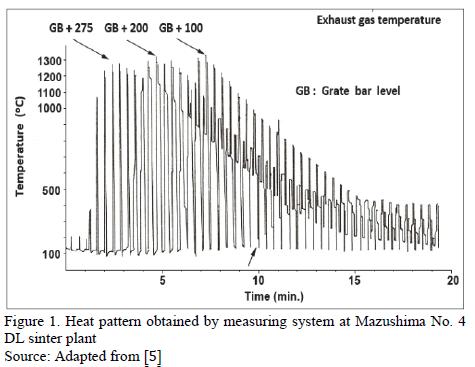
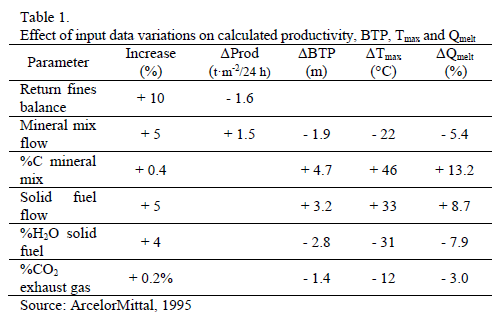
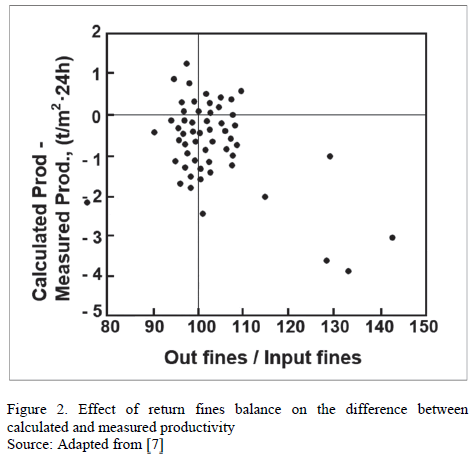
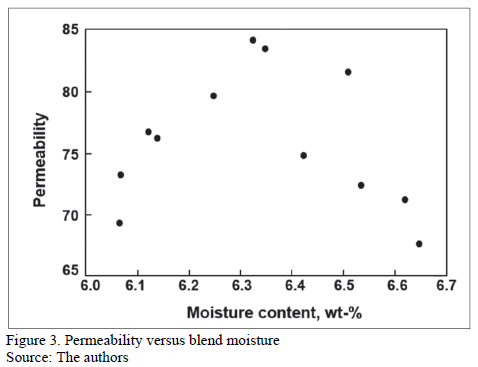
<body><![CDATA[<p><font size="2" face="Verdana, Arial, Helvetica, sans-serif">In its No. 4 SP at Muzishima (Japan), Kawasaki Steel  Corporation (KSC) has developed sensors that monitor heat pattern indices in  the sinter bed &#91;5&#93;. These sensors allow more elaborate operation control, not  only by evaluating operating conditions from the transition of permeability,  quality, yield and other conventional time-series data, but also by more  directly estimating changes in bed conditions and controlling the wind volume  distribution and coke distribution in the bed. <a href="#fig01">Fig. 1</a> shows an example of heat  pattern measuring.</font></p>     <p align="center"><font size="2" face="Verdana, Arial, Helvetica, sans-serif"><a name="fig01"></a></font><img src="/img/revistas/dyna/v82n190/v82n190a29fig01.gif"></p>     <p><font size="2" face="Verdana, Arial, Helvetica, sans-serif">In 1992 Arcelor-Mittal, in collaboration with CRM,  developed an expert system with Nexpert Object software and VAX VMS hardware  which controls 200 operating parameters every 15 seconds &#91;6&#93;. The system was  installed in the company's 516 m2 DL5 SP at Ougr&eacute;e (Belgium), with a production  of 9450 t sinter per day. As a result, it has been possible to reduce the  number of cases of cooking on the strand, to lower the standard deviation of  the FeO content, to improve the RDI, and to improve control of burn-through  point (BTP) and temperature profile in the wind boxes.</font></p>     <p><font size="2" face="Verdana, Arial, Helvetica, sans-serif">In  1994 Arcelor-Mittal installed in its No. 3 SP at Fos-sur-Mer (France) a sinter  strand control system based on analysis of the CO, CO2 and O2 content in the  wind box exhaust gases, coupled with the staged heat balance model developed by  IRSID &#91;7&#93;. The experience in the plant is reflected in <a href="#tab01">Table 1</a>, which indicates  the variation in productivity, BTP, maximum flame front temperature (Tmax) and  the fraction of melt (Qmelt) that forms in the bed at the maximum temperature,  as a function of the variation of a series of parameters. The theoretical  productivity depends mainly on the return fines balance and on the raw mix flow. Assessment of  the difference between real and measured productivities shows that the effect  of the return fines balance is well traced &#91;7&#93; (<a href="#fig02">Fig. 2</a>). </font></p>     <p align="center"><font size="2" face="Verdana, Arial, Helvetica, sans-serif"><a name="tab01"></a></font><img src="/img/revistas/dyna/v82n190/v82n190a29tab01.gif"></p>     <p align="center"><font size="2" face="Verdana, Arial, Helvetica, sans-serif"><a name="fig02"></a></font><img src="/img/revistas/dyna/v82n190/v82n190a29fig02.gif"></p>     <p><font size="2" face="Verdana, Arial, Helvetica, sans-serif">The calculated BTP depends on the flow and the chemical  composition of the raw mix (through the C content in the mineral mix and the H<sub>2</sub>O  content in the fuel) and the CO<sub>2</sub> in the exhaust gas. Assessment of  the difference between the calculated BTP and that resulting from temperature  measurements under the grate shows variations on both sides of a mean deviation  of the order of 1 to 2 m. An increase in this value constitutes a warming. The  calculated T<sub>max</sub> reached at the flame front and the Q<sub>max</sub> depend on heat inputs and requirements connected with the chemical composition  of the raw mix.</font></p>     <p><font size="2" face="Verdana, Arial, Helvetica, sans-serif">British Steel Corporation (BSC) has a 336 m<sup>2</sup> SP  installed at Redcar (United Kingdom) with a production of 3.5 million tons per  year. In 1994 improvements to the plant were begun &#91;8&#93;. A VAX 4000/500 was  selected as the central computer for logging data from 4500 signals with two  MicroVAX 3100 Model 80s to act as auxiliary machines to drive terminals and  printers. </font></p>     <p><font size="2" face="Verdana, Arial, Helvetica, sans-serif">Use of the computer has improved the determination of the optimum raw mix moisture following a  sinter bed change. By being able to constantly monitor operating data, it has  been possible to calculate permeability on a continuous basis, based on gas and  air flows into the ignition furnace. In <a href="#fig03">Fig. 3</a> the optimum moisture can be  easily observed. It is also possible to see the known strong influence of  moisture on permeability.</font></p>     <p align="center"><font size="2" face="Verdana, Arial, Helvetica, sans-serif"><a name="fig03"></a></font><img src="/img/revistas/dyna/v82n190/v82n190a29fig03.gif"></p>     ]]></body>
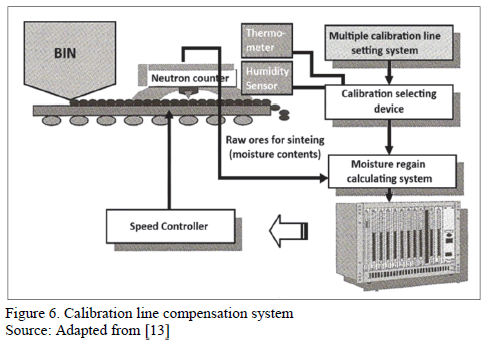
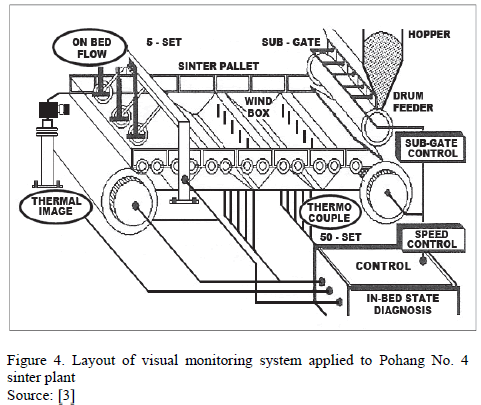
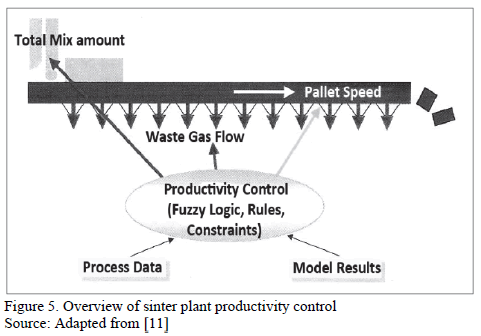
<body><![CDATA[<p><font size="2" face="Verdana, Arial, Helvetica, sans-serif">To measure the FeO content in the sinter, a belt coil  system has been placed around the product conveyor belt &#91;8&#93;. Improved FeO  control allows a coke saving of 1 kg t<sup>-1</sup> of sinter. It is also  possible to improve process control and achieve greater strand use efficiency  by measuring and controlling the BTP, where the maximum temperature occurs. A  BTP model has been installed on the new plant computer to calculate and detect  the burn-through point along the sinter strand by measuring the under-strand  temperature for the last eight wind boxes. The model calculates a proposed  strand speed to bring the actual BTP into line with a user-specified setting,  and this is notified to the operators in control of the strand. When strand  speed has been controlled using this model, strand utilisation has increased by  about 1%.</font></p>     <p><font size="2" face="Verdana, Arial, Helvetica, sans-serif">To increase production in  Tobata No. 3 SP at Yamata (Japan), NSC extended the length of the machine from  90 to 120 m, maintaining the 4 m pallet width. Since 1990 successive  improvements have been introduced in the plant &#91;9&#93;. The intensified sifting  feeder (ISF) designed for NSC was installed to reduce the charge density and  alleviate the avalanche of raw mix as charge onto the pallet. This ensured  uniform sintering of the sinter cake and improved the yield and shatter index  (SI) of the sinter cake. ISF technology is widely applied on sintering machines  both within and outside NSC &#91;10&#93;. Energy consumption in Tobata No. 3 SP has  been reduced by installing a NSC-developed surface combustion burner that mixed  the fuel gas (COG) and air at the inlet of the premix chamber. The completely  premixed gas is ejected through the network of porous plates (80 to 90%  porosity) at the premix chamber outlet and is rapidly burned to form a high  temperature flame. Exhaust gas recycling equipment has also been implemented,  consisting of recirculation blowers installed at the charge and discharge end  of the sinter strand. The discharge-end high temperature gas from the sinter  bed is drawn from the first half of the strand after the ignition to use its  sensible heat as sintering energy. The charge-end gas is drawn from the middle  of the strand. Sintering energy consumption has been reduced by about 100 MJ  per ton of sinter. </font></p>     <p><font size="2" face="Verdana, Arial, Helvetica, sans-serif">Pohang Iron and Steel Company, in its No. 4 SP at Pohang  (Korea), has 25 wind boxes and produces 13500 t sinter per day, which accounts  for 82% of the ferric material in its blast furnace burden. An integrated  visual monitoring and guide system has been in operation in this plant since  1995, and consists of fifty thermocouples, 5 on-bed flow meters, a thermal  imaging device and a sub-gate opening control system &#91;3&#93;. The thermocouples are  situated below wind boxes 15 to 25, and the 5 flow meters are on the bed of box  6. <a href="#fig04">Fig. 4</a> shows the layout of the developed system. This system helps the  operator to maintain the process in optimum and stable conditions.  Visualisation of the strand state gives the operator very good information on  pallet speed, charging density and fuel content. As a result, fluctuations in  the off-gas temperature under the sinter pallet decrease significantly after  automatic control of the sub-gate opening. This results in a lower return fine  production rate and higher product yield. Moreover, the emitted dust content  through the stack is greatly reduced by maintaining a stable in-bed condition  during sintering.</font></p>     <p align="center"><font size="2" face="Verdana, Arial, Helvetica, sans-serif"><a name="fig04"></a></font><img src="/img/revistas/dyna/v82n190/v82n190a29fig04.gif"></p>     <p><font size="2" face="Verdana, Arial, Helvetica, sans-serif">In the year 2000, Wuhan Iron and Steel Company (WISCO) in  China, in collaboration with Voest-Alpine Industrieanlagenbau (VAI) of Austria,  installed in its No. 1 SP, integrated by four strands of 126 m<sup>2</sup> each, a model that calculates 700 values at two levels of automation and a set  of process optimisation modules &#91;11&#93;. Despite the great complexity of the  process parameters, the main objectives are to improve output by 5%, to reduce  coke consumption by more than 2%, and to assure more than 99.5% system  availability. The level 1 model includes all the main data from different sources,  such as the analysis of raw materials and sinters. </font></p>     <p><font size="2" face="Verdana, Arial, Helvetica, sans-serif">This data is presented to the operator in the most efficient  way, preferably in graphic format. The level 2 model provides closed-loop  control of the process (without human interaction). Several groups of setpoints  are calculated: raw mix flow, material ratios, water addition, and sinter  strand speed to control the BTP. The models calculate the setpoints at any time  and simultaneously verify the applicability of these setpoints. If this is the  case, the system can switch from level 1 to level 2. If level 2 control is not  possible for any reason, control is again taken over by the level 1 system.  <a href="#fig05">Fig. 5</a> shows the set of parameters used to control output.</font></p>     <p align="center"><font size="2" face="Verdana, Arial, Helvetica, sans-serif"><a name="fig05"></a></font><img src="/img/revistas/dyna/v82n190/v82n190a29fig05.gif"></p>     <p><font size="2" face="Verdana, Arial, Helvetica, sans-serif">When it is not possible to regulate the strand speed in an  ideal way, speed variations may be expected to cause unstable operation. To  control the process it is necessary to assure complete sintering of the mix  before reaching the end of the strand, and guarantee that the cooking point is  as close as possible to the end of the strand in order to obtain the maximum  output.</font></p>     <p><font size="2" face="Verdana, Arial, Helvetica, sans-serif">In its Gwangyang plant (Korea), POSCO has installed an  on-line measuring system to check the moisture content in the iron ores and  coke sent to the drum mixer hoppers &#91;12&#93;. The system is based on a fast neutron  source. </font></p>     <p><font size="2" face="Verdana, Arial, Helvetica, sans-serif">When the fast neutrons collide with  hydrogen atoms in the mineral water, they lose energy in proportion to the  number of hydrogen atoms, and the moisture content may be determined using a sensor that detects the slow neutrons resulting  from the collision (<a href="#fig06">Fig. 6</a>). The system is calibrated to take into account  variations in the ambient temperature and humidity over the year.</font></p>     ]]></body>
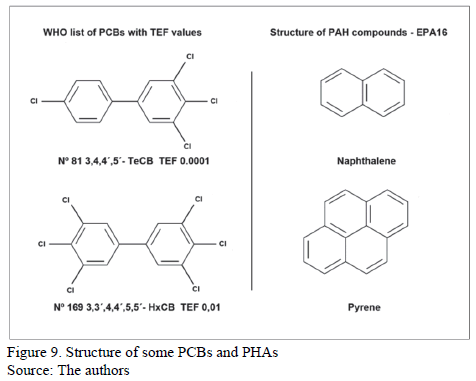
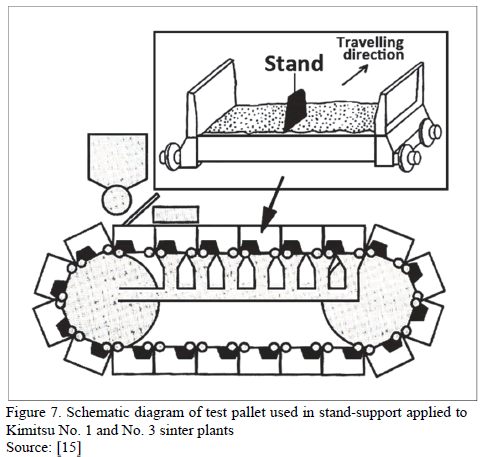
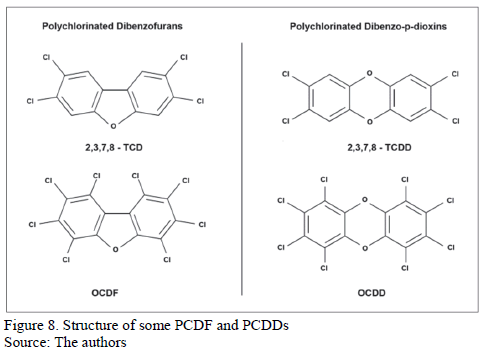
<body><![CDATA[<p align="center"><font size="2" face="Verdana, Arial, Helvetica, sans-serif"><a name="fig06"></a></font><img src="/img/revistas/dyna/v82n190/v82n190a29fig06.gif"></p>     <p><font size="2" face="Verdana, Arial, Helvetica, sans-serif">Research has been carried out on sinter cake structure  samples from commercial sinter plants and experimental pots using X-ray computed  tomography (X-ray CT) &#91;13&#93;. The sinter cake contains non-sintered, sintered,  oversintered and pore areas. An increase in the alumina content in the raw mix  causes impaired productivity by preventing the coalescence of pores. The  presence of metallic iron impaired productivity through the formation of a  dense sinter cake. Intensifying segregation, by means of an ISF, enhanced  productivity by decreasing the unsintered portion. Magnetic levitation of  sinter cake improved productivity by preventing shrinkage.</font></p>     <p><font size="2" face="Verdana, Arial, Helvetica, sans-serif">Companhia Siderùrgica de Tubarão (CST) has modernised its  sinter plant at Vitoria (Brazil) in collaboration with VAI &#91;14&#93;. The pallet  width has been increased from 5.0 to 5.5 m, making it the widest sintering  machine in the world. This measure increased the sintering area from 440 to 484  m2, leading to a rise in productivity from 37.0 to 38.9 t m-2 per day and an  increase in production from 16280 to 18800 t per day, without any loss of  sinter quality. Other improvements have also been obtained, including  reductions in electrical energy consumption, ignition gas, coke, burnt lime and  production costs.</font></p>     <p><font size="2" face="Verdana, Arial, Helvetica, sans-serif">A new sintering technique called &quot;stand support  sintering&quot;, to support the sinter cake with bars or plates attached to  pallets, has been developed &#91;15&#93;. This technique has been applied to the No. 1  and No. 3 SPs at Kimitsu works (Japan), improving shrinkage, porosity,  reducibility and productivity rates (<a href="#fig07">Fig. 7</a>).</font></p>     <p align="center"><font size="2" face="Verdana, Arial, Helvetica, sans-serif"><a name="fig07"></a></font><img src="/img/revistas/dyna/v82n190/v82n190a29fig07.gif"></p>     <p><font size="2" face="Verdana, Arial, Helvetica, sans-serif">At  Kakogawa sinter plant in Japan, research has been carried out to determine the  optimal granulation moisture value of sinter raw materials, testing the effect  of added moisture for six types of ore adjusted to the same particle </font><font size="2" face="Verdana, Arial, Helvetica, sans-serif">size distributions &#91;16&#93;. The  optimal moisture value to achieve maximum packed bed permeability was  determined for each ore. From the results obtained, an optimal moisture value  determination method was adopted, based on the hypothesis that the moisture  would not affect the optimal moisture for the mix materials, and a weighted  average was determined for the optimal moisture for the mix proportions of each  brand of ore and auxiliary materials. The application of the optimal moisture  allows the added moisture value to be reduced compared to the conventional  method. The packed bed permeability in the sinter plant increased and  productivity rose by 11 t h<sup>-1</sup>.</font></p>     <p>&nbsp;</p>     <p><font size="3" face="Verdana, Arial, Helvetica, sans-serif"><b>3. Environment </b></font></p>     <p><font size="2" face="Verdana, Arial, Helvetica, sans-serif">The importance of sintering plants lies not only in their  ability to take advantage of the finest iron ore granulometries, but also their  capacity to recycle waste products generated throughout the ironmaking industry  without altering the required physical, chemical and mechanical properties of  the sinter loaded into blast furnaces &#91;17,18&#93;. Gas emission volumes are high,  of the order of 2·106 Nm3 h-1&#91;18&#93;, and it is relevant to note that most sinter  plants in developed countries, which years ago were located well away from  built-up areas, are now surrounded by encroaching urban sprawl. Whereas before  the 1990s environmental attention was focused on dust and SO<sub>2</sub> emissions, in the final years of the 20th century and the start of the 21<sup>st</sup> century, concern shifted to NOX pollution, heavy metals (mercury, lead, chrome  and cadmium) and hydrocarbons, especially dioxins &#91;18&#93; (<a href="#fig08">Figs. 8</a> and <a href="#fig09">9</a>).</font></p>     <p align="center"><font size="2" face="Verdana, Arial, Helvetica, sans-serif"><a name="fig08"></a></font><img src="/img/revistas/dyna/v82n190/v82n190a29fig08.gif"></p>     ]]></body>
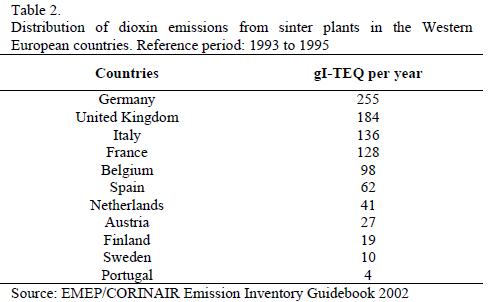
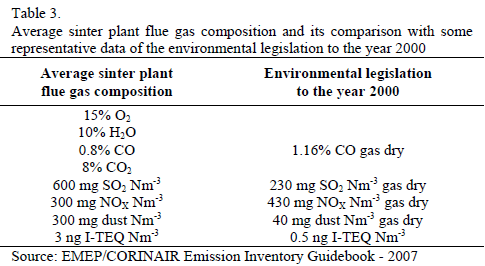
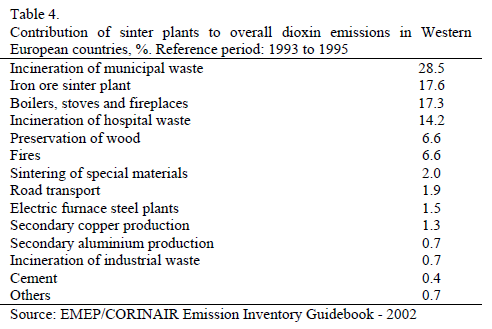
<body><![CDATA[<p align="center"><font size="2" face="Verdana, Arial, Helvetica, sans-serif"><a name="fig09"></a></font><img src="/img/revistas/dyna/v82n190/v82n190a29fig09.gif"></p>     <p><font size="2" face="Verdana, Arial, Helvetica, sans-serif">The World Health Organisation (WHO) highlights the risks  of polycyclic organic hydrocarbon emissions as potential carcinogenic  substances, especially dioxins (polychlorinated dibenzo-para-dioxin (PCDD) and  polychlorinated dibenzo furans (PCDF) or simply PCDD/F). However, not all 75  possible PCDD formulations or 135 PCDF formulations present the same health  risk, and a toxicity parameter known as the international toxicity equivalence  factor (I-TEF) has been introduced.</font></p>     <p><font size="2" face="Verdana, Arial, Helvetica, sans-serif">Furthermore, in order to express the toxicity of  a particular gaseous emission composed of dioxins, polycyclic</font> <font size="2" face="Verdana, Arial, Helvetica, sans-serif">aromatic hydrocarbons (PAH) or  polychlorinated biphenyls (PCB), the term equivalent toxicity, I-TEQ, has been  proposed, which serves to represent all the compounds that form part of a  sample, with their corresponding concentration, C<sub>X</sub>&#91;18,20&#93;:</font></p>     <p><img src="/img/revistas/dyna/v82n190/v82n190a29eq01.gif"></p>     <p><font size="2" face="Verdana, Arial, Helvetica, sans-serif">Since the start of the 21st century, the monitoring and  control of environmental dioxin emissions is a particularly sensitive issue in  view of their harmful effects on health. In 1993, 95% of chlorinated gaseous  pollutant emissions, 2.5 furandicarbaldehyde (FDC/F) from the ironmaking  industry, came from sinter plants. In 1995, 17.6% of European dioxin emissions  were produced by sintering &#91;21&#93; (<a href="#tab02">Table 2</a>). On the other hand, although there  continues to be no agreement on a global standard, in most industrialised  countries increasingly stringent restrictions are being set on pollutant  product emissions. </font></p>     <p align="center"><font size="2" face="Verdana, Arial, Helvetica, sans-serif"><a name="tab02"></a></font><img src="/img/revistas/dyna/v82n190/v82n190a29tab02.gif"></p>     <p><font size="2" face="Verdana, Arial, Helvetica, sans-serif"><a href="#tab03">Table 3</a> shows gas composition values in a sintering   process without the introduction of corrective technologies and the limitations   that have been imposed by environmental legislation &#91;21&#93;.</font></p>     <p align="center"><font size="2" face="Verdana, Arial, Helvetica, sans-serif"><a name="tab03"></a></font><img src="/img/revistas/dyna/v82n190/v82n190a29tab03.gif"></p>     <p><font size="2" face="Verdana, Arial, Helvetica, sans-serif"><b><i>3.1. Alternatives  for Emission Control</i></b></font></p>     <p><font size="2" face="Verdana, Arial, Helvetica, sans-serif"><a href="#tab03">Table 3</a> shows the composition of fumes emitted by sinter  plants in the last decade of the 20<sup>th</sup> century and the high rates of  harmful products they contained. The measures that can be adopted to reduce  emissions are as follows:</font></p> <ol type="a">       ]]></body>
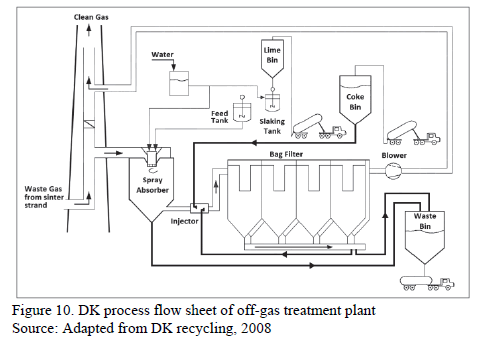
<body><![CDATA[<li><font size="2" face="Verdana, Arial, Helvetica, sans-serif">&quot;Primary measures&quot;, based on careful     selection of the quality of the raw materials used in the process;</font></li>       <li><font size="2" face="Verdana, Arial, Helvetica, sans-serif">&quot;Secondary     measures&quot;, reducing pollutant emissions by end-of-pipe means involving     mechanical, physical or chemical treatment of the solid or gaseous wastes     generated;</font></li>       <li><font size="2" face="Verdana, Arial, Helvetica, sans-serif">&quot;Tertiary processes&quot;, using potentially     polluting ironmaking by-products as raw materials, thus concentrating the     treatment of hazardous ironmaking waste in one or several facilities. </font></li>     </ol>     <p><font size="2" face="Verdana, Arial, Helvetica, sans-serif">One objection to primary measures lies in the need to  recycle oxidised products with the greatest potential to form dioxins, PCBs or  PAHs in sintering fumes. Similarly, one of the disadvantages of secondary  processes lies in the large amount of fumes to be treated, with a negative  influence on gas scrubbing-decontamination costs.</font></p>     <p><font size="2" face="Verdana, Arial, Helvetica, sans-serif">The Lucchini Severstal plant in Servola (Trieste-Italy)  has carried out retrofitting measures to limit the particulate matter (PM)  emissions in all the plant facilities (coals, iron ores and raw materials  stockyards, coke oven, sinter plant, blast furnace and casting machine) &#91;22&#93;, in  accordance with the legislation of the Environmental Protection Agency (EPA). As  a result it has continuously decreased the number of days a year in the  2004-2009 period, for which the permitted thresholds by EPA to PM emissions  were exceeded.</font></p>     <p><font size="2" face="Verdana, Arial, Helvetica, sans-serif">The tertiary process has been developed by the German  company DK Recycling and Roheisen GmbH to process 450,000 tons per year of  different dusts and sludges (BF sludge, BOF dust, sand blasting dust, cupola  dust, mill scale, Cu sludge and P sludge) using a sinter plant to transform the  waste oxides into a product that meets the requirements for processing in a  blast furnace &#91;23&#93;. </font></p>     <p><font size="2" face="Verdana, Arial, Helvetica, sans-serif">The amount of waste oxides generated per ton of steel  produced is 40 kg. The DK process causes problems with dioxin and furan  emissions. In order to overcome these problems an off-gas treatment plant has  been installed in the sinter plant downstream of the existing electrostatic  precipitator (<a href="#fig10">Fig. 10</a>). The plant is installed so that off-gas is taken from  the stack right after the main suction fan and piped into the spray absorber  where an atomiser treats it with a very fine mist of milk lime. The reaction  product gypsum falls into a cone at the base of the absorber from where it is  pneumatically transported to the waste bin. Between the spray absorber and the  bag house, lignite coke is injected into the gas stream. </font></p>     <p align="center"><font size="2" face="Verdana, Arial, Helvetica, sans-serif"><a name="fig10"></a></font><img src="/img/revistas/dyna/v82n190/v82n190a29fig10.gif"></p>     <p><font size="2" face="Verdana, Arial, Helvetica, sans-serif">The coke and other reaction products are captured in the  bag filter. All measurements of the clean gas leaving the bag house have been  below 0.4 ng I-TEM Nm<sup>-3</sup>.</font></p>     ]]></body>
<body><![CDATA[<p><font size="2" face="Verdana, Arial, Helvetica, sans-serif">The formation of chlorinated gaseous pollutants between  250 and 350 °C, by means of partial combustion catalysed by metals, is one of  the most real options in what is known as &quot;novo synthesis&quot;  &#91;20,24-27&#93;.</font></p>     <p><font size="2" face="Verdana, Arial, Helvetica, sans-serif"><img src="/img/revistas/dyna/v82n190/v82n190a29eq02.gif"></font></p>     <p><font size="2" face="Verdana, Arial, Helvetica, sans-serif">Due to the fact that sinter plants and urban waste  incinerators are the major source of dioxin emissions (<a href="#tab04">Table 4</a>), attempts have  been made to transfer experience in dioxin removal from urban waste  incinerators to sintering. Nevertheless, there are notable technological  differences between dioxin generation in incinerating plants and in sinter strands  &#91;21&#93;. There is no unanimous agreement about where dioxins are generated and  their possible correlation with other volatile organic compounds (VOCs).  Nevertheless, there is a conviction that the maximum dioxin concentration is  reached in the wind boxes located at the end of the grate, before the sinter is  tipped into the shredder. On the other hand, the maximum VOC concentration is  found in the wind boxes located towards the centre of the sinter strand  &#91;21,24&#93;. However, all such considerations are heavily dependent upon the  chemical characteristics and the proportions of the raw materials used in  sintering. If novo synthesis is catalysed by metals, in processes that involve  a greater presence of metals, these may influence the location of the wind  boxes where the maximum concentration is reached &#91;23,25-26&#93;. </font></p>     <p align="center"><font size="2" face="Verdana, Arial, Helvetica, sans-serif"><a name="tab04"></a></font><img src="/img/revistas/dyna/v82n190/v82n190a29tab04.gif"></p>     <p><font size="2" face="Verdana, Arial, Helvetica, sans-serif">Sintering fumes are treated with hydrogenated products  such as ammonia and urea to reduce dioxin and nitrogen oxide emissions.  Treatment with ammonia is carried out in wind boxes along the entire sinter  strip, while the addition of urea, which is more efficient, takes place in the  mixing drum &#91;20,24-26&#93;.</font></p>     <p><font size="2" face="Verdana, Arial, Helvetica, sans-serif"><b><i>3.2. Industrial  treatment processes</i></b></font></p>     <p><font size="2" face="Verdana, Arial, Helvetica, sans-serif">Since the end of the last century, when secondary  processes to reduce pollutant emissions from sinter plants were gradually  starting to be implemented, the following observations may be made:</font></p> <ol type="a">       <li><font size="2" face="Verdana, Arial, Helvetica, sans-serif">    The treatments applied were initially simple in order     to reduce dust and SO2 contents in exhaust fumes.</font></li>       <li><font size="2" face="Verdana, Arial, Helvetica, sans-serif">    More     complex technologies were subsequently applied, both in wet and dry treatment     processes, incorporating solid waste and wastewater treatment installations in     the process.</font></li>       <li><font size="2" face="Verdana, Arial, Helvetica, sans-serif">    The estimated cost of meeting more restrictive     environmental regulations (clean air) can account for up to 35% of the plant     construction cost &#91;27&#93;.</font></li>     ]]></body>
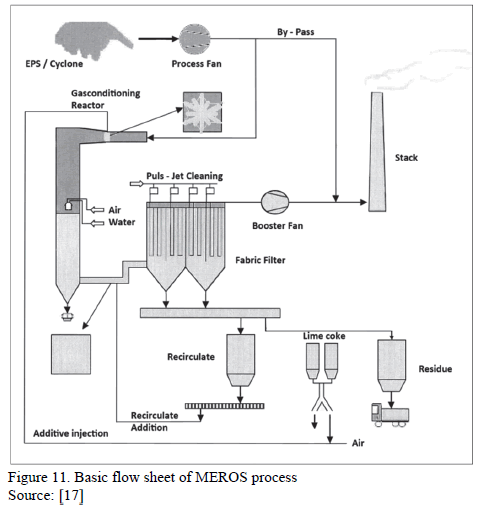
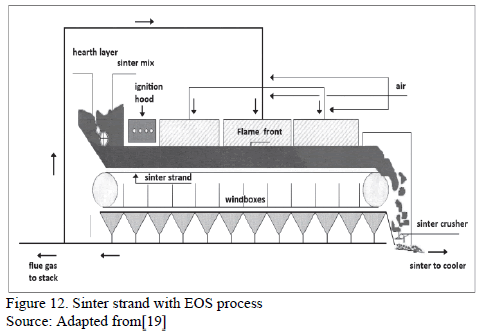
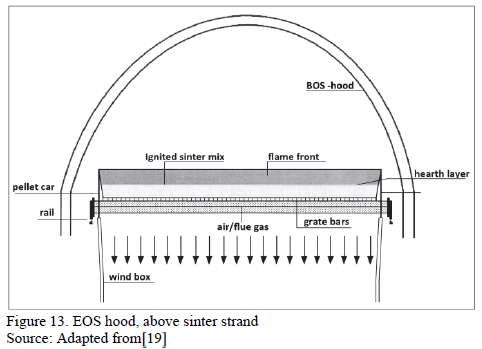
<body><![CDATA[</ol>     <p><font size="2" face="Verdana, Arial, Helvetica, sans-serif"><b>3.2.1. WETFINE  system</b></font></p>     <p><font size="2" face="Verdana, Arial, Helvetica, sans-serif">The WETFINE technology developed by VAI to reduce dust,  alkaline chloride, SO<sub>X</sub> and dioxin contents, consists of a flexible  modular system adaptable to smoke decontamination not only in sinter plants but  also in pelletisers, urban waste incinerators and industrial furnaces. Gas  scrubbing is achieved by a mixed system: wet wash and electrostatic discharges.  The treatment capacity of the modules ranges between 70,000 and 300,000 Nm<sup>3</sup> h<sup>-1</sup>. Nevertheless, this treatment system is not capable of reducing  dioxin emission levels below 0.4 ng I-TEQ Nm<sup>-3</sup>, as required by  legislation. For this reason it has been necessary to resort to the addition of  urea and the modification of some plant operating parameters &#91;24&#93;.</font></p>     <p><font size="2" face="Verdana, Arial, Helvetica, sans-serif"><b>3.2.2. MEROS  process</b></font></p>     <p><font size="2" face="Verdana, Arial, Helvetica, sans-serif">In the maximised emission  reduction of sintering (MEROS) process, developed by Siemens-VAI, dust, acid  gases, hazardous metals and organic compounds present in the sintering gases  are eliminated with high efficiency rates. In 2007 the first installation  started operating at Linz (Austria), with a gas treatment capacity of 1,000,000  Nm<sup>3</sup> h<sup>-1</sup>. One of the most outstanding characteristics of  MEROS is that it fulfils current environmental regulations and may work within  the restrictions that will foreseeably be set in the future &#91;17,19&#93; (<a href="#fig11">Fig. 11</a>).</font></p>     <p align="center"><font size="2" face="Verdana, Arial, Helvetica, sans-serif"><a name="fig11"></a></font><img src="/img/revistas/dyna/v82n190/v82n190a29fig11.gif"></p>     <p><font size="2" face="Verdana, Arial, Helvetica, sans-serif"><b>3.2.3 EOS system</b></font></p>     <p><font size="2" face="Verdana, Arial, Helvetica, sans-serif">The great volume of fumes and  the low concentration of elements to be decontaminated has always been one of  the problems of sinter plants. The fundamental objective of the emission  optimised sintering (EOS) system is to reduce the volume of the fumes to be  decontaminated (potentially achieving a reduction of up to 50%) by placing a  hood above the sinter grate which is fed with both clean air and recycled air  from the wind boxes&#91;17,19&#93; (<a href="#fig12">Figs. 12</a> and <a href="#fig13">13</a>).</font></p>     <p align="center"><font size="2" face="Verdana, Arial, Helvetica, sans-serif"><a name="fig12"></a></font><img src="/img/revistas/dyna/v82n190/v82n190a29fig12.gif"></p>     <p align="center"><font size="2" face="Verdana, Arial, Helvetica, sans-serif"><a name="fig13"></a></font><img src="/img/revistas/dyna/v82n190/v82n190a29fig13.gif"></p>     ]]></body>
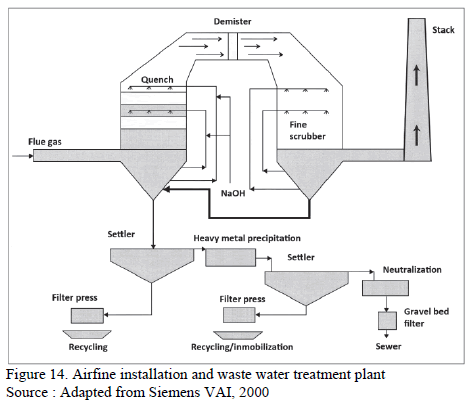
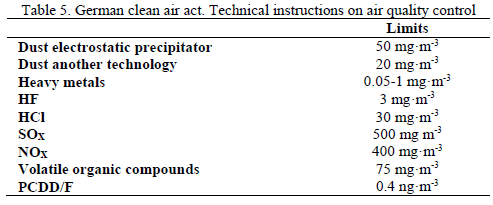
<body><![CDATA[<p><font size="2" face="Verdana, Arial, Helvetica, sans-serif"><b>3.2.4 AIRFINE system</b></font></p>     <p><font size="2" face="Verdana, Arial, Helvetica, sans-serif">The installations of this  process developed by VAI, consist of two scrubbers in series: the first rapidly  cools the gases (quench scrubber) while the second, which operates with  parallel water and gas currents, eliminates the finest dust particles and dioxins  (fine scrubber). <a href="#fig14">Fig. 14</a>. </font></p>     <p align="center"><font size="2" face="Verdana, Arial, Helvetica, sans-serif"><a name="fig14"></a></font><img src="/img/revistas/dyna/v82n190/v82n190a29fig14.gif"></p>     <p><font size="2" face="Verdana, Arial, Helvetica, sans-serif">The water used in the cooling  and treatment of the sintering gases is sent to a water treatment plant (WTP).  Similarly, parts of the solids collected in the WTP are recycled to the  sintering plant. The key to AIRFINE consists in the special design of a wet gas  scrubbing system with the use of dual spray nozzles (liquid/gas) which achieve  the atomisation of water particles in the fumes, obtaining sizes in the region  of 50 <font face="Symbol">m</font>m &#91;28,30&#93;.</font></p>     <p><font size="2" face="Verdana, Arial, Helvetica, sans-serif">The Siemens VAI selective  waste gas recirculation system was installed in March 2005 at the No. 5 SP of  VAI in Linz (Austria). In 2009 it was installed at the No. 1 SP of Dragon Steel  Corporation (DSC) in Taichung (Taiwan). With this system the content of heavy  metals, dioxins, SO<sub>X </sub>and NO<sub>X</sub> in the waste gas is reduced  &#91;31&#93;.</font></p>     <p><font size="2" face="Verdana, Arial, Helvetica, sans-serif"><b>3.2.5 EFA process</b></font></p>     <p><font size="2" face="Verdana, Arial, Helvetica, sans-serif">The entrained flow absorber  process, developed by the company Paul Wurth, belongs to the alternative  secondary &quot;<i>end of pipe</i>&quot;  process which maintains the electrostatic precipitator and adds an injection  process with an EFA operating with hydrated lime and activated lignite coke &#91;32&#93;.  It has been used in the ROGESA No. 2 SP at Dillinger (Germany), since 2005, and  complies with German legislation, which has also been adopted by other  countries (<a href="#tab05">Table 5</a>).</font></p>     <p align=center><font size="2" face="Verdana, Arial, Helvetica, sans-serif"><a name="tab05"></a></font><img src="/img/revistas/dyna/v82n190/v82n190a29tab05.gif"></p>     <p><font size="2" face="Verdana, Arial, Helvetica, sans-serif">This process has now been  installed in three other German sinter plants.</font></p>     <p><font size="3" face="Verdana, Arial, Helvetica, sans-serif"><b>4 Conclusions</b></font></p>     ]]></body>
<body><![CDATA[<p><font size="2" face="Verdana, Arial, Helvetica, sans-serif">Sinter is the main burden  material for some blast furnaces, whose correct operation depends largely on  the quality of the sinter used. Sinter plants throughout the world work with a  wide variety of mineral mixes which are characterised in great depth in terms  of granulometry and chemical and mineral composition. Plant operating  parameters must be adaptable to allow the introduction of low iron-content ores  in the mineral mix to replace high iron-content ores that are usually included  in the processed mix but are withdrawn for reasons such as stock depletion or  excessive price.</font></p>     <p><font size="2" face="Verdana, Arial, Helvetica, sans-serif">Sinter plants are in constant  evolution as a consequence of the practical operating experience acquired over  the years, with improved techniques and systems to control the high number of  parameters that intervene in the process. Plants have to adapt and incorporate  gas scrubbing systems to comply with increasingly restrictive legislation on  the limitation of toxic pollutant emissions into the atmosphere.</font></p>     <p>&nbsp;</p>     <p><font size="3" face="Verdana, Arial, Helvetica, sans-serif"><b>References</b></font></p>     <!-- ref --><p><font size="2" face="Verdana, Arial, Helvetica, sans-serif"><b>&#91;1&#93;</b> Cores, A., Verdeja, L.F., Ferreira, S., Ruiz-Bustinza, &Iacute;. and Moch&oacute;n,  J., Iron ore sintering Part 1. Theory  and practice of the sintering process, DYNA, 80 (180), pp. 152-171,  2013.    &nbsp;&nbsp;&nbsp;&nbsp;&nbsp;&nbsp;&nbsp;&nbsp;[&#160;<a href="javascript:void(0);" onclick="javascript: window.open('/scielo.php?script=sci_nlinks&ref=000167&pid=S0012-7353201500020002900001&lng=','','width=640,height=500,resizable=yes,scrollbars=1,menubar=yes,');">Links</a>&#160;]<!-- end-ref --> </font></p>     <!-- ref --><p><font size="2" face="Verdana, Arial, Helvetica, sans-serif"><b>&#91;2&#93;</b> Moch&oacute;n,  J., Cores, A., Ruiz-Bustinza, &Iacute;., Verdeja, L.F., Robla, J.I. and  García-Carcedo, F., Iron ore sintering  Part 2. Quality indices and productivity, DYNA, 81 (183), pp. 168-177, 2014. <a href="http://dx.doi.org/10.15446/dyna.v81n183.41568" target="_blank">http://dx.doi.org/10.15446/dyna.v81n183.41568</a></font>&nbsp;&nbsp;&nbsp;&nbsp;&nbsp;&nbsp;&nbsp;&nbsp;[&#160;<a href="javascript:void(0);" onclick="javascript: window.open('/scielo.php?script=sci_nlinks&ref=000169&pid=S0012-7353201500020002900002&lng=','','width=640,height=500,resizable=yes,scrollbars=1,menubar=yes,');">Links</a>&#160;]<!-- end-ref --><!-- ref --><p><font size="2" face="Verdana, Arial, Helvetica, sans-serif"><b>&#91;3&#93;</b>   Cho, B.K. and Lee, S.H., Proc. 2<sup>nd</sup> Int. Cong. on Sci. and Tech. Ironmaking. ISS Ironmaking Conf. Proc., 57, pp. 1291-1298,  1998.    &nbsp;&nbsp;&nbsp;&nbsp;&nbsp;&nbsp;&nbsp;&nbsp;[&#160;<a href="javascript:void(0);" onclick="javascript: window.open('/scielo.php?script=sci_nlinks&ref=000170&pid=S0012-7353201500020002900003&lng=','','width=640,height=500,resizable=yes,scrollbars=1,menubar=yes,');">Links</a>&#160;]<!-- end-ref --></font></p>     <!-- ref --><p><font size="2" face="Verdana, Arial, Helvetica, sans-serif"><b>&#91;4&#93;</b>   Yadav, U.S., Das, B.K.  and Baijal, A.D., Proc. 3<sup>rd</sup> Int. Conf. on Sci. and Tech. of  Ironmaking, VDEh, Düsseldorf, Germany, pp.138-143, 2003.    &nbsp;&nbsp;&nbsp;&nbsp;&nbsp;&nbsp;&nbsp;&nbsp;[&#160;<a href="javascript:void(0);" onclick="javascript: window.open('/scielo.php?script=sci_nlinks&ref=000172&pid=S0012-7353201500020002900004&lng=','','width=640,height=500,resizable=yes,scrollbars=1,menubar=yes,');">Links</a>&#160;]<!-- end-ref --></font></p>     <!-- ref --><p><font size="2" face="Verdana, Arial, Helvetica, sans-serif"><b>&#91;5&#93;</b>   Kurihara, J., Fukuda, A.,  Tanaka, S.  and Nigo, S., ISS Ironmaking Conf. Proc., 41, pp. 80-89, 1982.    &nbsp;&nbsp;&nbsp;&nbsp;&nbsp;&nbsp;&nbsp;&nbsp;[&#160;<a href="javascript:void(0);" onclick="javascript: window.open('/scielo.php?script=sci_nlinks&ref=000174&pid=S0012-7353201500020002900005&lng=','','width=640,height=500,resizable=yes,scrollbars=1,menubar=yes,');">Links</a>&#160;]<!-- end-ref --></font></p>     <!-- ref --><p><font size="2" face="Verdana, Arial, Helvetica, sans-serif"><b>&#91;6&#93;</b>   Depaye, P.,  Mathonet, Ch., Vanderheyden, B. and Manassis, E., Proc. 3<sup>rd</sup> European  Cokemaking and Ironmaking Cong., Gent, Belgium, Vol. 1. Ed. CRM, Liège,  Belgium, pp. 193-201, 1996.    &nbsp;&nbsp;&nbsp;&nbsp;&nbsp;&nbsp;&nbsp;&nbsp;[&#160;<a href="javascript:void(0);" onclick="javascript: window.open('/scielo.php?script=sci_nlinks&ref=000176&pid=S0012-7353201500020002900006&lng=','','width=640,height=500,resizable=yes,scrollbars=1,menubar=yes,');">Links</a>&#160;]<!-- end-ref --></font></p>     <!-- ref --><p><font size="2" face="Verdana, Arial, Helvetica, sans-serif"><b>&#91;7&#93;</b> Marlière, E., Dulcy,  C., Huguet, C. and Leblanc, O., Pro. 3<sup>rd</sup> European Cokemaking and  Ironmaking Cong., Gent, Belgium, Vol. 1 Ed. CRM, Liège, Belgium, pp. 202-208,  1996.    &nbsp;&nbsp;&nbsp;&nbsp;&nbsp;&nbsp;&nbsp;&nbsp;[&#160;<a href="javascript:void(0);" onclick="javascript: window.open('/scielo.php?script=sci_nlinks&ref=000178&pid=S0012-7353201500020002900007&lng=','','width=640,height=500,resizable=yes,scrollbars=1,menubar=yes,');">Links</a>&#160;]<!-- end-ref --></font></p>     <!-- ref --><p><font size="2" face="Verdana, Arial, Helvetica, sans-serif"><b>&#91;8&#93;</b>   Fisher, D.J., and  Coulston, B.: ISS Ironmaking Conf. Proc., 56, pp. 383-389, 1997.    &nbsp;&nbsp;&nbsp;&nbsp;&nbsp;&nbsp;&nbsp;&nbsp;[&#160;<a href="javascript:void(0);" onclick="javascript: window.open('/scielo.php?script=sci_nlinks&ref=000180&pid=S0012-7353201500020002900008&lng=','','width=640,height=500,resizable=yes,scrollbars=1,menubar=yes,');">Links</a>&#160;]<!-- end-ref --></font></p>     <!-- ref --><p><font size="2" face="Verdana, Arial, Helvetica, sans-serif"><b>&#91;9&#93;</b>   Gushima, A.,  Sakuragi, J. and Ikehara, S., Proc. 3<sup>rd</sup> European Cokemaking and Ironmaking  Cong., Gent, Belgium, Vol. 1. Ed. CRM, Liège, Belgium, pp. 184-192, 1996.    &nbsp;&nbsp;&nbsp;&nbsp;&nbsp;&nbsp;&nbsp;&nbsp;[&#160;<a href="javascript:void(0);" onclick="javascript: window.open('/scielo.php?script=sci_nlinks&ref=000182&pid=S0012-7353201500020002900009&lng=','','width=640,height=500,resizable=yes,scrollbars=1,menubar=yes,');">Links</a>&#160;]<!-- end-ref --></font></p>     <!-- ref --><p><font size="2" face="Verdana, Arial, Helvetica, sans-serif"><b>&#91;10&#93;</b>  Honorato, E.P. and  Seshadri, V., Granulometric  optimisation of raw materials for ISF continuous segregation system in  Usiminas' sintering plants, Ironmaking Steelmaking, 35 (6), pp. 405-415, 2008. <a href="http://dx.doi.org/10.1179/174328108X318374" target="_blank">http://dx.doi.org/10.1179/174328108X318374</a></font>&nbsp;&nbsp;&nbsp;&nbsp;&nbsp;&nbsp;&nbsp;&nbsp;[&#160;<a href="javascript:void(0);" onclick="javascript: window.open('/scielo.php?script=sci_nlinks&ref=000184&pid=S0012-7353201500020002900010&lng=','','width=640,height=500,resizable=yes,scrollbars=1,menubar=yes,');">Links</a>&#160;]<!-- end-ref --><!-- ref --><p><font size="2" face="Verdana, Arial, Helvetica, sans-serif"><b>&#91;11&#93;</b>  Wendong, S.,  Bettinger, D., Straka, G. and Stohl, K., Sinter plant automation on a new level  !, Rev. Met. Paris, 98 (11), pp. 999-1008, 2001.  <a href="http://dx.doi.org/10.1051/metal:2001141" target="_blank">http://dx.doi.org/10.1051/metal:2001141</a>.    &nbsp;&nbsp;&nbsp;&nbsp;&nbsp;&nbsp;&nbsp;&nbsp;[&#160;<a href="javascript:void(0);" onclick="javascript: window.open('/scielo.php?script=sci_nlinks&ref=000185&pid=S0012-7353201500020002900011&lng=','','width=640,height=500,resizable=yes,scrollbars=1,menubar=yes,');">Links</a>&#160;]<!-- end-ref --></font></p>     <!-- ref --><p><font size="2" face="Verdana, Arial, Helvetica, sans-serif"><b>&#91;12&#93;</b>  Lee, K., Proc. on  Iron and Steel Tech. Conf., Indianapolis, IN, USA. Assoc for Iron and Steel  Tech., Warrendale, PA, USA, 1, pp. 199-206, 2007.    &nbsp;&nbsp;&nbsp;&nbsp;&nbsp;&nbsp;&nbsp;&nbsp;[&#160;<a href="javascript:void(0);" onclick="javascript: window.open('/scielo.php?script=sci_nlinks&ref=000187&pid=S0012-7353201500020002900012&lng=','','width=640,height=500,resizable=yes,scrollbars=1,menubar=yes,');">Links</a>&#160;]<!-- end-ref --></font></p>     <!-- ref --><p><font size="2" face="Verdana, Arial, Helvetica, sans-serif"><b>&#91;13&#93;</b>  Nakano, N.,  Kawaguchi, T., Kasama, S. and Hosotani, Y., Proc. 2<sup>nd</sup> Int. Cong. on  Sci. and Tech. Ironmaking. ISS Ironmaking Conf. Proc., 57, pp. 1283-1290, 1998.    &nbsp;&nbsp;&nbsp;&nbsp;&nbsp;&nbsp;&nbsp;&nbsp;[&#160;<a href="javascript:void(0);" onclick="javascript: window.open('/scielo.php?script=sci_nlinks&ref=000189&pid=S0012-7353201500020002900013&lng=','','width=640,height=500,resizable=yes,scrollbars=1,menubar=yes,');">Links</a>&#160;]<!-- end-ref --></font></p>     <!-- ref --><p><font size="2" face="Verdana, Arial, Helvetica, sans-serif"><b>&#91;14&#93;</b>  Harano ,E.L.M.,  Vidal, J.A.N., da Silva, M.R., Pammer, O., Ram, H. and Gould, L., ISS  Ironmaking Conf. Proc., 58, pp. 533-543, 1999.    &nbsp;&nbsp;&nbsp;&nbsp;&nbsp;&nbsp;&nbsp;&nbsp;[&#160;<a href="javascript:void(0);" onclick="javascript: window.open('/scielo.php?script=sci_nlinks&ref=000191&pid=S0012-7353201500020002900014&lng=','','width=640,height=500,resizable=yes,scrollbars=1,menubar=yes,');">Links</a>&#160;]<!-- end-ref --></font></p>     ]]></body>
<body><![CDATA[<!-- ref --><p><font size="2" face="Verdana, Arial, Helvetica, sans-serif"><b>&#91;15&#93;</b>  Higuchi, K.,  Kawaguchi, T., Kobayashi, M., Hosotani, Y., Nakamura, K., Iwamoto, K. and  Fujimoto, M., ISIJ Int., 40, pp. 1188-1194, 2000. <a href="http://dx.doi.org/10.2355/isijinternational.40.1188" target="_blank">http://dx.doi.org/10.2355/isijinternational.40.1188</a></font>&nbsp;&nbsp;&nbsp;&nbsp;&nbsp;&nbsp;&nbsp;&nbsp;[&#160;<a href="javascript:void(0);" onclick="javascript: window.open('/scielo.php?script=sci_nlinks&ref=000193&pid=S0012-7353201500020002900015&lng=','','width=640,height=500,resizable=yes,scrollbars=1,menubar=yes,');">Links</a>&#160;]<!-- end-ref --><!-- ref --><p><font size="2" face="Verdana, Arial, Helvetica, sans-serif"><b>&#91;16&#93;</b>  Matsumura, T., Maki,  T., Amano, S., Sakamato, M. and Iwasaki, N., Effect of moisture absorption  behavior on optimal granulation moisture value of sinter raw material, ISIJ  Int., 49 (5), pp. 618-624, 2009. <a href="http://dx.doi.org/10.2355/isijinternational.49.618" target="_blank">http://dx.doi.org/10.2355/isijinternational.49.618</a></font>&nbsp;&nbsp;&nbsp;&nbsp;&nbsp;&nbsp;&nbsp;&nbsp;[&#160;<a href="javascript:void(0);" onclick="javascript: window.open('/scielo.php?script=sci_nlinks&ref=000194&pid=S0012-7353201500020002900016&lng=','','width=640,height=500,resizable=yes,scrollbars=1,menubar=yes,');">Links</a>&#160;]<!-- end-ref --><!-- ref --><p><font size="2" face="Verdana, Arial, Helvetica, sans-serif"><b>&#91;17&#93;</b> Vanderheyden, I.B.,  Marlière, M., Zwaan, F. and Neuschütz, D., Control of pollutants during sintering operation, &#91;on  line&#93;. European  Commission Technical Steel Research. EUR 20373 EN, 151 P., 2002, Available at:  <a href="http://bookshop.europa.eu/en/control-of-pollutants-during-sintering-operation-pbKINA20373/" target="_blank">http://bookshop.europa.eu/en/control-of-pollutants-during-sintering-operation-pbKINA20373/</a></font>&nbsp;&nbsp;&nbsp;&nbsp;&nbsp;&nbsp;&nbsp;&nbsp;[&#160;<a href="javascript:void(0);" onclick="javascript: window.open('/scielo.php?script=sci_nlinks&ref=000195&pid=S0012-7353201500020002900017&lng=','','width=640,height=500,resizable=yes,scrollbars=1,menubar=yes,');">Links</a>&#160;]<!-- end-ref --><!-- ref --><p><font size="2" face="Verdana, Arial, Helvetica, sans-serif"><b>&#91;18&#93;</b>  Fisher, R., Garcia,  F., Alaiz, E. and Pietruck, R., Effects of operational factors on the formation of toxic organic  micropollutants in EAF steelmaking, &#91;om line&#93;. European Commission Technical  Steel Research. EUR 21429 EN, pp. 151 P., 2005. Available at:  <a href="http://bookshop.europa.eu/en/effects-of-operational-factors-on-the-formation-of-toxic-organic-micropollutants-in-eaf-steelmaking-pbKINA21432/" target="_blank">http://bookshop.europa.eu/en/effects-of-operational-factors-on-the-formation-of-toxic-organic-micropollutants-in-eaf-steelmaking-pbKINA21432/</a></font>&nbsp;&nbsp;&nbsp;&nbsp;&nbsp;&nbsp;&nbsp;&nbsp;[&#160;<a href="javascript:void(0);" onclick="javascript: window.open('/scielo.php?script=sci_nlinks&ref=000196&pid=S0012-7353201500020002900018&lng=','','width=640,height=500,resizable=yes,scrollbars=1,menubar=yes,');">Links</a>&#160;]<!-- end-ref --><!-- ref --><p><font size="2" face="Verdana, Arial, Helvetica, sans-serif"><b>&#91;19&#93;</b>  Alexander, F.,  Robert, N. and Tobias, P., Proc. on Iron and Steel Tech. Conf., Indianapolis,  IN, USA. Association for Iron and Steel Tech., Warrendale, PA, USA, 1, pp.  215-223, 2007.    &nbsp;&nbsp;&nbsp;&nbsp;&nbsp;&nbsp;&nbsp;&nbsp;[&#160;<a href="javascript:void(0);" onclick="javascript: window.open('/scielo.php?script=sci_nlinks&ref=000197&pid=S0012-7353201500020002900019&lng=','','width=640,height=500,resizable=yes,scrollbars=1,menubar=yes,');">Links</a>&#160;]<!-- end-ref --></font></p>     <!-- ref --><p><font size="2" face="Verdana, Arial, Helvetica, sans-serif"><b>&#91;20&#93;</b>  Southern, S.,  Edmundson, J. and Hakimian, M., Proc. 4<sup>th</sup> European Cokemaking and  Ironmaking Cong., Paris, France, ATS, Paris, 1, pp. 118-125, 2000.    &nbsp;&nbsp;&nbsp;&nbsp;&nbsp;&nbsp;&nbsp;&nbsp;[&#160;<a href="javascript:void(0);" onclick="javascript: window.open('/scielo.php?script=sci_nlinks&ref=000199&pid=S0012-7353201500020002900020&lng=','','width=640,height=500,resizable=yes,scrollbars=1,menubar=yes,');">Links</a>&#160;]<!-- end-ref --></font></p>     <!-- ref --><p><font size="2" face="Verdana, Arial, Helvetica, sans-serif"><b>&#91;21&#93;</b> Perez, J.,  Espinel, J., Ocampo A. and Londono, C., Dioxinas en procesos de incineraci&oacute;n de  desechos, DYNA, 134, pp. 65-75, 2001.    &nbsp;&nbsp;&nbsp;&nbsp;&nbsp;&nbsp;&nbsp;&nbsp;[&#160;<a href="javascript:void(0);" onclick="javascript: window.open('/scielo.php?script=sci_nlinks&ref=000201&pid=S0012-7353201500020002900021&lng=','','width=640,height=500,resizable=yes,scrollbars=1,menubar=yes,');">Links</a>&#160;]<!-- end-ref --></font></p>     ]]></body>
<body><![CDATA[<!-- ref --><p><font size="2" face="Verdana, Arial, Helvetica, sans-serif"><b>&#91;22&#93;</b>  Boscolo, M. and Padoano, E., Monitoring of  particulate emissions to assess the outcomes of retrofitting measures at an  ironmaking plant, ISIJ Int., 51 (9) pp. 1553-1560, 2011. <a href="http://dx.doi.org/10.2355/isijinternational.51.1553" target="_blank">http://dx.doi.org/10.2355/isijinternational.51.1553</a></font>&nbsp;&nbsp;&nbsp;&nbsp;&nbsp;&nbsp;&nbsp;&nbsp;[&#160;<a href="javascript:void(0);" onclick="javascript: window.open('/scielo.php?script=sci_nlinks&ref=000203&pid=S0012-7353201500020002900022&lng=','','width=640,height=500,resizable=yes,scrollbars=1,menubar=yes,');">Links</a>&#160;]<!-- end-ref --><!-- ref --><p><font size="2" face="Verdana, Arial, Helvetica, sans-serif"><b>&#91;23&#93;</b>  Moore, C.M., Deike  R. and Hillman, C., Proc. 3<sup>rd</sup> Int. Conf. on Sci. and Tech. of  Ironmaking, VDEh, Düsseldorf, Germany, pp. 578-581, 2003.    &nbsp;&nbsp;&nbsp;&nbsp;&nbsp;&nbsp;&nbsp;&nbsp;[&#160;<a href="javascript:void(0);" onclick="javascript: window.open('/scielo.php?script=sci_nlinks&ref=000204&pid=S0012-7353201500020002900023&lng=','','width=640,height=500,resizable=yes,scrollbars=1,menubar=yes,');">Links</a>&#160;]<!-- end-ref --></font></p>     <!-- ref --><p><font size="2" face="Verdana, Arial, Helvetica, sans-serif"><b>&#91;24&#93;</b> Tan, P. and Neuschütz, D., Metall. Mater. Trans. B,  2004, 35B, 983-991. DOI: <a href="http://dx.doi.org/10.1007/s11663-004-0092-7" target="_blank">http://dx.doi.org/10.1007/s11663-004-0092-7</a></font>&nbsp;&nbsp;&nbsp;&nbsp;&nbsp;&nbsp;&nbsp;&nbsp;[&#160;<a href="javascript:void(0);" onclick="javascript: window.open('/scielo.php?script=sci_nlinks&ref=000206&pid=S0012-7353201500020002900024&lng=','','width=640,height=500,resizable=yes,scrollbars=1,menubar=yes,');">Links</a>&#160;]<!-- end-ref --><!-- ref --><p><font size="2" face="Verdana, Arial, Helvetica, sans-serif"><b>&#91;25&#93;</b>  Boscolo, M. and Padoano, E., Investigations into dioxin emissions at  Italian iron ore sintering plant, Ironmaking Steelmaking, 35 (5), pp. 338-342,  2008. <a href="http://dx.doi.org/10.1179/174328108X287739" target="_blank">http://dx.doi.org/10.1179/174328108X287739</a></font>&nbsp;&nbsp;&nbsp;&nbsp;&nbsp;&nbsp;&nbsp;&nbsp;[&#160;<a href="javascript:void(0);" onclick="javascript: window.open('/scielo.php?script=sci_nlinks&ref=000207&pid=S0012-7353201500020002900025&lng=','','width=640,height=500,resizable=yes,scrollbars=1,menubar=yes,');">Links</a>&#160;]<!-- end-ref --><!-- ref --><p><font size="2" face="Verdana, Arial, Helvetica, sans-serif"><b>&#91;26&#93;</b>  Kasai, E., Aono, T.,  Tomita, Y., Takasaki, M., Shiraishi, N. and Kitano, S., Macroscopic Behaviors  of Dioxins in the Iron Ore Sintering Plants, ISIJ Int., 41 (2), pp. 86-92. 001,  <a href="http://dx.doi.org/10.2355/isijinternational.41.86" target="_blank">http://dx.doi.org/10.2355/isijinternational.41.86</a></font>&nbsp;&nbsp;&nbsp;&nbsp;&nbsp;&nbsp;&nbsp;&nbsp;[&#160;<a href="javascript:void(0);" onclick="javascript: window.open('/scielo.php?script=sci_nlinks&ref=000208&pid=S0012-7353201500020002900026&lng=','','width=640,height=500,resizable=yes,scrollbars=1,menubar=yes,');">Links</a>&#160;]<!-- end-ref --><!-- ref --><p><font size="2" face="Verdana, Arial, Helvetica, sans-serif"><b>&#91;27&#93;</b> Lüngen, H.B. and  Theobald, W., Proc. 2<sup>nd</sup> European Ironmaking Congr., Glasgow, United  Kingdom. The Institute of Metals, London, United Kingdom, pp. 275-288, 1991.    &nbsp;&nbsp;&nbsp;&nbsp;&nbsp;&nbsp;&nbsp;&nbsp;[&#160;<a href="javascript:void(0);" onclick="javascript: window.open('/scielo.php?script=sci_nlinks&ref=000209&pid=S0012-7353201500020002900027&lng=','','width=640,height=500,resizable=yes,scrollbars=1,menubar=yes,');">Links</a>&#160;]<!-- end-ref --></font></p>     <!-- ref --><p><font size="2" face="Verdana, Arial, Helvetica, sans-serif"><b>&#91;28&#93;</b>  Leuwerink, T. and  Van der Panne, A., Proc. 4th European Cokemaking and Ironmaking Cong., Paris,  France, ATS, Paris, 1, pp. 374-379, 2000.    &nbsp;&nbsp;&nbsp;&nbsp;&nbsp;&nbsp;&nbsp;&nbsp;[&#160;<a href="javascript:void(0);" onclick="javascript: window.open('/scielo.php?script=sci_nlinks&ref=000211&pid=S0012-7353201500020002900028&lng=','','width=640,height=500,resizable=yes,scrollbars=1,menubar=yes,');">Links</a>&#160;]<!-- end-ref --></font></p>     ]]></body>
<body><![CDATA[<!-- ref --><p><font size="2" face="Verdana, Arial, Helvetica, sans-serif"><b>&#91;29&#93;</b> Hofstadler, K.,  Muraer, F., Steiner, D. and Gebert, W., WETFINE, a new gas cleaning technology  for sinter and pellet plants, Rev. Mètall. CIT, 98 (10), 2001, pp. 825-831. <a href="http://dx.doi.org/10.1051/metal:2001129" target="_blank">http://dx.doi.org/10.1051/metal:2001129</a></font>&nbsp;&nbsp;&nbsp;&nbsp;&nbsp;&nbsp;&nbsp;&nbsp;[&#160;<a href="javascript:void(0);" onclick="javascript: window.open('/scielo.php?script=sci_nlinks&ref=000213&pid=S0012-7353201500020002900029&lng=','','width=640,height=500,resizable=yes,scrollbars=1,menubar=yes,');">Links</a>&#160;]<!-- end-ref --><!-- ref --><p><font size="2" face="Verdana, Arial, Helvetica, sans-serif"><b>&#91;30&#93;</b>  Leuwerink, T. and  Van der Panne, A.: Stahl Eisen, 121, pp. 21-34, 2001-</font>&nbsp;&nbsp;&nbsp;&nbsp;&nbsp;&nbsp;&nbsp;&nbsp;[&#160;<a href="javascript:void(0);" onclick="javascript: window.open('/scielo.php?script=sci_nlinks&ref=000214&pid=S0012-7353201500020002900030&lng=','','width=640,height=500,resizable=yes,scrollbars=1,menubar=yes,');">Links</a>&#160;]<!-- end-ref --><!-- ref --><p><font size="2" face="Verdana, Arial, Helvetica, sans-serif"><b>&#91;31&#93;</b> Reidetschläger, J.,  Stiasny, H., Hötzinger, S., Aichinger, C. and Fulgencio, A., Stahl Eisen, 132, pp.  25-30, 2012,    &nbsp;&nbsp;&nbsp;&nbsp;&nbsp;&nbsp;&nbsp;&nbsp;[&#160;<a href="javascript:void(0);" onclick="javascript: window.open('/scielo.php?script=sci_nlinks&ref=000215&pid=S0012-7353201500020002900031&lng=','','width=640,height=500,resizable=yes,scrollbars=1,menubar=yes,');">Links</a>&#160;]<!-- end-ref --></font></p>     <!-- ref --><p><font size="2" face="Verdana, Arial, Helvetica, sans-serif"><b>&#91;32&#93;</b>  Hartin, W. and  Reufer, F., Iron Steel Tech., 8 (4), pp. 81-86, 2011.    &nbsp;&nbsp;&nbsp;&nbsp;&nbsp;&nbsp;&nbsp;&nbsp;[&#160;<a href="javascript:void(0);" onclick="javascript: window.open('/scielo.php?script=sci_nlinks&ref=000217&pid=S0012-7353201500020002900032&lng=','','width=640,height=500,resizable=yes,scrollbars=1,menubar=yes,');">Links</a>&#160;]<!-- end-ref --></font></p>     <p>&nbsp;</p>     <p><font size="2" face="Verdana, Arial, Helvetica, sans-serif"><b>A.  Cores,</b> is PhD in Chemical Sciences from the Universidad Complutense  de Madrid, Spain and scientific researcher <i>&quot;ad   honorem&quot;</i> at the Spanish National Research Council (CSIC)</font></p>     <p><font size="2" face="Verdana, Arial, Helvetica, sans-serif"><b>L.F.  Verdeja,</b> is PhD in Chemical Sciences from the Universidad de  Oviedo, Spain, member of the European Chemist Registration Board. European  Communities Chemistry Council (ECCC), Chairman of Steelmaking at the University  of Oviedo</font></p>     <p><font size="2" face="Verdana, Arial, Helvetica, sans-serif"><b>S. Ferreira,</b> is PhD  in Chemical Sciences from the Universidad Complutense de Madrid, Spain, and scientific  researcher <i>&quot;ad honorem&quot;</i> at the Spanish  National Research Council (CSIC)</font></p>     ]]></body>
<body><![CDATA[<p><font size="2" face="Verdana, Arial, Helvetica, sans-serif"><b>&Iacute;.  Ruiz-Bustinza,</b> is Metallurgical and Mining Engineer from the School  of Mines of Madrid (ETSIM - UPM), Spain, PhD from the University of Oviedo,  Spain. Responsible for European RFCS Projects at CENIM - CSIC (Spain)</font></p>     <p><font size="2" face="Verdana, Arial, Helvetica, sans-serif"><b>J.  Moch&oacute;n,</b> is PhD in Physical Sciences from the University Hispalense  of Sevilla, Spain, university professor and scientific researcher <i>&quot;ad honorem&quot;</i> at the Spanish National  Research Council (CSIC)</font></p>     <p><font size="2" face="Verdana, Arial, Helvetica, sans-serif"><b>J.I.  Robla,</b> is PhD in Chemical Sciences from the Universidad Complutense  de Madrid, Spain and scientific researcher at the Spanish National Research  Council (CSIC), Spain. Lead Researcher of the Group &quot;Processes, Materials and  Energy in the Ecological and Sustainable Metallurgy&quot; </font></p>     <p><font size="2" face="Verdana, Arial, Helvetica, sans-serif"><b>C.Gonz&aacute;lez-Gasca </b>has a PhD in Mining Engineering from the School of Mines of Madrid  (ETSIM - UPM), Spain, Coordinator of the Doctoral Program of the Centre of  Excellence for Research, Intelligent Systems and Renewable Energies at the Universidad  Europea - Laureate International Universities (Spain).</font></p>      ]]></body><back>
<ref-list>
<ref id="B1">
<label>1</label><nlm-citation citation-type="journal">
<person-group person-group-type="author">
<name>
<surname><![CDATA[Cores]]></surname>
<given-names><![CDATA[A.]]></given-names>
</name>
<name>
<surname><![CDATA[Verdeja]]></surname>
<given-names><![CDATA[L.F.]]></given-names>
</name>
<name>
<surname><![CDATA[Ferreira]]></surname>
<given-names><![CDATA[S.]]></given-names>
</name>
<name>
<surname><![CDATA[Ruiz-Bustinza]]></surname>
<given-names><![CDATA[Í.]]></given-names>
</name>
<name>
<surname><![CDATA[Mochón]]></surname>
<given-names><![CDATA[J.]]></given-names>
</name>
</person-group>
<article-title xml:lang="en"><![CDATA[Iron ore sintering: Part 1. Theory and practice of the sintering process]]></article-title>
<source><![CDATA[DYNA]]></source>
<year>2013</year>
<volume>80</volume>
<numero>180</numero>
<issue>180</issue>
<page-range>152-171</page-range></nlm-citation>
</ref>
<ref id="B2">
<label>2</label><nlm-citation citation-type="journal">
<person-group person-group-type="author">
<name>
<surname><![CDATA[Mochón]]></surname>
<given-names><![CDATA[J.]]></given-names>
</name>
<name>
<surname><![CDATA[Cores]]></surname>
<given-names><![CDATA[A.]]></given-names>
</name>
<name>
<surname><![CDATA[Ruiz-Bustinza]]></surname>
<given-names><![CDATA[Í.]]></given-names>
</name>
<name>
<surname><![CDATA[Verdeja]]></surname>
<given-names><![CDATA[L.F.]]></given-names>
</name>
<name>
<surname><![CDATA[Robla]]></surname>
<given-names><![CDATA[J.I.]]></given-names>
</name>
<name>
<surname><![CDATA[García-Carcedo]]></surname>
<given-names><![CDATA[F.]]></given-names>
</name>
</person-group>
<article-title xml:lang="en"><![CDATA[Iron ore sintering: Part 2. Quality indices and productivity]]></article-title>
<source><![CDATA[DYNA]]></source>
<year>2014</year>
<volume>81</volume>
<numero>183</numero>
<issue>183</issue>
<page-range>168-177</page-range></nlm-citation>
</ref>
<ref id="B3">
<label>3</label><nlm-citation citation-type="confpro">
<person-group person-group-type="author">
<name>
<surname><![CDATA[Cho]]></surname>
<given-names><![CDATA[B.K.]]></given-names>
</name>
<name>
<surname><![CDATA[Lee]]></surname>
<given-names><![CDATA[S.H.]]></given-names>
</name>
</person-group>
<source><![CDATA[]]></source>
<year>1998</year>
<conf-name><![CDATA[2nd Int. Cong. on Sci. and Tech. Ironmaking.]]></conf-name>
<conf-loc> </conf-loc>
<page-range>1291-1298</page-range></nlm-citation>
</ref>
<ref id="B4">
<label>4</label><nlm-citation citation-type="confpro">
<person-group person-group-type="author">
<name>
<surname><![CDATA[Yadav]]></surname>
<given-names><![CDATA[U.S.]]></given-names>
</name>
<name>
<surname><![CDATA[Das]]></surname>
<given-names><![CDATA[B.K.]]></given-names>
</name>
<name>
<surname><![CDATA[Baijal]]></surname>
<given-names><![CDATA[A.D.]]></given-names>
</name>
</person-group>
<source><![CDATA[]]></source>
<year>2003</year>
<conf-name><![CDATA[3rd Int. Conf. on Sci. and Tech. of Ironmaking]]></conf-name>
<conf-loc>Düsseldorf </conf-loc>
<page-range>138-143</page-range></nlm-citation>
</ref>
<ref id="B5">
<label>5</label><nlm-citation citation-type="confpro">
<person-group person-group-type="author">
<name>
<surname><![CDATA[Kurihara]]></surname>
<given-names><![CDATA[J.]]></given-names>
</name>
<name>
<surname><![CDATA[Fukuda]]></surname>
<given-names><![CDATA[A.]]></given-names>
</name>
<name>
<surname><![CDATA[Tanaka]]></surname>
<given-names><![CDATA[S.]]></given-names>
</name>
<name>
<surname><![CDATA[Nigo]]></surname>
<given-names><![CDATA[S.]]></given-names>
</name>
</person-group>
<source><![CDATA[]]></source>
<year>1982</year>
<conf-name><![CDATA[ ISS Ironmaking Conf. Proc.]]></conf-name>
<conf-loc> </conf-loc>
<page-range>80-89</page-range></nlm-citation>
</ref>
<ref id="B6">
<label>6</label><nlm-citation citation-type="confpro">
<person-group person-group-type="author">
<name>
<surname><![CDATA[Depaye]]></surname>
<given-names><![CDATA[P.]]></given-names>
</name>
<name>
<surname><![CDATA[Mathonet]]></surname>
<given-names><![CDATA[Ch.]]></given-names>
</name>
<name>
<surname><![CDATA[Vanderheyden]]></surname>
<given-names><![CDATA[B.]]></given-names>
</name>
<name>
<surname><![CDATA[Manassis]]></surname>
<given-names><![CDATA[E.]]></given-names>
</name>
</person-group>
<source><![CDATA[]]></source>
<year>1996</year>
<volume>1</volume>
<conf-name><![CDATA[3rd European Cokemaking and Ironmaking Cong]]></conf-name>
<conf-loc>Gent </conf-loc>
<page-range>193-201</page-range><publisher-loc><![CDATA[Liège ]]></publisher-loc>
<publisher-name><![CDATA[CRM]]></publisher-name>
</nlm-citation>
</ref>
<ref id="B7">
<label>7</label><nlm-citation citation-type="confpro">
<person-group person-group-type="author">
<name>
<surname><![CDATA[Marlière]]></surname>
<given-names><![CDATA[E.]]></given-names>
</name>
<name>
<surname><![CDATA[Dulcy]]></surname>
<given-names><![CDATA[C.]]></given-names>
</name>
<name>
<surname><![CDATA[Huguet]]></surname>
<given-names><![CDATA[C.]]></given-names>
</name>
<name>
<surname><![CDATA[Leblanc]]></surname>
<given-names><![CDATA[O.]]></given-names>
</name>
</person-group>
<source><![CDATA[]]></source>
<year>1996</year>
<volume>1</volume>
<conf-name><![CDATA[3rd European Cokemaking and Ironmaking Cong.]]></conf-name>
<conf-loc>Gent </conf-loc>
<page-range>202-208</page-range><publisher-loc><![CDATA[Liège ]]></publisher-loc>
<publisher-name><![CDATA[CRM]]></publisher-name>
</nlm-citation>
</ref>
<ref id="B8">
<label>8</label><nlm-citation citation-type="confpro">
<person-group person-group-type="author">
<name>
<surname><![CDATA[Fisher]]></surname>
<given-names><![CDATA[D.J.]]></given-names>
</name>
<name>
<surname><![CDATA[Coulston]]></surname>
<given-names><![CDATA[B.]]></given-names>
</name>
</person-group>
<source><![CDATA[]]></source>
<year>1997</year>
<volume>56</volume>
<conf-name><![CDATA[ ISS Ironmaking Conf. Proc.]]></conf-name>
<conf-loc> </conf-loc>
<page-range>383-389</page-range></nlm-citation>
</ref>
<ref id="B9">
<label>9</label><nlm-citation citation-type="confpro">
<person-group person-group-type="author">
<name>
<surname><![CDATA[Gushima]]></surname>
<given-names><![CDATA[A.]]></given-names>
</name>
<name>
<surname><![CDATA[Sakuragi]]></surname>
<given-names><![CDATA[J.]]></given-names>
</name>
<name>
<surname><![CDATA[Ikehara]]></surname>
<given-names><![CDATA[S.]]></given-names>
</name>
</person-group>
<source><![CDATA[]]></source>
<year>1996</year>
<volume>1</volume>
<conf-name><![CDATA[3rd European Cokemaking and Ironmaking Cong.]]></conf-name>
<conf-loc>Gent </conf-loc>
<page-range>184-192</page-range><publisher-loc><![CDATA[Liège ]]></publisher-loc>
<publisher-name><![CDATA[CRM]]></publisher-name>
</nlm-citation>
</ref>
<ref id="B10">
<label>10</label><nlm-citation citation-type="journal">
<person-group person-group-type="author">
<name>
<surname><![CDATA[Honorato]]></surname>
<given-names><![CDATA[E.P.]]></given-names>
</name>
<name>
<surname><![CDATA[Seshadri]]></surname>
<given-names><![CDATA[V.]]></given-names>
</name>
</person-group>
<article-title xml:lang="en"><![CDATA[Granulometric optimisation of raw materials for ISF continuous segregation system in Usiminas' sintering plants]]></article-title>
<source><![CDATA[Ironmaking Steelmaking]]></source>
<year>2008</year>
<volume>35</volume>
<numero>6</numero>
<issue>6</issue>
<page-range>405-415</page-range></nlm-citation>
</ref>
<ref id="B11">
<label>11</label><nlm-citation citation-type="journal">
<person-group person-group-type="author">
<name>
<surname><![CDATA[Wendong]]></surname>
<given-names><![CDATA[S.]]></given-names>
</name>
<name>
<surname><![CDATA[Bettinger]]></surname>
<given-names><![CDATA[D.]]></given-names>
</name>
<name>
<surname><![CDATA[Straka]]></surname>
<given-names><![CDATA[G.]]></given-names>
</name>
<name>
<surname><![CDATA[Stohl]]></surname>
<given-names><![CDATA[K.]]></given-names>
</name>
</person-group>
<article-title xml:lang="en"><![CDATA[Sinter plant automation on a new level !]]></article-title>
<source><![CDATA[Rev. Met. Paris]]></source>
<year>2001</year>
<volume>98</volume>
<numero>11</numero>
<issue>11</issue>
<page-range>999-1008</page-range></nlm-citation>
</ref>
<ref id="B12">
<label>12</label><nlm-citation citation-type="confpro">
<person-group person-group-type="author">
<name>
<surname><![CDATA[Lee]]></surname>
<given-names><![CDATA[K.]]></given-names>
</name>
</person-group>
<source><![CDATA[]]></source>
<year>2007</year>
<volume>1</volume>
<conf-name><![CDATA[ Proc. on Iron and Steel Tech. Conf.]]></conf-name>
<conf-loc>Indianapolis IN</conf-loc>
<page-range>199-206</page-range><publisher-loc><![CDATA[^ePA PA]]></publisher-loc>
<publisher-name><![CDATA[Assoc for Iron and Steel Tech.]]></publisher-name>
</nlm-citation>
</ref>
<ref id="B13">
<label>13</label><nlm-citation citation-type="confpro">
<person-group person-group-type="author">
<name>
<surname><![CDATA[Nakano]]></surname>
<given-names><![CDATA[N.]]></given-names>
</name>
<name>
<surname><![CDATA[Kawaguchi]]></surname>
<given-names><![CDATA[T.]]></given-names>
</name>
<name>
<surname><![CDATA[Kasama]]></surname>
<given-names><![CDATA[S.]]></given-names>
</name>
<name>
<surname><![CDATA[Hosotani]]></surname>
<given-names><![CDATA[Y.]]></given-names>
</name>
</person-group>
<source><![CDATA[]]></source>
<year>1998</year>
<volume>57</volume>
<conf-name><![CDATA[2nd Int. Cong. on Sci. and Tech. Ironmaking.ISS Ironmaking Conf. Proc.]]></conf-name>
<conf-loc> </conf-loc>
<page-range>1283-1290</page-range></nlm-citation>
</ref>
<ref id="B14">
<label>14</label><nlm-citation citation-type="confpro">
<person-group person-group-type="author">
<name>
<surname><![CDATA[Harano]]></surname>
<given-names><![CDATA[E.L.M.]]></given-names>
</name>
<name>
<surname><![CDATA[Vidal]]></surname>
<given-names><![CDATA[J.A.N.]]></given-names>
</name>
<name>
<surname><![CDATA[da Silva]]></surname>
<given-names><![CDATA[M.R.]]></given-names>
</name>
<name>
<surname><![CDATA[Pammer]]></surname>
<given-names><![CDATA[O.]]></given-names>
</name>
<name>
<surname><![CDATA[Ram]]></surname>
<given-names><![CDATA[H.]]></given-names>
</name>
<name>
<surname><![CDATA[Gould]]></surname>
<given-names><![CDATA[L.]]></given-names>
</name>
</person-group>
<source><![CDATA[]]></source>
<year>1999</year>
<volume>58</volume>
<conf-name><![CDATA[ ISS Ironmaking Conf. Proc.]]></conf-name>
<conf-loc> </conf-loc>
<page-range>533-543</page-range></nlm-citation>
</ref>
<ref id="B15">
<label>15</label><nlm-citation citation-type="journal">
<person-group person-group-type="author">
<name>
<surname><![CDATA[Higuchi]]></surname>
<given-names><![CDATA[K.]]></given-names>
</name>
<name>
<surname><![CDATA[Kawaguchi]]></surname>
<given-names><![CDATA[T.]]></given-names>
</name>
<name>
<surname><![CDATA[Kobayashi]]></surname>
<given-names><![CDATA[M.]]></given-names>
</name>
<name>
<surname><![CDATA[Hosotani]]></surname>
<given-names><![CDATA[Y.]]></given-names>
</name>
<name>
<surname><![CDATA[Nakamura]]></surname>
<given-names><![CDATA[K.]]></given-names>
</name>
<name>
<surname><![CDATA[Iwamoto]]></surname>
<given-names><![CDATA[K.]]></given-names>
</name>
<name>
<surname><![CDATA[Fujimoto]]></surname>
<given-names><![CDATA[M.]]></given-names>
</name>
</person-group>
<source><![CDATA[ISIJ Int.]]></source>
<year>2000</year>
<volume>40</volume>
<page-range>1188-1194</page-range></nlm-citation>
</ref>
<ref id="B16">
<label>16</label><nlm-citation citation-type="journal">
<person-group person-group-type="author">
<name>
<surname><![CDATA[Matsumura]]></surname>
<given-names><![CDATA[T.]]></given-names>
</name>
<name>
<surname><![CDATA[Maki]]></surname>
<given-names><![CDATA[T.]]></given-names>
</name>
<name>
<surname><![CDATA[Amano]]></surname>
<given-names><![CDATA[S.]]></given-names>
</name>
<name>
<surname><![CDATA[Sakamato]]></surname>
<given-names><![CDATA[M.]]></given-names>
</name>
<name>
<surname><![CDATA[Iwasaki]]></surname>
<given-names><![CDATA[N.]]></given-names>
</name>
</person-group>
<article-title xml:lang="en"><![CDATA[Effect of moisture absorption behavior on optimal granulation moisture value of sinter raw material]]></article-title>
<source><![CDATA[ISIJ Int.]]></source>
<year>2009</year>
<volume>49</volume>
<numero>5</numero>
<issue>5</issue>
<page-range>618-624</page-range></nlm-citation>
</ref>
<ref id="B17">
<label>17</label><nlm-citation citation-type="book">
<person-group person-group-type="author">
<name>
<surname><![CDATA[Vanderheyden]]></surname>
<given-names><![CDATA[I.B.]]></given-names>
</name>
<name>
<surname><![CDATA[Marlière]]></surname>
<given-names><![CDATA[M.]]></given-names>
</name>
<name>
<surname><![CDATA[Zwaan]]></surname>
<given-names><![CDATA[F.]]></given-names>
</name>
<name>
<surname><![CDATA[Neuschütz]]></surname>
<given-names><![CDATA[D.]]></given-names>
</name>
</person-group>
<source><![CDATA[Control of pollutants during sintering operation]]></source>
<year>2002</year>
<publisher-name><![CDATA[European Commission Technical Steel Research]]></publisher-name>
</nlm-citation>
</ref>
<ref id="B18">
<label>18</label><nlm-citation citation-type="book">
<person-group person-group-type="author">
<name>
<surname><![CDATA[Fisher]]></surname>
<given-names><![CDATA[R.]]></given-names>
</name>
<name>
<surname><![CDATA[Garcia]]></surname>
<given-names><![CDATA[F.]]></given-names>
</name>
<name>
<surname><![CDATA[Alaiz]]></surname>
<given-names><![CDATA[E.]]></given-names>
</name>
<name>
<surname><![CDATA[Pietruck]]></surname>
<given-names><![CDATA[R.]]></given-names>
</name>
</person-group>
<source><![CDATA[Effects of operational factors on the formation of toxic organic micropollutants in EAF steelmaking]]></source>
<year>2005</year>
<publisher-name><![CDATA[European Commission Technical Steel Research]]></publisher-name>
</nlm-citation>
</ref>
<ref id="B19">
<label>19</label><nlm-citation citation-type="confpro">
<person-group person-group-type="author">
<name>
<surname><![CDATA[Alexander]]></surname>
<given-names><![CDATA[F.]]></given-names>
</name>
<name>
<surname><![CDATA[Robert]]></surname>
<given-names><![CDATA[N.]]></given-names>
</name>
<name>
<surname><![CDATA[Tobias]]></surname>
<given-names><![CDATA[P.]]></given-names>
</name>
</person-group>
<source><![CDATA[]]></source>
<year>2007</year>
<volume>1</volume>
<conf-name><![CDATA[ Proc. on Iron and Steel Tech. Conf.]]></conf-name>
<conf-loc>Indianapolis IN</conf-loc>
<page-range>215-223</page-range><publisher-loc><![CDATA[Warrendale^ePA PA]]></publisher-loc>
<publisher-name><![CDATA[Association for Iron and Steel Tech.]]></publisher-name>
</nlm-citation>
</ref>
<ref id="B20">
<label>20</label><nlm-citation citation-type="confpro">
<person-group person-group-type="author">
<name>
<surname><![CDATA[Southern]]></surname>
<given-names><![CDATA[S.]]></given-names>
</name>
<name>
<surname><![CDATA[Edmundson]]></surname>
<given-names><![CDATA[J.]]></given-names>
</name>
<name>
<surname><![CDATA[Hakimian]]></surname>
<given-names><![CDATA[M.]]></given-names>
</name>
</person-group>
<source><![CDATA[]]></source>
<year>2000</year>
<conf-name><![CDATA[4th European Cokemaking and Ironmaking Cong.]]></conf-name>
<conf-loc>Paris </conf-loc>
<page-range>118-125</page-range><publisher-loc><![CDATA[Paris ]]></publisher-loc>
</nlm-citation>
</ref>
<ref id="B21">
<label>21</label><nlm-citation citation-type="journal">
<person-group person-group-type="author">
<name>
<surname><![CDATA[Perez]]></surname>
<given-names><![CDATA[J.]]></given-names>
</name>
<name>
<surname><![CDATA[Espinel]]></surname>
<given-names><![CDATA[J.]]></given-names>
</name>
<name>
<surname><![CDATA[Ocampo]]></surname>
<given-names><![CDATA[A.]]></given-names>
</name>
<name>
<surname><![CDATA[Londono]]></surname>
<given-names><![CDATA[C.]]></given-names>
</name>
</person-group>
<article-title xml:lang="es"><![CDATA[Dioxinas en procesos de incineración de desechos]]></article-title>
<source><![CDATA[DYNA]]></source>
<year>2001</year>
<numero>134</numero>
<issue>134</issue>
<page-range>65-75</page-range></nlm-citation>
</ref>
<ref id="B22">
<label>22</label><nlm-citation citation-type="journal">
<person-group person-group-type="author">
<name>
<surname><![CDATA[Boscolo]]></surname>
<given-names><![CDATA[M.]]></given-names>
</name>
<name>
<surname><![CDATA[Padoano]]></surname>
<given-names><![CDATA[E.]]></given-names>
</name>
</person-group>
<article-title xml:lang="en"><![CDATA[Monitoring of particulate emissions to assess the outcomes of retrofitting measures at an ironmaking plant]]></article-title>
<source><![CDATA[ISIJ Int.]]></source>
<year>2011</year>
<volume>51</volume>
<numero>9</numero>
<issue>9</issue>
<page-range>1553-1560</page-range></nlm-citation>
</ref>
<ref id="B23">
<label>23</label><nlm-citation citation-type="confpro">
<person-group person-group-type="author">
<name>
<surname><![CDATA[Moore]]></surname>
<given-names><![CDATA[C.M.]]></given-names>
</name>
<name>
<surname><![CDATA[Deike]]></surname>
<given-names><![CDATA[R.]]></given-names>
</name>
<name>
<surname><![CDATA[Hillman]]></surname>
<given-names><![CDATA[C.]]></given-names>
</name>
</person-group>
<source><![CDATA[]]></source>
<year>2003</year>
<conf-name><![CDATA[3rd Int. Conf. on Sci. and Tech. of Ironmaking]]></conf-name>
<conf-loc>Düsseldorf </conf-loc>
<page-range>578-581</page-range></nlm-citation>
</ref>
<ref id="B24">
<label>24</label><nlm-citation citation-type="journal">
<person-group person-group-type="author">
<name>
<surname><![CDATA[Tan]]></surname>
<given-names><![CDATA[P.]]></given-names>
</name>
<name>
<surname><![CDATA[Neuschütz]]></surname>
<given-names><![CDATA[D.]]></given-names>
</name>
</person-group>
<source><![CDATA[Metall. Mater. Trans. B]]></source>
<year>2004</year>
<numero>35B</numero>
<issue>35B</issue>
<page-range>983-991</page-range></nlm-citation>
</ref>
<ref id="B25">
<label>25</label><nlm-citation citation-type="journal">
<person-group person-group-type="author">
<name>
<surname><![CDATA[Boscolo]]></surname>
<given-names><![CDATA[M.]]></given-names>
</name>
<name>
<surname><![CDATA[Padoano]]></surname>
<given-names><![CDATA[E.]]></given-names>
</name>
</person-group>
<article-title xml:lang="en"><![CDATA[Investigations into dioxin emissions at Italian iron ore sintering plant]]></article-title>
<source><![CDATA[Ironmaking Steelmaking]]></source>
<year>2008</year>
<volume>35</volume>
<numero>5</numero>
<issue>5</issue>
<page-range>338-342</page-range></nlm-citation>
</ref>
<ref id="B26">
<label>26</label><nlm-citation citation-type="journal">
<person-group person-group-type="author">
<name>
<surname><![CDATA[Kasai]]></surname>
<given-names><![CDATA[E.]]></given-names>
</name>
<name>
<surname><![CDATA[Aono]]></surname>
<given-names><![CDATA[T.]]></given-names>
</name>
<name>
<surname><![CDATA[Tomita]]></surname>
<given-names><![CDATA[Y.]]></given-names>
</name>
<name>
<surname><![CDATA[Takasaki]]></surname>
<given-names><![CDATA[M.]]></given-names>
</name>
<name>
<surname><![CDATA[Shiraishi]]></surname>
<given-names><![CDATA[N.]]></given-names>
</name>
<name>
<surname><![CDATA[Kitano]]></surname>
<given-names><![CDATA[S.]]></given-names>
</name>
</person-group>
<article-title xml:lang="en"><![CDATA[Macroscopic Behaviors of Dioxins in the Iron Ore Sintering Plants]]></article-title>
<source><![CDATA[ISIJ Int.]]></source>
<year></year>
<volume>41</volume>
<numero>2</numero>
<issue>2</issue>
<page-range>86-92</page-range></nlm-citation>
</ref>
<ref id="B27">
<label>27</label><nlm-citation citation-type="confpro">
<person-group person-group-type="author">
<name>
<surname><![CDATA[Lüngen]]></surname>
<given-names><![CDATA[H.B.]]></given-names>
</name>
<name>
<surname><![CDATA[Theobald]]></surname>
<given-names><![CDATA[W.]]></given-names>
</name>
</person-group>
<source><![CDATA[]]></source>
<year>1991</year>
<conf-name><![CDATA[2nd European Ironmaking Congr.]]></conf-name>
<conf-loc>Glasgow </conf-loc>
<page-range>275-288</page-range><publisher-loc><![CDATA[London ]]></publisher-loc>
<publisher-name><![CDATA[The Institute of Metals]]></publisher-name>
</nlm-citation>
</ref>
<ref id="B28">
<label>28</label><nlm-citation citation-type="confpro">
<person-group person-group-type="author">
<name>
<surname><![CDATA[Leuwerink]]></surname>
<given-names><![CDATA[T.]]></given-names>
</name>
<name>
<surname><![CDATA[Van der Panne]]></surname>
<given-names><![CDATA[A.]]></given-names>
</name>
</person-group>
<source><![CDATA[]]></source>
<year>2000</year>
<conf-name><![CDATA[4th European Cokemaking and Ironmaking Cong.]]></conf-name>
<conf-loc>Paris </conf-loc>
<page-range>374-379</page-range><publisher-loc><![CDATA[Paris ]]></publisher-loc>
<publisher-name><![CDATA[ATS]]></publisher-name>
</nlm-citation>
</ref>
<ref id="B29">
<label>29</label><nlm-citation citation-type="journal">
<person-group person-group-type="author">
<name>
<surname><![CDATA[Hofstadler]]></surname>
<given-names><![CDATA[K.]]></given-names>
</name>
<name>
<surname><![CDATA[Muraer]]></surname>
<given-names><![CDATA[F.]]></given-names>
</name>
<name>
<surname><![CDATA[Steiner]]></surname>
<given-names><![CDATA[D.]]></given-names>
</name>
<name>
<surname><![CDATA[Gebert]]></surname>
<given-names><![CDATA[W.]]></given-names>
</name>
</person-group>
<article-title xml:lang="en"><![CDATA[WETFINE, a new gas cleaning technology for sinter and pellet plants]]></article-title>
<source><![CDATA[Rev. Mètall. CIT]]></source>
<year>2001</year>
<volume>98</volume>
<numero>10</numero>
<issue>10</issue>
<page-range>825-831</page-range></nlm-citation>
</ref>
<ref id="B30">
<label>30</label><nlm-citation citation-type="journal">
<person-group person-group-type="author">
<name>
<surname><![CDATA[Leuwerink]]></surname>
<given-names><![CDATA[T.]]></given-names>
</name>
<name>
<surname><![CDATA[Van der Panne]]></surname>
<given-names><![CDATA[A.]]></given-names>
</name>
</person-group>
<source><![CDATA[Stahl Eisen]]></source>
<year>2001</year>
<numero>121</numero>
<issue>121</issue>
<page-range>21-34</page-range></nlm-citation>
</ref>
<ref id="B31">
<label>31</label><nlm-citation citation-type="journal">
<person-group person-group-type="author">
<name>
<surname><![CDATA[Reidetschläger]]></surname>
<given-names><![CDATA[J.]]></given-names>
</name>
<name>
<surname><![CDATA[Stiasny]]></surname>
<given-names><![CDATA[H.]]></given-names>
</name>
<name>
<surname><![CDATA[Hötzinger]]></surname>
<given-names><![CDATA[S.]]></given-names>
</name>
<name>
<surname><![CDATA[Aichinger]]></surname>
<given-names><![CDATA[C.]]></given-names>
</name>
<name>
<surname><![CDATA[Fulgencio]]></surname>
<given-names><![CDATA[A.]]></given-names>
</name>
</person-group>
<source><![CDATA[Stahl Eisen]]></source>
<year>2012</year>
<numero>132</numero>
<issue>132</issue>
<page-range>25-30</page-range></nlm-citation>
</ref>
<ref id="B32">
<label>32</label><nlm-citation citation-type="journal">
<person-group person-group-type="author">
<name>
<surname><![CDATA[Hartin]]></surname>
<given-names><![CDATA[W.]]></given-names>
</name>
<name>
<surname><![CDATA[Reufer]]></surname>
<given-names><![CDATA[F.]]></given-names>
</name>
</person-group>
<source><![CDATA[Iron Steel Tech.]]></source>
<year>2011</year>
<volume>8</volume>
<numero>4</numero>
<issue>4</issue>
<page-range>81-86</page-range></nlm-citation>
</ref>
</ref-list>
</back>
</article>