<?xml version="1.0" encoding="ISO-8859-1"?><article xmlns:mml="http://www.w3.org/1998/Math/MathML" xmlns:xlink="http://www.w3.org/1999/xlink" xmlns:xsi="http://www.w3.org/2001/XMLSchema-instance">
<front>
<journal-meta>
<journal-id>0012-7353</journal-id>
<journal-title><![CDATA[DYNA]]></journal-title>
<abbrev-journal-title><![CDATA[Dyna rev.fac.nac.minas]]></abbrev-journal-title>
<issn>0012-7353</issn>
<publisher>
<publisher-name><![CDATA[Universidad Nacional de Colombia]]></publisher-name>
</publisher>
</journal-meta>
<article-meta>
<article-id>S0012-73532015000400002</article-id>
<article-id pub-id-type="doi">10.15446/dyna.v82n192.48565</article-id>
<title-group>
<article-title xml:lang="en"><![CDATA[Loads Characterization using the instantaneous power tensor theory]]></article-title>
<article-title xml:lang="es"><![CDATA[Caracterización de cargas usando la teoría instantánea del tensor de potencia]]></article-title>
</title-group>
<contrib-group>
<contrib contrib-type="author">
<name>
<surname><![CDATA[Trujillo-Orozco]]></surname>
<given-names><![CDATA[Odair Augusto]]></given-names>
</name>
<xref ref-type="aff" rid="A01"/>
</contrib>
<contrib contrib-type="author">
<name>
<surname><![CDATA[Garcés-Gómez]]></surname>
<given-names><![CDATA[Yeison Alberto]]></given-names>
</name>
<xref ref-type="aff" rid="A01"/>
</contrib>
<contrib contrib-type="author">
<name>
<surname><![CDATA[Ustariz-Farfán]]></surname>
<given-names><![CDATA[Armando Jaime]]></given-names>
</name>
<xref ref-type="aff" rid="A01"/>
</contrib>
<contrib contrib-type="author">
<name>
<surname><![CDATA[Cano-Plata]]></surname>
<given-names><![CDATA[Eduardo Antonio]]></given-names>
</name>
<xref ref-type="aff" rid="A01"/>
</contrib>
</contrib-group>
<aff id="A01">
<institution><![CDATA[,Universidad Nacional de Colombia Sede Manizales Facultad de Ingeniería y Arquitectura]]></institution>
<addr-line><![CDATA[Manizales ]]></addr-line>
<country>Colombia</country>
</aff>
<aff id="A">
<institution><![CDATA[,yagarsesg@unal.edu.co  ]]></institution>
<addr-line><![CDATA[ ]]></addr-line>
</aff>
<aff id="A">
<institution><![CDATA[,ajustarizf@unal.edu.co  ]]></institution>
<addr-line><![CDATA[ ]]></addr-line>
</aff>
<aff id="A">
<institution><![CDATA[,eacanopl@unal.edu.co  ]]></institution>
<addr-line><![CDATA[ ]]></addr-line>
</aff>
<pub-date pub-type="pub">
<day>00</day>
<month>08</month>
<year>2015</year>
</pub-date>
<pub-date pub-type="epub">
<day>00</day>
<month>08</month>
<year>2015</year>
</pub-date>
<volume>82</volume>
<numero>192</numero>
<fpage>19</fpage>
<lpage>25</lpage>
<copyright-statement/>
<copyright-year/>
<self-uri xlink:href="http://www.scielo.org.co/scielo.php?script=sci_arttext&amp;pid=S0012-73532015000400002&amp;lng=en&amp;nrm=iso"></self-uri><self-uri xlink:href="http://www.scielo.org.co/scielo.php?script=sci_abstract&amp;pid=S0012-73532015000400002&amp;lng=en&amp;nrm=iso"></self-uri><self-uri xlink:href="http://www.scielo.org.co/scielo.php?script=sci_pdf&amp;pid=S0012-73532015000400002&amp;lng=en&amp;nrm=iso"></self-uri><abstract abstract-type="short" xml:lang="en"><p><![CDATA[This paper presents a novel methodology to characterize loads using the instantaneous power tensor theory in three-phase three-wire or four-wire systems. Tensor theory is based on the dyadic product between voltage and current instantaneous vectors; this definition allows us to represent the phenomena of power quality produced by loads operation, through the deformation of a cube and the trajectory of one of its three-dimensional vectors. This new way of characterization could help researchers to construct better models of three-phase loads, or to achieve a better monitoring and machines diagnosis. Results are reached by implementing simulations in MATLAB® and endorsed with experimental measurements.]]></p></abstract>
<abstract abstract-type="short" xml:lang="es"><p><![CDATA[Este artículo presenta una novedosa metodología para caracterizar cargas usando la teoría instantánea del tensor de potencia en sistemas trifásicos de tres y cuatro hilos. La teoría tensorial está basada en el producto diádico entre los vectores instantáneos de corriente y tensión; esta definición permite representar los fenómenos de calidad de la potencia que produce la operación de la carga, a través de la deformación de un cubo y la trayectoria de uno de sus vectores tridimensionales. Esta nueva forma de caracterización podría ayudar a investigadores a construir mejores modelos de cargas trifásicas, o a realizar un mejor monitoreo y diagnóstico de máquinas. Los resultados son alcanzados implementando simulaciones en MATLAB® y son validados con mediciones experimentales.]]></p></abstract>
<kwd-group>
<kwd lng="en"><![CDATA[Power quality]]></kwd>
<kwd lng="en"><![CDATA[vector trajectory]]></kwd>
<kwd lng="en"><![CDATA[paths]]></kwd>
<kwd lng="en"><![CDATA[current-voltage characteristic]]></kwd>
<kwd lng="en"><![CDATA[characterizing loads]]></kwd>
<kwd lng="en"><![CDATA[harmonics]]></kwd>
<kwd lng="en"><![CDATA[Lissajous]]></kwd>
<kwd lng="en"><![CDATA[diagnosis]]></kwd>
<kwd lng="es"><![CDATA[Calidad de la potencia]]></kwd>
<kwd lng="es"><![CDATA[trayectoria del vector]]></kwd>
<kwd lng="es"><![CDATA[caminos]]></kwd>
<kwd lng="es"><![CDATA[característica corriente-tensión]]></kwd>
<kwd lng="es"><![CDATA[caracterización de cargas]]></kwd>
<kwd lng="es"><![CDATA[armónicos]]></kwd>
<kwd lng="es"><![CDATA[Lissajous]]></kwd>
<kwd lng="es"><![CDATA[diagnóstico]]></kwd>
</kwd-group>
</article-meta>
</front><body><![CDATA[ <p><font size="1" face="Verdana, Arial, Helvetica, sans-serif"><b>DOI:</b> <a href="http://dx.doi.org/10.15446/dyna.v82n192.48565" target="_blank">http://dx.doi.org/10.15446/dyna.v82n192.48565</a></font></p>     <p align="center"><font size="4" face="Verdana, Arial, Helvetica, sans-serif"><b>Loads Characterization using the instantaneous   power tensor theory</b></font></p>     <p align="center"><i><b><font size="3" face="Verdana, Arial, Helvetica, sans-serif">Caracterizaci&oacute;n   de cargas usando la teor&iacute;a instant&aacute;nea del tensor de potencia</font></b></i></p>     <p align="center"> </p>     <p align="center"><b><font size="2" face="Verdana, Arial, Helvetica, sans-serif">Odair Augusto Trujillo-Orozco <i><sup>a</sup></i>, Yeison Alberto Garc&eacute;s-G&oacute;mez <i><sup>b</sup></i>, Armando Jaime Ustariz-Farf&aacute;n <i><sup>c</sup></i> &amp; Eduardo Antonio Cano-Plata <i><sup>d</sup></i></font></b><font size="2" face="Verdana, Arial, Helvetica, sans-serif"></font></p>     <p align="center"> </p>     <p align="center"><font size="2" face="Verdana, Arial, Helvetica, sans-serif"><i>Facultad de Ingenier&iacute;a y   Arquitectura, Universidad Nacional de Colombia - Sede Manizales, Manizales, Colombia <sup>a</sup> <a href="mailto:oatrujilloo@unal.edu.co">oatrujilloo@unal.edu.co</a>, <sup>b</sup> <a href="mailto:yagarsesg@unal.edu.co">yagarsesg@unal.edu.co</a>, <sup>c</sup> <a href="mailto:ajustarizf@unal.edu.co">ajustarizf@unal.edu.co</a>, <sup>d</sup> <a href="mailto:eacanopl@unal.edu.co">eacanopl@unal.edu.co</a></i></font></p>     <p align="center"> </p>     <p align="center"><font size="2" face="Verdana, Arial, Helvetica, sans-serif"><b>Received: April, 29<sup>th</sup> of 2014. Received in   revised form: February 13<sup>th</sup> of 2015. Accepted: June 30<sup>th</sup> of 2015</b></font></p>     <p align="center"> </p>     ]]></body>
<body><![CDATA[<p align="center"><font size="1" face="Verdana, Arial, Helvetica, sans-seriff"><b>This work is licensed under a</b> <a rel="license" href="http://creativecommons.org/licenses/by-nc-nd/4.0/">Creative Commons Attribution-NonCommercial-NoDerivatives 4.0 International License</a>.</font><br />   <a rel="license" href="http://creativecommons.org/licenses/by-nc-nd/4.0/"><img style="border-width:0" src="https://i.creativecommons.org/l/by-nc-nd/4.0/88x31.png" /></a></p> <hr>     <p><font size="2" face="Verdana, Arial, Helvetica, sans-serif"><b>Abstract    <br>   </b></font><font size="2" face="Verdana, Arial, Helvetica, sans-serif">This paper presents a novel methodology to characterize   loads using the instantaneous power tensor theory in three-phase three-wire or   four-wire systems. Tensor theory is based on the dyadic product between voltage   and current instantaneous vectors; this definition allows us to represent the   phenomena of power quality produced by loads operation, through the deformation   of a cube and the trajectory of one of its three-dimensional vectors. This new   way of characterization could help researchers to construct better models of   three-phase loads, or to achieve a better monitoring and machines diagnosis.   Results are reached by implementing simulations in MATLAB® and endorsed with   experimental measurements.</font></p>     <p><font size="2" face="Verdana, Arial, Helvetica, sans-serif"><i>Keywords: </i>Power quality, vector trajectory, paths,   current-voltage characteristic, characterizing loads, harmonics, Lissajous,   diagnosis.</font></p>     <p><font size="2" face="Verdana, Arial, Helvetica, sans-serif"><b>Resumen    <br>   </b></font><font size="2" face="Verdana, Arial, Helvetica, sans-serif">Este art&iacute;culo   presenta una novedosa metodolog&iacute;a para caracterizar cargas usando la teor&iacute;a   instant&aacute;nea del tensor de potencia en sistemas trif&aacute;sicos de tres y cuatro   hilos. La teor&iacute;a tensorial est&aacute; basada en el producto di&aacute;dico entre los   vectores instant&aacute;neos de corriente y tensi&oacute;n; esta definici&oacute;n permite   representar los fen&oacute;menos de calidad de la potencia que produce la operaci&oacute;n de   la carga, a trav&eacute;s de la deformaci&oacute;n de un cubo y la trayectoria de uno de sus   vectores tridimensionales. Esta nueva forma de caracterizaci&oacute;n podr&iacute;a ayudar a   investigadores a construir mejores modelos de cargas trif&aacute;sicas, o a realizar   un mejor monitoreo y diagn&oacute;stico de m&aacute;quinas. Los resultados son alcanzados   implementando simulaciones en MATLAB® y son validados con mediciones   experimentales.</font></p>     <p><font size="2" face="Verdana, Arial, Helvetica, sans-serif"><i>Palabras clave: </i>Calidad de la potencia,   trayectoria del vector, caminos,   caracter&iacute;stica corriente-tensi&oacute;n, caracterizaci&oacute;n de cargas, arm&oacute;nicos,   Lissajous, diagn&oacute;stico.</font></p> <hr>     <p> </p>     <p><font size="3" face="Verdana, Arial, Helvetica, sans-serif"><b>1. Introduction</b></font></p>     <p><font size="2" face="Verdana, Arial, Helvetica, sans-serif">Characterization of   loads has been a useful tool for several applications like dimensioning of   facilities, loads modeling, power conservation and energy efficiency &#91;1&#93;,   diagnosis of machines &#91;2-4&#93;, even real time monitoring &#91;5&#93;, etc. Modeling is   the most important part in the simulation analysis; also a good   characterization of loads is a useful input for network operation and planning   &#91;6&#93;. Some methods use data analysis &#91;7&#93;, or Lissajous patterns that involve the   voltage and current time functions &#91;8,9&#93;; but most of such methods only apply   for single phase loads; those that are suitable for three-phase systems do not   involve voltage and current at the same time &#91;5&#93;. This paper proposes a new way   for characterizing loads, using three-dimensional trajectories (3-D paths) for   three-phase power, instead of single-phase voltages or currents diagrams, using   the instantaneous power tensor theory.</font></p>     ]]></body>
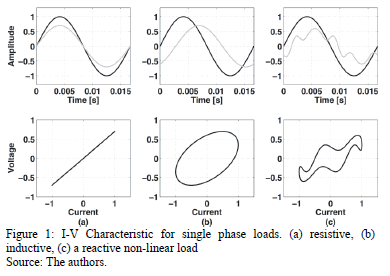
<body><![CDATA[<p><font size="2" face="Verdana, Arial, Helvetica, sans-serif">The paper is arranged   as follows. First, a background of other methods is presented in such a way   that comparisons can be made between them. Second, the proposed method is   introduced as a methodology consisting of five steps. Third, simulation results   using synthetic signals are presented. Fourth, experimental results with   measurements of two real loads are exposed. Finally, conclusions and future   work are raised.</font></p>     <p> </p>     <p><font size="3" face="Verdana, Arial, Helvetica, sans-serif"><b>2. Background of Other Methods</b></font></p>     <p><font size="2" face="Verdana, Arial, Helvetica, sans-serif"><b><i>2.1. Current -   Voltage Lissajous Patterns</i></b></font></p>     <p><font size="2" face="Verdana, Arial, Helvetica, sans-serif">Traditionally, for single phase loads, the current-voltage   characteristic or Lissajous patterns has been the most popular method for   characterizing loads &#91;1,8,9&#93;; even on three-phase systems it is still used,   graphing the I-V characteristic for each phase. The Lissajous patterns describe   the &quot;complex harmonic motion&quot; of a system with parametric equations given by   (1), where the ratio <font face="Symbol">w</font><sub>1</sub>/<font face="Symbol">w</font><sub>2</sub> and the value of <font face="Symbol">a</font> determines the shape of the pattern.</font></p>     <p><img src="/img/revistas/dyna/v82n192/v82n192a02eq01.gif"></p>     <p><font size="2" face="Verdana, Arial, Helvetica, sans-serif">In <a href="#fig01">Fig. 1</a> three typical single-phase I-V characteristic curves can be seen corresponding   to (a) a resistive load, (b) an inductive load, and (c) a reactive non-linear   load. It is worth noticing here that for the pure resistive load a straight   line or linear I-V relationship is obtained.</font></p>     <p align="center"><font size="2" face="Verdana, Arial, Helvetica, sans-serif"><a name="fig01"></a></font><img src="/img/revistas/dyna/v82n192/v82n192a02fig01.gif"></p>     <p><font size="2" face="Verdana, Arial, Helvetica, sans-serif">This is not a suitable approach for characterizing   three-phase loads, because it is not possible to see the whole three-phase   effect caused by such load operation. Also, it is difficult to determine which   harmonic is imposing the load to the network.</font></p>     <p><font size="2" face="Verdana, Arial, Helvetica, sans-serif">The main feature of this method is the advantage that can   be seen in the relationship between voltage and current signals.</font></p>     ]]></body>
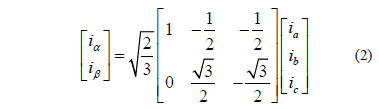
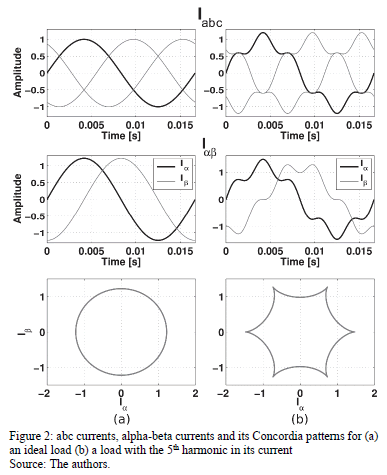
<body><![CDATA[<p><font size="2" face="Verdana, Arial, Helvetica, sans-serif"><b><i>2.2. Alpha - Beta   Patterns</i></b></font></p>     <p><font size="2" face="Verdana, Arial, Helvetica, sans-serif">Due to the need of characterizing three-phase loads on a   single diagram, for a better understanding and analysis, some authors have   proposed the <i><font face="Symbol">a</font>-<font face="Symbol">b</font></i> frame   &#91;4,5&#93;. This approach uses the Clarke's Transform for <i><font face="Symbol">a</font>-<font face="Symbol">b</font></i> components, and their paths or Concordia patterns to   draw the three-phase voltage or current vector.</font></p>     <p><font size="2" face="Verdana, Arial, Helvetica, sans-serif">The Clarke's transform is given by (2). It takes the measurements   of a three-phase system and leads it to a two axes coordinate frame of   reference (<i><font face="Symbol">a</font>-<font face="Symbol">b</font></i> frame),   allowing us </font><font size="2" face="Verdana, Arial, Helvetica, sans-serif">to obtain the two-dimensional   patterns useful for characterizing load or machine diagnosis.</font></p>     <p><img src="/img/revistas/dyna/v82n192/v82n192a02eq02.gif"></p>     <p><font size="2" face="Verdana, Arial, Helvetica, sans-serif"><a href="#fig02">Fig. 2</a> shows the <i>abc</i> currents, the <i><font face="Symbol">a</font><font face="Symbol">b</font></i> currents and the generated   patterns of (a) a three-phase load without unbalances, neither harmonics nor   reactive power; (b) a load that causes three-phase current with the 5<sup>th </sup>harmonic.   The pattern from (a) could be taken as a reference or ideal condition.</font></p>     <p align="center"><font size="2" face="Verdana, Arial, Helvetica, sans-serif"><a name="fig02"></a></font><img src="/img/revistas/dyna/v82n192/v82n192a02fig02.gif"></p>     <p><font size="2" face="Verdana, Arial, Helvetica, sans-serif"><b><i>2.3. Characteristic   Trajectory of the Instantaneous Power Tensor</i></b></font></p>     <p><font size="2" face="Verdana, Arial, Helvetica, sans-serif">A more recent approach, based on the tensor theory has   been published in &#91;10&#93;. It uses the dyadic product of the voltage and current   instantaneous vectors, to get the Instantaneous Power Tensor. It also describes   all the phenomena of power quality just analyzing the different characteristic   values of the obtained matrix. The following equation defines the power tensor.</font></p>     <p><img src="/img/revistas/dyna/v82n192/v82n192a02eq03.gif"></p>     <p><font size="2" face="Verdana, Arial, Helvetica, sans-serif">Then, for a three-phase system, the power tensor can be   written as:</font></p>     ]]></body>
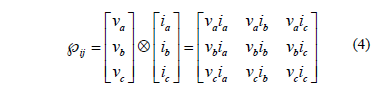
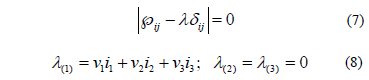
<body><![CDATA[<p><img src="/img/revistas/dyna/v82n192/v82n192a02eq04.gif"></p>     <p><font size="2" face="Verdana, Arial, Helvetica, sans-serif">In order to be able to draw the patterns used in loads   characterization, it is necessary to get a spatial vector derived from the   power tensor. For that reason it is desirable to reduce the order of the   tensor. This spatial vector allows us to describe the characteristic trajectory   of the power tensor in the R<sup>3 </sup>space. </font></p>     <p><font size="2" face="Verdana, Arial, Helvetica, sans-serif">Reduction of the power tensor order is described in &#91;10&#93;.   Here, it is shown that it is possible to find a vector <i>x<sub>j</sub></i> (a   first order tensor), which matches with the following equation:</font></p>     <p><img src="/img/revistas/dyna/v82n192/v82n192a02eq05.gif"></p>     <p><font size="2" face="Verdana, Arial, Helvetica, sans-serif">Where, <i><font face="Symbol">l</font></i> and <i>x<sub>j</sub></i>are the eigenvalues and   eigenvectors of the power tensor, respectively. </font></p>     <p><font size="2" face="Verdana, Arial, Helvetica, sans-serif">The matrix representation of the instantaneous power   tensor, allows us to calculate its eigenvalues and eigenvectors through the   following equation system: </font></p>     <p><img src="/img/revistas/dyna/v82n192/v82n192a02eq06.gif"></p>     <p><font size="2" face="Verdana, Arial, Helvetica, sans-serif">Where, <sub><img src="/img/revistas/dyna/v82n192/v82n192a02eq020.gif"></sub> is the <i>&quot;Kronecker's delta&quot;</i> tensor. The roots of   the characteristic equation given by (7) are the eigenvalues stated in (8).</font></p>     <p><img src="/img/revistas/dyna/v82n192/v82n192a02eq0708.gif"></p>     <p><font size="2" face="Verdana, Arial, Helvetica, sans-serif">There is a unique eigenvector xj for each <font face="Symbol">l</font> in (6).   As an example, a possible combination of eigenvectors associated to each   eigenvalue, may be:</font></p>     ]]></body>

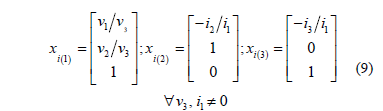
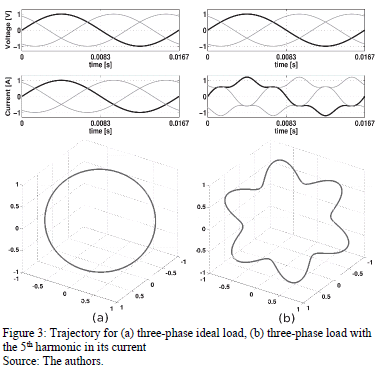
<body><![CDATA[<p><img src="/img/revistas/dyna/v82n192/v82n192a02eq09.gif"></p>     <p><font size="2" face="Verdana, Arial, Helvetica, sans-serif">With these results it is possible to obtain the   trajectories that describe the internal products between the power tensor and   its eigenvectors. Considering that <i><font face="Symbol">l</font><sub>2</sub>= <font face="Symbol">l</font><sub>3</sub>=0, </i>the only one possible trajectory is:</font></p>     <p><img src="/img/revistas/dyna/v82n192/v82n192a02eq101.gif"></p>     <p><font size="2" face="Verdana, Arial, Helvetica, sans-serif"><a href="#fig03">Fig. 3 (a)</a>, shows the trajectory generated by the vector stated in (10), corresponding   to the operation of an ideal load, i.e. the matrix <sub><img src="/img/revistas/dyna/v82n192/v82n192a02eq032.gif"></sub> is formed by   instantaneous vectors of voltage and current with positive sequence,   fundamental component and perfectly in phase. <a href="#fig03">Fig. 3 (b)</a> shows another trajectory for a three-phase load with the 5<sup>th</sup> harmonic in its current. Here the number of bumps is equal to <i>n+1</i>, where <i>n</i> is the harmonic order.</font></p>     <p align="center"><font size="2" face="Verdana, Arial, Helvetica, sans-serif"><a name="fig03"></a></font><img src="/img/revistas/dyna/v82n192/v82n192a02fig03.gif"></p>     <p><font size="2" face="Verdana, Arial, Helvetica, sans-serif">Notice that in this approach, the drown trajectory   describes the behavior of the instantaneous power, i.e. takes into account the   voltage and current signals at the same time.</font></p>     <p><font size="2" face="Verdana, Arial, Helvetica, sans-serif">Although this method takes into account the relationship   between the three-phase voltage and current vectors, it cannot draw   trajectories generated by reactive power, neither 3<sup>rd</sup> harmonic, nor   its multiples. Thus, it is necessary to use another concept of the   instantaneous power tensor, which enables us to draw the corresponding   trajectories caused by the mentioned phenomena. This alternative methodology is   described in the next section.</font></p>     <p> </p>     <p><font size="3" face="Verdana, Arial, Helvetica, sans-serif"><b>3. Proposed   methodology for loads characterization</b></font></p>     <p><font size="2" face="Verdana, Arial, Helvetica, sans-serif">The following methodology uses the instantaneous power   tensor theory proposed in &#91;10&#93; for characterizing loads, but using the   definition of the power distortion tensor, instead of the characteristic   trajectory. The process begins when the voltage and current vectors are stored   in a computer or in a DSP based system. Thus, if a DSP based system is used, it   is possible to do it in real time. On the contrary, the use of a computer based   software like Matlab® or another one that allows making matrix operations and   plotting the results of the measurements, is needed. </font></p>     ]]></body>
<body><![CDATA[<p><font size="2" face="Verdana, Arial, Helvetica, sans-serif">Assuming instantaneous values,   the methodology is described as follows:</font></p> <ul>       <li><font size="2" face="Verdana, Arial, Helvetica, sans-serif">Step 1: Obtain the power tensor of the real     system    <br>     </font><font size="2" face="Verdana, Arial, Helvetica, sans-serif">This is done by applying the     definition in (4) for the voltage and current vectors. Then, the <sub><img src="/img/revistas/dyna/v82n192/v82n192a02eq034.gif"></sub>tensor is obtained.</font></li>     </ul> <ul>       <li><font size="2" face="Verdana, Arial, Helvetica, sans-serif">Step 2: Obtain the ideal power tensor    <br>     </font><font size="2" face="Verdana, Arial, Helvetica, sans-serif">The ideal power tensor is formed by instantaneous voltage     and current vectors at fundamental frequency, positive sequence and perfectly     in phase. </font></li>     </ul> <ul>       <li><font size="2" face="Verdana, Arial, Helvetica, sans-serif">Step 3: Obtain the distortion tensor and the     distortion cube    <br>     </font><font size="2" face="Verdana, Arial, Helvetica, sans-serif">The distortion tensor represents exclusively all the     phenomena of power quality in the power trade of the system. The distortion     cube is the R<sup>3</sup> spatial representation of the distortion tensor.</font></li>     </ul> <ul>       ]]></body>
<body><![CDATA[<li><font size="2" face="Verdana, Arial, Helvetica, sans-serif">Step 4: Visualization process    <br>     </font><font size="2" face="Verdana, Arial, Helvetica, sans-serif">From the distortion cube, choose the three-dimensional     vector path generator and trace the path with each spatial coordinate.</font></li>     </ul> <ul>       <li><font size="2" face="Verdana, Arial, Helvetica, sans-serif">Step 5: Identify the power issues    <br>     </font><font size="2" face="Verdana, Arial, Helvetica, sans-serif">Using the different views of the plotted path for one     cycle of the signals on steady stage; look at the characteristics of the closed     path (i.e. bumps, loops, plane unsubscription). And then, conclude about the     load operation. </font></li>     </ul>     <p><font size="2" face="Verdana, Arial, Helvetica, sans-serif">In the next subsections the necessary foundations to   implement this methodology, are described.</font></p>     <p><font size="2" face="Verdana, Arial, Helvetica, sans-serif"><b><i>3.1. The ideal   power tensor</i></b></font></p>     <p><font size="2" face="Verdana, Arial, Helvetica, sans-serif">It represents the ideal power transference corresponding   to the conditions of a circuit with a sinusoidal source at fundamental   frequency, without either unbalances or reactive power, feeding a resistive load.   The equation is given by:</font></p>     <p><img src="/img/revistas/dyna/v82n192/v82n192a02eq10.gif"></p>     ]]></body>
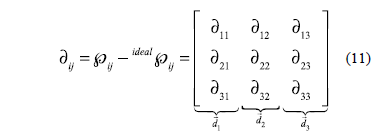
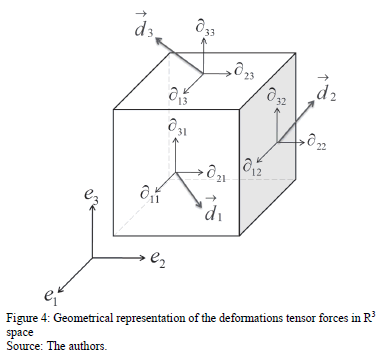
<body><![CDATA[<p><font size="2" face="Verdana, Arial, Helvetica, sans-serif">The voltage and current vectors could be gathered by   extracting the fundamental components at positive sequence from the voltage and   current signals, using the preferred method. Here, the method depicted in &#91;11&#93;   was used.</font></p>     <p><font size="2" face="Verdana, Arial, Helvetica, sans-serif"><b><i>3.2. The   instantaneous power distortion tensor</i></b></font></p>     <p><font size="2" face="Verdana, Arial, Helvetica, sans-serif">The instantaneous power distortion tensor <i>&#8706;<sub>ij</sub></i> describes exclusively the deviation of the power quality in respect to the   ideal conditions of the system, and it is depicted by this equation:</font></p>     <p><img src="/img/revistas/dyna/v82n192/v82n192a02eq11.gif"></p>     <p><font size="2" face="Verdana, Arial, Helvetica, sans-serif">Having a load that draws sinusoidal balanced voltages and   currents signals and perfectly in phase, all the elements of <i>&#8706;<sub>ij</sub></i> will equal zero.</font></p>     <p><font size="2" face="Verdana, Arial, Helvetica, sans-serif"><b><i>3.3. Spatial representation   of &#8706;ij</i></b></font></p>     <p><font size="2" face="Verdana, Arial, Helvetica, sans-serif">In this approach, it is   possible to construct a unitary cube having three director vectors given by the   reference axes, <sub><img src="/img/revistas/dyna/v82n192/v82n192a02eq042.gif"></sub> named <i>e<sub>1</sub>,e<sub>2</sub>,e<sub>3</sub></i>, respectively. The column vectors <sub><img src="/img/revistas/dyna/v82n192/v82n192a02eq044.gif"></sub> exert deforming forces   to each external cube face, depending on their components, i.e., depending on   the deviations of the power trade in the system. This cube is named as the   deformation cube and its formulation is sketched in <a href="#fig04">Fig. 4</a>.</font></p>     <p align="center"><font size="2" face="Verdana, Arial, Helvetica, sans-serif"><a name="fig04"></a></font><img src="/img/revistas/dyna/v82n192/v82n192a02fig04.gif"></p>     <p><font size="2" face="Verdana, Arial, Helvetica, sans-serif">The condition for these deformations to match with reality   is that they have to be infinitesimal quantities. Thus, in order to be able to   see such deformations it is necessary to scale it by a real positive number   greater than one.</font></p>     <p><font size="2" face="Verdana, Arial, Helvetica, sans-serif"><b><i>3.4. Visualization   process</i></b></font></p>     ]]></body>
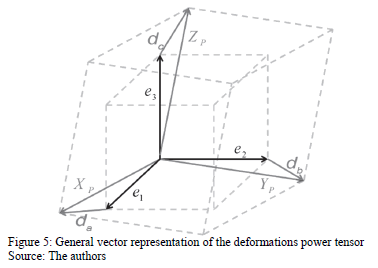
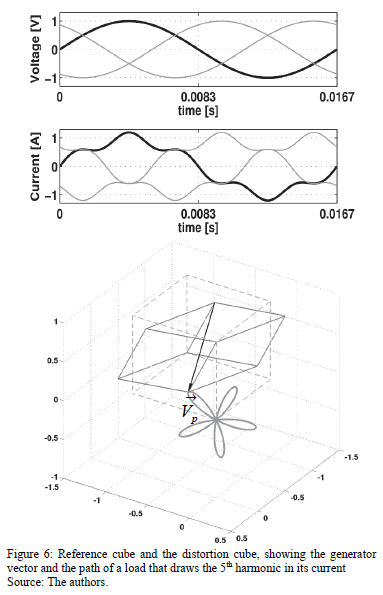
<body><![CDATA[<p><font size="2" face="Verdana, Arial, Helvetica, sans-serif">The final goal is to visualize the paths generated by the   distortion cube, identify their shape, and with this, characterize the load.   Accordingly, it is necessary to write some software applying vector algebra. </font></p>     <p><font size="2" face="Verdana, Arial, Helvetica, sans-serif">Due to the fact that the deformations are infinitesimal   quantities, it is possible to shift the column vectors of the tensor <i>&#8706;<sub>ij</sub></i> from their original position to the corners of the unitary cube, as depicted in <a href="#fig05">Fig.   5</a>. </font></p>     <p align="center"><font size="2" face="Verdana, Arial, Helvetica, sans-serif"><a name="fig05"></a></font><img src="/img/revistas/dyna/v82n192/v82n192a02fig05.gif"></p>     <p><font size="2" face="Verdana, Arial, Helvetica, sans-serif">Then, having the vectors<sub><img src="/img/revistas/dyna/v82n192/v82n192a02eq046.gif"></sub>, if the values of the distortion tensor are different from   zero, an instantaneous deforming cube can be plotted, with origin in <i>(-1,-1,0)</i>; otherwise, the distortion   cube will be the same unitary cube used as reference. </font></p>     <p><font size="2" face="Verdana, Arial, Helvetica, sans-serif"><b><i>3.5. Vector path   generator</i></b></font></p>     <p><font size="2" face="Verdana, Arial, Helvetica, sans-serif">In order to obtain the three-dimensional paths, it is   necessary to choose a vector of the distortion cube, which allows drawing the   paths corresponding to the deviations, imposed by the load operation. <a href="#fig06">Fig. 6</a> shows the chosen vector and, for simplicity, the resultant path corresponding   to a load drawing three-phase current with the 5<sup>th</sup> harmonic.</font></p>     <p align="center"><font size="2" face="Verdana, Arial, Helvetica, sans-serif"><a name="fig06"></a></font><img src="/img/revistas/dyna/v82n192/v82n192a02fig06.gif"></p>     <p><font size="2" face="Verdana, Arial, Helvetica, sans-serif">In <a href="#fig06">Fig. 6</a>,   the unitary cube using dashed lines and the deformed one using solid lines can   be seen. This last one is where the generator vector comes. This vector does   not follow a trajectory with an ideal load operation, because it is static due   to the zero values in <i>&#8706;<sub>ij</sub></i>. </font></p>     <p><font size="2" face="Verdana, Arial, Helvetica, sans-serif">The trajectory drawn by the vector <sub><img src="/img/revistas/dyna/v82n192/v82n192a02eq054.gif"></sub>can be gathered with either single or a combination of   different loads (linear and non-linear). </font></p>     <p> </p>     ]]></body>
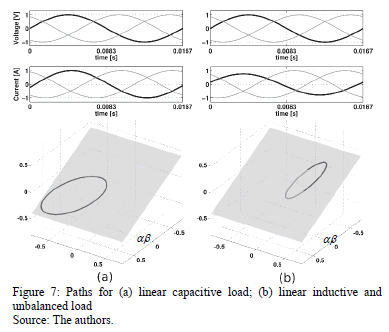
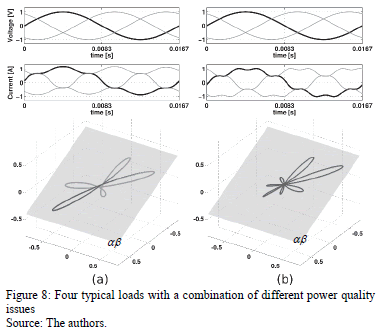
<body><![CDATA[<p><font size="3" face="Verdana, Arial, Helvetica, sans-serif"><b>4. Simulation   Results</b></font></p>     <p><font size="2" face="Verdana, Arial, Helvetica, sans-serif">In <a href="#fig07">Fig. 7 (a)</a>, a linear balanced, three-phase capacitive load has been characterized. Due   to the fact that the load is capacitive, the generated path is an ellipse   oriented to the left. In <a href="#fig07">Fig. 7 (b)</a>, a linear unbalanced, three-phase inductive load, has been characterized.   Given that the load is inductive, the ellipse is oriented to the right. Notice   that this method is able to show zero sequence components, meaning unbalance,   or the 3<sup>th</sup> harmonic (and its multiples) in other cases. For this   reason, and for convenience, but not being necessary, a semitransparent <i><font face="Symbol">a</font><font face="Symbol">b</font></i> plane has been used, since the zero sequence components cause the path to   unsubscribe from the <i><font face="Symbol">a</font><font face="Symbol">b</font></i> plane.</font></p>     <p align="center"><font size="2" face="Verdana, Arial, Helvetica, sans-serif"><a name="fig07"></a></font><img src="/img/revistas/dyna/v82n192/v82n192a02fig07.gif"></p>     <p><font size="2" face="Verdana, Arial, Helvetica, sans-serif"><a href="#fig08">Fig. 8 (a)</a> shows the paths corresponding to a three-phase load that causes the 5<sup>th</sup> and 7<sup>th</sup> harmonics in its current; with the 5<sup>th</sup> harmonic   predomination, unbalance (zero-sequence). <a href="#fig08">Fig. 8 (b)</a> shows a three-phase load with the 5<sup>th</sup> and 7<sup>th</sup> harmonics in its current, with the 7<sup>th</sup> harmonic predomination; also   lagging displacement factor.</font></p>     <p align="center"><font size="2" face="Verdana, Arial, Helvetica, sans-serif"><a name="fig08"></a></font><img src="/img/revistas/dyna/v82n192/v82n192a02fig08.gif"></p>     <p><font size="2" face="Verdana, Arial, Helvetica, sans-serif">Here the zero-sequence components cause path   unsubscribing. Also, it can be seen that the predominant harmonic order   establishes the number of bumps of the path, and the nature of the reactive   power, establishes the orientation of the path.</font></p>     <p><font size="2" face="Verdana, Arial, Helvetica, sans-serif">Moreover, it is possible to characterize loads with a complex   combination of power issues, which is done by looking at the whole 3-D view of   the generated trajectory. Additionally, it can be seen on the 2-D views and be   comparing the paths with the known ones for making additional inferences.</font></p>     <p> </p>     <p><font size="3" face="Verdana, Arial, Helvetica, sans-serif"><b>4. Experimental Results</b></font></p>     <p><font size="2" face="Verdana, Arial, Helvetica, sans-serif">Two real industrial loads with several power issues have   been characterized. Measurements have been done with the AEMC Power Pad-3945,   and processed with MATLAB®, using the proposed methodology.</font></p>     ]]></body>
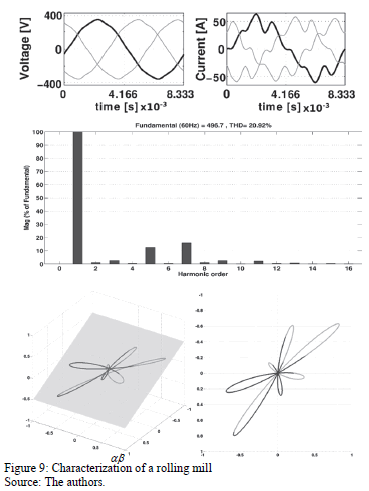
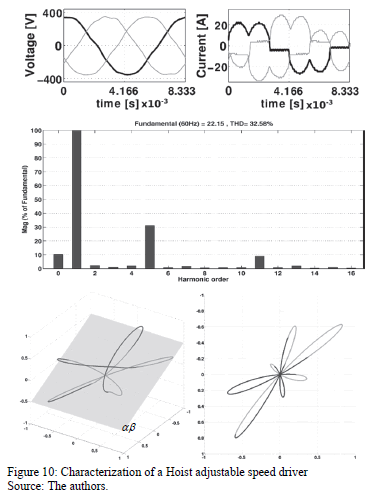
<body><![CDATA[<p><font size="2" face="Verdana, Arial, Helvetica, sans-serif"><a href="#fig09">Fig. 9</a> shows the characterization of a rolling mill;   measurements have been taken from the terminal block. This is a three-phase   load with several harmonics, the 7<sup>th</sup> harmonic predomination. (The   frequency spectrum of the <i>A</i> phase   current is shown, which allows comparisons). Anew, the predominant harmonic   order establishes the number of bumps; in the bottom right corner of <a href="#fig09">Fig. 9</a>, a zoom to the X-Y view was performed and seven   bumps can be counted. The soft trace parts are due to the fact that the path is   crossing the plane, which means a presence of a 3<sup>rd</sup> harmonic or   unbalance.</font></p>     <p align="center"><font size="2" face="Verdana, Arial, Helvetica, sans-serif"><a name="fig09"></a></font><img src="/img/revistas/dyna/v82n192/v82n192a02fig09.gif"></p>     <p><font size="2" face="Verdana, Arial, Helvetica, sans-serif"><a href="#fig10">Fig. 10</a> shows the characterization of a three-phase   adjustable speed drive, connected to a hoist. This load draws the 5<sup>th</sup> harmonic predomination and evidence of zero-sequence due to the path   unsubscribing. In the bottom right corner of <a href="#fig10">Fig. 10</a>, a zoom to the X-Y view was performed and it can   be seen that the 11<sup>th</sup> harmonic is just taken away from the symmetry   to the whole trajectory, but five bumps, corresponding to the predominant   harmonic order can be counted. </font></p>     <p align="center"><font size="2" face="Verdana, Arial, Helvetica, sans-serif"><a name="fig10"></a></font><img src="/img/revistas/dyna/v82n192/v82n192a02fig10.gif"></p>     <p><font size="2" face="Verdana, Arial, Helvetica, sans-serif">It is important to clarify that plotting the voltage and   current signals, or the frequency spectrum is not needed. Only the path is   needed to characterize the load. </font></p>     <p> </p>     <p><font size="3" face="Verdana, Arial, Helvetica, sans-serif"><b>Conclusions</b></font></p>     <p><font size="2" face="Verdana, Arial, Helvetica, sans-serif">The   proposed methodology is capable of depicting many phenomena due to the   operation of three-phase loads; odd </font><font size="2" face="Verdana, Arial, Helvetica, sans-serif">harmonics are depicted more   precisely with <i>n</i>bumps as   with harmonic order. Also it is the only one that is able to depict zero   sequence evidence, and can give information about harmonic content when a load   imposes several harmonics, establishing the dominant harmonic order with no   need of the Fourier Transform. </font></p>     <p><font size="2" face="Verdana, Arial, Helvetica, sans-serif">With this methodology it is possible to characterize   reactive non-linear and unbalanced loads. Loads with a more complex combination   of power issues can be characterized, even for a system with different loads   having different characteristics on each phase or having voltage distortion.</font></p>     <p><font size="2" face="Verdana, Arial, Helvetica, sans-serif">Although the proposed methodology needs the extraction of   the fundamental components of voltage and current signals for constructing the   ideal tensor, it does not mean that it loses its instantaneous character,   because it can be supposed that the fundamental components do not change   frequency or phase angle during the load operation, i.e. the ideal tensor   remains approximately constant.</font></p>     ]]></body>
<body><![CDATA[<p><font size="2" face="Verdana, Arial, Helvetica, sans-serif">In this paper, only current distortion effects were taken   into account; due to the fact that it is more common to have very low voltage   distortion at the load side. But with the increase of low impedance non-linear   loads, the voltage distortion may increase considerably. Therefore, taking into   account voltage distortion, is necessary future work.</font></p>     <p><font size="2" face="Verdana, Arial, Helvetica, sans-serif">Another future work is to use the capabilities of the   proposed methodology to make some experiments and benchmarking, in the areas of   machines diagnosis and electric systems monitoring. </font></p>     <p> </p>     <p><font size="3" face="Verdana, Arial, Helvetica, sans-serif"><b>Bibliography</b></font></p>     <!-- ref --><p><font size="2" face="Verdana, Arial, Helvetica, sans-serif"><b>&#91;1&#93;</b> Yi,   D., Liang, D., Bin, L., Harley, R.G. and Habetler, T.G., A review of   identification and monitoring methods for electric loads in commercial and   residential buildings. Energy Conversion Congress and Exposition (ECCE), 2010   IEEE, pp.4527-4533, 12-16 Sept. 2010.    &nbsp;&nbsp;&nbsp;&nbsp;&nbsp;&nbsp;&nbsp;&nbsp;[&#160;<a href="javascript:void(0);" onclick="javascript: window.open('/scielo.php?script=sci_nlinks&ref=000127&pid=S0012-7353201500040000200001&lng=','','width=640,height=500,resizable=yes,scrollbars=1,menubar=yes,');">Links</a>&#160;]<!-- end-ref --></font></p>     <!-- ref --><p><font size="2" face="Verdana, Arial, Helvetica, sans-serif"><b>&#91;2&#93;</b> Milanez,   D.L. and Emmanuel, D.L., The instantaneous-space phasor a powerful diagnosis   tool. IEEE Trans. on Instr. and Meas. 52   (1), pp. 143-148, 2003. DOI: 10.1109/TIM.2003.809069</font>&nbsp;&nbsp;&nbsp;&nbsp;&nbsp;&nbsp;&nbsp;&nbsp;[&#160;<a href="javascript:void(0);" onclick="javascript: window.open('/scielo.php?script=sci_nlinks&ref=000129&pid=S0012-7353201500040000200002&lng=','','width=640,height=500,resizable=yes,scrollbars=1,menubar=yes,');">Links</a>&#160;]<!-- end-ref --><!-- ref --><p><font size="2" face="Verdana, Arial, Helvetica, sans-serif"><b>&#91;3&#93;</b> Zidani,   F.M., Benbouzid, E.H., Diallo, D. and Nait-Said, M.S., Induction motor stator faults diagnosis by a   current Concordia pattern based fuzzy decision system. IEEE Trans. Energy Convers. 18 (4), pp.   469-475, 2003. DOI: 10.1109/TEC.2003.815832</font>&nbsp;&nbsp;&nbsp;&nbsp;&nbsp;&nbsp;&nbsp;&nbsp;[&#160;<a href="javascript:void(0);" onclick="javascript: window.open('/scielo.php?script=sci_nlinks&ref=000130&pid=S0012-7353201500040000200003&lng=','','width=640,height=500,resizable=yes,scrollbars=1,menubar=yes,');">Links</a>&#160;]<!-- end-ref --><!-- ref --><p><font size="2" face="Verdana, Arial, Helvetica, sans-serif"><b>&#91;4&#93;</b> Verucchi C.J. y Acosta G.G., T&eacute;cnicas de detecci&oacute;n y   diagn&oacute;stico de fallos en m&aacute;quinas el&eacute;ctricas de inducci&oacute;n. IEEE Latin   America Transactions, 5 (1), March 2007.    &nbsp;&nbsp;&nbsp;&nbsp;&nbsp;&nbsp;&nbsp;&nbsp;[&#160;<a href="javascript:void(0);" onclick="javascript: window.open('/scielo.php?script=sci_nlinks&ref=000131&pid=S0012-7353201500040000200004&lng=','','width=640,height=500,resizable=yes,scrollbars=1,menubar=yes,');">Links</a>&#160;]<!-- end-ref --></font></p>     ]]></body>
<body><![CDATA[<!-- ref --><p><font size="2" face="Verdana, Arial, Helvetica, sans-serif"><b>&#91;5&#93;</b> Gilreath,   P., Peterson, M. and Singh, B.N., A Novel technique for identification and   condition monitoring of nonlinear loads in power systems, power electronics,   drives and energy systems. PEDES '06. International Conference, pp.1-7, 12-15   Dec. 2006.    &nbsp;&nbsp;&nbsp;&nbsp;&nbsp;&nbsp;&nbsp;&nbsp;[&#160;<a href="javascript:void(0);" onclick="javascript: window.open('/scielo.php?script=sci_nlinks&ref=000133&pid=S0012-7353201500040000200005&lng=','','width=640,height=500,resizable=yes,scrollbars=1,menubar=yes,');">Links</a>&#160;]<!-- end-ref --> </font></p>     <!-- ref --><p><font size="2" face="Verdana, Arial, Helvetica, sans-serif"><b>&#91;6&#93;</b> Chao-Shun,   Ch., Tsung-Hsien, W., Chung-Chieh, L. and Yenn-Minn, T., The application of   load models of electric appliances to distribution system analysis. Power   Systems, IEEE Transactions. 10 (3), pp.1376-1382, Aug 1995.    &nbsp;&nbsp;&nbsp;&nbsp;&nbsp;&nbsp;&nbsp;&nbsp;[&#160;<a href="javascript:void(0);" onclick="javascript: window.open('/scielo.php?script=sci_nlinks&ref=000135&pid=S0012-7353201500040000200006&lng=','','width=640,height=500,resizable=yes,scrollbars=1,menubar=yes,');">Links</a>&#160;]<!-- end-ref --></font></p>     <!-- ref --><p><font size="2" face="Verdana, Arial, Helvetica, sans-serif"><b>&#91;7&#93;</b> Figueiredo,   V., Rodrigues, F., Vale, Z. and Gouveia, J.B., An electric energy consumer   characterization framework based on data mining techniques. Power Systems, IEEE Transactions. 20 (2),   pp.596-602, May, 2005</font>&nbsp;&nbsp;&nbsp;&nbsp;&nbsp;&nbsp;&nbsp;&nbsp;[&#160;<a href="javascript:void(0);" onclick="javascript: window.open('/scielo.php?script=sci_nlinks&ref=000137&pid=S0012-7353201500040000200007&lng=','','width=640,height=500,resizable=yes,scrollbars=1,menubar=yes,');">Links</a>&#160;]<!-- end-ref --><!-- ref --><p><font size="2" face="Verdana, Arial, Helvetica, sans-serif"><b>&#91;8&#93;</b> Cano-Plata,   E.A., Aplicaciones de la transformada   ondita y la teor&iacute;a de la potencia instant&aacute;nea a la detecci&oacute;n y clasificaci&oacute;n de   problemas de calidad de la potencia, PhD Tesis, Universidad de Buenos Aires,   Buenos Aires, Argentina, 2006.    &nbsp;&nbsp;&nbsp;&nbsp;&nbsp;&nbsp;&nbsp;&nbsp;[&#160;<a href="javascript:void(0);" onclick="javascript: window.open('/scielo.php?script=sci_nlinks&ref=000138&pid=S0012-7353201500040000200008&lng=','','width=640,height=500,resizable=yes,scrollbars=1,menubar=yes,');">Links</a>&#160;]<!-- end-ref --></font></p>     <!-- ref --><p><font size="2" face="Verdana, Arial, Helvetica, sans-serif"><b>&#91;9&#93;</b> Jagiela,   K., Rak, J., Gala, M. and Kepinski, M., Identification of electric power parameters   of AC arc furnace low voltage system. IEEE Conference Proceeding, 26-29 Sept.   2010, pp. 1-7, ISBN 978-1-4244-7244-4. DOI: 10.1109/ichqp.2010.5625439</font>&nbsp;&nbsp;&nbsp;&nbsp;&nbsp;&nbsp;&nbsp;&nbsp;[&#160;<a href="javascript:void(0);" onclick="javascript: window.open('/scielo.php?script=sci_nlinks&ref=000140&pid=S0012-7353201500040000200009&lng=','','width=640,height=500,resizable=yes,scrollbars=1,menubar=yes,');">Links</a>&#160;]<!-- end-ref --><!-- ref --><p><font size="2" face="Verdana, Arial, Helvetica, sans-serif"><b>&#91;10&#93;</b> Ustariz-Farf&aacute;n,   A.J., Formulaci&oacute;n de una teor&iacute;a tensorial de la potencia el&eacute;ctrica:   aplicaciones al estudio de la calidad de la energ&iacute;a, Ph.D. Tesis, Universidad Nacional de   Colombia, Sede Manizales, Colombia, 2011.    &nbsp;&nbsp;&nbsp;&nbsp;&nbsp;&nbsp;&nbsp;&nbsp;[&#160;<a href="javascript:void(0);" onclick="javascript: window.open('/scielo.php?script=sci_nlinks&ref=000141&pid=S0012-7353201500040000200010&lng=','','width=640,height=500,resizable=yes,scrollbars=1,menubar=yes,');">Links</a>&#160;]<!-- end-ref --></font></p>     ]]></body>
<body><![CDATA[<!-- ref --><p><font size="2" face="Verdana, Arial, Helvetica, sans-serif"><b>&#91;11&#93;</b> Ustariz-Farf&aacute;n,   A.J., Cano-Plata, E.A., and Tacca, H.E., New deviation factor of power quality   using tensor analysis and wavelet packet transform, International Conference on   Power Systems Transients (IPST2011). Delft, Netherlands. June 14-17, 2011.    &nbsp;&nbsp;&nbsp;&nbsp;&nbsp;&nbsp;&nbsp;&nbsp;[&#160;<a href="javascript:void(0);" onclick="javascript: window.open('/scielo.php?script=sci_nlinks&ref=000143&pid=S0012-7353201500040000200011&lng=','','width=640,height=500,resizable=yes,scrollbars=1,menubar=yes,');">Links</a>&#160;]<!-- end-ref --></font></p>     <p> </p>     <p><font size="2" face="Verdana, Arial, Helvetica, sans-serif"><b>O.A. Trujillo-Orozco,</b> was born in Fresno Tolima Colombia, in November 1979. He received the BSc.   Engineering degree in 2013 from the Universidad Nacional de Colombia, Manizales   campus, in Electrical Engineering. He's currently working on his MSc degree in   Engineering, Electrical Engineering at the Universidad Nacional de Colombia,   Manizales campus.</font></p>     <p><font size="2" face="Verdana, Arial, Helvetica, sans-serif"><b>Y.A. Garces-Gomez, </b>was born in Manzanares-Caldas, Colombia, in 1983. He   received the BSc. In Engineering Electronic in 2009 from the Universidad   Nacional de Colombia, Manizales campus. Between 2009 and 2011 he held a   &quot;Colciencias&quot; scholarship for postgraduate studies in engineering - industrial   automation at the Universidad Nacional de Colombia. He is currently working for a PhD degree in engineering in the Universidad Nacional   de Colombia.</font></p>     <p><font size="2" face="Verdana, Arial, Helvetica, sans-serif"><b>A.J.   Ustariz-Farf&aacute;n,</b> was born in Urumita, Colombia in 1973. He received a BSc   degree in Electrical Engineer in 1997, and a MSc in Electric Power in 2000 from   the Universidad Industrial de Santander, Colombia. He received the PhD. degree   in Electrical Engineering at the Universidad Nacional de Colombia, in 2011. He   is a research and associated professor with the Electrical, Electronic and   Computer Engineering Department, Universidad Nacional de Colombia, Manizales   campus.</font></p>     <p><font size="2" face="Verdana, Arial, Helvetica, sans-serif"><b>E.A. Cano-Plata,</b> was born in Neiva, Colombia, in 1967. He   received the BSc. and Sp. Engineering degree in 1990 and 1994 from Universidad   Nacional de Colombia, Manizales, both in Electrical Engineering. Between 1996   and 1998 he had a DAAD scholarship for postgraduate studies in Electrical   Engineering at the Universidad Nacional de San Juan, Argentina. He received the   Dr. degree in Engineering in 2006 from the Universidad de Buenos Aires,   Argentina. Since 1994, he is a titular professor at the Universidad Nacional de   Colombia in Manizales, Colombia.</font></p>      ]]></body><back>
<ref-list>
<ref id="B1">
<label>1</label><nlm-citation citation-type="confpro">
<person-group person-group-type="author">
<name>
<surname><![CDATA[Yi]]></surname>
<given-names><![CDATA[D.]]></given-names>
</name>
<name>
<surname><![CDATA[Liang]]></surname>
<given-names><![CDATA[D.]]></given-names>
</name>
<name>
<surname><![CDATA[Bin]]></surname>
<given-names><![CDATA[L.]]></given-names>
</name>
<name>
<surname><![CDATA[Harley]]></surname>
<given-names><![CDATA[R.G.]]></given-names>
</name>
<name>
<surname><![CDATA[Habetler]]></surname>
<given-names><![CDATA[T.G.]]></given-names>
</name>
</person-group>
<article-title xml:lang="en"><![CDATA[A review of identification and monitoring methods for electric loads in commercial and residential buildings]]></article-title>
<source><![CDATA[]]></source>
<year>12-1</year>
<month>6 </month>
<day>Se</day>
<conf-name><![CDATA[ Energy Conversion Congress and Exposition]]></conf-name>
<conf-date>2010</conf-date>
<conf-loc> </conf-loc>
<page-range>4527-4533</page-range></nlm-citation>
</ref>
<ref id="B2">
<label>2</label><nlm-citation citation-type="journal">
<person-group person-group-type="author">
<name>
<surname><![CDATA[Milanez]]></surname>
<given-names><![CDATA[D.L.]]></given-names>
</name>
<name>
<surname><![CDATA[Emmanuel]]></surname>
<given-names><![CDATA[D.L.]]></given-names>
</name>
</person-group>
<article-title xml:lang="en"><![CDATA[The instantaneous-space phasor a powerful diagnosis tool]]></article-title>
<source><![CDATA[IEEE Trans. on Instr. and Meas.]]></source>
<year>2003</year>
<volume>52</volume>
<numero>1</numero>
<issue>1</issue>
<page-range>143-148</page-range></nlm-citation>
</ref>
<ref id="B3">
<label>3</label><nlm-citation citation-type="journal">
<person-group person-group-type="author">
<name>
<surname><![CDATA[Zidani]]></surname>
<given-names><![CDATA[F.M.]]></given-names>
</name>
<name>
<surname><![CDATA[Benbouzid]]></surname>
<given-names><![CDATA[E.H.]]></given-names>
</name>
<name>
<surname><![CDATA[Diallo]]></surname>
<given-names><![CDATA[D.]]></given-names>
</name>
<name>
<surname><![CDATA[Nait-Said]]></surname>
<given-names><![CDATA[M.S.]]></given-names>
</name>
</person-group>
<article-title xml:lang="en"><![CDATA[Induction motor stator faults diagnosis by a current Concordia pattern based fuzzy decision system]]></article-title>
<source><![CDATA[IEEE Trans. Energy Convers.]]></source>
<year>2003</year>
<volume>18</volume>
<numero>4</numero>
<issue>4</issue>
<page-range>469-475</page-range></nlm-citation>
</ref>
<ref id="B4">
<label>4</label><nlm-citation citation-type="journal">
<person-group person-group-type="author">
<name>
<surname><![CDATA[Verucchi]]></surname>
<given-names><![CDATA[C.J.]]></given-names>
</name>
<name>
<surname><![CDATA[Acosta]]></surname>
<given-names><![CDATA[G.G.]]></given-names>
</name>
</person-group>
<article-title xml:lang="es"><![CDATA[Técnicas de detección y diagnóstico de fallos en máquinas eléctricas de inducción]]></article-title>
<source><![CDATA[IEEE Latin America Transactions]]></source>
<year>Marc</year>
<month>h </month>
<day>20</day>
<volume>5</volume>
<numero>1</numero>
<issue>1</issue>
</nlm-citation>
</ref>
<ref id="B5">
<label>5</label><nlm-citation citation-type="confpro">
<person-group person-group-type="author">
<name>
<surname><![CDATA[Gilreath]]></surname>
<given-names><![CDATA[P.]]></given-names>
</name>
<name>
<surname><![CDATA[Peterson]]></surname>
<given-names><![CDATA[M.]]></given-names>
</name>
<name>
<surname><![CDATA[Singh]]></surname>
<given-names><![CDATA[B.N.]]></given-names>
</name>
</person-group>
<article-title xml:lang="en"><![CDATA[A Novel technique for identification and condition monitoring of nonlinear loads in power systems, power electronics, drives and energy systems]]></article-title>
<source><![CDATA[]]></source>
<year>12-1</year>
<month>5 </month>
<day>De</day>
<conf-name><![CDATA[ PEDES '06. International Conference]]></conf-name>
<conf-loc> </conf-loc>
<page-range>1-7</page-range></nlm-citation>
</ref>
<ref id="B6">
<label>6</label><nlm-citation citation-type="journal">
<person-group person-group-type="author">
<name>
<surname><![CDATA[Chao-Shun]]></surname>
<given-names><![CDATA[Ch.]]></given-names>
</name>
<name>
<surname><![CDATA[Tsung-Hsien]]></surname>
<given-names><![CDATA[W.]]></given-names>
</name>
<name>
<surname><![CDATA[Chung-Chieh]]></surname>
<given-names><![CDATA[L.]]></given-names>
</name>
<name>
<surname><![CDATA[Yenn-Minn]]></surname>
<given-names><![CDATA[T.]]></given-names>
</name>
</person-group>
<article-title xml:lang="en"><![CDATA[The application of load models of electric appliances to distribution system analysis.]]></article-title>
<source><![CDATA[Power Systems, IEEE Transactions]]></source>
<year>Aug </year>
<month>19</month>
<day>95</day>
<volume>10</volume>
<numero>3</numero>
<issue>3</issue>
<page-range>1376-1382</page-range></nlm-citation>
</ref>
<ref id="B7">
<label>7</label><nlm-citation citation-type="journal">
<person-group person-group-type="author">
<name>
<surname><![CDATA[Figueiredo]]></surname>
<given-names><![CDATA[V.]]></given-names>
</name>
<name>
<surname><![CDATA[Rodrigues]]></surname>
<given-names><![CDATA[F.]]></given-names>
</name>
<name>
<surname><![CDATA[Vale]]></surname>
<given-names><![CDATA[Z.]]></given-names>
</name>
<name>
<surname><![CDATA[Gouveia]]></surname>
<given-names><![CDATA[J.B.]]></given-names>
</name>
</person-group>
<article-title xml:lang="en"><![CDATA[An electric energy consumer characterization framework based on data mining techniques.]]></article-title>
<source><![CDATA[Power Systems, IEEE Transactions]]></source>
<year>May,</year>
<month> 2</month>
<day>00</day>
<volume>20</volume>
<numero>2</numero>
<issue>2</issue>
<page-range>596-602</page-range></nlm-citation>
</ref>
<ref id="B8">
<label>8</label><nlm-citation citation-type="">
<person-group person-group-type="author">
<name>
<surname><![CDATA[Cano-Plata]]></surname>
<given-names><![CDATA[E.A.]]></given-names>
</name>
</person-group>
<source><![CDATA[Aplicaciones de la transformada ondita y la teoría de la potencia instantánea a la detección y clasificación de problemas de calidad de la potencia]]></source>
<year></year>
</nlm-citation>
</ref>
<ref id="B9">
<label>9</label><nlm-citation citation-type="confpro">
<person-group person-group-type="author">
<name>
<surname><![CDATA[Jagiela]]></surname>
<given-names><![CDATA[K.]]></given-names>
</name>
<name>
<surname><![CDATA[Rak]]></surname>
<given-names><![CDATA[J.]]></given-names>
</name>
<name>
<surname><![CDATA[Gala]]></surname>
<given-names><![CDATA[M.]]></given-names>
</name>
<name>
<surname><![CDATA[Kepinski]]></surname>
<given-names><![CDATA[M.]]></given-names>
</name>
</person-group>
<article-title xml:lang="en"><![CDATA[Identification of electric power parameters of AC arc furnace low voltage system]]></article-title>
<source><![CDATA[]]></source>
<year></year>
<conf-name><![CDATA[ IEEE Conference Proceeding]]></conf-name>
<conf-date>26-29 Sept. 2010</conf-date>
<conf-loc> </conf-loc>
<page-range>1-7</page-range></nlm-citation>
</ref>
<ref id="B10">
<label>10</label><nlm-citation citation-type="">
<person-group person-group-type="author">
<name>
<surname><![CDATA[Ustariz-Farfán]]></surname>
<given-names><![CDATA[A.J.]]></given-names>
</name>
</person-group>
<source><![CDATA[Formulación de una teoría tensorial de la potencia eléctrica: aplicaciones al estudio de la calidad de la energía]]></source>
<year></year>
</nlm-citation>
</ref>
<ref id="B11">
<label>11</label><nlm-citation citation-type="confpro">
<person-group person-group-type="author">
<name>
<surname><![CDATA[Ustariz-Farfán]]></surname>
<given-names><![CDATA[A.J.]]></given-names>
</name>
<name>
<surname><![CDATA[Cano-Plata]]></surname>
<given-names><![CDATA[E.A.]]></given-names>
</name>
<name>
<surname><![CDATA[Tacca]]></surname>
<given-names><![CDATA[H.E.]]></given-names>
</name>
</person-group>
<article-title xml:lang="en"><![CDATA[New deviation factor of power quality using tensor analysis and wavelet packet transform]]></article-title>
<source><![CDATA[]]></source>
<year></year>
<conf-name><![CDATA[ International Conference on Power Systems Transients (IPST2011)]]></conf-name>
<conf-date>June 14-17, 2011</conf-date>
<conf-loc>Delft </conf-loc>
</nlm-citation>
</ref>
</ref-list>
</back>
</article>