<?xml version="1.0" encoding="ISO-8859-1"?><article xmlns:mml="http://www.w3.org/1998/Math/MathML" xmlns:xlink="http://www.w3.org/1999/xlink" xmlns:xsi="http://www.w3.org/2001/XMLSchema-instance">
<front>
<journal-meta>
<journal-id>0012-7353</journal-id>
<journal-title><![CDATA[DYNA]]></journal-title>
<abbrev-journal-title><![CDATA[Dyna rev.fac.nac.minas]]></abbrev-journal-title>
<issn>0012-7353</issn>
<publisher>
<publisher-name><![CDATA[Universidad Nacional de Colombia]]></publisher-name>
</publisher>
</journal-meta>
<article-meta>
<article-id>S0012-73532015000400005</article-id>
<article-id pub-id-type="doi">10.15446/dyna.v82n192.48568</article-id>
<title-group>
<article-title xml:lang="en"><![CDATA[Effects on lifetime of low voltage conductors due to stationary power quality disturbances]]></article-title>
<article-title xml:lang="es"><![CDATA[Efectos en conductores de baja tensión debido a perturbaciones estacionarias de calidad de potencia]]></article-title>
</title-group>
<contrib-group>
<contrib contrib-type="author">
<name>
<surname><![CDATA[Duran-Tovar]]></surname>
<given-names><![CDATA[Ivan Camilo]]></given-names>
</name>
<xref ref-type="aff" rid="A01"/>
</contrib>
<contrib contrib-type="author">
<name>
<surname><![CDATA[Pavas-Martínez]]></surname>
<given-names><![CDATA[Fabio Andrés]]></given-names>
</name>
<xref ref-type="aff" rid="A02"/>
</contrib>
<contrib contrib-type="author">
<name>
<surname><![CDATA[Duarte-Velasco]]></surname>
<given-names><![CDATA[Oscar German]]></given-names>
</name>
<xref ref-type="aff" rid="A03"/>
</contrib>
</contrib-group>
<aff id="A01">
<institution><![CDATA[,Universidad Nacional de Colombia Facultad de Ingeniería ]]></institution>
<addr-line><![CDATA[Bogotá ]]></addr-line>
<country>Colombia</country>
</aff>
<aff id="A02">
<institution><![CDATA[,Universidad Nacional de Colombia Facultad de Ingeniería ]]></institution>
<addr-line><![CDATA[Bogotá ]]></addr-line>
<country>Colombia</country>
</aff>
<aff id="A03">
<institution><![CDATA[,Universidad Nacional de Colombia Facultad de Ingeniería ]]></institution>
<addr-line><![CDATA[Bogotá ]]></addr-line>
<country>Colombia</country>
</aff>
<pub-date pub-type="pub">
<day>00</day>
<month>08</month>
<year>2015</year>
</pub-date>
<pub-date pub-type="epub">
<day>00</day>
<month>08</month>
<year>2015</year>
</pub-date>
<volume>82</volume>
<numero>192</numero>
<fpage>44</fpage>
<lpage>51</lpage>
<copyright-statement/>
<copyright-year/>
<self-uri xlink:href="http://www.scielo.org.co/scielo.php?script=sci_arttext&amp;pid=S0012-73532015000400005&amp;lng=en&amp;nrm=iso"></self-uri><self-uri xlink:href="http://www.scielo.org.co/scielo.php?script=sci_abstract&amp;pid=S0012-73532015000400005&amp;lng=en&amp;nrm=iso"></self-uri><self-uri xlink:href="http://www.scielo.org.co/scielo.php?script=sci_pdf&amp;pid=S0012-73532015000400005&amp;lng=en&amp;nrm=iso"></self-uri><abstract abstract-type="short" xml:lang="en"><p><![CDATA[This paper presents a methodology to estimate the effects of heating and lifetime in Low Voltage conductors (LV) due to the presence of stationary power quality disturbances. Conductor overheating and cable insulation accelerated aging can be caused by temporary increases in the RMS values of the voltages and currents due to stationary disturbances. Waveform distortion, unbalance and phase displacements can be considered among the stationary disturbances. For disturbances with short duration, there are no significant reductions in the insulation lifetime, but disturbances acting for long time periods will cause cumulative and detrimental effects. Currently valid models for insulation aging are employed; the expected power quality disturbance levels are extracted from power quality databases. A discussion about the effects on insulation lifetime is presented.]]></p></abstract>
<abstract abstract-type="short" xml:lang="es"><p><![CDATA[Este artículo presenta una metodología para la estimación de los efectos en el calentamiento y la esperanza de vida en conductores de baja tensión (BT) debido a la presencia de perturbaciones estacionarias de calidad de potencia. El sobrecalentamiento del conductor y el prematuro envejecimiento en el aislamiento del cable puede ser causado por los incrementos temporales en los valores RMS de las tensiones y las corrientes ocasionados por perturbaciones estacionarias. Entre las perturbaciones están las distorsiones de forma de onda, desbalances y los desplazamientos de fase. Para incrementos de corta duración, no se ven reducciones significativas en el tiempo de vida del aislamiento, pero para largos periodos de tiempo se puede producir efectos acumulativos y degenerativos. Se emplean modelos válidos actualmente para envejecimiento del aislamiento; los niveles esperados de las perturbaciones de calidad de potencia son extraídos de bases de datos de calidad de potencia. Una discusión sobre los efectos en el tiempo de vida del aislamiento es presentada.]]></p></abstract>
<kwd-group>
<kwd lng="en"><![CDATA[Power quality]]></kwd>
<kwd lng="en"><![CDATA[insulation lifetime]]></kwd>
<kwd lng="en"><![CDATA[Harmonics]]></kwd>
<kwd lng="en"><![CDATA[Unbalance]]></kwd>
<kwd lng="en"><![CDATA[Phase displacement]]></kwd>
<kwd lng="en"><![CDATA[Arrhenius equation]]></kwd>
<kwd lng="en"><![CDATA[Aging Factor]]></kwd>
<kwd lng="es"><![CDATA[Calidad de potencia]]></kwd>
<kwd lng="es"><![CDATA[tiempo de vida del aislamiento]]></kwd>
<kwd lng="es"><![CDATA[Armónicos]]></kwd>
<kwd lng="es"><![CDATA[Ecuación de Arrhenius]]></kwd>
<kwd lng="es"><![CDATA[Factor de envejecimiento acelerado]]></kwd>
</kwd-group>
</article-meta>
</front><body><![CDATA[ <p><font size="1" face="Verdana, Arial, Helvetica, sans-serif"><b>DOI:</b> <a href="http://dx.doi.org/10.15446/dyna.v82n192.48568" target="_blank">http://dx.doi.org/10.15446/dyna.v82n192.48568</a></font></p>     <p align="center"><font size="4" face="Verdana, Arial, Helvetica, sans-serif"><b>Effects on lifetime of low voltage conductors due   to stationary power quality disturbances</b></font></p>     <p align="center"><b><font size="3" face="Verdana, Arial, Helvetica, sans-serif"><i>Efectos   en conductores de baja tensi&oacute;n debido a perturbaciones estacionarias de calidad   de potencia</i></font></b></p>     <p align="center"> </p>     <p align="center"><b><font size="2" face="Verdana, Arial, Helvetica, sans-serif">Ivan Camilo Duran-Tovar <i><sup>a</sup></i>, Fabio Andr&eacute;s Pavas-Mart&iacute;nez <i><sup>b</sup></i> &amp; Oscar German   Duarte-Velasco <i><sup>c</sup></i></font></b></p>     <p align="center"> </p>     <p align="center"><font size="2" face="Verdana, Arial, Helvetica, sans-serif"><sup><i>a </i></sup><i>Facultad de Ingenier&iacute;a, Universidad Nacional de Colombia, Bogot&aacute;,   Colombia. <a href="mailto:icdurant@unal.edu.co">icdurant@unal.edu.co</a>    <br>   <sup>b </sup>Facultad de Ingenier&iacute;a, Universidad Nacional de Colombia, Bogot&aacute;,   Colombia. <a href="mailto:fapavasm@unal.edu.co">fapavasm@unal.edu.co</a>    <br>   <sup>c </sup>Facultad de Ingenier&iacute;a, Universidad Nacional de Colombia, Bogot&aacute;,   Colombia. <a href="mailto:ogduartev@unal.edu.co">ogduartev@unal.edu.co</a></i></font></p>     <p align="center"> </p>     ]]></body>
<body><![CDATA[<p align="center"><font size="2" face="Verdana, Arial, Helvetica, sans-serif"><b>Received: April 29<sup>th</sup>, 2014. Received in revised   form: February 18<sup>th</sup>, 2015. Accepted: June 16<sup>th</sup>, 2015.</b></font></p>     <p align="center"> </p>     <p align="center"><font size="1" face="Verdana, Arial, Helvetica, sans-seriff"><b>This work is licensed under a</b> <a rel="license" href="http://creativecommons.org/licenses/by-nc-nd/4.0/">Creative Commons Attribution-NonCommercial-NoDerivatives 4.0 International License</a>.</font><br />   <a rel="license" href="http://creativecommons.org/licenses/by-nc-nd/4.0/"><img style="border-width:0"   src="https://i.creativecommons.org/l/by-nc-nd/4.0/88x31.png" /></a></p> <hr>     <p><font size="2" face="Verdana, Arial, Helvetica, sans-serif"><b>Abstract    <br>   </b></font><font size="2" face="Verdana, Arial, Helvetica, sans-serif">This paper presents a methodology to estimate the effects   of heating and lifetime in Low Voltage conductors (LV) due to the presence of   stationary power quality disturbances. Conductor overheating and cable   insulation accelerated aging can be caused by temporary increases in the RMS   values of the voltages and currents due to stationary disturbances. Waveform   distortion, unbalance and phase displacements can be considered among the   stationary disturbances. For disturbances with short duration, there are no   significant reductions in the insulation lifetime, but disturbances acting for   long time periods will cause cumulative and detrimental effects. Currently   valid models for insulation aging are employed; the expected power quality   disturbance levels are extracted from power quality databases. A discussion   about the effects on insulation lifetime is presented.</font></p>     <p><font size="2" face="Verdana, Arial, Helvetica, sans-serif"><i>Keywords</i>: Power   quality, insulation lifetime, Harmonics, Unbalance, Phase displacement,   Arrhenius equation, Aging Factor.</font></p>     <p><font size="2" face="Verdana, Arial, Helvetica, sans-serif"><b>Resumen    <br>   </b></font><font size="2" face="Verdana, Arial, Helvetica, sans-serif">Este   art&iacute;culo presenta una metodolog&iacute;a para la estimaci&oacute;n de los efectos en el   calentamiento y la esperanza de vida en conductores de baja tensi&oacute;n (BT) debido   a la presencia de perturbaciones estacionarias de calidad de potencia. El   sobrecalentamiento del conductor y el prematuro envejecimiento en el   aislamiento del cable puede ser causado por los incrementos temporales en los   valores RMS de las tensiones y las corrientes ocasionados por perturbaciones   estacionarias. Entre las perturbaciones est&aacute;n las distorsiones de forma de   onda, desbalances y los desplazamientos de fase. Para incrementos de corta   duraci&oacute;n, no se ven reducciones significativas en el tiempo de vida del   aislamiento, pero para largos periodos de tiempo se puede producir efectos   acumulativos y degenerativos. Se emplean modelos v&aacute;lidos actualmente para   envejecimiento del aislamiento; los niveles esperados de las perturbaciones de   calidad de potencia son extra&iacute;dos de bases de datos de calidad de potencia. Una   discusi&oacute;n sobre los efectos en el tiempo de vida del aislamiento es presentada.</font></p>     <p><font size="2" face="Verdana, Arial, Helvetica, sans-serif"><i>Palabras clave</i>: Calidad de potencia, tiempo de vida del aislamiento, Arm&oacute;nicos, Ecuaci&oacute;n   de Arrhenius, Factor de envejecimiento acelerado.</font></p> <hr>     <p> </p>     ]]></body>
<body><![CDATA[<p><font size="3" face="Verdana, Arial, Helvetica, sans-serif"><b>1. Introduction</b></font></p>     <p><font size="2" face="Verdana, Arial, Helvetica, sans-serif">The increased use of   nonlinear loads in Colombian household facilities, such as in commercial and   industrial ones, has led to the presence of stationary disturbances capable of   deteriorating the power quality in the distribution system. These disturbances cause   overheating in insulating dielectric materials, increasing their aging rate.   This overheating is the main cause of loss of life and premature failure in the   LV cables.</font></p>     <p><font size="2" face="Verdana, Arial, Helvetica, sans-serif">Previous studies have revealed that the increase of   harmonics distortion is one of the major problems in power quality. It was also   found that only certain frequency values are more commonly harmful for power   equipment and the electric network. These results have led to the study of the   impact, not only of wave distortions (harmonics), but also stationary   disturbances and their contributions in overheating and accelerated aging of   conductor insulation. Currently most household appliances cause waveform   distortion, phase displacement and unbalance due to their natural unbalanced   and unpredictable conformation. Among the most common non-linear loads with   significant impact on power quality, are compact fluorescent lamps, LED based   lamps, computers, TV sets, communication devices, and chargers, among others,   can be counted.</font></p>     <p><font size="2" face="Verdana, Arial, Helvetica, sans-serif">This paper presents a method for the estimation of LV   conductors temperature rise and its corresponding lifetime reduction due to   stationary disturbances (waveform distortion, unbalance and phase   displacement). Methodologies for estimating the aging and loss of life are extracted   from currently available methods.</font></p>     <p> </p>     <p><font size="3" face="Verdana, Arial, Helvetica, sans-serif"><b>2. Aging in low   voltage conductors</b></font></p>     <p><font size="2" face="Verdana, Arial, Helvetica, sans-serif">Aging in LV conductors depends on different factors, where   the most important one is the temperature rise. This is the main cause of   accelerated degradation in dielectric materials. Several phenomena can cause an   increase in the temperature inside the cable, hence it is important to   investigate these factors and the manner in which they cause premature aging.</font></p>     <p><font size="2" face="Verdana, Arial, Helvetica, sans-serif"><b>2.1. Aging model   for low voltage conductors due to temperature rise</b></font></p>     <p><font size="2" face="Verdana, Arial, Helvetica, sans-serif">Several studies on aging are based on the results of the   study of the Arrhenius thermal reaction theory or Arrhenius equation &#91;1&#93;. These   studies propose an equation, which relates the temperature of the chemical   reaction of the dielectric element, with its chemical characteristics. The   result is an equation to calculate the degradation rate or speed, which   determines when the useful life of the dielectric material comes to an end (1).   This equation calculates the rate of aging of the insulation material in LV   conductors.</font></p>     <p><img src="/img/revistas/dyna/v82n192/v82n192a05eq01.gif"></p>     ]]></body>
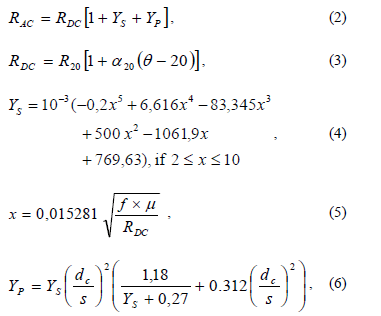
<body><![CDATA[<p><font size="2" face="Verdana, Arial, Helvetica, sans-serif">where <i>K<sub>0</sub></i> is the reaction rate constant, <i>A</i> is a   constant that depends in part on chemical concentrations in the reaction, <i>E<sub>a</sub></i> is the activation energy   of the degradation process, <i><font face="Symbol">q</font><sub>R</sub></i> is the absolute reaction temperature in Kelvin, <i>k</i> is the Boltzmann constant, <i>F<sub>A</sub></i> is the Aging Factor, <i><font face="Symbol">q</font><sub>H,R</sub></i> is the maximum allowable temperature in Celsius and <i><font face="Symbol">q</font><sub>H</sub></i> is the conductor temperature in Celsius.</font></p>     <p><font size="2" face="Verdana, Arial, Helvetica, sans-serif"><b>2.2. Overheating   in low voltage conductors under balanced and distorted currents</b></font></p>     <p><font size="2" face="Verdana, Arial, Helvetica, sans-serif">Equation (1) normally relates the aging of the dielectric   material with the overheating, but not the relationship of overheating with   electrical stresses. References &#91;3&#93;-&#91;7&#93; show that the presence of harmonic   currents cause overheating. This overheating degrades the dielectric material   used for insolation, reducing its useful life. The same references propose a   set of equations where the temperature rise in the phase and neutral conductors   are caused by power losses (<i>I<sup>2</sup>R</i>)   due to the presence of harmonic components. The frequency components in the   current change the value of the AC resistance, due to the skin effect and the   proximity effect.</font></p>     <p><font size="2" face="Verdana, Arial, Helvetica, sans-serif">The skin effect changes the current distribution in the conductor due to   the shielding of the inner portion of the conductor by the outer layer &#91;8&#93;. The   current is concentrated in the outer layer, increasing the effective resistance   of the conductor &#91;8&#93;. The skin effect is frequency-dependent and   increases with the conductor diameter.</font></p>     <p><font size="2" face="Verdana, Arial, Helvetica, sans-serif">The proximity effect is due to the conductor   magnetic field, which distorts the current in the adjacent conductors. For   round conductors this effect is smaller than the skin effect &#91;8&#93;. This effect   also increases the effective resistance of the conductor. </font></p>     <p><font size="2" face="Verdana, Arial, Helvetica, sans-serif">The proximity effect is due to the conductor magnetic field, which   distorts the current in the adjacent conductors. For round conductors this   effect is smaller than the skin effect &#91;8&#93;. This effect also increases the effective resistance of   the conductor. </font></p>     <p><font size="2" face="Verdana, Arial, Helvetica, sans-serif">References &#91;3&#93;-&#91;7&#93; and &#91;10&#93; proposed the equation to   determine the conductor AC resistance (2) with respect to its own DC resistance   value (3), the skin effect (4), (5) and the proximity effect (6).</font></p>     <p><img src="/img/revistas/dyna/v82n192/v82n192a05eq0206.gif"></p>     <p><font size="2" face="Verdana, Arial, Helvetica, sans-serif">where <i>R<sub>DC</sub></i> is the DC resistance at maximum operating temperature in ohms per distance, <i>Y<sub>S</sub></i> is the skin effect and <i>Y<sub>P</sub></i> is the proximity effect, <i>R<sub>20</sub></i> is the DC resistance at   20°C in ohms per kilometer, <i><font face="Symbol">a</font><sub>20</sub></i> is the temperature coefficient of resistance for conductor material at 20°C per   Kelvin, <i><font face="Symbol">q</font></i> is the maximum   operating temperature in Celsius, <i>x</i> is the skin effect parameter, <i>d<sub>c</sub></i> is the diameter of the conductor in millimeters, <i>s</i> is the distance between conductor axes in mm, <i>f</i> is the harmonic frequency component in   hertz and <i><font face="Symbol">m</font></i> is the magnetic   permeability (one for nonmagnetic material).</font></p>     <p><font size="2" face="Verdana, Arial, Helvetica, sans-serif">Along with the AC resistance, a set of equations to   determine the power losses due to harmonic currents (7)-(10) can be developed.   These losses must consider the current and the AC resistance of phase and   neutral conductors. These values are different for each frequency component.</font></p>     ]]></body>
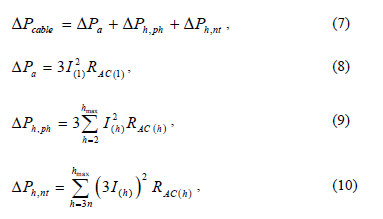
<body><![CDATA[<p><img src="/img/revistas/dyna/v82n192/v82n192a05eq0710.gif"></p>     <p><font size="2" face="Verdana, Arial, Helvetica, sans-serif">where, <i><font face="Symbol">D</font>P<sub>cable</sub></i> is the power loss in non-sinusoidal conditions in watts, <i><font face="Symbol">D</font>P<sub>a</sub></i> is the power losses in sinusoidal conditions   for phase and neutral conductors in watts, <i><font face="Symbol">D</font>P<sub>h,ph</sub></i> is the harmonic power losses for the phase conductors in watts, <i><font face="Symbol">D</font>P<sub>h,nt</sub></i> is the harmonic   power losses for the neutral conductor in watts, <i>I<sub>(1)</sub></i> is the phase current for the fundamental frequency   in amperes, <i>R<sub>AC(1)</sub></i> is the   phase AC resistance for the fundamental frequency in ohms, <i>I<sub>(h)</sub></i> is the phase current for the harmonic order <i>h</i> in amperes, <i>R<sub>AC(h)</sub></i> is the phase and neutral AC resistance for the   harmonic order <i>h</i> in ohms and <i>h<sub>max </sub></i>is the maximum harmonic   order.</font></p>     <p><font size="2" face="Verdana, Arial, Helvetica, sans-serif">Note that (7) considers a three-phase balanced system,   therefore the power loss in any phase is the same; there is no power losses in   the neutral conductor for fundamental frequency, under balanced conditions. Also,   the harmonic current in the neutral conductor is three times the harmonic   current in the phase, and only appears in the triple order frequencies (<i>I<sub>3</sub>, I<sub>9</sub>, I<sub>15</sub>,   I<sub>21</sub>… I<sub>3n</sub></i>).</font></p>     <p><font size="2" face="Verdana, Arial, Helvetica, sans-serif">The cables' temperature rise can be calculated based on   the maximum operating temperature and the ratio between the non-sinusoidal   losses and the rated sinusoidal losses calculated in (7) &#91;11&#93;.</font></p>     <p><img src="/img/revistas/dyna/v82n192/v82n192a05eq11.gif"></p>     <p><font size="2" face="Verdana, Arial, Helvetica, sans-serif"><i>P<sub>rated</sub></i> is the power losses in rated sinusoidal conditions for phase and neutral   conductors in watts, <i><font face="Symbol">q</font><sub>H</sub></i> is the temperature under non-sinusoidal conditions and <i><font face="Symbol">q</font><sub>H,R</sub></i> is the maximum operation temperature, both in   Celsius. </font></p>     <p><font size="2" face="Verdana, Arial, Helvetica, sans-serif">The expected loss of life can be calculated applying the   result of (11) in (1).</font></p>     <p> </p>     <p><font size="3" face="Verdana, Arial, Helvetica, sans-serif"><b>3. Conductor power   losses under distorted and unbalanced conditions</b></font></p>     <p><font size="2" face="Verdana, Arial, Helvetica, sans-serif">Most research regarding aging on LV conductors is focused   on the effects of harmonic currents in the system, but unbalance and phase   displacement have not been taken into account, even though these disturbances   are particularly important in low voltage grids. As a whole, the three   mentioned disturbances increase the current rms value, increasing the power   losses of phase and neutral conductors correspondingly.</font></p>     ]]></body>
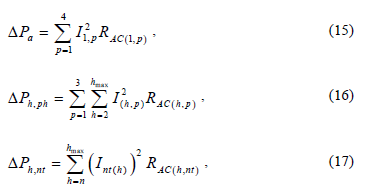
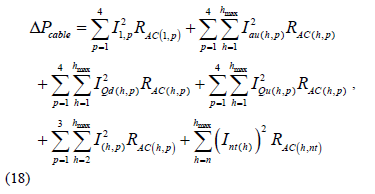
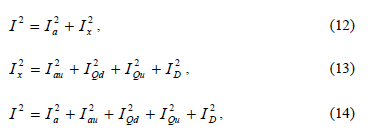
<body><![CDATA[<p><font size="2" face="Verdana, Arial, Helvetica, sans-serif">In reference &#91;12&#93; an orthogonal current decomposition for   poly-phase systems has been proposed. The current is split into two main   components, active and non-active currents (12). The non-active component   contains mainly the stationary disturbances (13). The full composition of the   current appears in (14).</font></p>     <p><img src="/img/revistas/dyna/v82n192/v82n192a05eq1214.gif"></p>     <p><font size="2" face="Verdana, Arial, Helvetica, sans-serif">where <i>I<sub>a</sub></i> is the fundamental active current (same <i>I<sub>(1)</sub></i>), <i>I<sub>au</sub></i> is the active   unbalanced current, <i>I<sub>Qd</sub></i> is   the displaced current (this component is quite similar to reactive current), <i>I<sub>Qu</sub></i> is the reactive   unbalanced current and <i>I<sub>D</sub></i> is the distorted current (harmonic current <i>I<sub>h </sub></i>in most cases).</font></p>     <p><font size="2" face="Verdana, Arial, Helvetica, sans-serif">Some field results in &#91;12&#93; show that phase currents are   not equal for the fundamental frequency, therefore it is necessary to make some   changes in (8). In the same manner, the harmonic currents have not the same   magnitude in all phases, then (9) and (10) require changes too. These changes   are required to consider the current for each phase separately and the neutral   harmonic current is not three times the phase current harmonic.</font></p>     <p><img src="/img/revistas/dyna/v82n192/v82n192a05eq1517.gif"></p>     <p><font size="2" face="Verdana, Arial, Helvetica, sans-serif">fundamental frequency in amperes, <i>R<sub>AC(1,p)</sub></i> is the phase and neutral AC resistance for the   fundamental frequency in ohms, <i>I<sub>(h,p)</sub></i> is the phase distorted current for the harmonic order <i>h</i> in amps, <i>I<sub>nt(h)</sub></i> is the neutral distorted current for the harmonic order <i>h</i> in amps, <i>R<sub>AC(h,p)</sub></i> is the phase AC resistance for the harmonic order <i>h</i> in ohms and <i>R<sub>AC(h,nt)</sub></i> is the neutral AC resistance for the harmonic order <i>h</i> in ohms.</font></p>     <p><font size="2" face="Verdana, Arial, Helvetica, sans-serif">Adding the other   stationary disturbances to (7) and using (15)-(17), the final equation for the   power losses due to stationary disturbances in three-phase systems is shown in   (18).</font></p>     <p><font size="2" face="Verdana, Arial, Helvetica, sans-serif">where, <i>I<sub>au(h,p)</sub></i> is the phase and neutral active unbalanced current for the harmonic order <i>h</i> in Amps,<i> I<sub>Qd(h,p)</sub></i> is the phase and neutral reactive displaced   current for the harmonic order <i>h</i> in   amps,<i> I<sub>Qu(h,p)</sub></i> is the   phase and neutral reactive unbalanced current for the harmonic order <i>h</i> in amps.</font></p>     <p><img src="/img/revistas/dyna/v82n192/v82n192a05eq18.gif"></p>     <p> </p>     ]]></body>
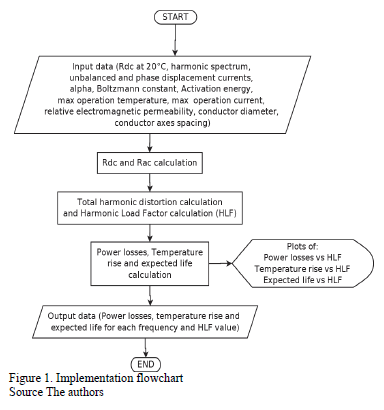
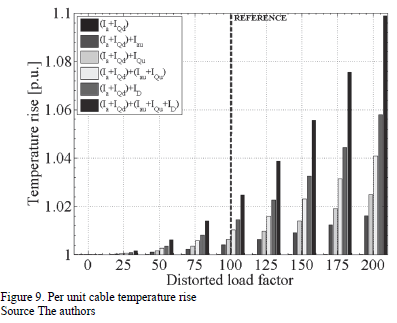
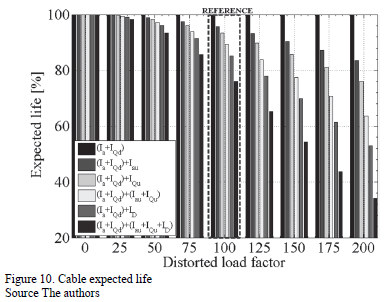
<body><![CDATA[<p><font size="3" face="Verdana, Arial, Helvetica, sans-serif"><b>4. Simulation and   results</b></font></p>     <p><font size="2" face="Verdana, Arial, Helvetica, sans-serif">In order to compare the effects of the stationary   disturbances (harmonics, unbalance and phase displacements) six cases are   simulated:</font></p> <ul>       <li><font size="2" face="Verdana, Arial, Helvetica, sans-serif"> Base case - Active current with reactive     displaced current (<i>I<sub>a</sub><sup>2</sup>+I<sub>Qd</sub><sup>2</sup></i>).     Although reactive currents are undesirable, they are tolerated; the base case     represents a common condition.</font></li>       <li><font size="2" face="Verdana, Arial, Helvetica, sans-serif"> Case 1 - Base case with active unbalanced current     (<i>I<sub>a</sub><sup>2</sup>+I<sub>Qd</sub><sup>2</sup></i>)<i>+I<sub>au</sub><sup>2</sup></i>.</font></li>       <li><font size="2" face="Verdana, Arial, Helvetica, sans-serif"> Case 2 - Base case with reactive unbalanced     current (<i>I<sub>a</sub><sup>2</sup>+I<sub>Qd</sub><sup>2</sup></i>)<i>+I<sub>Qu</sub><sup>2</sup></i>.</font></li>       <li><font size="2" face="Verdana, Arial, Helvetica, sans-serif"> Case 3 - Base case with unbalanced currents (<i>I<sub>a</sub><sup>2</sup>+I<sub>Qd</sub><sup>2</sup></i>)+(<i>I<sub>au</sub><sup>2</sup>+I<sub>au</sub><sup>2</sup></i>)<i>.</i></font></li>       <li><font size="2" face="Verdana, Arial, Helvetica, sans-serif"> Case 4 - Base Active current with distorted     current (<i>I<sub>a</sub><sup>2</sup>+I<sub>Qd</sub><sup>2</sup></i>)<i>+I<sub>D</sub><sup>2</sup></i>.</font></li>       <li><font size="2" face="Verdana, Arial, Helvetica, sans-serif"> Case 5 - Base case with unbalanced and distorted     currents (<i>I<sub>a</sub><sup>2</sup>+I<sub>Qd</sub><sup>2</sup>)+</i>(<i>I<sub>au</sub><sup>2</sup>+I<sub>Qu</sub><sup>2</sup>+I<sub>D</sub><sup>2</sup></i>).</font></li>     </ul>     <p><font size="2" face="Verdana, Arial, Helvetica, sans-serif">Equations (1) to (18) are implemented in MATLAB to   illustrate the aging model. <a href="#fig01">Fig. 1</a> represents the implementation flowchart. For   the Base case, the currents magnitudes are constant. For cases 1 to 5, the   magnitude of</font> <font size="2" face="Verdana, Arial, Helvetica, sans-serif">the unbalanced and distorted   currents starts from 0% to 200% of the current magnitude. This percentage value   will be called the Distorted Load Factor (<b><i>DLF</i></b>).</font></p>     ]]></body>
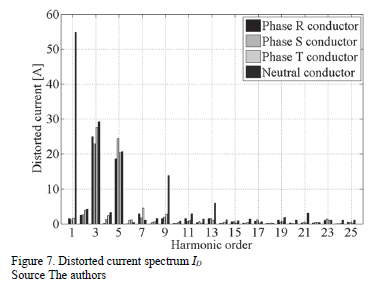
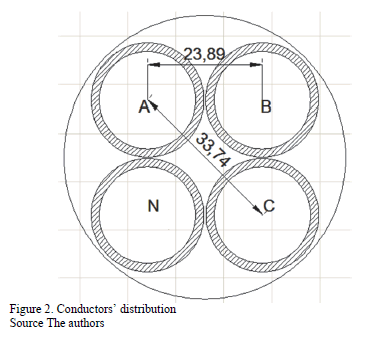
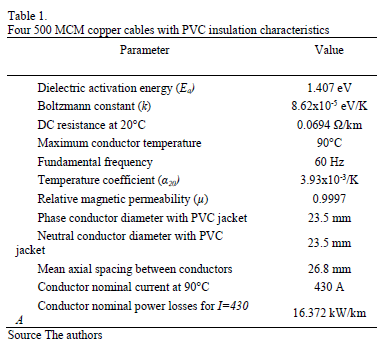
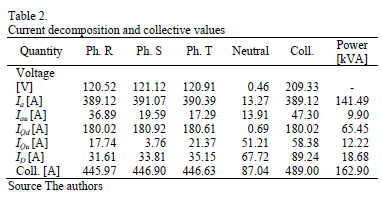
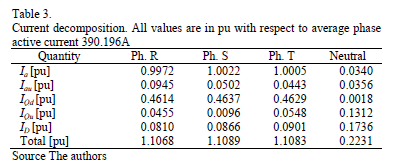
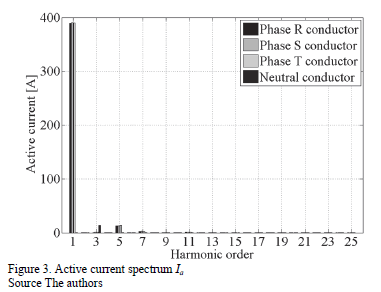
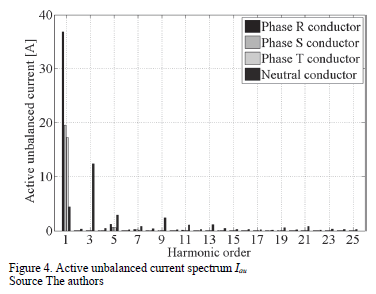
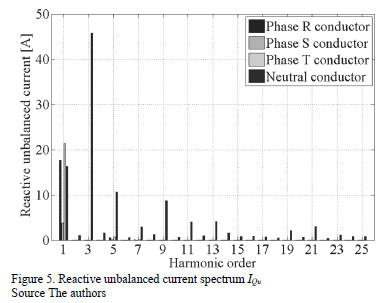
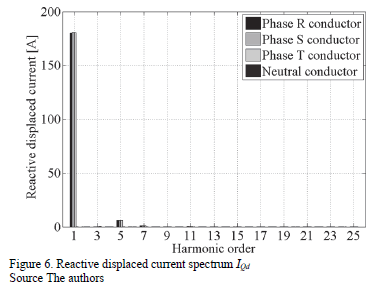
<body><![CDATA[<p align="center"><font size="2" face="Verdana, Arial, Helvetica, sans-serif"><a name="fig01"></a></font><img src="/img/revistas/dyna/v82n192/v82n192a05fig01.gif"></p>     <p><font size="2" face="Verdana, Arial, Helvetica, sans-serif">The conductor used is four 500 MCM copper cables with PVC   insulation (<a href="http://www.centelsa.com" target="_blank">http://www.centelsa.com</a>). <a href="#fig02">Fig. 2</a> shows an example of the cable   configuration and the physical and chemical parameters of the cable are shown   in <a href="#tab01">Table 1</a>. <a href="#tab02">Tables 2</a> and <a href="#tab03">3</a> show the current decomposition in amperes and pu   with respect to the collective current. Collective currents are calculated as   the squared root of the sum squared rms values, as explained in &#91;12&#93; and &#91;15&#93;.   Given that current decomposition is orthogonal, the collective values can be   calculated in the described manner. The spectrum for active current is   presented in <a href="#fig03">Fig. 3</a>, active unbalanced current in <a href="#fig04">Fig. 4</a>, reactive unbalanced   current in <a href="#fig05">Fig. 5</a>, reactive displaced current in <a href="#fig06">Fig. 6</a> and the distorted   current (harmonic) in <a href="#fig07">Fig. 7</a>.</font></p>     <p align="center"><font size="2" face="Verdana, Arial, Helvetica, sans-serif"><a name="fig02"></a></font><img src="/img/revistas/dyna/v82n192/v82n192a05fig02.gif"></p>     <p align="center"><font size="2" face="Verdana, Arial, Helvetica, sans-serif"><a name="tab01"></a></font><img src="/img/revistas/dyna/v82n192/v82n192a05tab01.gif"></p>     <p align="center"><font size="2" face="Verdana, Arial, Helvetica, sans-serif"><a name="tab02"></a></font><img src="/img/revistas/dyna/v82n192/v82n192a05tab02.gif"></p>     <p align="center"><font size="2" face="Verdana, Arial, Helvetica, sans-serif"><a name="tab03"></a></font><img src="/img/revistas/dyna/v82n192/v82n192a05tab03.gif"></p>     <p align="center"><font size="2" face="Verdana, Arial, Helvetica, sans-serif"><a name="fig03"></a></font><img src="/img/revistas/dyna/v82n192/v82n192a05fig03.gif"></p>     <p align="center"><font size="2" face="Verdana, Arial, Helvetica, sans-serif"><a name="fig04"></a></font><img src="/img/revistas/dyna/v82n192/v82n192a05fig04.gif"></p>     <p align="center"><font size="2" face="Verdana, Arial, Helvetica, sans-serif"><a name="fig05"></a></font><img src="/img/revistas/dyna/v82n192/v82n192a05fig05.gif"></p>     <p align="center"><font size="2" face="Verdana, Arial, Helvetica, sans-serif"><a name="fig06"></a></font><img src="/img/revistas/dyna/v82n192/v82n192a05fig06.gif"></p>     ]]></body>
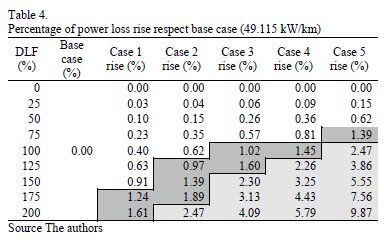
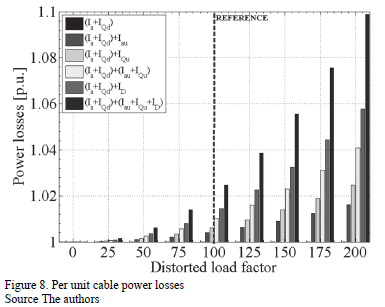
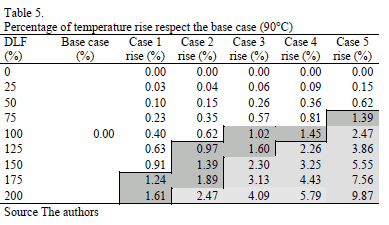
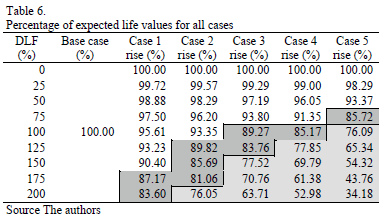
<body><![CDATA[<p align="center"><font size="2" face="Verdana, Arial, Helvetica, sans-serif"><a name="fig07"></a></font><img src="/img/revistas/dyna/v82n192/v82n192a05fig07.gif"></p>     <p><font size="2" face="Verdana, Arial, Helvetica, sans-serif">From the previous data, the power dissipated by the   conductors, its effect on temperature and expected life can be calculated. The   analysis will be made taking into account:</font></p> <ul>       <li><font size="2" face="Verdana, Arial, Helvetica, sans-serif"> Unbalanced and distorted currents magnitude is 100%     (dashed line in <a href="#fig08">Fig. 8</a>, <a href="#fig09">9</a> and <a href="#fig10">10</a>).</font></li>       <li><font size="2" face="Verdana, Arial, Helvetica, sans-serif"> Cable expected life between 90%-100%. White zones     in <a href="#tab04">Table 4</a>, <a href="#tab05">5</a> and <a href="#tab06">6</a> are considered as favorable conditions.</font></li>       <li><font size="2" face="Verdana, Arial, Helvetica, sans-serif"> Cable expected life between 80%-90%. Dark gray     zone in <a href="#tab04">Table 4</a>, <a href="#tab05">5</a> and <a href="#tab06">6</a> (tolerable condition).</font></li>       <li><font size="2" face="Verdana, Arial, Helvetica, sans-serif"> Cable expected life between 0%-70%. Light gray     zone in <a href="#tab04">Table 4</a>, <a href="#tab05">5</a> and <a href="#tab06">6</a> (unfavorable condition).</font></li>     </ul>     <p align="center"><font size="2" face="Verdana, Arial, Helvetica, sans-serif"><a name="fig08"></a></font><img src="/img/revistas/dyna/v82n192/v82n192a05fig08.gif"></p>     <p align="center"><font size="2" face="Verdana, Arial, Helvetica, sans-serif"><a name="fig09"></a></font><img src="/img/revistas/dyna/v82n192/v82n192a05fig09.gif"></p>     <p align="center"><font size="2" face="Verdana, Arial, Helvetica, sans-serif"><a name="fig10"></a></font><img src="/img/revistas/dyna/v82n192/v82n192a05fig10.gif"></p>     ]]></body>
<body><![CDATA[<p align="center"><font size="2" face="Verdana, Arial, Helvetica, sans-serif"><a name="tab04"></a></font><img src="/img/revistas/dyna/v82n192/v82n192a05tab04.gif"></p>     <p align="center"><font size="2" face="Verdana, Arial, Helvetica, sans-serif"><a name="tab05"></a></font><img src="/img/revistas/dyna/v82n192/v82n192a05tab05.gif"></p>     <p align="center"><font size="2" face="Verdana, Arial, Helvetica, sans-serif"><a name="tab06"></a></font><img src="/img/revistas/dyna/v82n192/v82n192a05tab06.gif"></p>     <p><font size="2" face="Verdana, Arial, Helvetica, sans-serif">Due to the linear relation between power losses and   temperature rise (11), <a href="#tab04">Tables 4</a>-<a href="#tab05">5</a> and <a href="#fig08">Figs 8</a>-<a href="#fig09">9</a> have the same behavior. </font></p>     <p><font size="2" face="Verdana, Arial, Helvetica, sans-serif">Comparing cases 1, 2 and 4   for <i>DLF </i>in <i>100%</i>, <i>I<sub>D</sub></i>provides   more power losses and the temperature rise (1.45% both) than <i>I<sub>au</sub></i> (0.4%) and <i>I<sub>Qu </sub></i>(0.62%). In   addition, the contribution of <i>I<sub>au</sub>+I<sub>Qu</sub></i> (case 3) is not enough to reach the distorted current</font> <font size="2" face="Verdana, Arial, Helvetica, sans-serif">contribution.   Moreover, when all disturbances are present the power losses increase in   temperature and amount to 2.47%. It clearly shows that distorted current is the   less desirable disturbance. Regarding expected life, in Cases 1 and 2 the   conductors' life expectancy has lost about 10%. This can be considered   favorable with respect to Case 4, where <i>I<sub>D</sub></i> reduces the expected life to 85.17%, a tolerable but not favorable condition   (dark gray zone). In Case 3, the unbalanced current reduces the life of the   cable insulation to 89.27% (tolerable condition). In Case 5 with all   disturbances present, the expected life reduces to 76.09%, it clearly   represents an unfavorable and intolerable condition as the life reduction is   approximately one quarter.</font></p>     <p><font size="2" face="Verdana, Arial, Helvetica, sans-serif">Reviewing   expected life areas for the cable, in Case 1, the active unbalanced current   allows an extra increase of 150%, without a change to tolerable conditions. In Case   2, the reactive unbalanced current remains in a favorable condition to 100%. At   this point, it can be observed that the increase in power loss and temperature rise   reaches 0.6%; same of <i>I<sub>au</sub></i></font></p>     <p><font size="2" face="Verdana, Arial, Helvetica, sans-serif">achieved when the magnitude increases at 125%. When   the magnitude of the <i>I<sub>Qu</sub></i> exceeds 100%, the expected life changes to a tolerable condition, and if it reaches   200%, it becomes an intolerable condition.</font></p>     <p><font size="2" face="Verdana, Arial, Helvetica, sans-serif">In Case 3, which groups unbalanced currents, the   increase of power losses and temperature rise, with respect to individual cases   are low (variations are 0.03% and 0.3% for a <i>DLF=75%</i>). At this point, the expected life was favorable. The   difference increases to 0.6% when DLF is equal to 100% and 125% (tolerable   condition). After the 125%, Case 3 comes to an intolerable condition and the   differences from Cases 1 and 2, reaches values of 1.4%. It can be observed that   Case 3 is not too critical.</font></p>     <p><font size="2" face="Verdana, Arial, Helvetica, sans-serif">Case 4 is particularly critical because it is harmful and,   as previously explained, it has the higher power losses for individual   disturbances, as shown in <a href="#fig08">Figure 8</a> for a <i>DLF&ge;100%</i>.   When the <i>DLF&le;75%</i>, the increase of   losses are comparable to those found in case 3 and the expected life is favorable.   Only when the <i>DLF=100%</i>, expected life   is tolerable but the difference from other cases increases significantly. After   the <i>DLF=125%</i>, expected life becomes   intolerable. Finally, for <i>DLF=200%</i> life expectancy is reduced by almost half. This confirms that the distorted   current is the least desirable disturbances.</font></p>     <p><font size="2" face="Verdana, Arial, Helvetica, sans-serif">Finally, for Case 5, which groups all disturbances, the   power losses and the temperature increase drastically with respect to the other   cases. It has a favorable condition only for <i>DLF&le;50%</i>, for <i>DLF=75%</i> it has a tolerable condition and for <i>DLF&ge;100%</i> it has an intolerable condition. It can be concluded from these results that in   cases when the power system has all types of disturbances, the insulation   degrades rapidly reducing the expected life to 35%.</font></p>     ]]></body>
<body><![CDATA[<p> </p>     <p><font size="3" face="Verdana, Arial, Helvetica, sans-serif"><b>5. Discussion</b></font></p>     <p><font size="2" face="Verdana, Arial, Helvetica, sans-serif">The results show that stationary   disturbances, like unbalance and phase displacement, are capable of causing   additional deterioration of dielectric materials. </font></p>     <p><font size="2" face="Verdana, Arial, Helvetica, sans-serif">Effects of waveform distortion on cables'   ampacity and life expectancy have been already investigated. This paper has   gone further by considering what unbalance can cause. </font></p>     <p><font size="2" face="Verdana, Arial, Helvetica, sans-serif">It has   been shown that unbalance is not despicable regarding its effect on the cables'   useful life. Its effects are comparable to the effects of overloading, which   are known as well. Nevertheless, unbalance increases apparent power but does   not increases active or reactive power, therefore its presence can pass   unperceived. If unbalance is not taken care of, not only will the system   capacity be decreased but also the insulation will be stressed by an additional   unperceived disturbance.</font></p>     <p><font size="2" face="Verdana, Arial, Helvetica, sans-serif">In this paper, the considered cases   included a full duty load behavior and different composition sizes, by means of   the so-called Distorted Load Factor. It is necessary to investigate this topic   further, particularly paying attention to the effects under different operation   conditions where the current fluctuates but disturbances remain present.</font></p>     <p><font size="2" face="Verdana, Arial, Helvetica, sans-serif">There is an interesting aspect regarding   the above-presented results. The benefits of compensating waveform distortion   are well known (reduction of rms currents, reduction of apparent power, losses   reduction, reduction of resonance risk, etc.). Benefits of unbalance compensation   have not been widely considered. The compensation of unbalance can be achieved   by economic solutions, which in general are cheaper than harmonics   compensation. The reduction of unbalance can provide interesting possibilities   for improving the usage of an existing electric facility and increasing its   life expectancy.</font></p>     <p><font size="2" face="Verdana, Arial, Helvetica, sans-serif">The effects of disturbance conductors' life expectancy can   be considered as design criteria for present and future electric facilities in   order to avoid possible dangers.</font></p>     <p> </p>     <p><font size="3" face="Verdana, Arial, Helvetica, sans-serif"><b>6. Conclusions</b></font></p>     ]]></body>
<body><![CDATA[<p><font size="2" face="Verdana, Arial, Helvetica, sans-serif">This   article presents a methodology for the estimation of reduction of the lifetime   caused by the temperature rise of low voltage cables due to   stationary disturbances, applying existing methods, which consider only current   waveform distortions.</font></p>     <p><font size="2" face="Verdana, Arial, Helvetica, sans-serif">The applied model enables us to   estimate punctual behavior of the power losses, temperature rise and expected   life due to stationary disturbances, but it is not very accurate because it cannot   show the entire behavior over the time. In order to estimate the behavior over   a long time, it is necessary to resort to many different samples in short time   intervals (<i>i.e. </i>every hour) in order calculate a cumulative aging factor   for large time intervals (<i>i.e. </i>days).</font></p>     <p><font size="2" face="Verdana, Arial, Helvetica, sans-serif">It was observed that temperature increases of about 5°C   are capable of reducing conductors' life expectancy to 50%. The effects of   waveform distortion are more severe than the effects of reactive components and   unbalance together, depending on the size of each disturbance. Nevertheless,   the effects of unbalance cannot be disregarded.</font></p>     <p><font size="2" face="Verdana, Arial, Helvetica, sans-serif">The employed orthogonal current decomposition provided a   simple and useful manner to discriminate the effects of each disturbance on   power losses, temperature increase and loss of life as well.</font></p>     <p> </p>     <p><font size="3" face="Verdana, Arial, Helvetica, sans-serif"><b>References</b></font></p>     <!-- ref --><p><font size="2" face="Verdana, Arial, Helvetica, sans-serif"><b>&#91;1&#93;</b> Laidler,   K., The Development of the Arrhenius Equation, Journal of Chemical Education, 61 (6), pp. 494-498, 1984. DOI: 10.1021/ed061p494</font>&nbsp;&nbsp;&nbsp;&nbsp;&nbsp;&nbsp;&nbsp;&nbsp;[&#160;<a href="javascript:void(0);" onclick="javascript: window.open('/scielo.php?script=sci_nlinks&ref=000119&pid=S0012-7353201500040000500001&lng=','','width=640,height=500,resizable=yes,scrollbars=1,menubar=yes,');">Links</a>&#160;]<!-- end-ref --><!-- ref --><p><font size="2" face="Verdana, Arial, Helvetica, sans-serif"><b>&#91;2&#93;</b> Duran, I.C. and Duarte, O.G., A survey of   methods of estimating lifetime and aging of assets in substations, Advances in   Power System Control, Operation and Management (APSCOM 2012), 9th IET   International Conference on, pp. 1-6, November, 2012.    &nbsp;&nbsp;&nbsp;&nbsp;&nbsp;&nbsp;&nbsp;&nbsp;[&#160;<a href="javascript:void(0);" onclick="javascript: window.open('/scielo.php?script=sci_nlinks&ref=000120&pid=S0012-7353201500040000500002&lng=','','width=640,height=500,resizable=yes,scrollbars=1,menubar=yes,');">Links</a>&#160;]<!-- end-ref --></font></p>     <!-- ref --><p><font size="2" face="Verdana, Arial, Helvetica, sans-serif"><b>&#91;3&#93;</b> IEC 60287-1-1., Electric cables -   Calculation of the current rating - Part 1-1: Current rating equations (100%   load factor) and calculation of losses - General International. International   Electrotechnical Commission, Electric cables Committee, 2001.    &nbsp;&nbsp;&nbsp;&nbsp;&nbsp;&nbsp;&nbsp;&nbsp;[&#160;<a href="javascript:void(0);" onclick="javascript: window.open('/scielo.php?script=sci_nlinks&ref=000122&pid=S0012-7353201500040000500003&lng=','','width=640,height=500,resizable=yes,scrollbars=1,menubar=yes,');">Links</a>&#160;]<!-- end-ref --></font></p>     <!-- ref --><p><font size="2" face="Verdana, Arial, Helvetica, sans-serif"><b>&#91;4&#93;</b> Desmet, J., Putman, D., D'hulster, F. and   Belmans, R., Thermal analysis of the influence of nonlinear, unbalanced and   asymmetric loads on current conducting capacity of LV-cables, Power Tech   Conference Proceedings. IEEE, 4, pp. 1-8, 2003.    &nbsp;&nbsp;&nbsp;&nbsp;&nbsp;&nbsp;&nbsp;&nbsp;[&#160;<a href="javascript:void(0);" onclick="javascript: window.open('/scielo.php?script=sci_nlinks&ref=000124&pid=S0012-7353201500040000500004&lng=','','width=640,height=500,resizable=yes,scrollbars=1,menubar=yes,');">Links</a>&#160;]<!-- end-ref --></font></p>     <!-- ref --><p><font size="2" face="Verdana, Arial, Helvetica, sans-serif"><b>&#91;5&#93;</b> Sahin, Y.G. and Aras, F., Investigation of   harmonic effects on underground power cables, Power Engineering, Energy and   Electrical Drives, 2007. POWERENG 2007. International Conference on, pp.   589-594, 2007.    &nbsp;&nbsp;&nbsp;&nbsp;&nbsp;&nbsp;&nbsp;&nbsp;[&#160;<a href="javascript:void(0);" onclick="javascript: window.open('/scielo.php?script=sci_nlinks&ref=000126&pid=S0012-7353201500040000500005&lng=','','width=640,height=500,resizable=yes,scrollbars=1,menubar=yes,');">Links</a>&#160;]<!-- end-ref --></font></p>     <!-- ref --><p><font size="2" face="Verdana, Arial, Helvetica, sans-serif"><b>&#91;6&#93;</b> Desmet J.,   Vanalme G., Belmans R. and Van Dommelen D., Simulation of losses in LV cables   due to nonlinear loads, Power Electronics Specialists Conference 2008. PESC 2008.   IEEE, pp. 785-790, 2008.    &nbsp;&nbsp;&nbsp;&nbsp;&nbsp;&nbsp;&nbsp;&nbsp;[&#160;<a href="javascript:void(0);" onclick="javascript: window.open('/scielo.php?script=sci_nlinks&ref=000128&pid=S0012-7353201500040000500006&lng=','','width=640,height=500,resizable=yes,scrollbars=1,menubar=yes,');">Links</a>&#160;]<!-- end-ref --></font></p>     <!-- ref --><p><font size="2" face="Verdana, Arial, Helvetica, sans-serif"><b>&#91;7&#93;</b> Demoulias,   C., Labridis, D.P., Dokopoulos, P.S. and Gouramanis, K., Ampacity of   Low-Voltage power cables under nonsinusoidal currents, Power Delivery IEEE   Transactions on, 22, pp. 584-594, 2007. DOI: 10.1109/TPWRD.2006.881445 </font>&nbsp;&nbsp;&nbsp;&nbsp;&nbsp;&nbsp;&nbsp;&nbsp;[&#160;<a href="javascript:void(0);" onclick="javascript: window.open('/scielo.php?script=sci_nlinks&ref=000130&pid=S0012-7353201500040000500007&lng=','','width=640,height=500,resizable=yes,scrollbars=1,menubar=yes,');">Links</a>&#160;]<!-- end-ref --><!-- ref --><p><font size="2" face="Verdana, Arial, Helvetica, sans-serif"><b>&#91;8&#93;</b> Wagner, V., Balda, J., Griffith, D.,   McEachern, A., Barnes, T., Hartmann, D., Phileggi, D., Emannuel, A., Horton,   W., Reid, W., Ferraro, R. and Jewell, W., Effects of harmonics on equipment,   Power Delivery, IEEE Transactions on, 8, 672-680, 1993.    &nbsp;&nbsp;&nbsp;&nbsp;&nbsp;&nbsp;&nbsp;&nbsp;[&#160;<a href="javascript:void(0);" onclick="javascript: window.open('/scielo.php?script=sci_nlinks&ref=000131&pid=S0012-7353201500040000500008&lng=','','width=640,height=500,resizable=yes,scrollbars=1,menubar=yes,');">Links</a>&#160;]<!-- end-ref --></font></p>     ]]></body>
<body><![CDATA[<!-- ref --><p><font size="2" face="Verdana, Arial, Helvetica, sans-serif"><b>&#91;9&#93;</b> Johnson H. and Graham M., High speed signal   propagation: Avanced Black Magic, Prentice Hall, 2003.    &nbsp;&nbsp;&nbsp;&nbsp;&nbsp;&nbsp;&nbsp;&nbsp;[&#160;<a href="javascript:void(0);" onclick="javascript: window.open('/scielo.php?script=sci_nlinks&ref=000133&pid=S0012-7353201500040000500009&lng=','','width=640,height=500,resizable=yes,scrollbars=1,menubar=yes,');">Links</a>&#160;]<!-- end-ref --></font></p>     <!-- ref --><p><font size="2" face="Verdana, Arial, Helvetica, sans-serif"><b>&#91;10&#93;</b> Tofoli, F., Sanhueza, S. and de Oliveira,   A., On the study of losses in cables and transformers in nonsinusoidal   conditions, Power Delivery, IEEE Transactions on, 21, pp. 971-978, 2006.    &nbsp;&nbsp;&nbsp;&nbsp;&nbsp;&nbsp;&nbsp;&nbsp;[&#160;<a href="javascript:void(0);" onclick="javascript: window.open('/scielo.php?script=sci_nlinks&ref=000135&pid=S0012-7353201500040000500010&lng=','','width=640,height=500,resizable=yes,scrollbars=1,menubar=yes,');">Links</a>&#160;]<!-- end-ref --></font></p>     <!-- ref --><p><font size="2" face="Verdana, Arial, Helvetica, sans-serif"><b>&#91;11&#93;</b> Patil, K. and Gandhare, W., Effects of   harmonics in distribution systems on temperature rise and life of XLPE power   cables, Power and Energy Systems (ICPS), 2011 International Conference on, pp.   1-6, 2011.    &nbsp;&nbsp;&nbsp;&nbsp;&nbsp;&nbsp;&nbsp;&nbsp;[&#160;<a href="javascript:void(0);" onclick="javascript: window.open('/scielo.php?script=sci_nlinks&ref=000137&pid=S0012-7353201500040000500011&lng=','','width=640,height=500,resizable=yes,scrollbars=1,menubar=yes,');">Links</a>&#160;]<!-- end-ref --></font></p>     <!-- ref --><p><font size="2" face="Verdana, Arial, Helvetica, sans-serif"><b>&#91;12&#93;</b> Pavas, A., Study of responsibilities   assignment methods in power quality, PhD Thesis, Bogota, DC. Universidad   Nacional de Colombia, Bogot&aacute;, Colombia, 2012.    &nbsp;&nbsp;&nbsp;&nbsp;&nbsp;&nbsp;&nbsp;&nbsp;[&#160;<a href="javascript:void(0);" onclick="javascript: window.open('/scielo.php?script=sci_nlinks&ref=000139&pid=S0012-7353201500040000500012&lng=','','width=640,height=500,resizable=yes,scrollbars=1,menubar=yes,');">Links</a>&#160;]<!-- end-ref --></font></p>     <!-- ref --><p><font size="2" face="Verdana, Arial, Helvetica, sans-serif"><b>&#91;13&#93;</b> Mazzanti,   G., Passarelli, G., Russo, A. and Verde, P. The effects of voltage waveform   factors on cable life estimation using measured distorted voltages, Power   Engineering Society General Meeting, 2006. IEEE, 8 P, 2006.    &nbsp;&nbsp;&nbsp;&nbsp;&nbsp;&nbsp;&nbsp;&nbsp;[&#160;<a href="javascript:void(0);" onclick="javascript: window.open('/scielo.php?script=sci_nlinks&ref=000141&pid=S0012-7353201500040000500013&lng=','','width=640,height=500,resizable=yes,scrollbars=1,menubar=yes,');">Links</a>&#160;]<!-- end-ref --></font></p>     ]]></body>
<body><![CDATA[<!-- ref --><p><font size="2" face="Verdana, Arial, Helvetica, sans-serif"><b>&#91;14&#93;</b> Stone, G. and Lawless J., The application   of weibull statistics to insulation aging tests, Electrical Insulation, IEEE   Transactions on, EI-14, pp. 233-239, 1979.    &nbsp;&nbsp;&nbsp;&nbsp;&nbsp;&nbsp;&nbsp;&nbsp;[&#160;<a href="javascript:void(0);" onclick="javascript: window.open('/scielo.php?script=sci_nlinks&ref=000143&pid=S0012-7353201500040000500014&lng=','','width=640,height=500,resizable=yes,scrollbars=1,menubar=yes,');">Links</a>&#160;]<!-- end-ref --></font></p>     <!-- ref --><p><font size="2" face="Verdana, Arial, Helvetica, sans-serif"><b>&#91;15&#93;</b> Pavas, A.,   Torres, H. and Staudt, V., Method of disturbances interaction: Novel approach   to assess responsibilities for steady state power quality disturbances among   customers, Harmonics and Quality of Power (ICHQP), 2010 14th International   Conference on, Bergamo, Italy, pp 1-9, 2010.    &nbsp;&nbsp;&nbsp;&nbsp;&nbsp;&nbsp;&nbsp;&nbsp;[&#160;<a href="javascript:void(0);" onclick="javascript: window.open('/scielo.php?script=sci_nlinks&ref=000145&pid=S0012-7353201500040000500015&lng=','','width=640,height=500,resizable=yes,scrollbars=1,menubar=yes,');">Links</a>&#160;]<!-- end-ref --></font></p>     <p> </p>     <p><font size="2" face="Verdana, Arial, Helvetica, sans-serif"><b>I.C.   Duran-Tovar,</b> received the BSc. Eng. in Electrical Engineering in 2006 from   the Universidad Nacional de Colombia, Bogot&aacute;, Colombia, and the MSc. degree in   Electrical Engineering in 2010 from the Universidad de los Andes, Bogot&aacute;,   Colombia. He is currently a PhD candidate for Electrical Engineering at the   Universidad Nacional de Colombia. His research interests include: power   quality, distribution systems and simulation.</font></p>     <p><font size="2" face="Verdana, Arial, Helvetica, sans-serif"><b>F.A. Pavas-Mart&iacute;nez,</b> received the BSc. Eng in Electrical Engineering in 2002, the MSc. degree in   Electrical Engineering 2005, and the PhD degree in Electrical Engineering in   2013, all of them from the Universidad Nacional de Colombia, Bogot&aacute;, Colombia.   Currently, he is a full professor with the Electrical and Electronic   Department, Facultad de Ingenier&iacute;a, Universidad Nacional de Colombia, Bogot&aacute;,   Colombia.</font></p>     <p><font size="2" face="Verdana, Arial, Helvetica, sans-serif"><b>O.G. Duarte-Velasco,</b> received the BSc. Eng in Electrical Engineering in 1991, the MSc. degree in   Industrial Automation in 1997, both from the Universidad Nacional de Colombia,   Bogot&aacute;, Colombia. He received the PhD. degree in Informatics in 2000, from the   Universidad de Granada, Granada, Espa&ntilde;a. Currently, he is a full professor with   the Electrical and Electronic Department, Facultad de Ingenier&iacute;a, Universidad   Nacional de Colombia, Bogot&aacute;, Colombia.</font></p>      ]]></body><back>
<ref-list>
<ref id="B1">
<label>1</label><nlm-citation citation-type="journal">
<person-group person-group-type="author">
<name>
<surname><![CDATA[Laidler]]></surname>
<given-names><![CDATA[K.]]></given-names>
</name>
</person-group>
<article-title xml:lang="en"><![CDATA[The Development of the Arrhenius Equation]]></article-title>
<source><![CDATA[Journal of Chemical Education]]></source>
<year>1984</year>
<volume>61</volume>
<numero>6</numero>
<issue>6</issue>
<page-range>494-498</page-range></nlm-citation>
</ref>
<ref id="B2">
<label>2</label><nlm-citation citation-type="confpro">
<person-group person-group-type="author">
<name>
<surname><![CDATA[Duran]]></surname>
<given-names><![CDATA[I.C.]]></given-names>
</name>
<name>
<surname><![CDATA[Duarte]]></surname>
<given-names><![CDATA[O.G.]]></given-names>
</name>
</person-group>
<article-title xml:lang="en"><![CDATA[A survey of methods of estimating lifetime and aging of assets in substations]]></article-title>
<source><![CDATA[]]></source>
<year>Nove</year>
<month>mb</month>
<day>er</day>
<conf-name><![CDATA[9th Advances in Power System Control, Operation and Management (APSCOM 2012)]]></conf-name>
<conf-loc> </conf-loc>
<page-range>1-6</page-range></nlm-citation>
</ref>
<ref id="B3">
<label>3</label><nlm-citation citation-type="confpro">
<article-title xml:lang="en"><![CDATA[IEC 60287-1-1., Electric cables - Calculation of the current rating: Part 1-1: Current rating equations (100% load factor) and calculation of losses]]></article-title>
<source><![CDATA[]]></source>
<year></year>
<conf-name><![CDATA[ General International. International Electrotechnical Commission, Electric cables Committee]]></conf-name>
<conf-date>2001</conf-date>
<conf-loc> </conf-loc>
</nlm-citation>
</ref>
<ref id="B4">
<label>4</label><nlm-citation citation-type="confpro">
<person-group person-group-type="author">
<name>
<surname><![CDATA[Desmet]]></surname>
<given-names><![CDATA[J.]]></given-names>
</name>
<name>
<surname><![CDATA[Putman]]></surname>
<given-names><![CDATA[D.]]></given-names>
</name>
<name>
<surname><![CDATA[D'hulster]]></surname>
<given-names><![CDATA[F.]]></given-names>
</name>
<name>
<surname><![CDATA[Belmans]]></surname>
<given-names><![CDATA[R.]]></given-names>
</name>
</person-group>
<article-title xml:lang="en"><![CDATA[Thermal analysis of the influence of nonlinear, unbalanced and asymmetric loads on current conducting capacity of LV-cables]]></article-title>
<source><![CDATA[]]></source>
<year>2003</year>
<volume>4</volume>
<conf-name><![CDATA[ Power Tech Conference Proceedings]]></conf-name>
<conf-loc> </conf-loc>
<page-range>1-8</page-range></nlm-citation>
</ref>
<ref id="B5">
<label>5</label><nlm-citation citation-type="confpro">
<person-group person-group-type="author">
<name>
<surname><![CDATA[Sahin]]></surname>
<given-names><![CDATA[Y.G.]]></given-names>
</name>
<name>
<surname><![CDATA[Aras]]></surname>
<given-names><![CDATA[F.]]></given-names>
</name>
</person-group>
<article-title xml:lang="en"><![CDATA[Investigation of harmonic effects on underground power cables]]></article-title>
<source><![CDATA[]]></source>
<year>2007</year>
<conf-name><![CDATA[ Power Engineering, Energy and Electrical Drives]]></conf-name>
<conf-date>2007</conf-date>
<conf-loc> </conf-loc>
<page-range>589-594</page-range></nlm-citation>
</ref>
<ref id="B6">
<label>6</label><nlm-citation citation-type="confpro">
<person-group person-group-type="author">
<name>
<surname><![CDATA[Desmet]]></surname>
<given-names><![CDATA[J.]]></given-names>
</name>
<name>
<surname><![CDATA[Vanalme]]></surname>
<given-names><![CDATA[G.]]></given-names>
</name>
<name>
<surname><![CDATA[Belmans]]></surname>
<given-names><![CDATA[R.]]></given-names>
</name>
<name>
<surname><![CDATA[Van Dommelen]]></surname>
<given-names><![CDATA[D.]]></given-names>
</name>
</person-group>
<article-title xml:lang="en"><![CDATA[Simulation of losses in LV cables due to nonlinear loads]]></article-title>
<source><![CDATA[]]></source>
<year>2008</year>
<conf-name><![CDATA[ Power Electronics Specialists Conference]]></conf-name>
<conf-date>2008</conf-date>
<conf-loc> </conf-loc>
<page-range>785-790</page-range><publisher-name><![CDATA[IEEE]]></publisher-name>
</nlm-citation>
</ref>
<ref id="B7">
<label>7</label><nlm-citation citation-type="journal">
<person-group person-group-type="author">
<name>
<surname><![CDATA[Demoulias]]></surname>
<given-names><![CDATA[C.]]></given-names>
</name>
<name>
<surname><![CDATA[Labridis]]></surname>
<given-names><![CDATA[D.P.]]></given-names>
</name>
<name>
<surname><![CDATA[Dokopoulos]]></surname>
<given-names><![CDATA[P.S.]]></given-names>
</name>
<name>
<surname><![CDATA[Gouramanis]]></surname>
<given-names><![CDATA[K.]]></given-names>
</name>
</person-group>
<article-title xml:lang="en"><![CDATA[Ampacity of Low-Voltage power cables under nonsinusoidal currents]]></article-title>
<source><![CDATA[Power Delivery IEEE Transactions]]></source>
<year>2007</year>
<numero>22</numero>
<issue>22</issue>
<page-range>584-594</page-range></nlm-citation>
</ref>
<ref id="B8">
<label>8</label><nlm-citation citation-type="journal">
<person-group person-group-type="author">
<name>
<surname><![CDATA[Wagner]]></surname>
<given-names><![CDATA[V.]]></given-names>
</name>
<name>
<surname><![CDATA[Balda]]></surname>
<given-names><![CDATA[J.]]></given-names>
</name>
<name>
<surname><![CDATA[Griffith]]></surname>
<given-names><![CDATA[D.]]></given-names>
</name>
<name>
<surname><![CDATA[McEachern]]></surname>
<given-names><![CDATA[A.]]></given-names>
</name>
<name>
<surname><![CDATA[Barnes]]></surname>
<given-names><![CDATA[T.]]></given-names>
</name>
<name>
<surname><![CDATA[Hartmann]]></surname>
<given-names><![CDATA[D.]]></given-names>
</name>
<name>
<surname><![CDATA[Phileggi]]></surname>
<given-names><![CDATA[D.]]></given-names>
</name>
<name>
<surname><![CDATA[Emannuel]]></surname>
<given-names><![CDATA[A.]]></given-names>
</name>
<name>
<surname><![CDATA[Horton]]></surname>
<given-names><![CDATA[W.]]></given-names>
</name>
<name>
<surname><![CDATA[Reid]]></surname>
<given-names><![CDATA[W.]]></given-names>
</name>
<name>
<surname><![CDATA[Ferraro]]></surname>
<given-names><![CDATA[R.]]></given-names>
</name>
<name>
<surname><![CDATA[Jewell]]></surname>
<given-names><![CDATA[W.]]></given-names>
</name>
</person-group>
<article-title xml:lang="en"><![CDATA[Effects of harmonics on equipment]]></article-title>
<source><![CDATA[Power Delivery, IEEE Transactions]]></source>
<year>1993</year>
<numero>8</numero>
<issue>8</issue>
<page-range>672-680</page-range></nlm-citation>
</ref>
<ref id="B9">
<label>9</label><nlm-citation citation-type="book">
<person-group person-group-type="author">
<name>
<surname><![CDATA[Johnson]]></surname>
<given-names><![CDATA[H.]]></given-names>
</name>
<name>
<surname><![CDATA[Graham]]></surname>
<given-names><![CDATA[M.]]></given-names>
</name>
</person-group>
<source><![CDATA[High speed signal propagation: Avanced Black Magic]]></source>
<year>2003</year>
<publisher-name><![CDATA[Prentice Hall]]></publisher-name>
</nlm-citation>
</ref>
<ref id="B10">
<label>10</label><nlm-citation citation-type="journal">
<person-group person-group-type="author">
<name>
<surname><![CDATA[Tofoli]]></surname>
<given-names><![CDATA[F.]]></given-names>
</name>
<name>
<surname><![CDATA[Sanhueza]]></surname>
<given-names><![CDATA[S.]]></given-names>
</name>
<name>
<surname><![CDATA[de Oliveira]]></surname>
<given-names><![CDATA[A.]]></given-names>
</name>
</person-group>
<article-title xml:lang="en"><![CDATA[On the study of losses in cables and transformers in nonsinusoidal conditions]]></article-title>
<source><![CDATA[Power Delivery, IEEE Transactions]]></source>
<year>2006</year>
<numero>21</numero>
<issue>21</issue>
<page-range>971-978</page-range></nlm-citation>
</ref>
<ref id="B11">
<label>11</label><nlm-citation citation-type="confpro">
<person-group person-group-type="author">
<name>
<surname><![CDATA[Patil]]></surname>
<given-names><![CDATA[K.]]></given-names>
</name>
<name>
<surname><![CDATA[Gandhare]]></surname>
<given-names><![CDATA[W.]]></given-names>
</name>
</person-group>
<article-title xml:lang="en"><![CDATA[Effects of harmonics in distribution systems on temperature rise and life of XLPE power cables]]></article-title>
<source><![CDATA[]]></source>
<year>2011</year>
<conf-name><![CDATA[ Power and Energy Systems (ICPS)]]></conf-name>
<conf-date>2011</conf-date>
<conf-loc> </conf-loc>
<page-range>1-6</page-range></nlm-citation>
</ref>
<ref id="B12">
<label>12</label><nlm-citation citation-type="">
<person-group person-group-type="author">
<name>
<surname><![CDATA[Pavas]]></surname>
<given-names><![CDATA[A.]]></given-names>
</name>
</person-group>
<source><![CDATA[Study of responsibilities assignment methods in power quality]]></source>
<year></year>
</nlm-citation>
</ref>
<ref id="B13">
<label>13</label><nlm-citation citation-type="confpro">
<person-group person-group-type="author">
<name>
<surname><![CDATA[Mazzanti]]></surname>
<given-names><![CDATA[G.]]></given-names>
</name>
<name>
<surname><![CDATA[Passarelli]]></surname>
<given-names><![CDATA[G.]]></given-names>
</name>
<name>
<surname><![CDATA[Russo]]></surname>
<given-names><![CDATA[A.]]></given-names>
</name>
<name>
<surname><![CDATA[Verde]]></surname>
<given-names><![CDATA[P.]]></given-names>
</name>
</person-group>
<article-title xml:lang="en"><![CDATA[The effects of voltage waveform factors on cable life estimation using measured distorted voltages]]></article-title>
<source><![CDATA[]]></source>
<year>2006</year>
<conf-name><![CDATA[ Power Engineering Society General Meeting]]></conf-name>
<conf-date>2006</conf-date>
<conf-loc> </conf-loc>
</nlm-citation>
</ref>
<ref id="B14">
<label>14</label><nlm-citation citation-type="journal">
<person-group person-group-type="author">
<name>
<surname><![CDATA[Stone]]></surname>
<given-names><![CDATA[G.]]></given-names>
</name>
<name>
<surname><![CDATA[Lawless]]></surname>
<given-names><![CDATA[J.]]></given-names>
</name>
</person-group>
<article-title xml:lang="en"><![CDATA[The application of weibull statistics to insulation aging tests]]></article-title>
<source><![CDATA[Electrical Insulation, IEEE Transactions]]></source>
<year>1979</year>
<numero>EI-14</numero>
<issue>EI-14</issue>
<page-range>233-239</page-range></nlm-citation>
</ref>
<ref id="B15">
<label>15</label><nlm-citation citation-type="confpro">
<person-group person-group-type="author">
<name>
<surname><![CDATA[Pavas]]></surname>
<given-names><![CDATA[A.]]></given-names>
</name>
<name>
<surname><![CDATA[Torres]]></surname>
<given-names><![CDATA[H.]]></given-names>
</name>
<name>
<surname><![CDATA[Staudt]]></surname>
<given-names><![CDATA[V.]]></given-names>
</name>
</person-group>
<article-title xml:lang="en"><![CDATA[Method of disturbances interaction: Novel approach to assess responsibilities for steady state power quality disturbances among customers]]></article-title>
<source><![CDATA[]]></source>
<year>2010</year>
<conf-name><![CDATA[14th Harmonics and Quality of Power]]></conf-name>
<conf-loc>Bergamo </conf-loc>
<page-range>1-9</page-range></nlm-citation>
</ref>
</ref-list>
</back>
</article>