<?xml version="1.0" encoding="ISO-8859-1"?><article xmlns:mml="http://www.w3.org/1998/Math/MathML" xmlns:xlink="http://www.w3.org/1999/xlink" xmlns:xsi="http://www.w3.org/2001/XMLSchema-instance">
<front>
<journal-meta>
<journal-id>0012-7353</journal-id>
<journal-title><![CDATA[DYNA]]></journal-title>
<abbrev-journal-title><![CDATA[Dyna rev.fac.nac.minas]]></abbrev-journal-title>
<issn>0012-7353</issn>
<publisher>
<publisher-name><![CDATA[Universidad Nacional de Colombia]]></publisher-name>
</publisher>
</journal-meta>
<article-meta>
<article-id>S0012-73532016000400019</article-id>
<article-id pub-id-type="doi">10.15446/dyna.v83n198.50400</article-id>
<title-group>
<article-title xml:lang="en"><![CDATA[Methodology for hydrodynamic model selection: Case study: spatial variability of the thermal structure in the Riogrande II tropical reservoir, Colombia]]></article-title>
<article-title xml:lang="es"><![CDATA[Metodología para la selección de modelos hidrodinámicos: Caso de aplicación: variabilidad espacial de la estructura térmica en el embalse tropical Riogrande II, Colombia]]></article-title>
</title-group>
<contrib-group>
<contrib contrib-type="author">
<name>
<surname><![CDATA[Betancur-Pérez]]></surname>
<given-names><![CDATA[Gabriel]]></given-names>
</name>
<xref ref-type="aff" rid="A01"/>
</contrib>
<contrib contrib-type="author">
<name>
<surname><![CDATA[Toro-Botero]]></surname>
<given-names><![CDATA[Francisco Mauricio]]></given-names>
</name>
<xref ref-type="aff" rid="A01"/>
</contrib>
<contrib contrib-type="author">
<name>
<surname><![CDATA[Gómez-Giraldo]]></surname>
<given-names><![CDATA[Andrés]]></given-names>
</name>
<xref ref-type="aff" rid="A01"/>
</contrib>
</contrib-group>
<aff id="A01">
<institution><![CDATA[,Universidad Nacional de Colombia Facultad de Minas ]]></institution>
<addr-line><![CDATA[Medellín ]]></addr-line>
<country>Colombia</country>
</aff>
<aff id="A">
<institution><![CDATA[,fmtoro@unal.edu.co  ]]></institution>
<addr-line><![CDATA[ ]]></addr-line>
</aff>
<aff id="A">
<institution><![CDATA[,eagomezgi@unal.edu.co  ]]></institution>
<addr-line><![CDATA[ ]]></addr-line>
</aff>
<pub-date pub-type="pub">
<day>00</day>
<month>09</month>
<year>2016</year>
</pub-date>
<pub-date pub-type="epub">
<day>00</day>
<month>09</month>
<year>2016</year>
</pub-date>
<volume>83</volume>
<numero>198</numero>
<fpage>154</fpage>
<lpage>164</lpage>
<copyright-statement/>
<copyright-year/>
<self-uri xlink:href="http://www.scielo.org.co/scielo.php?script=sci_arttext&amp;pid=S0012-73532016000400019&amp;lng=en&amp;nrm=iso"></self-uri><self-uri xlink:href="http://www.scielo.org.co/scielo.php?script=sci_abstract&amp;pid=S0012-73532016000400019&amp;lng=en&amp;nrm=iso"></self-uri><self-uri xlink:href="http://www.scielo.org.co/scielo.php?script=sci_pdf&amp;pid=S0012-73532016000400019&amp;lng=en&amp;nrm=iso"></self-uri><abstract abstract-type="short" xml:lang="en"><p><![CDATA[This article presents a methodology for a guided selection of a hydrodynamic model to study physical processes in a reservoir. It is based on both qualitative and quantitative criteria that are applied in order to study the spatial variability of the thermal structure in the Riogrande II tropical reservoir. The method consists of three main stages: i) definition and search, ii) pre-selection, and iii) selection. As a result, the DELFT3D and MIKE3 models were implemented, and the simulated temperature profiles were compared to field data that was collected between March 23rd and 27th, 2010. ELCOM was defined as a reference model, and the time series of the thermocline depth, the mixing layer depth, and its average temperature were compared with the selected models. The final selection was supported by using three different statistical parameters: the index of agreement (d1), the MAE, and the RMSE. The quantitative analysis showed that the DELFT3D model behaves better than MIKE 3.]]></p></abstract>
<abstract abstract-type="short" xml:lang="es"><p><![CDATA[Este artículo propone una metodología para la selección guiada de un modelo hidrodinámico para el estudio de los procesos físicos en un embalse, fundamentada en criterios cualitativos y cuantitativos, la cual fue aplicada para estudiar la variabilidad espacial de la estructura térmica en el embalse tropical de Riogrande II. La metodología considera tres etapas: i) definición y búsqueda, ii) preselección y iii) selección. Como resultado los modelos DELFT3D y MIKE3 fueron implementados y se compararon los perfiles de temperatura simulados con aquellos medidos entre el 23 y el 27 de marzo de 2010. ELCOM fue definido como modelo de referencia para comparar las series de tiempo de la profundidad media de la termoclina, la profundidad media de la capa de mezcla y su temperatura media. Para apoyar la selección final se utilizó tres estadísticos: i) el índice de concordancia (d1), ii) el MAE y iii) RMSE, cuyos resultados indicaron que el modelo DELFT3D es para este caso la mejor alternativa.]]></p></abstract>
<kwd-group>
<kwd lng="en"><![CDATA[methodology]]></kwd>
<kwd lng="en"><![CDATA[model selection]]></kwd>
<kwd lng="en"><![CDATA[three-dimensional hydrodynamic model]]></kwd>
<kwd lng="en"><![CDATA[tropical reservoir]]></kwd>
<kwd lng="en"><![CDATA[thermal structure]]></kwd>
<kwd lng="en"><![CDATA[ELCOM]]></kwd>
<kwd lng="en"><![CDATA[DELFT3D]]></kwd>
<kwd lng="en"><![CDATA[MIKE3]]></kwd>
<kwd lng="es"><![CDATA[metodología de selección]]></kwd>
<kwd lng="es"><![CDATA[modelos hidrodinámicos tridimensionales]]></kwd>
<kwd lng="es"><![CDATA[embalse tropical]]></kwd>
<kwd lng="es"><![CDATA[estructura térmica]]></kwd>
<kwd lng="es"><![CDATA[ELCOM]]></kwd>
<kwd lng="es"><![CDATA[DELFT3D]]></kwd>
<kwd lng="es"><![CDATA[MIKE]]></kwd>
</kwd-group>
</article-meta>
</front><body><![CDATA[ <p><font size="1" face="Verdana, Arial, Helvetica, sans-serif"><b>DOI:</b> <a href="http://dx.doi.org/10.15446/dyna.v83n198.50400" target="_blank">http://dx.doi.org/10.15446/dyna.v83n198.50400</a></font></p>     <p align="center"><font size="4" face="Verdana, Arial, Helvetica, sans-serif"><b>Methodology for   hydrodynamic model selection. Case study: spatial variability of the thermal   structure in the Riogrande II tropical reservoir, Colombia</b></font></p>     <p align="center"><i><b><font size="3" face="Verdana, Arial, Helvetica, sans-serif">Metodolog&iacute;a para la   selecci&oacute;n de modelos hidrodin&aacute;micos - Caso de aplicaci&oacute;n: variabilidad espacial   de la estructura t&eacute;rmica en el embalse tropical Riogrande II, Colombia</font></b></i></p>     <p align="center">&nbsp;</p>     <p align="center"><font size="2" face="Verdana, Arial, Helvetica, sans-serif"><b>Gabriel Betancur-P&eacute;rez <i><sup>a</sup></i>,   Francisco Mauricio Toro-Botero <i><sup>a</sup></i> &amp; Andr&eacute;s G&oacute;mez-Giraldo <i><sup>a</sup></i></b></font></p>     <p align="center">&nbsp;</p>     <p align="center"><font size="2" face="Verdana, Arial, Helvetica, sans-serif"><sup><i>a </i></sup><i>Facultad de   Minas, Universidad Nacional de Colombia - Sede Medell&iacute;n, Medell&iacute;n,   Colombia. <a href="mailto:gabetancp@unal.edu.co">gabetancp@unal.edu.co</a>, <a href="mailto:fmtoro@unal.edu.co">fmtoro@unal.edu.co</a>, <a href="mailto:eagomezgi@unal.edu.co">eagomezgi@unal.edu.co</a></i></font></p>     <p align="center">&nbsp;</p>     <p align="center"><font size="2" face="Verdana, Arial, Helvetica, sans-serif"><b>Received: May 04<sup>rd</sup>, 2015.   Received in revised form: November 20<sup>th</sup>, 2015. Accepted: March 30<sup>th</sup>,   2016.</b></font></p>     <p align="center">&nbsp;</p> <hr>     ]]></body>
<body><![CDATA[<p align="center"><font size="1" face="Verdana, Arial, Helvetica, sans-seriff"><b>This work is licensed under a</b> <a rel="license" href="http://creativecommons.org/licenses/by-nc-nd/4.0/">Creative Commons Attribution-NonCommercial-NoDerivatives 4.0 International License</a>.</font><br />   <a rel="license" href="http://creativecommons.org/licenses/by-nc-nd/4.0/"><img style="border-width:0" src="https://i.creativecommons.org/l/by-nc-nd/4.0/88x31.png" /></a></p>     <p><font size="2" face="Verdana, Arial, Helvetica, sans-serif"><b>Abstract    <br>   </b></font><font size="2" face="Verdana, Arial, Helvetica, sans-serif">This article presents a methodology for a guided   selection of a hydrodynamic model to study physical processes in a reservoir.   It is based on both qualitative and quantitative criteria that are applied in   order to study the spatial variability of the thermal structure in the   Riogrande II tropical reservoir. The method consists of three main stages: i)   definition and search, ii) pre-selection, and iii) selection. As a result, the   DELFT3D and MIKE3 models were implemented, and the simulated temperature   profiles were compared to field data that was collected between March 23<sup>rd</sup> and 27<sup>th</sup>, 2010. ELCOM was defined as a reference model, and the time   series of the thermocline depth, the mixing layer depth, and its average   temperature were compared with the selected models. The final selection was   supported by using three different statistical parameters: the index of   agreement (d<sub>1</sub>), the MAE, and the RMSE. The quantitative analysis   showed that the DELFT3D model behaves better than MIKE 3.</font></p>     <p><font size="2" face="Verdana, Arial, Helvetica, sans-serif"><i>Keywords:</i> methodology, model selection, three-dimensional hydrodynamic model, tropical reservoir, thermal   structure, ELCOM, DELFT3D, MIKE3. </font></p>     <p><font size="2" face="Verdana, Arial, Helvetica, sans-serif"><b>Resumen    <br>   </b></font><font size="2" face="Verdana, Arial, Helvetica, sans-serif">Este art&iacute;culo propone una metodolog&iacute;a para la   selecci&oacute;n guiada de un modelo hidrodin&aacute;mico para el estudio de los procesos   f&iacute;sicos en un embalse, fundamentada en criterios cualitativos y cuantitativos,   la cual fue aplicada para estudiar la variabilidad espacial de la estructura   t&eacute;rmica en el embalse tropical de Riogrande II. La metodolog&iacute;a considera tres etapas: i) definici&oacute;n y   b&uacute;squeda, ii) preselecci&oacute;n y iii) selecci&oacute;n. Como resultado los modelos DELFT3D   y MIKE3 fueron implementados y se compararon los perfiles de temperatura   simulados con aquellos medidos entre el 23 y el 27 de marzo de 2010. ELCOM fue   definido como modelo de referencia para comparar las series de tiempo de la   profundidad media de la termoclina, la profundidad media de la capa de mezcla y   su temperatura media. Para apoyar la selecci&oacute;n final se utiliz&oacute; tres   estad&iacute;sticos: i) el &iacute;ndice de concordancia (d<sub>1</sub>), ii) el MAE y iii)   RMSE, cuyos resultados indicaron que el modelo DELFT3D es para este caso la   mejor alternativa.</font></p>     <p><font size="2" face="Verdana, Arial, Helvetica, sans-serif"><i>Palabras   clave</i>:   metodolog&iacute;a de selecci&oacute;n, modelos hidrodin&aacute;micos   tridimensionales, embalse tropical, estructura t&eacute;rmica, ELCOM, DELFT3D, MIKE 3.</font></p> <hr>     <p>&nbsp;</p>     <p><font size="3" face="Verdana, Arial, Helvetica, sans-serif"><b>1. Introduction</b></font></p>     <p><font size="2" face="Verdana, Arial, Helvetica, sans-serif">The physical, climatic and hydrological   conditions of rivers, lakes, reservoirs, estuaries and coastal zones, cover a   complex dynamic of interaction and feedback between parameters of the   representative processes. Given the limited information available on   atmospheric variables, such as solar radiation, humidity, air temperature,   etc., and on the variables associated to the water body itself, such as free   surface, flow rate, temperature, salinity, turbidity, conductivity, etc., the   use of complex numerical models are required to understand the behavior of   these variables and their interactions.</font></p>     ]]></body>
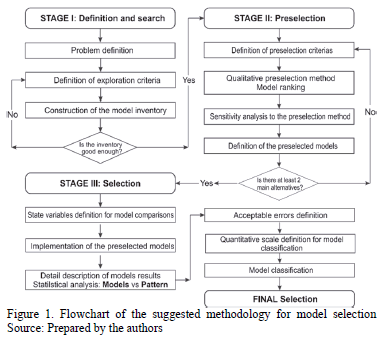
<body><![CDATA[<p><font size="2" face="Verdana, Arial, Helvetica, sans-serif">Moreover, the application of hydrodynamic   models with one, two, or three dimensions to study the mass transport &#91;1&#93;,   temperature &#91;2&#93; and salinity variations -in addition to the velocity and   circulation patterns &#91;3&#93; in different water bodies and geographic locations-   has increased over recent years. However, in many cases the choice of the model   to be used for a specific application is not clear, given the number of options   available in the market. This makes the selection of the proper model (tool) a   topic that needs to be carefully analyzed &#91;4&#93;. Selection of the proper model   for a given application is neither simple nor straightforward since there are   several factors involved in the process, such as the model accessibility   (public, restricted or commercial), the budget available to resolve the   problem, the personal involved, the available information to calibrate and   validate the model (field measurements of key variables such as temperature,   salinity, speed, current, etc.), and the time required to solve the problem.</font></p>     <p><font size="2" face="Verdana, Arial, Helvetica, sans-serif">As such, several authors have presented   their views on the selection of a hydrodynamic model, considering topics such   as the cost-complexity and the spatial and temporal dimension that are closely   related to the phenomenon &#91;5&#93;. However, there is no systematic method that   helps the user to make a good selection of a hydrodynamic model. </font></p>     <p><font size="2" face="Verdana, Arial, Helvetica, sans-serif">This article presents a methodology to   perform a guided selection of a hydrodynamic model, based on qualitative   criteria (multi-objective analysis) and quantitative tools (statistical   analysis of model results). To illustrate the methodology, the spatial variability   of the tropical reservoir Riogrande II's thermal structure, during a dry   season, was defined as the case study.</font></p>     <p>&nbsp;</p>     <p><font size="3" face="Verdana, Arial, Helvetica, sans-serif"><b>2. Suggested methodology for model selection</b></font></p>     <p><font size="2" face="Verdana, Arial, Helvetica, sans-serif">The suggested methodology considers three   stages, the first two being of a descriptive and qualitative nature, while the   third is quantitative. <a href="#fig01">Fig. 1</a> shows a flowchart, which is discussed in the   following sections.</font></p>     <p align="center"><font size="2" face="Verdana, Arial, Helvetica, sans-serif"><a name="fig01"></a></font><img src="/img/revistas/dyna/v83n198/v83n198a19fig01.gif"></p>     <p><font size="2" face="Verdana, Arial, Helvetica, sans-serif"><b><i>2.1. Stage I: Problem definition   and search for models</i></b></font></p>     <p><font size="2" face="Verdana, Arial, Helvetica, sans-serif">During the first stage, the physical   problem to be studied must be clearly defined (<i>process definition</i>) in a mathematical sense by writing the   equations (usually conservation laws) that describe the phenomenon under   consideration. Then, some <i>exploration   criteria</i> are defined and a <i>model   inventory</i> should be made that must account for the state of the art of   available models. Based on the knowledge gained during this search process, the   model user defines if the inventory is robust or not. If it is, the model   selection process continues to the next stage, if not, the decision maker will   reappraise the exploration criteria and start a new search.</font></p>     <p><font size="2" face="Verdana, Arial, Helvetica, sans-serif"><b><i>2.2. Stage II: Model preselection</i></b></font></p>     ]]></body>
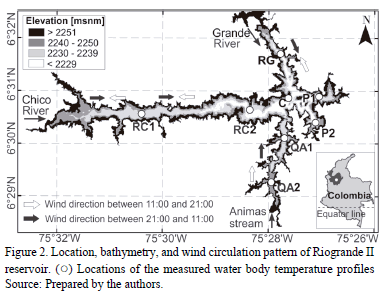
<body><![CDATA[<p><font size="2" face="Verdana, Arial, Helvetica, sans-serif">In the second stage, it is necessary to   define <i>preselection criteria </i>that are   more restrictive than those used in the previous stage, and that will be later   used to rank the pre-selected models through the implementation of a   multi-purpose analysis &#91;6&#93;. Next, it is necessary to perform a <i>sensitivity analysis</i> for the selected   multipurpose analysis method in order to assess whether the obtained solution   (rank) is robust. If so, a threshold for the number of numerical models to be   used in the next stage is defined and the process continues. Otherwise, the   preselection criteria should be reevaluated in order to achieve the previously   defined threshold.</font></p>     <p><font size="2" face="Verdana, Arial, Helvetica, sans-serif"><b><i>2.3. Stage III: Model selection</i></b></font></p>     <p><font size="2" face="Verdana, Arial, Helvetica, sans-serif">This is the quantitative stage of the   suggested methodology and it requires the numerical models that passed the   previous stages to be implemented. In this final stage, it is necessary to   clearly define the process control variables and select those that are going to   be used to compare the results. To perform this stage, a threshold for the   model errors (with respect to a pattern that can be another model or a series   of field measurements) is defined, and the model's performance is evaluated by   using a statistical tool such as the Mean Square Error (MSE), the Root Square   Mean Error (RMSE), or the index of agreement (d<sub>1</sub>). Each model's   performance is quantified according to a pre-defined scale to rank it and to   take the decision as to whether a model is selected.</font></p>     <p>&nbsp;</p>     <p><font size="3" face="Verdana, Arial, Helvetica, sans-serif"><b>3. Methods and application </b></font></p>     <p><font size="2" face="Verdana, Arial, Helvetica, sans-serif"><b><i>3.1. Case of study: Riogrande II   tropical reservoir</i></b></font></p>     <p><font size="2" face="Verdana, Arial, Helvetica, sans-serif">The Riogrande II reservoir is a   multi-purpose (water and energy supply) reservoir located north of Medell&iacute;n,   Colombia, and is located between the coordinates 75°32'W and 75°26'W and 6°33'N   and 6°28'N (<a href="#fig02">Fig. 2</a>). The main </font><font size="2" face="Verdana, Arial, Helvetica, sans-serif">tributaries are the Chico River (Q<sub>mean </sub>=   5m<sup>3</sup>/s) to the east, the Grande River (Q<sub>mean</sub> = 15m<sup>3</sup>/s)   to the north and the Las Animas stream that has a negligible discharge to the   south. The maximum water depth is 42.5m near the dam (near point P1 in <a href="#fig02">Fig. 2</a>),   and the water storage volume is 240Mm<sup>3 </sup>at 2270 m.a.s.l.&#91;7&#93;.   The intake to the hydroelectric plant and to the water supply plant is located   at point QA2 in <a href="#fig02">Fig. 2</a>.</font></p>     <p align="center"><font size="2" face="Verdana, Arial, Helvetica, sans-serif"><a name="fig02"></a></font><img src="/img/revistas/dyna/v83n198/v83n198a19fig02.gif"></p>     <p><font size="2" face="Verdana, Arial, Helvetica, sans-serif">This   three-branch canyon valley reservoir, which according to &#91;8&#93; and &#91;9&#93;, has a   spatial and temporal variable wind field with a daily cycle (shown in <a href="#fig02">Fig. 2</a>.   This includes a space and time variable wind field in the numerical models,   which is important because it is an internal wave generator that interacts with   the river plumes and generates fast vertical mixing &#91;10&#93;.</font></p>     <p><font size="2" face="Verdana, Arial, Helvetica, sans-serif">Numerical simulations made by &#91;9&#93;, as   well as field measurements during different climatological seasons (rainy and   dry seasons), suggest that the Grande River water moves in the reservoir like   an intrusive plume from its entrance and then splits in the confluence (C in <a href="#fig02">Fig. 2</a>) into two branches. One travels upstream along the Chico River branch,   which affects its plume dynamics, and the second travels south to the intake   (QA2 in <a href="#fig02">Fig. 2</a>). The dynamics of these two plumes are mainly affected by the   climatological seasons and the river´s water temperature &#91;9&#93;. </font></p>     ]]></body>
<body><![CDATA[<p><font size="2" face="Verdana, Arial, Helvetica, sans-serif"><b><i>3.2. Field Measurements for model calibration and validation</i></b></font></p>     <p><font size="2" face="Verdana, Arial, Helvetica, sans-serif">In order to facilitate the analysis of   the model's results, the reservoir was divided into five zones with similar   physical behavior that was based on the following field measurements:</font></p> <ul>       <li><font size="2" face="Verdana, Arial, Helvetica, sans-serif">Zone 1: ChicoRiver Branch (RC1     y RC2)</font></li>       <li><font size="2" face="Verdana, Arial, Helvetica, sans-serif">Zone 2: Confluence (C)</font></li>       <li><font size="2" face="Verdana, Arial, Helvetica, sans-serif">Zone 3: Grande River Branch     (RG)</font></li>       <li><font size="2" face="Verdana, Arial, Helvetica, sans-serif">Zone 4:     Las Animas stream (QA1 y QA2)</font></li>       <li><font size="2" face="Verdana, Arial, Helvetica, sans-serif">Zone 5:     Dam (P1 y P2)</font></li>     </ul>     <p><font size="2" face="Verdana, Arial, Helvetica, sans-serif">In order to compare the different models'   behavior that passed the second stage of the methodology the models' results   were compared to those obtained from a field campaign undertaken between March   23<sup>rd</sup> and 27<sup>th</sup>, 2010. These data are described in the   following paragraphs.</font></p>     <p><font size="2" face="Verdana, Arial, Helvetica, sans-serif"><i>3.2.1. Field Measurements</i></font></p>     ]]></body>
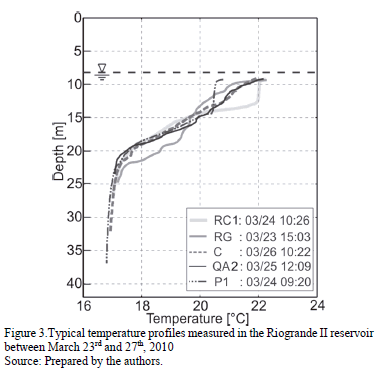
<body><![CDATA[<p><font size="2" face="Verdana, Arial, Helvetica, sans-serif">Temperature profiles were measured   between March 23<sup>rd</sup> and 27<sup>th</sup>, 2010 in the control stations   shown in <a href="#fig02">Fig. 2</a>. <a href="#fig03">Fig. 3</a> shows their typical behavior. The records of the   reservoir level were used to assess the mass balance of the system that was   reproduced by the implemented models.</font></p>     <p align="center"><font size="2" face="Verdana, Arial, Helvetica, sans-serif"><a name="fig03"></a></font><img src="/img/revistas/dyna/v83n198/v83n198a19fig03.gif"></p>     <p><font size="2" face="Verdana, Arial, Helvetica, sans-serif">Previous   reservoir simulations &#91;9&#93; indicate that the temperature profiles in station RG   are influenced by the Grande River. They consider that there is no well-defined   mixing zone such as that shown in RC1 or P1 profiles (<a href="#fig03">Fig. 3</a>). </font></p>     <p><font size="2" face="Verdana, Arial, Helvetica, sans-serif">In the case of the QA2 profile, despite   the selective withdrawal influence &#91;8&#93;, it is possible that the reservoir   shallowness in this area and the Grande River movement from its mouth to the   intake introduce a mixing condition that reduces the temperature gradients. It   shows a temperature profile similar to that in the RG station. In both cases,   further research and field data are required to evaluate and analyze movement   of the plumes and their influence on the reservoir's temperature conditions.   Further analysis is also necessary to explain the hydraulic control produced by   the Grande River on the Chico River branch. This analysis is outside the scope   of this article.</font></p>     <p><font size="2" face="Verdana, Arial, Helvetica, sans-serif"><i>3.2.2. The selection of a pattern for   comparison</i></font></p>     <p><font size="2" face="Verdana, Arial, Helvetica, sans-serif">Those models that passed the two   qualitative stages of the methodology will be implemented for this case study.   In order to quantify their behavior, their simulated temperature profiles will   be compared at selected points and zones of the reservoir using measurements   and a reference model (in the methodology a comparison with a pattern,   measurements, or another calibrated and validated model, is required). In our   case study, results from a calibrated and validated model &#91;9&#93; were chosen to   take advantage of the high space and time resolution obtained from the model.   This was not available from the measurements. The reference model selected was   ELCOM &#91;11&#93;, developed by the University of Western Australia, which was   calibrated for the field campaign during March 23<sup>rd</sup> to 27<sup>th</sup>,   2010. ELCOM is a model that has been developed and progressively improved to   capture the temperature gradients and the thermal structure in estuaries, lakes   and reservoirs. ELCOM incorporates a special mixing model to account for the   stratification processes &#91;12&#93;, and, therefore, constitutes a reference for   other models that seek to represent the thermal stratification in lakes and   reservoirs.</font></p>     <p><font size="2" face="Verdana, Arial, Helvetica, sans-serif">ELCOM's results were used to extract time   series of temperature at the stations indicated in <a href="#fig02">Fig. 2</a>. Based on these time   series, the average depth of the mixing layer and the mean thermocline depth   was estimated using the methodology proposed by &#91;13&#93;. Additionally, the average   temperature of the mixed layer was calculated once the average depth of the   mixed layer had been derived. These three variables will be used to test the   models' behavior.</font></p>     <p><font size="2" face="Verdana, Arial, Helvetica, sans-serif"><b><i>3.3. Multi-purpose analysis   methods</i></b></font></p>     <p><font size="2" face="Verdana, Arial, Helvetica, sans-serif">The implementation of the suggested   methodology requires, during the qualitative stages, the use of a multicriteria   analysis method to quickly reduce the potentially suitable models' alternatives   for this case study. In this project, the ELECTRE IV &#91;14&#93; method was used,   because unlike other multicriteria techniques, such as the PROMETHE method &#91;15&#93;   or AHP &#91;16&#93;, ELECTRE IV does not use weights to perform the classification   process. Instead, a table of metrics is used to define the values for each   evaluation criteria, and every alternative forms an <i>impact matrix</i>. Two types of sorting are then performed: <i>ascending </i>and <i>descending</i>. Tie breaker rules are applied to finally rank the   alternatives &#91;6&#93;.</font></p>     <p><font size="2" face="Verdana, Arial, Helvetica, sans-serif"><b><i>3.4. Statistical tools used for   model behavior evaluation </i></b></font></p>     ]]></body>
<body><![CDATA[<p><font size="2" face="Verdana, Arial, Helvetica, sans-serif">Several techniques for quantitative   evaluation of a model's behavior have been widely explored in atmospheric   sciences &#91;17&#93;. Their adaptations to the coastal engineering, undertaken by &#91;18&#93;   and &#91;19&#93;, are the most important contributions to the numerical model behavior   analysis. However, the introduction of the <i>index   of agreement,</i> undertaken by &#91;20&#93;, is a useful tool to compare and analyze   the model results. The statistical parameters used in this paper for the model   performance evaluation are presented below.</font></p>     <p><font size="2" face="Verdana, Arial, Helvetica, sans-serif">The most used statistical parameter in   model behavior analysis is the Root Mean Square Error (RMSE), given by equation   (1) as: </font></p>     <p><img src="/img/revistas/dyna/v83n198/v83n198a19eq01.gif"></p>     <p><font size="2" face="Verdana, Arial, Helvetica, sans-serif">where <i>y<sub>i</sub></i> are the reference values, <i>x<sub>i </sub></i>are   the model predictions, and <i>N</i> is the   number of data of the time series used in the comparison. </font></p>     <p><font size="2" face="Verdana, Arial, Helvetica, sans-serif">A robust measurement of the prediction's   precision is the Mean Absolute Error (MAE) because it is not influenced by the   time series' extreme values &#91;21&#93;: </font></p>     <p><img src="/img/revistas/dyna/v83n198/v83n198a19eq02.gif"></p>     <p><font size="2" face="Verdana, Arial, Helvetica, sans-serif">A third and fourth statistical parameter   used in the study are the indexes of agreement d<sub>1</sub> and d<sub>2,</sub> suggested by &#91;20,21&#93; for <font face="Symbol">g</font> = 1 y 2, respectively:</font></p>     <p><img src="/img/revistas/dyna/v83n198/v83n198a19eq03.gif"></p>     <p><font size="2" face="Verdana, Arial, Helvetica, sans-serif">As is the case for the RMSE, the d<sub>2</sub> index is highly influenced by the differences squared when they are large. For   this reason, in this paper, only the d<sub>1</sub> index was used to evaluate   the models results.</font></p>     <p>&nbsp;</p>     ]]></body>

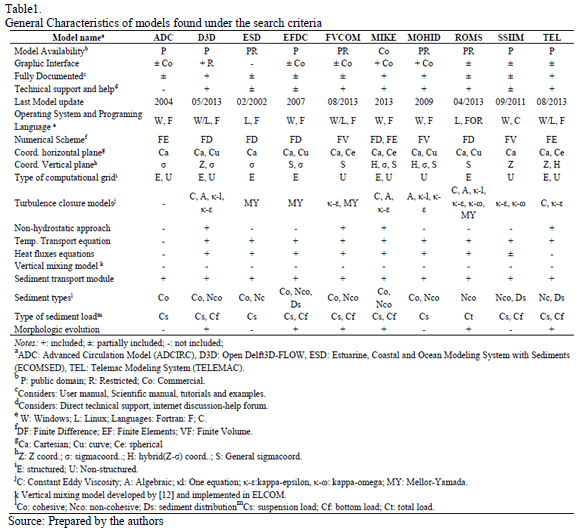
<body><![CDATA[<p><font size="3" face="Verdana, Arial, Helvetica, sans-serif"><b>4. Suggested methodology step by   step</b></font></p>     <p><font size="2" face="Verdana, Arial, Helvetica, sans-serif"><b><i>4.1. Stage I </i></b></font></p>     <p><font size="2" face="Verdana, Arial, Helvetica, sans-serif">The problem under study is the space variation   of the Riogrande II reservoir's thermal structure that is under the influence   of the wind field during the dry climatological season. The time window to   compare the models is between March 23<sup>rd</sup> and March 27<sup>th</sup>,   2010.</font></p>     <p><font size="2" face="Verdana, Arial, Helvetica, sans-serif">The search criteria to obtain the list of   potential models to be used to study the stated problem are:</font></p>     <p><font size="2" face="Verdana, Arial, Helvetica, sans-serif"><i>A   Three Dimensional Hydrodynamic Model. </i>The   interaction that takes place between the different physical processes in a   reservoir, such as the time-space variation of the water body temperature under   the force of a variable wind field and the dynamics of the river plumes and   their interaction makes it necessary to use a 3D hydrodynamic model to   correctly approach the stated problem. This makes 1D and 2D models unsuitable.   Additionally, the model should have implemented heat fluxes equations with the   atmosphere and heat transport in the water body. The turbulent flow of the   river plumes in their mixing layer requires an appropriate turbulence closure   scheme. A long inventory list of numerical models analyzed in this stage is   presented in <a href="#tab01">Table 1</a>. </font></p>     <p align="center"><font size="2" face="Verdana, Arial, Helvetica, sans-serif"><a name="tab01"></a></font><img src="/img/revistas/dyna/v83n198/v83n198a19tab01.gif"></p>     <p><font size="2" face="Verdana, Arial, Helvetica, sans-serif"><i>Sediment   transport module: </i>This module was considered   because, for future work, this will be a research field. However, no models   with sediment transport were implemented in this study and only the hydrodynamics   were considered.</font></p>     <p><font size="2" face="Verdana, Arial, Helvetica, sans-serif"><b><i>4.2. Stage II: Pre-selection </i></b></font></p>     <p><font size="2" face="Verdana, Arial, Helvetica, sans-serif">For this stage, the selection criteria   were grouped into three categories:</font></p>     <p><font size="2" face="Verdana, Arial, Helvetica, sans-serif"><i>General: </i>Including global characteristics. In this   application the following were considered:</font></p> <ul>       ]]></body>
<body><![CDATA[<li><font size="2" face="Verdana, Arial, Helvetica, sans-serif">Availability </font></li>       <li><font size="2" face="Verdana, Arial, Helvetica, sans-serif">Graphical user interface </font></li>       <li><font size="2" face="Verdana, Arial, Helvetica, sans-serif">Documentation </font></li>       <li><font size="2" face="Verdana, Arial, Helvetica, sans-serif">Technical support</font></li>     </ul>     <p><font size="2" face="Verdana, Arial, Helvetica, sans-serif"><i>Flexibility: </i>Configuration options available for the user to   properly represent the specific conditions of the phenomenon being considered   as well as the representation of the computational domain. In this application,   the following were considered:</font></p> <ul>       <li><font size="2" face="Verdana, Arial, Helvetica, sans-serif">Domain horizontal     discretization </font></li>       <li><font size="2" face="Verdana, Arial, Helvetica, sans-serif">Domain Vertical     discretization </font></li>       <li><font size="2" face="Verdana, Arial, Helvetica, sans-serif">Turbulence closure schemes </font></li>       <li><font size="2" face="Verdana, Arial, Helvetica, sans-serif">Non-hydrostatic module </font></li>     ]]></body>
<body><![CDATA[</ul>     <p><font size="2" face="Verdana, Arial, Helvetica, sans-serif"><i>Heat   fluxes: </i>Given the influence these fluxes have on   the lake or reservoir's thermal structure, the following were considered: </font></p> <ul>       <li><font size="2" face="Verdana, Arial, Helvetica, sans-serif">Formulae to estimate the latent     and sensible heat fluxes </font></li>       <li><font size="2" face="Verdana, Arial, Helvetica, sans-serif">Transport equation for     temperature</font></li>       <li><font size="2" face="Verdana, Arial, Helvetica, sans-serif">Vertical mixing model </font></li>     </ul>     <p><font size="2" face="Verdana, Arial, Helvetica, sans-serif"><i>Sediment   Transport:</i> This characteristic of the numerical   model was considered as an option for future work because the sediment   transport process requires a very well defined flow field. The following   criteria were considered for the qualitative classification: </font></p> <ul>       <li><font size="2" face="Verdana, Arial, Helvetica, sans-serif">Type of sediment transport     process </font></li>       <li><font size="2" face="Verdana, Arial, Helvetica, sans-serif">Type of sediments </font></li>       <li><font size="2" face="Verdana, Arial, Helvetica, sans-serif">Bottom morphology evolution </font></li>     ]]></body>
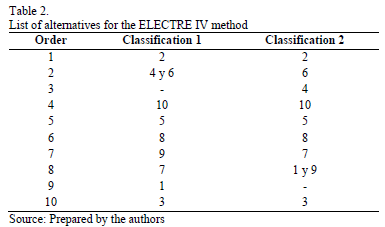
<body><![CDATA[</ul>     <p><font size="2" face="Verdana, Arial, Helvetica, sans-serif"><i>4.2.1. ELECTRE IV method</i></font></p>     <p><font size="2" face="Verdana, Arial, Helvetica, sans-serif">Once the pre-selection criteria have been   defined, the implementation of the ELECTRE IV method follows. To do this, two   valuation scales (metrics) were used for the criteria analysis: one with   integer numbers between 1 and 10 and a second one with odd numbers between 1   and 9. Using these two metrics, an <i>impact   matrix</i> is built with all previously selected criteria. Then, following   &#91;14&#93;, the <i>reference relationships</i> were   estimated by comparing the different alternatives, in groups of two, for each   selection criteria. The values that were estimated for the impact matrix and   following the preference rules are defined as follows: </font></p> <ul>       <li><font size="2" face="Verdana, Arial, Helvetica, sans-serif"><i>Over Relaxed classification</i>: alternative <i>i <b>OverRelaxed     Classifies</b></i> alternative <i>j</i> if     the number of criteria for which alternative <i>i</i> is preferred over alternative <i>j</i> is at least twice the number of criteria alternative <i>j</i> is preferred over alternative <i>i</i>.</font></li>       <li><font size="2" face="Verdana, Arial, Helvetica, sans-serif"><i>Weak Relaxed classification</i>: alternative <i>i<b>Weakly     Relaxed Classifies</b></i> alternative <i>j</i> if there is at least one criteria by which alternative <i>i</i> is strictly preferred over alternative <i>j</i> and there is no criteria by which alternative <i>j</i> is strictly preferred over alternative <i>i. </i>Also, there is the additional     condition that the <i>Strong Over     Classification</i> is not satisfied.</font></li>       <li><font size="2" face="Verdana, Arial, Helvetica, sans-serif"><i>Strong Classification: </i>Alternative <i>i </i>is <b>Strongly Classified</b> over alternative <i>j</i> if there is at least one criteria by which alternative <i>i</i> is strictly preferred over alternative <i>j</i> and there is not a criteria by     which alternative <i>j</i> is strictly     preferred over alternative <i>i</i>. Also,     if the number of criteria by which alternative <i>j</i> is weakly preferred over alternative <i>i</i> is smaller or equal to the number of criteria by which alternative <i>i</i> is preferred (strictly or weakly)     over alternative <i>j</i>. </font></li>     </ul>     <p><font size="2" face="Verdana, Arial, Helvetica, sans-serif">Finally,   based on the classifications just defined for each alternative, two lists of   alternatives, organized in ascending and descending order are prepared. The   final ordered list of alternatives is obtained as the intersection of these two   previous lists.</font></p>     <p><font size="2" face="Verdana, Arial, Helvetica, sans-serif"><a href="#tab02">Table   2</a> shows the final ordered list obtained by following the previously described   methodology and for each one of the two previously mentioned evaluation   metrics. The numbers appearing in the columns Classification 1 and   Classification 2 refer to the model number used in the inventory table (<a href="#tab01">Table   1</a>): alternative 1 refers to the ADCIRC model and alternative 10 refers to the   TELEMAC 3D model. </font></p>     <p align="center"><font size="2" face="Verdana, Arial, Helvetica, sans-serif"><a name="tab02"></a></font><img src="/img/revistas/dyna/v83n198/v83n198a19tab02.gif"></p>     ]]></body>
<body><![CDATA[<p><font size="2" face="Verdana, Arial, Helvetica, sans-serif">The   ELECTRE IV method shows that the DELFT 3D model is the dominant alternative   because both classifications placed it in first position on the list. The MIKE   3 and the EFCD 3D models in Classification 1 shared the second position, but in   Classification 2, the MIKE3 model only appears in the second position. For this   reason, the MIKE3 model was finally classified in the second position. Based on   these results, models DELFT 3D and MIKE 3 are chosen for the next stage in the   methodology.</font></p>     <p><font size="2" face="Verdana, Arial, Helvetica, sans-serif"><b><i>4.3. Stage III: Selection </i></b></font></p>     <p><font size="2" face="Verdana, Arial, Helvetica, sans-serif"><i>4.3.1. Variables used for comparison</i></font></p>     <p><font size="2" face="Verdana, Arial, Helvetica, sans-serif">Based   on the field measurements and on the time series obtained from the reference   model (ELCOM), the variables used to evaluate the behavior of the preselected   models are: </font></p> <ul>       <li><font size="2" face="Verdana, Arial, Helvetica, sans-serif">Temperature profiles</font></li>       <li><font size="2" face="Verdana, Arial, Helvetica, sans-serif">Water level variations in the     reservoir </font></li>       <li><font size="2" face="Verdana, Arial, Helvetica, sans-serif">Mean depth of the mixing layer</font></li>       <li><font size="2" face="Verdana, Arial, Helvetica, sans-serif">Mean Temperature of the mixing     layer </font></li>       <li><font size="2" face="Verdana, Arial, Helvetica, sans-serif">Mean depth of the thermocline</font></li>     </ul>     ]]></body>
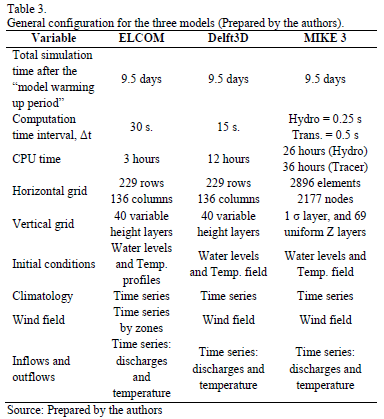
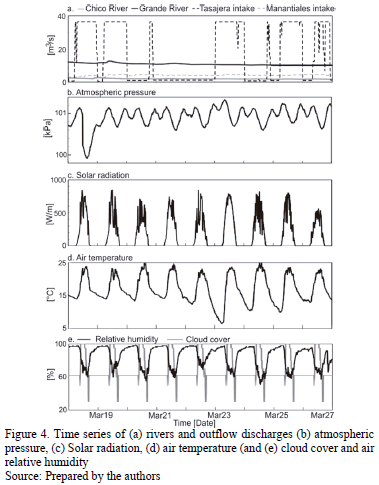
<body><![CDATA[<p><font size="2" face="Verdana, Arial, Helvetica, sans-serif">It is very   important that the list of models selected for this stage captures some of the   most relevant components of the physical process under study. In this case, the   thermal structure of the water body, under the influence of two forcing factors   such as the wind field and the river plumes, is well represented by the   above-mentioned variables. The depth of the mixing layer and that of the   thermocline are important variables because they are a key part of the possible   internal waves' appearance in the reservoir &#91;23&#93; as well as being important for   its ecological evolution. The mean temperature of the mixing layer is important   because it is in this zone that the energy exchange between the water body and   the atmosphere occurs &#91;12&#93;.</font></p>     <p><font size="2" face="Verdana, Arial, Helvetica, sans-serif"><i>4.3.2. Implementation of the   pre-selected models. </i></font></p>     <p><font size="2" face="Verdana, Arial, Helvetica, sans-serif">DELFT3D is a   3D hydrodynamic model whose governing equations are solved numerically by the   Finite Difference technique. The model has been used to simulate flow   circulation patterns, heat transport, water quality and bottom morphology under   several forcing factors such as wind field and tidal waves with a wide field of   applications in coastal zones and estuaries &#91;24&#93;. Since 2010, DELFT3D has been   an open code for the hydrodynamic (FLOW), Morphodynamic (MOR), and waves (WAVE)   modules. In the year 2013, the water quality module (DELWAQ) was released as an   open code. In our application, graphic interphase version 4.00.02 and code   5.00.10.2136 of January 22<sup>nd</sup>, 2013 were used for the model   implementation of the Riogrande II reservoir.</font></p>     <p><font size="2" face="Verdana, Arial, Helvetica, sans-serif">MIKE3 is the   3D version of the MIKE 21 model developed by the Danish Hydraulic Institute   (DHI). It has been widely used in coastal and estuarine applications. The model   includes several modules coupled to a graphic interphase. To simulate the   thermal structure of the Riogrande II reservoir, the 2012 flexible grid version   was used. This version uses the non-structured grid with a finite element   discretization in the horizontal plane and a hybrid <font face="Symbol">s</font> - Z coordinate   discretization in the vertical plane &#91;25&#93;.</font></p>     <p><font size="2" face="Verdana, Arial, Helvetica, sans-serif">Both models   were implemented following the reference model (ELCOM) as closely as possible.   The reference model was included in this analysis (selection) because it was   fully calibrated and validated with field measurements and will be used to   generate data not directly available from the measurements. <a href="#tab03">Table 3</a> shows the   general configuration for these three models, in which some differences in the   time interval are clear; these are differences due to space discretization. <a href="#fig04">Fig. 4</a> shows the river discharges and outflows from the reservoir and the   atmospheric forcing factors used for all the three models.</font></p>     <p align="center"><font size="2" face="Verdana, Arial, Helvetica, sans-serif"><a name="tab03"></a></font><img src="/img/revistas/dyna/v83n198/v83n198a19tab03.gif"></p>     <p align="center"><font size="2" face="Verdana, Arial, Helvetica, sans-serif"><a name="fig04"></a></font><img src="/img/revistas/dyna/v83n198/v83n198a19fig04.gif"></p>     <p><font size="2" face="Verdana, Arial, Helvetica, sans-serif"><i>4.3.3. Model results and behavior   analysis of the models</i></font></p>     <p><font size="2" face="Verdana, Arial, Helvetica, sans-serif"><b>Error limits </b></font></p>     <p><font size="2" face="Verdana, Arial, Helvetica, sans-serif">Temperature   profiles shown in <a href="#fig03">Fig. 3</a>, typical for tropical zones, differ from those for   extra tropical regions. In extra</font> <font size="2" face="Verdana, Arial, Helvetica, sans-serif">tropical reservoirs typical temperature   differences between the surface and bottom of the reservoir may reach values of   20&deg;C &#91;26&#93; with an error of 10% (2&deg;C), which may be reasonable for simulated   results. In tropical reservoirs and lakes, the vertical temperature gradients (<a href="#fig03">Figure 3</a>) are much milder than those in extra tropical   zones and there are temperature differences between the surface and the bottom   in the order of 5&deg;C or 6&deg;C all year long, with a daily cycle. This makes the   value of 2&deg;C a very high tolerance error for these cases. By keeping the 10%   value for the tolerance error, an equivalent of &plusmn; 0.5&deg;C was used in this   work as an acceptable limit for the RMSE and MAE errors. </font></p>     ]]></body>
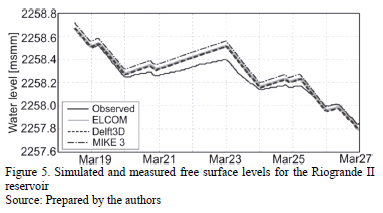
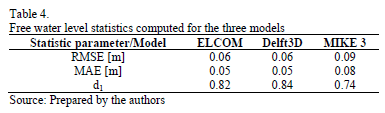
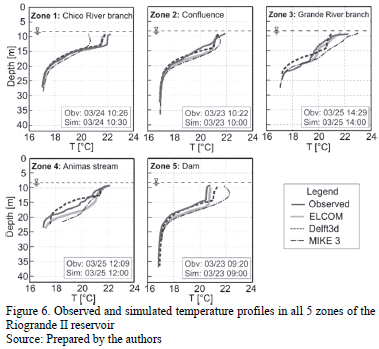
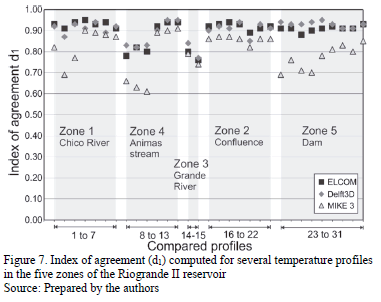
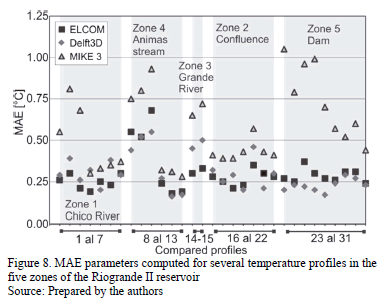
<body><![CDATA[<p><font size="2" face="Verdana, Arial, Helvetica, sans-serif"><b>Reservoir free Surface level</b></font></p>     <p><font size="2" face="Verdana, Arial, Helvetica, sans-serif">Measured and simulated free surface water   levels are shown in <a href="#fig05">Fig. 5</a>. It is clear from the figure that all three models   closely follow the measured tendency. The differences found between the   measured simulated values, a maximum of 20 cm for March 23<sup>rd</sup>, are   due to deficiencies in the measured inflows and outflows time series. </font></p>     <p align="center"><font size="2" face="Verdana, Arial, Helvetica, sans-serif"><a name="fig05"></a></font><img src="/img/revistas/dyna/v83n198/v83n198a19fig05.gif"></p>     <p><font size="2" face="Verdana, Arial, Helvetica, sans-serif">The corresponding MAE and RMSE values,   that are close to zero (<a href="#tab04">Table 4</a>), indicate the good agreement with   measurements. Although, the very similar values obtained for all three models   do not allow us to draw any conclusion about which models have a better   behavior with respect to this variable. The same behavior can be noticed for   the index of agreement, d<sub>1</sub>; although, MIKE3 is the one that behaves   the poorest. This variable is not good enough for model classification because,   as will be shown later, major differences in the parameters are found for the   models: differences that are not important for this variable (all models   sufficiently capture the free surface water level).</font></p>     <p align="center"><font size="2" face="Verdana, Arial, Helvetica, sans-serif"><a name="tab04"></a></font><img src="/img/revistas/dyna/v83n198/v83n198a19tab04.gif"></p>     <p><font size="2" face="Verdana, Arial, Helvetica, sans-serif"><b>Temperature Profiles</b></font></p>     <p><font size="2" face="Verdana, Arial, Helvetica, sans-serif">A comparison between simulated and   measured temperature profiles is shown in <a href="#fig06">Fig. 6</a>, in which the profiles   correspond to those showing the maximum difference between the simulated and   computed ones. In zone 1, ELCOM and DELFT3D closely follow the measured   profile for which corresponding values for d<sub>1</sub> of 0.93 and 0.91 were   found with MAE corresponding values of 0.25°C and</font> <font size="2" face="Verdana, Arial, Helvetica, sans-serif">0.30&deg;C. MIKE3 is   less precise: in the hypolimnium, the model closely follows the measurements,   but as the free water surface is approached the model departs from measurements   and even shows an unstable profile. This behavior leads to a d<sub>1</sub> value of 0.83 and an MAE value of 0.48&deg;C (see <a href="#fig07">Fig. 7</a> and <a href="#fig08">Fig. 8</a> for more   details).</font></p>     <p align="center"><font size="2" face="Verdana, Arial, Helvetica, sans-serif"><a name="fig06"></a></font><img src="/img/revistas/dyna/v83n198/v83n198a19fig06.gif"></p>     <p align="center"><font size="2" face="Verdana, Arial, Helvetica, sans-serif"><a name="fig07"></a></font><img src="/img/revistas/dyna/v83n198/v83n198a19fig07.gif"></p>     <p align="center"><font size="2" face="Verdana, Arial, Helvetica, sans-serif"><a name="fig08"></a></font><img src="/img/revistas/dyna/v83n198/v83n198a19fig08.gif"></p>     ]]></body>
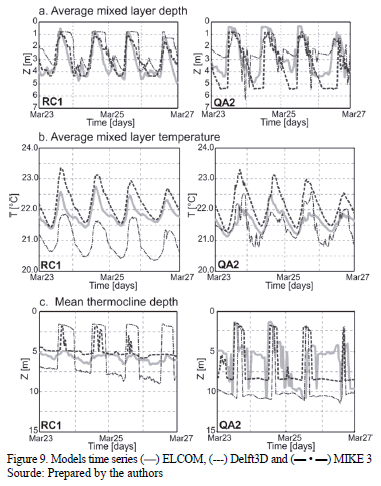
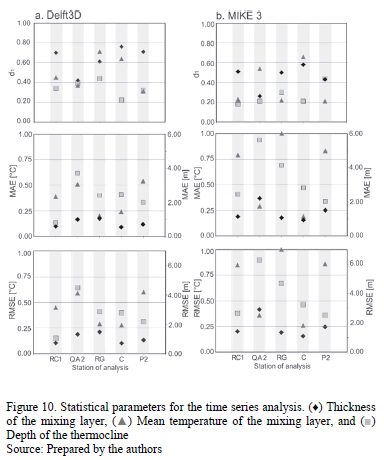
<body><![CDATA[<p><font size="2" face="Verdana, Arial, Helvetica, sans-serif">In zone 2, measurements do not show the   near surface mixing layer (Fi. 6), which generates a constant temperature   vertical gradient that is not sufficiently captured by any model. It instead   shows a mixing layer that is about 5m deep. In this zone, ELCOM and DELFT3D   produce a d<sub>1</sub> value higher than 0.9 and RMSE values that are smaller   than 0.5°C (<a href="#fig09">Fig. 9</a>). MIKE3 shows a value of 0.86 for d<sub>1</sub> and a value   of 0.61°C for RMSE. </font></p>     <p align="center"><font size="2" face="Verdana, Arial, Helvetica, sans-serif"><a name="fig09"></a></font><img src="/img/revistas/dyna/v83n198/v83n198a19fig09.gif"></p>     <p><font size="2" face="Verdana, Arial, Helvetica, sans-serif">In zone 3,   near the entrance of Grande River, the absence of the surface mixing layer is   clear (<a href="#fig06">Fig. 6</a>) and there is a constant temperature vertical gradient. The   vertical mixing produced at the river's entrance is responsible for these types   of profiles in addition to the wind action in the shallow parts of the   reservoir. Values of the index of agreement are presented in <a href="#fig07">Fig. 7</a>, and it is   seen that MIKE3 has the smallest values for several profiles in the zone.   Analyzing the MAE and RMSE parameters (<a href="#fig08">Figs. 8</a> and <a href="#fig09">9</a>), once again MIKE3 has   poorer behavior with respect to ELCOM and DELFT3D. Similar behavior is noticed   in zone 4 where the effect of the hydro-plant intake is relevant.</font></p>     <p><font size="2" face="Verdana, Arial, Helvetica, sans-serif">Finally, in zone 5, ELCOM and DELFT3D   behave in a similar way to in zone 1, with values close to unity for the index   of agreement (<a href="#fig07">Fig. 7</a>) and values for the MAE and RMSE that are close to zero   (<a href="#fig08">Figs. 8</a> and <a href="#fig09">9</a>). In this zone, MIKE3 also has a poorer behavior than the other   two models.</font></p>     <p><font size="2" face="Verdana, Arial, Helvetica, sans-serif">These   results suggest that the MAE parameter shows better behavioral models. For   example, in zone 3 the index of agreement indicates that all three models have   poor behavior without being able to differentiate the best one (<a href="#fig08">Fig. 8</a>). The   RMSE parameter, on the other hand, demonstrates the better behavior of the   ELCOM models, but it is unable to show the differences between DELFT3D and   MIKE3. The MAE parameter, however, did show the difference between the three   models. </font></p>     <p><font size="2" face="Verdana, Arial, Helvetica, sans-serif"><b>Time series</b></font></p>     <p><font size="2" face="Verdana, Arial, Helvetica, sans-serif">Three variables of physical interest for   the thermal structure of the reservoir are selected for analysis: the thickness   of the mixing layer, the mean temperature of this layer, and the depth of the   thermocline &#91;13&#93;. The time series of these variables are shown in <a href="#fig09">Fig. 9</a> for   monitoring stations RC1 and QA2. </font></p>     <p><font size="2" face="Verdana, Arial, Helvetica, sans-serif">The thickness of the mixing layer at RC1   (<a href="#fig10">Fig. 10a</a>) is captured by DELFT3D and MIKE3 for the four-day computed period.   DELFT3D closely follows the reference model (ELCOM) in both the shape of the   series and in the maximum and minimum values. MIKE3, on the other hand,   captured the peaks but the shape of the time series looks different from that   of the reference model. It showed a constant peak for a period of six hours,   which is not in the reference time series. At QA2, both models show more   differences with the reference model, although DELFT3D seems to be closer to   it. The index of agreement computed for this variable and for several   monitoring points in the reservoir is shown in <a href="#fig08">Fig. 8</a>, in which it is clear   that DELFT3D better follows the reference model (higher d<sub>1</sub> values   than MIKE3).</font></p>     <p align="center"><font size="2" face="Verdana, Arial, Helvetica, sans-serif"><a name="fig10"></a></font><img src="/img/revistas/dyna/v83n198/v83n198a19fig10.gif"></p>     <p><font size="2" face="Verdana, Arial, Helvetica, sans-serif">Time series for the mean temperature of   the mixing layer for the monitoring points RC1 and QA2 are shown in <a href="#fig09">Fig. 9b</a>.   Mean temperature computed from both models monitoring station RC1 follow the   shape of the reference model, but the MIKE3 results are about 0.75°C cooler for   the reported period than the reference time series. The ones for DELFT3D are   about 0.5°C warmer than the reference time series. For monitoring station QA2,   DELFT3D continues with the same behavior, but the temperature difference is now   between 1.2°C and 0.5°C warmer. MIKE3 maintains the shape of the daily cycle   but is now sometimes warmer and sometimes cooler than the reference. The   statistical parameters (d<sub>1</sub>, MAE and RMSE) confirm that DELFT3D   behaves more similarly to the reference model than MIKE3 does. The behavior of   MIKE3 can be explained, with respect to this variable, due to the calibration   undertaken to the vertical dispersion coefficient (0.0025). This, for some   higher values, produced stable temperature profiles near the surface, resulting   in a thicker mixing layer and a deeper thermocline position. For smaller values   it generated unstable temperature profiles near the surface with cooler   temperature. </font></p>     ]]></body>
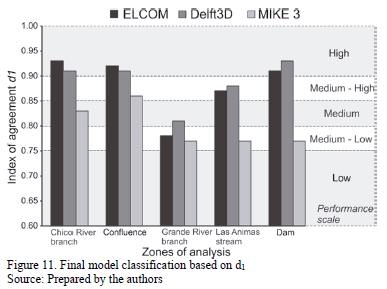
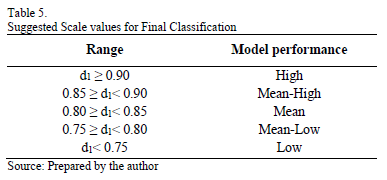
<body><![CDATA[<p><font size="2" face="Verdana, Arial, Helvetica, sans-serif">This behavior is reflected in the   statistical parameters in <a href="#fig11">Fig. 11</a>. The behavior of DELFT3D, generating warmer   mean temperatures for the mixing layer, may be related to the parametrization   for the heat fluxes included in the model as well as to the wind shear stress   on the surface, although a detailed study is needed to confirm this.</font></p>     <p align="center"><font size="2" face="Verdana, Arial, Helvetica, sans-serif"><a name="fig11"></a></font><img src="/img/revistas/dyna/v83n198/v83n198a19fig11.gif"></p>     <p><font size="2" face="Verdana, Arial, Helvetica, sans-serif">Finally, the analysis undertaken to the   thermocline depth shows large differences between the reference time series and   the computed ones in both monitoring stations (<a href="#fig10">Fig. 10c</a>). It confirms the   values of the statistical parameters computed for several stations   (<a href="#fig11">Fig. 11</a>). It is important to notice that the methodology the reference model,   ELCOM, has implemented a special mixing model differing from those implemented   in DELFT3D and MIKE3.</font></p>     <p><font size="2" face="Verdana, Arial, Helvetica, sans-serif"><i>4.3.4. Models classification and final   selection </i></font></p>     <p><font size="2" face="Verdana, Arial, Helvetica, sans-serif">ELCOM was taken as a reference model. The   results were used to generate temperature time series that are not available   from direct field measurements. This model was not considered for   classification purposes due to its proven capacity to simulate thermal   stratification and heat fluxes dynamics in lakes and estuaries &#91;23&#93;. It is also   widely used to simulate similar cases around the world &#91;27&#93;.</font></p>     <p><font size="2" face="Verdana, Arial, Helvetica, sans-serif">Based on the ranges defined by <a href="#tab05">Table 5</a>,   the models' performance were estimated for several points in the reservoir   zones defined in section 3. <a href="#fig11">Fig. 11</a> shows that DELFT3D performs better than   MIKE3, and its results are similar to ELCOM.</font></p>     <p align="center"><font size="2" face="Verdana, Arial, Helvetica, sans-serif"><a name="tab05"></a></font><img src="/img/revistas/dyna/v83n198/v83n198a19tab05.gif"></p>     <p>&nbsp;</p>     <p><font size="3" face="Verdana, Arial, Helvetica, sans-serif"><b>5. Discusion</b></font></p>     <p><font size="2" face="Verdana, Arial, Helvetica, sans-serif"><b>On the general methodology</b></font></p>     ]]></body>
<body><![CDATA[<p><font size="2" face="Verdana, Arial, Helvetica, sans-serif">The qualitative stages of the methodology   are a fundamental part of the selection process because, for practical reasons,   it is not possible to implement the long list of available models in the   literature. During these stages, it is possible to make a quick review of the   alternatives and create a long inventory of possible models that can be used   for future work. However, the subjective character of the methods used in these   stages may lead to a skewed decision by choosing a model that may not be the   best technical option.</font></p>     <p><font size="2" face="Verdana, Arial, Helvetica, sans-serif">This subjective character,   which is associated with the definition of the selection criteria and with the   implementation of the multi-purpose decision analysis, such as the ELECTRE IV   method, may be reduced by looking for methodologies that reduce the   subjectivity of the definition of the selection criteria and their evaluation   scales. One example is the AHP method &#91;16&#93;, which is a technique that involves   more than one decision maker and includes a panel of experts that participates   in the final decision. </font></p>     <p><font size="2" face="Verdana, Arial, Helvetica, sans-serif">Regarding the quantitative   stage of the methodology, the index of agreement for statistical parameters has   the advantage over the other two. This is because it is non-dimensional and can   be used in a general sense as well as being compared to other models in similar   cases. However, care must be taken when using it because it represents a result   in a statistical sense. This depends on the set of data used to make   comparisons and it is the modeler´s decision to use it instead of the physical   results. In this case, the d<sub>1</sub> provides a coherent interpretation of   the results and that is why it was selected as the leading parameter for   decision-making. </font></p>     <p><font size="2" face="Verdana, Arial, Helvetica, sans-serif"><b>The Statistical   parameters </b></font></p>     <p><font size="2" face="Verdana, Arial, Helvetica, sans-serif">The comparison results showed that the   MAE parameter is much more robust, in its physical interpretation, than RMSE,   as suggested by &#91;21&#93; and later reported by &#91;28&#93;. In the same sense, the index   of agreement is the best parameter to use, given its direct relation to MAE.   However, despite the acceptance of this parameter as the leading parameter for   selecting and classifying the behavior of hydrodynamic models, there are other   alternatives reported in the literature like the &quot;skill scores&quot;, reported by   &#91;29&#93;, who proposed a different scale for the errors. Also &#91;18&#93; suggested the   use of the ARMAE (the square root of the modified MAE by including the errors   in the measurements) parameter to compare and classify hydrodynamic models.</font></p>     <p>&nbsp;</p>     <p><font size="3" face="Verdana, Arial, Helvetica, sans-serif"><b>6. Conclusions</b></font></p>     <p><font size="2" face="Verdana, Arial, Helvetica, sans-serif">The presented methodology approximates a   guided selection of a model (hydrodynamic model in the case study presented   here). It is based on qualitative as well as on quantitative criteria that   systematically filter the list of possible candidates to simulate of a given   process. In this study, the results showed that DELFT3D is the best-fitting   model to simulate the thermal structure of a reservoir. The ELCOM model was not   included in the selection process because of its role as a reference model.</font></p>     <p><font size="2" face="Verdana, Arial, Helvetica, sans-serif">The analysis of the performance results   shows that MAE is a better alternative than RMSE to compare the models' results   because MAE clearly distinguishes its behavior in each one of the compared   zones. As a complement, the index of agreement, d<sub>1</sub>, is a very useful tool to   classify and compare models' performance due to its dimensionless nature, and   allows a direct comparison between results.</font></p>     <p>&nbsp;</p>     ]]></body>
<body><![CDATA[<p><font size="3" face="Verdana, Arial, Helvetica, sans-serif"><b>Acknowledgments</b></font></p>     <p><font size="2" face="Verdana, Arial, Helvetica, sans-serif">The authors would like to acknowledge   Empresas Publicas de Medellin (EPM) for facilitating the field data used in   this work. In addition, we would like to thank the Center of Water Research   (CWR) of the University of Western Australia, DELTARES, and the Danish   Hydraulics Institute (DHI) for allowing us to use the ELCOM, DELFT3D and MIKE3   models. The first author also   acknowledges the financial support given by COLCIENCIAS. Finally, the authors   thank the valuable discussions provided by Professors Carlos Palacio and Luis   Fernando Carvajal, and the students of the Posgrado en Aprovechamiento en   Recursos Hidr&aacute;ulicos PARH and LymnoPARH (http://www.lymnoparh.com) for their valuable contributions.</font></p>     <p>&nbsp;</p>     <p><font size="3" face="Verdana, Arial, Helvetica, sans-serif"><b>References</b></font></p>     <!-- ref --><p><font size="2" face="Verdana, Arial, Helvetica, sans-serif"><b>&#91;1&#93;</b> Rueda, F.J. and MacIntyre, S., Modelling the fate and transport of   negatively buoyant storm-river water in small multi-basin lakes, Environ.   Model. Softw., 25(1), pp. 146-157, 2010.    &nbsp;&nbsp;&nbsp;&nbsp;&nbsp;&nbsp;&nbsp;&nbsp;[&#160;<a href="javascript:void(0);" onclick="javascript: window.open('/scielo.php?script=sci_nlinks&ref=1143326&pid=S0012-7353201600040001900001&lng=','','width=640,height=500,resizable=yes,scrollbars=1,menubar=yes,');">Links</a>&#160;]<!-- end-ref --></font></p>     <!-- ref --><p><font size="2" face="Verdana, Arial, Helvetica, sans-serif"><b>&#91;2&#93;</b> Rom&aacute;n-Botero, R.,   G&oacute;mez-Giraldo, A. y Toro-Botero, M., Efecto estacional de los afluentes en la   estructura t&eacute;rmica de un peque&ntilde;o embalse neotropical, La Fe - Colombia. DYNA,   80(177), pp. 152-161, 2013.    &nbsp;&nbsp;&nbsp;&nbsp;&nbsp;&nbsp;&nbsp;&nbsp;[&#160;<a href="javascript:void(0);" onclick="javascript: window.open('/scielo.php?script=sci_nlinks&ref=1143328&pid=S0012-7353201600040001900002&lng=','','width=640,height=500,resizable=yes,scrollbars=1,menubar=yes,');">Links</a>&#160;]<!-- end-ref --></font></p>     <!-- ref --><p><font size="2" face="Verdana, Arial, Helvetica, sans-serif"><b>&#91;3&#93;</b> Beletsky, D., Schwab, D. and   McCormick, M., Modeling the 1998-2003 summer circulation and thermal structure   in Lake Michigan, J. Geophys. Res., 111(C10), p. C10010, 2006.    &nbsp;&nbsp;&nbsp;&nbsp;&nbsp;&nbsp;&nbsp;&nbsp;[&#160;<a href="javascript:void(0);" onclick="javascript: window.open('/scielo.php?script=sci_nlinks&ref=1143330&pid=S0012-7353201600040001900003&lng=','','width=640,height=500,resizable=yes,scrollbars=1,menubar=yes,');">Links</a>&#160;]<!-- end-ref --></font></p>     ]]></body>
<body><![CDATA[<!-- ref --><p><font size="2" face="Verdana, Arial, Helvetica, sans-serif"><b>&#91;4&#93;</b> Osorio, A., Pel&aacute;ez-Zapata, D.,   Guerrero-Gallego, J., &Aacute;lvarez-Silva, O., Osorio-Cano, J., Toro-Botero, F.M. y   Giraldo, A., Hidrodin&aacute;mica aplicada a la gesti&oacute;n y la conservaci&oacute;n de   ecosistemas marinos y costeros: Isla Gorgona , Oc&eacute;ano Pac&iacute;fico Colombiano, Rev.   Biol. Trop., 62, pp. 133-147, 2014.    &nbsp;&nbsp;&nbsp;&nbsp;&nbsp;&nbsp;&nbsp;&nbsp;[&#160;<a href="javascript:void(0);" onclick="javascript: window.open('/scielo.php?script=sci_nlinks&ref=1143332&pid=S0012-7353201600040001900004&lng=','','width=640,height=500,resizable=yes,scrollbars=1,menubar=yes,');">Links</a>&#160;]<!-- end-ref --></font></p>     <!-- ref --><p><font size="2" face="Verdana, Arial, Helvetica, sans-serif"><b>&#91;5&#93;</b> Papanicolaou, A.N.T., Elhakeem,   M., Krallis, G., Prakash, S. and Edinger, J., Sediment transport modeling   review - Current, J. Hydraul. Eng., 2008.    &nbsp;&nbsp;&nbsp;&nbsp;&nbsp;&nbsp;&nbsp;&nbsp;[&#160;<a href="javascript:void(0);" onclick="javascript: window.open('/scielo.php?script=sci_nlinks&ref=1143334&pid=S0012-7353201600040001900005&lng=','','width=640,height=500,resizable=yes,scrollbars=1,menubar=yes,');">Links</a>&#160;]<!-- end-ref --></font></p>     <!-- ref --><p><font size="2" face="Verdana, Arial, Helvetica, sans-serif"><b>&#91;6&#93;</b> Smith, R., Mesa, O., Dyner, I.   Jaramillo, P., Poveda, G. y Valencia, D. Decisiones con m&uacute;ltiples objetivos,   Segunda ed. Universidad Nacional de Colombia, Sede Medell&iacute;n, 2000.    &nbsp;&nbsp;&nbsp;&nbsp;&nbsp;&nbsp;&nbsp;&nbsp;[&#160;<a href="javascript:void(0);" onclick="javascript: window.open('/scielo.php?script=sci_nlinks&ref=1143336&pid=S0012-7353201600040001900006&lng=','','width=640,height=500,resizable=yes,scrollbars=1,menubar=yes,');">Links</a>&#160;]<!-- end-ref --></font></p>     <!-- ref --><p><font size="2" face="Verdana, Arial, Helvetica, sans-serif"><b>&#91;7&#93;</b> INTEGRAL-EEPPM, Proyecto   hidroelectrico Rio-Grande II. Estudio de factibilidad: Informe Final, 1982.    &nbsp;&nbsp;&nbsp;&nbsp;&nbsp;&nbsp;&nbsp;&nbsp;[&#160;<a href="javascript:void(0);" onclick="javascript: window.open('/scielo.php?script=sci_nlinks&ref=1143338&pid=S0012-7353201600040001900007&lng=','','width=640,height=500,resizable=yes,scrollbars=1,menubar=yes,');">Links</a>&#160;]<!-- end-ref --></font></p>     <!-- ref --><p><font size="2" face="Verdana, Arial, Helvetica, sans-serif"><b>&#91;8&#93;</b> Mar&iacute;n, L.M., Modelamiento de la   estructura t&eacute;rmica en embalses tropicales. Aplicaci&oacute;n al embalse de Riogrande   II, Tesis. Universidad Nacional de Colombia, Sede Medell&iacute;n, Colombia, 2008.    &nbsp;&nbsp;&nbsp;&nbsp;&nbsp;&nbsp;&nbsp;&nbsp;[&#160;<a href="javascript:void(0);" onclick="javascript: window.open('/scielo.php?script=sci_nlinks&ref=1143340&pid=S0012-7353201600040001900008&lng=','','width=640,height=500,resizable=yes,scrollbars=1,menubar=yes,');">Links</a>&#160;]<!-- end-ref --></font></p>     ]]></body>
<body><![CDATA[<!-- ref --><p><font size="2" face="Verdana, Arial, Helvetica, sans-serif"><b>&#91;9&#93;</b> Franco, J.D., Modelaci&oacute;n de la   estructura t&eacute;rmica de un embalse ramificado mediante el an&aacute;lisis de los   procesos f&iacute;sicos gobernantes. Aplicaci&oacute;n al embalse multiprop&oacute;sito Riogrande   II, Tesis. Universidad Nacional de Colombia, Sede Medell&iacute;n, Colombia, 2011.    &nbsp;&nbsp;&nbsp;&nbsp;&nbsp;&nbsp;&nbsp;&nbsp;[&#160;<a href="javascript:void(0);" onclick="javascript: window.open('/scielo.php?script=sci_nlinks&ref=1143342&pid=S0012-7353201600040001900009&lng=','','width=640,height=500,resizable=yes,scrollbars=1,menubar=yes,');">Links</a>&#160;]<!-- end-ref --></font></p>     <!-- ref --><p><font size="2" face="Verdana, Arial, Helvetica, sans-serif"><b>&#91;10&#93;</b> Morillo, S., Imberger, J.,   Asce, M., Antenucci, J.P. and Woods, P.F., Influence of wind and lake   morphometry on the interaction between two rivers entering a stratified lake,   134(11), pp. 1579-1590, 2009.    &nbsp;&nbsp;&nbsp;&nbsp;&nbsp;&nbsp;&nbsp;&nbsp;[&#160;<a href="javascript:void(0);" onclick="javascript: window.open('/scielo.php?script=sci_nlinks&ref=1143344&pid=S0012-7353201600040001900010&lng=','','width=640,height=500,resizable=yes,scrollbars=1,menubar=yes,');">Links</a>&#160;]<!-- end-ref --></font></p>     <!-- ref --><p><font size="2" face="Verdana, Arial, Helvetica, sans-serif"><b>&#91;11&#93;</b> Hodges, B. and Dallimore, C.,   Estuary, Lake and coastal ocean model: ELCOM v2.2 Science Manual, 2012.    &nbsp;&nbsp;&nbsp;&nbsp;&nbsp;&nbsp;&nbsp;&nbsp;[&#160;<a href="javascript:void(0);" onclick="javascript: window.open('/scielo.php?script=sci_nlinks&ref=1143346&pid=S0012-7353201600040001900011&lng=','','width=640,height=500,resizable=yes,scrollbars=1,menubar=yes,');">Links</a>&#160;]<!-- end-ref --></font></p>     <!-- ref --><p><font size="2" face="Verdana, Arial, Helvetica, sans-serif"><b>&#91;12&#93;</b> Spigel, R.H., Imberger, J. and   Rayner, K.N., Modeling the diurnal mixed layer, Limnol. Oceanogr., 31(3), pp.   533-556, 1986.    &nbsp;&nbsp;&nbsp;&nbsp;&nbsp;&nbsp;&nbsp;&nbsp;[&#160;<a href="javascript:void(0);" onclick="javascript: window.open('/scielo.php?script=sci_nlinks&ref=1143348&pid=S0012-7353201600040001900012&lng=','','width=640,height=500,resizable=yes,scrollbars=1,menubar=yes,');">Links</a>&#160;]<!-- end-ref --></font></p>     <!-- ref --><p><font size="2" face="Verdana, Arial, Helvetica, sans-serif"><b>&#91;13&#93;</b> Read, J.S., Hamilton, D.P.,   Jones, I.D., Muraoka, K., Winslow, L.A., Kroiss, R., Wu, C.H. and Gaiser, E.,   Derivation of lake mixing and stratification indices from high-resolution lake   buoy data, Environ. Model. Softw., 26(11), pp. 1325-1336, 2011.    &nbsp;&nbsp;&nbsp;&nbsp;&nbsp;&nbsp;&nbsp;&nbsp;[&#160;<a href="javascript:void(0);" onclick="javascript: window.open('/scielo.php?script=sci_nlinks&ref=1143350&pid=S0012-7353201600040001900013&lng=','','width=640,height=500,resizable=yes,scrollbars=1,menubar=yes,');">Links</a>&#160;]<!-- end-ref --></font></p>     ]]></body>
<body><![CDATA[<!-- ref --><p><font size="2" face="Verdana, Arial, Helvetica, sans-serif"><b>&#91;14&#93;</b> Roy, B., The outranking   approach and the foundations of ELECTRE methods, Theory Decis., 31, pp. 49-73,   1991.    &nbsp;&nbsp;&nbsp;&nbsp;&nbsp;&nbsp;&nbsp;&nbsp;[&#160;<a href="javascript:void(0);" onclick="javascript: window.open('/scielo.php?script=sci_nlinks&ref=1143352&pid=S0012-7353201600040001900014&lng=','','width=640,height=500,resizable=yes,scrollbars=1,menubar=yes,');">Links</a>&#160;]<!-- end-ref --></font></p>     <!-- ref --><p><font size="2" face="Verdana, Arial, Helvetica, sans-serif"><b>&#91;15&#93;</b> Behzadian, M., Kazemzadeh,   R.B., Albadvi, A. and Aghdasi, M., PROMETHEE: A comprehensive literature review   on methodologies and applications, Eur. J. Oper. Res., 200(1), pp. 198-215,   2010.    &nbsp;&nbsp;&nbsp;&nbsp;&nbsp;&nbsp;&nbsp;&nbsp;[&#160;<a href="javascript:void(0);" onclick="javascript: window.open('/scielo.php?script=sci_nlinks&ref=1143354&pid=S0012-7353201600040001900015&lng=','','width=640,height=500,resizable=yes,scrollbars=1,menubar=yes,');">Links</a>&#160;]<!-- end-ref --></font></p>     <!-- ref --><p><font size="2" face="Verdana, Arial, Helvetica, sans-serif"><b>&#91;16&#93;</b> Saaty, T. and Vargas, L.,   Models, methods, concepts &amp; applications of the Analytic Hierarchy Process,   Second ed. Springer, 2012.    &nbsp;&nbsp;&nbsp;&nbsp;&nbsp;&nbsp;&nbsp;&nbsp;[&#160;<a href="javascript:void(0);" onclick="javascript: window.open('/scielo.php?script=sci_nlinks&ref=1143356&pid=S0012-7353201600040001900016&lng=','','width=640,height=500,resizable=yes,scrollbars=1,menubar=yes,');">Links</a>&#160;]<!-- end-ref --></font></p>     <!-- ref --><p><font size="2" face="Verdana, Arial, Helvetica, sans-serif"><b>&#91;17&#93;</b> Hetland, R.D. and DiMarco,   S.F., Skill assessment of a hydrodynamic model of circulation over the   Texas-Louisiana continental shelf, Ocean Model., 43-44, pp. 64-76, 2012.    &nbsp;&nbsp;&nbsp;&nbsp;&nbsp;&nbsp;&nbsp;&nbsp;[&#160;<a href="javascript:void(0);" onclick="javascript: window.open('/scielo.php?script=sci_nlinks&ref=1143358&pid=S0012-7353201600040001900017&lng=','','width=640,height=500,resizable=yes,scrollbars=1,menubar=yes,');">Links</a>&#160;]<!-- end-ref --></font></p>     <!-- ref --><p><font size="2" face="Verdana, Arial, Helvetica, sans-serif"><b>&#91;18&#93;</b> Sutherland, J., Peet, A.H. and   Soulsby, R.L., Evaluating the performance of morphological models, Coast. Eng.,   51(8-9), pp. 917-939, 2004.    &nbsp;&nbsp;&nbsp;&nbsp;&nbsp;&nbsp;&nbsp;&nbsp;[&#160;<a href="javascript:void(0);" onclick="javascript: window.open('/scielo.php?script=sci_nlinks&ref=1143360&pid=S0012-7353201600040001900018&lng=','','width=640,height=500,resizable=yes,scrollbars=1,menubar=yes,');">Links</a>&#160;]<!-- end-ref --></font></p>     ]]></body>
<body><![CDATA[<!-- ref --><p><font size="2" face="Verdana, Arial, Helvetica, sans-serif"><b>&#91;19&#93;</b> Bennett, N.D., Croke, B.F.W.,   Guariso, G., Guillaume, J.H., Hamilton, S.H., Jakeman, A.J., Marsili-Libelli,   S., Newham, L.T.H., Norton, J.P., Perrin, C., Pierce, S. Robson, B., Seppelt,   R., Voinov, A., Fath, B.D. and Andreassian, V., Characterising performance of   environmental models, Environ. Model. Softw, 40, pp. 1-20, 2013.    &nbsp;&nbsp;&nbsp;&nbsp;&nbsp;&nbsp;&nbsp;&nbsp;[&#160;<a href="javascript:void(0);" onclick="javascript: window.open('/scielo.php?script=sci_nlinks&ref=1143362&pid=S0012-7353201600040001900019&lng=','','width=640,height=500,resizable=yes,scrollbars=1,menubar=yes,');">Links</a>&#160;]<!-- end-ref --></font></p>     <!-- ref --><p><font size="2" face="Verdana, Arial, Helvetica, sans-serif"><b>&#91;20&#93;</b> Willmott, C.J., On the   validation of models.pdf, Phys. Gepgraphy, 2(2), pp. 184-194, 1981.    &nbsp;&nbsp;&nbsp;&nbsp;&nbsp;&nbsp;&nbsp;&nbsp;[&#160;<a href="javascript:void(0);" onclick="javascript: window.open('/scielo.php?script=sci_nlinks&ref=1143364&pid=S0012-7353201600040001900020&lng=','','width=640,height=500,resizable=yes,scrollbars=1,menubar=yes,');">Links</a>&#160;]<!-- end-ref --></font></p>     <!-- ref --><p><font size="2" face="Verdana, Arial, Helvetica, sans-serif"><b>&#91;21&#93;</b> Willmott C.J. and Matsuura, K.,   Advantages of the mean absolute error (MAE) over the root mean square error   (RMSE) in assessing average model performance, Clim. Res., 30, pp. 79-82, 2005.    &nbsp;&nbsp;&nbsp;&nbsp;&nbsp;&nbsp;&nbsp;&nbsp;[&#160;<a href="javascript:void(0);" onclick="javascript: window.open('/scielo.php?script=sci_nlinks&ref=1143366&pid=S0012-7353201600040001900021&lng=','','width=640,height=500,resizable=yes,scrollbars=1,menubar=yes,');">Links</a>&#160;]<!-- end-ref --></font></p>     <!-- ref --><p><font size="2" face="Verdana, Arial, Helvetica, sans-serif"><b>&#91;22&#93;</b> Willmott, C.J., Ackleson, S.G.,   Davis,R.E., Feddema, J.J., Klink, K.M., Legates, D.R., O'Donnell, J. and Rowe,   C.M., Statistics for the evaluation and comparison of models, J. Geophys. Res.,   90(C5), 8995 P., 1985.    &nbsp;&nbsp;&nbsp;&nbsp;&nbsp;&nbsp;&nbsp;&nbsp;[&#160;<a href="javascript:void(0);" onclick="javascript: window.open('/scielo.php?script=sci_nlinks&ref=1143368&pid=S0012-7353201600040001900022&lng=','','width=640,height=500,resizable=yes,scrollbars=1,menubar=yes,');">Links</a>&#160;]<!-- end-ref --></font></p>     <!-- ref --><p><font size="2" face="Verdana, Arial, Helvetica, sans-serif"><b>&#91;23&#93;</b> Hodges, B.R., Imberger, J.,   Laval, B. and Appt, J., Modeling the hydrodynamics of stratified lakes, in   Hydroinformatics 2000 Conference, 2000, July, pp. 23-27.    &nbsp;&nbsp;&nbsp;&nbsp;&nbsp;&nbsp;&nbsp;&nbsp;[&#160;<a href="javascript:void(0);" onclick="javascript: window.open('/scielo.php?script=sci_nlinks&ref=1143370&pid=S0012-7353201600040001900023&lng=','','width=640,height=500,resizable=yes,scrollbars=1,menubar=yes,');">Links</a>&#160;]<!-- end-ref --></font></p>     ]]></body>
<body><![CDATA[<!-- ref --><p><font size="2" face="Verdana, Arial, Helvetica, sans-serif"><b>&#91;24&#93;</b> Deltares, Delft3D-FLOW - Simulation   of multi-dimensional hydrodynamic flows and transport phenomena, including   sediments. Deltares, Rotterdamseweg, The Netherlands, pp. 1-706, 2013.    &nbsp;&nbsp;&nbsp;&nbsp;&nbsp;&nbsp;&nbsp;&nbsp;[&#160;<a href="javascript:void(0);" onclick="javascript: window.open('/scielo.php?script=sci_nlinks&ref=1143372&pid=S0012-7353201600040001900024&lng=','','width=640,height=500,resizable=yes,scrollbars=1,menubar=yes,');">Links</a>&#160;]<!-- end-ref --></font></p>     <!-- ref --><p><font size="2" face="Verdana, Arial, Helvetica, sans-serif"><b>&#91;25&#93;</b> D.H.I. DHI, Mike 3 Flow Model   FM - Hydrodynamic Module. DHI, pp. 1-130, 2012.    &nbsp;&nbsp;&nbsp;&nbsp;&nbsp;&nbsp;&nbsp;&nbsp;[&#160;<a href="javascript:void(0);" onclick="javascript: window.open('/scielo.php?script=sci_nlinks&ref=1143374&pid=S0012-7353201600040001900025&lng=','','width=640,height=500,resizable=yes,scrollbars=1,menubar=yes,');">Links</a>&#160;]<!-- end-ref --></font></p>     <!-- ref --><p><font size="2" face="Verdana, Arial, Helvetica, sans-serif"><b>&#91;26&#93;</b> Boehrer B. and Schultze, M.,   Stratification of lakes, Rev. Geophys., 446, pp. 1-27, 2008.    &nbsp;&nbsp;&nbsp;&nbsp;&nbsp;&nbsp;&nbsp;&nbsp;[&#160;<a href="javascript:void(0);" onclick="javascript: window.open('/scielo.php?script=sci_nlinks&ref=1143376&pid=S0012-7353201600040001900026&lng=','','width=640,height=500,resizable=yes,scrollbars=1,menubar=yes,');">Links</a>&#160;]<!-- end-ref --></font></p>     <!-- ref --><p><font size="2" face="Verdana, Arial, Helvetica, sans-serif"><b>&#91;27&#93;</b> Lee, H., Chung, S., Ryu, I. and   Choi, J., Three-dimensional modeling of thermal stratification of a deep and   dendritic reservoir using ELCOM model, J. Hydro-environment Res., 7(2), pp. 124-133,   2013.    &nbsp;&nbsp;&nbsp;&nbsp;&nbsp;&nbsp;&nbsp;&nbsp;[&#160;<a href="javascript:void(0);" onclick="javascript: window.open('/scielo.php?script=sci_nlinks&ref=1143378&pid=S0012-7353201600040001900027&lng=','','width=640,height=500,resizable=yes,scrollbars=1,menubar=yes,');">Links</a>&#160;]<!-- end-ref --></font></p>     <!-- ref --><p><font size="2" face="Verdana, Arial, Helvetica, sans-serif"><b>&#91;28&#93;</b> Winter, C., On the evaluation   of sediment transport models in tidal environments, Sediment. Geol., 202(3),   pp. 562-571, 2007.    &nbsp;&nbsp;&nbsp;&nbsp;&nbsp;&nbsp;&nbsp;&nbsp;[&#160;<a href="javascript:void(0);" onclick="javascript: window.open('/scielo.php?script=sci_nlinks&ref=1143380&pid=S0012-7353201600040001900028&lng=','','width=640,height=500,resizable=yes,scrollbars=1,menubar=yes,');">Links</a>&#160;]<!-- end-ref --></font></p>     ]]></body>
<body><![CDATA[<!-- ref --><p><font size="2" face="Verdana, Arial, Helvetica, sans-serif"><b>&#91;29&#93;</b> van Rijn, L., Walstra, D.J.,   Grasmeijer, B., Sutherland, J., Pan, S. and Sierra, J., The predictability of   cross-shore bed evolution of sandy beaches at the time scale of storms and   seasons using process-based Profile models, Coast. Eng., 47(3), pp. 295-327,   2003.    &nbsp;&nbsp;&nbsp;&nbsp;&nbsp;&nbsp;&nbsp;&nbsp;[&#160;<a href="javascript:void(0);" onclick="javascript: window.open('/scielo.php?script=sci_nlinks&ref=1143382&pid=S0012-7353201600040001900029&lng=','','width=640,height=500,resizable=yes,scrollbars=1,menubar=yes,');">Links</a>&#160;]<!-- end-ref --> </font></p>     <p>&nbsp;</p>     <p><font size="2" face="Verdana, Arial, Helvetica, sans-serif"><b>G.A. Betancur-P&eacute;rez,</b> received the BSc. Eng in Civil Engineering in 2010 and the MSc. degree in Water   Resources in 2014 both from the Universidad Nacional de Colombia, Medellin,   Colombia. Currently, he works as full time engineer in the Centro de Ciencia y   Tecnolog&iacute;a de Antioquia (<a href="http://www.cta.org.co">www.cta.org.co</a>). His research interests include   hydrodynamic modeling, physical limnology and water resources management. ORCID:orcid.org/0000-0002-8923-4414</font></p>     <p><font size="2" face="Verdana, Arial, Helvetica, sans-serif"><b>F.M. Toro-Botero,</b> received   his BSc. Eng in Civil Engineering in 1981 from the Universidad Nacional de   Colombia. Medellin, Colombia. The MSc. degree in Engineering in 1985 and the   PhD degree in Hidroscience and Engineering in 1994, both of them from the   University of Mississippi, USA. Currently, he is a Full Professor in the   Geosciences and Environmental Department, Facultad de Minas of the Universidad   Nacional de Colombia, Medell&iacute;n, Colombia. His research interests include   hydrodynamics, fluid mechanics, numerical methods, water quality simulation and   hydrodynamic modeling. ORCID:   0000-0002-4763-7469</font></p>     <p><font size="2" face="Verdana, Arial, Helvetica, sans-serif"><b>E.A. G&oacute;mez-Giraldo,</b> received his BSc. Eng in Civil Engineering in 1995 and the MSc. degree in Water   Resources in 1998 both from the Universidad Nacional de Colombia. Medellin,   Colombia. His PhD in Environmental Engineering in 1997 from the University of   Western Australia. Currently, he is an assistant Professor in the Geosciences and   Environmental Department, Facultad de Minas, of the Universidad Nacional de   Colombia, Medell&iacute;n, Colombia. His research interests include physical limnology   and hydrodynamic simulation. ORCID:   0000-0001-7103-9</font></p>      ]]></body><back>
<ref-list>
<ref id="B1">
<label>1</label><nlm-citation citation-type="journal">
<person-group person-group-type="author">
<name>
<surname><![CDATA[Rueda]]></surname>
<given-names><![CDATA[F.J.]]></given-names>
</name>
<name>
<surname><![CDATA[MacIntyre]]></surname>
<given-names><![CDATA[S.]]></given-names>
</name>
</person-group>
<article-title xml:lang="en"><![CDATA[Modelling the fate and transport of negatively buoyant storm-river water in small multi-basin lakes]]></article-title>
<source><![CDATA[Environ. Model. Softw.]]></source>
<year>2010</year>
<volume>25</volume>
<numero>1</numero>
<issue>1</issue>
<page-range>146-157</page-range></nlm-citation>
</ref>
<ref id="B2">
<label>2</label><nlm-citation citation-type="journal">
<person-group person-group-type="author">
<name>
<surname><![CDATA[Román-Botero]]></surname>
<given-names><![CDATA[R.]]></given-names>
</name>
<name>
<surname><![CDATA[Gómez-Giraldo]]></surname>
<given-names><![CDATA[A.]]></given-names>
</name>
<name>
<surname><![CDATA[Toro-Botero]]></surname>
<given-names><![CDATA[M.]]></given-names>
</name>
</person-group>
<article-title xml:lang="es"><![CDATA[Efecto estacional de los afluentes en la estructura térmica de un pequeño embalse neotropical, La Fe - Colombia.]]></article-title>
<source><![CDATA[DYNA]]></source>
<year>2013</year>
<volume>80</volume>
<numero>177</numero>
<issue>177</issue>
<page-range>152-161</page-range></nlm-citation>
</ref>
<ref id="B3">
<label>3</label><nlm-citation citation-type="journal">
<person-group person-group-type="author">
<name>
<surname><![CDATA[Beletsky]]></surname>
<given-names><![CDATA[D.]]></given-names>
</name>
<name>
<surname><![CDATA[Schwab]]></surname>
<given-names><![CDATA[D.]]></given-names>
</name>
<name>
<surname><![CDATA[McCormick]]></surname>
<given-names><![CDATA[M.]]></given-names>
</name>
</person-group>
<article-title xml:lang="en"><![CDATA[Modeling the 1998-2003 summer circulation and thermal structure in Lake Michigan]]></article-title>
<source><![CDATA[J. Geophys. Res.]]></source>
<year>2006</year>
<volume>111</volume>
<numero>C10</numero>
<issue>C10</issue>
<page-range>C10010</page-range></nlm-citation>
</ref>
<ref id="B4">
<label>4</label><nlm-citation citation-type="journal">
<person-group person-group-type="author">
<name>
<surname><![CDATA[Osorio]]></surname>
<given-names><![CDATA[A.]]></given-names>
</name>
<name>
<surname><![CDATA[Peláez-Zapata]]></surname>
<given-names><![CDATA[D.]]></given-names>
</name>
<name>
<surname><![CDATA[Guerrero-Gallego]]></surname>
<given-names><![CDATA[J.]]></given-names>
</name>
<name>
<surname><![CDATA[Álvarez-Silva]]></surname>
<given-names><![CDATA[O.]]></given-names>
</name>
<name>
<surname><![CDATA[Osorio-Cano]]></surname>
<given-names><![CDATA[J.]]></given-names>
</name>
<name>
<surname><![CDATA[Toro-Botero]]></surname>
<given-names><![CDATA[F.M.]]></given-names>
</name>
<name>
<surname><![CDATA[Giraldo]]></surname>
<given-names><![CDATA[A.]]></given-names>
</name>
</person-group>
<article-title xml:lang="en"><![CDATA[Hidrodinámica aplicada a la gestión y la conservación de ecosistemas marinos y costeros: Isla Gorgona , Océano Pacífico Colombiano]]></article-title>
<source><![CDATA[Rev. Biol. Trop.]]></source>
<year>2014</year>
<numero>62</numero>
<issue>62</issue>
<page-range>133-147</page-range></nlm-citation>
</ref>
<ref id="B5">
<label>5</label><nlm-citation citation-type="journal">
<person-group person-group-type="author">
<name>
<surname><![CDATA[Papanicolaou]]></surname>
<given-names><![CDATA[A.N.T.]]></given-names>
</name>
<name>
<surname><![CDATA[Elhakeem]]></surname>
<given-names><![CDATA[M.]]></given-names>
</name>
<name>
<surname><![CDATA[Krallis]]></surname>
<given-names><![CDATA[G.]]></given-names>
</name>
<name>
<surname><![CDATA[Prakash]]></surname>
<given-names><![CDATA[S.]]></given-names>
</name>
<name>
<surname><![CDATA[Edinger]]></surname>
<given-names><![CDATA[J.]]></given-names>
</name>
</person-group>
<article-title xml:lang="en"><![CDATA[Sediment transport modeling review - Current]]></article-title>
<source><![CDATA[J. Hydraul. Eng.]]></source>
<year>2008</year>
</nlm-citation>
</ref>
<ref id="B6">
<label>6</label><nlm-citation citation-type="">
<person-group person-group-type="author">
<name>
<surname><![CDATA[Smith]]></surname>
<given-names><![CDATA[R.]]></given-names>
</name>
<name>
<surname><![CDATA[Mesa]]></surname>
<given-names><![CDATA[O.]]></given-names>
</name>
<name>
<surname><![CDATA[Dyner]]></surname>
<given-names><![CDATA[I.]]></given-names>
</name>
<name>
<surname><![CDATA[Jaramillo]]></surname>
<given-names><![CDATA[P.]]></given-names>
</name>
<name>
<surname><![CDATA[Poveda]]></surname>
<given-names><![CDATA[G.]]></given-names>
</name>
<name>
<surname><![CDATA[Valencia]]></surname>
<given-names><![CDATA[D.]]></given-names>
</name>
</person-group>
<collab>Universidad Nacional de Colombia^dSede Medellín</collab>
<source><![CDATA[Decisiones con múltiples objetivos]]></source>
<year>2000</year>
<edition>Segunda</edition>
</nlm-citation>
</ref>
<ref id="B7">
<label>7</label><nlm-citation citation-type="">
<collab>INTEGRAL</collab>
<collab>EEPPM</collab>
<source><![CDATA[Proyecto hidroelectrico Rio-Grande II: Estudio de factibilidad: Informe Final]]></source>
<year>1982</year>
</nlm-citation>
</ref>
<ref id="B8">
<label>8</label><nlm-citation citation-type="">
<person-group person-group-type="author">
<name>
<surname><![CDATA[Marín]]></surname>
<given-names><![CDATA[L.M.]]></given-names>
</name>
</person-group>
<source><![CDATA[Modelamiento de la estructura térmica en embalses tropicales: Aplicación al embalse de Riogrande II]]></source>
<year></year>
</nlm-citation>
</ref>
<ref id="B9">
<label>9</label><nlm-citation citation-type="">
<person-group person-group-type="author">
<name>
<surname><![CDATA[Franco]]></surname>
<given-names><![CDATA[J.D.]]></given-names>
</name>
</person-group>
<source><![CDATA[Modelación de la estructura térmica de un embalse ramificado mediante el análisis de los procesos físicos gobernantes.: Aplicación al embalse multipropósito Riogrande II]]></source>
<year></year>
</nlm-citation>
</ref>
<ref id="B10">
<label>10</label><nlm-citation citation-type="">
<person-group person-group-type="author">
<name>
<surname><![CDATA[Morillo]]></surname>
<given-names><![CDATA[S.]]></given-names>
</name>
<name>
<surname><![CDATA[Imberger]]></surname>
<given-names><![CDATA[J.]]></given-names>
</name>
<name>
<surname><![CDATA[Asce]]></surname>
<given-names><![CDATA[M.]]></given-names>
</name>
<name>
<surname><![CDATA[Antenucci]]></surname>
<given-names><![CDATA[J.P.]]></given-names>
</name>
<name>
<surname><![CDATA[Woods]]></surname>
<given-names><![CDATA[P.F.]]></given-names>
</name>
</person-group>
<article-title xml:lang="en"><![CDATA[Influence of wind and lake morphometry on the interaction between two rivers entering a stratified lake]]></article-title>
<source><![CDATA[]]></source>
<year>2009</year>
<volume>134</volume>
<numero>11</numero>
<issue>11</issue>
<page-range>1579-1590</page-range></nlm-citation>
</ref>
<ref id="B11">
<label>11</label><nlm-citation citation-type="">
<person-group person-group-type="author">
<name>
<surname><![CDATA[Hodges]]></surname>
<given-names><![CDATA[B.]]></given-names>
</name>
<name>
<surname><![CDATA[Dallimore]]></surname>
<given-names><![CDATA[C.]]></given-names>
</name>
</person-group>
<source><![CDATA[Estuary, Lake and coastal ocean model: ELCOM v2.2 Science Manual]]></source>
<year>2012</year>
</nlm-citation>
</ref>
<ref id="B12">
<label>12</label><nlm-citation citation-type="journal">
<person-group person-group-type="author">
<name>
<surname><![CDATA[Spigel]]></surname>
<given-names><![CDATA[R.H.]]></given-names>
</name>
<name>
<surname><![CDATA[Imberger]]></surname>
<given-names><![CDATA[J.]]></given-names>
</name>
<name>
<surname><![CDATA[Rayner]]></surname>
<given-names><![CDATA[K.N.]]></given-names>
</name>
</person-group>
<article-title xml:lang="en"><![CDATA[Modeling the diurnal mixed layer]]></article-title>
<source><![CDATA[Limnol. Oceanogr]]></source>
<year>1986</year>
<volume>31</volume>
<numero>3</numero>
<issue>3</issue>
<page-range>533-556</page-range></nlm-citation>
</ref>
<ref id="B13">
<label>13</label><nlm-citation citation-type="journal">
<person-group person-group-type="author">
<name>
<surname><![CDATA[Read]]></surname>
<given-names><![CDATA[J.S.]]></given-names>
</name>
<name>
<surname><![CDATA[Hamilton]]></surname>
<given-names><![CDATA[D.P.]]></given-names>
</name>
<name>
<surname><![CDATA[Jones]]></surname>
<given-names><![CDATA[I.D.]]></given-names>
</name>
<name>
<surname><![CDATA[Muraoka]]></surname>
<given-names><![CDATA[K.]]></given-names>
</name>
<name>
<surname><![CDATA[Winslow]]></surname>
<given-names><![CDATA[L.A.]]></given-names>
</name>
<name>
<surname><![CDATA[Kroiss]]></surname>
<given-names><![CDATA[R.]]></given-names>
</name>
<name>
<surname><![CDATA[Wu]]></surname>
<given-names><![CDATA[C.H.]]></given-names>
</name>
<name>
<surname><![CDATA[Gaiser]]></surname>
<given-names><![CDATA[E.]]></given-names>
</name>
</person-group>
<article-title xml:lang="en"><![CDATA[Derivation of lake mixing and stratification indices from high-resolution lake buoy data]]></article-title>
<source><![CDATA[Environ. Model. Softw.]]></source>
<year>2011</year>
<volume>26</volume>
<numero>11</numero>
<issue>11</issue>
<page-range>1325-1336</page-range></nlm-citation>
</ref>
<ref id="B14">
<label>14</label><nlm-citation citation-type="journal">
<person-group person-group-type="author">
<name>
<surname><![CDATA[Roy]]></surname>
<given-names><![CDATA[B.]]></given-names>
</name>
</person-group>
<article-title xml:lang="en"><![CDATA[The outranking approach and the foundations of ELECTRE methods]]></article-title>
<source><![CDATA[Theory Decis.]]></source>
<year>1991</year>
<numero>31</numero>
<issue>31</issue>
<page-range>49-73</page-range></nlm-citation>
</ref>
<ref id="B15">
<label>15</label><nlm-citation citation-type="journal">
<person-group person-group-type="author">
<name>
<surname><![CDATA[Behzadian]]></surname>
<given-names><![CDATA[M.]]></given-names>
</name>
<name>
<surname><![CDATA[Kazemzadeh]]></surname>
<given-names><![CDATA[R.B.]]></given-names>
</name>
<name>
<surname><![CDATA[Albadvi]]></surname>
<given-names><![CDATA[A.]]></given-names>
</name>
<name>
<surname><![CDATA[Aghdasi]]></surname>
<given-names><![CDATA[M.]]></given-names>
</name>
</person-group>
<article-title xml:lang="en"><![CDATA[PROMETHEE: A comprehensive literature review on methodologies and applications]]></article-title>
<source><![CDATA[Eur. J. Oper. Res.]]></source>
<year>2010</year>
<volume>200</volume>
<numero>1</numero>
<issue>1</issue>
<page-range>198-215</page-range></nlm-citation>
</ref>
<ref id="B16">
<label>16</label><nlm-citation citation-type="book">
<person-group person-group-type="author">
<name>
<surname><![CDATA[Saaty]]></surname>
<given-names><![CDATA[T.]]></given-names>
</name>
<name>
<surname><![CDATA[Vargas]]></surname>
<given-names><![CDATA[L.]]></given-names>
</name>
</person-group>
<source><![CDATA[Models, methods, concepts & applications of the Analytic Hierarchy Process]]></source>
<year>2012</year>
<edition>Second</edition>
<publisher-name><![CDATA[Springer]]></publisher-name>
</nlm-citation>
</ref>
<ref id="B17">
<label>17</label><nlm-citation citation-type="journal">
<person-group person-group-type="author">
<name>
<surname><![CDATA[Hetland]]></surname>
<given-names><![CDATA[R.D.]]></given-names>
</name>
<name>
<surname><![CDATA[DiMarco]]></surname>
<given-names><![CDATA[S.F.]]></given-names>
</name>
</person-group>
<article-title xml:lang="en"><![CDATA[Skill assessment of a hydrodynamic model of circulation over the Texas-Louisiana continental shelf]]></article-title>
<source><![CDATA[Ocean Model.]]></source>
<year>2012</year>
<numero>43-44</numero>
<issue>43-44</issue>
<page-range>64-76</page-range></nlm-citation>
</ref>
<ref id="B18">
<label>18</label><nlm-citation citation-type="journal">
<person-group person-group-type="author">
<name>
<surname><![CDATA[Sutherland]]></surname>
<given-names><![CDATA[J.]]></given-names>
</name>
<name>
<surname><![CDATA[Peet]]></surname>
<given-names><![CDATA[A.H.]]></given-names>
</name>
<name>
<surname><![CDATA[Soulsby]]></surname>
<given-names><![CDATA[R.L.]]></given-names>
</name>
</person-group>
<article-title xml:lang="en"><![CDATA[Evaluating the performance of morphological models]]></article-title>
<source><![CDATA[Coast. Eng.]]></source>
<year>2004</year>
<volume>51</volume>
<numero>8-9</numero>
<issue>8-9</issue>
<page-range>917-939</page-range></nlm-citation>
</ref>
<ref id="B19">
<label>19</label><nlm-citation citation-type="journal">
<person-group person-group-type="author">
<name>
<surname><![CDATA[Bennett]]></surname>
<given-names><![CDATA[N.D.]]></given-names>
</name>
<name>
<surname><![CDATA[Croke]]></surname>
<given-names><![CDATA[B.F.W.]]></given-names>
</name>
<name>
<surname><![CDATA[Guariso]]></surname>
<given-names><![CDATA[G.]]></given-names>
</name>
<name>
<surname><![CDATA[Guillaume]]></surname>
<given-names><![CDATA[J.H.]]></given-names>
</name>
<name>
<surname><![CDATA[Hamilton]]></surname>
<given-names><![CDATA[S.H.]]></given-names>
</name>
<name>
<surname><![CDATA[Jakeman]]></surname>
<given-names><![CDATA[A.J.]]></given-names>
</name>
<name>
<surname><![CDATA[Marsili-Libelli]]></surname>
<given-names><![CDATA[S.]]></given-names>
</name>
<name>
<surname><![CDATA[Newham]]></surname>
<given-names><![CDATA[L.T.H.]]></given-names>
</name>
<name>
<surname><![CDATA[Norton]]></surname>
<given-names><![CDATA[J.P.]]></given-names>
</name>
<name>
<surname><![CDATA[Perrin]]></surname>
<given-names><![CDATA[C.]]></given-names>
</name>
<name>
<surname><![CDATA[Pierce]]></surname>
<given-names><![CDATA[S.]]></given-names>
</name>
<name>
<surname><![CDATA[Robson]]></surname>
<given-names><![CDATA[B.]]></given-names>
</name>
<name>
<surname><![CDATA[Seppelt]]></surname>
<given-names><![CDATA[R.]]></given-names>
</name>
<name>
<surname><![CDATA[Voinov]]></surname>
<given-names><![CDATA[A.]]></given-names>
</name>
<name>
<surname><![CDATA[Fath]]></surname>
<given-names><![CDATA[B.D.]]></given-names>
</name>
<name>
<surname><![CDATA[Andreassian]]></surname>
<given-names><![CDATA[V.]]></given-names>
</name>
</person-group>
<article-title xml:lang="en"><![CDATA[Characterising performance of environmental models]]></article-title>
<source><![CDATA[Environ. Model. Softw]]></source>
<year>2013</year>
<numero>40</numero>
<issue>40</issue>
<page-range>1-20</page-range></nlm-citation>
</ref>
<ref id="B20">
<label>20</label><nlm-citation citation-type="journal">
<person-group person-group-type="author">
<name>
<surname><![CDATA[Willmott]]></surname>
<given-names><![CDATA[C.J.]]></given-names>
</name>
</person-group>
<article-title xml:lang="en"><![CDATA[On the validation of models]]></article-title>
<source><![CDATA[Phys. Gepgraphy]]></source>
<year>1981</year>
<volume>2</volume>
<numero>2</numero>
<issue>2</issue>
<page-range>184-194</page-range></nlm-citation>
</ref>
<ref id="B21">
<label>21</label><nlm-citation citation-type="journal">
<person-group person-group-type="author">
<name>
<surname><![CDATA[Willmott]]></surname>
<given-names><![CDATA[C.J.]]></given-names>
</name>
<name>
<surname><![CDATA[Matsuura]]></surname>
<given-names><![CDATA[K.]]></given-names>
</name>
</person-group>
<article-title xml:lang="en"><![CDATA[Advantages of the mean absolute error (MAE) over the root mean square error (RMSE) in assessing average model performance]]></article-title>
<source><![CDATA[Clim. Res.]]></source>
<year>2005</year>
<numero>30</numero>
<issue>30</issue>
<page-range>79-82</page-range></nlm-citation>
</ref>
<ref id="B22">
<label>22</label><nlm-citation citation-type="journal">
<person-group person-group-type="author">
<name>
<surname><![CDATA[Willmott]]></surname>
<given-names><![CDATA[C.J.]]></given-names>
</name>
<name>
<surname><![CDATA[Ackleson]]></surname>
<given-names><![CDATA[S.G.]]></given-names>
</name>
<name>
<surname><![CDATA[Davis]]></surname>
<given-names><![CDATA[R.E.]]></given-names>
</name>
<name>
<surname><![CDATA[Feddema]]></surname>
<given-names><![CDATA[J.J.]]></given-names>
</name>
<name>
<surname><![CDATA[Klink]]></surname>
<given-names><![CDATA[K.M.]]></given-names>
</name>
<name>
<surname><![CDATA[Legates]]></surname>
<given-names><![CDATA[D.R.]]></given-names>
</name>
<name>
<surname><![CDATA[O'Donnell]]></surname>
<given-names><![CDATA[J.]]></given-names>
</name>
<name>
<surname><![CDATA[Rowe]]></surname>
<given-names><![CDATA[C.M.]]></given-names>
</name>
</person-group>
<article-title xml:lang="en"><![CDATA[Statistics for the evaluation and comparison of models]]></article-title>
<source><![CDATA[J. Geophys. Res.]]></source>
<year>1985</year>
<volume>90</volume>
<numero>C5</numero>
<issue>C5</issue>
<page-range>8995</page-range></nlm-citation>
</ref>
<ref id="B23">
<label>23</label><nlm-citation citation-type="confpro">
<person-group person-group-type="author">
<name>
<surname><![CDATA[Hodges]]></surname>
<given-names><![CDATA[B.]]></given-names>
</name>
<name>
<surname><![CDATA[Imberger]]></surname>
<given-names><![CDATA[J.]]></given-names>
</name>
<name>
<surname><![CDATA[Laval]]></surname>
<given-names><![CDATA[B.]]></given-names>
</name>
<name>
<surname><![CDATA[Appt]]></surname>
<given-names><![CDATA[J.]]></given-names>
</name>
</person-group>
<article-title xml:lang="en"><![CDATA[Modeling the hydrodynamics of stratified lakes]]></article-title>
<source><![CDATA[]]></source>
<year></year>
<conf-name><![CDATA[ Hydroinformatics 2000 Conference]]></conf-name>
<conf-date>2000</conf-date>
<conf-loc> </conf-loc>
</nlm-citation>
</ref>
<ref id="B24">
<label>24</label><nlm-citation citation-type="book">
<collab>Deltares</collab>
<source><![CDATA[Delft3D-FLOW: Simulation of multi-dimensional hydrodynamic flows and transport phenomena, including sediments]]></source>
<year>2013</year>
<page-range>1-706</page-range><publisher-loc><![CDATA[Rotterdamseweg ]]></publisher-loc>
<publisher-name><![CDATA[Deltares]]></publisher-name>
</nlm-citation>
</ref>
<ref id="B25">
<label>25</label><nlm-citation citation-type="book">
<person-group person-group-type="author">
<name>
<surname><![CDATA[D.H.I.]]></surname>
<given-names><![CDATA[DHI]]></given-names>
</name>
</person-group>
<source><![CDATA[Mike 3 Flow Model FM: Hydrodynamic Module]]></source>
<year>2012</year>
<page-range>1-130</page-range><publisher-name><![CDATA[DHI]]></publisher-name>
</nlm-citation>
</ref>
<ref id="B26">
<label>26</label><nlm-citation citation-type="journal">
<person-group person-group-type="author">
<name>
<surname><![CDATA[Boehrer]]></surname>
<given-names><![CDATA[B.]]></given-names>
</name>
<name>
<surname><![CDATA[Schultze]]></surname>
<given-names><![CDATA[M.]]></given-names>
</name>
</person-group>
<article-title xml:lang="en"><![CDATA[Stratification of lakes]]></article-title>
<source><![CDATA[Rev. Geophys.]]></source>
<year>2008</year>
<numero>446</numero>
<issue>446</issue>
<page-range>1-27</page-range></nlm-citation>
</ref>
<ref id="B27">
<label>27</label><nlm-citation citation-type="journal">
<person-group person-group-type="author">
<name>
<surname><![CDATA[Lee]]></surname>
<given-names><![CDATA[H.]]></given-names>
</name>
<name>
<surname><![CDATA[Chung]]></surname>
<given-names><![CDATA[S.]]></given-names>
</name>
<name>
<surname><![CDATA[Ryu]]></surname>
<given-names><![CDATA[I.]]></given-names>
</name>
<name>
<surname><![CDATA[Choi]]></surname>
<given-names><![CDATA[J.]]></given-names>
</name>
</person-group>
<article-title xml:lang="en"><![CDATA[Three-dimensional modeling of thermal stratification of a deep and dendritic reservoir using ELCOM model]]></article-title>
<source><![CDATA[J. Hydro-environment Res.]]></source>
<year>2013</year>
<volume>7</volume>
<numero>2</numero>
<issue>2</issue>
<page-range>124-133</page-range></nlm-citation>
</ref>
<ref id="B28">
<label>28</label><nlm-citation citation-type="journal">
<person-group person-group-type="author">
<name>
<surname><![CDATA[Winter]]></surname>
<given-names><![CDATA[C.]]></given-names>
</name>
</person-group>
<article-title xml:lang="en"><![CDATA[On the evaluation of sediment transport models in tidal environments]]></article-title>
<source><![CDATA[Sediment. Geol.]]></source>
<year>2007</year>
<volume>202</volume>
<numero>3</numero>
<issue>3</issue>
<page-range>562-571</page-range></nlm-citation>
</ref>
<ref id="B29">
<label>29</label><nlm-citation citation-type="journal">
<person-group person-group-type="author">
<name>
<surname><![CDATA[van Rijn]]></surname>
<given-names><![CDATA[L.]]></given-names>
</name>
<name>
<surname><![CDATA[Walstra]]></surname>
<given-names><![CDATA[D.J.]]></given-names>
</name>
<name>
<surname><![CDATA[Grasmeijer]]></surname>
<given-names><![CDATA[B.]]></given-names>
</name>
<name>
<surname><![CDATA[Sutherland]]></surname>
<given-names><![CDATA[J.]]></given-names>
</name>
<name>
<surname><![CDATA[Pan]]></surname>
<given-names><![CDATA[S.]]></given-names>
</name>
<name>
<surname><![CDATA[Sierra]]></surname>
<given-names><![CDATA[J.]]></given-names>
</name>
</person-group>
<article-title xml:lang="en"><![CDATA[The predictability of cross-shore bed evolution of sandy beaches at the time scale of storms and seasons using process-based Profile models]]></article-title>
<source><![CDATA[Coast. Eng.]]></source>
<year>2003</year>
<volume>47</volume>
<numero>3</numero>
<issue>3</issue>
<page-range>295-327</page-range></nlm-citation>
</ref>
</ref-list>
</back>
</article>