<?xml version="1.0" encoding="ISO-8859-1"?><article xmlns:mml="http://www.w3.org/1998/Math/MathML" xmlns:xlink="http://www.w3.org/1999/xlink" xmlns:xsi="http://www.w3.org/2001/XMLSchema-instance">
<front>
<journal-meta>
<journal-id>0012-7353</journal-id>
<journal-title><![CDATA[DYNA]]></journal-title>
<abbrev-journal-title><![CDATA[Dyna rev.fac.nac.minas]]></abbrev-journal-title>
<issn>0012-7353</issn>
<publisher>
<publisher-name><![CDATA[Universidad Nacional de Colombia]]></publisher-name>
</publisher>
</journal-meta>
<article-meta>
<article-id>S0012-73532016000400020</article-id>
<article-id pub-id-type="doi">10.15446/dyna.v83n198.48707</article-id>
<title-group>
<article-title xml:lang="en"><![CDATA[Facile one-pot synthesis of uniform silver nanoparticles and growth mechanism]]></article-title>
<article-title xml:lang="es"><![CDATA[Fácil síntesis en un paso y mecanismo de formación de nanopartículas de plata]]></article-title>
</title-group>
<contrib-group>
<contrib contrib-type="author">
<name>
<surname><![CDATA[Ramirez]]></surname>
<given-names><![CDATA[Daniel]]></given-names>
</name>
<xref ref-type="aff" rid="A01"/>
</contrib>
<contrib contrib-type="author">
<name>
<surname><![CDATA[Jaramillo]]></surname>
<given-names><![CDATA[Franklin]]></given-names>
</name>
<xref ref-type="aff" rid="A01"/>
</contrib>
</contrib-group>
<aff id="A01">
<institution><![CDATA[,Universidad de Antioquia Centro de Investigación, Innovación y Desarrollo de Materiales ]]></institution>
<addr-line><![CDATA[Medellín ]]></addr-line>
<country>Colombia</country>
</aff>
<aff id="A">
<institution><![CDATA[,franklin.jaramillo@udea.edu.co  ]]></institution>
<addr-line><![CDATA[ ]]></addr-line>
</aff>
<pub-date pub-type="pub">
<day>00</day>
<month>09</month>
<year>2016</year>
</pub-date>
<pub-date pub-type="epub">
<day>00</day>
<month>09</month>
<year>2016</year>
</pub-date>
<volume>83</volume>
<numero>198</numero>
<fpage>165</fpage>
<lpage>170</lpage>
<copyright-statement/>
<copyright-year/>
<self-uri xlink:href="http://www.scielo.org.co/scielo.php?script=sci_arttext&amp;pid=S0012-73532016000400020&amp;lng=en&amp;nrm=iso"></self-uri><self-uri xlink:href="http://www.scielo.org.co/scielo.php?script=sci_abstract&amp;pid=S0012-73532016000400020&amp;lng=en&amp;nrm=iso"></self-uri><self-uri xlink:href="http://www.scielo.org.co/scielo.php?script=sci_pdf&amp;pid=S0012-73532016000400020&amp;lng=en&amp;nrm=iso"></self-uri><abstract abstract-type="short" xml:lang="en"><p><![CDATA[Size controlled silver nanoparticles were obtained via chemical reduction using one-pot synthesis. Differently from other reported methods for silver nanoparticles, 1-octanol was used as both solvent and reduction agent, oleylamine and oleic acid acted as capping agents and silver nitrate was used as the metal precursor. Ultraviolet-visible and Raman spectroscopy were used to monitor the in situ growth of the nanoparticles and to corroborate the oxidation of the alcohol to caprylic acid. X-ray diffraction (XRD) and transmission electron microscopy (TEM) served to find the size and shape of the nanoparticles. It was found that the temperature used and the reagents proportions were appropriated to produce silver nanoparticles. A growth mechanism was proposed including the formation of silver carboxylates as an intermediate step of the reaction. As a systematic use of oleic acid, we could observe that a higher concentration of this capping agent led to smaller and more homogenous nanoparticles, less than 5nm in size.]]></p></abstract>
<abstract abstract-type="short" xml:lang="es"><p><![CDATA[En este trabajo se obtuvieron nanoparticulas de plata por la ruta de reducción química usando síntesis en un paso. Diferente a otros métodos reportados para nanoparticulas de plata, se usó 1-octanol como solvente y agente reductor, oleilamina y ácido oleico como agentes estabilizantes, mientras que el precursor del metal fue nitrato de plata. El crecimiento de las nanopartículas fue monitoreado por espectroscopia de absorción ultravioleta-visible y Raman, lo cual corroboró la oxidación del alcohol a ácido caprilico. Los ensayos de difracción de rayos X y microscopia electrónica de transmisión permitieron conocer la forma y el tamaño de las nanopartículas. Se encontró que la temperatura y los reactivos empleados fueron apropiados para producir nanopartículas de plata. Se formaron carboxilatos de plata como un paso intermedio en la reacción. Finalmente, el incremento en la concentración de ácido oleico permitió la obtención de nanopartículas de plata de menos de 5nm.]]></p></abstract>
<kwd-group>
<kwd lng="en"><![CDATA[silver nanoparticles]]></kwd>
<kwd lng="en"><![CDATA[nanoparticles growth]]></kwd>
<kwd lng="en"><![CDATA[capping agents]]></kwd>
<kwd lng="es"><![CDATA[nanopartículas de plata]]></kwd>
<kwd lng="es"><![CDATA[crecimiento]]></kwd>
<kwd lng="es"><![CDATA[agentes estabilizantes]]></kwd>
</kwd-group>
</article-meta>
</front><body><![CDATA[ <p><font size="1" face="Verdana, Arial, Helvetica, sans-serif"><b>DOI:</b> <a href="http://dx.doi.org/10.15446/dyna.v83n198.48707" target="_blank">http://dx.doi.org/10.15446/dyna.v83n198.48707</a></font></p>     <p align="center"><font size="4" face="Verdana, Arial, Helvetica, sans-serif"><b>Facile   one-pot synthesis of uniform silver nanoparticles and growth mechanism</b></font></p>     <p align="center"><i><font size="3"><b><font face="Verdana, Arial, Helvetica, sans-serif">F&aacute;cil   s&iacute;ntesis en un paso y mecanismo de formaci&oacute;n de nanopart&iacute;culas de plata</font></b></font></i></p>     <p align=center>&nbsp;</p>     <p align=center><b><font size="2" face="Verdana, Arial, Helvetica, sans-serif">Daniel Ramirez &amp; Franklin Jaramillo</font></b></p>     <p align="center">&nbsp;</p>     <p align="center"><font size="2" face="Verdana, Arial, Helvetica, sans-serif"><i>Centro de Investigaci&oacute;n, Innovaci&oacute;n   y Desarrollo de Materiales-CIDEMAT, Universidad de Antioquia - ­UdeA, Medell&iacute;n,   Colombia. <a href="mailto:estiben.ramirez@udea.edu.co">estiben.ramirez@udea.edu.co</a>, <a href="mailto:franklin.jaramillo@udea.edu.co">franklin.jaramillo@udea.edu.co</a></i></font></p>     <p align="center">&nbsp;</p>     <p align="center"><font size="2" face="Verdana, Arial, Helvetica, sans-serif"><b>Received:   January 29<sup>th</sup>, 2015. Received in revised form: November 20<sup>th</sup>,   2015. Accepted: March 30<sup>th</sup>, 2016.</b></font></p>     <p align="center">&nbsp;</p>     ]]></body>
<body><![CDATA[<p align="center"><font size="1" face="Verdana, Arial, Helvetica, sans-seriff"><b>This work is licensed under a</b> <a rel="license" href="http://creativecommons.org/licenses/by-nc-nd/4.0/">Creative Commons Attribution-NonCommercial-NoDerivatives 4.0 International License</a>.</font><br />   <a rel="license" href="http://creativecommons.org/licenses/by-nc-nd/4.0/"><img style="border-width:0" src="https://i.creativecommons.org/l/by-nc-nd/4.0/88x31.png" /></a></p> <hr>     <p><font size="2" face="Verdana, Arial, Helvetica, sans-serif"><b>Abstract    <br>   </b></font><font size="2" face="Verdana, Arial, Helvetica, sans-serif">Size   controlled silver nanoparticles were obtained via chemical reduction using   one-pot synthesis. Differently from other reported methods for silver   nanoparticles, 1-octanol was used as both solvent and reduction agent,   oleylamine and oleic acid acted as capping agents and silver nitrate was used   as the metal precursor. Ultraviolet-visible and Raman spectroscopy were used to   monitor the in situ growth of the nanoparticles and to corroborate the   oxidation of the alcohol to caprylic acid. X-ray diffraction (XRD) and   transmission electron microscopy (TEM) served to find the size and shape of the   nanoparticles. It was found that the temperature used and the reagents   proportions were appropriated to produce silver nanoparticles. A growth   mechanism was proposed including the formation of silver carboxylates as an   intermediate step of the reaction. As a systematic use of oleic acid, we could   observe that a higher concentration of this capping agent led to smaller and more   homogenous nanoparticles, less than 5nm in size.</font></p>     <p><font size="2" face="Verdana, Arial, Helvetica, sans-serif"><i>Keywords</i>: silver nanoparticles, nanoparticles growth, capping agents.</font></p>     <p><font size="2" face="Verdana, Arial, Helvetica, sans-serif"><b>Resumen    <br>   </b></font><font size="2" face="Verdana, Arial, Helvetica, sans-serif">En   este trabajo se obtuvieron nanoparticulas de plata por la ruta de reducci&oacute;n   qu&iacute;mica usando s&iacute;ntesis en un paso. Diferente a otros m&eacute;todos reportados para   nanoparticulas de plata, se us&oacute; 1-octanol como solvente y agente reductor,   oleilamina y &aacute;cido oleico como agentes estabilizantes, mientras que el   precursor del metal fue nitrato de plata. El crecimiento de las nanopart&iacute;culas   fue monitoreado por espectroscopia de absorci&oacute;n ultravioleta-visible y Raman,   lo cual corrobor&oacute; la oxidaci&oacute;n del alcohol a &aacute;cido caprilico. Los ensayos de   difracci&oacute;n de rayos X y microscopia electr&oacute;nica de transmisi&oacute;n permitieron   conocer la forma y el tama&ntilde;o de las nanopart&iacute;culas. Se encontr&oacute; que la   temperatura y los reactivos empleados fueron apropiados para producir   nanopart&iacute;culas de plata. Se formaron carboxilatos de plata como un paso   intermedio en la reacci&oacute;n. Finalmente, el incremento en la concentraci&oacute;n de   &aacute;cido oleico permiti&oacute; la obtenci&oacute;n de nanopart&iacute;culas de plata de menos de 5nm.</font></p>     <p><font size="2" face="Verdana, Arial, Helvetica, sans-serif"><i>Palabras clave</i>: nanopart&iacute;culas de plata, crecimiento,   agentes estabilizantes.</font></p> <hr>     <p>&nbsp;</p>     <p><font size="3" face="Verdana, Arial, Helvetica, sans-serif"><b>1. Introduction</b></font></p>     <p><font size="2" face="Verdana, Arial, Helvetica, sans-serif">Silver nanoparticles are very attractive   due to their remarkable size and shape-dependent electronic and optical   properties &#91;1,2&#93;. Hence, they have been used in a broad range of fields which   include catalysis, photonics and surface-enhanced Raman scattering (SERS)   &#91;3-10&#93;. It has also been demonstrated that they have highly effective   bactericide properties related to the continuous release of silver ions, and   therefore they have become one of the most commercialized nanotechnology   products in the area of health care; i.e., for bandages, clothing, and   cosmetics &#91;11&#93;.</font></p>     ]]></body>
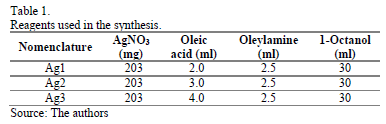
<body><![CDATA[<p><font size="2" face="Verdana, Arial, Helvetica, sans-serif">The absorption spectrum of silver   nanoparticles is sharp and strong, a feature which is ascribed to the so called   surface plasmons, which consists in the excitation of collective electron   oscillations, in response to an electromagnetic field &#91;12&#93;. The optical   properties of silver nanoparticles are dictated by the morphological   parameters, such as size and shape; hence it is crucial to be able to control   these parameters &#91;13&#93;.</font></p>     <p><font size="2" face="Verdana, Arial, Helvetica, sans-serif">Many strategies have been developed for   the preparation of silver nanoparticles. Mehta S.K. et al &#91;14&#93; prepared silver   nanoparticles with controlled shapes and size in homogeneous aqueous solutions   using silver nitrate and different saccharides in a micellar media with sodium   dodecyl sulfate as surfactant. More complex methods have also been developed,   like the use of gamma radiation known as the radiolytic reduction method, in   which an aqueous solution of the silver precursor (commonly silver nitrate) is   irradiated with gamma rays in order to generate reactive species capable of   reducing silver ions Ag+ into zero-oxidation state silver atoms (Ag<sup>0</sup>)   &#91;15,16&#93;. Tri-sodium citrate, tannic acid and silver nitrate have also been used   &#91;17&#93;, but some other methods require the usage of uncommon silver   tetradecanoate as a precursor reagent &#91;18&#93;. One of the most common reducing   agents for the synthesis of nanoparticles is 1,2-hexadecanediol &#91;19,20&#93;, and   other less expensive capping and reducing agents like liquid paraffin &#91;21&#93; have   also been used. In this case, 1-octanol, which is a very common and available   solvent, is explored both as a solvent and a reducing agent.</font></p>     <p>&nbsp;</p>     <p><font size="3" face="Verdana, Arial, Helvetica, sans-serif"><b>2. Experimental methods</b></font></p>     <p><font size="2" face="Verdana, Arial, Helvetica, sans-serif">In order to fulfill the requirements of a   standard, high purity (&gt;99.8%) silver nitrate and 1-octanol were purchased   from Merck, Oleic Acid (90%) from Alfa Easer and technical grade oleylamine   (70%) from Sigma-Aldrich. All these reagents were used without any further   purification.</font></p>     <p><font size="2" face="Verdana, Arial, Helvetica, sans-serif"><b><i>2.1. Synthesis of silver nanoparticles</i></b></font></p>     <p><font size="2" face="Verdana, Arial, Helvetica, sans-serif">Silver nanoparticles were obtained by a   facile method via one-pot synthesis. The reagents used are described in <a href="#tab01">Table   1</a>. Changes were made to the quantity of Oleic acid rather than the quantity of   oleylamine or 1-octanol because of this reagent's lower cost. In order to   synthesize nanoparticles with uniform sizes, a &quot;hot injection&quot; rather than   &quot;heating up&quot; method was adopted as proposed by Chen Y. et al &#91;22&#93;. 1-octanol,   oleylamine and oleic acid were added in a 100 mL two-neck flask, and the   mixture was heated to 180°C under magnetic stirring. Upon reaching the set   temperature, AgNO<sub>3</sub> was added and the reaction continued and at the   same time aliquots were taken at different times and cooled in an ice bath in   order to follow the kinetic by Raman and UV-vis absorbance measurements. The   resulting dark brown solution was cooled down to room temperature, and the   product was precipitated by adding ethanol to the solution and collected by   centrifugation at 5000 rpm for 5min, which was further purified by washing with   ethanol 2-3 times. Final products were re-dispersed in hexane for later use and   analysis.</font></p>     <p align="center"><font size="2" face="Verdana, Arial, Helvetica, sans-serif"><a name="tab01"></a></font><img src="/img/revistas/dyna/v83n198/v83n198a20tab01.gif"></p>     <p><font size="2" face="Verdana, Arial, Helvetica, sans-serif"><b><i>2.2. UV-Vis absorption spectrophotometry</i></b></font></p>     <p><font size="2" face="Verdana, Arial, Helvetica, sans-serif">The UV-vis absorption spectra were taken   at room temperature on a UV-vis spectrophotometer Cary 100 from Varian Inc,   with a variable wavelength between 300 and 800 nm using a glass cuvette with an   optical path of 1 cm.</font></p>     ]]></body>
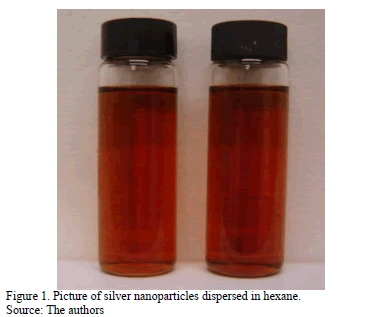
<body><![CDATA[<p><font size="2" face="Verdana, Arial, Helvetica, sans-serif"><b><i>2.3. X-ray diffraction (XRD)</i></b></font></p>     <p><font size="2" face="Verdana, Arial, Helvetica, sans-serif">The X-ray powder diffraction (XRD)   pattern was recorded using a PANalytical X-ray diffractometer with Cu K<font face="Symbol">a</font> radiation (1.5406Å). Samples for measurement were prepared by dropping silver   colloids (dispersion in hexane) on the Mylar grid and allowing them to dry at   room temperature. The scan step size was 0.0525, ranging from 20 to 90º with a   time per step of 64s.</font></p>     <p><font size="2" face="Verdana, Arial, Helvetica, sans-serif"><b><i>2.4. Micro-Raman spectroscopy</i></b></font></p>     <p><font size="2" face="Verdana, Arial, Helvetica, sans-serif">Raman spectra of the samples were   recorded using a Horiba Yvonjobin dispersive micro-Raman spectrophotometer. A   785nm laser for the excitation radiation was used. All the spectra were   collected in the range 3700-100cm<sup>-1</sup>. </font></p>     <p><font size="2" face="Verdana, Arial, Helvetica, sans-serif"><b><i>2.5. Transmission electron microscopy (TEM)</i></b></font></p>     <p><font size="2" face="Verdana, Arial, Helvetica, sans-serif">Transmission electron microscopic images   were obtained on a FEI Tecnai TEM. Samples for the TEM were dispersed in hexane   and deposited on an amorphous carbon film-coated copper grid followed by   natural evaporation at room temperature.</font></p>     <p>&nbsp;</p>     <p><font size="3" face="Verdana, Arial, Helvetica, sans-serif"><b>3. Results</b></font></p>     <p><font size="2" face="Verdana, Arial, Helvetica, sans-serif"><a href="#fig01">Fig. 1</a> shows a picture of the resulting   nanoparticles dispersed in hexane after being purified. The brown color is very   characteristic of the colloidal dispersion. Visual monitoring was carried out   for 2 months and no color change or sedimentation was observed, indicating that   the particles were very stable in this solvent.</font></p>     <p align="center"><font size="2" face="Verdana, Arial, Helvetica, sans-serif"><a name="fig01"></a></font><img src="/img/revistas/dyna/v83n198/v83n198a20fig01.gif"></p>     ]]></body>
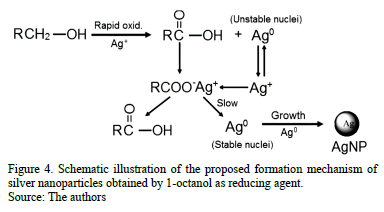
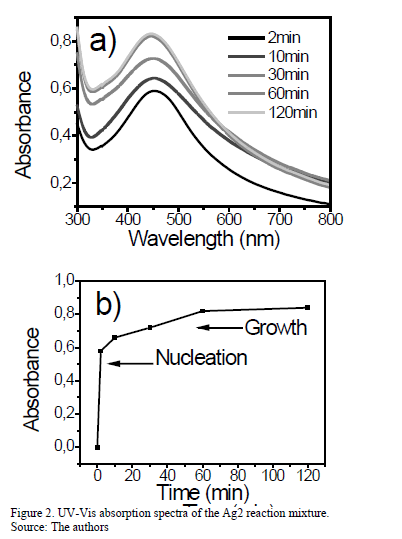
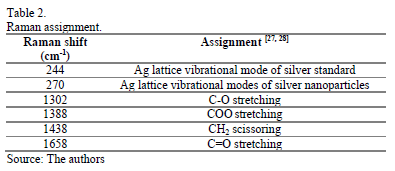
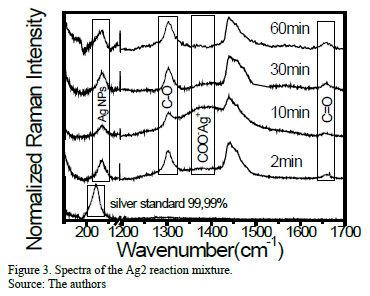
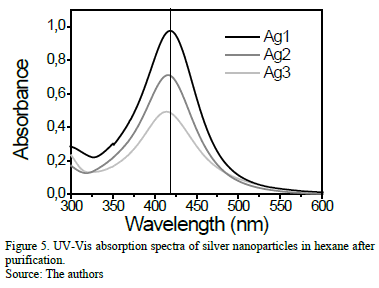
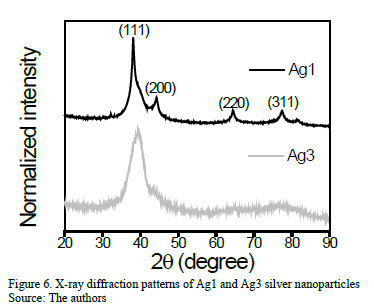
<body><![CDATA[<p><font size="2" face="Verdana, Arial, Helvetica, sans-serif"><b><i>3.1. Growth process of silver nanoparticles: UV-Vis and Raman spectra</i></b></font></p>     <p><font size="2" face="Verdana, Arial, Helvetica, sans-serif">2 mL aliquots of the reacting solution   were deposited into test tubes at different times (2, 10, 30, 60 and 120min)   and then immediately cooled in ice water to stop the reaction. To carry on the   optical spectra of the nanodispersions, 20µL of each aliquot were diluted into   3mL of ethanol.</font></p>     <p><font size="2" face="Verdana, Arial, Helvetica, sans-serif">The evolution of the growing   silver nanoparticles was monitored by their change of the UV-visible spectrum. <a href="#fig02">Fig. 2a</a> shows the resultant absorbance spectra for Ag2. A   very characteristic absorption peak could be observed around 460nm. We can see   that the absorbance increased rapidly in just 2 minutes, indicating a higher   concentration of silver nanoparticles; after 2 hours the change was not   significant, because all particles were already formed. A blue shift was found   while the reaction occurred, which is consistent with   other reports &#91;23&#93;. As the position of the peak is very dependent on the   nanoparticles' size &#91;21&#93; the 460nm peak   is not the real one associated to the plasmon resonance of the particles,   because they were not well dispersed in the samples taken from the reacting   solution (aggregates absorb at higher wavelengths). Lower peak positions were   obtained after purification and dispersion in hexane (See <a href="#fig05">Fig. 5</a>).</font></p>     <p align="center"><font size="2" face="Verdana, Arial, Helvetica, sans-serif"><a name="fig02"></a></font><img src="/img/revistas/dyna/v83n198/v83n198a20fig02.gif"></p>     <p><font size="2" face="Verdana, Arial, Helvetica, sans-serif">The two well-defined processes associated   with the nucleation and growth of the particles can be observed in <a href="#fig02">Fig. 2b</a>.   These are similar to those proposed by Lamer and Dinegar &#91;24&#93; who studied the   variation of the solute concentration as a function of time. Nucleation implies   an increase in the number of scattering centers (number of particles) for a   given system, and therefore gives an increase in the scattered intensity. In   contrast, the growth of particles is associated with a decrease of the   scattered intensity since the observation window corresponds to the diffraction   of smaller particles that are disappearing during the growth process or   dissolution of the unstable nucleus. It is consistent with the mechanism of the   reduction of Ag<sup>+</sup> ions and the association of Ag<sup>0</sup> atoms to   produce metallic Ag particles as proposed by several authors &#91;14,25,26&#93;.</font></p>     <p><font size="2" face="Verdana, Arial, Helvetica, sans-serif">Raman measurements were also carried out   in order to understand the evolution of the reaction. It was not possible to   find a clear reported position band for the absorption of silver nanoparticles   in the literature, but it is known that silver presents a lattice vibrational   mode between 50 and 300cm<sup>-1</sup> depending on whether it is present as   oxide, nitrate, chloride or as some other compound &#91;26&#93;. Nevertheless, as a   reference we decided to use a 99.99% pure silver wire to compare with </font><font size="2" face="Verdana, Arial, Helvetica, sans-serif">the position for   the metallic silver. The observed bands were found to be 244cm<sup>-1</sup> for   the silver wire, while 270cm<sup>-1 </sup>for the growing silver nanoparticles. <a href="#tab02">Table 2</a> shows the signals assignation.</font></p>     <p align="center"><font size="2" face="Verdana, Arial, Helvetica, sans-serif"><a name="tab02"></a></font><img src="/img/revistas/dyna/v83n198/v83n198a20tab02.gif"></p>     <p><font size="2" face="Verdana, Arial, Helvetica, sans-serif">The Raman spectra of the reaction mixture   are plotted in <a href="#fig03">Fig. 3</a>. This behavior was attributed to an intermediate step, in   which silver carboxylates could be formed; this is thought to be because the   symmetric strong COO stretch band is usually seen at 1450-1360cm<sup>-1</sup> &#91;28&#93;. The symmetric stretching vibrations of C=O groups could be identified at   1658cm<sup>-1</sup>; from 2 to 10 minutes its intensity remained almost the   same, but later, the peak became more intense, indicating that more C=O groups   were formed due to the oxidation of 1-octanol to octanoic acid (Caprylic acid).   Oleylamine can </font><font size="2" face="Verdana, Arial, Helvetica, sans-serif">also act as reducing agent and undergo metal-ion-induced oxidation to   nitriles &#91;29&#93;, but it was not possible to observe changes because the content   of Oleylamine was relatively low. </font></p>     <p align="center"><font size="2" face="Verdana, Arial, Helvetica, sans-serif"><a name="fig03"></a></font><img src="/img/revistas/dyna/v83n198/v83n198a20fig03.gif"></p>     <p><font size="2" face="Verdana, Arial, Helvetica, sans-serif"><a href="#fig04">Fig. 4</a> shows the proposed formation   mechanism of silver nanoparticles according to the results observed by Raman.   The formation of intermediated unstable silver nanoparticles occurs very   rapidly (less than two minutes) as observed in the absorption spectra. These   nanoparticles are not large enough to grow and these unstable nuclei can be   partially dissolved, and therefore as shown in the Raman results, the peak   intensity attributed to the already formed nanoparticles decreased while the   silver carboxylate increased (see <a href="#fig03">Fig. 3</a> at 10 minutes) &#91;24&#93;. As the silver   carboxylate formation is an intermediate step, and as the salts are not very   stable at 180 °C, they provide the Ag+ ions, which are later reduced to form   stable nuclei for the nanoparticles. This means that the formed carboxylates   tend to disappear (as seen in the Raman spectrum at 30 minutes) and the   intensity associated to the formed nanoparticles has to increase.</font></p>     ]]></body>
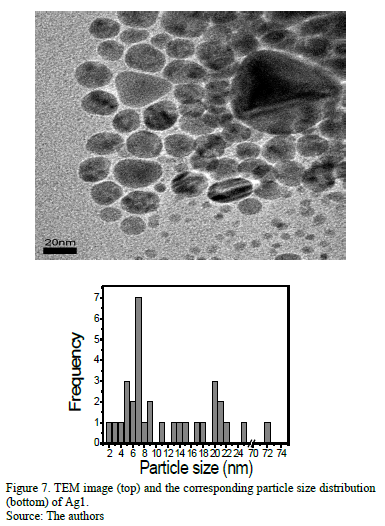
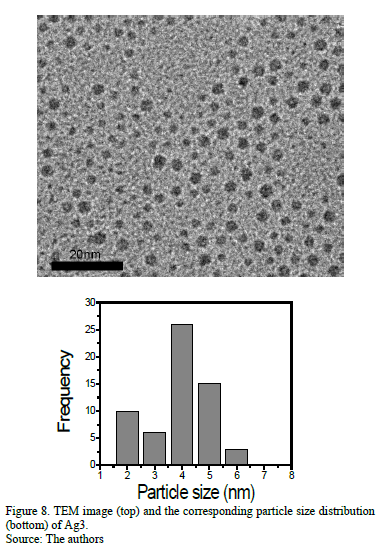
<body><![CDATA[<p align="center"><font size="2" face="Verdana, Arial, Helvetica, sans-serif"><a name="fig04"></a></font><img src="/img/revistas/dyna/v83n198/v83n198a20fig04.gif"></p>     <p><font size="2" face="Verdana, Arial, Helvetica, sans-serif"><a href="#fig05">Fig. 5</a> shows the resulting absorbance   spectra for the three sets of nanoparticles synthesized in this work. If the   particle size becomes comparable to or smaller than the mean free path of the   conduction band electrons or &quot;free&quot; electrons, the collisions of the electrons   with the particle surface becomes important and the effective mean free path is   less than that existing in bulk materials. This usually results in broadening   and blue-shift of the plasmon band for particles smaller than </font><font size="2" face="Verdana, Arial, Helvetica, sans-serif">about 10 nm &#91;30&#93;. There was a slightly blue shift in the maximum   absorbance peak from Ag1 to Ag3. These results suggest that smaller   nanoparticles were obtained by increasing the oleic acid concentration,   probably because of the steric effects; the growing particles are rapidly   capped or stabilized by the molecules of the acid and therefore the opportunity   for a particle to interact with others becomes lower.</font></p>     <p align="center"><font size="2" face="Verdana, Arial, Helvetica, sans-serif"><a name="fig05"></a></font><img src="/img/revistas/dyna/v83n198/v83n198a20fig05.gif"></p>     <p><font size="2" face="Verdana, Arial, Helvetica, sans-serif"><b><i>3.2. Particle size: XRD and TEM</i></b></font></p>     <p><font size="2" face="Verdana, Arial, Helvetica, sans-serif">The X-ray   diffraction patterns of Ag1 and Ag3 samples are shown in <a href="#fig06">Fig. 6</a>. The peaks of   Ag1 perfectly match the face-centered cubic (fcc) structure of the bulk silver,   with the broad peaks around 2<font face="Symbol">q</font> = 38°, 44°, 65°, and 78° corresponding to   (111), (200), (220) and (311) lattice planes, respectively.</font></p>     <p align="center"><font size="2" face="Verdana, Arial, Helvetica, sans-serif"><a name="fig06"></a></font><img src="/img/revistas/dyna/v83n198/v83n198a20fig06.gif"></p>     <p><font size="2" face="Verdana, Arial, Helvetica, sans-serif">The average crystallite size   of both samples were calculated over the (111) reflection plane using the   classical Scherrer Eq.1 &#91;31&#93;. <i>k</i> is   the Scherrer constant (k = 0.89) <font face="Symbol">l</font> is the wavelength of the X-ray, <i><font face="Symbol">b</font></i> is the FWHM of the peak and <i><font face="Symbol">q</font></i> is half of the Bragg angle.</font></p>     <p><img src="/img/revistas/dyna/v83n198/v83n198a20eq01.gif"></p>     <p><font size="2" face="Verdana, Arial, Helvetica, sans-serif">The calculated crystallite size was found   to be 5.97nm and 2.63nm for Ag1 and Ag3, respectively. These results are consistent   with the absorbance spectra of <a href="#fig05">Fig. 5</a>.</font></p>     <p><font size="2" face="Verdana, Arial, Helvetica, sans-serif"><a href="#fig07">Fig.s 7</a> and <a href="#fig08">8</a> show TEM images of the   samples. The corresponding histogram of the particles size distribution for the   respective samples is presented along with the TEM images. Ag1 (<a href="#fig07">Fig. 7</a>) ranged   from 4 to 71nm and Ag3 from 2.1 to 4.7nm, the latter being more uniform and   smaller than Ag1, with an average particle size of 3.8±0.5nm.</font></p>     ]]></body>
<body><![CDATA[<p align="center"><font size="2" face="Verdana, Arial, Helvetica, sans-serif"><a name="fig07"></a></font><img src="/img/revistas/dyna/v83n198/v83n198a20fig07.gif"></p>     <p align="center"><font size="2" face="Verdana, Arial, Helvetica, sans-serif"><a name="fig08"></a></font><img src="/img/revistas/dyna/v83n198/v83n198a20fig08.gif"></p>     <p><font size="2" face="Verdana, Arial, Helvetica, sans-serif">A lower concentration of oleic acid   resulted in larger crystallites and nanoparticles because it was probably not   enough to completely cover the particles' surface and stabilize; therefore,   some non-regular shapes (elongated spheres and prisms) were obtained.</font></p>     <p><font size="2" face="Verdana, Arial, Helvetica, sans-serif">According to <a href="#fig08">Fig. 8</a>, there was an   important improvement in the distribution of the particles indicating that a   simple change in the capping agent's concentration allows for controlling the   nanoparticles' shape and size and that can lead to the formation of almost   monodispersed nanoparticles</font></p>     <p>&nbsp;</p>     <p><font size="3" face="Verdana, Arial, Helvetica, sans-serif"><b>4. Conclusions</b></font></p>     <p><font size="2" face="Verdana, Arial, Helvetica, sans-serif">Well   dispersed silver nanoparticles with controllable size and shape were prepared   by reducing silver nitrate with 1-octanol in the presence of oleic acid and   oleylamine as capping agents. The nucleation and growth processes could be   recognized by UV-vis</font> <font size="2" face="Verdana, Arial, Helvetica, sans-serif">spectrophotometry. A mechanism for the formation of the silver   nanoparticles was proposed according to the Raman measurements, which allowed   us to identify that during the reduction of silver ions and oxidation of   1-octanol to caprylic acid, an intermediate step occurred, in which silver carboxylates   were formed. Finally, oleic acid limited further aggregation and particle size   of silver nanoparticles and fully stabilized the dispersed silver nanoparticles   in solution, which served to obtain smaller and more homogenous spherical   nanoparticles.</font></p>     <p>&nbsp;</p>     <p><font size="3" face="Verdana, Arial, Helvetica, sans-serif"><b>Acknowledgements</b></font></p>     <p><font size="2" face="Verdana, Arial, Helvetica, sans-serif">We would   like to thank to <i>Universidad de Antioquia </i>for funding this project. Help for TEM characterization from Aditya   Baradwaj and Bryan Boudouris from   Purdue University is greatly appreciated. The authors also appreciate the   support of Harol Torres with the Raman measurements. </font></p>     ]]></body>
<body><![CDATA[<p>&nbsp;</p>     <p><font size="3" face="Verdana, Arial, Helvetica, sans-serif"><b>References</b></font></p>     <!-- ref --><p><font size="2" face="Verdana, Arial, Helvetica, sans-serif"><b>&#91;1&#93;</b> Tsuboi,   A., Nakamura, K. and Kobayashi, N., Chromatic control of multicolor   electrochromic device with localized surface plasmon resonance of silver   nanoparticles by voltage-step method. Solar Energy Materials and Solar Cells,   145, pp 16-25, 2016. DOI: 10.1016/j.solmat.2015.07.034</font>&nbsp;&nbsp;&nbsp;&nbsp;&nbsp;&nbsp;&nbsp;&nbsp;[&#160;<a href="javascript:void(0);" onclick="javascript: window.open('/scielo.php?script=sci_nlinks&ref=1143493&pid=S0012-7353201600040002000001&lng=','','width=640,height=500,resizable=yes,scrollbars=1,menubar=yes,');">Links</a>&#160;]<!-- end-ref --><!-- ref --><p><font size="2" face="Verdana, Arial, Helvetica, sans-serif"><b>&#91;2&#93;</b> Xiangheng,   N., Libo, S., Jianming, P., Fengxian, Q., Yongsheng, Y., Hongli, Z., and Minbo,   L., Modulating the assembly of sputtered silver nanoparticles on screen-printed   carbon electrodes for hydrogen peroxide electroreduction: Effect of the surface   coverage. Electrochimica Acta, 199, pp 187-193, 2016. DOI:   10.1016/j.electacta.2016.03.100</font>&nbsp;&nbsp;&nbsp;&nbsp;&nbsp;&nbsp;&nbsp;&nbsp;[&#160;<a href="javascript:void(0);" onclick="javascript: window.open('/scielo.php?script=sci_nlinks&ref=1143494&pid=S0012-7353201600040002000002&lng=','','width=640,height=500,resizable=yes,scrollbars=1,menubar=yes,');">Links</a>&#160;]<!-- end-ref --><!-- ref --><p><font size="2" face="Verdana, Arial, Helvetica, sans-serif"><b>&#91;3&#93;</b> Steffan,   M., Jakob, A., Claus, P. and Lang, H., Silica supported silver nanoparticles   from a silver (I) carboxylate: Highly active catalyst for regioselective   hydrogenation. Catalysis Communications, 10, pp. 437-441, 2009. DOI:   10.1016/j.catcom.2008.10.003</font>&nbsp;&nbsp;&nbsp;&nbsp;&nbsp;&nbsp;&nbsp;&nbsp;[&#160;<a href="javascript:void(0);" onclick="javascript: window.open('/scielo.php?script=sci_nlinks&ref=1143495&pid=S0012-7353201600040002000003&lng=','','width=640,height=500,resizable=yes,scrollbars=1,menubar=yes,');">Links</a>&#160;]<!-- end-ref --><!-- ref --><p><font size="2" face="Verdana, Arial, Helvetica, sans-serif"><b>&#91;4&#93;</b> Kalfagiannis,   N., Karagiannidis, P.G., Pitsalidis, C., Panagiotopoulos, N.T., Gravalidis, C.,   Kassavetis, S., Patsalasc, P. and Logothetidisa, S., Plasmonic silver   nanoparticles for improved organic solar cells. Solar Energy Materials and   Solar Cells, 104, pp 165-174, 2012. DOI: 10.1016/j.solmat.2012.05.018</font>&nbsp;&nbsp;&nbsp;&nbsp;&nbsp;&nbsp;&nbsp;&nbsp;[&#160;<a href="javascript:void(0);" onclick="javascript: window.open('/scielo.php?script=sci_nlinks&ref=1143496&pid=S0012-7353201600040002000004&lng=','','width=640,height=500,resizable=yes,scrollbars=1,menubar=yes,');">Links</a>&#160;]<!-- end-ref --><!-- ref --><p><font size="2" face="Verdana, Arial, Helvetica, sans-serif"><b>&#91;5&#93;</b> Pei,   J., Tao, J., Zhou, Y., Dong, Q., Liu, Z., Li, Z, Chen, F., Zhang, J., Xu, W.   and Tian, W., Efficiency enhancement of polymer solar cells by incorporating a   self-assembled layer of silver nanodisks. Solar Energy Materials and Solar   Cells, 95, pp. 3281-3286, 2011. DOI: 10.1016/j.solmat.2011.07.007</font>&nbsp;&nbsp;&nbsp;&nbsp;&nbsp;&nbsp;&nbsp;&nbsp;[&#160;<a href="javascript:void(0);" onclick="javascript: window.open('/scielo.php?script=sci_nlinks&ref=1143497&pid=S0012-7353201600040002000005&lng=','','width=640,height=500,resizable=yes,scrollbars=1,menubar=yes,');">Links</a>&#160;]<!-- end-ref --><!-- ref --><p><font size="2" face="Verdana, Arial, Helvetica, sans-serif"><b>&#91;6&#93;</b> Kang,   Y., Si, M., Zhu, Y., Miao, L. and Xu, G., Surface-enhanced Raman scattering   (SERS) spectra of hemoglobin of mouse and rabbit with self-assembled   nano-silver film. Spectrochimica Acta Part A: Molecular and Biomolecular   Spectroscopy, 108, pp. 177-180, 2013. DOI: 10.1016/j.saa.2013.01.098</font>&nbsp;&nbsp;&nbsp;&nbsp;&nbsp;&nbsp;&nbsp;&nbsp;[&#160;<a href="javascript:void(0);" onclick="javascript: window.open('/scielo.php?script=sci_nlinks&ref=1143498&pid=S0012-7353201600040002000006&lng=','','width=640,height=500,resizable=yes,scrollbars=1,menubar=yes,');">Links</a>&#160;]<!-- end-ref --><!-- ref --><p><font size="2" face="Verdana, Arial, Helvetica, sans-serif"><b>&#91;7&#93;</b> Vanamudan,   A. and Sudhakar, P.P., Biopolymer capped silver nanoparticles with potential   for multifaceted applications. International Journal of Biological   Macromolecules, 86, pp. 262-268, 2016. DOI: 10.1016/j.ijbiomac.2016.01.056</font>&nbsp;&nbsp;&nbsp;&nbsp;&nbsp;&nbsp;&nbsp;&nbsp;[&#160;<a href="javascript:void(0);" onclick="javascript: window.open('/scielo.php?script=sci_nlinks&ref=1143499&pid=S0012-7353201600040002000007&lng=','','width=640,height=500,resizable=yes,scrollbars=1,menubar=yes,');">Links</a>&#160;]<!-- end-ref --><!-- ref --><p><font size="2" face="Verdana, Arial, Helvetica, sans-serif"><b>&#91;8&#93;</b> Bi,   L., Dong, J., Xie, W., Lu, W., Tong, W., Tao, L. and Qian, W., Bimetallic   gold-silver nanoplate array as a highly active SERS substrate for detection of   streptavidin/biotin assemblies. Analytica Chimica Acta, 805, pp. 95-100, 2013.   DOI: 10.1016/j.aca.2013.10.045</font>&nbsp;&nbsp;&nbsp;&nbsp;&nbsp;&nbsp;&nbsp;&nbsp;[&#160;<a href="javascript:void(0);" onclick="javascript: window.open('/scielo.php?script=sci_nlinks&ref=1143500&pid=S0012-7353201600040002000008&lng=','','width=640,height=500,resizable=yes,scrollbars=1,menubar=yes,');">Links</a>&#160;]<!-- end-ref --><!-- ref --><p><font size="2" face="Verdana, Arial, Helvetica, sans-serif"><b>&#91;9&#93;</b> Geetha,   K., Umadevi, M., Sathe, G.V., Vanelle, P., Terme, T. and Khoumeri, O.,   Orientation of 1,4-dimethoxy-3-bromomethylanthracence-9,10-dione on silver   nanoparticles: SERS studies. Journal of Molecular Structure, 1059, pp. 87-93,   2014. DOI: 10.1016/j.molstruc.2013.11.013</font>&nbsp;&nbsp;&nbsp;&nbsp;&nbsp;&nbsp;&nbsp;&nbsp;[&#160;<a href="javascript:void(0);" onclick="javascript: window.open('/scielo.php?script=sci_nlinks&ref=1143501&pid=S0012-7353201600040002000009&lng=','','width=640,height=500,resizable=yes,scrollbars=1,menubar=yes,');">Links</a>&#160;]<!-- end-ref --><!-- ref --><p><font size="2" face="Verdana, Arial, Helvetica, sans-serif"><b>&#91;10&#93;</b> Raza,   A. and Saha, B., In situ silver nanoparticles synthesis in agarose film   supported on filter paper and its application as highly efficient SERS test   stripes. Forensic Science International, 237, 2014.    &nbsp;&nbsp;&nbsp;&nbsp;&nbsp;&nbsp;&nbsp;&nbsp;[&#160;<a href="javascript:void(0);" onclick="javascript: window.open('/scielo.php?script=sci_nlinks&ref=1143502&pid=S0012-7353201600040002000010&lng=','','width=640,height=500,resizable=yes,scrollbars=1,menubar=yes,');">Links</a>&#160;]<!-- end-ref --> </font></p>     <!-- ref --><p><font size="2" face="Verdana, Arial, Helvetica, sans-serif"><b>&#91;11&#93;</b> Chernousova,   S. and Epple, M., Silver as antibacterial agent: Ion, nanoparticle, and metal.   Angewandte Chemie International Edition, 52, pp. 1636-1653, 2013. DOI: 10.1002/anie.201205923</font>&nbsp;&nbsp;&nbsp;&nbsp;&nbsp;&nbsp;&nbsp;&nbsp;[&#160;<a href="javascript:void(0);" onclick="javascript: window.open('/scielo.php?script=sci_nlinks&ref=1143504&pid=S0012-7353201600040002000011&lng=','','width=640,height=500,resizable=yes,scrollbars=1,menubar=yes,');">Links</a>&#160;]<!-- end-ref --><!-- ref --><p><font size="2" face="Verdana, Arial, Helvetica, sans-serif"><b>&#91;12&#93;</b> Chatre,   A., Solasa, P., Sakle, S., Thaokar, R. and Mehra, A., Color and surface plasmon   effects in nanoparticle systems: Case of silver nanoparticles prepared by   microemulsion route. Colloids and Surfaces A: Physicochemical and Engineering   Aspects, 404, pp. 83-92, 2012. DOI: 10.1016/J.COLSURFA.2012.04.016</font>&nbsp;&nbsp;&nbsp;&nbsp;&nbsp;&nbsp;&nbsp;&nbsp;[&#160;<a href="javascript:void(0);" onclick="javascript: window.open('/scielo.php?script=sci_nlinks&ref=1143505&pid=S0012-7353201600040002000012&lng=','','width=640,height=500,resizable=yes,scrollbars=1,menubar=yes,');">Links</a>&#160;]<!-- end-ref --><!-- ref --><p><font size="2" face="Verdana, Arial, Helvetica, sans-serif"><b>&#91;13&#93;</b> An,   W., Zhu, T. and Zhu, Q., Numerical investigation of radiative properties and   surface plasmon resonance of silver nanorod dimers on a substrate. Journal of   Quantitative Spectroscopy and Radiative Transfer, 132, pp. 28-35, 2014. DOI: 10.1016/j.jqsrt.2013.01.013</font>&nbsp;&nbsp;&nbsp;&nbsp;&nbsp;&nbsp;&nbsp;&nbsp;[&#160;<a href="javascript:void(0);" onclick="javascript: window.open('/scielo.php?script=sci_nlinks&ref=1143506&pid=S0012-7353201600040002000013&lng=','','width=640,height=500,resizable=yes,scrollbars=1,menubar=yes,');">Links</a>&#160;]<!-- end-ref --><!-- ref --><p><font size="2" face="Verdana, Arial, Helvetica, sans-serif"><b>&#91;14&#93;</b> Mehta,   S.K., Chaudhary, S. and Gradzielski, M., Time dependence of nucleation and   growth of silver nanoparticles generated by sugar reduction in micellar media.   Journal of Colloid and Interface Science, 343, pp. 447-453, 2010. DOI: 0.1016/j.jcis.2009.11.053</font>&nbsp;&nbsp;&nbsp;&nbsp;&nbsp;&nbsp;&nbsp;&nbsp;[&#160;<a href="javascript:void(0);" onclick="javascript: window.open('/scielo.php?script=sci_nlinks&ref=1143507&pid=S0012-7353201600040002000014&lng=','','width=640,height=500,resizable=yes,scrollbars=1,menubar=yes,');">Links</a>&#160;]<!-- end-ref --><!-- ref --><p><font size="2" face="Verdana, Arial, Helvetica, sans-serif"><b>&#91;15&#93;</b> Saion,   E., Gharibshahi, E. and Naghavi, K., Size-Controlled and optical properties of   monodispersed silver nanoparticles synthesized by the radiolytic reduction   method. International Journal of Molecular Sciences, 14, pp. 7880-7896, 2013.   DOI: 10.1021/la0600245</font>&nbsp;&nbsp;&nbsp;&nbsp;&nbsp;&nbsp;&nbsp;&nbsp;[&#160;<a href="javascript:void(0);" onclick="javascript: window.open('/scielo.php?script=sci_nlinks&ref=1143508&pid=S0012-7353201600040002000015&lng=','','width=640,height=500,resizable=yes,scrollbars=1,menubar=yes,');">Links</a>&#160;]<!-- end-ref --><!-- ref --><p><font size="2" face="Verdana, Arial, Helvetica, sans-serif"><b>&#91;16&#93;</b> Shin,   H.S., Yang, H.J., Kim, S.B. and Lee, M.S., Mechanism of growth of colloidal   silver nanoparticles stabilized by polyvinyl pyrrolidone in <font face="Symbol">g</font>-irradiated   silver nitrate solution. Journal of Colloid and Interface Science, 274, pp.   89-94, 2004. DOI: 10.1016/J.JCIS.2004.02.084</font>&nbsp;&nbsp;&nbsp;&nbsp;&nbsp;&nbsp;&nbsp;&nbsp;[&#160;<a href="javascript:void(0);" onclick="javascript: window.open('/scielo.php?script=sci_nlinks&ref=1143509&pid=S0012-7353201600040002000016&lng=','','width=640,height=500,resizable=yes,scrollbars=1,menubar=yes,');">Links</a>&#160;]<!-- end-ref --><!-- ref --><p><font size="2" face="Verdana, Arial, Helvetica, sans-serif"><b>&#91;17&#93;</b> Dadosh,   T. Synthesis of uniform silver nanoparticles with a controllable size.   Materials Letters, 63, pp. 2236-2238, 2009. DOI: 10.1016/J.MATLET.2009.07.042</font>&nbsp;&nbsp;&nbsp;&nbsp;&nbsp;&nbsp;&nbsp;&nbsp;[&#160;<a href="javascript:void(0);" onclick="javascript: window.open('/scielo.php?script=sci_nlinks&ref=1143510&pid=S0012-7353201600040002000017&lng=','','width=640,height=500,resizable=yes,scrollbars=1,menubar=yes,');">Links</a>&#160;]<!-- end-ref --><!-- ref --><p><font size="2" face="Verdana, Arial, Helvetica, sans-serif"><b>&#91;18&#93;</b> Yamamoto,   M., Kashiwagi, Y. and Nakamoto, M., Size-controlled synthesis of monodispersed   silver nanoparticles capped by long-chain alkyl carboxylates from silver   carboxylate and tertiary amine. Langmuir, 22, pp. 8581-8586, 2006. DOI: 10.1021/LA0600245</font>&nbsp;&nbsp;&nbsp;&nbsp;&nbsp;&nbsp;&nbsp;&nbsp;[&#160;<a href="javascript:void(0);" onclick="javascript: window.open('/scielo.php?script=sci_nlinks&ref=1143511&pid=S0012-7353201600040002000018&lng=','','width=640,height=500,resizable=yes,scrollbars=1,menubar=yes,');">Links</a>&#160;]<!-- end-ref --><!-- ref --><p><font size="2" face="Verdana, Arial, Helvetica, sans-serif"><b>&#91;19&#93;</b> Chiang,   I.C., Chen, Y.T. and Chen, D.H., Synthesis of NiAu colloidal nanocrystals with   kinetically tunable properties. Journal of Alloys and Compounds, 468, pp.   237-245, 2009. DOI: 10.1016/J.JALLCOM.2008.01.063</font>&nbsp;&nbsp;&nbsp;&nbsp;&nbsp;&nbsp;&nbsp;&nbsp;[&#160;<a href="javascript:void(0);" onclick="javascript: window.open('/scielo.php?script=sci_nlinks&ref=1143512&pid=S0012-7353201600040002000019&lng=','','width=640,height=500,resizable=yes,scrollbars=1,menubar=yes,');">Links</a>&#160;]<!-- end-ref --><!-- ref --><p><font size="2" face="Verdana, Arial, Helvetica, sans-serif"><b>&#91;20&#93;</b> Li,   Y., Zhang, X.L., Qiu, R. and Kang, Y.S., Synthesis and investigation of SmCo5   magnetic nanoparticles. Colloids and Surfaces A: Physicochemical and   Engineering Aspects, 313, pp. 621-624, 2008. DOI: 10.1016/J.COLSURFA.2007.04.150</font>&nbsp;&nbsp;&nbsp;&nbsp;&nbsp;&nbsp;&nbsp;&nbsp;[&#160;<a href="javascript:void(0);" onclick="javascript: window.open('/scielo.php?script=sci_nlinks&ref=1143513&pid=S0012-7353201600040002000020&lng=','','width=640,height=500,resizable=yes,scrollbars=1,menubar=yes,');">Links</a>&#160;]<!-- end-ref --><!-- ref --><p><font size="2" face="Verdana, Arial, Helvetica, sans-serif"><b>&#91;21&#93;</b> Chen,   M., Feng, Y.G., Wang, X., Li, T.C., Zhang, J.Y., and Qian, D.J., Silver   nanoparticles capped by oleylamine: Formation, growth, and   self-organization. Langmuir, 23, pp. 5296-5304, 2007. DOI: 10.1021/LA700553D</font>&nbsp;&nbsp;&nbsp;&nbsp;&nbsp;&nbsp;&nbsp;&nbsp;[&#160;<a href="javascript:void(0);" onclick="javascript: window.open('/scielo.php?script=sci_nlinks&ref=1143514&pid=S0012-7353201600040002000021&lng=','','width=640,height=500,resizable=yes,scrollbars=1,menubar=yes,');">Links</a>&#160;]<!-- end-ref --><!-- ref --><p><font size="2" face="Verdana, Arial, Helvetica, sans-serif"><b>&#91;22&#93;</b> Chen,   Y., Gao, N. and Jiang, J., Surface matters: Enhanced bactericidal property of   core-shell Ag-Fe2O3 nanostructures to their heteromer counterparts from one-pot   synthesis. Small, 9, pp. 3242-3246, 2013. DOI: 10.1002/SMLL.201300543</font>&nbsp;&nbsp;&nbsp;&nbsp;&nbsp;&nbsp;&nbsp;&nbsp;[&#160;<a href="javascript:void(0);" onclick="javascript: window.open('/scielo.php?script=sci_nlinks&ref=1143515&pid=S0012-7353201600040002000022&lng=','','width=640,height=500,resizable=yes,scrollbars=1,menubar=yes,');">Links</a>&#160;]<!-- end-ref --><!-- ref --><p><font size="2" face="Verdana, Arial, Helvetica, sans-serif"><b>&#91;23&#93;</b> Jana,   N.R., Sau, T.K. and Pal, T., Growing small silver particle as redox catalyst.   The Journal of Physical Chemistry B, 103, pp. 115-121, 1998. DOI: 10.1021/JP982731F</font>&nbsp;&nbsp;&nbsp;&nbsp;&nbsp;&nbsp;&nbsp;&nbsp;[&#160;<a href="javascript:void(0);" onclick="javascript: window.open('/scielo.php?script=sci_nlinks&ref=1143516&pid=S0012-7353201600040002000023&lng=','','width=640,height=500,resizable=yes,scrollbars=1,menubar=yes,');">Links</a>&#160;]<!-- end-ref --><!-- ref --><p><font size="2" face="Verdana, Arial, Helvetica, sans-serif"><b>&#91;24&#93;</b> Lamer,   V.K. and Dinegar, R.H., Theory, production and mechanism of formation of   monodispersed hydrosols. Journal of the American Chemical Society, 72, pp.   847-854, 1950. DOI: 10.1021/ja01167a001</font>&nbsp;&nbsp;&nbsp;&nbsp;&nbsp;&nbsp;&nbsp;&nbsp;[&#160;<a href="javascript:void(0);" onclick="javascript: window.open('/scielo.php?script=sci_nlinks&ref=1143517&pid=S0012-7353201600040002000024&lng=','','width=640,height=500,resizable=yes,scrollbars=1,menubar=yes,');">Links</a>&#160;]<!-- end-ref --><!-- ref --><p><font size="2" face="Verdana, Arial, Helvetica, sans-serif"><b>&#91;25&#93;</b> Goia,   D.V., Preparation and formation mechanisms of uniform metallic particles in   homogeneous solutions. Journal of Materials Chemistry, 14, pp. 451-458, 2004.   DOI: 10.1039/B311076A</font>&nbsp;&nbsp;&nbsp;&nbsp;&nbsp;&nbsp;&nbsp;&nbsp;[&#160;<a href="javascript:void(0);" onclick="javascript: window.open('/scielo.php?script=sci_nlinks&ref=1143518&pid=S0012-7353201600040002000025&lng=','','width=640,height=500,resizable=yes,scrollbars=1,menubar=yes,');">Links</a>&#160;]<!-- end-ref --><!-- ref --><p><font size="2" face="Verdana, Arial, Helvetica, sans-serif"><b>&#91;26&#93;</b> Harada,   M, Inada, Y. and Nomura, M., In situ time-resolved XAFS analysis of silver   particle formation by photoreduction in polymer solutions. Journal of Colloid   and Interface Science, 337, pp. 427-438, 2009. DOI: 10.1016/j.jcis.2009.05.035</font>&nbsp;&nbsp;&nbsp;&nbsp;&nbsp;&nbsp;&nbsp;&nbsp;[&#160;<a href="javascript:void(0);" onclick="javascript: window.open('/scielo.php?script=sci_nlinks&ref=1143519&pid=S0012-7353201600040002000026&lng=','','width=640,height=500,resizable=yes,scrollbars=1,menubar=yes,');">Links</a>&#160;]<!-- end-ref --><!-- ref --><p><font size="2" face="Verdana, Arial, Helvetica, sans-serif"><b>&#91;27&#93;</b> Martina,   I., Wiesinger, R., Jembrih, D. and Schreiner, M., Micro-raman characterisation   of silver corrosion products: Instrumental set up and reference database.   E-Preservation Science: Morana RTD &#91;Online&#93;. pp. 1-8, 2012. Available at: <a href="http://www.morana-rtd.com/e-preservationscience/2012/Martina-05-03-2012.pdf" target="_blank">http://www.morana-rtd.com/e-preservationscience/2012/Martina-05-03-2012.pdf</a></font>&nbsp;&nbsp;&nbsp;&nbsp;&nbsp;&nbsp;&nbsp;&nbsp;[&#160;<a href="javascript:void(0);" onclick="javascript: window.open('/scielo.php?script=sci_nlinks&ref=1143520&pid=S0012-7353201600040002000027&lng=','','width=640,height=500,resizable=yes,scrollbars=1,menubar=yes,');">Links</a>&#160;]<!-- end-ref --><!-- ref --><p><font size="2" face="Verdana, Arial, Helvetica, sans-serif"><b>&#91;28&#93;</b> Lin-Vien,   D., Colthup, N. B., Fateley, W.G. and Grasselli, J.G., CHAPTER 9 - Compounds   containing the carbonyl group. In: Lin-Vien, D, Colthup, NB, Fateley, WG,   Grasselli, JG, eds. The Handbook of Infrared and Raman Characteristic   Frequencies of Organic Molecules. San Diego: Academic Press, 1991, pp. 117-154.    &nbsp;&nbsp;&nbsp;&nbsp;&nbsp;&nbsp;&nbsp;&nbsp;[&#160;<a href="javascript:void(0);" onclick="javascript: window.open('/scielo.php?script=sci_nlinks&ref=1143521&pid=S0012-7353201600040002000028&lng=','','width=640,height=500,resizable=yes,scrollbars=1,menubar=yes,');">Links</a>&#160;]<!-- end-ref --></font></p>     <!-- ref --><p><font size="2" face="Verdana, Arial, Helvetica, sans-serif"><b>&#91;29&#93;</b> Mourdikoudis,   S. and Liz-Marz&aacute;n, L.M., Oleylamine in nanoparticle synthesis. Chemistry of   Materials, 25, pp. 1465-1476, 2013. DOI: 10.1021/cm4000476</font>&nbsp;&nbsp;&nbsp;&nbsp;&nbsp;&nbsp;&nbsp;&nbsp;[&#160;<a href="javascript:void(0);" onclick="javascript: window.open('/scielo.php?script=sci_nlinks&ref=1143523&pid=S0012-7353201600040002000029&lng=','','width=640,height=500,resizable=yes,scrollbars=1,menubar=yes,');">Links</a>&#160;]<!-- end-ref --><!-- ref --><p><font size="2" face="Verdana, Arial, Helvetica, sans-serif"><b>&#91;30&#93;</b> Zhang,   J.Z., Optical Properties and Spectroscopy of Nanomaterials. Cahpter 7 - Optical   Properties and Spectroscopy of Nanomaterials: World Scientific, 2009, pp.   205-235.    &nbsp;&nbsp;&nbsp;&nbsp;&nbsp;&nbsp;&nbsp;&nbsp;[&#160;<a href="javascript:void(0);" onclick="javascript: window.open('/scielo.php?script=sci_nlinks&ref=1143524&pid=S0012-7353201600040002000030&lng=','','width=640,height=500,resizable=yes,scrollbars=1,menubar=yes,');">Links</a>&#160;]<!-- end-ref --></font></p>     <!-- ref --><p><font size="2" face="Verdana, Arial, Helvetica, sans-serif"><b>&#91;31&#93;</b> Scherrer,   P., Bestimmung der Grösse und der inneren Struktur von Kolloidteilchen mittels   Röntgenstrahlen. &#91;Online&#93;. pp. 98-100, 1918. Available at: <a href="http://gdz.sub.uni-goettingen.de/dms/load/img/?PPN=GDZPPN002505045&IDDOC=63709" target="_blank">http://gdz.sub.uni-goettingen.de/dms/load/img/?PPN=GDZPPN002505045&amp;IDDOC=63709</a></font>&nbsp;&nbsp;&nbsp;&nbsp;&nbsp;&nbsp;&nbsp;&nbsp;[&#160;<a href="javascript:void(0);" onclick="javascript: window.open('/scielo.php?script=sci_nlinks&ref=1143526&pid=S0012-7353201600040002000031&lng=','','width=640,height=500,resizable=yes,scrollbars=1,menubar=yes,');">Links</a>&#160;]<!-- end-ref --><p>&nbsp;</p>     <p><font size="2" face="Verdana, Arial, Helvetica, sans-serif"><b>D. Ramirez,</b> is currently a PhD student   in Materials Engineering at Universidad de Antioquia, Medell&iacute;n, Colombia, where   he also completed his BSc. Eng in Materials Engineering in 2014. His research   interests include nanothecnology and nanostructured solar cells. He is   currently working on synthesis and characterization of nanoparticles,   nanocomposites and novel semiconductors for thin film photovoltaic applications   in The Center of Research, Innovation and Development of Materials - CIDEMAT at   Universidad de Antioquia. ORCID: 0000-0003-2630-7628</font></p>     <p><font size="2" face="Verdana, Arial, Helvetica, sans-serif"><b>F. Jaramillo,</b> completed his BSc. Eng in   Chemical Engineering at Universidad de Antioquia, Medell&iacute;n, Colombia, in 2001   and, in 2005, a PhD in Chemistry at The University of Manchester, USA. He is   the current director of the solar cells lab EPM-UdeA, part of the   Nanotechnology Regional Iniciative at Ruta N-Medell&iacute;n, and a member of the   national advisory council in Nanoscience and Nanotechnology - Red NanoColombia.   His research interest areas include nanotechnology, nanostructured solar cells,   novel semiconductors, energy materials, nanocomposites, and functional polymers   from renewable resources. He is currently an associated professor at Materials   Engineering Department and member of The Center of Research, Innovation and   Development of Materials - CIDEMAT at Universidad de Antioquia. ORCID: 0000-0003-1722-5487</font></p>      ]]></body><back>
<ref-list>
<ref id="B1">
<label>1</label><nlm-citation citation-type="journal">
<person-group person-group-type="author">
<name>
<surname><![CDATA[Tsuboi]]></surname>
<given-names><![CDATA[A.]]></given-names>
</name>
<name>
<surname><![CDATA[Nakamura]]></surname>
<given-names><![CDATA[K.]]></given-names>
</name>
<name>
<surname><![CDATA[Kobayashi]]></surname>
<given-names><![CDATA[N.]]></given-names>
</name>
</person-group>
<article-title xml:lang="en"><![CDATA[Chromatic control of multicolor electrochromic device with localized surface plasmon resonance of silver nanoparticles by voltage-step method]]></article-title>
<source><![CDATA[Solar Energy Materials and Solar Cells]]></source>
<year>2016</year>
<numero>145</numero>
<issue>145</issue>
<page-range>16-25</page-range></nlm-citation>
</ref>
<ref id="B2">
<label>2</label><nlm-citation citation-type="journal">
<person-group person-group-type="author">
<name>
<surname><![CDATA[Xiangheng]]></surname>
<given-names><![CDATA[N.]]></given-names>
</name>
<name>
<surname><![CDATA[Libo]]></surname>
<given-names><![CDATA[S.]]></given-names>
</name>
<name>
<surname><![CDATA[Jianming]]></surname>
<given-names><![CDATA[P.]]></given-names>
</name>
<name>
<surname><![CDATA[Fengxian]]></surname>
<given-names><![CDATA[Q.]]></given-names>
</name>
<name>
<surname><![CDATA[Yongsheng]]></surname>
<given-names><![CDATA[Y.]]></given-names>
</name>
<name>
<surname><![CDATA[Hongli]]></surname>
<given-names><![CDATA[Z.]]></given-names>
</name>
<name>
<surname><![CDATA[Minbo]]></surname>
<given-names><![CDATA[L.]]></given-names>
</name>
</person-group>
<article-title xml:lang="en"><![CDATA[Modulating the assembly of sputtered silver nanoparticles on screen-printed carbon electrodes for hydrogen peroxide electroreduction: Effect of the surface coverage]]></article-title>
<source><![CDATA[Electrochimica Acta]]></source>
<year>2016</year>
<numero>199</numero>
<issue>199</issue>
<page-range>187-193</page-range></nlm-citation>
</ref>
<ref id="B3">
<label>3</label><nlm-citation citation-type="journal">
<person-group person-group-type="author">
<name>
<surname><![CDATA[Steffan]]></surname>
<given-names><![CDATA[M.]]></given-names>
</name>
<name>
<surname><![CDATA[Jakob]]></surname>
<given-names><![CDATA[A.]]></given-names>
</name>
<name>
<surname><![CDATA[Claus]]></surname>
<given-names><![CDATA[P.]]></given-names>
</name>
<name>
<surname><![CDATA[Lang]]></surname>
<given-names><![CDATA[H.]]></given-names>
</name>
</person-group>
<article-title xml:lang="en"><![CDATA[Silica supported silver nanoparticles from a silver (I) carboxylate: Highly active catalyst for regioselective hydrogenation]]></article-title>
<source><![CDATA[Catalysis Communications]]></source>
<year>2009</year>
<numero>10</numero>
<issue>10</issue>
<page-range>437-441</page-range></nlm-citation>
</ref>
<ref id="B4">
<label>4</label><nlm-citation citation-type="journal">
<person-group person-group-type="author">
<name>
<surname><![CDATA[Kalfagiannis]]></surname>
<given-names><![CDATA[N.]]></given-names>
</name>
<name>
<surname><![CDATA[Karagiannidis]]></surname>
<given-names><![CDATA[P.G.]]></given-names>
</name>
<name>
<surname><![CDATA[Pitsalidis]]></surname>
<given-names><![CDATA[C.]]></given-names>
</name>
<name>
<surname><![CDATA[Panagiotopoulos]]></surname>
<given-names><![CDATA[N.T.]]></given-names>
</name>
<name>
<surname><![CDATA[Gravalidis]]></surname>
<given-names><![CDATA[C.]]></given-names>
</name>
<name>
<surname><![CDATA[Kassavetis]]></surname>
<given-names><![CDATA[S.]]></given-names>
</name>
<name>
<surname><![CDATA[Patsalasc]]></surname>
<given-names><![CDATA[P.]]></given-names>
</name>
<name>
<surname><![CDATA[Logothetidisa]]></surname>
<given-names><![CDATA[S.]]></given-names>
</name>
</person-group>
<article-title xml:lang="en"><![CDATA[Plasmonic silver nanoparticles for improved organic solar cells.]]></article-title>
<source><![CDATA[Solar Energy Materials and Solar Cells]]></source>
<year>2012</year>
<numero>104</numero>
<issue>104</issue>
<page-range>165-174</page-range></nlm-citation>
</ref>
<ref id="B5">
<label>5</label><nlm-citation citation-type="journal">
<person-group person-group-type="author">
<name>
<surname><![CDATA[Pei]]></surname>
<given-names><![CDATA[J.]]></given-names>
</name>
<name>
<surname><![CDATA[Tao]]></surname>
<given-names><![CDATA[J.]]></given-names>
</name>
<name>
<surname><![CDATA[Zhou]]></surname>
<given-names><![CDATA[Y.]]></given-names>
</name>
<name>
<surname><![CDATA[Dong]]></surname>
<given-names><![CDATA[Q.]]></given-names>
</name>
<name>
<surname><![CDATA[Liu]]></surname>
<given-names><![CDATA[Z.]]></given-names>
</name>
<name>
<surname><![CDATA[Li]]></surname>
<given-names><![CDATA[Z]]></given-names>
</name>
<name>
<surname><![CDATA[Chen]]></surname>
<given-names><![CDATA[F.]]></given-names>
</name>
<name>
<surname><![CDATA[Zhang]]></surname>
<given-names><![CDATA[J.]]></given-names>
</name>
<name>
<surname><![CDATA[Xu]]></surname>
<given-names><![CDATA[W.]]></given-names>
</name>
<name>
<surname><![CDATA[Tian]]></surname>
<given-names><![CDATA[W.]]></given-names>
</name>
</person-group>
<article-title xml:lang="en"><![CDATA[Efficiency enhancement of polymer solar cells by incorporating a self-assembled layer of silver nanodisks]]></article-title>
<source><![CDATA[Solar Energy Materials and Solar Cells]]></source>
<year>2011</year>
<numero>95</numero>
<issue>95</issue>
<page-range>3281-3286</page-range></nlm-citation>
</ref>
<ref id="B6">
<label>6</label><nlm-citation citation-type="journal">
<person-group person-group-type="author">
<name>
<surname><![CDATA[Kang]]></surname>
<given-names><![CDATA[Y.]]></given-names>
</name>
<name>
<surname><![CDATA[Si]]></surname>
<given-names><![CDATA[M.]]></given-names>
</name>
<name>
<surname><![CDATA[Zhu]]></surname>
<given-names><![CDATA[Y.]]></given-names>
</name>
<name>
<surname><![CDATA[Miao]]></surname>
<given-names><![CDATA[L.]]></given-names>
</name>
<name>
<surname><![CDATA[Xu]]></surname>
<given-names><![CDATA[G.]]></given-names>
</name>
</person-group>
<article-title xml:lang="en"><![CDATA[Surface-enhanced Raman scattering (SERS) spectra of hemoglobin of mouse and rabbit with self-assembled nano-silver film]]></article-title>
<source><![CDATA[Spectrochimica Acta Part A: Molecular and Biomolecular Spectroscopy]]></source>
<year>2013</year>
<numero>108</numero>
<issue>108</issue>
<page-range>177-180</page-range></nlm-citation>
</ref>
<ref id="B7">
<label>7</label><nlm-citation citation-type="journal">
<person-group person-group-type="author">
<name>
<surname><![CDATA[Vanamudan]]></surname>
<given-names><![CDATA[A.]]></given-names>
</name>
<name>
<surname><![CDATA[Sudhakar]]></surname>
<given-names><![CDATA[P.P.]]></given-names>
</name>
</person-group>
<article-title xml:lang="en"><![CDATA[Biopolymer capped silver nanoparticles with potential for multifaceted applications]]></article-title>
<source><![CDATA[International Journal of Biological Macromolecules]]></source>
<year>2016</year>
<numero>86</numero>
<issue>86</issue>
<page-range>262-268</page-range></nlm-citation>
</ref>
<ref id="B8">
<label>8</label><nlm-citation citation-type="journal">
<person-group person-group-type="author">
<name>
<surname><![CDATA[Bi]]></surname>
<given-names><![CDATA[L.]]></given-names>
</name>
<name>
<surname><![CDATA[Dong]]></surname>
<given-names><![CDATA[J.]]></given-names>
</name>
<name>
<surname><![CDATA[Xie]]></surname>
<given-names><![CDATA[W.]]></given-names>
</name>
<name>
<surname><![CDATA[Lu]]></surname>
<given-names><![CDATA[W.]]></given-names>
</name>
<name>
<surname><![CDATA[Tong]]></surname>
<given-names><![CDATA[W.]]></given-names>
</name>
<name>
<surname><![CDATA[Tao]]></surname>
<given-names><![CDATA[L.]]></given-names>
</name>
<name>
<surname><![CDATA[Qian]]></surname>
<given-names><![CDATA[W.]]></given-names>
</name>
</person-group>
<article-title xml:lang="en"><![CDATA[Bimetallic gold-silver nanoplate array as a highly active SERS substrate for detection of streptavidin/biotin assemblies]]></article-title>
<source><![CDATA[Analytica Chimica Acta]]></source>
<year>2013</year>
<numero>805</numero>
<issue>805</issue>
<page-range>95-100</page-range></nlm-citation>
</ref>
<ref id="B9">
<label>9</label><nlm-citation citation-type="journal">
<person-group person-group-type="author">
<name>
<surname><![CDATA[Geetha]]></surname>
<given-names><![CDATA[K.]]></given-names>
</name>
<name>
<surname><![CDATA[Umadevi]]></surname>
<given-names><![CDATA[M.]]></given-names>
</name>
<name>
<surname><![CDATA[Sathe]]></surname>
<given-names><![CDATA[G.V.]]></given-names>
</name>
<name>
<surname><![CDATA[Vanelle]]></surname>
<given-names><![CDATA[P.]]></given-names>
</name>
<name>
<surname><![CDATA[Terme]]></surname>
<given-names><![CDATA[T.]]></given-names>
</name>
<name>
<surname><![CDATA[Khoumeri]]></surname>
<given-names><![CDATA[O.]]></given-names>
</name>
</person-group>
<article-title xml:lang="en"><![CDATA[Orientation of 1,4-dimethoxy-3-bromomethylanthracence-9,10-dione on silver nanoparticles: SERS studies]]></article-title>
<source><![CDATA[Journal of Molecular Structure]]></source>
<year>2014</year>
<numero>1059</numero>
<issue>1059</issue>
<page-range>87-93</page-range></nlm-citation>
</ref>
<ref id="B10">
<label>10</label><nlm-citation citation-type="journal">
<person-group person-group-type="author">
<name>
<surname><![CDATA[Raza]]></surname>
<given-names><![CDATA[A.]]></given-names>
</name>
<name>
<surname><![CDATA[Saha]]></surname>
<given-names><![CDATA[B.]]></given-names>
</name>
</person-group>
<article-title xml:lang="en"><![CDATA[In situ silver nanoparticles synthesis in agarose film supported on filter paper and its application as highly efficient SERS test stripes]]></article-title>
<source><![CDATA[Forensic Science International]]></source>
<year>2014</year>
<numero>237</numero>
<issue>237</issue>
</nlm-citation>
</ref>
<ref id="B11">
<label>11</label><nlm-citation citation-type="journal">
<person-group person-group-type="author">
<name>
<surname><![CDATA[Chernousova]]></surname>
<given-names><![CDATA[S.]]></given-names>
</name>
<name>
<surname><![CDATA[Epple]]></surname>
<given-names><![CDATA[M.]]></given-names>
</name>
</person-group>
<article-title xml:lang="en"><![CDATA[Silver as antibacterial agent: Ion, nanoparticle, and metal]]></article-title>
<source><![CDATA[Angewandte Chemie International Edition]]></source>
<year>2013</year>
<numero>52</numero>
<issue>52</issue>
<page-range>1636-1653</page-range></nlm-citation>
</ref>
<ref id="B12">
<label>12</label><nlm-citation citation-type="journal">
<person-group person-group-type="author">
<name>
<surname><![CDATA[Chatre]]></surname>
<given-names><![CDATA[A.]]></given-names>
</name>
<name>
<surname><![CDATA[Solasa]]></surname>
<given-names><![CDATA[P.]]></given-names>
</name>
<name>
<surname><![CDATA[Sakle]]></surname>
<given-names><![CDATA[S.]]></given-names>
</name>
<name>
<surname><![CDATA[Thaokar]]></surname>
<given-names><![CDATA[R.]]></given-names>
</name>
<name>
<surname><![CDATA[Mehra]]></surname>
<given-names><![CDATA[A.]]></given-names>
</name>
</person-group>
<article-title xml:lang="en"><![CDATA[Color and surface plasmon effects in nanoparticle systems: Case of silver nanoparticles prepared by microemulsion route.]]></article-title>
<source><![CDATA[Colloids and Surfaces A: Physicochemical and Engineering Aspects]]></source>
<year>2012</year>
<numero>404</numero>
<issue>404</issue>
<page-range>83-92</page-range></nlm-citation>
</ref>
<ref id="B13">
<label>13</label><nlm-citation citation-type="journal">
<person-group person-group-type="author">
<name>
<surname><![CDATA[An]]></surname>
<given-names><![CDATA[W.]]></given-names>
</name>
<name>
<surname><![CDATA[Zhu]]></surname>
<given-names><![CDATA[T.]]></given-names>
</name>
<name>
<surname><![CDATA[Zhu]]></surname>
<given-names><![CDATA[Q.]]></given-names>
</name>
</person-group>
<article-title xml:lang="en"><![CDATA[Numerical investigation of radiative properties and surface plasmon resonance of silver nanorod dimers on a substrate]]></article-title>
<source><![CDATA[Journal of Quantitative Spectroscopy and Radiative Transfer]]></source>
<year>2014</year>
<numero>132</numero>
<issue>132</issue>
<page-range>28-35</page-range></nlm-citation>
</ref>
<ref id="B14">
<label>14</label><nlm-citation citation-type="journal">
<person-group person-group-type="author">
<name>
<surname><![CDATA[Mehta]]></surname>
<given-names><![CDATA[S.K.]]></given-names>
</name>
<name>
<surname><![CDATA[Chaudhary]]></surname>
<given-names><![CDATA[S.]]></given-names>
</name>
<name>
<surname><![CDATA[Gradzielski]]></surname>
<given-names><![CDATA[M.]]></given-names>
</name>
</person-group>
<article-title xml:lang="en"><![CDATA[Time dependence of nucleation and growth of silver nanoparticles generated by sugar reduction in micellar media.]]></article-title>
<source><![CDATA[Journal of Colloid and Interface Science]]></source>
<year>2010</year>
<numero>343</numero>
<issue>343</issue>
<page-range>447-453</page-range></nlm-citation>
</ref>
<ref id="B15">
<label>15</label><nlm-citation citation-type="journal">
<person-group person-group-type="author">
<name>
<surname><![CDATA[Saion]]></surname>
<given-names><![CDATA[E.]]></given-names>
</name>
<name>
<surname><![CDATA[Gharibshahi]]></surname>
<given-names><![CDATA[E.]]></given-names>
</name>
<name>
<surname><![CDATA[Naghavi]]></surname>
<given-names><![CDATA[K.]]></given-names>
</name>
</person-group>
<article-title xml:lang="en"><![CDATA[Size-Controlled and optical properties of monodispersed silver nanoparticles synthesized by the radiolytic reduction method]]></article-title>
<source><![CDATA[International Journal of Molecular Sciences]]></source>
<year>2013</year>
<numero>14</numero>
<issue>14</issue>
<page-range>7880-7896</page-range></nlm-citation>
</ref>
<ref id="B16">
<label>16</label><nlm-citation citation-type="journal">
<person-group person-group-type="author">
<name>
<surname><![CDATA[Shin]]></surname>
<given-names><![CDATA[H.S.]]></given-names>
</name>
<name>
<surname><![CDATA[Yang]]></surname>
<given-names><![CDATA[H.J.]]></given-names>
</name>
<name>
<surname><![CDATA[Kim]]></surname>
<given-names><![CDATA[S.B.]]></given-names>
</name>
<name>
<surname><![CDATA[Lee]]></surname>
<given-names><![CDATA[M.S.]]></given-names>
</name>
</person-group>
<article-title xml:lang="en"><![CDATA[Mechanism of growth of colloidal silver nanoparticles stabilized by polyvinyl pyrrolidone in gamma-irradiated silver nitrate solution]]></article-title>
<source><![CDATA[Journal of Colloid and Interface Science]]></source>
<year>2004</year>
<numero>274</numero>
<issue>274</issue>
<page-range>89-94</page-range></nlm-citation>
</ref>
<ref id="B17">
<label>17</label><nlm-citation citation-type="journal">
<person-group person-group-type="author">
<name>
<surname><![CDATA[Dadosh]]></surname>
<given-names><![CDATA[T.]]></given-names>
</name>
</person-group>
<article-title xml:lang="en"><![CDATA[Synthesis of uniform silver nanoparticles with a controllable size]]></article-title>
<source><![CDATA[Materials Letters]]></source>
<year>2009</year>
<numero>63</numero>
<issue>63</issue>
<page-range>2236-2238</page-range></nlm-citation>
</ref>
<ref id="B18">
<label>18</label><nlm-citation citation-type="journal">
<person-group person-group-type="author">
<name>
<surname><![CDATA[Yamamoto]]></surname>
<given-names><![CDATA[M.]]></given-names>
</name>
<name>
<surname><![CDATA[Kashiwagi]]></surname>
<given-names><![CDATA[Y.]]></given-names>
</name>
<name>
<surname><![CDATA[Nakamoto]]></surname>
<given-names><![CDATA[M.]]></given-names>
</name>
</person-group>
<article-title xml:lang="en"><![CDATA[Size-controlled synthesis of monodispersed silver nanoparticles capped by long-chain alkyl carboxylates from silver carboxylate and tertiary amine.]]></article-title>
<source><![CDATA[Langmuir]]></source>
<year>2006</year>
<numero>22</numero>
<issue>22</issue>
<page-range>8581-8586</page-range></nlm-citation>
</ref>
<ref id="B19">
<label>19</label><nlm-citation citation-type="journal">
<person-group person-group-type="author">
<name>
<surname><![CDATA[Chiang]]></surname>
<given-names><![CDATA[I.C.]]></given-names>
</name>
<name>
<surname><![CDATA[Chen]]></surname>
<given-names><![CDATA[Y.T.]]></given-names>
</name>
<name>
<surname><![CDATA[Chen]]></surname>
<given-names><![CDATA[D.H.]]></given-names>
</name>
</person-group>
<article-title xml:lang="en"><![CDATA[Synthesis of NiAu colloidal nanocrystals with kinetically tunable properties]]></article-title>
<source><![CDATA[Journal of Alloys and Compounds]]></source>
<year>2009</year>
<numero>468</numero>
<issue>468</issue>
<page-range>237-245</page-range></nlm-citation>
</ref>
<ref id="B20">
<label>20</label><nlm-citation citation-type="journal">
<person-group person-group-type="author">
<name>
<surname><![CDATA[Li]]></surname>
<given-names><![CDATA[Y.]]></given-names>
</name>
<name>
<surname><![CDATA[Zhang]]></surname>
<given-names><![CDATA[X.L.]]></given-names>
</name>
<name>
<surname><![CDATA[Qiu]]></surname>
<given-names><![CDATA[R.]]></given-names>
</name>
<name>
<surname><![CDATA[Kang]]></surname>
<given-names><![CDATA[Y.S.]]></given-names>
</name>
</person-group>
<article-title xml:lang="en"><![CDATA[Synthesis and investigation of SmCo5 magnetic nanoparticles]]></article-title>
<source><![CDATA[Colloids and Surfaces A Physicochemical and Engineering Aspects]]></source>
<year>2008</year>
<numero>313</numero>
<issue>313</issue>
<page-range>621-624</page-range></nlm-citation>
</ref>
<ref id="B21">
<label>21</label><nlm-citation citation-type="journal">
<person-group person-group-type="author">
<name>
<surname><![CDATA[Chen]]></surname>
<given-names><![CDATA[M.]]></given-names>
</name>
<name>
<surname><![CDATA[Feng]]></surname>
<given-names><![CDATA[Y.G.]]></given-names>
</name>
<name>
<surname><![CDATA[Wang]]></surname>
<given-names><![CDATA[X.]]></given-names>
</name>
<name>
<surname><![CDATA[Li]]></surname>
<given-names><![CDATA[T.C.]]></given-names>
</name>
<name>
<surname><![CDATA[Zhang]]></surname>
<given-names><![CDATA[J.Y.]]></given-names>
</name>
<name>
<surname><![CDATA[Qian]]></surname>
<given-names><![CDATA[D.J.]]></given-names>
</name>
</person-group>
<article-title xml:lang="en"><![CDATA[Silver nanoparticles capped by oleylamine: Formation, growth, and self-organization]]></article-title>
<source><![CDATA[Langmuir]]></source>
<year>2007</year>
<numero>23</numero>
<issue>23</issue>
<page-range>5296-5304</page-range></nlm-citation>
</ref>
<ref id="B22">
<label>22</label><nlm-citation citation-type="journal">
<person-group person-group-type="author">
<name>
<surname><![CDATA[Chen]]></surname>
<given-names><![CDATA[Y.]]></given-names>
</name>
<name>
<surname><![CDATA[Gao]]></surname>
<given-names><![CDATA[N.]]></given-names>
</name>
<name>
<surname><![CDATA[Jiang]]></surname>
<given-names><![CDATA[J.]]></given-names>
</name>
</person-group>
<article-title xml:lang="en"><![CDATA[Surface matters: Enhanced bactericidal property of core-shell Ag-Fe2O3 nanostructures to their heteromer counterparts from one-pot synthesis]]></article-title>
<source><![CDATA[Small]]></source>
<year>2013</year>
<numero>9</numero>
<issue>9</issue>
<page-range>3242-3246</page-range></nlm-citation>
</ref>
<ref id="B23">
<label>23</label><nlm-citation citation-type="journal">
<person-group person-group-type="author">
<name>
<surname><![CDATA[Jana]]></surname>
<given-names><![CDATA[N.R.]]></given-names>
</name>
<name>
<surname><![CDATA[Sau]]></surname>
<given-names><![CDATA[T.K.]]></given-names>
</name>
<name>
<surname><![CDATA[Pal]]></surname>
<given-names><![CDATA[T.]]></given-names>
</name>
</person-group>
<article-title xml:lang="en"><![CDATA[Growing small silver particle as redox catalyst]]></article-title>
<source><![CDATA[The Journal of Physical Chemistry B]]></source>
<year>1998</year>
<numero>103</numero>
<issue>103</issue>
<page-range>115-121</page-range></nlm-citation>
</ref>
<ref id="B24">
<label>24</label><nlm-citation citation-type="journal">
<person-group person-group-type="author">
<name>
<surname><![CDATA[Lamer]]></surname>
<given-names><![CDATA[V.K.]]></given-names>
</name>
<name>
<surname><![CDATA[Dinegar]]></surname>
<given-names><![CDATA[R.H.]]></given-names>
</name>
</person-group>
<article-title xml:lang="en"><![CDATA[Theory, production and mechanism of formation of monodispersed hydrosols]]></article-title>
<source><![CDATA[Journal of the American Chemical Society]]></source>
<year>1950</year>
<numero>72</numero>
<issue>72</issue>
<page-range>847-854</page-range></nlm-citation>
</ref>
<ref id="B25">
<label>25</label><nlm-citation citation-type="journal">
<person-group person-group-type="author">
<name>
<surname><![CDATA[Goia]]></surname>
<given-names><![CDATA[D.V.]]></given-names>
</name>
</person-group>
<article-title xml:lang="en"><![CDATA[Preparation and formation mechanisms of uniform metallic particles in homogeneous solutions]]></article-title>
<source><![CDATA[Journal of Materials Chemistry]]></source>
<year>2004</year>
<numero>14</numero>
<issue>14</issue>
<page-range>451-458</page-range></nlm-citation>
</ref>
<ref id="B26">
<label>26</label><nlm-citation citation-type="journal">
<person-group person-group-type="author">
<name>
<surname><![CDATA[Harada]]></surname>
<given-names><![CDATA[M]]></given-names>
</name>
<name>
<surname><![CDATA[Inada]]></surname>
<given-names><![CDATA[Y.]]></given-names>
</name>
<name>
<surname><![CDATA[Nomura]]></surname>
<given-names><![CDATA[M.]]></given-names>
</name>
</person-group>
<article-title xml:lang="en"><![CDATA[In situ time-resolved XAFS analysis of silver particle formation by photoreduction in polymer solutions.]]></article-title>
<source><![CDATA[Journal of Colloid and Interface Science]]></source>
<year>2009</year>
<numero>337</numero>
<issue>337</issue>
<page-range>427-438</page-range></nlm-citation>
</ref>
<ref id="B27">
<label>27</label><nlm-citation citation-type="book">
<person-group person-group-type="author">
<name>
<surname><![CDATA[Martina]]></surname>
<given-names><![CDATA[I.]]></given-names>
</name>
<name>
<surname><![CDATA[Wiesinger]]></surname>
<given-names><![CDATA[R.]]></given-names>
</name>
<name>
<surname><![CDATA[Jembrih]]></surname>
<given-names><![CDATA[D.]]></given-names>
</name>
<name>
<surname><![CDATA[Schreiner]]></surname>
<given-names><![CDATA[M.]]></given-names>
</name>
</person-group>
<article-title xml:lang="en"><![CDATA[Micro-raman characterisation of silver corrosion products: Instrumental set up and reference database]]></article-title>
<source><![CDATA[E-Preservation Science]]></source>
<year>2012</year>
<page-range>1-8</page-range><publisher-name><![CDATA[Morana RTD]]></publisher-name>
</nlm-citation>
</ref>
<ref id="B28">
<label>28</label><nlm-citation citation-type="book">
<person-group person-group-type="author">
<name>
<surname><![CDATA[Lin-Vien]]></surname>
<given-names><![CDATA[D.]]></given-names>
</name>
<name>
<surname><![CDATA[Colthup]]></surname>
<given-names><![CDATA[N. B.]]></given-names>
</name>
<name>
<surname><![CDATA[Fateley]]></surname>
<given-names><![CDATA[W.G.]]></given-names>
</name>
<name>
<surname><![CDATA[Grasselli]]></surname>
<given-names><![CDATA[J.G.]]></given-names>
</name>
</person-group>
<article-title xml:lang="en"><![CDATA[CHAPTER 9 - Compounds containing the carbonyl group]]></article-title>
<person-group person-group-type="editor">
<name>
<surname><![CDATA[Lin-Vien]]></surname>
<given-names><![CDATA[D]]></given-names>
</name>
<name>
<surname><![CDATA[Colthup]]></surname>
<given-names><![CDATA[NB]]></given-names>
</name>
<name>
<surname><![CDATA[Fateley]]></surname>
<given-names><![CDATA[WG]]></given-names>
</name>
<name>
<surname><![CDATA[Grasselli]]></surname>
<given-names><![CDATA[JG]]></given-names>
</name>
</person-group>
<source><![CDATA[The Handbook of Infrared and Raman Characteristic Frequencies of Organic Molecules]]></source>
<year>1991</year>
<page-range>117-154</page-range><publisher-loc><![CDATA[San Diego ]]></publisher-loc>
<publisher-name><![CDATA[Academic Press]]></publisher-name>
</nlm-citation>
</ref>
<ref id="B29">
<label>29</label><nlm-citation citation-type="journal">
<person-group person-group-type="author">
<name>
<surname><![CDATA[Mourdikoudis]]></surname>
<given-names><![CDATA[S.]]></given-names>
</name>
<name>
<surname><![CDATA[Liz-Marzán]]></surname>
<given-names><![CDATA[L.M.]]></given-names>
</name>
</person-group>
<article-title xml:lang="en"><![CDATA[Oleylamine in nanoparticle synthesis]]></article-title>
<source><![CDATA[Chemistry of Materials]]></source>
<year>2013</year>
<numero>25</numero>
<issue>25</issue>
<page-range>1465-1476</page-range></nlm-citation>
</ref>
<ref id="B30">
<label>30</label><nlm-citation citation-type="book">
<person-group person-group-type="author">
<name>
<surname><![CDATA[Zhang]]></surname>
<given-names><![CDATA[J.Z.]]></given-names>
</name>
</person-group>
<source><![CDATA[Optical Properties and Spectroscopy of Nanomaterials: Cahpter 7 - Optical Properties and Spectroscopy of Nanomaterials]]></source>
<year>2009</year>
<page-range>205-235</page-range><publisher-name><![CDATA[World Scientific]]></publisher-name>
</nlm-citation>
</ref>
<ref id="B31">
<label>31</label><nlm-citation citation-type="">
<person-group person-group-type="author">
<name>
<surname><![CDATA[Scherrer]]></surname>
<given-names><![CDATA[P.]]></given-names>
</name>
</person-group>
<source><![CDATA[Bestimmung der Grösse und der inneren Struktur von Kolloidteilchen mittels Röntgenstrahlen]]></source>
<year>1918</year>
<page-range>98-100</page-range></nlm-citation>
</ref>
</ref-list>
</back>
</article>