<?xml version="1.0" encoding="ISO-8859-1"?><article xmlns:mml="http://www.w3.org/1998/Math/MathML" xmlns:xlink="http://www.w3.org/1999/xlink" xmlns:xsi="http://www.w3.org/2001/XMLSchema-instance">
<front>
<journal-meta>
<journal-id>0120-0690</journal-id>
<journal-title><![CDATA[Revista Colombiana de Ciencias Pecuarias]]></journal-title>
<abbrev-journal-title><![CDATA[Rev Colom Cienc Pecua]]></abbrev-journal-title>
<issn>0120-0690</issn>
<publisher>
<publisher-name><![CDATA[Facultad de Ciencias Agrarias, Universidad de Antioquia]]></publisher-name>
</publisher>
</journal-meta>
<article-meta>
<article-id>S0120-06902012000100002</article-id>
<title-group>
<article-title xml:lang="en"><![CDATA[Embryonic development of Columba livia(Aves: Columbiformes) from an altricial-precocial perspective]]></article-title>
<article-title xml:lang="es"><![CDATA[Desarrollo embrionario de Columba livia(Aves: Columbiformes) desde una perspectiva altricial-precoz]]></article-title>
<article-title xml:lang="pt"><![CDATA[Desenvolvimento embrionário de Columba livia(Aves: Columbiformes) a partir de uma perspectiva altricial-precoce]]></article-title>
</title-group>
<contrib-group>
<contrib contrib-type="author">
<name>
<surname><![CDATA[Olea]]></surname>
<given-names><![CDATA[Gabriela B]]></given-names>
</name>
<xref ref-type="aff" rid="A01"/>
</contrib>
<contrib contrib-type="author">
<name>
<surname><![CDATA[Sandoval]]></surname>
<given-names><![CDATA[María T]]></given-names>
</name>
<xref ref-type="aff" rid="A01"/>
</contrib>
</contrib-group>
<aff id="A01">
<institution><![CDATA[,Universidad Nacional del Nordeste Facultad de Ciencias Exactas y Naturales y Agrimensura Departamento de Biología]]></institution>
<addr-line><![CDATA[Corrientes ]]></addr-line>
<country>Argentina</country>
</aff>
<pub-date pub-type="pub">
<day>00</day>
<month>03</month>
<year>2012</year>
</pub-date>
<pub-date pub-type="epub">
<day>00</day>
<month>03</month>
<year>2012</year>
</pub-date>
<volume>25</volume>
<numero>1</numero>
<fpage>3</fpage>
<lpage>13</lpage>
<copyright-statement/>
<copyright-year/>
<self-uri xlink:href="http://www.scielo.org.co/scielo.php?script=sci_arttext&amp;pid=S0120-06902012000100002&amp;lng=en&amp;nrm=iso"></self-uri><self-uri xlink:href="http://www.scielo.org.co/scielo.php?script=sci_abstract&amp;pid=S0120-06902012000100002&amp;lng=en&amp;nrm=iso"></self-uri><self-uri xlink:href="http://www.scielo.org.co/scielo.php?script=sci_pdf&amp;pid=S0120-06902012000100002&amp;lng=en&amp;nrm=iso"></self-uri><abstract abstract-type="short" xml:lang="en"><p><![CDATA[Objective: this study characterized the morphogenesis of Columba livia and proposed a table with 43 embryonic stages. The ontogeny of this species was divided into three phases: early, middle and late. Methods and Results: the early phase (stages 1-26) includes the final period of segmentation, gastrulation, neurulation and somitogenesis, organization of the extraembryonic membranes, and the initial formation of the major organic systems. The middle phase (stages 27-36) was characterized mainly by the growth of limbs and the organization of the autopodium, the formation and growth of the peak, and the development of integumentary annexes such as feather germs and leg scales. The late phase (stages 37-43) shows the overall embryo growth, the final organization of the pterilosis pattern and growth of feather germs, as well as final consumption of the yolk, and hatching. Conclusions: these results allow making comparisons with the proposed developmental events of Gallus gallus domesticus, highlighting similarities and differences in the ontogenetic sequence of both species. Therefore we propose some hypotheses about possible heterochronic events related to altricial-precocial developmental models.]]></p></abstract>
<abstract abstract-type="short" xml:lang="es"><p><![CDATA[Objetivo: en el presente trabajo se caracteriza la morfogénesis de Columba livia y se propone una tabla con 43 estadios embrionarios. La ontogenia de dicha especie fue dividida en tres etapas: temprana, media y tardía. Métodos y Resultados: la etapa temprana (estadios 1-26) incluye el periodo final de la segmentación, la gastrulación, neurulación y somitogénesis, la organización de las membranas extraembrionarias y la formación de los esbozos de los principales sistemas de órganos. La etapa media (estadios 27-36) se caracteriza principalmente por el crecimiento de los miembros y la organización del autopodio, la formación y crecimiento del pico y el desarrollo de los anexos tegumentarios como plumones y escamas de las patas. En la etapa tardía (estadios 37-43) se evidencia el crecimiento general del embrión, la organización final del patrón de pterilosis y crecimiento de plumones, como así también el consumo final del vitelo y la eclosión. Conclusiones: en base a los resultados obtenidos se realizan algunas comparaciones con respecto a los eventos del desarrollo propuestos para Gallus gallus domesticus, destacando semejanzas y diferencias en la secuencia ontogénetica de ambas especies. A partir de esto se plantean algunas hipótesis acerca de posibles eventos heterocrónicos relacionados con los modelos de desarrollo altricial-precoz.]]></p></abstract>
<abstract abstract-type="short" xml:lang="pt"><p><![CDATA[Objetivo: no presente trabalho caracteriza-se a morfogênese de Columba livia, mediante uma tabela com 43 estágios embrionários. A ontogenia desta espécie foi dividida em três etapas: inicial, intermediária e final. Métodos y Resultados: a etapa inicial (estágios 1-26) incluiu o período final de segmentação, gastrulação, neurulação e somitogênese, organização das membranas extraembrionárias e formação dos esboços dos principais sistemas de órgãos. A etapa intermediária (estágios 27-36) foi caracterizada principalmente pelo crescimento dos membros e organização do autopódio, formação e crescimento do bico e desenvolvimento de anexos tegumentários como as penas e as escamas das patas. Na etapa tardia (estágios 37-43) foi caracterizada pelo crescimento geral do embrião, a organização final do padrão de pterilose e o padrão de crescimento das penas, assim como o consumo final do vitelo e eclosão. Conclusões: com base nos resultados obtidos, foram realizadas algumas comparações com respeito aos eventos do desenvolvimento proposto para Gallus gallus domesticus, destacando semelhanças e diferenças durante a sequência ontogenética de ambas espécies. A partir disso, algumas hipóteses são propostas acerca dos possíveis eventos heterocrônicos relacionados com os modelos de desenvolvimento altricial e precoce.]]></p></abstract>
<kwd-group>
<kwd lng="en"><![CDATA[Columbidae]]></kwd>
<kwd lng="en"><![CDATA[development patterns]]></kwd>
<kwd lng="en"><![CDATA[embryonic stages]]></kwd>
<kwd lng="en"><![CDATA[ontogeny]]></kwd>
<kwd lng="es"><![CDATA[Columbidae]]></kwd>
<kwd lng="es"><![CDATA[estados de desarrollo embrionario]]></kwd>
<kwd lng="es"><![CDATA[ontogenia]]></kwd>
<kwd lng="pt"><![CDATA[Columbidae]]></kwd>
<kwd lng="pt"><![CDATA[estádios de desenvolvimento embrionário]]></kwd>
<kwd lng="pt"><![CDATA[ontogenia]]></kwd>
<kwd lng="pt"><![CDATA[padrões de desenvolvimento]]></kwd>
</kwd-group>
</article-meta>
</front><body><![CDATA[ <p align="right"><font face="Verdana, Arial, Helvetica, sans-serif" size="2"><b>Art&iacute;culos originales </b></font></p>     <p align="center"><font face="Verdana, Arial, Helvetica, sans-serif" size="4"><b>Embryonic development of </b><i>Columba livia</i><b>(Aves:Columbiformes) from an altricial-precocial perspective<sup>&curren;</sup></b> </font></p>     <p align="center"><font face="Verdana, Arial, Helvetica, sans-serif" size="3"><b><i>Desarrollo embrionario de </i></b><i><u>C</u><u>o</u><u>l</u><u>umba </u><u>livia</u></i><b><i>(Aves: Columbiformes) desde  una perspectiva altricial-precoz</i></b> </font></p>     <p align="center"><font face="Verdana, Arial, Helvetica, sans-serif" size="3"><b><i>Desenvolvimento embrion&aacute;rio de </i></b><i><u>C</u><u>o</u><u>l</u><u>umba </u><u>l</u><u>i</u><u>v</u><u>ia</u></i><b><i>(Aves: Columbiformes) a partir de uma perspectiva altricial-precoce</i></b> </font></p>     <p><font face="Verdana, Arial, Helvetica, sans-serif" size="2"></font></p>     <p>&nbsp;</p>     <p><font face="Verdana, Arial, Helvetica, sans-serif" size="2">Gabriela B Olea<i><sup>1</sup>, Lic Cienc Biol; </i>Mar&iacute;a T Sandoval<i><sup>1</sup></i><b>*</b><i>, Lic Cienc Biol.</i></font></p>     <p><font face="Verdana, Arial, Helvetica, sans-serif" size="2"><i><sup>1</sup>Laboratorio de Herpetolog&iacute;a.  Departamento de Biolog&iacute;a. Facultad de Ciencias Exactas y Naturales y Agrimensura &ndash; Universidad Nacional del Nordeste.Avenida Libertad,5470(3400) Corrientes,  Argentina.</i> </font></p>     <p><font face="Verdana, Arial, Helvetica, sans-serif" size="2"><i>(Recibido:28enero,2011; aceptado: 29 septiembre, 2011)</i> </font></p>     <p>&nbsp;</p> <hr size="1" />     ]]></body>
<body><![CDATA[<p><font face="Verdana, Arial, Helvetica, sans-serif" size="2"><b>Summary </b></font></p>     <p><font face="Verdana, Arial, Helvetica, sans-serif" size="2"><u><b>Objective</b>:</u> this study characterized  the morphogenesis of <i><u>Columba</u> <u>livia</u> an</i>d proposed  a table with    43 embryonic stages. The ontogeny of this species was divided into three phases: early, middle and late. <u><b>Methods</b></u> and <b><u>R</u><u>e</u><u>s</u><u>u</u><u>l</u><u>t</u><u>s</u></b>: the early phase (stages 1-26) includes the final period of segmentation,  gastrulation, neurulation and somitogenesis,  organization of the extraembryonic  membranes,  and the  initial  formation    of the major organic systems. The middle phase (stages 27-36) was characterized mainly by the growth of limbs and the organization of the  autopodium,  the formation  and growth of the peak, and the development    of integumentary annexes such as feather germs and leg scales. The late phase (stages 37-43) shows the overall embryo  growth, the  final organization  of the pterilosis pattern and growth  of feather  germs, as well    as final consumption of the yolk, and hatching. <u><b>Conclusions</b></u>: these results  allow making comparisons  with  the proposed  developmental  events of <i><u>Gallus</u> <u>g</u><u>a</u><u>llus</u> domesticus</i>, highlighting similarities and differences    in the  ontogenetic  sequence  of both species.  Therefore  we propose some hypotheses about possible  heterochronic events related  to altricial-precocial developmental models. </font></p>     <p><font face="Verdana, Arial, Helvetica, sans-serif" size="2"><b>Key words: </b>Columbidae, development  patterns, embryonic  stages,  ontogeny<b>.</b></font></p>     <p>&nbsp;</p> <hr size="1" />     <p><font face="Verdana, Arial, Helvetica, sans-serif" size="2"><b>Resumen</b></font></p>     <p><font face="Verdana, Arial, Helvetica, sans-serif" size="2"><u><b>Objetivo</b></u>: en el presente trabajo se caracteriza la morfog&eacute;nesis de <u><i>Columba livia</i></u> y se propone una tabla con 43 estadios embrionarios. La ontogenia de dicha especie fue dividida  en tres etapas: temprana, media y tard&iacute;a. <u><b>M&eacute;todos</b></u> y <u><b>Resultados</b></u>: la etapa  temprana  (estadios  1-26)  incluye  el periodo final de la segmentaci&oacute;n, la gastrulaci&oacute;n, neurulaci&oacute;n y  somitog&eacute;nesis, la  organizaci&oacute;n  de las membranas extraembrionarias y    la formaci&oacute;n de los esbozos de los principales sistemas de &oacute;rganos. La etapa  media (estadios  27-36)  se caracteriza principalmente  por el crecimiento de los  miembros  y la organizaci&oacute;n  del autopodio,  la formaci&oacute;n    y crecimiento del pico y el desarrollo de los anexos tegumentarios como plumones y escamas de las patas. En la etapa tard&iacute;a (estadios 37-43) se evidencia el crecimiento general del embri&oacute;n, la organizaci&oacute;n final del patr&oacute;n de pterilosis y crecimiento  de plumones,  como as&iacute; tambi&eacute;n el consumo final  del vitelo  y la eclosi&oacute;n. <u><b>Conclusiones</b></u>: en base a los  resultados obtenidos se realizan algunas comparaciones con  respecto    a los eventos del desarrollo propuestos para <i><u>Gallus</u><u> </u><u>g</u><u>a</u><u>l</u><u>lus</u><u> </u><u>d</u><u>o</u><u>mesticus</u></i>, destacando semejanzas y diferencias    en la secuencia ontog&eacute;netica de ambas especies. A partir de esto se plantean algunas hip&oacute;tesis acerca de posibles eventos heterocr&oacute;nicos relacionados  con los modelos de desarrollo altricial-precoz. </font></p>     <p><font face="Verdana, Arial, Helvetica, sans-serif" size="2"><b>Palabras clave<i>:</i>: </b>Columbidae, estados de  desarrollo embrionario,  ontogenia.</font></p>     <p>&nbsp;</p> <hr size="1" />     <p><font face="Verdana, Arial, Helvetica, sans-serif" size="2"><b>Resumo </b></font></p>     <p><font face="Verdana, Arial, Helvetica, sans-serif" size="2"><u><b>Objetivo</b></u>: no presente trabalho caracteriza-se a morfog&ecirc;nese de <i><u>Columba</u> <u>livia</u></i>, mediante uma tabela com 43 est&aacute;gios embrion&aacute;rios.  A ontogenia desta esp&eacute;cie foi dividida em  tr&ecirc;s etapas: inicial, intermedi&aacute;ria    e final.  <u><b>M&eacute;todos</b></u> y <u><b>Resultados</b></u>: a  etapa inicial (est&aacute;gios  1-26) incluiu o  per&iacute;odo final de segmenta&ccedil;&atilde;o,  gastrula&ccedil;&atilde;o, neurula&ccedil;&atilde;o e  somitog&ecirc;nese,  organiza&ccedil;&atilde;o  das membranas  extraembrion&aacute;rias  e forma&ccedil;&atilde;o  dos esbo&ccedil;os dos principais sistemas  de &oacute;rg&atilde;os. A etapa intermedi&aacute;ria  (est&aacute;gios 27-36) foi caracterizada principalmente pelo crescimento dos membros e organiza&ccedil;&atilde;o do autop&oacute;dio,  forma&ccedil;&atilde;o e crescimento do bico  e desenvolvimento de anexos tegument&aacute;rios como as penas e as escamas das patas. Na etapa  tardia    (est&aacute;gios 37-43) foi caracterizada pelo crescimento geral do embri&atilde;o, a organiza&ccedil;&atilde;o final do padr&atilde;o de pterilose e o padr&atilde;o de crescimento das penas, assim como o consumo final do vitelo e eclos&atilde;o. <u><b>Conclus&otilde;es</b></u>: com base nos  resultados  obtidos, foram realizadas  algumas compara&ccedil;&otilde;es com respeito aos eventos  do desenvolvimento proposto para <i><u>Gallus</u> <u>g</u><u>a</u><u>llus</u> <u>domesticus</u></i>,  destacando semelhan&ccedil;as  e diferen&ccedil;as  durante a sequ&ecirc;ncia ontogen&eacute;tica de ambas esp&eacute;cies. A partir disso, algumas hip&oacute;teses s&atilde;o propostas acerca dos poss&iacute;veis eventos heterocr&ocirc;nicos relacionados com os modelos de desenvolvimento altricial e precoce.</font> </p>     ]]></body>
<body><![CDATA[<p><font face="Verdana, Arial, Helvetica, sans-serif" size="2"><b>Palavras chave<i>:</i>:  </b>Columbidae,  est&aacute;dios  de desenvolvimento  embrion&aacute;rio, ontogenia,  padr&otilde;es de desenvolvimento. </font></p>     <p><font face="Verdana, Arial, Helvetica, sans-serif" size="2"></font><font face="Verdana, Arial, Helvetica, sans-serif" size="2">&sect; To cite this article: Olea GB, Sandoval MT. Embryonic development of C<i>olumba livia </i>(Aves: Columbiformes) from an altricial-precocial perspective. Rev Colomb Cienc Pecu 2012; 25:3-13.</font></p>     <p><font face="Verdana, Arial, Helvetica, sans-serif" size="2"> * Corresponding author: Mar&iacute;a T Sandoval. Avenida Libertad, 5470 (3400) Corrientes,  Argentina. E-mail:  <a href="mailto:mtsandoval@exa.unne.edu.ar">mtsandoval@exa.unne.edu.ar</a></font></p> <hr size="1" />     <p>&nbsp;</p>     <p><font face="Verdana, Arial, Helvetica, sans-serif" size="2"></font></p>     <p><font face="Verdana, Arial, Helvetica, sans-serif" size="3"><b>Introduction</b> </font></p>     <p><font face="Verdana, Arial, Helvetica, sans-serif" size="2">The embryology of vertebrates has been extensively studied in model organisms such as Danio  rerio (Kimmel <i>et al.</i>, 1995), <i>Xenopus laevis</i> (Keller, 1991), <i>Bufo arenarum </i>(Del  Conte  and Sirlin, 1951; Echeverria and De L&oacute;pez, 1981), and <i>Rattus norvegicus</i>  (Tam  and Beddington,  1987) for which there is extensive  information regarding  the  ontogenetic sequence and  the morphology of different  stages.  In the case  of birds, most  of the knowledge  on embryonic morphology has been derived  from  studies of <i>Gallus gallus domesticus</i>. Based on embryonic morphological characteristics,  Hamburger  and Hamilton (1952) established a table  with 46 stages of development, which is used as a benchmark  for  many  studies that have birds as  the experimental  model (Bellairs,  1958; Chevallier, 1977; Brush  <i>et al.</i>, 1972; Couly <i>et al.</i>, 1992; Caprioli <i>et al.</i>, 1998). </font></p>     <p><font face="Verdana, Arial, Helvetica, sans-serif" size="2">Other  studies on bird development have addressed  precocial bird species such as <i>Colinus  virginianus </i>(Hendrickx  and  Hanzlik, 1965), <i>Anas boschas domestica  </i>(Koecke 1958), <i>Meleagris gallopavo </i>(Mun and  Kosin, 1960), <i>Coturnix  coturnix japonica </i>(Ainsworth <i>et al.</i>, 2009), and altricial species such as <i>Lonchura striata </i>(Yamasaki  and  Tonosaki, 1988) and <i>Tyto alba </i>(K&circ;ppl <i>et al.</i>, 2005), although only partial information on their embryonic  ontogeny is currently  available.  These reports  indicate existing developmental  variations in  certain structures between species, which are related  to the status of the chicks at  hatching or, according to Yamasaki and Tonosaki (1988), are influenced by altricial or precocial developmental models. There are marked  differences  between early and altricial  species specifically  during the period  when ontogenetic events occur. Starck &amp; Ricklefs (1998) state that precocial  species have higher  rates  of embryonic  development so that at  the time of hatching  their organs are in a  more advanced state of functional maturity as compared  with  altricial  species. These differences demonstrate that the correspondence or assignment of a bird&iacute;s embryonic stage based on a single reference table  as established  by Hamburger  and  Hamilton (1952)  would not be valid for all taxa.</font></p>     <p><font face="Verdana, Arial, Helvetica, sans-serif" size="2"><i>Columba livia </i>is a cosmopolitan  and  flying species  with urban and suburban habits and a type- 2 semialtricial  development model (Starck and Ricklef, 1998). Given the ease of egg collection,  laboratory incubation,  and biological peculiarities, this species is a good model  for embryological  studies  and has been used in many studies on the development of organ systems  (Chevallier, 1977; Teillet, 1978; Caprioli <i>et al.</i>, 1998, Pardanaud  and Dieterlen-Li&Euml;vre, 1999). Currently, this species is used in genetic  and  developmental  biology studies  (Kuroda <i>et al.</i>, 1990; Schultheiss  <i>et al.</i>, 1995; Petitte  <i>et al.</i>, 2004; Petitte,  2006), which require the identification of embryonic stages. However,  there is no information on the ontogeny of <i>Columba livia </i>so the assignment of embryonic  stage  allocations is based  on the <i>Gallus gallus domesticus </i>table.  In this paper we address the study of the developmental  sequence of <i>Columba livia </i>with the aim of producing  a table of embryonic  stages  based on external morphological characters that would facilitate  its identification. Additionally, the differences and/or similarities  in the embryonic sequence  of this species  with the sequence  proposed for <i>Gallus gallus domesticus </i>were analyzed in order to provide  data that will allow the identification of patterns related  to altricial  and precocial  models.</font></p>     <p>&nbsp;</p>     ]]></body>
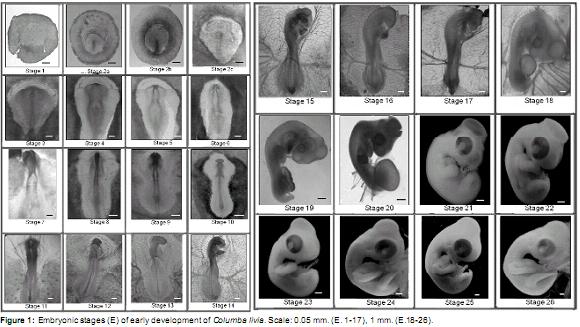
<body><![CDATA[<p><font face="Verdana, Arial, Helvetica, sans-serif" size="3"><b>Materials and methods</b> </font></p>     <p><font face="Verdana, Arial, Helvetica, sans-serif" size="2"><i>Materials</i> </font></p>     <p><font face="Verdana, Arial, Helvetica, sans-serif" size="2">Fertile eggs from <i>Columba livia </i>were collected on  the Facultad de Ciencias Exactas y  Naturales  y Agrimensura  campus of the Universidad Nacional  del Nordeste (Corrientes, Argentina) during the nesting period. At this location the animals build their nests  in holes and depressions on the roof and lay 2 eggs on alternating days. For the present study 10 nests were randomly selected to be checked daily or weekly for fertilized eggs from September  to March  2008-2009 and  2009-2010. The eggs were collected early  in the  morning  to ensure they were recently laid. Eggs were artificially incubated in a culture stove at 35-37 &deg;C with approximately 40-45% humidity to obtain embryos in different stages of development. Fixation of the embryos in 10% formalin was performed according to the following protocol: every 1-4 hours during  the first 5 days,  then every 6-10 hours, until the tenth  day and then every 12-24 hours, to complete the development. To slaughter the specimens, the standard method established in the Guidelines for Animal Euthanasia  proposed by the IACUC (Institutional Animal Care and Use  Committee)  was  followed. A stereoscopic  microscope was used to separate  yolks from  embryos, which were cleaned and  subsequently stained with methylene blue. The analyzed material  became part of the scientific collection of the animal  embryology  course of the Department of Biology, Facultad de Ciencias Exactas y Naturales y Agrimensura of the Universidad Nacional del Nordeste. </font></p>     <p><font face="Verdana, Arial, Helvetica, sans-serif" size="2"><i>Embryo analysis</i> </font></p>     <p><font face="Verdana, Arial, Helvetica, sans-serif" size="2">A total of 190 embryos  in various  stages of development were analyzed:  100 in early phase   (stages 1-26), 55 in middle  phase (stages  27-36) and 35 in late  phase (stages 37-43). Each stage was characterized based on the external morphological  traits  considered  by Hamburger  and Hamilton   (1952) in addition to other traits not considered by these authors (see  text). Stage 2  was divided  into sub-stages  a, b, and c, considering they  represent the same process (formation of the primitive streak) in different periods.</font></p>     <p><font face="Verdana, Arial, Helvetica, sans-serif" size="2">The following were measured  during stages 3-12: the length of the zona  pellucida (LZP), the length  of the primitive streak  (LLP),  and the total length  (Lt) of the embryo pondered from  the anterior end of the plate/neural  tube  to the posterior end  of the primitive streak.</font></p>     <p><font face="Verdana, Arial, Helvetica, sans-serif" size="2">During stages 28-43 the length of the maxillary process (Lpmx)  and length  of mandibular process (Lpm) were measured.  These measurements  were made with an ocular  micrometer incorporated in the  stereomicroscope. For stages 37-42 a graduated  cylinder  was used to measure the embryo  volume (Ve) and yolk volume (Vv). Using these data, total volume (Vt)  was calculated as  Vt =  Ve +  Vv. The morphology of lungs was described  based upon the  method proposed by Chuong <i>et al. </i>(2000). Photographs of the embryos were taken  with a Canon A2000 IS digital camera.</font></p>     <p>&nbsp;</p>     <p><font face="Verdana, Arial, Helvetica, sans-serif" size="3"><b>Results</b> </font></p>     <p><font face="Verdana, Arial, Helvetica, sans-serif" size="2"><i>Early phase (<a href="#f1">Figure 1</a>)</i> </font></p>     ]]></body>
<body><![CDATA[<p><font face="Verdana, Arial, Helvetica, sans-serif" size="2">Stage 1 (&plusmn; 3 h of incubation): zona pellucida and Zona opaca circularly  shaped. Blastoderm in the central portion of the zona pellucida.</font></p>     <p><font face="Verdana, Arial, Helvetica, sans-serif" size="2">Stage 2a (&plusmn; 8 h  of incubation): zona pellucida inverted  pear-shape.  Primitive  streak visible in the rear end of the zona pellucida. Llp LZP &plusmn; 25%.</font></p>     <p><font face="Verdana, Arial, Helvetica, sans-serif" size="2">Stage 2b (&plusmn;  10 h  incubation): zona pellucida inverted pear-shape.  Llp LZP &plusmn; 50%.</font></p>     <p><font face="Verdana, Arial, Helvetica, sans-serif" size="2">Stage 2c (&plusmn; 12 h incubation): zona pellucida inverted pear-shape. Llp LZP &plusmn; 70%. Primitive streak groove, and Hensen&iacute;s node clearly distinguishable.</font></p>     <p><font face="Verdana, Arial, Helvetica, sans-serif" size="2">Stage 3 (&plusmn;  14 h  incubation): primitive  streak similar  to previous stage. Neural plate visible in front of the primitive  streak.</font></p>     <p><font face="Verdana, Arial, Helvetica, sans-serif" size="2">Stage 4 (&plusmn; 17 h of incubation): neural folds and neural groove visible in the anterior neural plate. Llp &plusmn;  75% of the Lt of the embryo.  Blood islands are visible in the  posterior region of the opaque area.</font></p>     <p><font face="Verdana, Arial, Helvetica, sans-serif" size="2">Stage 5 (&plusmn; 18 h incubation):  two pairs of somites.  Deeper neural groove. Neural folds close together  in the dorsal midline of the anterior region.  Llp &plusmn; 65% of the Lt of the embryo. Blood islands as previously  described.</font></p>     <p><font face="Verdana, Arial, Helvetica, sans-serif" size="2">Stage 6 (&plusmn; 20 h incubation):  three pairs of somites. Neural folds similar to the previous stage. Llp  &plusmn; 50% of the Lt of the embryo. Patterns  of vitelline vessels  visible in the posterior region of the vitelline membrane.</font></p>     <p><font face="Verdana, Arial, Helvetica, sans-serif" size="2">Stage 7 (&plusmn; 21 h incubation): four pairs of somites. Neural folds fused at the medial  and posterior  brain. Anterior region open. Llp &plusmn; 45% of the Lt of the embryo.  Vitelline vessels extend to the middle  region of the membrane  sac.</font></p>     <p><font face="Verdana, Arial, Helvetica, sans-serif" size="2">Stage 8 (&plusmn; 23 h incubation):  five pairs of somites.  Three delimited  brain vesicles  (forebrain, midbrain  and hindbrain). Anterior neuropore is open.  Neural folds of trunk unfused. Llp &plusmn; 37% of the Lt of the embryo. Vitelline vessels extending to the anterior  region of the vitelline membrane.</font></p>     ]]></body>
<body><![CDATA[<p><font face="Verdana, Arial, Helvetica, sans-serif" size="2">Stage 9 (&plusmn; 26 h  incubation):  six-seven pairs of somites. Forebrain expanded laterally to form optic vesicles. Anterior neuropore open. Neural folds of trunk and Llp as described above. Two endocardial tubes  visible in the ventrally pharyngeal  region of  the embryo.  Vitelline  vessels extending to the anterior region of the vitelline membrane.</font></p>     <p><font face="Verdana, Arial, Helvetica, sans-serif" size="2">Stage 10 (&plusmn; 27 h incubation): 9 pairs of somites.  Forebrain with laterally expanded optic vesicles, well  delineated  midbrain  and hindbrain. Anterior  neuropore  is closing.  Neural folds of trunk fused at the  level of the somites,  unfused into the posterior region. Llp &plusmn; 20% of the Lt of the embryo. Endocardial tubes fused in the midline with vitelline  veins  projected  laterally  from  the posterior region.  Well-definedvitelline vesselsinthe vitelline membrane.</font></p>     <p><font face="Verdana, Arial, Helvetica, sans-serif" size="2">Stage 11 (&plusmn; 28 h incubation): 11 pairs  of somites.  Telencephalon curved toward the anterior  ventral  region. Optic placodes distinguishable  as thickenings  on both sides of the optic vesicles.  Neural  folds of trunk unfused in the posterior region.  Llp &plusmn;  20% of the Lt of the embryo. In ventral  view, a tubular heart with a posterior widening  corresponding to the venous sinus. Idem vitelline vessels.</font></p>     <p><font face="Verdana, Arial, Helvetica, sans-serif" size="2">Stage 12 (&plusmn; 29 h incubation): 13 pairs of somites.  More developed telencephalon and optic vesicles visible ventrally. More prominent  midbrain,  with six rombomeres in the hindbrain (r1-r6). Otic placodes in process  of invagination visible dorsally  at r5-r6. Llp &plusmn; 15% of the LT. S-shaped curved heart. Vitelline veins  connected to the vessels of the vitelline membrane.  Evident heartbeat. Amniotic membrane visible in  the anterior region of the embryo covering the procencephalon  and midbrain.  Vitelline membrane covering  approximately 1/4 of the yolk mass.</font></p>     <p><font face="Verdana, Arial, Helvetica, sans-serif" size="2">Stage 13 (&plusmn; 32 h incubation):  16 pairs of somites. Cephalic  region curved to the right. Telencephalon and mesencephalon more prominent. Mesencephalic flexure distinguishable. r2 r1 more dilated  than others. Invaginated lens vesicle, optic  cup with  distinguishable choroidal  fissure. Invaginated otic vesicle  visible at the level of r5- r6. Llp &plusmn; 7% of the Lt of the embryo. Heart with   4 chambers well defined, expanded laterally to the  right. Anterior  fold of the amnion extends to the posterior  region  of the hindbrain.  Vitelline membrane  similar to the previous stage.</font></p>     <p><font face="Verdana, Arial, Helvetica, sans-serif" size="2">Stage 14 (&plusmn; 36-40 h incubation): 19-22 pairs of  somites. Curvature of the embryo  to  the right extends  to the first somite. Eye and  otic vesicle  similar  to previous  stage. First  and Second visceral archespresent.Primitivestreakabsent.  Well- developed  vitelline vascular  system. Well-developed vitelline  arteries and visible at  the level  of somite   15-16. Atrial and ventricular more prominent than other cardiac chamber, no obvious septa. Anterior fold  of the amnion extends to the level of somite 7.</font></p>     <p><font face="Verdana, Arial, Helvetica, sans-serif" size="2">Stage 15 (&plusmn; 40-44 h incubation): 25 pairs  of somites.  Curvature  of the embryo to the right more pronounced. Midbrain more prominent  than the other brain vesicles. Cervical flexion distinguishable. Eye more prominent with the onset of  retinal  pigmentation. Auditory vesicle shows dorsal  endolymphatic  duct. First, second, third,  and fourth visceral arches present,  the second  being  the largest.  Nasal  placodes in lateroventral  position visible in the anterior region  of the head.  Anterior fold  of the amnion covers the embryo to the level of somite 14. Vitelline membrane covering about 1/3 of the yolk mass.</font></p>     <p><font face="Verdana, Arial, Helvetica, sans-serif" size="2">Stage 16 (&plusmn; 44-46 h incubation): 26-28 pairs of somites. Invaginated nasal placode. Anterior amnion  fold covers the embryo until the 17 somite; lateral amnion  folds  visible in the posterior region of the embryo.  Distinctive anterior  limb bud at the height of 12-14 somites as a lateral expansion. Other structures  similar to the previous stage.</font></p>     <p><font face="Verdana, Arial, Helvetica, sans-serif" size="2">Stage 17 (&plusmn; 48-54 h incubation):  30 to 36 pairs of somites. More  pronounced curvature of the embryo.  Telencephalon divided into two distinct vesicles visible laterally. Epiphysis visible in the dorsal  region of the diencephalon. Midbrain divided into bulky lobes. Four visceral  arches present; the second is largest and the fourth is very small. Posterior  limb bud visible at the level  of somite   25-30. Caudal  end is ventrally curved.  Anterior  fold  of the amnion  extends to the posterior region  of the embryo,  lateral folds  fused with anterior and  posterior, except  in the posterior  dorsal region. Allantoisvisibleasasmallventralsaccular evagination between the posterior limb buds.</font></p>     <p><font face="Verdana, Arial, Helvetica, sans-serif" size="2">Stage 18 (&plusmn;  54-63 h  incubation): 37-40 pairs of  somites. Embryo is C-shaped  with large head.  Midbrain well developed.  Eye prominent with a more  pigmented  retina. Visceral  arch 1 divided into maxillary  and  mandibular  processes, third and  fourth  visceral  arches  not visible. Anterior and  posterior  limb buds equal length. Amnion completely formed. Allantois more prominent than previous stage and laterally  visible in the posterior region  of the embryo. Vitelline membrane  covering about half of the yolk mass  with well-developed  arterial  and venous vessels.</font></p>     ]]></body>
<body><![CDATA[<p><font face="Verdana, Arial, Helvetica, sans-serif" size="2">Stage 19 (&plusmn;  63-69 h  incubation): 40-43 pairs of somites.  Maxillary process  longer than the mandibular process.  Second visceral arch visible. Limb  buds are as long as wide. Allantois  more developed  than previous stage with patterns of blood  vessels.</font></p>     <p><font face="Verdana, Arial, Helvetica, sans-serif" size="2">Stage 20 (&plusmn; 69-96 h incubation): 44 pairs  of somites. Curvature of the embryo more pronounced. Mandibular process extends  to the middle of the maxillary process. Second visceral arch inconspicuous.  Heart with ventricle  prominently located  posteroventral  to the right and left atria. Limb buds more developed.  Allantois larger and well vascularized. </font></p>     <p><font face="Verdana, Arial, Helvetica, sans-serif" size="2">Stage 21 (4 days of incubation): the embryo becomes white, internal structures not clearly visible.  Optic lobes very prominent. Eyes are large.  Second  visceral arch visible as a ventrolateral expansion  posterior  to the mandibular process. Limb  bud oar-shaped.  Allantois completely  covers the embryo.  Embryo produces  muscular torsional  movements.</font></p>     <p><font face="Verdana, Arial, Helvetica, sans-serif" size="2">Stage 22 (5 days of incubation):  anterior  end of the maxillary process  close to the nostrils. Anterior  end of the mandibular  process joint in the midline.  Stomodeum plate closed.  Limb buds more developed. Allantois larger  than previous  stage. Smooth  integument.</font></p>     <p><font face="Verdana, Arial, Helvetica, sans-serif" size="2">Stage 23 (5 &frac12;  days of incubation): maxillary process exceeds previously to the nostrils. Mandibular process reaches  half the length of the  maxillary process. Stomodeum  plate perforated.   Differentiated second visceral arch not visible. Longer  limbs  with distinguishable digital  plates in the  autopod  region. Vitelline membrane  completely  covers the yolk mass.</font></p>     <p><font face="Verdana, Arial, Helvetica, sans-serif" size="2">Stage 24 (6  days of incubation):  auditive duct visiblebehindthemandibularprocess.Large eyes. Articulation member  between stylopod and zeugopod.  Forelimb autopod with notch between digits  1 and 2.</font></p>     <p><font face="Verdana, Arial, Helvetica, sans-serif" size="2">Stage 25 (6 &frac12; days of incubation): limbs longer in length. Autopod of the forelimb  and posterior recesses between  digits 1 and 2 and 2 and 3.</font></p>     <p><font face="Verdana, Arial, Helvetica, sans-serif" size="2">Stage 26 (7 days  of incubation): maxillary  process longer and curved down. Forelimb interdigital notches sharper. Interdigital notch between  finger 3 and 4 of the hind limb visible. Longer neck.</font></p>     <p align="center"><a name="f1"><img src="/img/revistas/rccp/v25n1/a02f1.jpg" /></a></p>     <p><font face="Verdana, Arial, Helvetica, sans-serif" size="2"><i>Middle phase</i> (<a href="#f2"><i>Figure 2)</i></a> </font></p>     ]]></body>
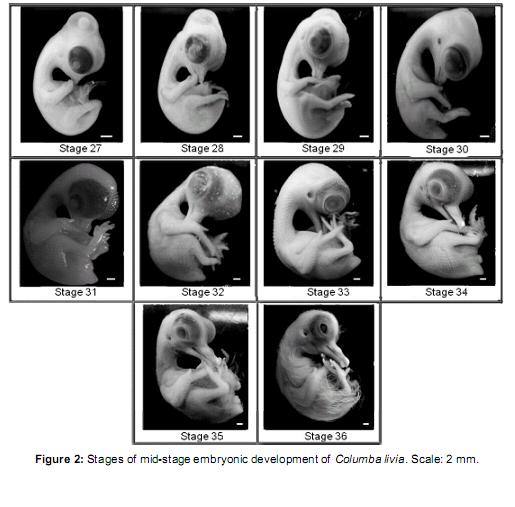
<body><![CDATA[<p><font face="Verdana, Arial, Helvetica, sans-serif" size="2">Stage 27 (7 &frac12;  days of incubation): maxillary process with egg-tooth on the dorsal side. Mandibular  process extended  to half the length of the  maxillary process. Hind limb with digits 2, 3, and 4  dorsally visible; digit 1 in a ventral position. Primordial  feather germ placode-shaped distributed in two dorsal rows and two caudal rows.</font></p>     <p><font face="Verdana, Arial, Helvetica, sans-serif" size="2">Stage 28 (8 days of incubation): mandibular and maxillar process form distinguishable beak. Beak:  Lpmx: 5.49 mm and Lpm: 4.27 mm. Digit 2 of the forelimb  longer than the others.  Webbing of the hind limb transparent. Primordial  feather germ placode shaped distributed in 4 dorsal rows and 3 caudal  rows.  4 scleral papillae visible on the eyeball.</font></p>     <p><font face="Verdana, Arial, Helvetica, sans-serif" size="2">Stage 29 (8 &frac12; days of incubation):  beak: Lpmx: 5.73 mm and Lpm: 4.51 mm. Limbs more developed  than in the previous  stage. Digit 3 of the hind limb longer than others.  Primordial  feather  germ  placode  shaped distributed in 4 spinal rows,   5-6 lumbo-sacral rows, 2  femoral rows, 2  scapular   rows. Primordial feather germ reticulum-shaped  distributed  in 4  cuadal  rows. 6-7 scleral papillae arranged  in a semicircle  on the eyeball.  Eyelid rim visible around the eyeball.</font></p>     <p><font face="Verdana, Arial, Helvetica, sans-serif" size="2">Stage 30  (9 days of incubation): beak: Lpmx:   5.98 mm  and Lpm: 4.76 mm. Forelimb wing-like. Webbing of the limb buds absent. Primordial feather germ  placode shaped distributed in 2 marginal spinal  rows, 7  lumbo-sacral rows, 4  femoral rows,   4 scapular rows, 1  row  around  the duct auditive, and dispersed pectoral  and capital  primordial.  Primordial feather germ reticulum shaped distributed in the 2 medial rows  and 4 spinal caudal  rows.13  scleral  papillae around the eyeball.</font></p>     <p><font face="Verdana, Arial, Helvetica, sans-serif" size="2">Stage 31 (9 &frac12; days of incubation): beak: Lpmx: 6.1 mm and Lpm: 4.88 mm. Limbs developed. Eyelid covers half of the eyeball. Primordial feather  germ reticulum  shaped distributed throughout the body except the ventral region of the neck and abdomen.</font></p>     <p><font face="Verdana, Arial, Helvetica, sans-serif" size="2">Stage 32 (10 days of incubation): beak: Lpmx:   6.1 mm and Lpm: 5.49 mm. Phalanges of the  hind limb distinguishable. Primordial feather germ reticulum shaped in the ventral region  of the neck and  entire body except in the abdominal  region.  Upper  and  lower eyelids cover the eye scleral papillae.  Nictitating membrane  visible in the vertice of the eye. Chorioallantoideal membrane  closely attached  to the eggshell.</font></p>     <p><font face="Verdana, Arial, Helvetica, sans-serif" size="2">Stage 33 (10 &frac12; days of incubation): beak: Lpmx:      6.8 mm  and  Lpm: 6.34 mm. Primordial feather germ  conical-shaped in the dorsal part of the body; the  rest form a lattice. Filiform feather  germ in the wing and femoral tract.  Footpads and claws not yet cornified.</font></p>     <p><font face="Verdana, Arial, Helvetica, sans-serif" size="2">Stage 34 (11 days of incubation):  beak: Lpmx:   7.93 mm and Lpm:  9.37 mm with prominent egg tooth.  Contour  eyeling oval-shaped.  Patterns of scales  slightly visible on the front of the hind limb. Footpads  well differentiated onset cornification  in claws.  Feathers similar  to the previous stage.</font></p>     <p><font face="Verdana, Arial, Helvetica, sans-serif" size="2">Stage 35 (11 &frac12; days of incubation): beak: Lpmx:    8.54 mm and Lpm: 10.98 mm. Filiform markers throughout the body except in the circumorbital region and around  the auditive duct where they remain reticulum-shaped. Leg scales arranged  in imbricate  form.</font></p>     <p><font face="Verdana, Arial, Helvetica, sans-serif" size="2">Stage 36 (12 days of incubation): beak: Lpmx:   10.04 mm and Lpm: 11.83 mm. Long thread-like feathers  in trunk region, short feathers on the head region,  neck, and wing. Footpads  with pattern of scales visible as papillae. Claws well cornified. Eyelid covers most of the eye.</font></p>     ]]></body>
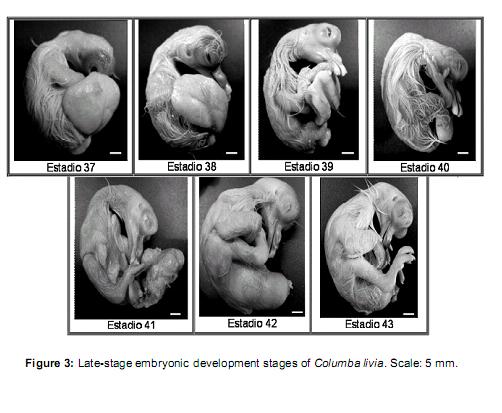
<body><![CDATA[<p align="center"><a name="f2"><img src="/img/revistas/rccp/v25n1/a02f2.jpg" /></a></p>     <p><font face="Verdana, Arial, Helvetica, sans-serif" size="2">Stage 37 (12  &frac12; days of incubation):  Vv =  50- 40% / Vt. Beak:  Lpmx: 10.37 mm and Lpm: 12.2 mm. Feathers similar to the previous stage, but corneal sheath.</font></p>     <p><font face="Verdana, Arial, Helvetica, sans-serif" size="2">Stage 38 (13 days  of incubation): Vv = 40-25%   / Vt. Beak:  Lpmx:  10.49 and  Lpm: 12.4 mm, well cornified.  Filiform feathers  longer than previous  stage.Footpads coveredwithgranular scales. Eyelids cover the lenses.</font></p>     <p><font face="Verdana, Arial, Helvetica, sans-serif" size="2">Stage 39 (13 &frac12;  days of incubation):  Vv =  25-   20% / Vt. Beak: Lpm Lpmx idem to previous stage.  Feathers are longer. </font></p>     <p><font face="Verdana, Arial, Helvetica, sans-serif" size="2">Stage 40 (14 days  of incubation): Vv = 20-10%   / Vt. Closed eyelids, not fused. All others similar to the previous stage. </font></p>     <p><font face="Verdana, Arial, Helvetica, sans-serif" size="2">Stage 41 (15 days of incubation):  Vv =  &lt;10% / Vt. Beak: Lpmx: 12.2mm and Lpm: 15.25mm. Feathers have lost the sheath cornea. Eyelids  same as previous stage.</font></p>     <p><font face="Verdana, Arial, Helvetica, sans-serif" size="2">Stage 42 (16 days of incubation): Yolk completely incorporated into the abdominal cavity of the embryo.  Feathers  acquired  yellow  color.  Beak:  Lpm Lpmx idem to previous stage. Eyelid same  as previous stage.  Onset of egg shells breaking   (time &plusmn; 24 h). </font></p>     <p><font face="Verdana, Arial, Helvetica, sans-serif" size="2">Stage 43 (&plusmn; 17 days): Neonate with closed  eyelids and low mobility.</font></p>     <p align="center"><a name="f3"><img src="/img/revistas/rccp/v25n1/a02f3.jpg" /></a></p>     <p>&nbsp;</p>     ]]></body>
<body><![CDATA[<p><font face="Verdana, Arial, Helvetica, sans-serif" size="3"><b>Discussion</b> </font></p>     <p><font face="Verdana, Arial, Helvetica, sans-serif" size="2">Hendrickx and Hanzlik (1965) described the ontogeny  of <i>Colinus virginianus </i>pointing at a gradual  delay in the development  of this species compared  to what was described  by Hamburger and  Hamilton (1952). Yamasaki and Tonosaki (1988) found differences between <i>Lonchura  striata</i>var domestica and  <i>Gallus gallus domesticus  </i>in the following: the development  and  duration  of the primitive  streak, neural  folds, brain, retinal pigmentation, and feathers. K&circ;ppl <i>et al. </i>(2005) reported  the normal developmental sequence of <i>Tyto alba </i>and exposed  differences  found with respect to the ontogeny of the chicken concerning  the  development of the eyelids  and feather  germs. Likewise,  Ainswort <i>et al. </i>(2009)  compared  the morphogenesis and feather germ pigmentation,  the development  of the beak and toes between <i>Coturnix  coturnix  japonica </i>and <i>Gallus gallus domesticus</i>, and identified variations in the developmental time,  mainly during late ontogenetic stages.</font></p>     <p><font face="Verdana, Arial, Helvetica, sans-serif" size="2">Regard ing the observations of the present study, <i>Columbalivia</i>domesticus showedsimilarities with  <i>Gallus gallus domesticus </i>in the ontogenetic  sequence of events during the early  stages of development.  These include the formation of the primitive  streak, the appearance of the neural plate  and consequent  formation  of the neural folds  and neural  tube, the formation  of the primary circulatory system,  and the organization  of extra- embryonic membranes. However, consistent with  what has been reported by other authors, we observed differences  in middle and late stages corresponding mainly to the timing of appearance  of limb buds, the growth of the beak,  the development of  feathers and the organization and cornification of legs, scales, and claws. Considering the stages and developmental time, these structures  appear  earlier  in <i>Columba  livia </i>than in <i>Gallus </i></font><font face="Verdana, Arial, Helvetica, sans-serif" size="2"><i>gallus domesticus</i>. These differences could be   explained bythe morphological characteristics  of neonates and the incubation of eggs, which are  17 and 21 days, respectively.  Upon hatching,  the  chicks of these species differ in the degree of functional maturity of some organ systems,  such as muscular,  and in behavioral aspects, such as nest  permanence  and feeding  by parents,  which are characteristics associated  with semialtricial-2  andprecocial-2developmentalmodels(Starck and Ricklefs, 1998; Pough <i>et al.</i>, 2003). However, the  external morphology of hatchlings is similar  in the development  of feathers, scales, claws, beak, and eyes. In  this regard,  we believe that the advancement in time of these characteristically  morphogenetic  events allows <i>Columba livia </i>to reach   a degree  of morphological development  similar to  that of <i>Gallus gallus domesticus  </i>in a  shorter time  period and represents  a clear example  of heterochrony  in the ontogeny of these species.</font></p>     <p><font face="Verdana, Arial, Helvetica, sans-serif" size="2">Blom and Lilja (2005) described differences in developmental time and maturation of the digestive system, muscular somite formation and size of the brain, eyes,  and locomotive  organs among precocial and altricial  species with different patterns  of postnatal growth. In conclusion,  they suggest that the assessment  of embryonic  growth rate is essential to characterize  the patterns of development and also  offers an excellent opportunity to analyze  heterochonyc events. Based  on the results of the present study we propose that the analysis and comparison  of ontogenetic sequences of varying speciesof birdswith differentdevelopmental  models  is also important not only to obtain  a wider knowledge of embryonic characteristics  in each species,  but also  to identify ontogenetic patterns  related  to altricial and  precocial  models.</font></p>     <p>&nbsp;</p>     <p><font face="Verdana, Arial, Helvetica, sans-serif" size="3"><b>Acknowledgements</b> </font></p>     <p><font face="Verdana, Arial, Helvetica, sans-serif" size="2">To Lic. Alejandra Hernando and Lic. Blanca Beatriz  Alvarez de Avanza for their critical reading  of the manuscript  and their comments as well  as the General Secretariat  of Science and  Technology of the  Universidad Nacional del Nordeste for funding this work (Res. 740/07 CS). We also thank the suggestions  and corrections  made  by this paper&iacute;s reviewers astheysubstantiallycontributedto improve the quality of the manuscript.</font></p>     <p><font face="Verdana, Arial, Helvetica, sans-serif" size="2"></font></p>     <p><font face="Verdana, Arial, Helvetica, sans-serif" size="3"><b>References</b> </font></p>     <!-- ref --><p><font face="Verdana, Arial, Helvetica, sans-serif" size="2">1. Ainsworth SJ, Stanley RL, Evans DJR. Developmental  stage japanece  quail. J Anat 2009; 216:3-16.</font>&nbsp;&nbsp;&nbsp;&nbsp;&nbsp;&nbsp;&nbsp;&nbsp;[&#160;<a href="javascript:void(0);" onclick="javascript: window.open('/scielo.php?script=sci_nlinks&ref=000102&pid=S0120-0690201200010000200001&lng=','','width=640,height=500,resizable=yes,scrollbars=1,menubar=yes,');">Links</a>&#160;]<!-- end-ref --><!-- ref --><p><font face="Verdana, Arial, Helvetica, sans-serif" size="2">2. Bellairs R. The conversion of yolk into cytoplasm in the chick blastoderm as shown by electron microscopy.Embryol Exp Morph  1958; 6:149-61.</font>&nbsp;&nbsp;&nbsp;&nbsp;&nbsp;&nbsp;&nbsp;&nbsp;[&#160;<a href="javascript:void(0);" onclick="javascript: window.open('/scielo.php?script=sci_nlinks&ref=000103&pid=S0120-0690201200010000200002&lng=','','width=640,height=500,resizable=yes,scrollbars=1,menubar=yes,');">Links</a>&#160;]<!-- end-ref --><!-- ref --><p><font face="Verdana, Arial, Helvetica, sans-serif" size="2">3. Blom J, Lilja CA. Comparative study of embryonic development  of some bird species with different patterns of postnatal growth. Zoology 2005; 108:81-95.</font>&nbsp;&nbsp;&nbsp;&nbsp;&nbsp;&nbsp;&nbsp;&nbsp;[&#160;<a href="javascript:void(0);" onclick="javascript: window.open('/scielo.php?script=sci_nlinks&ref=000104&pid=S0120-0690201200010000200003&lng=','','width=640,height=500,resizable=yes,scrollbars=1,menubar=yes,');">Links</a>&#160;]<!-- end-ref --><!-- ref --><p><font face="Verdana, Arial, Helvetica, sans-serif" size="2">4. Brush A, Scott A. Development  of protein polymorphisms in redwing blackbirds.  J Embryol Exp Morph 1972; 28:481-489.</font>&nbsp;&nbsp;&nbsp;&nbsp;&nbsp;&nbsp;&nbsp;&nbsp;[&#160;<a href="javascript:void(0);" onclick="javascript: window.open('/scielo.php?script=sci_nlinks&ref=000105&pid=S0120-0690201200010000200004&lng=','','width=640,height=500,resizable=yes,scrollbars=1,menubar=yes,');">Links</a>&#160;]<!-- end-ref --><!-- ref --><p><font face="Verdana, Arial, Helvetica, sans-serif" size="2">5. Caprioli A, Jaffredo T, Gautier R, Dubourg C, Dieterlen-Lievre  F. Blood-borne seeding  by hematopoietic and endothelial precursors from the allantois.  Proc Natl Acad  Sci 1998;   95:1641-1646. </font>&nbsp;&nbsp;&nbsp;&nbsp;&nbsp;&nbsp;&nbsp;&nbsp;[&#160;<a href="javascript:void(0);" onclick="javascript: window.open('/scielo.php?script=sci_nlinks&ref=000106&pid=S0120-0690201200010000200005&lng=','','width=640,height=500,resizable=yes,scrollbars=1,menubar=yes,');">Links</a>&#160;]<!-- end-ref --><!-- ref --><p><font face="Verdana, Arial, Helvetica, sans-serif" size="2">6. Chevallier A. Origine des ceintures scapulaires et pelviennes chez l&iacute;embryon d&iacute;oiseau. J Embryol Exp Morph 1977; 42:275- 292. </font>&nbsp;&nbsp;&nbsp;&nbsp;&nbsp;&nbsp;&nbsp;&nbsp;[&#160;<a href="javascript:void(0);" onclick="javascript: window.open('/scielo.php?script=sci_nlinks&ref=000107&pid=S0120-0690201200010000200006&lng=','','width=640,height=500,resizable=yes,scrollbars=1,menubar=yes,');">Links</a>&#160;]<!-- end-ref --><!-- ref --><p><font face="Verdana, Arial, Helvetica, sans-serif" size="2">7. Couly GF, Coltey PM, Le Douarin  NM. The developmental  fate  of the cephalic mesoderm in quail-chick  chimeras. Development  1992; 114:1-15.</font>&nbsp;&nbsp;&nbsp;&nbsp;&nbsp;&nbsp;&nbsp;&nbsp;[&#160;<a href="javascript:void(0);" onclick="javascript: window.open('/scielo.php?script=sci_nlinks&ref=000108&pid=S0120-0690201200010000200007&lng=','','width=640,height=500,resizable=yes,scrollbars=1,menubar=yes,');">Links</a>&#160;]<!-- end-ref --><!-- ref --><p><font face="Verdana, Arial, Helvetica, sans-serif" size="2">8. Del Conte E, Sirlin L. The first stages of <i>Bufo arenarum</i>   development. Acta Zool Lilloana 1951; 12:495-499. </font>&nbsp;&nbsp;&nbsp;&nbsp;&nbsp;&nbsp;&nbsp;&nbsp;[&#160;<a href="javascript:void(0);" onclick="javascript: window.open('/scielo.php?script=sci_nlinks&ref=000109&pid=S0120-0690201200010000200008&lng=','','width=640,height=500,resizable=yes,scrollbars=1,menubar=yes,');">Links</a>&#160;]<!-- end-ref --><!-- ref --><p><font face="Verdana, Arial, Helvetica, sans-serif" size="2">9. Echeverr&iacute;a DD, Fiorito De L&oacute;pez LE. Estadios de la metamorfosis  en <i>Bufo arenarum </i>(Anura) Physis Secc B. 1981;   40:15-23. </font>&nbsp;&nbsp;&nbsp;&nbsp;&nbsp;&nbsp;&nbsp;&nbsp;[&#160;<a href="javascript:void(0);" onclick="javascript: window.open('/scielo.php?script=sci_nlinks&ref=000110&pid=S0120-0690201200010000200009&lng=','','width=640,height=500,resizable=yes,scrollbars=1,menubar=yes,');">Links</a>&#160;]<!-- end-ref --><!-- ref --><p><font face="Verdana, Arial, Helvetica, sans-serif" size="2">10. Hamburger V, Hamilton HL. A series of normal stages in the development  of the chick embryo.  J Morphol  1952; 88:49-92.</font>&nbsp;&nbsp;&nbsp;&nbsp;&nbsp;&nbsp;&nbsp;&nbsp;[&#160;<a href="javascript:void(0);" onclick="javascript: window.open('/scielo.php?script=sci_nlinks&ref=000111&pid=S0120-0690201200010000200010&lng=','','width=640,height=500,resizable=yes,scrollbars=1,menubar=yes,');">Links</a>&#160;]<!-- end-ref --><!-- ref --><p><font face="Verdana, Arial, Helvetica, sans-serif" size="2">11. Hendrickx AG, Hanzlik R. Developmental  stages of the bobwhite  quail embryo, <i>Colinus virginianus</i>. Biol Bull1965;   129:523-531. </font>&nbsp;&nbsp;&nbsp;&nbsp;&nbsp;&nbsp;&nbsp;&nbsp;[&#160;<a href="javascript:void(0);" onclick="javascript: window.open('/scielo.php?script=sci_nlinks&ref=000112&pid=S0120-0690201200010000200011&lng=','','width=640,height=500,resizable=yes,scrollbars=1,menubar=yes,');">Links</a>&#160;]<!-- end-ref --><!-- ref --><p><font face="Verdana, Arial, Helvetica, sans-serif" size="2">12. Keller R.  Early embryonic  development of <i>Xenopus  laevis</i>. Methods  Cell  Biol  1991; 36:61-113.</font>&nbsp;&nbsp;&nbsp;&nbsp;&nbsp;&nbsp;&nbsp;&nbsp;[&#160;<a href="javascript:void(0);" onclick="javascript: window.open('/scielo.php?script=sci_nlinks&ref=000113&pid=S0120-0690201200010000200012&lng=','','width=640,height=500,resizable=yes,scrollbars=1,menubar=yes,');">Links</a>&#160;]<!-- end-ref --><!-- ref --><p><font face="Verdana, Arial, Helvetica, sans-serif" size="2">13. Kimmel CB, Ballard WW,  Kimmel SR, Ullmann B, Schilling TF. Stages of embryonic development of the zebrafish. Develop Dynam  1995; 203:253-310.</font>&nbsp;&nbsp;&nbsp;&nbsp;&nbsp;&nbsp;&nbsp;&nbsp;[&#160;<a href="javascript:void(0);" onclick="javascript: window.open('/scielo.php?script=sci_nlinks&ref=000114&pid=S0120-0690201200010000200013&lng=','','width=640,height=500,resizable=yes,scrollbars=1,menubar=yes,');">Links</a>&#160;]<!-- end-ref --><!-- ref --><p><font face="Verdana, Arial, Helvetica, sans-serif" size="2">14. Koecke HU. Normalstadien der Embryonalentwicklung bei der Hausente,(<i>Anas boschas domestica</i>). Embryologia  1958; 4:55- 78. </font>&nbsp;&nbsp;&nbsp;&nbsp;&nbsp;&nbsp;&nbsp;&nbsp;[&#160;<a href="javascript:void(0);" onclick="javascript: window.open('/scielo.php?script=sci_nlinks&ref=000115&pid=S0120-0690201200010000200014&lng=','','width=640,height=500,resizable=yes,scrollbars=1,menubar=yes,');">Links</a>&#160;]<!-- end-ref --><!-- ref --><p><font face="Verdana, Arial, Helvetica, sans-serif" size="2">15. K&ouml;ppl C, Futterer E, Nieder B,  Sistermann R,Wagner H. Embryonic  and Posthatching Development of the Barn  Owl (<i>Tyto alba</i>): Reference  Data for Age Determination.  Develop   Dynam 2005; 233:1248-1260.</font>&nbsp;&nbsp;&nbsp;&nbsp;&nbsp;&nbsp;&nbsp;&nbsp;[&#160;<a href="javascript:void(0);" onclick="javascript: window.open('/scielo.php?script=sci_nlinks&ref=000116&pid=S0120-0690201200010000200015&lng=','','width=640,height=500,resizable=yes,scrollbars=1,menubar=yes,');">Links</a>&#160;]<!-- end-ref --><!-- ref --><p><font face="Verdana, Arial, Helvetica, sans-serif" size="2">16. Kuroda O, Matsunaga C, Whittow  G, Tazawa H. Comparative  metabolic  responses  to prolonged cooling in precocial duck (<i>Anas domestica</i>) and altricial pigeons (<i>Columba domestica</i>) embryos. Comparative Biochemistry and Physiology Part  A: Physiology 1990; 95:407-410. </font>&nbsp;&nbsp;&nbsp;&nbsp;&nbsp;&nbsp;&nbsp;&nbsp;[&#160;<a href="javascript:void(0);" onclick="javascript: window.open('/scielo.php?script=sci_nlinks&ref=000117&pid=S0120-0690201200010000200016&lng=','','width=640,height=500,resizable=yes,scrollbars=1,menubar=yes,');">Links</a>&#160;]<!-- end-ref --><!-- ref --><p><font face="Verdana, Arial, Helvetica, sans-serif" size="2">17. Mun AM, Kosin IL. Developmental stages of the broad breasted  bronze turkey embryo. Biol Bull 1960; 119:90-97.</font>&nbsp;&nbsp;&nbsp;&nbsp;&nbsp;&nbsp;&nbsp;&nbsp;[&#160;<a href="javascript:void(0);" onclick="javascript: window.open('/scielo.php?script=sci_nlinks&ref=000118&pid=S0120-0690201200010000200017&lng=','','width=640,height=500,resizable=yes,scrollbars=1,menubar=yes,');">Links</a>&#160;]<!-- end-ref --><!-- ref --><p><font face="Verdana, Arial, Helvetica, sans-serif" size="2">18. Pardanaud L, Dieterlen-Li&egrave;vreF. Manipulation of the angiopoietic/hemangiopoietic commitment in the avian embryo.  Development 1999; 126:617-627.</font>&nbsp;&nbsp;&nbsp;&nbsp;&nbsp;&nbsp;&nbsp;&nbsp;[&#160;<a href="javascript:void(0);" onclick="javascript: window.open('/scielo.php?script=sci_nlinks&ref=000119&pid=S0120-0690201200010000200018&lng=','','width=640,height=500,resizable=yes,scrollbars=1,menubar=yes,');">Links</a>&#160;]<!-- end-ref --><!-- ref --><p><font face="Verdana, Arial, Helvetica, sans-serif" size="2">19. Petitte JN, Liu G, Yang Z. Avian pluripotent stem cells. Mech   Dev.2004; 121:1159-1168.</font>&nbsp;&nbsp;&nbsp;&nbsp;&nbsp;&nbsp;&nbsp;&nbsp;[&#160;<a href="javascript:void(0);" onclick="javascript: window.open('/scielo.php?script=sci_nlinks&ref=000120&pid=S0120-0690201200010000200019&lng=','','width=640,height=500,resizable=yes,scrollbars=1,menubar=yes,');">Links</a>&#160;]<!-- end-ref --><!-- ref --><p><font face="Verdana, Arial, Helvetica, sans-serif" size="2">20. Petitte JN. Avian germplasm preservation: embryonic stem cells or primordial  germ cells?  Poult Sci 2006; 85:237-242.</font>&nbsp;&nbsp;&nbsp;&nbsp;&nbsp;&nbsp;&nbsp;&nbsp;[&#160;<a href="javascript:void(0);" onclick="javascript: window.open('/scielo.php?script=sci_nlinks&ref=000121&pid=S0120-0690201200010000200020&lng=','','width=640,height=500,resizable=yes,scrollbars=1,menubar=yes,');">Links</a>&#160;]<!-- end-ref --><!-- ref --><p><font face="Verdana, Arial, Helvetica, sans-serif" size="2">21. Pough HF, Janis CM, Heiser JB. Vertebrate Life. Sixth edition. Ed. Prentice Hall. New Jersey; 2003.</font>&nbsp;&nbsp;&nbsp;&nbsp;&nbsp;&nbsp;&nbsp;&nbsp;[&#160;<a href="javascript:void(0);" onclick="javascript: window.open('/scielo.php?script=sci_nlinks&ref=000122&pid=S0120-0690201200010000200021&lng=','','width=640,height=500,resizable=yes,scrollbars=1,menubar=yes,');">Links</a>&#160;]<!-- end-ref --><!-- ref --><p><font face="Verdana, Arial, Helvetica, sans-serif" size="2">22. Starck JM, Ricklefs RE. Avian growth and development: evolution within the altricial  precocial spectrum. Ed. Oxford University Press, New York; 1998. </font>&nbsp;&nbsp;&nbsp;&nbsp;&nbsp;&nbsp;&nbsp;&nbsp;[&#160;<a href="javascript:void(0);" onclick="javascript: window.open('/scielo.php?script=sci_nlinks&ref=000123&pid=S0120-0690201200010000200022&lng=','','width=640,height=500,resizable=yes,scrollbars=1,menubar=yes,');">Links</a>&#160;]<!-- end-ref --><!-- ref --><p><font face="Verdana, Arial, Helvetica, sans-serif" size="2">23. Schultheiss TM, Xydas S, Lassar AB. Induction  of avian cardiac myogenesis  by anterior endoderm. Development 1995;   121:4203-4214. </font>&nbsp;&nbsp;&nbsp;&nbsp;&nbsp;&nbsp;&nbsp;&nbsp;[&#160;<a href="javascript:void(0);" onclick="javascript: window.open('/scielo.php?script=sci_nlinks&ref=000124&pid=S0120-0690201200010000200023&lng=','','width=640,height=500,resizable=yes,scrollbars=1,menubar=yes,');">Links</a>&#160;]<!-- end-ref --><!-- ref --><p><font face="Verdana, Arial, Helvetica, sans-serif" size="2">24. Tam PPL, Beddington  RSP. The formation of mesodermal tissues in the mouse embryo during gastrulation and early organogenesis.  Development  1987; 99:109-126.</font>&nbsp;&nbsp;&nbsp;&nbsp;&nbsp;&nbsp;&nbsp;&nbsp;[&#160;<a href="javascript:void(0);" onclick="javascript: window.open('/scielo.php?script=sci_nlinks&ref=000125&pid=S0120-0690201200010000200024&lng=','','width=640,height=500,resizable=yes,scrollbars=1,menubar=yes,');">Links</a>&#160;]<!-- end-ref --><!-- ref --><p><font face="Verdana, Arial, Helvetica, sans-serif" size="2">25. Teillet MA.  Evolution of the lumbo-sacral  neural crest in  the avian  embryo: origin and differentiation  of the ganglionated nerve  of Remak studied in interspecific quail-chick. Wilhelm Roux&iacute;s Arch Dev Biol 1978; 184:251-268.</font>&nbsp;&nbsp;&nbsp;&nbsp;&nbsp;&nbsp;&nbsp;&nbsp;[&#160;<a href="javascript:void(0);" onclick="javascript: window.open('/scielo.php?script=sci_nlinks&ref=000126&pid=S0120-0690201200010000200025&lng=','','width=640,height=500,resizable=yes,scrollbars=1,menubar=yes,');">Links</a>&#160;]<!-- end-ref --><!-- ref --><p><font face="Verdana, Arial, Helvetica, sans-serif" size="2">26. Yamasaki M, Tonosaki A. Developmental stages of the society finch, <i>Lonchura striata </i>var. domestica. Dev Growth Diff 1988; 30:515-542. </font>&nbsp;&nbsp;&nbsp;&nbsp;&nbsp;&nbsp;&nbsp;&nbsp;[&#160;<a href="javascript:void(0);" onclick="javascript: window.open('/scielo.php?script=sci_nlinks&ref=000127&pid=S0120-0690201200010000200026&lng=','','width=640,height=500,resizable=yes,scrollbars=1,menubar=yes,');">Links</a>&#160;]<!-- end-ref --> ]]></body><back>
<ref-list>
<ref id="B1">
<label>1</label><nlm-citation citation-type="journal">
<person-group person-group-type="author">
<name>
<surname><![CDATA[Ainsworth]]></surname>
<given-names><![CDATA[SJ]]></given-names>
</name>
<name>
<surname><![CDATA[Stanley]]></surname>
<given-names><![CDATA[RL]]></given-names>
</name>
<name>
<surname><![CDATA[Evans]]></surname>
<given-names><![CDATA[DJR]]></given-names>
</name>
</person-group>
<article-title xml:lang="en"><![CDATA[Developmental stage japanece quail]]></article-title>
<source><![CDATA[J Anat]]></source>
<year>2009</year>
<volume>216</volume>
<page-range>3-16</page-range></nlm-citation>
</ref>
<ref id="B2">
<label>2</label><nlm-citation citation-type="journal">
<person-group person-group-type="author">
<name>
<surname><![CDATA[Bellairs]]></surname>
<given-names><![CDATA[R]]></given-names>
</name>
</person-group>
<article-title xml:lang="en"><![CDATA[The conversion of yolk into cytoplasm in the chick blastoderm as shown by electron microscopy]]></article-title>
<source><![CDATA[Embryol Exp Morph]]></source>
<year>1958</year>
<volume>6</volume>
<page-range>149-61</page-range></nlm-citation>
</ref>
<ref id="B3">
<label>3</label><nlm-citation citation-type="journal">
<person-group person-group-type="author">
<name>
<surname><![CDATA[Blom]]></surname>
<given-names><![CDATA[J]]></given-names>
</name>
<name>
<surname><![CDATA[Lilja]]></surname>
<given-names><![CDATA[CA]]></given-names>
</name>
</person-group>
<article-title xml:lang="en"><![CDATA[Comparative study of embryonic development of some bird species with different patterns of postnatal growth]]></article-title>
<source><![CDATA[Zoology]]></source>
<year>2005</year>
<volume>108</volume>
<page-range>81-95</page-range></nlm-citation>
</ref>
<ref id="B4">
<label>4</label><nlm-citation citation-type="journal">
<person-group person-group-type="author">
<name>
<surname><![CDATA[Brush]]></surname>
<given-names><![CDATA[A]]></given-names>
</name>
<name>
<surname><![CDATA[Scott]]></surname>
<given-names><![CDATA[A]]></given-names>
</name>
</person-group>
<article-title xml:lang="en"><![CDATA[Development of protein polymorphisms in redwing blackbirds]]></article-title>
<source><![CDATA[J Embryol Exp Morph]]></source>
<year>1972</year>
<volume>28</volume>
<page-range>481-489</page-range></nlm-citation>
</ref>
<ref id="B5">
<label>5</label><nlm-citation citation-type="journal">
<person-group person-group-type="author">
<name>
<surname><![CDATA[Caprioli]]></surname>
<given-names><![CDATA[A]]></given-names>
</name>
<name>
<surname><![CDATA[Jaffredo]]></surname>
<given-names><![CDATA[T]]></given-names>
</name>
<name>
<surname><![CDATA[Gautier]]></surname>
<given-names><![CDATA[R]]></given-names>
</name>
<name>
<surname><![CDATA[Dubourg]]></surname>
<given-names><![CDATA[C]]></given-names>
</name>
<name>
<surname><![CDATA[Dieterlen-Lievre]]></surname>
<given-names><![CDATA[F]]></given-names>
</name>
</person-group>
<article-title xml:lang="en"><![CDATA[Blood-borne seeding by hematopoietic and endothelial precursors from the allantois]]></article-title>
<source><![CDATA[Proc Natl Acad Sci]]></source>
<year>1998</year>
<volume>95</volume>
<page-range>1641-1646</page-range></nlm-citation>
</ref>
<ref id="B6">
<label>6</label><nlm-citation citation-type="journal">
<person-group person-group-type="author">
<name>
<surname><![CDATA[Chevallier]]></surname>
<given-names><![CDATA[A]]></given-names>
</name>
</person-group>
<article-title xml:lang="en"><![CDATA[Origine des ceintures scapulaires et pelviennes chez líembryon díoiseau]]></article-title>
<source><![CDATA[J Embryol Exp Morph]]></source>
<year>1977</year>
<volume>42</volume>
<page-range>275- 292</page-range></nlm-citation>
</ref>
<ref id="B7">
<label>7</label><nlm-citation citation-type="journal">
<person-group person-group-type="author">
<name>
<surname><![CDATA[Couly]]></surname>
<given-names><![CDATA[GF]]></given-names>
</name>
<name>
<surname><![CDATA[Coltey]]></surname>
<given-names><![CDATA[PM]]></given-names>
</name>
<name>
<surname><![CDATA[Le]]></surname>
<given-names><![CDATA[Douarin NM]]></given-names>
</name>
</person-group>
<article-title xml:lang="en"><![CDATA[The developmental fate of the cephalic mesoderm in quail-chick chimeras]]></article-title>
<source><![CDATA[Development]]></source>
<year>1992</year>
<volume>114</volume>
<page-range>1-15</page-range></nlm-citation>
</ref>
<ref id="B8">
<label>8</label><nlm-citation citation-type="journal">
<person-group person-group-type="author">
<name>
<surname><![CDATA[Del]]></surname>
<given-names><![CDATA[Conte E]]></given-names>
</name>
<name>
<surname><![CDATA[Sirlin]]></surname>
<given-names><![CDATA[L]]></given-names>
</name>
</person-group>
<article-title xml:lang="en"><![CDATA[The first stages of Bufo arenarum development]]></article-title>
<source><![CDATA[Acta Zool Lilloana]]></source>
<year>1951</year>
<volume>12</volume>
<page-range>495-499</page-range></nlm-citation>
</ref>
<ref id="B9">
<label>9</label><nlm-citation citation-type="journal">
<person-group person-group-type="author">
<name>
<surname><![CDATA[Echeverría]]></surname>
<given-names><![CDATA[DD]]></given-names>
</name>
<name>
<surname><![CDATA[Fiorito De López]]></surname>
<given-names><![CDATA[LE]]></given-names>
</name>
</person-group>
<article-title xml:lang="es"><![CDATA[Estadios de la metamorfosis en Bufo arenarum (Anura)]]></article-title>
<source><![CDATA[Physis Secc B]]></source>
<year>1981</year>
<volume>40</volume>
<page-range>15-23</page-range></nlm-citation>
</ref>
<ref id="B10">
<label>10</label><nlm-citation citation-type="journal">
<person-group person-group-type="author">
<name>
<surname><![CDATA[Hamburger]]></surname>
<given-names><![CDATA[V]]></given-names>
</name>
<name>
<surname><![CDATA[Hamilton]]></surname>
<given-names><![CDATA[HL]]></given-names>
</name>
</person-group>
<article-title xml:lang="en"><![CDATA[A series of normal stages in the development of the chick embryo]]></article-title>
<source><![CDATA[J Morphol]]></source>
<year>1952</year>
<volume>88</volume>
<page-range>49-92</page-range></nlm-citation>
</ref>
<ref id="B11">
<label>11</label><nlm-citation citation-type="journal">
<person-group person-group-type="author">
<name>
<surname><![CDATA[Hendrickx]]></surname>
<given-names><![CDATA[AG]]></given-names>
</name>
<name>
<surname><![CDATA[Hanzlik]]></surname>
<given-names><![CDATA[R]]></given-names>
</name>
</person-group>
<article-title xml:lang="en"><![CDATA[Developmental stages of the bobwhite quail embryo, Colinus virginianus]]></article-title>
<source><![CDATA[Biol Bull]]></source>
<year>1965</year>
<volume>129</volume>
<page-range>523-531</page-range></nlm-citation>
</ref>
<ref id="B12">
<label>12</label><nlm-citation citation-type="journal">
<person-group person-group-type="author">
<name>
<surname><![CDATA[Keller]]></surname>
<given-names><![CDATA[R]]></given-names>
</name>
</person-group>
<article-title xml:lang="en"><![CDATA[Early embryonic development of Xenopus laevis]]></article-title>
<source><![CDATA[Methods Cell Biol]]></source>
<year>1991</year>
<volume>36</volume>
<page-range>61-113</page-range></nlm-citation>
</ref>
<ref id="B13">
<label>13</label><nlm-citation citation-type="journal">
<person-group person-group-type="author">
<name>
<surname><![CDATA[Kimmel]]></surname>
<given-names><![CDATA[CB]]></given-names>
</name>
<name>
<surname><![CDATA[Ballard]]></surname>
<given-names><![CDATA[WW]]></given-names>
</name>
<name>
<surname><![CDATA[Kimmel]]></surname>
<given-names><![CDATA[SR]]></given-names>
</name>
<name>
<surname><![CDATA[Ullmann]]></surname>
<given-names><![CDATA[B]]></given-names>
</name>
<name>
<surname><![CDATA[Schilling]]></surname>
<given-names><![CDATA[TF]]></given-names>
</name>
</person-group>
<article-title xml:lang="en"><![CDATA[Stages of embryonic development of the zebrafish]]></article-title>
<source><![CDATA[Develop Dynam]]></source>
<year>1995</year>
<volume>203</volume>
<page-range>253-310</page-range></nlm-citation>
</ref>
<ref id="B14">
<label>14</label><nlm-citation citation-type="journal">
<person-group person-group-type="author">
<name>
<surname><![CDATA[Koecke]]></surname>
<given-names><![CDATA[HU]]></given-names>
</name>
</person-group>
<article-title xml:lang="en"><![CDATA[Normalstadien der Embryonalentwicklung bei der Hausente,(Anas boschas domestica)]]></article-title>
<source><![CDATA[Embryologia]]></source>
<year>1958</year>
<volume>4</volume>
<page-range>55- 78</page-range></nlm-citation>
</ref>
<ref id="B15">
<label>15</label><nlm-citation citation-type="journal">
<person-group person-group-type="author">
<name>
<surname><![CDATA[Köppl]]></surname>
<given-names><![CDATA[C]]></given-names>
</name>
<name>
<surname><![CDATA[Futterer]]></surname>
<given-names><![CDATA[E]]></given-names>
</name>
<name>
<surname><![CDATA[Nieder]]></surname>
<given-names><![CDATA[B]]></given-names>
</name>
<name>
<surname><![CDATA[Sistermann]]></surname>
<given-names><![CDATA[R]]></given-names>
</name>
<name>
<surname><![CDATA[Wagner]]></surname>
<given-names><![CDATA[H]]></given-names>
</name>
</person-group>
<article-title xml:lang="en"><![CDATA[Embryonic and Posthatching Development of the Barn Owl (Tyto alba): Reference Data for Age Determination]]></article-title>
<source><![CDATA[Develop Dynam]]></source>
<year>2005</year>
<volume>233</volume>
<page-range>1248-1260</page-range></nlm-citation>
</ref>
<ref id="B16">
<label>16</label><nlm-citation citation-type="journal">
<person-group person-group-type="author">
<name>
<surname><![CDATA[Kuroda]]></surname>
<given-names><![CDATA[O]]></given-names>
</name>
<name>
<surname><![CDATA[Matsunaga]]></surname>
<given-names><![CDATA[C]]></given-names>
</name>
<name>
<surname><![CDATA[Whittow]]></surname>
<given-names><![CDATA[G]]></given-names>
</name>
<name>
<surname><![CDATA[Tazawa]]></surname>
<given-names><![CDATA[H]]></given-names>
</name>
</person-group>
<article-title xml:lang="en"><![CDATA[Comparative metabolic responses to prolonged cooling in precocial duck (Anas domestica) and altricial pigeons (Columba domestica) embryos]]></article-title>
<source><![CDATA[Comparative Biochemistry and Physiology Part A: Physiology]]></source>
<year>1990</year>
<volume>95</volume>
<page-range>407-410</page-range></nlm-citation>
</ref>
<ref id="B17">
<label>17</label><nlm-citation citation-type="journal">
<person-group person-group-type="author">
<name>
<surname><![CDATA[Mun]]></surname>
<given-names><![CDATA[AM]]></given-names>
</name>
<name>
<surname><![CDATA[Kosin]]></surname>
<given-names><![CDATA[IL]]></given-names>
</name>
</person-group>
<article-title xml:lang="en"><![CDATA[Developmental stages of the broad breasted bronze turkey embryo]]></article-title>
<source><![CDATA[Biol Bull]]></source>
<year>1960</year>
<volume>119</volume>
<page-range>90-97</page-range></nlm-citation>
</ref>
<ref id="B18">
<label>18</label><nlm-citation citation-type="journal">
<person-group person-group-type="author">
<name>
<surname><![CDATA[Pardanaud]]></surname>
<given-names><![CDATA[L, Dieterlen-LièvreF]]></given-names>
</name>
</person-group>
<article-title xml:lang="en"><![CDATA[Manipulation of the angiopoietic/hemangiopoietic commitment in the avian embryo]]></article-title>
<source><![CDATA[Development]]></source>
<year>1999</year>
<volume>126</volume>
<page-range>617-627</page-range></nlm-citation>
</ref>
<ref id="B19">
<label>19</label><nlm-citation citation-type="journal">
<person-group person-group-type="author">
<name>
<surname><![CDATA[Petitte]]></surname>
<given-names><![CDATA[JN]]></given-names>
</name>
<name>
<surname><![CDATA[Liu]]></surname>
<given-names><![CDATA[G]]></given-names>
</name>
<name>
<surname><![CDATA[Yang]]></surname>
<given-names><![CDATA[Z]]></given-names>
</name>
</person-group>
<article-title xml:lang="en"><![CDATA[Avian pluripotent stem cells]]></article-title>
<source><![CDATA[Mech Dev]]></source>
<year>2004</year>
<volume>121</volume>
<page-range>1159-1168</page-range></nlm-citation>
</ref>
<ref id="B20">
<label>20</label><nlm-citation citation-type="journal">
<person-group person-group-type="author">
<name>
<surname><![CDATA[Petitte]]></surname>
<given-names><![CDATA[JN]]></given-names>
</name>
</person-group>
<article-title xml:lang="en"><![CDATA[Avian germplasm preservation: embryonic stem cells or primordial germ cells?]]></article-title>
<source><![CDATA[Poult Sci]]></source>
<year>2006</year>
<volume>85</volume>
<page-range>237-242</page-range></nlm-citation>
</ref>
<ref id="B21">
<label>21</label><nlm-citation citation-type="book">
<person-group person-group-type="author">
<name>
<surname><![CDATA[Pough]]></surname>
<given-names><![CDATA[HF]]></given-names>
</name>
<name>
<surname><![CDATA[Janis]]></surname>
<given-names><![CDATA[CM]]></given-names>
</name>
<name>
<surname><![CDATA[Heiser]]></surname>
<given-names><![CDATA[JB]]></given-names>
</name>
</person-group>
<source><![CDATA[Vertebrate Life]]></source>
<year>2003</year>
<edition>Sixth</edition>
<publisher-loc><![CDATA[New Jersey ]]></publisher-loc>
<publisher-name><![CDATA[Ed. Prentice Hall]]></publisher-name>
</nlm-citation>
</ref>
<ref id="B22">
<label>22</label><nlm-citation citation-type="book">
<person-group person-group-type="author">
<name>
<surname><![CDATA[Starck]]></surname>
<given-names><![CDATA[JM]]></given-names>
</name>
<name>
<surname><![CDATA[Ricklefs]]></surname>
<given-names><![CDATA[RE]]></given-names>
</name>
</person-group>
<source><![CDATA[Avian growth and development: evolution within the altricial precocial spectrum]]></source>
<year>1998</year>
<publisher-loc><![CDATA[New York ]]></publisher-loc>
<publisher-name><![CDATA[Ed. Oxford University Press]]></publisher-name>
</nlm-citation>
</ref>
<ref id="B23">
<label>23</label><nlm-citation citation-type="journal">
<person-group person-group-type="author">
<name>
<surname><![CDATA[Schultheiss]]></surname>
<given-names><![CDATA[TM]]></given-names>
</name>
<name>
<surname><![CDATA[Xydas]]></surname>
<given-names><![CDATA[S]]></given-names>
</name>
<name>
<surname><![CDATA[Lassar]]></surname>
<given-names><![CDATA[AB]]></given-names>
</name>
</person-group>
<article-title xml:lang="en"><![CDATA[Induction of avian cardiac myogenesis by anterior endoderm]]></article-title>
<source><![CDATA[Development]]></source>
<year>1995</year>
<volume>121</volume>
<page-range>4203-4214</page-range></nlm-citation>
</ref>
<ref id="B24">
<label>24</label><nlm-citation citation-type="journal">
<person-group person-group-type="author">
<name>
<surname><![CDATA[Tam]]></surname>
<given-names><![CDATA[PPL]]></given-names>
</name>
<name>
<surname><![CDATA[Beddington]]></surname>
<given-names><![CDATA[RSP]]></given-names>
</name>
</person-group>
<article-title xml:lang="en"><![CDATA[The formation of mesodermal tissues in the mouse embryo during gastrulation and early organogenesis]]></article-title>
<source><![CDATA[Development]]></source>
<year>1987</year>
<volume>99</volume>
<page-range>109-126</page-range></nlm-citation>
</ref>
<ref id="B25">
<label>25</label><nlm-citation citation-type="journal">
<person-group person-group-type="author">
<name>
<surname><![CDATA[Teillet]]></surname>
<given-names><![CDATA[MA]]></given-names>
</name>
</person-group>
<article-title xml:lang="en"><![CDATA[Evolution of the lumbo-sacral neural crest in the avian embryo: origin and differentiation of the ganglionated nerve of Remak studied in interspecific quail-chick]]></article-title>
<source><![CDATA[Wilhelm Rouxís Arch Dev Biol]]></source>
<year>1978</year>
<volume>184</volume>
<page-range>251-268</page-range></nlm-citation>
</ref>
<ref id="B26">
<label>26</label><nlm-citation citation-type="journal">
<person-group person-group-type="author">
<name>
<surname><![CDATA[Yamasaki]]></surname>
<given-names><![CDATA[M]]></given-names>
</name>
<name>
<surname><![CDATA[Tonosaki]]></surname>
<given-names><![CDATA[A]]></given-names>
</name>
</person-group>
<article-title xml:lang="en"><![CDATA[Developmental stages of the society finch, Lonchura striata var. domestica]]></article-title>
<source><![CDATA[Dev Growth Diff]]></source>
<year>1988</year>
<volume>30</volume>
<page-range>515-542</page-range></nlm-citation>
</ref>
</ref-list>
</back>
</article>