<?xml version="1.0" encoding="ISO-8859-1"?><article xmlns:mml="http://www.w3.org/1998/Math/MathML" xmlns:xlink="http://www.w3.org/1999/xlink" xmlns:xsi="http://www.w3.org/2001/XMLSchema-instance">
<front>
<journal-meta>
<journal-id>0120-6230</journal-id>
<journal-title><![CDATA[Revista Facultad de Ingeniería Universidad de Antioquia]]></journal-title>
<abbrev-journal-title><![CDATA[Rev.fac.ing.univ. Antioquia]]></abbrev-journal-title>
<issn>0120-6230</issn>
<publisher>
<publisher-name><![CDATA[Facultad de Ingeniería, Universidad de Antioquia]]></publisher-name>
</publisher>
</journal-meta>
<article-meta>
<article-id>S0120-62302009000400001</article-id>
<title-group>
<article-title xml:lang="en"><![CDATA[Effects of the synthetic method on the particle size and purity of magnetite]]></article-title>
<article-title xml:lang="es"><![CDATA[Efecto del método de síntesis en el tamaño de partícula y pureza de la magnetita]]></article-title>
</title-group>
<contrib-group>
<contrib contrib-type="author">
<name>
<surname><![CDATA[Jaramillo Tabares]]></surname>
<given-names><![CDATA[Beatriz]]></given-names>
</name>
<xref ref-type="aff" rid="A01"/>
</contrib>
<contrib contrib-type="author">
<name>
<surname><![CDATA[Zuleta Gil]]></surname>
<given-names><![CDATA[Alejandro Alberto]]></given-names>
</name>
<xref ref-type="aff" rid="A01"/>
</contrib>
<contrib contrib-type="author">
<name>
<surname><![CDATA[Jaramillo Isaza]]></surname>
<given-names><![CDATA[Franklin]]></given-names>
</name>
<xref ref-type="aff" rid="A01"/>
</contrib>
</contrib-group>
<aff id="A01">
<institution><![CDATA[,Universidad de Antioquia Grupo de Corrosión y Protección (GCP) ]]></institution>
<addr-line><![CDATA[Medellín ]]></addr-line>
<country>Colombia</country>
</aff>
<pub-date pub-type="pub">
<day>00</day>
<month>12</month>
<year>2009</year>
</pub-date>
<pub-date pub-type="epub">
<day>00</day>
<month>12</month>
<year>2009</year>
</pub-date>
<numero>50</numero>
<fpage>9</fpage>
<lpage>16</lpage>
<copyright-statement/>
<copyright-year/>
<self-uri xlink:href="http://www.scielo.org.co/scielo.php?script=sci_arttext&amp;pid=S0120-62302009000400001&amp;lng=en&amp;nrm=iso"></self-uri><self-uri xlink:href="http://www.scielo.org.co/scielo.php?script=sci_abstract&amp;pid=S0120-62302009000400001&amp;lng=en&amp;nrm=iso"></self-uri><self-uri xlink:href="http://www.scielo.org.co/scielo.php?script=sci_pdf&amp;pid=S0120-62302009000400001&amp;lng=en&amp;nrm=iso"></self-uri><abstract abstract-type="short" xml:lang="en"><p><![CDATA[The characterization of magnetites synthesized by methods reported with some modifications is presented. The influence on purity and particle size of the obtained oxides is discussed. The samples were characterized by Mössbauer Spectroscopy at room temperature, particle size analysis by light scattering and by transmission electron microscopy of naked particles. The results showed that depending on the method of synthesis there are variations on stoichiometry and composition of magnetites, being this difference more important when the rate of addition of the alkaline solution to the combined ferrous and dispersant solution is changed. Moreover, it has been found strong agglomeration evidenced by TEM, however the sizes of the individual crystallites are in the nanometer scale.]]></p></abstract>
<abstract abstract-type="short" xml:lang="es"><p><![CDATA[Se presenta la evaluación de magnetitas sintetizadas bajo diferentes condiciones reportadas en la literatura y con algunas modificaciones, su influencia en la pureza y en el tamaño de partícula de los óxidos obtenidos. Las muestras se caracterizaron mediante espectroscopía Mössbauer a temperatura ambiente, análisis por dispersión de luz y microscopía electrónica de transmisión. Los resultados Mössbauer mostraron variaciones estequiométricas y de composición, que fueron más notables cuando una combinación de solución ferrosa y dispersante se agregó rápidamente a una solución alcalina. Además, se encontró que el tamaño de partícula también cambia dependiendo del método de síntesis.]]></p></abstract>
<kwd-group>
<kwd lng="en"><![CDATA[Magnetite synthesis]]></kwd>
<kwd lng="en"><![CDATA[nanometric magnetite]]></kwd>
<kwd lng="en"><![CDATA[magnetite characterization]]></kwd>
<kwd lng="es"><![CDATA[Síntesis de magnetita]]></kwd>
<kwd lng="es"><![CDATA[espectroscopía Mössbauer]]></kwd>
<kwd lng="es"><![CDATA[tamaño de partícula]]></kwd>
<kwd lng="es"><![CDATA[magnetita nanoparticulada]]></kwd>
</kwd-group>
</article-meta>
</front><body><![CDATA[ <p align="center"><font face="Verdana" size="4"> <b>Effects of the synthetic method on the particle size and purity of magnetite</b></font></p>     <p align="center"><font face="Verdana" size="4"> <b>Efecto del m&eacute;todo de s&iacute;ntesis en el tama&ntilde;o de part&iacute;cula y pureza de la magnetita</b></font></p>     <p> <font face="Verdana" size="2"> <i>Beatriz Jaramillo Tabares, Alejandro Alberto Zuleta Gil, Franklin Jaramillo Isaza<sup>*</sup></i></font></p>      <p> <font face="Verdana" size="2">Grupo de Corrosi&oacute;n y Protecci&oacute;n &#40;GCP&#41;, Universidad de Antioquia, calle 62 N<sup>o</sup> 52-59, SIU, Torre 2, Laboratorio 330, Medell&iacute;n, Colombia.</font></p>      <p><font face="Verdana" size="2">&nbsp;</font></p> <hr noshade size="1">     <p><font face="Verdana" size="3"> <b>Abstract</b></font></p>     <p><font face="Verdana" size="2">The characterization of magnetites synthesized by methods reported with some modifications is presented. The influence on purity and particle size of the obtained oxides is discussed. The samples were characterized by M&ouml;ssbauer Spectroscopy at room temperature, particle size analysis by light scattering and by transmission electron microscopy of naked particles. The results showed that depending on the method of synthesis there are variations on stoichiometry and composition of magnetites, being this difference more important when the rate of addition of the alkaline solution to the combined ferrous and dispersant solution is changed. Moreover, it has been found strong agglomeration evidenced by TEM, however the sizes of the individual crystallites are in the nanometer scale.</font></p>     <p><font face="Verdana" size="2"><b>Keywords:</b> Magnetite synthesis, nanometric magnetite, magnetite characterization</font></p>     <p><font face="Verdana" size="2">&nbsp;</font></p> <hr noshade size="1">     <p><font face="Verdana" size="3"><b>Resumen</b></font></p>      ]]></body>
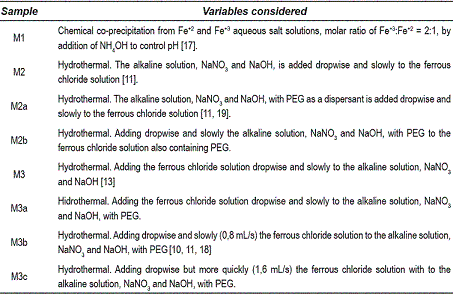
<body><![CDATA[<p><font face="Verdana" size="2">Se presenta la evaluaci&oacute;n de magnetitas sintetizadas bajo diferentes condiciones reportadas en la literatura y con algunas modificaciones, su influencia en la pureza y en el tama&ntilde;o de part&iacute;cula de los &oacute;xidos obtenidos. Las muestras se caracterizaron mediante espectroscop&iacute;a M&ouml;ssbauer a temperatura ambiente, an&aacute;lisis por dispersi&oacute;n de luz y microscop&iacute;a electr&oacute;nica de transmisi&oacute;n. Los resultados M&ouml;ssbauer mostraron variaciones estequiom&eacute;tricas y de composici&oacute;n, que fueron m&aacute;s notables cuando una combinaci&oacute;n de soluci&oacute;n ferrosa y dispersante se agreg&oacute; r&aacute;pidamente a una soluci&oacute;n alcalina. Adem&aacute;s, se encontr&oacute; que el tama&ntilde;o de part&iacute;cula tambi&eacute;n cambia dependiendo del m&eacute;todo de s&iacute;ntesis.</font></p>      <p><font face="Verdana" size="2"><b>Palabras clave:</b> S&iacute;ntesis de magnetita, espectroscop&iacute;a M&ouml;ssbauer, tama&ntilde;o de part&iacute;cula, magnetita nanoparticulada</font></p>     <p><font face="Verdana" size="2">&nbsp;</font></p> <hr noshade size="1">      <p><font face="Verdana" size="3"><b>Introduction</b></font></p>      <p><font face="Verdana" size="2">Magnetite &#40;Fe<sub>3</sub>O<sub>4</sub>&#41; is a ferromagentic oxide widely studied due to its broad range of applications such as ferrofluid, pigment, storage information material, biomedical applications, catalyst, among others [1-5]. It has been found that magnetite nanoparticles show superparamagnetic behavior and their properties are strongly influenced by the method of synthesis. The main reported methods are sonochemical [6], chemical co-precipitation [7-9] forced hydrolysis reaction [10], micro-emulsion [11], hydrothermal [12-14], pyrolysis [15] and electrochemical synthesis [16]. Moreover there are some studies [17,18] related to the effect of pH, temperature and stirring conditions in purity, stoichiometry and particle size variations of synthetic magnetites.</font></p>        <p><font face="Verdana" size="2">Magnetite has an inverse spinel structure, with a face-centred cubic unit cell based on 32 O<sup>2-</sup> that contain 8 Fe<sup>3+ </sup> ions on the tetrahedral sites &#40;A sites&#41; and 16 Fe ions on the octahedral sites &#40;B sites&#41;; 8 of which are Fe<sup>2+</sup> end the other 8 are Fe<sup>3+ </sup>. Its formula is written as Y [XY]O<sub>4</sub> where X&#61; Fe<sup>2+</sup>, Y&#61; Fe<sup>3+ </sup> and the brackets denote octahedral sites [13]. At room temperature the M&ouml;ssbauer spectrum of magnetite shows two magnetic components. A sextet corresponding to Fe<sup>3+ </sup> on the tetrahedral sites &#40;A&#41;, with higher hyperfine field and a sextet with lower hyperfine field due to Fe<sup>2,5+</sup> on the octahedral sites &#40;B&#41;.</font></p>       <p><font face="Verdana" size="2">The lines corresponding to B-sites are broader and larger than A-sites because of hopping of electrons between Fe<sup>2+</sup> and Fe<sup>3+ </sup> ions occurs only on the B-sites, leading to the well known "Fe<sup>2,5+</sup>" ionic state [18]. A simplified formula of magnetite can be written as Fe<sub>3-x</sub>O<sub>4</sub>, where the oxidation parameter x can vary continuously from zero, for a stoichiometric magnetite, to 1&#47;3 for maghemite &#40;&Upsilon;-Fe<sub>2</sub>O<sub>3</sub>&#41;. This parameter can be calculated from the M&ouml;ssbauer spectra [16] using the expression <i>x</i>&#61; &#40;2R-1.06&#41;&#47;&#40;5.3+6R&#41;, where R represents the ratio of the subspectral area of the A sites to the subspectral area of B sites.</font></p>      <p><font face="Verdana" size="2">The properties of magnetite are strongly influenced by particle size, purity and stoichiometry. Most of the recent applications reported in the literature have taken advantage of the nanometric size. However, many of those papers focus mainly on the size rather than stoichiometry or purity of the oxides, and problems like the formation of other phases as maghemite and goethite in the synthesis of magnetite are poorly discussed. In the present work the influence of modifications on the purity and stoichiometry of the oxides in the conventional synthetic hydrothermal method is studied. Such modifications include addition rate and order of the precursors, and usage of dispersant. An improvement on the hydrothermal method is presented in order to obtain a balance between size and purity.</font></p>     <p><font face="Verdana" size="3"><b>Experimental</b></font></p>     <p><font face="Verdana" size="2"><b>Materials</b></font></p>     ]]></body>
<body><![CDATA[<p><font face="Verdana" size="2">FeCl<sub>2</sub>.4H<sub>2</sub>O and FeCl<sub>3</sub>.6H<sub>2</sub>O &#40;Merck&#41;, NaOH &#40;Carlo Erba&#41; and NaNO<sub>3</sub> &#40;Merck&#41;, polyethyleneglycol 4000 &#40;Merck&#41; were used without any further purification. The water used in all experiments was de-ionized with conductivity 0.054 &mu;Scm<sup>-1</sup>.</font></p>      <p><font face="Verdana" size="2"><b>Synthesis and characterization</b></font></p>     <p><font face="Verdana" size="2">Three different methods of synthesis were evaluated, with some variations in each of them to finally obtain eight different magnetites. For a typical synthesis a degassed solution of ferrous chloride was added at a controlled rate to a degassed aqueous solution containing NaOH&#47; NaNO<sub>3</sub>. In other cases the addition was done in the other way around. In some cases polyethyleneglycol &#40;PEG&#41; was used as a dispersant to increase the viscosity of the system and evaluate its Stoichiometric quantities of the precursors were used and taken from the literature [7, 17]. Thus the precipitate obtained was decanted in a dialysis tubing cellulose membrane, and placed in a bath of distilled water. The anions of the suspension were removed by osmosis through the membrane. The water of the bath was replaced many times until the conductivity of the bath was constant and similar to the deionised water &#40;0.054 &mu;S Scm<sup>-1</sup>&#41;. The resulting was filtered and dried at 40<sup>o</sup>C for 48 hours. The prepared samples were stored in a desiccator under nitrogen atmosphere. All the used methods are described on <a href="#Tabla1">Table 1</a>. These are classified on three groups, group 1 &#40;M1&#41; corresponding to chemical coprecipitation from Fe<sup>2+</sup> and Fe<sup>3+ </sup>, group 2 &#40;M2, M2a y M2b&#41;, in which the oxidizing solution was added to the ferrous solution, and group 3 &#40;M3, M3a, M3b, M3c&#41; in which the ferrous solution was added to the oxidizing solution.</font></p>      <p><font face="Verdana" size="2"><b>Table 1</b> Variables considered in simple preparation of the magnetites</font></p>     <p align="center"><font face="Verdana" size="2"><img src="/img/revistas/rfiua/n50/n50a01i01.gif" ><a name="Tabla1"></a></font></p>       <p><font face="Verdana" size="1"><sup>*</sup> When PEG is used, the ratio is 6 g PEG:1 g Fe total.</font></p>      <p><font face="Verdana" size="2">The samples of synthesized magnetites were characterized by M&ouml;ssbauer spectroscopy at room temperature. M&ouml;ssbauer spectra were obtained in the transmission mode using a constant acceleration with a Co&#47;Rh source and a triangulate signal to control source velocity with constant acceleration. The spectra were fitted using MOSF program which is based on a nonlinear least-square method assuming Lorentzian line shapes. A three or four sextets model has been used. The two first attributed to magnetite, sextet 1 &#40;S1&#41; corresponding to Fe<sup>3+ </sup> ions on the tetrahedral sites &#40;A&#41; and sextet 2 &#40;S2&#41; to Fe2.5+ on octahedral sites &#40;B&#41;, sextet 3 &#40;S3&#41; and 4 &#40;S4&#41; to goethite. Light scattering experiments to obtain particle size distributions were accomplished in a Malvern Instruments, Mastersizer 2000 Ver. 5.22 equipment by dispersion of the oxides in ethanol with 1&#37; of PEG. TEM images were obtained in a Tecnai 20 TW, D345, FP 5020&#47;10 Phillips microscope at 200 kV and 25-30 mA.</font></p>      <p><font face="Verdana" size="3"><b>Results and discussion</b></font></p>     <p><font face="Verdana" size="2">Results showed different features on the final product comparing the synthesis obtained by hydrothermal and co-precipitation route. These variations are mainly attributable to solution mixing order.</font></p>      <p><font face="Verdana" size="2">The co-precipitation method &#40;M1&#41; normally gives a brownish solution when the reagents are mixed. As caution, the water used in solutions was degassed over 30 min. This color can remain during all the reaction and finally give a brownlike oxide. In contrast, the hydrothermal method with dropwise addition of alkaline&#47;oxidizing solution to the ferrous solution &#40;M2, M2a y M2b&#41;, with or without PEG presented the formation of a black suspension localized at the contact of the drop with the solution and homogenized throughout out the flask while the reaction took place. Finally, When the ferrous solution was added to the alkaline/oxidizing solution &#40;M3, M3a, M3b y M3c&#41;, a suspended solid was also formed from the localized oxidation of Fe<sup>2+</sup> to Fe<sup>3+ </sup>, the suspension looked like green rusts that quickly change to black magnetite in the alkaline medium, this is in agreement with the results previously reported for this synthetic strategy [20].</font></p>      ]]></body>
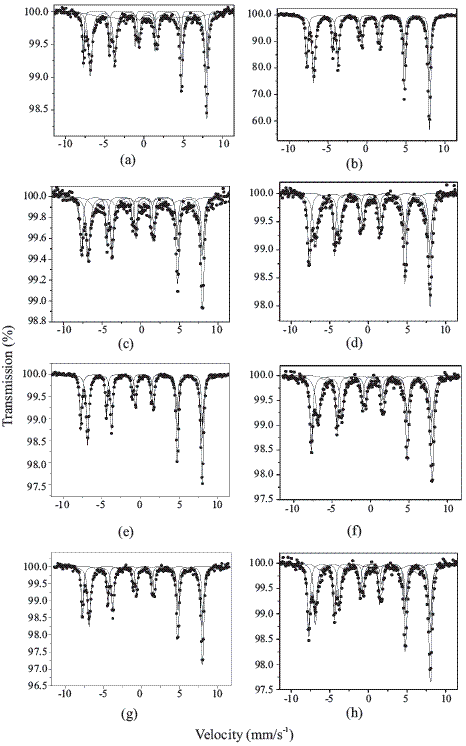
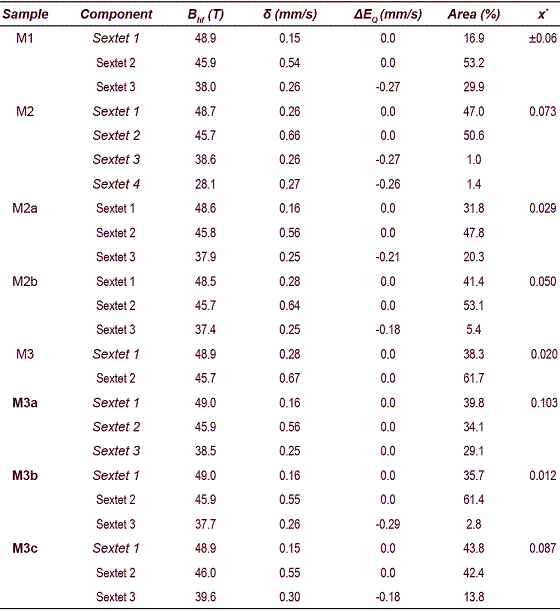
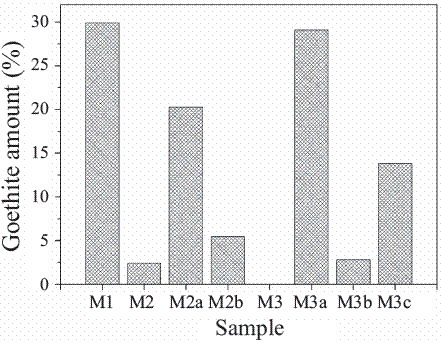
<body><![CDATA[<p><font face="Verdana" size="2">According to the M&ouml;ssbauer Spectra &#40;<a href="#Figura1">Figure 1</a>&#41;, all samples presented magnetite as the main component &#40;see <a href="#Tabla2">Table 2</a> for sextets 1 and 2&#41;. In all the fittings the hyperfine parameters corresponded to magnetite &#40;Bhf<sub>1</sub>:49T, Bhf<sub>2</sub>:46 T, &delta;<sub>1</sub>:0.15mm&#47;s, &delta;2:0.56mm&#47;s&#41; and goethite &#40;Bhf<sup>1</sup>:38.2 T, &delta;<sub>1</sub>:0.25mm&#47;s&#41; [19]. Sample M1 presented around 30&#37; of a second phase &#40;sextet 3&#41; assigned to goethite according to the characteristic hyperfine parameters [21]. Sample M2 was fitting using a model with four sextets, S1 and S2 corresponding to magnetite and sextets third and fourth corresponding to goethites of different particle size &#40;see<a href="#Figura3"> Figure 3b</a>&#41;. Samples M2a, M3a, M3b, M2b, M3c were fitted using a three sextets model. S1 and S2 correspond to magnetite and S3 corresponding to goethite. Sample M3 was fitted using two sextets &#40;S1 and S2&#41; which correspond to a highly pure magnetite.</font></p>      <p align="center"><font face="Verdana" size="2"><img src="/img/revistas/rfiua/n50/n50a01i02.gif" ><a name="Figura1"></a></font></p>     <p><font face="Verdana" size="2"><b>Figure 1</b> Room temperature M&ouml;ssbauer spectra of synthetized magnetites. &#40;a&#41; M1, &#40;b&#41; M2, &#40;c&#41; M2a, &#40;d&#41; M2b, &#40;e&#41; M3, &#40;f&#41; M3a, &#40;g&#41; M3b, &#40;h&#41; M3c</font></p>     <p><font face="Verdana" size="2"><a href="#Tabla2">Table 2</a> shows the calculated oxidation parameter <i>x</i> of stoichiometry for magnetite, being samples M3 and M3b those with smaller <i>x</i>. It can be noticed that samples M2b, M3a and M3c showed a decrease in intensity on sextet corresponding to B-sites, resulting in a decrease of the stoichiometry. This result can be attributed to the addition rate of the ferrous solution, which has to be controlled &#40;0.8 mL&#47;s&#41; in order to obtain a more stoichiometric oxide, like sample M3b.</font></p>      <p><font face="Verdana" size="2"><b>Table 2</b> Hyperfine Parameters of synthetized magnetites</font></p>      <p align="center"><font face="Verdana" size="2"><img src="/img/revistas/rfiua/n50/n50a01i03.gif" ><a name="Tabla2"></a></font></p>      <p><font face="Verdana" size="1"><sup>*</sup><i> x</i>: oxidation parameter. <i>x</i>&#61; &#40;2R-1.06&#41;&#47;&#40;5.3+6R&#41;</font></p>     <p><font face="Verdana" size="2">For clarity, <a href="#Figura2">figure 2</a> shows the amount of goethite found in all the obtained samples calculated from the M&ouml;ssbauer spectra &#40;<a href="#Figura1">Figure 1</a> and <a href="#Tabla2">Table 2</a>&#41;. Remarkable differences in the amount of goethite were observed depending on the method of synthesis and the rate of addition of the reactive solutions. Method M1 gives the highest amount of goethite &#40;&#161;30&#37;&#41;, probably due to differences on co-precipitation kinetics of Fe<sup>2+</sup> and Fe<sup>3+ </sup> ions, giving as result a stoichiometric changes in balance, which are favorable for the oxi-hydroxide &alpha;-FeOOH formation. When the ferrous solution is added to the oxidizing&#47;alkaline solution &#40;M3&#41;, pure and stoichiometric magnetite was obtained in comparison to that when oxidizing/alkaline solution was added to the ferrous solution &#40;M2&#41;. Moreover, when a solution of PEG and oxidizing&#47;alkaline &#40;M2a and M3a&#41; was used at 0.2 mL&#47;s, independently of the order of addition, an increase on the amount of goethite was observed.</font></p>       <p align="center"><font face="Verdana" size="2"><img src="/img/revistas/rfiua/n50/n50a01i04.gif" ><a name="Figura2"></a></font></p>     <p><font face="Verdana" size="2"><b>Figure 2</b> Amount of goethite in samples</font></p>      ]]></body>
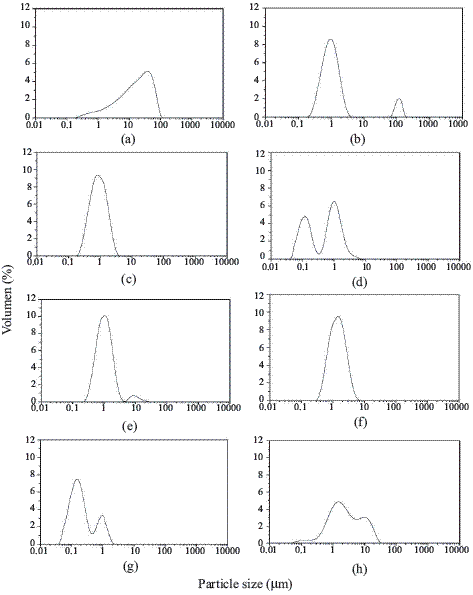
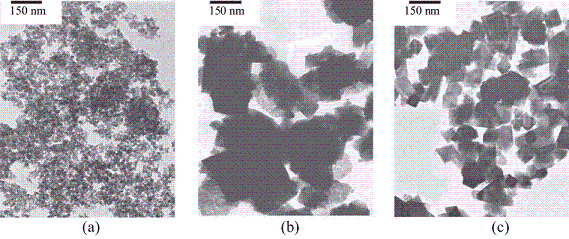
<body><![CDATA[<p><font face="Verdana" size="2">An increase of the viscosity seems to promote the oxidation process of Fe<sup>2+</sup> to Fe<sup>3+ </sup> favoring the formation of additional phases like goethite. Further decrease in the amount of goethite &#40;3&#37;&#41; was observed for an addition rate of 0.8 mL/s &#40;M3b&#41; and an increase up to about 14&#37; was observed for M3c &#40;1.6 mL&#47;s&#41;.</font></p>      <p><font face="Verdana" size="2">It is worth noting that the methods M2 and M3, despite being very similar in terms of procedure, it appears that just changing the order in the addition of the solutions resulted in substantial changes in the stoichiometry and purity of the obtained magnetites. This may be due to the fact that on method M3 each drop of Fe<sup>2+</sup> solution is oxidized immediately in the right ratio 1:2 upon making contact with the solution of NaOH and NaNO<sub>3</sub>. In method M2, by adding the oxidizing/ alkaline solution to the Fe<sup>2+</sup>, the transformation process is much localized at the top of the solution and the concentration of Fe<sup>2+</sup> decreases in the surroundings of the drop. In this case more Fe<sup>2+</sup> needs to contact the oxidizing agent in order to the reaction to take place gradually.</font></p>      <p><font face="Verdana" size="2"><a href="#Figura3">Figure 3</a> shows the particle size distribution obtained by light scattering from the dispersions. As the particles in ethanol&#47;PEG were not completely stable, this technique gave information mainly about aggregation and sizes of the bulky particles &#40;see TEM below&#41;. Excepting samples M2a and M3a &#40;alkaline&#47;oxidative solution containing PEG and addition rate at 0.2 mL&#47;s&#41; the size distribution of the magnetites was bi- and tri-modal. In general, it was found particle sizes between 1 and 10 mm, being 1 mm the most common size. Samples M3b and M2b &#40;<a href="#Figura3">Figure 3d </a>and <a href="#Figura3">Figure 3g</a>&#41; showed particle size distributions between 0,1 and 1 mm, with greater percentage at 0,1 mm for the oxide obtained using method M3b. It may be noted that the way and rate of addition of solutions, as well as its composition &#40;with or without PEG&#41;, had influence both in purity of magnetite and in the size and aggregation of the particles. Samples without PEG &#40;M1, M2, M3&#41; showed particle size between 1 and 10 mm; however samples with PEG in the oxidizing/alkaline solution &#40;M2a, M3a&#41; exhibited particle sizes closer to 1 mm. On the other hand, samples with PEG in the ferrous solution gave particles sizes of 0,1 and 10 mm, being the smallest for those in which the solution was added slowly &#40;M3b&#41;.</font></p>       <p align="center"><font face="Verdana" size="2"><img src="/img/revistas/rfiua/n50/n50a01i05.gif" ><a name="Figura3"></a></font></p>     <p><font face="Verdana" size="2"><b>Figure 3</b> Particle size distribution. &#40;a&#41; M1, &#40;b&#41; M2, &#40;c&#41; M2a, &#40;d&#41; M2b, &#40;e&#41; M3, &#40;f&#41; M3a, &#40;g&#41; M3b, &#40;h&#41; M3c.</font></p>      <p><font face="Verdana" size="2">Although the observed particle distribution by light scattering was found to be in the micrometer size due to aggregates, TEM images contribute to validate the individual size of the particles. <a href="#Figura4">Figure 4</a> shows the transmission electron micrographs of samples M1, M2a y M3b.</font></p>      <p><font face="Verdana" size="2">TEM images showed particle sizes much less than 100 nm for sample M1 &#40;about 10 nm&#41;. This is in agreement with the literature for magnetites obtained from Fe<sup>2+</sup> and Fe<sup>3+ </sup> [17,24]. Particles at around 100 nm were obtained for sample M3b, similar to the result obtained by particle size distribution for the same sample. On light scattering analysis, the second peak is, in general, associated to aggregation, as was also confirmed by TEM. The individual particles of nano-magnetites tend to aggregate by formation of strong magnetic dipoledipole interactions in order to reduce the surface energy of its high surface area/volume ratio [22]. It has been suggested in the literature that the presence of PEG prevents the aggregation of nanoparticles into larger particles and could kinetically control the growth rates of various crystalline faces affecting the diffusion rate of Fe+3 on the surfaces of Fe<sub>3</sub>O<sub>4</sub> nanocrystallites and their epitaxial growth [25]. As showed in<a href="#Figura4"> Figure 4</a>, for M2a and M3b, PEG helped to dispersed the magnetite particles in both cases, however in terms of particle size and distribution the order of addition of the reagents had a more important effect for each sample, as observed by TEM and light scattering.</font></p>        <p align="center"><font face="Verdana" size="2"><img src="/img/revistas/rfiua/n50/n50a01i06.gif" ><a name="Figura4"></a></font></p>     <p><font face="Verdana" size="2"><b>Figure 4</b> TEM images. &#40;a&#41; M1, &#40;b&#41; M2a, &#40;c&#41; M3b</font></p>     <p><font face="Verdana" size="3"><b>Conclusions</b></font></p>     ]]></body>
<body><![CDATA[<p><font face="Verdana" size="2">It was verified, that the order and rate of addition of the reactive solutions and the presence of PEG as dispersant has a major effect on the purity, stoichiometry and particle size of the obtained oxides. In general, as expected, the size of the particles decreased when used PEG as dispersant; however its presence affected the purity of the oxides and favored the formation of goethite. Highly pure magnetite was obtained by adding the iron solution on the alkaline&#47;oxidizing &#40;M3&#41;, however for this sample the average particle size is expected to be higher than 200nm according to the light scattering measurements. On the other hand the magnetite M3b obtained by adding the ferrous solution to the alkaline&#47;oxidizing solution with PEG presented both interesting particle size &#40;higher than 40 nm&#41; and relative good purity &#40;about 2.8&#37; of goethite&#41;. Even though co-precipitation method &#40;M1, Fe<sup>2+</sup>&#47;Fe<sup>3+ </sup>&#41;, exhibited smallest particle size &#40;&#161; 10 nm&#41;, from M&ouml;ssbauer analysis can be deduced that is not a highly pure magnetite.</font></p>      <p><font face="Verdana" size="3"><b>Acknowledgements</b></font></p>     <p><font face="Verdana" size="2">The authors wish to acknowledge financial support by Excellence Centre of Novel Materials -CENM- and COLCIENCIAS.</font></p>      <p><font face="Verdana" size="3"><b>References</b></font></p>     <!-- ref --><p><font face="Verdana" size="2">1. R. Y. Hong, T. T. Pan, Y. P. Han, H. Z. Li, J. Ding, S. Hand. "Magnetic field synthesis of Fe<sub>3</sub>O<sub>4</sub> nanoparticles used as a precursor of ferrofluids". J. Magn. Mater. Vol. 310. 2007. pp. 37-47.</font>&nbsp;&nbsp;&nbsp;&nbsp;&nbsp;&nbsp;&nbsp;&nbsp;[&#160;<a href="javascript:void(0);" onclick="javascript: window.open('/scielo.php?script=sci_nlinks&ref=000057&pid=S0120-6230200900040000100001&lng=','','width=640,height=500,resizable=yes,scrollbars=1,menubar=yes,');">Links</a>&#160;]<!-- end-ref --><!-- ref --><p><font face="Verdana" size="2">2. M. A. Legodi, D. de Waal. "The preparation of magnetite, goethite, hematite and maghemite of pigment quality from mill scale iron waste". Dyes and Pigments. Vol. 74. 2007. pp. 161-168.</font>&nbsp;&nbsp;&nbsp;&nbsp;&nbsp;&nbsp;&nbsp;&nbsp;[&#160;<a href="javascript:void(0);" onclick="javascript: window.open('/scielo.php?script=sci_nlinks&ref=000058&pid=S0120-6230200900040000100002&lng=','','width=640,height=500,resizable=yes,scrollbars=1,menubar=yes,');">Links</a>&#160;]<!-- end-ref --><!-- ref --><p><font face="Verdana" size="2">3. S. Sun, C. B. Murray, D. Weller, L. Folks, A. Moser. "Monodisperse FePt Nanoparticles and Ferromagnetic FePt Nanocrystal Superlattices". Science. Vol. 287. 2000. pp. 1989-1992.</font>&nbsp;&nbsp;&nbsp;&nbsp;&nbsp;&nbsp;&nbsp;&nbsp;[&#160;<a href="javascript:void(0);" onclick="javascript: window.open('/scielo.php?script=sci_nlinks&ref=000059&pid=S0120-6230200900040000100003&lng=','','width=640,height=500,resizable=yes,scrollbars=1,menubar=yes,');">Links</a>&#160;]<!-- end-ref --><!-- ref --><p><font face="Verdana" size="2">4. Q. A. Pankhurst, J. Connolly, S. K. Jones, J. Dobson. "Applications of magnetic nanoparticles in biomedicine". J. Phys D: Appl. Phys. Vol. 36. 2003. pp. R167-181.</font>&nbsp;&nbsp;&nbsp;&nbsp;&nbsp;&nbsp;&nbsp;&nbsp;[&#160;<a href="javascript:void(0);" onclick="javascript: window.open('/scielo.php?script=sci_nlinks&ref=000060&pid=S0120-6230200900040000100004&lng=','','width=640,height=500,resizable=yes,scrollbars=1,menubar=yes,');">Links</a>&#160;]<!-- end-ref --><!-- ref --><p><font face="Verdana" size="2">5. N. Pernicone, F. Ferrero, I. Rossetti, L. Forni, P. Canton, P. Riello, G. Fagherazzi, M. Signoretto, F. Pinna. "Wustite as a new precursor of industrial ammonia synthesis catalysts". Appl. Catal. A: Gen. Vol. 251. 2003. pp. 121-129.</font>&nbsp;&nbsp;&nbsp;&nbsp;&nbsp;&nbsp;&nbsp;&nbsp;[&#160;<a href="javascript:void(0);" onclick="javascript: window.open('/scielo.php?script=sci_nlinks&ref=000061&pid=S0120-6230200900040000100005&lng=','','width=640,height=500,resizable=yes,scrollbars=1,menubar=yes,');">Links</a>&#160;]<!-- end-ref --><!-- ref --><p><font face="Verdana" size="2">6. E. H. Kim, H. S. Lee, B. K. Kwak, B. K. Kim. "Synthesis of ferrofluid with magnetic nanoparticles by sonochemical method for MRI contrast agent". J. Magn. Mater. Vol. 289. 2005. pp. 328-330.</font>&nbsp;&nbsp;&nbsp;&nbsp;&nbsp;&nbsp;&nbsp;&nbsp;[&#160;<a href="javascript:void(0);" onclick="javascript: window.open('/scielo.php?script=sci_nlinks&ref=000062&pid=S0120-6230200900040000100006&lng=','','width=640,height=500,resizable=yes,scrollbars=1,menubar=yes,');">Links</a>&#160;]<!-- end-ref --><!-- ref --><p><font face="Verdana" size="2">7. D. Maity, D. C. Agrawal. "Synthesis of iron oxide nanoparticles under oxidizing environment and their stabilization in aqueous and non-aqueous media". J. Magn. Mater. Vol. 308. 2007. pp. 46-55.</font>&nbsp;&nbsp;&nbsp;&nbsp;&nbsp;&nbsp;&nbsp;&nbsp;[&#160;<a href="javascript:void(0);" onclick="javascript: window.open('/scielo.php?script=sci_nlinks&ref=000063&pid=S0120-6230200900040000100007&lng=','','width=640,height=500,resizable=yes,scrollbars=1,menubar=yes,');">Links</a>&#160;]<!-- end-ref --><!-- ref --><p><font face="Verdana" size="2">8. H. Zhang, R. Wang, G. Zhang, B. Yang. "A covalently attached film based on poly&#40;methacrylic acid&#41;-capped Fe<sub>3</sub>O<sub>4</sub> nanoparticles". Thin Solid Films. Vol. 429. 2003. pp. 167-173.</font>&nbsp;&nbsp;&nbsp;&nbsp;&nbsp;&nbsp;&nbsp;&nbsp;[&#160;<a href="javascript:void(0);" onclick="javascript: window.open('/scielo.php?script=sci_nlinks&ref=000064&pid=S0120-6230200900040000100008&lng=','','width=640,height=500,resizable=yes,scrollbars=1,menubar=yes,');">Links</a>&#160;]<!-- end-ref --><!-- ref --><p><font face="Verdana" size="2">9. Y. Yang, L. Li, G. Chen. "Synthesis of magnetic particles via a cationic-anionic urfactante vesicle method". J. Magn. Mater. Vol. 305. 2006. pp. 40-46.</font>&nbsp;&nbsp;&nbsp;&nbsp;&nbsp;&nbsp;&nbsp;&nbsp;[&#160;<a href="javascript:void(0);" onclick="javascript: window.open('/scielo.php?script=sci_nlinks&ref=000065&pid=S0120-6230200900040000100009&lng=','','width=640,height=500,resizable=yes,scrollbars=1,menubar=yes,');">Links</a>&#160;]<!-- end-ref --><!-- ref --><p><font face="Verdana" size="2">10. Z. Huang, F. Tang, L. Zhang. "Morphology control and texture of Fe<sub>3</sub>O<sub>4</sub> nanoparticle-coated polystyrene microspheres by ethylene glycol in forced hydrolysis reaction". Thin Solid Films. Vol. 471. 2005. pp. 105-112.</font>&nbsp;&nbsp;&nbsp;&nbsp;&nbsp;&nbsp;&nbsp;&nbsp;[&#160;<a href="javascript:void(0);" onclick="javascript: window.open('/scielo.php?script=sci_nlinks&ref=000066&pid=S0120-6230200900040000100010&lng=','','width=640,height=500,resizable=yes,scrollbars=1,menubar=yes,');">Links</a>&#160;]<!-- end-ref --><!-- ref --><p><font face="Verdana" size="2">11. Z. L. Liu, X. Wang, K. L. Yao, G. H. Du, Q. H. Lu, Z. H. Ding, J. Tao, Q. Ning, X. P. Luo, D. Y. Tian, D. Xi. "Synthesis of magnetite nanoparticles in W&#47;O microemulsion". J. Mater. Sci. Vol. 39. 2004. pp. 2633-2636.</font>&nbsp;&nbsp;&nbsp;&nbsp;&nbsp;&nbsp;&nbsp;&nbsp;[&#160;<a href="javascript:void(0);" onclick="javascript: window.open('/scielo.php?script=sci_nlinks&ref=000067&pid=S0120-6230200900040000100011&lng=','','width=640,height=500,resizable=yes,scrollbars=1,menubar=yes,');">Links</a>&#160;]<!-- end-ref --><!-- ref --><p><font face="Verdana" size="2">12. Y. Okano, T. Nakamura. Hydrothermal synthesis of aluminum bearing magnetite particles. Colloids and Surfaces. Vol. 139. 1998. pp. 279-285.</font>&nbsp;&nbsp;&nbsp;&nbsp;&nbsp;&nbsp;&nbsp;&nbsp;[&#160;<a href="javascript:void(0);" onclick="javascript: window.open('/scielo.php?script=sci_nlinks&ref=000068&pid=S0120-6230200900040000100012&lng=','','width=640,height=500,resizable=yes,scrollbars=1,menubar=yes,');">Links</a>&#160;]<!-- end-ref --><!-- ref --><p><font face="Verdana" size="2">13. U. Schwertmann, R. M. Cornell. Iron Oxides in the Laboratory. Preparation and Characterization. 2<sup>a</sup> ed. Ed. Wiley, Weinheim. 1991. pp. 75-111.</font>&nbsp;&nbsp;&nbsp;&nbsp;&nbsp;&nbsp;&nbsp;&nbsp;[&#160;<a href="javascript:void(0);" onclick="javascript: window.open('/scielo.php?script=sci_nlinks&ref=000069&pid=S0120-6230200900040000100013&lng=','','width=640,height=500,resizable=yes,scrollbars=1,menubar=yes,');">Links</a>&#160;]<!-- end-ref --><!-- ref --><p><font face="Verdana" size="2">14. W. Yu, T. Zhang, J. Zhang, X. Qiao, L. Yang, Y. Liu. "The synthesis of octahedral nanoparticles of magnetite" Mat. Lett. Vol. 60. 2006. pp. 2998-3001.</font>&nbsp;&nbsp;&nbsp;&nbsp;&nbsp;&nbsp;&nbsp;&nbsp;[&#160;<a href="javascript:void(0);" onclick="javascript: window.open('/scielo.php?script=sci_nlinks&ref=000070&pid=S0120-6230200900040000100014&lng=','','width=640,height=500,resizable=yes,scrollbars=1,menubar=yes,');">Links</a>&#160;]<!-- end-ref --><!-- ref --><p><font face="Verdana" size="2">15. Y.K. Gun'ko, S.C. Pillai, D. Mcinerney, "Magnetic nanoparticles and nanoparticle assemblies from metallorganic precursors". J. Mater. Sci. Mater. Electron. Vol. 12. 2001. pp. 299-302.</font>&nbsp;&nbsp;&nbsp;&nbsp;&nbsp;&nbsp;&nbsp;&nbsp;[&#160;<a href="javascript:void(0);" onclick="javascript: window.open('/scielo.php?script=sci_nlinks&ref=000071&pid=S0120-6230200900040000100015&lng=','','width=640,height=500,resizable=yes,scrollbars=1,menubar=yes,');">Links</a>&#160;]<!-- end-ref --><!-- ref --><p><font face="Verdana" size="2">16. S. Franger, P. Berthet, J. Berthon. "Electrochemical synthesis of Fe<sub>3</sub>O<sub>4</sub> nanoparticles in alkaline aqueous solutions containing complexing agents". J. Solid State Electrochem. Vol. 8. 2004. pp. 218-223.</font>&nbsp;&nbsp;&nbsp;&nbsp;&nbsp;&nbsp;&nbsp;&nbsp;[&#160;<a href="javascript:void(0);" onclick="javascript: window.open('/scielo.php?script=sci_nlinks&ref=000072&pid=S0120-6230200900040000100016&lng=','','width=640,height=500,resizable=yes,scrollbars=1,menubar=yes,');">Links</a>&#160;]<!-- end-ref --><!-- ref --><p><font face="Verdana" size="2">17. G. Gnanaprakash, S. Mahadevan, T. Jayakumar, P. Kalyanasundaram, J. Philip , B. Raj. "Effect of initial pH and temperature of iron salt Solutions on formation of magnetite nanoparticles". Mat. Chem. and Phys. Vol. 103. 2007. pp.168-175.</font>&nbsp;&nbsp;&nbsp;&nbsp;&nbsp;&nbsp;&nbsp;&nbsp;[&#160;<a href="javascript:void(0);" onclick="javascript: window.open('/scielo.php?script=sci_nlinks&ref=000073&pid=S0120-6230200900040000100017&lng=','','width=640,height=500,resizable=yes,scrollbars=1,menubar=yes,');">Links</a>&#160;]<!-- end-ref --><!-- ref --><p><font face="Verdana" size="2">18. C. A. Barrero, A. L. Morales, J. Mazo-Zuluaga, F. Jaramillo, G. P&eacute;rez, D. M. Escobar, C. Arroyave, J. Tob&oacute;n, P. M. Montoya, L. Ososrio, R. E Vandenberghe, J. M. Greneche. "Synthesis and M&ouml;ssbauer characterization of Cu and Cr doped magnetites". Rev. Metal. Madrid. Vol. Extr. 2003. pp. 62-67.</font>&nbsp;&nbsp;&nbsp;&nbsp;&nbsp;&nbsp;&nbsp;&nbsp;[&#160;<a href="javascript:void(0);" onclick="javascript: window.open('/scielo.php?script=sci_nlinks&ref=000074&pid=S0120-6230200900040000100018&lng=','','width=640,height=500,resizable=yes,scrollbars=1,menubar=yes,');">Links</a>&#160;]<!-- end-ref --><!-- ref --><p><font face="Verdana" size="2">19. J. Deng, Ch. L. He, Y. Peng, J. Wang, X. Long, P. Li, A. S. C. Chang. "Magnetic and conductive Fe<sub>3</sub>O<sub>4</sub>- polyaniline nanoparticles with core-shell structure". Synt. Met. Vol. 139. 2003. pp. 295-301.</font>&nbsp;&nbsp;&nbsp;&nbsp;&nbsp;&nbsp;&nbsp;&nbsp;[&#160;<a href="javascript:void(0);" onclick="javascript: window.open('/scielo.php?script=sci_nlinks&ref=000075&pid=S0120-6230200900040000100019&lng=','','width=640,height=500,resizable=yes,scrollbars=1,menubar=yes,');">Links</a>&#160;]<!-- end-ref --><!-- ref --><p><font face="Verdana" size="2">20. P. S. Shidu, R. J.Gilkes, A. M. Posner. "The synthesis and some properties of Co, Ni, Zn, Cu, Mn and Cd substituted magnetites". J. inorg. nucl. chem. Vol. 40. 1978. pp. 429-435.</font>&nbsp;&nbsp;&nbsp;&nbsp;&nbsp;&nbsp;&nbsp;&nbsp;[&#160;<a href="javascript:void(0);" onclick="javascript: window.open('/scielo.php?script=sci_nlinks&ref=000076&pid=S0120-6230200900040000100020&lng=','','width=640,height=500,resizable=yes,scrollbars=1,menubar=yes,');">Links</a>&#160;]<!-- end-ref --><!-- ref --><p><font face="Verdana" size="2">21. R. M. Cornell, U. Schwertmann. Iron oxide. Structure, Properties, Reactions, Ocurrence and Uses. 2<sup>a</sup> ed. Ed. Wiley, Weinheim. 2003. pp. 149.</font>&nbsp;&nbsp;&nbsp;&nbsp;&nbsp;&nbsp;&nbsp;&nbsp;[&#160;<a href="javascript:void(0);" onclick="javascript: window.open('/scielo.php?script=sci_nlinks&ref=000077&pid=S0120-6230200900040000100021&lng=','','width=640,height=500,resizable=yes,scrollbars=1,menubar=yes,');">Links</a>&#160;]<!-- end-ref --><!-- ref --><p><font face="Verdana" size="2">22. D. K Kim, Y. Zhang, W. Voit, K. V.Rao, M. Muhammed. "Synthesis and characterization of surfactant-coated superparamagnetic monodispersed iron oxide nanoparticles". J. Magn. Mater. Vol. 225. 2001. pp. 30-36.</font>&nbsp;&nbsp;&nbsp;&nbsp;&nbsp;&nbsp;&nbsp;&nbsp;[&#160;<a href="javascript:void(0);" onclick="javascript: window.open('/scielo.php?script=sci_nlinks&ref=000078&pid=S0120-6230200900040000100022&lng=','','width=640,height=500,resizable=yes,scrollbars=1,menubar=yes,');">Links</a>&#160;]<!-- end-ref --><!-- ref --><p><font face="Verdana" size="2">23. R. W. Chantrell, A. Bradbury, J. Popplewell, W. Charles. "Agglomerate formation in a magnetic fluid". J. of Appl. Phys. Vol. 53. 1982. pp. 2742-2744.</font>&nbsp;&nbsp;&nbsp;&nbsp;&nbsp;&nbsp;&nbsp;&nbsp;[&#160;<a href="javascript:void(0);" onclick="javascript: window.open('/scielo.php?script=sci_nlinks&ref=000079&pid=S0120-6230200900040000100023&lng=','','width=640,height=500,resizable=yes,scrollbars=1,menubar=yes,');">Links</a>&#160;]<!-- end-ref --><!-- ref --><p><font face="Verdana" size="2">24. J. H. Wu, S. P. Ko, H. L.Liu, S. Kim, J. S. Ju, Y. K Kim. "Sub 5 nm magnetite nanoparticles: Synthesis, microstructure, and magnetic properties". Mat. Lett. Vol. 61. 2007. pp. 3124-3129.</font>&nbsp;&nbsp;&nbsp;&nbsp;&nbsp;&nbsp;&nbsp;&nbsp;[&#160;<a href="javascript:void(0);" onclick="javascript: window.open('/scielo.php?script=sci_nlinks&ref=000080&pid=S0120-6230200900040000100024&lng=','','width=640,height=500,resizable=yes,scrollbars=1,menubar=yes,');">Links</a>&#160;]<!-- end-ref --><!-- ref --><p><font face="Verdana" size="2">25. L. Li, Y. Chu, Y. Liu, D. Wang. "Solution-phase synthesis of single-crystalline Fe<sub>3</sub>O<sub>4</sub> magnetic nanobelts". Journal of Alloys and Compounds. Vol. 472. 2009. pp. 271-275.</font>&nbsp;&nbsp;&nbsp;&nbsp;&nbsp;&nbsp;&nbsp;&nbsp;[&#160;<a href="javascript:void(0);" onclick="javascript: window.open('/scielo.php?script=sci_nlinks&ref=000081&pid=S0120-6230200900040000100025&lng=','','width=640,height=500,resizable=yes,scrollbars=1,menubar=yes,');">Links</a>&#160;]<!-- end-ref --><p><font face="Verdana" size="2">&#40;Recibido el 10 de febrero de 2009. Aceptado el 24 de agosto de 2009&#41;</font></p>     ]]></body>
<body><![CDATA[<p><font face="Verdana" size="2"><sup>*</sup>Autor de correspondencia: tel&eacute;fono: + 57 +4 +219 66 15, correo electr&oacute;nico: <a href="mailto:bejarami@udea.edu.co">bejarami@udea.edu.co</a> (F. Jaramillo).</font></p>       ]]></body><back>
<ref-list>
<ref id="B1">
<label>1</label><nlm-citation citation-type="journal">
<person-group person-group-type="author">
<name>
<surname><![CDATA[Hong]]></surname>
<given-names><![CDATA[R. Y]]></given-names>
</name>
<name>
<surname><![CDATA[Pan]]></surname>
<given-names><![CDATA[T. T]]></given-names>
</name>
<name>
<surname><![CDATA[Han]]></surname>
<given-names><![CDATA[Y. P]]></given-names>
</name>
<name>
<surname><![CDATA[Li]]></surname>
<given-names><![CDATA[H. Z]]></given-names>
</name>
<name>
<surname><![CDATA[Ding]]></surname>
<given-names><![CDATA[J]]></given-names>
</name>
</person-group>
<article-title xml:lang="en"><![CDATA[Magnetic field synthesis of Fe3O4 nanoparticles used as a precursor of ferrofluids]]></article-title>
<source><![CDATA[J. Magn. Mater]]></source>
<year>2007</year>
<volume>310</volume>
<page-range>37-47</page-range></nlm-citation>
</ref>
<ref id="B2">
<label>2</label><nlm-citation citation-type="journal">
<person-group person-group-type="author">
<name>
<surname><![CDATA[Legodi]]></surname>
<given-names><![CDATA[M. A]]></given-names>
</name>
<name>
<surname><![CDATA[de Waal]]></surname>
<given-names><![CDATA[D]]></given-names>
</name>
</person-group>
<article-title xml:lang="en"><![CDATA[The preparation of magnetite, goethite, hematite and maghemite of pigment quality from mill scale iron waste]]></article-title>
<source><![CDATA[Dyes and Pigments]]></source>
<year>2007</year>
<volume>74</volume>
<page-range>161-168</page-range></nlm-citation>
</ref>
<ref id="B3">
<label>3</label><nlm-citation citation-type="journal">
<person-group person-group-type="author">
<name>
<surname><![CDATA[Sun]]></surname>
<given-names><![CDATA[S]]></given-names>
</name>
<name>
<surname><![CDATA[Murray]]></surname>
<given-names><![CDATA[C. B]]></given-names>
</name>
<name>
<surname><![CDATA[Weller]]></surname>
<given-names><![CDATA[D]]></given-names>
</name>
<name>
<surname><![CDATA[Folks]]></surname>
<given-names><![CDATA[L]]></given-names>
</name>
<name>
<surname><![CDATA[Moser]]></surname>
<given-names><![CDATA[A]]></given-names>
</name>
</person-group>
<article-title xml:lang="en"><![CDATA[Monodisperse FePt Nanoparticles and Ferromagnetic FePt Nanocrystal Superlattices]]></article-title>
<source><![CDATA[Science]]></source>
<year>2000</year>
<volume>287</volume>
<page-range>1989-1992</page-range></nlm-citation>
</ref>
<ref id="B4">
<label>4</label><nlm-citation citation-type="journal">
<person-group person-group-type="author">
<name>
<surname><![CDATA[Pankhurst]]></surname>
<given-names><![CDATA[Q. A]]></given-names>
</name>
<name>
<surname><![CDATA[Connolly]]></surname>
<given-names><![CDATA[J]]></given-names>
</name>
<name>
<surname><![CDATA[Jones]]></surname>
<given-names><![CDATA[S]]></given-names>
</name>
<name>
<surname><![CDATA[Dobson]]></surname>
<given-names><![CDATA[J]]></given-names>
</name>
</person-group>
<article-title xml:lang="en"><![CDATA[Applications of magnetic nanoparticles in biomedicine]]></article-title>
<source><![CDATA[J. Phys D: Appl. Phys]]></source>
<year>2003</year>
<volume>36</volume>
<page-range>R167-181</page-range></nlm-citation>
</ref>
<ref id="B5">
<label>5</label><nlm-citation citation-type="journal">
<person-group person-group-type="author">
<name>
<surname><![CDATA[Pernicone]]></surname>
<given-names><![CDATA[N]]></given-names>
</name>
<name>
<surname><![CDATA[Ferrero]]></surname>
<given-names><![CDATA[F]]></given-names>
</name>
<name>
<surname><![CDATA[Rossetti]]></surname>
<given-names><![CDATA[I]]></given-names>
</name>
<name>
<surname><![CDATA[Forni]]></surname>
<given-names><![CDATA[L]]></given-names>
</name>
<name>
<surname><![CDATA[Canton]]></surname>
<given-names><![CDATA[P]]></given-names>
</name>
<name>
<surname><![CDATA[Riello]]></surname>
<given-names><![CDATA[P]]></given-names>
</name>
<name>
<surname><![CDATA[Fagherazzi]]></surname>
<given-names><![CDATA[G]]></given-names>
</name>
<name>
<surname><![CDATA[Signoretto]]></surname>
<given-names><![CDATA[M]]></given-names>
</name>
<name>
<surname><![CDATA[Pinna]]></surname>
<given-names><![CDATA[F]]></given-names>
</name>
</person-group>
<article-title xml:lang="en"><![CDATA[Wustite as a new precursor of industrial ammonia synthesis catalysts]]></article-title>
<source><![CDATA[Appl. Catal. A: Gen]]></source>
<year>2003</year>
<volume>251</volume>
<page-range>121-129</page-range></nlm-citation>
</ref>
<ref id="B6">
<label>6</label><nlm-citation citation-type="journal">
<person-group person-group-type="author">
<name>
<surname><![CDATA[Kim]]></surname>
<given-names><![CDATA[E. H]]></given-names>
</name>
<name>
<surname><![CDATA[Lee]]></surname>
<given-names><![CDATA[H. S]]></given-names>
</name>
<name>
<surname><![CDATA[Kwak]]></surname>
<given-names><![CDATA[B. K]]></given-names>
</name>
<name>
<surname><![CDATA[Kim]]></surname>
<given-names><![CDATA[B. K]]></given-names>
</name>
</person-group>
<article-title xml:lang="en"><![CDATA[Synthesis of ferrofluid with magnetic nanoparticles by sonochemical method for MRI contrast agent]]></article-title>
<source><![CDATA[J. Magn. Mater]]></source>
<year>2005</year>
<volume>289</volume>
<page-range>328-330</page-range></nlm-citation>
</ref>
<ref id="B7">
<label>7</label><nlm-citation citation-type="journal">
<person-group person-group-type="author">
<name>
<surname><![CDATA[Maity]]></surname>
<given-names><![CDATA[D]]></given-names>
</name>
<name>
<surname><![CDATA[Agrawal]]></surname>
<given-names><![CDATA[D. C]]></given-names>
</name>
</person-group>
<article-title xml:lang="en"><![CDATA[Synthesis of iron oxide nanoparticles under oxidizing environment and their stabilization in aqueous and non-aqueous media]]></article-title>
<source><![CDATA[J. Magn. Mater]]></source>
<year>2007</year>
<volume>308</volume>
<page-range>46-55</page-range></nlm-citation>
</ref>
<ref id="B8">
<label>8</label><nlm-citation citation-type="journal">
<person-group person-group-type="author">
<name>
<surname><![CDATA[Zhang]]></surname>
<given-names><![CDATA[H]]></given-names>
</name>
<name>
<surname><![CDATA[Wang]]></surname>
<given-names><![CDATA[R]]></given-names>
</name>
<name>
<surname><![CDATA[Zhang]]></surname>
<given-names><![CDATA[G]]></given-names>
</name>
<name>
<surname><![CDATA[Yang]]></surname>
<given-names><![CDATA[B]]></given-names>
</name>
</person-group>
<article-title xml:lang="en"><![CDATA[A covalently attached film based on poly(methacrylic acid)-capped Fe3O4 nanoparticles]]></article-title>
<source><![CDATA[Thin Solid Films]]></source>
<year>2003</year>
<volume>429</volume>
<page-range>167-173</page-range></nlm-citation>
</ref>
<ref id="B9">
<label>9</label><nlm-citation citation-type="journal">
<person-group person-group-type="author">
<name>
<surname><![CDATA[Yang]]></surname>
<given-names><![CDATA[Y]]></given-names>
</name>
<name>
<surname><![CDATA[Chen]]></surname>
<given-names><![CDATA[L. Li]]></given-names>
</name>
</person-group>
<article-title xml:lang="en"><![CDATA[Synthesis of magnetic particles via a cationic-anionic urfactante vesicle method]]></article-title>
<source><![CDATA[J. Magn. Mater]]></source>
<year>2006</year>
<volume>305</volume>
<page-range>40-46</page-range></nlm-citation>
</ref>
<ref id="B10">
<label>10</label><nlm-citation citation-type="journal">
<person-group person-group-type="author">
<name>
<surname><![CDATA[Huang]]></surname>
<given-names><![CDATA[Z]]></given-names>
</name>
<name>
<surname><![CDATA[Tang]]></surname>
<given-names><![CDATA[F]]></given-names>
</name>
<name>
<surname><![CDATA[Zhang]]></surname>
<given-names><![CDATA[L]]></given-names>
</name>
</person-group>
<article-title xml:lang="en"><![CDATA[Morphology control and texture of Fe3O4 nanoparticle-coated polystyrene microspheres by ethylene glycol in forced hydrolysis reaction]]></article-title>
<source><![CDATA[Thin Solid Films]]></source>
<year>2005</year>
<volume>471</volume>
<page-range>105-112</page-range></nlm-citation>
</ref>
<ref id="B11">
<label>11</label><nlm-citation citation-type="journal">
<person-group person-group-type="author">
<name>
<surname><![CDATA[Liu]]></surname>
<given-names><![CDATA[Z. L]]></given-names>
</name>
<name>
<surname><![CDATA[Wang]]></surname>
<given-names><![CDATA[X]]></given-names>
</name>
<name>
<surname><![CDATA[Yao]]></surname>
<given-names><![CDATA[K. L]]></given-names>
</name>
<name>
<surname><![CDATA[Du]]></surname>
<given-names><![CDATA[G. H]]></given-names>
</name>
<name>
<surname><![CDATA[Lu]]></surname>
<given-names><![CDATA[Q. H]]></given-names>
</name>
</person-group>
<article-title xml:lang="en"><![CDATA[Synthesis of magnetite nanoparticles in W/O microemulsion]]></article-title>
<source><![CDATA[J. Mater. Sci]]></source>
<year>2004</year>
<volume>39</volume>
<page-range>2633-2636</page-range></nlm-citation>
</ref>
<ref id="B12">
<label>12</label><nlm-citation citation-type="journal">
<person-group person-group-type="author">
<name>
<surname><![CDATA[Okano]]></surname>
<given-names><![CDATA[Y]]></given-names>
</name>
<name>
<surname><![CDATA[Nakamura]]></surname>
<given-names><![CDATA[T]]></given-names>
</name>
</person-group>
<article-title xml:lang="en"><![CDATA[Hydrothermal synthesis of aluminum bearing magnetite particles]]></article-title>
<source><![CDATA[Colloids and Surfaces]]></source>
<year>1998</year>
<volume>139</volume>
<page-range>279-285</page-range></nlm-citation>
</ref>
<ref id="B13">
<label>13</label><nlm-citation citation-type="book">
<person-group person-group-type="author">
<name>
<surname><![CDATA[Schwertmann]]></surname>
<given-names><![CDATA[U]]></given-names>
</name>
<name>
<surname><![CDATA[Cornell]]></surname>
<given-names><![CDATA[R. M]]></given-names>
</name>
</person-group>
<source><![CDATA[Iron Oxides in the Laboratory: Preparation and Characterization]]></source>
<year>1991</year>
<edition>2</edition>
<page-range>75-111</page-range><publisher-name><![CDATA[Ed. Wiley, Weinheim]]></publisher-name>
</nlm-citation>
</ref>
<ref id="B14">
<label>14</label><nlm-citation citation-type="journal">
<person-group person-group-type="author">
<name>
<surname><![CDATA[Yu]]></surname>
<given-names><![CDATA[W]]></given-names>
</name>
<name>
<surname><![CDATA[Zhang]]></surname>
<given-names><![CDATA[T]]></given-names>
</name>
<name>
<surname><![CDATA[Zhang]]></surname>
<given-names><![CDATA[J]]></given-names>
</name>
<name>
<surname><![CDATA[Qiao]]></surname>
<given-names><![CDATA[X]]></given-names>
</name>
<name>
<surname><![CDATA[Yang]]></surname>
<given-names><![CDATA[L]]></given-names>
</name>
<name>
<surname><![CDATA[Liu]]></surname>
<given-names><![CDATA[Y]]></given-names>
</name>
</person-group>
<article-title xml:lang="en"><![CDATA[The synthesis of octahedral nanoparticles of magnetite]]></article-title>
<source><![CDATA[Mat. Lett]]></source>
<year>2006</year>
<volume>60</volume>
<page-range>2998-3001</page-range></nlm-citation>
</ref>
<ref id="B15">
<label>15</label><nlm-citation citation-type="journal">
<person-group person-group-type="author">
<name>
<surname><![CDATA[Gun'ko]]></surname>
<given-names><![CDATA[Y.K]]></given-names>
</name>
<name>
<surname><![CDATA[Pillai]]></surname>
<given-names><![CDATA[S.C]]></given-names>
</name>
<name>
<surname><![CDATA[Mcinerney]]></surname>
<given-names><![CDATA[D]]></given-names>
</name>
</person-group>
<article-title xml:lang="en"><![CDATA[Magnetic nanoparticles and nanoparticle assemblies from metallorganic precursors]]></article-title>
<source><![CDATA[J. Mater. Sci. Mater. Electron]]></source>
<year>2001</year>
<volume>12</volume>
<page-range>299-302</page-range></nlm-citation>
</ref>
<ref id="B16">
<label>16</label><nlm-citation citation-type="journal">
<person-group person-group-type="author">
<name>
<surname><![CDATA[Franger]]></surname>
<given-names><![CDATA[S]]></given-names>
</name>
<name>
<surname><![CDATA[Berthet]]></surname>
<given-names><![CDATA[P]]></given-names>
</name>
<name>
<surname><![CDATA[Berthon]]></surname>
<given-names><![CDATA[J]]></given-names>
</name>
</person-group>
<article-title xml:lang="en"><![CDATA[Electrochemical synthesis of Fe3O4 nanoparticles in alkaline aqueous solutions containing complexing agents]]></article-title>
<source><![CDATA[J. Solid State Electrochem]]></source>
<year>2004</year>
<volume>8</volume>
<page-range>218-223</page-range></nlm-citation>
</ref>
<ref id="B17">
<label>17</label><nlm-citation citation-type="journal">
<person-group person-group-type="author">
<name>
<surname><![CDATA[Gnanaprakash]]></surname>
<given-names><![CDATA[G]]></given-names>
</name>
<name>
<surname><![CDATA[Mahadevan]]></surname>
<given-names><![CDATA[S]]></given-names>
</name>
<name>
<surname><![CDATA[Jayakumar]]></surname>
<given-names><![CDATA[T]]></given-names>
</name>
<name>
<surname><![CDATA[Kalyanasundaram]]></surname>
<given-names><![CDATA[P]]></given-names>
</name>
<name>
<surname><![CDATA[Philip]]></surname>
<given-names><![CDATA[J]]></given-names>
</name>
<name>
<surname><![CDATA[Raj]]></surname>
<given-names><![CDATA[B]]></given-names>
</name>
</person-group>
<article-title xml:lang="en"><![CDATA[Effect of initial pH and temperature of iron salt Solutions on formation of magnetite nanoparticles]]></article-title>
<source><![CDATA[Mat. Chem. and Phys]]></source>
<year>2007</year>
<volume>103</volume>
<page-range>168-175</page-range></nlm-citation>
</ref>
<ref id="B18">
<label>18</label><nlm-citation citation-type="journal">
<person-group person-group-type="author">
<name>
<surname><![CDATA[Barrero]]></surname>
<given-names><![CDATA[C. A]]></given-names>
</name>
<name>
<surname><![CDATA[Morales]]></surname>
<given-names><![CDATA[A. L]]></given-names>
</name>
<name>
<surname><![CDATA[Mazo-Zuluaga]]></surname>
<given-names><![CDATA[J]]></given-names>
</name>
<name>
<surname><![CDATA[Jaramillo]]></surname>
<given-names><![CDATA[F]]></given-names>
</name>
<name>
<surname><![CDATA[Pérez]]></surname>
<given-names><![CDATA[G]]></given-names>
</name>
<name>
<surname><![CDATA[Escobar]]></surname>
<given-names><![CDATA[D. M]]></given-names>
</name>
<name>
<surname><![CDATA[Arroyave]]></surname>
<given-names><![CDATA[C]]></given-names>
</name>
<name>
<surname><![CDATA[Tobón]]></surname>
<given-names><![CDATA[J]]></given-names>
</name>
<name>
<surname><![CDATA[Montoya]]></surname>
<given-names><![CDATA[P. M]]></given-names>
</name>
<name>
<surname><![CDATA[Ososrio]]></surname>
<given-names><![CDATA[L]]></given-names>
</name>
<name>
<surname><![CDATA[Vandenberghe]]></surname>
<given-names><![CDATA[R. E]]></given-names>
</name>
<name>
<surname><![CDATA[Greneche]]></surname>
<given-names><![CDATA[J. M]]></given-names>
</name>
</person-group>
<article-title xml:lang="en"><![CDATA[Synthesis and Mössbauer characterization of Cu and Cr doped magnetites]]></article-title>
<source><![CDATA[Rev. Metal]]></source>
<year>2003</year>
<page-range>62-67</page-range><publisher-loc><![CDATA[Madrid ]]></publisher-loc>
</nlm-citation>
</ref>
<ref id="B19">
<label>19</label><nlm-citation citation-type="journal">
<person-group person-group-type="author">
<name>
<surname><![CDATA[Deng]]></surname>
<given-names><![CDATA[J]]></given-names>
</name>
<name>
<surname><![CDATA[He]]></surname>
<given-names><![CDATA[Ch. L]]></given-names>
</name>
<name>
<surname><![CDATA[Peng]]></surname>
<given-names><![CDATA[Y]]></given-names>
</name>
<name>
<surname><![CDATA[Wang]]></surname>
<given-names><![CDATA[J]]></given-names>
</name>
<name>
<surname><![CDATA[Long]]></surname>
<given-names><![CDATA[X]]></given-names>
</name>
<name>
<surname><![CDATA[Li]]></surname>
<given-names><![CDATA[P]]></given-names>
</name>
<name>
<surname><![CDATA[Chang]]></surname>
<given-names><![CDATA[A. S. C]]></given-names>
</name>
</person-group>
<article-title xml:lang="en"><![CDATA[Magnetic and conductive Fe3O4- polyaniline nanoparticles with core-shell structure]]></article-title>
<source><![CDATA[Synt. Met]]></source>
<year>2003</year>
<volume>139</volume>
<page-range>295-301</page-range></nlm-citation>
</ref>
<ref id="B20">
<label>20</label><nlm-citation citation-type="journal">
<person-group person-group-type="author">
<name>
<surname><![CDATA[Shidu]]></surname>
<given-names><![CDATA[P. S]]></given-names>
</name>
<name>
<surname><![CDATA[Gilkes]]></surname>
<given-names><![CDATA[R. J]]></given-names>
</name>
<name>
<surname><![CDATA[Posner]]></surname>
<given-names><![CDATA[A. M]]></given-names>
</name>
</person-group>
<article-title xml:lang="en"><![CDATA[The synthesis and some properties of Co, Ni, Zn, Cu, Mn and Cd substituted magnetites]]></article-title>
<source><![CDATA[J. inorg. nucl. chem]]></source>
<year>1978</year>
<volume>40</volume>
<page-range>429-435</page-range></nlm-citation>
</ref>
<ref id="B21">
<label>21</label><nlm-citation citation-type="book">
<person-group person-group-type="author">
<name>
<surname><![CDATA[Cornell]]></surname>
<given-names><![CDATA[R. M]]></given-names>
</name>
<name>
<surname><![CDATA[Schwertmann]]></surname>
<given-names><![CDATA[U]]></given-names>
</name>
</person-group>
<source><![CDATA[Iron oxide. Structure, Properties, Reactions, Ocurrence and Uses]]></source>
<year>2003</year>
<edition>2</edition>
<page-range>149</page-range><publisher-name><![CDATA[Ed. Wiley, Weinheim]]></publisher-name>
</nlm-citation>
</ref>
<ref id="B22">
<label>22</label><nlm-citation citation-type="journal">
<person-group person-group-type="author">
<name>
<surname><![CDATA[Kim]]></surname>
<given-names><![CDATA[D. K]]></given-names>
</name>
<name>
<surname><![CDATA[Zhang]]></surname>
<given-names><![CDATA[Y]]></given-names>
</name>
<name>
<surname><![CDATA[Voit]]></surname>
<given-names><![CDATA[W]]></given-names>
</name>
<name>
<surname><![CDATA[Rao]]></surname>
<given-names><![CDATA[K. V]]></given-names>
</name>
<name>
<surname><![CDATA[Muhammed]]></surname>
<given-names><![CDATA[M]]></given-names>
</name>
</person-group>
<article-title xml:lang="en"><![CDATA[Synthesis and characterization of surfactant-coated superparamagnetic monodispersed iron oxide nanoparticles]]></article-title>
<source><![CDATA[J. Magn. Mater]]></source>
<year>2001</year>
<volume>225</volume>
<page-range>30-36</page-range></nlm-citation>
</ref>
<ref id="B23">
<label>23</label><nlm-citation citation-type="journal">
<person-group person-group-type="author">
<name>
<surname><![CDATA[Chantrell]]></surname>
<given-names><![CDATA[R. W]]></given-names>
</name>
<name>
<surname><![CDATA[Bradbury]]></surname>
<given-names><![CDATA[A]]></given-names>
</name>
<name>
<surname><![CDATA[Popplewell]]></surname>
<given-names><![CDATA[J]]></given-names>
</name>
<name>
<surname><![CDATA[Charles]]></surname>
<given-names><![CDATA[W]]></given-names>
</name>
</person-group>
<article-title xml:lang="en"><![CDATA[Agglomerate formation in a magnetic fluid]]></article-title>
<source><![CDATA[J. of Appl. Phys]]></source>
<year>1982</year>
<volume>53</volume>
<page-range>2742-2744</page-range></nlm-citation>
</ref>
<ref id="B24">
<label>24</label><nlm-citation citation-type="journal">
<person-group person-group-type="author">
<name>
<surname><![CDATA[Wu]]></surname>
<given-names><![CDATA[J. H]]></given-names>
</name>
<name>
<surname><![CDATA[Ko]]></surname>
<given-names><![CDATA[S. P]]></given-names>
</name>
<name>
<surname><![CDATA[Liu]]></surname>
<given-names><![CDATA[H. L]]></given-names>
</name>
<name>
<surname><![CDATA[Kim]]></surname>
<given-names><![CDATA[S]]></given-names>
</name>
<name>
<surname><![CDATA[Ju]]></surname>
<given-names><![CDATA[J. S]]></given-names>
</name>
<name>
<surname><![CDATA[Kim]]></surname>
<given-names><![CDATA[Y. K]]></given-names>
</name>
</person-group>
<article-title xml:lang="en"><![CDATA[Sub 5 nm magnetite nanoparticles: Synthesis, microstructure, and magnetic properties]]></article-title>
<source><![CDATA[Mat. Lett]]></source>
<year>2007</year>
<volume>61</volume>
<page-range>3124-3129</page-range></nlm-citation>
</ref>
<ref id="B25">
<label>25</label><nlm-citation citation-type="journal">
<person-group person-group-type="author">
<name>
<surname><![CDATA[Li]]></surname>
<given-names><![CDATA[L]]></given-names>
</name>
<name>
<surname><![CDATA[Chu]]></surname>
<given-names><![CDATA[Y]]></given-names>
</name>
<name>
<surname><![CDATA[Liu]]></surname>
<given-names><![CDATA[Y]]></given-names>
</name>
<name>
<surname><![CDATA[Wang]]></surname>
<given-names><![CDATA[D]]></given-names>
</name>
</person-group>
<article-title xml:lang="en"><![CDATA[Solution-phase synthesis of single-crystalline Fe3O4 magnetic nanobelts]]></article-title>
<source><![CDATA[Journal of Alloys and Compounds]]></source>
<year>2009</year>
<volume>472</volume>
<page-range>271-275</page-range></nlm-citation>
</ref>
</ref-list>
</back>
</article>