<?xml version="1.0" encoding="ISO-8859-1"?><article xmlns:mml="http://www.w3.org/1998/Math/MathML" xmlns:xlink="http://www.w3.org/1999/xlink" xmlns:xsi="http://www.w3.org/2001/XMLSchema-instance">
<front>
<journal-meta>
<journal-id>0120-6230</journal-id>
<journal-title><![CDATA[Revista Facultad de Ingeniería Universidad de Antioquia]]></journal-title>
<abbrev-journal-title><![CDATA[Rev.fac.ing.univ. Antioquia]]></abbrev-journal-title>
<issn>0120-6230</issn>
<publisher>
<publisher-name><![CDATA[Facultad de Ingeniería, Universidad de Antioquia]]></publisher-name>
</publisher>
</journal-meta>
<article-meta>
<article-id>S0120-62302010000500018</article-id>
<title-group>
<article-title xml:lang="en"><![CDATA[On classification improvement by using an approximate discriminative hidden Markov model]]></article-title>
<article-title xml:lang="es"><![CDATA[Mejoramiento de la clasificación usando un modelo oculto de Markov discriminativo aproximado]]></article-title>
</title-group>
<contrib-group>
<contrib contrib-type="author">
<name>
<surname><![CDATA[Carvajal- González]]></surname>
<given-names><![CDATA[Johanna]]></given-names>
</name>
<xref ref-type="aff" rid="A01"/>
</contrib>
<contrib contrib-type="author">
<name>
<surname><![CDATA[Sarria-Paja]]></surname>
<given-names><![CDATA[Milton]]></given-names>
</name>
<xref ref-type="aff" rid="A01"/>
</contrib>
<contrib contrib-type="author">
<name>
<surname><![CDATA[Castellanos- Dom]]></surname>
<given-names><![CDATA[Germán]]></given-names>
</name>
<xref ref-type="aff" rid="A01"/>
</contrib>
</contrib-group>
<aff id="A01">
<institution><![CDATA[,Universidad Nacional de Colombia Grupo de Control y Procesamiento Digital de Señales ]]></institution>
<addr-line><![CDATA[Manizales ]]></addr-line>
<country>Colombia</country>
</aff>
<pub-date pub-type="pub">
<day>00</day>
<month>09</month>
<year>2010</year>
</pub-date>
<pub-date pub-type="epub">
<day>00</day>
<month>09</month>
<year>2010</year>
</pub-date>
<numero>55</numero>
<fpage>174</fpage>
<lpage>183</lpage>
<copyright-statement/>
<copyright-year/>
<self-uri xlink:href="http://www.scielo.org.co/scielo.php?script=sci_arttext&amp;pid=S0120-62302010000500018&amp;lng=en&amp;nrm=iso"></self-uri><self-uri xlink:href="http://www.scielo.org.co/scielo.php?script=sci_abstract&amp;pid=S0120-62302010000500018&amp;lng=en&amp;nrm=iso"></self-uri><self-uri xlink:href="http://www.scielo.org.co/scielo.php?script=sci_pdf&amp;pid=S0120-62302010000500018&amp;lng=en&amp;nrm=iso"></self-uri><abstract abstract-type="short" xml:lang="en"><p><![CDATA[HMMs are statistical models used in a very successful and effective form in speech recognition. However, HMM is a general model to describe the dynamic of stochastic processes; therefore it can be applied to a huge variety of biomedical signals. Usually, the HMM parameters are estimated by means of MLE (Maximum Likelihood Estimation) criterion. Nevertheless, MLE has as disadvantage that the distribution it is wanted to adjust is the distribution of each class, besides the models and/or data of other classes do not participate in the parameter re-estimation, as a result, the ML criterion is not directly related to reduce the error rate; it has led to many researchers to choice other training techniques known as discriminative training, including maximum mutual information (MMI) estimation. In this work, we carry out an EEG classification in order to compare HMM trained with both ML estimation and MMI estimation. The obtained results show a better performance in all database used.]]></p></abstract>
<abstract abstract-type="short" xml:lang="es"><p><![CDATA[Los modelos ocultos de Markov (HMM) son modelos estadísticos usados de forma efectiva en procesamiento del habla. Aunque, siendo orientado al análisis de procesos estocásticos puede ser aplicado a una alta variedad de tareas relacionadas con el proceso e identificación con señales biomédicas. Tradicionalmente, los parámetros HMM son estimados bajo el criterio de máxima verosimilitud (entrenamiento generativo). Sin embargo, la estimación en este caso tiene como desventaja que la distribución que se quiere ajustar es la distribución de cada clase, y además los modelos y/o datos de otras clases no participan en la re-estimación de los parámetros, como consecuencia, el criterio MLE (Maximum Likelihood Estimation) no esta relacionado directamente con el objetivo de reducción de la tasa de error, lo que ha llevado a muchos investigadores a optar por técnicas de entrenamiento conocidas como entrenamiento discriminativo, en el que se encuentra la estimación de máxima información mutua. Este trabajo se realiza una comparación entre las técnicas de entrenamiento generativo y discriminativo para casos concretos de detección de patologías en señales de voz, fonocardiografía y electroencefalografía. Los resultados obtenidos muestran un mejor desempeño de la técnica discriminativa sobre la generativa en todas las bases de datos usadas.]]></p></abstract>
<kwd-group>
<kwd lng="en"><![CDATA[Hidden Markov models]]></kwd>
<kwd lng="en"><![CDATA[discriminative training]]></kwd>
<kwd lng="en"><![CDATA[MMI]]></kwd>
<kwd lng="en"><![CDATA[biosignals]]></kwd>
<kwd lng="es"><![CDATA[Modelos ocultos de Markov]]></kwd>
<kwd lng="es"><![CDATA[entrenamiento discriminativo]]></kwd>
<kwd lng="es"><![CDATA[MMI]]></kwd>
<kwd lng="es"><![CDATA[bioseñales]]></kwd>
</kwd-group>
</article-meta>
</front><body><![CDATA[ <p align="center"><font face="Verdana" size="4"> <b>On classification improvement by using an approximate discriminative hidden Markov model</b></font></p>      <p align="center"><font face="Verdana" size="4"> <b>Mejoramiento de la clasificaci&oacute;n usando un modelo oculto de Markov discriminativo aproximado</b></font></p>       <p> <font face="Verdana" size="2"><i> Johanna Carvajal- Gonz&aacute;lez <sup>*</sup>, Milton Sarria-Paja, Germ&aacute;n Castellanos- Dom&iacute;nguez</i> </font></p>      <p><font face="Verdana" size="2"> Grupo de Control y Procesamiento Digital de Señales, Universidad Nacional de Colombia, Km. 7 v&iacute;a al aeropuerto Campus La Nubia - Bloque W, Manizales, Colombia.</font></p>      <p>&nbsp;</p>   <hr noshade size="1">      <p><font face="Verdana" size="3"> <b>Abstract</b></font></p>      <p><font face="Verdana" size="2">HMMs are statistical models used in a very successful and effective form in speech recognition. However, HMM is a general model to describe the dynamic of stochastic processes; therefore it can be applied to a huge variety of biomedical signals. Usually, the HMM parameters are estimated by means of MLE (Maximum Likelihood Estimation) criterion. Nevertheless, MLE has as disadvantage that the distribution it is wanted to adjust is the distribution of each class, besides the models and/or data of other classes do not participate in the parameter re-estimation, as a result, the ML criterion is not directly related to reduce the error rate; it has led to many researchers to choice other training techniques known as discriminative training, including maximum mutual information (MMI) estimation. In this work, we carry out an EEG classification in order to compare HMM trained with both ML estimation and MMI estimation. The obtained results show a better performance in all database used.</font></p>      <p><font face="Verdana" size="2"><b>Keywords: </b>Hidden Markov models, discriminative training, MMI,  biosignals</font></p>  <hr noshade size="1">      <p><font face="Verdana" size="3"> <b>Resumen:</b></font></p>      <p><font face="Verdana" size="2">Los modelos  ocultos de Markov (HMM) son modelos estad&iacute;sticos usados de forma efectiva en  procesamiento del habla. Aunque, siendo orientado al an&aacute;lisis de procesos  estoc&aacute;sticos puede ser aplicado a una alta variedad de tareas relacionadas con  el proceso e identificaci&oacute;n con se&ntilde;ales biom&eacute;dicas. Tradicionalmente, los  par&aacute;metros HMM son estimados bajo el criterio de m&aacute;xima verosimilitud  (entrenamiento generativo). Sin embargo, la estimaci&oacute;n en este caso tiene como  desventaja que la distribuci&oacute;n que se quiere ajustar es la distribuci&oacute;n de cada  clase, y adem&aacute;s los modelos y/o datos de otras clases no participan en la  re-estimaci&oacute;n de los par&aacute;metros, como consecuencia, el criterio MLE (Maximum Likelihood  Estimation) no esta relacionado directamente con el objetivo de reducci&oacute;n de la tasa de  error, lo que ha llevado a muchos investigadores a optar por t&eacute;cnicas de  entrenamiento conocidas como entrenamiento discriminativo, en el que se  encuentra la estimaci&oacute;n de m&aacute;xima informaci&oacute;n mutua. Este trabajo se realiza  una comparaci&oacute;n entre las t&eacute;cnicas de entrenamiento generativo y discriminativo  para casos concretos de detecci&oacute;n de patolog&iacute;as en se&ntilde;ales de voz,  fonocardiograf&iacute;a y electroencefalograf&iacute;a. Los resultados obtenidos muestran un  mejor desempe&ntilde;o de la t&eacute;cnica discriminativa sobre la generativa en todas las  bases de datos usadas. </font></p>      ]]></body>
<body><![CDATA[<p><font face="Verdana" size="2"><b>palabras clave: </b>Modelos ocultos de Markov,  entrenamiento discriminativo, MMI, biose&ntilde;ales</font></p>  <hr noshade size="1">      <p><font face="Verdana" size="3"><b>Introduction</b></font>      <p><font face="Verdana" size="2">Although stochastic classifiers have been employed mostly in speech recognition, their use can be extended to other biosignals tasks [1]: (i) detection of speech pathology and vocal dysfunctions [2], (ii) first and second heart sound detection and classification of different cardiac diseases by phonocardiography (PCG) [3], (iii) identification of human movements as well as pattern recognition by electroencephalography (EEG) [4]. However, the recognition performance strongly depends on the quality of the features extraction and its fit to the classifier. In conventional features extraction algorithms, discriminant analysis is one of the most promising choices for confusing classifying patterns (as it is the case of biosignal classes that manifest patterns with similar structures) where the classifier can be represented for instance by a set of discriminant functions. Nonetheless, computation of those functions requires complete knowledge of all relevant values of the probability density function (pdf) which is rarely acquired in practice, and the main goal of designing a classifier eventually is turned into by using the available training samples to estimate the class-conditional pdf P(x)|C<sub>i</sub>) as accurately as possible. In turn, the estimation of P(x)|C<sub>i</sub>) can be simplified by representing this density as a functional form, which consists of several adjustable parameters of a given model. Then, the estimation of the probability density becomes a problem of estimating parameters of the underlying function. One of the most common methods to overcome this issue is Maximum Likelihood Estimation (MLE) [5], that is a nondiscriminative training method, and it had become the comparison baseline in implementation of the pattern recognition systems.    <br>    <br> Non-discriminative classifiers (referred as generative or informative classifiers [6] aim at building a model to represent the training samples for each class. Given an unknown sample, classification is carried out by choosing the model that best fit the data. Examples of non-discriminative classifiers are Hidden Markov Models (HMM) and Gaussian Mixture Models; classically, these classifiers rely on nondiscriminative training methods such as MLE, when the model of each class is trained separately by using its own samples. HMMs work well in pathology detection because the biosignal recordings are the progression of biological events that can map themselves to states. This time alignment helps in the recognition.    <br>    <br> Most researches in HMM have focused on the estimation problem, since there is no any approach to solve analytically the model which maximizes the probability of the observation sequence [7]. Different discriminative training criteria had been proposed mainly for speech recognition. Among them the Maximum Mutual Information (MMI) and Minimum Classification Error (MCE) criteria. MMI estimation aims at finding the parameter set which maximizes the mutual information between the samples and their correct categories. MMI [8] estimation derives from the basic concept of mutual information and MCE [9], which focuses directly on minimizing the empirical classification error; both methods include the information of all classes to be recognized in the training process.    <br>    <br> As commonly known, when samples distribution are required to be classified, these should be described by an accurate statistical model implying that the size of the training set tends to be unbounded, then the MLE training outperforms the discriminative training methods. Actually, the real data are scattered and there is a small number of records or samples [10].    <br>    ]]></body>
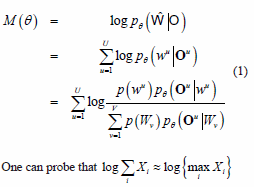
<body><![CDATA[<br> This work focuses on applying a discriminative training criterion to the non-discriminative HMM classifiers with the aim of improving the recognition performance. Although HMM are used successfully and effectively in speech processing, the model can be generalized for stochastic processes and may thus be applied to a large variety of biomedical signals [11]. Since the classification of biosignals share similar characteristics with speech recognition [4], the goal of the present work is to verify whether discriminative training technique shows a better performance than generative approach (as it happens in speech pathological detection or speech recognition [12]) in training of EEG and PCG signals as well as in Voice signals. The discriminative training algorithm used in this work to estimate the HMM parameters is an approximation of the MMI objective function that is a maximization technique similar to EM algorithm, carried out by a simple modification of the standard Baum-Welch algorithm [13]. </font>    <br></p>       <p><font face="Verdana" size="2"><b><i>Approximated MMI algorithm</i></b></font></p>     <p><font face="Verdana" size="2">The MMI training of a model is performed over a given  training set made up of the observations O = (O<sup>1</sup>,...,O<sup>u</sup>)  and their respective labels W = (w<sub>1</sub>,... w<sub>u</sub>...,  w<sub>U</sub>),  where each  wu e  (W<sub>1</sub>, W</sub>v<sub>,...W<sub>V</sub>) and V is the classes number. Each  class  W1  is associated to a HMM, denoted by &theta; = {A,B,&pi;}    <br> [7].    <br> The MMI objective function is given by [13]</font></p>      <p><img src="/img/revistas/rfiua/n55/n55a18e01.gif"><a name="ecuacion1"></a></p>     <p><font face="Verdana" size="2">One can probe that log X X<sub>i</sub>{  &laquo; log {max X<sub>i</sub>} [13], which is equivalent to use the MAP (Maximum a  Posteriori) criterion to associate one observation with a label.</font></p>      <p><img src="/img/revistas/rfiua/n55/n55a18e02.gif"><a name="ecuacion2"></a></p>     <p><font face="Verdana" size="2">where Bv holds the indices of training set that are recognized as  the class  W<sub>v</sub>,  and the parameters    ]]></body>
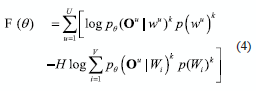
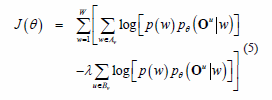
<body><![CDATA[<br> of each class Av = {  u|w<sup>u</sup> = W<sub>v</sub>} . Using these definitions of A<sub>v</sub> and B<sub>v</sub> (equation 2), equation 1 is  rewritten as follows:</font></p>      <p><img src="/img/revistas/rfiua/n55/n55a18e03.gif"><a name="ecuacion3"></a></p>     <p><font face="Verdana" size="2">MMI and ML can be related  through of H-criterion, which is an interpolation between the MMI and ML  objective functions [12]:</font></p>      <p><img src="/img/revistas/rfiua/n55/n55a18e04.gif"><a name="ecuacion4"></a></p>     <p><font face="Verdana" size="2">where k is described as a weighting exponent that usually is 1.  For  H = 1  this is equivalent to MMI (equation 1) and for H = 0 it is equivalent to the ML  criterion [12].    <br> Motivated by (equation 3 and  4), the following objective function is introduced, called the    <br> approximated MMI criterion (herein, just  MMI):</font></p>      <p><img src="/img/revistas/rfiua/n55/n55a18e05.gif"><a name="ecuacion5"></a></p>     <p><font face="Verdana" size="2">Note that H (equation 4) has been changed to X (equation 5). Now, it  is possible describe the new re-estimation procedure for each parameter, u, in  the following way:</font></p>      <p><img src="/img/revistas/rfiua/n55/n55a18e06.gif"><a name="ecuacion6"></a></p>     ]]></body>
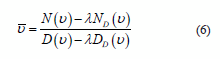
<body><![CDATA[<p><font face="Verdana" size="2">where N(u) and D(u), referred to as accumulators, are calculated using the  original training set A<sub>v</sub>. Likewise, N<sub>D</sub>(u) and D<sub>d</sub>(u), called discriminative  accumulators,  are computed according to the set B<sub>v</sub> obtained by recognition [13].    <br> The new algorithm is developed by two following steps [13]:    <br>    <br> <ul>       <li>Approximation: Performing recognition on the  training set to obtain the B<sub>v</sub> sets. Using these sets, the approximated MMI objective function J(&theta;)  (equation 5) can be calculated.</li>        <li>Maximization: Maximizing the objective function J(&theta;) using re-estimation  formulas (equation 6).</li>     </ul></font></p>      <p><font face="Verdana" size="2"><b>Experimental setup</b></font></p>     <p><font face="Verdana" size="2">The experiments are performed on 3 different biosignal  databases (EEG, PCG and Voice), comparing both training methods (ML and MMI).  The accuracy is measured using a k-folds cross validation strategy.  Namely, 10 folds have been used, splitting the 70% of the files for training  classifier, and the remaining 30% for validation. The HMM topology is full  connection-type, and each class is modeled by a HMM with 3 states and with diagonal  covariance matrices. Besides, HMM is trained with 2, 3 y 5 Gaussian Mixtures  (GM) output distributions, the number of states is fixed, it is due to the  amount of degrees of freedom (Number of states, number of GM per state and the  parameter &lambda;), it makes that the number of possible combinations and the  computational cost be too high, furthermore in our experiments we found if the  number of states is high the algorithm does not work well, and the performance  of the system is not good.    <br> MLE is applied over the training set, and it is taken as  the initial condition, the system performance is measured and it is taken as  reference point, after that it is applied an iteration of Approximation and ten of maximization as suggested in [13].  Parameter &lambda; is fixed individually according to each database. For all databases,  it is found that when &lambda; increases, values of variances and transition  probabilities become negative. In this case, they are replaced by their ML  values (e.g. &lambda; = 0) [13], because the optimization method does not take into  account the constrains and when they fail the model is not suitable and it has  to be replaced.</font></p>      ]]></body>
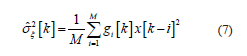
<body><![CDATA[<p><font face="Verdana" size="2"><b><i>EEG signals</i></b></font></p>     <p><font face="Verdana" size="2">The EEG signals are taken from Clinic of  Epileptology of the University Hospital of Bonn. The database is formed by 5  sets (enumerated from A till E), each of them is composed by 100 EEG segments  of a single channel that are labeled in 3 classes. The A and B sets are  superficial EEG recordings (scalp) from five healthy people (normal class). The  C, D and E sets refer to EEG pre-surgery diagnosis recordings as part of  pathological activities (say pathological class). All EEG signal are acquired  with a 128-channel system that are digitized at 173.61Hz with 12 bit  resolution. We chose a single set of each class, normal and pathological, the  chosen sets were A and C, respectively.    <br> The EEG features extraction is based on a variance  decimation methodology proposed in [14]. Estimation residuals of Kalman  smoothing are used to compute the variance of the random process, as follow:</font></p>        <p><img src="/img/revistas/rfiua/n55/n55a18e07.gif"><a name="ecuacion7"></a></p>       <p><font face="Verdana" size="2">where x[k] is the EEG signal, g = N  (2M, &beta;&sigma; &xi; 2  [k -1]) is  a Gaussian smoothing window when weight is time-variant according to the speed  signal, &beta; is an empirical constant  value and  M is the  number samples to estimation [14].</font></p>        <br>    <p><font face="Verdana" size="2"><b><i>PCG signals</i></b></font></p>     <p><font face="Verdana" size="2">The PCG database used in this work is made up of 22  de-identified adult subjects, who gave their informed consent, and underwent a  medical examination. A diagnosis was carried out for each patient and the  severity of the valve lesion was evaluated by cardiologists according to  clinical routine. A set of 16 patients were labeled as normal, while 6 were  with evidence of systolic murmur, caused by valve disorders. Besides, 8  recordings corresponding to the four traditional focuses of auscultation  (mitral, tricuspid, aortic and pulmonary areas) were taken for each patient in  the phase of post-expiratory and post- inspiratory apnea. Each record lasted 12  5. and was obtained from the patient standing in dorsal decubitus position. The  recording time could not be extended more because patients suffering cardiac  problems were unable of keeping both post-inspiratory and post-expiratory apnea  for a longer period. After visual and audible inspection by cardiologists, one  of the four signals was randomly picked up, taking into consideration that most  of the time murmurs do not necessary show up for all focuses at once, unless  they are very intense (which is an evidence of their harmfulness). An  electronic stethoscope (WelchAllyn&reg; Meditron model) is used to acquire the  HS  (Heart Sound)  simultaneously with a standard 3-lead ECG (since the QRS complex is clearly determined,  DII derivation is synchronized as a time reference). Both signals are sampled  with 44.1  kHz rate.  Tailored software is developed for recording, monitoring and editing the HS and  ECG signals.    <br>    <br> Application of TFR (Time Frequency  Representation)  to enhanced murmurs indicates that their time-frequency dynamics is far from being  stationary, as it is implicitly assumed in many studies. Besides, if one  demands to characterize also the dynamics of HS process, this would require a  time-resolved (e.g., event- related) spectral analysis. Therefore, it is not  only the spectral decomposition per se which is of interest, but rather a variety of measures  derived from TFR.    ]]></body>
<body><![CDATA[<br>    <br> Generally speaking, dynamic measures derived from TFR that  have a wide acceptance for characterizing a HS [15,16] can be estimated by two  methods; the ones based on computing of conditional moments of TFR, taking into  account the condition of correct time and frequency marginals , and the subband  methods based on filter-bank calculation.    <br>    <br> A filter-bank applied on TFR (both Short Time Fourier  Transform-STFT and Wavelet Transform- WT) and taking into account that  TFR eliminates the use of smoothing window that is necessary to calculate MFCC  [2], 12 MFCC are calculated with 24 filters, moreover it is applied a smoothing  on the contours by using a 16-order low-pass FIR filter, with cut-off frequency  of 60Hz. Choice of number of MFCC contours to be considered is made as a  compromise between informativity (measured by entropy) versus consistency of  estimation (measured as estimate deviation)</font></p>      <br>    <p><font face="Verdana" size="2"><b><i>Voice signals</i></b></font></p>     <p><font face="Verdana" size="2">Kay-Elemetrics  and UPM databases of voice disorders (described in [17]) were used to test the  proposed methodology. From Kay-Elemetrics a set of 173 pathological and 53  normal speakers has been taken, the recorded material is the sustained  phonation of /ah/ vowel from patients with a variety of voice pathologies:  organic, neurological, and traumatic disorders [18]. UPM stores 239  pathological voices with a wide variety of organic pathologies (nodules,  polyps, edemas, carcinomas, etc), and 201 normal voices. The dataset contains  the sustained phonation of the /a/ Spanish vowel with a sampling rate of 50 kHz  and 16-bits of resolution. Each recorded voice (observation) was uniformly  windowed employing 40 ms length window with 50% of overlapping. Within each  window 16 features were computed. These measures are: 12 Mel Frequency Cepstrum  Coefficients (MFCC) [19], the Harmonics to Noise Ratio (HNR) [20], the Glottal  to Noise Excitation Ratio (GNE) [21], the Normalized Noise Energy (NNE) [22],  and the Energy of the frame, as well.</font></p>      <br>    <p><font face="Verdana" size="2"><b>Results</b></font></p>      <p><font face="Verdana" size="2"><b><i>EEG signals</i></b></font></p>     ]]></body>
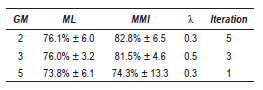
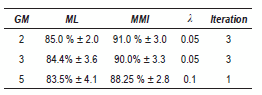
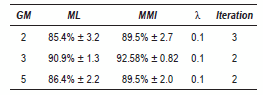
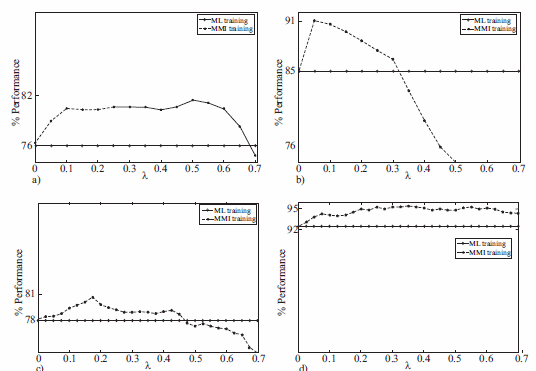
<body><![CDATA[<p><font face="Verdana" size="2">The figure 1(a) shows the recognition rate versus &lambda;, by  using 3 GM. The continuous line represents the ML baseline. In this case, best  results were obtained for &lambda; = 0.5, where the accuracy was 81.5%. In this  figure, notice that when &lambda; increases until its best performance, its behavior  becomes to decrease, for this reason, &lambda; was restricted to lower values (&lambda; &lt;  0.7). Similar results were found to 2 and 3 GM.    <br> The obtained complete results  with EEG signals are summarized in table 1. It is possible to see that for all  GM the algorithm yielded an improvement over ML estimation. The improvement  decreases while increases the number of GM, nevertheless, we can see that 3 GM  performs slightly better than 2 GM. However 3 GM have less dispersion and the  iteration number is lower than 2 GM.</font></p>      <p><font face="Verdana" size="2"><b>Table 1</b> Best results - EEG database</font></p>     <p align="center"><img src="/img/revistas/rfiua/n55/n55a18t01.gif"><a name="tabla1"></a></p>     <p><font face="Verdana" size="2">The best performance for EEG signals was obtained with 2  GM, however the difference with 3 GM is approximated 1%, therefore we should  taking into account the other obtained parameters as standard deviation and the  iterations number and thus we can concluded that the best modeling is given for  3 GM, since both values are minor.</font></p>      <p><font face="Verdana" size="2"><b><i>PCG signals</i></b></font></p>     <p><font face="Verdana" size="2">As same as in EEG signals, behavior of &lambda; becomes to  decrease, in a quicker way even to lower values than EEG case (&lambda; &lt; 0.35).The  results on PCG database are divided in two main groups: features extraction by  means of WT and STFT.</font></p>      <p><font face="Verdana" size="2"><i>Wavelet Transform</i></font></p>     <p><font face="Verdana" size="2">The figure 1(b) shows the recognition rate versus &lambda; with  the features obtained with WT set, by using 2 GM. Notice that when &lambda; &gt; 0.3  MMI performance is less than baseline ML. Similar results were found for 2 and  5 GM.    <br> The table 2 summarized the obtained results. Better  performances are always obtained to the MMI-trained model. The highest accuracy  in this case was 91.0% with 2 GM.    ]]></body>
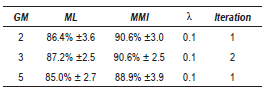
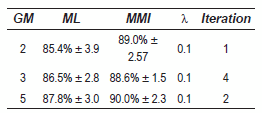
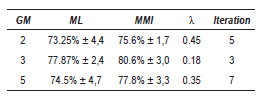
<body><![CDATA[<br> The table 3 summarized the  obtained results to the smoothed WT. In comparison with the table 2, notice  that the results in MMI training are very similar, with a best performance  achieve of 90.6% in the case of 2 y 3 GM, the difference between both is that the  iteration number is less with the smoothed contours WT.</font></p>      <p><font face="Verdana" size="2"><b>Table 2</b> Best results - PCG (contours WT)</font></p>     <p align="center"><img src="/img/revistas/rfiua/n55/n55a18t02.gif"><a name="tabla2"></a></p>      <p><font face="Verdana" size="2"><b>Table 3</b> Best results - PCG (smoothed contours WT)</font></p>     <p align="center"><img src="/img/revistas/rfiua/n55/n55a18t03.gif"><a name="tabla3"></a></p>      <p><font face="Verdana" size="2"><i>Short time frequency transform</i></font></p>     <p><font face="Verdana" size="2">In tables 4 and 5, the results for contours STFT and  smoothed contours STFT are given, respectively. The results show clearly the  MMI training method always improves the recognition rate. The best performance  is achieved in smoothed contours in the case of 3 GM, with the lower iteration  numbers (2). All best results are obtained with&nbsp;  &lambda; = 0.1.</font></p>      <p><font face="Verdana" size="2"><b>Table 4</b> Best results - PCG (contours STFT)</font></p>     <p align="center"><img src="/img/revistas/rfiua/n55/n55a18t04.gif"><a name="tabla4"></a></p>     <p><font face="Verdana" size="2">In general we can say that in PCG database the best results  are obtained with &lambda; &lt; 0.1, and a iteration number less than or equal 4.</font></p>      ]]></body>
<body><![CDATA[<p><font face="Verdana" size="2"><b>Table 5</b> Best results - PCG (smoothed contours STFT)</font></p>     <p align="center"><img src="/img/revistas/rfiua/n55/n55a18t05.gif"><a name="tabla5"></a></p>      <p><font face="Verdana" size="2"><i>Voice Ssgnals</i></font></p>     <p><font face="Verdana" size="2">In this part we show the results to both UPM and  Kay-Elemetrics databases. The &lambda; value also was restricted and iterates by steps  of 0.025.    <br> The figure 1(c) and (d) show the recognition rate versus &lambda;,  to UPM and Kay-Elemetrics database, respectively. In this figure, we also  notice that when &lambda; increases until its best performance, its behavior becomes  to decrease. Similar results were found to 2 and 3 GM. The figure for Kay-  Elemetrics database is omitted because, its behavior is similar to UPM  database.    <br>    <br> In a similar way the algorithm was tested with two voice  databases (described in section III-C). The results are shown in table 6 that  correspond to the evaluation of the classification system with the UPM database,  it is showed that the best results are reached with 3 GM to the discriminative  case when &lambda; = 0.175 and 3 iterations are carried out, however in all cases the  discriminative algorithm outperforms the ML training for &lambda; values between 0  &lt; &lambda; &lt; 0.6.</font></p>      <p><font face="Verdana" size="2"><b>Table 6</b> Best results - UPM</font></p>     <p align="center"><img src="/img/revistas/rfiua/n55/n55a18t06.gif"><a name="tabla6"></a></p>     <p><font face="Verdana" size="2">Table 7 shows the obtained results with Kay- Elemetrics  database, in this case the best results are reached when employ 2 GM were  employed (&lambda; = 0.35L=0.35) and the range for all GM of the X values is between 0  &lt; &lambda; &lt; 0.7.</font></p>      ]]></body>
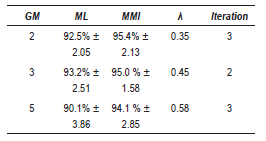
<body><![CDATA[<p><font face="Verdana" size="2"><b>Table 7</b> Best results - Kay-Elemetrics</font></p>     <p align="center"><img src="/img/revistas/rfiua/n55/n55a18t07.gif"><a name="tabla7"></a></p>     <p><font face="Verdana" size="2">Despite of the accuracy  achieved with the UPM database is lower than the accuracy obtained for  Kay-Elemetrics database, the methodology showed to be consistent and it can be  applied adequately to outperform the achieved results with a classification  system based on HMM trained with ML.    <br>    <br>   The lower performance obtained with UPM database might be  due to the diversity in the pathological class. This database has a large  number of pathologies, hence the classes' variability is higher, and perhaps  the evaluated features are not enough to model it correctly.</font></p>        <p align="center"><img src="/img/revistas/rfiua/n55/n55a18i01.gif"><a name="figura1"></a></p>      <p><font face="Verdana" size="2"><b>Figure 1</b> Performance vs. A. (a) EEG (b) PCG (contours WT) (c) Voice (UPM database) (d) Voice (Kay-Elemetrics database)</font></p>      <p>-------------------------------------------------------------------------------------</p>      <p align="center">&nbsp;</p>      <p><font face="Verdana" size="3"><b>Conclusions</b></font></p>     ]]></body>
<body><![CDATA[<p><font face="Verdana" size="2">The  discriminative training method for HMM based on the MMI criterion outperforms  the performance of a classification system for the detection of pathologies in  biosignals. This method consists on an approximation of the MMI objective  function by using the similarity with the H-Criterion objective function, which  is optimized by using a modified version of the BW algorithm, and it is carried  out by means of an additional term that is weighted by a value &lambda;, this term is  usually referred as a discriminative accumulator. The algorithm has two major  steps: Approximation, which is the derivation of  the algorithm's criterion, and Maximization, which is similar to the MLE method to estimate the  parameters of a HMM.    <br> Testing of the discriminative MLE algorithm for three  different types of biomedical databases (EEG, PCG and Voice) show that the  operation range of &lambda; parameter depends on the signals nature used for training.  It is because the structure of randomness of the data and the source of the  processes that it is wanted to model is different. Though the range turns to be  different on dependence of biosignal type, suggested algorithm shows an  advantage since for all considered database a better performance is achieved.    <br> As future work, the use of other discriminative training  criteria should be considered to compare between them and the training  algorithm presented in this work, as well the use of contingency matrices and  performance curves (ROC - curve, DET - curve) to improve the quality and  clarity of the results of the validation phase.</font></p>      <br>    <p><font face="Verdana" size="3"><b>Acknowledgments</b></font></p>     <p><font face="Verdana" size="2">This work was carried out under grants: 20201004208  funded by Universidad Nacional de Colombia-DIMA, &quot;Detecci&oacute;n de  los niveles de compromiso de resonancia en ni&ntilde;os con labio y/o paladar  hendido&quot;, and &quot;J&oacute;venes investigadores e Innovadores&quot;  sponsored by COLCIENCIAS and the graduate program thesis support (2009) with  the project &quot;Metodolog&iacute;a de Entrenamiento de Modelos Ocultos de Markov Empleando  Criterios Discriminativos de Gran Margen para La Detecci&oacute;n de Patolog&iacute;as en  Biose&ntilde;ales.&quot;. </font></p>      <br>     <p><font face="Verdana" size="3"><b>References</b></font></p>      <!-- ref --><p><font face="Verdana" size="2">1. D. Novak,  D. Cuesta-Frau, T. A. Ani, M. Aboy, P. Mico, L. Lhotska. &quot;Speech Recognition  Methods Applied to Biomedical Signals Processing.&quot; 26th Annual  International Conference of the IEEE. San Francisco (CA). Vol. 1.  2004. pp. 118-121.    &nbsp;&nbsp;&nbsp;&nbsp;&nbsp;&nbsp;&nbsp;&nbsp;[&#160;<a href="javascript:void(0);" onclick="javascript: window.open('/scielo.php?script=sci_nlinks&ref=000121&pid=S0120-6230201000050001800001&lng=','','width=640,height=500,resizable=yes,scrollbars=1,menubar=yes,');">Links</a>&#160;]<!-- end-ref --><br>    ]]></body>
<body><![CDATA[<!-- ref --><br> 2. R. Solera  Ure&ntilde;a, D. M. Iglesias, A. Gallardo, C. Pel&aacute;ez, A. D&iacute;az. &quot;Robust ASR using Support  Vector Machines.&quot; Speech Communication. Vol. 49. 2007. pp. 253-267.    &nbsp;&nbsp;&nbsp;&nbsp;&nbsp;&nbsp;&nbsp;&nbsp;[&#160;<a href="javascript:void(0);" onclick="javascript: window.open('/scielo.php?script=sci_nlinks&ref=000123&pid=S0120-6230201000050001800002&lng=','','width=640,height=500,resizable=yes,scrollbars=1,menubar=yes,');">Links</a>&#160;]<!-- end-ref --><br>    <!-- ref --><br> 3. L. G. Gamero, R. Watrous.  &quot;Detection of the first and second heart sound using probabilistic  models.&quot; Proceedings of the 25th Annual International Conference of  the IEEE.  Cancun (M&eacute;xico). Vol. 3. 2003. pp. 2877-2880.    &nbsp;&nbsp;&nbsp;&nbsp;&nbsp;&nbsp;&nbsp;&nbsp;[&#160;<a href="javascript:void(0);" onclick="javascript: window.open('/scielo.php?script=sci_nlinks&ref=000125&pid=S0120-6230201000050001800003&lng=','','width=640,height=500,resizable=yes,scrollbars=1,menubar=yes,');">Links</a>&#160;]<!-- end-ref --><br>    <!-- ref --><br> 4. H. Lee, S. Choi.  &quot;PCA+HMM+SVM for EEG Pattern Classification.&quot; Seventh  International Symposium on Signal Processing and Its Applications. Paris (France). Vol. 1. 2003.  pp. 541-544.    &nbsp;&nbsp;&nbsp;&nbsp;&nbsp;&nbsp;&nbsp;&nbsp;[&#160;<a href="javascript:void(0);" onclick="javascript: window.open('/scielo.php?script=sci_nlinks&ref=000127&pid=S0120-6230201000050001800004&lng=','','width=640,height=500,resizable=yes,scrollbars=1,menubar=yes,');">Links</a>&#160;]<!-- end-ref --><br>    <!-- ref --><br> 5. C. M. Bishop. Neural Networks  for Pattern Recognition. Ed. Oxford University Press. New York. 1995. pp. 1-508.    &nbsp;&nbsp;&nbsp;&nbsp;&nbsp;&nbsp;&nbsp;&nbsp;[&#160;<a href="javascript:void(0);" onclick="javascript: window.open('/scielo.php?script=sci_nlinks&ref=000129&pid=S0120-6230201000050001800005&lng=','','width=640,height=500,resizable=yes,scrollbars=1,menubar=yes,');">Links</a>&#160;]<!-- end-ref --><br>    <!-- ref --><br> 6. D. Y. Rubinstein, T.  Hastie. &quot;Discriminative vs Informative Learning&quot;. 3rd International  Conference on Knowledge Discovery and Data Mining. Newport Beach (CA). 1997. pp.  49-53.    &nbsp;&nbsp;&nbsp;&nbsp;&nbsp;&nbsp;&nbsp;&nbsp;[&#160;<a href="javascript:void(0);" onclick="javascript: window.open('/scielo.php?script=sci_nlinks&ref=000131&pid=S0120-6230201000050001800006&lng=','','width=640,height=500,resizable=yes,scrollbars=1,menubar=yes,');">Links</a>&#160;]<!-- end-ref --><br>    ]]></body>
<body><![CDATA[<!-- ref --><br> 7. L. R. Rabiner. &quot;A  tutorial on Hidden Markov models and selected applications in speech  recognition.&quot; IEEE. Vol. 77. 1989. pp. 257-285.    &nbsp;&nbsp;&nbsp;&nbsp;&nbsp;&nbsp;&nbsp;&nbsp;[&#160;<a href="javascript:void(0);" onclick="javascript: window.open('/scielo.php?script=sci_nlinks&ref=000133&pid=S0120-6230201000050001800007&lng=','','width=640,height=500,resizable=yes,scrollbars=1,menubar=yes,');">Links</a>&#160;]<!-- end-ref --><br>    <!-- ref --><br> 8. L. Bahl, P.  Brown, P. de Souza, R. Mercer. &quot;Maximum mutual information estimation of hidden  Markov model parameters for speech recognition&quot;. Acoustics,  Speech, and Signal Processing, IEEE International Conference on ICASSP. Tokyo (Japan). Vol. 11. 1986.  pp. 49-52.    &nbsp;&nbsp;&nbsp;&nbsp;&nbsp;&nbsp;&nbsp;&nbsp;[&#160;<a href="javascript:void(0);" onclick="javascript: window.open('/scielo.php?script=sci_nlinks&ref=000135&pid=S0120-6230201000050001800008&lng=','','width=640,height=500,resizable=yes,scrollbars=1,menubar=yes,');">Links</a>&#160;]<!-- end-ref --><br>    <!-- ref --><br> 9. B. H. Juang, S. Katagiri.  &quot;Discriminative Learning for Minimum Error Classification&quot;. IEEE Transaction  on Signal Processing. Vol. 40. 1992. pp. 3043-3054.    &nbsp;&nbsp;&nbsp;&nbsp;&nbsp;&nbsp;&nbsp;&nbsp;[&#160;<a href="javascript:void(0);" onclick="javascript: window.open('/scielo.php?script=sci_nlinks&ref=000137&pid=S0120-6230201000050001800009&lng=','','width=640,height=500,resizable=yes,scrollbars=1,menubar=yes,');">Links</a>&#160;]<!-- end-ref --><br>    <!-- ref --><br> 10. A. Nadas. &quot;A decision  theoretic formulation of a training problem in speech recognition and a  comparison of training by unconditional versus conditional maximum  likelihood.&quot; IEEE Trans. Acoust. Speech, Signal Processing. Vol. 31. 1983. pp. 814-817.    &nbsp;&nbsp;&nbsp;&nbsp;&nbsp;&nbsp;&nbsp;&nbsp;[&#160;<a href="javascript:void(0);" onclick="javascript: window.open('/scielo.php?script=sci_nlinks&ref=000139&pid=S0120-6230201000050001800010&lng=','','width=640,height=500,resizable=yes,scrollbars=1,menubar=yes,');">Links</a>&#160;]<!-- end-ref --><br>    <!-- ref --><br> 11. A. Cohen. &quot;Hidden  Markov models in biomedical signal processing&quot;. 20th Annual  International Conference of the IEEE Engineering in Medicine and Biology  Society.  Hong Kong. Vol. 20. 1998. pp. 1145&shy;1150.    &nbsp;&nbsp;&nbsp;&nbsp;&nbsp;&nbsp;&nbsp;&nbsp;[&#160;<a href="javascript:void(0);" onclick="javascript: window.open('/scielo.php?script=sci_nlinks&ref=000141&pid=S0120-6230201000050001800011&lng=','','width=640,height=500,resizable=yes,scrollbars=1,menubar=yes,');">Links</a>&#160;]<!-- end-ref --><br>    ]]></body>
<body><![CDATA[<!-- ref --><br> 12. Y. Normandin, S. D.  Morgera. &quot;An improved MMIE training algorithm for speaker-independent,  small vocabulary, continuous speech recognition&quot;. Proceedings of the  Acoustics, Speech, and Signal Processing. Vol. 1. 1991. pp. 537-540.    &nbsp;&nbsp;&nbsp;&nbsp;&nbsp;&nbsp;&nbsp;&nbsp;[&#160;<a href="javascript:void(0);" onclick="javascript: window.open('/scielo.php?script=sci_nlinks&ref=000143&pid=S0120-6230201000050001800012&lng=','','width=640,height=500,resizable=yes,scrollbars=1,menubar=yes,');">Links</a>&#160;]<!-- end-ref --><br>    <!-- ref --><br> 13. D. Burshtein, A.  Ben-Yishai. &quot;A Discriminative Training Algorithm for Hidden Markov  Models&quot;. IEEE Transactions on Speech and Audio Processing. Vol. 12. 2004. pp. 204-217.    &nbsp;&nbsp;&nbsp;&nbsp;&nbsp;&nbsp;&nbsp;&nbsp;[&#160;<a href="javascript:void(0);" onclick="javascript: window.open('/scielo.php?script=sci_nlinks&ref=000145&pid=S0120-6230201000050001800013&lng=','','width=640,height=500,resizable=yes,scrollbars=1,menubar=yes,');">Links</a>&#160;]<!-- end-ref --><br>    <!-- ref --><br> 14. L. D.  Avendano, J. M. Ferrero, G. Castellanos- Dominguez. &quot;Improved Parametric  Estimation of Time Frequency Representations for Cardiac Murmur  Discrimination&quot;. Computers in Cardiology. Vol. 35. 2008. pp. 157-160.    &nbsp;&nbsp;&nbsp;&nbsp;&nbsp;&nbsp;&nbsp;&nbsp;[&#160;<a href="javascript:void(0);" onclick="javascript: window.open('/scielo.php?script=sci_nlinks&ref=000147&pid=S0120-6230201000050001800014&lng=','','width=640,height=500,resizable=yes,scrollbars=1,menubar=yes,');">Links</a>&#160;]<!-- end-ref --><br>    <!-- ref --><br> 15. H. Shino,  H. Yoshida, H. Mizuta, K. Yana. &quot;Phonocardiogram classification using time-frequency  representation.&quot; 19th International Conference. IEEE/ EMBS. Chicago (IL). 1997. pp.  1636-1673.    &nbsp;&nbsp;&nbsp;&nbsp;&nbsp;&nbsp;&nbsp;&nbsp;[&#160;<a href="javascript:void(0);" onclick="javascript: window.open('/scielo.php?script=sci_nlinks&ref=000149&pid=S0120-6230201000050001800015&lng=','','width=640,height=500,resizable=yes,scrollbars=1,menubar=yes,');">Links</a>&#160;]<!-- end-ref --><br>    <!-- ref --><br> 16. W. Haibin, W. Jianqi, L.  Guohua, Z. Guohui, N. Ansheng. &quot;Application of adaptive time-frequency  analysis in cardiac murmurs signal processing.&quot; Proceedings of the  23rd Annual International Conference of the IEEE. Istanbul (Turkey). Vol. 4.  2001. pp. 1896-1898.    &nbsp;&nbsp;&nbsp;&nbsp;&nbsp;&nbsp;&nbsp;&nbsp;[&#160;<a href="javascript:void(0);" onclick="javascript: window.open('/scielo.php?script=sci_nlinks&ref=000151&pid=S0120-6230201000050001800016&lng=','','width=640,height=500,resizable=yes,scrollbars=1,menubar=yes,');">Links</a>&#160;]<!-- end-ref --><br>    ]]></body>
<body><![CDATA[<!-- ref --><br> 17. G.  Daza-Santacoloma, J. D. Arias-Londono, J. I. Godino, G. Castellanos-Dominguez,  V. Osma, N. Saenz. &quot;Dynamic feature extraction: an application to voice  pathology detection.&quot; Intelligent Automation and Soft Computing. Vol. 15. 2009. pp. 665-680.    &nbsp;&nbsp;&nbsp;&nbsp;&nbsp;&nbsp;&nbsp;&nbsp;[&#160;<a href="javascript:void(0);" onclick="javascript: window.open('/scielo.php?script=sci_nlinks&ref=000153&pid=S0120-6230201000050001800017&lng=','','width=640,height=500,resizable=yes,scrollbars=1,menubar=yes,');">Links</a>&#160;]<!-- end-ref --><br>    <!-- ref --><br> 18. L. Rankinea, M. Mesbaha,  B. Boashash. &quot;IF estimation for multicomponent signals using image  processing techniques in the time frequency domain.&quot; Signal  Processing.  Vol. 87. 2007. pp. 1234-1250.    &nbsp;&nbsp;&nbsp;&nbsp;&nbsp;&nbsp;&nbsp;&nbsp;[&#160;<a href="javascript:void(0);" onclick="javascript: window.open('/scielo.php?script=sci_nlinks&ref=000155&pid=S0120-6230201000050001800018&lng=','','width=640,height=500,resizable=yes,scrollbars=1,menubar=yes,');">Links</a>&#160;]<!-- end-ref --><br>    <!-- ref --><br> 19. A. Acero, X. Huang. Spoken Language  Processing. Ed.  Prentice Hall. New Jersey. 2001. pp. 1-1008.    &nbsp;&nbsp;&nbsp;&nbsp;&nbsp;&nbsp;&nbsp;&nbsp;[&#160;<a href="javascript:void(0);" onclick="javascript: window.open('/scielo.php?script=sci_nlinks&ref=000157&pid=S0120-6230201000050001800019&lng=','','width=640,height=500,resizable=yes,scrollbars=1,menubar=yes,');">Links</a>&#160;]<!-- end-ref --><br>    <!-- ref --><br> 20. G. de Krom. &quot;A  cepstrum-based technique for determining a harmonics-to-noise ratio in speech  signals&quot;. Journal of Speech and Hearing Research. Vol. 36. 1993. pp. 254-266.    &nbsp;&nbsp;&nbsp;&nbsp;&nbsp;&nbsp;&nbsp;&nbsp;[&#160;<a href="javascript:void(0);" onclick="javascript: window.open('/scielo.php?script=sci_nlinks&ref=000159&pid=S0120-6230201000050001800020&lng=','','width=640,height=500,resizable=yes,scrollbars=1,menubar=yes,');">Links</a>&#160;]<!-- end-ref --><br>    <!-- ref --><br> 21. D. Michaelis, T. Gramms,  H. W. Strube. &quot;Glottal to Noise Excitation ratio - a new measure for  describing pathological voices.&quot; Acta Acustica  united with Acustica. Vol. 83. 1997. pp. 700-706.    &nbsp;&nbsp;&nbsp;&nbsp;&nbsp;&nbsp;&nbsp;&nbsp;[&#160;<a href="javascript:void(0);" onclick="javascript: window.open('/scielo.php?script=sci_nlinks&ref=000161&pid=S0120-6230201000050001800021&lng=','','width=640,height=500,resizable=yes,scrollbars=1,menubar=yes,');">Links</a>&#160;]<!-- end-ref --><br>    ]]></body>
<body><![CDATA[<!-- ref --><br> 22. H. Kasuya,  S. Ogawa, K. Mashima, S. Ebihara. &quot;Normalized noise energy as an acoustic measure to  evaluate pathologic voice&quot;. Acoustical  Society of America. Vol. 80. 1986. pp. 1329-1334.</font>&nbsp;&nbsp;&nbsp;&nbsp;&nbsp;&nbsp;&nbsp;&nbsp;[&#160;<a href="javascript:void(0);" onclick="javascript: window.open('/scielo.php?script=sci_nlinks&ref=000163&pid=S0120-6230201000050001800022&lng=','','width=640,height=500,resizable=yes,scrollbars=1,menubar=yes,');">Links</a>&#160;]<!-- end-ref --><p>&nbsp;</p>     <p><font face="Verdana" size="2">(Recibido el 25 de noviembre de 2008. Aceptado el 6 de abril de 2010)    <br>       <br>   <sup>*</sup>Autor de correspondencia: tel&eacute;fono: + 57 + 6 + 882 67 14, correo electr&oacute;nico: <a href="mailto:johacarvajalg@gmail.com">johacarvajalg@gmail.com</a> (J. Carvajal).</font></p>      ]]></body><back>
<ref-list>
<ref id="B1">
<label>1</label><nlm-citation citation-type="confpro">
<person-group person-group-type="author">
<name>
<surname><![CDATA[Novak]]></surname>
<given-names><![CDATA[D]]></given-names>
</name>
<name>
<surname><![CDATA[Cuesta-Frau]]></surname>
<given-names><![CDATA[D]]></given-names>
</name>
<name>
<surname><![CDATA[Ani]]></surname>
<given-names><![CDATA[T. A]]></given-names>
</name>
<name>
<surname><![CDATA[Aboy]]></surname>
<given-names><![CDATA[M]]></given-names>
</name>
<name>
<surname><![CDATA[Mico]]></surname>
<given-names><![CDATA[P]]></given-names>
</name>
<name>
<surname><![CDATA[Lhotska]]></surname>
<given-names><![CDATA[L]]></given-names>
</name>
</person-group>
<source><![CDATA[Speech Recognition Methods Applied to Biomedical Signals Processing]]></source>
<year>2004</year>
<volume>1</volume>
<conf-name><![CDATA[26th Annual International Conference of the IEEE]]></conf-name>
<conf-loc>San Francisco CA</conf-loc>
<page-range>118-121</page-range></nlm-citation>
</ref>
<ref id="B2">
<label>2</label><nlm-citation citation-type="journal">
<person-group person-group-type="author">
<name>
<surname><![CDATA[Solera Ureña]]></surname>
<given-names><![CDATA[R]]></given-names>
</name>
<name>
<surname><![CDATA[Iglesias]]></surname>
<given-names><![CDATA[D. M]]></given-names>
</name>
<name>
<surname><![CDATA[Gallardo]]></surname>
<given-names><![CDATA[A]]></given-names>
</name>
<name>
<surname><![CDATA[Peláez]]></surname>
<given-names><![CDATA[C]]></given-names>
</name>
<name>
<surname><![CDATA[Díaz]]></surname>
<given-names><![CDATA[A]]></given-names>
</name>
</person-group>
<article-title xml:lang="en"><![CDATA[Robust ASR using Support Vector Machines]]></article-title>
<source><![CDATA[Speech Communication]]></source>
<year>2007</year>
<volume>49</volume>
<page-range>253-267</page-range></nlm-citation>
</ref>
<ref id="B3">
<label>3</label><nlm-citation citation-type="confpro">
<person-group person-group-type="author">
<name>
<surname><![CDATA[Gamero]]></surname>
<given-names><![CDATA[L. G]]></given-names>
</name>
<name>
<surname><![CDATA[Watrous]]></surname>
<given-names><![CDATA[R]]></given-names>
</name>
</person-group>
<source><![CDATA[Detection of the first and second heart sound using probabilistic models]]></source>
<year>2003</year>
<volume>3</volume>
<conf-name><![CDATA[25th Annual International Conference of the IEEE]]></conf-name>
<conf-loc>Cancun </conf-loc>
<page-range>2877-2880</page-range></nlm-citation>
</ref>
<ref id="B4">
<label>4</label><nlm-citation citation-type="confpro">
<person-group person-group-type="author">
<name>
<surname><![CDATA[Lee]]></surname>
<given-names><![CDATA[H]]></given-names>
</name>
<name>
<surname><![CDATA[Choi]]></surname>
<given-names><![CDATA[S]]></given-names>
</name>
</person-group>
<source><![CDATA[PCA+HMM+SVM for EEG Pattern Classification]]></source>
<year>2003</year>
<volume>1</volume>
<conf-name><![CDATA[Seventh International Symposium on Signal Processing and Its Applications]]></conf-name>
<conf-loc>Paris </conf-loc>
<page-range>541-544</page-range></nlm-citation>
</ref>
<ref id="B5">
<label>5</label><nlm-citation citation-type="book">
<person-group person-group-type="author">
<name>
<surname><![CDATA[Bishop]]></surname>
<given-names><![CDATA[C. M]]></given-names>
</name>
</person-group>
<source><![CDATA[Neural Networks for Pattern Recognition]]></source>
<year>1995</year>
<page-range>1-508</page-range><publisher-loc><![CDATA[New York ]]></publisher-loc>
<publisher-name><![CDATA[Ed. Oxford University Press]]></publisher-name>
</nlm-citation>
</ref>
<ref id="B6">
<label>6</label><nlm-citation citation-type="confpro">
<person-group person-group-type="author">
<name>
<surname><![CDATA[Rubinstein]]></surname>
<given-names><![CDATA[D. Y]]></given-names>
</name>
<name>
<surname><![CDATA[Hastie]]></surname>
<given-names><![CDATA[T]]></given-names>
</name>
</person-group>
<source><![CDATA[Discriminative vs Informative Learning]]></source>
<year></year>
<conf-name><![CDATA[3rd International Conference on Knowledge Discovery and Data Mining]]></conf-name>
<conf-date>1997</conf-date>
<conf-loc>Newport Beac </conf-loc>
<page-range>49-53</page-range></nlm-citation>
</ref>
<ref id="B7">
<label>7</label><nlm-citation citation-type="journal">
<person-group person-group-type="author">
<name>
<surname><![CDATA[Rabiner]]></surname>
<given-names><![CDATA[L. R]]></given-names>
</name>
</person-group>
<article-title xml:lang="en"><![CDATA[A tutorial on Hidden Markov models and selected applications in speech recognition]]></article-title>
<source><![CDATA[IEEE]]></source>
<year>1989</year>
<volume>77</volume>
<page-range>257-285</page-range></nlm-citation>
</ref>
<ref id="B8">
<label>8</label><nlm-citation citation-type="confpro">
<person-group person-group-type="author">
<name>
<surname><![CDATA[Bahl]]></surname>
<given-names><![CDATA[L]]></given-names>
</name>
<name>
<surname><![CDATA[Brown]]></surname>
<given-names><![CDATA[P]]></given-names>
</name>
<name>
<surname><![CDATA[de Souza]]></surname>
<given-names><![CDATA[P]]></given-names>
</name>
<name>
<surname><![CDATA[Mercer]]></surname>
<given-names><![CDATA[R]]></given-names>
</name>
</person-group>
<source><![CDATA[Maximum mutual information estimation of hidden Markov model parameters for speech recognition]]></source>
<year>1986</year>
<volume>11</volume>
<conf-name><![CDATA[ Acoustics, Speech, and Signal Processing, IEEE International Conference on ICASSP]]></conf-name>
<conf-loc>Tokyo </conf-loc>
<page-range>49-5</page-range></nlm-citation>
</ref>
<ref id="B9">
<label>9</label><nlm-citation citation-type="journal">
<person-group person-group-type="author">
<name>
<surname><![CDATA[Juang]]></surname>
<given-names><![CDATA[B. H]]></given-names>
</name>
<name>
<surname><![CDATA[Katagiri]]></surname>
<given-names><![CDATA[S]]></given-names>
</name>
</person-group>
<article-title xml:lang="en"><![CDATA[Discriminative Learning for Minimum Error Classification]]></article-title>
<source><![CDATA[IEEE Transaction on Signal Processing]]></source>
<year>1992</year>
<volume>40</volume>
<page-range>3043-3054</page-range></nlm-citation>
</ref>
<ref id="B10">
<label>10</label><nlm-citation citation-type="journal">
<person-group person-group-type="author">
<name>
<surname><![CDATA[Nadas]]></surname>
<given-names><![CDATA[A]]></given-names>
</name>
</person-group>
<article-title xml:lang="en"><![CDATA[A decision theoretic formulation of a training problem in speech recognition and a comparison of training by unconditional versus conditional maximum likelihood]]></article-title>
<source><![CDATA[IEEE Trans. Acoust. Speech, Signal Processing]]></source>
<year>1983</year>
<volume>31</volume>
<page-range>814-817</page-range></nlm-citation>
</ref>
<ref id="B11">
<label>11</label><nlm-citation citation-type="confpro">
<person-group person-group-type="author">
<name>
<surname><![CDATA[Cohen]]></surname>
<given-names><![CDATA[A]]></given-names>
</name>
</person-group>
<source><![CDATA[Hidden Markov models in biomedical signal processing]]></source>
<year>1998</year>
<volume>20</volume>
<conf-name><![CDATA[20th International Conference of the IEEE Engineering in Medicine and Biology Society]]></conf-name>
<conf-loc>Hong Kong </conf-loc>
<page-range>1145-1150</page-range></nlm-citation>
</ref>
<ref id="B12">
<label>12</label><nlm-citation citation-type="">
<person-group person-group-type="author">
<name>
<surname><![CDATA[Normandin]]></surname>
<given-names><![CDATA[Y]]></given-names>
</name>
<name>
<surname><![CDATA[Morgera]]></surname>
<given-names><![CDATA[S. D]]></given-names>
</name>
</person-group>
<source><![CDATA[An improved MMIE training algorithm for speaker-independent, small vocabulary, continuous speech recognition: Proceedings of the Acoustics, Speech, and Signal Processing]]></source>
<year>1991</year>
<volume>1</volume>
<page-range>537-540</page-range></nlm-citation>
</ref>
<ref id="B13">
<label>13</label><nlm-citation citation-type="journal">
<person-group person-group-type="author">
<name>
<surname><![CDATA[Burshtein]]></surname>
<given-names><![CDATA[D]]></given-names>
</name>
<name>
<surname><![CDATA[Ben-Yishai]]></surname>
<given-names><![CDATA[A]]></given-names>
</name>
</person-group>
<article-title xml:lang="en"><![CDATA[A Discriminative Training Algorithm for Hidden Markov Models]]></article-title>
<source><![CDATA[IEEE Transactions on Speech and Audio Processing]]></source>
<year>2004</year>
<volume>12</volume>
<page-range>204-217</page-range></nlm-citation>
</ref>
<ref id="B14">
<label>14</label><nlm-citation citation-type="journal">
<person-group person-group-type="author">
<name>
<surname><![CDATA[Avendano]]></surname>
<given-names><![CDATA[L. D]]></given-names>
</name>
<name>
<surname><![CDATA[Ferrero]]></surname>
<given-names><![CDATA[J. M]]></given-names>
</name>
<name>
<surname><![CDATA[Castellanos- Dominguez]]></surname>
<given-names><![CDATA[G]]></given-names>
</name>
</person-group>
<article-title xml:lang="en"><![CDATA[Improved Parametric Estimation of Time Frequency Representations for Cardiac Murmur Discrimination]]></article-title>
<source><![CDATA[Computers in Cardiology]]></source>
<year>2008</year>
<volume>35</volume>
<page-range>157-160</page-range></nlm-citation>
</ref>
<ref id="B15">
<label>15</label><nlm-citation citation-type="confpro">
<person-group person-group-type="author">
<name>
<surname><![CDATA[Shino]]></surname>
<given-names><![CDATA[H]]></given-names>
</name>
<name>
<surname><![CDATA[Yoshida]]></surname>
<given-names><![CDATA[H]]></given-names>
</name>
<name>
<surname><![CDATA[Mizuta]]></surname>
<given-names><![CDATA[H]]></given-names>
</name>
<name>
<surname><![CDATA[Yana]]></surname>
<given-names><![CDATA[K]]></given-names>
</name>
</person-group>
<source><![CDATA[Phonocardiogram classification using time-frequency representation]]></source>
<year></year>
<conf-name><![CDATA[19th International Conference. IEEE/ EMBS]]></conf-name>
<conf-date>1997</conf-date>
<conf-loc>Chicago </conf-loc>
<page-range>1636-1673</page-range></nlm-citation>
</ref>
<ref id="B16">
<label>16</label><nlm-citation citation-type="">
<person-group person-group-type="author">
<name>
<surname><![CDATA[Haibin]]></surname>
<given-names><![CDATA[W]]></given-names>
</name>
<name>
<surname><![CDATA[Jianqi]]></surname>
<given-names><![CDATA[W]]></given-names>
</name>
<name>
<surname><![CDATA[Guohua]]></surname>
<given-names><![CDATA[L]]></given-names>
</name>
<name>
<surname><![CDATA[Guohui]]></surname>
<given-names><![CDATA[Z]]></given-names>
</name>
<name>
<surname><![CDATA[Ansheng]]></surname>
<given-names><![CDATA[N]]></given-names>
</name>
</person-group>
<source><![CDATA[Application of adaptive time-frequency analysis in cardiac murmurs signal processing]]></source>
<year>2001</year>
<volume>4</volume>
<page-range>1896-1898</page-range></nlm-citation>
</ref>
<ref id="B17">
<label>17</label><nlm-citation citation-type="journal">
<person-group person-group-type="author">
<name>
<surname><![CDATA[Daza-Santacoloma]]></surname>
<given-names><![CDATA[G]]></given-names>
</name>
<name>
<surname><![CDATA[Arias-Londono]]></surname>
<given-names><![CDATA[J. D]]></given-names>
</name>
<name>
<surname><![CDATA[Godino]]></surname>
<given-names><![CDATA[J. I]]></given-names>
</name>
<name>
<surname><![CDATA[Castellanos-Dominguez]]></surname>
<given-names><![CDATA[G]]></given-names>
</name>
<name>
<surname><![CDATA[Osma]]></surname>
<given-names><![CDATA[V]]></given-names>
</name>
<name>
<surname><![CDATA[Saenz]]></surname>
<given-names><![CDATA[N]]></given-names>
</name>
</person-group>
<article-title xml:lang="en"><![CDATA[Dynamic feature extraction: an application to voice pathology detection]]></article-title>
<source><![CDATA[Intelligent Automation and Soft Computing]]></source>
<year>2009</year>
<volume>15</volume>
<page-range>665-680</page-range></nlm-citation>
</ref>
<ref id="B18">
<label>18</label><nlm-citation citation-type="journal">
<person-group person-group-type="author">
<name>
<surname><![CDATA[Rankinea]]></surname>
<given-names><![CDATA[L]]></given-names>
</name>
<name>
<surname><![CDATA[Mesbaha]]></surname>
<given-names><![CDATA[M]]></given-names>
</name>
<name>
<surname><![CDATA[Boashash]]></surname>
<given-names><![CDATA[B]]></given-names>
</name>
</person-group>
<article-title xml:lang="en"><![CDATA[IF estimation for multicomponent signals using image processing techniques in the time frequency domain]]></article-title>
<source><![CDATA[Signal Processing]]></source>
<year>2007</year>
<volume>87</volume>
<page-range>1234-1250</page-range></nlm-citation>
</ref>
<ref id="B19">
<label>19</label><nlm-citation citation-type="book">
<person-group person-group-type="author">
<name>
<surname><![CDATA[Acero]]></surname>
<given-names><![CDATA[A]]></given-names>
</name>
<name>
<surname><![CDATA[Huang]]></surname>
<given-names><![CDATA[X]]></given-names>
</name>
</person-group>
<source><![CDATA[Spoken Language Processing]]></source>
<year>2001</year>
<page-range>1-1008</page-range><publisher-loc><![CDATA[New Jersey ]]></publisher-loc>
<publisher-name><![CDATA[Ed. Prentice Hall]]></publisher-name>
</nlm-citation>
</ref>
<ref id="B20">
<label>20</label><nlm-citation citation-type="journal">
<person-group person-group-type="author">
<name>
<surname><![CDATA[de Krom]]></surname>
<given-names><![CDATA[G]]></given-names>
</name>
</person-group>
<article-title xml:lang="en"><![CDATA[A cepstrum-based technique for determining a harmonics-to-noise ratio in speech signals]]></article-title>
<source><![CDATA[Journal of Speech and Hearing Research]]></source>
<year>1993</year>
<volume>36</volume>
<page-range>254-266</page-range></nlm-citation>
</ref>
<ref id="B21">
<label>21</label><nlm-citation citation-type="journal">
<person-group person-group-type="author">
<name>
<surname><![CDATA[Michaelis]]></surname>
<given-names><![CDATA[D]]></given-names>
</name>
<name>
<surname><![CDATA[Gramms]]></surname>
<given-names><![CDATA[T]]></given-names>
</name>
<name>
<surname><![CDATA[Strube]]></surname>
<given-names><![CDATA[H. W]]></given-names>
</name>
</person-group>
<article-title xml:lang="en"><![CDATA[Glottal to Noise Excitation ratio - a new measure for describing pathological voices]]></article-title>
<source><![CDATA[Acta Acustica united with Acustica]]></source>
<year>1997</year>
<volume>83</volume>
<page-range>700-706</page-range></nlm-citation>
</ref>
<ref id="B22">
<label>22</label><nlm-citation citation-type="journal">
<person-group person-group-type="author">
<name>
<surname><![CDATA[Kasuya]]></surname>
<given-names><![CDATA[H]]></given-names>
</name>
<name>
<surname><![CDATA[Ogawa]]></surname>
<given-names><![CDATA[S]]></given-names>
</name>
<name>
<surname><![CDATA[Mashima]]></surname>
<given-names><![CDATA[K]]></given-names>
</name>
<name>
<surname><![CDATA[Ebihara]]></surname>
<given-names><![CDATA[S]]></given-names>
</name>
</person-group>
<article-title xml:lang="en"><![CDATA[Normalized noise energy as an acoustic measure to evaluate pathologic voice]]></article-title>
<source><![CDATA[Acoustical Society of America]]></source>
<year>1986</year>
<volume>80</volume>
<page-range>1329-1334</page-range></nlm-citation>
</ref>
</ref-list>
</back>
</article>