<?xml version="1.0" encoding="ISO-8859-1"?><article xmlns:mml="http://www.w3.org/1998/Math/MathML" xmlns:xlink="http://www.w3.org/1999/xlink" xmlns:xsi="http://www.w3.org/2001/XMLSchema-instance">
<front>
<journal-meta>
<journal-id>0120-6230</journal-id>
<journal-title><![CDATA[Revista Facultad de Ingeniería Universidad de Antioquia]]></journal-title>
<abbrev-journal-title><![CDATA[Rev.fac.ing.univ. Antioquia]]></abbrev-journal-title>
<issn>0120-6230</issn>
<publisher>
<publisher-name><![CDATA[Facultad de Ingeniería, Universidad de Antioquia]]></publisher-name>
</publisher>
</journal-meta>
<article-meta>
<article-id>S0120-62302010000500021</article-id>
<title-group>
<article-title xml:lang="en"><![CDATA[Variables that dynamize access to information and communication technologies in middle income families from Aburrá Valley]]></article-title>
<article-title xml:lang="es"><![CDATA[Variables que dinamizan el acceso a las tecnologías de información y comunicación en familias de ingreso medio del Valle de Aburrá]]></article-title>
</title-group>
<contrib-group>
<contrib contrib-type="author">
<name>
<surname><![CDATA[López]]></surname>
<given-names><![CDATA[Sandra María]]></given-names>
</name>
<xref ref-type="aff" rid="A01"/>
</contrib>
<contrib contrib-type="author">
<name>
<surname><![CDATA[Cárdenas Soto]]></surname>
<given-names><![CDATA[Ana María]]></given-names>
</name>
<xref ref-type="aff" rid="A02"/>
</contrib>
<contrib contrib-type="author">
<name>
<surname><![CDATA[Pérez]]></surname>
<given-names><![CDATA[Héctor Alonso]]></given-names>
</name>
<xref ref-type="aff" rid="A01"/>
</contrib>
</contrib-group>
<aff id="A01">
<institution><![CDATA[,Universidad Pontificia Bolivariana  ]]></institution>
<addr-line><![CDATA[Medellín ]]></addr-line>
<country>Colombia</country>
</aff>
<aff id="A02">
<institution><![CDATA[,Universidad de Antioquia Facultad de Ingeniería ]]></institution>
<addr-line><![CDATA[Medellín ]]></addr-line>
<country>Colombia</country>
</aff>
<pub-date pub-type="pub">
<day>00</day>
<month>09</month>
<year>2010</year>
</pub-date>
<pub-date pub-type="epub">
<day>00</day>
<month>09</month>
<year>2010</year>
</pub-date>
<numero>55</numero>
<fpage>203</fpage>
<lpage>209</lpage>
<copyright-statement/>
<copyright-year/>
<self-uri xlink:href="http://www.scielo.org.co/scielo.php?script=sci_arttext&amp;pid=S0120-62302010000500021&amp;lng=en&amp;nrm=iso"></self-uri><self-uri xlink:href="http://www.scielo.org.co/scielo.php?script=sci_abstract&amp;pid=S0120-62302010000500021&amp;lng=en&amp;nrm=iso"></self-uri><self-uri xlink:href="http://www.scielo.org.co/scielo.php?script=sci_pdf&amp;pid=S0120-62302010000500021&amp;lng=en&amp;nrm=iso"></self-uri><abstract abstract-type="short" xml:lang="en"><p><![CDATA[This paper presents the methodology for the selection of the most important or essential variables to access information and communication technologies (ICT) in middle-income families from a developing country. The variables are chosen through a combination of three different methods for the interpretation of the results based on structural analysis using MICMAC (Impact Matrix Cross-reference Multiplication) software.]]></p></abstract>
<abstract abstract-type="short" xml:lang="es"><p><![CDATA[El presente artículo muestra una metodología para seleccionar las variables que tengan una influencia significativa en la dinamización del acceso a las tecnologías de información y comunicación (TIC) en las familias de ingreso medio en el Valle de Aburrá, así como las interrelaciones principales entre esas variables. Las variables se escogen a partir de la combinación de tres métodos de interpretación de resultados, basados en Análisis Estructural con el software MICMAC (Impact Matrix Cross-reference Multiplication).]]></p></abstract>
<kwd-group>
<kwd lng="en"><![CDATA[information and communication technologies (ICT)]]></kwd>
<kwd lng="en"><![CDATA[structural analysis]]></kwd>
<kwd lng="en"><![CDATA[ICT access]]></kwd>
<kwd lng="es"><![CDATA[tecnologías de información y comunicación (TIC)]]></kwd>
<kwd lng="es"><![CDATA[análisis estructural]]></kwd>
<kwd lng="es"><![CDATA[acceso a TIC]]></kwd>
</kwd-group>
</article-meta>
</front><body><![CDATA[ <p align="center"><font face="Verdana" size="4"> <b>Variables that dynamize access to information and communication technologies in middle income families from Aburrá Valley</b></font></p>      <p align="center"><font face="Verdana" size="4"> <b>Variables que dinamizan el acceso a las tecnolog&iacute;as de informaci&oacute;n y comunicaci&oacute;n en familias de ingreso medio del Valle de Aburr&aacute;</b></font></p>       <p> <font face="Verdana" size="2"><i> Sandra Mar&iacute;a L&oacute;pez<sup>*</sup>, Ana Mar&iacute;a C&aacute;rdenas Soto<sup>2</sup>, H&eacute;ctor Alonso P&eacute;rez<sup>1</sup></i> </font></p>      <p><font face="Verdana" size="2"> <sup>1</sup> Universidad Pontificia Bolivariana. Circular 1a N.° 70-01, Medell&iacute;n, Colombia.</font></p>      <p><font face="Verdana" size="2"> <sup>2</sup> Universidad de Antioquia. Facultad de Ingenier&iacute;a. Apartado A&eacute;reo 1226. Medell&iacute;n, Colombia</font></p>      <p>&nbsp;</p>   <hr noshade size="1">      <p><font face="Verdana" size="3"> <b>Abstract</b></font></p>      <p><font face="Verdana" size="2">This paper presents the methodology for the selection of the most important or essential variables to access information and communication technologies (ICT) in middle-income families from a developing country. The variables are chosen through a combination of three different methods for the interpretation of the results based on structural analysis using MICMAC (Impact Matrix Cross-reference Multiplication) software. </font></p>      <p><font face="Verdana" size="2"><b>Keywords: </b>information  and communication technologies (ICT), structural  analysis, ICT access</font></p>  <hr noshade size="1">      <p><font face="Verdana" size="3"> <b>Resumen:</b></font></p>      ]]></body>
<body><![CDATA[<p><font face="Verdana" size="2">El presente art&iacute;culo muestra una metodolog&iacute;a para  seleccionar las variables que tengan una influencia significativa en la  dinamizaci&oacute;n del acceso a las tecnolog&iacute;as de informaci&oacute;n y comunicaci&oacute;n (TIC)  en las familias de ingreso medio en el Valle de Aburr&aacute;, as&iacute; como las  interrelaciones principales entre esas variables. Las variables se escogen a  partir de la combinaci&oacute;n de tres m&eacute;todos de interpretaci&oacute;n de resultados,  basados en An&aacute;lisis Estructural con el software MICMAC (Impact Matrix  Cross-reference Multiplication). </font></p>      <p><font face="Verdana" size="2"><b>palabras clave: </b>tecnolog&iacute;as de informaci&oacute;n y comunicaci&oacute;n (TIC),  an&aacute;lisis estructural, acceso a TIC</font></p>  <hr noshade size="1">      <p><font face="Verdana" size="3"><b>Introduction</b></font>      <p><font face="Verdana" size="2">The Information and Communication Technologies (ICT) are powerful tools to achieve people's goals, since they aim to facilitate information exchange and interactions between them, with fewer restrictions over time and space than other communication media. Therefore, the presence of ICT, especially of Internet, in society is a determining factor for development [1-3] given opportunities in education, work, entertainment, transactions, and health, as the millennium development goals suggests [4]. The economic and social impact of ICT led governments to recognize the importance of these technologies, and have been incorporated in government plans and by all citizens [5-7]. It is therefore an important issue to understand and identify the main factors that can change the process in order to dinamize the incorporation of ICT in a particular context. This paper analyzes ICT access for the middle income families in an urban region of Colombia, focusing mainly on finding the variables that are essential to the specific context, that have strong influence in the dynamics of family's access to ICT and the relationship between these variables.    <br>    <br> The factors affecting access to ICT have focused primarily on demographics such as age, type of members in the family, etc., in some cases combined with pricing policies and capacities. However, in this research the focus is on variables that may be affected, not only observed to streamline the process of access to ICT in a particular context. </font></p>      <br>    <p><font face="Verdana" size="2"><b><i>General concepts of structural analysis</i></b></font></p>     <p><font face="Verdana" size="2">The goal is to identify in the most  objective way the variables that have strong influence on the dynamic of ICT  access. The methodology takes as a base the Structural Analysis with MICMAC  methodology that aims to show the influential and dependent variables and  therefore the key to the evolution of the system. The software MICMAC -Impact  Matrix Cross-reference Multiplication Applied to a Classification of Laboratory  for  Prospective  Studies LIPSOR of France- [8], is a computational tool that helps to analyze  the relationship between variables.</font> </p>      <br>    ]]></body>
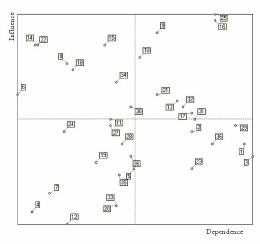
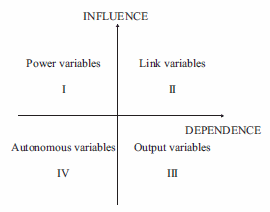
<body><![CDATA[<p><font face="Verdana" size="2"><b><i>Variable selection</i></b></font></p>     <p><font face="Verdana" size="2">The  structural analysis consists of three phases [9]: The  first phase is the identification, definition and homologation of factors  involved in the problem. To carry out this phase, there must be done an  exhaustive inventory of factors. The reduction of the factors through the  contextualization of the definition of each variable minimizes the number of  variables in cases where different names are given to variables with the same  meaning or variables do not apply for the particular problem. The second phase  is based on the description of the relationship between variables. This  relationship is discussed in meetings with experts using a matrix of double  input, grading the direct influence of a variable over other variables as  strong, average, weak, non-existent or potential. The numerical value assigned  to the relation is from 3 to 0, with 3 representing a strong relation and 0 for  a lack of relation, the letter P has been assigned for a potential relation.  This matrix is entered in the software MICMAC when the information from the matrix is  processed to obtain the interrelationships that may not be evident through the  direct analysis made by the experts. That  leads us to the third phase: the identification of essential variables of the  system, the software MICMAC delivers the factors introduced in the matrix,  organized in an influence-dependence Cartesian graph, which  should be interpreted as follows: a variable has more influence on other  variables if the variable is at the top of the y-axis, and with regard to their  dependence, if it is right on the X axis, this means it is more dependent than  those on its left, as shown in figure  1.    <br>    <br> The main  methods for the selection of the key variables of the system, using the interpretation of the influence  of the variables, according to their location in Cartesian graph are: Analysis of the four quadrants, which is designed  to find the most relevant variables for the formulation of strategies [9]; The  strategic axis, that is the projection of variables on the diagonal to the  Cartesian graph, ordering the variables according to their importance for the  system [10]; the method of the nine quadrants, which focuses on analysis of the  variables with greater power and dependence on the change of the system [11].  This paper proposes the combination of the three previous described methods to  select variables that are the most relevant to the dynamics of  the system.</font></p>      <p align="center"><img src="/img/revistas/rfiua/n55/n55a21i01.gif"><a name="figura1"></a></p>      <p><font face="Verdana" size="2"><b>Figure 1</b> Variables relationship- influence - dependence</font></p>      <br>    <p><font face="Verdana" size="2"><b><i>Methodology for selection of variables</i></b></font></p>     <p><font face="Verdana" size="2">To be  consistent in the application of structural analysis methodology, in Phase 1  ofthe methodology there was reviewed an exhaustive list of aspects that are  involved in the process of Internet access from primary and secondary sources.     <br>    ]]></body>
<body><![CDATA[<br> Secondary  information is obtained from studies and literature of research [12-16], global  organizations and telecommunications operators [17-21], and policies of different countries  [5-7] as well as international indicators  that compare the progress of ICT in different countries [22-24].    <br>    <br> Another information was obtained from  primary sources from working sessions and interviews with experts and research  groups that have experience on the topic, in the areas of psychology,  anthropology, engineering, social communication, philosophy and economics. A  special consideration for the selection of these experts is that they are  directly involved in the process of ICT from different knowledge areas in  representative applications such as e-medicine, e-education, e-health,  administrative, technical or philosophical ICT process. Part of this work was  done with international experts; their analysis was focused on a global vision  of access to ICT and with regional experts from the specific region in a  developing country, with emphasis on the special conditions in the context for  the processes.    <br>    <br> The result of this work is a list of  over 150 factors which were defined and reviewed in order to find those that  had a different name but its meaning was similar, allowing a reduction to a  common factor or eliminating those that were not relevant for the context.  Using this process the list of the variables was obtained for a total of 82  variables selected in this stage for the context discussed in the sessions, 50 of which can affect the decision on access to ICT.    <br>    <br> In  phase 2 according to the Structural Analysis, the variables are  placed in a matrix of double- input with the collaboration of the expert group  based on the grading of the direct relationship between variables (item 2). The  analysis was focused specifically on the particular context of study. The location in the plane of each  variable according to the relation of dependence /influence with other  variables is shown in figure 2.    <br>    <br> The third  phase uses the results delivered by the software MICMAC of the matrix built in  the second phase, this phase was used to identify the variables that have some  influential and/or dependence between variables for the process to ICT access.  Analyzing the results obtained in the Cartesian plane can be seen that there  are two important implications for case study:     <br>    ]]></body>
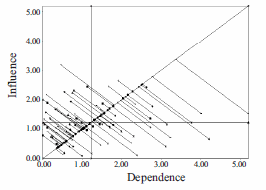
<body><![CDATA[<br> Figure 2 shows that there is a large  concentration of Autonomous Variables. A representative number of variables  are located in the power and output quadrants, and only 2 variables in the link  quadrant, making an L-shaped figure, this demonstrates that the combination of  factors analyzed, at the present tends to remain very stable [9].</font></p>      <p align="center"><img src="/img/revistas/rfiua/n55/n55a21i02.gif"><a name="figura2"></a></p>      <p><font face="Verdana" size="2"><b>Figure 2</b> Influence / dependence of access to ICT variables Use software MICMAC of LIPSOR LABORATORY</font></p>     <p><font face="Verdana" size="2">On the  other hand, the number of essential variables obtained is high, a maximum of 20 [9].    <br>    <br> Therefore,  the system has yet to seek higher goals of access, use and adoption to Internet  for the population under study, but in this situation it is difficult to  identify which variables could be affected by policies or strategies to achieve  dynamism in the process of access to ICT. Given these assumptions, it was decided to place more  emphasis on the most important variables of the process, so that decision  makers can act on the variables that allow the system to move towards more  households with ICT access    <br>    <br> The  first filter is to take the variables located in the quadrants of power, link  and output (figure 2), based on the initial set of 82 variables, thereby selecting the most strategic variables  according to the method proposed by Godet [9]. The second filter  is to apply the method of strategic axis,  in which variables are projected on the diagonal through the center of  influence and dependence on the Cartesian graph (see figure 3). The variables  that have values beyond the arithmetic media (eq. 1) are considered to be more  relevant for the system than the others [10]. It shows the order of importance  of the variables.</font></p>      <p align="center"><img src="/img/revistas/rfiua/n55/n55a21i03.gif"><a name="figura3"></a></p>      <p><font face="Verdana" size="2"><b>Figure 3</b> Strategy Axis  E = 100 / n</font></p>     ]]></body>
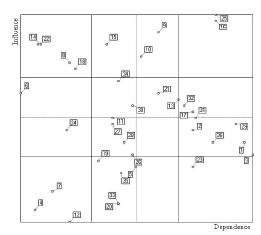
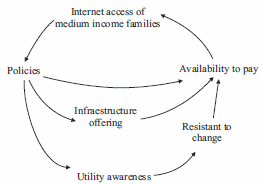
<body><![CDATA[<p><font face="Verdana" size="2">Where,     <br> E: expected value    <br> N: number of variables     <br>     <br> When  combining the results of analysis of the four quadrants and the analysis of  strategic axis, 36 variables were selected. This selection represents a large  number of variables that requires a new analysis by the experts. On the results  of the method of the four quadrants and the strategic axis is necessary to  apply a third and final filter that selects the variables with strong power  applying the method proposed by Popper [11], the analysis of the nine  quadrants, that considers the most important variables those with a strong  power to change the process for its relationship between influence and  dependence of the system.  This research combines three  different methods of variable analysis: the analysis of four quadrants  (strategic variables), the analysis of strategic axis (the most important  variables) and a third analysis of dependence and variables that have strong  power to change the system; in this case there are 16 variables that can be  selected as the most important variables in the sense of ensuring that the system  could be modified and that the variables have a strong influence over the  process of incorporate ICT in people's lives. (See figure 4)</font></p>      <p align="center"><img src="/img/revistas/rfiua/n55/n55a21i04.gif"><a name="figura4"></a></p>      <p><font face="Verdana" size="2"><b>Figure 4</b> Analysis of nine quadrants</font></p>      <br>    <p><font face="Verdana" size="3"><b>Results and discussion</b></font></p>     <p><font face="Verdana" size="2">In the  previous methodology the most important variables on which the decision makers  must act to achieve the dynamism on Internet access in the system are:  Infrastructure offering, utility awareness, willingness to pay, and resistance  to change. Other  variables related to ICT access are common to find in singular analysis and  also appear in the strong variables for the present research, but they  disappear when the tree methods of variable selection are combined, like  education level or age. This variables are important for the system, but they  can't be changed with endogenous policies. The relationship between variables  is relevant to achieve the proper effect on  the context, especially considering that this process is not  linear and that the implementation of policies should be done holistically.  Initially, the MICMAC give us a diagram with main relationships, which is shown  in figure 5.    ]]></body>
<body><![CDATA[<br>    <br> The initial goal of the system is that families which do not have ICT  access can connect and use them to achieve benefits of ICT [6, 25]. As shown in  figure 5, access to infrastructure (the net) is a prerequisite for the  connection, so a service provider is necessary with enough coverage to reach  the house. However there are variables associated with access that show that  this is not the first step. It is also necessary that families should be  available to pay the monthly value for the service, which depends on the desire  of families to have the service and also depends of their utility awareness  overcoming resistance to change.</font></p>      <p align="center"><img src="/img/revistas/rfiua/n55/n55a21i05.gif"><a name="figura5"></a></p>      <p><font face="Verdana" size="2"><b>Figure 5</b> Relationship between Variables to ICT. Access of medium income families in a developing country</font></p>      <br>    <p><font face="Verdana" size="3"><b>Conclusions</b></font></p>     <p><font face="Verdana" size="2">The  combination of three methods of analysis has managed the focus on the variables  that most changed the process of ICT access. It should be noted that the  variables that are not included in this selection are variables that are part  of the system; but the result indicates that the approach towards the  formulation of strategies should focus on key variables.     <br>    <br> The used  methodology reduces the subjectivity in the selection of essential variables  for analysis of a given system, because it considers different views of the  problem and from different disciplines.     <br>    ]]></body>
<body><![CDATA[<br> It is increasingly important to  understand the structure of the relationships that exist in the processes of  access to information and communication technologies for a particular community  and in a specific segment, because this allows better directional strategies  for ICT and determining factors in the development and competitiveness.     <br>    <br> For this  reason it is necessary to take into account the particularities to determine  what factors are most relevant depending on the context in which they are  analyzed. The indicators that measure progress in the adoption of information  and communication technologies are focused mainly on the progress of  infrastructure and some of its uses, yet we must emphasize the need to adapt  this analysis to the particular context in order to see the real effects of the  use of ICT in each case.  The relationship between variables is determining to  find the way of a better access process</font></p>      <br>    <p><font face="Verdana" size="3"><b>Acknowledgements</b></font></p>     <p><font face="Verdana" size="2">The  authors thank UNE and the University Pontificia Bolivariana for their support  and sponsoring of this research. The participants in the panels of experts,  Joven TIC Group of Universidad Auton&oacute;ma de Barcelona, Artur Serr&aacute; of I2CAT,  Lucio Mauricio Henao, Jackson Reina, Adriana Vega, Eduardo Dom&iacute;nguez, Erika  Jailler, Diego Cuartas, Jairo Mart&iacute;nez, Nathalie Ortiz and Diego Palacio. </font></p>     <br>     <p><font face="Verdana" size="3"><b>References</b></font></p>      <!-- ref --><p><font face="Verdana" size="2">1. R. J. Gordon. &quot;Does the New  Economy Measure up to the great Inventions of the Past&quot;.  Journal of Economics Perspectives. Vol. 14. 2000. pp. 49-74.     &nbsp;&nbsp;&nbsp;&nbsp;&nbsp;&nbsp;&nbsp;&nbsp;[&#160;<a href="javascript:void(0);" onclick="javascript: window.open('/scielo.php?script=sci_nlinks&ref=000081&pid=S0120-6230201000050002100001&lng=','','width=640,height=500,resizable=yes,scrollbars=1,menubar=yes,');">Links</a>&#160;]<!-- end-ref --><br>    ]]></body>
<body><![CDATA[<!-- ref --><br> 2. S. D. Oliner, D. E.   Sichel, K. J. Stiroh. &quot;Explaining a productive decade&quot;.  Journal of Policy Modeling. Vol.30. 2008. pp. 633-673.     &nbsp;&nbsp;&nbsp;&nbsp;&nbsp;&nbsp;&nbsp;&nbsp;[&#160;<a href="javascript:void(0);" onclick="javascript: window.open('/scielo.php?script=sci_nlinks&ref=000083&pid=S0120-6230201000050002100002&lng=','','width=640,height=500,resizable=yes,scrollbars=1,menubar=yes,');">Links</a>&#160;]<!-- end-ref --><br>    <!-- ref --><br> 3. B V. Ark, R. Inklaar, R. H. McGucking. &quot;ICT  and Productivity Growth in the Europe and the United States: Where do the  Differences&quot;. CESifo Economic Studies. Vol. 49. 2003. pp. 295-318.     &nbsp;&nbsp;&nbsp;&nbsp;&nbsp;&nbsp;&nbsp;&nbsp;[&#160;<a href="javascript:void(0);" onclick="javascript: window.open('/scielo.php?script=sci_nlinks&ref=000085&pid=S0120-6230201000050002100003&lng=','','width=640,height=500,resizable=yes,scrollbars=1,menubar=yes,');">Links</a>&#160;]<!-- end-ref --><br>    <!-- ref --><br> 4. UIT, UN. Declaraci&oacute;n de principios, Construir la sociedad de la  informaci&oacute;n un desaf&iacute;o global. Geneva., http://www.itu.int/dms_pub/itu-s/md/03/wsis/doc/ S03-WSIS-D0C-0009!R1!PDF-S.pdf. Consultada el 20 de  febrero de 2006.    &nbsp;&nbsp;&nbsp;&nbsp;&nbsp;&nbsp;&nbsp;&nbsp;[&#160;<a href="javascript:void(0);" onclick="javascript: window.open('/scielo.php?script=sci_nlinks&ref=000087&pid=S0120-6230201000050002100004&lng=','','width=640,height=500,resizable=yes,scrollbars=1,menubar=yes,');">Links</a>&#160;]<!-- end-ref --><br>    <!-- ref --><br> 5. Estados  Unidos Mexicanos. El Mexico que  queremos. Mexico: Visi&oacute;n 2030.. http://www.vision2030.gob.mx/ pdf/folleto.pdf. Consultada el 9 de Junio de 2007.    &nbsp;&nbsp;&nbsp;&nbsp;&nbsp;&nbsp;&nbsp;&nbsp;[&#160;<a href="javascript:void(0);" onclick="javascript: window.open('/scielo.php?script=sci_nlinks&ref=000089&pid=S0120-6230201000050002100005&lng=','','width=640,height=500,resizable=yes,scrollbars=1,menubar=yes,');">Links</a>&#160;]<!-- end-ref --><br>    <!-- ref --><br> 6. Ministerio de Comunicaciones de Colombia. Plan Nacional de Tecnolog&iacute;as de Informaci&oacute;n y  Comunicaciones de Colombia. 2007. <em>http://www.</em>colombiaplantic.org/index.php. Consultada el 17 de  septiembre de 2008.     &nbsp;&nbsp;&nbsp;&nbsp;&nbsp;&nbsp;&nbsp;&nbsp;[&#160;<a href="javascript:void(0);" onclick="javascript: window.open('/scielo.php?script=sci_nlinks&ref=000091&pid=S0120-6230201000050002100006&lng=','','width=640,height=500,resizable=yes,scrollbars=1,menubar=yes,');">Links</a>&#160;]<!-- end-ref --><br>    ]]></body>
<body><![CDATA[<!-- ref --><br> 7. Ministerio de  Industria, Turismo y Comercio, Espa&ntilde;a. Plan 2006-2010 para el desarrollo de La Sociedad de la Informaci&oacute;n y de  Convergencia con Europa entre Comunidades Aut&oacute;nomas y Ciudades. 2005. http:// www.planavanza.es/NR/rdonlyre//F3D2C27A-FE8E- 4BFF-ABFA - B3F8D02F4F39/14383/plan_avanza_  documento_completo.pdf. Consultada el 3 de Abril de 2007.    &nbsp;&nbsp;&nbsp;&nbsp;&nbsp;&nbsp;&nbsp;&nbsp;[&#160;<a href="javascript:void(0);" onclick="javascript: window.open('/scielo.php?script=sci_nlinks&ref=000093&pid=S0120-6230201000050002100007&lng=','','width=640,height=500,resizable=yes,scrollbars=1,menubar=yes,');">Links</a>&#160;]<!-- end-ref --><br>    <!-- ref --><br> 8. M. Godet. Caja de Herramientas para la prospectiva estrat&eacute;gica. Cuaderno N.0 5. LIPSOR.  Ed. Gerpa. Paris (Francia). 2000. pp. 70.     &nbsp;&nbsp;&nbsp;&nbsp;&nbsp;&nbsp;&nbsp;&nbsp;[&#160;<a href="javascript:void(0);" onclick="javascript: window.open('/scielo.php?script=sci_nlinks&ref=000095&pid=S0120-6230201000050002100008&lng=','','width=640,height=500,resizable=yes,scrollbars=1,menubar=yes,');">Links</a>&#160;]<!-- end-ref --><br>    <!-- ref --><br> 9. M.  Godet. Analysis with the MICMAC Method  &amp; Actors 'Strategy with MACTOR Method. Ed.  AC/UNU Millennium Project Futures Research Methodology. Washington D.C.  2002. pp. 1-50     &nbsp;&nbsp;&nbsp;&nbsp;&nbsp;&nbsp;&nbsp;&nbsp;[&#160;<a href="javascript:void(0);" onclick="javascript: window.open('/scielo.php?script=sci_nlinks&ref=000097&pid=S0120-6230201000050002100009&lng=','','width=640,height=500,resizable=yes,scrollbars=1,menubar=yes,');">Links</a>&#160;]<!-- end-ref --><br>    <!-- ref --><br> 10. F. Mojica S. La prospectiva, T&eacute;cnicas para visualizar el futuro. Ed. Legis Editores S.A. Bogot&aacute;.  1991. pp 35-68.     &nbsp;&nbsp;&nbsp;&nbsp;&nbsp;&nbsp;&nbsp;&nbsp;[&#160;<a href="javascript:void(0);" onclick="javascript: window.open('/scielo.php?script=sci_nlinks&ref=000099&pid=S0120-6230201000050002100010&lng=','','width=640,height=500,resizable=yes,scrollbars=1,menubar=yes,');">Links</a>&#160;]<!-- end-ref --><br>    <!-- ref --><br> 11. R. Popper.  Prioritization in Foresight, International Workshop on foresight. 19-20 de Junio de 2003. http:// foretech.online.bg/docs/wsppt_1.ppt.  Consultada el 15 de Noviembre de 2006.     &nbsp;&nbsp;&nbsp;&nbsp;&nbsp;&nbsp;&nbsp;&nbsp;[&#160;<a href="javascript:void(0);" onclick="javascript: window.open('/scielo.php?script=sci_nlinks&ref=000101&pid=S0120-6230201000050002100011&lng=','','width=640,height=500,resizable=yes,scrollbars=1,menubar=yes,');">Links</a>&#160;]<!-- end-ref --><br>    ]]></body>
<body><![CDATA[<!-- ref --><br> 12. ASETA.  Asociaci&oacute;n de Empresas de Telecomunicaciones de la Comunidad Andina  (ASETA). Modelo para  cuantificaci&oacute;n de la brecha digital. Quito. 2004. pp. 1-165.     &nbsp;&nbsp;&nbsp;&nbsp;&nbsp;&nbsp;&nbsp;&nbsp;[&#160;<a href="javascript:void(0);" onclick="javascript: window.open('/scielo.php?script=sci_nlinks&ref=000103&pid=S0120-6230201000050002100012&lng=','','width=640,height=500,resizable=yes,scrollbars=1,menubar=yes,');">Links</a>&#160;]<!-- end-ref --><br>    <!-- ref --><br> 13. RED.ES. 1er informe Inhibidores de uso de las TIC en  la sociedad espa&ntilde;ola. Madrid.  2007. pp.76.     &nbsp;&nbsp;&nbsp;&nbsp;&nbsp;&nbsp;&nbsp;&nbsp;[&#160;<a href="javascript:void(0);" onclick="javascript: window.open('/scielo.php?script=sci_nlinks&ref=000105&pid=S0120-6230201000050002100013&lng=','','width=640,height=500,resizable=yes,scrollbars=1,menubar=yes,');">Links</a>&#160;]<!-- end-ref --><br>    <!-- ref --><br> 14. Harvard University.  A Guide For Developing Countries. 2005. http://www.readinessguide.org/. Consultada el 15  de Noviembre de 2005.     &nbsp;&nbsp;&nbsp;&nbsp;&nbsp;&nbsp;&nbsp;&nbsp;[&#160;<a href="javascript:void(0);" onclick="javascript: window.open('/scielo.php?script=sci_nlinks&ref=000107&pid=S0120-6230201000050002100014&lng=','','width=640,height=500,resizable=yes,scrollbars=1,menubar=yes,');">Links</a>&#160;]<!-- end-ref --><br>    <!-- ref --><br> 15. J. Katz, M. Hilbert. Los caminos hacia una sociedad de la informaci&oacute;n en  Am&eacute;rica Latina y el Caribe. Ed. CEPAL.  Santiago de Chile. 2003. pp. 1-129.     &nbsp;&nbsp;&nbsp;&nbsp;&nbsp;&nbsp;&nbsp;&nbsp;[&#160;<a href="javascript:void(0);" onclick="javascript: window.open('/scielo.php?script=sci_nlinks&ref=000109&pid=S0120-6230201000050002100015&lng=','','width=640,height=500,resizable=yes,scrollbars=1,menubar=yes,');">Links</a>&#160;]<!-- end-ref --><br>    <!-- ref --><br> 16. Universidad  de los Andes. Desarrollo del  An&aacute;lisis de Impacto de los Programas COMPARTEL - Internet Social. Ministerio de Comunicaciones de  Colombia. Bogot&aacute;. 2007. pp 15-20.     &nbsp;&nbsp;&nbsp;&nbsp;&nbsp;&nbsp;&nbsp;&nbsp;[&#160;<a href="javascript:void(0);" onclick="javascript: window.open('/scielo.php?script=sci_nlinks&ref=000111&pid=S0120-6230201000050002100016&lng=','','width=640,height=500,resizable=yes,scrollbars=1,menubar=yes,');">Links</a>&#160;]<!-- end-ref --><br>    ]]></body>
<body><![CDATA[<!-- ref --><br> 17. Telef&oacute;nica CTC Chile. La   Sociedad de la   Informaci&oacute;n en CHILE 2004 / 2007: Presente y Perspectivas. Santiago de Chile. 2004. pp.238     &nbsp;&nbsp;&nbsp;&nbsp;&nbsp;&nbsp;&nbsp;&nbsp;[&#160;<a href="javascript:void(0);" onclick="javascript: window.open('/scielo.php?script=sci_nlinks&ref=000113&pid=S0120-6230201000050002100017&lng=','','width=640,height=500,resizable=yes,scrollbars=1,menubar=yes,');">Links</a>&#160;]<!-- end-ref --><br>    <!-- ref --><br> 18. The World Bank Group.  E-development - From Excitement to Effectiveness. R.  Schware (editor). Washington   D.C. 2005. pp.168.     &nbsp;&nbsp;&nbsp;&nbsp;&nbsp;&nbsp;&nbsp;&nbsp;[&#160;<a href="javascript:void(0);" onclick="javascript: window.open('/scielo.php?script=sci_nlinks&ref=000115&pid=S0120-6230201000050002100018&lng=','','width=640,height=500,resizable=yes,scrollbars=1,menubar=yes,');">Links</a>&#160;]<!-- end-ref --><br>    <!-- ref --><br> 19. Apt. Asia pacific telecommunity. http://www.aptsec.org/. Consultada el 10  de Junio de 2005.    &nbsp;&nbsp;&nbsp;&nbsp;&nbsp;&nbsp;&nbsp;&nbsp;[&#160;<a href="javascript:void(0);" onclick="javascript: window.open('/scielo.php?script=sci_nlinks&ref=000117&pid=S0120-6230201000050002100019&lng=','','width=640,height=500,resizable=yes,scrollbars=1,menubar=yes,');">Links</a>&#160;]<!-- end-ref --><br>    <!-- ref --><br> 20. ETSI. World Calss Standards http://www.etsi.org/  WebSite/homepage.aspx. Consultada el 10 de marzo de 2009.    &nbsp;&nbsp;&nbsp;&nbsp;&nbsp;&nbsp;&nbsp;&nbsp;[&#160;<a href="javascript:void(0);" onclick="javascript: window.open('/scielo.php?script=sci_nlinks&ref=000119&pid=S0120-6230201000050002100020&lng=','','width=640,height=500,resizable=yes,scrollbars=1,menubar=yes,');">Links</a>&#160;]<!-- end-ref --><br>    <!-- ref --><br> 21. UIT. Informe sobre  el desarrollo mundial de las telecomunicaciones, Evaluaci&oacute;n de las TIC para el  desarrollo econ&oacute;mico y social. Ginebra. 2006. pp.42.     &nbsp;&nbsp;&nbsp;&nbsp;&nbsp;&nbsp;&nbsp;&nbsp;[&#160;<a href="javascript:void(0);" onclick="javascript: window.open('/scielo.php?script=sci_nlinks&ref=000121&pid=S0120-6230201000050002100021&lng=','','width=640,height=500,resizable=yes,scrollbars=1,menubar=yes,');">Links</a>&#160;]<!-- end-ref --><br>    ]]></body>
<body><![CDATA[<!-- ref --><br> 22. RED RICYT. Manual de Lisboa, Pautas para la interpretaci&oacute;n de los  datos estad&iacute;sticos disponibles y la construcci&oacute;n de indicadores referidos a la  transici&oacute;n de Iberoam&eacute;rica hac&iacute;a la sociedad de la Informaci&oacute;n. Lisboa. 2006. pp.  1-62.     &nbsp;&nbsp;&nbsp;&nbsp;&nbsp;&nbsp;&nbsp;&nbsp;[&#160;<a href="javascript:void(0);" onclick="javascript: window.open('/scielo.php?script=sci_nlinks&ref=000123&pid=S0120-6230201000050002100022&lng=','','width=640,height=500,resizable=yes,scrollbars=1,menubar=yes,');">Links</a>&#160;]<!-- end-ref --><br>    <!-- ref --><br> 23. UIT. International Telecommunication  Union. Measuring  the Information Society 2007, ICT Opportunity  Index and World Telecommunication/ ICT Indicators. 2QQ7. http://www.itu.int/ITU-D/ict/ publications/ict-oi/2QQ7/index.html. Consultada el 6  de Septiembre de 2QQ9.    &nbsp;&nbsp;&nbsp;&nbsp;&nbsp;&nbsp;&nbsp;&nbsp;[&#160;<a href="javascript:void(0);" onclick="javascript: window.open('/scielo.php?script=sci_nlinks&ref=000125&pid=S0120-6230201000050002100023&lng=','','width=640,height=500,resizable=yes,scrollbars=1,menubar=yes,');">Links</a>&#160;]<!-- end-ref --><br>    <!-- ref --><br> 24. World Economic Forum;  The Global Information Technology Report 2008-2009. http://www.insead.edu/ v1/gitr/wef/main/fullreport/index.html. Consultada el  1Q de Septiembre de 2QQ9.    &nbsp;&nbsp;&nbsp;&nbsp;&nbsp;&nbsp;&nbsp;&nbsp;[&#160;<a href="javascript:void(0);" onclick="javascript: window.open('/scielo.php?script=sci_nlinks&ref=000127&pid=S0120-6230201000050002100024&lng=','','width=640,height=500,resizable=yes,scrollbars=1,menubar=yes,');">Links</a>&#160;]<!-- end-ref --><br>    <!-- ref --><br> 25. Medell&iacute;n Digital. Tecnolog&iacute;a al servicio del Desarrollo Econ&oacute;mico y  Social. http://www.medellindigital.gov. co/. Consultada el 1Q de Septiembre de 2QQ9.</font>&nbsp;&nbsp;&nbsp;&nbsp;&nbsp;&nbsp;&nbsp;&nbsp;[&#160;<a href="javascript:void(0);" onclick="javascript: window.open('/scielo.php?script=sci_nlinks&ref=000129&pid=S0120-6230201000050002100025&lng=','','width=640,height=500,resizable=yes,scrollbars=1,menubar=yes,');">Links</a>&#160;]<!-- end-ref --><p>&nbsp;</p>     <p><font face="Verdana" size="2">(el 26 de Octubre de 2009. Aceptado el 6 de abril de 2010)    <br>       ]]></body>
<body><![CDATA[<br>   <sup>*</sup>Autor de correspondencia: tel&eacute;fono: + 57 + 4 + 354 45 32, fax: + 57 + 4 + 354 45 32, correo electr&oacute;nico: <a href="mailto:sandra.lopez@upb.edu.co ">sandra.lopez@upb.edu.co</a> (S. L&oacute;pez).</font></p>      ]]></body><back>
<ref-list>
<ref id="B1">
<label>1</label><nlm-citation citation-type="journal">
<person-group person-group-type="author">
<name>
<surname><![CDATA[Gordon]]></surname>
<given-names><![CDATA[R. J]]></given-names>
</name>
</person-group>
<article-title xml:lang="en"><![CDATA[Does the New Economy Measure up to the great Inventions of the Past]]></article-title>
<source><![CDATA[Journal of Economics Perspectives]]></source>
<year>2000</year>
<volume>14</volume>
<page-range>49-74</page-range></nlm-citation>
</ref>
<ref id="B2">
<label>2</label><nlm-citation citation-type="journal">
<person-group person-group-type="author">
<name>
<surname><![CDATA[Oliner]]></surname>
<given-names><![CDATA[S. D]]></given-names>
</name>
<name>
<surname><![CDATA[Sichel]]></surname>
<given-names><![CDATA[D. E]]></given-names>
</name>
<name>
<surname><![CDATA[Stiroh]]></surname>
<given-names><![CDATA[K. J]]></given-names>
</name>
</person-group>
<article-title xml:lang="en"><![CDATA[Explaining a productive decade]]></article-title>
<source><![CDATA[Journal of Policy Modeling]]></source>
<year>2008</year>
<volume>30</volume>
<page-range>633-673</page-range></nlm-citation>
</ref>
<ref id="B3">
<label>3</label><nlm-citation citation-type="journal">
<person-group person-group-type="author">
<name>
<surname><![CDATA[Ark]]></surname>
<given-names><![CDATA[B V]]></given-names>
</name>
<name>
<surname><![CDATA[Inklaar]]></surname>
<given-names><![CDATA[R]]></given-names>
</name>
<name>
<surname><![CDATA[McGucking]]></surname>
<given-names><![CDATA[R. H]]></given-names>
</name>
</person-group>
<article-title xml:lang="en"><![CDATA[ICT and Productivity Growth in the Europe and the United States: Where do the Differences]]></article-title>
<source><![CDATA[CESifo Economic Studies]]></source>
<year>2003</year>
<volume>49</volume>
<page-range>295-318</page-range></nlm-citation>
</ref>
<ref id="B4">
<label>4</label><nlm-citation citation-type="">
<collab>UIT</collab>
<collab>UN</collab>
<source><![CDATA[Declaración de principios, Construir la sociedad de la información un desafío global]]></source>
<year></year>
</nlm-citation>
</ref>
<ref id="B5">
<label>5</label><nlm-citation citation-type="book">
<collab>Estados Unidos Mexicanos</collab>
<source><![CDATA[El Mexico que queremos]]></source>
<year></year>
<publisher-name><![CDATA[Visión 2030]]></publisher-name>
</nlm-citation>
</ref>
<ref id="B6">
<label>6</label><nlm-citation citation-type="">
<collab>Ministerio de Comunicaciones de Colombia</collab>
<source><![CDATA[Plan Nacional de Tecnologías de Información y Comunicaciones de Colombia]]></source>
<year>2007</year>
</nlm-citation>
</ref>
<ref id="B7">
<label>7</label><nlm-citation citation-type="">
<collab>Ministerio de Industria, Turismo y Comercio, España</collab>
<source><![CDATA[Plan 2006-2010 para el desarrollo de La Sociedad de la Información y de Convergencia con Europa entre Comunidades Autónomas y Ciudades]]></source>
<year>2005</year>
</nlm-citation>
</ref>
<ref id="B8">
<label>8</label><nlm-citation citation-type="book">
<person-group person-group-type="author">
<name>
<surname><![CDATA[Godet]]></surname>
<given-names><![CDATA[M]]></given-names>
</name>
</person-group>
<source><![CDATA[Caja de Herramientas para la prospectiva estratégica]]></source>
<year>2000</year>
<publisher-loc><![CDATA[Paris ]]></publisher-loc>
<publisher-name><![CDATA[Ed. Gerpa]]></publisher-name>
</nlm-citation>
</ref>
<ref id="B9">
<label>9</label><nlm-citation citation-type="book">
<person-group person-group-type="author">
<name>
<surname><![CDATA[Godet]]></surname>
<given-names><![CDATA[M]]></given-names>
</name>
</person-group>
<source><![CDATA[Analysis with the MICMAC Method & Actors 'Strategy with MACTOR Method]]></source>
<year>2002</year>
<page-range>1-50</page-range><publisher-loc><![CDATA[Washington ]]></publisher-loc>
<publisher-name><![CDATA[Ed. AC/UNU Millennium Project Futures Research Methodology]]></publisher-name>
</nlm-citation>
</ref>
<ref id="B10">
<label>10</label><nlm-citation citation-type="book">
<person-group person-group-type="author">
<name>
<surname><![CDATA[Mojica S]]></surname>
<given-names><![CDATA[F]]></given-names>
</name>
</person-group>
<source><![CDATA[La prospectiva, Técnicas para visualizar el futuro]]></source>
<year>1991</year>
<page-range>35-68</page-range><publisher-loc><![CDATA[Bogotá ]]></publisher-loc>
<publisher-name><![CDATA[Ed. Legis Editores S.A]]></publisher-name>
</nlm-citation>
</ref>
<ref id="B11">
<label>11</label><nlm-citation citation-type="">
<person-group person-group-type="author">
<name>
<surname><![CDATA[Popper]]></surname>
<given-names><![CDATA[R]]></given-names>
</name>
</person-group>
<source><![CDATA[Prioritization in Foresight, International Workshop on foresight]]></source>
<year>2003</year>
</nlm-citation>
</ref>
<ref id="B12">
<label>12</label><nlm-citation citation-type="">
<collab>ASETA. Asociación de Empresas de Telecomunicaciones de la Comunidad Andina (ASETA)</collab>
<source><![CDATA[Modelo para cuantificación de la brecha digital]]></source>
<year>2004</year>
<page-range>1-165</page-range><publisher-loc><![CDATA[Quito ]]></publisher-loc>
</nlm-citation>
</ref>
<ref id="B13">
<label>13</label><nlm-citation citation-type="">
<collab>RED.ES</collab>
<source><![CDATA[1er informe Inhibidores de uso de las TIC en la sociedad española]]></source>
<year>2007</year>
<page-range>76</page-range><publisher-loc><![CDATA[Madrid ]]></publisher-loc>
</nlm-citation>
</ref>
<ref id="B14">
<label>14</label><nlm-citation citation-type="">
<collab>Harvard University</collab>
<source><![CDATA[A Guide For Developing Countries]]></source>
<year>2005</year>
</nlm-citation>
</ref>
<ref id="B15">
<label>15</label><nlm-citation citation-type="book">
<person-group person-group-type="author">
<name>
<surname><![CDATA[Katz]]></surname>
<given-names><![CDATA[J]]></given-names>
</name>
<name>
<surname><![CDATA[Hilbert]]></surname>
<given-names><![CDATA[M]]></given-names>
</name>
</person-group>
<source><![CDATA[Los caminos hacia una sociedad de la información en América Latina y el Caribe]]></source>
<year>2003</year>
<page-range>1-129</page-range><publisher-loc><![CDATA[Santiago de Chile ]]></publisher-loc>
<publisher-name><![CDATA[Ed. CEPAL]]></publisher-name>
</nlm-citation>
</ref>
<ref id="B16">
<label>16</label><nlm-citation citation-type="">
<collab>Universidad de los Andes. Desarrollo del Análisis de Impacto de los Programas COMPARTEL - Internet Social</collab>
<source><![CDATA[]]></source>
<year>2007</year>
<page-range>15-20</page-range><publisher-loc><![CDATA[Bogotá ]]></publisher-loc>
</nlm-citation>
</ref>
<ref id="B17">
<label>17</label><nlm-citation citation-type="">
<collab>Telefónica CTC Chile</collab>
<source><![CDATA[La Sociedad de la Información en CHILE 2004 / 2007: Presente y Perspectivas]]></source>
<year>2004</year>
<page-range>238</page-range><publisher-loc><![CDATA[Santiago de Chile ]]></publisher-loc>
</nlm-citation>
</ref>
<ref id="B18">
<label>18</label><nlm-citation citation-type="">
<collab>The World Bank Group</collab>
<source><![CDATA[E-development - From Excitement to Effectiveness]]></source>
<year>2005</year>
<page-range>168</page-range><publisher-loc><![CDATA[Washington ]]></publisher-loc>
</nlm-citation>
</ref>
<ref id="B19">
<label>19</label><nlm-citation citation-type="">
<source><![CDATA[]]></source>
<year></year>
</nlm-citation>
</ref>
<ref id="B20">
<label>20</label><nlm-citation citation-type="">
<source><![CDATA[]]></source>
<year></year>
</nlm-citation>
</ref>
<ref id="B21">
<label>21</label><nlm-citation citation-type="">
<collab>UIT</collab>
<source><![CDATA[Informe sobre el desarrollo mundial de las telecomunicaciones, Evaluación de las TIC para el desarrollo económico y social]]></source>
<year>2006</year>
<page-range>42</page-range><publisher-loc><![CDATA[Ginebra ]]></publisher-loc>
</nlm-citation>
</ref>
<ref id="B22">
<label>22</label><nlm-citation citation-type="">
<collab>RED RICYT</collab>
<source><![CDATA[Manual de Lisboa, Pautas para la interpretación de los datos estadísticos disponibles y la construcción de indicadores referidos a la transición de Iberoamérica hacía la sociedad de la Información]]></source>
<year>2006</year>
<page-range>1-62</page-range><publisher-loc><![CDATA[Lisboa ]]></publisher-loc>
</nlm-citation>
</ref>
<ref id="B23">
<label>23</label><nlm-citation citation-type="">
<source><![CDATA[]]></source>
<year></year>
</nlm-citation>
</ref>
<ref id="B24">
<label>24</label><nlm-citation citation-type="">
<collab>World Economic Forum</collab>
<source><![CDATA[The Global Information Technology Report 2008-2009]]></source>
<year></year>
</nlm-citation>
</ref>
<ref id="B25">
<label>25</label><nlm-citation citation-type="">
<collab>Medellín Digital</collab>
<source><![CDATA[Tecnología al servicio del Desarrollo Económico y Social]]></source>
<year></year>
</nlm-citation>
</ref>
</ref-list>
</back>
</article>