<?xml version="1.0" encoding="ISO-8859-1"?><article xmlns:mml="http://www.w3.org/1998/Math/MathML" xmlns:xlink="http://www.w3.org/1999/xlink" xmlns:xsi="http://www.w3.org/2001/XMLSchema-instance">
<front>
<journal-meta>
<journal-id>0120-6230</journal-id>
<journal-title><![CDATA[Revista Facultad de Ingeniería Universidad de Antioquia]]></journal-title>
<abbrev-journal-title><![CDATA[Rev.fac.ing.univ. Antioquia]]></abbrev-journal-title>
<issn>0120-6230</issn>
<publisher>
<publisher-name><![CDATA[Facultad de Ingeniería, Universidad de Antioquia]]></publisher-name>
</publisher>
</journal-meta>
<article-meta>
<article-id>S0120-62302011000100004</article-id>
<title-group>
<article-title xml:lang="en"><![CDATA[Characterization by temperature programmed techniques of spent and acid treated vanadium catalysts]]></article-title>
<article-title xml:lang="es"><![CDATA[Caracterización por técnicas de la temperatura programada de catalizadores de vanadio desactivados y tratados con ácido]]></article-title>
</title-group>
<contrib-group>
<contrib contrib-type="author">
<name>
<surname><![CDATA[Charry]]></surname>
<given-names><![CDATA[Iran David]]></given-names>
</name>
<xref ref-type="aff" rid="A01"/>
</contrib>
<contrib contrib-type="author">
<name>
<surname><![CDATA[González]]></surname>
<given-names><![CDATA[Lina María]]></given-names>
</name>
<xref ref-type="aff" rid="A01"/>
</contrib>
<contrib contrib-type="author">
<name>
<surname><![CDATA[Montes de Correa]]></surname>
<given-names><![CDATA[Consuelo]]></given-names>
</name>
<xref ref-type="aff" rid="A01"/>
</contrib>
</contrib-group>
<aff id="A01">
<institution><![CDATA[,Universidad de Antioquia Environmental Catalysis Research Group. ]]></institution>
<addr-line><![CDATA[Medellín ]]></addr-line>
<country>Colombia</country>
</aff>
<pub-date pub-type="pub">
<day>00</day>
<month>01</month>
<year>2011</year>
</pub-date>
<pub-date pub-type="epub">
<day>00</day>
<month>01</month>
<year>2011</year>
</pub-date>
<numero>57</numero>
<fpage>31</fpage>
<lpage>37</lpage>
<copyright-statement/>
<copyright-year/>
<self-uri xlink:href="http://www.scielo.org.co/scielo.php?script=sci_arttext&amp;pid=S0120-62302011000100004&amp;lng=en&amp;nrm=iso"></self-uri><self-uri xlink:href="http://www.scielo.org.co/scielo.php?script=sci_abstract&amp;pid=S0120-62302011000100004&amp;lng=en&amp;nrm=iso"></self-uri><self-uri xlink:href="http://www.scielo.org.co/scielo.php?script=sci_pdf&amp;pid=S0120-62302011000100004&amp;lng=en&amp;nrm=iso"></self-uri><abstract abstract-type="short" xml:lang="en"><p><![CDATA[Spent samples of V2O5/SiO2-&gamma;Al2O3 catalyst used for H2SO4 production were acid treated to recover vanadium. Fresh, spent, and acid treated samples were characterized by temperature-programmed techniques: TPR-H2, TPO-O2, TPD-NH3 and, TGA-DTA in order to determine the effect of deactivating species on vanadium recovery. DRX and UV-Vis techniques were used to confirm several signals from the temperature-programmed profiles. The results suggest that vanadium sulfovanadates and oxides in treated samples strongly interact with the support making it difficult to get more than 86% vanadium recovery.]]></p></abstract>
<abstract abstract-type="short" xml:lang="es"><p><![CDATA[Muestras de V2O5/SiO2-&gamma;Al2O3 desactivado durante la producción de ácido sulfúrico se trataron con ácido con el fin de recuperar el vanadio. Los materiales se caracterizaron mediante técnicas de temperatura programada: TPR-H2, TPO-O2, TPD-NH3, y TGA-DTA con el fin de determinar el efecto de las especies responsables de la desactivación en la recuperación del metal. Análisis por DRX y UV-Vis se utilizaron para confirmar algunas señales obtenidas en los perfiles de temperatura programada. Los resultados sugieren que la presencia de sulfovanadatos y óxidos de vanadio en las muestras tratadas hacen difícil recuperar más del 86% del vanadio presente en las muestras de catalizador.]]></p></abstract>
<kwd-group>
<kwd lng="en"><![CDATA[V2O5 catalyst]]></kwd>
<kwd lng="en"><![CDATA[catalyst deactivation]]></kwd>
<kwd lng="en"><![CDATA[vanadium recovery]]></kwd>
<kwd lng="en"><![CDATA[sulfovanadate species]]></kwd>
<kwd lng="en"><![CDATA[temperature-programmed techniques]]></kwd>
<kwd lng="es"><![CDATA[Catalizador V2O5]]></kwd>
<kwd lng="es"><![CDATA[desactivación de catalizadores]]></kwd>
<kwd lng="es"><![CDATA[recuperación de vanadio]]></kwd>
<kwd lng="es"><![CDATA[técnicas de temperatura programada]]></kwd>
</kwd-group>
</article-meta>
</front><body><![CDATA[ <p align="center"><font face="Verdana" size="4"> <b>Characterization by temperature programmed techniques of spent and acid treated vanadium catalysts</b></font></p>      <p align="center"><font face="Verdana" size="4"> <b>Caracterizaci&oacute;n por t&eacute;cnicas de la temperatura programada de catalizadores de vanadio desactivados y tratados con &aacute;cido</b></font></p>      <p> <font face="Verdana" size="2"> <i>Iran David Charry, Lina Mar&iacute;a Gonz&aacute;lez*, Consuelo Montes de Correa </i></font></p>       <p><font face="Verdana" size="2"> Environmental Catalysis Research Group. Universidad de  Antioquia. Sede  de Investigaci&oacute;n  Universitaria- SIU. A.A. 1226, Calle  62 N&deg; 52-59. Medell&iacute;n,  Colombia</font></p>     <br>  <hr noshade size="1">     <p><font face="Verdana" size="3"><b>Abstract</b></font></p>       <p><font face="Verdana" size="2">Spent  samples of V<sub>2</sub>O<sub>5</sub>/SiO<sub>2</sub>-&gamma;Al<sub>2</sub>O<sub>3</sub>  catalyst used for H<sub>2</sub>SO<sub>4</sub> production were acid treated to  recover vanadium. Fresh, spent, and acid treated samples were characterized by  temperature-programmed techniques: TPR-H<sub>2</sub>, TPO-O<sub>2</sub>, TPD-NH<sub>3</sub>  and, TGA-DTA in order to determine the effect of deactivating species on  vanadium recovery. DRX and UV-Vis techniques were used to confirm several  signals from the temperature-programmed profiles. The results suggest that  vanadium sulfovanadates and oxides in treated samples strongly interact with  the support making it difficult to get more than 86% vanadium recovery.</font></p>       <p><font face="Verdana" size="2"><i>Keywords:</i> V<sub>2</sub>O<sub>5</sub> catalyst, catalyst deactivation, vanadium recovery, sulfovanadate species, temperature-programmed techniques. </font></p>  <hr noshade size="1">     <p><font face="Verdana" size="3"><b>Resumen</b></font></p>      <p><font face="Verdana" size="2">Muestras  de V<sub>2</sub>O<sub>5</sub>/SiO<sub>2</sub>-&gamma;Al<sub>2</sub>O<sub>3</sub> desactivado durante la producci&oacute;n de &aacute;cido sulf&uacute;rico se  trataron con &aacute;cido con el fin de recuperar el vanadio. Los materiales se  caracterizaron mediante t&eacute;cnicas de temperatura programada: TPR-H<sub>2</sub>,  TPO-O<sub>2</sub>, TPD-NH<sub>3</sub>, y TGA-DTA con el fin de determinar el  efecto de las especies responsables de la desactivaci&oacute;n en la recuperaci&oacute;n del  metal. An&aacute;lisis por DRX y UV-Vis se utilizaron para confirmar algunas se&ntilde;ales  obtenidas en los perfiles de temperatura programada. Los resultados sugieren  que la presencia de sulfovanadatos y &oacute;xidos de vanadio en las muestras tratadas  hacen dif&iacute;cil recuperar m&aacute;s del 86% del vanadio presente en las muestras de  catalizador.</font></p>      ]]></body>
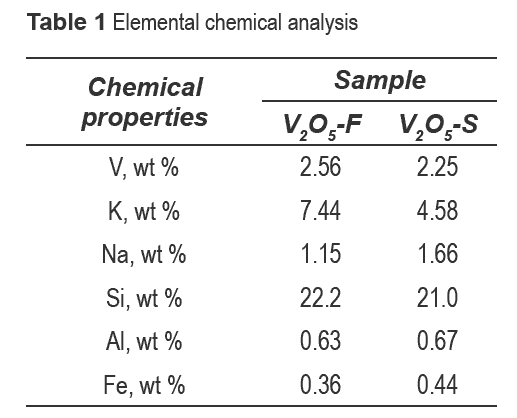
<body><![CDATA[<p><font face="Verdana" size="2"><i>Palabras clave: </i>Catalizador V<sub>2</sub>O<sub>5</sub>, desactivaci&oacute;n  de catalizadores, recuperaci&oacute;n de vanadio, sulfovanadatos, t&eacute;cnicas de  temperatura programada.</font></p>  <hr noshade size="1">      <p><font face="Verdana" size="3"><b>Introduction</b></font></p>       <p> <font face="Verdana" size="2">The catalyst V<sub>2</sub>O<sub>5</sub>/SiO<sub>2</sub>-&gamma;Al<sub>2</sub>O<sub>3</sub>  has been widely used for the oxidation of SO<sub>2</sub> to SO<sub>3</sub> to  commercially produce sulfuric acid [1, 2]. In spite of its high catalytic  activity, it is slowly deactivated under reaction conditions (temperatures  between 450 and 600 &deg;C) [3, 4]. Characterization of spent V<sub>2</sub>O<sub>5</sub>/  SiO<sub>2</sub>-&gamma;Al<sub>2</sub>O<sub>3</sub> samples evidenced the formation of  some species of vanadium V<sup>4+</sup>, such as: K<sub>4</sub>(VO)<sub>3</sub>(SO<sub>4</sub>),  KV(SO<sub>4</sub>)<sub>2</sub>, Na<sub>2</sub>VO(SO<sub>4</sub>) and Na<sub>4</sub>(VO)<sub>2</sub>O(SO<sub>4</sub>)<sub>4</sub>  [5], which are very stable [1,2]. The disposal of deactivated vanadium  catalysts has turned on an environmental problem in recent years due to its  toxicity [6]. Recycling of some catalyst components, such as vanadium, silica,  and alumina has been recommended instead of catalyst disposal. Additionally,  the recovery of vanadium from spent catalysts is considered an additional  source of vanadium, which has a large commercial demand [2]. Although several  methods have been proposed for vanadium leaching from spent catalysts leading  to around 90 % wt. vanadium recovery [2-9], most of them involve the use large  quantities of leaching agents, are too expensive, or use hazardous organic  solvents, leading to the formation of vanadium chlorides. Previously, we reported  a clean and economical method for vanadium leaching from spent V<sub>2</sub>O<sub>5</sub>/SiO<sub>2</sub>-&gamma;Al<sub>2</sub>O<sub>3</sub>  commercial catalyst using a 10 % vol. H<sub>2</sub>SO<sub>4</sub> at room  temperature obtaining 86 % wt. vanadium recovery [6]. The goal of this work is  to characterize commercial samples of fresh (V<sub>2</sub>O<sub>5</sub>-F) and  spent (V<sub>2</sub>O<sub>5</sub>-S) vanadium catalysts by temperature  programmed techniques. Temperature-programmed reduction and oxidation (TPR-H<sub>2</sub>  and TPO-O<sub>2</sub>) shed light of a possible reduction of the active phase  and the formation of oligomeric vanadium species. Ammonia  temperature-programmed desorption (TPD-NH<sub>3</sub>) and thermogravimetric  analyses (TGA-DTA) were used to identify sulfovanadates formed with the alkali  promoted metals. Likewise, experiments of oxidation-reduction cycles (TPO/ TPR)  were carried out as a possible reactivation method. In addition, complementary  techniques such as X-Ray Diffraction (XRD), and UV-VIS Diffuse Reflectance were  used. The formation of sulfovanadates and the interaction of vanadia with the  support are important for the efficiency of vanadium recovery. </font></p>       <p><font face="Verdana" size="3"><b>Experimental </b> </font></p>        <p> <font face="Verdana" size="2"><b><i>Catalyst materials</i></b></font></p>        <p><font face="Verdana" size="2">   The ring shaped fresh and used vanadium catalyst samples  were supplied by Industrias B&aacute;sicas de Caldas S.A from Monsanto Enviro-Chem  Systems, Inc., USA (ref. LP110). <a href="#Tabla1">Table 1</a> shows the chemical analysis of fresh  and spent catalyst samples.    </font></p>        <p align="center"><img src="/img/revistas/rfiua/n57/n57a04t01.gif" ><a name="Tabla1"></a></p>        <p> <font face="Verdana" size="2">Samples of non-supported vanadium oxide and supported over  silica, &gamma;-Al<sub>2</sub>O<sub>3</sub> and silica/&gamma;-Al<sub>2</sub>O<sub>3</sub> mixture  were prepared for identifying specific signals of the temperature-programmed  profiles. V<sub>2</sub>O<sub>5</sub> was prepared using NH<sub>4</sub>VO<sub>3</sub>  (11 mmol) dissolved in 11.5 mL of oxalic acid (0.91 M). The resulting solid was  dried at 100 &deg;C and calcined at 550 &deg;C for 8 h in a muffle furnace. VO<sub>2</sub>  was prepared by reduction of V<sub>2</sub>O<sub>5</sub> in 4.47 % H<sub>2</sub>/Ar  at 700 &deg;C for 30 min. V<sub>2</sub>O<sub>5</sub> supported on SiO<sub>2</sub>, &gamma;-Al<sub>2</sub>O<sub>3</sub>  or &gamma;-Al<sub>2</sub>O<sub>3</sub>/SiO<sub>2</sub> (weight ratio 1:40) samples  were prepared by the precipitation of ammonium metavanadate (9.5 mmol) in a  suspension of the support (1 g) in 5 mL of oxalic acid (0.91 M). The excess  water was eliminated by evaporation in a rotavap and the solid finally dried at  100 &deg;C for 16 h, and calcined at 450 &deg;C for 8 h in a muffle furnace. </font></p>      <p> <font face="Verdana" size="2"><b><i>Catalyst characterization</i></b></font></p>        <p> <font face="Verdana" size="2">Temperature-programmed  experiments were carried out in a Micromeritics Autochem II equipped with a  thermal conductivity detector (TCD). Catalyst samples were loaded in a U-type  quartz reactor of 0.95 cm diameter. Before TPR or TPO experiments 50 mg samples  were pretreated during 60 min at 100 &deg;C under flowing argon (50 mL/min) [8] and  then cooled to 40 &deg;C. The TPR and TPO analysis were carried out at 900 &deg;C at a  heating rate of 5 &deg;C/min in flowing 4.47 % H<sub>2</sub>/ Ar or 5.36 % O<sub>2</sub>/Ar,  respectively (50 mL/min). In order to evaluate the re-oxidation capacity of  vanadium reduced species TPO analysis of fresh catalyst samples previously  reduced at 600 &deg;C (highest oxidation temperature of SO<sub>2</sub> to SO<sub>3</sub> [1,2])  was carried out during 120 min in flowing 4.47 % H<sub>2</sub>/Ar. During  TPD-NH<sub>3</sub> experiments the samples were manipulated under nitrogen  atmosphere. Before the analysis, the sample (around 50 mg) was heated at 500 &deg;C  in flowing helium for 30 min. After cooling, the sample was treated in flowing  3 % NH<sub>3</sub>/He (50 mL/min) for 90 min and then 30 min in flowing Argon  (30 mL/min). Then, the sample was heated (10 &deg;C/ min) to 1100 &deg;C. An additional  analysis was performed to a surface scraped sample of spent catalyst to  evaluate the possible deactivation by the formation of superficial sulfates.  The thermogravimetric and differential thermal measurements (TGA-DTA) were  carried out on a Universal V2.5 TGA equipment. Samples were heated (10 &deg;C/min)  in air at temperatures between 25 and 800 &deg;C. X-ray diffraction (XRD) patterns  were collected (5&deg; &lt; 2&theta; &lt; 60&deg;) in a Rigaku Miniplex equipped with a Cu  lamp. UV- VIS diffuse reflectance spectra were collected in the range 200 - 800  nm in a Lamda 4B Perkin Elmer spectrophotometer equipped with a diffuse  reflectance attachment using BaSO<sub>4</sub> as reference. </font></p>      ]]></body>
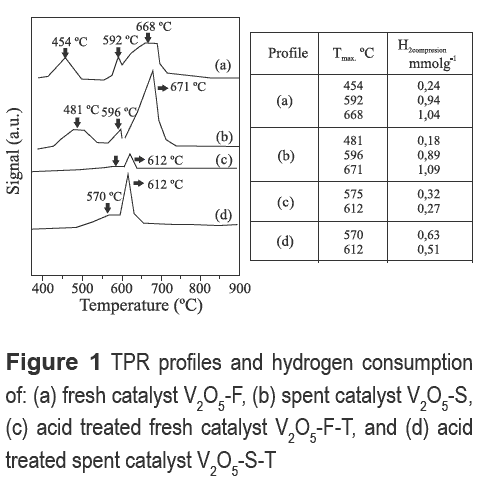
<body><![CDATA[<p> <font face="Verdana" size="2"><b><i>Leaching of vanadium with sulphuric acid</i></b></font></p>      <p> <font face="Verdana" size="2">Finely ground samples (1 g) of fresh (V<sub>2</sub>O<sub>5</sub>-F)  and spent (V<sub>2</sub>O<sub>5</sub>-S) commercial catalyst were treated with  a solution of 10 vol %. H<sub>2</sub>SO<sub>4</sub> (20 mL) at room temperature  [9,10]. Then a 30 wt. % solution of H<sub>2</sub>O<sub>2</sub>, was added up to  a pH between 6 and 7. The final solution was stirred for 2 hours. Treated  materials were coded as V<sub>2</sub>O<sub>5</sub>-F-T and V<sub>2</sub>O<sub>5</sub>-S-T,  respectively. </font></p>      <p><font face="Verdana" size="3"><b>Results and discussion</b> </font></p>     <p> <font face="Verdana" size="2"><b><i> H<sub>2</sub>-TPR  </i></b></font></p>      <p> <font face="Verdana" size="2"> Different types of oxidized species on vanadium catalysts  [11,12] were identified. TPR profiles of fresh, spent and acid treated catalyst  samples and their hydrogen consumption are shown in <a href="#Figura1">figure 1</a>.</font></p>      <p align="center"><img src="/img/revistas/rfiua/n57/n57a04i01.gif" ><a name="Figura1"></a></p>      <p> <font face="Verdana" size="2">The fresh catalyst sample, <a href="#Figura1">figure 1a</a>, exhibits a peak at  454 &deg;C associated with the reduction of polyvanadate species bonded to catalyst  alkali promoters: sodium and potassium [13,14]. The shift to 481 &deg;C, <a href="#Figura1">figure 1b</a>,  observed in a spent catalyst sample can be attributed to the formation of  sulphovanadates on the catalytic surface, such as KV(SO<sub>4</sub>)<sub>2</sub>  K<sub>4</sub>(V<sup>IV</sup>O)<sub>3</sub>(SO<sub>4</sub>), K<sub>2</sub>V<sup>IV</sup>O(SO<sub>4</sub>)<sub>3</sub>, Na<sub>2</sub>V<sup>IV</sup>O(SO<sub>4</sub>)<sub>2</sub>,  Na<sub>3</sub>(VO)<sub>2</sub>(SO<sub>4</sub>)<sub>4</sub> and K<sub>3</sub>(VO)<sub>2</sub>(SO<sub>4</sub>)<sub>5</sub>*,  where (*) refers to a mixture of V<sup>5+</sup> y V<sup>4+</sup> compounds  [3,15-18]. Formation of those compounds is favored by the presence of  pyrosulfates S<sub>2</sub>O<sub>7</sub><sup>2-</sup>, which not only act as  active intermediate species in the oxidation of SO<sub>2</sub> to SO<sub>3</sub>  [2,15,16], but also in the sulphovanadate precipitation over the catalytic  surface leading to catalyst deactivation [16,17].    <br>    <br> An enhanced effect of the support (&gamma;-Al<sub>2</sub>O<sub>3</sub>-  SiO<sub>2</sub>) in the reduction of V<sub>2</sub>O<sub>5</sub> is evidenced by  a consumption peak around 590 &deg;C (<a href="#Figura1">Figs 1a</a> and <a href="#Figura1">1b</a>) associated to the formation  of V<sub>6</sub>O<sub>13</sub> [18-20]. Unsupported V<sub>2</sub>O<sub>5</sub>  shows a signal at 640 &deg;C. The shift to lower temperature observed in the  supported sample is attributed to support interaction [18]. Notwithstanding, &gamma;-Al<sub>2</sub>O<sub>3</sub>  is able to stabilize the reduced forms of vanadium, mainly V<sup>4+</sup>  compounds V-O-Al, during the deactivation of the catalyst as the signal remains  in the spent catalyst, <a href="#Figura1">figure 1b</a>, [21-23]. The peak around 670 &deg;C is associated  to the reduction of monomeric, polymeric, and crystalline VOx  species which coexist on the surface as: V<sub>3</sub>O<sub>7</sub>, V<sub>4</sub>O<sub>9</sub>,  V<sub>6</sub>O<sub>13</sub> and V<sub>2</sub>O<sub>5</sub> [7,  13, 21, 24-26]. Thus, this peak appears to be a superposition of different  reduction steps of these species [18]. When catalyst samples were treated with  H<sub>2</sub>SO<sub>4</sub> (<a href="#Figura1">Figures 1c</a> and <a href="#Figura1">1d</a>) the strong interaction between  vanadium species and the support are evidenced since the signals around 570 and  612 &deg;C remained.    </font></p>      <p> <font face="Verdana" size="2"><b><i>TPO</i></b></font></p>      ]]></body>
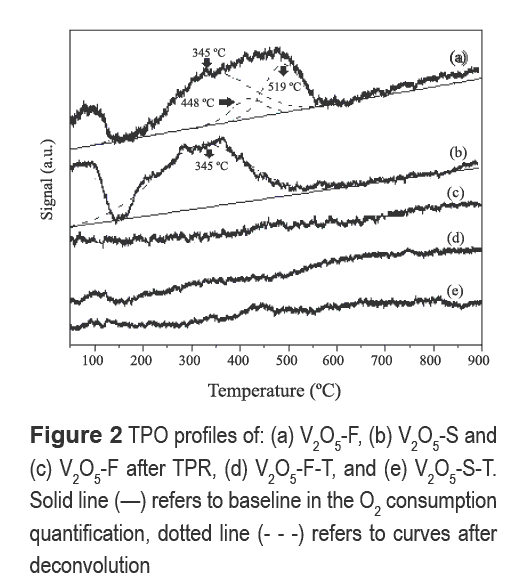
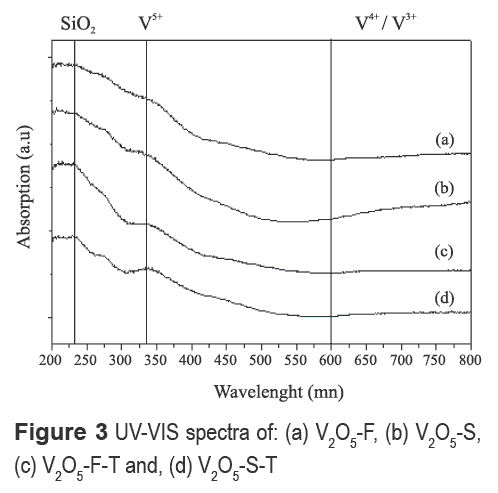
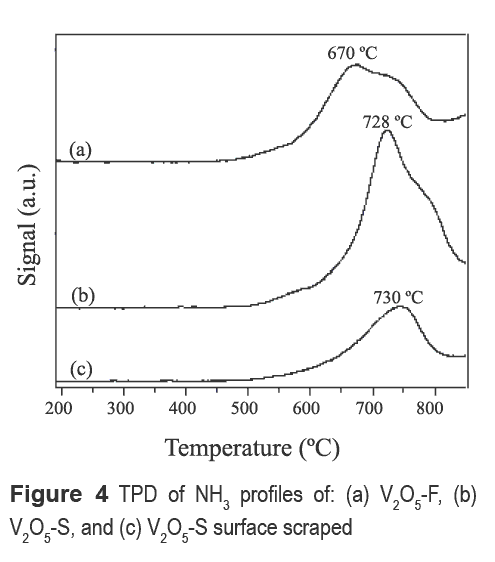
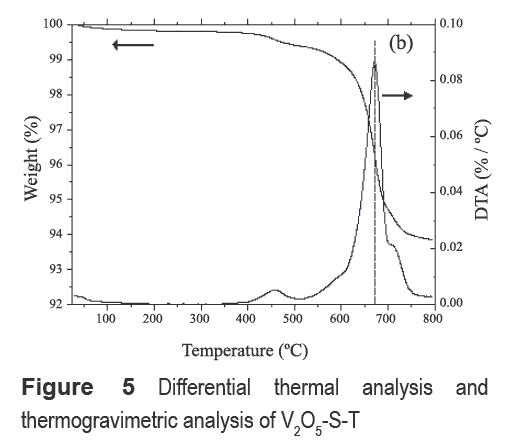
<body><![CDATA[<p> <font face="Verdana" size="2">TPO analysis was used to evaluate the oxidation of spent  catalyst samples as a possible regeneration method. TPO of V<sub>2</sub>O<sub>5</sub>-F  samples after TPR are shown in <a href="#Figura2">figure 2</a>. After deconvolution of the signal, the  fresh sample exhibits three oxidation peaks at 345 &deg;C, 448 &deg;C and 519 &deg;C,  <a href="#Figura2">figure 2a</a>. The peaks at 448 &deg;C and 519 &deg;C are associated to the oxidation of VO<sub>2</sub>  and V<sub>6</sub>O<sub>13</sub> coexisting with V<sub>2</sub>O<sub>5</sub>, as  shown in reaction 1 [6,19,24,25]. Similar to TPR experiments, the lower  oxidation temperature compared to unsupported VO<sub>4</sub> is associated with  the interaction between the support and VOx species [18].</font></p>      <p> <img src="/img/revistas/rfiua/n57/n57a04e01.gif"></p>     <p align="center"><img src="/img/revistas/rfiua/n57/n57a04i02.gif" ><a name="Figura2"></a></p>      <p> <font face="Verdana" size="2">   The peaks around 345 &deg;C exhibited by the fresh and spent  catalyst samples are associated with the reoxidation of VOx most probably  crystalline species [24]. The higher oxygen consumption of the spent catalyst  sample compared with the fresh one could be attributed to the sinterization and  formation of sulphovanadates of sodium and potassium during H<sub>2</sub>SO<sub>4</sub>  production [3,15-18,27]. Moreover, the oxidation of the fresh catalyst sample  reduced at 600 &deg;C, <a href="#Figura2">figure 2c</a>, suggests that reduced vanadium compounds (V<sup>4+</sup>)  are stable compared to the pentavalent initial state making it difficult  catalyst re-activation. <a href="#Figura2">Figures 2d</a> and <a href="#Figura2">2e</a> show that remaining vanadium species  seem to be stable to oxidation since negligible oxygen consumption was  observed.    <br>    <br>  UV-VIS results, <a href="#Figura3">figure 3</a>, confirm the oxidation states of  vanadium and the strong interaction with the support [22]. A broad band close  to 250 nm corresponds to the SiO<sub>2</sub> support, and a shoulder around 350  nm is assigned to the ligand to metal charge transfer (LMCT) band of V<sup>5+</sup>  [20, 22, 28] confirming the presence of V<sub>2</sub>O<sub>5</sub>-K-SiO<sub>2</sub>.  The d-d electron transition band of V<sup>4+</sup>/ V<sup>3+</sup> is found in  the range 600 - 800 nm [20,22], and the absorption increased due to the  presence of sulphovanadates in the spent sample, <a href="#Figura3">figure 3b</a>.</font></p>      <p align="center"><img src="/img/revistas/rfiua/n57/n57a04i03.gif" ><a name="Figura3"></a></p>      <p> <font face="Verdana" size="2"><b><i>  TPD-NH<sub>3</sub>    </i></b></font></p>      <p><font face="Verdana" size="2"> <a href="#Figura4">Figure 4</a> shows ammonia TPD profiles of V<sub>2</sub>O<sub>5</sub>-F,  V<sub>2</sub>O<sub>5</sub>-S, and V<sub>2</sub>O<sub>5</sub>-S surface scraped  samples. These samples exhibit a well resolved desorption peak in the range  670-730 &deg;C assigned to a mixture of strong Lewis and Br&ouml;nsted acid sites. The  Lewis sites are unsaturated VO<sup>2+</sup> vanadyls, and the Br&ouml;nsted sites  are associated with V-OH and the specific acidic properties of the support  [22,29]. However, the increase of ammonia desorption of the spent sample  compared to the fresh one, <a href="#Figura4">figure 4a</a> and  <a href="#Figura4">4b</a>, confirms the deposition of sulfate  ions through the formation of sulfovanadates during the reaction. Furthermore,  TPD-NH<sub>3</sub> of scrapped surface of a spent catalyst sample,  <a href="#Figura4">figure 4c</a>,  evidences the formation of sulfovanadates. </font></p>      <p align="center"><img src="/img/revistas/rfiua/n57/n57a04i04.gif" ><a name="Figura4"></a></p>      ]]></body>
<body><![CDATA[<p> <font face="Verdana" size="2"><b><i>Vanadium recovery     </i></b></font></p>      <p> <font face="Verdana" size="2">TPO analysis after TPR confirms the irreversibility of  vanadium catalyst deactivation. Therefore, the recovery of vanadium becomes a  good alternative for avoiding the release of toxic waste. After the treatment  with H<sub>2</sub>SO<sub>4</sub> (10 % vol.) only 86 wt. % of vanadium was  extracted from the support in the spent catalyst and 92 wt. % from the fresh  catalyst [6]. The presence of vanadium species was confirmed by TGA-DTA, <a href="#Figura5">figure 5</a>. The small weight lost around 450 &deg;C is associated to vanadium degradation  [30], while the lost at 660 &deg;C is assigned to bond breaking of reduced vanadium  (V<sup>4+</sup>) and alkali promoters [6,13].    <br>    <br></font></p>     <p align="center"><img src="/img/revistas/rfiua/n57/n57a04i05.gif" ><a name="Figura5"></a></p>      <p> <font face="Verdana" size="2">XRD evidences the presence of reduced V<sup>4+</sup>  species which are hard to remove during the leaching process. Peaks in the X  ray diffraction pattern (not shown), at 11&deg;, 25&deg;, 28&deg;, 31&deg;, 33&deg; and 36&deg; are  attributed to the presence of VO<sub>2</sub>, V<sub>6</sub>O<sub>13</sub>, V<sub>2</sub>O<sub>5</sub>-K-SiO<sub>2</sub>,  and sulphovanadates KV(SO<sub>4</sub>)<sub>2</sub> [6, 26]. Notwithstanding,  the peaks associated with the presence of VO<sub>2</sub> and V<sub>2</sub>O<sub>5</sub>-K-SiO<sub>2</sub>  also remain in the fresh catalyst after the treatment with sulphuric acid,  confirming the strong interaction between vanadium species and the support.      </font></p>         <p><font face="Verdana" size="3"><b>Conclusions      </b> </font></p>        <p> <font face="Verdana" size="2"> The results of this study let us to conclude that alkali  sulfovanates in the spent V<sub>2</sub>O<sub>5</sub>/SiO<sub>2</sub>-&gamma;Al<sub>2</sub>O<sub>3</sub>  catalyst are hard to remove with 10 vol. % H<sub>2</sub>SO<sub>4</sub>.  TPR-H<sub>2</sub> and TPO-O<sub>2</sub> of fresh samples treated with acid  under the same conditions confirm strong interactions between the support and  vanadium oxide which can also affect vanadium leaching with 10 vol. % H<sub>2</sub>SO<sub>4</sub>.    </font></p>       <p><font face="Verdana" size="3"><b>Acknowledgments      </b> </font></p>     <p> <font face="Verdana" size="2">The authors acknowledge financial support from Universidad de Antioquia through the project "Sustainability 2009 - 2010".</font></p>        ]]></body>
<body><![CDATA[<p><font face="Verdana" size="3"><b>References     </b> </font></p>     <!-- ref --><p> <font face="Verdana" size="2">    1.  European Sulphuric Acid Association (ESA). &quot;Production of Sulphuric  Acid&quot;. European Fertilizer Manufacturers&quot;. Association (EFMA). <i>Best Available  Techniques for Pollution Prevention and Control in the European Sulphuric Acid  and Fertilizer Industries.</i> Booklet 8 of 8. Brussels. Belgium. 2000. pp. 1-36.     &nbsp;&nbsp;&nbsp;&nbsp;&nbsp;&nbsp;&nbsp;&nbsp;[&#160;<a href="javascript:void(0);" onclick="javascript: window.open('/scielo.php?script=sci_nlinks&ref=000054&pid=S0120-6230201100010000400001&lng=','','width=640,height=500,resizable=yes,scrollbars=1,menubar=yes,');">Links</a>&#160;]<!-- end-ref --><br>    <!-- ref --><br> 2. E. &Aacute;lvarez. <i>La  eliminaci&oacute;n de SO<sub>2</sub> en gases de combustion, catalizadores y adsorbentes para protecci&oacute;n ambiental en la regi&oacute;n  iberoamericana. CYTED.</i> Madrid. 1998. pp. 79-84.    &nbsp;&nbsp;&nbsp;&nbsp;&nbsp;&nbsp;&nbsp;&nbsp;[&#160;<a href="javascript:void(0);" onclick="javascript: window.open('/scielo.php?script=sci_nlinks&ref=000056&pid=S0120-6230201100010000400002&lng=','','width=640,height=500,resizable=yes,scrollbars=1,menubar=yes,');">Links</a>&#160;]<!-- end-ref --><br>     <!-- ref --><br> 3. M. Ksibi, E. Elaloui, A. Houas, N. Moussa. &quot;Diagnosis of  deactivation sources for vanadium catalysts used in SO<sub>2</sub>  oxidation reaction and optimization of vanadium extraction from deactivated  catalysts&quot;. <i>Applied Surface Science.</i> Vol. 220. 2003. pp. 105-112.    &nbsp;&nbsp;&nbsp;&nbsp;&nbsp;&nbsp;&nbsp;&nbsp;[&#160;<a href="javascript:void(0);" onclick="javascript: window.open('/scielo.php?script=sci_nlinks&ref=000058&pid=S0120-6230201100010000400003&lng=','','width=640,height=500,resizable=yes,scrollbars=1,menubar=yes,');">Links</a>&#160;]<!-- end-ref --><br>    <!-- ref --><br> 4.  I. D. Charry, L. M. Gonz&aacute;lez, C. Montes de C. &quot;Vanadium leaching  from V<sub>2</sub>O<sub>5</sub>-SiO<sub>2</sub> spent catalysts&quot;.<i> 21st North American  Catalysis Society Meeting (NAM).</i> San Francisco (CA). USA. 2009.  P-W-143. CD-ROM.     &nbsp;&nbsp;&nbsp;&nbsp;&nbsp;&nbsp;&nbsp;&nbsp;[&#160;<a href="javascript:void(0);" onclick="javascript: window.open('/scielo.php?script=sci_nlinks&ref=000060&pid=S0120-6230201100010000400004&lng=','','width=640,height=500,resizable=yes,scrollbars=1,menubar=yes,');">Links</a>&#160;]<!-- end-ref --><br>    <!-- ref --><br> 5. I. D. Charry, L. M. Gonz&aacute;lez, C. Montes de C. &quot;Evaluaci&oacute;n de la desactivaci&oacute;n de catalizadores  de vanadio con t&eacute;cnicas de temperatura programada&quot;.<i> XXI  Simposio Iberoamericano de Cat&aacute;lisis (XXI SICAT). </i>Junio 22-27. M&aacute;laga.  Espa&ntilde;a. 2008. pp. 943-950.     &nbsp;&nbsp;&nbsp;&nbsp;&nbsp;&nbsp;&nbsp;&nbsp;[&#160;<a href="javascript:void(0);" onclick="javascript: window.open('/scielo.php?script=sci_nlinks&ref=000062&pid=S0120-6230201100010000400005&lng=','','width=640,height=500,resizable=yes,scrollbars=1,menubar=yes,');">Links</a>&#160;]<!-- end-ref --><br>    <!-- ref --><br> 6. I. D. Charry, L. M. Gonz&aacute;lez, C. Montes de C. &quot;Efecto de las  especies desactivantes en la recuperaci&oacute;n de vanadio del catalizador V<sub>2</sub>O<sub>5</sub>/SiO<sub>2</sub>  gastado&quot;.<i> VI Simposio Colombiano de Cat&aacute;lisis (VI SICCAT).</i> Octubre 28-30. Medell&iacute;n.  Colombia. 2009.  CD-ROM.    &nbsp;&nbsp;&nbsp;&nbsp;&nbsp;&nbsp;&nbsp;&nbsp;[&#160;<a href="javascript:void(0);" onclick="javascript: window.open('/scielo.php?script=sci_nlinks&ref=000064&pid=S0120-6230201100010000400006&lng=','','width=640,height=500,resizable=yes,scrollbars=1,menubar=yes,');">Links</a>&#160;]<!-- end-ref --><br>    <!-- ref --><br> 7.  J. Liu, Z. Zhao, C. Xu, A. Duan, L. Zhu, X. Wang. &quot;The structures of VOx/MOx and alkali-VOx/MOx  catalysts and their catalytic performances for soot combustion&quot;.<i> Catal. Today. </i>Vol. 118. 2006. pp. 315-322.    &nbsp;&nbsp;&nbsp;&nbsp;&nbsp;&nbsp;&nbsp;&nbsp;[&#160;<a href="javascript:void(0);" onclick="javascript: window.open('/scielo.php?script=sci_nlinks&ref=000066&pid=S0120-6230201100010000400007&lng=','','width=640,height=500,resizable=yes,scrollbars=1,menubar=yes,');">Links</a>&#160;]<!-- end-ref --><br>    <!-- ref --><br> 8.  B. Reddy, K. J. Ratnam, P. Saikia. &quot;Characterization of CaO-TiO<sub>2</sub>  and V<sub>2</sub>O<sub>5</sub>/CaO-TiO<sub>2</sub> catalysts and their activity  for cyclohexanol conversion&quot;.<i> J. Mol. Catal. A.</i> Vol. 252. 2006. pp. 238-244.    &nbsp;&nbsp;&nbsp;&nbsp;&nbsp;&nbsp;&nbsp;&nbsp;[&#160;<a href="javascript:void(0);" onclick="javascript: window.open('/scielo.php?script=sci_nlinks&ref=000068&pid=S0120-6230201100010000400008&lng=','','width=640,height=500,resizable=yes,scrollbars=1,menubar=yes,');">Links</a>&#160;]<!-- end-ref --><br>    <!-- ref --><br> 9.  S. Besselmann, C. Freitag, O. Hinrichsen, M. Muhler.  &quot;Temperature-programmed reduction and oxidation experiments with V<sub>2</sub>O<sub>5</sub>/TiO<sub>2</sub>  catalysts&quot;.<i> Phys. Chem. Chem. Phys.</i> Vol. 3. 2001. pp. 4633-4638.    &nbsp;&nbsp;&nbsp;&nbsp;&nbsp;&nbsp;&nbsp;&nbsp;[&#160;<a href="javascript:void(0);" onclick="javascript: window.open('/scielo.php?script=sci_nlinks&ref=000070&pid=S0120-6230201100010000400009&lng=','','width=640,height=500,resizable=yes,scrollbars=1,menubar=yes,');">Links</a>&#160;]<!-- end-ref --><br>    <!-- ref --><br> 10. S. Khorfan, A.Wahoud, Y. Reda. &quot;Recovery of vanadium  pentoxide from spent catalyst used in the manufacture of sulphuric acid&quot;. <i>Periodica  polytechnica ser. Chem. Eng. </i>Vol. 45.  2001. pp. 131-137.     &nbsp;&nbsp;&nbsp;&nbsp;&nbsp;&nbsp;&nbsp;&nbsp;[&#160;<a href="javascript:void(0);" onclick="javascript: window.open('/scielo.php?script=sci_nlinks&ref=000072&pid=S0120-6230201100010000400010&lng=','','width=640,height=500,resizable=yes,scrollbars=1,menubar=yes,');">Links</a>&#160;]<!-- end-ref --><br>    <!-- ref --><br> 11. R. Monaci, E. Rombia, V. Solinas, A. Sorrentino, E. Santacesaria, G.  Colon. &quot;Oxidative  dehydrogenation of propane over V<sub>2</sub>O<sub>5</sub>/TiO<sub>2</sub>/SiO<sub>2</sub>  catalysts obtained by grafting titanium and vanadium alkoxides on silica&quot;.<i>  Applied  Catal.  A. </i>Vol. 214. 2001. pp. 203-212.    &nbsp;&nbsp;&nbsp;&nbsp;&nbsp;&nbsp;&nbsp;&nbsp;[&#160;<a href="javascript:void(0);" onclick="javascript: window.open('/scielo.php?script=sci_nlinks&ref=000074&pid=S0120-6230201100010000400011&lng=','','width=640,height=500,resizable=yes,scrollbars=1,menubar=yes,');">Links</a>&#160;]<!-- end-ref --><br>    <!-- ref --><br> 12.  O. Bayraktar, E. L. Kugler. &quot;Temperature-programmed reduction of  metal-contaminated fluid catalytic cracking (FCC) catalysts&quot;. <i>Applied Catal. A.</i> Vol. 260. 2004. pp. 125-132.    &nbsp;&nbsp;&nbsp;&nbsp;&nbsp;&nbsp;&nbsp;&nbsp;[&#160;<a href="javascript:void(0);" onclick="javascript: window.open('/scielo.php?script=sci_nlinks&ref=000076&pid=S0120-6230201100010000400012&lng=','','width=640,height=500,resizable=yes,scrollbars=1,menubar=yes,');">Links</a>&#160;]<!-- end-ref --><br>    <!-- ref --><br> 13. U. Bentrup, A. Martin, G. U. Wolf. &quot;Comparative  study of the thermal and redox behavior of alkali-promoted V<sub>2</sub>O<sub>5</sub>  catalysts&quot;.<i> Thermochimica. Acta. </i> Vol. 398. 2003. pp. 131-143.    &nbsp;&nbsp;&nbsp;&nbsp;&nbsp;&nbsp;&nbsp;&nbsp;[&#160;<a href="javascript:void(0);" onclick="javascript: window.open('/scielo.php?script=sci_nlinks&ref=000078&pid=S0120-6230201100010000400013&lng=','','width=640,height=500,resizable=yes,scrollbars=1,menubar=yes,');">Links</a>&#160;]<!-- end-ref --><br>    <!-- ref --><br> 14. J. Liu, Z. Zhao, C. Xu, A. Duan, L. Zhu, X. Wang.  &quot;The structures of VOx/MOx and alkali-VOx/MOx catalysts and their  catalytic performances for soot combustion&quot;. <i> Catal. Today. </i>Vol. 118. 2006. pp. 315-322.    &nbsp;&nbsp;&nbsp;&nbsp;&nbsp;&nbsp;&nbsp;&nbsp;[&#160;<a href="javascript:void(0);" onclick="javascript: window.open('/scielo.php?script=sci_nlinks&ref=000080&pid=S0120-6230201100010000400014&lng=','','width=640,height=500,resizable=yes,scrollbars=1,menubar=yes,');">Links</a>&#160;]<!-- end-ref --><br>    <!-- ref --><br> 15. R. J. Farrauto, C. H. Bartholomew. <i>Fundamentals of  industrial Catalytic Processes.</i> Ed Blackie Academic &amp; Professional. New Jersey (USA).  pp. 474-480.    &nbsp;&nbsp;&nbsp;&nbsp;&nbsp;&nbsp;&nbsp;&nbsp;[&#160;<a href="javascript:void(0);" onclick="javascript: window.open('/scielo.php?script=sci_nlinks&ref=000082&pid=S0120-6230201100010000400015&lng=','','width=640,height=500,resizable=yes,scrollbars=1,menubar=yes,');">Links</a>&#160;]<!-- end-ref --><br>    <!-- ref --><br> 16. A. Christodoulakis, S. Boghosian. &quot;Molecular  structure of supported molten salt catalysts for SO<sub>2</sub> oxidation&quot;. <i>J. Catal. </i>Vol. 215. 2003. pp. 139-150.    &nbsp;&nbsp;&nbsp;&nbsp;&nbsp;&nbsp;&nbsp;&nbsp;[&#160;<a href="javascript:void(0);" onclick="javascript: window.open('/scielo.php?script=sci_nlinks&ref=000084&pid=S0120-6230201100010000400016&lng=','','width=640,height=500,resizable=yes,scrollbars=1,menubar=yes,');">Links</a>&#160;]<!-- end-ref --><br>    <!-- ref --><br> 17. S. Besselmann, C. Freitag, O. Hinrichsen, M. Muhler.  &quot;Temperature-programmed reduction and oxidation experiments with V<sub>2</sub>O<sub>5</sub>/TiO<sub>2</sub>  catalysts.&quot; <i>Phys. Chem. Chem. Phys.</i> Vol. 3. 2001. pp. 4633-4638.    &nbsp;&nbsp;&nbsp;&nbsp;&nbsp;&nbsp;&nbsp;&nbsp;[&#160;<a href="javascript:void(0);" onclick="javascript: window.open('/scielo.php?script=sci_nlinks&ref=000086&pid=S0120-6230201100010000400017&lng=','','width=640,height=500,resizable=yes,scrollbars=1,menubar=yes,');">Links</a>&#160;]<!-- end-ref --><br>    <!-- ref --><br> 18. I. Giakoumelou, V. Parvulescu, S. Boghosian.  &quot;Oxidation of sulfur dioxide over supported solid V<sub>2</sub>O<sub>5</sub>/SiO<sub>2</sub>  and supported molten salt V<sub>2</sub>O<sub>5</sub>-Cs<sub>2</sub>SO<sub>4</sub>/  SiO<sub>2</sub> catalysts: molecular structure and reactivity&quot;.<i> J. Catal.</i> Vol. 225. 2004. pp. 337-349.    &nbsp;&nbsp;&nbsp;&nbsp;&nbsp;&nbsp;&nbsp;&nbsp;[&#160;<a href="javascript:void(0);" onclick="javascript: window.open('/scielo.php?script=sci_nlinks&ref=000088&pid=S0120-6230201100010000400018&lng=','','width=640,height=500,resizable=yes,scrollbars=1,menubar=yes,');">Links</a>&#160;]<!-- end-ref --><br>    <!-- ref --><br> 19. N. Fateh, G. A. Fontalvo, G. Gassner, C. Mitterer.  &quot;The Beneficial Effect of High-Temperature Oxidation on the Tribological  Behaviour of V and VN Coatings&quot;.<i> Tribol Lett.</i> Vol. 28. 2007. pp.1-7.    &nbsp;&nbsp;&nbsp;&nbsp;&nbsp;&nbsp;&nbsp;&nbsp;[&#160;<a href="javascript:void(0);" onclick="javascript: window.open('/scielo.php?script=sci_nlinks&ref=000090&pid=S0120-6230201100010000400019&lng=','','width=640,height=500,resizable=yes,scrollbars=1,menubar=yes,');">Links</a>&#160;]<!-- end-ref --><br>    <!-- ref --><br> 20. P. Concepci&oacute;n, M. T. Navarro, T. Blasco, J. M. L&oacute;pez  Nieto, B. Panzacchi1, F. Rey. &quot;Vanadium oxide supported on mesoporous Al<sub>2</sub>O<sub>3</sub>.  Preparation, characterization and reactivity&quot;. <i>Catal. Today.</i> Vol. 96. 2004. pp. 179-186.    &nbsp;&nbsp;&nbsp;&nbsp;&nbsp;&nbsp;&nbsp;&nbsp;[&#160;<a href="javascript:void(0);" onclick="javascript: window.open('/scielo.php?script=sci_nlinks&ref=000092&pid=S0120-6230201100010000400020&lng=','','width=640,height=500,resizable=yes,scrollbars=1,menubar=yes,');">Links</a>&#160;]<!-- end-ref --><br>    <!-- ref --><br> 21. X. Gao, M. A. Ba&ntilde;ares, I. E. Wachs. &quot;Ethane and  n-Butane Oxidation over Supported Vanadium Oxide Catalysts: An in Situ UV-Visible  Diffuse Reflectance Spectroscopic Investigation&quot;.<i> J. Catal.</i> Vol. 188. 1999. pp. 325-331.    &nbsp;&nbsp;&nbsp;&nbsp;&nbsp;&nbsp;&nbsp;&nbsp;[&#160;<a href="javascript:void(0);" onclick="javascript: window.open('/scielo.php?script=sci_nlinks&ref=000094&pid=S0120-6230201100010000400021&lng=','','width=640,height=500,resizable=yes,scrollbars=1,menubar=yes,');">Links</a>&#160;]<!-- end-ref --><br>    <!-- ref --><br> 22. X. Gao, I. E. Wachs. &quot;Structural Characteristics  and Reactivity Properties of Highly Dispersed Al<sub>2</sub>O<sub>3</sub>/SiO<sub>2</sub>  and V<sub>2</sub>O<sub>5</sub>/Al<sub>2</sub>O<sub>3</sub>/SiO<sub>2</sub>  Catalysts&quot;.<i> J.Catal.</i> Vol. 192. 2000. pp. 18-28.    &nbsp;&nbsp;&nbsp;&nbsp;&nbsp;&nbsp;&nbsp;&nbsp;[&#160;<a href="javascript:void(0);" onclick="javascript: window.open('/scielo.php?script=sci_nlinks&ref=000096&pid=S0120-6230201100010000400022&lng=','','width=640,height=500,resizable=yes,scrollbars=1,menubar=yes,');">Links</a>&#160;]<!-- end-ref --><br>    <!-- ref --><br> 23. A. Khodakov, B. Olthof, A. T. Bell, E. Iglesia.  &quot;Structure and Catalytic Properties of Supported Vanadium Oxides: Support  Effects on Oxidative Dehydrogenation Reactions&quot;.<i> J.Catal.</i> Vol. 181. 1999. pp. 205-216.    &nbsp;&nbsp;&nbsp;&nbsp;&nbsp;&nbsp;&nbsp;&nbsp;[&#160;<a href="javascript:void(0);" onclick="javascript: window.open('/scielo.php?script=sci_nlinks&ref=000098&pid=S0120-6230201100010000400023&lng=','','width=640,height=500,resizable=yes,scrollbars=1,menubar=yes,');">Links</a>&#160;]<!-- end-ref --><br>    <!-- ref --><br> 24. Y. H. Kim, H. I. Lee. &quot;Redox Property of Vanadium  Oxide and Its Behavior in Catalytic Oxidation&quot;.<i> Bull. Korean  Chem. Soc.</i>  Vol. 20. 1999. pp. 1457-1463.    &nbsp;&nbsp;&nbsp;&nbsp;&nbsp;&nbsp;&nbsp;&nbsp;[&#160;<a href="javascript:void(0);" onclick="javascript: window.open('/scielo.php?script=sci_nlinks&ref=000100&pid=S0120-6230201100010000400024&lng=','','width=640,height=500,resizable=yes,scrollbars=1,menubar=yes,');">Links</a>&#160;]<!-- end-ref --><br>    <!-- ref --><br> 25. T. Kozo, Z. Li, Y. Q. Wang, J. Ni, Y. Hu, Z. Zhang.  &quot;Oxidation phase growth diagram of vanadium oxides film fabricated by rapid thermal  annealing&quot;.<i> Mater. Sci. China.</i> Vol. 3. 2009. pp. 48-52.    &nbsp;&nbsp;&nbsp;&nbsp;&nbsp;&nbsp;&nbsp;&nbsp;[&#160;<a href="javascript:void(0);" onclick="javascript: window.open('/scielo.php?script=sci_nlinks&ref=000102&pid=S0120-6230201100010000400025&lng=','','width=640,height=500,resizable=yes,scrollbars=1,menubar=yes,');">Links</a>&#160;]<!-- end-ref --><br>    <!-- ref --><br> 26. S. G. Masters, K. M. Eriksen, R. Fehrmann.  &quot;Hysteresis phenomena in sulfur dioxide oxidation over supported vanadium  catalysts&quot;.<i> J. Mol. Catal. A.</i> Vol. 120. 1997. pp. 227-233.    &nbsp;&nbsp;&nbsp;&nbsp;&nbsp;&nbsp;&nbsp;&nbsp;[&#160;<a href="javascript:void(0);" onclick="javascript: window.open('/scielo.php?script=sci_nlinks&ref=000104&pid=S0120-6230201100010000400026&lng=','','width=640,height=500,resizable=yes,scrollbars=1,menubar=yes,');">Links</a>&#160;]<!-- end-ref --><br>    <!-- ref --><br> 27. J. Liu, Z. Zhao, C. Xua, A. Duana, L. Zhub, X. Wang.  &quot;The structures of VOx/MOx and alkali-VOx/MOx catalysts and their  catalytic performances for soot combustion&quot;. <i>Catal. Today.</i> Vol. 118. 2006. pp. 315-322.    &nbsp;&nbsp;&nbsp;&nbsp;&nbsp;&nbsp;&nbsp;&nbsp;[&#160;<a href="javascript:void(0);" onclick="javascript: window.open('/scielo.php?script=sci_nlinks&ref=000106&pid=S0120-6230201100010000400027&lng=','','width=640,height=500,resizable=yes,scrollbars=1,menubar=yes,');">Links</a>&#160;]<!-- end-ref --><br>    <!-- ref --><br> 28. V. N. Kalevaru, B. D. Raju, V. V. Rao, A. Martin. &quot;Ammoxidation of  3-picoline over V<sub>2</sub>O<sub>5</sub>/MgF<sub>2</sub> catalysts:  Correlations between nicotinonitrile yield and O<sub>2</sub> and NH<sub>3</sub>  chemisorption properties&quot;.<i> Catal. Com.</i> Vol. 9. 2008. pp. 715-720.    &nbsp;&nbsp;&nbsp;&nbsp;&nbsp;&nbsp;&nbsp;&nbsp;[&#160;<a href="javascript:void(0);" onclick="javascript: window.open('/scielo.php?script=sci_nlinks&ref=000108&pid=S0120-6230201100010000400028&lng=','','width=640,height=500,resizable=yes,scrollbars=1,menubar=yes,');">Links</a>&#160;]<!-- end-ref --><br>    <!-- ref --><br> 29. M. Niwa, Y. Habuta, K. Okumura, N. Katada. &quot;Solid  acidity of metal oxide monolayer and its role in catalytic reactions&quot;.<i> Catal. Today.</i> Vol. 87. 2003. pp. 213-218.    &nbsp;&nbsp;&nbsp;&nbsp;&nbsp;&nbsp;&nbsp;&nbsp;[&#160;<a href="javascript:void(0);" onclick="javascript: window.open('/scielo.php?script=sci_nlinks&ref=000110&pid=S0120-6230201100010000400029&lng=','','width=640,height=500,resizable=yes,scrollbars=1,menubar=yes,');">Links</a>&#160;]<!-- end-ref --><br>    <!-- ref --><br> 30. L. Gao, X. Wang, L. Fei, M. Ji, H. Zheng, H. Zhang, T.  Shen, K. Yang. &quot;Synthesis and electrochemical properties of  nanocrystalline V<sub>2</sub>O<sub>5</sub> flake via a citric acid-assistant  sol-gel method&quot;. <i>J. Crystal Growth.</i> Vol. 281. 2005. pp. 463-467.  </font>&nbsp;&nbsp;&nbsp;&nbsp;&nbsp;&nbsp;&nbsp;&nbsp;[&#160;<a href="javascript:void(0);" onclick="javascript: window.open('/scielo.php?script=sci_nlinks&ref=000112&pid=S0120-6230201100010000400030&lng=','','width=640,height=500,resizable=yes,scrollbars=1,menubar=yes,');">Links</a>&#160;]<!-- end-ref --><p>&nbsp;</p>      <br>        <br>        <br>        <br>          <p><font face="Verdana" size="2">(Recibido el 03 de febrero de 2010. Aceptado el 15 de octubre de 2010)</font></p>     <p><font face="Verdana" size="2"><sup>*</sup>Autor de correspondencia: tel&eacute;fono: + 57 + 4 + 219 65 09, fax: + 57 + 4 + 219 65 65, correo electr&oacute;nico:<a href="mailto:lgonzale@udea.edu.co">lgonzale@udea.edu.co</a> lgonzale@udea.edu.co (L. M. Gonz&aacute;lez)</font></p>      ]]></body><back>
<ref-list>
<ref id="B1">
<label>1</label><nlm-citation citation-type="">
<collab>European Sulphuric Acid Association (ESA)</collab>
<article-title xml:lang="en"><![CDATA[Production of Sulphuric Acid]]></article-title>
<collab>European Fertilizer Manufacturers". Association (EFMA)</collab>
<source><![CDATA[Best Available Techniques for Pollution Prevention and Control in the European Sulphuric Acid and Fertilizer Industries]]></source>
<year>2000</year>
<page-range>1-36</page-range><publisher-loc><![CDATA[Brussels ]]></publisher-loc>
</nlm-citation>
</ref>
<ref id="B2">
<label>2</label><nlm-citation citation-type="book">
<person-group person-group-type="author">
<name>
<surname><![CDATA[Álvarez]]></surname>
<given-names><![CDATA[E]]></given-names>
</name>
</person-group>
<source><![CDATA[La eliminación de SO2 en gases de combustion, catalizadores y adsorbentes para protección ambiental en la región iberoamericana]]></source>
<year>1998</year>
<page-range>79-84</page-range><publisher-loc><![CDATA[Madrid ]]></publisher-loc>
<publisher-name><![CDATA[CYTED]]></publisher-name>
</nlm-citation>
</ref>
<ref id="B3">
<label>3</label><nlm-citation citation-type="journal">
<person-group person-group-type="author">
<name>
<surname><![CDATA[Ksibi]]></surname>
<given-names><![CDATA[M]]></given-names>
</name>
<name>
<surname><![CDATA[Elaloui]]></surname>
<given-names><![CDATA[E]]></given-names>
</name>
<name>
<surname><![CDATA[Houas]]></surname>
<given-names><![CDATA[A]]></given-names>
</name>
<name>
<surname><![CDATA[Moussa]]></surname>
<given-names><![CDATA[N]]></given-names>
</name>
</person-group>
<article-title xml:lang="en"><![CDATA[Diagnosis of deactivation sources for vanadium catalysts used in SO2 oxidation reaction and optimization of vanadium extraction from deactivated catalysts]]></article-title>
<source><![CDATA[Applied Surface Science]]></source>
<year>2003</year>
<volume>220</volume>
<page-range>105-112</page-range></nlm-citation>
</ref>
<ref id="B4">
<label>4</label><nlm-citation citation-type="">
<person-group person-group-type="author">
<name>
<surname><![CDATA[Charry]]></surname>
<given-names><![CDATA[I. D]]></given-names>
</name>
<name>
<surname><![CDATA[González]]></surname>
<given-names><![CDATA[L. M]]></given-names>
</name>
<name>
<surname><![CDATA[Montes de C]]></surname>
<given-names><![CDATA[C]]></given-names>
</name>
</person-group>
<source><![CDATA[Vanadium leaching from V2O5-SiO2 spent catalysts: 21st North American Catalysis Society Meeting (NAM)]]></source>
<year>2009</year>
<publisher-loc><![CDATA[San Francisco ]]></publisher-loc>
</nlm-citation>
</ref>
<ref id="B5">
<label>5</label><nlm-citation citation-type="confpro">
<person-group person-group-type="author">
<name>
<surname><![CDATA[Charry]]></surname>
<given-names><![CDATA[I. D]]></given-names>
</name>
<name>
<surname><![CDATA[González]]></surname>
<given-names><![CDATA[L. M]]></given-names>
</name>
<name>
<surname><![CDATA[Montes de C]]></surname>
<given-names><![CDATA[C]]></given-names>
</name>
</person-group>
<source><![CDATA[Evaluación de la desactivación de catalizadores de vanadio con técnicas de temperatura programada]]></source>
<year></year>
<conf-name><![CDATA[XXI Simposio Iberoamericano de Catálisis]]></conf-name>
<conf-date>2008</conf-date>
<conf-loc>Málaga </conf-loc>
<page-range>943-950</page-range></nlm-citation>
</ref>
<ref id="B6">
<label>6</label><nlm-citation citation-type="confpro">
<person-group person-group-type="author">
<name>
<surname><![CDATA[Charry]]></surname>
<given-names><![CDATA[I. D]]></given-names>
</name>
<name>
<surname><![CDATA[González]]></surname>
<given-names><![CDATA[L. M]]></given-names>
</name>
<name>
<surname><![CDATA[Montes de C]]></surname>
<given-names><![CDATA[C]]></given-names>
</name>
</person-group>
<source><![CDATA[Efecto de las especies desactivantes en la recuperación de vanadio del catalizador V2O5/SiO2 gastado]]></source>
<year></year>
<conf-name><![CDATA[VI Simposio Colombiano de Catálisis (VI SICCAT)]]></conf-name>
<conf-date>2009</conf-date>
<conf-loc>Medellín </conf-loc>
</nlm-citation>
</ref>
<ref id="B7">
<label>7</label><nlm-citation citation-type="journal">
<person-group person-group-type="author">
<name>
<surname><![CDATA[Liu]]></surname>
<given-names><![CDATA[J]]></given-names>
</name>
<name>
<surname><![CDATA[Zhao]]></surname>
<given-names><![CDATA[Z]]></given-names>
</name>
<name>
<surname><![CDATA[Xu]]></surname>
<given-names><![CDATA[C]]></given-names>
</name>
<name>
<surname><![CDATA[Duan]]></surname>
<given-names><![CDATA[A]]></given-names>
</name>
<name>
<surname><![CDATA[Zhu]]></surname>
<given-names><![CDATA[L]]></given-names>
</name>
<name>
<surname><![CDATA[Wang]]></surname>
<given-names><![CDATA[X]]></given-names>
</name>
</person-group>
<article-title xml:lang="en"><![CDATA[The structures of VOx/MOx and alkali-VOx/MOx catalysts and their catalytic performances for soot combustion]]></article-title>
<source><![CDATA[Catal. Today]]></source>
<year>2006</year>
<volume>118</volume>
<page-range>315-322</page-range></nlm-citation>
</ref>
<ref id="B8">
<label>8</label><nlm-citation citation-type="journal">
<person-group person-group-type="author">
<name>
<surname><![CDATA[Reddy]]></surname>
<given-names><![CDATA[B]]></given-names>
</name>
<name>
<surname><![CDATA[Ratnam]]></surname>
<given-names><![CDATA[K. J]]></given-names>
</name>
</person-group>
<article-title xml:lang="en"><![CDATA[Characterization of CaO-TiO2 and V2O5/CaO-TiO2 catalysts and their activity for cyclohexanol conversion]]></article-title>
<source><![CDATA[J. Mol. Catal. A]]></source>
<year>2006</year>
<volume>252</volume>
<page-range>238-244</page-range></nlm-citation>
</ref>
<ref id="B9">
<label>9</label><nlm-citation citation-type="journal">
<person-group person-group-type="author">
<name>
<surname><![CDATA[Besselmann]]></surname>
<given-names><![CDATA[S]]></given-names>
</name>
<name>
<surname><![CDATA[Freitag]]></surname>
<given-names><![CDATA[C]]></given-names>
</name>
<name>
<surname><![CDATA[Hinrichsen]]></surname>
<given-names><![CDATA[O]]></given-names>
</name>
<name>
<surname><![CDATA[Muhler]]></surname>
<given-names><![CDATA[M]]></given-names>
</name>
</person-group>
<article-title xml:lang="en"><![CDATA[Temperature-programmed reduction and oxidation experiments with V2O5/TiO2 catalysts]]></article-title>
<source><![CDATA[Phys. Chem. Chem. Phys]]></source>
<year>2001</year>
<volume>3</volume>
<page-range>4633-4638</page-range></nlm-citation>
</ref>
<ref id="B10">
<label>10</label><nlm-citation citation-type="journal">
<person-group person-group-type="author">
<name>
<surname><![CDATA[Khorfan]]></surname>
<given-names><![CDATA[S]]></given-names>
</name>
<name>
<surname><![CDATA[Wahoud]]></surname>
<given-names><![CDATA[A]]></given-names>
</name>
<name>
<surname><![CDATA[Reda]]></surname>
<given-names><![CDATA[Y]]></given-names>
</name>
</person-group>
<article-title xml:lang="en"><![CDATA[Recovery of vanadium pentoxide from spent catalyst used in the manufacture of sulphuric acid]]></article-title>
<source><![CDATA[Periodica polytechnica ser. Chem. Eng]]></source>
<year>2001</year>
<volume>45</volume>
<page-range>131-137</page-range></nlm-citation>
</ref>
<ref id="B11">
<label>11</label><nlm-citation citation-type="journal">
<person-group person-group-type="author">
<name>
<surname><![CDATA[Monaci]]></surname>
<given-names><![CDATA[R]]></given-names>
</name>
<name>
<surname><![CDATA[Rombia]]></surname>
<given-names><![CDATA[E]]></given-names>
</name>
<name>
<surname><![CDATA[Solinas]]></surname>
<given-names><![CDATA[V]]></given-names>
</name>
<name>
<surname><![CDATA[Sorrentino]]></surname>
<given-names><![CDATA[A]]></given-names>
</name>
<name>
<surname><![CDATA[Colon]]></surname>
<given-names><![CDATA[G]]></given-names>
</name>
</person-group>
<article-title xml:lang="en"><![CDATA[Oxidative dehydrogenation of propane over V2O5/TiO2/SiO2 catalysts obtained by grafting titanium and vanadium alkoxides on silica]]></article-title>
<source><![CDATA[Applied Catal. A]]></source>
<year>2001</year>
<volume>214</volume>
<page-range>203-212</page-range></nlm-citation>
</ref>
<ref id="B12">
<label>12</label><nlm-citation citation-type="journal">
<person-group person-group-type="author">
<name>
<surname><![CDATA[Bayraktar]]></surname>
<given-names><![CDATA[O]]></given-names>
</name>
<name>
<surname><![CDATA[Kugler]]></surname>
<given-names><![CDATA[E. L]]></given-names>
</name>
</person-group>
<article-title xml:lang="en"><![CDATA[Temperature-programmed reduction of metal-contaminated fluid catalytic cracking (FCC) catalysts]]></article-title>
<source><![CDATA[Applied Catal. A]]></source>
<year>2004</year>
<volume>260</volume>
<page-range>125-132</page-range></nlm-citation>
</ref>
<ref id="B13">
<label>13</label><nlm-citation citation-type="journal">
<person-group person-group-type="author">
<name>
<surname><![CDATA[Bentrup]]></surname>
<given-names><![CDATA[U]]></given-names>
</name>
<name>
<surname><![CDATA[Martin]]></surname>
<given-names><![CDATA[A]]></given-names>
</name>
<name>
<surname><![CDATA[Wolf]]></surname>
<given-names><![CDATA[G. U]]></given-names>
</name>
</person-group>
<article-title xml:lang="en"><![CDATA[Comparative study of the thermal and redox behavior of alkali-promoted V2O5 catalysts]]></article-title>
<source><![CDATA[Thermochimica. Acta]]></source>
<year>2003</year>
<volume>398</volume>
<page-range>131-143</page-range></nlm-citation>
</ref>
<ref id="B14">
<label>14</label><nlm-citation citation-type="journal">
<person-group person-group-type="author">
<name>
<surname><![CDATA[Liu]]></surname>
<given-names><![CDATA[J]]></given-names>
</name>
<name>
<surname><![CDATA[Zhao]]></surname>
<given-names><![CDATA[Z]]></given-names>
</name>
<name>
<surname><![CDATA[Xu]]></surname>
<given-names><![CDATA[C]]></given-names>
</name>
<name>
<surname><![CDATA[Duan]]></surname>
<given-names><![CDATA[A]]></given-names>
</name>
<name>
<surname><![CDATA[Zhu]]></surname>
<given-names><![CDATA[L]]></given-names>
</name>
<name>
<surname><![CDATA[Wang]]></surname>
<given-names><![CDATA[X]]></given-names>
</name>
</person-group>
<article-title xml:lang="en"><![CDATA[The structures of VOx/MOx and alkali-VOx/MOx catalysts and their catalytic performances for soot combustion]]></article-title>
<source><![CDATA[Catal. Today]]></source>
<year>2006</year>
<volume>118</volume>
<page-range>315-322</page-range></nlm-citation>
</ref>
<ref id="B15">
<label>15</label><nlm-citation citation-type="book">
<person-group person-group-type="author">
<name>
<surname><![CDATA[Farrauto]]></surname>
<given-names><![CDATA[R. J]]></given-names>
</name>
<name>
<surname><![CDATA[Bartholomew]]></surname>
<given-names><![CDATA[C. H]]></given-names>
</name>
</person-group>
<source><![CDATA[Fundamentals of industrial Catalytic Processes]]></source>
<year></year>
<page-range>474-480</page-range><publisher-loc><![CDATA[New Jersey ]]></publisher-loc>
<publisher-name><![CDATA[Ed Blackie Academic & Professional]]></publisher-name>
</nlm-citation>
</ref>
<ref id="B16">
<label>16</label><nlm-citation citation-type="journal">
<person-group person-group-type="author">
<name>
<surname><![CDATA[Christodoulakis]]></surname>
<given-names><![CDATA[A]]></given-names>
</name>
<name>
<surname><![CDATA[Boghosian]]></surname>
<given-names><![CDATA[S]]></given-names>
</name>
</person-group>
<article-title xml:lang="en"><![CDATA[Molecular structure of supported molten salt catalysts for SO2 oxidation]]></article-title>
<source><![CDATA[J. Catal]]></source>
<year>2003</year>
<volume>215</volume>
<page-range>139-150</page-range></nlm-citation>
</ref>
<ref id="B17">
<label>17</label><nlm-citation citation-type="journal">
<person-group person-group-type="author">
<name>
<surname><![CDATA[Besselmann]]></surname>
<given-names><![CDATA[S]]></given-names>
</name>
<name>
<surname><![CDATA[Freitag]]></surname>
<given-names><![CDATA[C]]></given-names>
</name>
<name>
<surname><![CDATA[Hinrichsen]]></surname>
<given-names><![CDATA[O]]></given-names>
</name>
<name>
<surname><![CDATA[Muhler]]></surname>
<given-names><![CDATA[M]]></given-names>
</name>
</person-group>
<article-title xml:lang="en"><![CDATA[Temperature-programmed reduction and oxidation experiments with V2O5/TiO2 catalysts]]></article-title>
<source><![CDATA[Phys. Chem. Chem. Phys]]></source>
<year>2001</year>
<volume>3</volume>
<page-range>4633-4638</page-range></nlm-citation>
</ref>
<ref id="B18">
<label>18</label><nlm-citation citation-type="journal">
<person-group person-group-type="author">
<name>
<surname><![CDATA[Giakoumelou]]></surname>
<given-names><![CDATA[I]]></given-names>
</name>
<name>
<surname><![CDATA[Parvulescu]]></surname>
<given-names><![CDATA[V]]></given-names>
</name>
<name>
<surname><![CDATA[Boghosian]]></surname>
<given-names><![CDATA[S]]></given-names>
</name>
</person-group>
<article-title xml:lang="en"><![CDATA[Oxidation of sulfur dioxide over supported solid V2O5/SiO2 and supported molten salt V2O5-Cs2SO4/ SiO2 catalysts: molecular structure and reactivity]]></article-title>
<source><![CDATA[J. Catal]]></source>
<year>2004</year>
<volume>225</volume>
<page-range>337-349</page-range></nlm-citation>
</ref>
<ref id="B19">
<label>19</label><nlm-citation citation-type="journal">
<person-group person-group-type="author">
<name>
<surname><![CDATA[Fateh]]></surname>
<given-names><![CDATA[N]]></given-names>
</name>
<name>
<surname><![CDATA[Fontalvo]]></surname>
<given-names><![CDATA[G. A]]></given-names>
</name>
<name>
<surname><![CDATA[Gassner]]></surname>
<given-names><![CDATA[G]]></given-names>
</name>
<name>
<surname><![CDATA[Mitterer]]></surname>
<given-names><![CDATA[C]]></given-names>
</name>
</person-group>
<article-title xml:lang="en"><![CDATA[The Beneficial Effect of High-Temperature Oxidation on the Tribological Behaviour of V and VN Coatings]]></article-title>
<source><![CDATA[Tribol Lett]]></source>
<year>2007</year>
<volume>28</volume>
<page-range>1-7</page-range></nlm-citation>
</ref>
<ref id="B20">
<label>20</label><nlm-citation citation-type="journal">
<person-group person-group-type="author">
<name>
<surname><![CDATA[Concepción]]></surname>
<given-names><![CDATA[P]]></given-names>
</name>
<name>
<surname><![CDATA[Navarro]]></surname>
<given-names><![CDATA[M. T]]></given-names>
</name>
<name>
<surname><![CDATA[Blasco]]></surname>
<given-names><![CDATA[T]]></given-names>
</name>
<name>
<surname><![CDATA[López Nieto]]></surname>
<given-names><![CDATA[J. M]]></given-names>
</name>
</person-group>
<article-title xml:lang="en"><![CDATA[Vanadium oxide supported on mesoporous Al2O3. Preparation, characterization and reactivity]]></article-title>
<source><![CDATA[Catal. Today]]></source>
<year>2004</year>
<volume>96</volume>
<page-range>179-186</page-range></nlm-citation>
</ref>
<ref id="B21">
<label>21</label><nlm-citation citation-type="journal">
<person-group person-group-type="author">
<name>
<surname><![CDATA[Gao]]></surname>
<given-names><![CDATA[X]]></given-names>
</name>
<name>
<surname><![CDATA[Bañares]]></surname>
<given-names><![CDATA[M. A]]></given-names>
</name>
<name>
<surname><![CDATA[Wachs]]></surname>
<given-names><![CDATA[I. E]]></given-names>
</name>
</person-group>
<article-title xml:lang="en"><![CDATA[Ethane and n-Butane Oxidation over Supported Vanadium Oxide Catalysts: An in Situ UV-Visible Diffuse Reflectance Spectroscopic Investigation]]></article-title>
<source><![CDATA[J. Catal]]></source>
<year>1999</year>
<volume>188</volume>
<page-range>325-331</page-range></nlm-citation>
</ref>
<ref id="B22">
<label>22</label><nlm-citation citation-type="journal">
<person-group person-group-type="author">
<name>
<surname><![CDATA[Gao]]></surname>
<given-names><![CDATA[X]]></given-names>
</name>
<name>
<surname><![CDATA[Wachs]]></surname>
<given-names><![CDATA[I. E]]></given-names>
</name>
</person-group>
<article-title xml:lang="en"><![CDATA[Structural Characteristics and Reactivity Properties of Highly Dispersed Al2O3/SiO2 and V2O5/Al2O3/SiO2 Catalysts]]></article-title>
<source><![CDATA[J.Catal]]></source>
<year>2000</year>
<volume>192</volume>
<page-range>18-28</page-range></nlm-citation>
</ref>
<ref id="B23">
<label>23</label><nlm-citation citation-type="journal">
<person-group person-group-type="author">
<name>
<surname><![CDATA[Khodakov]]></surname>
<given-names><![CDATA[A]]></given-names>
</name>
<name>
<surname><![CDATA[Olthof]]></surname>
<given-names><![CDATA[B]]></given-names>
</name>
<name>
<surname><![CDATA[Bell]]></surname>
<given-names><![CDATA[A. T]]></given-names>
</name>
<name>
<surname><![CDATA[Iglesia]]></surname>
<given-names><![CDATA[E]]></given-names>
</name>
</person-group>
<article-title xml:lang="en"><![CDATA[Structure and Catalytic Properties of Supported Vanadium Oxides: Support Effects on Oxidative Dehydrogenation Reactions]]></article-title>
<source><![CDATA[J.Catal]]></source>
<year>1999</year>
<volume>181</volume>
<page-range>205-216</page-range></nlm-citation>
</ref>
<ref id="B24">
<label>24</label><nlm-citation citation-type="journal">
<person-group person-group-type="author">
<name>
<surname><![CDATA[Kim]]></surname>
<given-names><![CDATA[Y. H]]></given-names>
</name>
<name>
<surname><![CDATA[Lee]]></surname>
<given-names><![CDATA[H. I]]></given-names>
</name>
</person-group>
<article-title xml:lang="en"><![CDATA[Redox Property of Vanadium Oxide and Its Behavior in Catalytic Oxidation]]></article-title>
<source><![CDATA[Bull. Korean Chem. Soc]]></source>
<year>1999</year>
<volume>20</volume>
<page-range>1457-1463</page-range></nlm-citation>
</ref>
<ref id="B25">
<label>25</label><nlm-citation citation-type="journal">
<person-group person-group-type="author">
<name>
<surname><![CDATA[Kozo]]></surname>
<given-names><![CDATA[T]]></given-names>
</name>
<name>
<surname><![CDATA[Li]]></surname>
<given-names><![CDATA[Z]]></given-names>
</name>
<name>
<surname><![CDATA[Wang]]></surname>
<given-names><![CDATA[Y. Q]]></given-names>
</name>
<name>
<surname><![CDATA[Ni]]></surname>
<given-names><![CDATA[J]]></given-names>
</name>
<name>
<surname><![CDATA[Hu]]></surname>
<given-names><![CDATA[Y]]></given-names>
</name>
<name>
<surname><![CDATA[Zhang]]></surname>
<given-names><![CDATA[Z]]></given-names>
</name>
</person-group>
<article-title xml:lang="en"><![CDATA[Oxidation phase growth diagram of vanadium oxides film fabricated by rapid thermal annealing]]></article-title>
<source><![CDATA[Mater. Sci. China]]></source>
<year>2009</year>
<volume>3</volume>
<page-range>48-52</page-range></nlm-citation>
</ref>
<ref id="B26">
<label>26</label><nlm-citation citation-type="journal">
<person-group person-group-type="author">
<name>
<surname><![CDATA[Masters]]></surname>
<given-names><![CDATA[S. G]]></given-names>
</name>
<name>
<surname><![CDATA[Eriksen]]></surname>
<given-names><![CDATA[K. M]]></given-names>
</name>
<name>
<surname><![CDATA[Fehrmann]]></surname>
<given-names><![CDATA[R]]></given-names>
</name>
</person-group>
<article-title xml:lang="en"><![CDATA[Hysteresis phenomena in sulfur dioxide oxidation over supported vanadium catalysts]]></article-title>
<source><![CDATA[J. Mol. Catal. A]]></source>
<year>1997</year>
<volume>120</volume>
<page-range>227-233</page-range></nlm-citation>
</ref>
<ref id="B27">
<label>27</label><nlm-citation citation-type="journal">
<person-group person-group-type="author">
<name>
<surname><![CDATA[Liu]]></surname>
<given-names><![CDATA[J]]></given-names>
</name>
<name>
<surname><![CDATA[Zhao]]></surname>
<given-names><![CDATA[Z]]></given-names>
</name>
<name>
<surname><![CDATA[Xua]]></surname>
<given-names><![CDATA[C]]></given-names>
</name>
<name>
<surname><![CDATA[Duana]]></surname>
<given-names><![CDATA[A]]></given-names>
</name>
<name>
<surname><![CDATA[Zhub]]></surname>
<given-names><![CDATA[L]]></given-names>
</name>
</person-group>
<article-title xml:lang="en"><![CDATA[The structures of VOx/MOx and alkali-VOx/MOx catalysts and their catalytic performances for soot combustion]]></article-title>
<source><![CDATA[Catal. Today]]></source>
<year>2006</year>
<volume>118</volume>
<page-range>315-322</page-range></nlm-citation>
</ref>
<ref id="B28">
<label>28</label><nlm-citation citation-type="journal">
<person-group person-group-type="author">
<name>
<surname><![CDATA[Kalevaru]]></surname>
<given-names><![CDATA[V. N]]></given-names>
</name>
<name>
<surname><![CDATA[Raju]]></surname>
<given-names><![CDATA[B. D]]></given-names>
</name>
<name>
<surname><![CDATA[Rao]]></surname>
<given-names><![CDATA[V. V]]></given-names>
</name>
<name>
<surname><![CDATA[Martin]]></surname>
<given-names><![CDATA[A]]></given-names>
</name>
</person-group>
<article-title xml:lang="en"><![CDATA[Ammoxidation of 3-picoline over V2O5/MgF2 catalysts: Correlations between nicotinonitrile yield and O2 and NH3 chemisorption properties]]></article-title>
<source><![CDATA[Catal. Com]]></source>
<year>2008</year>
<volume>9</volume>
<page-range>715-720</page-range></nlm-citation>
</ref>
<ref id="B29">
<label>29</label><nlm-citation citation-type="journal">
<person-group person-group-type="author">
<name>
<surname><![CDATA[Niwa]]></surname>
<given-names><![CDATA[M]]></given-names>
</name>
<name>
<surname><![CDATA[Habuta]]></surname>
<given-names><![CDATA[Y]]></given-names>
</name>
<name>
<surname><![CDATA[Okumura]]></surname>
<given-names><![CDATA[K]]></given-names>
</name>
<name>
<surname><![CDATA[Katada]]></surname>
<given-names><![CDATA[N]]></given-names>
</name>
</person-group>
<article-title xml:lang="en"><![CDATA[Solid acidity of metal oxide monolayer and its role in catalytic reactions]]></article-title>
<source><![CDATA[Catal. Today]]></source>
<year>2003</year>
<volume>87</volume>
<page-range>213-218</page-range></nlm-citation>
</ref>
<ref id="B30">
<label>30</label><nlm-citation citation-type="journal">
<person-group person-group-type="author">
<name>
<surname><![CDATA[Gao]]></surname>
<given-names><![CDATA[L]]></given-names>
</name>
<name>
<surname><![CDATA[Wang]]></surname>
<given-names><![CDATA[X]]></given-names>
</name>
<name>
<surname><![CDATA[Fei]]></surname>
<given-names><![CDATA[L]]></given-names>
</name>
<name>
<surname><![CDATA[Ji]]></surname>
<given-names><![CDATA[M]]></given-names>
</name>
<name>
<surname><![CDATA[Zheng]]></surname>
<given-names><![CDATA[H]]></given-names>
</name>
<name>
<surname><![CDATA[Zhang]]></surname>
<given-names><![CDATA[H]]></given-names>
</name>
<name>
<surname><![CDATA[Shen]]></surname>
<given-names><![CDATA[T]]></given-names>
</name>
<name>
<surname><![CDATA[Yang]]></surname>
<given-names><![CDATA[K]]></given-names>
</name>
</person-group>
<article-title xml:lang="en"><![CDATA[Synthesis and electrochemical properties of nanocrystalline V2O5 flake via a citric acid-assistant sol-gel method]]></article-title>
<source><![CDATA[J. Crystal Growth]]></source>
<year>2005</year>
<volume>281</volume>
<page-range>463-467</page-range></nlm-citation>
</ref>
</ref-list>
</back>
</article>