<?xml version="1.0" encoding="ISO-8859-1"?><article xmlns:mml="http://www.w3.org/1998/Math/MathML" xmlns:xlink="http://www.w3.org/1999/xlink" xmlns:xsi="http://www.w3.org/2001/XMLSchema-instance">
<front>
<journal-meta>
<journal-id>0120-6230</journal-id>
<journal-title><![CDATA[Revista Facultad de Ingeniería Universidad de Antioquia]]></journal-title>
<abbrev-journal-title><![CDATA[Rev.fac.ing.univ. Antioquia]]></abbrev-journal-title>
<issn>0120-6230</issn>
<publisher>
<publisher-name><![CDATA[Facultad de Ingeniería, Universidad de Antioquia]]></publisher-name>
</publisher>
</journal-meta>
<article-meta>
<article-id>S0120-62302011000300004</article-id>
<title-group>
<article-title xml:lang="en"><![CDATA[Semantic assessment of similarity between raster elevation datasets]]></article-title>
<article-title xml:lang="es"><![CDATA[Valoración semántica de la similitud entre conjuntos de datos raster de elevación]]></article-title>
</title-group>
<contrib-group>
<contrib contrib-type="author">
<name>
<surname><![CDATA[Moreno-Ibarra]]></surname>
<given-names><![CDATA[Marco]]></given-names>
</name>
<xref ref-type="aff" rid="A01"/>
</contrib>
<contrib contrib-type="author">
<name>
<surname><![CDATA[Torres]]></surname>
<given-names><![CDATA[Miguel]]></given-names>
</name>
<xref ref-type="aff" rid="A01"/>
</contrib>
<contrib contrib-type="author">
<name>
<surname><![CDATA[Quintero]]></surname>
<given-names><![CDATA[Rolando]]></given-names>
</name>
<xref ref-type="aff" rid="A01"/>
</contrib>
<contrib contrib-type="author">
<name>
<surname><![CDATA[Guzman]]></surname>
<given-names><![CDATA[Giovanni]]></given-names>
</name>
<xref ref-type="aff" rid="A01"/>
</contrib>
<contrib contrib-type="author">
<name>
<surname><![CDATA[Menchaca-Mendez]]></surname>
<given-names><![CDATA[Rolando]]></given-names>
</name>
<xref ref-type="aff" rid="A01"/>
</contrib>
</contrib-group>
<aff id="A01">
<institution><![CDATA[,Instituto Politécnico Nacional Centro de Investigación en Computación ]]></institution>
<addr-line><![CDATA[Mexico ]]></addr-line>
<country>Mexico</country>
</aff>
<pub-date pub-type="pub">
<day>00</day>
<month>06</month>
<year>2011</year>
</pub-date>
<pub-date pub-type="epub">
<day>00</day>
<month>06</month>
<year>2011</year>
</pub-date>
<numero>59</numero>
<fpage>37</fpage>
<lpage>46</lpage>
<copyright-statement/>
<copyright-year/>
<self-uri xlink:href="http://www.scielo.org.co/scielo.php?script=sci_arttext&amp;pid=S0120-62302011000300004&amp;lng=en&amp;nrm=iso"></self-uri><self-uri xlink:href="http://www.scielo.org.co/scielo.php?script=sci_abstract&amp;pid=S0120-62302011000300004&amp;lng=en&amp;nrm=iso"></self-uri><self-uri xlink:href="http://www.scielo.org.co/scielo.php?script=sci_pdf&amp;pid=S0120-62302011000300004&amp;lng=en&amp;nrm=iso"></self-uri><abstract abstract-type="short" xml:lang="en"><p><![CDATA[This paper describes a method to assess the similarity between digital elevation models (DEM), based on the comparison of the landforms. The method attempts to mimic the one commonly used by human beings, which consists of comparisons among the shapes that a human subject identifies in the landscape. To do so, semantic similarity measurements are applied over a hierarchy of concepts. Our method is composed of two stages: the Geomorphometric Analysis and the Semantic Analysis. The first stage aims to represent the topographic properties using one of the concepts of the hierarchy, depending on an analysis of the DEM. The second stage consists of comparisons among the concepts that characterize the landscape using a measure of semantic similarity. In this stage, two levels of semantic analysis are defined: local and global. The advantage of our method is that the interpretation of the results is simplified by means of a semantic processing.]]></p></abstract>
<abstract abstract-type="short" xml:lang="es"><p><![CDATA[Este artículo describe un método para evaluar la similitud entre modelos digitales de elevación (DEM) con base en la comparación de las formas del terreno. El método intenta imitar la forma en que el ser humano compara el paisaje, identificando las formas del relieve. Para ello, se aplican mediciones de similitud semántica sobre una jerarquía de conceptos. El método se compone de dos etapas: Análisis Geomorfométrico y Análisis Semántico. La primera consiste en representar las formas del terreno utilizando alguno de los conceptos de la jerarquía, en función del análisis al DEM. La segunda consiste en comparar los conceptos que caracterizan el relieve, utilizando una medida de similitud semántica. En esta etapa se definen dos niveles de análisis: local y global. La ventaja del método es facilitar la interpretación de los resultados, a través del procesamiento semántico.]]></p></abstract>
<kwd-group>
<kwd lng="en"><![CDATA[Semantic similarity]]></kwd>
<kwd lng="en"><![CDATA[DEM]]></kwd>
<kwd lng="en"><![CDATA[ontology]]></kwd>
<kwd lng="en"><![CDATA[geomorphometric analysis]]></kwd>
<kwd lng="en"><![CDATA[GIS]]></kwd>
<kwd lng="es"><![CDATA[similitud semántica]]></kwd>
<kwd lng="es"><![CDATA[MDE]]></kwd>
<kwd lng="es"><![CDATA[ontología]]></kwd>
<kwd lng="es"><![CDATA[análisis geomorfométrico]]></kwd>
<kwd lng="es"><![CDATA[SIG]]></kwd>
</kwd-group>
</article-meta>
</front><body><![CDATA[ <p align="center"><font face="Verdana" size="4"> <b>Semantic assessment of similarity between raster elevation datasets</b></font></p>      <p align="center"><font face="Verdana" size="4"> <b>Valoraci&oacute;n sem&aacute;ntica de la similitud entre conjuntos de datos raster de elevaci&oacute;n</b></font></p>      <p> <font face="Verdana" size="2"> <i>Marco Moreno-Ibarra<sup>*</sup> , Miguel Torres, Rolando Quintero, Giovanni Guzman, Rolando Menchaca-Mendez</i></font></p>       <p> <font face="verdana" size="2">Centro de Investigaci&oacute;n en Computaci&oacute;n - Instituto Polit&eacute;cnico Nacional Av. Juan de Dios B&aacute;tiz S/N, UPALM, C.P. 07738, Mexico, D. F. Mexico.</font></p>     <br>  <hr noshade size="1">     <p><font face="Verdana" size="3"><b>Abstract</b></font></p>       <p><font face="Verdana" size="2">This paper describes a method to assess the similarity between digital elevation models (DEM), based on the comparison of the landforms. The method attempts to mimic the one commonly used by human beings, which consists of comparisons among the shapes that a human subject identifies in the landscape. To do so, semantic similarity measurements are applied over a hierarchy of concepts. Our method is composed of two stages: the Geomorphometric Analysis and the Semantic Analysis. The first stage aims to represent the topographic properties using one of the concepts of the hierarchy, depending on an analysis of the DEM. The second stage consists of comparisons among the concepts that characterize the landscape using a measure of semantic similarity. In this stage, two levels of semantic analysis are defined: local and global. The advantage of our method is that the interpretation of the results is simplified by means of a semantic processing.</font></p>       <p><font face="Verdana" size="2"><i>Keywords:</i>Semantic similarity, DEM, ontology, geomorphometric analysis, GIS. </font></p>  <hr noshade size="1">       <p><font face="Verdana" size="3"><b>Resumen</b></font></p>      <p><font face="Verdana" size="2">Este art&iacute;culo describe un m&eacute;todo para evaluar la similitud entre modelos digitales de elevaci&oacute;n (DEM) con base en la comparaci&oacute;n de las formas del terreno. El m&eacute;todo intenta imitar la forma en que el ser humano compara el paisaje, identificando las formas del relieve. Para ello, se aplican mediciones de similitud sem&aacute;ntica sobre una jerarqu&iacute;a de conceptos. El m&eacute;todo se compone de dos etapas: An&aacute;lisis Geomorfom&eacute;trico y An&aacute;lisis Sem&aacute;ntico. La primera consiste en representar las formas del terreno utilizando alguno de los conceptos de la jerarqu&iacute;a, en funci&oacute;n del an&aacute;lisis al DEM. La segunda consiste en comparar los conceptos que caracterizan el relieve, utilizando una medida de similitud sem&aacute;ntica. En esta etapa se definen dos niveles de an&aacute;lisis: local y global. La ventaja del m&eacute;todo es facilitar la interpretaci&oacute;n de los resultados, a trav&eacute;s del procesamiento sem&aacute;ntico.</font></p>      ]]></body>
<body><![CDATA[<p><font face="Verdana" size="2"><i>Palabras clave: </i>similitud sem&aacute;ntica, MDE, ontolog&iacute;a, an&aacute;lisis geomorfom&eacute;trico, SIG.</font></p>  <hr noshade size="1">        <p><font face="Verdana" size="3"><b>Introduction</b></font></p>          <p> <font face="Verdana" size="2">  Nowadays, it is common to find  diverse representations of the same geographic phenomenon [1]. This is mainly  due to the development of technologies such as geopositioning, remote sensing  and to the fact that geographic data are acquired with different goals and from  different perspectives [1, 2]. Hence, it is common for designers and users of  the Geographic Information Systems (GIS) to come across data that is the  representation of a geographic domain from diverse points of view [2, 3]. One  of the most relevant aspects to geographic analysis is the land's topography,  which is directly related to natural and social processes [4]. The topography  is commonly represented by means of DEMs where the precision of the elevations  and resolution are taken into consideration [5]. However, for particular  applications, the landforms are the most relevant aspects to be considered, so  as to describe if it is steep or flat. The topographical characteristics are  intuitively used by the designers to assess if a DEM fulfills the requirements  of an application. In this paper we propose a comparative method for DEMs  based on semantic similarity between the landform concepts represented in a  hierarchy that describes the landscape. This is different from previous works,  which are in general oriented towards the analysis and comparison of elevation  data based on numerical approaches (e.g., [6, 7]). We propose to use the  Terrain Ruggedness Index (TRI) [8] to characterize the topography. The TRI  refers to how rugged or irregular is the Earth's surface in a particular area.  A semantic approach is used in this paper to analyze the data in a similar way  to the one used by a person who interprets qualitative variables [9]. Other  approach to semantically process geomorphometric objects is presented in [10,  11]. That is why a hierarchy of landform concepts describes the semantics of  the domain of interest. Within the context of this document a <i>concept</i> is an idea, which  characterizes a set or category of objects [12]. In our case, it refers to the  landforms presented by a portion of DEM. The above is done when transforming  quantitative measurements into a <i>concept level</i> with the goal of facilitating  its characterization and interpretation. The comparison is based on semantic  similarity between the concepts. In general, semantic similarity refers to how  similar two concepts are [13], according  to their conceptual structure. For example, a mountain is similar to a hill,  but they are not exactly the same due to the fact that some of their properties  and relations are different (e.g., elevation, size and slope).    <br>    <br> Semantic similarity has been  used in the past with diverse objectives, such as: information retrieval [14] and  generalization of geographic data [9]. However, to the best of our knowledge  there is no previous work related to the comparison of DEMs based on semantic  similarity. As a case study, our method is applied to two geographic datasets  of Mexico.    <br>    <br> The rest of this paper is  organized as follows: the related work is presented in the Background section.  Then, we describe the proposed methodology, as well as the experiments and  results. Finally, we outline our general conclusions.</font></p>       <p> <font face="Verdana" size="2"><i><b>Background</b></i></font></p>      <p> <font face="Verdana" size="2">A brief state ofthe art about ruggedness measuring of topography is included as well as some terms and concepts related to how we measure the semantic similarity.</font></p>       <p><font face="Verdana" size="3"><b> Methodology</b> </font></p>        ]]></body>
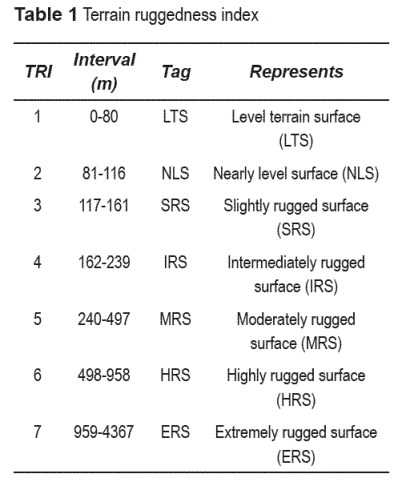
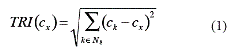
<body><![CDATA[<p> <font face="Verdana" size="2"><i><b>Measurements of terrain ruggedness</b></i></font></p>      <p> <font face="Verdana" size="2">  Our method is based on geomorphometric analysis that is  defined as the measuring of the geometry of the Earth, using raster data to  analyze the distribution and concentration of spatial objects [15]. Some  methods have been defined to quantify ruggedness [16], where it corresponds to  the total length of the elevation contours, presented in a particular area.  Other methods are based on the density of the contour lines per unit of area  [17].    <br>    <br> The TRI [8] is based on qualitative descriptors to  characterize DEMs in such a way that the derived values are easily understood.  The method to compute the TRI consists of two stages: (a) the <i>elevation  analysis,</i>  the elevations are directly analyzed from the model, having as a result a  quantitative descriptor; while (b) the <i>tagged stage </i>generates the quantitative  descriptors, by the usage of the previously defined intervals. The stage (a)  consists of calculating the differences between the elevation values, starting  from a central cell within an 8-neighborhood. Later on, the differences of  elevation among the 8-neighbors of each cell are squared so as to make an  arithmetic addition of the squares of all the differences of elevation. The  quantitative descriptor of the TRI is the result of the calculation of the  square root of the addition, and it corresponds to the mean elevation of the  change between any point of the DEM and the area, which surrounds it. Thus, the  units of the result will be given in meters. Equation 1 demonstrates the  described procedure.</font></p>      <p> <img src="/img/revistas/rfiua/n59/n59a04e01.gif"></p>      <p> <font face="Verdana" size="2">where: c<sub>x</sub> is the cell under analysis and <i>N<sub>8</sub>(c)</i> is the set of 8-neighbors of <i>c</i>.    <br>    <br> The stage (b) consists of  classifying the quantitative values according to the intervals proposed by [8].  A tag is assigned to each cell in relation to the classification to which it  belongs to (see <a href="#Tabla1">table 1</a>). However, they can be modified to highlight certain  aspects of the topography, depending on the specific case study.    </font></p>      <p align="center"><img src="/img/revistas/rfiua/n59/n59a04t01.gif" ><a name="Tabla1"></a></p>      <p> <font face="Verdana" size="2"><b><i>Semantic Similarity</i></b></font></p>      ]]></body>
<body><![CDATA[<p> <font face="Verdana" size="2">    Semantic similarity allows the identification of objects,  which are conceptually close to each other but not identical [13]. We focus on  the evaluation of the conceptual distances, also called <i>confusion</i> that was redefined in this  work, and which is applied over hierarchies [18]. Some terms related to  confusion and hierarchies are defined (see <a href="#Figura1">figure 1</a>) as follows:    <br>    <br> &bull; <i>Hierarchy.</i> A hierarchy is a 2-tuple <i>H(C<sub>H</sub> , R<sub>H</sub>)</i> where <i>C<sub>H</sub></i> is a set of concepts and <i>R<sub>H</sub></i> is a set of relations of the  form a&rho;b,  where  <i>a,b &#8712; C<sub>H</sub></i> and &rho; is a relation &rho;:<i> C<sub>H</sub> x C<sub>H</sub></i>, of the form <i>a&rho;c, a&rho;b &#8712; R<sub>H</sub></i> then, <i>b = c <img src="/img/revistas/rfiua/n59/n59a04e0a.gif">a &#8712; C<sub>H</sub>.</i>    <br>     <br> &bull; Additionally, <img src="/img/revistas/rfiua/n59/n59a04e0d.gif" align="middle"><i>a<sub>i</sub>&rho;b = U(b)</i> where <i>U(b)</i> is the universe of elements  that can be identified by <i>b</i>.    <br>      <br> &bull; <i>Ordered Hierarchy, H</i> is an ordered hierarchy if <i><img src="/img/revistas/rfiua/n59/n59a04e0a.gif">b &#8712; C<sub>H</sub> , <img src="/img/revistas/rfiua/n59/n59a04e0b.gif">&Omega;: U(b) x U(b)</i> such that &Omega; is a relation of order.    <br>    <br> &bull; <i>Father of</i>, let <i>a, b &#8712; C<sub>H</sub></i> be concepts, then <i>father_of (a) = b,</i> iff <i>a&rho;b &#8712; R<sub>H</sub>.</i>    <br>    ]]></body>
<body><![CDATA[<br> &bull; <i>Son of</i>, let <i>a, b &#8712; C<sub>H</sub></i> be concepts, then <i>son_of = b</i>, iff <i>a&rho;a &#8712; R<sub>H</sub></i>, on the other hand <i>son_ of (b) = {a| a&rho;b &#8712; R<sub>H</sub>}.</i>    <br>    <br> &bull; <i>Root</i>, is the node <i>h</i> which does not have father,  that is  <i>h &#8712; C<sub>H</sub> | father_of (h) = &Oslash;.</i>    <br>    <br> &bull; <i>Siblings</i>, let <i>a, b &#8712; C<sub>H</sub></i> be two concepts. Then, they  are siblings if <i>father_of (a) = fathers_of (b)</i>. The set of the siblings of a concept a is defined as <i>siblings_of (a) = sons_of (father_  of (a))-{a}</i>.    <br>    <br> &bull; <i>Ascendants</i>, the set of ascendants of a concept <i>a &#8712; C<sub>H</sub></i> is defined by <i>asc(a) = {b} <img src="/img/revistas/rfiua/n59/n59a04e0d1.gif"> asc (b)</i>, where <i>b = father_of (a)</i>.    <br>    <br> &bull; <i>Difference between concepts in a ordered hierarchy</i>, this function is only defined  over sibling concepts. It is defined as <i>dif (a, b) = &omega;(b) - &omega;(a)</i>, where &omega; is a  function that computes the position of a concept in an order &Omega;. More formally, <i>&omega;(a) = |{c<sub>i</sub>|c<sub>i</sub>&Omega;a}, &omega;(b) = |{c<sub>i</sub>|c<sub>i</sub>&Omega;b}</i>. Additionally, <i>dif (a,b) = 0 &harr; a = b.</i>    <br>    ]]></body>
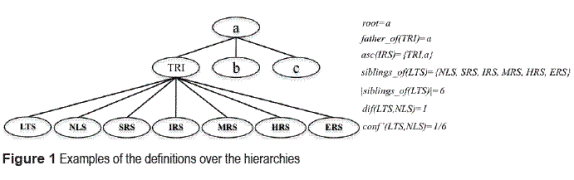
<body><![CDATA[<br> &bull; <i>Confusion in simple hierarchies</i>. To measure confusion, the  descendant links are counted from <i>r</i> to <i>s</i>. If <i>r,s</i> &#8712; C<sub>H</sub>, then the confusion of using <i>r</i> instead of <i>s</i>, denoted as <i>conf(r,s)</i>, is defined by the following  rules:    <br> <i>conf(r,r) = conf(r, asc(r)) = 0.</i>    <br> <i>conf(r,s) = 1 + conf(r, father_ of(s)).</i>    <br>    <br> &bull; <i>Confusion in ordered hierarchies.</i> For simple hierarchies composed  of ordered sets, the confusion of using <i>r</i> instead of <i>s</i>, denoted by <i>conf'(r,s)</i>, is defined by:    <br>  <i>conf' (r,r) = conf (r, asc (r)) = 0.</i>    <br>  If <i>r</i> and <i>s</i> are siblings and the father  is not in an ordered set; then, <i>conf'(r,s)</i> is the relative distance from <i>r</i> to <i>s</i>, being the number of  steps required to get from <i>r</i> to <i>s</i> in the order defined by &Omega;, divided between <i>son_of(r)) - 1.</i>    <br> <i>conf(r,r)' = 1 + conf'(r, father_of (s))</i>.</font></p>      <p align="center"><img src="/img/revistas/rfiua/n59/n59a04i01.gif" ><a name="Figura1"></a></p>      <p> <font face="Verdana" size="2"><b><i>Semantic comparison of digital elevation models (SECODEM)</i></b></font></p>      ]]></body>
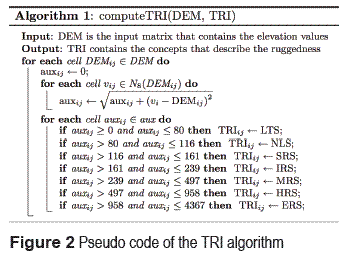
<body><![CDATA[<p> <font face="Verdana" size="2"> The SECODEM method is based on measuring of semantic  similarity over a hierarchy of geomorphometric concepts. The procedure is  carried out taking into account a <i>base dataset </i>(CB) and a <i>secondary dataset</i> (CS). Preferably, the one  that owns the highest level of detail, or the most accurate is considered as  CB. However, the selection can also be random. SECODEM consists of two stages: <i>Geomorphometric  Analysis  and  Semantic Analysis. </i> In the first stage, the numerical analysis of the DEM is carried out. The  objective is to assign to each cell of the DEM a quantitative descriptor  representing its ruggedness. The latter is done by an integer value defined in  the TRI column of <a href="#Tabla1">table 1</a>. This task is performed for the CB as well as for the  CS. The Semantic Analysis stage compares the DEMs by means of a measure  denominated  <i>confusion</i>, which  represents the conceptual distance between concepts that describes the  ruggedness in CS and CB. This measure is used because we are conceptualizing  the domain through a hierarchy. From this, two levels of semantic analysis are  generated: local and global.    <br>    <br> <i>Stage 1: Geomorphometric analysis</i>     <br>    <br> This stage extracts the topographic properties implicitly  represented in the DEM. TRI is used to characterize DEMs, identifying the most  relevant aspects of each region. The values retrieved from the set are denoted  by: TRI = {LTS, NLS, SRS, IRS, MRS, HRS, ERS}, which describe an explicit  meaning of a landform (see <a href="#Tabla1">table 1</a>). Still, other classifications of the  topography can be made, like the one defined by [19], which considers aspects such  as slope and curvature. <a href="#Figura2">Figure 2</a> depicts the pseudo code of the TRI algorithm.</font></p>       <p align="center"><img src="/img/revistas/rfiua/n59/n59a04i02.gif" ><a name="Figura2"></a></p>      <p><font face="Verdana" size="2"> In the previous pseudo code, <i>DEM</i> is the input matrix that  contains the elevation values, <i>DEM<sub>ij</sub></i> is the value of the matrix <i>DEM</i> that corresponds to the  elevation at that coordinate in the <i>i,j</i> position. The <i>aux</i> matrix stores the  quantitative descriptors that characterize the ruggedness. These descriptors  are later classified using the ruggedness intervals established in [8] and  presented in <a href="#Tabla1">table 1</a>. By using this method, we are able to qualitatively  quantify the ruggedness and hence, interpret them as concepts in the hierarchy.  The classified values are stored in a raster called <i>TRI</i> that contains the concepts  that describe the ruggedness.    <br>    <br> <i>Stage  2: Semantic analysis</i>     <br>    ]]></body>
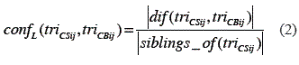
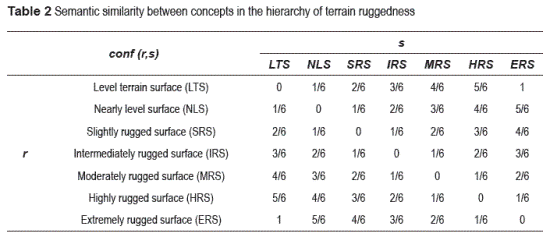
<body><![CDATA[<br> In  this stage a comparison between the descriptors in the DEM that refer to the  two datasets to be compared (<i>CB</i> and <i>CS</i>) is performed. Such comparison is attained in a <i>concept level</i>, by means of a measure of the <i>semantic  similarity</i>;  which is commonly defined in terms of a distance between two concepts. These  concepts belong to a hierarchical structure, which underlies in an ontology [9,  13]. In this case, an ordered hierarchy based on the ruggedness describing the  concepts related to the TRI (see <a href="#Tabla1">table 1</a>) is used. That is, the concept, which  represents the highest ruggedness, will appear in one extreme of the hierarchy  partition whereas the concept, which represents the lowest ruggedness, will  appear in the opposite extreme. These values are preceded by their cardinality.  The hierarchy of concepts of the TRI was implemented in the Ontology Editor Prot&eacute;g&eacute; 3.4.1. We are using only the  relation of existence ("is") to define the concepts that belong to  the same classification, allowing it to be specialized by means of generic  concepts that explicitly describe the concept terms defined in [8]. The  comparison is done in two levels: <i>local</i> and <i>global.</i>    <br>    <br> <i>Semantic similarity in a local level</i>     <br>    <br> The  semantic similarity in a local level is defined in terms of the functions  defined over the hierarchies presented in the Semantic Similarity Section. This  similarity is established between two concepts that describe the TRIs and is  computed as the difference between them within the hierarchy, divided by their  total number of siblings (see equation 2).    <br>    <br> Please  note, that if the TRIs are the same then the numerator will be zero. In this  case, the confusion in a local level will be zero. On the other hand, the  denominator cannot take a value of zero because hierarchies are complete partitions composed of at least two parts. Therefore,  if  a is one of  the parts, then the minimum value that the expression <i>siblings_of(a)</i> can take is one (see  equation 2).</font></p>        <p> <img src="/img/revistas/rfiua/n59/n59a04e02.gif"></p>        <p> <font face="Verdana" size="2"> where, <i>tri<sub>CSij</sub></i> and <i>tri<sub>CBij</sub></i> refer  to a cell of the raster with values of TRI for CS and CB, respectively. In  fact, the similarity is evaluated considering the absolute value of the  difference of the positions of two concepts that appear in the hierarchy. The  possible values of the similarity are in the interval [0, 1], (see <a href="#Tabla2">table 2</a>). In  this table is appreciated that the more similar two concepts are, the less  their value of similarity will be.</font></p>      <p align="center"><img src="/img/revistas/rfiua/n59/n59a04t02.gif" ><a name="Tabla2"></a></p>      ]]></body>
<body><![CDATA[<p> <font face="Verdana" size="2">If other geomorphometric measurement is applied, like the  classification in [19], another kind of structure will be required, and in some  cases, another measure of semantic similarity, as the one described in [13]  will be also required. Based on the measures concerning hierarchy, two cases of  semantic similarity (i.e., equivalent and different) are defined to a local  level among the cells belonging to two DEMs. In this case, confusion and a <i>threshold value (w)</i> are used. This threshold  is defined by the user according to the requirements of the case study. The  cases of semantic similarity in a local level are:    <br>    <br> - <i>Equivalent</i>, if 0 &lt; <i>conf<sub>L</sub>(r,s) &lt; w &lt;1,</i> the concepts are  defined as equivalent, which means that the topography being compared may be  considered as the same.    <br>    <br> - <i>Different</i>, if <i>0 &lt; w &lt; conf<sub>L</sub>(r,s) &lt; 1 ,</i> the concepts are  considered different. Thisinterpretation is because the topographical characteristics  are diverse.    <br>    <br> <i>Semantic similarity in a global level</i>     <br>    <br> This measurement uses the semantic similarity at a local  level, defined in equation 3.</font></p> 	     <p> <img src="/img/revistas/rfiua/n59/n59a04e03.gif"></p>	      ]]></body>
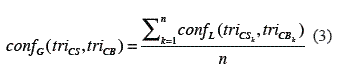
<body><![CDATA[<p><font face="Verdana" size="2">where, <i>tri<sub>CS</sub></i> and <i>tri<sub>CB</sub></i> are the rasters that store the TRI of each dataset and <i>n</i> is the number of cells that  contains <i>tri<sub>CS</sub></i>  and  <i>tri<sub>CB</sub></i>.  The range of this function is between 0 and 1. Values near <i>conf<sub>G</sub>  = 0</i> mean high  similarity or equivalence between DEMs, while values near <i>conf<sub>G</sub>  = 1</i> are  interpreted as DEMs that are not similar. Furthermore, the global measurement  allows the introduction of new concepts to characterize qualitatively the differences  between the CS and CB of the DEMs. These concepts are:    <br>       <br>	 - <i>Identical</i>, if <i>conf<sub>G</sub> = 0</i>; means that landforms in CS  are identical to CB, and CS can be considered equal to CB.    <br>     <br> - <i>Substitute</i>, if 0 &lt;<i> conf<sub>G</sub></i> &le; 0.04; means that CS can be substituted by CB.    <br>     <br> - <i>Very similar</i>, if 0.04 &lt; <i>conf<sub>G</sub></i> &le; 0.12; means that CS and  CB have a large number of landforms in common.    <br>     <br> - <i>Similar</i>, if 0.12 &lt; <i>conf<sub>G</sub></i> &le; 0.25; means that CS and  CB have several landforms in common.    <br>     ]]></body>
<body><![CDATA[<br> - <i>Somehow similar </i>, if 0.25 &lt; <i>conf<sub>G</sub></i> &le; 0.46; means that CS and  CB have some landforms in common.    <br>     <br> - <i>Different</i>, if 0.47 &lt; <i>conf<sub>G</sub></i> &le; 1; means that CS and CB  have just a few or any landforms in common.    <br>     <br> The intervals to determine the semantic similarity in this  level, were established by experimentation, using the consensus of geologists,  as is presented in [9]. However, the intervals can be calibrated depending on  the application.    <br>     <br> <i><b>Considerations of implementation</b></i>     <br>     <br> The following considerations have been established taking  into account that the comparison is achieved at a conceptual level. It is  important to point out that in our methodology the rasters have to refer  exactly to the same geographic area. Thus:    <br>     ]]></body>
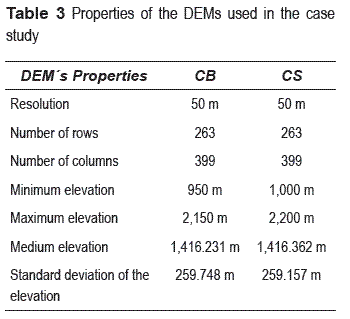
<body><![CDATA[<br> - DEMs  must have the same coordinates system, projection, datum and units.    <br>    <br> - DEMs  must have the same geometric resolution.    <br>    <br> - If  the bounding coordinates of the DEMs are different, the comparison must be made  only with the overlapping cells.    <br>    <br> Ideally the semantic processing avoids the usage of the  aspects that traditionally are used for the manipulation of digital cartography  such as scales and geographic coordinates.</font></p>         <p><font face="Verdana" size="3"><b>Results and discussion</b> </font></p>      <p> <font face="Verdana" size="2">In this section, a set of results when applying the method  to the DEMs of Mexico is presented. They were generated from elevation contour  lines from INEGI (National Mapping Agency of Mexico) that correspond to two  different editions of the topographic map E14A56 to a scale of 1:50,000. The  contour lines are given by intervals of elevation of 10 m, being the minor  elevation equal to 950 amsl and the major elevation equal to 2200 amsl. DEMs  with resolution of 50 m, having 263 rows and 399 columns were generated (see  <a href="#Tabla3">table 3</a>). The resolution was determined based on the surface that covers the  area and in such a way that the topography of the terrain, which is not  considerably large.      </font></p>      <p align="center"><img src="/img/revistas/rfiua/n59/n59a04t03.gif" ><a name="Tabla3"></a></p>      ]]></body>
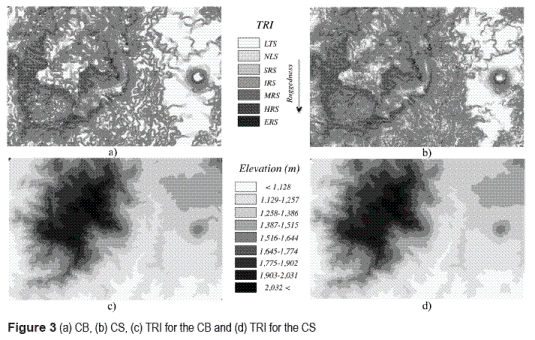
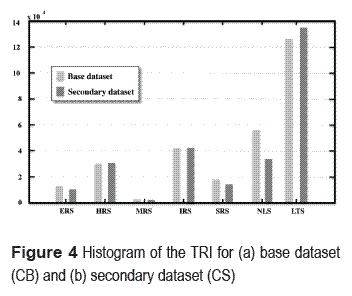
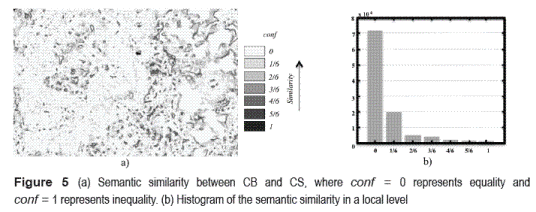
<body><![CDATA[<p> <font face="Verdana" size="2"><a href="#Figura3">Figure 3.a</a> shows the DEM that  represents the CB, while <a href="#Figura3">figure 3.b</a> depicts the CS. In these figures it is  appreciated that both models are very similar; however, they are not the same.  The TRI computation allows the characterization of the topography and it is  applied to quantify the similarity between the DEMs. <a href="#Figura3">Figure 3.c</a> shows the TRI  for the CB, where the minimum value of the TRI is identified as 1 (Level  terrain surface), while the maximum value is 7 (Extremely rugged surface), (see  <a href="#Tabla1">table 1</a>) and the average value is 3.919. This can be interpreted (approximating  it to the nearest integer number) as a zone, which is mainly  "Intermediately rugged surface" (IRS). In <a href="#Figura3">figure 3.d</a>, the TRI for CS  is shown, the minimum value of TRI is 1, while the maximum TRI is 7.</font></p>        <p align="center"><img src="/img/revistas/rfiua/n59/n59a04i03.gif" ><a name="Figura3"></a></p>      <p> <font face="Verdana" size="2">Therefore, the medium value is 4.212, which can be interpreted as a zone that in general is an IRS. In both cases, it can be noticed that the zones identified as extremely rugged are located in the western part of the area, while the flat zones are located mainly in the east section of the DEM.    <br>    <br> When analyzing the histogram for the TRI for the CB (<a href="#Figura4">figure 4.a</a>) and the one for the TRI for the CS (<a href="#Figura4">figure 4.b</a>), it is observed that in both cases the most popular class is a flat surface identified by the concept "Level terrain surface" (SPL) (see <a href="#Tabla1">table 1</a>). However, it is important to notice that in the rest of the classes, do not have the same degree of popularity. In general, it can be assumed that the datasets are similar.</font></p>      <p align="center"><img src="/img/revistas/rfiua/n59/n59a04i04.gif" ><a name="Figura4"></a></p>         <p> <font face="Verdana" size="2">As a consequence, a measure of  semantic similarity at a local level is applied, which will allow us to  semantically quantify the differences between the DEMs. The semantic similarity  between the raster that holds the TRI for the CB and the one that holds the TRI  for the  <i>CS</i> is shown  in <a href="#Figura5">figure 5.a</a>. When visually analyzing <a href="#Figura5">figure 5.a</a>, it can be intuitively said  that both datasets are similar; this is due to the fact that the light tones in  such figure are predominant. Note that in the figure the light tones indicate  similarity between datasets, in other words the values of similarity are close  to zero. In particular, large zones with values of similarity equal to zero  located to the western part of the area can be appreciated. This means that the  same landform is described in both datasets, while in the whole area; there are  also zones where considerable differences in the topography <i>conf</i> = 1 can be appreciated. Such  statement is confirmed when observing the histogram of <a href="#Figura5">figure 5.b</a>, where the  most popular class is <i>conf</i> = 0. The latter means that the landforms are the same.  Likewise, it is depicted in the histogram that the cardinality of the classes  decreases with respect to the difference between concepts. In these  experiments, the cases of semantic similarity at local level were identified as  "equivalent" and "different", using a threshold value of <i>w</i> = 1/6. In this case, the number  of elements that belong to the equivalent class is larger than the number of  elements that belong to the different class (see <a href="#Figura5">figure 5.a</a>). This can be  appreciated when observing <a href="#Figura5">figure 5.b</a>. By using the concepts of  "equivalent" and "different", the semantic similarity is  described at a local level. With the purpose of quantifying the semantic  similarity at a global level, the measure <i>conf<sub>G</sub></i> is applied, which is 0.089 for  this case. Taking into account the previously defined criterion, it can be said  that the datasets are very similar. This corresponds to the interpretation  given in <a href="#Figura5">figure 5.a</a>.</font></p>        <p align="center"><img src="/img/revistas/rfiua/n59/n59a04i05.gif" ><a name="Figura5"></a></p>       <p><font face="Verdana" size="3"><b>Conclusions</b> </font></p>      <p> <font face="Verdana" size="2">      In this work, a method based  on semantic similarity to compare DEMs, using the geomorphologic  characteristics has been described. The method is based on a hierarchical  representation of the concepts and properties, in particular the Terrain  Ruggedness Index. A semantic component is added to the data, which is usually  not considered in the traditional quantitative approaches used in GIS. The goal  is to extract the semantics of the elevation dataset by means of a  geomorphometric analysis. This process provides as result, an evaluation based  on the meaning of these representations, where we take advantage of an  explicit, precise and comprehensible vocabulary denoted by concepts that makes  easy the interpretation of the results. To describe the semantic similarity  between the DEMs, two levels of analysis are proposed: local and global. The  first one describes the semantics of a single cell and the latter describes the  semantics of whole DEM. The assessment and comparison of the elevation data  have an important role in diverse areas of application such as prevention of  natural disasters, agricultural planning, and hydrology, in which the correct  selection of the data determines the success of any kind of spatial analysis.</font></p>       ]]></body>
<body><![CDATA[<p><font face="Verdana" size="3"><b>Acknowledgements</b> </font></p>      <p> <font face="Verdana" size="2">Work partially sponsored by the IPN, by the CONACyT under grant 106692 and by the SIP-IPN under grants 20101282, 20101069, 20101088, 20100371, and 20100417. We are thankful to the reviewers for their invaluable and constructive feedback that helped improve the quality of the paper.</font></p>       <p><font face="Verdana" size="3"><b>References</b> </font></p>      <!-- ref --><p> <font face="Verdana" size="2">1. D. Sheeren, S. Musti&eacute;re, J.  D. Zucker. "A data- mining approach for assessing consistency between  multiple representations in spatial databases".<i> Int. J. of  Geographical Information Science. </i>Vol. 23. 2009. pp. 961- 992.    &nbsp;&nbsp;&nbsp;&nbsp;&nbsp;&nbsp;&nbsp;&nbsp;[&#160;<a href="javascript:void(0);" onclick="javascript: window.open('/scielo.php?script=sci_nlinks&ref=000136&pid=S0120-6230201100030000400001&lng=','','width=640,height=500,resizable=yes,scrollbars=1,menubar=yes,');">Links</a>&#160;]<!-- end-ref --><br>    <br> 2. P. Fisher, A. Comber, R.  Wadsworth. "What's in a name? Semantics, standards and data quality".  R. Devillers, H. Goodchild. (editors). <i>Spatial data  quality. From process to decisions.</i> Ed. CRC Press. Boca Raton. 2010. pp. 2-16.    <br>     <!-- ref --><br> 3. H. T. Uitermark, P. J. van  Oosterom, N. J. I. Mars, M. Molenaar. "Ontology-based integration of  topographic data sets". <i>Int. J. of Applied Earth Observation and Geoinformation.</i> Vol. 7. 2005. pp. 97-106.    &nbsp;&nbsp;&nbsp;&nbsp;&nbsp;&nbsp;&nbsp;&nbsp;[&#160;<a href="javascript:void(0);" onclick="javascript: window.open('/scielo.php?script=sci_nlinks&ref=000140&pid=S0120-6230201100030000400003&lng=','','width=640,height=500,resizable=yes,scrollbars=1,menubar=yes,');">Links</a>&#160;]<!-- end-ref --><br>    <!-- ref --><br> 4. J. M. Sappington, K. M.  Longshore. "Quantifying Landscape Ruggedness for Animal Habitat Analysis:  A Case Study Using Bighorn Sheep in the Mojave Desert".<i> J. of Wildlife  Management.</i>  Vol. 71. 2007. pp. 1419-1426.    &nbsp;&nbsp;&nbsp;&nbsp;&nbsp;&nbsp;&nbsp;&nbsp;[&#160;<a href="javascript:void(0);" onclick="javascript: window.open('/scielo.php?script=sci_nlinks&ref=000142&pid=S0120-6230201100030000400004&lng=','','width=640,height=500,resizable=yes,scrollbars=1,menubar=yes,');">Links</a>&#160;]<!-- end-ref --><br>    <!-- ref --><br> 5. O. Z. Chaudhry, W. A.  Mackaness. "Creating Mountains out of Mole Hills: Automatic Identification  of Hills and Ranges Using Morphometric Analysis". <i>Transactions in  GIS.</i>  Vol. 12. 2008. pp. 567-589.    &nbsp;&nbsp;&nbsp;&nbsp;&nbsp;&nbsp;&nbsp;&nbsp;[&#160;<a href="javascript:void(0);" onclick="javascript: window.open('/scielo.php?script=sci_nlinks&ref=000144&pid=S0120-6230201100030000400005&lng=','','width=640,height=500,resizable=yes,scrollbars=1,menubar=yes,');">Links</a>&#160;]<!-- end-ref --><br>    <!-- ref --><br> 6. E. R. Venteris, B. K.  Slater. "A Comparison between Contour Elevation Data Sources for DEM  Creation and Soil Carbon Prediction, Coshocton, Ohio". <i>Transactions in  GIS.</i>  Vol. 9. 2005. pp. 179-198.    &nbsp;&nbsp;&nbsp;&nbsp;&nbsp;&nbsp;&nbsp;&nbsp;[&#160;<a href="javascript:void(0);" onclick="javascript: window.open('/scielo.php?script=sci_nlinks&ref=000146&pid=S0120-6230201100030000400006&lng=','','width=640,height=500,resizable=yes,scrollbars=1,menubar=yes,');">Links</a>&#160;]<!-- end-ref --><br>    <!-- ref --><br> 7. S. Clarke, K. Burnett.  "Comparison of Digital Elevation Models for Aquatic Data  Development". <i>Photogrammetric Engineering &amp; Remote Sensing.</i> Vol. 69. 2003. pp. 1367-1375.    &nbsp;&nbsp;&nbsp;&nbsp;&nbsp;&nbsp;&nbsp;&nbsp;[&#160;<a href="javascript:void(0);" onclick="javascript: window.open('/scielo.php?script=sci_nlinks&ref=000148&pid=S0120-6230201100030000400007&lng=','','width=640,height=500,resizable=yes,scrollbars=1,menubar=yes,');">Links</a>&#160;]<!-- end-ref --><br>    <!-- ref --><br> 8. S. J. Riley, S. D. De  Gloria, R. Elliot. "A terrain ruggedness index that quantifies topographic  heterogeneity". <i>Intermountain J. of Sciences.</i> Vol. 5. 1999. pp. 23-27.    &nbsp;&nbsp;&nbsp;&nbsp;&nbsp;&nbsp;&nbsp;&nbsp;[&#160;<a href="javascript:void(0);" onclick="javascript: window.open('/scielo.php?script=sci_nlinks&ref=000150&pid=S0120-6230201100030000400008&lng=','','width=640,height=500,resizable=yes,scrollbars=1,menubar=yes,');">Links</a>&#160;]<!-- end-ref --><br>    <!-- ref --><br> 9. M. Moreno-Ibarra.  "Semantic Similarity Applied to Generalization of Geospatial Data".<i> Lecture Notes in  Computer Science.</i>  Vol. 4853. 2007. pp. 247-255.    &nbsp;&nbsp;&nbsp;&nbsp;&nbsp;&nbsp;&nbsp;&nbsp;[&#160;<a href="javascript:void(0);" onclick="javascript: window.open('/scielo.php?script=sci_nlinks&ref=000152&pid=S0120-6230201100030000400009&lng=','','width=640,height=500,resizable=yes,scrollbars=1,menubar=yes,');">Links</a>&#160;]<!-- end-ref --><br>    <!-- ref --><br> 10. R. Quintero. <i>Representaci&oacute;n  Sem&aacute;ntica de Datos Espaciales Raster.</i> Tesis Doctoral. Instituto  Polit&eacute;cnico Nacional. 2007. pp. 77-108.    &nbsp;&nbsp;&nbsp;&nbsp;&nbsp;&nbsp;&nbsp;&nbsp;[&#160;<a href="javascript:void(0);" onclick="javascript: window.open('/scielo.php?script=sci_nlinks&ref=000154&pid=S0120-6230201100030000400010&lng=','','width=640,height=500,resizable=yes,scrollbars=1,menubar=yes,');">Links</a>&#160;]<!-- end-ref --><br>    <!-- ref --><br> 11. R. Quintero, M. Torres, M.  Moreno, G. Guzm&aacute;n G. "Metodolog&iacute;a para generar una Representaci&oacute;n  Sem&aacute;ntica de Datos Raster". T. Delgado, J. Capote (editors). <i>Sem&aacute;ntica  espacial y descubrimiento de conocimiento para desarrollo sostenible.</i> Ed. CUJAE. La Habana. 2009.  pp. 119-145.    &nbsp;&nbsp;&nbsp;&nbsp;&nbsp;&nbsp;&nbsp;&nbsp;[&#160;<a href="javascript:void(0);" onclick="javascript: window.open('/scielo.php?script=sci_nlinks&ref=000156&pid=S0120-6230201100030000400011&lng=','','width=640,height=500,resizable=yes,scrollbars=1,menubar=yes,');">Links</a>&#160;]<!-- end-ref --><br>    <!-- ref --><br> 12. S. A. Sloman, B. C. Love,  A. Woo-Kyoung. "Feature centrality and conceptual coherence". <i>Cognitive  Science.</i>  Vol. 22. 1998. pp. 189-228.    &nbsp;&nbsp;&nbsp;&nbsp;&nbsp;&nbsp;&nbsp;&nbsp;[&#160;<a href="javascript:void(0);" onclick="javascript: window.open('/scielo.php?script=sci_nlinks&ref=000158&pid=S0120-6230201100030000400012&lng=','','width=640,height=500,resizable=yes,scrollbars=1,menubar=yes,');">Links</a>&#160;]<!-- end-ref --><br>    <!-- ref --><br> 13. A. Rodriguez, M.  Egenhofer. "Comparing Geospatial Entity Classes: An Asymmetric and  Context- Dependent Similarity Measure". <i>Int. Journal of  Geographical Information Science.</i> Vol. 18. 2004. pp. 229-256.    &nbsp;&nbsp;&nbsp;&nbsp;&nbsp;&nbsp;&nbsp;&nbsp;[&#160;<a href="javascript:void(0);" onclick="javascript: window.open('/scielo.php?script=sci_nlinks&ref=000160&pid=S0120-6230201100030000400013&lng=','','width=640,height=500,resizable=yes,scrollbars=1,menubar=yes,');">Links</a>&#160;]<!-- end-ref --><br>    <!-- ref --><br> 14. K. Janowicz, C. Ke&szlig;ler, M.  Schwarz, M. Wilkes, I. Panov, M. Espeter, B. B&auml;umer. "Algorithm,  Implementation and Application of the SIM-DL Similarity Server".<i> Lecture Notes in  Computer Science. </i> Vol. 4853. 2007. pp. 128-145.    &nbsp;&nbsp;&nbsp;&nbsp;&nbsp;&nbsp;&nbsp;&nbsp;[&#160;<a href="javascript:void(0);" onclick="javascript: window.open('/scielo.php?script=sci_nlinks&ref=000162&pid=S0120-6230201100030000400014&lng=','','width=640,height=500,resizable=yes,scrollbars=1,menubar=yes,');">Links</a>&#160;]<!-- end-ref --><br>    <!-- ref --><br> 15. R. Bonk.  "Scale-dependent Geomorphometric Analysis for Glacier Mapping at Nanga  Parbat: GRASS GIS Approach".<i> Proc. of the Open  source GIS - GRASS User's Conference.</i> Trento (Italy). 11-13  september 2002.    &nbsp;&nbsp;&nbsp;&nbsp;&nbsp;&nbsp;&nbsp;&nbsp;[&#160;<a href="javascript:void(0);" onclick="javascript: window.open('/scielo.php?script=sci_nlinks&ref=000164&pid=S0120-6230201100030000400015&lng=','','width=640,height=500,resizable=yes,scrollbars=1,menubar=yes,');">Links</a>&#160;]<!-- end-ref --><br>    <!-- ref --><br> 16. S. L. Beasom, E. P.  Wiggers R. J. Giordono. "A technique for assessing land surface  ruggedness". <i>J. of Wildlife Management.</i> Vol. 47. 1983. pp. 1163-1166.    &nbsp;&nbsp;&nbsp;&nbsp;&nbsp;&nbsp;&nbsp;&nbsp;[&#160;<a href="javascript:void(0);" onclick="javascript: window.open('/scielo.php?script=sci_nlinks&ref=000166&pid=S0120-6230201100030000400016&lng=','','width=640,height=500,resizable=yes,scrollbars=1,menubar=yes,');">Links</a>&#160;]<!-- end-ref --><br>    <!-- ref --><br> 17. J. S. Jenness.  "Calculating landscape surface area from digital elevation models".<i> Wildlife Society  Bulletin.</i> Vol.  32. 2004. pp. 829-839.    &nbsp;&nbsp;&nbsp;&nbsp;&nbsp;&nbsp;&nbsp;&nbsp;[&#160;<a href="javascript:void(0);" onclick="javascript: window.open('/scielo.php?script=sci_nlinks&ref=000168&pid=S0120-6230201100030000400017&lng=','','width=640,height=500,resizable=yes,scrollbars=1,menubar=yes,');">Links</a>&#160;]<!-- end-ref --><br>    <!-- ref --><br> 18. S. Levachkine, A.  Guzman-Arenas. "Hierarchy as a new data type for qualitative  variables". <i>Expert Systems with Applications.</i> Vol. 32. 2007. pp. 899-910.    &nbsp;&nbsp;&nbsp;&nbsp;&nbsp;&nbsp;&nbsp;&nbsp;[&#160;<a href="javascript:void(0);" onclick="javascript: window.open('/scielo.php?script=sci_nlinks&ref=000170&pid=S0120-6230201100030000400018&lng=','','width=640,height=500,resizable=yes,scrollbars=1,menubar=yes,');">Links</a>&#160;]<!-- end-ref --><br>    <!-- ref --><br> 19. D. J. Pennock, B. J.  Zebarth, E. de Jong. "Landform classification and soil distribution in  hummocky terrain, Sasketchewan, Canada".<i> Geoderma.</i> Vol. 40. 1997. pp. 297-315. </font>&nbsp;&nbsp;&nbsp;&nbsp;&nbsp;&nbsp;&nbsp;&nbsp;[&#160;<a href="javascript:void(0);" onclick="javascript: window.open('/scielo.php?script=sci_nlinks&ref=000172&pid=S0120-6230201100030000400019&lng=','','width=640,height=500,resizable=yes,scrollbars=1,menubar=yes,');">Links</a>&#160;]<!-- end-ref --><br>    <br>    <br>     <p><font face="Verdana" size="2">(Recibido el 13 de agostoo de 2010. Aceptado el 21 de febrero de 2011)</font></p>     <p><font face="Verdana" size="2"><sup>*</sup>Autor de correspondencia: tel&eacute;fono: + 52 + 55 + 57 29 60 00 ext. 56528, fax: + 52 + 55 + 57 29 6000 ext. 56607, correo electr&oacute;nico: <a href="mailto:marcomoreno@cic.ipn.mx">marcomoreno@cic.ipn.mx. .</a> (M. Moreno-Ibarra)</font></p>      ]]></body><back>
<ref-list>
<ref id="B1">
<label>1</label><nlm-citation citation-type="journal">
<person-group person-group-type="author">
<name>
<surname><![CDATA[Sheeren]]></surname>
<given-names><![CDATA[D]]></given-names>
</name>
<name>
<surname><![CDATA[Mustiére]]></surname>
<given-names><![CDATA[S]]></given-names>
</name>
<name>
<surname><![CDATA[Zucker]]></surname>
<given-names><![CDATA[J. D]]></given-names>
</name>
</person-group>
<article-title xml:lang="en"><![CDATA[A data- mining approach for assessing consistency between multiple representations in spatial databases]]></article-title>
<source><![CDATA[Int. J. of Geographical Information Science]]></source>
<year>2009</year>
<volume>23</volume>
<page-range>961- 992</page-range></nlm-citation>
</ref>
<ref id="B2">
<label>2</label><nlm-citation citation-type="book">
<person-group person-group-type="author">
<name>
<surname><![CDATA[Fisher]]></surname>
<given-names><![CDATA[P]]></given-names>
</name>
<name>
<surname><![CDATA[Comber]]></surname>
<given-names><![CDATA[A]]></given-names>
</name>
<name>
<surname><![CDATA[Wadsworth]]></surname>
<given-names><![CDATA[R]]></given-names>
</name>
</person-group>
<article-title xml:lang="en"><![CDATA[What's in a name? Semantics, standards and data quality]]></article-title>
<source><![CDATA[Spatial data quality. From process to decisions]]></source>
<year>2010</year>
<page-range>2-16</page-range><publisher-loc><![CDATA[Boca Raton ]]></publisher-loc>
<publisher-name><![CDATA[Ed. CRC Press]]></publisher-name>
</nlm-citation>
</ref>
<ref id="B3">
<label>3</label><nlm-citation citation-type="journal">
<person-group person-group-type="author">
<name>
<surname><![CDATA[Uitermark]]></surname>
<given-names><![CDATA[H. T]]></given-names>
</name>
<name>
<surname><![CDATA[van Oosterom]]></surname>
<given-names><![CDATA[P. J]]></given-names>
</name>
<name>
<surname><![CDATA[Mars]]></surname>
<given-names><![CDATA[N. J. I]]></given-names>
</name>
<name>
<surname><![CDATA[Molenaar]]></surname>
<given-names><![CDATA[M]]></given-names>
</name>
</person-group>
<article-title xml:lang="en"><![CDATA[Ontology-based integration of topographic data sets]]></article-title>
<source><![CDATA[Int. J. of Applied Earth Observation and Geoinformation]]></source>
<year>2005</year>
<volume>7</volume>
<page-range>97-106</page-range></nlm-citation>
</ref>
<ref id="B4">
<label>4</label><nlm-citation citation-type="journal">
<person-group person-group-type="author">
<name>
<surname><![CDATA[Sappington]]></surname>
<given-names><![CDATA[J. M]]></given-names>
</name>
<name>
<surname><![CDATA[Longshore]]></surname>
<given-names><![CDATA[K. M]]></given-names>
</name>
</person-group>
<article-title xml:lang="en"><![CDATA[Quantifying Landscape Ruggedness for Animal Habitat Analysis: A Case Study Using Bighorn Sheep in the Mojave Desert]]></article-title>
<source><![CDATA[J. of Wildlife Management]]></source>
<year>2007</year>
<volume>71</volume>
<page-range>1419-1426</page-range></nlm-citation>
</ref>
<ref id="B5">
<label>5</label><nlm-citation citation-type="journal">
<person-group person-group-type="author">
<name>
<surname><![CDATA[Chaudhry]]></surname>
<given-names><![CDATA[O. Z]]></given-names>
</name>
<name>
<surname><![CDATA[Mackaness]]></surname>
<given-names><![CDATA[W. A]]></given-names>
</name>
</person-group>
<article-title xml:lang="en"><![CDATA[Creating Mountains out of Mole Hills: Automatic Identification of Hills and Ranges Using Morphometric Analysis]]></article-title>
<source><![CDATA[Transactions in GIS]]></source>
<year>2008</year>
<volume>12</volume>
<page-range>567-589</page-range></nlm-citation>
</ref>
<ref id="B6">
<label>6</label><nlm-citation citation-type="journal">
<person-group person-group-type="author">
<name>
<surname><![CDATA[Venteris]]></surname>
<given-names><![CDATA[E. R]]></given-names>
</name>
<name>
<surname><![CDATA[Slater]]></surname>
<given-names><![CDATA[B. K]]></given-names>
</name>
</person-group>
<article-title xml:lang="en"><![CDATA[A Comparison between Contour Elevation Data Sources for DEM Creation and Soil Carbon Prediction, Coshocton, Ohio]]></article-title>
<source><![CDATA[Transactions in GIS]]></source>
<year>2005</year>
<volume>9</volume>
<page-range>179-198</page-range></nlm-citation>
</ref>
<ref id="B7">
<label>7</label><nlm-citation citation-type="journal">
<person-group person-group-type="author">
<name>
<surname><![CDATA[Clarke]]></surname>
<given-names><![CDATA[S]]></given-names>
</name>
<name>
<surname><![CDATA[Burnett]]></surname>
<given-names><![CDATA[K]]></given-names>
</name>
</person-group>
<article-title xml:lang="en"><![CDATA[Comparison of Digital Elevation Models for Aquatic Data Development]]></article-title>
<source><![CDATA[Photogrammetric Engineering & Remote Sensing]]></source>
<year>2003</year>
<volume>69</volume>
<page-range>1367-1375</page-range></nlm-citation>
</ref>
<ref id="B8">
<label>8</label><nlm-citation citation-type="journal">
<person-group person-group-type="author">
<name>
<surname><![CDATA[Riley]]></surname>
<given-names><![CDATA[S. J]]></given-names>
</name>
<name>
<surname><![CDATA[De Gloria]]></surname>
<given-names><![CDATA[S. D]]></given-names>
</name>
<name>
<surname><![CDATA[Elliot]]></surname>
<given-names><![CDATA[R]]></given-names>
</name>
</person-group>
<article-title xml:lang="en"><![CDATA[A terrain ruggedness index that quantifies topographic heterogeneity]]></article-title>
<source><![CDATA[Intermountain J. of Sciences]]></source>
<year>1999</year>
<volume>5</volume>
<page-range>23-27</page-range></nlm-citation>
</ref>
<ref id="B9">
<label>9</label><nlm-citation citation-type="journal">
<person-group person-group-type="author">
<name>
<surname><![CDATA[Moreno-Ibarra]]></surname>
<given-names><![CDATA[M]]></given-names>
</name>
</person-group>
<article-title xml:lang="en"><![CDATA[Semantic Similarity Applied to Generalization of Geospatial Data]]></article-title>
<source><![CDATA[Lecture Notes in Computer Science]]></source>
<year>2007</year>
<volume>4853</volume>
<page-range>247-255</page-range></nlm-citation>
</ref>
<ref id="B10">
<label>10</label><nlm-citation citation-type="">
<person-group person-group-type="author">
<name>
<surname><![CDATA[Quintero]]></surname>
<given-names><![CDATA[R]]></given-names>
</name>
</person-group>
<source><![CDATA[Representación Semántica de Datos Espaciales Raster]]></source>
<year></year>
<page-range>77-108</page-range></nlm-citation>
</ref>
<ref id="B11">
<label>11</label><nlm-citation citation-type="book">
<person-group person-group-type="author">
<name>
<surname><![CDATA[Quintero]]></surname>
<given-names><![CDATA[R]]></given-names>
</name>
<name>
<surname><![CDATA[Torres]]></surname>
<given-names><![CDATA[M]]></given-names>
</name>
<name>
<surname><![CDATA[Moreno]]></surname>
<given-names><![CDATA[M]]></given-names>
</name>
<name>
<surname><![CDATA[Guzmán G]]></surname>
<given-names><![CDATA[G]]></given-names>
</name>
</person-group>
<article-title xml:lang="en"><![CDATA[Metodología para generar una Representación Semántica de Datos Raster]]></article-title>
<person-group person-group-type="editor">
<name>
<surname><![CDATA[Delgado]]></surname>
<given-names><![CDATA[T]]></given-names>
</name>
<name>
<surname><![CDATA[Capote]]></surname>
<given-names><![CDATA[J]]></given-names>
</name>
</person-group>
<source><![CDATA[Semántica espacial y descubrimiento de conocimiento para desarrollo sostenible]]></source>
<year>2009</year>
<page-range>119-145</page-range><publisher-loc><![CDATA[La Habana ]]></publisher-loc>
<publisher-name><![CDATA[Ed. CUJAE]]></publisher-name>
</nlm-citation>
</ref>
<ref id="B12">
<label>12</label><nlm-citation citation-type="journal">
<person-group person-group-type="author">
<name>
<surname><![CDATA[Sloman]]></surname>
<given-names><![CDATA[S. A]]></given-names>
</name>
<name>
<surname><![CDATA[Love]]></surname>
<given-names><![CDATA[B. C]]></given-names>
</name>
<name>
<surname><![CDATA[Woo-Kyoung]]></surname>
<given-names><![CDATA[A]]></given-names>
</name>
</person-group>
<article-title xml:lang="en"><![CDATA[Feature centrality and conceptual coherence]]></article-title>
<source><![CDATA[Cognitive Science]]></source>
<year>1998</year>
<volume>22</volume>
<page-range>189-228</page-range></nlm-citation>
</ref>
<ref id="B13">
<label>13</label><nlm-citation citation-type="journal">
<person-group person-group-type="author">
<name>
<surname><![CDATA[Rodriguez]]></surname>
<given-names><![CDATA[A]]></given-names>
</name>
<name>
<surname><![CDATA[Egenhofer]]></surname>
<given-names><![CDATA[M]]></given-names>
</name>
</person-group>
<article-title xml:lang="en"><![CDATA[Comparing Geospatial Entity Classes: An Asymmetric and Context- Dependent Similarity Measure]]></article-title>
<source><![CDATA[Int. Journal of Geographical Information Science]]></source>
<year>2004</year>
<volume>18</volume>
<page-range>229-256</page-range></nlm-citation>
</ref>
<ref id="B14">
<label>14</label><nlm-citation citation-type="journal">
<person-group person-group-type="author">
<name>
<surname><![CDATA[Janowicz]]></surname>
<given-names><![CDATA[K]]></given-names>
</name>
<name>
<surname><![CDATA[Keßler]]></surname>
<given-names><![CDATA[C]]></given-names>
</name>
<name>
<surname><![CDATA[Schwarz]]></surname>
<given-names><![CDATA[M]]></given-names>
</name>
<name>
<surname><![CDATA[Wilkes]]></surname>
<given-names><![CDATA[M]]></given-names>
</name>
<name>
<surname><![CDATA[Panov]]></surname>
<given-names><![CDATA[I]]></given-names>
</name>
<name>
<surname><![CDATA[Espeter]]></surname>
<given-names><![CDATA[M]]></given-names>
</name>
<name>
<surname><![CDATA[Bäumer]]></surname>
<given-names><![CDATA[B]]></given-names>
</name>
</person-group>
<article-title xml:lang="en"><![CDATA[Algorithm, Implementation and Application of the SIM-DL Similarity Server]]></article-title>
<source><![CDATA[Lecture Notes in Computer Science]]></source>
<year>2007</year>
<volume>4853</volume>
<page-range>128-145</page-range></nlm-citation>
</ref>
<ref id="B15">
<label>15</label><nlm-citation citation-type="confpro">
<person-group person-group-type="author">
<name>
<surname><![CDATA[Bonk]]></surname>
<given-names><![CDATA[R]]></given-names>
</name>
</person-group>
<source><![CDATA[Scale-dependent Geomorphometric Analysis for Glacier Mapping at Nanga Parbat: GRASS GIS Approach]]></source>
<year></year>
<conf-name><![CDATA[ Proc. of the Open source GIS - GRASS User's Conference]]></conf-name>
<conf-date>2002</conf-date>
<conf-loc>Trento </conf-loc>
</nlm-citation>
</ref>
<ref id="B16">
<label>16</label><nlm-citation citation-type="journal">
<person-group person-group-type="author">
<name>
<surname><![CDATA[Beasom]]></surname>
<given-names><![CDATA[S. L]]></given-names>
</name>
<name>
<surname><![CDATA[Wiggers]]></surname>
<given-names><![CDATA[E. P]]></given-names>
</name>
<name>
<surname><![CDATA[Giordono]]></surname>
<given-names><![CDATA[R. J]]></given-names>
</name>
</person-group>
<article-title xml:lang="en"><![CDATA[A technique for assessing land surface ruggedness]]></article-title>
<source><![CDATA[J. of Wildlife Management]]></source>
<year>1983</year>
<volume>47</volume>
<page-range>1163-1166</page-range></nlm-citation>
</ref>
<ref id="B17">
<label>17</label><nlm-citation citation-type="journal">
<person-group person-group-type="author">
<name>
<surname><![CDATA[Jenness]]></surname>
<given-names><![CDATA[J. S]]></given-names>
</name>
</person-group>
<article-title xml:lang="en"><![CDATA[Calculating landscape surface area from digital elevation models]]></article-title>
<source><![CDATA[Wildlife Society Bulletin]]></source>
<year>2004</year>
<volume>32</volume>
<page-range>829-839</page-range></nlm-citation>
</ref>
<ref id="B18">
<label>18</label><nlm-citation citation-type="journal">
<person-group person-group-type="author">
<name>
<surname><![CDATA[Levachkine]]></surname>
<given-names><![CDATA[S]]></given-names>
</name>
<name>
<surname><![CDATA[Guzman-Arenas]]></surname>
<given-names><![CDATA[A]]></given-names>
</name>
</person-group>
<article-title xml:lang="en"><![CDATA[Hierarchy as a new data type for qualitative variables]]></article-title>
<source><![CDATA[Expert Systems with Applications]]></source>
<year>2007</year>
<volume>32</volume>
<page-range>899-910</page-range></nlm-citation>
</ref>
<ref id="B19">
<label>19</label><nlm-citation citation-type="journal">
<person-group person-group-type="author">
<name>
<surname><![CDATA[Pennock]]></surname>
<given-names><![CDATA[D. J]]></given-names>
</name>
<name>
<surname><![CDATA[Zebarth]]></surname>
<given-names><![CDATA[B. J]]></given-names>
</name>
<name>
<surname><![CDATA[de Jong]]></surname>
<given-names><![CDATA[E]]></given-names>
</name>
</person-group>
<article-title xml:lang="en"><![CDATA[Landform classification and soil distribution in hummocky terrain, Sasketchewan, Canada]]></article-title>
<source><![CDATA[Geoderma]]></source>
<year>1997</year>
<volume>40</volume>
<page-range>297-315</page-range></nlm-citation>
</ref>
</ref-list>
</back>
</article>