<?xml version="1.0" encoding="ISO-8859-1"?><article xmlns:mml="http://www.w3.org/1998/Math/MathML" xmlns:xlink="http://www.w3.org/1999/xlink" xmlns:xsi="http://www.w3.org/2001/XMLSchema-instance">
<front>
<journal-meta>
<journal-id>0120-6230</journal-id>
<journal-title><![CDATA[Revista Facultad de Ingeniería Universidad de Antioquia]]></journal-title>
<abbrev-journal-title><![CDATA[Rev.fac.ing.univ. Antioquia]]></abbrev-journal-title>
<issn>0120-6230</issn>
<publisher>
<publisher-name><![CDATA[Facultad de Ingeniería, Universidad de Antioquia]]></publisher-name>
</publisher>
</journal-meta>
<article-meta>
<article-id>S0120-62302011000300005</article-id>
<title-group>
<article-title xml:lang="en"><![CDATA[Solving the traffic assignment problem using real data for a segment of Medellin's transportation network]]></article-title>
<article-title xml:lang="es"><![CDATA[Solución al problema de asignación del tránsito para un segmento de la red vial de Medellín a partir de datos reales]]></article-title>
</title-group>
<contrib-group>
<contrib contrib-type="author">
<name>
<surname><![CDATA[González Calderón]]></surname>
<given-names><![CDATA[Carlos Alberto]]></given-names>
</name>
<xref ref-type="aff" rid="A01"/>
</contrib>
<contrib contrib-type="author">
<name>
<surname><![CDATA[González Calderón]]></surname>
<given-names><![CDATA[Guillermo]]></given-names>
</name>
<xref ref-type="aff" rid="A02"/>
</contrib>
<contrib contrib-type="author">
<name>
<surname><![CDATA[Posada Henao]]></surname>
<given-names><![CDATA[John Jairo]]></given-names>
</name>
<xref ref-type="aff" rid="A03"/>
</contrib>
</contrib-group>
<aff id="A01">
<institution><![CDATA[,Universidad de Antioquia Facultad de Ingeniería ]]></institution>
<addr-line><![CDATA[Medellín ]]></addr-line>
<country>Colombia</country>
</aff>
<aff id="A02">
<institution><![CDATA[,Universidad de Medellín Facultad de Ingenierías Grupo de Investigación ARKADIUS]]></institution>
<addr-line><![CDATA[Medellín ]]></addr-line>
<country>Colombia</country>
</aff>
<aff id="A03">
<institution><![CDATA[,Universidad Nacional de Colombia - Sede Medellín Facultad de Minas ]]></institution>
<addr-line><![CDATA[Medellín ]]></addr-line>
<country>Colombia</country>
</aff>
<pub-date pub-type="pub">
<day>00</day>
<month>06</month>
<year>2011</year>
</pub-date>
<pub-date pub-type="epub">
<day>00</day>
<month>06</month>
<year>2011</year>
</pub-date>
<numero>59</numero>
<fpage>47</fpage>
<lpage>58</lpage>
<copyright-statement/>
<copyright-year/>
<self-uri xlink:href="http://www.scielo.org.co/scielo.php?script=sci_arttext&amp;pid=S0120-62302011000300005&amp;lng=en&amp;nrm=iso"></self-uri><self-uri xlink:href="http://www.scielo.org.co/scielo.php?script=sci_abstract&amp;pid=S0120-62302011000300005&amp;lng=en&amp;nrm=iso"></self-uri><self-uri xlink:href="http://www.scielo.org.co/scielo.php?script=sci_pdf&amp;pid=S0120-62302011000300005&amp;lng=en&amp;nrm=iso"></self-uri><abstract abstract-type="short" xml:lang="en"><p><![CDATA[This paper is based on data obtained from most recent transportation studies done in the Metropolitan Area of Valle de Aburra, city of Medellin and other 9 municipalities. The studies were based on an Origin/Destination Survey (2005), Analysis of bus routes (2006), and Mobility Master Plan (2006). This paper explains the process of writing a software application for a given network (Network of Medellin) that solves the deterministic user equilibrium problem. The software code was implemented in Visual Basic .NET®, supported by some operations using Microsoft Excel®, and hardcoded for a segment of the Medellin network. The user equilibrium distribution of flow was found by using the Frank-Wolfe algorithm. The applied algorithm was analyzed in some aspects such as number of iterations, convergence patterns, response time, as well as changes in network demand. The traffic assignment models were analyzed by using the algorithm during the P.M. peak hour (hour of highest traffic congestion). The analysis was compared with the results from the traffic assignment procedure using TransCAD® (well-known and used transportation demand software) for the 2005 database and it was found that the software is somewhat faster than the algorithm, but the latter could be a good tool for practitioners and students for modeling small networks.]]></p></abstract>
<abstract abstract-type="short" xml:lang="es"><p><![CDATA[Este artículo está basado en datos obtenidos en los más recientes estudios de transporte que se han realizado en el Área Metropolitana del Valle de Aburrá. (Medellín y otros 9 municipios). Estos estudios fueron la Encuesta Origen Destino (2005), análisis de las rutas de buses (2005) y el Plan Maestro de Movilidad (2006). En el artículo se explica el proceso utilizado para el desarrollo de una aplicación informática para resolver el problema determinístico de equilibrio de usuario en la red vial de Medellín. El código fue construido usando Visual Basic.NET ® y Microsoft Excel ® para la ejecución de algunas operaciones en un segmento de la red vial de Medellín. La distribución del flujo del equilibrio de usuario fue encontrada usando el algoritmo de Frank-Wolfe y fueron analizados algunos aspectos tales como número de iteraciones, patrones de convergencia, tiempo de respuesta y cambios en la demanda de viajes en la red. Los modelos de asignación del tránsito fueron analizados para las horas pico de la tarde. Se compararon los resultados de la asignación del tránsito del algoritmo desarrollado en este trabajo con los resultados de TransCAD ® para los datos del 2005 y fue encontrado que el software es un poco más rápido que el algoritmo, pero sin embargo éste último puede ser una buena herramienta para profesionales y estudiantes para la modelación de redes pequeñas.]]></p></abstract>
<kwd-group>
<kwd lng="en"><![CDATA[Traffic modeling]]></kwd>
<kwd lng="en"><![CDATA[traffic assignment]]></kwd>
<kwd lng="en"><![CDATA[Frank-Wolfe algorithm]]></kwd>
<kwd lng="es"><![CDATA[Modelación de tránsito]]></kwd>
<kwd lng="es"><![CDATA[asignación del tránsito]]></kwd>
<kwd lng="es"><![CDATA[algoritmo Frank-Wolfe]]></kwd>
</kwd-group>
</article-meta>
</front><body><![CDATA[ <p align="center"><font face="Verdana" size="4"> <b>Solving the traffic assignment problem using real data for a segment of Medellin's transportation network</b></font></p>      <p align="center"><font face="Verdana" size="4"> <b>Soluci&oacute;n al problema de asignaci&oacute;n del tr&aacute;nsito para un  segmento de la red vial de Medell&iacute;n a partir de datos reales</b></font></p>       <p> <font face="Verdana" size="2"> <i>Carlos Alberto Gonz&aacute;lez Calder&oacute;n<sup>1*</sup>, Guillermo Gonz&aacute;lez Calder&oacute;n<sup>2</sup>, John Jairo Posada Henao<sup>3</sup></sup></i></font></p>       <p> <font face="verdana" size="2"><sup>1</sup>Universidad de Antioquia, Facultad de Ingenier&iacute;a, Calle 67 N° 53-108. Bloque 20. Oficina 439, Medell&iacute;n, Colombia.</font></p>     <p> <font face="verdana" size="2"><sup>2</sup>Grupo de Investigaci&oacute;n ARKADIUS, Universidad de Medell&iacute;n, Facultad de Ingenier&iacute;as, Bloque 4, Medell&iacute;n, Colombia</font></p>     <p> <font face="verdana" size="2"><sup>3</sup>Universidad Nacional de Colombia - Sede Medell&iacute;n, Facultad de Minas, Calle 65 N° 78-28. Bloque M1. Oficina 113, Medell&iacute;n, Colombia</font></p>     <br>  <hr noshade size="1">     <p><font face="Verdana" size="3"><b>Abstract</b></font></p>       <p><font face="Verdana" size="2">This paper is  based on data obtained from most recent transportation studies done in the  Metropolitan Area of Valle de Aburra, city of Medellin and other 9  municipalities. The studies were based on an Origin/Destination Survey (2005),  Analysis of bus routes (2006), and Mobility Master Plan (2006). This paper  explains the process of writing a software application for a given network  (Network of Medellin) that solves the deterministic user equilibrium problem.  The software code was implemented in Visual Basic .NET&reg;, supported by some  operations using Microsoft Excel&reg;, and hardcoded for a segment of the Medellin  network. The user equilibrium distribution of flow was found by using the Frank-Wolfe algorithm. The applied  algorithm was analyzed in some aspects such as number of iterations,  convergence patterns, response time, as well as changes in network demand. The  traffic assignment models were analyzed by using the algorithm during the P.M.  peak hour (hour of highest traffic congestion). The analysis was compared with  the results from the traffic assignment procedure using TransCAD&reg; (well-known  and used transportation demand software) for the 2005 database and it was found  that the software is somewhat faster than the algorithm, but the latter could  be a good tool for practitioners and students for modeling small networks. </font></p>       <p><font face="Verdana" size="2"><i>Keywords:</i>Traffic modeling,  traffic assignment, Frank-Wolfe algorithm.</font></p>  <hr noshade size="1">      ]]></body>
<body><![CDATA[<p><font face="Verdana" size="3"><b>Resumen</b></font></p>      <p><font face="Verdana" size="2">Este  art&iacute;culo est&aacute; basado en datos obtenidos en los m&aacute;s recientes estudios de  transporte que se han realizado en el &Aacute;rea Metropolitana del Valle de Aburr&aacute;.  (Medell&iacute;n y otros 9 municipios). Estos estudios fueron la Encuesta Origen  Destino (2005), an&aacute;lisis de las rutas de buses (2005) y el Plan Maestro de  Movilidad (2006). En el art&iacute;culo se explica el proceso utilizado para el  desarrollo de una aplicaci&oacute;n inform&aacute;tica para resolver el problema determin&iacute;stico  de equilibrio de usuario en la red vial de Medell&iacute;n. El c&oacute;digo fue construido  usando Visual Basic.NET &reg; y Microsoft Excel &reg; para la ejecuci&oacute;n de algunas  operaciones en un segmento de la red vial de Medell&iacute;n. La distribuci&oacute;n del  flujo del equilibrio de usuario fue encontrada usando el algoritmo de  Frank-Wolfe y fueron analizados algunos aspectos tales como n&uacute;mero de  iteraciones, patrones de convergencia, tiempo de respuesta y cambios en la  demanda de viajes en la red. Los modelos de asignaci&oacute;n del tr&aacute;nsito fueron  analizados para las horas pico de la tarde. Se compararon los resultados de la  asignaci&oacute;n del tr&aacute;nsito del algoritmo desarrollado en este trabajo con los  resultados de TransCAD &reg; para los datos del 2005 y fue encontrado que el  software es un poco m&aacute;s r&aacute;pido que el algoritmo, pero sin embargo &eacute;ste &uacute;ltimo  puede ser una buena herramienta para profesionales y estudiantes para la  modelaci&oacute;n de redes peque&ntilde;as. </font></p>      <p><font face="Verdana" size="2"><i>Palabras clave: </i>Modelaci&oacute;n de tr&aacute;nsito, asignaci&oacute;n del tr&aacute;nsito,algoritmo Frank-Wolfe.</font> </p>  <hr noshade size="1">       <p><font face="Verdana" size="3"><b>Introduction</b></font></p>          <p><font face="Verdana" size="2">Medellin  is the second largest city in Colombia and it is located in Valle de Aburra; it  has a population of 2.5 million people and has an area of 382 km<sup>2</sup>.  Buses, taxis, and the "Metro de Medellin" (the only passenger  municipal train system in Colombia) serve as public transportation services in  the city. There are 4.8 million trips per day [1], where buses represent 34% of  the trips, Metro de Medellin represents 10% of the trips, taxis and private  automobiles represent 13% of the trips, and the other modes of transportation  such as bicycles, walking, etc., represent 43% of the trips. Despite the  variety of options, traffic in Medellin has become chaotic, as the number of  vehicles has exceeded roadway capacity; the city has no further space for the construction  of new highways or roads. For this reason and other mobility aspects like  accessibility, the city needs an optimal traffic assignment for the  transportation network to plan and forecast the traffic demand for future  scenarios.     <br>    <br> The use of the convex  combinations method (Frank-Wolfe algorithm) in conjunction with the  label-correcting (shortest path) algorithm for the <i>direction finding</i> step, provides an easy and  efficient approach to minimizing the equivalent User Equilibrium (UE) program.  The convergence of the convex combinations method is asymptotic in nature; the  marginal contribution of each additional iteration to the reduction in the  value of the objective function is decreasing, the number of iterations  required for convergence is primarily a function of the congestion over the  network, and the computational effort needed for each iteration is proportional  to the number of origins and the size of the network [2]. Thus, the method can  be implemented in a segment of the Medellin Network to obtain the traffic  assignment by using the UE program and such is the purpose of this work. </font></p>      <p><font face="Verdana" size="2"><b><i>Background</i></b></font></p>      <p><font face="Verdana" size="2">The  convex combination algorithm was originally suggested by Frank and Wolfe in  1956 as a procedure for solving quadratic programming problems with linear constraints  and is known also as the Frank-Wolfe (FW) method [2]. In the traffic  application, the linear program decomposes into a set of shortest path problems  [3].      <br>    ]]></body>
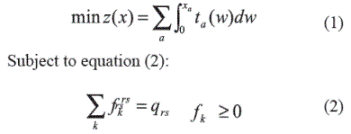
<body><![CDATA[<br> The Frank-Wolfe  method [4] was first introduced in quadratic programming at once it proved very  effective for the resolution of large scale flood problems, with particularly  interesting assets, resting on the marvelous fusion of the mathematical  programming and the graph theory, the Frank-Wolfe method is famous for its  advantages: it is easy to implement and it performs well far from the optimal  solution. Unfortunately, its convergence rate is not entirely satisfactory;  this slowness is due mainly to the way in zigzag described by the points of the  algorithm showing very slow asymptotic convergence. To remedy this  disadvantage, much of attempts have been done, since the first "L. J.  Leblanc" works until recent works of "Ziyou Gao and Al" [5]. The  Frank-Wolfe method is one of the most widely used algorithms for solving  routing problems in the telecom and traffic areas [6], and it is widely used to  solve traffic equilibrium assignment problems [2]. It has the characteristics  of simple implementation and modest memory requirement. However, it also faces  some problems such as slow convergence, no providing path information, and so  on [7], i.e. the FW algorithm converges very slowly when iterations are closing  to the optimal solution [2].     <br>     <br> Sheffi [2] shows  that the application of Frank and Wolfe's convex combinations method to the  solution of transportation network equilibrium was first suggested by  Bruynooghe in 1968 and applied by Murchland in 1969. Shortly thereafter it was  used by LeBlanc in 1975, which coded and tested the algorithm for a small city.  At the same time, Nguyen [8] suggested the use of the convex simplex method for  solving the User Equilibrium equivalent minimization program.      <br>    <br> Also Sheffi shows  that Nguyen [8] also suggested the use of the reduced gradient method and a  modified reduced gradient method for this purpose. In some side-by-side  comparative experiments, Florian and Nguyen [9] found that even though the  convex simplex method converges somewhat faster than the convex combinations  method, it requires more computer memory. Consequently, the overall  computational effort required by both methods is similar. </font></p>      <p><font face="Verdana" size="3"><b> Methodology</b></font></p>      <p><font face="Verdana" size="2"><b><i>Frank Wolfe Algorithm</i></b></font></p>              <p><font face="Verdana" size="2"> In this study the  traffic equilibrium is assumed to have additive path costs, users with perfect  information, fixed demand, there is no link interaction in the network, and the  cost functions are also monotonic, differentiable and continuous. The User  Equilibrium (UE) objective function is given by equation (1):       <p> <img src="/img/revistas/rfiua/n59/n59a05e01.gif"></p>   </font>     <p><font face="Verdana" size="2">Where <i>x<sub>a</sub></i> is the flow on link a, <i>t<sub>a</sub></i> represents travel time  on link  a, <i>f<sub>k</sub><sup>rs</sup></i> represents the flow on path <i>k</i> connecting origin <i>r</i> and destination <em>s</em>, and q<sub>rs</sub> is the trip rate between  origin  <i>r</i> and  destination <em>s</em> during the period of analysis.     ]]></body>
<body><![CDATA[<br>   The objective  function is the sum of the integrals of the link performance functions.  Applying the convex combinations algorithm for the minimization of the UE program  requires, at every iteration, a solution of the linear program (LP) that  decomposes into a set of shortest path problems. The steps of the Frank-Wolfe  Algorithm can be expressed as: </font></p>     <p><font face="Verdana" size="2">    <br>   <i>Step  0: Initialization</i>     <br>       <br>   Perform  all-or-nothing assignment based on <i>t<i><sub>a</sub></i> = t<i><sub>a</sub></i>  (0)</i><img src="/img/revistas/rfiua/n59/n59a04e0a.gif">a. This yields {<i>x<i><sub>a</sub></i></i>}.  Set counter n = 1.     <br>      <i>Step  1: Update</i>     <br>       <br>   Set <i>t<i><sub>a</sub></i> = t<i><sub>a</sub></i> (x<i><sub>a</sub></i>)</i> <img src="/img/revistas/rfiua/n59/n59a04e0a.gif">a     <br>      <i> Step  2: Direction finding</i>     <br>       ]]></body>
<body><![CDATA[<br>   Perform  all-or-nothing assignment based on {<em>t</em><i><sub>a</sub></i>}. This yields a set of  (auxiliary) flows {y<i><sub>a</sub></i>}     <br>      <i>Step  3: Line search</i>     <br>       <br>   Find &alpha;n (0  &le;a&le; 1) that solves equation (3) </font></p> <font face="Verdana" size="2">     <p> <img src="/img/revistas/rfiua/n59/n59a05e03.gif"></p> <i>Step  4: Move</i>     <br>     <br> Set <em>x</em><sub>a</sub><sup>n+1</sup>=<em>x</em><sub>a</sub><sup>n</sup>+&alpha;<sub>n</sub>(y<sub>a</sub><sup>n</sup>-<em>x</em><sub>a</sub><sup>n</sup>)<img src="/img/revistas/rfiua/n59/n59a04e0a.gif">&nbsp;a     <br>     <br> <i>Step  5: Convergence test</i>     <br>     ]]></body>
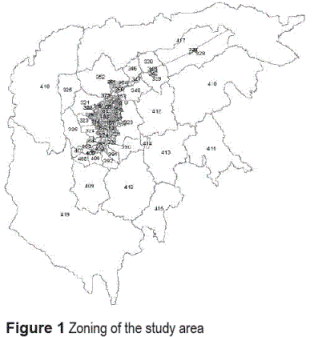
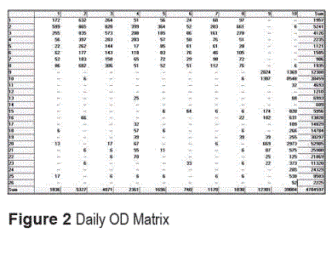
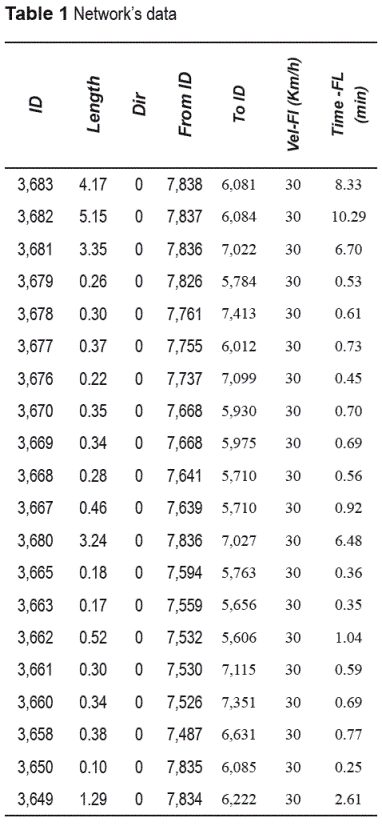
<body><![CDATA[<br> If a convergence  criterion is met, stop (the current solution, {<em>x</em>an+1}, is the set of equilibrium link flows); otherwise, set n:  = n + 1 and go to step 1.</font> </p>      <p><font face="Verdana" size="2"><b><i>Case study</i></b></font></p>      <p><font face="Verdana" size="2">This study takes  place in the Metropolitan Area of the Aburr&aacute; Valley (Medellin city and other 9  municipalities) and it is based on data obtained on most recent studies of  transportation. Those studies were Origin/Destination Survey (2005), Analysis  of transit routes (2005), and Mobility Master Plan (2006) [1]. For this study,  the traffic assignment was done taking into account the demand in PM peak hours  (17:00 - 19:00) because is the time of the day with more congestion.</font></p>       <p><font face="Verdana" size="2"><i>Zoning and Origin-Destination (OD) Matrix</i></font></p>  <font face="Verdana" size="2">The traffic  assignment models take as input flows between all origins and destinations. The  OD Matrix in the study area is defined by 419 zones that are distributed as  depicted in <a href="#Figura1">figure 1</a> [1].      <p align="center"><img src="/img/revistas/rfiua/n59/n59a05i01.gif" ><a name="Figura1"></a></p> Taking  into account the information above and using the software TransCAD &reg;, <a href="#Figura2">figure 2</a> shows the OD matrix of all trips in all zones. </font></p>      <p align="center"><img src="/img/revistas/rfiua/n59/n59a05i02.gif" ><a name="Figura2"></a></p>      <p><font face="Verdana" size="2"><i>The Network</i></font></p>        <p><font face="Verdana" size="2"> Medellin's network  is composed by 1516 nodes and 4502 links connecting all nodes. In a common day,  there are in Medellin 4.8 million trips [1], and those trips need a traffic  network for the traffic assignment. <a href="#Figura3">Figure 3</a> shows the study network. Using  TransCAD&reg;, a network was built with links and nodes that include all 419 zones  in the study area.       <p align="center"><img src="/img/Revistas/rfiua/n59/n59a05i03.gif"  ><a name="Figura3"></a></p>  The network  contains data for links and nodes (See <a href="#Tabla1">table 1</a>) including travel time,  velocity, length, direction, etc. [1].       <p align="center"><img src="/img/revistas/rfiua/n59/n59a05t01.gif" ><a name="Tabla1"></a></p>   For  the purpose of this study there is a sample of a segment (selection) of  Medellin's network and its structure (See <a href="#Figura4">figure 4</a>). This network segment is  composed by 13 nodes and 21 links connecting all nodes (See <a href="#Figura5">figure 5</a>). The  demand between origin 93 and destination 82 was 1,433 trips in the PM peak  hour.       ]]></body>
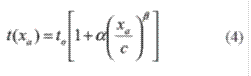
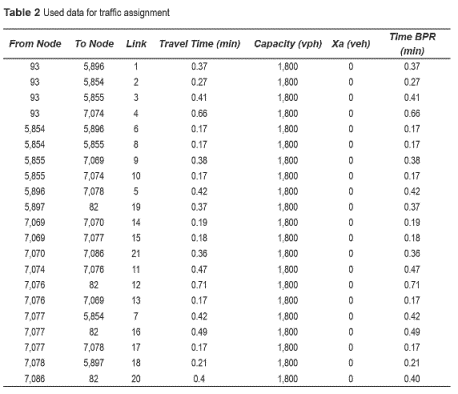
<body><![CDATA[<p align="center"><img src="/img/Revistas/rfiua/n59/n59a05i04.gif"  ><a name="Figura4"></a></p>     <p align="center"><img src="/img/Revistas/rfiua/n59/n59a05i05.gif"  ><a name="Figura5"></a></p>   The cost function  used for the links in the network is given by Bureau of Public Roads (BPR)  function equation (4):       <p> <img src="/img/revistas/rfiua/n59/n59a05e04.gif"></p>   Where:     <br>     <em>t (x<sub>a</sub></em>) = cost of using link a  (given by time)     <br>     <em>t<sub>a</sub></em> = free flow time     <br>     <em>x<sub>a</sub></em> = flow on link a     <br>     <i>c</i> = capacity of the link     <br>   &alpha;,&beta; = given parameters of the  cost function. It is assumed that &alpha; = 0.15 and &beta; =4 </font></p>        <p><font face="Verdana" size="2"><i>The Code</i></font></p>   <font face="Verdana" size="2">The  code was implemented in Visual Basic .NET&reg; and it was supported for some  operations using Microsoft Excel. The first step of this process was to think  in a way to make the program to understand the configuration of the network.  The basic configuration of the code allows finding the shortest path using <i>Dijkstra's  algorithm  </i>[10] between an origin and a destination taking into account the costs (time)  in all paths that connect this pair O-D. The algorithm essentially scans the  network nodes in an iterative manner. At each iteration the algorithm tries to  find a path from the root to the node being scanned that is better (shorter)  than the current path. The data used for the algorithm is presented in <a href="#Tabla2">table 2</a>.          <p align="center"><img src="/img/revistas/rfiua/n59/n59a05t02.gif" ><a name="Tabla2"></a></p>     The O-D pairs were introduced into the algorithm and the  name of each vertex was modified with a new name called Element x, thus in  instance, Node 93 (origin) is Element 0 and Node 82 (destination) is Element  12, and those values were organized as start element, end element and weight  (variable cost). At the end, the Algorithm shows the previous vertex name.     ]]></body>
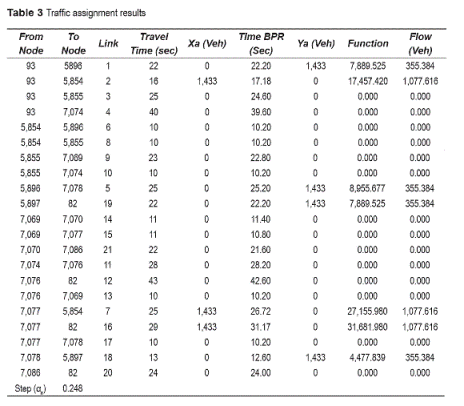
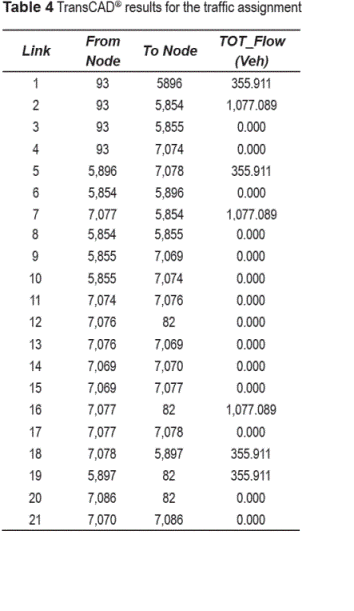
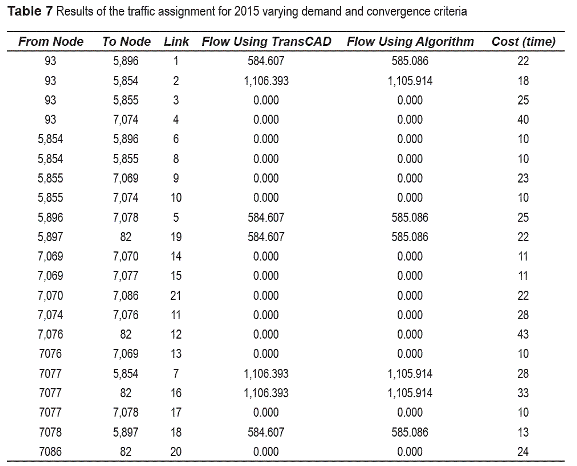
<body><![CDATA[<br>    <br>     Excel  was helpful in order to introduce the data and find some values such as step  size and others. The results of the traffic assignment using Frank Wolfe  algorithm (convergence criteria of 0.01 and using the shortest path with all or  nothing assignment) are presented in <a href="#Tabla3">table 3</a>.       <p align="center"><img src="/img/revistas/rfiua/n59/n59a05t03.gif" ><a name="Tabla3"></a></p>   The shortest path  was presented as shown in <a href="#Figura6">figure 6</a>, where it presented the first shortest path  using all or nothing assignment. The Shortest Path from origin 93 to  destination 82 is given by: 93--&gt;5,854--&gt;7,077--&gt;82.</font></p>      <p align="center"><img src="/img/Revistas/rfiua/n59/n59a05i06.gif"  ><a name="Figura6"></a></p>       <p><font face="Verdana" size="2"><i>Traffic  Assignment with TransCAD &reg;</i></font></p>       <p><font face="Verdana" size="2">Using TransCAD &reg;  and taking into account the data above was done the traffic assignment with the  User Equilibrium method and convergence criteria of 0.01. The results are  presented in <a href="#Tabla4">table 4</a> and in <a href="#Tabla5">table 5</a>. The traffic assignment is depicted in  <a href="#Figura7">figure 7</a>       <p align="center"><img src="/img/revistas/rfiua/n59/n59a05t04.gif" ><a name="Tabla4"></a></p>      <p align="center"><img src="/img/revistas/rfiua/n59/n59a05t05.gif" ><a name="Tabla5"></a></p>     <p align="center"><img src="/img/Revistas/rfiua/n59/n59a05i07.gif"  ><a name="Figura7"></a></p>        <p><font face="Verdana" size="3"><b>Results and discussion</b></font></p>   <font face="Verdana" size="2">The results of the  traffic assignment in the segment of Medellin's Network using the algorithm and  TransCAD &reg; are presented in <a href="#Tabla6">table 6</a>.       ]]></body>
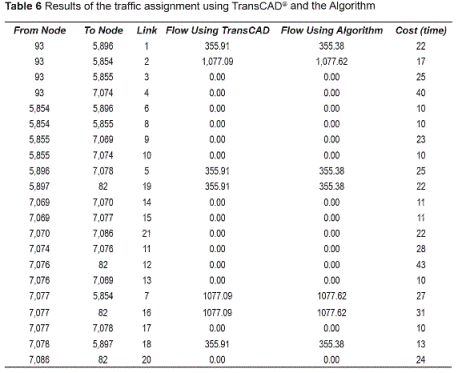
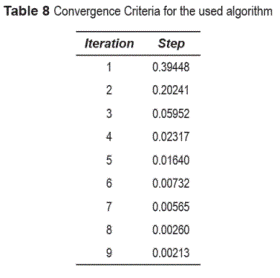
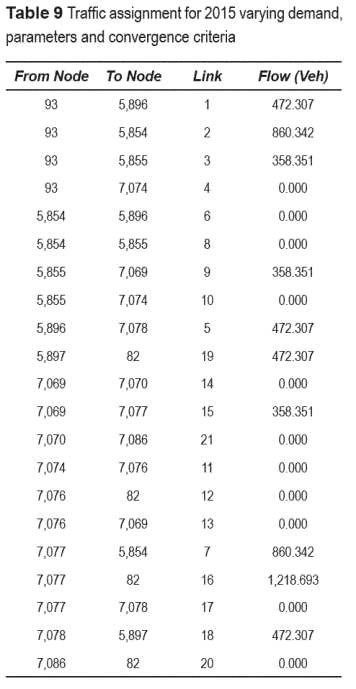
<body><![CDATA[<p align="center"><img src="/img/revistas/rfiua/n59/n59a05t06.gif" ><a name="Tabla6"></a></p>  Comparing the two  result sets using TransCAD<sup>&reg;</sup> and the algorithm, the flow is very similar (except  for some decimals), using convergence criteria of 0.01 it converged in both  cases after two iterations, the step size using TransCAD &reg; for the first  iteration was 0.248368 and for the second iteration was 0.000000. For the other  source the step size was 0.248000 for the first iteration and for the second  one was 0.000000</font></p>      <p><font face="Verdana" size="2"><i><b>Traffic Assignment  varying of demand, alpha, beta and convergence</b></i></font></p>  <font face="Verdana" size="2">One  important issue in transportation modeling is the forecasting process. For that  reason in this paper we assumed a different value of demand between nodes 93  and 82. It is assumed that there will be 1,691 trips in 2015 (increase of 18%)  instead of 1,433 trips. The traffic assignment was done using the User  Equilibrium method and convergence criteria of 0.0001. Using the algorithm, the  step size is alpha n = 0.3460 and using TransCAD &reg; is 0.3457. The result set of  the traffic assignment in the segment of Medellin's Network is presented in  <a href="#Tabla7">table 7</a>         <p align="center"><img src="/img/revistas/rfiua/n59/n59a05t07.gif" ><a name="Tabla7"></a></p>   Comparing the two  result sets using TransCAD &reg; and the algorithm, the flow is very similar and  the results are similar as in the previous case. Now, taking into account  different convergence criteria of 0.05 and 0.001 and calibrated parameters from  the network of alpha (0.68) and beta (2.2), the algorithm took 4 iterations for  the convergence criteria of 0.05, and 10 iterations for the convergence  criteria of 0.001. The results for the latter are presented in <a href="#Tabla8">table 8</a>         <p align="center"><img src="/img/revistas/rfiua/n59/n59a05t08.gif" ><a name="Tabla8"></a></p>   The  results for the traffic assignment in the network varying demand, parameters  and convergence criteria for 2015 are presented in <a href="#Tabla9">table 9</a>        <p align="center"><img src="/img/revistas/rfiua/n59/n59a05t09.gif" ><a name="Tabla9"></a></p>   Comparing the  traffic assignments with variable convergence criteria and with new values of  alpha and beta obtained from the calibration process, we can see that the flow  paths are different from previous cases because it depends of the value of the  step size; and it can be observed that if the convergence criteria is lower,  the number of iterations increases significantly (from 4 to 10), and the step  size reduces in each iteration until get the appropriate value with the same  demand.</font></p>          <p><font face="Verdana" size="3"><b>Conclusions</b></font></p>        <p><font face="Verdana" size="2">&bull;This  work introduces a software application in order to get the traffic assignment  in a real network, with  real demand and costs using Visual Basic .NET&reg; and Excel &reg;. It was made for a  segment of Medellin's Network and the results were compared with TransCAD &reg;  results finding that TransCAD &reg; is a bit faster and shows graphically the path  with the respective flows and costs, and has more accuracy in the results; but  the algorithm can be used for modeling small networks and it is easy to use,  besides of the cost of it (it is free). It could be useful for practitioners  and students.    <br>    <br>     &bull;All  the flows found when the algorithm converged, satisfied the user equilibrium  optimality condition. It explains that the network studied was in equilibrium  and no user had any incentive to change their path choice because they would  increase their travel costs in the network.    <br>    ]]></body>
<body><![CDATA[<br> &bull;The  traffic assignment in this study took into account only travel time and  capacity of the network. The values of Beta and Alpha were assumed. For best  results it would be great to analyze more factors such as velocity, preloads,  stops, etc. and use values of alpha and beta calibrated from the network. The  purpose of this paper is to give an introduction to solve the traffic  assignment in a real network but the code must be improved in order to get a  better model of traffic assignment in any network.    <br>    <br>  &bull;For  different demands, the traffic assignment procedure used the same paths (the  shortest path was always the same) in the network increasing only the flows in  each link according to the traffic forecast. It could change it if is analyzed  the entire network because the ratio of forecast of trips in all city is not  the same.    <br>    <br>  &bull;When  there are various traffic assignments with variable convergence criteria the  flow is different in both cases because it depends of the value of the step  size; and if the convergence criteria is lower, the number of iterations  increases significantly using the Frank-Wolfe Algorithm.    <br>    <br>  &bull;Finally,  it would be good to clarify that the algorithm implementation needs to improve  the integration of Excel &reg; and Visual Basic. NET &reg; in order to get better  results providing input mechanisms of all data required for the traffic  assignment. Thus, it is recommended to continue actively working on the  application user interface in order to facilitate the process of entering this  information.</font></p>          <p><font face="Verdana" size="3"><b>References</b></font></p>         <!-- ref --><p><font face="Verdana" size="2">1. &Aacute;rea  Metropolitana del Valle de Aburr&aacute; (AMVA) - Consorcio Movilidad Regional  Colombia-Chile.<i>Formulaci&oacute;n del Plan Maestro de Movilidad para la Regi&oacute;n  Metropolitana del Valle de Aburr&aacute;</i>. Medell&iacute;n. 2007. Informe Final. Cap&iacute;tulo 2:  Diagn&oacute;stico. pp. 102--188    &nbsp;&nbsp;&nbsp;&nbsp;&nbsp;&nbsp;&nbsp;&nbsp;[&#160;<a href="javascript:void(0);" onclick="javascript: window.open('/scielo.php?script=sci_nlinks&ref=000101&pid=S0120-6230201100030000500001&lng=','','width=640,height=500,resizable=yes,scrollbars=1,menubar=yes,');">Links</a>&#160;]<!-- end-ref --><br>           ]]></body>
<body><![CDATA[<!-- ref --><br>     2.  Y. Sheffi.  <i>Urban Transportation Networks: Equilibrium analysis with mathematical  programming methods.</i> Ed. Prentice-Hall Inc. New Jersey. 1985. pp. 111-132    &nbsp;&nbsp;&nbsp;&nbsp;&nbsp;&nbsp;&nbsp;&nbsp;[&#160;<a href="javascript:void(0);" onclick="javascript: window.open('/scielo.php?script=sci_nlinks&ref=000103&pid=S0120-6230201100030000500002&lng=','','width=640,height=500,resizable=yes,scrollbars=1,menubar=yes,');">Links</a>&#160;]<!-- end-ref --><br>    <!-- ref --><br>     3.  M. Patriksson. <i>The traffic Assignment Problem-Models and Methods.</i> Ed. VSP. Utrecht. 1994. pp.  131--135.    &nbsp;&nbsp;&nbsp;&nbsp;&nbsp;&nbsp;&nbsp;&nbsp;[&#160;<a href="javascript:void(0);" onclick="javascript: window.open('/scielo.php?script=sci_nlinks&ref=000105&pid=S0120-6230201100030000500003&lng=','','width=640,height=500,resizable=yes,scrollbars=1,menubar=yes,');">Links</a>&#160;]<!-- end-ref --><br>    <!-- ref --><br>     4.  M. Frank, P. H. Wolfe. "An algorithm for quadratic programming". <i>Naval Res.  Logist. Quart.</i>  Vol. 3. 1956. pp. 95-110.    &nbsp;&nbsp;&nbsp;&nbsp;&nbsp;&nbsp;&nbsp;&nbsp;[&#160;<a href="javascript:void(0);" onclick="javascript: window.open('/scielo.php?script=sci_nlinks&ref=000107&pid=S0120-6230201100030000500004&lng=','','width=640,height=500,resizable=yes,scrollbars=1,menubar=yes,');">Links</a>&#160;]<!-- end-ref --><br>    <!-- ref --><br>     5.  S. Arrache, R. Ouafi, "Improved Frank-Wolfe method: application to the  traffic assignment problem". <i>Proceedings of  the International Congress of Mathematicians, Section 15.</i> Madrid. 2006. pp. 8-9. <a href="http://www.icm2006.org/v_f/AbsDef/Posters/abs_1702.pdf" target="_blank">http://www.icm2006.org/v_f/AbsDef/Posters/abs_1702.pdf</a><u>.</u> Consultada el 8 de septiembre de 2009.     &nbsp;&nbsp;&nbsp;&nbsp;&nbsp;&nbsp;&nbsp;&nbsp;[&#160;<a href="javascript:void(0);" onclick="javascript: window.open('/scielo.php?script=sci_nlinks&ref=000109&pid=S0120-6230201100030000500005&lng=','','width=640,height=500,resizable=yes,scrollbars=1,menubar=yes,');">Links</a>&#160;]<!-- end-ref --><br>    <!-- ref --><br>     6. S. Arrache, R. Ouafi.  "Accelerating Convergence of the Frank-Wolfe Algorithm for Solving the  Traffic Assignment Problem".<i> IJCSNS  International Journal of Computer Science and Network Security.</i> Vol.8. 2008. pp.  181-186.    &nbsp;&nbsp;&nbsp;&nbsp;&nbsp;&nbsp;&nbsp;&nbsp;[&#160;<a href="javascript:void(0);" onclick="javascript: window.open('/scielo.php?script=sci_nlinks&ref=000111&pid=S0120-6230201100030000500006&lng=','','width=640,height=500,resizable=yes,scrollbars=1,menubar=yes,');">Links</a>&#160;]<!-- end-ref --><br>    ]]></body>
<body><![CDATA[<!-- ref --><br>     7.  X. Meng, Q. Yunchao, G. Ziyou. "Implementing Frank-Wolfe Algorithm under  Different Flow Update Strategies and Line Search Technologies". <i>Journal of  Transportation Systems Engineering and Information Technology.</i> Vol. 8. 2008. pp. 14-22.    &nbsp;&nbsp;&nbsp;&nbsp;&nbsp;&nbsp;&nbsp;&nbsp;[&#160;<a href="javascript:void(0);" onclick="javascript: window.open('/scielo.php?script=sci_nlinks&ref=000113&pid=S0120-6230201100030000500007&lng=','','width=640,height=500,resizable=yes,scrollbars=1,menubar=yes,');">Links</a>&#160;]<!-- end-ref --><br>    <!-- ref --><br>     8.  S. Nguyen. "An Algorithm for the Traffic Assignment Problem". <i>Transportation  Science. </i> Vol. 8. 1974. pp. 203-216.    &nbsp;&nbsp;&nbsp;&nbsp;&nbsp;&nbsp;&nbsp;&nbsp;[&#160;<a href="javascript:void(0);" onclick="javascript: window.open('/scielo.php?script=sci_nlinks&ref=000115&pid=S0120-6230201100030000500008&lng=','','width=640,height=500,resizable=yes,scrollbars=1,menubar=yes,');">Links</a>&#160;]<!-- end-ref --><br>    <!-- ref --><br>     9.  M. Florian, S. Nguyen. "An Application and Validation of Equilibrium. Trip  Assignment Methods". <i>Transportation Science </i>Vol. 10. 1976. pp. 374-390.    &nbsp;&nbsp;&nbsp;&nbsp;&nbsp;&nbsp;&nbsp;&nbsp;[&#160;<a href="javascript:void(0);" onclick="javascript: window.open('/scielo.php?script=sci_nlinks&ref=000117&pid=S0120-6230201100030000500009&lng=','','width=640,height=500,resizable=yes,scrollbars=1,menubar=yes,');">Links</a>&#160;]<!-- end-ref --><br>    <!-- ref --><br> 10. E. W. Dijkstra. "A  note on two problems in connexion with graphs". <i>Numerische  Mathematik.</i>  Vol. 1. 1959. pp. 269-271.</font>&nbsp;&nbsp;&nbsp;&nbsp;&nbsp;&nbsp;&nbsp;&nbsp;[&#160;<a href="javascript:void(0);" onclick="javascript: window.open('/scielo.php?script=sci_nlinks&ref=000119&pid=S0120-6230201100030000500010&lng=','','width=640,height=500,resizable=yes,scrollbars=1,menubar=yes,');">Links</a>&#160;]<!-- end-ref --><br>          <br>    <br>     ]]></body>
<body><![CDATA[<p><font face="Verdana" size="2">(Recibido el 16 de febrero  de 2010. Aceptado el 31 de agosto de 2010)</font></p>     <p><font face="Verdana" size="2"><sup>*</sup>Autor de correspondencia: tel&eacute;fono: + 57 + 4 + 219 55 70,fax: + 57 + 4 + 219 55 14,  correo electr&oacute;nico:<a href="mailto:gonzalez@udea.edu.co">gonzalez@udea.edu.co</a> (C. Gonz&aacute;lez)</font></p>      ]]></body><back>
<ref-list>
<ref id="B1">
<label>1</label><nlm-citation citation-type="">
<collab>Área Metropolitana del Valle de Aburrá (AMVA)</collab>
<collab>Consorcio Movilidad Regional Colombia-Chile</collab>
<source><![CDATA[Formulación del Plan Maestro de Movilidad para la Región Metropolitana del Valle de Aburrá]]></source>
<year>2007</year>
<page-range>102--188</page-range><publisher-loc><![CDATA[Medellín ]]></publisher-loc>
</nlm-citation>
</ref>
<ref id="B2">
<label>2</label><nlm-citation citation-type="book">
<person-group person-group-type="author">
<name>
<surname><![CDATA[Sheffi]]></surname>
<given-names><![CDATA[Y]]></given-names>
</name>
</person-group>
<source><![CDATA[Urban Transportation Networks: Equilibrium analysis with mathematical programming methods]]></source>
<year>1985</year>
<page-range>111-132</page-range><publisher-loc><![CDATA[New Jersey ]]></publisher-loc>
<publisher-name><![CDATA[Ed. Prentice-Hall Inc]]></publisher-name>
</nlm-citation>
</ref>
<ref id="B3">
<label>3</label><nlm-citation citation-type="book">
<person-group person-group-type="author">
<name>
<surname><![CDATA[Patriksson]]></surname>
<given-names><![CDATA[M]]></given-names>
</name>
</person-group>
<source><![CDATA[The traffic Assignment Problem-Models and Methods]]></source>
<year>1994</year>
<page-range>131--135</page-range><publisher-loc><![CDATA[Utrecht ]]></publisher-loc>
<publisher-name><![CDATA[Ed. VSP]]></publisher-name>
</nlm-citation>
</ref>
<ref id="B4">
<label>4</label><nlm-citation citation-type="journal">
<person-group person-group-type="author">
<name>
<surname><![CDATA[Frank]]></surname>
<given-names><![CDATA[M]]></given-names>
</name>
<name>
<surname><![CDATA[Wolfe]]></surname>
<given-names><![CDATA[P. H]]></given-names>
</name>
</person-group>
<article-title xml:lang="en"><![CDATA[An algorithm for quadratic programming]]></article-title>
<source><![CDATA[Naval Res. Logist. Quart]]></source>
<year>1956</year>
<volume>3</volume>
<page-range>95-110</page-range></nlm-citation>
</ref>
<ref id="B5">
<label>5</label><nlm-citation citation-type="confpro">
<person-group person-group-type="author">
<name>
<surname><![CDATA[Arrache]]></surname>
<given-names><![CDATA[S]]></given-names>
</name>
<name>
<surname><![CDATA[Ouafi]]></surname>
<given-names><![CDATA[R]]></given-names>
</name>
</person-group>
<source><![CDATA[Improved Frank-Wolfe method: application to the traffic assignment problem"]]></source>
<year></year>
<conf-name><![CDATA[ Proceedings of the International Congress of Mathematicians, Section 15]]></conf-name>
<conf-date>2006</conf-date>
<conf-loc>Madrid </conf-loc>
</nlm-citation>
</ref>
<ref id="B6">
<label>6</label><nlm-citation citation-type="journal">
<person-group person-group-type="author">
<name>
<surname><![CDATA[Arrache]]></surname>
<given-names><![CDATA[S]]></given-names>
</name>
<name>
<surname><![CDATA[Ouafi]]></surname>
<given-names><![CDATA[R]]></given-names>
</name>
</person-group>
<article-title xml:lang="en"><![CDATA[Accelerating Convergence of the Frank-Wolfe Algorithm for Solving the Traffic Assignment Problem]]></article-title>
<source><![CDATA[IJCSNS International Journal of Computer Science and Network Security]]></source>
<year>2008</year>
<volume>8</volume>
<page-range>181-186</page-range></nlm-citation>
</ref>
<ref id="B7">
<label>7</label><nlm-citation citation-type="journal">
<person-group person-group-type="author">
<name>
<surname><![CDATA[Meng]]></surname>
<given-names><![CDATA[X]]></given-names>
</name>
<name>
<surname><![CDATA[Yunchao]]></surname>
<given-names><![CDATA[Q]]></given-names>
</name>
<name>
<surname><![CDATA[Ziyou]]></surname>
<given-names><![CDATA[G]]></given-names>
</name>
</person-group>
<article-title xml:lang="en"><![CDATA[Implementing Frank-Wolfe Algorithm under Different Flow Update Strategies and Line Search Technologies]]></article-title>
<source><![CDATA[Journal of Transportation Systems Engineering and Information Technology]]></source>
<year>2008</year>
<volume>8</volume>
<page-range>14-22</page-range></nlm-citation>
</ref>
<ref id="B8">
<label>8</label><nlm-citation citation-type="journal">
<person-group person-group-type="author">
<name>
<surname><![CDATA[Nguyen]]></surname>
<given-names><![CDATA[S]]></given-names>
</name>
</person-group>
<article-title xml:lang="en"><![CDATA[An Algorithm for the Traffic Assignment Problem]]></article-title>
<source><![CDATA[Transportation Science]]></source>
<year>1974</year>
<volume>8</volume>
<page-range>203-216</page-range></nlm-citation>
</ref>
<ref id="B9">
<label>9</label><nlm-citation citation-type="journal">
<person-group person-group-type="author">
<name>
<surname><![CDATA[Florian]]></surname>
<given-names><![CDATA[M]]></given-names>
</name>
<name>
<surname><![CDATA[Nguyen]]></surname>
<given-names><![CDATA[S]]></given-names>
</name>
</person-group>
<article-title xml:lang="en"><![CDATA[An Application and Validation of Equilibrium. Trip Assignment Methods]]></article-title>
<source><![CDATA[Transportation Science]]></source>
<year>1976</year>
<volume>10</volume>
<page-range>374-390</page-range></nlm-citation>
</ref>
<ref id="B10">
<label>10</label><nlm-citation citation-type="journal">
<person-group person-group-type="author">
<name>
<surname><![CDATA[Dijkstra]]></surname>
<given-names><![CDATA[E. W]]></given-names>
</name>
</person-group>
<article-title xml:lang="en"><![CDATA[A note on two problems in connexion with graphs]]></article-title>
<source><![CDATA[Numerische Mathematik]]></source>
<year>1959</year>
<volume>1</volume>
<page-range>269-271</page-range></nlm-citation>
</ref>
</ref-list>
</back>
</article>